Cambridge A Level Psychology (from 2018) 9990 — 2023 Oct/Nov Paper 4 · Variant 1
9990/41/O/N/23 · 12 questions · 60 marks · ≈68 min
The question paper and its mark scheme, free to read here and free to download. This is Cambridge’s own paper, exactly as it was sat.
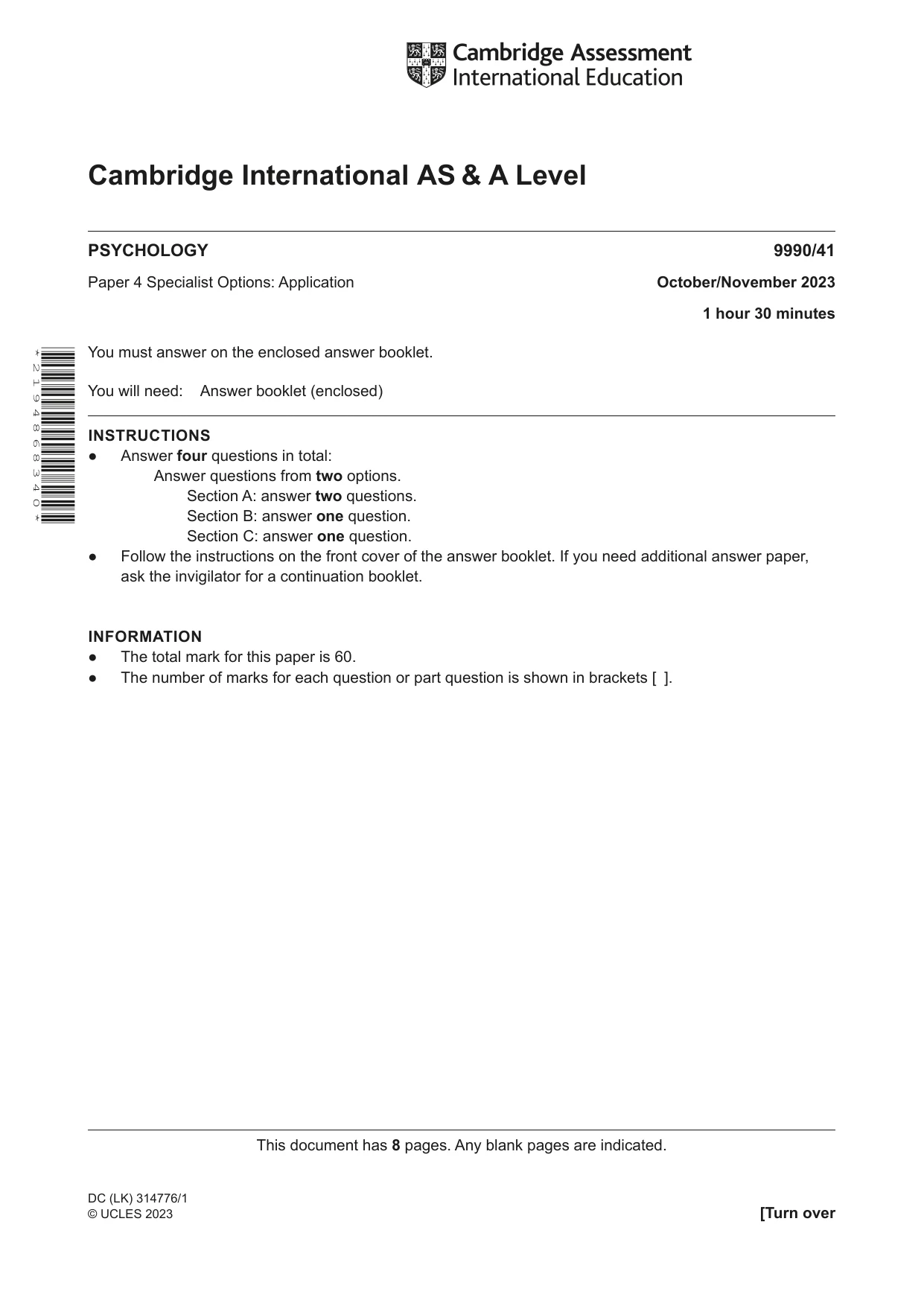
Question paper8 pages



Mark scheme24 pages
Answers below. Sit the paper first if you are practising.
Questions as text
Q1 · One explanation of bipolar disorder is that it is genetic
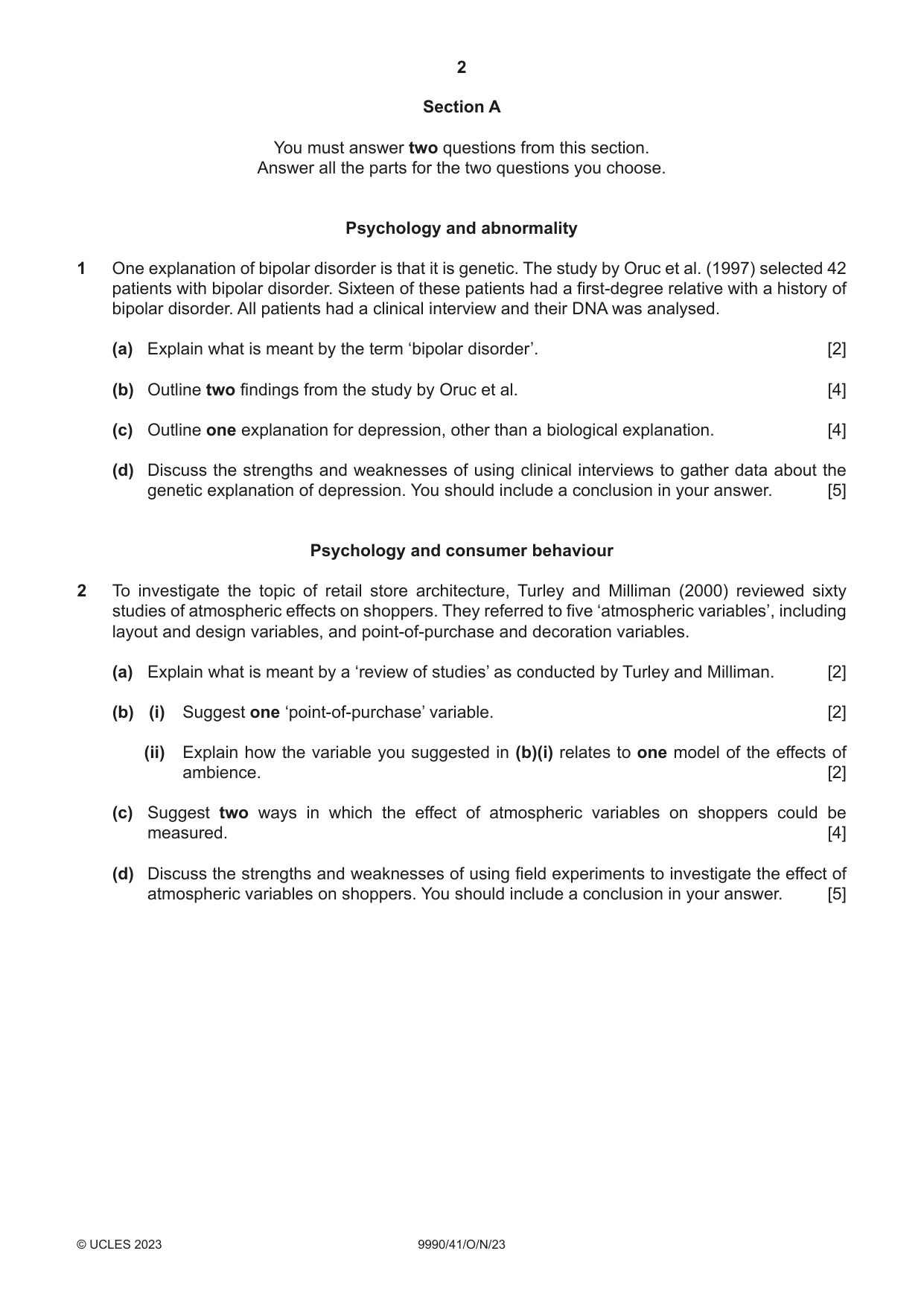
1 One explanation of bipolar disorder is that it is genetic. The study by Oruc et al. (1997) selected 42 patients with bipolar disorder. Sixteen of these patients had a first-degree relative with a history of bipolar disorder. All patients had a clinical interview and their DNA was analysed. (a) Explain what is meant by the term ‘bipolar disorder’. [2] (b) Outline two findings from the study by Oruc et al. [4] (c) Outline one explanation for depression, other than a biological explanation. [4] (d) Discuss the strengths and weaknesses of using clinical interviews to gather data about the genetic explanation of depression. You should include a conclusion in your answer. [5] Psychology and consumer behaviour
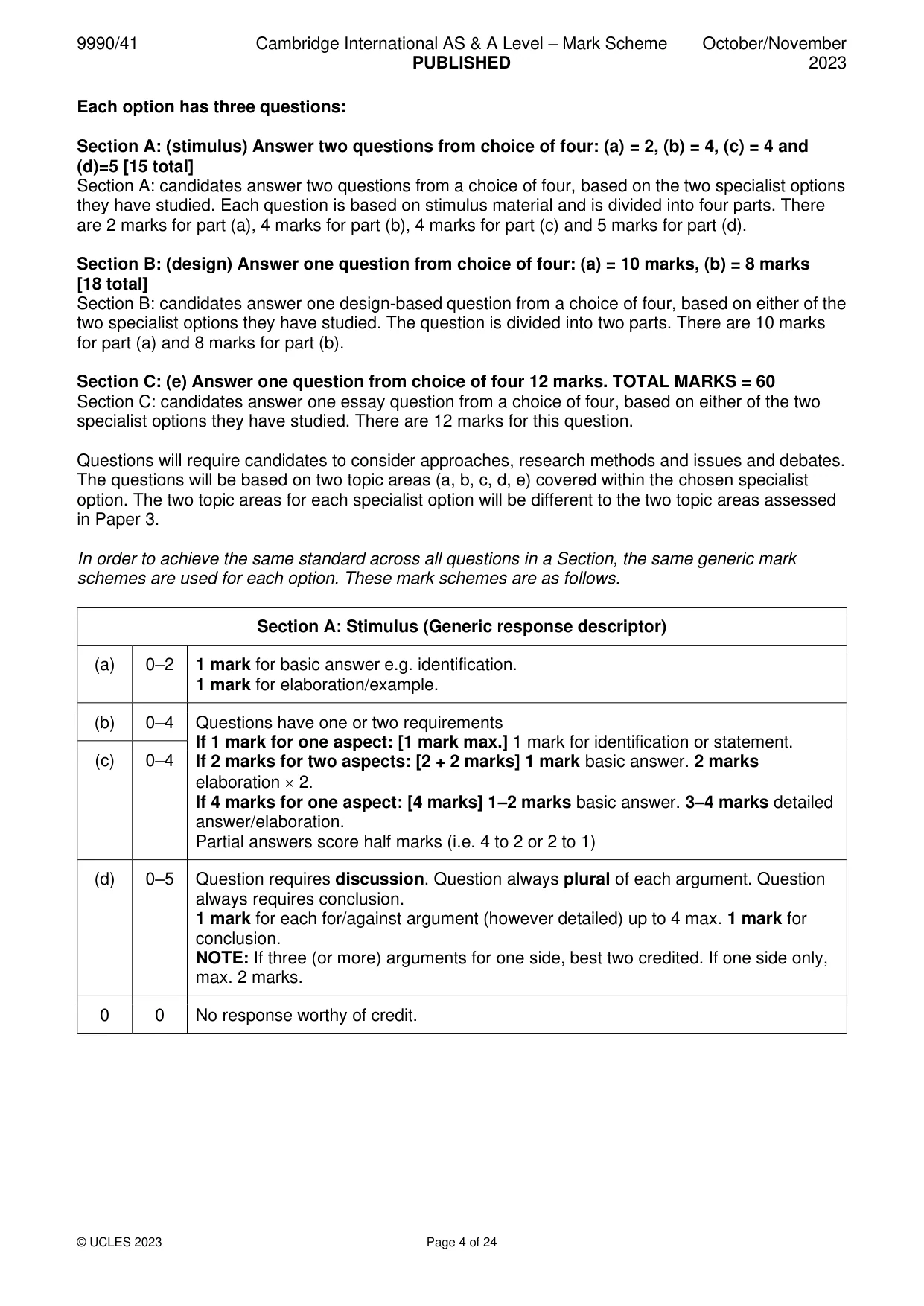
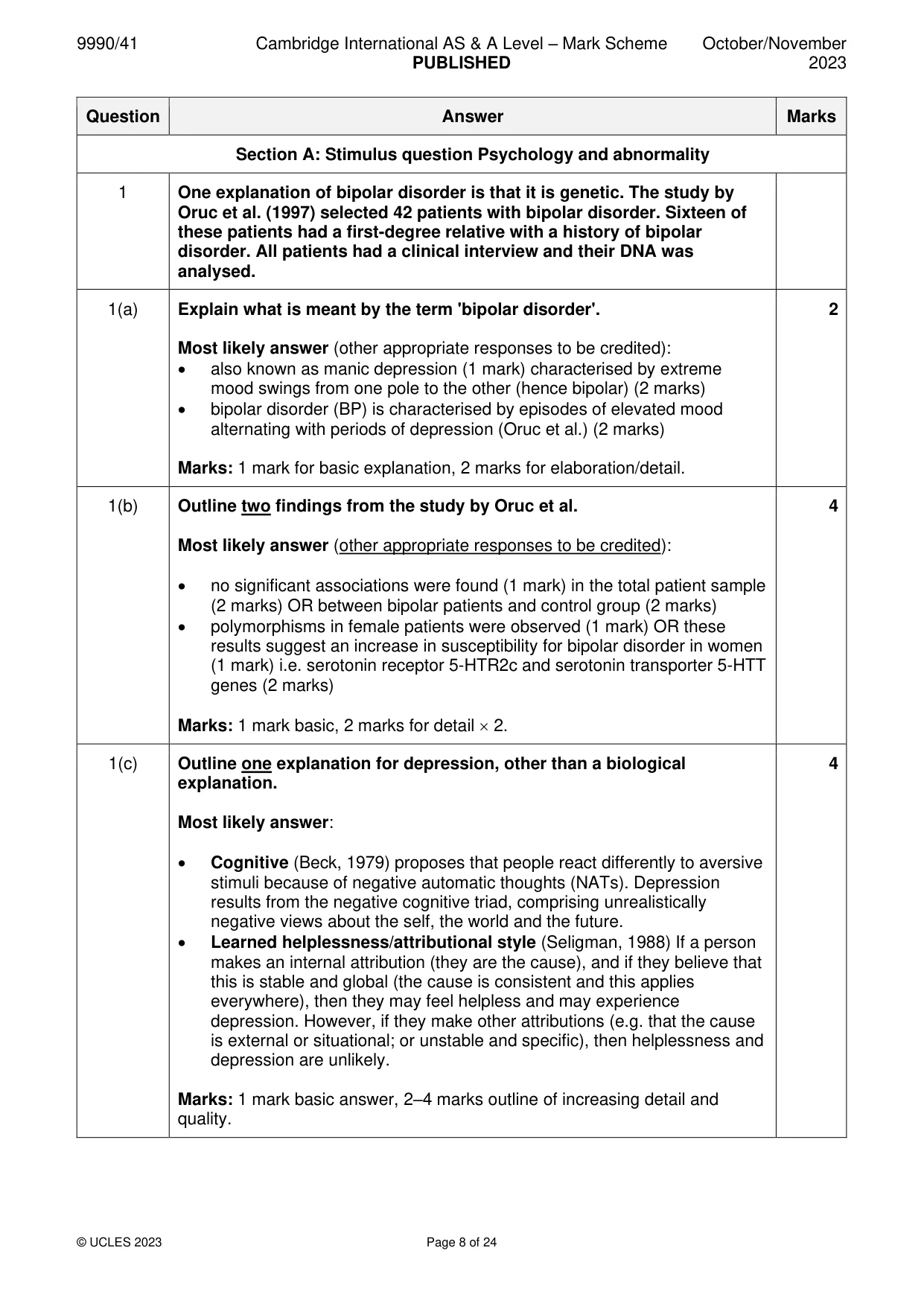
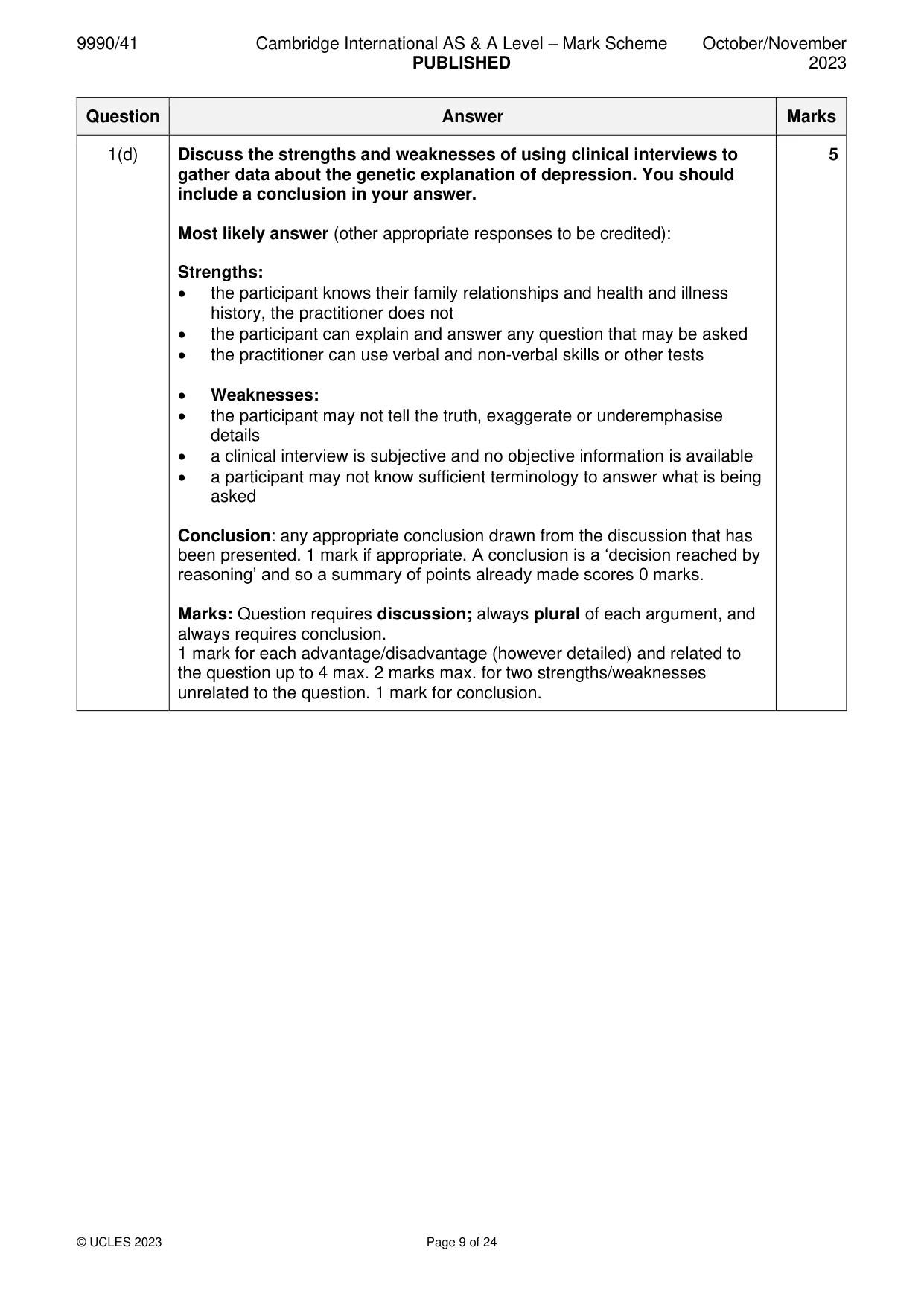
Mark scheme: Question Answer Marks Section A: Stimulus question Psychology and abnormality 1 One explanation of bipolar disorder is that it is genetic. The study by Oruc et al. (1997) selected 42 patients with bipolar disorder. Sixteen of these patients had a first-degree relative with a history of bipolar disorder. All patients had a clinical interview and their DNA was analysed. 1(a) Explain what is meant by the term 'bipolar disorder'. 2 Most likely answer (other appropriate responses to be credited): • also known as manic depression (1 mark) characterised by extreme mood swings from one pole to the other (hence bipolar) (2 marks) • bipolar disorder (BP) is characterised by episodes of elevated mood alternating with periods of depression (Oruc et al.) (2 marks) Marks: 1 mark for basic explanation, 2 marks for elaboration/detail. 1(b) Outline two findings from the study by Oruc et al. 4 Most likely answer (other appropriate responses to be credited): • no significant associations were found (1 mark) in the total patient sample (2 marks) OR between bipolar patients and control group (2 marks) • polymorphisms in female patients were observed (1 mark) OR these results suggest an increase in susceptibility for bipolar disorder in women (1 mark) i.e. serotonin receptor 5-HTR2c and serotonin transporter 5-HTT genes (2 marks) Marks: 1 mark basic, 2 marks for detail 2. 1(c) Outline one explanation for depression, other than a biological 4 explanation. Most likely answer: • Cognitive (Beck, 1979) proposes that people react differently to aversive stimuli because of negative automatic thoughts (NATs). Depression results from the negative cognitive triad, comprising unrealistically negative views about the self, the world and the future. • Learned helplessness/attributional style (Seligman, 1988) If a person makes an internal attribution (they are the cause), and if they believe that this is stable and global (the cause is consistent and this applies everywhere), then they may feel helpless and may experience depression. However, if they make other attributions (e.g. that the cause is external or situational; or unstable and specific), then helplessness and depression are unlikely. Marks: 1 mark basic answer, 2–4 marks outline of increasing detail and quality. 1(d) Discuss the strengths and weaknesses of using clinical interviews to 5 gather data about the genetic explanation of depression. You should include a conclusion in your answer. Most likely answer (other appropriate responses to be credited): Strengths: • the participant knows their family relationships and health and illness history, the practitioner does not • the participant can explain and answer any question that may be asked • the practitioner can use verbal and non-verbal skills or other tests • Weaknesses: • the participant may not tell the truth, exaggerate or underemphasise details • a clinical interview is subjective and no objective information is available • a participant may not know sufficient terminology to answer what is being asked Conclusion: any appropriate conclusion drawn from the discussion that has been presented. 1 mark if appropriate. A conclusion is a ‘decision reached by reasoning’ and so a summary of points already made scores 0 marks. Marks: Question requires discussion; always plural of each argument, and always requires conclusion. 1 mark for each advantage/disadvantage (however detailed) and related to the question up to 4 max. 2 marks max. for two strengths/weaknesses unrelated to the question. 1 mark for conclusion.
More questions on Mood (affective) disorders: depressive disorder (unipolar) and bipolar disorder
Q2 · To investigate the topic of retail store architecture, Turley and Milliman (2000)…
2 To investigate the topic of retail store architecture, Turley and Milliman (2000) reviewed sixty studies of atmospheric effects on shoppers. They referred to five ‘atmospheric variables’, including layout and design variables, and point-of-purchase and decoration variables. (a) Explain what is meant by a ‘review of studies’ as conducted by Turley and Milliman. [2] (b) (i) Suggest one ‘point-of-purchase’ variable. [2] (ii) Explain how the variable you suggested in (b)(i) relates to one model of the effects of ambience. [2] (c) Suggest two ways in which the effect of atmospheric variables on shoppers could be measured. [4] (d) Discuss the strengths and weaknesses of using field experiments to investigate the effect of atmospheric variables on shoppers. You should include a conclusion in your answer. [5] Psychology and health
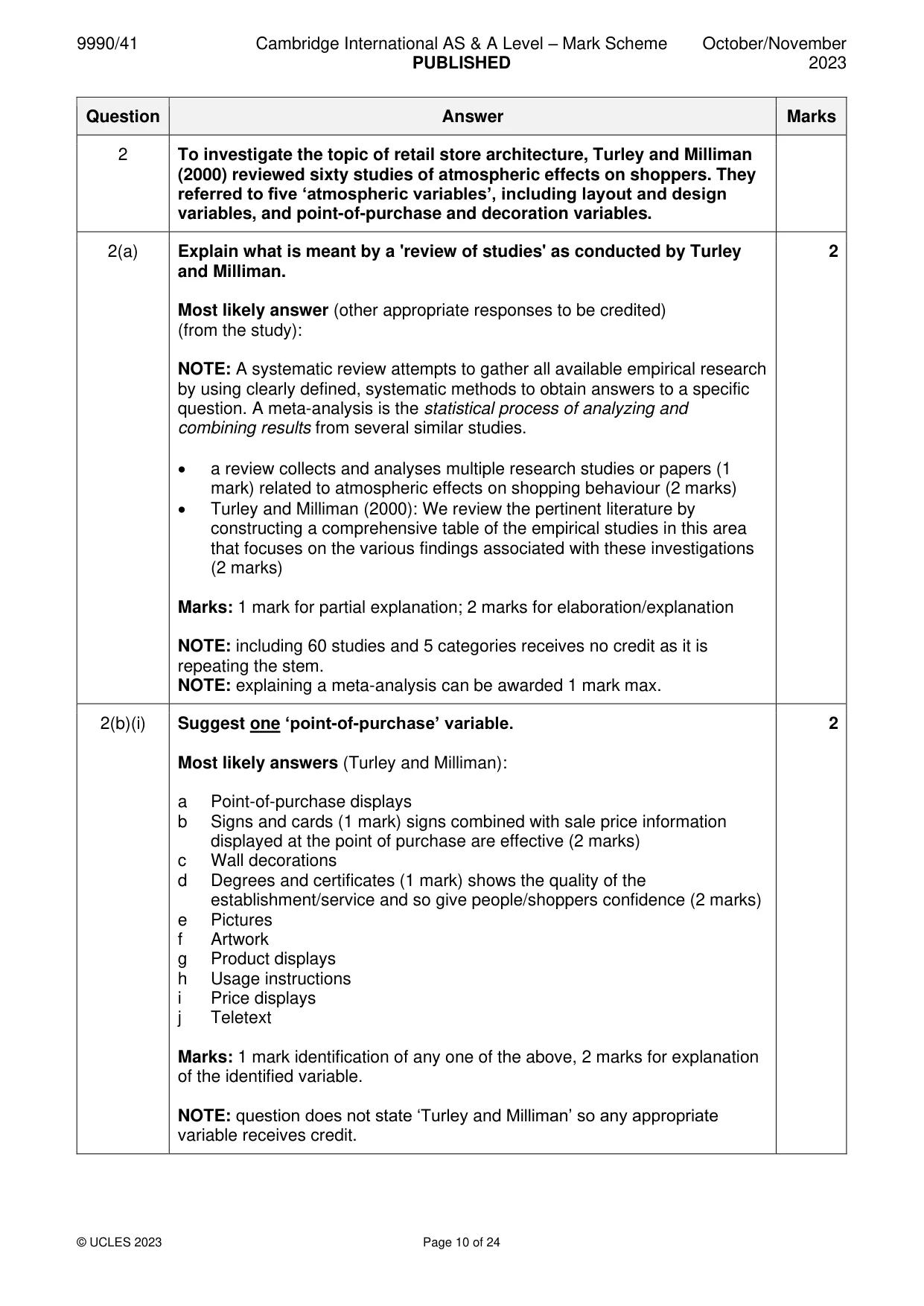
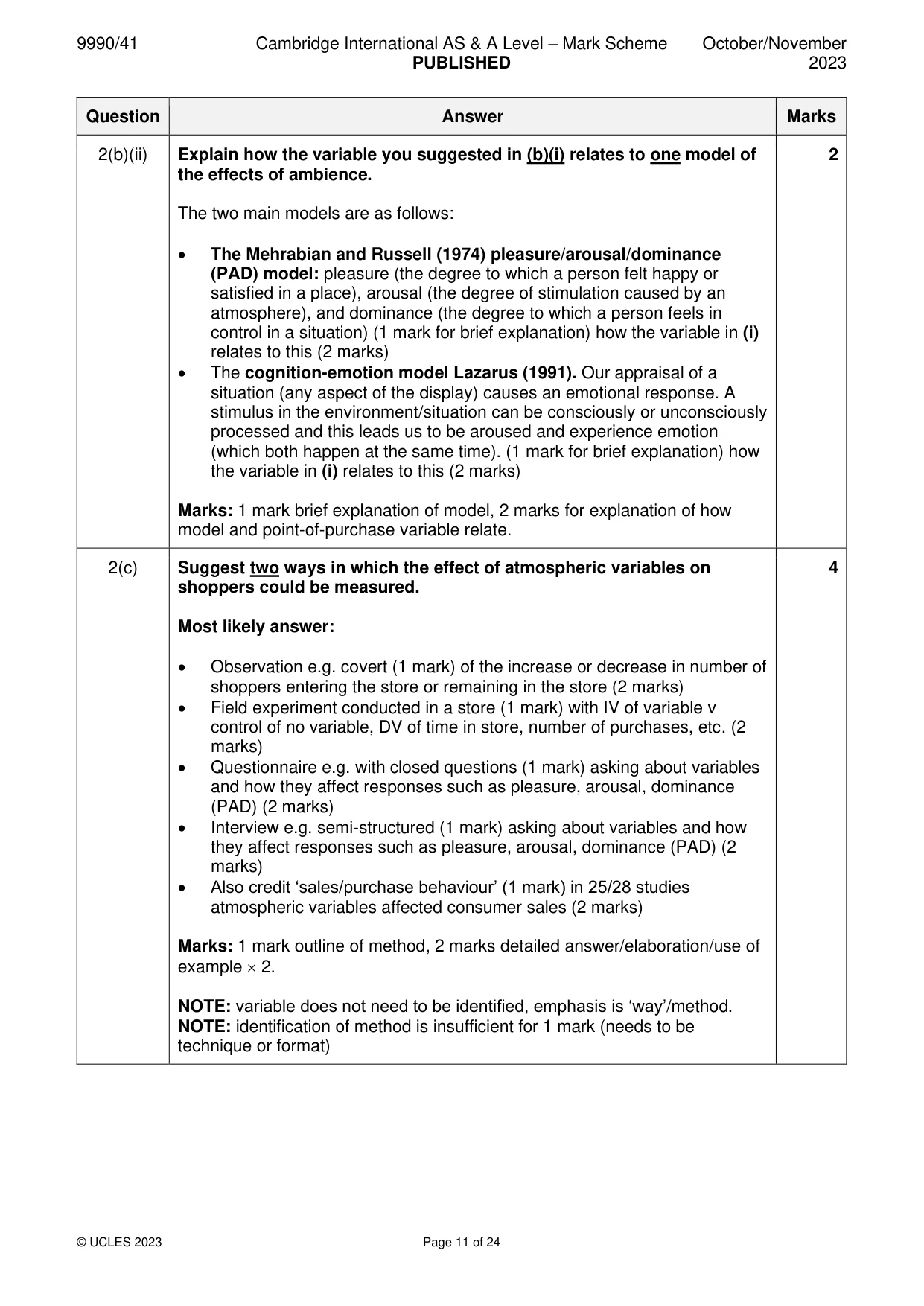
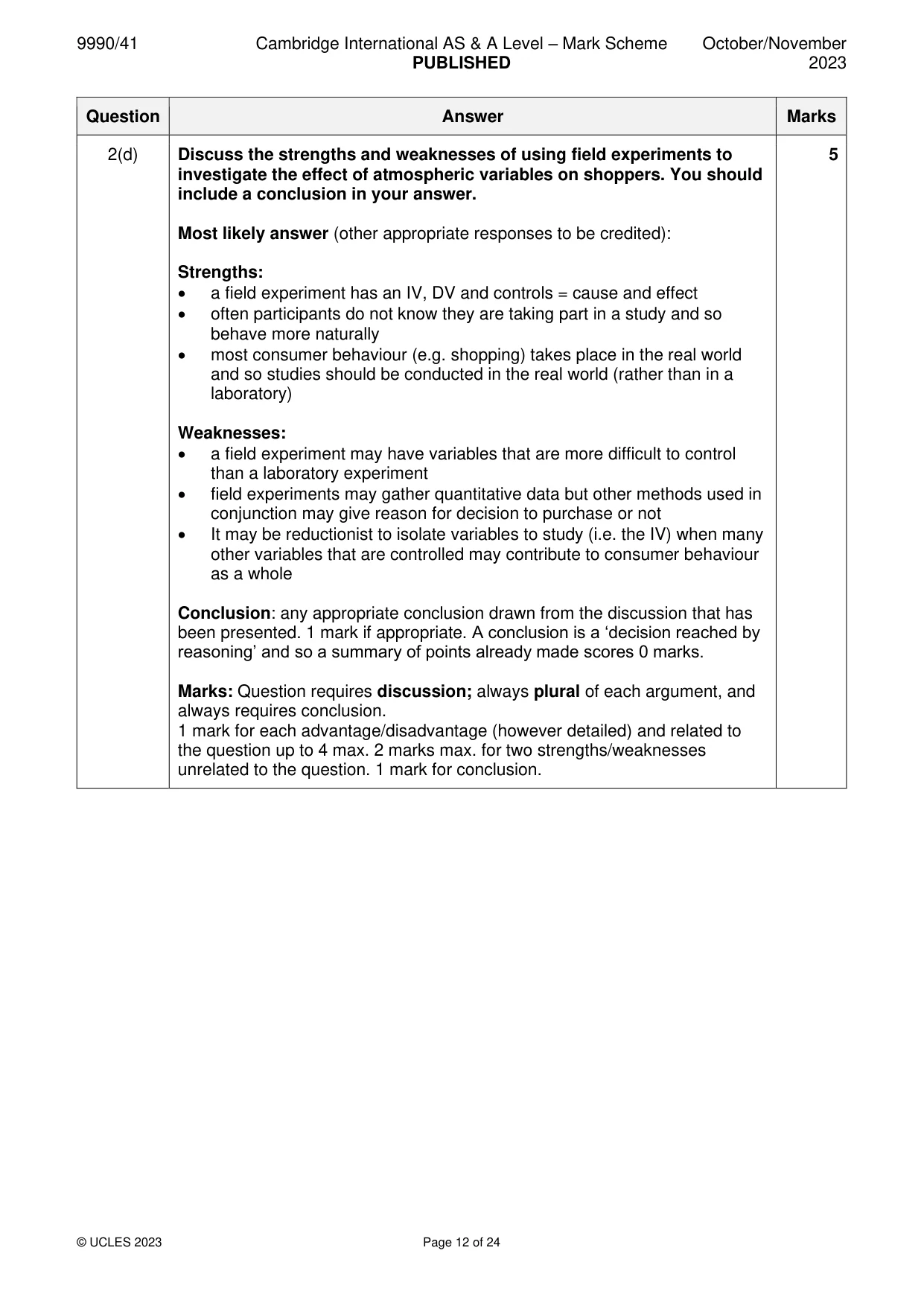
Mark scheme: 2 To investigate the topic of retail store architecture, Turley and Milliman (2000) reviewed sixty studies of atmospheric effects on shoppers. They referred to five ‘atmospheric variables’, including layout and design variables, and point-of-purchase and decoration variables. 2(a) Explain what is meant by a 'review of studies' as conducted by Turley 2 and Milliman. Most likely answer (other appropriate responses to be credited) (from the study): NOTE: A systematic review attempts to gather all available empirical research by using clearly defined, systematic methods to obtain answers to a specific question. A meta-analysis is the statistical process of analyzing and combining results from several similar studies. • a review collects and analyses multiple research studies or papers (1 mark) related to atmospheric effects on shopping behaviour (2 marks) • Turley and Milliman (2000): We review the pertinent literature by constructing a comprehensive table of the empirical studies in this area that focuses on the various findings associated with these investigations (2 marks) Marks: 1 mark for partial explanation; 2 marks for elaboration/explanation NOTE: including 60 studies and 5 categories receives no credit as it is repeating the stem. NOTE: explaining a meta-analysis can be awarded 1 mark max. 2(b)(i) Suggest one ‘point-of-purchase’ variable. 2 Most likely answers (Turley and Milliman): a Point-of-purchase displays b Signs and cards (1 mark) signs combined with sale price information displayed at the point of purchase are effective (2 marks) c Wall decorations d Degrees and certificates (1 mark) shows the quality of the establishment/service and so give people/shoppers confidence (2 marks) e Pictures f Artwork g Product displays h Usage instructions i Price displays j Teletext Marks: 1 mark identification of any one of the above, 2 marks for explanation of the identified variable. NOTE: question does not state ‘Turley and Milliman’ so any appropriate variable receives credit. 2(b)(ii) Explain how the variable you suggested in (b)(i) relates to one model of 2 the effects of ambience. The two main models are as follows: • The Mehrabian and Russell (1974) pleasure/arousal/dominance (PAD) model: pleasure (the degree to which a person felt happy or satisfied in a place), arousal (the degree of stimulation caused by an atmosphere), and dominance (the degree to which a person feels in control in a situation) (1 mark for brief explanation) how the variable in (i) relates to this (2 marks) • The cognition-emotion model Lazarus (1991). Our appraisal of a situation (any aspect of the display) causes an emotional response. A stimulus in the environment/situation can be consciously or unconsciously processed and this leads us to be aroused and experience emotion (which both happen at the same time). (1 mark for brief explanation) how the variable in (i) relates to this (2 marks) Marks: 1 mark brief explanation of model, 2 marks for explanation of how model and point-of-purchase variable relate. 2(c) Suggest two ways in which the effect of atmospheric variables on 4 shoppers could be measured. Most likely answer: • Observation e.g. covert (1 mark) of the increase or decrease in number of shoppers entering the store or remaining in the store (2 marks) • Field experiment conducted in a store (1 mark) with IV of variable v control of no variable, DV of time in store, number of purchases, etc. (2 marks) • Questionnaire e.g. with closed questions (1 mark) asking about variables and how they affect responses such as pleasure, arousal, dominance (PAD) (2 marks) • Interview e.g. semi-structured (1 mark) asking about variables and how they affect responses such as pleasure, arousal, dominance (PAD) (2 marks) • Also credit ‘sales/purchase behaviour’ (1 mark) in 25/28 studies atmospheric variables affected consumer sales (2 marks) Marks: 1 mark outline of method, 2 marks detailed answer/elaboration/use of example 2. NOTE: variable does not need to be identified, emphasis is ‘way’/method. NOTE: identification of method is insufficient for 1 mark (needs to be technique or format) 2(d) Discuss the strengths and weaknesses of using field experiments to 5 investigate the effect of atmospheric variables on shoppers. You should include a conclusion in your answer. Most likely answer (other appropriate responses to be credited): Strengths: • a field experiment has an IV, DV and controls = cause and effect • often participants do not know they are taking part in a study and so behave more naturally • most consumer behaviour (e.g. shopping) takes place in the real world and so studies should be conducted in the real world (rather than in a laboratory) Weaknesses: • a field experiment may have variables that are more difficult to control than a laboratory experiment • field experiments may gather quantitative data but other methods used in conjunction may give reason for decision to purchase or not • It may be reductionist to isolate variables to study (i.e. the IV) when many other variables that are controlled may contribute to consumer behaviour as a whole Conclusion: any appropriate conclusion drawn from the discussion that has been presented. 1 mark if appropriate. A conclusion is a ‘decision reached by reasoning’ and so a summary of points already made scores 0 marks. Marks: Question requires discussion; always plural of each argument, and always requires conclusion. 1 mark for each advantage/disadvantage (however detailed) and related to the question up to 4 max. 2 marks max. for two strengths/weaknesses unrelated to the question. 1 mark for conclusion.
Q3 · Many people experience chronic pain
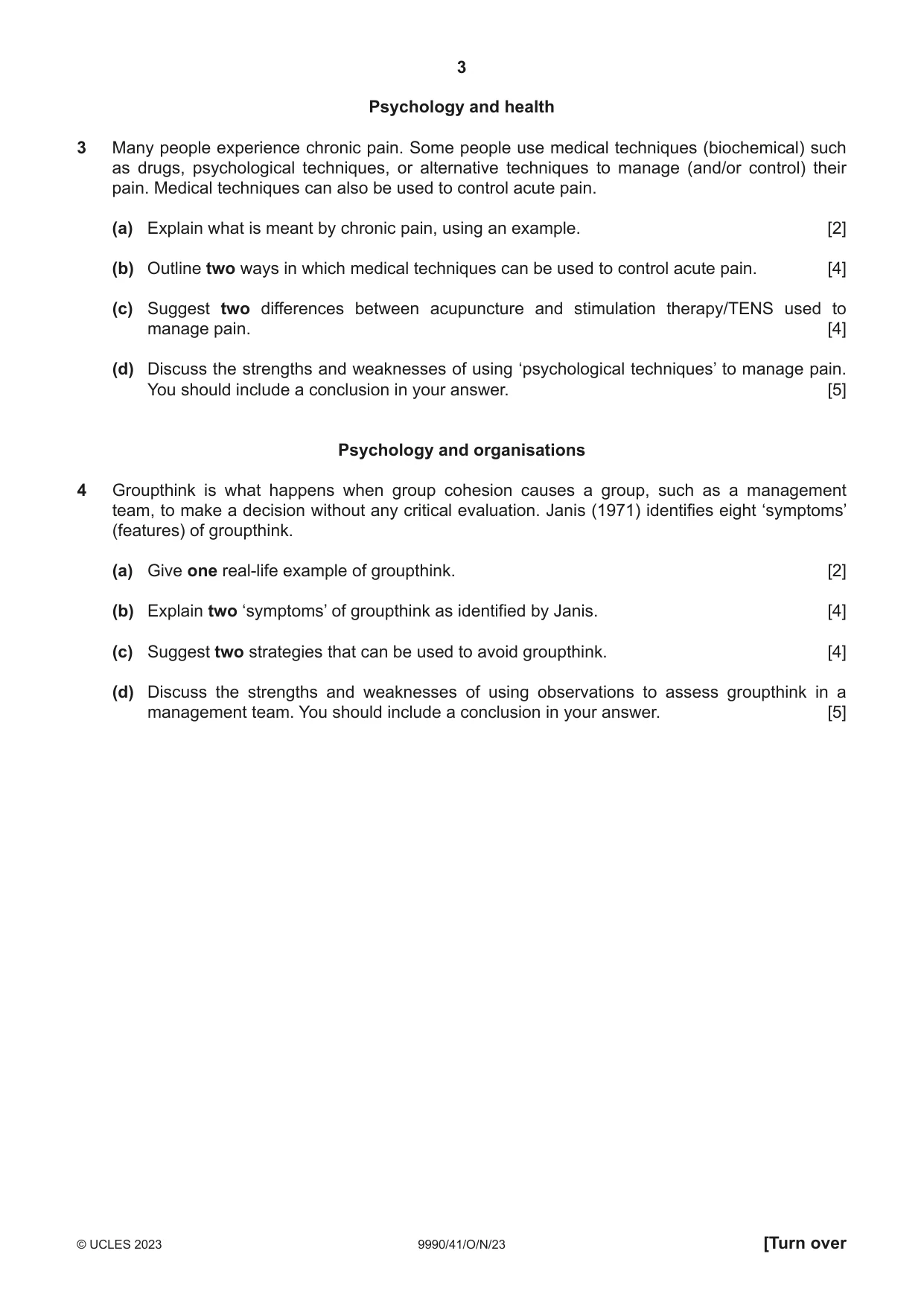
3 Many people experience chronic pain. Some people use medical techniques (biochemical) such as drugs, psychological techniques, or alternative techniques to manage (and/or control) their pain. Medical techniques can also be used to control acute pain. (a) Explain what is meant by chronic pain, using an example. [2] (b) Outline two ways in which medical techniques can be used to control acute pain. [4] (c) Suggest two differences between acupuncture and stimulation therapy/TENS used to manage pain. [4] (d) Discuss the strengths and weaknesses of using ‘psychological techniques’ to manage pain. You should include a conclusion in your answer. [5] Psychology and organisations
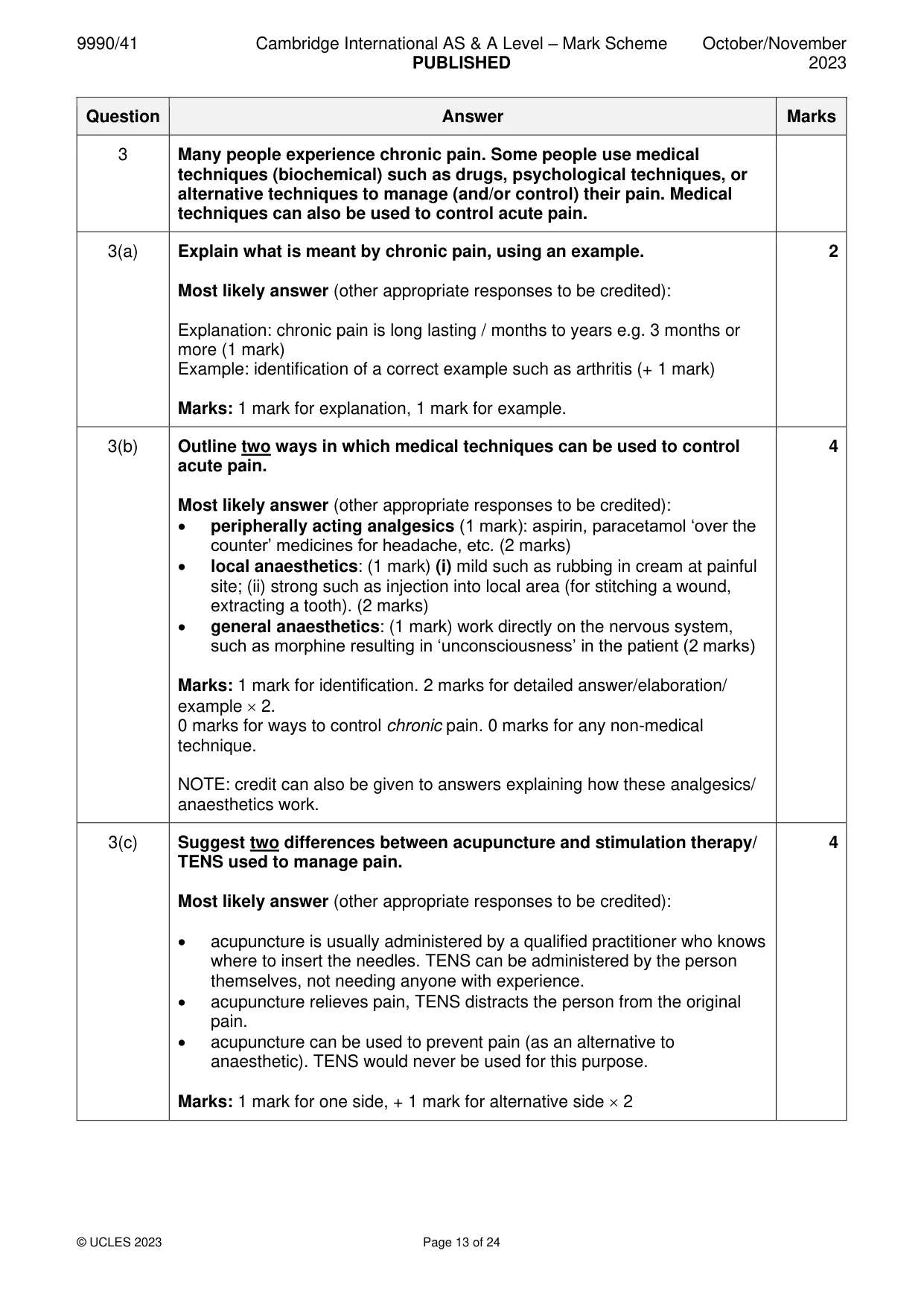
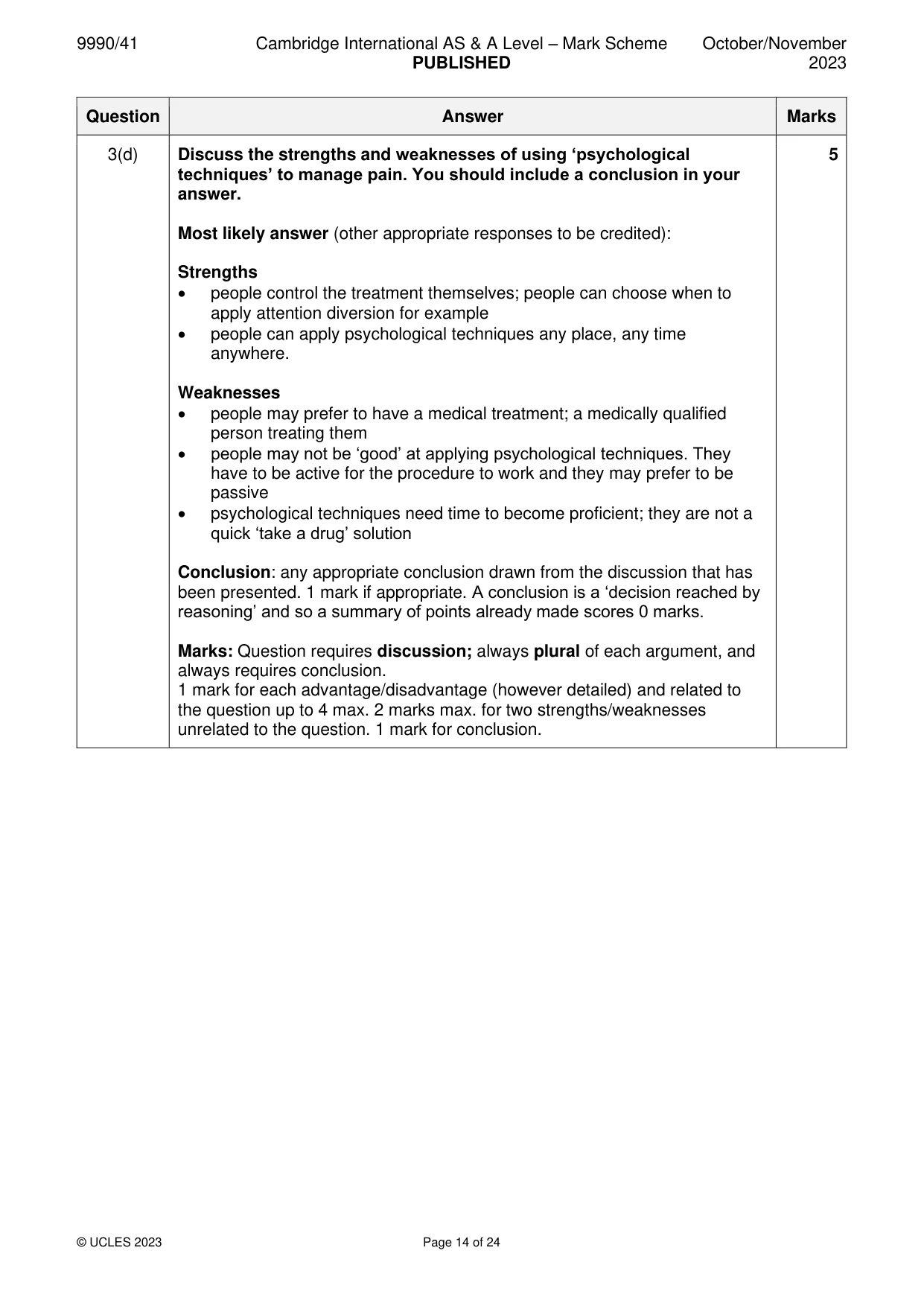
Mark scheme: 3 Many people experience chronic pain. Some people use medical techniques (biochemical) such as drugs, psychological techniques, or alternative techniques to manage (and/or control) their pain. Medical techniques can also be used to control acute pain. 3(a) Explain what is meant by chronic pain, using an example. 2 Most likely answer (other appropriate responses to be credited): Explanation: chronic pain is long lasting / months to years e.g. 3 months or more (1 mark) Example: identification of a correct example such as arthritis (+ 1 mark) Marks: 1 mark for explanation, 1 mark for example. 3(b) Outline two ways in which medical techniques can be used to control 4 acute pain. Most likely answer (other appropriate responses to be credited): • peripherally acting analgesics (1 mark): aspirin, paracetamol ‘over the counter’ medicines for headache, etc. (2 marks) • local anaesthetics: (1 mark) (i) mild such as rubbing in cream at painful site; (ii) strong such as injection into local area (for stitching a wound, extracting a tooth). (2 marks) • general anaesthetics: (1 mark) work directly on the nervous system, such as morphine resulting in ‘unconsciousness’ in the patient (2 marks) Marks: 1 mark for identification. 2 marks for detailed answer/elaboration/ example 2. 0 marks for ways to control chronic pain. 0 marks for any non-medical technique. NOTE: credit can also be given to answers explaining how these analgesics/ anaesthetics work. 3(c) Suggest two differences between acupuncture and stimulation therapy/ 4 TENS used to manage pain. Most likely answer (other appropriate responses to be credited): • acupuncture is usually administered by a qualified practitioner who knows where to insert the needles. TENS can be administered by the person themselves, not needing anyone with experience. • acupuncture relieves pain, TENS distracts the person from the original pain. • acupuncture can be used to prevent pain (as an alternative to anaesthetic). TENS would never be used for this purpose. Marks: 1 mark for one side, + 1 mark for alternative side 2 3(d) Discuss the strengths and weaknesses of using ‘psychological 5 techniques’ to manage pain. You should include a conclusion in your answer. Most likely answer (other appropriate responses to be credited): Strengths • people control the treatment themselves; people can choose when to apply attention diversion for example • people can apply psychological techniques any place, any time anywhere. Weaknesses • people may prefer to have a medical treatment; a medically qualified person treating them • people may not be ‘good’ at applying psychological techniques. They have to be active for the procedure to work and they may prefer to be passive • psychological techniques need time to become proficient; they are not a quick ‘take a drug’ solution Conclusion: any appropriate conclusion drawn from the discussion that has been presented. 1 mark if appropriate. A conclusion is a ‘decision reached by reasoning’ and so a summary of points already made scores 0 marks. Marks: Question requires discussion; always plural of each argument, and always requires conclusion. 1 mark for each advantage/disadvantage (however detailed) and related to the question up to 4 max. 2 marks max. for two strengths/weaknesses unrelated to the question. 1 mark for conclusion.
Q4 · Groupthink is what happens when group cohesion causes a group, such as a management team…
4 Groupthink is what happens when group cohesion causes a group, such as a management team, to make a decision without any critical evaluation. Janis (1971) identifies eight ‘symptoms’ (features) of groupthink. (a) Give one real-life example of groupthink. [2] (b) Explain two ‘symptoms’ of groupthink as identified by Janis. [4] (c) Suggest two strategies that can be used to avoid groupthink. [4] (d) Discuss the strengths and weaknesses of using observations to assess groupthink in a management team. You should include a conclusion in your answer. [5]
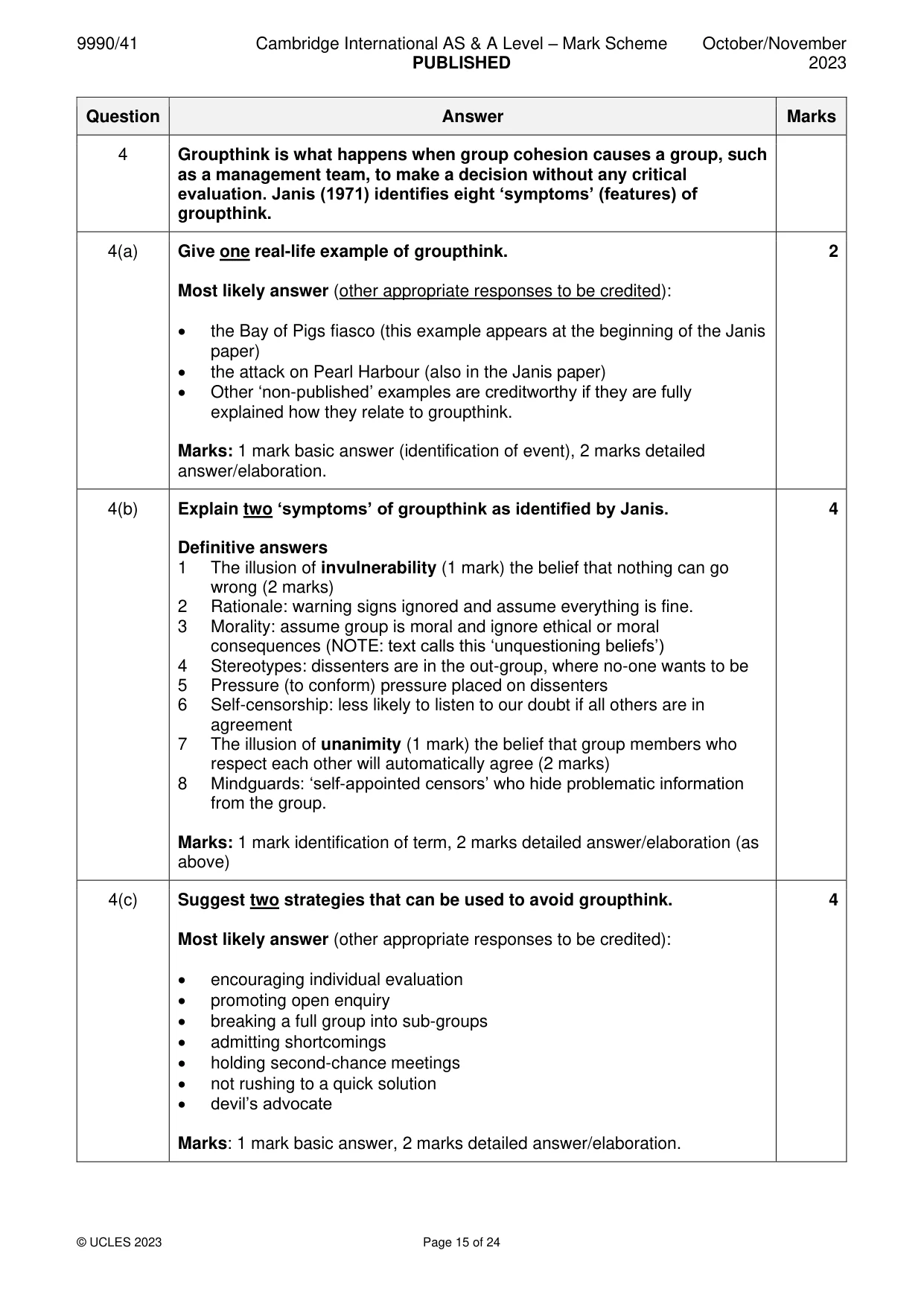
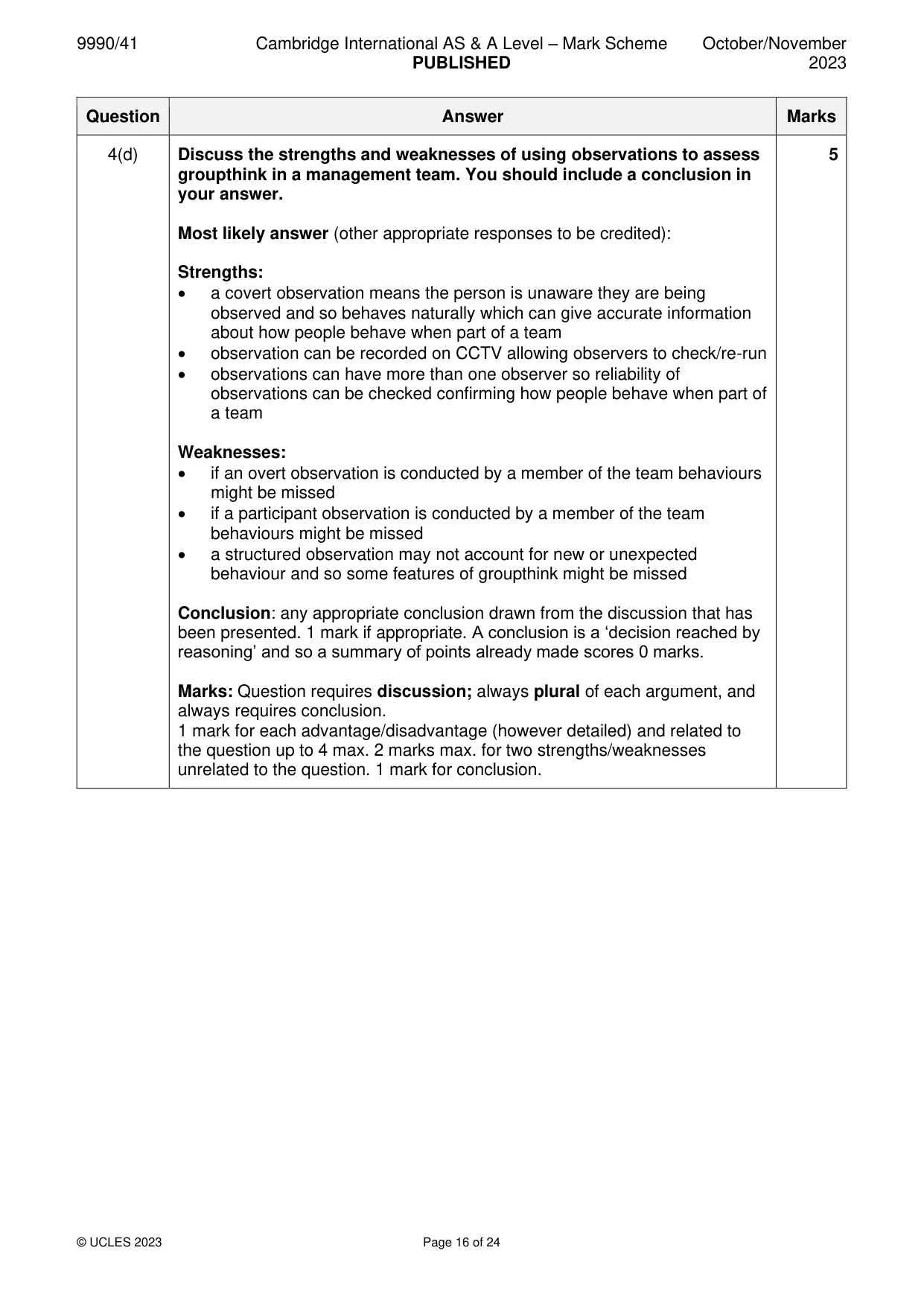
Mark scheme: 4 Groupthink is what happens when group cohesion causes a group, such as a management team, to make a decision without any critical evaluation. Janis (1971) identifies eight ‘symptoms’ (features) of groupthink. 4(a) Give one real-life example of groupthink. 2 Most likely answer (other appropriate responses to be credited): • the Bay of Pigs fiasco (this example appears at the beginning of the Janis paper) • the attack on Pearl Harbour (also in the Janis paper) • Other ‘non-published’ examples are creditworthy if they are fully explained how they relate to groupthink. Marks: 1 mark basic answer (identification of event), 2 marks detailed answer/elaboration. 4(b) Explain two ‘symptoms’ of groupthink as identified by Janis. 4 Definitive answers 1 The illusion of invulnerability (1 mark) the belief that nothing can go wrong (2 marks) 2 Rationale: warning signs ignored and assume everything is fine. 3 Morality: assume group is moral and ignore ethical or moral consequences (NOTE: text calls this ‘unquestioning beliefs’) 4 Stereotypes: dissenters are in the out-group, where no-one wants to be 5 Pressure (to conform) pressure placed on dissenters 6 Self-censorship: less likely to listen to our doubt if all others are in agreement 7 The illusion of unanimity (1 mark) the belief that group members who respect each other will automatically agree (2 marks) 8 Mindguards: ‘self-appointed censors’ who hide problematic information from the group. Marks: 1 mark identification of term, 2 marks detailed answer/elaboration (as above) 4(c) Suggest two strategies that can be used to avoid groupthink. 4 Most likely answer (other appropriate responses to be credited): • encouraging individual evaluation • promoting open enquiry • breaking a full group into sub-groups • admitting shortcomings • holding second-chance meetings • not rushing to a quick solution • devil’s advocate Marks: 1 mark basic answer, 2 marks detailed answer/elaboration. 4(d) Discuss the strengths and weaknesses of using observations to assess 5 groupthink in a management team. You should include a conclusion in your answer. Most likely answer (other appropriate responses to be credited): Strengths: • a covert observation means the person is unaware they are being observed and so behaves naturally which can give accurate information about how people behave when part of a team • observation can be recorded on CCTV allowing observers to check/re-run • observations can have more than one observer so reliability of observations can be checked confirming how people behave when part of a team Weaknesses: • if an overt observation is conducted by a member of the team behaviours might be missed • if a participant observation is conducted by a member of the team behaviours might be missed • a structured observation may not account for new or unexpected behaviour and so some features of groupthink might be missed Conclusion: any appropriate conclusion drawn from the discussion that has been presented. 1 mark if appropriate. A conclusion is a ‘decision reached by reasoning’ and so a summary of points already made scores 0 marks. Marks: Question requires discussion; always plural of each argument, and always requires conclusion. 1 mark for each advantage/disadvantage (however detailed) and related to the question up to 4 max. 2 marks max. for two strengths/weaknesses unrelated to the question. 1 mark for conclusion.
Q5 · Design a study to investigate the long-term effectiveness of systematic desensitisation…
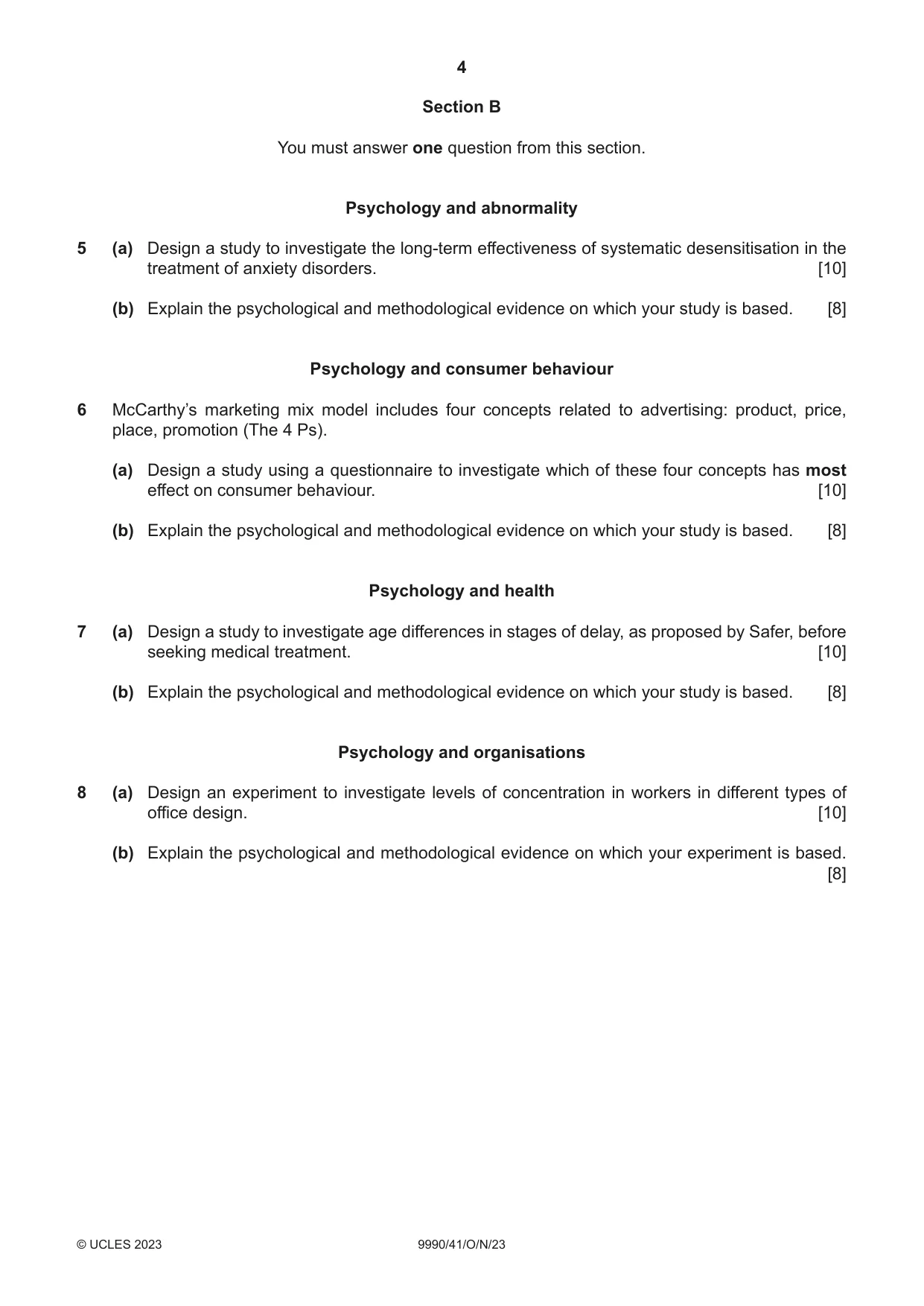
5 (a) Design a study to investigate the long-term effectiveness of systematic desensitisation in the treatment of anxiety disorders. [10] (b) Explain the psychological and methodological evidence on which your study is based. [8] Psychology and consumer behaviour
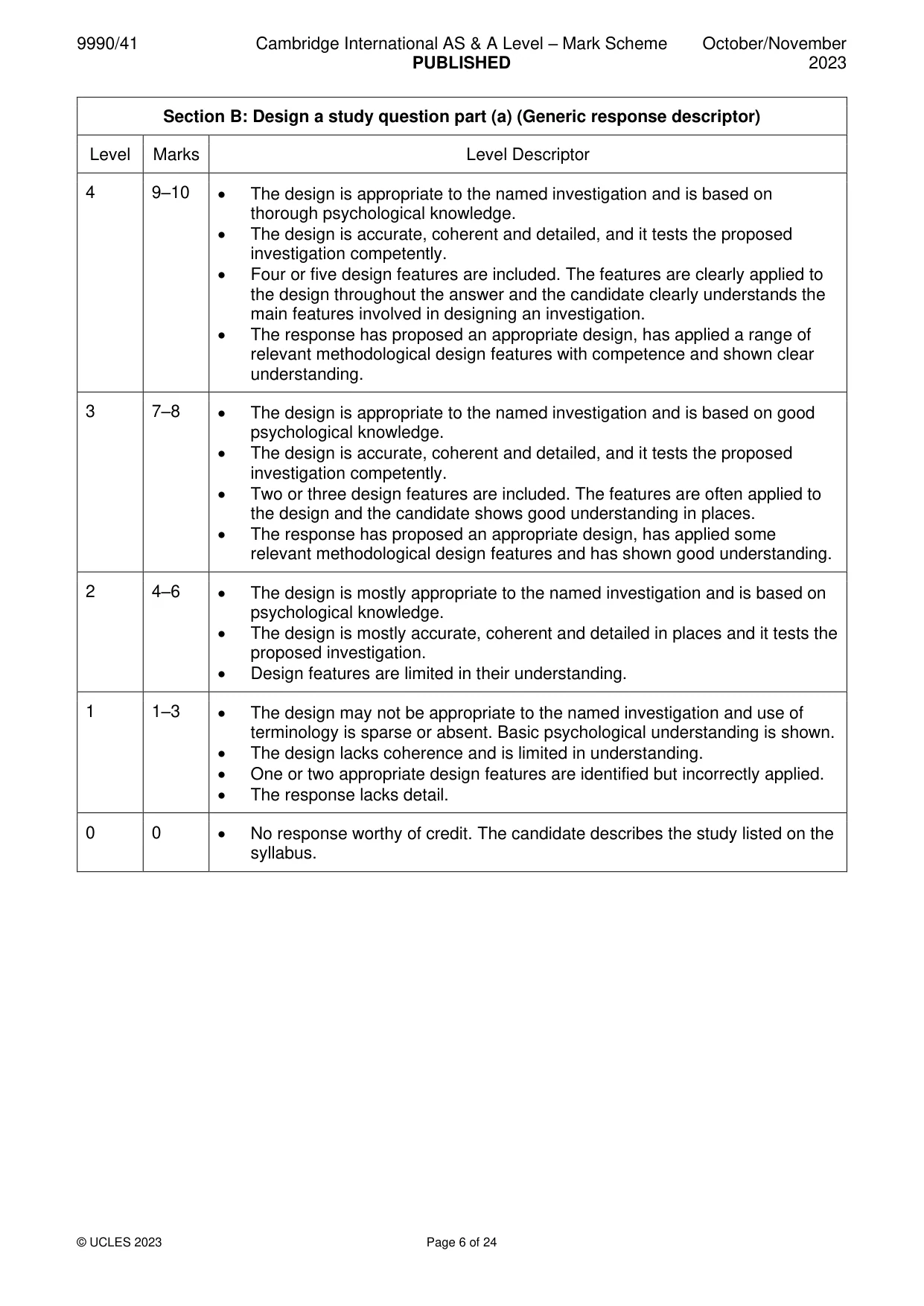
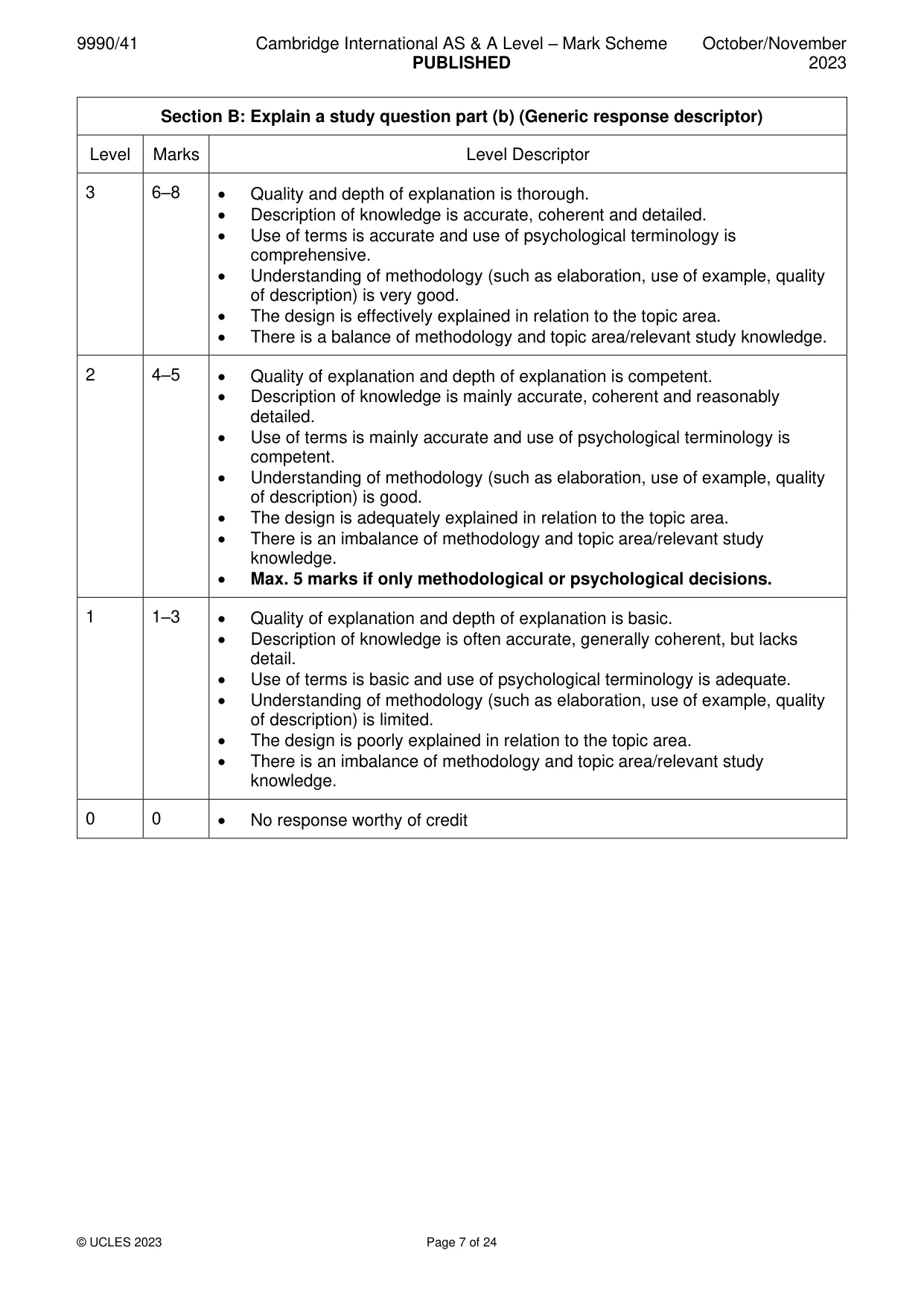
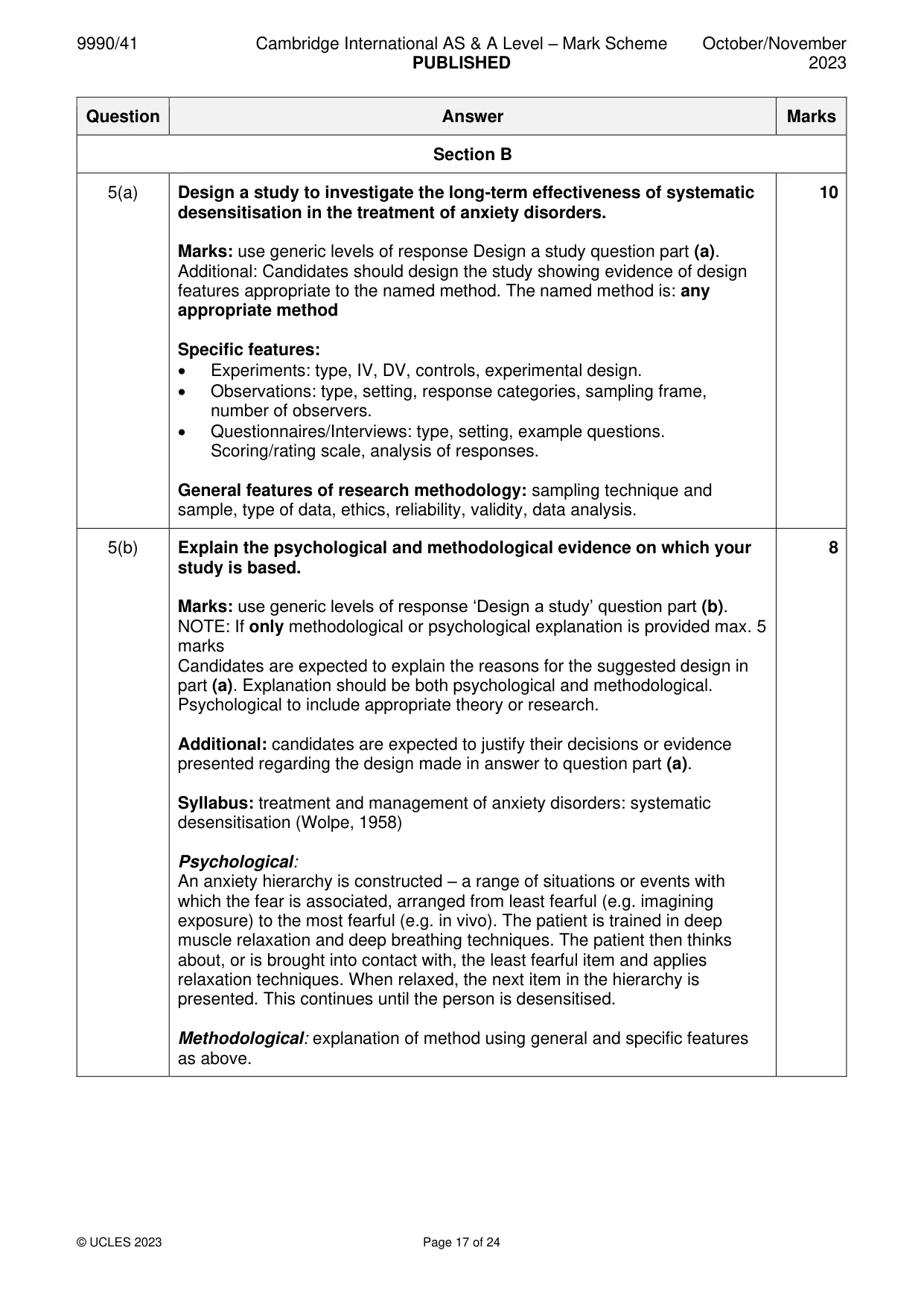
Mark scheme: 5(a) Design a study to investigate the long-term effectiveness of systematic 10 desensitisation in the treatment of anxiety disorders. Marks: use generic levels of response Design a study question part (a). Additional: Candidates should design the study showing evidence of design features appropriate to the named method. The named method is: any appropriate method Specific features: • Experiments: type, IV, DV, controls, experimental design. • Observations: type, setting, response categories, sampling frame, number of observers. • Questionnaires/Interviews: type, setting, example questions. Scoring/rating scale, analysis of responses. General features of research methodology: sampling technique and sample, type of data, ethics, reliability, validity, data analysis. 5(b) Explain the psychological and methodological evidence on which your 8 study is based. Marks: use generic levels of response ‘Design a study’ question part (b). NOTE: If only methodological or psychological explanation is provided max. 5 marks Candidates are expected to explain the reasons for the suggested design in part (a). Explanation should be both psychological and methodological. Psychological to include appropriate theory or research. Additional: candidates are expected to justify their decisions or evidence presented regarding the design made in answer to question part (a). Syllabus: treatment and management of anxiety disorders: systematic desensitisation (Wolpe, 1958) Psychological: An anxiety hierarchy is constructed – a range of situations or events with which the fear is associated, arranged from least fearful (e.g. imagining exposure) to the most fearful (e.g. in vivo). The patient is trained in deep muscle relaxation and deep breathing techniques. The patient then thinks about, or is brought into contact with, the least fearful item and applies relaxation techniques. When relaxed, the next item in the hierarchy is presented. This continues until the person is desensitised. Methodological: explanation of method using general and specific features as above.
More questions on Anxiety disorders and fear-related disorders
Q6 · McCarthy’s marketing mix model includes four concepts related to advertising: product…
6 McCarthy’s marketing mix model includes four concepts related to advertising: product, price, place, promotion (The 4 Ps). (a) Design a study using a questionnaire to investigate which of these four concepts has most effect on consumer behaviour. [10] (b) Explain the psychological and methodological evidence on which your study is based. [8] Psychology and health
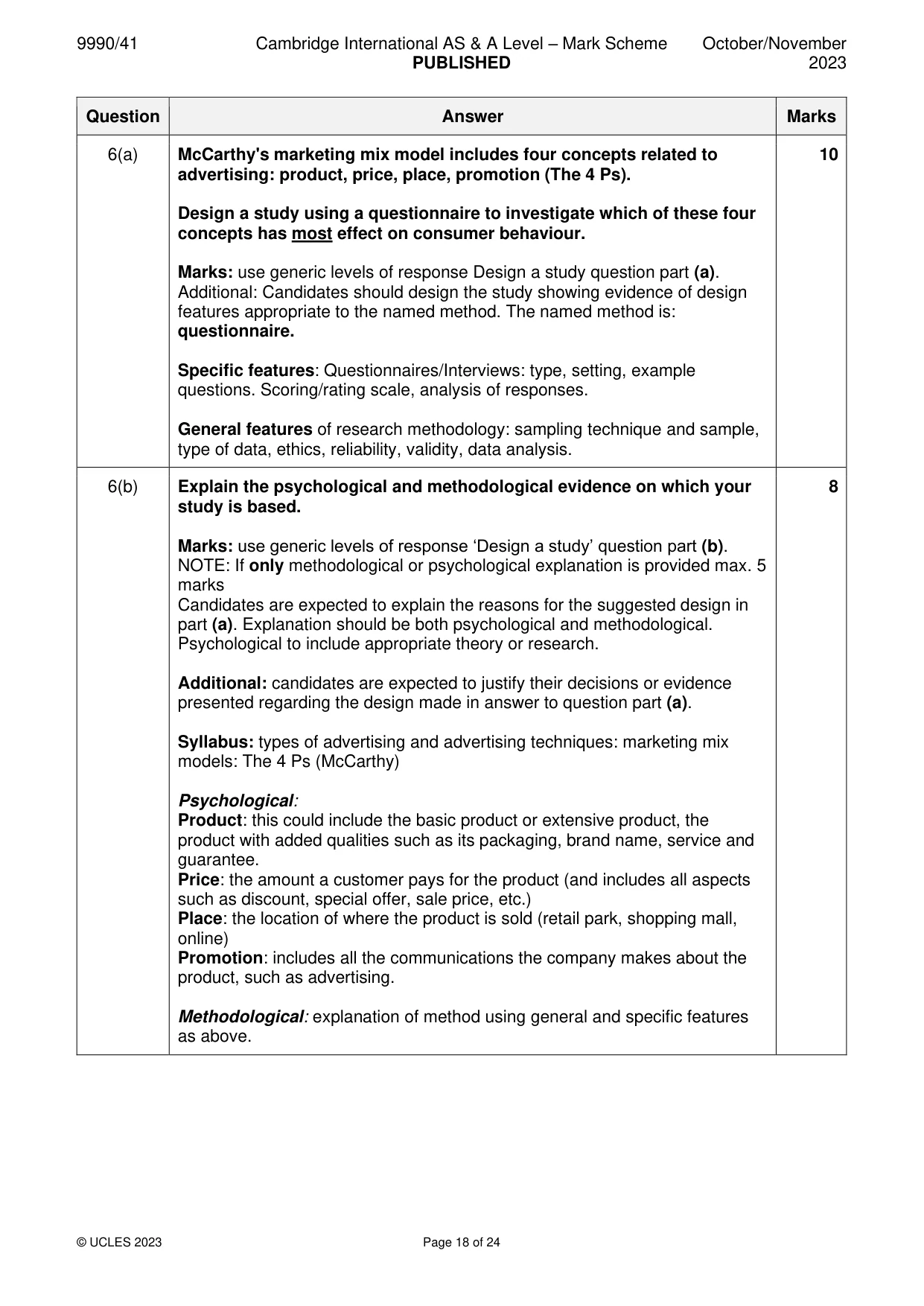
Mark scheme: 6(a) McCarthy's marketing mix model includes four concepts related to 10 advertising: product, price, place, promotion (The 4 Ps). Design a study using a questionnaire to investigate which of these four concepts has most effect on consumer behaviour. Marks: use generic levels of response Design a study question part (a). Additional: Candidates should design the study showing evidence of design features appropriate to the named method. The named method is: questionnaire. Specific features: Questionnaires/Interviews: type, setting, example questions. Scoring/rating scale, analysis of responses. General features of research methodology: sampling technique and sample, type of data, ethics, reliability, validity, data analysis. 6(b) Explain the psychological and methodological evidence on which your 8 study is based. Marks: use generic levels of response ‘Design a study’ question part (b). NOTE: If only methodological or psychological explanation is provided max. 5 marks Candidates are expected to explain the reasons for the suggested design in part (a). Explanation should be both psychological and methodological. Psychological to include appropriate theory or research. Additional: candidates are expected to justify their decisions or evidence presented regarding the design made in answer to question part (a). Syllabus: types of advertising and advertising techniques: marketing mix models: The 4 Ps (McCarthy) Psychological: Product: this could include the basic product or extensive product, the product with added qualities such as its packaging, brand name, service and guarantee. Price: the amount a customer pays for the product (and includes all aspects such as discount, special offer, sale price, etc.) Place: the location of where the product is sold (retail park, shopping mall, online) Promotion: includes all the communications the company makes about the product, such as advertising. Methodological: explanation of method using general and specific features as above.
Q7 · Design a study to investigate age differences in stages of delay, as proposed by Safer…
7 (a) Design a study to investigate age differences in stages of delay, as proposed by Safer, before seeking medical treatment. [10] (b) Explain the psychological and methodological evidence on which your study is based. [8] Psychology and organisations
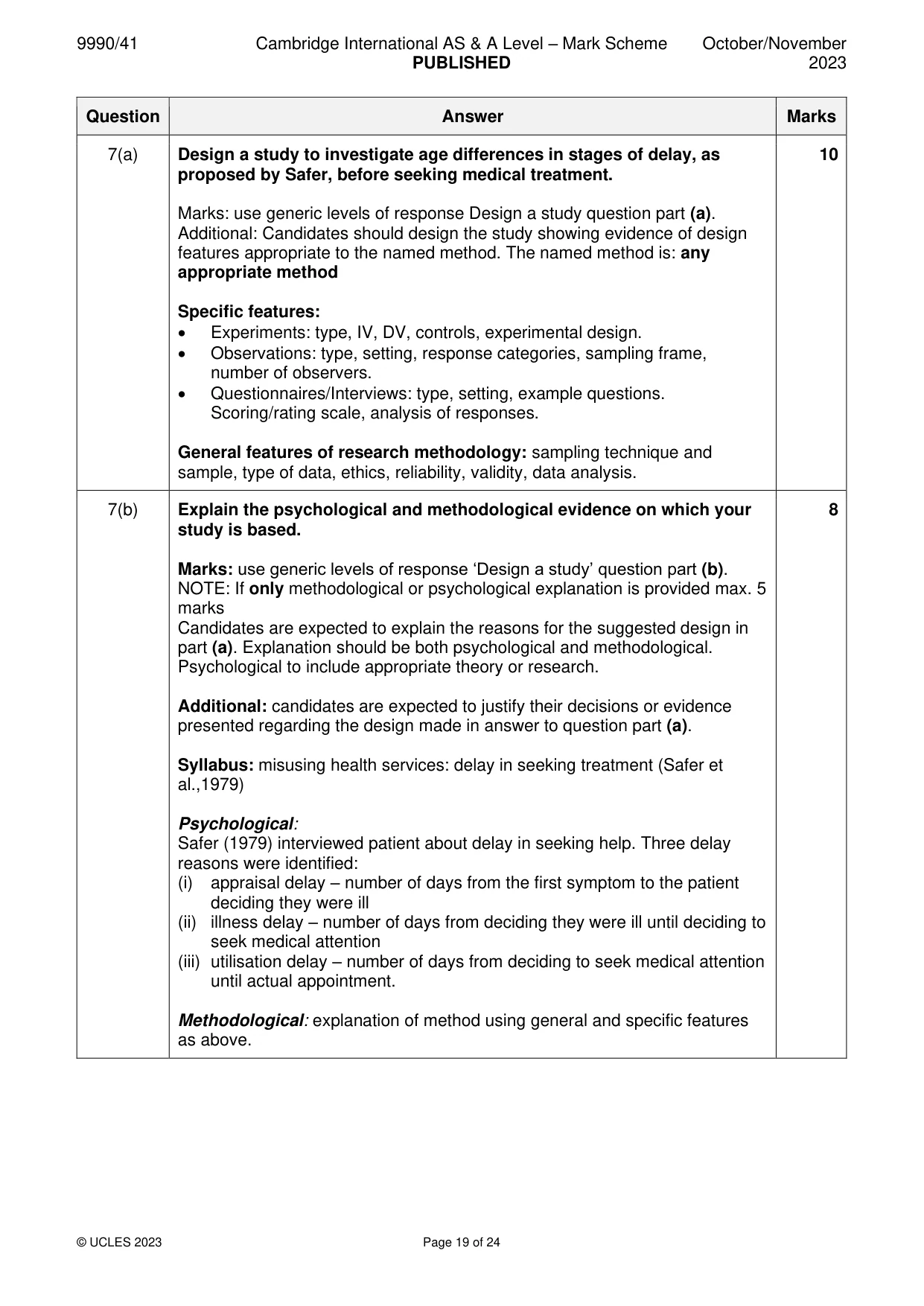
Mark scheme: 7(a) Design a study to investigate age differences in stages of delay, as 10 proposed by Safer, before seeking medical treatment. Marks: use generic levels of response Design a study question part (a). Additional: Candidates should design the study showing evidence of design features appropriate to the named method. The named method is: any appropriate method Specific features: • Experiments: type, IV, DV, controls, experimental design. • Observations: type, setting, response categories, sampling frame, number of observers. • Questionnaires/Interviews: type, setting, example questions. Scoring/rating scale, analysis of responses. General features of research methodology: sampling technique and sample, type of data, ethics, reliability, validity, data analysis. 7(b) Explain the psychological and methodological evidence on which your 8 study is based. Marks: use generic levels of response ‘Design a study’ question part (b). NOTE: If only methodological or psychological explanation is provided max. 5 marks Candidates are expected to explain the reasons for the suggested design in part (a). Explanation should be both psychological and methodological. Psychological to include appropriate theory or research. Additional: candidates are expected to justify their decisions or evidence presented regarding the design made in answer to question part (a). Syllabus: misusing health services: delay in seeking treatment (Safer et al.,1979) Psychological: Safer (1979) interviewed patient about delay in seeking help. Three delay reasons were identified: (i) appraisal delay – number of days from the first symptom to the patient deciding they were ill (ii) illness delay – number of days from deciding they were ill until deciding to seek medical attention (iii) utilisation delay – number of days from deciding to seek medical attention until actual appointment. Methodological: explanation of method using general and specific features as above.
Q8 · Design an experiment to investigate levels of concentration in workers in different types…
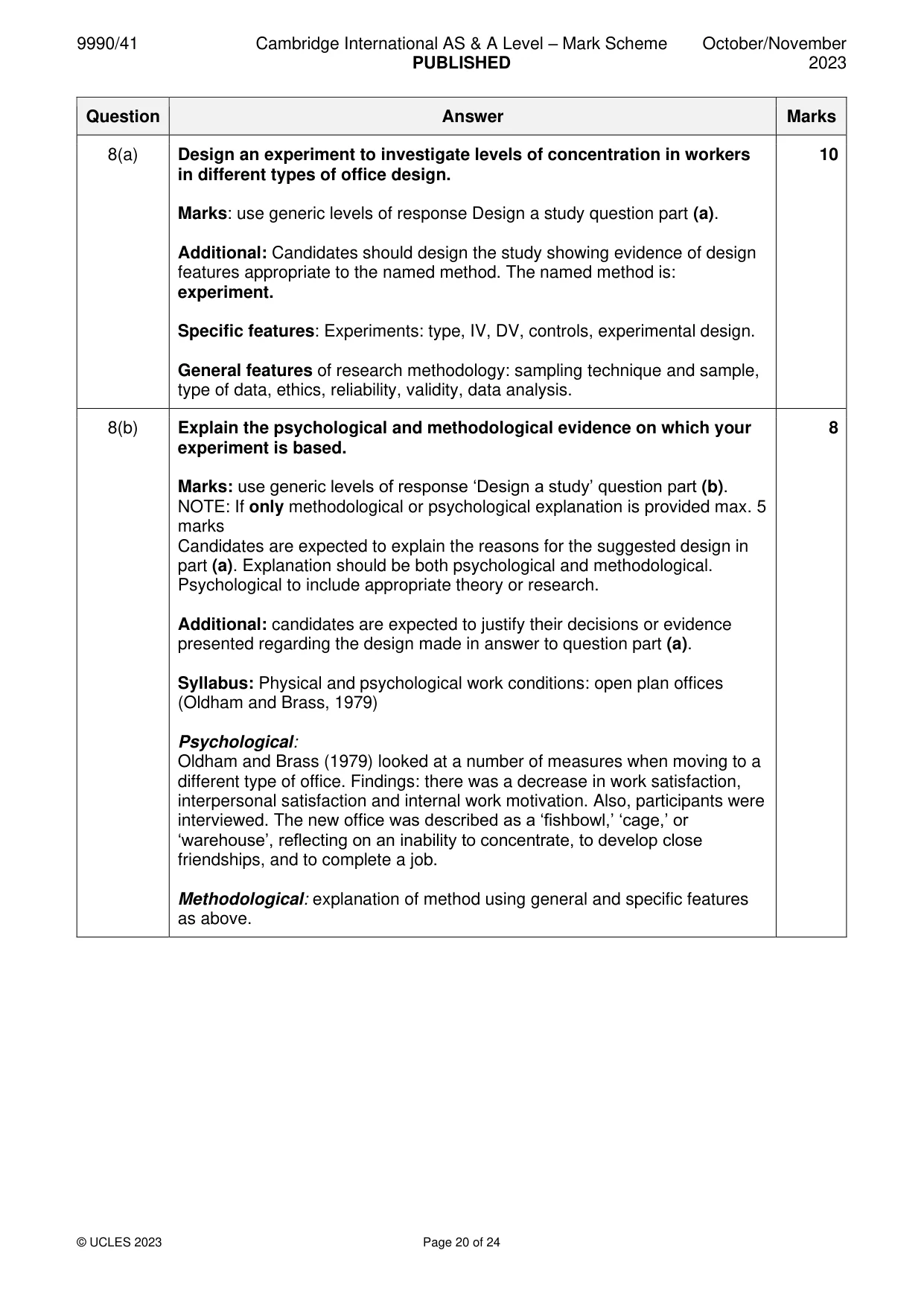
8 (a) Design an experiment to investigate levels of concentration in workers in different types of office design. [10] (b) Explain the psychological and methodological evidence on which your experiment is based. [8] Section C You must answer one question from this section. Psychology and abnormality
Mark scheme: 8(a) Design an experiment to investigate levels of concentration in workers 10 in different types of office design. Marks: use generic levels of response Design a study question part (a). Additional: Candidates should design the study showing evidence of design features appropriate to the named method. The named method is: experiment. Specific features: Experiments: type, IV, DV, controls, experimental design. General features of research methodology: sampling technique and sample, type of data, ethics, reliability, validity, data analysis. 8(b) Explain the psychological and methodological evidence on which your 8 experiment is based. Marks: use generic levels of response ‘Design a study’ question part (b). NOTE: If only methodological or psychological explanation is provided max. 5 marks Candidates are expected to explain the reasons for the suggested design in part (a). Explanation should be both psychological and methodological. Psychological to include appropriate theory or research. Additional: candidates are expected to justify their decisions or evidence presented regarding the design made in answer to question part (a). Syllabus: Physical and psychological work conditions: open plan offices (Oldham and Brass, 1979) Psychological: Oldham and Brass (1979) looked at a number of measures when moving to a different type of office. Findings: there was a decrease in work satisfaction, interpersonal satisfaction and internal work motivation. Also, participants were interviewed. The new office was described as a ‘fishbowl,’ ‘cage,’ or ‘warehouse’, reflecting on an inability to concentrate, to develop close friendships, and to complete a job. Methodological: explanation of method using general and specific features as above.
Q9 · ‘Psychometric measures used to assess anxiety disorders, such as the Generalised Anxiety…
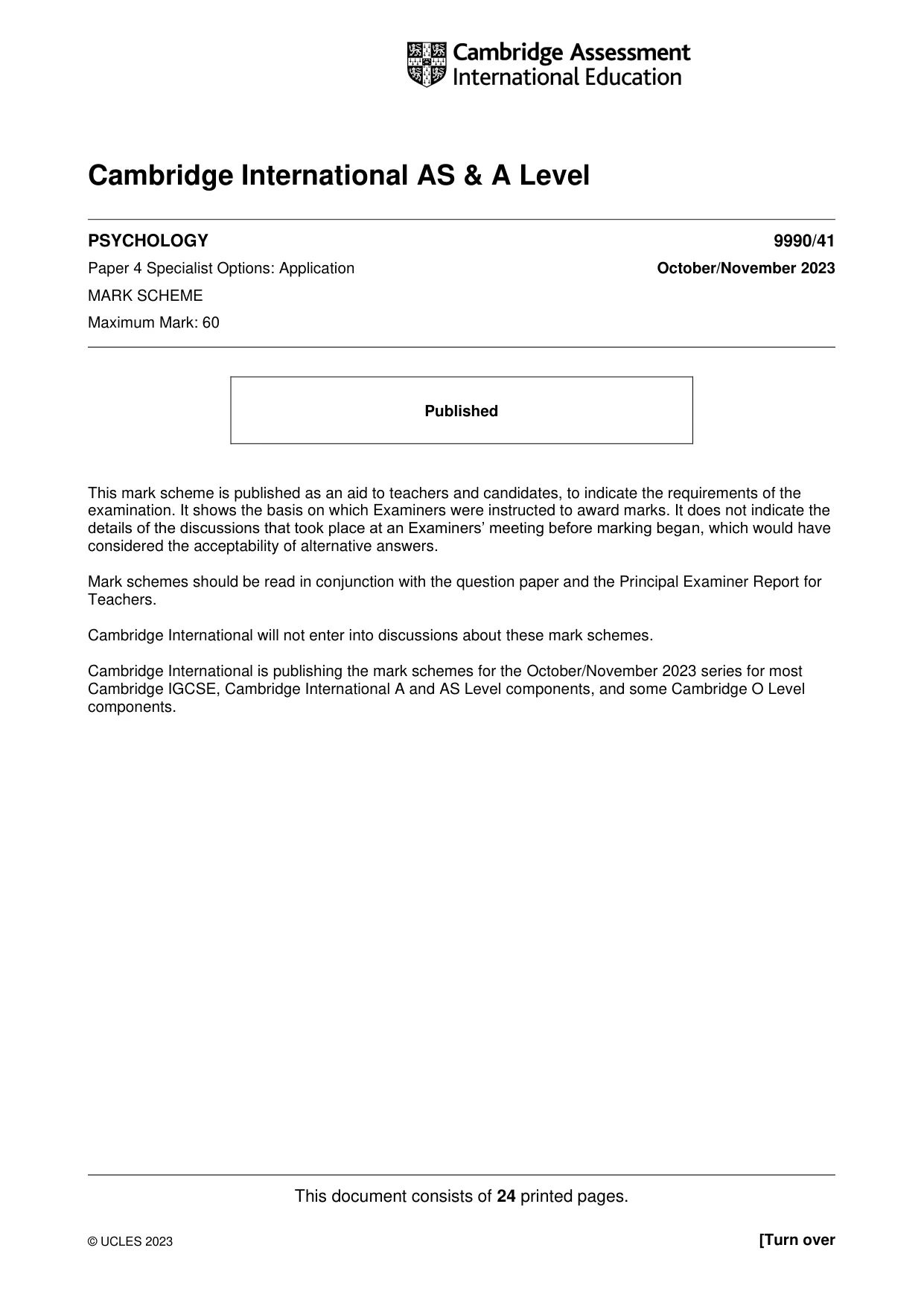
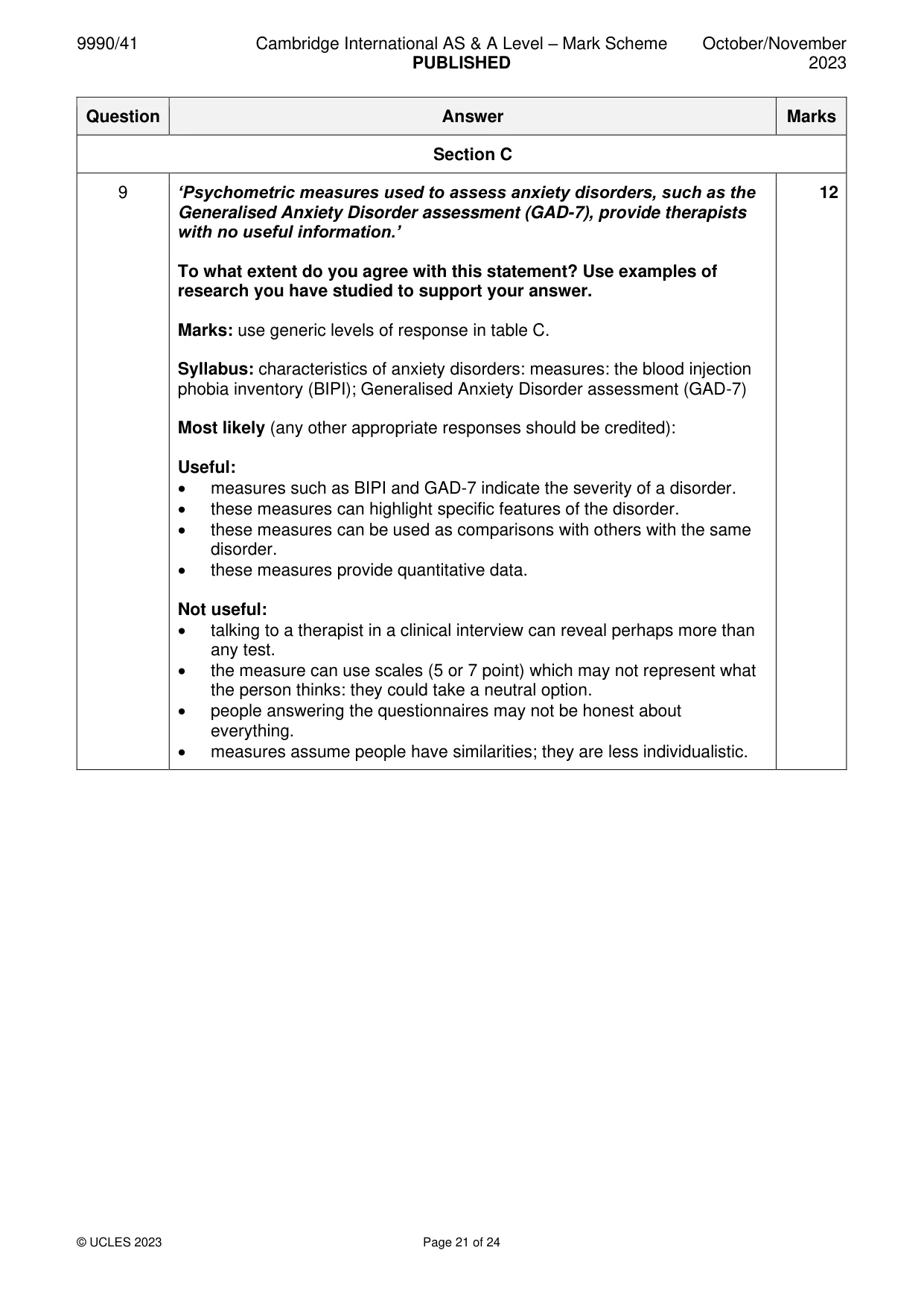
9 ‘Psychometric measures used to assess anxiety disorders, such as the Generalised Anxiety Disorder assessment (GAD-7), provide therapists with no useful information.’ To what extent do you agree with this statement? Use examples of research you have studied to support your answer. [12] Psychology and consumer behaviour
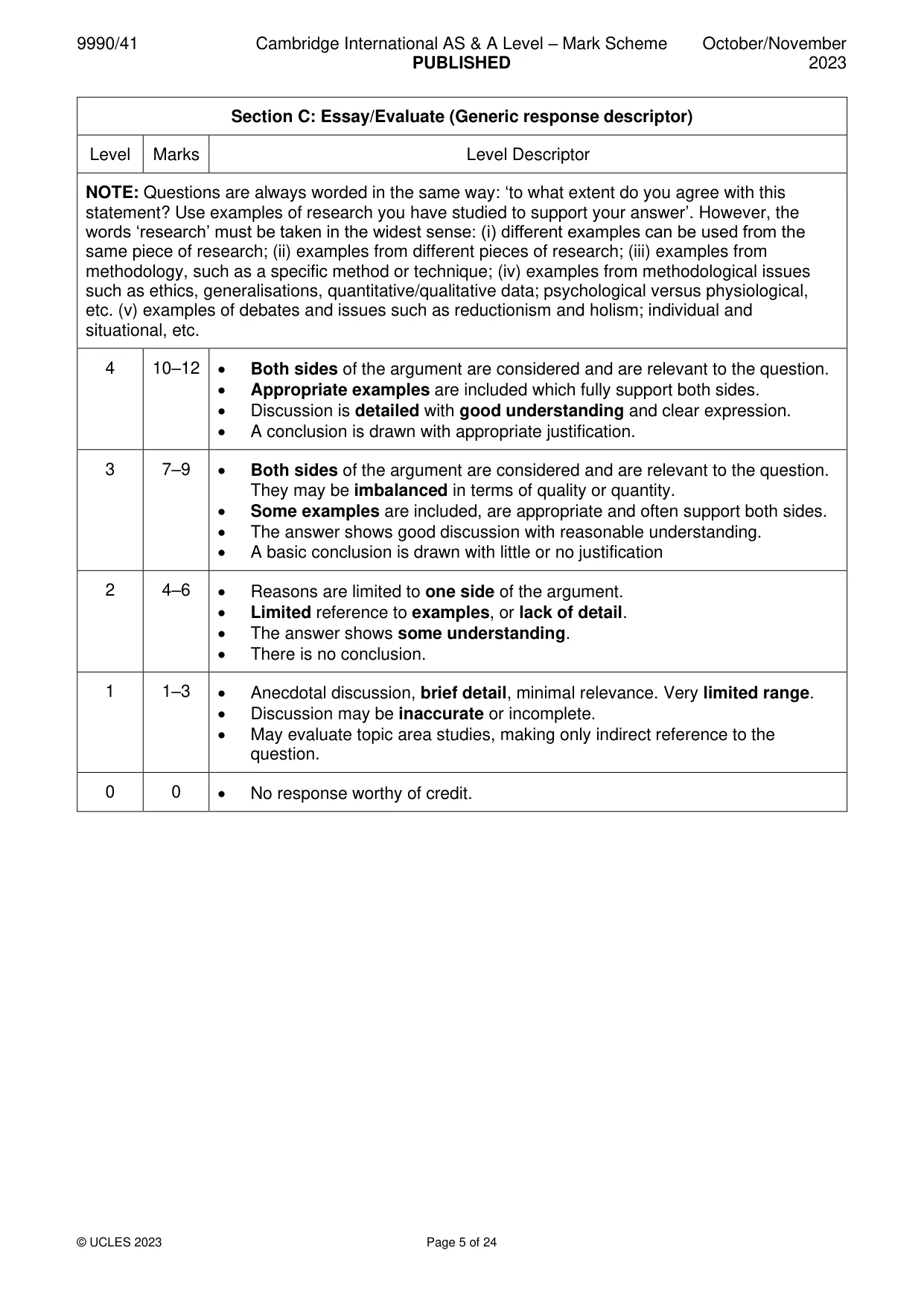
Mark scheme: 9 ‘Psychometric measures used to assess anxiety disorders, such as the 12 Generalised Anxiety Disorder assessment (GAD-7), provide therapists with no useful information.’ To what extent do you agree with this statement? Use examples of research you have studied to support your answer. Marks: use generic levels of response in table C. Syllabus: characteristics of anxiety disorders: measures: the blood injection phobia inventory (BIPI); Generalised Anxiety Disorder assessment (GAD-7) Most likely (any other appropriate responses should be credited): Useful: • measures such as BIPI and GAD-7 indicate the severity of a disorder. • these measures can highlight specific features of the disorder. • these measures can be used as comparisons with others with the same disorder. • these measures provide quantitative data. Not useful: • talking to a therapist in a clinical interview can reveal perhaps more than any test. • the measure can use scales (5 or 7 point) which may not represent what the person thinks: they could take a neutral option. • people answering the questionnaires may not be honest about everything. • measures assume people have similarities; they are less individualistic.
More questions on Anxiety disorders and fear-related disorders
Q10 · ‘If playing one type of music at one open air market stall increases the amount of money…
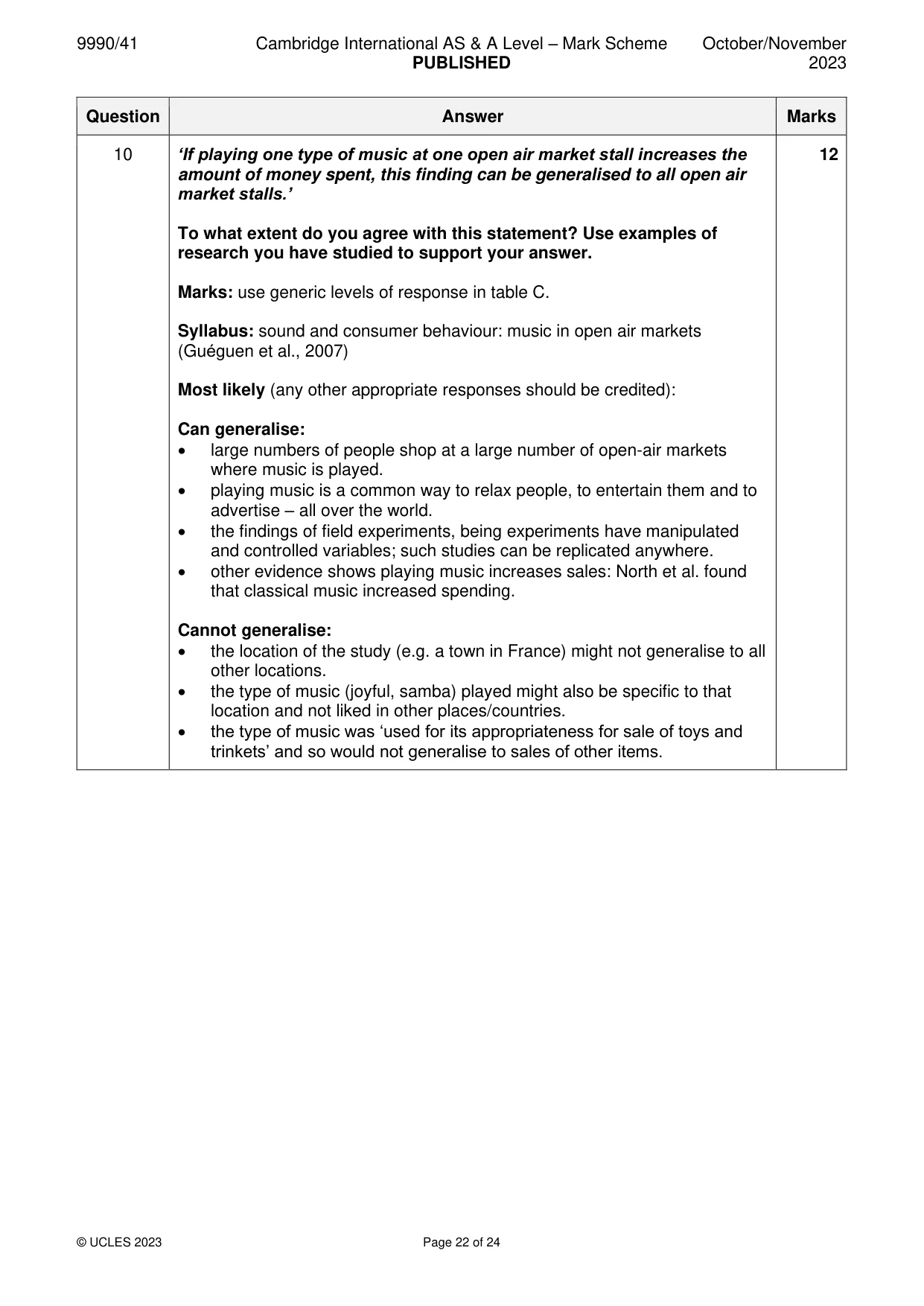
10 ‘If playing one type of music at one open air market stall increases the amount of money spent, this finding can be generalised to all open air market stalls.’ To what extent do you agree with this statement? Use examples of research you have studied to support your answer. [12] Psychology and health
Mark scheme: 10 ‘If playing one type of music at one open air market stall increases the 12 amount of money spent, this finding can be generalised to all open air market stalls.’ To what extent do you agree with this statement? Use examples of research you have studied to support your answer. Marks: use generic levels of response in table C. Syllabus: sound and consumer behaviour: music in open air markets (Guéguen et al., 2007) Most likely (any other appropriate responses should be credited): Can generalise: • large numbers of people shop at a large number of open-air markets where music is played. • playing music is a common way to relax people, to entertain them and to advertise – all over the world. • the findings of field experiments, being experiments have manipulated and controlled variables; such studies can be replicated anywhere. • other evidence shows playing music increases sales: North et al. found that classical music increased spending. Cannot generalise: • the location of the study (e.g. a town in France) might not generalise to all other locations. • the type of music (joyful, samba) played might also be specific to that location and not liked in other places/countries. • the type of music was ‘used for its appropriateness for sale of toys and trinkets’ and so would not generalise to sales of other items.
Q11 · ‘Practitioner style (doctor or patient-centred) is irrelevant
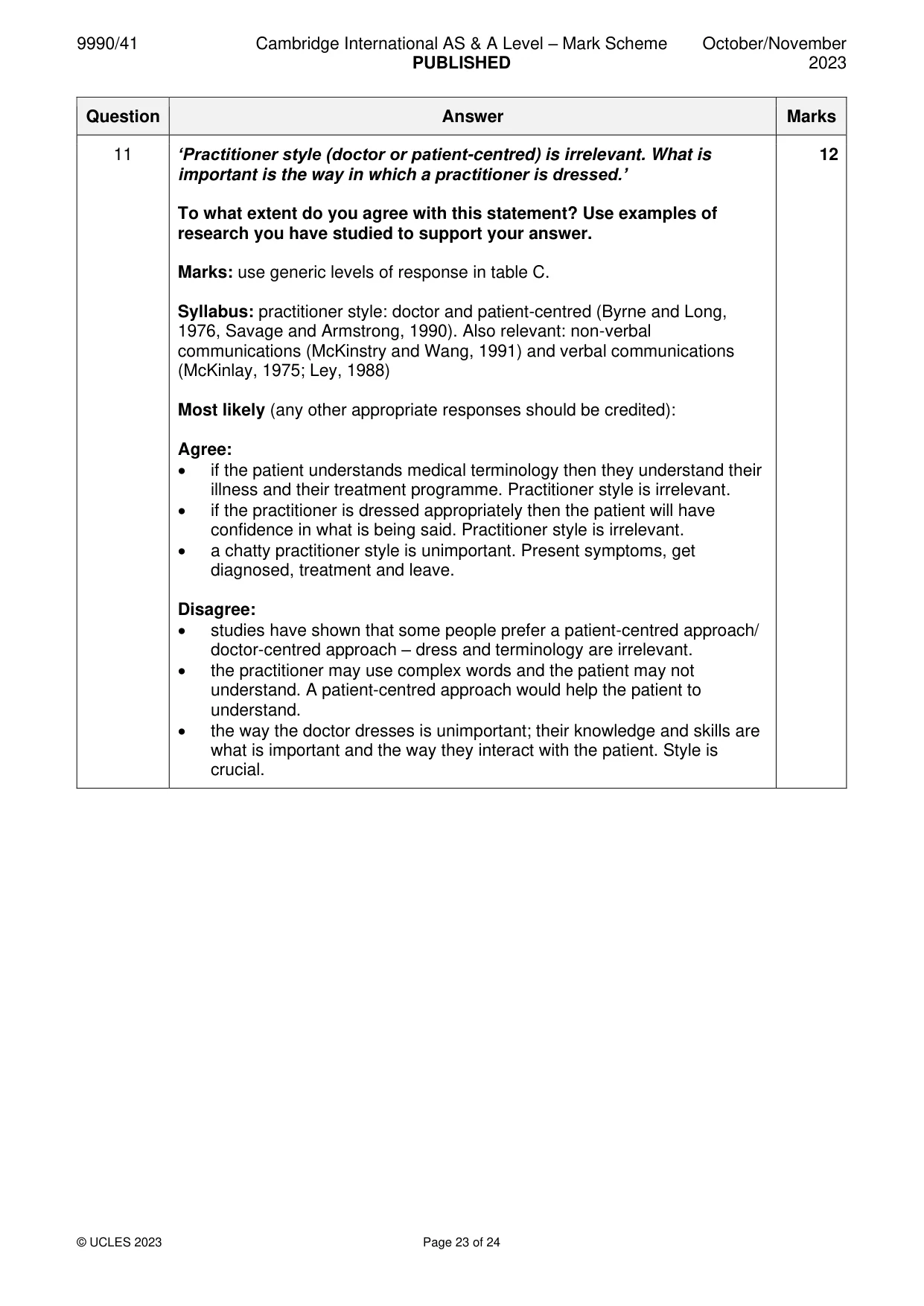
11 ‘Practitioner style (doctor or patient-centred) is irrelevant. What is important is the way in which a practitioner is dressed.’ To what extent do you agree with this statement? Use examples of research you have studied to support your answer. [12] Psychology and organisations
Mark scheme: 11 ‘Practitioner style (doctor or patient-centred) is irrelevant. What is 12 important is the way in which a practitioner is dressed.’ To what extent do you agree with this statement? Use examples of research you have studied to support your answer. Marks: use generic levels of response in table C. Syllabus: practitioner style: doctor and patient-centred (Byrne and Long, 1976, Savage and Armstrong, 1990). Also relevant: non-verbal communications (McKinstry and Wang, 1991) and verbal communications (McKinlay, 1975; Ley, 1988) Most likely (any other appropriate responses should be credited): Agree: • if the patient understands medical terminology then they understand their illness and their treatment programme. Practitioner style is irrelevant. • if the practitioner is dressed appropriately then the patient will have confidence in what is being said. Practitioner style is irrelevant. • a chatty practitioner style is unimportant. Present symptoms, get diagnosed, treatment and leave. Disagree: • studies have shown that some people prefer a patient-centred approach/ doctor-centred approach – dress and terminology are irrelevant. • the practitioner may use complex words and the patient may not understand. A patient-centred approach would help the patient to understand. • the way the doctor dresses is unimportant; their knowledge and skills are what is important and the way they interact with the patient. Style is crucial.
Q12 · ‘All accidents at work are caused by errors in operator-machine systems (system errors)…
12 ‘All accidents at work are caused by errors in operator-machine systems (system errors); not by other factors, such as human error.’ To what extent do you agree with this statement? Use examples of research you have studied to support your answer. [12]
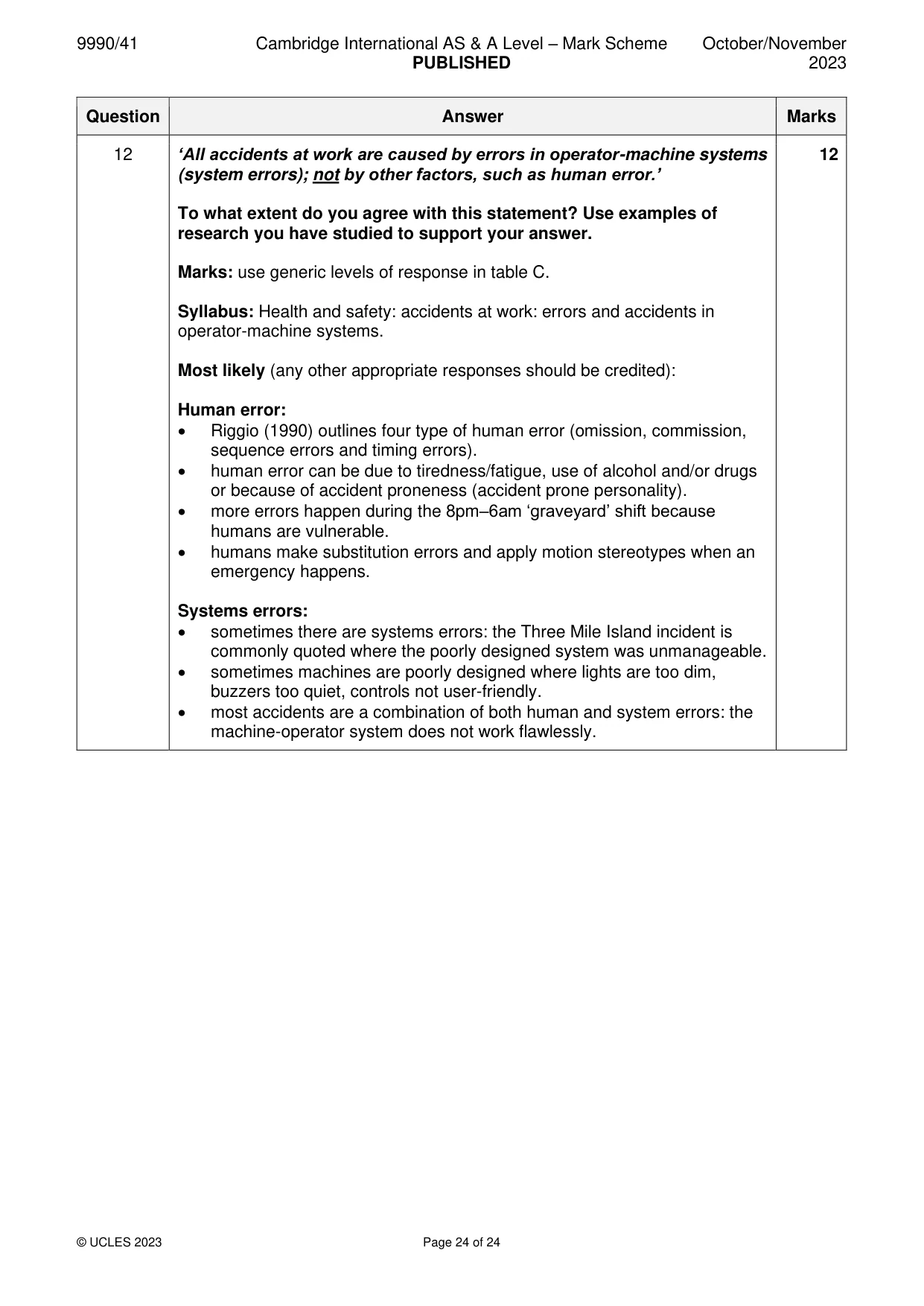
Mark scheme: 12 ‘All accidents at work are caused by errors in operator-machine systems 12 (system errors); not by other factors, such as human error.’ To what extent do you agree with this statement? Use examples of research you have studied to support your answer. Marks: use generic levels of response in table C. Syllabus: Health and safety: accidents at work: errors and accidents in operator-machine systems. Most likely (any other appropriate responses should be credited): Human error: • Riggio (1990) outlines four type of human error (omission, commission, sequence errors and timing errors). • human error can be due to tiredness/fatigue, use of alcohol and/or drugs or because of accident proneness (accident prone personality). • more errors happen during the 8pm–6am ‘graveyard’ shift because humans are vulnerable. • humans make substitution errors and apply motion stereotypes when an emergency happens. Systems errors: • sometimes there are systems errors: the Three Mile Island incident is commonly quoted where the poorly designed system was unmanageable. • sometimes machines are poorly designed where lights are too dim, buzzers too quiet, controls not user-friendly. • most accidents are a combination of both human and system errors: the machine-operator system does not work flawlessly.
What was in this paper
The subtopics covered by these 12 questions, and how many questions each got. Open one in a new tab to see every Cambridge question on it.
What you needed in this session
Cambridge’s own grade thresholds for 2023 Oct/Nov, Paper 4 · Variant 1. A higher threshold means an easier paper — the bar moves with how the cohort did.