Cambridge A Level Psychology (from 2018) 9990 — 2018 May/June Paper 4 · Variant 2
9990/42/M/J/18 · 12 questions · 60 marks · ≈68 min
The question paper and its mark scheme, free to read here and free to download. This is Cambridge’s own paper, exactly as it was sat.
Question paper8 pages



Mark scheme22 pages
Answers below. Sit the paper first if you are practising.
Questions as text
Q1 · The aim of the study by Lovell et al
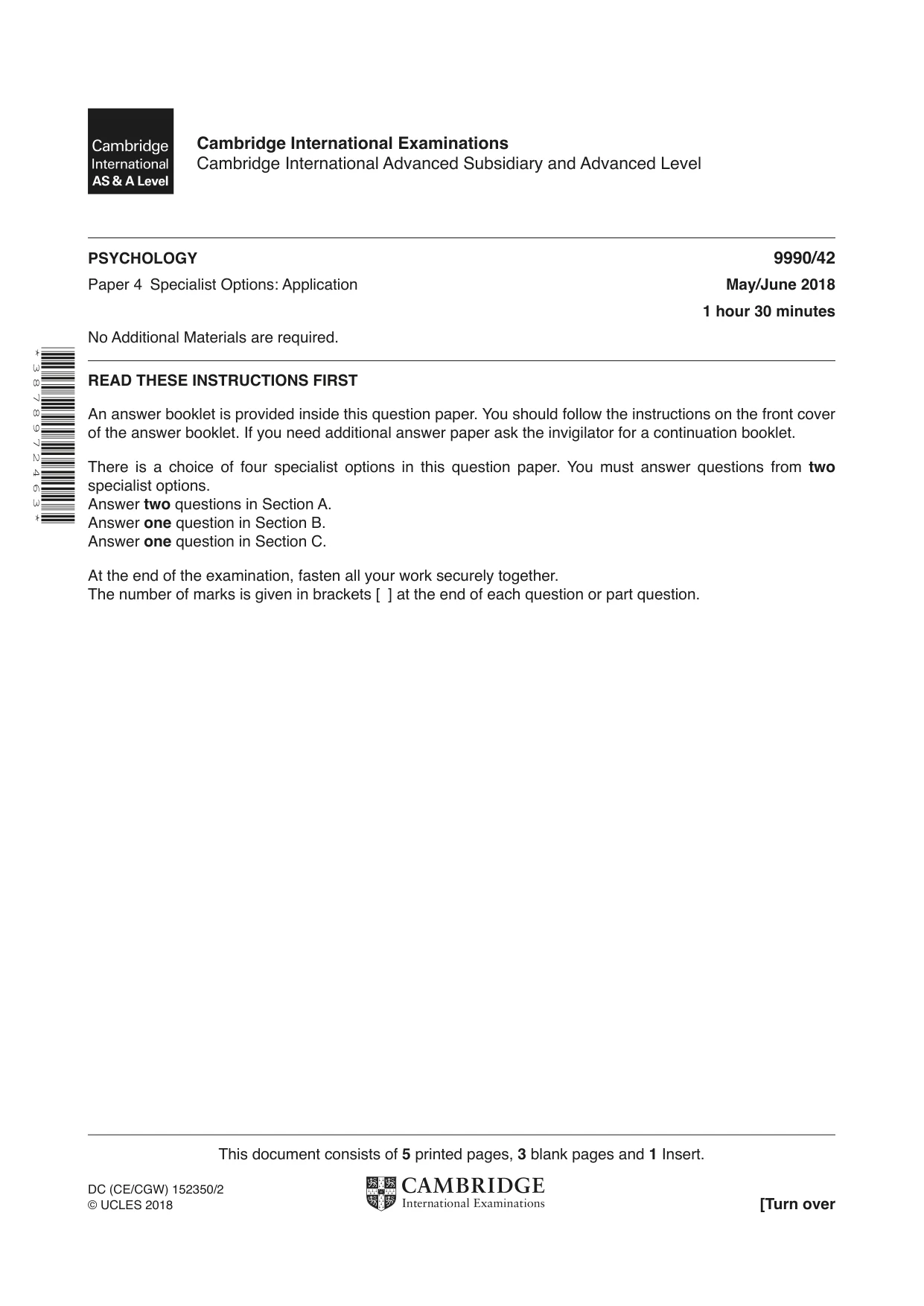
1 The aim of the study by Lovell et al. (2006) was to compare the effectiveness of cognitive behavioural therapy (CBT) for obsessive-compulsive disorder (OCD), delivered face-to-face or by telephone. (a) What was concluded about the effectiveness of the therapy? [2] (b) How and why did the researchers gather baseline data from the participants? [4] (c) Give two differences in the delivery of telephone and face-to-face therapy in this study. [4] (d) Discuss the strengths and weaknesses of using telephone delivery of CBT with patients. You should include a conclusion in your answer. [5] Psychology and consumer behaviour
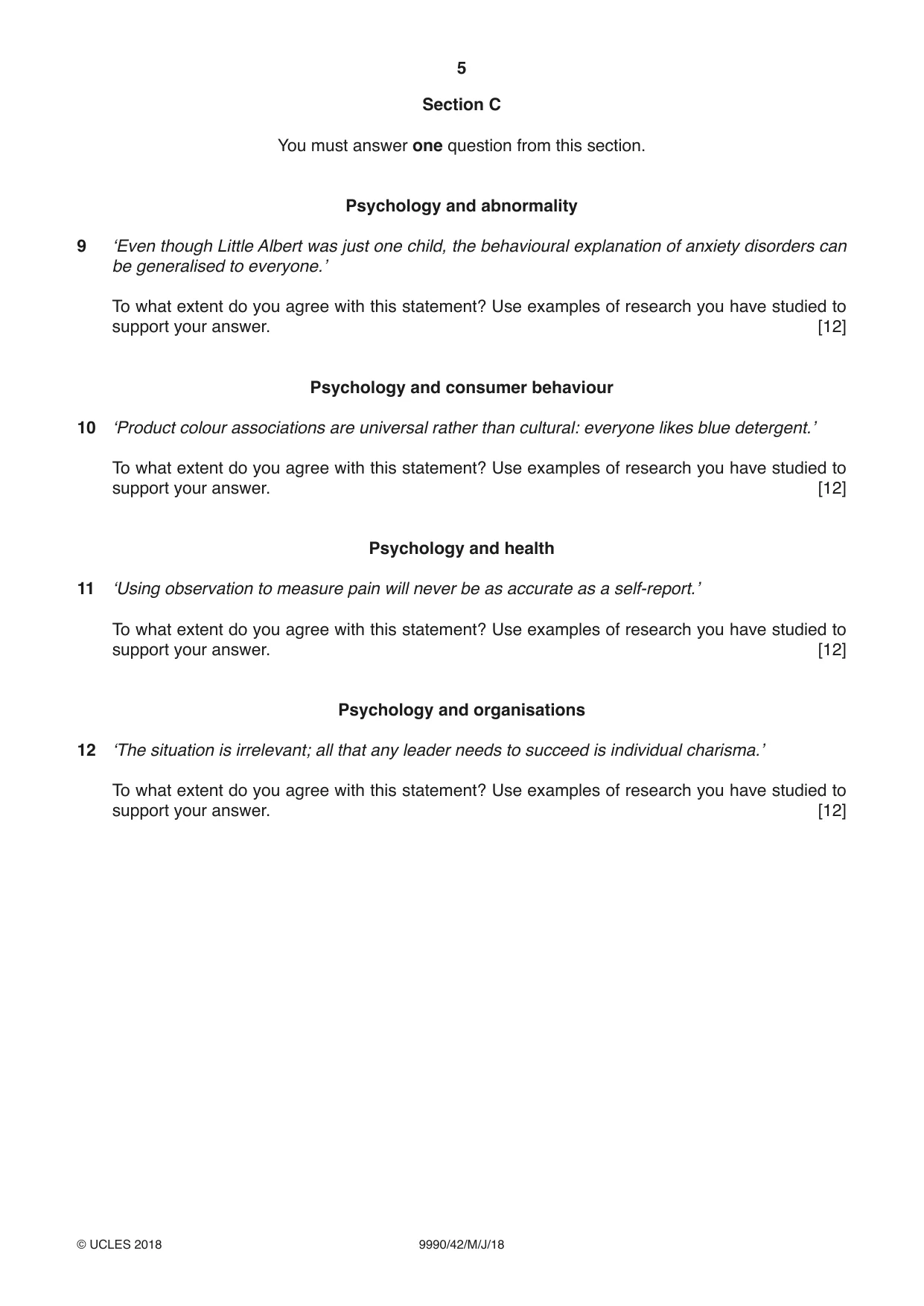
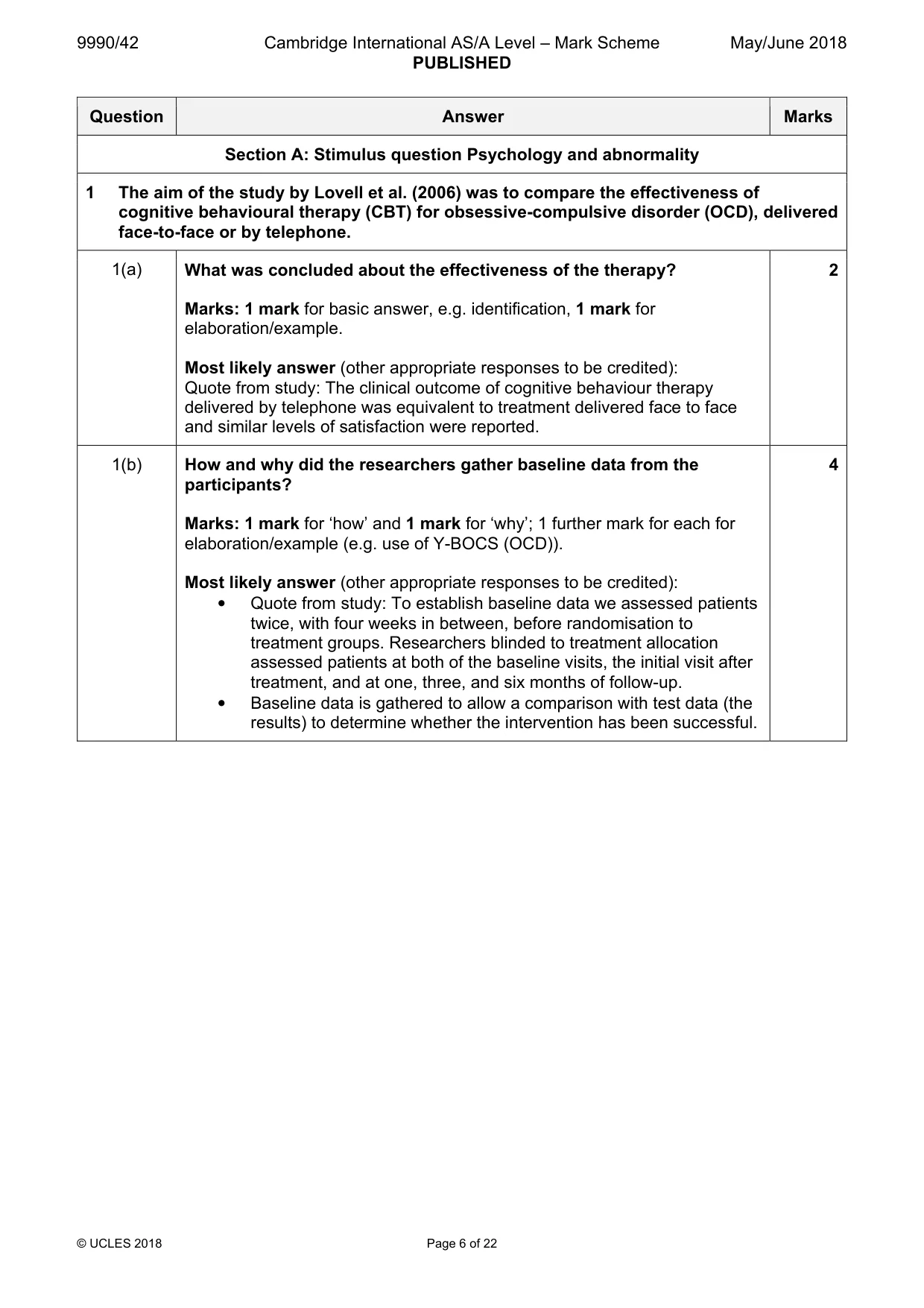
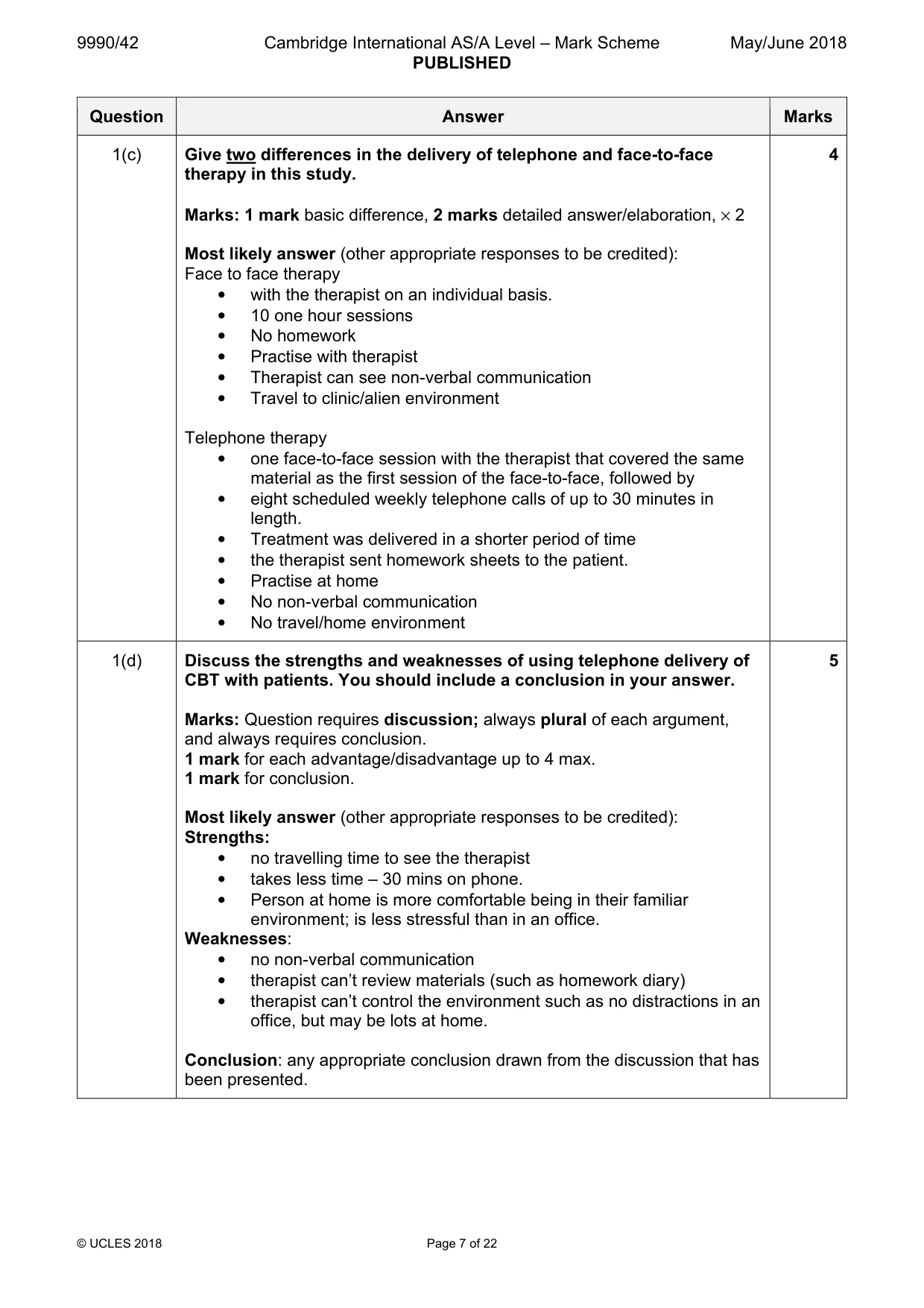
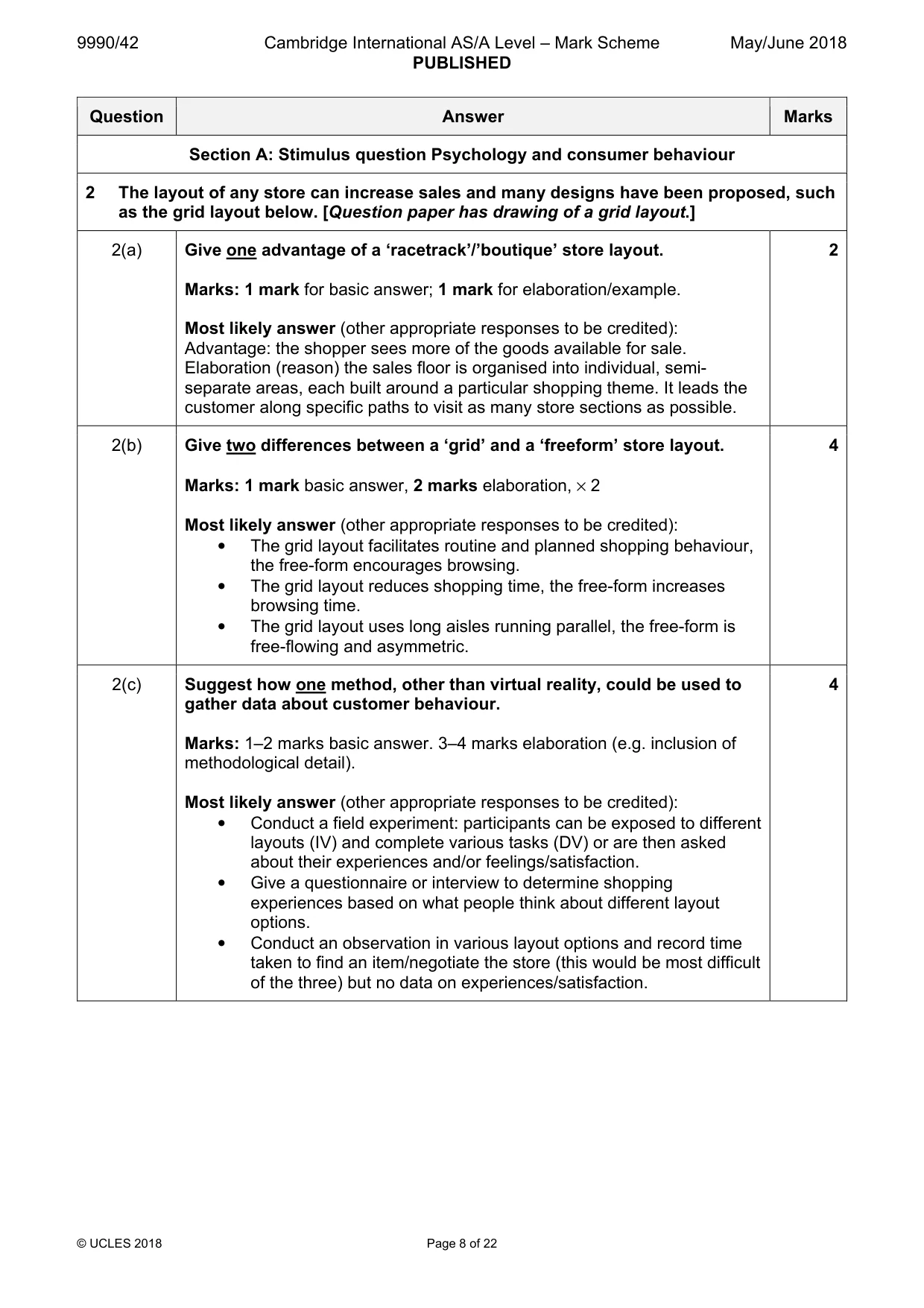
Mark scheme: Question Answer Marks Section A: Stimulus question Psychology and abnormality 1 The aim of the study by Lovell et al. (2006) was to compare the effectiveness of cognitive behavioural therapy (CBT) for obsessive-compulsive disorder (OCD), delivered face-to-face or by telephone. 1(a) What was concluded about the effectiveness of the therapy? 2 Marks: 1 mark for basic answer, e.g. identification, 1 mark for elaboration/example. Most likely answer (other appropriate responses to be credited): Quote from study: The clinical outcome of cognitive behaviour therapy delivered by telephone was equivalent to treatment delivered face to face and similar levels of satisfaction were reported. 1(b) How and why did the researchers gather baseline data from the 4 participants? Marks: 1 mark for ‘how’ and 1 mark for ‘why’; 1 further mark for each for elaboration/example (e.g. use of Y-BOCS (OCD)). Most likely answer (other appropriate responses to be credited): • Quote from study: To establish baseline data we assessed patients twice, with four weeks in between, before randomisation to treatment groups. Researchers blinded to treatment allocation assessed patients at both of the baseline visits, the initial visit after treatment, and at one, three, and six months of follow-up. • Baseline data is gathered to allow a comparison with test data (the results) to determine whether the intervention has been successful. 1(c) Give two differences in the delivery of telephone and face-to-face 4 therapy in this study. Marks: 1 mark basic difference, 2 marks detailed answer/elaboration, × 2 Most likely answer (other appropriate responses to be credited): Face to face therapy • with the therapist on an individual basis. • 10 one hour sessions • No homework • Practise with therapist • Therapist can see non-verbal communication • Travel to clinic/alien environment Telephone therapy • one face-to-face session with the therapist that covered the same material as the first session of the face-to-face, followed by • eight scheduled weekly telephone calls of up to 30 minutes in length. • Treatment was delivered in a shorter period of time • the therapist sent homework sheets to the patient. • Practise at home • No non-verbal communication • No travel/home environment 1(d) Discuss the strengths and weaknesses of using telephone delivery of 5 CBT with patients. You should include a conclusion in your answer. Marks: Question requires discussion; always plural of each argument, and always requires conclusion. 1 mark for each advantage/disadvantage up to 4 max. 1 mark for conclusion. Most likely answer (other appropriate responses to be credited): Strengths: • no travelling time to see the therapist • takes less time – 30 mins on phone. • Person at home is more comfortable being in their familiar environment; is less stressful than in an office. Weaknesses: • no non-verbal communication • therapist can’t review materials (such as homework diary) • therapist can’t control the environment such as no distractions in an office, but may be lots at home. Conclusion: any appropriate conclusion drawn from the discussion that has been presented.
Q2 · The layout of any store can increase sales and many designs have been proposed, such as…
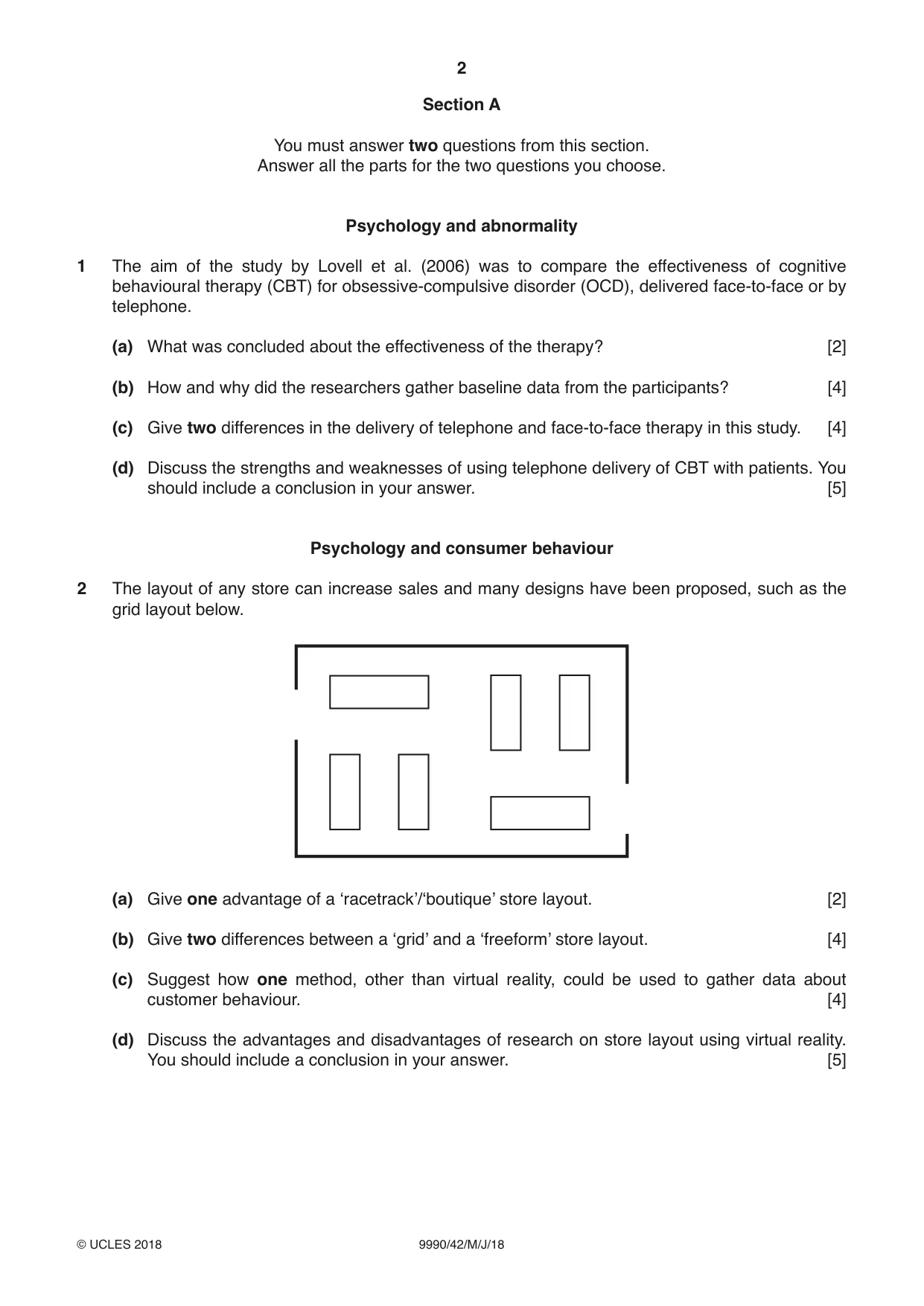
2 The layout of any store can increase sales and many designs have been proposed, such as the grid layout below. (a) Give one advantage of a ‘racetrack’/‘boutique’ store layout. [2] (b) Give two differences between a ‘grid’ and a ‘freeform’ store layout. [4] (c) Suggest how one method, other than virtual reality, could be used to gather data about customer behaviour. [4] (d) Discuss the advantages and disadvantages of research on store layout using virtual reality. You should include a conclusion in your answer. [5] Psychology and health
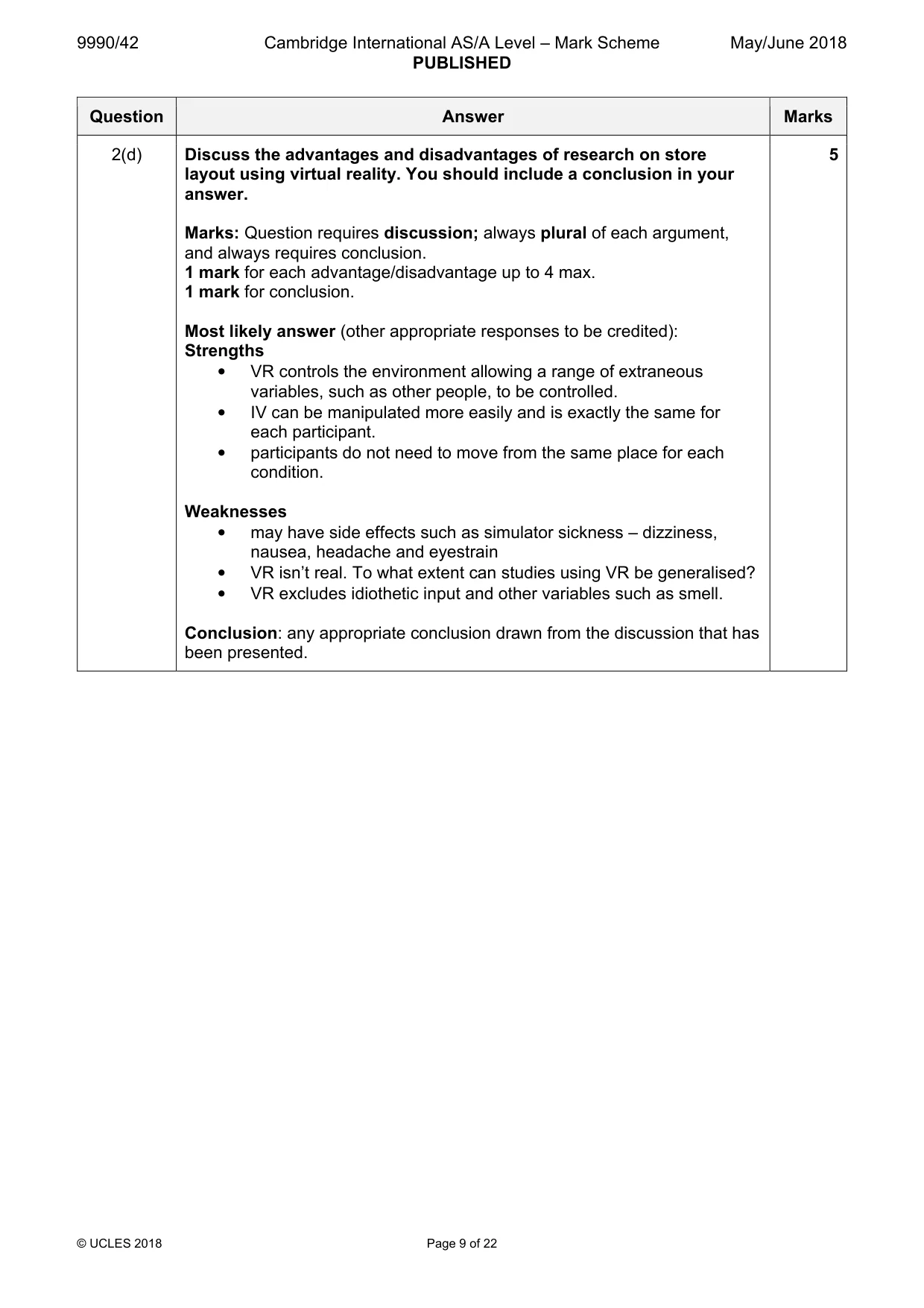
Mark scheme: 2(a) Give one advantage of a ‘racetrack’/’boutique’ store layout. 2 Marks: 1 mark for basic answer; 1 mark for elaboration/example. Most likely answer (other appropriate responses to be credited): Advantage: the shopper sees more of the goods available for sale. Elaboration (reason) the sales floor is organised into individual, semi- separate areas, each built around a particular shopping theme. It leads the customer along specific paths to visit as many store sections as possible. 2(b) Give two differences between a ‘grid’ and a ‘freeform’ store layout. 4 Marks: 1 mark basic answer, 2 marks elaboration, × 2 Most likely answer (other appropriate responses to be credited): • The grid layout facilitates routine and planned shopping behaviour, the free-form encourages browsing. • The grid layout reduces shopping time, the free-form increases browsing time. • The grid layout uses long aisles running parallel, the free-form is free-flowing and asymmetric. 2(c) Suggest how one method, other than virtual reality, could be used to 4 gather data about customer behaviour. Marks: 1–2 marks basic answer. 3–4 marks elaboration (e.g. inclusion of methodological detail). Most likely answer (other appropriate responses to be credited): • Conduct a field experiment: participants can be exposed to different layouts (IV) and complete various tasks (DV) or are then asked about their experiences and/or feelings/satisfaction. • Give a questionnaire or interview to determine shopping experiences based on what people think about different layout options. • Conduct an observation in various layout options and record time taken to find an item/negotiate the store (this would be most difficult of the three) but no data on experiences/satisfaction. 2(d) Discuss the advantages and disadvantages of research on store 5 layout using virtual reality. You should include a conclusion in your answer. Marks: Question requires discussion; always plural of each argument, and always requires conclusion. 1 mark for each advantage/disadvantage up to 4 max. 1 mark for conclusion. Most likely answer (other appropriate responses to be credited): Strengths • VR controls the environment allowing a range of extraneous variables, such as other people, to be controlled. • IV can be manipulated more easily and is exactly the same for each participant. • participants do not need to move from the same place for each condition. Weaknesses • may have side effects such as simulator sickness – dizziness, nausea, headache and eyestrain • VR isn’t real. To what extent can studies using VR be generalised? • VR excludes idiothetic input and other variables such as smell. Conclusion: any appropriate conclusion drawn from the discussion that has been presented.
Q3 · Unhealthy behaviours are difficult to change because of lifestyles; behaviours developed…
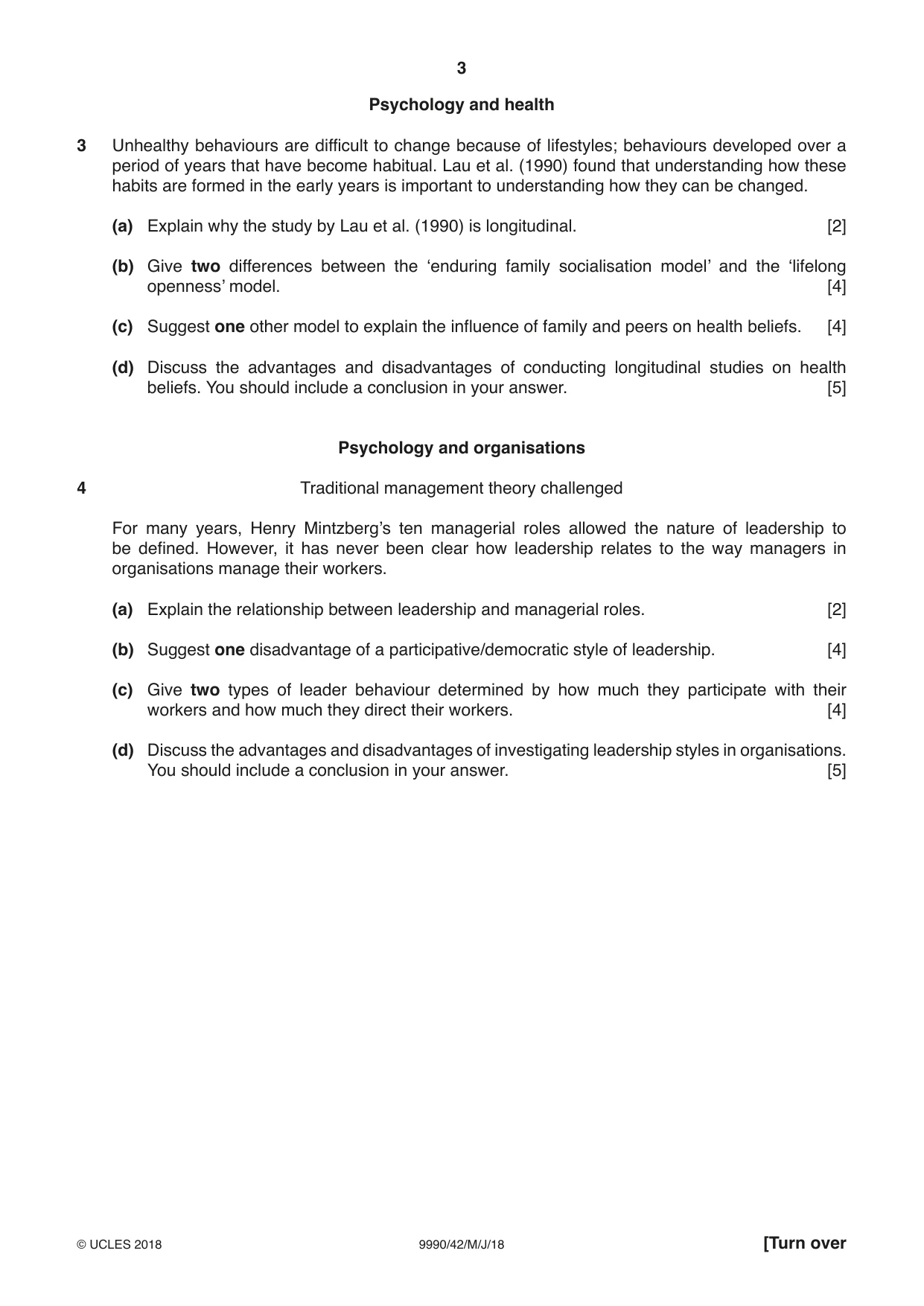
3 Unhealthy behaviours are difficult to change because of lifestyles; behaviours developed over a period of years that have become habitual. Lau et al. (1990) found that understanding how these habits are formed in the early years is important to understanding how they can be changed. (a) Explain why the study by Lau et al. (1990) is longitudinal. [2] (b) Give two differences between the ‘enduring family socialisation model’ and the ‘lifelong openness’ model. [4] (c) Suggest one other model to explain the influence of family and peers on health beliefs. [4] (d) Discuss the advantages and disadvantages of conducting longitudinal studies on health beliefs. You should include a conclusion in your answer. [5] Psychology and organisations
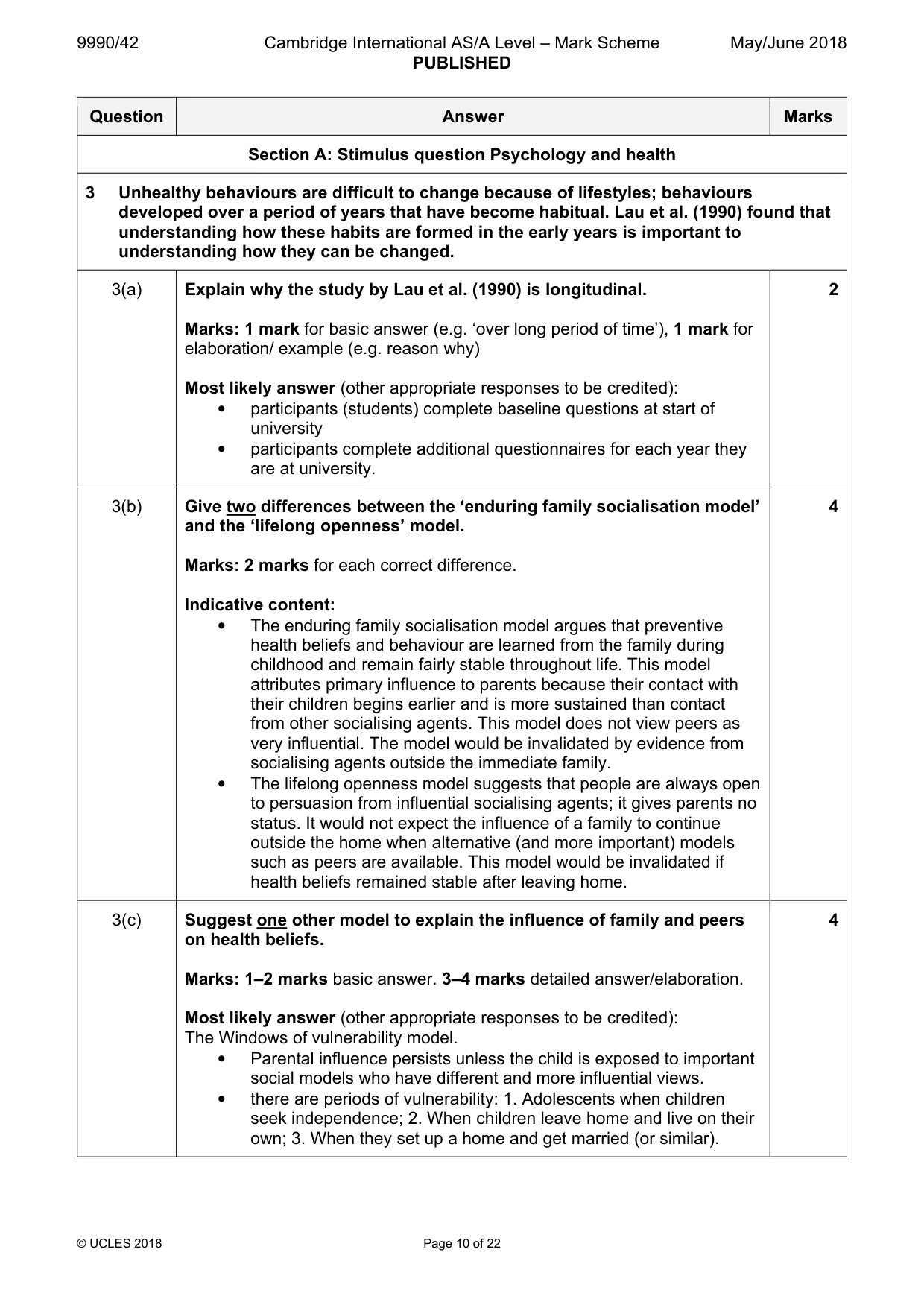
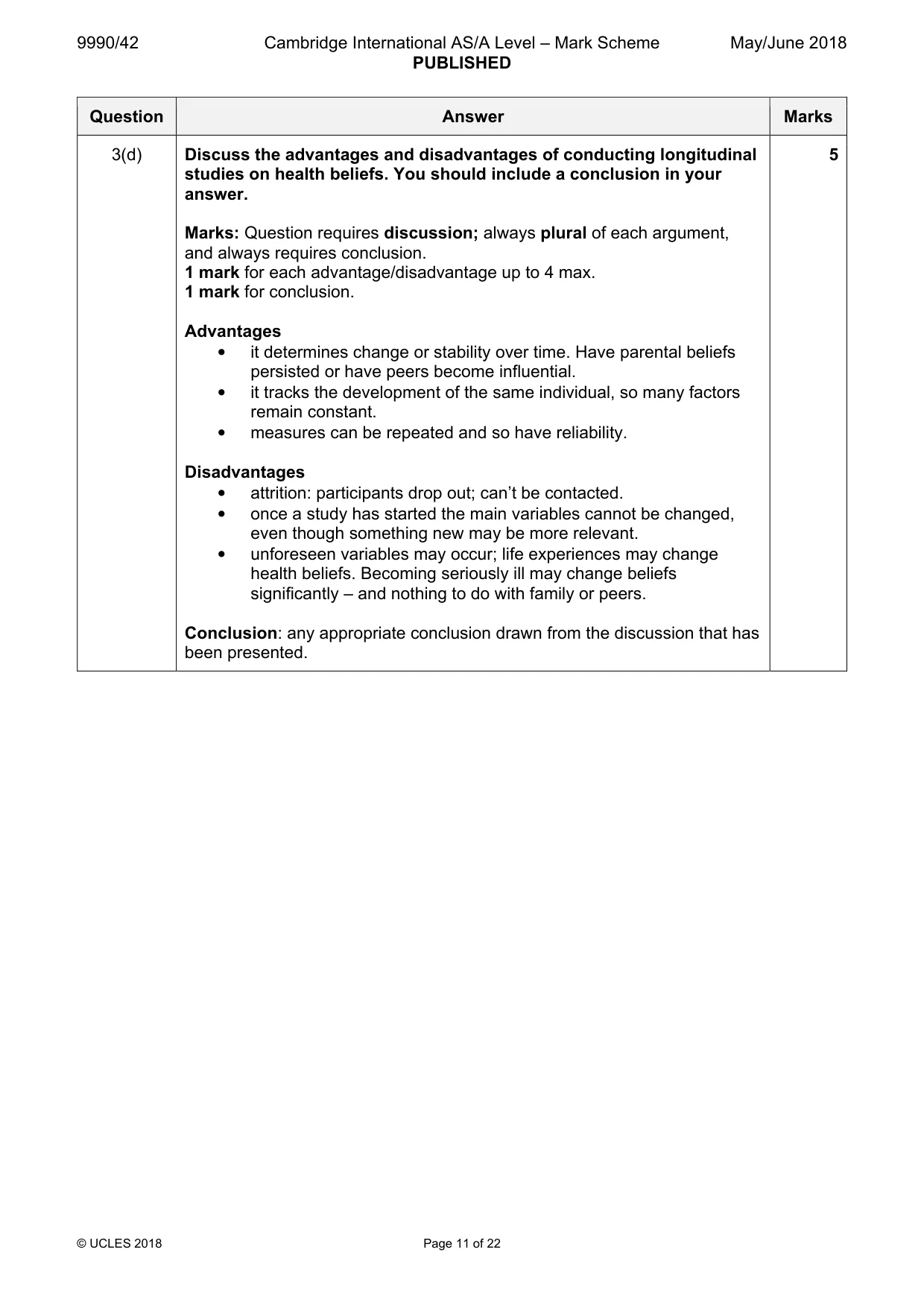
Mark scheme: 3(a) Explain why the study by Lau et al. (1990) is longitudinal. 2 Marks: 1 mark for basic answer (e.g. ‘over long period of time’), 1 mark for elaboration/ example (e.g. reason why) Most likely answer (other appropriate responses to be credited): • participants (students) complete baseline questions at start of university • participants complete additional questionnaires for each year they are at university. 3(b) Give two differences between the ‘enduring family socialisation model’ 4 and the ‘lifelong openness’ model. Marks: 2 marks for each correct difference. Indicative content: • The enduring family socialisation model argues that preventive health beliefs and behaviour are learned from the family during childhood and remain fairly stable throughout life. This model attributes primary influence to parents because their contact with their children begins earlier and is more sustained than contact from other socialising agents. This model does not view peers as very influential. The model would be invalidated by evidence from socialising agents outside the immediate family. • The lifelong openness model suggests that people are always open to persuasion from influential socialising agents; it gives parents no status. It would not expect the influence of a family to continue outside the home when alternative (and more important) models such as peers are available. This model would be invalidated if health beliefs remained stable after leaving home. 3(c) Suggest one other model to explain the influence of family and peers 4 on health beliefs. Marks: 1–2 marks basic answer. 3–4 marks detailed answer/elaboration. Most likely answer (other appropriate responses to be credited): The Windows of vulnerability model. • Parental influence persists unless the child is exposed to important social models who have different and more influential views. • there are periods of vulnerability: 1. Adolescents when children seek independence; 2. When children leave home and live on their own; 3. When they set up a home and get married (or similar). 3(d) Discuss the advantages and disadvantages of conducting longitudinal 5 studies on health beliefs. You should include a conclusion in your answer. Marks: Question requires discussion; always plural of each argument, and always requires conclusion. 1 mark for each advantage/disadvantage up to 4 max. 1 mark for conclusion. Advantages • it determines change or stability over time. Have parental beliefs persisted or have peers become influential. • it tracks the development of the same individual, so many factors remain constant. • measures can be repeated and so have reliability. Disadvantages • attrition: participants drop out; can’t be contacted. • once a study has started the main variables cannot be changed, even though something new may be more relevant. • unforeseen variables may occur; life experiences may change health beliefs. Becoming seriously ill may change beliefs significantly – and nothing to do with family or peers. Conclusion: any appropriate conclusion drawn from the discussion that has been presented.
More questions on 2 Health promotion in schools and worksites
Q4 · Traditional management theory challenged For many years, Henry Mintzberg’s ten managerial…
4 Traditional management theory challenged For many years, Henry Mintzberg’s ten managerial roles allowed the nature of leadership to be defined. However, it has never been clear how leadership relates to the way managers in organisations manage their workers. (a) Explain the relationship between leadership and managerial roles. [2] (b) Suggest one disadvantage of a participative/democratic style of leadership. [4] (c) Give two types of leader behaviour determined by how much they participate with their workers and how much they direct their workers. [4] (d) Discuss the advantages and disadvantages of investigating leadership styles in organisations. You should include a conclusion in your answer. [5]
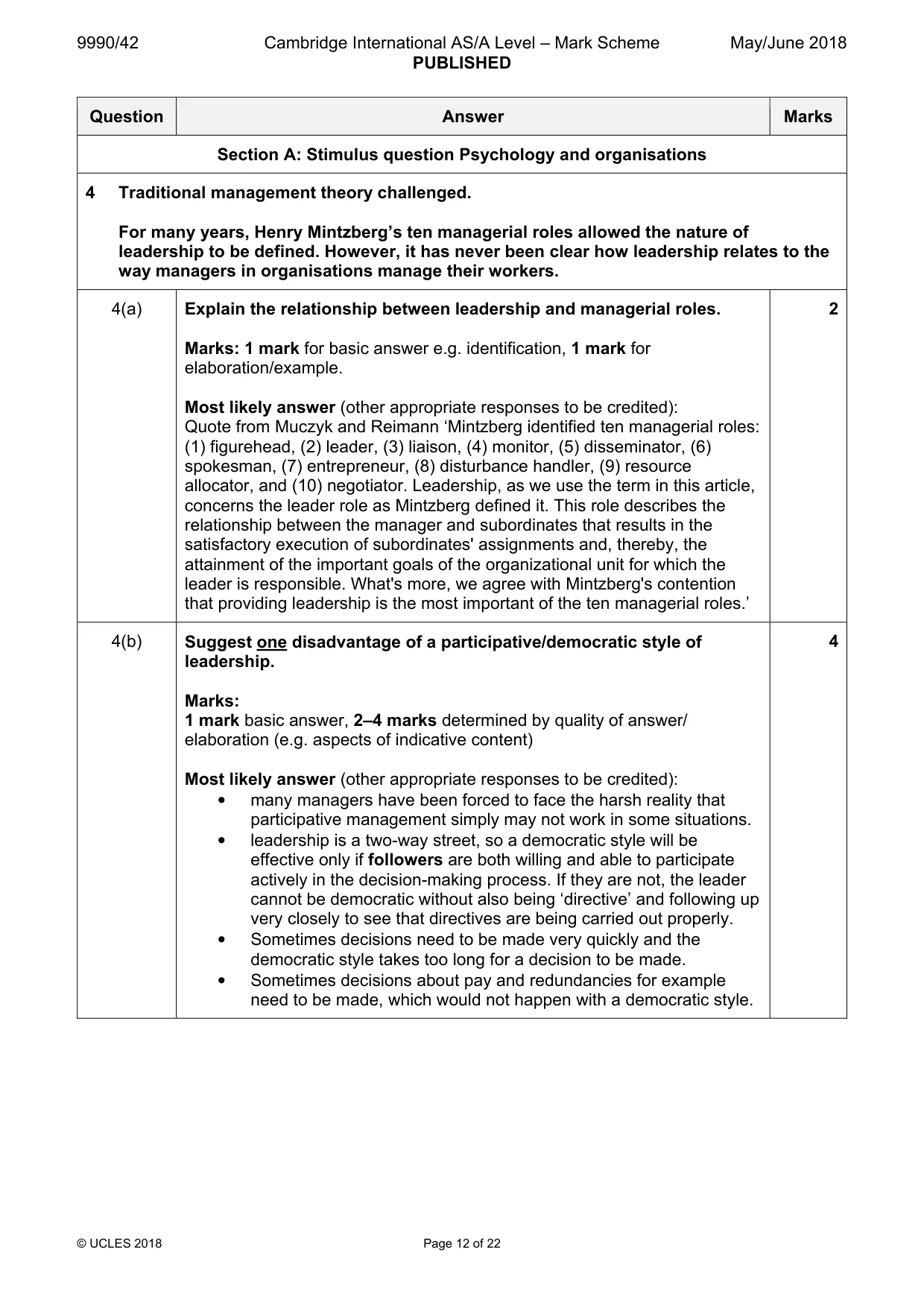
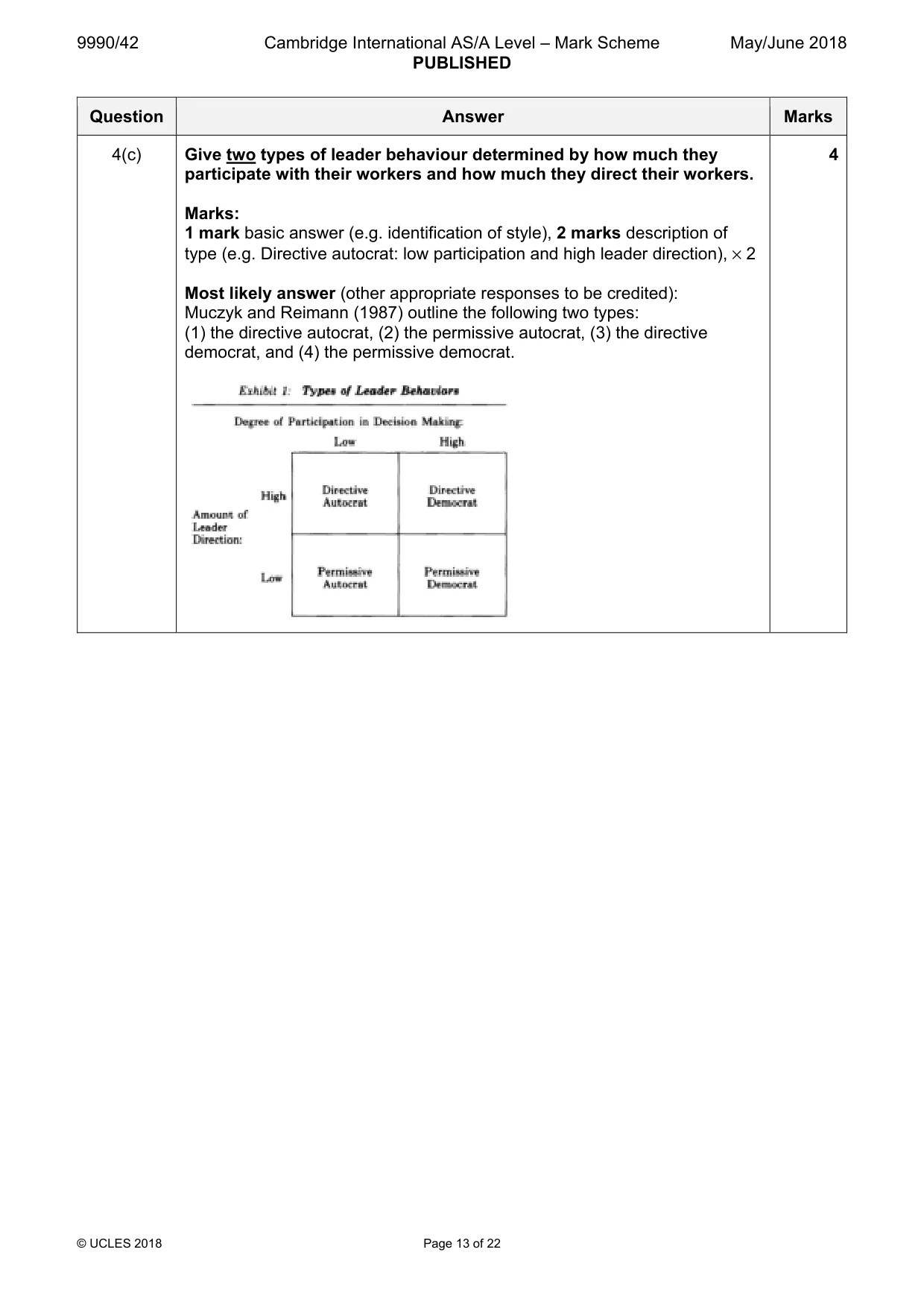
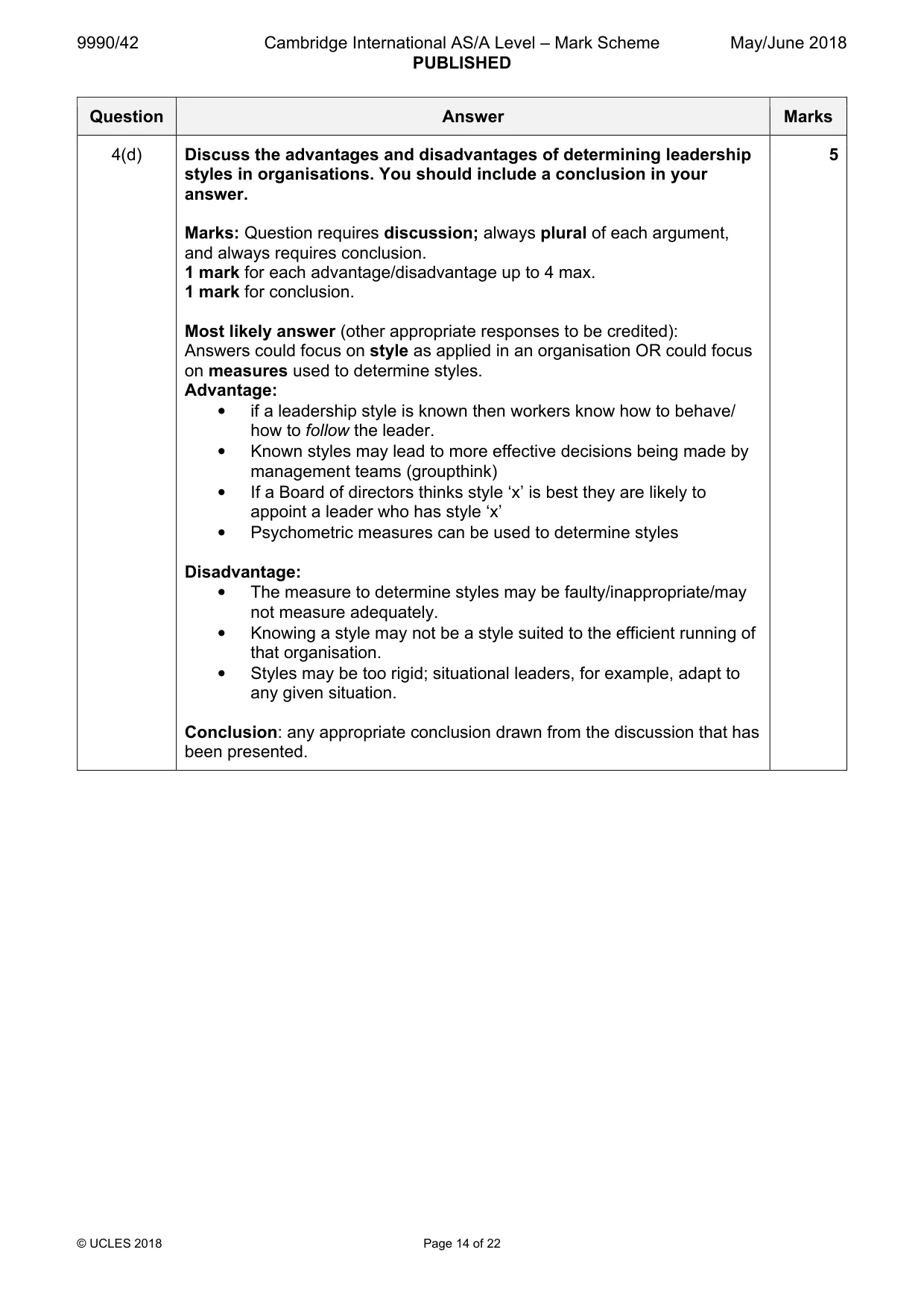
Mark scheme: 4(a) Explain the relationship between leadership and managerial roles. 2 Marks: 1 mark for basic answer e.g. identification, 1 mark for elaboration/example. Most likely answer (other appropriate responses to be credited): Quote from Muczyk and Reimann ‘Mintzberg identified ten managerial roles: (1) figurehead, (2) leader, (3) liaison, (4) monitor, (5) disseminator, (6) spokesman, (7) entrepreneur, (8) disturbance handler, (9) resource allocator, and (10) negotiator. Leadership, as we use the term in this article, concerns the leader role as Mintzberg defined it. This role describes the relationship between the manager and subordinates that results in the satisfactory execution of subordinates' assignments and, thereby, the attainment of the important goals of the organizational unit for which the leader is responsible. What's more, we agree with Mintzberg's contention that providing leadership is the most important of the ten managerial roles.’ 4(b) Suggest one disadvantage of a participative/democratic style of 4 leadership. Marks: 1 mark basic answer, 2–4 marks determined by quality of answer/ elaboration (e.g. aspects of indicative content) Most likely answer (other appropriate responses to be credited): • many managers have been forced to face the harsh reality that participative management simply may not work in some situations. • leadership is a two-way street, so a democratic style will be effective only if followers are both willing and able to participate actively in the decision-making process. If they are not, the leader cannot be democratic without also being ‘directive’ and following up very closely to see that directives are being carried out properly. • Sometimes decisions need to be made very quickly and the democratic style takes too long for a decision to be made. • Sometimes decisions about pay and redundancies for example need to be made, which would not happen with a democratic style. 4(c) Give two types of leader behaviour determined by how much they 4 participate with their workers and how much they direct their workers. Marks: 1 mark basic answer (e.g. identification of style), 2 marks description of type (e.g. Directive autocrat: low participation and high leader direction), × 2 Most likely answer (other appropriate responses to be credited): Muczyk and Reimann (1987) outline the following two types: (1) the directive autocrat, (2) the permissive autocrat, (3) the directive democrat, and (4) the permissive democrat. 4(d) Discuss the advantages and disadvantages of determining leadership 5 styles in organisations. You should include a conclusion in your answer. Marks: Question requires discussion; always plural of each argument, and always requires conclusion. 1 mark for each advantage/disadvantage up to 4 max. 1 mark for conclusion. Most likely answer (other appropriate responses to be credited): Answers could focus on style as applied in an organisation OR could focus on measures used to determine styles. Advantage: • if a leadership style is known then workers know how to behave/ how to follow the leader. • Known styles may lead to more effective decisions being made by management teams (groupthink) • If a Board of directors thinks style ‘x’ is best they are likely to appoint a leader who has style ‘x’ • Psychometric measures can be used to determine styles Disadvantage: • The measure to determine styles may be faulty/inappropriate/may not measure adequately. • Knowing a style may not be a style suited to the efficient running of that organisation. • Styles may be too rigid; situational leaders, for example, adapt to any given situation. Conclusion: any appropriate conclusion drawn from the discussion that has been presented.
Q5 · Design a study using a questionnaire to investigate the most common body dysmorphic…
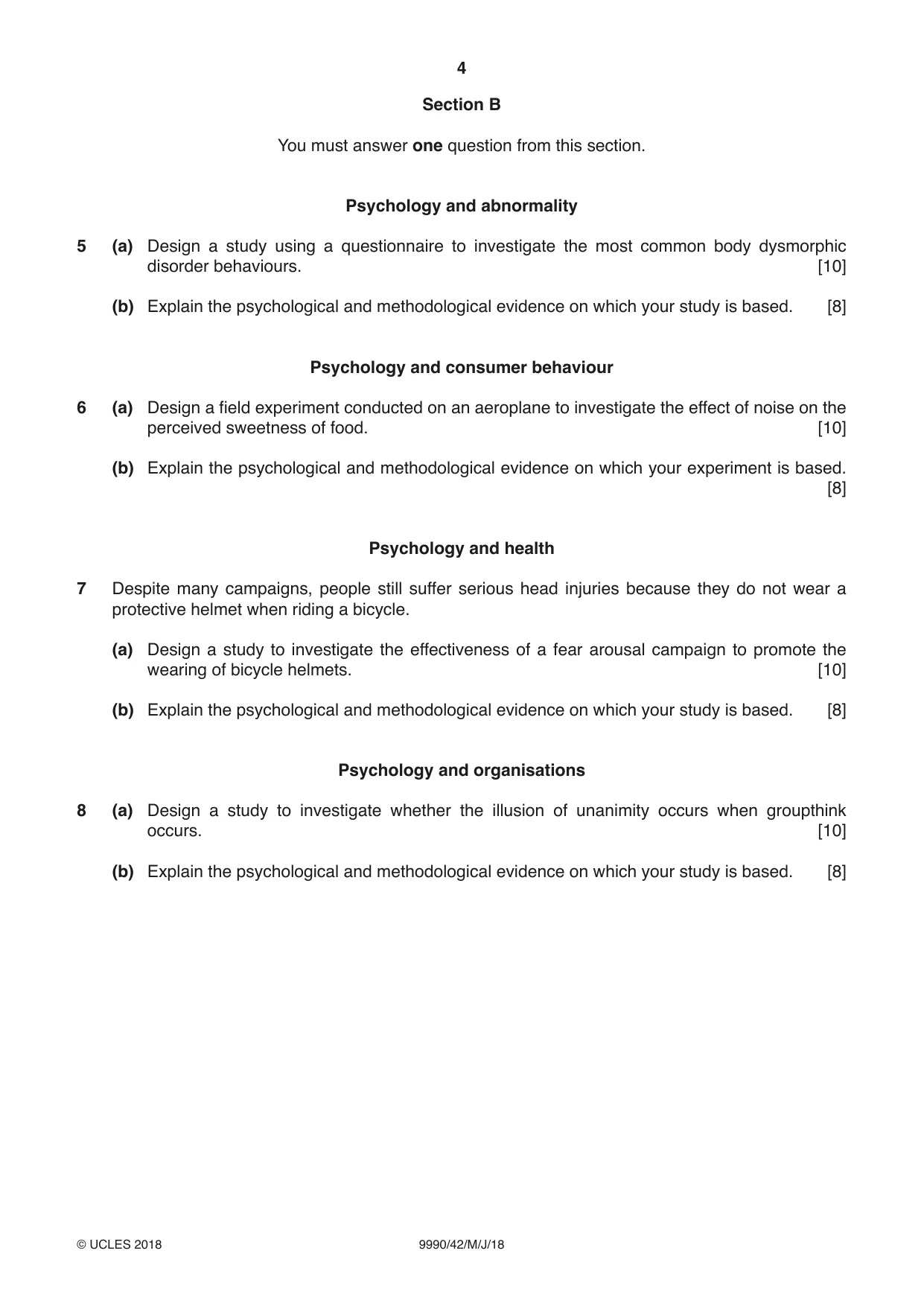
5 (a) Design a study using a questionnaire to investigate the most common body dysmorphic disorder behaviours. [10] (b) Explain the psychological and methodological evidence on which your study is based. [8] Psychology and consumer behaviour
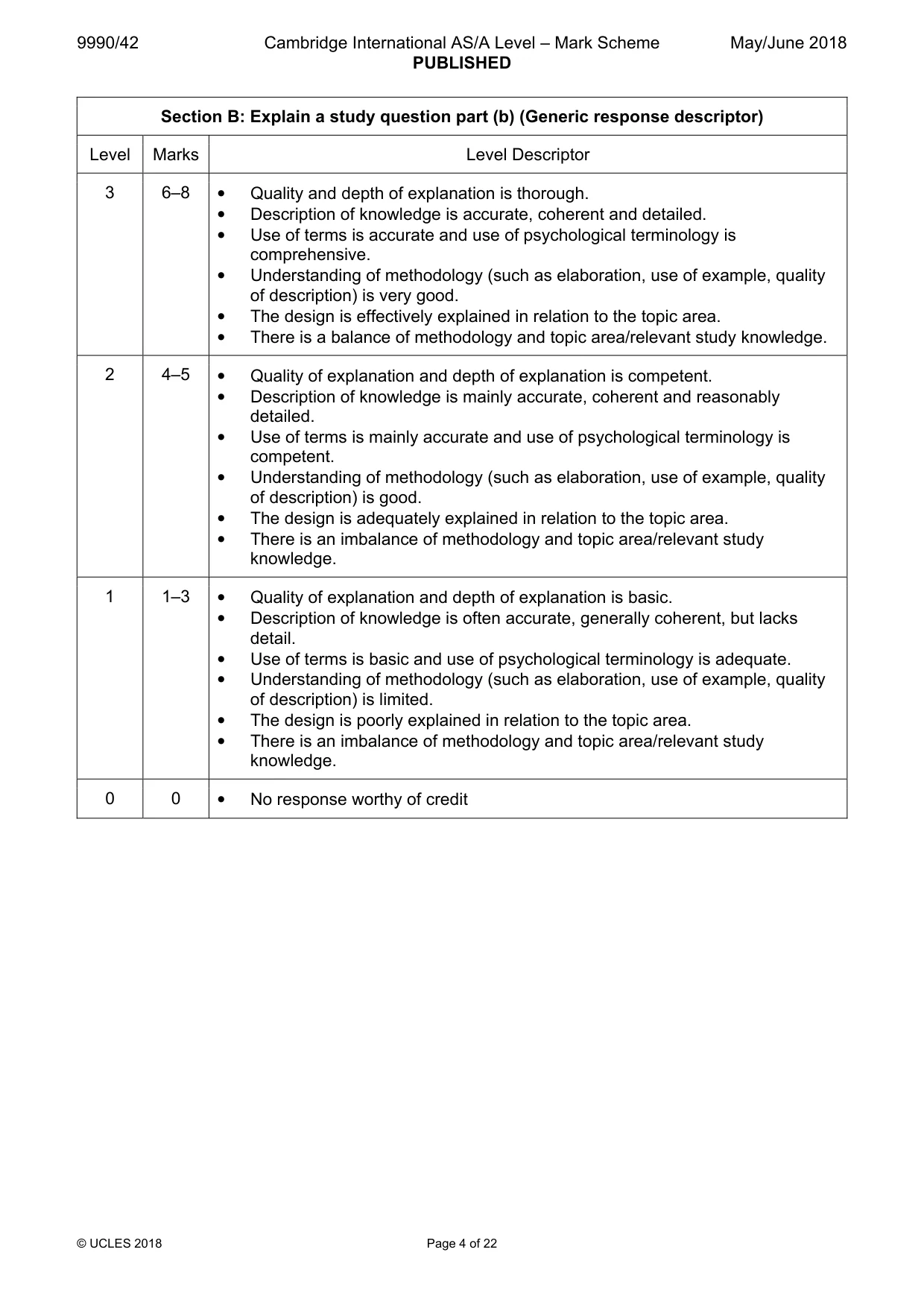
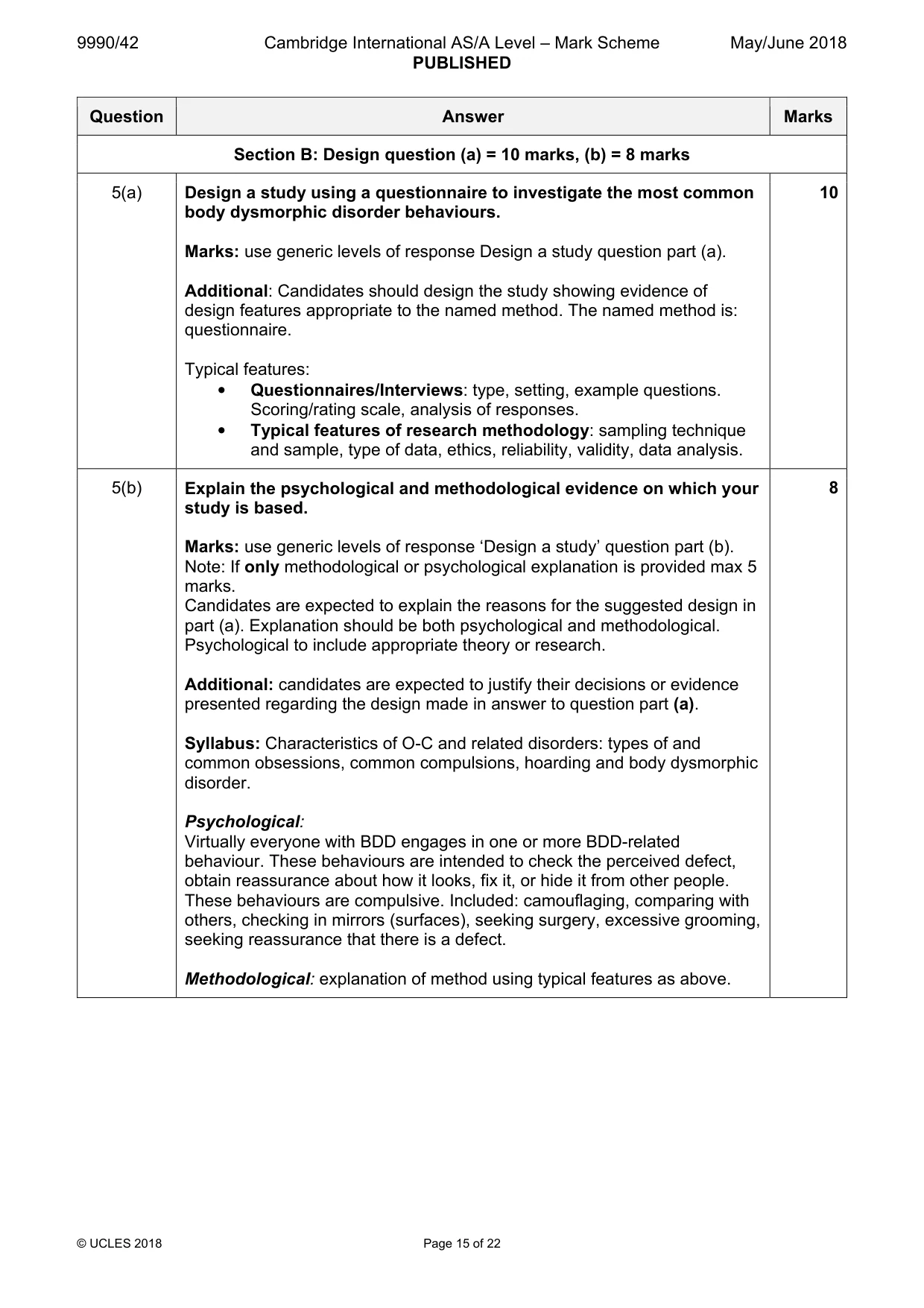
Mark scheme: 5(a) Design a study using a questionnaire to investigate the most common 10 body dysmorphic disorder behaviours. Marks: use generic levels of response Design a study question part (a). Additional: Candidates should design the study showing evidence of design features appropriate to the named method. The named method is: questionnaire. Typical features: • Questionnaires/Interviews: type, setting, example questions. Scoring/rating scale, analysis of responses. • Typical features of research methodology: sampling technique and sample, type of data, ethics, reliability, validity, data analysis. 5(b) Explain the psychological and methodological evidence on which your 8 study is based. Marks: use generic levels of response ‘Design a study’ question part (b). Note: If only methodological or psychological explanation is provided max 5 marks. Candidates are expected to explain the reasons for the suggested design in part (a). Explanation should be both psychological and methodological. Psychological to include appropriate theory or research. Additional: candidates are expected to justify their decisions or evidence presented regarding the design made in answer to question part (a). Syllabus: Characteristics of O-C and related disorders: types of and common obsessions, common compulsions, hoarding and body dysmorphic disorder. Psychological: Virtually everyone with BDD engages in one or more BDD-related behaviour. These behaviours are intended to check the perceived defect, obtain reassurance about how it looks, fix it, or hide it from other people. These behaviours are compulsive. Included: camouflaging, comparing with others, checking in mirrors (surfaces), seeking surgery, excessive grooming, seeking reassurance that there is a defect. Methodological: explanation of method using typical features as above.
Q6 · Design a field experiment conducted on an aeroplane to investigate the effect of noise on…
6 (a) Design a field experiment conducted on an aeroplane to investigate the effect of noise on the perceived sweetness of food. [10] (b) Explain the psychological and methodological evidence on which your experiment is based. [8] Psychology and health
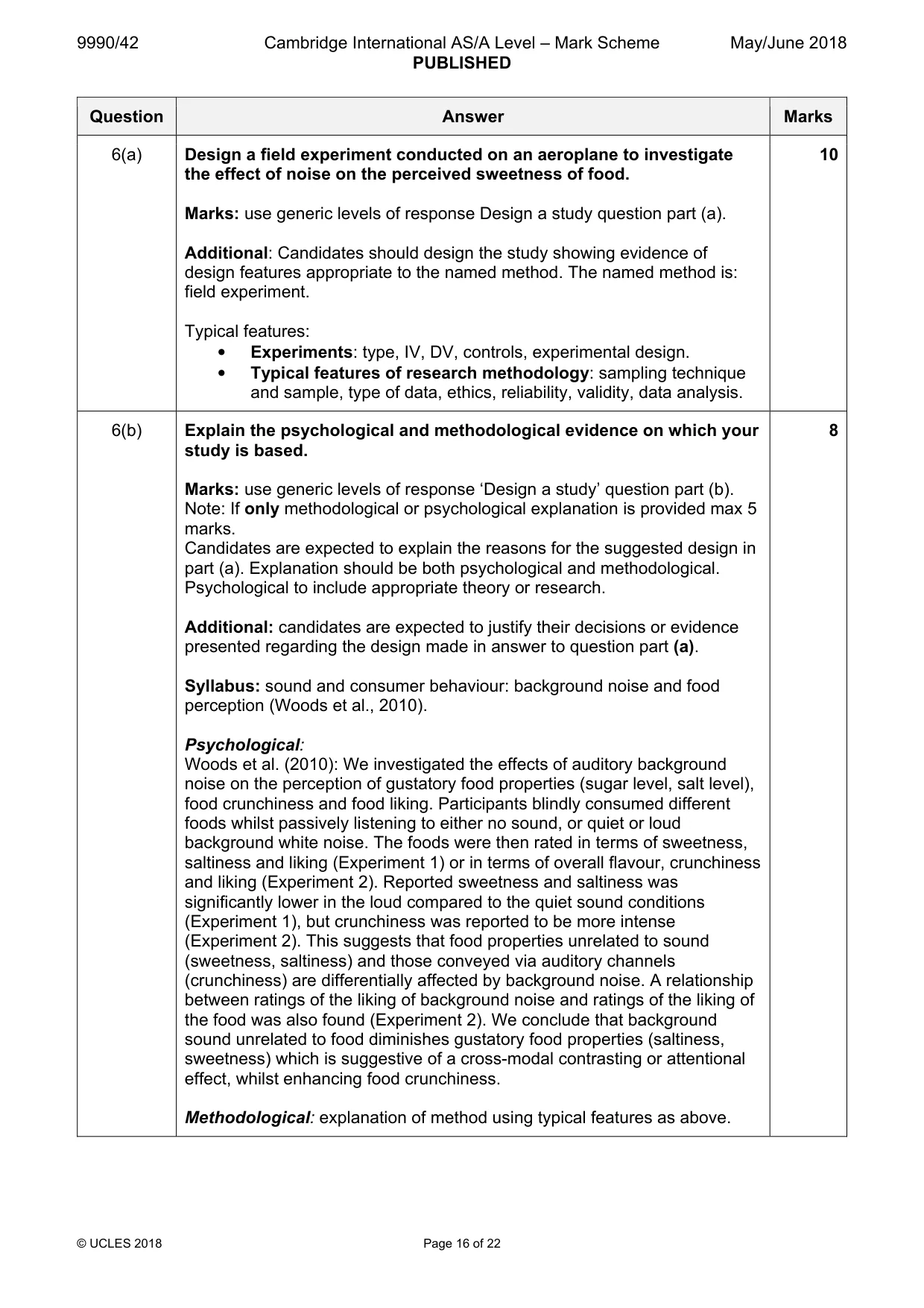
Mark scheme: 6(a) Design a field experiment conducted on an aeroplane to investigate 10 the effect of noise on the perceived sweetness of food. Marks: use generic levels of response Design a study question part (a). Additional: Candidates should design the study showing evidence of design features appropriate to the named method. The named method is: field experiment. Typical features: • Experiments: type, IV, DV, controls, experimental design. • Typical features of research methodology: sampling technique and sample, type of data, ethics, reliability, validity, data analysis. 6(b) Explain the psychological and methodological evidence on which your 8 study is based. Marks: use generic levels of response ‘Design a study’ question part (b). Note: If only methodological or psychological explanation is provided max 5 marks. Candidates are expected to explain the reasons for the suggested design in part (a). Explanation should be both psychological and methodological. Psychological to include appropriate theory or research. Additional: candidates are expected to justify their decisions or evidence presented regarding the design made in answer to question part (a). Syllabus: sound and consumer behaviour: background noise and food perception (Woods et al., 2010). Psychological: Woods et al. (2010): We investigated the effects of auditory background noise on the perception of gustatory food properties (sugar level, salt level), food crunchiness and food liking. Participants blindly consumed different foods whilst passively listening to either no sound, or quiet or loud background white noise. The foods were then rated in terms of sweetness, saltiness and liking (Experiment 1) or in terms of overall flavour, crunchiness and liking (Experiment 2). Reported sweetness and saltiness was significantly lower in the loud compared to the quiet sound conditions (Experiment 1), but crunchiness was reported to be more intense (Experiment 2). This suggests that food properties unrelated to sound (sweetness, saltiness) and those conveyed via auditory channels (crunchiness) are differentially affected by background noise. A relationship between ratings of the liking of background noise and ratings of the liking of the food was also found (Experiment 2). We conclude that background sound unrelated to food diminishes gustatory food properties (saltiness, sweetness) which is suggestive of a cross-modal contrasting or attentional effect, whilst enhancing food crunchiness. Methodological: explanation of method using typical features as above.
Q7 · Despite many campaigns, people still suffer serious head injuries because they do not…
7 Despite many campaigns, people still suffer serious head injuries because they do not wear a protective helmet when riding a bicycle. (a) Design a study to investigate the effectiveness of a fear arousal campaign to promote the wearing of bicycle helmets. [10] (b) Explain the psychological and methodological evidence on which your study is based. [8] Psychology and organisations
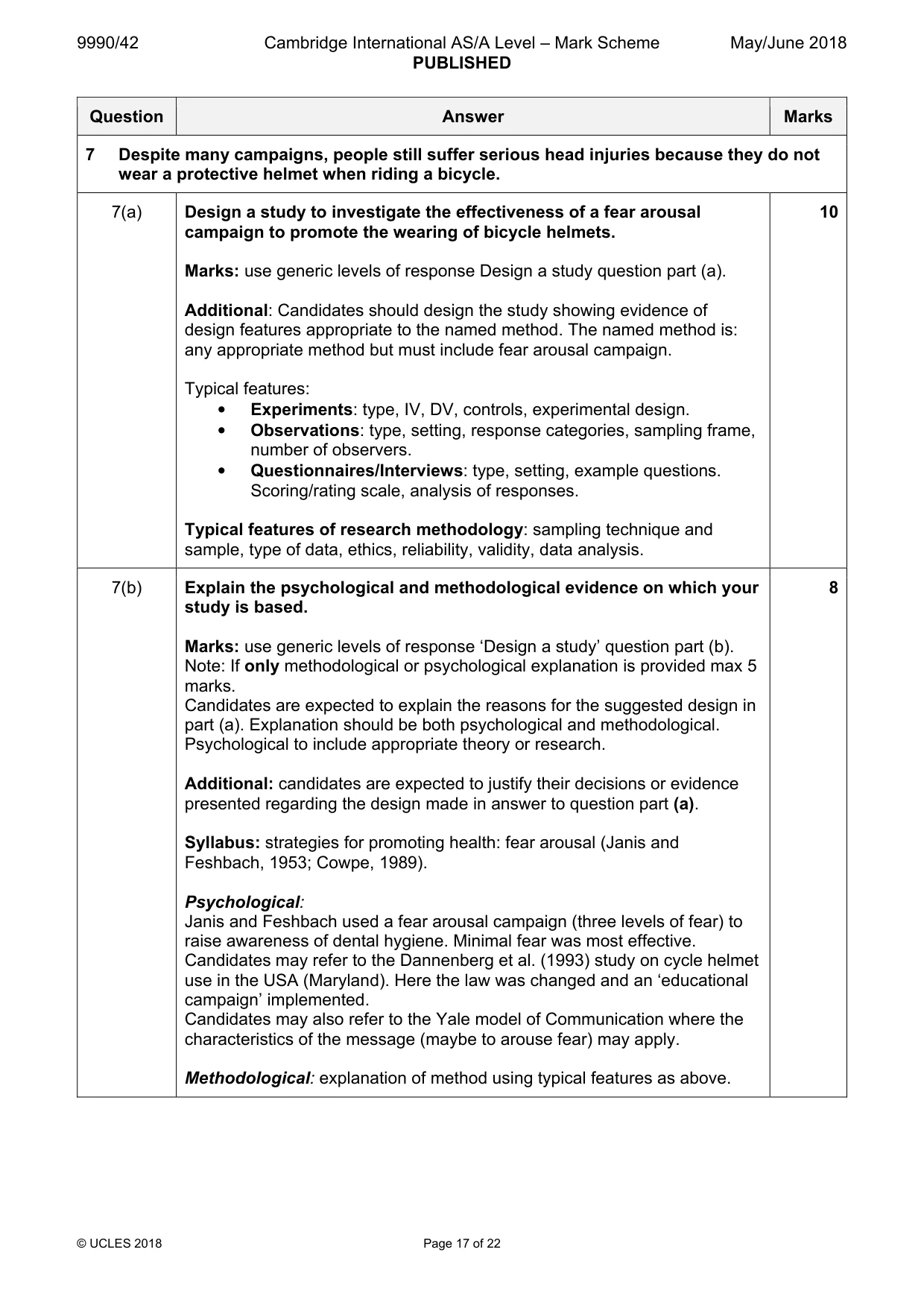
Mark scheme: 7(a) Design a study to investigate the effectiveness of a fear arousal 10 campaign to promote the wearing of bicycle helmets. Marks: use generic levels of response Design a study question part (a). Additional: Candidates should design the study showing evidence of design features appropriate to the named method. The named method is: any appropriate method but must include fear arousal campaign. Typical features: • Experiments: type, IV, DV, controls, experimental design. • Observations: type, setting, response categories, sampling frame, number of observers. • Questionnaires/Interviews: type, setting, example questions. Scoring/rating scale, analysis of responses. Typical features of research methodology: sampling technique and sample, type of data, ethics, reliability, validity, data analysis. 7(b) Explain the psychological and methodological evidence on which your 8 study is based. Marks: use generic levels of response ‘Design a study’ question part (b). Note: If only methodological or psychological explanation is provided max 5 marks. Candidates are expected to explain the reasons for the suggested design in part (a). Explanation should be both psychological and methodological. Psychological to include appropriate theory or research. Additional: candidates are expected to justify their decisions or evidence presented regarding the design made in answer to question part (a). Syllabus: strategies for promoting health: fear arousal (Janis and Feshbach, 1953; Cowpe, 1989). Psychological: Janis and Feshbach used a fear arousal campaign (three levels of fear) to raise awareness of dental hygiene. Minimal fear was most effective. Candidates may refer to the Dannenberg et al. (1993) study on cycle helmet use in the USA (Maryland). Here the law was changed and an ‘educational campaign’ implemented. Candidates may also refer to the Yale model of Communication where the characteristics of the message (maybe to arouse fear) may apply. Methodological: explanation of method using typical features as above.
More questions on 2 Health promotion in schools and worksites
Q8 · Design a study to investigate whether the illusion of unanimity occurs when groupthink…
8 (a) Design a study to investigate whether the illusion of unanimity occurs when groupthink occurs. [10] (b) Explain the psychological and methodological evidence on which your study is based. [8] Section C You must answer one question from this section. Psychology and abnormality
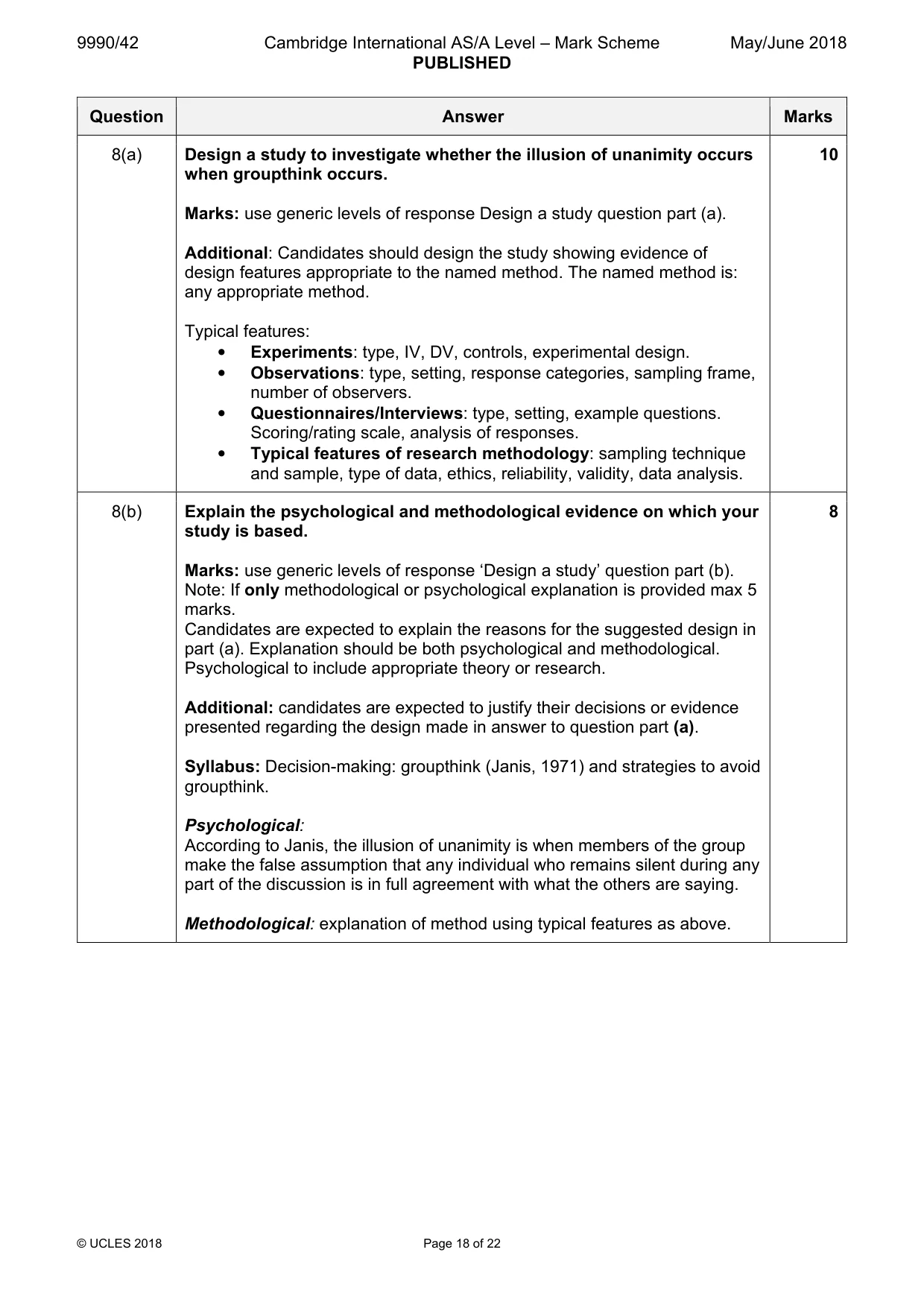
Mark scheme: 8(a) Design a study to investigate whether the illusion of unanimity occurs 10 when groupthink occurs. Marks: use generic levels of response Design a study question part (a). Additional: Candidates should design the study showing evidence of design features appropriate to the named method. The named method is: any appropriate method. Typical features: • Experiments: type, IV, DV, controls, experimental design. • Observations: type, setting, response categories, sampling frame, number of observers. • Questionnaires/Interviews: type, setting, example questions. Scoring/rating scale, analysis of responses. • Typical features of research methodology: sampling technique and sample, type of data, ethics, reliability, validity, data analysis. 8(b) Explain the psychological and methodological evidence on which your 8 study is based. Marks: use generic levels of response ‘Design a study’ question part (b). Note: If only methodological or psychological explanation is provided max 5 marks. Candidates are expected to explain the reasons for the suggested design in part (a). Explanation should be both psychological and methodological. Psychological to include appropriate theory or research. Additional: candidates are expected to justify their decisions or evidence presented regarding the design made in answer to question part (a). Syllabus: Decision-making: groupthink (Janis, 1971) and strategies to avoid groupthink. Psychological: According to Janis, the illusion of unanimity is when members of the group make the false assumption that any individual who remains silent during any part of the discussion is in full agreement with what the others are saying. Methodological: explanation of method using typical features as above.
Q9 · ‘Even though Little Albert was just one child, the behavioural explanation of anxiety…
9 ‘Even though Little Albert was just one child, the behavioural explanation of anxiety disorders can be generalised to everyone.’ To what extent do you agree with this statement? Use examples of research you have studied to support your answer. [12] Psychology and consumer behaviour
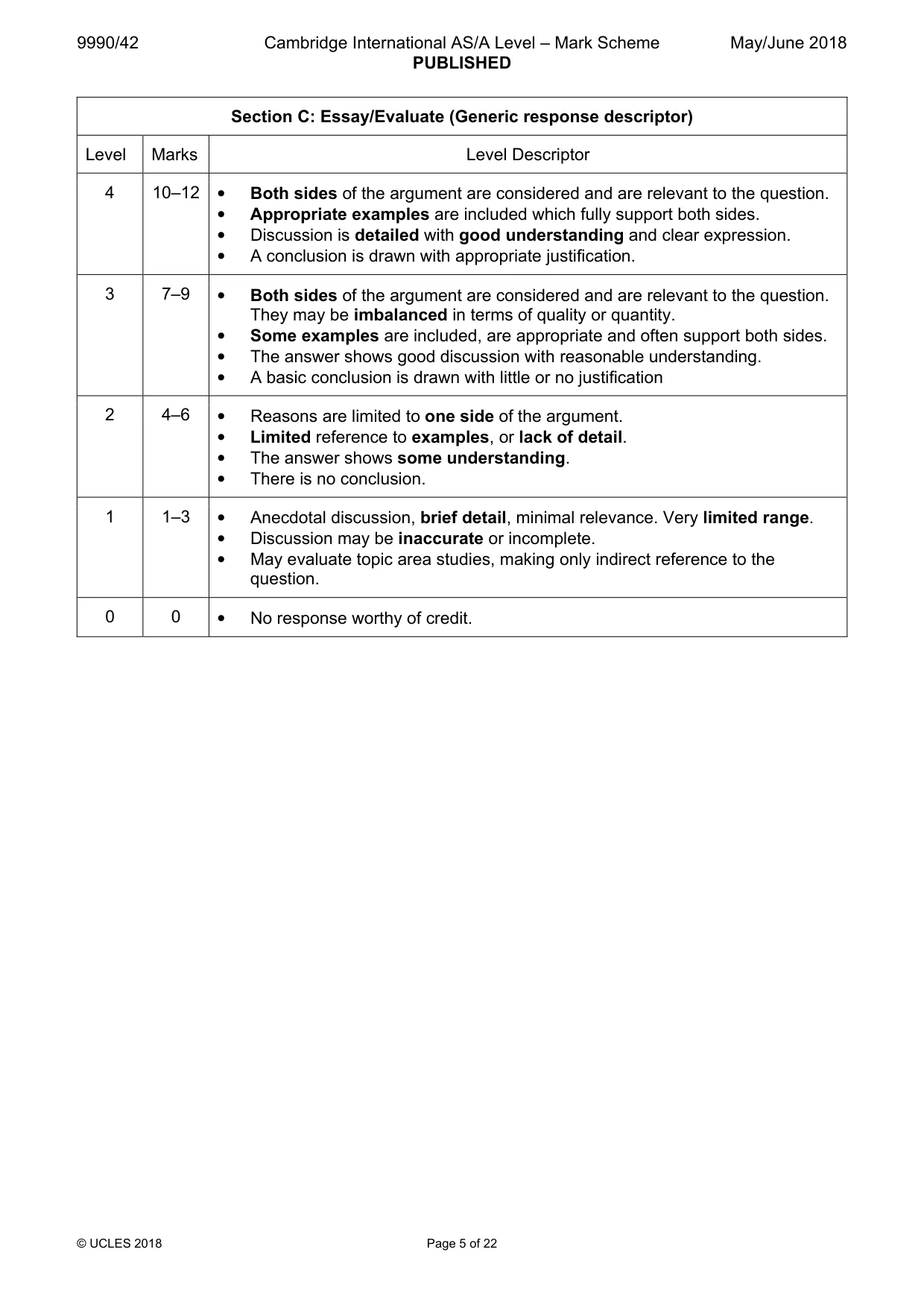
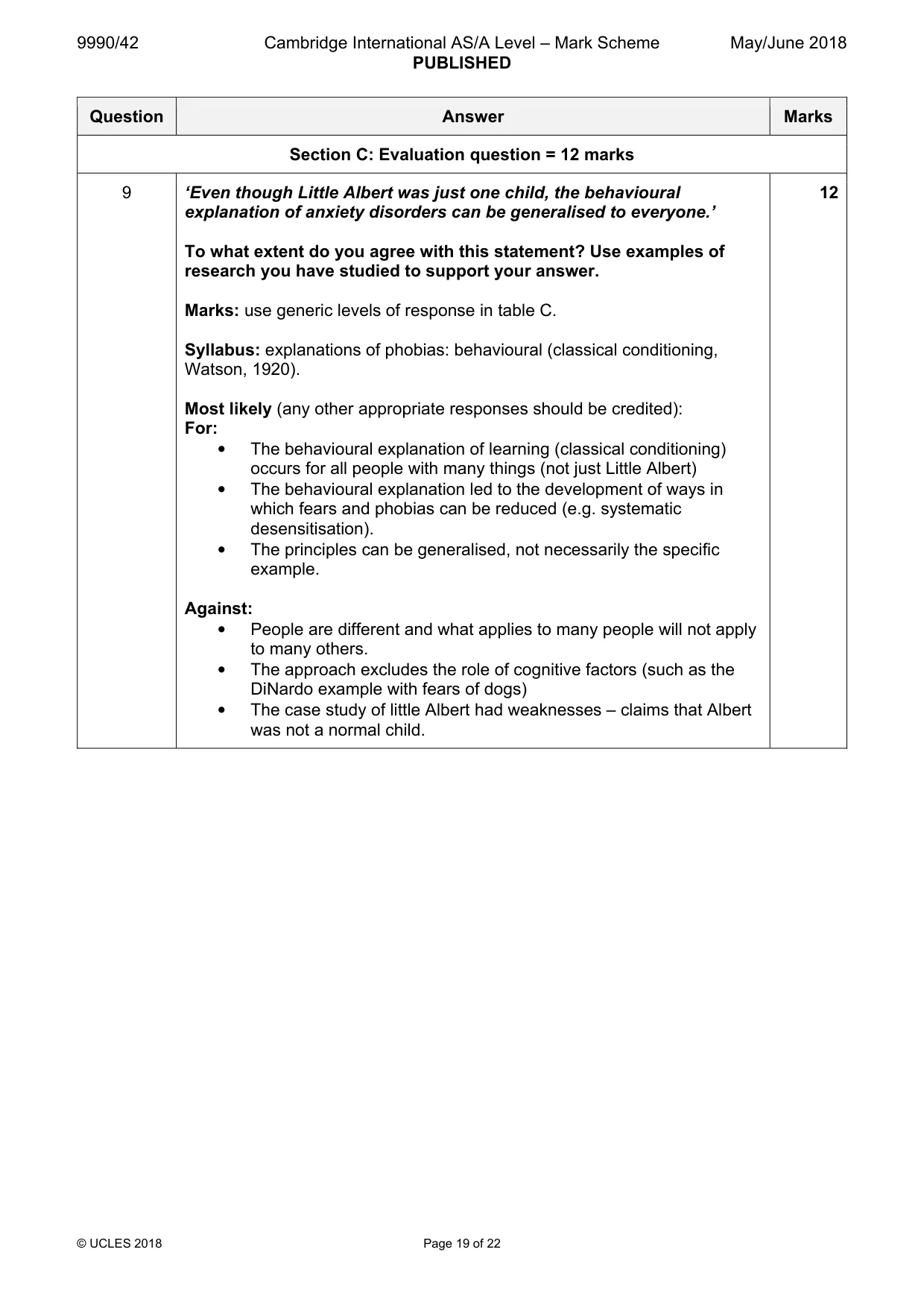
Mark scheme: 9 ‘Even though Little Albert was just one child, the behavioural 12 explanation of anxiety disorders can be generalised to everyone.’ To what extent do you agree with this statement? Use examples of research you have studied to support your answer. Marks: use generic levels of response in table C. Syllabus: explanations of phobias: behavioural (classical conditioning, Watson, 1920). Most likely (any other appropriate responses should be credited): For: • The behavioural explanation of learning (classical conditioning) occurs for all people with many things (not just Little Albert) • The behavioural explanation led to the development of ways in which fears and phobias can be reduced (e.g. systematic desensitisation). • The principles can be generalised, not necessarily the specific example. Against: • People are different and what applies to many people will not apply to many others. • The approach excludes the role of cognitive factors (such as the DiNardo example with fears of dogs) • The case study of little Albert had weaknesses – claims that Albert was not a normal child.
More questions on Anxiety disorders and fear-related disorders
Q10 · ‘Product colour associations are universal rather than cultural: everyone likes blue…
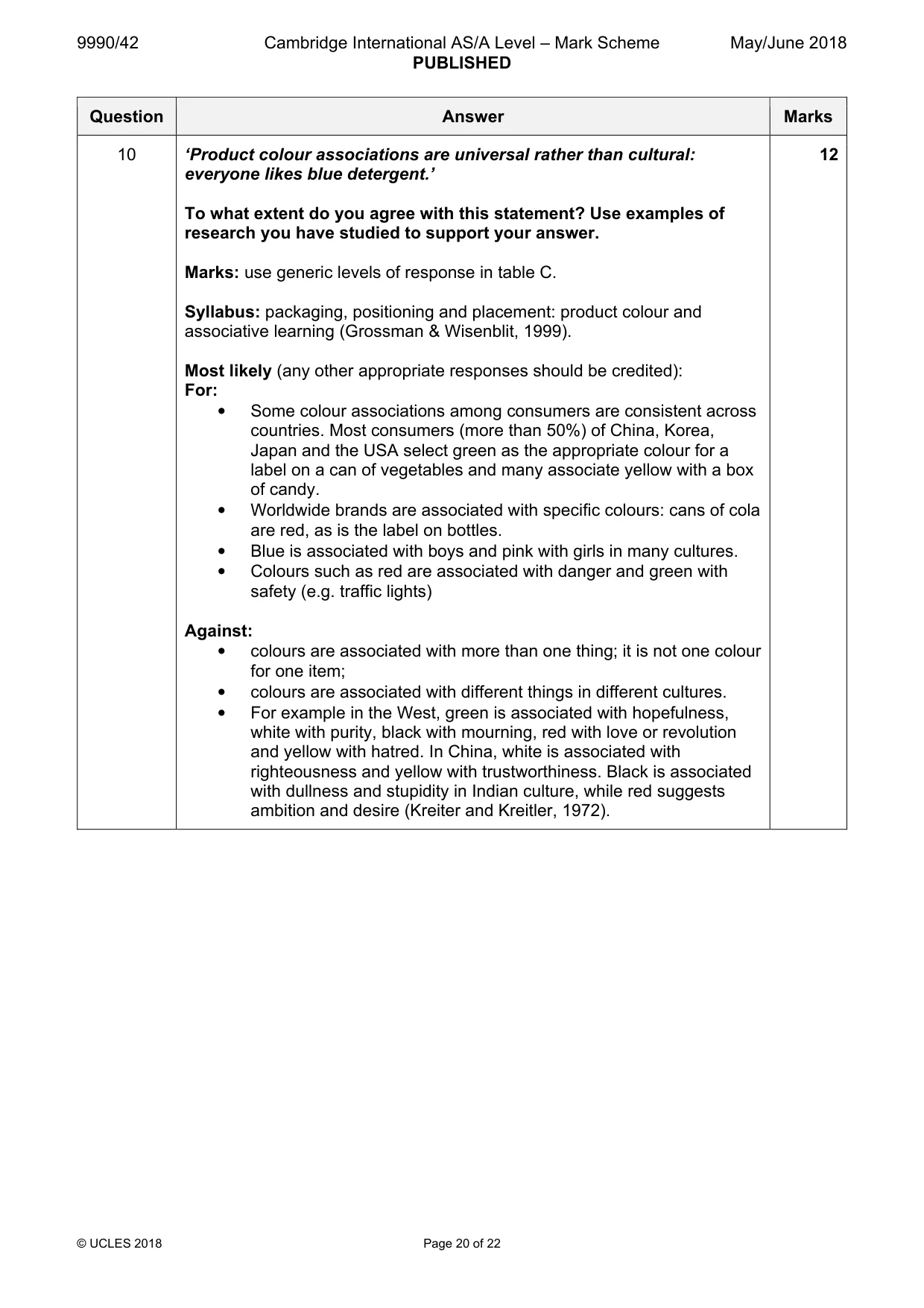
10 ‘Product colour associations are universal rather than cultural: everyone likes blue detergent.’ To what extent do you agree with this statement? Use examples of research you have studied to support your answer. [12] Psychology and health
Mark scheme: 10 ‘Product colour associations are universal rather than cultural: 12 everyone likes blue detergent.’ To what extent do you agree with this statement? Use examples of research you have studied to support your answer. Marks: use generic levels of response in table C. Syllabus: packaging, positioning and placement: product colour and associative learning (Grossman & Wisenblit, 1999). Most likely (any other appropriate responses should be credited): For: • Some colour associations among consumers are consistent across countries. Most consumers (more than 50%) of China, Korea, Japan and the USA select green as the appropriate colour for a label on a can of vegetables and many associate yellow with a box of candy. • Worldwide brands are associated with specific colours: cans of cola are red, as is the label on bottles. • Blue is associated with boys and pink with girls in many cultures. • Colours such as red are associated with danger and green with safety (e.g. traffic lights) Against: • colours are associated with more than one thing; it is not one colour for one item; • colours are associated with different things in different cultures. • For example in the West, green is associated with hopefulness, white with purity, black with mourning, red with love or revolution and yellow with hatred. In China, white is associated with righteousness and yellow with trustworthiness. Black is associated with dullness and stupidity in Indian culture, while red suggests ambition and desire (Kreiter and Kreitler, 1972).
Q11 · ‘Using observation to measure pain will never be as accurate as a self-report.’ To what…
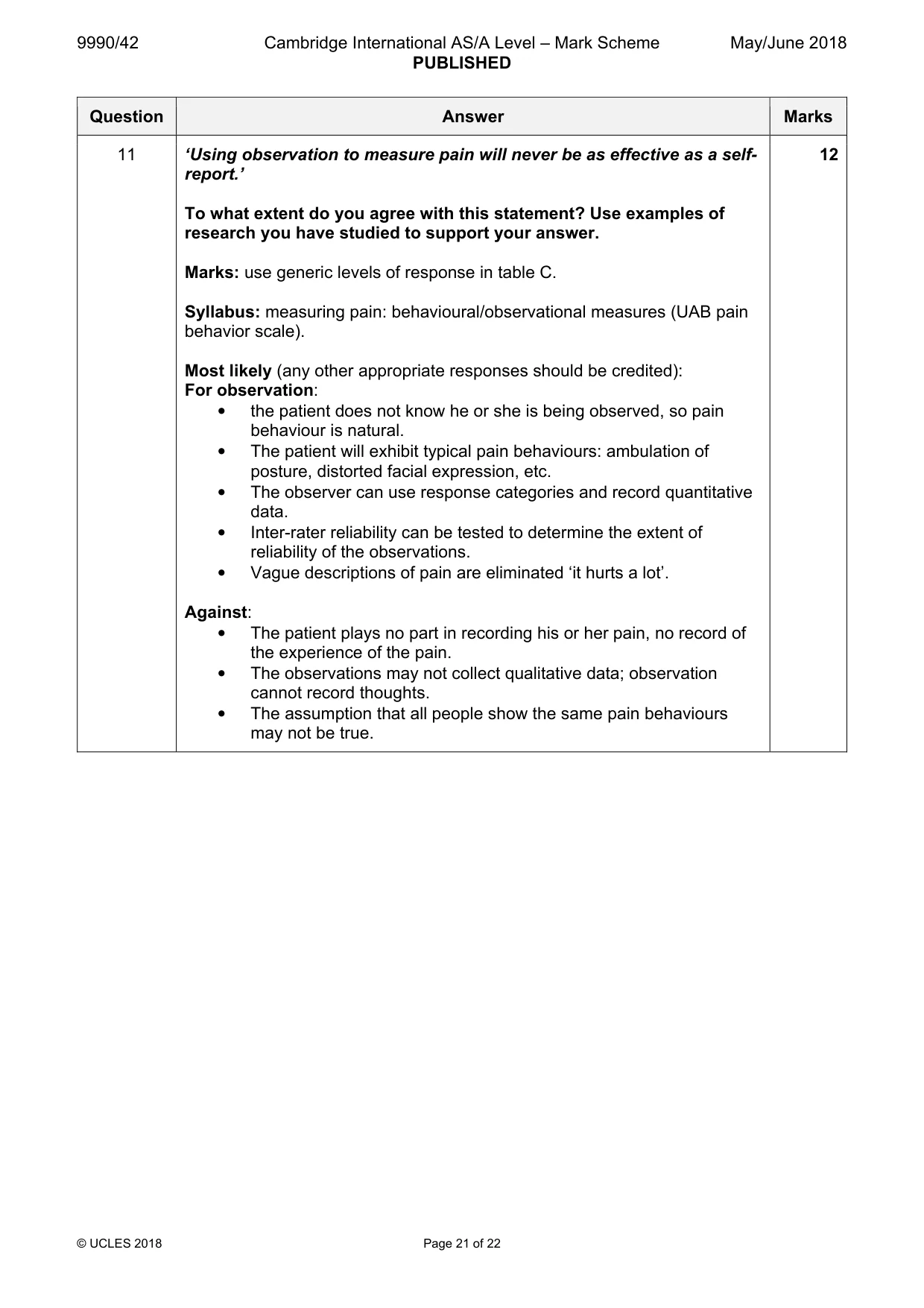
11 ‘Using observation to measure pain will never be as accurate as a self-report.’ To what extent do you agree with this statement? Use examples of research you have studied to support your answer. [12] Psychology and organisations
Mark scheme: 11 ‘Using observation to measure pain will never be as effective as a self- 12 report.’ To what extent do you agree with this statement? Use examples of research you have studied to support your answer. Marks: use generic levels of response in table C. Syllabus: measuring pain: behavioural/observational measures (UAB pain behavior scale). Most likely (any other appropriate responses should be credited): For observation: • the patient does not know he or she is being observed, so pain behaviour is natural. • The patient will exhibit typical pain behaviours: ambulation of posture, distorted facial expression, etc. • The observer can use response categories and record quantitative data. • Inter-rater reliability can be tested to determine the extent of reliability of the observations. • Vague descriptions of pain are eliminated ‘it hurts a lot’. Against: • The patient plays no part in recording his or her pain, no record of the experience of the pain. • The observations may not collect qualitative data; observation cannot record thoughts. • The assumption that all people show the same pain behaviours may not be true.
Q12 · ‘The situation is irrelevant; all that any leader needs to succeed is individual…
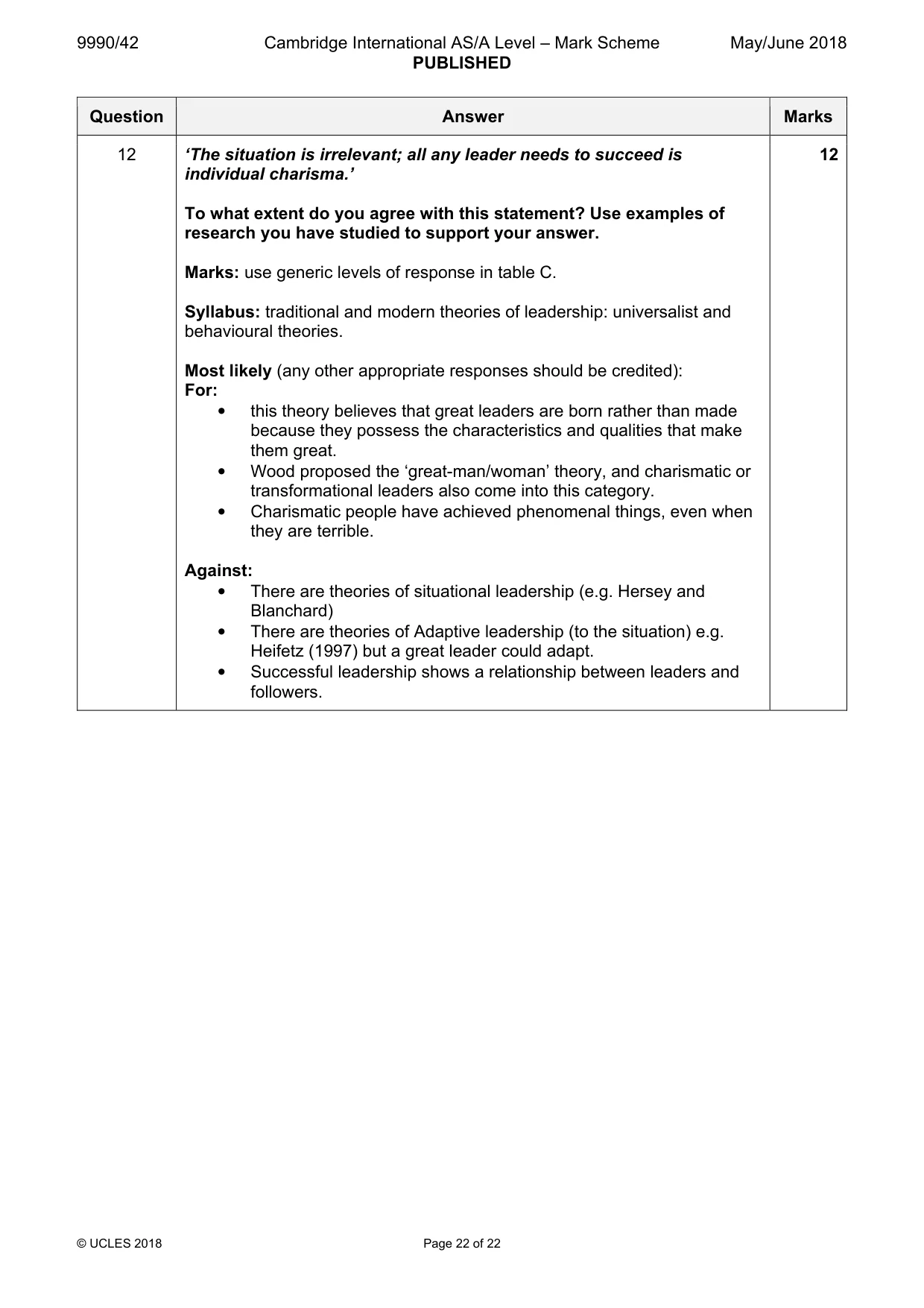
12 ‘The situation is irrelevant; all that any leader needs to succeed is individual charisma.’ To what extent do you agree with this statement? Use examples of research you have studied to support your answer. [12]
Mark scheme: 12 ‘The situation is irrelevant; all any leader needs to succeed is 12 individual charisma.’ To what extent do you agree with this statement? Use examples of research you have studied to support your answer. Marks: use generic levels of response in table C. Syllabus: traditional and modern theories of leadership: universalist and behavioural theories. Most likely (any other appropriate responses should be credited): For: • this theory believes that great leaders are born rather than made because they possess the characteristics and qualities that make them great. • Wood proposed the ‘great-man/woman’ theory, and charismatic or transformational leaders also come into this category. • Charismatic people have achieved phenomenal things, even when they are terrible. Against: • There are theories of situational leadership (e.g. Hersey and Blanchard) • There are theories of Adaptive leadership (to the situation) e.g. Heifetz (1997) but a great leader could adapt. • Successful leadership shows a relationship between leaders and followers.
What was in this paper
The subtopics covered by these 12 questions, and how many questions each got. Open one in a new tab to see every Cambridge question on it.
What you needed in this session
Cambridge’s own grade thresholds for 2018 May/June, Paper 4 · Variant 2. A higher threshold means an easier paper — the bar moves with how the cohort did.