Cambridge A Level Psychology (from 2018) 9990 — 2023 Feb/March Paper 4 · Variant 2
9990/42/F/M/23 · 12 questions · 60 marks · ≈68 min
The question paper and its mark scheme, free to read here and free to download. This is Cambridge’s own paper, exactly as it was sat.
Question paper8 pages
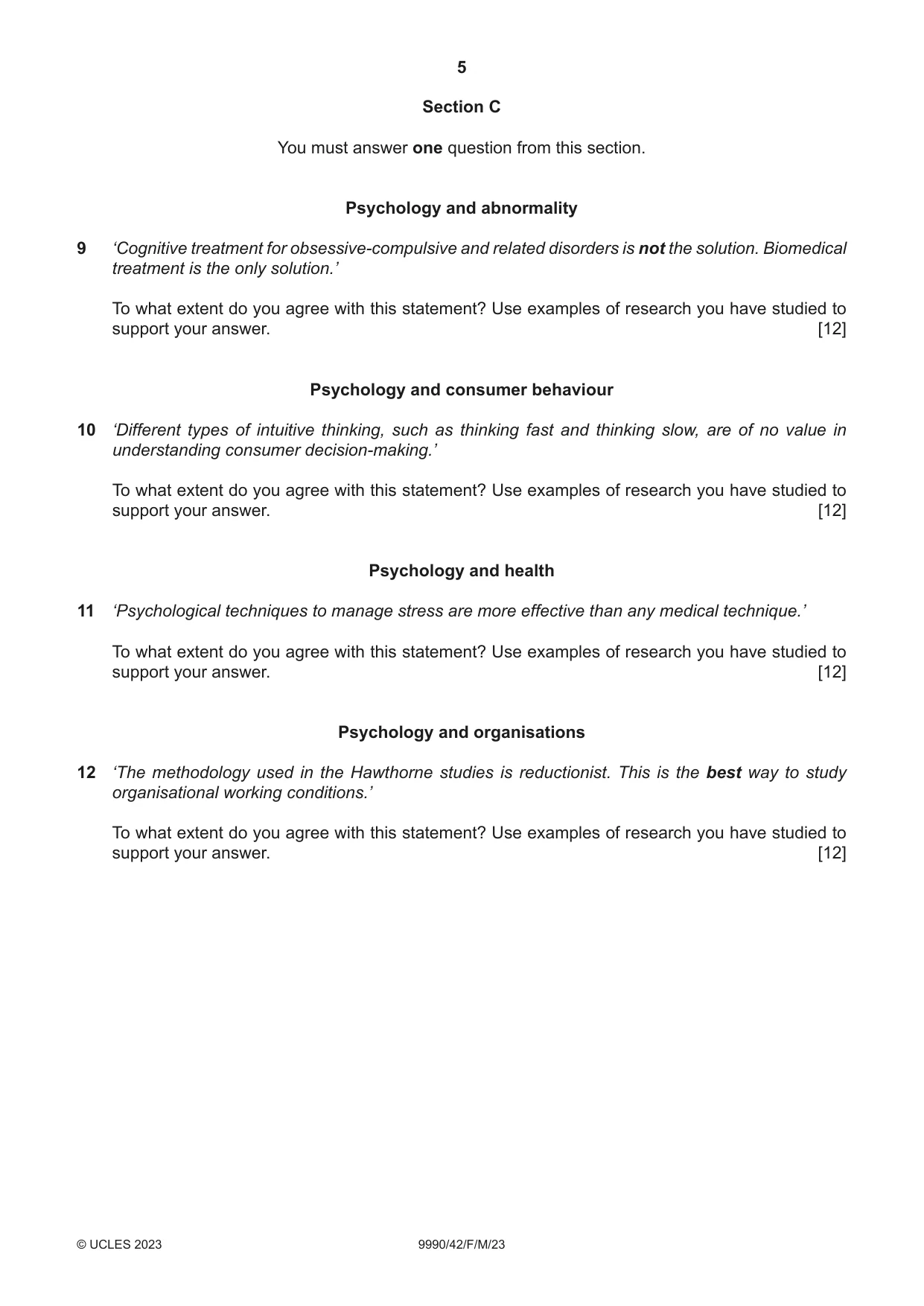



Mark scheme25 pages
Answers below. Sit the paper first if you are practising.
Questions as text
Q1 · Depression can be treated with medical treatments and it can be managed with…
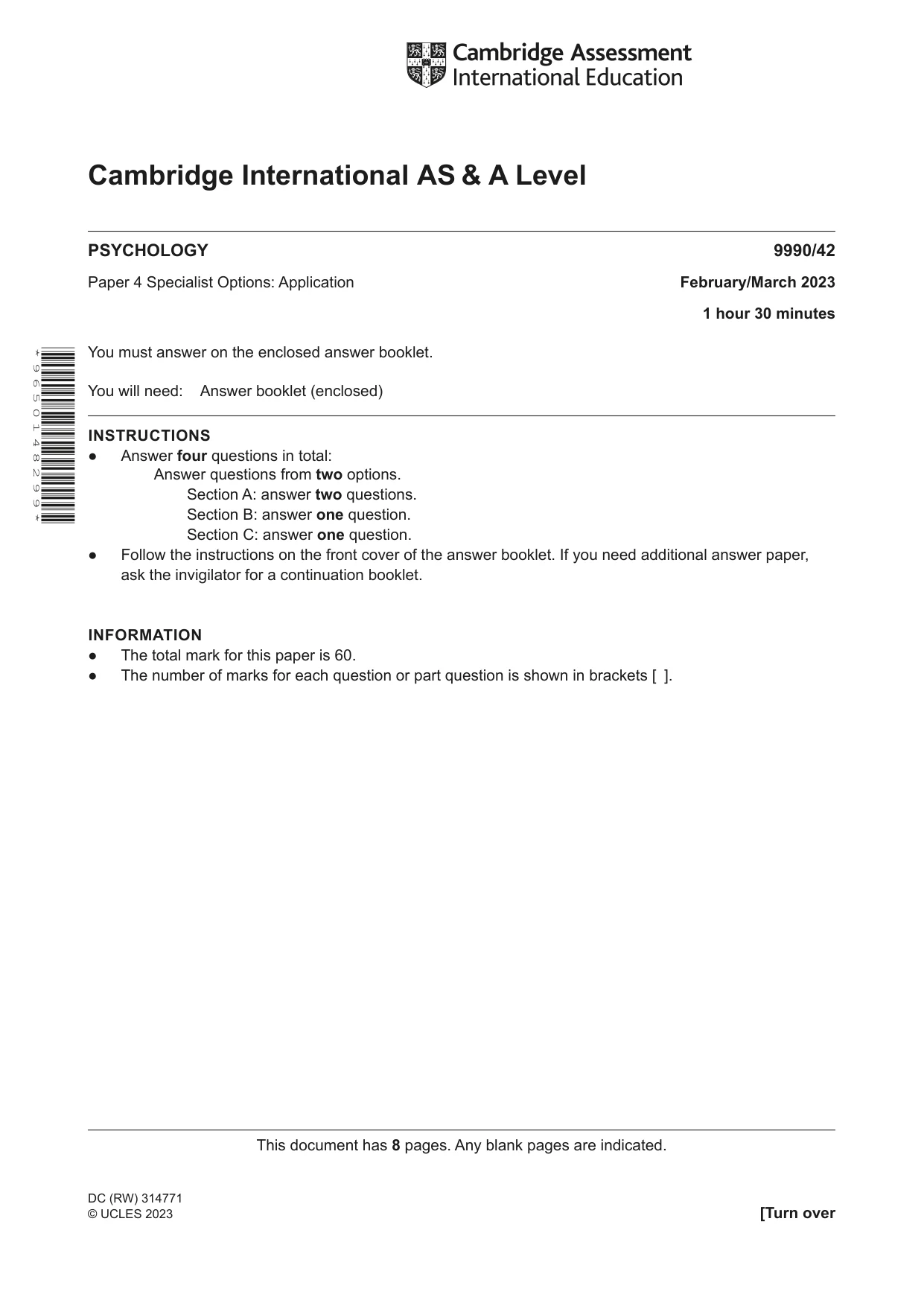
1 Depression can be treated with medical treatments and it can be managed with psychological treatments. Medical treatments include the use of electro‑convulsive therapy (ECT) and chemical/ drug treatments. Depression can also be treated psychologically. (a) Outline the procedure of ECT for depression. [2] (b) (i) Explain one chemical/drug treatment for depression. [2] (ii) Suggest one weakness of this chemical/drug treatment for depression. [2] (c) Outline two psychological treatments for depression. [4] (d) Discuss the strengths and weaknesses of using ECT for the treatment of depression. You should include a conclusion in your answer. [5] Psychology and consumer behaviour
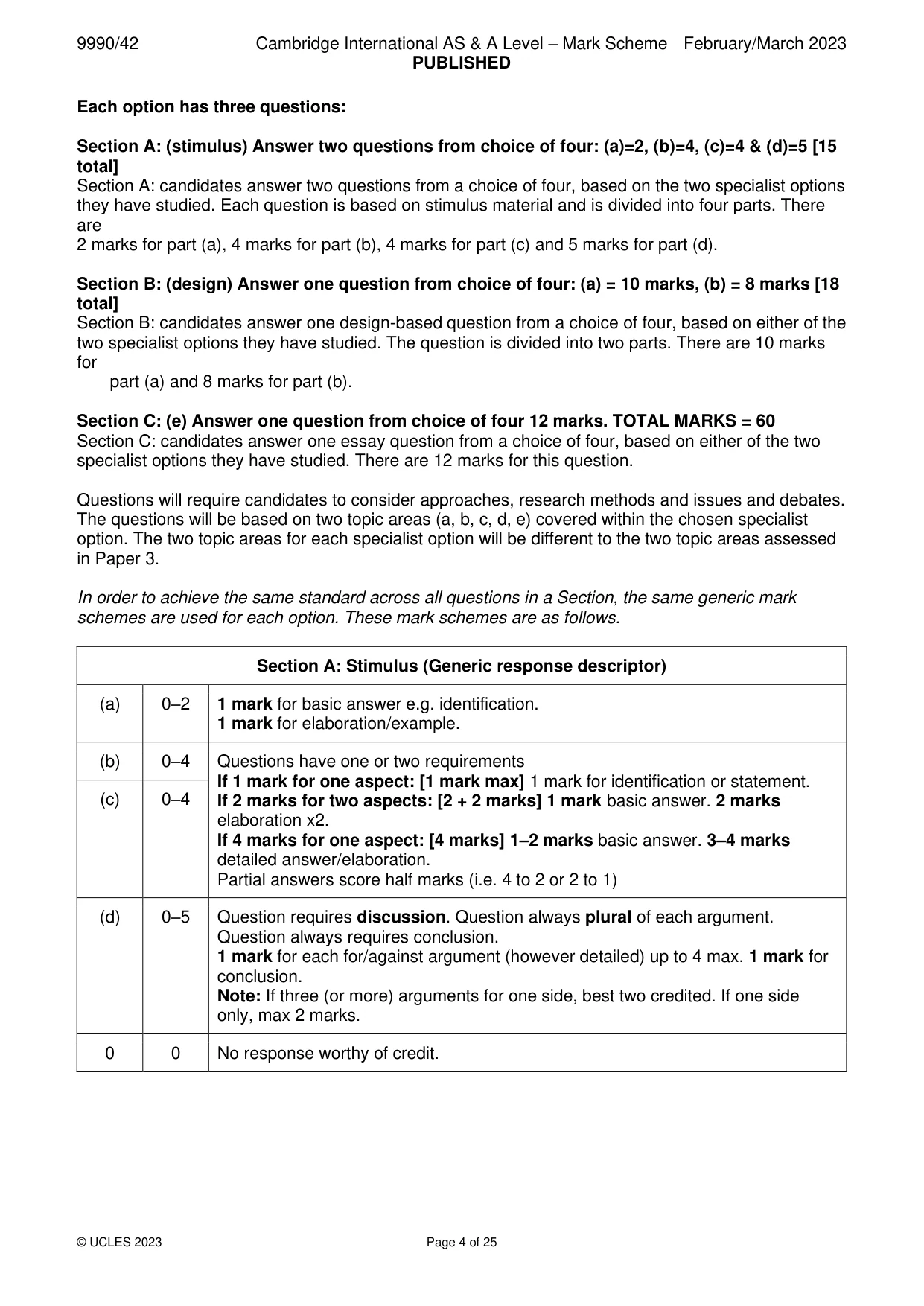
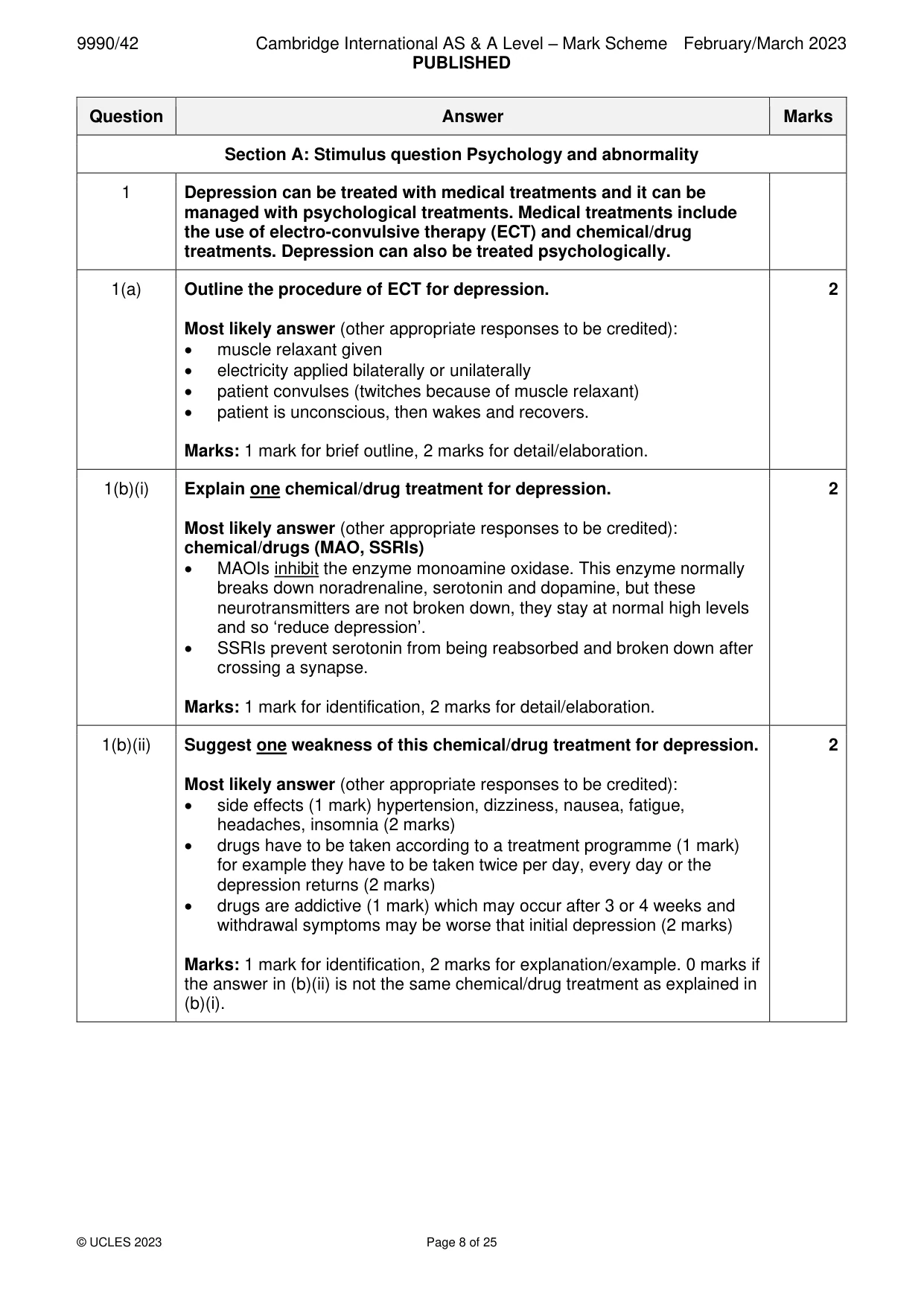
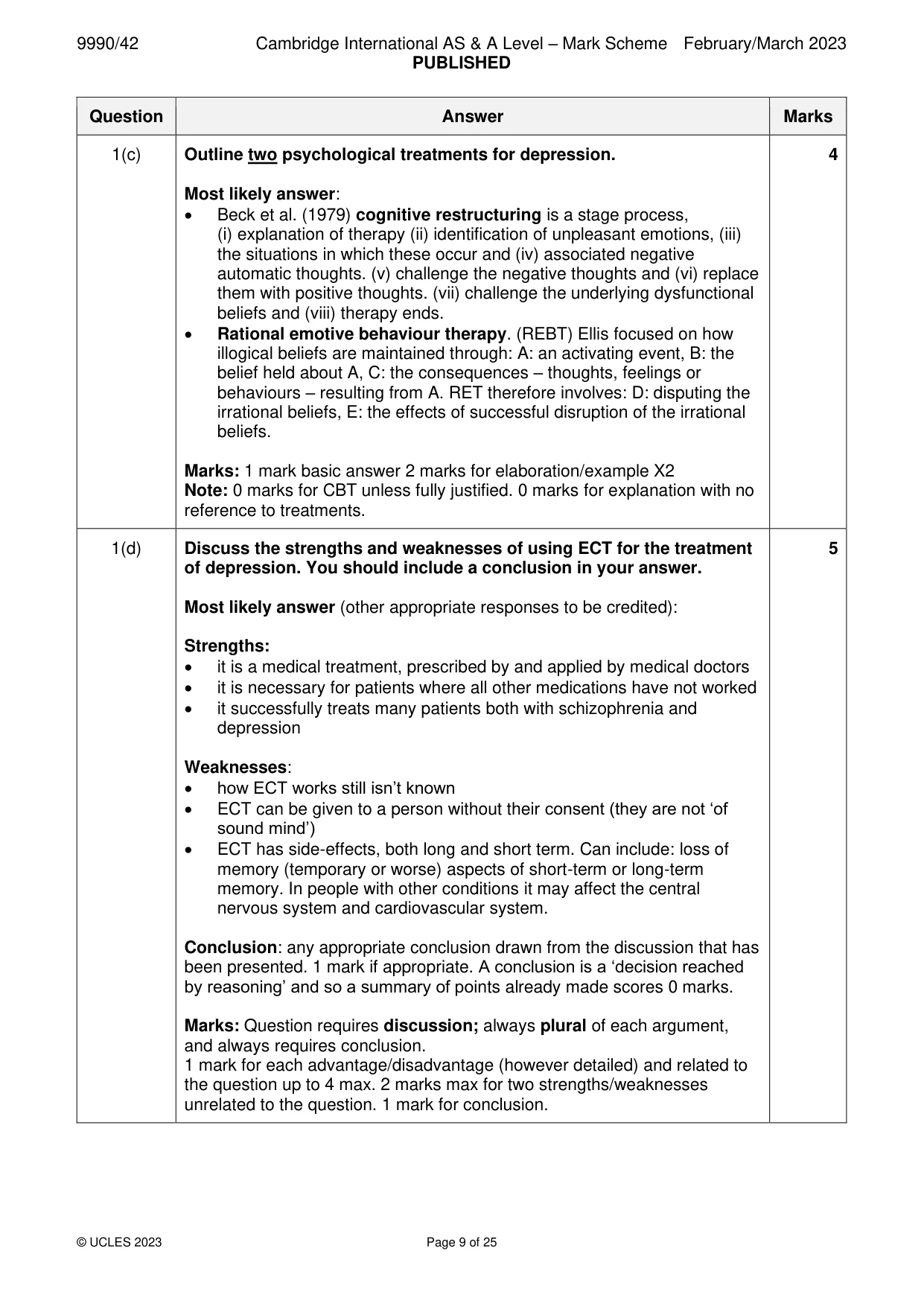
Mark scheme: Question Answer Marks Section A: Stimulus question Psychology and abnormality 1 Depression can be treated with medical treatments and it can be managed with psychological treatments. Medical treatments include the use of electro-convulsive therapy (ECT) and chemical/drug treatments. Depression can also be treated psychologically. 1(a) Outline the procedure of ECT for depression. 2 Most likely answer (other appropriate responses to be credited): • muscle relaxant given • electricity applied bilaterally or unilaterally • patient convulses (twitches because of muscle relaxant) • patient is unconscious, then wakes and recovers. Marks: 1 mark for brief outline, 2 marks for detail/elaboration. 1(b)(i) Explain one chemical/drug treatment for depression. 2 Most likely answer (other appropriate responses to be credited): chemical/drugs (MAO, SSRIs) • MAOIs inhibit the enzyme monoamine oxidase. This enzyme normally breaks down noradrenaline, serotonin and dopamine, but these neurotransmitters are not broken down, they stay at normal high levels and so ‘reduce depression’. • SSRIs prevent serotonin from being reabsorbed and broken down after crossing a synapse. Marks: 1 mark for identification, 2 marks for detail/elaboration. 1(b)(ii) Suggest one weakness of this chemical/drug treatment for depression. 2 Most likely answer (other appropriate responses to be credited): • side effects (1 mark) hypertension, dizziness, nausea, fatigue, headaches, insomnia (2 marks) • drugs have to be taken according to a treatment programme (1 mark) for example they have to be taken twice per day, every day or the depression returns (2 marks) • drugs are addictive (1 mark) which may occur after 3 or 4 weeks and withdrawal symptoms may be worse that initial depression (2 marks) Marks: 1 mark for identification, 2 marks for explanation/example. 0 marks if the answer in (b)(ii) is not the same chemical/drug treatment as explained in (b)(i). 1(c) Outline two psychological treatments for depression. 4 Most likely answer: • Beck et al. (1979) cognitive restructuring is a stage process, (i) explanation of therapy (ii) identification of unpleasant emotions, (iii) the situations in which these occur and (iv) associated negative automatic thoughts. (v) challenge the negative thoughts and (vi) replace them with positive thoughts. (vii) challenge the underlying dysfunctional beliefs and (viii) therapy ends. • Rational emotive behaviour therapy. (REBT) Ellis focused on how illogical beliefs are maintained through: A: an activating event, B: the belief held about A, C: the consequences – thoughts, feelings or behaviours – resulting from A. RET therefore involves: D: disputing the irrational beliefs, E: the effects of successful disruption of the irrational beliefs. Marks: 1 mark basic answer 2 marks for elaboration/example X2 Note: 0 marks for CBT unless fully justified. 0 marks for explanation with no reference to treatments. 1(d) Discuss the strengths and weaknesses of using ECT for the treatment 5 of depression. You should include a conclusion in your answer. Most likely answer (other appropriate responses to be credited): Strengths: • it is a medical treatment, prescribed by and applied by medical doctors • it is necessary for patients where all other medications have not worked • it successfully treats many patients both with schizophrenia and depression Weaknesses: • how ECT works still isn’t known • ECT can be given to a person without their consent (they are not ‘of sound mind’) • ECT has side-effects, both long and short term. Can include: loss of memory (temporary or worse) aspects of short-term or long-term memory. In people with other conditions it may affect the central nervous system and cardiovascular system. Conclusion: any appropriate conclusion drawn from the discussion that has been presented. 1 mark if appropriate. A conclusion is a ‘decision reached by reasoning’ and so a summary of points already made scores 0 marks. Marks: Question requires discussion; always plural of each argument, and always requires conclusion. 1 mark for each advantage/disadvantage (however detailed) and related to the question up to 4 max. 2 marks max for two strengths/weaknesses unrelated to the question. 1 mark for conclusion.
More questions on Mood (affective) disorders: depressive disorder (unipolar) and bipolar disorder
Q2 · A clothes company uses a pleasant odour in all their stores which is ‘clean, subtle…
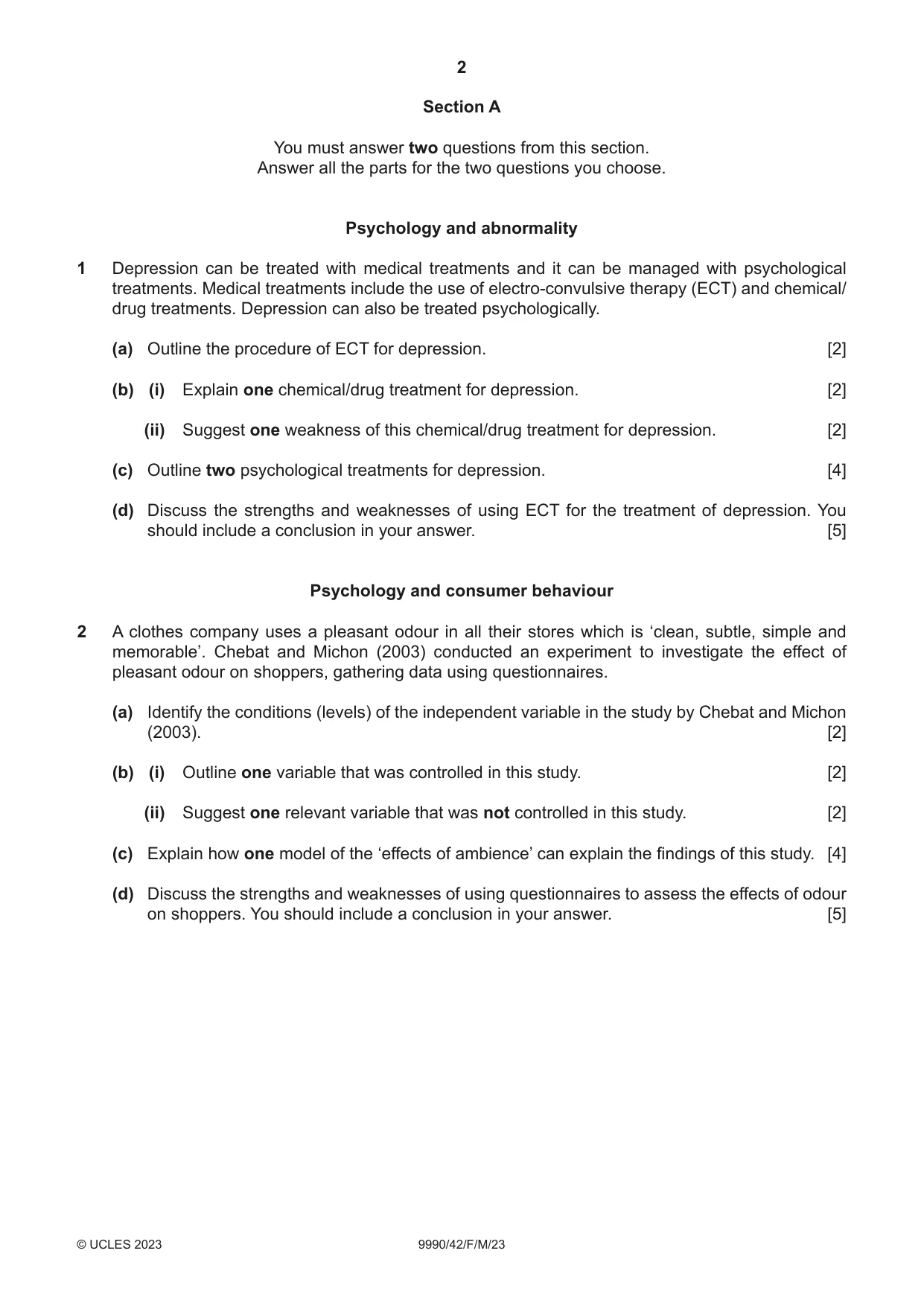
2 A clothes company uses a pleasant odour in all their stores which is ‘clean, subtle, simple and memorable’. Chebat and Michon (2003) conducted an experiment to investigate the effect of pleasant odour on shoppers, gathering data using questionnaires. (a) Identify the conditions (levels) of the independent variable in the study by Chebat and Michon (2003). [2] (b) (i) Outline one variable that was controlled in this study. [2] (ii) Suggest one relevant variable that was not controlled in this study. [2] (c) Explain how one model of the ‘effects of ambience’ can explain the findings of this study. [4] (d) Discuss the strengths and weaknesses of using questionnaires to assess the effects of odour on shoppers. You should include a conclusion in your answer. [5] Psychology and health
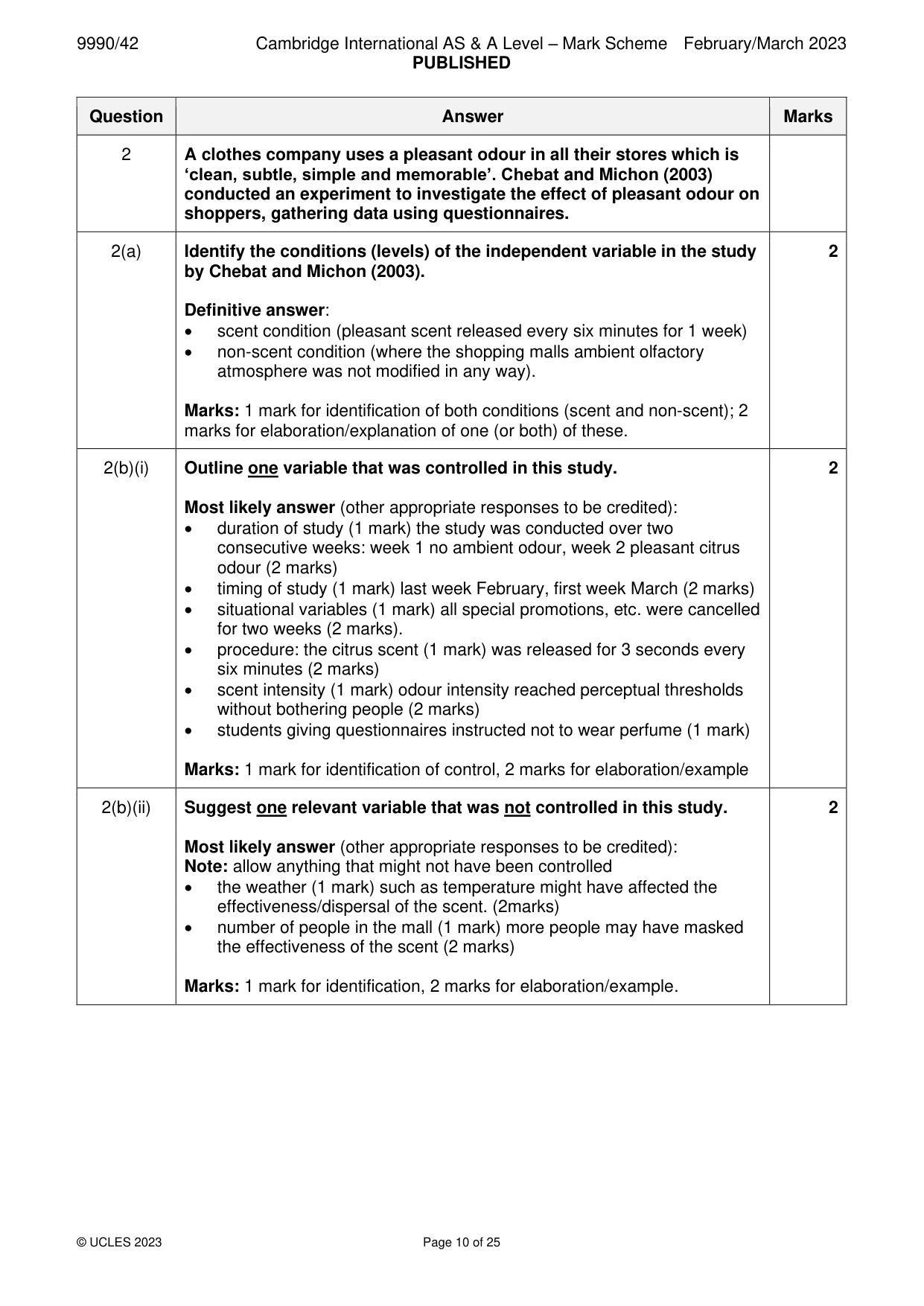
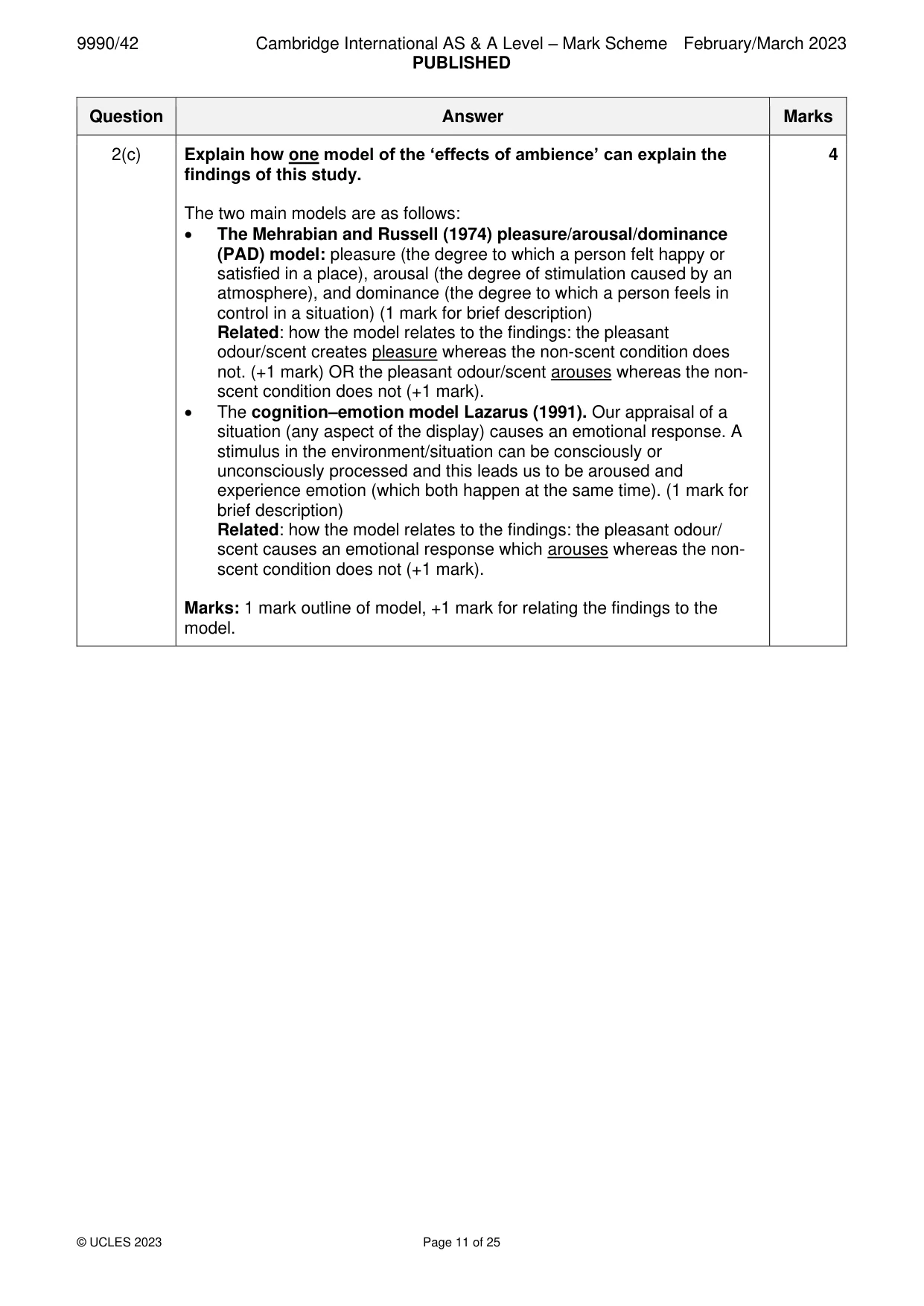
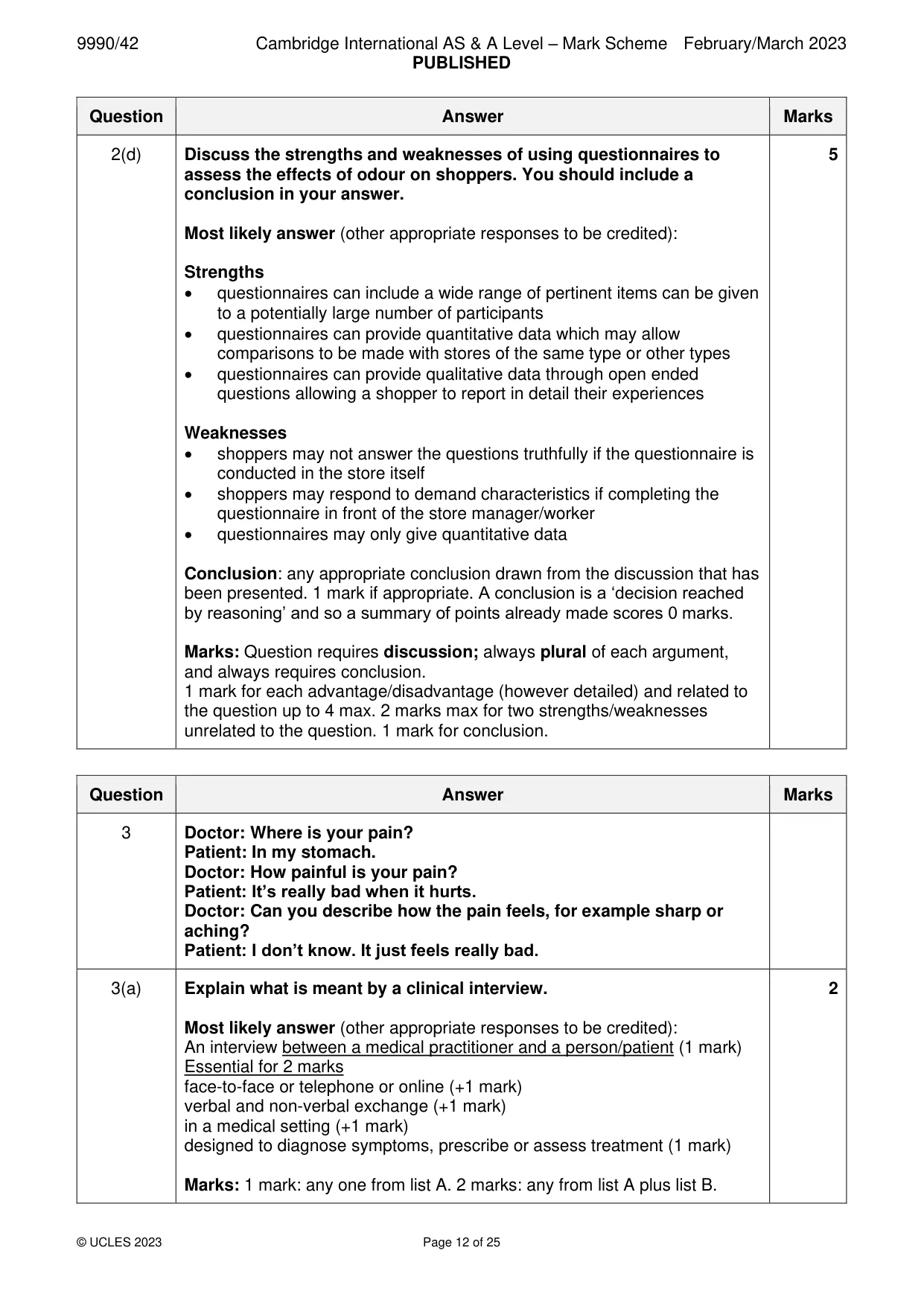
Mark scheme: 2 A clothes company uses a pleasant odour in all their stores which is ‘clean, subtle, simple and memorable’. Chebat and Michon (2003) conducted an experiment to investigate the effect of pleasant odour on shoppers, gathering data using questionnaires. 2(a) Identify the conditions (levels) of the independent variable in the study 2 by Chebat and Michon (2003). Definitive answer: • scent condition (pleasant scent released every six minutes for 1 week) • non-scent condition (where the shopping malls ambient olfactory atmosphere was not modified in any way). Marks: 1 mark for identification of both conditions (scent and non-scent); 2 marks for elaboration/explanation of one (or both) of these. 2(b)(i) Outline one variable that was controlled in this study. 2 Most likely answer (other appropriate responses to be credited): • duration of study (1 mark) the study was conducted over two consecutive weeks: week 1 no ambient odour, week 2 pleasant citrus odour (2 marks) • timing of study (1 mark) last week February, first week March (2 marks) • situational variables (1 mark) all special promotions, etc. were cancelled for two weeks (2 marks). • procedure: the citrus scent (1 mark) was released for 3 seconds every six minutes (2 marks) • scent intensity (1 mark) odour intensity reached perceptual thresholds without bothering people (2 marks) • students giving questionnaires instructed not to wear perfume (1 mark) Marks: 1 mark for identification of control, 2 marks for elaboration/example 2(b)(ii) Suggest one relevant variable that was not controlled in this study. 2 Most likely answer (other appropriate responses to be credited): Note: allow anything that might not have been controlled • the weather (1 mark) such as temperature might have affected the effectiveness/dispersal of the scent. (2marks) • number of people in the mall (1 mark) more people may have masked the effectiveness of the scent (2 marks) Marks: 1 mark for identification, 2 marks for elaboration/example. 2(c) Explain how one model of the ‘effects of ambience’ can explain the 4 findings of this study. The two main models are as follows: • The Mehrabian and Russell (1974) pleasure/arousal/dominance (PAD) model: pleasure (the degree to which a person felt happy or satisfied in a place), arousal (the degree of stimulation caused by an atmosphere), and dominance (the degree to which a person feels in control in a situation) (1 mark for brief description) Related: how the model relates to the findings: the pleasant odour/scent creates pleasure whereas the non-scent condition does not. (+1 mark) OR the pleasant odour/scent arouses whereas the non- scent condition does not (+1 mark). • The cognition–emotion model Lazarus (1991). Our appraisal of a situation (any aspect of the display) causes an emotional response. A stimulus in the environment/situation can be consciously or unconsciously processed and this leads us to be aroused and experience emotion (which both happen at the same time). (1 mark for brief description) Related: how the model relates to the findings: the pleasant odour/ scent causes an emotional response which arouses whereas the non- scent condition does not (+1 mark). Marks: 1 mark outline of model, +1 mark for relating the findings to the model. 2(d) Discuss the strengths and weaknesses of using questionnaires to 5 assess the effects of odour on shoppers. You should include a conclusion in your answer. Most likely answer (other appropriate responses to be credited): Strengths • questionnaires can include a wide range of pertinent items can be given to a potentially large number of participants • questionnaires can provide quantitative data which may allow comparisons to be made with stores of the same type or other types • questionnaires can provide qualitative data through open ended questions allowing a shopper to report in detail their experiences Weaknesses • shoppers may not answer the questions truthfully if the questionnaire is conducted in the store itself • shoppers may respond to demand characteristics if completing the questionnaire in front of the store manager/worker • questionnaires may only give quantitative data Conclusion: any appropriate conclusion drawn from the discussion that has been presented. 1 mark if appropriate. A conclusion is a ‘decision reached by reasoning’ and so a summary of points already made scores 0 marks. Marks: Question requires discussion; always plural of each argument, and always requires conclusion. 1 mark for each advantage/disadvantage (however detailed) and related to the question up to 4 max. 2 marks max for two strengths/weaknesses unrelated to the question. 1 mark for conclusion.
Q3 · Doctor: Where is your pain?
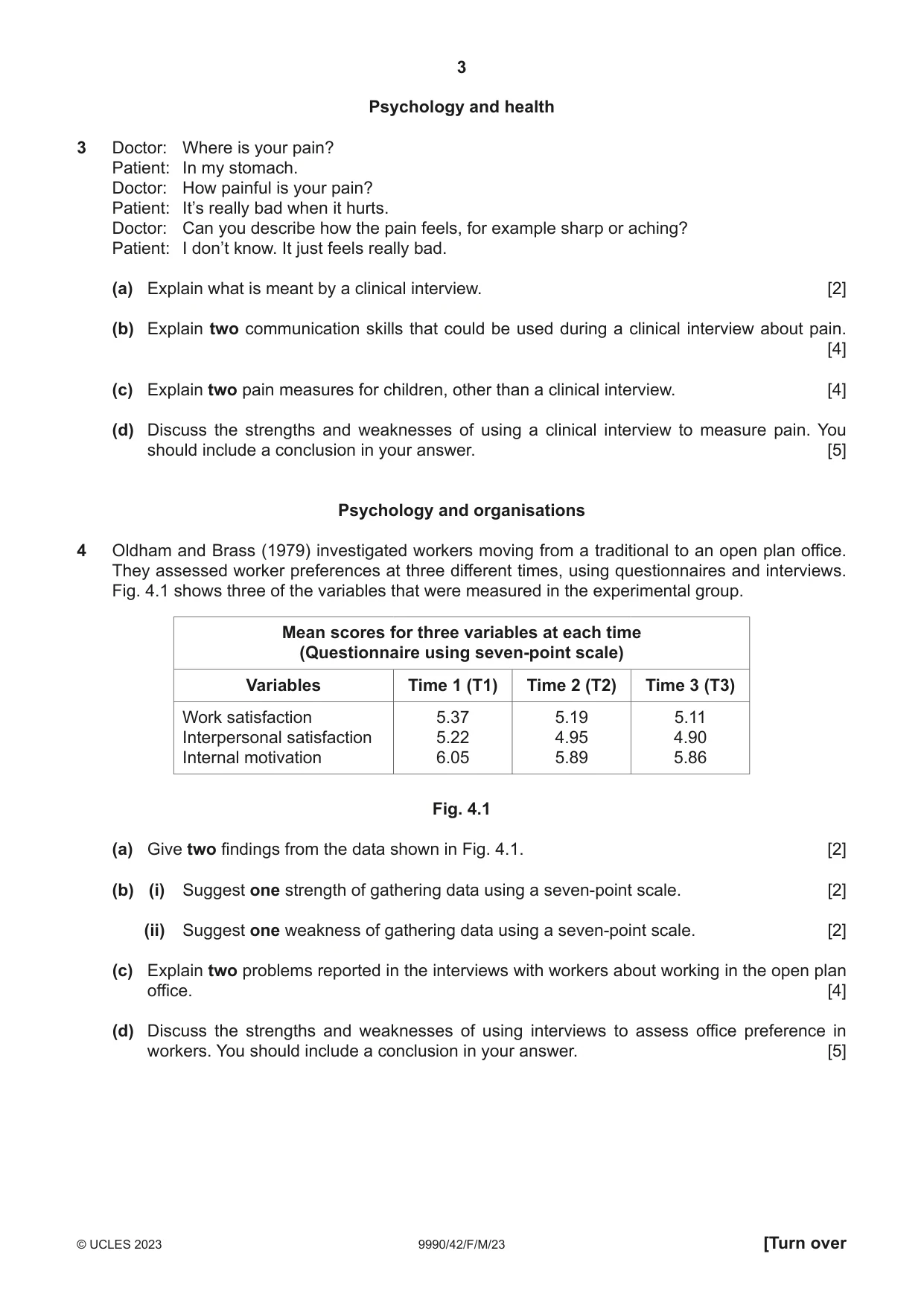
3 Doctor: Where is your pain? Patient: In my stomach. Doctor: How painful is your pain? Patient: It’s really bad when it hurts. Doctor: Can you describe how the pain feels, for example sharp or aching? Patient: I don’t know. It just feels really bad. (a) Explain what is meant by a clinical interview. [2] (b) Explain two communication skills that could be used during a clinical interview about pain. [4] (c) Explain two pain measures for children, other than a clinical interview. [4] (d) Discuss the strengths and weaknesses of using a clinical interview to measure pain. You should include a conclusion in your answer. [5] Psychology and organisations
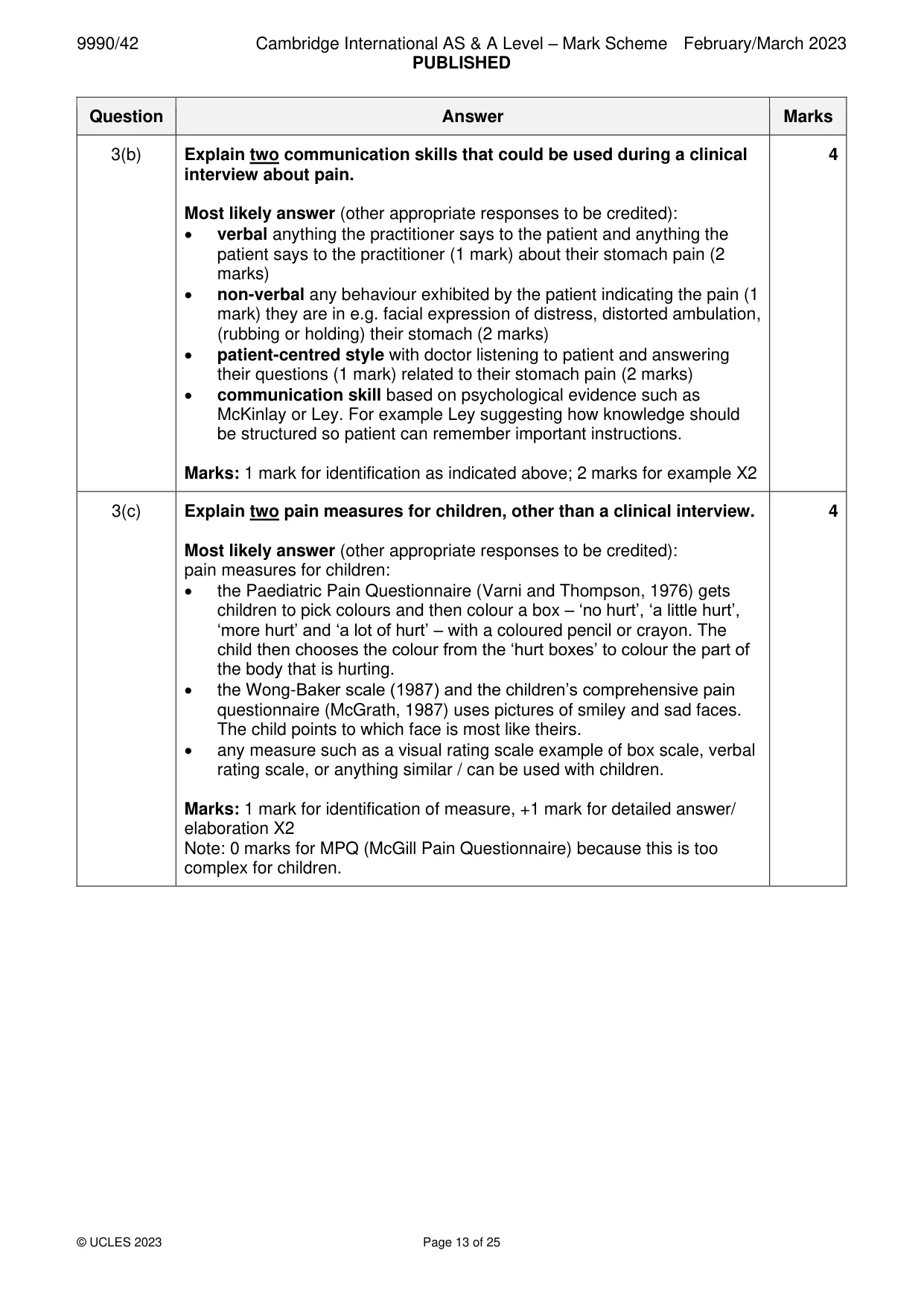
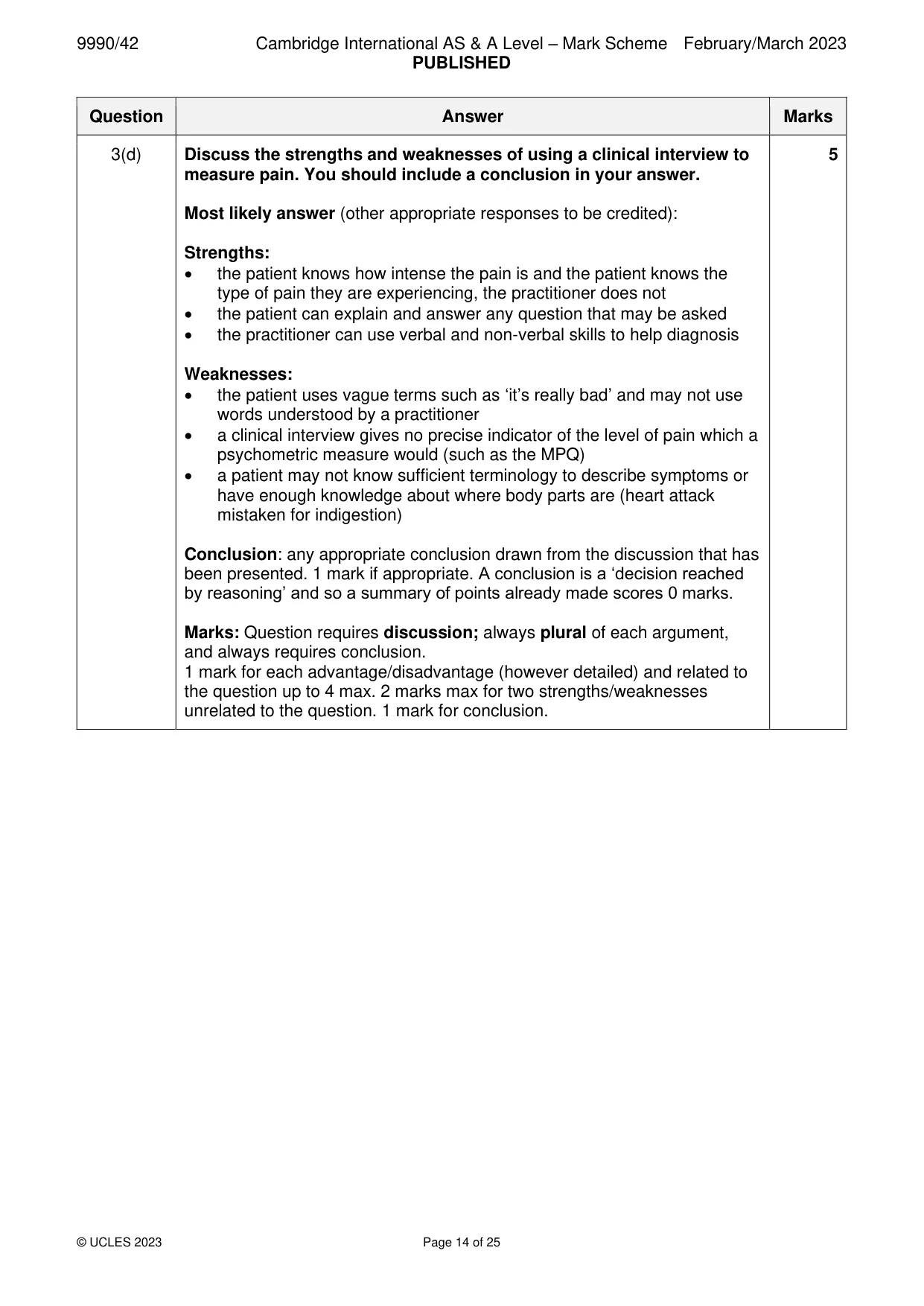
Mark scheme: 3 Doctor: Where is your pain? Patient: In my stomach. Doctor: How painful is your pain? Patient: It’s really bad when it hurts. Doctor: Can you describe how the pain feels, for example sharp or aching? Patient: I don’t know. It just feels really bad. 3(a) Explain what is meant by a clinical interview. 2 Most likely answer (other appropriate responses to be credited): An interview between a medical practitioner and a person/patient (1 mark) Essential for 2 marks face-to-face or telephone or online (+1 mark) verbal and non-verbal exchange (+1 mark) in a medical setting (+1 mark) designed to diagnose symptoms, prescribe or assess treatment (1 mark) Marks: 1 mark: any one from list A. 2 marks: any from list A plus list B. 3(b) Explain two communication skills that could be used during a clinical 4 interview about pain. Most likely answer (other appropriate responses to be credited): • verbal anything the practitioner says to the patient and anything the patient says to the practitioner (1 mark) about their stomach pain (2 marks) • non-verbal any behaviour exhibited by the patient indicating the pain (1 mark) they are in e.g. facial expression of distress, distorted ambulation, (rubbing or holding) their stomach (2 marks) • patient-centred style with doctor listening to patient and answering their questions (1 mark) related to their stomach pain (2 marks) • communication skill based on psychological evidence such as McKinlay or Ley. For example Ley suggesting how knowledge should be structured so patient can remember important instructions. Marks: 1 mark for identification as indicated above; 2 marks for example X2 3(c) Explain two pain measures for children, other than a clinical interview. 4 Most likely answer (other appropriate responses to be credited): pain measures for children: • the Paediatric Pain Questionnaire (Varni and Thompson, 1976) gets children to pick colours and then colour a box – ‘no hurt’, ‘a little hurt’, ‘more hurt’ and ‘a lot of hurt’ – with a coloured pencil or crayon. The child then chooses the colour from the ‘hurt boxes’ to colour the part of the body that is hurting. • the Wong-Baker scale (1987) and the children’s comprehensive pain questionnaire (McGrath, 1987) uses pictures of smiley and sad faces. The child points to which face is most like theirs. • any measure such as a visual rating scale example of box scale, verbal rating scale, or anything similar / can be used with children. Marks: 1 mark for identification of measure, +1 mark for detailed answer/ elaboration X2 Note: 0 marks for MPQ (McGill Pain Questionnaire) because this is too complex for children. 3(d) Discuss the strengths and weaknesses of using a clinical interview to 5 measure pain. You should include a conclusion in your answer. Most likely answer (other appropriate responses to be credited): Strengths: • the patient knows how intense the pain is and the patient knows the type of pain they are experiencing, the practitioner does not • the patient can explain and answer any question that may be asked • the practitioner can use verbal and non-verbal skills to help diagnosis Weaknesses: • the patient uses vague terms such as ‘it’s really bad’ and may not use words understood by a practitioner • a clinical interview gives no precise indicator of the level of pain which a psychometric measure would (such as the MPQ) • a patient may not know sufficient terminology to describe symptoms or have enough knowledge about where body parts are (heart attack mistaken for indigestion) Conclusion: any appropriate conclusion drawn from the discussion that has been presented. 1 mark if appropriate. A conclusion is a ‘decision reached by reasoning’ and so a summary of points already made scores 0 marks. Marks: Question requires discussion; always plural of each argument, and always requires conclusion. 1 mark for each advantage/disadvantage (however detailed) and related to the question up to 4 max. 2 marks max for two strengths/weaknesses unrelated to the question. 1 mark for conclusion.
Q4 · Oldham and Brass (1979) investigated workers moving from a traditional to an open plan…
4 Oldham and Brass (1979) investigated workers moving from a traditional to an open plan office. They assessed worker preferences at three different times, using questionnaires and interviews. Fig. 4.1 shows three of the variables that were measured in the experimental group. Mean scores for three variables at each time (Questionnaire using seven‑point scale) Variables Time 1 (T1) Time 2 (T2) Time 3 (T3) Work satisfaction 5.37 5.19 5.11 Interpersonal satisfaction 5.22 4.95 4.90 Internal motivation 6.05 5.89 5.86 Fig. 4.1 (a) Give two findings from the data shown in Fig. 4.1. [2] (b) (i) Suggest one strength of gathering data using a seven‑point scale. [2] (ii) Suggest one weakness of gathering data using a seven‑point scale. [2] (c) Explain two problems reported in the interviews with workers about working in the open plan office. [4] (d) Discuss the strengths and weaknesses of using interviews to assess office preference in workers. You should include a conclusion in your answer. [5]
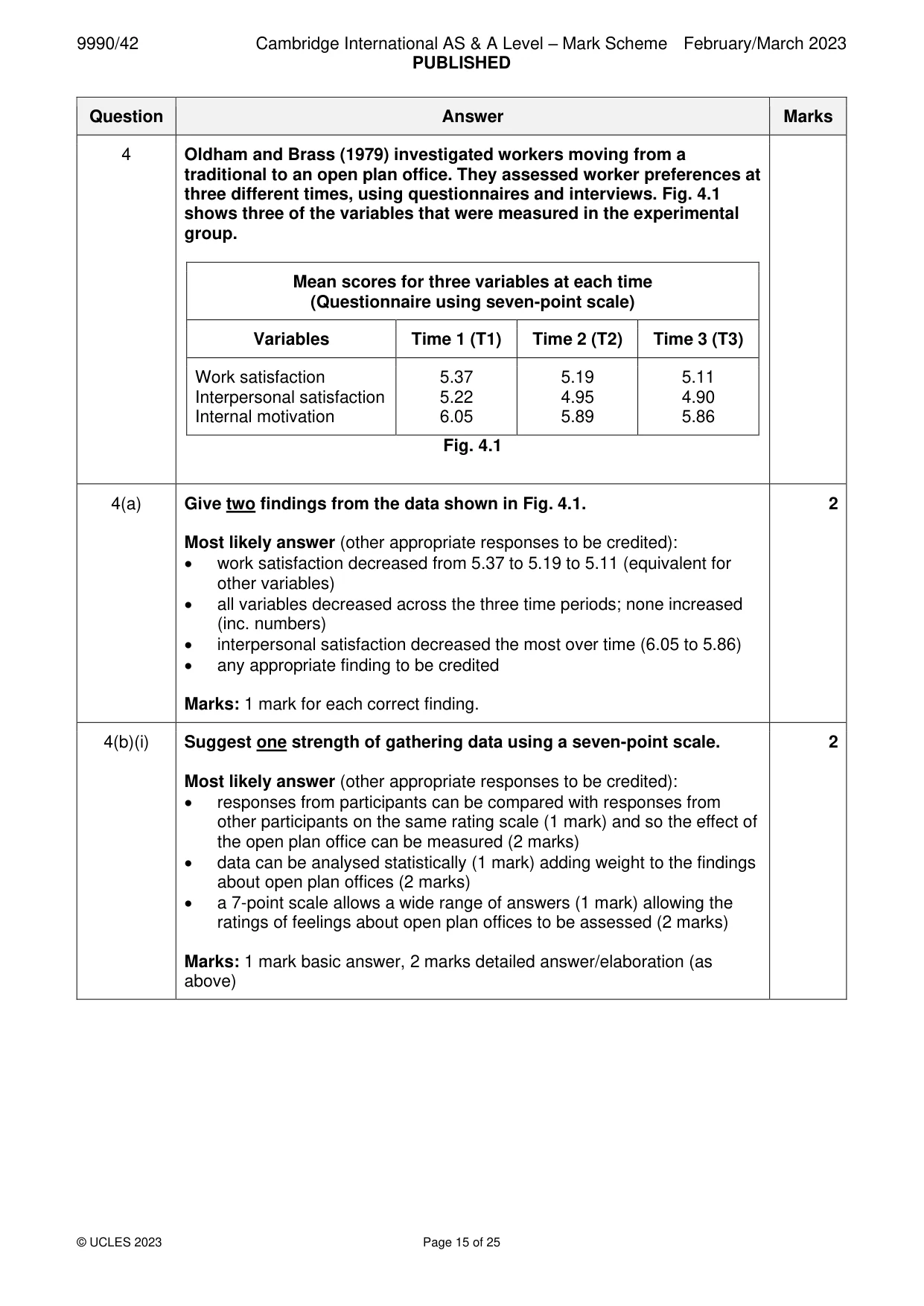
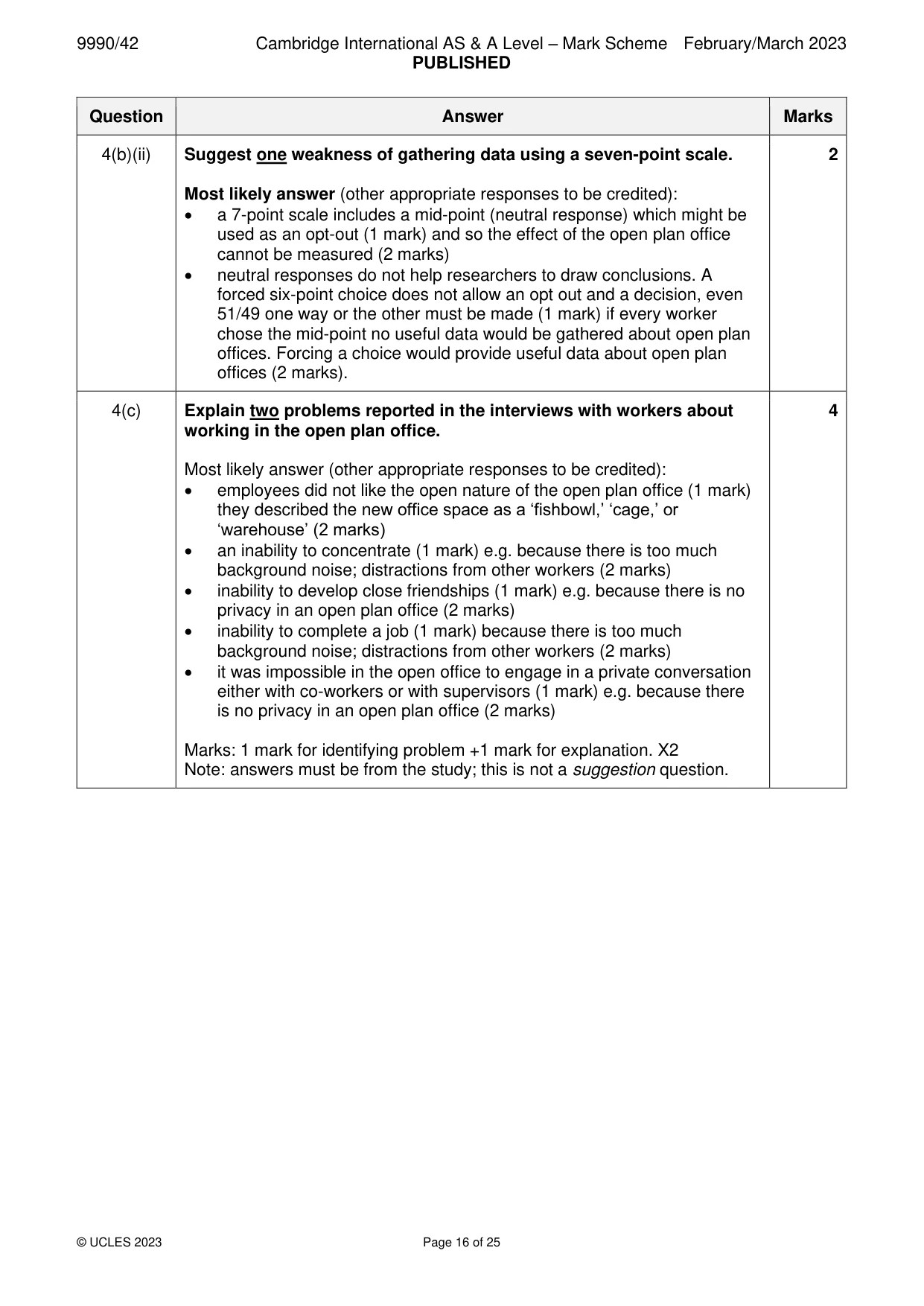
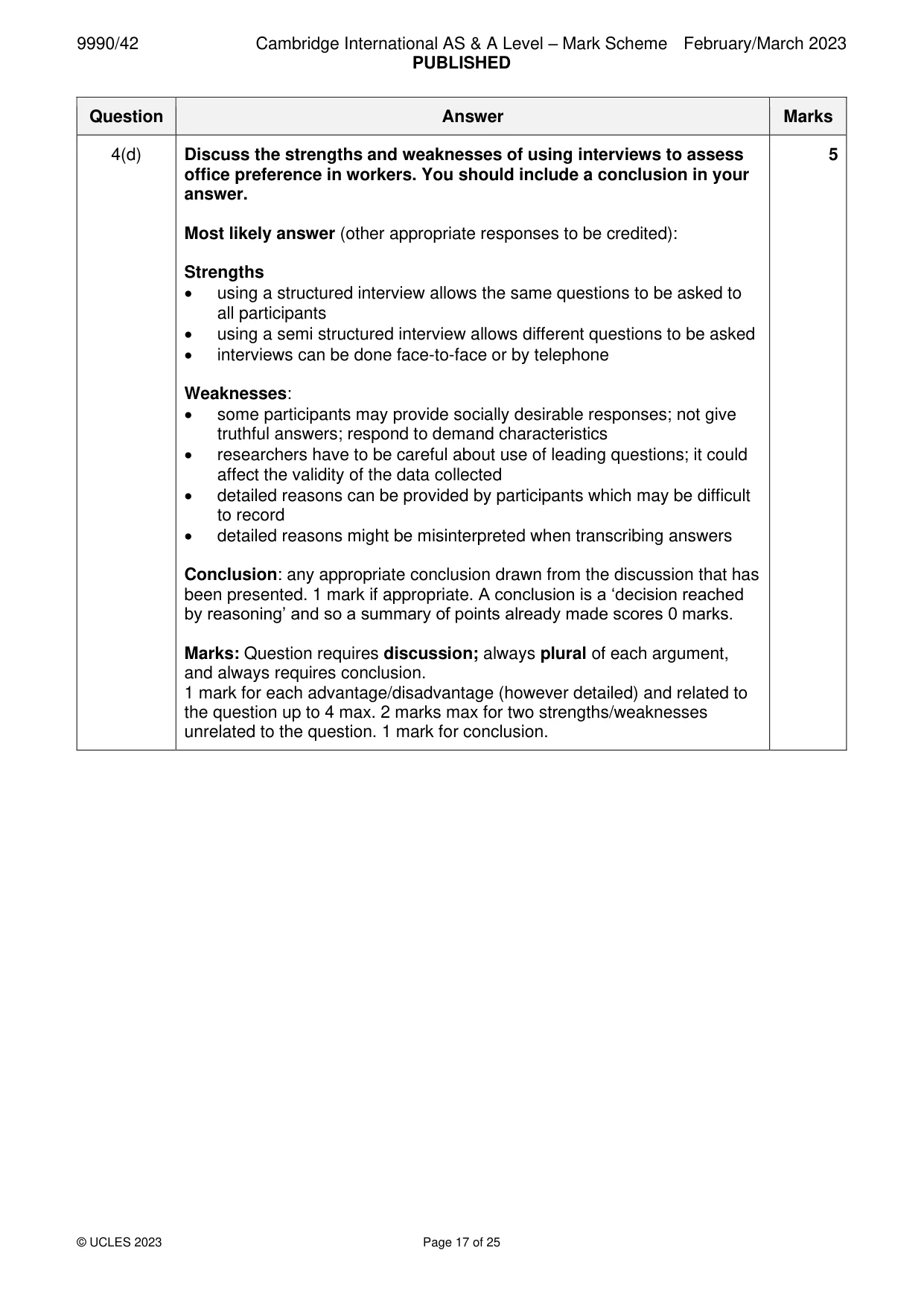
Mark scheme: 4 Oldham and Brass (1979) investigated workers moving from a traditional to an open plan office. They assessed worker preferences at three different times, using questionnaires and interviews. Fig. 4.1 shows three of the variables that were measured in the experimental group. Mean scores for three variables at each time (Questionnaire using seven-point scale) Variables Time 1 (T1) Time 2 (T2) Time 3 (T3) Work satisfaction 5.37 5.19 5.11 Interpersonal satisfaction 5.22 4.95 4.90 Internal motivation 6.05 5.89 5.86 Fig. 4.1 4(a) Give two findings from the data shown in Fig. 4.1. 2 Most likely answer (other appropriate responses to be credited): • work satisfaction decreased from 5.37 to 5.19 to 5.11 (equivalent for other variables) • all variables decreased across the three time periods; none increased (inc. numbers) • interpersonal satisfaction decreased the most over time (6.05 to 5.86) • any appropriate finding to be credited Marks: 1 mark for each correct finding. 4(b)(i) Suggest one strength of gathering data using a seven-point scale. 2 Most likely answer (other appropriate responses to be credited): • responses from participants can be compared with responses from other participants on the same rating scale (1 mark) and so the effect of the open plan office can be measured (2 marks) • data can be analysed statistically (1 mark) adding weight to the findings about open plan offices (2 marks) • a 7-point scale allows a wide range of answers (1 mark) allowing the ratings of feelings about open plan offices to be assessed (2 marks) Marks: 1 mark basic answer, 2 marks detailed answer/elaboration (as above) 4(b)(ii) Suggest one weakness of gathering data using a seven-point scale. 2 Most likely answer (other appropriate responses to be credited): • a 7-point scale includes a mid-point (neutral response) which might be used as an opt-out (1 mark) and so the effect of the open plan office cannot be measured (2 marks) • neutral responses do not help researchers to draw conclusions. A forced six-point choice does not allow an opt out and a decision, even 51/49 one way or the other must be made (1 mark) if every worker chose the mid-point no useful data would be gathered about open plan offices. Forcing a choice would provide useful data about open plan offices (2 marks). 4(c) Explain two problems reported in the interviews with workers about 4 working in the open plan office. Most likely answer (other appropriate responses to be credited): • employees did not like the open nature of the open plan office (1 mark) they described the new office space as a ‘fishbowl,’ ‘cage,’ or ‘warehouse’ (2 marks) • an inability to concentrate (1 mark) e.g. because there is too much background noise; distractions from other workers (2 marks) • inability to develop close friendships (1 mark) e.g. because there is no privacy in an open plan office (2 marks) • inability to complete a job (1 mark) because there is too much background noise; distractions from other workers (2 marks) • it was impossible in the open office to engage in a private conversation either with co-workers or with supervisors (1 mark) e.g. because there is no privacy in an open plan office (2 marks) Marks: 1 mark for identifying problem +1 mark for explanation. X2 Note: answers must be from the study; this is not a suggestion question. 4(d) Discuss the strengths and weaknesses of using interviews to assess 5 office preference in workers. You should include a conclusion in your answer. Most likely answer (other appropriate responses to be credited): Strengths • using a structured interview allows the same questions to be asked to all participants • using a semi structured interview allows different questions to be asked • interviews can be done face-to-face or by telephone Weaknesses: • some participants may provide socially desirable responses; not give truthful answers; respond to demand characteristics • researchers have to be careful about use of leading questions; it could affect the validity of the data collected • detailed reasons can be provided by participants which may be difficult to record • detailed reasons might be misinterpreted when transcribing answers Conclusion: any appropriate conclusion drawn from the discussion that has been presented. 1 mark if appropriate. A conclusion is a ‘decision reached by reasoning’ and so a summary of points already made scores 0 marks. Marks: Question requires discussion; always plural of each argument, and always requires conclusion. 1 mark for each advantage/disadvantage (however detailed) and related to the question up to 4 max. 2 marks max for two strengths/weaknesses unrelated to the question. 1 mark for conclusion.
Q5 · Design a study using an observation to investigate which are the most common compulsions…
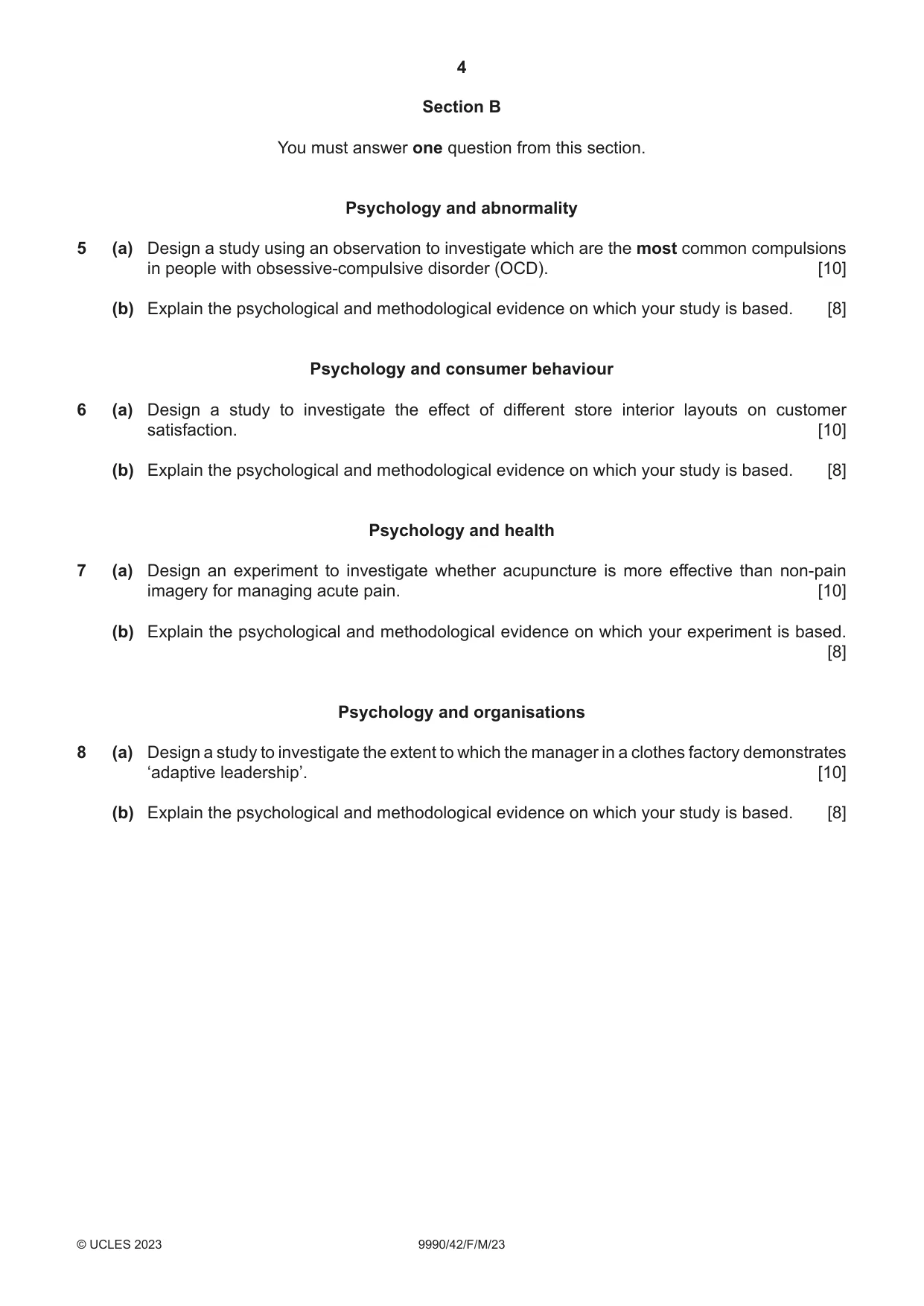
5 (a) Design a study using an observation to investigate which are the most common compulsions in people with obsessive‑compulsive disorder (OCD). [10] (b) Explain the psychological and methodological evidence on which your study is based. [8] Psychology and consumer behaviour
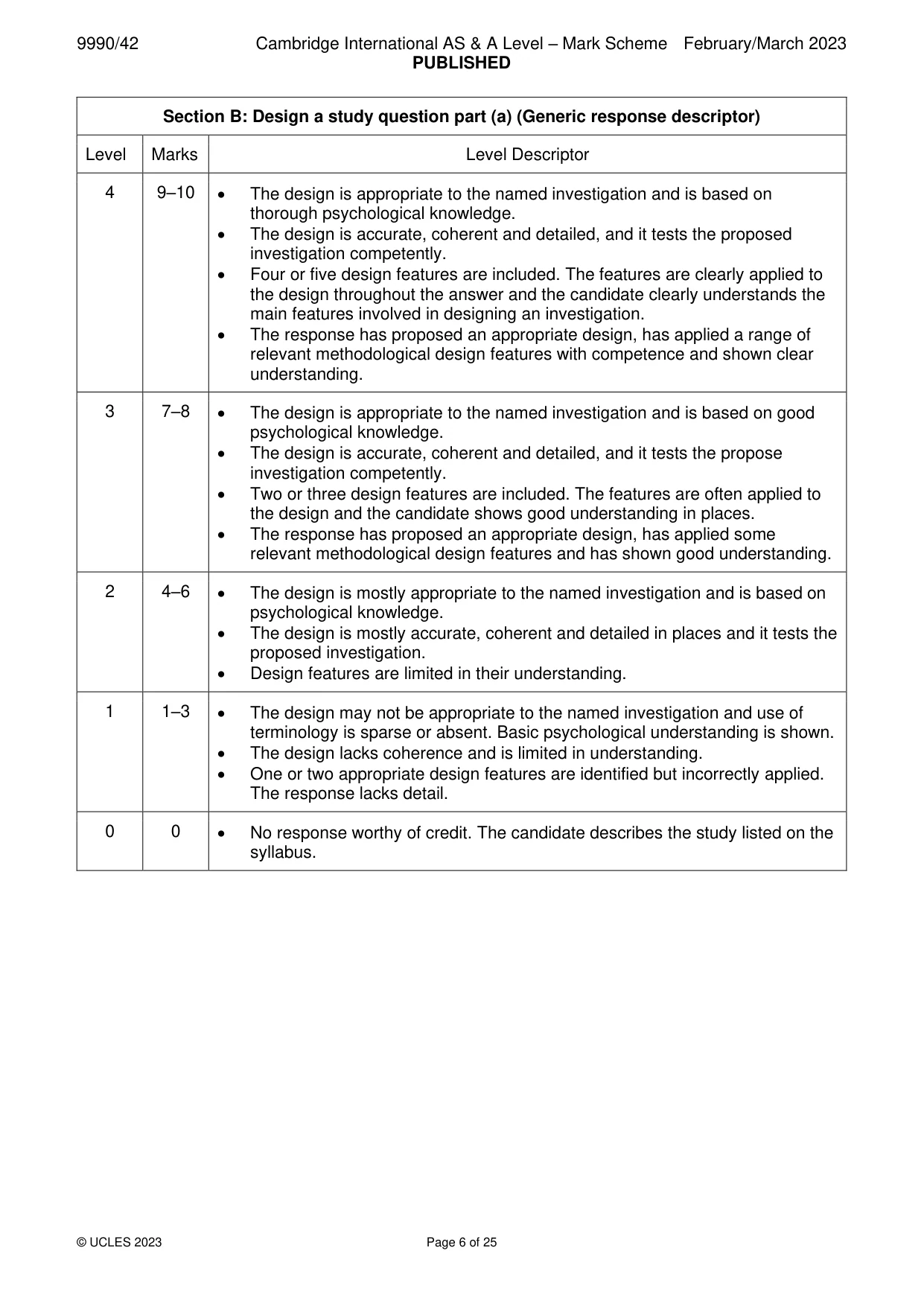
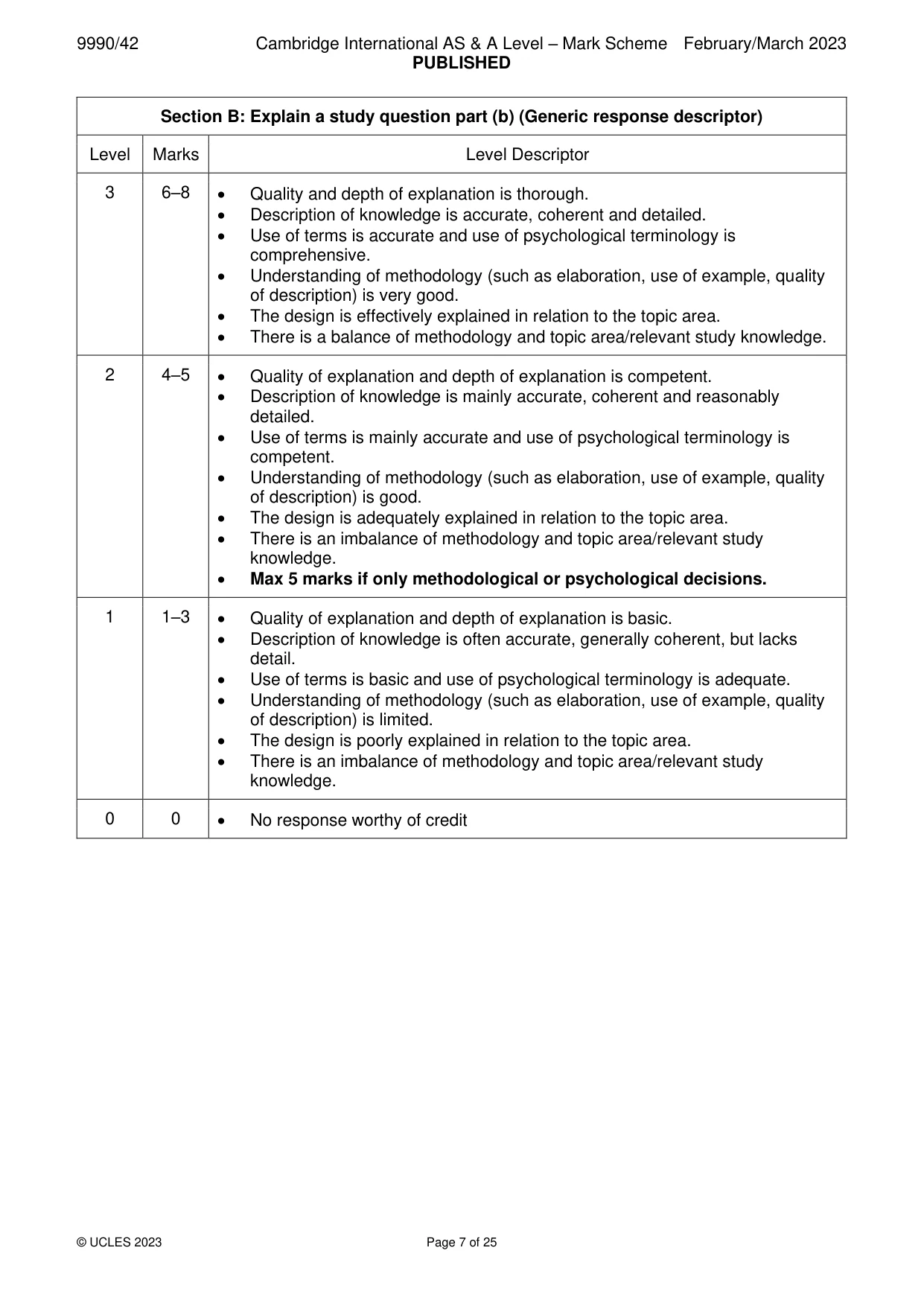
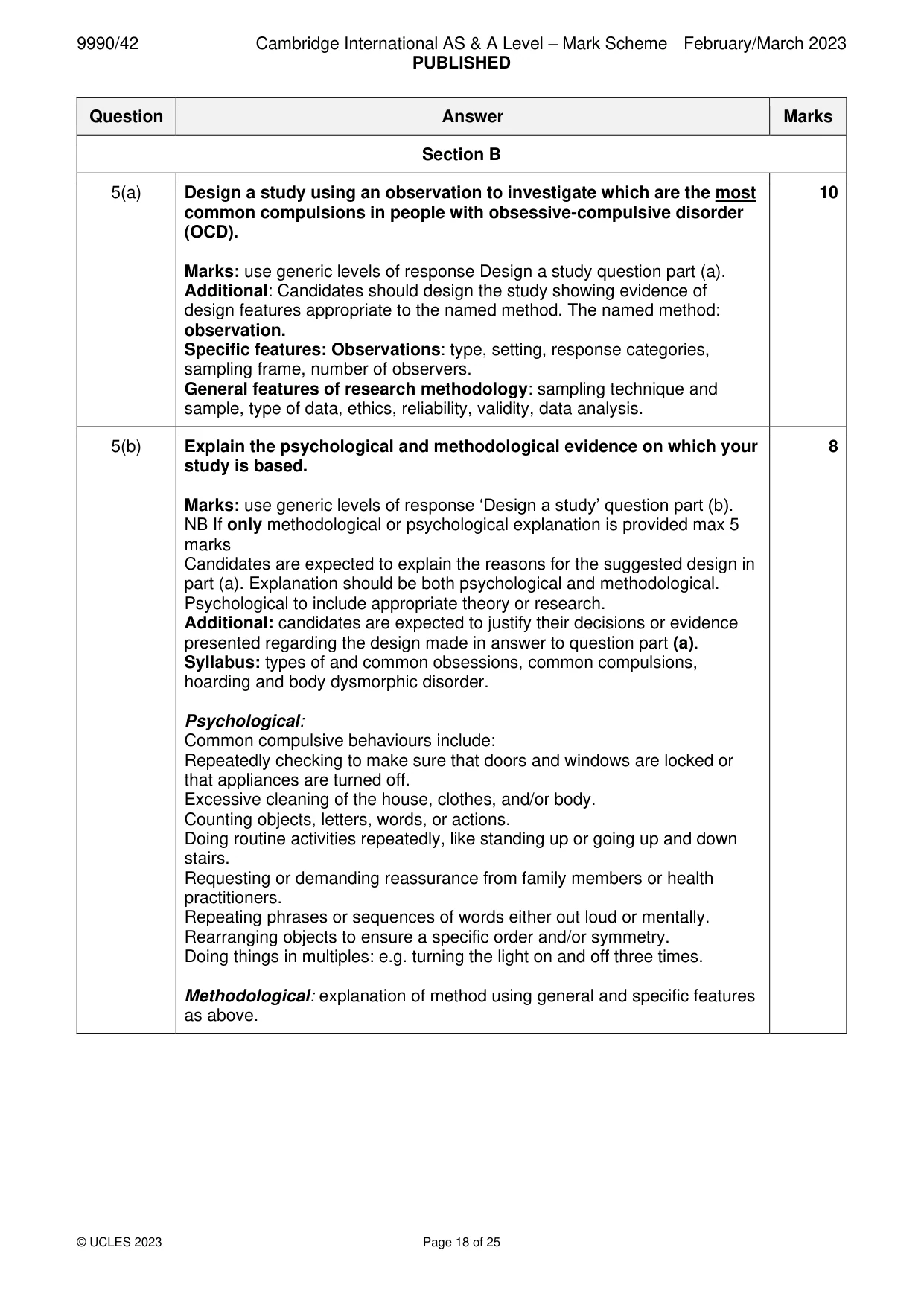
Mark scheme: 5(a) Design a study using an observation to investigate which are the most 10 common compulsions in people with obsessive-compulsive disorder (OCD). Marks: use generic levels of response Design a study question part (a). Additional: Candidates should design the study showing evidence of design features appropriate to the named method. The named method: observation. Specific features: Observations: type, setting, response categories, sampling frame, number of observers. General features of research methodology: sampling technique and sample, type of data, ethics, reliability, validity, data analysis. 5(b) Explain the psychological and methodological evidence on which your 8 study is based. Marks: use generic levels of response ‘Design a study’ question part (b). NB If only methodological or psychological explanation is provided max 5 marks Candidates are expected to explain the reasons for the suggested design in part (a). Explanation should be both psychological and methodological. Psychological to include appropriate theory or research. Additional: candidates are expected to justify their decisions or evidence presented regarding the design made in answer to question part (a). Syllabus: types of and common obsessions, common compulsions, hoarding and body dysmorphic disorder. Psychological: Common compulsive behaviours include: Repeatedly checking to make sure that doors and windows are locked or that appliances are turned off. Excessive cleaning of the house, clothes, and/or body. Counting objects, letters, words, or actions. Doing routine activities repeatedly, like standing up or going up and down stairs. Requesting or demanding reassurance from family members or health practitioners. Repeating phrases or sequences of words either out loud or mentally. Rearranging objects to ensure a specific order and/or symmetry. Doing things in multiples: e.g. turning the light on and off three times. Methodological: explanation of method using general and specific features as above.
Q6 · Design a study to investigate the effect of different store interior layouts on customer…
6 (a) Design a study to investigate the effect of different store interior layouts on customer satisfaction. [10] (b) Explain the psychological and methodological evidence on which your study is based. [8] Psychology and health
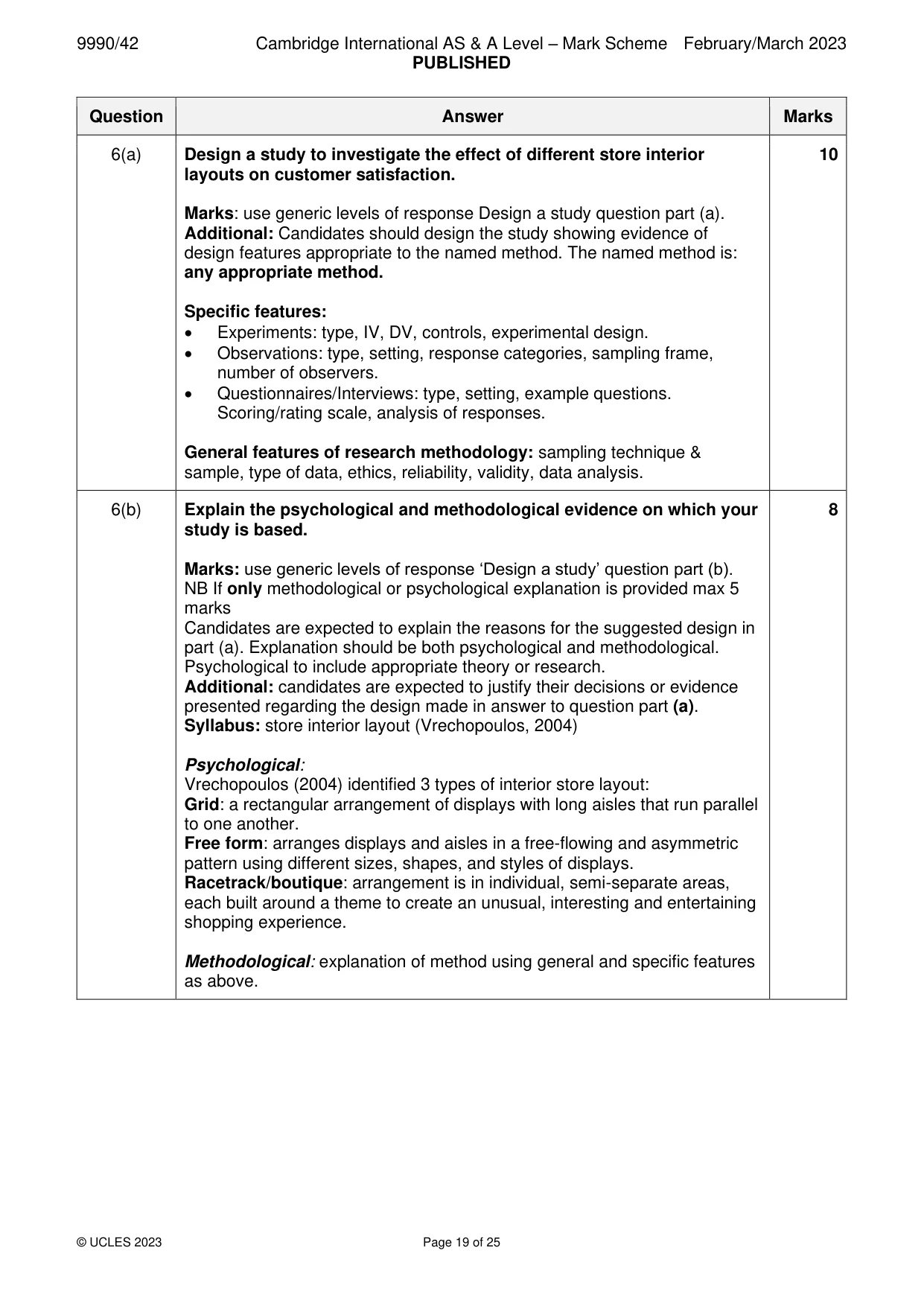
Mark scheme: 6(a) Design a study to investigate the effect of different store interior 10 layouts on customer satisfaction. Marks: use generic levels of response Design a study question part (a). Additional: Candidates should design the study showing evidence of design features appropriate to the named method. The named method is: any appropriate method. Specific features: • Experiments: type, IV, DV, controls, experimental design. • Observations: type, setting, response categories, sampling frame, number of observers. • Questionnaires/Interviews: type, setting, example questions. Scoring/rating scale, analysis of responses. General features of research methodology: sampling technique & sample, type of data, ethics, reliability, validity, data analysis. 6(b) Explain the psychological and methodological evidence on which your 8 study is based. Marks: use generic levels of response ‘Design a study’ question part (b). NB If only methodological or psychological explanation is provided max 5 marks Candidates are expected to explain the reasons for the suggested design in part (a). Explanation should be both psychological and methodological. Psychological to include appropriate theory or research. Additional: candidates are expected to justify their decisions or evidence presented regarding the design made in answer to question part (a). Syllabus: store interior layout (Vrechopoulos, 2004) Psychological: Vrechopoulos (2004) identified 3 types of interior store layout: Grid: a rectangular arrangement of displays with long aisles that run parallel to one another. Free form: arranges displays and aisles in a free-flowing and asymmetric pattern using different sizes, shapes, and styles of displays. Racetrack/boutique: arrangement is in individual, semi-separate areas, each built around a theme to create an unusual, interesting and entertaining shopping experience. Methodological: explanation of method using general and specific features as above.
Q7 · Design an experiment to investigate whether acupuncture is more effective than non‑pain…
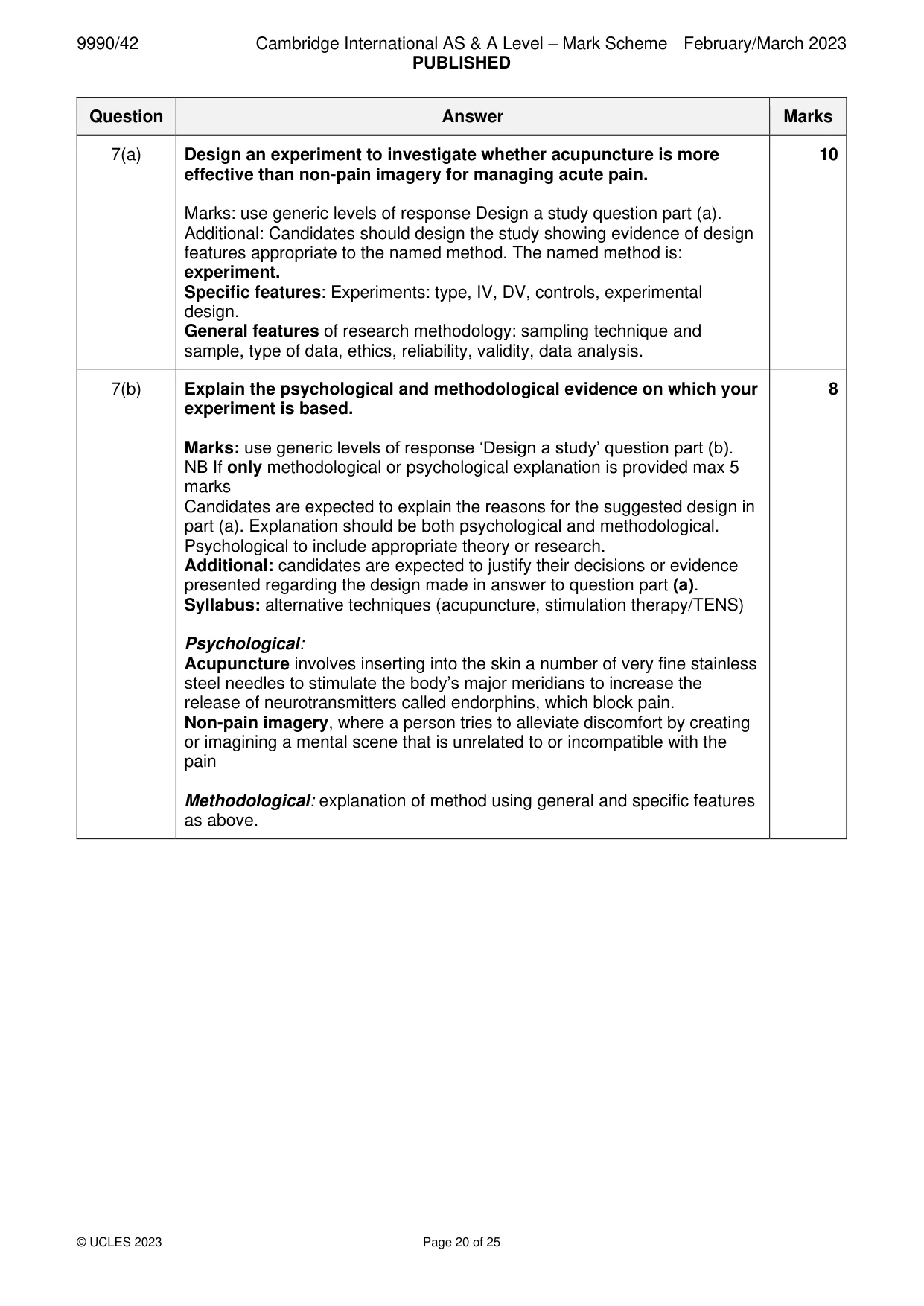
7 (a) Design an experiment to investigate whether acupuncture is more effective than non‑pain imagery for managing acute pain. [10] (b) Explain the psychological and methodological evidence on which your experiment is based. [8] Psychology and organisations
Mark scheme: 7(a) Design an experiment to investigate whether acupuncture is more 10 effective than non-pain imagery for managing acute pain. Marks: use generic levels of response Design a study question part (a). Additional: Candidates should design the study showing evidence of design features appropriate to the named method. The named method is: experiment. Specific features: Experiments: type, IV, DV, controls, experimental design. General features of research methodology: sampling technique and sample, type of data, ethics, reliability, validity, data analysis. 7(b) Explain the psychological and methodological evidence on which your 8 experiment is based. Marks: use generic levels of response ‘Design a study’ question part (b). NB If only methodological or psychological explanation is provided max 5 marks Candidates are expected to explain the reasons for the suggested design in part (a). Explanation should be both psychological and methodological. Psychological to include appropriate theory or research. Additional: candidates are expected to justify their decisions or evidence presented regarding the design made in answer to question part (a). Syllabus: alternative techniques (acupuncture, stimulation therapy/TENS) Psychological: Acupuncture involves inserting into the skin a number of very fine stainless steel needles to stimulate the body’s major meridians to increase the release of neurotransmitters called endorphins, which block pain. Non-pain imagery, where a person tries to alleviate discomfort by creating or imagining a mental scene that is unrelated to or incompatible with the pain Methodological: explanation of method using general and specific features as above.
Q8 · Design a study to investigate the extent to which the manager in a clothes factory…
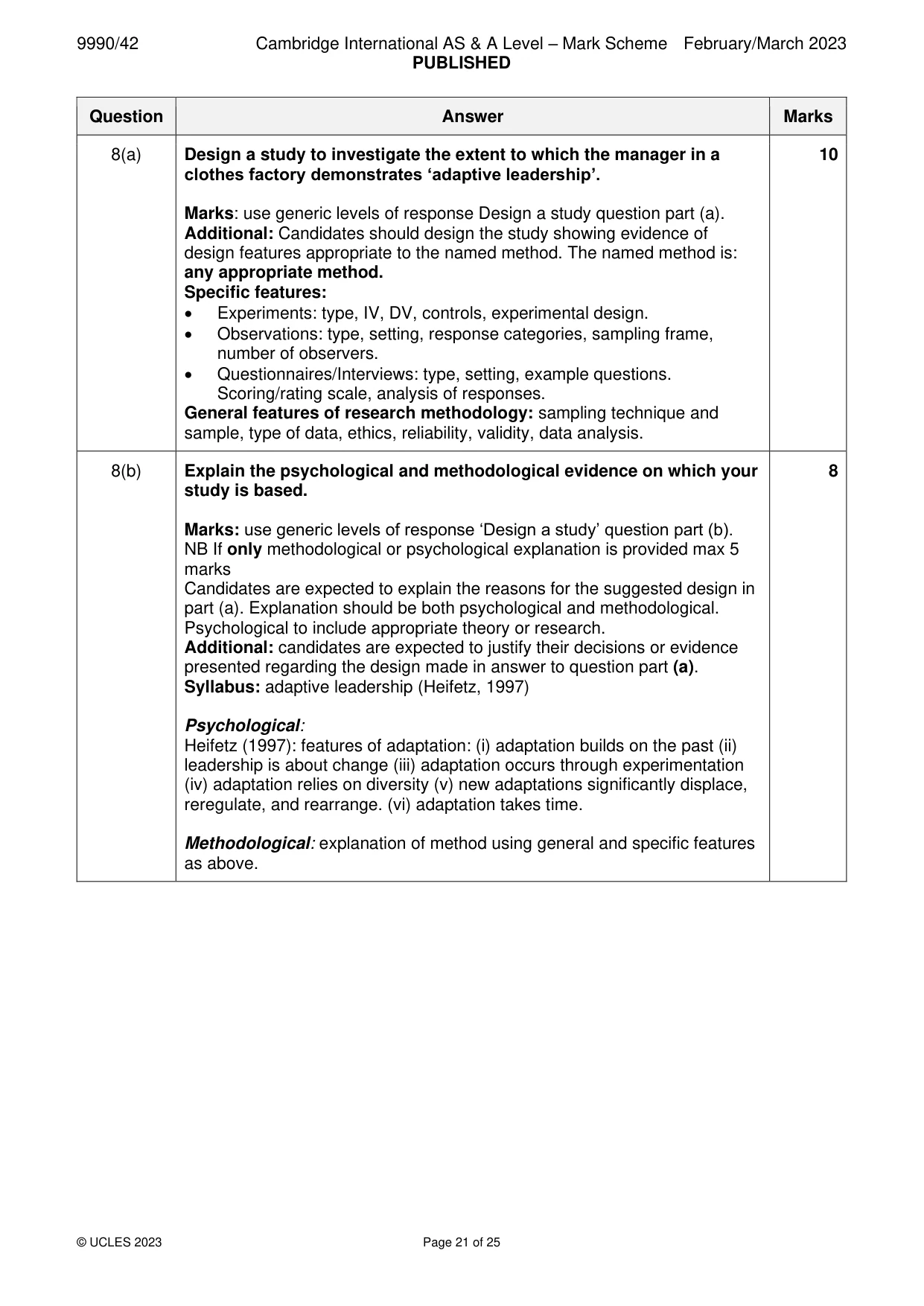
8 (a) Design a study to investigate the extent to which the manager in a clothes factory demonstrates ‘adaptive leadership’. [10] (b) Explain the psychological and methodological evidence on which your study is based. [8] Section C You must answer one question from this section. Psychology and abnormality
Mark scheme: 8(a) Design a study to investigate the extent to which the manager in a 10 clothes factory demonstrates ‘adaptive leadership’. Marks: use generic levels of response Design a study question part (a). Additional: Candidates should design the study showing evidence of design features appropriate to the named method. The named method is: any appropriate method. Specific features: • Experiments: type, IV, DV, controls, experimental design. • Observations: type, setting, response categories, sampling frame, number of observers. • Questionnaires/Interviews: type, setting, example questions. Scoring/rating scale, analysis of responses. General features of research methodology: sampling technique and sample, type of data, ethics, reliability, validity, data analysis. 8(b) Explain the psychological and methodological evidence on which your 8 study is based. Marks: use generic levels of response ‘Design a study’ question part (b). NB If only methodological or psychological explanation is provided max 5 marks Candidates are expected to explain the reasons for the suggested design in part (a). Explanation should be both psychological and methodological. Psychological to include appropriate theory or research. Additional: candidates are expected to justify their decisions or evidence presented regarding the design made in answer to question part (a). Syllabus: adaptive leadership (Heifetz, 1997) Psychological: Heifetz (1997): features of adaptation: (i) adaptation builds on the past (ii) leadership is about change (iii) adaptation occurs through experimentation (iv) adaptation relies on diversity (v) new adaptations significantly displace, reregulate, and rearrange. (vi) adaptation takes time. Methodological: explanation of method using general and specific features as above.
Q9 · ‘Cognitive treatment for obsessive‑compulsive and related disorders is not the solution
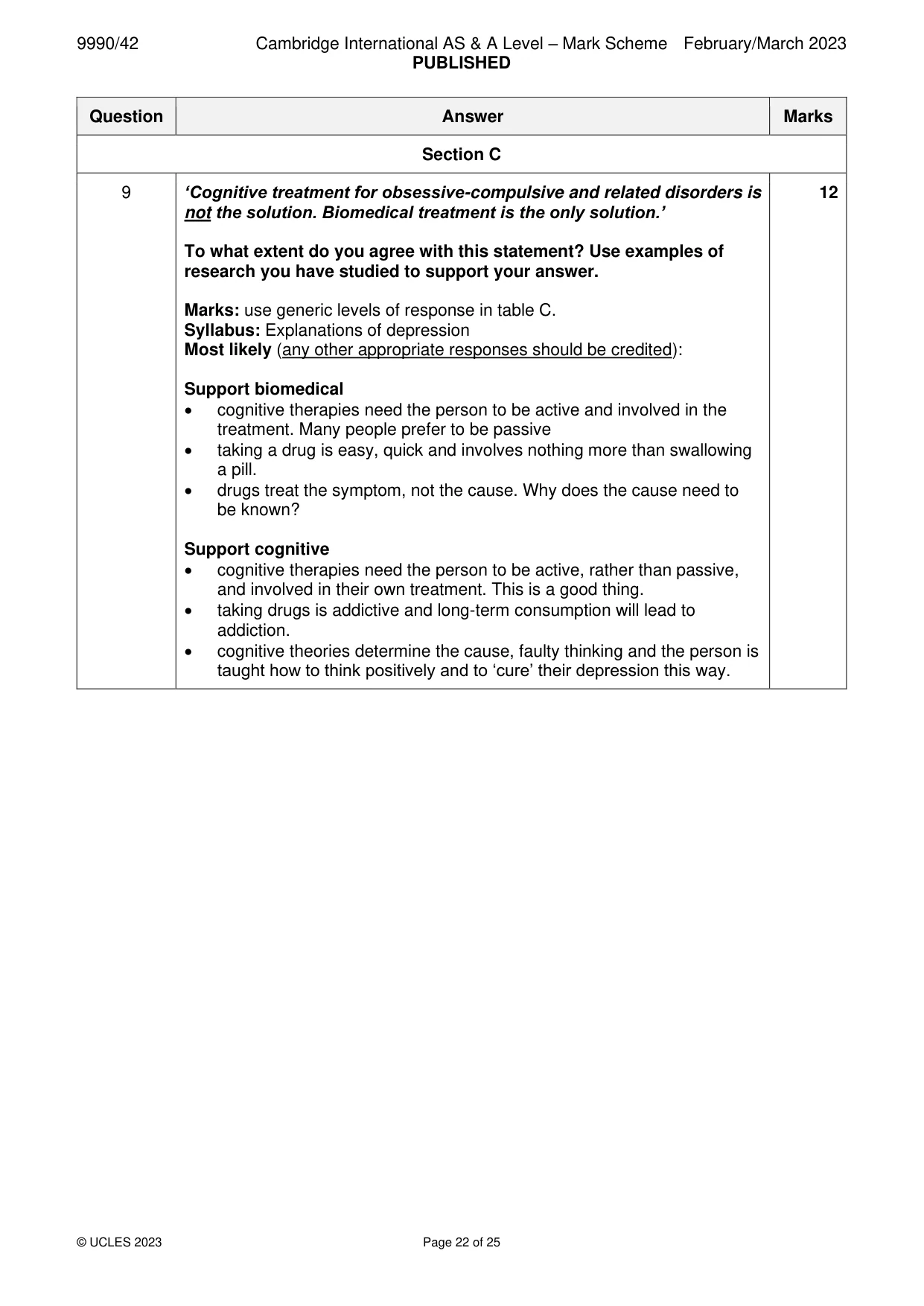
9 ‘Cognitive treatment for obsessive‑compulsive and related disorders is not the solution. Biomedical treatment is the only solution.’ To what extent do you agree with this statement? Use examples of research you have studied to support your answer. [12] Psychology and consumer behaviour
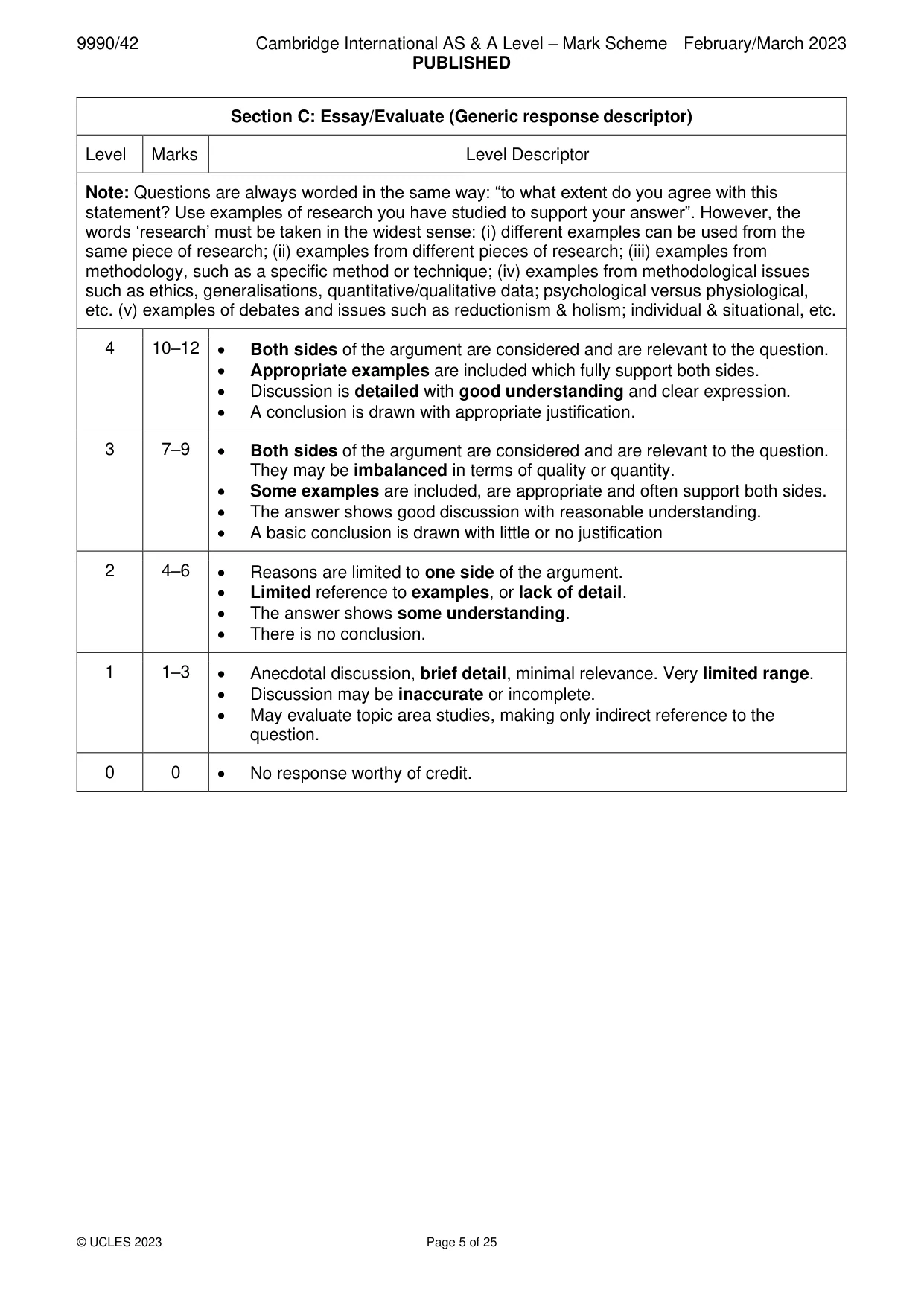
Mark scheme: 9 ‘Cognitive treatment for obsessive-compulsive and related disorders is 12 not the solution. Biomedical treatment is the only solution.’ To what extent do you agree with this statement? Use examples of research you have studied to support your answer. Marks: use generic levels of response in table C. Syllabus: Explanations of depression Most likely (any other appropriate responses should be credited): Support biomedical • cognitive therapies need the person to be active and involved in the treatment. Many people prefer to be passive • taking a drug is easy, quick and involves nothing more than swallowing a pill. • drugs treat the symptom, not the cause. Why does the cause need to be known? Support cognitive • cognitive therapies need the person to be active, rather than passive, and involved in their own treatment. This is a good thing. • taking drugs is addictive and long-term consumption will lead to addiction. • cognitive theories determine the cause, faulty thinking and the person is taught how to think positively and to ‘cure’ their depression this way.
Q10 · ‘Different types of intuitive thinking, such as thinking fast and thinking slow, are of…
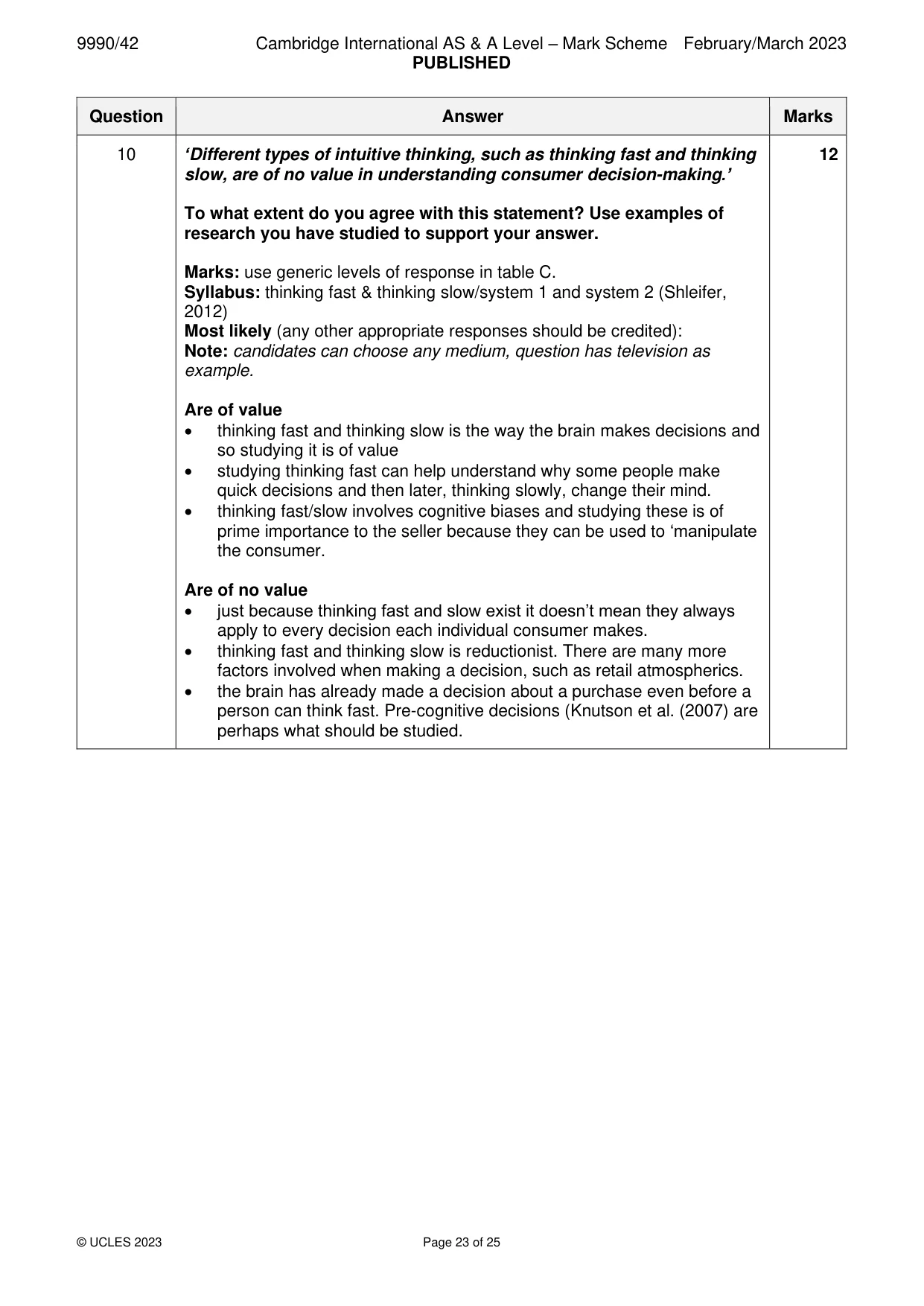
10 ‘Different types of intuitive thinking, such as thinking fast and thinking slow, are of no value in understanding consumer decision‑making.’ To what extent do you agree with this statement? Use examples of research you have studied to support your answer. [12] Psychology and health
Mark scheme: 10 ‘Different types of intuitive thinking, such as thinking fast and thinking 12 slow, are of no value in understanding consumer decision-making.’ To what extent do you agree with this statement? Use examples of research you have studied to support your answer. Marks: use generic levels of response in table C. Syllabus: thinking fast & thinking slow/system 1 and system 2 (Shleifer, 2012) Most likely (any other appropriate responses should be credited): Note: candidates can choose any medium, question has television as example. Are of value • thinking fast and thinking slow is the way the brain makes decisions and so studying it is of value • studying thinking fast can help understand why some people make quick decisions and then later, thinking slowly, change their mind. • thinking fast/slow involves cognitive biases and studying these is of prime importance to the seller because they can be used to ‘manipulate the consumer. Are of no value • just because thinking fast and slow exist it doesn’t mean they always apply to every decision each individual consumer makes. • thinking fast and thinking slow is reductionist. There are many more factors involved when making a decision, such as retail atmospherics. • the brain has already made a decision about a purchase even before a person can think fast. Pre-cognitive decisions (Knutson et al. (2007) are perhaps what should be studied.
Q11 · ‘Psychological techniques to manage stress are more effective than any medical…
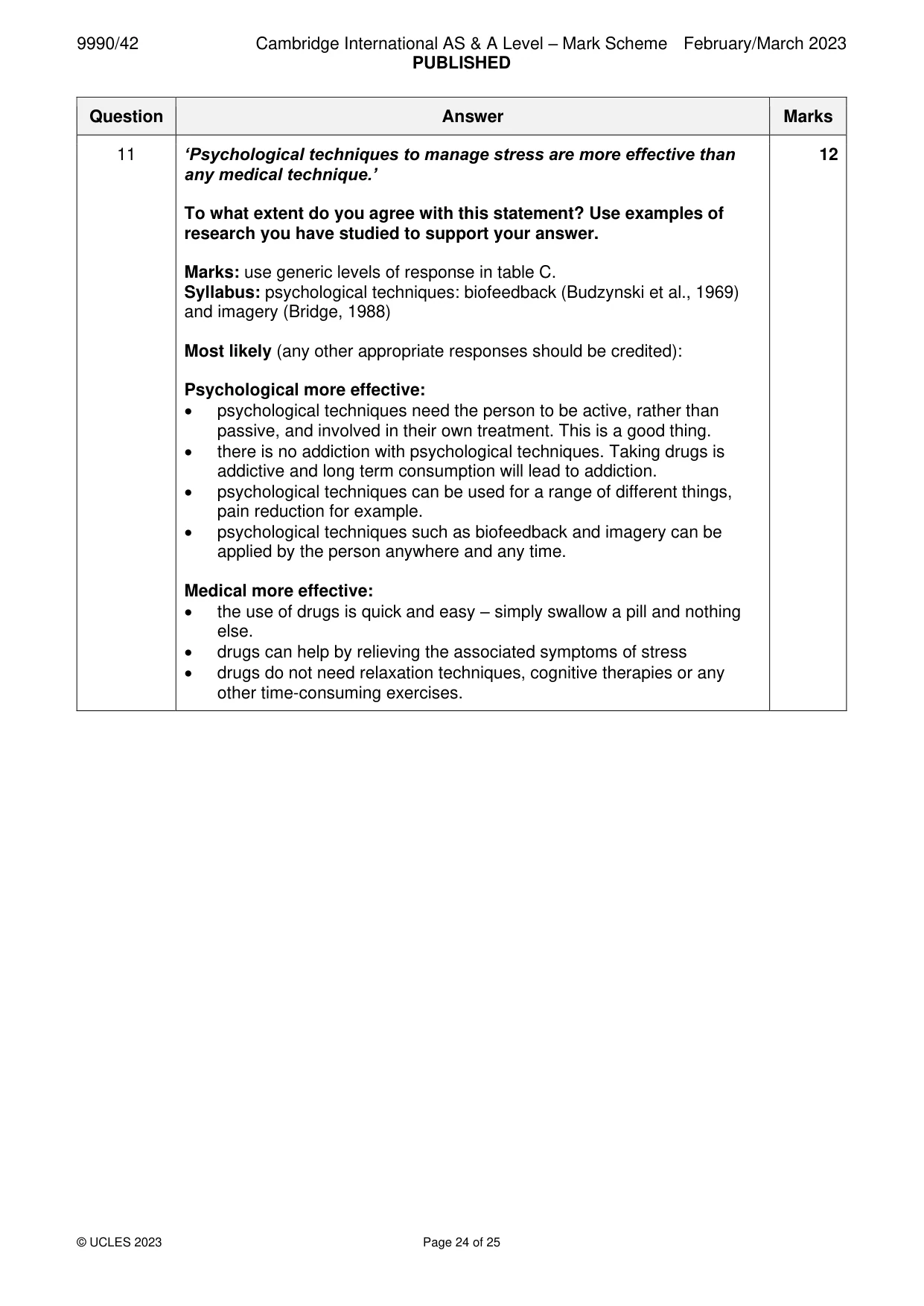
11 ‘Psychological techniques to manage stress are more effective than any medical technique.’ To what extent do you agree with this statement? Use examples of research you have studied to support your answer. [12] Psychology and organisations
Mark scheme: 11 ‘Psychological techniques to manage stress are more effective than 12 any medical technique.’ To what extent do you agree with this statement? Use examples of research you have studied to support your answer. Marks: use generic levels of response in table C. Syllabus: psychological techniques: biofeedback (Budzynski et al., 1969) and imagery (Bridge, 1988) Most likely (any other appropriate responses should be credited): Psychological more effective: • psychological techniques need the person to be active, rather than passive, and involved in their own treatment. This is a good thing. • there is no addiction with psychological techniques. Taking drugs is addictive and long term consumption will lead to addiction. • psychological techniques can be used for a range of different things, pain reduction for example. • psychological techniques such as biofeedback and imagery can be applied by the person anywhere and any time. Medical more effective: • the use of drugs is quick and easy – simply swallow a pill and nothing else. • drugs can help by relieving the associated symptoms of stress • drugs do not need relaxation techniques, cognitive therapies or any other time-consuming exercises.
Q12 · ‘The methodology used in the Hawthorne studies is reductionist
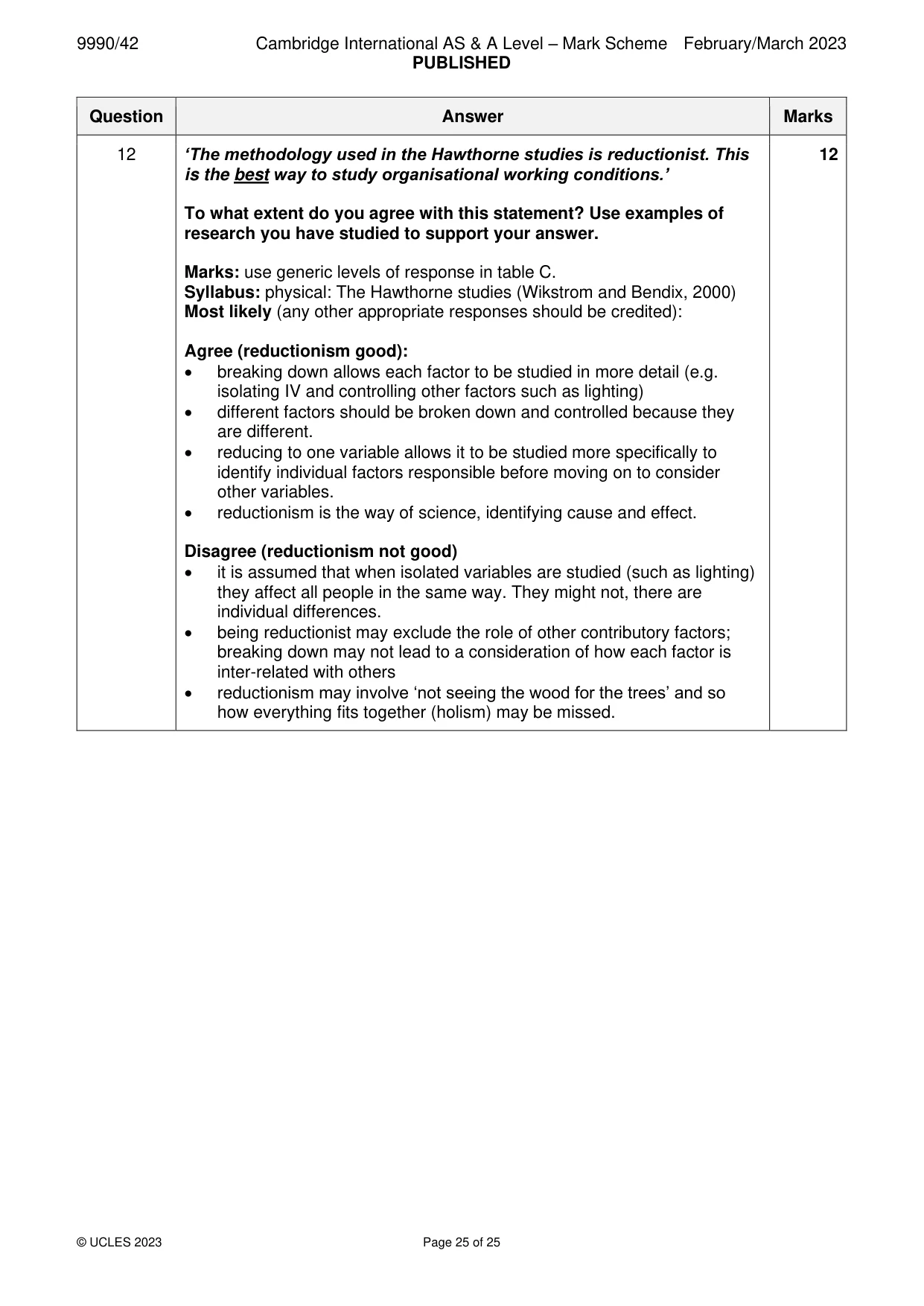
12 ‘The methodology used in the Hawthorne studies is reductionist. This is the best way to study organisational working conditions.’ To what extent do you agree with this statement? Use examples of research you have studied to support your answer. [12]
Mark scheme: 12 ‘The methodology used in the Hawthorne studies is reductionist. This 12 is the best way to study organisational working conditions.’ To what extent do you agree with this statement? Use examples of research you have studied to support your answer. Marks: use generic levels of response in table C. Syllabus: physical: The Hawthorne studies (Wikstrom and Bendix, 2000) Most likely (any other appropriate responses should be credited): Agree (reductionism good): • breaking down allows each factor to be studied in more detail (e.g. isolating IV and controlling other factors such as lighting) • different factors should be broken down and controlled because they are different. • reducing to one variable allows it to be studied more specifically to identify individual factors responsible before moving on to consider other variables. • reductionism is the way of science, identifying cause and effect. Disagree (reductionism not good) • it is assumed that when isolated variables are studied (such as lighting) they affect all people in the same way. They might not, there are individual differences. • being reductionist may exclude the role of other contributory factors; breaking down may not lead to a consideration of how each factor is inter-related with others • reductionism may involve ‘not seeing the wood for the trees’ and so how everything fits together (holism) may be missed.
What was in this paper
The subtopics covered by these 12 questions, and how many questions each got. Open one in a new tab to see every Cambridge question on it.
What you needed in this session
Cambridge’s own grade thresholds for 2023 Feb/March, Paper 4 · Variant 2. A higher threshold means an easier paper — the bar moves with how the cohort did.