Questions as text
Q1 · The first law of thermodynamics can be represented by the expression ΔU = q + w 9702/42 Feb/March 2017
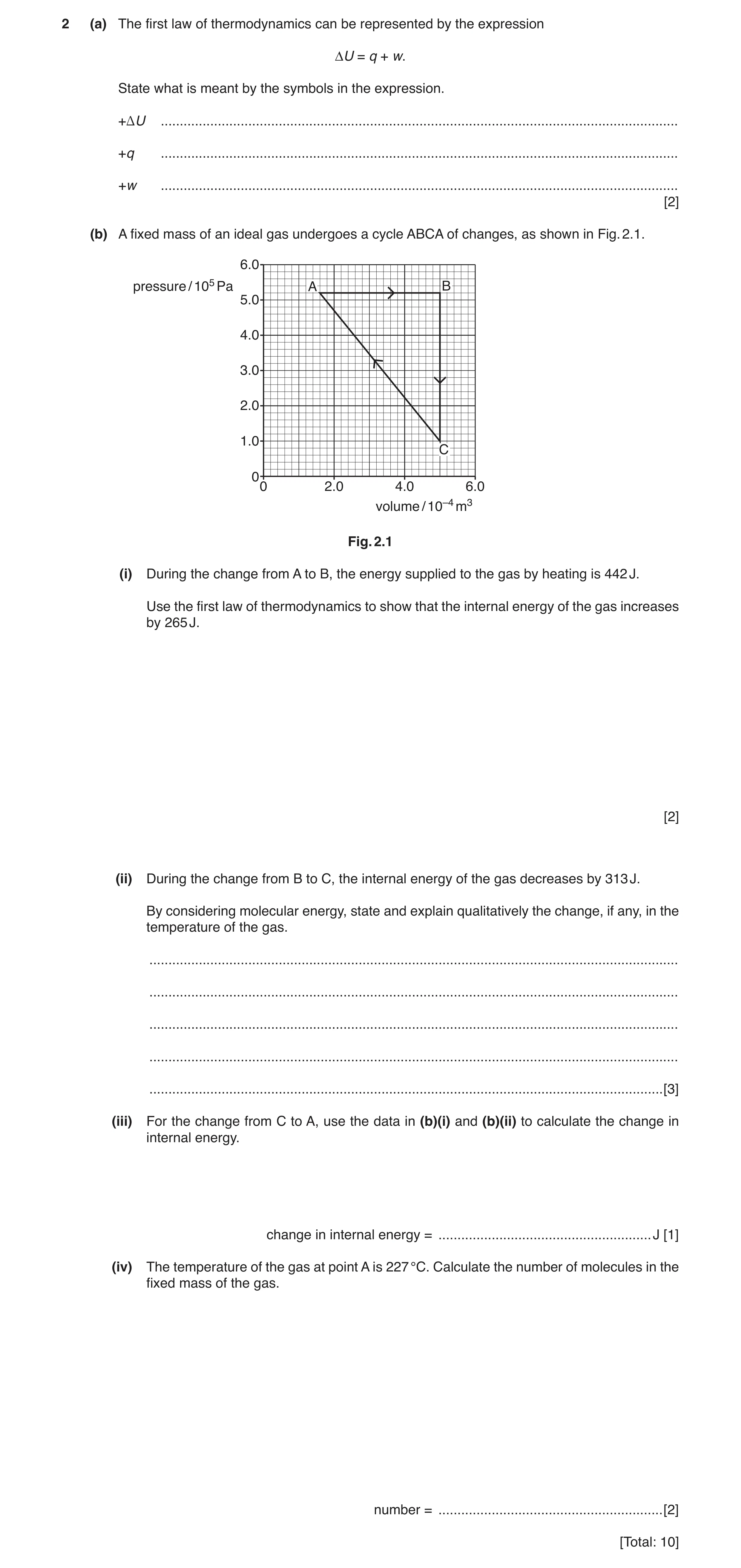
2 (a) The first law of thermodynamics can be represented by the expression ΔU = q + w. State what is meant by the symbols in the expression. +DU … +q … +w … [2] (b) A fixed mass of an ideal gas undergoes a cycle ABCA of changes, as shown in Fig. 2.1. 6.0 pressure / 105 Pa A B 5.0 4.0 3.0 2.0 1.0 C 0 0 2.0 4.0 6.0 volume / 10–4 m3 Fig. 2.1 (i) During the change from A to B, the energy supplied to the gas by heating is 442 J. Use the first law of thermodynamics to show that the internal energy of the gas increases by 265 J. [2] (ii) During the change from B to C, the internal energy of the gas decreases by 313 J. By considering molecular energy, state and explain qualitatively the change, if any, in the temperature of the gas. … … … … … [3] (iii) For the change from C to A, use the data in (b)(i) and (b)(ii) to calculate the change in internal energy. change in internal energy = … J [1] (iv) The temperature of the gas at point A is 227 °C. Calculate the number of molecules in the fixed mass of the gas. number = … [2] [Total: 10]
10 marks
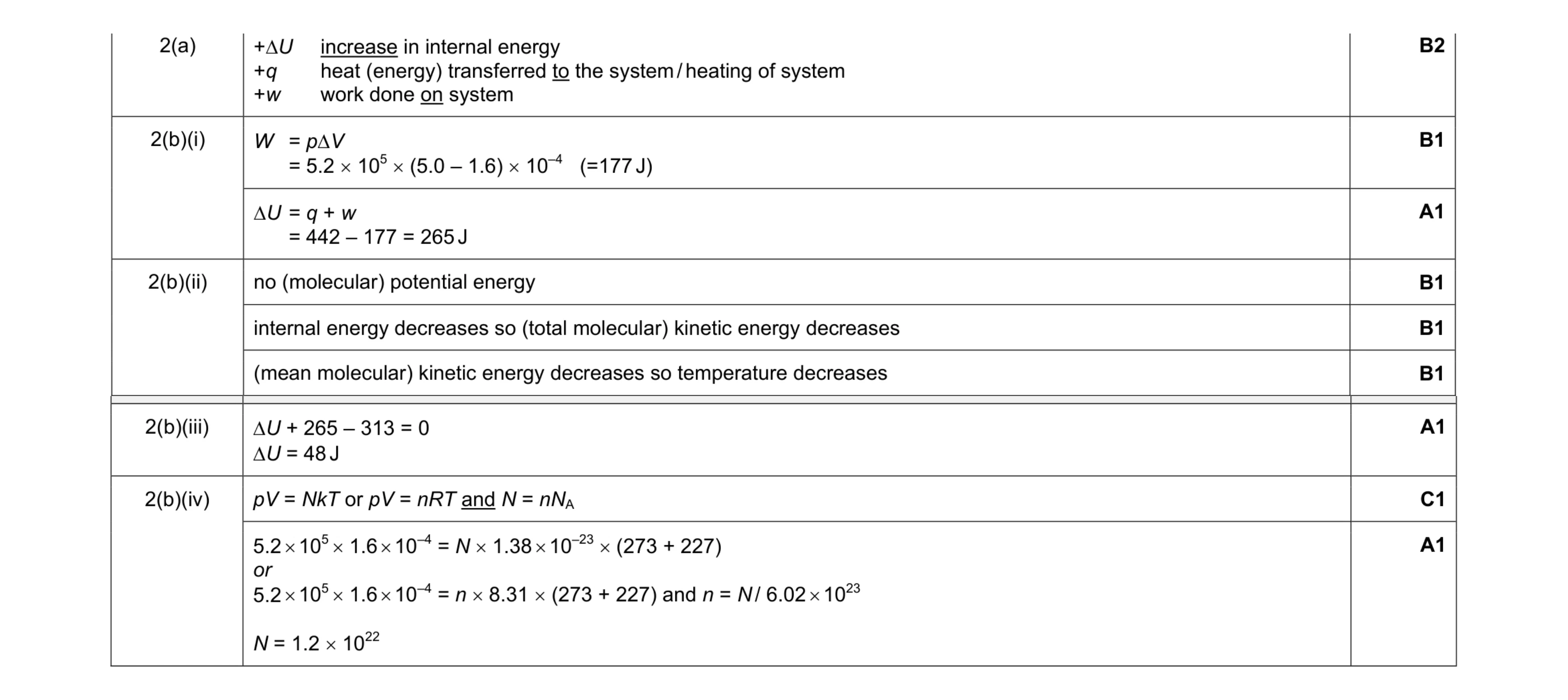
Mark scheme: 2(a) +q heat (energy) transferred to the system / heating of system +w work done on system B2 2(b)(i) W = p∆V = 5.2 × 105 × (5.0 – 1.6) × 10–4 (=177 J) B1 ∆U = q + w = 442 – 177 = 265 J A1 2(b)(ii) no (molecular) potential energy B1 internal energy decreases so (total molecular) kinetic energy decreases B1 (mean molecular) kinetic energy decreases so temperature decreases B1 Question Answer Marks 2(b)(iii) ∆U + 265 – 313 = 0 ∆U = 48 J A1 2(b)(iv) pV = NkT or pV = nRT and N = nNA C1 5.2 × 105 × 1.6 × 10–4 = N × 1.38 × 10–23 × (273 + 227) or 5.2 × 105 × 1.6 × 10–4 = n × 8.31 × (273 + 227) and n = N / 6.02 × 10²³ N = 1.2 × 10²² A1
This question in 9702/42 Feb/March 2017
Q2 · State what is meant by specific latent heat 9702/42 Oct/Nov 2017
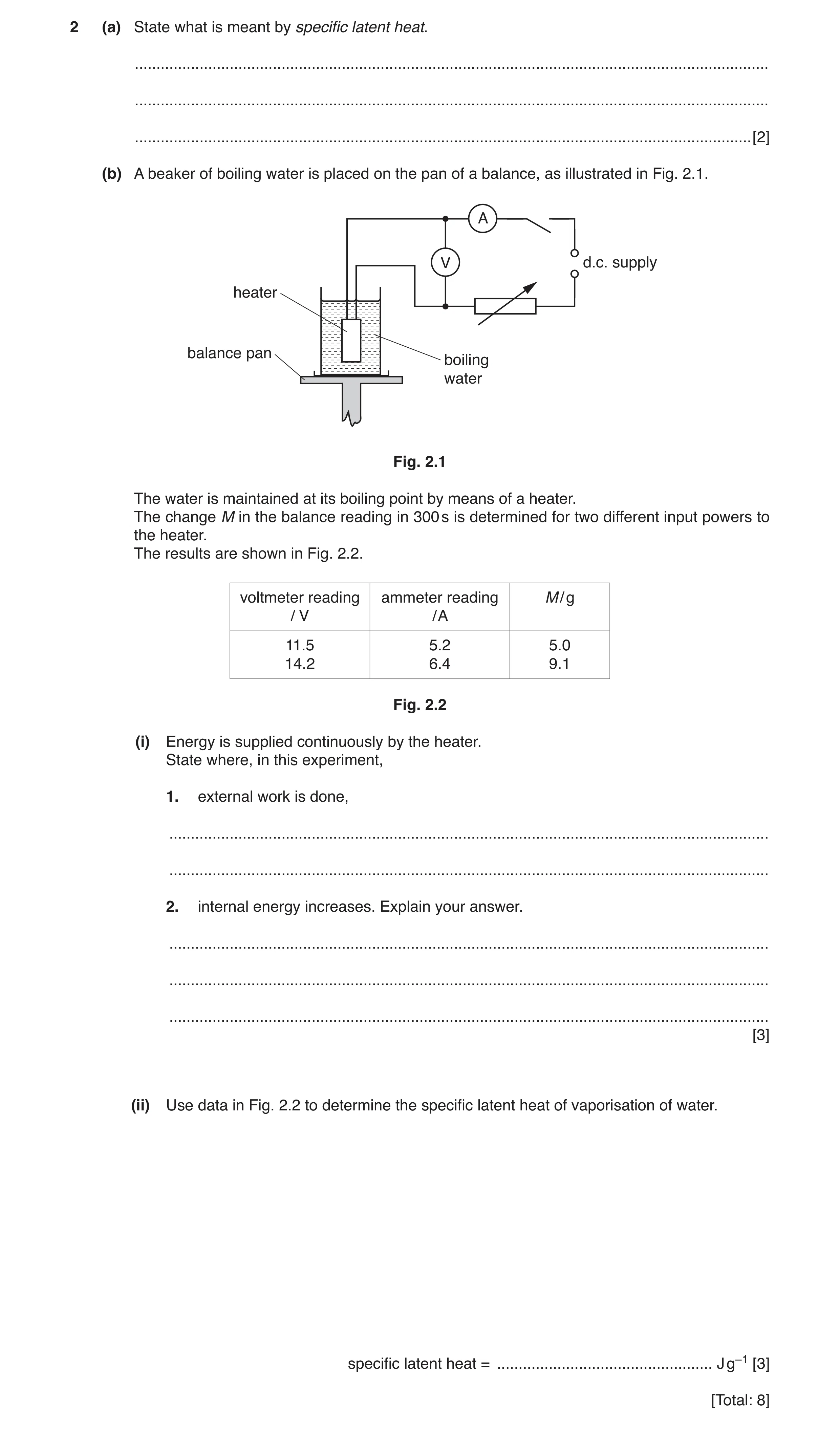
2 (a) State what is meant by specific latent heat. … … … [2] (b) A beaker of boiling water is placed on the pan of a balance, as illustrated in Fig. 2.1. A V d.c. supply heater balance pan boiling water Fig. 2.1 The water is maintained at its boiling point by means of a heater. The change M in the balance reading in 300 s is determined for two different input powers to the heater. The results are shown in Fig. 2.2. voltmeter reading ammeter reading M / g / V / A 11.5 5.2 5.0 14.2 6.4 9.1 Fig. 2.2 (i) Energy is supplied continuously by the heater. State where, in this experiment, 1. external work is done, … … 2. internal energy increases. Explain your answer. … … … [3] (ii) Use data in Fig. 2.2 to determine the specific latent heat of vaporisation of water. specific latent heat = … J g–1 [3] [Total: 8]
8 marks
Mark scheme: 2(a) (thermal) energy per (unit) mass (to cause change of state) B1 (energy required to cause/released in) change of state at constant temperature B1 2(b)(i) 1. (work done on/against) the atmosphere B1 2. water as it turns from liquid to vapour M1 as potential energy of molecules increases A1 or surroundings as its temperature rises (M1) as energy is lost/transferred to surroundings (A1) 2(b)(ii) VI – h = M / t × L (where h = power loss) or L = (VIt – Q) / M (where Q = energy loss) C1 (14.2 × 6.4) – (11.5 × 5.2) = (9.1 – 5.0) × L / 300 or L = [(14.2 × 6.4) – (11.5 × 5.2)] × 300 / (9.1 – 5.0) C1 L = 2300 J g–1 A1
This question in 9702/42 Oct/Nov 2017
Q3 · A cylinder contains 5.12 mol of an ideal gas at pressure of 5.60 × 10⁵ Pa and volume 3.80… 9702/42 Feb/March 2018
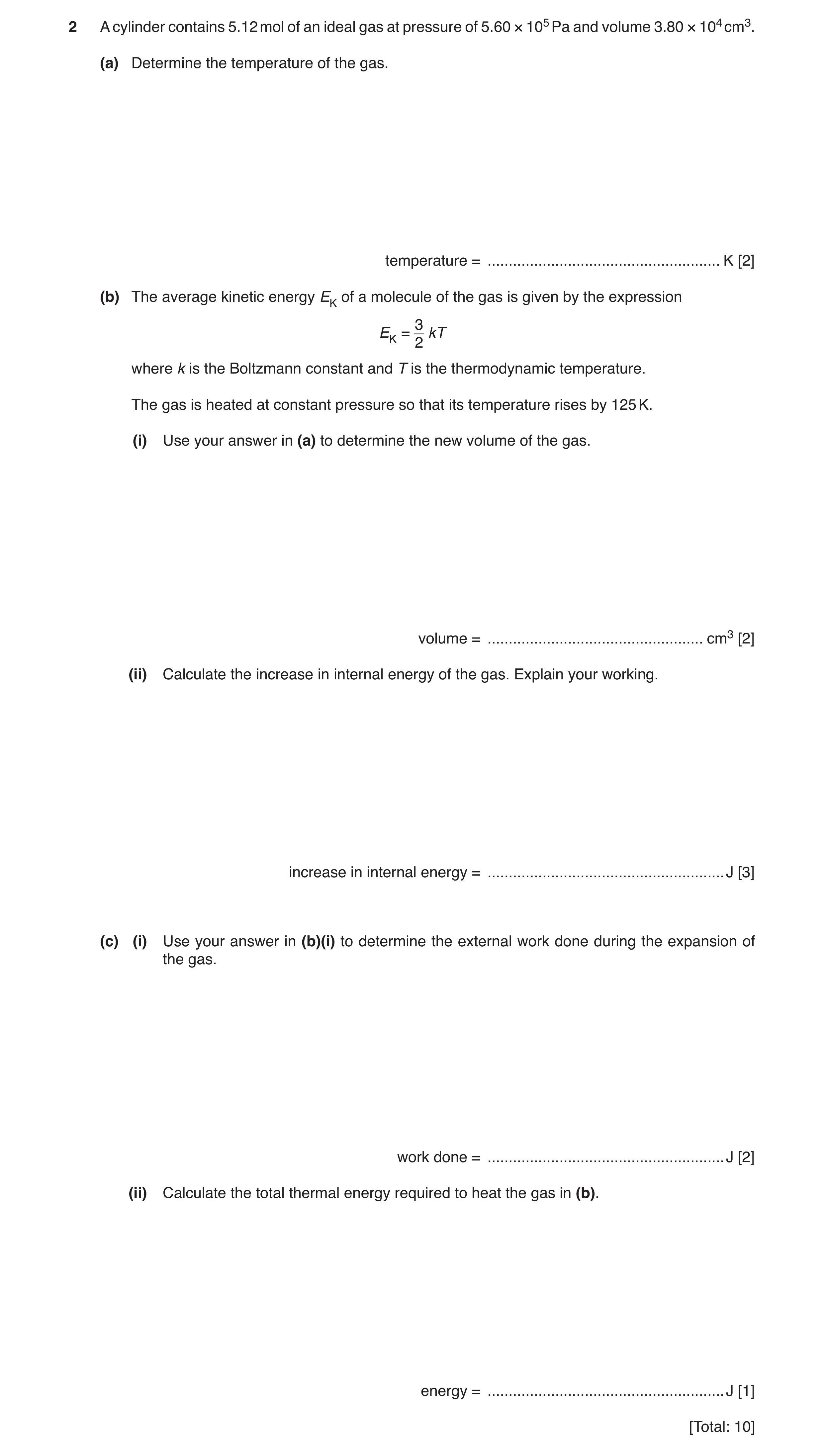
2 A cylinder contains 5.12 mol of an ideal gas at pressure of 5.60 × 10⁵ Pa and volume 3.80 × 104 cm3. (a) Determine the temperature of the gas. temperature = … K [2] (b) The average kinetic energy EK of a molecule of the gas is given by the expression 3 EK = kT 2 where k is the Boltzmann constant and T is the thermodynamic temperature. The gas is heated at constant pressure so that its temperature rises by 125 K. (i) Use your answer in (a) to determine the new volume of the gas. volume = … cm3 [2] (ii) Calculate the increase in internal energy of the gas. Explain your working. increase in internal energy = … J [3] (c) (i) Use your answer in (b)(i) to determine the external work done during the expansion of the gas. work done = … J [2] (ii) Calculate the total thermal energy required to heat the gas in (b). energy = … J [1] [Total: 10]
10 marks
Mark scheme: 2(a) pV = nRT T = (5.60 × 105 × 3.80 × 10–2) / (5.12 × 8.31) C1 T = 500 K A1 2(b)(i) V / T is constant V = (3.80 × 104) × (500 + 125) / 500 C1 V = 4.75 × 104 cm3 A1 2(b)(ii) (for ideal gas,) change in internal energy is change in (total) kinetic energy (of molecules) B1 ∆U = 3 / 2 × 1.38 × 10–23 × 125 × 5.12 × 6.02 × 1023 C1 = 7980 J A1 2(c)(i) w = p∆V = 5.60 × 105 × (4.75 – 3.80) × 10–2 C1 = 5320 J A1 2(c)(ii) total = 7980 + 5320 = 13300 J A1
This question in 9702/42 Feb/March 2018
Q4 · State what is meant by the internal energy of a system 9702/41 Oct/Nov 2018
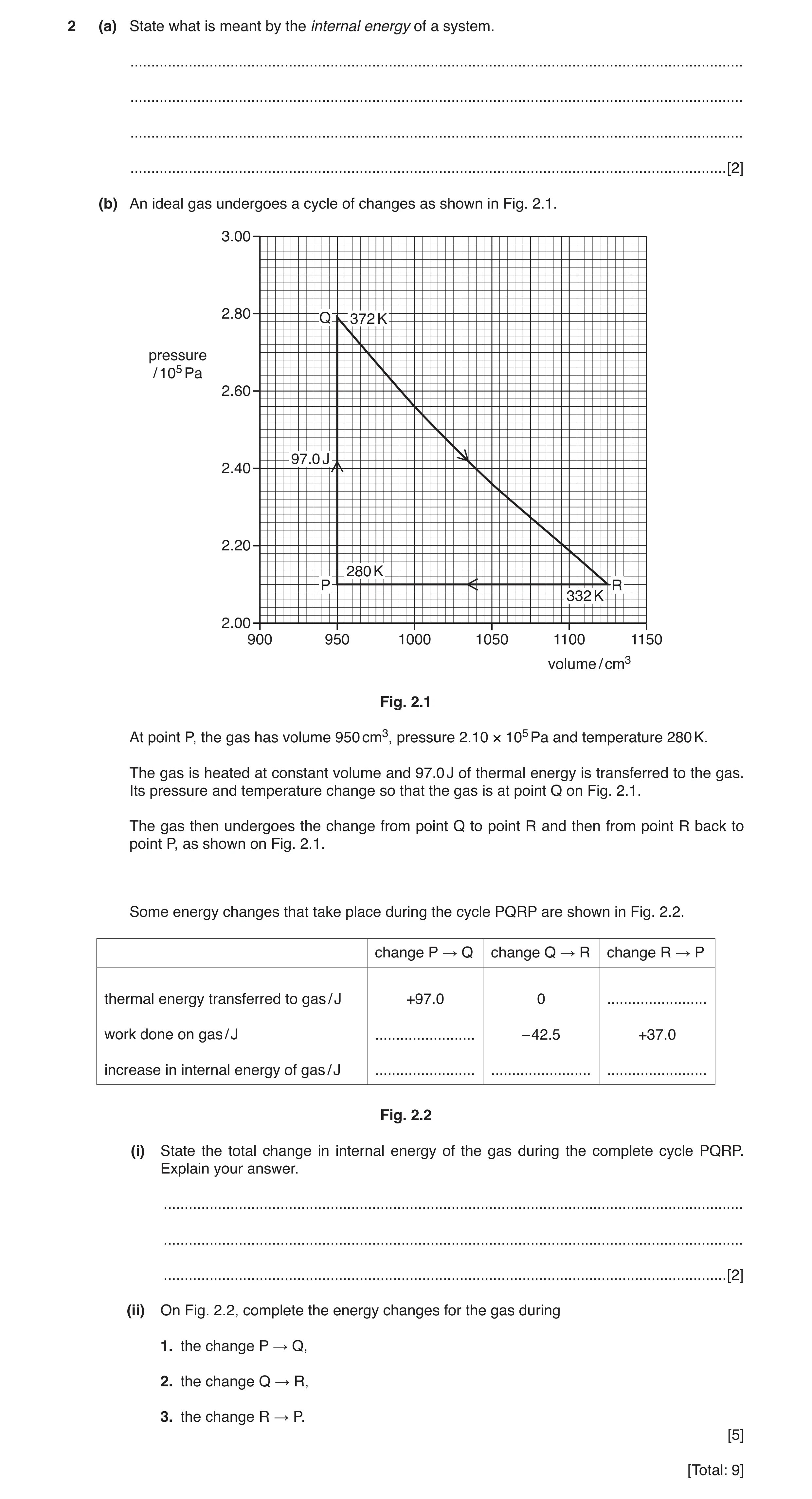
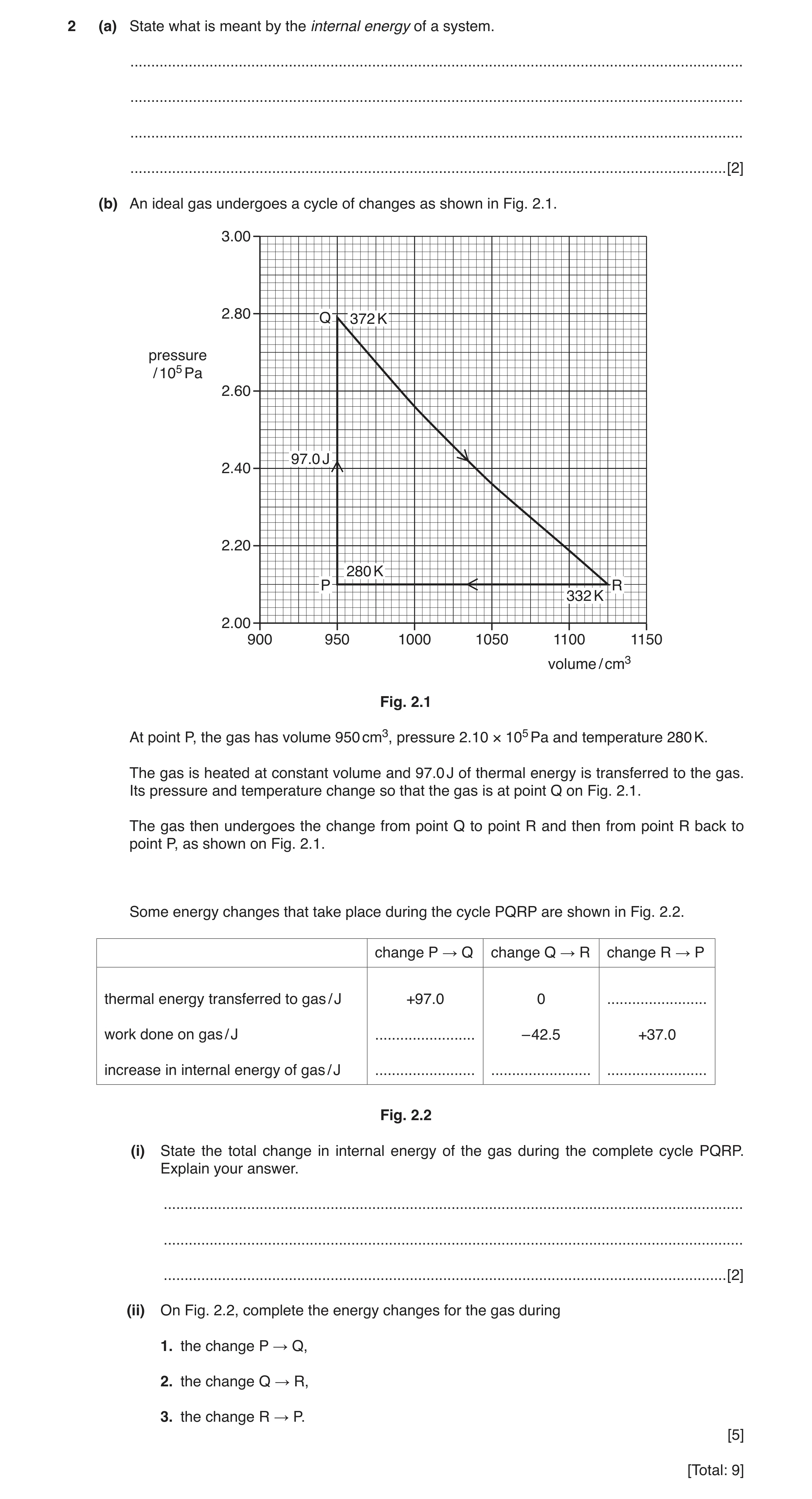
2 (a) State what is meant by the internal energy of a system. … … … … [2] (b) An ideal gas undergoes a cycle of changes as shown in Fig. 2.1. 3.00 2.80 Q 372 K pressure / 105 Pa 2.60 97.0 J 2.40 2.20 280 K P R 332 K 2.00 900 950 1000 1050 1100 1150 volume / cm3 Fig. 2.1 At point P, the gas has volume 950 cm3, pressure 2.10 × 10⁵ Pa and temperature 280 K. The gas is heated at constant volume and 97.0 J of thermal energy is transferred to the gas. Its pressure and temperature change so that the gas is at point Q on Fig. 2.1. The gas then undergoes the change from point Q to point R and then from point R back to point P, as shown on Fig. 2.1. Some energy changes that take place during the cycle PQRP are shown in Fig. 2.2. change P → Q change Q → R change R → P thermal energy transferred to gas / J +97.0 0 … work done on gas / J … –42.5 +37.0 increase in internal energy of gas / J … … … Fig. 2.2 (i) State the total change in internal energy of the gas during the complete cycle PQRP. Explain your answer. … … … [2] (ii) On Fig. 2.2, complete the energy changes for the gas during 1. the change P → Q, 2. the change Q → R, 3. the change R → P. [5] [Total: 9]
9 marks
Mark scheme: 2(a) sum of potential and kinetic energies (of molecules/atoms/particles) B1 (energy of) molecules/atoms/particles in random motion B1 2(b)(i) final temperature = initial temperature B1 no change in internal energy B1 2(b)(ii) 1. work done on gas (P→Q): 0 A1 increase in internal energy (P→Q): (+)97.0 J A1 2. increase in internal energy (Q→R): –42.5 J A1 3. increase in internal energy (R→P): –54.5 J A1 thermal energy supplied (R→P): –91.5 J A1
This question in 9702/41 Oct/Nov 2018
Q5 · State what is meant by the internal energy of a system 9702/43 Oct/Nov 2018
2 (a) State what is meant by the internal energy of a system. … … … … [2] (b) An ideal gas undergoes a cycle of changes as shown in Fig. 2.1. 3.00 2.80 Q 372 K pressure / 105 Pa 2.60 97.0 J 2.40 2.20 280 K P R 332 K 2.00 900 950 1000 1050 1100 1150 volume / cm3 Fig. 2.1 At point P, the gas has volume 950 cm3, pressure 2.10 × 10⁵ Pa and temperature 280 K. The gas is heated at constant volume and 97.0 J of thermal energy is transferred to the gas. Its pressure and temperature change so that the gas is at point Q on Fig. 2.1. The gas then undergoes the change from point Q to point R and then from point R back to point P, as shown on Fig. 2.1. Some energy changes that take place during the cycle PQRP are shown in Fig. 2.2. change P → Q change Q → R change R → P thermal energy transferred to gas / J +97.0 0 … work done on gas / J … –42.5 +37.0 increase in internal energy of gas / J … … … Fig. 2.2 (i) State the total change in internal energy of the gas during the complete cycle PQRP. Explain your answer. … … … [2] (ii) On Fig. 2.2, complete the energy changes for the gas during 1. the change P → Q, 2. the change Q → R, 3. the change R → P. [5] [Total: 9]
9 marks
Mark scheme: 2(a) sum of potential and kinetic energies (of molecules/atoms/particles) B1 (energy of) molecules/atoms/particles in random motion B1 2(b)(i) final temperature = initial temperature B1 no change in internal energy B1 2(b)(ii) 1. work done on gas (P→Q): 0 A1 increase in internal energy (P→Q): (+)97.0 J A1 2. increase in internal energy (Q→R): –42.5 J A1 3. increase in internal energy (R→P): –54.5 J A1 thermal energy supplied (R→P): –91.5 J A1
This question in 9702/43 Oct/Nov 2018
Q6 · A fixed mass of an ideal gas has volume 210 cm3 at pressure 3.0 × 10⁵ Pa and temperature… 9702/41 May/June 2019
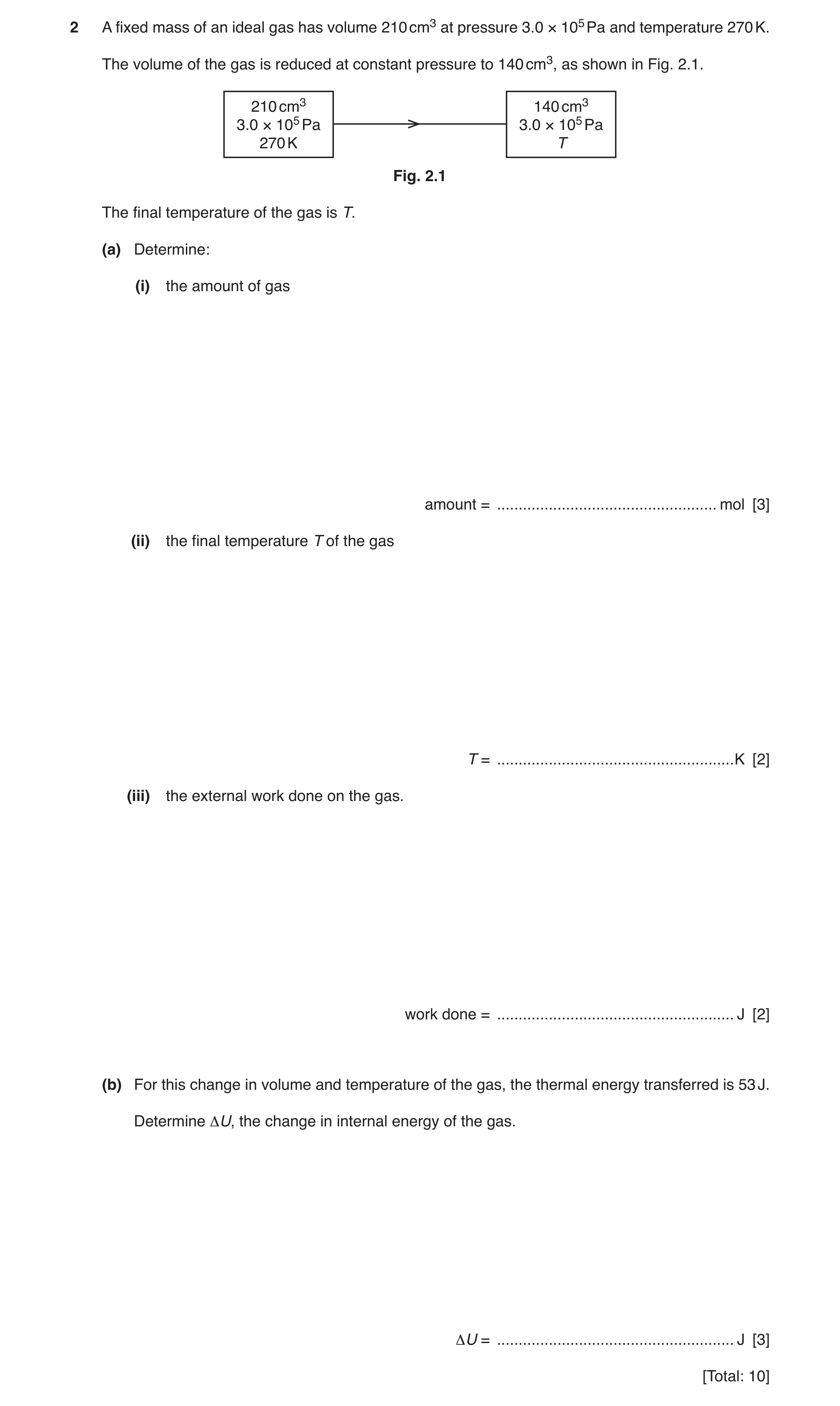
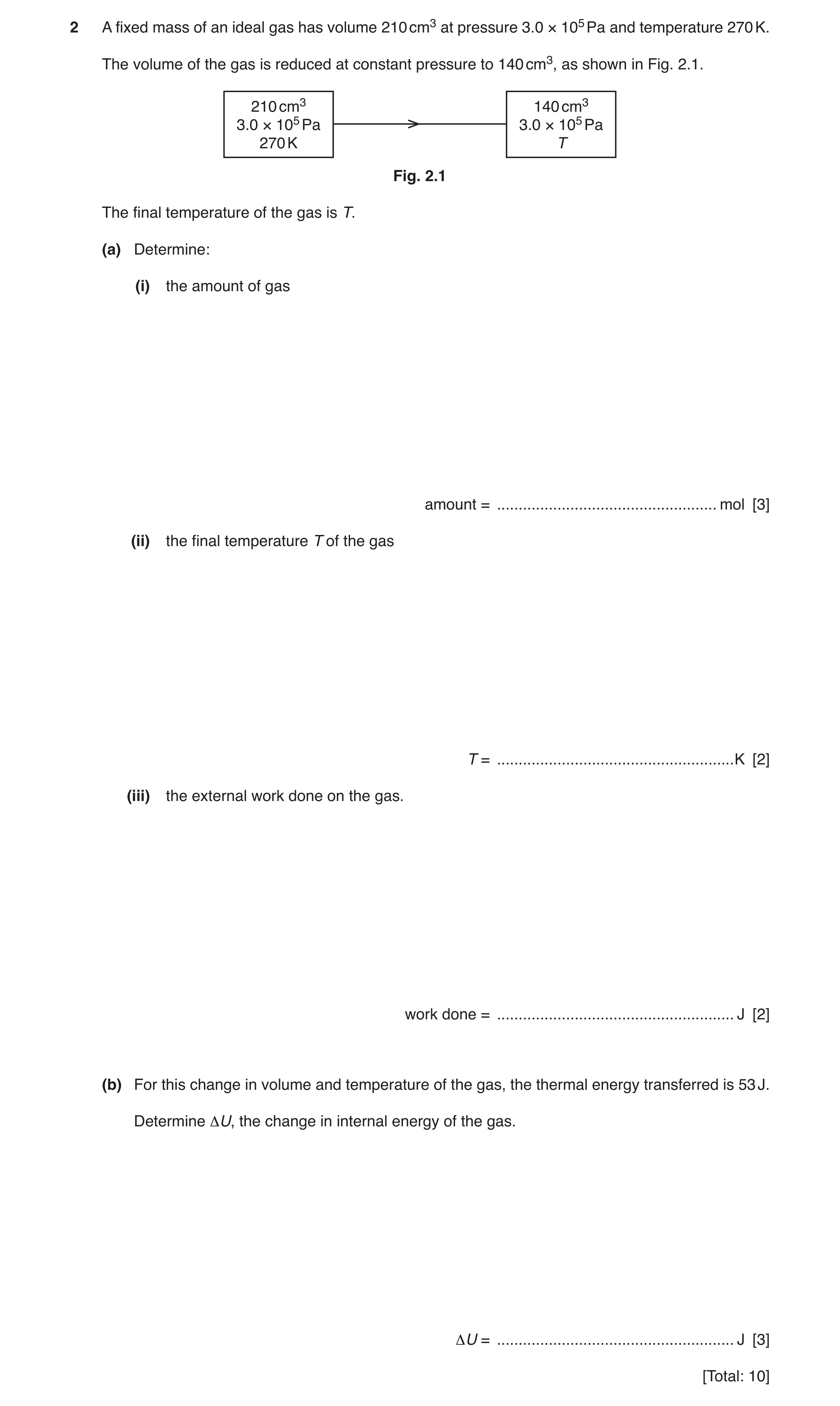
2 A fixed mass of an ideal gas has volume 210 cm3 at pressure 3.0 × 10⁵ Pa and temperature 270 K. The volume of the gas is reduced at constant pressure to 140 cm3, as shown in Fig. 2.1. 210 cm3 140 cm3 3.0 × 10⁵ Pa 3.0 × 10⁵ Pa 270 K T Fig. 2.1 The final temperature of the gas is T. (a) Determine: (i) the amount of gas amount = … mol [3] (ii) the final temperature T of the gas T = … K [2] (iii) the external work done on the gas. work done = … J [2] (b) For this change in volume and temperature of the gas, the thermal energy transferred is 53 J. Determine ΔU, the change in internal energy of the gas. ΔU = … J [3] [Total: 10]
10 marks
Mark scheme: 2(a)(i) pV = nRT C1 n = (3.0 × 105 × 210 × 10–6) / (8.31 × 270) C1 = 0.028 mol A1 2(a)(ii) V ∝ T or T = pV / nR with value of n from (i) C1 T = (140 / 210) × 270 or T = (3.0 × 105 × 140 ×10–6) / (8.31 × 0.028) = 180 K A1 2(a)(iii) W = p∆V = 3.0 × 105 × (210 – 140) × 10–6 C1 = 21 J A1 Question Answer Marks 2(b) ∆U = w + q C1 = 21 – 53 C1 or ∆U = (nNA) × (3 / 2)k∆T (C1) = (0.0281 × 6.02 × 1023) × (3 / 2) × 1.38 × 10–23 × (180 – 270) (C1) or ∆U = (3 / 2)nR∆T (C1) = (3 / 2) × 0.0281 × 8.31 × (180 – 270) (C1) ∆U = (–)32 J A1
This question in 9702/41 May/June 2019
Q7 · The first law of thermodynamics may be expressed in the form ΔU = q + w 9702/42 May/June 2019
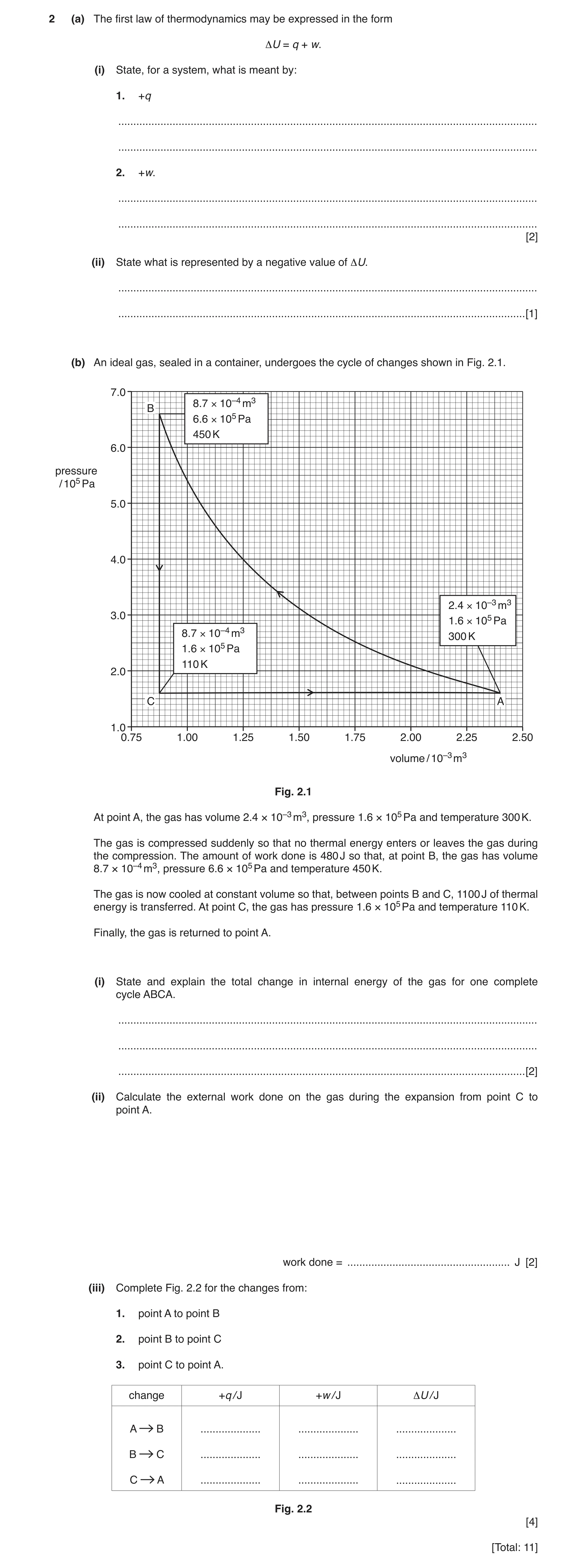
2 (a) The first law of thermodynamics may be expressed in the form ΔU = q + w. (i) State, for a system, what is meant by: 1. +q … … 2. +w. … … [2] (ii) State what is represented by a negative value of ΔU. … … [1] (b) An ideal gas, sealed in a container, undergoes the cycle of changes shown in Fig. 2.1. 7.0 8.7 × 10⁻⁴ m3 B 6.6 × 10⁵ Pa 450 K 6.0 pressure / 105 Pa 5.0 4.0 2.4 × 10⁻³ m3 3.0 1.6 × 10⁵ Pa 8.7 × 10⁻⁴ m3 300 K 1.6 × 10⁵ Pa 110 K 2.0 C A 1.0 0.75 1.00 1.25 1.50 1.75 2.00 2.25 2.50 volume / 10–3 m3 Fig. 2.1 At point A, the gas has volume 2.4 × 10⁻³ m3, pressure 1.6 × 10⁵ Pa and temperature 300 K. The gas is compressed suddenly so that no thermal energy enters or leaves the gas during the compression. The amount of work done is 480 J so that, at point B, the gas has volume 8.7 × 10⁻⁴ m3, pressure 6.6 × 10⁵ Pa and temperature 450 K. The gas is now cooled at constant volume so that, between points B and C, 1100 J of thermal energy is transferred. At point C, the gas has pressure 1.6 × 10⁵ Pa and temperature 110 K. Finally, the gas is returned to point A. (i) State and explain the total change in internal energy of the gas for one complete cycle ABCA. … … … [2] (ii) Calculate the external work done on the gas during the expansion from point C to point A. work done = … J [2] (iii) Complete Fig. 2.2 for the changes from: 1. point A to point B 2. point B to point C 3. point C to point A. change +q / J +w / J ΔU / J A B … … … B C … … … C A … … … Fig. 2.2 [4] [Total: 11]
11 marks
Mark scheme: 2(a)(i) 1. energy transfer to the system by heating B1 2. (external) work done on the system B1 2(a)(ii) decrease in internal energy B1 2(b)(i) no change (in internal energy) B1 (because) no change in temperature B1 2(b)(ii) work done = p∆V = (–)1.6 × 105 × (2.4 – 0.87) × 10–3 C1 = (–)240 J A1 2(b)(iii) first row all correct (0, 480, 480) A1 second row all correct (–1100, 0, –1100) A1 final column of third row calculated correctly from the two values above it, so that the final column adds up to 0 A1 second column in final row correct, with correct negative sign and first column in final row calculated correctly so that it adds to the second column to give the third column (fully correct table is: 0 480 480 –1100 0 –1100 860 –240 620 ) A1
This question in 9702/42 May/June 2019
Q8 · A fixed mass of an ideal gas has volume 210 cm3 at pressure 3.0 × 10⁵ Pa and temperature… 9702/43 May/June 2019
2 A fixed mass of an ideal gas has volume 210 cm3 at pressure 3.0 × 10⁵ Pa and temperature 270 K. The volume of the gas is reduced at constant pressure to 140 cm3, as shown in Fig. 2.1. 210 cm3 140 cm3 3.0 × 10⁵ Pa 3.0 × 10⁵ Pa 270 K T Fig. 2.1 The final temperature of the gas is T. (a) Determine: (i) the amount of gas amount = … mol [3] (ii) the final temperature T of the gas T = … K [2] (iii) the external work done on the gas. work done = … J [2] (b) For this change in volume and temperature of the gas, the thermal energy transferred is 53 J. Determine ΔU, the change in internal energy of the gas. ΔU = … J [3] [Total: 10]
10 marks
Mark scheme: 2(a)(i) pV = nRT C1 n = (3.0 × 105 × 210 × 10–6) / (8.31 × 270) C1 = 0.028 mol A1 2(a)(ii) V ∝ T or T = pV / nR with value of n from (i) C1 T = (140 / 210) × 270 or T = (3.0 × 105 × 140 ×10–6) / (8.31 × 0.028) = 180 K A1 2(a)(iii) W = p∆V = 3.0 × 105 × (210 – 140) × 10–6 C1 = 21 J A1 Question Answer Marks 2(b) ∆U = w + q C1 = 21 – 53 C1 or ∆U = (nNA) × (3 / 2)k∆T (C1) = (0.0281 × 6.02 × 1023) × (3 / 2) × 1.38 × 10–23 × (180 – 270) (C1) or ∆U = (3 / 2)nR∆T (C1) = (3 / 2) × 0.0281 × 8.31 × (180 – 270) (C1) ∆U = (–)32 J A1
This question in 9702/43 May/June 2019
Q9 · Smoke particles are suspended in still air 9702/42 Oct/Nov 2019
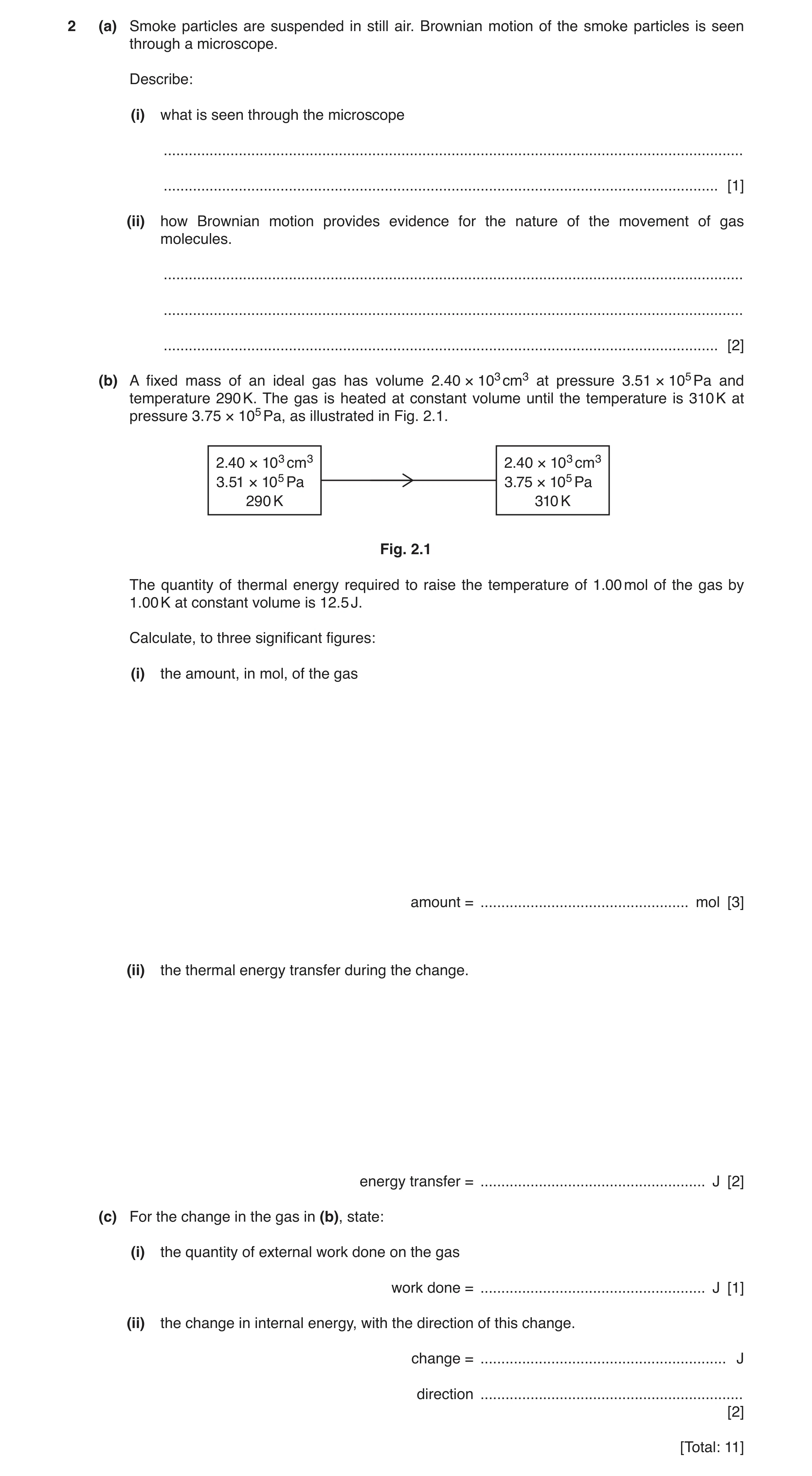
2 (a) Smoke particles are suspended in still air. Brownian motion of the smoke particles is seen through a microscope. Describe: (i) what is seen through the microscope … … [1] (ii) how Brownian motion provides evidence for the nature of the movement of gas molecules. … … … [2] (b) A fixed mass of an ideal gas has volume 2.40 × 103 cm3 at pressure 3.51 × 10⁵ Pa and temperature 290 K. The gas is heated at constant volume until the temperature is 310 K at pressure 3.75 × 10⁵ Pa, as illustrated in Fig. 2.1. 2.40 × 103 cm3 2.40 × 103 cm3 3.51 × 10⁵ Pa 3.75 × 10⁵ Pa 290 K 310 K Fig. 2.1 The quantity of thermal energy required to raise the temperature of 1.00 mol of the gas by 1.00 K at constant volume is 12.5 J. Calculate, to three significant figures: (i) the amount, in mol, of the gas amount = … mol [3] (ii) the thermal energy transfer during the change. energy transfer = … J [2] (c) For the change in the gas in (b), state: (i) the quantity of external work done on the gas work done = … J [1] (ii) the change in internal energy, with the direction of this change. change = … J direction … [2] [Total: 11]
11 marks
Mark scheme: 2(a)(i) specks of light moving haphazardly B1 2(a)(ii) (gas) molecules collide with (smoke) particles or random motion of the (gas) molecules M1 causes the (haphazard) motion of the smoke particles or causes the smoke particles to change direction A1 2(b)(i) pV = nRT C1 n = (3.51 × 105 × 2.40 × 10–3) / (8.31 × 290) or n = (3.75 × 105 × 2.40 × 10–3) / (8.31 × 310) C1 or pV = NkT (C1) n = (3.51 × 105 × 2.40 × 10–3) / (1.38 × 10–23 × 6.02 × 1023 × 290) or n = (3.75 × 105 × 2.40 × 10–3) / (1.38 × 10–23 × 6.02 × 1023 × 310) (C1) n = 0.350 mol or 0.349 mol A1 2(b)(ii) energy transfer = (0.349 or 0.35) × 12.5 × (310 – 290) C1 = 87.3 J or 87.5 J A1 2(c)(i) zero A1 2(c)(ii) 87.3 J or 87.5 J A1 increase B1
This question in 9702/42 Oct/Nov 2019
Q10 · By reference to the first law of thermodynamics, state and explain the change, if any, in… 9702/42 May/June 2020
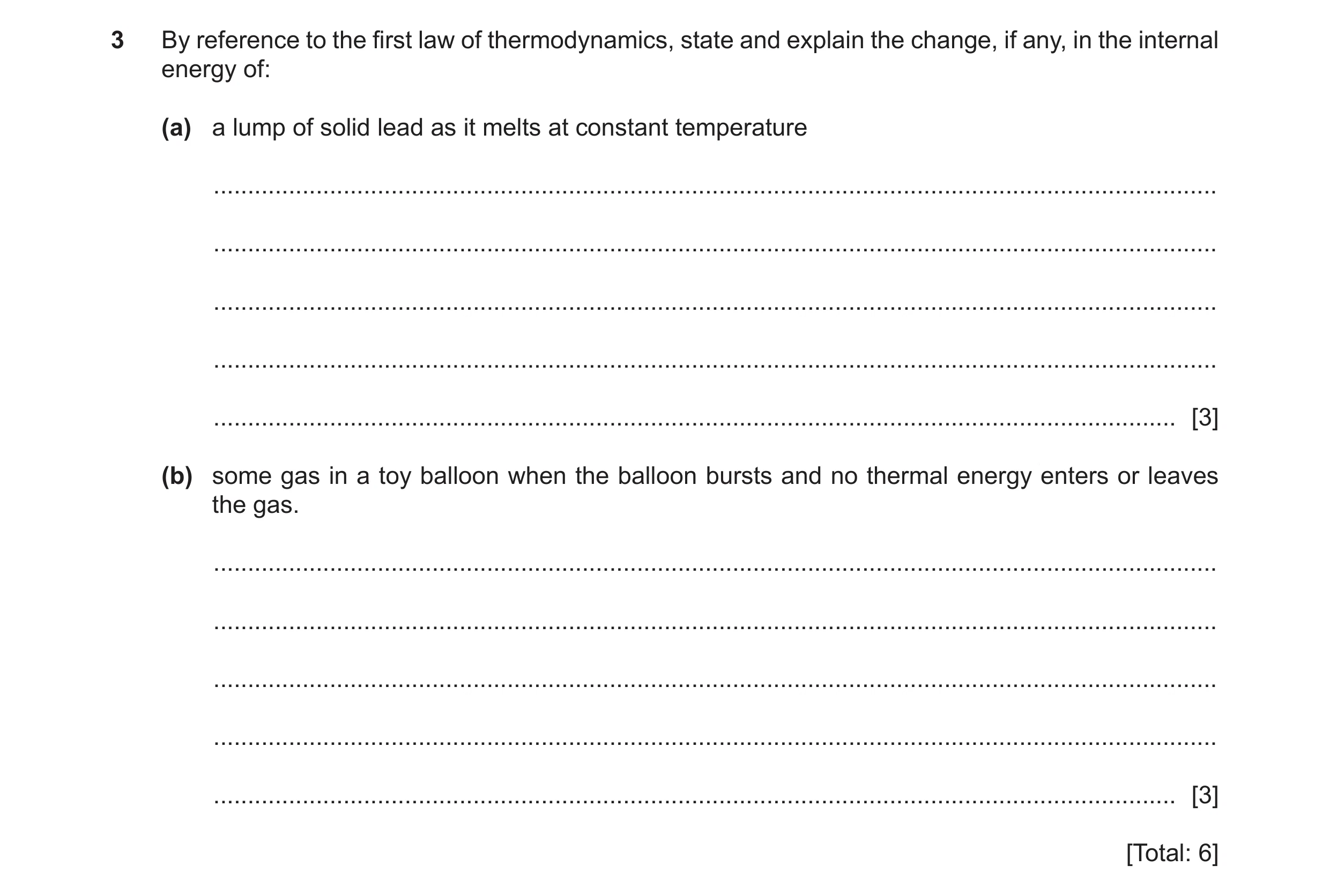
3 By reference to the first law of thermodynamics, state and explain the change, if any, in the internal energy of: (a) a lump of solid lead as it melts at constant temperature … … … … … [3] (b) some gas in a toy balloon when the balloon bursts and no thermal energy enters or leaves the gas. … … … … … [3] [Total: 6]
6 marks
Mark scheme: 3(a) (little/no volume change so) little/no external work done B1 thermal energy supplied to provide latent heat M1 internal energy increases A1 3(b) (rapid) increase in volume B1 gas does work against the atmosphere M1 internal energy decreases A1
This question in 9702/42 May/June 2020
Q11 · The first law of thermodynamics may be expressed as ΔU = (+q) + (+w) where ΔU is the… 9702/41 Oct/Nov 2020
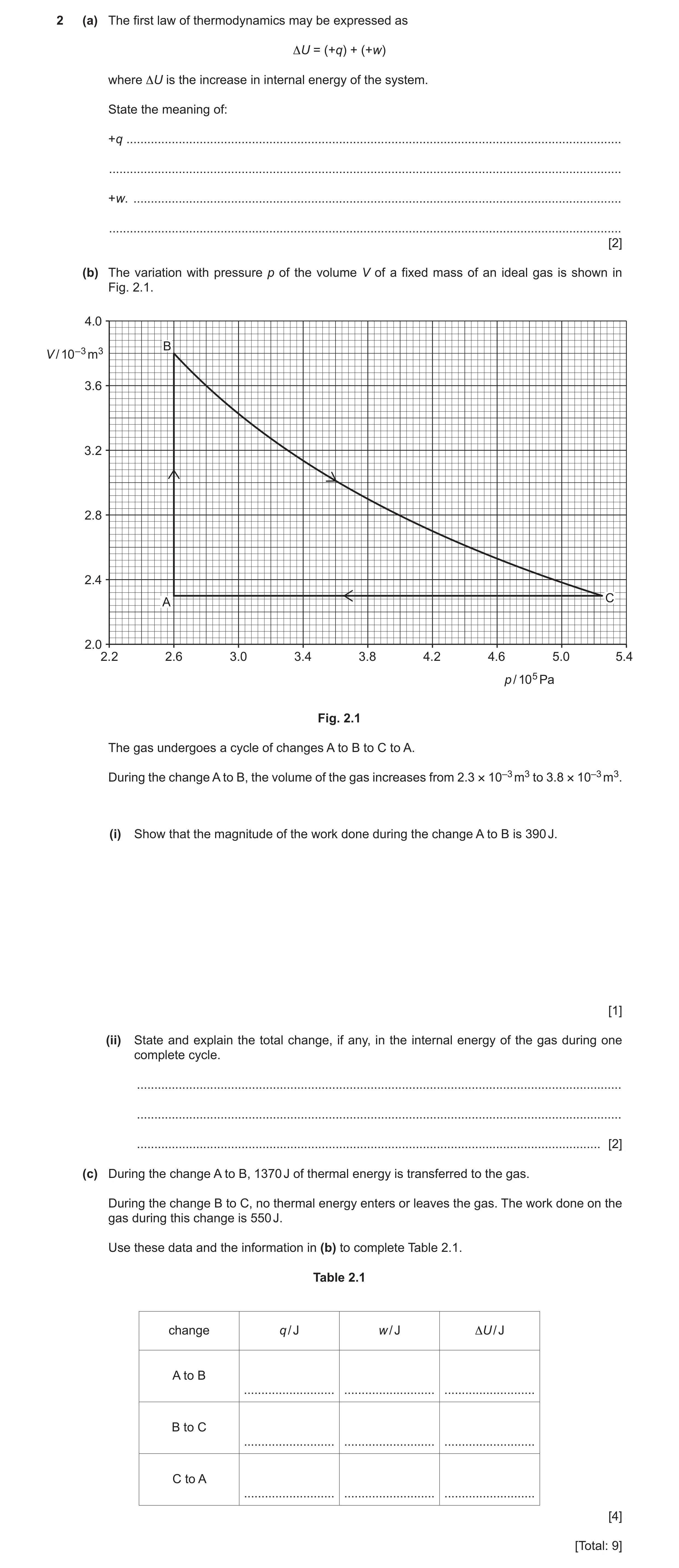
2 (a) The first law of thermodynamics may be expressed as ΔU = (+q) + (+w) where ΔU is the increase in internal energy of the system. State the meaning of: +q … … +w. … … [2] (b) The variation with pressure p of the volume V of a fixed mass of an ideal gas is shown in Fig. 2.1. 4.0 BV / 10–3 m3 3.6 3.2 2.8 2.4 C A 2.0 2.2 2.6 3.0 3.4 3.8 4.2 4.6 5.0 5.4 p / 105 Pa Fig. 2.1 The gas undergoes a cycle of changes A to B to C to A. During the change A to B, the volume of the gas increases from 2.3 × 10⁻³ m3 to 3.8 × 10⁻³ m3. (i) Show that the magnitude of the work done during the change A to B is 390 J. [1] (ii) State and explain the total change, if any, in the internal energy of the gas during one complete cycle. … … … [2] (c) During the change A to B, 1370 J of thermal energy is transferred to the gas. During the change B to C, no thermal energy enters or leaves the gas. The work done on the gas during this change is 550 J. Use these data and the information in (b) to complete Table 2.1. Table 2.1 change q / J w / J ΔU / J A to B … … … B to C … … … C to A … … … [4] [Total: 9]
9 marks
Mark scheme: 2(a) +q: thermal energy transfer to system B1 +w: work done on system B1 2(b)(i) (W =) 2.6 ×105 × (3.8 – 2.3) × 10–3 = 390 J A1 2(b)(ii) no (total) change (in internal energy) B1 gas returns to its original temperature B1 2(c) A to B row all correct (1370, – 390, 980) B1 B to C row all correct (0, 550, 550) B1 C to A row: ΔU adds to the other two ΔU values to give zero B1 C to A row: w = 0 and q adds to w to give ΔU value complete correct answer: change q / J w / J ΔU / J A to B B to C C to A (+)1370 0 –1530 –390 (+)550 0 (+)980 (+)550 –1530 B1
This question in 9702/41 Oct/Nov 2020
Q12 · State what is meant by the internal energy of a system 9702/42 Oct/Nov 2020
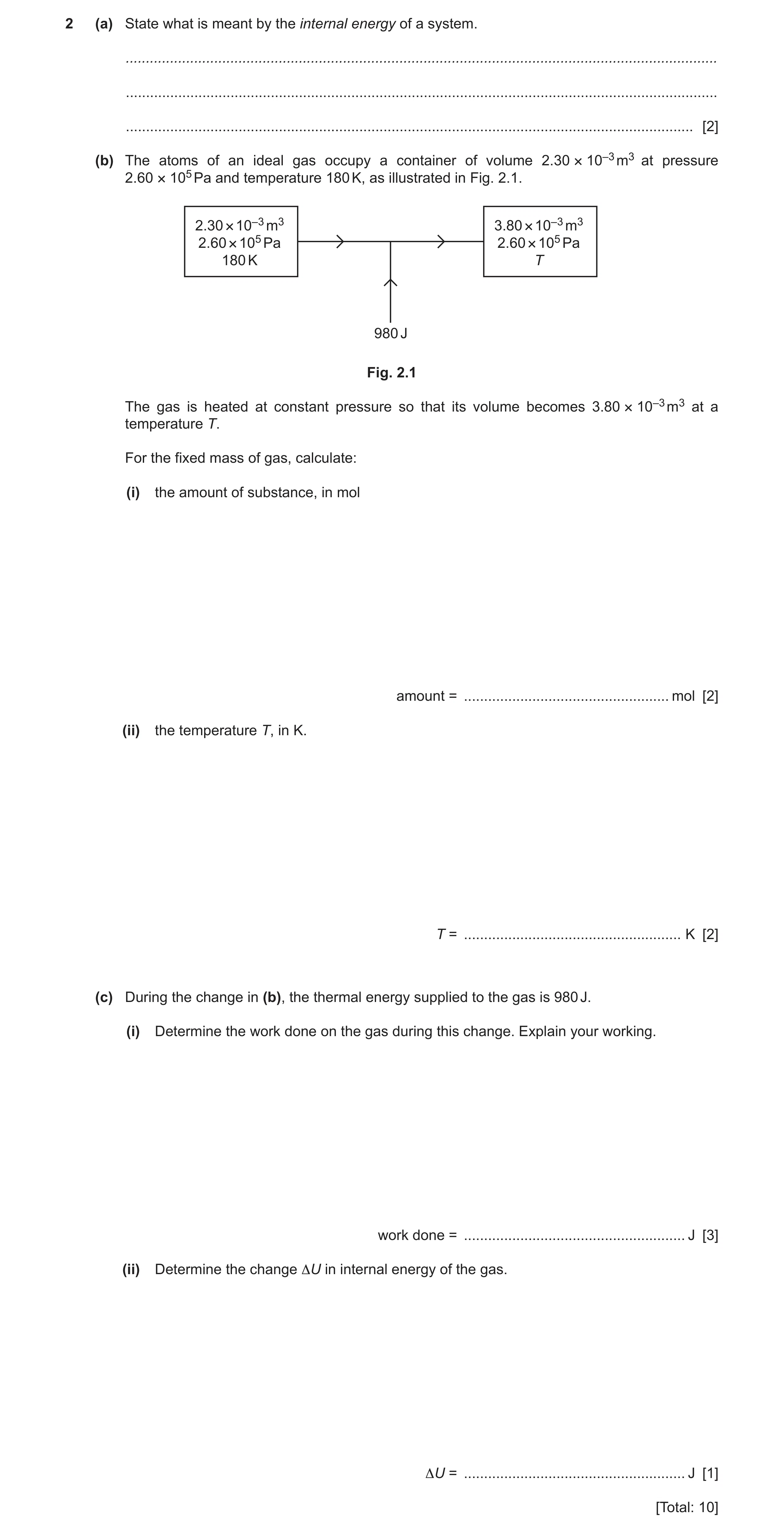
2 (a) State what is meant by the internal energy of a system. … … … [2] (b) The atoms of an ideal gas occupy a container of volume 2.30 × 10⁻³ m3 at pressure 2.60 × 10⁵ Pa and temperature 180 K, as illustrated in Fig. 2.1. 2.30 × 10⁻³ m3 3.80 × 10⁻³ m3 2.60 × 10⁵ Pa 2.60 × 10⁵ Pa 180 K T 980 J Fig. 2.1 The gas is heated at constant pressure so that its volume becomes 3.80 × 10⁻³ m3 at a temperature T. For the fixed mass of gas, calculate: (i) the amount of substance, in mol amount = … mol [2] (ii) the temperature T, in K. T = … K [2] (c) During the change in (b), the thermal energy supplied to the gas is 980 J. (i) Determine the work done on the gas during this change. Explain your working. work done = … J [3] (ii) Determine the change ΔU in internal energy of the gas. ΔU = … J [1] [Total: 10]
10 marks
Mark scheme: 2(a) sum of potential energy and kinetic energy (of particles) B1 (total) energy of random motion of particles B1 2(b)(i) pV = nRT C1 2.60 × 105 × 2.30 × 10–3 = n × 8.31 × 180 n = 0.400 mol A1 2(b)(ii) (2.30 × 10⁻³) / 180 = (3.80 × 10⁻³) / T or 2.60 × 105 × 3.80 × 10–3 = 0.400 × 8.31 × T C1 T = 297 K A1 2(c)(i) ΔW = pΔV = 2.60 × 105 × (2.30 – 3.80) × 10–3 C1 = (–)390 J A1 negative because work is done by gas or negative because work is done against atmospheric pressure or negative because volume of gas increases B1 2(c)(ii) ΔU = (980 – 390) = 590 J A1
This question in 9702/42 Oct/Nov 2020
Q13 · The first law of thermodynamics may be expressed as ΔU = (+q) + (+w) where ΔU is the… 9702/43 Oct/Nov 2020
2 (a) The first law of thermodynamics may be expressed as ΔU = (+q) + (+w) where ΔU is the increase in internal energy of the system. State the meaning of: +q … … +w. … … [2] (b) The variation with pressure p of the volume V of a fixed mass of an ideal gas is shown in Fig. 2.1. 4.0 BV / 10–3 m3 3.6 3.2 2.8 2.4 C A 2.0 2.2 2.6 3.0 3.4 3.8 4.2 4.6 5.0 5.4 p / 105 Pa Fig. 2.1 The gas undergoes a cycle of changes A to B to C to A. During the change A to B, the volume of the gas increases from 2.3 × 10⁻³ m3 to 3.8 × 10⁻³ m3. (i) Show that the magnitude of the work done during the change A to B is 390 J. [1] (ii) State and explain the total change, if any, in the internal energy of the gas during one complete cycle. … … … [2] (c) During the change A to B, 1370 J of thermal energy is transferred to the gas. During the change B to C, no thermal energy enters or leaves the gas. The work done on the gas during this change is 550 J. Use these data and the information in (b) to complete Table 2.1. Table 2.1 change q / J w / J ΔU / J A to B … … … B to C … … … C to A … … … [4] [Total: 9]
9 marks
Mark scheme: 2(a) +q: thermal energy transfer to system B1 +w: work done on system B1 2(b)(i) (W =) 2.6 ×105 × (3.8 – 2.3) × 10–3 = 390 J A1 2(b)(ii) no (total) change (in internal energy) B1 gas returns to its original temperature B1 2(c) A to B row all correct (1370, – 390, 980) B1 B to C row all correct (0, 550, 550) B1 C to A row: ΔU adds to the other two ΔU values to give zero B1 C to A row: w = 0 and q adds to w to give ΔU value complete correct answer: change q / J w / J ΔU / J A to B B to C C to A (+)1370 0 –1530 –390 (+)550 0 (+)980 (+)550 –1530 B1
This question in 9702/43 Oct/Nov 2020
Q14 · An ideal gas is contained in a cylinder by means of a movable frictionless piston, as… 9702/41 May/June 2021
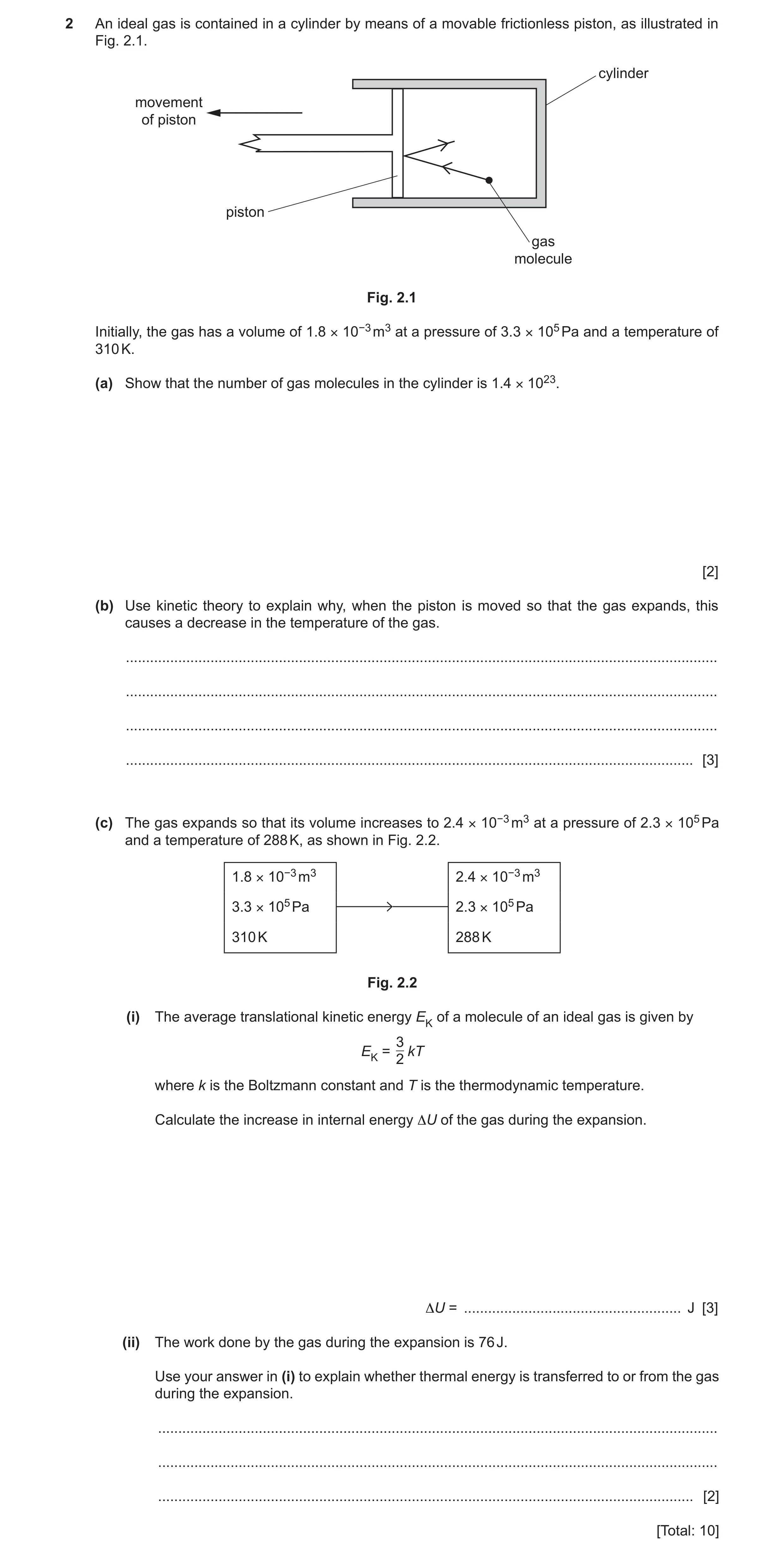
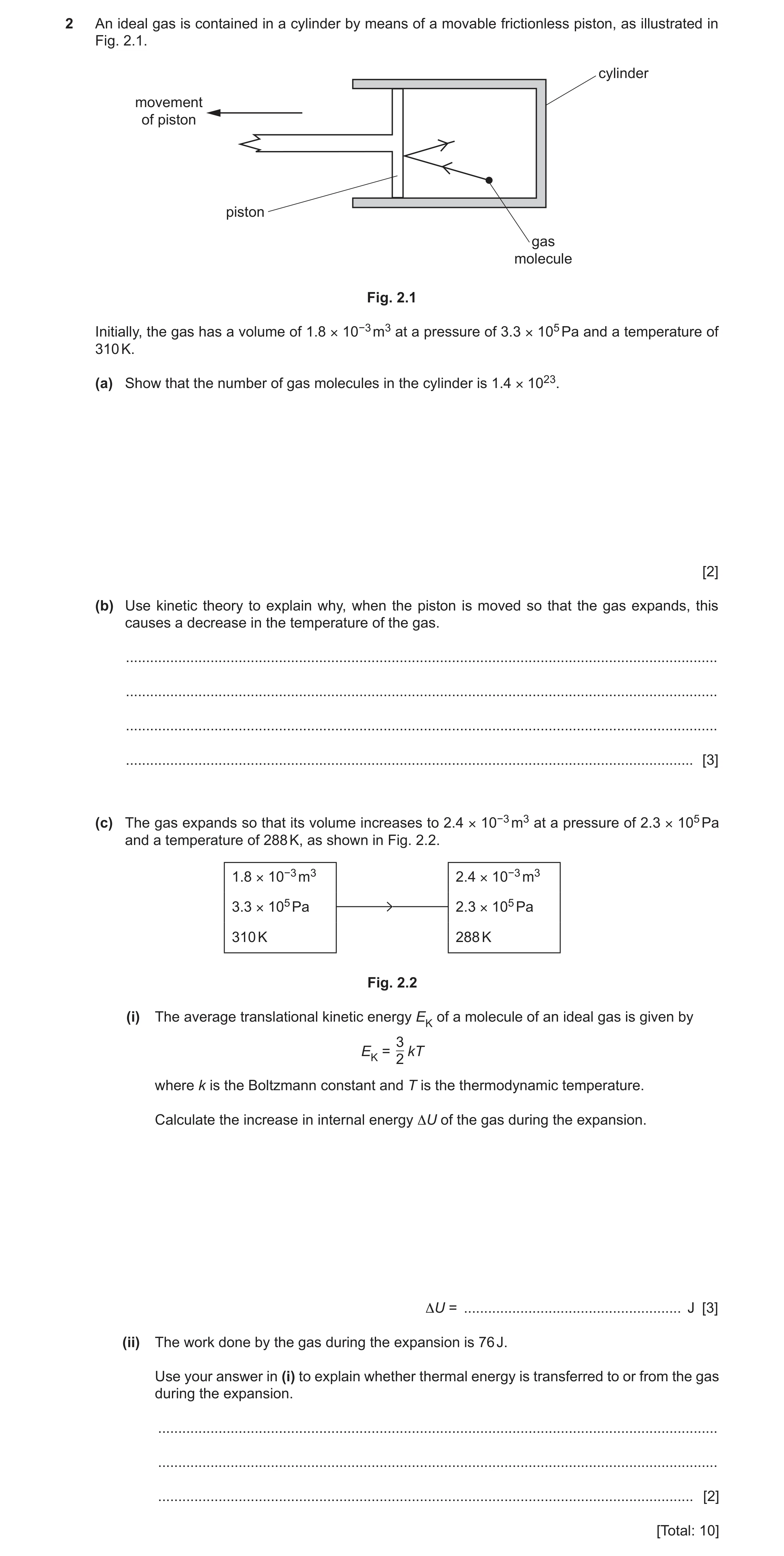
2 An ideal gas is contained in a cylinder by means of a movable frictionless piston, as illustrated in Fig. 2.1. cylinder movement of piston piston gas molecule Fig. 2.1 Initially, the gas has a volume of 1.8 × 10⁻³ m3 at a pressure of 3.3 × 10⁵ Pa and a temperature of 310 K. (a) Show that the number of gas molecules in the cylinder is 1.4 × 10²³. [2] (b) Use kinetic theory to explain why, when the piston is moved so that the gas expands, this causes a decrease in the temperature of the gas. … … … … [3] (c) The gas expands so that its volume increases to 2.4 × 10⁻³ m3 at a pressure of 2.3 × 10⁵ Pa and a temperature of 288 K, as shown in Fig. 2.2. 1.8 × 10⁻³ m3 2.4 × 10⁻³ m3 3.3 × 10⁵ Pa 2.3 × 10⁵ Pa 310 K 288 K Fig. 2.2 (i) The average translational kinetic energy EK of a molecule of an ideal gas is given by 3 EK = kT 2 where k is the Boltzmann constant and T is the thermodynamic temperature. Calculate the increase in internal energy ΔU of the gas during the expansion. ΔU = … J [3] (ii) The work done by the gas during the expansion is 76 J. Use your answer in (i) to explain whether thermal energy is transferred to or from the gas during the expansion. … … … [2] [Total: 10]
10 marks
Mark scheme: 2(a) pV = NkT C1 N = (1.8 × 10–3 × 3.3 × 105) / (1.38 × 10–23 × 310) = 1.4 × 10²³ A1 or pV = nRT and nNA = N (C1) N = (1.8 × 10–3 × 3.3 × 105 × 6.02 × 1023) / (8.31 × 310) = 1.4 × 10²³ (A1) 2(b) speed of molecule decreases on impact with moving piston B1 mean square speed (directly) proportional to (thermodynamic) temperature or mean square speed (directly) proportional to kinetic energy (of molecules) or kinetic energy (of molecules) (directly) proportional to (thermodynamic) temperature B1 kinetic energy (of molecules) decreases (so temperature decreases) B1 2(c)(i) ΔU = 3/2 × k × ΔT × N C1 = 3/2 × 1.38 × 10–23 × (288 – 310) × 1.4 × 1023 C1 = – 64 J A1 2(c)(ii) decrease in internal energy is less than work done by gas M1 (thermal energy is) transferred to the gas (during the expansion) A1
This question in 9702/41 May/June 2021
Q15 · An ideal gas has a volume of 3.1 × 10⁻³ m3 at a pressure of 8.5 × 10⁵ Pa and a… 9702/42 May/June 2021
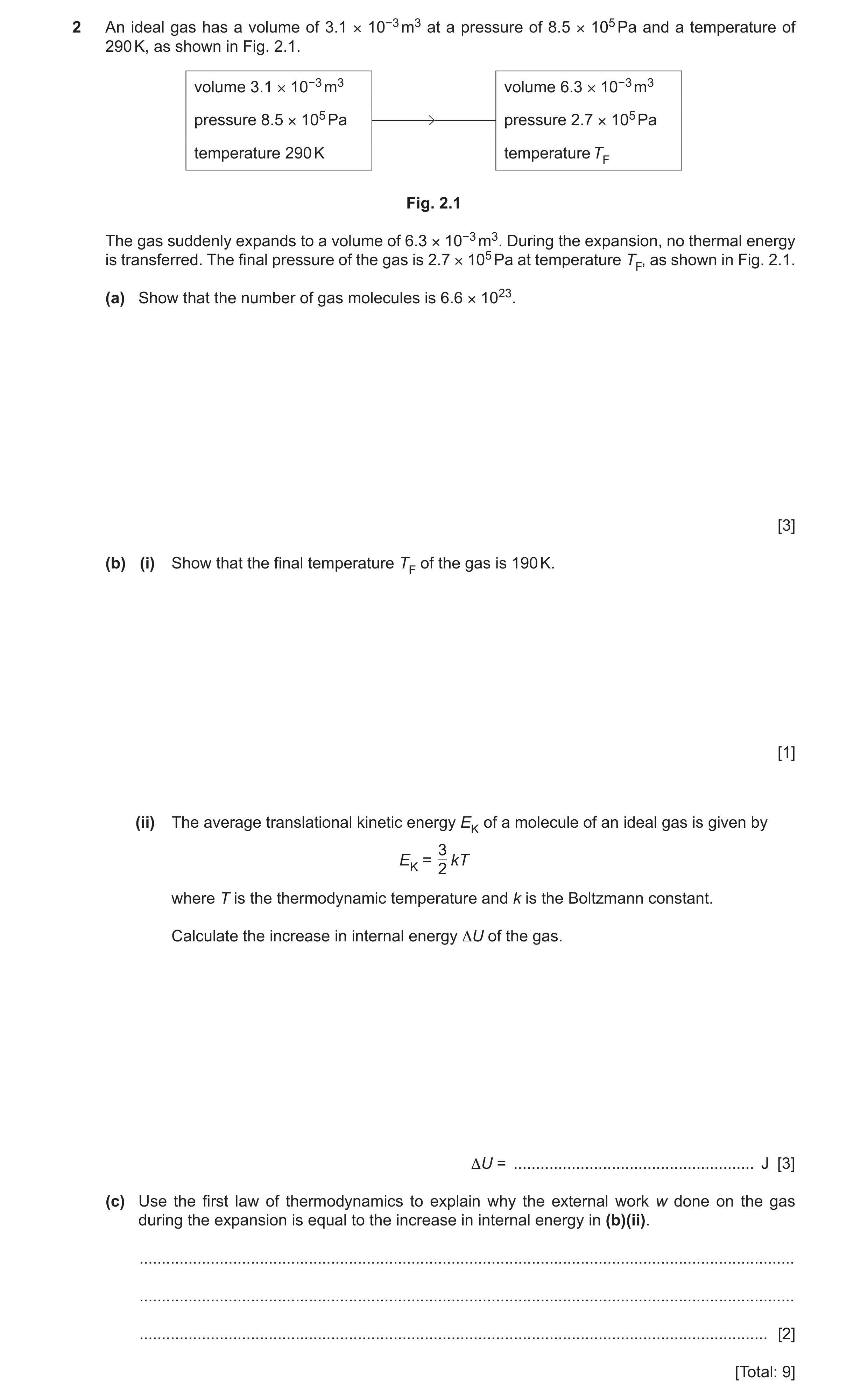
2 An ideal gas has a volume of 3.1 × 10⁻³ m3 at a pressure of 8.5 × 10⁵ Pa and a temperature of 290 K, as shown in Fig. 2.1. volume 3.1 × 10⁻³ m3 volume 6.3 × 10⁻³ m3 pressure 8.5 × 10⁵ Pa pressure 2.7 × 10⁵ Pa temperature 290 K temperature TF Fig. 2.1 The gas suddenly expands to a volume of 6.3 × 10⁻³ m3. During the expansion, no thermal energy is transferred. The final pressure of the gas is 2.7 × 10⁵ Pa at temperature TF, as shown in Fig. 2.1. (a) Show that the number of gas molecules is 6.6 × 10²³. [3] (b) (i) Show that the final temperature TF of the gas is 190 K. [1] (ii) The average translational kinetic energy EK of a molecule of an ideal gas is given by 3 EK = kT 2 where T is the thermodynamic temperature and k is the Boltzmann constant. Calculate the increase in internal energy ΔU of the gas. ΔU = … J [3] (c) Use the first law of thermodynamics to explain why the external work w done on the gas during the expansion is equal to the increase in internal energy in (b)(ii). … … … [2] [Total: 9]
9 marks
Mark scheme: 2(a) pV = nRT C1 pV = nRT and N = nNA or pV = NkT C1 3.1 × 10–3 × 8.5 × 105 = (N × 290 × 8.31) / (6.02 × 10²³) so N = 6.6 × 10²³ or 3.1 × 10–3 × 8.5 × 105 = N × 1.38 × 10–23 × 290 so N = 6.6 × 10²³ A1 2(b)(i) (3.1 × 10–3 × 8.5 × 105) / 290 = (6.3 × 10–3 × 2.7 × 105) / T so T = 190 K or 6.3 × 10–3 × 2.7 × 105 = 6.6 × 1023 × 1.38 × 10–23 × T so T = 190 K A1 2(b)(ii) ΔU = 3/2 × k × ΔT × N C1 = 3/2 × 1.38 × 10–23 × (190 – 290) × 6.6 × 1023 C1 = –1400 J A1 2(c) ΔU = q + w M1 q = 0 so ΔU = w A1
This question in 9702/42 May/June 2021
Q16 · An ideal gas is contained in a cylinder by means of a movable frictionless piston, as… 9702/43 May/June 2021
2 An ideal gas is contained in a cylinder by means of a movable frictionless piston, as illustrated in Fig. 2.1. cylinder movement of piston piston gas molecule Fig. 2.1 Initially, the gas has a volume of 1.8 × 10⁻³ m3 at a pressure of 3.3 × 10⁵ Pa and a temperature of 310 K. (a) Show that the number of gas molecules in the cylinder is 1.4 × 10²³. [2] (b) Use kinetic theory to explain why, when the piston is moved so that the gas expands, this causes a decrease in the temperature of the gas. … … … … [3] (c) The gas expands so that its volume increases to 2.4 × 10⁻³ m3 at a pressure of 2.3 × 10⁵ Pa and a temperature of 288 K, as shown in Fig. 2.2. 1.8 × 10⁻³ m3 2.4 × 10⁻³ m3 3.3 × 10⁵ Pa 2.3 × 10⁵ Pa 310 K 288 K Fig. 2.2 (i) The average translational kinetic energy EK of a molecule of an ideal gas is given by 3 EK = kT 2 where k is the Boltzmann constant and T is the thermodynamic temperature. Calculate the increase in internal energy ΔU of the gas during the expansion. ΔU = … J [3] (ii) The work done by the gas during the expansion is 76 J. Use your answer in (i) to explain whether thermal energy is transferred to or from the gas during the expansion. … … … [2] [Total: 10]
10 marks
Mark scheme: 2(a) pV = NkT C1 N = (1.8 × 10–3 × 3.3 × 105) / (1.38 × 10–23 × 310) = 1.4 × 10²³ A1 or pV = nRT and nNA = N (C1) N = (1.8 × 10–3 × 3.3 × 105 × 6.02 × 1023) / (8.31 × 310) = 1.4 × 10²³ (A1) 2(b) speed of molecule decreases on impact with moving piston B1 mean square speed (directly) proportional to (thermodynamic) temperature or mean square speed (directly) proportional to kinetic energy (of molecules) or kinetic energy (of molecules) (directly) proportional to (thermodynamic) temperature B1 kinetic energy (of molecules) decreases (so temperature decreases) B1 2(c)(i) ΔU = 3/2 × k × ΔT × N C1 = 3/2 × 1.38 × 10–23 × (288 – 310) × 1.4 × 1023 C1 = – 64 J A1 2(c)(ii) decrease in internal energy is less than work done by gas M1 (thermal energy is) transferred to the gas (during the expansion) A1
This question in 9702/43 May/June 2021
Q17 · Define specific heat capacity 9702/41 Oct/Nov 2021
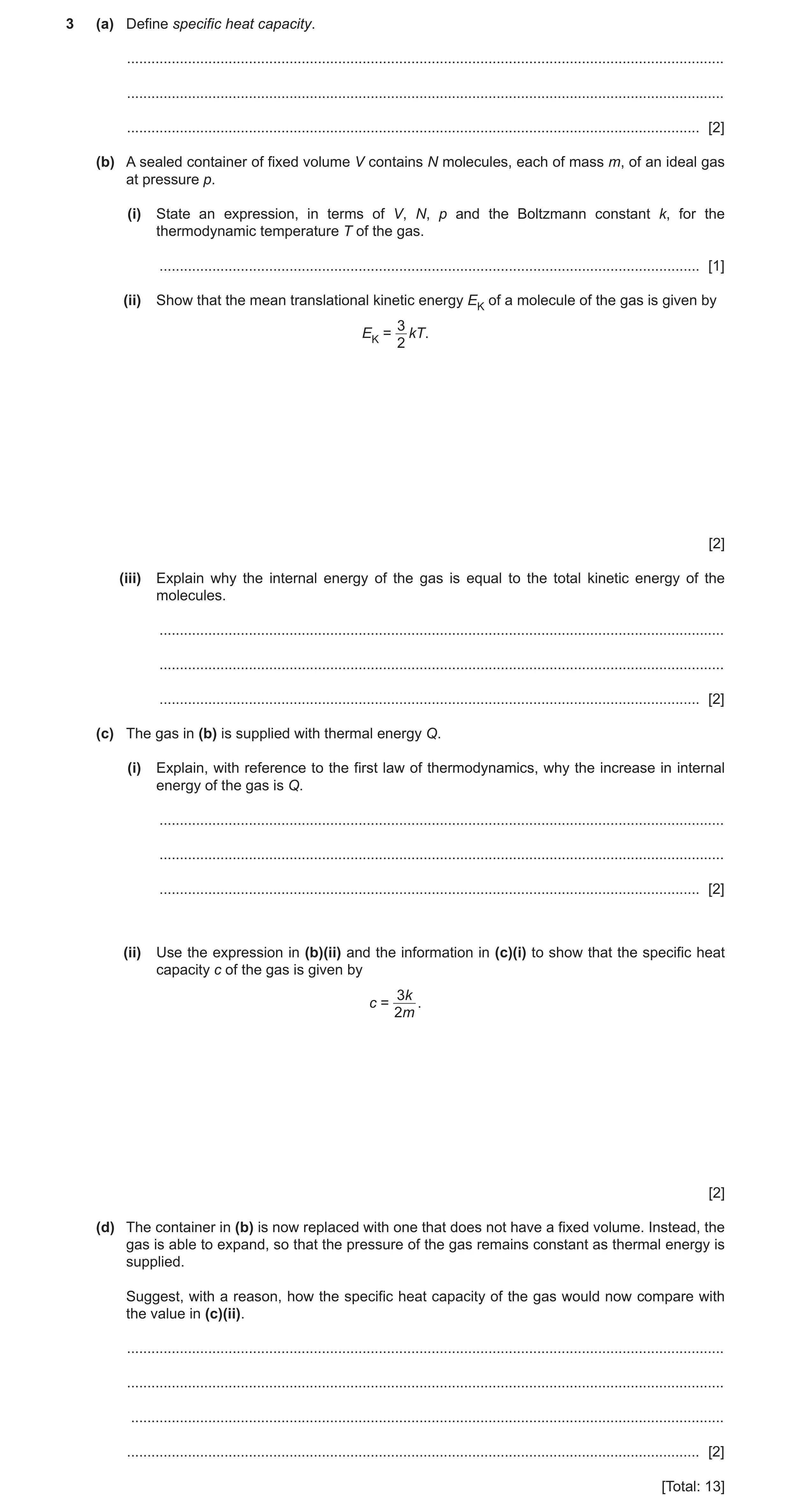
3 (a) Define specific heat capacity. … … … [2] (b) A sealed container of fixed volume V contains N molecules, each of mass m, of an ideal gas at pressure p. (i) State an expression, in terms of V, N, p and the Boltzmann constant k, for the thermodynamic temperature T of the gas. … [1] (ii) Show that the mean translational kinetic energy EK of a molecule of the gas is given by 3 EK = kT. 2 [2] (iii) Explain why the internal energy of the gas is equal to the total kinetic energy of the molecules. … … … [2] (c) The gas in (b) is supplied with thermal energy Q. (i) Explain, with reference to the first law of thermodynamics, why the increase in internal energy of the gas is Q. … … … [2] (ii) Use the expression in (b)(ii) and the information in (c)(i) to show that the specific heat capacity c of the gas is given by 3k c = . 2m [2] (d) The container in (b) is now replaced with one that does not have a fixed volume. Instead, the gas is able to expand, so that the pressure of the gas remains constant as thermal energy is supplied. Suggest, with a reason, how the specific heat capacity of the gas would now compare with the value in (c)(ii). … … … … [2] [Total: 13]
13 marks
Mark scheme: 3(a) (thermal) energy per unit mass (to cause temperature change) B1 (thermal) energy per unit change in temperature B1 3(b)(i) (T =) pV / Nk B1 3(b)(ii) (pV =) NkT = ⅓Nm<c2> or pV = NkT and pV = ⅓Nm<c2> M1 leading to ½m<c2> = (3/2)kT and ½m<c2> = EK A1 3(b)(iii) internal energy = ΣEK (of molecules) + ΣEP (of molecules) or no forces between molecules B1 potential energy of molecules is zero B1 3(c)(i) increase in internal energy = Q + work done B1 constant volume so no work done B1 3(c)(ii) c = Q / NmΔT C1 = [N × (3/2)kΔT] / (NmΔT) = 3k / 2m A1 3(d) (as it expands) gas does work (against the atmosphere/external pressure) B1 for same temperature rise) more (thermal) energy needed, so larger specific heat capacity B1
This question in 9702/41 Oct/Nov 2021
Q18 · Define specific heat capacity 9702/43 Oct/Nov 2021
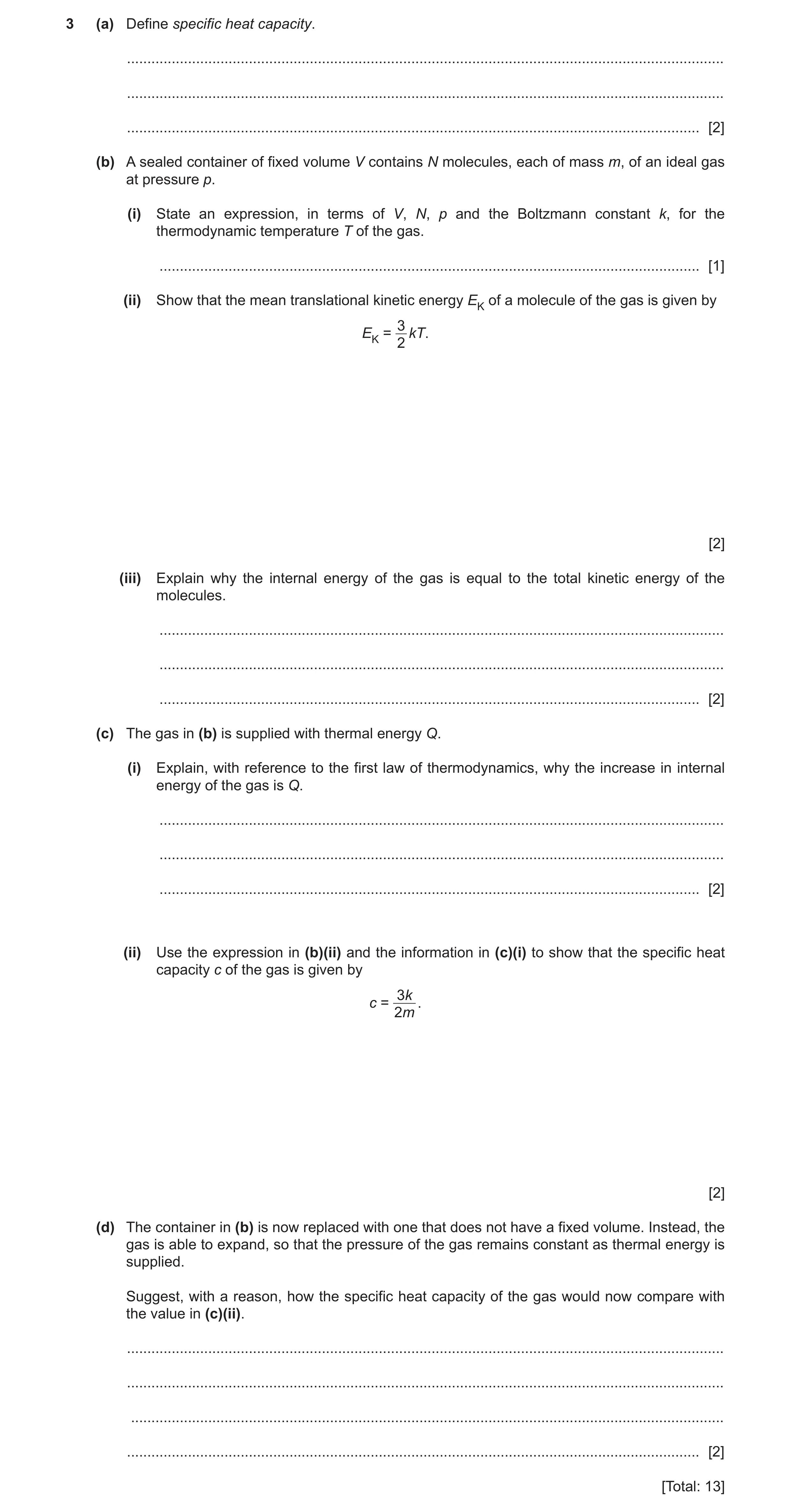
3 (a) Define specific heat capacity. … … … [2] (b) A sealed container of fixed volume V contains N molecules, each of mass m, of an ideal gas at pressure p. (i) State an expression, in terms of V, N, p and the Boltzmann constant k, for the thermodynamic temperature T of the gas. … [1] (ii) Show that the mean translational kinetic energy EK of a molecule of the gas is given by 3 EK = kT. 2 [2] (iii) Explain why the internal energy of the gas is equal to the total kinetic energy of the molecules. … … … [2] (c) The gas in (b) is supplied with thermal energy Q. (i) Explain, with reference to the first law of thermodynamics, why the increase in internal energy of the gas is Q. … … … [2] (ii) Use the expression in (b)(ii) and the information in (c)(i) to show that the specific heat capacity c of the gas is given by 3k c = . 2m [2] (d) The container in (b) is now replaced with one that does not have a fixed volume. Instead, the gas is able to expand, so that the pressure of the gas remains constant as thermal energy is supplied. Suggest, with a reason, how the specific heat capacity of the gas would now compare with the value in (c)(ii). … … … … [2] [Total: 13]
13 marks
Mark scheme: 3(a) (thermal) energy per unit mass (to cause temperature change) B1 (thermal) energy per unit change in temperature B1 3(b)(i) (T =) pV / Nk B1 3(b)(ii) (pV =) NkT = ⅓Nm<c2> or pV = NkT and pV = ⅓Nm<c2> M1 leading to ½m<c2> = (3/2)kT and ½m<c2> = EK A1 3(b)(iii) internal energy = ΣEK (of molecules) + ΣEP (of molecules) or no forces between molecules B1 potential energy of molecules is zero B1 3(c)(i) increase in internal energy = Q + work done B1 constant volume so no work done B1 3(c)(ii) c = Q / NmΔT C1 = [N × (3/2)kΔT] / (NmΔT) = 3k / 2m A1 3(d) (as it expands) gas does work (against the atmosphere/external pressure) B1 for same temperature rise) more (thermal) energy needed, so larger specific heat capacity B1
This question in 9702/43 Oct/Nov 2021
Q19 · A fixed mass of an ideal gas has a volume V and a pressure p 9702/42 Feb/March 2022
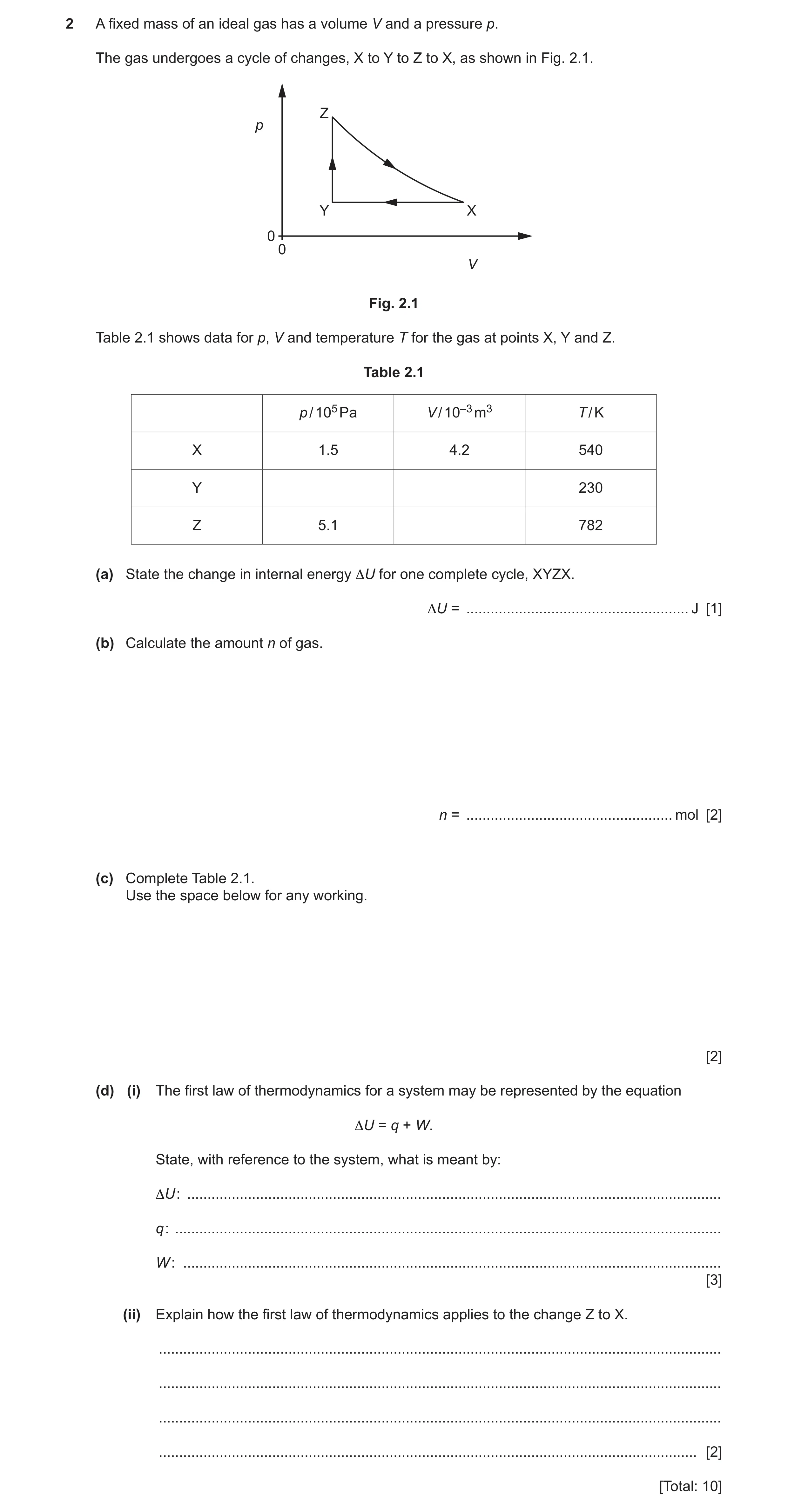
2 A fixed mass of an ideal gas has a volume V and a pressure p. The gas undergoes a cycle of changes, X to Y to Z to X, as shown in Fig. 2.1. Z p Y X 0 0 V Fig. 2.1 Table 2.1 shows data for p, V and temperature T for the gas at points X, Y and Z. Table 2.1 p / 105 Pa V / 10–3 m3 T / K X 1.5 4.2 540 Y 230 Z 5.1 782 (a) State the change in internal energy ΔU for one complete cycle, XYZX. ΔU = … J [1] (b) Calculate the amount n of gas. n = … mol [2] (c) Complete Table 2.1. Use the space below for any working. [2] (d) (i) The first law of thermodynamics for a system may be represented by the equation ΔU = q + W. State, with reference to the system, what is meant by: ΔU : … q : … W : … [3] (ii) Explain how the first law of thermodynamics applies to the change Z to X. … … … … [2] [Total: 10]
10 marks
Mark scheme: 2(a) 0 B1 2(b) pV = nRT (n =) 1.5 × 105 × 4.2 × 10–3 / 8.31 × 540 C1 = 0.14 mol A1 2(c) missing pressure 1.5 (× 105) B1 both missing volumes 1.8 (× 10–3) B1 2(d)(i) (ΔU:) increase in internal energy (of the system) B1 (q:) thermal energy supplied to the system B1 (W:) work done on system B1 Question Answer Marks 2(d)(ii) volume increases and work is done by the gas B1 temperature decreases and internal energy decreases B1
This question in 9702/42 Feb/March 2022
Q20 · Define specific latent heat of vaporisation 9702/42 May/June 2022
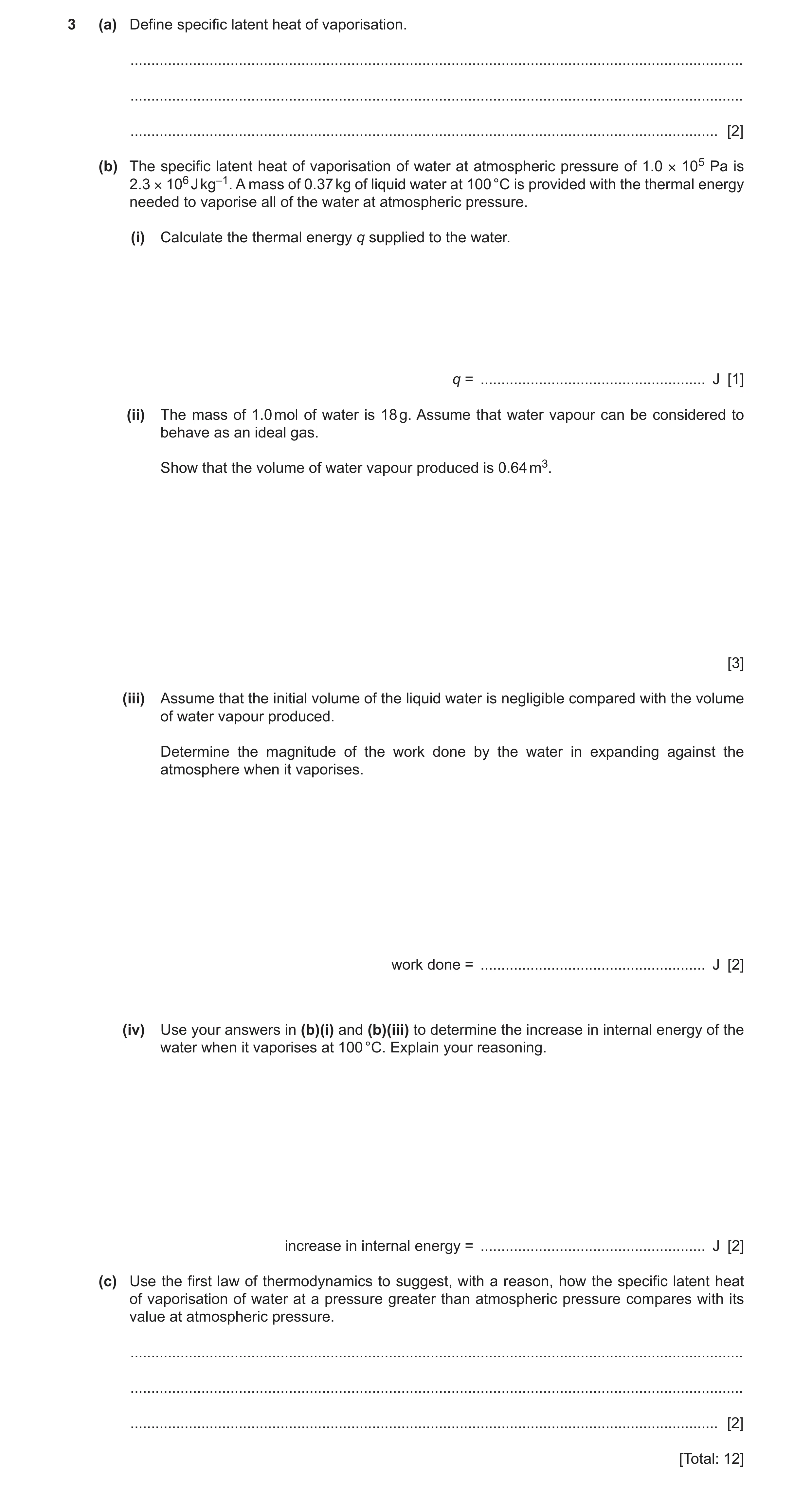
3 (a) Define specific latent heat of vaporisation. … … … [2] (b) The specific latent heat of vaporisation of water at atmospheric pressure of 1.0 × 10⁵ Pa is 2.3 × 10⁶ J kg–1. A mass of 0.37 kg of liquid water at 100 °C is provided with the thermal energy needed to vaporise all of the water at atmospheric pressure. (i) Calculate the thermal energy q supplied to the water. q = … J [1] (ii) The mass of 1.0 mol of water is 18 g. Assume that water vapour can be considered to behave as an ideal gas. Show that the volume of water vapour produced is 0.64 m3. [3] (iii) Assume that the initial volume of the liquid water is negligible compared with the volume of water vapour produced. Determine the magnitude of the work done by the water in expanding against the atmosphere when it vaporises. work done = … J [2] (iv) Use your answers in (b)(i) and (b)(iii) to determine the increase in internal energy of the water when it vaporises at 100 °C. Explain your reasoning. increase in internal energy = … J [2] (c) Use the first law of thermodynamics to suggest, with a reason, how the specific latent heat of vaporisation of water at a pressure greater than atmospheric pressure compares with its value at atmospheric pressure. … … … [2] [Total: 12]
12 marks
Mark scheme: 3(a) (thermal) energy per unit mass B1 energy to change state between liquid and gas at constant temperature B1 3(b)(i) q = mL = 0.37 2.3 106 = 8.5 105 J A1 3(b)(ii) pV = nRT and T = 373 K C1 n = 370 / 18 C1 V = [(370 / 18) 8.31 373] / (1.0 105) = 0.64 m3 A1 3(b)(iii) w = pV C1 = 1.0 105 0.64 = 6.4 104 J A1 3(b)(iv) (water does work against atmosphere so) work done on water is negative B1 increase in internal energy = (8.5 – 0.64) 105 = 7.9 105 J A1 3(c) valid reasoning of how work done by water is affected M1 correct use of first law to draw conclusion about effect on specific latent heat that is consistent with work done A1
This question in 9702/42 May/June 2022
Q21 · Define specific heat capacity 9702/42 Oct/Nov 2022
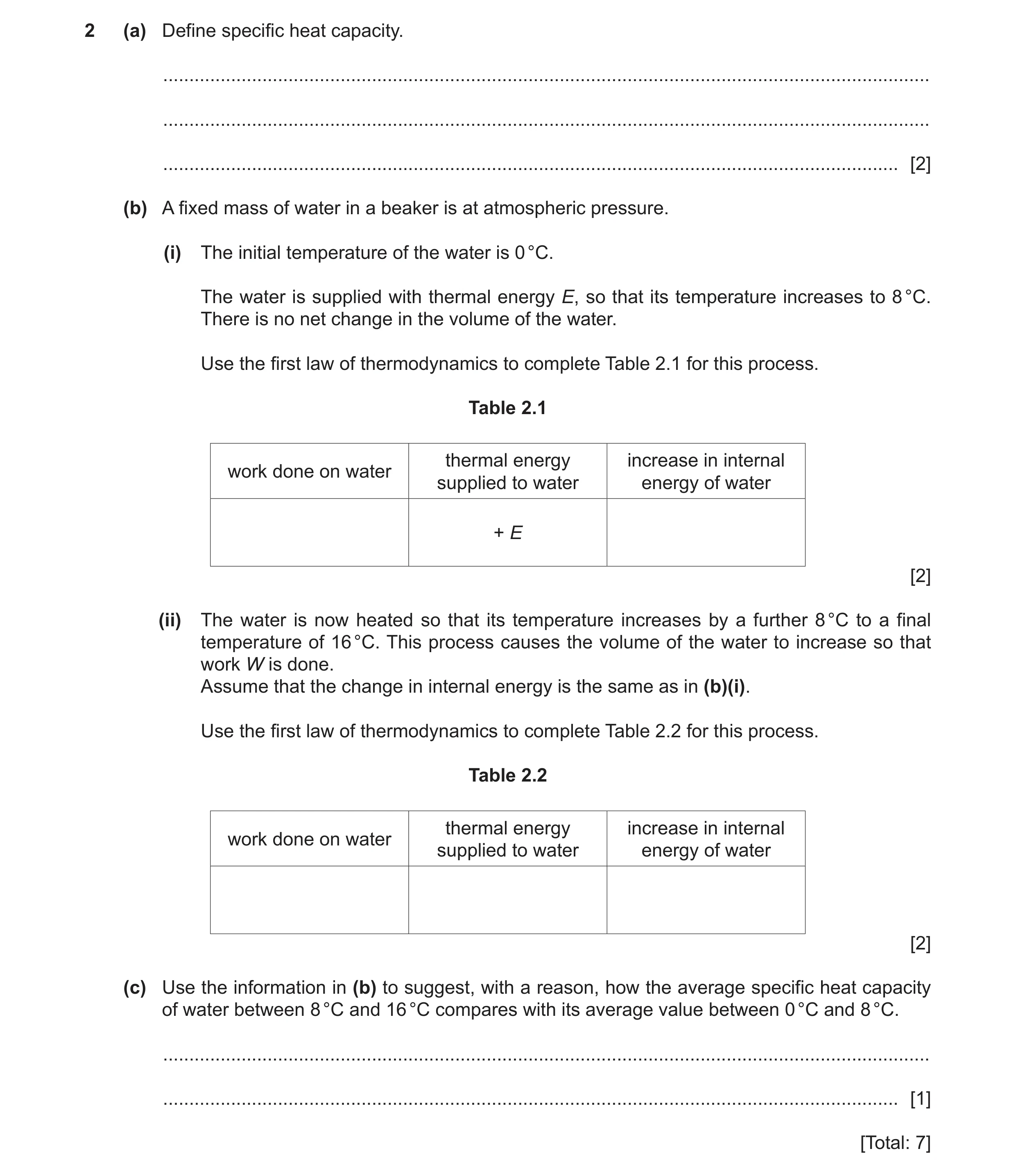
2 (a) Define specific heat capacity. … … … [2] (b) A fixed mass of water in a beaker is at atmospheric pressure. (i) The initial temperature of the water is 0 °C. The water is supplied with thermal energy E, so that its temperature increases to 8 °C. There is no net change in the volume of the water. Use the first law of thermodynamics to complete Table 2.1 for this process. Table 2.1 thermal energy increase in internal work done on water supplied to water energy of water + E [2] (ii) The water is now heated so that its temperature increases by a further 8 °C to a final temperature of 16 °C. This process causes the volume of the water to increase so that work W is done. Assume that the change in internal energy is the same as in (b)(i). Use the first law of thermodynamics to complete Table 2.2 for this process. Table 2.2 thermal energy increase in internal work done on water supplied to water energy of water [2] (c) Use the information in (b) to suggest, with a reason, how the average specific heat capacity of water between 8 °C and 16 °C compares with its average value between 0 °C and 8 °C. … … [1] [Total: 7]
7 marks
Mark scheme: 2(a) (thermal) energy per unit mass (to cause temperature change) B1 (thermal) energy per unit change in temperature B1 2(b)(i) work done correct (0) B1 increase in internal energy correct (+E) B1 2(b)(ii) work done correct (–W) and increase in internal energy same as (b)(i) B1 thermal energy correct so that it adds to work done to give increase in internal energy B1 2(c) more thermal energy needed so specific heat capacity is greater B1
This question in 9702/42 Oct/Nov 2022
Q22 · State the first law of thermodynamics 9702/42 May/June 2023
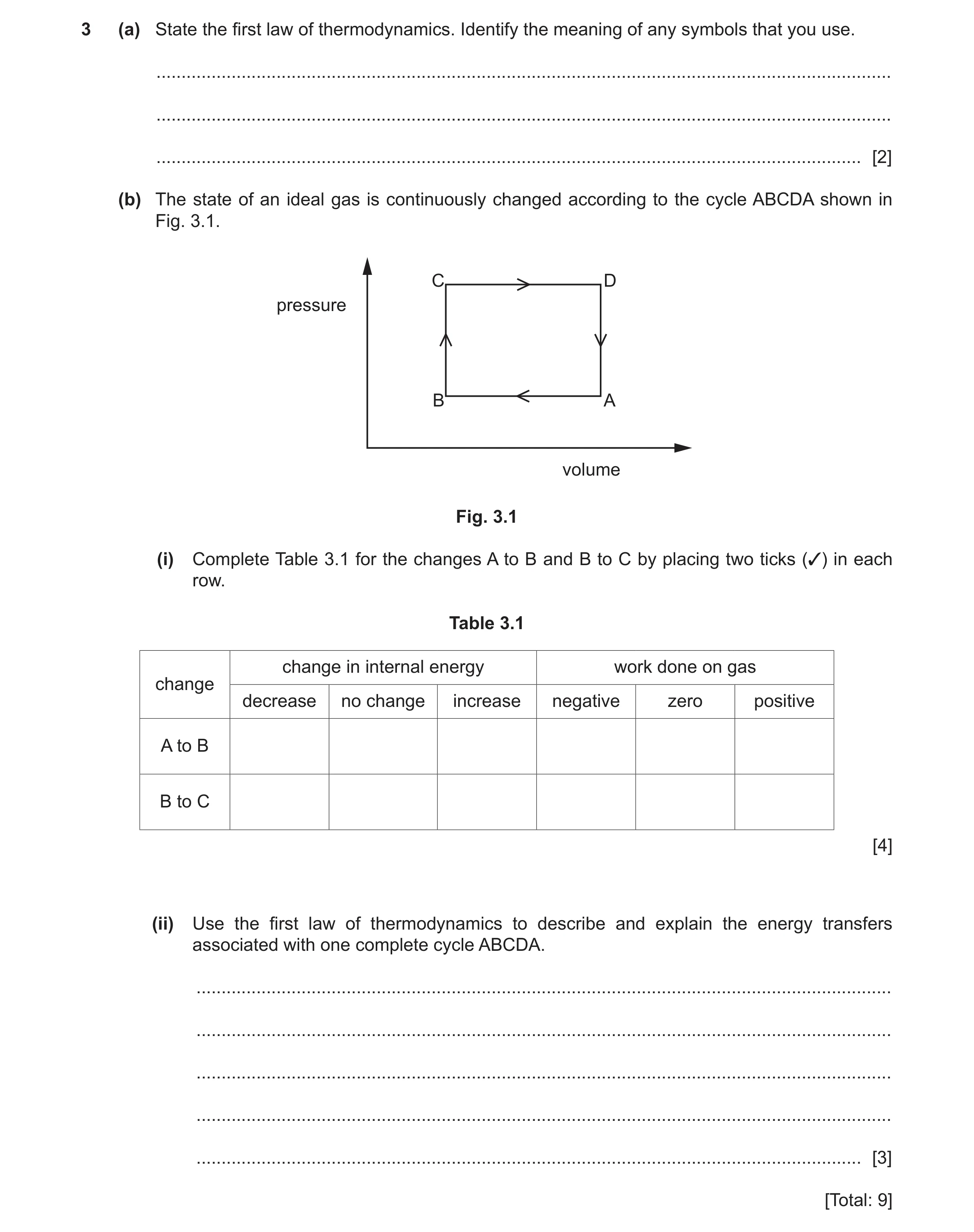
3 (a) State the first law of thermodynamics. Identify the meaning of any symbols that you use. … … … [2] (b) The state of an ideal gas is continuously changed according to the cycle ABCDA shown in Fig. 3.1. C D pressure B A volume Fig. 3.1 (i) Complete Table 3.1 for the changes A to B and B to C by placing two ticks (3) in each row. Table 3.1 change in internal energy work done on gas change decrease no change increase negative zero positive A to B B to C [4] (ii) Use the first law of thermodynamics to describe and explain the energy transfers associated with one complete cycle ABCDA. … … … … … [3] [Total: 9]
9 marks
Mark scheme: 3(a) C1 increase in internal energy = work done on system + energy transferred to the system by heating A1 3(b)(i) AB change in internal energy: decrease B1 AB work done on gas: positive B1 BC change in internal energy: increase B1 BC work done on gas: zero B1 3(b)(ii) more work done by gas in CD than is done on gas in AB or (no work done on gas in BC and DA so) (overall) gas does work B1 (overall) change in internal energy is zero B1 (must be an overall) input of thermal energy B1
This question in 9702/42 May/June 2023
Q23 · Define specific heat capacity 9702/41 Oct/Nov 2023
2 (a) Define specific heat capacity. … … … [2] (b) An ideal gas of mass 0.35 kg is heated at a constant pressure of 2.0 × 10⁵ Pa so that its internal energy increases by 7600 J. During this process, the volume of the gas increases from 0.038 m3 to 0.063 m3 and the temperature increases by 56 °C. (i) Show that the magnitude of the work done on the gas is 5000 J. [1] (ii) Explain whether the work done on the gas is positive or negative. … … … [2] (iii) Determine the magnitude of the thermal energy q transferred to the gas. q = … J [2] (iv) Calculate the specific heat capacity of the gas for this process. Give a unit with your answer. specific heat capacity = … unit … [2] (c) The gas in (b) is now heated at constant volume rather than at constant pressure. The increase in internal energy of the gas is the same as in (b). Use the first law of thermodynamics to explain whether the specific heat capacity of the gas for this process is less than, the same as, or greater than the answer in (b)(iv). … … … … … [3] [Total: 12]
12 marks
Mark scheme: 2(a) (thermal) energy per unit mass (to change temperature) B1 (thermal) energy per unit change in temperature B1 2(b)(i) work done = pV A1 = (2.0 105) (0.063 – 0.038) = 5000 J 2(b)(ii) gas is expanding (against external pressure) B1 gas does work / work is done by gas, so (work done on gas is) negative B1 2(b)(iii) U = q + W C1 7600 = q + (–5000) A1 q = 12 600 J 2(b)(iv) specific heat capacity = q / mT C1 = 12600 / (0.35 56) = 640 J kg–1 K–1 A1 2(c) same gain in internal energy so same temperature rise B1 no change in volume so no work done B1 or no work done so less thermal energy needed (for same change in internal energy) less thermal energy needed (for same temperature change) so lower specific heat capacity B1
This question in 9702/41 Oct/Nov 2023
Q24 · State what is meant by the internal energy of a system 9702/42 Oct/Nov 2023
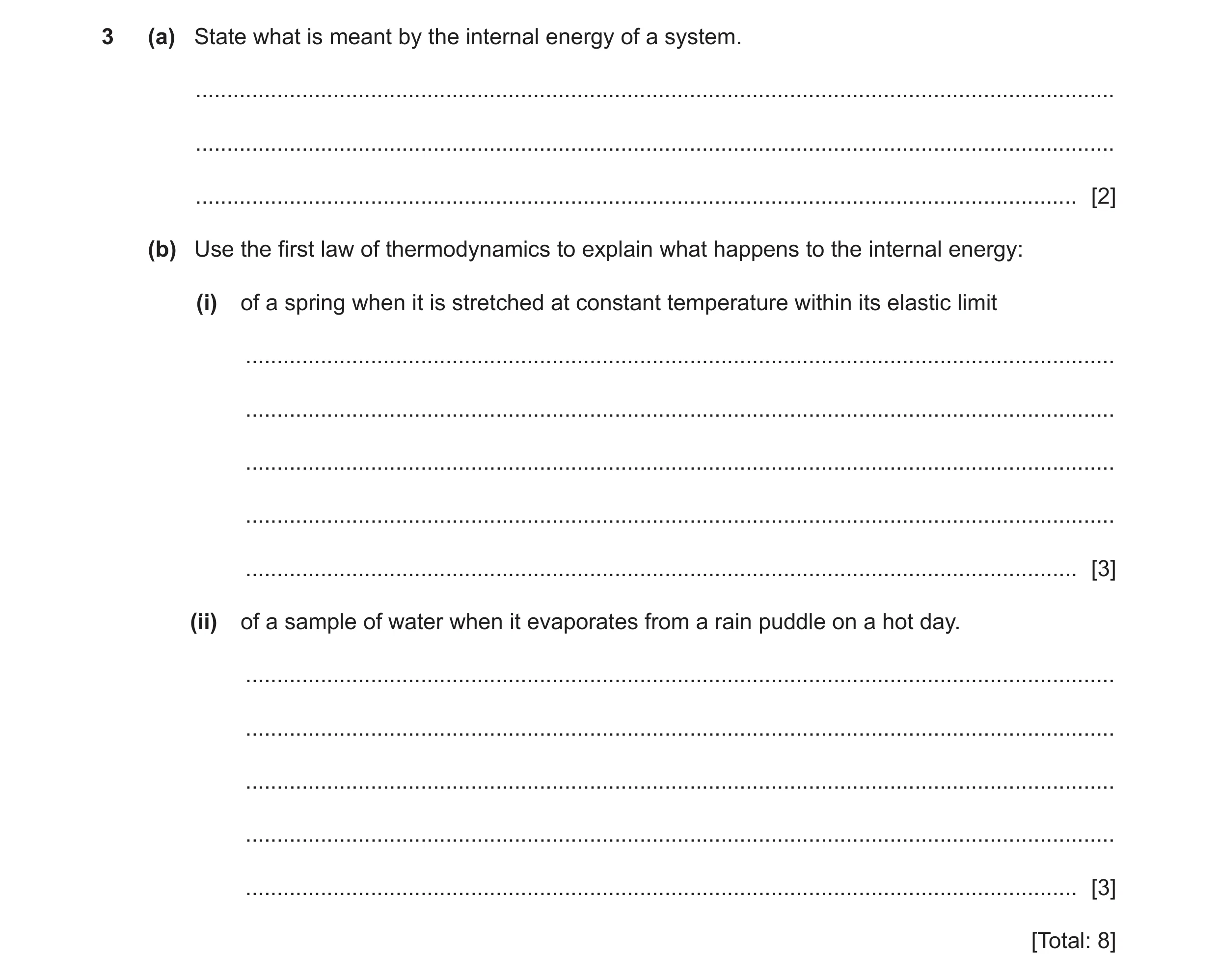
3 (a) State what is meant by the internal energy of a system. … … … [2] (b) Use the first law of thermodynamics to explain what happens to the internal energy: (i) of a spring when it is stretched at constant temperature within its elastic limit … … … … … [3] (ii) of a sample of water when it evaporates from a rain puddle on a hot day. … … … … … [3] [Total: 8]
8 marks
Mark scheme: 3(a) sum of potential energy and kinetic energy (of particles) B1 (total) energy of random motion of particles B1 3(b)(i) no thermal energy transferred B1 work is done on the spring (increasing the potential energy of particles) M1 so internal energy increases A1 3(b)(ii) thermal energy transferred to water B1 work is done by water (expanding against atmosphere as it vaporises) B1 more thermal energy transferred than work done so internal energy increases B1
This question in 9702/42 Oct/Nov 2023
Q25 · Define specific heat capacity 9702/43 Oct/Nov 2023
2 (a) Define specific heat capacity. … … … [2] (b) An ideal gas of mass 0.35 kg is heated at a constant pressure of 2.0 × 10⁵ Pa so that its internal energy increases by 7600 J. During this process, the volume of the gas increases from 0.038 m3 to 0.063 m3 and the temperature increases by 56 °C. (i) Show that the magnitude of the work done on the gas is 5000 J. [1] (ii) Explain whether the work done on the gas is positive or negative. … … … [2] (iii) Determine the magnitude of the thermal energy q transferred to the gas. q = … J [2] (iv) Calculate the specific heat capacity of the gas for this process. Give a unit with your answer. specific heat capacity = … unit … [2] (c) The gas in (b) is now heated at constant volume rather than at constant pressure. The increase in internal energy of the gas is the same as in (b). Use the first law of thermodynamics to explain whether the specific heat capacity of the gas for this process is less than, the same as, or greater than the answer in (b)(iv). … … … … … [3] [Total: 12]
12 marks
Mark scheme: 2(a) (thermal) energy per unit mass (to change temperature) B1 (thermal) energy per unit change in temperature B1 2(b)(i) work done = pV A1 = (2.0 105) (0.063 – 0.038) = 5000 J 2(b)(ii) gas is expanding (against external pressure) B1 gas does work / work is done by gas, so (work done on gas is) negative B1 2(b)(iii) U = q + W C1 7600 = q + (–5000) A1 q = 12 600 J 2(b)(iv) specific heat capacity = q / mT C1 = 12600 / (0.35 56) = 640 J kg–1 K–1 A1 2(c) same gain in internal energy so same temperature rise B1 no change in volume so no work done B1 or no work done so less thermal energy needed (for same change in internal energy) less thermal energy needed (for same temperature change) so lower specific heat capacity B1
This question in 9702/43 Oct/Nov 2023
Q26 · Define specific latent heat 9702/42 Oct/Nov 2024
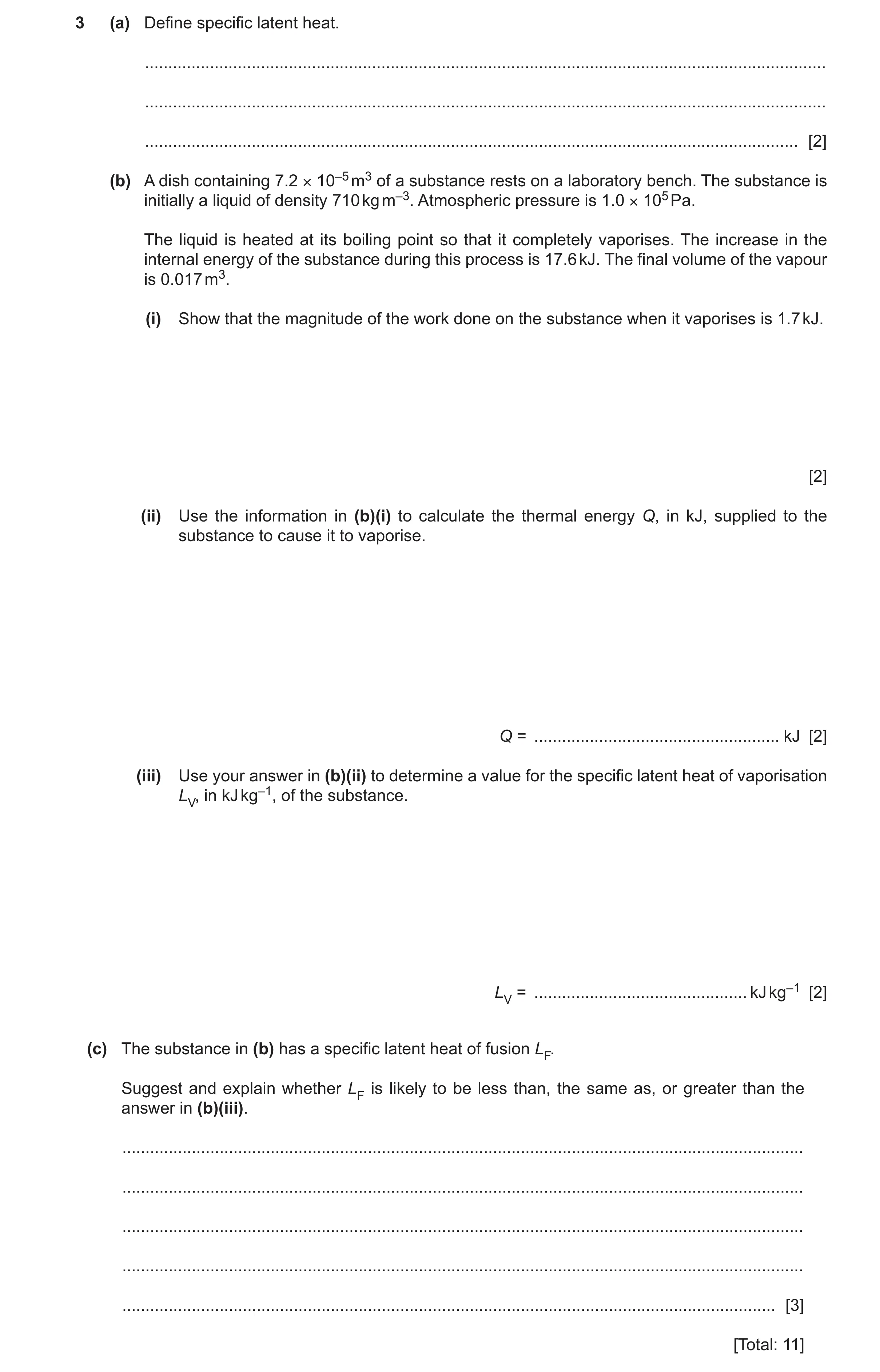
3 (a) Define specific latent heat. … … … [2] (b) A dish containing 7.2 × 10⁻⁵ m3 of a substance rests on a laboratory bench. The substance is initially a liquid of density 710 kg m–3. Atmospheric pressure is 1.0 × 10⁵ Pa. The liquid is heated at its boiling point so that it completely vaporises. The increase in the internal energy of the substance during this process is 17.6 kJ. The final volume of the vapour is 0.017 m3. (i) Show that the magnitude of the work done on the substance when it vaporises is 1.7 kJ. [2] (ii) Use the information in (b)(i) to calculate the thermal energy Q, in kJ, supplied to the substance to cause it to vaporise. Q = … kJ [2] (iii) Use your answer in (b)(ii) to determine a value for the specific latent heat of vaporisation LV, in kJ kg–1, of the substance. LV = … kJ kg–1 [2] (c) The substance in (b) has a specific latent heat of fusion LF. Suggest and explain whether LF is likely to be less than, the same as, or greater than the answer in (b)(iii). … … … … … [3] [Total: 11]
11 marks
Mark scheme: 3(a) (thermal) energy per unit mass (to cause change of state) B1 (thermal) energy to change state at constant temperature B1 3(b)(i) W = pV C1 = 1.0 105 0.017 = 1700 J = 1.7 kJ A1 3(b)(ii) U = Q + W C1 Q = 17.6 + 1.7 A1 = 19.3 kJ 3(b)(iii) mass = 710 7.2 10–5 C1 ( = 0.051 kg) L = 19.3 / 0.051 A1 = 380 kJ kg–1 3(c) fusion involves (much) smaller volume change (than vaporisation) B1 smaller change in intermolecular spacing so smaller change in internal energy B1 negligible work done (by substance during fusion) so LF is less (than LV) B1
This question in 9702/42 Oct/Nov 2024
Q27 · Define specific heat capacity 9702/42 May/June 2025
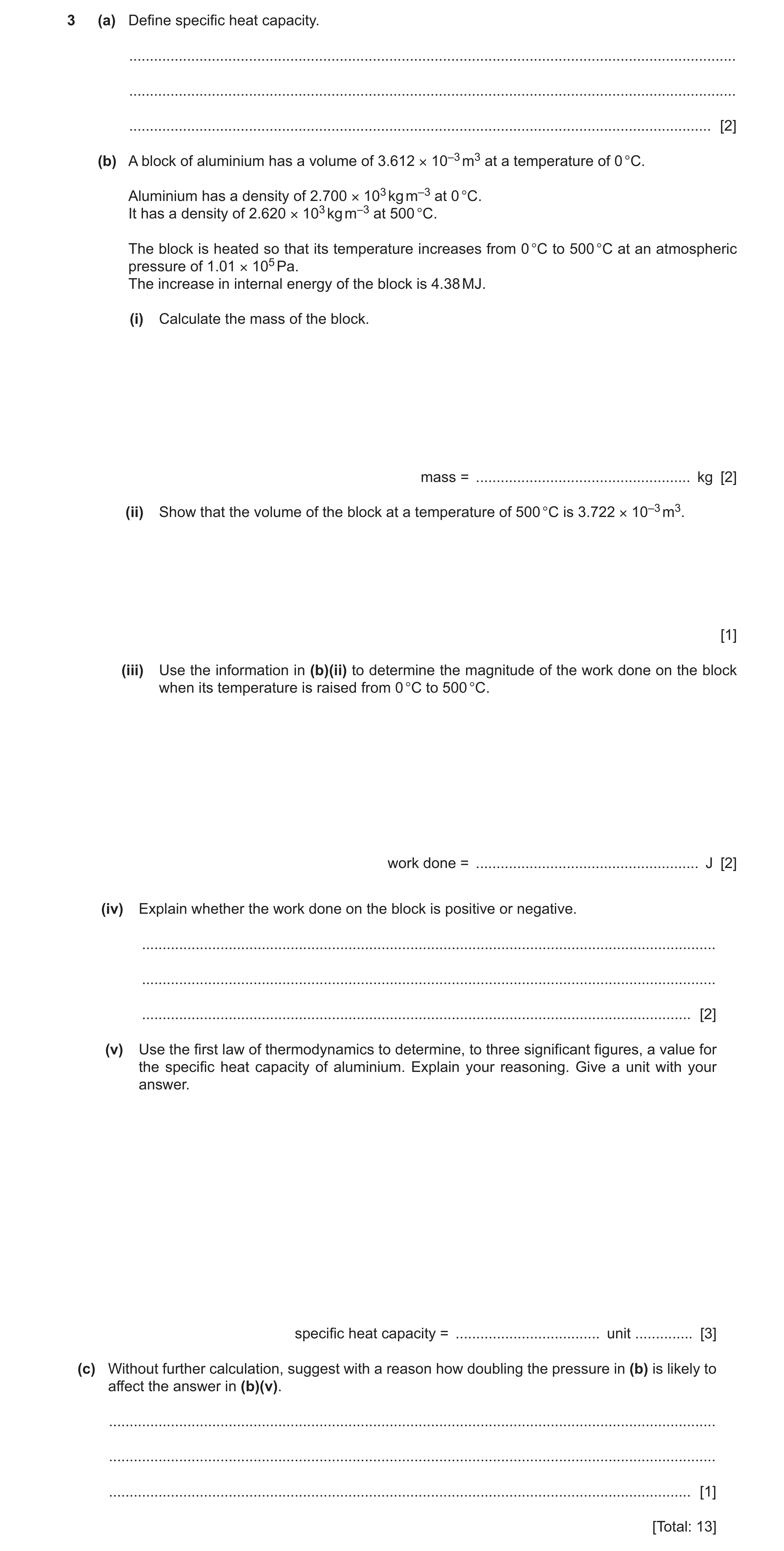
3 (a) Define specific heat capacity. … … … [2] (b) A block of aluminium has a volume of 3.612 × 10⁻³ m3 at a temperature of 0 °C. Aluminium has a density of 2.700 × 10³ kg m–3 at 0 °C. It has a density of 2.620 × 10³ kg m–3 at 500 °C. The block is heated so that its temperature increases from 0 °C to 500 °C at an atmospheric pressure of 1.01 × 10⁵ Pa. The increase in internal energy of the block is 4.38 MJ. (i) Calculate the mass of the block. mass = … kg [2] (ii) Show that the volume of the block at a temperature of 500 °C is 3.722 × 10⁻³ m3. [1] (iii) Use the information in (b)(ii) to determine the magnitude of the work done on the block when its temperature is raised from 0 °C to 500 °C. work done = … J [2] (iv) Explain whether the work done on the block is positive or negative. … … … [2] (v) Use the first law of thermodynamics to determine, to three significant figures, a value for the specific heat capacity of aluminium. Explain your reasoning. Give a unit with your answer. specific heat capacity = … unit … [3] (c) Without further calculation, suggest with a reason how doubling the pressure in (b) is likely to affect the answer in (b)(v). … … … [1] [Total: 13]
13 marks
Mark scheme: 3(a) (thermal) energy per unit mass (to cause temperature change) B1 (thermal) energy per unit change in temperature B1 3(b)(i) density = mass / volume C1 mass = 2.700 × 103 × 3.612 × 10–3 A1 = 9.752 kg 3(b)(ii) volume = 3.612 × 10–3 × (2.700 / 2.620) = 3.722 × 10⁻³ m3 A1 or volume = 9.752 / (2.620 × 10³) = 3.722 × 10⁻³ m3 3(b)(iii) W = pV C1 = 1.01 × 105 × (3.722 – 3.612) × 10–3 A1 = 11.1 J 3(b)(iv) volume (of block) increases B1 work is done against the atmosphere so work done (on block) is negative B1 3(b)(v) thermal energy = (4.38 × 10⁶) + 11.1 B1 specific heat capacity = (4.38 × 10⁶) / (9.75 × 500) C1 = 898 J kg–1 °C–1 A1 3(c) work done is negligible compared with (change in) internal energy so (answer in (b)(v) would be) unchanged B1
This question in 9702/42 May/June 2025
Q28 · State two ways in which the first law of thermodynamics describes that the internal… 9702/41 Oct/Nov 2025
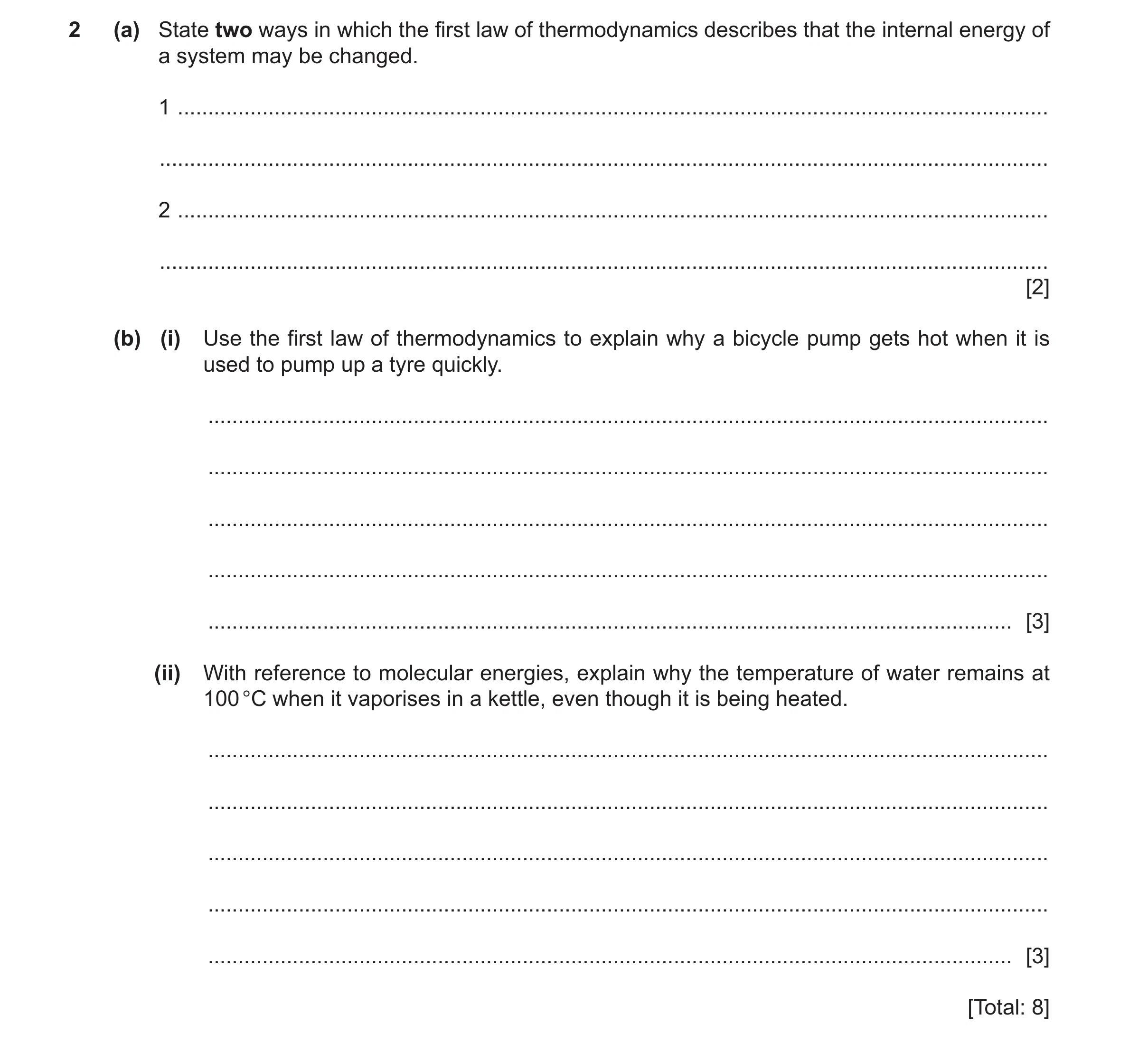
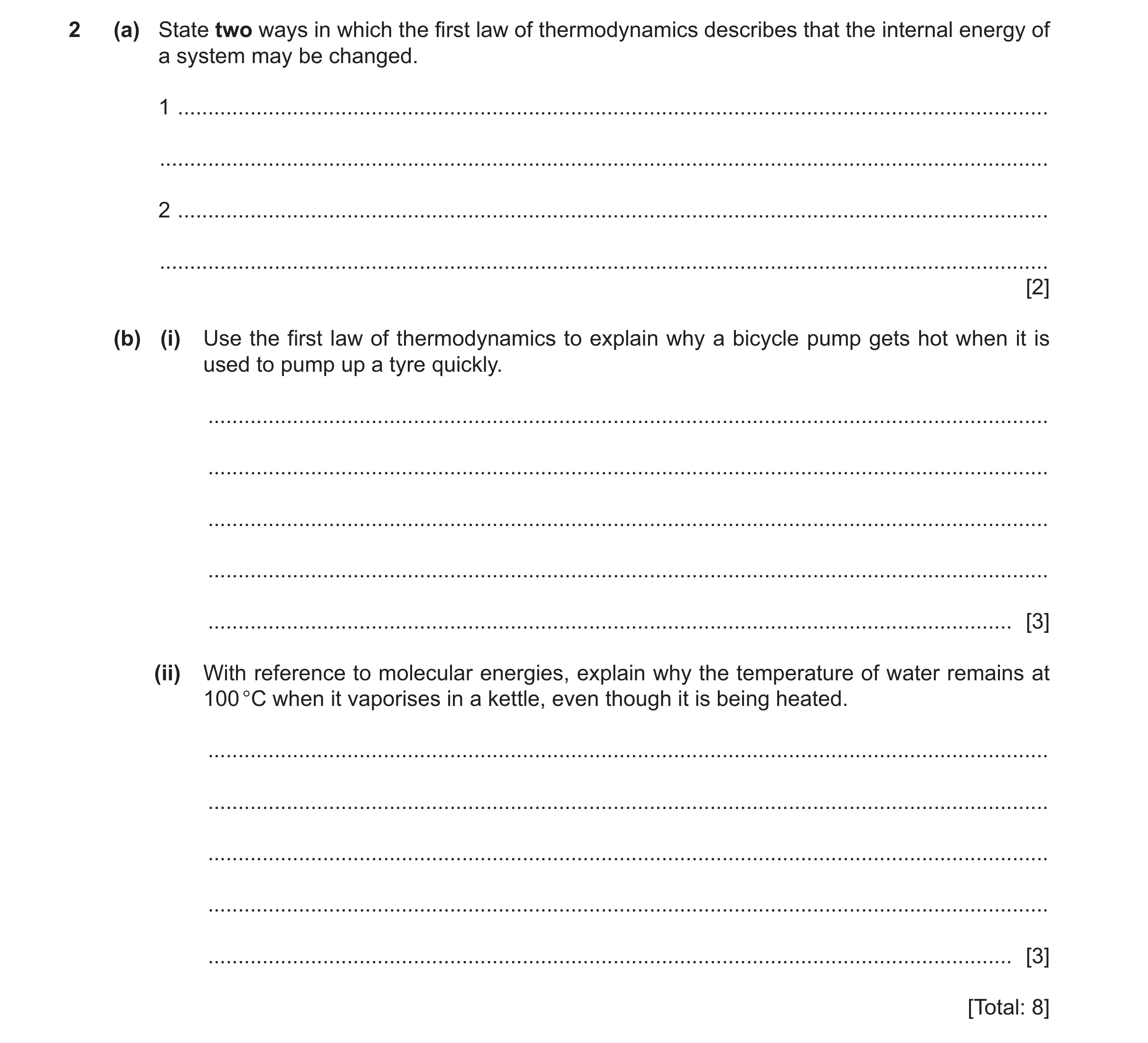
2 (a) State two ways in which the first law of thermodynamics describes that the internal energy of a system may be changed. 1 … … 2 … … [2] (b) (i) Use the first law of thermodynamics to explain why a bicycle pump gets hot when it is used to pump up a tyre quickly. … … … … … [3] (ii) With reference to molecular energies, explain why the temperature of water remains at 100 °C when it vaporises in a kettle, even though it is being heated. … … … … … [3] [Total: 8]
8 marks
Mark scheme: 2(a) work done on / by system B1 thermal energy supplied to / removed from system B1 2(b)(i) no thermal energy transferred to / from system (due to lack of time) B1 work is done on the gas to compress it / to decrease its volume B1 internal energy increases so temperature increases B1 2(b)(ii) (during vaporisation) molecular separation increases B1 (heating causes) potential energy of molecules to increase B1 kinetic energy of molecules unchanged so temperature unchanged B1
This question in 9702/41 Oct/Nov 2025
Q29 · A cylinder contains a fixed mass of an ideal gas at pressure 2Y and volume 6X 9702/42 Oct/Nov 2025
4 A cylinder contains a fixed mass of an ideal gas at pressure 2Y and volume 6X. The gas undergoes a sequence of changes from its initial state A, through states B, C and D, then finally back to its initial state A, as shown in Fig. 4.1. 6Y pressure C D 4Y 2Y B A 0 0 2X 4X 6X 8X volume Fig. 4.1 Fig. 4.2 shows the variation with time of the internal energy of the gas. 60XY internal energy D 40XY 20XY A A C B 0 time Fig. 4.2 (a) State the first law of thermodynamics. … … … [2] (b) (i) Use Fig. 4.1 and Fig. 4.2 to determine the general expression for the internal energy U of the gas when it has pressure p and volume V. U = … [1] (ii) An ideal gas at thermodynamic temperature T contains N molecules. Use your answer in (b)(i) and the equation of state for an ideal gas to deduce an expression for U in terms of N and T. Identify any other symbols you use. U = … [2] (c) Determine expressions, in terms of X and Y, for the work W done on the gas during: (i) change AB W = … [1] (ii) change CD. W = … [1] (d) Use your answers in (c) and the first law of thermodynamics to determine an expression, in terms of X and Y, for the net thermal energy Q supplied to the gas during one full cycle ABCDA. Explain your reasoning. Q = … [3] [Total: 10]
10 marks
Mark scheme: 4(a) change in internal energy = work done + energy transfer by heating C1 increase in internal energy = work done on system + energy transferred to the system by heating A1 4(b)(i) U = (3 / 2) pV A1 4(b)(ii) pV = NkT and k identified as Boltzmann constant B1 U = (3 / 2) NkT A1 4(c)(i) W = (+)8XY A1 4(c)(ii) W = –20XY A1 4(d) work done during stages BC and DA = 0 B1 change in internal energy (over complete cycle) = 0 C1 thermal energy supplied = 20XY – 8XY A1 = (+)12XY
This question in 9702/42 Oct/Nov 2025
Q30 · State two ways in which the first law of thermodynamics describes that the internal… 9702/43 Oct/Nov 2025
2 (a) State two ways in which the first law of thermodynamics describes that the internal energy of a system may be changed. 1 … … 2 … … [2] (b) (i) Use the first law of thermodynamics to explain why a bicycle pump gets hot when it is used to pump up a tyre quickly. … … … … … [3] (ii) With reference to molecular energies, explain why the temperature of water remains at 100 °C when it vaporises in a kettle, even though it is being heated. … … … … … [3] [Total: 8]
8 marks
Mark scheme: 2(a) work done on / by system B1 thermal energy supplied to / removed from system B1 2(b)(i) no thermal energy transferred to / from system (due to lack of time) B1 work is done on the gas to compress it / to decrease its volume B1 internal energy increases so temperature increases B1 2(b)(ii) (during vaporisation) molecular separation increases B1 (heating causes) potential energy of molecules to increase B1 kinetic energy of molecules unchanged so temperature unchanged B1
This question in 9702/43 Oct/Nov 2025
 14 / 41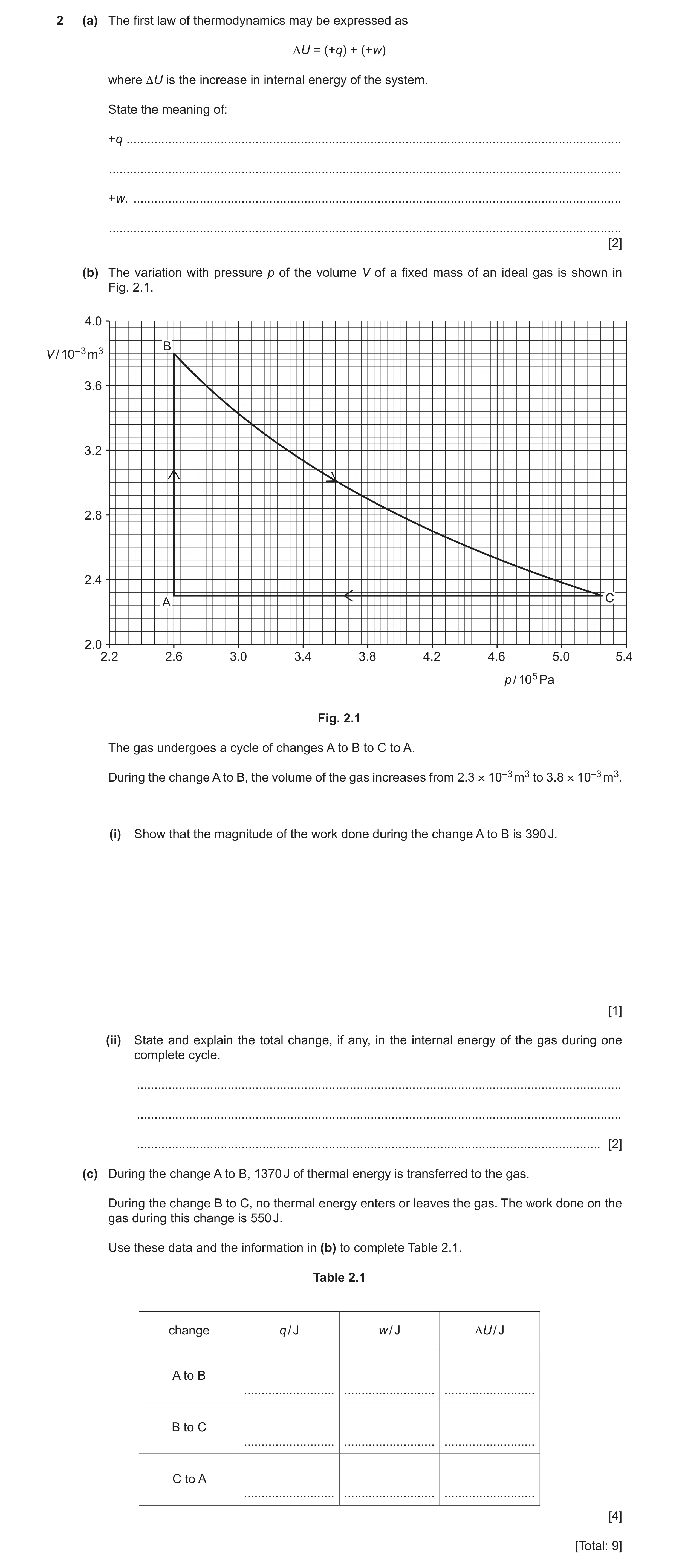
 30 / 41
 31 / 41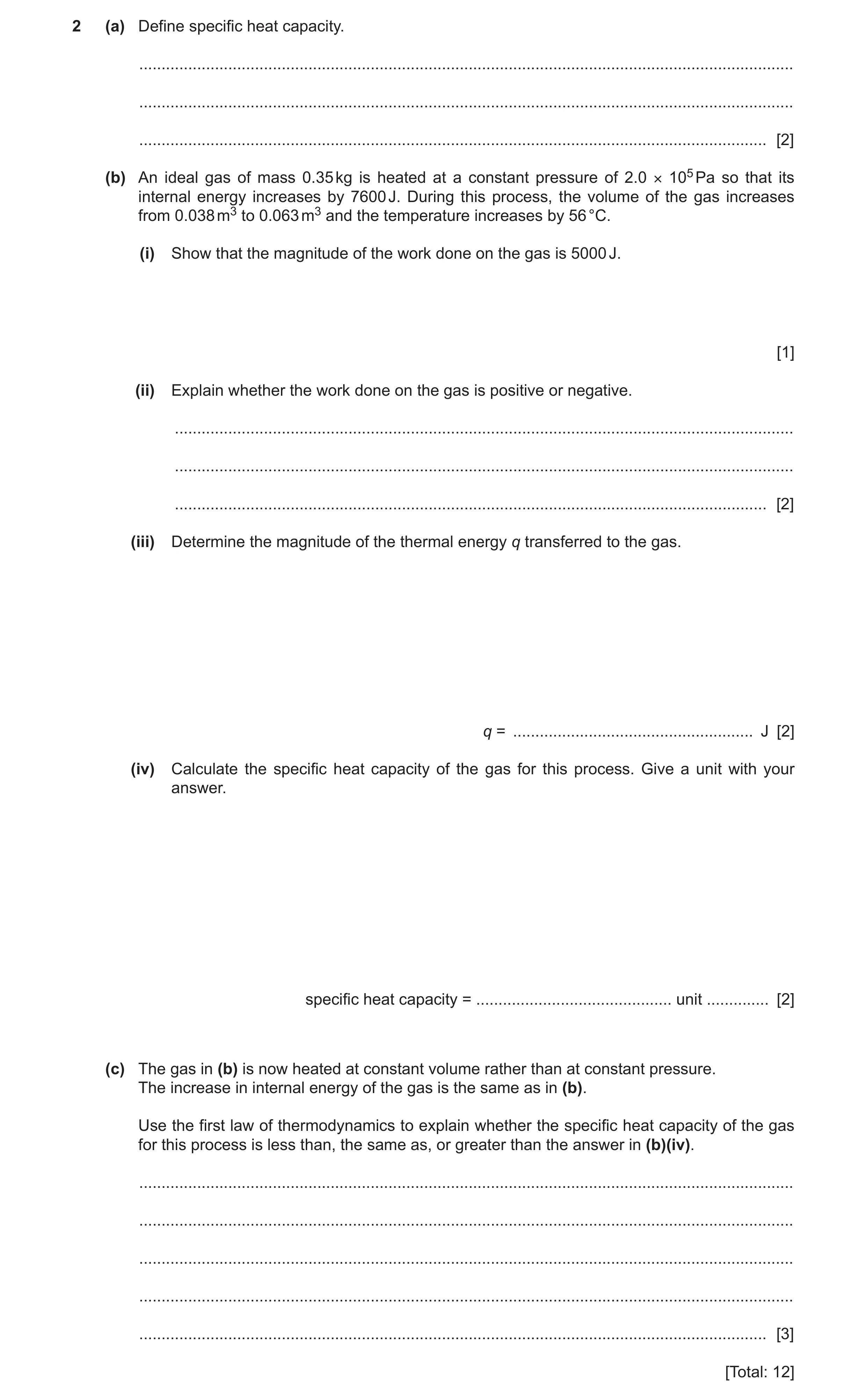
 33 / 41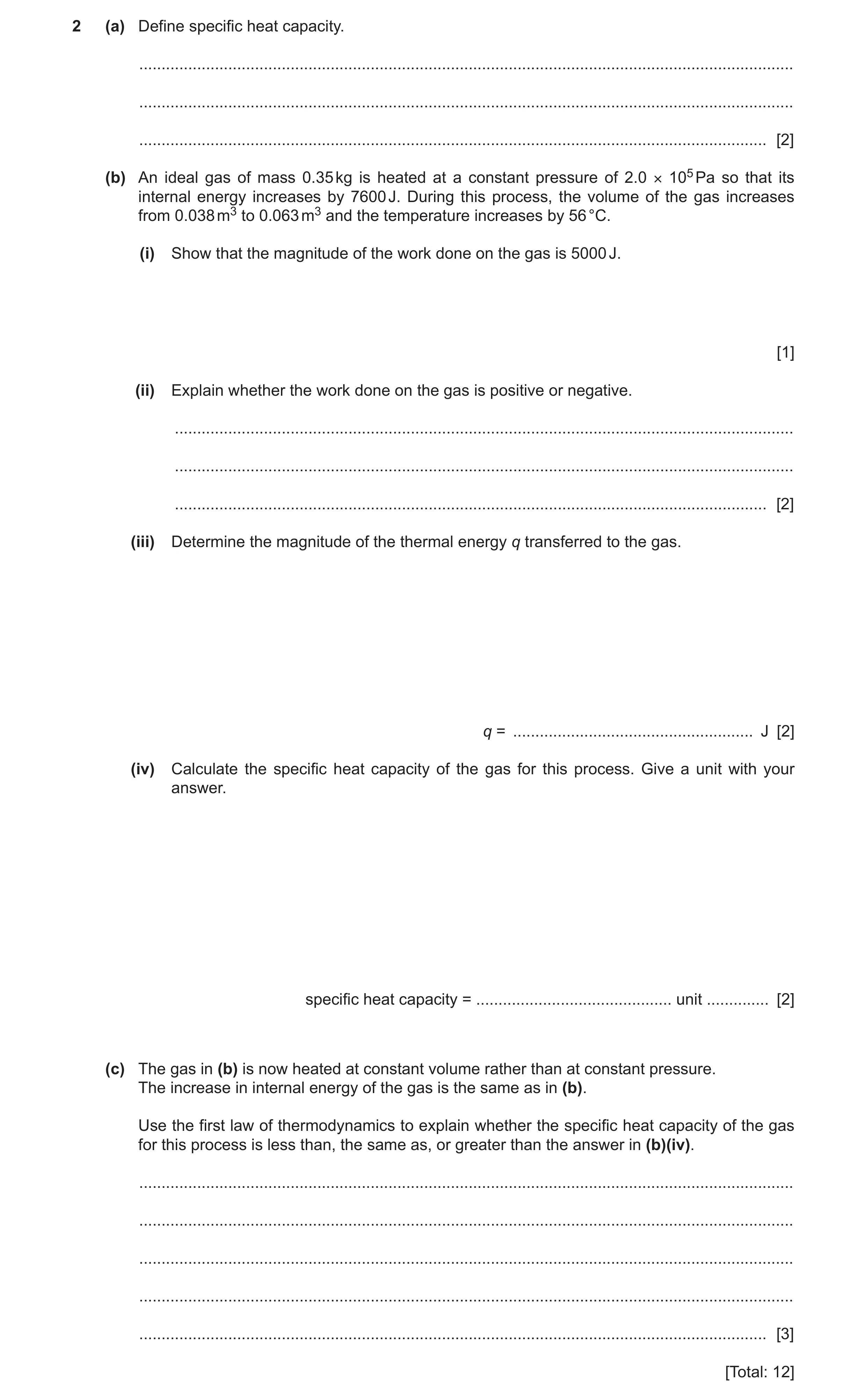
 38 / 41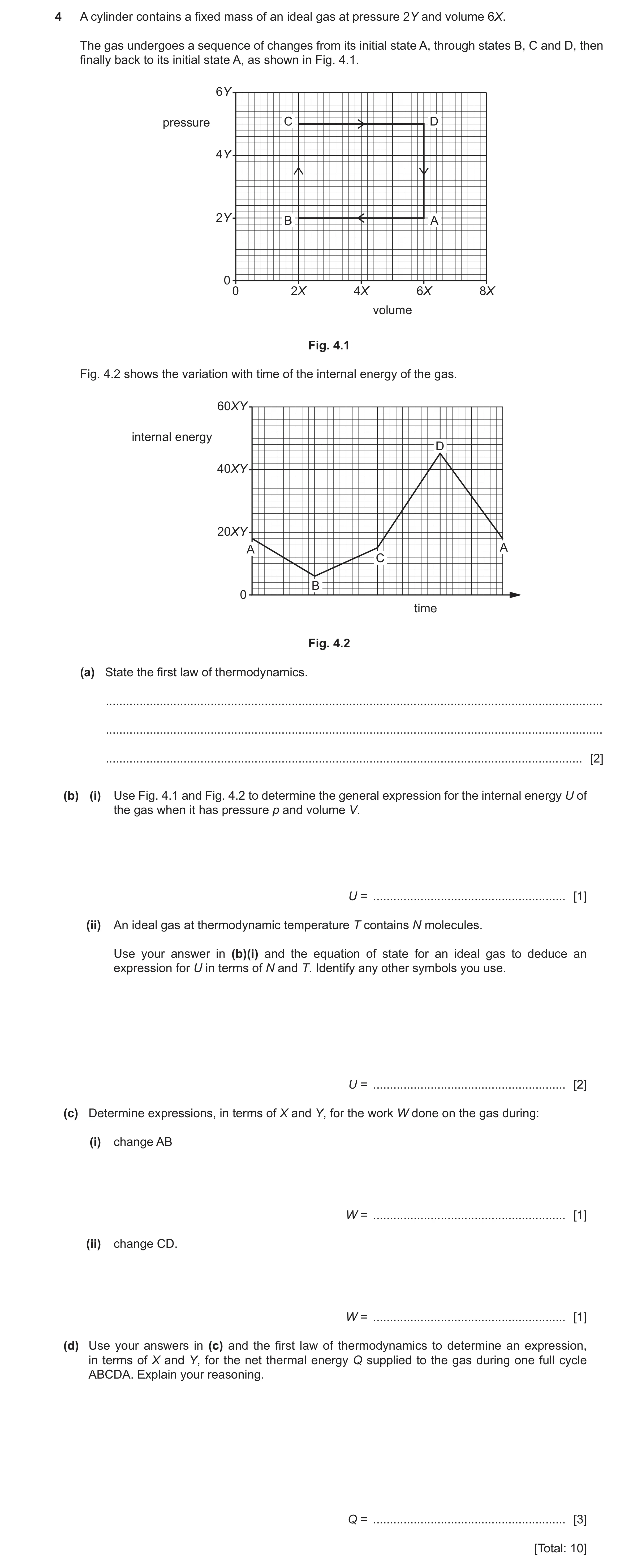
 41 / 41
 10
10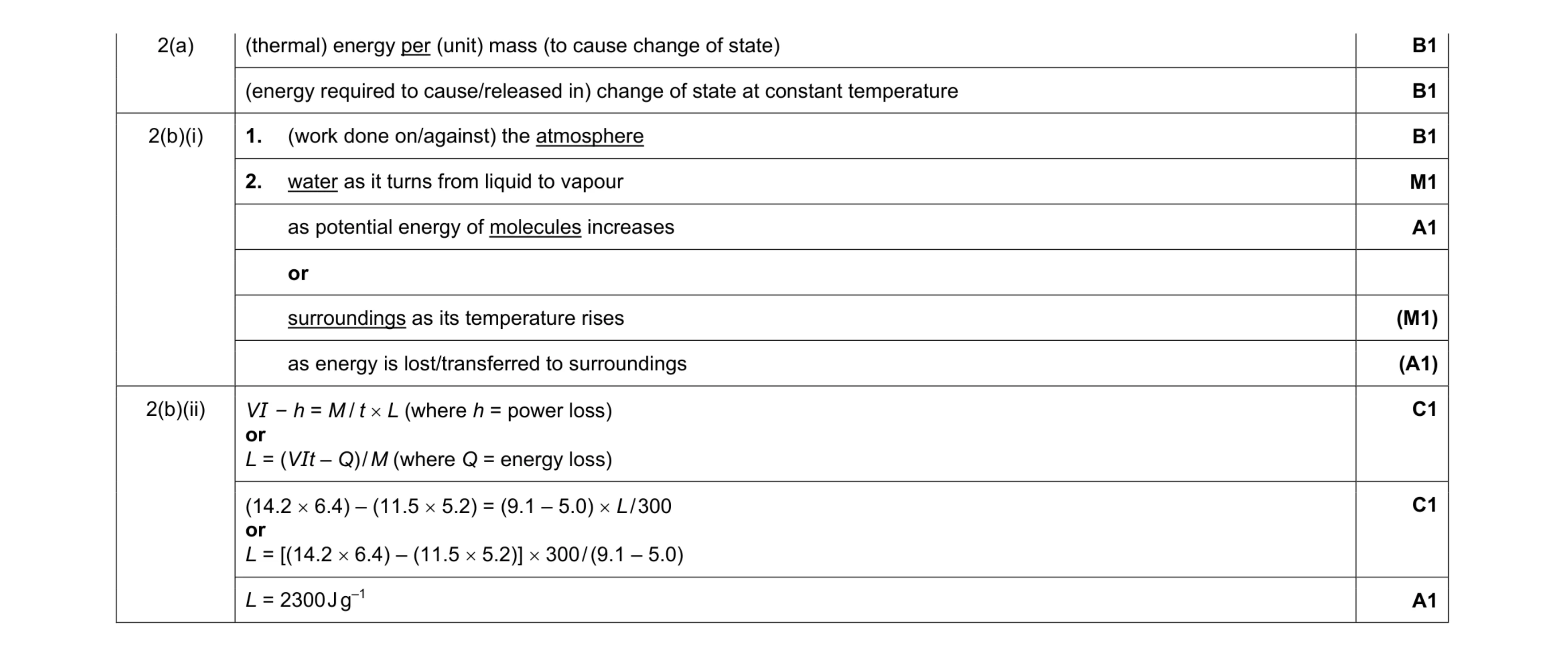 8
8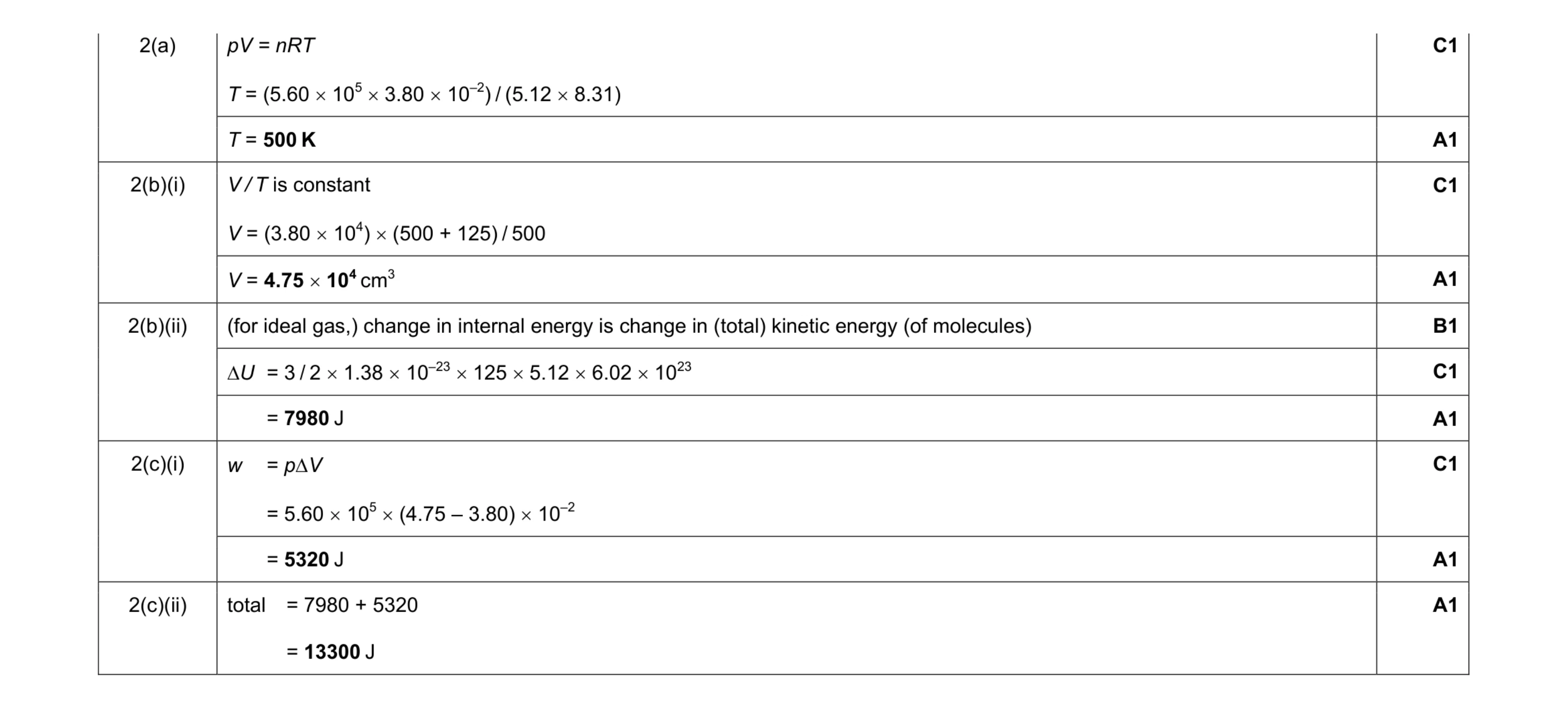 10
10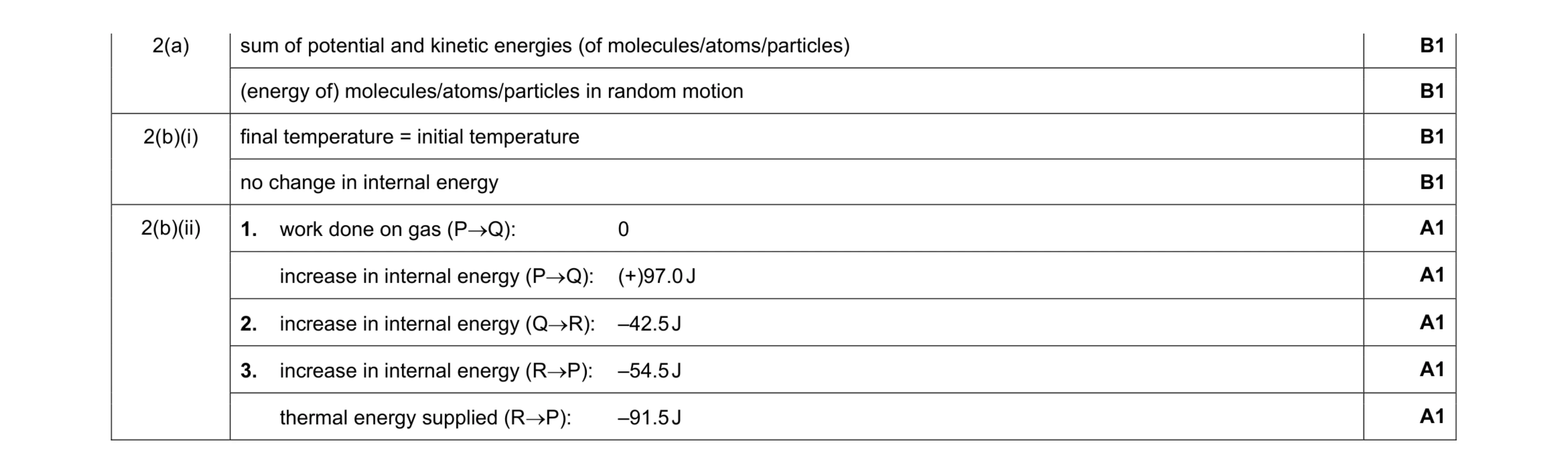 9
9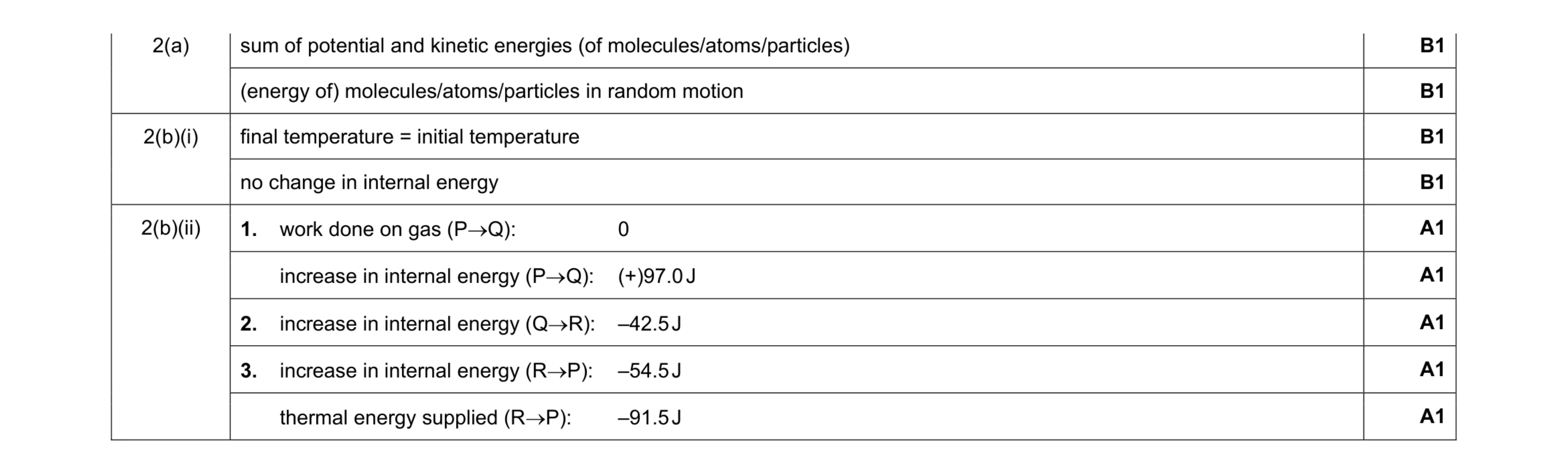 9
9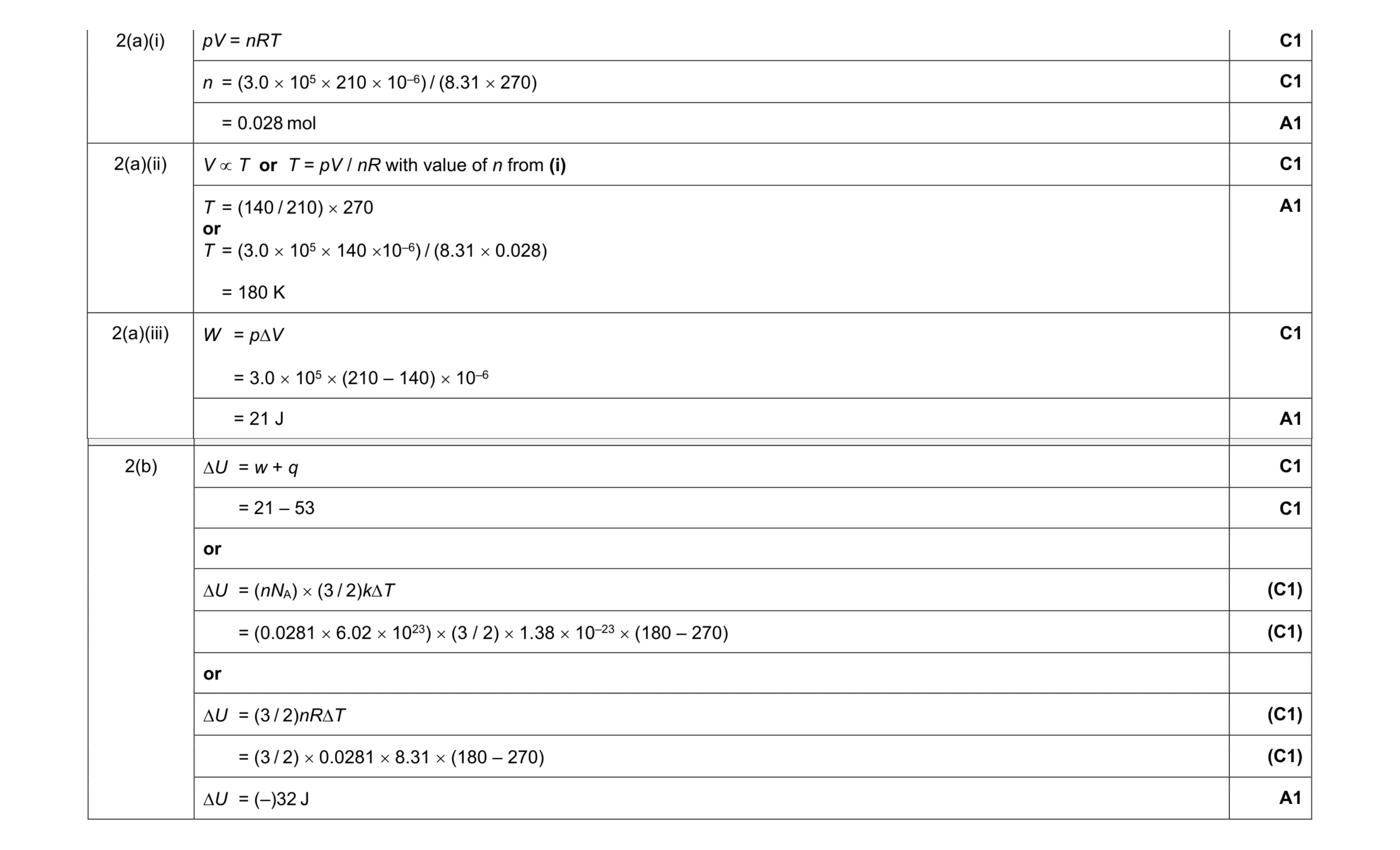 10
10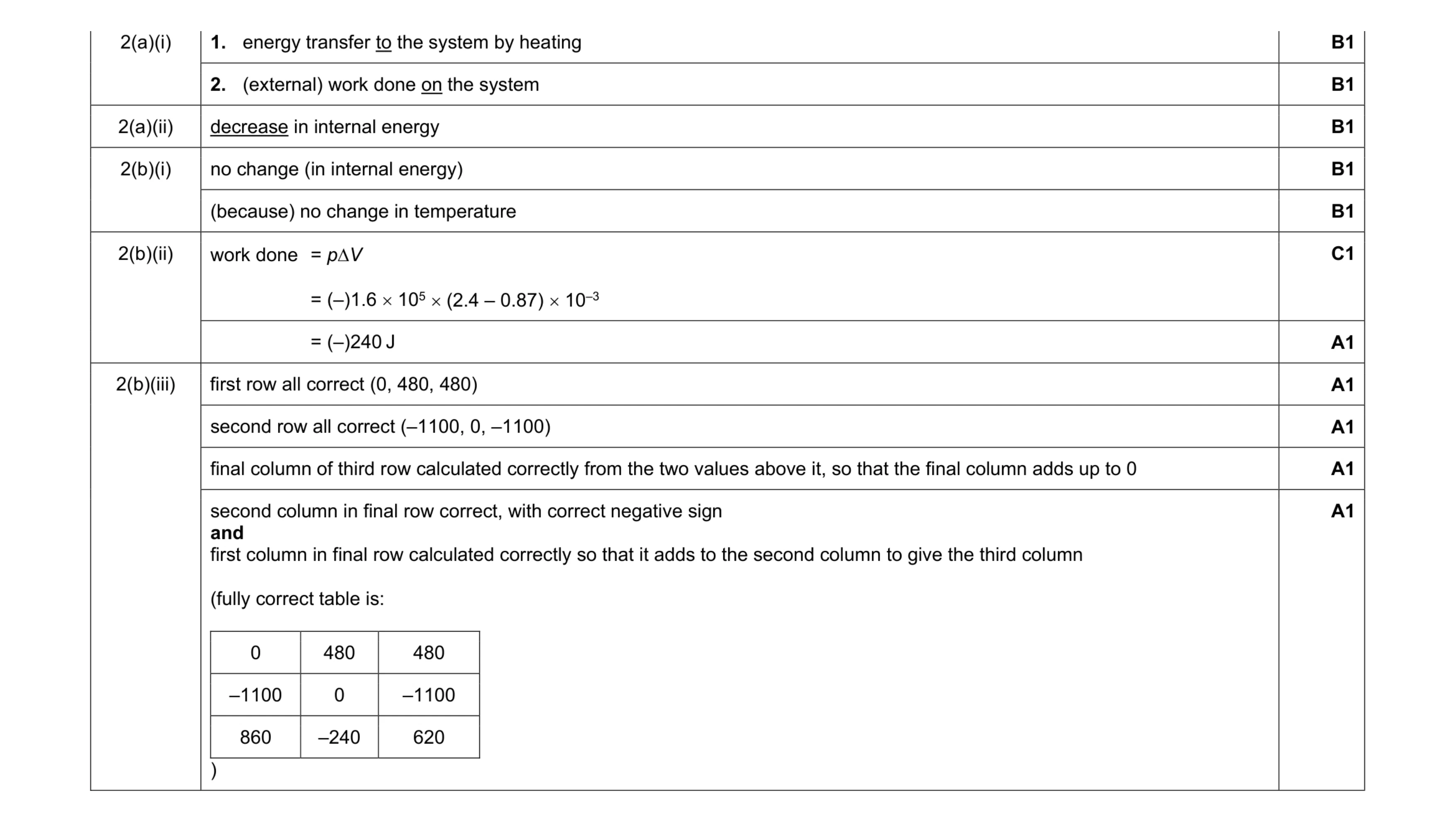 11
11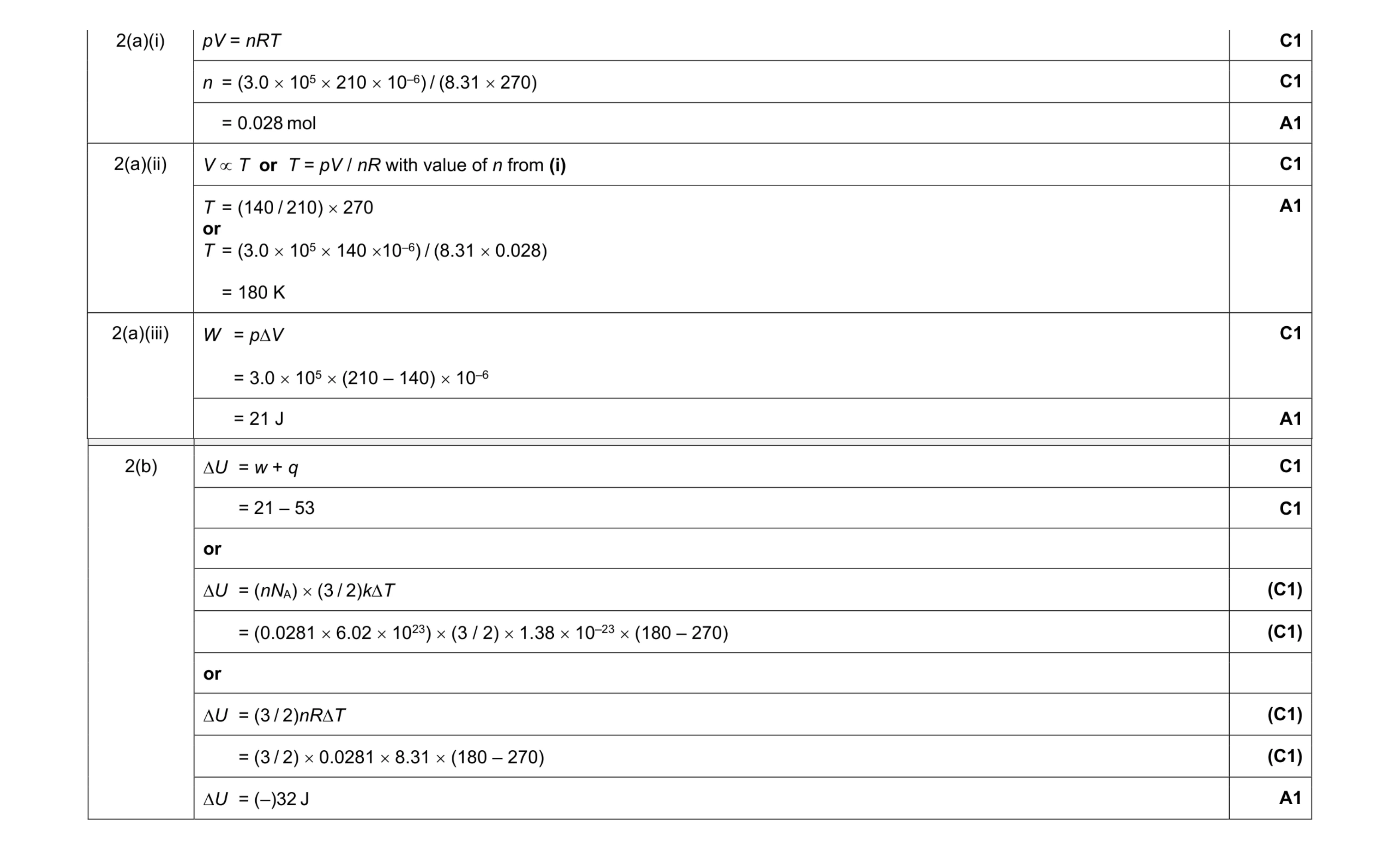 10
10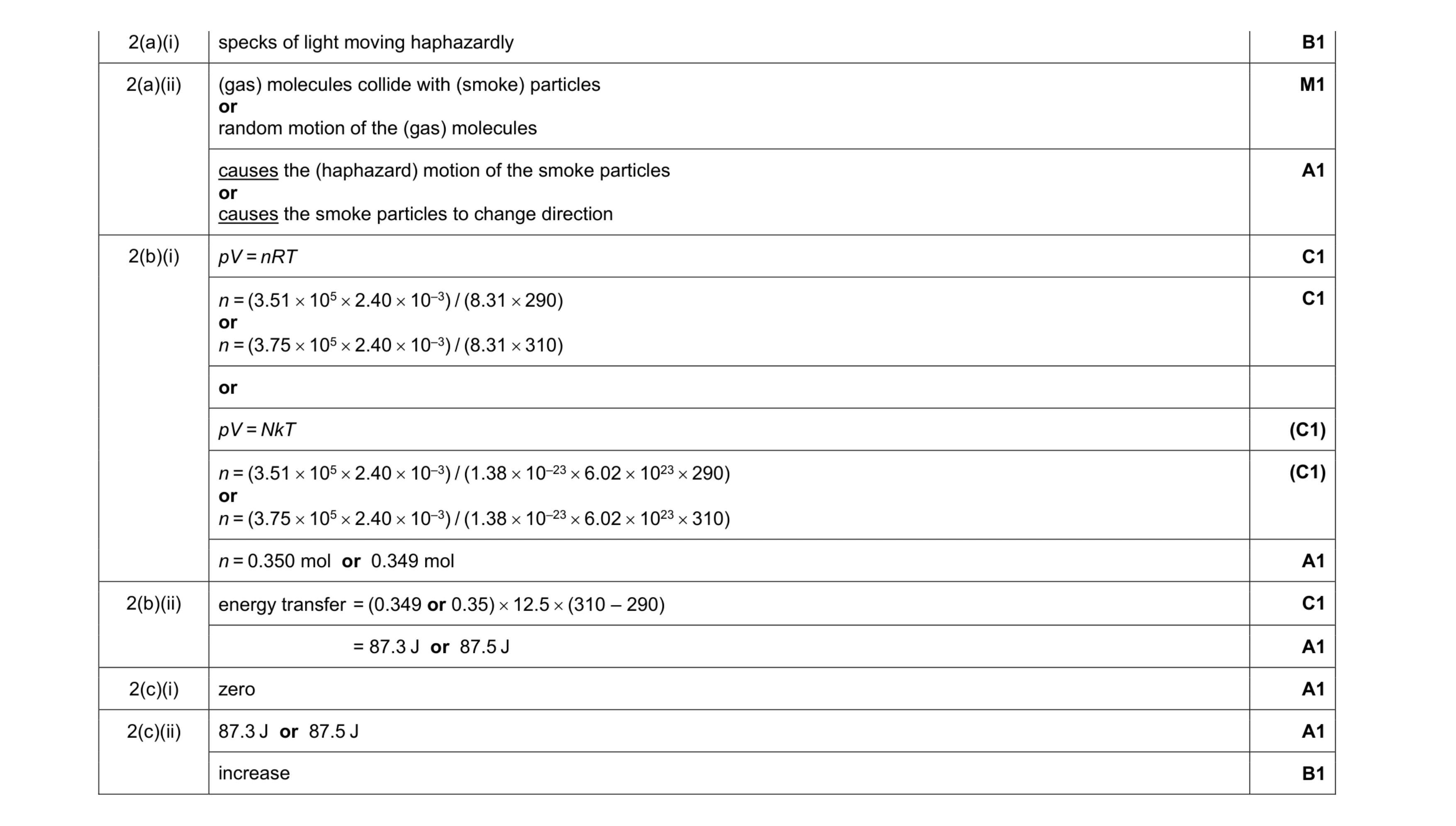 11
11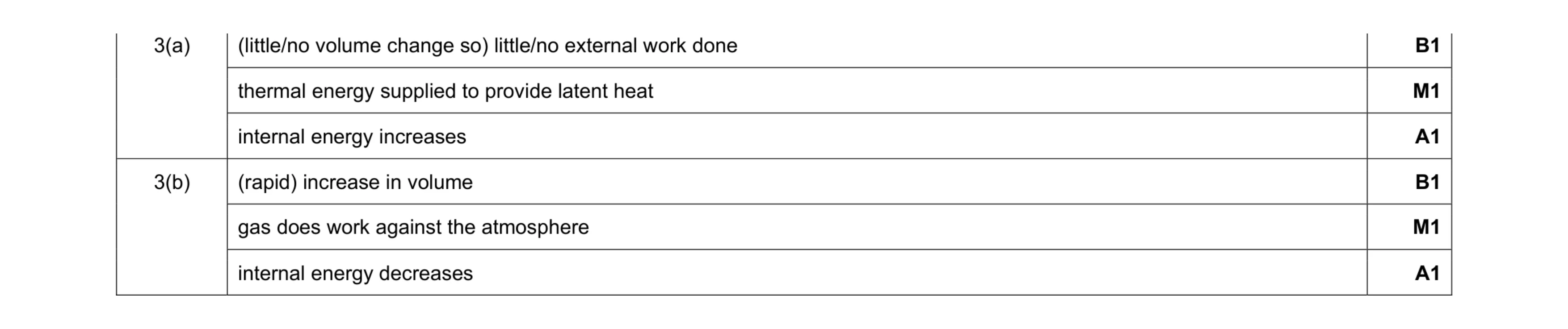 6
6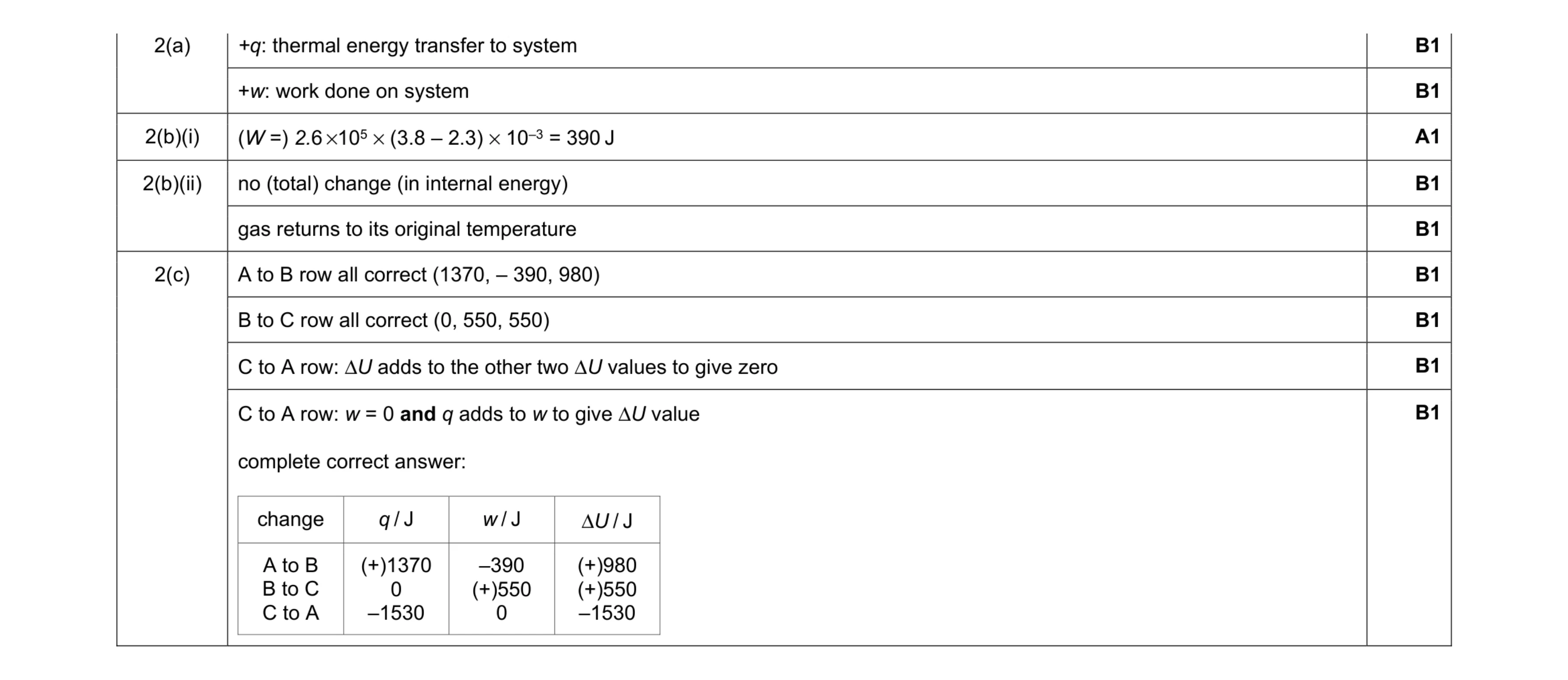 9
9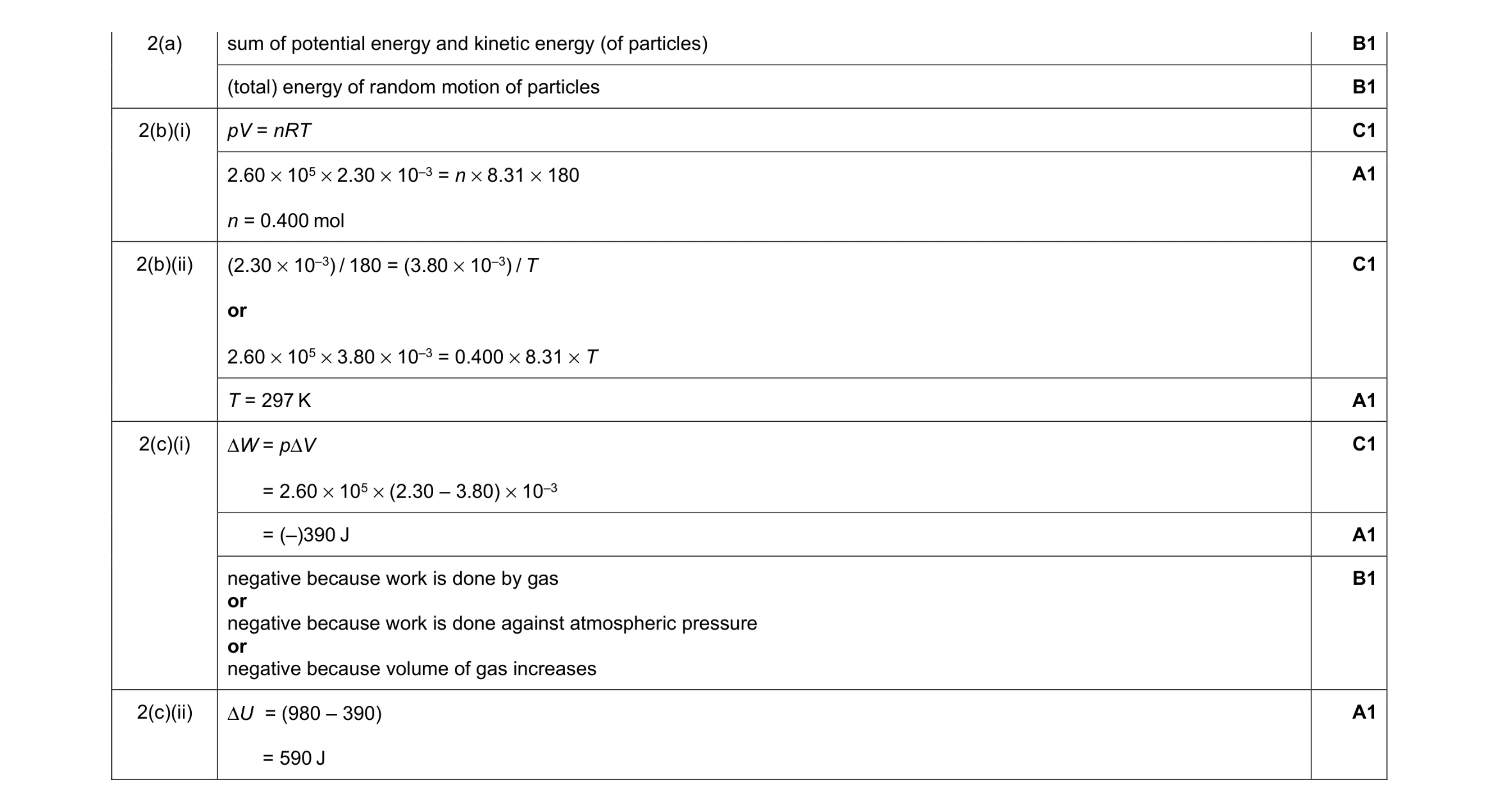 10
10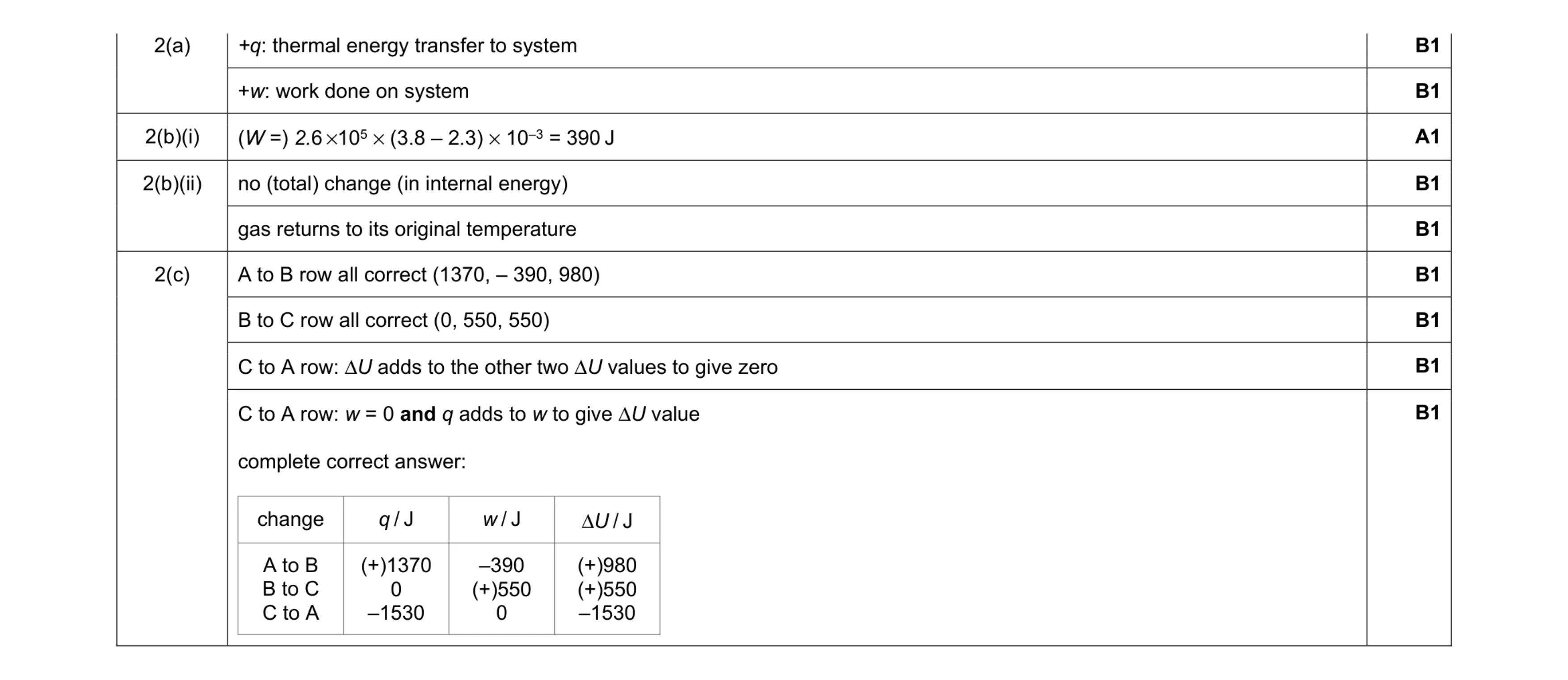 9
9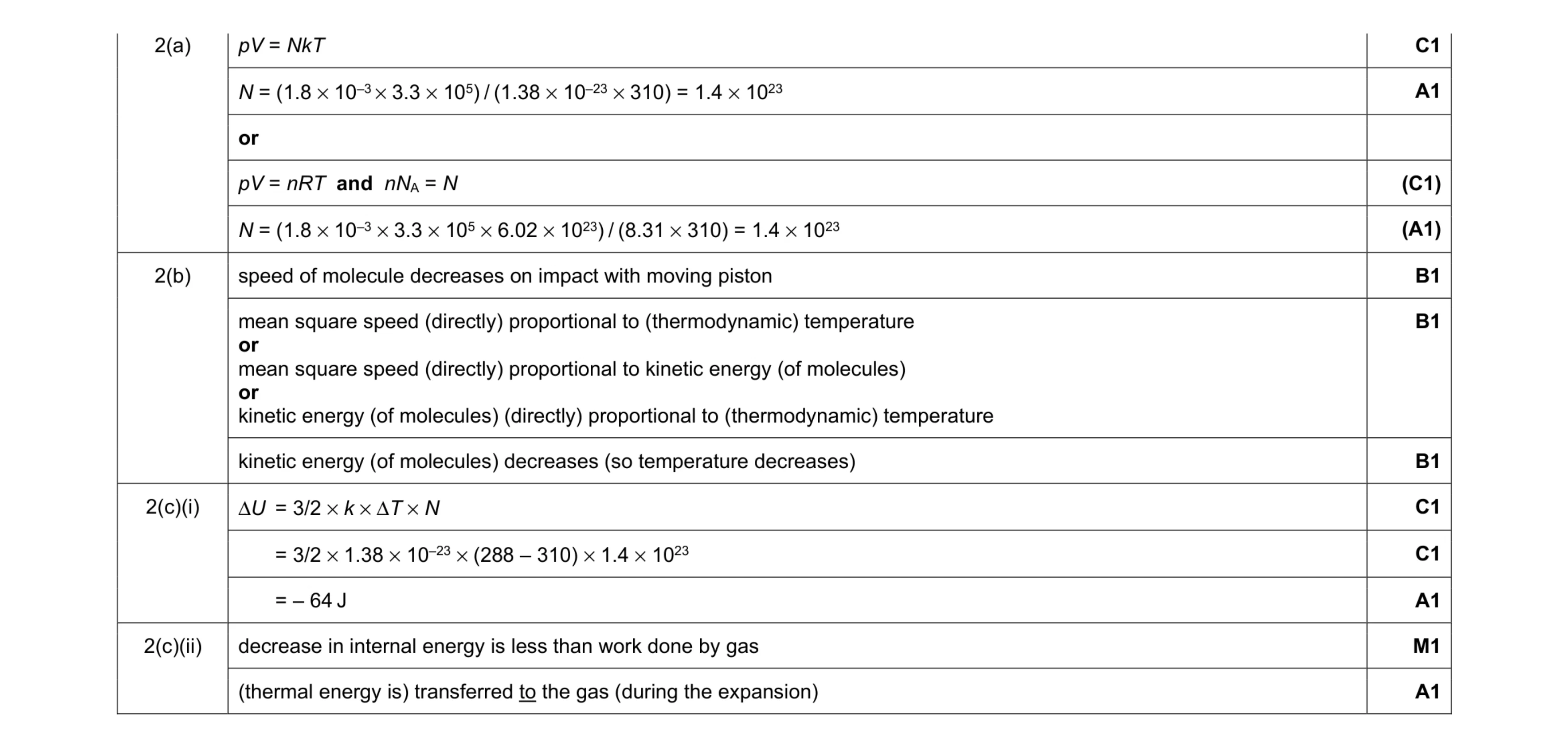 10
10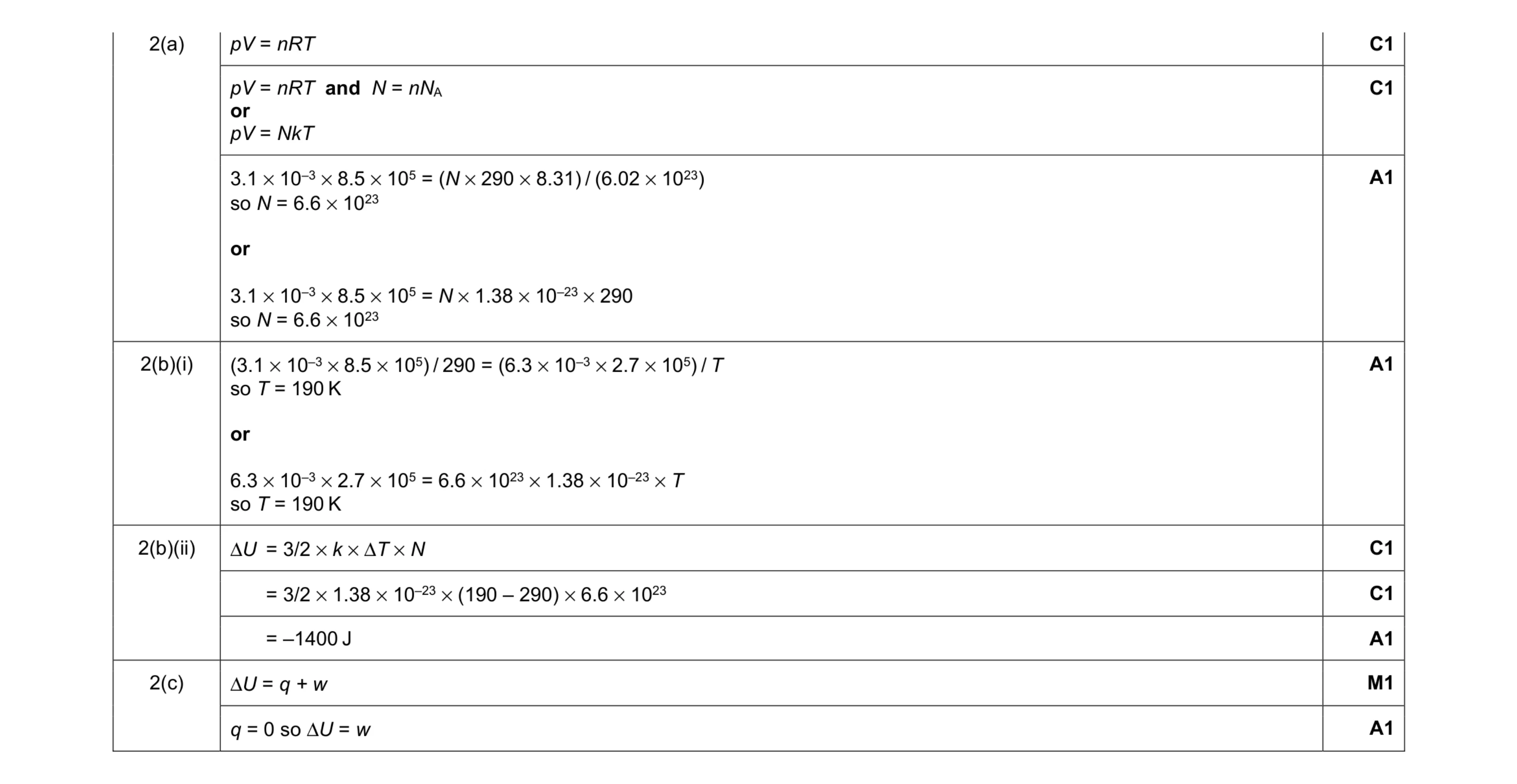 9
9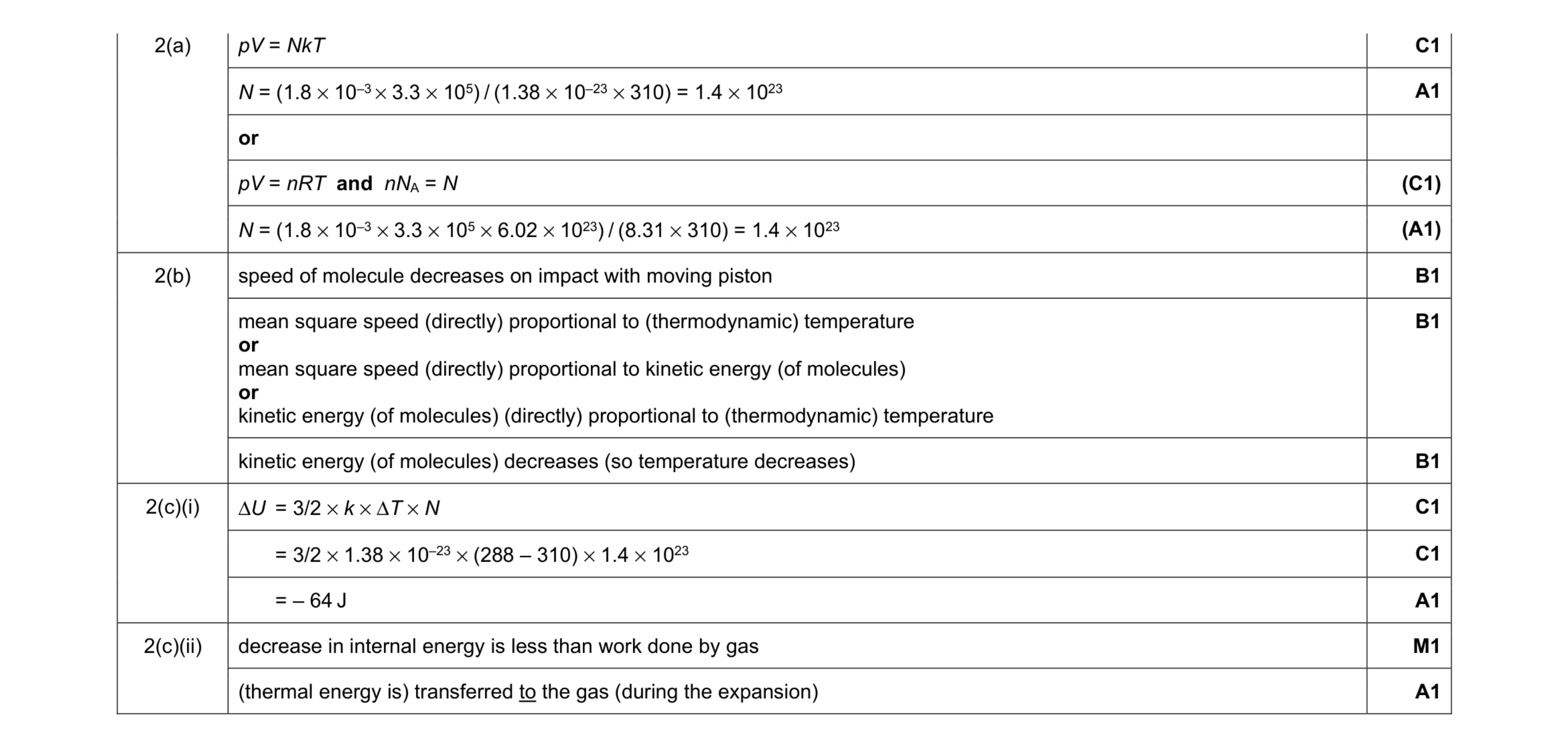 10
10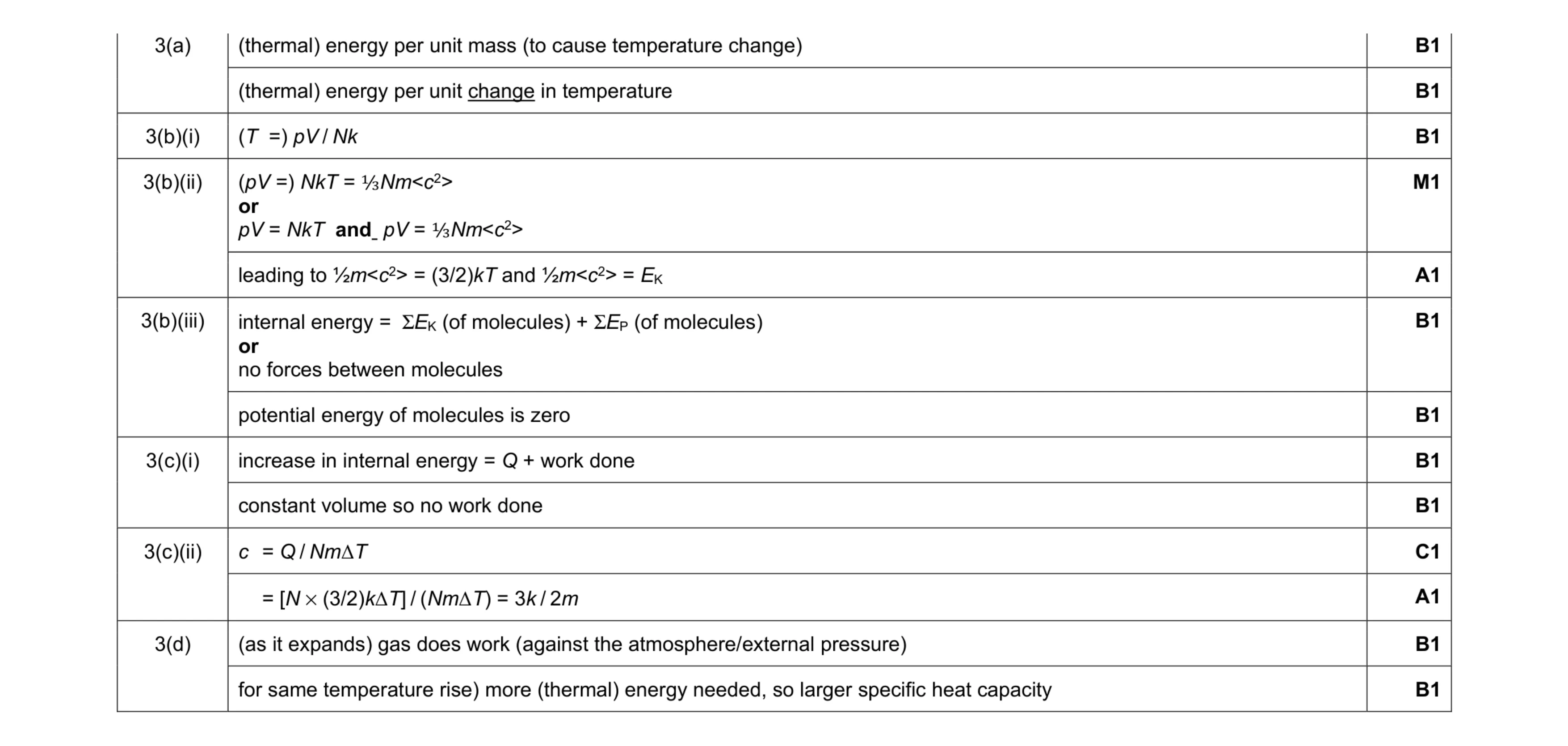 13
13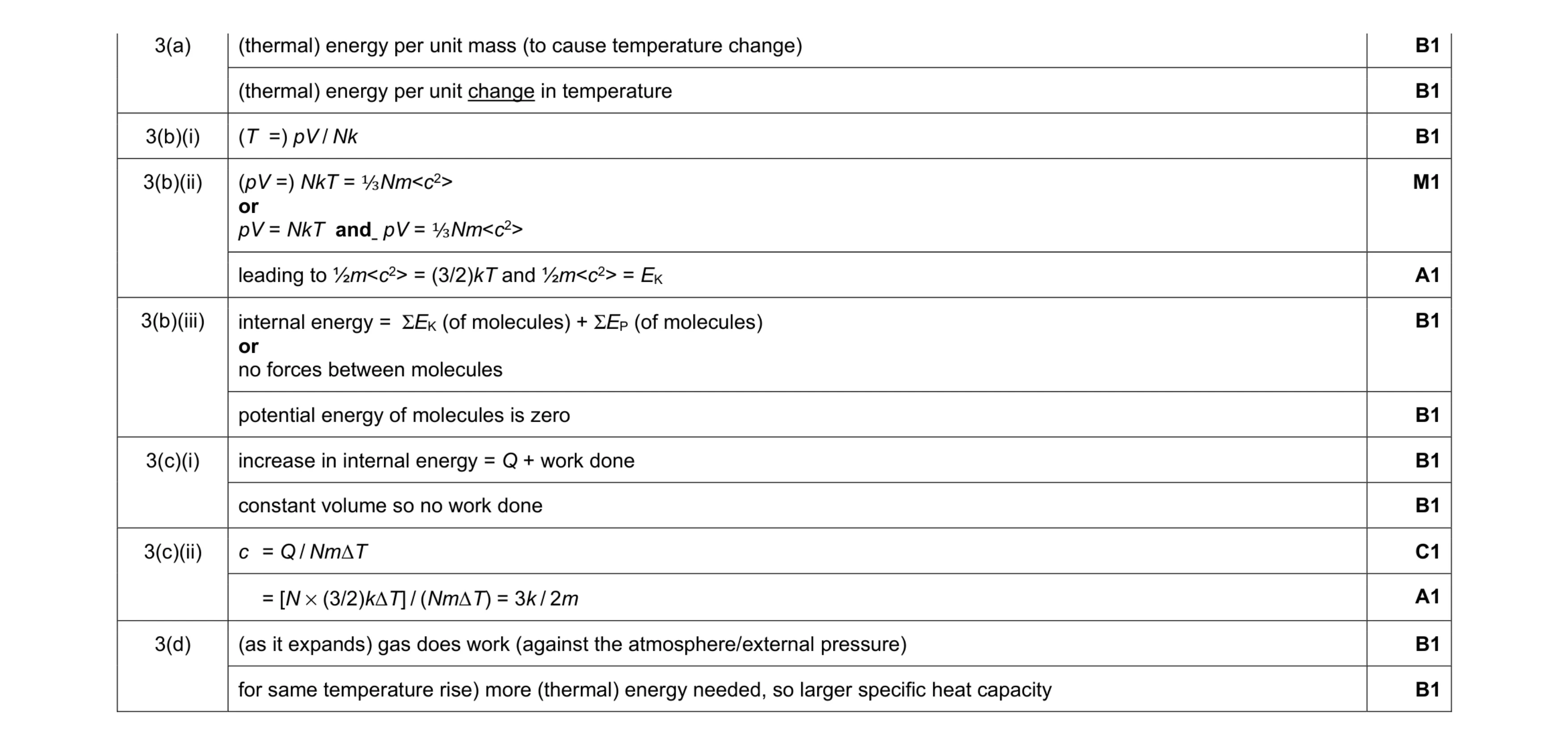 13
13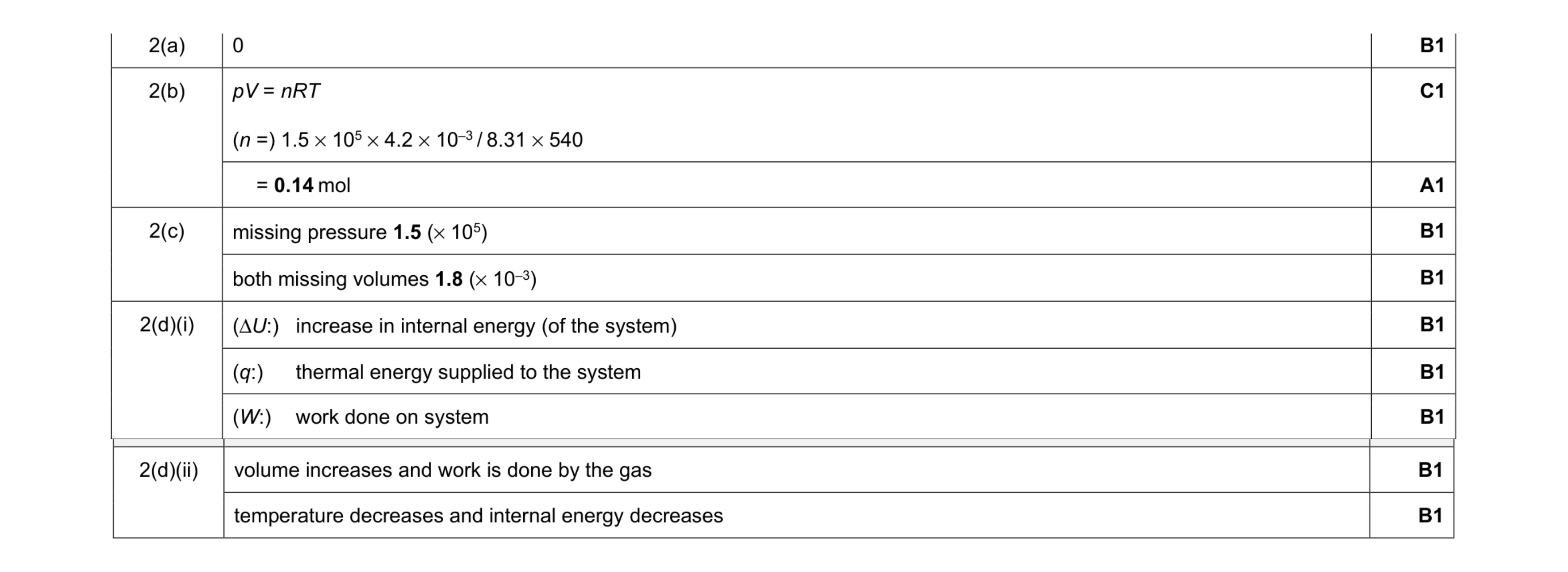 10
10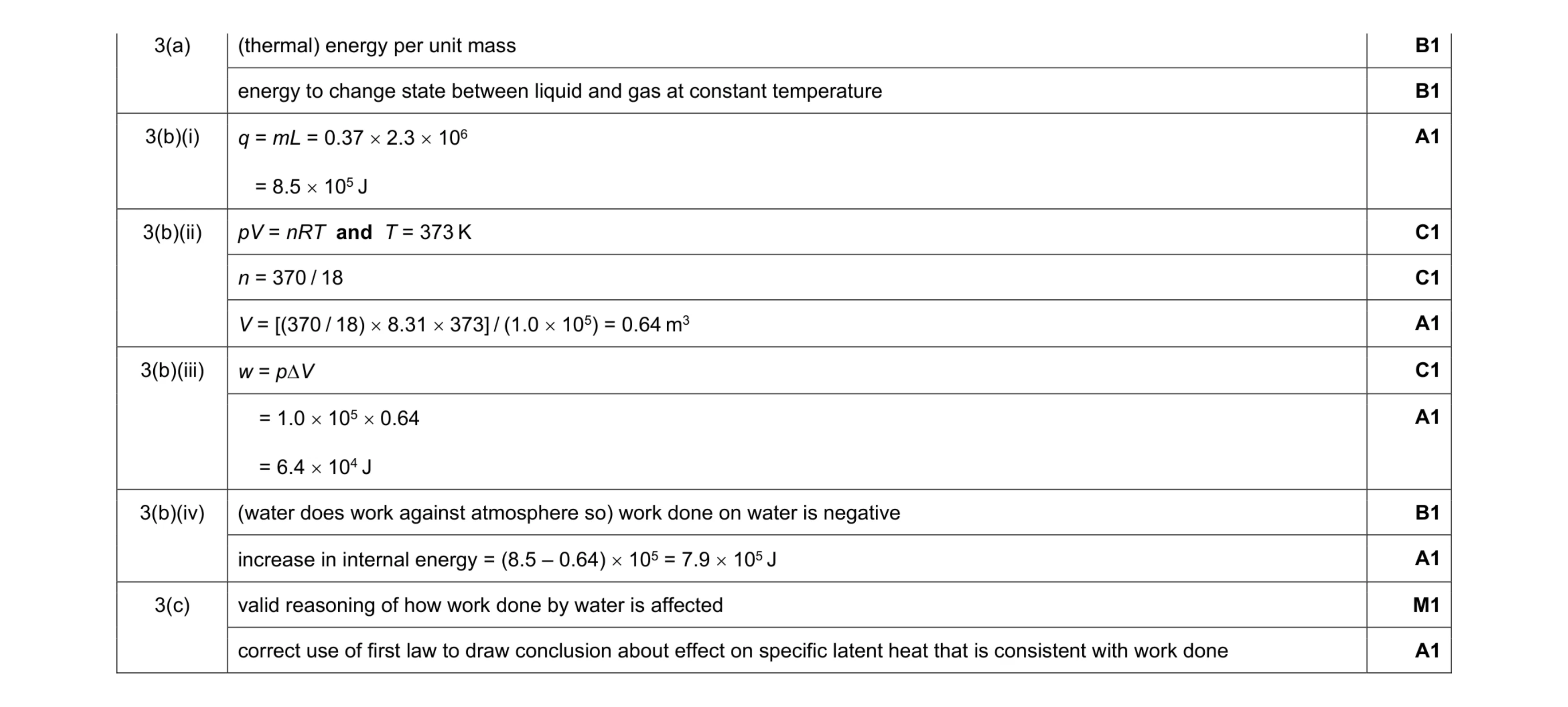 12
12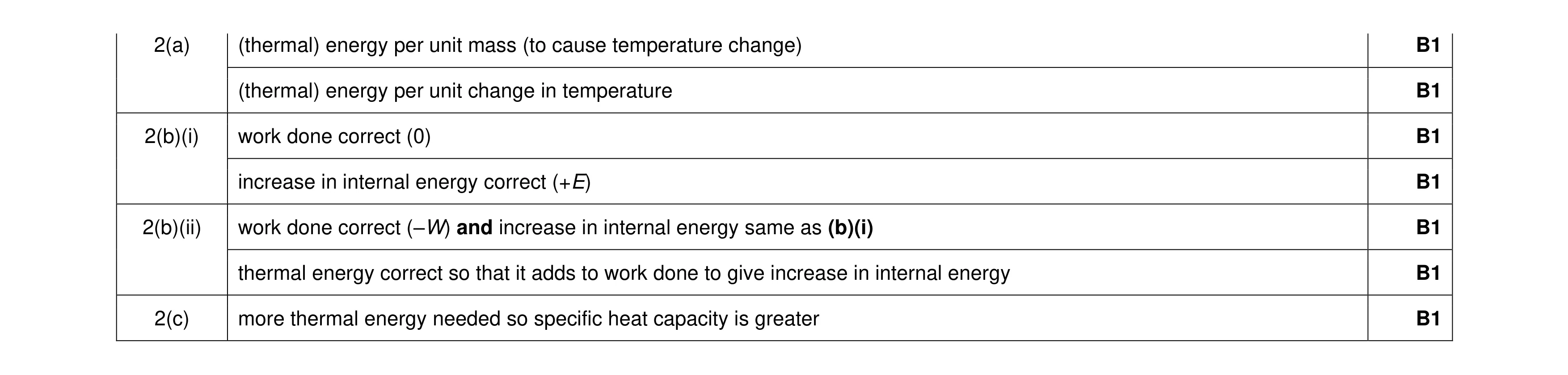 7
7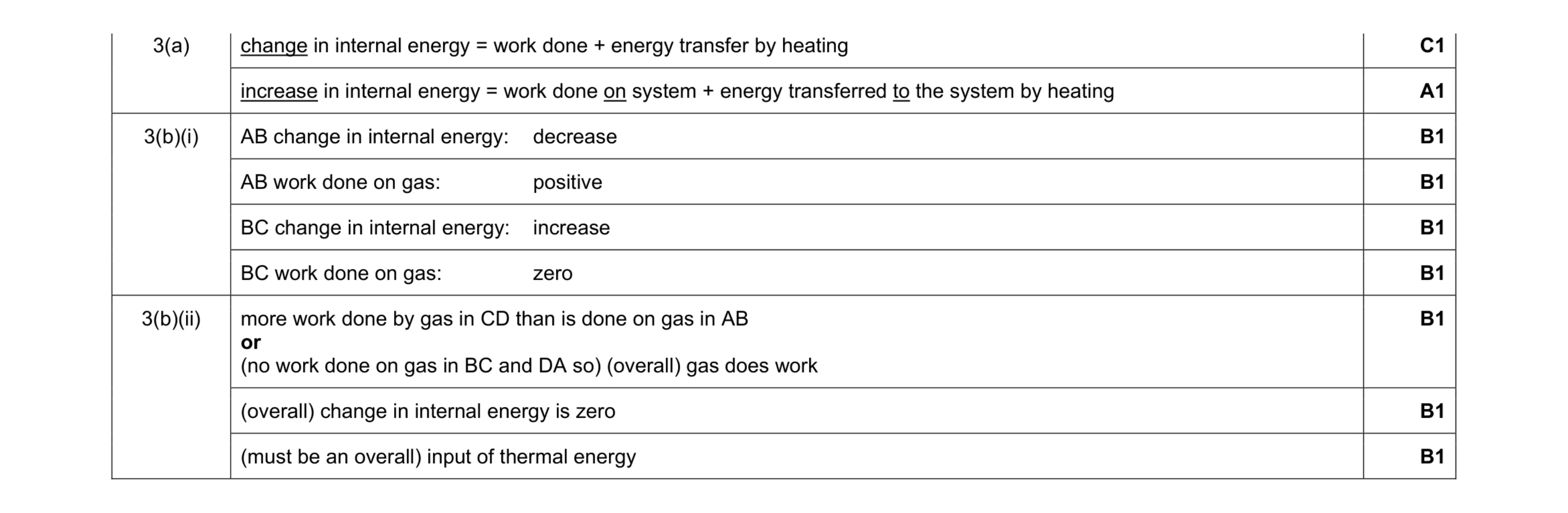 9
9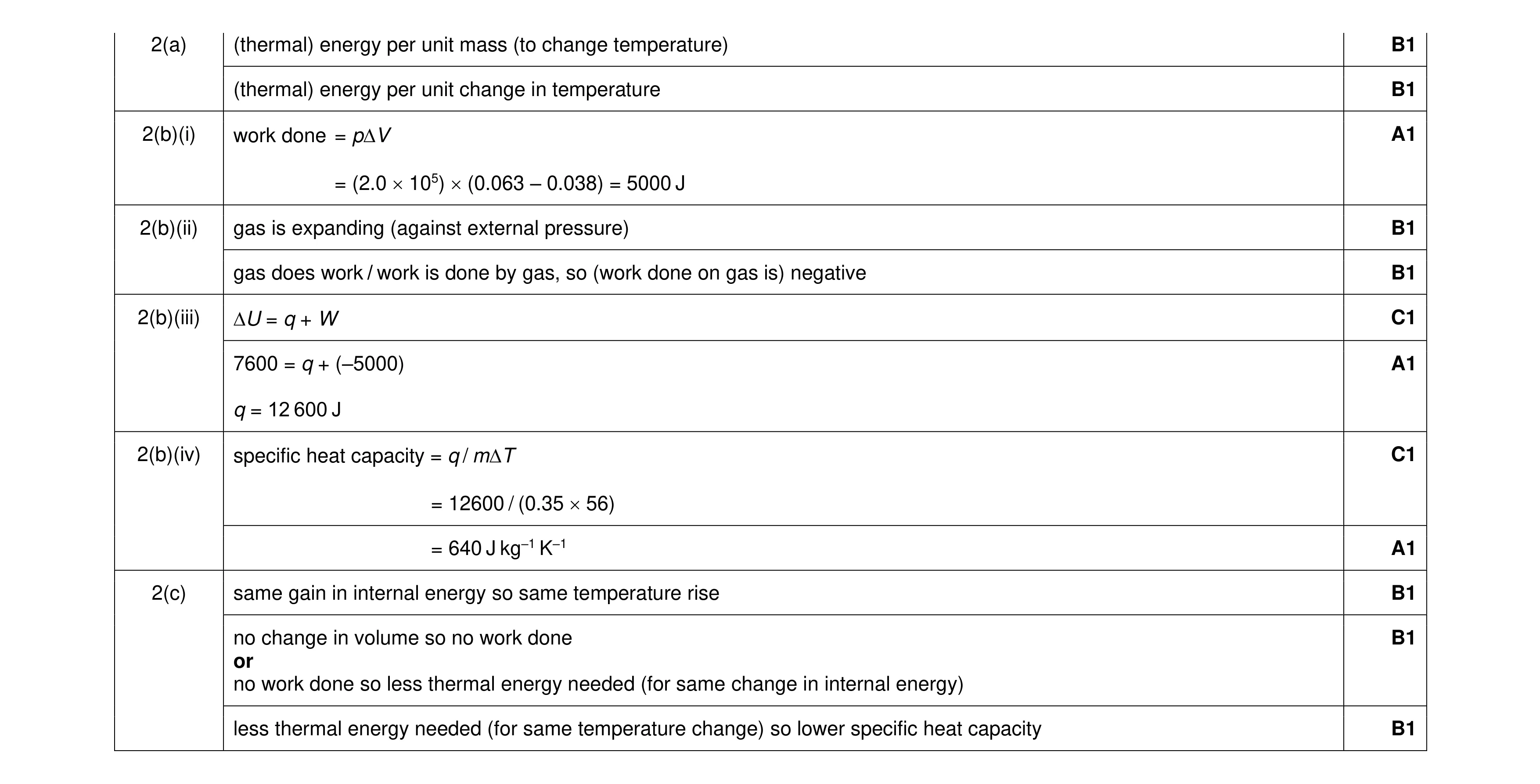 12
12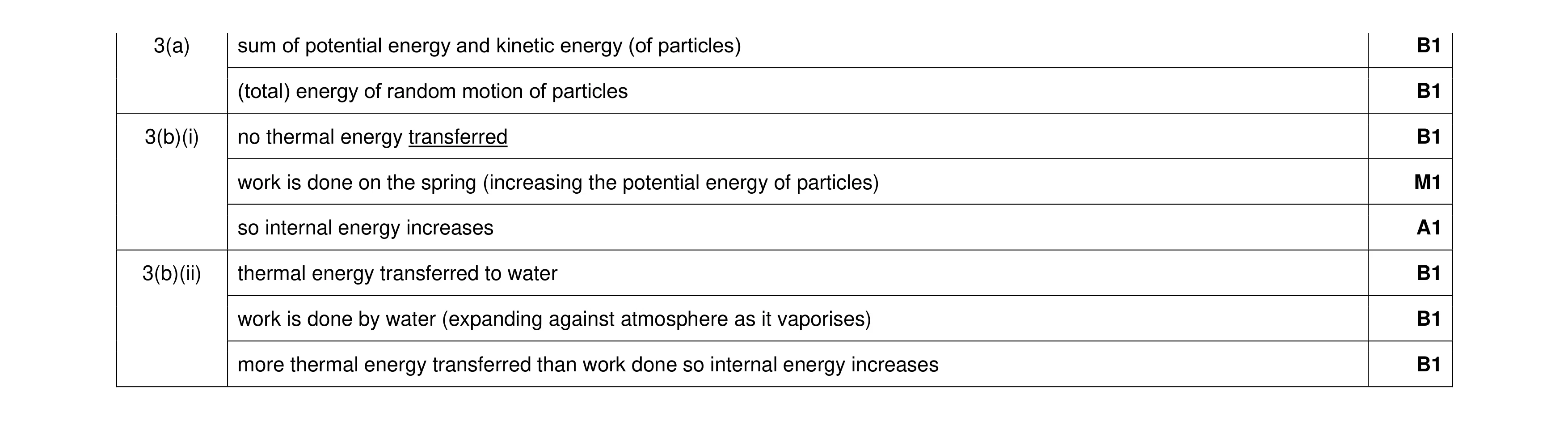 8
8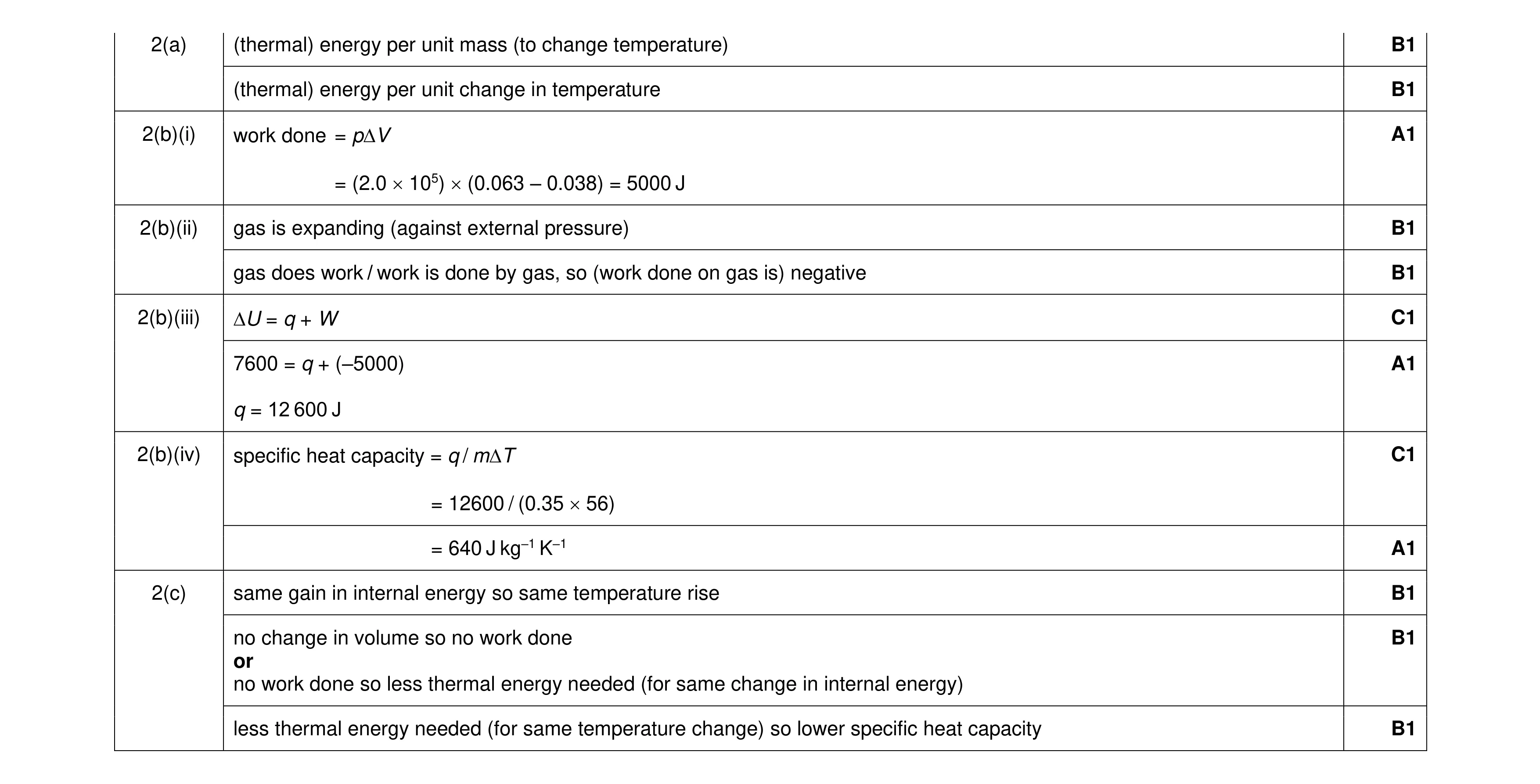 12
12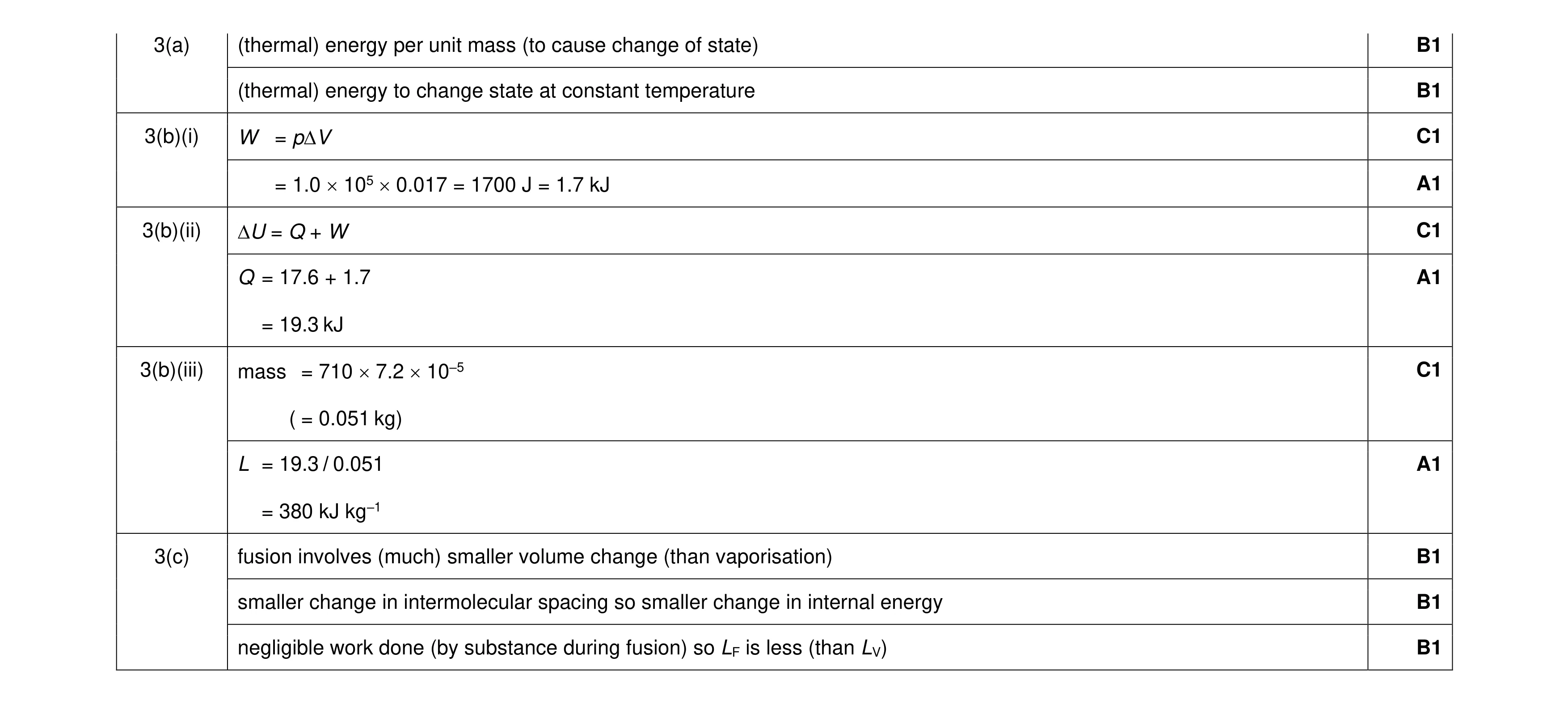 11
11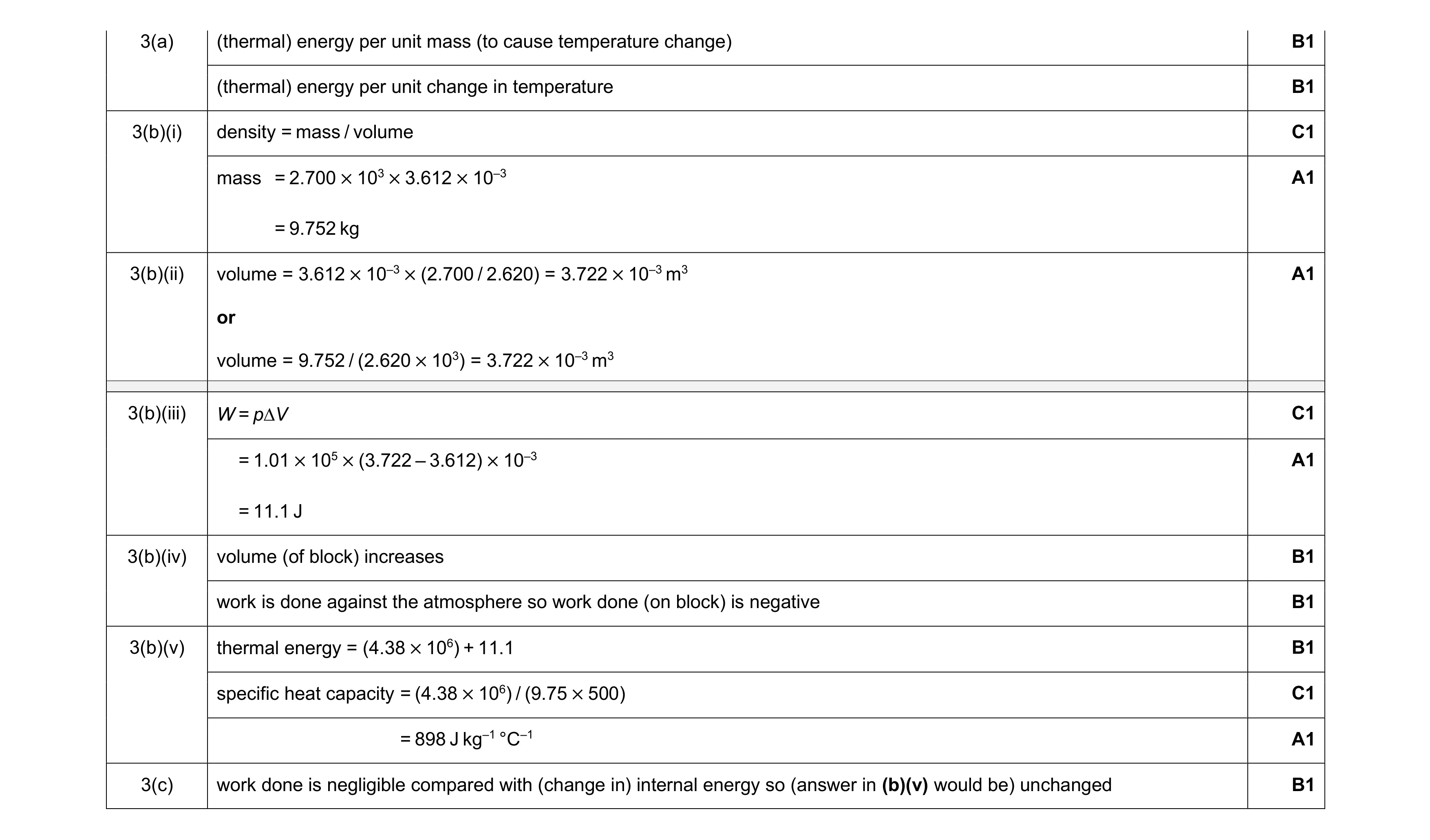 13
13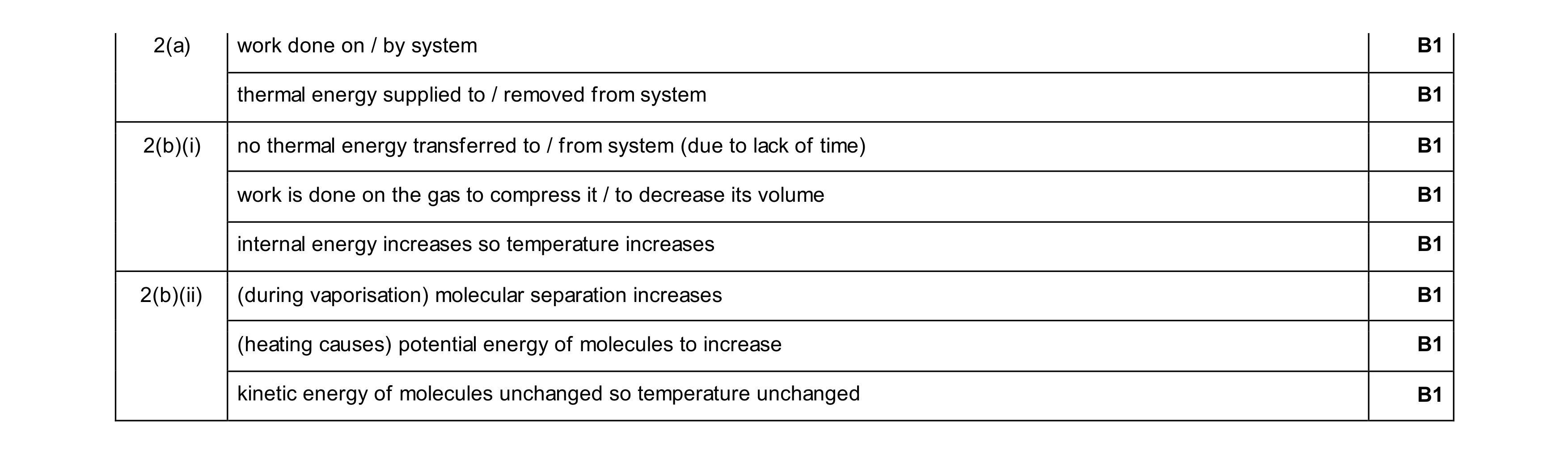 8
8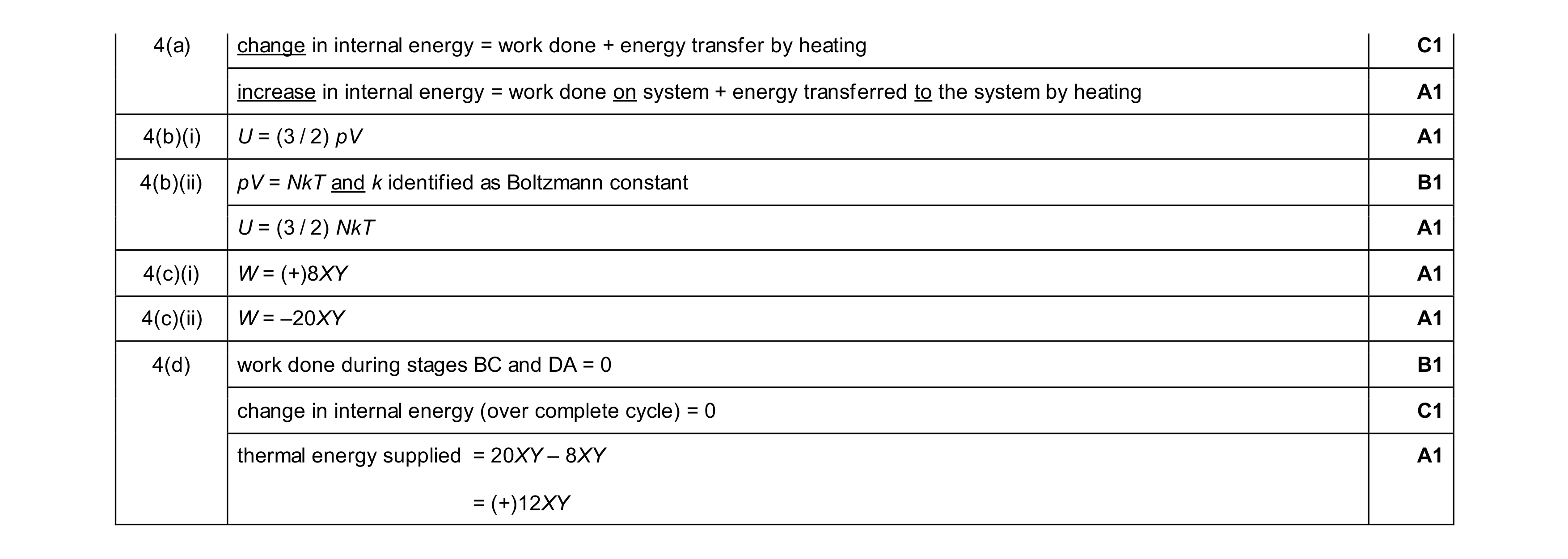 10
10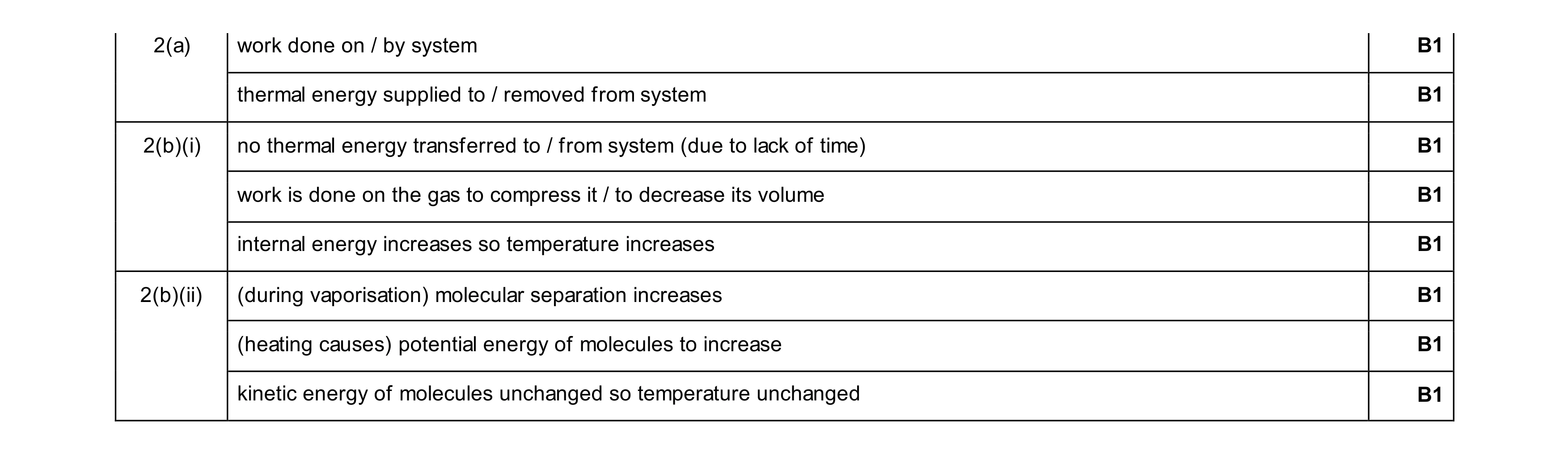 8
8