Cambridge A Level Physics 9702 — 2023 Oct/Nov Paper 4 · Variant 2
9702/42/O/N/23 · 10 questions · 100 marks · ≈113 min
The question paper and its mark scheme, free to read here and free to download. This is Cambridge’s own paper, exactly as it was sat.
Question paper24 pages
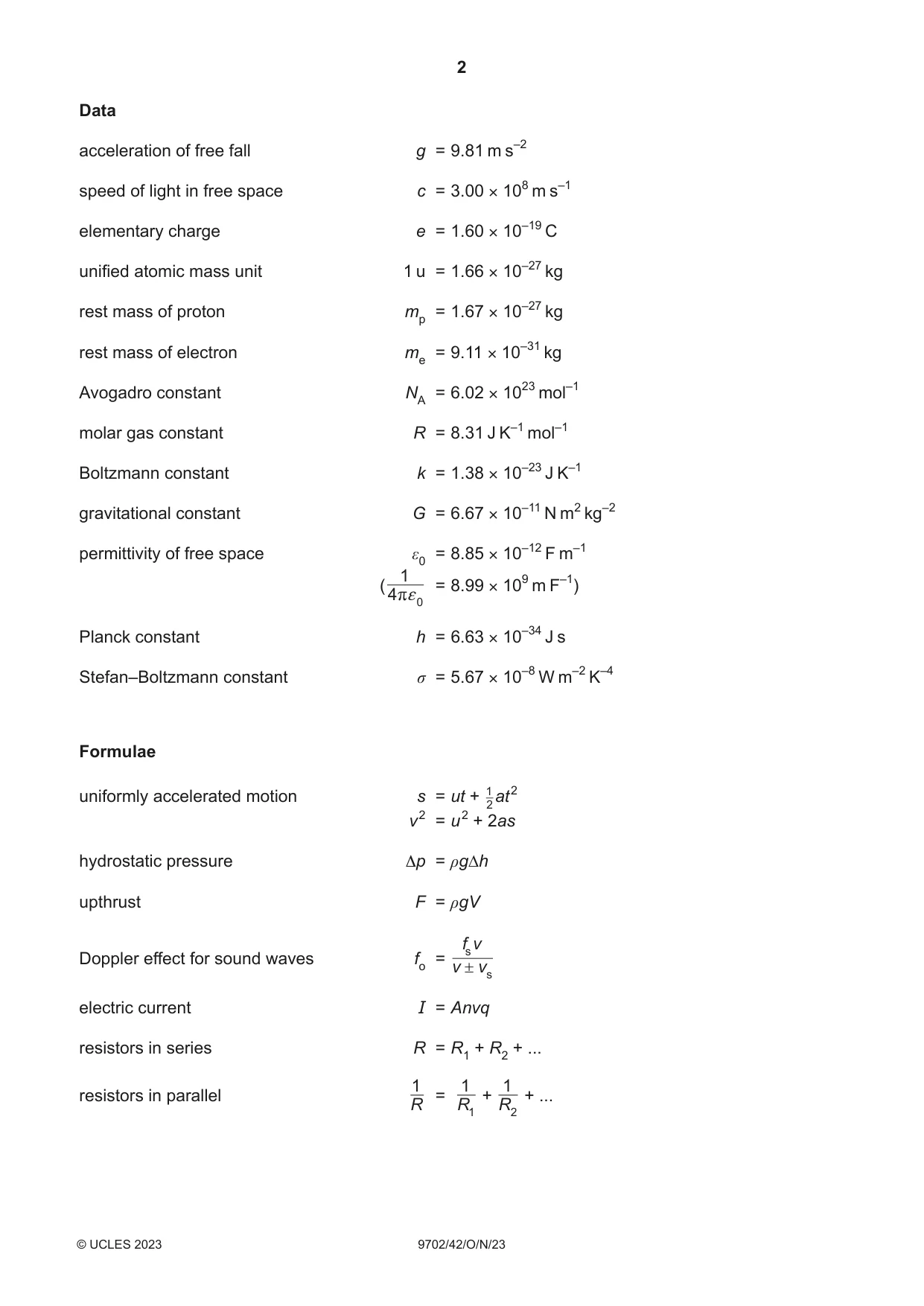
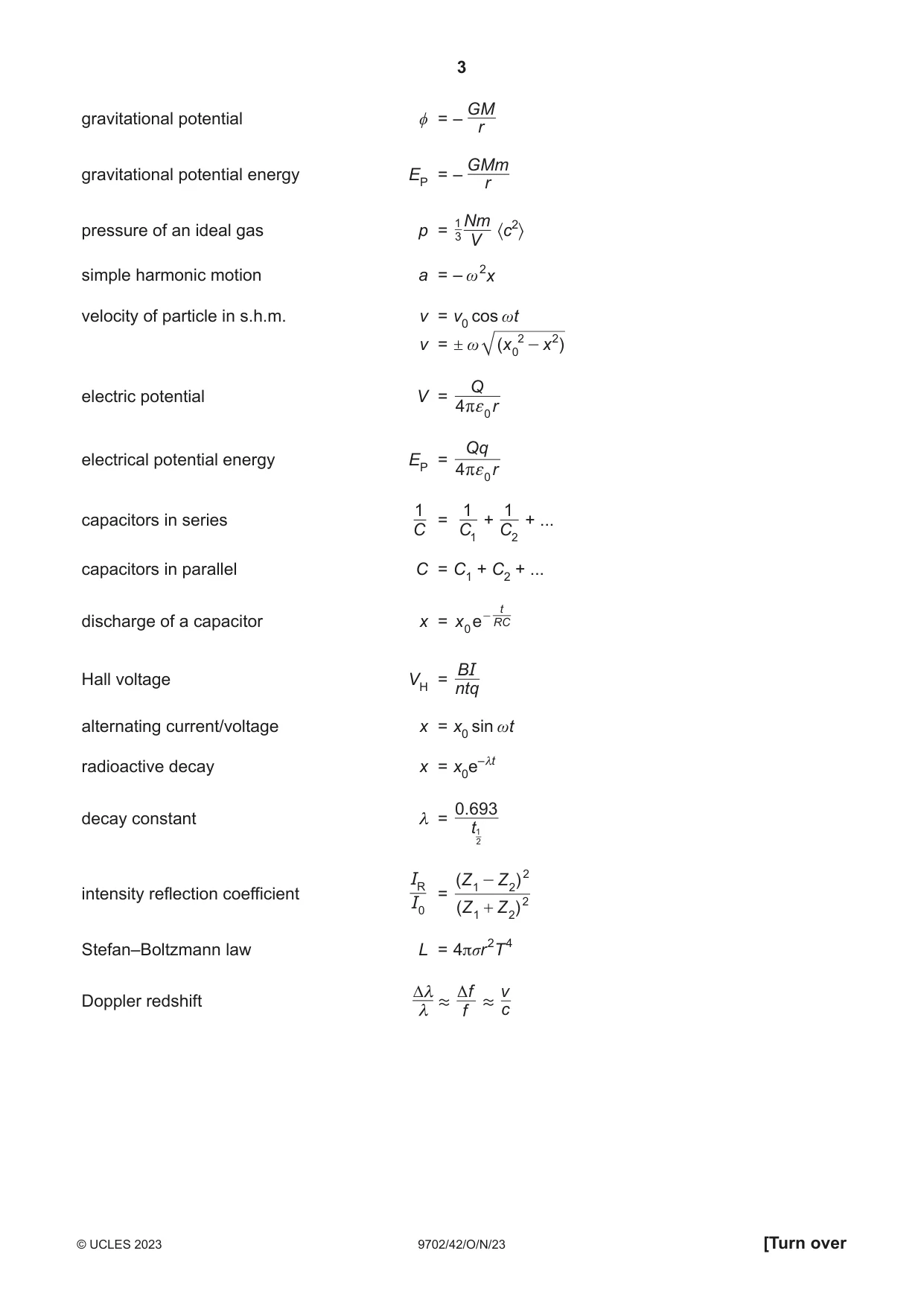




Mark scheme15 pages
Answers below. Sit the paper first if you are practising.
Questions as text
Question 1
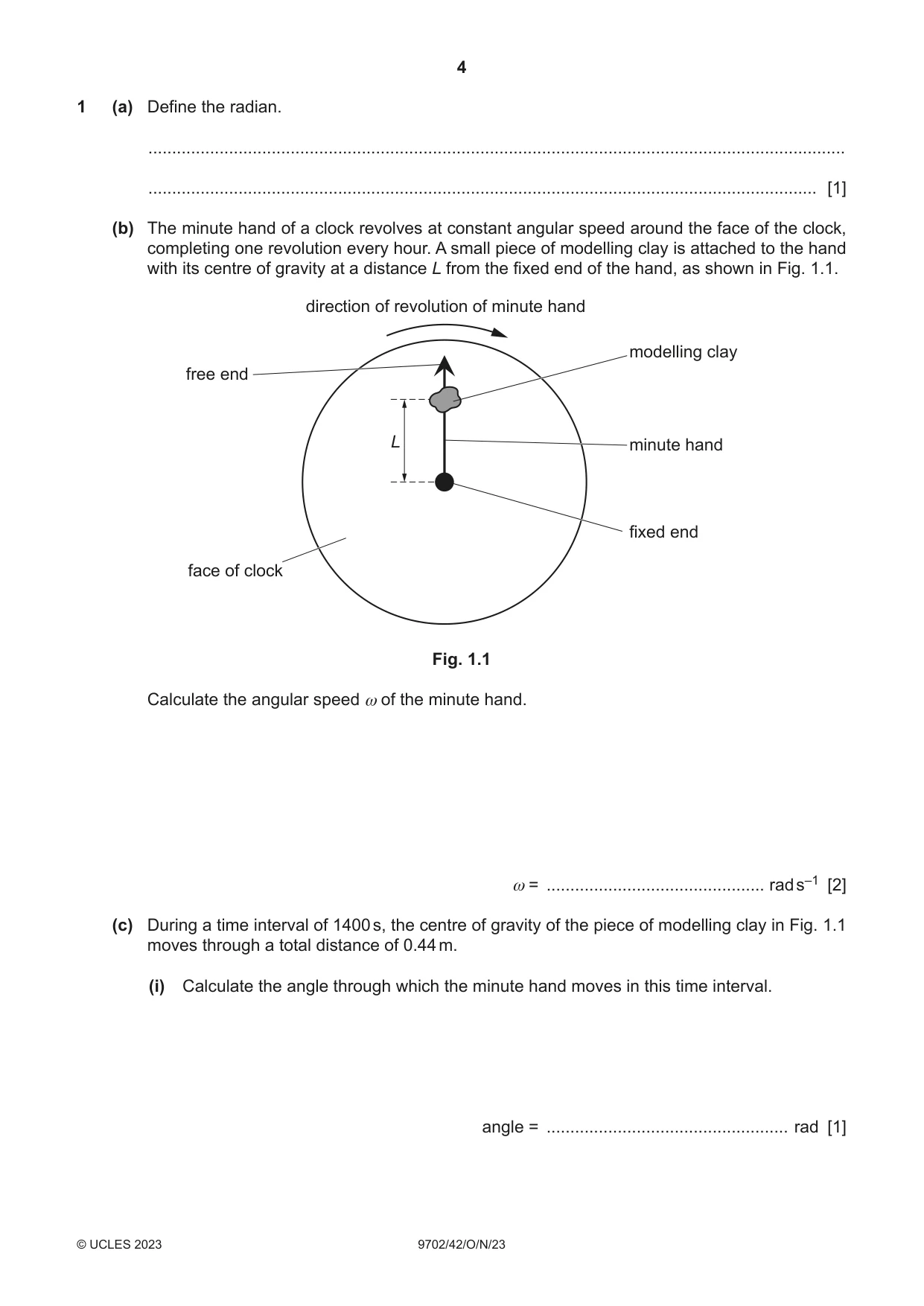
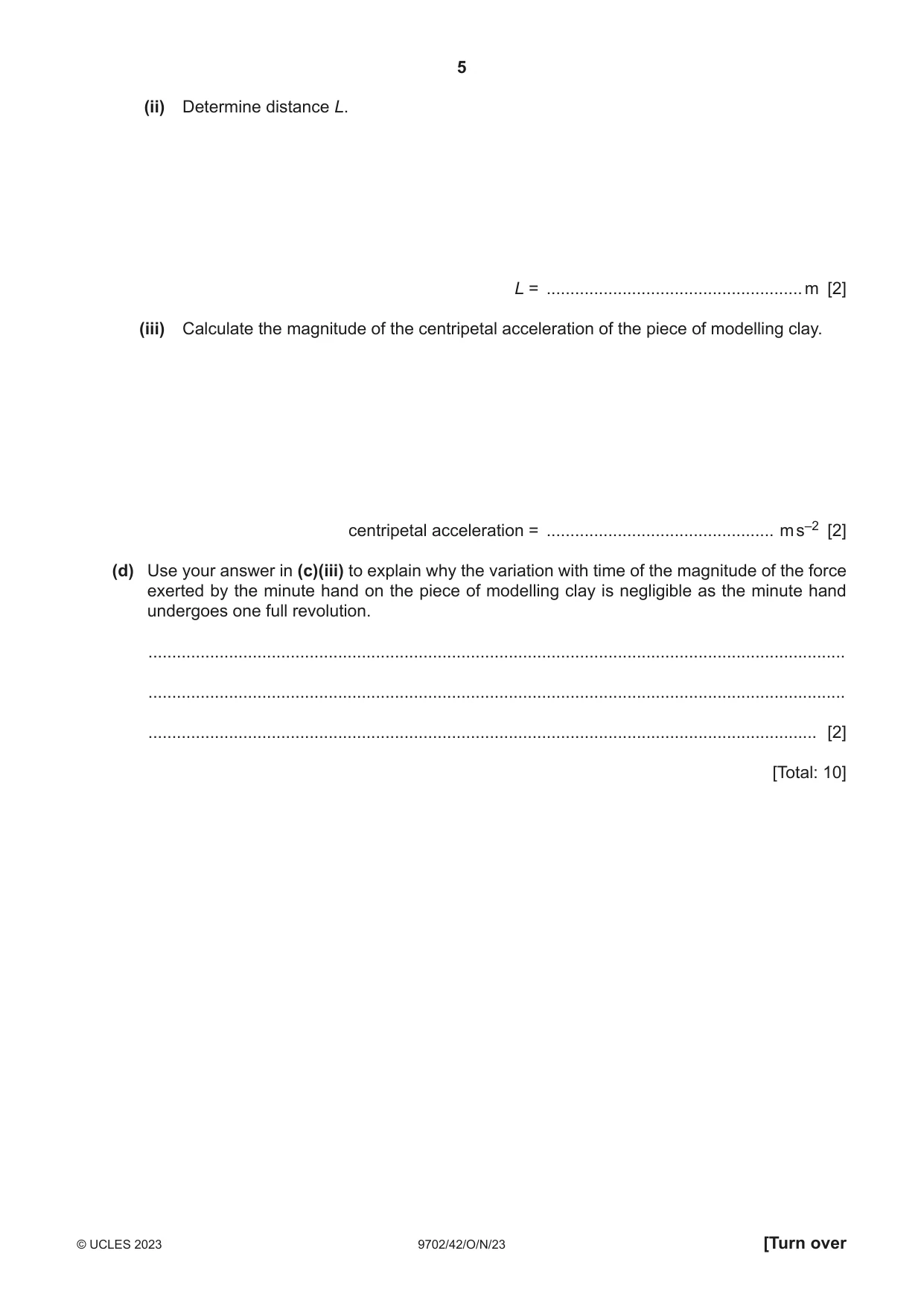
1 (a) Define the radian. ................................................................................................................................................... ............................................................................................................................................. [1] (b) The minute hand of a clock revolves at constant angular speed around the face of the clock, completing one revolution every hour. A small piece of modelling clay is attached to the hand with its centre of gravity at a distance L from the fixed end of the hand, as shown in Fig. 1.1. direction of revolution of minute hand modelling clay free end L minute hand fixed end face of clock Fig. 1.1 Calculate the angular speed ω of the minute hand. ω = .............................................. rad s–1 [2] (c) During a time interval of 1400 s, the centre of gravity of the piece of modelling clay in Fig. 1.1 moves through a total distance of 0.44 m. (i) Calculate the angle through which the minute hand moves in this time interval. angle = ................................................... rad [1] (ii) Determine distance L. L = ...................................................... m [2] (iii) Calculate the magnitude of the centripetal acceleration of the piece of modelling clay. centripetal acceleration = ................................................ m s–2 [2] (d) Use your answer in (c)(iii) to explain why the variation with time of the magnitude of the force exerted by the minute hand on the piece of modelling clay is negligible as the minute hand undergoes one full revolution. ................................................................................................................................................... ................................................................................................................................................... ............................................................................................................................................. [2] [Total: 10]
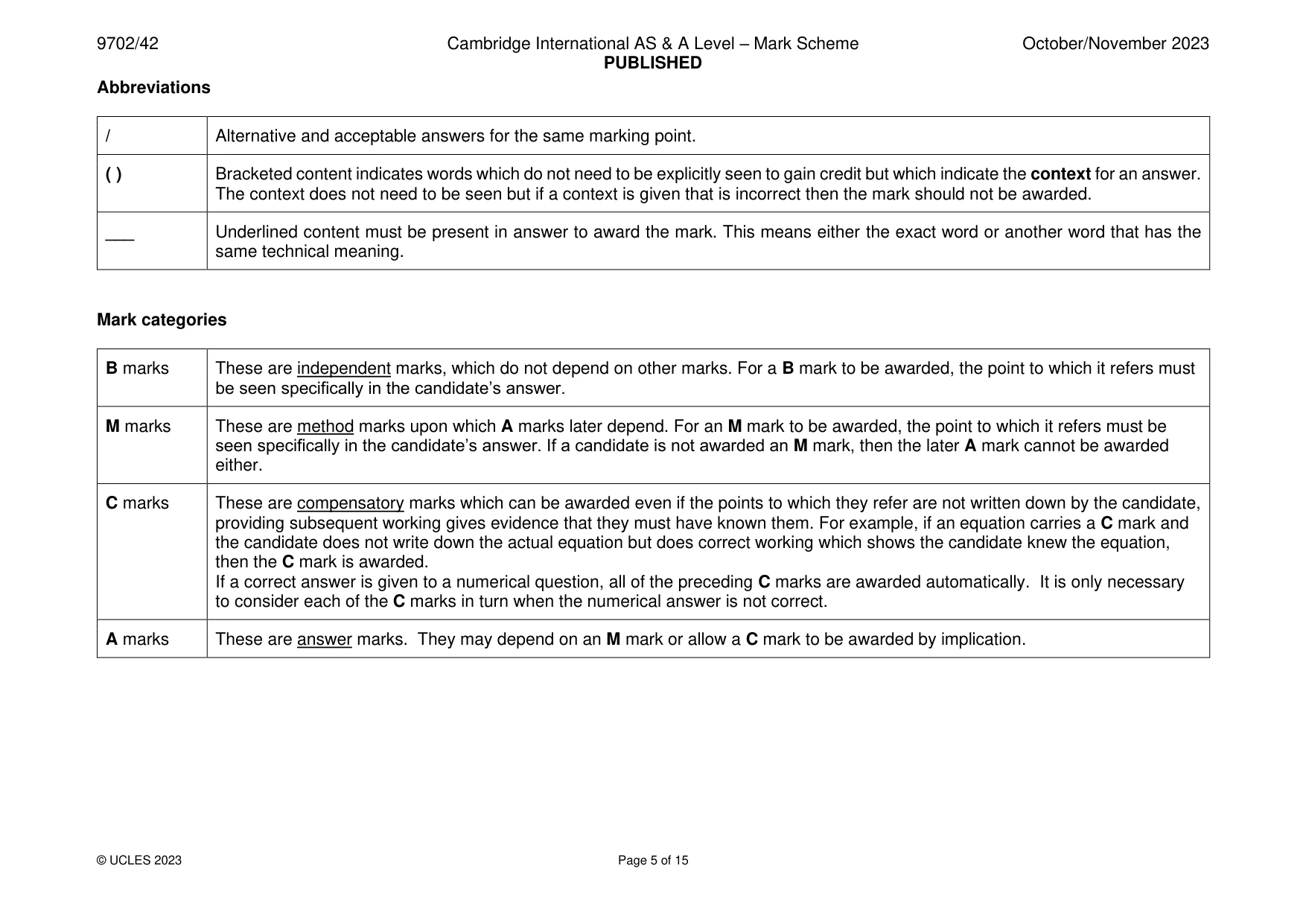
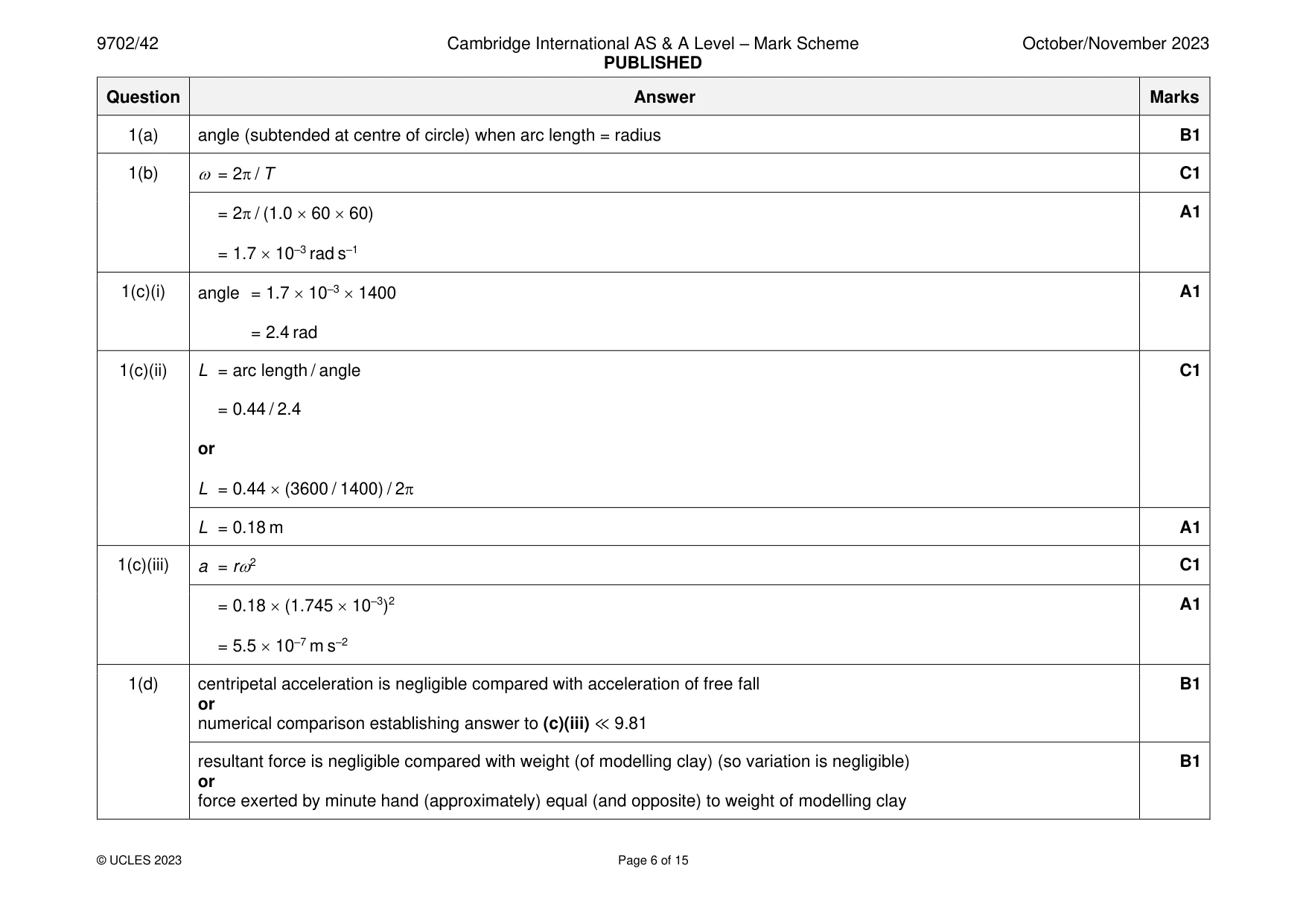
Mark scheme: Question Answer Marks 1(a) angle (subtended at centre of circle) when arc length = radius B1 1(b) = 2 / T C1 = 2 / (1.0 60 60) A1 = 1.7 10–3 rad s–1 1(c)(i) angle = 1.7 10–3 1400 A1 = 2.4 rad 1(c)(ii) L = arc length / angle C1 = 0.44 / 2.4 or L = 0.44 (3600 / 1400) / 2 L = 0.18 m A1 1(c)(iii) a = r2 C1 = 0.18 (1.745 10–3)2 A1 = 5.5 10–7 m s–2 1(d) centripetal acceleration is negligible compared with acceleration of free fall B1 or numerical comparison establishing answer to (c)(iii) ≪ 9.81 resultant force is negligible compared with weight (of modelling clay) (so variation is negligible) B1 or force exerted by minute hand (approximately) equal (and opposite) to weight of modelling clay
Q2 · Define gravitational potential at a point
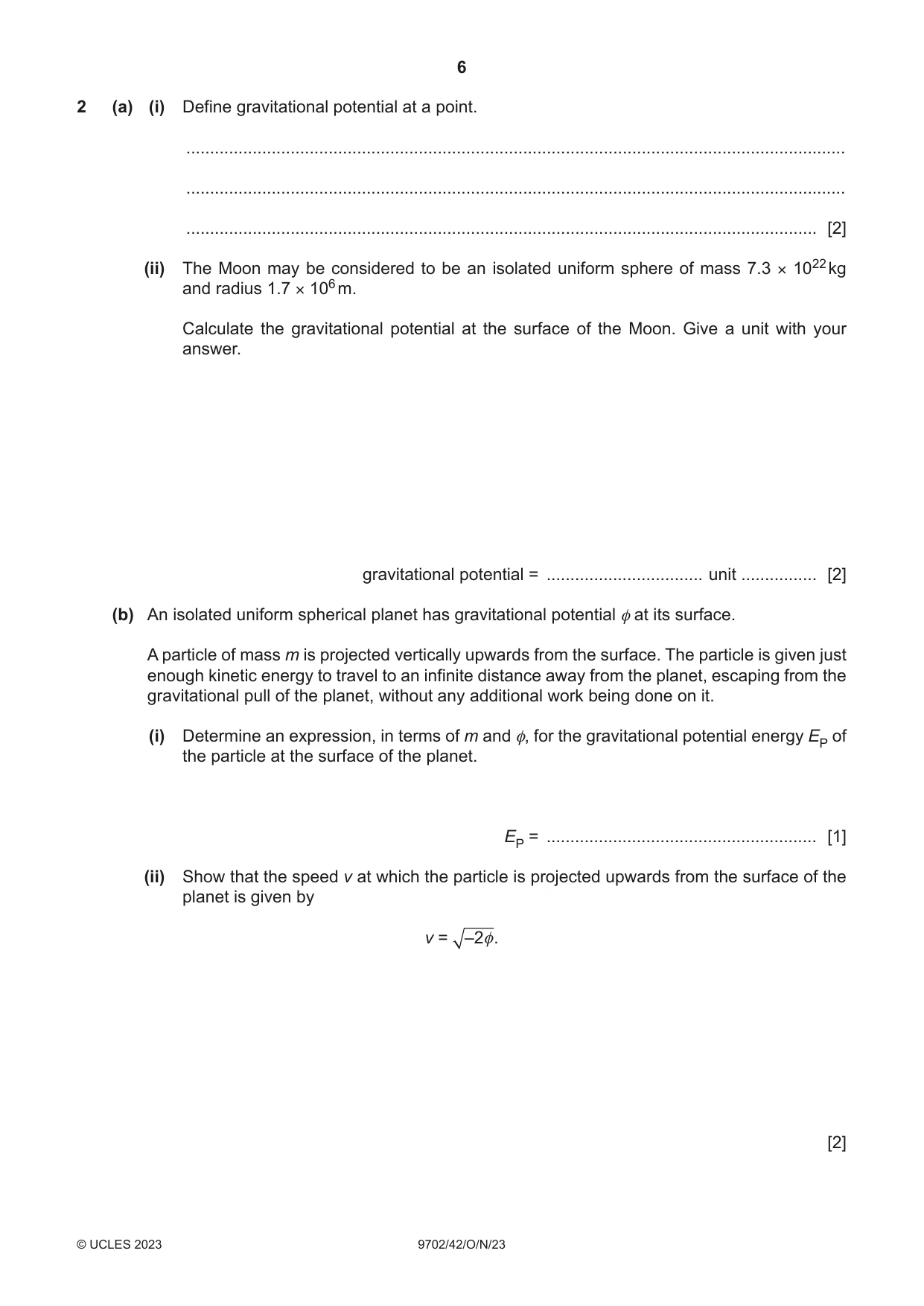
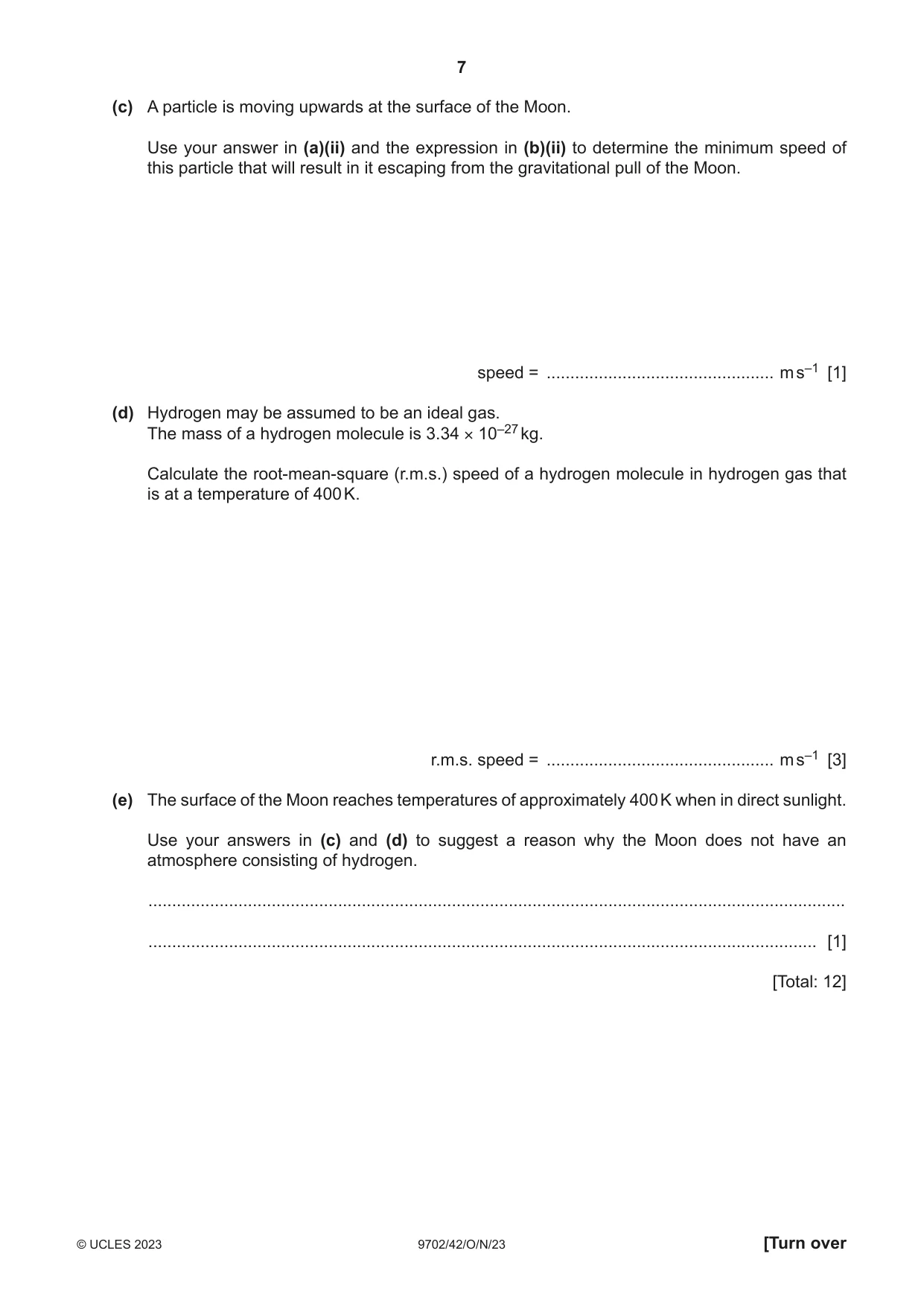
2 (a) (i) Define gravitational potential at a point. ........................................................................................................................................... ........................................................................................................................................... ..................................................................................................................................... [2] (ii) The Moon may be considered to be an isolated uniform sphere of mass 7.3 × 10²² kg and radius 1.7 × 10⁶ m. Calculate the gravitational potential at the surface of the Moon. Give a unit with your answer. gravitational potential = ................................. unit ................ [2] (b) An isolated uniform spherical planet has gravitational potential φ at its surface. A particle of mass m is projected vertically upwards from the surface. The particle is given just enough kinetic energy to travel to an infinite distance away from the planet, escaping from the gravitational pull of the planet, without any additional work being done on it. (i) Determine an expression, in terms of m and φ, for the gravitational potential energy EP of the particle at the surface of the planet. EP = ......................................................... [1] (ii) Show that the speed v at which the particle is projected upwards from the surface of the planet is given by v = –2φ. [2] (c) A particle is moving upwards at the surface of the Moon. Use your answer in (a)(ii) and the expression in (b)(ii) to determine the minimum speed of this particle that will result in it escaping from the gravitational pull of the Moon. speed = ................................................ m s–1 [1] (d) Hydrogen may be assumed to be an ideal gas. The mass of a hydrogen molecule is 3.34 × 10⁻²⁷ kg. Calculate the root-mean-square (r.m.s.) speed of a hydrogen molecule in hydrogen gas that is at a temperature of 400 K. r.m.s. speed = ................................................ m s–1 [3] (e) The surface of the Moon reaches temperatures of approximately 400 K when in direct sunlight. Use your answers in (c) and (d) to suggest a reason why the Moon does not have an atmosphere consisting of hydrogen. ................................................................................................................................................... ............................................................................................................................................. [1] [Total: 12]
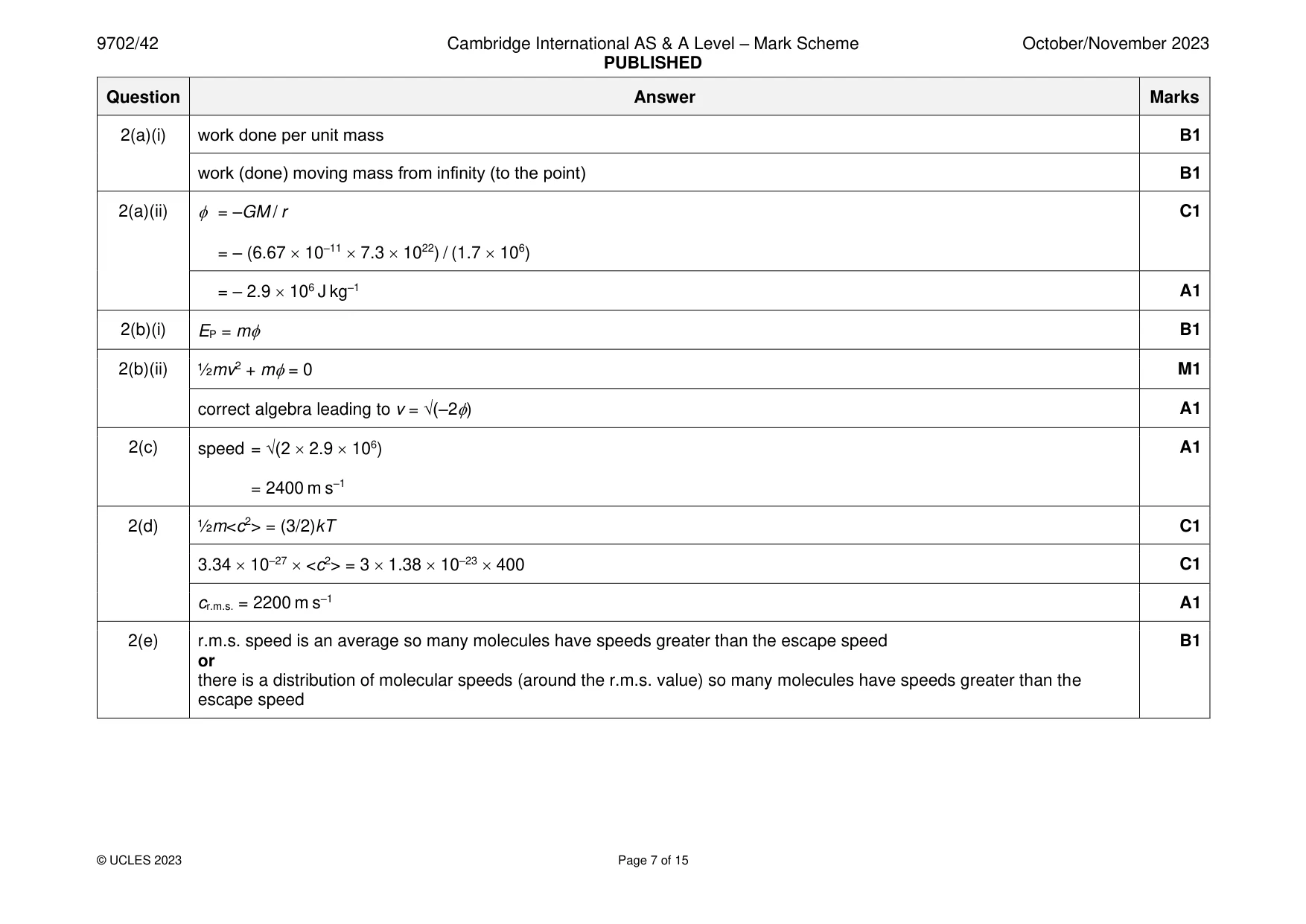
Mark scheme: 2(a)(i) work done per unit mass B1 work (done) moving mass from infinity (to the point) B1 2(a)(ii) = –GM / r C1 = – (6.67 10–11 7.3 1022) / (1.7 106) = – 2.9 106 J kg–1 A1 2(b)(i) EP = m B1 2(b)(ii) ½mv2 + m= 0 M1 correct algebra leading to v = √(–2) A1 2(c) speed = √(2 2.9 106) A1 = 2400 m s–1 2(d) ½m<c2> = (3/2)kT C1 3.34 10–27 <c2> = 3 1.38 10–23 400 C1 cr.m.s. = 2200 m s–1 A1 2(e) r.m.s. speed is an average so many molecules have speeds greater than the escape speed B1 or there is a distribution of molecular speeds (around the r.m.s. value) so many molecules have speeds greater than the escape speed
Q3 · State what is meant by the internal energy of a system
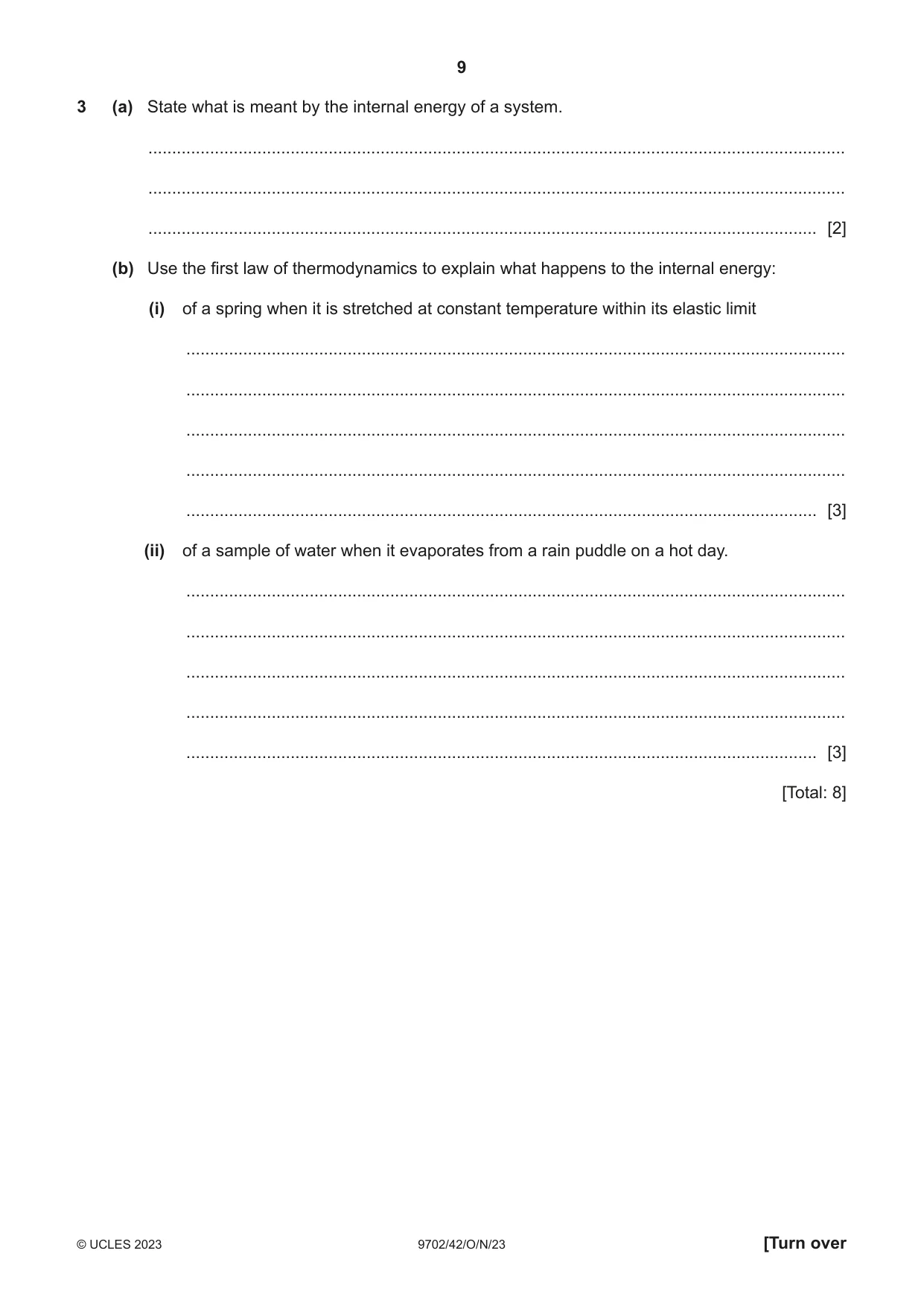
3 (a) State what is meant by the internal energy of a system. ................................................................................................................................................... ................................................................................................................................................... ............................................................................................................................................. [2] (b) Use the first law of thermodynamics to explain what happens to the internal energy: (i) of a spring when it is stretched at constant temperature within its elastic limit ........................................................................................................................................... ........................................................................................................................................... ........................................................................................................................................... ........................................................................................................................................... ..................................................................................................................................... [3] (ii) of a sample of water when it evaporates from a rain puddle on a hot day. ........................................................................................................................................... ........................................................................................................................................... ........................................................................................................................................... ........................................................................................................................................... ..................................................................................................................................... [3] [Total: 8]
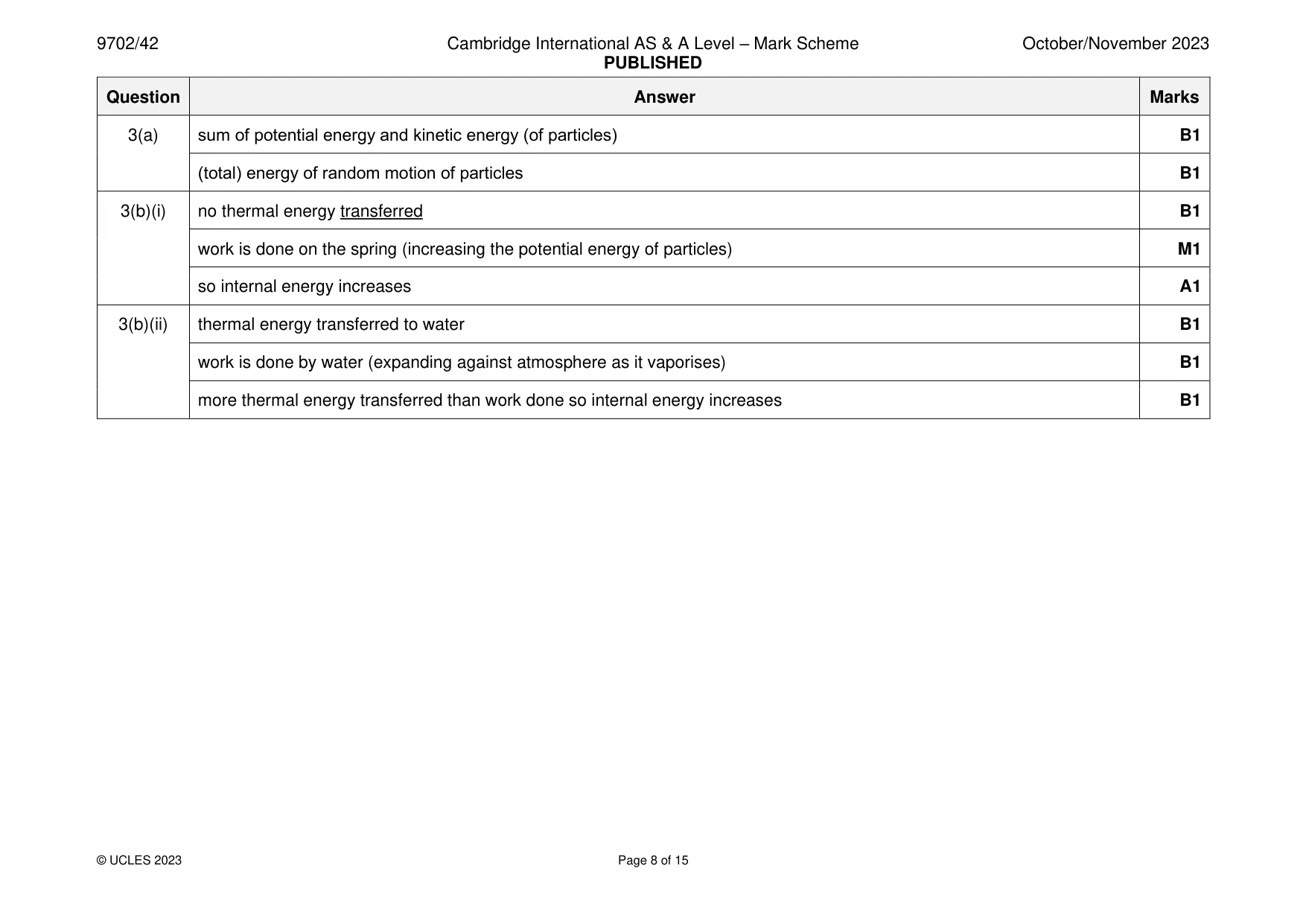
Mark scheme: 3(a) sum of potential energy and kinetic energy (of particles) B1 (total) energy of random motion of particles B1 3(b)(i) no thermal energy transferred B1 work is done on the spring (increasing the potential energy of particles) M1 so internal energy increases A1 3(b)(ii) thermal energy transferred to water B1 work is done by water (expanding against atmosphere as it vaporises) B1 more thermal energy transferred than work done so internal energy increases B1
Q4 · An electron in a metal rod moves randomly about a mean position
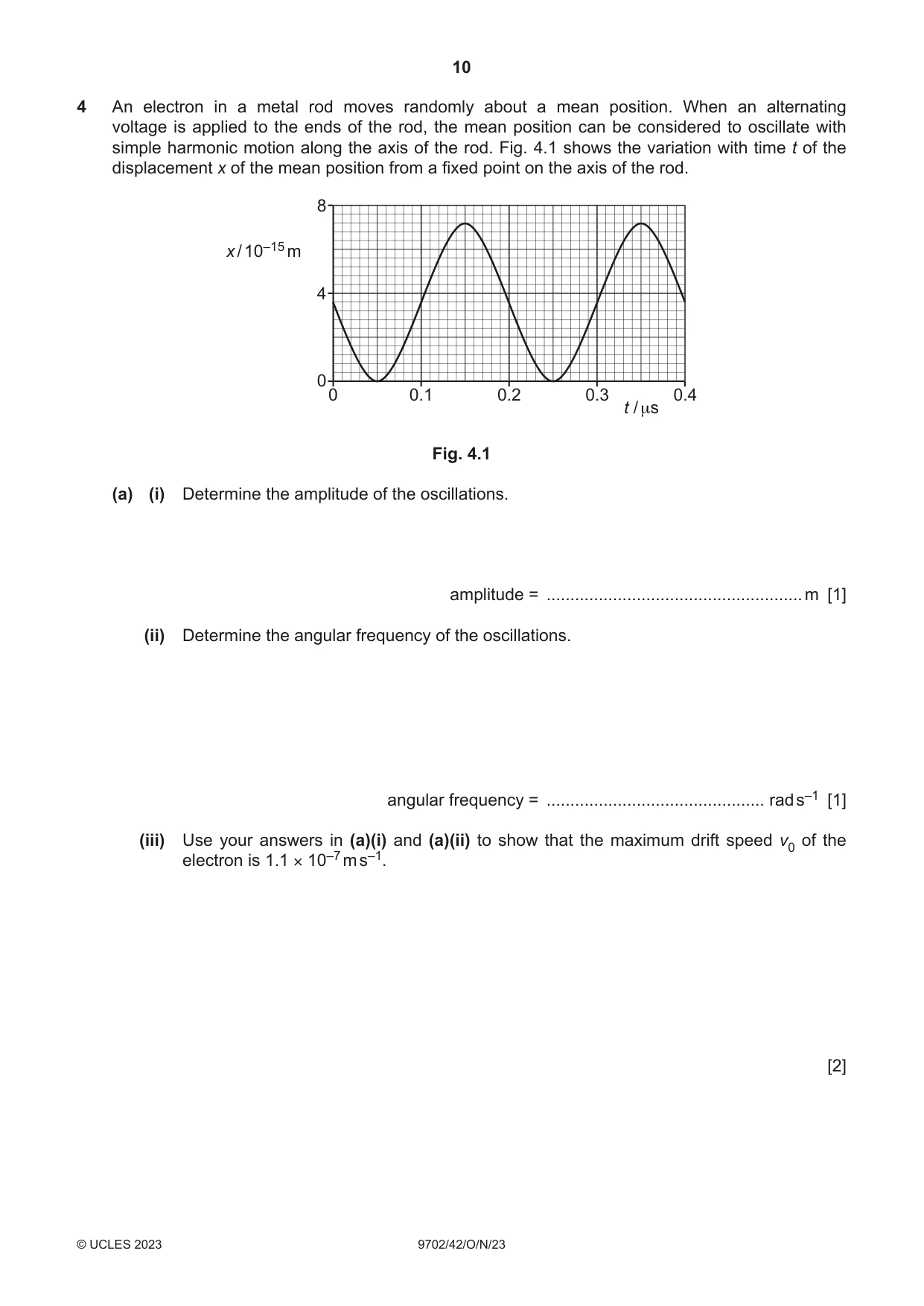
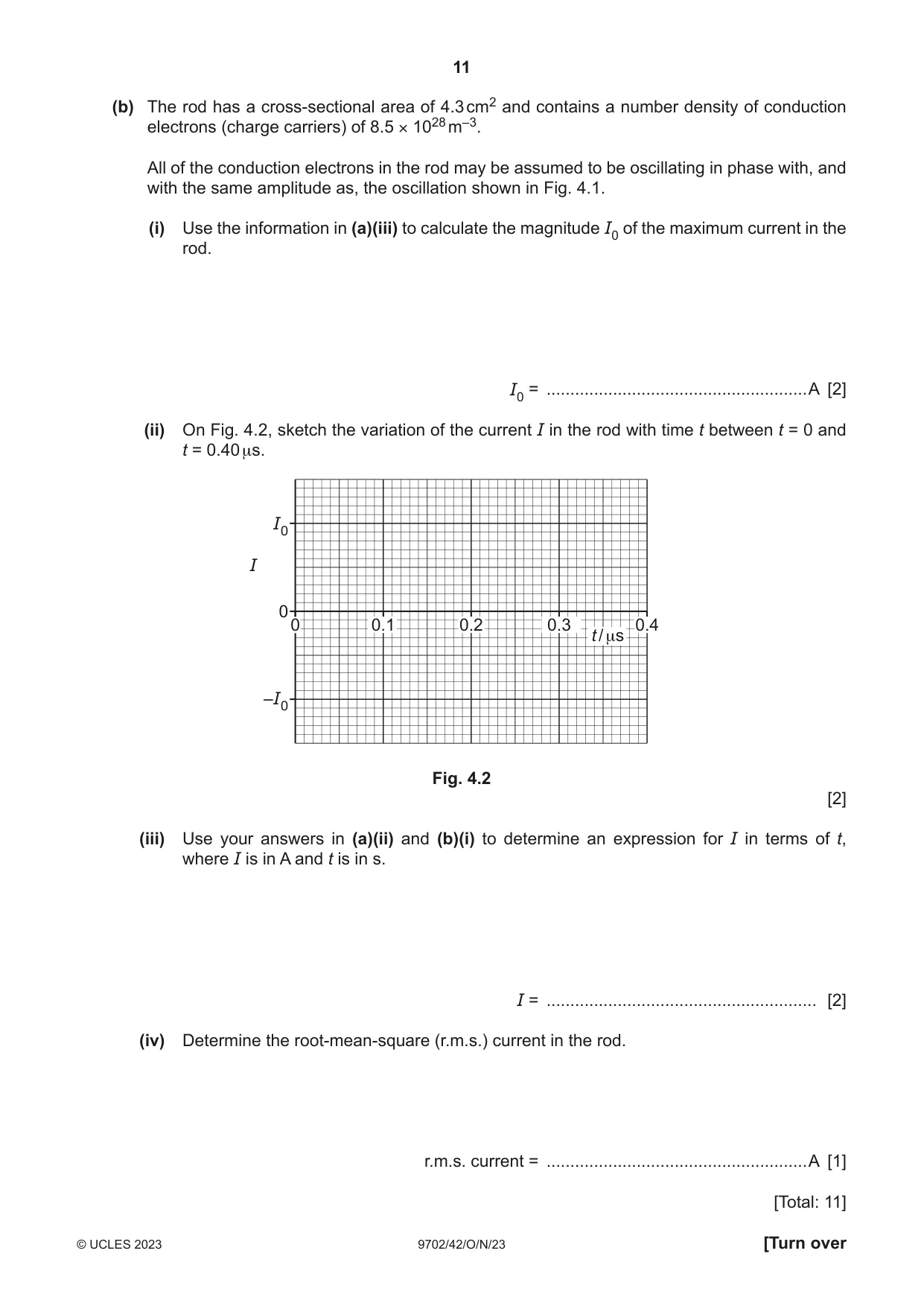
4 An electron in a metal rod moves randomly about a mean position. When an alternating voltage is applied to the ends of the rod, the mean position can be considered to oscillate with simple harmonic motion along the axis of the rod. Fig. 4.1 shows the variation with time t of the displacement x of the mean position from a fixed point on the axis of the rod. 8 x / 10–15 m 4 0 0 0.1 0.2 0.3 0.4 t / μs Fig. 4.1 (a) (i) Determine the amplitude of the oscillations. amplitude = ...................................................... m [1] (ii) Determine the angular frequency of the oscillations. angular frequency = .............................................. rad s–1 [1] (iii) Use your answers in (a)(i) and (a)(ii) to show that the maximum drift speed v0 of the electron is 1.1 × 10⁻⁷ m s–1. [2] (b) The rod has a cross-sectional area of 4.3 cm2 and contains a number density of conduction electrons (charge carriers) of 8.5 × 1028 m–3. All of the conduction electrons in the rod may be assumed to be oscillating in phase with, and with the same amplitude as, the oscillation shown in Fig. 4.1. (i) Use the information in (a)(iii) to calculate the magnitude I0 of the maximum current in the rod. I0 = ....................................................... A [2] (ii) On Fig. 4.2, sketch the variation of the current I in the rod with time t between t = 0 and t = 0.40 μs. I0 I 0 0 0.1 0.2 0.3 0.4 t / μs –I0 Fig. 4.2 [2] (iii) Use your answers in (a)(ii) and (b)(i) to determine an expression for I in terms of t, where I is in A and t is in s. I = ......................................................... [2] (iv) Determine the root-mean-square (r.m.s.) current in the rod. r.m.s. current = ....................................................... A [1] [Total: 11]
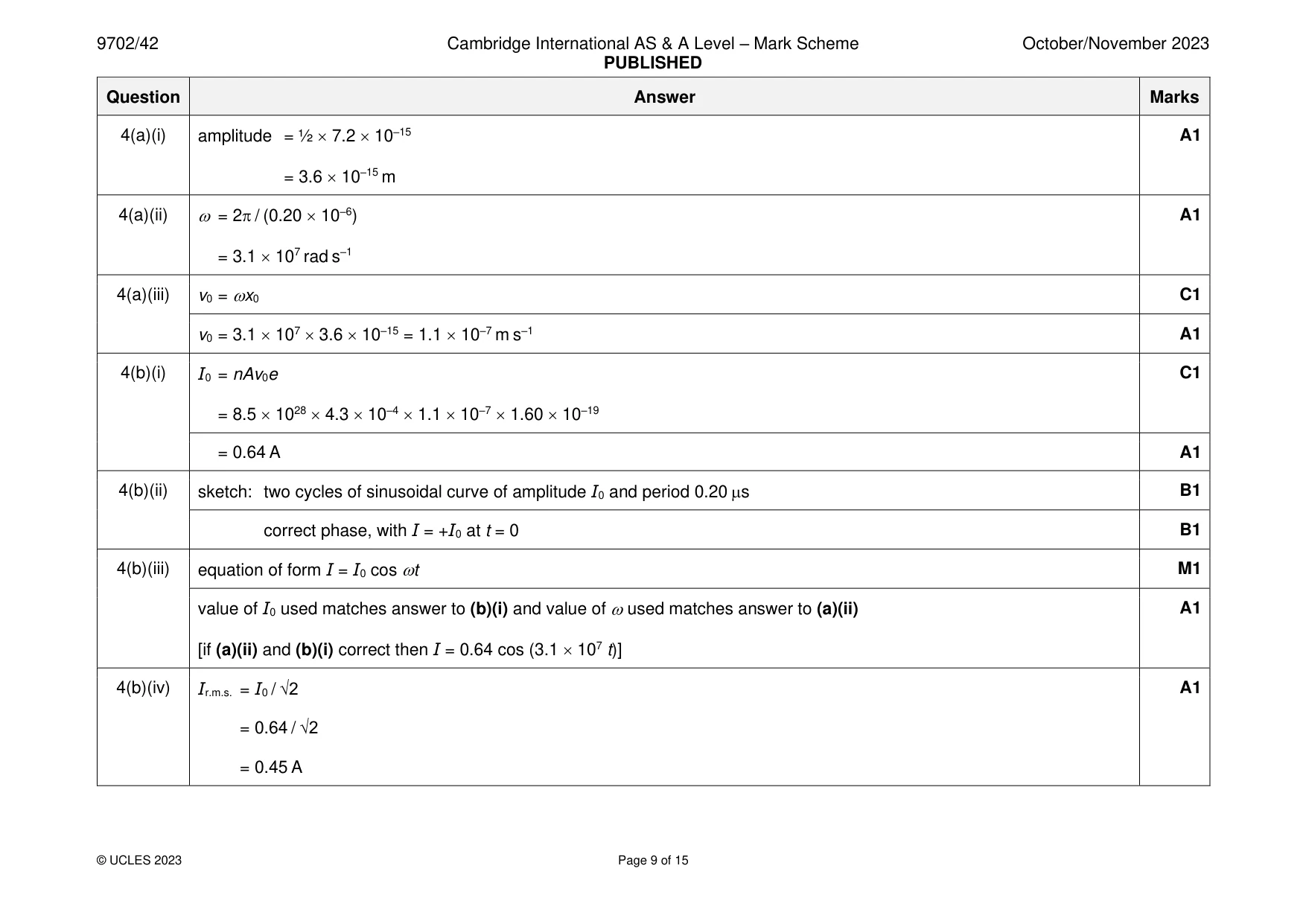
Mark scheme: 4(a)(i) amplitude = ½ 7.2 10–15 A1 = 3.6 10–15 m 4(a)(ii) = 2 / (0.20 10–6) A1 = 3.1 107 rad s–1 4(a)(iii) v0 = x0 C1 v0 = 3.1 107 3.6 10–15 = 1.1 10–7 m s–1 A1 4(b)(i) I0 = nAv0e C1 = 8.5 1028 4.3 10–4 1.1 10–7 1.60 10–19 = 0.64 A A1 4(b)(ii) sketch: two cycles of sinusoidal curve of amplitude I0 and period 0.20 s B1 correct phase, with I = +I0 at t = 0 B1 4(b)(iii) equation of form I = I0 cos t M1 value of I0 used matches answer to (b)(i) and value of used matches answer to (a)(ii) A1 [if (a)(ii) and (b)(i) correct then I = 0.64 cos (3.1 107 t)] 4(b)(iv) Ir.m.s. = I0 / √2 A1 = 0.64 / √2 = 0.45 A
Question 5
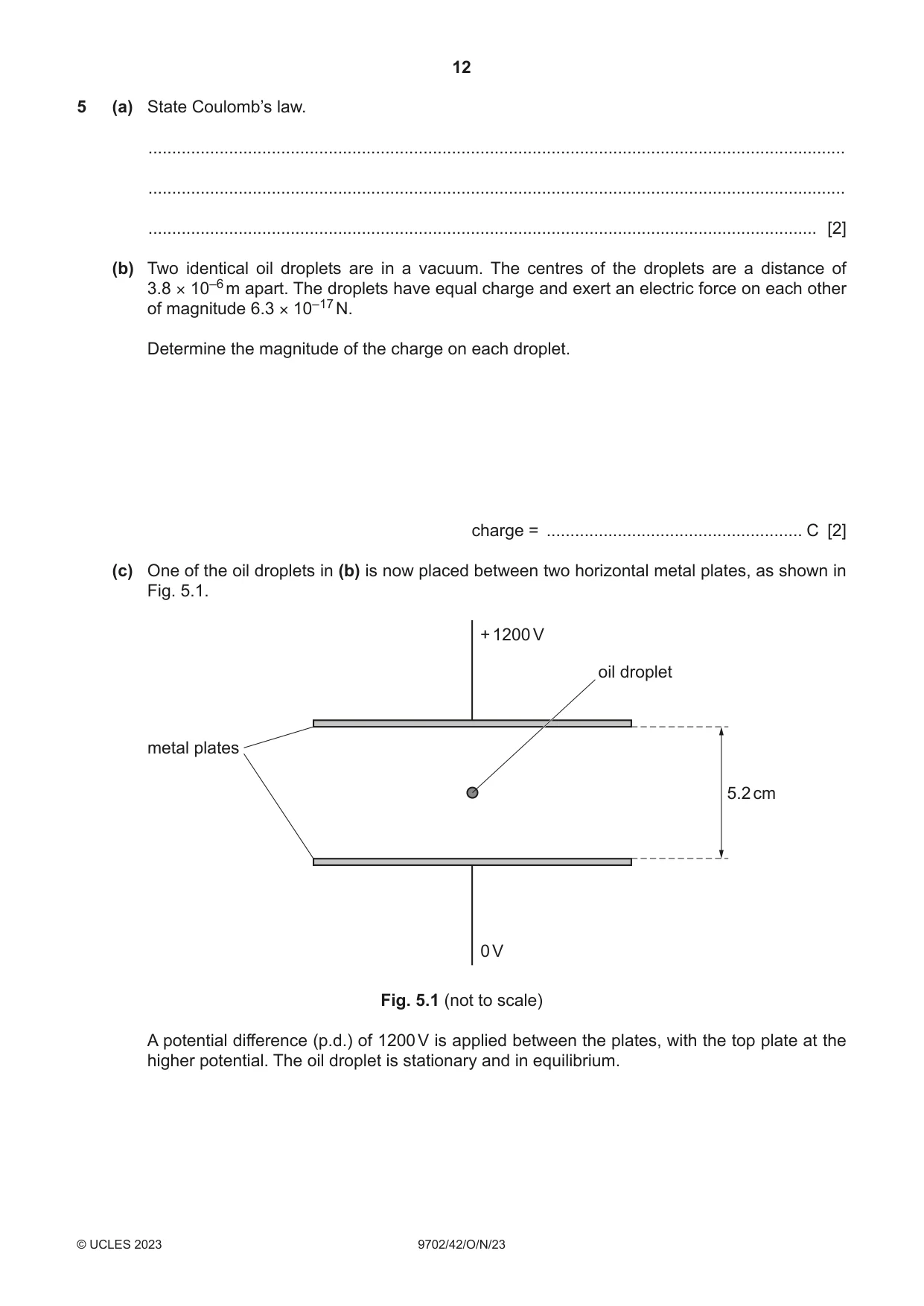
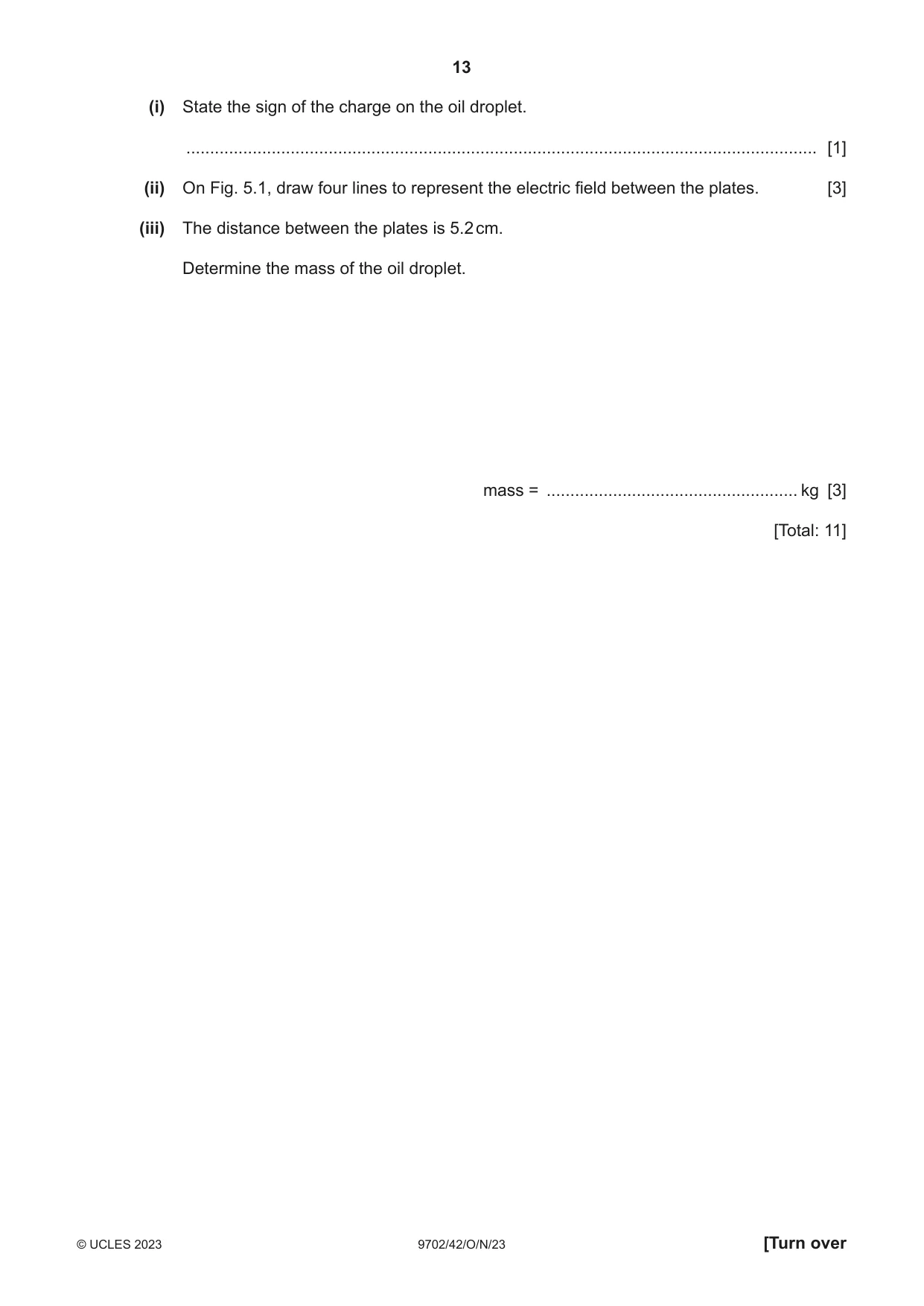
5 (a) State Coulomb’s law. ................................................................................................................................................... ................................................................................................................................................... ............................................................................................................................................. [2] (b) Two identical oil droplets are in a vacuum. The centres of the droplets are a distance of 3.8 × 10⁻⁶ m apart. The droplets have equal charge and exert an electric force on each other of magnitude 6.3 × 10⁻¹⁷ N. Determine the magnitude of the charge on each droplet. charge = ...................................................... C [2] (c) One of the oil droplets in (b) is now placed between two horizontal metal plates, as shown in Fig. 5.1. + 1200 V oil droplet metal plates 5.2 cm 0 V Fig. 5.1 (not to scale) A potential difference (p.d.) of 1200 V is applied between the plates, with the top plate at the higher potential. The oil droplet is stationary and in equilibrium. (i) State the sign of the charge on the oil droplet. ..................................................................................................................................... [1] (ii) On Fig. 5.1, draw four lines to represent the electric field between the plates. [3] (iii) The distance between the plates is 5.2 cm. Determine the mass of the oil droplet. mass = ..................................................... kg [3] [Total: 11]
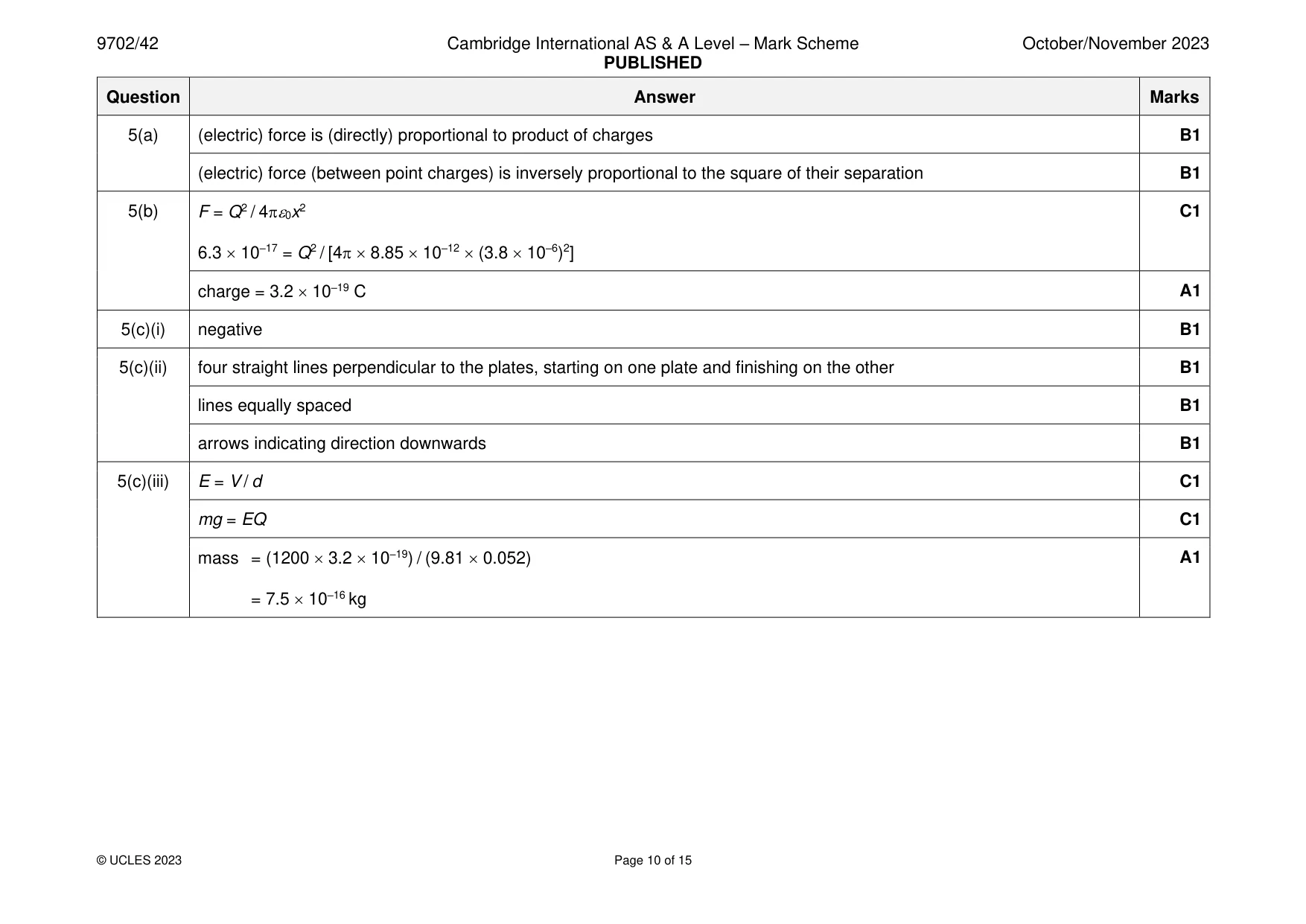
Mark scheme: 5(a) (electric) force is (directly) proportional to product of charges B1 (electric) force (between point charges) is inversely proportional to the square of their separation B1 5(b) F = Q2 / 40x2 C1 6.3 10–17 = Q2 / [4 8.85 10–12 (3.8 10–6)2] charge = 3.2 10–19 C A1 5(c)(i) negative B1 5(c)(ii) four straight lines perpendicular to the plates, starting on one plate and finishing on the other B1 lines equally spaced B1 arrows indicating direction downwards B1 5(c)(iii) E = V / d C1 mg = EQ C1 mass = (1200 3.2 10–19) / (9.81 0.052) A1 = 7.5 10–16 kg
Q6 · A capacitor C is charged so that the potential difference (p.d.) V across its terminals…
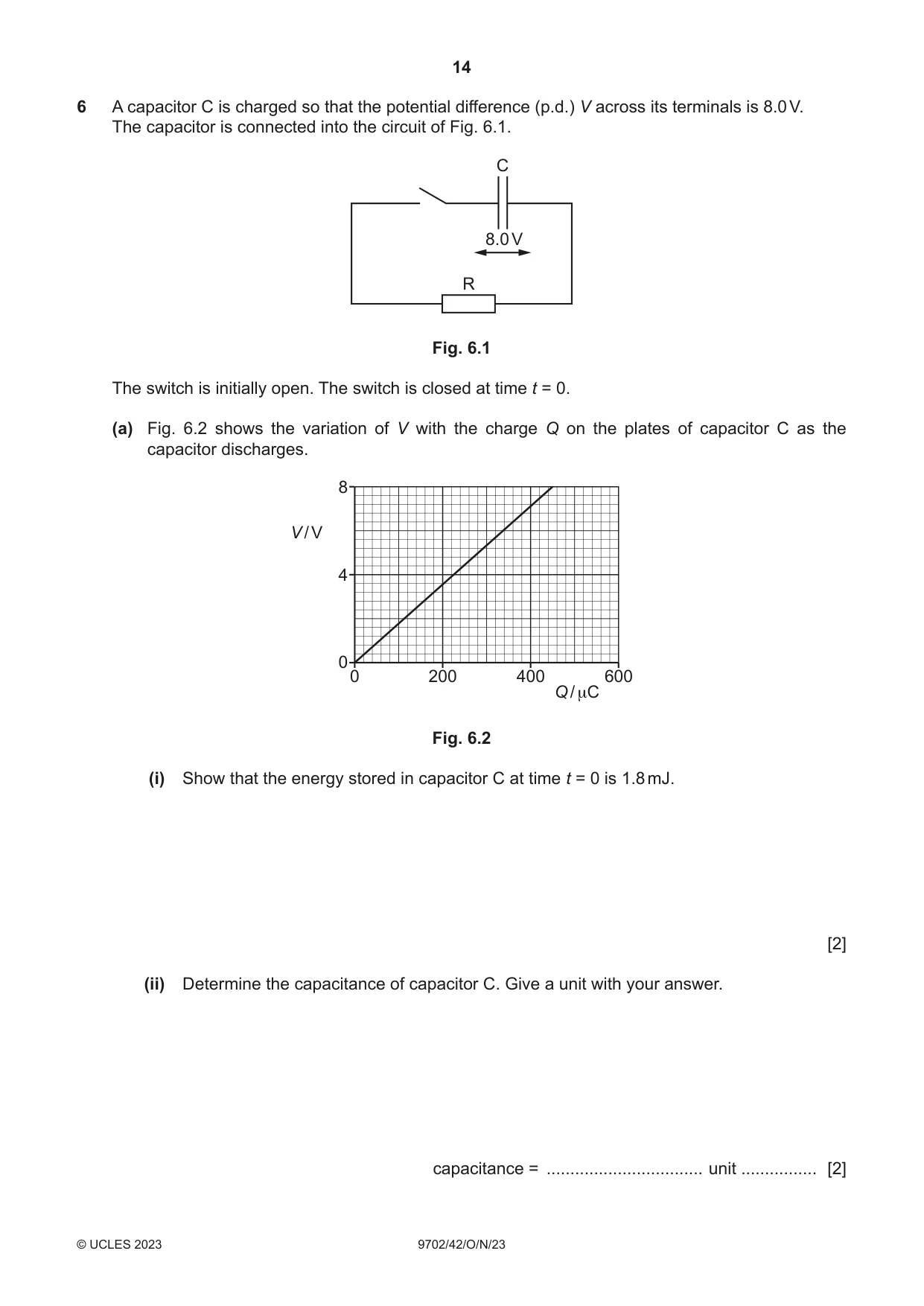
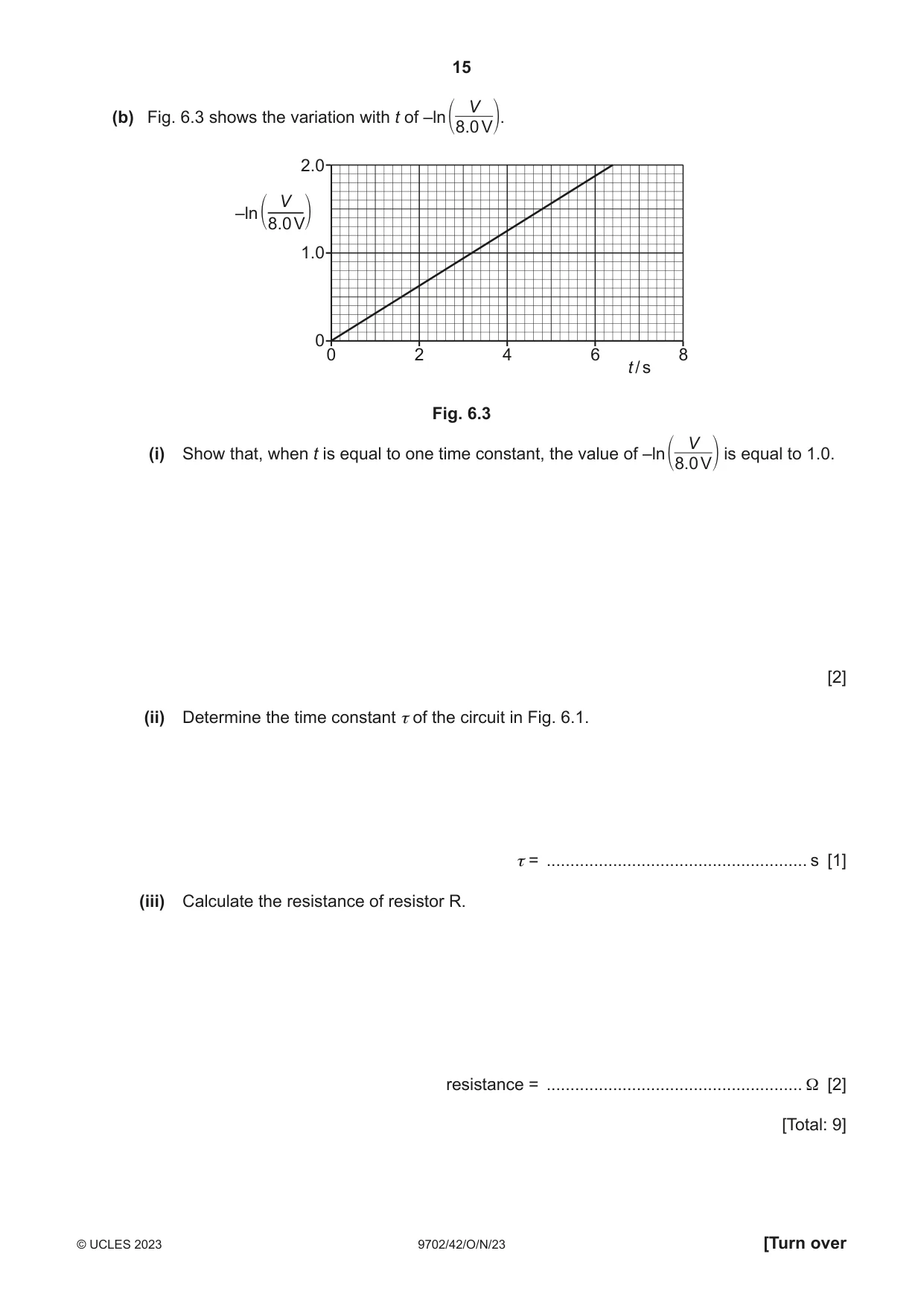
6 A capacitor C is charged so that the potential difference (p.d.) V across its terminals is 8.0 V. The capacitor is connected into the circuit of Fig. 6.1. C 8.0 V R Fig. 6.1 The switch is initially open. The switch is closed at time t = 0. (a) Fig. 6.2 shows the variation of V with the charge Q on the plates of capacitor C as the capacitor discharges. 8 V / V 4 0 0 200 400 600 Q / μC Fig. 6.2 (i) Show that the energy stored in capacitor C at time t = 0 is 1.8 mJ. [2] (ii) Determine the capacitance of capacitor C. Give a unit with your answer. capacitance = ................................. unit ................ [2] V(b) Fig. 6.3 shows the variation with t of –ln 8.0 V. 2.0 V –ln 1 8.0 V2 1.0 0 0 2 4 6 8 t / s Fig. 6.3 V (i) Show that, when t is equal to one time constant, the value of –ln is equal to 1.0. 8.0 V [2] (ii) Determine the time constant τ of the circuit in Fig. 6.1. τ = ....................................................... s [1] (iii) Calculate the resistance of resistor R. resistance = ...................................................... Ω [2] [Total: 9]
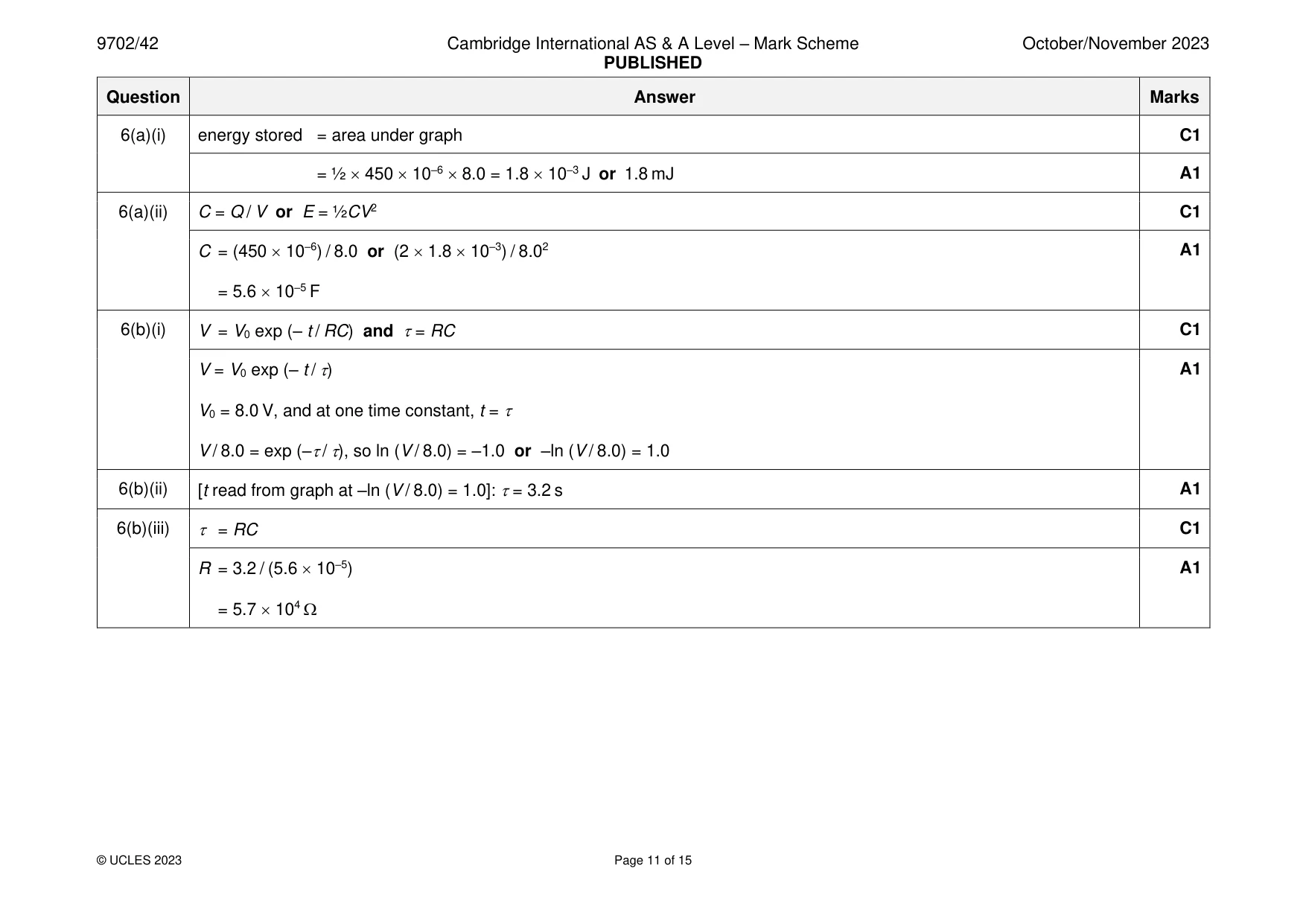
Mark scheme: 6(a)(i) energy stored = area under graph C1 = ½ 450 10–6 8.0 = 1.8 10–3 J or 1.8 mJ A1 6(a)(ii) C = Q / V or E = ½CV2 C1 C = (450 10–6) / 8.0 or (2 1.8 10–3) / 8.02 A1 = 5.6 10–5 F 6(b)(i) V = V0 exp (– t / RC) and = RC C1 V = V0 exp (– t / ) A1 V0 = 8.0 V, and at one time constant, t = V / 8.0 = exp (– / ), so ln (V / 8.0) = –1.0 or –ln (V / 8.0) = 1.0 6(b)(ii) [t read from graph at –ln (V / 8.0) = 1.0]: = 3.2 s A1 6(b)(iii) = RC C1 R = 3.2 / (5.6 10–5) A1 = 5.7 104
Q7 · A Hall probe containing a thin slice of semiconducting material is placed in a uniform…
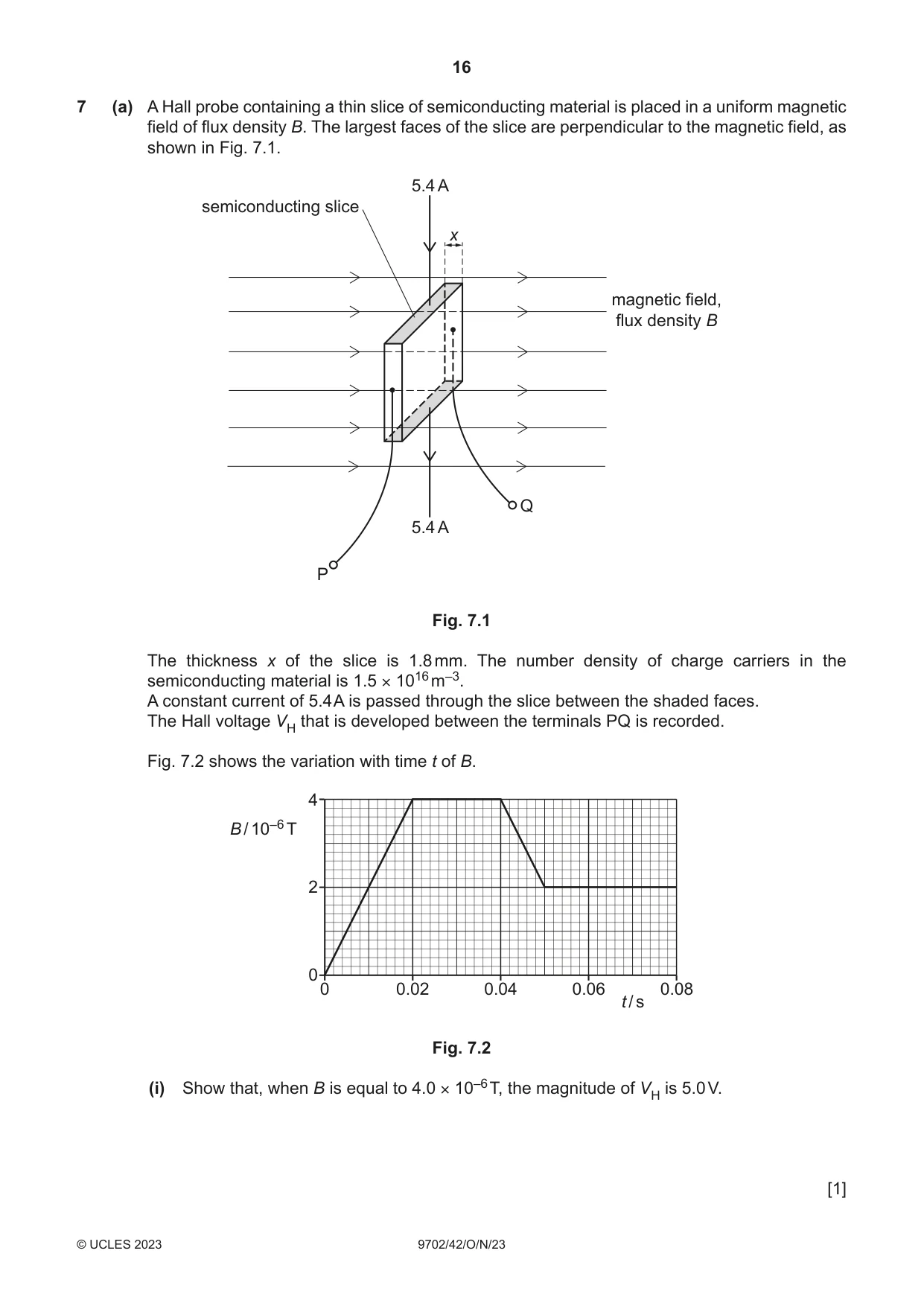
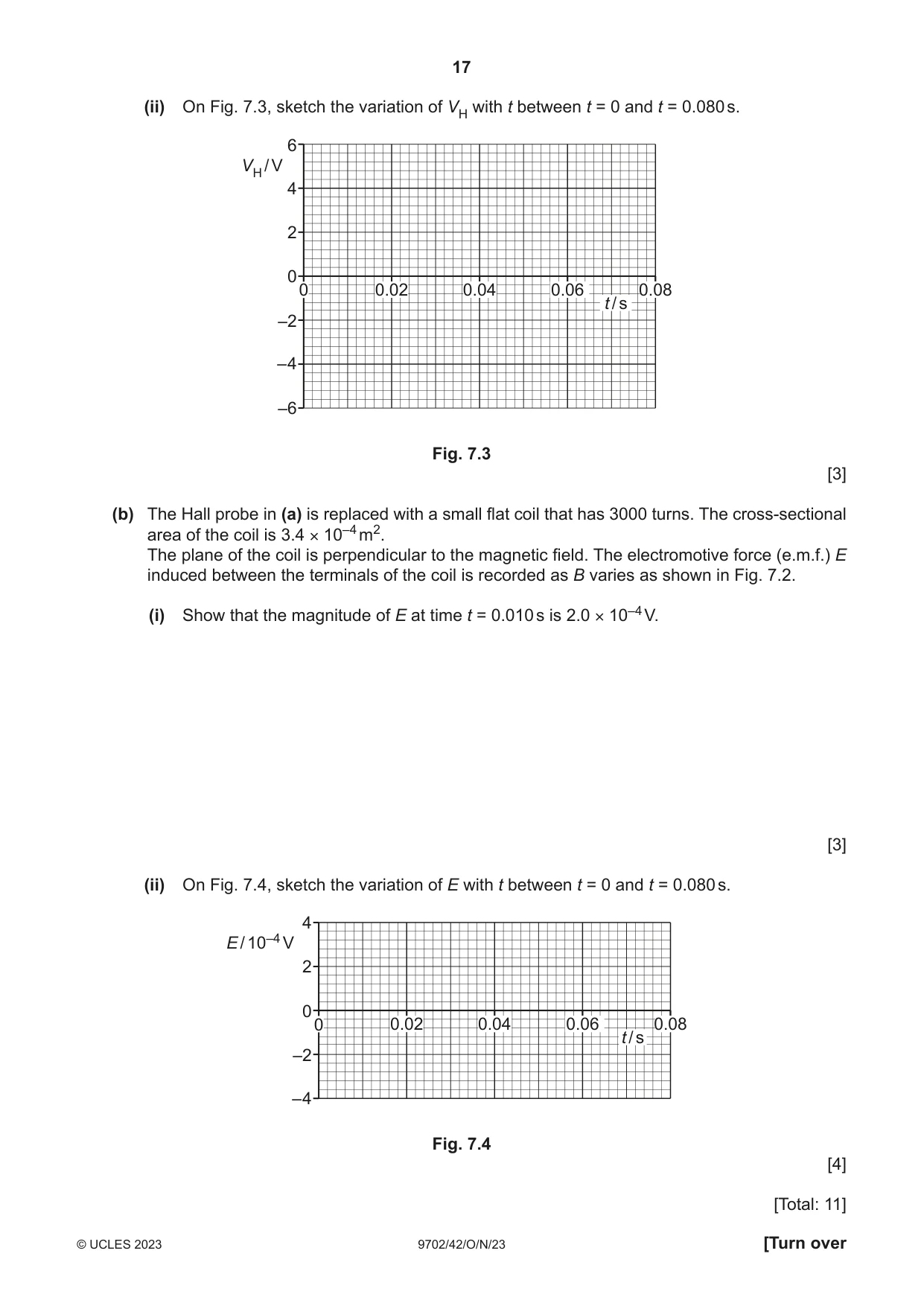
7 (a) A Hall probe containing a thin slice of semiconducting material is placed in a uniform magnetic field of flux density B. The largest faces of the slice are perpendicular to the magnetic field, as shown in Fig. 7.1. 5.4 A semiconducting slice x magnetic field, flux density B Q 5.4 A P Fig. 7.1 The thickness x of the slice is 1.8 mm. The number density of charge carriers in the semiconducting material is 1.5 × 10¹⁶ m–3. A constant current of 5.4 A is passed through the slice between the shaded faces. The Hall voltage VH that is developed between the terminals PQ is recorded. Fig. 7.2 shows the variation with time t of B. 4 B / 10–6 T 2 0 0 0.02 0.04 0.06 0.08 t / s Fig. 7.2 (i) Show that, when B is equal to 4.0 × 10⁻⁶ T, the magnitude of VH is 5.0 V. [1] (ii) On Fig. 7.3, sketch the variation of VH with t between t = 0 and t = 0.080 s. 6 VH / V 4 2 0 0 0.02 0.04 0.06 0.08 t / s –2 – 4 –6 Fig. 7.3 [3] (b) The Hall probe in (a) is replaced with a small flat coil that has 3000 turns. The cross-sectional area of the coil is 3.4 × 10⁻⁴ m2. The plane of the coil is perpendicular to the magnetic field. The electromotive force (e.m.f.) E induced between the terminals of the coil is recorded as B varies as shown in Fig. 7.2. (i) Show that the magnitude of E at time t = 0.010 s is 2.0 × 10⁻⁴ V. [3] (ii) On Fig. 7.4, sketch the variation of E with t between t = 0 and t = 0.080 s. 4 E / 10–4 V 2 0 0 0.02 0.04 0.06 0.08 t / s –2 – 4 Fig. 7.4 [4] [Total: 11]
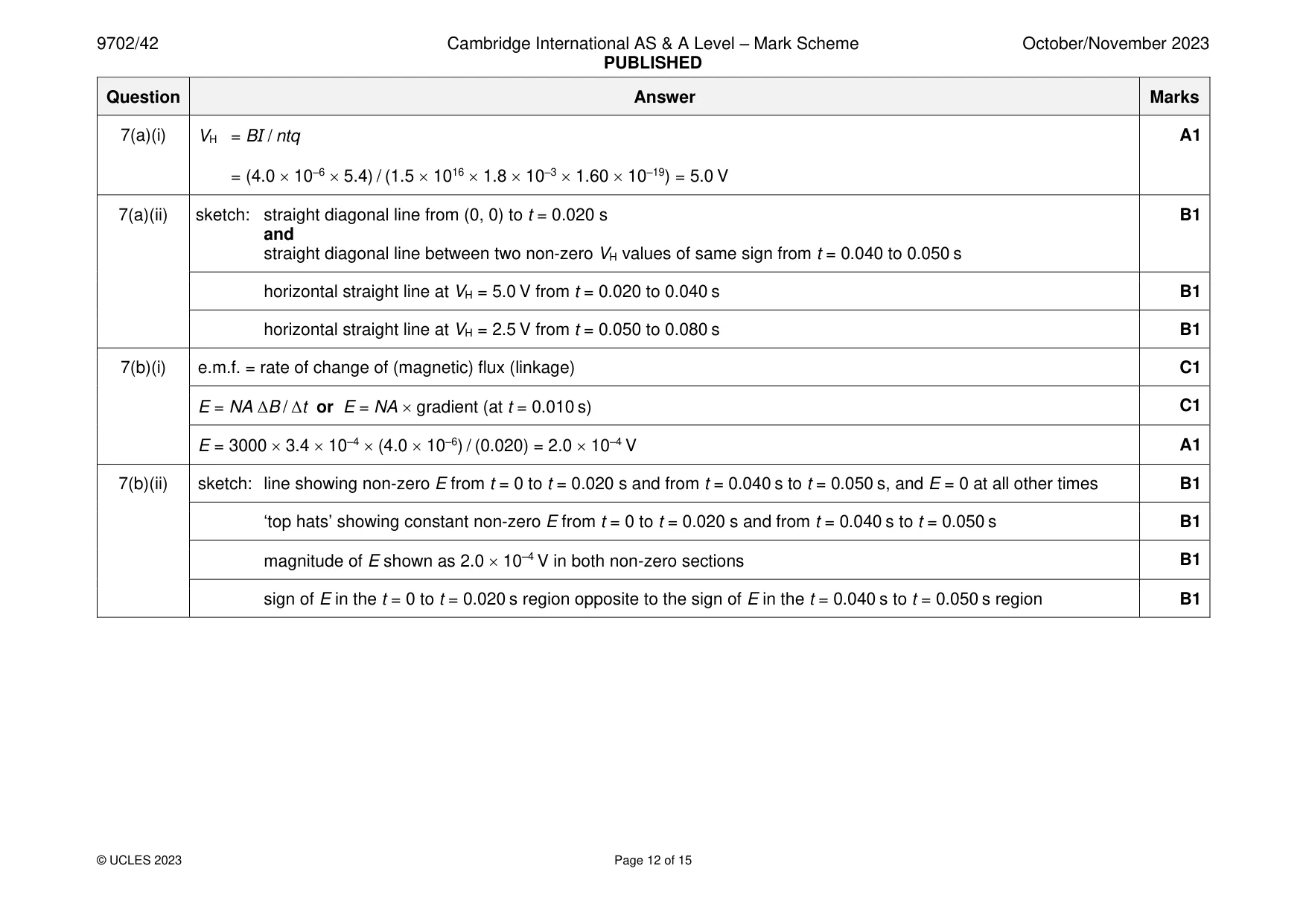
Mark scheme: 7(a)(i) VH = BI / ntq A1 = (4.0 10–6 5.4) / (1.5 1016 1.8 10–3 1.60 10–19) = 5.0 V 7(a)(ii) sketch: straight diagonal line from (0, 0) to t = 0.020 s B1 and straight diagonal line between two non-zero VH values of same sign from t = 0.040 to 0.050 s horizontal straight line at VH = 5.0 V from t = 0.020 to 0.040 s B1 horizontal straight line at VH = 2.5 V from t = 0.050 to 0.080 s B1 7(b)(i) e.m.f. = rate of change of (magnetic) flux (linkage) C1 E = NA ΔB / Δt or E = NA gradient (at t = 0.010 s) C1 E = 3000 3.4 10–4 (4.0 10–6) / (0.020) = 2.0 10–4 V A1 7(b)(ii) sketch: line showing non-zero E from t = 0 to t = 0.020 s and from t = 0.040 s to t = 0.050 s, and E = 0 at all other times B1 ‘top hats’ showing constant non-zero E from t = 0 to t = 0.020 s and from t = 0.040 s to t = 0.050 s B1 magnitude of E shown as 2.0 10–4 V in both non-zero sections B1 sign of E in the t = 0 to t = 0.020 s region opposite to the sign of E in the t = 0.040 s to t = 0.050 s region B1
Q8 · State what is meant by a photon
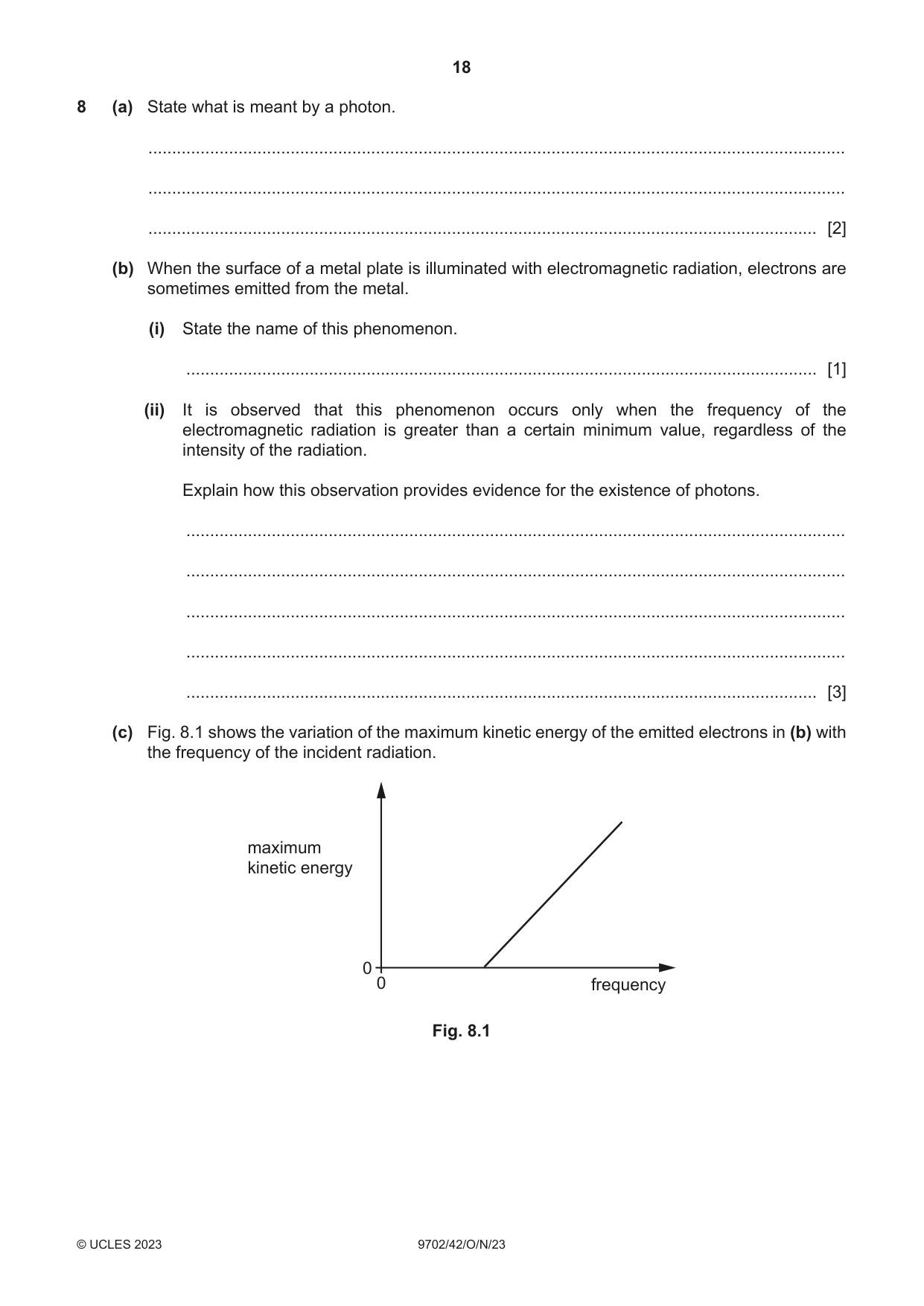
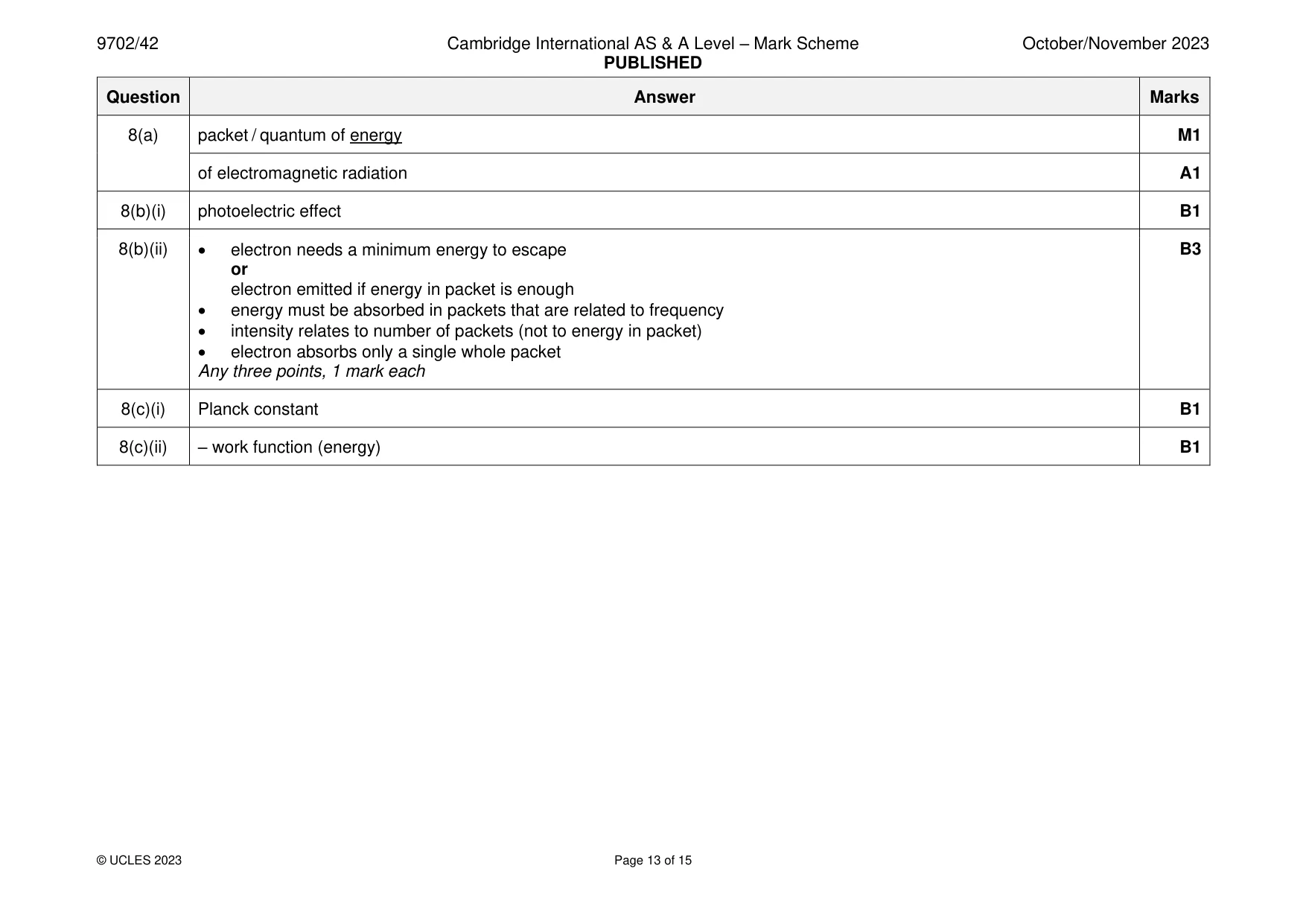
8 (a) State what is meant by a photon. ................................................................................................................................................... ................................................................................................................................................... ............................................................................................................................................. [2] (b) When the surface of a metal plate is illuminated with electromagnetic radiation, electrons are sometimes emitted from the metal. (i) State the name of this phenomenon. ..................................................................................................................................... [1] (ii) It is observed that this phenomenon occurs only when the frequency of the electromagnetic radiation is greater than a certain minimum value, regardless of the intensity of the radiation. Explain how this observation provides evidence for the existence of photons. ........................................................................................................................................... ........................................................................................................................................... ........................................................................................................................................... ........................................................................................................................................... ..................................................................................................................................... [3] (c) Fig. 8.1 shows the variation of the maximum kinetic energy of the emitted electrons in (b) with the frequency of the incident radiation. maximum kinetic energy 0 0 frequency Fig. 8.1 State the name of the quantity represented by: (i) the gradient of the line in Fig. 8.1 ..................................................................................................................................... [1] (ii) the y-intercept of the extrapolated line in Fig. 8.1. ..................................................................................................................................... [1] [Total: 8]
Mark scheme: 8(a) packet / quantum of energy M1 of electromagnetic radiation A1 8(b)(i) photoelectric effect B1 8(b)(ii) • electron needs a minimum energy to escape B3 or electron emitted if energy in packet is enough • energy must be absorbed in packets that are related to frequency • intensity relates to number of packets (not to energy in packet) • electron absorbs only a single whole packet Any three points, 1 mark each 8(c)(i) Planck constant B1 8(c)(ii) – work function (energy) B1
Q9 · Fluorine-18 (189F) is a radioactive nuclide that is used as a tracer in positron emission…
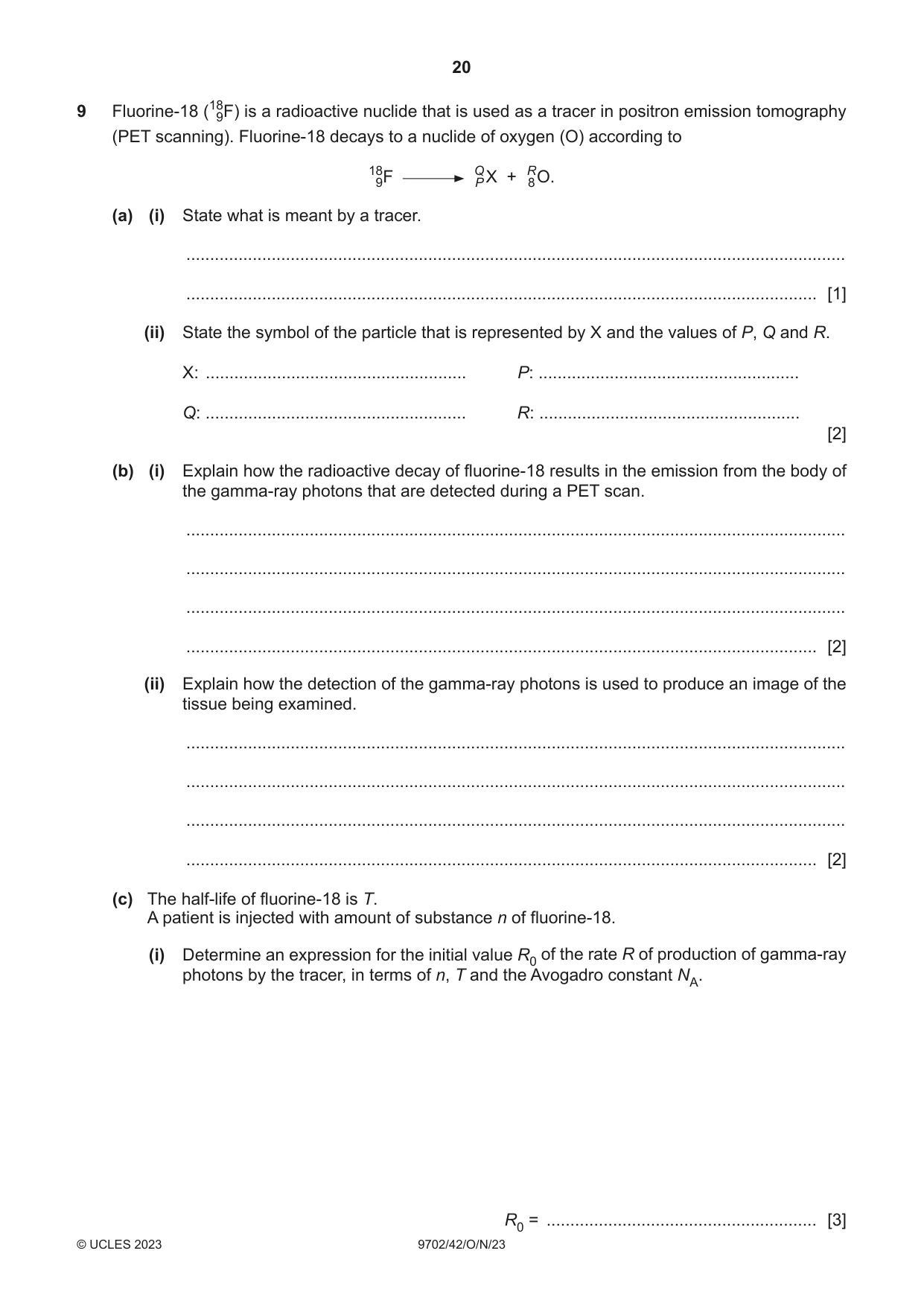
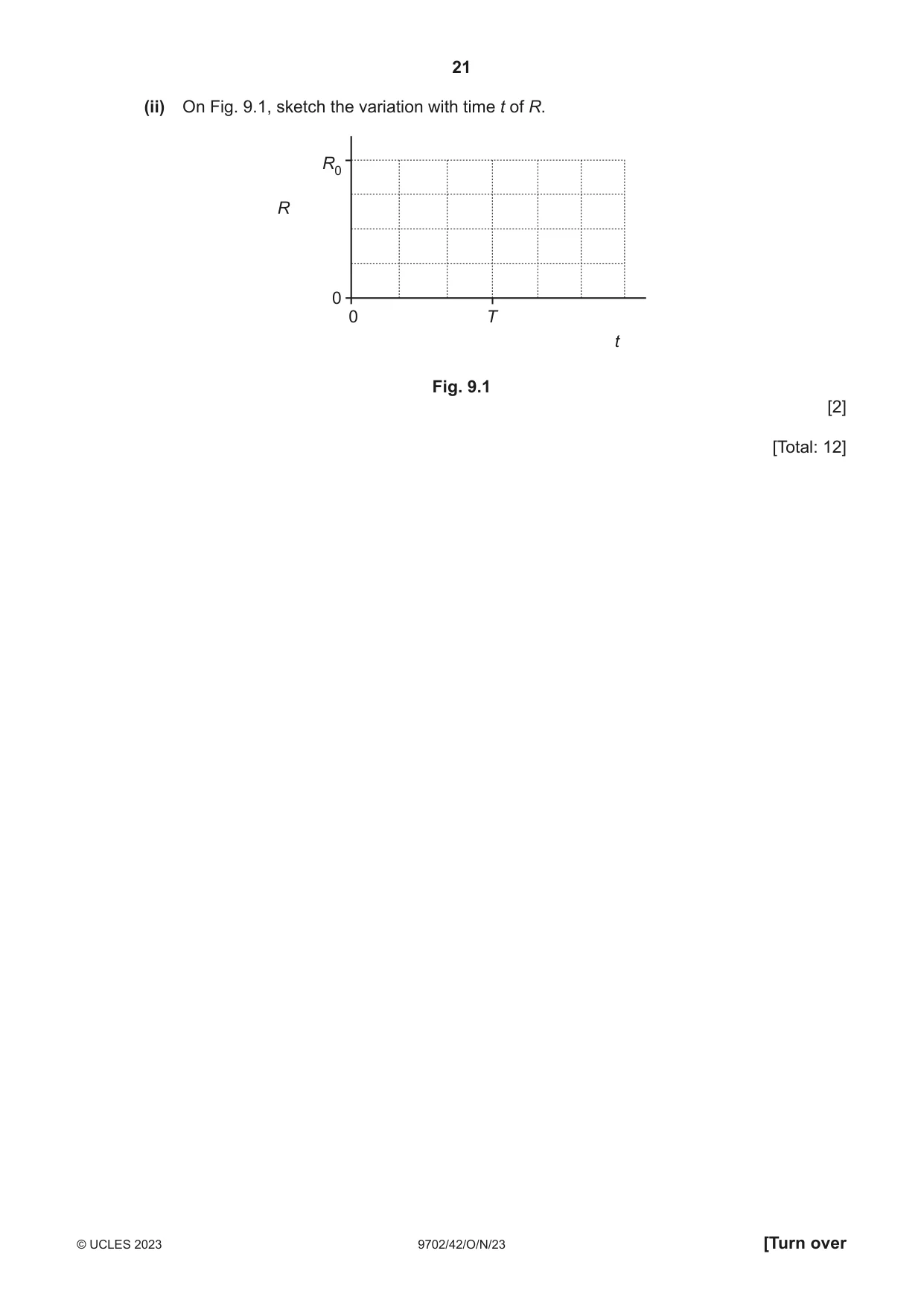
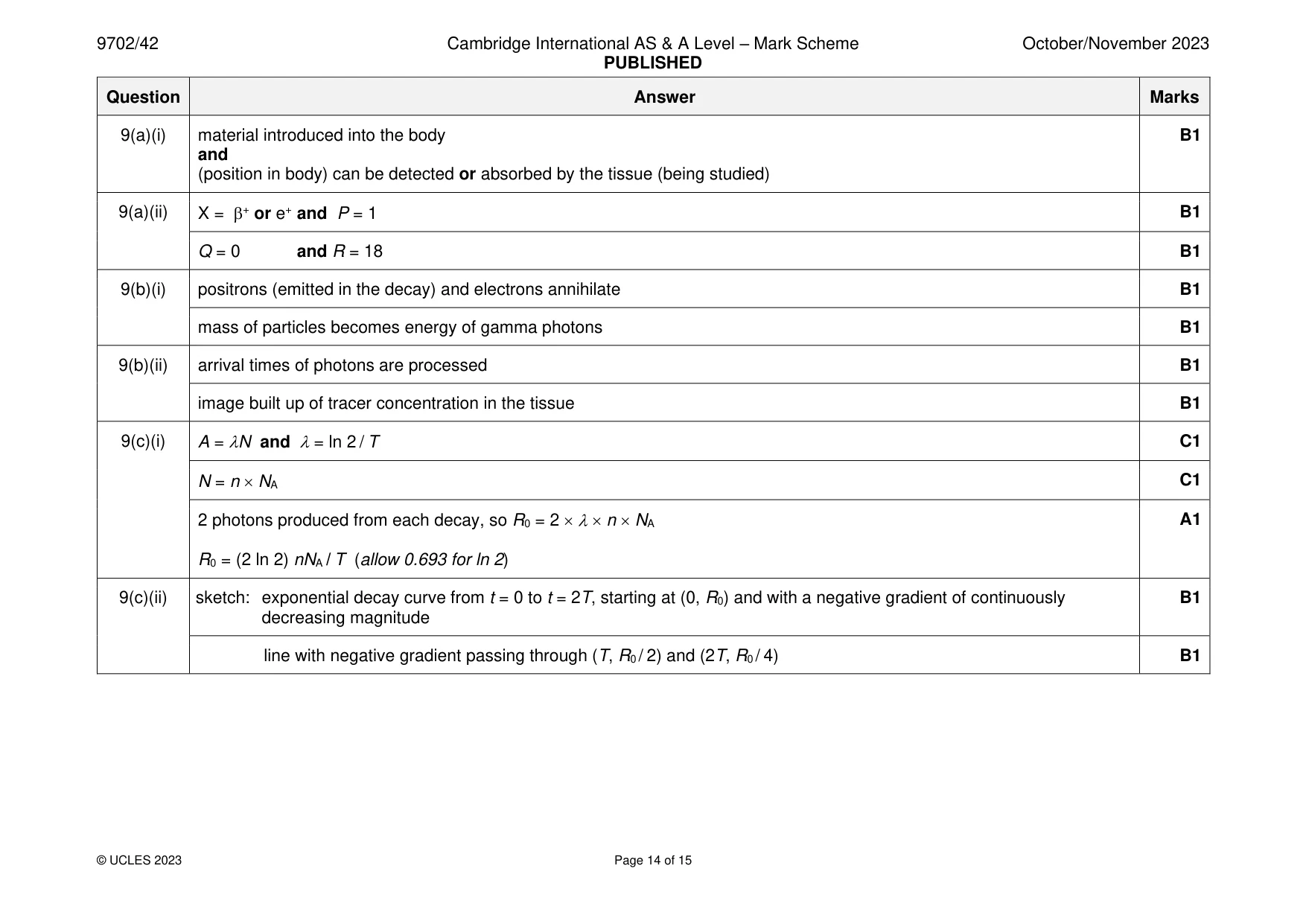
9 Fluorine-18 (189F) is a radioactive nuclide that is used as a tracer in positron emission tomography (PET scanning). Fluorine-18 decays to a nuclide of oxygen (O) according to 189F QP X + R8O. (a) (i) State what is meant by a tracer. ........................................................................................................................................... ..................................................................................................................................... [1] (ii) State the symbol of the particle that is represented by X and the values of P, Q and R. X: ....................................................... P: ....................................................... Q: ....................................................... R: ....................................................... [2] (b) (i) Explain how the radioactive decay of fluorine-18 results in the emission from the body of the gamma-ray photons that are detected during a PET scan. ........................................................................................................................................... ........................................................................................................................................... ........................................................................................................................................... ..................................................................................................................................... [2] (ii) Explain how the detection of the gamma-ray photons is used to produce an image of the tissue being examined. ........................................................................................................................................... ........................................................................................................................................... ........................................................................................................................................... ..................................................................................................................................... [2] (c) The half-life of fluorine-18 is T. A patient is injected with amount of substance n of fluorine-18. (i) Determine an expression for the initial value R0 of the rate R of production of gamma-ray photons by the tracer, in terms of n, T and the Avogadro constant NA. R0 = ......................................................... [3] (ii) On Fig. 9.1, sketch the variation with time t of R. R0 R 0 0 T t Fig. 9.1 [2] [Total: 12]
Mark scheme: 9(a)(i) material introduced into the body B1 and (position in body) can be detected or absorbed by the tissue (being studied) 9(a)(ii) X = + or e+ and P = 1 B1 Q = 0 and R = 18 B1 9(b)(i) positrons (emitted in the decay) and electrons annihilate B1 mass of particles becomes energy of gamma photons B1 9(b)(ii) arrival times of photons are processed B1 image built up of tracer concentration in the tissue B1 9(c)(i) A = N and = ln 2 / T C1 N = n NA C1 2 photons produced from each decay, so R0 = 2 n NA A1 R0 = (2 ln 2) nNA / T (allow 0.693 for ln 2) 9(c)(ii) sketch: exponential decay curve from t = 0 to t = 2T, starting at (0, R0) and with a negative gradient of continuously B1 decreasing magnitude line with negative gradient passing through (T, R0 / 2) and (2T, R0 / 4) B1
Q10 · State Wien’s displacement law
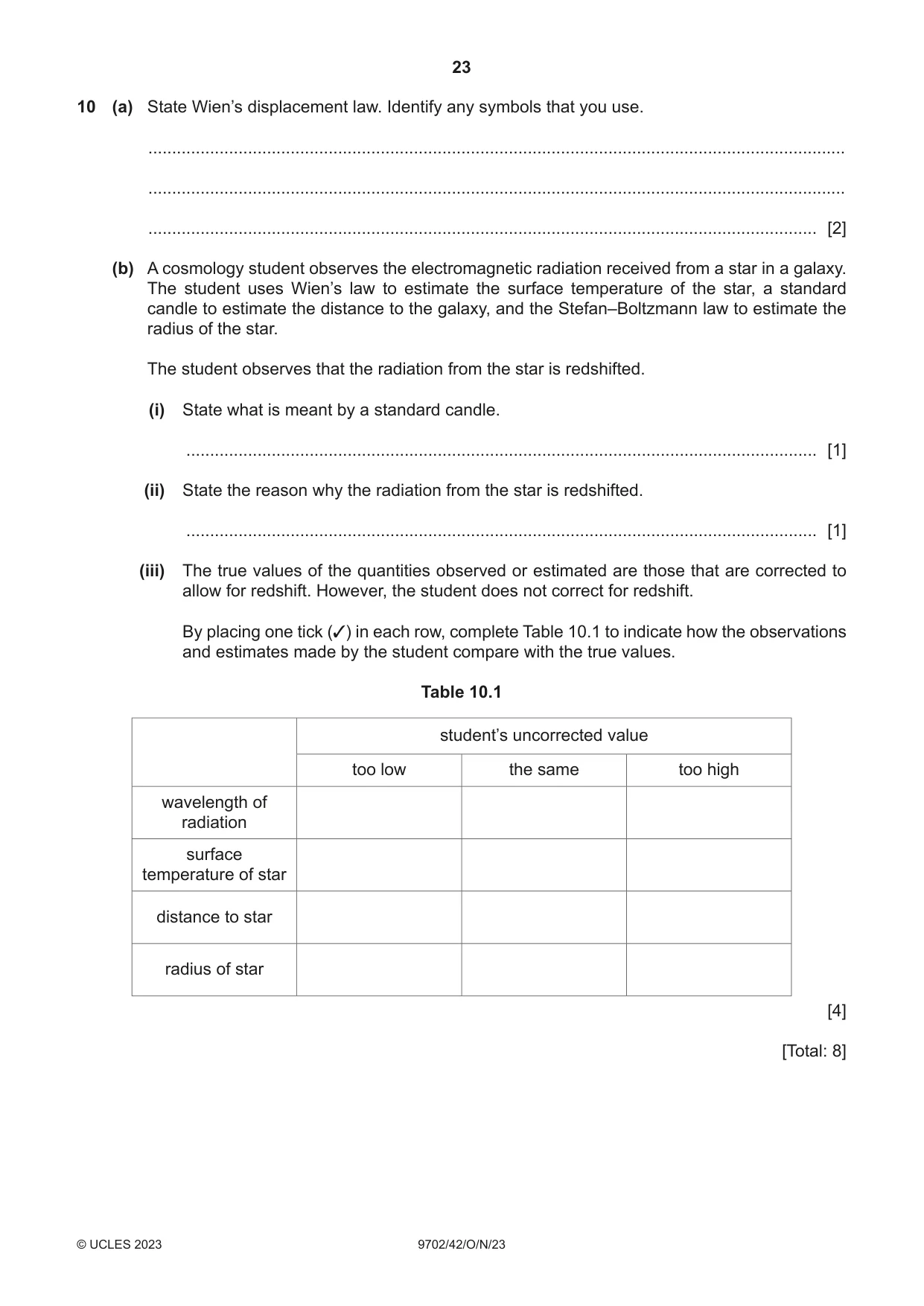
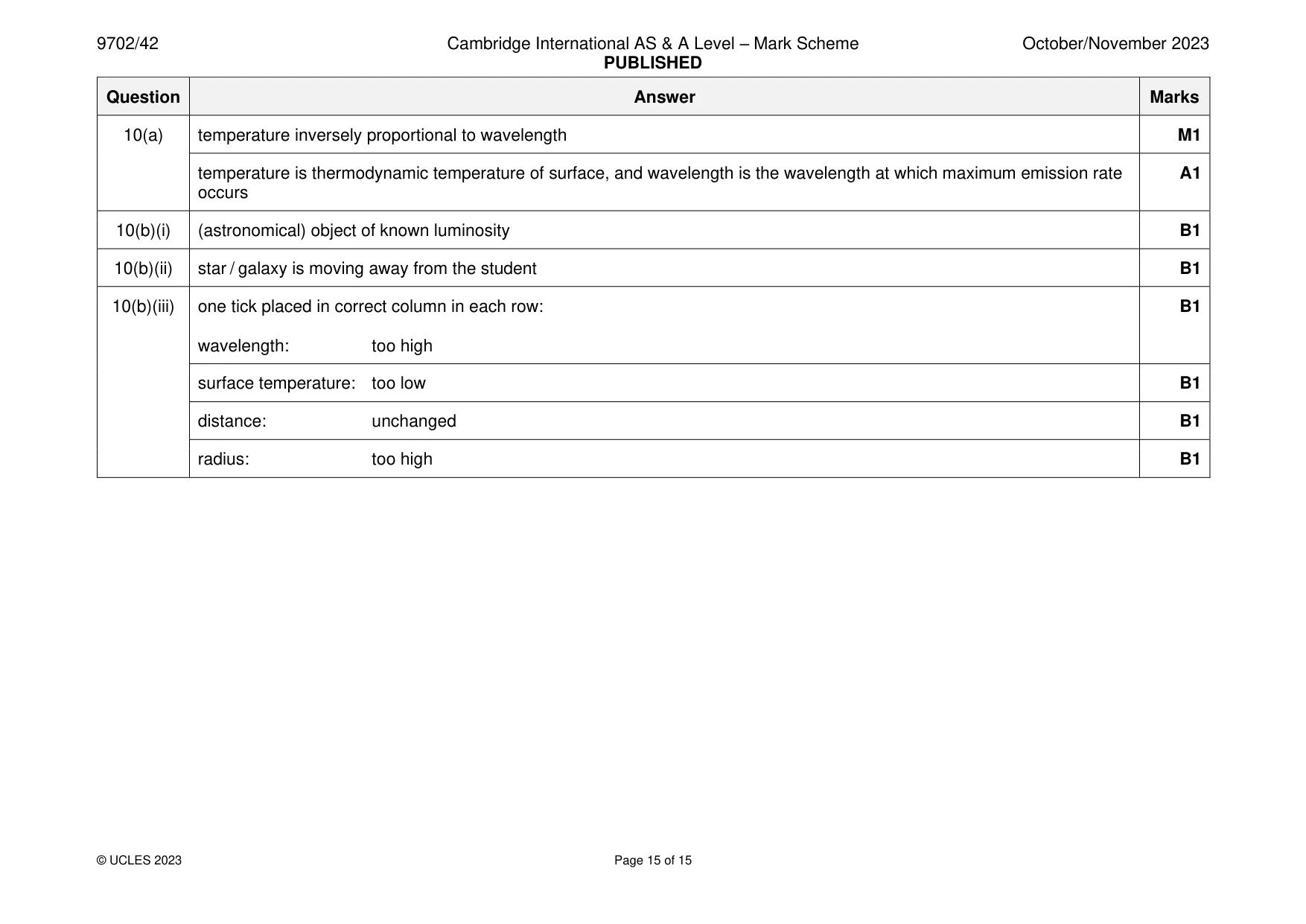
10 (a) State Wien’s displacement law. Identify any symbols that you use. ................................................................................................................................................... ................................................................................................................................................... ............................................................................................................................................. [2] (b) A cosmology student observes the electromagnetic radiation received from a star in a galaxy. The student uses Wien’s law to estimate the surface temperature of the star, a standard candle to estimate the distance to the galaxy, and the Stefan–Boltzmann law to estimate the radius of the star. The student observes that the radiation from the star is redshifted. (i) State what is meant by a standard candle. ..................................................................................................................................... [1] (ii) State the reason why the radiation from the star is redshifted. ..................................................................................................................................... [1] (iii) The true values of the quantities observed or estimated are those that are corrected to allow for redshift. However, the student does not correct for redshift. By placing one tick (3) in each row, complete Table 10.1 to indicate how the observations and estimates made by the student compare with the true values. Table 10.1 student’s uncorrected value too low the same too high wavelength of radiation surface temperature of star distance to star radius of star [4] [Total: 8]
Mark scheme: 10(a) temperature inversely proportional to wavelength M1 temperature is thermodynamic temperature of surface, and wavelength is the wavelength at which maximum emission rate A1 occurs 10(b)(i) (astronomical) object of known luminosity B1 10(b)(ii) star / galaxy is moving away from the student B1 10(b)(iii) one tick placed in correct column in each row: B1 wavelength: too high surface temperature: too low B1 distance: unchanged B1 radius: too high B1
What was in this paper
The subtopics covered by these 10 questions, and how many questions each got. Open one in a new tab to see every Cambridge question on it.
What you needed in this session
Cambridge’s own grade thresholds for 2023 Oct/Nov, Paper 4 · Variant 2. A higher threshold means an easier paper — the bar moves with how the cohort did.