Questions as text
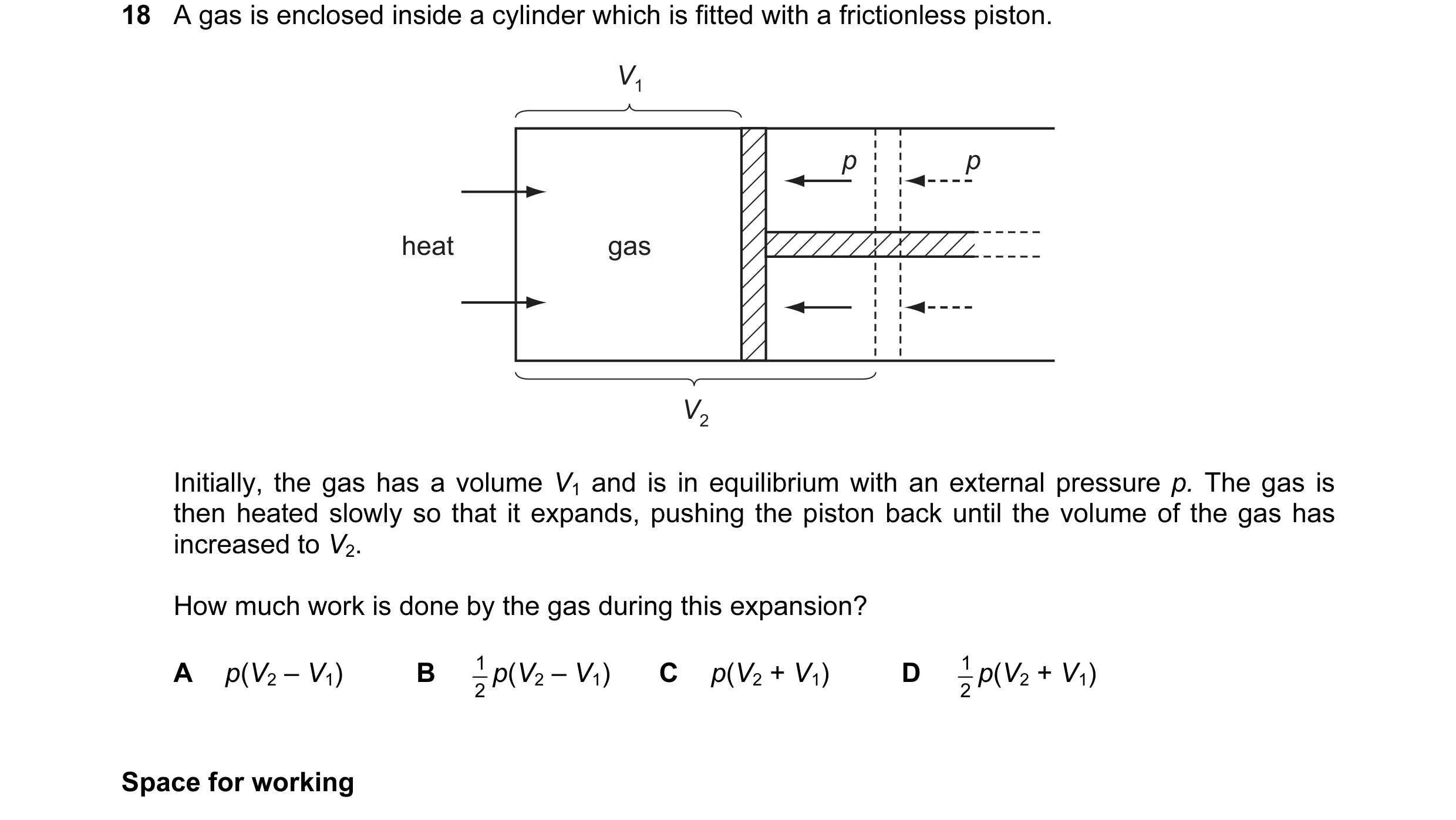
Q1 · A gas is enclosed inside a cylinder which is fitted with a frictionless piston 9702/12 May/June 2013
18 A gas is enclosed inside a cylinder which is fitted with a frictionless piston. V1 p p heat gas V2 Initially, the gas has a volume V1 and is in equilibrium with an external pressure p. The gas is then heated slowly so that it expands, pushing the piston back until the volume of the gas has increased to V2. How much work is done by the gas during this expansion? 1 p(V2 – V1) 1 p(V2 + V1) A p(V2 – V1) B C p(V2 + V1) D 2 2 Space for working
1 marks
Answer: A
This question in 9702/12 May/June 2013
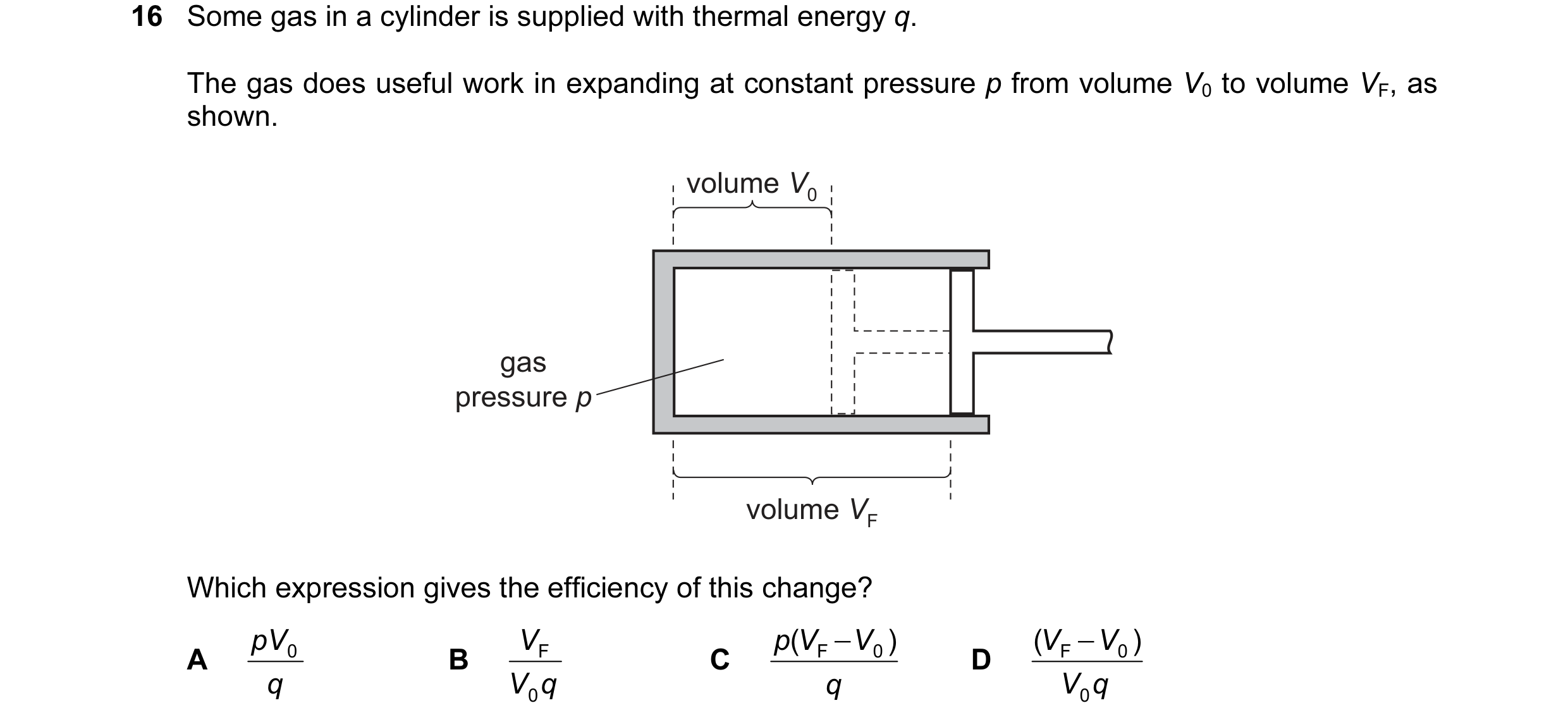
Q2 · Some gas in a cylinder is supplied with thermal energy q 9702/11 May/June 2016
16 Some gas in a cylinder is supplied with thermal energy q. The gas does useful work in expanding at constant pressure p from volume V0 to volume VF, as shown. volume V0 gas pressure p volume VF Which expression gives the efficiency of this change? pV0 V F p ( V F − V ) ( V − V ) A B C 0 D F 0 q V q q V q 0 0
1 marks
Answer: C
This question in 9702/11 May/June 2016
Q3 · An engine transforms thermal energy into mechanical work 9702/11 Oct/Nov 2016
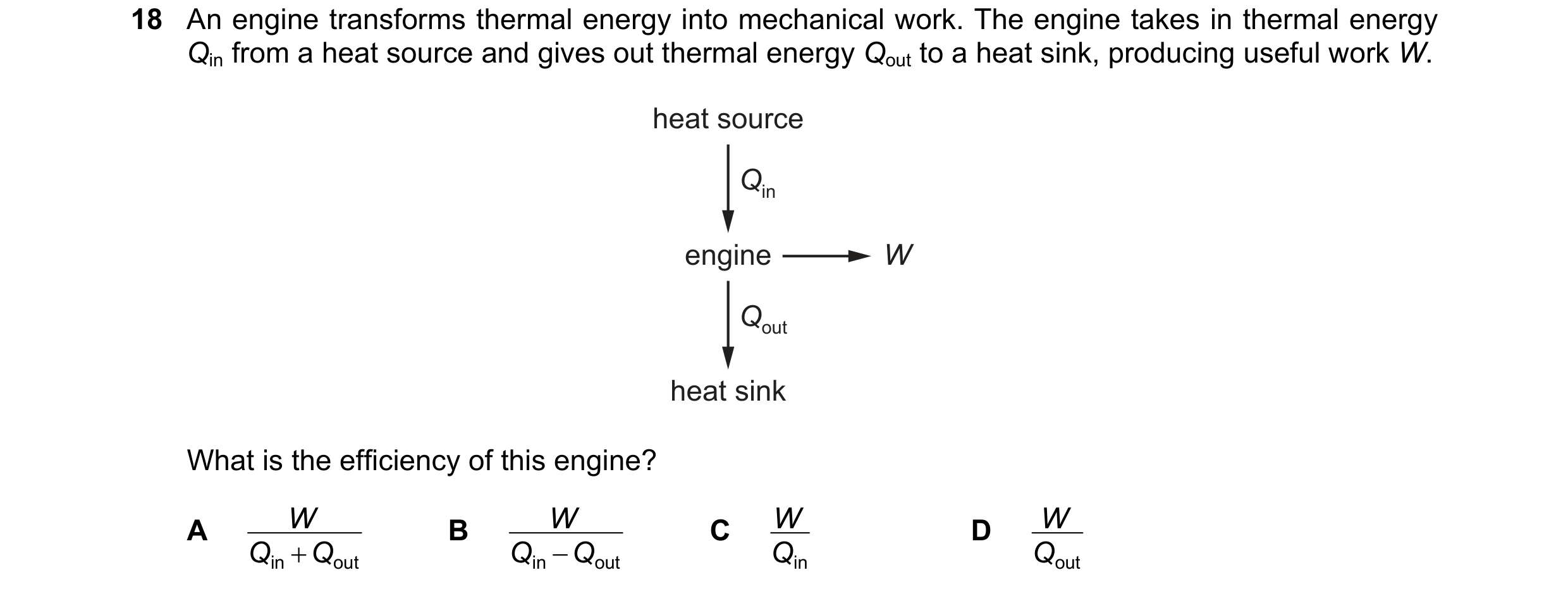
18 An engine transforms thermal energy into mechanical work. The engine takes in thermal energy Qin from a heat source and gives out thermal energy Qout to a heat sink, producing useful work W. heat source Qin engine W Qout heat sink What is the efficiency of this engine? A W B W C W D W Q + Q Q − Q Q Q in out in out in out
1 marks
Answer: C
This question in 9702/11 Oct/Nov 2016
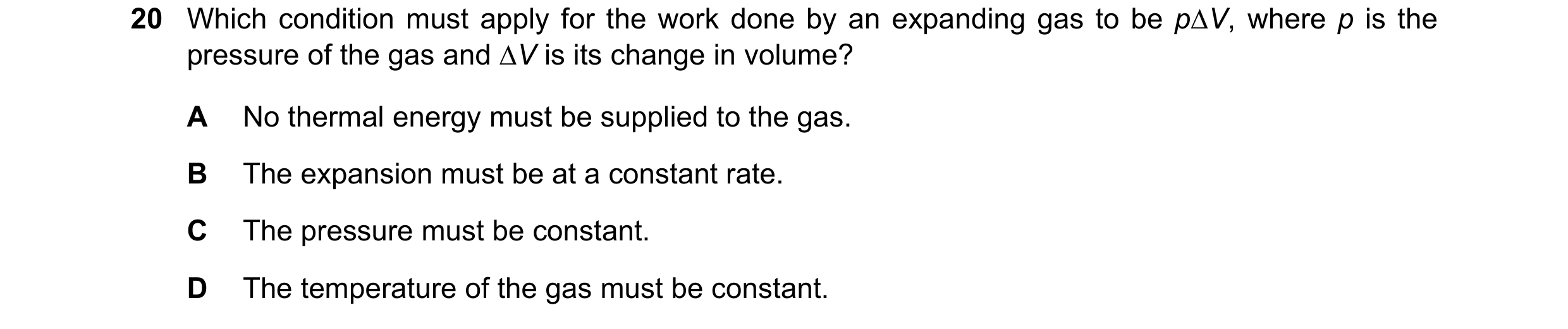
Q4 · Which condition must apply for the work done by an expanding gas to be p∆V, where p is… 9702/11 Oct/Nov 2016
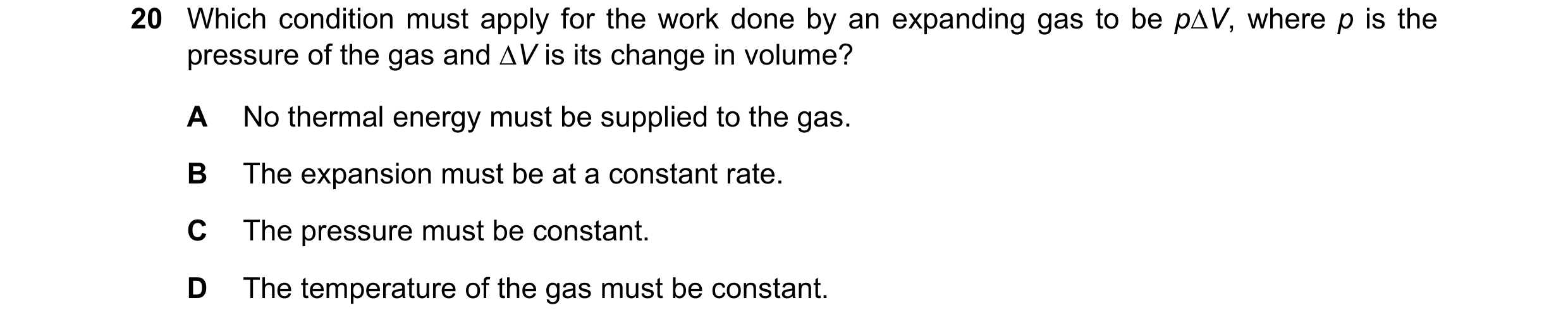
20 Which condition must apply for the work done by an expanding gas to be p∆V, where p is the pressure of the gas and ∆V is its change in volume? A No thermal energy must be supplied to the gas. B The expansion must be at a constant rate. C The pressure must be constant. D The temperature of the gas must be constant.
1 marks
Answer: C
This question in 9702/11 Oct/Nov 2016
Q5 · An engine transforms thermal energy into mechanical work 9702/13 Oct/Nov 2016
18 An engine transforms thermal energy into mechanical work. The engine takes in thermal energy Qin from a heat source and gives out thermal energy Qout to a heat sink, producing useful work W. heat source Qin engine W Qout heat sink What is the efficiency of this engine? A W B W C W D W Q + Q Q − Q Q Q in out in out in out
1 marks
Answer: C
This question in 9702/13 Oct/Nov 2016
Q6 · Which condition must apply for the work done by an expanding gas to be p∆V, where p is… 9702/13 Oct/Nov 2016
20 Which condition must apply for the work done by an expanding gas to be p∆V, where p is the pressure of the gas and ∆V is its change in volume? A No thermal energy must be supplied to the gas. B The expansion must be at a constant rate. C The pressure must be constant. D The temperature of the gas must be constant.
1 marks
Answer: C
This question in 9702/13 Oct/Nov 2016
Q7 · A gas is enclosed inside a cylinder which is fitted with a frictionless piston 9702/12 Feb/March 2017
17 A gas is enclosed inside a cylinder which is fitted with a frictionless piston. V1 piston p gas p V2 Initially, the gas has a volume V1 and is in equilibrium with the external pressure p. The gas is then heated slowly so that it expands at constant pressure, pushing the piston back until the volume of the gas has increased to V2. How much work is done by the gas during this expansion? A B 1 p (V2 – V1) C D 1 p (V2 + V1) p (V2 – V1) p (V2 + V1) 2 2
1 marks
Answer: A
This question in 9702/12 Feb/March 2017
Q8 · A horizontal cylinder of cross-sectional area A is fitted with a frictionless piston and… 9702/13 Oct/Nov 2017
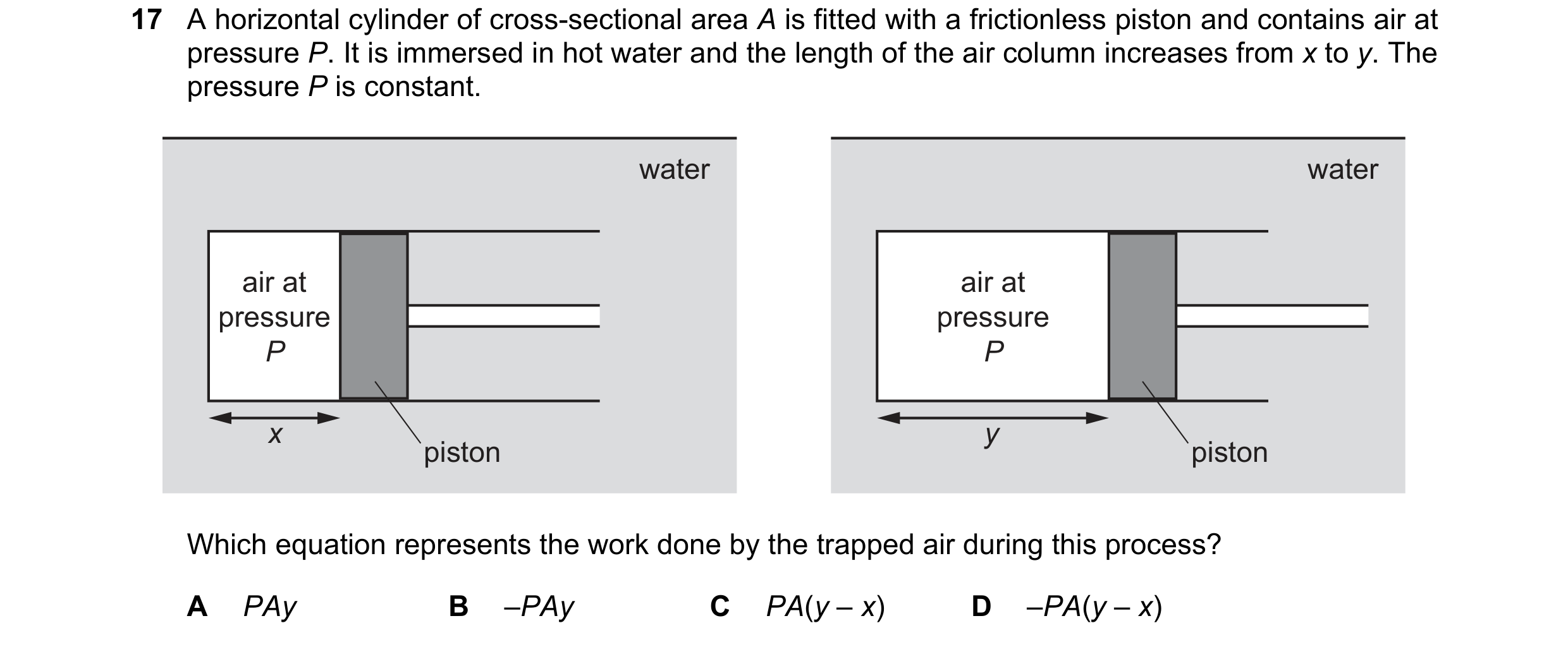
17 A horizontal cylinder of cross-sectional area A is fitted with a frictionless piston and contains air at pressure P. It is immersed in hot water and the length of the air column increases from x to y. The pressure P is constant. water water air at air at pressure pressure P P x y piston piston Which equation represents the work done by the trapped air during this process? A PAy B –PAy C PA(y – x) D –PA(y – x)
1 marks
Answer: C
This question in 9702/13 Oct/Nov 2017
Q9 · A cylinder contains a fixed mass of gas 9702/12 Oct/Nov 2018
16 A cylinder contains a fixed mass of gas. The gas, at a constant pressure of 1.3 × 10⁵ Pa, expands from a volume of 900 cm3 to a volume of 1100 cm3. What is the work done by the gas during this expansion? A 26 J B 130 J C 2600 J D 13 000 J
1 marks
Answer: A
This question in 9702/12 Oct/Nov 2018
Q10 · A fixed amount of a gas undergoes a series of changes to its pressure and volume 9702/11 Oct/Nov 2019
16 A fixed amount of a gas undergoes a series of changes to its pressure and volume. In two of the changes, no work is done by or on the gas. In one change work is done by the gas on its surroundings. In another change work is done on the gas by its surroundings. 2.0 pressure / 105 Pa 1.5 1.0 0.5 0 0 1 2 3 4 5 volume / 10–4 m3 During the change when work is done on the gas by its surroundings, how much work is done on the gas? A 15 J B 25 J C 30 J D 45 J
1 marks
Answer: C
This question in 9702/11 Oct/Nov 2019
Q11 · A cylinder contains a volume of 0.012 m3 of gas at a pressure of 1.0 × 10⁵ Pa 9702/12 Feb/March 2020
14 A cylinder contains a volume of 0.012 m3 of gas at a pressure of 1.0 × 10⁵ Pa. 400 J of work is done on this gas, with its pressure remaining constant throughout. What is the final volume of the gas? A 0.0040 m3 B 0.0080 m3 C 0.016 m3 D 0.020 m3
1 marks
Answer: B
This question in 9702/12 Feb/March 2020
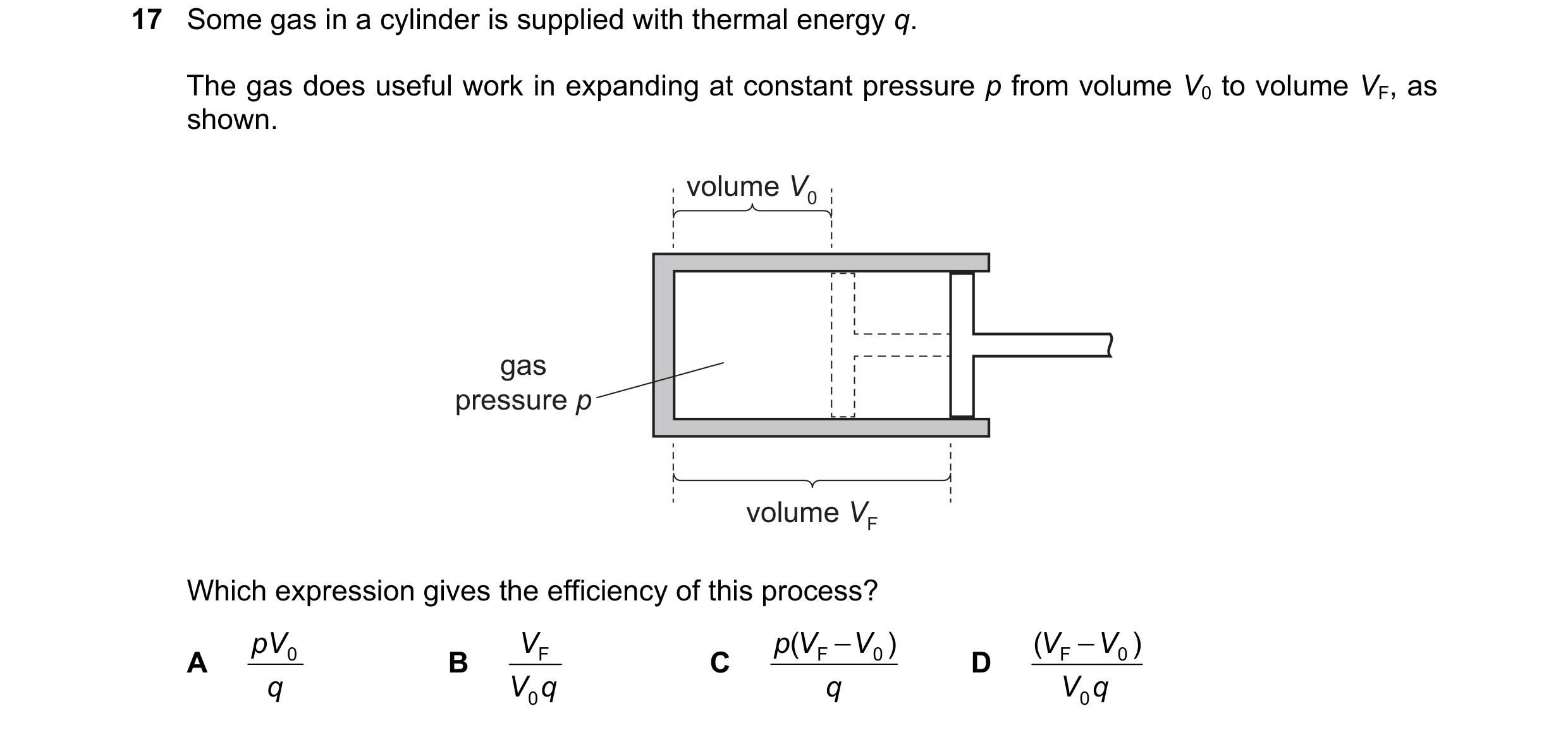
Q12 · Some gas in a cylinder is supplied with thermal energy q 9702/13 Oct/Nov 2020
17 Some gas in a cylinder is supplied with thermal energy q. The gas does useful work in expanding at constant pressure p from volume V0 to volume VF, as shown. volume V0 gas pressure p volume VF Which expression gives the efficiency of this process? pV0 V p ( V F V ) ( V V ) A B F C 0 D F 0 q V q q V q 0 0
1 marks
Answer: C
This question in 9702/13 Oct/Nov 2020
Q13 · A sample of gas is sealed in a cylinder by a piston 9702/13 May/June 2021
17 A sample of gas is sealed in a cylinder by a piston. The frictionless piston is free to move, so that the pressure of the gas remains constant at 1.80 105 Pa. The gas initially occupies a volume of 2.40 10–4 m3. The gas now does 14.4 J of work. What is the volume of the gas after doing this work? A 0.80 10–4 m3 B 1.60 10–4 m3 C 3.20 10–4 m3 D 4.00 10–4 m3
1 marks
Answer: C
This question in 9702/13 May/June 2021
 1 / 5
1 / 5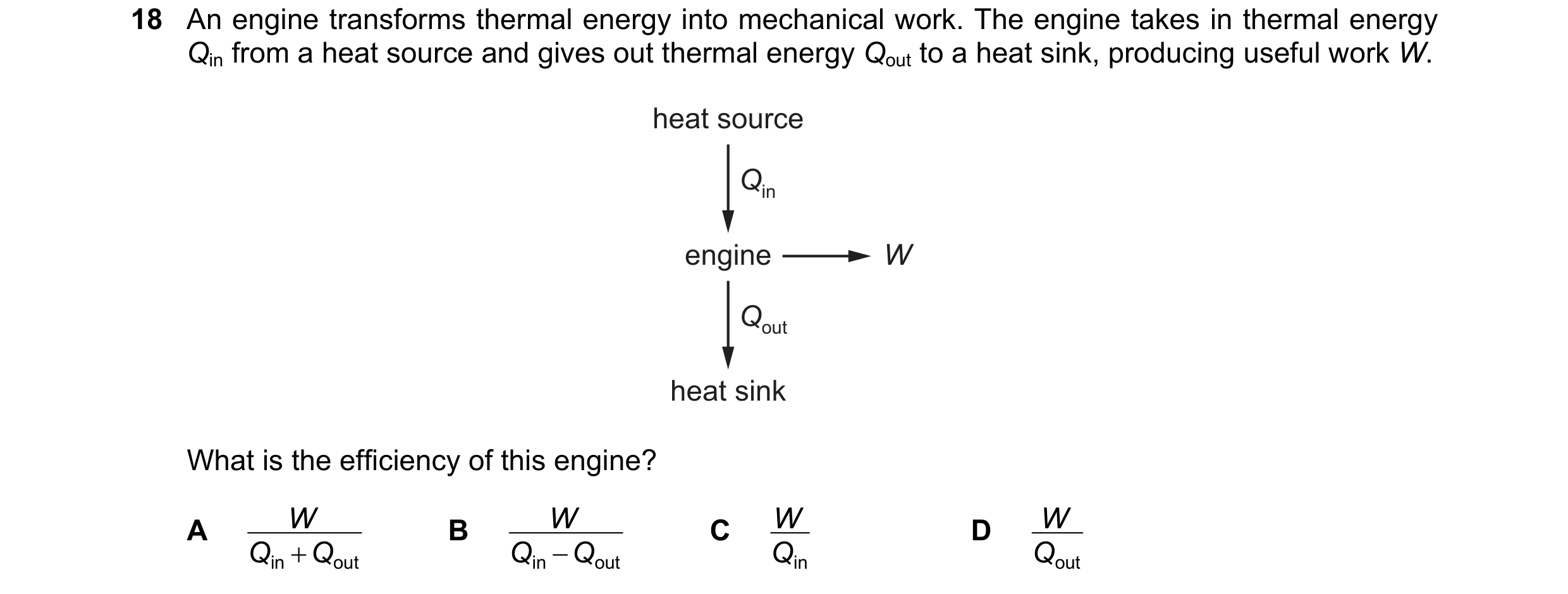
 2 / 5
2 / 5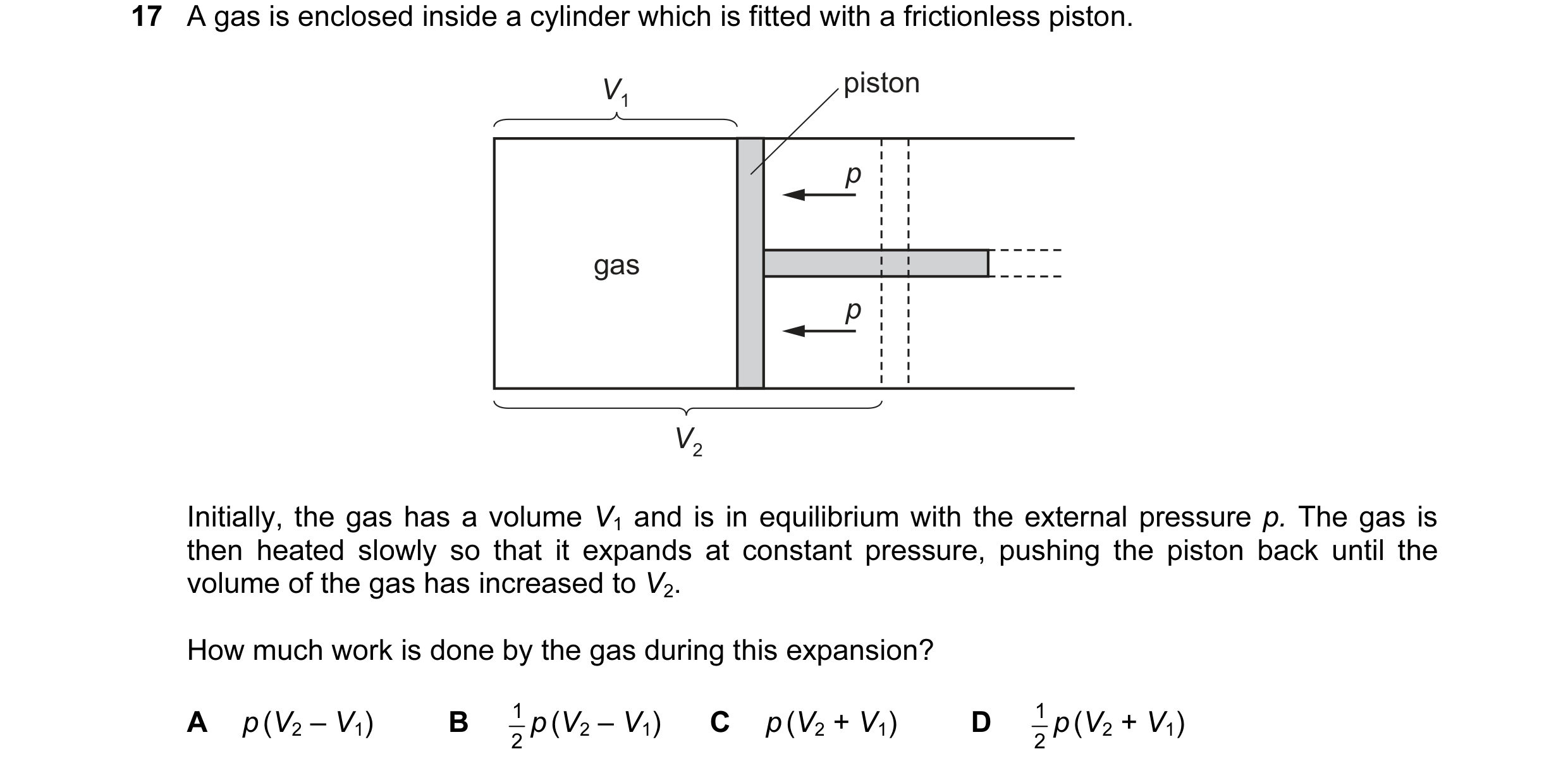
 3 / 5
3 / 5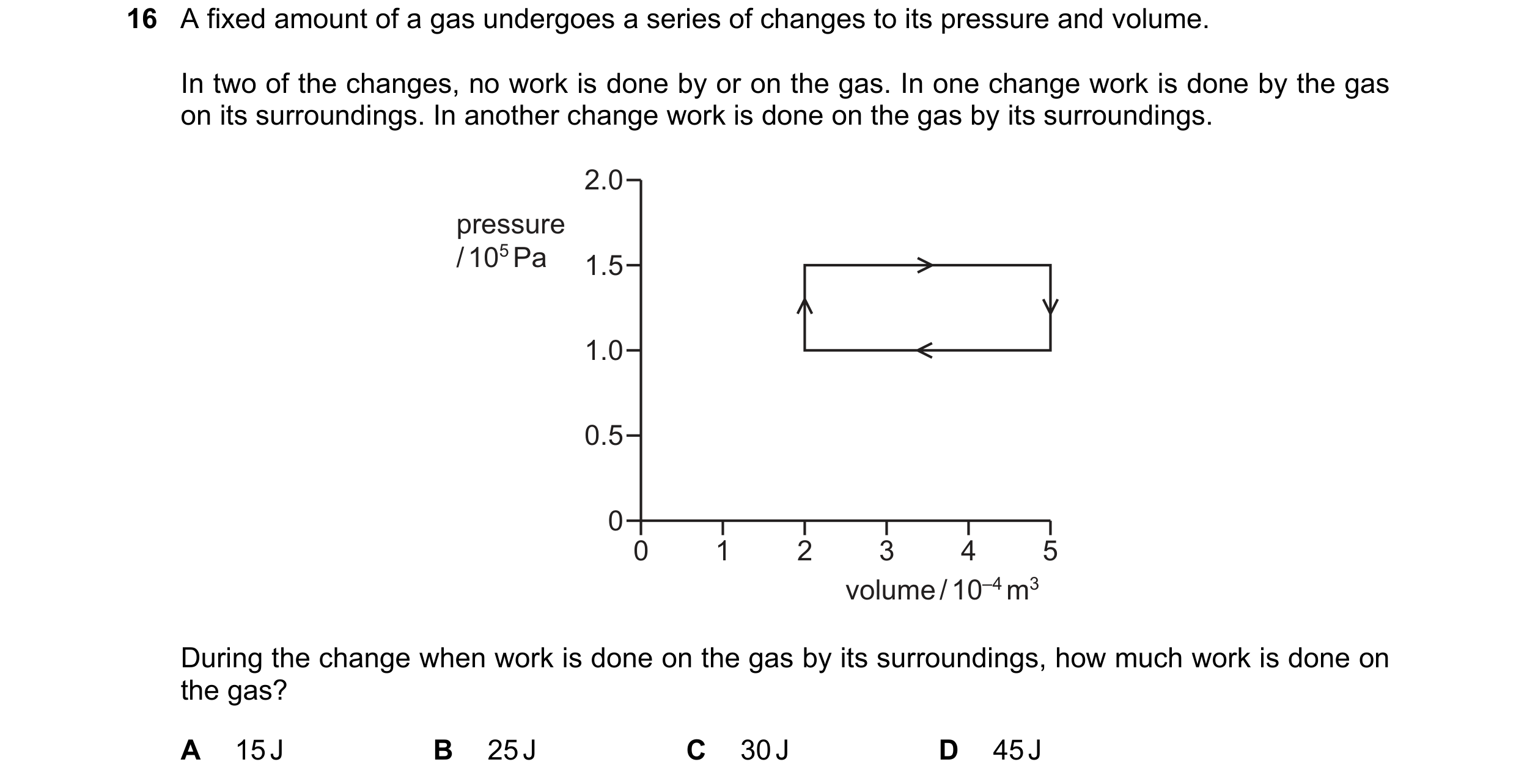

 4 / 5
4 / 5 5 / 5
5 / 5