Cambridge A Level Physics 9702 — 2020 May/June Paper 4 · Variant 2
9702/42/M/J/20 · 12 questions · 100 marks · ≈113 min
The question paper and its mark scheme, free to read here and free to download. This is Cambridge’s own paper, exactly as it was sat.
Question paper20 pages
Mark scheme17 pages
Answers below. Sit the paper first if you are practising.
Questions as text
Q1 · Define gravitational potential at a point
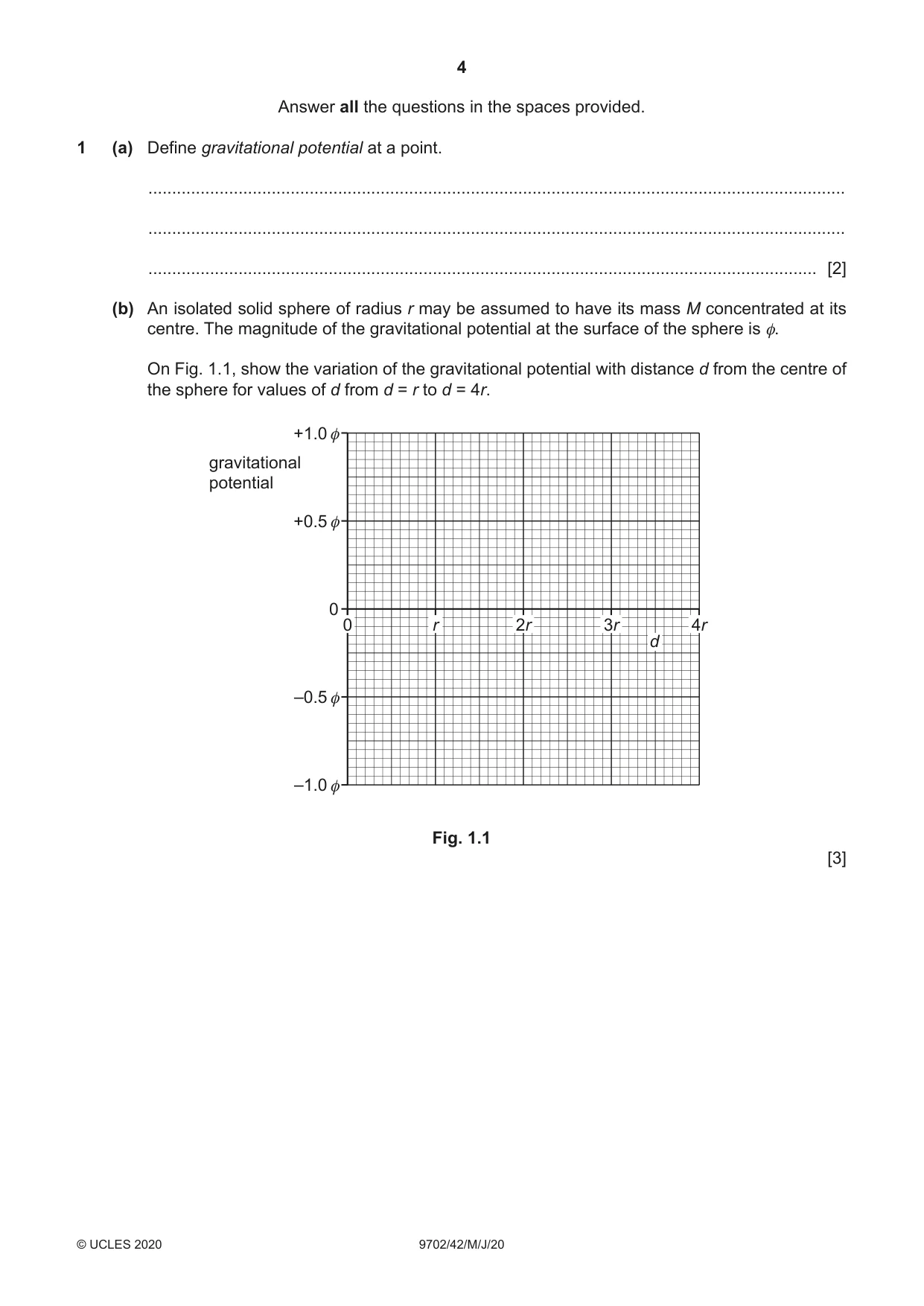
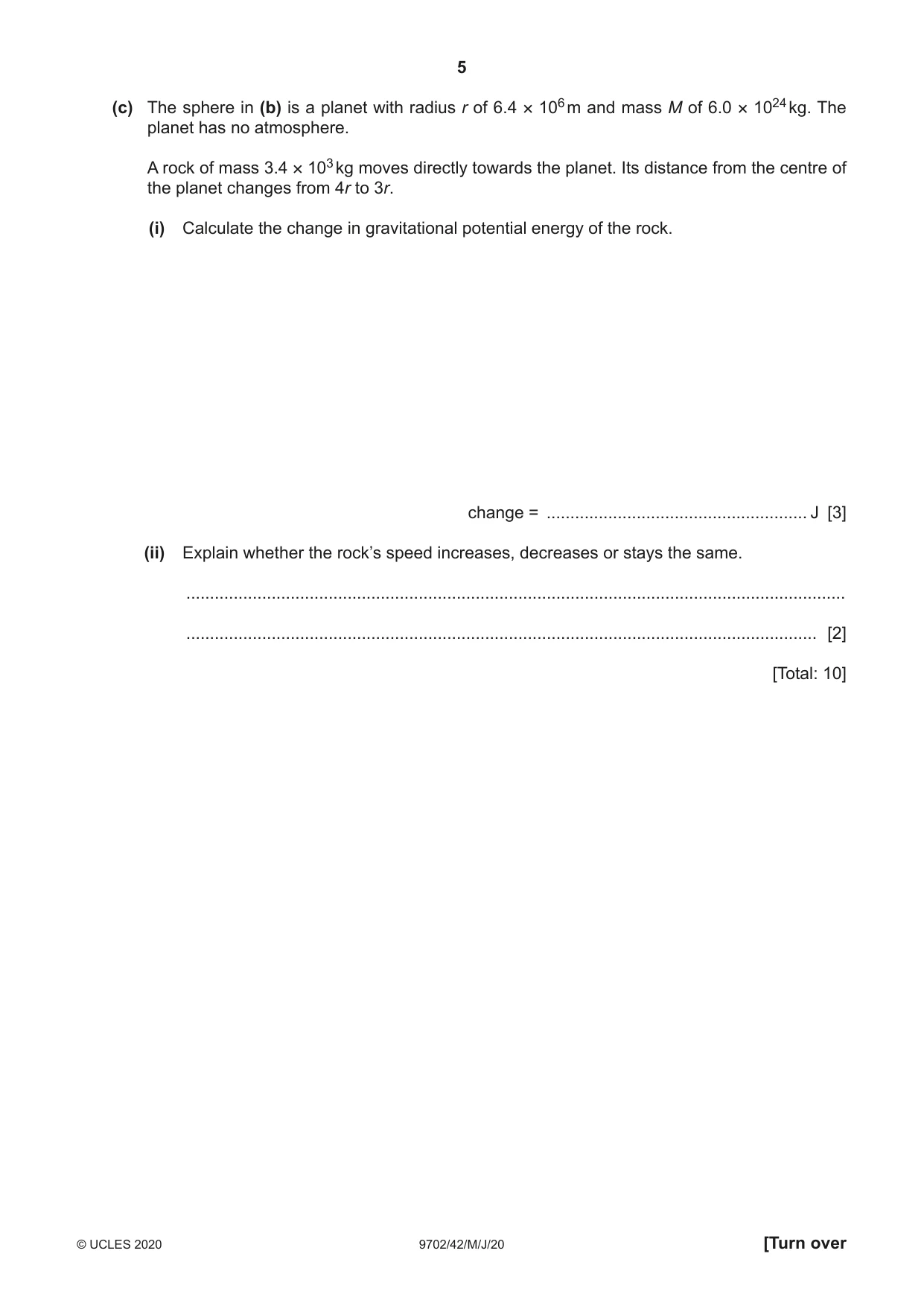
1 (a) Define gravitational potential at a point. ................................................................................................................................................... ................................................................................................................................................... ............................................................................................................................................. [2] (b) An isolated solid sphere of radius r may be assumed to have its mass M concentrated at its centre. The magnitude of the gravitational potential at the surface of the sphere is φ. On Fig. 1.1, show the variation of the gravitational potential with distance d from the centre of the sphere for values of d from d = r to d = 4r. +1.0 φ gravitational potential +0.5 φ 0 0 r 2r 3r 4r d –0.5 φ –1.0 φ Fig. 1.1 [3] (c) The sphere in (b) is a planet with radius r of 6.4 × 10⁶ m and mass M of 6.0 × 1024 kg. The planet has no atmosphere. A rock of mass 3.4 × 10³ kg moves directly towards the planet. Its distance from the centre of the planet changes from 4r to 3r. (i) Calculate the change in gravitational potential energy of the rock. change = ....................................................... J [3] (ii) Explain whether the rock’s speed increases, decreases or stays the same. ........................................................................................................................................... ..................................................................................................................................... [2] [Total: 10]
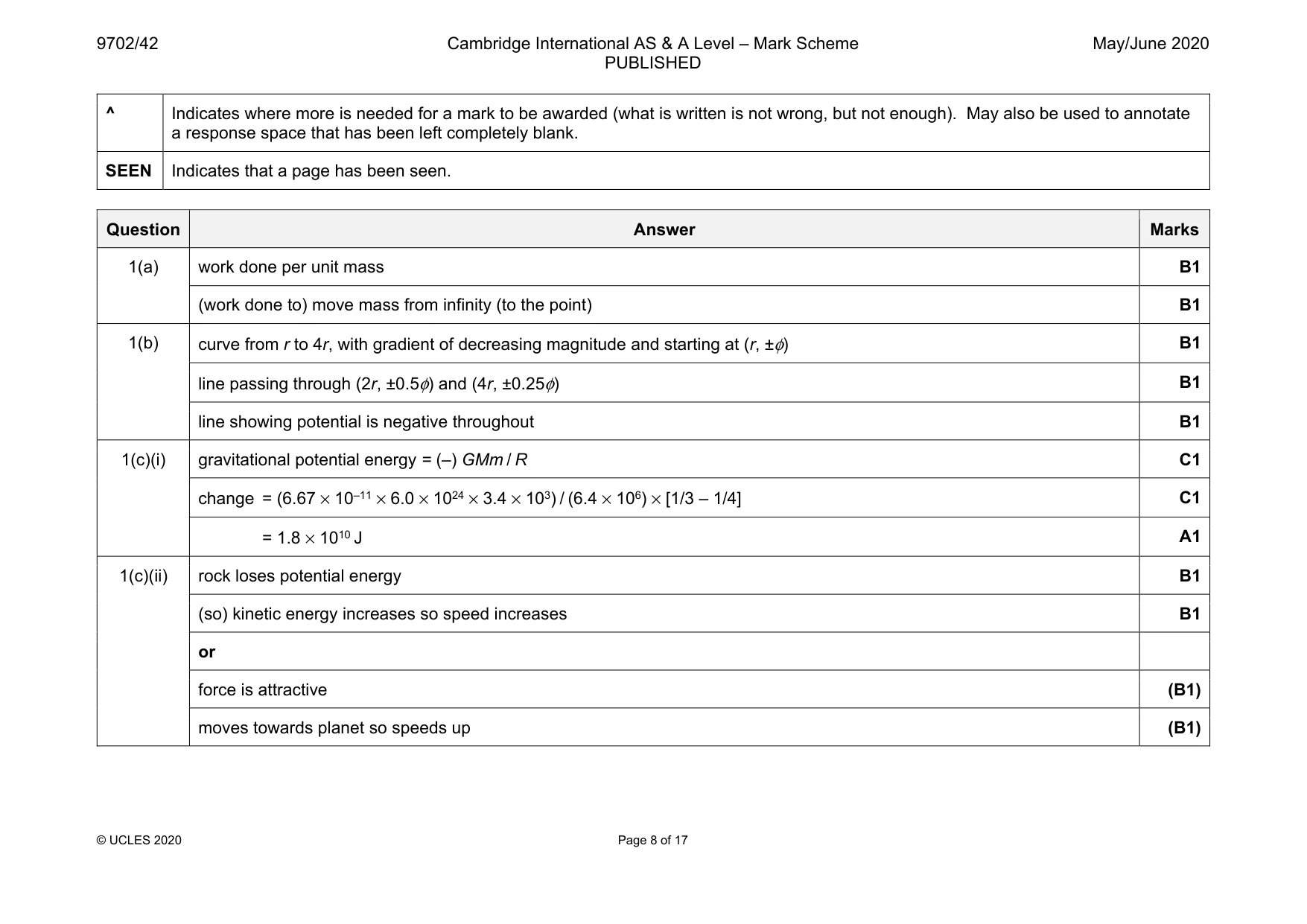
Mark scheme: 1(a) work done per unit mass B1 (work done to) move mass from infinity (to the point) B1 1(b) curve from r to 4r, with gradient of decreasing magnitude and starting at (r, ±φ) B1 line passing through (2r, ±0.5φ) and (4r, ±0.25φ) B1 line showing potential is negative throughout B1 1(c)(i) gravitational potential energy = (–) GMm / R C1 change = (6.67 × 10–11 × 6.0 × 1024 × 3.4 × 103) / (6.4 × 106) × [1/3 – 1/4] C1 = 1.8 × 10¹⁰ J A1 1(c)(ii) rock loses potential energy B1 (so) kinetic energy increases so speed increases B1 or force is attractive (B1) moves towards planet so speeds up (B1)
Q2 · A square box of volume V contains N molecules of an ideal gas
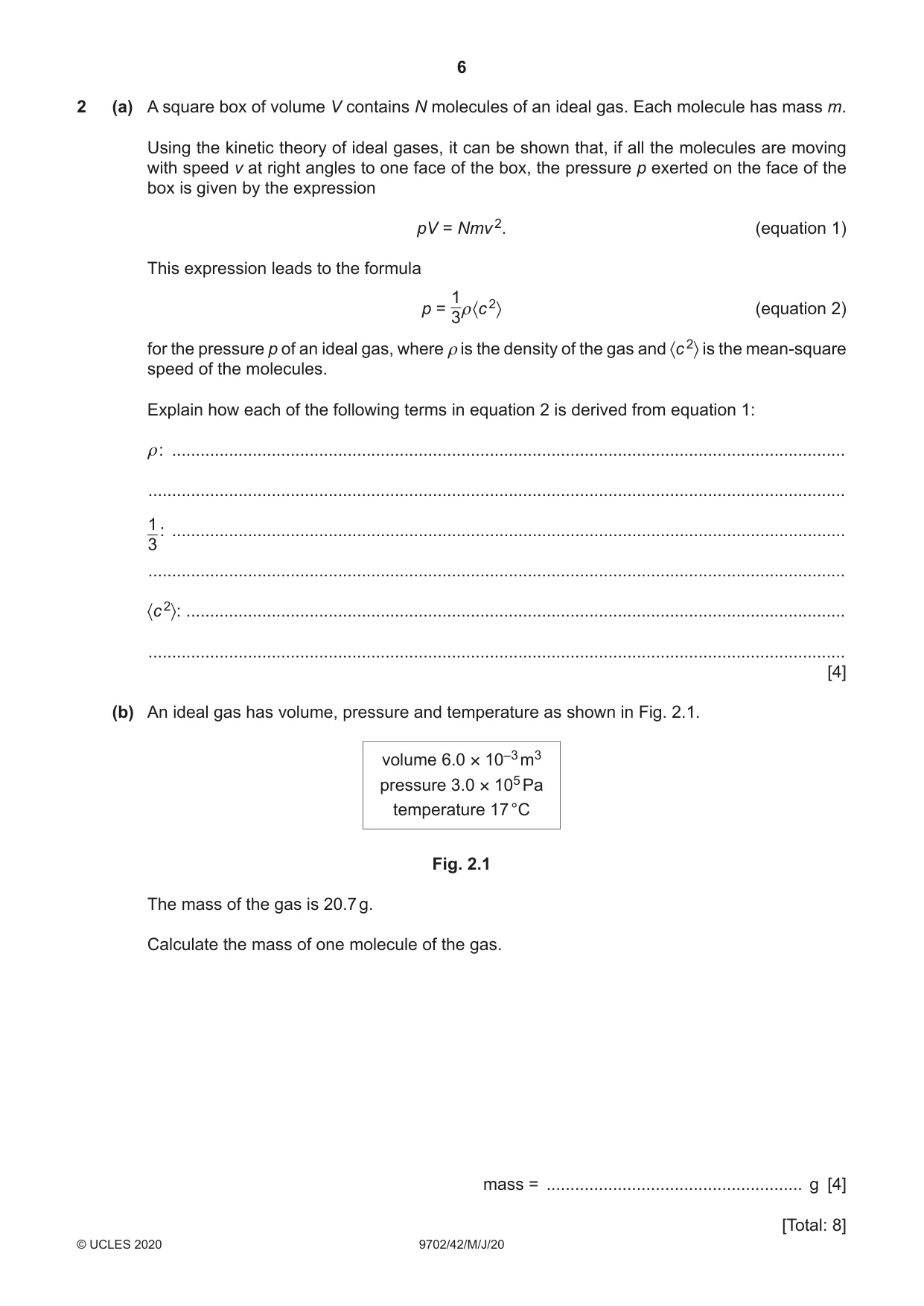
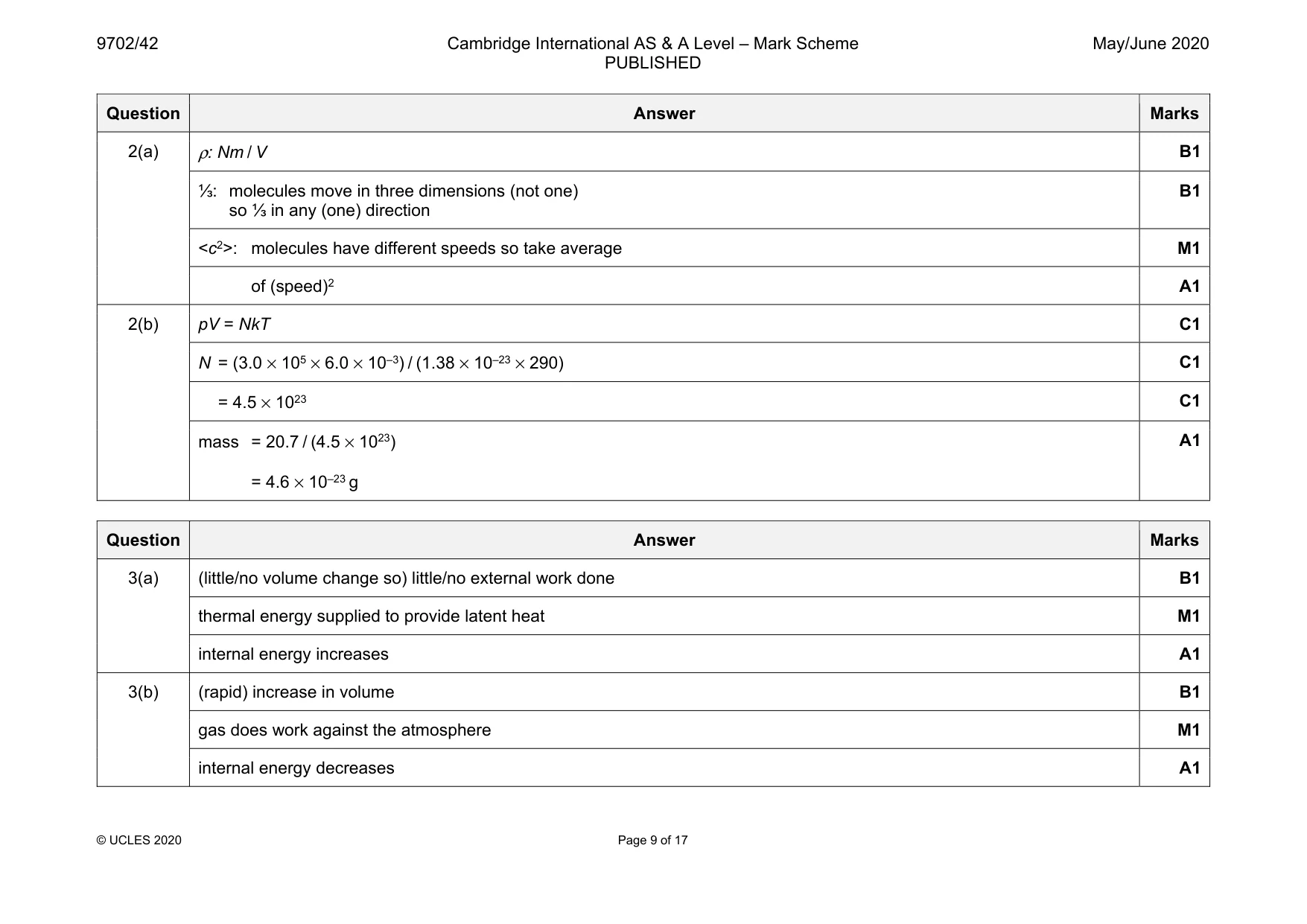
2 (a) A square box of volume V contains N molecules of an ideal gas. Each molecule has mass m. Using the kinetic theory of ideal gases, it can be shown that, if all the molecules are moving with speed v at right angles to one face of the box, the pressure p exerted on the face of the box is given by the expression pV = Nmv 2. (equation 1) This expression leads to the formula 1 p = 3ρ 〈c 2〉 (equation 2) for the pressure p of an ideal gas, where ρis the density of the gas and 〈c 2〉 is the mean‑square speed of the molecules. Explain how each of the following terms in equation 2 is derived from equation 1: ρ : .............................................................................................................................................. ................................................................................................................................................... 1 : .............................................................................................................................................. 3 ................................................................................................................................................... 〈c 2〉: ........................................................................................................................................... ................................................................................................................................................... [4] (b) An ideal gas has volume, pressure and temperature as shown in Fig. 2.1. volume 6.0 × 10⁻³ m3 pressure 3.0 × 10⁵ Pa temperature 17 °C Fig. 2.1 The mass of the gas is 20.7 g. Calculate the mass of one molecule of the gas. mass = ...................................................... g [4] [Total: 8]
Mark scheme: 2(a) ρ: Nm / V ⅓: molecules move in three dimensions (not one) so ⅓ in any (one) direction B1 <c2>: molecules have different speeds so take average M1 of (speed)2 A1 2(b) pV = NkT C1 N = (3.0 × 105 × 6.0 × 10–3) / (1.38 × 10–23 × 290) C1 = 4.5 × 10²³ C1 mass = 20.7 / (4.5 × 10²³) = 4.6 × 10⁻²³ g A1
Q3 · By reference to the first law of thermodynamics, state and explain the change, if any, in…
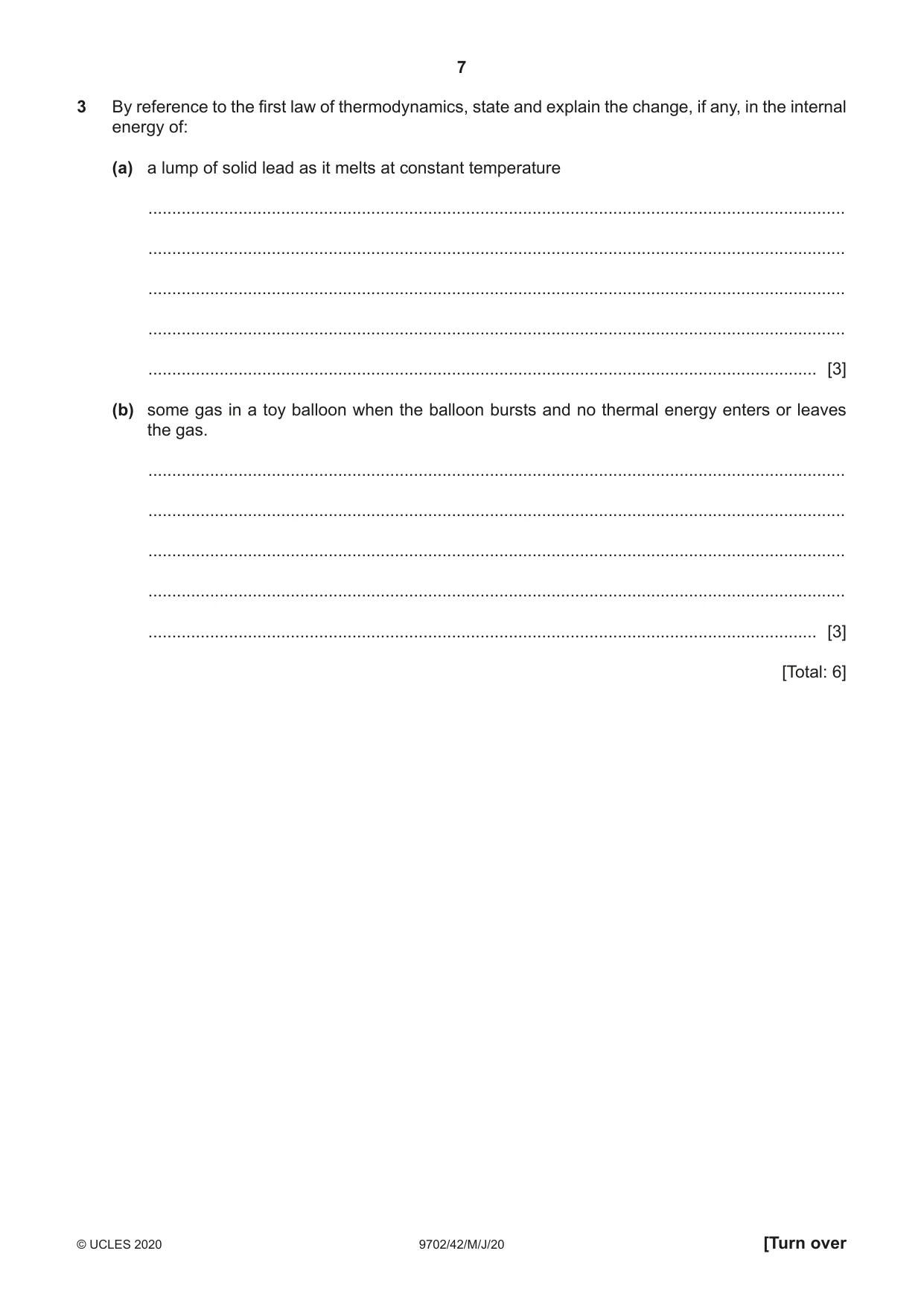
3 By reference to the first law of thermodynamics, state and explain the change, if any, in the internal energy of: (a) a lump of solid lead as it melts at constant temperature ................................................................................................................................................... ................................................................................................................................................... ................................................................................................................................................... ................................................................................................................................................... ............................................................................................................................................. [3] (b) some gas in a toy balloon when the balloon bursts and no thermal energy enters or leaves the gas. ................................................................................................................................................... ................................................................................................................................................... ................................................................................................................................................... ................................................................................................................................................... ............................................................................................................................................. [3] [Total: 6]
Mark scheme: 3(a) (little/no volume change so) little/no external work done B1 thermal energy supplied to provide latent heat M1 internal energy increases A1 3(b) (rapid) increase in volume B1 gas does work against the atmosphere M1 internal energy decreases A1
Q4 · A dish is made from a section of a hollow glass sphere
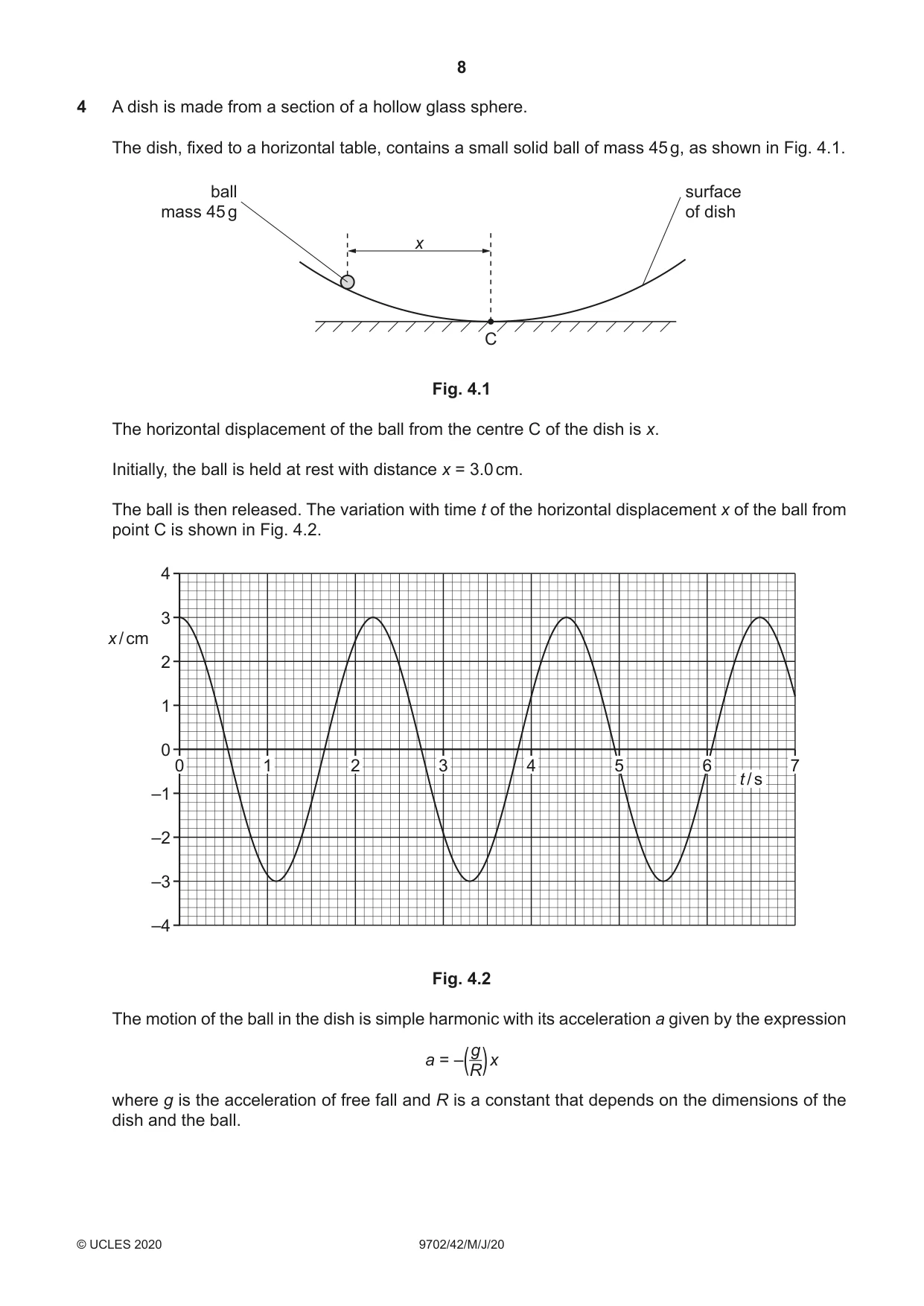
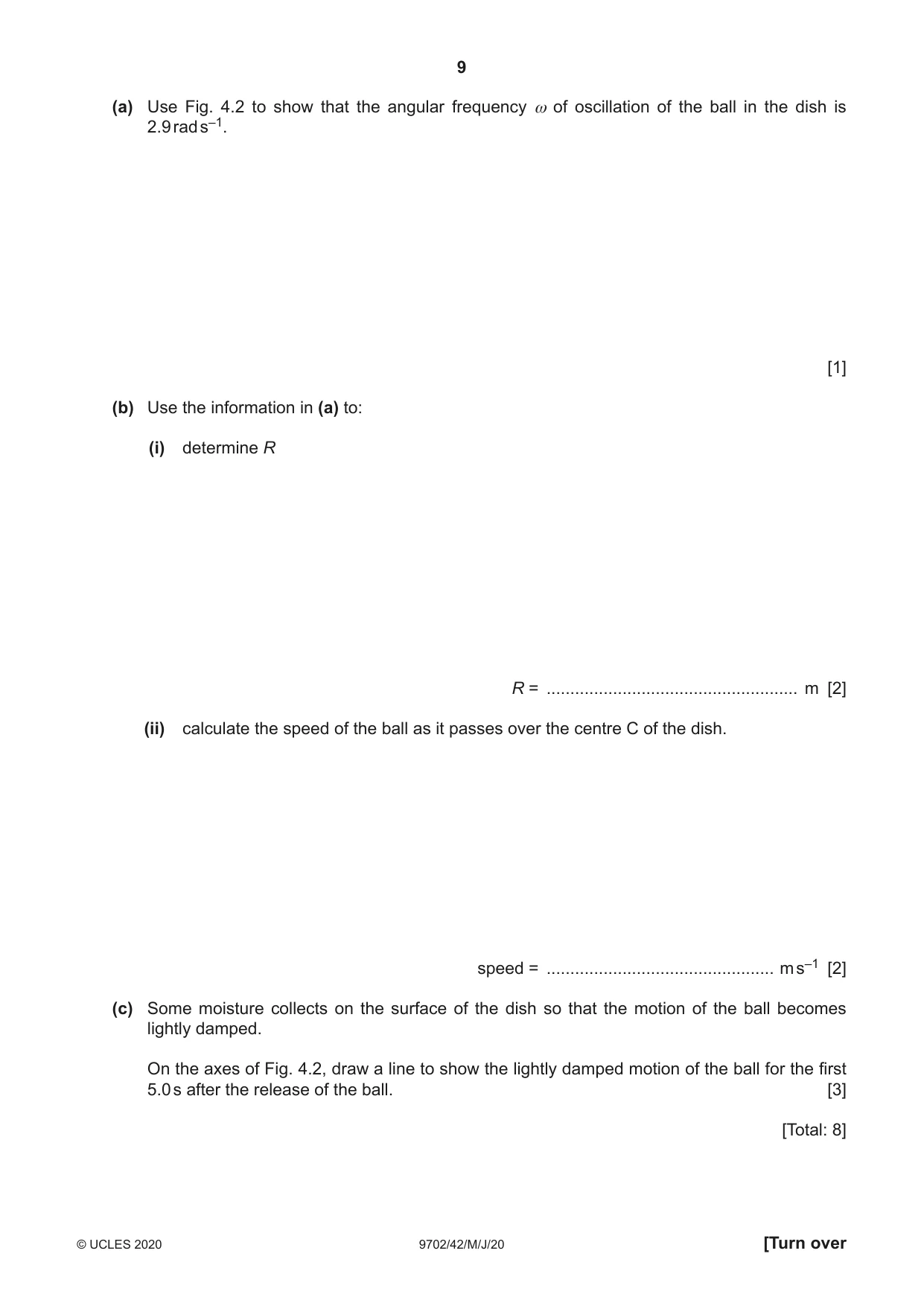
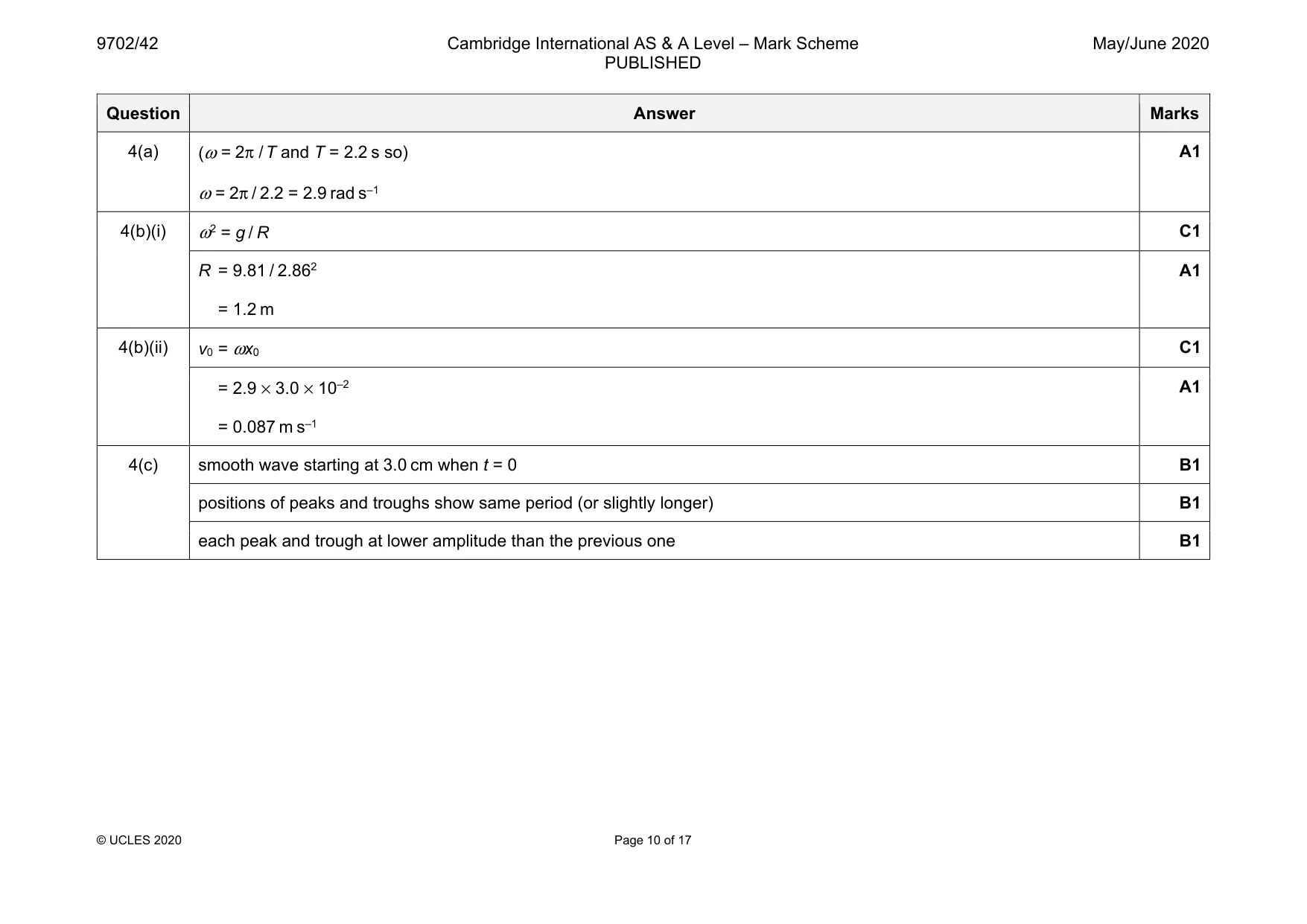
4 A dish is made from a section of a hollow glass sphere. The dish, fixed to a horizontal table, contains a small solid ball of mass 45 g, as shown in Fig. 4.1. ball surface mass 45 g of dish x C Fig. 4.1 The horizontal displacement of the ball from the centre C of the dish is x. Initially, the ball is held at rest with distance x = 3.0 cm. The ball is then released. The variation with time t of the horizontal displacement x of the ball from point C is shown in Fig. 4.2. 4 3 x / cm 2 1 0 0 1 2 3 4 5 6 7 t / s –1 –2 –3 –4 Fig. 4.2 The motion of the ball in the dish is simple harmonic with its acceleration a given by the expression a = x –(gR) where g is the acceleration of free fall and R is a constant that depends on the dimensions of the dish and the ball. (a) Use Fig. 4.2 to show that the angular frequency ω of oscillation of the ball in the dish is 2.9 rad s–1. [1] (b) Use the information in (a) to: (i) determine R R = ..................................................... m [2] (ii) calculate the speed of the ball as it passes over the centre C of the dish. speed = ................................................ m s–1 [2] (c) Some moisture collects on the surface of the dish so that the motion of the ball becomes lightly damped. On the axes of Fig. 4.2, draw a line to show the lightly damped motion of the ball for the first 5.0 s after the release of the ball. [3] [Total: 8]
Mark scheme: 4(a) (ω = 2π / T and T = 2.2 s so) ω = 2π / 2.2 = 2.9 rad s–1 4(b)(i) ω2 = g / R C1 R = 9.81 / 2.862 = 1.2 m A1 4(b)(ii) v0 = ωx0 C1 = 2.9 × 3.0 × 10–2 = 0.087 m s–1 A1 4(c) smooth wave starting at 3.0 cm when t = 0 B1 positions of peaks and troughs show same period (or slightly longer) B1 each peak and trough at lower amplitude than the previous one B1
Q5 · Explain the principles of the detection of ultrasound waves for medical diagnosis
5 (a) Explain the principles of the detection of ultrasound waves for medical diagnosis. ................................................................................................................................................... ................................................................................................................................................... ................................................................................................................................................... ................................................................................................................................................... ................................................................................................................................................... ................................................................................................................................................... ................................................................................................................................................... ............................................................................................................................................. [4] (b) By reference to specific acoustic impedance, explain why there is very little transmission of ultrasound waves from air into skin. ................................................................................................................................................... ................................................................................................................................................... ................................................................................................................................................... ................................................................................................................................................... ................................................................................................................................................... ............................................................................................................................................. [3] [Total: 7]
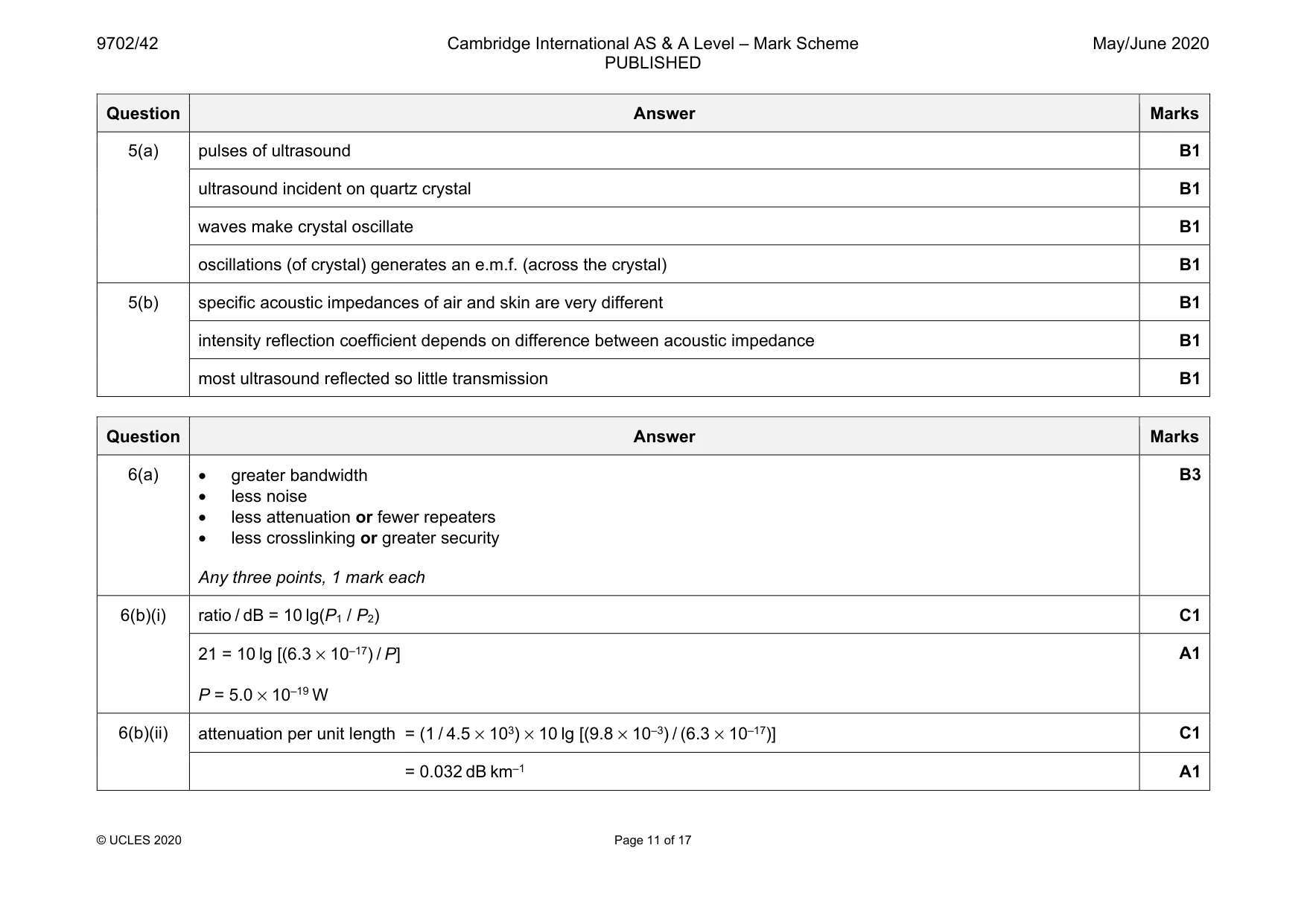
Mark scheme: 5(a) pulses of ultrasound B1 ultrasound incident on quartz crystal B1 waves make crystal oscillate B1 oscillations (of crystal) generates an e.m.f. (across the crystal) B1 5(b) specific acoustic impedances of air and skin are very different B1 intensity reflection coefficient depends on difference between acoustic impedance B1 most ultrasound reflected so little transmission B1
Q6 · Telephone signals may be transmitted either by means of an optic fibre or by means of a…
6 (a) Telephone signals may be transmitted either by means of an optic fibre or by means of a wire pair. State three advantages of the use of an optic fibre rather than a wire pair. 1. ............................................................................................................................................... ................................................................................................................................................... 2. ............................................................................................................................................... ................................................................................................................................................... 3. ............................................................................................................................................... ................................................................................................................................................... [3] (b) It is proposed to transmit a signal over a distance of 4.5 × 10³ km by means of an optic fibre. The input signal has a power of 9.8 mW. The minimum signal that can be detected at the output has a power of 6.3 × 10⁻¹⁷ W. For this signal power, the signal‑to‑noise ratio is 21 dB. Calculate: (i) the power of the background noise power = ..................................................... W [2] (ii) the maximum attenuation per unit length of the optic fibre that allows for uninterrupted transmission of the signal. attenuation per unit length = ........................................... dB km–1 [2] [Total: 7]
Mark scheme: 6(a) • greater bandwidth • less noise • less attenuation or fewer repeaters • less crosslinking or greater security Any three points, 1 mark each 6(b)(i) ratio / dB = 10 lg(P1 / P2) C1 21 = 10 lg [(6.3 × 10⁻¹⁷) / P] P = 5.0 × 10⁻¹⁹ W A1 6(b)(ii) attenuation per unit length = (1 / 4.5 × 103) × 10 lg [(9.8 × 10⁻³) / (6.3 × 10⁻¹⁷)] C1 = 0.032 dB km–1 A1
Q7 · A metal sphere of radius R is isolated in space
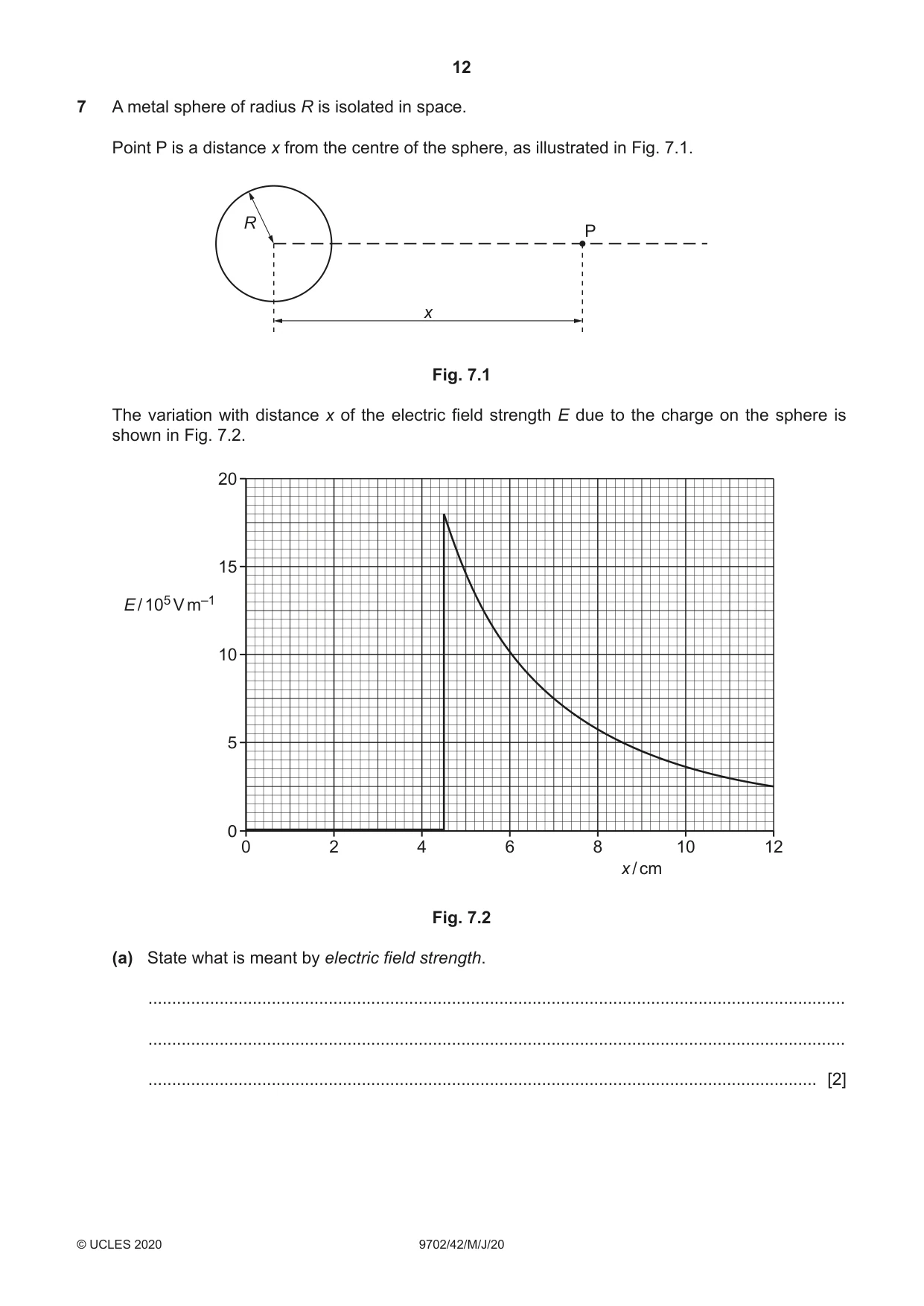
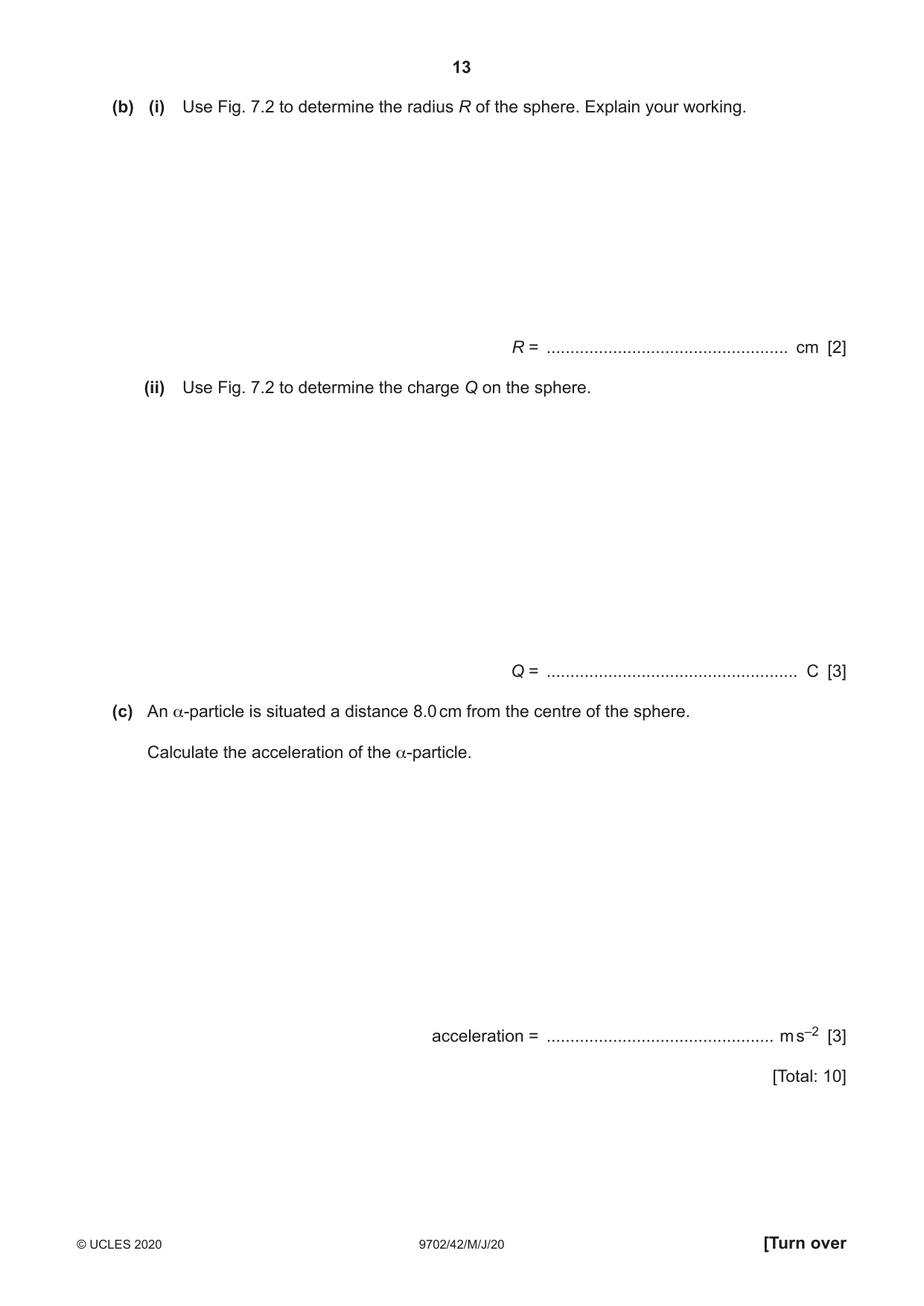
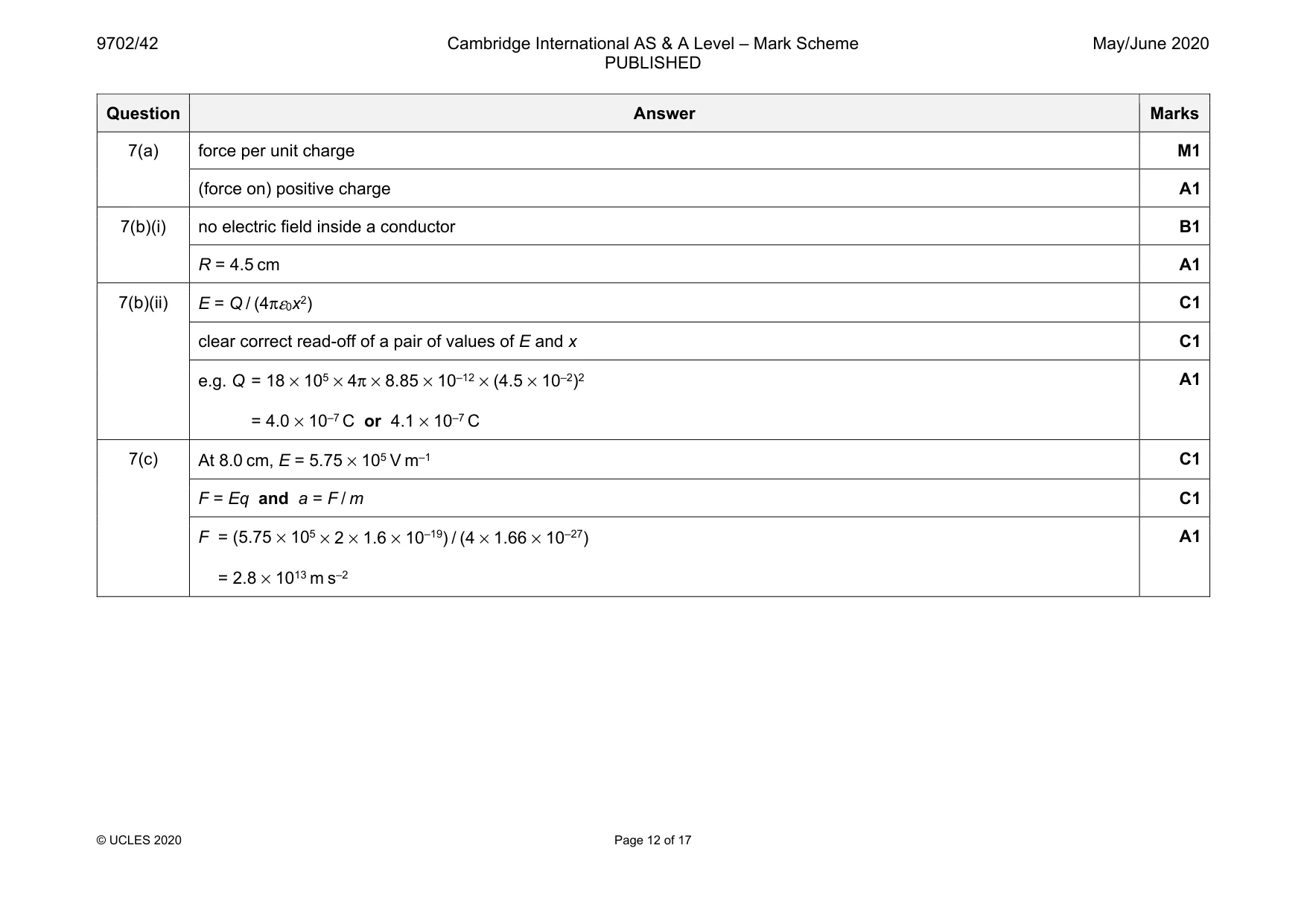
7 A metal sphere of radius R is isolated in space. Point P is a distance x from the centre of the sphere, as illustrated in Fig. 7.1. R P x Fig. 7.1 The variation with distance x of the electric field strength E due to the charge on the sphere is shown in Fig. 7.2. 20 15 E / 105 V m–1 10 5 0 0 2 4 6 8 10 12 x / cm Fig. 7.2 (a) State what is meant by electric field strength. ................................................................................................................................................... ................................................................................................................................................... ............................................................................................................................................. [2] (b) (i) Use Fig. 7.2 to determine the radius R of the sphere. Explain your working. R = ................................................... cm [2] (ii) Use Fig. 7.2 to determine the charge Q on the sphere. Q = ..................................................... C [3] (c) An α‑particle is situated a distance 8.0 cm from the centre of the sphere. Calculate the acceleration of the α‑particle. acceleration = ................................................ m s–2 [3] [Total: 10]
Mark scheme: 7(a) force per unit charge M1 (force on) positive charge A1 7(b)(i) no electric field inside a conductor B1 R = 4.5 cm A1 7(b)(ii) E = Q / (4πε0x2) C1 clear correct read-off of a pair of values of E and x C1 e.g. Q = 18 × 105 × 4π × 8.85 × 10–12 × (4.5 × 10–2)2 = 4.0 × 10⁻⁷ C or 4.1 × 10⁻⁷ C A1 7(c) At 8.0 cm, E = 5.75 × 10⁵ V m–1 C1 F = Eq and a = F / m C1 F = (5.75 × 105 × 2 × 1.6 × 10–19) / (4 × 1.66 × 10–27) = 2.8 × 10¹³ m s–2 A1
Q8 · An ideal operational amplifier (op‑amp) is connected to a load resistor
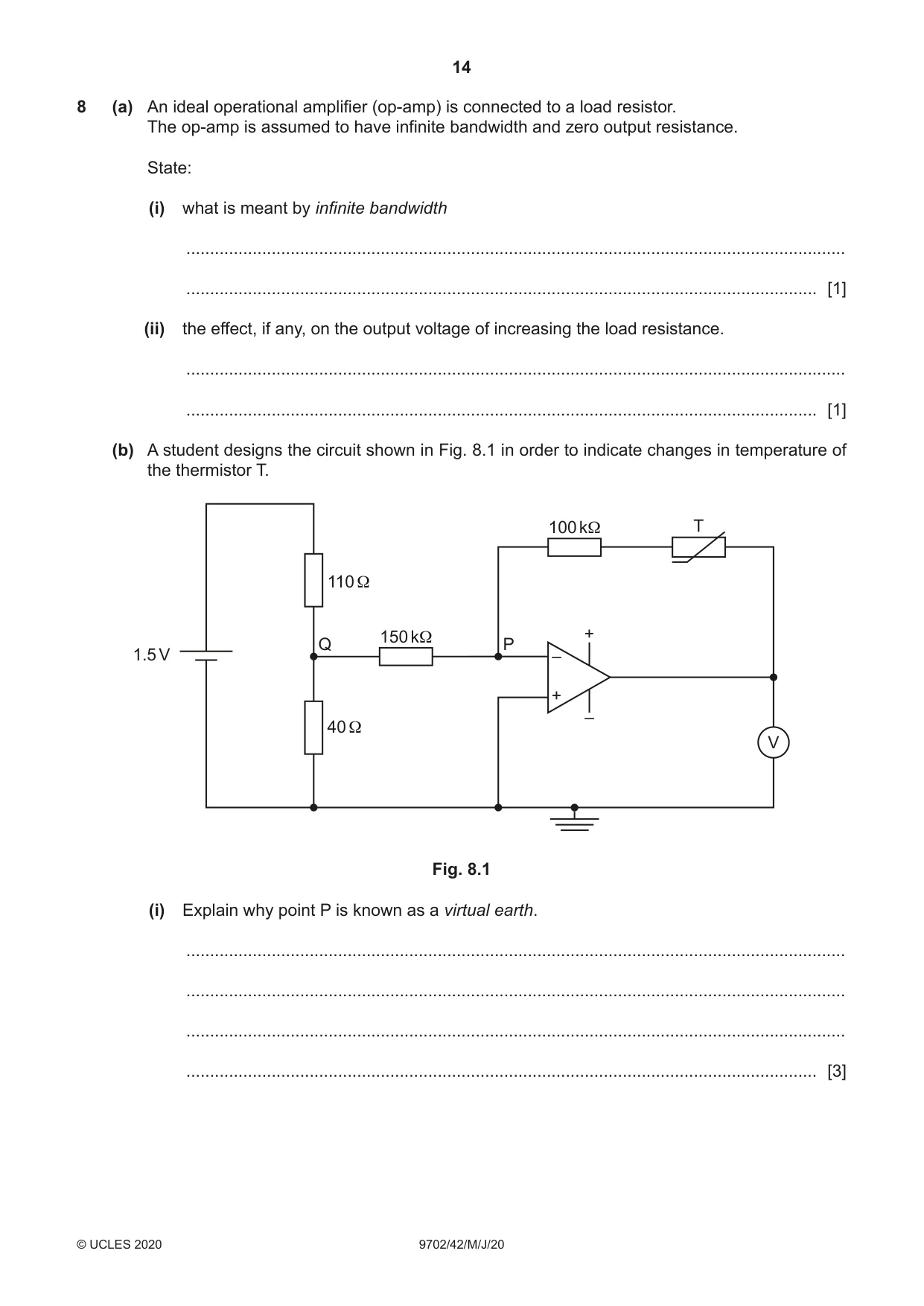
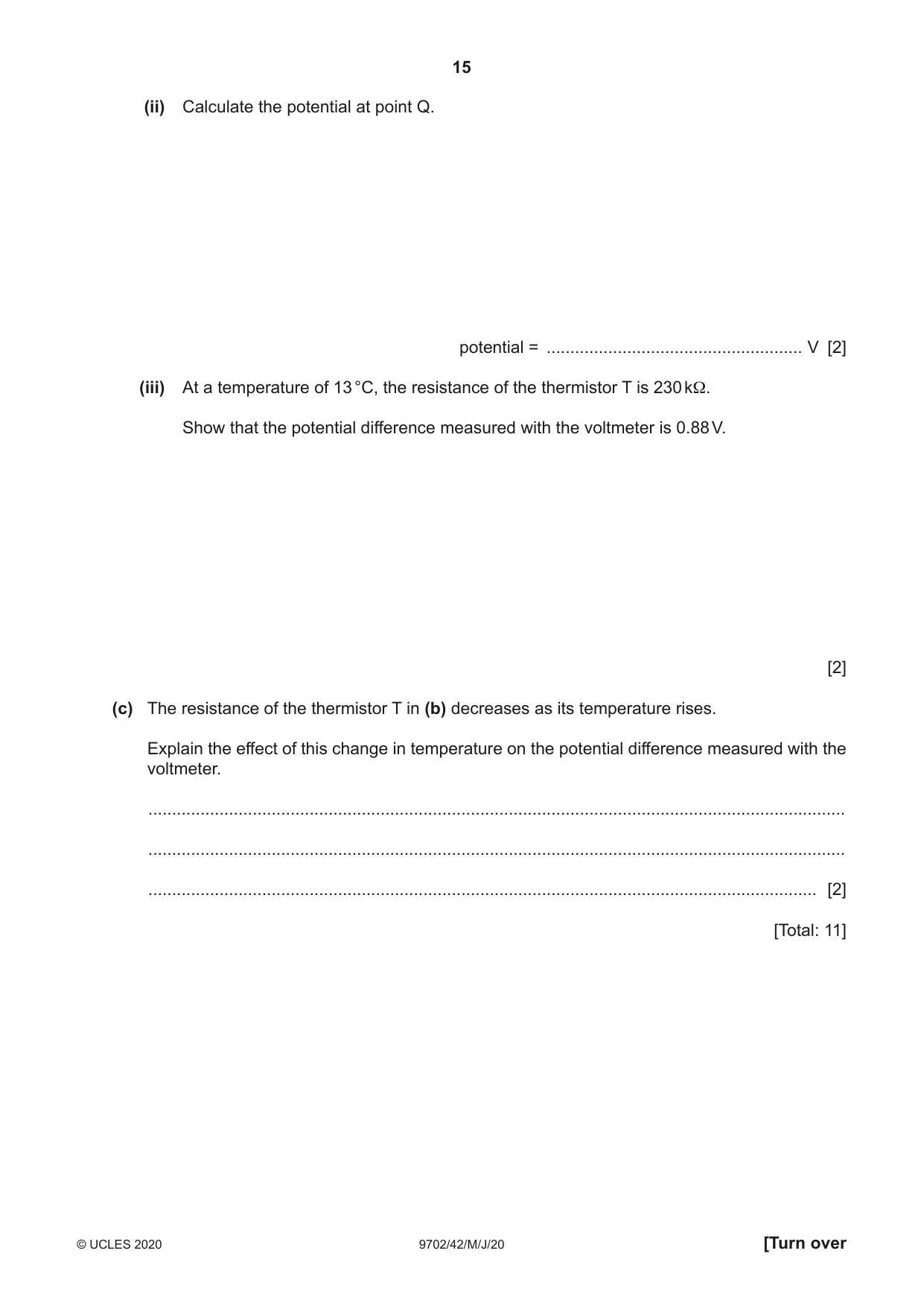
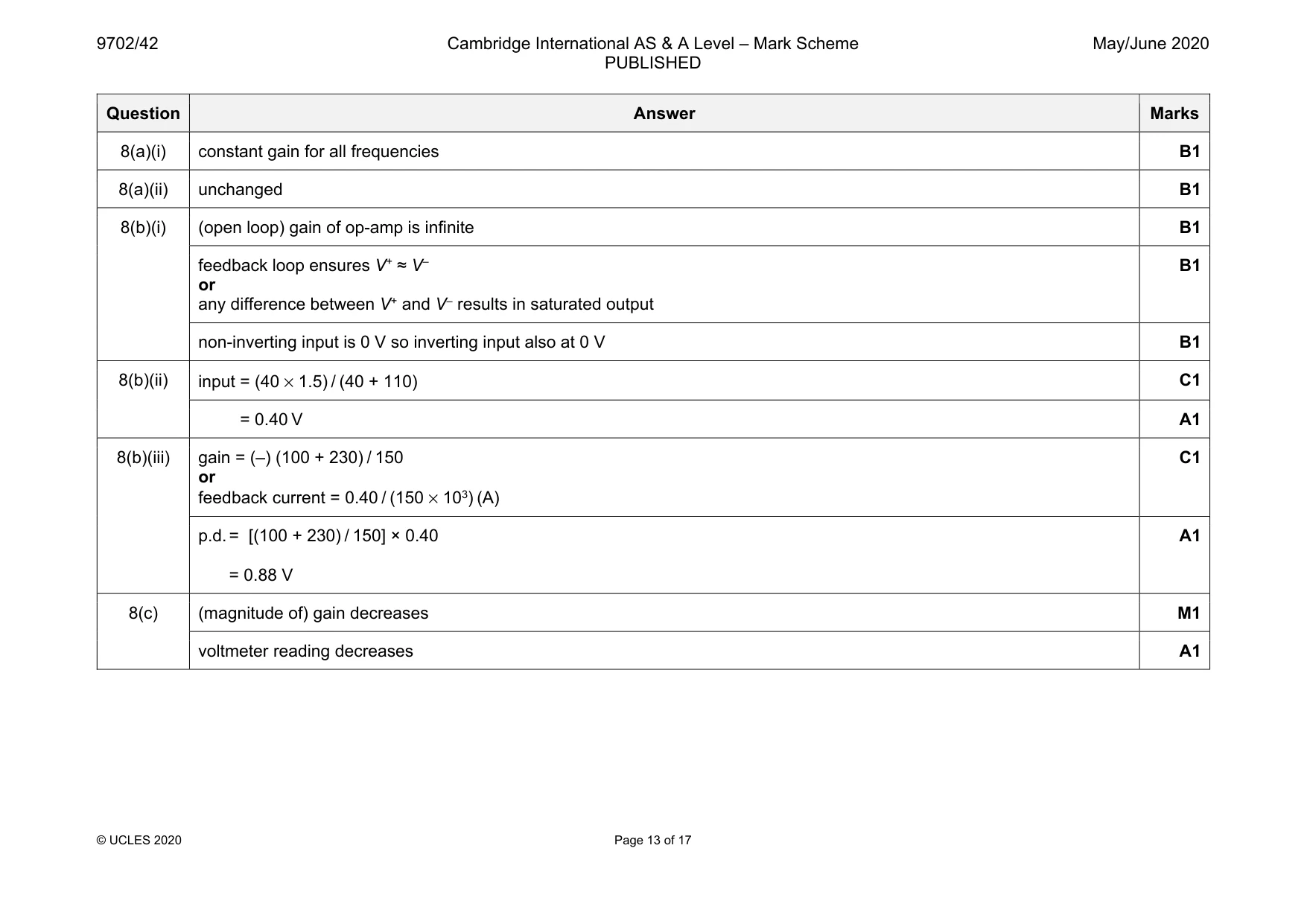
8 (a) An ideal operational amplifier (op‑amp) is connected to a load resistor. The op‑amp is assumed to have infinite bandwidth and zero output resistance. State: (i) what is meant by infinite bandwidth ........................................................................................................................................... ..................................................................................................................................... [1] (ii) the effect, if any, on the output voltage of increasing the load resistance. ........................................................................................................................................... ..................................................................................................................................... [1] (b) A student designs the circuit shown in Fig. 8.1 in order to indicate changes in temperature of the thermistor T. 100 kΩ T 110 Ω 150 kΩ + Q P 1.5 V – + – 40 Ω V Fig. 8.1 (i) Explain why point P is known as a virtual earth. ........................................................................................................................................... ........................................................................................................................................... ........................................................................................................................................... ..................................................................................................................................... [3] (ii) Calculate the potential at point Q. potential = ...................................................... V [2] (iii) At a temperature of 13 °C, the resistance of the thermistor T is 230 kΩ. Show that the potential difference measured with the voltmeter is 0.88 V. [2] (c) The resistance of the thermistor T in (b) decreases as its temperature rises. Explain the effect of this change in temperature on the potential difference measured with the voltmeter. ................................................................................................................................................... ................................................................................................................................................... ............................................................................................................................................. [2] [Total: 11]
Mark scheme: 8(a)(i) constant gain for all frequencies B1 8(a)(ii) unchanged B1 8(b)(i) (open loop) gain of op-amp is infinite B1 feedback loop ensures V+ ≈ V– or any difference between V+ and V– results in saturated output B1 non-inverting input is 0 V so inverting input also at 0 V B1 8(b)(ii) input = (40 × 1.5) / (40 + 110) C1 = 0.40 V A1 8(b)(iii) gain = (–) (100 + 230) / 150 or feedback current = 0.40 / (150 × 103) (A) C1 p.d. = [(100 + 230) / 150] × 0.40 = 0.88 V A1 8(c) (magnitude of) gain decreases M1 voltmeter reading decreases A1
Q9 · An electron is travelling at speed v in a straight line in a vacuum
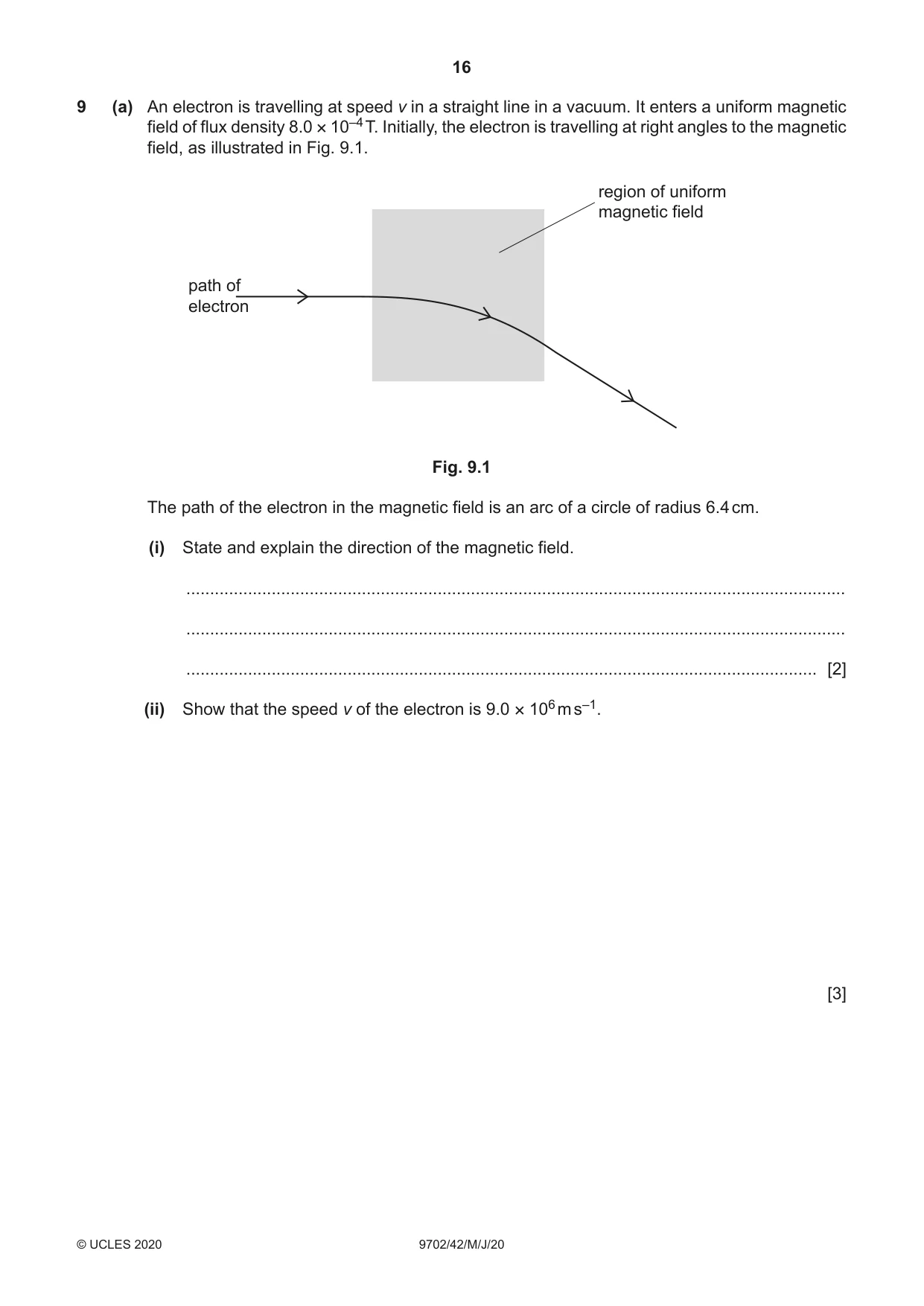
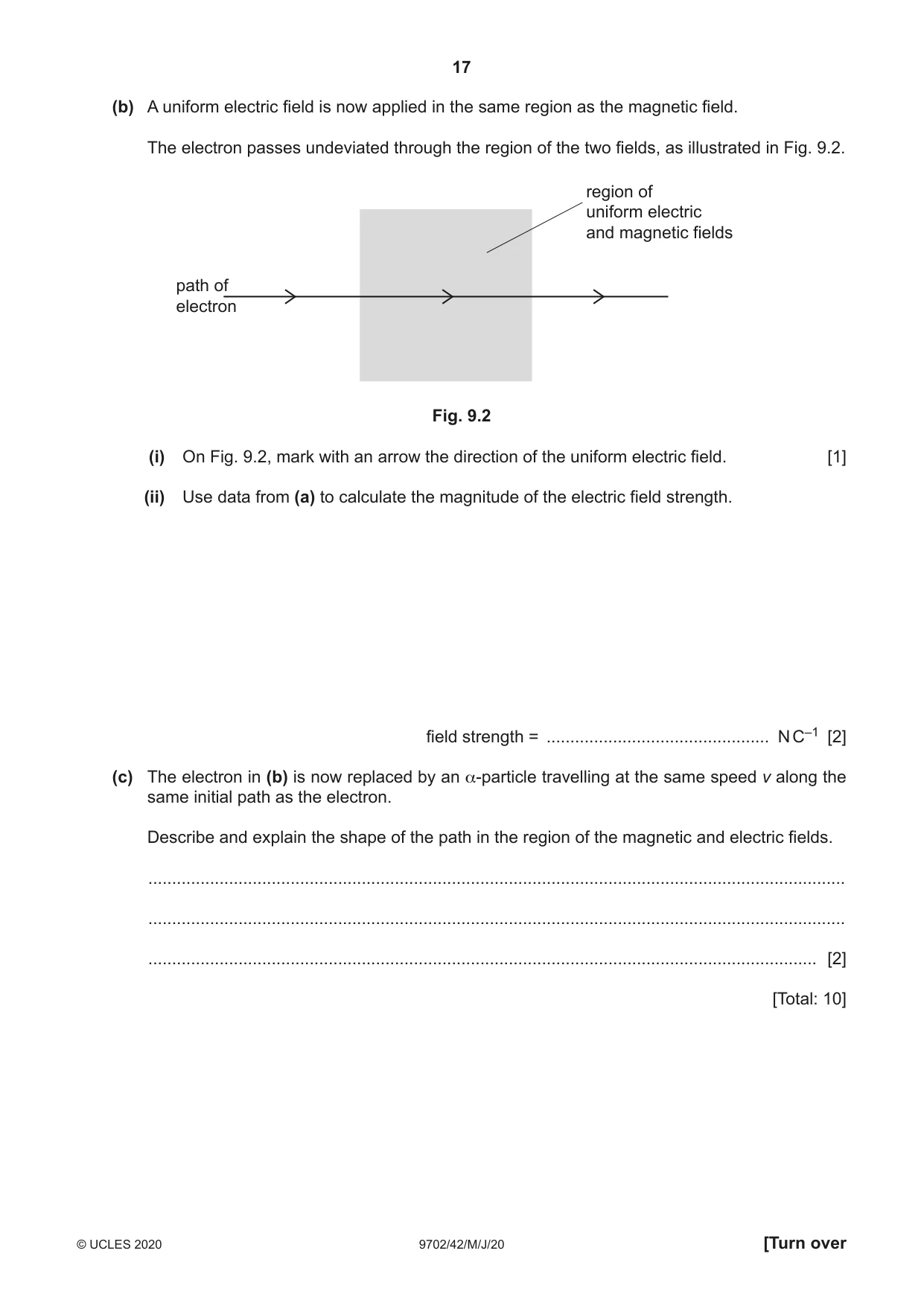
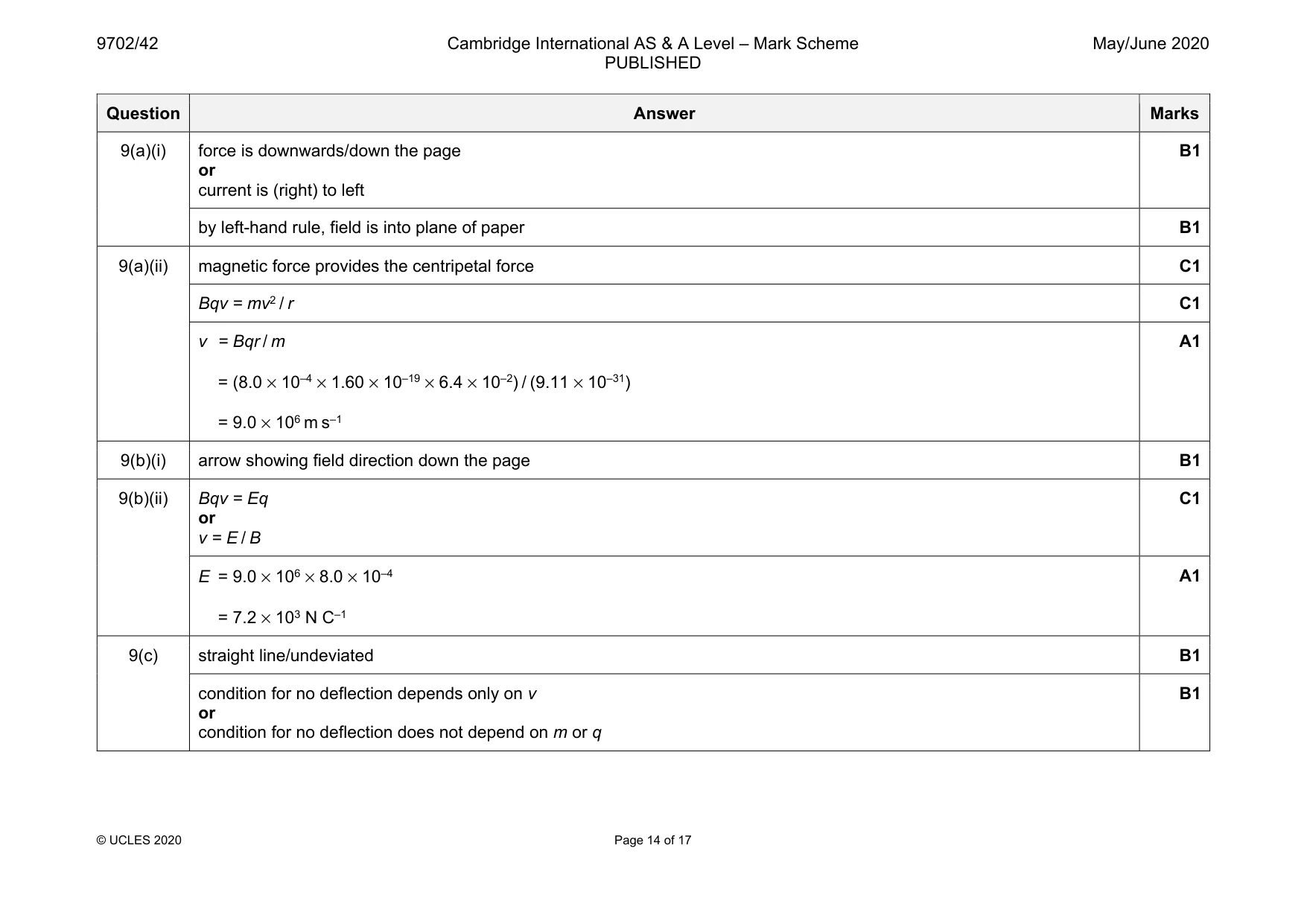
9 (a) An electron is travelling at speed v in a straight line in a vacuum. It enters a uniform magnetic field of flux density 8.0 × 10⁻⁴ T. Initially, the electron is travelling at right angles to the magnetic field, as illustrated in Fig. 9.1. region of uniform magnetic field path of electron Fig. 9.1 The path of the electron in the magnetic field is an arc of a circle of radius 6.4 cm. (i) State and explain the direction of the magnetic field. ........................................................................................................................................... ........................................................................................................................................... ..................................................................................................................................... [2] (ii) Show that the speed v of the electron is 9.0 × 10⁶ m s–1. [3] (b) A uniform electric field is now applied in the same region as the magnetic field. The electron passes undeviated through the region of the two fields, as illustrated in Fig. 9.2. region of uniform electric and magnetic fields path of electron Fig. 9.2 (i) On Fig. 9.2, mark with an arrow the direction of the uniform electric field. [1] (ii) Use data from (a) to calculate the magnitude of the electric field strength. field strength = ............................................... N C–1 [2] (c) The electron in (b) is now replaced by an α‑particle travelling at the same speed v along the same initial path as the electron. Describe and explain the shape of the path in the region of the magnetic and electric fields. ................................................................................................................................................... ................................................................................................................................................... ............................................................................................................................................. [2] [Total: 10]
Mark scheme: 9(a)(i) force is downwards/down the page or current is (right) to left B1 by left-hand rule, field is into plane of paper B1 9(a)(ii) magnetic force provides the centripetal force C1 Bqv = mv2 / r C1 v = Bqr / m = (8.0 × 10–4 × 1.60 × 10–19 × 6.4 × 10–2) / (9.11 × 10⁻³¹) = 9.0 × 10⁶ m s–1 A1 9(b)(i) arrow showing field direction down the page B1 9(b)(ii) Bqv = Eq or v = E / B C1 E = 9.0 × 106 × 8.0 × 10–4 = 7.2 × 10³ N C–1 A1 9(c) straight line/undeviated B1 condition for no deflection depends only on v or condition for no deflection does not depend on m or q B1
Q10 · State Faraday’s law of electromagnetic induction
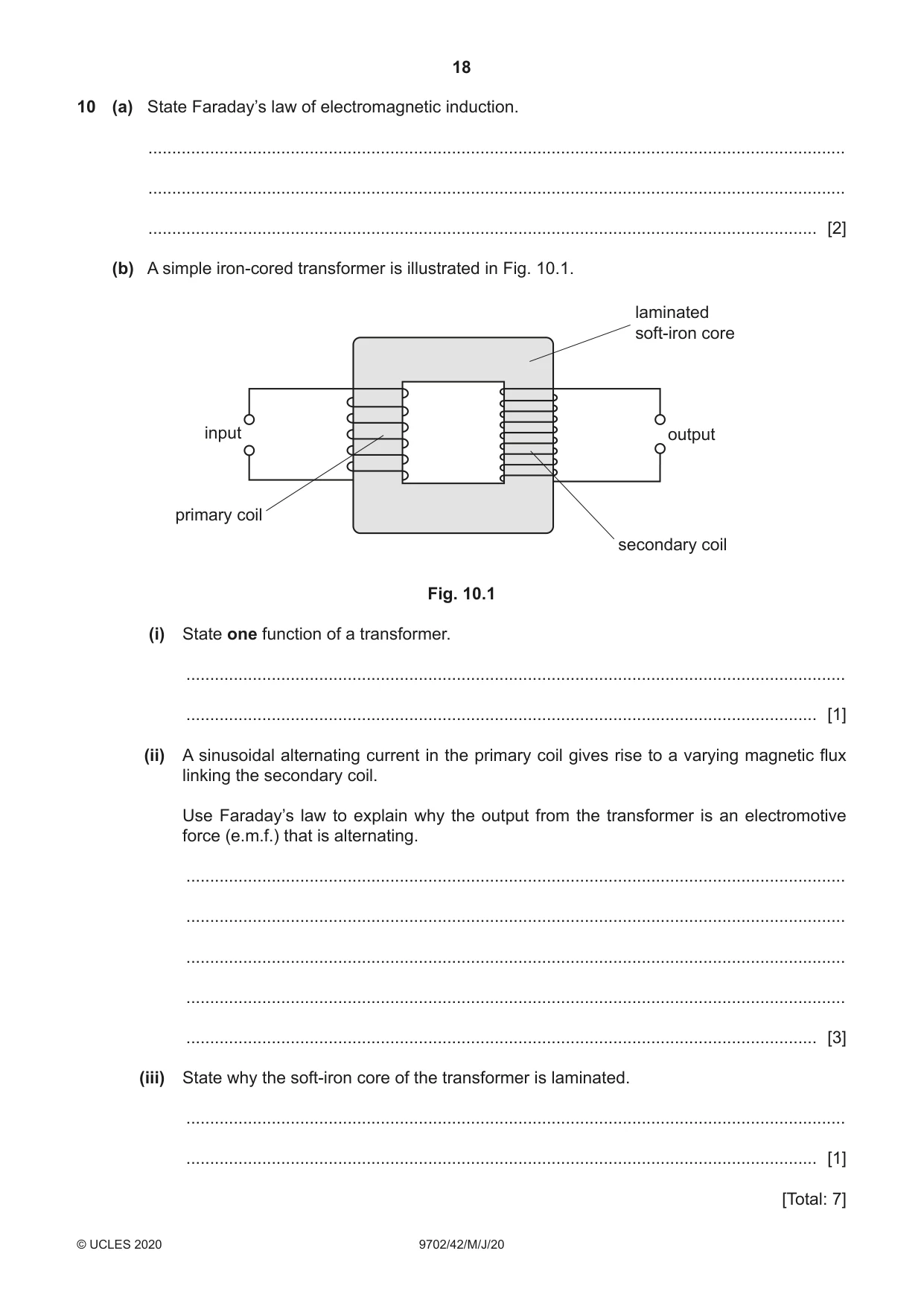
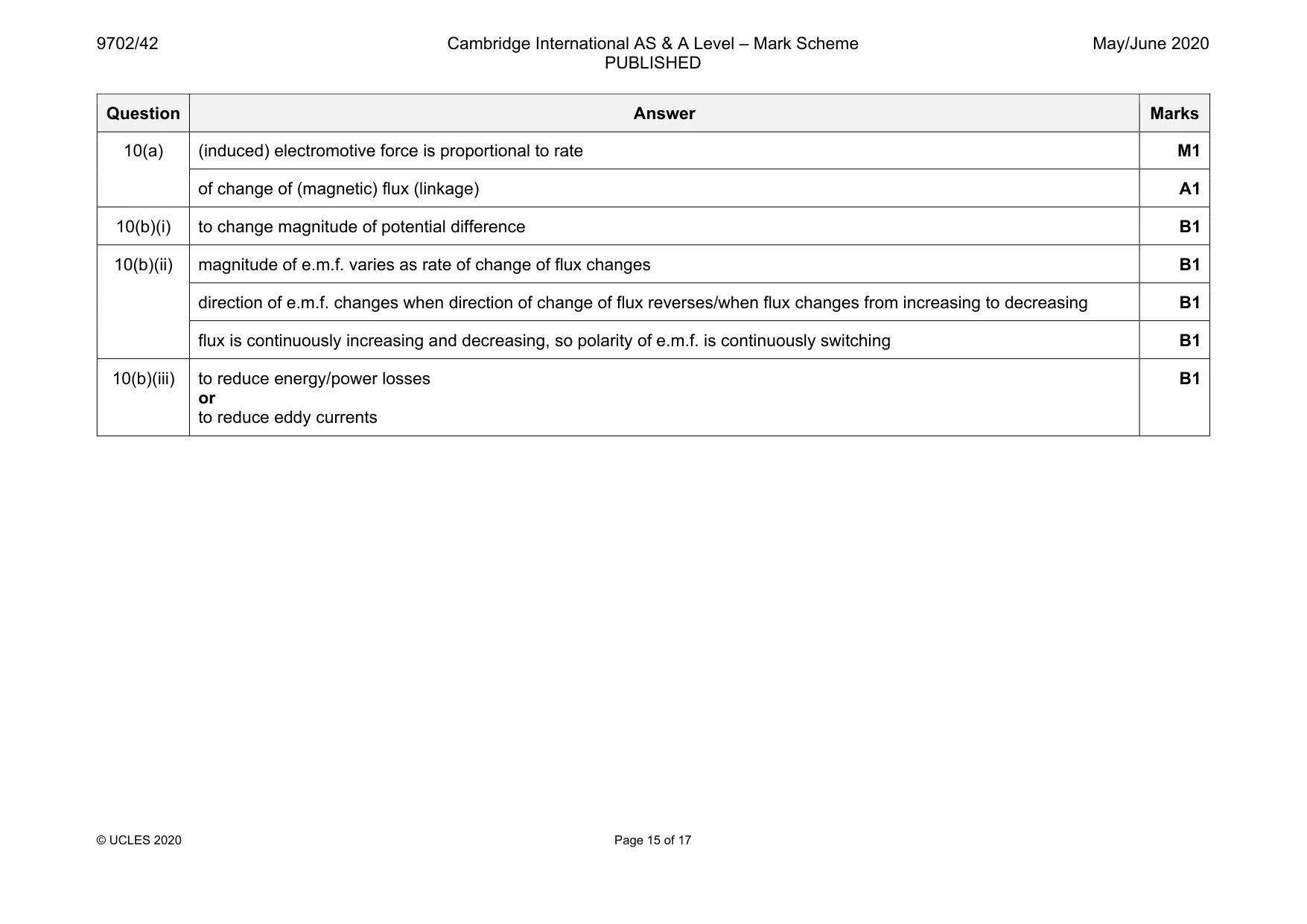
10 (a) State Faraday’s law of electromagnetic induction. ................................................................................................................................................... ................................................................................................................................................... ............................................................................................................................................. [2] (b) A simple iron‑cored transformer is illustrated in Fig. 10.1. laminated soft-iron core input output primary coil secondary coil Fig. 10.1 (i) State one function of a transformer. ........................................................................................................................................... ..................................................................................................................................... [1] (ii) A sinusoidal alternating current in the primary coil gives rise to a varying magnetic flux linking the secondary coil. Use Faraday’s law to explain why the output from the transformer is an electromotive force (e.m.f.) that is alternating. ........................................................................................................................................... ........................................................................................................................................... ........................................................................................................................................... ........................................................................................................................................... ..................................................................................................................................... [3] (iii) State why the soft‑iron core of the transformer is laminated. ........................................................................................................................................... ..................................................................................................................................... [1] [Total: 7]
Mark scheme: 10(a) (induced) electromotive force is proportional to rate M1 of change of (magnetic) flux (linkage) A1 10(b)(i) to change magnitude of potential difference B1 10(b)(ii) magnitude of e.m.f. varies as rate of change of flux changes B1 direction of e.m.f. changes when direction of change of flux reverses/when flux changes from increasing to decreasing B1 flux is continuously increasing and decreasing, so polarity of e.m.f. is continuously switching B1 10(b)(iii) to reduce energy/power losses or to reduce eddy currents B1
Q11 · The uppermost energy bands in a solid are known as the valence band (VB), the forbidden…
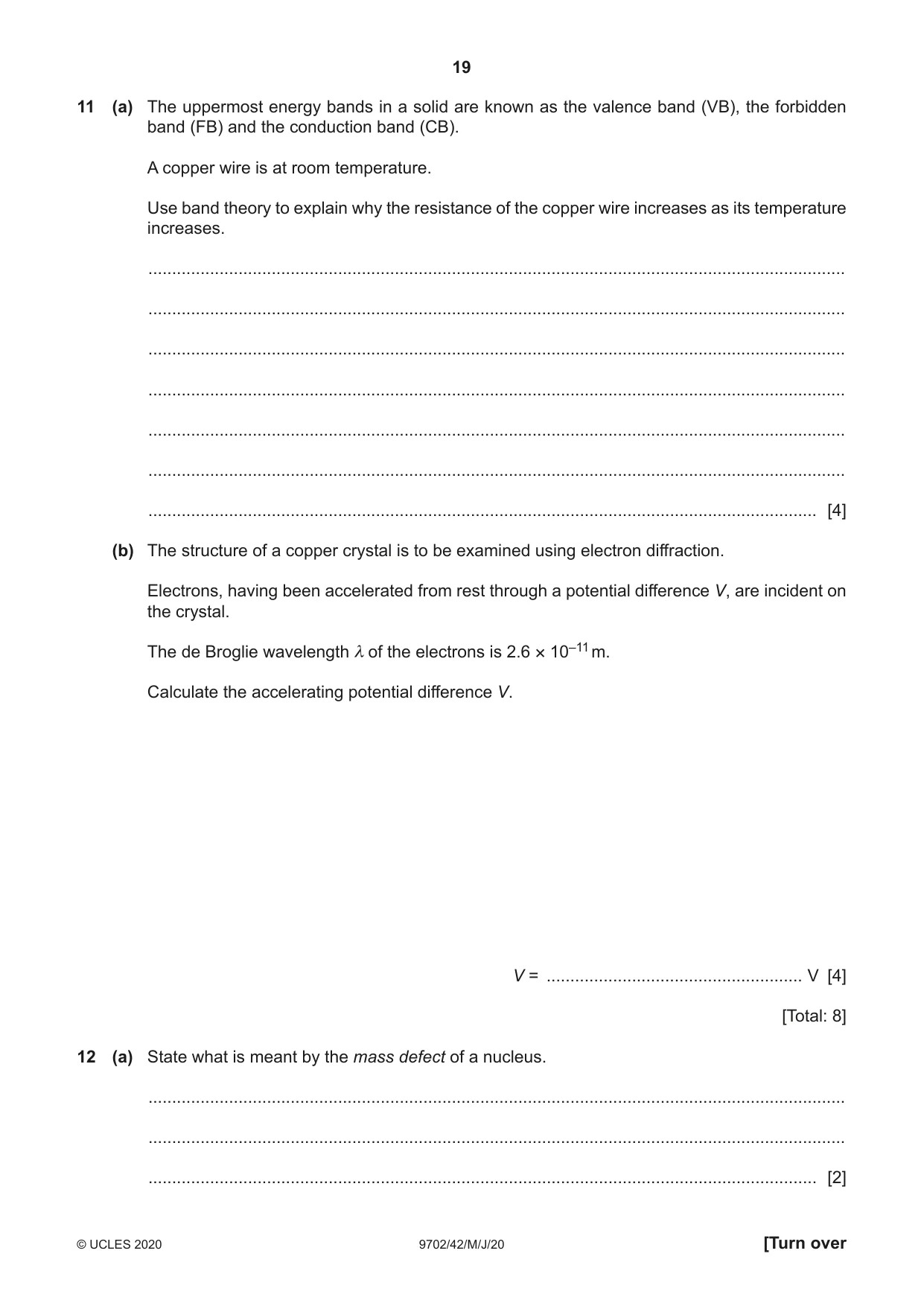
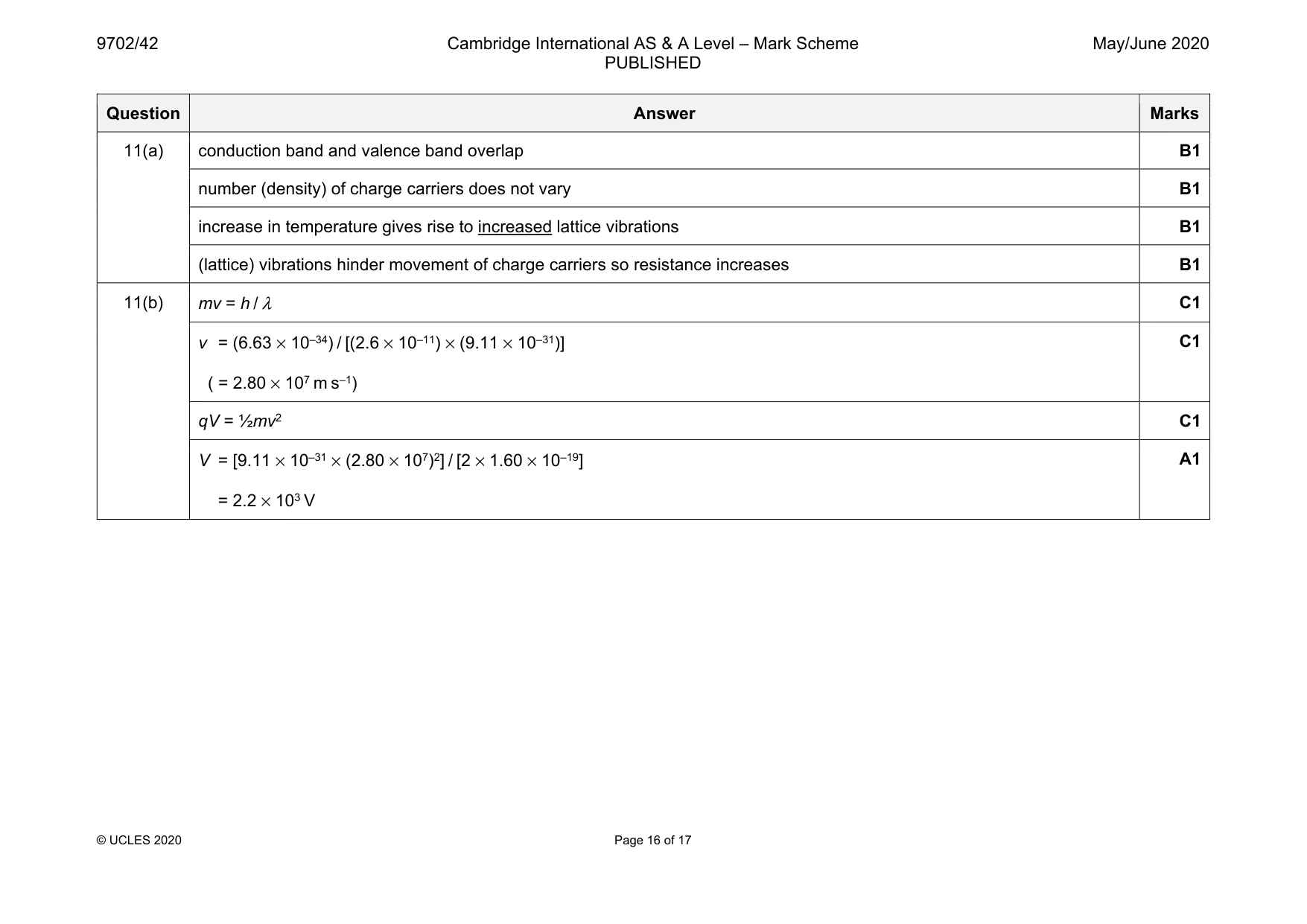
11 (a) The uppermost energy bands in a solid are known as the valence band (VB), the forbidden band (FB) and the conduction band (CB). A copper wire is at room temperature. Use band theory to explain why the resistance of the copper wire increases as its temperature increases. ................................................................................................................................................... ................................................................................................................................................... ................................................................................................................................................... ................................................................................................................................................... ................................................................................................................................................... ................................................................................................................................................... ............................................................................................................................................. [4] (b) The structure of a copper crystal is to be examined using electron diffraction. Electrons, having been accelerated from rest through a potential difference V, are incident on the crystal. The de Broglie wavelength λ of the electrons is 2.6 × 10⁻¹¹ m. Calculate the accelerating potential difference V. V = ...................................................... V [4] [Total: 8]
Mark scheme: 11(a) conduction band and valence band overlap B1 number (density) of charge carriers does not vary B1 increase in temperature gives rise to increased lattice vibrations B1 (lattice) vibrations hinder movement of charge carriers so resistance increases B1 11(b) mv = h / λ C1 v = (6.63 × 10⁻³⁴) / [(2.6 × 10–11) × (9.11 × 10–31)] ( = 2.80 × 10⁷ m s–1) C1 qV = ½mv2 C1 V = [9.11 × 10–31 × (2.80 × 107)2] / [2 × 1.60 × 10–19] = 2.2 × 10³ V A1
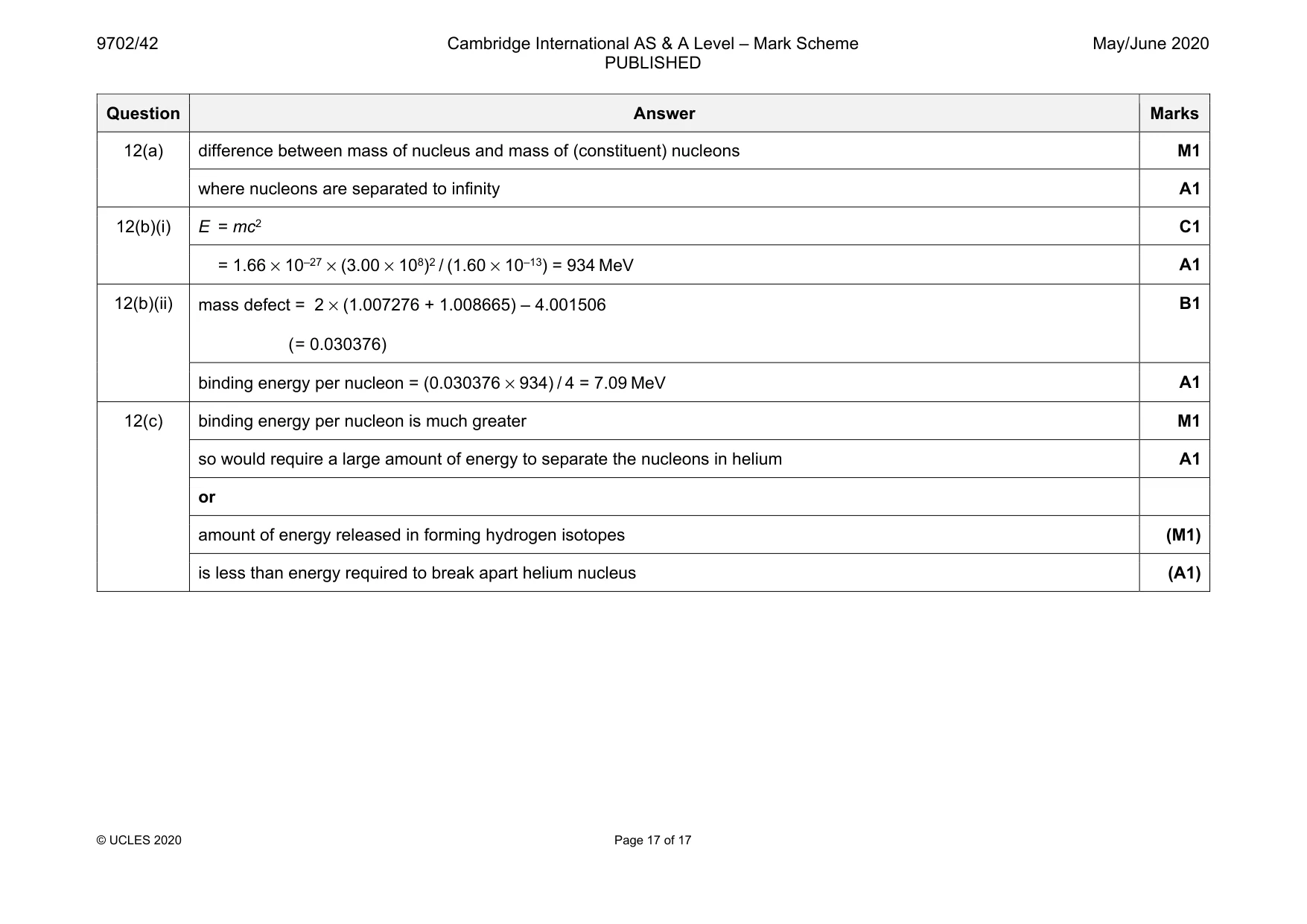
Q12 · State what is meant by the mass defect of a nucleus
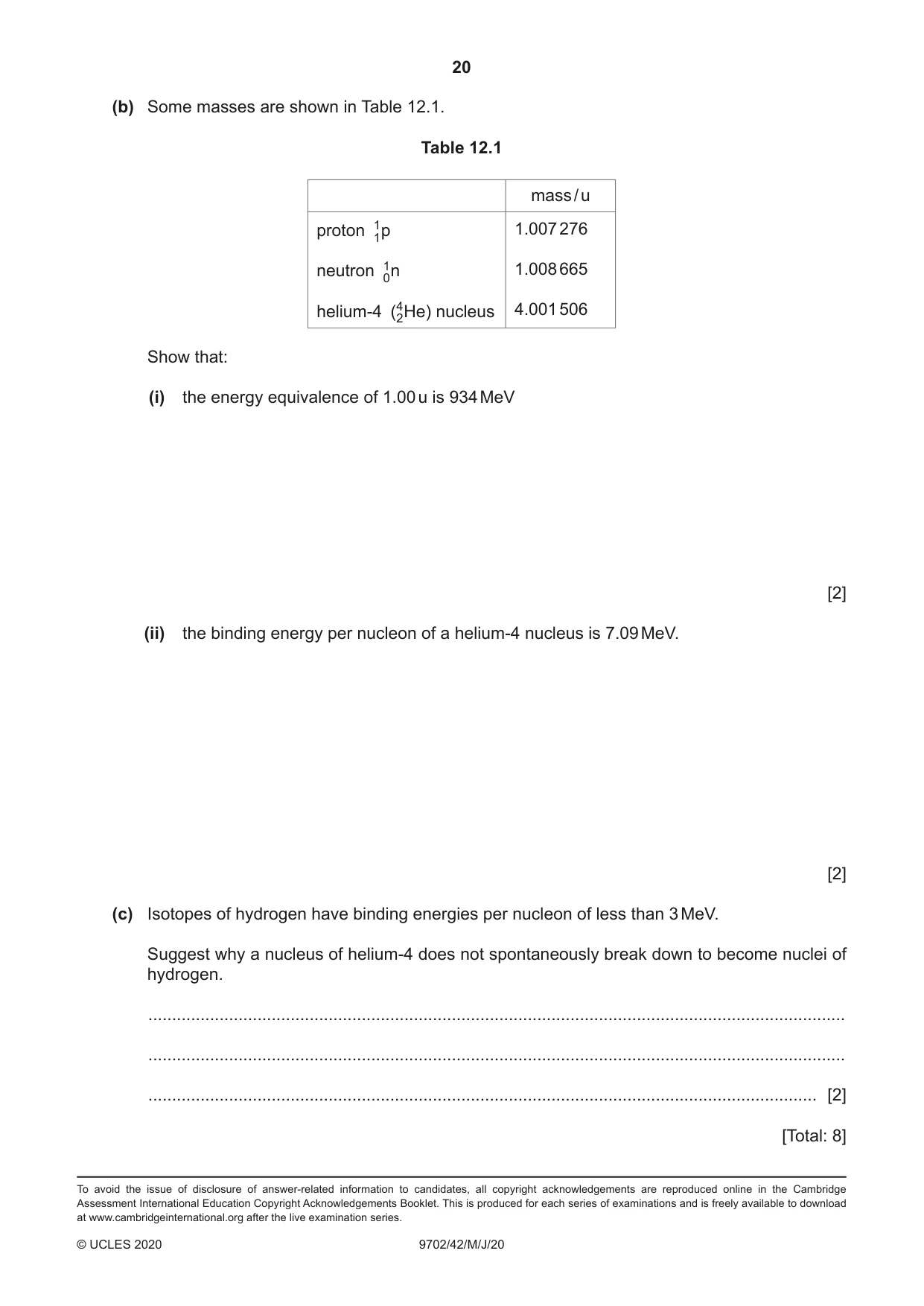
12 (a) State what is meant by the mass defect of a nucleus. ................................................................................................................................................... ................................................................................................................................................... ............................................................................................................................................. [2] (b) Some masses are shown in Table 12.1. Table 12.1 mass / u proton 11p 1.007 276 neutron 10n 1.008 665 helium‑4 (42He) nucleus 4.001 506 Show that: (i) the energy equivalence of 1.00 u is 934 MeV [2] (ii) the binding energy per nucleon of a helium-4 nucleus is 7.09 MeV. [2] (c) Isotopes of hydrogen have binding energies per nucleon of less than 3 MeV. Suggest why a nucleus of helium‑4 does not spontaneously break down to become nuclei of hydrogen. ................................................................................................................................................... ................................................................................................................................................... ............................................................................................................................................. [2] [Total: 8] To avoid the issue of disclosure of answer‑related information to candidates, all copyright acknowledgements are reproduced online in the Cambridge Assessment International Education Copyright Acknowledgements Booklet. This is produced for each series of examinations and is freely available to download
Mark scheme: 12(a) difference between mass of nucleus and mass of (constituent) nucleons M1 where nucleons are separated to infinity A1 12(b)(i) E = mc2 C1 = 1.66 × 10–27 × (3.00 × 108)2 / (1.60 × 10⁻¹³) = 934 MeV A1 12(b)(ii) mass defect = 2 × (1.007276 + 1.008665) – 4.001506 ( = 0.030376) B1 binding energy per nucleon = (0.030376 × 934) / 4 = 7.09 MeV A1 12(c) binding energy per nucleon is much greater M1 so would require a large amount of energy to separate the nucleons in helium A1 or amount of energy released in forming hydrogen isotopes (M1) is less than energy required to break apart helium nucleus (A1)
What was in this paper
The subtopics covered by these 12 questions, and how many questions each got. Open one in a new tab to see every Cambridge question on it.
1Electromagnetic induction1Electromagnetic spectrum1Force on a moving charge1Gravitational potential1Kinetic theory of gases1Mass defect and nuclear binding energy1Practical circuits1Production and use of ultrasound1Resistance and resistivity1Simple harmonic oscillations1The first law of thermodynamics1