Questions as text
Q1 · Tuna catches along the Namibian coast in south west Africa have decreased significantly… 9693/31 May/June 2017
6 Tuna catches along the Namibian coast in south west Africa have decreased significantly in recent years. (a) The reduction in the catch has been blamed on seismic blasting during oil and gas exploration in the waters off the Namibian coast. Seismic blasting is carried out by firing airguns underwater every 10 seconds causing very large sound vibrations in the water. (i) Suggest why seismic blasting could affect tuna catch. … … … … … … … [3] (ii) Seismic blasting is unregulated. The tuna fishing season lasts from October to April, with 70% of fish caught in February and March. Use this information to suggest what steps the Namibian government can take to reduce the decline in tuna catch, but continue with oil and gas exploration. … … … … [2] (b) Scientists have suggested tagging tuna that migrate through the area, so that they can be monitored by satellite. State what information the satellite tag could provide. … … [1] (c) Environmentalists are concerned that oil exploration along the Namibian coast could result in an oil spill. (i) Explain how oil pollution could affect fish-eating seabirds in the area. … … … … … … … … … … [4] (ii) Describe how biotechnology could be used to remove oil pollution from the environment. … … … … [2] [Total: 12]
12 marks
Mark scheme: 6(a)(i) any 3 of: idea of, tuna / fish move away (from blasting) ; can kill tuna outright ; can kill tuna prey fish ; increases sediment in water / turbidity preventing tuna finding food ; kills eggs / larvae / fry ; 3 6(a)(ii) ban any seismic surveys between October and April / between February and March / during main fishing season ; avoid seismic surveys on migration routes / fishing hotspots / spawning areas ; 2 6(b) any 1 of: location of tuna / fish / spawning or feeding areas ; numbers of tuna ; (exact) migration route ; timing of migration / when not to blast ; 1 Question Answer Marks Guidance 6(c)(i) any 4 of: sticks to their feathers and inhibits flight ; coats feathers limiting temperature regulation ; coats feathers so decreases / reduces buoyancy (so bird sinks / drowns) ; kills seabirds as it is toxic / poisonous / carcinogenic ; swallowed by sea birds (blocking the intestines) / gets into beak (and blocks breathing system) ; damages internal) organs as corrosive ; washes onto shores and covers eggs / kills chicks / nest abandoned ; hormonal changes in some birds (and disrupts breeding) ; fish killed by oil, so less food for birds ; ref. to bioaccumulation of chemicals / pollutants from oil ; 4 6(c)(ii) using microorganisms / bacteria ; that digest the oil ; 2
This question in 9693/31 May/June 2017
Q2 · Ecotourism is based on the appreciation of the natural environment and should involve… 9693/31 May/June 2017
7 Ecotourism is based on the appreciation of the natural environment and should involve good practice in conserving the environment. Read the descriptions of two types of ecotourism. type 1 • travelling by car to the tourist area • staying in small locally run hotels • helping to remove refuse from reefs and making maps of damaged reef areas • taking part in educational classes about reefs and the uses made of the resources of the reef type 2 • travelling by a small cruise ship to protected areas in a marine reserve • visiting islands, reefs and seagrass beds in small groups with a local tour guide who is an expert on the area (a) For each of these types of ecotourism, discuss the ways in which they support or undermine conservation. (i) type 1 … … … … … … [3] (ii) type 2 … … … … … … … … [3] (b) A beach hotel that is part of an international chain is going to be closed for redevelopment. All the existing guest rooms will be refitted and a new block of guest bedrooms built. The company that owns the hotel wants to improve the way in which the hotel uses energy and water so it is more ecologically sustainable. At present, energy is supplied from the main electricity supply for heating, lighting and air conditioning. Water is supplied from the main water supply for cooking, washing, toilets, the swimming pool and grass sprinklers. Suggest and explain two ways in which the use of energy and water by the hotel could be made more sustainable. 1 … … … 2 … … … [4] [Total: 10]
10 marks
Mark scheme: 7(a)(i) support: any 2 of: using local people to provide hotel service ; small hotel so less impact on the environment ; more money into local economy ; helps conservation / protects environment by clearing rubbish / mapping reefs ; raising awareness / showing appreciation of the natural environment, by educational classes ; undermine: ref. to car travel causing (air) pollution / adds carbon dioxide to the air ; 3 answers must relate to an aim of ecotourism: involving local people, raising awareness, conservation, minimising ecological impact 7(a)(ii) support: any 2 of: small cruise ships carry fewer people, so less impact on the environment ; using local people as guides ; raising awareness / showing appreciation by using an expert on the area ; small groups for trips have less impact ; undermine: any 2 of: cruise ships cause pollution / litter in water (damaging the environment) ; cruise ships also cause physical damage to reefs / seagrass ; idea that a small cruise ship will still have a lot of small groups that could damage the ecosystem / environment ; 3 answers must relate to an aim of ecotourism: involving local people, raising awareness, conservation, minimising ecological impact Question Answer Marks Guidance 7(b) 1 × 2 for energy of: 1 use solar panels / wind turbine (for electricity / energy) ; using renewable resource / reducing use of fossil fuels ; 2 ref. to any method of reducing electricity consumption ; using less energy from the (mains) supply ; 1 × 2 for water of: 1 collect water from showers / baths / to use for watering grass / plants ; re-using water / recycling water reduces clean water demand (from mains) ; 2 replace grass with less water-demanding / drought tolerant plants ; OR collect rain water for watering grass / plants ; OR collect rain water for water in showers / baths / laundry / cleaning ; (because) it reduces the use of clean water from the mains ; 3 replace the water in the swimming pool with sea water ; reducing use of fresh water / using local resources ; 4 install eco-friendly showers and toilets ; reduce water consumption ; 4 A water power A grey water A replacing with artificial grass / paving I filling in swimming pool A re-using towels and bed linen
This question in 9693/31 May/June 2017
Q3 · A northern lobster, which is an important seafood export for south west Nova Scotia… 9693/30 May/June 2018
3 Fig. 3.1 shows a northern lobster, which is an important seafood export for south west Nova Scotia, Canada. Fig. 3.1 Northern lobsters are a cold water species that live in burrows and crevices in a rocky substrate. They are active nocturnal hunters. Outside their burrows, juveniles are prey for many fish species, especially cod. Breeding occurs during the summer months when they also moult to replace their hard outer shell. (a) (i) Use the information to suggest why lobsters are caught in traps and not by benthic trawling. … … … … … [2] (ii) Suggest why the fishing season does not include the summer months. … … … … … [2] (b) Lobster catch has increased over the last 10 years, mainly due to warmer currents extending northwards and a collapse in cod numbers. Explain how these two factors could have increased lobster catch. … … … … … [2] (c) Lobsters are caught in traps which are put on the seabed in shallow water, between the end of November and the end of May. Fig. 3.2 shows a typical lobster trap, as viewed from above. A bag of bait is placed inside the first compartment. The lobster enters the trap via net funnels. A similar funnel allows the lobster to move into the second compartment. bait bag funnel to second compartment funnel entrances to first compartment stone stone first compartment second small compartment exit Fig. 3.2 Suggest the function of the stones and the small exit in the second compartment. stones … … small exit … … [2] (d) The coastline around south west Nova Scotia is a mixture of rocky areas and sandy bays. When the season opens, 1500 lobster boats race to claim the best fishing locations. Suggest why fishing boats need to race to claim their fishing locations. … … … [1] (e) Concrete artificial reefs have been designed for lobsters and other high value marine species. Lobsters begin to colonise these reefs in two years. After seven years, the reefs are fully functional. (i) Suggest why an artificial reef takes seven years to become fully functional. … … … [1] (ii) Suggest how artificial reefs could be used to increase the lobster catch in Nova Scotia. … … … … … [2] [Total: 12]
12 marks
This question in 9693/30 May/June 2018
Q4 · Sea turtles spend their lives in the sea 9693/30 May/June 2018
6 Sea turtles spend their lives in the sea. They migrate thousands of miles to reach their breeding grounds. All species of sea turtle are listed as threatened or endangered. Fig. 6.1 shows the change in the number of loggerhead sea turtle nests on beaches in Florida from 1989 to 2005. Other species show a similar pattern. 65 000 55 000 number of nests 45 000 35 000 25 000 1989 1991 1993 1995 1997 1999 2001 2003 2005 year of sampling Fig. 6.1 (a) Describe the trend shown in Fig. 6.1. … … … … … [2] (b) Female sea turtles leave the sea to lay their eggs on sandy beaches. When the eggs hatch, usually at night, the young use the horizon and reflected light of the moon and stars to reach the sea. (i) Suggest two ways in which increased human activity on beaches may have contributed to sea turtles becoming endangered. 1 … … 2 … … [2] (ii) Suggest two other human actions in the ocean that could present a risk to sea turtle survival. 1 … … 2 … … [2] (c) Loggerhead sea turtles take between 25 and 30 years to become sexually mature. Females mate once every three years, making up to three nests with about 100 eggs in each. An average of one egg per nest survives to reach breeding age. Conservation programmes in Florida started in the 1980s. (i) Suggest one way each of the following actions could help more loggerhead sea turtles to survive. marking and covering nests with netting … … keeping a 24-hour watch over the nests during the hatching time … … [2] (ii) An article from a Florida newspaper in 2013 claimed that these conservation efforts have had some success in increasing the population of loggerhead sea turtles. Table 6.1 shows the data on which this claim was based. Indicator beaches are those used as a measure of turtle nesting success. Table 6.1 year of survey 2008 2009 2010 2011 2012 number of nests on 2060 3135 1980 3506 2910 indicator beaches number of nests in 39 000 35 000 44 000 41 000 58 000 the whole of Florida Describe how the data in Table 6.1 support the claim that the population of loggerhead sea turtles is increasing. … … … … … [2] [Total: 10]
10 marks
This question in 9693/30 May/June 2018
Q5 · Fish tend to gather around any floating object in the sea 9693/30 Oct/Nov 2018
4 Fish tend to gather around any floating object in the sea. Fish aggregating devices (FADs), either drifting or anchored to the sea bed, are used to increase the catch of fish. Most FADs last between two and eight years. (a) Industrial fishing fleets use drifting FADs consisting of a buoy equipped with sonar. Suggest why the sonar frequency must be different for each individual FAD. … … … … … [2] (b) Fig. 4.1 shows two types of anchored FAD that are used by coastal communities. buoy sea surface sinking rope aggregator rope curve floating rope concrete block attached to chain type A type B Fig. 4.1 Use the information in Fig. 4.1 to explain how each type of FAD is designed to cope with rough seas. type A … … type B … … [2] (c) Many FADs have an aggregator to attract fish. Suggest one benefit of using an aggregator made from plant material such as palm fronds instead of nylon rope. … … … [1] (d) Somalia is an East African country with a 3300 km coastline. This is lined with coral reefs and seagrass beds, many of which are being overfished. In 2016, funding from the Food and Agriculture Organization of the United Nations and European Union provided an anchored FAD to 25 different coastal communities in Somalia. The FADs were set up in deep water offshore sites to improve the local, small‑scale fishing industry in each community. (i) Suggest how the FADs could increase the long‑term supply of fish to each community. … … … … … [2] (ii) The FAD programme was set up with the agreement of the local community at each location. Suggest two benefits of involving the whole of the local community in the use of the FADs. 1 … … 2 … … [2] [Total: 9]
9 marks
This question in 9693/30 Oct/Nov 2018
Q6 · Define the term gene 9693/30 Oct/Nov 2018
7 (a) Define the term gene. … … [1] (b) (i) Genetically engineered salmon, GM salmon, contain genes from Chinook salmon and ocean pout. The GM salmon grow all year and can be harvested sooner than non‑genetically engineered salmon. Name the two types of gene that were transferred to produce these GM salmon. 1 … 2 … [2] (ii) State the effect of this change in genotype on the phenotype of these GM salmon. … … … [1] (c) In November 2015 the United States of America Food and Drug Administration announced that they had approved production, sale and human consumption of GM salmon. GM salmon eggs are produced at a land‑based hatchery in Canada. Fertilised eggs are treated so that they develop into sterile salmon. The eggs are then flown directly to a land‑ based facility in Panama to grow to market size before being harvested and processed for sale. State what you understand by the term precautionary principle and describe how this is applied to GM salmon production. … … … … … … … [3] (d) Production time for GM salmon takes about two years compared to three to four years for non‑genetically engineered salmon. State the economic advantage of producing GM salmon compared with non‑genetically engineered salmon. … … … [1] (e) Suggest two reasons why GM salmon production in aquaculture could be considered more sustainable than fishing for wild salmon. 1 … … 2 … … [2] [Total: 10]
10 marks
This question in 9693/30 Oct/Nov 2018
Q7 · Read the information about coastal areas 9693/31 May/June 2019
6 Read the information about coastal areas. Humans use coastal areas for water, shipping, ports, food from fisheries and aquaculture developments and recreation such as fishing and diving. Approximately half of the world’s population lives in coastal areas. This is expected to increase greatly by 2025 as the number of people migrating to coastal areas is increasing. Coastal areas worldwide are destinations for tourists and offer a major source of income for some regions. Management of coastal areas to cope with growing pressures involves many conflicts of interest. These can be difficult to control because different government departments control industry, housing, tourism, road building, sanitation and environmental protection. (a) Describe what is meant by a conflict of interest. … … [1] (b) A coastal manager of a large expanding town, 5 km from the coast, is assessing the issues involving two applications for further development in an area of mangrove forest close to the town. Fig. 6.1 represents a map of the area showing the proposed applications. application 1 Expand the Key housing in the town towards the town mangrove forest and clear a 1 km strip of mangrove forest in front of the mangrove new houses. application 1 application 2 2 km application 2 Remove about half of the mangrove forest to build a luxury tourist hotel, keeping the rest of the mangrove forest as a reserve. 5 km Fig. 6.1 (i) Explain the negative effects of the removal of mangrove forests from coastal areas. … … … … … … [3] (ii) The use of land is a source of conflict of interest between the tourism department and the housing department. Suggest one argument the housing department could make to support application 1 and one argument the tourism department could make to support application 2. housing department … … … tourism department … … … [2] [Total: 6]
6 marks
Mark scheme: 6(a) idea of: opposing / different views (about how an area should be used) ; 1 6(b)(i) mangroves are part of coastal defences / protects coastline (from flooding) ; as roots dissipate wave energy / roots, bind / stabilise, soil ; if lost could lead to erosion of coast ; may be breeding or nursery grounds for, juvenile / rare / endangered, species ; they are an important habitat for other (land and marine) organisms ; if lost, results in less recruitment of fish for fishing industry ; idea of: act as carbon sinks (so removal will contribute to global warming) ; (human) community loses supply of, fuel / building materials / raw materials ; 3 Question Answer Marks Guidance 6(b)(ii) any 1 from housing: idea of: more housing available for expected increase in population ; reduces house prices in area (idea of: more affordable housing) ; brings more people to live in the area, so improving economy ; could also lead to improvements in sanitation / less overcrowding / improved living conditions ; inland mangrove cleared so there will be no soil erosion on coastline ; building houses provides employment for local, builders / trades people ; any 1 from tourism: building hotel provides employment for local, builders / trades people ; hotel / increase in tourism, creates new jobs / money into the economy ; (spin off development of) more shops / businesses for tourists in the town ; would improve roads / infrastructure of area ; 2 I ref. to the amount of mangrove removed Do NOT award MP6 and MP7– one or the other can be awarded
This question in 9693/31 May/June 2019
Q8 · Read the descriptions about some resorts in Central America which are marketed as… 9693/30 Oct/Nov 2019
6 Read the descriptions about some resorts in Central America which are marketed as ecotourist resorts. ‘During the day, when not out on a tour, you can relax on the beach or swim in our natural river pool.’ ‘Wake up each morning in your air-conditioned beachfront cabana to an incredible tropical seascape of white sand beach.’ ‘We offer a wide range of non-motorised water sports in our sheltered lagoon, protected by a coral reef just offshore. Activities include kayaking, windsurfing, sailing and snorkelling.’ ‘All our guest rooms and restaurant are decorated throughout with teak floors and hardwood furnishings imported from Asia.’ (a) Explain the meaning of the term ecotourism. … … [1] (b) Identify two features in the descriptions that support conservation. For each feature, explain how it does this. feature 1 … explanation … … … feature 2 … explanation … … … [4] (c) Identify two features in the descriptions that undermine conservation. For each feature, suggest a suitable improvement. feature 1 … improvement … … … feature 2 … improvement … … … [4] [Total: 9]
9 marks
This question in 9693/30 Oct/Nov 2019
Q9 · Macquarie Harbour is a large natural harbour, partly within the protected Tasmanian… 9693/30 May/June 2020
7 Macquarie Harbour is a large natural harbour, partly within the protected Tasmanian Wilderness World Heritage Area, Australia. The area was important for mining in the 1880s. Mining waste was either washed out to sea by local rivers, or became locked in sediment on the sea bed within the harbour. Fish farming began in the deeper water in the centre of the harbour around 30 years ago, after water quality had improved. Fish cages provide a source of salmon both locally and for export. Today, the small community at Strahan is an important tourist destination. It provides locally run hotels, restaurants and boat tours within the harbour. The shores of the harbour are important areas for commercial and recreational fishing using nets. All fishing is banned in deeper water. Fig. 7.1 shows a map of the area. Strahan King River Southern salmon farms Ocean Macquarie Harbour Gordon River Fig. 7.1 (a) (i) Use the information provided to explain why Macquarie Harbour is a suitable location for salmon cages. … … … … … … [3] (ii) Between 1990 and 2005 annual salmon production was less than 2000 tonnes. By 2011, production increased to 9000 tonnes and by 2015 it reached 20 000 tonnes. Water quality monitoring in the harbour since 2015 has shown a significant decrease in dissolved oxygen levels in deeper water, below 15 m depth. Explain how the increase in the number of salmon cages might have contributed to the decrease in dissolved oxygen levels. … … … … … … [3] (b) A meeting took place between the fish companies and other stakeholders to discuss a further increase in the number of salmon cages in the harbour. (i) State the meaning of the term stakeholder. … … [1] (ii) Conservationists may oppose the increase in the number of salmon cages in the harbour. Suggest one other stakeholder who would oppose this increase and give a reason for your answer. stakeholder … reason … … … [2] (c) The fish companies have suggested dredging the sediment beneath the fish cages to remove any pollutants and improve water quality. Use the information provided to suggest why this might not be a suitable solution. … … [1] (d) Macquarie Harbour is one of only two areas in Tasmania where the endangered Maugean skate is found. The adult lives in estuaries, in shallow water between 5 m and 10 m depth, around the shores of the harbour. It lays its eggs in deeper water, below 15 m depth, where juveniles are found. Suggest and explain why conservationists are concerned about the future of the Maugean skate in Macquarie Harbour. … … … … … … [3] [Total: 13]
13 marks
This question in 9693/30 May/June 2020
Q10 · Illegal fishing is an international issue 9693/30 Oct/Nov 2020
3 (a) Illegal fishing is an international issue. State one method of enforcement available if illegal fishing has taken place. … … [1] (b) Various monitoring methods are used to try to reduce illegal fishing. These include fishermen having to use logbooks to record their catch and patrol aircraft observing fishing boats to check for illegal fishing. Complete Table 3.1 to show an advantage and disadvantage of each method. Table 3.1 monitoring advantage disadvantage method cheap and can be used on any logbooks fishing vessel, in any language cannot arrest fishing crew and patrol aircraft cannot inspect catch or gear [2] (c) Two other methods of monitoring include Vessel Management System (VMS) and Automatic Identification System (AIS). VMS was designed as a ship monitoring and tracking system, while AIS was designed for ships to communicate with each other and with shore. AIS depends on a communication satellite signal. Only AIS information is freely available. Fig. 3.1 shows part of the coastline of Indonesia. Map A tracks a fishing vessel using AIS. Map B tracks the same fishing vessel using VMS and AIS. Key marine conservation area port port path of fishing vessel A – AIS only B – AIS and VMS Fig. 3.1 (i) Suggest and explain the advantages of using combined data from both VMS and AIS rather than relying on data from AIS only. … … … … [2] (ii) Indonesia has recently made the data from VMS freely available, so that, when combined with AIS, all its fishing fleet can be tracked. Suggest the advantage to the Indonesian fishing industry of sharing their fishing fleet tracking data. … … [1] (d) The catch made by smaller fishing vessels is often transferred to larger factory vessels while still at sea. The factory vessels later carry the catch to port. (i) Suggest two advantages of transferring catch to factory vessels. 1 … … 2 … … [2] One problem with transferring catch at sea is that legal and illegal catch can become mixed together. Some fishing boats switch off their AIS when they are fishing illegally, or when they are transferring illegal catch. Argentina allows only Argentinian vessels to fish for squid within 483 km of the shore. There is no restriction on squid fishing outside this restricted fishing zone. Fig. 3.2 shows the restricted fishing zone around part of the coastline of Argentina. Each star ( ) represents a different non-Argentinian fishing vessel. The stars show the positions where each vessel stopped transmitting AIS signals for at least 24 hours. 483 km coastline of Argentina restricted fishing zone unrestricted fishing zone Fig. 3.2 (ii) Use the information provided in Fig. 3.1 and 3.2 to discuss the evidence that illegal fishing and illegal transfers are taking place along the border between the restricted fishing zone and the unrestricted fishing zone. … … … … … … [3] [Total: 11]
11 marks
This question in 9693/30 Oct/Nov 2020
Q11 · A marine conservation organisation carries out projects with local communities all over… 9693/30 Oct/Nov 2020
6 A marine conservation organisation carries out projects with local communities all over the world to help to conserve the marine environment. This work has resulted in the setting up of Locally Managed Marine Areas (LMMAs), which are managed by local communities. (a) Suggest why LMMAs are often more successful than government-directed projects. … … … … [2] (b) Suggest two reasons why it is important to conserve coral reefs. 1 … … 2 … … [2] (c) In Madagascar, international volunteers are working in an LMMA to assess the effectiveness of a complete fishing ban on the health of coral reefs. The volunteers map the reef and collect information about different aspects of the reef at regular intervals over a period of time. Two sorts of information that are collected by the volunteers are: • the percentage of the reef that is bleached and where the bleaching is located • the number of different species living on the reef and the size of the populations of these species. (i) Suggest how this information can be used to assess whether the health of a coral reef is improving. … … … … … … [3] (ii) Suggest why there may be conflicts of interest between the local managers of the LMMAs and tourists to Madagascar. … … … … [2] [Total: 9]
9 marks
This question in 9693/30 Oct/Nov 2020
Q12 · The stages in the life cycle of Pacific salmon 9693/30 May/June 2021
6 (a) Fig. 6.1 shows the stages in the life cycle of Pacific salmon. egg … fry … smolt adult Fig. 6.1 Complete Fig. 6.1 with the names of the missing stages in the life cycle. [2] (b) In Japan, as well as in many other countries, river beds are excavated to increase channel depth and dams are constructed to retain fresh water. Salmon hatcheries collect mature wild salmon to be used in aquaculture for breeding purposes. Suggest and explain how these activities have affected salmon numbers. … … … … … … [3] (c) Farm-hatched fish are often released in large numbers, to help increase wild populations. Suggest and explain two advantages of rearing salmon in a hatchery, rather than relying on natural reproduction in the wild. 1 … … 2 … … [2] (d) (i) Conservation areas in Japanese rivers have been created to separate wild salmon from hatchery-produced salmon to prevent them breeding together. Suggest one reason for preventing the wild salmon from breeding with hatchery-produced salmon. … … [1] (ii) State two other disadvantages of releasing hatchery-produced salmon into the ocean. 1 … … 2 … … [2] [Total: 10]
10 marks
This question in 9693/30 May/June 2021
Q13 · State the type of fertilisation used by whales and tuna 9693/30 Oct/Nov 2021
3 (a) (i) State the type of fertilisation used by whales and tuna. whales … tuna … [1] (ii) State how the spawning habits of tuna might increase the chances of fertilisation. … … [1] (iii) State and explain two ways in which a female whale increases the chances of her calf surviving to adulthood. 1 … … 2 … … [2] (b) The North Atlantic right whale is one of the most endangered of all large whales. The population around the east coast of North America is thought to be around 400 individuals, while the population around Northern Europe is thought to be almost extinct. Read the information about the North Atlantic right whale along the east coast of America. During late autumn and winter, whales breed in temperate waters, just off the coast of the southern states of Georgia and Florida. In spring they migrate northwards to the coastal waters of northern states and Canada. Here they feed on zooplankton, krill and other invertebrates over the summer months. Whales migrate alone, or in small groups of 2 to 3. When feeding, groups of up to 12 or more can be seen. Adult whales can live for 30 years or more and start breeding at the age of 9 or 10 years. Breeding takes place every 3 to 6 years and gestation lasts for a year. Mating pairs do not maintain long-term bonds. Right whales emit a number of low frequency sounds, mostly during courtship, but also to maintain contact with other individuals and to communicate threats. (i) The North Atlantic right whale population reached critically low levels due to whaling. Since 1930 it has been protected from whaling, but shows no sign of recovery. Use the information provided to identify two reasons why the population has not recovered. 1 … … 2 … … [2] (ii) The coastal waters around the east coast of America are important fishing and shipping areas. Suggest how these two activities have influenced the lack of recovery in North Atlantic right whale numbers. … … … … [2] (c) In 2017, twelve North Atlantic right whales were found dead in the Gulf of St. Lawrence area, Canada. Scientists believe that shipping and fishing were the main cause. As a result of these deaths, new speed restrictions were introduced for all commercial shipping, cruise ships and recreational vessels from April to November 2018. The area is also an important fishing area for snow crab and lobster, which are caught in traps. In spring 2018 fishermen began testing new ropeless traps. Restrictions were placed on fishing areas and length of fishing season. Fig. 3.1 shows a map of the Gulf of St Lawrence area. key Quebec Anticosti vessels travel at Island normal speed unless a whale is within 4.5 km, Gulf of St. then a 15-day Lawrence mandatory 10 knot speed is imposed 10 knot speed New Brunswick limit for all vessels over 20 m important feeding and mating areas Nova Scotia for whales Bay of Fundy Fig. 3.1 Use all the information in Fig. 3.1 to discuss the possible effects of these restrictions on whales and on the human community. … … … … … … [3] (d) Scientists are trialling the use of satellites to locate, identify and count whales. Suggest the advantages of using satellite images rather than traditional methods such as spotter planes, or counting from boats. … … … … [2] (e) In 2012 a decision was made to build an undersea sonar station just off the coast of Georgia / northern Florida. Use the information provided to suggest and explain the likely impact of this sonar station on the North Atlantic right whales. … … … … [2] (f) No North Atlantic right whales were born in 2018, but seven were born by March 2019. Suggest why the conservation measures put in place should remain for several years at least. … … [1] [Total: 16]
16 marks
This question in 9693/30 Oct/Nov 2021
Q14 · Tuna stocks in the Indian Ocean are monitored annually 9693/30 Oct/Nov 2021
4 (a) Tuna stocks in the Indian Ocean are monitored annually. Information required to monitor stocks includes natural mortality, fishing mortality and age of reproductive maturity. State two other pieces of information used to monitor fish stocks. 1 … … 2 … … [2] (b) Table 4.1 shows albacore and yellowfin tuna catch from the Indian Ocean between 2014 and 2018. It also shows an assessment of stock sustainability in each of those years. Three classes are used to assess stock sustainability: good, intermediate and needs improving. Table 4.1 albacore tuna yellowfin tuna catch stock catch stock year / 1000 tonnes sustainability / 1000 tonnes sustainability 2014 34 good 366 good 2015 38 good 402 good 2016 40 good 409 intermediate 2017 35 good 407 needs improving 2018 36 good 422 needs improving (i) Describe what is meant by the term sustainable fishing. … … [1] (ii) Albacore tuna stocks were good in all years from 2014 to 2018. Use the information in Table 4.1 to suggest the reason why yellowfin tuna stocks are not sustainable. … … [1] (iii) State two methods that can be introduced to conserve yellowfin tuna stocks to make them more sustainable. 1 … … 2 … … [2] (c) Fig. 4.1 shows the fishing methods and percentage share of total catch for albacore tuna and yellowfin tuna in 2018. 100 key 80 purse seine fishing % share gillnet of total 60 catch pole and line 40 longline other 20 0 albacore tuna yellowfin tuna Fig. 4.1 (i) Explain why benthic trawling is unlikely to be an example of ‘other’ fishing method. … … … … [2] (ii) Use Fig. 4.1 and Table 4.1 to discuss the impact of different fishing methods on albacore and yellowfin tuna catch and sustainability. … … … … … … … … [4] (d) Conservation programmes involve the management of ecosystems in order to protect and preserve the species and habitats present. Outline why marine conservation must sustain ecological linkages to be successful. … … … … … … [3] [Total: 15]
15 marks
This question in 9693/30 Oct/Nov 2021
Q15 · Discuss the role of marine zoos and aquaria in the conservation of marine species 9693/31 May/June 2022
7 Discuss the role of marine zoos and aquaria in the conservation of marine species. … … … … … … … … … … … … [6]
6 marks
Mark scheme: 7 any 6 from: 1 allows general public, to see / study, marine life ; 2 so generating funding for, zoo / aquarium / conservation projects ; 3 provides, protection / home, for, (endangered / vulnerable) species / rehabilitate injured animals ; 4 act as research facilities ; 5 allows captive breeding to increase numbers ; 6 for (possible) reintroduction into the wild ; 7 suitable example e.g. corals (after bleaching event) / turtles ; 8 can result in inbreeding if population is small ; 9 so reducing genetic diversity ; 10 assisted reproduction possible using AI / IVF ; 11 increases awareness / education about marine conservation ; 12 possible adverse effect on food chains / food webs / ecosystem of conservation of just one species ; 6
This question in 9693/31 May/June 2022
Q16 · Numbers of offshore wind farms are increasing annually 9693/32 May/June 2022
4 (a) Numbers of offshore wind farms are increasing annually. Wind power is converted to electricity by turbines. There can be more than 650 turbines in the largest wind farms. State two reasons why the number of wind farms is increasing worldwide. 1 … … 2 … … [2] (b) Fig. 4.1 shows two turbines from a typical offshore wind farm. blade length can be 40 m or more generator uses wind energy to generate electricity using electromagnetism shaft of turbine placed into steel tube for support steel tube 4 m in diameter is hammered 25 m into the seabed Fig. 4.1 During construction, the steel tubes are placed into the seabed either by drilling in rocky areas or by being hammered into the sediment. Large ships bring the parts to the site for assembly and lay cables to transport the electricity generated from the wind farm to the land. Suggest and explain the likely impacts of construction activities on marine fish. … … … … … … [3] (c) Several different methods are used to protect the base of the turbine from erosion by water currents. These methods include placing large 2 m structures, either large rocks or reef balls, around the base. Fig. 4.2 shows a typical reef ball. Fig. 4.2 Suggest the ecological advantages of using reef balls instead of using large rocks. … … … … … … [3] (d) Suggest an advantage and a disadvantage of large offshore wind farms to commercial fishermen. advantage … … disadvantage … … [2] [Total: 10]
10 marks
Mark scheme: 4(a) any 2 from: demand for energy is increasing ; it is, renewable / sustainable, energy source / it does not use fossil fuels ; no / less carbon dioxide released into the atmosphere / reduced carbon footprint ; so less effect on global warming ; idea of legislation to decrease carbon dioxide emissions ; Question Answer Marks 4(b) any 3 from: loss of, feeding / breeding / nursery area, reduces fish numbers ; electromagnetic field (from cables) / loud noise from, drilling / hammering, drives, fish / prey species, away ; loud noise / drilling / vibrations, can damage, fish, eggs / larvae / cause fish to migrate ; fish migration routes might change ; increase in sediment / turbidity (from construction) + suitable effect on marine species ; sediment / construction materials, might release toxins, killing fish ; laying cables / steel tubes / drilling, destroys benthic habitat / dislodges benthic organisms ; AVP ; 3 4(c) any 3 from: larger surface area for attachment of organisms ; more habitat available for organisms / acts as an artificial reef ; (holes) provide more hiding places for prey / more breeding areas ; reef balls / holes, will dissipate energy in currents ; causing less erosion ; more biodiversity (over time) ; quarrying of large rocks causes ecological damage ; 3 4(d) advantage provide a refuge for fish to breed ; or can act as fish aggregation devices ; or can increase fish numbers in surrounding areas ; disadvantage loss of fishing areas ; or increases competition for fish (in a smaller fishing area) ; or cables can damage benthic trawls / rocks can damage nets / vibrations form wind farms cause fish migration away from area ; or increased fuel costs / difficulty navigating around wind farm ; 2
This question in 9693/32 May/June 2022
Q17 · Numbers of offshore wind farms are increasing annually 9693/33 May/June 2022
4 (a) Numbers of offshore wind farms are increasing annually. Wind power is converted to electricity by turbines. There can be more than 650 turbines in the largest wind farms. State two reasons why the number of wind farms is increasing worldwide. 1 … … 2 … … [2] (b) Fig. 4.1 shows two turbines from a typical offshore wind farm. blade length can be 40 m or more generator uses wind energy to generate electricity using electromagnetism shaft of turbine placed into steel tube for support steel tube 4 m in diameter is hammered 25 m into the seabed Fig. 4.1 During construction, the steel tubes are placed into the seabed either by drilling in rocky areas or by being hammered into the sediment. Large ships bring the parts to the site for assembly and lay cables to transport the electricity generated from the wind farm to the land. Suggest and explain the likely impacts of construction activities on marine fish. … … … … … … [3] (c) Several different methods are used to protect the base of the turbine from erosion by water currents. These methods include placing large 2 m structures, either large rocks or reef balls, around the base. Fig. 4.2 shows a typical reef ball. Fig. 4.2 Suggest the ecological advantages of using reef balls instead of using large rocks. … … … … … … [3] (d) Suggest an advantage and a disadvantage of large offshore wind farms to commercial fishermen. advantage … … disadvantage … … [2] [Total: 10]
10 marks
Mark scheme: 4(a) any 2 from: demand for energy is increasing ; it is, renewable / sustainable, energy source / it does not use fossil fuels ; no / less carbon dioxide released into the atmosphere / reduced carbon footprint ; so less effect on global warming ; idea of legislation to decrease carbon dioxide emissions ; Question Answer Marks 4(b) any 3 from: loss of, feeding / breeding / nursery area, reduces fish numbers ; electromagnetic field (from cables) / loud noise from, drilling / hammering, drives, fish / prey species, away ; loud noise / drilling / vibrations, can damage, fish, eggs / larvae / cause fish to migrate ; fish migration routes might change ; increase in sediment / turbidity (from construction) + suitable effect on marine species ; sediment / construction materials, might release toxins, killing fish ; laying cables / steel tubes / drilling, destroys benthic habitat / dislodges benthic organisms ; AVP ; 3 4(c) any 3 from: larger surface area for attachment of organisms ; more habitat available for organisms / acts as an artificial reef ; (holes) provide more hiding places for prey / more breeding areas ; reef balls / holes, will dissipate energy in currents ; causing less erosion ; more biodiversity (over time) ; quarrying of large rocks causes ecological damage ; 3 4(d) advantage provide a refuge for fish to breed ; or can act as fish aggregation devices ; or can increase fish numbers in surrounding areas ; disadvantage loss of fishing areas ; or increases competition for fish (in a smaller fishing area) ; or cables can damage benthic trawls / rocks can damage nets / vibrations form wind farms cause fish migration away from area ; or increased fuel costs / difficulty navigating around wind farm ; 2
This question in 9693/33 May/June 2022
Q18 · Discuss the advantages and disadvantages of building artificial reefs to rehabilitate… 9693/31 Oct/Nov 2022
5 Discuss the advantages and disadvantages of building artificial reefs to rehabilitate depleted fish stocks. … … … … … … … … … … … … … … … … … … … … [10]
10 marks
Mark scheme: 5 any 10 of: 10 advantages: 1 provide shelter from water currents / waves / storms ; 2 provide shelter from predators ; 3 enhance an existing habitat / provide a new habitat ; 4 provide a substrate for sessile species / producers / algae / corals / sponges / larval attachment ; 5 increase in producers, attracts / provides food, for more consumers ; 6 increasing biodiversity ; 7 provide nursery areas, (so populations increase) ; 8 can be used with aquaculture ; 9 as a source of wild fish / shellfish ; 10 filter feeders on reef improve water quality for other species ; 11 provide a source of, fish / invertebrates, for fishing industry ; 12 so reducing pressure on natural reefs ; disadvantages: 1 material used for construction needs to remain in place on seabed ; 2 or it could move during winter storms ; 3 so damaging benthic organisms / natural reefs ; 4 unsuitable material can be toxic to marine organisms ; 5 e.g. ships deliberately sunk may still contain oil / paint ; 6 unsuitable material might erode quickly ; 7 so can only provide a temporary habitat ; 8 cost of (specially made) building materials can be high ; 9 e.g. reef balls ; 10 could introduce / be a spawning ground for invasive species ; 11 takes time / many years for an ecosystem to develop ; 12 tourism could drive away fish stocks ;
This question in 9693/31 Oct/Nov 2022
Q19 · Discuss the advantages and disadvantages of building artificial reefs to rehabilitate… 9693/32 Oct/Nov 2022
5 Discuss the advantages and disadvantages of building artificial reefs to rehabilitate depleted fish stocks. … … … … … … … … … … … … … … … … … … … … [10]
10 marks
Mark scheme: 5 any 10 of: 10 advantages: 1 provide shelter from water currents / waves / storms ; 2 provide shelter from predators ; 3 enhance an existing habitat / provide a new habitat ; 4 provide a substrate for sessile species / producers / algae / corals / sponges / larval attachment ; 5 increase in producers, attracts / provides food, for more consumers ; 6 increasing biodiversity ; 7 provide nursery areas, (so populations increase) ; 8 can be used with aquaculture ; 9 as a source of wild fish / shellfish ; 10 filter feeders on reef improve water quality for other species ; 11 provide a source of, fish / invertebrates, for fishing industry ; 12 so reducing pressure on natural reefs ; disadvantages: 1 material used for construction needs to remain in place on seabed ; 2 or it could move during winter storms ; 3 so damaging benthic organisms / natural reefs ; 4 unsuitable material can be toxic to marine organisms ; 5 e.g. ships deliberately sunk may still contain oil / paint ; 6 unsuitable material might erode quickly ; 7 so can only provide a temporary habitat ; 8 cost of (specially made) building materials can be high ; 9 e.g. reef balls ; 10 could introduce / be a spawning ground for invasive species ; 11 takes time / many years for an ecosystem to develop ; 12 tourism could drive away fish stocks ;
This question in 9693/32 Oct/Nov 2022
Q20 · Discuss the advantages and disadvantages of building artificial reefs to rehabilitate… 9693/33 Oct/Nov 2022
5 Discuss the advantages and disadvantages of building artificial reefs to rehabilitate depleted fish stocks. … … … … … … … … … … … … … … … … … … … … [10]
10 marks
Mark scheme: 5 any 10 of: 10 advantages: 1 provide shelter from water currents / waves / storms ; 2 provide shelter from predators ; 3 enhance an existing habitat / provide a new habitat ; 4 provide a substrate for sessile species / producers / algae / corals / sponges / larval attachment ; 5 increase in producers, attracts / provides food, for more consumers ; 6 increasing biodiversity ; 7 provide nursery areas, (so populations increase) ; 8 can be used with aquaculture ; 9 as a source of wild fish / shellfish ; 10 filter feeders on reef improve water quality for other species ; 11 provide a source of, fish / invertebrates, for fishing industry ; 12 so reducing pressure on natural reefs ; disadvantages: 1 material used for construction needs to remain in place on seabed ; 2 or it could move during winter storms ; 3 so damaging benthic organisms / natural reefs ; 4 unsuitable material can be toxic to marine organisms ; 5 e.g. ships deliberately sunk may still contain oil / paint ; 6 unsuitable material might erode quickly ; 7 so can only provide a temporary habitat ; 8 cost of (specially made) building materials can be high ; 9 e.g. reef balls ; 10 could introduce / be a spawning ground for invasive species ; 11 takes time / many years for an ecosystem to develop ; 12 tourism could drive away fish stocks ;
This question in 9693/33 Oct/Nov 2022
Q21 · The United Nations achieved its aim of 10% of oceans on Earth becoming protected areas by… 9693/31 May/June 2023
3 (a) The United Nations achieved its aim of 10% of oceans on Earth becoming protected areas by 2020. Creating marine protected areas (MPAs) and placing endangered species on the IUCN Red List are two of the main ways to conserve marine species and increase biodiversity. (i) Name two other strategies used for conserving marine species. 1 … … 2 … … [2] (ii) Suggest why many MPAs are created in coastal areas which include mangroves, coral reefs or seagrass beds. … … … … [2] (b) The European Union (EU) is made up of many separate nations. Industrial fishing takes place in the seas around the EU. MPAs have been created by some of the nations in the EU. Each nation controls its own MPAs. However, fishing is regulated by the EU as a whole and not by individual nations. MPAs cover 29% of European waters. A recent study found industrial bottom-trawling and dredging took place in 59% of these MPAs. Monitoring has shown that sharks and rays are five times more abundant in non-protected areas than in MPAs, indicating that MPAs have a relatively low biodiversity. Suggest reasons why the MPAs around Europe have been largely unsuccessful at increasing biodiversity. … … … … … … … … [4] [Total: 8]
8 marks
Mark scheme: 3(a)(i) any 2 of: captive breeding (and release) programme ; legislation ; creating UNESCO biosphere reserves ; marine zoos and aquaria ; ecotourism ; control of invasive species ; AVP ; 3(a)(ii) any 2 of: areas of high biodiversity ; (important) nursery / breeding, area (for marine organisms) ; (important), habitat / feeding, areas for marine organisms / endangered species; protect coast from erosion / storm damage / dissipate wave energy ; areas of high oxygen production (from photosynthesis) ; idea of coastal areas provide food / resources for humans or more likely to be disturbed by humans ; they act as carbon sinks ; 2 Question Answer Marks 3(b) any 4 of: too many countries involved in fishing regulations / cannot agree on conservation / regulations / regulations, difficult / expensive, to enforce / monitor ; fishing methods / bottom-trawling / dredging, damage seabed ; disturbing sediment / increases turbidity / releases toxins ; destroying habitat / nursery areas / feeding areas, (for marine organisms ; bottom-trawling increases by-catch ; idea of overfishing inside MPAs / more fishing inside MPAs than non-protected areas ; (disturbance) causes marine organisms to migrate outside MPAs ; 4
This question in 9693/31 May/June 2023
Q22 · Describe ecotourism and outline how it can be used as a strategy to conserve marine… 9693/32 May/June 2023
7 Describe ecotourism and outline how it can be used as a strategy to conserve marine species. … … … … … … … … … … … … … … … … [8] The boundaries and names shown, the designations used and the presentation of material on any maps contained in this question paper/insert do not imply official endorsement or acceptance by Cambridge Assessment International Education concerning the legal status of any country, territory, or area or any of its authorities, or of the delimitation of its frontiers or boundaries.
8 marks
Mark scheme: 7 any 8 of: 1 raises awareness of conservation ; 2 provides funds for conservation projects ; 3 limit tourist numbers / tourist activities at site ; 4 ecotourist accommodation / facilities is environmentally friendly ; 5 uses, local / sustainable resources ; 6 can benefit local population by providing employment / source of income ; 7 uses renewable energy sources / reduced power from fossil fuels ; 8 e.g. solar panels / fans / electric vehicles ; 9 limited use of fresh water ; 10 waste water / sewage, is treated (to avoid pollution) ; 11 use environmentally friendly cleaning products ; 12 reduced use of, plastics / non-biodegradable products ; 13 recycling of waste products e.g. paper / cardboard / wood ; 14 causes minimal, damage / impact, to natural environment ;
This question in 9693/32 May/June 2023
Q23 · Describe ecotourism and outline how it can be used as a strategy to conserve marine… 9693/33 May/June 2023
7 Describe ecotourism and outline how it can be used as a strategy to conserve marine species. … … … … … … … … … … … … … … … … [8] The boundaries and names shown, the designations used and the presentation of material on any maps contained in this question paper/insert do not imply official endorsement or acceptance by Cambridge Assessment International Education concerning the legal status of any country, territory, or area or any of its authorities, or of the delimitation of its frontiers or boundaries.
8 marks
Mark scheme: 7 any 8 of: 1 raises awareness of conservation ; 2 provides funds for conservation projects ; 3 limit tourist numbers / tourist activities at site ; 4 ecotourist accommodation / facilities is environmentally friendly ; 5 uses, local / sustainable resources ; 6 can benefit local population by providing employment / source of income ; 7 uses renewable energy sources / reduced power from fossil fuels ; 8 e.g. solar panels / fans / electric vehicles ; 9 limited use of fresh water ; 10 waste water / sewage, is treated (to avoid pollution) ; 11 use environmentally friendly cleaning products ; 12 reduced use of, plastics / non-biodegradable products ; 13 recycling of waste products e.g. paper / cardboard / wood ; 14 causes minimal, damage / impact, to natural environment ;
This question in 9693/33 May/June 2023
Q24 · Antarctic krill feed on phytoplankton 9693/31 Oct/Nov 2023
4 (a) Antarctic krill feed on phytoplankton. Krill are prey for fish, squid, and several species of whale. They also provide food for seals and penguin colonies, which breed onshore. Fig. 4.1 shows the life cycle of Antarctic krill. adult eggs laid on ocean surface larvae hatch after 5–6 days juvenile stages Fig. 4.1 (i) The life cycle in Fig. 4.1 shows metamorphosis. Explain what is meant by the term metamorphosis. … … [1] (ii) Spawning season is from January to March and female krill can produce up to 10 000 eggs at a time. As the eggs develop they become more dense and sink, so that the larvae hatch at a depth of below 1000 m. The larvae then swim upwards through the water column to feed. State how sea water conditions at 1000 m differ from those at the surface. … … … … [2] (b) Laboratory experiments have shown that krill eggs are sensitive to carbon dioxide concentration in sea water. The concentration of carbon dioxide in the sea around the Antarctic is around 250 ppm. Fig. 4.2 shows the effect of increasing carbon dioxide concentration in sea water on the percentage of krill eggs that hatch. 60 50 40 percentage of krill eggs 30 that hatch 20 10 0 0 250 500 750 1000 1250 1500 1750 2000 carbon dioxide concentration in sea water / ppm Fig. 4.2 Use Fig. 4.2 and your own knowledge to explain why increasing concentration of carbon dioxide in the atmosphere poses a threat to krill in the Antarctic Ocean. … … … … … … … … [4] (c) CCAMLR (Commission for the Conservation of Antarctic Marine Living Resources) was set up in 1980 to manage fishing, including Antarctic krill fishing, in Antarctica. Krill fishing vessels are factory ships as the krill must be processed immediately. Fishing only takes place for a few months during the Antarctic summer season when the ice retreats. Surveys take place annually to estimate krill populations. Computer modelling is used to predict total numbers and set catch limits for the following year. Krill fishing is only allowed in certain sectors. These are shown in Fig. 4.3. krill fishing areas = 0.45 million km2 in a total sector area of 3.45 million km2 other fishing Antarctica sectors where krill fishing is not allowed Fig. 4.3 (i) Suggest one reason why all krill fishing vessels must be fitted with satellite tracking and one reason why most also have an independent observer from a regulatory body on board. satellite tracking … … independent observer … … [2] (ii) In 2020, new sectors were surveyed to see if they could support sustainable krill fishing. The surveys included using sonar to locate krill shoals. State what other information sonar could provide. … … [1] (iii) In the 2020 / 21 fishing season, Antarctic krill fishing areas were moved further from the shore, away from breeding colonies of penguins and seals. Use all the information provided to suggest the advantages to fishers of factory ships fishing further from the shore. … … … … [2] (d) Only the 25 countries which are members of CCAMLR are licensed to fish in Antarctic waters. Suggest what implications this has for conservation in Antarctic waters. … … … … [2] [Total: 14]
14 marks
Mark scheme: 4(a)(i) any 1 of: 1 different forms of the same animal ; adult and larval (forms) present ; process of transformation / change from immature to adult form ; 4(a)(ii) any 2 of: 2 cooler / more temperature stable ; increased pressure ; oxygen concentration decreases ; ref. to salinity increasing / density increasing ; water darker (due to less light penetration) ; 4(b) any 4 of: 4 increasing carbon dioxide decreases hatch rate ; so krill population decreases ; increased dissolution of carbon dioxide ; forms hydrogen ions and hydrogencarbonate ions ; increased ocean acidification / pH decreases ; less carbonate for krill exoskeleton ; so krill deformed / more easily preyed upon ; 4(c)(i) satellite tracking: can ensure vessel is fishing in correct location / can show when a vessel is fishing / can show method of 2 fishing ; observer: can inspect catch size or limit / monitor fishing gear / ensure that there is no by-catch ; 4(c)(ii) any 1 of: 1 depth of shoal / size of shoal / underwater objects / depth of water ; 4(c)(iii) any 2 of: 2 idea of less competition, from krill predators / fish / squid / whales / seals / penguins ; so Antarctic krill numbers higher further from shore ; so quota can be increased ; less fuel required to reach fishing areas ; AVP ; 4(d) any 2 of: 2 countries which are not members are not bound by the rules ; ref. to IUU fishing ; will result in overfishing ; ref to all 25 countries have to agree to any (change in) regulation ; fishing in area / number of licenses, is restricted ; to maintain sustainable fishing ;
This question in 9693/31 Oct/Nov 2023
Q25 · Describe the role of UNESCO biosphere reserves in conservation 9693/31 Oct/Nov 2023
6 (a) Describe the role of UNESCO biosphere reserves in conservation. … … … … … … … … … … [5] (b) Kelp is a macroalga that forms ‘forests’ in shallow water. Explain why it is important to conserve kelp forests. … … … … … … … … … … … … … … … … … … … … [10] [Total: 15]
15 marks
Mark scheme: 6(a) any 5 of: 5 1 include, most types of / terrestrial / coastal / marine, ecosystems ; 2 promotes / increases awareness of, conservation issues ; 3 suitable example e.g. protecting vulnerable species / allows vulnerable species to repopulate ; 4 sites, nominated / funded / maintained, by (national) governments ; 5 UNESCO sites are found worldwide / in over 100 (129) countries ; 6 involve local communities in planning / management / brings benefits to local communities ; 7 ref. to core area where species are strictly protected / no human activity is allowed ; 8 ref. to a buffer area, where human activity is controlled / used for education / research / monitoring / training ; 9 ref. to interactive / transition / sustainably developed, area which allows, sociological / economic human activities e.g. ecotourism ; 10 AVP ; 6(b) any 10 of: 10 1 have a high / help maintain, biodiversity ; 2 blades help to dissipate wave action ; 3 holdfast stabilises, sediment / sea bed ; 4 so reducing (coastal), erosion / flooding ; 5 carry out photosynthesis / are primary producers ; 6 fix carbon to make, glucose / organic compounds ; 7 source of energy for consumers ; 8 are important, habitats / nursery areas (for juvenile fish / invertebrates) ; 9 as they provide shelter from predators ; 10 source of oxygen for consumer respiration ; 11 increases, fish / invertebrate stocks, in surrounding areas ; 12 (some of which) are fished commercially ; 13 so provide a source of income ; 14 food source / source of pharmaceutical products / gels / alginates, for humans ; 15 collected and used as a fertiliser ; 16 act as a carbon sink / store carbon ; 17 due to high productivity (in tropical areas) ; 18 source of recycled nutrients when they die and decompose ;
This question in 9693/31 Oct/Nov 2023
Q26 · Antarctic krill feed on phytoplankton 9693/32 Oct/Nov 2023
4 (a) Antarctic krill feed on phytoplankton. Krill are prey for fish, squid, and several species of whale. They also provide food for seals and penguin colonies, which breed onshore. Fig. 4.1 shows the life cycle of Antarctic krill. adult eggs laid on ocean surface larvae hatch after 5–6 days juvenile stages Fig. 4.1 (i) The life cycle in Fig. 4.1 shows metamorphosis. Explain what is meant by the term metamorphosis. … … [1] (ii) Spawning season is from January to March and female krill can produce up to 10 000 eggs at a time. As the eggs develop they become more dense and sink, so that the larvae hatch at a depth of below 1000 m. The larvae then swim upwards through the water column to feed. State how sea water conditions at 1000 m differ from those at the surface. … … … … [2] (b) Laboratory experiments have shown that krill eggs are sensitive to carbon dioxide concentration in sea water. The concentration of carbon dioxide in the sea around the Antarctic is around 250 ppm. Fig. 4.2 shows the effect of increasing carbon dioxide concentration in sea water on the percentage of krill eggs that hatch. 60 50 40 percentage of krill eggs 30 that hatch 20 10 0 0 250 500 750 1000 1250 1500 1750 2000 carbon dioxide concentration in sea water / ppm Fig. 4.2 Use Fig. 4.2 and your own knowledge to explain why increasing concentration of carbon dioxide in the atmosphere poses a threat to krill in the Antarctic Ocean. … … … … … … … … [4] (c) CCAMLR (Commission for the Conservation of Antarctic Marine Living Resources) was set up in 1980 to manage fishing, including Antarctic krill fishing, in Antarctica. Krill fishing vessels are factory ships as the krill must be processed immediately. Fishing only takes place for a few months during the Antarctic summer season when the ice retreats. Surveys take place annually to estimate krill populations. Computer modelling is used to predict total numbers and set catch limits for the following year. Krill fishing is only allowed in certain sectors. These are shown in Fig. 4.3. krill fishing areas = 0.45 million km2 in a total sector area of 3.45 million km2 other fishing Antarctica sectors where krill fishing is not allowed Fig. 4.3 (i) Suggest one reason why all krill fishing vessels must be fitted with satellite tracking and one reason why most also have an independent observer from a regulatory body on board. satellite tracking … … independent observer … … [2] (ii) In 2020, new sectors were surveyed to see if they could support sustainable krill fishing. The surveys included using sonar to locate krill shoals. State what other information sonar could provide. … … [1] (iii) In the 2020 / 21 fishing season, Antarctic krill fishing areas were moved further from the shore, away from breeding colonies of penguins and seals. Use all the information provided to suggest the advantages to fishers of factory ships fishing further from the shore. … … … … [2] (d) Only the 25 countries which are members of CCAMLR are licensed to fish in Antarctic waters. Suggest what implications this has for conservation in Antarctic waters. … … … … [2] [Total: 14]
14 marks
Mark scheme: 4(a)(i) any 1 of: 1 different forms of the same animal ; adult and larval (forms) present ; process of transformation / change from immature to adult form ; 4(a)(ii) any 2 of: 2 cooler / more temperature stable ; increased pressure ; oxygen concentration decreases ; ref. to salinity increasing / density increasing ; water darker (due to less light penetration) ; 4(b) any 4 of: 4 increasing carbon dioxide decreases hatch rate ; so krill population decreases ; increased dissolution of carbon dioxide ; forms hydrogen ions and hydrogencarbonate ions ; increased ocean acidification / pH decreases ; less carbonate for krill exoskeleton ; so krill deformed / more easily preyed upon ; 4(c)(i) satellite tracking: can ensure vessel is fishing in correct location / can show when a vessel is fishing / can show method of 2 fishing ; observer: can inspect catch size or limit / monitor fishing gear / ensure that there is no by-catch ; 4(c)(ii) any 1 of: 1 depth of shoal / size of shoal / underwater objects / depth of water ; 4(c)(iii) any 2 of: 2 idea of less competition, from krill predators / fish / squid / whales / seals / penguins ; so Antarctic krill numbers higher further from shore ; so quota can be increased ; less fuel required to reach fishing areas ; AVP ; 4(d) any 2 of: 2 countries which are not members are not bound by the rules ; ref. to IUU fishing ; will result in overfishing ; ref to all 25 countries have to agree to any (change in) regulation ; fishing in area / number of licenses, is restricted ; to maintain sustainable fishing ;
This question in 9693/32 Oct/Nov 2023
Q27 · Describe the role of UNESCO biosphere reserves in conservation 9693/32 Oct/Nov 2023
6 (a) Describe the role of UNESCO biosphere reserves in conservation. … … … … … … … … … … [5] (b) Kelp is a macroalga that forms ‘forests’ in shallow water. Explain why it is important to conserve kelp forests. … … … … … … … … … … … … … … … … … … … … [10] [Total: 15]
15 marks
Mark scheme: 6(a) any 5 of: 5 1 include, most types of / terrestrial / coastal / marine, ecosystems ; 2 promotes / increases awareness of, conservation issues ; 3 suitable example e.g. protecting vulnerable species / allows vulnerable species to repopulate ; 4 sites, nominated / funded / maintained, by (national) governments ; 5 UNESCO sites are found worldwide / in over 100 (129) countries ; 6 involve local communities in planning / management / brings benefits to local communities ; 7 ref. to core area where species are strictly protected / no human activity is allowed ; 8 ref. to a buffer area, where human activity is controlled / used for education / research / monitoring / training ; 9 ref. to interactive / transition / sustainably developed, area which allows, sociological / economic human activities e.g. ecotourism ; 10 AVP ; 6(b) any 10 of: 10 1 have a high / help maintain, biodiversity ; 2 blades help to dissipate wave action ; 3 holdfast stabilises, sediment / sea bed ; 4 so reducing (coastal), erosion / flooding ; 5 carry out photosynthesis / are primary producers ; 6 fix carbon to make, glucose / organic compounds ; 7 source of energy for consumers ; 8 are important, habitats / nursery areas (for juvenile fish / invertebrates) ; 9 as they provide shelter from predators ; 10 source of oxygen for consumer respiration ; 11 increases, fish / invertebrate stocks, in surrounding areas ; 12 (some of which) are fished commercially ; 13 so provide a source of income ; 14 food source / source of pharmaceutical products / gels / alginates, for humans ; 15 collected and used as a fertiliser ; 16 act as a carbon sink / store carbon ; 17 due to high productivity (in tropical areas) ; 18 source of recycled nutrients when they die and decompose ;
This question in 9693/32 Oct/Nov 2023
Q28 · Antarctic krill feed on phytoplankton 9693/33 Oct/Nov 2023
4 (a) Antarctic krill feed on phytoplankton. Krill are prey for fish, squid, and several species of whale. They also provide food for seals and penguin colonies, which breed onshore. Fig. 4.1 shows the life cycle of Antarctic krill. adult eggs laid on ocean surface larvae hatch after 5–6 days juvenile stages Fig. 4.1 (i) The life cycle in Fig. 4.1 shows metamorphosis. Explain what is meant by the term metamorphosis. … … [1] (ii) Spawning season is from January to March and female krill can produce up to 10 000 eggs at a time. As the eggs develop they become more dense and sink, so that the larvae hatch at a depth of below 1000 m. The larvae then swim upwards through the water column to feed. State how sea water conditions at 1000 m differ from those at the surface. … … … … [2] (b) Laboratory experiments have shown that krill eggs are sensitive to carbon dioxide concentration in sea water. The concentration of carbon dioxide in the sea around the Antarctic is around 250 ppm. Fig. 4.2 shows the effect of increasing carbon dioxide concentration in sea water on the percentage of krill eggs that hatch. 60 50 40 percentage of krill eggs 30 that hatch 20 10 0 0 250 500 750 1000 1250 1500 1750 2000 carbon dioxide concentration in sea water / ppm Fig. 4.2 Use Fig. 4.2 and your own knowledge to explain why increasing concentration of carbon dioxide in the atmosphere poses a threat to krill in the Antarctic Ocean. … … … … … … … … [4] (c) CCAMLR (Commission for the Conservation of Antarctic Marine Living Resources) was set up in 1980 to manage fishing, including Antarctic krill fishing, in Antarctica. Krill fishing vessels are factory ships as the krill must be processed immediately. Fishing only takes place for a few months during the Antarctic summer season when the ice retreats. Surveys take place annually to estimate krill populations. Computer modelling is used to predict total numbers and set catch limits for the following year. Krill fishing is only allowed in certain sectors. These are shown in Fig. 4.3. krill fishing areas = 0.45 million km2 in a total sector area of 3.45 million km2 other fishing Antarctica sectors where krill fishing is not allowed Fig. 4.3 (i) Suggest one reason why all krill fishing vessels must be fitted with satellite tracking and one reason why most also have an independent observer from a regulatory body on board. satellite tracking … … independent observer … … [2] (ii) In 2020, new sectors were surveyed to see if they could support sustainable krill fishing. The surveys included using sonar to locate krill shoals. State what other information sonar could provide. … … [1] (iii) In the 2020 / 21 fishing season, Antarctic krill fishing areas were moved further from the shore, away from breeding colonies of penguins and seals. Use all the information provided to suggest the advantages to fishers of factory ships fishing further from the shore. … … … … [2] (d) Only the 25 countries which are members of CCAMLR are licensed to fish in Antarctic waters. Suggest what implications this has for conservation in Antarctic waters. … … … … [2] [Total: 14]
14 marks
Mark scheme: 4(a)(i) any 1 of: 1 different forms of the same animal ; adult and larval (forms) present ; process of transformation / change from immature to adult form ; 4(a)(ii) any 2 of: 2 cooler / more temperature stable ; increased pressure ; oxygen concentration decreases ; ref. to salinity increasing / density increasing ; water darker (due to less light penetration) ; 4(b) any 4 of: 4 increasing carbon dioxide decreases hatch rate ; so krill population decreases ; increased dissolution of carbon dioxide ; forms hydrogen ions and hydrogencarbonate ions ; increased ocean acidification / pH decreases ; less carbonate for krill exoskeleton ; so krill deformed / more easily preyed upon ; 4(c)(i) satellite tracking: can ensure vessel is fishing in correct location / can show when a vessel is fishing / can show method of 2 fishing ; observer: can inspect catch size or limit / monitor fishing gear / ensure that there is no by-catch ; 4(c)(ii) any 1 of: 1 depth of shoal / size of shoal / underwater objects / depth of water ; 4(c)(iii) any 2 of: 2 idea of less competition, from krill predators / fish / squid / whales / seals / penguins ; so Antarctic krill numbers higher further from shore ; so quota can be increased ; less fuel required to reach fishing areas ; AVP ; 4(d) any 2 of: 2 countries which are not members are not bound by the rules ; ref. to IUU fishing ; will result in overfishing ; ref to all 25 countries have to agree to any (change in) regulation ; fishing in area / number of licenses, is restricted ; to maintain sustainable fishing ;
This question in 9693/33 Oct/Nov 2023
Q29 · Describe the role of UNESCO biosphere reserves in conservation 9693/33 Oct/Nov 2023
6 (a) Describe the role of UNESCO biosphere reserves in conservation. … … … … … … … … … … [5] (b) Kelp is a macroalga that forms ‘forests’ in shallow water. Explain why it is important to conserve kelp forests. … … … … … … … … … … … … … … … … … … … … [10] [Total: 15]
15 marks
Mark scheme: 6(a) any 5 of: 5 1 include, most types of / terrestrial / coastal / marine, ecosystems ; 2 promotes / increases awareness of, conservation issues ; 3 suitable example e.g. protecting vulnerable species / allows vulnerable species to repopulate ; 4 sites, nominated / funded / maintained, by (national) governments ; 5 UNESCO sites are found worldwide / in over 100 (129) countries ; 6 involve local communities in planning / management / brings benefits to local communities ; 7 ref. to core area where species are strictly protected / no human activity is allowed ; 8 ref. to a buffer area, where human activity is controlled / used for education / research / monitoring / training ; 9 ref. to interactive / transition / sustainably developed, area which allows, sociological / economic human activities e.g. ecotourism ; 10 AVP ; 6(b) any 10 of: 10 1 have a high / help maintain, biodiversity ; 2 blades help to dissipate wave action ; 3 holdfast stabilises, sediment / sea bed ; 4 so reducing (coastal), erosion / flooding ; 5 carry out photosynthesis / are primary producers ; 6 fix carbon to make, glucose / organic compounds ; 7 source of energy for consumers ; 8 are important, habitats / nursery areas (for juvenile fish / invertebrates) ; 9 as they provide shelter from predators ; 10 source of oxygen for consumer respiration ; 11 increases, fish / invertebrate stocks, in surrounding areas ; 12 (some of which) are fished commercially ; 13 so provide a source of income ; 14 food source / source of pharmaceutical products / gels / alginates, for humans ; 15 collected and used as a fertiliser ; 16 act as a carbon sink / store carbon ; 17 due to high productivity (in tropical areas) ; 18 source of recycled nutrients when they die and decompose ;
This question in 9693/33 Oct/Nov 2023
Q30 · The manufacture and use of clothing contributes to harmful effects on the marine… 9693/31 May/June 2024
3 (a) The manufacture and use of clothing contributes to harmful effects on the marine environment. Many items of clothing are now produced quickly and cheaply to follow the latest fashion trends. This is called fast fashion. Global surveys suggest that on average customers throw away 60% of their clothing less than a year after buying it. Fig. 3.1 shows how clothing sales and use changed between 2000 and 2015. Key clothing sales average number of times an item of clothing is worn average number clothing of times an item sales of clothing is worn 2000 2005 2010 2015 year Fig. 3.1 Describe the trends shown in Fig. 3.1. … … [1] (b) Many of the discarded clothes end up in landfill, where they decompose, or they are sent for burning. This releases carbon dioxide into the atmosphere and contributes to the increase in global sea water temperatures. Describe how increasing sea temperatures affect corals. … … … … [2] (c) Cotton is a natural fibre used in the production of clothes. It is often dyed using synthetic dyes which do not bind well to the cotton fibres. The dyes enter streams and rivers during the dyeing process and when the clothes are washed. The dyes eventually enter the sea where they reflect sunlight falling on the water surface. Suggest how these dyes could affect marine organisms. … … … … … … [3] (d) Washing clothes made from synthetic fibres is estimated to produce 35% of the microplastics in the oceans. Explain how microplastic is a problem for top predators in the oceans. … … … … … … [3] (e) Use all the information provided to suggest how the fast fashion industry could reduce its environmental impact. … … … … [2] [Total: 11]
11 marks
Mark scheme: 3(a) as clothing sales increase, the average number of times clothes are worn decreases ; 1 3(b) any 2 of: coral bleaching ; as zooxanthellae / algae are expelled ; results in a lack of nutrients for coral (which dies) ; eq less oxygen available for (aerobic) respiration ; 2 3(c) any 3 of: less / no light able to reach producers, so less photosynthesis ; reducing productivity ; consumers, die from lack of food / move away to other areas ; less dissolution of gases at surface, so reducing availability of gases for photosynthesis / respiration ; dyes could be toxic ; 3 3(d) any 3 of: microplastics taken up by filter-feeders e.g. mussels / zooplankton ; microplastics cannot be excreted / ref. to bioaccumulation ; biomagnification occurs at each trophic level ; as more prey consumed ; microplastics contain toxins which could kill top predators ; 3 Question Answer Marks 3(e) any 2 of: use natural dyes (instead of synthetic ones) / biodegradable dyes ; (encourage) recycling clothes / wearing them for longer before throwing away / giving clothes to charity ; make / buy clothes made from natural fibres / biodegradable fibres (instead of synthetic ones to reduce release of microplastics) ; produce / market sustainable clothes ; 2
This question in 9693/31 May/June 2024
Q31 · Discuss the role of the IWC (International Whaling Commission) moratorium in conservation 9693/32 May/June 2024
6 (a) Discuss the role of the IWC (International Whaling Commission) moratorium in conservation. … … … … … … … … … … … … [6] (b) Compare fertilisation and subsequent investment in the care of offspring in sharks and whales. … … … … … … … … … … … … … … [7] [Total: 13]
13 marks
Mark scheme: 6(a) any 6 of: 1 introduce legislation (locally and globally) ; 2 help to secure international cooperation ; 3 protects whale stocks ; 4 whaling can be banned altogether ; 5 e.g. Southern Ocean Sanctuary ; 6 or managed by having, quotas / seasons ; 7 not always successful / not all countries sign up ; 8 idea that funding provided for conservation ; 9 does not apply if whale is killed for research ; 10 enforcement / monitoring, difficult to apply ; 6 Question Answer Marks 6(b) any 7 of: 1 sharks and whales carry our internal fertilisation ; 2 males introduce sperm into the female’s body ; 3 via claspers in sharks and penis in whales ; 4. fewer sperm are produced than if fertilisation was external ; 5 as fertilisation is more guaranteed ; 6 both are K-strategists ; 7 whale young are fed via placenta ; 8 shark eggs fed, via yolk sac / via placenta ; 9 sharks have a few offspring, whales have only one calf ; 10 whales and (some) sharks give birth to live young / viviparous ; 11 some sharks give birth to live young inside a mermaid’s purse ; 12 shark young are independent straight away ; 13 young whales fed on milk ; 14 whale calf remains with mother until sexually mature / for many years ; 15 whale pod protect calf from predators / calf learns from parent ; 7
This question in 9693/32 May/June 2024
Q32 · Discuss the role of the IWC (International Whaling Commission) moratorium in conservation 9693/33 May/June 2024
6 (a) Discuss the role of the IWC (International Whaling Commission) moratorium in conservation. … … … … … … … … … … … … [6] (b) Compare fertilisation and subsequent investment in the care of offspring in sharks and whales. … … … … … … … … … … … … … … [7] [Total: 13]
13 marks
Mark scheme: 6(a) any 6 of: 1 introduce legislation (locally and globally) ; 2 help to secure international cooperation ; 3 protects whale stocks ; 4 whaling can be banned altogether ; 5 e.g. Southern Ocean Sanctuary ; 6 or managed by having, quotas / seasons ; 7 not always successful / not all countries sign up ; 8 idea that funding provided for conservation ; 9 does not apply if whale is killed for research ; 10 enforcement / monitoring, difficult to apply ; 6 Question Answer Marks 6(b) any 7 of: 1 sharks and whales carry our internal fertilisation ; 2 males introduce sperm into the female’s body ; 3 via claspers in sharks and penis in whales ; 4. fewer sperm are produced than if fertilisation was external ; 5 as fertilisation is more guaranteed ; 6 both are K-strategists ; 7 whale young are fed via placenta ; 8 shark eggs fed, via yolk sac / via placenta ; 9 sharks have a few offspring, whales have only one calf ; 10 whales and (some) sharks give birth to live young / viviparous ; 11 some sharks give birth to live young inside a mermaid’s purse ; 12 shark young are independent straight away ; 13 young whales fed on milk ; 14 whale calf remains with mother until sexually mature / for many years ; 15 whale pod protect calf from predators / calf learns from parent ; 7
This question in 9693/33 May/June 2024
Q33 · Île du Grand-Connétable is an uninhabited island situated 15 km from the coast of French… 9693/31 Oct/Nov 2025
3 (a) Île du Grand-Connétable is an uninhabited island situated 15 km from the coast of French Guiana, in South America. It is a steep-sided, treeless rock that provides nesting sites for thousands of seabirds. The island and the waters around it have been designated a marine protected area because of the high biodiversity both in the sea and on land. Fig. 3.1 shows a photograph of part of the island. Fig. 3.1 (i) The site conserves species such as the Atlantic goliath grouper and the Guiana dolphin, which are both on the International Union for Conservation of Nature (IUCN) Red List. State why some species are listed on the IUCN Red List. … … [1] (ii) The main sources of income for local people on Île du Grand-Connétable are commercial and recreational fishing as well as tourism. The site is managed locally and includes science activities for local schoolchildren and visitors. Suggest and explain possible conflicts of interests which could occur between some local people and conservationists. … … … … … … [3] (iii) In 2020, Île du Grand-Connétable was added to the IUCN Green List of protected and conserved areas. IUCN Green List sites are certified for being managed effectively. Suggest how this marine protected area could be managed effectively to produce a long-term positive impact on people and nature. … … … … … … … … [4] (iv) Suggest the possible effects of excessive conservation of the Atlantic goliath grouper and the Guiana dolphin. … … … … [2] (b) (i) State the meaning of the term ecotourism. … … [1] (ii) Suggest two ways marine protected areas can benefit from ecotourism. 1 … … 2 … … [2] [Total: 13]
13 marks
Mark scheme: 3(a)(i) numbers are low / distribution range is small, so population at risk of extinction ; 1 3(a)(ii) any three of: 3 conservationists would want to restrict: 1 access to the island tourism, as it would disturb bird breeding grounds ; 2 (fishing / tourist) boats, as they would, disturb / cause migration of, the Atlantic goliath grouper / Guiana dolphin ; 3 fishing, which would, increase food for seabirds OR decrease catch / food / income / employment, for locals ; 4 fishing, to avoid reducing numbers of Atlantic goliath grouper / Guiana dolphin 5 tourism, so less, employment opportunities / income, for locals ; 3(a)(iii) any four of: 4 1 catch restrictions on commercial fishing, to retain enough fish for recruitment ; 2 fishing restrictions on, location / season, to avoid breeding season of, fish / grouper / dolphin ; 3 suitable fishing methods / no bottom-trawling / dredging, to avoid by-catch / no disturbance to seabed habitat ; 4 restricted visits by tourists, to avoid bird, breeding / nesting season ; 5 site managed locally / locals involved in decision making / regular meetings with locals, so conflicts less likely / locals can see the benefits ; 6 idea of, raises awareness / educating, schoolchildren / tourists, on conservation issues ; 7 regular monitoring of MPA / enforcement of restrictions ; 8 AVP ; 3(a)(iv) any two of: 2 1 these species might be prioritised over others ; 2 population of these (two) species increases ; 3 so there will be less prey (for other species) ; 4 idea of disrupts food chains / webs / ecosystems ; 3(b)(i) idea of sustainable tourism associated with an appreciation of the environment / tourism that causes minimal damage to the 1 environment / tourism that can benefit the environment and local population ; 3(b)(ii) 1 raises awareness / educates tourists about conservation ; 2 2 tourism brings in money for conservation measures ;
This question in 9693/31 Oct/Nov 2025
Q34 · Île du Grand-Connétable is an uninhabited island situated 15 km from the coast of French… 9693/32 Oct/Nov 2025
3 (a) Île du Grand-Connétable is an uninhabited island situated 15 km from the coast of French Guiana, in South America. It is a steep-sided, treeless rock that provides nesting sites for thousands of seabirds. The island and the waters around it have been designated a marine protected area because of the high biodiversity both in the sea and on land. Fig. 3.1 shows a photograph of part of the island. Fig. 3.1 (i) The site conserves species such as the Atlantic goliath grouper and the Guiana dolphin, which are both on the International Union for Conservation of Nature (IUCN) Red List. State why some species are listed on the IUCN Red List. … … [1] (ii) The main sources of income for local people on Île du Grand-Connétable are commercial and recreational fishing as well as tourism. The site is managed locally and includes science activities for local schoolchildren and visitors. Suggest and explain possible conflicts of interests which could occur between some local people and conservationists. … … … … … … [3] (iii) In 2020, Île du Grand-Connétable was added to the IUCN Green List of protected and conserved areas. IUCN Green List sites are certified for being managed effectively. Suggest how this marine protected area could be managed effectively to produce a long-term positive impact on people and nature. … … … … … … … … [4] (iv) Suggest the possible effects of excessive conservation of the Atlantic goliath grouper and the Guiana dolphin. … … … … [2] (b) (i) State the meaning of the term ecotourism. … … [1] (ii) Suggest two ways marine protected areas can benefit from ecotourism. 1 … … 2 … … [2] [Total: 13]
13 marks
Mark scheme: 3(a)(i) numbers are low / distribution range is small, so population at risk of extinction ; 1 3(a)(ii) any three of: 3 conservationists would want to restrict: 1 access to the island tourism, as it would disturb bird breeding grounds ; 2 (fishing / tourist) boats, as they would, disturb / cause migration of, the Atlantic goliath grouper / Guiana dolphin ; 3 fishing, which would, increase food for seabirds OR decrease catch / food / income / employment, for locals ; 4 fishing, to avoid reducing numbers of Atlantic goliath grouper / Guiana dolphin 5 tourism, so less, employment opportunities / income, for locals ; 3(a)(iii) any four of: 4 1 catch restrictions on commercial fishing, to retain enough fish for recruitment ; 2 fishing restrictions on, location / season, to avoid breeding season of, fish / grouper / dolphin ; 3 suitable fishing methods / no bottom-trawling / dredging, to avoid by-catch / no disturbance to seabed habitat ; 4 restricted visits by tourists, to avoid bird, breeding / nesting season ; 5 site managed locally / locals involved in decision making / regular meetings with locals, so conflicts less likely / locals can see the benefits ; 6 idea of, raises awareness / educating, schoolchildren / tourists, on conservation issues ; 7 regular monitoring of MPA / enforcement of restrictions ; 8 AVP ; 3(a)(iv) any two of: 2 1 these species might be prioritised over others ; 2 population of these (two) species increases ; 3 so there will be less prey (for other species) ; 4 idea of disrupts food chains / webs / ecosystems ; 3(b)(i) idea of sustainable tourism associated with an appreciation of the environment / tourism that causes minimal damage to the 1 environment / tourism that can benefit the environment and local population ; 3(b)(ii) 1 raises awareness / educates tourists about conservation ; 2 2 tourism brings in money for conservation measures ;
This question in 9693/32 Oct/Nov 2025
Q35 · Île du Grand-Connétable is an uninhabited island situated 15 km from the coast of French… 9693/33 Oct/Nov 2025
3 (a) Île du Grand-Connétable is an uninhabited island situated 15 km from the coast of French Guiana, in South America. It is a steep-sided, treeless rock that provides nesting sites for thousands of seabirds. The island and the waters around it have been designated a marine protected area because of the high biodiversity both in the sea and on land. Fig. 3.1 shows a photograph of part of the island. Fig. 3.1 (i) The site conserves species such as the Atlantic goliath grouper and the Guiana dolphin, which are both on the International Union for Conservation of Nature (IUCN) Red List. State why some species are listed on the IUCN Red List. … … [1] (ii) The main sources of income for local people on Île du Grand-Connétable are commercial and recreational fishing as well as tourism. The site is managed locally and includes science activities for local schoolchildren and visitors. Suggest and explain possible conflicts of interests which could occur between some local people and conservationists. … … … … … … [3] (iii) In 2020, Île du Grand-Connétable was added to the IUCN Green List of protected and conserved areas. IUCN Green List sites are certified for being managed effectively. Suggest how this marine protected area could be managed effectively to produce a long-term positive impact on people and nature. … … … … … … … … [4] (iv) Suggest the possible effects of excessive conservation of the Atlantic goliath grouper and the Guiana dolphin. … … … … [2] (b) (i) State the meaning of the term ecotourism. … … [1] (ii) Suggest two ways marine protected areas can benefit from ecotourism. 1 … … 2 … … [2] [Total: 13]
13 marks
Mark scheme: 3(a)(i) numbers are low / distribution range is small, so population at risk of extinction ; 1 3(a)(ii) any three of: 3 conservationists would want to restrict: 1 access to the island tourism, as it would disturb bird breeding grounds ; 2 (fishing / tourist) boats, as they would, disturb / cause migration of, the Atlantic goliath grouper / Guiana dolphin ; 3 fishing, which would, increase food for seabirds OR decrease catch / food / income / employment, for locals ; 4 fishing, to avoid reducing numbers of Atlantic goliath grouper / Guiana dolphin 5 tourism, so less, employment opportunities / income, for locals ; 3(a)(iii) any four of: 4 1 catch restrictions on commercial fishing, to retain enough fish for recruitment ; 2 fishing restrictions on, location / season, to avoid breeding season of, fish / grouper / dolphin ; 3 suitable fishing methods / no bottom-trawling / dredging, to avoid by-catch / no disturbance to seabed habitat ; 4 restricted visits by tourists, to avoid bird, breeding / nesting season ; 5 site managed locally / locals involved in decision making / regular meetings with locals, so conflicts less likely / locals can see the benefits ; 6 idea of, raises awareness / educating, schoolchildren / tourists, on conservation issues ; 7 regular monitoring of MPA / enforcement of restrictions ; 8 AVP ; 3(a)(iv) any two of: 2 1 these species might be prioritised over others ; 2 population of these (two) species increases ; 3 so there will be less prey (for other species) ; 4 idea of disrupts food chains / webs / ecosystems ; 3(b)(i) idea of sustainable tourism associated with an appreciation of the environment / tourism that causes minimal damage to the 1 environment / tourism that can benefit the environment and local population ; 3(b)(ii) 1 raises awareness / educates tourists about conservation ; 2 2 tourism brings in money for conservation measures ;
This question in 9693/33 Oct/Nov 2025
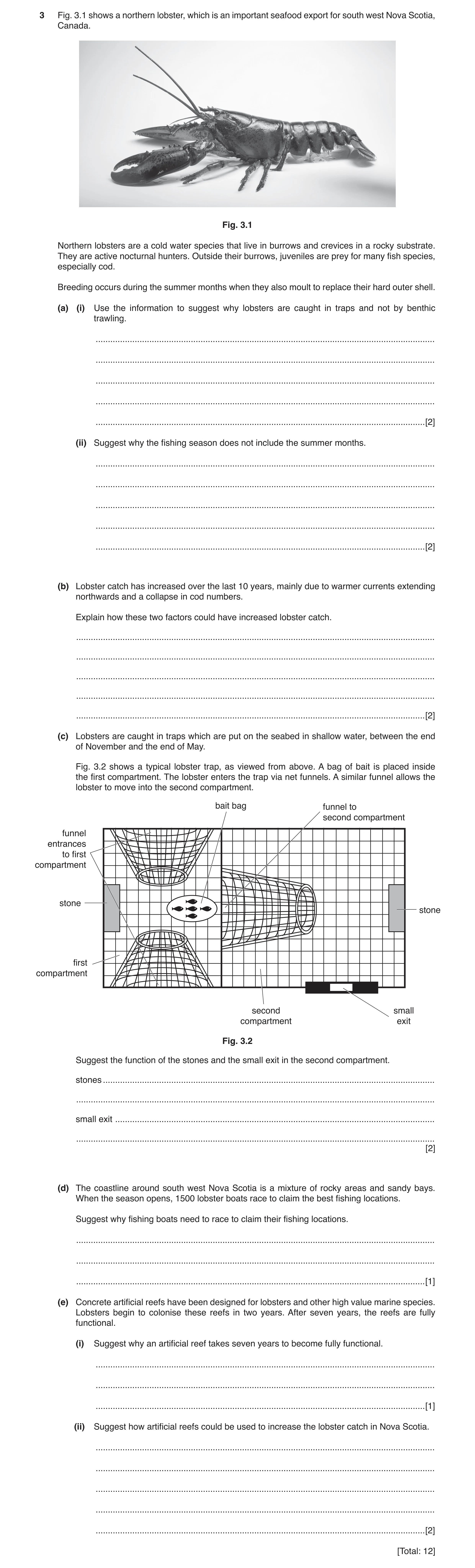
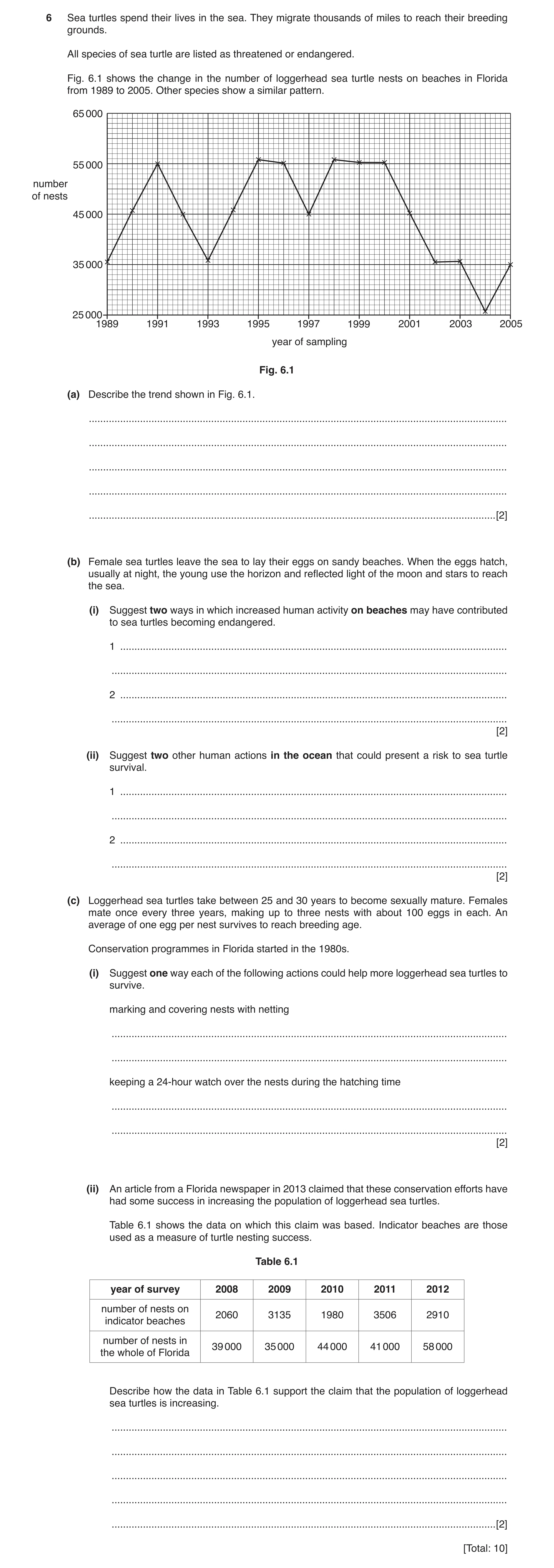
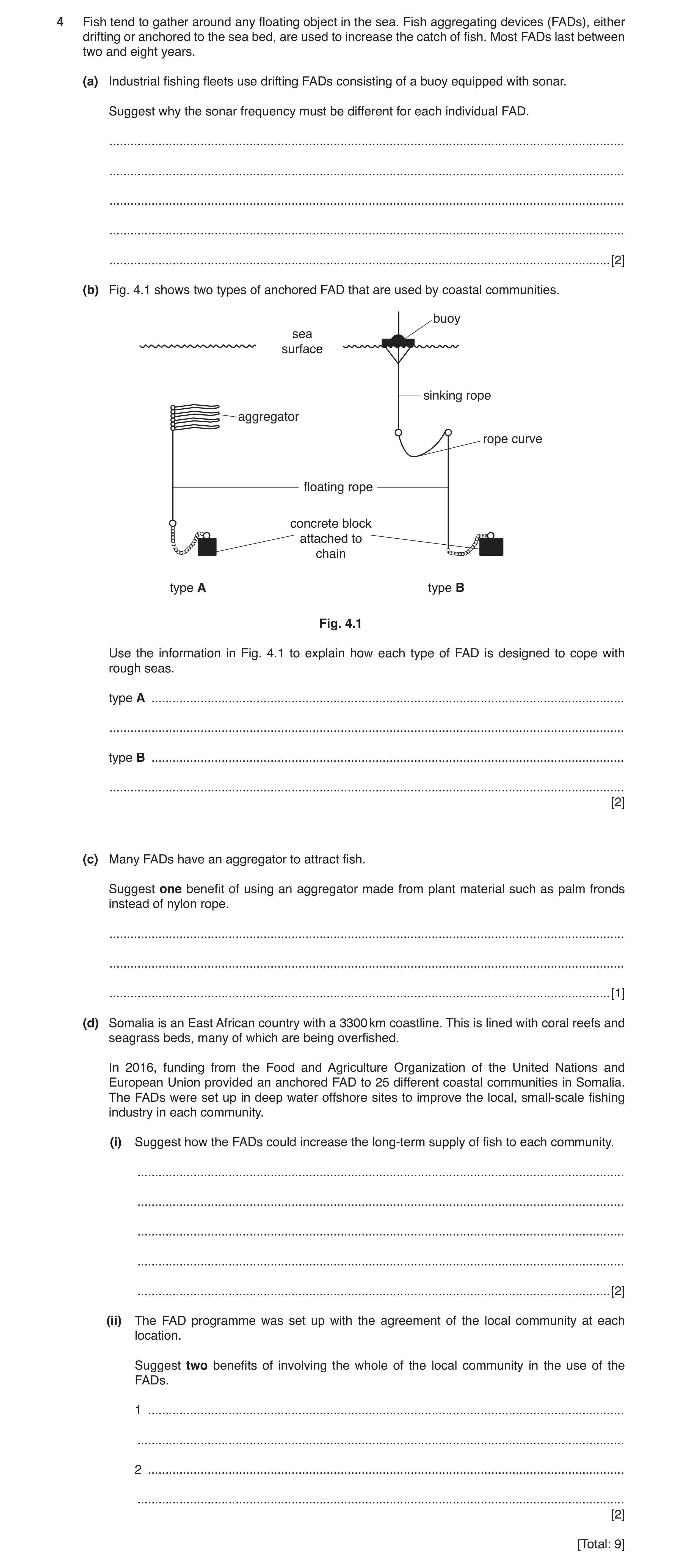
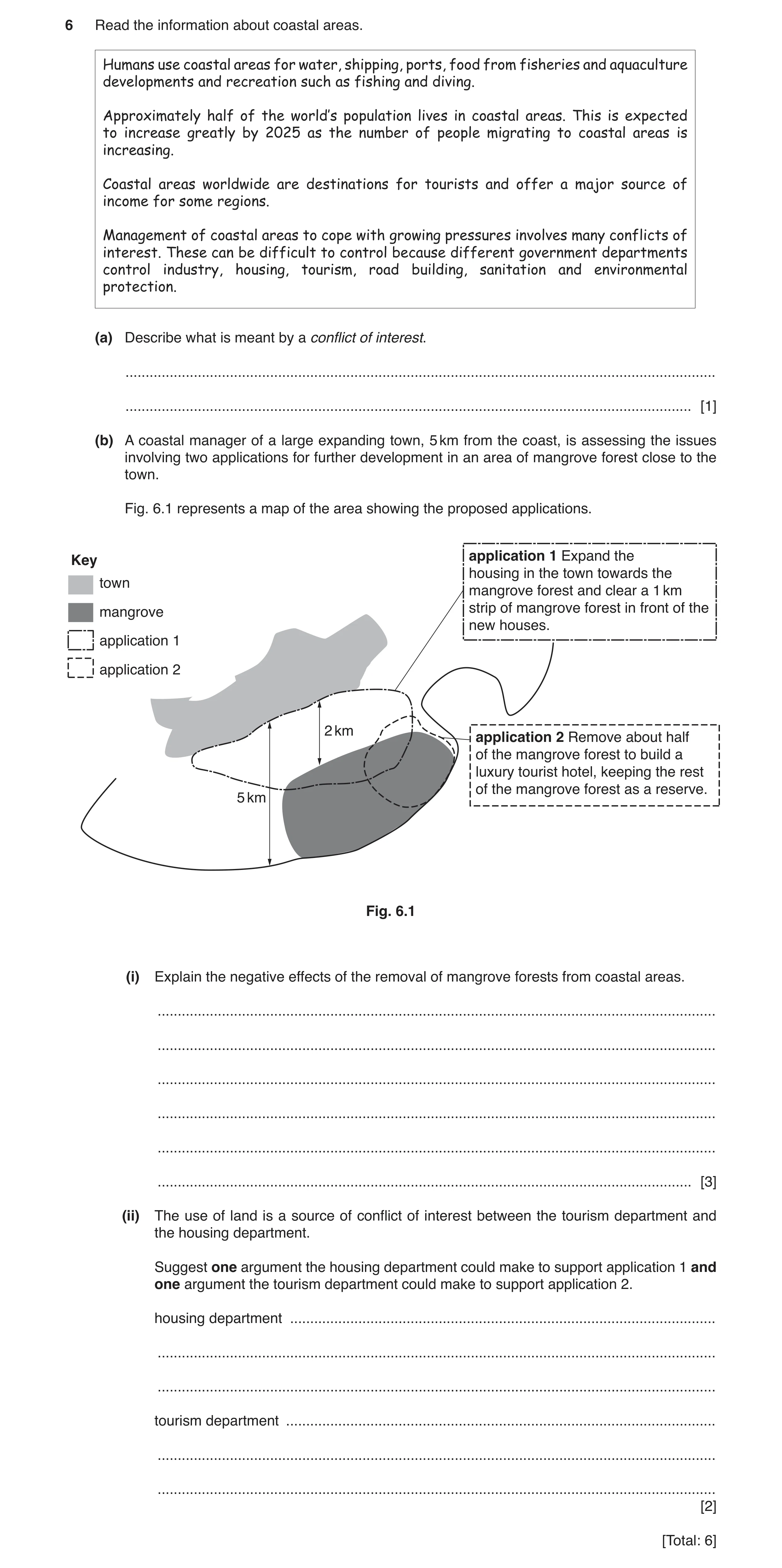
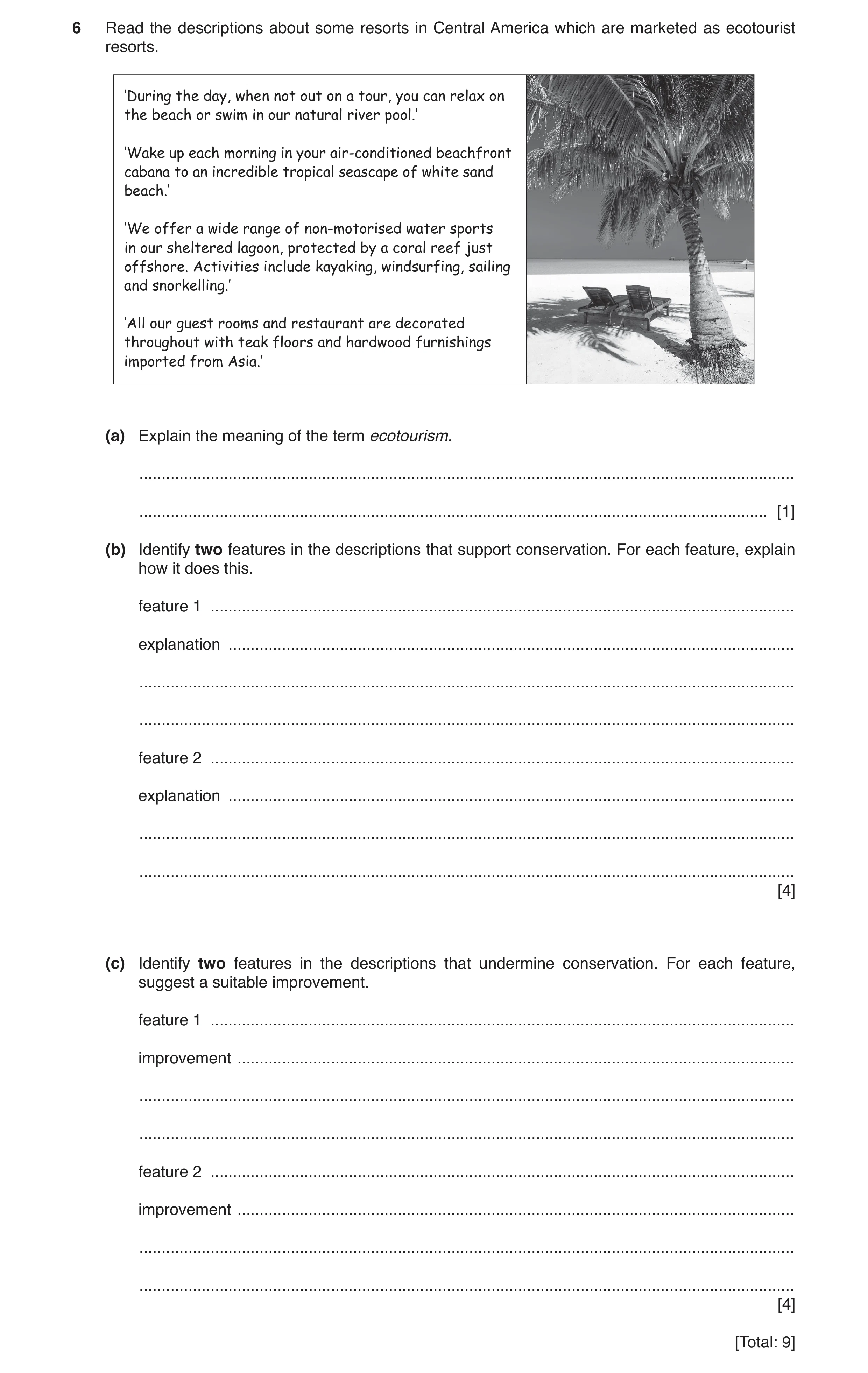
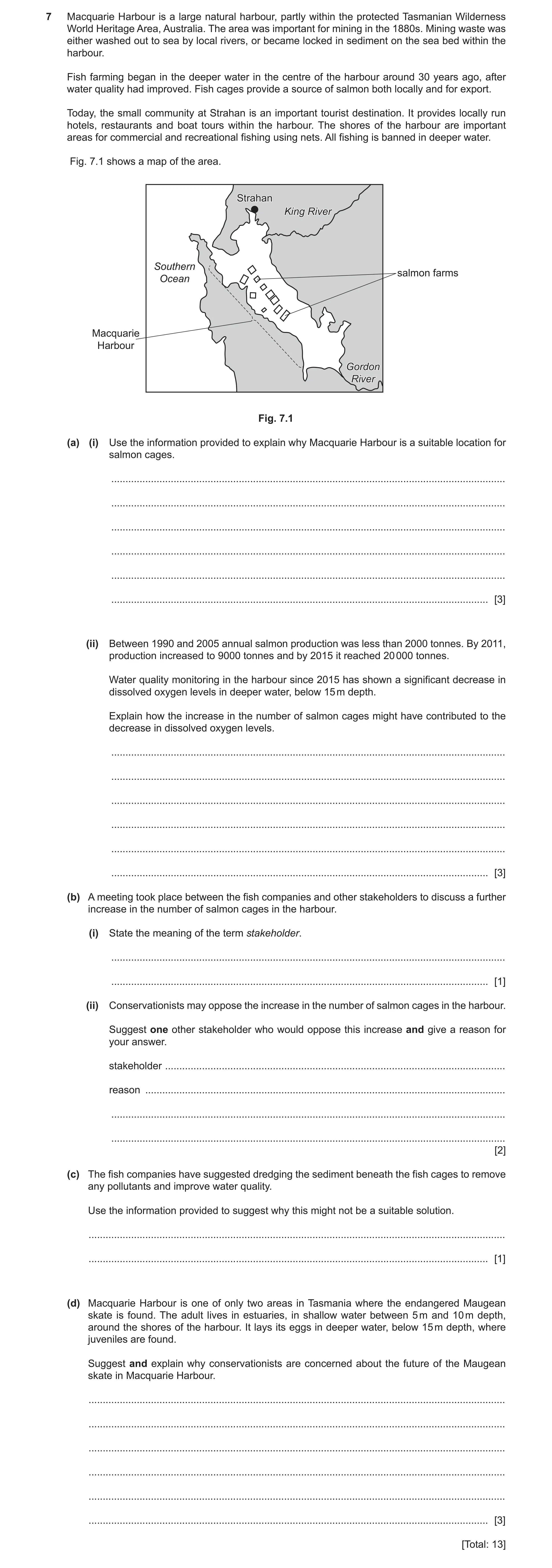
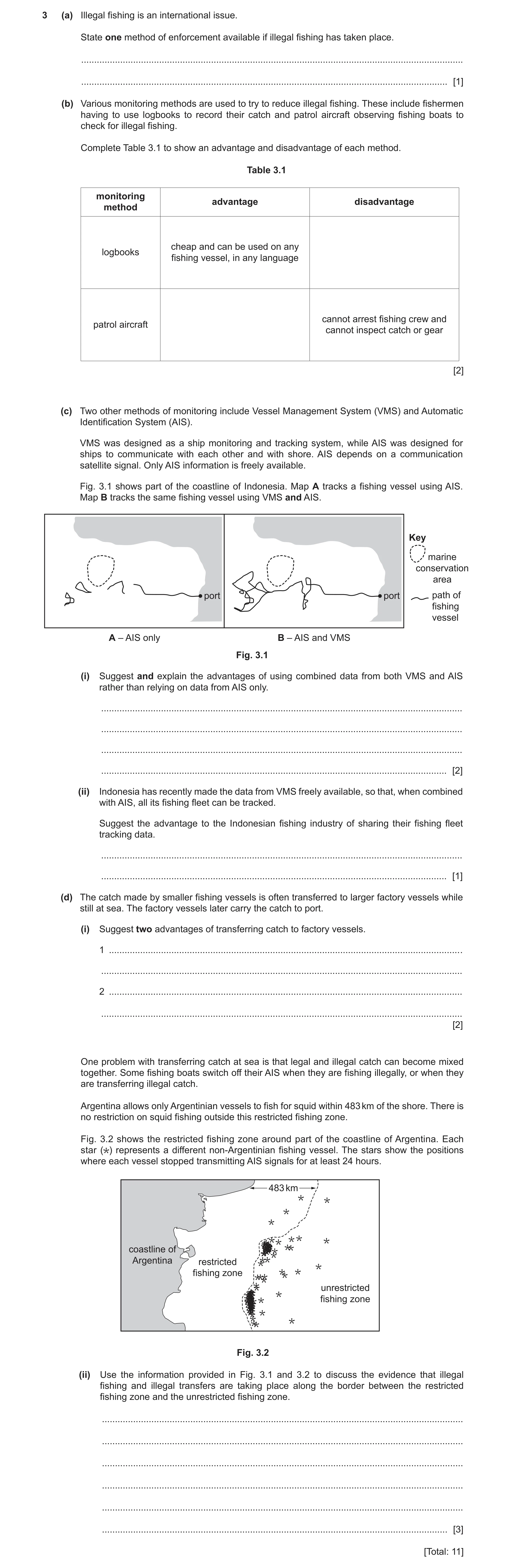
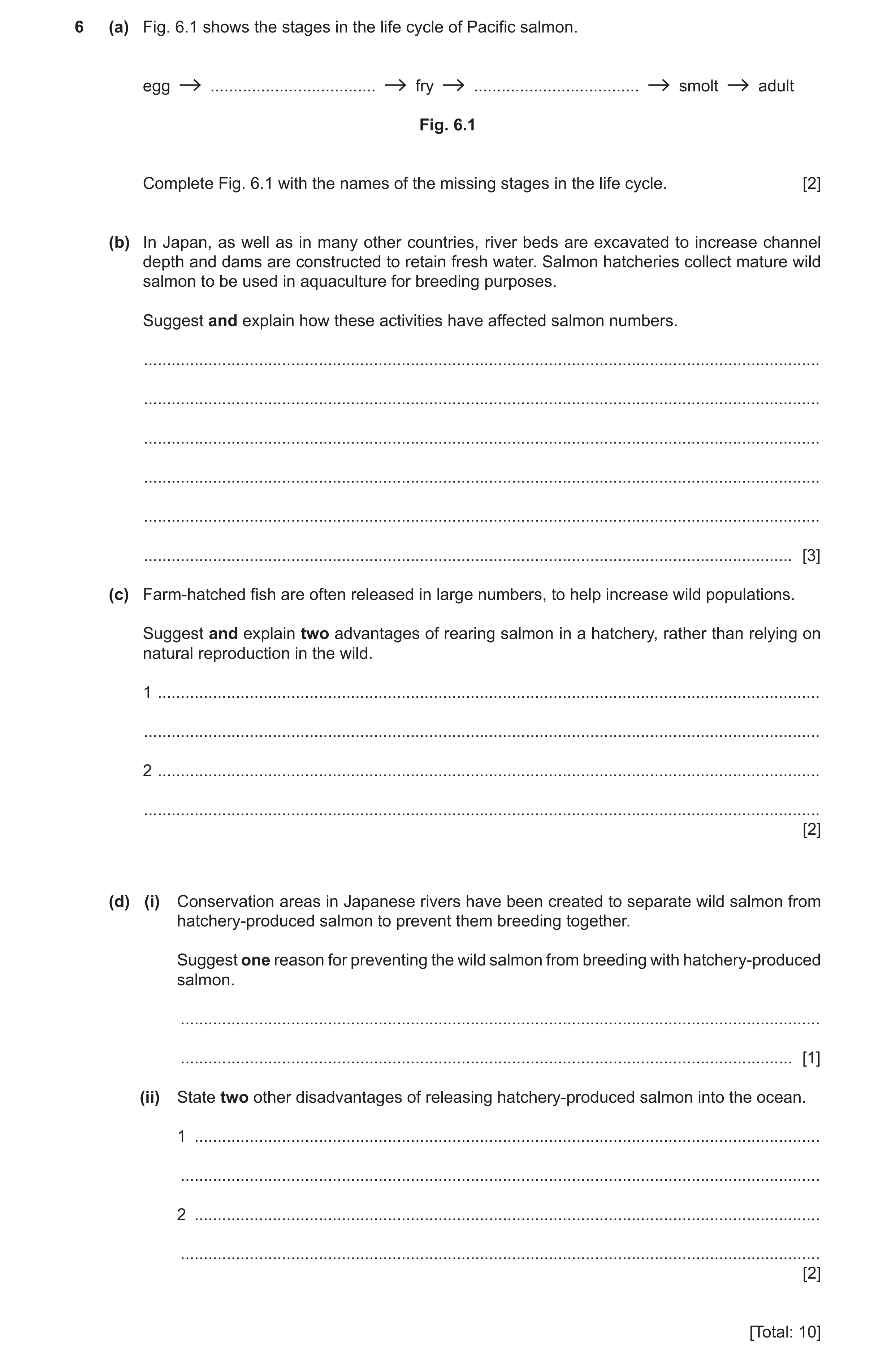
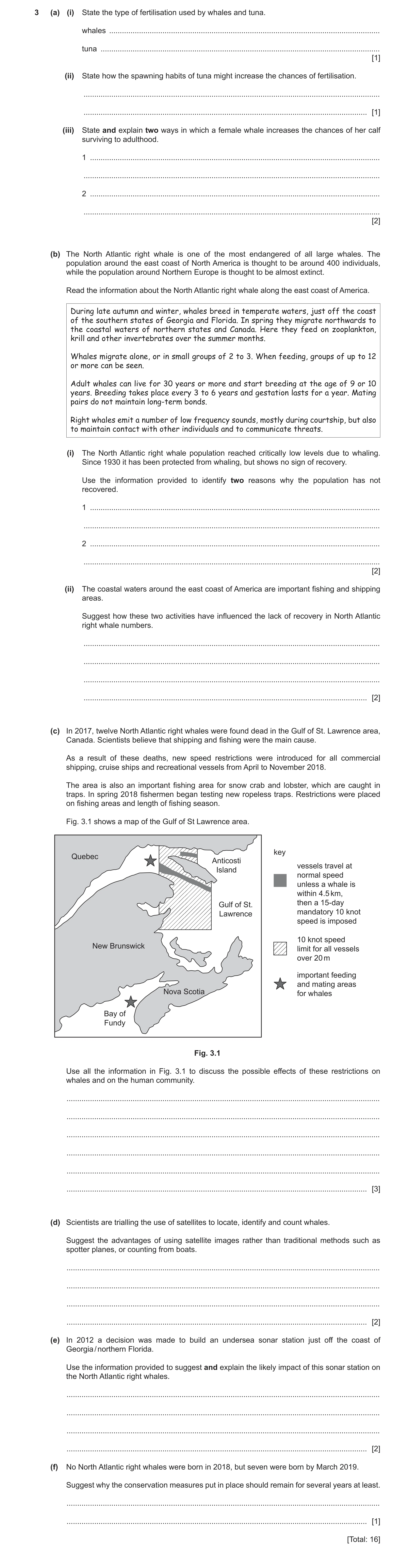
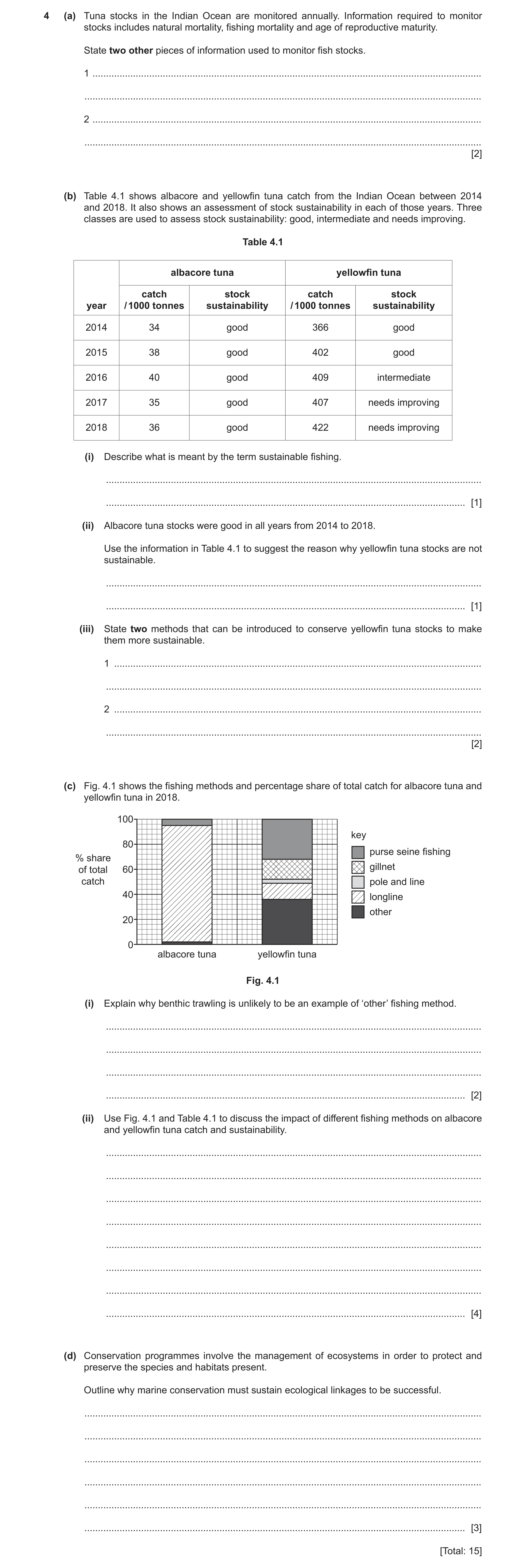
 27 / 60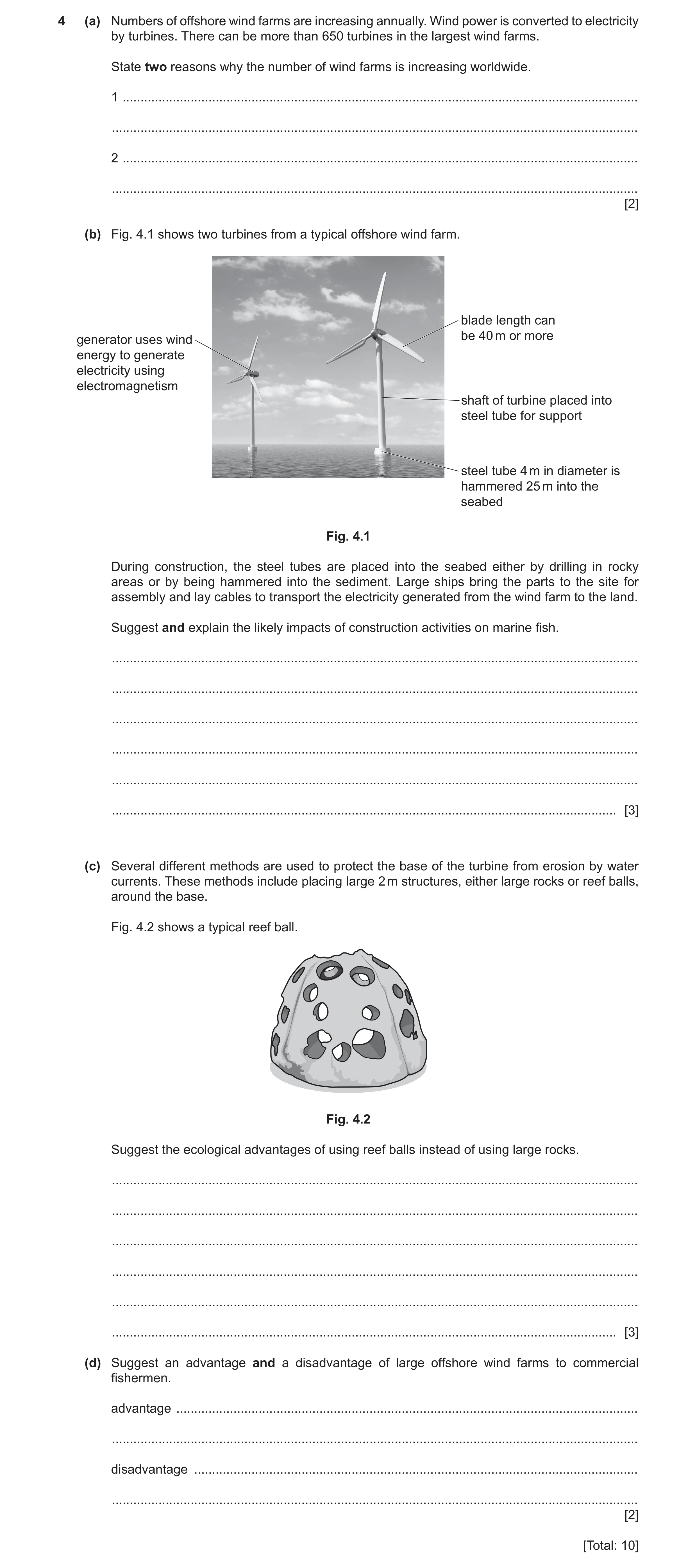
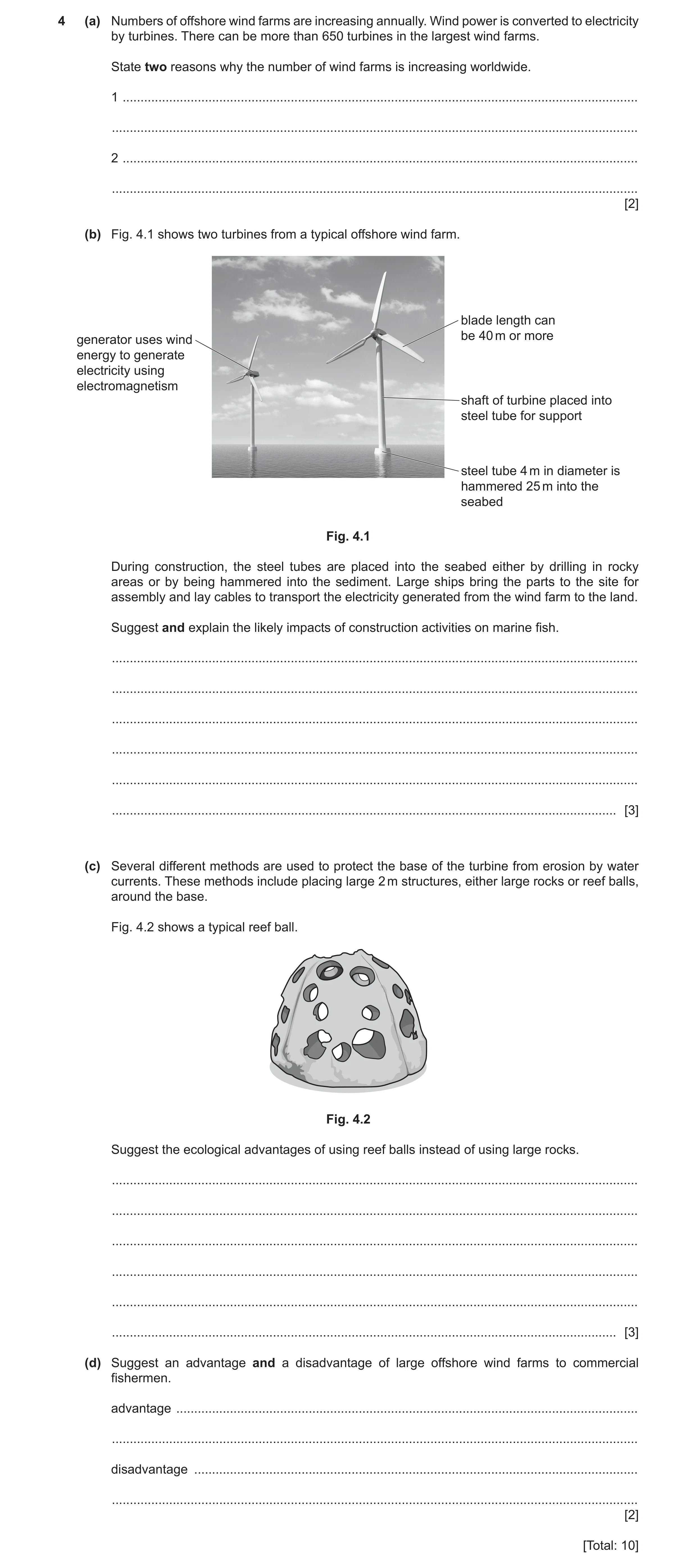
 31 / 60
 32 / 60
 33 / 60
 34 / 60
 35 / 60
 36 / 60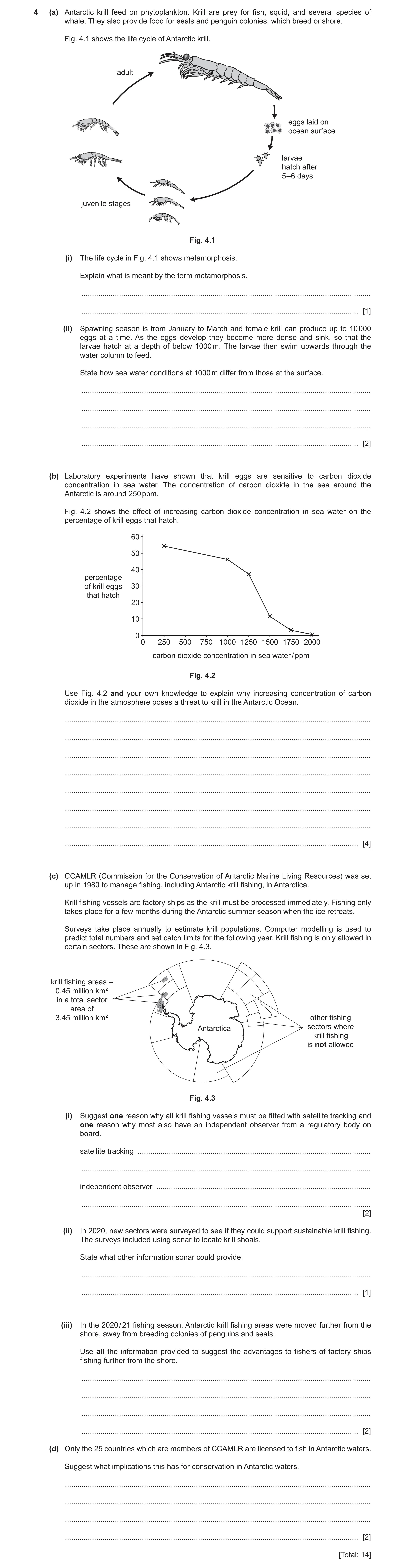
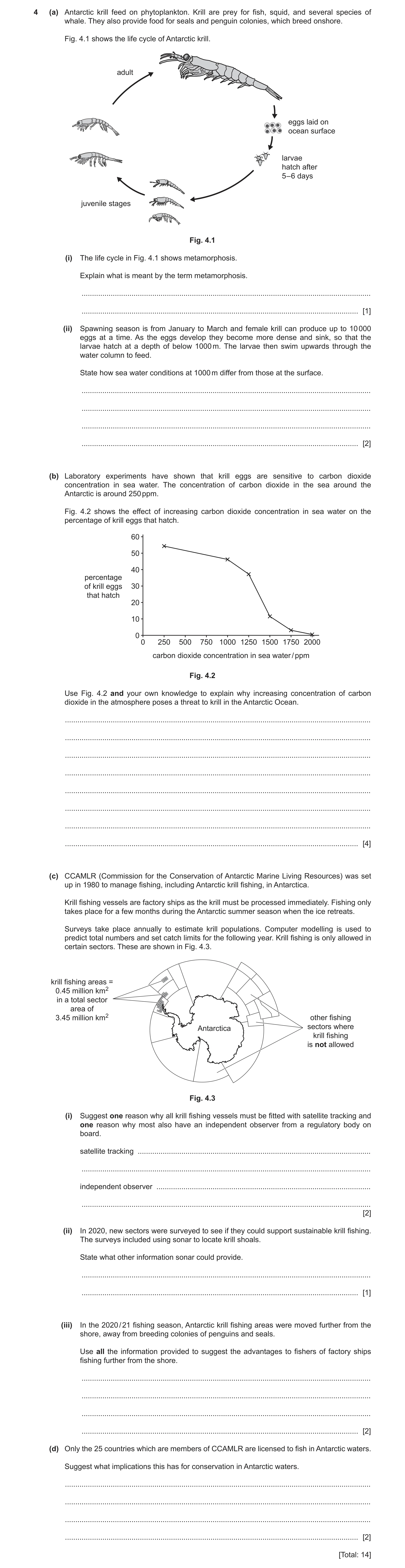
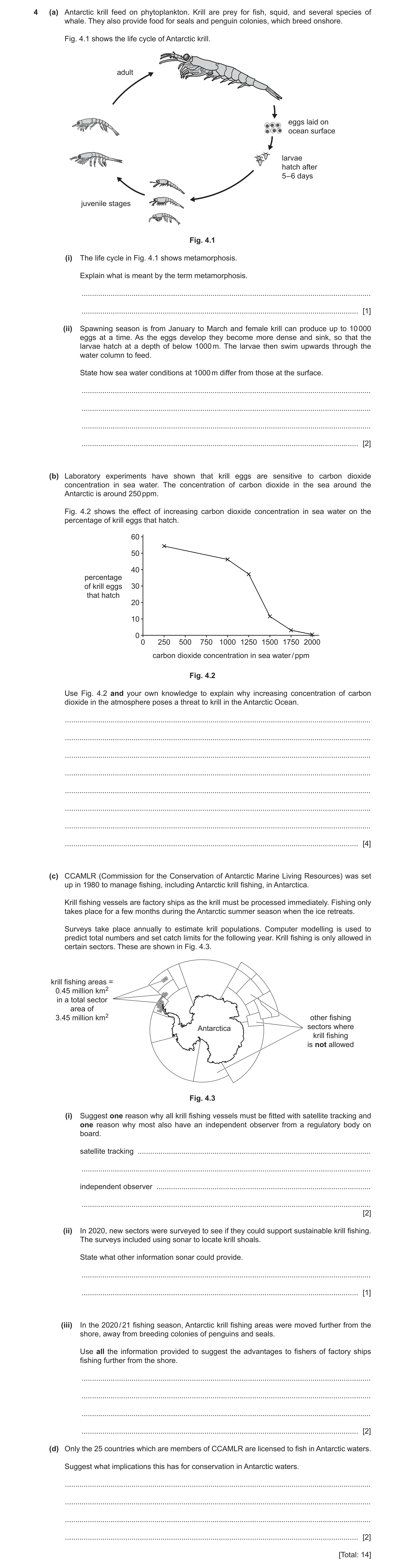
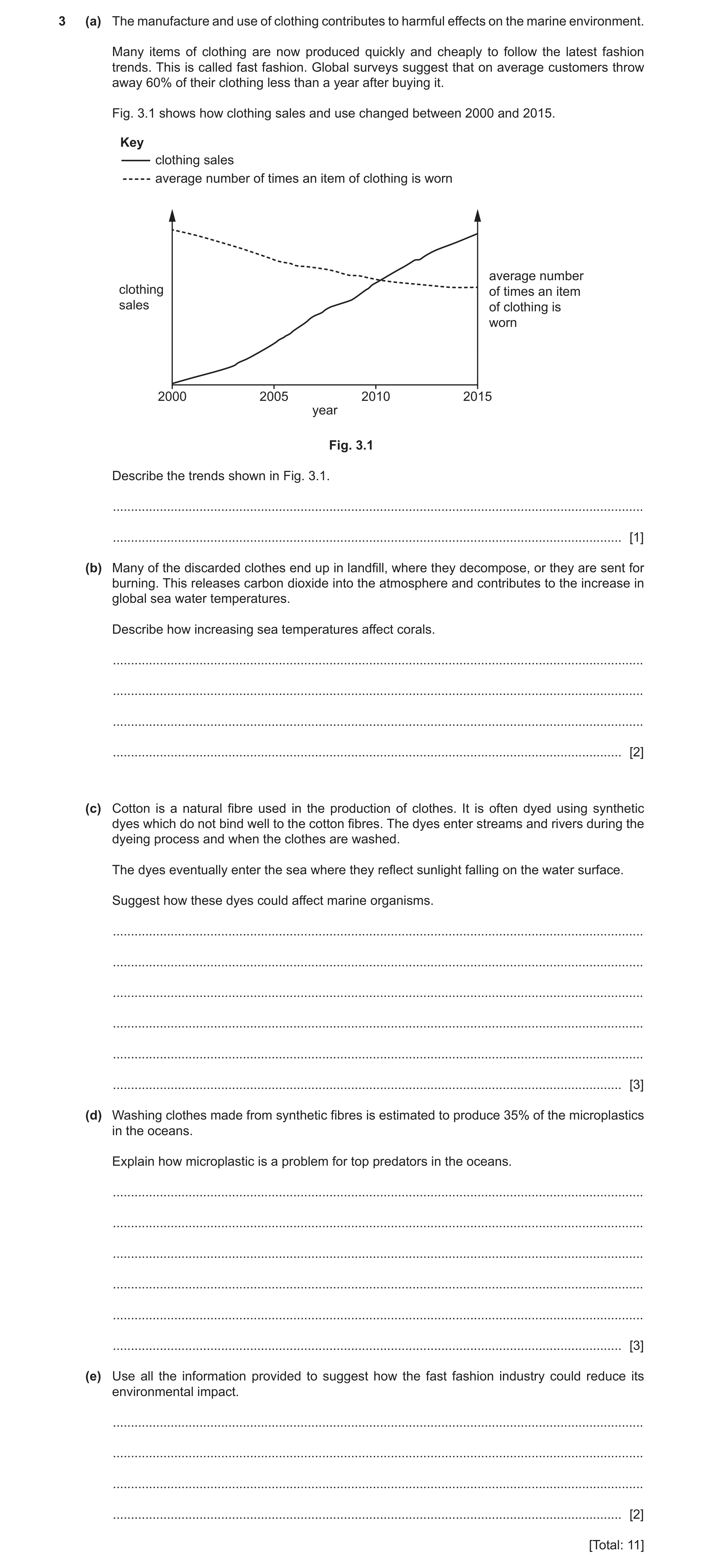
 53 / 60
 54 / 60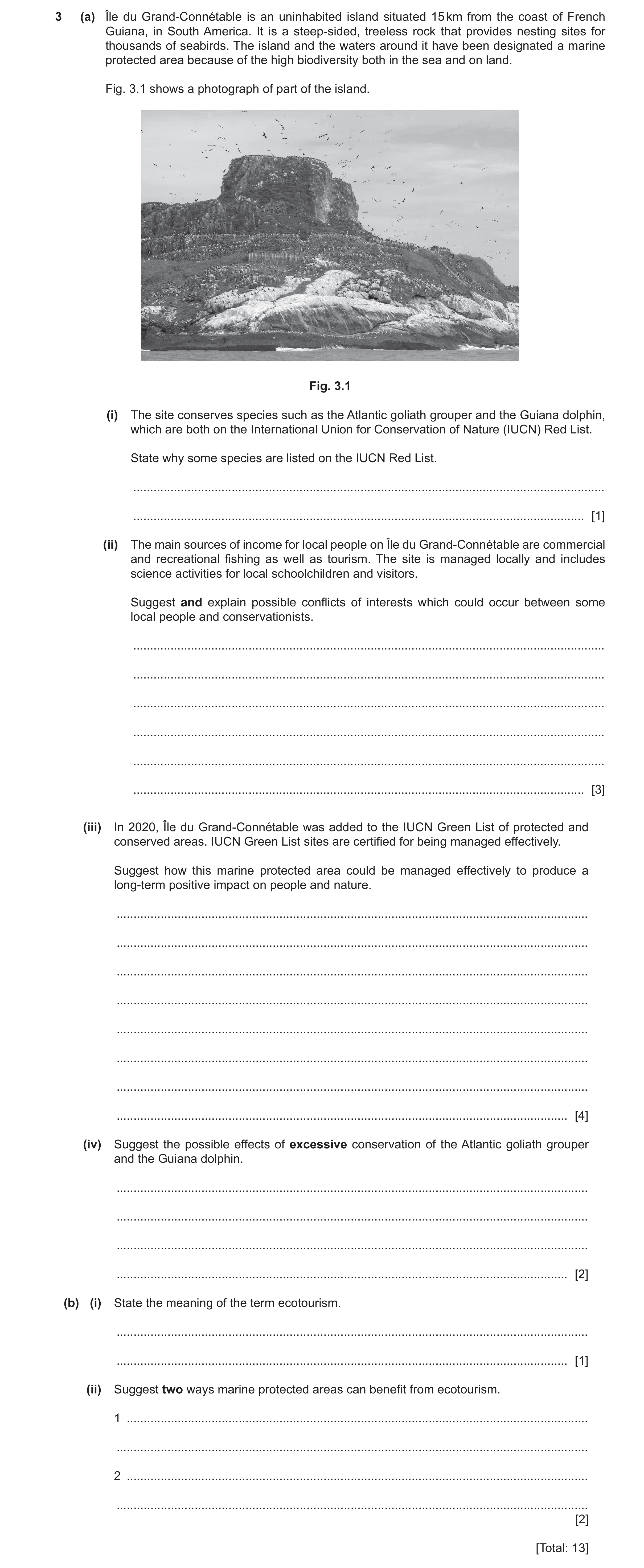
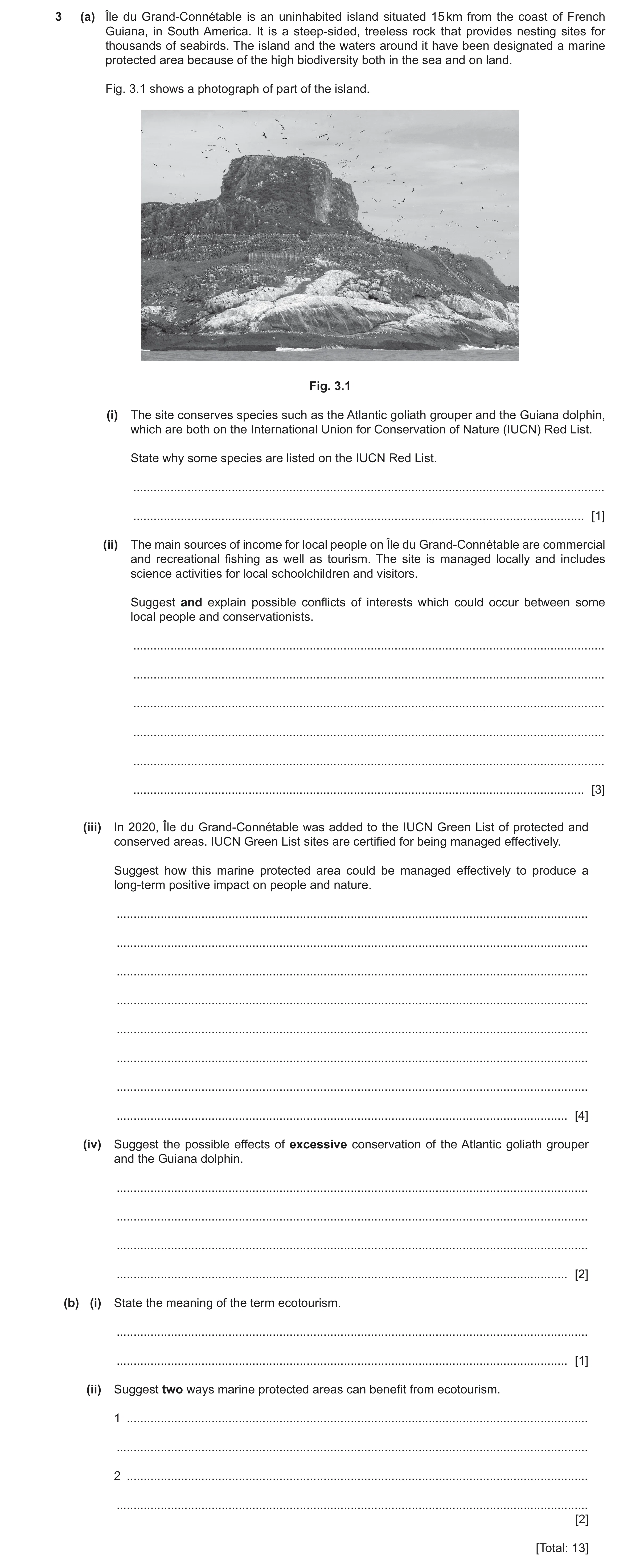
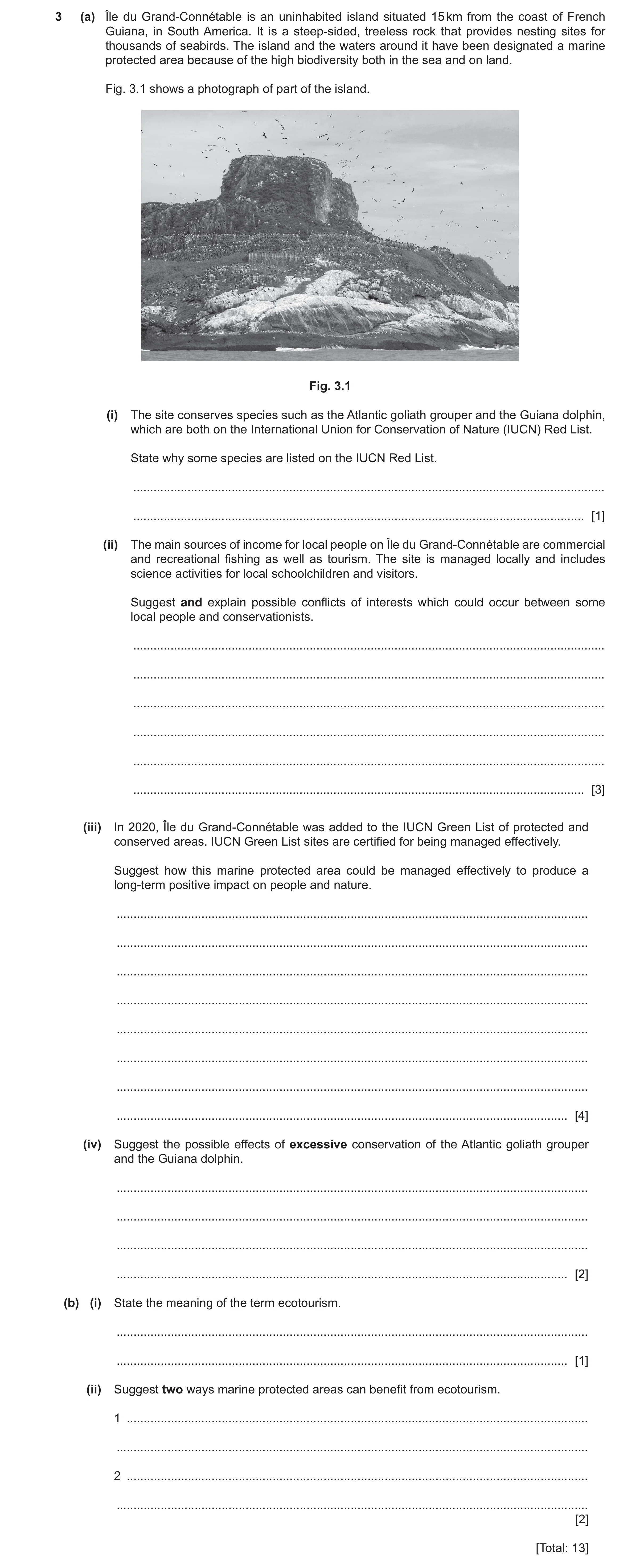
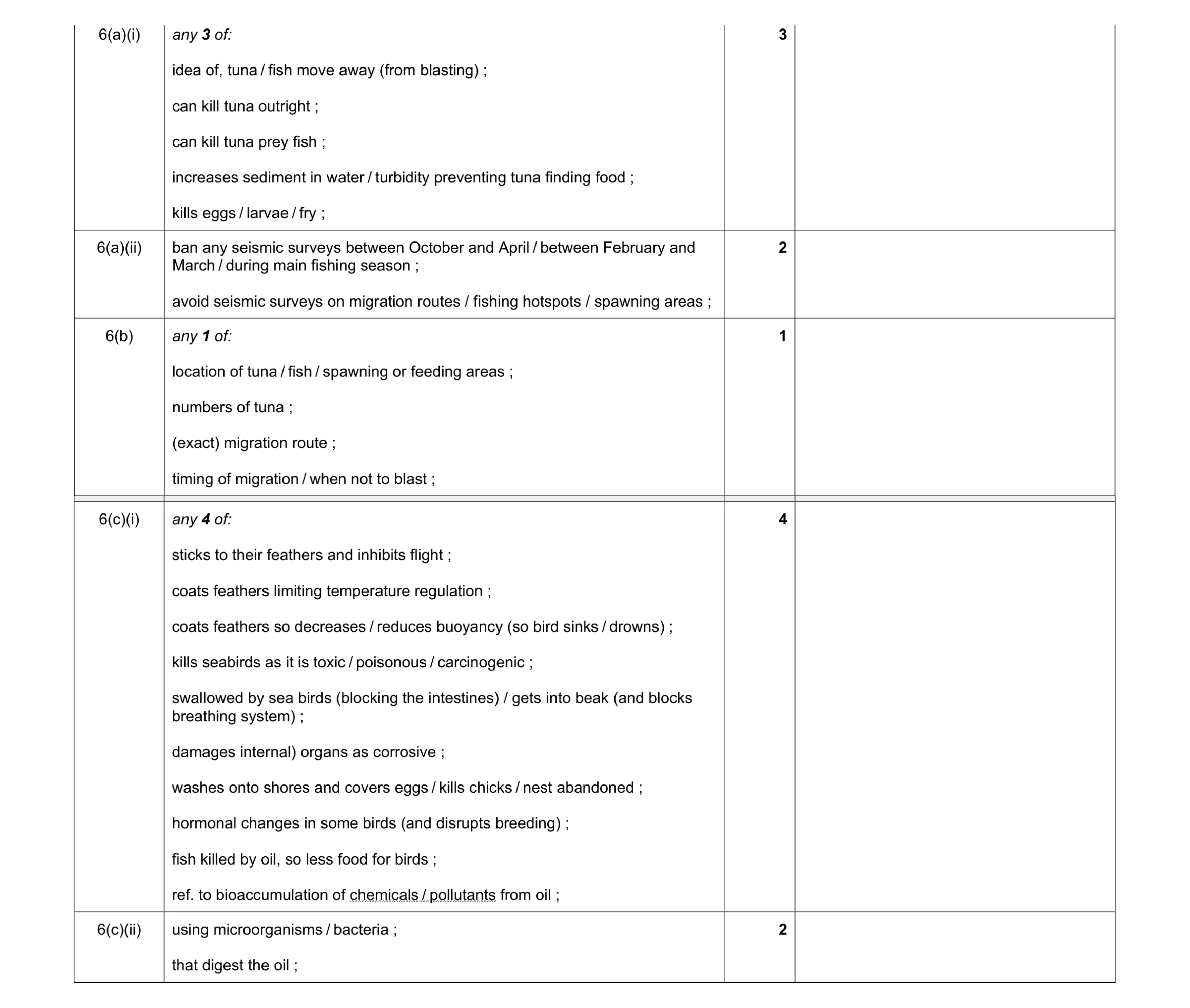 12
12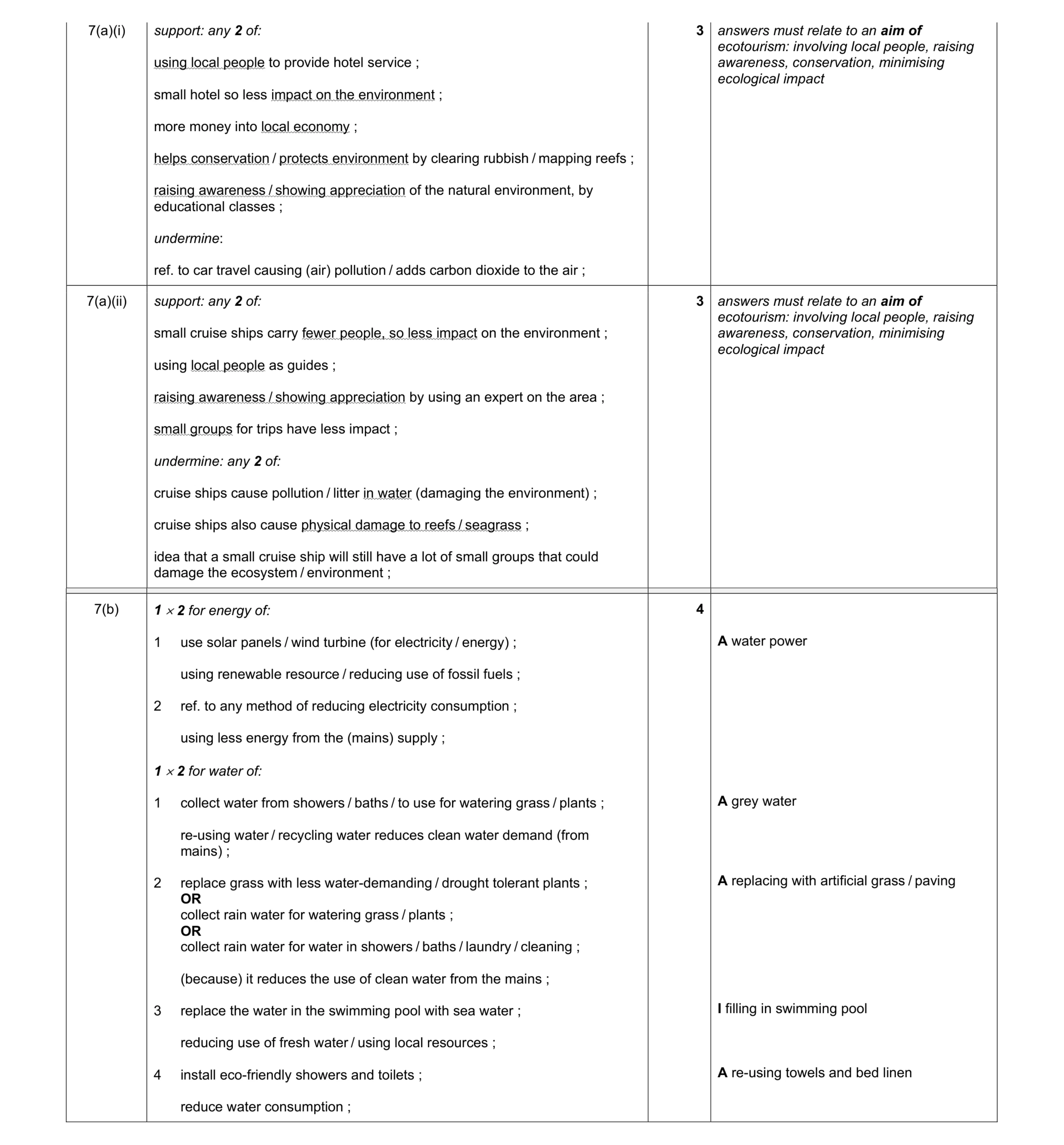 10
10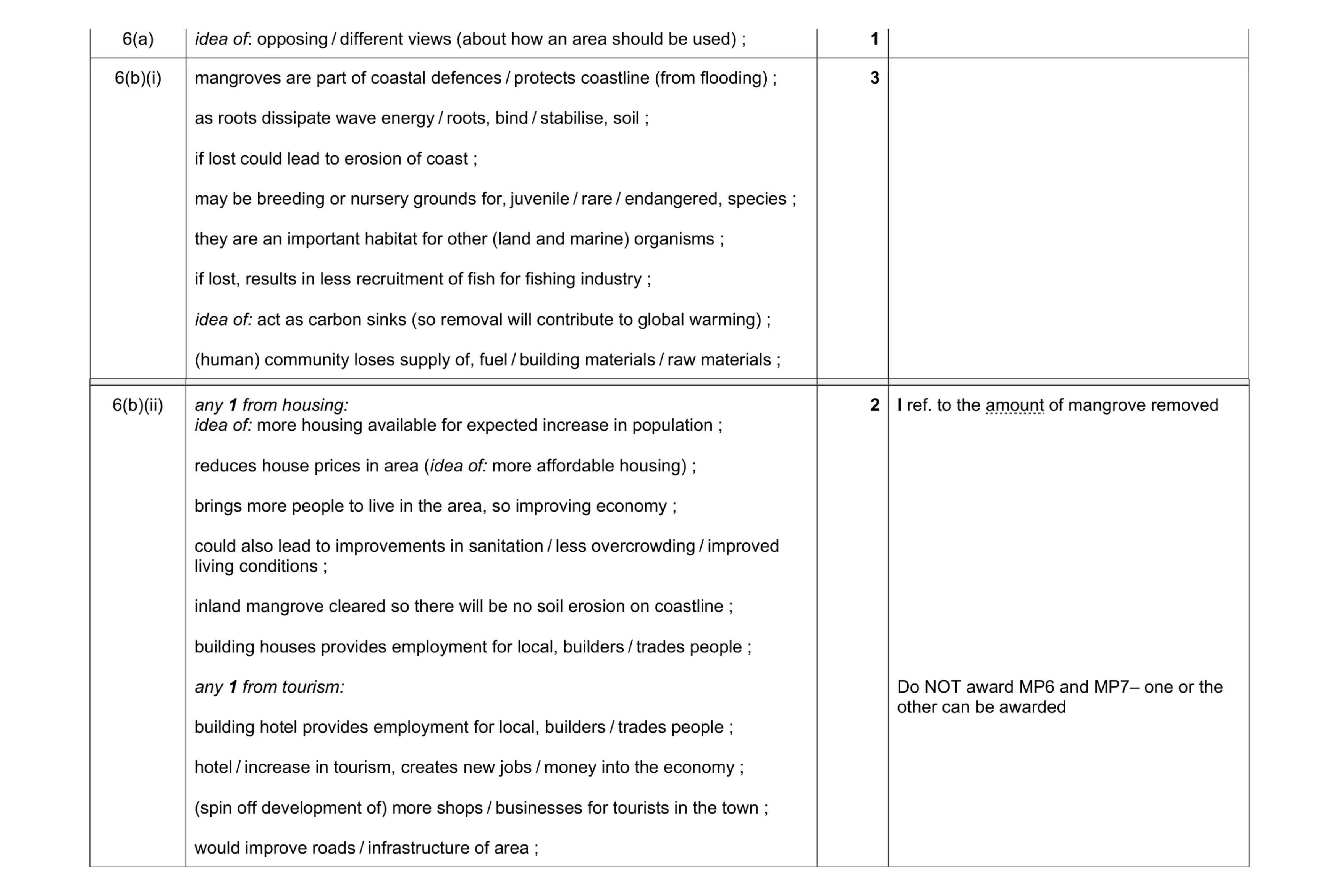 6
6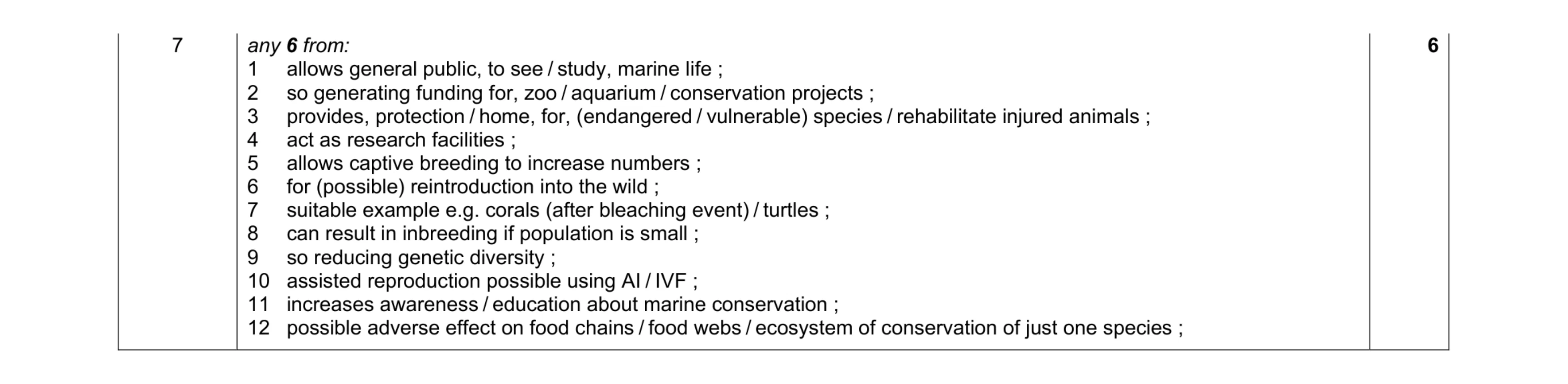 6
6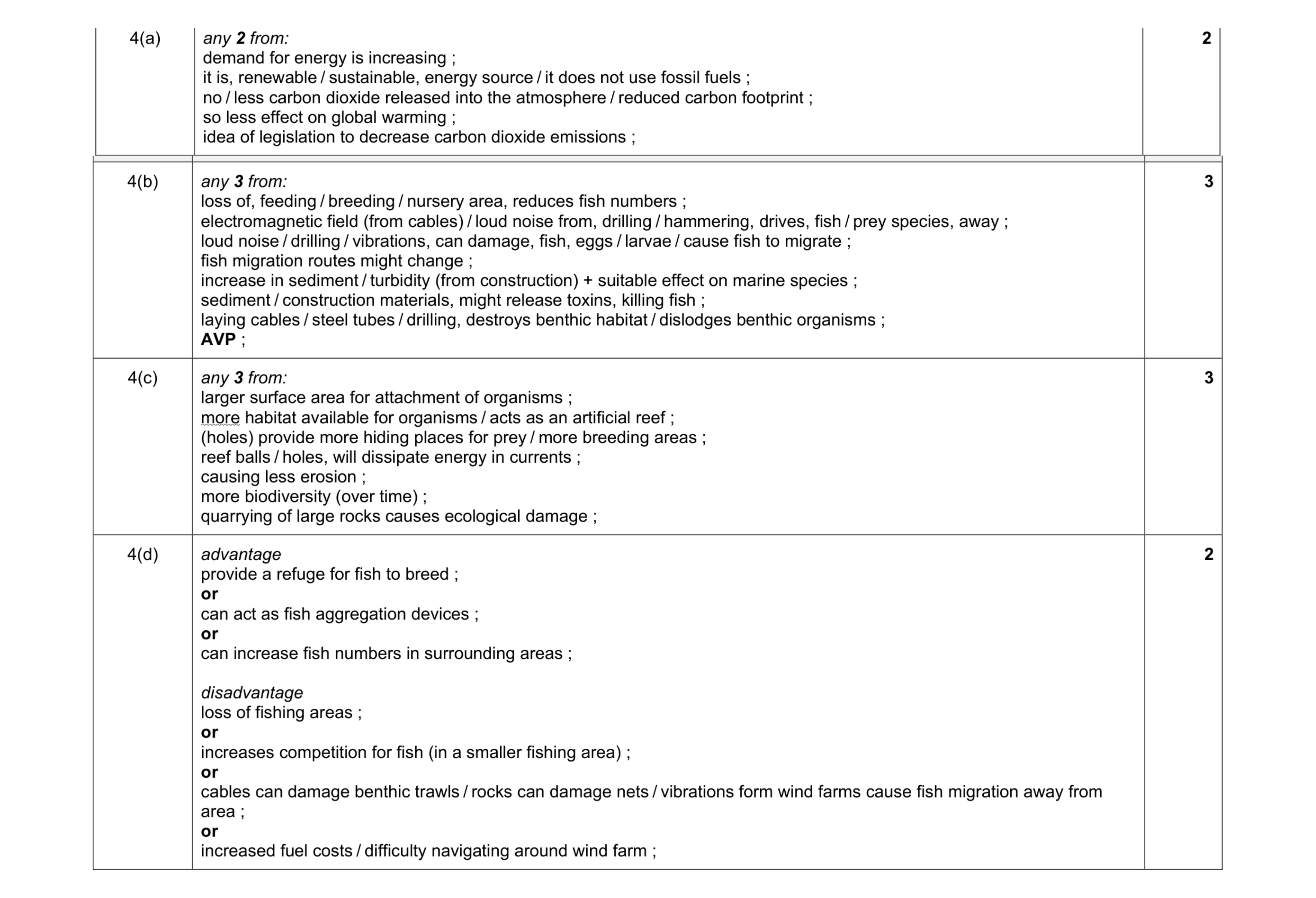 10
10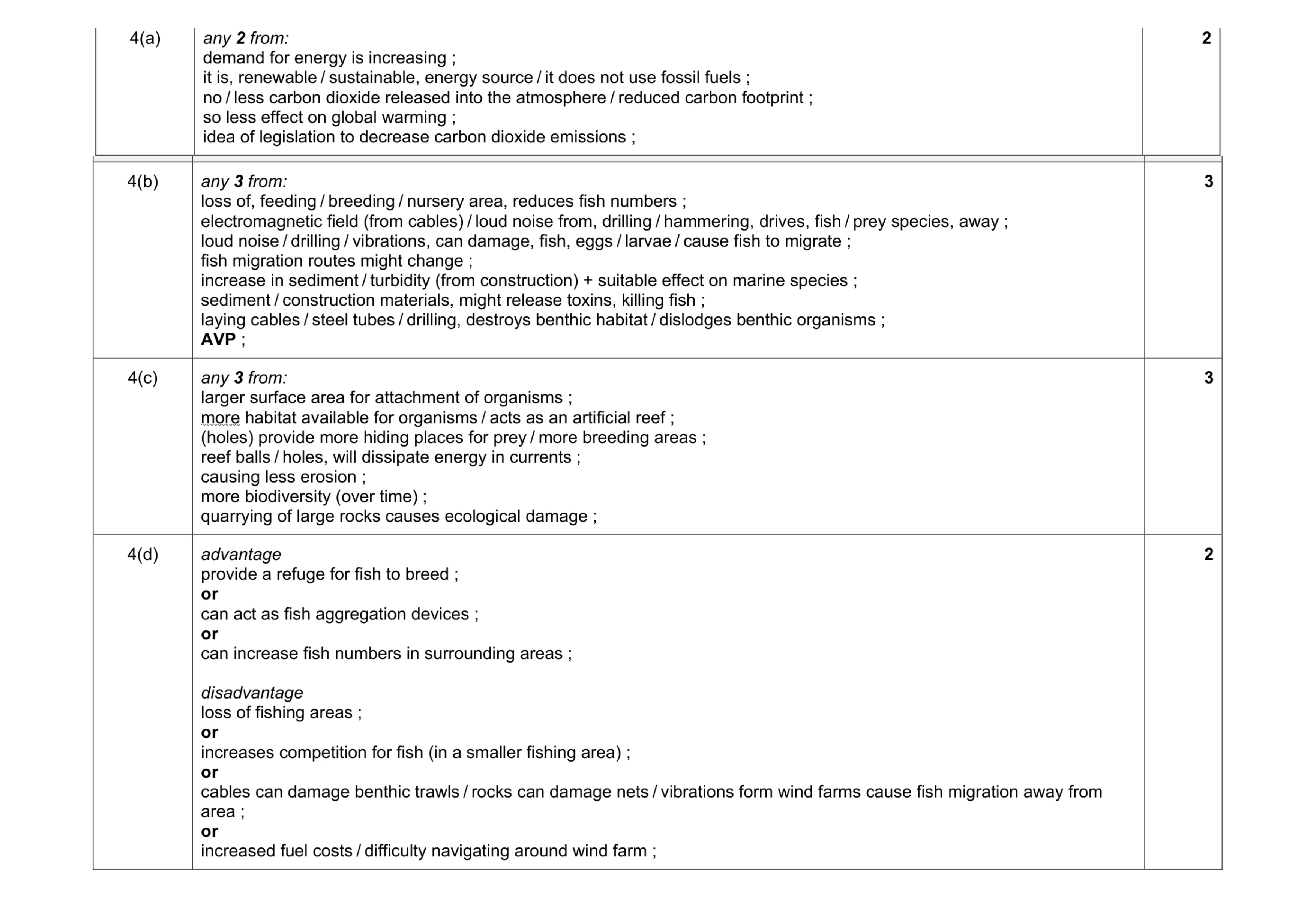 10
10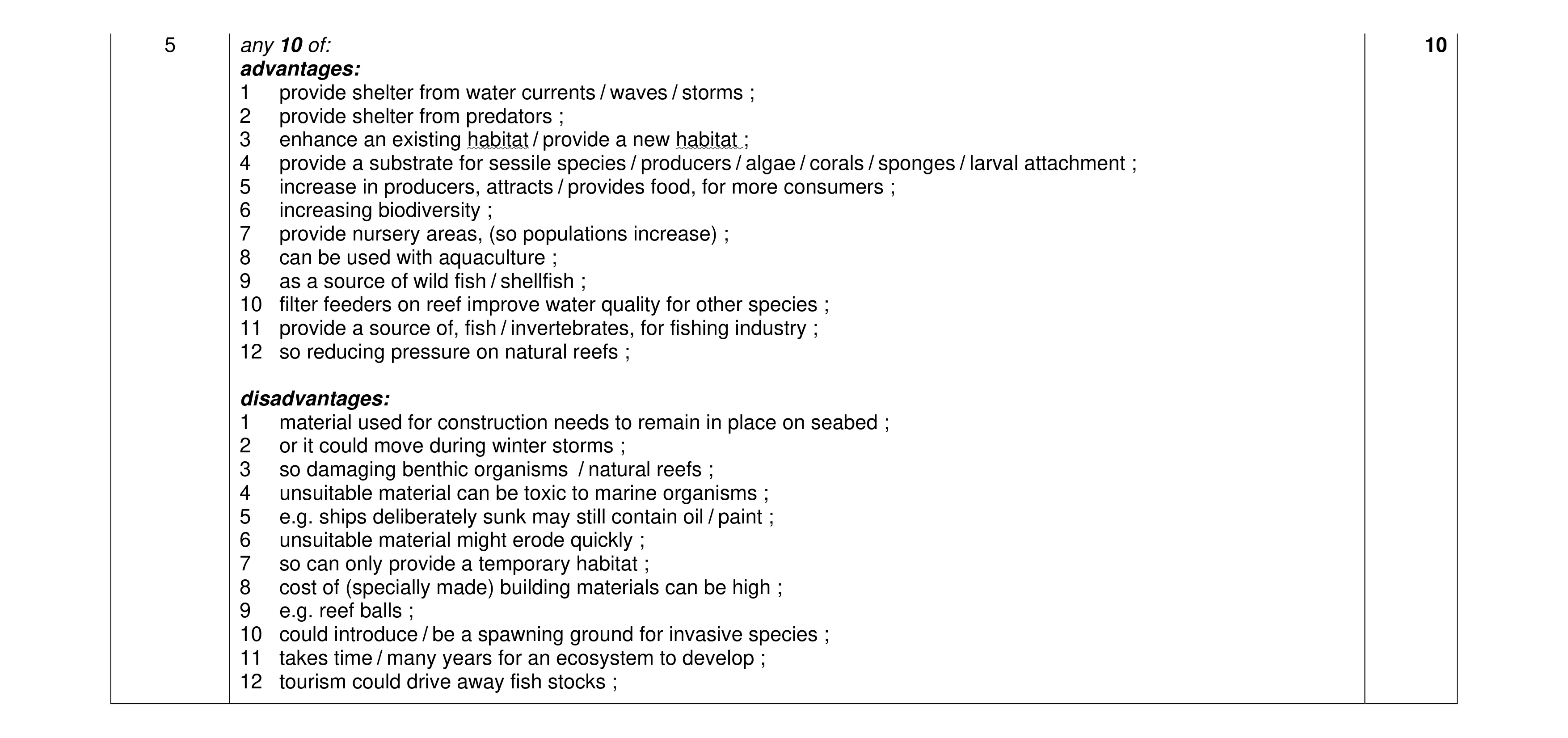 10
10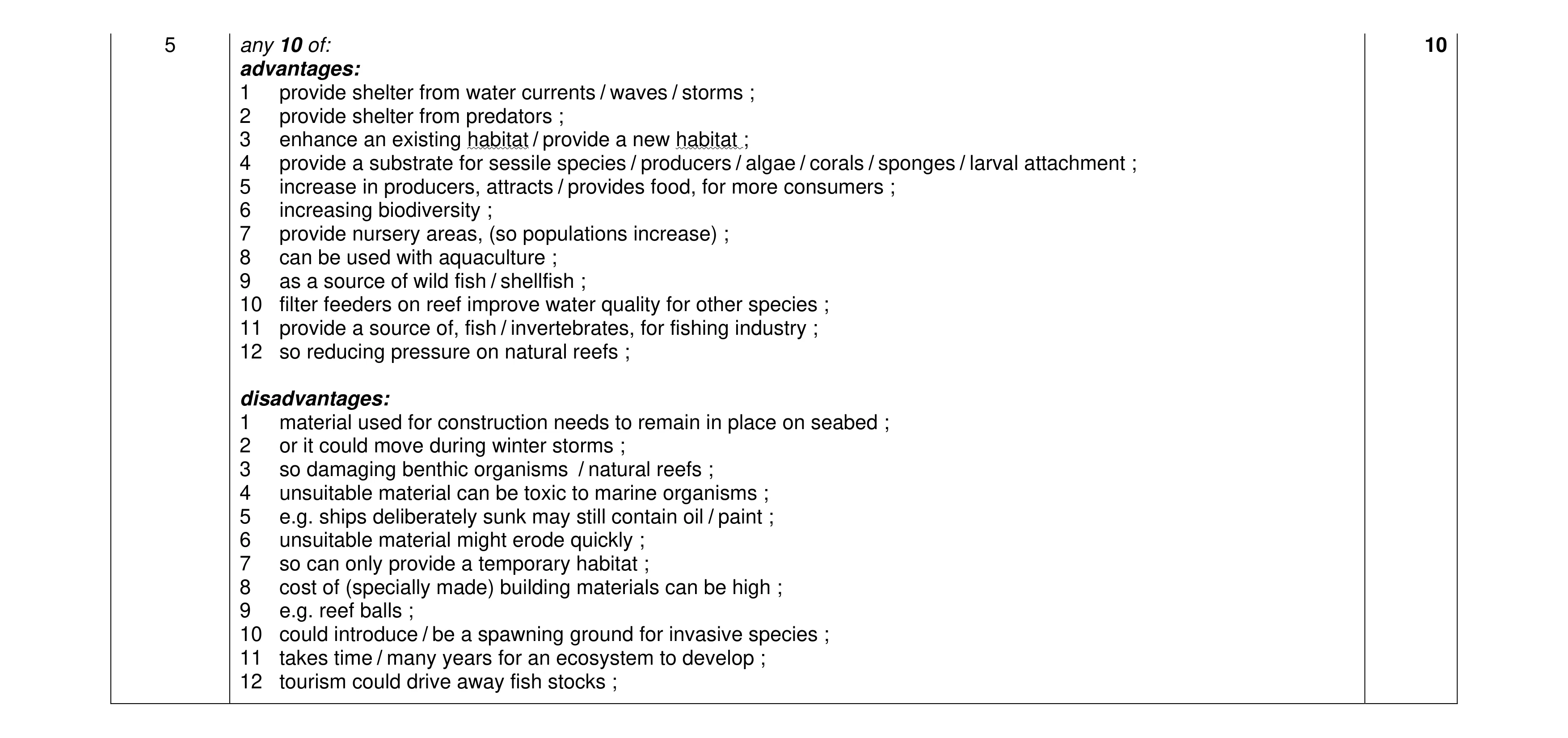 10
10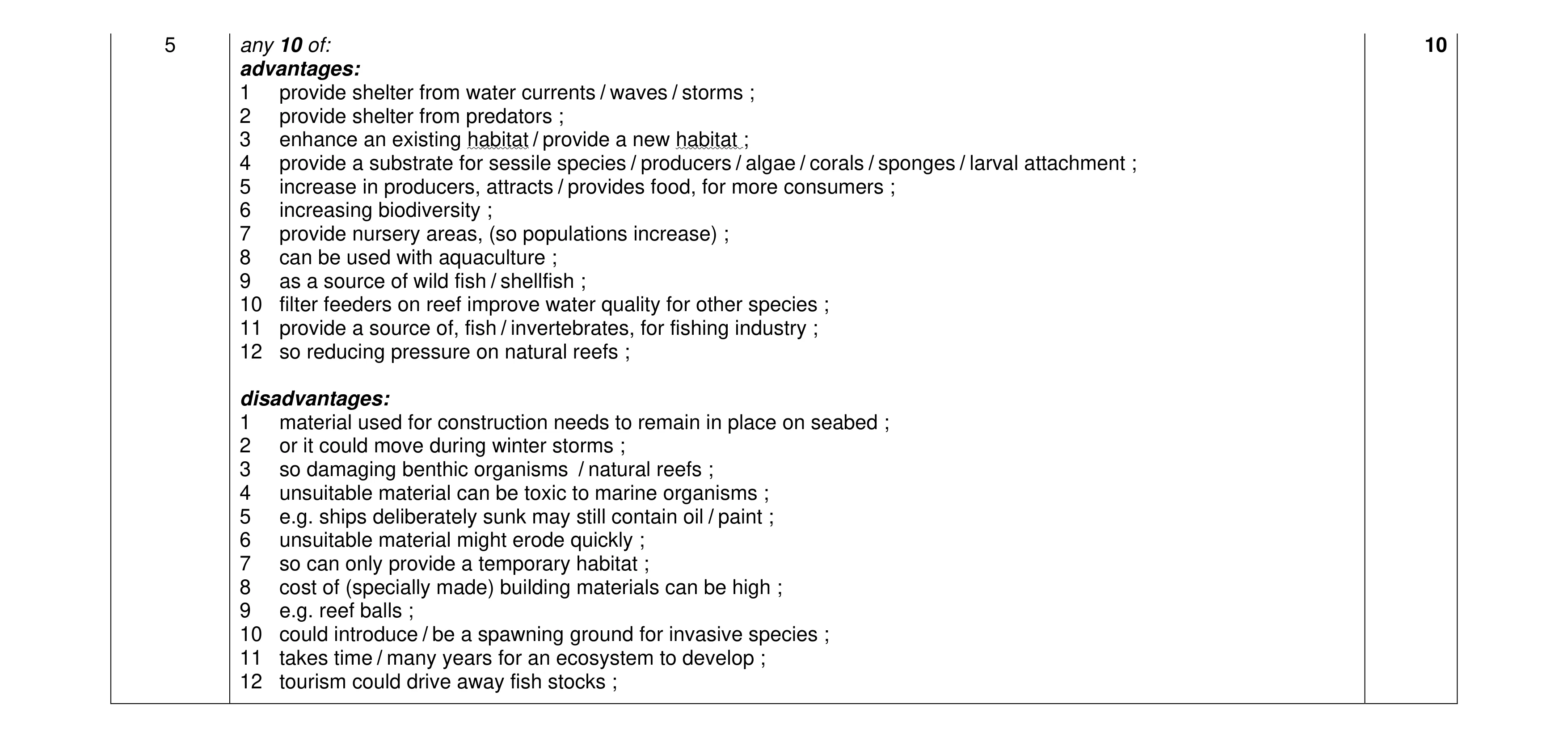 10
10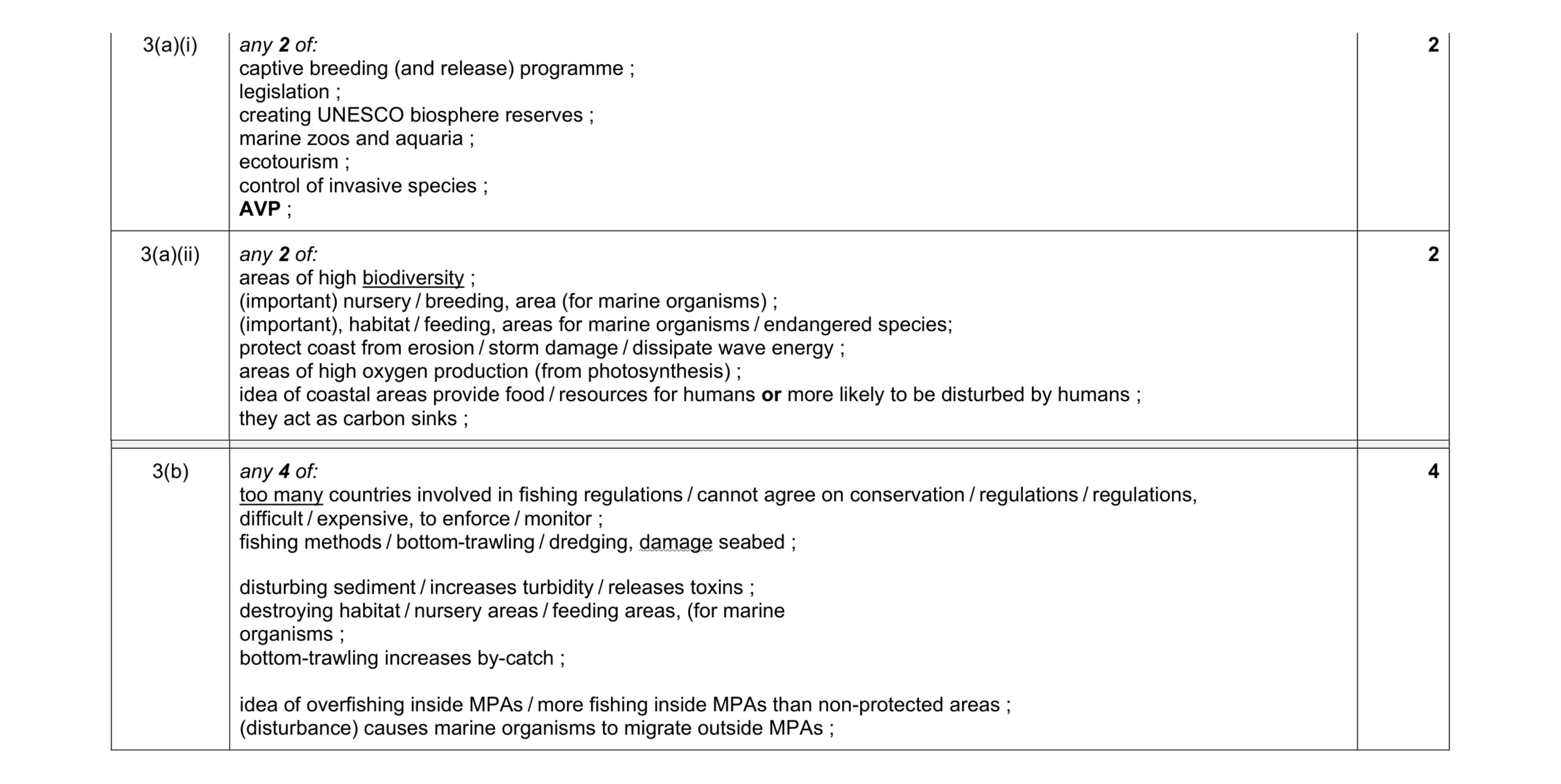 8
8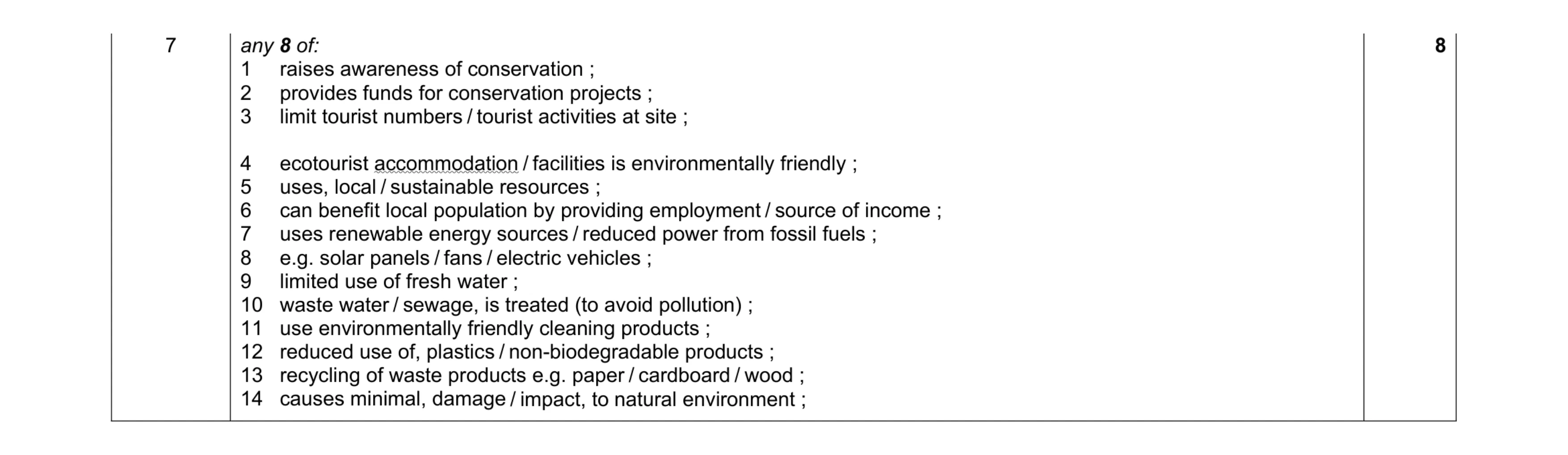 8
8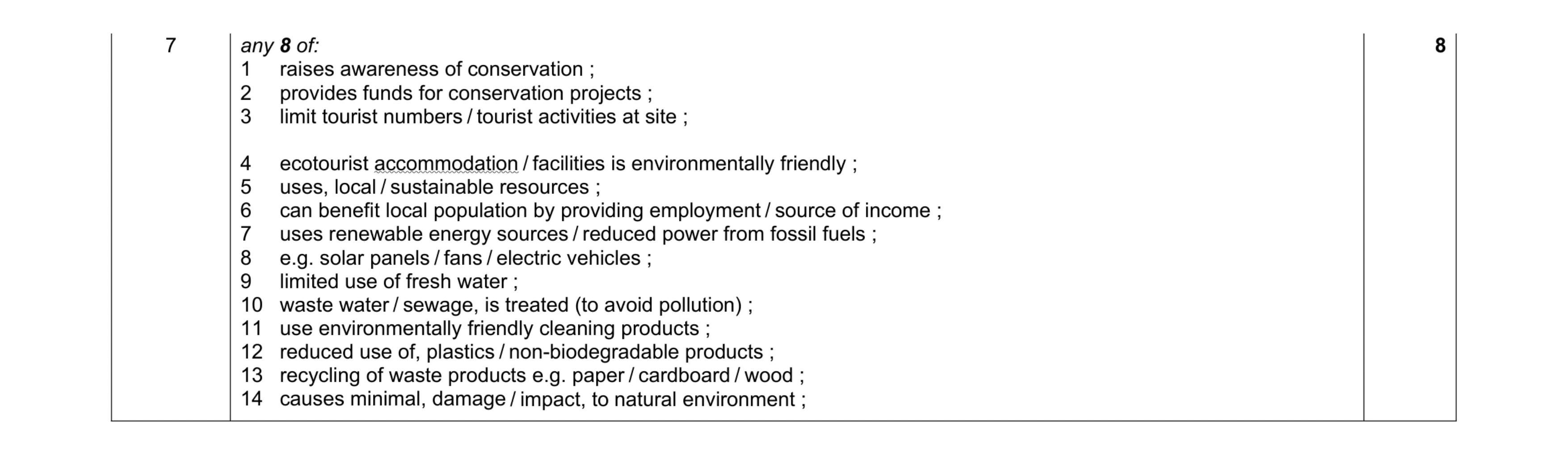 8
8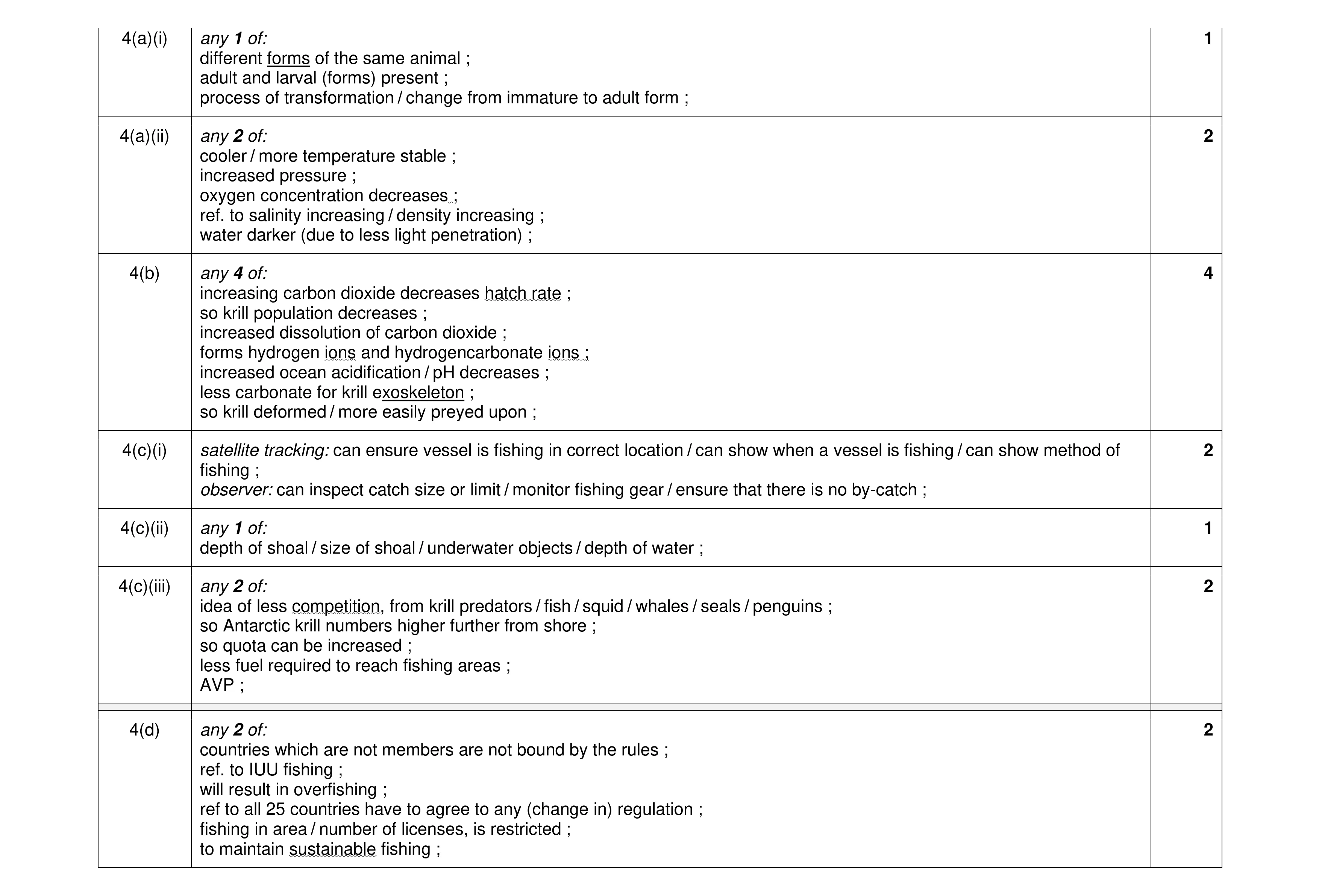 14
14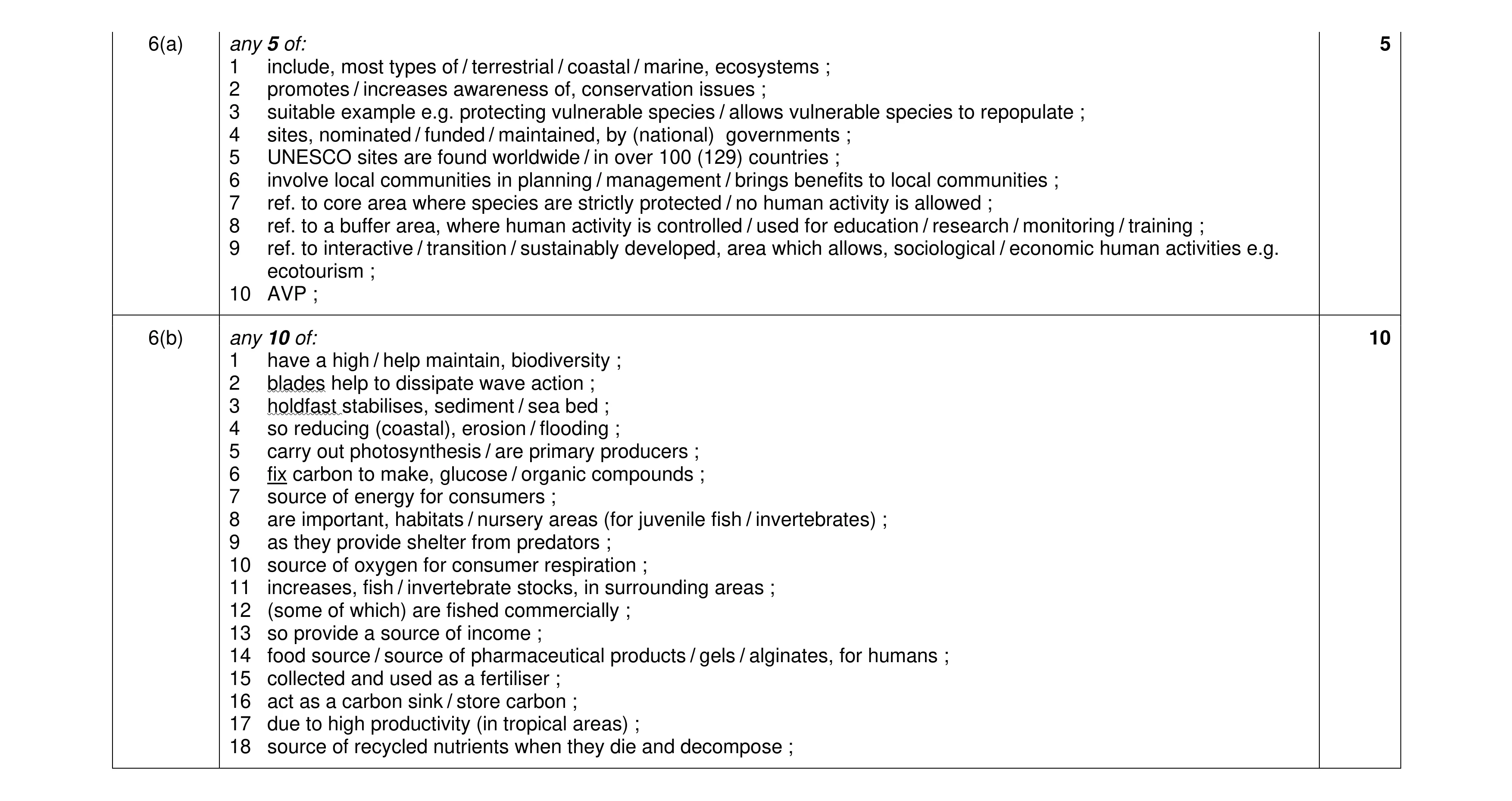 15
15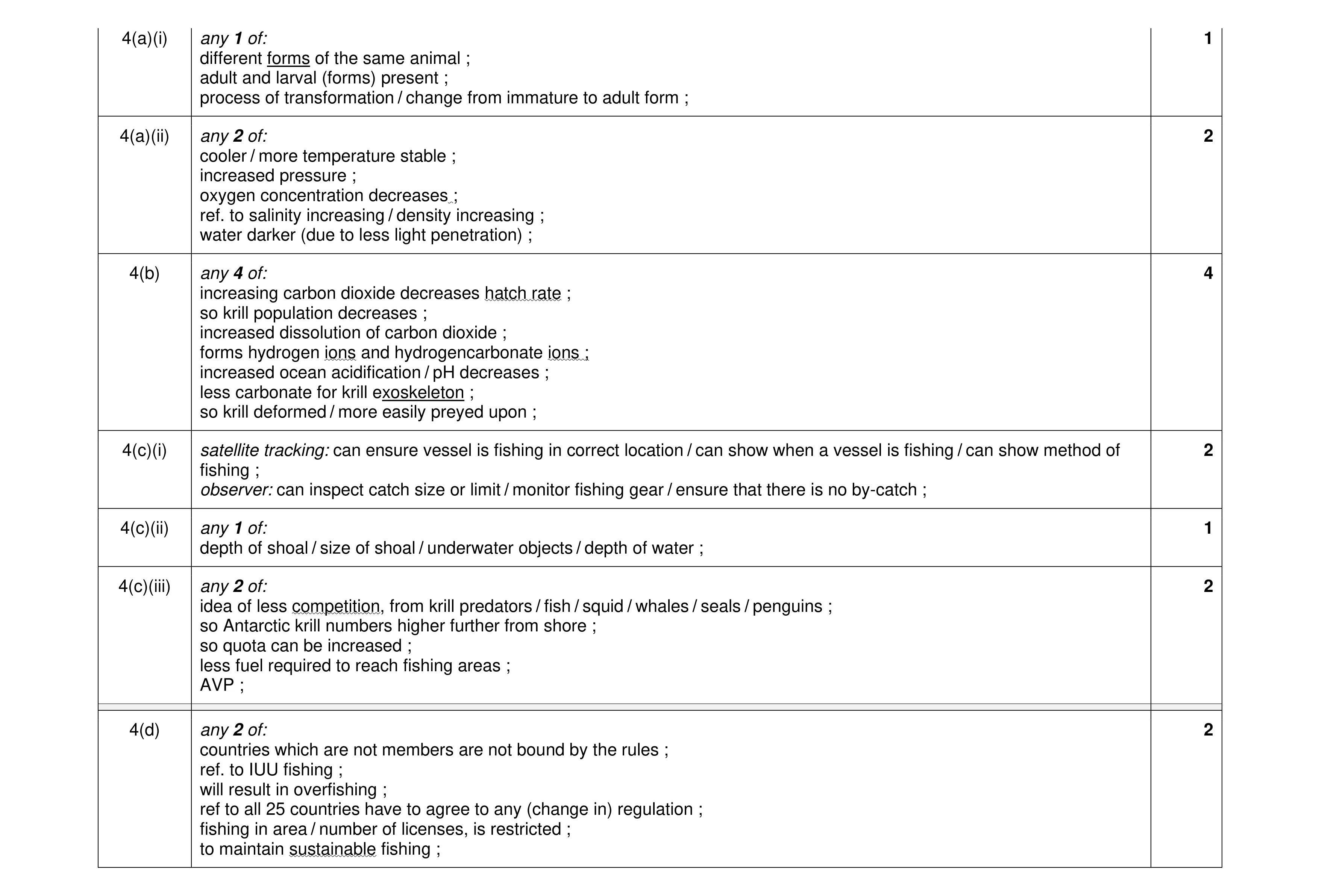 14
14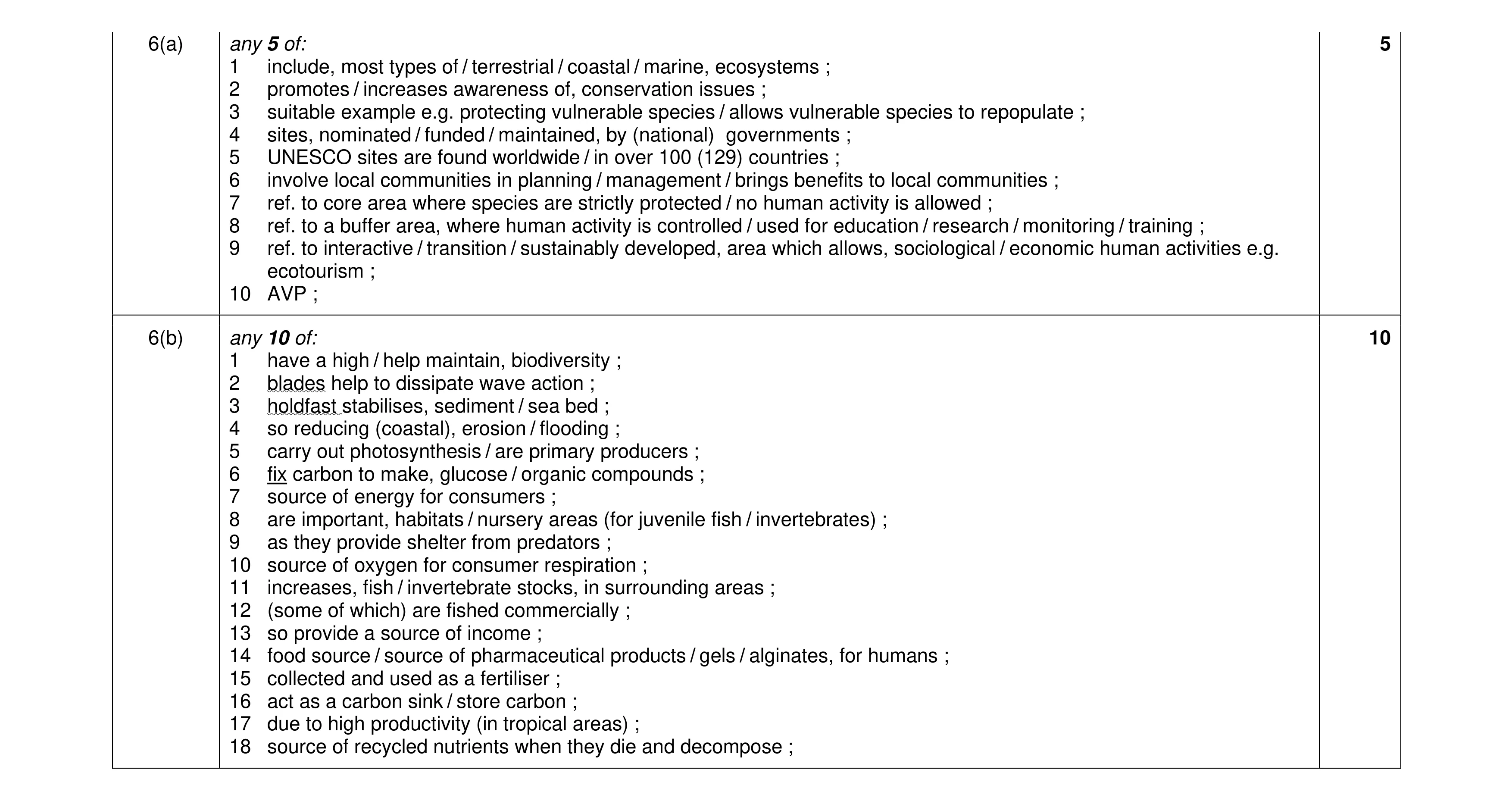 15
15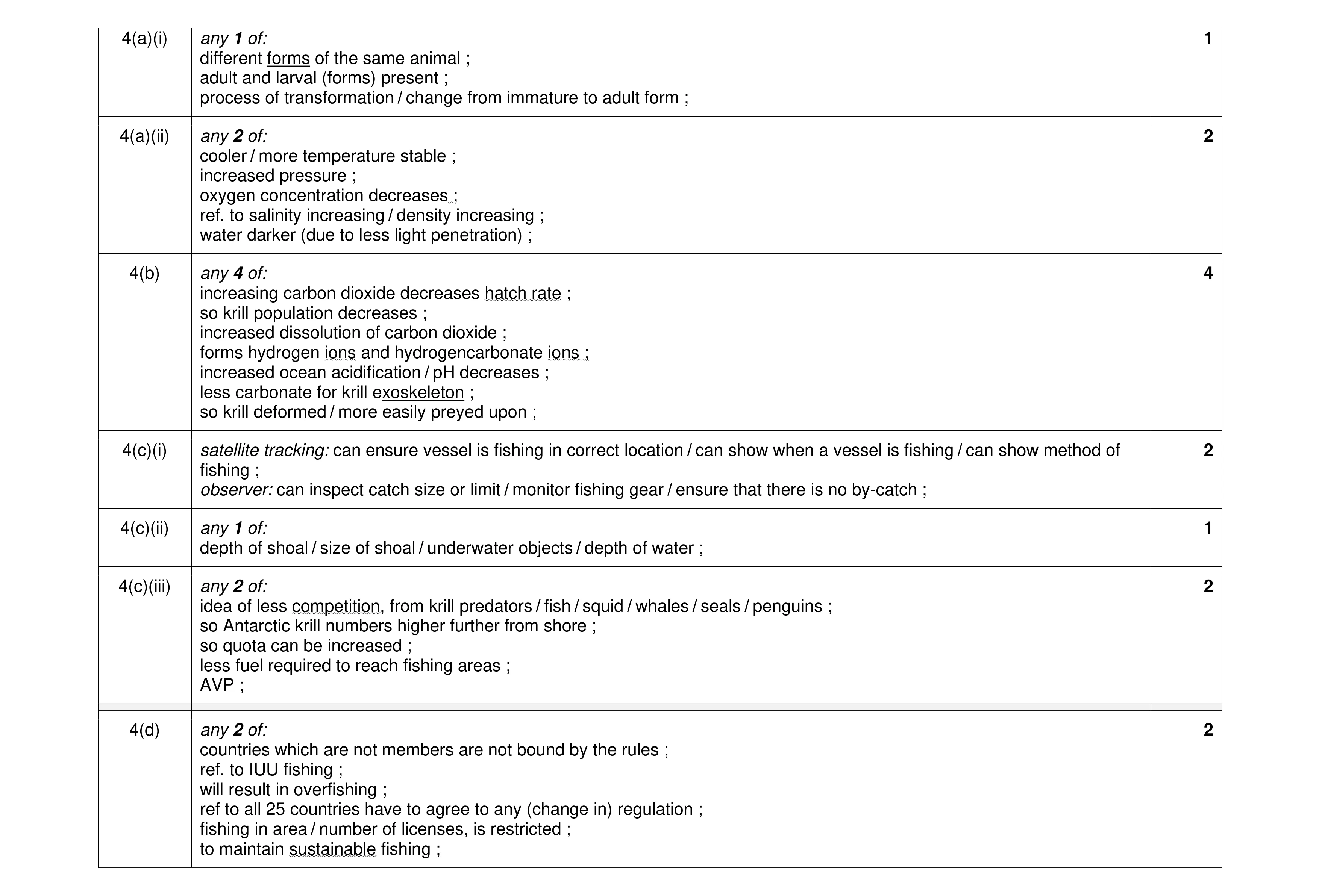 14
14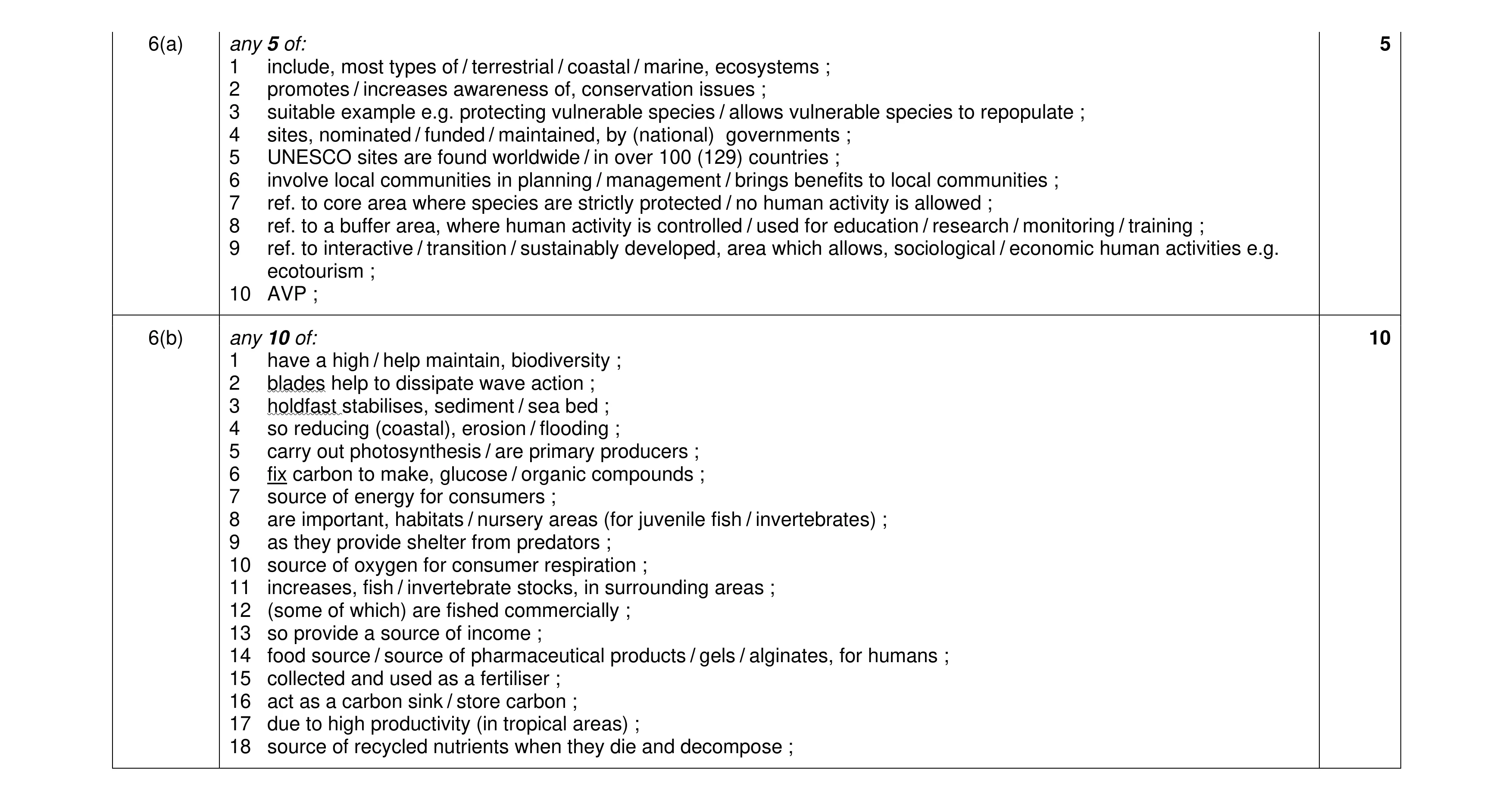 15
15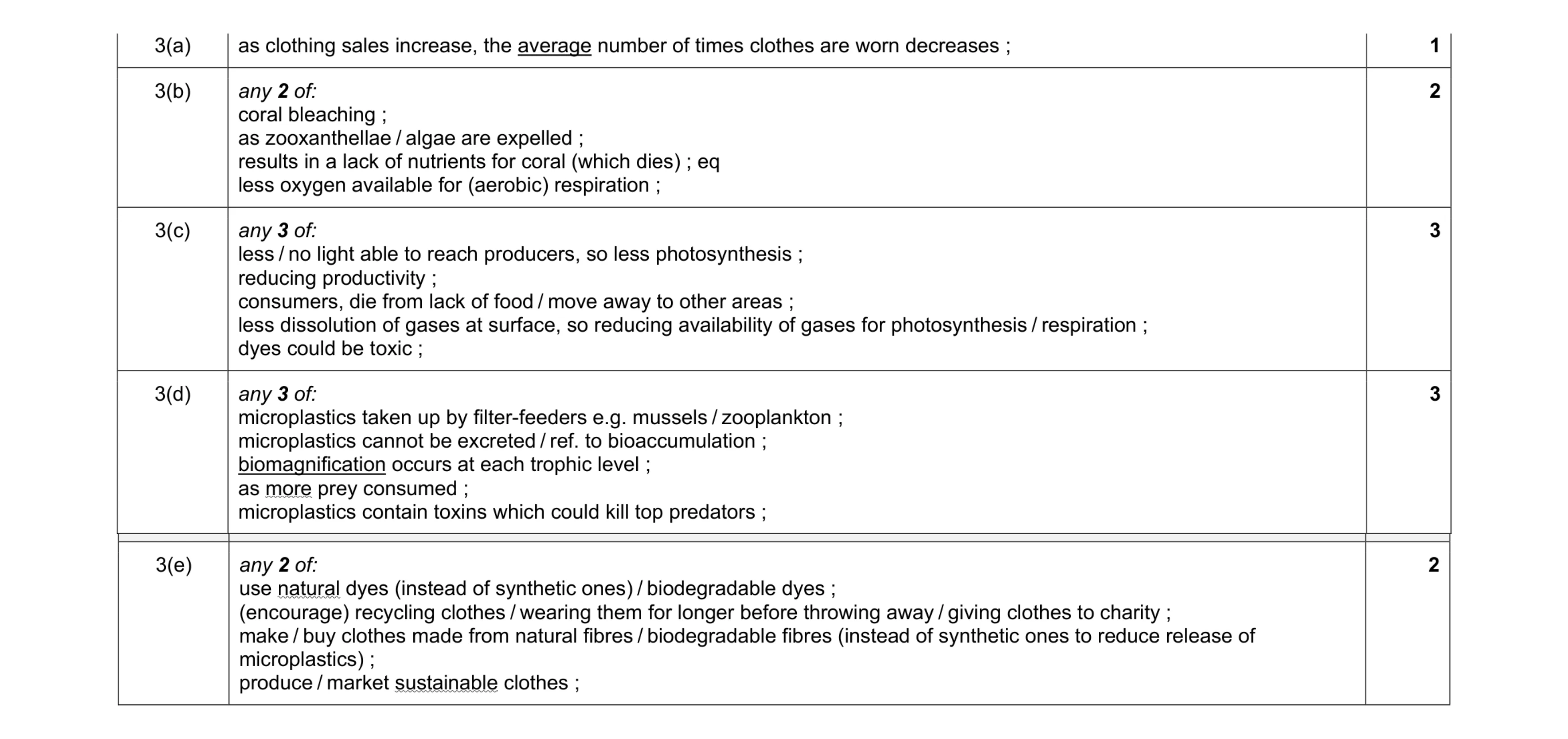 11
11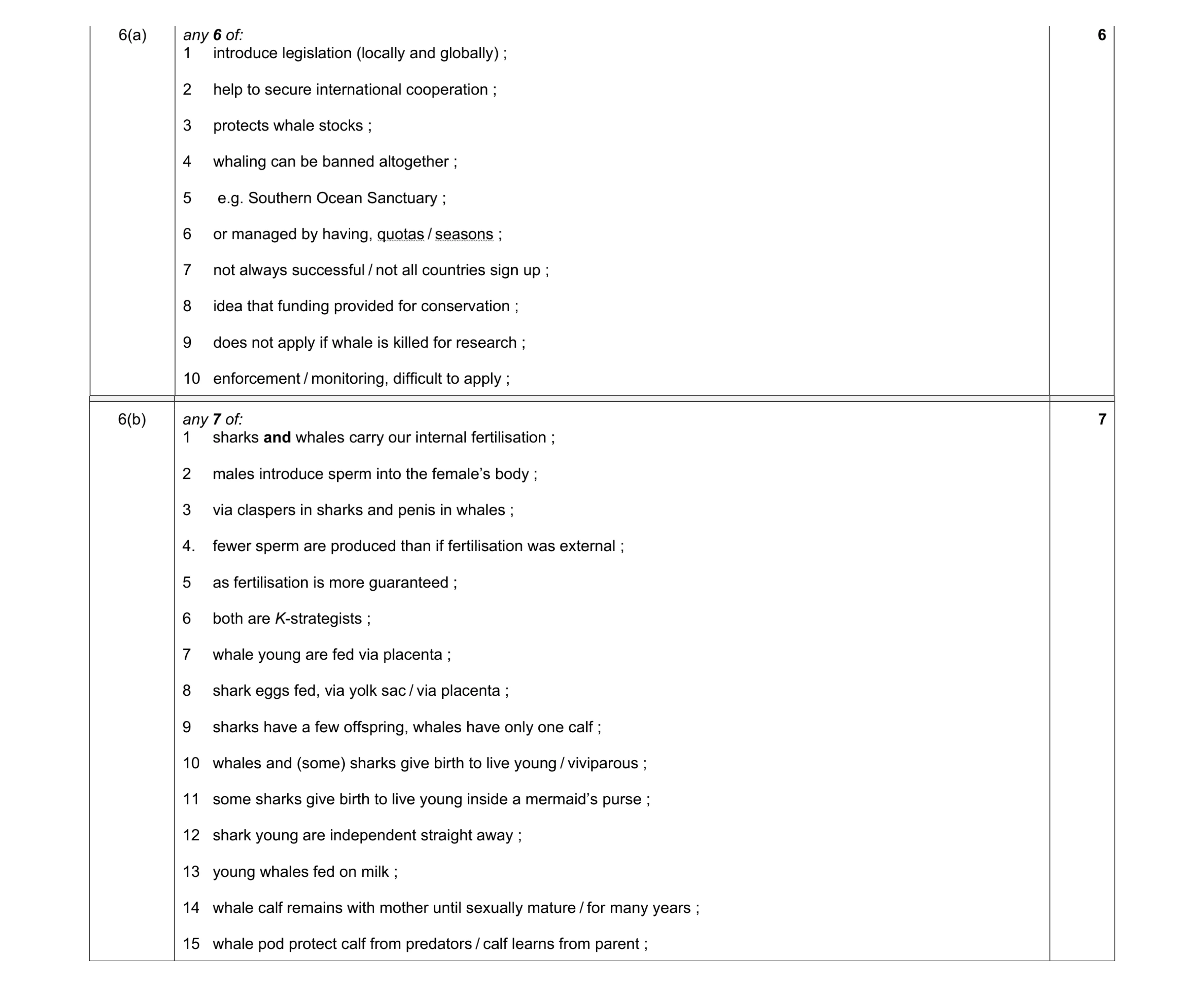 13
13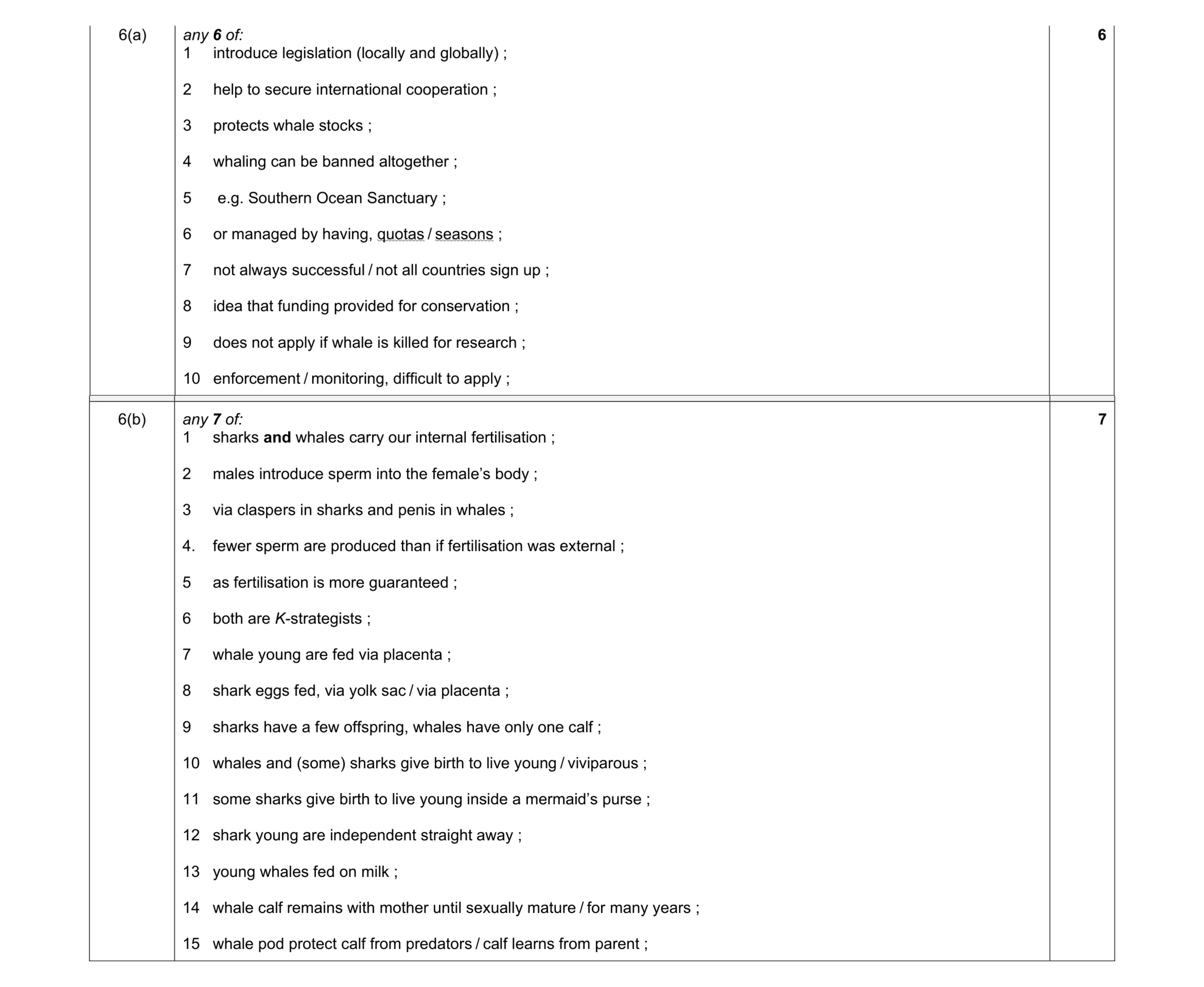 13
13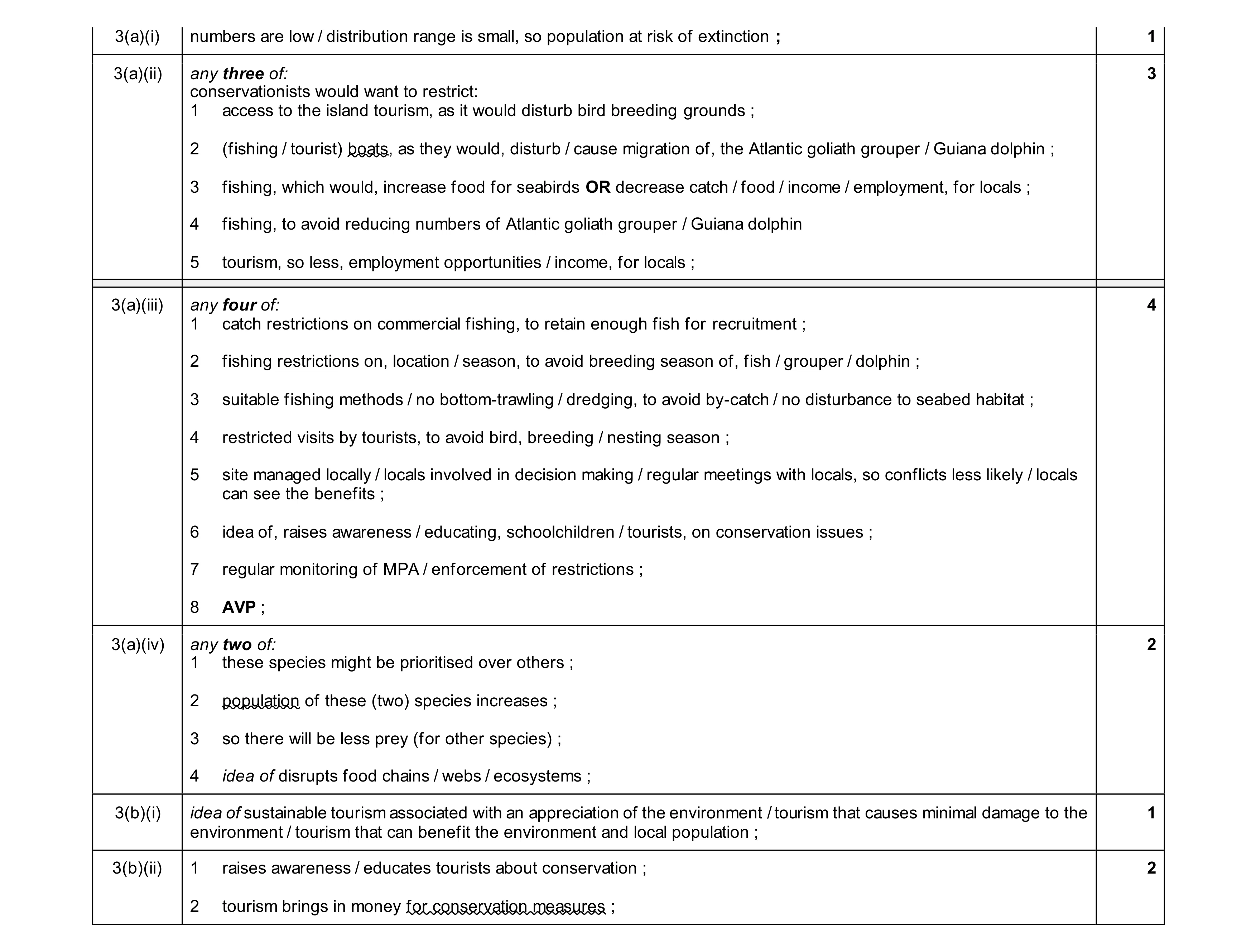 13
13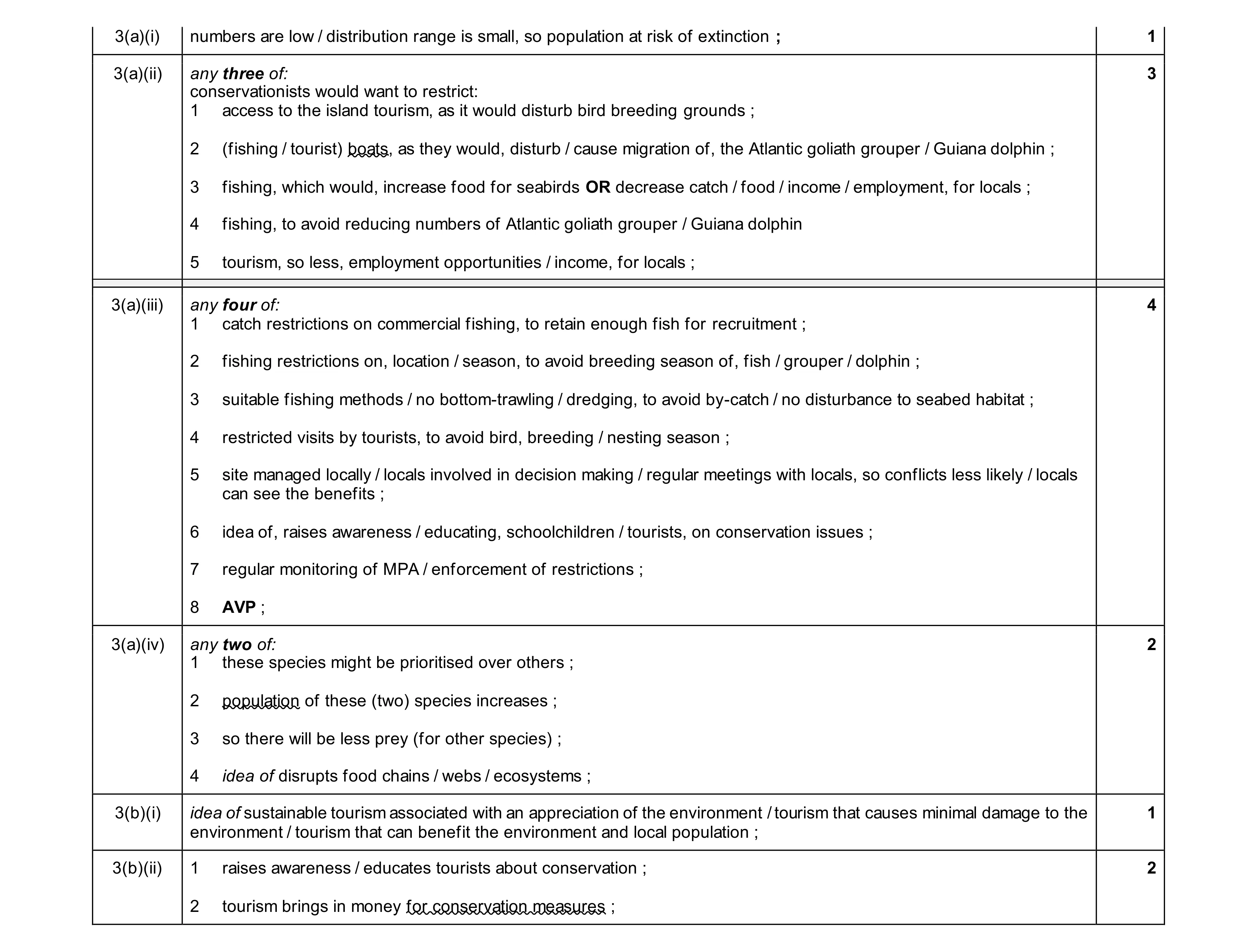 13
13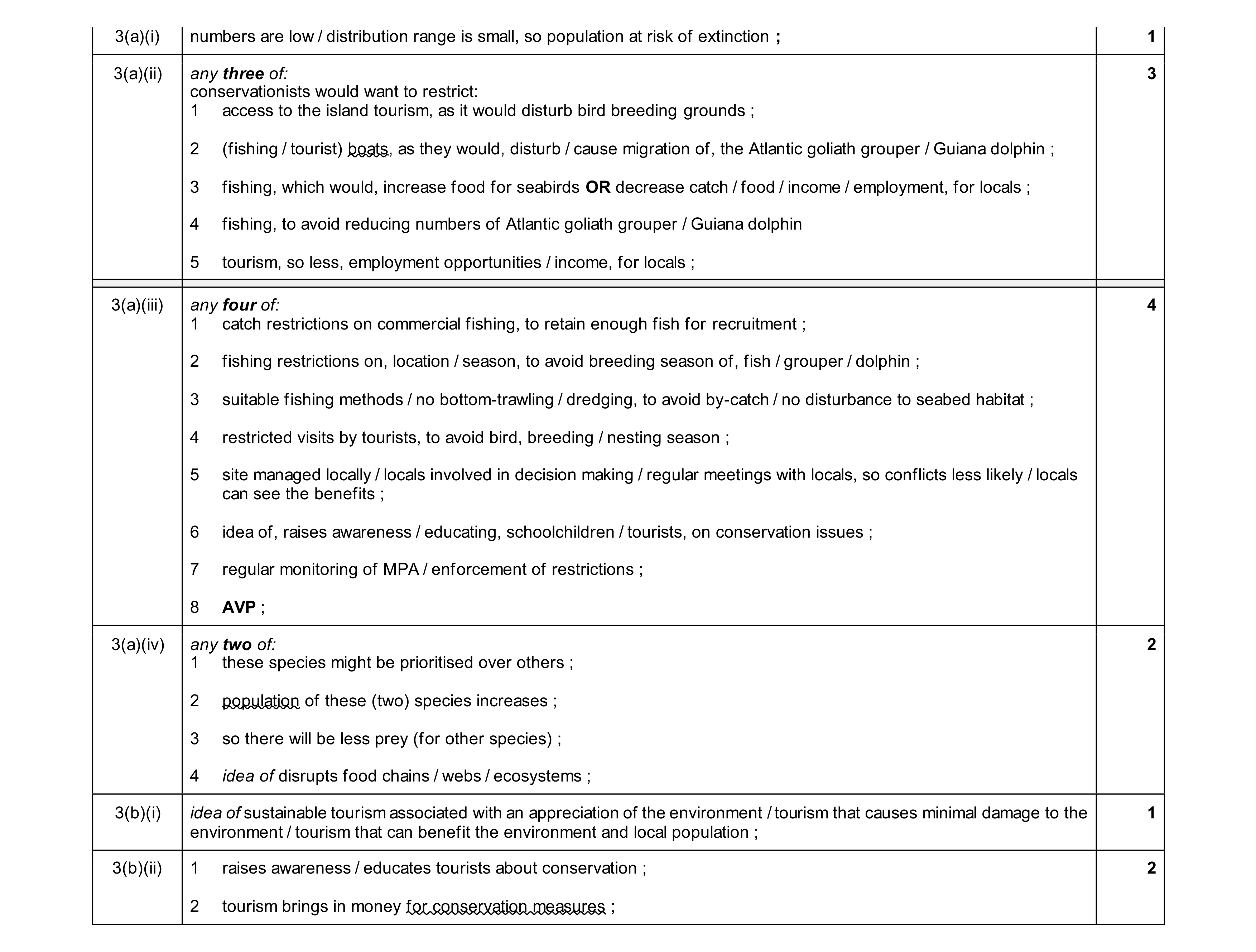 13
13