Questions as text
Q1 · Read the information about sea bass in the North Sea 9693/31 May/June 2017
4 Read the information about sea bass in the North Sea. Sea bass are slow-growing fish and take between four and seven years to mature. During the spawning season from December to April, adult sea bass migrate from their inshore habitats to offshore spawning sites. Pelagic trawlers target the fish during the spawning season and are responsible for a 25% reduction in adult sea bass numbers. In Northern European countries, sea bass is an important species for marine recreational fishing using a rod and line. Recreational fishing accounts for 25% of all sea bass caught. In January 2015, large numbers of juvenile sea bass were detected in shoals of adult fish. As a result, the European Commission imposed an emergency ban on all pelagic trawling for sea bass until the end of April 2015. (a) (i) Explain why a large number of juveniles in shoals was a reason to impose the emergency ban on pelagic trawling. … … … … … [2] (ii) State two measures that could be imposed to limit sea bass catches by recreational fishermen using rod and line. 1 … … 2 … … [2] (b) Figs. 4.1 and 4.2 show data on sea bass in the North Sea from 1985 to 2013. 5.0 4.5 4.0 3.5 3.0 catch / 1000 2.5 tonnes 2.0 1.5 1.0 0.5 0 1985 1990 1995 2000 2005 2010 year Fig. 4.1 40 35 30 25 recruitment / millions 20 15 10 5 0 1985 1990 1995 2000 2005 2010 year Fig. 4.2 (i) Use the information in Fig. 4.1 to describe the trend in the catch of sea bass between 1985 and 2013. … … [1] (ii) Use the information in Fig. 4.2 to calculate the percentage change in recruitment between 1989 and 2011. Show your working. … [2] (iii) In 1992 and 2013 the fish stock had fallen to a similar low level. Use the information in Fig. 4.1, Fig. 4.2 and the information about sea bass growth rate on page 9 to suggest why there was no need to impose fishing restrictions in 1993 but fishing restrictions were imposed in 2015. … … … … [2] [Total: 9]
9 marks
Mark scheme: 4(a)(i) any 2 of: (large number of) juveniles suggests reduced number of / too few adults in the population ; ban coincides with spawning season ; (large numbers of) juveniles would be caught (by pelagic trawlers) ; less juveniles surviving to become breeding adults / reach fertility so less adults to spawn in future years ; stocks might not be sustainable ; 2 4(a)(ii) any 2 of: restriction by season ; restriction on fish size ; restriction on numbers that can be retained ; restriction of fishing intensity e.g. number of fishermen per boat / number of boats / require fishermen to have a permit ; restriction by location ; 2 4(b)(i) trend shows an (overall) increase / AW ; 1 4(b)(ii) − × 35 3 100 35 or × 32 100 35 / 91 / 91.4 / 91.43 (%); decreases ; 2 Question Answer Marks Guidance 4(b)(iii) any 2 of: ref. to sustainability ; catch much higher in 2013 / lower catch in 1992 ; ref.to high recruitment in 1989 (enable stock recovery after 1992) ; OR high recruitment in 1989 ; (so) 5 years later enough mature fish in stocks for high catch (so no need for ban) ; very low recruitment in 2010 ; (so) by 2015 not enough mature fish to support a catch / to be sustainable ; 2
This question in 9693/31 May/June 2017
Q2 · Peru has one of the world’s largest sustainable anchovy fisheries 9693/31 Oct/Nov 2017
4 Peru has one of the world’s largest sustainable anchovy fisheries. Fishing is normally allowed during two fishing seasons, one from May to July, and a second later in the year. (a) Explain what is meant by sustainable exploitation. … … [1] (b) Anchovy stocks are carefully monitored throughout the year to allocate a fishing quota and to determine the start dates of the first and second fishing seasons. State two pieces of information required from the monitoring process. 1 … 2 … [2] (c) In late 2014, the second anchovy fishing season in Peru was suspended due to the presence of large numbers of juveniles. Explain how fishing during this time would have affected sustainability. … … … … [2] (d) Anchovy fishing can be suspended during El Niño events when warm water currents reach the coast of Peru, driving anchovies to colder waters. A survey of anchovy stocks in March 2015 found large numbers of adult fish. In April 2015, the first fishing season was started early as sea temperatures were starting to increase. Suggest why the first fishing season was started early. … … … … … [2] (e) Most of the anchovies caught are converted into fishmeal. • Fishmeal can make up to 50% of feed for high value species such as shrimp, grouper and salmon. • High value species require high protein and omega-3 oils in their diet. • The Food and Agricultural Organization of the United Nations (FAO) predicts that fishmeal will make up less than 15% of fish feed by 2020, as it is gradually replaced by more sustainable and cheaper alternatives. Table 4.1 compares fishmeal with two possible alternatives, insects and soya. Table 4.1 source of percentage omega-3 oils other information protein protein content not sustainable in the fishmeal 65 to 70 high future insects e.g. black bred in manure, waste 40 to 70 high soldier flies food or fish trimmings grown on agricultural soya 50 medium to high land (i) Use the information in Table 4.1 to describe why insects and soya make suitable alternatives to fishmeal. … … [1] (ii) State why fish feed should have a high protein content. … … [1] (iii) With reference to Table 4.1, suggest one reason why the use of insects might be more sustainable than soya as an alternative to fishmeal. … … [1] [Total: 10]
10 marks
Mark scheme: 4(a) idea of, allows controlled fishing whilst maintaining stock numbers ; 1 4(b) any 2 of: recruitment / growth / natural mortality / fishing mortality / age of reproductive maturity / fecundity / dependency on particular habitats ; ; 2 4(c) any 2 of: stocks would not be sustainable ; (because) large number of juveniles suggests, reduced number of / too few, adults in the population ; large numbers of juveniles would be caught ; so fewer juveniles survive to mature into breeding adults ; so fewer adults to spawn in future years ; 2 4(d) any 2 of: enough / sustainable stocks of adult fish present now ; sea temperature rise indicates an El Niño ; this will drive the fish away from fishing areas / to colder waters ; fewer / no fish to catch by the start of the fishing season ; 2 4(e)(i) both have high / similar protein + omega-3 levels ; 1 I ref. to sustainability 4(e)(ii) (protein) required for growth ; 1 Question Answer Marks Guidance 4(e)(iii) insects as they can be fed on, manure / fish trimmings / fish waste, which is available in most countries ; insects as they do not require any, commercial / expensive equipment / buildings, for production / ORA ; not soya as it requires a suitable climate to grow which is not available in many countries ; not soya as agricultural land is needed to produce food for humans ; 1 A recycled
This question in 9693/31 Oct/Nov 2017
Q3 · A northern lobster, which is an important seafood export for south west Nova Scotia… 9693/30 May/June 2018
3 Fig. 3.1 shows a northern lobster, which is an important seafood export for south west Nova Scotia, Canada. Fig. 3.1 Northern lobsters are a cold water species that live in burrows and crevices in a rocky substrate. They are active nocturnal hunters. Outside their burrows, juveniles are prey for many fish species, especially cod. Breeding occurs during the summer months when they also moult to replace their hard outer shell. (a) (i) Use the information to suggest why lobsters are caught in traps and not by benthic trawling. … … … … … [2] (ii) Suggest why the fishing season does not include the summer months. … … … … … [2] (b) Lobster catch has increased over the last 10 years, mainly due to warmer currents extending northwards and a collapse in cod numbers. Explain how these two factors could have increased lobster catch. … … … … … [2] (c) Lobsters are caught in traps which are put on the seabed in shallow water, between the end of November and the end of May. Fig. 3.2 shows a typical lobster trap, as viewed from above. A bag of bait is placed inside the first compartment. The lobster enters the trap via net funnels. A similar funnel allows the lobster to move into the second compartment. bait bag funnel to second compartment funnel entrances to first compartment stone stone first compartment second small compartment exit Fig. 3.2 Suggest the function of the stones and the small exit in the second compartment. stones … … small exit … … [2] (d) The coastline around south west Nova Scotia is a mixture of rocky areas and sandy bays. When the season opens, 1500 lobster boats race to claim the best fishing locations. Suggest why fishing boats need to race to claim their fishing locations. … … … [1] (e) Concrete artificial reefs have been designed for lobsters and other high value marine species. Lobsters begin to colonise these reefs in two years. After seven years, the reefs are fully functional. (i) Suggest why an artificial reef takes seven years to become fully functional. … … … [1] (ii) Suggest how artificial reefs could be used to increase the lobster catch in Nova Scotia. … … … … … [2] [Total: 12]
12 marks
This question in 9693/30 May/June 2018
Q4 · The habitat of each stage in the life cycle of tuna and grouper 9693/30 May/June 2018
4 (a) Table 4.1 shows the habitat of each stage in the life cycle of tuna and grouper. Table 4.1 habitat stage in life cycle tuna grouper egg free-floating in plankton … seagrass beds and larva … mangroves seagrass beds then migrate juvenile … offshore adult open ocean … Complete Table 4.1 by naming the habitat for each stage of the life cycle of tuna and grouper. [4] (b) Read the information about bluefin tuna aquaculture (also called tuna ranching) in the Mediterranean Sea and in the Pacific Ocean. Bluefin tuna aquaculture involves catching two-year-old juvenile wild tuna and towing them in cages to the aquaculture site. Growth continues in large net cages in the sea (sea cages) until they reach market size. Tuna are difficult to keep in sea cages because they are easily disturbed by light, noise or small changes in the water temperature. Collisions with the walls of the sea cages are common. Damage to their skin lowers their market value and in many cases causes death. Tuna are fed on wild caught mackerel, sardines and squid and need to eat 10% of their body weight per day. Small fragments of the food fish break off when eaten and are lost to the sea bed below the cages. (i) Use the information to suggest why growing tuna in sea cages is considered a partly extensive and partly intensive type of aquaculture. … … … … … [2] (ii) In the wild, bluefin tuna become sexually mature between 9 and 12 years old. Use the information about tuna aquaculture to explain why the breeding age of bluefin tuna might make the supply of wild juveniles unsustainable in the future. … … … … … [2] (iii) Suggest two reasons why an alternative food source, consisting of pellets made from dried fish waste, is being developed for the tuna in sea cages. 1 … … 2 … … [2] (iv) Scientists in Japan have recently obtained fertilised eggs from adult tuna reared and bred in captivity. Use the information about tuna aquaculture to suggest why only 2% of these eggs survive to become adult fish. … … … … … [2] (c) Wild tuna stocks have decreased by 50% in the last decade. Captive bred tuna could supply 50% of the Japanese domestic market in a few years. Suggest two benefits of selling captive bred tuna, rather than tuna raised from young fish caught in the wild. 1 … … 2 … … [2] [Total: 14]
14 marks
This question in 9693/30 May/June 2018
Q5 · Fish tend to gather around any floating object in the sea 9693/30 Oct/Nov 2018
4 Fish tend to gather around any floating object in the sea. Fish aggregating devices (FADs), either drifting or anchored to the sea bed, are used to increase the catch of fish. Most FADs last between two and eight years. (a) Industrial fishing fleets use drifting FADs consisting of a buoy equipped with sonar. Suggest why the sonar frequency must be different for each individual FAD. … … … … … [2] (b) Fig. 4.1 shows two types of anchored FAD that are used by coastal communities. buoy sea surface sinking rope aggregator rope curve floating rope concrete block attached to chain type A type B Fig. 4.1 Use the information in Fig. 4.1 to explain how each type of FAD is designed to cope with rough seas. type A … … type B … … [2] (c) Many FADs have an aggregator to attract fish. Suggest one benefit of using an aggregator made from plant material such as palm fronds instead of nylon rope. … … … [1] (d) Somalia is an East African country with a 3300 km coastline. This is lined with coral reefs and seagrass beds, many of which are being overfished. In 2016, funding from the Food and Agriculture Organization of the United Nations and European Union provided an anchored FAD to 25 different coastal communities in Somalia. The FADs were set up in deep water offshore sites to improve the local, small‑scale fishing industry in each community. (i) Suggest how the FADs could increase the long‑term supply of fish to each community. … … … … … [2] (ii) The FAD programme was set up with the agreement of the local community at each location. Suggest two benefits of involving the whole of the local community in the use of the FADs. 1 … … 2 … … [2] [Total: 9]
9 marks
This question in 9693/30 Oct/Nov 2018
Q6 · India is a major exporter of high value prawns worldwide 9693/31 May/June 2019
3 India is a major exporter of high value prawns worldwide. There are over 30 000 prawn trawlers fishing in the shallow waters around the Indian coastline. Small-mesh fishing nets are trawled for many hours to catch adult prawns living on the sea bed. This method of fishing also catches fish and other species as bycatch. (a) (i) Name the type of trawling used for prawn fishing. … [1] (ii) It has been estimated that prawn trawling is responsible for a third of the world’s bycatch. Explain how prawn trawling results in so much bycatch. … … … … [2] (iii) Use the information provided to suggest and explain why returning the bycatch to the sea would not benefit the bycatch species. … … … … [2] (b) Prawn harvests have decreased greatly over the past 10 years. In order to increase stocks, marine conservation zones have been created in a few coastal sites. All commercial fishing is banned inside these zones. Explain how the creation of marine conservation zones could improve stocks of prawns and fish in coastal areas. … … … … … … [3] (c) Some commercial prawn fishermen are ignoring the ban and continue trawling for prawns inside marine conservation zones. Two methods of monitoring fishing are the use of satellites and inspection of catch. Discuss the effectiveness of these two methods to monitor prawn trawling in India. satellites … … … … inspection of catch … … … … [4] [Total: 12]
12 marks
Mark scheme: 3(a)(i) benthic (trawling) ; 1 3(a)(ii) idea of: lots of organisms on, sea bed / sea floor / substrate / benthic zone ; small mesh catches everything in its path OR most organisms too big to escape ; nets in the water / fishing, for a very long time, so catches lots ; 2 3(a)(iii) any 2 of: most will be dead / injured / suffocate / drown (due to lack of oxygen) ; as they have been in nets for several hours ; bycatch taken a long way from their habitat / bycatch might not be able to get back to suitable habitat ; habitat destroyed by benthic trawling ; 2 3(b) any 3 of: allows more, prawns / fish, to reach maturity ; more (chance of) breeding / reproduction ; more recruitment / allows, population to increase / stocks to replenish ; sea bed undisturbed, so more food / habitat for, prawns / other species OR allows habitat to recover ; increased stocks to migrate outside conservation zone ; 3 Question Answer Marks Guidance 3(c) MAX 2 from each: satellite monitoring shows the exact boat position ; can track multiple boats at the same time ; can track all areas of the ocean day and night ; so boat can be tracked if inside the conservation zone ; (but) do not know if boat was fishing inside conservation zone ; (but) not all boats fitted with satellite technology / it can be switched off ; catch inspection shows the, species caught / amount caught / volume of catch / bycatch ; (but) you cannot determine if fishing took place inside or outside the conservation zone / can’t tell where the boat has been ; bycatch could be disposed of / hidden before inspection ; log book can be checked against catch ; fishing method could be modified ; 4
This question in 9693/31 May/June 2019
Q7 · Omega-3 oils are an important part of the human diet 9693/31 May/June 2019
7 (a) Omega-3 oils are an important part of the human diet. There is some evidence that they may help to reduce the risk of heart disease and stroke. Phytoplankton produce omega-3 oils, which are transferred to fish along food chains. Table 7.1 compares the mass of omega-3 oils in a 100 g serving of some marine fish. Table 7.1 mass of omega-3 oils omega-3 oils source / g per 100 g serving anchovies 2.1 sardines 1.8 farmed salmon 1.4 wild salmon 0.7 canned tuna 0.35 cod 0.3 (i) Use Table 7.1 to suggest why eating farmed salmon is more beneficial in the human diet than eating wild salmon. … … [1] (ii) Traditionally, farmed salmon have been fed on pellets made from fishmeal and fish oil, mainly from anchovies and sardines. Use the information in Table 7.1 to suggest why these two species are suitable sources of fishmeal and fish oil. … … [1] (iii) Wild stocks of both anchovies and sardines are now becoming unsustainable. State the meaning of the term unsustainable. … … [1] (b) Over the past 10 years, the percentage of fishmeal and fish oil in pellets used to feed farmed salmon has gradually decreased. It has been replaced by alternative feed ingredients such as soy and oil from canola. Fig. 7.1 shows the effect of this change in feed on the mass of omega-3 oils in farmed salmon. 3.0 2.5 mass of 2.0 omega-3 oils / g per 100 g 1.5 serving of farmed salmon 1.0 0.5 0 2006 2010 2016 year Fig. 7.1 Use the information in Fig. 7.1 to describe the effect of these fishmeal replacements on omega-3 oil levels in farmed salmon between 2006 and 2016. … … … … [2] (c) One alternative to using fishmeal and fish oil in salmon feed is to replace them with genetically modified (GM) canola. GM canola has been genetically engineered to contain genes from phytoplankton and is rich in omega-3 oils. (i) Define the term gene. … … … … [2] (ii) Suggest the two types of gene that would be transferred from phytoplankton to canola, to make GM canola. 1 … 2 … [2] (iii) If farmed salmon are fed on pellets containing GM canola oil, current regulations state that they must be labelled as having been fed on GM crops. Suggest and explain why this labelling could present a problem for the sale of these fish. … … … … [2] [Total: 11]
11 marks
Mark scheme: 7(a)(i) more / twice as much, omega-3 in farmed salmon than wild ORA ; 1 7(a)(ii) any 1 of: they have the highest levels of omega-3 oils ; idea of: tuna / cod are higher value species for human consumption ; 1 7(a)(iii) idea of: fishing pressure too great to maintain numbers of fish ; 1 Question Answer Marks Guidance 7(b) omega-3 levels have decreased ; almost halved / reduced by 1.3 g (per 100 g of fish) / decreased by 48.1% ; 2 I simply quoting figures from graph 7(c)(i) a length of DNA (deoxyribonucleic acid) / sequence of nucleotides ; that codes for a (specific), polypeptide / protein (product) OR that determines a particular trait / characteristic ; 2 7(c)(ii) (gene) to produce omega-3 oils ; promoter (gene) ; 2 7(c)(iii) any 2 of: people will not buy / shops will not sell the fish ; as they are unsure of the long-term effects of eating GM food ; lack of current research into effect of eating GM food ; some countries / EU, have banned GM foods for human consumption ; 2 I reduced sales unqualified
This question in 9693/31 May/June 2019
Q8 · Blue king crabs live in almost freezing water in the Bering Sea around Alaska 9693/30 Oct/Nov 2019
3 (a) Blue king crabs live in almost freezing water in the Bering Sea around Alaska. These crabs feed on a wide variety of marine shellfish, including mussels, clams and snails, as well as sponges, sea urchins, fish parts and algae. Young crabs and crab larvae are eaten by several types of fish, including cod, halibut and sole. Use the information to describe the habitat and ecological niche of blue king crabs. habitat … … ecological niche … … … … [3] (b) Commercial fishing for blue king crabs is traditional in Alaska. These crabs are caught using large pots baited with cod or herring. The pots are lowered to the sea bed and left for one or two days before lifting to remove any crabs caught. Fig. 3.1 shows the number of crabs caught per pot and the total catch for the Alaskan blue king crab fishery from 1973 to 1988. 30 6 25 5 20 4 number of crabs total catch caught per pot / tonnes 15 3 10 2 5 1 0 0 1973 1975 1977 1979 1981 1983 1985 1987 1989 year Fig. 3.1 (i) Use Fig. 3.1 to describe the trend in the relationship between total catch and number of crabs caught per pot, from 1973 to 1980. … … [1] (ii) Suggest an explanation for this trend. … … … … [2] (iii) Suggest two explanations for the continuous fall in total catch after 1980. 1 … … … … 2 … … … … [4] [Total: 10]
10 marks
This question in 9693/30 Oct/Nov 2019
Q9 · Different species of marine organism reproduce using internal or external fertilisation 9693/30 May/June 2020
4 (a) Different species of marine organism reproduce using internal or external fertilisation. Sharks reproduce using internal fertilisation. (i) State the type of fertilisation used by whales and by tuna. whales … tuna … [1] (ii) Describe the advantages and disadvantages of internal fertilisation compared with external fertilisation. … … … … … … [3] Table 4.1 shows some information about the life cycles of three species of shark. Table 4.1 feature of life cycle mako shark lemon shark zebra shark open water in coastal in sub-tropical coastal in tropical seas habitat temperate and tropical seas near coral reefs near coral reefs seas and mangroves males: 8 years sexual maturity 12 to 16 years 10 to 12 years females: 18 years yearly in captivity but breeding cycle once every 3 years once every 2 years unknown in the wild embryos develop embryos develop egg cases attached to inside female for inside female for cracks in coral reefs 15 months 11 months develop for 6 months embryo development embryos feed on embryos feed by a embryos feed on food unfertilised eggs placenta stored in eggs up to 50 large egg usual number of cases, laid in batches offspring per breeding 10 to 18 4 to 17 of 4 to 5, over a period cycle of 4 months (b) Use the information in Table 4.1 to: (i) suggest why mako sharks usually produce more offspring per breeding cycle than lemon sharks … … [1] (ii) suggest why zebra sharks do not lay all 50 egg cases at the same time. … … … … [2] (c) Sharks do not show parental care, but may increase their reproductive success by other means. Young zebra sharks stay at the base of the coral reef where they hatch. Suggest why this could increase the chance of survival of young zebra sharks. … … [1] (d) Many species of shark, including those described in Table 4.1, are in danger of becoming extinct. Use the information in Table 4.1 to suggest two reasons why many species of shark could become extinct. 1 … … 2 … … [2] [Total: 10]
10 marks
This question in 9693/30 May/June 2020
Q10 · Atlantic cod is a commercially important fish found in the North Sea 9693/30 May/June 2020
5 Atlantic cod is a commercially important fish found in the North Sea. Adults breed between January and April and can migrate over 300 km to specific spawning areas. During the 1970s and 1980s cod stocks were overfished. Fishing was no longer sustainable. (a) State the meaning of the term sustainable fishing. … … [1] (b) Fig. 5.1 shows cod catch in the North Sea from 1963 to 2016. 400 350 300 250 cod catch / thousand 200 tonnes 150 100 50 0 1970 1980 1990 2000 2010 year Fig. 5.1 (i) Use Fig. 5.1 to calculate the percentage change in cod catch between 1981 and 2006. … % [3] (ii) A ‘cod recovery plan’ was introduced in 2009 to reduce annual catch. The number of days that boats were allowed to fish was reduced, and conservation measures were put in place. These measures included on-board CCTV cameras to monitor catch and accepting a lower quota. Despite these measures, low numbers of cod were still reported, and sixty cod fishing boats had to be retired from fishing. State three other examples of conservation measures that the commercial fishermen could have been offered, so that fewer boats had to be retired. 1 … … 2 … … 3 … … [3] (iii) Complete the table to compare the long-term sociological impacts of restrictions on fishing compared with unrestricted fishing. long-term sociological impacts of long-term sociological impacts of restrictions on fishing unrestricted fishing [2] (c) Female cod become adult at the age of three or four years, and can lay up to 1 million eggs. However, few cod survive to adulthood. Fig. 5.2 shows the total mass of breeding adult cod in the North Sea from 1963 to 2017. 300 250 200 total mass of maximum breeding adult cod 150 sustainable / thousand tonnes yield 100 50 0 1970 1980 1990 2000 2010 year Fig. 5.2 (i) The Marine Stewardship Council (MSC) is an international non-profit organisation with the aim of ensuring sustainable fisheries around the world. Their logo on products indicates to consumers that seafood comes from sustainable fisheries and is fully traceable. Until July 2017, North Sea cod was on the MSC ‘fish to avoid list’. Use the data in Fig. 5.2 to explain why North Sea cod was taken off the ‘fish to avoid list’ in 2017. … … … … [2] (ii) Use all the information provided to suggest why the cod recovery plan should remain in place for several years. … … … … … … [3] [Total: 14]
14 marks
This question in 9693/30 May/June 2020
Q11 · Between 1950 and 2010, production of fish by aquaculture increased by 120 million tonnes 9693/30 Oct/Nov 2020
4 (a) Between 1950 and 2010, production of fish by aquaculture increased by 120 million tonnes. Production by commercial fishing increased by 60 million tonnes between 1950 and 1990 and then stayed the same until 2010. Suggest why aquaculture production is still increasing but production from commercial fishing is not. … … … … … … [3] (b) New aquaculture projects are being set up in many different countries. Fig. 4.1 shows a flow diagram of an aquaculture project in Africa. Water from the fish-rearing tanks is recycled in a closed system that treats the water. Key arrows represent movement of water automatic feeders nitrogen gas carbon dioxide gas fish-rearing tanks filters to remove solids and biological filter to convert toxic convert nitrate to ammonia produced by fish to nitrate nitrogen gas pump to circulate oxygen gas water ultraviolet light to kill microorganisms Fig. 4.1 (i) Three requirements for a sustainable aquaculture system are clean water, efficiency of food use and disease management. Describe how the system in Fig. 4.1 meets each of these requirements. … … … … … … … … [4] (ii) State two requirements, other than those listed in (b)(i), for a sustainable aquaculture system. 1 … 2 … [2] (iii) Suggest two disadvantages of the aquaculture system shown in Fig. 4.1. 1 … … 2 … … [2] (iv) Suggest two ways in which the aquaculture system in Fig. 4.1 reduces the negative impacts of aquaculture. 1 … … 2 … … [2] (c) Some aquaculture systems rear fish which are released into the sea to increase the populations of wild fish. Explain why fish raised in aquaculture are often unsuccessful in increasing populations of wild fish. … … … … … … [3] [Total: 16]
16 marks
This question in 9693/30 Oct/Nov 2020
Q12 · Mackerel are found in large shoals which migrate throughout the North Atlantic Ocean and… 9693/30 May/June 2021
3 (a) Mackerel are found in large shoals which migrate throughout the North Atlantic Ocean and the North Sea. Mackerel stocks are monitored to ensure that they are fished sustainably. Monitoring methods include collecting and counting eggs, using sonar and using data from purse seine fishing. (i) Suggest what information about stocks can be provided by using sonar. … … [1] (ii) Explain how the data from purse seine fishing can be used to assess mackerel stocks. … … … … [3] (iii) Fishing restrictions can be introduced to help ensure that stocks are sustainable. Suggest why restriction in size of fish caught might be more successful in maintaining mackerel stocks than placing a restriction on fishing areas. … … [1] (b) Fig. 3.1 shows the biomass of spawning adult mackerel from 2000 to 2020. 5 4 biomass of 3 spawning adult mackerel 2 / million tonnes 1 0 2000 2005 2010 2015 2020 year Fig. 3.1 (i) Calculate the mean change in biomass of spawning adult mackerel between 2002 and 2011. State the unit. Show your working. … [3] (ii) Fig. 3.2 shows the expansion in mackerel feeding areas in the seas around Northern Europe since 1984. Mackerel feed in these areas during the summer months as the water temperature increases. N Key traditional feeding areas from 1984 to 2013 additional feeding areas from 2006 additional feeding areas from 2009 additional feeding areas from 2013 migration of mackerel stocks from spawning grounds further south to feeding 0 200 400 grounds in the north during km summer months Fig. 3.2 A recent study of mackerel caught by purse seine fishing found that in 2013, the mean length of mackerel had decreased by 3.7 cm and the mean mass had decreased by 175 g compared to 2002. Use the information in Fig. 3.1 and Fig. 3.2 to suggest and explain why there was a difference in length and mass between 2002 and 2013. … … … … … … … … [3] [Total: 11]
11 marks
This question in 9693/30 May/June 2021
Q13 · Tuna stocks in the Indian Ocean are monitored annually 9693/30 Oct/Nov 2021
4 (a) Tuna stocks in the Indian Ocean are monitored annually. Information required to monitor stocks includes natural mortality, fishing mortality and age of reproductive maturity. State two other pieces of information used to monitor fish stocks. 1 … … 2 … … [2] (b) Table 4.1 shows albacore and yellowfin tuna catch from the Indian Ocean between 2014 and 2018. It also shows an assessment of stock sustainability in each of those years. Three classes are used to assess stock sustainability: good, intermediate and needs improving. Table 4.1 albacore tuna yellowfin tuna catch stock catch stock year / 1000 tonnes sustainability / 1000 tonnes sustainability 2014 34 good 366 good 2015 38 good 402 good 2016 40 good 409 intermediate 2017 35 good 407 needs improving 2018 36 good 422 needs improving (i) Describe what is meant by the term sustainable fishing. … … [1] (ii) Albacore tuna stocks were good in all years from 2014 to 2018. Use the information in Table 4.1 to suggest the reason why yellowfin tuna stocks are not sustainable. … … [1] (iii) State two methods that can be introduced to conserve yellowfin tuna stocks to make them more sustainable. 1 … … 2 … … [2] (c) Fig. 4.1 shows the fishing methods and percentage share of total catch for albacore tuna and yellowfin tuna in 2018. 100 key 80 purse seine fishing % share gillnet of total 60 catch pole and line 40 longline other 20 0 albacore tuna yellowfin tuna Fig. 4.1 (i) Explain why benthic trawling is unlikely to be an example of ‘other’ fishing method. … … … … [2] (ii) Use Fig. 4.1 and Table 4.1 to discuss the impact of different fishing methods on albacore and yellowfin tuna catch and sustainability. … … … … … … … … [4] (d) Conservation programmes involve the management of ecosystems in order to protect and preserve the species and habitats present. Outline why marine conservation must sustain ecological linkages to be successful. … … … … … … [3] [Total: 15]
15 marks
This question in 9693/30 Oct/Nov 2021
Q14 · Read the information about oysters in Chesapeake Bay, United States of America 9693/30 Oct/Nov 2021
6 (a) Read the information about oysters in Chesapeake Bay, United States of America. Oyster numbers reduced to just 0.3% of the population in the 1800s. Disease, habitat loss, overharvesting and poor water quality were the main factors for this reduction. In recent years the oyster population has recovered due to water quality improvement of the ten tributaries which flow into the bay, increasing disease resistance, growth of aquaculture and better management of the wild harvest. Oysters are filter feeders and are used to improve water quality and provide a habitat for many species, especially crabs and shrimp, which in turn provide food for fish. Better management techniques include creating sanctuary areas for oysters where no harvesting is allowed. (i) Suggest the benefits of creating oyster sanctuary areas. … … … … … … [3] (ii) Suggest how aquaculture can be used to increase oyster numbers in the bay. … … … … [2] (iii) The Chesapeake Oyster Alliance has been set up to help restore oyster numbers in the bay. Suggest why it is important to involve the local population in this alliance. … … … … [2] (b) (i) Scientists are working on improving disease resistance in oysters. The traditional method involved the use of selective breeding based on phenotype. Describe what is meant by selective breeding based on phenotype. … … … … … … [3] Recently, a technique involving genomics has been used to help with selective breeding to improve disease resistance in oysters. The genes that confer resistance are located and identified, and only oysters that contain these genes are allowed to breed. (ii) Describe what is meant by the term gene. … … [1] (iii) Explain why this breeding process is not an example of genetic engineering. … … [1] (iv) Suggest the benefits of selecting the individuals allowed to breed according to their genes, rather than selecting them according to their phenotype. … … … … [2] [Total: 14]
14 marks
This question in 9693/30 Oct/Nov 2021
Q15 · The seas around North West Africa are important fishing locations 9693/31 May/June 2022
3 (a) The seas around North West Africa are important fishing locations. Small pelagic fish such as sardines and mackerel make up between 50% and 70% of the animal protein consumed by the local people. Over the past decade, most of the fish that the local population depend on as a source of protein are being sent to foreign-owned factories. These factories use the fish to produce fishmeal and fish oil for export to Asia and Europe. The factories use fish caught by local people and by their own industrial fishing fleets. Fig. 3.1 shows the fishing areas, and location and numbers of fish-processing factories in three countries in North West Africa. N Key 27 factories 12 factories 1 factory Atlantic Mauritania Ocean area fished by foreign trawlers area fished by local 15° N fishing fleet Senegal land The Gambia 200 km Fig. 3.1 Table 3.1 shows fishmeal and fish oil production for export in 2014 and 2018. Table 3.1 fishmeal production / tonnes fish oil production / tonnes country 2014 2018 2014 2018 Mauritania 66 783 127 940 19 752 40 430 Senegal 14 315 9116 249 2604 The Gambia 0 1969 0 823 (i) Total catches of small pelagic fish off North West Africa increased from 1.2 million tonnes (MT) in 1994 to 2.7 MT in 2017. During these years, the effort required to harvest catch has increased and mean fish size has decreased. Suggest why the effort required to harvest catch has increased and fish sizes have decreased since 2014. … … … … [2] (ii) Local fishermen use small fishing boats and traditional methods, catching fish for women to process for food to be sold locally. Use the information provided in Fig. 3.1 and Table 3.1 to suggest and explain the sociological and economic effect of unrestricted fishing by foreign fishing fleets on the local population. … … … … … … [3] (iii) Before 2017 data on stocks of small pelagic fish were limited. The data were collected using acoustic surveys (sonar) and from records of catch. State what information can be obtained from acoustic surveys and records of catch. acoustic surveys … … records of catch … … [2] (iv) Data from 2019 confirm that stocks of small pelagic fish have decreased significantly. Fishing restrictions are urgently required to improve stocks and one suggestion has been to ban all foreign-owned fishing fleets from fishing around the North West African coast. This would initially provide more fish for the local population and eventually result in a surplus of fish available for export. Suggest how consumer-orientated tools could be used to increase the sale of these surplus fish globally. … … … … … … [3] (b) A recent survey predicts that increasing water temperatures due to climate change will cause the small pelagic fish to migrate 1000 km further north. Suggest why the warmer water will be an unsuitable environment for the small pelagic fish. … … … … … … [3] [Total: 13]
13 marks
Mark scheme: 3(a)(i) any 2 from: too many fishing boats / overfishing ; fish numbers reduced ; fish do not have enough time to (grow and) breed / fish caught before they reproduce / reach maturity ; less, mature / adult, fish available / higher numbers of juveniles caught ; stocks are unsustainable ; 2 3(a)(ii) any 3 from: less fish can be caught by locals as fishing area is smaller / closer to coast / simple fishing methods / gear used ; foreign owned companies provide their own fishing fleets and factories, so do not need to buy fish from locals ; loss of employment for, local fishermen / women processors, due to lack of fish ; less food supply for locals as less fish caught ; less fish to sell locally, so loss of income ; local population have their main protein source reduced (and could suffer from malnutrition) ; AVP ; 3 3(a)(iii) acoustic surveys: size of shoal / numbers of fish in shoal / direction or location of shoal or fish / depth of shoal or fish ; records of catch: numbers / species / size / mass, of fish / idea of used to assess fish stocks over time ; 2 3(a)(iv) any 3 from: labelling of fish ; so the fish could be marketed as caught, in an environmentally friendly way / using traditional methods ; shows traceability / shows where fish was caught ; fish could be marketed as sustainably harvested ; advertising / education campaign ; can promote health benefits of eating fish ; certification used ; price tariffs reduced (to decrease price) ; 3 Question Answer Marks 3(b) any 3 from: warmer waters contain less oxygen ; for (aerobic) respiration ; so less energy for growth / movement ; warmer waters can kill fish eggs / change reproductive patterns ; food species migrate northwards / number of food species reduces ; AVP ; 3
This question in 9693/31 May/June 2022
Q16 · Skipjack tuna occur in large shoals in tropical and sub‑tropical areas around the coast… 9693/32 May/June 2022
3 (a) Skipjack tuna occur in large shoals in tropical and sub‑tropical areas around the coast of West Africa. They reach sexual maturity in one year and spawn throughout the year in tropical areas where the water temperature is at least 25 °C. Data from tagged fish have shown that growth of skipjack tuna from sub‑tropical areas is faster than in tropical areas. (i) Suggest a reason for the difference in growth rates. … … [1] Before 1990, most skipjack tuna fishing occurred from small local boats using longlines or pole and line. Since 1990, modern technology, such as sonar and purse seine nets on industrial fishing fleets, has increased the number and size of fishing areas further from the coast. Large shoals are usually a mix of skipjack tuna and other shoaling species. Shoals that form under Fish Aggregation Devices (FADs) consist of a much higher percentage of skipjack tuna. Table 3.1 shows the total skipjack tuna catch from all fishing methods in West Africa between 2010 and 2017. Table 3.1 year skipjack tuna catch / tonnes 2010 152 165 2013 254 852 2017 267 565 Fig. 3.1 shows the mean skipjack tuna catch by purse seine fishing with and without the use of FADs from 2010 to 2017. mean catch using FADs 30 25 mean 20 catch / tonnes 15 10 mean catch without 5 using FADs 0 2010 2012 2014 2016 2018 year Fig. 3.1 (ii) Use all the information provided to suggest and explain why there has been an increase in total catch since 2010. … … … … … … … … [4] (iii) Scientists are concerned that skipjack tuna fishing might now be unsustainable. State the meaning of the term unsustainable. … … [1] (iv) State two restrictions that could be introduced to fishing gear to ensure that skipjack tuna stocks are sustainable in future. 1 … … 2 … … [2] (b) Data on skipjack tuna stocks are limited, especially before 2010. Even in 2017 catch was estimated to be under‑reported by around 28%. Use all the information provided and your own knowledge to suggest why data on stock assessment of skipjack tuna are difficult to collect and under‑reported. … … … … … … … … [4] [Total: 12]
12 marks
Mark scheme: 3(a)(i) more oxygen available in sub-tropical waters, and more respiration / more energy available, (for growth) ; or more nutrients available / increased upwelling in sub-tropical areas, and more primary productivity / more food (for growth) ; or more food available in sub-tropical areas, and less competition for food ; or AVP ; 3(a)(ii) any 4 from: change in gear from longline and pole and line to purse seine ; purse seine can catch whole shoals at once ; use of sonar to detect, size / depth / location, of shoal ; increase in number / size of fishing areas (further from coast) ; advantage of using industrial boats ; use of FADs (has increased mean catch) ; FADs increase percentage of skipjack tuna in catch ; by (approximately) 6 ; 4 Question Answer Marks 3(a)(iii) idea that if, current catch levels continue / fishing levels are above MSY, there will be no fish left to breed in future ; 1 3(a)(iv) any 2 of: increase size of mesh ; reduce size of nets ; replace purse seine fishing with pole and line fishing ; 2 3(b) any 4 of: no specific breeding grounds ; breed throughout the year ; so difficult to monitor breeding / recruitment ; logbooks / data, showing fish catch not completed / incomplete / completed dishonestly ; to reduce the chance of restrictions being introduced / to avoid fines / avoid fishing above quotas ; by-catch / undersized / juvenile / damaged tuna, could be thrown back into the sea / not reported ; lack of observers to monitor catch ; no technology on boats to report catch ; too few fish have been tagged ; little / no data on natural mortality ; AVP ; 4
This question in 9693/32 May/June 2022
Q17 · Numbers of offshore wind farms are increasing annually 9693/32 May/June 2022
4 (a) Numbers of offshore wind farms are increasing annually. Wind power is converted to electricity by turbines. There can be more than 650 turbines in the largest wind farms. State two reasons why the number of wind farms is increasing worldwide. 1 … … 2 … … [2] (b) Fig. 4.1 shows two turbines from a typical offshore wind farm. blade length can be 40 m or more generator uses wind energy to generate electricity using electromagnetism shaft of turbine placed into steel tube for support steel tube 4 m in diameter is hammered 25 m into the seabed Fig. 4.1 During construction, the steel tubes are placed into the seabed either by drilling in rocky areas or by being hammered into the sediment. Large ships bring the parts to the site for assembly and lay cables to transport the electricity generated from the wind farm to the land. Suggest and explain the likely impacts of construction activities on marine fish. … … … … … … [3] (c) Several different methods are used to protect the base of the turbine from erosion by water currents. These methods include placing large 2 m structures, either large rocks or reef balls, around the base. Fig. 4.2 shows a typical reef ball. Fig. 4.2 Suggest the ecological advantages of using reef balls instead of using large rocks. … … … … … … [3] (d) Suggest an advantage and a disadvantage of large offshore wind farms to commercial fishermen. advantage … … disadvantage … … [2] [Total: 10]
10 marks
Mark scheme: 4(a) any 2 from: demand for energy is increasing ; it is, renewable / sustainable, energy source / it does not use fossil fuels ; no / less carbon dioxide released into the atmosphere / reduced carbon footprint ; so less effect on global warming ; idea of legislation to decrease carbon dioxide emissions ; Question Answer Marks 4(b) any 3 from: loss of, feeding / breeding / nursery area, reduces fish numbers ; electromagnetic field (from cables) / loud noise from, drilling / hammering, drives, fish / prey species, away ; loud noise / drilling / vibrations, can damage, fish, eggs / larvae / cause fish to migrate ; fish migration routes might change ; increase in sediment / turbidity (from construction) + suitable effect on marine species ; sediment / construction materials, might release toxins, killing fish ; laying cables / steel tubes / drilling, destroys benthic habitat / dislodges benthic organisms ; AVP ; 3 4(c) any 3 from: larger surface area for attachment of organisms ; more habitat available for organisms / acts as an artificial reef ; (holes) provide more hiding places for prey / more breeding areas ; reef balls / holes, will dissipate energy in currents ; causing less erosion ; more biodiversity (over time) ; quarrying of large rocks causes ecological damage ; 3 4(d) advantage provide a refuge for fish to breed ; or can act as fish aggregation devices ; or can increase fish numbers in surrounding areas ; disadvantage loss of fishing areas ; or increases competition for fish (in a smaller fishing area) ; or cables can damage benthic trawls / rocks can damage nets / vibrations form wind farms cause fish migration away from area ; or increased fuel costs / difficulty navigating around wind farm ; 2
This question in 9693/32 May/June 2022
Q18 · Skipjack tuna occur in large shoals in tropical and sub‑tropical areas around the coast… 9693/33 May/June 2022
3 (a) Skipjack tuna occur in large shoals in tropical and sub‑tropical areas around the coast of West Africa. They reach sexual maturity in one year and spawn throughout the year in tropical areas where the water temperature is at least 25 °C. Data from tagged fish have shown that growth of skipjack tuna from sub‑tropical areas is faster than in tropical areas. (i) Suggest a reason for the difference in growth rates. … … [1] Before 1990, most skipjack tuna fishing occurred from small local boats using longlines or pole and line. Since 1990, modern technology, such as sonar and purse seine nets on industrial fishing fleets, has increased the number and size of fishing areas further from the coast. Large shoals are usually a mix of skipjack tuna and other shoaling species. Shoals that form under Fish Aggregation Devices (FADs) consist of a much higher percentage of skipjack tuna. Table 3.1 shows the total skipjack tuna catch from all fishing methods in West Africa between 2010 and 2017. Table 3.1 year skipjack tuna catch / tonnes 2010 152 165 2013 254 852 2017 267 565 Fig. 3.1 shows the mean skipjack tuna catch by purse seine fishing with and without the use of FADs from 2010 to 2017. mean catch using FADs 30 25 mean 20 catch / tonnes 15 10 mean catch without 5 using FADs 0 2010 2012 2014 2016 2018 year Fig. 3.1 (ii) Use all the information provided to suggest and explain why there has been an increase in total catch since 2010. … … … … … … … … [4] (iii) Scientists are concerned that skipjack tuna fishing might now be unsustainable. State the meaning of the term unsustainable. … … [1] (iv) State two restrictions that could be introduced to fishing gear to ensure that skipjack tuna stocks are sustainable in future. 1 … … 2 … … [2] (b) Data on skipjack tuna stocks are limited, especially before 2010. Even in 2017 catch was estimated to be under‑reported by around 28%. Use all the information provided and your own knowledge to suggest why data on stock assessment of skipjack tuna are difficult to collect and under‑reported. … … … … … … … … [4] [Total: 12]
12 marks
Mark scheme: 3(a)(i) more oxygen available in sub-tropical waters, and more respiration / more energy available, (for growth) ; or more nutrients available / increased upwelling in sub-tropical areas, and more primary productivity / more food (for growth) ; or more food available in sub-tropical areas, and less competition for food ; or AVP ; 3(a)(ii) any 4 from: change in gear from longline and pole and line to purse seine ; purse seine can catch whole shoals at once ; use of sonar to detect, size / depth / location, of shoal ; increase in number / size of fishing areas (further from coast) ; advantage of using industrial boats ; use of FADs (has increased mean catch) ; FADs increase percentage of skipjack tuna in catch ; by (approximately) 6 ; 4 Question Answer Marks 3(a)(iii) idea that if, current catch levels continue / fishing levels are above MSY, there will be no fish left to breed in future ; 1 3(a)(iv) any 2 of: increase size of mesh ; reduce size of nets ; replace purse seine fishing with pole and line fishing ; 2 3(b) any 4 of: no specific breeding grounds ; breed throughout the year ; so difficult to monitor breeding / recruitment ; logbooks / data, showing fish catch not completed / incomplete / completed dishonestly ; to reduce the chance of restrictions being introduced / to avoid fines / avoid fishing above quotas ; by-catch / undersized / juvenile / damaged tuna, could be thrown back into the sea / not reported ; lack of observers to monitor catch ; no technology on boats to report catch ; too few fish have been tagged ; little / no data on natural mortality ; AVP ; 4
This question in 9693/33 May/June 2022
Q19 · Numbers of offshore wind farms are increasing annually 9693/33 May/June 2022
4 (a) Numbers of offshore wind farms are increasing annually. Wind power is converted to electricity by turbines. There can be more than 650 turbines in the largest wind farms. State two reasons why the number of wind farms is increasing worldwide. 1 … … 2 … … [2] (b) Fig. 4.1 shows two turbines from a typical offshore wind farm. blade length can be 40 m or more generator uses wind energy to generate electricity using electromagnetism shaft of turbine placed into steel tube for support steel tube 4 m in diameter is hammered 25 m into the seabed Fig. 4.1 During construction, the steel tubes are placed into the seabed either by drilling in rocky areas or by being hammered into the sediment. Large ships bring the parts to the site for assembly and lay cables to transport the electricity generated from the wind farm to the land. Suggest and explain the likely impacts of construction activities on marine fish. … … … … … … [3] (c) Several different methods are used to protect the base of the turbine from erosion by water currents. These methods include placing large 2 m structures, either large rocks or reef balls, around the base. Fig. 4.2 shows a typical reef ball. Fig. 4.2 Suggest the ecological advantages of using reef balls instead of using large rocks. … … … … … … [3] (d) Suggest an advantage and a disadvantage of large offshore wind farms to commercial fishermen. advantage … … disadvantage … … [2] [Total: 10]
10 marks
Mark scheme: 4(a) any 2 from: demand for energy is increasing ; it is, renewable / sustainable, energy source / it does not use fossil fuels ; no / less carbon dioxide released into the atmosphere / reduced carbon footprint ; so less effect on global warming ; idea of legislation to decrease carbon dioxide emissions ; Question Answer Marks 4(b) any 3 from: loss of, feeding / breeding / nursery area, reduces fish numbers ; electromagnetic field (from cables) / loud noise from, drilling / hammering, drives, fish / prey species, away ; loud noise / drilling / vibrations, can damage, fish, eggs / larvae / cause fish to migrate ; fish migration routes might change ; increase in sediment / turbidity (from construction) + suitable effect on marine species ; sediment / construction materials, might release toxins, killing fish ; laying cables / steel tubes / drilling, destroys benthic habitat / dislodges benthic organisms ; AVP ; 3 4(c) any 3 from: larger surface area for attachment of organisms ; more habitat available for organisms / acts as an artificial reef ; (holes) provide more hiding places for prey / more breeding areas ; reef balls / holes, will dissipate energy in currents ; causing less erosion ; more biodiversity (over time) ; quarrying of large rocks causes ecological damage ; 3 4(d) advantage provide a refuge for fish to breed ; or can act as fish aggregation devices ; or can increase fish numbers in surrounding areas ; disadvantage loss of fishing areas ; or increases competition for fish (in a smaller fishing area) ; or cables can damage benthic trawls / rocks can damage nets / vibrations form wind farms cause fish migration away from area ; or increased fuel costs / difficulty navigating around wind farm ; 2
This question in 9693/33 May/June 2022
Q20 · Sandeels in the North Sea are an important food source for many predators including fish… 9693/31 May/June 2023
4 (a) Sandeels in the North Sea are an important food source for many predators including fish, marine mammals and seabirds. Sandeels are a short-lived species which swim in large shoals just above the sea bed. Sandeels support a large commercial fishery in the North Sea. (i) State the trawling method used to catch sandeels and give a reason for your answer. trawling method … reason … [1] Fig. 4.1 shows the mass of spawning adult sandeels between 1998 and 2019, in part of the North Sea. 600 400 mass of spawning adult sandeels maximum / tonnes × 103 sustainable 200 yield 0 1998 2003 2008 2013 2018 2023 year Fig. 4.1 (ii) Calculate the change in mass of spawning adult sandeels between 1998 and 2019. Show your working. … tonnes [2] (iii) Quotas on catch limits were introduced in 2004 and are set each year. Quotas ensure that there are enough sandeels to support both the local ecosystem and commercial fishing. Use the information in Fig. 4.1 to evaluate if quotas have been successful. … … … … [2] (b) Sandeels feed on zooplankton, particularly copepods. Copepods feed on phytoplankton. The outer circle in Fig. 4.2 shows the life cycle of sandeels over one year. The middle circle shows the food source for each stage in the life cycle and its availability. The inner circle shows the temperature change with each season. egg Key larval pb = phytoplankton bloom hibernation stage over pb cl = copepod larvae winter cl ac = adult copepods winter spring settling (cold) (warming) juvenile autumn summer (cooling) (warm) ac food for seabirds adult sandeel Fig. 4.2 Adult sandeels actively feed over the summer and autumn to build up energy stores for hibernation over winter. During hibernation adult sandeels ‘sleep’, buried in sand on the sea bed and do not feed. At the end of this time they produce eggs, ready for release onto the sea bed in January. The planktonic larvae hatch in early spring and drift with the currents until they settle on the sea bed. Increasing sea temperatures have increased the rate at which adults use their energy stores while hibernating, so less energy is available for egg production, and egg release is delayed. Use the information in Fig. 4.2 to suggest and explain the effect of increasing sea temperatures on sandeel eggs, larvae and juveniles. … … … … … … [3] (c) Seabirds such as kittiwakes nest on sea cliffs and depend on adult sandeels to feed their chicks during early summer. Increasing wind farm construction in the North Sea close to shore has concerned conservationists. Wind farms have a negative effect on seabirds if they are within 75 km of their nesting sites. Seabirds either fly through a wind farm, or around the wind farm, to reach feeding areas. Use all the information provided to suggest possible causes for the decline in numbers of seabirds such as kittiwakes, on sea cliffs around the North Sea. … … … … … … … … [4] [Total: 12]
12 marks
Mark scheme: 4(a)(i) benthic (trawling) AND as sandeels swim just above sea bed ; 1 4(a)(ii) 1998 = 520 000 2019 = 65 000 ; (change is,) 455 000 (tonnes) decrease / – 455 000 ; 2 4(a)(iii) (idea of) no, as numbers have fluctuated ; correct reference to (sometimes) below maximum sustainable yield ; 2 4(b) any 3 of: fewer eggs are produced / released ; phytoplankton bloom is over (before eggs hatch) ; less, copepod larvae / food, present for sandeel larvae to feed on ; so less growth of sandeel larvae ; fewer juveniles, survive / settle, to become adults / less recruitment ; 3 Question Answer Marks 4(c) any 4 of: less food for birds due to overfishing of sandeels, eq ; less food for birds due to, mismatch of sandeels with their prey / decreased food availability (for sandeels) / fewer sandeels reaching maturity ; seabirds could be, killed / injured, flying / colliding into wind farm ; seabirds have to fly further (around windfarm) ; so use up more energy (to find food) ; less food for chicks / chicks starve / fewer chicks survive to adulthood ; ref. to construction / installation + suitable effect on sandeels or birds ; AVP ; 4
This question in 9693/31 May/June 2023
Q21 · Antarctic krill feed on phytoplankton 9693/31 Oct/Nov 2023
4 (a) Antarctic krill feed on phytoplankton. Krill are prey for fish, squid, and several species of whale. They also provide food for seals and penguin colonies, which breed onshore. Fig. 4.1 shows the life cycle of Antarctic krill. adult eggs laid on ocean surface larvae hatch after 5–6 days juvenile stages Fig. 4.1 (i) The life cycle in Fig. 4.1 shows metamorphosis. Explain what is meant by the term metamorphosis. … … [1] (ii) Spawning season is from January to March and female krill can produce up to 10 000 eggs at a time. As the eggs develop they become more dense and sink, so that the larvae hatch at a depth of below 1000 m. The larvae then swim upwards through the water column to feed. State how sea water conditions at 1000 m differ from those at the surface. … … … … [2] (b) Laboratory experiments have shown that krill eggs are sensitive to carbon dioxide concentration in sea water. The concentration of carbon dioxide in the sea around the Antarctic is around 250 ppm. Fig. 4.2 shows the effect of increasing carbon dioxide concentration in sea water on the percentage of krill eggs that hatch. 60 50 40 percentage of krill eggs 30 that hatch 20 10 0 0 250 500 750 1000 1250 1500 1750 2000 carbon dioxide concentration in sea water / ppm Fig. 4.2 Use Fig. 4.2 and your own knowledge to explain why increasing concentration of carbon dioxide in the atmosphere poses a threat to krill in the Antarctic Ocean. … … … … … … … … [4] (c) CCAMLR (Commission for the Conservation of Antarctic Marine Living Resources) was set up in 1980 to manage fishing, including Antarctic krill fishing, in Antarctica. Krill fishing vessels are factory ships as the krill must be processed immediately. Fishing only takes place for a few months during the Antarctic summer season when the ice retreats. Surveys take place annually to estimate krill populations. Computer modelling is used to predict total numbers and set catch limits for the following year. Krill fishing is only allowed in certain sectors. These are shown in Fig. 4.3. krill fishing areas = 0.45 million km2 in a total sector area of 3.45 million km2 other fishing Antarctica sectors where krill fishing is not allowed Fig. 4.3 (i) Suggest one reason why all krill fishing vessels must be fitted with satellite tracking and one reason why most also have an independent observer from a regulatory body on board. satellite tracking … … independent observer … … [2] (ii) In 2020, new sectors were surveyed to see if they could support sustainable krill fishing. The surveys included using sonar to locate krill shoals. State what other information sonar could provide. … … [1] (iii) In the 2020 / 21 fishing season, Antarctic krill fishing areas were moved further from the shore, away from breeding colonies of penguins and seals. Use all the information provided to suggest the advantages to fishers of factory ships fishing further from the shore. … … … … [2] (d) Only the 25 countries which are members of CCAMLR are licensed to fish in Antarctic waters. Suggest what implications this has for conservation in Antarctic waters. … … … … [2] [Total: 14]
14 marks
Mark scheme: 4(a)(i) any 1 of: 1 different forms of the same animal ; adult and larval (forms) present ; process of transformation / change from immature to adult form ; 4(a)(ii) any 2 of: 2 cooler / more temperature stable ; increased pressure ; oxygen concentration decreases ; ref. to salinity increasing / density increasing ; water darker (due to less light penetration) ; 4(b) any 4 of: 4 increasing carbon dioxide decreases hatch rate ; so krill population decreases ; increased dissolution of carbon dioxide ; forms hydrogen ions and hydrogencarbonate ions ; increased ocean acidification / pH decreases ; less carbonate for krill exoskeleton ; so krill deformed / more easily preyed upon ; 4(c)(i) satellite tracking: can ensure vessel is fishing in correct location / can show when a vessel is fishing / can show method of 2 fishing ; observer: can inspect catch size or limit / monitor fishing gear / ensure that there is no by-catch ; 4(c)(ii) any 1 of: 1 depth of shoal / size of shoal / underwater objects / depth of water ; 4(c)(iii) any 2 of: 2 idea of less competition, from krill predators / fish / squid / whales / seals / penguins ; so Antarctic krill numbers higher further from shore ; so quota can be increased ; less fuel required to reach fishing areas ; AVP ; 4(d) any 2 of: 2 countries which are not members are not bound by the rules ; ref. to IUU fishing ; will result in overfishing ; ref to all 25 countries have to agree to any (change in) regulation ; fishing in area / number of licenses, is restricted ; to maintain sustainable fishing ;
This question in 9693/31 Oct/Nov 2023
Q22 · Antarctic krill feed on phytoplankton 9693/32 Oct/Nov 2023
4 (a) Antarctic krill feed on phytoplankton. Krill are prey for fish, squid, and several species of whale. They also provide food for seals and penguin colonies, which breed onshore. Fig. 4.1 shows the life cycle of Antarctic krill. adult eggs laid on ocean surface larvae hatch after 5–6 days juvenile stages Fig. 4.1 (i) The life cycle in Fig. 4.1 shows metamorphosis. Explain what is meant by the term metamorphosis. … … [1] (ii) Spawning season is from January to March and female krill can produce up to 10 000 eggs at a time. As the eggs develop they become more dense and sink, so that the larvae hatch at a depth of below 1000 m. The larvae then swim upwards through the water column to feed. State how sea water conditions at 1000 m differ from those at the surface. … … … … [2] (b) Laboratory experiments have shown that krill eggs are sensitive to carbon dioxide concentration in sea water. The concentration of carbon dioxide in the sea around the Antarctic is around 250 ppm. Fig. 4.2 shows the effect of increasing carbon dioxide concentration in sea water on the percentage of krill eggs that hatch. 60 50 40 percentage of krill eggs 30 that hatch 20 10 0 0 250 500 750 1000 1250 1500 1750 2000 carbon dioxide concentration in sea water / ppm Fig. 4.2 Use Fig. 4.2 and your own knowledge to explain why increasing concentration of carbon dioxide in the atmosphere poses a threat to krill in the Antarctic Ocean. … … … … … … … … [4] (c) CCAMLR (Commission for the Conservation of Antarctic Marine Living Resources) was set up in 1980 to manage fishing, including Antarctic krill fishing, in Antarctica. Krill fishing vessels are factory ships as the krill must be processed immediately. Fishing only takes place for a few months during the Antarctic summer season when the ice retreats. Surveys take place annually to estimate krill populations. Computer modelling is used to predict total numbers and set catch limits for the following year. Krill fishing is only allowed in certain sectors. These are shown in Fig. 4.3. krill fishing areas = 0.45 million km2 in a total sector area of 3.45 million km2 other fishing Antarctica sectors where krill fishing is not allowed Fig. 4.3 (i) Suggest one reason why all krill fishing vessels must be fitted with satellite tracking and one reason why most also have an independent observer from a regulatory body on board. satellite tracking … … independent observer … … [2] (ii) In 2020, new sectors were surveyed to see if they could support sustainable krill fishing. The surveys included using sonar to locate krill shoals. State what other information sonar could provide. … … [1] (iii) In the 2020 / 21 fishing season, Antarctic krill fishing areas were moved further from the shore, away from breeding colonies of penguins and seals. Use all the information provided to suggest the advantages to fishers of factory ships fishing further from the shore. … … … … [2] (d) Only the 25 countries which are members of CCAMLR are licensed to fish in Antarctic waters. Suggest what implications this has for conservation in Antarctic waters. … … … … [2] [Total: 14]
14 marks
Mark scheme: 4(a)(i) any 1 of: 1 different forms of the same animal ; adult and larval (forms) present ; process of transformation / change from immature to adult form ; 4(a)(ii) any 2 of: 2 cooler / more temperature stable ; increased pressure ; oxygen concentration decreases ; ref. to salinity increasing / density increasing ; water darker (due to less light penetration) ; 4(b) any 4 of: 4 increasing carbon dioxide decreases hatch rate ; so krill population decreases ; increased dissolution of carbon dioxide ; forms hydrogen ions and hydrogencarbonate ions ; increased ocean acidification / pH decreases ; less carbonate for krill exoskeleton ; so krill deformed / more easily preyed upon ; 4(c)(i) satellite tracking: can ensure vessel is fishing in correct location / can show when a vessel is fishing / can show method of 2 fishing ; observer: can inspect catch size or limit / monitor fishing gear / ensure that there is no by-catch ; 4(c)(ii) any 1 of: 1 depth of shoal / size of shoal / underwater objects / depth of water ; 4(c)(iii) any 2 of: 2 idea of less competition, from krill predators / fish / squid / whales / seals / penguins ; so Antarctic krill numbers higher further from shore ; so quota can be increased ; less fuel required to reach fishing areas ; AVP ; 4(d) any 2 of: 2 countries which are not members are not bound by the rules ; ref. to IUU fishing ; will result in overfishing ; ref to all 25 countries have to agree to any (change in) regulation ; fishing in area / number of licenses, is restricted ; to maintain sustainable fishing ;
This question in 9693/32 Oct/Nov 2023
Q23 · Antarctic krill feed on phytoplankton 9693/33 Oct/Nov 2023
4 (a) Antarctic krill feed on phytoplankton. Krill are prey for fish, squid, and several species of whale. They also provide food for seals and penguin colonies, which breed onshore. Fig. 4.1 shows the life cycle of Antarctic krill. adult eggs laid on ocean surface larvae hatch after 5–6 days juvenile stages Fig. 4.1 (i) The life cycle in Fig. 4.1 shows metamorphosis. Explain what is meant by the term metamorphosis. … … [1] (ii) Spawning season is from January to March and female krill can produce up to 10 000 eggs at a time. As the eggs develop they become more dense and sink, so that the larvae hatch at a depth of below 1000 m. The larvae then swim upwards through the water column to feed. State how sea water conditions at 1000 m differ from those at the surface. … … … … [2] (b) Laboratory experiments have shown that krill eggs are sensitive to carbon dioxide concentration in sea water. The concentration of carbon dioxide in the sea around the Antarctic is around 250 ppm. Fig. 4.2 shows the effect of increasing carbon dioxide concentration in sea water on the percentage of krill eggs that hatch. 60 50 40 percentage of krill eggs 30 that hatch 20 10 0 0 250 500 750 1000 1250 1500 1750 2000 carbon dioxide concentration in sea water / ppm Fig. 4.2 Use Fig. 4.2 and your own knowledge to explain why increasing concentration of carbon dioxide in the atmosphere poses a threat to krill in the Antarctic Ocean. … … … … … … … … [4] (c) CCAMLR (Commission for the Conservation of Antarctic Marine Living Resources) was set up in 1980 to manage fishing, including Antarctic krill fishing, in Antarctica. Krill fishing vessels are factory ships as the krill must be processed immediately. Fishing only takes place for a few months during the Antarctic summer season when the ice retreats. Surveys take place annually to estimate krill populations. Computer modelling is used to predict total numbers and set catch limits for the following year. Krill fishing is only allowed in certain sectors. These are shown in Fig. 4.3. krill fishing areas = 0.45 million km2 in a total sector area of 3.45 million km2 other fishing Antarctica sectors where krill fishing is not allowed Fig. 4.3 (i) Suggest one reason why all krill fishing vessels must be fitted with satellite tracking and one reason why most also have an independent observer from a regulatory body on board. satellite tracking … … independent observer … … [2] (ii) In 2020, new sectors were surveyed to see if they could support sustainable krill fishing. The surveys included using sonar to locate krill shoals. State what other information sonar could provide. … … [1] (iii) In the 2020 / 21 fishing season, Antarctic krill fishing areas were moved further from the shore, away from breeding colonies of penguins and seals. Use all the information provided to suggest the advantages to fishers of factory ships fishing further from the shore. … … … … [2] (d) Only the 25 countries which are members of CCAMLR are licensed to fish in Antarctic waters. Suggest what implications this has for conservation in Antarctic waters. … … … … [2] [Total: 14]
14 marks
Mark scheme: 4(a)(i) any 1 of: 1 different forms of the same animal ; adult and larval (forms) present ; process of transformation / change from immature to adult form ; 4(a)(ii) any 2 of: 2 cooler / more temperature stable ; increased pressure ; oxygen concentration decreases ; ref. to salinity increasing / density increasing ; water darker (due to less light penetration) ; 4(b) any 4 of: 4 increasing carbon dioxide decreases hatch rate ; so krill population decreases ; increased dissolution of carbon dioxide ; forms hydrogen ions and hydrogencarbonate ions ; increased ocean acidification / pH decreases ; less carbonate for krill exoskeleton ; so krill deformed / more easily preyed upon ; 4(c)(i) satellite tracking: can ensure vessel is fishing in correct location / can show when a vessel is fishing / can show method of 2 fishing ; observer: can inspect catch size or limit / monitor fishing gear / ensure that there is no by-catch ; 4(c)(ii) any 1 of: 1 depth of shoal / size of shoal / underwater objects / depth of water ; 4(c)(iii) any 2 of: 2 idea of less competition, from krill predators / fish / squid / whales / seals / penguins ; so Antarctic krill numbers higher further from shore ; so quota can be increased ; less fuel required to reach fishing areas ; AVP ; 4(d) any 2 of: 2 countries which are not members are not bound by the rules ; ref. to IUU fishing ; will result in overfishing ; ref to all 25 countries have to agree to any (change in) regulation ; fishing in area / number of licenses, is restricted ; to maintain sustainable fishing ;
This question in 9693/33 Oct/Nov 2023
Q24 · Price tariffs are a form of tax applied to imports from other countries, such as seafood 9693/31 May/June 2024
4 (a) Price tariffs are a form of tax applied to imports from other countries, such as seafood. (i) State one advantage and one disadvantage of introducing price tariffs to imported seafood. advantage … … disadvantage … … [2] (ii) Chile, Norway, and the state of Alaska, USA, are the main producers of salmon for export. China is a major importer of salmon. In January 2022 China introduced new temporary lower tariffs for the import of fresh, whole Atlantic salmon. Predict the effects of these lower tariffs for salmon producers and for Chinese consumers. … … … … [2] (b) Companies in Northern Europe and North America began making commitments to sustainable production of seafood in the early 2000s. These commitments have since expanded globally. Seafood products are often labelled to show that they are fished sustainably. Examples of these labels are shown in Fig. 4.1. This product comes from a fishery Tuna caught that has been independently certified This tuna has been caught using dolphin- to MSC standard for a well-managed using pole and line fishery. friendly methods Fig. 4.1 (i) There are many different organisations which offer sustainability certifications. Suggest why this might be a problem for consumers purchasing seafood. … … [1] (ii) MSC stands for the Marine Stewardship Council, which is an international organisation working to promote sustainable fishing. Fig. 4.2 shows a 5-year trend in the number of MSC-certified products available in three regions of Europe. 8000 Key yeartotal 6000 2015 / 2016number of MSC- 2016 / 2017 4000certified 2017 / 2018 products 2018 / 2019 2000available 2019 / 2020 0 northwestern Europe southern Europe eastern Europe Fig. 4.2 Discuss the changes in the total number of MSC-certified products in the three regions. … … … … … … [3] [Total: 8]
8 marks
Mark scheme: 4(a)(i) advantage – any 1 of: protects domestic producers from cheaper foreign imports ; increases domestic production ; source of revenue for government ; disadvantage – any 1 of: reduced imports can lead to shortages / less consumer choice ; can lead to decrease in product quality ; (idea of) can lead to trade wars between countries ; 4(a)(ii) any two of: reduced export costs (to China) ; increased (fresh salmon) sales (to China) ; decrease in cost (of fresh salmon) for consumers (in China) ; more products (for consumers) to choose from ; 2 4(b)(i) consumer will be confused / don’t know the difference / conflicting advice, between the different organisations ; 1 4(b)(ii) any three of: (number of MSC certified products) have increased (each year) in all regions ; correct manipulation of data ; due to, education / awareness, about sustainability / increased advertising ; customers in, Eastern / Southern Europe, not prepared to pay extra for sustainable seafood ; ORA sustainable fishing methods have increased (in 5 years in each region) ; 3
This question in 9693/31 May/June 2024
Q25 · Fishmeal is an important component of fish feed used in aquaculture 9693/31 Oct/Nov 2024
2 Fishmeal is an important component of fish feed used in aquaculture. It is obtained from low-value fish, such as anchovies and sardines as well as from fish trimmings. Fish feed usually contains around 30% fishmeal. Fishmeal contains between 55% and 65% protein and has the correct balance of essential amino acids. (a) State why a high protein content is required in fish feed. … … [1] (b) Fig. 2.1 shows the percentage change in use of fishmeal as a food source for agriculture, aquaculture and other animals between 1980 and 2010. 1980 2010 key agriculture 4% 2% aquaculture 10% 25% other animals 86% 73% Fig. 2.1 (i) Use the information in Fig. 2.1 and your own knowledge to suggest why fish farmers are looking for alternative feeds that contain less fishmeal. … … … … … … [3] (ii) One possibility is to replace some of the fishmeal with soybean. Soybean consists of 47% protein. Fermented soybean consists of 56% protein. Table 2.1 shows the results of an experiment where fish were fed on either fishmeal, a mixture of fishmeal and soybean or a mixture of fishmeal and fermented soybean. Table 2.1 mean percentage mean percentage percentage mass gain of feed growth rate of fish survival of fish after seven per day fish weeks control 391 3.54 70 30% fishmeal 24% fishmeal 379 3.48 68 + 6% soybean 18% fishmeal 370 3.44 68 + 12% soybean 24% fishmeal 426 3.96 68 + 6% fermented soybean 18% fishmeal 380 3.47 70 + 12% fermented soybean Use all the information provided to evaluate whether soybean and/or fermented soybean are suitable replacements for fishmeal. … … … … … … … … [4] (c) Automatic feeders are commonly used in aquaculture as an alternative to feeding fish by hand. Suggest two advantages and two disadvantages of using automatic feeders to feed fish. advantages 1 … … 2 … … disadvantages 1 … … 2 … … [4] [Total: 12]
12 marks
Mark scheme: 2(a) (protein) required for growth / muscle development ; 1 2(b)(i) any 3 of: 3 1 increasing demand / use, for aquaculture ; 2 will increase price ; 3 supply of anchovies / sardines, decreasing / unreliable ; 4 do not want to use a fish that is food for humans ; 5 removes prey for many marine species ; 6 so disrupts food chains / food webs ; 2(b)(ii) any 4 of: 4 1 both are suitable replacements (as mean percentage mass gain + mean % daily growth rate and survival are very similar to control) ; 2 suitable comparison from table ; 3 correct manipulation of figures from table ; 4 correct ref. to protein content of soybean, fermented soybean and fishmeal ; 5 soybean might not have the correct balance of amino acids ; 6 AVP ; 2(c) advantages: any 2 of: 4 1 less labour required / less labour costs ; 2 idea of less time required to feed fish ; 3 correct volume of feed delivered ; 4 fish fed at regular times ; disadvantages: any 2 of: 5 high cost of automatic feeder / installation; 6 cannot see feeding response; 7 so cannot see if all food is eaten ; 8 idea of uneaten food causing pollution ; 9 not as easy to check fish for, disease / parasites / damage ;
This question in 9693/31 Oct/Nov 2024
Q26 · Describe how satellite technology can be used to monitor fishing vessels and state the… 9693/31 Oct/Nov 2024
5 Describe how satellite technology can be used to monitor fishing vessels and state the advantages and disadvantages of using this method. … … … … … … … … … … … … … … [7]
7 marks
Mark scheme: 5 any 7 of: 7 1 (most) ships fitted with AIS (automatic identification system) ; 2 uses navigation / communication satellites ; 3 to communicate, between vessels / with shore ; advantages 4 provides real-time data / rapid transfer of information ; 5 shows location of boat ; 6 speed ; 7 course ; 8 can check to see if boat is in MPAs / restricted areas ; 9 catch, if using electronic logbooks ; 10 reaches all areas of ocean OR idea of constant monitoring ; disadvantages 11 can be costly ; 12 not all ships use AIS / have the technology ; 13 manual inspections still need to be carried out ; 14 (AIS) can be switched off (for illegal fishing) ; 15 AVP ;
This question in 9693/31 Oct/Nov 2024
Q27 · Fishmeal is an important component of fish feed used in aquaculture 9693/32 Oct/Nov 2024
2 Fishmeal is an important component of fish feed used in aquaculture. It is obtained from low-value fish, such as anchovies and sardines as well as from fish trimmings. Fish feed usually contains around 30% fishmeal. Fishmeal contains between 55% and 65% protein and has the correct balance of essential amino acids. (a) State why a high protein content is required in fish feed. … … [1] (b) Fig. 2.1 shows the percentage change in use of fishmeal as a food source for agriculture, aquaculture and other animals between 1980 and 2010. 1980 2010 key agriculture 4% 2% aquaculture 10% 25% other animals 86% 73% Fig. 2.1 (i) Use the information in Fig. 2.1 and your own knowledge to suggest why fish farmers are looking for alternative feeds that contain less fishmeal. … … … … … … [3] (ii) One possibility is to replace some of the fishmeal with soybean. Soybean consists of 47% protein. Fermented soybean consists of 56% protein. Table 2.1 shows the results of an experiment where fish were fed on either fishmeal, a mixture of fishmeal and soybean or a mixture of fishmeal and fermented soybean. Table 2.1 mean percentage mean percentage percentage mass gain of feed growth rate of fish survival of fish after seven per day fish weeks control 391 3.54 70 30% fishmeal 24% fishmeal 379 3.48 68 + 6% soybean 18% fishmeal 370 3.44 68 + 12% soybean 24% fishmeal 426 3.96 68 + 6% fermented soybean 18% fishmeal 380 3.47 70 + 12% fermented soybean Use all the information provided to evaluate whether soybean and/or fermented soybean are suitable replacements for fishmeal. … … … … … … … … [4] (c) Automatic feeders are commonly used in aquaculture as an alternative to feeding fish by hand. Suggest two advantages and two disadvantages of using automatic feeders to feed fish. advantages 1 … … 2 … … disadvantages 1 … … 2 … … [4] [Total: 12]
12 marks
Mark scheme: 2(a) (protein) required for growth / muscle development ; 1 2(b)(i) any 3 of: 3 1 increasing demand / use, for aquaculture ; 2 will increase price ; 3 supply of anchovies / sardines, decreasing / unreliable ; 4 do not want to use a fish that is food for humans ; 5 removes prey for many marine species ; 6 so disrupts food chains / food webs ; 2(b)(ii) any 4 of: 4 1 both are suitable replacements (as mean percentage mass gain + mean % daily growth rate and survival are very similar to control) ; 2 suitable comparison from table ; 3 correct manipulation of figures from table ; 4 correct ref. to protein content of soybean, fermented soybean and fishmeal ; 5 soybean might not have the correct balance of amino acids ; 6 AVP ; 2(c) advantages: any 2 of: 4 1 less labour required / less labour costs ; 2 idea of less time required to feed fish ; 3 correct volume of feed delivered ; 4 fish fed at regular times ; disadvantages: any 2 of: 5 high cost of automatic feeder / installation; 6 cannot see feeding response; 7 so cannot see if all food is eaten ; 8 idea of uneaten food causing pollution ; 9 not as easy to check fish for, disease / parasites / damage ;
This question in 9693/32 Oct/Nov 2024
Q28 · Describe how satellite technology can be used to monitor fishing vessels and state the… 9693/32 Oct/Nov 2024
5 Describe how satellite technology can be used to monitor fishing vessels and state the advantages and disadvantages of using this method. … … … … … … … … … … … … … … [7]
7 marks
Mark scheme: 5 any 7 of: 7 1 (most) ships fitted with AIS (automatic identification system) ; 2 uses navigation / communication satellites ; 3 to communicate, between vessels / with shore ; advantages 4 provides real-time data / rapid transfer of information ; 5 shows location of boat ; 6 speed ; 7 course ; 8 can check to see if boat is in MPAs / restricted areas ; 9 catch, if using electronic logbooks ; 10 reaches all areas of ocean OR idea of constant monitoring ; disadvantages 11 can be costly ; 12 not all ships use AIS / have the technology ; 13 manual inspections still need to be carried out ; 14 (AIS) can be switched off (for illegal fishing) ; 15 AVP ;
This question in 9693/32 Oct/Nov 2024
Q29 · Fishmeal is an important component of fish feed used in aquaculture 9693/33 Oct/Nov 2024
2 Fishmeal is an important component of fish feed used in aquaculture. It is obtained from low-value fish, such as anchovies and sardines as well as from fish trimmings. Fish feed usually contains around 30% fishmeal. Fishmeal contains between 55% and 65% protein and has the correct balance of essential amino acids. (a) State why a high protein content is required in fish feed. … … [1] (b) Fig. 2.1 shows the percentage change in use of fishmeal as a food source for agriculture, aquaculture and other animals between 1980 and 2010. 1980 2010 key agriculture 4% 2% aquaculture 10% 25% other animals 86% 73% Fig. 2.1 (i) Use the information in Fig. 2.1 and your own knowledge to suggest why fish farmers are looking for alternative feeds that contain less fishmeal. … … … … … … [3] (ii) One possibility is to replace some of the fishmeal with soybean. Soybean consists of 47% protein. Fermented soybean consists of 56% protein. Table 2.1 shows the results of an experiment where fish were fed on either fishmeal, a mixture of fishmeal and soybean or a mixture of fishmeal and fermented soybean. Table 2.1 mean percentage mean percentage percentage mass gain of feed growth rate of fish survival of fish after seven per day fish weeks control 391 3.54 70 30% fishmeal 24% fishmeal 379 3.48 68 + 6% soybean 18% fishmeal 370 3.44 68 + 12% soybean 24% fishmeal 426 3.96 68 + 6% fermented soybean 18% fishmeal 380 3.47 70 + 12% fermented soybean Use all the information provided to evaluate whether soybean and/or fermented soybean are suitable replacements for fishmeal. … … … … … … … … [4] (c) Automatic feeders are commonly used in aquaculture as an alternative to feeding fish by hand. Suggest two advantages and two disadvantages of using automatic feeders to feed fish. advantages 1 … … 2 … … disadvantages 1 … … 2 … … [4] [Total: 12]
12 marks
Mark scheme: 2(a) (protein) required for growth / muscle development ; 1 2(b)(i) any 3 of: 3 1 increasing demand / use, for aquaculture ; 2 will increase price ; 3 supply of anchovies / sardines, decreasing / unreliable ; 4 do not want to use a fish that is food for humans ; 5 removes prey for many marine species ; 6 so disrupts food chains / food webs ; 2(b)(ii) any 4 of: 4 1 both are suitable replacements (as mean percentage mass gain + mean % daily growth rate and survival are very similar to control) ; 2 suitable comparison from table ; 3 correct manipulation of figures from table ; 4 correct ref. to protein content of soybean, fermented soybean and fishmeal ; 5 soybean might not have the correct balance of amino acids ; 6 AVP ; 2(c) advantages: any 2 of: 4 1 less labour required / less labour costs ; 2 idea of less time required to feed fish ; 3 correct volume of feed delivered ; 4 fish fed at regular times ; disadvantages: any 2 of: 5 high cost of automatic feeder / installation; 6 cannot see feeding response; 7 so cannot see if all food is eaten ; 8 idea of uneaten food causing pollution ; 9 not as easy to check fish for, disease / parasites / damage ;
This question in 9693/33 Oct/Nov 2024
Q30 · Describe how satellite technology can be used to monitor fishing vessels and state the… 9693/33 Oct/Nov 2024
5 Describe how satellite technology can be used to monitor fishing vessels and state the advantages and disadvantages of using this method. … … … … … … … … … … … … … … [7]
7 marks
Mark scheme: 5 any 7 of: 7 1 (most) ships fitted with AIS (automatic identification system) ; 2 uses navigation / communication satellites ; 3 to communicate, between vessels / with shore ; advantages 4 provides real-time data / rapid transfer of information ; 5 shows location of boat ; 6 speed ; 7 course ; 8 can check to see if boat is in MPAs / restricted areas ; 9 catch, if using electronic logbooks ; 10 reaches all areas of ocean OR idea of constant monitoring ; disadvantages 11 can be costly ; 12 not all ships use AIS / have the technology ; 13 manual inspections still need to be carried out ; 14 (AIS) can be switched off (for illegal fishing) ; 15 AVP ;
This question in 9693/33 Oct/Nov 2024
Q31 · Sea cucumbers are benthic animals which are found in all oceans worldwide 9693/32 May/June 2025
2 Sea cucumbers are benthic animals which are found in all oceans worldwide. Fig. 2.1 shows a sea cucumber. Fig. 2.1 Sea cucumbers are in high demand as a food in some Asian countries. Some people also consider them to have health benefits. Fishers in tropical countries harvest adult sea cucumbers from coastal waters for this multi‑billion‑dollar industry worldwide. This has resulted in overfishing, with some governments placing a ban on collection of adult sea cucumbers. (a) Suggest two reasons why the ban might not result in an increase in the sea cucumber population. 1 … … 2 … … [2] (b) Sea cucumber aquaculture started in the 1980s after successful hatchery technology was developed. Suggest what information was required about sea cucumbers so that they could be grown successfully in a hatchery. … … … … [2] (c) Small villages in Indonesia, where local fish stocks have been depleted, are being encouraged to farm sea cucumbers. Suggest the advantages of involving the local community in managing the aquaculture project rather than having a large multinational company manage it. … … … … [2] (d) Sea cucumbers eat sand, digesting the organic matter it contains, cleaning it in the process. Scientists have proposed that sea cucumbers might have a valuable role if grown under commercial fish cages in coastal waters. Explain the benefits of growing sea cucumbers under fish cages. … … … … … … … … [4] [Total: 10]
10 marks
Mark scheme: 2(a) any 2 of: 2 1 ban might be ignored by fishers / illegal fishing (for adults) continues ; 2 juveniles will be harvested instead ; 3 ban would be difficult to monitor / enforce ; 4 AVP ; 2(b) any 2 of: 2 1 (optimum) abiotic conditions (required for spawning / larval survival / growth) ; 2 life-cycle / breeding ; 3 suitable feed for adults / larvae ; 4 AVP ; 2(c) any 2 of: 2 1 provide, employment / income (for local community) ; 2 more likely to, look after / ensure success of, aquaculture project ; 3 idea that local people will look after the environment ; 4 AVP ; 2(d) any 4 of: 4 1 removes, organic waste / faeces, from sea floor ; 2 so recycling nutrients ; 3 decreases the chance of algal blooms ; 4 decreases the chance of, oxygen depletion / anoxic conditions ; 5 provides another source of income ; 6 no feed input required / no extra cost of feed ; 7 AVP ;
This question in 9693/32 May/June 2025
Q32 · Sea cucumbers are benthic animals which are found in all oceans worldwide 9693/33 May/June 2025
2 Sea cucumbers are benthic animals which are found in all oceans worldwide. Fig. 2.1 shows a sea cucumber. Fig. 2.1 Sea cucumbers are in high demand as a food in some Asian countries. Some people also consider them to have health benefits. Fishers in tropical countries harvest adult sea cucumbers from coastal waters for this multi‑billion‑dollar industry worldwide. This has resulted in overfishing, with some governments placing a ban on collection of adult sea cucumbers. (a) Suggest two reasons why the ban might not result in an increase in the sea cucumber population. 1 … … 2 … … [2] (b) Sea cucumber aquaculture started in the 1980s after successful hatchery technology was developed. Suggest what information was required about sea cucumbers so that they could be grown successfully in a hatchery. … … … … [2] (c) Small villages in Indonesia, where local fish stocks have been depleted, are being encouraged to farm sea cucumbers. Suggest the advantages of involving the local community in managing the aquaculture project rather than having a large multinational company manage it. … … … … [2] (d) Sea cucumbers eat sand, digesting the organic matter it contains, cleaning it in the process. Scientists have proposed that sea cucumbers might have a valuable role if grown under commercial fish cages in coastal waters. Explain the benefits of growing sea cucumbers under fish cages. … … … … … … … … [4] [Total: 10]
10 marks
Mark scheme: 2(a) any 2 of: 2 1 ban might be ignored by fishers / illegal fishing (for adults) continues ; 2 juveniles will be harvested instead ; 3 ban would be difficult to monitor / enforce ; 4 AVP ; 2(b) any 2 of: 2 1 (optimum) abiotic conditions (required for spawning / larval survival / growth) ; 2 life-cycle / breeding ; 3 suitable feed for adults / larvae ; 4 AVP ; 2(c) any 2 of: 2 1 provide, employment / income (for local community) ; 2 more likely to, look after / ensure success of, aquaculture project ; 3 idea that local people will look after the environment ; 4 AVP ; 2(d) any 4 of: 4 1 removes, organic waste / faeces, from sea floor ; 2 so recycling nutrients ; 3 decreases the chance of algal blooms ; 4 decreases the chance of, oxygen depletion / anoxic conditions ; 5 provides another source of income ; 6 no feed input required / no extra cost of feed ; 7 AVP ;
This question in 9693/33 May/June 2025
Q33 · The life cycle of a jellyfish 9693/31 Oct/Nov 2025
1 (a) Fig. 1.1 shows the life cycle of a jellyfish. adult medusa larval stage free-swimming budding microscopic medusa polyp polyp sea bed Fig. 1.1 (i) Use Fig. 1.1 to state the type of life cycle shown by the jellyfish and give two reasons for your answer. type of life cycle … reason 1 … reason 2 … [3] (ii) Polyps are sessile and adult medusae are non-sessile. State one advantage of having a non-sessile stage in the life cycle. … [1] (b) The helmet jellyfish is a predator with large stinging cells. They feed on zooplankton, fish larvae and juvenile fish, including cod. The jellyfish breed throughout the year. During the last 20 years, jellyfish numbers have increased so much that they form large swarms. These swarms have caused increased problems for local cod fishermen who fish in the inlets around Norway, in northern Europe. Suggest and explain the negative effects of jellyfish swarms on these fishermen. … … … … … … … … [4] [Total: 8]
8 marks
Mark scheme: Question Answer Marks 1(a)(i) type of life cycle: complex ; 3 reasons: larval stages present ; metamorphosis shown / polyp and medusa present ; 1(a)(ii) idea of dispersal ; 1 1(b) any four of: 4 1 fishermen get stung by jellyfish so, cannot fish / need treatment ; 2 reduced catch of fish (as nets fill with jellyfish) / jellyfish increase by-catch, so reducing, income / employment for fishermen ; 3 idea that large swarms, clog boat propeller / interfere with navigation, so preventing movement (of boat) ; 4 extra time spent on, cleaning nets / propeller instead of fishing reduces income ; 5 harvested fish, damaged / killed by stinging cells from jellyfish, so lower price obtained for fish ; 6 travel further / out from inlet, to fish (due to swarms), so more money spent on fuel / time wasted reaching shoal ; 7 decaying swarms use up oxygen in the water, so less available for fish ; 8 jellyfish prey on, cod eggs / juveniles or compete with cod for prey so, recruitment reduced / fewer cod survive to adulthood ;
This question in 9693/31 Oct/Nov 2025
Q34 · The life cycle of a jellyfish 9693/32 Oct/Nov 2025
1 (a) Fig. 1.1 shows the life cycle of a jellyfish. adult medusa larval stage free-swimming budding microscopic medusa polyp polyp sea bed Fig. 1.1 (i) Use Fig. 1.1 to state the type of life cycle shown by the jellyfish and give two reasons for your answer. type of life cycle … reason 1 … reason 2 … [3] (ii) Polyps are sessile and adult medusae are non-sessile. State one advantage of having a non-sessile stage in the life cycle. … [1] (b) The helmet jellyfish is a predator with large stinging cells. They feed on zooplankton, fish larvae and juvenile fish, including cod. The jellyfish breed throughout the year. During the last 20 years, jellyfish numbers have increased so much that they form large swarms. These swarms have caused increased problems for local cod fishermen who fish in the inlets around Norway, in northern Europe. Suggest and explain the negative effects of jellyfish swarms on these fishermen. … … … … … … … … [4] [Total: 8]
8 marks
Mark scheme: Question Answer Marks 1(a)(i) type of life cycle: complex ; 3 reasons: larval stages present ; metamorphosis shown / polyp and medusa present ; 1(a)(ii) idea of dispersal ; 1 1(b) any four of: 4 1 fishermen get stung by jellyfish so, cannot fish / need treatment ; 2 reduced catch of fish (as nets fill with jellyfish) / jellyfish increase by-catch, so reducing, income / employment for fishermen ; 3 idea that large swarms, clog boat propeller / interfere with navigation, so preventing movement (of boat) ; 4 extra time spent on, cleaning nets / propeller instead of fishing reduces income ; 5 harvested fish, damaged / killed by stinging cells from jellyfish, so lower price obtained for fish ; 6 travel further / out from inlet, to fish (due to swarms), so more money spent on fuel / time wasted reaching shoal ; 7 decaying swarms use up oxygen in the water, so less available for fish ; 8 jellyfish prey on, cod eggs / juveniles or compete with cod for prey so, recruitment reduced / fewer cod survive to adulthood ;
This question in 9693/32 Oct/Nov 2025
Q35 · The life cycle of a jellyfish 9693/33 Oct/Nov 2025
1 (a) Fig. 1.1 shows the life cycle of a jellyfish. adult medusa larval stage free-swimming budding microscopic medusa polyp polyp sea bed Fig. 1.1 (i) Use Fig. 1.1 to state the type of life cycle shown by the jellyfish and give two reasons for your answer. type of life cycle … reason 1 … reason 2 … [3] (ii) Polyps are sessile and adult medusae are non-sessile. State one advantage of having a non-sessile stage in the life cycle. … [1] (b) The helmet jellyfish is a predator with large stinging cells. They feed on zooplankton, fish larvae and juvenile fish, including cod. The jellyfish breed throughout the year. During the last 20 years, jellyfish numbers have increased so much that they form large swarms. These swarms have caused increased problems for local cod fishermen who fish in the inlets around Norway, in northern Europe. Suggest and explain the negative effects of jellyfish swarms on these fishermen. … … … … … … … … [4] [Total: 8]
8 marks
Mark scheme: Question Answer Marks 1(a)(i) type of life cycle: complex ; 3 reasons: larval stages present ; metamorphosis shown / polyp and medusa present ; 1(a)(ii) idea of dispersal ; 1 1(b) any four of: 4 1 fishermen get stung by jellyfish so, cannot fish / need treatment ; 2 reduced catch of fish (as nets fill with jellyfish) / jellyfish increase by-catch, so reducing, income / employment for fishermen ; 3 idea that large swarms, clog boat propeller / interfere with navigation, so preventing movement (of boat) ; 4 extra time spent on, cleaning nets / propeller instead of fishing reduces income ; 5 harvested fish, damaged / killed by stinging cells from jellyfish, so lower price obtained for fish ; 6 travel further / out from inlet, to fish (due to swarms), so more money spent on fuel / time wasted reaching shoal ; 7 decaying swarms use up oxygen in the water, so less available for fish ; 8 jellyfish prey on, cod eggs / juveniles or compete with cod for prey so, recruitment reduced / fewer cod survive to adulthood ;
This question in 9693/33 Oct/Nov 2025
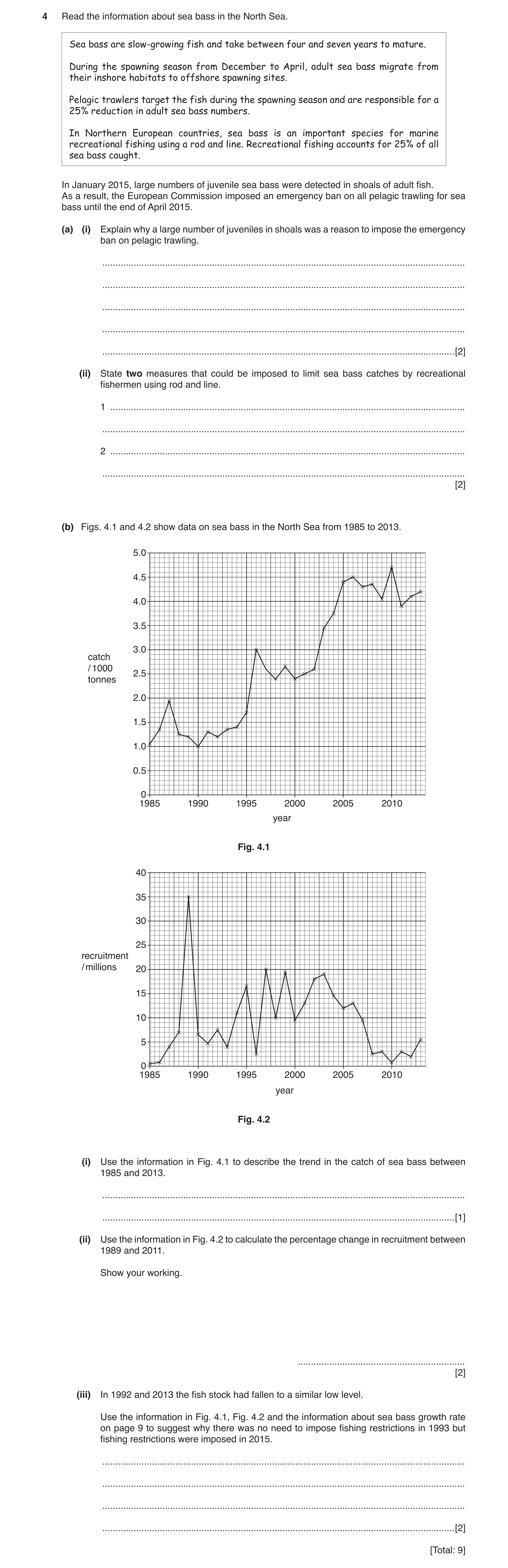
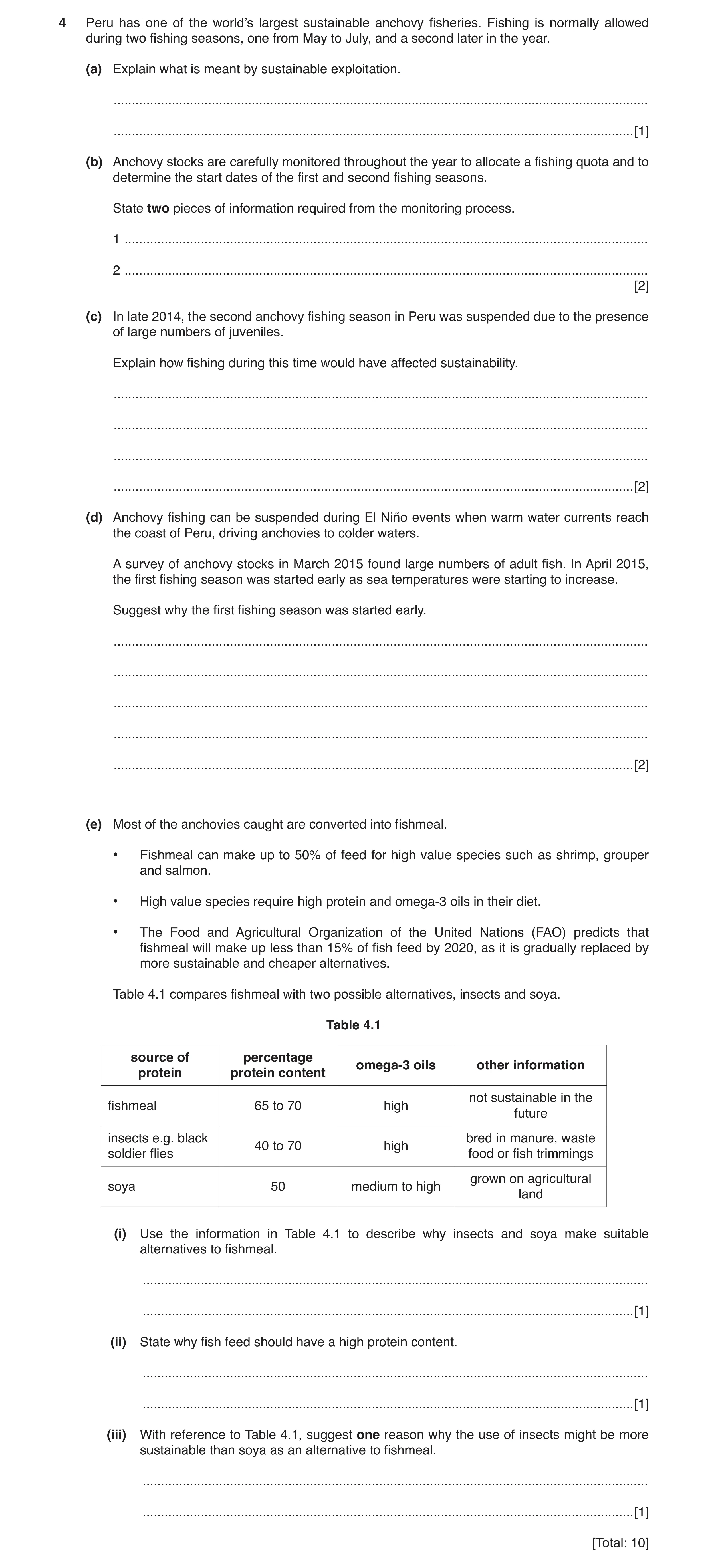
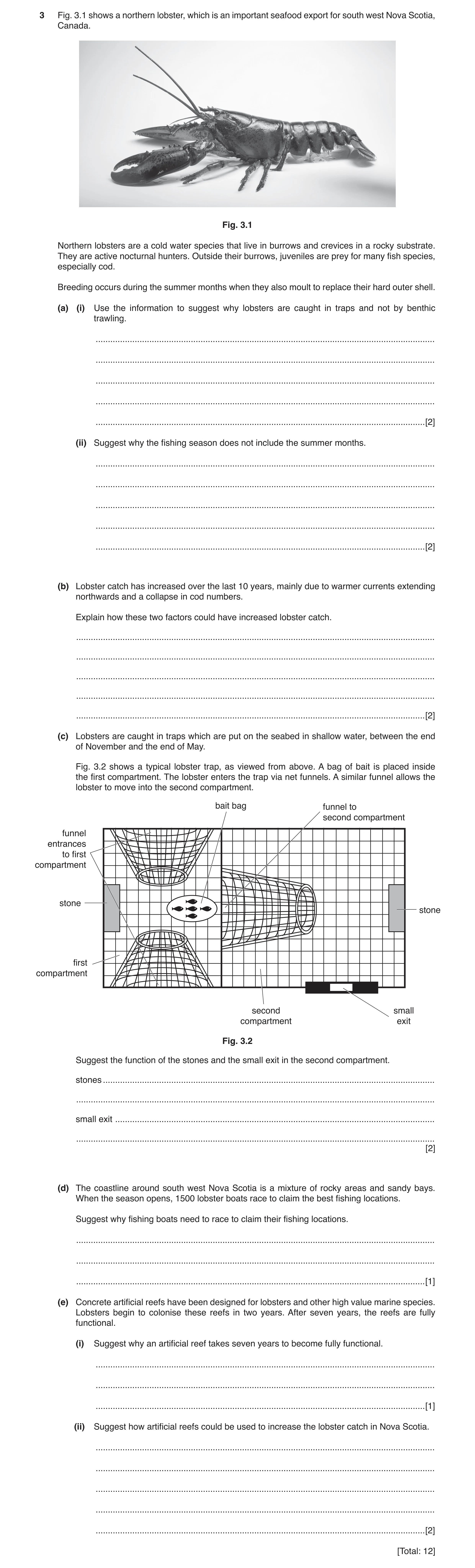
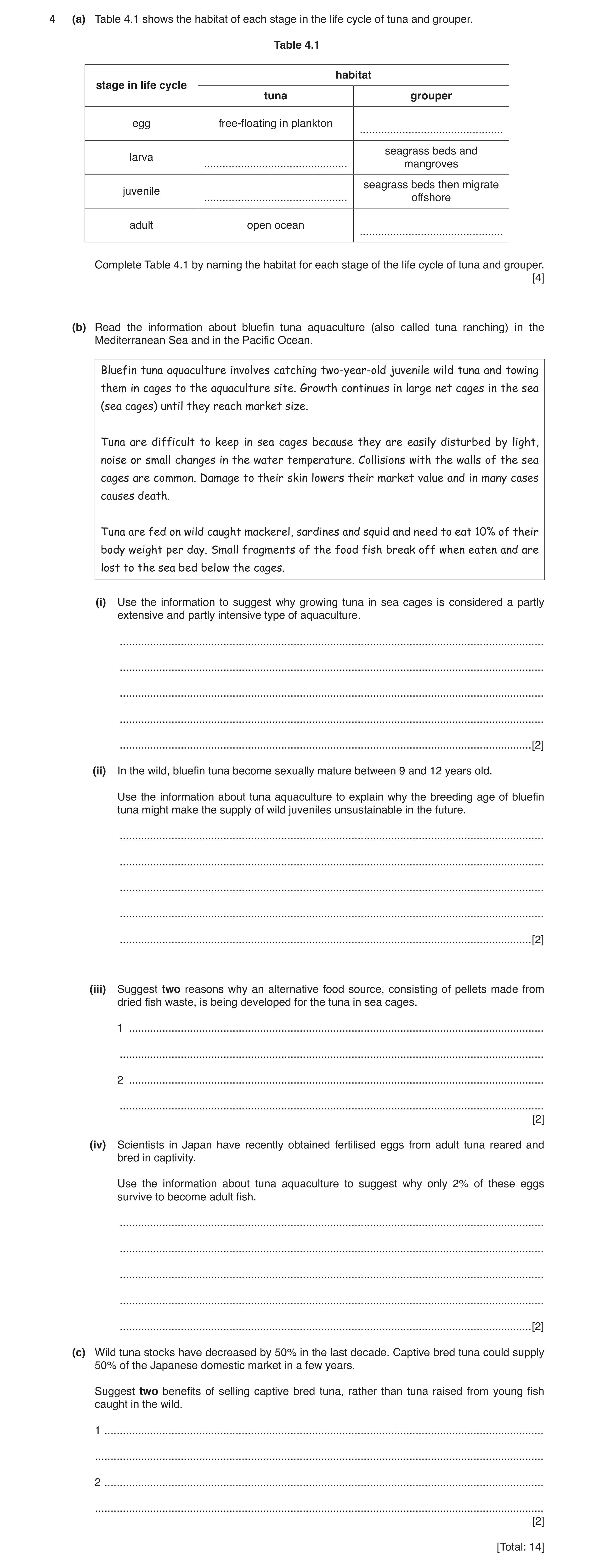
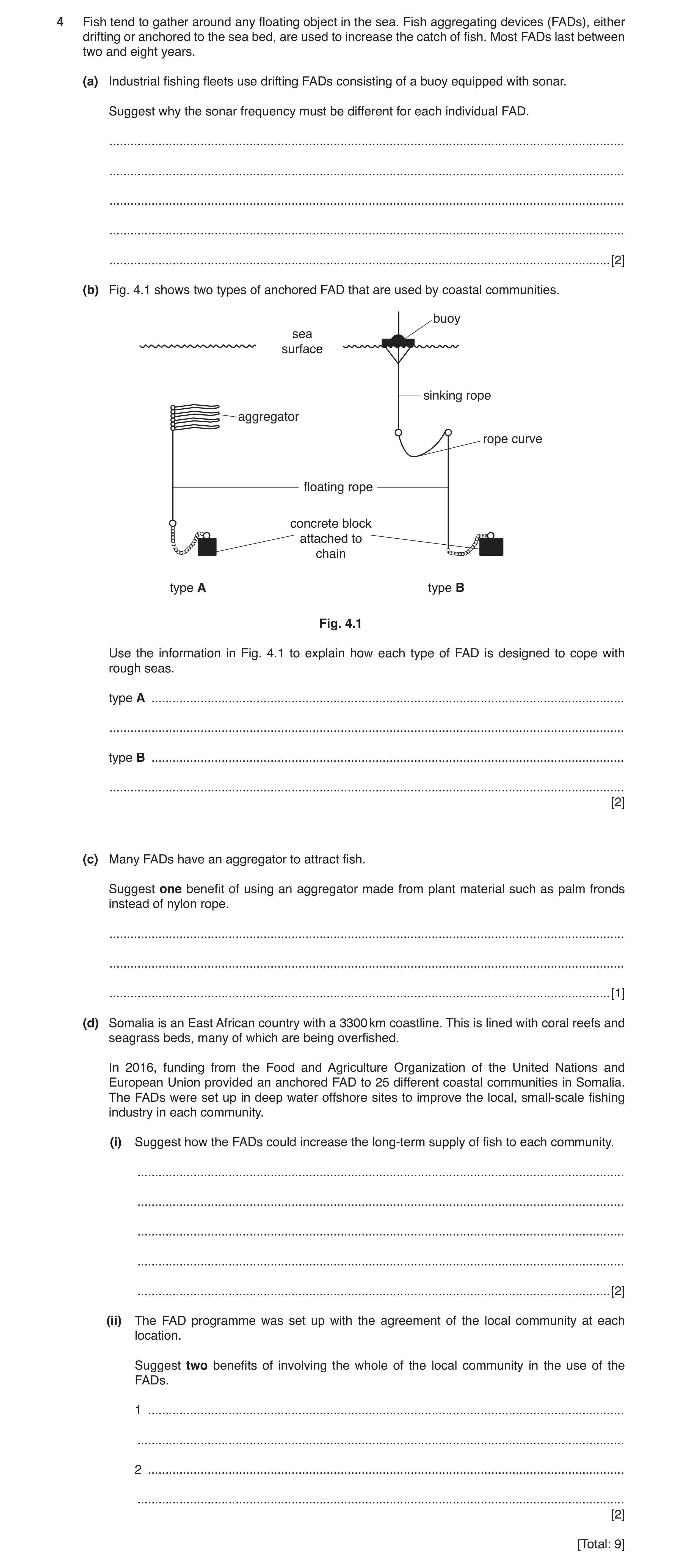
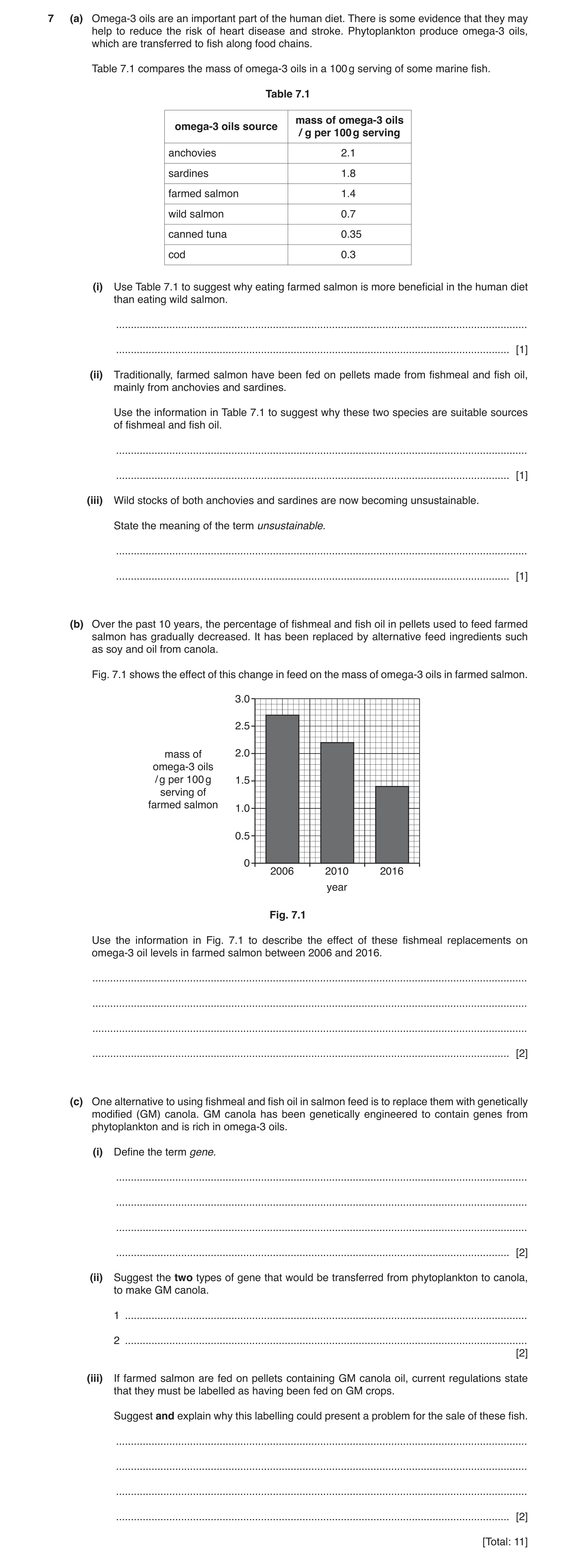
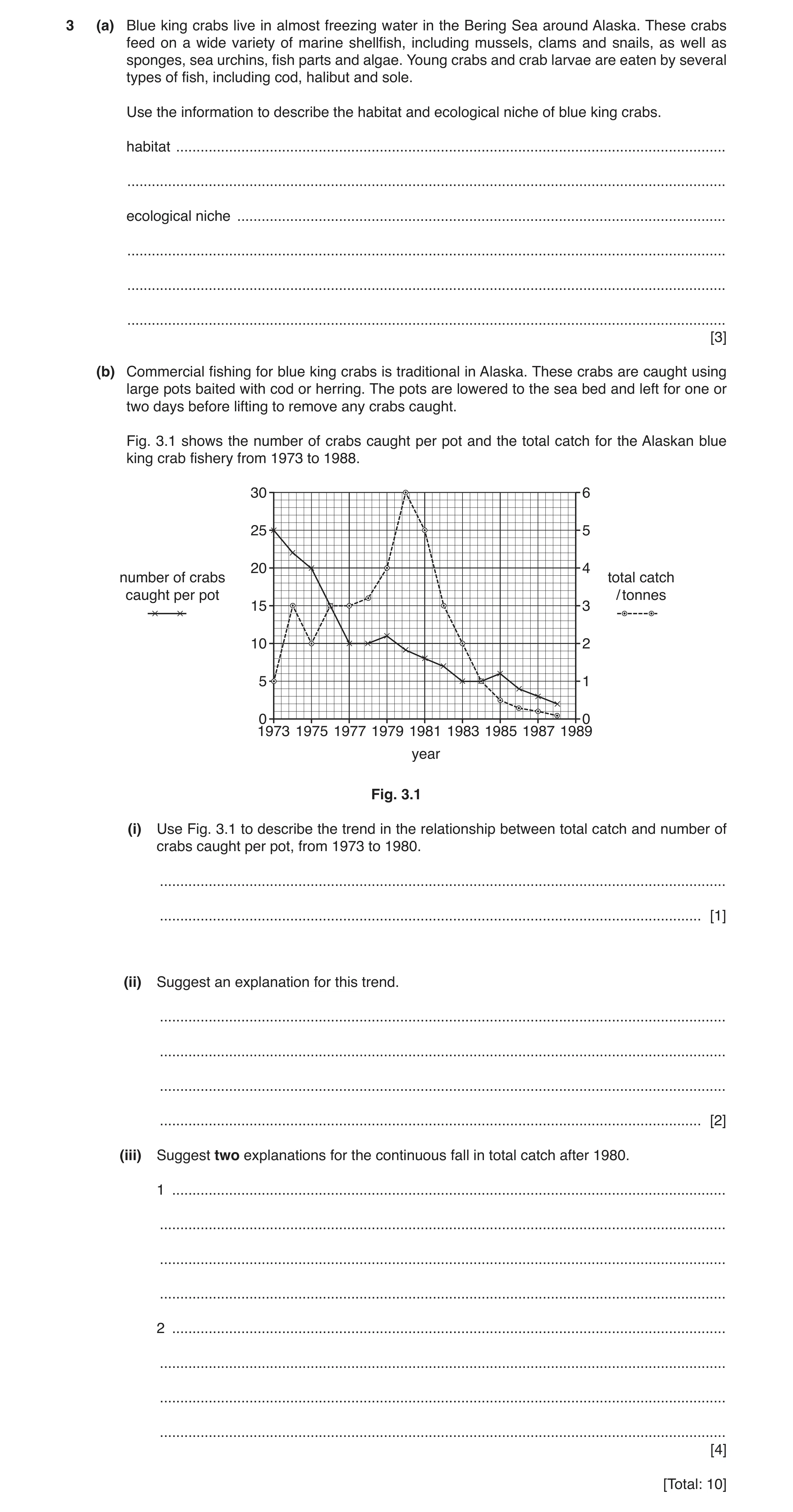
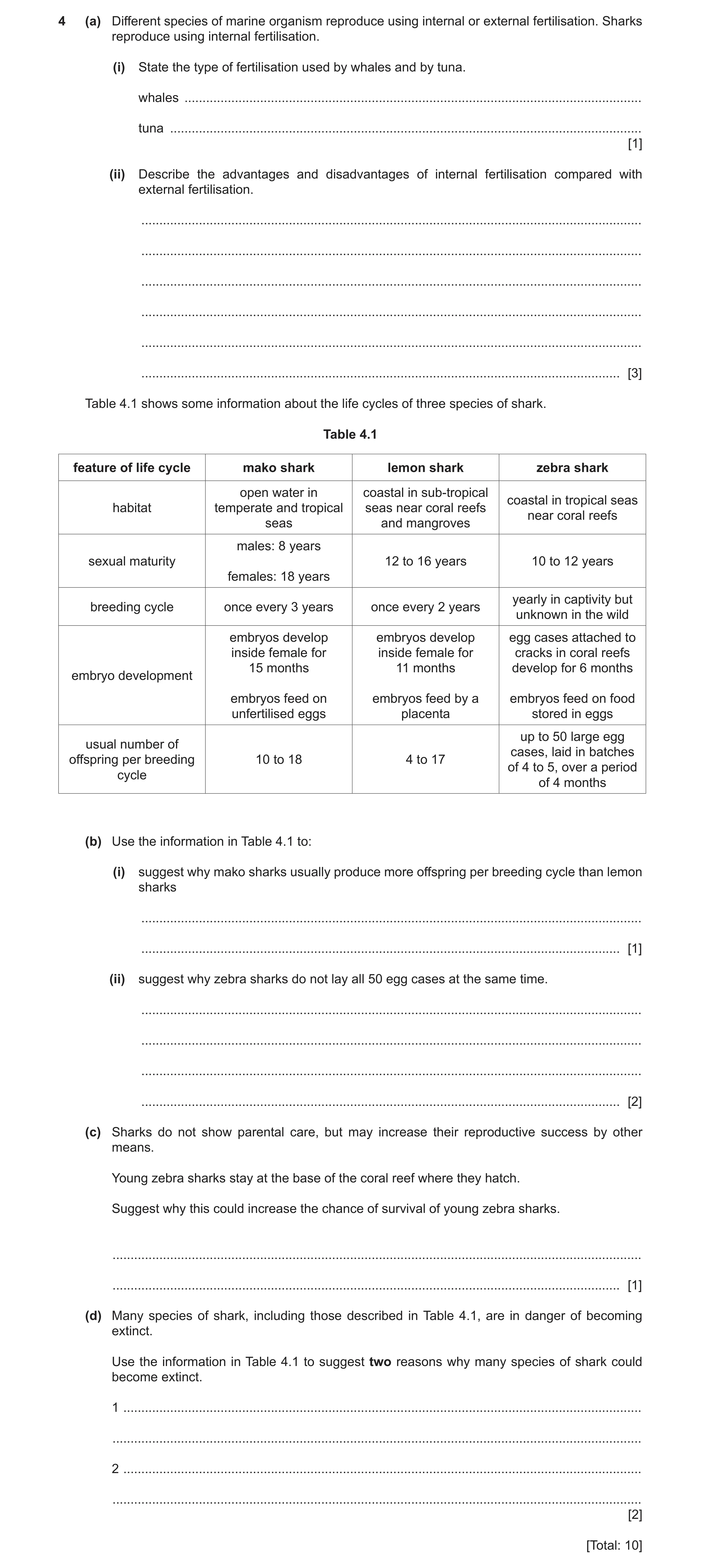
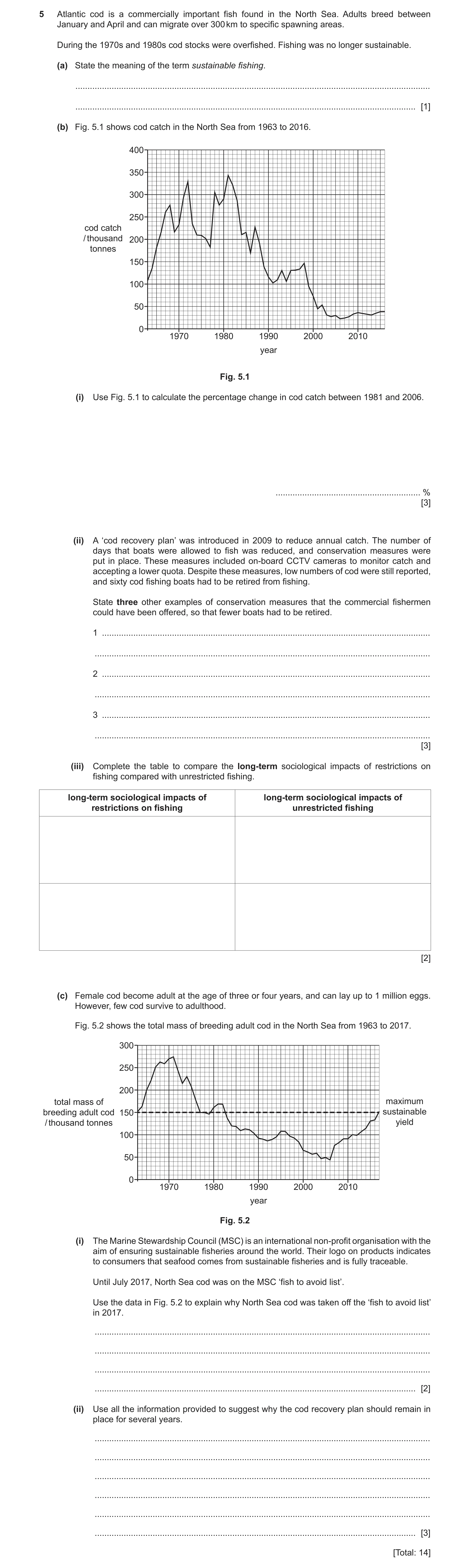
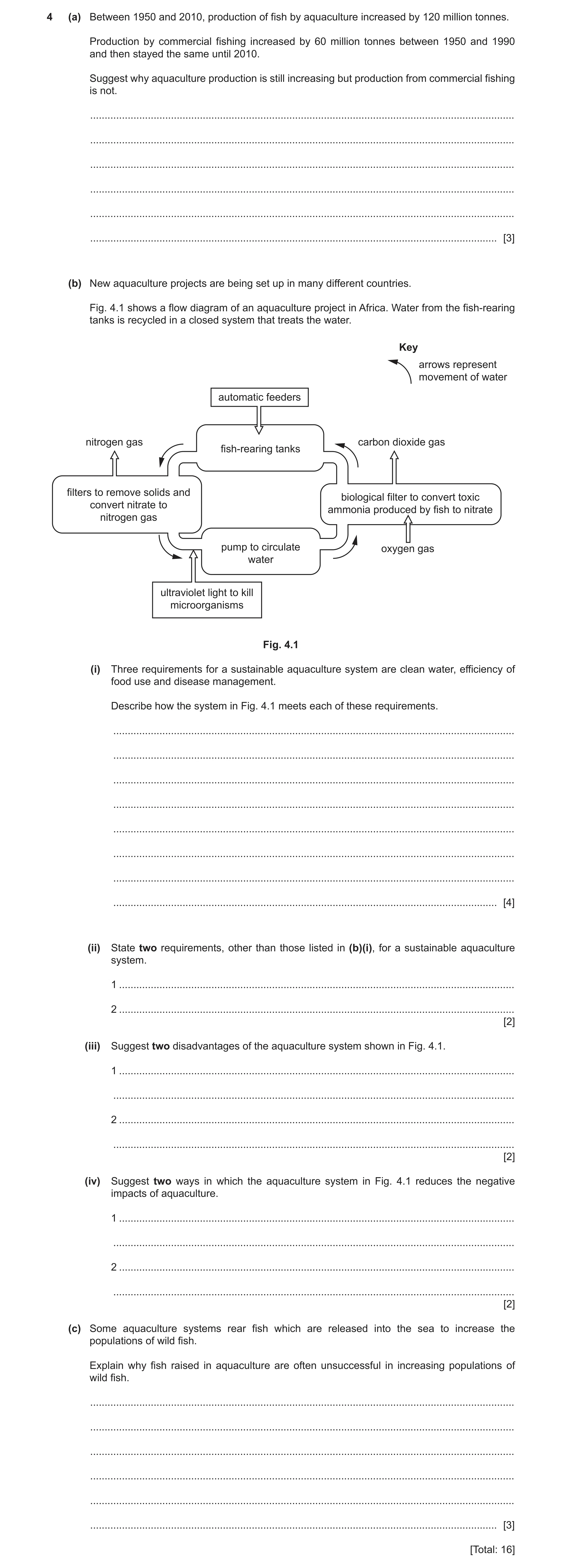
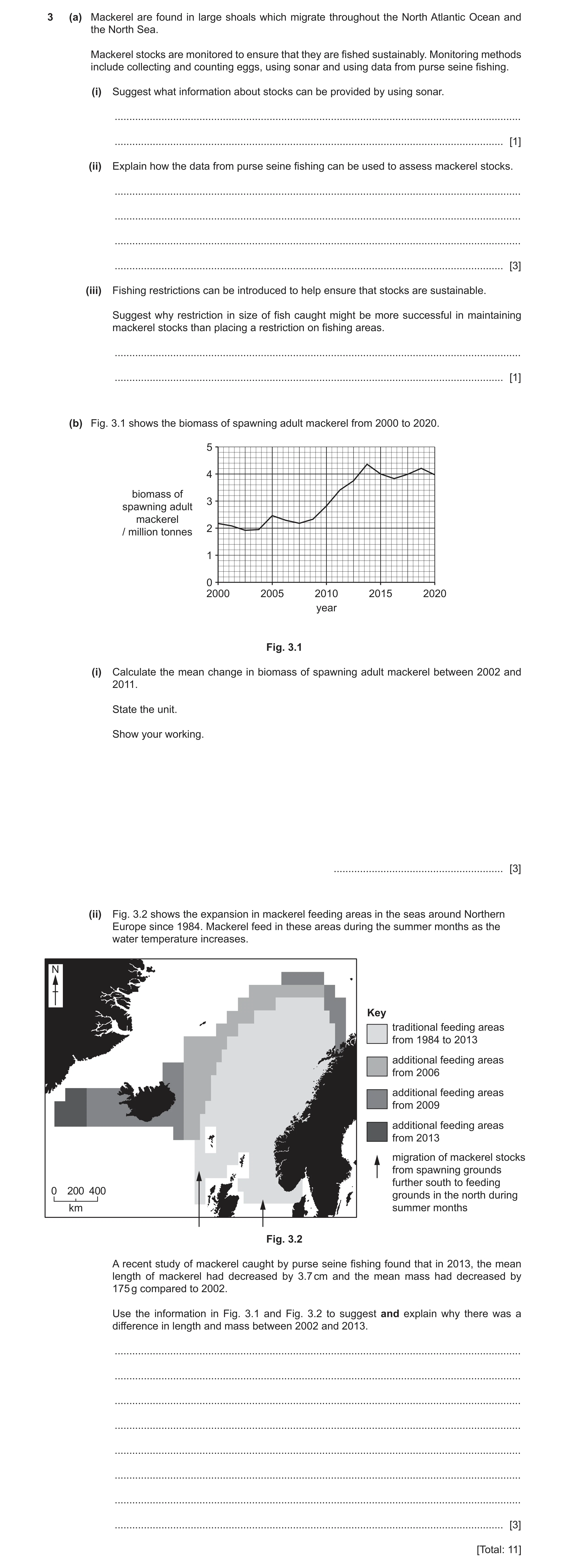
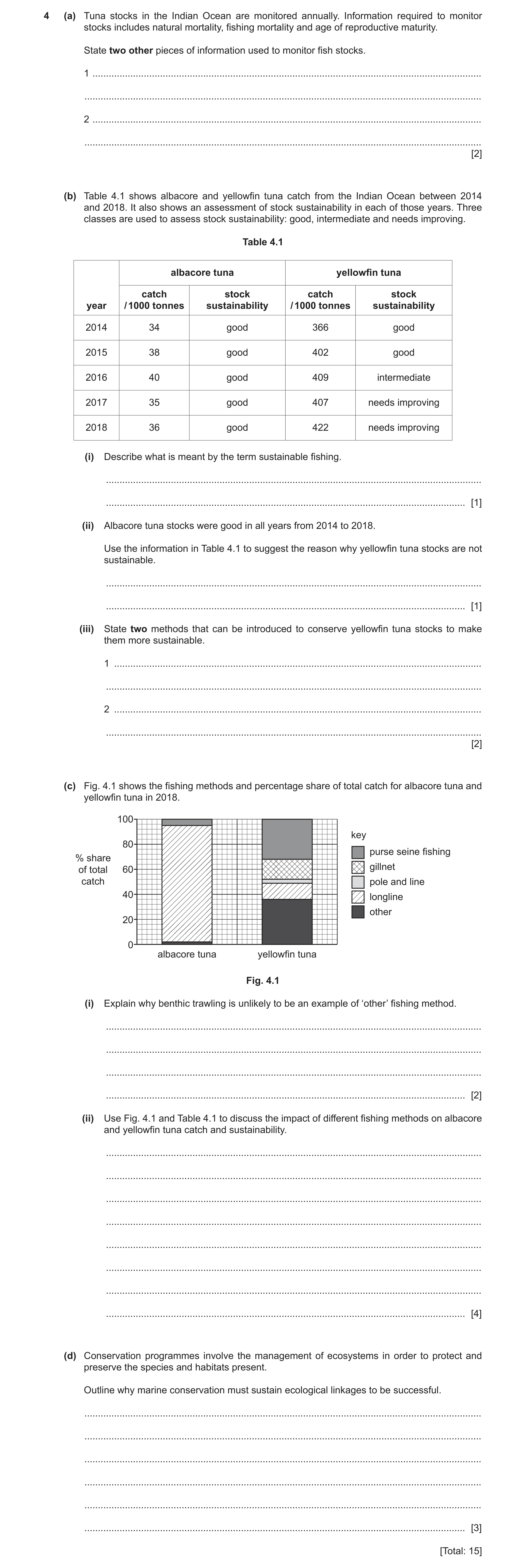
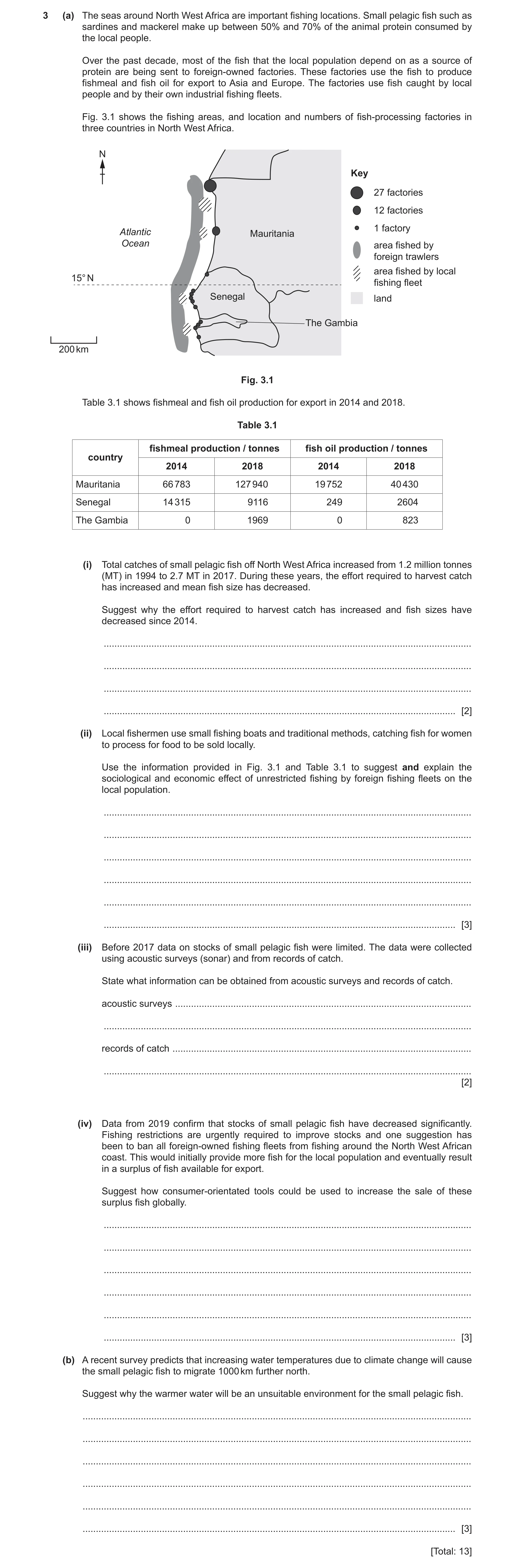
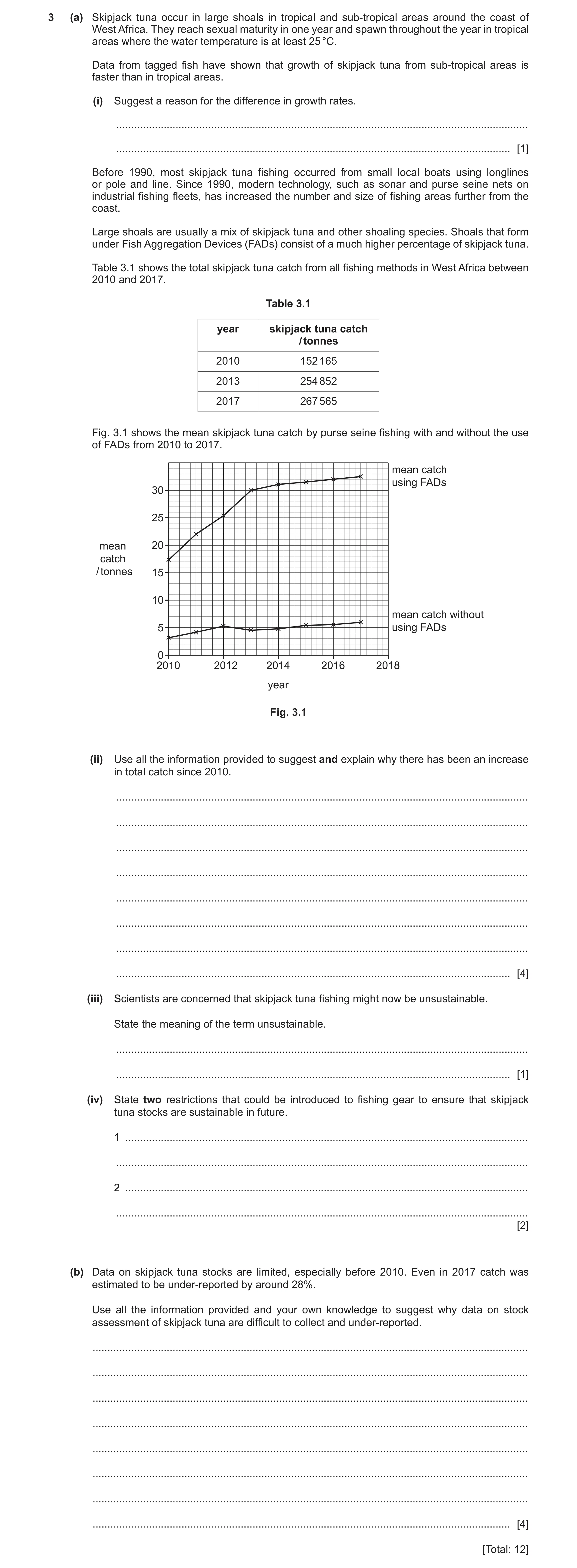
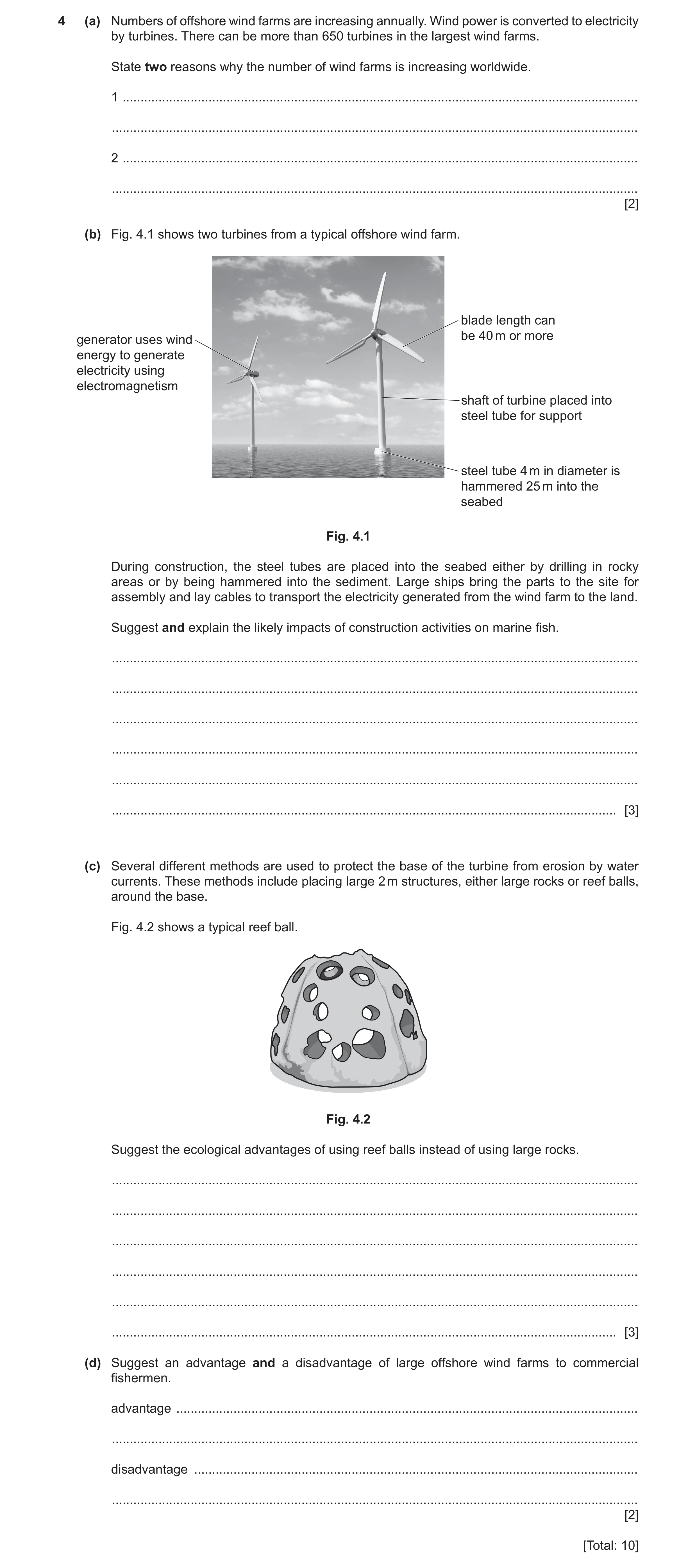
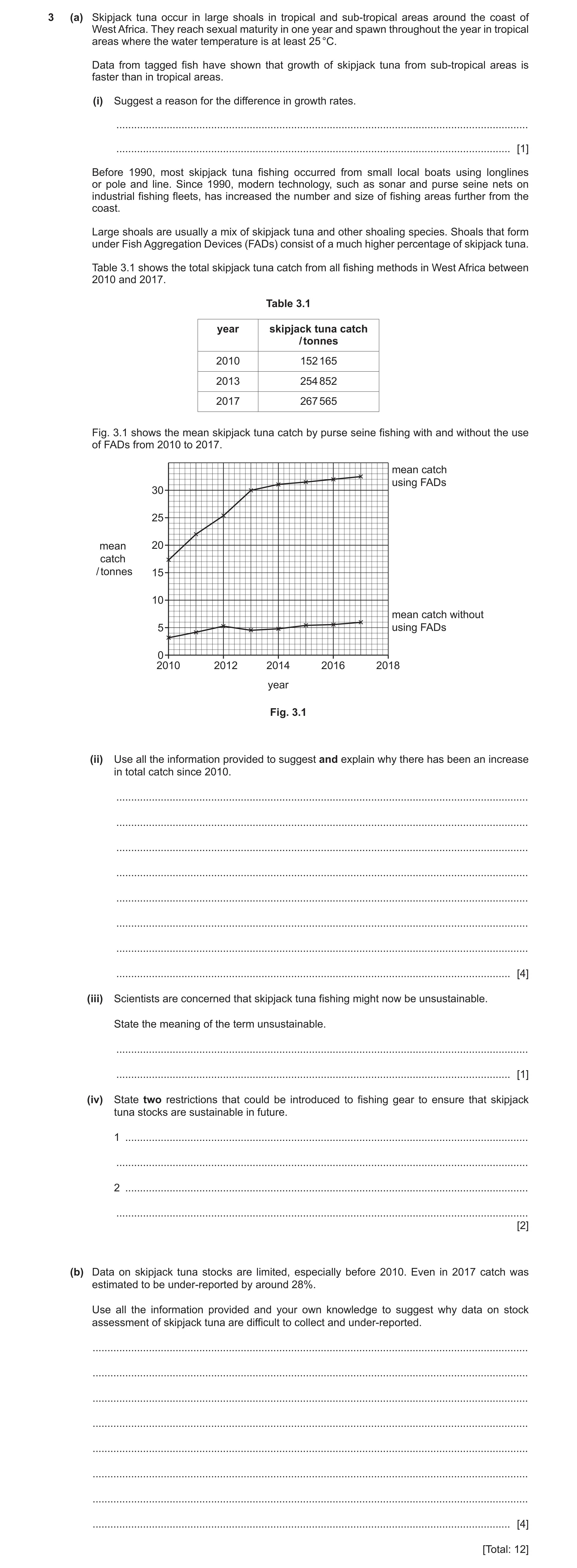
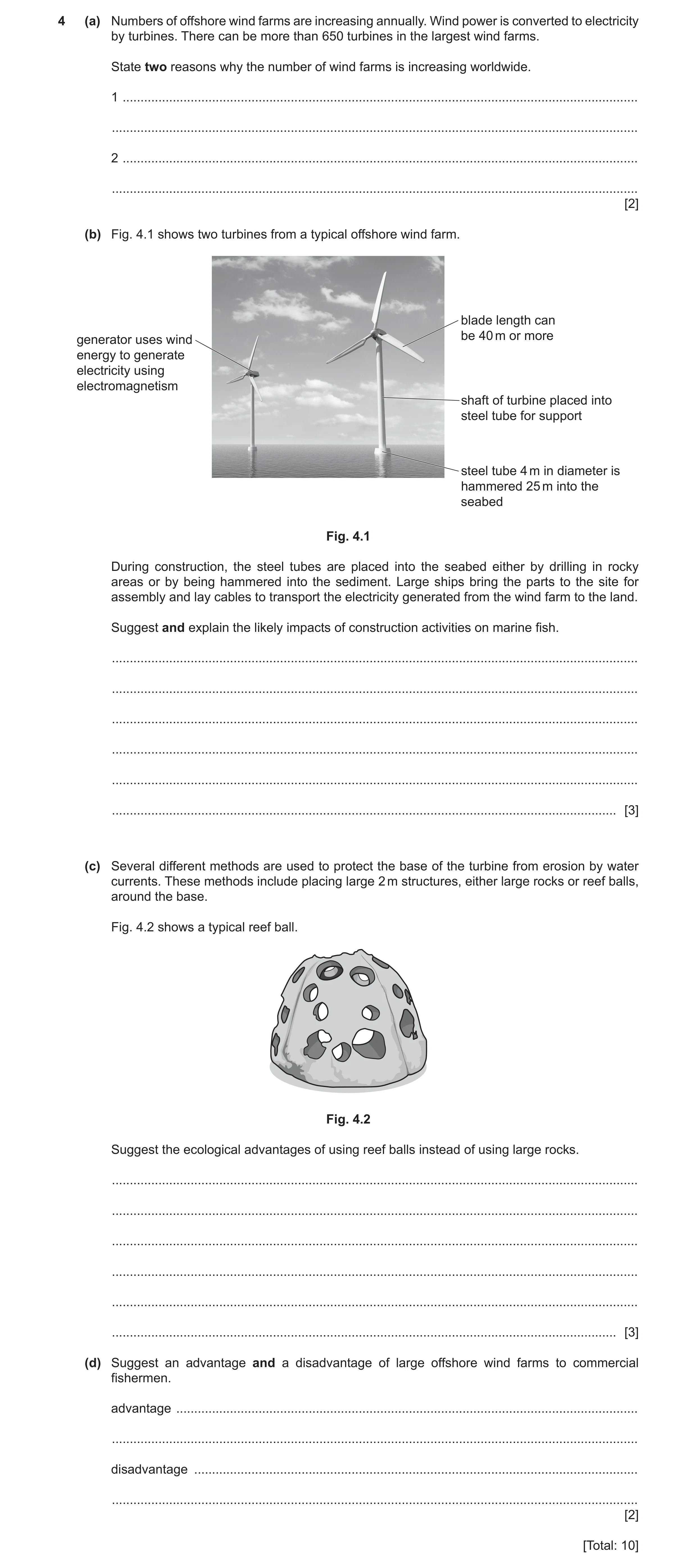
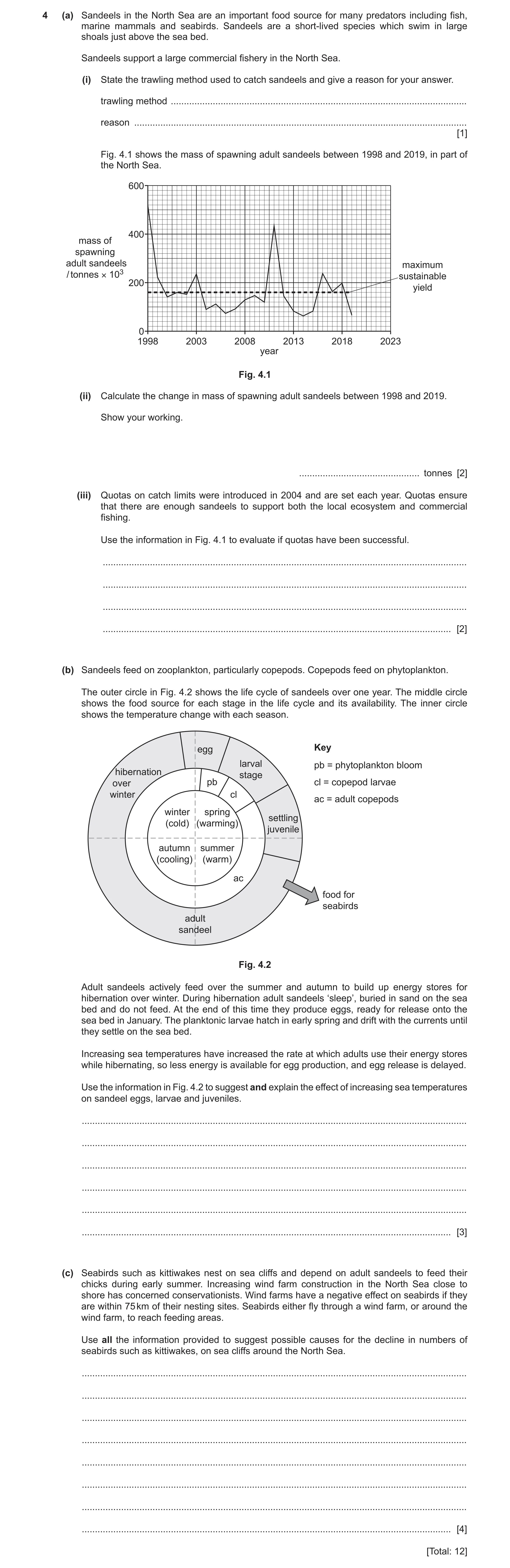
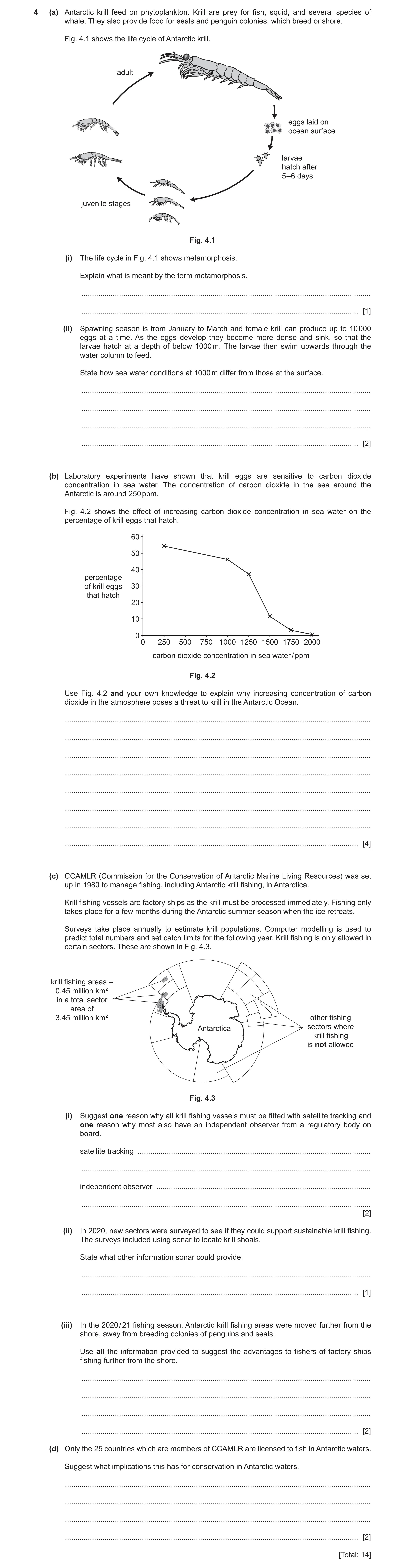
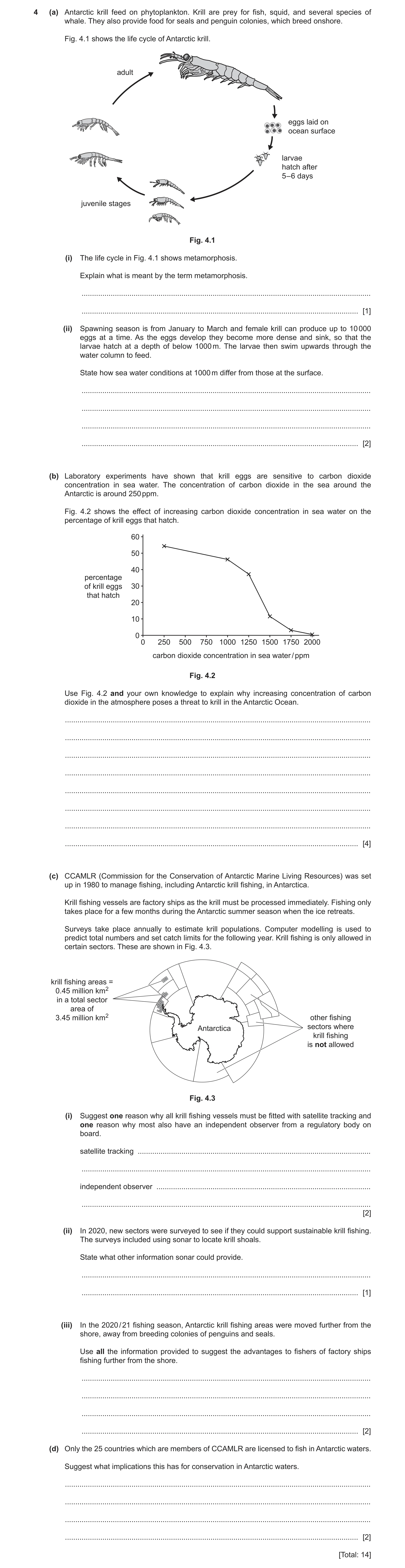
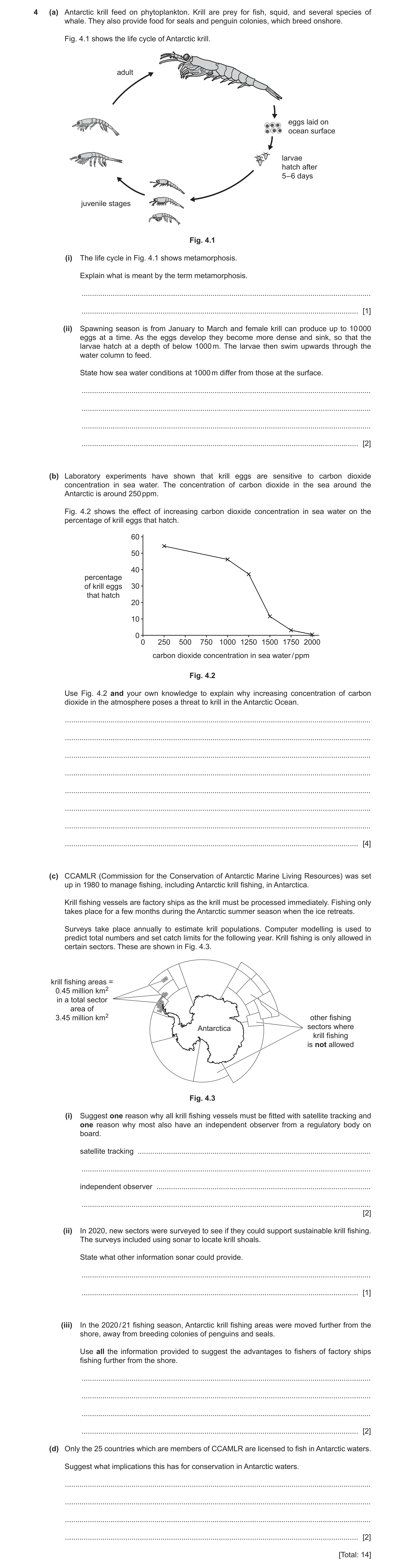
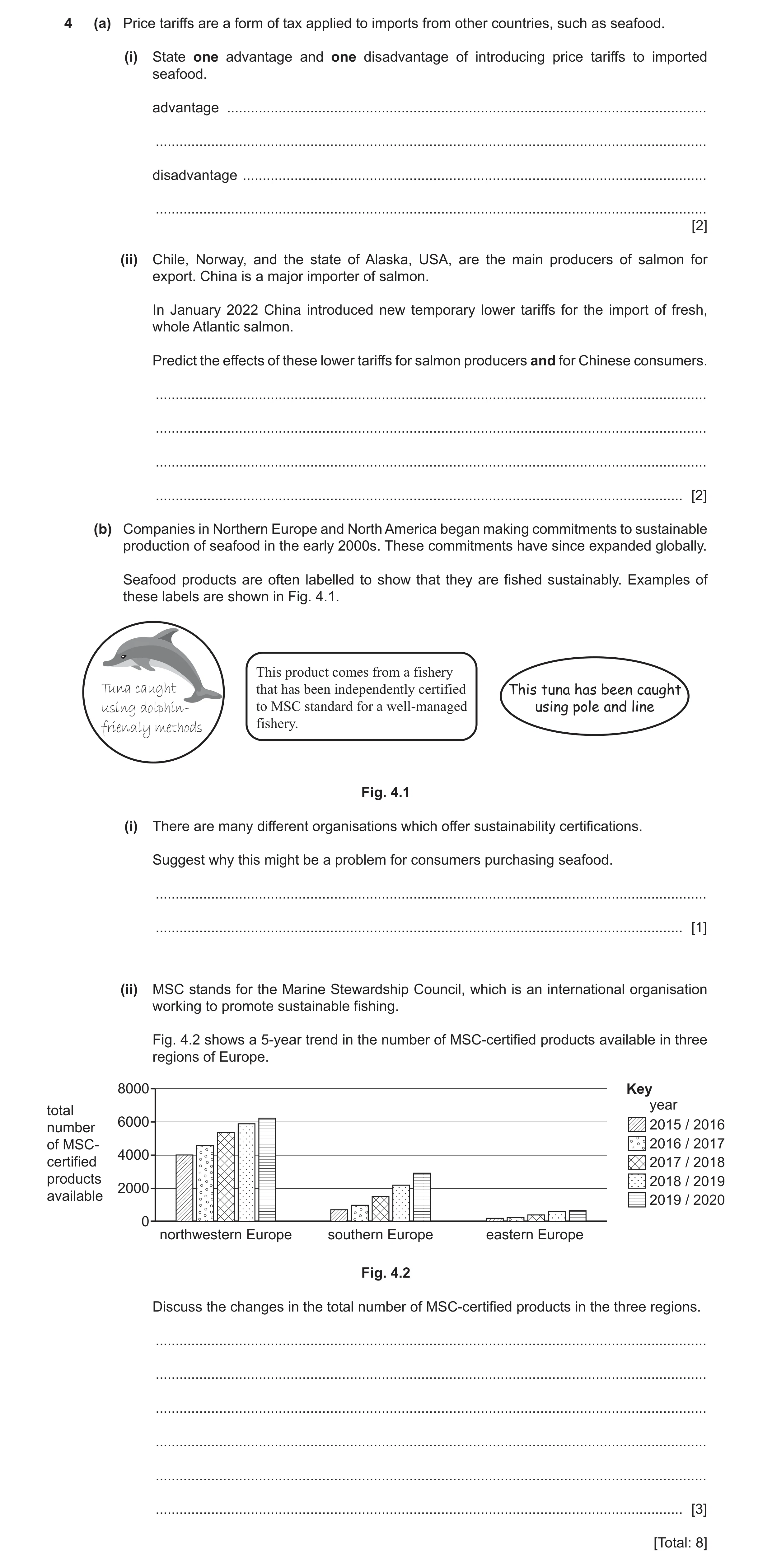
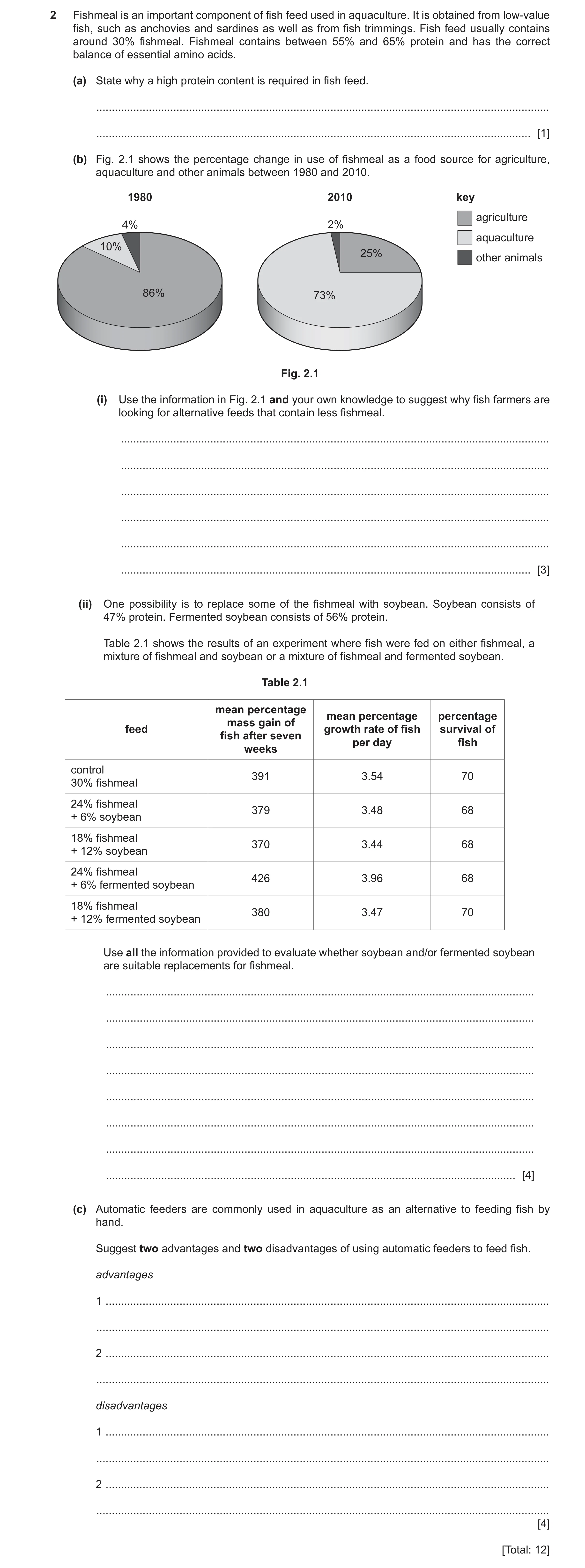
 55 / 68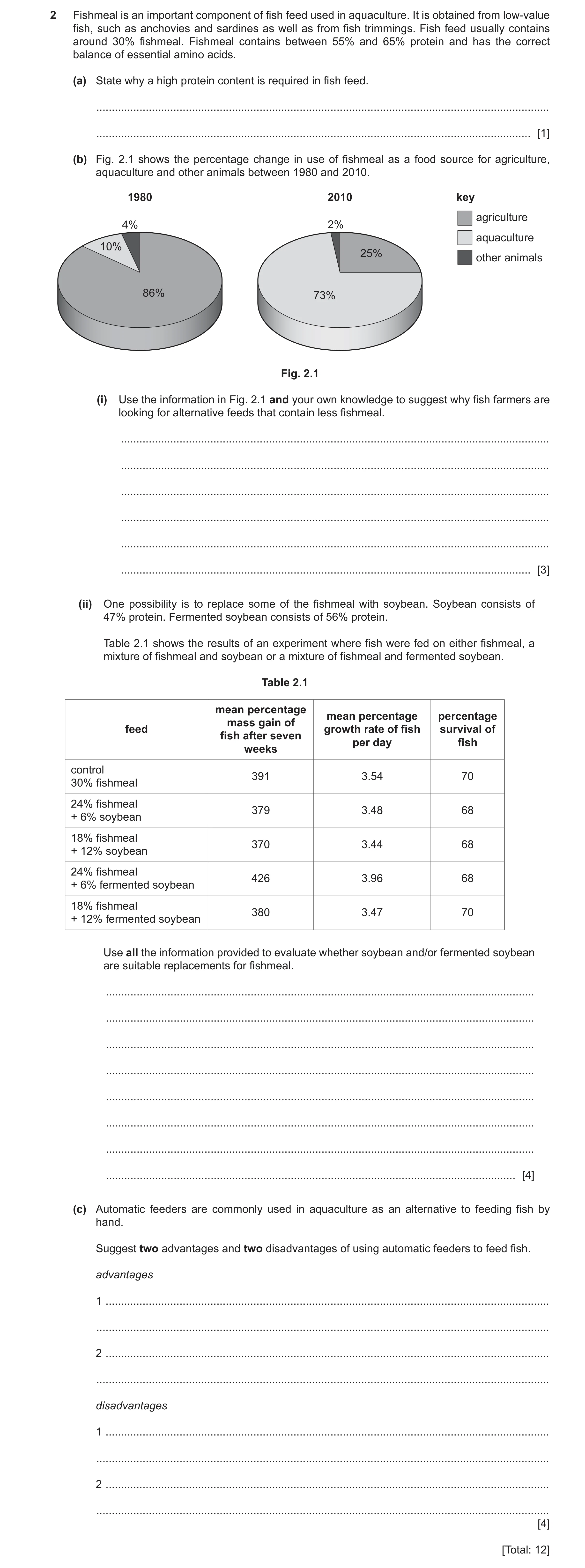
 58 / 68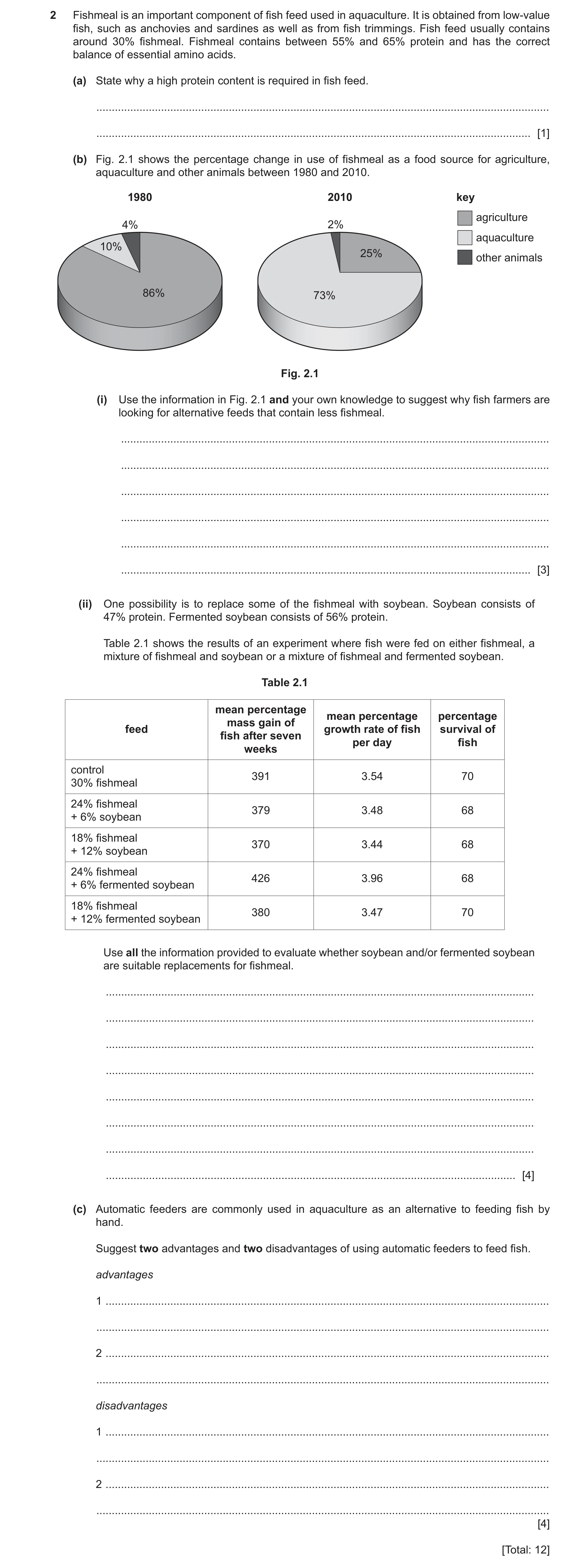
 61 / 68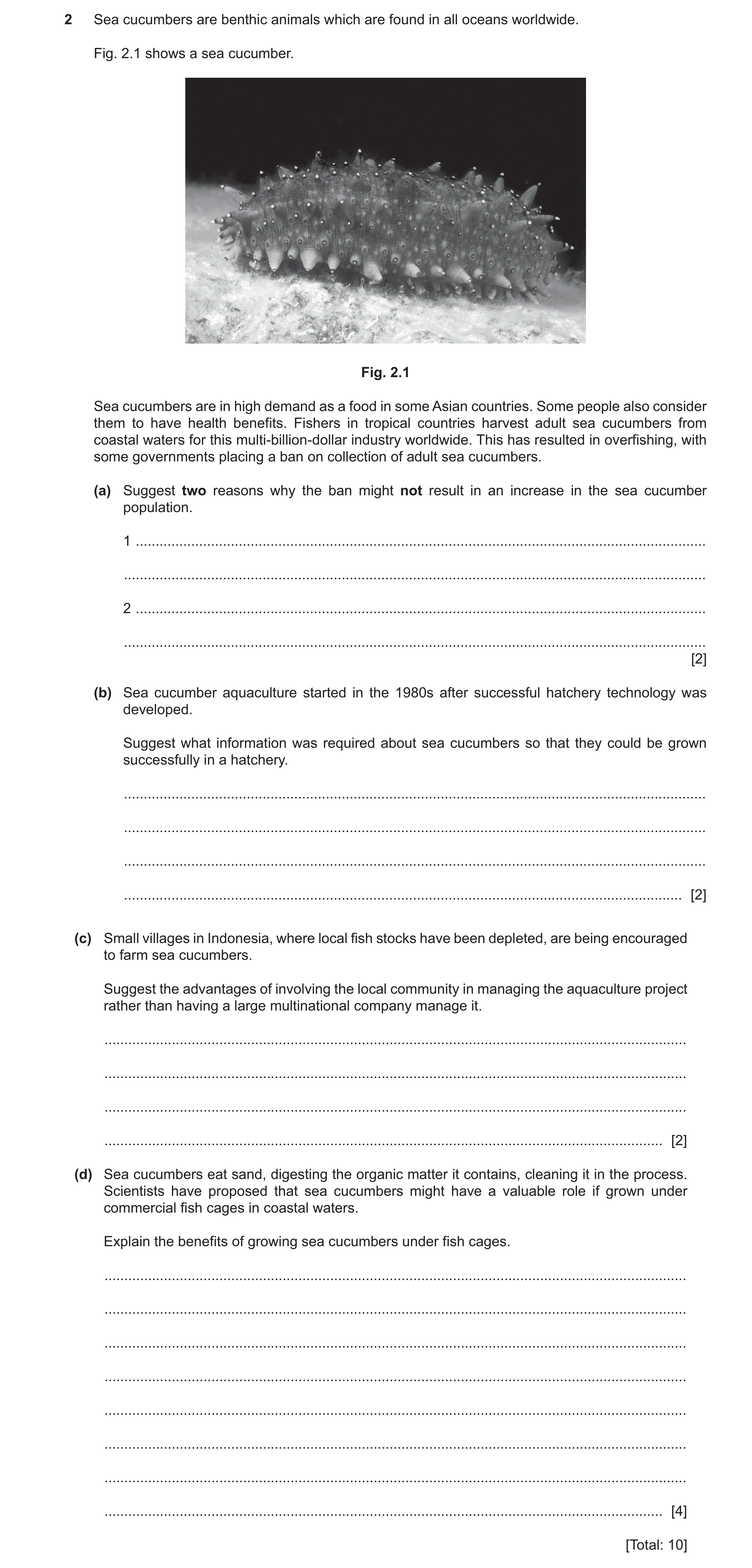
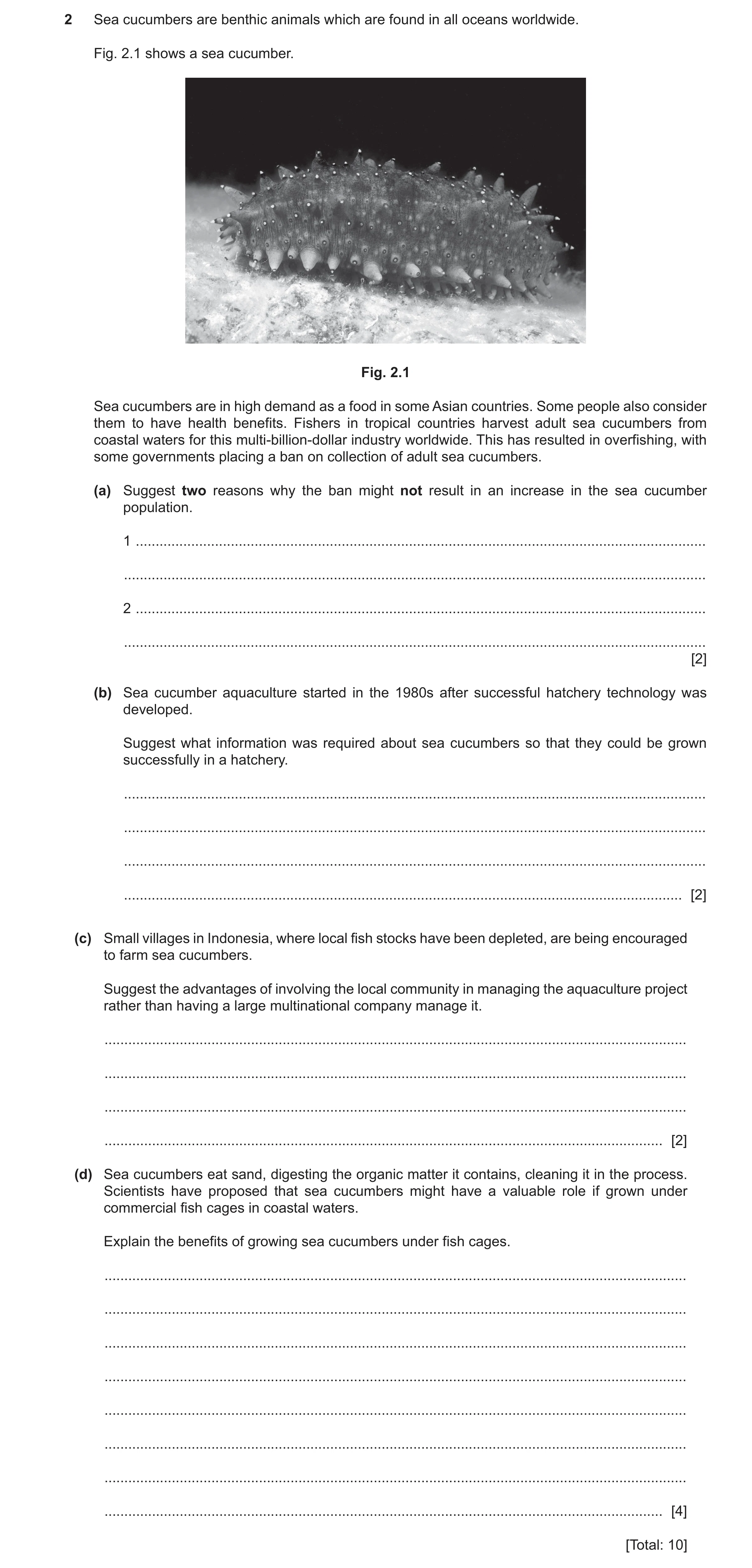
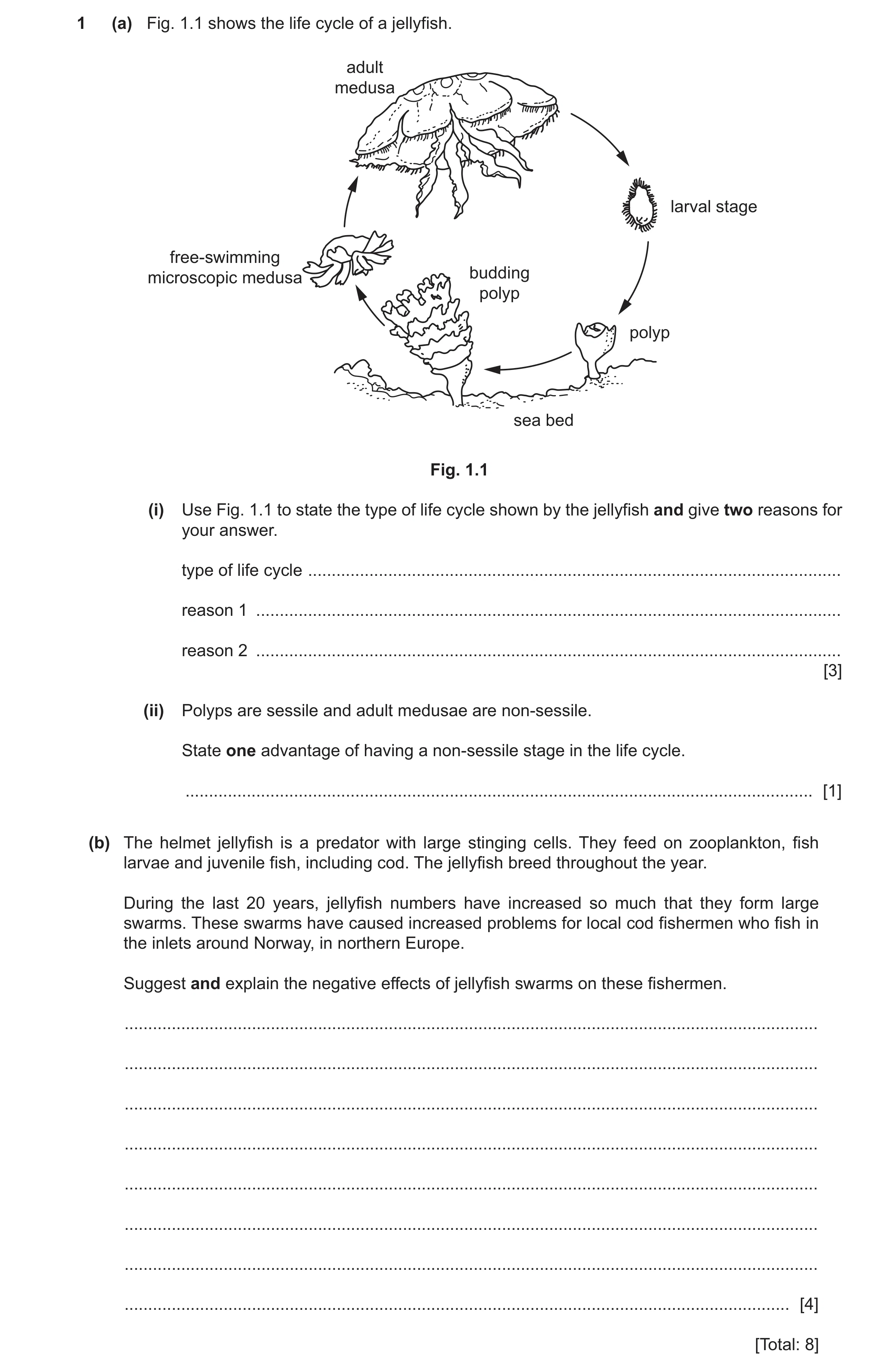
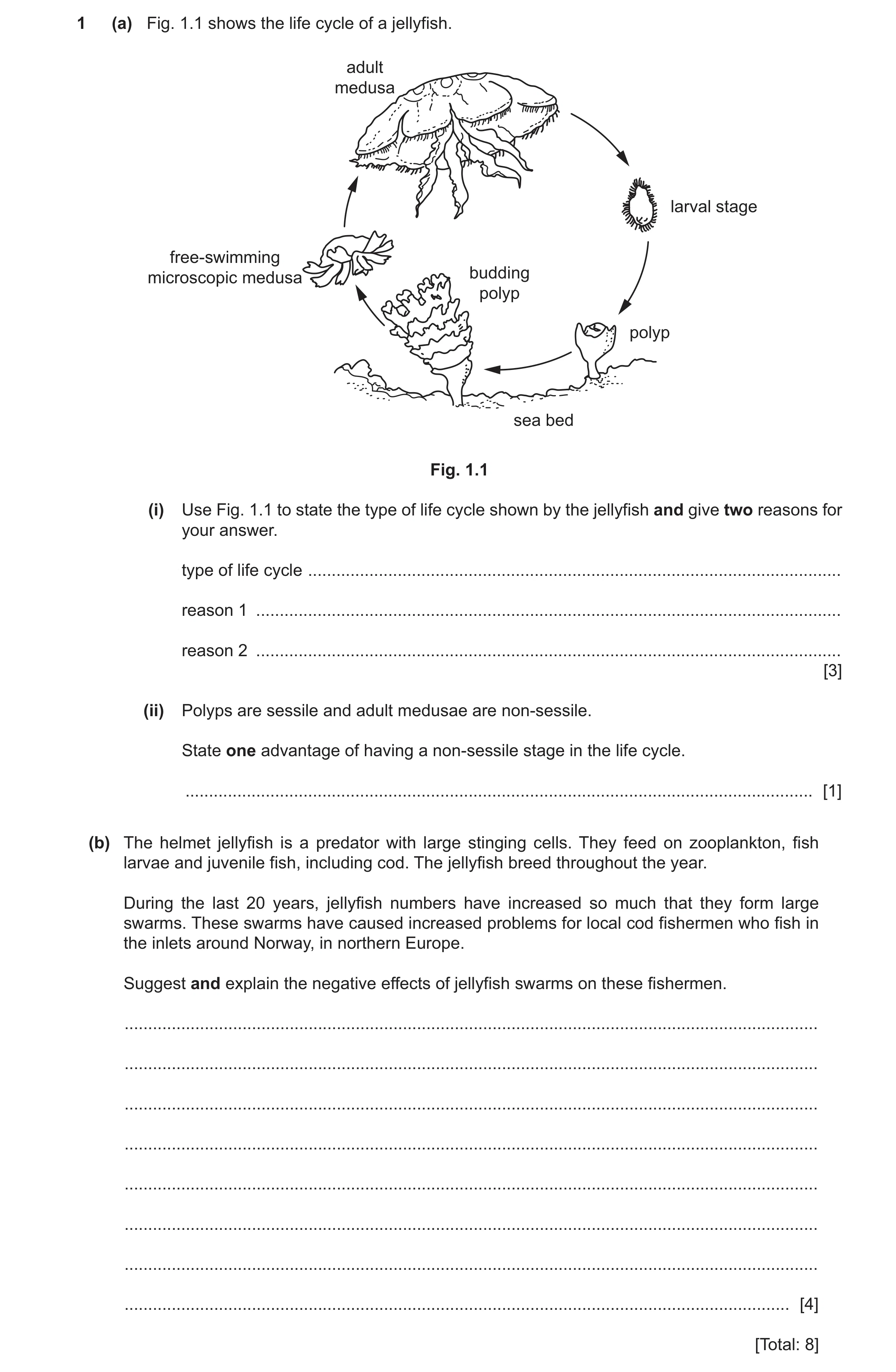
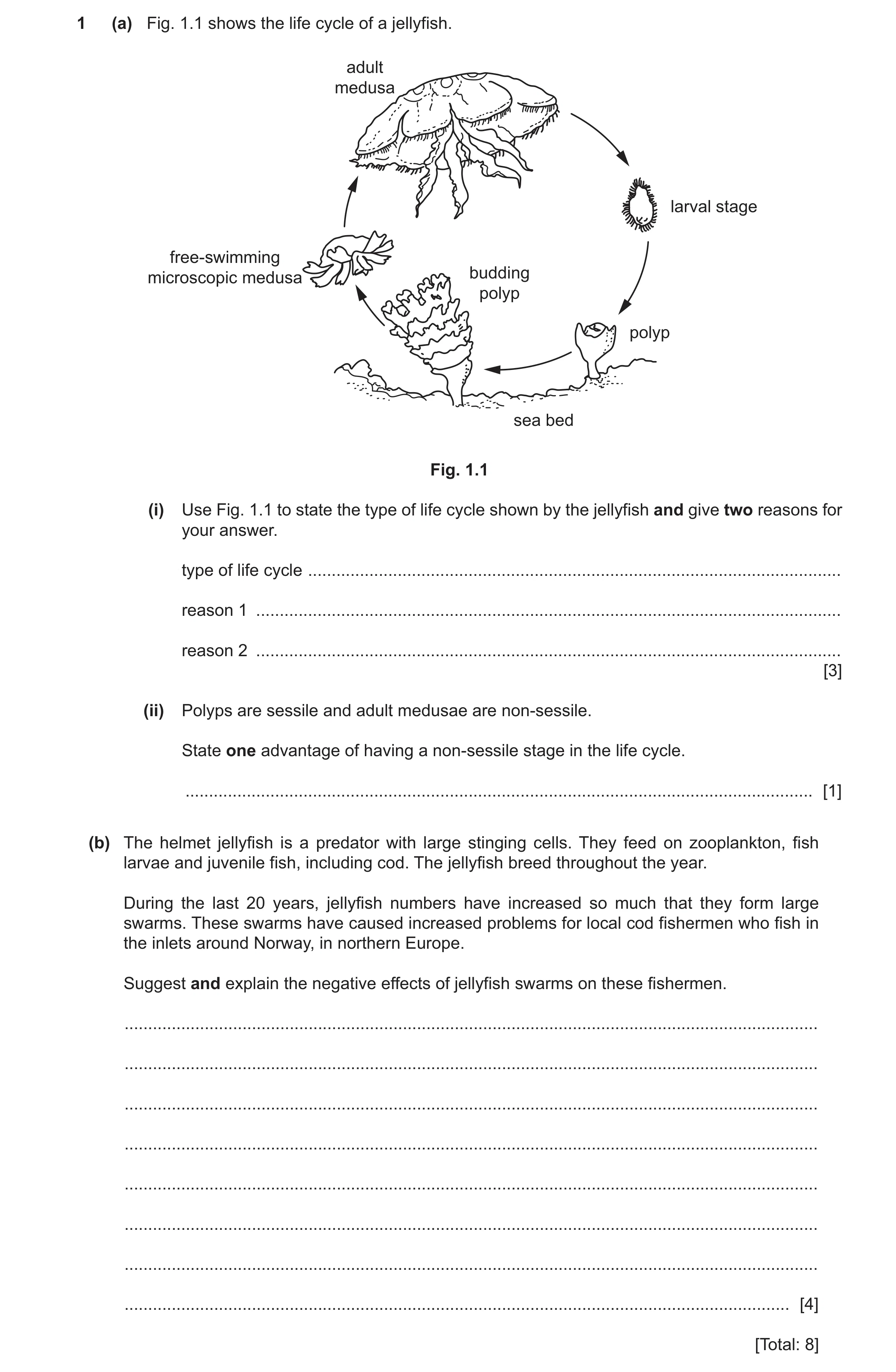
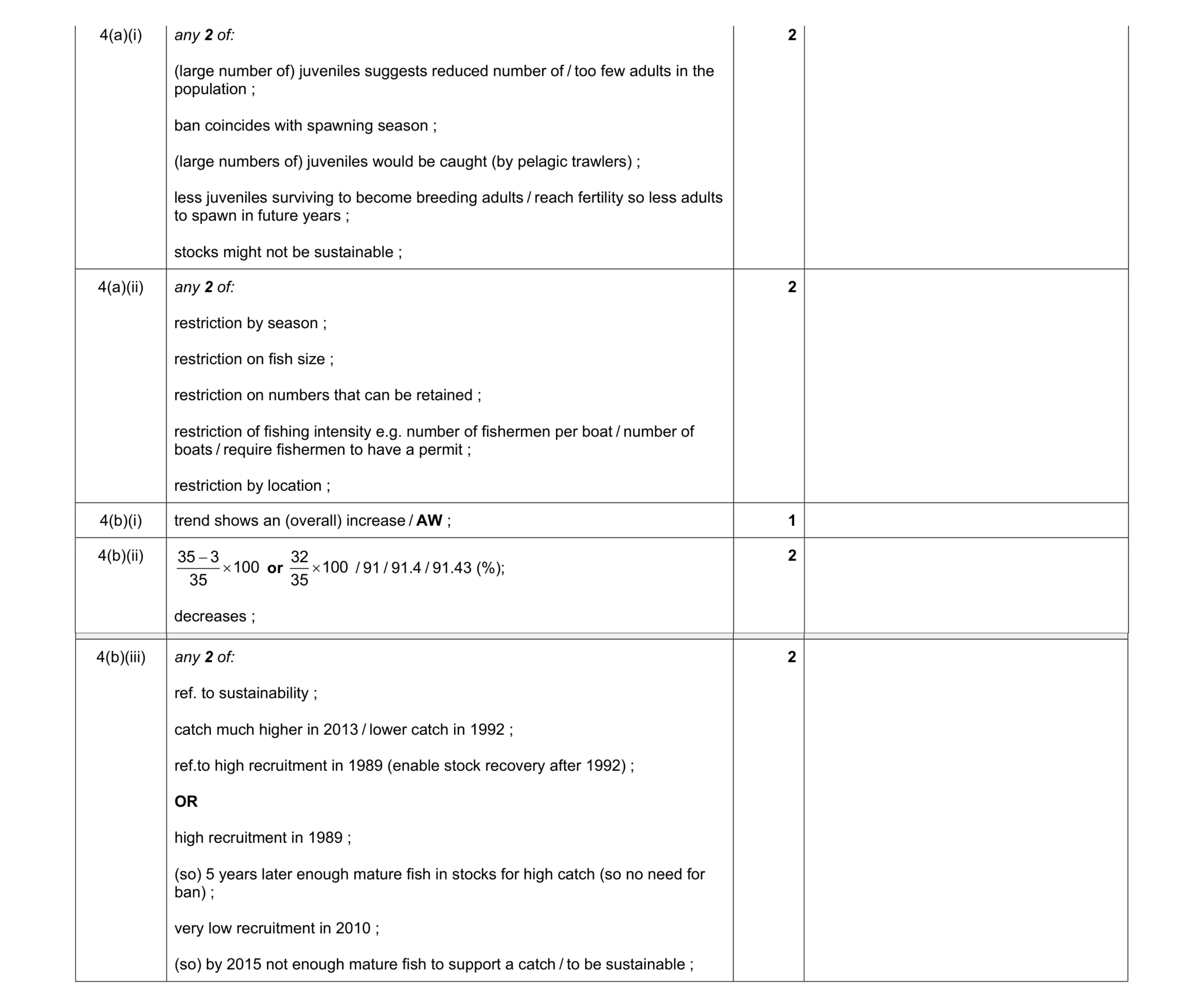 9
9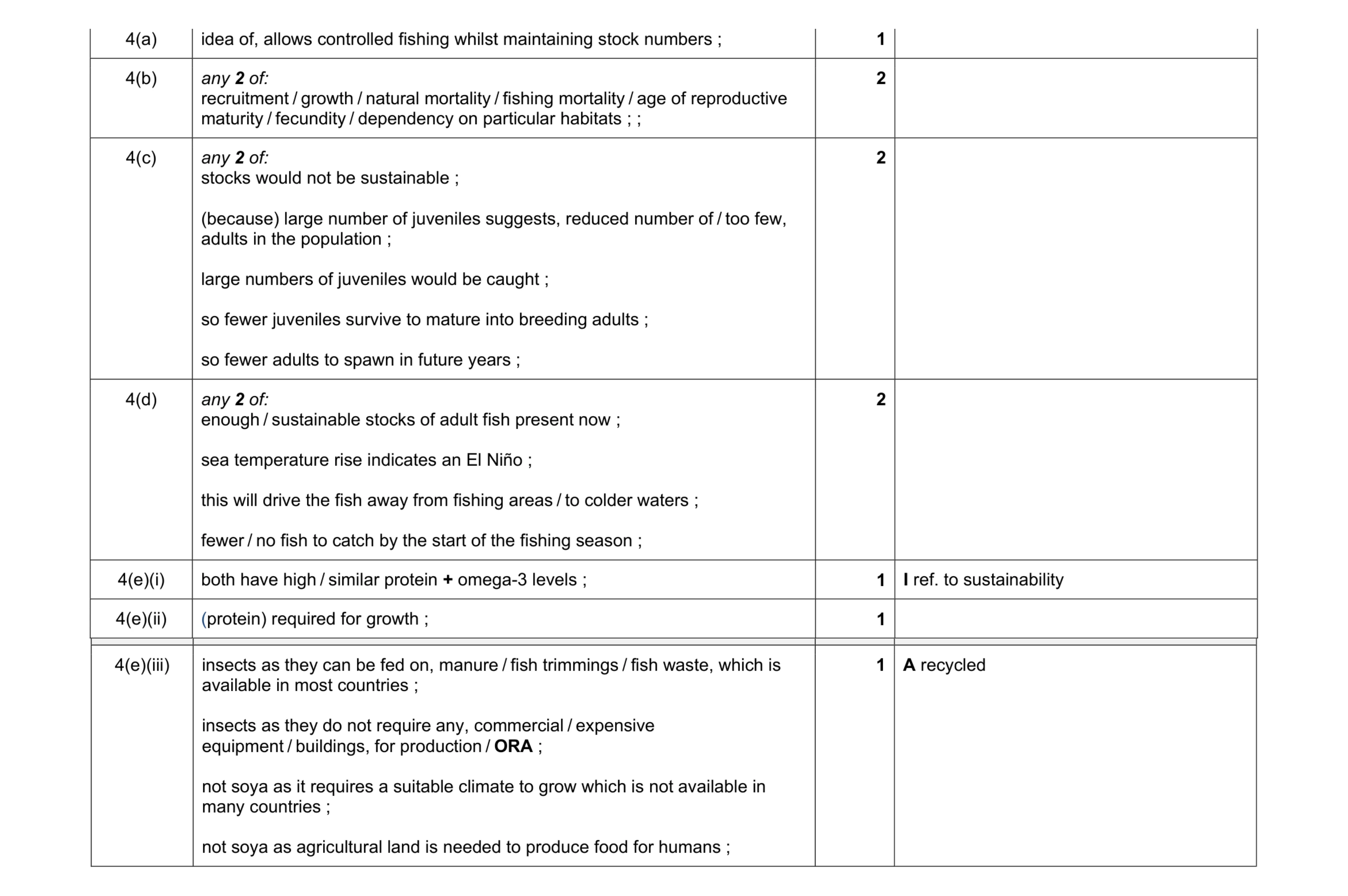 10
10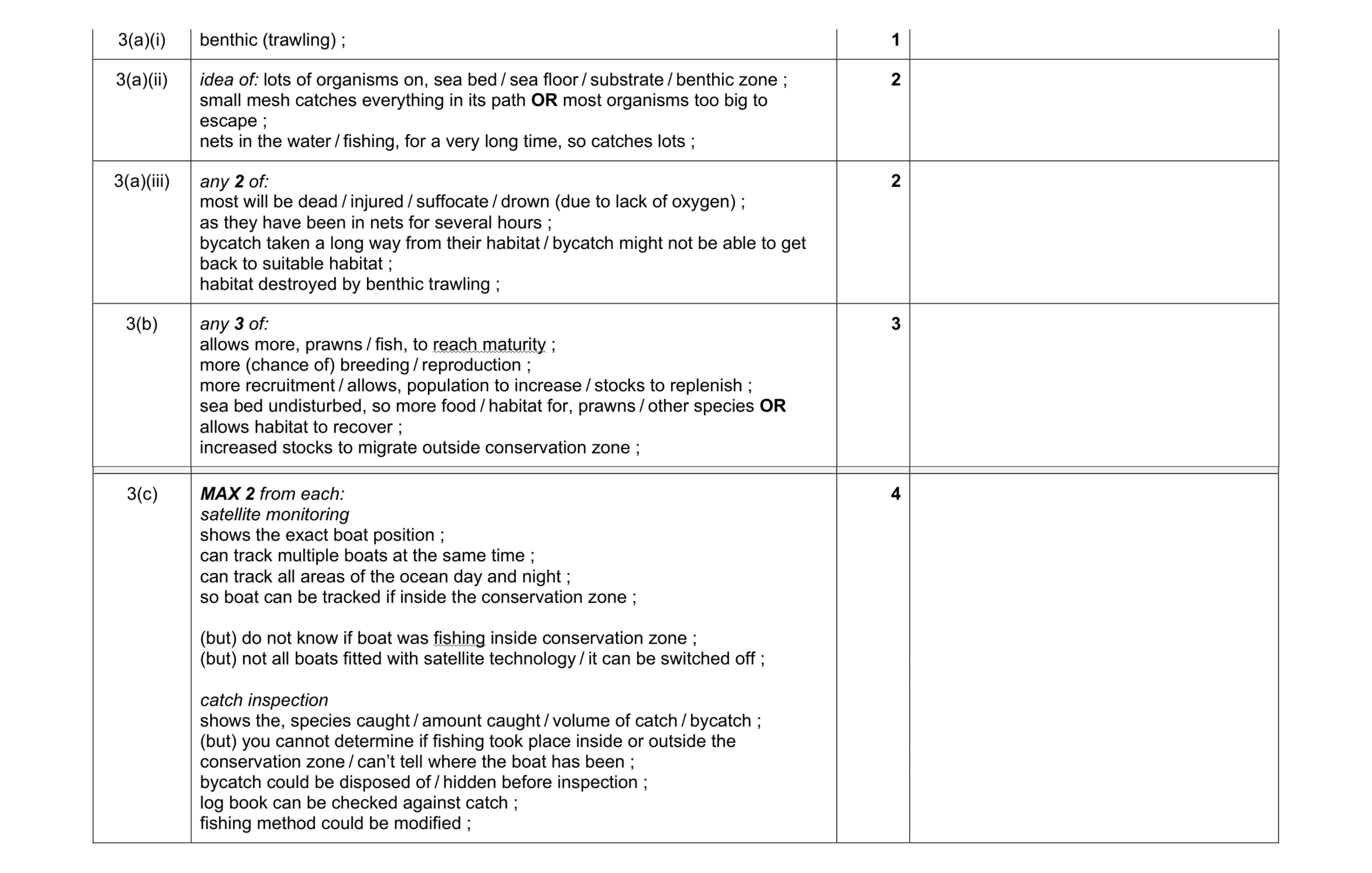 12
12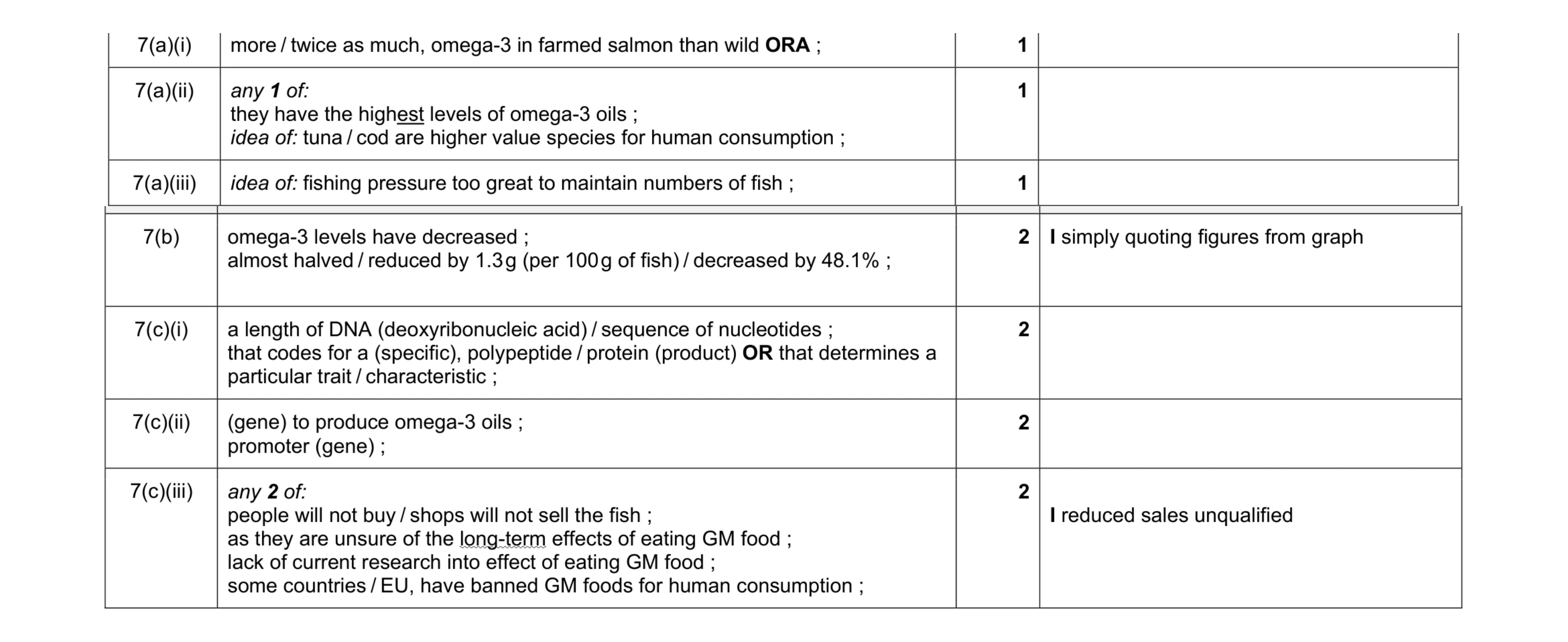 11
11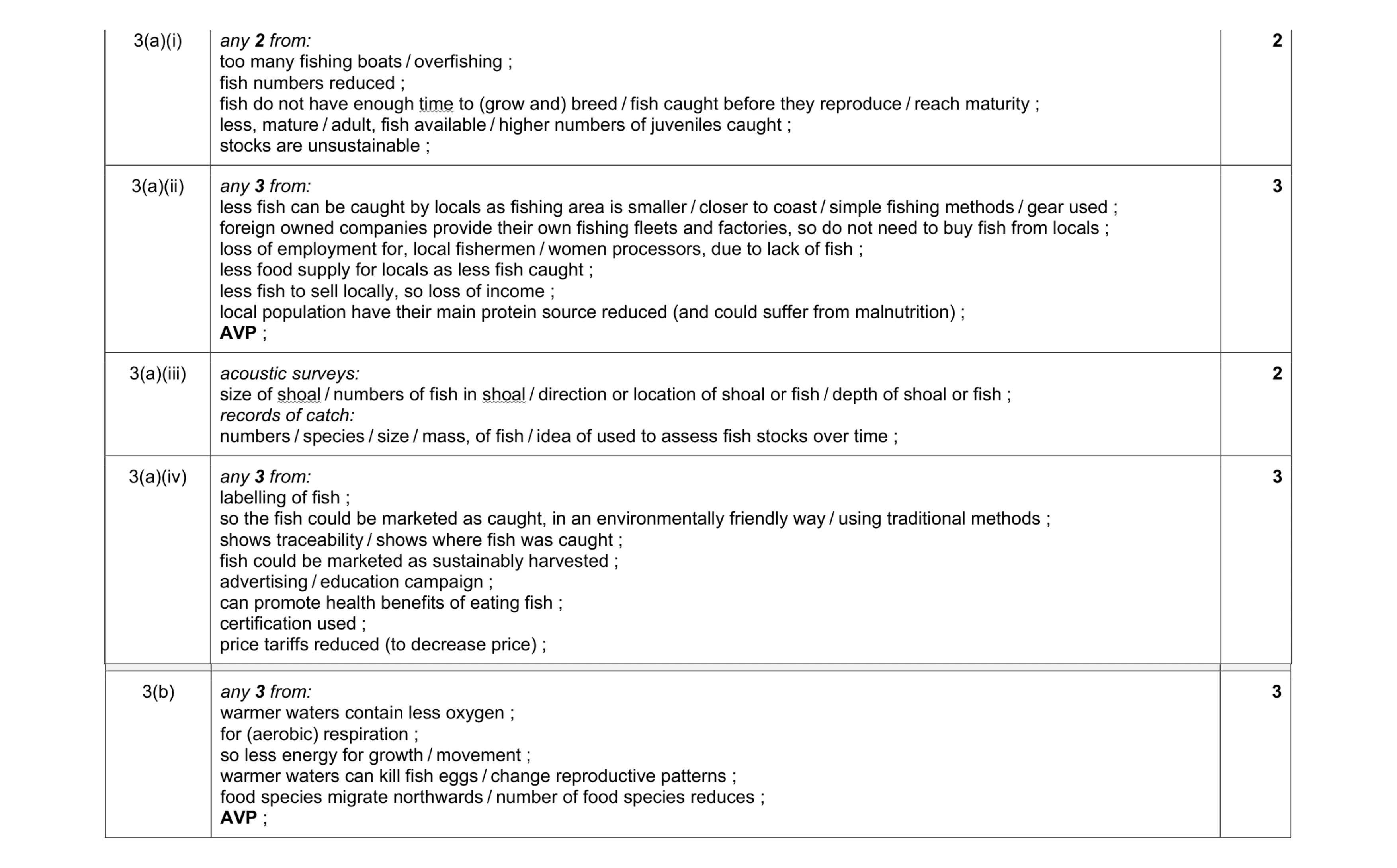 13
13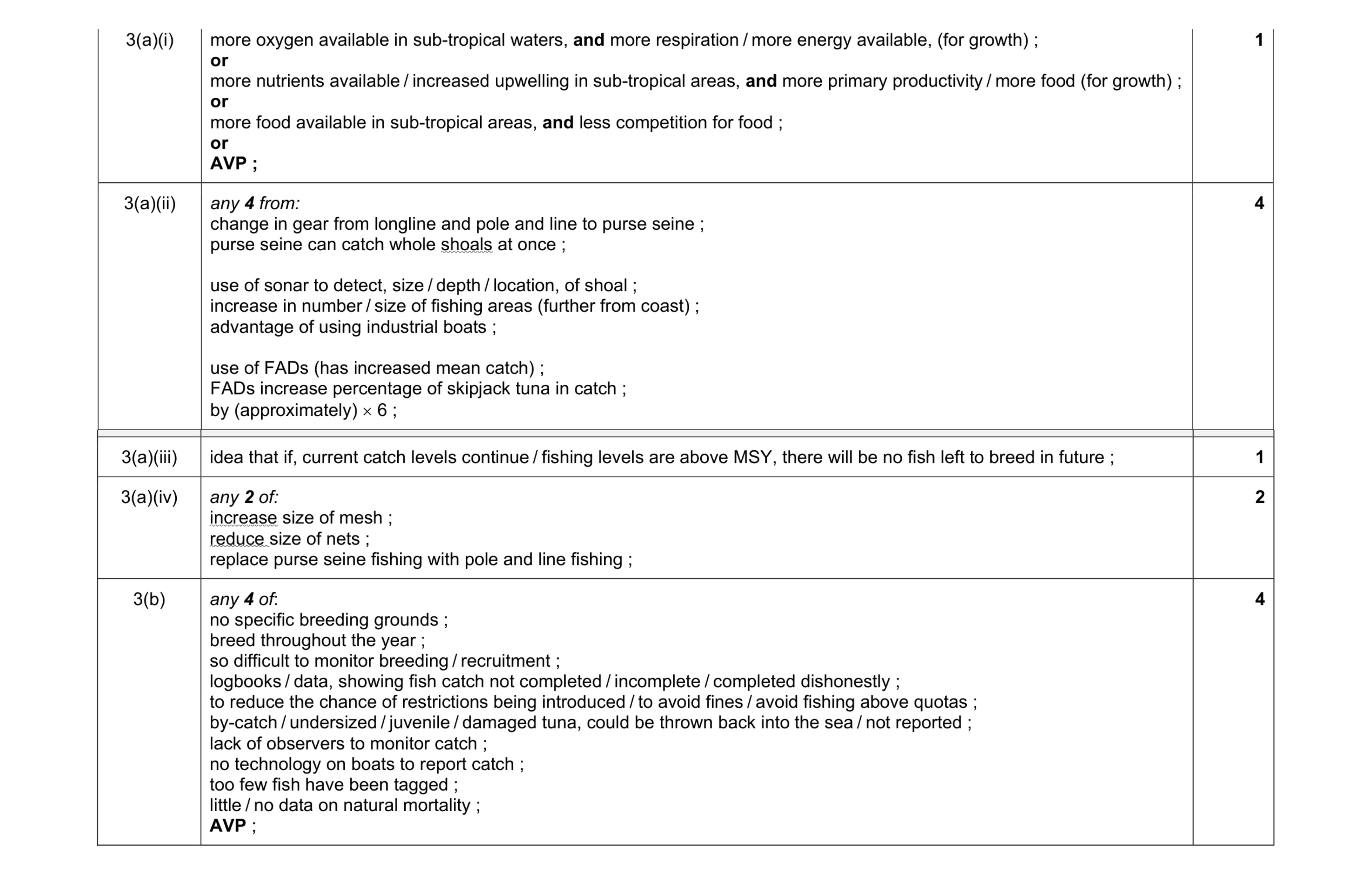 12
12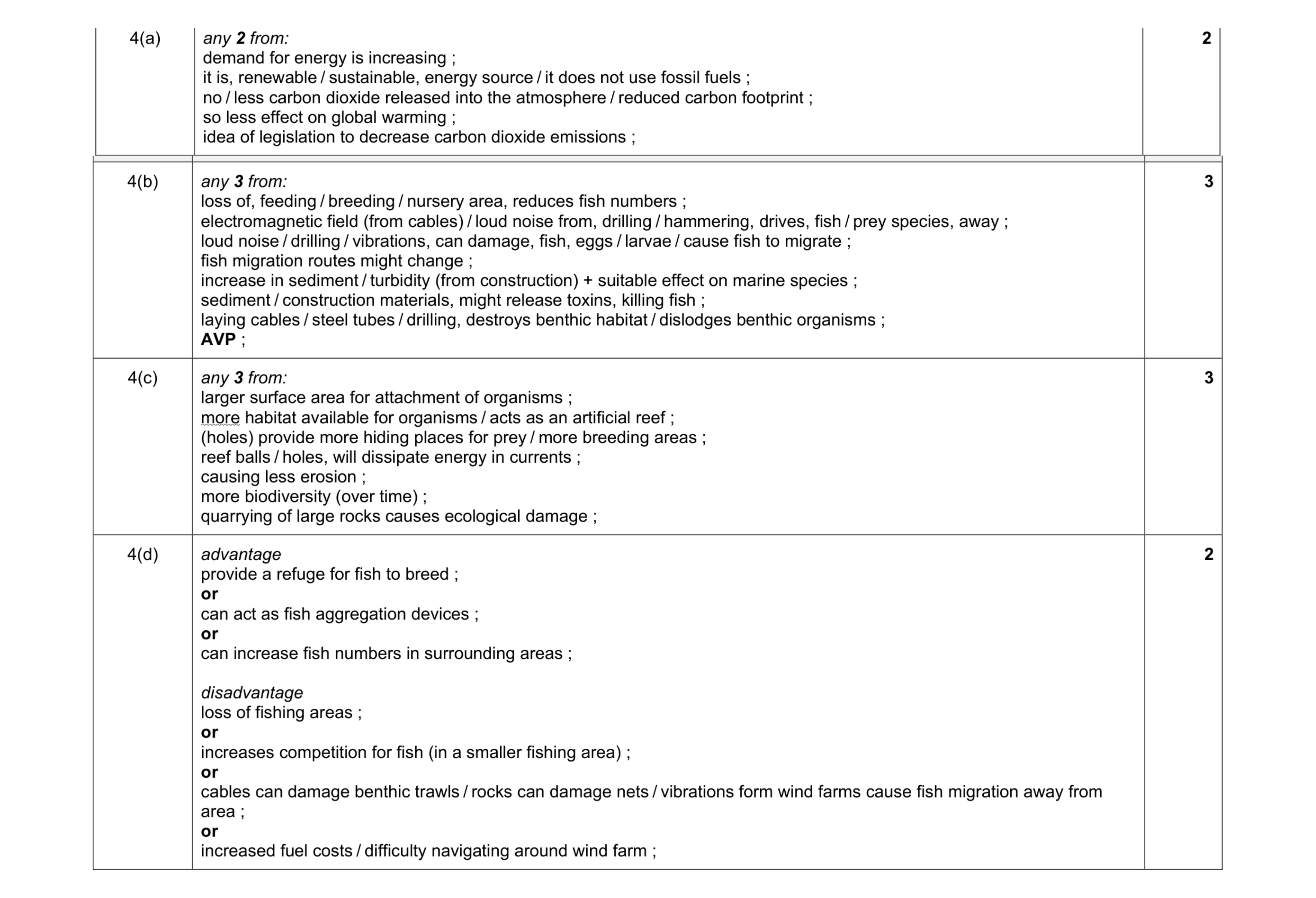 10
10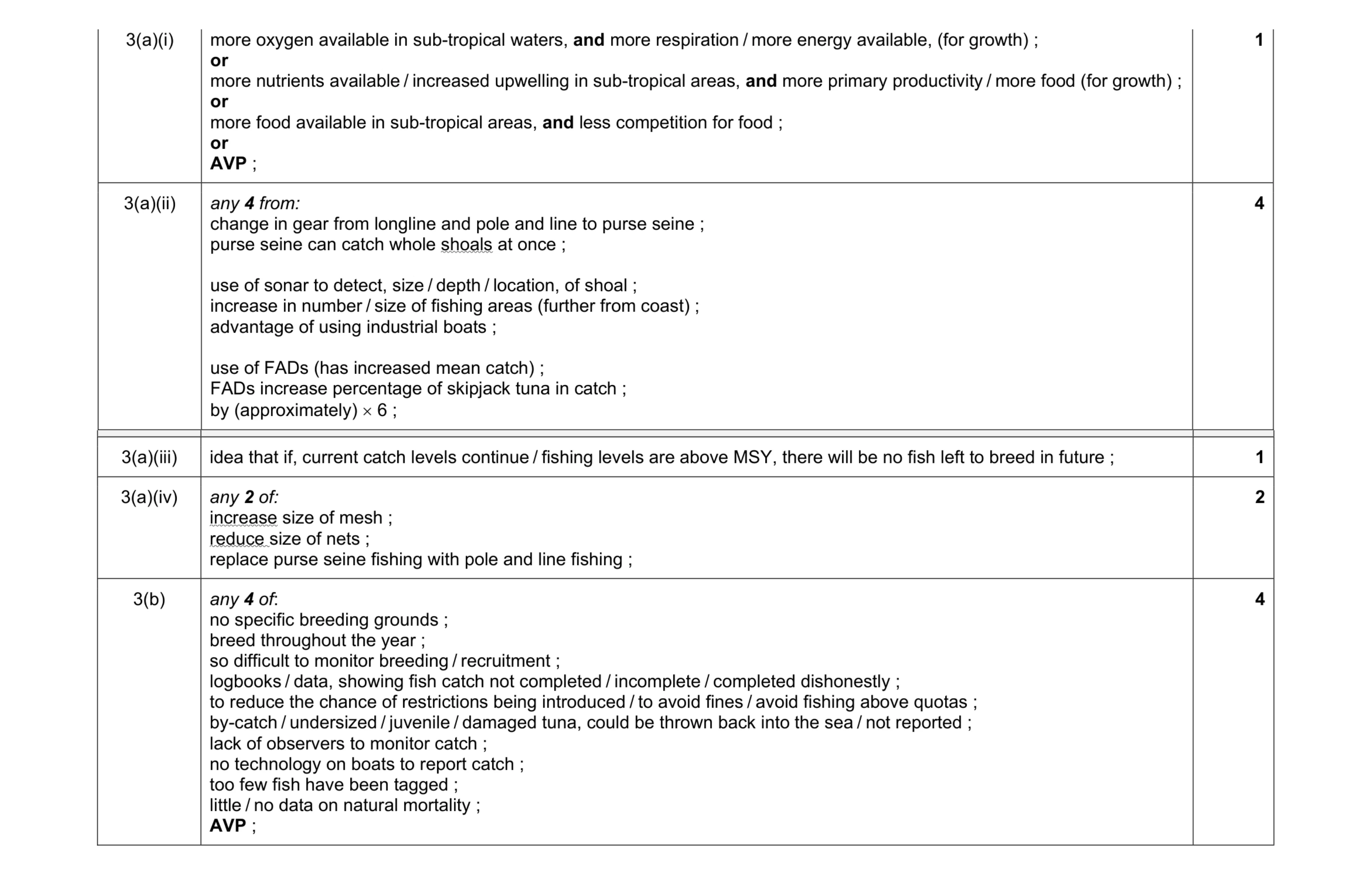 12
12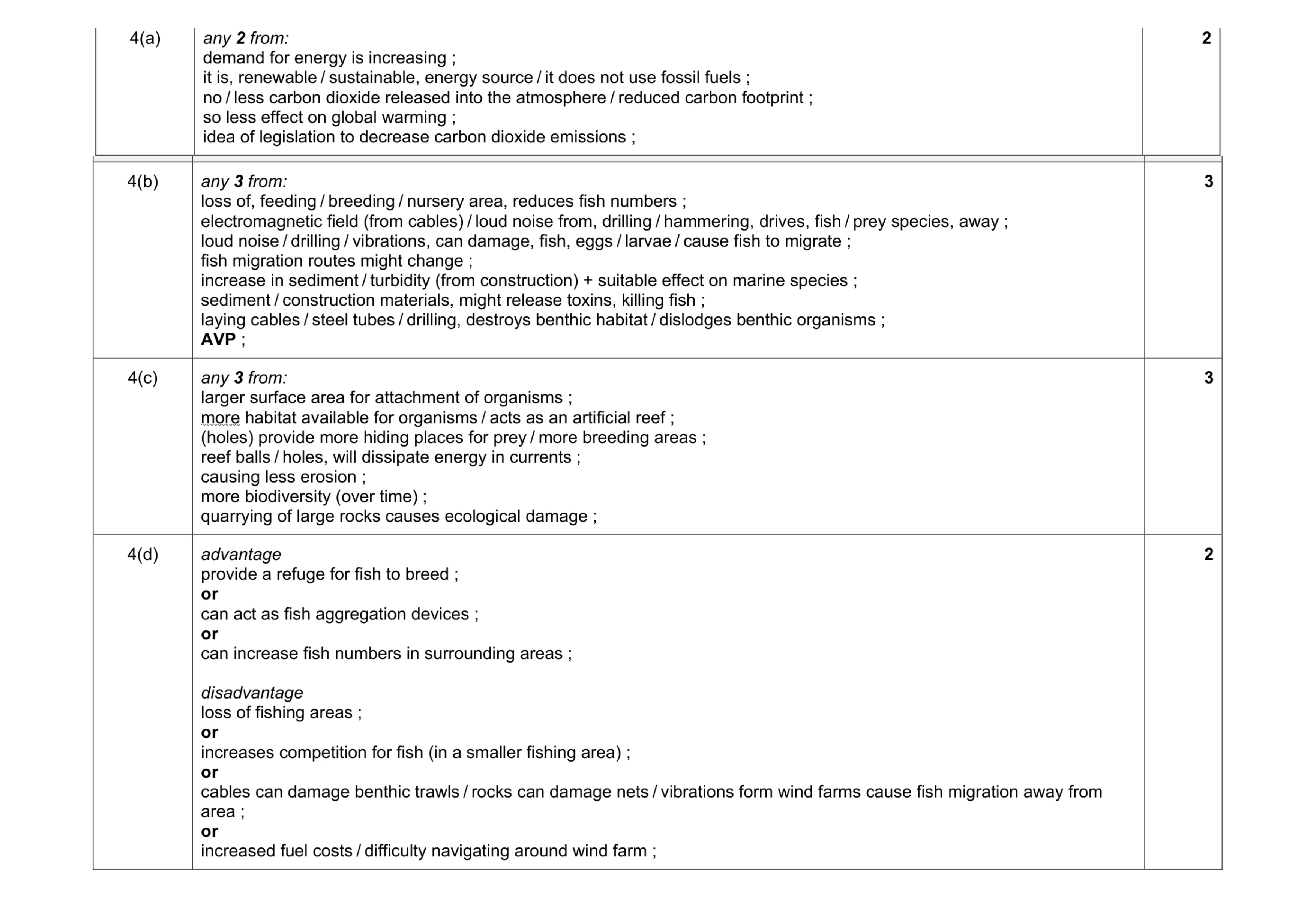 10
10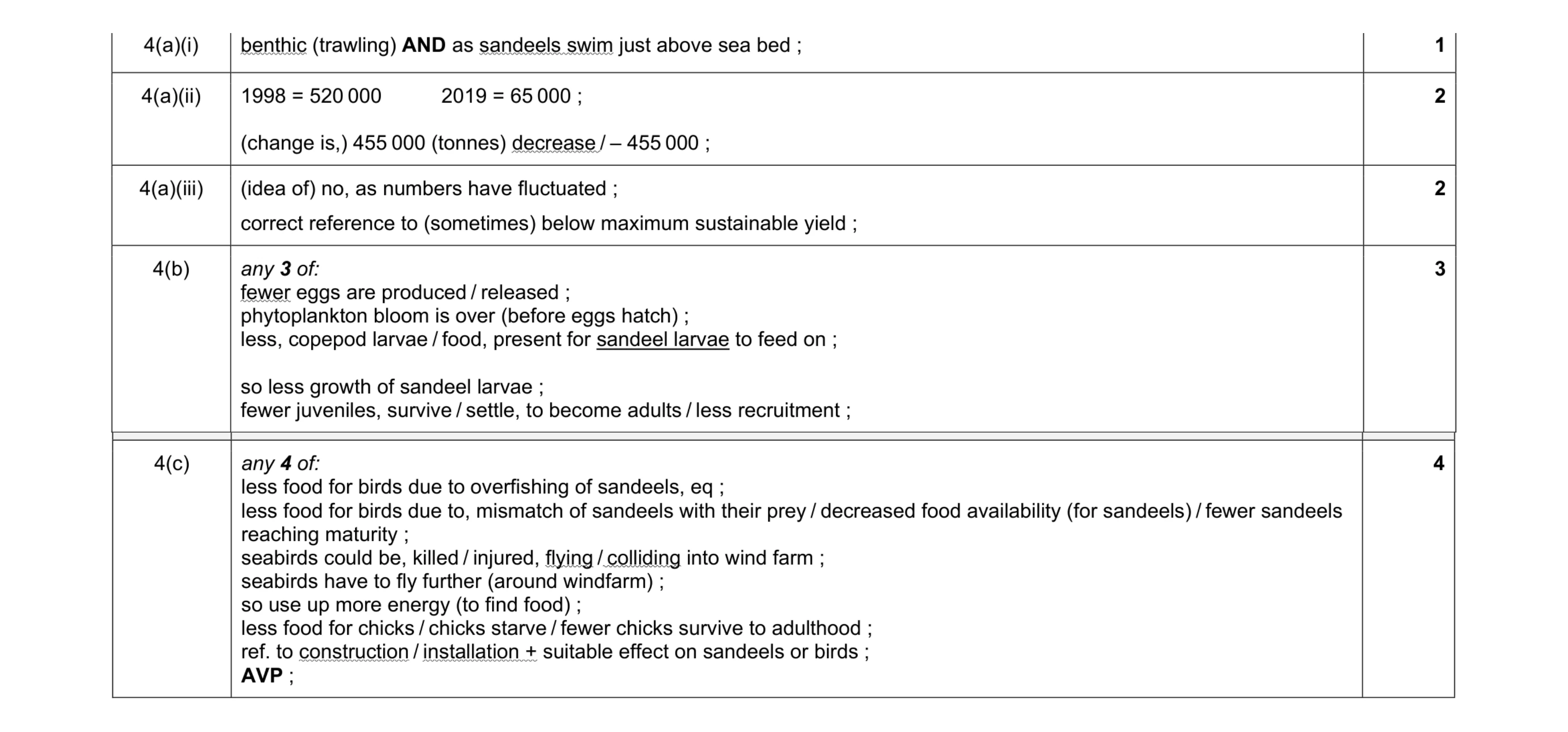 12
12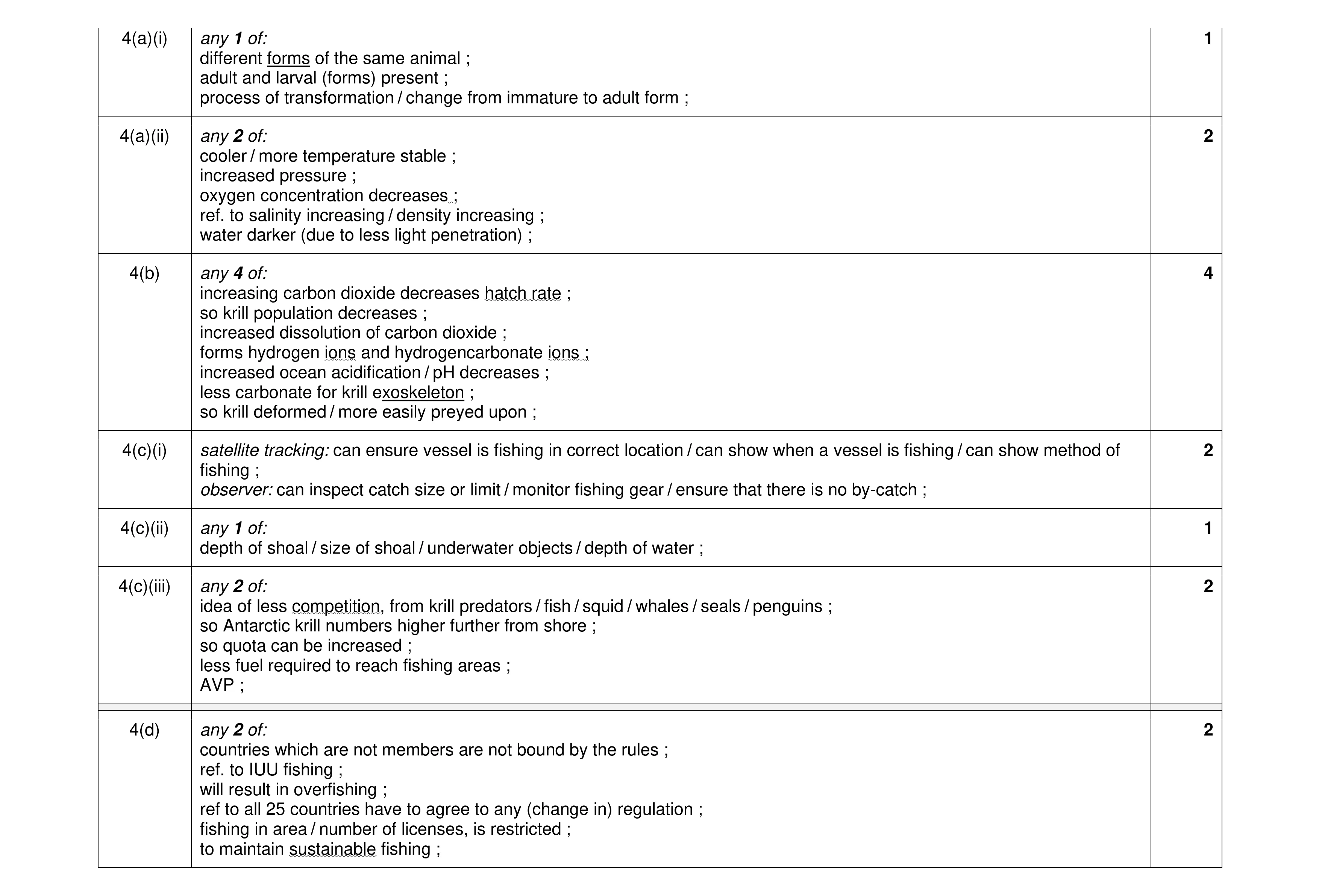 14
14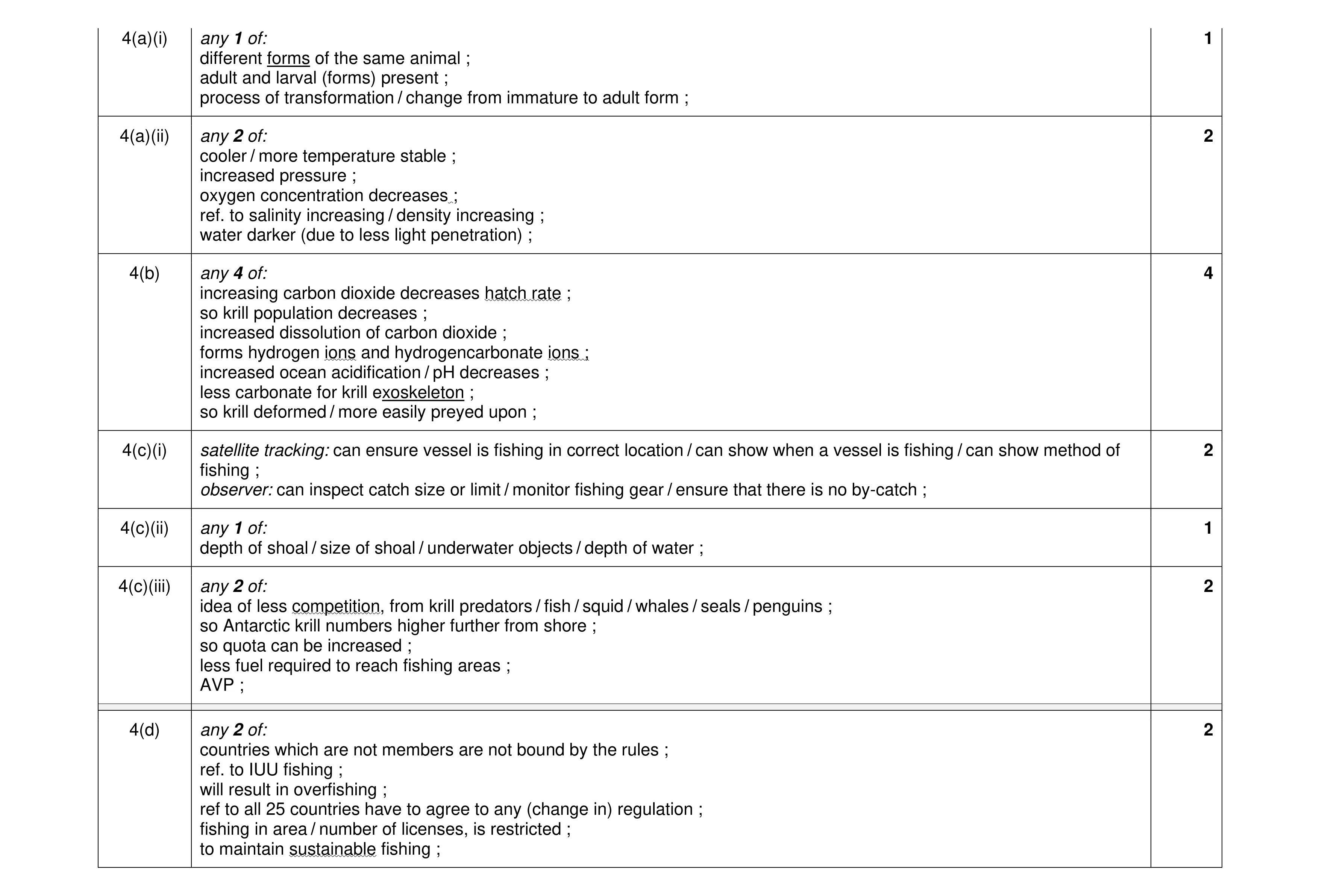 14
14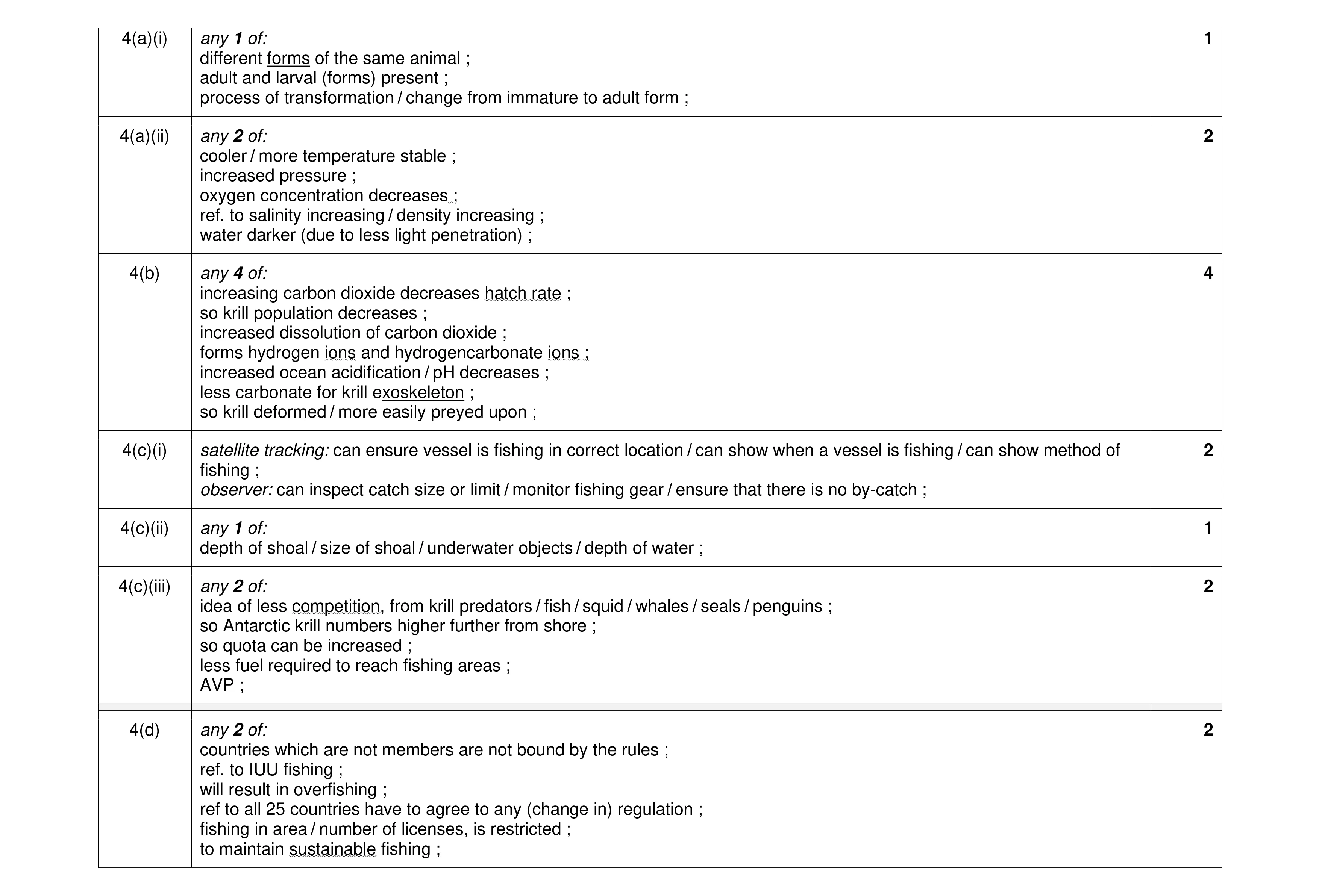 14
14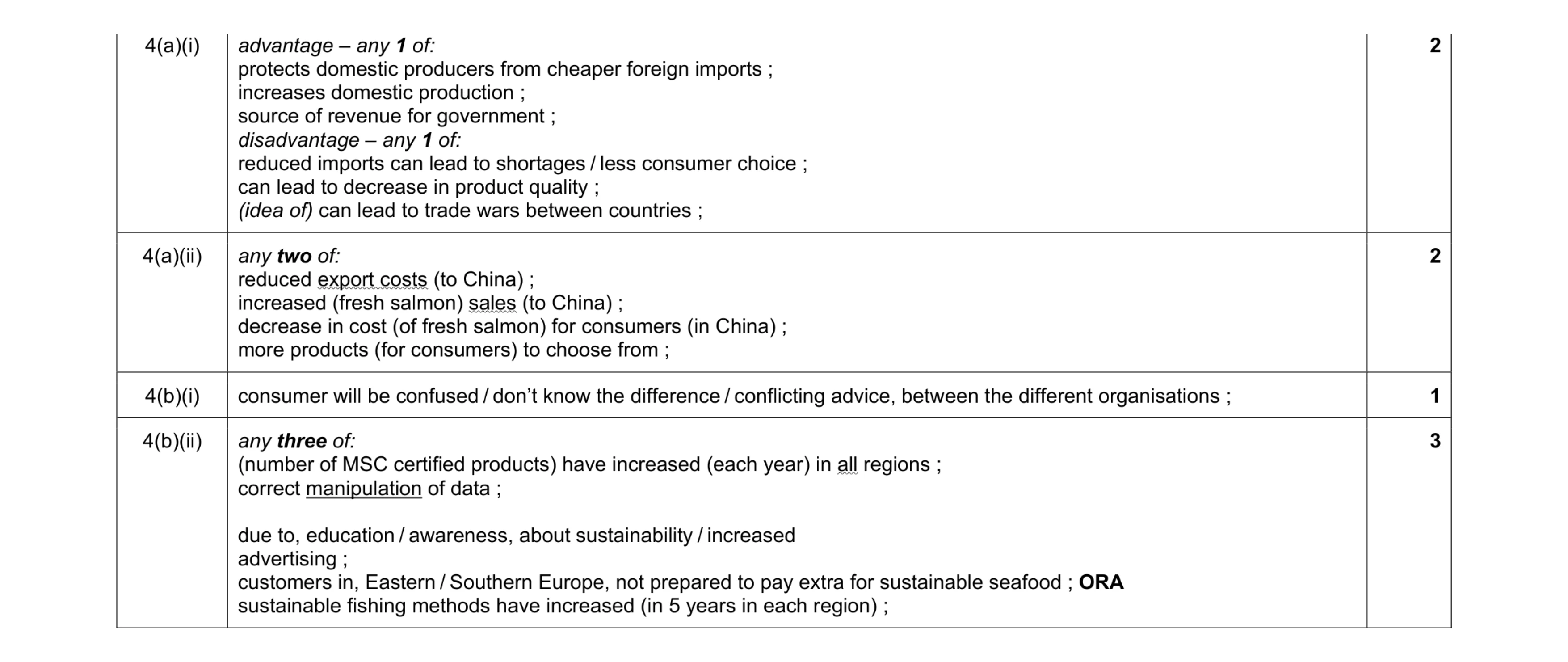 8
8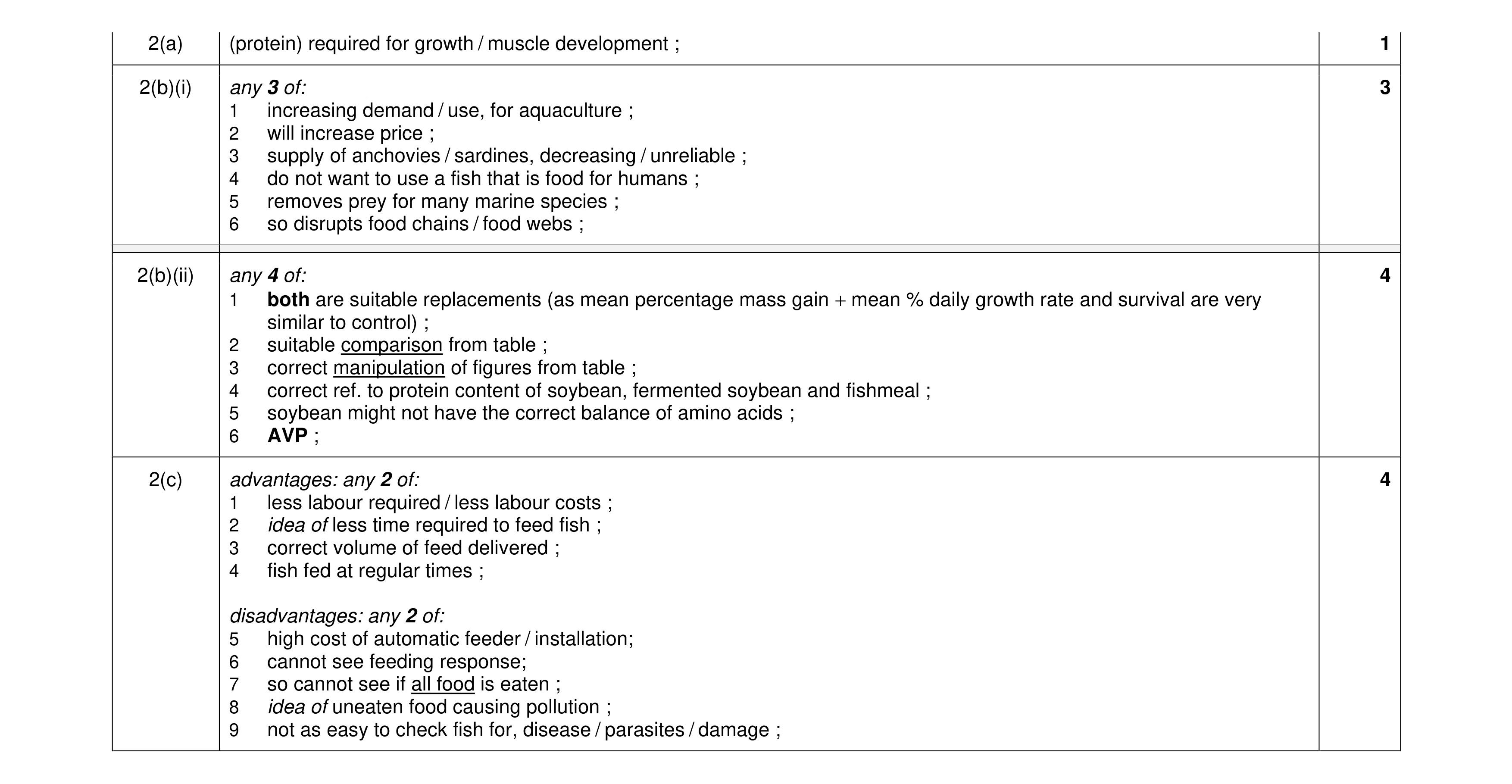 12
12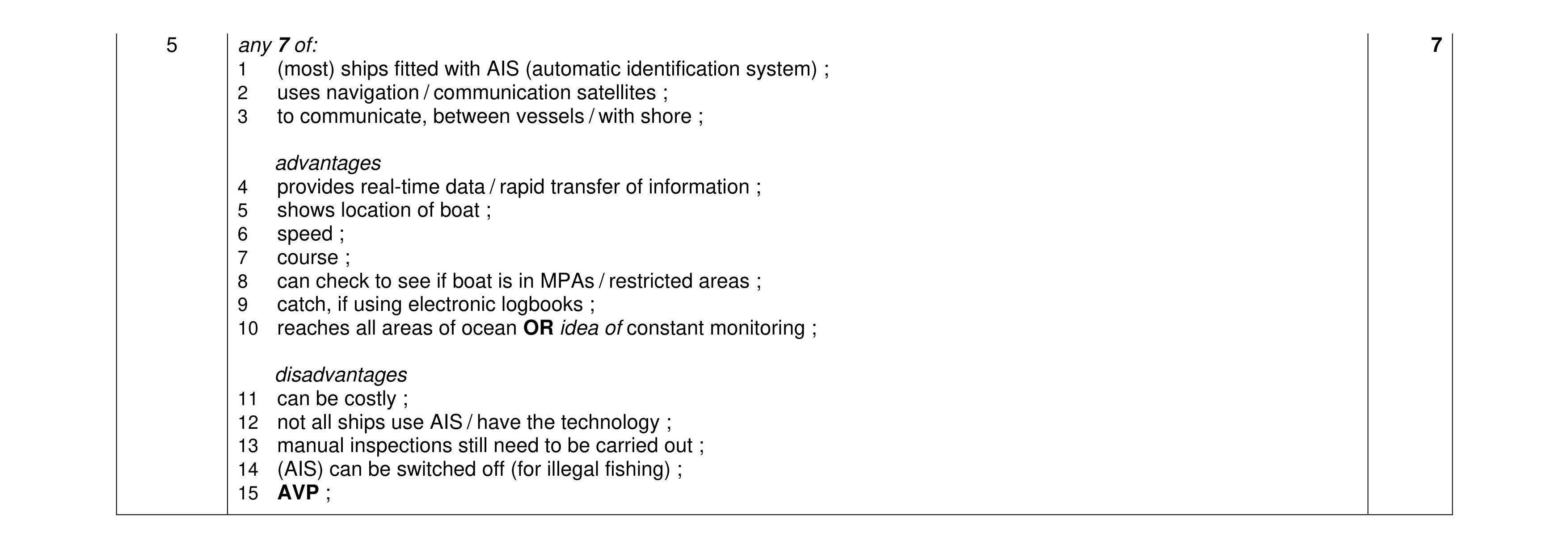 7
7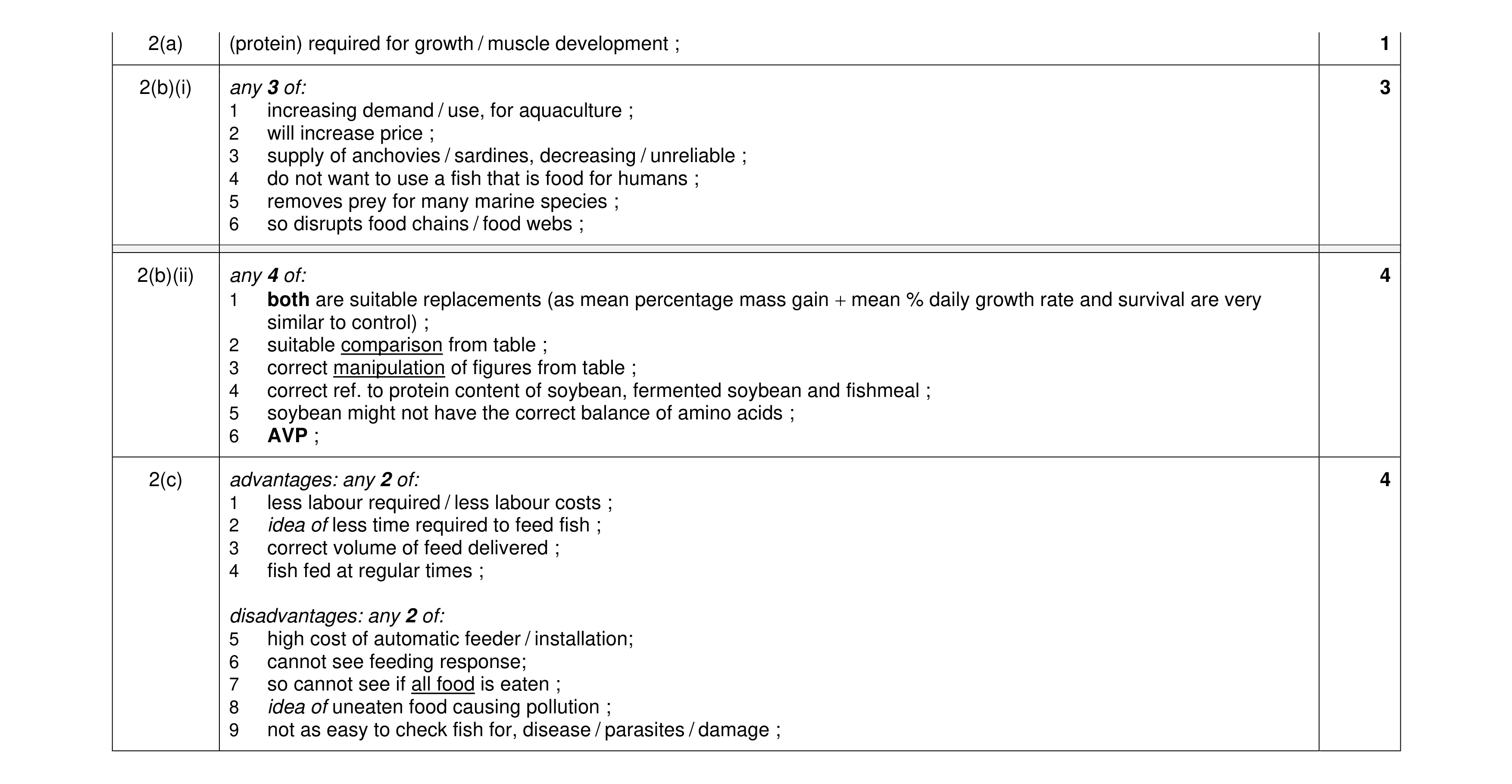 12
12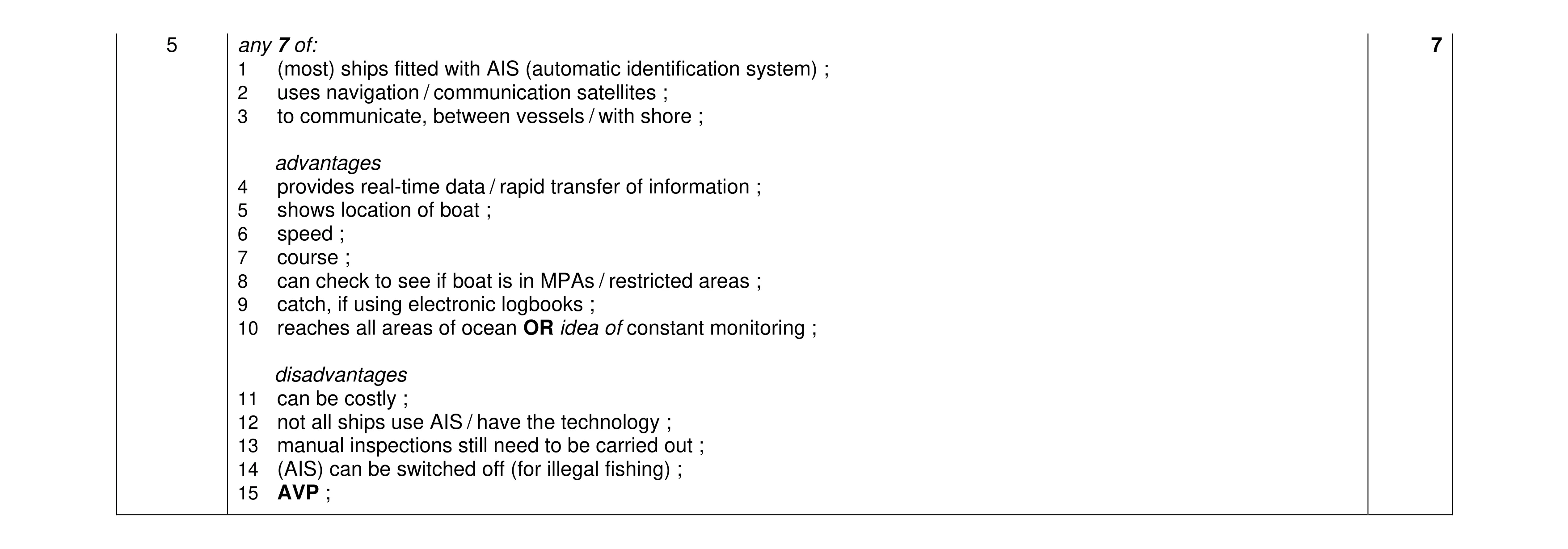 7
7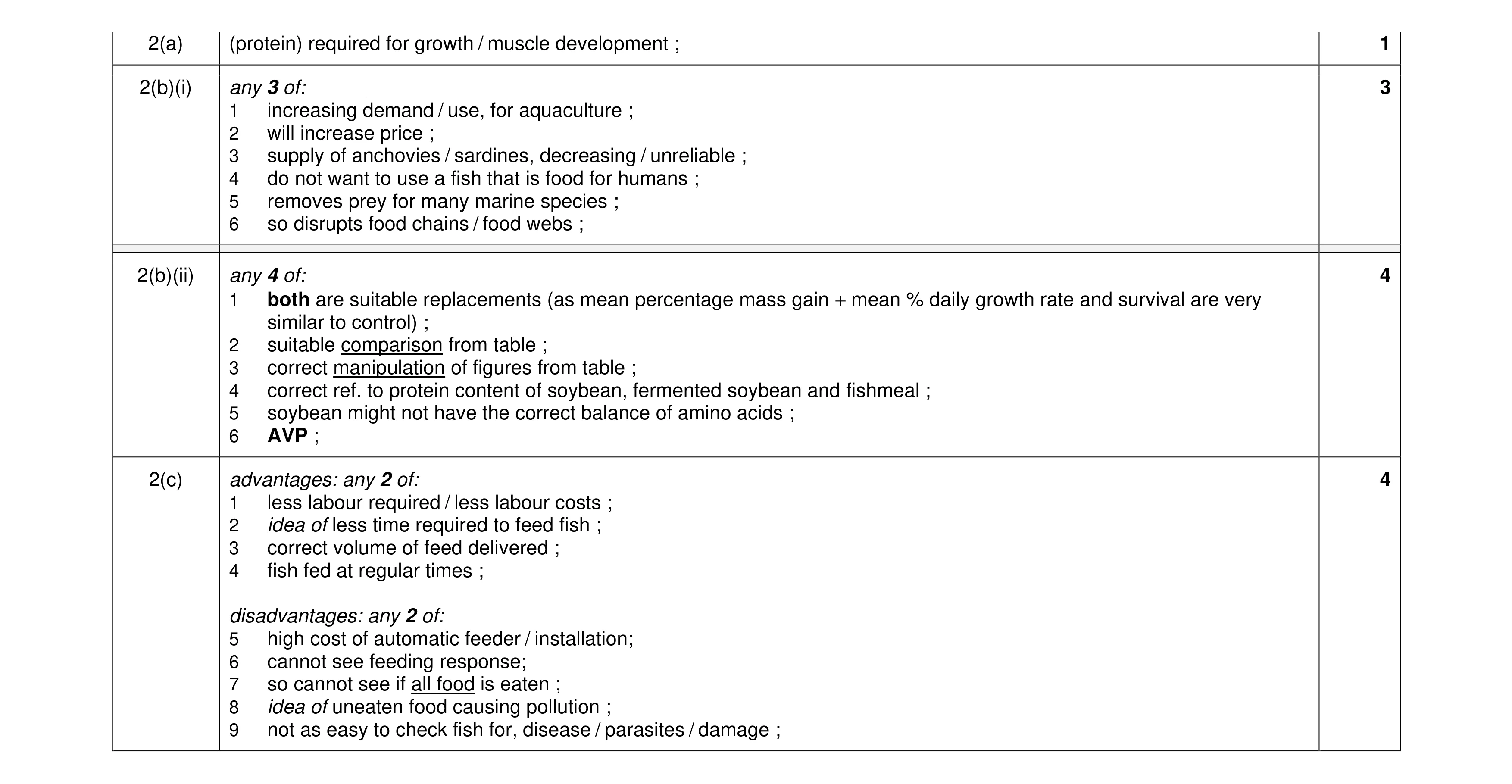 12
12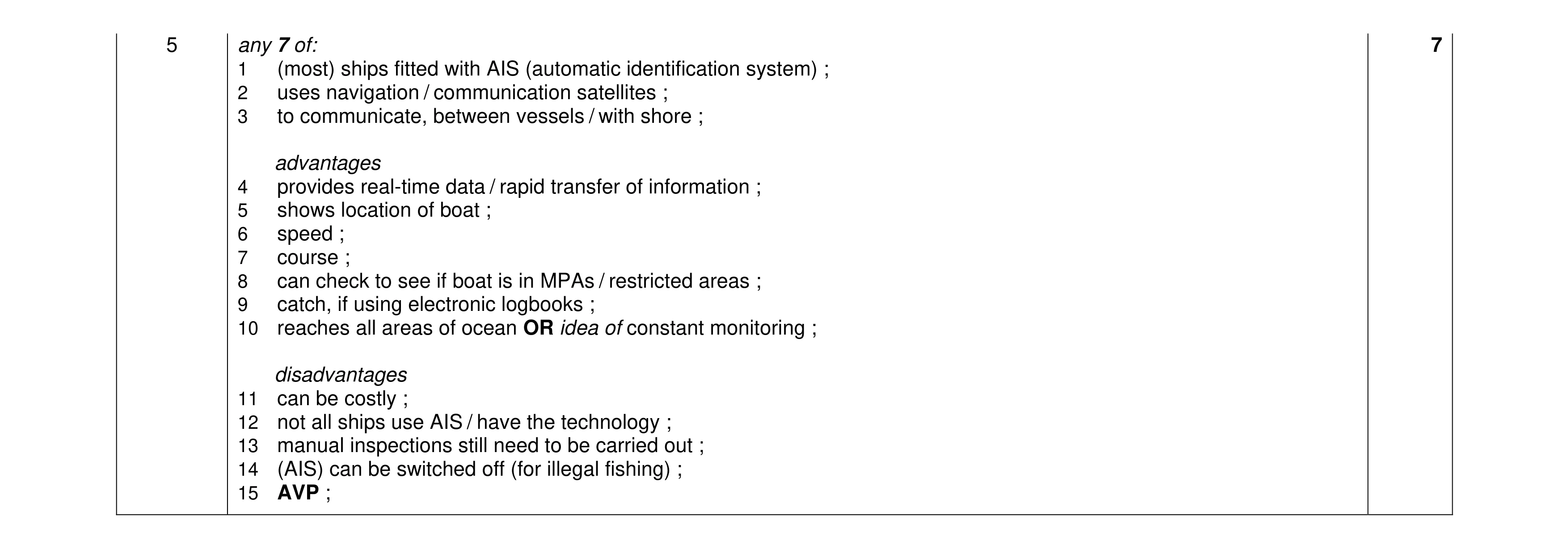 7
7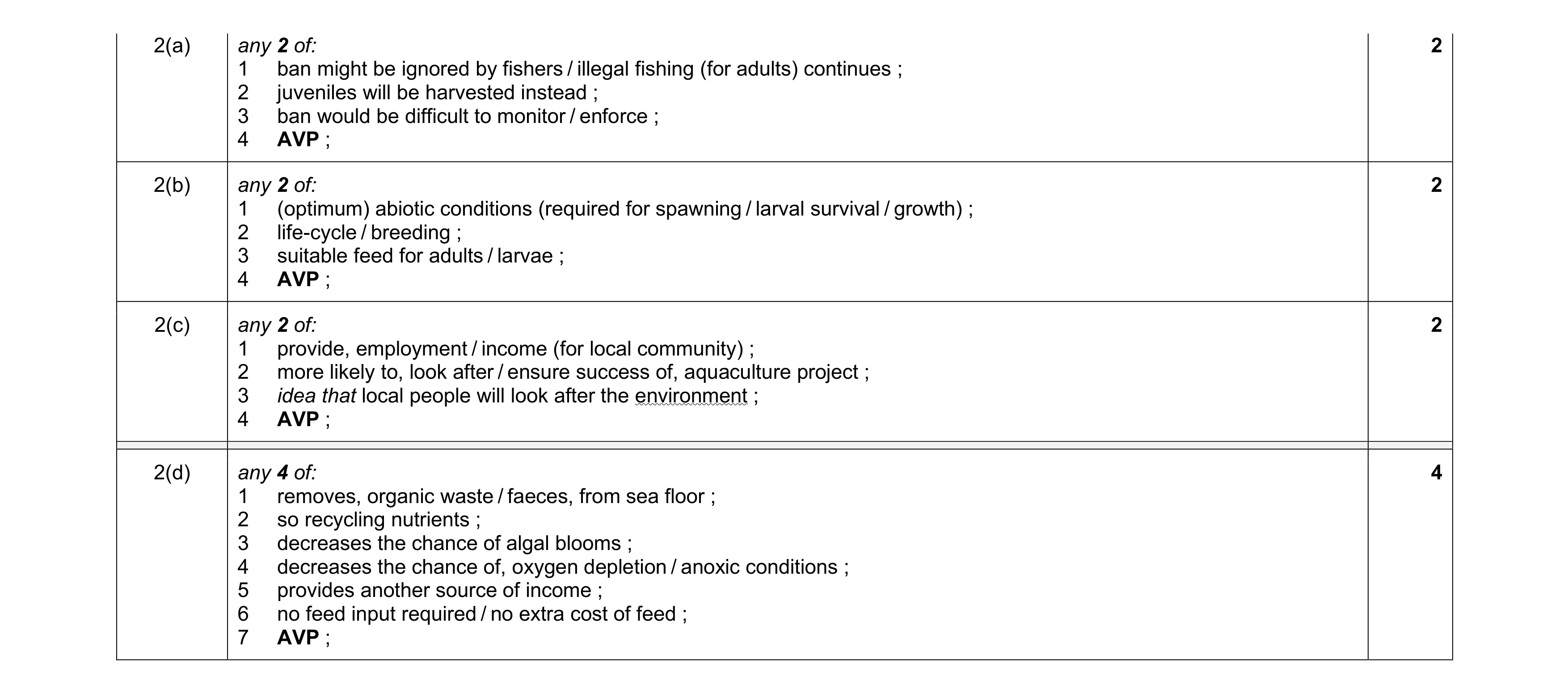 10
10 10
10 8
8 8
8 8
8