Questions as text
Q1 · A school orchestra is practising 0654/32 May/June 2017
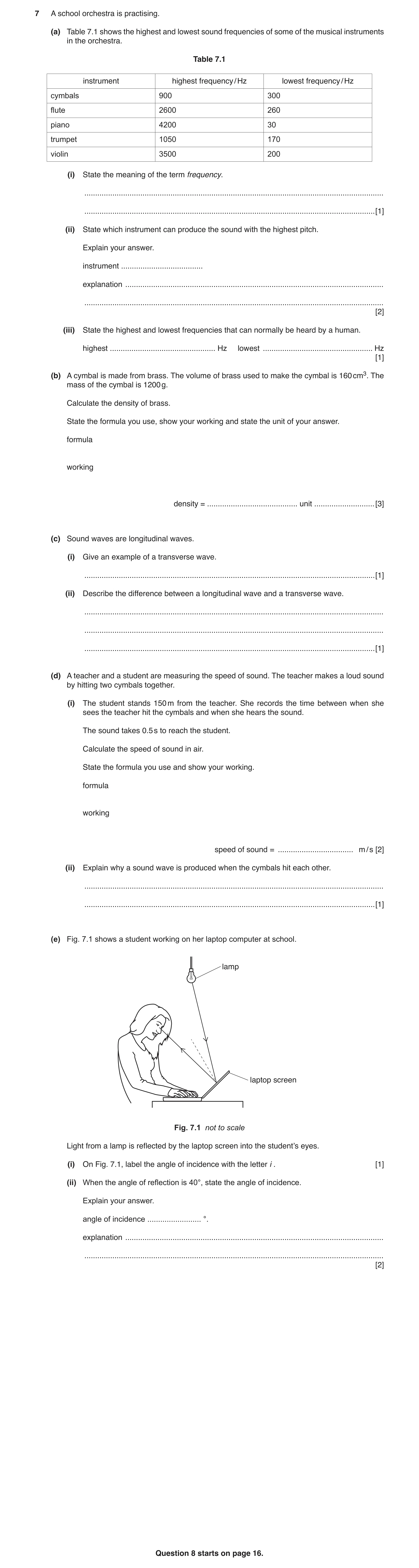
7 A school orchestra is practising. (a) Table 7.1 shows the highest and lowest sound frequencies of some of the musical instruments in the orchestra. Table 7.1 instrument highest frequency / Hz lowest frequency / Hz cymbals 900 300 flute 2600 260 piano 4200 30 trumpet 1050 170 violin 3500 200 (i) State the meaning of the term frequency. … … [1] (ii) State which instrument can produce the sound with the highest pitch. Explain your answer. instrument … explanation … … [2] (iii) State the highest and lowest frequencies that can normally be heard by a human. highest … Hz lowest … Hz [1] (b) A cymbal is made from brass. The volume of brass used to make the cymbal is 160 cm3. The mass of the cymbal is 1200 g. Calculate the density of brass. State the formula you use, show your working and state the unit of your answer. formula working density = … unit … [3] (c) Sound waves are longitudinal waves. (i) Give an example of a transverse wave. … [1] (ii) Describe the difference between a longitudinal wave and a transverse wave. … … … [1] (d) A teacher and a student are measuring the speed of sound. The teacher makes a loud sound by hitting two cymbals together. (i) The student stands 150 m from the teacher. She records the time between when she sees the teacher hit the cymbals and when she hears the sound. The sound takes 0.5 s to reach the student. Calculate the speed of sound in air. State the formula you use and show your working. formula working speed of sound = … m / s [2] (ii) Explain why a sound wave is produced when the cymbals hit each other. … … [1] (e) Fig. 7.1 shows a student working on her laptop computer at school. lamp laptop screen Fig. 7.1 not to scale Light from a lamp is reflected by the laptop screen into the student’s eyes. (i) On Fig. 7.1, label the angle of incidence with the letter i . [1] (ii) When the angle of reflection is 40°, state the angle of incidence. Explain your answer. angle of incidence … °. explanation … … [2] Question 8 starts on page 16.
15 marks
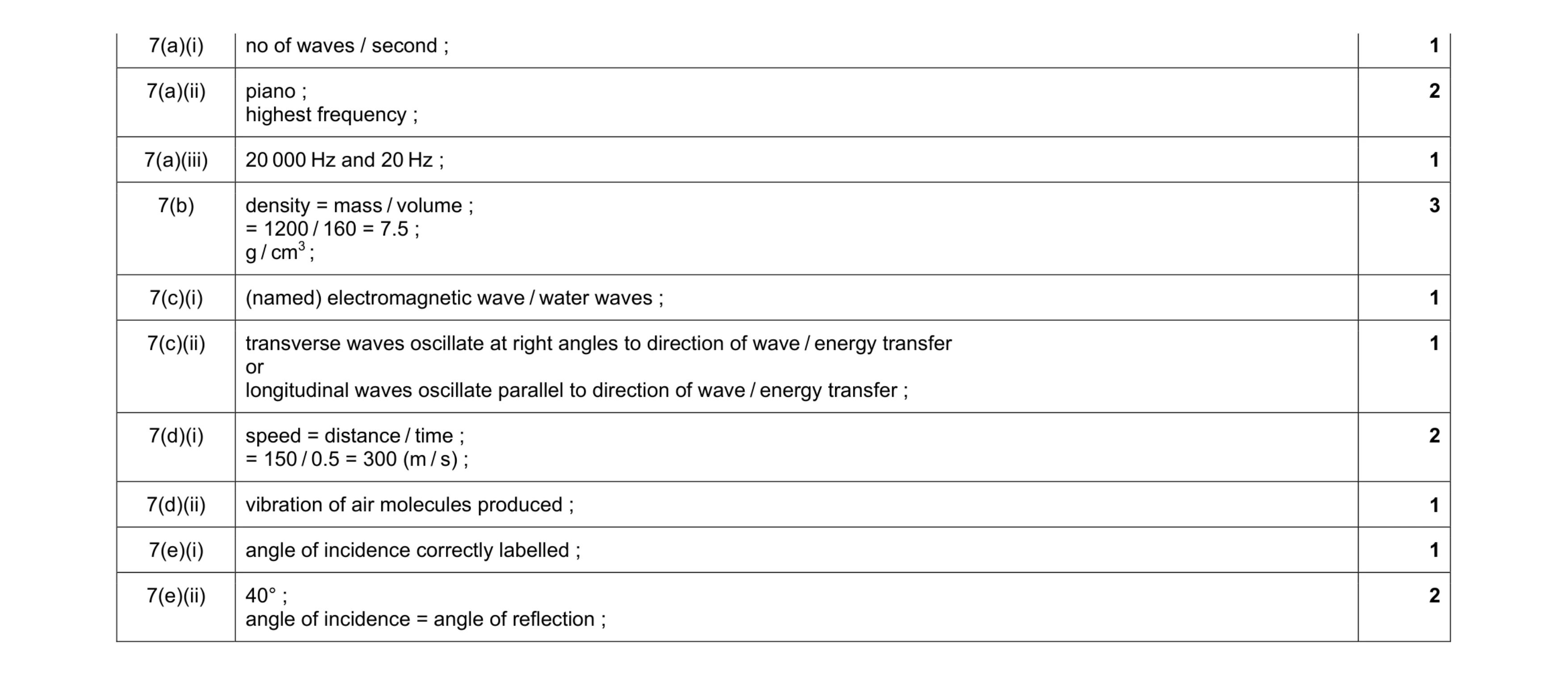
Mark scheme: 7(a)(i) no of waves / second ; 1 7(a)(ii) piano ; highest frequency ; 2 7(a)(iii) 20 000 Hz and 20 Hz ; 1 7(b) density = mass / volume ; = 1200 / 160 = 7.5 ; g / cm3 ; 3 7(c)(i) (named) electromagnetic wave / water waves ; 1 7(c)(ii) transverse waves oscillate at right angles to direction of wave / energy transfer or longitudinal waves oscillate parallel to direction of wave / energy transfer ; 1 7(d)(i) speed = distance / time ; = 150 / 0.5 = 300 (m / s) ; 2 7(d)(ii) vibration of air molecules produced ; 1 7(e)(i) angle of incidence correctly labelled ; 1 7(e)(ii) 40° ; angle of incidence = angle of reflection ; 2
This question in 0654/32 May/June 2017
Q2 · Four swimmers are competing at a swimming pool 0654/31 Oct/Nov 2017
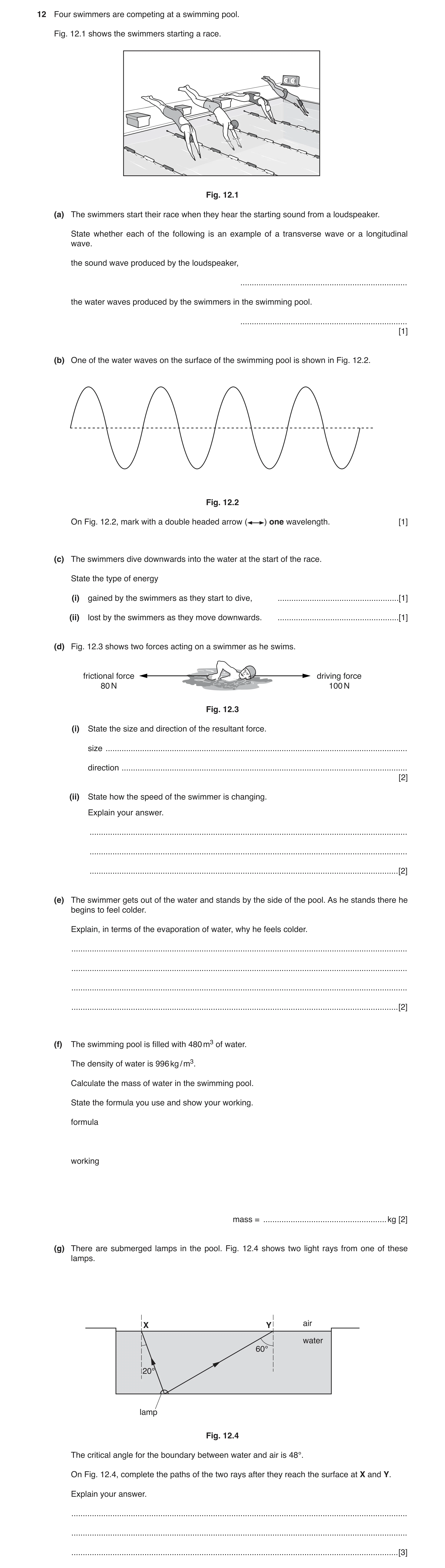
12 Four swimmers are competing at a swimming pool. Fig. 12.1 shows the swimmers starting a race. Fig. 12.1 (a) The swimmers start their race when they hear the starting sound from a loudspeaker. State whether each of the following is an example of a transverse wave or a longitudinal wave. the sound wave produced by the loudspeaker, … the water waves produced by the swimmers in the swimming pool. … [1] (b) One of the water waves on the surface of the swimming pool is shown in Fig. 12.2. Fig. 12.2 On Fig. 12.2, mark with a double headed arrow ( ) one wavelength. [1] (c) The swimmers dive downwards into the water at the start of the race. State the type of energy (i) gained by the swimmers as they start to dive, … [1] (ii) lost by the swimmers as they move downwards. … [1] (d) Fig. 12.3 shows two forces acting on a swimmer as he swims. frictional force driving force 80 N 100 N Fig. 12.3 (i) State the size and direction of the resultant force. size … direction … [2] (ii) State how the speed of the swimmer is changing. Explain your answer. … … … [2] (e) The swimmer gets out of the water and stands by the side of the pool. As he stands there he begins to feel colder. Explain, in terms of the evaporation of water, why he feels colder. … … … … [2] (f) The swimming pool is filled with 480 m3 of water. The density of water is 996 kg / m3. Calculate the mass of water in the swimming pool. State the formula you use and show your working. formula working mass = … kg [2] (g) There are submerged lamps in the pool. Fig. 12.4 shows two light rays from one of these lamps. X Y air water 60° 20° lamp Fig. 12.4 The critical angle for the boundary between water and air is 48°. On Fig. 12.4, complete the paths of the two rays after they reach the surface at X and Y. Explain your answer. … … … [3]
15 marks
Mark scheme: 12(a) sound wave – longitudinal water wave – transverse ; 1 12(b) double headed arrow showing distance between two identical points on two consecutive waves ; 1 12(c)(i) kinetic (energy) ; 1 12(c)(ii) (gravitational) potential (energy) ; 1 12(d)(i) 20 (N) ; forwards / to the right ; 2 Question Answer Marks 12(d)(ii) the swimmers speed increases / acceleration ; resultant force / unbalanced force in direction of motion / to right ; 2 12(e) energy transferred to particles from surroundings (body) ; fastest molecules escape ; average energy of the rest of particles reduced / thermal energy removed from liquid ; max 2 12(f) mass = density × volume or 996 × 480 ; 478 080 (kg) ; 2 12(g) at Y reflection only is shown ; at X refraction (and reflection is shown) ; total internal reflection occurs when angle of incidence exceeds critical angle / angle of incidence = angle of reflection for reflection / refraction away from normal going from denser to less dense medium ; 3
This question in 0654/31 Oct/Nov 2017
Q3 · A boy rides his bicycle along a straight level road 0654/32 Oct/Nov 2017
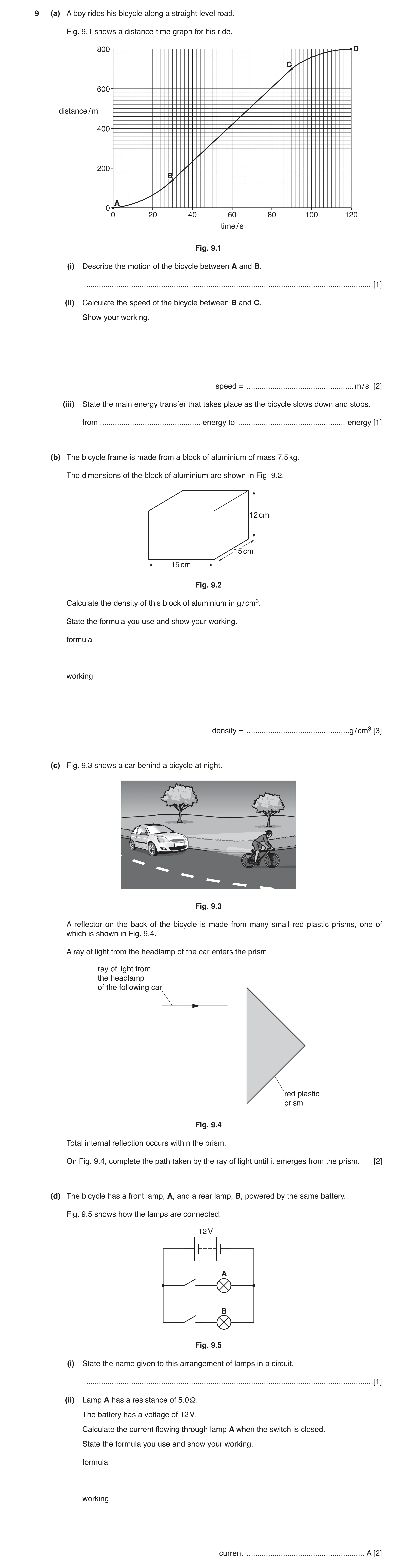
9 (a) A boy rides his bicycle along a straight level road. Fig. 9.1 shows a distance-time graph for his ride. 800 D CC 600 distance / m 400 200 B A 0 0 20 40 60 80 100 120 time / s Fig. 9.1 (i) Describe the motion of the bicycle between A and B. … [1] (ii) Calculate the speed of the bicycle between B and C. Show your working. speed = … m / s [2] (iii) State the main energy transfer that takes place as the bicycle slows down and stops. from … energy to … energy [1] (b) The bicycle frame is made from a block of aluminium of mass 7.5 kg. The dimensions of the block of aluminium are shown in Fig. 9.2. 12 cm 15 cm 15 cm Fig. 9.2 Calculate the density of this block of aluminium in g / cm3. State the formula you use and show your working. formula working density = … g / cm3 [3] (c) Fig. 9.3 shows a car behind a bicycle at night. Fig. 9.3 A reflector on the back of the bicycle is made from many small red plastic prisms, one of which is shown in Fig. 9.4. A ray of light from the headlamp of the car enters the prism. ray of light from the headlamp of the following car red plastic prism Fig. 9.4 Total internal reflection occurs within the prism. On Fig. 9.4, complete the path taken by the ray of light until it emerges from the prism. [2] (d) The bicycle has a front lamp, A, and a rear lamp, B, powered by the same battery. Fig. 9.5 shows how the lamps are connected. 12 V A B Fig. 9.5 (i) State the name given to this arrangement of lamps in a circuit. … [1] (ii) Lamp A has a resistance of 5.0 Ω. The battery has a voltage of 12 V. Calculate the current flowing through lamp A when the switch is closed. State the formula you use and show your working. formula working current … A [2]
12 marks
Mark scheme: 9(a)(i) accelerating / increasing speed ; 1 9(a)(ii) speed = distance / time / = 560 / 60 ; = 9.33 (m / s) ; 2 9(a)(iii) kinetic energy to thermal / sound ; 1 9(b) volume = 15 × 15 × 12 / = 2700 cm3 ; density = mass/volume or 7500 / 2700 ; = 2.78 (g / cm3) ; 3 9(c) first reflection ; second reflection parallel to incident ray ; 2 9(d)(i) Parallel ; 1 9(d)(ii) I = V / R or 12 / 5 ; = 2.4 (A) ; 2
This question in 0654/32 Oct/Nov 2017
Q4 · A list of materials is shown 0654/31 Oct/Nov 2018
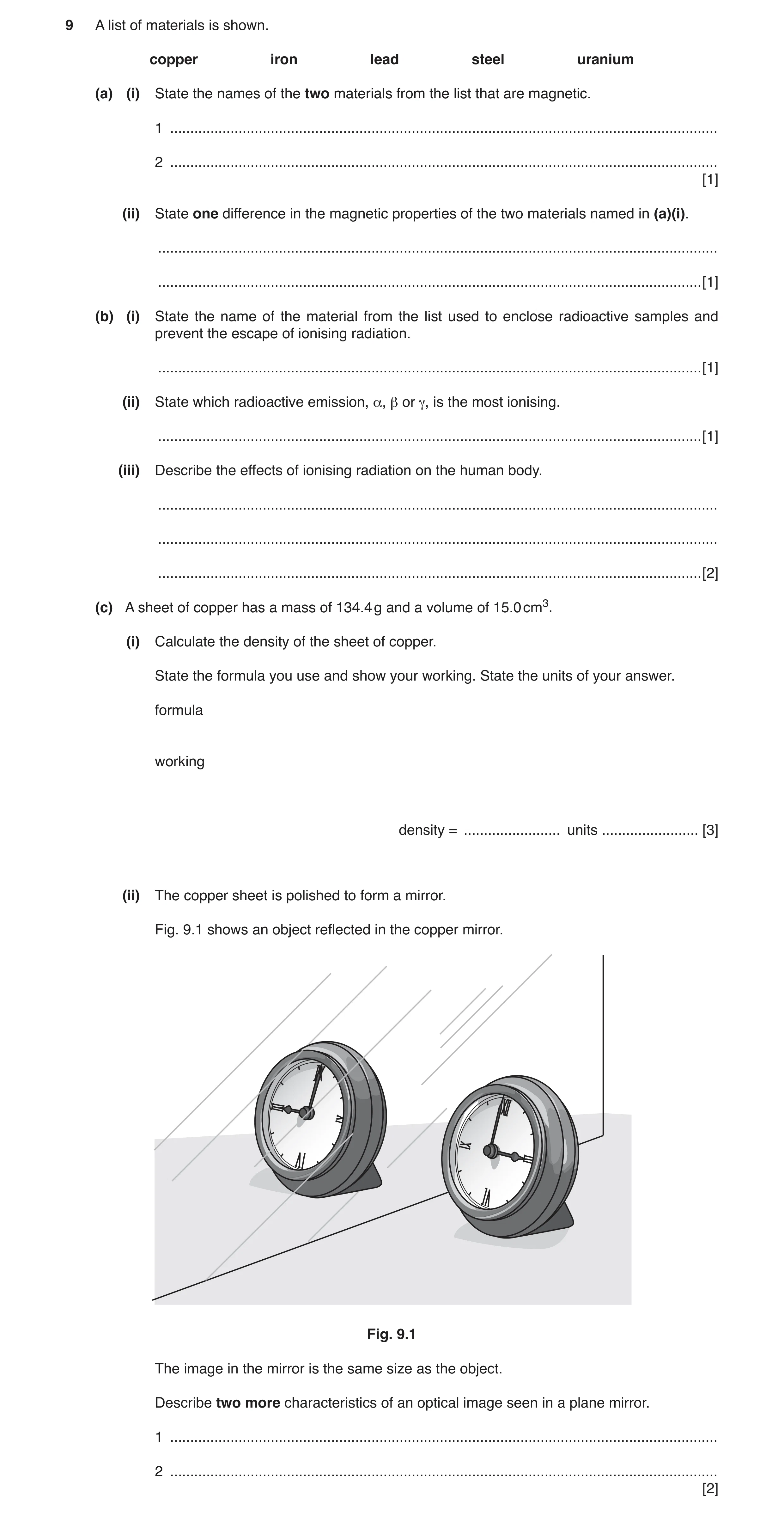
9 A list of materials is shown. copper iron lead steel uranium (a) (i) State the names of the two materials from the list that are magnetic. 1 … 2 … [1] (ii) State one difference in the magnetic properties of the two materials named in (a)(i). … … [1] (b) (i) State the name of the material from the list used to enclose radioactive samples and prevent the escape of ionising radiation. … [1] (ii) State which radioactive emission, α, β or γ, is the most ionising. … [1] (iii) Describe the effects of ionising radiation on the human body. … … … [2] (c) A sheet of copper has a mass of 134.4 g and a volume of 15.0 cm3. (i) Calculate the density of the sheet of copper. State the formula you use and show your working. State the units of your answer. formula working density = … units … [3] (ii) The copper sheet is polished to form a mirror. Fig. 9.1 shows an object reflected in the copper mirror. Fig. 9.1 The image in the mirror is the same size as the object. Describe two more characteristics of an optical image seen in a plane mirror. 1 … 2 … [2]
11 marks
Mark scheme: 9(a)(i) iron and steel ; 1 9(a)(ii) iron magnetises quicker / iron loses magnetism quicker ; 1 9(b)(i) lead ; 1 9(b)(ii) alpha ; 1 9(b)(ii) damages / mutates cells ; cancer ; radiation burns ; max 2 9(c)(i) density = mass / volume or 134.4 / 15.0 ; = 8.96 ; g / cm3 ; 3 9(c)(ii) upright ; laterally inverted ; 2
This question in 0654/31 Oct/Nov 2018
Q5 · The audible frequency range of four animals 0654/33 Oct/Nov 2018
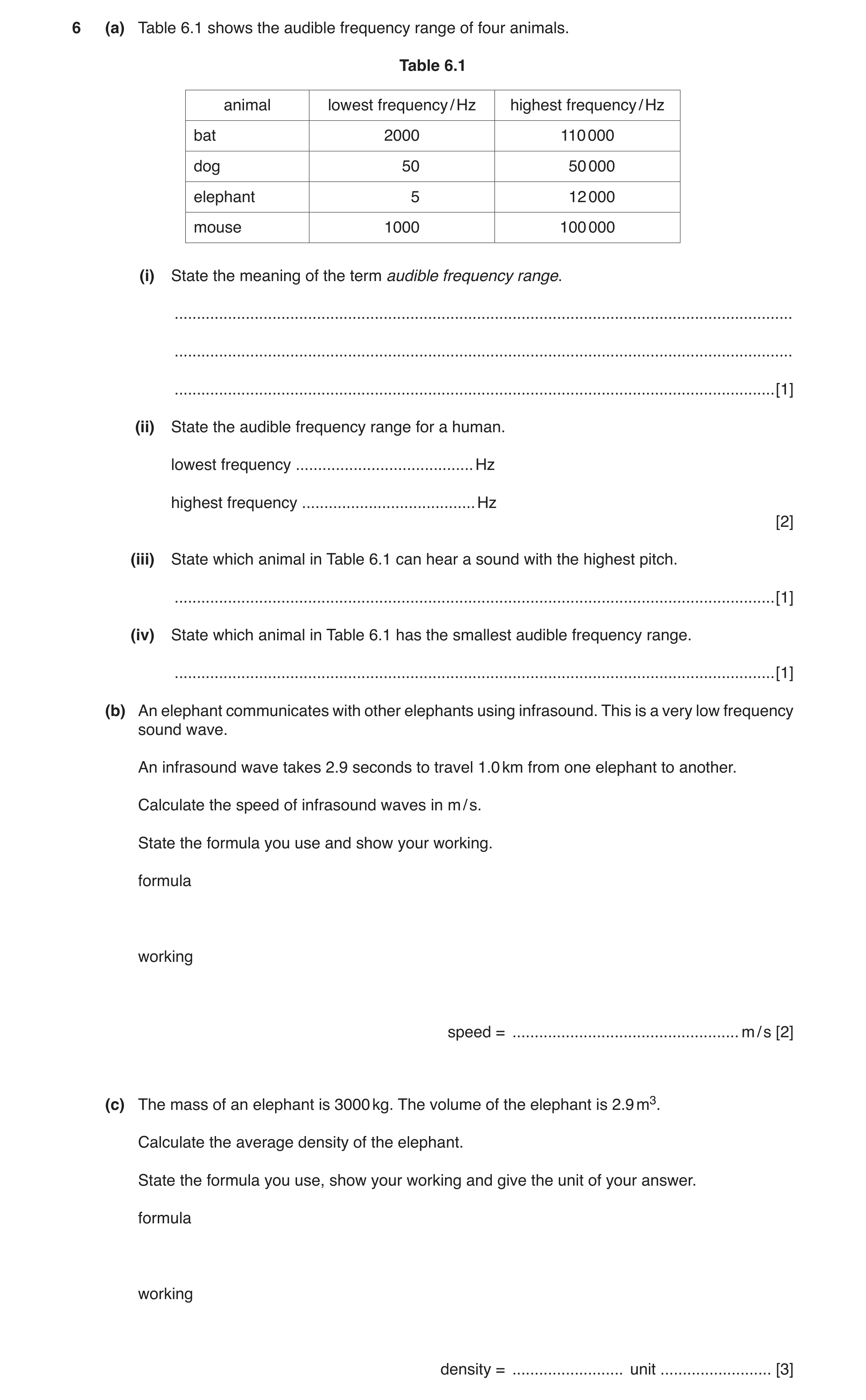
6 (a) Table 6.1 shows the audible frequency range of four animals. Table 6.1 animal lowest frequency / Hz highest frequency / Hz bat 2000 110 000 dog 50 50 000 elephant 5 12 000 mouse 1000 100 000 (i) State the meaning of the term audible frequency range. … … … [1] (ii) State the audible frequency range for a human. lowest frequency … Hz highest frequency … Hz [2] (iii) State which animal in Table 6.1 can hear a sound with the highest pitch. … [1] (iv) State which animal in Table 6.1 has the smallest audible frequency range. … [1] (b) An elephant communicates with other elephants using infrasound. This is a very low frequency sound wave. An infrasound wave takes 2.9 seconds to travel 1.0 km from one elephant to another. Calculate the speed of infrasound waves in m / s. State the formula you use and show your working. formula working speed = … m / s [2] (c) The mass of an elephant is 3000 kg. The volume of the elephant is 2.9 m3. Calculate the average density of the elephant. State the formula you use, show your working and give the unit of your answer. formula working density = … unit … [3]
10 marks
Mark scheme: 6(a)(i) range of frequencies that can be heard by an organism ; 1 6(a)(ii) 20 Hz ; 20 000 Hz ; 2 6(a)(iii) bat ; 1 6(a)(iv) elephant ; 1 6(b) speed = distance / time or 1000 / 2.9 ; 340 m / s ; (allow 344.8 m / s) 2 6(c) density = mass / volume or 3000 / 2.9 ; 1034.5 ; kg / m3 ; 3
This question in 0654/33 Oct/Nov 2018
Q6 · A ray of light from a lamp striking the surface of an ice rink 0654/31 Oct/Nov 2019
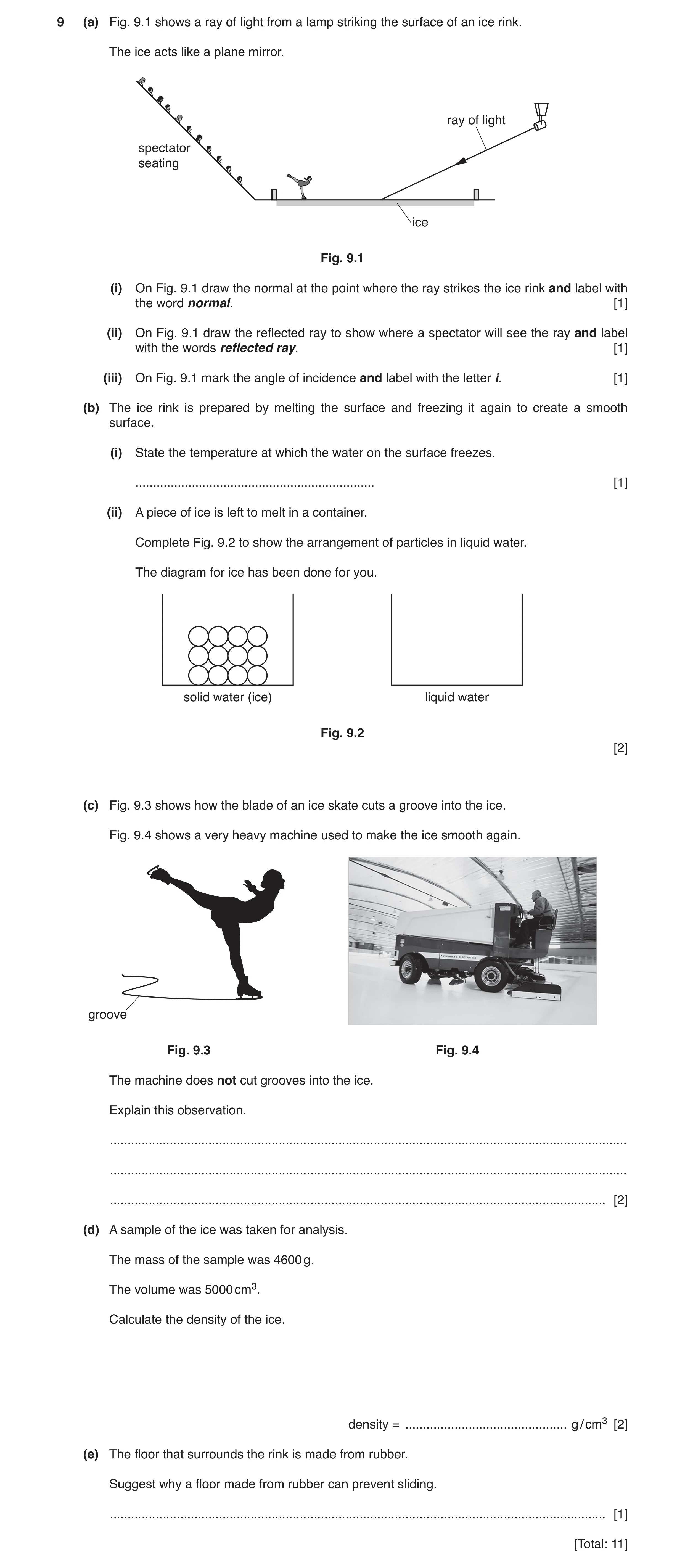
9 (a) Fig. 9.1 shows a ray of light from a lamp striking the surface of an ice rink. The ice acts like a plane mirror. ray of light spectator seating ice Fig. 9.1 (i) On Fig. 9.1 draw the normal at the point where the ray strikes the ice rink and label with the word normal. [1] (ii) On Fig. 9.1 draw the reflected ray to show where a spectator will see the ray and label with the words reflected ray. [1] (iii) On Fig. 9.1 mark the angle of incidence and label with the letter i. [1] (b) The ice rink is prepared by melting the surface and freezing it again to create a smooth surface. (i) State the temperature at which the water on the surface freezes. … [1] (ii) A piece of ice is left to melt in a container. Complete Fig. 9.2 to show the arrangement of particles in liquid water. The diagram for ice has been done for you. solid water (ice) liquid water Fig. 9.2 [2] (c) Fig. 9.3 shows how the blade of an ice skate cuts a groove into the ice. Fig. 9.4 shows a very heavy machine used to make the ice smooth again. groove Fig. 9.3 Fig. 9.4 The machine does not cut grooves into the ice. Explain this observation. … … … [2] (d) A sample of the ice was taken for analysis. The mass of the sample was 4600 g. The volume was 5000 cm3. Calculate the density of the ice. density = … g / cm3 [2] (e) The floor that surrounds the rink is made from rubber. Suggest why a floor made from rubber can prevent sliding. … [1] [Total: 11]
11 marks
Mark scheme: 9(a)(i) normal drawn from ice and ray intercept, 90° to the ice ; 1 9(a)(ii) reflected ray to correct point in spectator area (symmetrical about the normal to the incident ray) and labelled ‘reflected ray’ ; 1 9(a)(iii) angle drawn between the normal and the incident ray and labelled ‘i’ ; 1 9(b)(i) 0 °C ; 1 9(b)(ii) in liquid water : molecules drawn touching in random arrangement ; in liquid water: random arrangement ; 2 9(c) larger area; so smaller pressure; 2 9(d) ρ = m/v or 4600 / 5000 or 4.6 / 5000 seen ; 0.92 g/cm3 ; 2 9(e) friction ; 1
This question in 0654/31 Oct/Nov 2019
Q7 · A team of students enter a competition to see who can build the highest tower from… 0654/32 Oct/Nov 2019
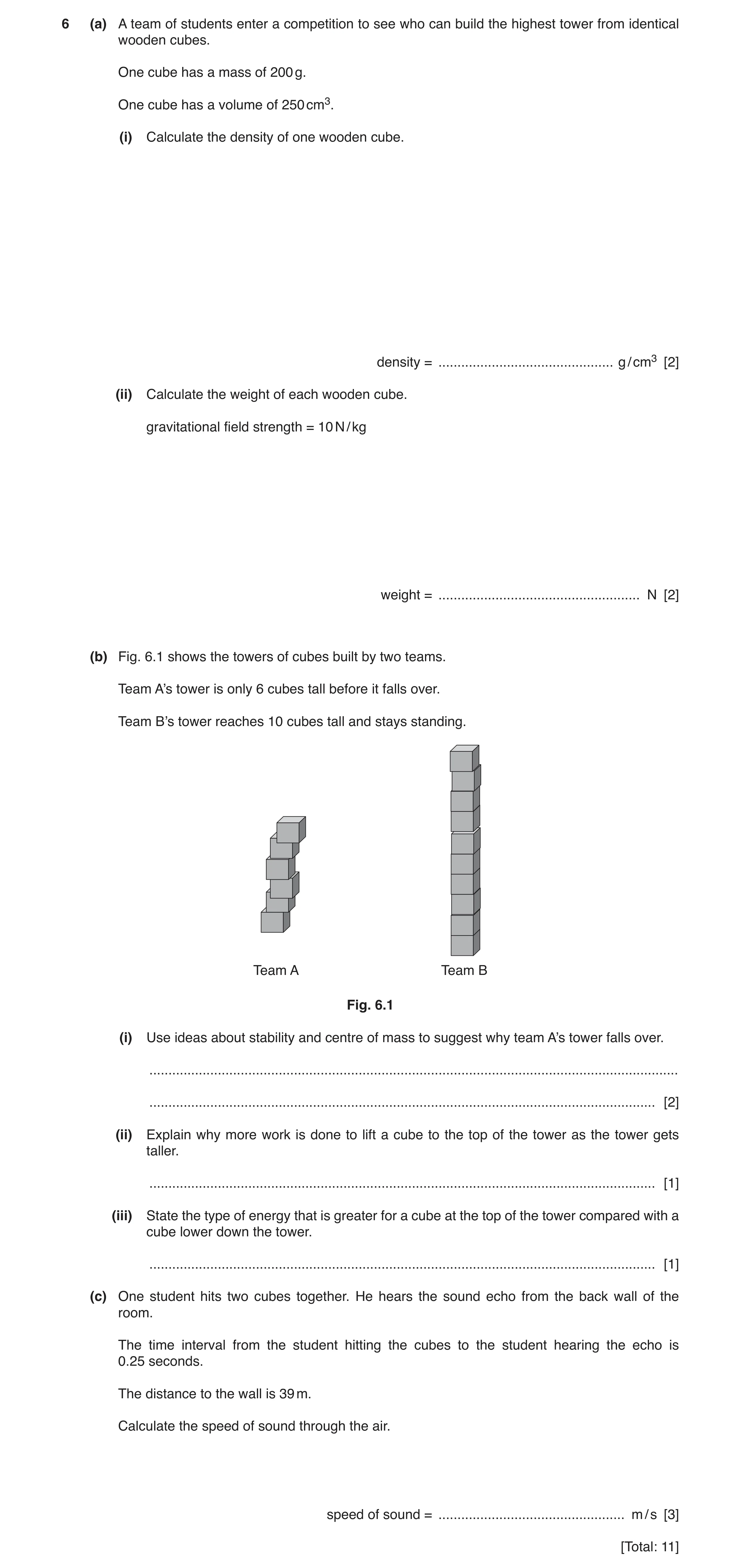
6 (a) A team of students enter a competition to see who can build the highest tower from identical wooden cubes. One cube has a mass of 200 g. One cube has a volume of 250 cm3. (i) Calculate the density of one wooden cube. density = … g / cm3 [2] (ii) Calculate the weight of each wooden cube. gravitational field strength = 10 N / kg weight = … N [2] (b) Fig. 6.1 shows the towers of cubes built by two teams. Team A’s tower is only 6 cubes tall before it falls over. Team B’s tower reaches 10 cubes tall and stays standing. Team A Team B Fig. 6.1 (i) Use ideas about stability and centre of mass to suggest why team A’s tower falls over. … … [2] (ii) Explain why more work is done to lift a cube to the top of the tower as the tower gets taller. … [1] (iii) State the type of energy that is greater for a cube at the top of the tower compared with a cube lower down the tower. … [1] (c) One student hits two cubes together. He hears the sound echo from the back wall of the room. The time interval from the student hitting the cubes to the student hearing the echo is 0.25 seconds. The distance to the wall is 39 m. Calculate the speed of sound through the air. speed of sound = … m / s [3] [Total: 11]
11 marks
Mark scheme: 6(a)(i) ρ = m / v or 200 / 250 ; 0.8 (g / cm3) ; 2 6(a)(ii) W = mg, 0.200 × 10 ; 2 (N) ; 2 6(b)(i) the position of the COM in A is not through the centre of the tower base / COM is not directly above the base ; it is unstable, (or opposite for B) ; 2 6(b)(ii) it is lifted up through the furthest distance compared to the other blocks ; 1 6(b)(iii) gravitational potential ; 1 6(c) s = d / t ; (39 + 39) / 0.25 ; 310 m / s ; 3
This question in 0654/32 Oct/Nov 2019
Q8 · A skydiver jumps from an aircraft high above the ground 0654/32 Oct/Nov 2020
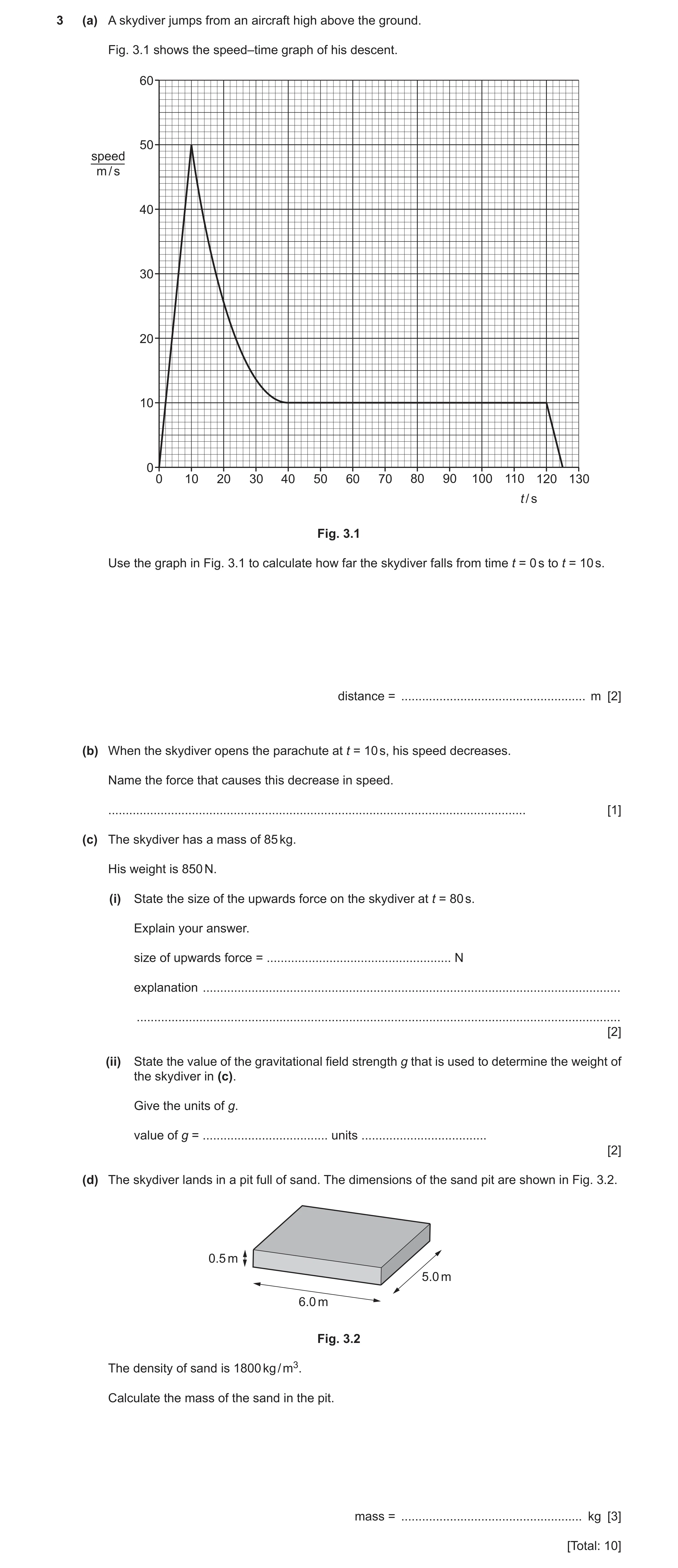
3 (a) A skydiver jumps from an aircraft high above the ground. Fig. 3.1 shows the speed–time graph of his descent. 60 50 speed m / s 40 30 20 10 0 0 10 20 30 40 50 60 70 80 90 100 110 120 130 t / s Fig. 3.1 Use the graph in Fig. 3.1 to calculate how far the skydiver falls from time t = 0 s to t = 10 s. distance = … m [2] (b) When the skydiver opens the parachute at t = 10 s, his speed decreases. Name the force that causes this decrease in speed. … [1] (c) The skydiver has a mass of 85 kg. His weight is 850 N. (i) State the size of the upwards force on the skydiver at t = 80 s. Explain your answer. size of upwards force = … N explanation … … [2] (ii) State the value of the gravitational field strength g that is used to determine the weight of the skydiver in (c). Give the units of g. value of g = … units … [2] (d) The skydiver lands in a pit full of sand. The dimensions of the sand pit are shown in Fig. 3.2. 0.5 m 5.0 m 6.0 m Fig. 3.2 The density of sand is 1800 kg / m3. Calculate the mass of the sand in the pit. mass = … kg [3] [Total: 10]
10 marks
Mark scheme: 3(a)(i) area under graph or 50 × 10/2; 250 (m); 2 3(b) friction / air resistance; 1 3(c)(i) 850(N); forces balance / travelling at constant speed; 2 3(c)(ii) 10; N/kg; 2 3(d) volume calculation – volume = 15 (m3); mass = density × volume or 1800 × 15; 27 000 (kg); 3
This question in 0654/32 Oct/Nov 2020
Q9 · A school orchestra is practising 0654/31 May/June 2021
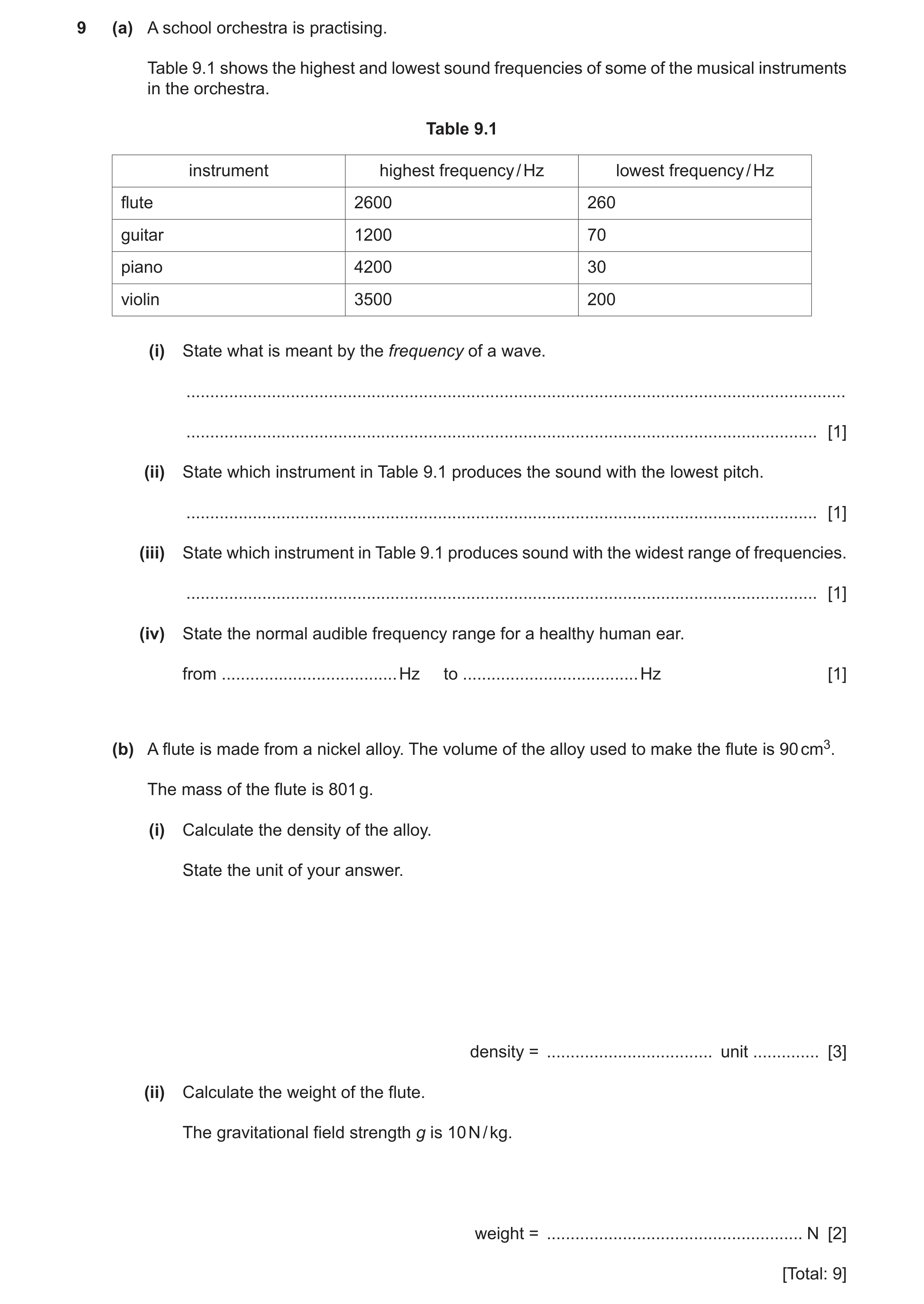
9 (a) A school orchestra is practising. Table 9.1 shows the highest and lowest sound frequencies of some of the musical instruments in the orchestra. Table 9.1 instrument highest frequency / Hz lowest frequency / Hz flute 2600 260 guitar 1200 70 piano 4200 30 violin 3500 200 (i) State what is meant by the frequency of a wave. … … [1] (ii) State which instrument in Table 9.1 produces the sound with the lowest pitch. … [1] (iii) State which instrument in Table 9.1 produces sound with the widest range of frequencies. … [1] (iv) State the normal audible frequency range for a healthy human ear. from … Hz to … Hz [1] (b) A flute is made from a nickel alloy. The volume of the alloy used to make the flute is 90 cm3. The mass of the flute is 801 g. (i) Calculate the density of the alloy. State the unit of your answer. density = … unit … [3] (ii) Calculate the weight of the flute. The gravitational field strength g is 10 N / kg. weight = … N [2] [Total: 9]
9 marks
Mark scheme: 9(a)(i) number of waves produced per second / passing a fixed point per second ; 1 9(a)(ii) piano ; 1 9(a)(iii) piano; 1 9(a)(iv) from 20 Hz to 20 000 Hz ; 1 9(b)(i) density = mass / volume or 801 / 90 ; = 8.90 ; g / cm3 ; 3 9(b)(ii) 801 g = 0.801 kg or weight = mass × g or 0.801 × 10 ; = 8.01 (N) ; 2
This question in 0654/31 May/June 2021
Question 10 0654/31 Oct/Nov 2021
9 Fig. 9.1 shows a refrigerator. freezing compartment Fig. 9.1 (a) The freezing compartment at the top of the refrigerator cools all the air in the refrigerator. State the main method of thermal energy transfer used in this cooling process. … [1] (b) The volume of air in the refrigerator is 210 000 cm3. The density of air is 0.00126 g / cm3. Calculate the mass of air in the refrigerator. Show your working. mass = … g [2] (c) A liquid-in-glass thermometer is placed inside the freezing compartment to measure a temperature of –20 °C. (i) Name a suitable liquid to use in the thermometer. … [1] (ii) State the physical property of the liquid that varies with temperature in a liquid-in-glass thermometer. … [1] (d) The refrigerator emits a quiet sound with a low pitch. (i) Describe the amplitude and frequency of this sound. amplitude … frequency … [2] (ii) State the unit of frequency. … [1] (e) The refrigerator contains two lamps connected in series. Lamp A has a resistance of 4000 Ω and lamp B has a resistance of 5000 Ω. (i) Calculate the combined resistance of the two lamps connected in series. resistance = … Ω [1] (ii) The potential difference across the lamps is 240 V. Use your answer to (e)(i) to calculate the current in the lamps. Show your working. current = … A [2] [Total: 11]
11 marks
Mark scheme: 9(a) convection ; 1 9(b) mass = density × volume or 0.00126 × 210 000 ; = 265 g ; 2 9(c)(i) mercury / alcohol ; 1 9(c)(ii) volume ; 1 9(d)(i) small amplitude ; low frequency ; 2 9(d)(ii) hertz ; 1 9(e)(i) 9000 Ω ; 1 Question Answer Marks 9(e)(ii) current = voltage / resistance or 240 / 9000 ; 0.027 (A) ; 2
This question in 0654/31 Oct/Nov 2021
Q11 · Water in a saucepan on an electric cooker 0654/33 Oct/Nov 2021
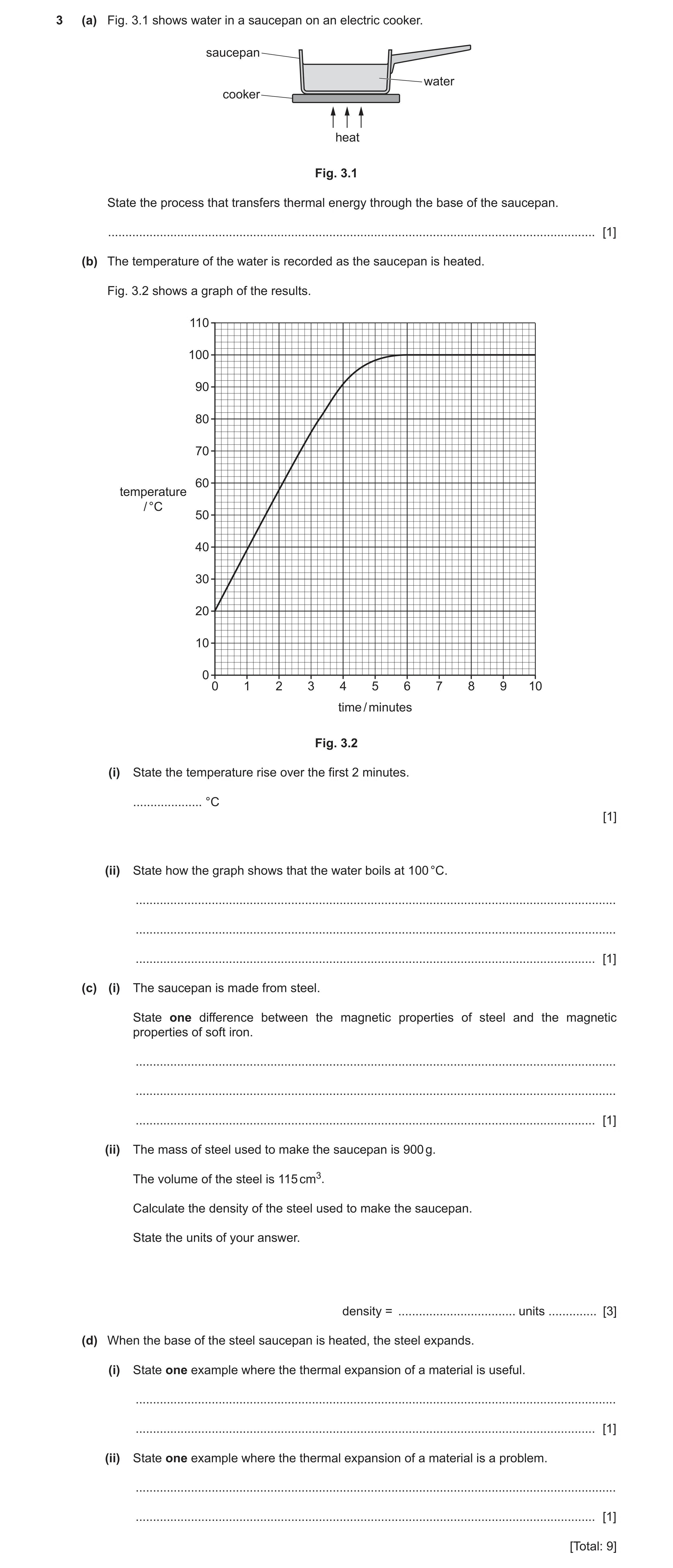
3 (a) Fig. 3.1 shows water in a saucepan on an electric cooker. saucepan water cooker heat Fig. 3.1 State the process that transfers thermal energy through the base of the saucepan. … [1] (b) The temperature of the water is recorded as the saucepan is heated. Fig. 3.2 shows a graph of the results. 110 100 90 80 70 60 temperature / °C 50 40 30 20 10 0 0 1 2 3 4 5 6 7 8 9 10 time / minutes Fig. 3.2 (i) State the temperature rise over the first 2 minutes. … °C [1] (ii) State how the graph shows that the water boils at 100 °C. … … … [1] (c) (i) The saucepan is made from steel. State one difference between the magnetic properties of steel and the magnetic properties of soft iron. … … … [1] (ii) The mass of steel used to make the saucepan is 900 g. The volume of the steel is 115 cm3. Calculate the density of the steel used to make the saucepan. State the units of your answer. density = … units … [3] (d) When the base of the steel saucepan is heated, the steel expands. (i) State one example where the thermal expansion of a material is useful. … … [1] (ii) State one example where the thermal expansion of a material is a problem. … … [1] [Total: 9]
9 marks
Mark scheme: 3(a)(i) conduction ; 1 3(b)(i) 38 °C ; 1 3(b)(ii) temperature stops increasing ; 1 3(c)(i) (soft) iron is magnetised quickly / steel is magnetised slowly ; or (soft) iron loses its magnetism quickly / steel loses magnetism slowly ; 1 3(c)(ii) density = mass ÷ volume or mass value ÷ volume value or 900 ÷ 115 ; 7.83 ; g / cm3 ; 3 3(d)(i) (liquid in glass) thermometers / bimetallic strips ; 1 3(d)(ii) bridges / roads / overhead electricity cables etc. ; 1
This question in 0654/33 Oct/Nov 2021
Q12 · A wind surfer on a surfboard, driven by the wind, sailing at a constant speed across the… 0654/31 May/June 2022
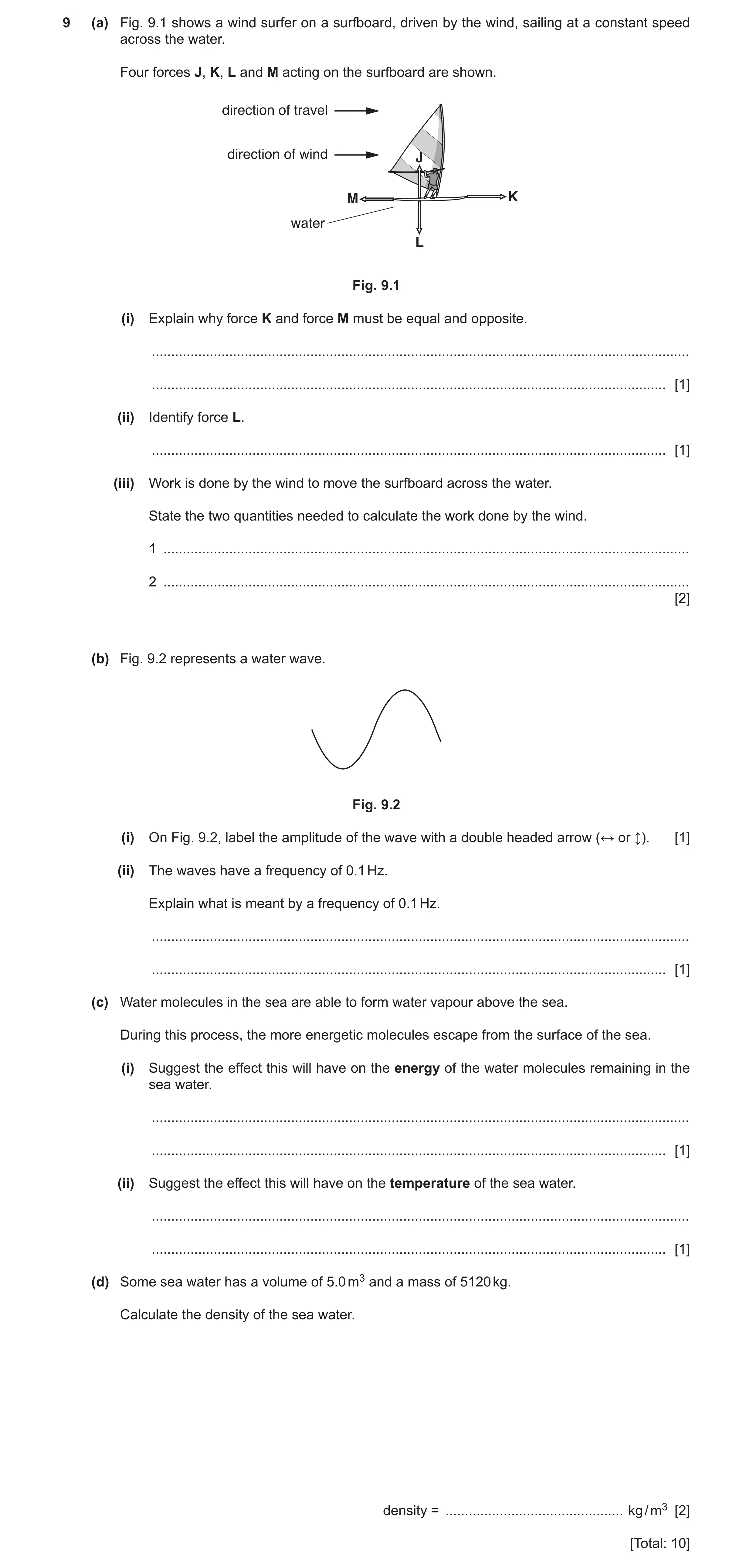
9 (a) Fig. 9.1 shows a wind surfer on a surfboard, driven by the wind, sailing at a constant speed across the water. Four forces J, K, L and M acting on the surfboard are shown. direction of travel direction of wind J M K water L Fig. 9.1 (i) Explain why force K and force M must be equal and opposite. … … [1] (ii) Identify force L. … [1] (iii) Work is done by the wind to move the surfboard across the water. State the two quantities needed to calculate the work done by the wind. 1 … 2 … [2] (b) Fig. 9.2 represents a water wave. Fig. 9.2 (i) On Fig. 9.2, label the amplitude of the wave with a double headed arrow (↔ or ↕). [1] (ii) The waves have a frequency of 0.1 Hz. Explain what is meant by a frequency of 0.1 Hz. … … [1] (c) Water molecules in the sea are able to form water vapour above the sea. During this process, the more energetic molecules escape from the surface of the sea. (i) Suggest the effect this will have on the energy of the water molecules remaining in the sea water. … … [1] (ii) Suggest the effect this will have on the temperature of the sea water. … … [1] (d) Some sea water has a volume of 5.0 m3 and a mass of 5120 kg. Calculate the density of the sea water. density = … kg / m3 [2] [Total: 10]
10 marks
Mark scheme: 9(a)(i) surfboard is moving at constant speed; 1 9(a)(ii) gravitational (force) / weight; 1 9(a)(iii) force; distance; 2 9(b)(i) amplitude correctly labelled; 1 9(b)(ii) one wave passes every 10 seconds; 1 9(c)(i) less energetic molecules ; owtte 1 9(c)(ii) decrease / cool ; 1 9(d) density = mass / volume or 5120 / 5; density = 1024 (kg / m3) ; 2
This question in 0654/31 May/June 2022
Q13 · A person standing on a warm, sunny beach is exposed to several forms of electromagnetic… 0654/31 Oct/Nov 2022
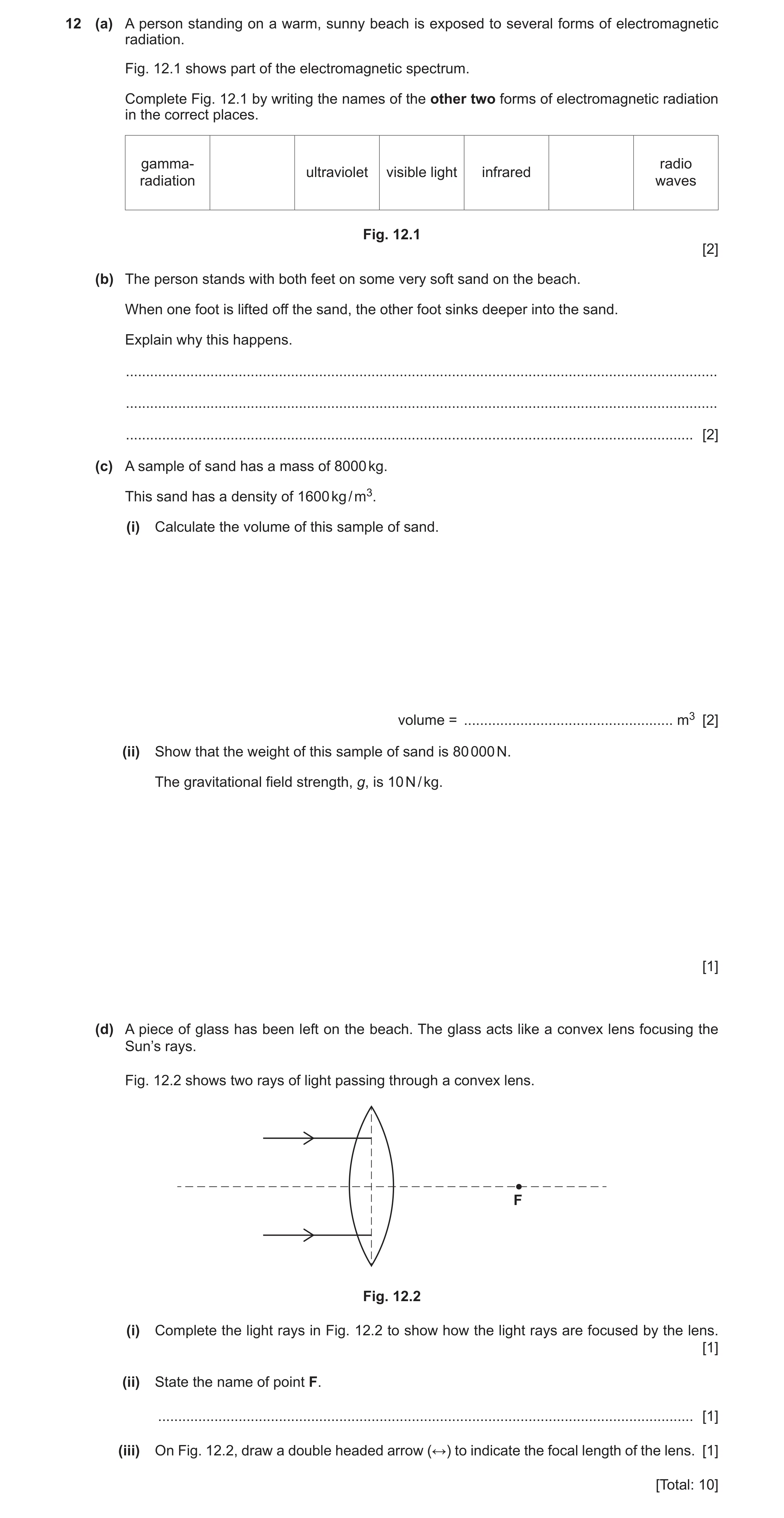
12 (a) A person standing on a warm, sunny beach is exposed to several forms of electromagnetic radiation. Fig. 12.1 shows part of the electromagnetic spectrum. Complete Fig. 12.1 by writing the names of the other two forms of electromagnetic radiation in the correct places. gamma- radio ultraviolet visible light infrared radiation waves Fig. 12.1 [2] (b) The person stands with both feet on some very soft sand on the beach. When one foot is lifted off the sand, the other foot sinks deeper into the sand. Explain why this happens. … … … [2] (c) A sample of sand has a mass of 8000 kg. This sand has a density of 1600 kg / m3. (i) Calculate the volume of this sample of sand. volume = … m3 [2] (ii) Show that the weight of this sample of sand is 80 000 N. The gravitational field strength, g, is 10 N / kg. [1] (d) A piece of glass has been left on the beach. The glass acts like a convex lens focusing the Sun’s rays. Fig. 12.2 shows two rays of light passing through a convex lens. F Fig. 12.2 (i) Complete the light rays in Fig. 12.2 to show how the light rays are focused by the lens. [1] (ii) State the name of point F. … [1] (iii) On Fig. 12.2, draw a double headed arrow (↔) to indicate the focal length of the lens. [1] [Total: 10]
10 marks
Mark scheme: 12(a) 2 -rays X-rays ultraviolet visible light infrared microwaves radio waves microwaves in correct place ; X-rays in correct place ; 12(b) area decreases ; 2 so pressure increases ; 12(c)(i) volume = mass / density (in any form symbols or words) or 8000 / 1600 ; 2 = 5 (m3) ; 12(c)(ii) 8000 10 ; 1 (= 80 000 N) 12(d)(i) rays meet at focus (F) ; 1 12(d)(ii) principal focus ; 1 12(d)(iii) focal length correctly identified ; 1
This question in 0654/31 Oct/Nov 2022
Q14 · An astronomer observes a large meteorite, a rock from outer space 0654/33 Oct/Nov 2022
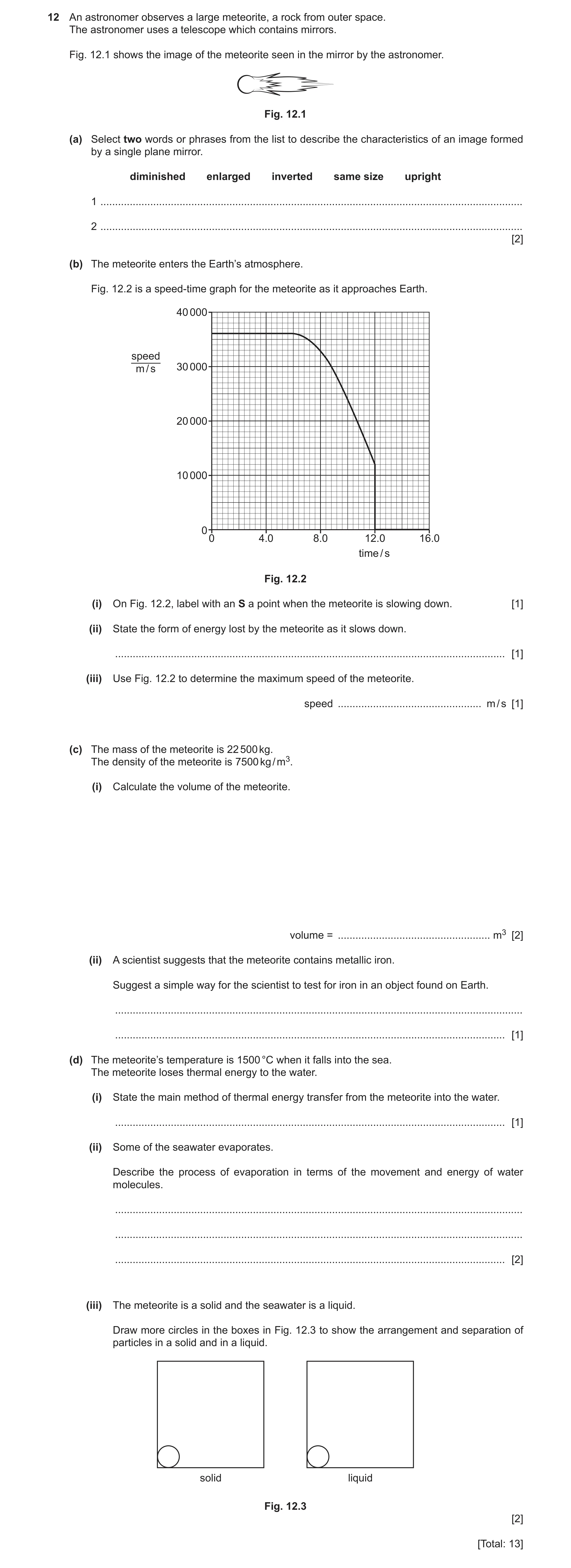
12 An astronomer observes a large meteorite, a rock from outer space. The astronomer uses a telescope which contains mirrors. Fig. 12.1 shows the image of the meteorite seen in the mirror by the astronomer. Fig. 12.1 (a) Select two words or phrases from the list to describe the characteristics of an image formed by a single plane mirror. diminished enlarged inverted same size upright 1 … 2 … [2] (b) The meteorite enters the Earth’s atmosphere. Fig. 12.2 is a speed-time graph for the meteorite as it approaches Earth. 40 000 speed m / s 30 000 20 000 10 000 0 0 4.0 8.0 12.0 16.0 time / s Fig. 12.2 (i) On Fig. 12.2, label with an S a point when the meteorite is slowing down. [1] (ii) State the form of energy lost by the meteorite as it slows down. … [1] (iii) Use Fig. 12.2 to determine the maximum speed of the meteorite. speed … m / s [1] (c) The mass of the meteorite is 22 500 kg. The density of the meteorite is 7500 kg / m3. (i) Calculate the volume of the meteorite. volume = … m3 [2] (ii) A scientist suggests that the meteorite contains metallic iron. Suggest a simple way for the scientist to test for iron in an object found on Earth. … … [1] (d) The meteorite’s temperature is 1500 °C when it falls into the sea. The meteorite loses thermal energy to the water. (i) State the main method of thermal energy transfer from the meteorite into the water. … [1] (ii) Some of the seawater evaporates. Describe the process of evaporation in terms of the movement and energy of water molecules. … … … [2] (iii) The meteorite is a solid and the seawater is a liquid. Draw more circles in the boxes in Fig. 12.3 to show the arrangement and separation of particles in a solid and in a liquid. solid liquid Fig. 12.3 [2] [Total: 13]
13 marks
Mark scheme: 12(a) same size ; 2 upright ; 12(b)(i) S somewhere between 5 s and 12 s ; 1 12(b)(ii) kinetic energy ; 1 12(b)(iii) 36 000 m / s ; 1 12(c)(i) volume = mass ÷ density (words or symbols) or 22 500 ÷ 7500 ; 2 = 3.0 m3 ; 12(c)(ii) use a magnet ; 1 12(d)(i) conduction ; 1 12(d)(ii) fastest moving / most energetic molecules ; 2 escape at surface ; 12(d)(iii) solid – all touching and regular arrangement ; 2 liquid – all / most touching and irregular arrangement ;
This question in 0654/33 Oct/Nov 2022
Q15 · The audible frequency range of five animals 0654/32 May/June 2023
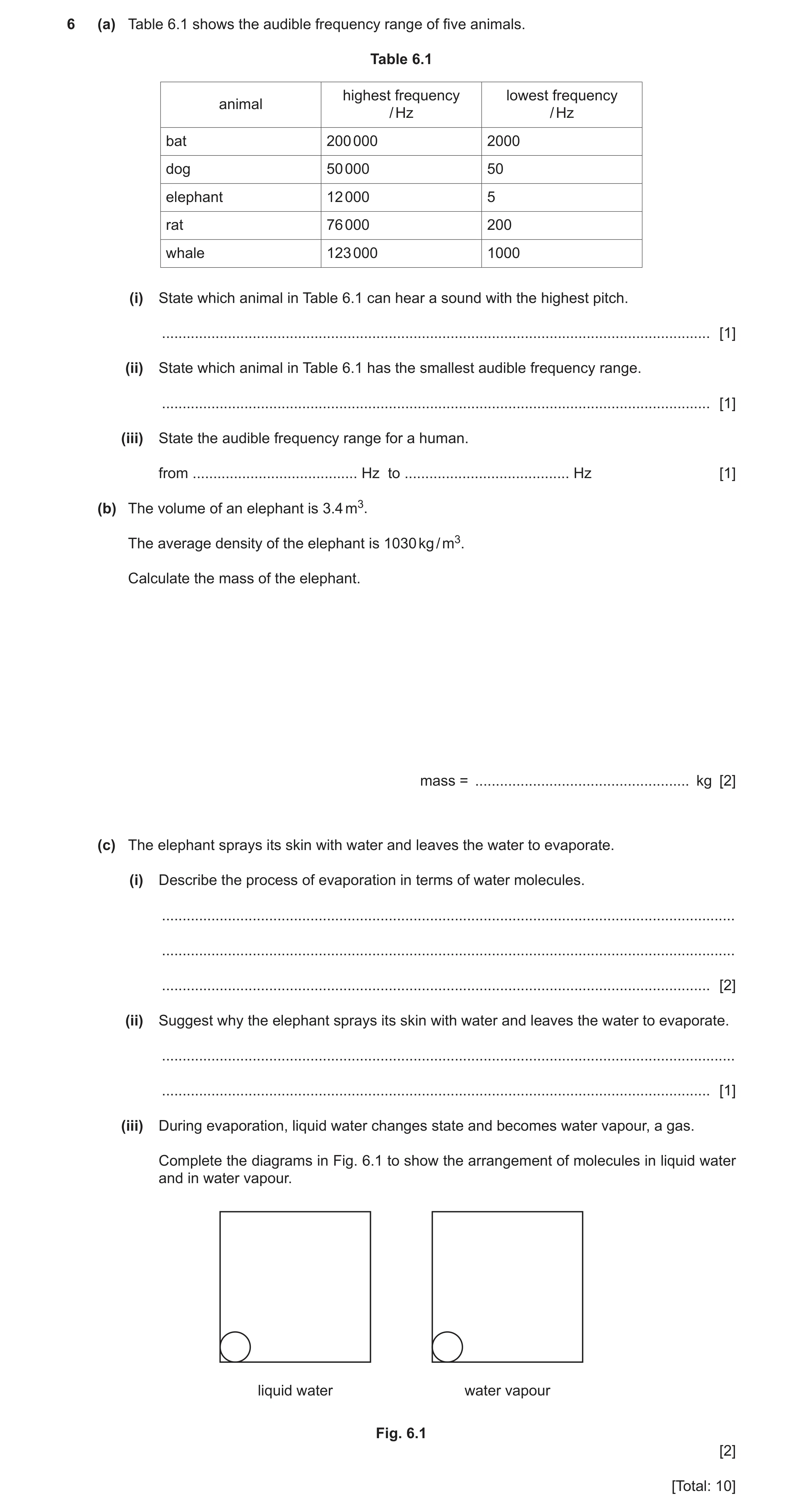
6 (a) Table 6.1 shows the audible frequency range of five animals. Table 6.1 highest frequency lowest frequency animal / Hz / Hz bat 200 000 2000 dog 50 000 50 elephant 12 000 5 rat 76 000 200 whale 123 000 1000 (i) State which animal in Table 6.1 can hear a sound with the highest pitch. … [1] (ii) State which animal in Table 6.1 has the smallest audible frequency range. … [1] (iii) State the audible frequency range for a human. from … Hz to … Hz [1] (b) The volume of an elephant is 3.4 m3. The average density of the elephant is 1030 kg / m3. Calculate the mass of the elephant. mass = … kg [2] (c) The elephant sprays its skin with water and leaves the water to evaporate. (i) Describe the process of evaporation in terms of water molecules. … … … [2] (ii) Suggest why the elephant sprays its skin with water and leaves the water to evaporate. … … [1] (iii) During evaporation, liquid water changes state and becomes water vapour, a gas. Complete the diagrams in Fig. 6.1 to show the arrangement of molecules in liquid water and in water vapour. liquid water water vapour Fig. 6.1 [2] [Total: 10]
10 marks
Mark scheme: 6(a)(i) bat ; 1 6(a)(ii) elephant ; 1 6(a)(iii) 20 (Hz) to 20 000 (Hz) ; 1 6(b) mass = density volume (in any form) or 1030 3.4 ; = 3500 (kg) ; 2 6(c)(i) fastest moving molecules escape ; from the surface of the liquid ; 2 6(c)(ii) evaporation has a cooling effect ; 1 6(c)(iii) liquid – all molecules touching random arrangement ; gas – molecules widely separated (no more than seven shown) and random arrangement ; 2
This question in 0654/32 May/June 2023
Q16 · The audible frequency range of five animals 0654/33 May/June 2023
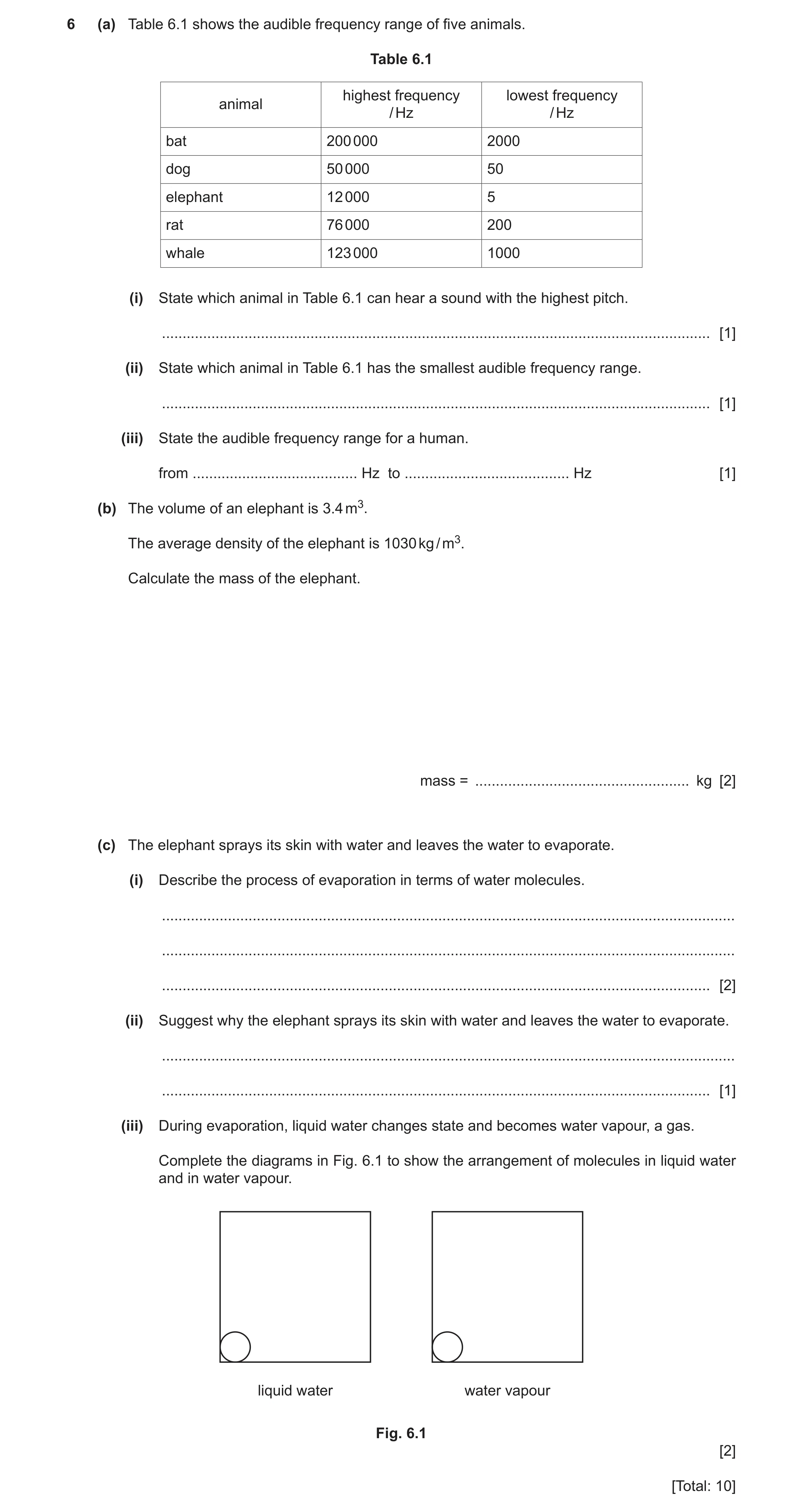
6 (a) Table 6.1 shows the audible frequency range of five animals. Table 6.1 highest frequency lowest frequency animal / Hz / Hz bat 200 000 2000 dog 50 000 50 elephant 12 000 5 rat 76 000 200 whale 123 000 1000 (i) State which animal in Table 6.1 can hear a sound with the highest pitch. … [1] (ii) State which animal in Table 6.1 has the smallest audible frequency range. … [1] (iii) State the audible frequency range for a human. from … Hz to … Hz [1] (b) The volume of an elephant is 3.4 m3. The average density of the elephant is 1030 kg / m3. Calculate the mass of the elephant. mass = … kg [2] (c) The elephant sprays its skin with water and leaves the water to evaporate. (i) Describe the process of evaporation in terms of water molecules. … … … [2] (ii) Suggest why the elephant sprays its skin with water and leaves the water to evaporate. … … [1] (iii) During evaporation, liquid water changes state and becomes water vapour, a gas. Complete the diagrams in Fig. 6.1 to show the arrangement of molecules in liquid water and in water vapour. liquid water water vapour Fig. 6.1 [2] [Total: 10]
10 marks
Mark scheme: 6(a)(i) bat ; 1 6(a)(ii) elephant ; 1 6(a)(iii) 20 (Hz) to 20 000 (Hz) ; 1 6(b) mass = density volume (in any form) or 1030 3.4 ; = 3500 (kg) ; 2 6(c)(i) fastest moving molecules escape ; from the surface of the liquid ; 2 6(c)(ii) evaporation has a cooling effect ; 1 6(c)(iii) liquid – all molecules touching random arrangement ; gas – molecules widely separated (no more than seven shown) and random arrangement ; 2
This question in 0654/33 May/June 2023
Q17 · Train track is made of lengths of steel rails with small gaps between them 0654/31 Oct/Nov 2023
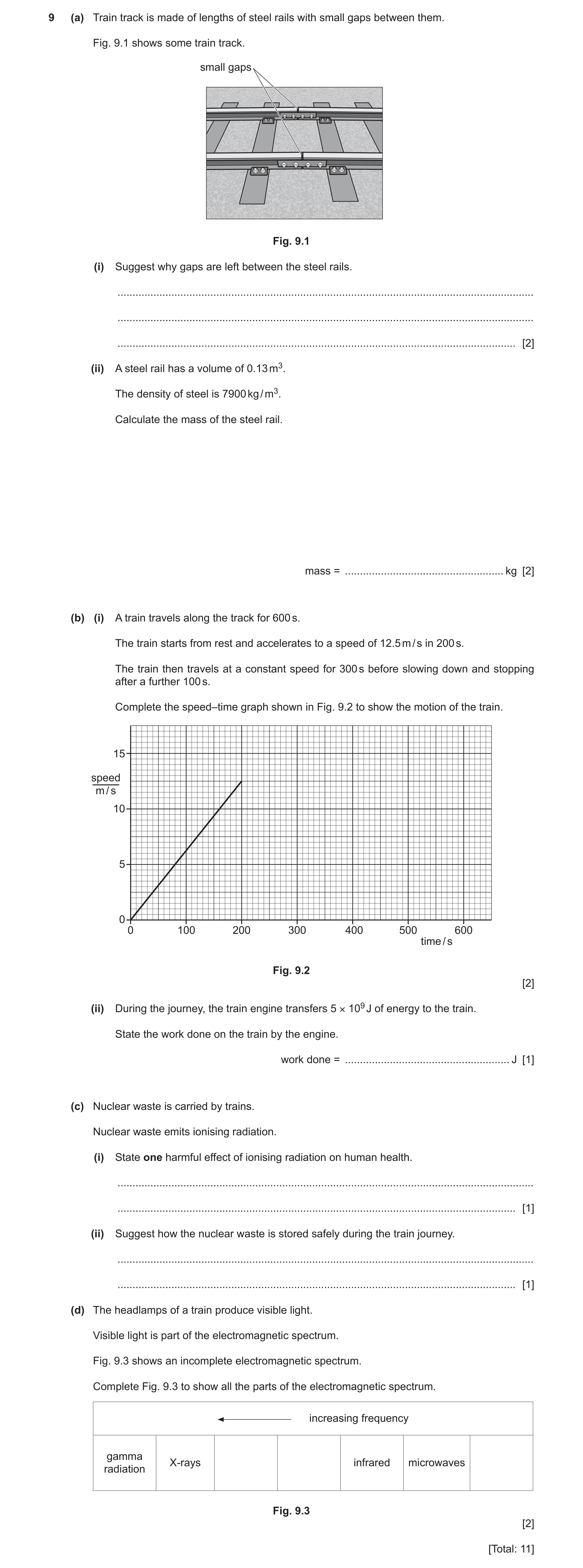
9 (a) Train track is made of lengths of steel rails with small gaps between them. Fig. 9.1 shows some train track. small gaps Fig. 9.1 (i) Suggest why gaps are left between the steel rails. … … … [2] (ii) A steel rail has a volume of 0.13 m3. The density of steel is 7900 kg / m3. Calculate the mass of the steel rail. mass = … kg [2] (b) (i) A train travels along the track for 600 s. The train starts from rest and accelerates to a speed of 12.5 m / s in 200 s. The train then travels at a constant speed for 300 s before slowing down and stopping after a further 100 s. Complete the speed–time graph shown in Fig. 9.2 to show the motion of the train. 15 speed m / s 10 5 0 0 100 200 300 400 500 600 time / s Fig. 9.2 [2] (ii) During the journey, the train engine transfers 5 × 10⁹ J of energy to the train. State the work done on the train by the engine. work done = … J [1] (c) Nuclear waste is carried by trains. Nuclear waste emits ionising radiation. (i) State one harmful effect of ionising radiation on human health. … … [1] (ii) Suggest how the nuclear waste is stored safely during the train journey. … … [1] (d) The headlamps of a train produce visible light. Visible light is part of the electromagnetic spectrum. Fig. 9.3 shows an incomplete electromagnetic spectrum. Complete Fig. 9.3 to show all the parts of the electromagnetic spectrum. increasing frequency gamma X-rays infrared microwaves radiation Fig. 9.3 [2] [Total: 11]
11 marks
Mark scheme: 9(a)(i) to allow for expansion ; 2 so rails are not damaged / in hot weather ; 9(a)(ii) mass = density volume (in any form) or 7900 0.13 ; 2 1000 (kg) or 1027 (kg) ; 9(b)(i) horizontal section correct ; 2 slowing down section taking 100 s ; 9(b)(ii) 5 109 (J) ; 1 9(c)(i) cancer / radiation burns / AVP ; 1 9(c)(ii) lead lined container ; 1 9(d) 2 gamma visible radio X-rays ultraviolet infrared microwaves radiation light waves three correct ; in correct order ;
This question in 0654/31 Oct/Nov 2023
Question 18 0654/32 Oct/Nov 2023
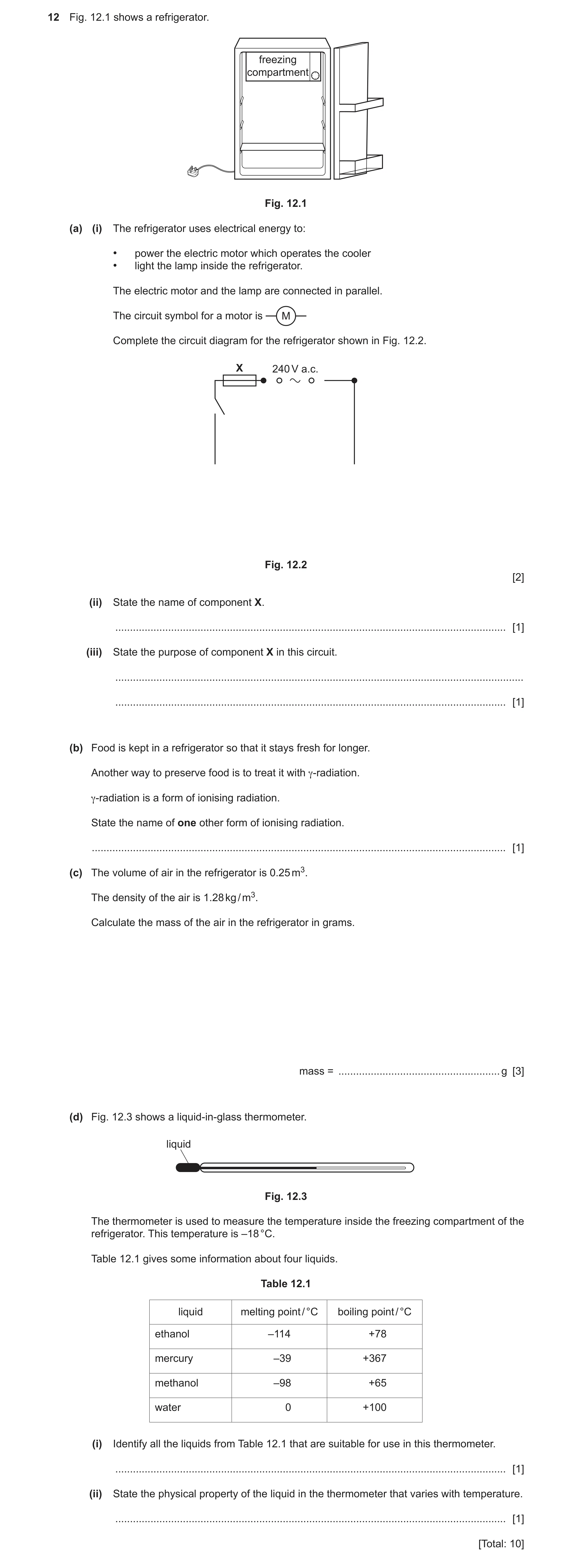
12 Fig. 12.1 shows a refrigerator. freezing compartment Fig. 12.1 (a) (i) The refrigerator uses electrical energy to: • power the electric motor which operates the cooler • light the lamp inside the refrigerator. The electric motor and the lamp are connected in parallel. The circuit symbol for a motor is M Complete the circuit diagram for the refrigerator shown in Fig. 12.2. X 240 V a.c. Fig. 12.2 [2] (ii) State the name of component X. … [1] (iii) State the purpose of component X in this circuit. … … [1] (b) Food is kept in a refrigerator so that it stays fresh for longer. Another way to preserve food is to treat it with γ-radiation. γ-radiation is a form of ionising radiation. State the name of one other form of ionising radiation. … [1] (c) The volume of air in the refrigerator is 0.25 m3. The density of the air is 1.28 kg / m3. Calculate the mass of the air in the refrigerator in grams. mass = … g [3] (d) Fig. 12.3 shows a liquid-in-glass thermometer. liquid Fig. 12.3 The thermometer is used to measure the temperature inside the freezing compartment of the refrigerator. This temperature is –18 °C. Table 12.1 gives some information about four liquids. Table 12.1 liquid melting point / °C boiling point / °C ethanol –114 +78 mercury –39 +367 methanol –98 +65 water 0 +100 (i) Identify all the liquids from Table 12.1 that are suitable for use in this thermometer. … [1] (ii) State the physical property of the liquid in the thermometer that varies with temperature. … [1] [Total: 10]
10 marks
Mark scheme: 12(a)(i) correct symbol for lamp ; 2 lamp and motor in parallel ; 12(a)(ii) fuse ; 1 12(a)(iii) protect circuit ; 1 12(b) alpha / beta / X-rays ; 1 12(c) mass = density volume (in any form) / 1.28 0.25 ; 3 evidence of conversion of mass to grams ; = 320 (g) ; 12(d)(i) ethanol, mercury and methanol ; 1 12(d)(ii) density / volume ; 1
This question in 0654/32 Oct/Nov 2023
Q19 · A student investigates the properties of five materials: copper ice iron plastic wood… 0654/32 Feb/March 2024
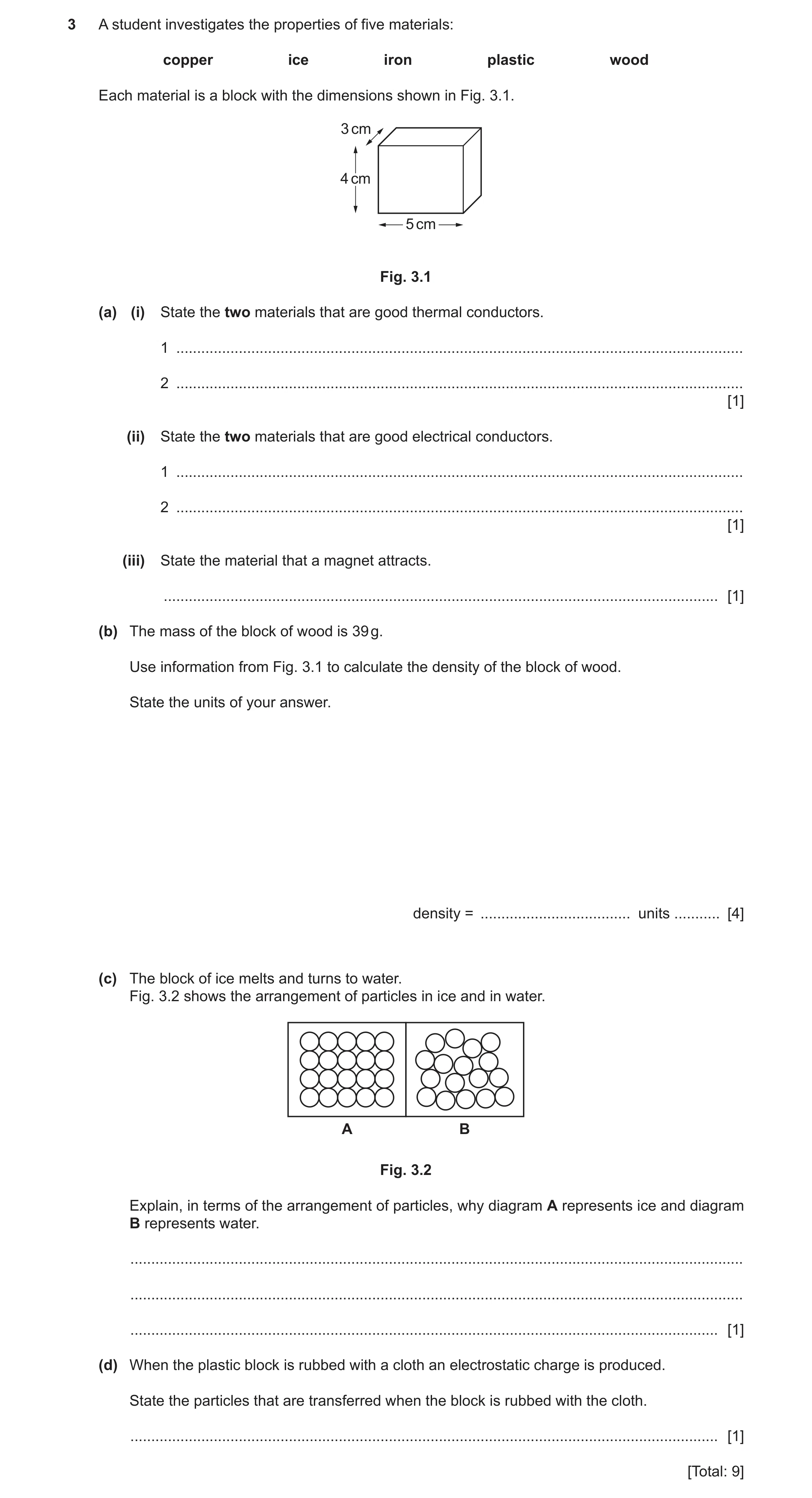
3 A student investigates the properties of five materials: copper ice iron plastic wood Each material is a block with the dimensions shown in Fig. 3.1. 3 cm 4 cm 5 cm Fig. 3.1 (a) (i) State the two materials that are good thermal conductors. 1 … 2 … [1] (ii) State the two materials that are good electrical conductors. 1 … 2 … [1] (iii) State the material that a magnet attracts. … [1] (b) The mass of the block of wood is 39 g. Use information from Fig. 3.1 to calculate the density of the block of wood. State the units of your answer. density = … units … [4] (c) The block of ice melts and turns to water. Fig. 3.2 shows the arrangement of particles in ice and in water. A B Fig. 3.2 Explain, in terms of the arrangement of particles, why diagram A represents ice and diagram B represents water. … … … [1] (d) When the plastic block is rubbed with a cloth an electrostatic charge is produced. State the particles that are transferred when the block is rubbed with the cloth. … [1] [Total: 9]
9 marks
Mark scheme: 3(a)(i) copper and iron ; 1 3(a)(ii) copper and iron ; 1 3(a)(iii) iron ; 1 3(b) volume = 3 4 5 = 60 cm3 ; 4 density = mass / volume (in any form) or 39 / 60 ; = 0.65 ; g / cm3 ; 3(c) ice – particles arranged regularly 1 and water – particles arranged irregularly ; 3(d) electrons ; 1
This question in 0654/32 Feb/March 2024
 18 / 35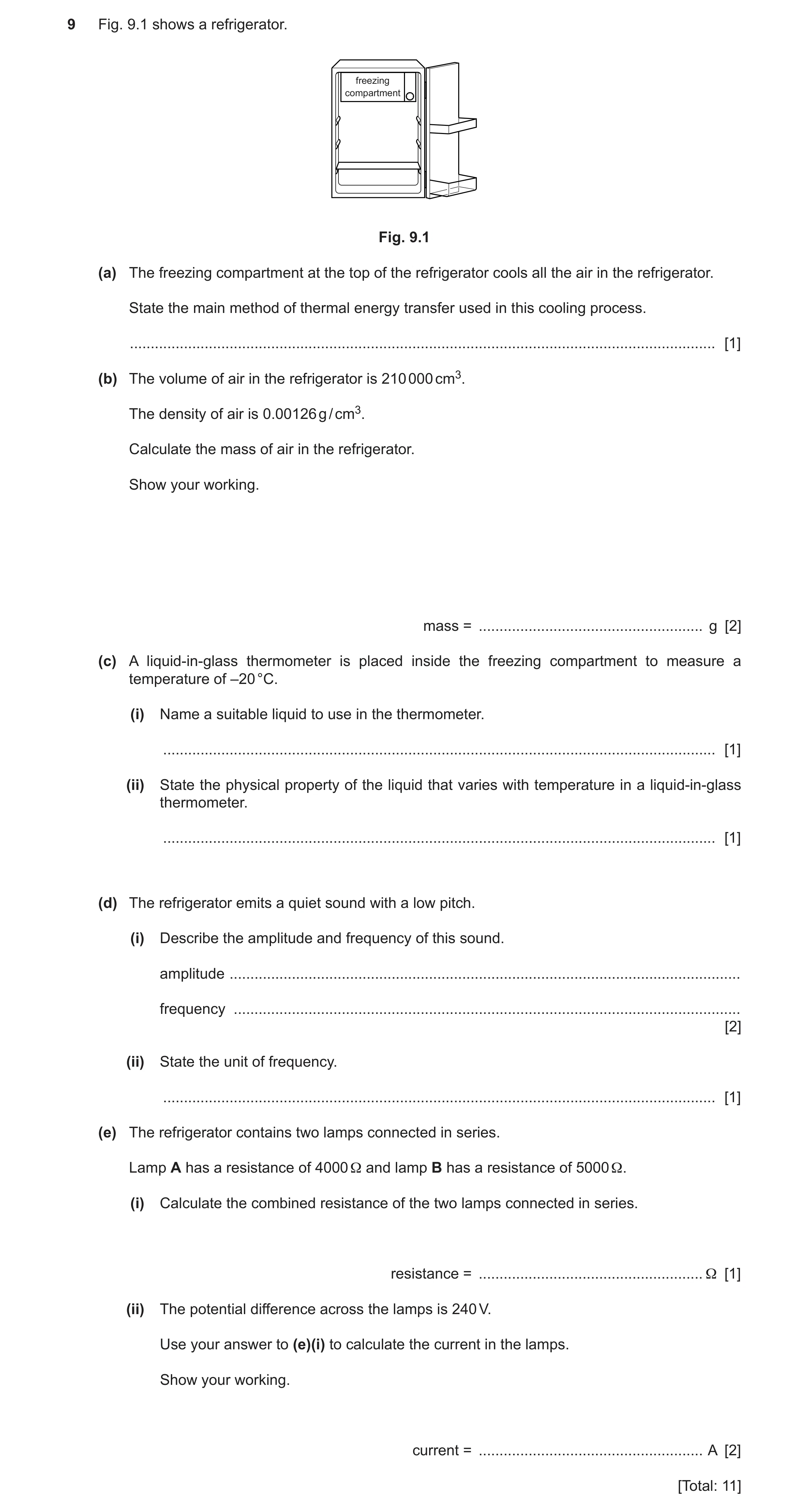
 15
15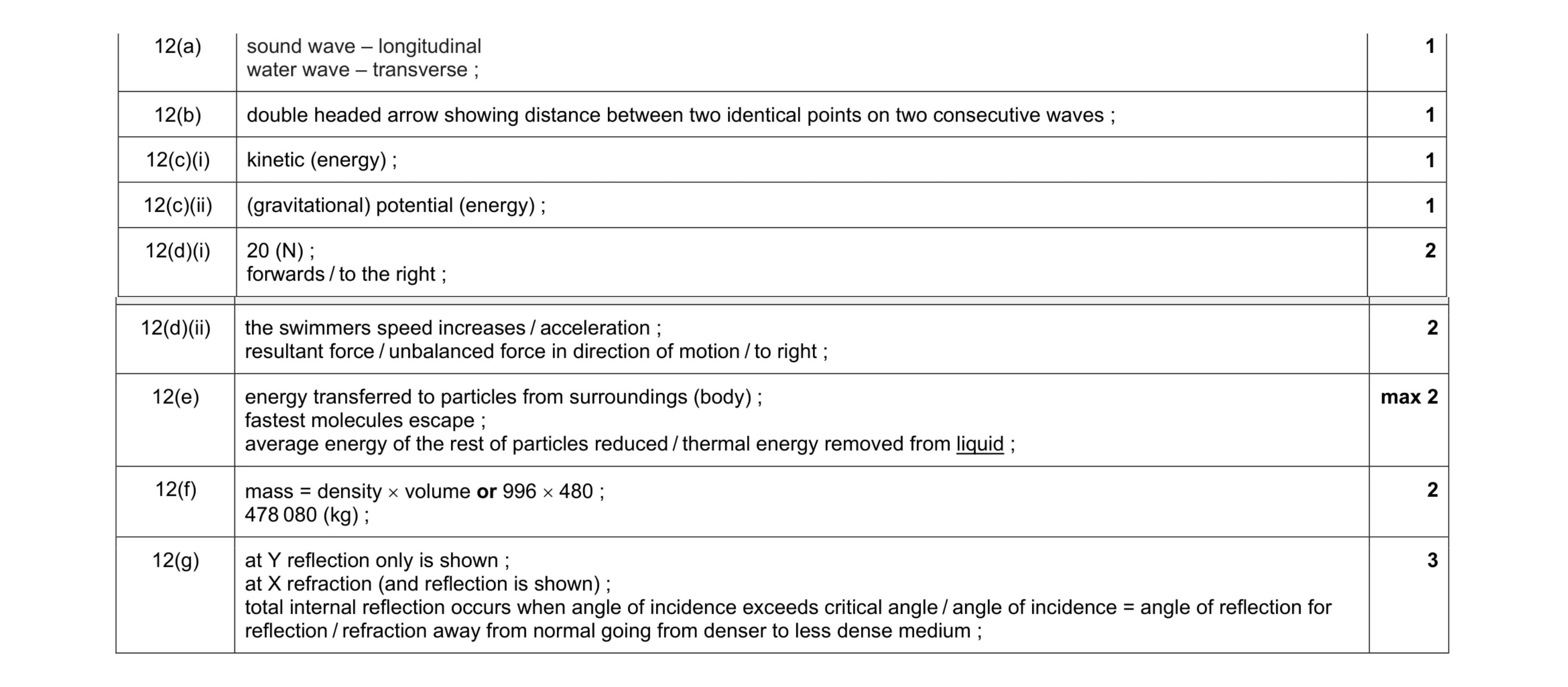 15
15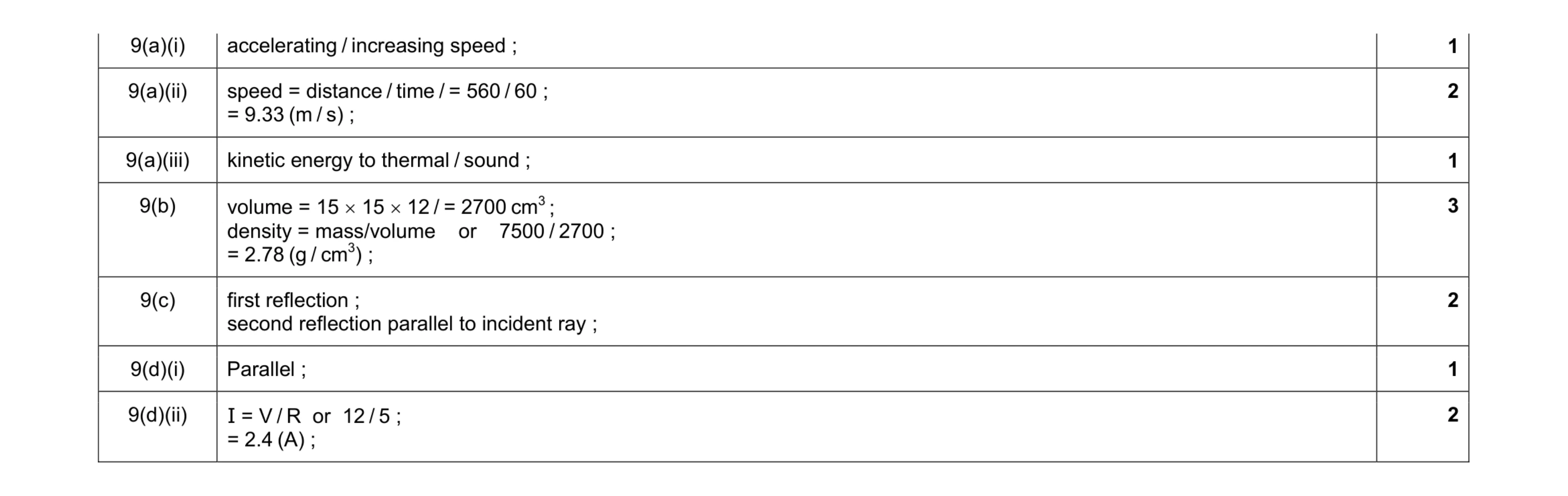 12
12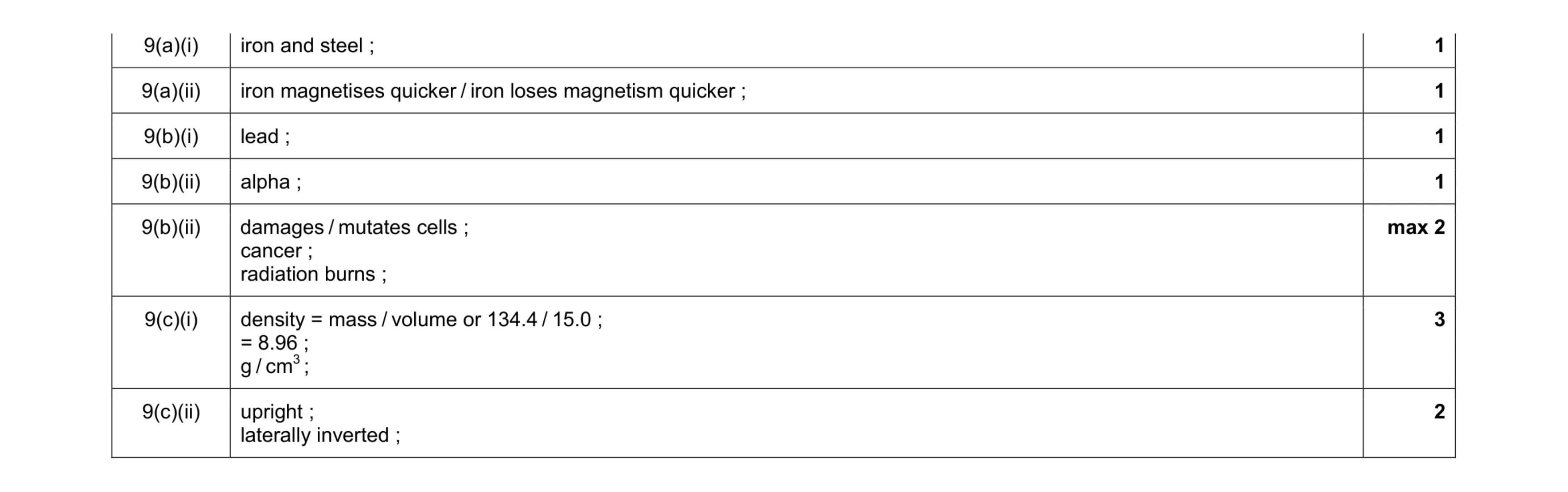 11
11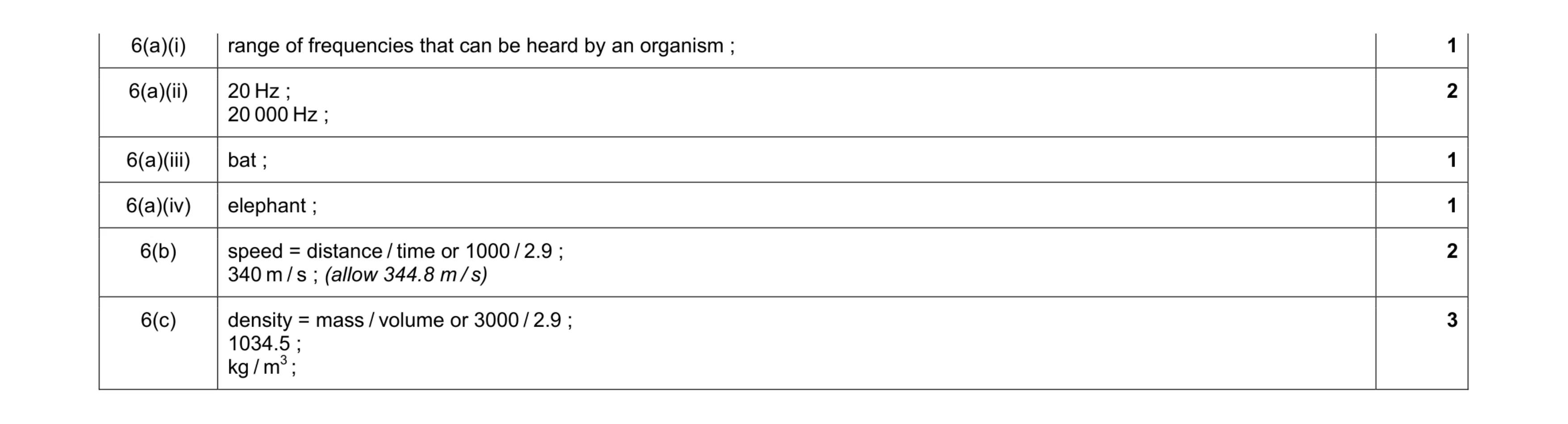 10
10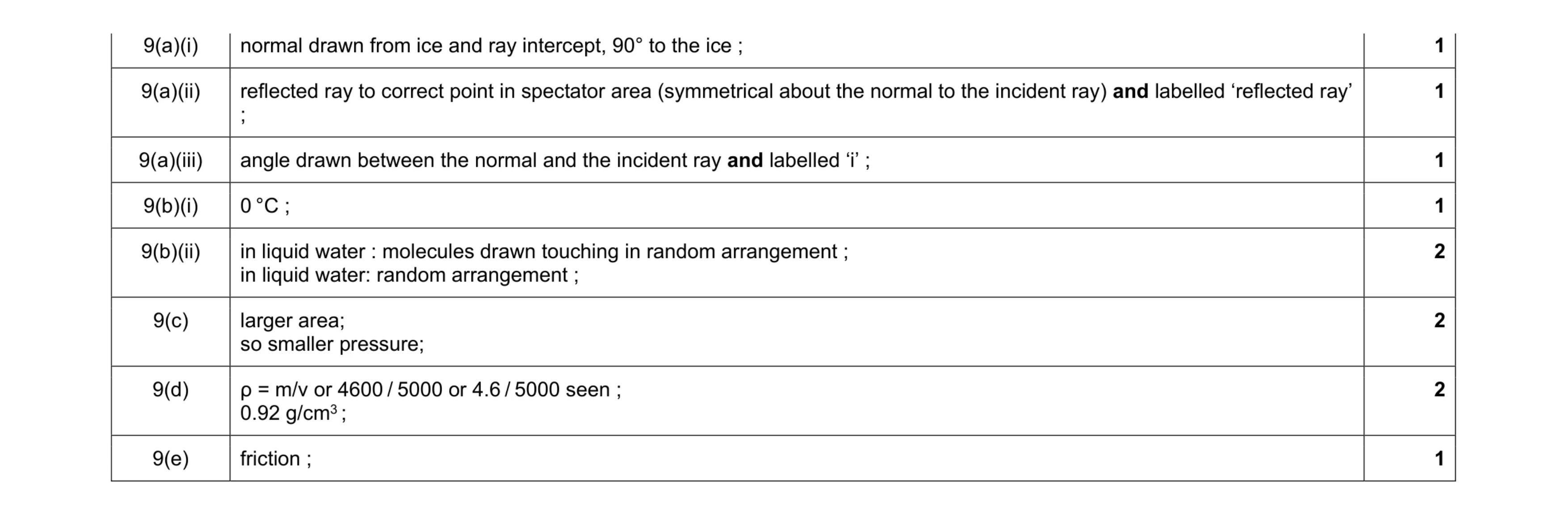 11
11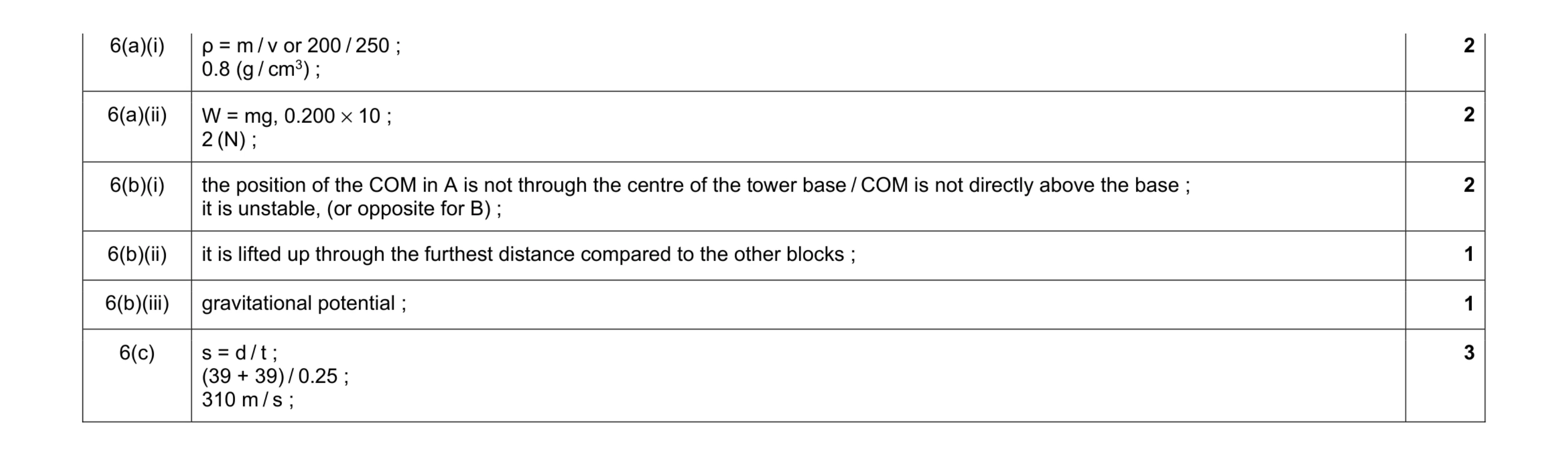 11
11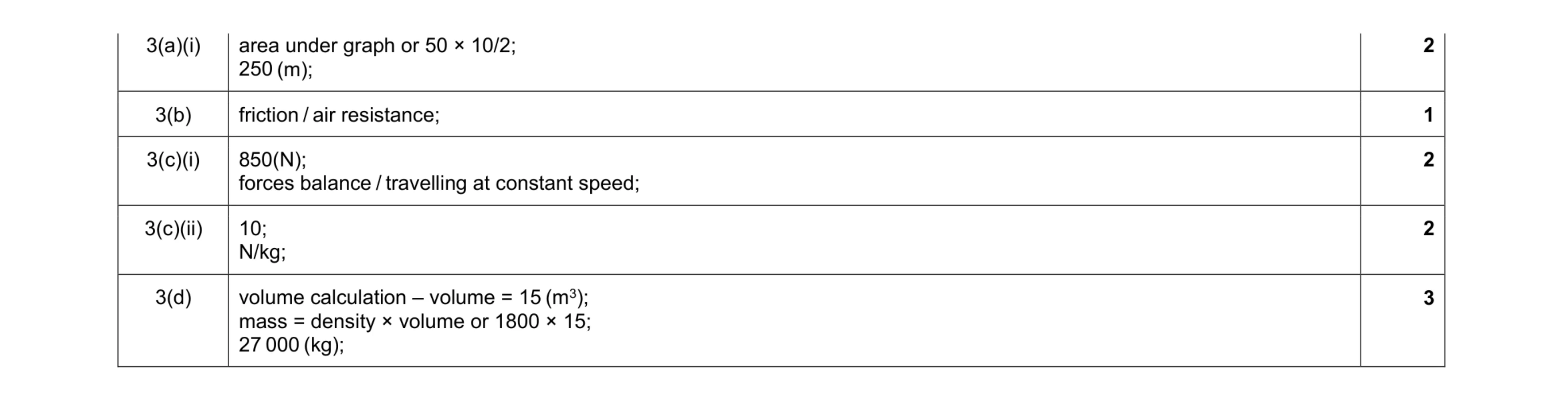 10
10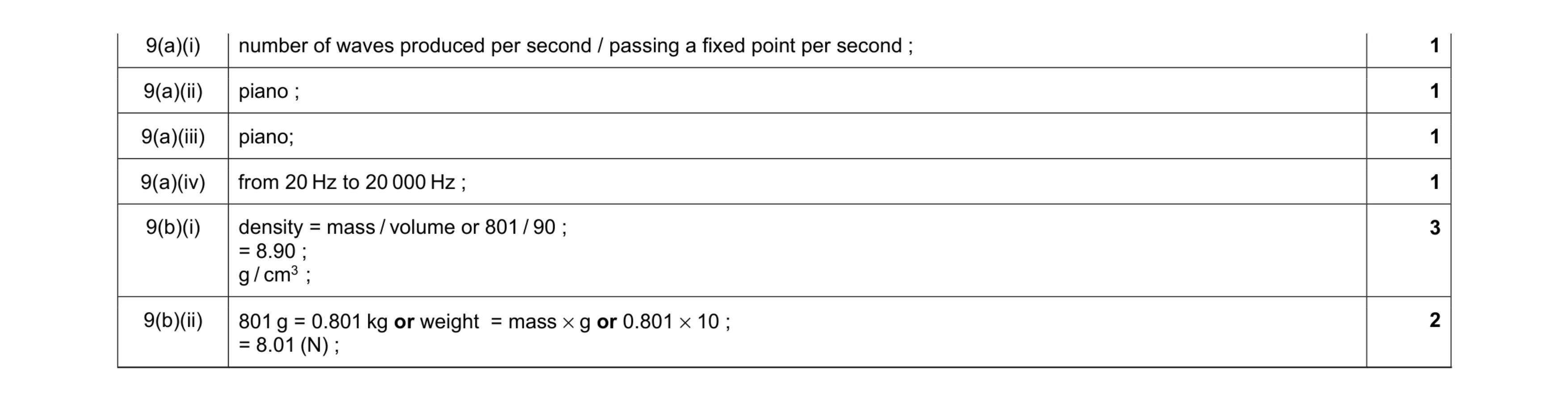 9
9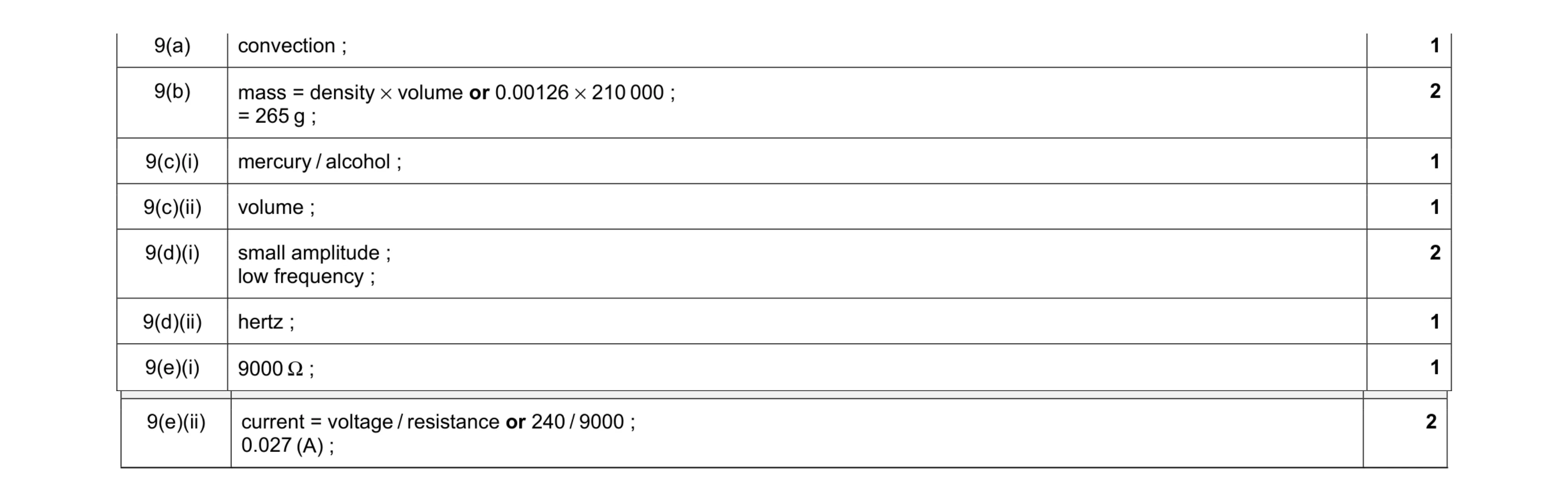 11
11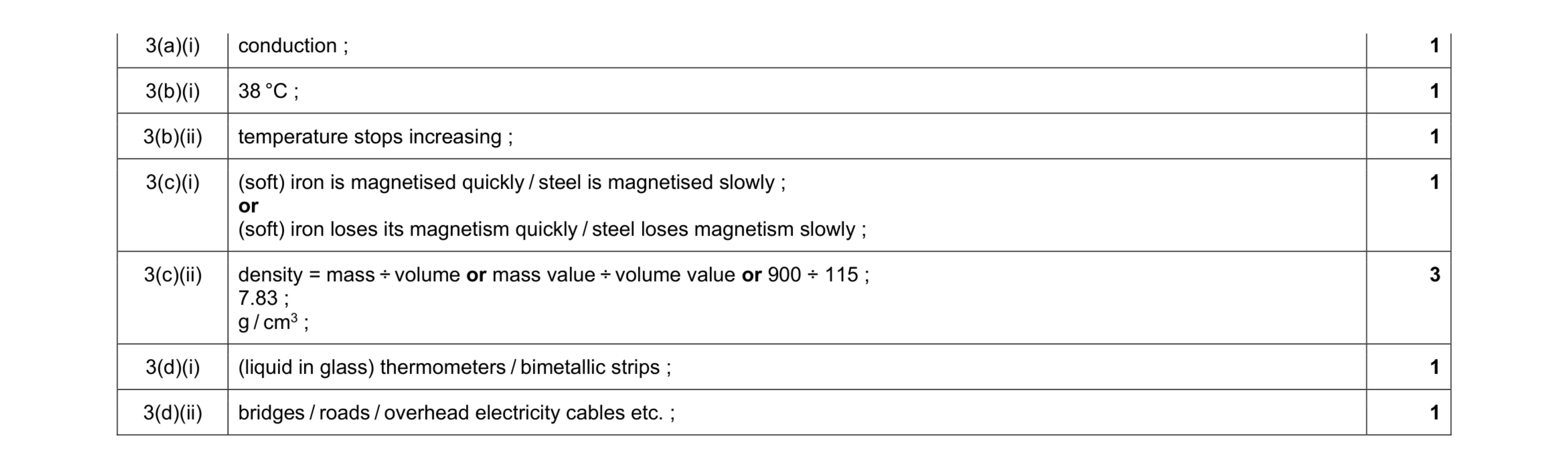 9
9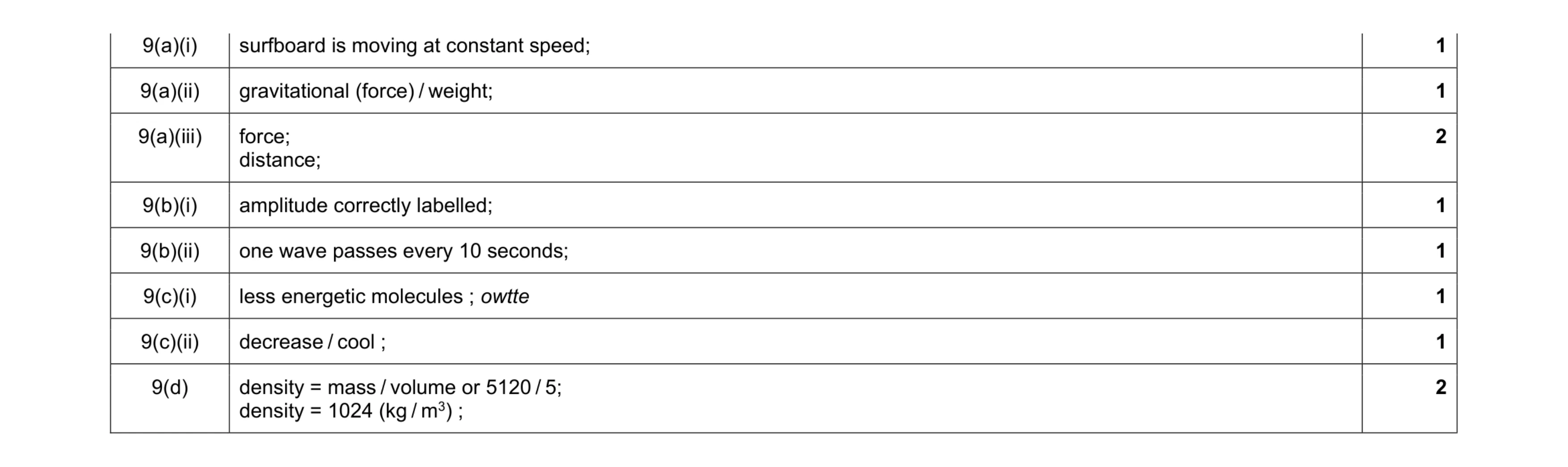 10
10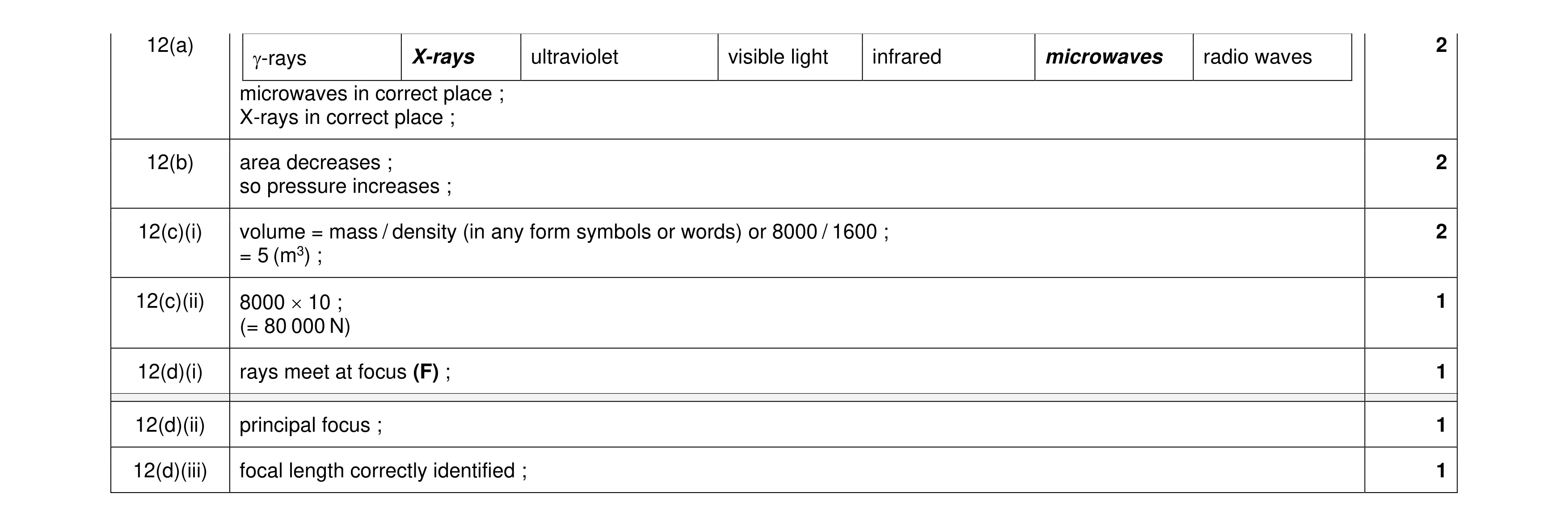 10
10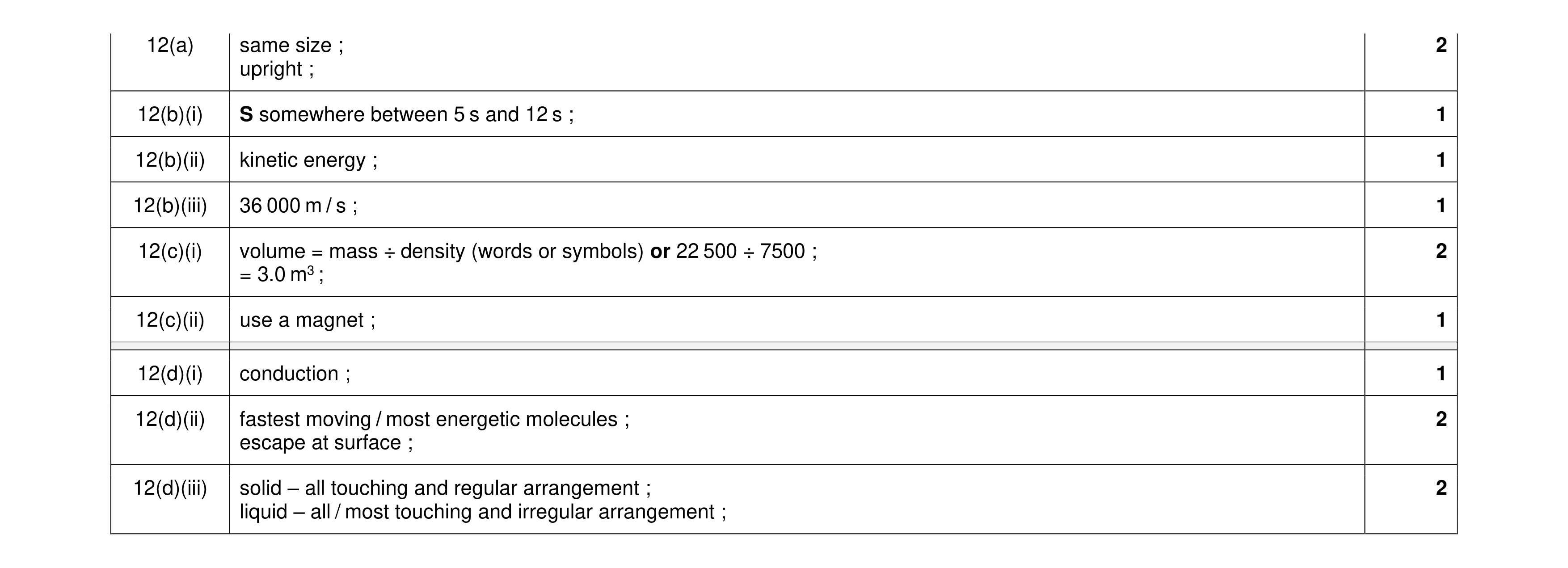 13
13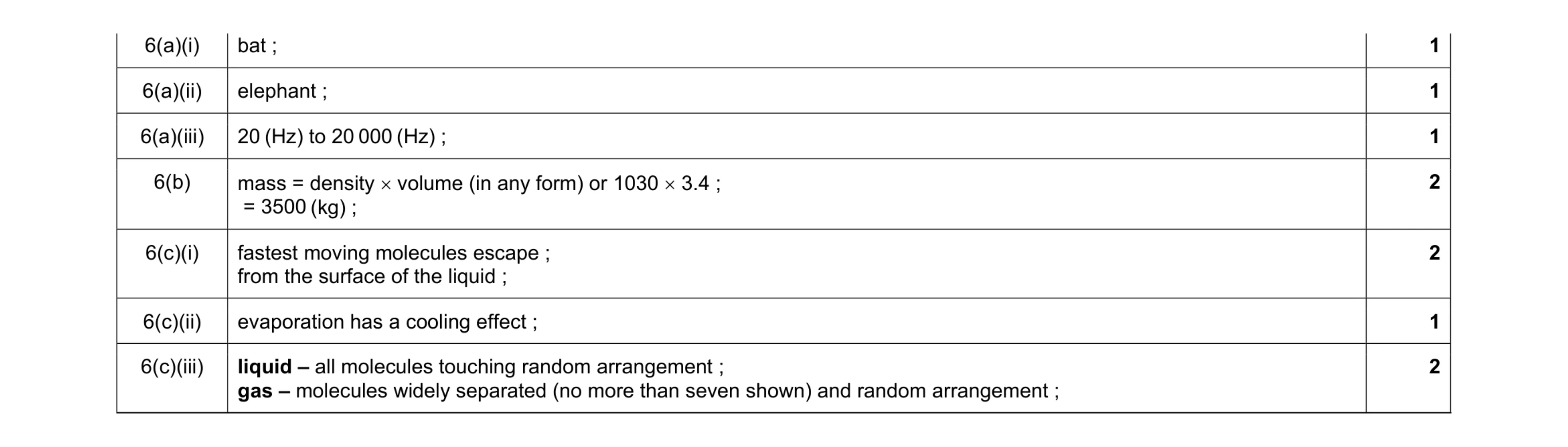 10
10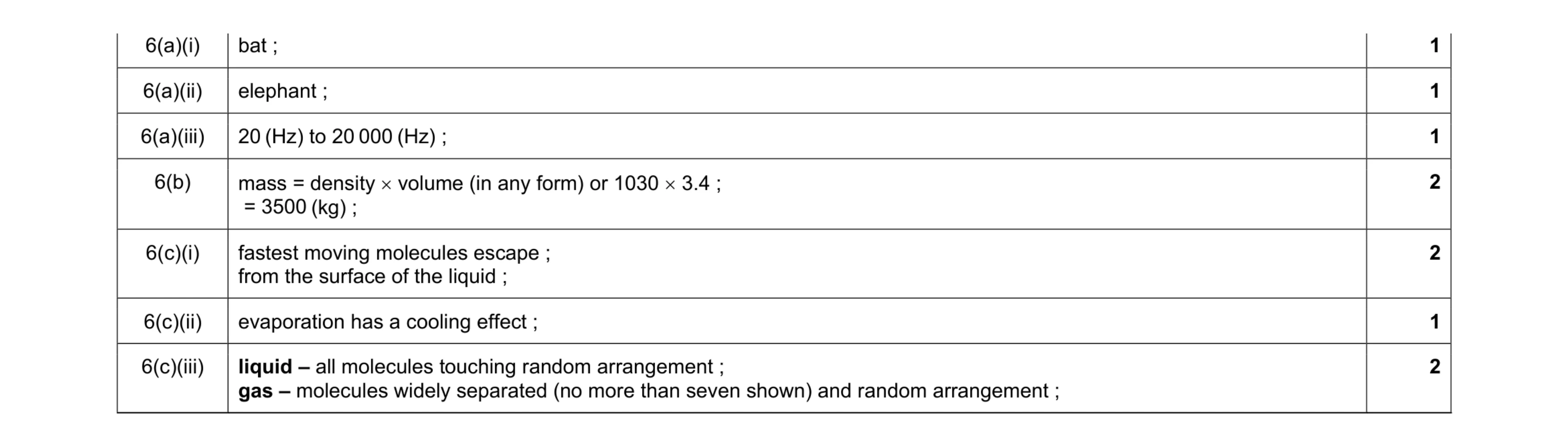 10
10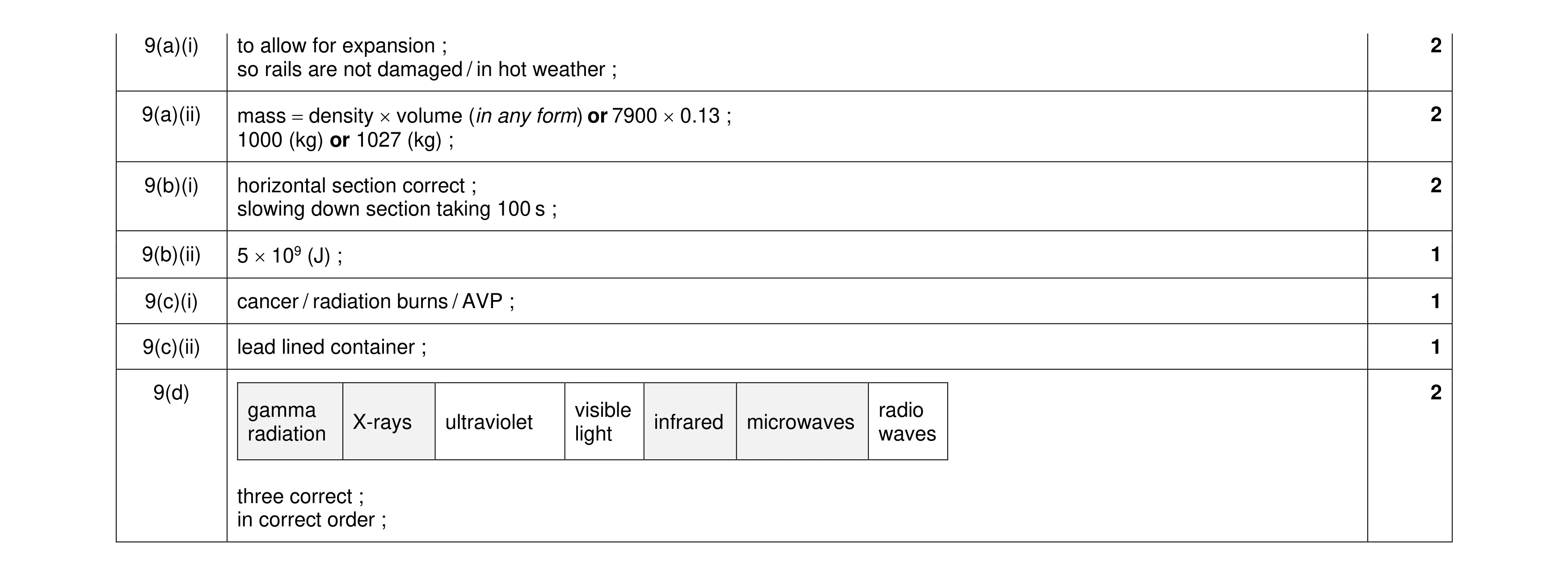 11
11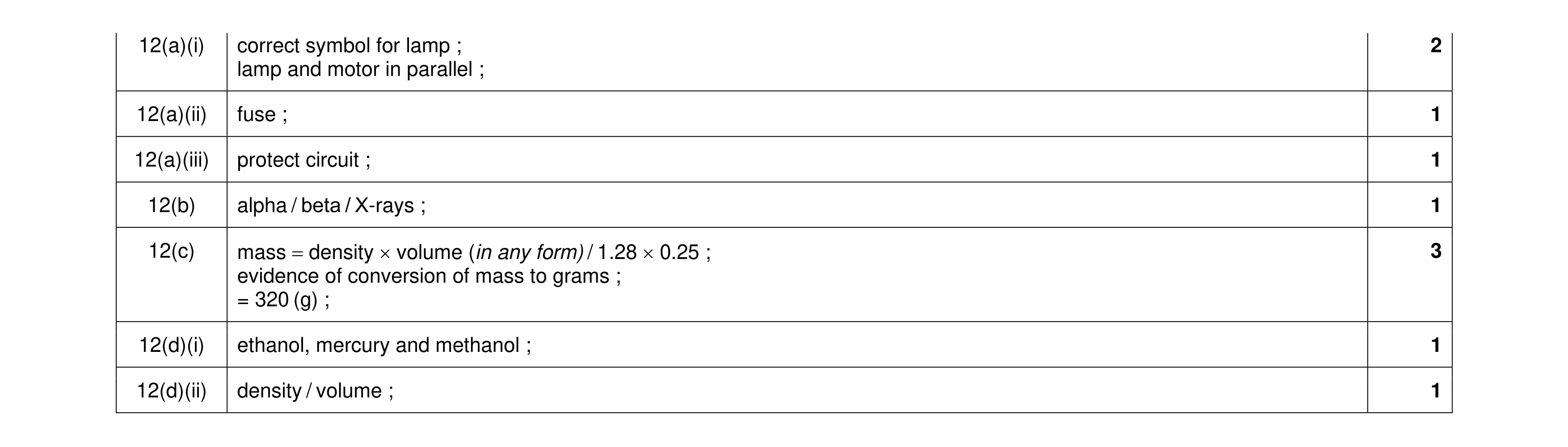 10
10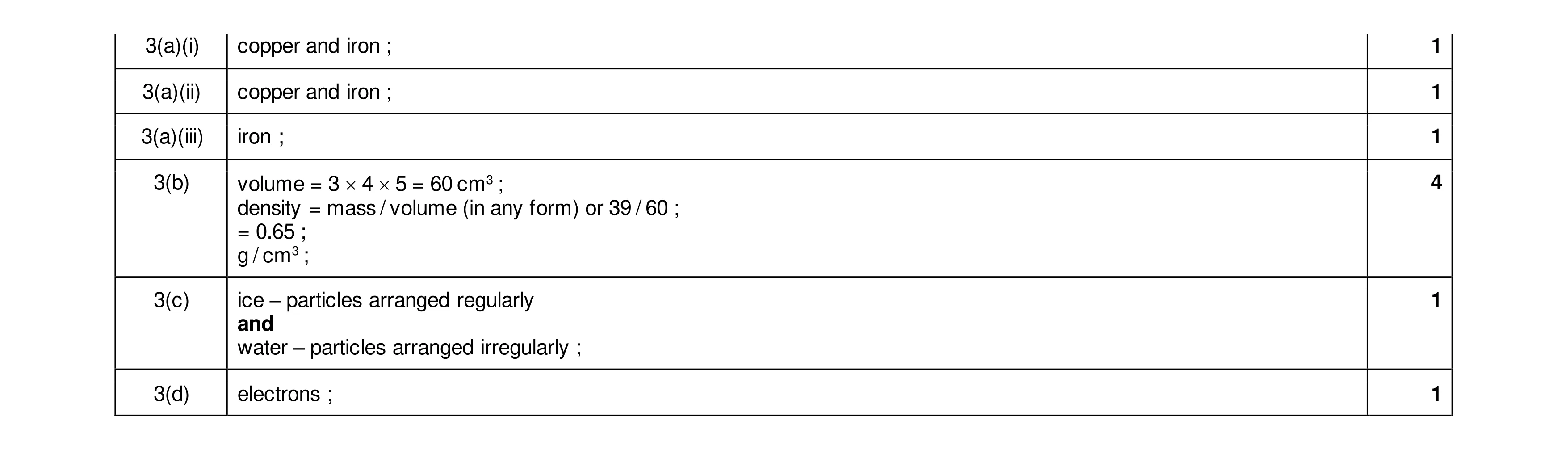 9
9