Questions as text
Q1 · A list of metals is shown 0654/42 Oct/Nov 2018
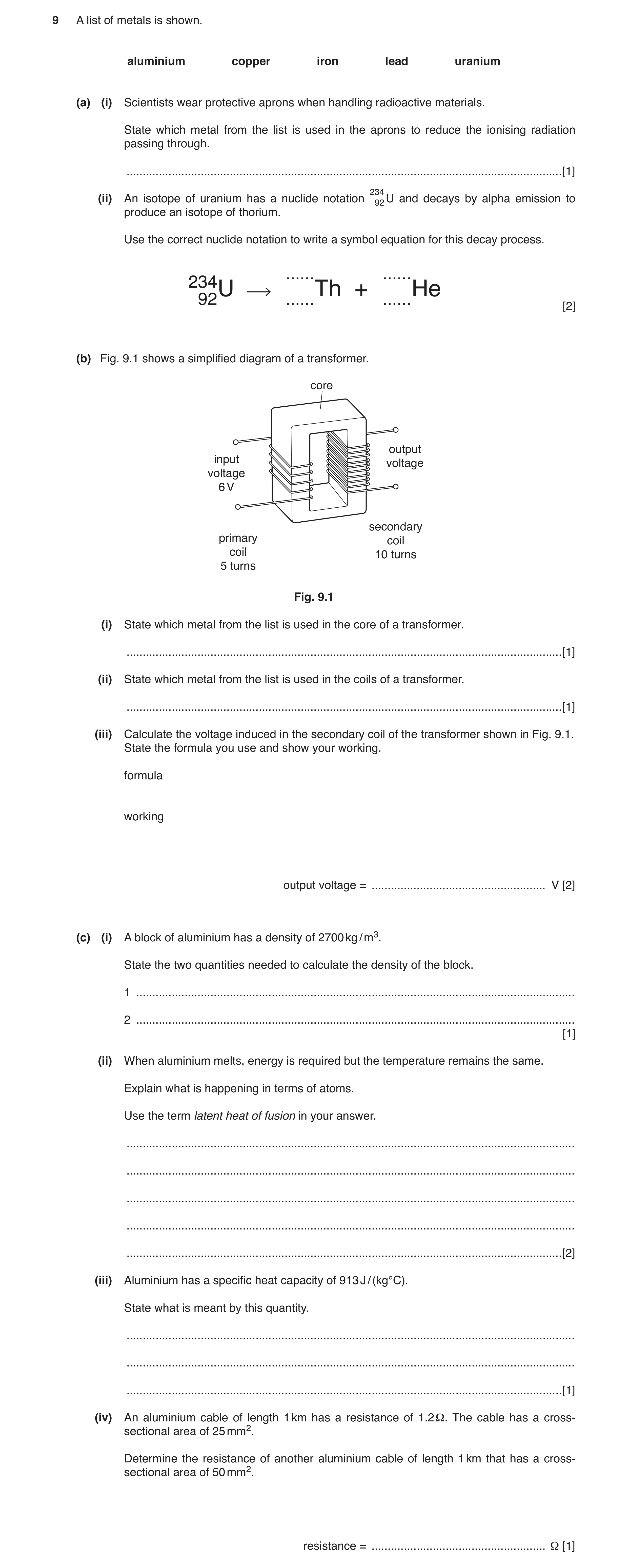
9 A list of metals is shown. aluminium copper iron lead uranium (a) (i) Scientists wear protective aprons when handling radioactive materials. State which metal from the list is used in the aprons to reduce the ionising radiation passing through. … [1] 234 (ii) An isotope of uranium has a nuclide notation 92 U and decays by alpha emission to produce an isotope of thorium. Use the correct nuclide notation to write a symbol equation for this decay process. … … 23492U … Th + … He [2] (b) Fig. 9.1 shows a simplified diagram of a transformer. core output input voltage voltage 6 V secondary primary coil coil 10 turns 5 turns Fig. 9.1 (i) State which metal from the list is used in the core of a transformer. … [1] (ii) State which metal from the list is used in the coils of a transformer. … [1] (iii) Calculate the voltage induced in the secondary coil of the transformer shown in Fig. 9.1. State the formula you use and show your working. formula working output voltage = … V [2] (c) (i) A block of aluminium has a density of 2700 kg / m3. State the two quantities needed to calculate the density of the block. 1 … 2 … [1] (ii) When aluminium melts, energy is required but the temperature remains the same. Explain what is happening in terms of atoms. Use the term latent heat of fusion in your answer. … … … … … [2] (iii) Aluminium has a specific heat capacity of 913 J / (kg°C). State what is meant by this quantity. … … … [1] (iv) An aluminium cable of length 1 km has a resistance of 1.2 Ω. The cable has a cross- sectional area of 25 mm2. Determine the resistance of another aluminium cable of length 1 km that has a cross- sectional area of 50 mm2. resistance = … Ω [1]
12 marks
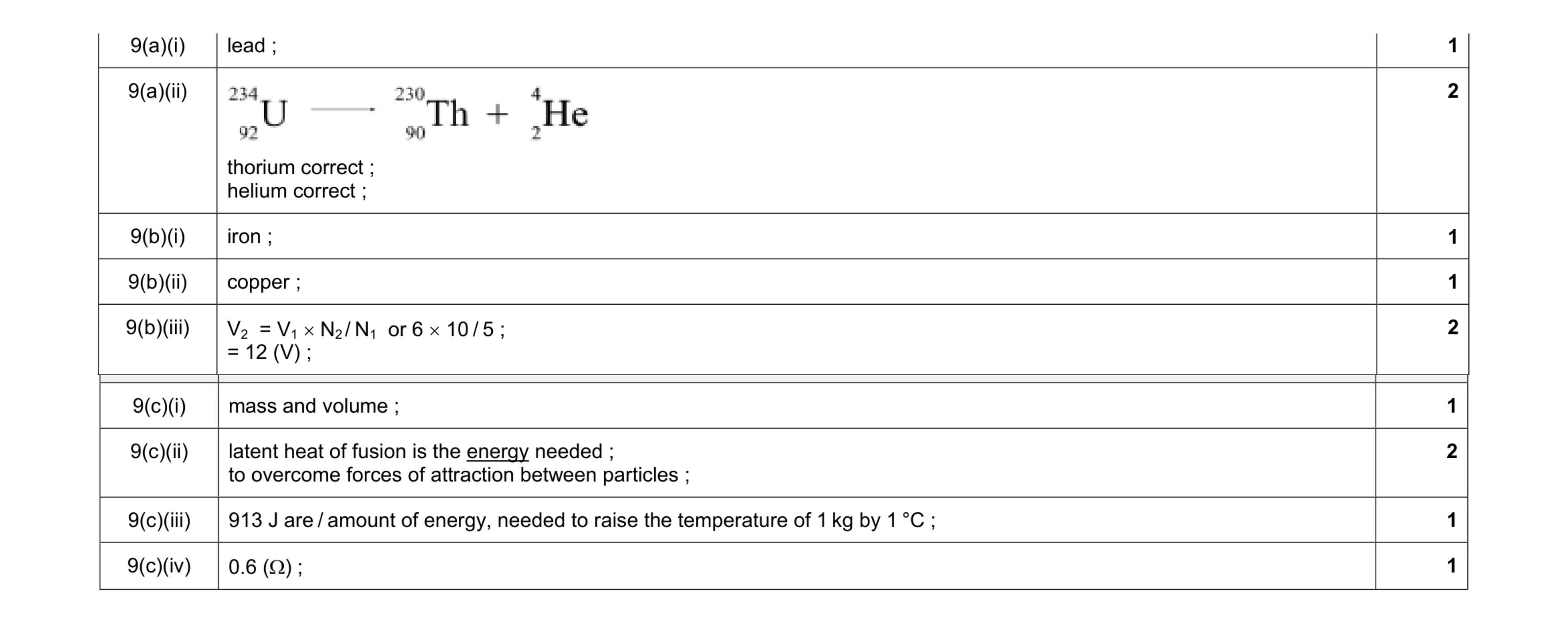
Mark scheme: 9(a)(i) lead ; 1 9(a)(ii) thorium correct ; helium correct ; 2 9(b)(i) iron ; 1 9(b)(ii) copper ; 1 9(b)(iii) V2 = V1 × N2 / N1 or 6 × 10 / 5 ; = 12 (V) ; 2 Question Answer Marks 9(c)(i) mass and volume ; 1 9(c)(ii) latent heat of fusion is the energy needed ; to overcome forces of attraction between particles ; 2 9(c)(iii) 913 J are / amount of energy, needed to raise the temperature of 1 kg by 1 °C ; 1 9(c)(iv) 0.6 (Ω) ; 1
This question in 0654/42 Oct/Nov 2018
Q2 · In a cartoon, a mouse is being chased by a cat 0654/43 Oct/Nov 2019
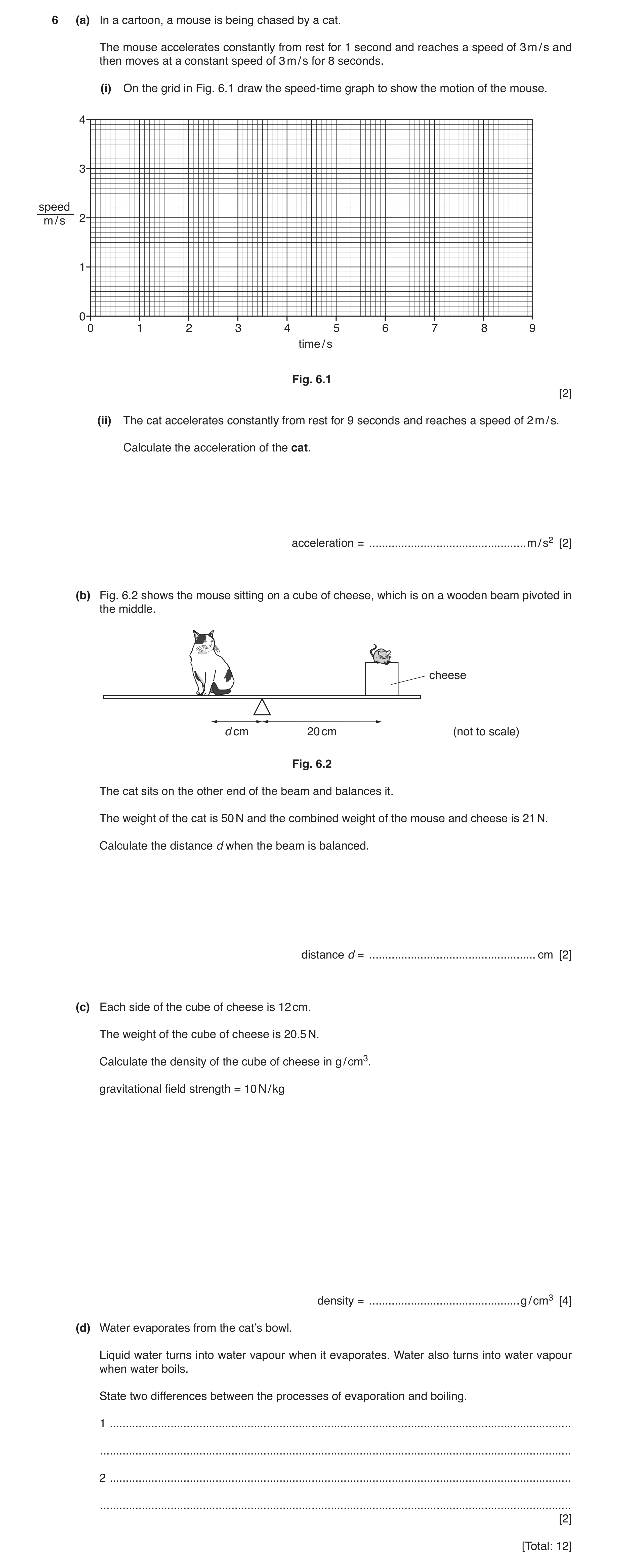
6 (a) In a cartoon, a mouse is being chased by a cat. The mouse accelerates constantly from rest for 1 second and reaches a speed of 3 m / s and then moves at a constant speed of 3 m / s for 8 seconds. (i) On the grid in Fig. 6.1 draw the speed-time graph to show the motion of the mouse. 4 3 speed m / s 2 1 0 0 1 2 3 4 5 6 7 8 9 time / s Fig. 6.1 [2] (ii) The cat accelerates constantly from rest for 9 seconds and reaches a speed of 2 m / s. Calculate the acceleration of the cat. acceleration = … m / s2 [2] (b) Fig. 6.2 shows the mouse sitting on a cube of cheese, which is on a wooden beam pivoted in the middle. cheese d cm 20 cm (not to scale) Fig. 6.2 The cat sits on the other end of the beam and balances it. The weight of the cat is 50 N and the combined weight of the mouse and cheese is 21 N. Calculate the distance d when the beam is balanced. distance d = … cm [2] (c) Each side of the cube of cheese is 12 cm. The weight of the cube of cheese is 20.5 N. Calculate the density of the cube of cheese in g / cm3. gravitational field strength = 10 N / kg density = … g / cm3 [4] (d) Water evaporates from the cat’s bowl. Liquid water turns into water vapour when it evaporates. Water also turns into water vapour when water boils. State two differences between the processes of evaporation and boiling. 1 … … 2 … … [2] [Total: 12]
12 marks
Mark scheme: 6(a)(i) acceleration section ; constant speed section ; 2 6(a)(ii) acceleration = change in speed / time OR 2 / 9 ; = 0.2 (m / s2) ; 2 6(b) f1d1 = f2d2 OR 50 × d = 21 × 20 ; d = 8.4 (cm) ; 2 6(c) volume = 1728 (cm3) / use of 123 ; mass = 20.5 / 10 OR 2.05 kg ; 2.05 × 1000 OR 2050 g ; (density = ) 1.2 (g / cm3) ; 4 6(d) evaporation can occur at any temperature / boiling only happens at the boiling point ; evaporation happens at the surface / boiling occurs throughout the liquid ; during boiling all / most molecules have enough energy to leave / evaporation lets only the molecules with most kinetic energy out ; evaporation can occur using the internal energy of the system / boiling a(n external) source of heat ; evaporation produces cooling / boiling does not produce cooling ; evaporation is a slow process / boiling is a rapid process ; max 2 2
This question in 0654/43 Oct/Nov 2019
Q3 · The arrangement of molecules in samples of a solid, a liquid and a gas 0654/43 May/June 2021
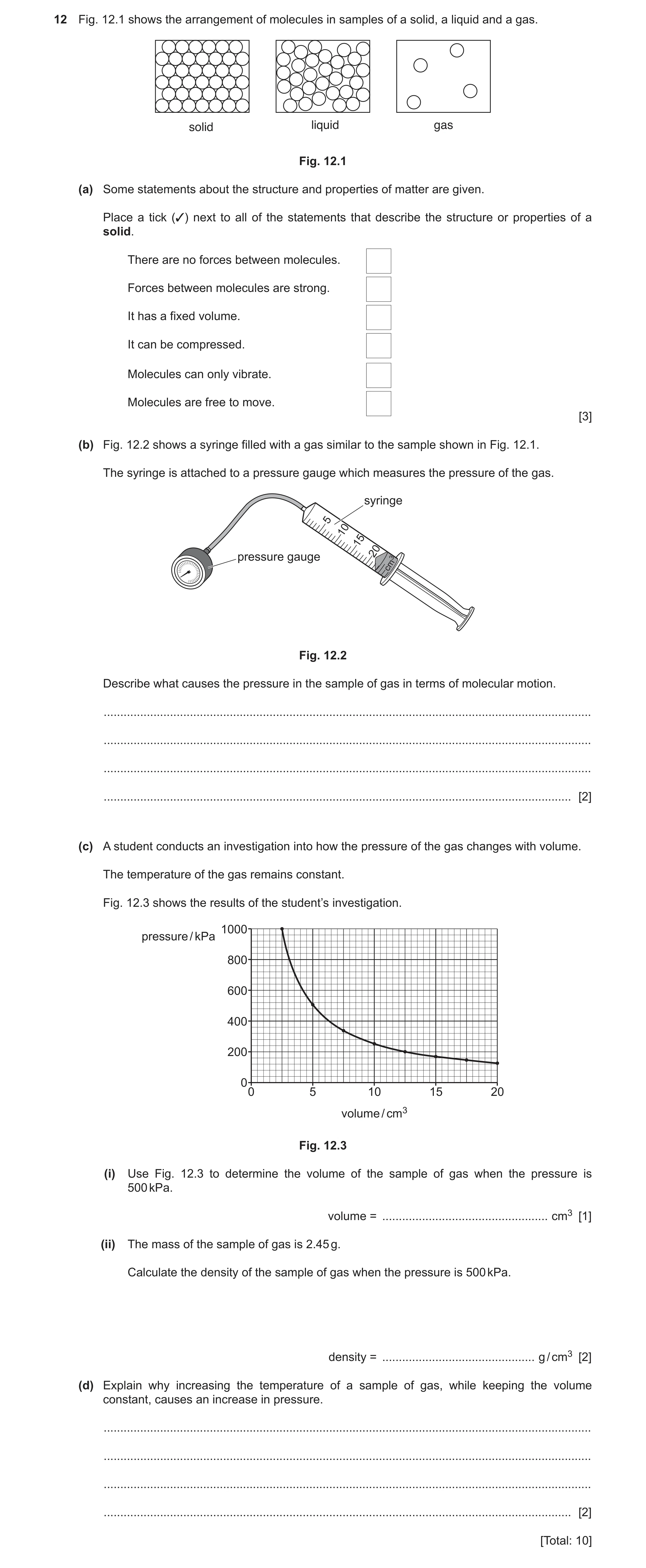
12 Fig. 12.1 shows the arrangement of molecules in samples of a solid, a liquid and a gas. solid liquid gas Fig. 12.1 (a) Some statements about the structure and properties of matter are given. Place a tick (3) next to all of the statements that describe the structure or properties of a solid. There are no forces between molecules. Forces between molecules are strong. It has a fixed volume. It can be compressed. Molecules can only vibrate. Molecules are free to move. [3] (b) Fig. 12.2 shows a syringe filled with a gas similar to the sample shown in Fig. 12.1. The syringe is attached to a pressure gauge which measures the pressure of the gas. syringe 5 10 15 20 pressure gauge cm3 Fig. 12.2 Describe what causes the pressure in the sample of gas in terms of molecular motion. … … … … [2] (c) A student conducts an investigation into how the pressure of the gas changes with volume. The temperature of the gas remains constant. Fig. 12.3 shows the results of the student’s investigation. 1000 pressure / kPa 800 600 400 200 00 5 10 15 20 volume / cm3 Fig. 12.3 (i) Use Fig. 12.3 to determine the volume of the sample of gas when the pressure is 500 kPa. volume = … cm3 [1] (ii) The mass of the sample of gas is 2.45 g. Calculate the density of the sample of gas when the pressure is 500 kPa. density = … g / cm3 [2] (d) Explain why increasing the temperature of a sample of gas, while keeping the volume constant, causes an increase in pressure. … … … … [2] [Total: 10]
10 marks
Mark scheme: 12(a) forces between molecules are strong ; it has a fixed volume ; molecules can only vibrate; 3 12(b) collisions of molecules with walls ; produces a force ; 2 12(c)(i) 5 (cm3) ; 1 12(c)(ii) (density =) m / V or 2.45 / 5 ; 0.5 (g / cm3) ; 2 12(d) molecules move faster / have more energy ; molecules collide, more often / more frequently, with walls / with a larger force exerted on walls ; 2
This question in 0654/43 May/June 2021
Q4 · A 35 kg child sliding down a long wire called a zipline 0654/42 May/June 2022
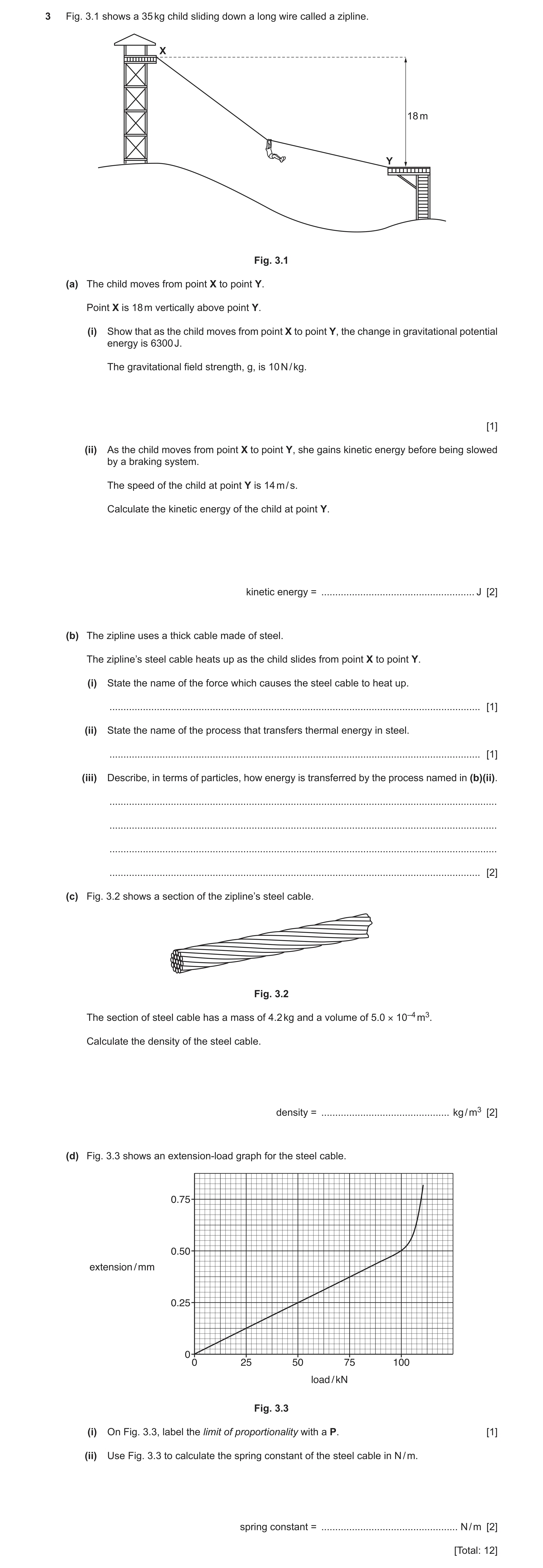
3 Fig. 3.1 shows a 35 kg child sliding down a long wire called a zipline. X 18 m Y Fig. 3.1 (a) The child moves from point X to point Y. Point X is 18 m vertically above point Y. (i) Show that as the child moves from point X to point Y, the change in gravitational potential energy is 6300 J. The gravitational field strength, g, is 10 N / kg. [1] (ii) As the child moves from point X to point Y, she gains kinetic energy before being slowed by a braking system. The speed of the child at point Y is 14 m / s. Calculate the kinetic energy of the child at point Y. kinetic energy = … J [2] (b) The zipline uses a thick cable made of steel. The zipline’s steel cable heats up as the child slides from point X to point Y. (i) State the name of the force which causes the steel cable to heat up. … [1] (ii) State the name of the process that transfers thermal energy in steel. … [1] (iii) Describe, in terms of particles, how energy is transferred by the process named in (b)(ii). … … … … [2] (c) Fig. 3.2 shows a section of the zipline’s steel cable. Fig. 3.2 The section of steel cable has a mass of 4.2 kg and a volume of 5.0 × 10⁻⁴ m3. Calculate the density of the steel cable. density = … kg / m3 [2] (d) Fig. 3.3 shows an extension‑load graph for the steel cable. 0.75 0.50 extension / mm 0.25 0 0 25 50 75 100 load / kN Fig. 3.3 (i) On Fig. 3.3, label the limit of proportionality with a P. [1] (ii) Use Fig. 3.3 to calculate the spring constant of the steel cable in N / m. spring constant = … N / m [2] [Total: 12]
12 marks
Mark scheme: 3(a)(i) 1 3(a)(ii) (KE =) ½ mv2 or ½ 35 142 ; 3430 (J) ; 2 3(b)(i) friction ; 1 3(b)(ii) conduction ; 1 3(b)(iii) idea of vibrations / oscillations, from particle to particle ; transferred by electrons ; 2 3(c) ( =) m / V or 4.2 / 5.0 10–4 ; 8400 (kg / m3) ; 2 3(d)(i) P at 100,0.5 ; 1 3(d)(ii) (k =) F / x or 100 000 / 0.0005 ; 200 000 000 (N / m) ; 2
This question in 0654/42 May/June 2022
Q5 · A piece of graphite with an irregular shape 0654/43 May/June 2022
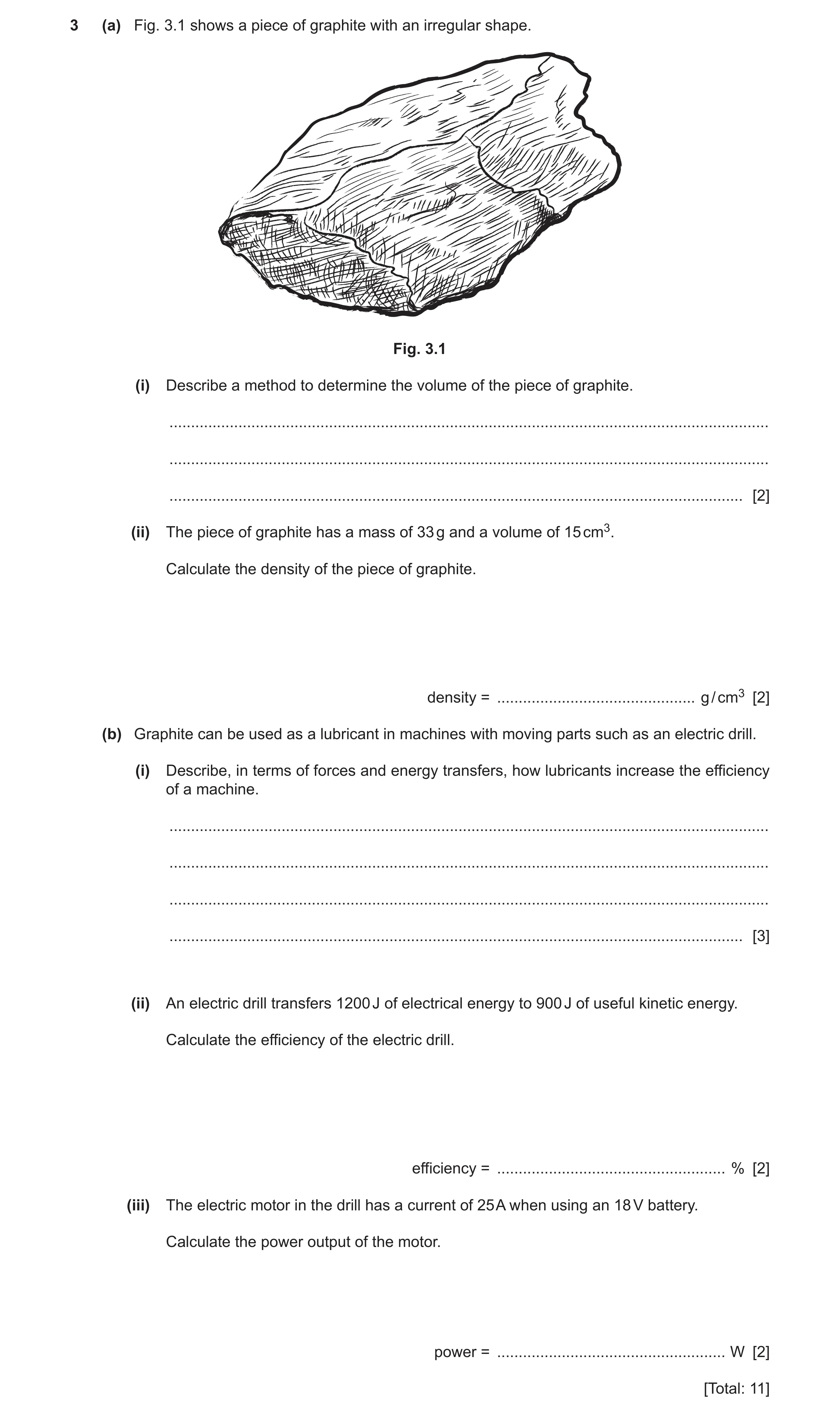
3 (a) Fig. 3.1 shows a piece of graphite with an irregular shape. Fig. 3.1 (i) Describe a method to determine the volume of the piece of graphite. … … … [2] (ii) The piece of graphite has a mass of 33 g and a volume of 15 cm3. Calculate the density of the piece of graphite. density = … g / cm3 [2] (b) Graphite can be used as a lubricant in machines with moving parts such as an electric drill. (i) Describe, in terms of forces and energy transfers, how lubricants increase the efficiency of a machine. … … … … [3] (ii) An electric drill transfers 1200 J of electrical energy to 900 J of useful kinetic energy. Calculate the efficiency of the electric drill. efficiency = … % [2] (iii) The electric motor in the drill has a current of 25 A when using an 18 V battery. Calculate the power output of the motor. power = … W [2] [Total: 11]
11 marks
Mark scheme: 3(a)(i) submerge graphite in water ; measure volume of water displaced ; OR measure the mass of graphite ; look up density and apply V = m / d ; 2 3(a)(ii) (density =) m / V OR 33 / 15 ; 2.2 (g / cm3) ; 2 Question Answer Marks 3(b)(i) reduce friction ; less heat is generated ; less wasted energy / more useful energy ; 3 3(b)(ii) (efficiency =) useful output total input 100 OR 900 1200 100 ; 75 (%) ; 2 3(b)(iii) (P=) I V OR 25 18 ; (P =) 450 (W) ; 2
This question in 0654/43 May/June 2022
Q6 · A marble staircase made up of 17 steps 0654/43 Oct/Nov 2022
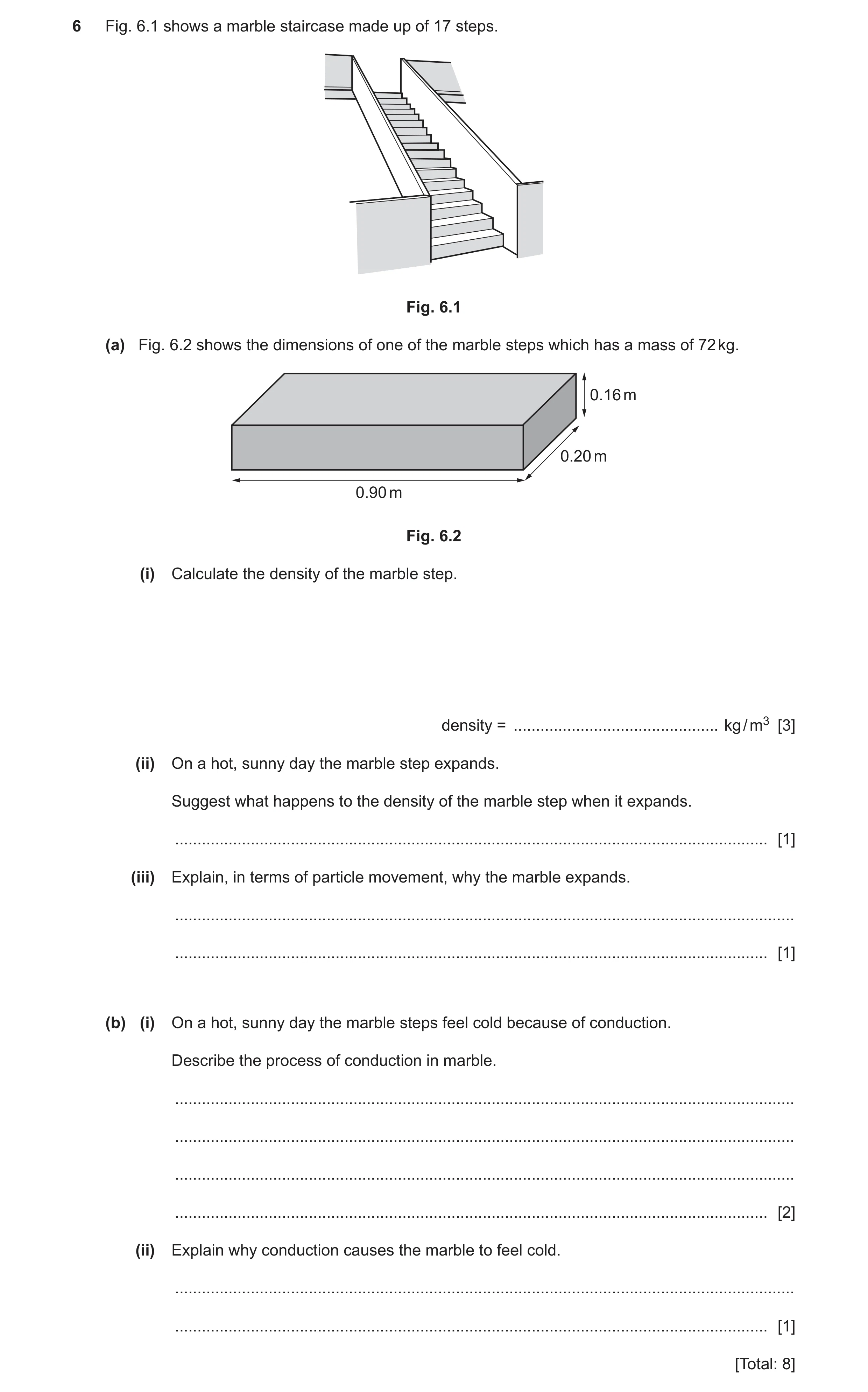
6 Fig. 6.1 shows a marble staircase made up of 17 steps. Fig. 6.1 (a) Fig. 6.2 shows the dimensions of one of the marble steps which has a mass of 72 kg. 0.16 m 0.20 m 0.90 m Fig. 6.2 (i) Calculate the density of the marble step. density = … kg / m3 [3] (ii) On a hot, sunny day the marble step expands. Suggest what happens to the density of the marble step when it expands. … [1] (iii) Explain, in terms of particle movement, why the marble expands. … … [1] (b) (i) On a hot, sunny day the marble steps feel cold because of conduction. Describe the process of conduction in marble. … … … … [2] (ii) Explain why conduction causes the marble to feel cold. … … [1] [Total: 8]
8 marks
Mark scheme: 6(a)(i) (V =) 0.16 0.20 0.90 or 0.0288 (m3) ; 3 ( =) m / V or 72 / 0.0288 ; 2500 (kg / m3) ; 6(a)(ii) decreases ; 1 6(a)(iii) particles move further apart ; 1 6(b)(i) (conduction is) caused by particle vibrations ; 2 vibrations passed from one particle to the next ; 6(b)(ii) thermal energy is moved away from the hand / surface ; 1
This question in 0654/43 Oct/Nov 2022
Q7 · A student investigates how different shaped objects fall 0654/42 Feb/March 2023
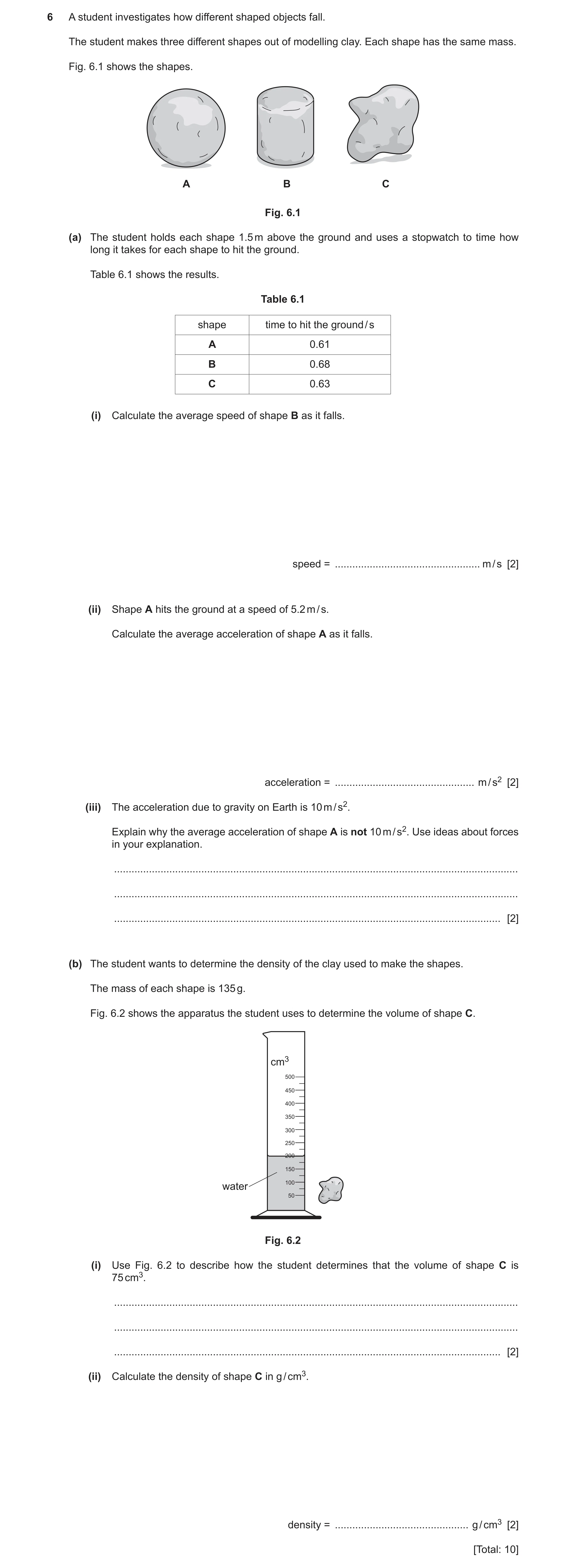
6 A student investigates how different shaped objects fall. The student makes three different shapes out of modelling clay. Each shape has the same mass. Fig. 6.1 shows the shapes. A B C Fig. 6.1 (a) The student holds each shape 1.5 m above the ground and uses a stopwatch to time how long it takes for each shape to hit the ground. Table 6.1 shows the results. Table 6.1 shape time to hit the ground / s A 0.61 B 0.68 C 0.63 (i) Calculate the average speed of shape B as it falls. speed = … m / s [2] (ii) Shape A hits the ground at a speed of 5.2 m / s. Calculate the average acceleration of shape A as it falls. acceleration = … m / s2 [2] (iii) The acceleration due to gravity on Earth is 10 m / s2. Explain why the average acceleration of shape A is not 10 m / s2. Use ideas about forces in your explanation. … … … [2] (b) The student wants to determine the density of the clay used to make the shapes. The mass of each shape is 135 g. Fig. 6.2 shows the apparatus the student uses to determine the volume of shape C. cm3 water Fig. 6.2 (i) Use Fig. 6.2 to describe how the student determines that the volume of shape C is 75 cm3. … … … [2] (ii) Calculate the density of shape C in g / cm3. density = … g / cm3 [2] [Total: 10]
10 marks
Mark scheme: 6(a)(i) evidence of (speed =) distance/time (in any form) or 1.5 / 0.68 ; 2 (speed =) 2.2 (m / s) ; 6(a)(ii) evidence of (a =) v / t (in any form) or 5.2 / 0.61 ; 2 (a =) 8.5 (m / s2) ; 6(a)(iii) reference to air resistance ; 2 (air resistance) acts in opposite direction to weight / upwards ; 6(b)(i) place shape in water ; 2 measure the volume of water displaced ; 6(b)(ii) evidence of (density =) m / V (in any form) or 135 / 75; 2 (density =) 1.8 (g / cm3)
This question in 0654/42 Feb/March 2023
Q8 · A student investigates the penetrating abilities of ionising radiation 0654/41 May/June 2023
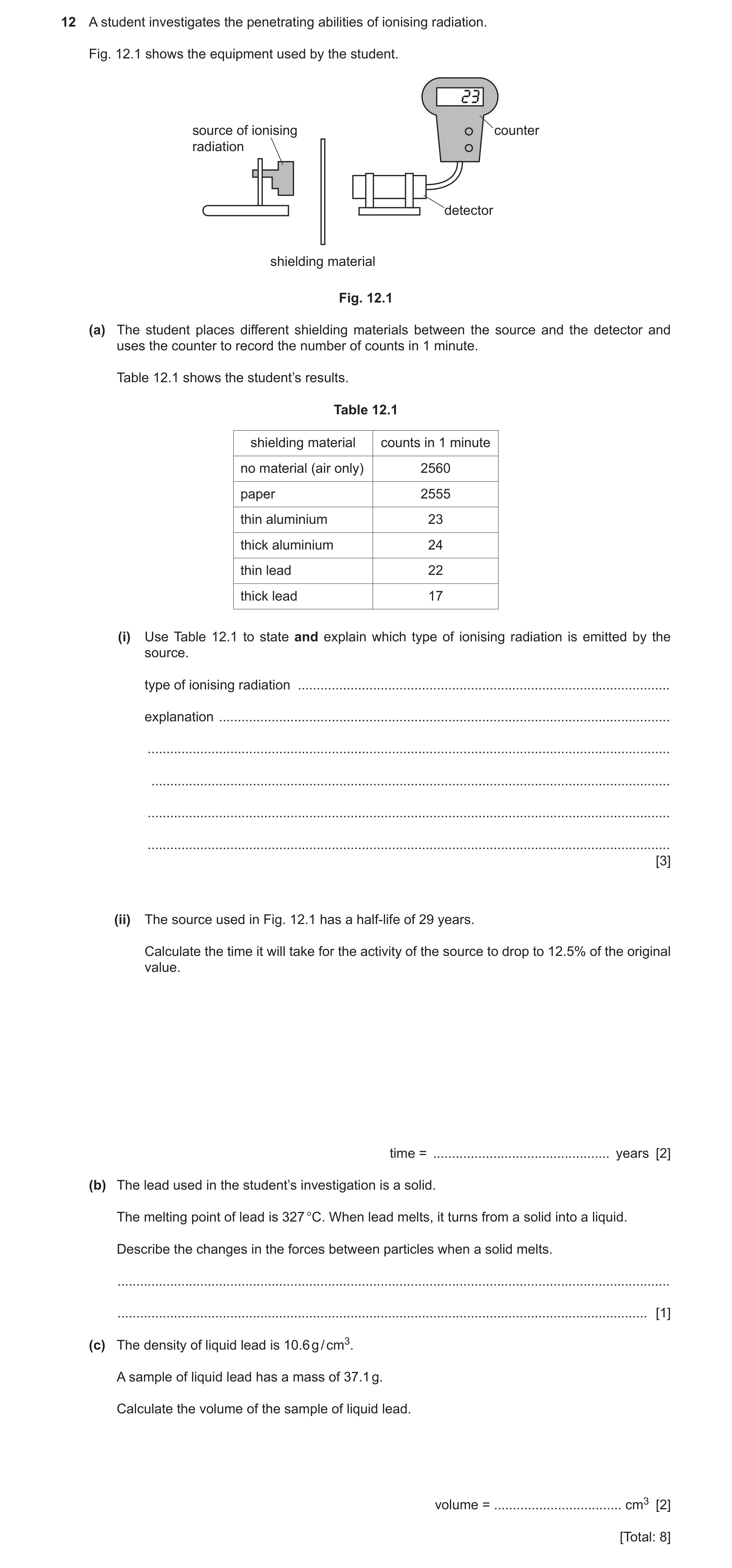
12 A student investigates the penetrating abilities of ionising radiation. Fig. 12.1 shows the equipment used by the student. source of ionising counter radiation detector shielding material Fig. 12.1 (a) The student places different shielding materials between the source and the detector and uses the counter to record the number of counts in 1 minute. Table 12.1 shows the student’s results. Table 12.1 shielding material counts in 1 minute no material (air only) 2560 paper 2555 thin aluminium 23 thick aluminium 24 thin lead 22 thick lead 17 (i) Use Table 12.1 to state and explain which type of ionising radiation is emitted by the source. type of ionising radiation … explanation … … … … … [3] (ii) The source used in Fig. 12.1 has a half‑life of 29 years. Calculate the time it will take for the activity of the source to drop to 12.5% of the original value. time = … years [2] (b) The lead used in the student’s investigation is a solid. The melting point of lead is 327 °C. When lead melts, it turns from a solid into a liquid. Describe the changes in the forces between particles when a solid melts. … … [1] (c) The density of liquid lead is 10.6 g / cm3. A sample of liquid lead has a mass of 37.1 g. Calculate the volume of the sample of liquid lead. volume = … cm3 [2] [Total: 8]
8 marks
Mark scheme: 12(a)(i) beta ; (beta) can penetrate (air and) paper ; (beta) can’t penetrate thin aluminium (and thicker materials) ; 3 12(a)(ii) 3 half lives ; (t = 3 29 =) 87 (years) ; 2 12(b) (forces between particles) decrease ; 1 12(c) d = m / v or v = m / d or v = 37.1 / 10.6 ; = 3.5 (cm3) ; 2
This question in 0654/41 May/June 2023
Q9 · An iceberg floating in the sea 0654/43 May/June 2023
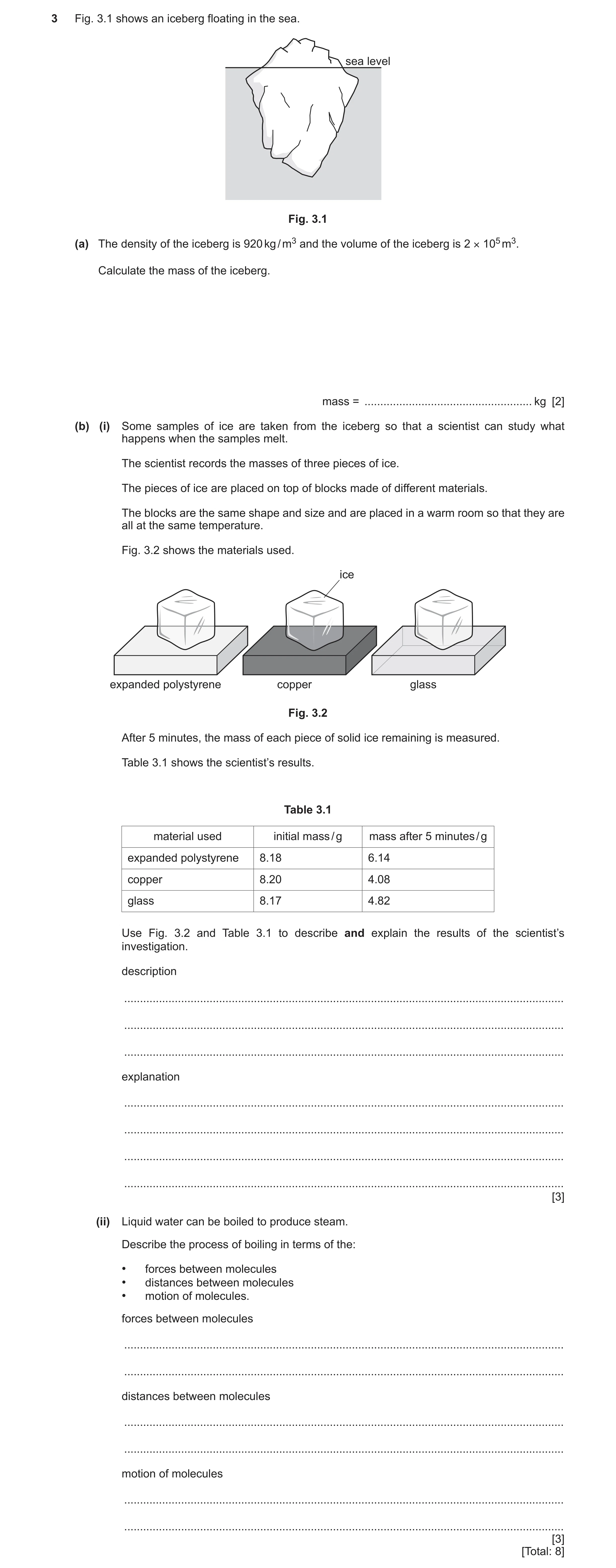
3 Fig. 3.1 shows an iceberg floating in the sea. sea level Fig. 3.1 (a) The density of the iceberg is 920 kg / m3 and the volume of the iceberg is 2 × 10⁵ m3. Calculate the mass of the iceberg. mass = … kg [2] (b) (i) Some samples of ice are taken from the iceberg so that a scientist can study what happens when the samples melt. The scientist records the masses of three pieces of ice. The pieces of ice are placed on top of blocks made of different materials. The blocks are the same shape and size and are placed in a warm room so that they are all at the same temperature. Fig. 3.2 shows the materials used. ice expanded polystyrene copper glass Fig. 3.2 After 5 minutes, the mass of each piece of solid ice remaining is measured. Table 3.1 shows the scientist’s results. Table 3.1 material used initial mass / g mass after 5 minutes / g expanded polystyrene 8.18 6.14 copper 8.20 4.08 glass 8.17 4.82 Use Fig. 3.2 and Table 3.1 to describe and explain the results of the scientist’s investigation. description … … … explanation … … … … [3] (ii) Liquid water can be boiled to produce steam. Describe the process of boiling in terms of the: • forces between molecules • distances between molecules • motion of molecules. forces between molecules … … distances between molecules … … motion of molecules … … [3] [Total: 8]
8 marks
Mark scheme: 3(a) (m =) 1.84 108 (kg) ; 3(b)(i) any three from: changes in mass calculated: polystyrene: 2.04 g, copper: 4.12 g, glass: 3.35 g ; copper melts the most / polystyrene melts the least ; copper is a good conductor / polystyrene is an, insulator / poor conductor ; maximum (rate of) energy transfer in copper / minimum energy transfer in polystyrene ; copper is a metal / expanded polystyrene contains trapped air ; 3 3(b)(ii) (forces between molecules) decrease ; (distance between molecules) increase ; (molecules) become free to move / move out of container ; 3
This question in 0654/43 May/June 2023
Q10 · A ray of light refracted as it enters a glass block 0654/41 Oct/Nov 2023
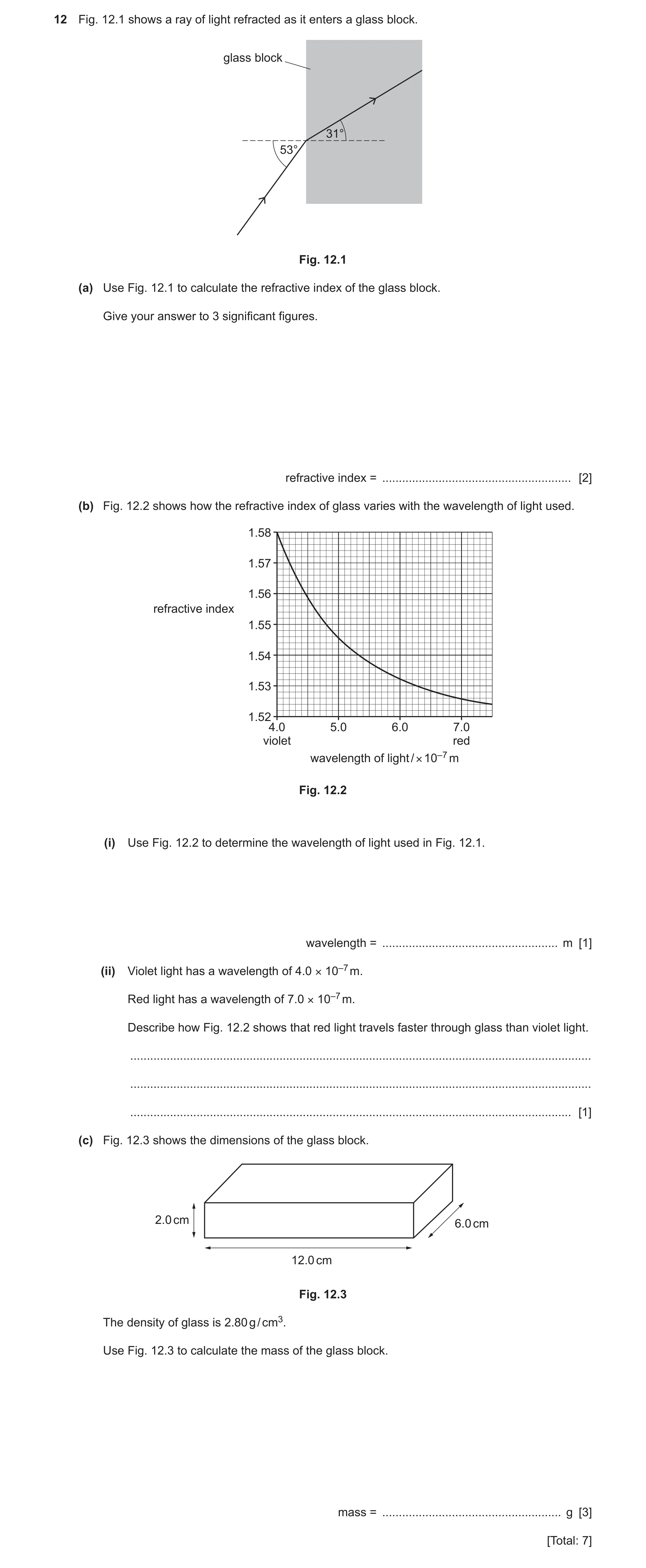
12 Fig. 12.1 shows a ray of light refracted as it enters a glass block. glass block 31° 53° Fig. 12.1 (a) Use Fig. 12.1 to calculate the refractive index of the glass block. Give your answer to 3 significant figures. refractive index = … [2] (b) Fig. 12.2 shows how the refractive index of glass varies with the wavelength of light used. 1.58 1.57 1.56 refractive index 1.55 1.54 1.53 1.52 4.0 5.0 6.0 7.0 violet red wavelength of light / × 10–7 m Fig. 12.2 (i) Use Fig. 12.2 to determine the wavelength of light used in Fig. 12.1. wavelength = … m [1] (ii) Violet light has a wavelength of 4.0 × 10⁻⁷ m. Red light has a wavelength of 7.0 × 10⁻⁷ m. Describe how Fig. 12.2 shows that red light travels faster through glass than violet light. … … … [1] (c) Fig. 12.3 shows the dimensions of the glass block. 2.0 cm 6.0 cm 12.0 cm Fig. 12.3 The density of glass is 2.80 g / cm3. Use Fig. 12.3 to calculate the mass of the glass block. mass = … g [3] [Total: 7]
7 marks
Mark scheme: 12(a) (n =) sin i / sin r or sin 53° / sin 31° ; 2 (n =) 1.55 ; 12(b)(i) (wavelength =) 4.8 10–7 (m) ; 1 12(b)(ii) refractive index is inversely proportional to speed ; 1 12(c) (volume =) 144 (cm3) ; 3 (mass =) 2.8(0) 144 ; (mass = ) 403 (g) ;
This question in 0654/41 Oct/Nov 2023
Q11 · Meteoroids are lumps of rock which travel through space 0654/43 Oct/Nov 2023
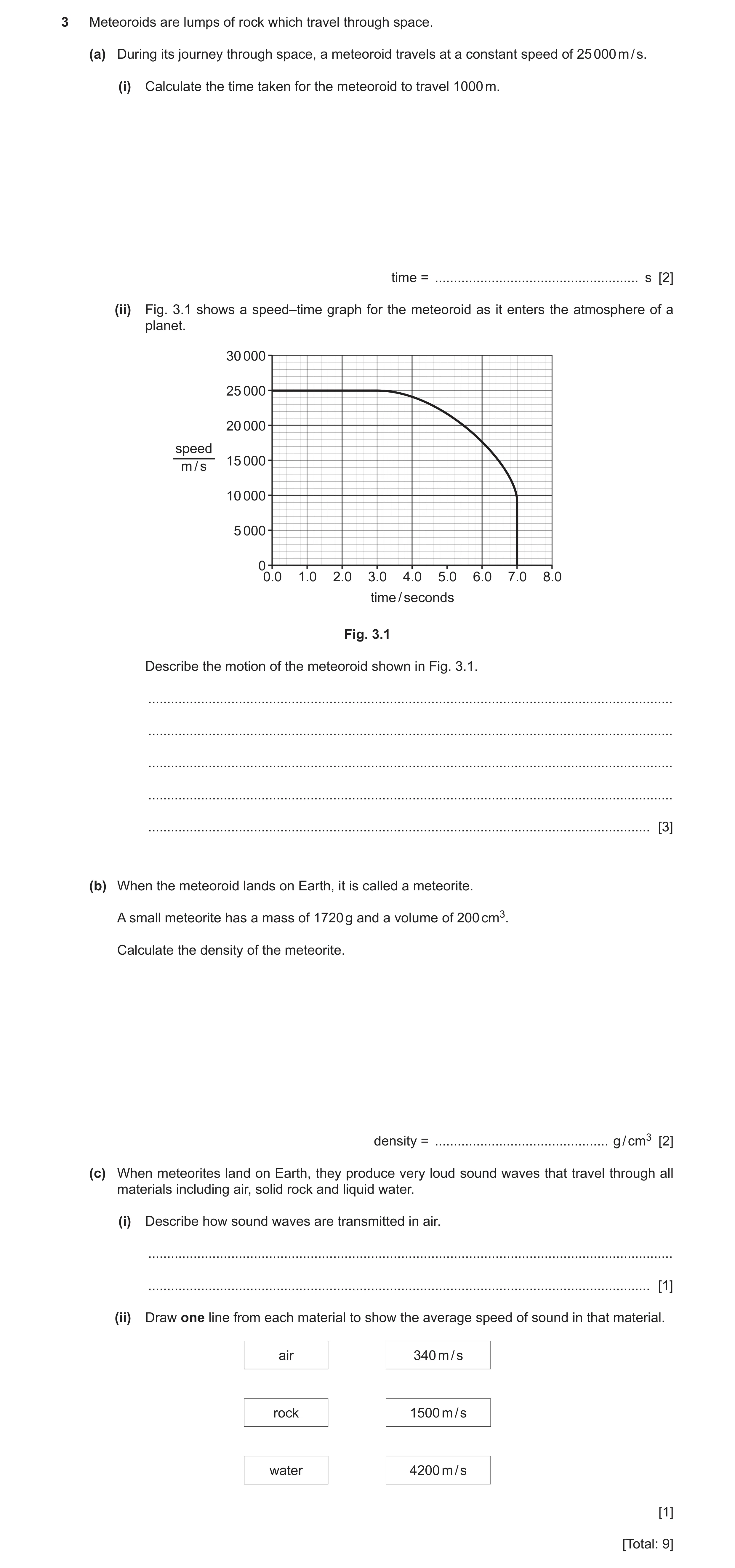
3 Meteoroids are lumps of rock which travel through space. (a) During its journey through space, a meteoroid travels at a constant speed of 25 000 m / s. (i) Calculate the time taken for the meteoroid to travel 1000 m. time = … s [2] (ii) Fig. 3.1 shows a speed–time graph for the meteoroid as it enters the atmosphere of a planet. 30 000 25 000 20 000 speed 15 000 m / s 10 000 5 000 0 0.0 1.0 2.0 3.0 4.0 5.0 6.0 7.0 8.0 time / seconds Fig. 3.1 Describe the motion of the meteoroid shown in Fig. 3.1. … … … … … [3] (b) When the meteoroid lands on Earth, it is called a meteorite. A small meteorite has a mass of 1720 g and a volume of 200 cm3. Calculate the density of the meteorite. density = … g / cm3 [2] (c) When meteorites land on Earth, they produce very loud sound waves that travel through all materials including air, solid rock and liquid water. (i) Describe how sound waves are transmitted in air. … … [1] (ii) Draw one line from each material to show the average speed of sound in that material. air 340 m / s rock 1500 m / s water 4200 m / s [1] [Total: 9]
9 marks
Mark scheme: 3(a)(i) (t =) d / v or 1000 / 25 000 ; (in any form) 2 (t =) 0.04 (s) ; 3(a)(ii) 0–3 s / initially constant speed ; 3 then slows down / decelerates / negative acceleration / non-constant deceleration ; (at 7 s) it stops / hits the ground / speed becomes 0 ; 3(b) (density =) mass / volume or 1720 / 200 (in any form) ; 2 8.6(0) (g / cm3) ; 3(c)(i) compressions and rarefactions ; 1 3(c)(ii) 1 air 340 m / s rock 1500 m / s water 4200 m / s all correct ;
This question in 0654/43 Oct/Nov 2023
Q12 · A student investigates a spring 0654/42 Feb/March 2024
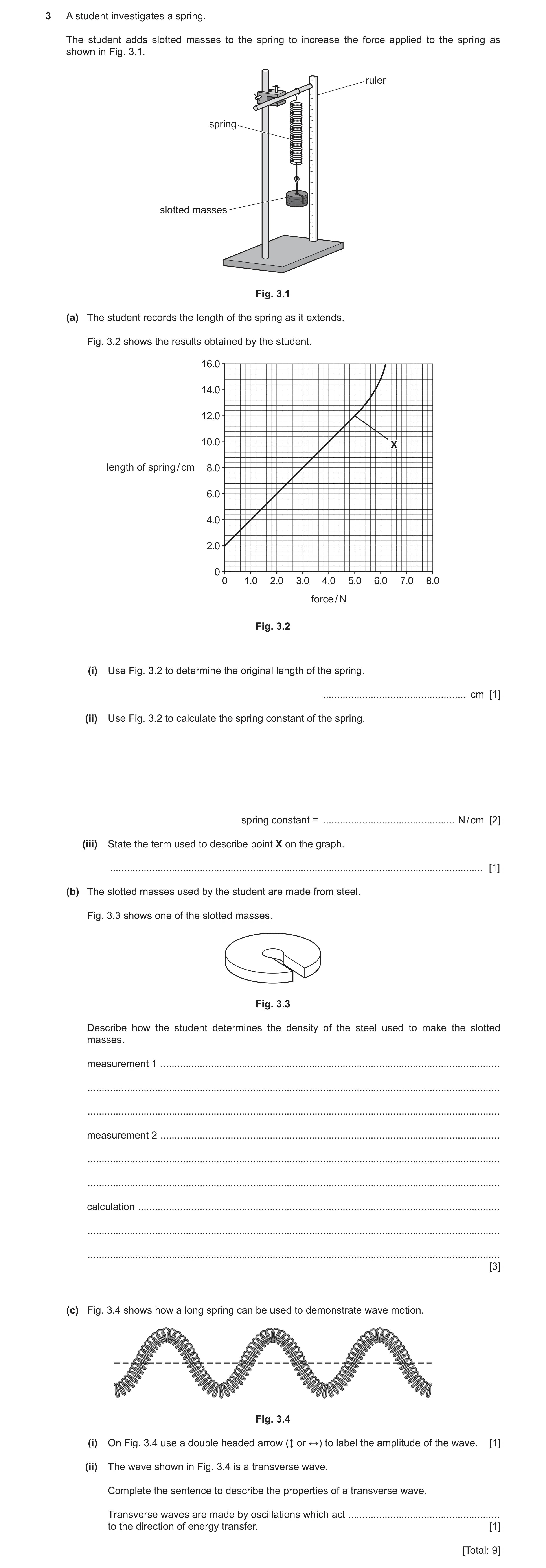
3 A student investigates a spring. The student adds slotted masses to the spring to increase the force applied to the spring as shown in Fig. 3.1. ruler spring slotted masses Fig. 3.1 (a) The student records the length of the spring as it extends. Fig. 3.2 shows the results obtained by the student. 16.0 14.0 12.0 10.0 X length of spring / cm 8.0 6.0 4.0 2.0 0 0 1.0 2.0 3.0 4.0 5.0 6.0 7.0 8.0 force / N Fig. 3.2 (i) Use Fig. 3.2 to determine the original length of the spring. … cm [1] (ii) Use Fig. 3.2 to calculate the spring constant of the spring. spring constant = … N / cm [2] (iii) State the term used to describe point X on the graph. … [1] (b) The slotted masses used by the student are made from steel. Fig. 3.3 shows one of the slotted masses. Fig. 3.3 Describe how the student determines the density of the steel used to make the slotted masses. measurement 1 … … … measurement 2 … … … calculation … … … [3] (c) Fig. 3.4 shows how a long spring can be used to demonstrate wave motion. Fig. 3.4 (i) On Fig. 3.4 use a double headed arrow (↕ or ↔) to label the amplitude of the wave. [1] (ii) The wave shown in Fig. 3.4 is a transverse wave. Complete the sentence to describe the properties of a transverse wave. Transverse waves are made by oscillations which act … to the direction of energy transfer. [1] [Total: 9]
9 marks
Mark scheme: 3(a)(i) 2.0 (cm) ; 1 3(a)(ii) use of data from graph OR use of F = k x OR 5.0 / 10 ; 2 (k=) 0.5 (N / cm) ; 3(a)(iii) limit of proportionality ; 1 3(b) volume using displacement method / eureka can ; 3 mass using, balance / scales ; density = mass / volume ; 3(c)(i) amplitude labelled from peak or trough to equilibrium position ; 1 3(c)(ii) perpendicular / at right angles / 90° ; 1
This question in 0654/42 Feb/March 2024
Q13 · The element strontium has many naturally occurring isotopes, some of which are unstable 0654/42 May/June 2024
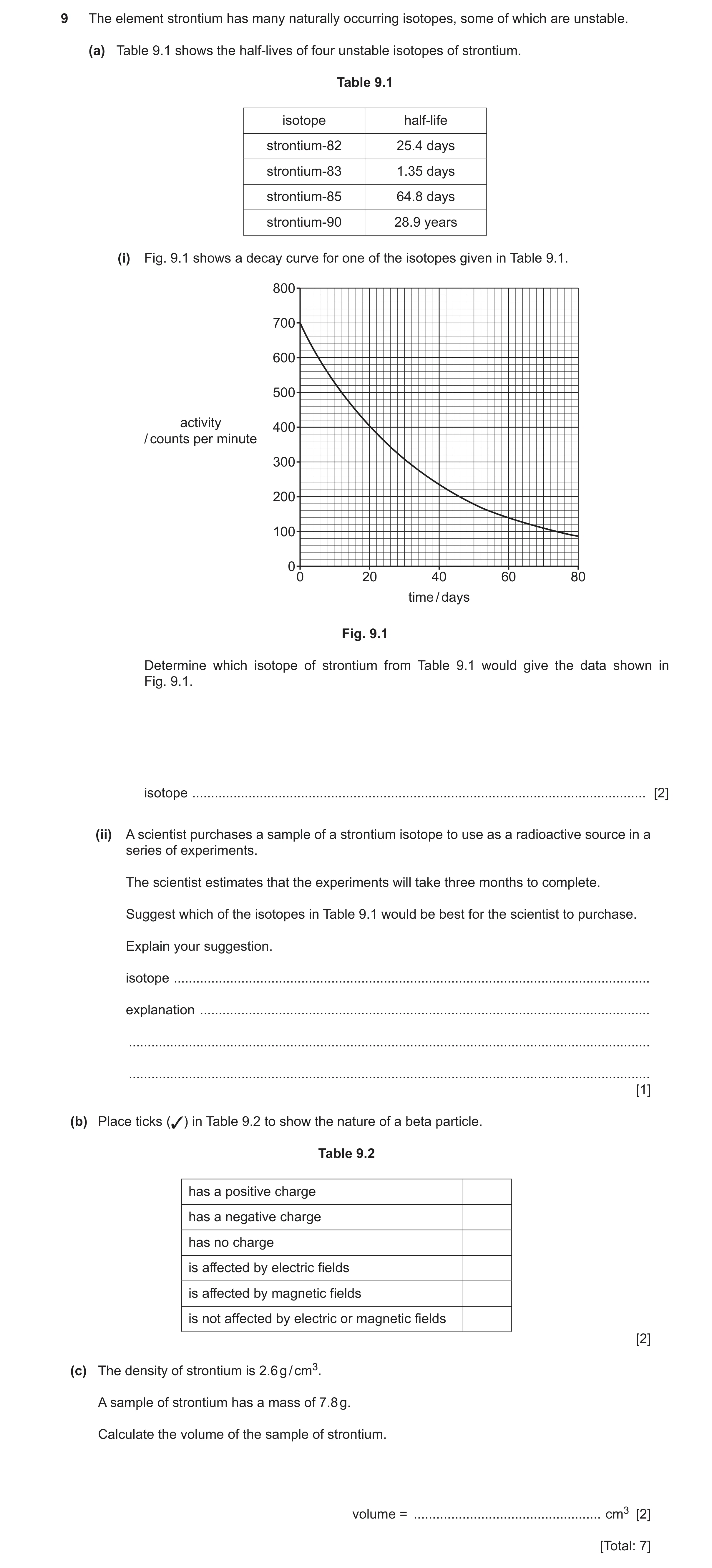
9 The element strontium has many naturally occurring isotopes, some of which are unstable. (a) Table 9.1 shows the half‑lives of four unstable isotopes of strontium. Table 9.1 isotope half‑life strontium‑82 25.4 days strontium‑83 1.35 days strontium‑85 64.8 days strontium‑90 28.9 years (i) Fig. 9.1 shows a decay curve for one of the isotopes given in Table 9.1. 800 700 600 500 activity 400 / counts per minute 300 200 100 0 0 20 40 60 80 time / days Fig. 9.1 Determine which isotope of strontium from Table 9.1 would give the data shown in Fig. 9.1. isotope … [2] (ii) A scientist purchases a sample of a strontium isotope to use as a radioactive source in a series of experiments. The scientist estimates that the experiments will take three months to complete. Suggest which of the isotopes in Table 9.1 would be best for the scientist to purchase. Explain your suggestion. isotope … explanation … … … [1] (b) Place ticks (✓) in Table 9.2 to show the nature of a beta particle. Table 9.2 has a positive charge has a negative charge has no charge is affected by electric fields is affected by magnetic fields is not affected by electric or magnetic fields [2] (c) The density of strontium is 2.6 g / cm3. A sample of strontium has a mass of 7.8 g. Calculate the volume of the sample of strontium. volume = … cm3 [2] [Total: 7]
7 marks
Mark scheme: 9(a)(i) half-life calculated from graph ; strontium-82 ; 2 9(a)(ii) strontium-90 AND it will not need to be replaced for a long time / will last for a long time / will not run out quickly / owtte ; 1 9(b) has a negative charge ; is affected by electric fields AND is affected by magnetic fields ; 2 9(c) (V=) m / OR 7.8 / 2.6 ; (V=) 3.0 (cm3) ; 2
This question in 0654/42 May/June 2024
Q14 · A student investigates the properties of graphite 0654/41 Oct/Nov 2024
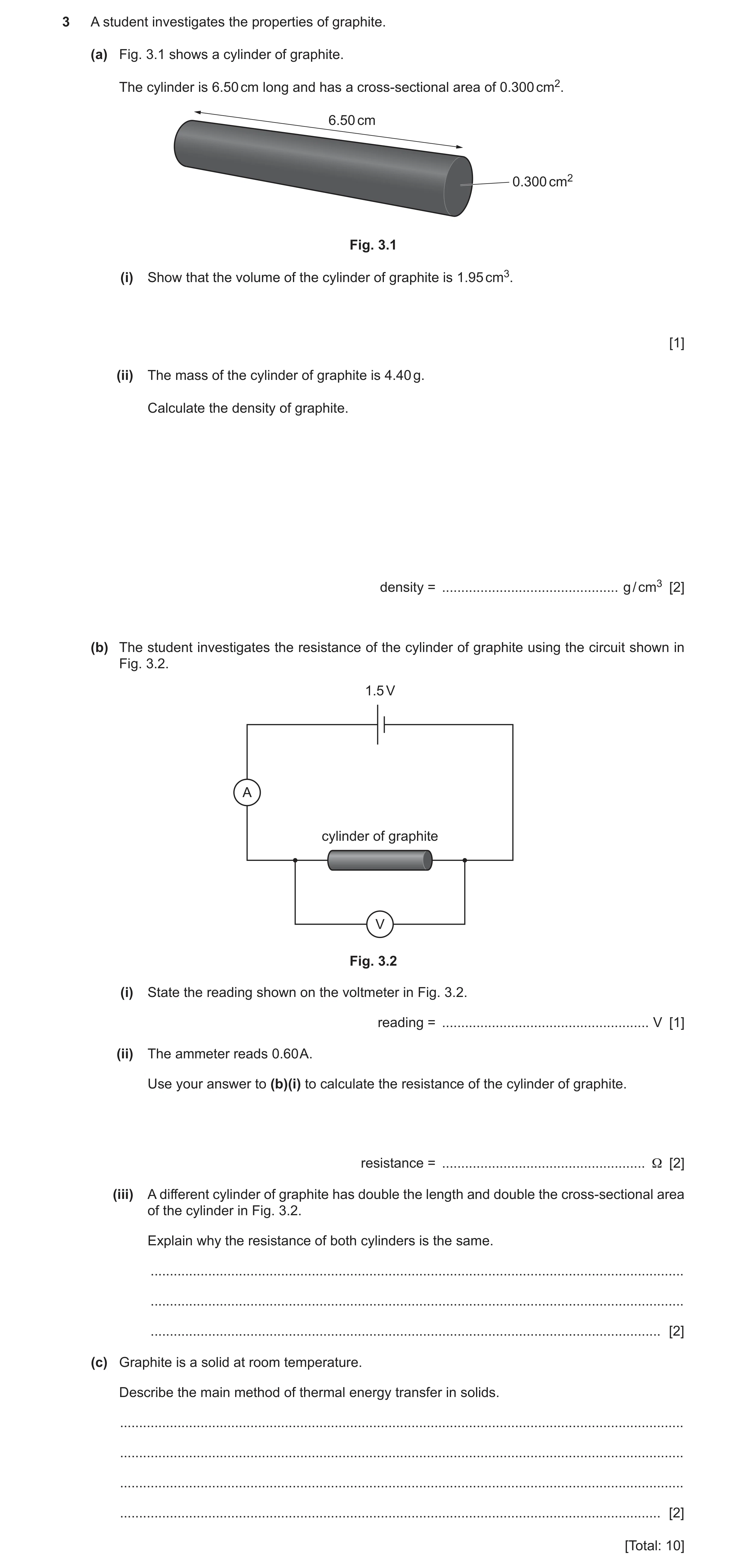
3 A student investigates the properties of graphite. (a) Fig. 3.1 shows a cylinder of graphite. The cylinder is 6.50 cm long and has a cross‑sectional area of 0.300 cm2. 6.50 cm 0.300 cm2 Fig. 3.1 (i) Show that the volume of the cylinder of graphite is 1.95 cm3. [1] (ii) The mass of the cylinder of graphite is 4.40 g. Calculate the density of graphite. density = … g / cm3 [2] (b) The student investigates the resistance of the cylinder of graphite using the circuit shown in Fig. 3.2. 1.5 V A cylinder of graphite V Fig. 3.2 (i) State the reading shown on the voltmeter in Fig. 3.2. reading = … V [1] (ii) The ammeter reads 0.60 A. Use your answer to (b)(i) to calculate the resistance of the cylinder of graphite. resistance = … Ω [2] (iii) A different cylinder of graphite has double the length and double the cross‑sectional area of the cylinder in Fig. 3.2. Explain why the resistance of both cylinders is the same. … … … [2] (c) Graphite is a solid at room temperature. Describe the main method of thermal energy transfer in solids. … … … … [2] [Total: 10]
10 marks
Mark scheme: 3(a)(i) (volume =) 6.5(0) 0.3(00) ; 1 3(a)(ii) m 2 evidence of = or 4.4(0) ÷ 1.95 ; V 2.26 (g / cm3) ; 3(b)(i) 1.5 (V) ; 1 3(b)(ii) evidence of R = V ÷ I or 1.5 ÷ 0.6(0) ; 2 2.5 () ; 3(b)(iii) (idea that) doubling the length doubles the resistance ; 2 (idea that) doubling the (cross-sectional) area halves the resistance ; 3(c) any two from: 2 atoms vibrate ; (idea that) vibrations passed on to next atom ; (idea of) transfer by (free) electrons ;
This question in 0654/41 Oct/Nov 2024
 12
12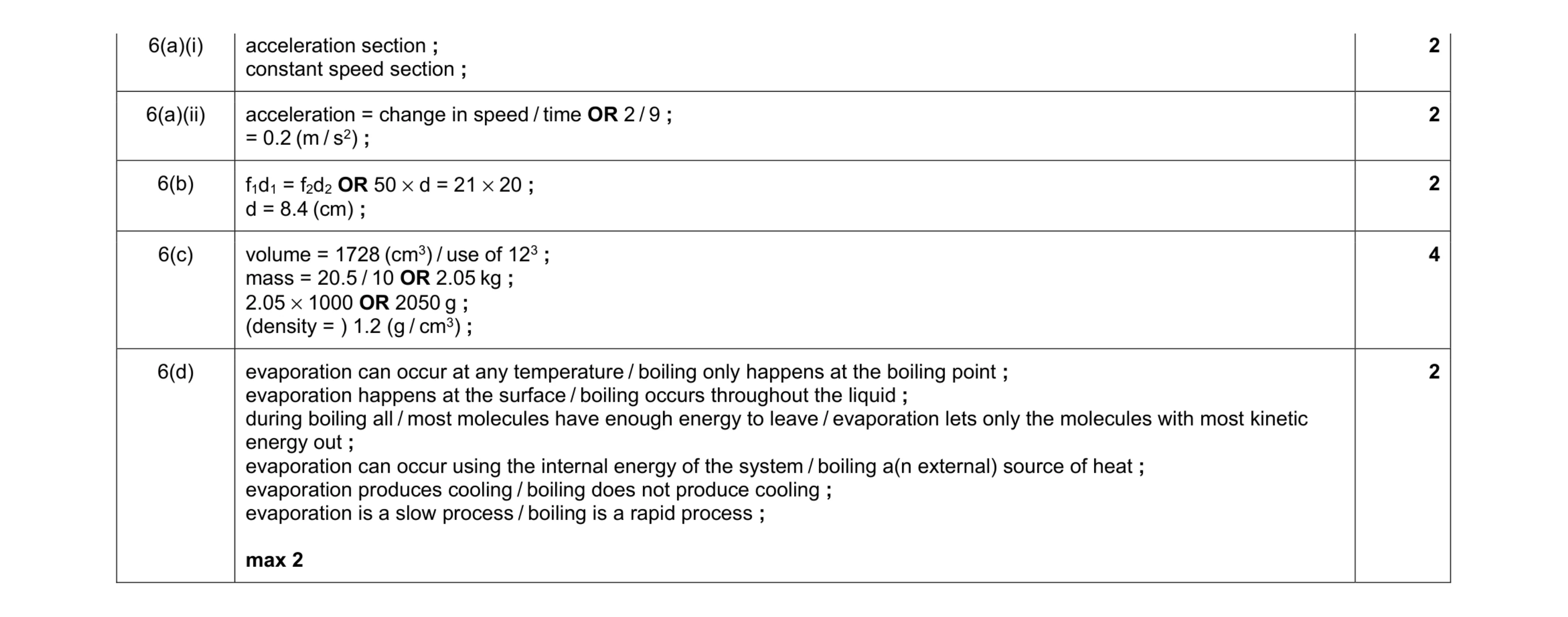 12
12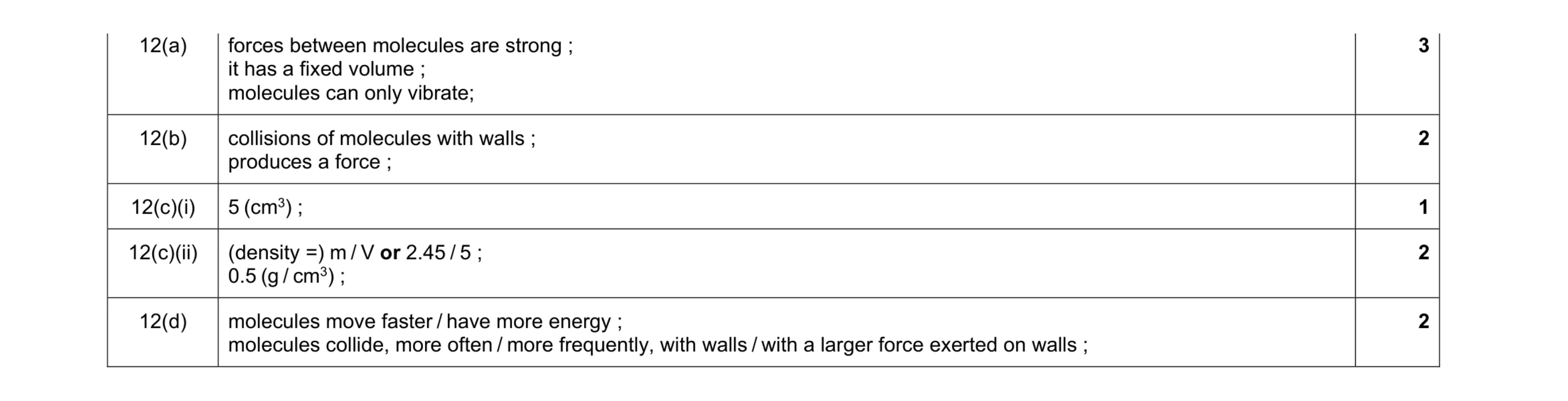 10
10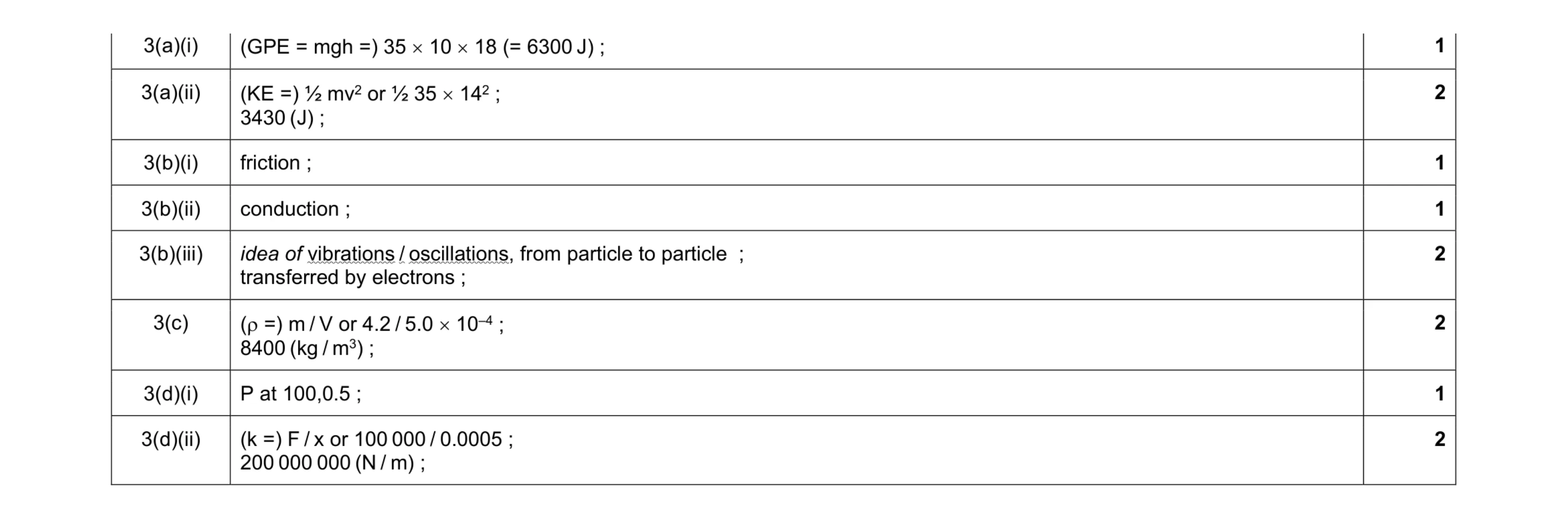 12
12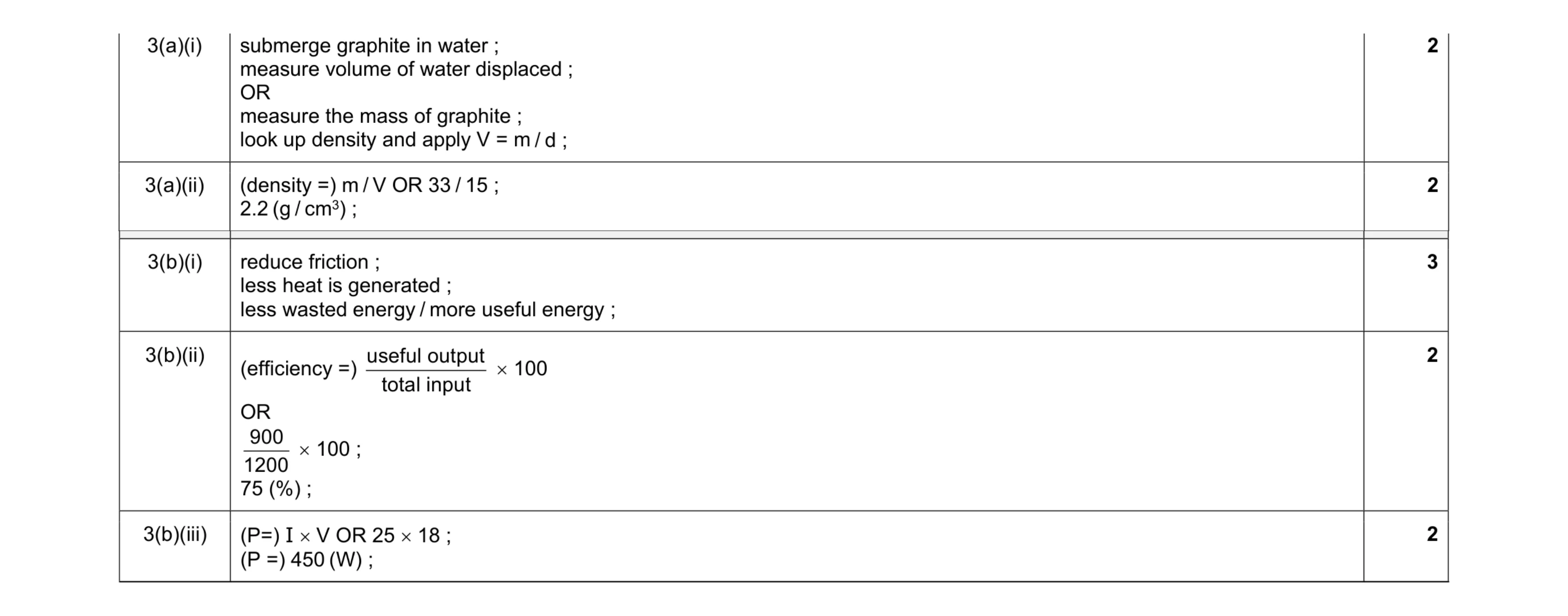 11
11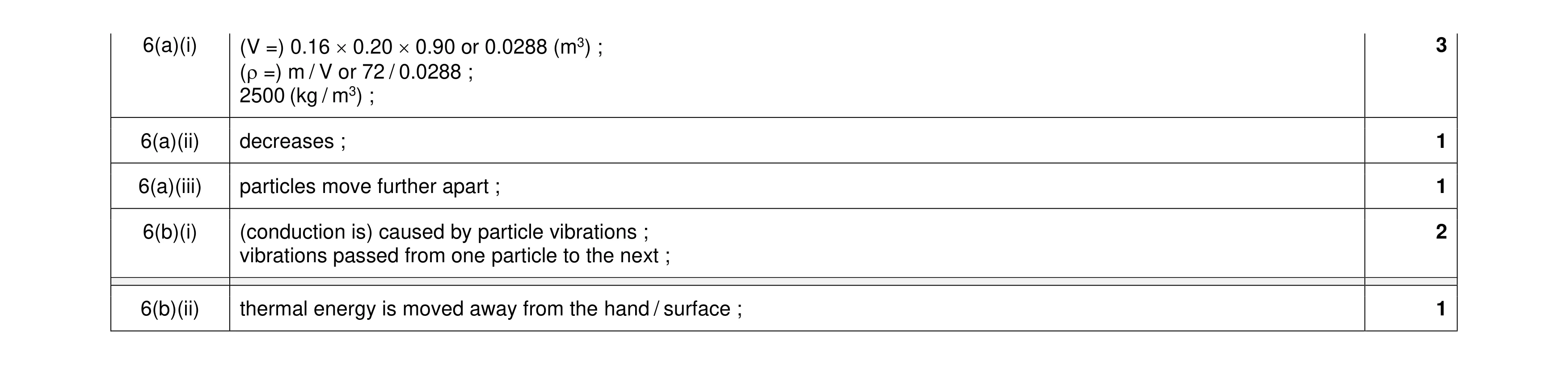 8
8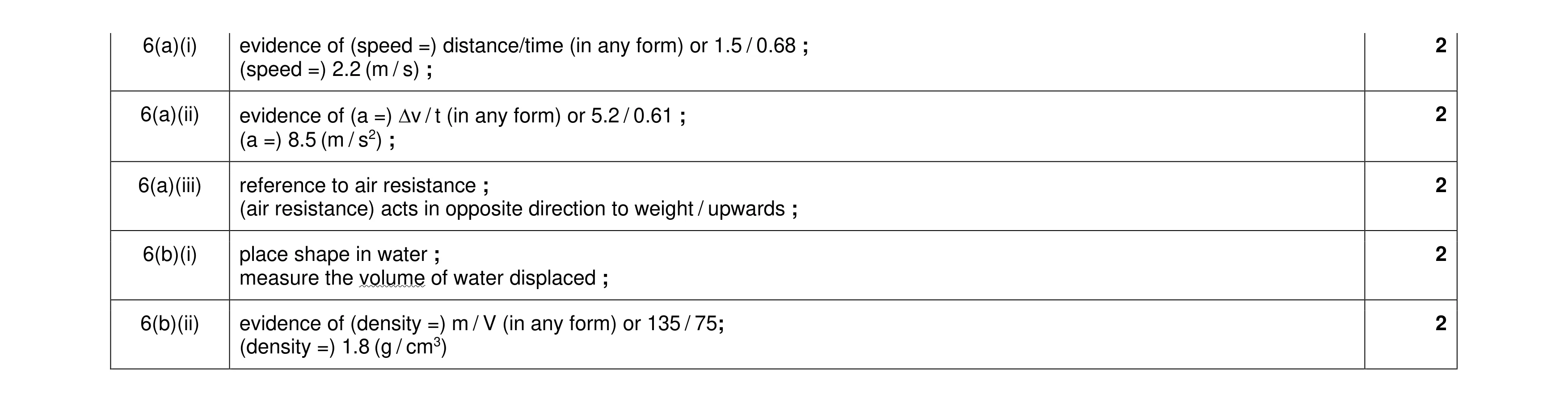 10
10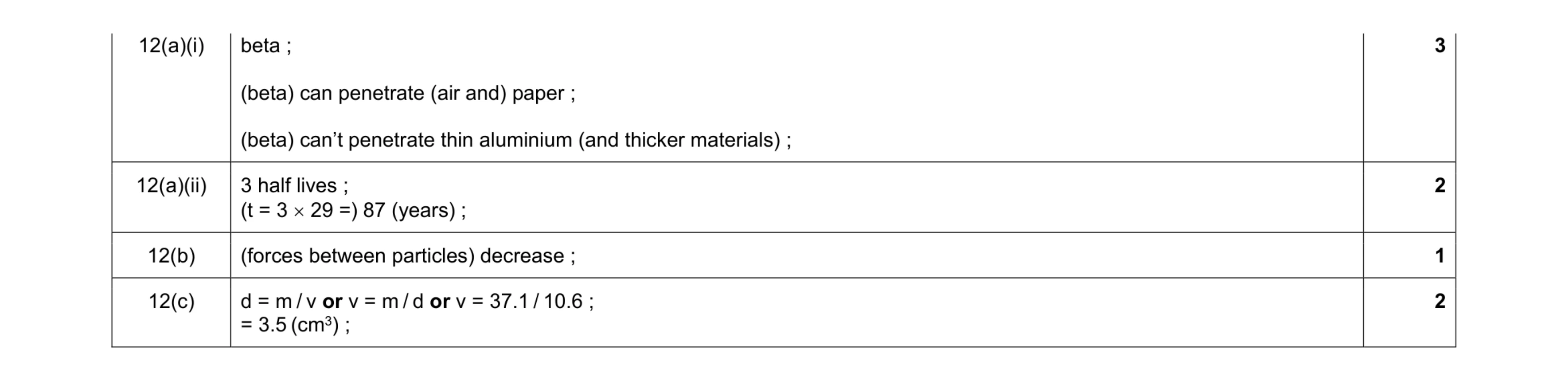 8
8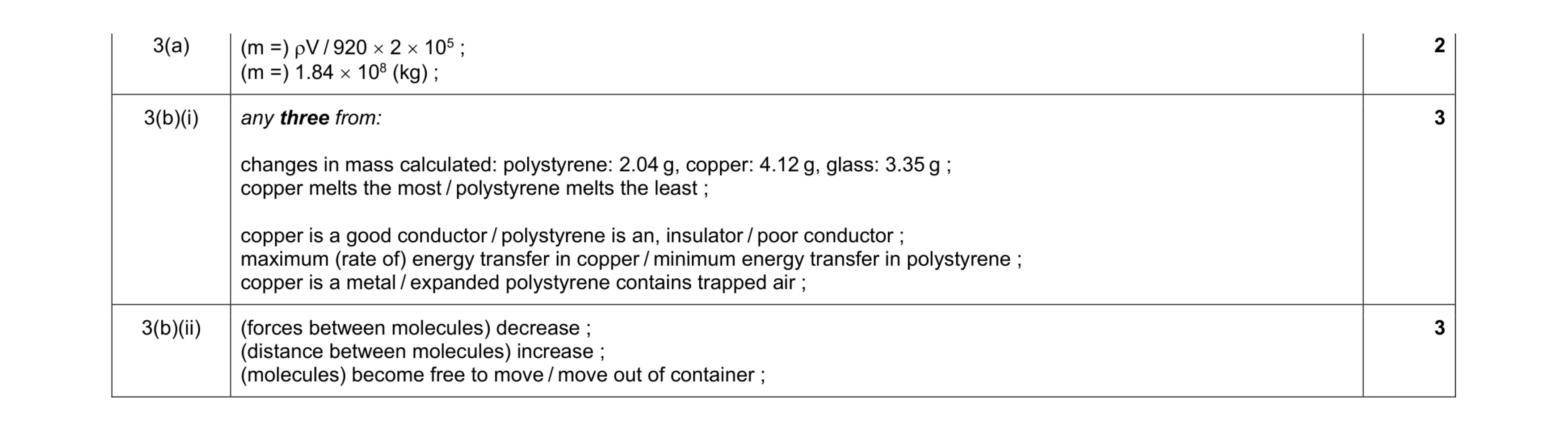 8
8 7
7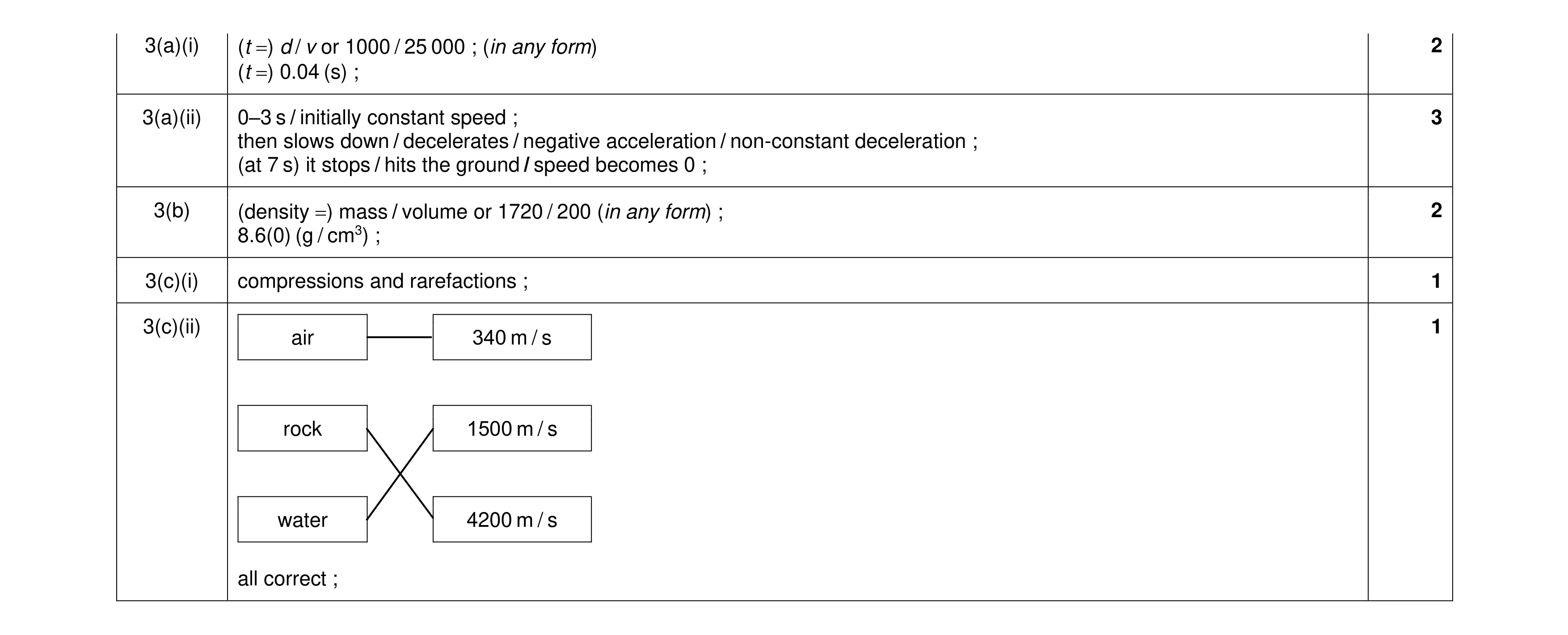 9
9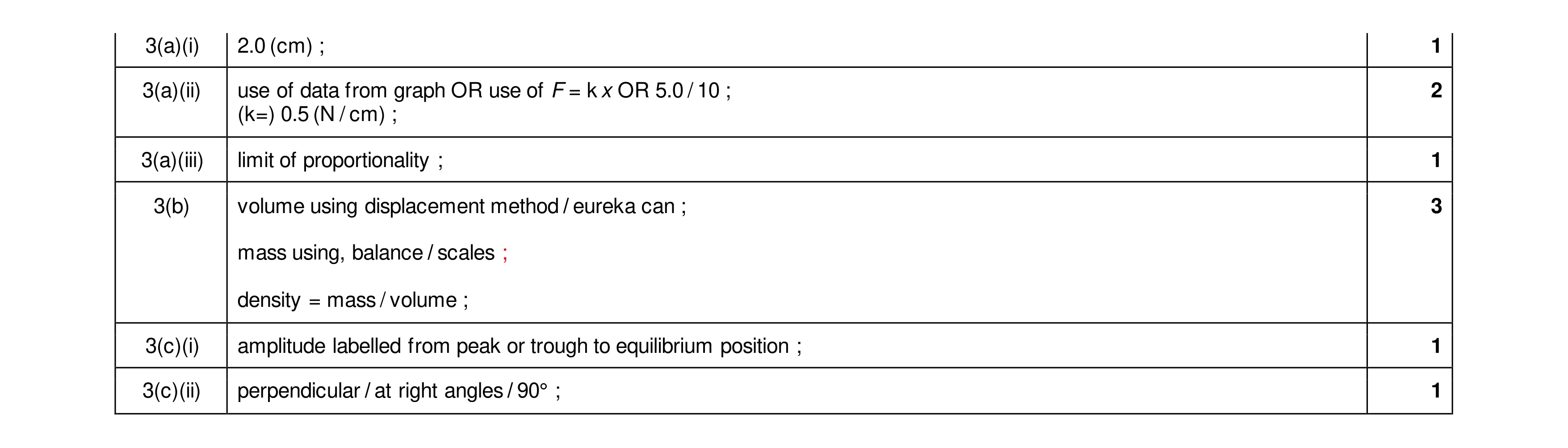 9
9 7
7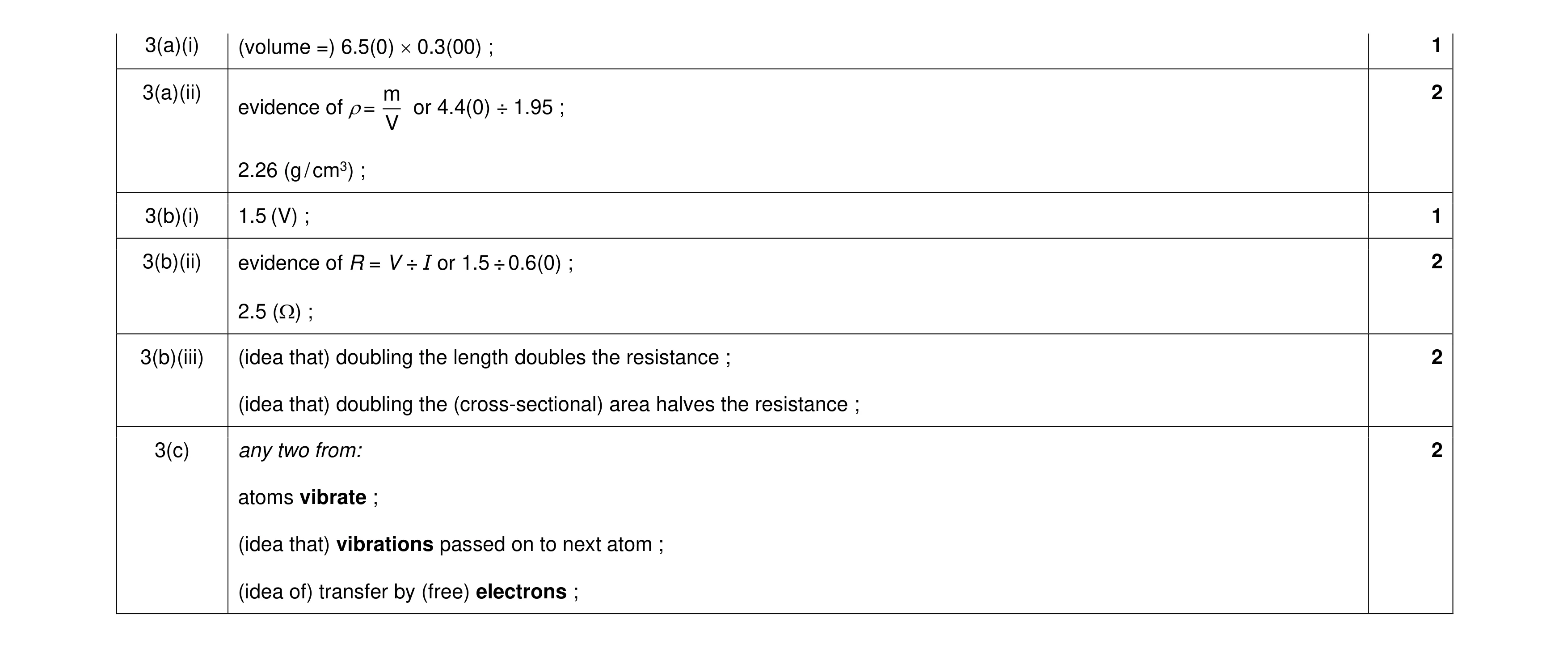 10
10