Questions as text
Q1 · Sulfur is found in compounds and as an element 0654/43 Oct/Nov 2018
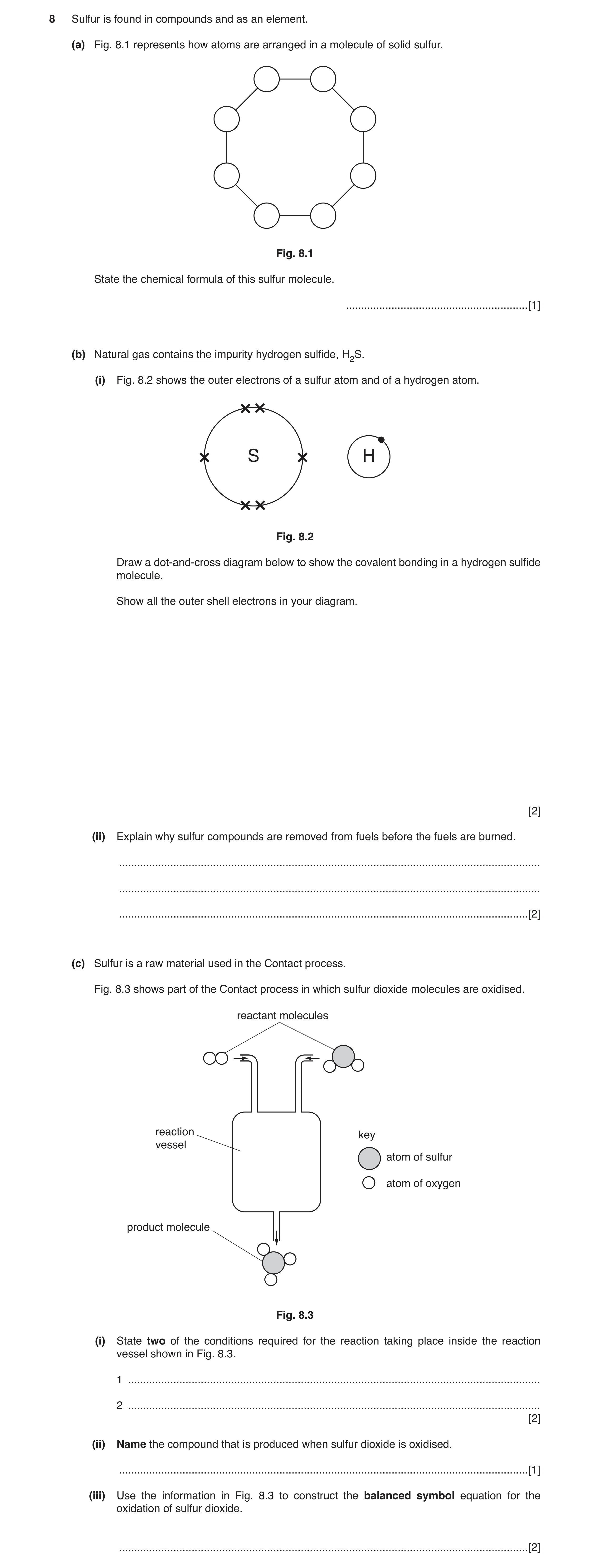
8 Sulfur is found in compounds and as an element. (a) Fig. 8.1 represents how atoms are arranged in a molecule of solid sulfur. Fig. 8.1 State the chemical formula of this sulfur molecule. … [1] (b) Natural gas contains the impurity hydrogen sulfide, H2S. (i) Fig. 8.2 shows the outer electrons of a sulfur atom and of a hydrogen atom. S H Fig. 8.2 Draw a dot-and-cross diagram below to show the covalent bonding in a hydrogen sulfide molecule. Show all the outer shell electrons in your diagram. [2] (ii) Explain why sulfur compounds are removed from fuels before the fuels are burned. … … … [2] (c) Sulfur is a raw material used in the Contact process. Fig. 8.3 shows part of the Contact process in which sulfur dioxide molecules are oxidised. reactant molecules reaction key vessel atom of sulfur atom of oxygen product molecule Fig. 8.3 (i) State two of the conditions required for the reaction taking place inside the reaction vessel shown in Fig. 8.3. 1 … 2 … [2] (ii) Name the compound that is produced when sulfur dioxide is oxidised. … [1] (iii) Use the information in Fig. 8.3 to construct the balanced symbol equation for the oxidation of sulfur dioxide. … [2]
10 marks
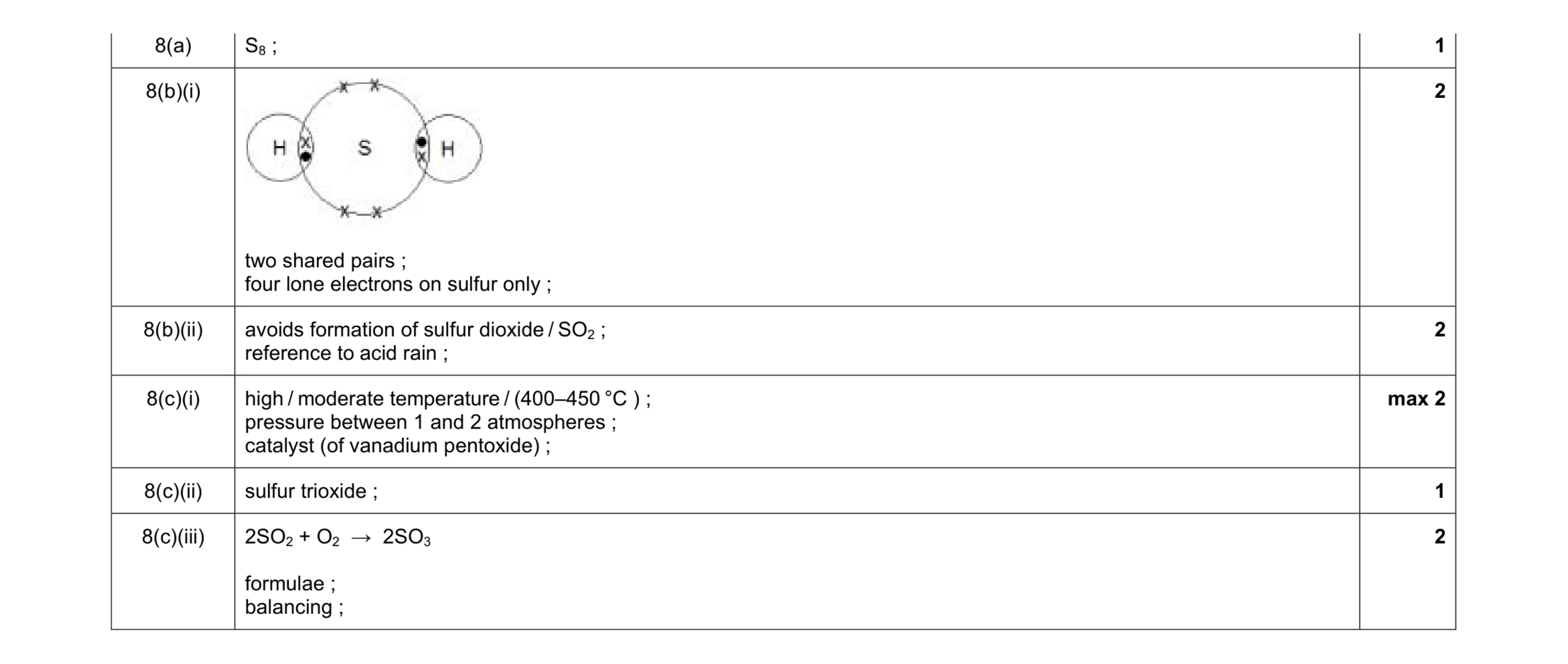
Mark scheme: 8(a) S8 ; 1 8(b)(i) two shared pairs ; four lone electrons on sulfur only ; 2 8(b)(ii) avoids formation of sulfur dioxide / SO2 ; reference to acid rain ; 2 8(c)(i) high / moderate temperature / (400–450 °C ) ; pressure between 1 and 2 atmospheres ; catalyst (of vanadium pentoxide) ; max 2 8(c)(ii) sulfur trioxide ; 1 8(c)(iii) 2SO2 + O2 → 2SO3 formulae ; balancing ; 2
This question in 0654/43 Oct/Nov 2018
Q2 · Ammonia is manufactured in the Haber process 0654/42 Oct/Nov 2019
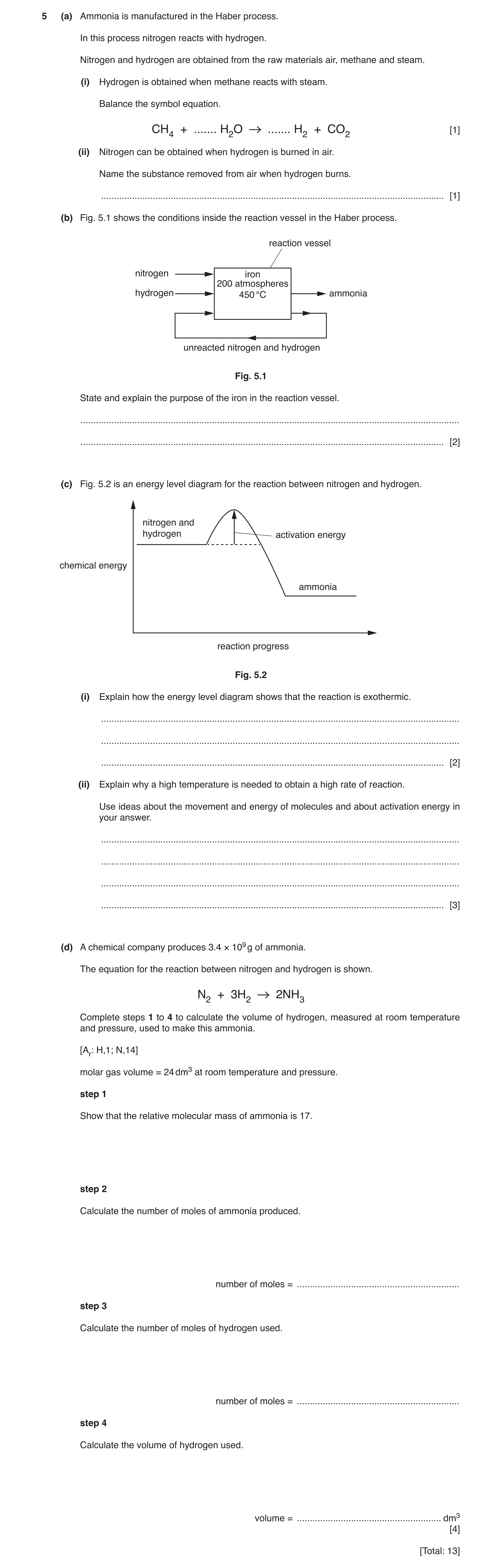
5 (a) Ammonia is manufactured in the Haber process. In this process nitrogen reacts with hydrogen. Nitrogen and hydrogen are obtained from the raw materials air, methane and steam. (i) Hydrogen is obtained when methane reacts with steam. Balance the symbol equation. [1] CH4 + … H2O … H2 + CO2 (ii) Nitrogen can be obtained when hydrogen is burned in air. Name the substance removed from air when hydrogen burns. … [1] (b) Fig. 5.1 shows the conditions inside the reaction vessel in the Haber process. reaction vessel nitrogen iron 200 atmospheres hydrogen 450 °C ammonia unreacted nitrogen and hydrogen Fig. 5.1 State and explain the purpose of the iron in the reaction vessel. … … [2] (c) Fig. 5.2 is an energy level diagram for the reaction between nitrogen and hydrogen. nitrogen and hydrogen activation energy chemical energy ammonia reaction progress Fig. 5.2 (i) Explain how the energy level diagram shows that the reaction is exothermic. … … … [2] (ii) Explain why a high temperature is needed to obtain a high rate of reaction. Use ideas about the movement and energy of molecules and about activation energy in your answer. … … … … [3] (d) A chemical company produces 3.4 × 10⁹ g of ammonia. The equation for the reaction between nitrogen and hydrogen is shown. N2 + 3H2 2NH3 Complete steps 1 to 4 to calculate the volume of hydrogen, measured at room temperature and pressure, used to make this ammonia. [Ar: H,1; N,14] molar gas volume = 24 dm3 at room temperature and pressure. step 1 Show that the relative molecular mass of ammonia is 17. step 2 Calculate the number of moles of ammonia produced. number of moles = … step 3 Calculate the number of moles of hydrogen used. number of moles = … step 4 Calculate the volume of hydrogen used. volume = … dm3 [4] [Total: 13]
13 marks
Mark scheme: 5(a)(i) CH4 + 2H2O → 4H2 + CO2 ; 1 5(a)(ii) oxygen ; 1 5(b) catalyst ; speeds up reaction ; lowers activation energy ; max 2 2 5(c)(i) product stores less energy than reactants ; (surplus) energy released (from system) ; 2 5(c)(ii) high temperature provides molecules with more (kinetic) energy / increases speed of molecules ; more molecules have the activation energy / sufficient energy to react ; increased frequency of (successful) collisions ; 3 5(d) 14 + 3(1) (=17) ; ( 3.4 × 10⁹ 17 =) 2.0 × 10⁸ ; ( 3 × 2.0 × 108 2 ) = 3.0 × 10⁸ ; 3.0 × 108 × 24 = 7.2 × 10⁹ (dm3) ; 4
This question in 0654/42 Oct/Nov 2019
Q3 · Ammonia, NH3, is made by the reaction between nitrogen gas and hydrogen gas in the Haber… 0654/43 Oct/Nov 2019
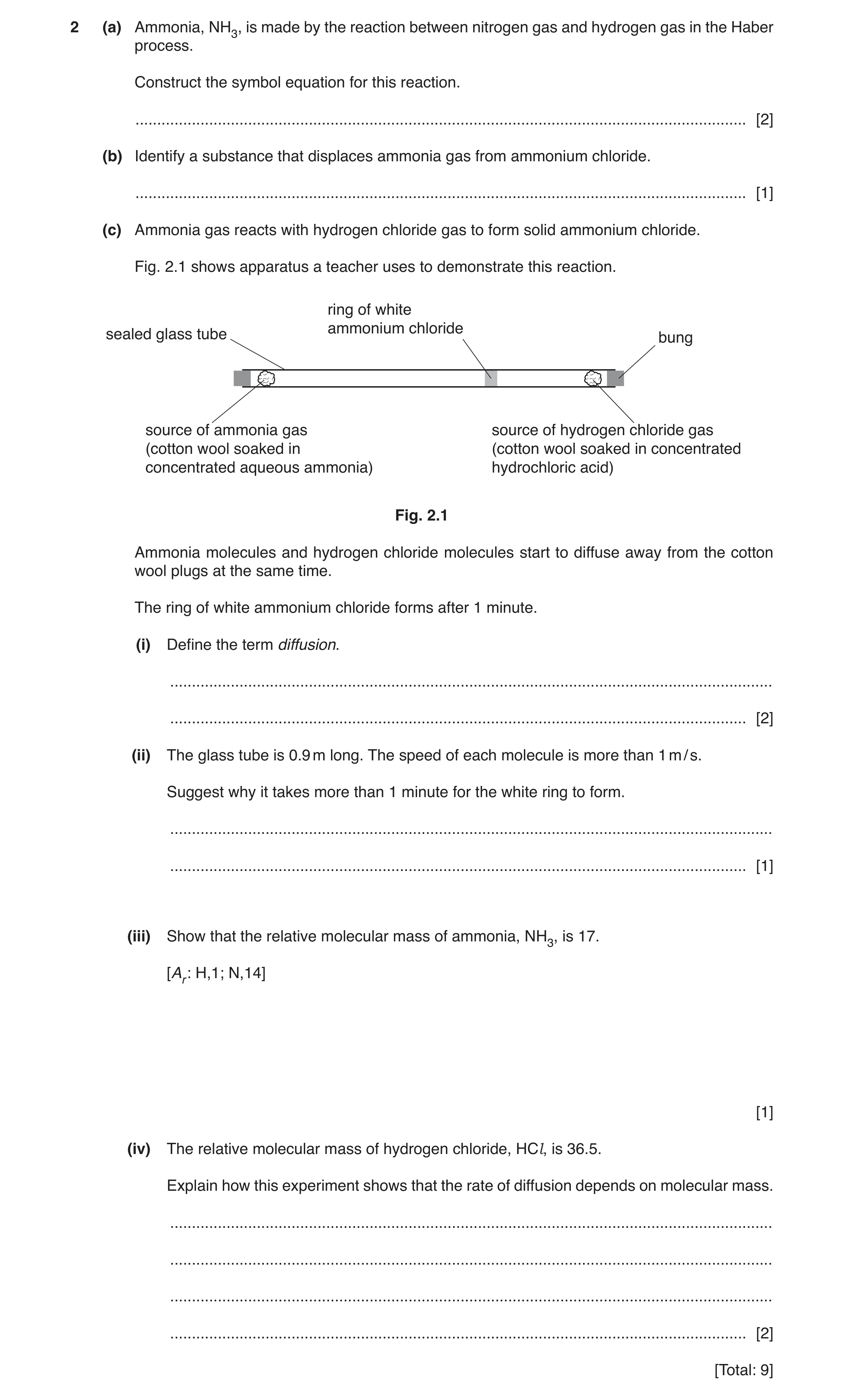
2 (a) Ammonia, NH3, is made by the reaction between nitrogen gas and hydrogen gas in the Haber process. Construct the symbol equation for this reaction. … [2] (b) Identify a substance that displaces ammonia gas from ammonium chloride. … [1] (c) Ammonia gas reacts with hydrogen chloride gas to form solid ammonium chloride. Fig. 2.1 shows apparatus a teacher uses to demonstrate this reaction. ring of white ammonium chloride sealed glass tube bung source of ammonia gas source of hydrogen chloride gas (cotton wool soaked in (cotton wool soaked in concentrated concentrated aqueous ammonia) hydrochloric acid) Fig. 2.1 Ammonia molecules and hydrogen chloride molecules start to diffuse away from the cotton wool plugs at the same time. The ring of white ammonium chloride forms after 1 minute. (i) Define the term diffusion. … … [2] (ii) The glass tube is 0.9 m long. The speed of each molecule is more than 1 m / s. Suggest why it takes more than 1 minute for the white ring to form. … … [1] (iii) Show that the relative molecular mass of ammonia, NH3, is 17. [Ar : H,1; N,14] [1] (iv) The relative molecular mass of hydrogen chloride, HCl, is 36.5. Explain how this experiment shows that the rate of diffusion depends on molecular mass. … … … … [2] [Total: 9]
9 marks
Mark scheme: 2(a) N2 + 3H2 → 2NH3 formulae ; balancing ; 2 2(b) any named base ; 1 2(c)(i) the (net) movement of particles from a region of their higher concentration to a region of their lower concentration / down a concentration gradient ; as a result of their random movement ; 2 2(c)(ii) collisions between molecules (which slows progress through tube) ; 1 2(c)(iii) 14 + (3 × 1) ( = 17) ; 1 2(c)(iv) white ring closer to HCl / right of centre / NH3 diffuses further than HCl (in the same time) ; NH3 diffuses faster than HCl ; rate of diffusion decreases with increasing molecular mass ; max 2 2
This question in 0654/43 Oct/Nov 2019
Q4 · Methanol, CH3OH, is made by reacting carbon dioxide with hydrogen 0654/41 Oct/Nov 2020
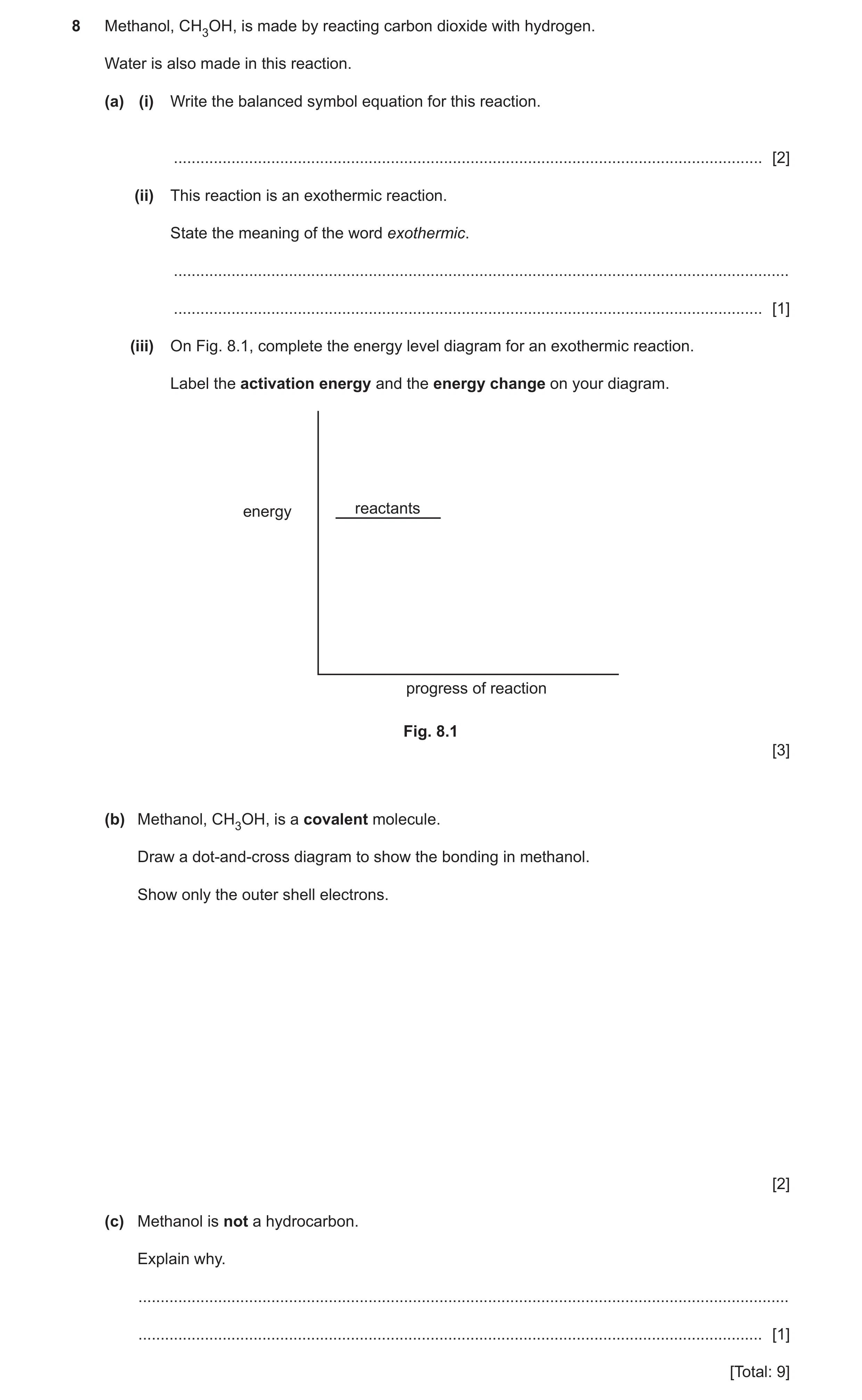
8 Methanol, CH3OH, is made by reacting carbon dioxide with hydrogen. Water is also made in this reaction. (a) (i) Write the balanced symbol equation for this reaction. … [2] (ii) This reaction is an exothermic reaction. State the meaning of the word exothermic. … … [1] (iii) On Fig. 8.1, complete the energy level diagram for an exothermic reaction. Label the activation energy and the energy change on your diagram. energy reactants progress of reaction Fig. 8.1 [3] (b) Methanol, CH3OH, is a covalent molecule. Draw a dot‑and‑cross diagram to show the bonding in methanol. Show only the outer shell electrons. [2] (c) Methanol is not a hydrocarbon. Explain why. … … [1] [Total: 9]
9 marks
Mark scheme: 8(a)(i) CO2 + 3H2 → CH3OH + H2O correct formulae ; correctly balanced ; 2 8(a)(ii) (reaction in which) energy is given out ; 1 8(a)(iii) 3 8(b) ;; 2 8(c) (methanol) contains an oxygen atom / (methanol) is not just carbon and hydrogen / AW ; 1 energy change energy activation energy
This question in 0654/41 Oct/Nov 2020
Q5 · Ammonium sulfate is a fertiliser 0654/43 Oct/Nov 2020
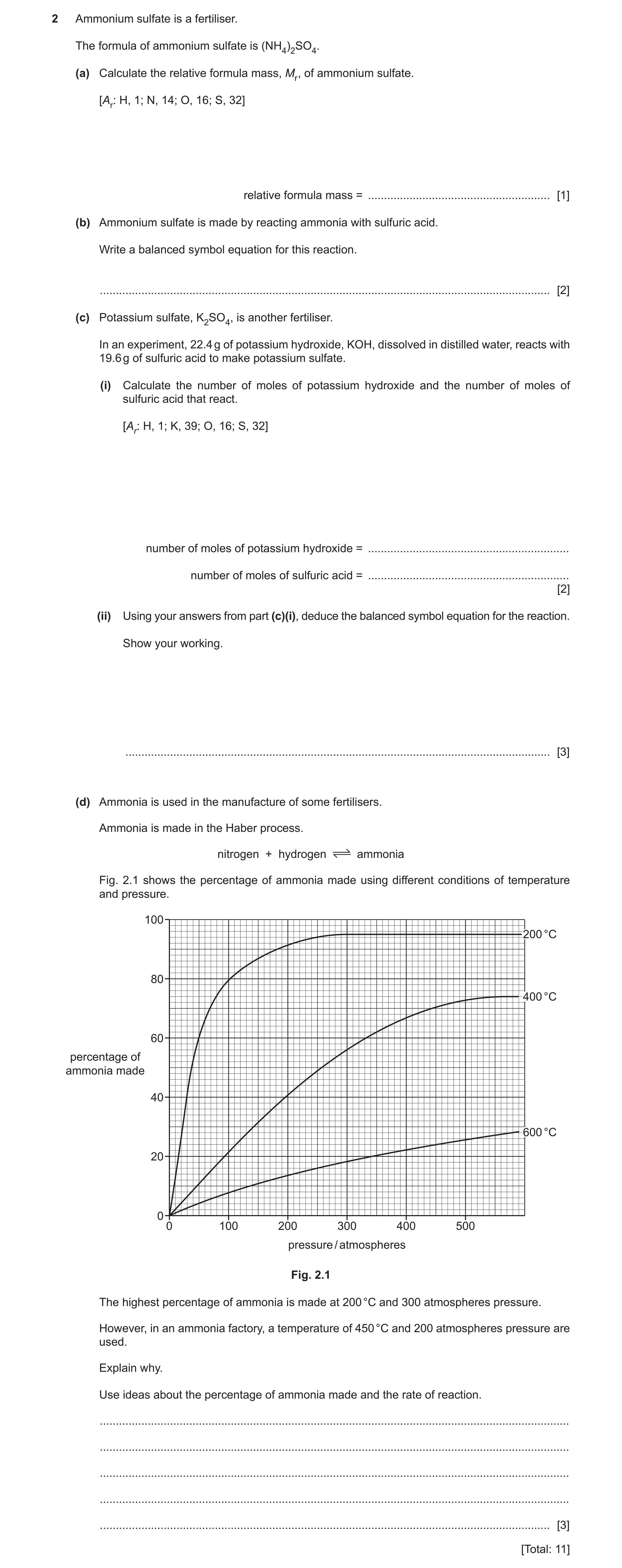
2 Ammonium sulfate is a fertiliser. The formula of ammonium sulfate is (NH4)2SO4. (a) Calculate the relative formula mass, Mr , of ammonium sulfate. [Ar: H, 1; N, 14; O, 16; S, 32] relative formula mass = … [1] (b) Ammonium sulfate is made by reacting ammonia with sulfuric acid. Write a balanced symbol equation for this reaction. … [2] (c) Potassium sulfate, K2SO4, is another fertiliser. In an experiment, 22.4 g of potassium hydroxide, KOH, dissolved in distilled water, reacts with 19.6 g of sulfuric acid to make potassium sulfate. (i) Calculate the number of moles of potassium hydroxide and the number of moles of sulfuric acid that react. [Ar: H, 1; K, 39; O, 16; S, 32] number of moles of potassium hydroxide = … number of moles of sulfuric acid = … [2] (ii) Using your answers from part (c)(i), deduce the balanced symbol equation for the reaction. Show your working. … [3] (d) Ammonia is used in the manufacture of some fertilisers. Ammonia is made in the Haber process. nitrogen + hydrogen ammonia Fig. 2.1 shows the percentage of ammonia made using different conditions of temperature and pressure. 100 200 °C 80 400 °C 60 percentage of ammonia made 40 600 °C 20 0 0 100 200 300 400 500 pressure / atmospheres Fig. 2.1 The highest percentage of ammonia is made at 200 °C and 300 atmospheres pressure. However, in an ammonia factory, a temperature of 450 °C and 200 atmospheres pressure are used. Explain why. Use ideas about the percentage of ammonia made and the rate of reaction. … … … … … [3] [Total: 11]
11 marks
Mark scheme: 2(a) 132 ; 1 2(b) 2NH3 + H2SO4 → (NH4)2SO4 correct formulae ; correctly balanced ; 2 2(c)(i) moles of KOH = mass ÷ Mr = 22.4 ÷ 56 = 0.40 moles of H2SO4 mass ÷ Mr = 19.6 ÷ 98 = 0.20 use of mass ÷ Mr or working ; 0.40 and 0.20 ; 2 Question Answer Marks 2(c)(ii) simplest whole number ratio is 2:1 / (so) 2 mol of KOH react with 1 mol of H2SO4 ; 2KOH + H2SO4 → K2SO4 + 2H2O correct formulae ; correctly balanced ; 3 2(d) 450°C / higher temperature (rather than 200°C) increases rate of reaction ; 200 atmospheres / lower pressure (rather than 300 atmospheres) safer / less expensive ; idea of compromise (e.g. between yield and rate) ; max 3 3
This question in 0654/43 Oct/Nov 2020
Q6 · Sodium, Na, is an element in Group I of the Periodic Table 0654/42 Feb/March 2021
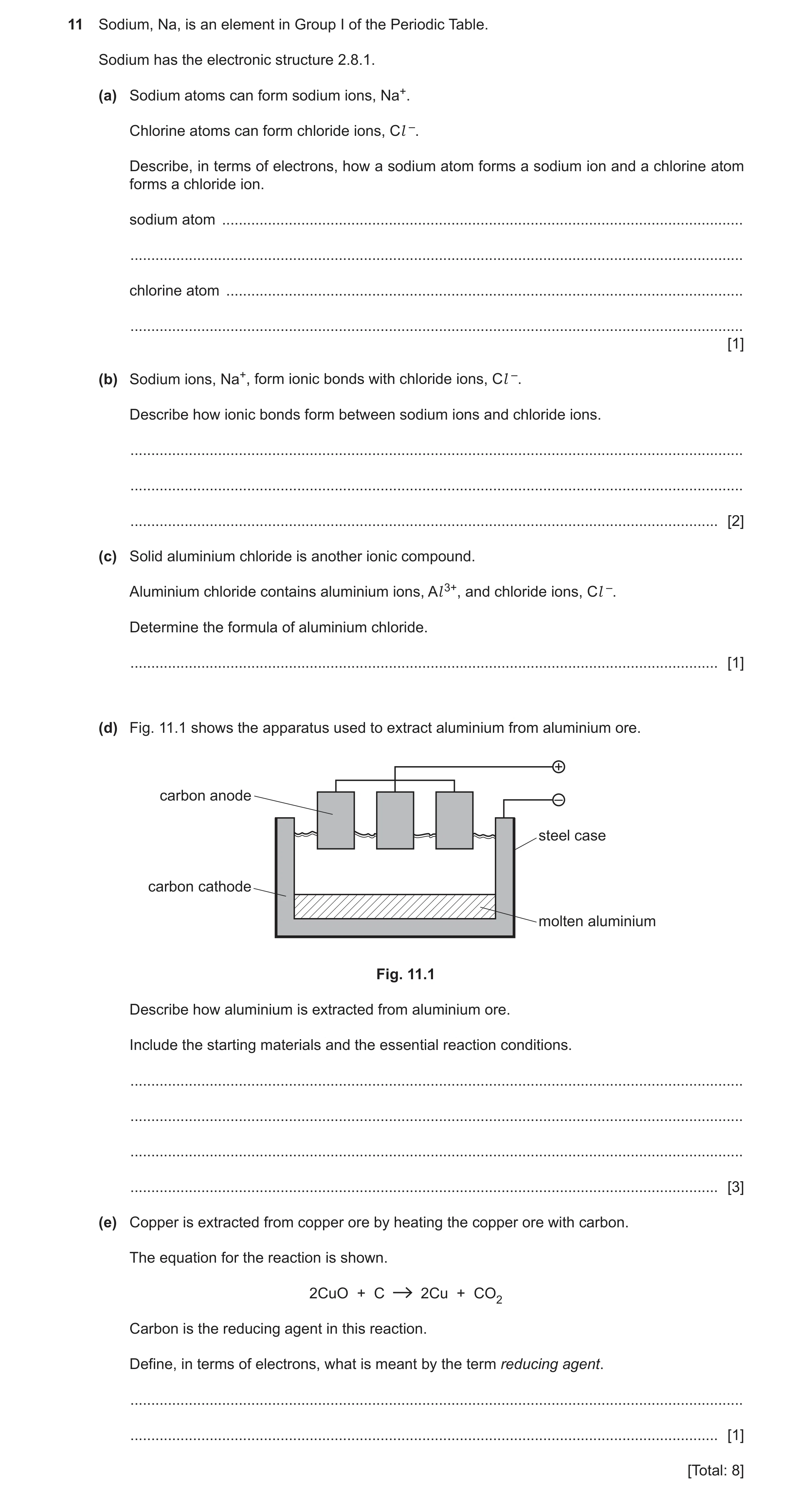
11 Sodium, Na, is an element in Group I of the Periodic Table. Sodium has the electronic structure 2.8.1. (a) Sodium atoms can form sodium ions, Na+. Chlorine atoms can form chloride ions, Cl –. Describe, in terms of electrons, how a sodium atom forms a sodium ion and a chlorine atom forms a chloride ion. sodium atom … … chlorine atom … … [1] (b) Sodium ions, Na+, form ionic bonds with chloride ions, Cl –. Describe how ionic bonds form between sodium ions and chloride ions. … … … [2] (c) Solid aluminium chloride is another ionic compound. Aluminium chloride contains aluminium ions, Al 3+, and chloride ions, Cl –. Determine the formula of aluminium chloride. … [1] (d) Fig. 11.1 shows the apparatus used to extract aluminium from aluminium ore. + carbon anode – steel case carbon cathode molten aluminium Fig. 11.1 Describe how aluminium is extracted from aluminium ore. Include the starting materials and the essential reaction conditions. … … … … [3] (e) Copper is extracted from copper ore by heating the copper ore with carbon. The equation for the reaction is shown. 2CuO + C 2Cu + CO2 Carbon is the reducing agent in this reaction. Define, in terms of electrons, what is meant by the term reducing agent. … … [1] [Total: 8]
8 marks
Mark scheme: 11(a) (sodium atom) loses one electron and (chlorine atom) gains one electron ; 1 11(b) electrostatic attraction ; between oppositely charged ions ; 2 11(c) AlCl3 ; 1 11(d) any three from: molten aluminium oxide / alumina, and cryolite ; cryolite lowers melting point of, aluminium oxide / alumina ; electrolysis / use of electricity ; high temperature to melt, aluminium oxide / alumina ; 3 11(e) (species that) loses or donates electrons ; 1
This question in 0654/42 Feb/March 2021
Q7 · A student is investigating indigestion tablets 0654/42 May/June 2021
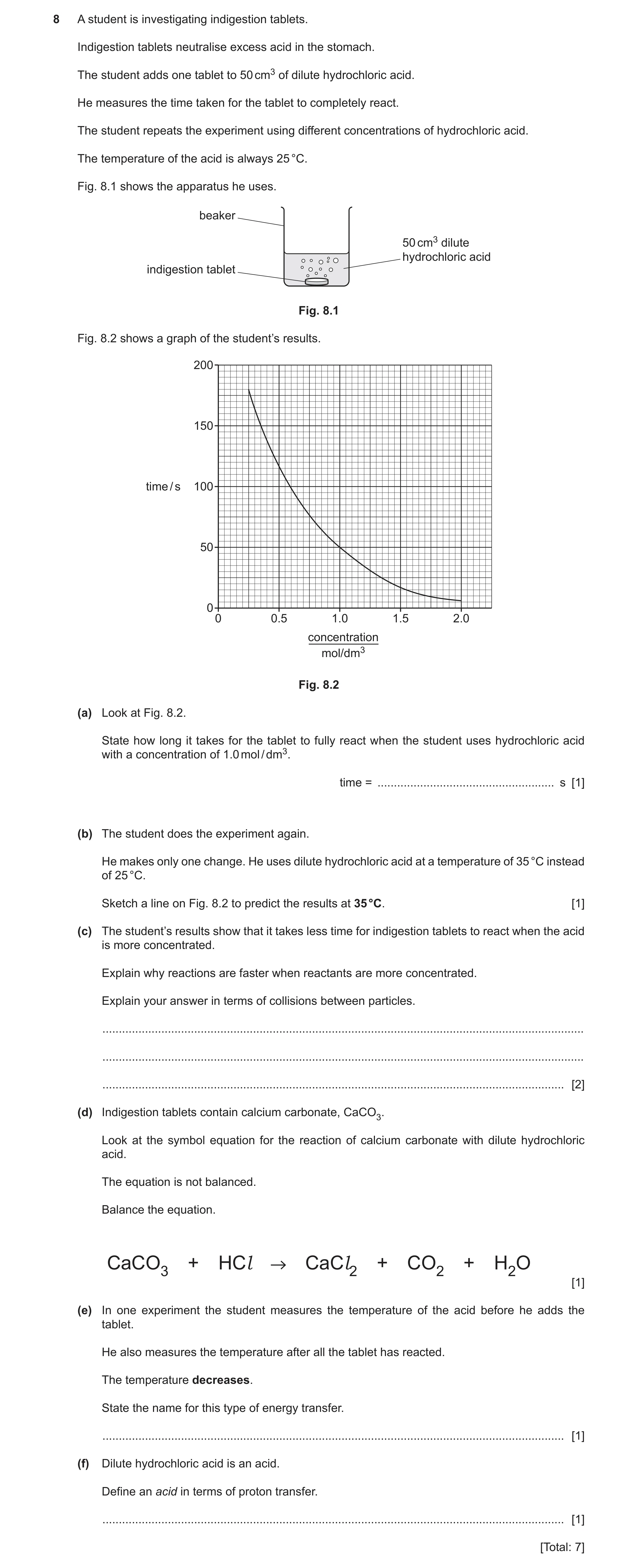
8 A student is investigating indigestion tablets. Indigestion tablets neutralise excess acid in the stomach. The student adds one tablet to 50 cm3 of dilute hydrochloric acid. He measures the time taken for the tablet to completely react. The student repeats the experiment using different concentrations of hydrochloric acid. The temperature of the acid is always 25 °C. Fig. 8.1 shows the apparatus he uses. beaker 50 cm3 dilute hydrochloric acid indigestion tablet Fig. 8.1 Fig. 8.2 shows a graph of the student’s results. 200 150 time / s 100 50 0 0 0.5 1.0 1.5 2.0 concentration mol/dm3 Fig. 8.2 (a) Look at Fig. 8.2. State how long it takes for the tablet to fully react when the student uses hydrochloric acid with a concentration of 1.0 mol / dm3. time = … s [1] (b) The student does the experiment again. He makes only one change. He uses dilute hydrochloric acid at a temperature of 35 °C instead of 25 °C. Sketch a line on Fig. 8.2 to predict the results at 35 °C. [1] (c) The student’s results show that it takes less time for indigestion tablets to react when the acid is more concentrated. Explain why reactions are faster when reactants are more concentrated. Explain your answer in terms of collisions between particles. … … … [2] (d) Indigestion tablets contain calcium carbonate, CaCO3. Look at the symbol equation for the reaction of calcium carbonate with dilute hydrochloric acid. The equation is not balanced. Balance the equation. CaCO3 + HCl CaCl2 + CO2 + H2O [1] (e) In one experiment the student measures the temperature of the acid before he adds the tablet. He also measures the temperature after all the tablet has reacted. The temperature decreases. State the name for this type of energy transfer. … [1] (f) Dilute hydrochloric acid is an acid. Define an acid in terms of proton transfer. … [1] [Total: 7]
7 marks
Mark scheme: 8(a) 50 (seconds) ; 1 8(b) line is same shape as original and is always underneath it ; 1 8(c) more particles per unit volume / more particles per cm3 ; more frequent collisions / more collisions per second ; 2 8(d) CaCO3 + 2 HCl → CaCl2 + CO2 + H2O ; 1 8(e) endothermic ; 1 8(f) (acid is a) proton donor / donates protons / owtte ; 1
This question in 0654/42 May/June 2021
Q8 · Magnesium carbonate, MgCO3, reacts with dilute hydrochloric acid, HCl 0654/41 Oct/Nov 2021
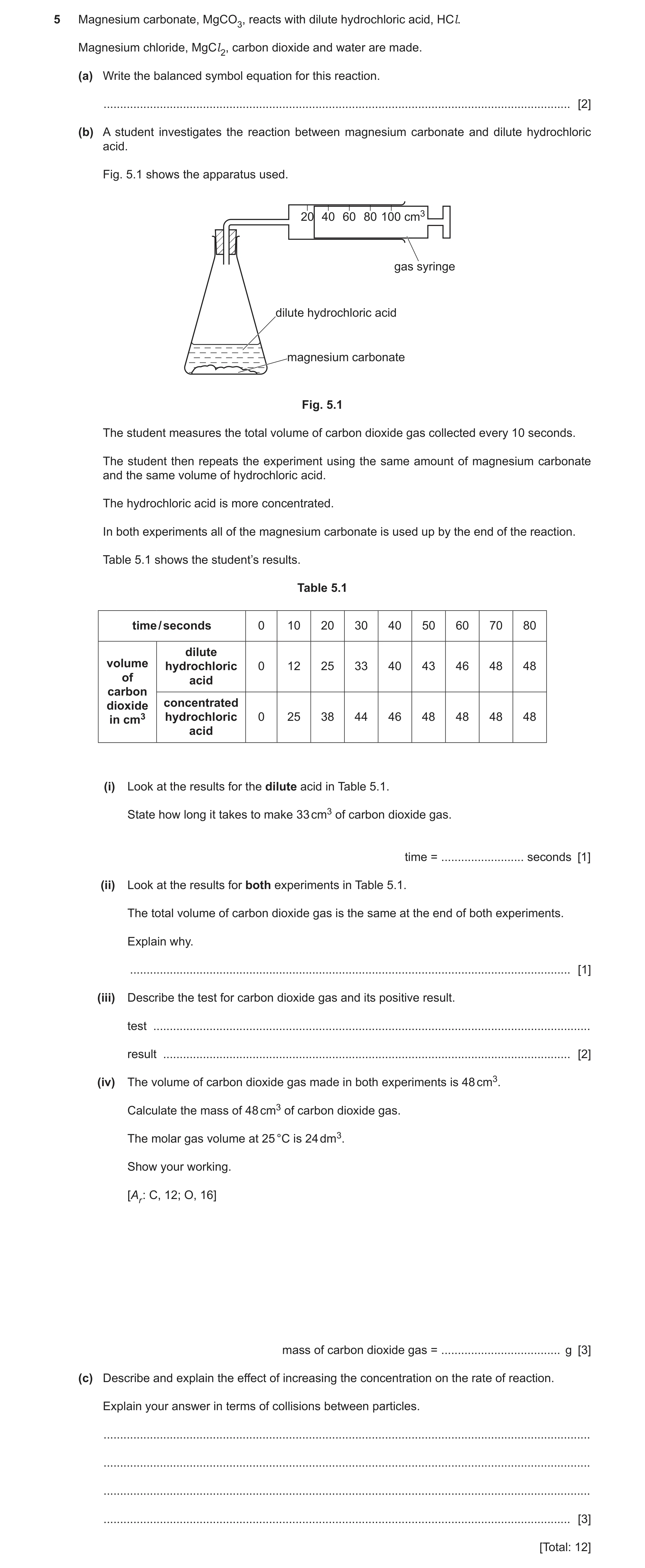
5 Magnesium carbonate, MgCO3, reacts with dilute hydrochloric acid, HCl. Magnesium chloride, MgCl 2, carbon dioxide and water are made. (a) Write the balanced symbol equation for this reaction. … [2] (b) A student investigates the reaction between magnesium carbonate and dilute hydrochloric acid. Fig. 5.1 shows the apparatus used. 20 40 60 80 100 cm3 gas syringe dilute hydrochloric acid magnesium carbonate Fig. 5.1 The student measures the total volume of carbon dioxide gas collected every 10 seconds. The student then repeats the experiment using the same amount of magnesium carbonate and the same volume of hydrochloric acid. The hydrochloric acid is more concentrated. In both experiments all of the magnesium carbonate is used up by the end of the reaction. Table 5.1 shows the student’s results. Table 5.1 time / seconds 0 10 20 30 40 50 60 70 80 dilute volume hydrochloric 0 12 25 33 40 43 46 48 48 of acid carbon dioxide concentrated in cm3 hydrochloric 0 25 38 44 46 48 48 48 48 acid (i) Look at the results for the dilute acid in Table 5.1. State how long it takes to make 33 cm3 of carbon dioxide gas. time = … seconds [1] (ii) Look at the results for both experiments in Table 5.1. The total volume of carbon dioxide gas is the same at the end of both experiments. Explain why. … [1] (iii) Describe the test for carbon dioxide gas and its positive result. test … result … [2] (iv) The volume of carbon dioxide gas made in both experiments is 48 cm3. Calculate the mass of 48 cm3 of carbon dioxide gas. The molar gas volume at 25 °C is 24 dm3. Show your working. [Ar : C, 12; O, 16] mass of carbon dioxide gas = … g [3] (c) Describe and explain the effect of increasing the concentration on the rate of reaction. Explain your answer in terms of collisions between particles. … … … … [3] [Total: 12]
12 marks
Mark scheme: 5(a) MgCO3 + 2HCl → MgCl2 + CO2 + H2O correct formulae ; correct balancing ; 2 5(b)(i) 30 (seconds) ; 1 5(b)(ii) (student used) same mass of magnesium carbonate; 1 5(b)(iii) limewater ; turns milky / cloudy ; 2 5(b)(iv) moles of CO2 = 48 ÷ 24 000 or 0.048 ÷ 24 or 0.0020 ; Mr of CO2 = 44 ; (mass of CO2 = 0.0020 × 44 =) 0.088 (g) ; 3 5(c) rate of reaction increases / owtte ; particles are more crowded / more particles per unit volume / more particles per cm3 ; more frequent collisions / more collisions per second ; 3
This question in 0654/41 Oct/Nov 2021
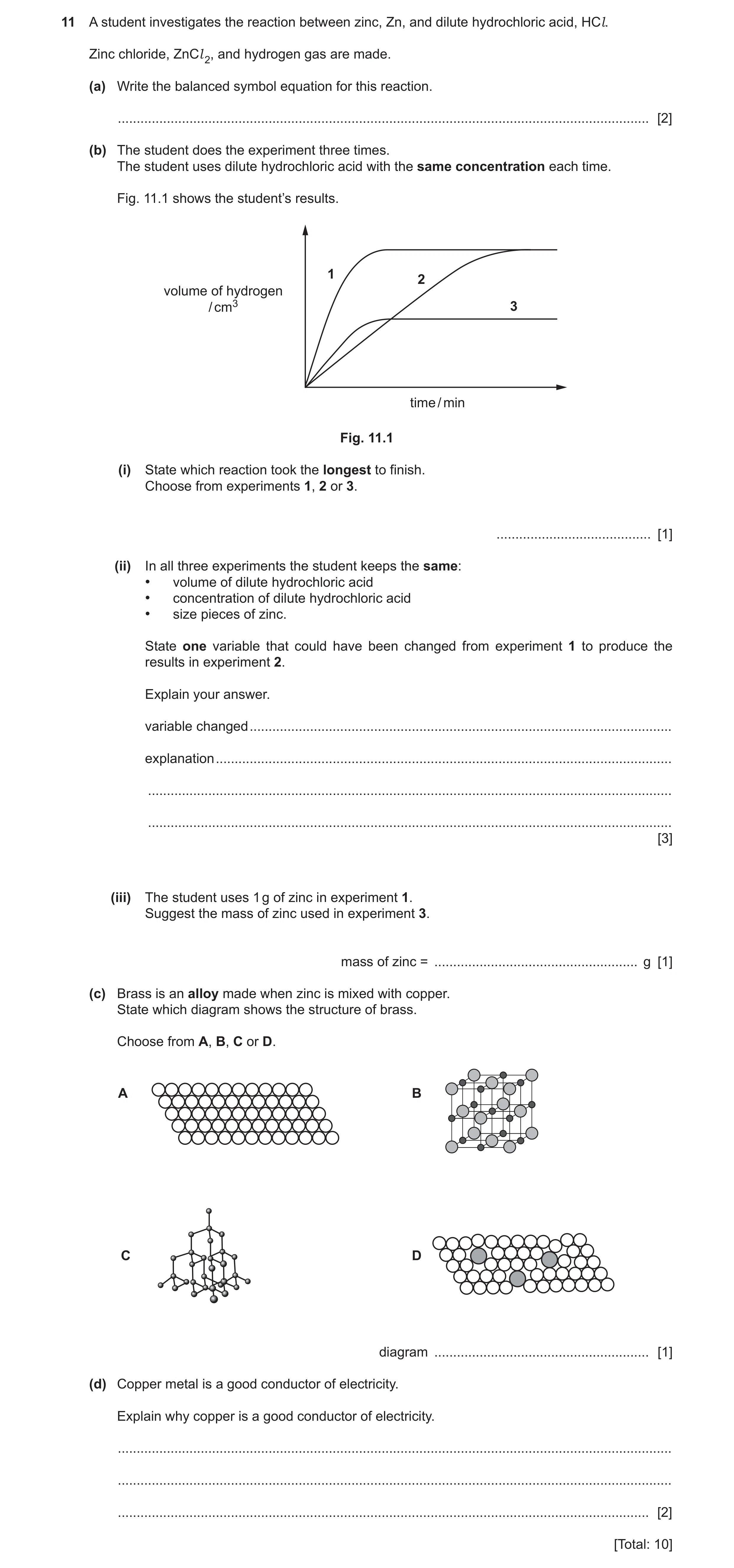
Q9 · A student investigates the reaction between zinc, Zn, and dilute hydrochloric acid, HCl 0654/43 Oct/Nov 2021
11 A student investigates the reaction between zinc, Zn, and dilute hydrochloric acid, HCl. Zinc chloride, ZnCl 2, and hydrogen gas are made. (a) Write the balanced symbol equation for this reaction. … [2] (b) The student does the experiment three times. The student uses dilute hydrochloric acid with the same concentration each time. Fig. 11.1 shows the student’s results. 1 2 volume of hydrogen / cm3 3 time / min Fig. 11.1 (i) State which reaction took the longest to finish. Choose from experiments 1, 2 or 3. … [1] (ii) In all three experiments the student keeps the same: • volume of dilute hydrochloric acid • concentration of dilute hydrochloric acid • size pieces of zinc. State one variable that could have been changed from experiment 1 to produce the results in experiment 2. Explain your answer. variable changed … explanation … … … [3] (iii) The student uses 1 g of zinc in experiment 1. Suggest the mass of zinc used in experiment 3. mass of zinc = … g [1] (c) Brass is an alloy made when zinc is mixed with copper. State which diagram shows the structure of brass. Choose from A, B, C or D. A B C D diagram … [1] (d) Copper metal is a good conductor of electricity. Explain why copper is a good conductor of electricity. … … … [2] [Total: 10]
10 marks
Mark scheme: 11(a) Zn + 2HCl → ZnCl2 + H2 correct formulae ; correct balancing ; 2 11(b)(i) 2 : 1 11(b)(ii) explanation for experiment 2: used a lower temperature ; any two from: particles move slower or particles have less energy ; less frequent collisions / less collisions per second ; less particles with the activation energy / enough energy to react ; 3 11(b)(iii) 0.5 (g) ; 1 11(c) D ; 1 11(d) reference to sea of electrons ; electrons can move through the structure / flow / carry charge ; 2
This question in 0654/43 Oct/Nov 2021
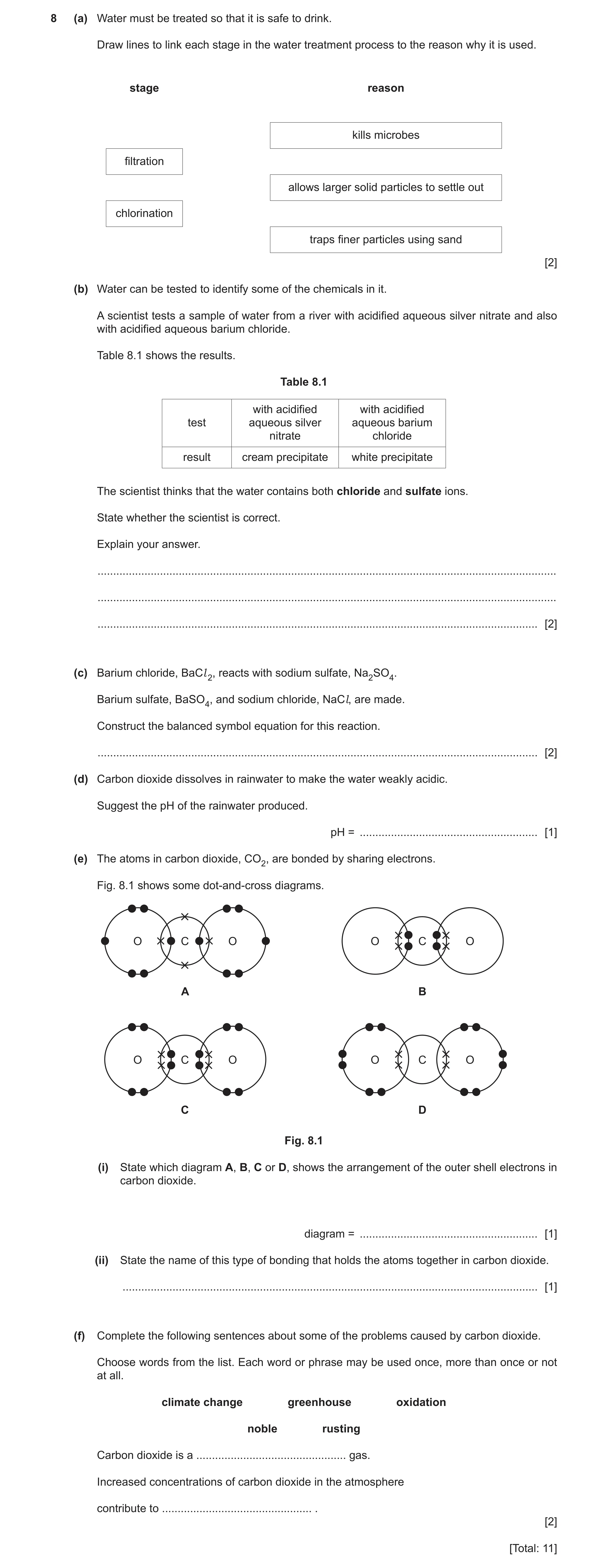
Q10 · Water must be treated so that it is safe to drink 0654/43 Oct/Nov 2022
8 (a) Water must be treated so that it is safe to drink. Draw lines to link each stage in the water treatment process to the reason why it is used. stage reason kills microbes filtration allows larger solid particles to settle out chlorination traps finer particles using sand [2] (b) Water can be tested to identify some of the chemicals in it. A scientist tests a sample of water from a river with acidified aqueous silver nitrate and also with acidified aqueous barium chloride. Table 8.1 shows the results. Table 8.1 with acidified with acidified test aqueous silver aqueous barium nitrate chloride result cream precipitate white precipitate The scientist thinks that the water contains both chloride and sulfate ions. State whether the scientist is correct. Explain your answer. … … … [2] (c) Barium chloride, BaCl 2, reacts with sodium sulfate, Na2SO4. Barium sulfate, BaSO4, and sodium chloride, NaCl, are made. Construct the balanced symbol equation for this reaction. … [2] (d) Carbon dioxide dissolves in rainwater to make the water weakly acidic. Suggest the pH of the rainwater produced. pH = … [1] (e) The atoms in carbon dioxide, CO2, are bonded by sharing electrons. Fig. 8.1 shows some dot-and-cross diagrams. O C O O C O A B O C O O C O C D Fig. 8.1 (i) State which diagram A, B, C or D, shows the arrangement of the outer shell electrons in carbon dioxide. diagram = … [1] (ii) State the name of this type of bonding that holds the atoms together in carbon dioxide. … [1] (f) Complete the following sentences about some of the problems caused by carbon dioxide. Choose words from the list. Each word or phrase may be used once, more than once or not at all. climate change greenhouse oxidation noble rusting Carbon dioxide is a … gas. Increased concentrations of carbon dioxide in the atmosphere contribute to … . [2] [Total: 11]
11 marks
Mark scheme: 8(a) filtration – traps finer particles using sand ; 2 chlorination – kills microbes ; 8(b) (no because) 2 bromide ions give a cream precipitate with silver nitrate solution / chloride ions give a white precipitate with silver nitrate solution ; idea that sample does contain sulfate ions as there is a white precipitate with barium chloride solution ; 8(c) BaCl2 + Na2SO4 → BaSO4 + 2NaCl ;; 2 8(d) any pH above 3 and less than 7 ; 1 8(e)(i) C ; 1 8(e)(ii) covalent ; 1 8(f) greenhouse ; 2 climate change ;
This question in 0654/43 Oct/Nov 2022
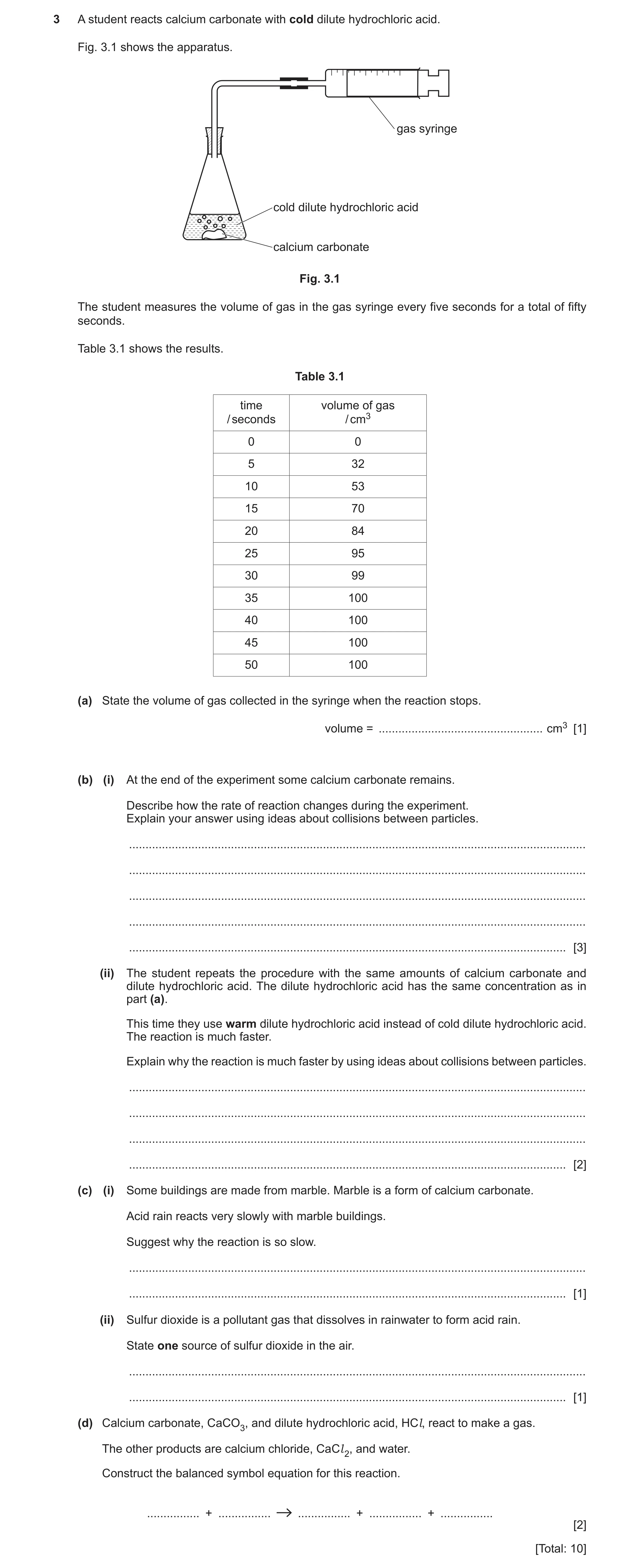
Q11 · A student reacts calcium carbonate with cold dilute hydrochloric acid 0654/42 Feb/March 2023
3 A student reacts calcium carbonate with cold dilute hydrochloric acid. Fig. 3.1 shows the apparatus. gas syringe cold dilute hydrochloric acid calcium carbonate Fig. 3.1 The student measures the volume of gas in the gas syringe every five seconds for a total of fifty seconds. Table 3.1 shows the results. Table 3.1 time volume of gas / seconds / cm3 0 0 5 32 10 53 15 70 20 84 25 95 30 99 35 100 40 100 45 100 50 100 (a) State the volume of gas collected in the syringe when the reaction stops. volume = … cm3 [1] (b) (i) At the end of the experiment some calcium carbonate remains. Describe how the rate of reaction changes during the experiment. Explain your answer using ideas about collisions between particles. … … … … … [3] (ii) The student repeats the procedure with the same amounts of calcium carbonate and dilute hydrochloric acid. The dilute hydrochloric acid has the same concentration as in part (a). This time they use warm dilute hydrochloric acid instead of cold dilute hydrochloric acid. The reaction is much faster. Explain why the reaction is much faster by using ideas about collisions between particles. … … … … [2] (c) (i) Some buildings are made from marble. Marble is a form of calcium carbonate. Acid rain reacts very slowly with marble buildings. Suggest why the reaction is so slow. … … [1] (ii) Sulfur dioxide is a pollutant gas that dissolves in rainwater to form acid rain. State one source of sulfur dioxide in the air. … … [1] (d) Calcium carbonate, CaCO3, and dilute hydrochloric acid, HCl, react to make a gas. The other products are calcium chloride, CaCl 2, and water. Construct the balanced symbol equation for this reaction. … + … … + … + … [2] [Total: 10]
10 marks
Mark scheme: 3(a) 100 (cm3) ; 1 3(b)(i) rate of reaction decreases ; 3 as the reaction proceeds there are less particles in the same volume / less crowded particles ; therefore less collisions per second ; 3(b)(ii) particles move faster / particles have more (kinetic) energy ; 2 more (successful) collisions per second / owtte ; 3(c)(i) acid is very dilute / marble is in large pieces or has a small surface area ; 1 3(c)(ii) combustion of fossil fuels (which contain sulfur compounds) / AVP ; 1 3(d) CaCO3 + 2 HCl → CaCl2 + H2O + CO2 ;; 2
This question in 0654/42 Feb/March 2023
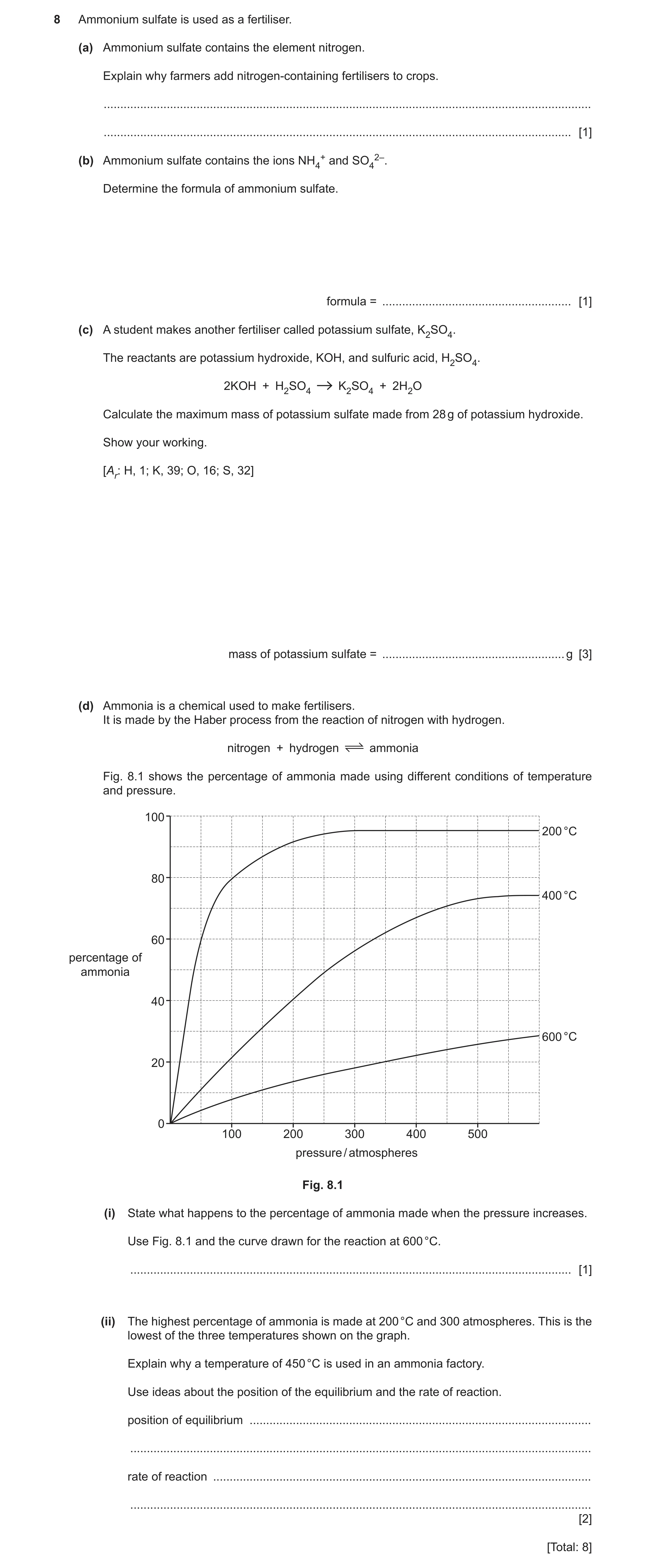
Q12 · Ammonium sulfate is used as a fertiliser 0654/42 Feb/March 2023
8 Ammonium sulfate is used as a fertiliser. (a) Ammonium sulfate contains the element nitrogen. Explain why farmers add nitrogen‑containing fertilisers to crops. … … [1] (b) Ammonium sulfate contains the ions NH4+ and SO42–. Determine the formula of ammonium sulfate. formula = … [1] (c) A student makes another fertiliser called potassium sulfate, K2SO4. The reactants are potassium hydroxide, KOH, and sulfuric acid, H2SO4. 2KOH + H2SO4 K2SO4 + 2H2O Calculate the maximum mass of potassium sulfate made from 28 g of potassium hydroxide. Show your working. [Ar: H, 1; K, 39; O, 16; S, 32] mass of potassium sulfate = … g [3] (d) Ammonia is a chemical used to make fertilisers. It is made by the Haber process from the reaction of nitrogen with hydrogen. nitrogen + hydrogen ammonia Fig. 8.1 shows the percentage of ammonia made using different conditions of temperature and pressure. 100 200 °C 80 400 °C 60 percentage of ammonia 40 600 °C 20 0 100 200 300 400 500 pressure / atmospheres Fig. 8.1 (i) State what happens to the percentage of ammonia made when the pressure increases. Use Fig. 8.1 and the curve drawn for the reaction at 600 °C. … [1] (ii) The highest percentage of ammonia is made at 200 °C and 300 atmospheres. This is the lowest of the three temperatures shown on the graph. Explain why a temperature of 450 °C is used in an ammonia factory. Use ideas about the position of the equilibrium and the rate of reaction. position of equilibrium … … rate of reaction … … [2] [Total: 8]
8 marks
Mark scheme: 8(a) increased crop yield / increased growth rate / idea of better-quality crops / idea of replacing or adding nutrients or 1 minerals / for synthesis of amino acids or proteins ; 8(b) (NH4)2SO4 ; 1 8(c) relative formula mass of KOH =56 and of K2SO4 = 174 ; 3 28 moles of KOH = = 0.5 ; 56 (2:1 ratio so) mass of potassium sulfate = 0.25 174 = 43.5 g ; 8(d)(i) increases / owtte ; 1 8(d)(ii) position of equilibrium 2 low temperature or 200 °C moves (position of) equilibrium to RHS / ORA ; rate of reaction reaction slow at low temperatures / ORA ;
This question in 0654/42 Feb/March 2023
Q13 · A student investigates the rate of reaction between dilute hydrochloric acid, HCl, and… 0654/41 May/June 2023
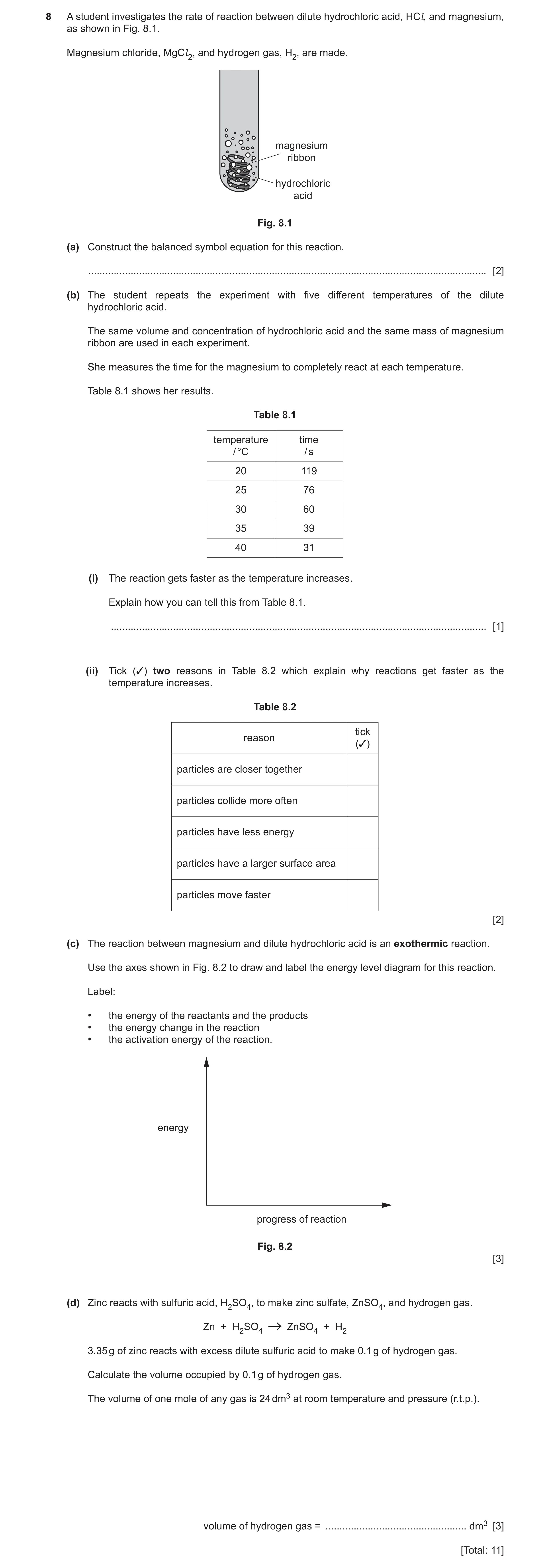
8 A student investigates the rate of reaction between dilute hydrochloric acid, HCl, and magnesium, as shown in Fig. 8.1. Magnesium chloride, MgCl 2, and hydrogen gas, H2, are made. magnesium ribbon hydrochloric acid Fig. 8.1 (a) Construct the balanced symbol equation for this reaction. … [2] (b) The student repeats the experiment with five different temperatures of the dilute hydrochloric acid. The same volume and concentration of hydrochloric acid and the same mass of magnesium ribbon are used in each experiment. She measures the time for the magnesium to completely react at each temperature. Table 8.1 shows her results. Table 8.1 temperature time / °C / s 20 119 25 76 30 60 35 39 40 31 (i) The reaction gets faster as the temperature increases. Explain how you can tell this from Table 8.1. … [1] (ii) Tick (3) two reasons in Table 8.2 which explain why reactions get faster as the temperature increases. Table 8.2 tick reason (3) particles are closer together particles collide more often particles have less energy particles have a larger surface area particles move faster [2] (c) The reaction between magnesium and dilute hydrochloric acid is an exothermic reaction. Use the axes shown in Fig. 8.2 to draw and label the energy level diagram for this reaction. Label: • the energy of the reactants and the products • the energy change in the reaction • the activation energy of the reaction. energy progress of reaction Fig. 8.2 [3] (d) Zinc reacts with sulfuric acid, H2SO4, to make zinc sulfate, ZnSO4, and hydrogen gas. Zn + H2SO4 ZnSO4 + H2 3.35 g of zinc reacts with excess dilute sulfuric acid to make 0.1 g of hydrogen gas. Calculate the volume occupied by 0.1 g of hydrogen gas. The volume of one mole of any gas is 24 dm3 at room temperature and pressure (r.t.p.). volume of hydrogen gas = … dm3 [3] [Total: 11]
11 marks
Mark scheme: 8(a) Correct formulae ; Correct balancing ; 2 8(b)(i) (as the temperature increases) the time decreases / owtte ; 1 Question Answer Marks 8(b)(ii) reason tick () particles are closer together particles collide more often particles have less energy particles have a larger surface area particles move faster ;; 2 8(c) products shown below reactants ; energy change or H correctly labelled ; activation energy correctly labelled ; 3 Question Answer Marks 8(d) Mr of H2 = 2 ; moles of H2 = 0.1 ÷ 2 = 0.05 / M / Mr ; volume of H2 = 0.05 24 = 1.2 dm³ ; 3
This question in 0654/41 May/June 2023
Q14 · Element X is found in Group II of the Periodic Table 0654/43 May/June 2023
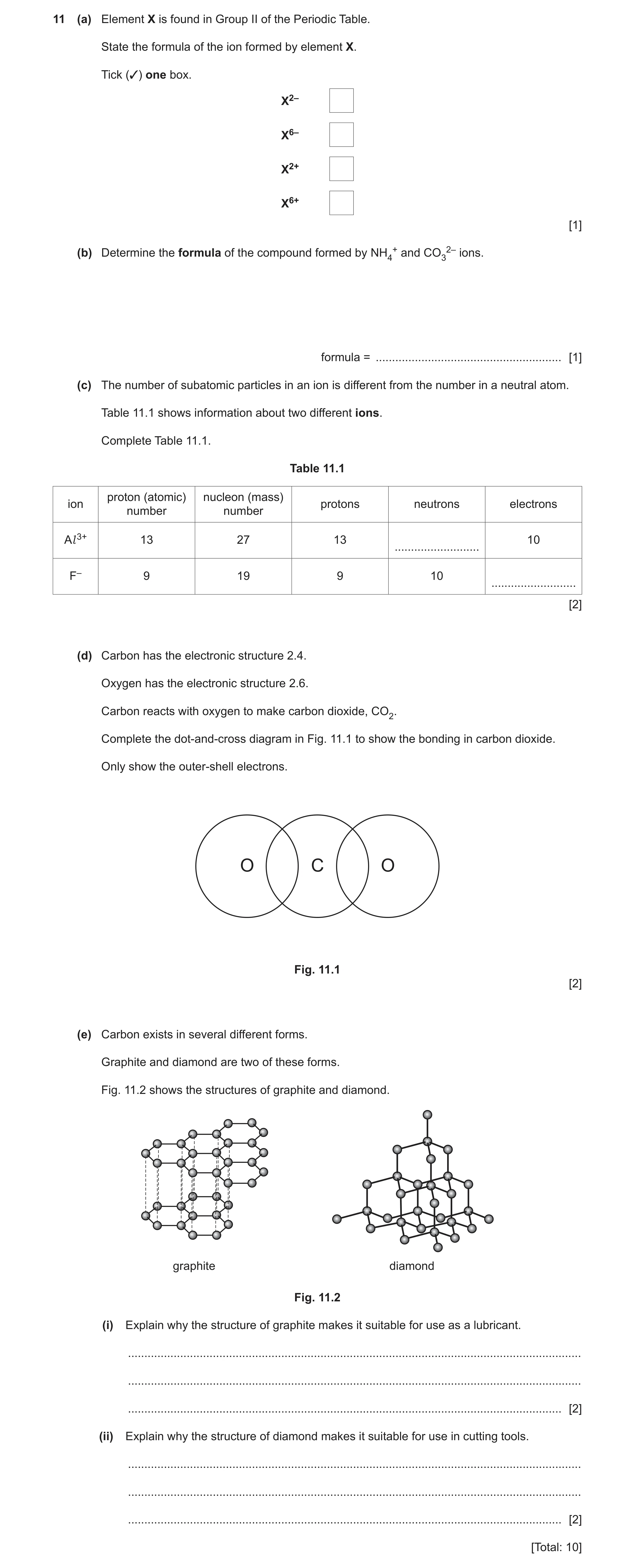
11 (a) Element X is found in Group II of the Periodic Table. State the formula of the ion formed by element X. Tick (3) one box. X2– X6– X2+ X6+ [1] (b) Determine the formula of the compound formed by NH4+ and CO32– ions. formula = … [1] (c) The number of subatomic particles in an ion is different from the number in a neutral atom. Table 11.1 shows information about two different ions. Complete Table 11.1. Table 11.1 proton (atomic) nucleon (mass) ion protons neutrons electrons number number Al 3+ 13 27 13 10 … F– 9 19 9 10 … [2] (d) Carbon has the electronic structure 2.4. Oxygen has the electronic structure 2.6. Carbon reacts with oxygen to make carbon dioxide, CO2. Complete the dot‑and‑cross diagram in Fig. 11.1 to show the bonding in carbon dioxide. Only show the outer‑shell electrons. O C O Fig. 11.1 [2] (e) Carbon exists in several different forms. Graphite and diamond are two of these forms. Fig. 11.2 shows the structures of graphite and diamond. graphite diamond Fig. 11.2 (i) Explain why the structure of graphite makes it suitable for use as a lubricant. … … … [2] (ii) Explain why the structure of diamond makes it suitable for use in cutting tools. … … … [2] [Total: 10]
10 marks
Mark scheme: 11(a) X2+ ; 1 11(b) (NH4)2CO3 ; 1 11(c) ion proton (atomic) number nucleon (mass) number protons neutrons electrons Al 3+ 13 27 13 14 10 F- 9 19 9 10 10 ;; 2 Question Answer Marks 11(d) double bonds between C and O atoms ; rest of structure correct ; 2 11(e)(i) (graphite has) weak forces between the layers ; layers can slide over each other / owtte ; 2 11(e)(ii) any two from: (diamond) has many strong bonds ; bonds are covalent bonds ; (diamond has) giant molecular / macromolecular / giant tetrahedral / lattice / giant covalent, structure ; 2
This question in 0654/43 May/June 2023
Q15 · A student investigates the reaction between zinc and dilute nitric acid, HNO3 0654/41 Oct/Nov 2024
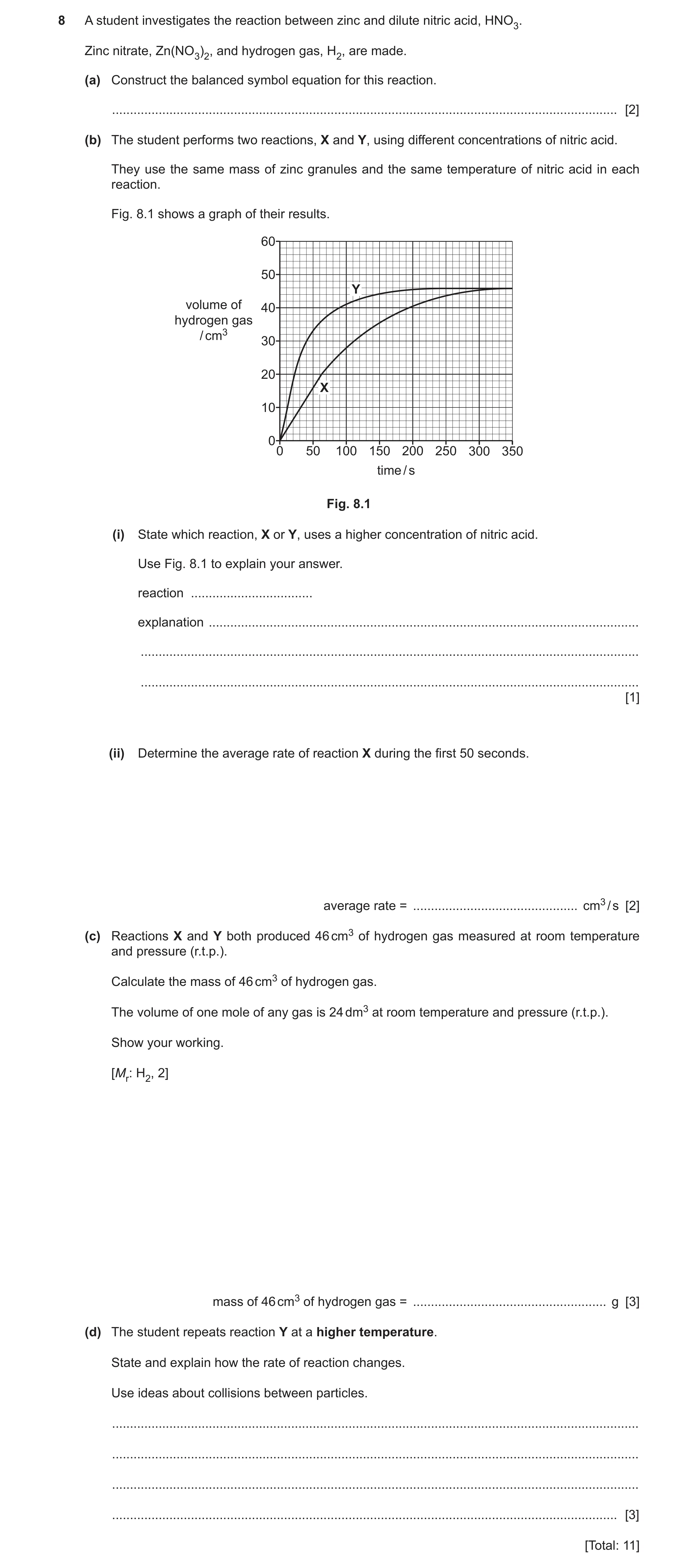
8 A student investigates the reaction between zinc and dilute nitric acid, HNO3. Zinc nitrate, Zn(NO3)2, and hydrogen gas, H2, are made. (a) Construct the balanced symbol equation for this reaction. … [2] (b) The student performs two reactions, X and Y, using different concentrations of nitric acid. They use the same mass of zinc granules and the same temperature of nitric acid in each reaction. Fig. 8.1 shows a graph of their results. 60 50 Y volume of 40 hydrogen gas / cm3 30 20 X 10 0 0 50 100 150 200 250 300 350 time / s Fig. 8.1 (i) State which reaction, X or Y, uses a higher concentration of nitric acid. Use Fig. 8.1 to explain your answer. reaction … explanation … … … [1] (ii) Determine the average rate of reaction X during the first 50 seconds. average rate = … cm3 / s [2] (c) Reactions X and Y both produced 46 cm3 of hydrogen gas measured at room temperature and pressure (r.t.p.). Calculate the mass of 46 cm3 of hydrogen gas. The volume of one mole of any gas is 24 dm3 at room temperature and pressure (r.t.p.). Show your working. [Mr: H2, 2] mass of 46 cm3 of hydrogen gas = … g [3] (d) The student repeats reaction Y at a higher temperature. State and explain how the rate of reaction changes. Use ideas about collisions between particles. … … … … [3] [Total: 11]
11 marks
Mark scheme: 8(a) Zn + 2HNO3 → Zn(NO3)2 + H2 ;; 2 1 mark for correct formulae 1 mark for correct balanced equation 8(b)(i) (Y) 1 curve has a steeper gradient / reaction finishes sooner ; 8(b)(ii) (gradient calculation)16 ÷ 50 ; 2 0.32 (cm3 / s) ; 8(c) (46 cm3 =) 0.046 (dm3) ; 3 (moles of H2 = 0.046 ÷ 24 =) 0.0019 ; (mass of H2 = 2 0.0019 =) 0.0038 (g) ; 8(d) (reaction will be) faster ; 3 (because) any two from: molecules have higher (average) energy / molecules are moving faster ; more molecules with activation energy ; frequency of collision (of molecules) is higher / more collisions per second ; more successful collisions ;
This question in 0654/41 Oct/Nov 2024
Q16 · The metal iron is extracted from hematite in a blast furnace 0654/41 May/June 2025
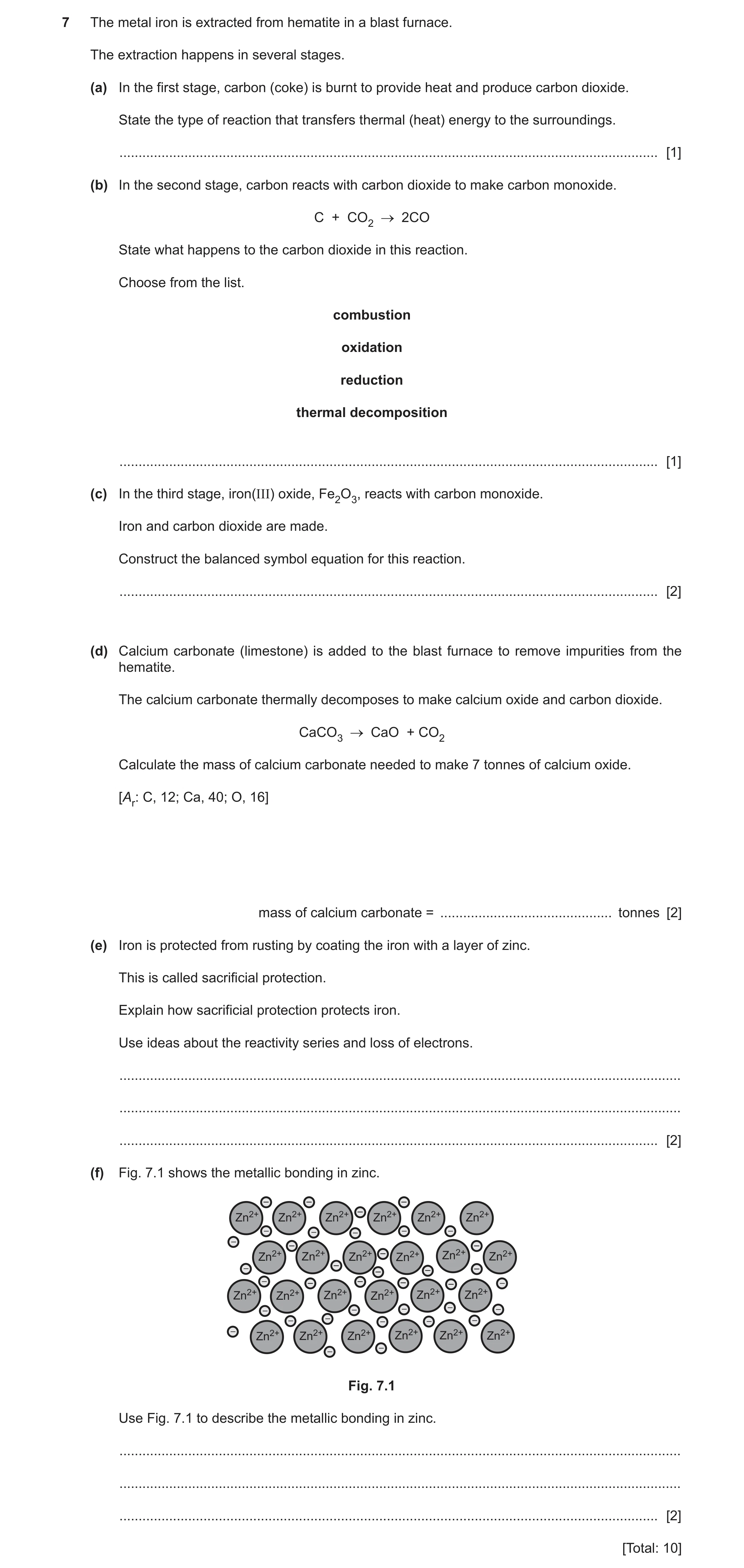
7 The metal iron is extracted from hematite in a blast furnace. The extraction happens in several stages. (a) In the first stage, carbon (coke) is burnt to provide heat and produce carbon dioxide. State the type of reaction that transfers thermal (heat) energy to the surroundings. … [1] (b) In the second stage, carbon reacts with carbon dioxide to make carbon monoxide. C + CO2 2CO State what happens to the carbon dioxide in this reaction. Choose from the list. combustion oxidation reduction thermal decomposition … [1] (c) In the third stage, iron(III) oxide, Fe2O3, reacts with carbon monoxide. Iron and carbon dioxide are made. Construct the balanced symbol equation for this reaction. … [2] (d) Calcium carbonate (limestone) is added to the blast furnace to remove impurities from the hematite. The calcium carbonate thermally decomposes to make calcium oxide and carbon dioxide. CaCO3 CaO + CO2 Calculate the mass of calcium carbonate needed to make 7 tonnes of calcium oxide. [Ar: C, 12; Ca, 40; O, 16] mass of calcium carbonate = … tonnes [2] (e) Iron is protected from rusting by coating the iron with a layer of zinc. This is called sacrificial protection. Explain how sacrificial protection protects iron. Use ideas about the reactivity series and loss of electrons. … … … [2] (f) Fig. 7.1 shows the metallic bonding in zinc. – – – Zn2+ Zn2+ Zn2+ – Zn2+ Zn2+ Zn2+ – – – – – – – – Zn2+ Zn2+ Zn2+ – Zn2+ Zn2+ Zn2+ – – – – – – – – – – – Zn2+ Zn2+ Zn2+ Zn2+ Zn2+ Zn2+ – – – – – – – – – – – Zn2+ Zn2+ Zn2+ Zn2+ Zn2+ Zn2+ – – Fig. 7.1 Use Fig. 7.1 to describe the metallic bonding in zinc. … … … [2] [Total: 10]
10 marks
Mark scheme: 7(a) exothermic ; 1 7(b) reduction ; 1 7(c) Fe2O3 + 3CO → 2Fe + 3CO2 ;; 2 7(d) Mr of CaCO3 = 100 and Mr of CaO = 56 ; 2 100 7 = 12.5 (tonnes) ; 56 7(e) zinc is more reactive than iron / ORA ; 2 zinc loses electrons more easily than iron / ORA ; 7(f) electrostatic attraction ; 2 between positive (zinc / metal) ions and (a ‘sea’ of) delocalised electrons ;
This question in 0654/41 May/June 2025
Q17 · The structure of magnesium oxide 0654/43 May/June 2025
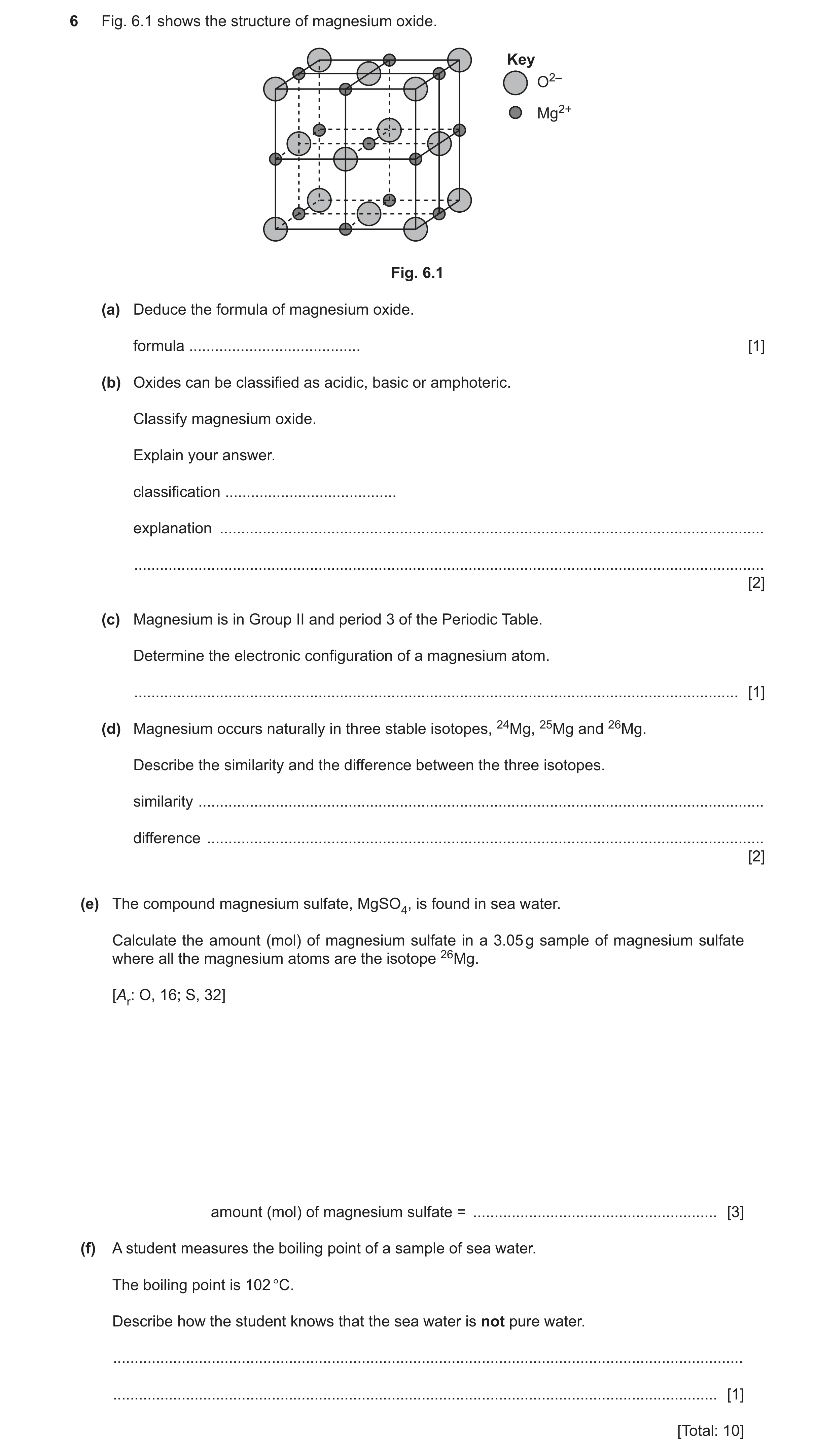
6 Fig. 6.1 shows the structure of magnesium oxide. Key O2– Mg2+ Fig. 6.1 (a) Deduce the formula of magnesium oxide. formula … [1] (b) Oxides can be classified as acidic, basic or amphoteric. Classify magnesium oxide. Explain your answer. classification … explanation … … [2] (c) Magnesium is in Group II and period 3 of the Periodic Table. Determine the electronic configuration of a magnesium atom. … [1] (d) Magnesium occurs naturally in three stable isotopes, 24Mg, 25Mg and 26Mg. Describe the similarity and the difference between the three isotopes. similarity … difference … [2] (e) The compound magnesium sulfate, MgSO4, is found in sea water. Calculate the amount (mol) of magnesium sulfate in a 3.05 g sample of magnesium sulfate where all the magnesium atoms are the isotope 26Mg. [Ar: O, 16; S, 32] amount (mol) of magnesium sulfate = … [3] (f) A student measures the boiling point of a sample of sea water. The boiling point is 102 °C. Describe how the student knows that the sea water is not pure water. … … [1] [Total: 10]
10 marks
Mark scheme: 6(a) MgO; 1 6(b) basic; 2 (because) magnesium is a metal; 6(c) 2.8.2; 1 6(d) similarity 2 same number / amount of protons / same atomic number / all have an atomic number of 12; difference different number / amount of neutrons / different mass number; 6(e) Mr of MgSO4 = 26 + 32 + (4 16) = 122; 3 mol = mass ÷ Mr / 3.05 ÷ 122; = 0.025; 6(f) idea that (pure) water has a boiling point of 100 °C; 1
This question in 0654/43 May/June 2025
 10
10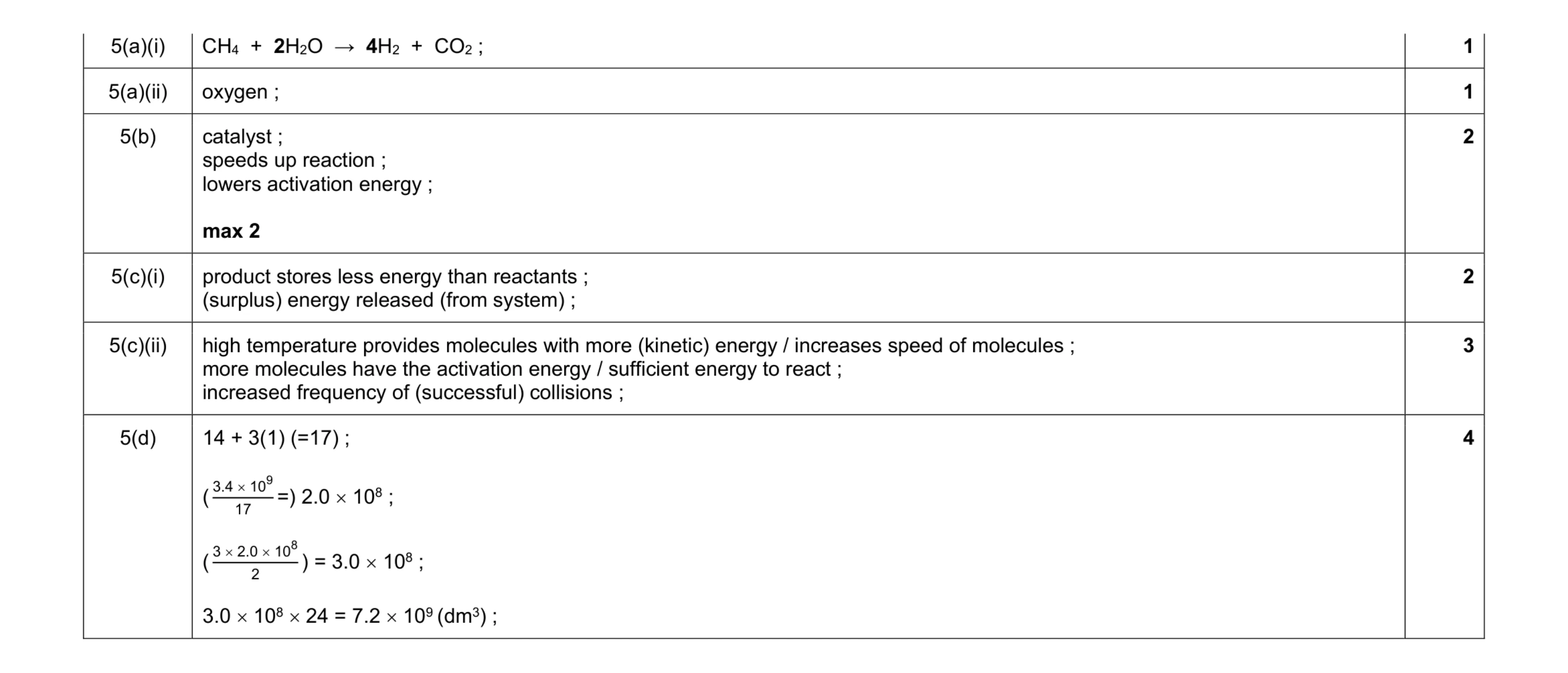 13
13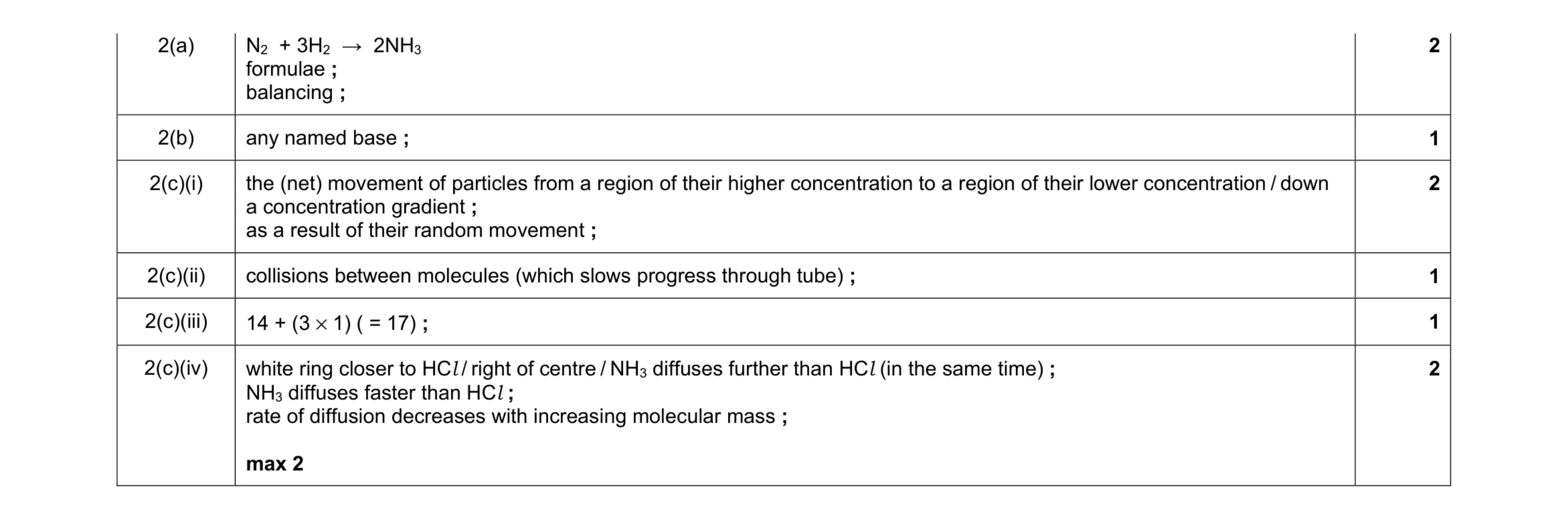 9
9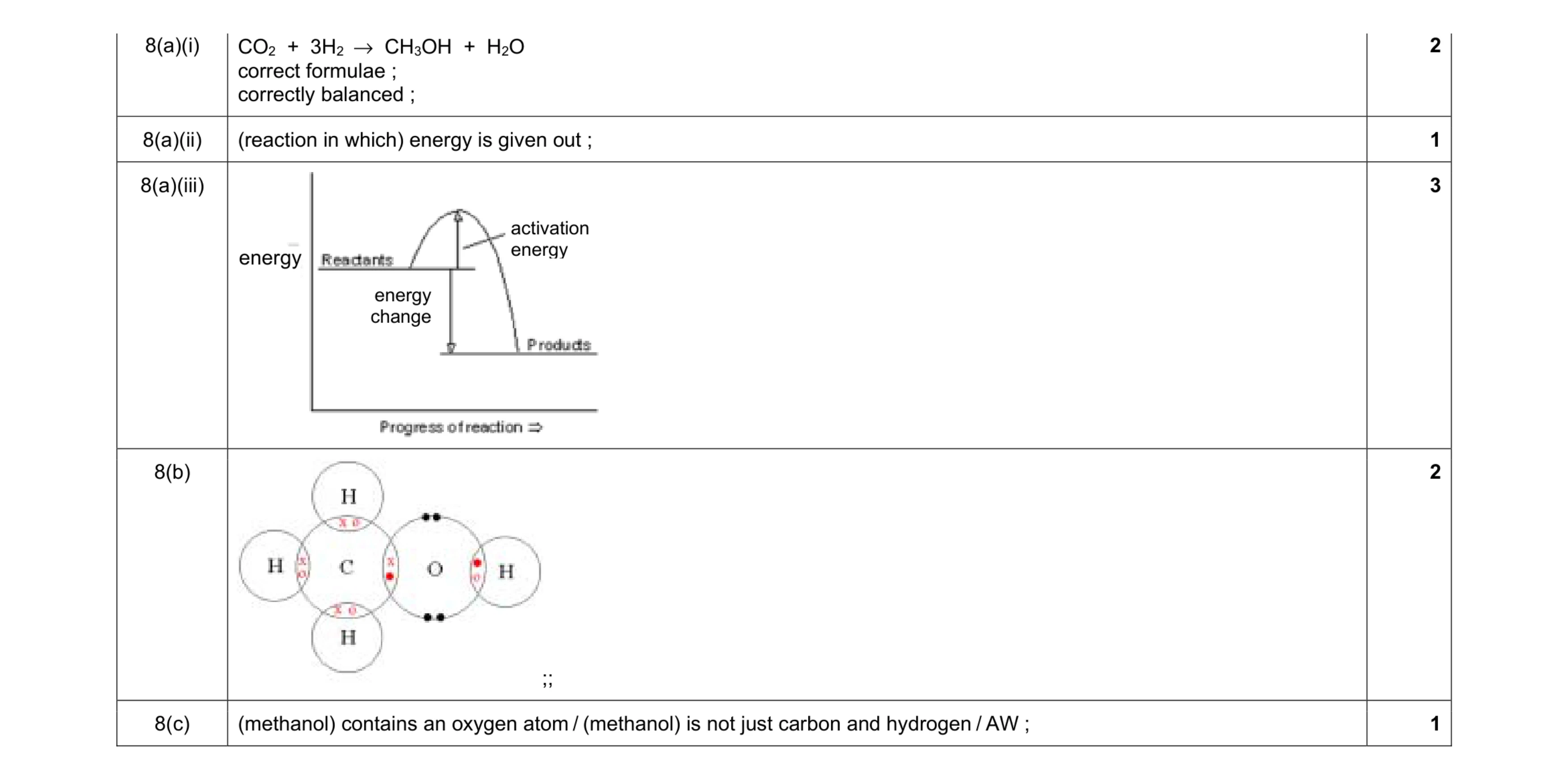 9
9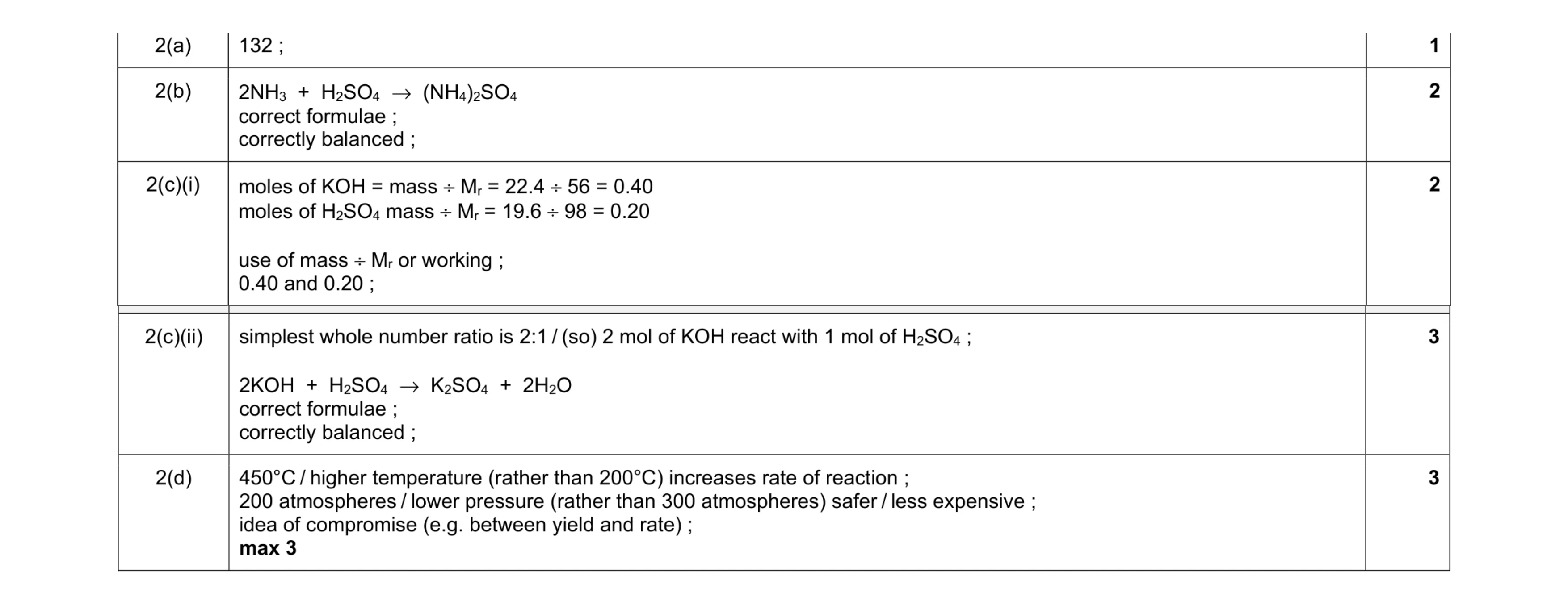 11
11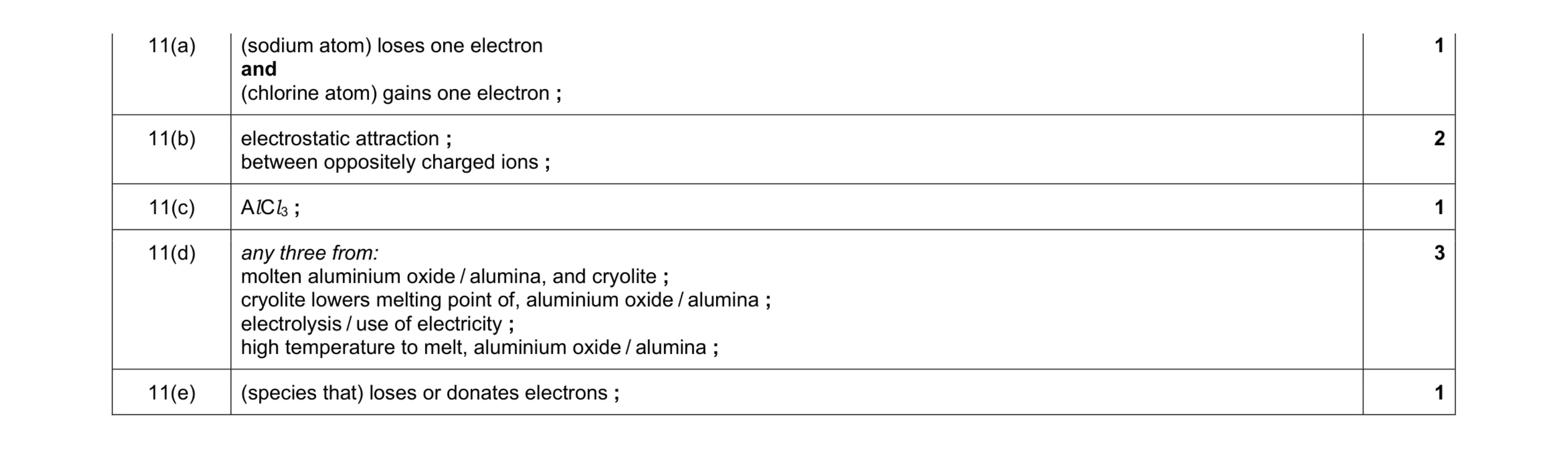 8
8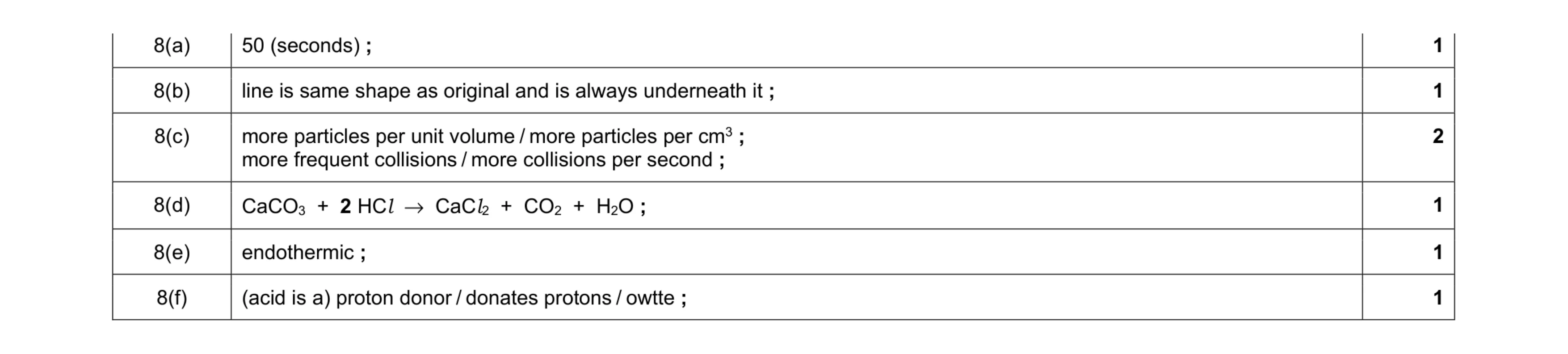 7
7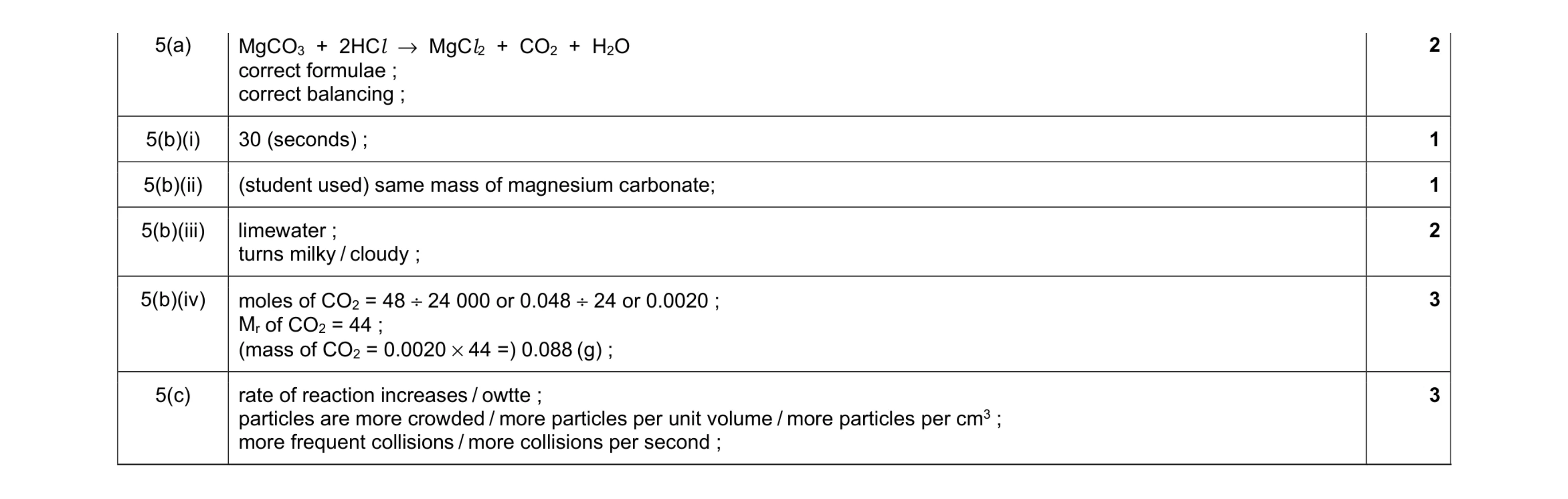 12
12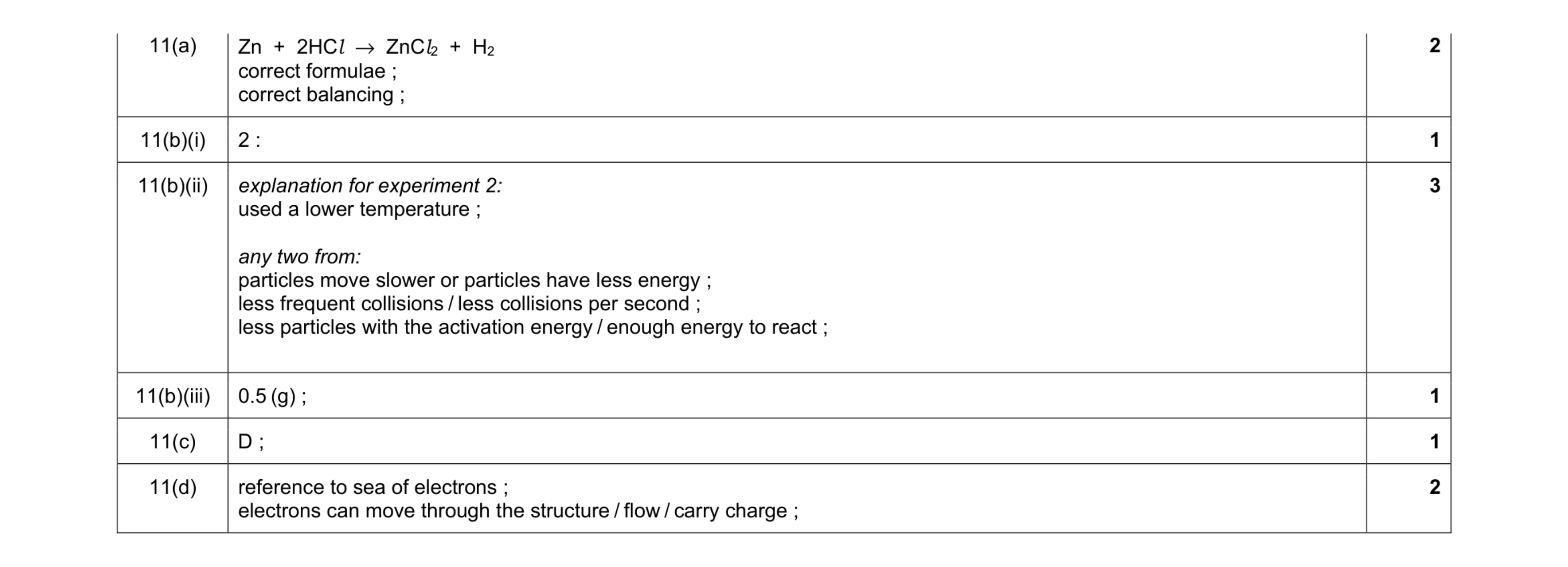 10
10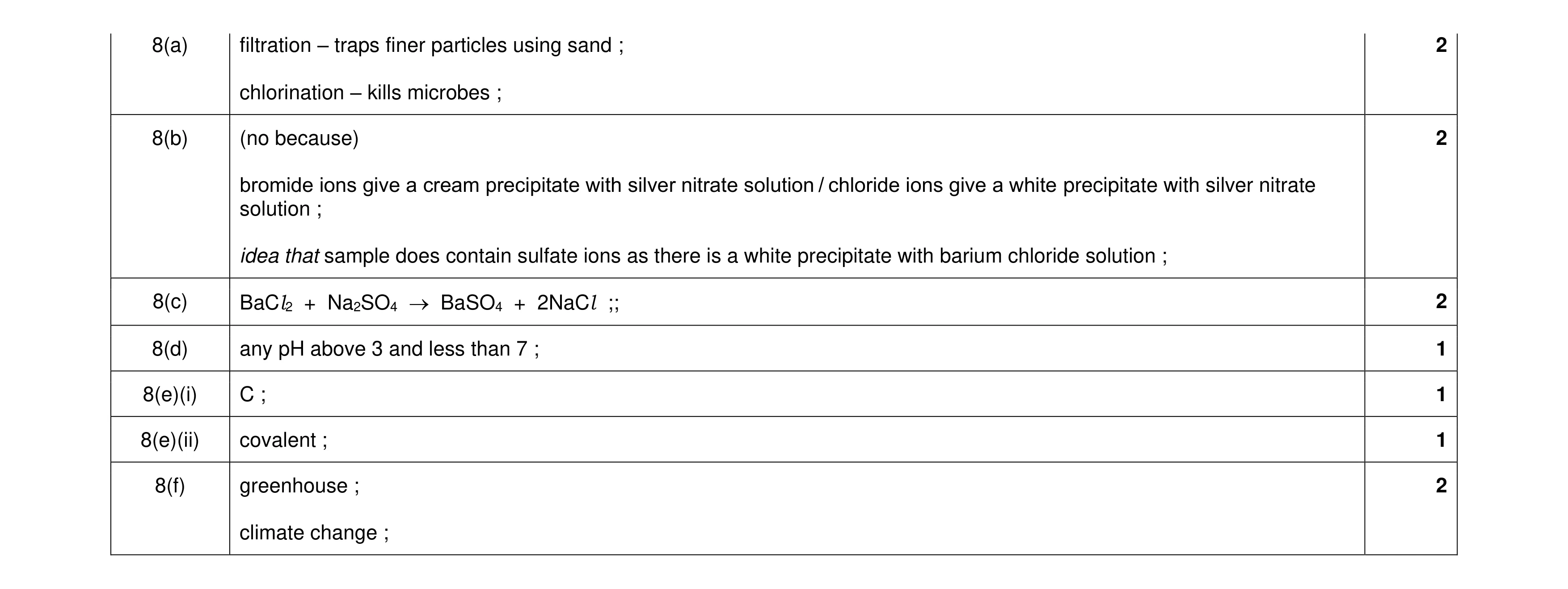 11
11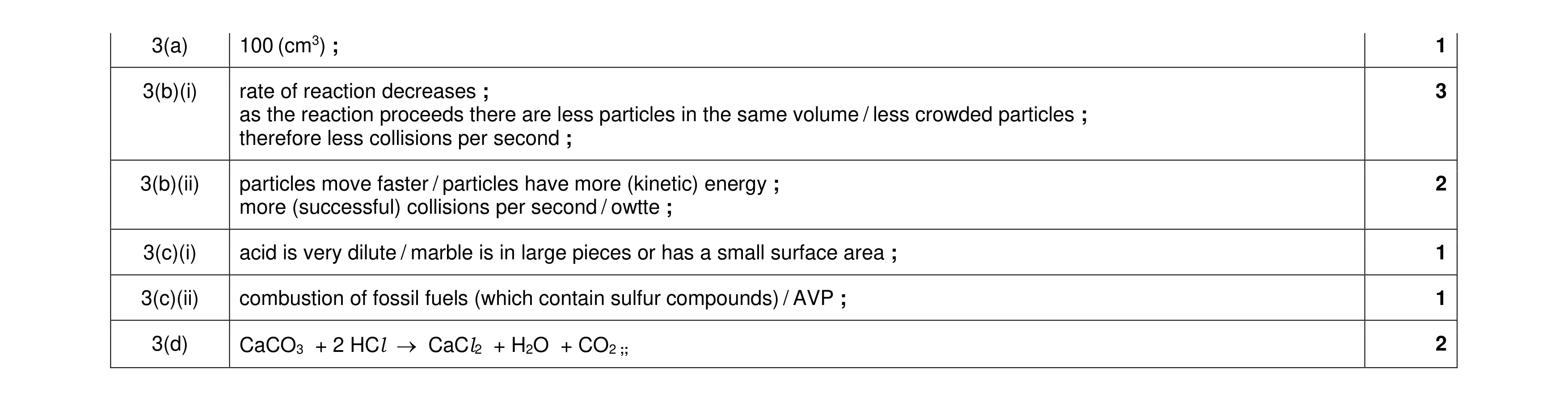 10
10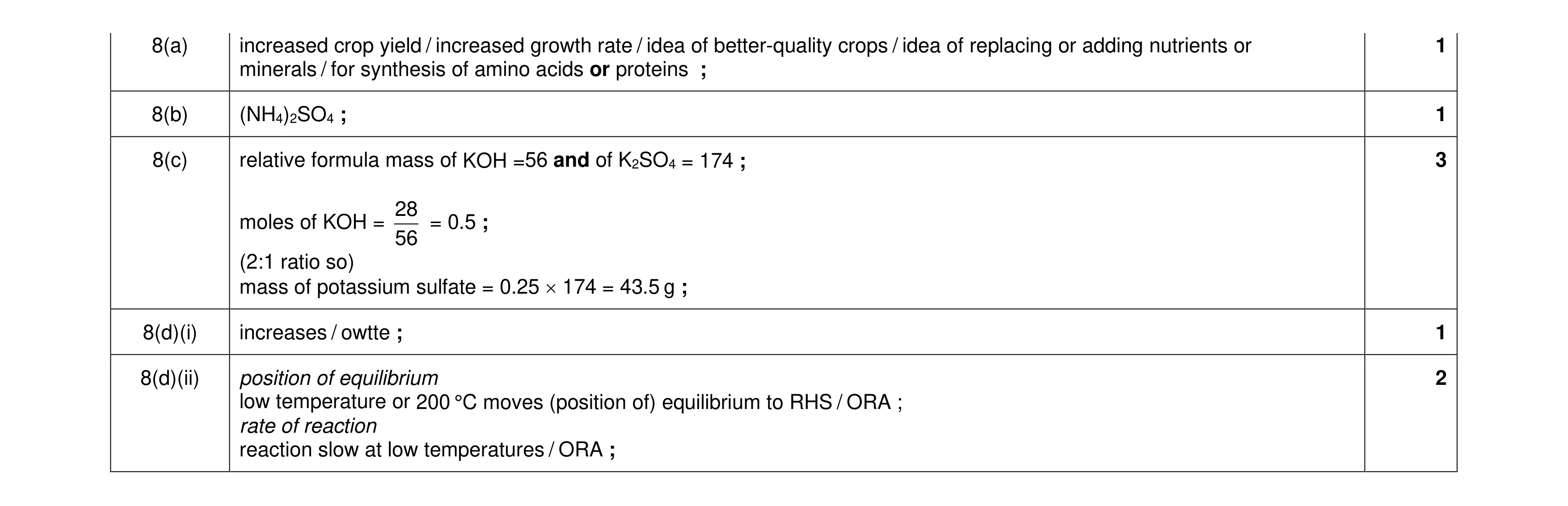 8
8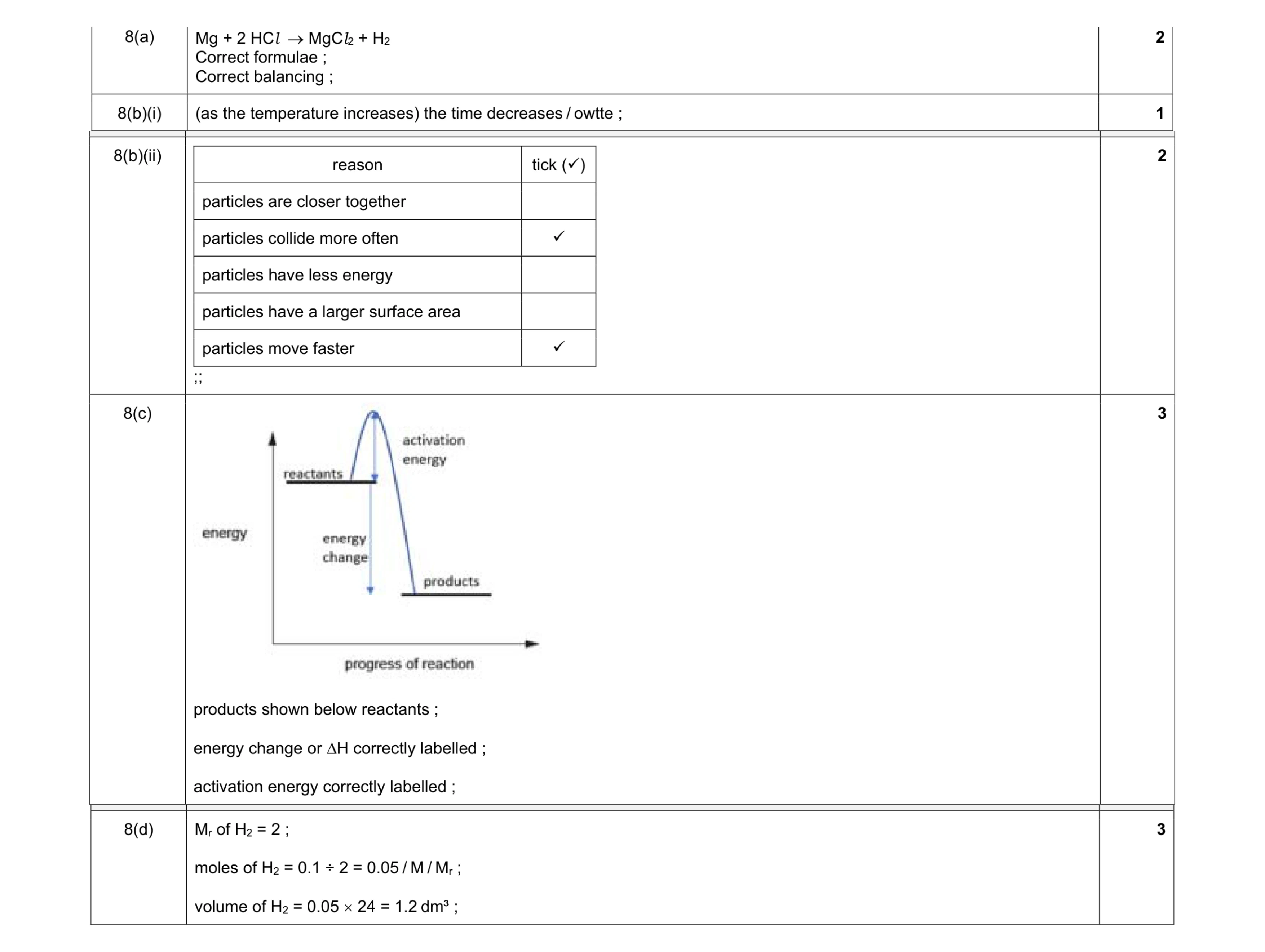 11
11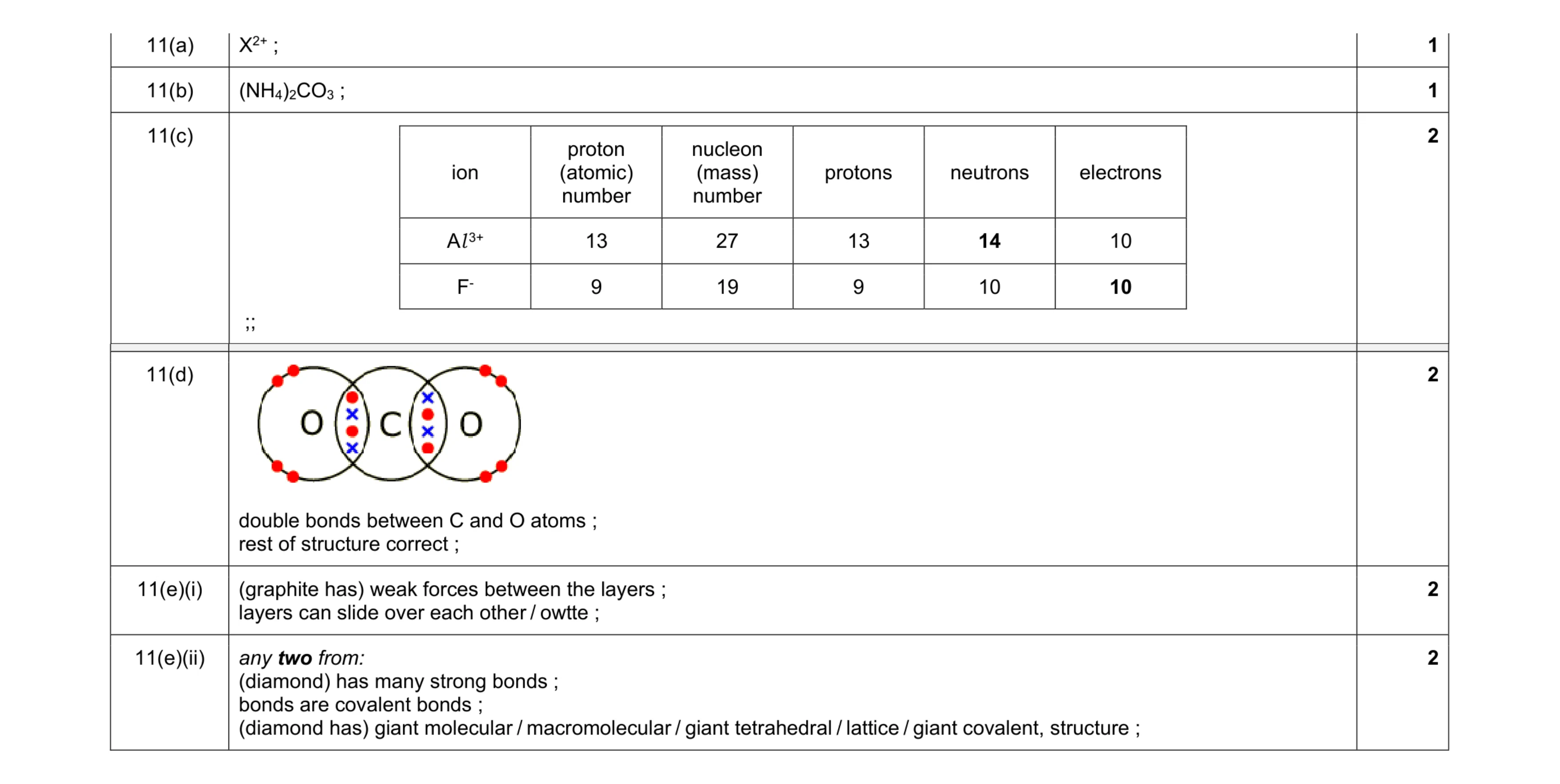 10
10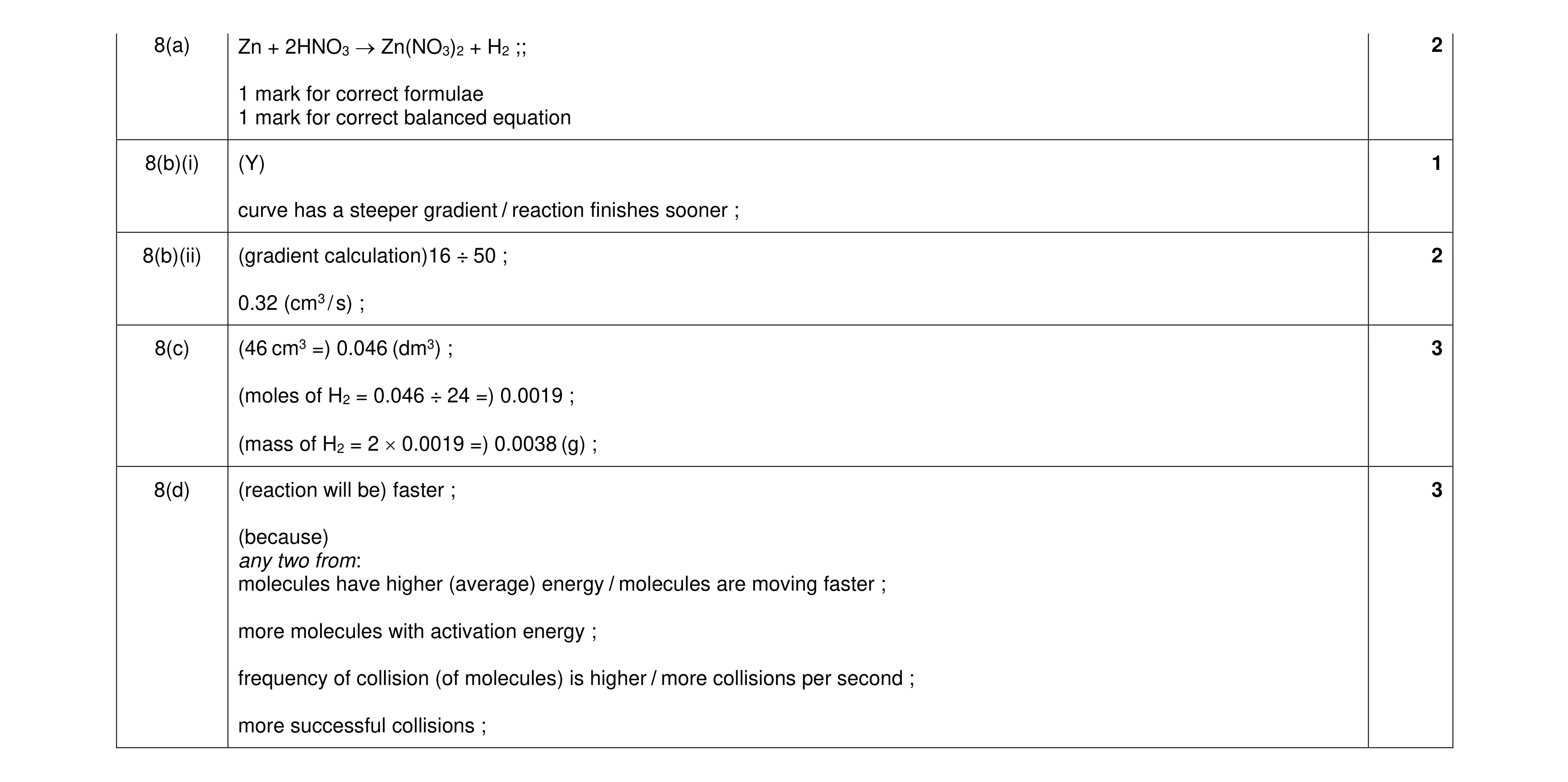 11
11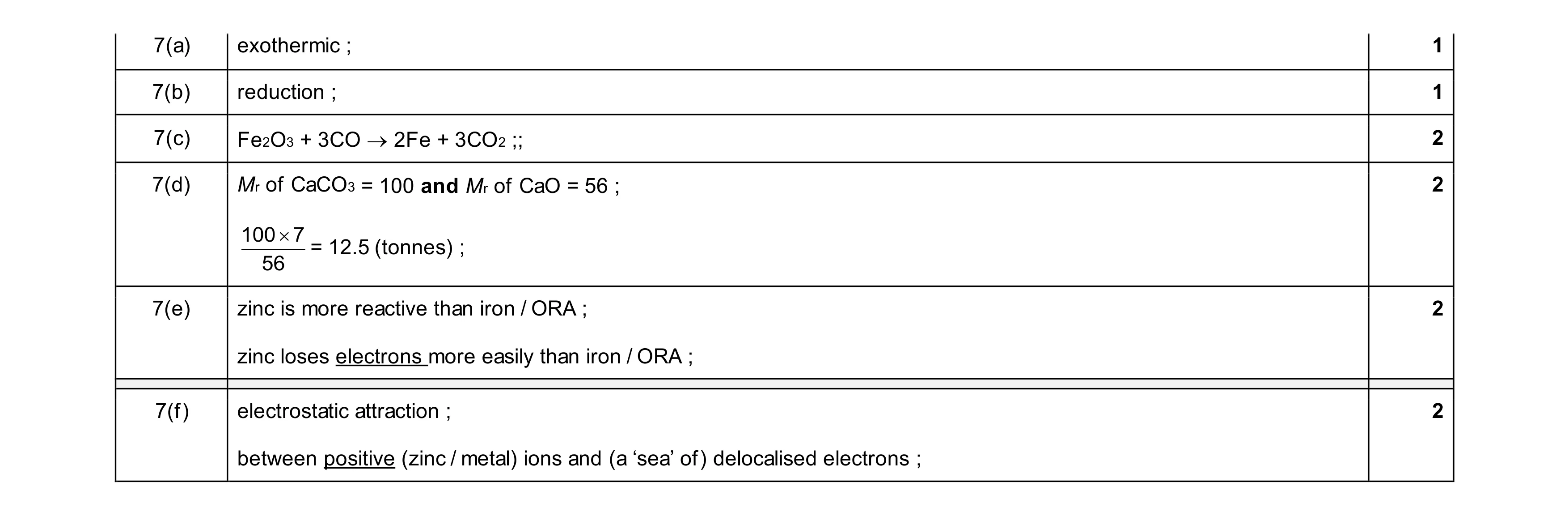 10
10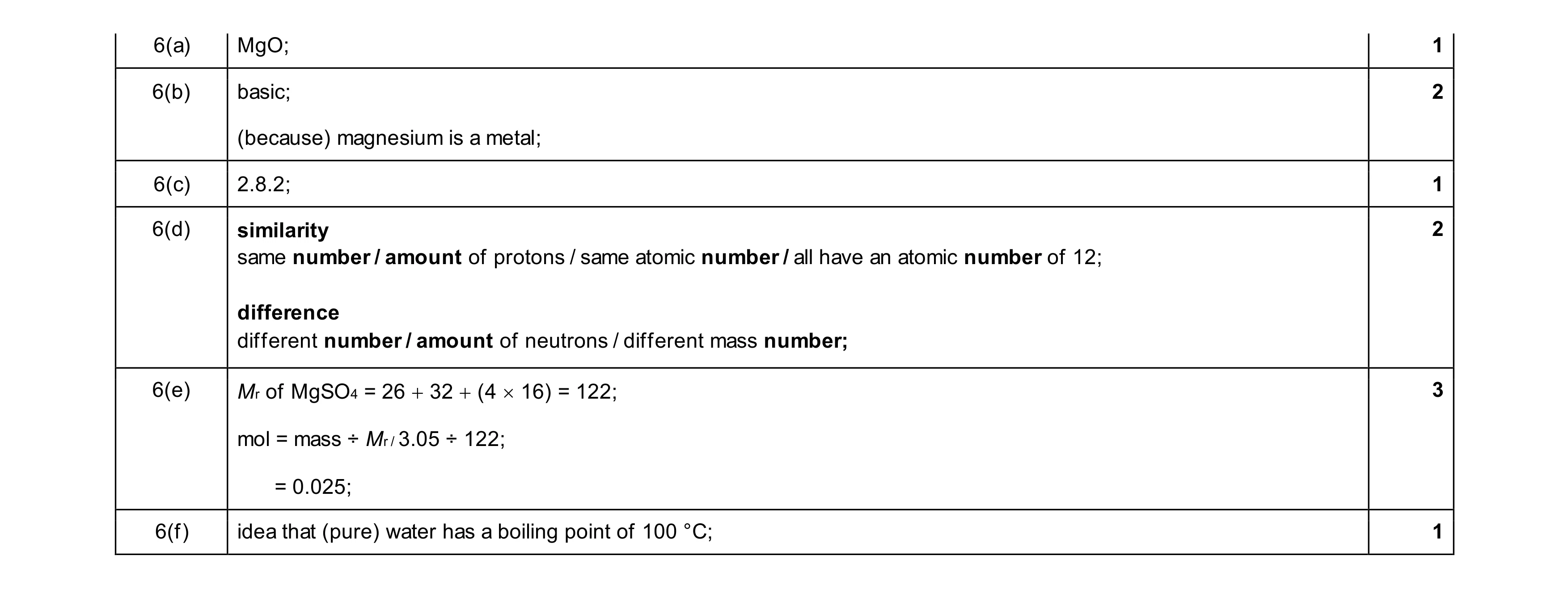 10
10