Questions as text
Q1 · Ionic compounds contain ions 0654/32 Oct/Nov 2017
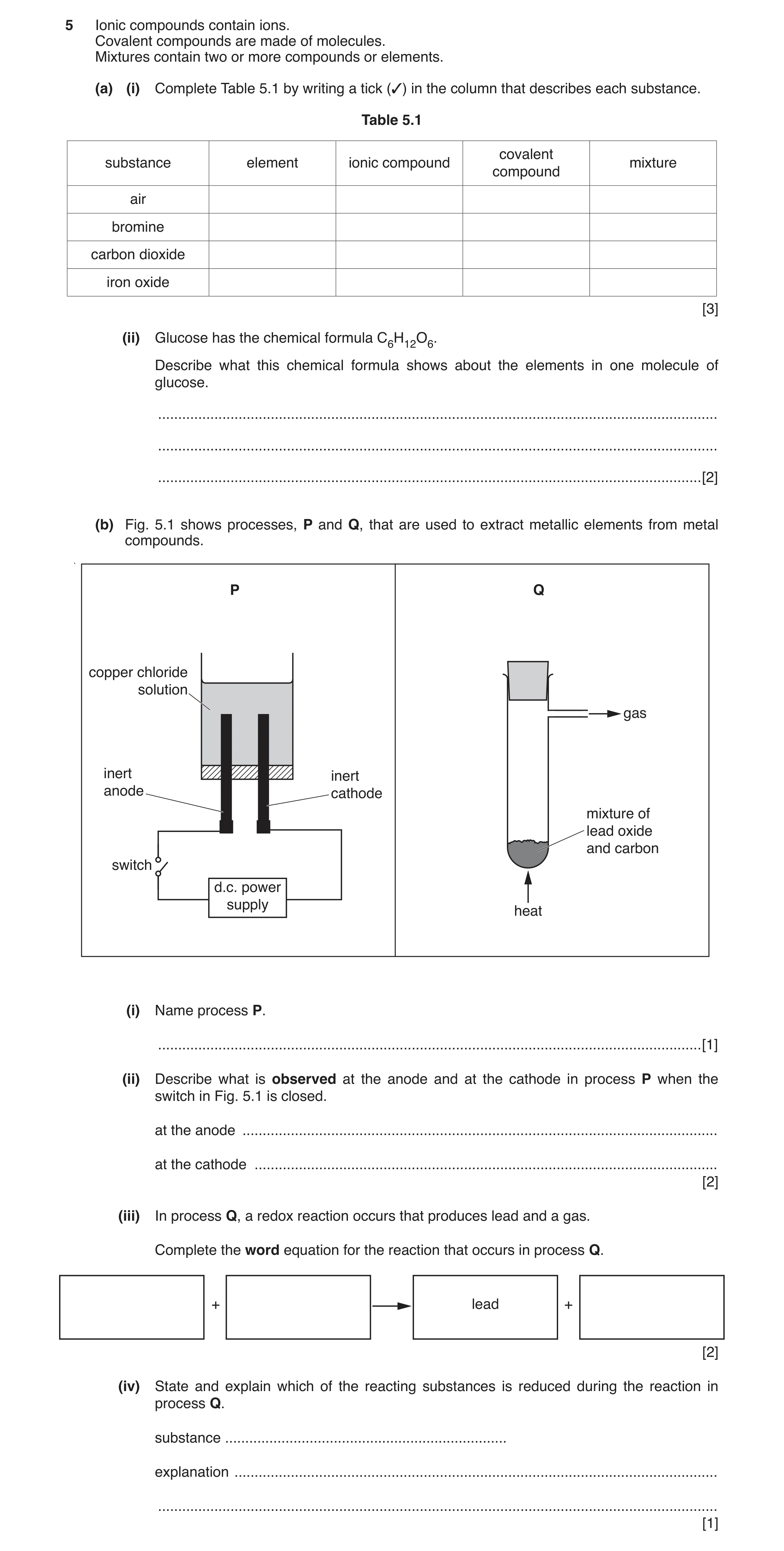
5 Ionic compounds contain ions. Covalent compounds are made of molecules. Mixtures contain two or more compounds or elements. (a) (i) Complete Table 5.1 by writing a tick (3) in the column that describes each substance. Table 5.1 covalent substance element ionic compound mixture compound air bromine carbon dioxide iron oxide [3] (ii) Glucose has the chemical formula C6H12O6. Describe what this chemical formula shows about the elements in one molecule of glucose. … … … [2] (b) Fig. 5.1 shows processes, P and Q, that are used to extract metallic elements from metal compounds. P Q copper chloride solution gas inert inert anode cathode mixture of lead oxide and carbon switch d.c. power supply heat (i) Name process P. … [1] (ii) Describe what is observed at the anode and at the cathode in process P when the switch in Fig. 5.1 is closed. at the anode … at the cathode … [2] (iii) In process Q, a redox reaction occurs that produces lead and a gas. Complete the word equation for the reaction that occurs in process Q. + lead + [2] (iv) State and explain which of the reacting substances is reduced during the reaction in process Q. substance … explanation … … [1]
11 marks
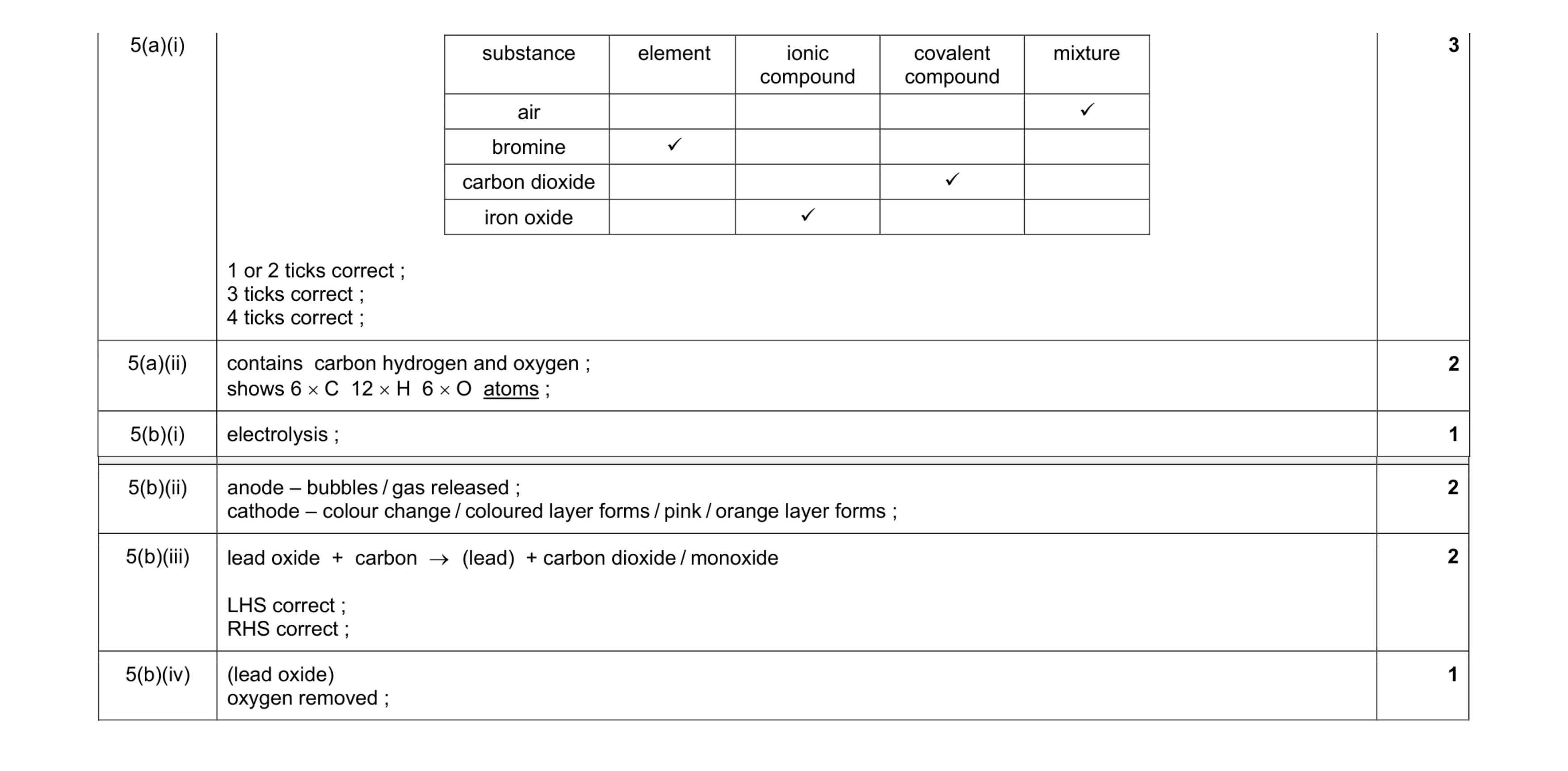
Mark scheme: 5(a)(i) substance element ionic compound covalent compound mixture air 9 bromine 9 carbon dioxide 9 iron oxide 9 1 or 2 ticks correct ; 3 ticks correct ; 4 ticks correct ; 3 5(a)(ii) contains carbon hydrogen and oxygen ; shows 6 × C 12 × H 6 × O atoms ; 2 5(b)(i) electrolysis ; 1 Question Answer Marks 5(b)(ii) anode – bubbles / gas released ; cathode – colour change / coloured layer forms / pink / orange layer forms ; 2 5(b)(iii) lead oxide + carbon → (lead) + carbon dioxide / monoxide LHS correct ; RHS correct ; 2 5(b)(iv) (lead oxide) oxygen removed ; 1
This question in 0654/32 Oct/Nov 2017
Q2 · Thermal decomposition happens when compounds are heated and break down into simpler… 0654/31 Oct/Nov 2020
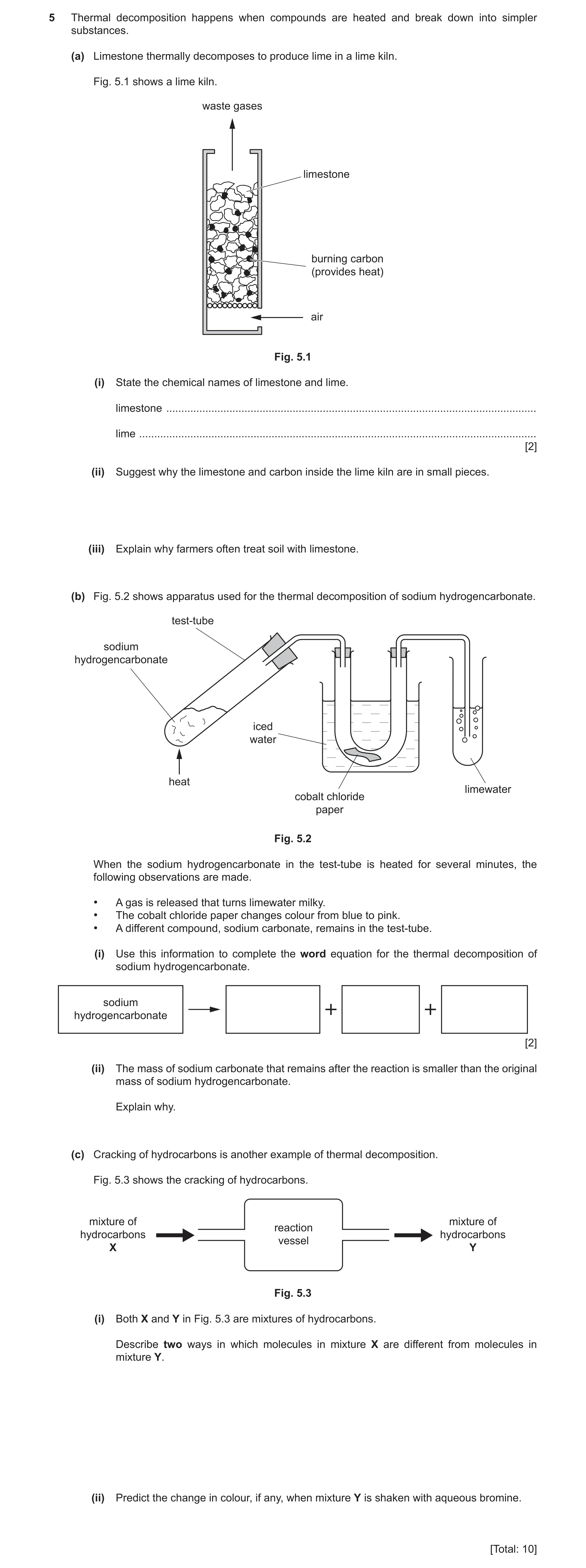
5 Thermal decomposition happens when compounds are heated and break down into simpler substances. (a) Limestone thermally decomposes to produce lime in a lime kiln. Fig. 5.1 shows a lime kiln. waste gases limestone burning carbon (provides heat) air Fig. 5.1 (i) State the chemical names of limestone and lime. limestone ��������������������������������������������������������������������������������������������������������������������������� lime ������������������������������������������������������������������������������������������������������������������������������������ [2] (ii) Suggest why the limestone and carbon inside the lime kiln are in small pieces. (iii) Explain why farmers often treat soil with limestone. (b) Fig. 5.2 shows apparatus used for the thermal decomposition of sodium hydrogencarbonate. test-tube sodium hydrogencarbonate iced water heat limewater cobalt chloride paper Fig. 5.2 When the sodium hydrogencarbonate in the test‑tube is heated for several minutes, the following observations are made. • A gas is released that turns limewater milky. • The cobalt chloride paper changes colour from blue to pink. • A different compound, sodium carbonate, remains in the test‑tube. (i) Use this information to complete the word equation for the thermal decomposition of sodium hydrogencarbonate. sodium hydrogencarbonate [2] (ii) The mass of sodium carbonate that remains after the reaction is smaller than the original mass of sodium hydrogencarbonate. Explain why. (c) Cracking of hydrocarbons is another example of thermal decomposition. Fig. 5.3 shows the cracking of hydrocarbons. mixture of mixture of reaction hydrocarbons hydrocarbons vessel X Y Fig. 5.3 (i) Both X and Y in Fig. 5.3 are mixtures of hydrocarbons. Describe two ways in which molecules in mixture X are different from molecules in mixture Y. (ii) Predict the change in colour, if any, when mixture Y is shaken with aqueous bromine. [Total: 10]
10 marks
Mark scheme: 5(a)(i) calcium carbonate ; calcium oxide ; 2 5(a)(ii) speeds up reaction rate (of both reactions) 1 5(a)(iii) treat acidic soil ; 1 5(b)(i) (sodium hydrogencarbonate →) sodium carbonate + carbon dioxide + water ;; 2 5(b)(ii) gaseous products removed from sodium hydrogencarbonate ; 1 5(c)(i) mixture Y contains unsaturated hydrocarbons (and X does not) ; molecules (on average) are smaller in Y ; 2 5(c)(ii) orange to colourless ; 1
This question in 0654/31 Oct/Nov 2020
Q3 · Hydrogen burning in air 0654/32 Oct/Nov 2020
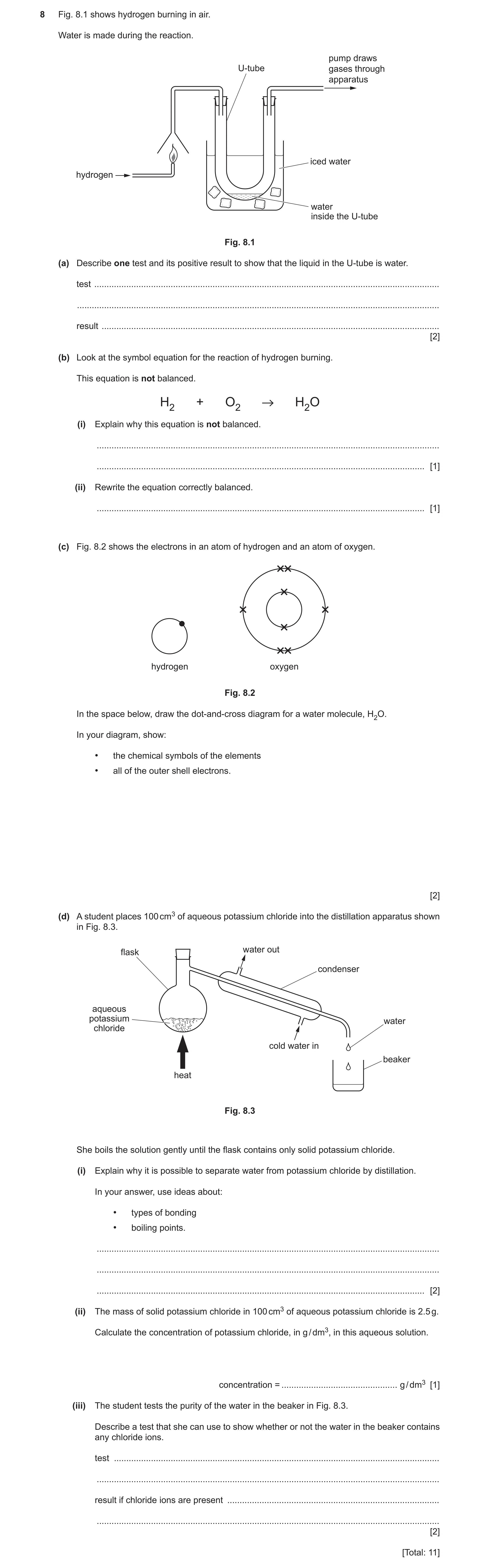
8 Fig. 8.1 shows hydrogen burning in air. Water is made during the reaction. pump draws U-tube gases through apparatus iced water hydrogen water inside the U-tube Fig. 8.1 (a) Describe one test and its positive result to show that the liquid in the U-tube is water. test … … result … [2] (b) Look at the symbol equation for the reaction of hydrogen burning. This equation is not balanced. H2 + O2 H2O (i) Explain why this equation is not balanced. … … [1] (ii) Rewrite the equation correctly balanced. … [1] (c) Fig. 8.2 shows the electrons in an atom of hydrogen and an atom of oxygen. hydrogen oxygen Fig. 8.2 In the space below, draw the dot-and-cross diagram for a water molecule, H2O. In your diagram, show: • the chemical symbols of the elements • all of the outer shell electrons. [2] (d) A student places 100 cm3 of aqueous potassium chloride into the distillation apparatus shown in Fig. 8.3. water out flask condenser aqueous potassium water chloride cold water in beaker heat Fig. 8.3 She boils the solution gently until the flask contains only solid potassium chloride. (i) Explain why it is possible to separate water from potassium chloride by distillation. In your answer, use ideas about: • types of bonding • boiling points. … … … [2] (ii) The mass of solid potassium chloride in 100 cm3 of aqueous potassium chloride is 2.5 g. Calculate the concentration of potassium chloride, in g / dm3, in this aqueous solution. concentration = … g / dm3 [1] (iii) The student tests the purity of the water in the beaker in Fig. 8.3. Describe a test that she can use to show whether or not the water in the beaker contains any chloride ions. test … … result if chloride ions are present … … [2] [Total: 11]
11 marks
Mark scheme: 8(a) cobalt chloride ; (blue to) pink ; OR anhydrous copper(II) sulfate ; (white to) blue ; 8(b)(i) different numbers of oxygen atoms on LHS and RHS / the numbers of each type of atom is not the same on both sides ; 1 8(b)(ii) 2 H2 + O2 → 2 H2O ; 1 8(c) symbols correct ; dot-and -cross diagram correct; 2 8(d)(i) the idea that water boils and potassium chloride does not / water is more volatile than potassium chloride ; because water is covalent / molecular and potassium chloride is ionic ; 2 8(d)(ii) 100 cm3 contains 2.5 g KCl so concentration is 25 (g / dm3 ) ; 1 8(d)(iii) addition of (acidified aqueous) silver nitrate ; white precipitate ; 2
This question in 0654/32 Oct/Nov 2020
Q4 · Metal oxides are formed when metals and oxygen react 0654/33 Oct/Nov 2020
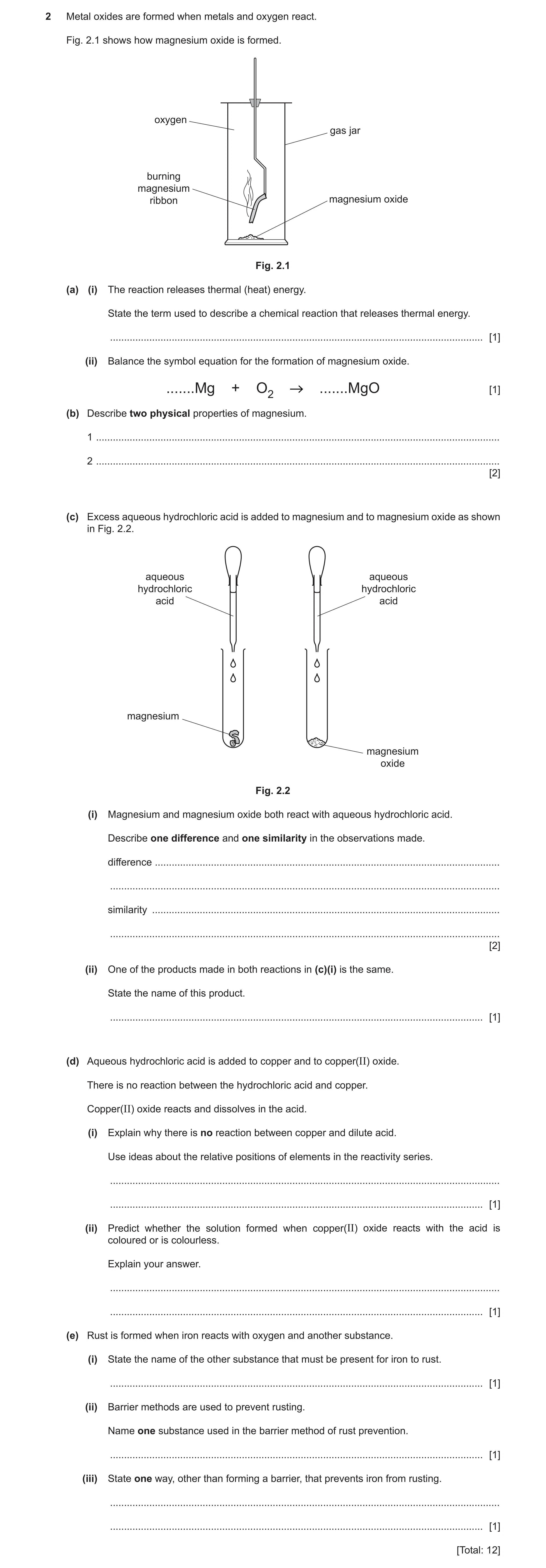
2 Metal oxides are formed when metals and oxygen react. Fig. 2.1 shows how magnesium oxide is formed. oxygen gas jar burning magnesium ribbon magnesium oxide Fig. 2.1 (a) (i) The reaction releases thermal (heat) energy. State the term used to describe a chemical reaction that releases thermal energy. … [1] (ii) Balance the symbol equation for the formation of magnesium oxide. [1] … Mg + O2 … MgO (b) Describe two physical properties of magnesium. 1 … 2 … [2] (c) Excess aqueous hydrochloric acid is added to magnesium and to magnesium oxide as shown in Fig. 2.2. aqueous aqueous hydrochloric hydrochloric acid acid magnesium magnesium oxide Fig. 2.2 (i) Magnesium and magnesium oxide both react with aqueous hydrochloric acid. Describe one difference and one similarity in the observations made. difference … … similarity … … [2] (ii) One of the products made in both reactions in (c)(i) is the same. State the name of this product. … [1] (d) Aqueous hydrochloric acid is added to copper and to copper(II) oxide. There is no reaction between the hydrochloric acid and copper. Copper(II) oxide reacts and dissolves in the acid. (i) Explain why there is no reaction between copper and dilute acid. Use ideas about the relative positions of elements in the reactivity series. … … [1] (ii) Predict whether the solution formed when copper(II) oxide reacts with the acid is coloured or is colourless. Explain your answer. … … [1] (e) Rust is formed when iron reacts with oxygen and another substance. (i) State the name of the other substance that must be present for iron to rust. … [1] (ii) Barrier methods are used to prevent rusting. Name one substance used in the barrier method of rust prevention. … [1] (iii) State one way, other than forming a barrier, that prevents iron from rusting. … … [1] [Total: 12]
12 marks
Mark scheme: 2(a)(i) exothermic ; 1 2(a)(ii) 2Mg + O2 → 2MgO ; 1 2(b) (magnesium is) malleable ; ductile ; good (electrical / thermal) conductor ; 2 2(c)(i) difference – gas released with magnesium (and not with the oxide) ; similarity – the solid reacts to form a soluble product / solid dissolves ; 2 2(c)(ii) magnesium chloride / MgCl2 ; 1 Question Answer Marks 2(d)(i) copper is low in the reactivity series ; copper is less reactive than hydrogen ; 1 2(d)(ii) (coloured) copper is a transition metal / transition metal compounds are (usually) coloured / copper compounds are coloured ; 1 2(e)(i) water / water vapour ; 1 2(e)(ii) paint / oil / plastic / (named) unreactive metal ; 1 2(e)(iii) (add other metals to) make it into an alloy / stainless steel ; 1
This question in 0654/33 Oct/Nov 2020
Q5 · The melting points of some Group I elements 0654/31 Oct/Nov 2021
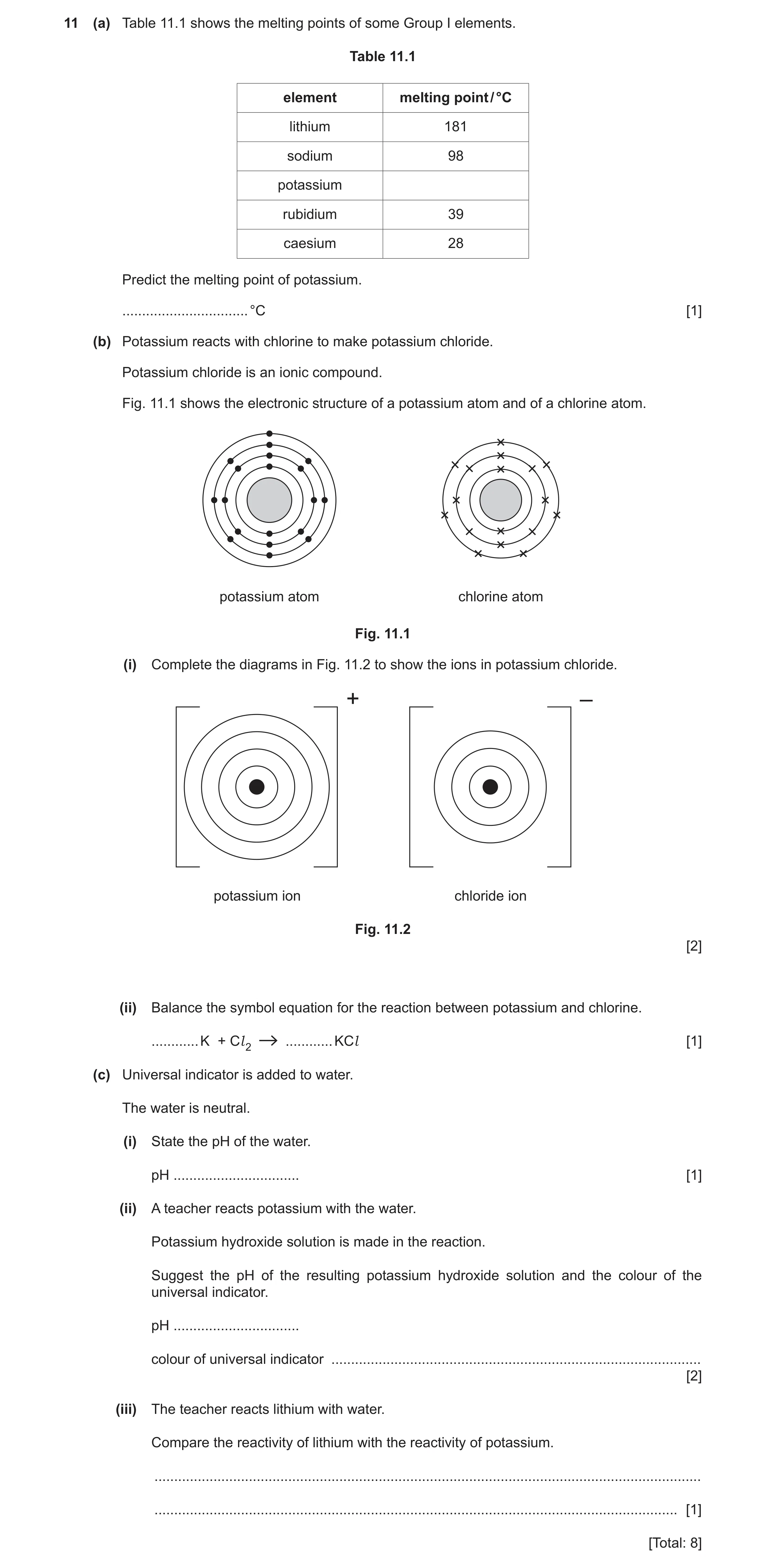
11 (a) Table 11.1 shows the melting points of some Group I elements. Table 11.1 element melting point / °C lithium 181 sodium 98 potassium rubidium 39 caesium 28 Predict the melting point of potassium. … °C [1] (b) Potassium reacts with chlorine to make potassium chloride. Potassium chloride is an ionic compound. Fig. 11.1 shows the electronic structure of a potassium atom and of a chlorine atom. potassium atom chlorine atom Fig. 11.1 (i) Complete the diagrams in Fig. 11.2 to show the ions in potassium chloride. + – potassium ion chloride ion Fig. 11.2 [2] (ii) Balance the symbol equation for the reaction between potassium and chlorine. … K + Cl2 … KCl [1] (c) Universal indicator is added to water. The water is neutral. (i) State the pH of the water. pH … [1] (ii) A teacher reacts potassium with the water. Potassium hydroxide solution is made in the reaction. Suggest the pH of the resulting potassium hydroxide solution and the colour of the universal indicator. pH … colour of universal indicator … [2] (iii) The teacher reacts lithium with water. Compare the reactivity of lithium with the reactivity of potassium. … … [1] [Total: 8]
8 marks
Mark scheme: 11(a) 45 (°C) to 90 (°C) ; 1 11(b)(i) potassium ion 2.8.8. ; chloride ion 2.8.8 ; 2 11(b)(ii) 2 (K + Cl 2 → ) 2 (KCl) ; 1 11(c)(i) 7 ; 1 11(c)(ii) any value between 7 and 14 ; purple ; 2 11(c)(iii) lithium reacts less violently / lithium is less reactive ; 1
This question in 0654/31 Oct/Nov 2021
Q6 · Sodium and chlorine are elements 0654/31 Oct/Nov 2022
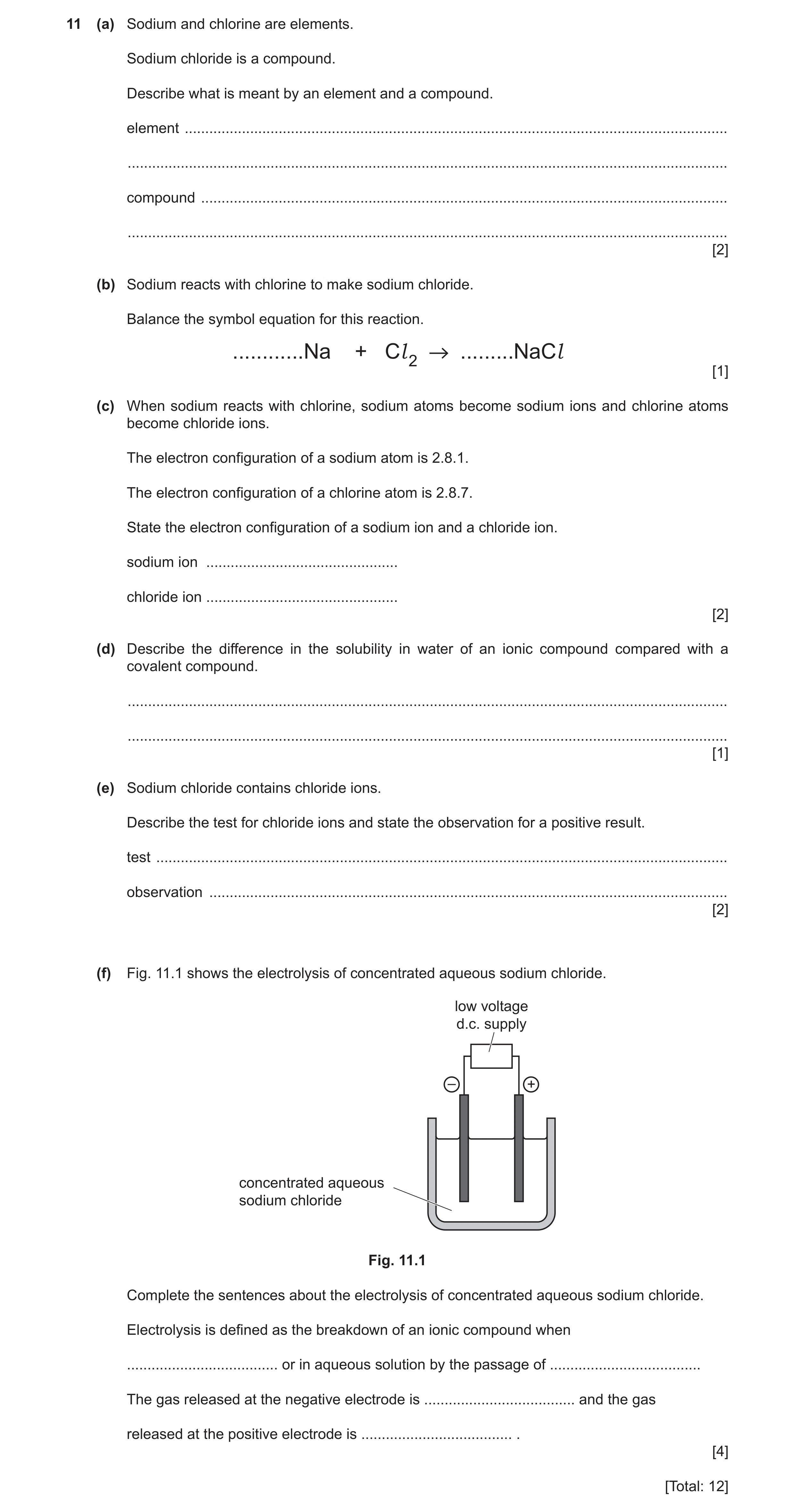
11 (a) Sodium and chlorine are elements. Sodium chloride is a compound. Describe what is meant by an element and a compound. element … … compound … … [2] (b) Sodium reacts with chlorine to make sodium chloride. Balance the symbol equation for this reaction. … Na + Cl2 … NaCl [1] (c) When sodium reacts with chlorine, sodium atoms become sodium ions and chlorine atoms become chloride ions. The electron configuration of a sodium atom is 2.8.1. The electron configuration of a chlorine atom is 2.8.7. State the electron configuration of a sodium ion and a chloride ion. sodium ion … chloride ion … [2] (d) Describe the difference in the solubility in water of an ionic compound compared with a covalent compound. … … [1] (e) Sodium chloride contains chloride ions. Describe the test for chloride ions and state the observation for a positive result. test … observation … [2] (f) Fig. 11.1 shows the electrolysis of concentrated aqueous sodium chloride. low voltage d.c. supply – + concentrated aqueous sodium chloride Fig. 11.1 Complete the sentences about the electrolysis of concentrated aqueous sodium chloride. Electrolysis is defined as the breakdown of an ionic compound when … or in aqueous solution by the passage of … The gas released at the negative electrode is … and the gas released at the positive electrode is … . [4] [Total: 12]
12 marks
Mark scheme: 11(a) element – contains only one type of atom ; 2 compound – contains two or more elements (chemically combined) ; 11(b) 2Na + Cl2 → 2NaCl ; 1 11(c) sodium ion 2.8 ; 2 chloride ion 2.8.8 ; 11(d) solubility of ionic compound is greater ; 1 11(e) add acidified aqueous silver nitrate ; 2 white precipitate ; 11(f) molten ; 4 electricity ; hydrogen ; chlorine ;
This question in 0654/31 Oct/Nov 2022
Q7 · The list gives the names of seven elements 0654/32 Feb/March 2023
2 (a) The list gives the names of seven elements. aluminium carbon copper chlorine helium phosphorus sulfur State which of the elements in the list: (i) forms diamond and graphite … [1] (ii) is a halogen … [1] (iii) is electroplated onto another metal … [1] (iv) is extracted from bauxite … [1] (v) is used in the manufacture of sulfuric acid … [1] (vi) is used to sterilise drinking water … [1] (b) The formula of phosphorus oxide is P4O10. State the number of atoms of phosphorus and of oxygen contained in one molecule of phosphorus oxide. phosphorus … oxygen … [1] (c) Explain why phosphorus oxide makes an acidic solution when it dissolves in water. … … [1] (d) Phosphorus is contained in fertilisers. State the two other elements commonly found in fertilisers. 1 … 2 … [2] [Total: 10]
10 marks
Mark scheme: 2(a)(i) carbon ; 1 2(a)(ii) chlorine ; 1 2(a)(iii) copper ; 1 2(a)(iv) aluminium ; 1 2(a)(v) sulfur ; 1 2(a)(vi) chlorine ; 1 2(b) phosphorus 4 1 oxygen 10 ; 2(c) non-metal oxides are acidic or non-metal oxides form acidic solutions ; 1 2(d) nitrogen ; 2 potassium ;
This question in 0654/32 Feb/March 2023
Q8 · A sample of clean air is a mixture of oxygen, nitrogen and small quantities of noble… 0654/32 May/June 2023
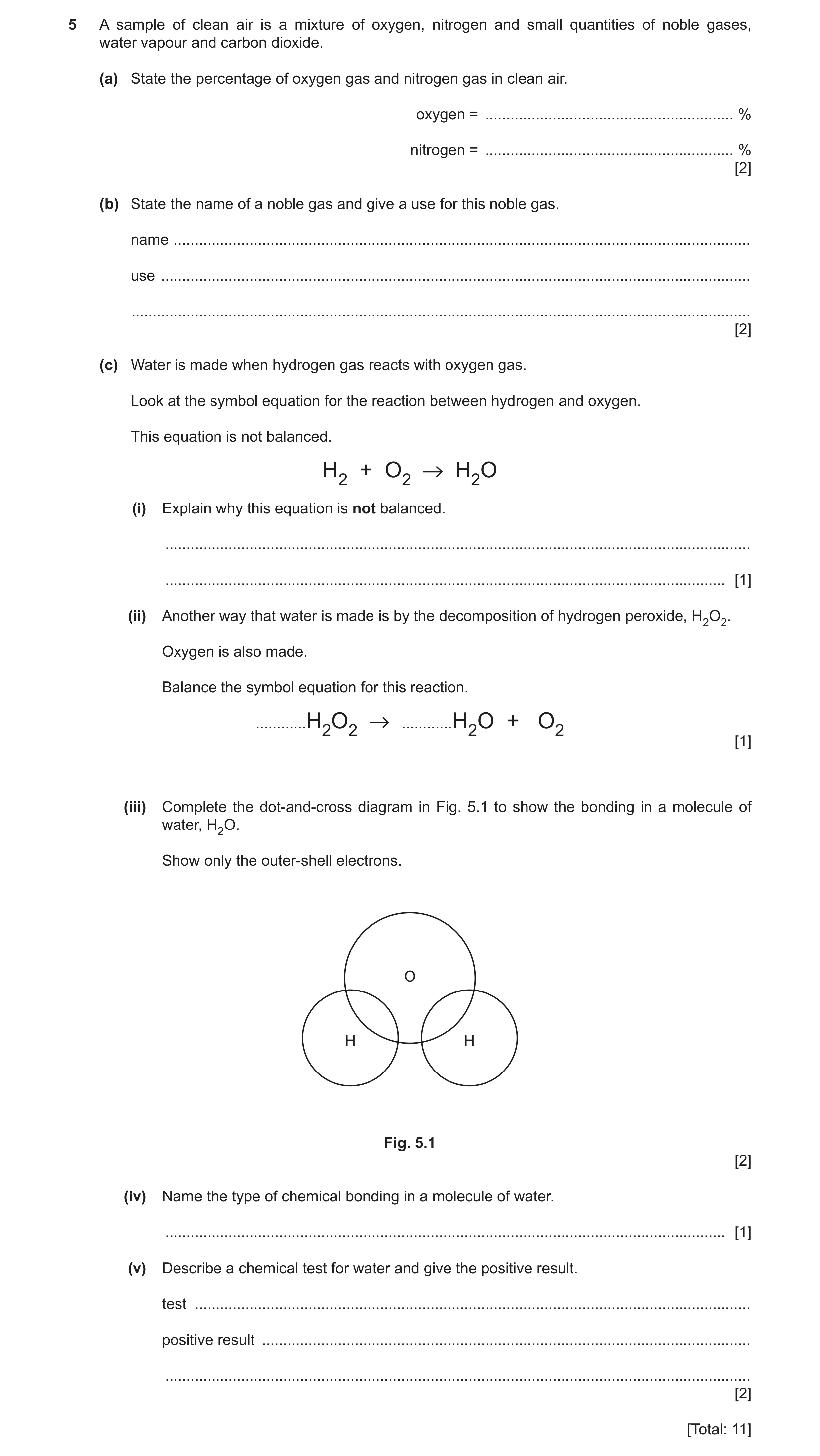
5 A sample of clean air is a mixture of oxygen, nitrogen and small quantities of noble gases, water vapour and carbon dioxide. (a) State the percentage of oxygen gas and nitrogen gas in clean air. oxygen = … % nitrogen = … % [2] (b) State the name of a noble gas and give a use for this noble gas. name … use … … [2] (c) Water is made when hydrogen gas reacts with oxygen gas. Look at the symbol equation for the reaction between hydrogen and oxygen. This equation is not balanced. H2 + O2 H2O (i) Explain why this equation is not balanced. … … [1] (ii) Another way that water is made is by the decomposition of hydrogen peroxide, H2O2. Oxygen is also made. Balance the symbol equation for this reaction. … H2O2 … H2O + O2 [1] (iii) Complete the dot-and-cross diagram in Fig. 5.1 to show the bonding in a molecule of water, H2O. Show only the outer-shell electrons. O H H Fig. 5.1 [2] (iv) Name the type of chemical bonding in a molecule of water. … [1] (v) Describe a chemical test for water and give the positive result. test … positive result … … [2] [Total: 11]
11 marks
Mark scheme: 5(a) oxygen – 21% ; nitrogen – 78% ; 2 5(b) named noble gas ; correct use ; 2 5(c)(i) nos of oxygen atoms is different on LHS to RHS ; 1 5(c)(ii) 2 H2O2 2 H2O O2 ; 1 5(c)(iii) 1 shared pair ; all else correct ; 2 5(c)(iv) covalent (bonds) ; 1 5(c)(v) anhydrous copper sulfate ; white to blue ; OR cobalt chloride (paper) ; blue to pink ; 2
This question in 0654/32 May/June 2023
Q9 · A sample of clean air is a mixture of oxygen, nitrogen and small quantities of noble… 0654/33 May/June 2023
5 A sample of clean air is a mixture of oxygen, nitrogen and small quantities of noble gases, water vapour and carbon dioxide. (a) State the percentage of oxygen gas and nitrogen gas in clean air. oxygen = … % nitrogen = … % [2] (b) State the name of a noble gas and give a use for this noble gas. name … use … … [2] (c) Water is made when hydrogen gas reacts with oxygen gas. Look at the symbol equation for the reaction between hydrogen and oxygen. This equation is not balanced. H2 + O2 H2O (i) Explain why this equation is not balanced. … … [1] (ii) Another way that water is made is by the decomposition of hydrogen peroxide, H2O2. Oxygen is also made. Balance the symbol equation for this reaction. … H2O2 … H2O + O2 [1] (iii) Complete the dot-and-cross diagram in Fig. 5.1 to show the bonding in a molecule of water, H2O. Show only the outer-shell electrons. O H H Fig. 5.1 [2] (iv) Name the type of chemical bonding in a molecule of water. … [1] (v) Describe a chemical test for water and give the positive result. test … positive result … … [2] [Total: 11]
11 marks
Mark scheme: 5(a) oxygen – 21% ; nitrogen – 78% ; 2 5(b) named noble gas ; correct use ; 2 5(c)(i) nos of oxygen atoms is different on LHS to RHS ; 1 5(c)(ii) 2 H2O2 2 H2O O2 ; 1 5(c)(iii) 1 shared pair ; all else correct ; 2 5(c)(iv) covalent (bonds) ; 1 5(c)(v) anhydrous copper sulfate ; white to blue ; OR cobalt chloride (paper) ; blue to pink ; 2
This question in 0654/33 May/June 2023
Q10 · A student investigates the reaction between magnesium and dilute sulfuric acid 0654/31 Oct/Nov 2023
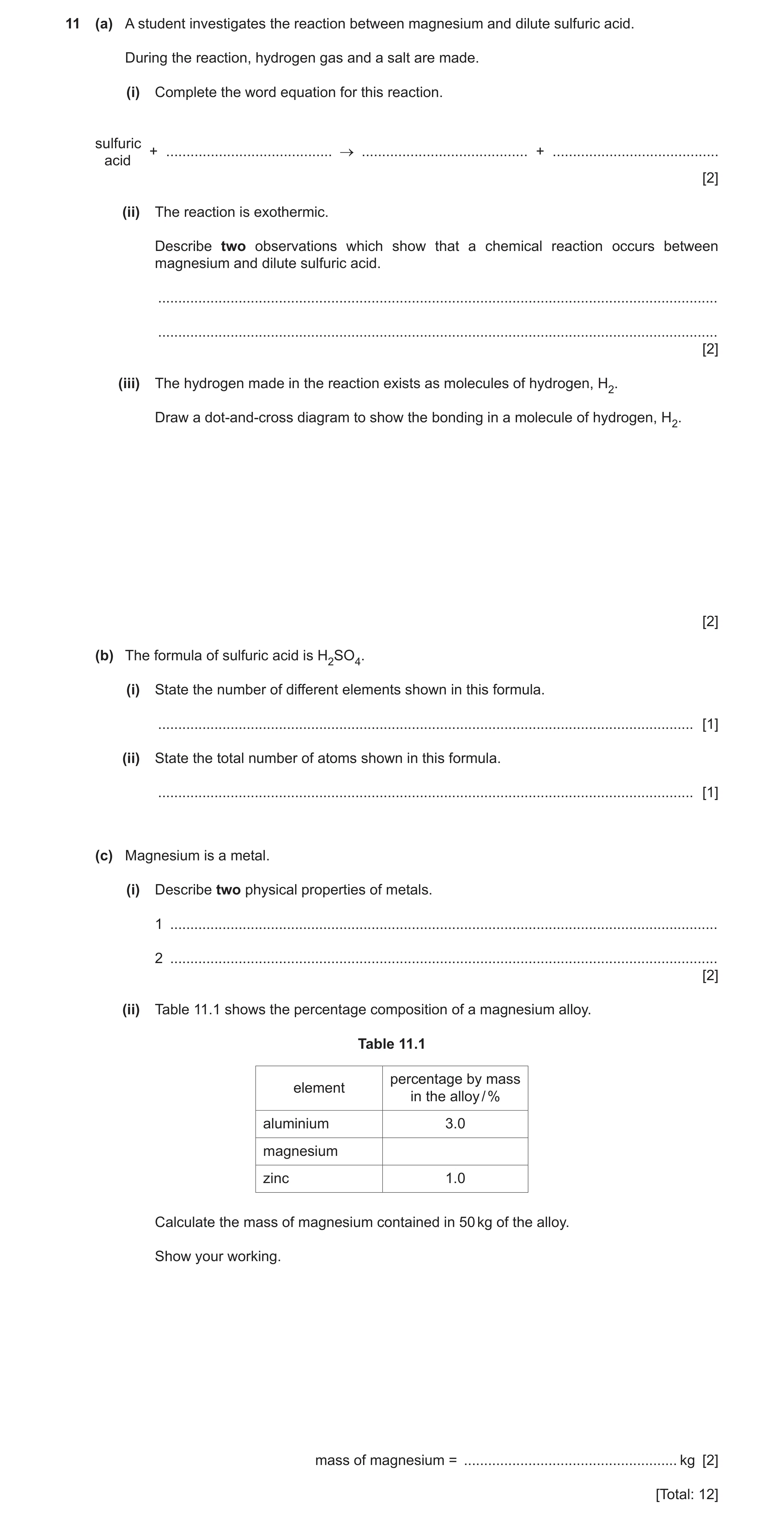
11 (a) A student investigates the reaction between magnesium and dilute sulfuric acid. During the reaction, hydrogen gas and a salt are made. (i) Complete the word equation for this reaction. sulfuric + … … + … acid [2] (ii) The reaction is exothermic. Describe two observations which show that a chemical reaction occurs between magnesium and dilute sulfuric acid. … … [2] (iii) The hydrogen made in the reaction exists as molecules of hydrogen, H2. Draw a dot-and-cross diagram to show the bonding in a molecule of hydrogen, H2. [2] (b) The formula of sulfuric acid is H2SO4. (i) State the number of different elements shown in this formula. … [1] (ii) State the total number of atoms shown in this formula. … [1] (c) Magnesium is a metal. (i) Describe two physical properties of metals. 1 … 2 … [2] (ii) Table 11.1 shows the percentage composition of a magnesium alloy. Table 11.1 percentage by mass element in the alloy / % aluminium 3.0 magnesium zinc 1.0 Calculate the mass of magnesium contained in 50 kg of the alloy. Show your working. mass of magnesium = … kg [2] [Total: 12]
12 marks
Mark scheme: 11(a)(i) (sulfuric acid) + magnesium → hydrogen + magnesium sulfate 2 magnesium and hydrogen ; magnesium sulfate ; 11(a)(ii) gets hot / temperature increases ; 2 fizzing / bubbles / effervescence ; 11(a)(iii) 2 2 hydrogen atoms ; 1 shared pair of electrons only ; 11(b)(i) 3 ; 1 11(b)(ii) 7 ; 1 11(c)(i) any two from: 2 good conductor of electricity ; good conductor of heat ; high melting / boiling point ; malleable ; 11(c)(ii) • 96 (%) seen ; 2 • 48 (kg) ;
This question in 0654/31 Oct/Nov 2023
Q11 · Sodium forms a basic oxide 0654/33 Oct/Nov 2023
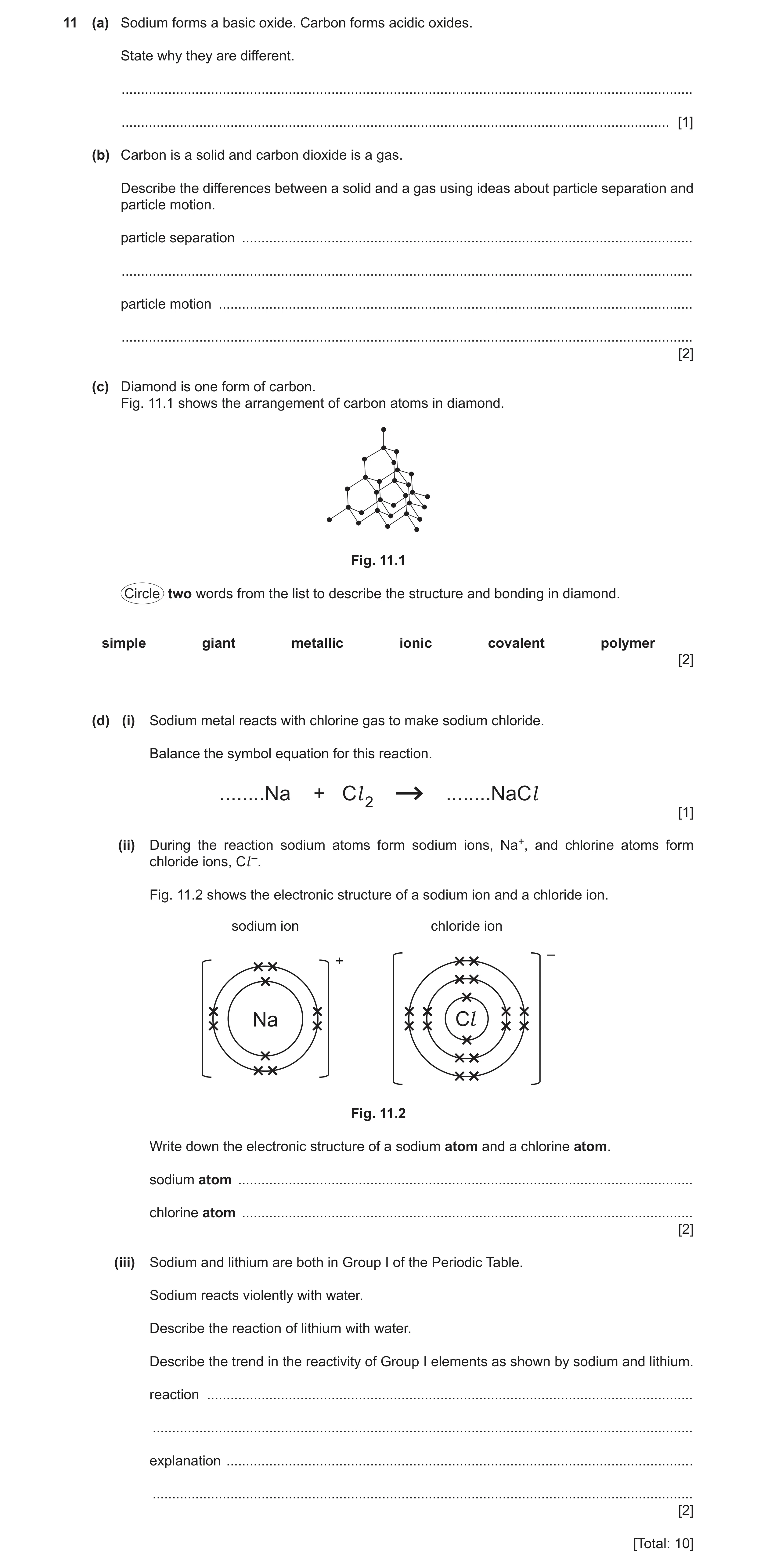
11 (a) Sodium forms a basic oxide. Carbon forms acidic oxides. State why they are different. … … [1] (b) Carbon is a solid and carbon dioxide is a gas. Describe the differences between a solid and a gas using ideas about particle separation and particle motion. particle separation … … particle motion … … [2] (c) Diamond is one form of carbon. Fig. 11.1 shows the arrangement of carbon atoms in diamond. Fig. 11.1 Circle two words from the list to describe the structure and bonding in diamond. simple giant metallic ionic covalent polymer [2] (d) (i) Sodium metal reacts with chlorine gas to make sodium chloride. Balance the symbol equation for this reaction. … Na + Cl … NaCl 2 [1] (ii) During the reaction sodium atoms form sodium ions, Na+, and chlorine atoms form chloride ions, Cl –. Fig. 11.2 shows the electronic structure of a sodium ion and a chloride ion. sodium ion chloride ion – + Na Cl Fig. 11.2 Write down the electronic structure of a sodium atom and a chlorine atom. sodium atom … chlorine atom … [2] (iii) Sodium and lithium are both in Group I of the Periodic Table. Sodium reacts violently with water. Describe the reaction of lithium with water. Describe the trend in the reactivity of Group I elements as shown by sodium and lithium. reaction … … explanation … … [2] [Total: 10]
10 marks
Mark scheme: 11(a) non-metals form acidic oxides and metals form basic oxides ; 1 11(b) (solid) closer together / (gas) further apart) ; 2 (solid) vibrating about a fixed point / (gas) free to move / faster ; 11(c) giant ; 2 covalent ; 11(d)(i) 2 Na and 2 NaCl ; 1 11(d)(ii) 2, 8, 1 ; 2 2, 8, 7 ; 11(d)(iii) lithium reacts less rapidly / quickly ; 2 (metal) reactivity increases down group ;
This question in 0654/33 Oct/Nov 2023
Q12 · Three metals are placed in three different test-tubes of dilute sulfuric acid as shown in… 0654/32 Feb/March 2024
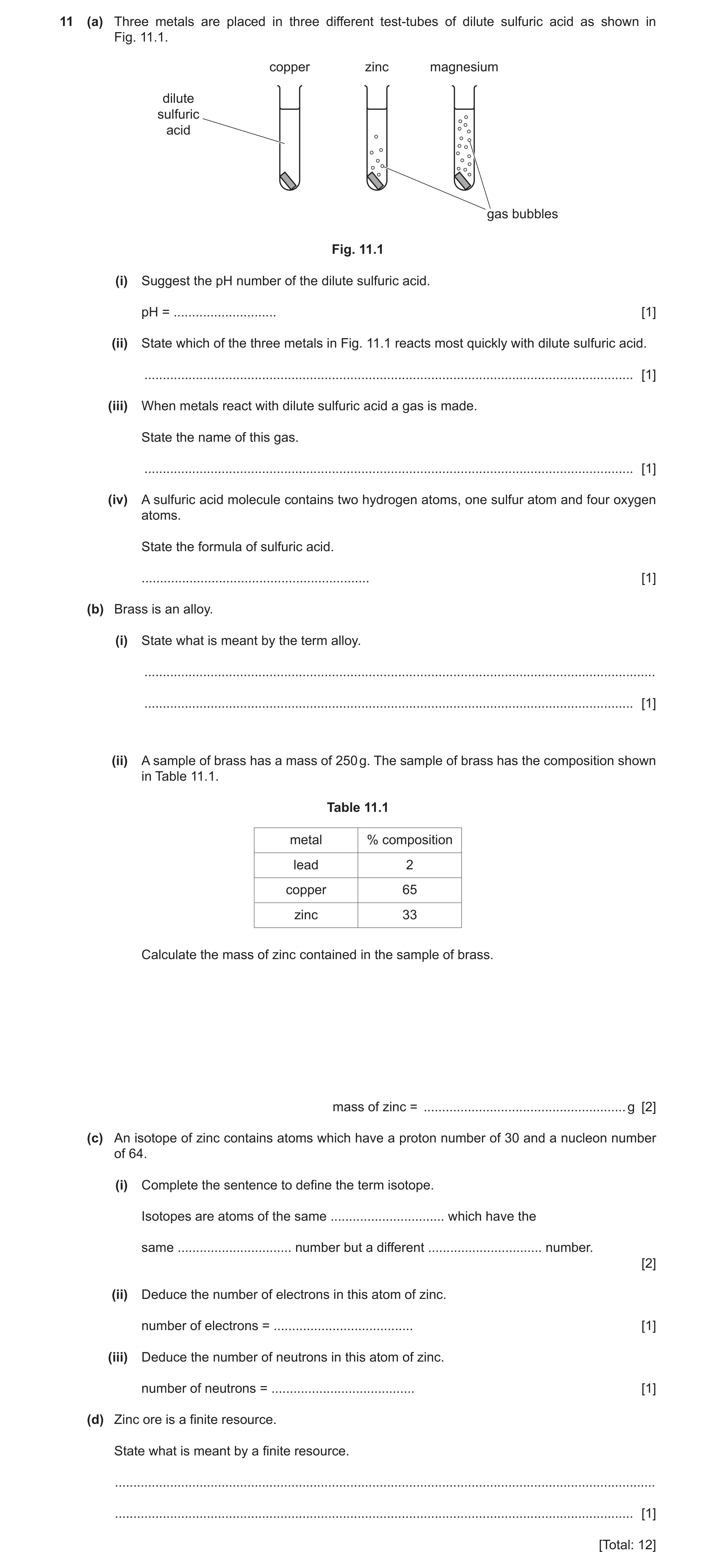
11 (a) Three metals are placed in three different test-tubes of dilute sulfuric acid as shown in Fig. 11.1. copper zinc magnesium dilute sulfuric acid gas bubbles Fig. 11.1 (i) Suggest the pH number of the dilute sulfuric acid. pH = … [1] (ii) State which of the three metals in Fig. 11.1 reacts most quickly with dilute sulfuric acid. … [1] (iii) When metals react with dilute sulfuric acid a gas is made. State the name of this gas. … [1] (iv) A sulfuric acid molecule contains two hydrogen atoms, one sulfur atom and four oxygen atoms. State the formula of sulfuric acid. … [1] (b) Brass is an alloy. (i) State what is meant by the term alloy. … … [1] (ii) A sample of brass has a mass of 250 g. The sample of brass has the composition shown in Table 11.1. Table 11.1 metal % composition lead 2 copper 65 zinc 33 Calculate the mass of zinc contained in the sample of brass. mass of zinc = … g [2] (c) An isotope of zinc contains atoms which have a proton number of 30 and a nucleon number of 64. (i) Complete the sentence to define the term isotope. Isotopes are atoms of the same … which have the same … number but a different … number. [2] (ii) Deduce the number of electrons in this atom of zinc. number of electrons = … [1] (iii) Deduce the number of neutrons in this atom of zinc. number of neutrons = … [1] (d) Zinc ore is a finite resource. State what is meant by a finite resource. … … [1] [Total: 12]
12 marks
Mark scheme: 11(a)(i) in the range from 1 to 6 ; 1 11(a)(ii) magnesium ; 1 11(a)(iii) hydrogen ; 1 11(a)(iv) H2SO4 ; 1 11(b)(i) a mixture of a metals and other elements; 1 11(b)(ii) 33 250 / 100 ; 2 83 ; 11(c)(i) element; 2 proton and nucleon; 11(c)(ii) 30 ; 1 11(c)(iii) 34 ; 1 11(d) (A finite resource is something useful that is) non-renewable / will eventually run out ; 1
This question in 0654/32 Feb/March 2024
Q13 · A calcium atom has a proton number of 20 and a nucleon number of 40 0654/31 May/June 2024
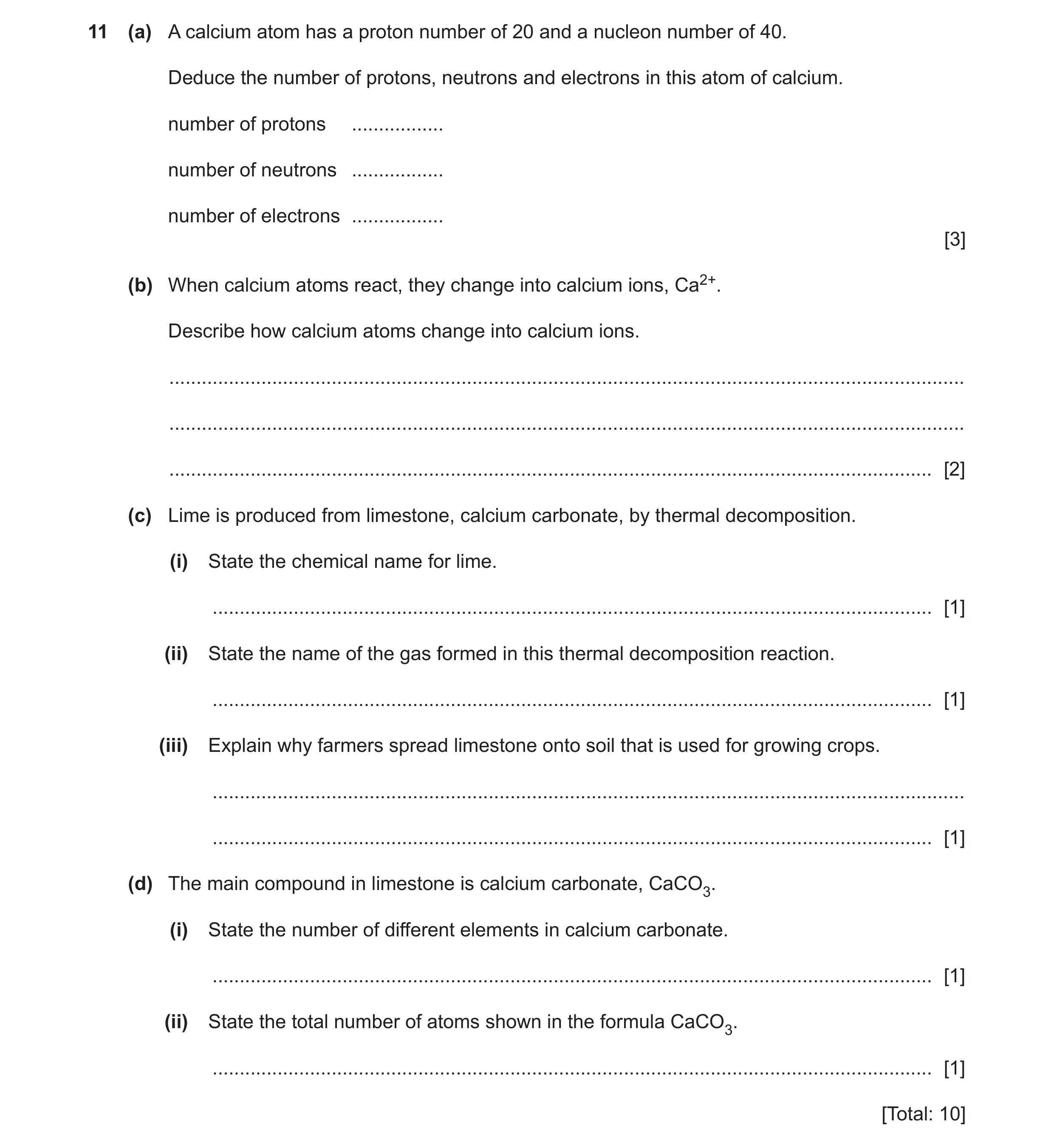
11 (a) A calcium atom has a proton number of 20 and a nucleon number of 40. Deduce the number of protons, neutrons and electrons in this atom of calcium. number of protons … number of neutrons … number of electrons … [3] (b) When calcium atoms react, they change into calcium ions, Ca2+. Describe how calcium atoms change into calcium ions. … … … [2] (c) Lime is produced from limestone, calcium carbonate, by thermal decomposition. (i) State the chemical name for lime. … [1] (ii) State the name of the gas formed in this thermal decomposition reaction. … [1] (iii) Explain why farmers spread limestone onto soil that is used for growing crops. … … [1] (d) The main compound in limestone is calcium carbonate, CaCO3. (i) State the number of different elements in calcium carbonate. … [1] (ii) State the total number of atoms shown in the formula CaCO3. … [1] [Total: 10]
10 marks
Mark scheme: 11(a) protons = 20 ; neutrons = 20 ; electrons = 20 ; 3 11(b) loses electrons ; 2 electrons ; 2 11(c)(i) calcium oxide ; 1 11(c)(ii) carbon dioxide ; 1 11(c)(iii) neutralise acidic soil ; 1 11(d)(i) 3 ; 1 11(d)(ii) 5 ; 1
This question in 0654/31 May/June 2024
Q14 · A teacher reacts sodium with water 0654/33 May/June 2024
8 A teacher reacts sodium with water. Hydrogen and aqueous sodium hydroxide are the products of the reaction. (a) Balance the symbol equation for this reaction. 2Na + … H2O … NaOH + H2 [2] (b) Before sodium is added to water, the water is neutral. Aqueous sodium hydroxide is an alkali. (i) State the pH number of pure water. pH = … [1] (ii) Suggest the pH number of the aqueous sodium hydroxide. pH = … [1] (c) The reaction between sodium and water is described as violent. Describe the reaction between potassium and water. Explain your answer. reaction … … explanation … … … [2] (d) Sodium reacts with chlorine to make sodium chloride. In this reaction, sodium atoms form sodium ions and chlorine atoms form chloride ions. • the electronic structure of a sodium atom is 2.8.1 • the electronic structure of a chlorine atom is 2.8.7 (i) Deduce the electronic structure for a sodium ion. … [1] (ii) Deduce the electronic structure for a chloride ion. … [1] (e) When concentrated aqueous sodium chloride is electrolysed, gases are released at each inert electrode. State the names of the gases released at each electrode. gas at cathode … gas at anode … [2] [Total: 10]
10 marks
Mark scheme: 8(a) 2Na + 2 H2O 2 NaOH + H2 ;; 2 8(b)(i) 7 ; 1 8(b)(ii) 8–14 ; 1 8(c) even more violent / explosive ; reactivity increases down the group / potassium is more reactive than sodium ; 2 8(d)(i) 2.8 ; 1 8(d)(ii) 2.8.8 ; 1 8(e) cathode–hydrogen ; anode–chlorine ; 2
This question in 0654/33 May/June 2024
Q15 · The changes of state of water 0654/31 Oct/Nov 2024
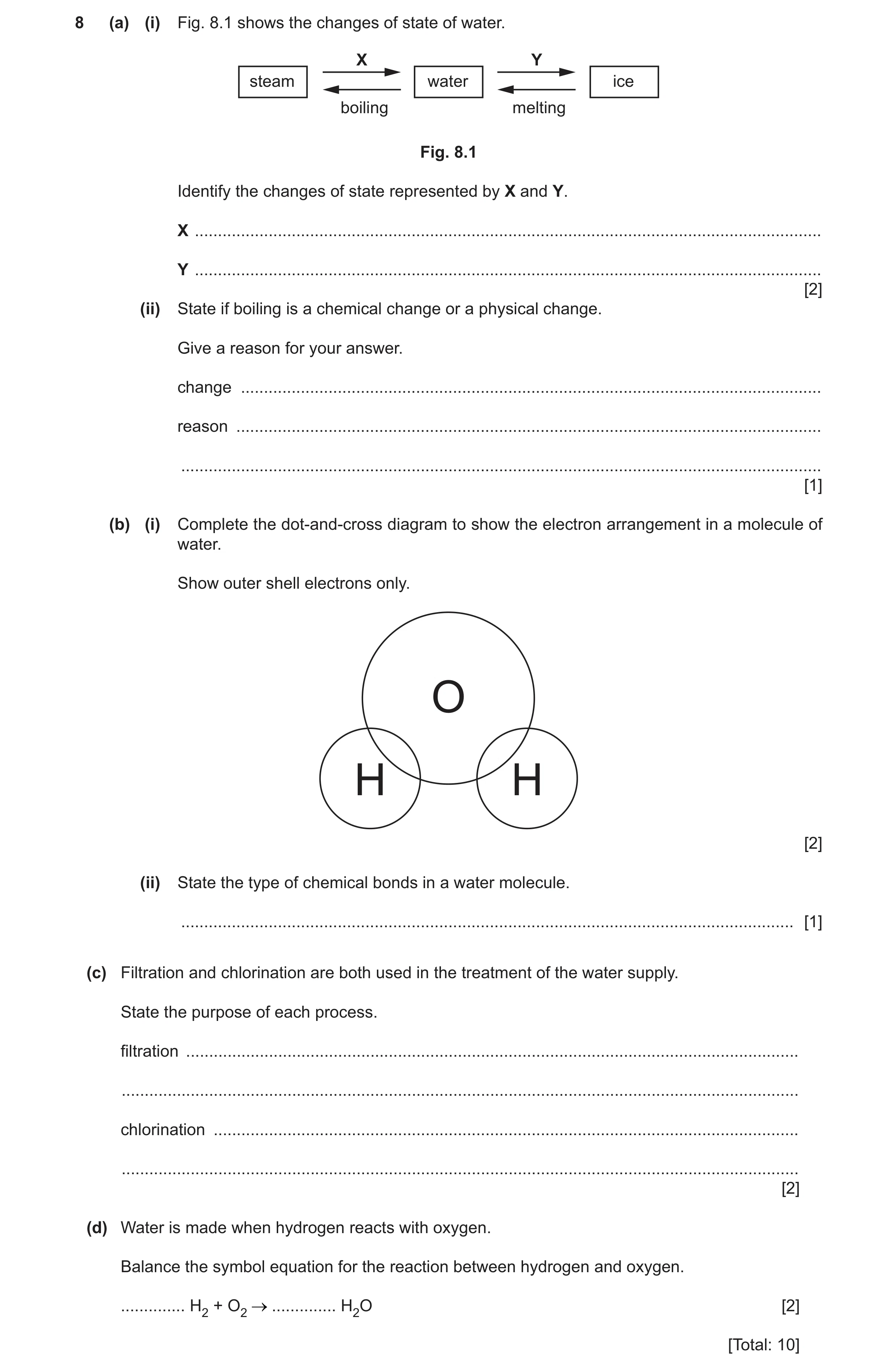
8 (a) (i) Fig. 8.1 shows the changes of state of water. X Y steam water ice boiling melting Fig. 8.1 Identify the changes of state represented by X and Y. X … Y … [2] (ii) State if boiling is a chemical change or a physical change. Give a reason for your answer. change … reason … … [1] (b) (i) Complete the dot-and-cross diagram to show the electron arrangement in a molecule of water. Show outer shell electrons only. O H H [2] (ii) State the type of chemical bonds in a water molecule. … [1] (c) Filtration and chlorination are both used in the treatment of the water supply. State the purpose of each process. filtration … … chlorination … … [2] (d) Water is made when hydrogen reacts with oxygen. Balance the symbol equation for the reaction between hydrogen and oxygen. … H2 + O2 … H2O [2] [Total: 10]
10 marks
Mark scheme: 8(a)(i) X = condensation ; 2 Y = solidification or freezing ; 8(a)(ii) physical (no mark) ; 1 no new substance formed / can be reversed ; 8(b)(i) 2 one pair of bonding electrons ; all else correct ; 8(b)(ii) covalent ; 1 8(c) filtration – remove solid matter OWTTE ; 2 chlorination – kill bacteria / microorganisms ; 8(d) 2 H2 + O2 → 2 H2O 2 2 H2 ; 2 H2O ;
This question in 0654/31 Oct/Nov 2024
 12 / 23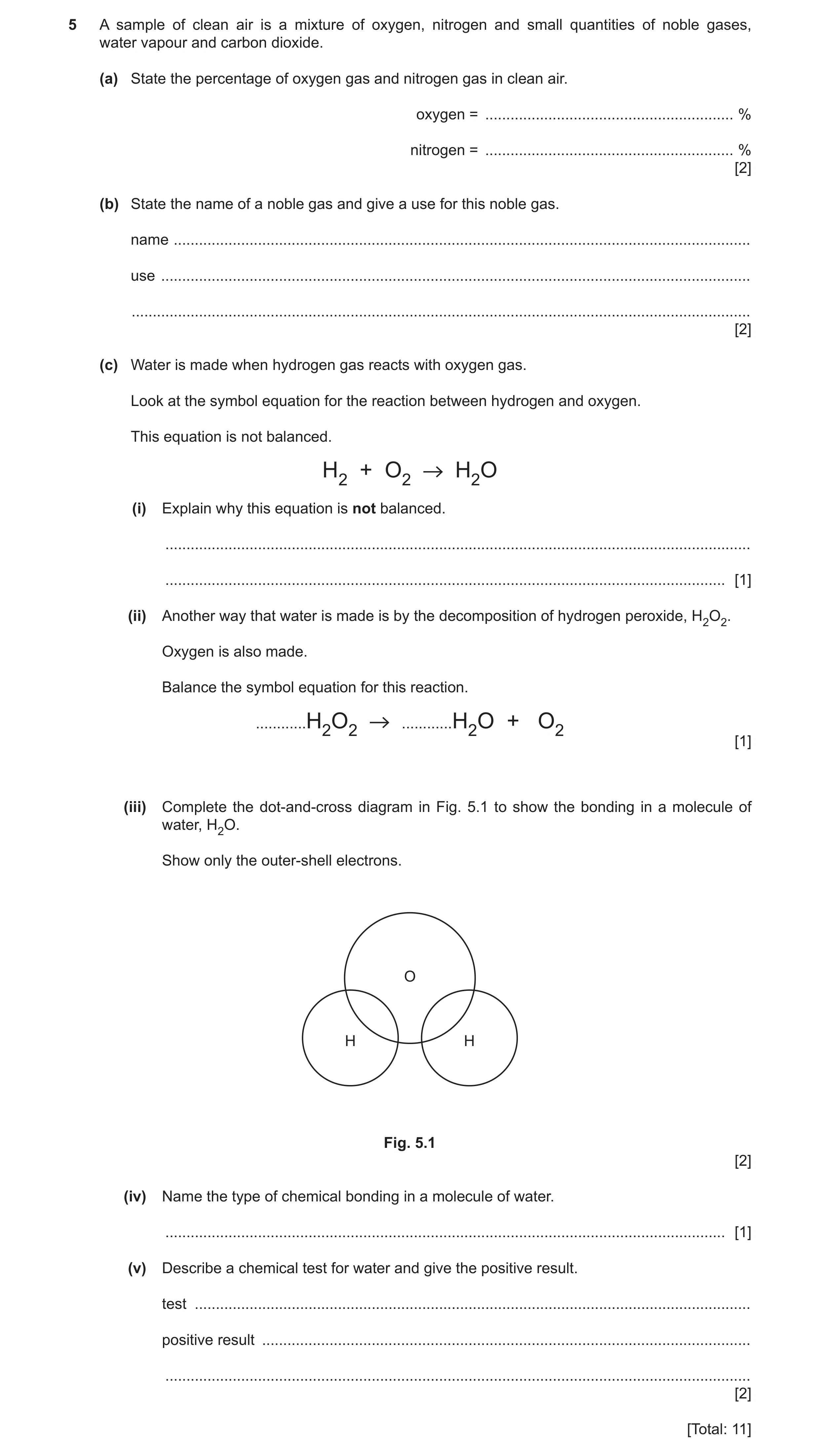
 20 / 23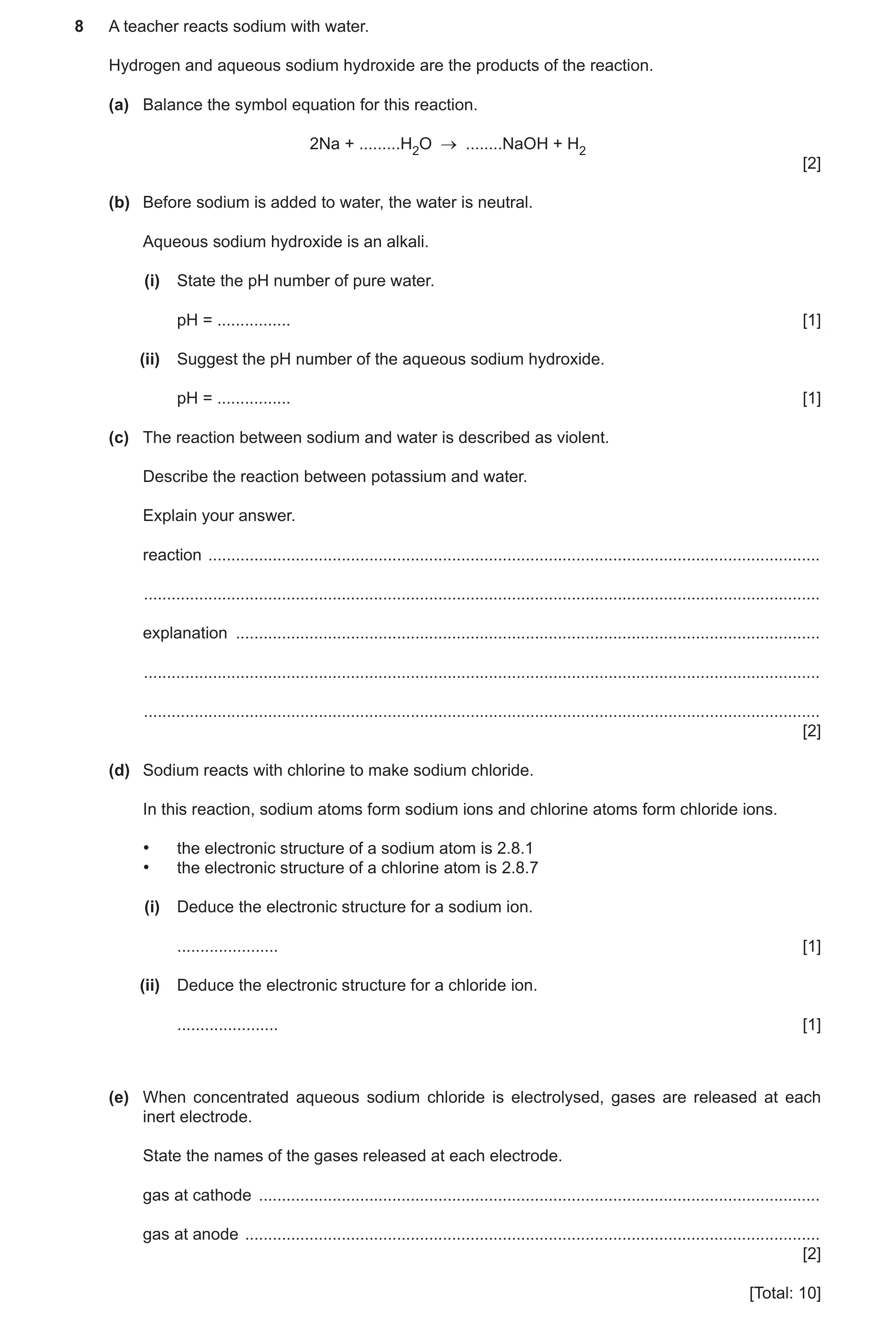
 11
11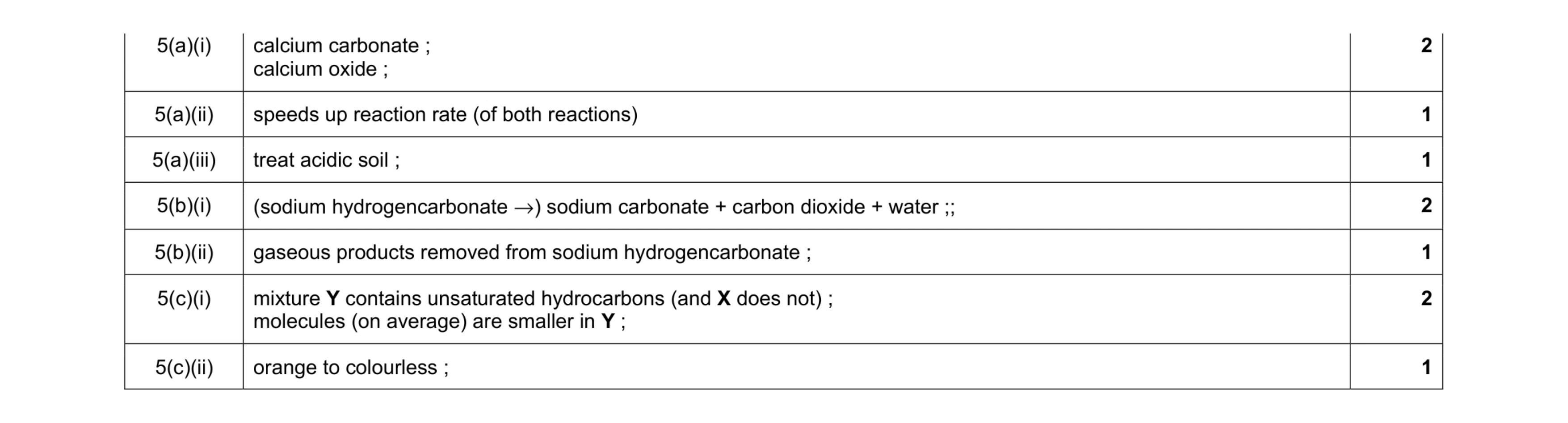 10
10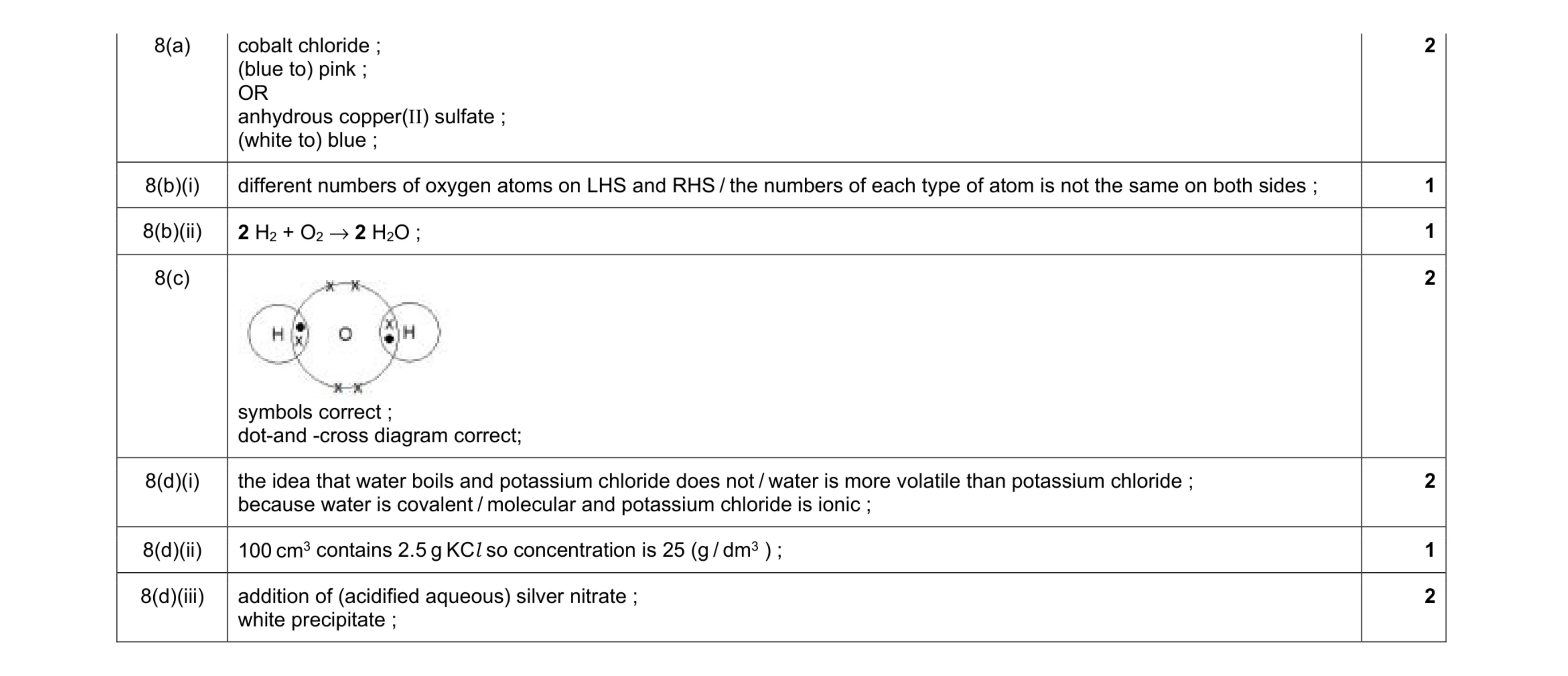 11
11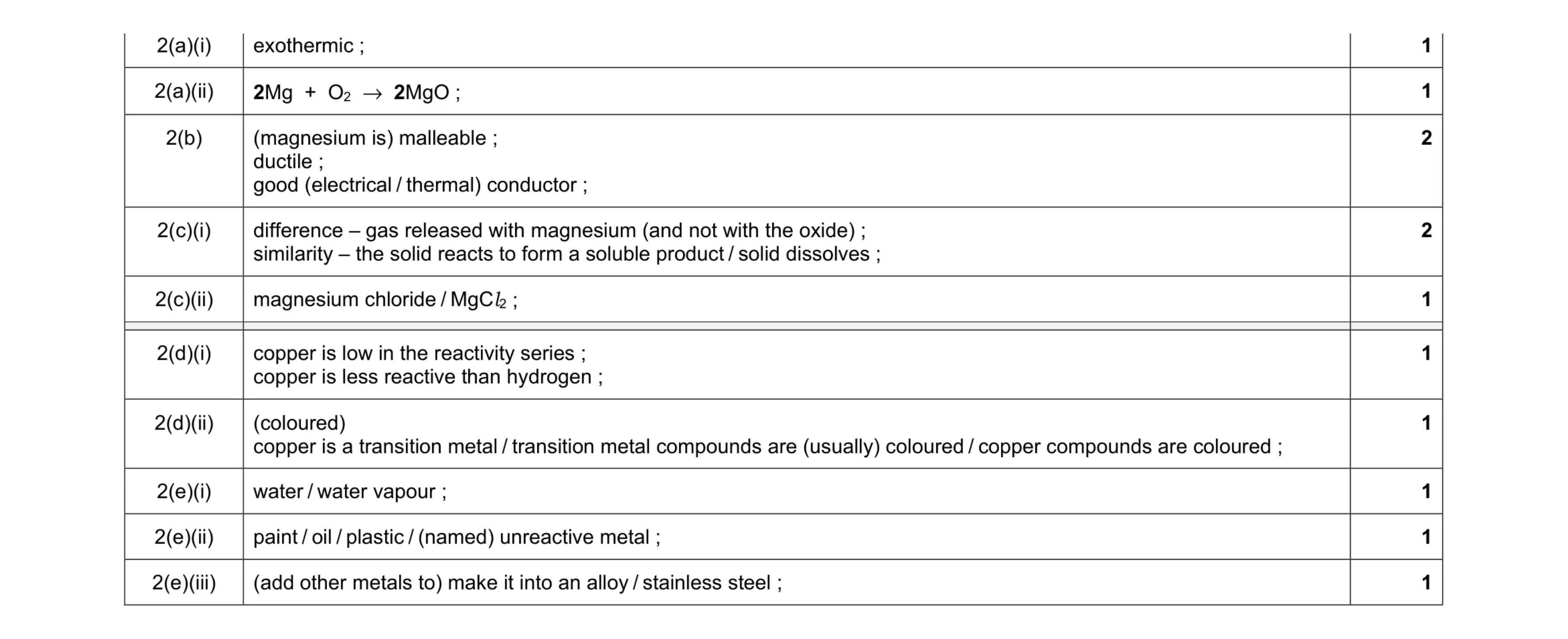 12
12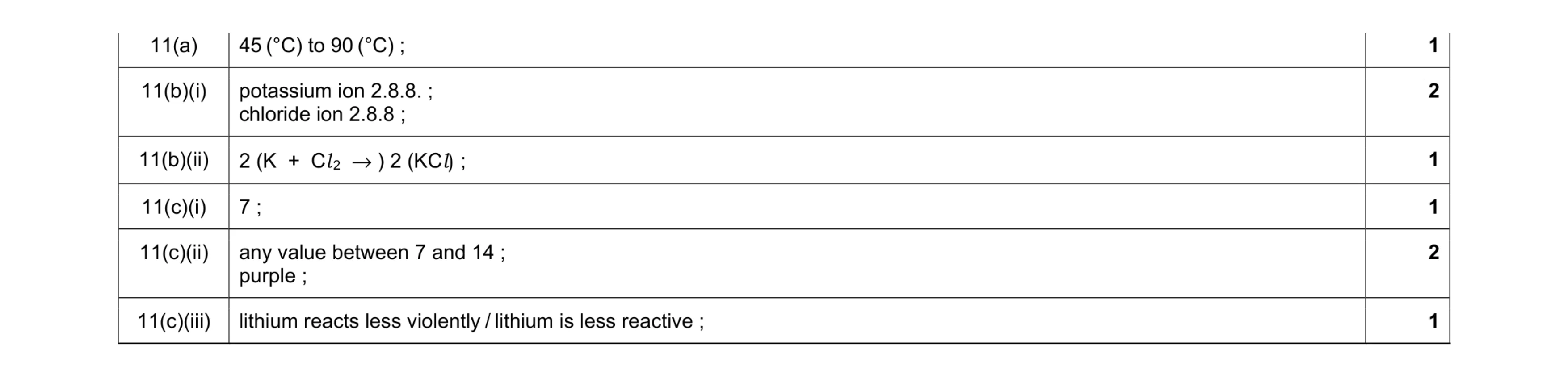 8
8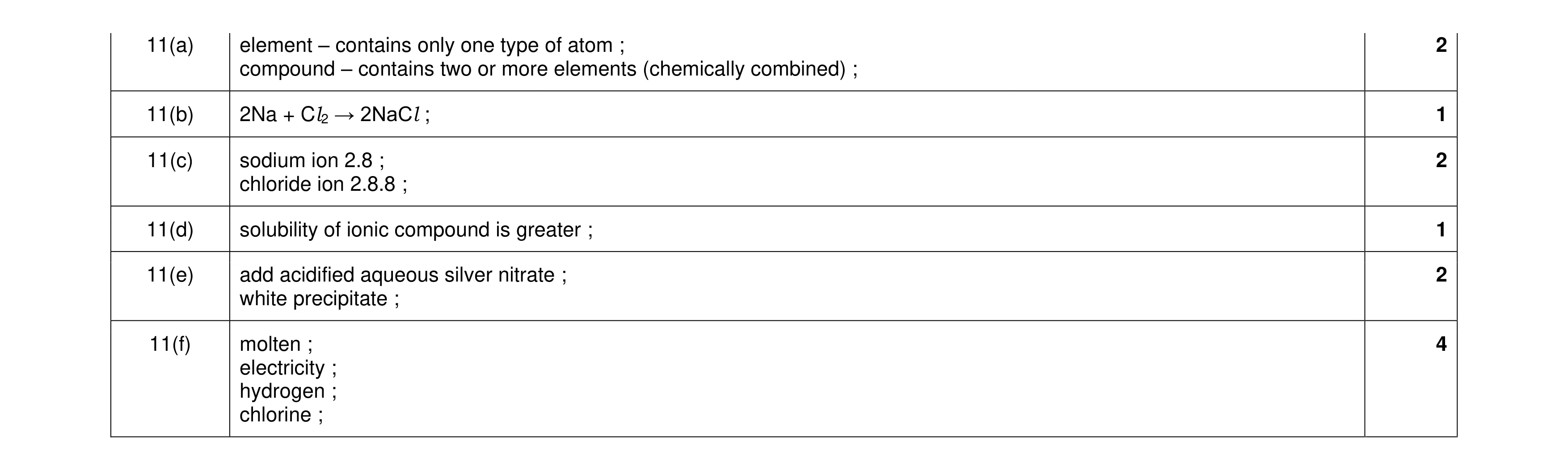 12
12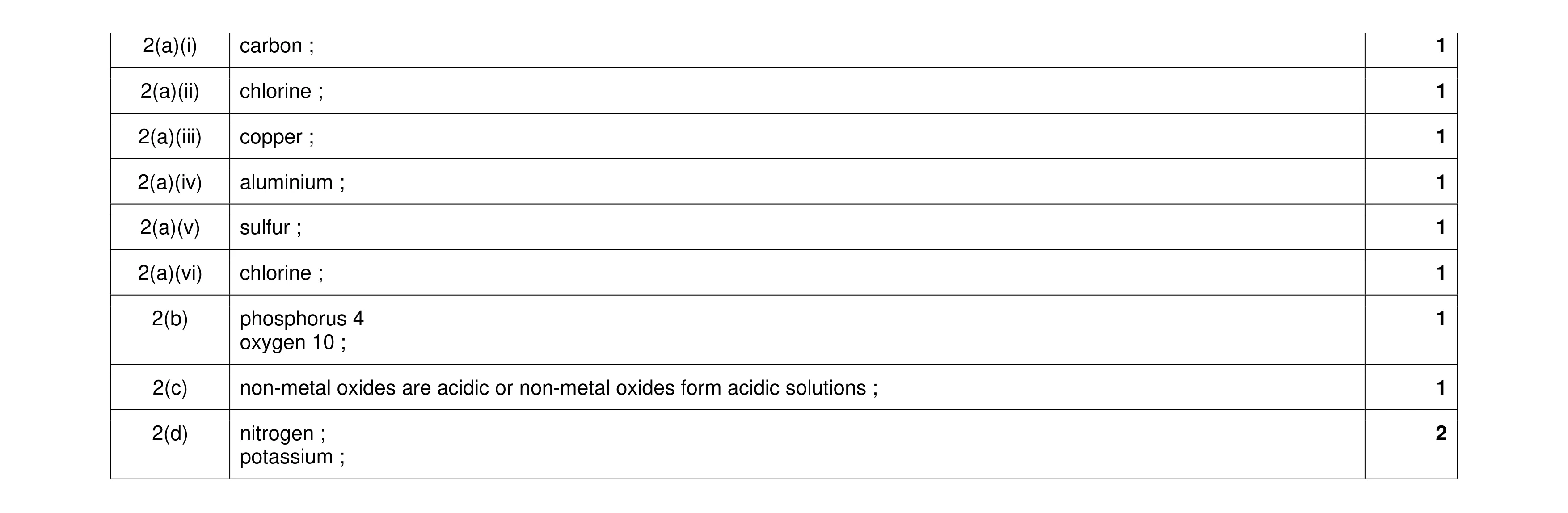 10
10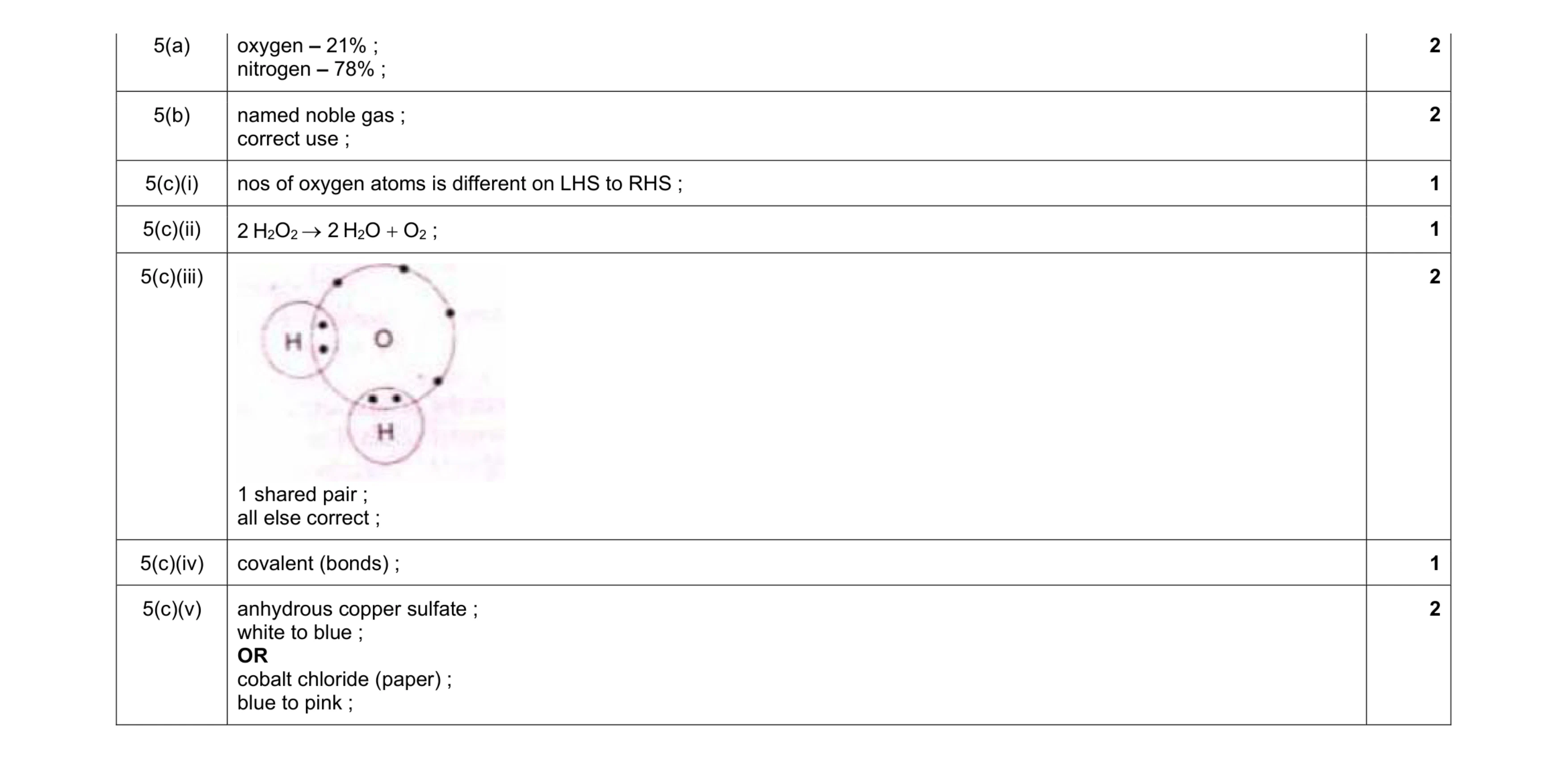 11
11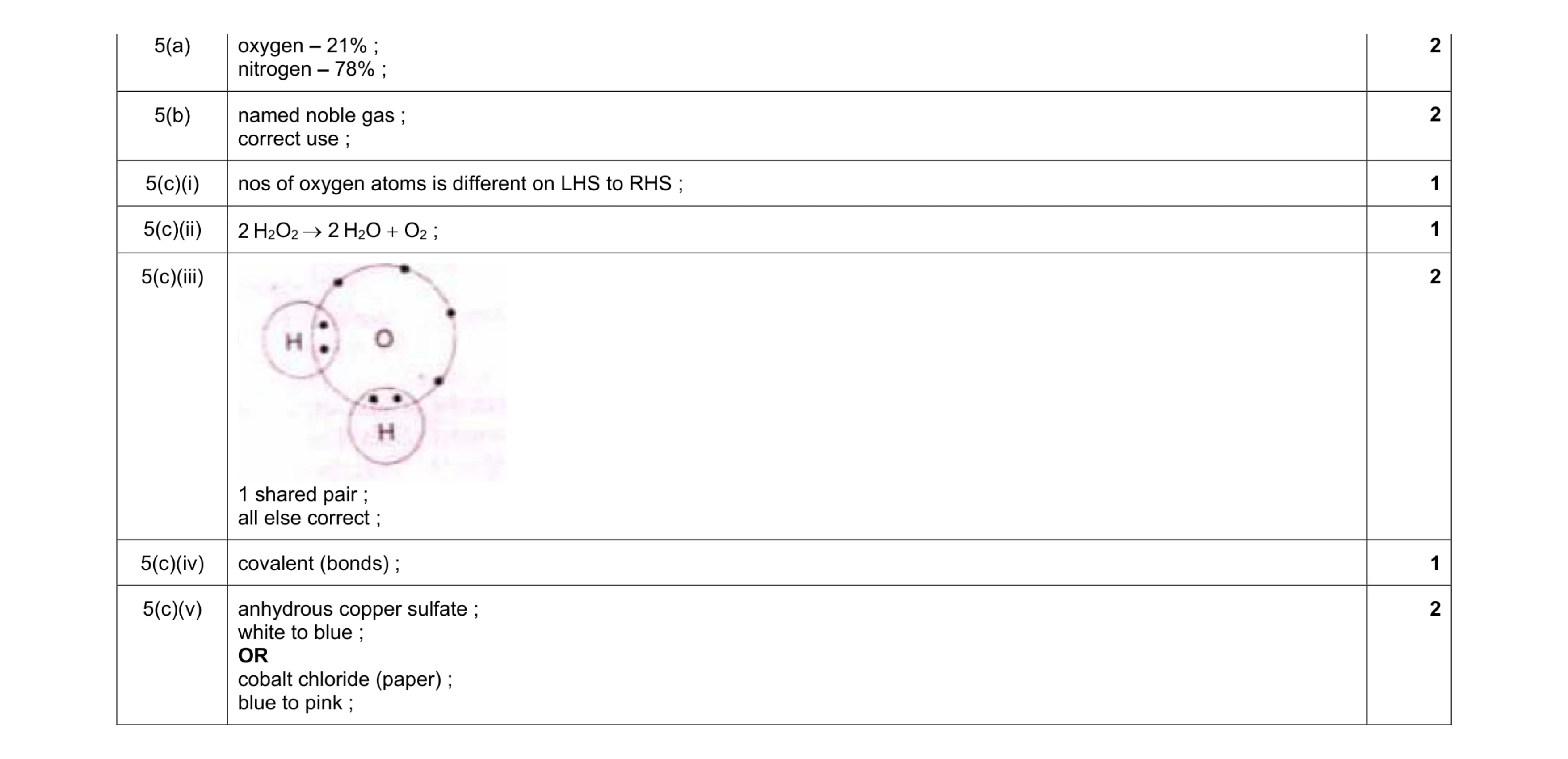 11
11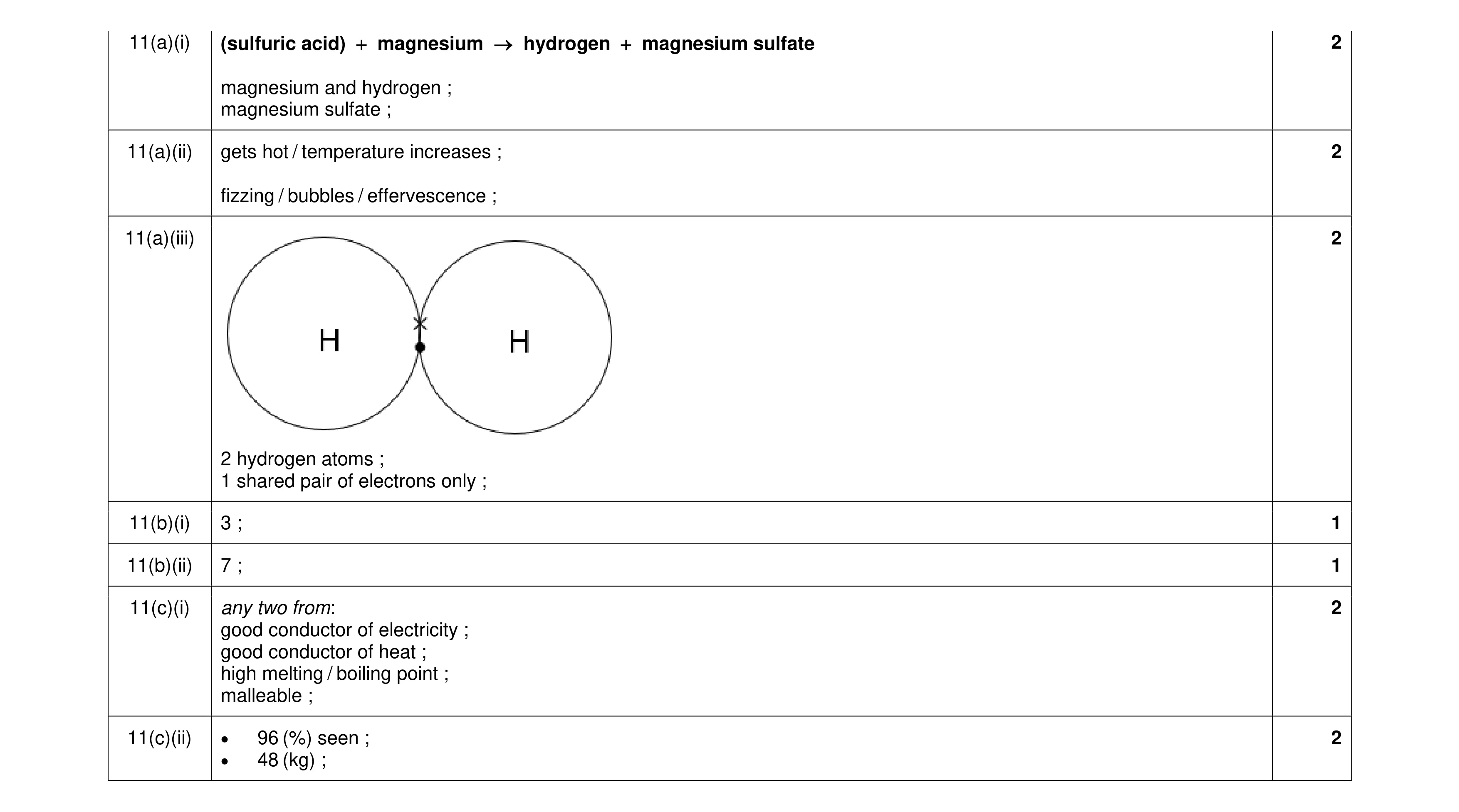 12
12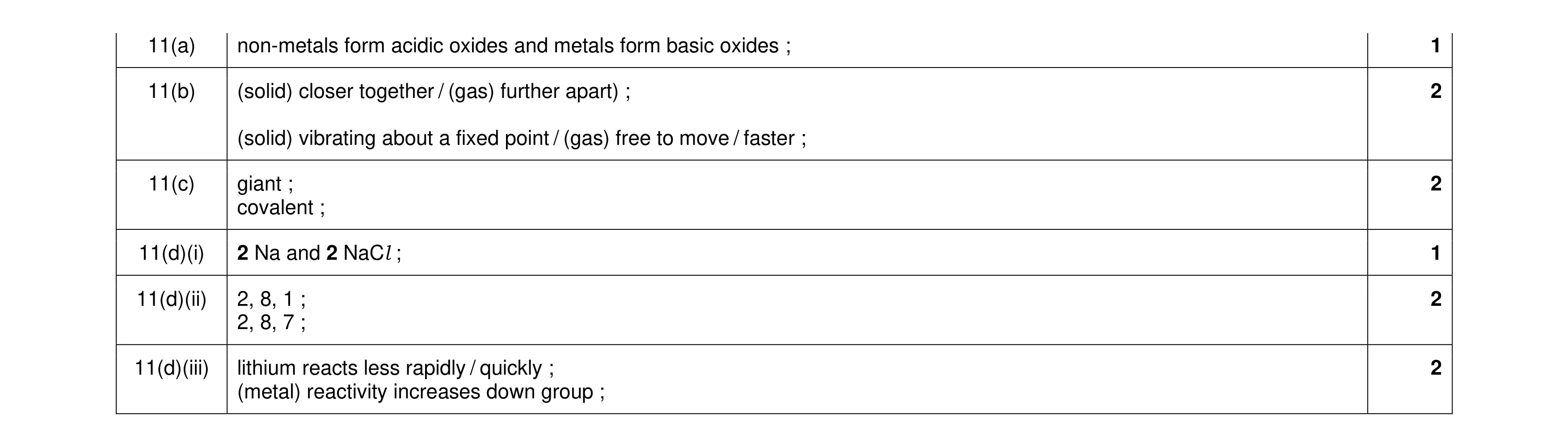 10
10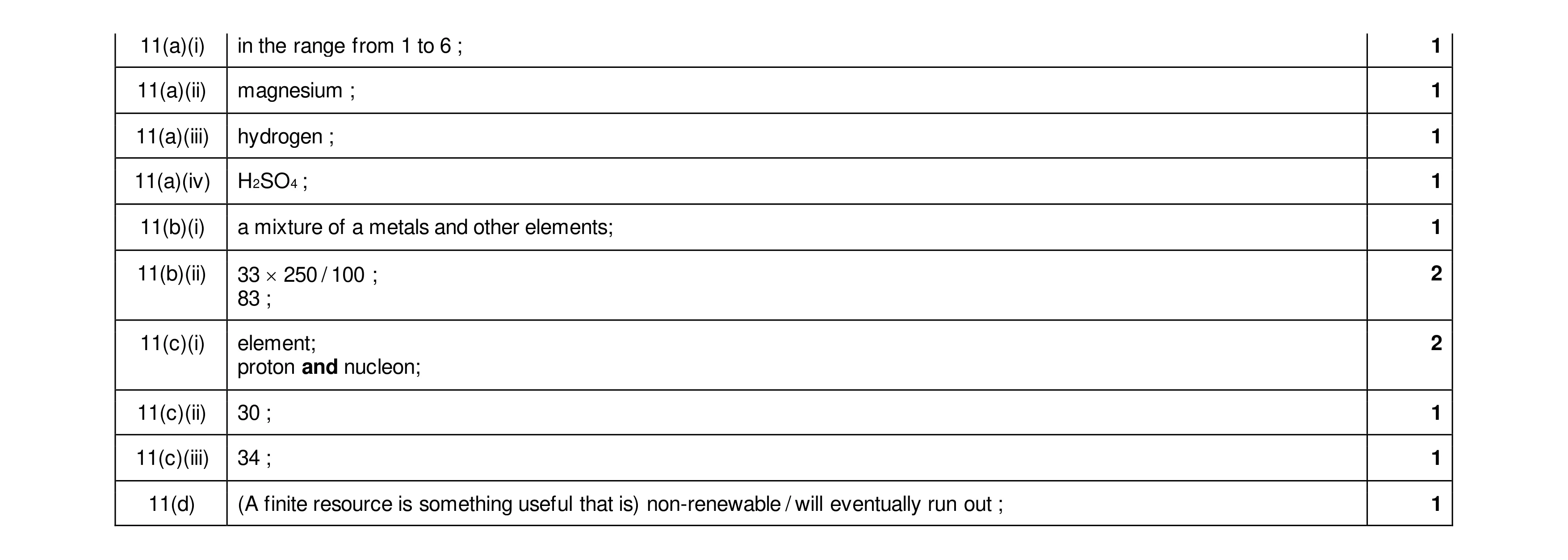 12
12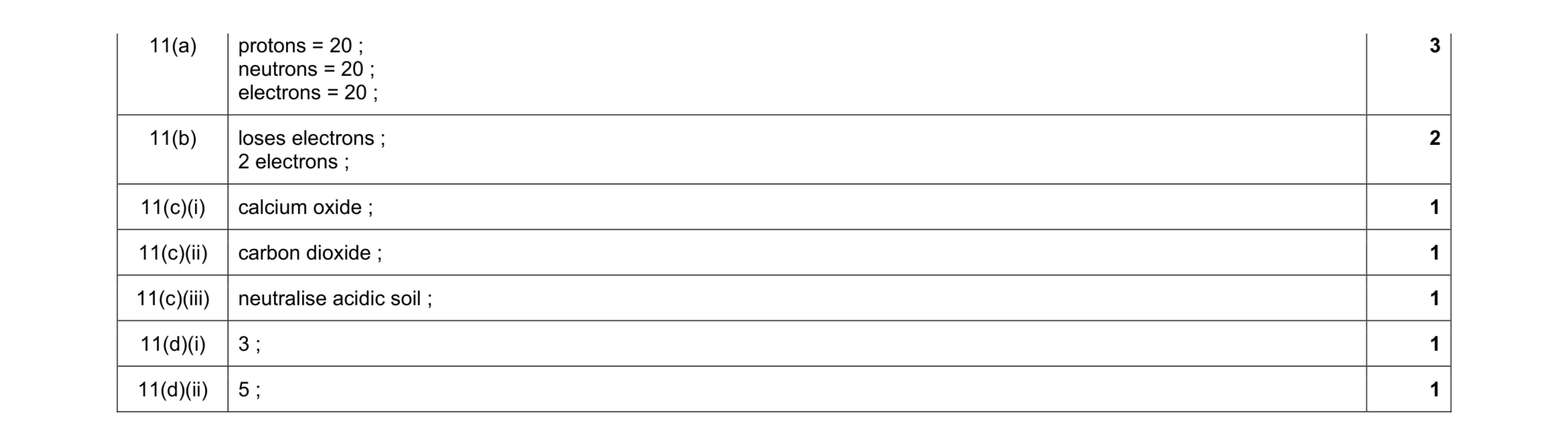 10
10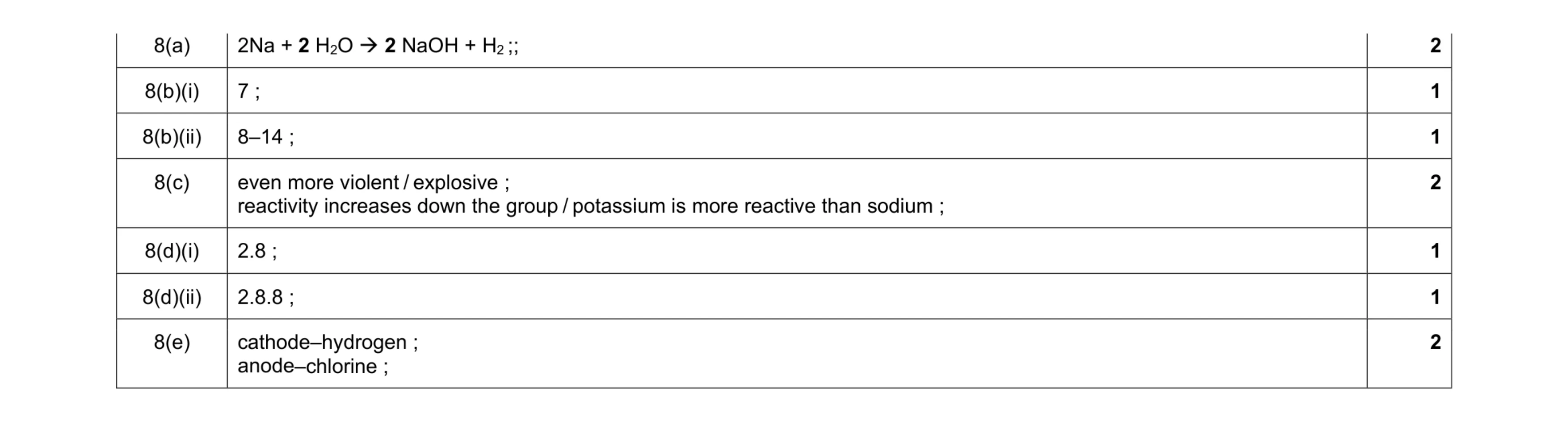 10
10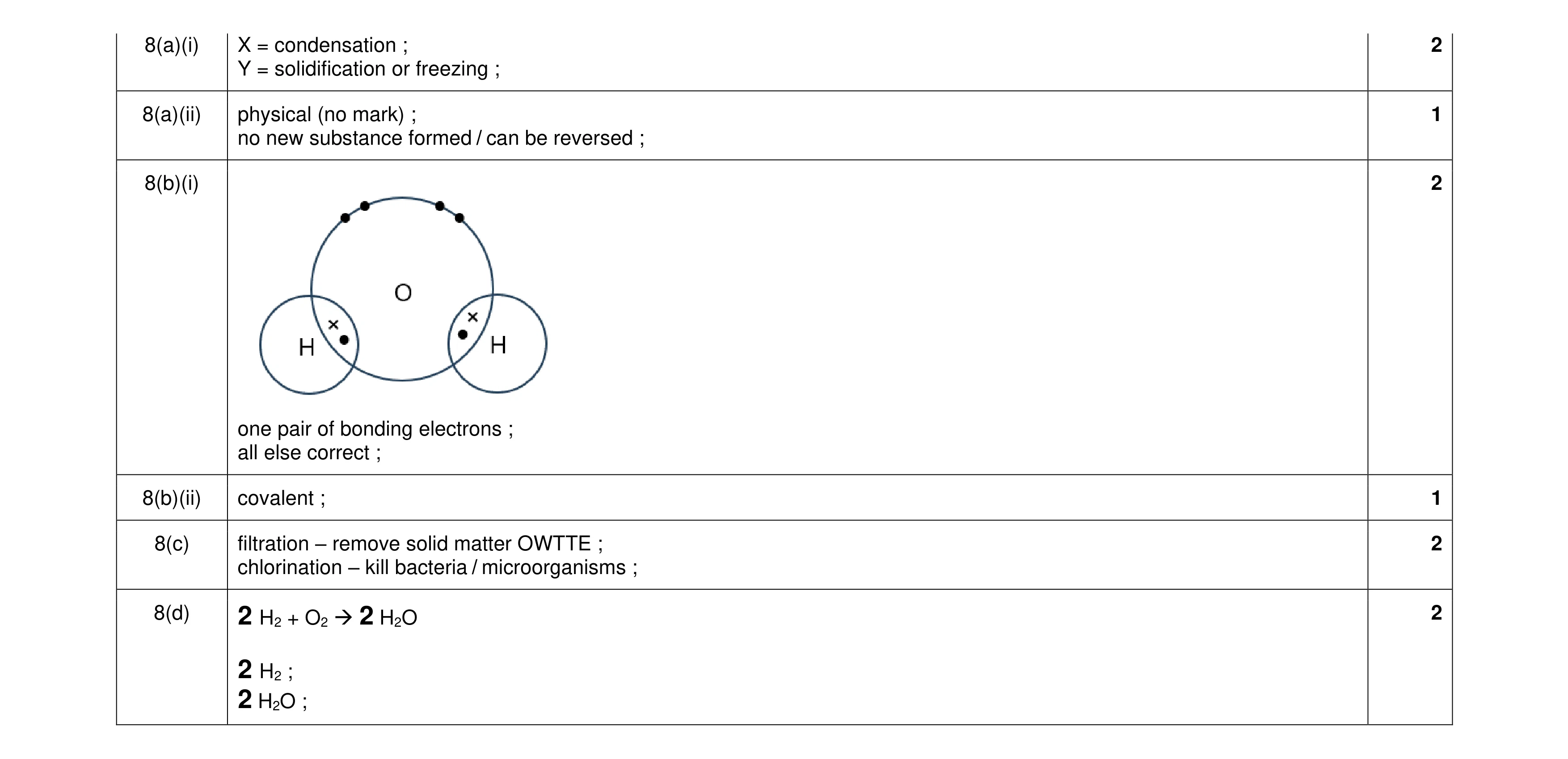 10
10