Questions as text
Q1 · The shell colour in crabs has two alleles as shown 0654/42 May/June 2017
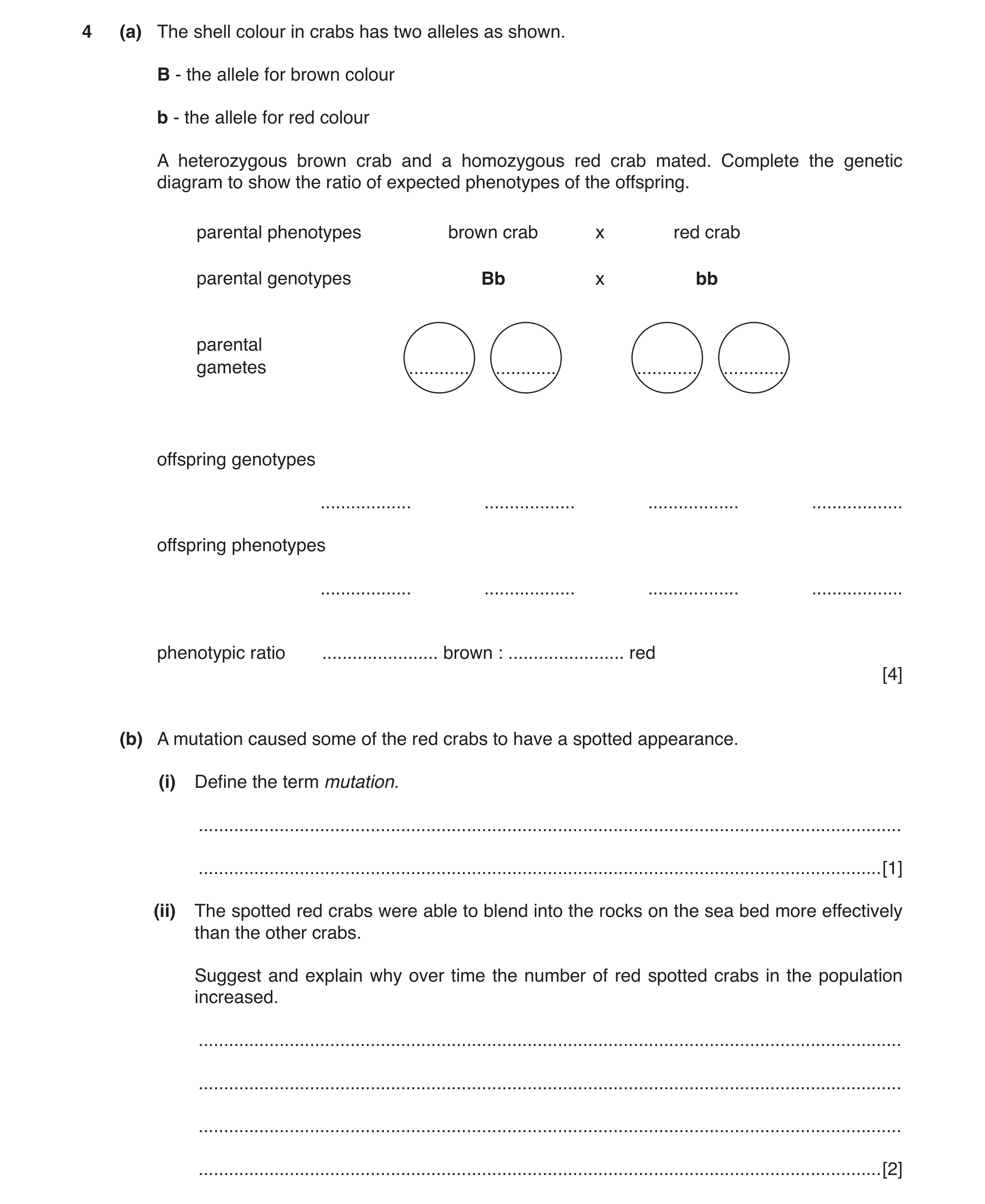
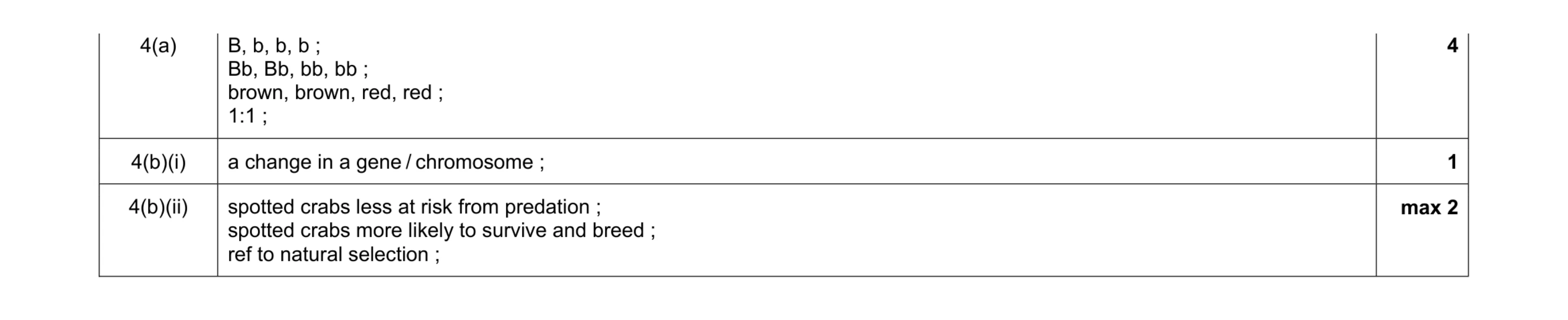
4 (a) The shell colour in crabs has two alleles as shown. B - the allele for brown colour b - the allele for red colour A heterozygous brown crab and a homozygous red crab mated. Complete the genetic diagram to show the ratio of expected phenotypes of the offspring. parental phenotypes brown crab x red crab parental genotypes Bb x bb parental gametes … … … … offspring genotypes … … … … offspring phenotypes … … … … phenotypic ratio … brown : … red [4] (b) A mutation caused some of the red crabs to have a spotted appearance. (i) Define the term mutation. … … [1] (ii) The spotted red crabs were able to blend into the rocks on the sea bed more effectively than the other crabs. Suggest and explain why over time the number of red spotted crabs in the population increased. … … … … [2]
7 marks
Mark scheme: 4(a) B, b, b, b ; Bb, Bb, bb, bb ; brown, brown, red, red ; 1:1 ; 4 4(b)(i) a change in a gene / chromosome ; 1 4(b)(ii) spotted crabs less at risk from predation ; spotted crabs more likely to survive and breed ; ref to natural selection ; max 2
This question in 0654/42 May/June 2017
Q2 · MRSA is a bacterium that causes infection and has become resistant to many antibiotics 0654/42 Oct/Nov 2017
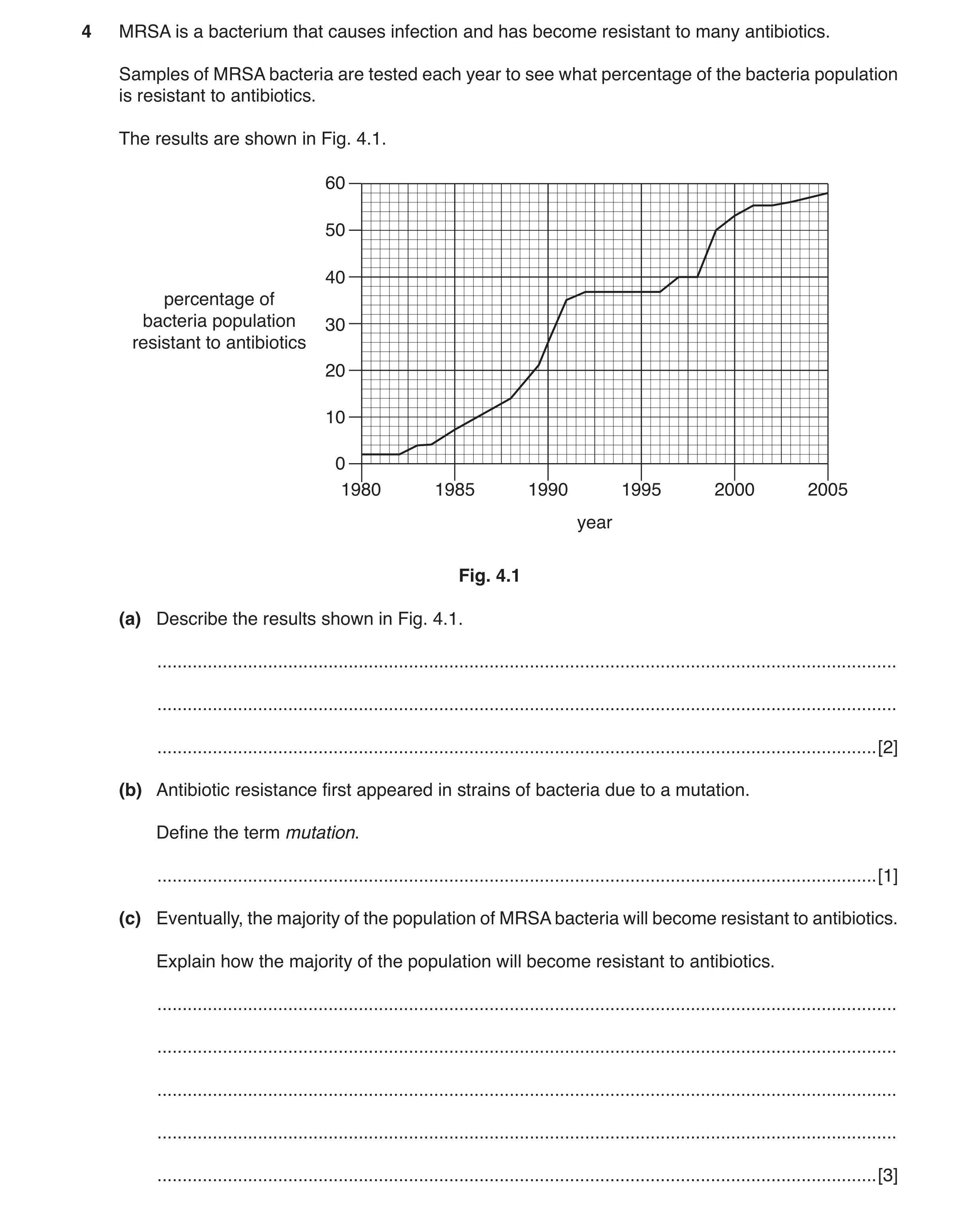
4 MRSA is a bacterium that causes infection and has become resistant to many antibiotics. Samples of MRSA bacteria are tested each year to see what percentage of the bacteria population is resistant to antibiotics. The results are shown in Fig. 4.1. 60 50 40 percentage of bacteria population 30 resistant to antibiotics 20 10 0 1980 1985 1990 1995 2000 2005 year Fig. 4.1 (a) Describe the results shown in Fig. 4.1. … … … [2] (b) Antibiotic resistance first appeared in strains of bacteria due to a mutation. Define the term mutation. … [1] (c) Eventually, the majority of the population of MRSA bacteria will become resistant to antibiotics. Explain how the majority of the population will become resistant to antibiotics. … … … … … [3]
6 marks
Mark scheme: 4(a) resistance increases over time ; resistance, plateaus / levels off, between 1992–1996 / from 2000 ; correct data quote ; max 2 4(b) change in gene / chromosome ; 1 4(c) antibiotics will kill bacteria with no resistance ; resistant bacteria survive and reproduce ; pass on resistance to their offspring ; ref to natural selection ; max 3
This question in 0654/42 Oct/Nov 2017
Q3 · Sexual reproduction in large animal populations usually results in approximately equal… 0654/43 Oct/Nov 2017
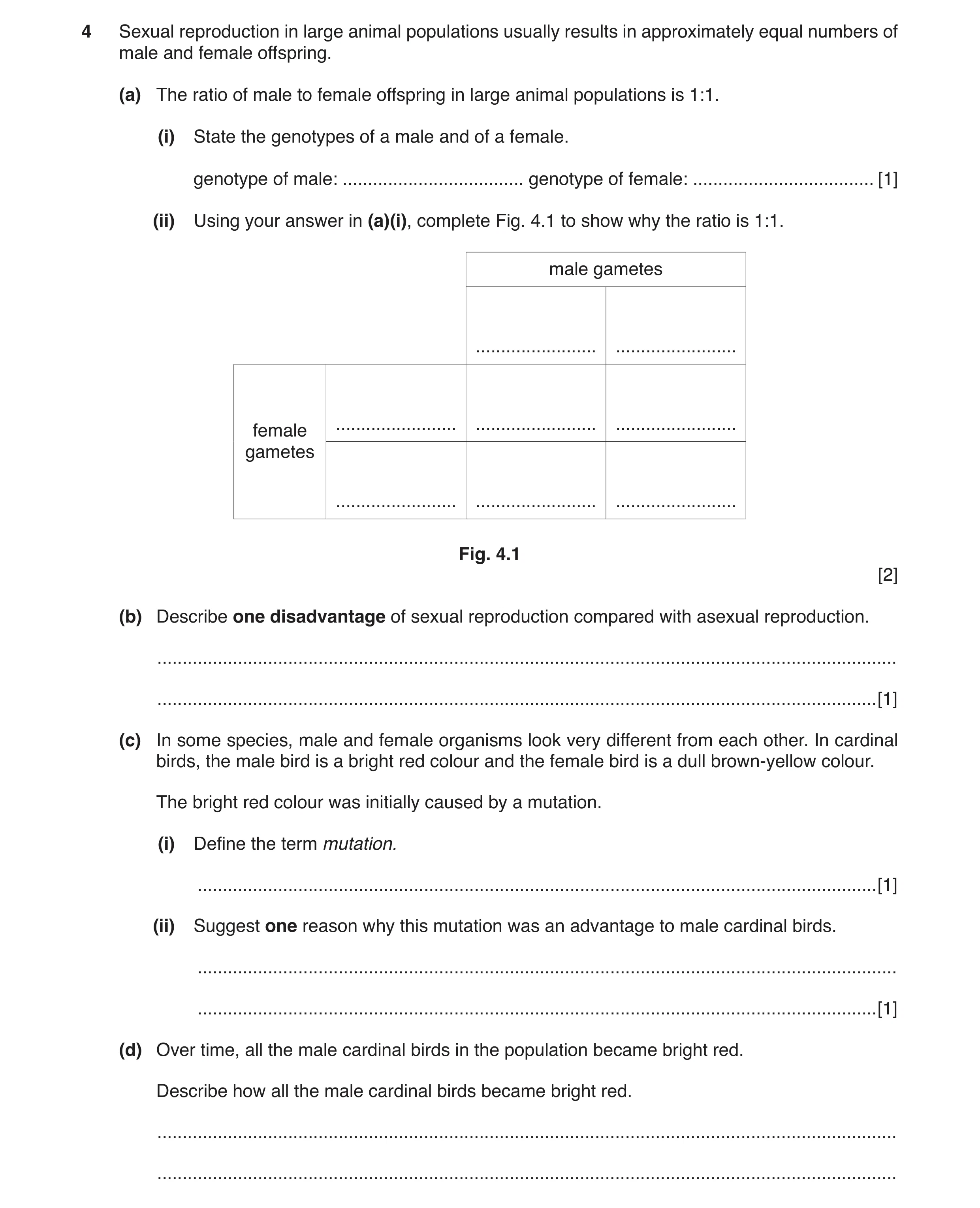
4 Sexual reproduction in large animal populations usually results in approximately equal numbers of male and female offspring. (a) The ratio of male to female offspring in large animal populations is 1:1. (i) State the genotypes of a male and of a female. genotype of male: … genotype of female: … [1] (ii) Using your answer in (a)(i), complete Fig. 4.1 to show why the ratio is 1:1. male gametes … … … … … female gametes … … … Fig. 4.1 [2] (b) Describe one disadvantage of sexual reproduction compared with asexual reproduction. … … [1] (c) In some species, male and female organisms look very different from each other. In cardinal birds, the male bird is a bright red colour and the female bird is a dull brown-yellow colour. The bright red colour was initially caused by a mutation. (i) Define the term mutation. … [1] (ii) Suggest one reason why this mutation was an advantage to male cardinal birds. … … [1] (d) Over time, all the male cardinal birds in the population became bright red. Describe how all the male cardinal birds became bright red. … …
8 marks
Mark scheme: 4(a)(i) genotype of male: XY genotype of female: XX ; 1 4(a)(ii) gametes correct ; X and X for female X and Y for male ; offspring correct ; XX, XX, XY, XY ; male gametes X Y female gametes X XX XY X XX XY 2 4(b) two parents needed ; harmful variations can occur ; max 1 4(c)(i) change in, gene / chromosome ; 1 4(c)(ii) more visible to females / mates ; 1 4(d) red cardinal birds (more likely to) reproduce / mate ; pass on, allele / gene / colour, to their offspring ; ref to natural selection ; max 2
This question in 0654/43 Oct/Nov 2017
Q4 · A picture of a racehorse 0654/42 Oct/Nov 2019
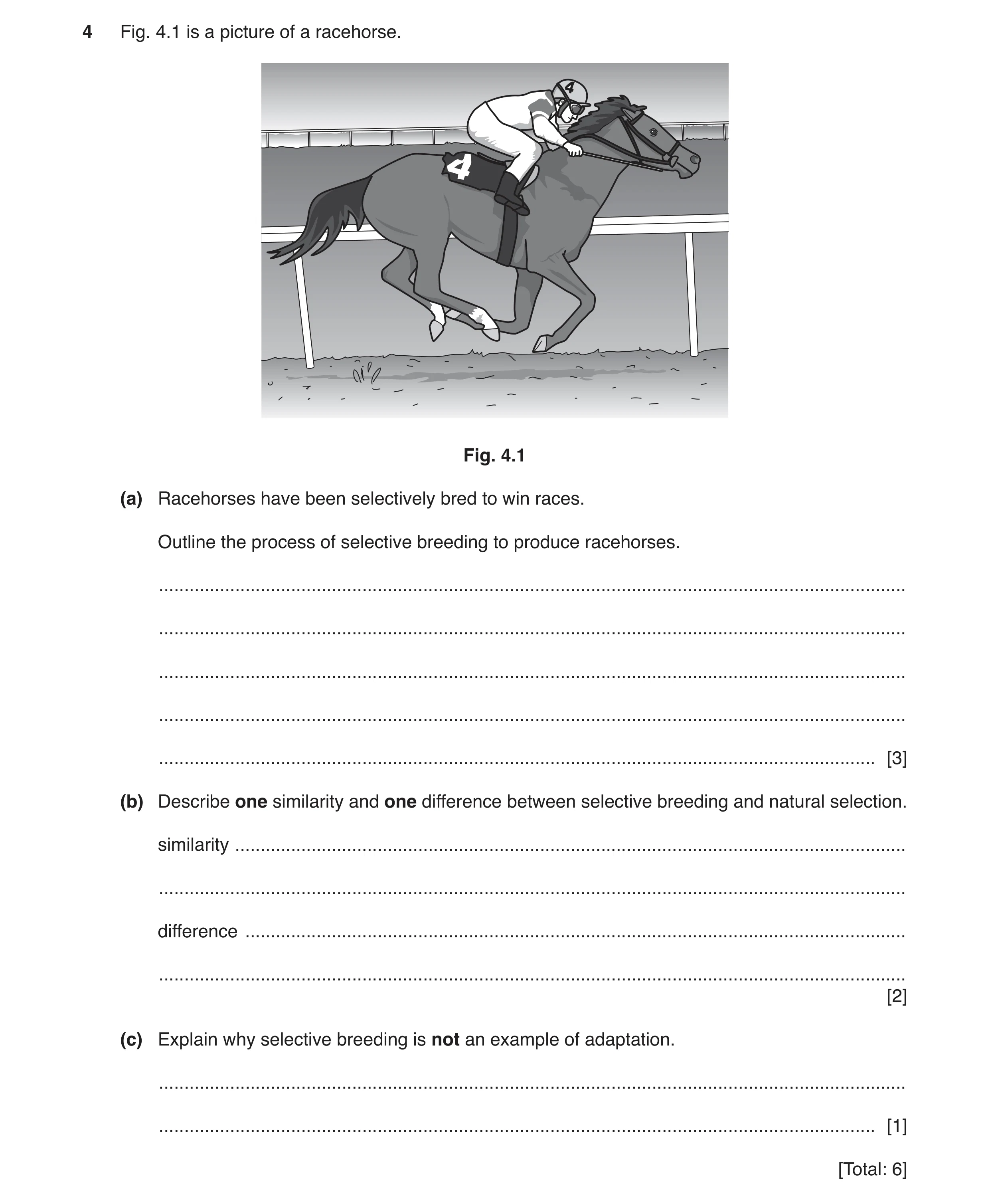
4 Fig. 4.1 is a picture of a racehorse. Fig. 4.1 (a) Racehorses have been selectively bred to win races. Outline the process of selective breeding to produce racehorses. … … … … … [3] (b) Describe one similarity and one difference between selective breeding and natural selection. similarity … … difference … … [2] (c) Explain why selective breeding is not an example of adaptation. … … [1] [Total: 6]
6 marks
Mark scheme: 4(a) any three from best horses selected ; these horses allowed to breed ; (offspring observed and) best offspring selected ; process repeated (over many generations) ; max 3 3 4(b) similarity features are inherited ; difference humans select the feature in selective breeding / the environment selects the feature in natural selection ; 2 4(c) adaptation results from natural selection not artificial selection / AW ; 1
This question in 0654/42 Oct/Nov 2019
Q5 · MRSA is a strain of bacteria that is resistant to antibiotics 0654/43 Oct/Nov 2019
10 (a) MRSA is a strain of bacteria that is resistant to antibiotics. Table 10.1 compares the number of cases of infection caused by MRSA bacteria in one hospital between 1998 and 2008. Table 10.1 year number of cases of infection 1998 3 2000 6 2002 22 2004 109 2006 155 2008 167 Calculate the percentage increase in number of cases between 2006 and 2008. … % [2] (b) The resistant allele in MRSA bacteria developed due to a mutation. (i) Define the term mutation. … … [1] (ii) With reference to natural selection, describe how MRSA bacteria have evolved to become resistant to antibiotics. … … … … … [3] (c) Bacteria reproduce by asexual reproduction. Describe one disadvantage to bacteria without the resistant allele of reproducing asexually. … … … … [2] [Total: 8]
8 marks
Mark scheme: 10(a) 167 – 155 OR 12 ; (12 / 155 × 100 = ) 7.7 (%) ; 2 10(b)(i) change in the, gene / chromosome ; 1 10(b)(ii) bacteria without the resistance die ; bacteria with the resistance survive and breed ; resistant allele passed onto offspring ; 3 10(c) offspring are genetically identical / have no genetic variation, to parent ; offspring will not have the resistant allele ; 2
This question in 0654/43 Oct/Nov 2019
Q6 · Antibiotics are drugs that are used to kill bacteria 0654/41 Oct/Nov 2021
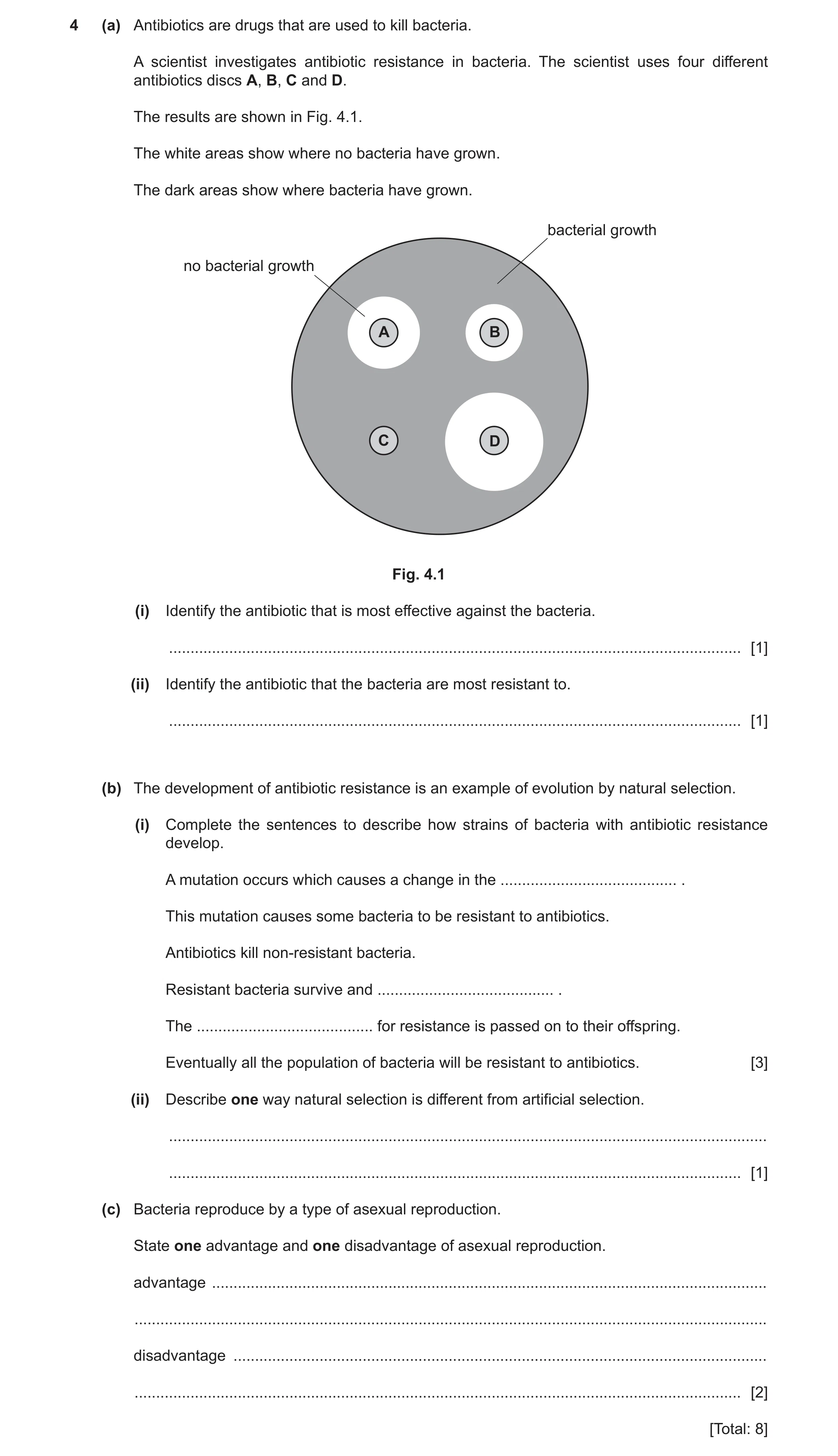
4 (a) Antibiotics are drugs that are used to kill bacteria. A scientist investigates antibiotic resistance in bacteria. The scientist uses four different antibiotics discs A, B, C and D. The results are shown in Fig. 4.1. The white areas show where no bacteria have grown. The dark areas show where bacteria have grown. bacterial growth no bacterial growth A B C D Fig. 4.1 (i) Identify the antibiotic that is most effective against the bacteria. … [1] (ii) Identify the antibiotic that the bacteria are most resistant to. … [1] (b) The development of antibiotic resistance is an example of evolution by natural selection. (i) Complete the sentences to describe how strains of bacteria with antibiotic resistance develop. A mutation occurs which causes a change in the … . This mutation causes some bacteria to be resistant to antibiotics. Antibiotics kill non-resistant bacteria. Resistant bacteria survive and … . The … for resistance is passed on to their offspring. Eventually all the population of bacteria will be resistant to antibiotics. [3] (ii) Describe one way natural selection is different from artificial selection. … … [1] (c) Bacteria reproduce by a type of asexual reproduction. State one advantage and one disadvantage of asexual reproduction. advantage … … disadvantage … … [2] [Total: 8]
8 marks
Mark scheme: 4(a)(i) D ; 1 4(a)(ii) C ; 1 4(b)(i) chromosome / gene ; reproduce / AW ; allele ; 3 4(b)(ii) traits / characteristics, are selected by humans (in artificial selection) / traits are selected by the environment in natural selection ; traits / characteristics, are usually chosen for economic reasons (in artificial selection) / traits are beneficial for survival in natural selection ; faster results (from artificial selection) / ORA ; (artificial selection only) takes place in selected individuals / natural selection takes place in whole populations ; (artificial selection) does not lead to evolution / ORA ; (artificial selection) results in decreased (genetic) variation / diversity / ORA ; (artificial selection) leads to increased likelihood of inherited / genetic disease ; AVP ; max1 4(c) advantages: no mates required / rapid / AVP ; disadvantages no (genetic) diversity / no evolution / extinction more likely ; 2
This question in 0654/41 Oct/Nov 2021
Q7 · Complete the definition of the term ecosystem 0654/43 Oct/Nov 2021
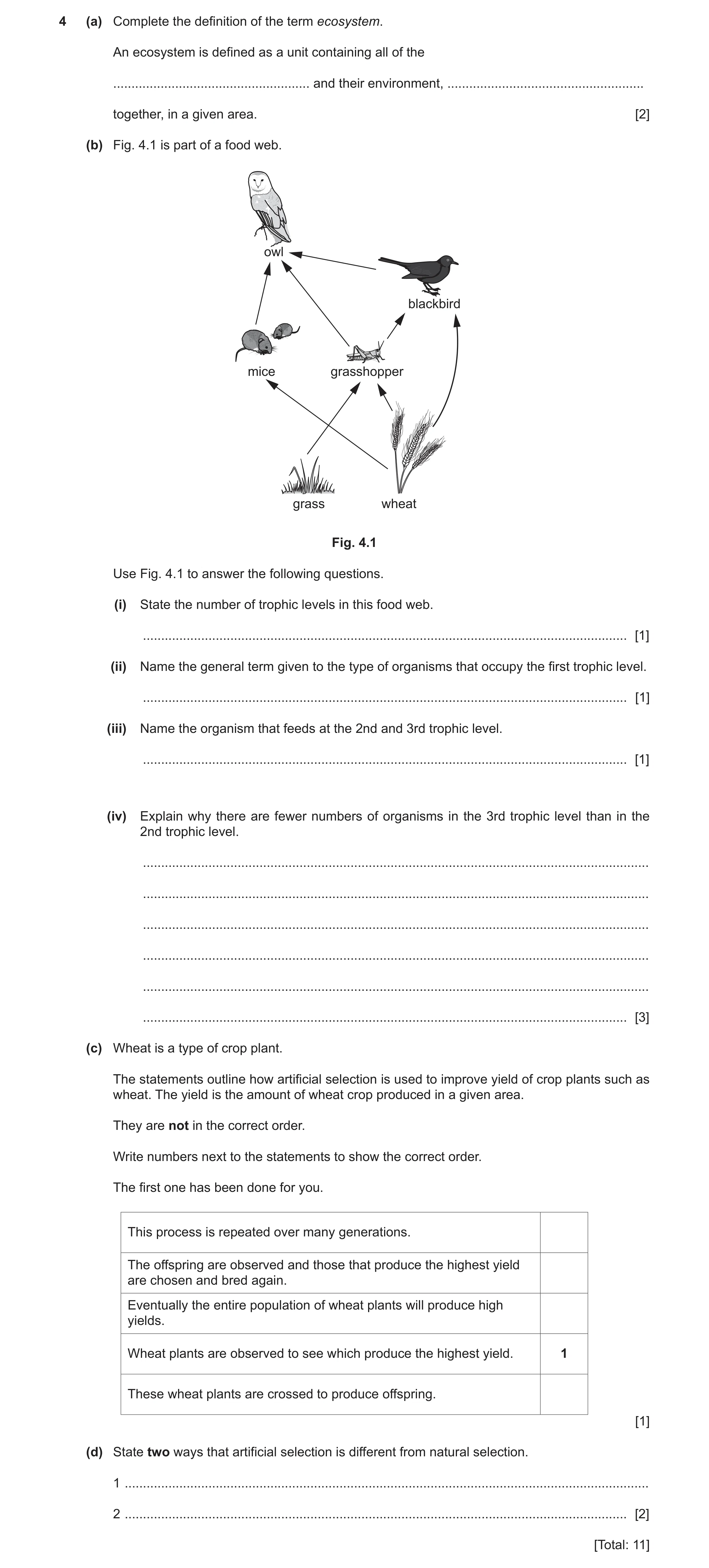
4 (a) Complete the definition of the term ecosystem. An ecosystem is defined as a unit containing all of the … and their environment, … together, in a given area. [2] (b) Fig. 4.1 is part of a food web. owl blackbird mice grasshopper grass wheat Fig. 4.1 Use Fig. 4.1 to answer the following questions. (i) State the number of trophic levels in this food web. … [1] (ii) Name the general term given to the type of organisms that occupy the first trophic level. … [1] (iii) Name the organism that feeds at the 2nd and 3rd trophic level. … [1] (iv) Explain why there are fewer numbers of organisms in the 3rd trophic level than in the 2nd trophic level. … … … … … … [3] (c) Wheat is a type of crop plant. The statements outline how artificial selection is used to improve yield of crop plants such as wheat. The yield is the amount of wheat crop produced in a given area. They are not in the correct order. Write numbers next to the statements to show the correct order. The first one has been done for you. This process is repeated over many generations. The offspring are observed and those that produce the highest yield are chosen and bred again. Eventually the entire population of wheat plants will produce high yields. Wheat plants are observed to see which produce the highest yield. 1 These wheat plants are crossed to produce offspring. [1] (d) State two ways that artificial selection is different from natural selection. 1 … 2 … [2] [Total: 11]
11 marks
Mark scheme: 4(a) organisms ; interacting ; 2 4(b)(i) 4 ; 1 4(b)(ii) producers ; 1 4(b)(iii) blackbirds ; 1 4(b)(iv) any three from: energy is lost between the trophic levels ; energy lost by, respiration / movement / heat / excretion ; not all the organism, is eaten / digested ; not enough energy for larger number of organisms ; 3 4(c) 4 3 5 (1) 2 ; 1 4(d) any two from: traits / characteristics, are selected by humans (in artificial selection) / traits are selected by the environment in natural selection ; traits / characteristics, are usually chosen for economic reasons (in artificial selection) / traits are beneficial for survival (in natural selection) ; faster results (from artificial selection) / ORA ; (artificial selection only) takes place in selected individuals / natural selection takes place in whole populations ; (artificial selection) does not lead to evolution / ORA ; (artificial selection) results in decreased genetic variation / diversity / ORA ; (artificial selection) leads to increased likelihood of inherited / genetic disease ; AVP ; 2
This question in 0654/43 Oct/Nov 2021
Q8 · A marine food web 0654/42 Feb/March 2022
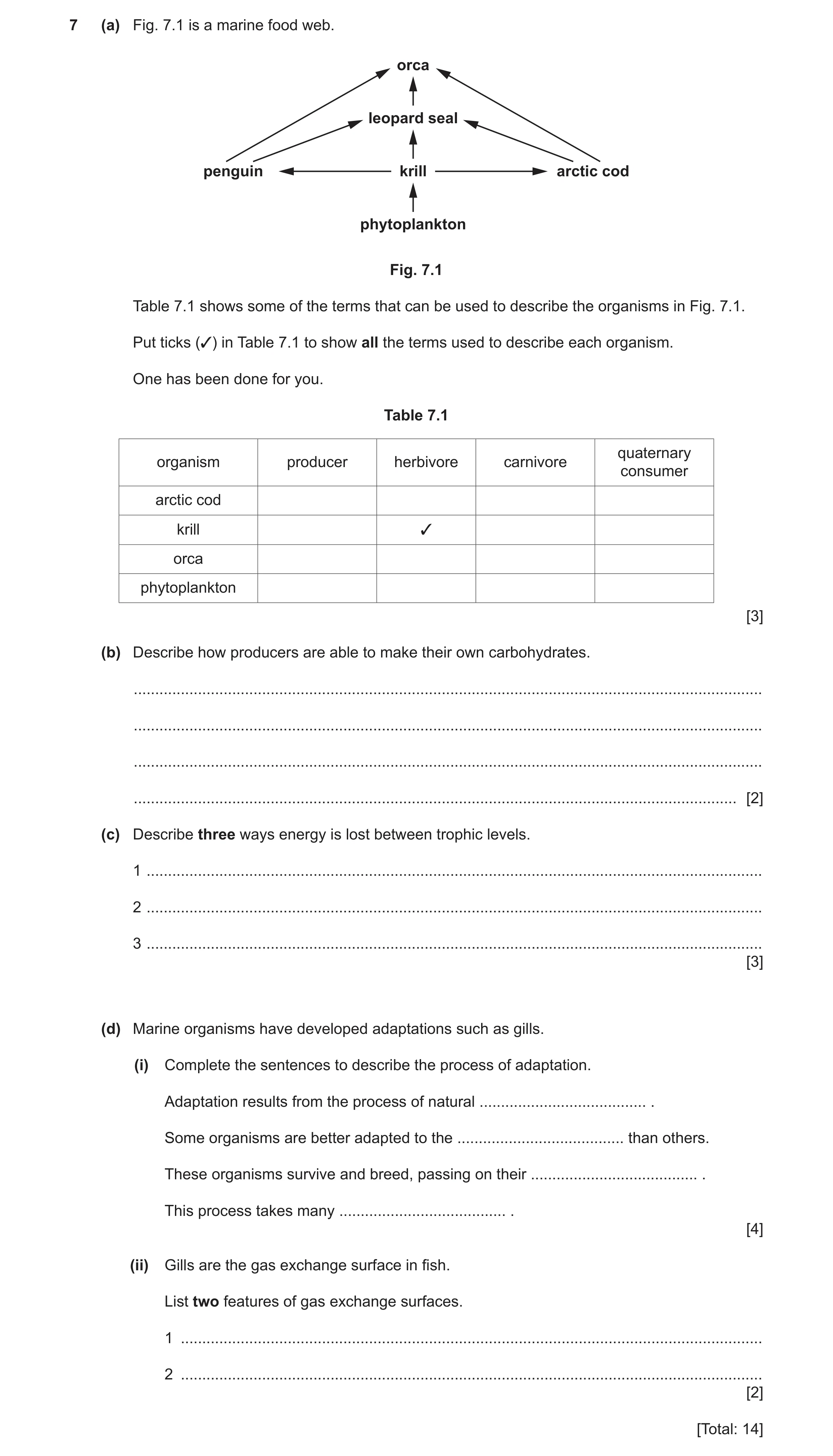
7 (a) Fig. 7.1 is a marine food web. orca leopard seal penguin krill arctic cod phytoplankton Fig. 7.1 Table 7.1 shows some of the terms that can be used to describe the organisms in Fig. 7.1. Put ticks (3) in Table 7.1 to show all the terms used to describe each organism. One has been done for you. Table 7.1 quaternary organism producer herbivore carnivore consumer arctic cod krill 3 orca phytoplankton [3] (b) Describe how producers are able to make their own carbohydrates. … … … … [2] (c) Describe three ways energy is lost between trophic levels. 1 … 2 … 3 … [3] (d) Marine organisms have developed adaptations such as gills. (i) Complete the sentences to describe the process of adaptation. Adaptation results from the process of natural … . Some organisms are better adapted to the … than others. These organisms survive and breed, passing on their … . This process takes many … . [4] (ii) Gills are the gas exchange surface in fish. List two features of gas exchange surfaces. 1 … 2 … [2] [Total: 14]
14 marks
Mark scheme: 7(a) organism producer herbivore carnivore quaternary consumer arctic cod krill orca phytoplankton ;;; 7(b) any two from: by photosynthesis ; using light (energy) ; using carbon dioxide and water ; 2 7(c) any three from: heat / respiration ; excretion / faeces / urea ; (named) movement / (named) metabolic processes ; not all the organism is eaten / some parts are undigested ; not all the organisms from the trophic level are eaten ; 3 7(d)(i) selection ; environment ; alleles ; generations ; 4 7(d)(ii) any two from: good blood supply ; thin (walls/surface) / short diffusion distance ; large surface area ; good ventilation ; AVP ; 2
This question in 0654/42 Feb/March 2022
Q9 · The blood group of some patients in hospital is recorded 0654/43 May/June 2022
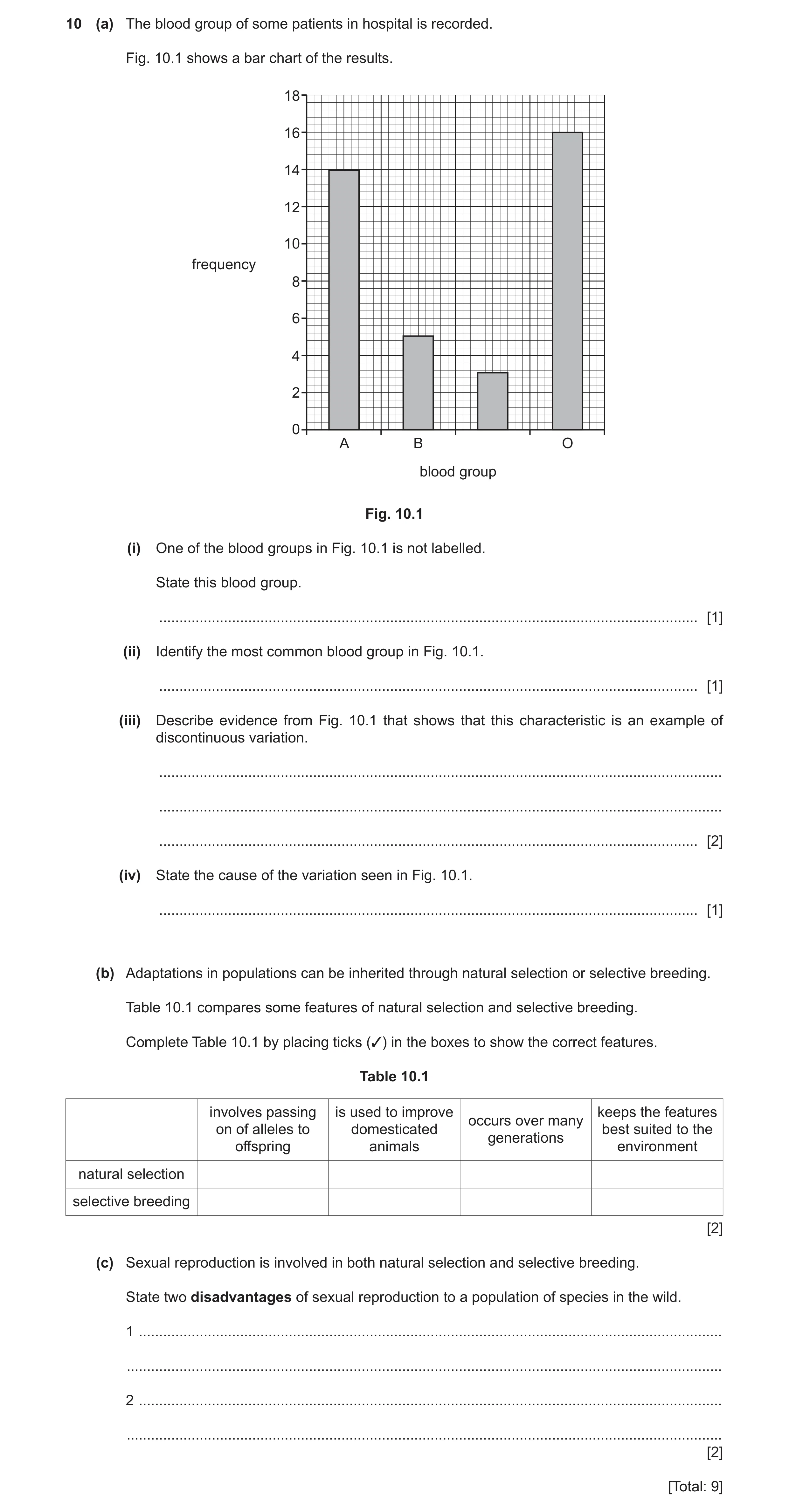
10 (a) The blood group of some patients in hospital is recorded. Fig. 10.1 shows a bar chart of the results. 18 16 14 12 10 frequency 8 6 4 2 0 A B O blood group Fig. 10.1 (i) One of the blood groups in Fig. 10.1 is not labelled. State this blood group. … [1] (ii) Identify the most common blood group in Fig. 10.1. … [1] (iii) Describe evidence from Fig. 10.1 that shows that this characteristic is an example of discontinuous variation. … … … [2] (iv) State the cause of the variation seen in Fig. 10.1. … [1] (b) Adaptations in populations can be inherited through natural selection or selective breeding. Table 10.1 compares some features of natural selection and selective breeding. Complete Table 10.1 by placing ticks (3) in the boxes to show the correct features. Table 10.1 involves passing is used to improve keeps the features occurs over many on of alleles to domesticated best suited to the generations offspring animals environment natural selection selective breeding [2] (c) Sexual reproduction is involved in both natural selection and selective breeding. State two disadvantages of sexual reproduction to a population of species in the wild. 1 … … 2 … … [2] [Total: 9]
9 marks
Mark scheme: 10(a)(i) AB ; 1 10(a)(ii) O ; 1 10(a)(iii) limited number of phenotypes ; no intermediates ; 2 10(a)(iv) genes / alleles ; 1 Question Answer Marks 10(b) involves passing on of alleles to offspring is used to improve domesticated animals occurs over many generations keeps the features best suited to the environment natural selection selective breeding ;; 2 10(c) takes longer ; more energy required ; has to find a mate ; idea that genetic variation may result in harmful phenotypes ; AVP ; max 2 2
This question in 0654/43 May/June 2022
Q10 · A scientist tests the resistance of one strain of bacteria, to four different… 0654/42 Oct/Nov 2022
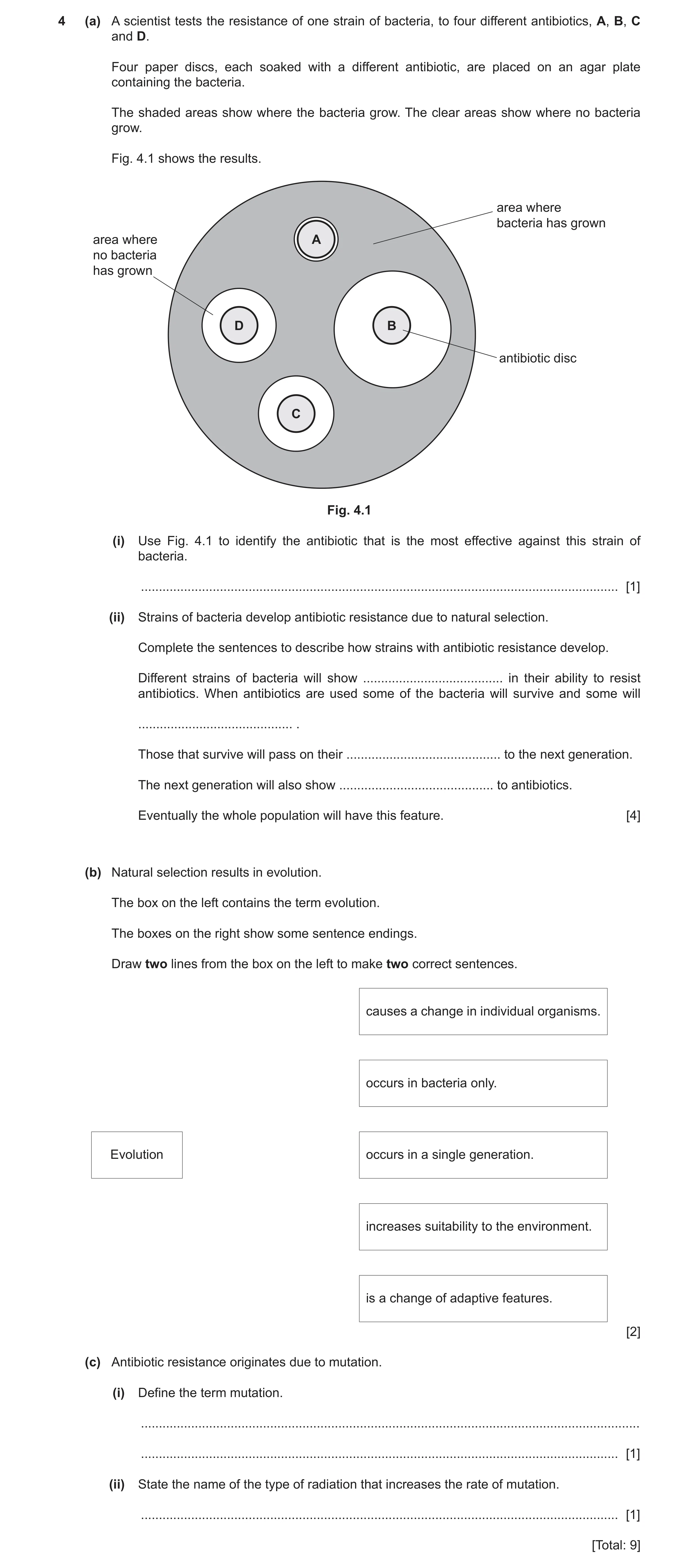
4 (a) A scientist tests the resistance of one strain of bacteria, to four different antibiotics, A, B, C and D. Four paper discs, each soaked with a different antibiotic, are placed on an agar plate containing the bacteria. The shaded areas show where the bacteria grow. The clear areas show where no bacteria grow. Fig. 4.1 shows the results. area where bacteria has grown area where A no bacteria has grown D B antibiotic disc C Fig. 4.1 (i) Use Fig. 4.1 to identify the antibiotic that is the most effective against this strain of bacteria. … [1] (ii) Strains of bacteria develop antibiotic resistance due to natural selection. Complete the sentences to describe how strains with antibiotic resistance develop. Different strains of bacteria will show … in their ability to resist antibiotics. When antibiotics are used some of the bacteria will survive and some will … . Those that survive will pass on their … to the next generation. The next generation will also show … to antibiotics. Eventually the whole population will have this feature. [4] (b) Natural selection results in evolution. The box on the left contains the term evolution. The boxes on the right show some sentence endings. Draw two lines from the box on the left to make two correct sentences. causes a change in individual organisms. occurs in bacteria only. Evolution occurs in a single generation. increases suitability to the environment. is a change of adaptive features. [2] (c) Antibiotic resistance originates due to mutation. (i) Define the term mutation. … … [1] (ii) State the name of the type of radiation that increases the rate of mutation. … [1] [Total: 9]
9 marks
Mark scheme: 4(a)(i) B ; 1 4(a)(ii) variation / AW ; 4 die ; alleles ; resistance ; 4(b) evolution linked to: 2 increases suitability to the environment ; is a change of adaptive features ; 4(c)(i) change in the gene / chromosome ; 1 4(c)(ii) ionising ; 1
This question in 0654/42 Oct/Nov 2022
Q11 · A diagram showing the development of a strain of antibiotic resistant bacteria 0654/41 May/June 2023
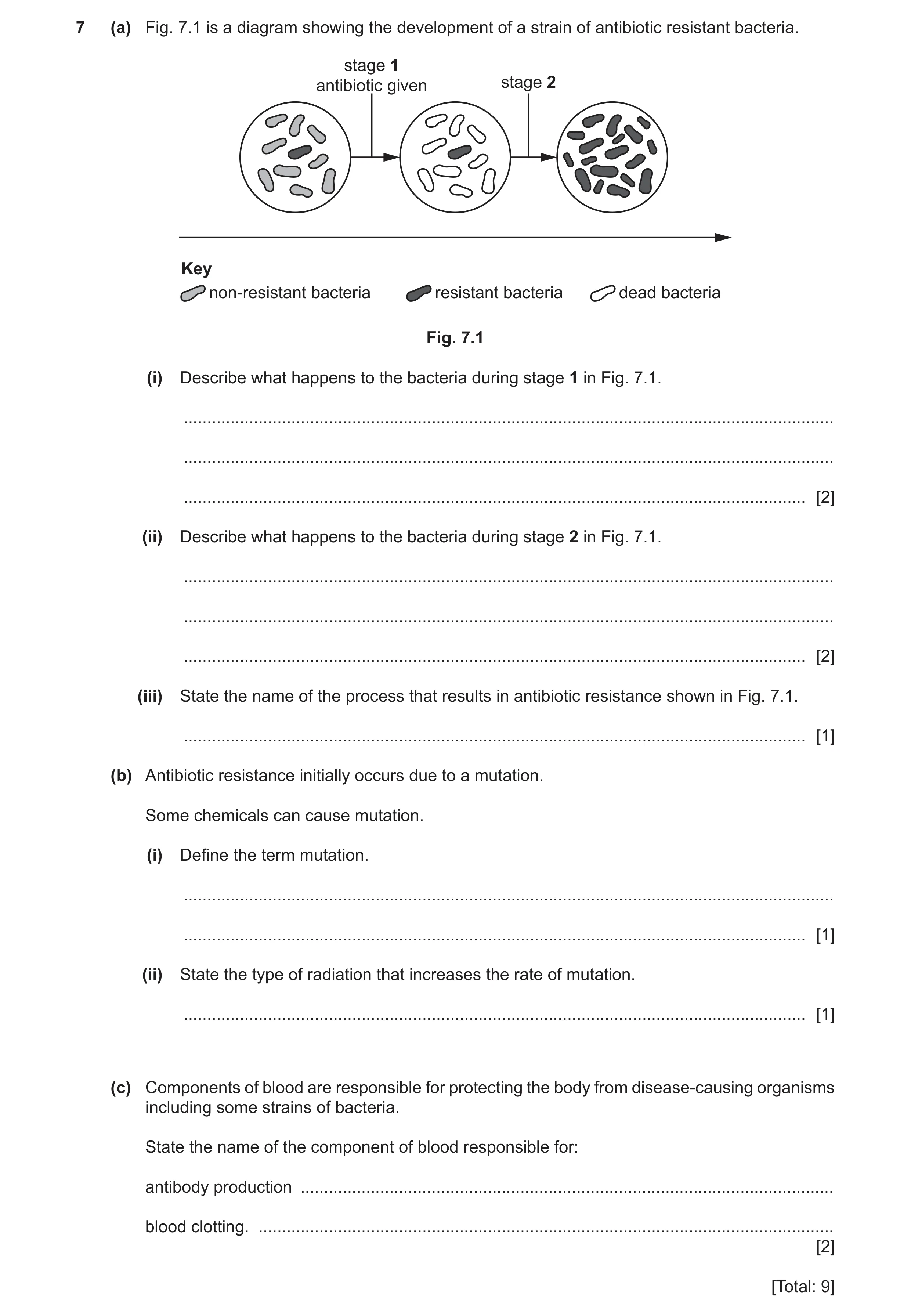
7 (a) Fig. 7.1 is a diagram showing the development of a strain of antibiotic resistant bacteria. stage 1 antibiotic given stage 2 Key non-resistant bacteria resistant bacteria dead bacteria Fig. 7.1 (i) Describe what happens to the bacteria during stage 1 in Fig. 7.1. … … … [2] (ii) Describe what happens to the bacteria during stage 2 in Fig. 7.1. … … … [2] (iii) State the name of the process that results in antibiotic resistance shown in Fig. 7.1. … [1] (b) Antibiotic resistance initially occurs due to a mutation. Some chemicals can cause mutation. (i) Define the term mutation. … … [1] (ii) State the type of radiation that increases the rate of mutation. … [1] (c) Components of blood are responsible for protecting the body from disease‑causing organisms including some strains of bacteria. State the name of the component of blood responsible for: antibody production … blood clotting. … [2] [Total: 9]
9 marks
Mark scheme: 7(a)(i) the bacteria with (antibiotic) resistance survive ; antibiotics kill the bacteria without (antibiotic) resistance ; 2 7(a)(ii) the bacteria with (antibiotic) resistance, multiplies / divides ; passing on alleles / genes / (mutated) DNA to the next generation / the offspring all gain resistance (to antibiotics) ; 2 7(a)(iii) natural selection ; 1 7(b)(i) change in, gene / chromosome ; 1 7(b)(ii) ionising ; 1 7(c) white blood cells ; platelets ; 2
This question in 0654/41 May/June 2023
Q12 · A student investigates antibiotic resistance in one strain of bacteria 0654/42 May/June 2024
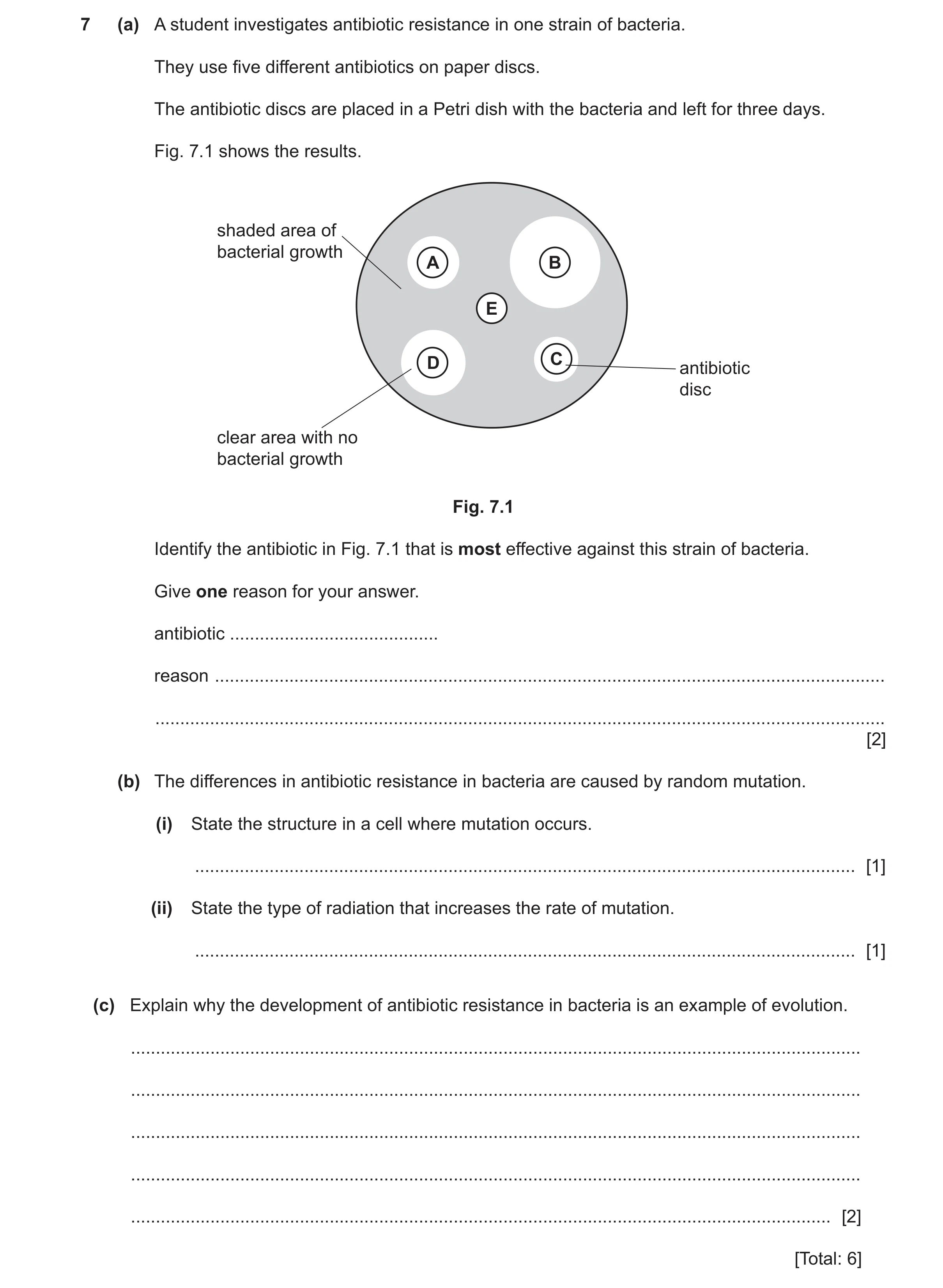
7 (a) A student investigates antibiotic resistance in one strain of bacteria. They use five different antibiotics on paper discs. The antibiotic discs are placed in a Petri dish with the bacteria and left for three days. Fig. 7.1 shows the results. shaded area of bacterial growth A B E D C antibiotic disc clear area with no bacterial growth Fig. 7.1 Identify the antibiotic in Fig. 7.1 that is most effective against this strain of bacteria. Give one reason for your answer. antibiotic … reason … … [2] (b) The differences in antibiotic resistance in bacteria are caused by random mutation. (i) State the structure in a cell where mutation occurs. … [1] (ii) State the type of radiation that increases the rate of mutation. … [1] (c) Explain why the development of antibiotic resistance in bacteria is an example of evolution. … … … … … [2] [Total: 6]
6 marks
Mark scheme: 7(a) B ; largest clear area / AW ; 2 7(b)(i) gene / chromosome / nucleus / DNA ; 1 7(b)(ii) ionising ; 1 7(c) change in adaptive features (over time) ; that results from natural selection ; 2
This question in 0654/42 May/June 2024
Q13 · Part of a food web from a desert ecosystem 0654/43 May/June 2024
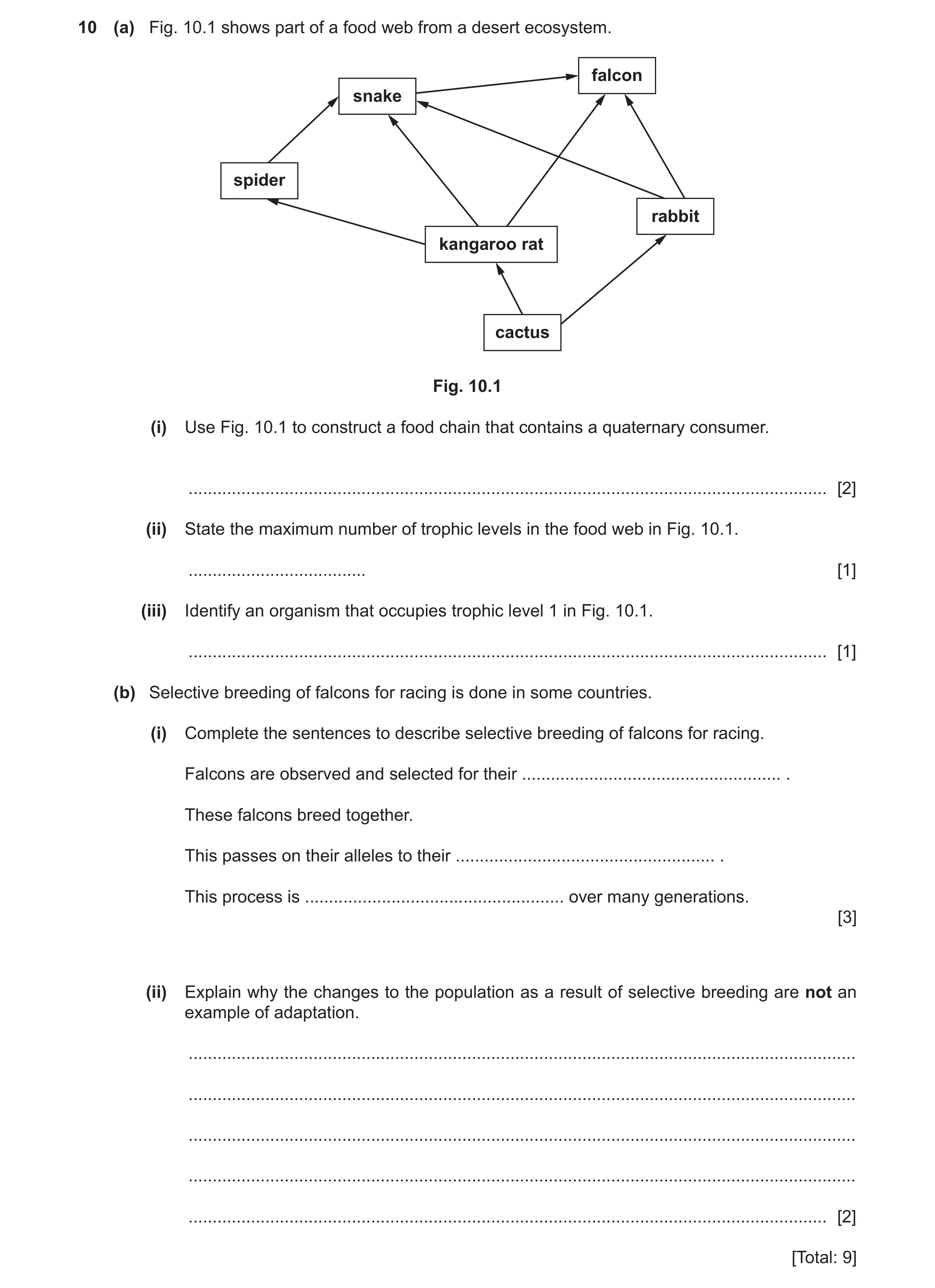
10 (a) Fig. 10.1 shows part of a food web from a desert ecosystem. falcon snake spider rabbit kangaroo rat cactus Fig. 10.1 (i) Use Fig. 10.1 to construct a food chain that contains a quaternary consumer. … [2] (ii) State the maximum number of trophic levels in the food web in Fig. 10.1. … [1] (iii) Identify an organism that occupies trophic level 1 in Fig. 10.1. … [1] (b) Selective breeding of falcons for racing is done in some countries. (i) Complete the sentences to describe selective breeding of falcons for racing. Falcons are observed and selected for their … . These falcons breed together. This passes on their alleles to their … . This process is … over many generations. [3] (ii) Explain why the changes to the population as a result of selective breeding are not an example of adaptation. … … … … … [2] [Total: 9]
9 marks
Mark scheme: 10(a)(i) cactus→kangaroo rat→spider→snake→falcon ;; 2 10(a)(ii) 5 ; 1 10(a)(iii) cactus ; 1 10(b)(i) speed / desirable features ; offspring ; repeated ; 3 Question Answer Marks 10(b)(ii) changes are not caused by natural selection ; population is not more suited to its environment / no change in adaptive features ; 2
This question in 0654/43 May/June 2024
Q14 · A farmer planted some seeds 0654/43 Oct/Nov 2024
10 A farmer planted some seeds. (a) Explain why the farmer digs the soil to ensure there are air spaces in the soil before the seeds are planted. … … … [2] (b) The seeds grow and some of the tips are removed. Fig. 10.1 shows the shoots after a few days. tip removed light shoot A shoot B Fig. 10.1 (i) State the name of the tropic response shown by shoot A in Fig. 10.1. … [1] (ii) Explain why shoot B does not grow towards the light in Fig. 10.1. … … … … … [2] (c) State the name of the type of selection the farmer could use to improve the quality of crop plants. … [1] (d) The shoots eventually flower. Fig. 10.2 is a drawing of one of the flowers. Fig. 10.2 (i) Label the part in Fig. 10.2 that protects the developing flower. Use a label line and the correct name. [2] (ii) Describe one visible feature that shows the flower in Fig. 10.2 is insect-pollinated. … … [1] (e) Explain the effect of a magnesium deficiency in the soil on the colour of the plant leaves. … … … … [2] [Total: 11]
11 marks
Mark scheme: 10(a) provide oxygen ; 2 for germination ; 10(b)(i) phototropism ; 1 10(b)(ii) auxin is made in the tip only ; 2 so no cell elongation (stimulated) ; 10(c) artificial ; 1 10(d)(i) sepal labelled ;; 2 1 mark for correct part labelled 1 mark for correct name 10(d)(ii) any one from: 1 large petals ; anther / stamen / filament, inside flower ; stigma / style inside flower ; Idea that anther is below the stigma ; 10(e) Less / no, synthesis / making of chlorophyll ; 2 yellow leaves ;
This question in 0654/43 Oct/Nov 2024
Q15 · Variation occurs in all organisms 0654/43 Oct/Nov 2025
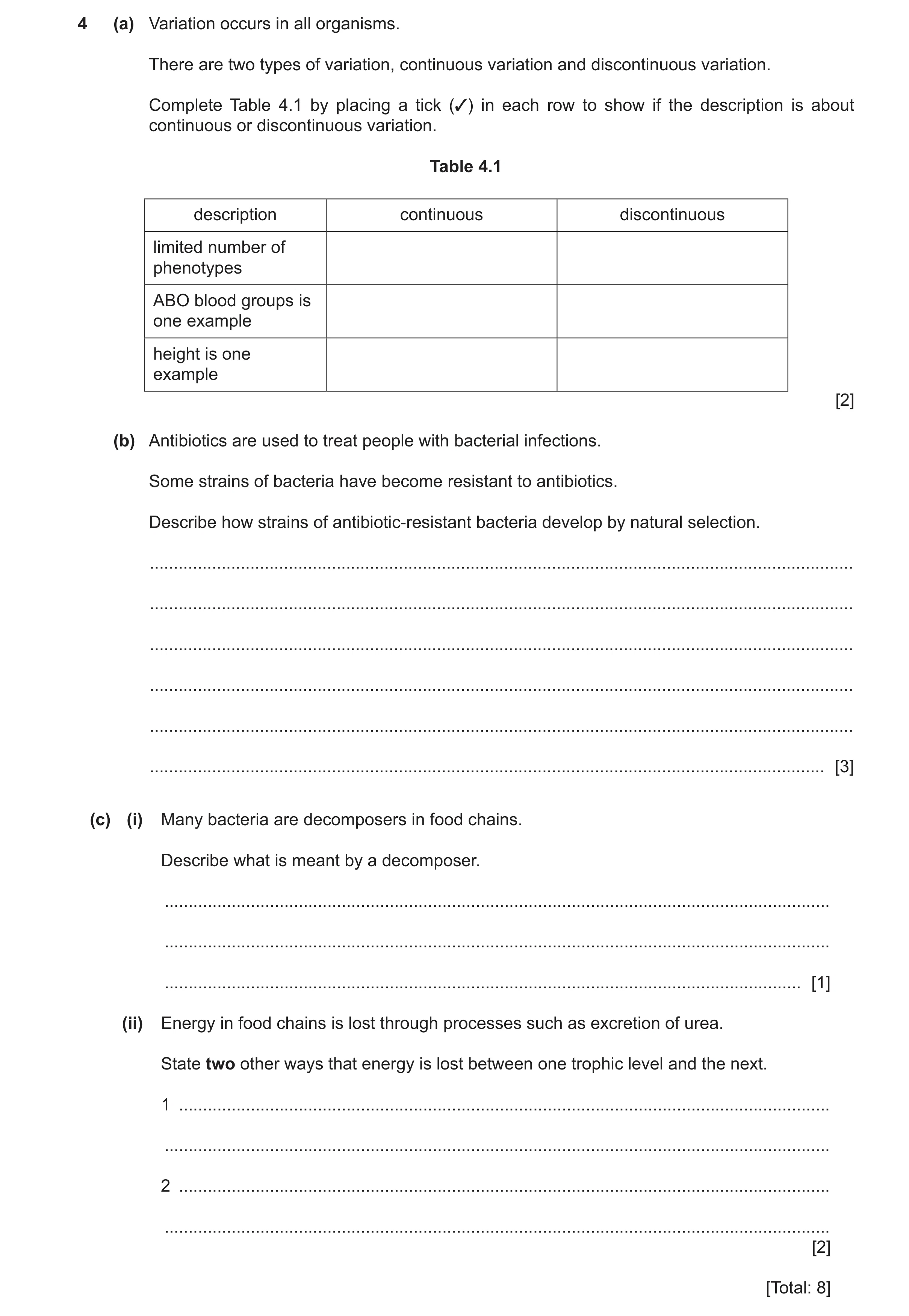
4 (a) Variation occurs in all organisms. There are two types of variation, continuous variation and discontinuous variation. Complete Table 4.1 by placing a tick (3) in each row to show if the description is about continuous or discontinuous variation. Table 4.1 description continuous discontinuous limited number of phenotypes ABO blood groups is one example height is one example [2] (b) Antibiotics are used to treat people with bacterial infections. Some strains of bacteria have become resistant to antibiotics. Describe how strains of antibiotic-resistant bacteria develop by natural selection. … … … … … … [3] (c) (i) Many bacteria are decomposers in food chains. Describe what is meant by a decomposer. … … … [1] (ii) Energy in food chains is lost through processes such as excretion of urea. State two other ways that energy is lost between one trophic level and the next. 1 … … 2 … … [2] [Total: 8]
8 marks
Mark scheme: 4(a) 2 description continuous discontinuous limited number of ✓ phenotypes ABO blood groups is ✓ one example height is one ✓ example 3 correct for 2 marks 2 correct for 1 mark 4(b) some bacteria mutate and become resistant (to antibiotics) ; 3 (idea that these bacteria) survive and divide / reproduce ; pass on alleles (for antibiotic resistance to offspring) ; 4(c)(i) an organism that gets its energy from dead or waste organic material ; 1 4(c)(ii) any two from: 2 • egestion / faeces / indigestible material ; • respiration / heat (loss) ; • movement / muscle contraction ; • (there are), inedible parts / bones / teeth ; • AVP ;
This question in 0654/43 Oct/Nov 2025
 1 / 20
 2 / 20
 3 / 20
 4 / 20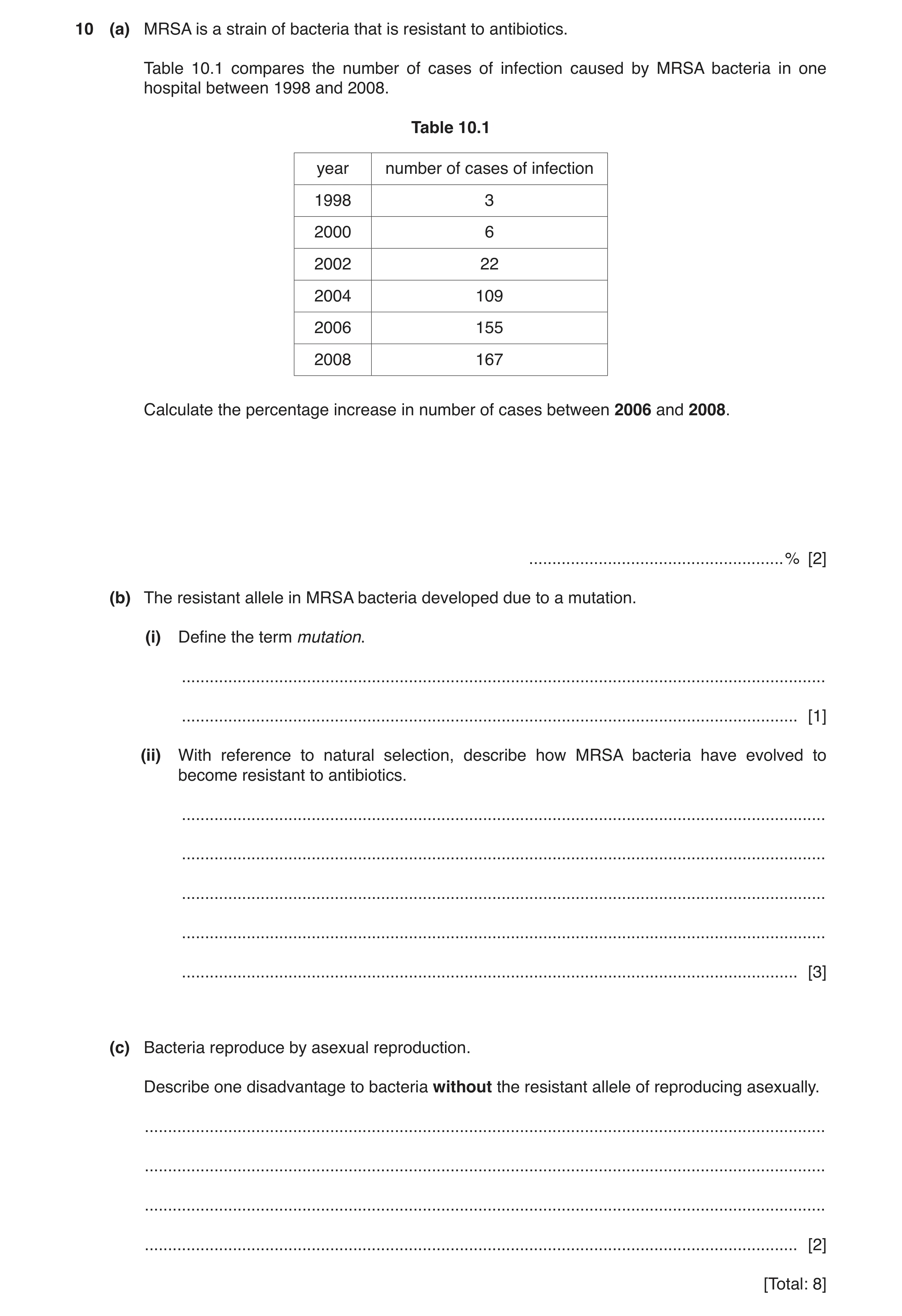
 14 / 20
 15 / 20
 16 / 20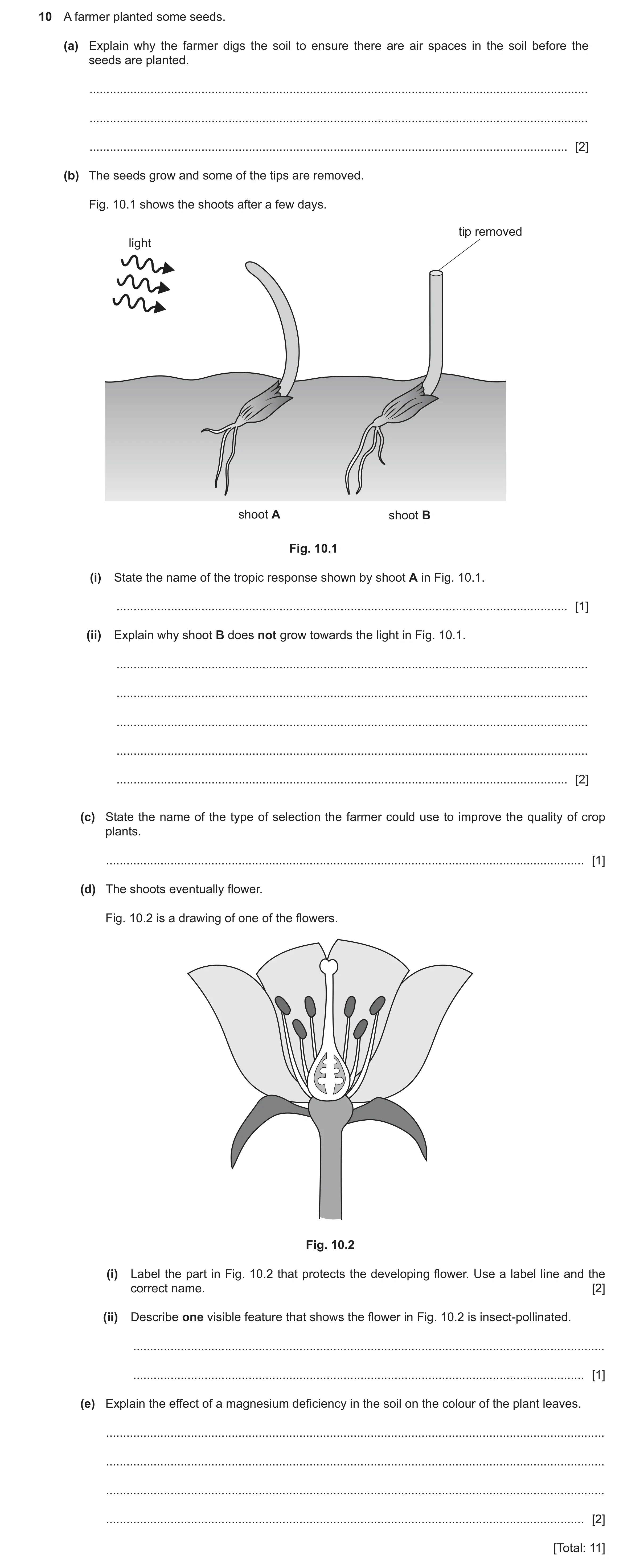
 7
7 6
6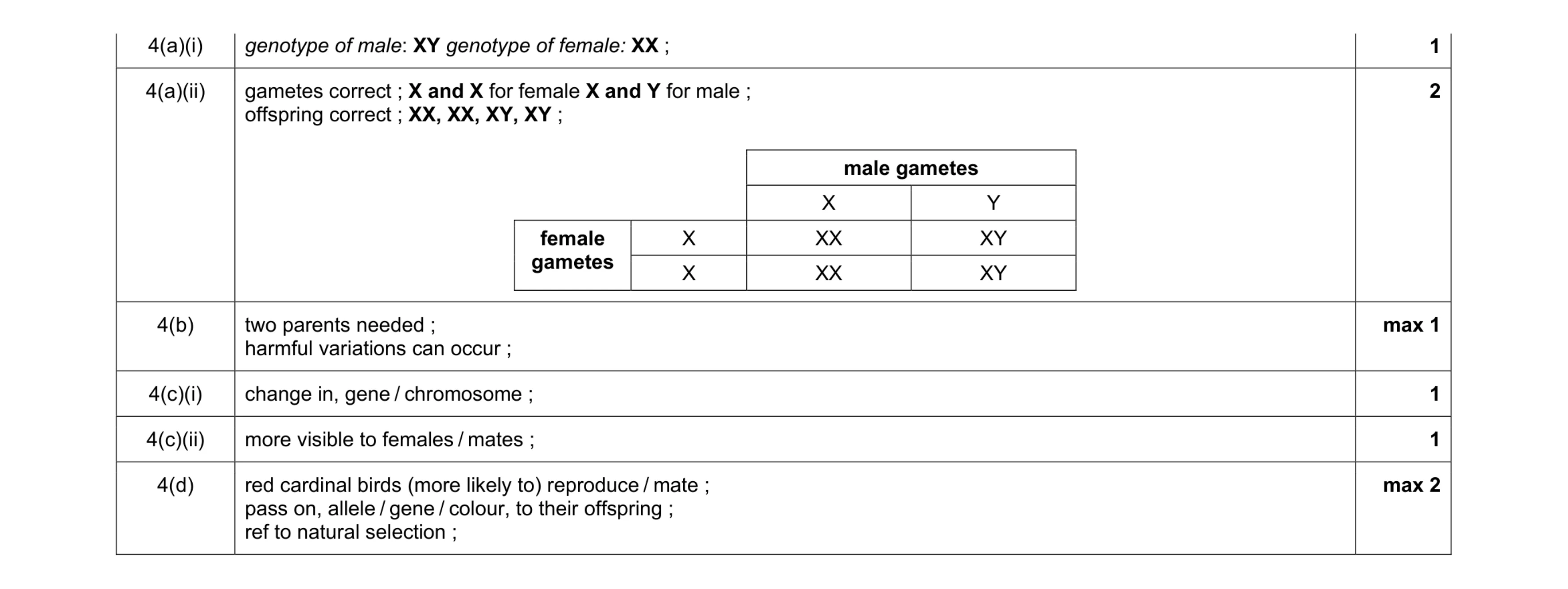 8
8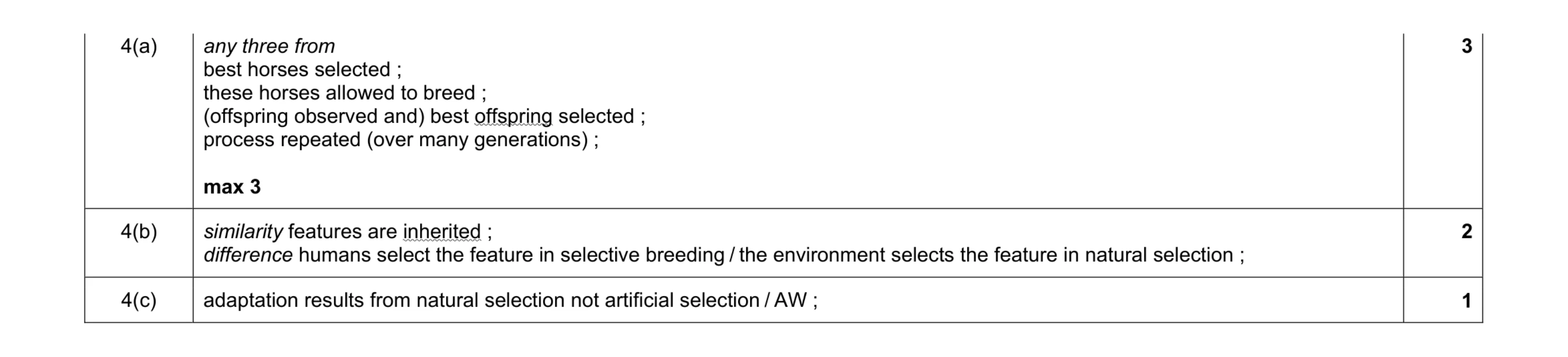 6
6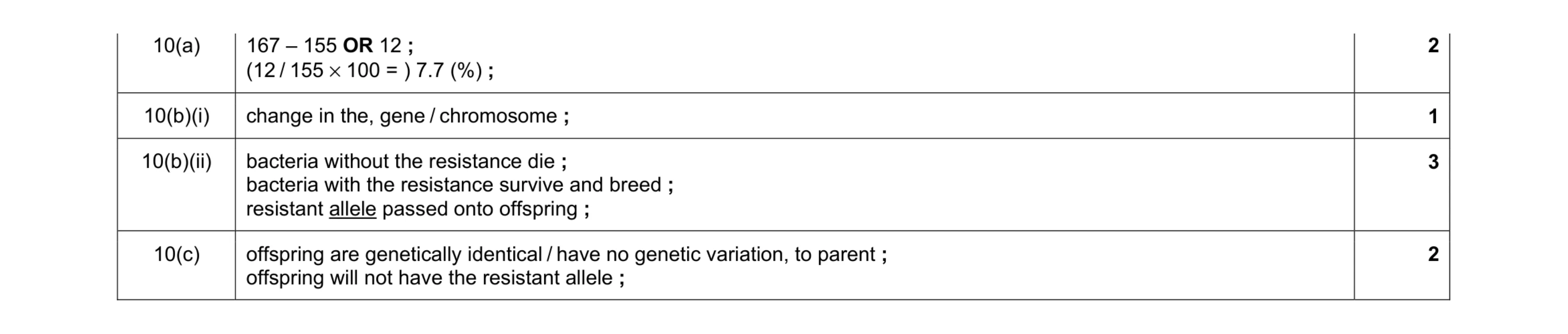 8
8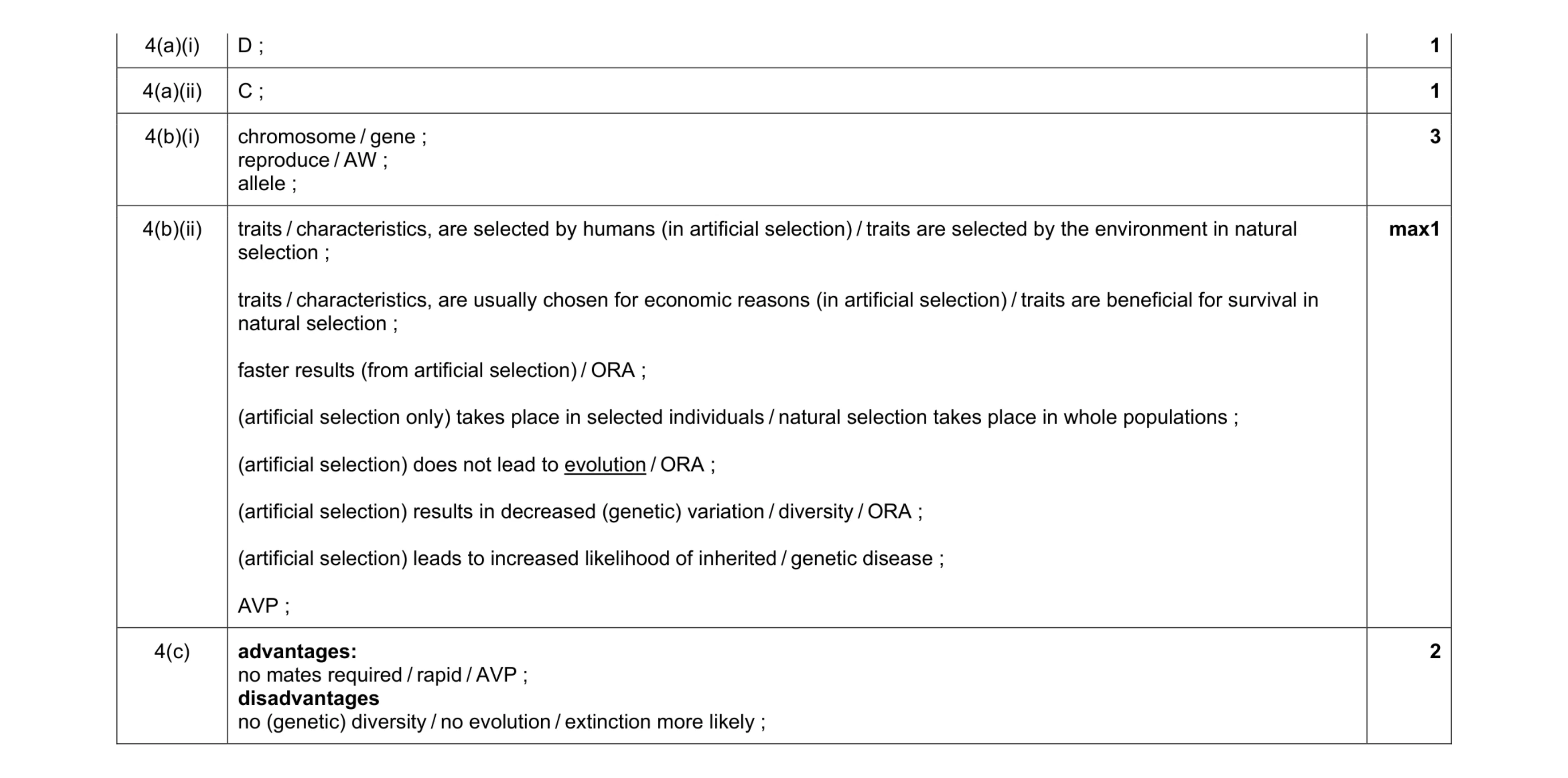 8
8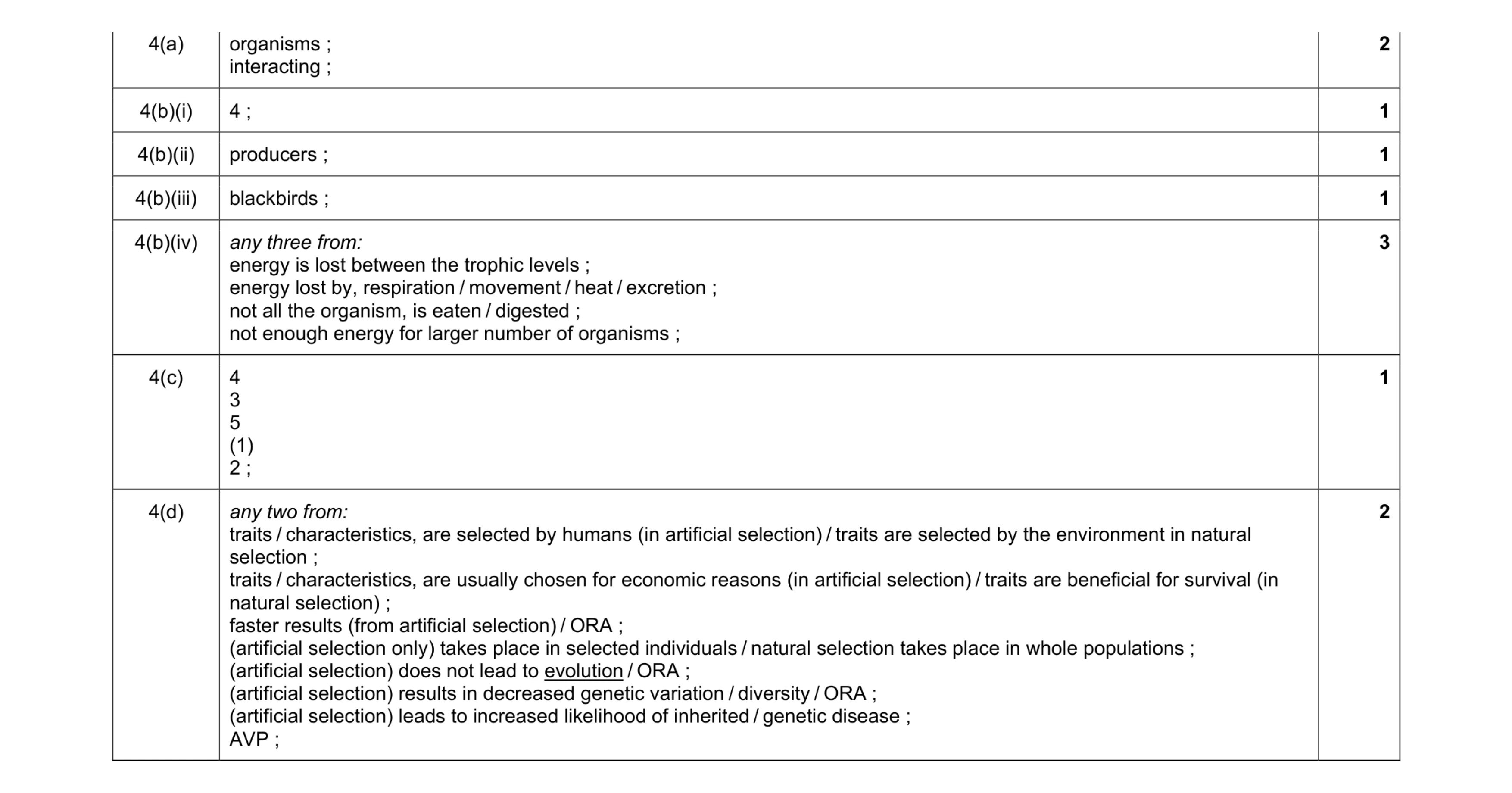 11
11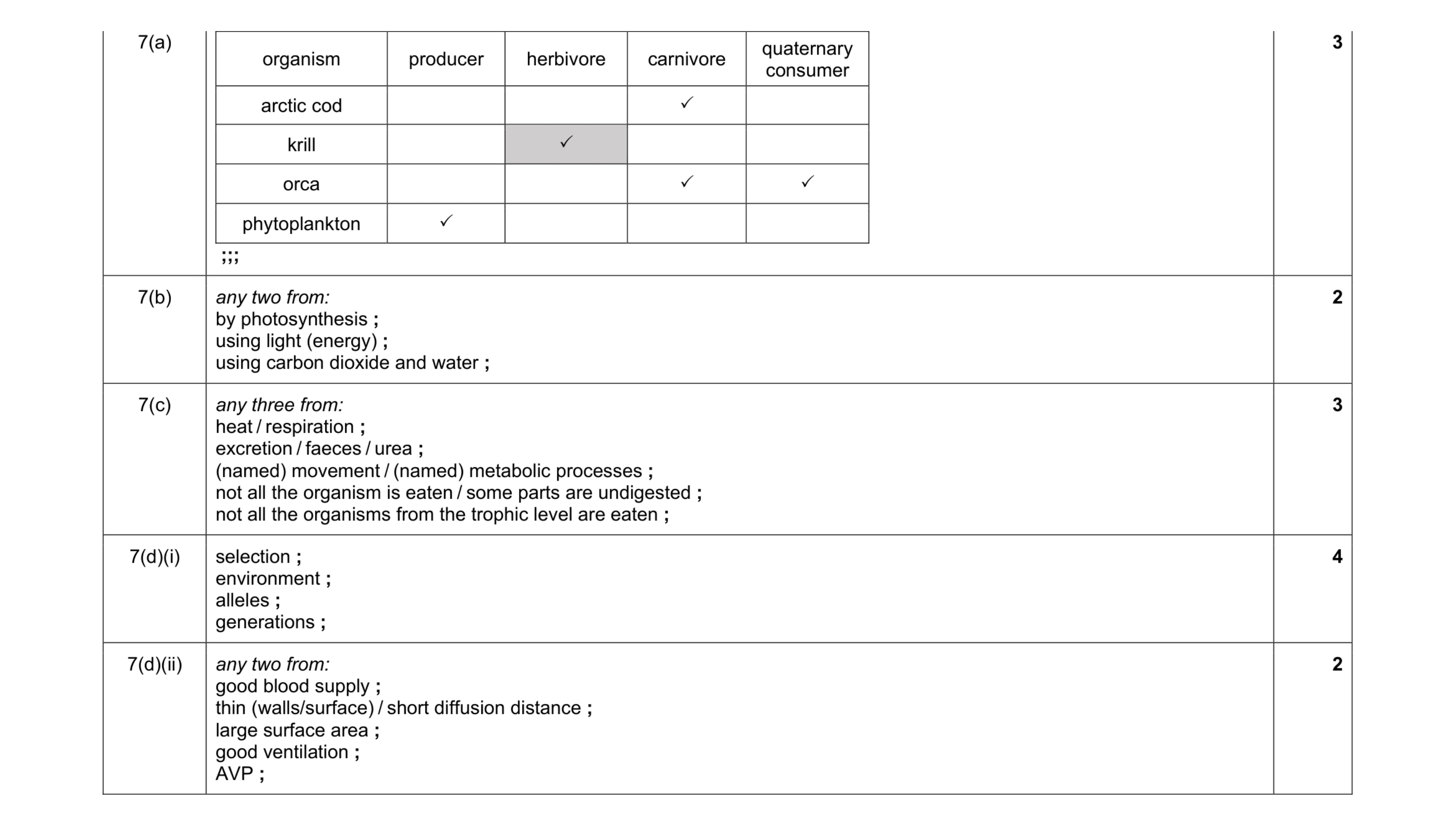 14
14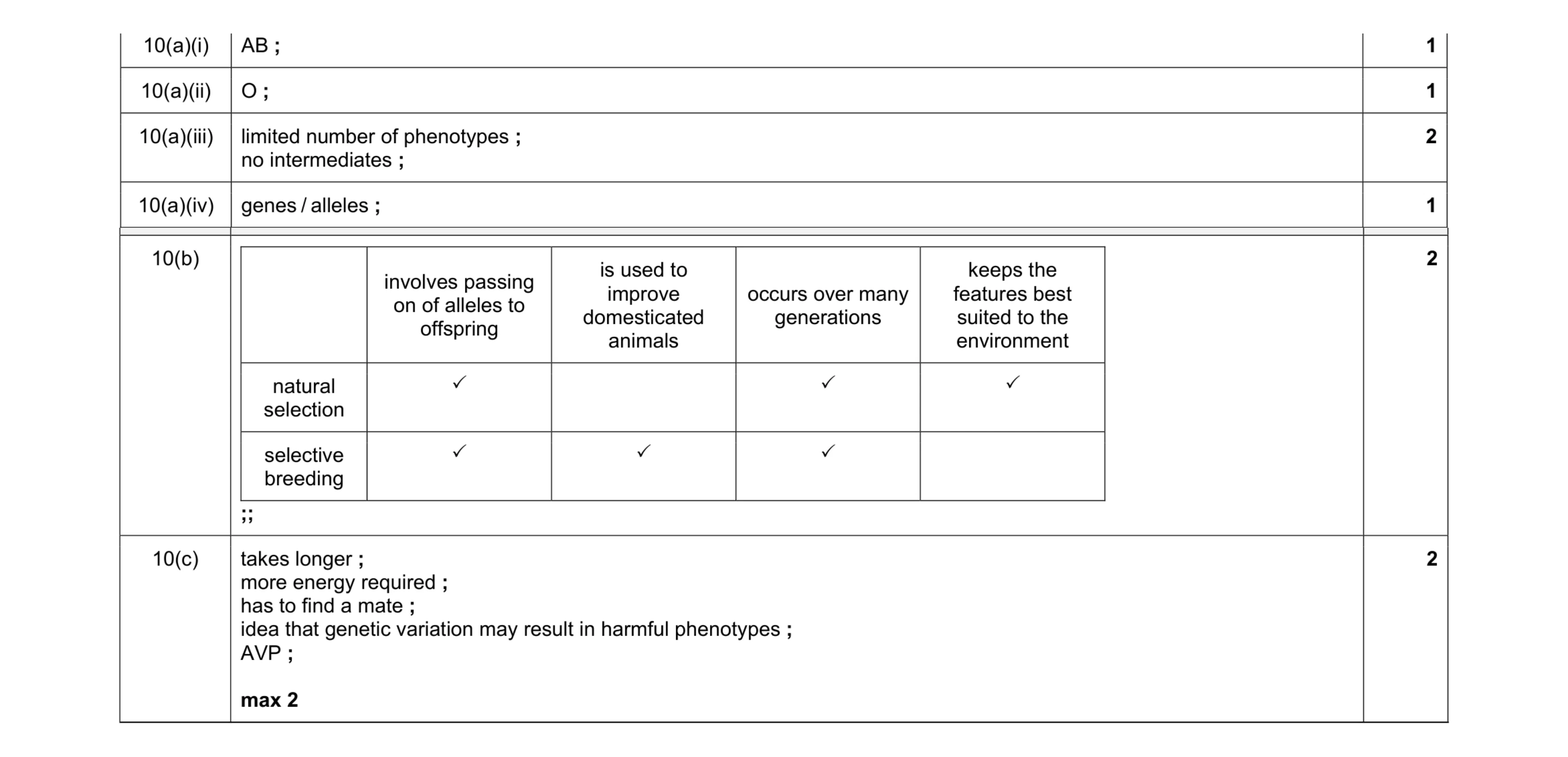 9
9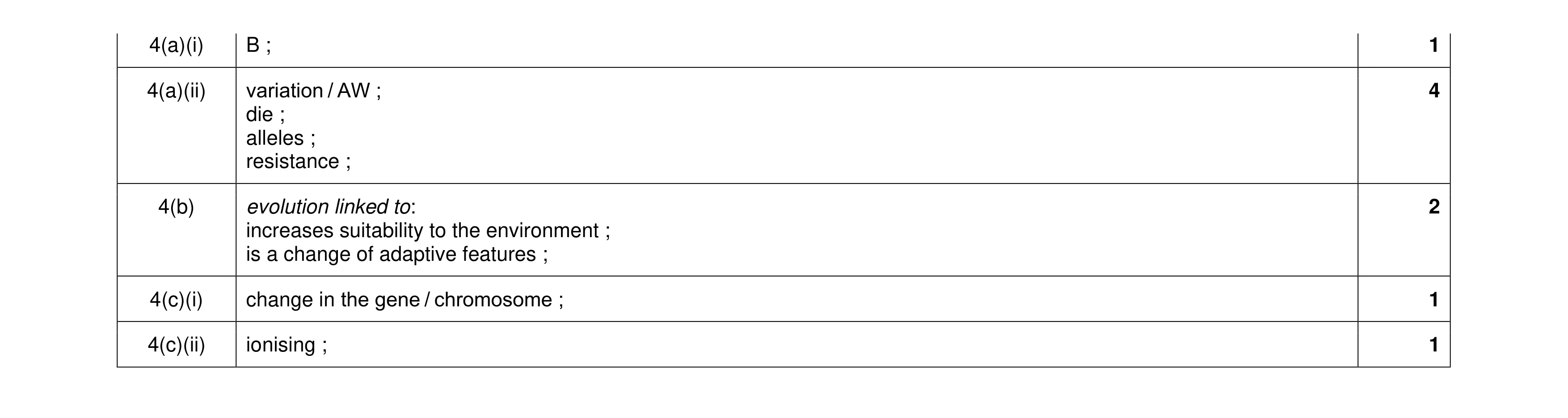 9
9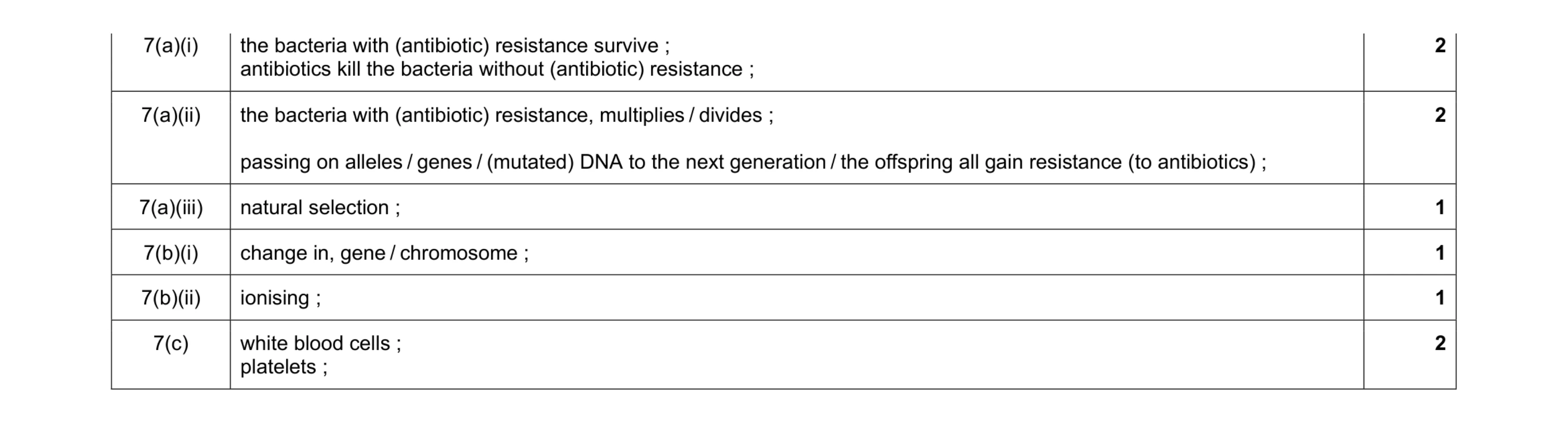 9
9 6
6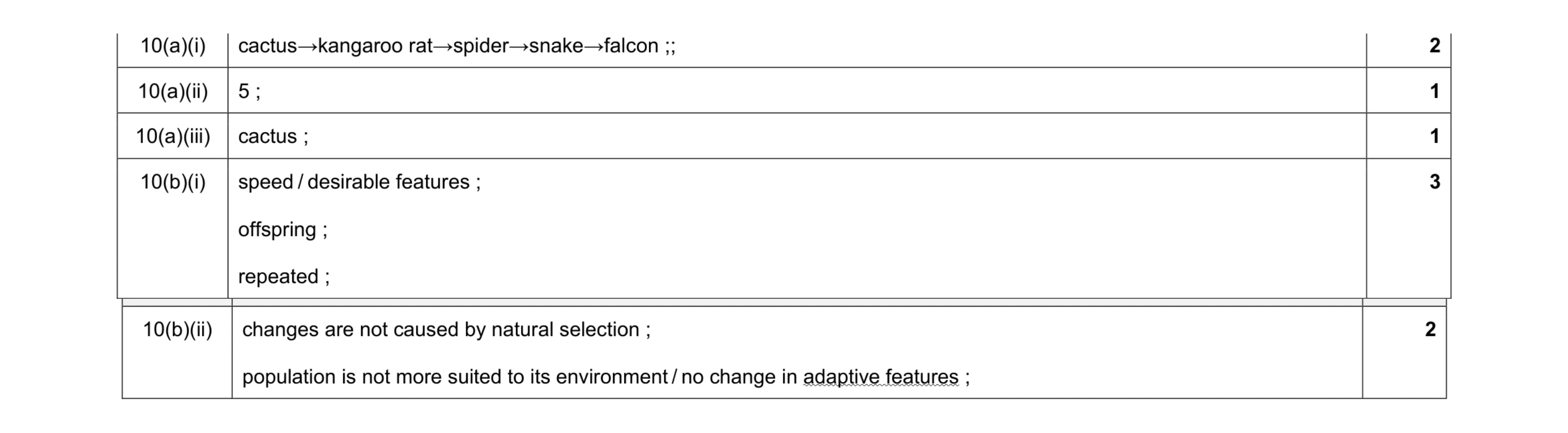 9
9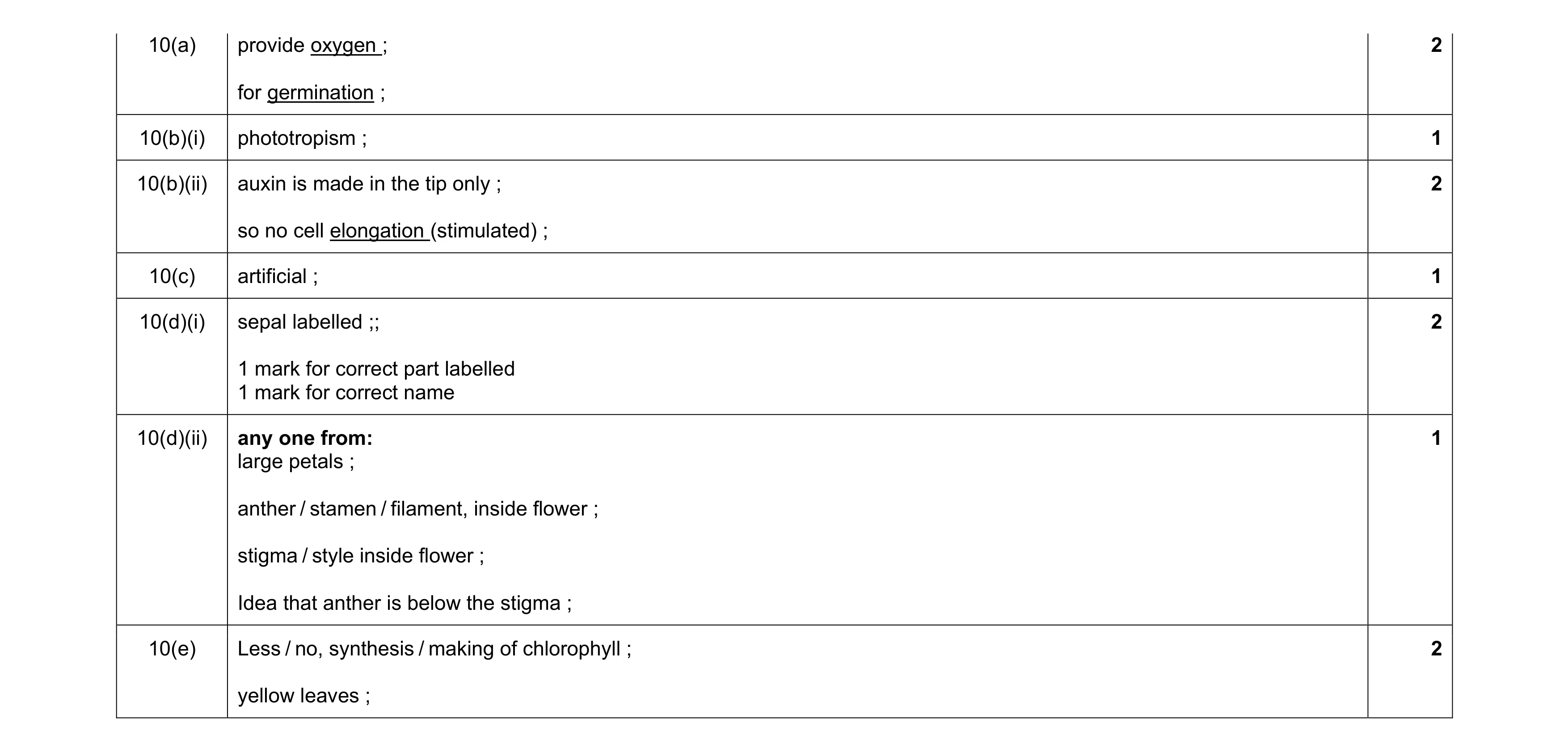 11
11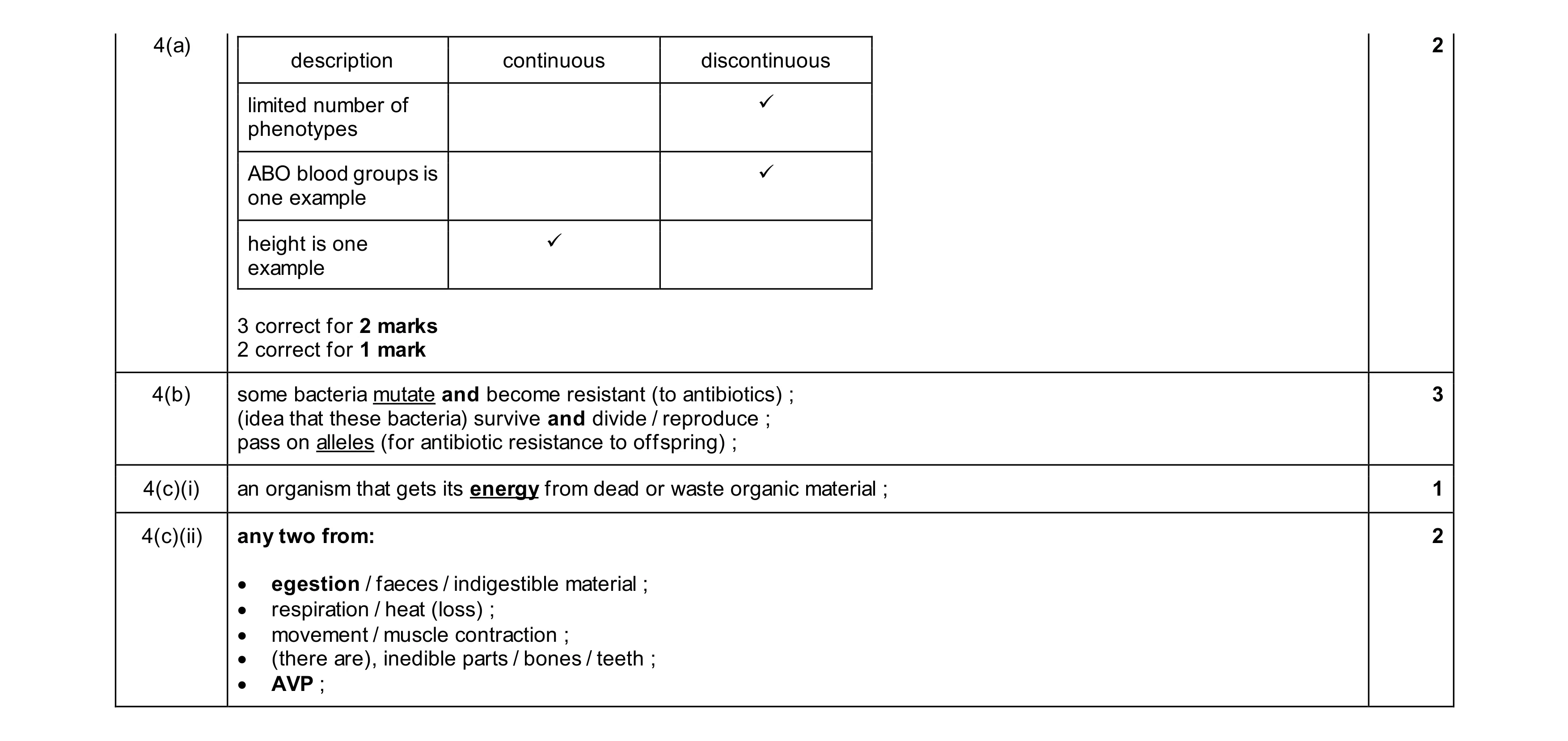 8
8