Questions as text
Q1 · Food chains show the flow of energy from one organism to another 0654/32 Oct/Nov 2017
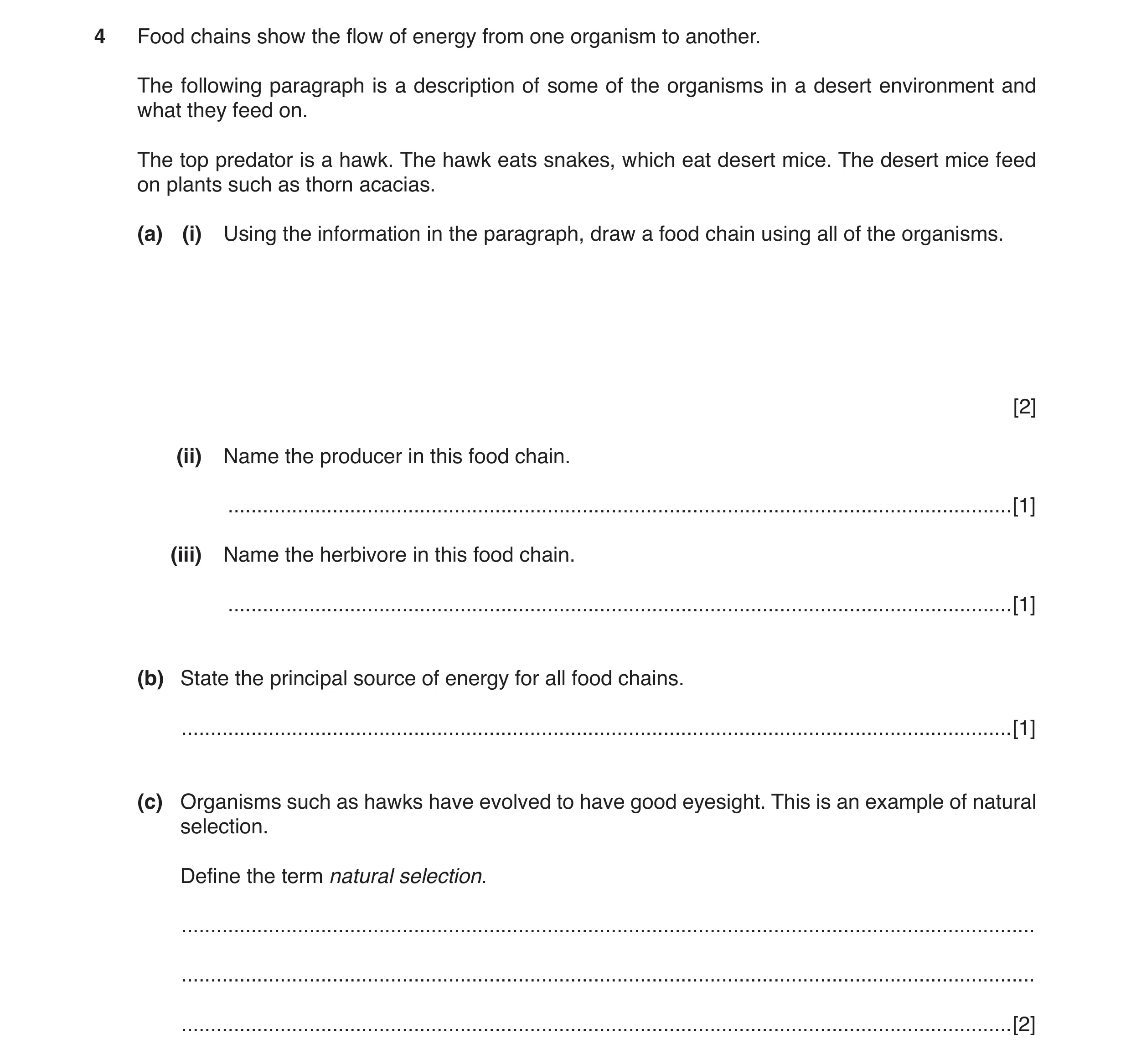
4 Food chains show the flow of energy from one organism to another. The following paragraph is a description of some of the organisms in a desert environment and what they feed on. The top predator is a hawk. The hawk eats snakes, which eat desert mice. The desert mice feed on plants such as thorn acacias. (a) (i) Using the information in the paragraph, draw a food chain using all of the organisms. [2] (ii) Name the producer in this food chain. … [1] (iii) Name the herbivore in this food chain. … [1] (b) State the principal source of energy for all food chains. … [1] (c) Organisms such as hawks have evolved to have good eyesight. This is an example of natural selection. Define the term natural selection. … … … [2]
7 marks
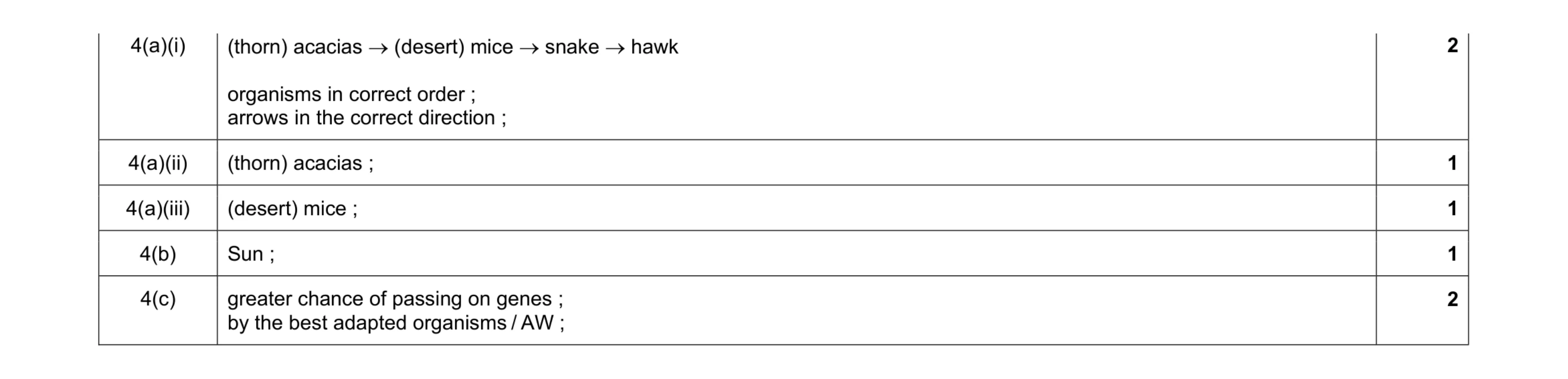
Mark scheme: 4(a)(i) organisms in correct order ; arrows in the correct direction ; 2 4(a)(ii) (thorn) acacias ; 1 4(a)(iii) (desert) mice ; 1 4(b) Sun ; 1 4(c) greater chance of passing on genes ; by the best adapted organisms / AW ; 2
This question in 0654/32 Oct/Nov 2017
Q2 · Describe the difference between phenotypic variation and genetic variation 0654/32 May/June 2019
10 (a) Describe the difference between phenotypic variation and genetic variation. … … … … [2] (b) A class investigated the number of students that are able to roll their tongues. Fig. 10.1 is a graph of the results. 30 25 20 number of students 15 10 5 0 can roll tongue cannot roll tongue ability to roll tongue Fig. 10.1 Use evidence from Fig. 10.1 to explain why this is an example of discontinuous variation. … … [1] (c) The list shows some examples of different types of variation. Place a tick (3) in the boxes to show all the examples of continuous variation. height foot length sex (gender) types of teeth mass [2] (d) Fig. 10.2 is a photograph of a giraffe, a mammal. Giraffes eat the leaves from branches on trees. Fig. 10.2 The ancestors of giraffes had shorter necks. Describe how giraffes developed long necks by natural selection. Use the words variation, competition and alleles in your answer. … … … … … … [4] [Total: 9]
9 marks
Mark scheme: 10(a) phenotypic variation are differences in the features we can observe ; genetic variation are differences in the genotype ; 2 10(b) there are a limited number of phenotypes (and no intermediates) ; 1 10(c) height ticked foot length ticked mass ticked 1 correct ; 3 correct ; 2 10(d) there is variation in the length of giraffes necks ; there is competition for resources / food ; giraffes with long necks survive ; passing on their alleles (for long necks) to offspring ; 4
This question in 0654/32 May/June 2019
Q3 · Describe the difference between phenotypic variation and genetic variation 0654/33 May/June 2019
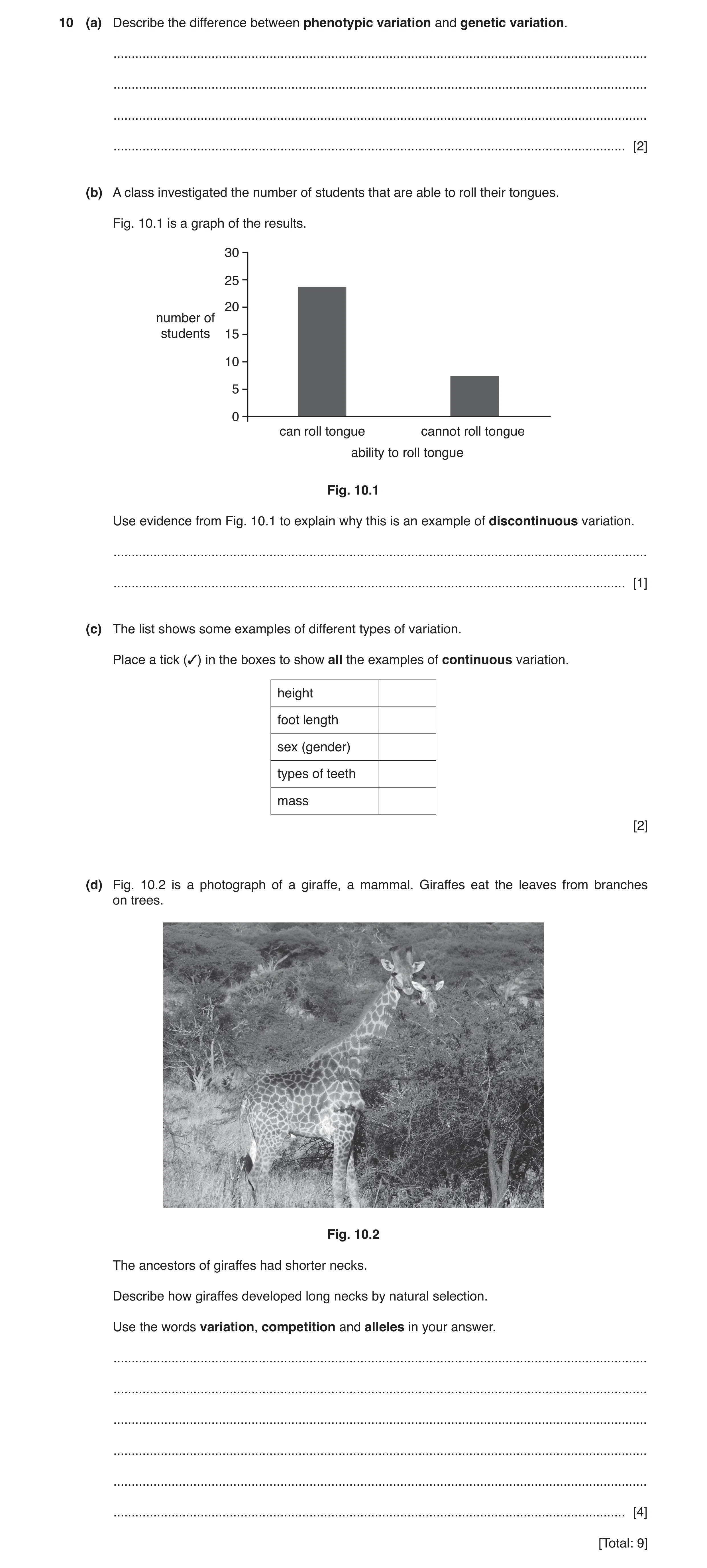
10 (a) Describe the difference between phenotypic variation and genetic variation. … … … … [2] (b) A class investigated the number of students that are able to roll their tongues. Fig. 10.1 is a graph of the results. 30 25 20 number of students 15 10 5 0 can roll tongue cannot roll tongue ability to roll tongue Fig. 10.1 Use evidence from Fig. 10.1 to explain why this is an example of discontinuous variation. … … [1] (c) The list shows some examples of different types of variation. Place a tick (3) in the boxes to show all the examples of continuous variation. height foot length sex (gender) types of teeth mass [2] (d) Fig. 10.2 is a photograph of a giraffe, a mammal. Giraffes eat the leaves from branches on trees. Fig. 10.2 The ancestors of giraffes had shorter necks. Describe how giraffes developed long necks by natural selection. Use the words variation, competition and alleles in your answer. … … … … … … [4] [Total: 9]
9 marks
Mark scheme: 10(a) phenotypic variation are differences in the features we can observe ; genetic variation are differences in the genotype ; 2 10(b) there are a limited number of phenotypes (and no intermediates) ; 1 10(c) height ticked foot length ticked mass ticked 1 correct ; 3 correct ; 2 10(d) there is variation in the length of giraffes necks ; there is competition for resources / food ; giraffes with long necks survive ; passing on their alleles (for long necks) to offspring ; 4
This question in 0654/33 May/June 2019
Q4 · A teacher measured the height of the students in a class to the nearest cm 0654/31 May/June 2020
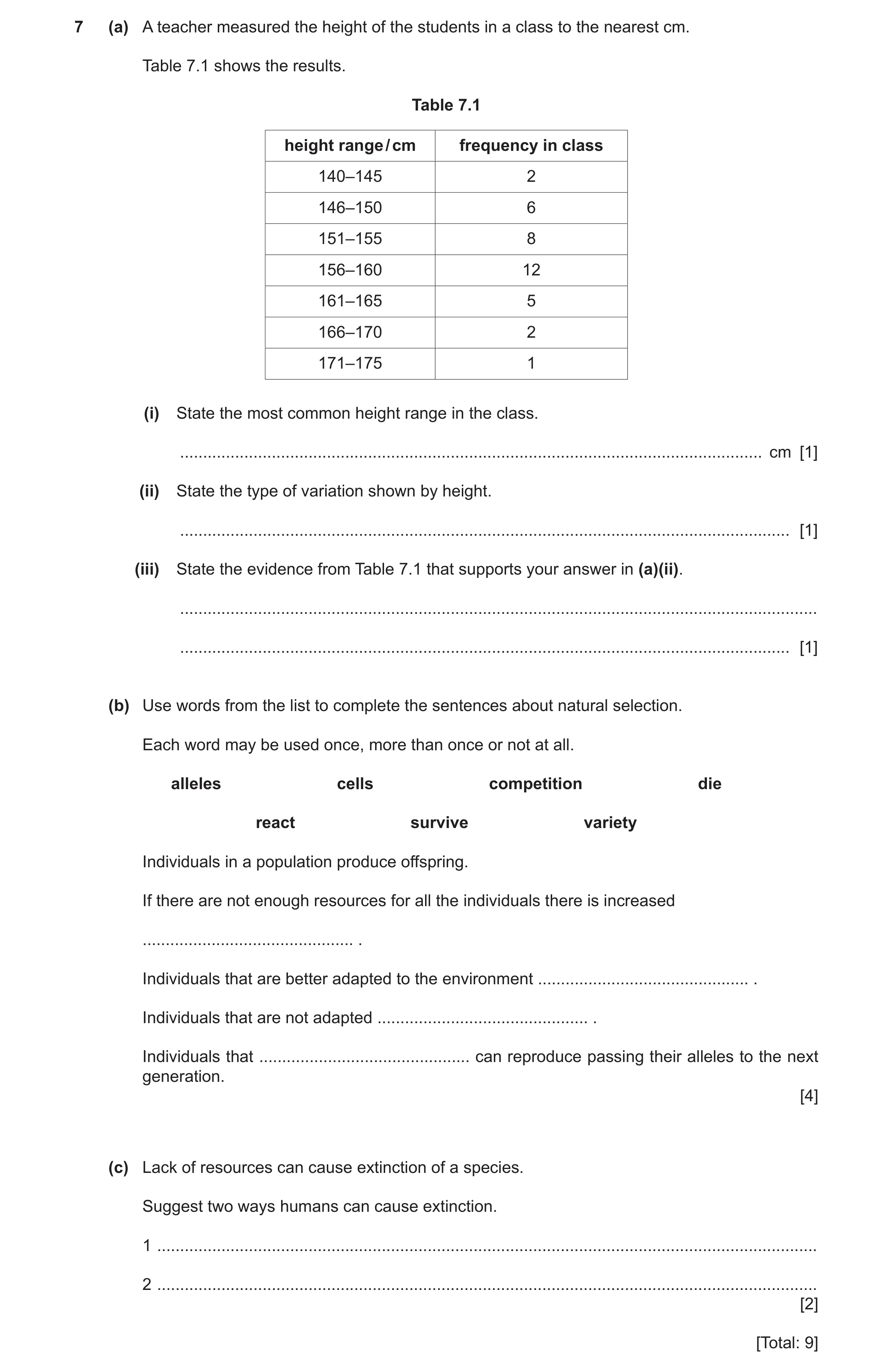
7 (a) A teacher measured the height of the students in a class to the nearest cm. Table 7.1 shows the results. Table 7.1 height range / cm frequency in class 140–145 2 146–150 6 151–155 8 156–160 12 161–165 5 166–170 2 171–175 1 (i) State the most common height range in the class. … cm [1] (ii) State the type of variation shown by height. … [1] (iii) State the evidence from Table 7.1 that supports your answer in (a)(ii). … … [1] (b) Use words from the list to complete the sentences about natural selection. Each word may be used once, more than once or not at all. alleles cells competition die react survive variety Individuals in a population produce offspring. If there are not enough resources for all the individuals there is increased … . Individuals that are better adapted to the environment … . Individuals that are not adapted … . Individuals that … can reproduce passing their alleles to the next generation. [4] (c) Lack of resources can cause extinction of a species. Suggest two ways humans can cause extinction. 1 … 2 … [2] [Total: 9]
9 marks
Mark scheme: 7(a)(i) 156 – 160 (cm) ; 1 7(a)(ii) continuous ; 1 7(a)(iii) height is a range (between two extremes) / not distinct categories ; 1 Question Answer Marks 7(b) competition ; survive ; die ; survive ; 4 7(c) any two from: pollution hunting deforestation / any change of land use introducing new disease introducing new (competitive) species ;; 2
This question in 0654/31 May/June 2020
Question 5 0654/32 May/June 2020
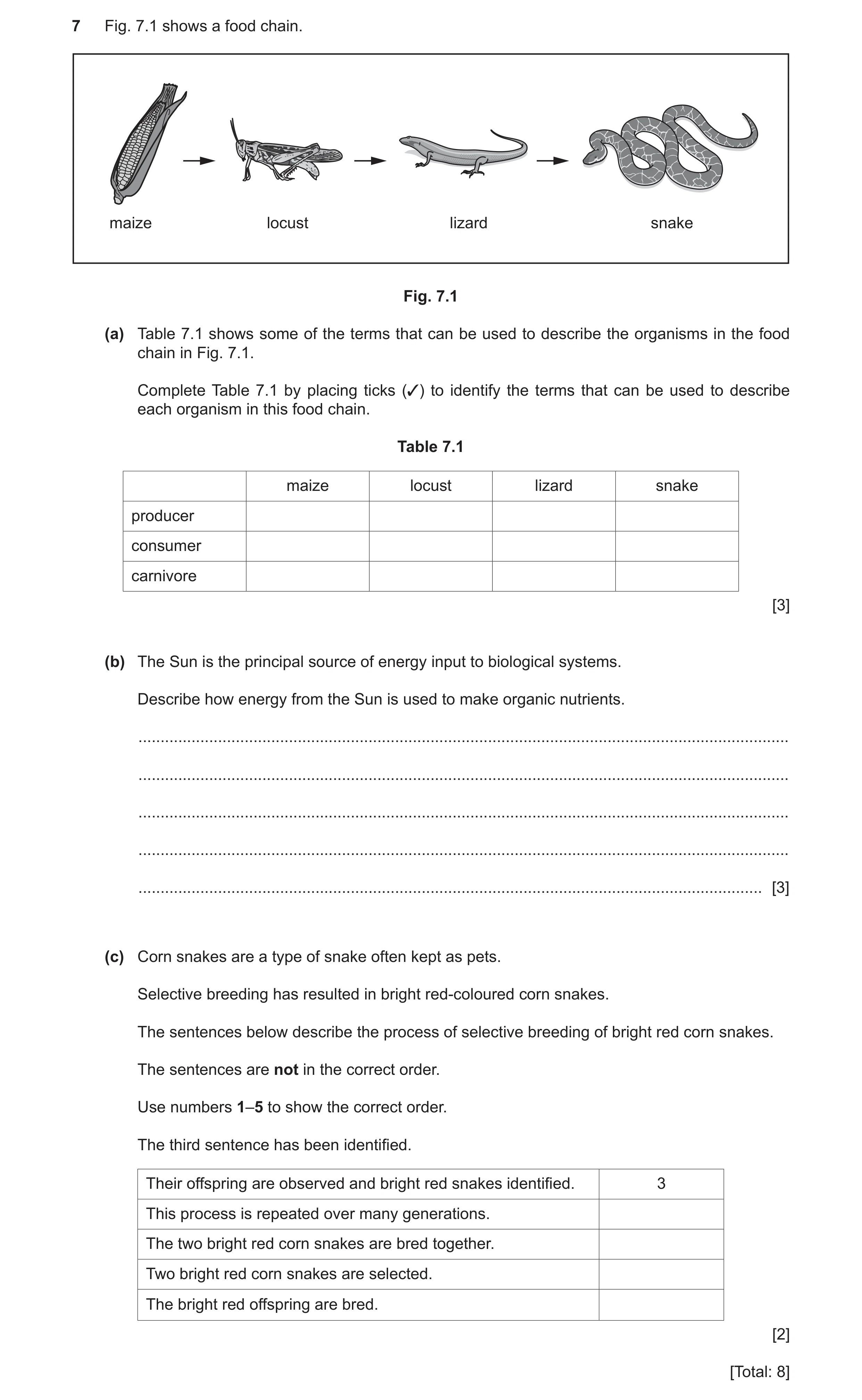
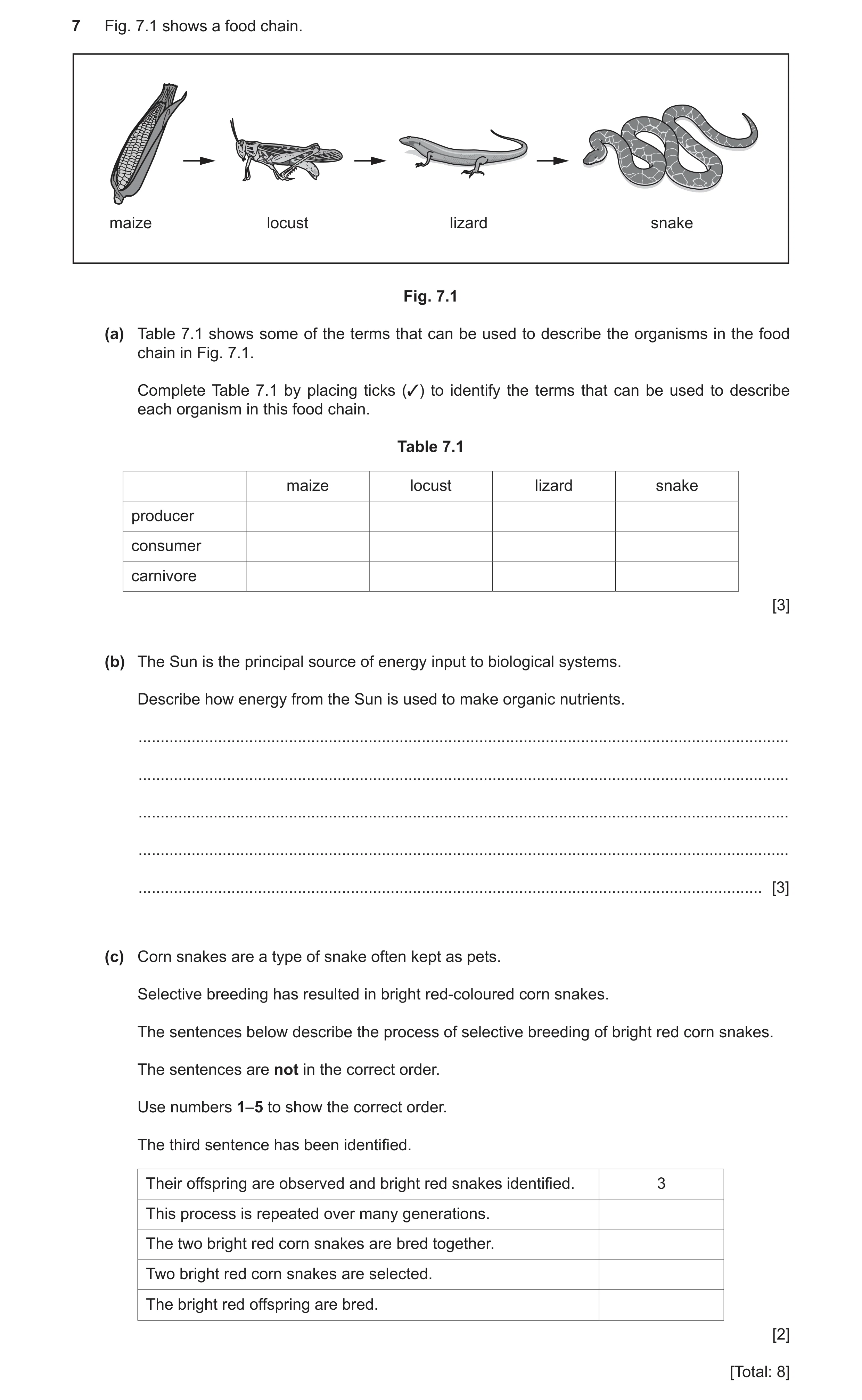
7 Fig. 7.1 shows a food chain. maize locust lizard snake Fig. 7.1 (a) Table 7.1 shows some of the terms that can be used to describe the organisms in the food chain in Fig. 7.1. Complete Table 7.1 by placing ticks (3) to identify the terms that can be used to describe each organism in this food chain. Table 7.1 maize locust lizard snake producer consumer carnivore [3] (b) The Sun is the principal source of energy input to biological systems. Describe how energy from the Sun is used to make organic nutrients. … … … … … [3] (c) Corn snakes are a type of snake often kept as pets. Selective breeding has resulted in bright red-coloured corn snakes. The sentences below describe the process of selective breeding of bright red corn snakes. The sentences are not in the correct order. Use numbers 1–5 to show the correct order. The third sentence has been identified. Their offspring are observed and bright red snakes identified. 3 This process is repeated over many generations. The two bright red corn snakes are bred together. Two bright red corn snakes are selected. The bright red offspring are bred. [2] [Total: 8]
8 marks
Mark scheme: 7(a) producer – maize ticked ; consumer – locust, lizard and snake ticked ; carnivore – lizard and snake ticked ; 3 7(b) ref to photosynthesis ; light energy used ; by producers / plants ; to make carbohydrates ; max 3 7(c) 3 5 2 1 4 ;; 5 at the top and 4 at the bottom for 1 mark 2, 1 in the correct order for 1 mark 2
This question in 0654/32 May/June 2020
Question 6 0654/33 May/June 2020
7 Fig. 7.1 shows a food chain. maize locust lizard snake Fig. 7.1 (a) Table 7.1 shows some of the terms that can be used to describe the organisms in the food chain in Fig. 7.1. Complete Table 7.1 by placing ticks (3) to identify the terms that can be used to describe each organism in this food chain. Table 7.1 maize locust lizard snake producer consumer carnivore [3] (b) The Sun is the principal source of energy input to biological systems. Describe how energy from the Sun is used to make organic nutrients. … … … … … [3] (c) Corn snakes are a type of snake often kept as pets. Selective breeding has resulted in bright red-coloured corn snakes. The sentences below describe the process of selective breeding of bright red corn snakes. The sentences are not in the correct order. Use numbers 1–5 to show the correct order. The third sentence has been identified. Their offspring are observed and bright red snakes identified. 3 This process is repeated over many generations. The two bright red corn snakes are bred together. Two bright red corn snakes are selected. The bright red offspring are bred. [2] [Total: 8]
8 marks
Mark scheme: 7(a) producer – maize ticked ; consumer – locust, lizard and snake ticked ; carnivore – lizard and snake ticked ; 3 7(b) ref to photosynthesis ; light energy used ; by producers / plants ; to make carbohydrates ; max 3 7(c) 3 5 2 1 4 ;; 5 at the top and 4 at the bottom for 1 mark 2, 1 in the correct order for 1 mark 2
This question in 0654/33 May/June 2020
Q7 · A farmer keeps ponies 0654/32 Feb/March 2021
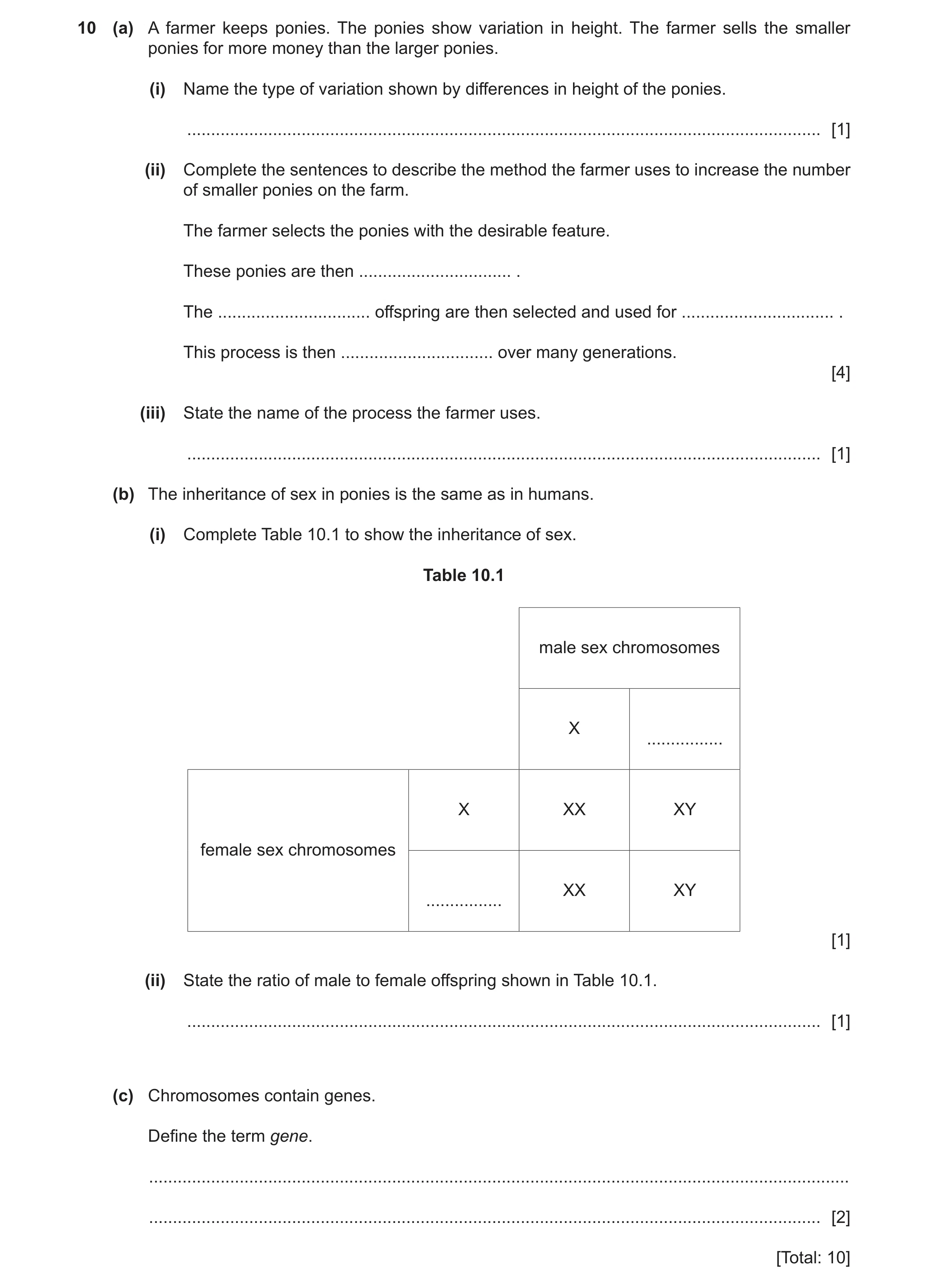
10 (a) A farmer keeps ponies. The ponies show variation in height. The farmer sells the smaller ponies for more money than the larger ponies. (i) Name the type of variation shown by differences in height of the ponies. … [1] (ii) Complete the sentences to describe the method the farmer uses to increase the number of smaller ponies on the farm. The farmer selects the ponies with the desirable feature. These ponies are then … . The … offspring are then selected and used for … . This process is then … over many generations. [4] (iii) State the name of the process the farmer uses. … [1] (b) The inheritance of sex in ponies is the same as in humans. (i) Complete Table 10.1 to show the inheritance of sex. Table 10.1 male sex chromosomes X … X XX XY female sex chromosomes XX XY … [1] (ii) State the ratio of male to female offspring shown in Table 10.1. … [1] (c) Chromosomes contain genes. Define the term gene. … … [2] [Total: 10]
10 marks
Mark scheme: 10(a)(i) continuous ; 1 10(a)(ii) crossed / bred / AW ; smallest ; breeding ; repeated ; 4 10(a)(iii) selective breeding ; 1 Question Answer Marks 10(b)(i) X Y X XX XY X XX XY ; 1 10(b)(ii) 1:1 ; 1 10(c) length of DNA ; that codes for a protein ; 2
This question in 0654/32 Feb/March 2021
Q8 · A school investigates variation in one class 0654/32 May/June 2023
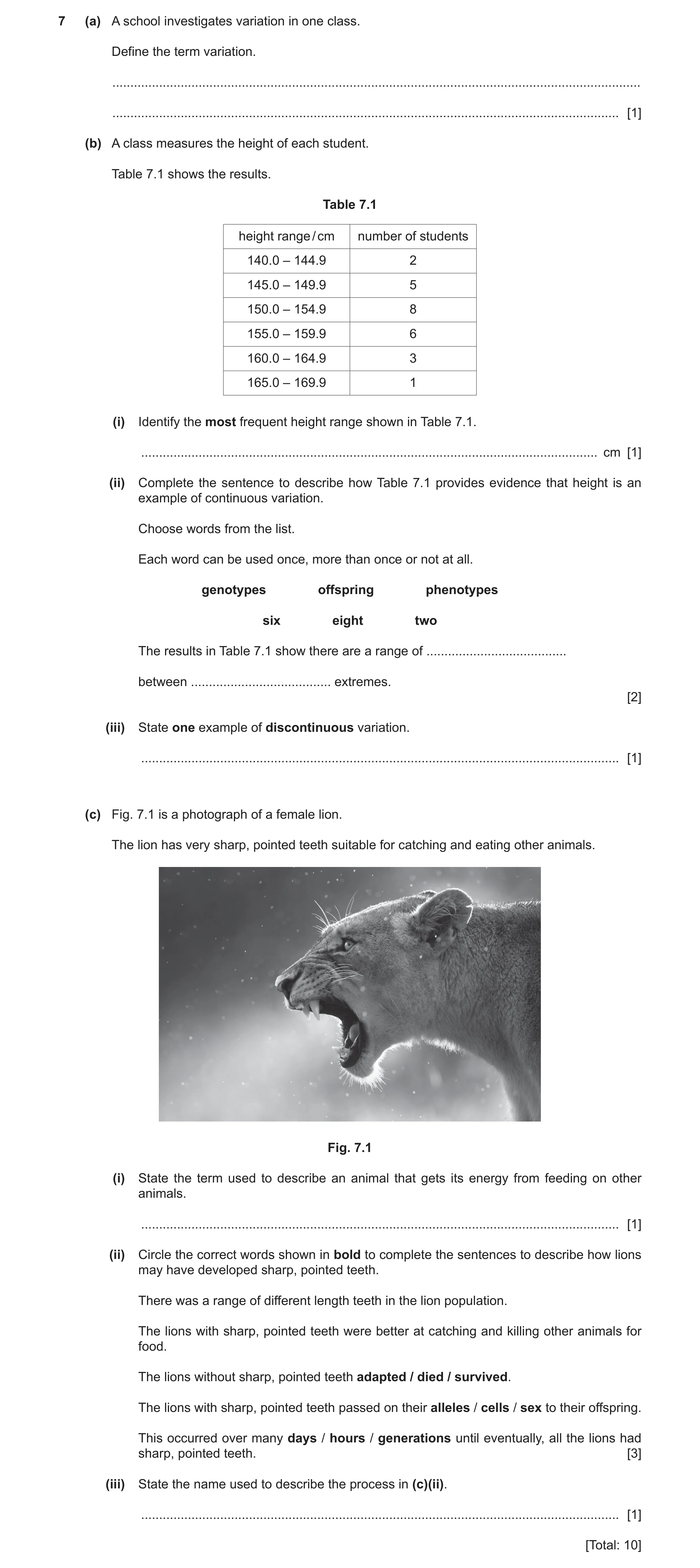
7 (a) A school investigates variation in one class. Define the term variation. … … [1] (b) A class measures the height of each student. Table 7.1 shows the results. Table 7.1 height range / cm number of students 140.0 – 144.9 2 145.0 – 149.9 5 150.0 – 154.9 8 155.0 – 159.9 6 160.0 – 164.9 3 165.0 – 169.9 1 (i) Identify the most frequent height range shown in Table 7.1. … cm [1] (ii) Complete the sentence to describe how Table 7.1 provides evidence that height is an example of continuous variation. Choose words from the list. Each word can be used once, more than once or not at all. genotypes offspring phenotypes six eight two The results in Table 7.1 show there are a range of … between … extremes. [2] (iii) State one example of discontinuous variation. … [1] (c) Fig. 7.1 is a photograph of a female lion. The lion has very sharp, pointed teeth suitable for catching and eating other animals. Fig. 7.1 (i) State the term used to describe an animal that gets its energy from feeding on other animals. … [1] (ii) Circle the correct words shown in bold to complete the sentences to describe how lions may have developed sharp, pointed teeth. There was a range of different length teeth in the lion population. The lions with sharp, pointed teeth were better at catching and killing other animals for food. The lions without sharp, pointed teeth adapted / died / survived. The lions with sharp, pointed teeth passed on their alleles / cells / sex to their offspring. This occurred over many days / hours / generations until eventually, all the lions had sharp, pointed teeth. [3] (iii) State the name used to describe the process in (c)(ii). … [1] [Total: 10]
10 marks
Mark scheme: 7(a) differences between individuals (of the same species) / AW ; 1 7(b)(i) 150.0–154.9 (cm) ; 1 7(b)(ii) phenotypes ; two ; 2 7(b)(iii) tongue rolling / AVP ; 1 7(c)(i) carnivore ; 1 7(c)(ii) died ; alleles ; generations ; 3 7(c)(iii) natural selection ; 1
This question in 0654/32 May/June 2023
Q9 · A school investigates variation in one class 0654/33 May/June 2023
7 (a) A school investigates variation in one class. Define the term variation. … … [1] (b) A class measures the height of each student. Table 7.1 shows the results. Table 7.1 height range / cm number of students 140.0 – 144.9 2 145.0 – 149.9 5 150.0 – 154.9 8 155.0 – 159.9 6 160.0 – 164.9 3 165.0 – 169.9 1 (i) Identify the most frequent height range shown in Table 7.1. … cm [1] (ii) Complete the sentence to describe how Table 7.1 provides evidence that height is an example of continuous variation. Choose words from the list. Each word can be used once, more than once or not at all. genotypes offspring phenotypes six eight two The results in Table 7.1 show there are a range of … between … extremes. [2] (iii) State one example of discontinuous variation. … [1] (c) Fig. 7.1 is a photograph of a female lion. The lion has very sharp, pointed teeth suitable for catching and eating other animals. Fig. 7.1 (i) State the term used to describe an animal that gets its energy from feeding on other animals. … [1] (ii) Circle the correct words shown in bold to complete the sentences to describe how lions may have developed sharp, pointed teeth. There was a range of different length teeth in the lion population. The lions with sharp, pointed teeth were better at catching and killing other animals for food. The lions without sharp, pointed teeth adapted / died / survived. The lions with sharp, pointed teeth passed on their alleles / cells / sex to their offspring. This occurred over many days / hours / generations until eventually, all the lions had sharp, pointed teeth. [3] (iii) State the name used to describe the process in (c)(ii). … [1] [Total: 10]
10 marks
Mark scheme: 7(a) differences between individuals (of the same species) / AW ; 1 7(b)(i) 150.0–154.9 (cm) ; 1 7(b)(ii) phenotypes ; two ; 2 7(b)(iii) tongue rolling / AVP ; 1 7(c)(i) carnivore ; 1 7(c)(ii) died ; alleles ; generations ; 3 7(c)(iii) natural selection ; 1
This question in 0654/33 May/June 2023
Q10 · Pea colour and shape are inherited characteristics that are controlled by a single gene 0654/32 Feb/March 2024
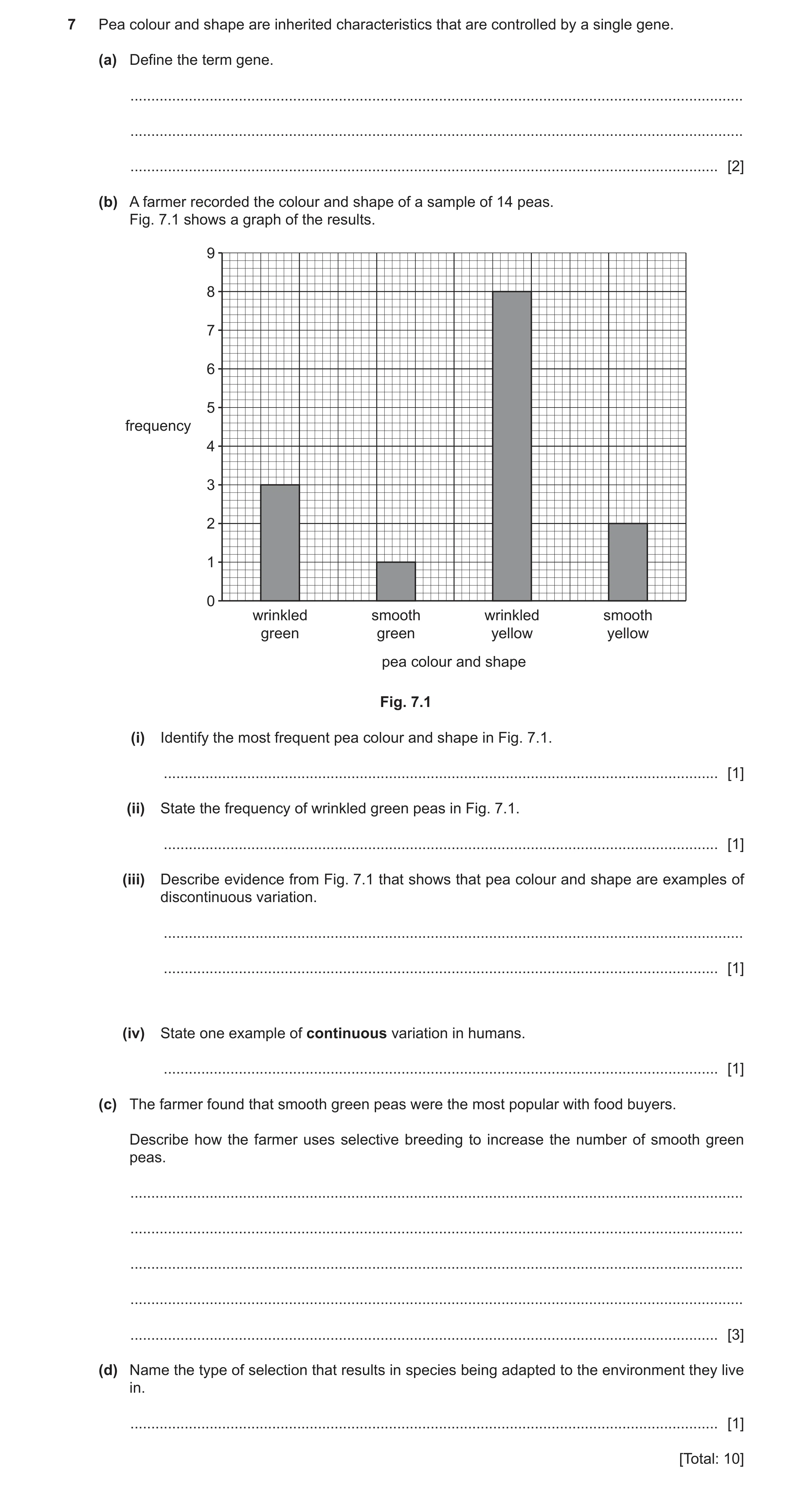
7 Pea colour and shape are inherited characteristics that are controlled by a single gene. (a) Define the term gene. … … … [2] (b) A farmer recorded the colour and shape of a sample of 14 peas. Fig. 7.1 shows a graph of the results. 9 8 7 6 5 frequency 4 3 2 1 0 wrinkled smooth wrinkled smooth green green yellow yellow pea colour and shape Fig. 7.1 (i) Identify the most frequent pea colour and shape in Fig. 7.1. … [1] (ii) State the frequency of wrinkled green peas in Fig. 7.1. … [1] (iii) Describe evidence from Fig. 7.1 that shows that pea colour and shape are examples of discontinuous variation. … … [1] (iv) State one example of continuous variation in humans. … [1] (c) The farmer found that smooth green peas were the most popular with food buyers. Describe how the farmer uses selective breeding to increase the number of smooth green peas. … … … … … [3] (d) Name the type of selection that results in species being adapted to the environment they live in. … [1] [Total: 10]
10 marks
Mark scheme: 7(a) length of DNA ; 2 that codes for a protein ; 7(b)(i) wrinkled yellow ; 1 7(b)(ii) 3 ; 1 7(b)(iii) there are, a limited number of phenotypes / no intermediates / AW ; 1 7(b)(iv) height / AVP ; 1 7(c) any two from: 3 farmer selects smooth green peas plants ; uses these plants to breed ; observes / selects, offspring (for smooth green peas) ; repeats the process (for many generations) ; 7(d) natural (selection) ; 1
This question in 0654/32 Feb/March 2024
Q11 · Scientists record the mass of each baby at birth in one country 0654/32 Oct/Nov 2024
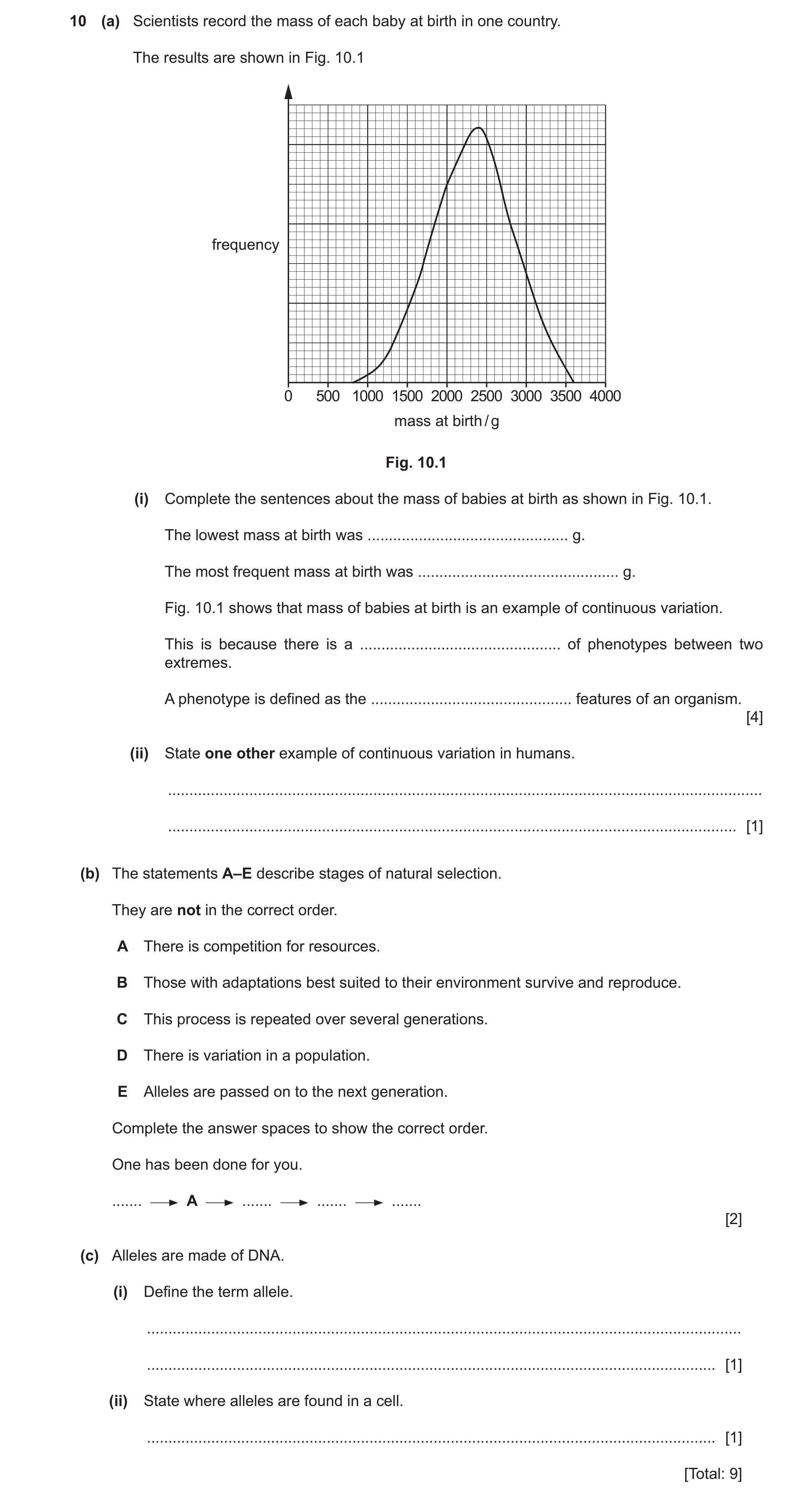
10 (a) Scientists record the mass of each baby at birth in one country. The results are shown in Fig. 10.1 frequency 0 500 1000 1500 2000 2500 3000 3500 4000 mass at birth / g Fig. 10.1 (i) Complete the sentences about the mass of babies at birth as shown in Fig. 10.1. The lowest mass at birth was … g. The most frequent mass at birth was … g. Fig. 10.1 shows that mass of babies at birth is an example of continuous variation. This is because there is a … of phenotypes between two extremes. A phenotype is defined as the … features of an organism. [4] (ii) State one other example of continuous variation in humans. … … [1] (b) The statements A–E describe stages of natural selection. They are not in the correct order. A There is competition for resources. B Those with adaptations best suited to their environment survive and reproduce. C This process is repeated over several generations. D There is variation in a population. E Alleles are passed on to the next generation. Complete the answer spaces to show the correct order. One has been done for you. … A … … … [2] (c) Alleles are made of DNA. (i) Define the term allele. … … [1] (ii) State where alleles are found in a cell. … [1] [Total: 9]
9 marks
Mark scheme: 10(a)(i) 800 (g) ; 4 2400 (g) ; range / AW ; observable / AW ; 10(a)(ii) height / AVP ; 1 10(b) D in first box ; 2 B, E, C ; 10(c)(i) a version of a gene ; 1 10(c)(ii) nucleus ; 1
This question in 0654/32 Oct/Nov 2024
Q12 · Scientists record the mass of each baby at birth in one country 0654/33 Oct/Nov 2024
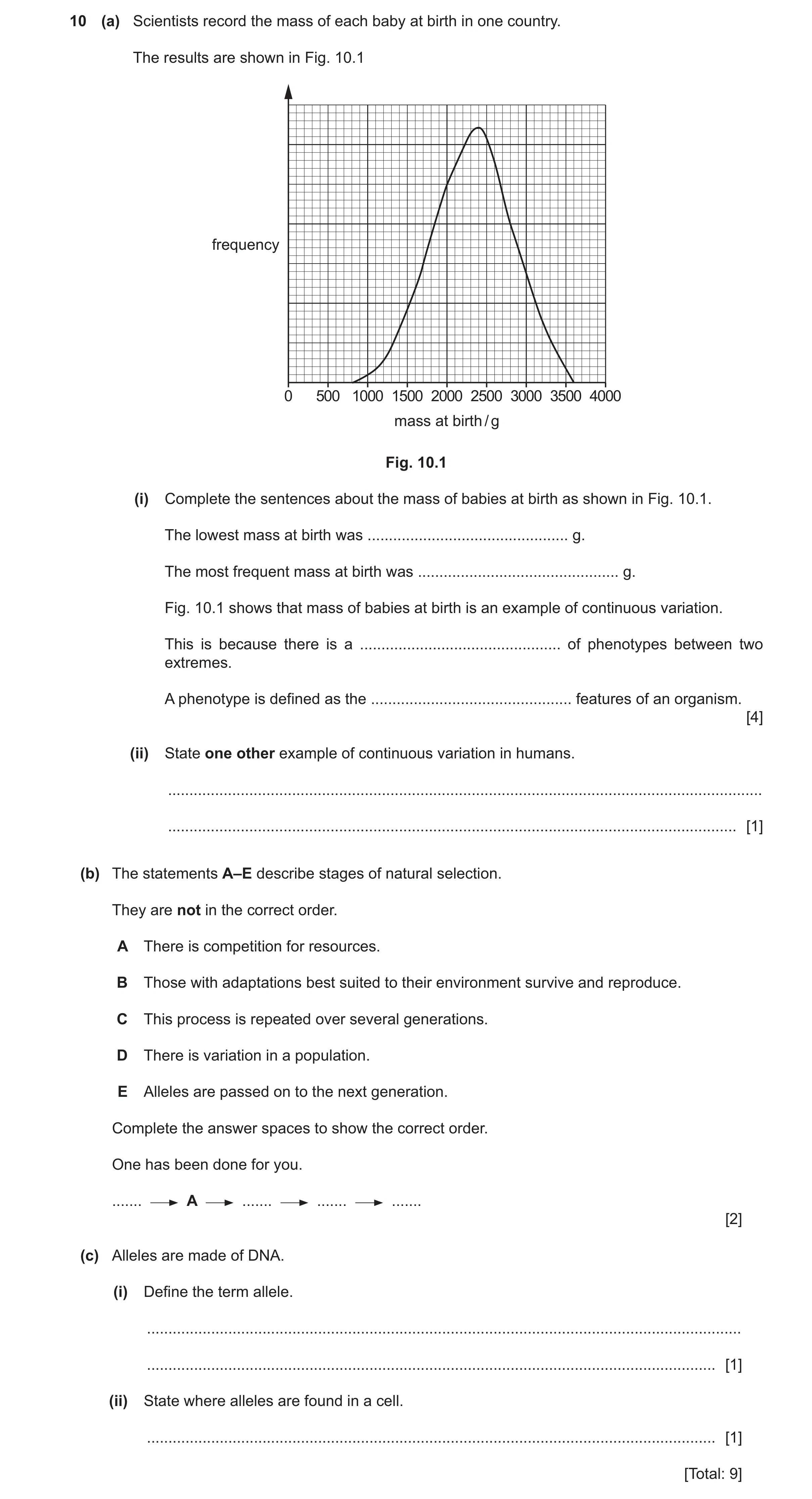
10 (a) Scientists record the mass of each baby at birth in one country. The results are shown in Fig. 10.1 frequency 0 500 1000 1500 2000 2500 3000 3500 4000 mass at birth / g Fig. 10.1 (i) Complete the sentences about the mass of babies at birth as shown in Fig. 10.1. The lowest mass at birth was … g. The most frequent mass at birth was … g. Fig. 10.1 shows that mass of babies at birth is an example of continuous variation. This is because there is a … of phenotypes between two extremes. A phenotype is defined as the … features of an organism. [4] (ii) State one other example of continuous variation in humans. … … [1] (b) The statements A–E describe stages of natural selection. They are not in the correct order. A There is competition for resources. B Those with adaptations best suited to their environment survive and reproduce. C This process is repeated over several generations. D There is variation in a population. E Alleles are passed on to the next generation. Complete the answer spaces to show the correct order. One has been done for you. … A … … … [2] (c) Alleles are made of DNA. (i) Define the term allele. … … [1] (ii) State where alleles are found in a cell. … [1] [Total: 9]
9 marks
Mark scheme: 10(a)(i) 800 (g) ; 4 2400 (g) ; range / AW ; observable / AW ; 10(a)(ii) height / AVP ; 1 10(b) D in first box ; 2 B, E, C ; 10(c)(i) a version of a gene ; 1 10(c)(ii) nucleus ; 1
This question in 0654/33 Oct/Nov 2024
Q13 · Complete the sentences using words from the list 0654/32 Feb/March 2025
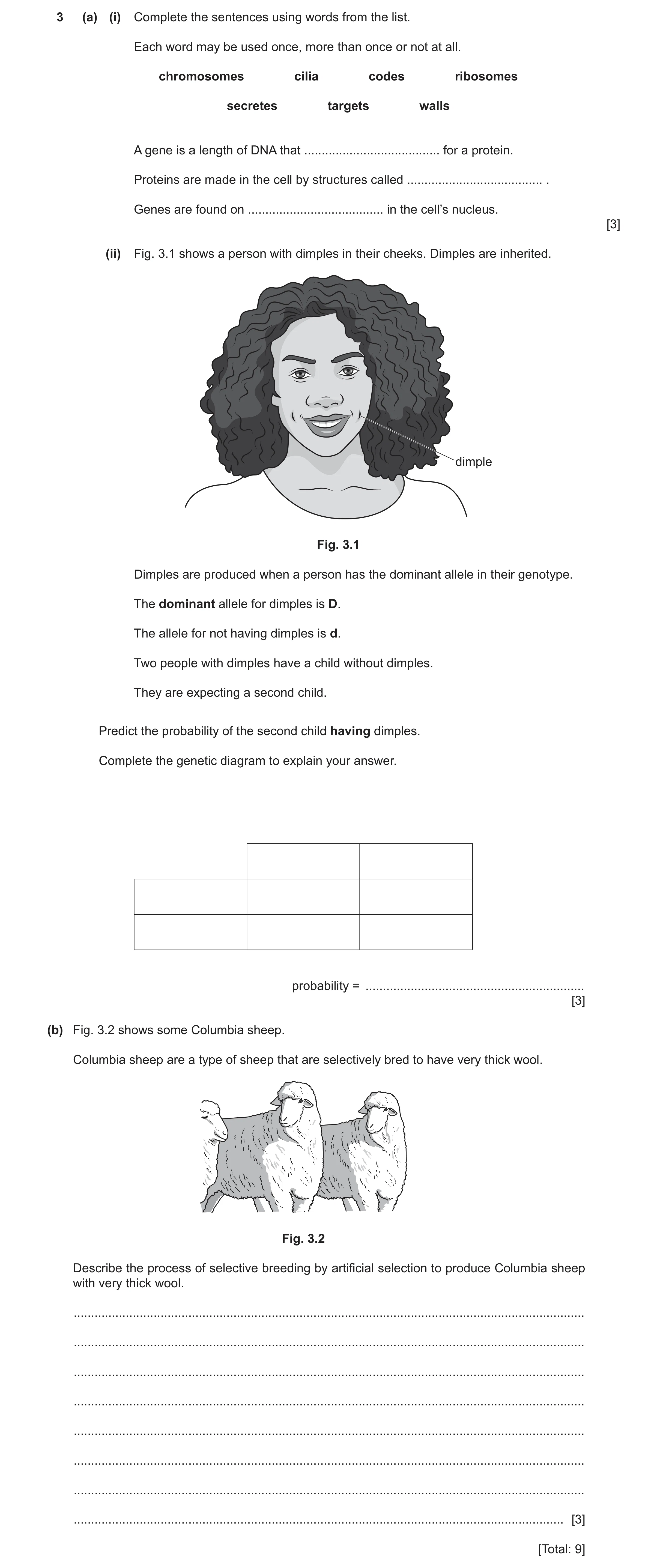
3 (a) (i) Complete the sentences using words from the list. Each word may be used once, more than once or not at all. chromosomes cilia codes ribosomes secretes targets walls A gene is a length of DNA that … for a protein. Proteins are made in the cell by structures called … . Genes are found on … in the cell’s nucleus. [3] (ii) Fig. 3.1 shows a person with dimples in their cheeks. Dimples are inherited. dimple Fig. 3.1 Dimples are produced when a person has the dominant allele in their genotype. The dominant allele for dimples is D. The allele for not having dimples is d. Two people with dimples have a child without dimples. They are expecting a second child. Predict the probability of the second child having dimples. Complete the genetic diagram to explain your answer. probability = … [3] (b) Fig. 3.2 shows some Columbia sheep. Columbia sheep are a type of sheep that are selectively bred to have very thick wool. Fig. 3.2 Describe the process of selective breeding by artificial selection to produce Columbia sheep with very thick wool. … … … … … … … … [3] [Total: 9]
9 marks
Mark scheme: 3(a)(i) codes ; 3 ribosomes ; chromosomes ; 3(a)(ii) 3 D d D DD Dd d Dd dd genotype of parents ; genotype of offspring ; probability = 75(% ) / 3 in 4 ; 3(b) any three from: 3 select sheep with desirable traits / thick(er) wool selected sheep breed together select offspring with desirable traits idea of repeating over many generations ; ; ;
This question in 0654/32 Feb/March 2025
Q14 · An ancestor of the modern‑day elephant 0654/32 Oct/Nov 2025
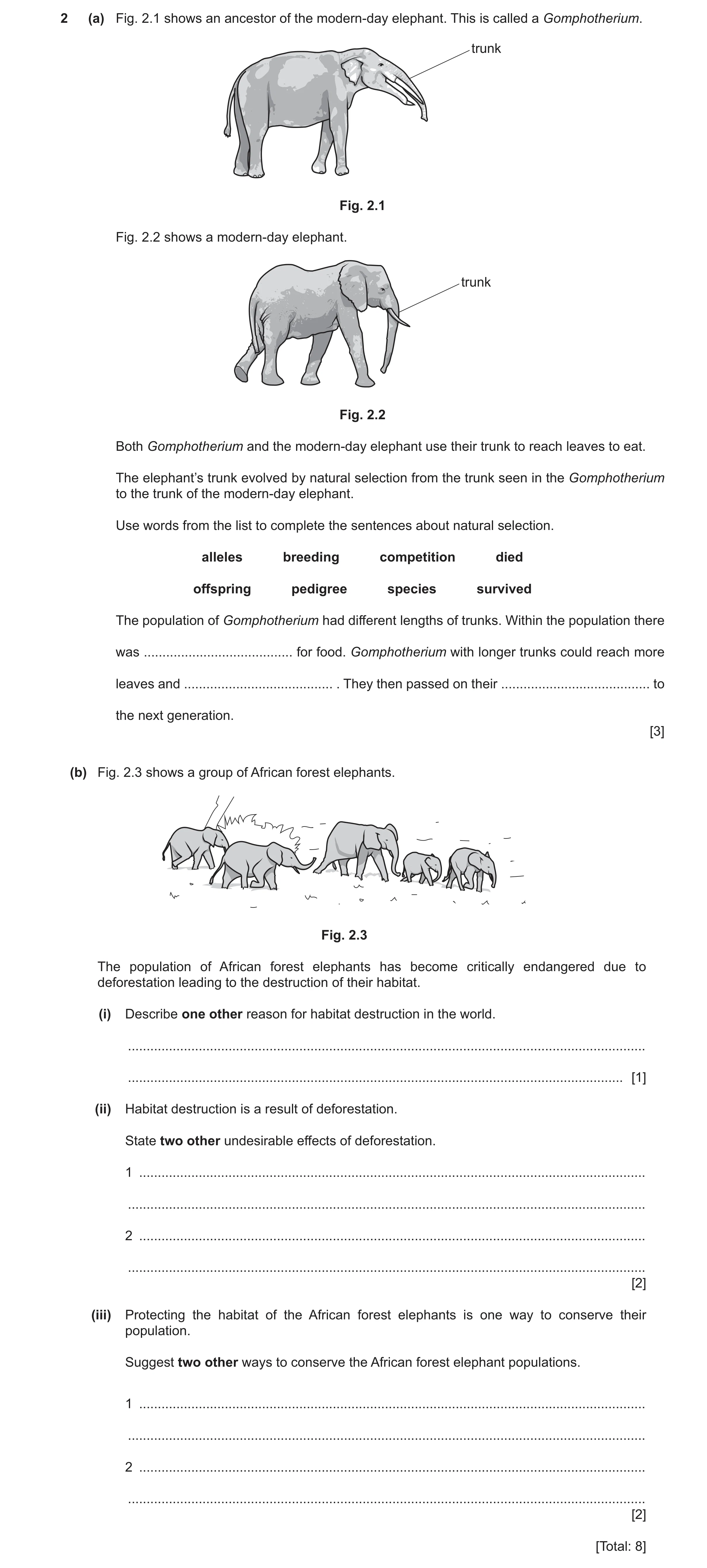
2 (a) Fig. 2.1 shows an ancestor of the modern‑day elephant. This is called a Gomphotherium. trunk Fig. 2.1 Fig. 2.2 shows a modern‑day elephant. trunk Fig. 2.2 Both Gomphotherium and the modern‑day elephant use their trunk to reach leaves to eat. The elephant’s trunk evolved by natural selection from the trunk seen in the Gomphotherium to the trunk of the modern‑day elephant. Use words from the list to complete the sentences about natural selection. alleles breeding competition died offspring pedigree species survived The population of Gomphotherium had different lengths of trunks. Within the population there was … for food. Gomphotherium with longer trunks could reach more leaves and … . They then passed on their … to the next generation. [3] (b) Fig. 2.3 shows a group of African forest elephants. Fig. 2.3 The population of African forest elephants has become critically endangered due to deforestation leading to the destruction of their habitat. (i) Describe one other reason for habitat destruction in the world. … … [1] (ii) Habitat destruction is a result of deforestation. State two other undesirable effects of deforestation. 1 … … 2 … … [2] (iii) Protecting the habitat of the African forest elephants is one way to conserve their population. Suggest two other ways to conserve the African forest elephant populations. 1 … … 2 … … [2] [Total: 8]
8 marks
Mark scheme: 2(a) competition ; 3 survived ; alleles ; 2(b)(i) any one from: 1 • increased area for housing ; • crop plant production ; • livestock production ; • extraction of natural resources ; • freshwater and marine pollution ; • AVP ; 2(b)(ii) any two from: 2 • reducing biodiversity ; • extinction ; • loss of soil ; • flooding ; • increase of carbon dioxide in the atmosphere ; 2(b)(iii) any two from: 2 • method of monitoring species / method of protecting species ; • education ; • captive breeding programmes ;
This question in 0654/32 Oct/Nov 2025
Q15 · An ancestor of the modern‑day elephant 0654/33 Oct/Nov 2025
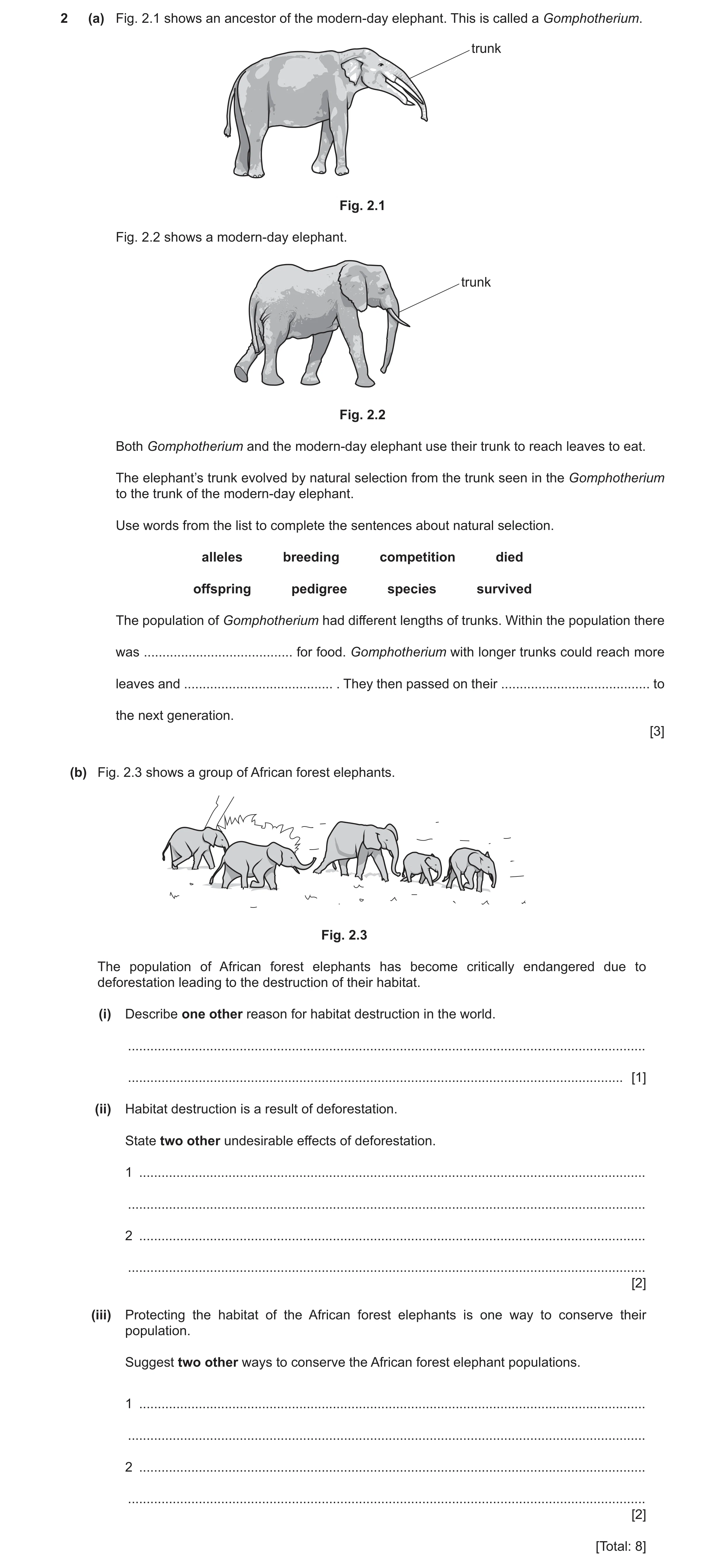
2 (a) Fig. 2.1 shows an ancestor of the modern‑day elephant. This is called a Gomphotherium. trunk Fig. 2.1 Fig. 2.2 shows a modern‑day elephant. trunk Fig. 2.2 Both Gomphotherium and the modern‑day elephant use their trunk to reach leaves to eat. The elephant’s trunk evolved by natural selection from the trunk seen in the Gomphotherium to the trunk of the modern‑day elephant. Use words from the list to complete the sentences about natural selection. alleles breeding competition died offspring pedigree species survived The population of Gomphotherium had different lengths of trunks. Within the population there was … for food. Gomphotherium with longer trunks could reach more leaves and … . They then passed on their … to the next generation. [3] (b) Fig. 2.3 shows a group of African forest elephants. Fig. 2.3 The population of African forest elephants has become critically endangered due to deforestation leading to the destruction of their habitat. (i) Describe one other reason for habitat destruction in the world. … … [1] (ii) Habitat destruction is a result of deforestation. State two other undesirable effects of deforestation. 1 … … 2 … … [2] (iii) Protecting the habitat of the African forest elephants is one way to conserve their population. Suggest two other ways to conserve the African forest elephant populations. 1 … … 2 … … [2] [Total: 8]
8 marks
Mark scheme: 2(a) competition ; 3 survived ; alleles ; 2(b)(i) any one from: 1 • increased area for housing ; • crop plant production ; • livestock production ; • extraction of natural resources ; • freshwater and marine pollution ; • AVP ; 2(b)(ii) any two from: 2 • reducing biodiversity ; • extinction ; • loss of soil ; • flooding ; • increase of carbon dioxide in the atmosphere ; 2(b)(iii) any two from: 2 • method of monitoring species / method of protecting species ; • education ; • captive breeding programmes ;
This question in 0654/33 Oct/Nov 2025
 1 / 23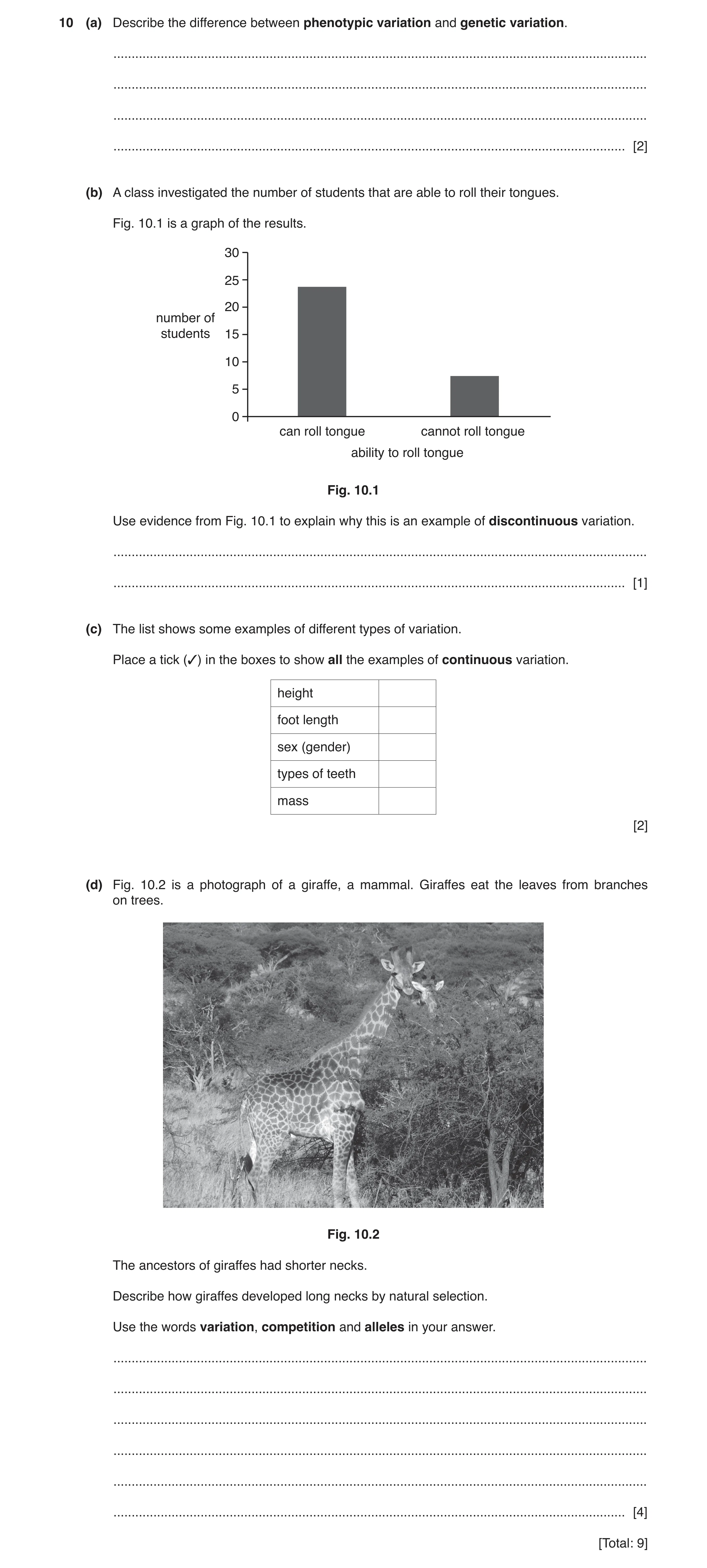
 9 / 23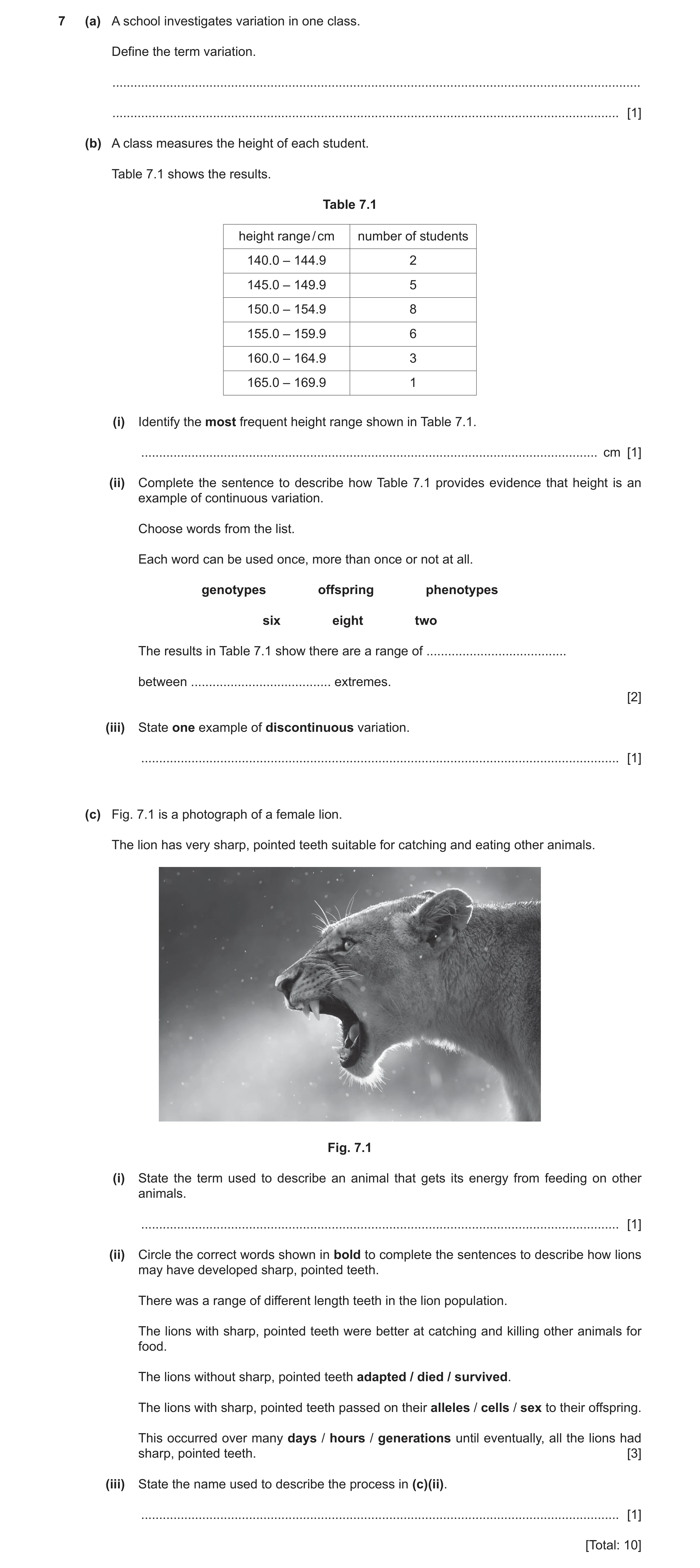
 7
7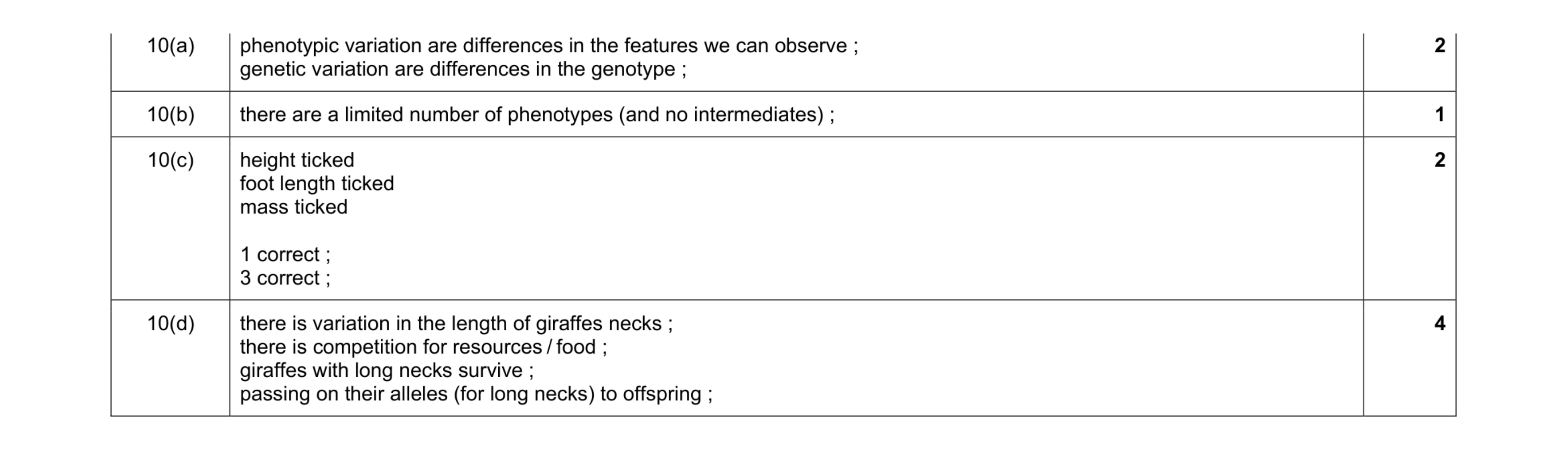 9
9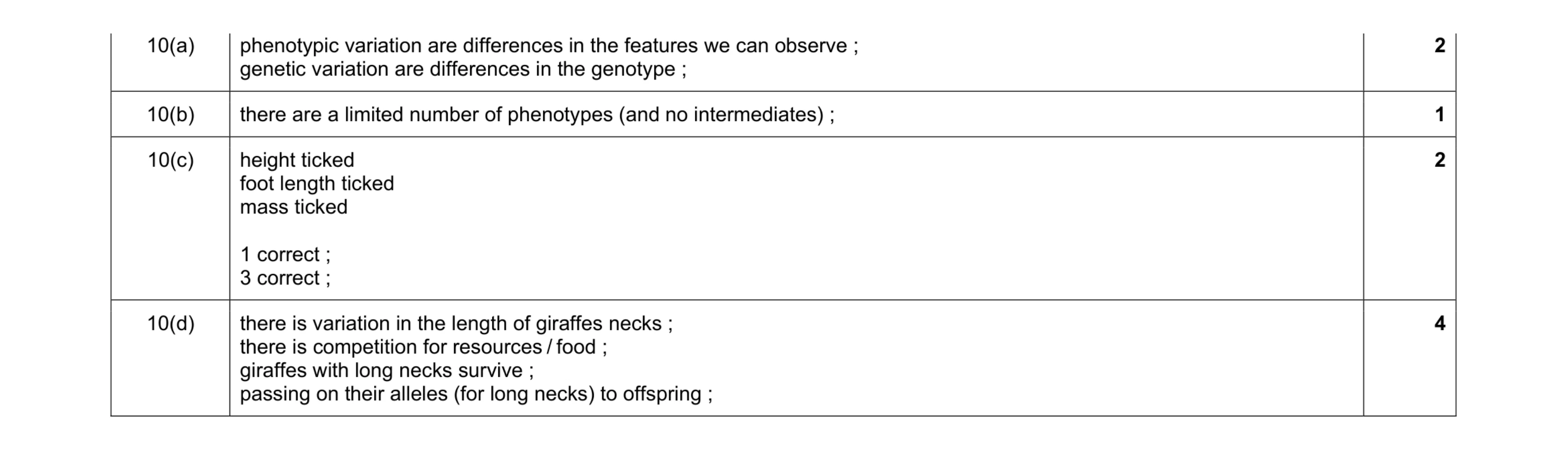 9
9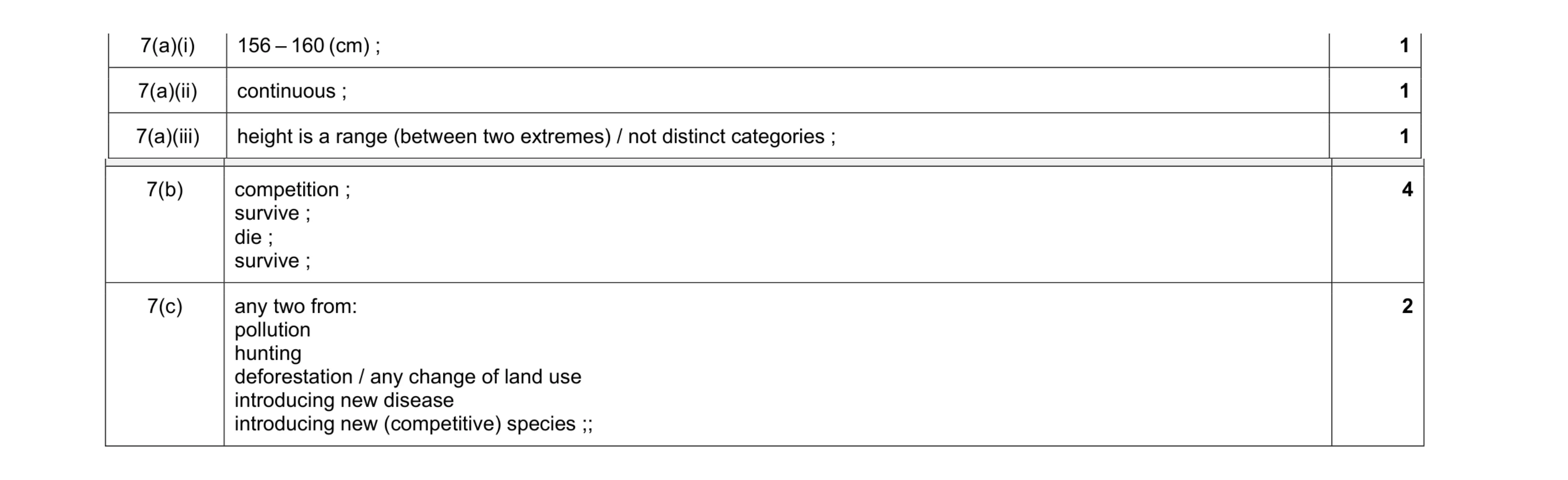 9
9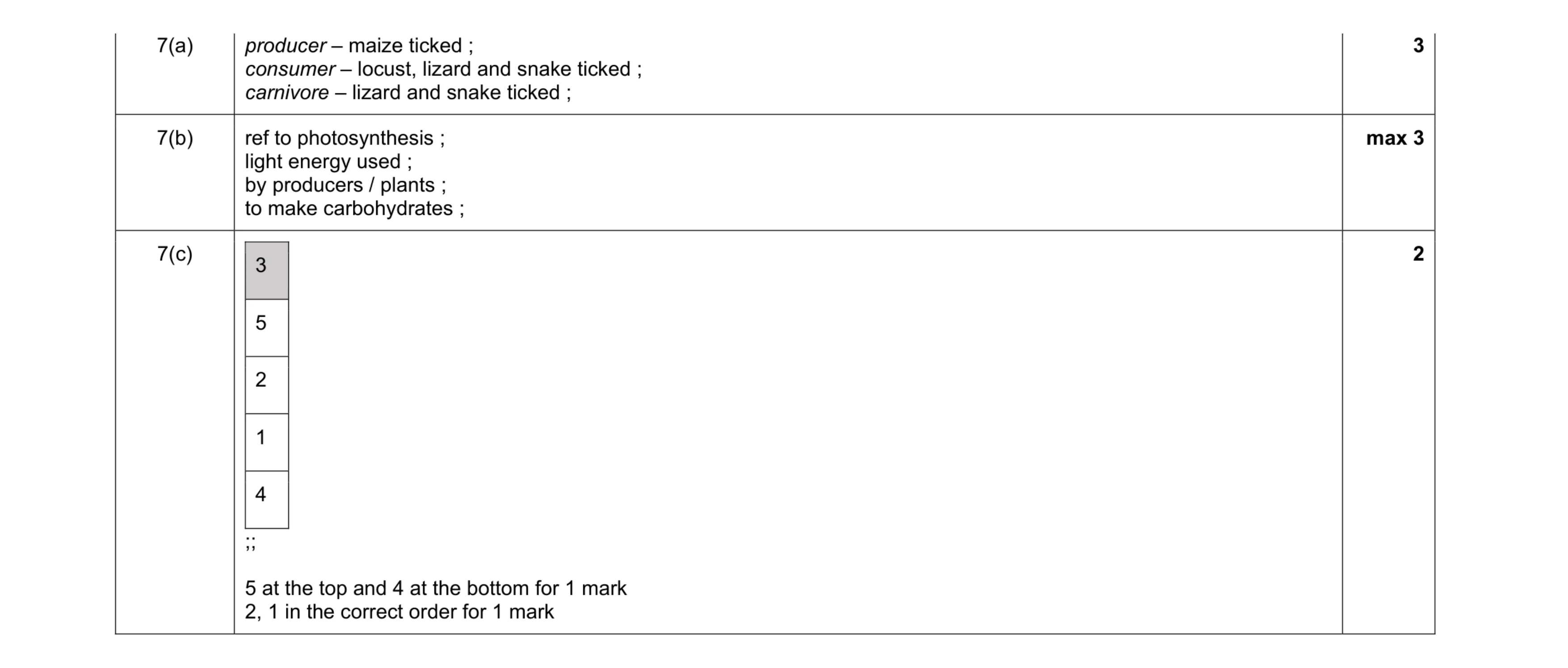 8
8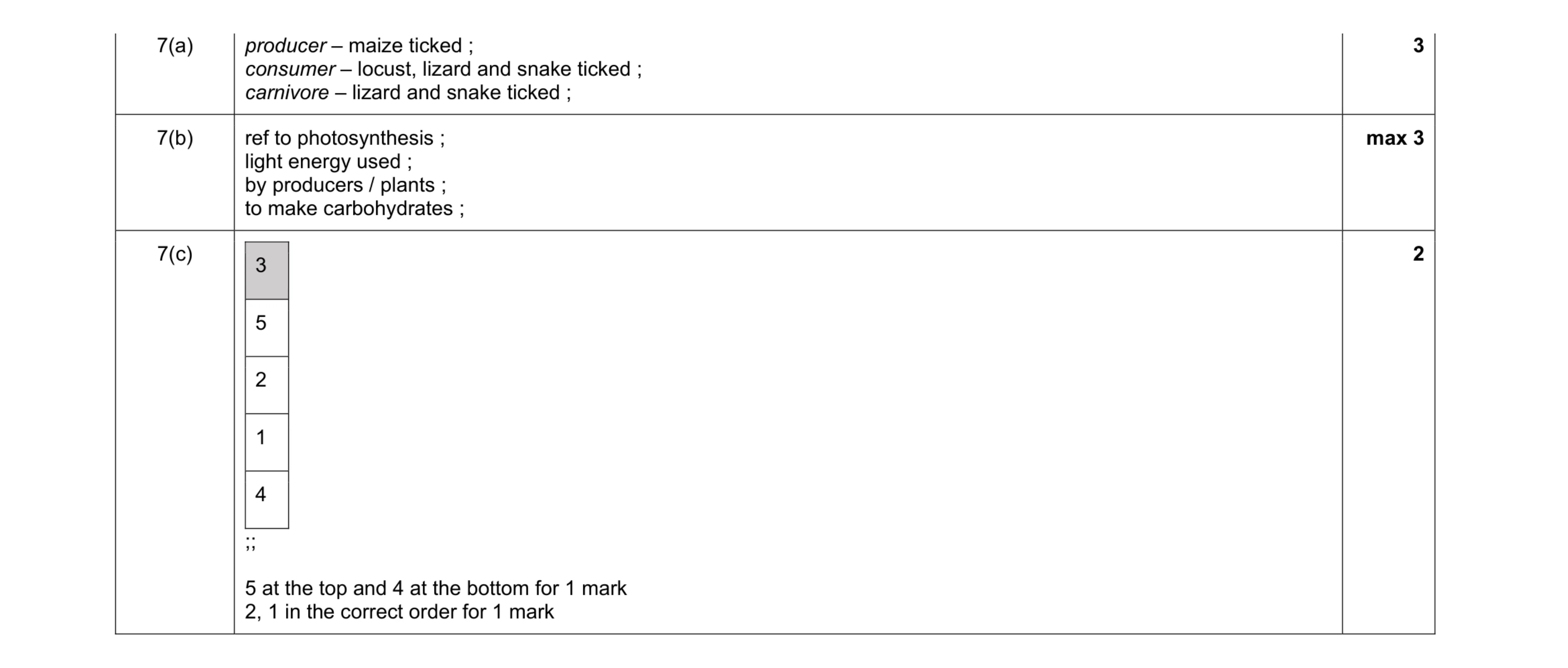 8
8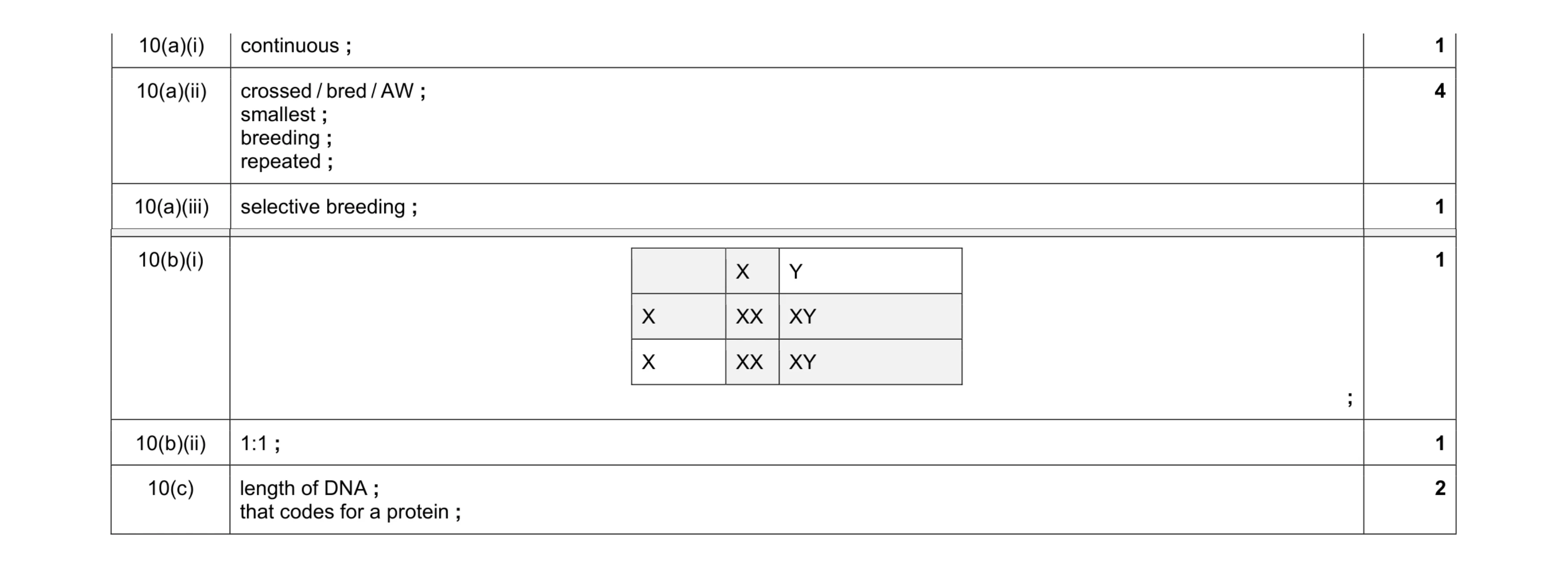 10
10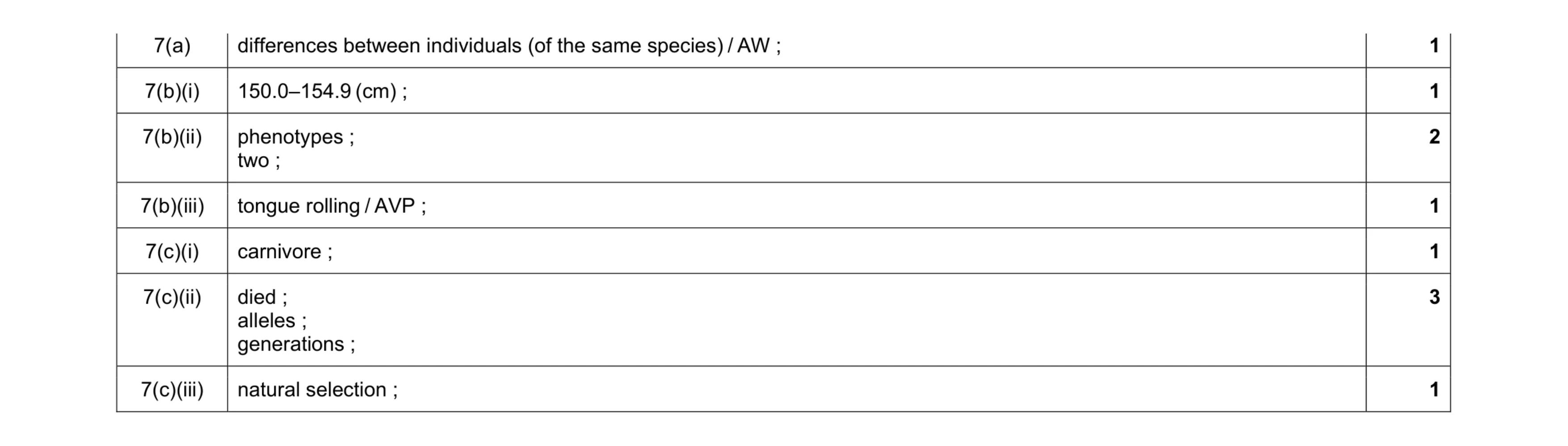 10
10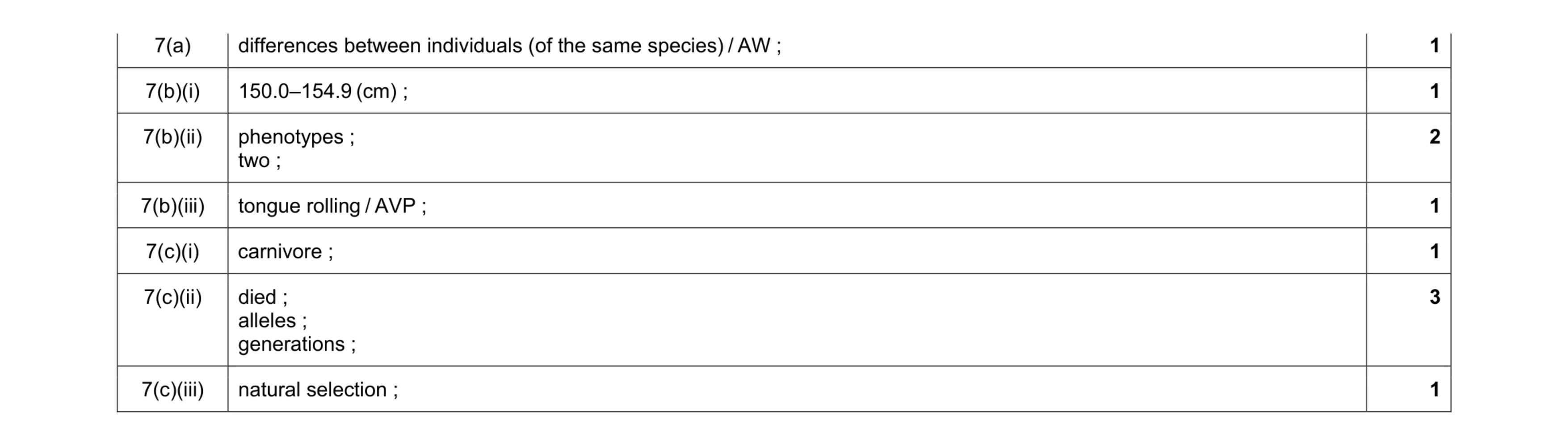 10
10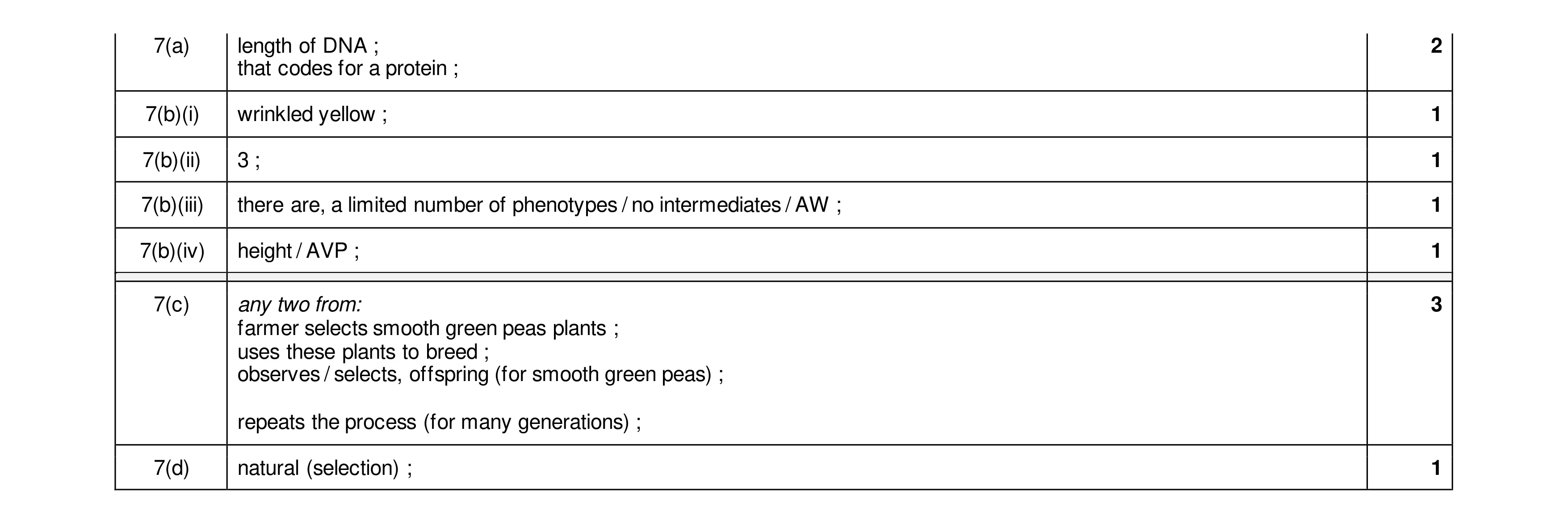 10
10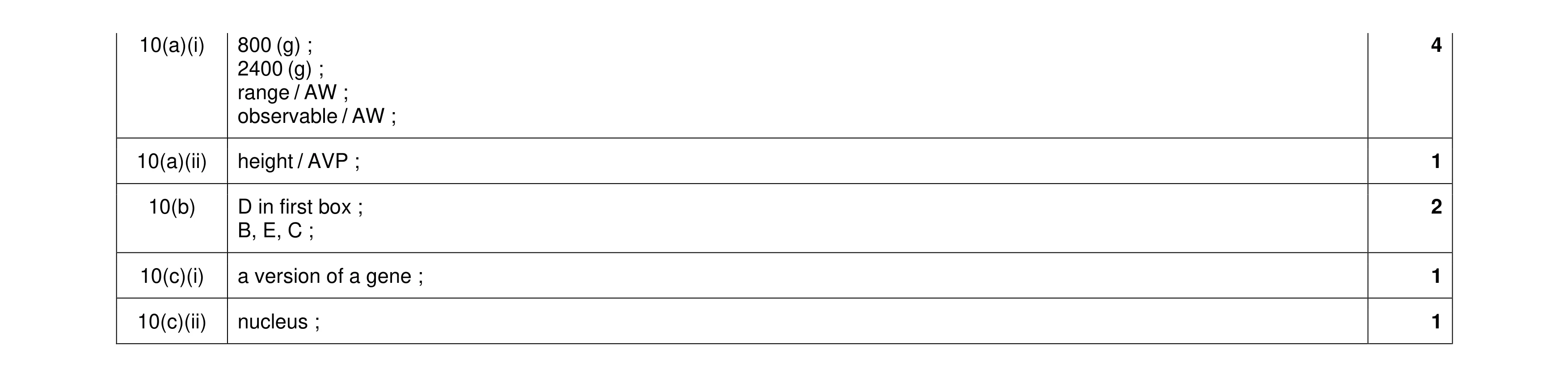 9
9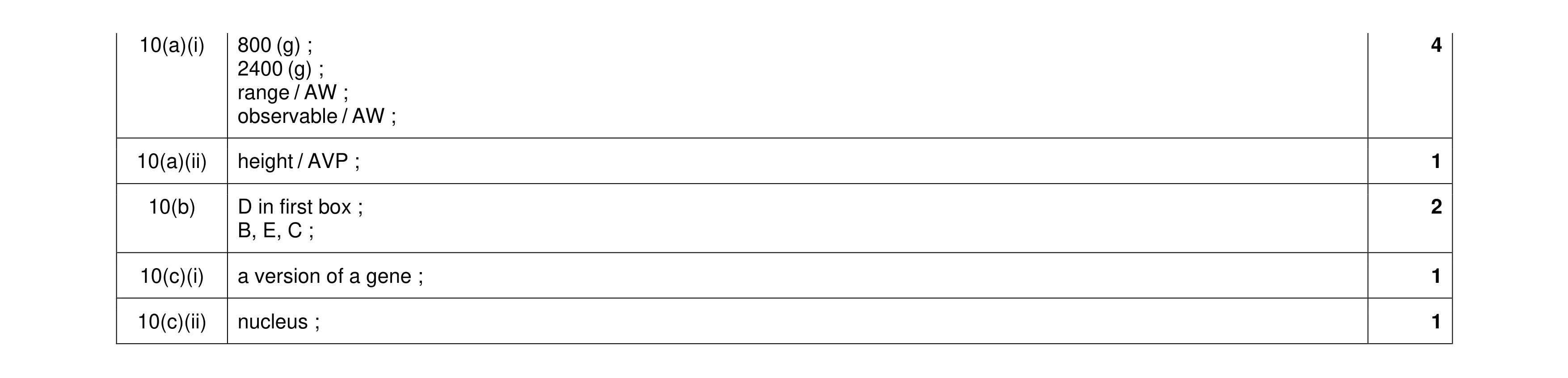 9
9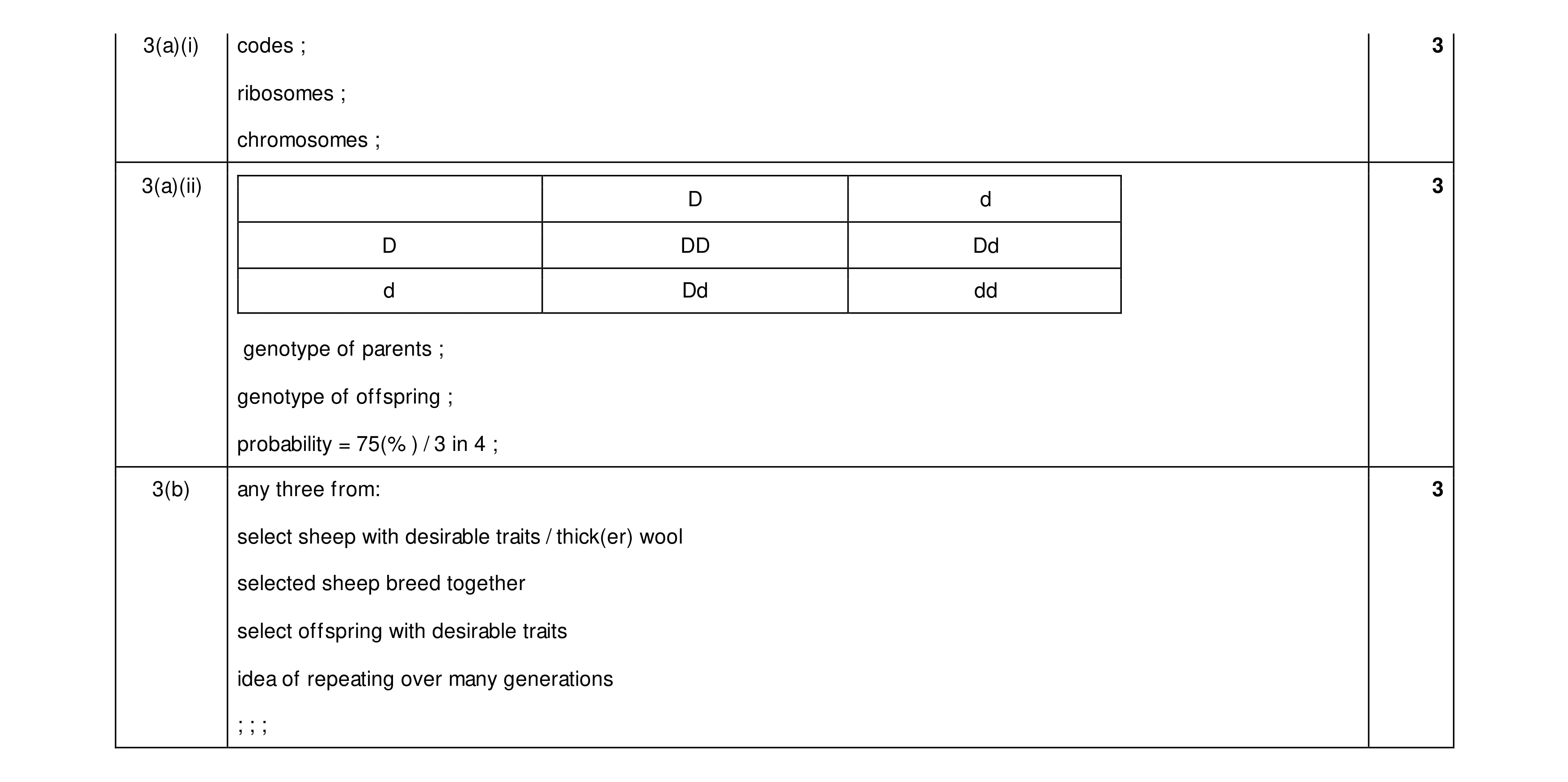 9
9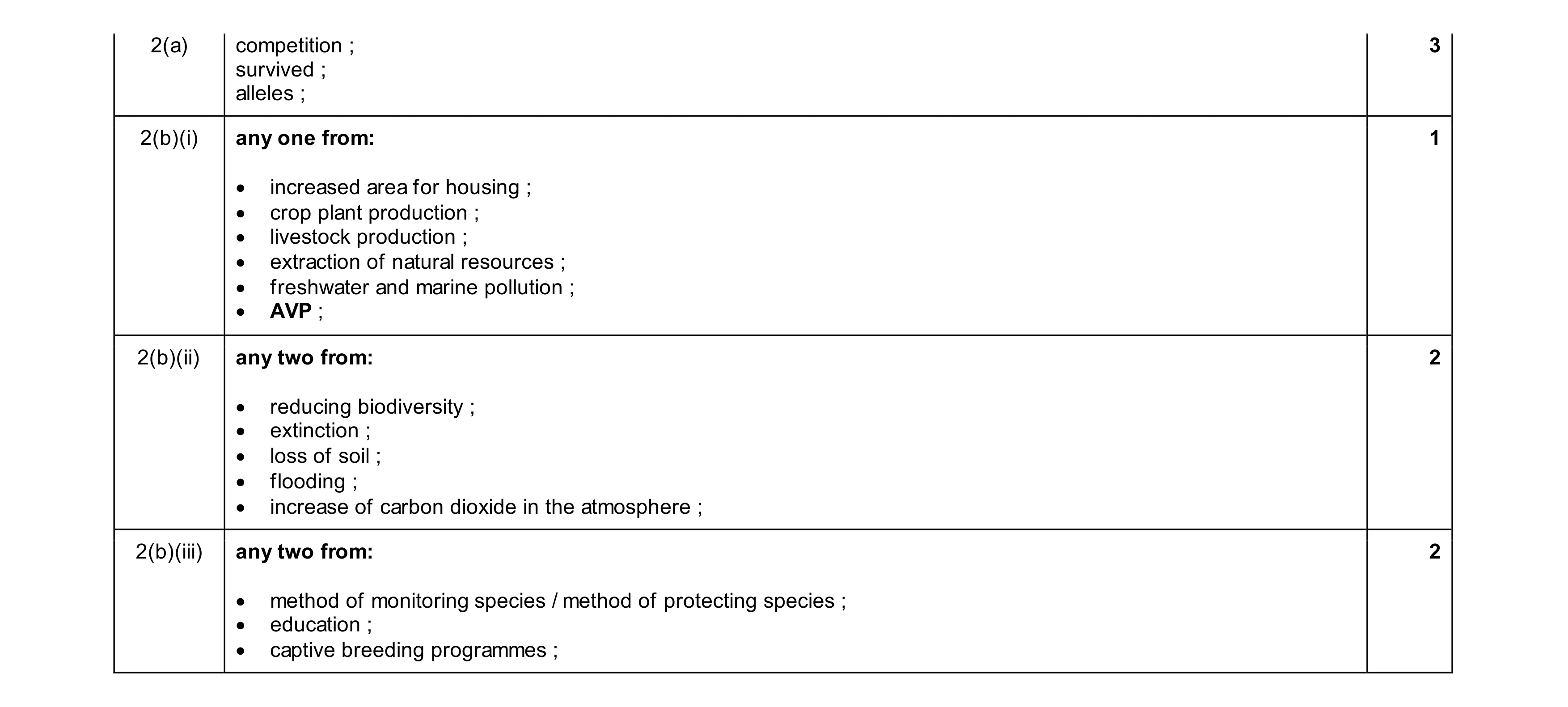 8
8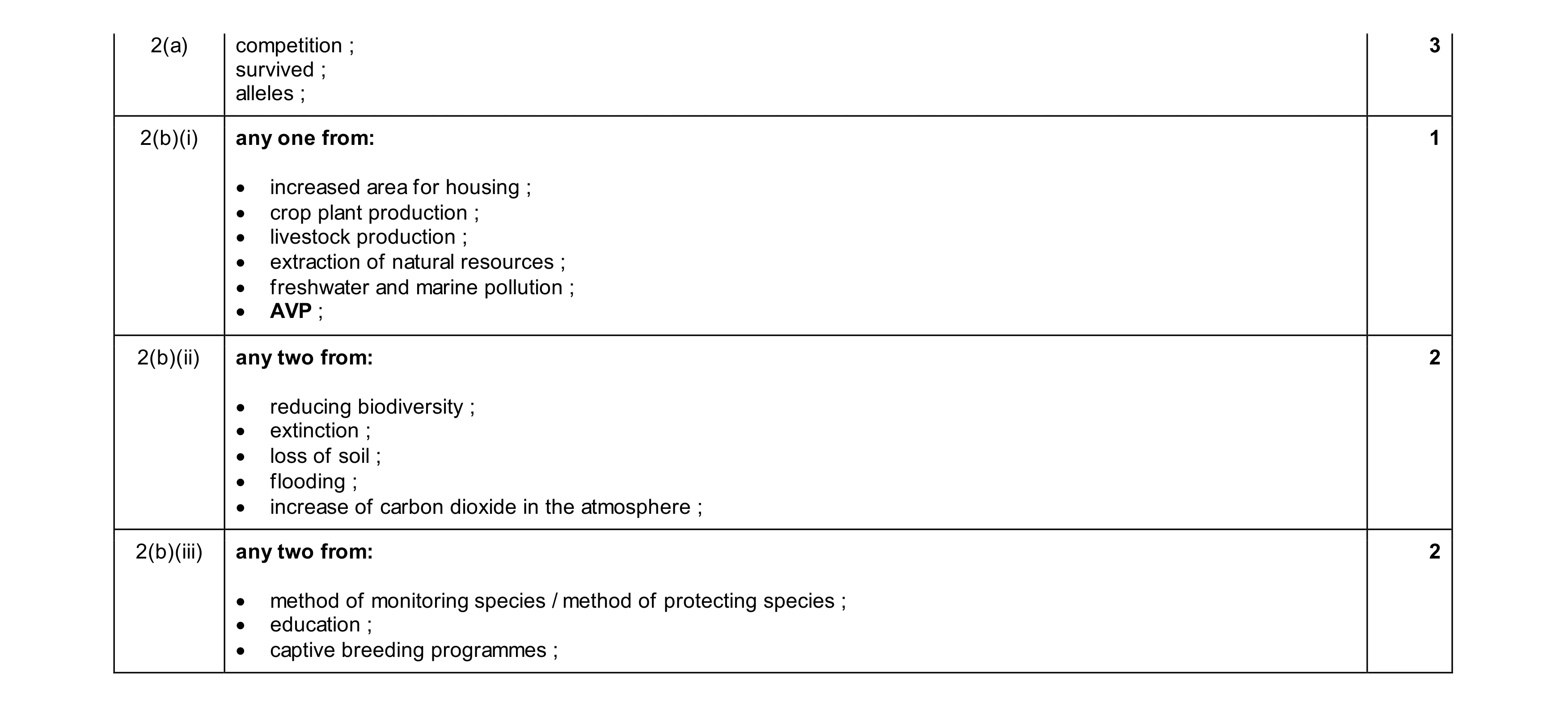 8
8