Questions as text
Q1 · What is not produced by artificial selection? 0654/11 May/June 2014
12 What is not produced by artificial selection? A bacteria with antibiotic resistance B cows with high milk yield C sheep with thick wool D wheat with resistance to disease
1 marks
Answer: A
This question in 0654/11 May/June 2014
Q2 · What is not produced by artificial selection? 0654/13 May/June 2014
11 What is not produced by artificial selection? A bacteria with antibiotic resistance B cows with high milk yield C sheep with thick wool D wheat with resistance to disease
1 marks
Answer: A
This question in 0654/13 May/June 2014
Q3 · What is not produced by artificial selection? 0654/11 May/June 2017
1 What is not produced by artificial selection? A bacteria with antibiotic resistance B cows with high milk yield C sheep with thick wool D wheat with resistance to disease
1 marks
Answer: A
This question in 0654/11 May/June 2017
Q4 · What is not produced by artificial selection? 0654/12 May/June 2017
1 What is not produced by artificial selection? A bacteria with antibiotic resistance B cows with high milk yield C sheep with thick wool D wheat with resistance to disease
1 marks
Answer: A
This question in 0654/12 May/June 2017
Q5 · What is not produced by artificial selection? 0654/13 May/June 2017
1 What is not produced by artificial selection? A bacteria with antibiotic resistance B cows with high milk yield C sheep with thick wool D wheat with resistance to disease
1 marks
Answer: A
This question in 0654/13 May/June 2017
Q6 · What is the main result of natural selection? 0654/11 Oct/Nov 2017
10 What is the main result of natural selection? A fewer genes being passed on to offspring B higher-yielding food crops C organisms better adapted to the environment D sheep that produce better quality wool
1 marks
Answer: C
This question in 0654/11 Oct/Nov 2017
Q7 · Predators that hunt at night have large eyes and ears 0654/12 Oct/Nov 2017
11 Predators that hunt at night have large eyes and ears. This has resulted from the passing on of genes by the best-adapted organisms. What is this process called? A artificial selection B conservation C homeostasis D natural selection
1 marks
Answer: D
This question in 0654/12 Oct/Nov 2017
Q8 · Species of frogs which live in trees have sticky pads on their feet 0654/13 Oct/Nov 2018
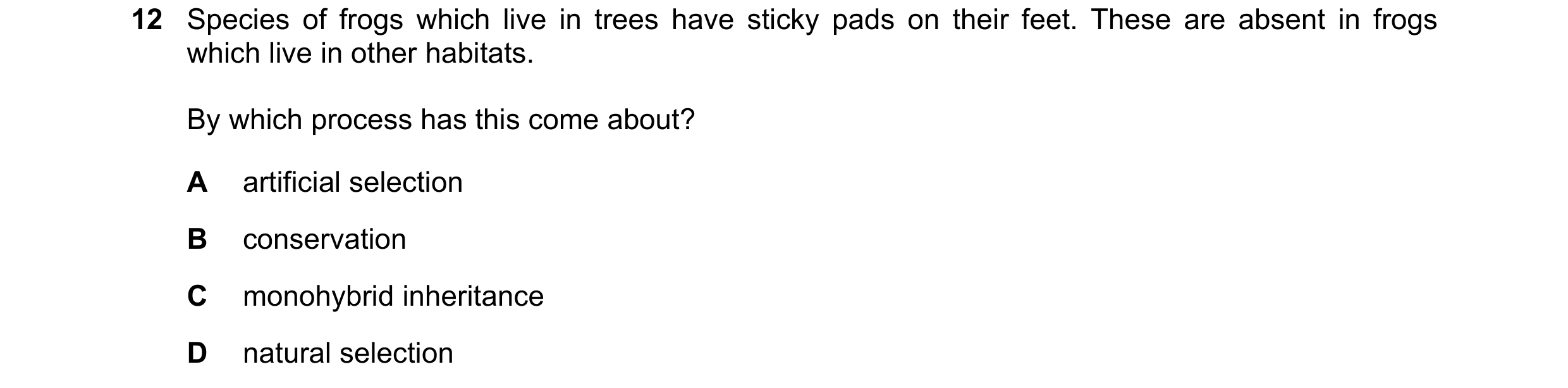
12 Species of frogs which live in trees have sticky pads on their feet. These are absent in frogs which live in other habitats. By which process has this come about? A artificial selection B conservation C monohybrid inheritance D natural selection
1 marks
Answer: D
This question in 0654/13 Oct/Nov 2018
Q9 · The graph shows the number of cows producing different volumes of milk 0654/11 Oct/Nov 2019
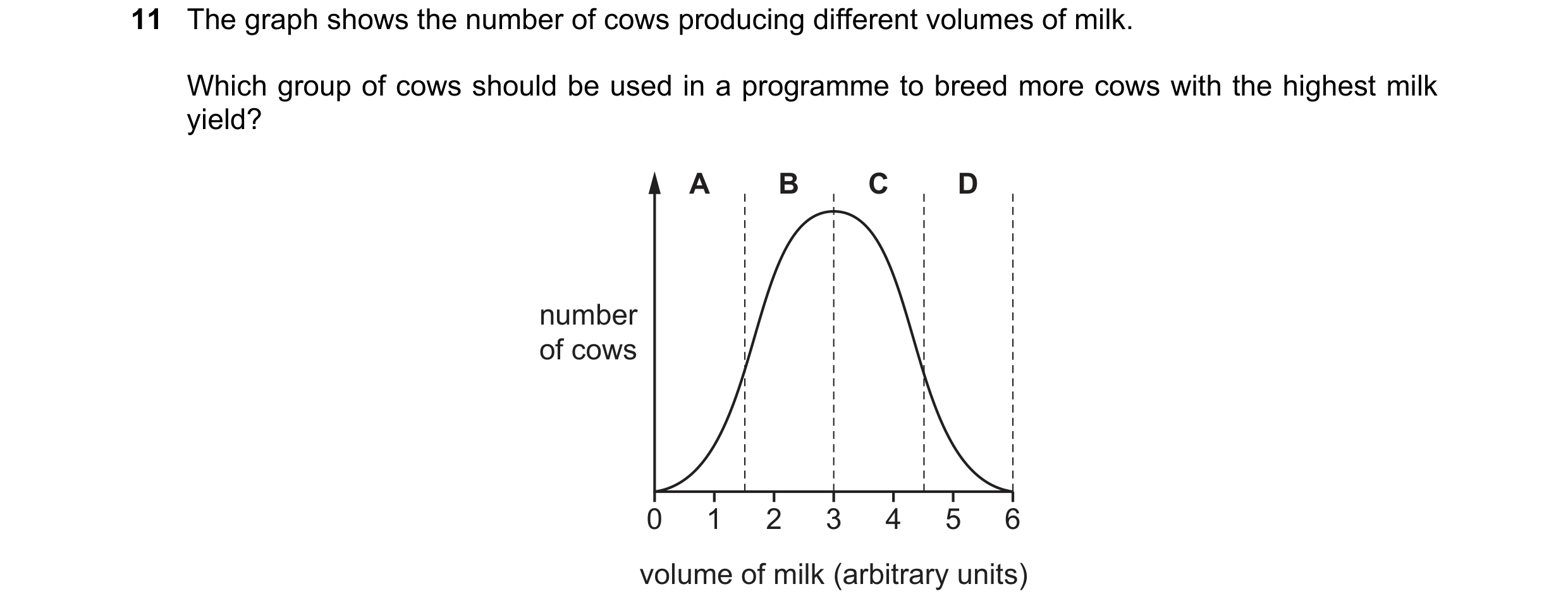
11 The graph shows the number of cows producing different volumes of milk. Which group of cows should be used in a programme to breed more cows with the highest milk yield? A B C D number of cows 0 1 2 3 4 5 6 volume of milk (arbitrary units)
1 marks
Answer: D
This question in 0654/11 Oct/Nov 2019
Q10 · A farmer wants to breed sheep that will produce a high yield of milk 0654/12 May/June 2020
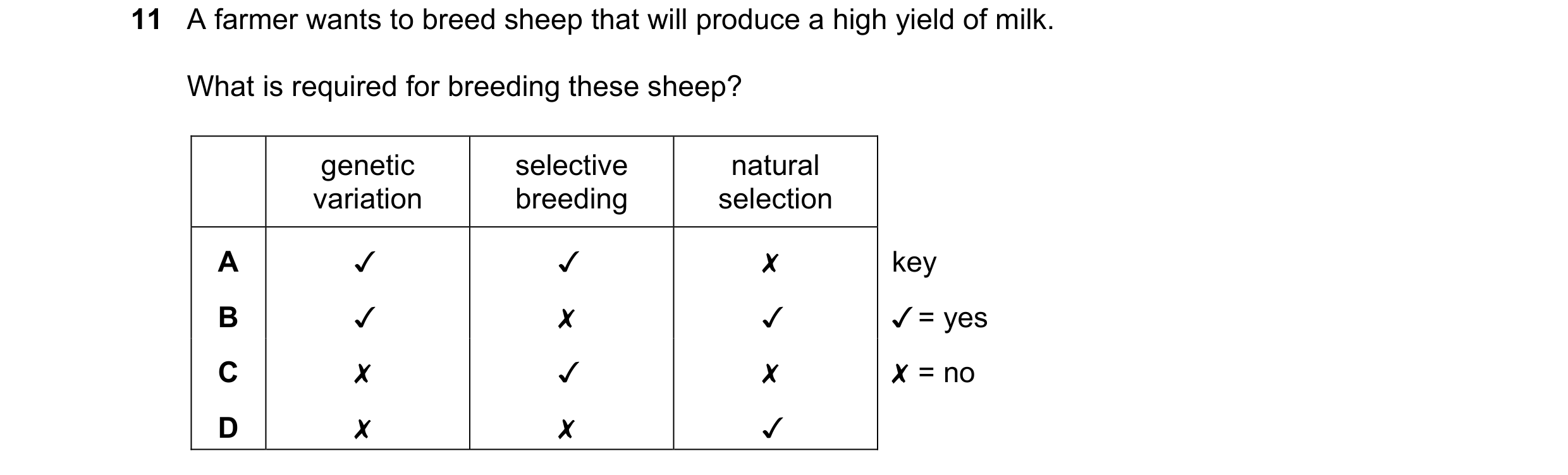
11 A farmer wants to breed sheep that will produce a high yield of milk.
What is required for breeding these sheep?
genetic selective natural
variation breeding selection
Jv v x
v x v
x v x
x x v
key
J/ = yes
X =no
1 marks
Answer: A
This question in 0654/12 May/June 2020
Q11 · Natural selection involves several stages 0654/11 Oct/Nov 2021
11 Natural selection involves several stages. 1 passing on alleles to the next generation 2 struggle for survival 3 competition for resources 4 production of many offspring What is the correct order of these stages? A 4 1 2 3 B 4 3 2 1 C 1 2 3 4 D 3 2 1 4
1 marks
Answer: B
This question in 0654/11 Oct/Nov 2021
Q12 · Selection in chickens has produced individuals that lay more eggs per week 0654/12 May/June 2022
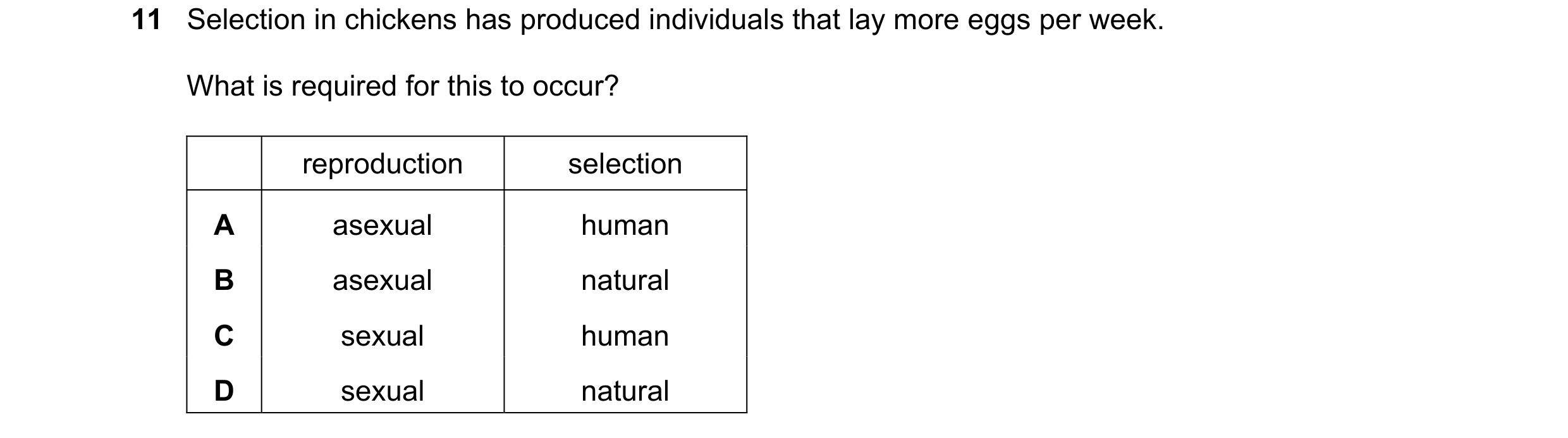
11 Selection in chickens has produced individuals that lay more eggs per week. What is required for this to occur? reproduction selection A asexual human B asexual natural C sexual human D sexual natural
1 marks
Answer: C
This question in 0654/12 May/June 2022
Q13 · Selection in chickens has produced individuals that lay more eggs per week 0654/13 May/June 2022
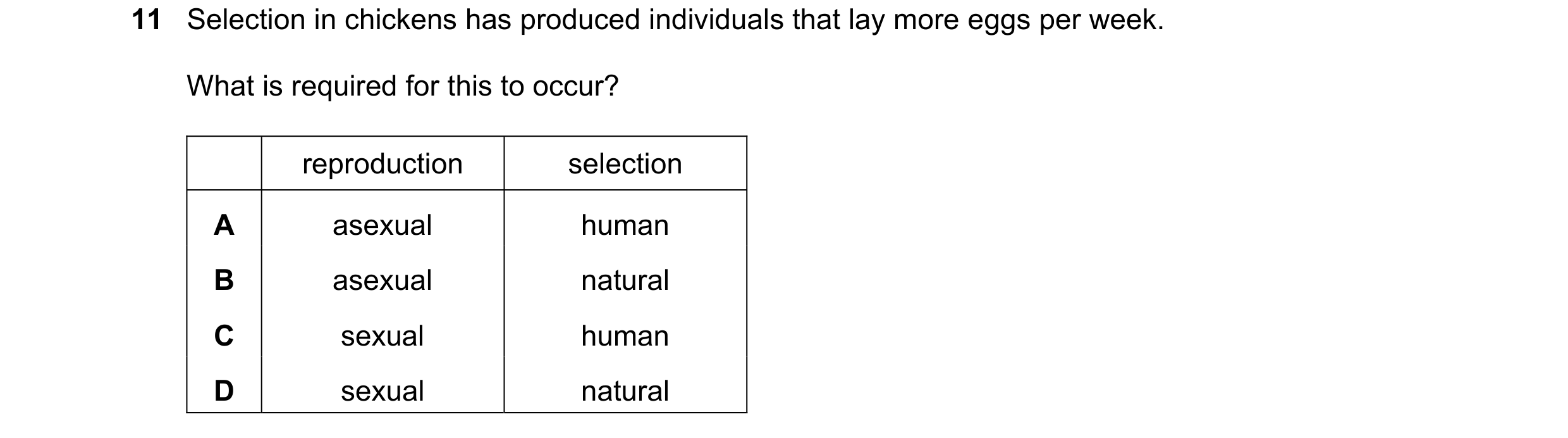
11 Selection in chickens has produced individuals that lay more eggs per week. What is required for this to occur? reproduction selection A asexual human B asexual natural C sexual human D sexual natural
1 marks
Answer: C
This question in 0654/13 May/June 2022
Q14 · A list of the stages of a process is shown 0654/11 Oct/Nov 2025
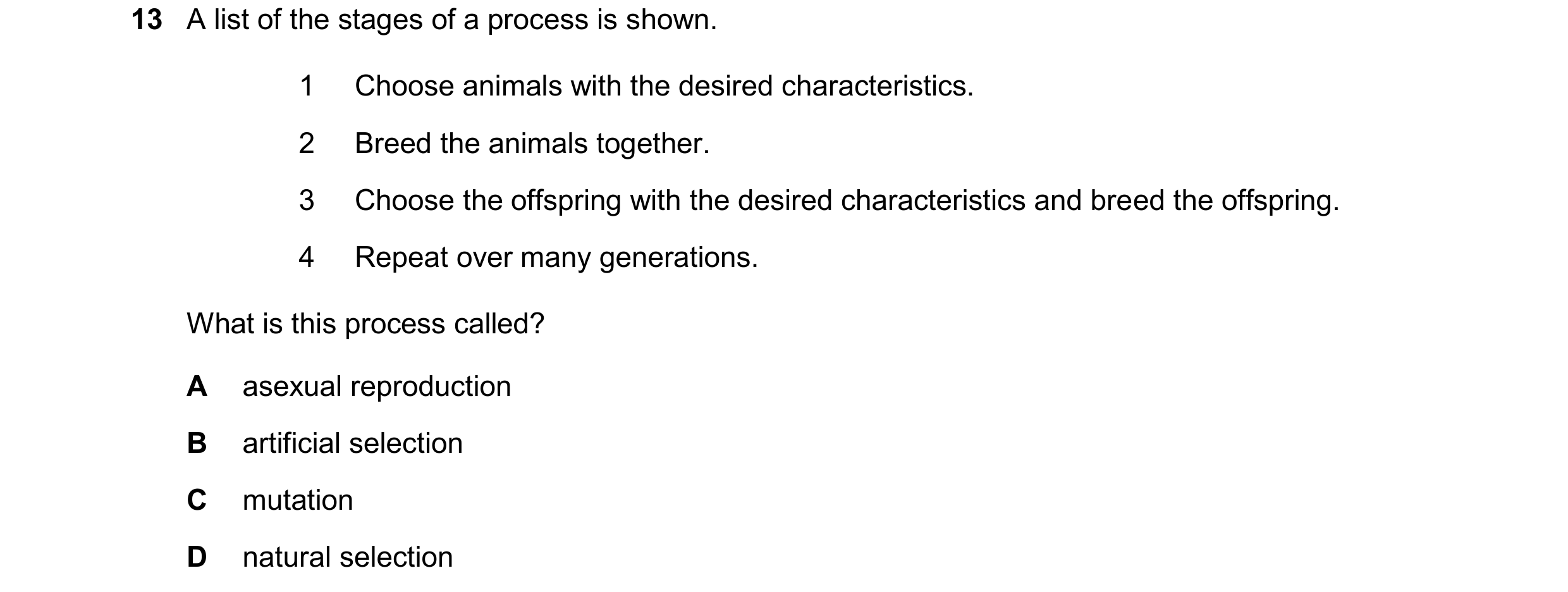
13 A list of the stages of a process is shown. 1 Choose animals with the desired characteristics. 2 Breed the animals together. 3 Choose the offspring with the desired characteristics and breed the offspring. 4 Repeat over many generations. What is this process called? A asexual reproduction B artificial selection C mutation D natural selection
1 marks
Answer: B
This question in 0654/11 Oct/Nov 2025
Q15 · Three stages involved in the selective breeding of wheat to increase the size of the… 0654/12 Oct/Nov 2025
12 Three stages involved in the selective breeding of wheat to increase the size of the seeds are shown. 1 crossing wheat plants to produce the next generation 2 selection by humans of wheat with large seeds 3 selection of wheat offspring with large seeds What is the correct sequence of these stages? A 1 2 3 B 2 1 3 C 2 3 1 D 3 1 2
1 marks
Answer: B
This question in 0654/12 Oct/Nov 2025
Q16 · Three stages involved in the selective breeding of wheat to increase the size of the… 0654/13 Oct/Nov 2025
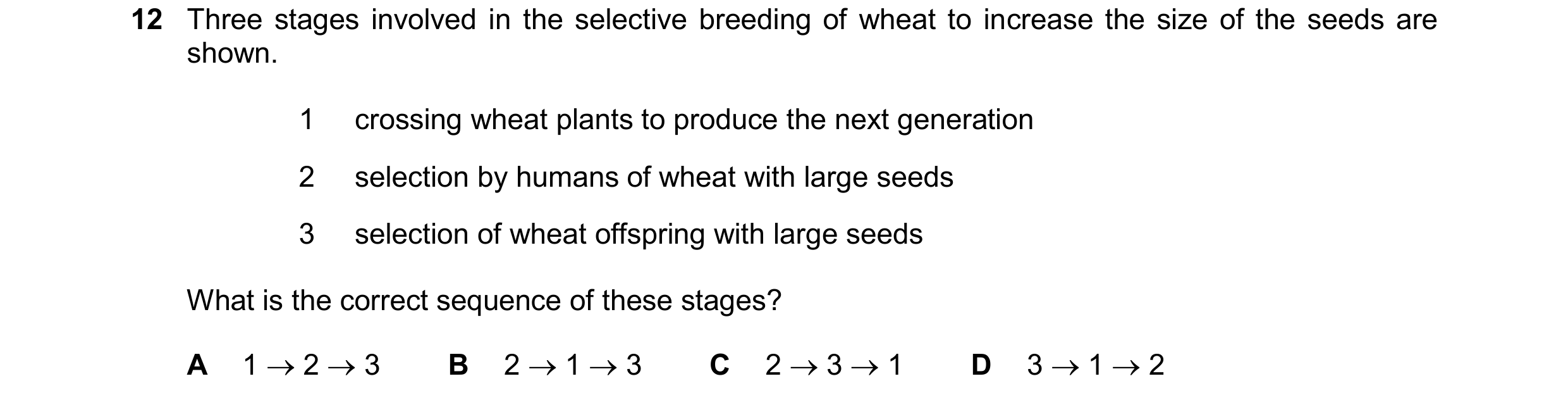
12 Three stages involved in the selective breeding of wheat to increase the size of the seeds are shown. 1 crossing wheat plants to produce the next generation 2 selection by humans of wheat with large seeds 3 selection of wheat offspring with large seeds What is the correct sequence of these stages? A 1 2 3 B 2 1 3 C 2 3 1 D 3 1 2
1 marks
Answer: B
This question in 0654/13 Oct/Nov 2025





 1 / 4
1 / 4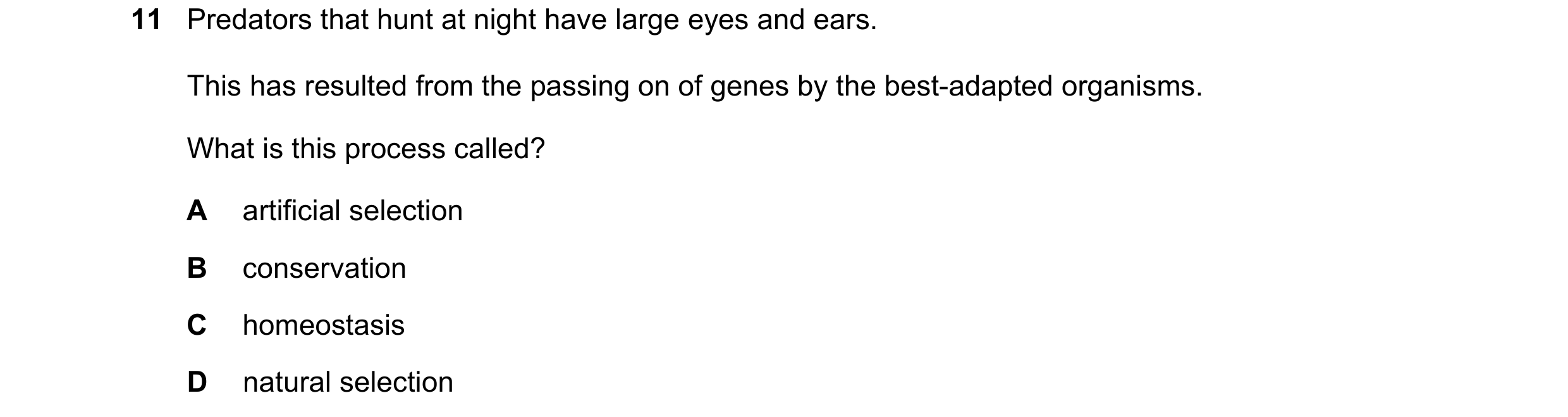
 2 / 4
2 / 4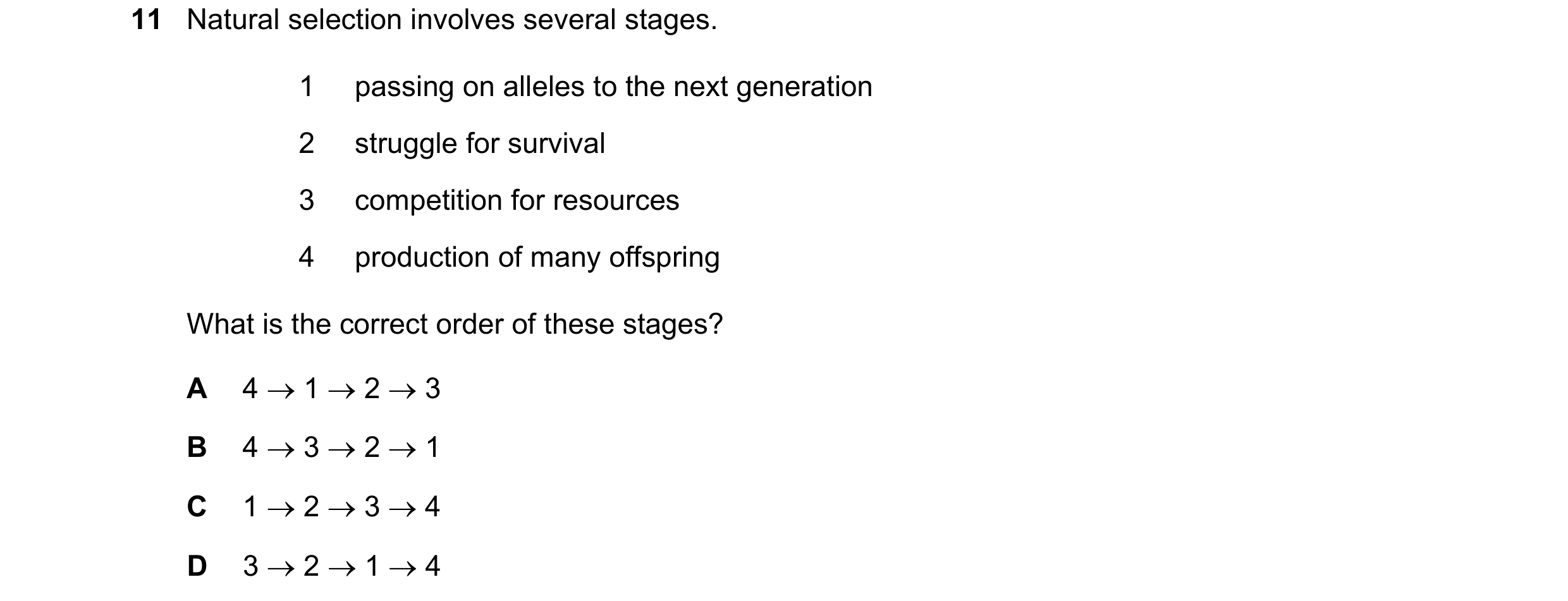
 3 / 4
3 / 4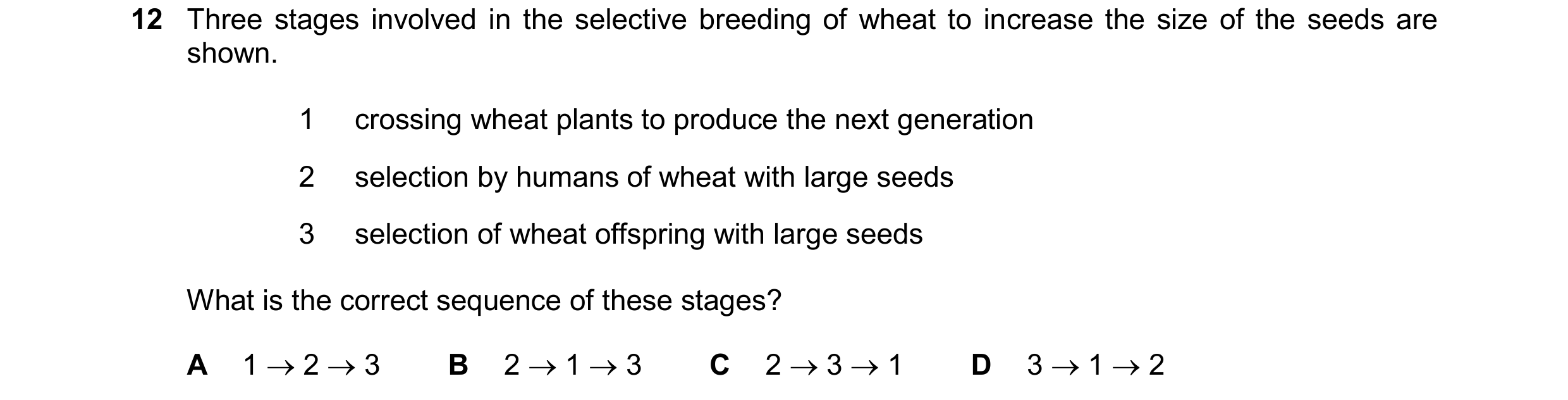
 4 / 4
4 / 4