Questions as text
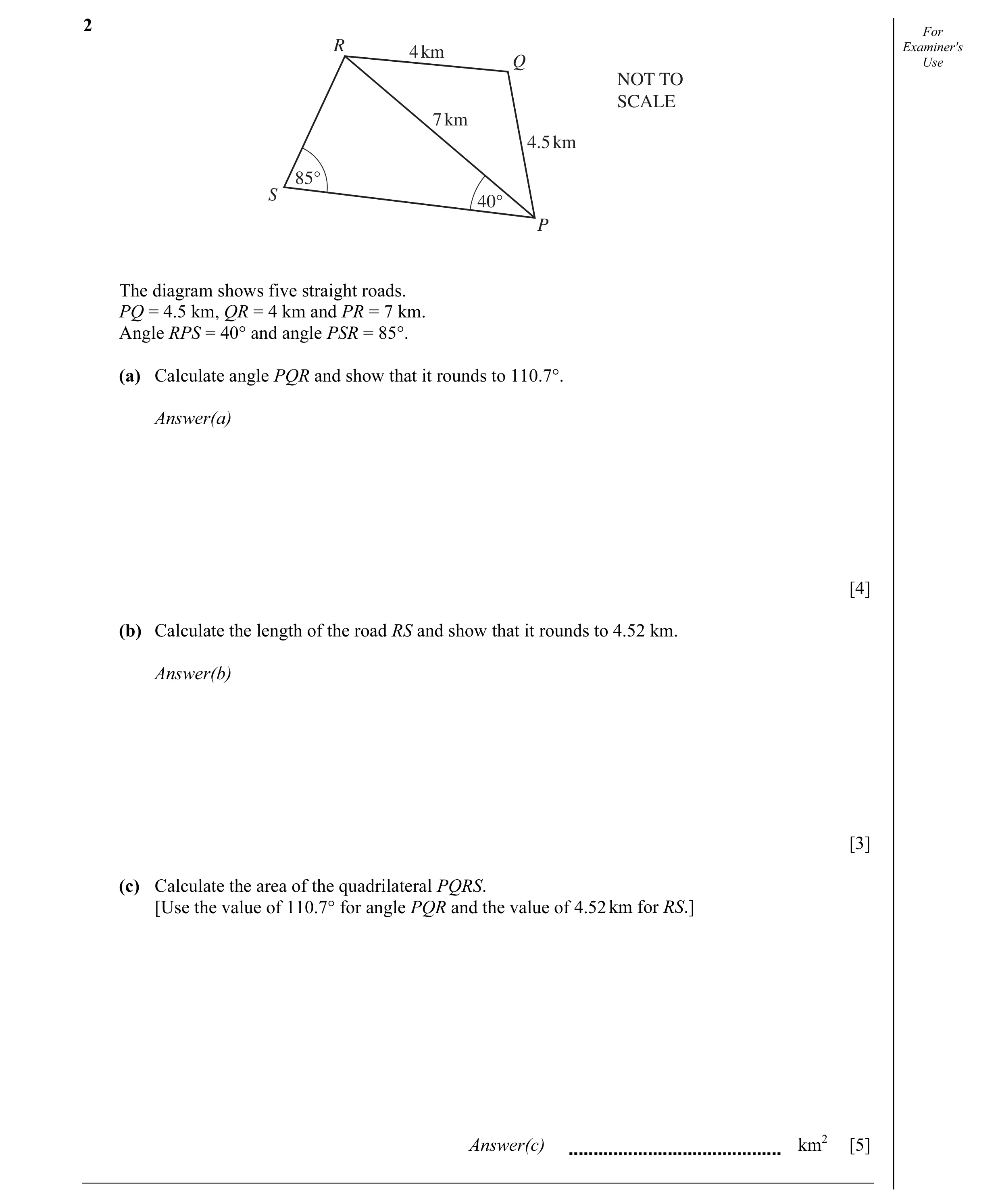
Q1 · For R Examiner's 4 km Q Use NOT TO SCALE 7 km 4.5 km 85° S 40° P The diagram shows five… 0580/43 Oct/Nov 2010
2 For R Examiner's 4 km Q Use NOT TO SCALE 7 km 4.5 km 85° S 40° P The diagram shows five straight roads. PQ = 4.5 km, QR = 4 km and PR = 7 km. Angle RPS = 40° and angle PSR = 85°. (a) Calculate angle PQR and show that it rounds to 110.7°. Answer(a) [4] (b) Calculate the length of the road RS and show that it rounds to 4.52 km. Answer(b) [3] (c) Calculate the area of the quadrilateral PQRS. [Use the value of 110.7° for angle PQR and the value of 4.52 km for RS.] Answer(c) km2 [5]
12 marks
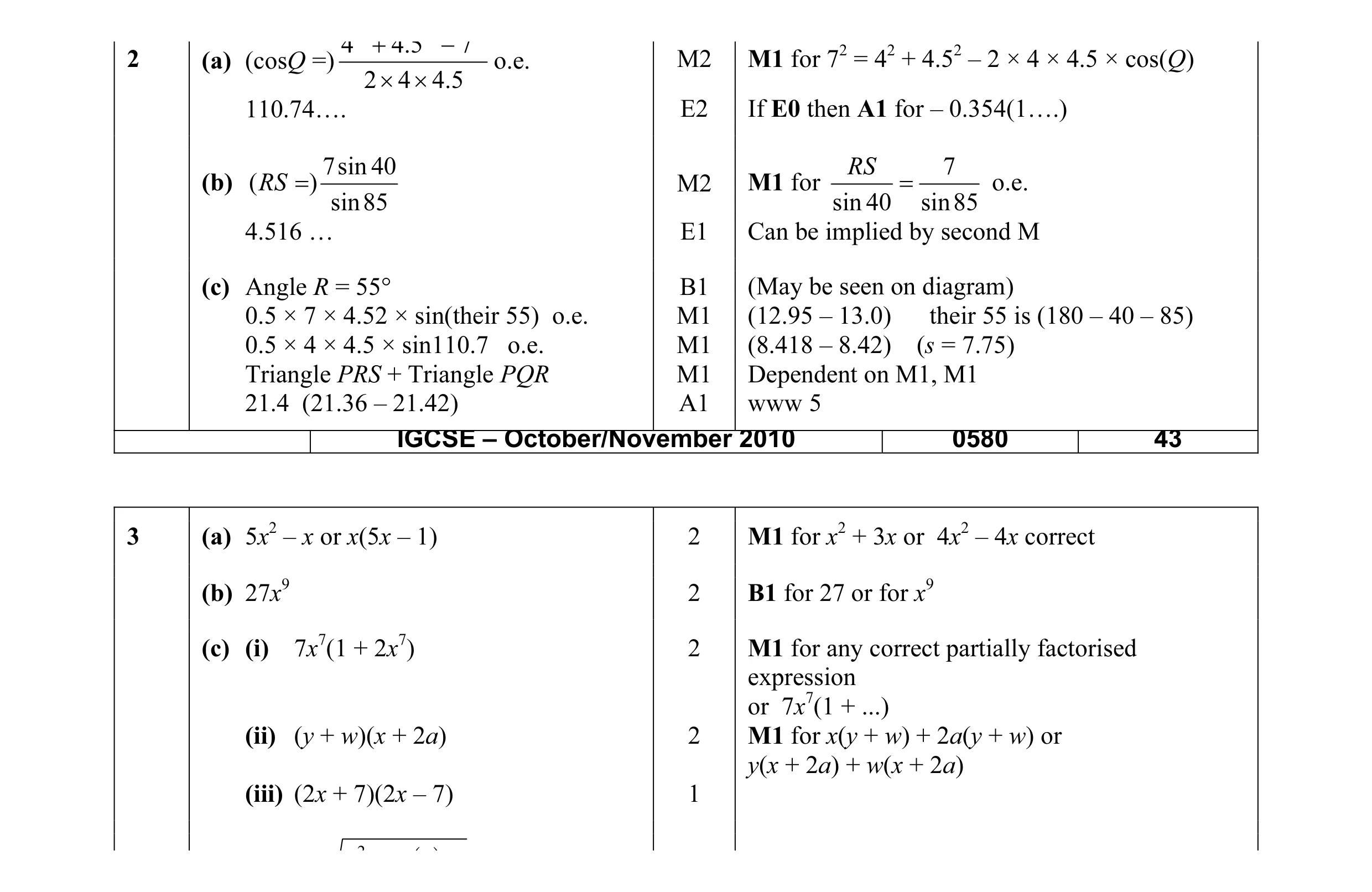
Mark scheme: 4 + 5.4 − 7 2 (a) (cosQ =) o.e. M2 M1 for 72 = 42 + 4.52 – 2 × 4 × 4.5 × cos(Q) 2 × 4 × 5.4 110.74…. E2 If E0 then A1 for – 0.354(1….) 7 sin 40 RS 7 (b) ( RS = ) M2 M1 for = o.e. sin 85 sin 40 sin 85 4.516 … E1 Can be implied by second M (c) Angle R = 55° B1 (May be seen on diagram) 0.5 × 7 × 4.52 × sin(their 55) o.e. M1 (12.95 – 13.0) their 55 is (180 – 40 – 85) 0.5 × 4 × 4.5 × sin110.7 o.e. M1 (8.418 – 8.42) (s = 7.75) Triangle PRS + Triangle PQR M1 Dependent on M1, M1 21.4 (21.36 – 21.42) A1 www 5 IGCSE – October/November 2010 0580 43 3 (a) 5x2 – x or x(5x – 1) 2 M1 for x2 + 3x or 4x2 – 4x correct (b) 27x9 2 B1 for 27 or for x9 (c) (i) 7x7(1 + 2x7) 2 M1 for any correct partially factorised expression or 7x7(1 + ...) (ii) (y + w)(x + 2a) 2 M1 for x(y + w) + 2a(y + w) or y(x + 2a) + w(x + 2a) (iii) (2x + 7)(2x – 7) 1 2 ( )
This question in 0580/43 Oct/Nov 2010
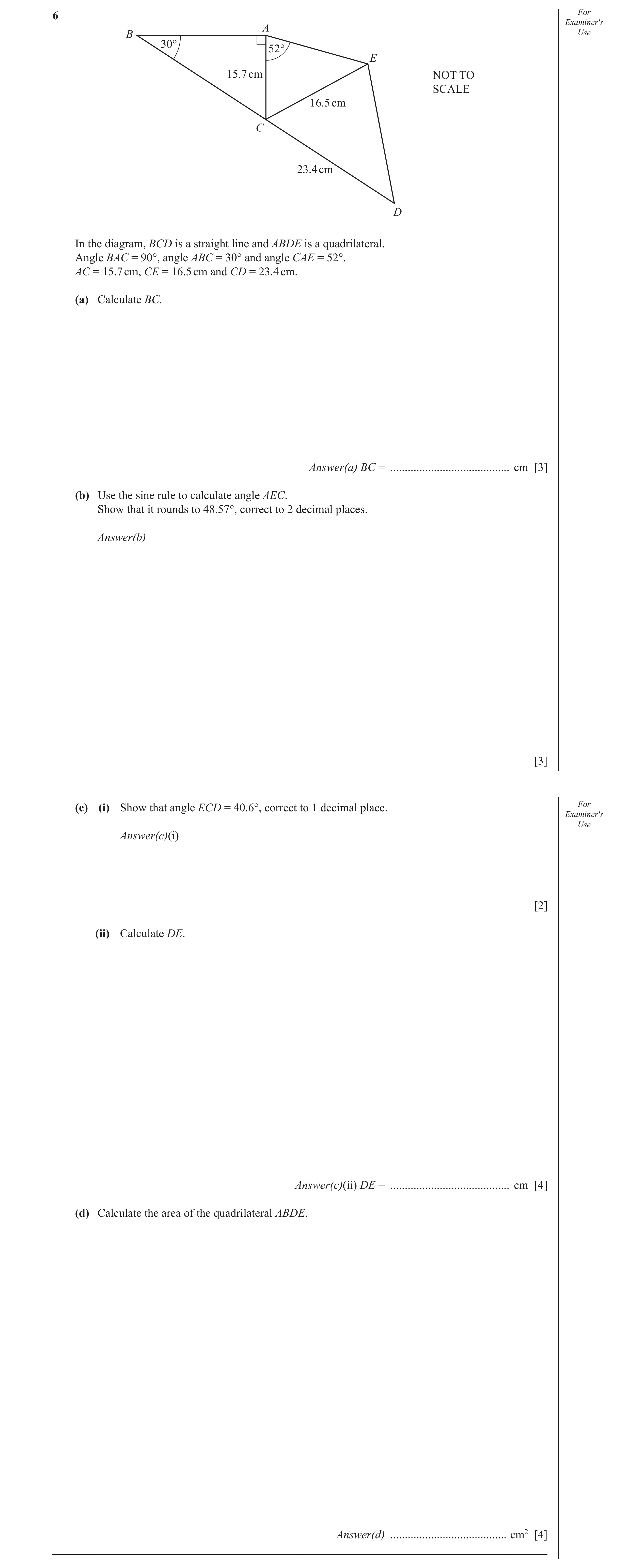
Q2 · For Examiner′s A Use B 30° 52° E 15.7 cm NOT TO SCALE 16.5 cm C 23.4 cm D In the diagram… 0580/41 May/June 2013
6 For Examiner′s A Use B 30° 52° E 15.7 cm NOT TO SCALE 16.5 cm C 23.4 cm D In the diagram, BCD is a straight line and ABDE is a quadrilateral. Angle BAC = 90°, angle ABC = 30° and angle CAE = 52°. AC = 15.7 cm, CE = 16.5 cm and CD = 23.4 cm. (a) Calculate BC. Answer(a) BC = … cm [3] (b) Use the sine rule to calculate angle AEC. Show that it rounds to 48.57°, correct to 2 decimal places. Answer(b) [3] (c) (i) Show that angle ECD = 40.6°, correct to 1 decimal place. For Examiner′s Use Answer(c)(i) [2] (ii) Calculate DE. Answer(c)(ii) DE = … cm [4] (d) Calculate the area of the quadrilateral ABDE. Answer(d) … cm2 [4] _____________________________________________________________________________________
16 marks
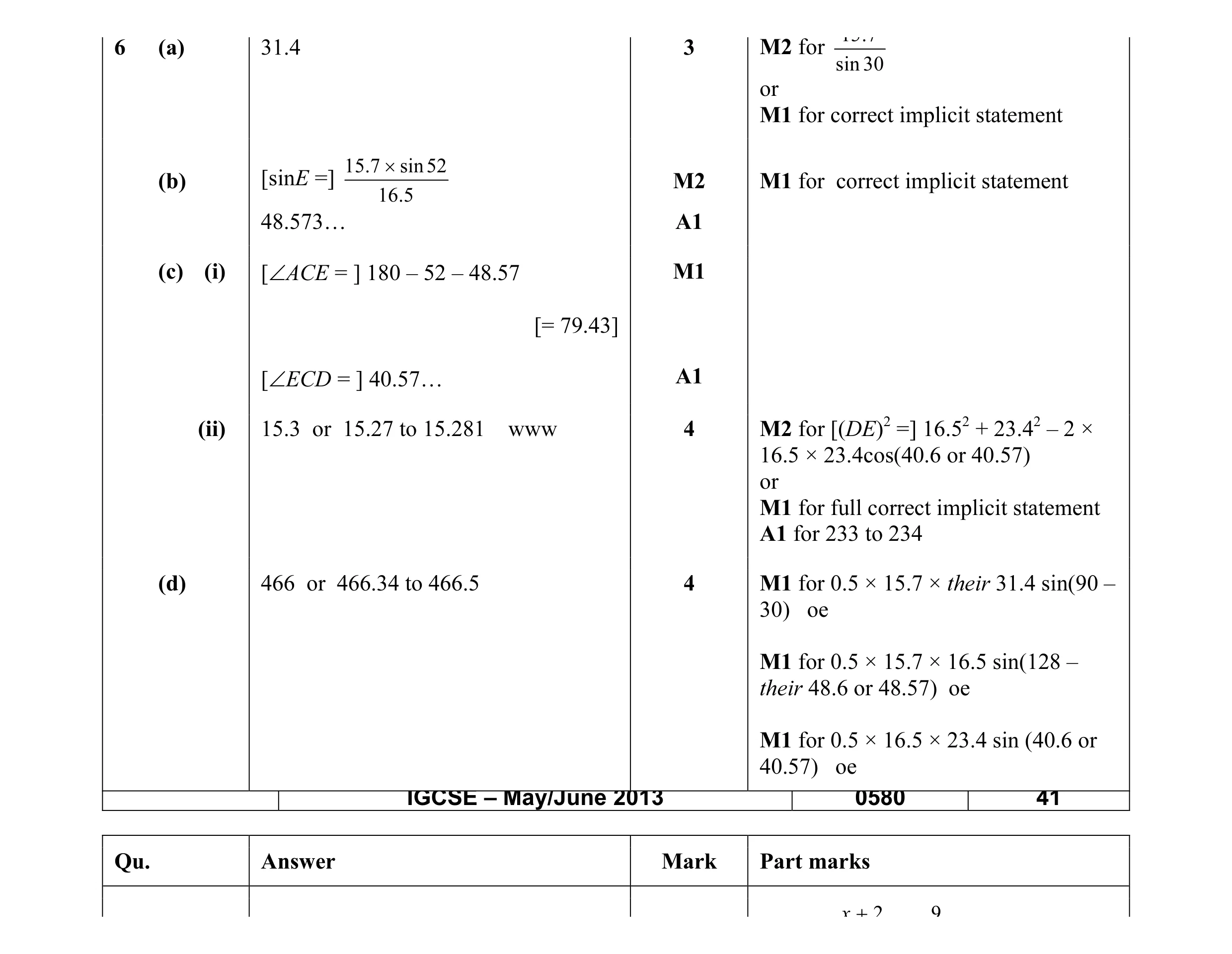
Mark scheme: 15 7. 6 (a) 31.4 3 M2 for sin 30 or M1 for correct implicit statement 15 7. × sin 52 (b) [sinE =] M2 M1 for correct implicit statement 16 5. 48.573… A1 (c) (i) [∠ACE = ] 180 – 52 – 48.57 M1 [= 79.43] [∠ECD = ] 40.57… A1 (ii) 15.3 or 15.27 to 15.281 www 4 M2 for [(DE)2 =] 16.52 + 23.42 – 2 × 16.5 × 23.4cos(40.6 or 40.57) or M1 for full correct implicit statement A1 for 233 to 234 (d) 466 or 466.34 to 466.5 4 M1 for 0.5 × 15.7 × their 31.4 sin(90 – 30) oe M1 for 0.5 × 15.7 × 16.5 sin(128 – their 48.6 or 48.57) oe M1 for 0.5 × 16.5 × 23.4 sin (40.6 or 40.57) oe IGCSE – May/June 2013 0580 41 Qu. Answer Mark Part marks x + 2 9
This question in 0580/41 May/June 2013
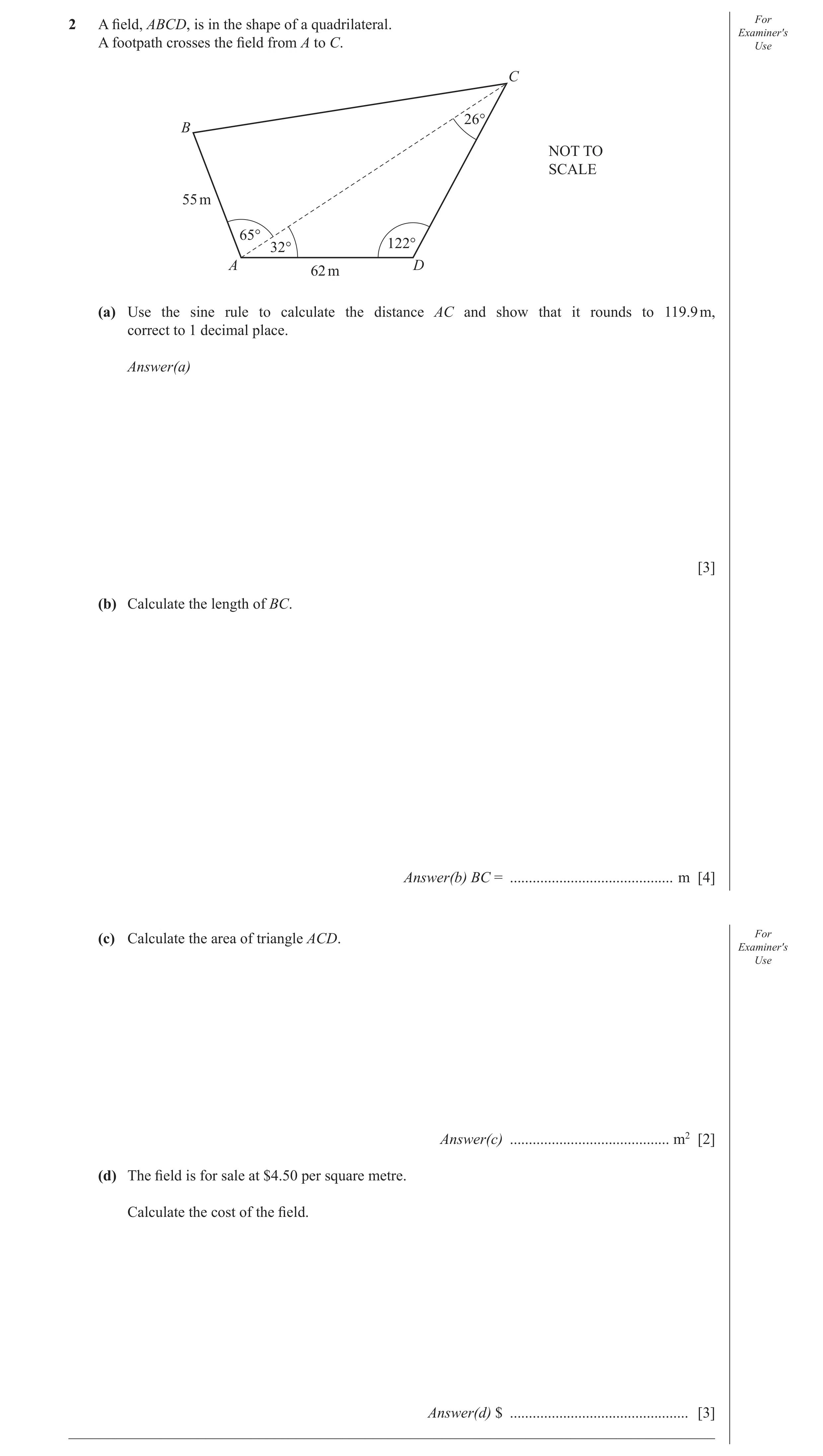
Q3 · A fi eld, ABCD, is in the shape of a quadrilateral 0580/43 Oct/Nov 2013
2 A fi eld, ABCD, is in the shape of a quadrilateral. For Examiner′s A footpath crosses the fi eld from A to C. Use C 26° B NOT TO SCALE 55 m 65° 32° 122° A D 62 m (a) Use the sine rule to calculate the distance AC and show that it rounds to 119.9 m, correct to 1 decimal place. Answer(a) [3] (b) Calculate the length of BC. Answer(b) BC = … m [4] (c) Calculate the area of triangle ACD. For Examiner′s Use Answer(c) … m2 [2] (d) The fi eld is for sale at $4.50 per square metre. Calculate the cost of the fi eld. Answer(d) $ … [3] _____________________________________________________________________________________
12 marks
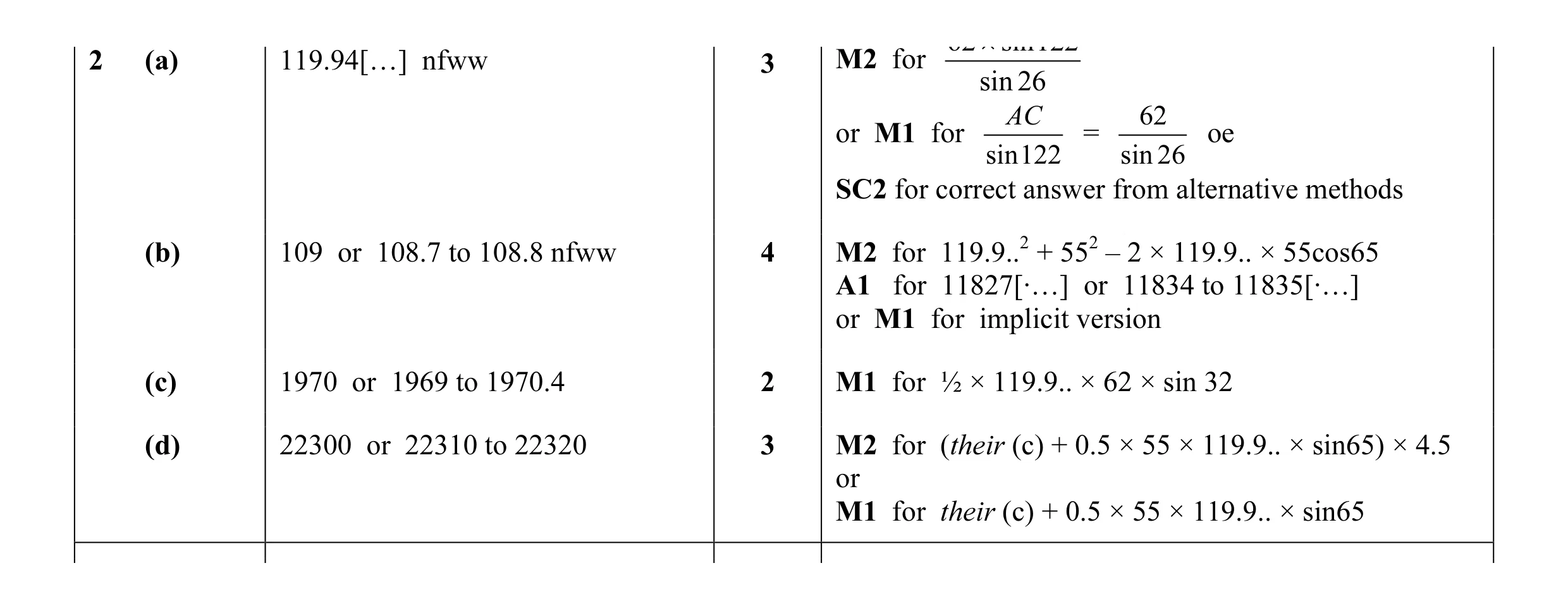
Mark scheme: 62 × sin 122 2 (a) 119.94[…] nfww 3 M2 for sin 26 AC 62 or M1 for = oe sin 122 sin 26 SC2 for correct answer from alternative methods (b) 109 or 108.7 to 108.8 nfww 4 M2 for 119.9..2 + 552 – 2 × 119.9.. × 55cos65 A1 for 11827[·…] or 11834 to 11835[·…] or M1 for implicit version (c) 1970 or 1969 to 1970.4 2 M1 for ½ × 119.9.. × 62 × sin 32 (d) 22300 or 22310 to 22320 3 M2 for (their (c) + 0.5 × 55 × 119.9.. × sin65) × 4.5 or M1 for their (c) + 0.5 × 55 × 119.9.. × sin65
This question in 0580/43 Oct/Nov 2013
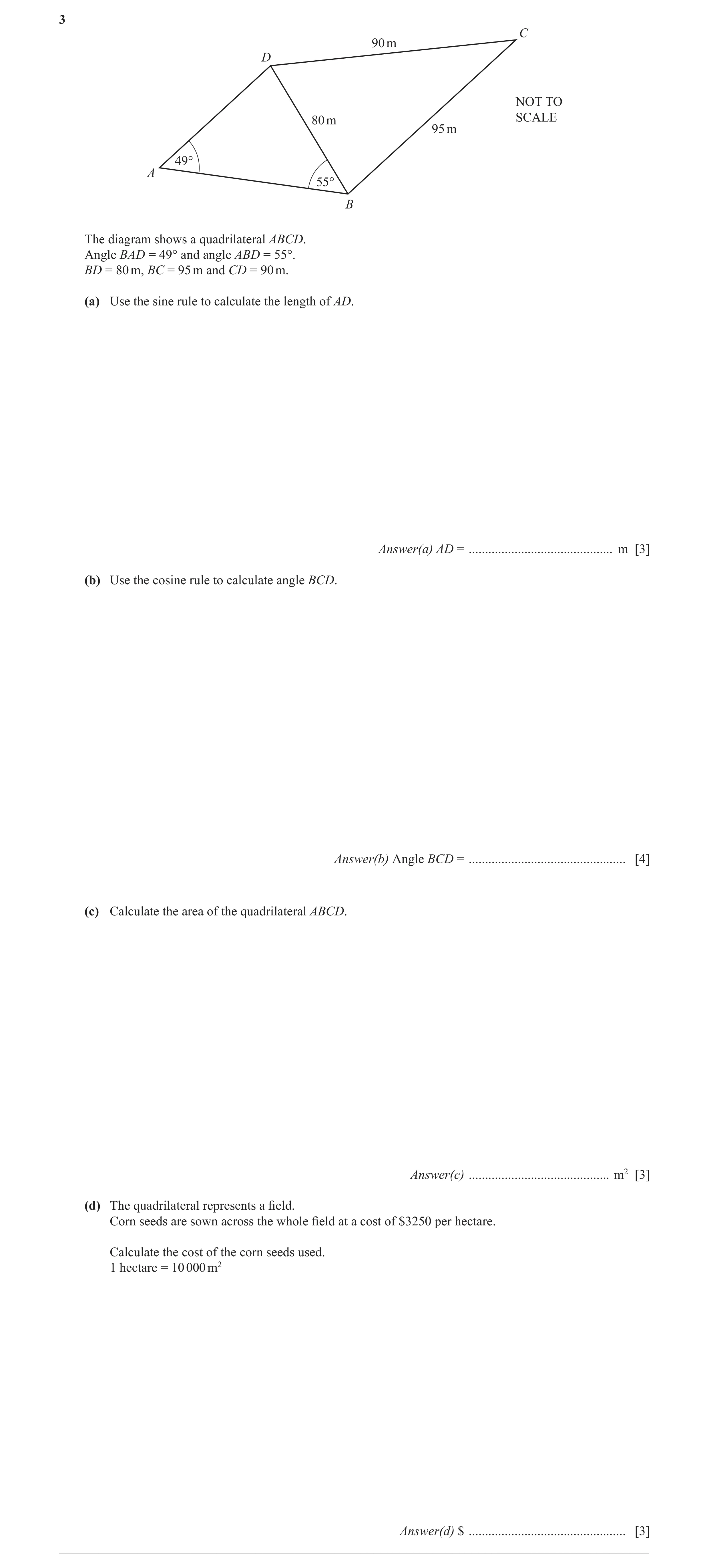
Q4 · C 90 m D NOT TO 80 m SCALE 95 m 49° A 55° B The diagram shows a quadrilateral ABCD 0580/42 May/June 2014
3 C 90 m D NOT TO 80 m SCALE 95 m 49° A 55° B The diagram shows a quadrilateral ABCD. Angle BAD = 49° and angle ABD = 55°. BD = 80 m, BC = 95 m and CD = 90 m. (a) Use the sine rule to calculate the length of AD. Answer(a) AD = … m [3] (b) Use the cosine rule to calculate angle BCD. Answer(b) Angle BCD = … [4] (c) Calculate the area of the quadrilateral ABCD. Answer(c) … m2 [3] (d) The quadrilateral represents a fi eld. Corn seeds are sown across the whole fi eld at a cost of $3250 per hectare. Calculate the cost of the corn seeds used. 1 hectare = 10 000 m2 Answer(d) $ … [3] __________________________________________________________________________________________
13 marks
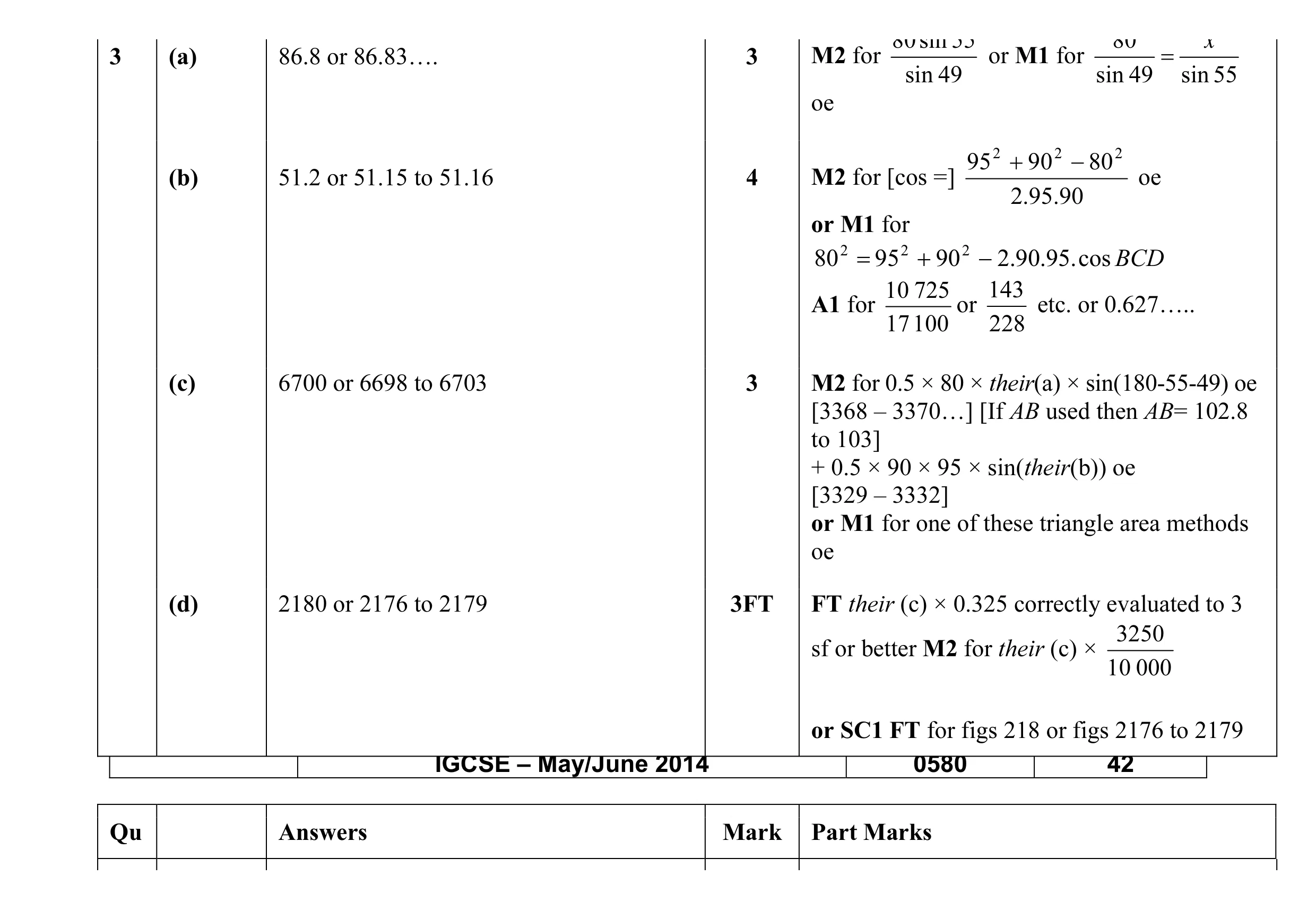
Mark scheme: 80 sin 55 80 x 3 (a) 86.8 or 86.83…. 3 M2 for or M1 for = sin 49 sin 49 sin 55 oe 95 2 + 90 2 − 80 2 (b) 51.2 or 51.15 to 51.16 4 M2 for [cos =] oe .2 95. 90 or M1 for 80 2 = 95 2 + 90 2 − .290.95. cos BCD 10 725 143 A1 for or etc. or 0.627….. 17 100 228 (c) 6700 or 6698 to 6703 3 M2 for 0.5 × 80 × their(a) × sin(180-55-49) oe [3368 – 3370…] [If AB used then AB= 102.8 to 103] + 0.5 × 90 × 95 × sin(their(b)) oe [3329 – 3332] or M1 for one of these triangle area methods oe (d) 2180 or 2176 to 2179 3FT FT their (c) × 0.325 correctly evaluated to 3 3250 sf or better M2 for their (c) × 10 000 or SC1 FT for figs 218 or figs 2176 to 2179 IGCSE – May/June 2014 0580 42 Qu Answers Mark Part Marks
This question in 0580/42 May/June 2014
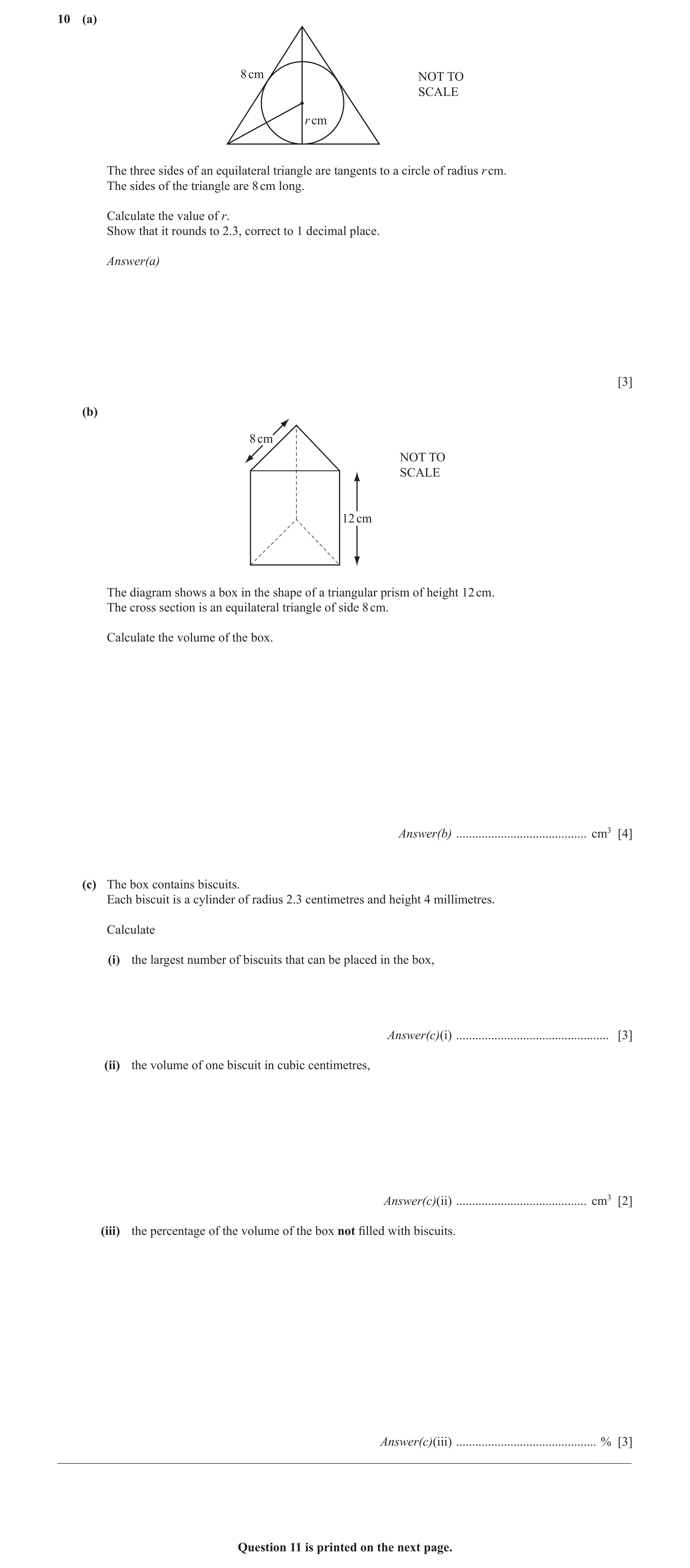
Q5 · 8 cm NOT TO SCALE r cm The three sides of an equilateral triangle are tangents to a… 0580/43 May/June 2014
10 (a) 8 cm NOT TO SCALE r cm The three sides of an equilateral triangle are tangents to a circle of radius r cm. The sides of the triangle are 8 cm long. Calculate the value of r. Show that it rounds to 2.3, correct to 1 decimal place. Answer(a) [3] (b) 8 cm NOT TO SCALE 12 cm The diagram shows a box in the shape of a triangular prism of height 12 cm. The cross section is an equilateral triangle of side 8 cm. Calculate the volume of the box. Answer(b) … cm3 [4] (c) The box contains biscuits. Each biscuit is a cylinder of radius 2.3 centimetres and height 4 millimetres. Calculate (i) the largest number of biscuits that can be placed in the box, Answer(c)(i) … [3] (ii) the volume of one biscuit in cubic centimetres, Answer(c)(ii) … cm3 [2] (iii) the percentage of the volume of the box not fi lled with biscuits. Answer(c)(iii) … % [3] __________________________________________________________________________________________ Question 11 is printed on the next page.
15 marks
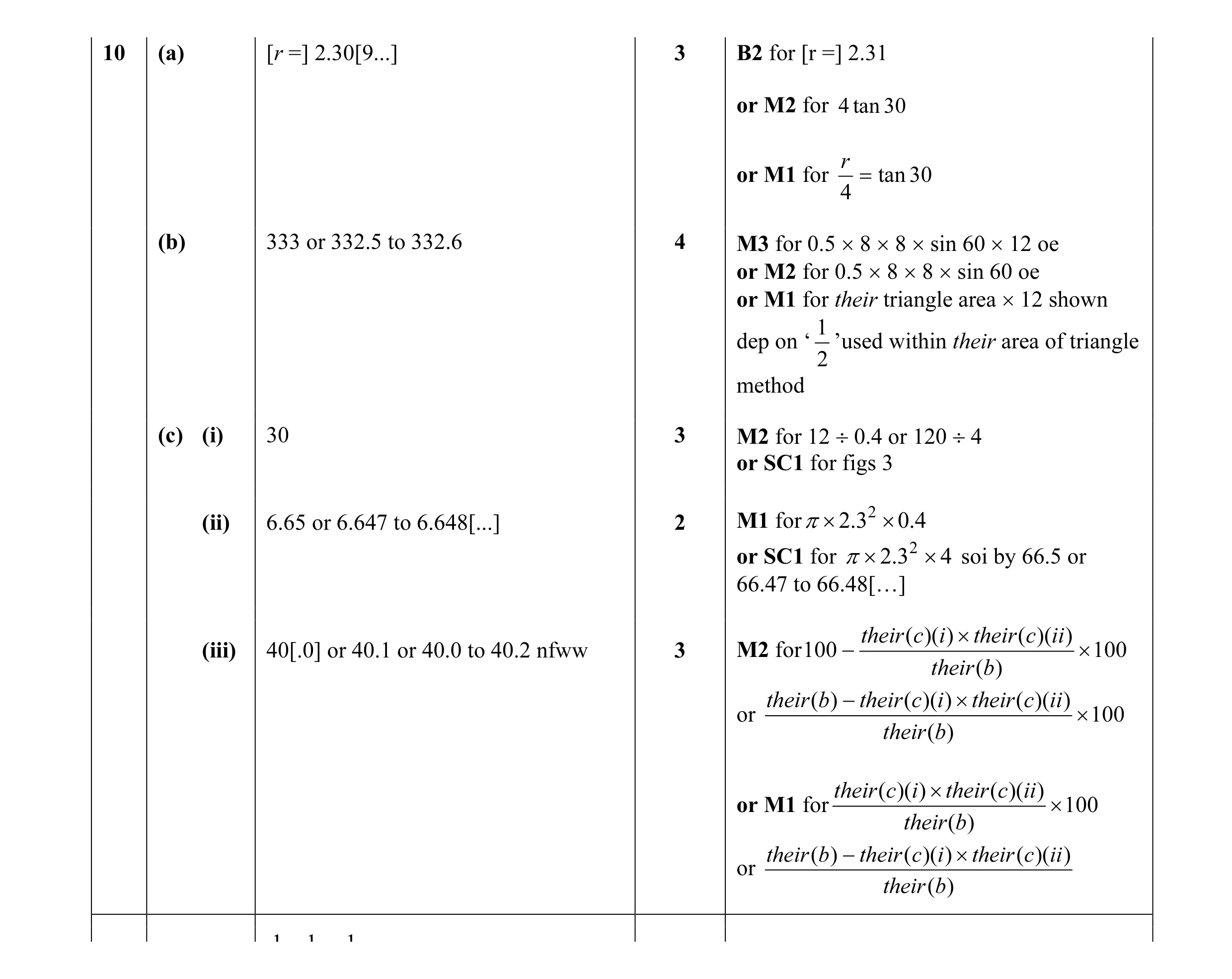
Mark scheme: 10 (a) [r =] 2.30[9...] 3 B2 for [r =] 2.31 or M2 for 4 tan 30 r or M1 for = tan 30 4 (b) 333 or 332.5 to 332.6 4 M3 for 0.5 × 8 × 8 × sin 60 × 12 oe or M2 for 0.5 × 8 × 8 × sin 60 oe or M1 for their triangle area × 12 shown 1 dep on ‘ ’used within their area of triangle 2 method (c) (i) 30 3 M2 for 12 ÷ 0.4 or 120 ÷ 4 or SC1 for figs 3 (ii) 6.65 or 6.647 to 6.648[...] 2 M1 for π × 3.2 2 × 4.0 or SC1 for π × 3.2 2 × 4 soi by 66.5 or 66.47 to 66.48[…] their ( c )(i ) × their ( c )(ii ) (iii) 40[.0] or 40.1 or 40.0 to 40.2 nfww 3 M2 for 100 − × 100 their (b ) their (b ) − their ( c )(i ) × their ( c )(ii ) or × 100 their (b ) their ( c )(i ) × their ( c )(ii ) or M1 for × 100 their (b ) their ( b ) − their ( c )(i ) × their ( c )(ii ) or their ( b ) 1 1 1
This question in 0580/43 May/June 2014
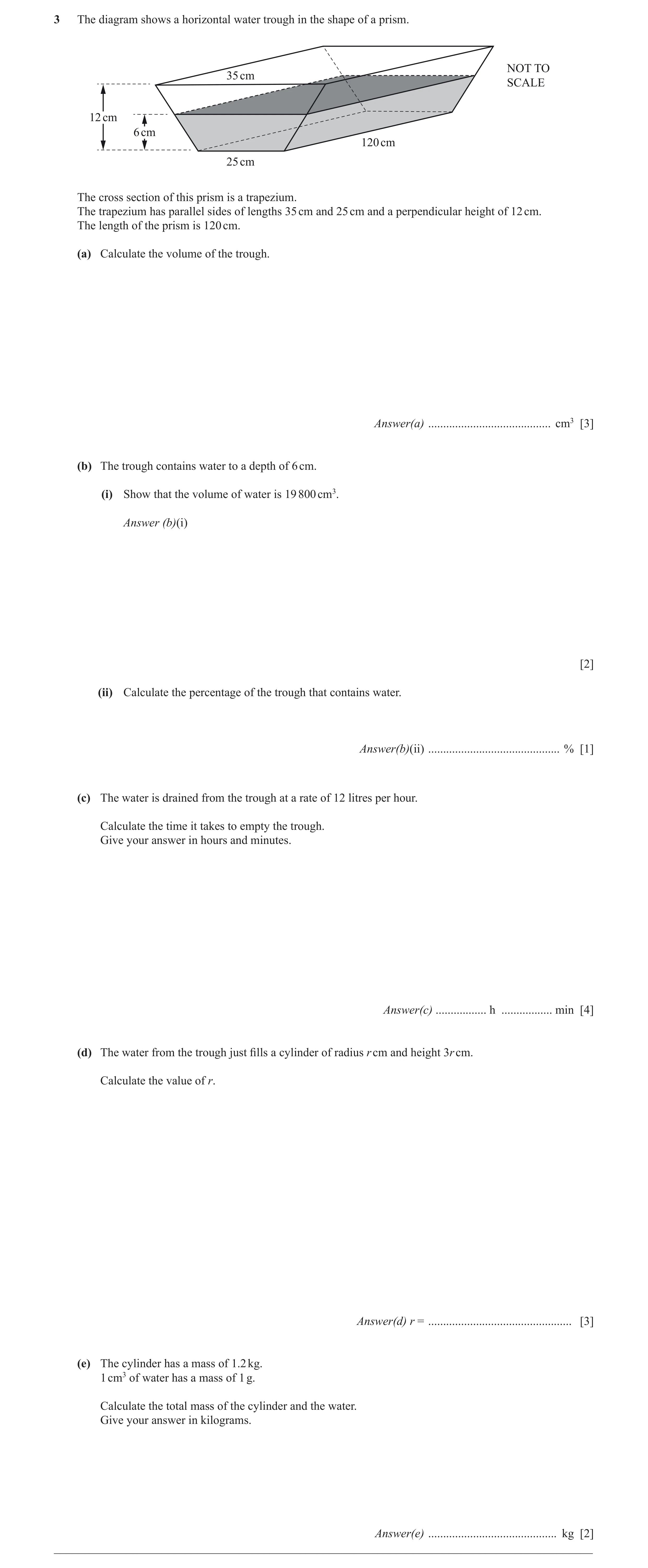
Q6 · The diagram shows a horizontal water trough in the shape of a prism 0580/43 Oct/Nov 2015
3 The diagram shows a horizontal water trough in the shape of a prism. NOT TO 35 cm SCALE 12 cm 6 cm 120 cm 25 cm The cross section of this prism is a trapezium. The trapezium has parallel sides of lengths 35 cm and 25 cm and a perpendicular height of 12 cm. The length of the prism is 120 cm. (a) Calculate the volume of the trough. Answer(a) … cm3 [3] (b) The trough contains water to a depth of 6 cm. (i) Show that the volume of water is 19 800 cm3. Answer (b)(i) [2] (ii) Calculate the percentage of the trough that contains water. Answer(b)(ii) … % [1] (c) The water is drained from the trough at a rate of 12 litres per hour. Calculate the time it takes to empty the trough. Give your answer in hours and minutes. Answer(c) … h … min [4] (d) The water from the trough just fills a cylinder of radius r cm and height 3r cm. Calculate the value of r. Answer(d) r = … [3] (e) The cylinder has a mass of 1.2 kg. 1 cm3 of water has a mass of 1 g. Calculate the total mass of the cylinder and the water. Give your answer in kilograms. Answer(e) … kg [2] __________________________________________________________________________________________
15 marks
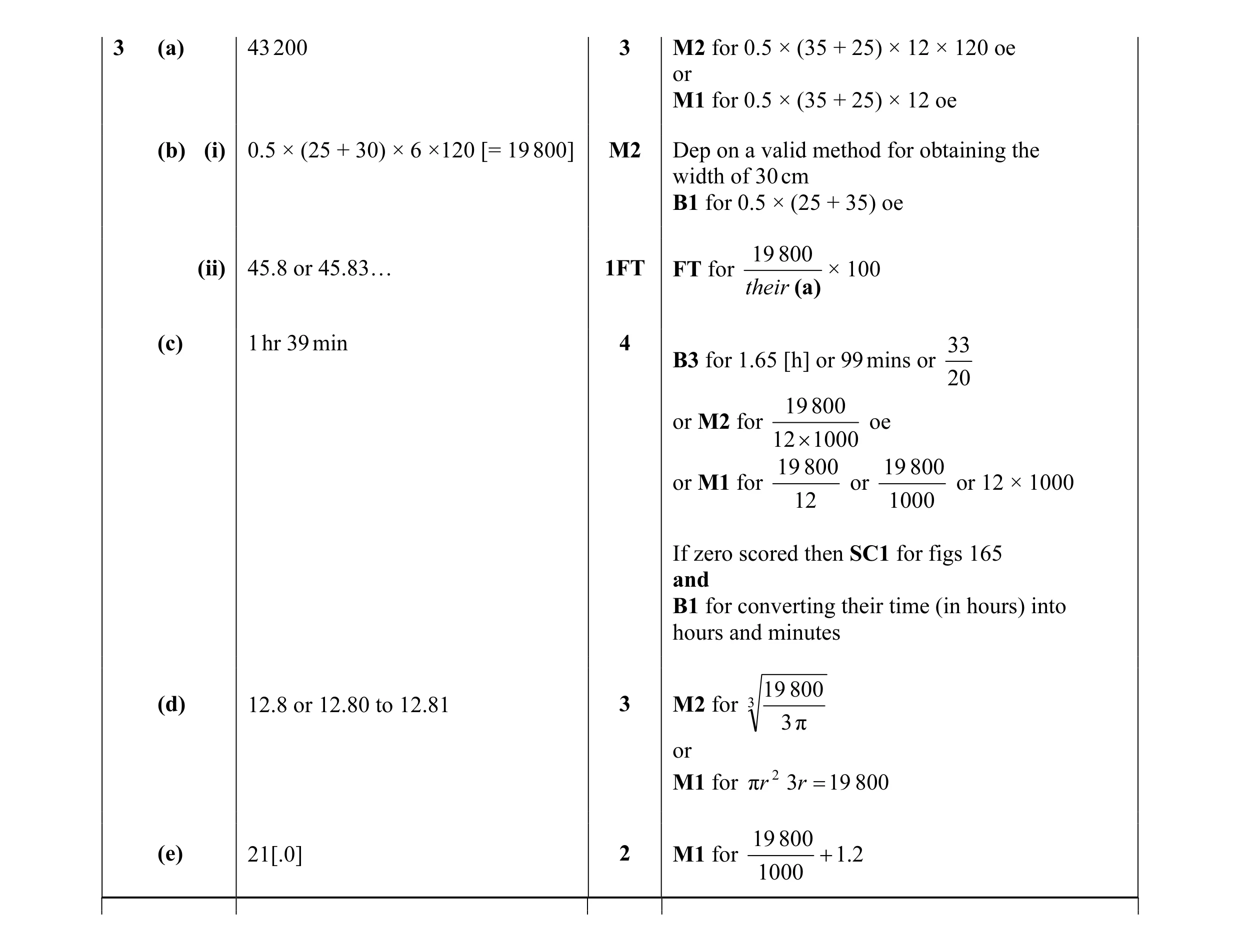
Mark scheme: 3 (a) 43 200 3 M2 for 0.5 × (35 + 25) × 12 × 120 oe or M1 for 0.5 × (35 + 25) × 12 oe (b) (i) 0.5 × (25 + 30) × 6 ×120 [= 19 800] M2 Dep on a valid method for obtaining the width of 30 cm B1 for 0.5 × (25 + 35) oe 19 800 (ii) 45.8 or 45.83… 1FT FT for × 100 their (a) (c) 1 hr 39 min 4 33 B3 for 1.65 [h] or 99 mins or 20 19 800 or M2 for oe 12 × 1000 19 800 19 800 or M1 for or or 12 × 1000 12 1000 If zero scored then SC1 for figs 165 and B1 for converting their time (in hours) into hours and minutes 19 800 (d) 12.8 or 12.80 to 12.81 3 M2 for 3 3 π or M1 for π r 2 3r = 19 800 19 800 (e) 21[.0] 2 M1 for + 2.1 1000
This question in 0580/43 Oct/Nov 2015
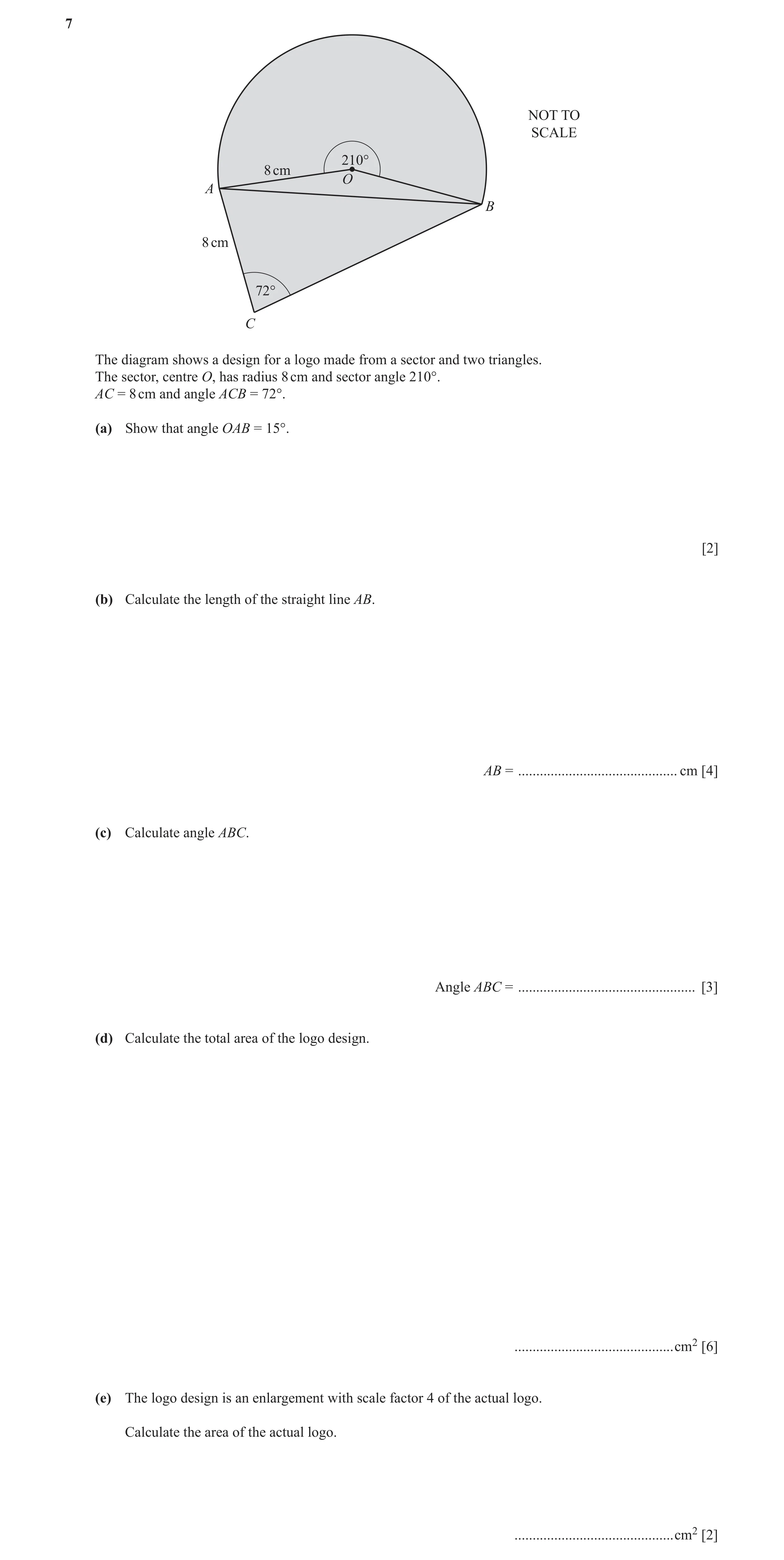
Q7 · NOT TO SCALE 210° 88cmcm O A B 8 cm 72° C The diagram shows a design for a logo made from… 0580/42 May/June 2016
7 NOT TO SCALE 210° 88cmcm O A B 8 cm 72° C The diagram shows a design for a logo made from a sector and two triangles. The sector, centre O, has radius 8 cm and sector angle 210°. AC = 8 cm and angle ACB = 72°. (a) Show that angle OAB = 15°. [2] (b) Calculate the length of the straight line AB. AB = … cm [4] (c) Calculate angle ABC. Angle ABC = … [3] (d) Calculate the total area of the logo design. … cm2 [6] (e) The logo design is an enlargement with scale factor 4 of the actual logo. Calculate the area of the actual logo. … cm2 [2]
17 marks
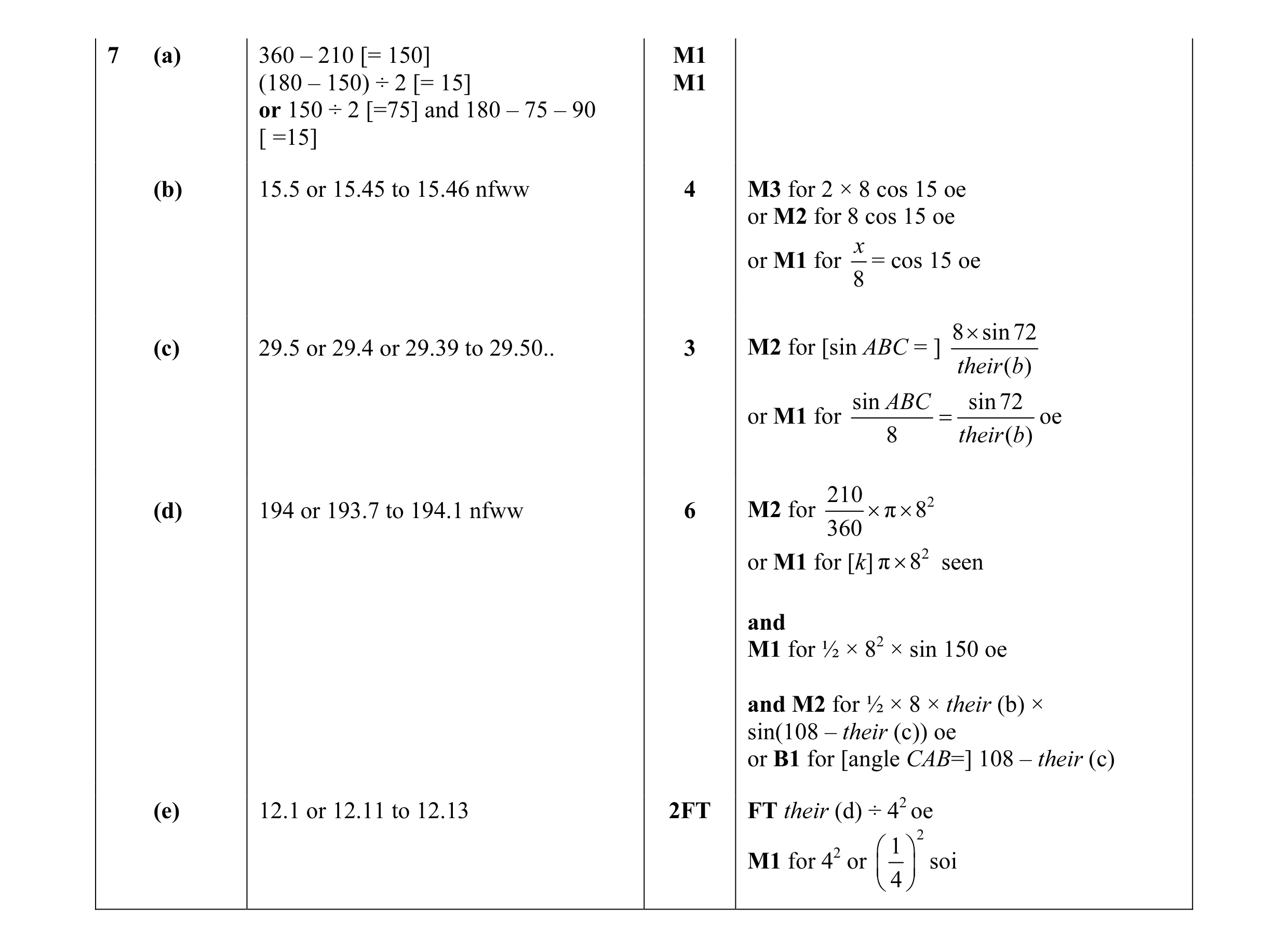
Mark scheme: 7 (a) 360 – 210 [= 150] M1 (180 – 150) ÷ 2 [= 15] M1 or 150 ÷ 2 [=75] and 180 – 75 – 90 [ =15] (b) 15.5 or 15.45 to 15.46 nfww 4 M3 for 2 × 8 cos 15 oe or M2 for 8 cos 15 oe x or M1 for = cos 15 oe 8 8 × sin72 (c) 29.5 or 29.4 or 29.39 to 29.50.. 3 M2 for [sin ABC = ] their (b ) sin ABC sin72 or M1 for = oe 8 their (b ) 210 2 (d) 194 or 193.7 to 194.1 nfww 6 M2 for × π × 8 360 or M1 for [k] π × 8 2 seen and M1 for ½ × 82 × sin 150 oe and M2 for ½ × 8 × their (b) × sin(108 – their (c)) oe or B1 for [angle CAB=] 108 – their (c) (e) 12.1 or 12.11 to 12.13 2FT FT their (d) ÷ 42 oe 2 1 M1 for 42 or soi 4
This question in 0580/42 May/June 2016
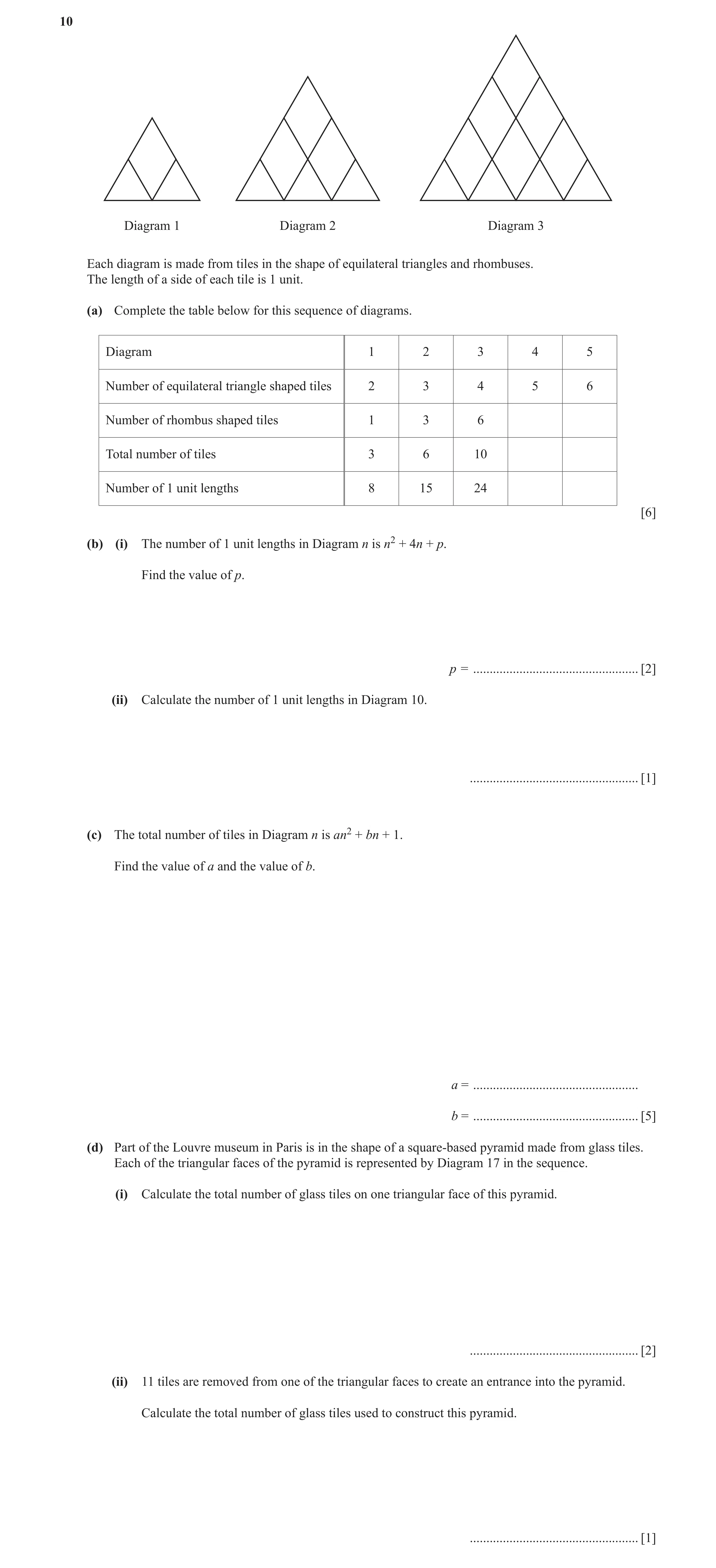
Q8 · Diagram 1 Diagram 2 Diagram 3 Each diagram is made from tiles in the shape of equilateral… 0580/43 May/June 2016
10 Diagram 1 Diagram 2 Diagram 3 Each diagram is made from tiles in the shape of equilateral triangles and rhombuses. The length of a side of each tile is 1 unit. (a) Complete the table below for this sequence of diagrams. Diagram 1 2 3 4 5 Number of equilateral triangle shaped tiles 2 3 4 5 6 Number of rhombus shaped tiles 1 3 6 Total number of tiles 3 6 10 Number of 1 unit lengths 8 15 24 [6] (b) (i) The number of 1 unit lengths in Diagram n is n2 + 4n + p. Find the value of p. p = … [2] (ii) Calculate the number of 1 unit lengths in Diagram 10. … [1] (c) The total number of tiles in Diagram n is an2 + bn + 1. Find the value of a and the value of b. a = … b = … [5] (d) Part of the Louvre museum in Paris is in the shape of a square-based pyramid made from glass tiles. Each of the triangular faces of the pyramid is represented by Diagram 17 in the sequence. (i) Calculate the total number of glass tiles on one triangular face of this pyramid. … [2] (ii) 11 tiles are removed from one of the triangular faces to create an entrance into the pyramid. Calculate the total number of glass tiles used to construct this pyramid. … [1]
17 marks
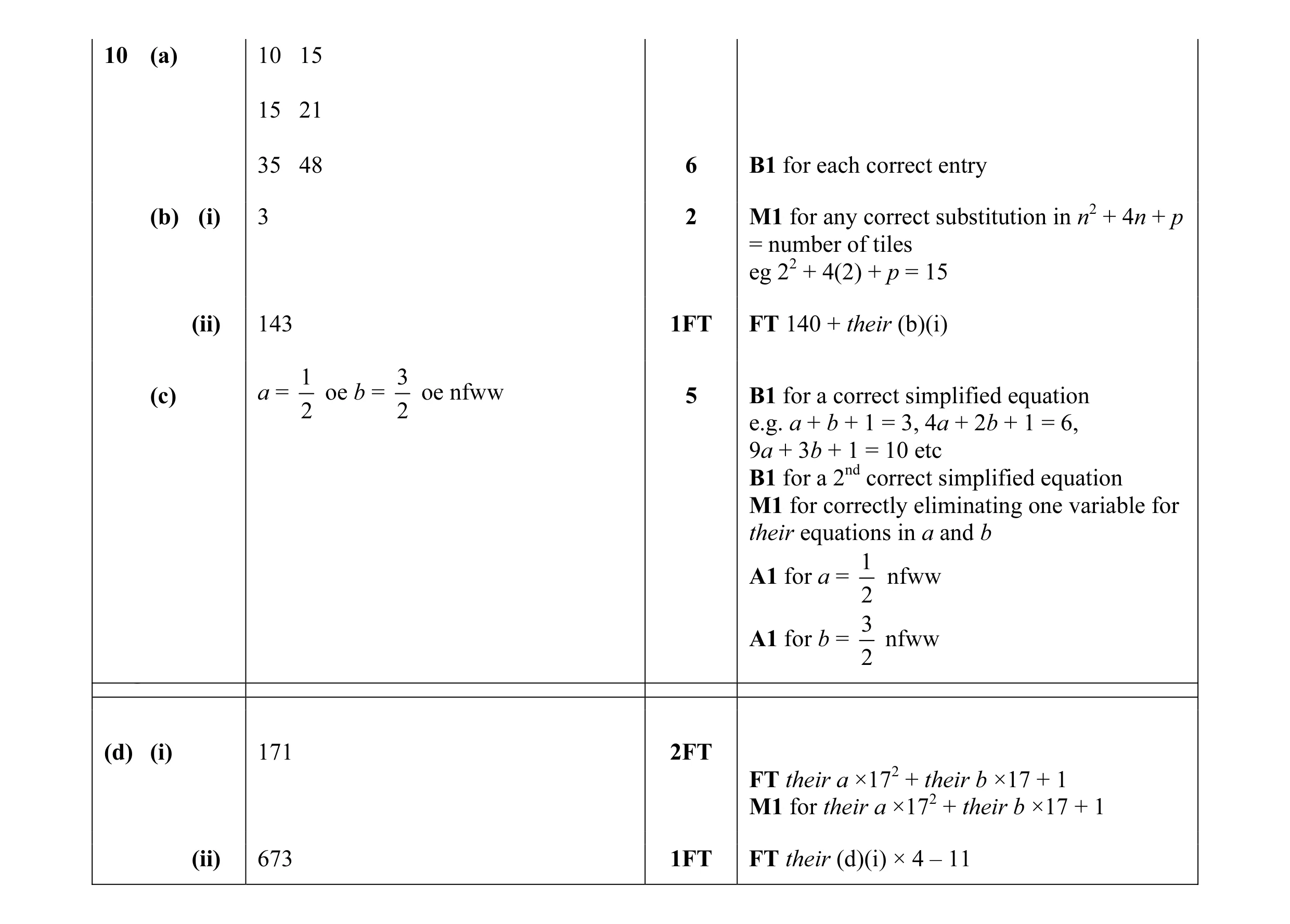
Mark scheme: 10 (a) 10 15 15 21 35 48 6 B1 for each correct entry (b) (i) 3 2 M1 for any correct substitution in n2 + 4n + p = number of tiles eg 22 + 4(2) + p = 15 (ii) 143 1FT FT 140 + their (b)(i) 1 3 (c) a = oe b = oe nfww 5 B1 for a correct simplified equation 2 2 e.g. a + b + 1 = 3, 4a + 2b + 1 = 6, 9a + 3b + 1 = 10 etc B1 for a 2nd correct simplified equation M1 for correctly eliminating one variable for their equations in a and b 1 A1 for a = nfww 2 3 A1 for b = nfww 2 (d) (i) 171 2FT FT their a ×172 + their b ×17 + 1 M1 for their a ×172 + their b ×17 + 1 (ii) 673 1FT FT their (d)(i) × 4 – 11
This question in 0580/43 May/June 2016
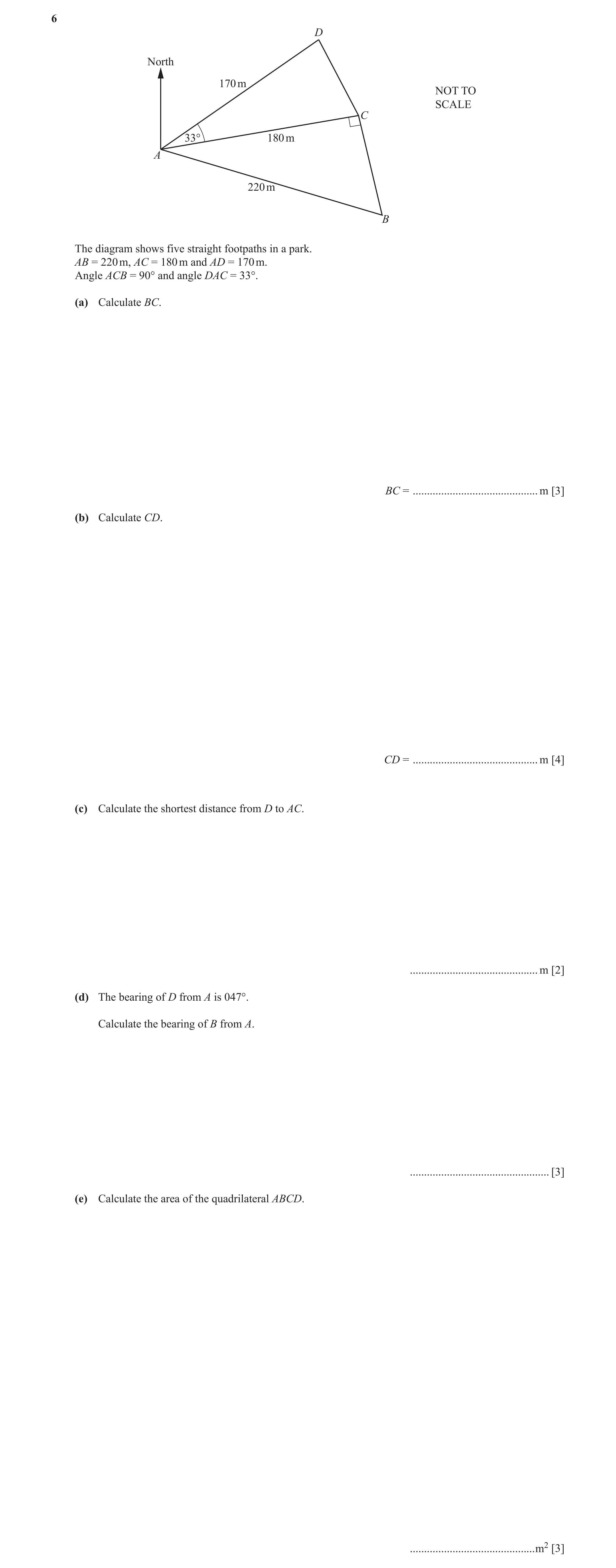
Q9 · D North 170 m NOT TO SCALE C 33° 180 m A 220 m B The diagram shows five straight… 0580/41 Oct/Nov 2016
6 D North 170 m NOT TO SCALE C 33° 180 m A 220 m B The diagram shows five straight footpaths in a park. AB = 220 m, AC = 180 m and AD = 170 m. Angle ACB = 90° and angle DAC = 33°. (a) Calculate BC. BC = … m [3] (b) Calculate CD. CD = … m [4] (c) Calculate the shortest distance from D to AC. … m [2] (d) The bearing of D from A is 047°. Calculate the bearing of B from A. … [3] (e) Calculate the area of the quadrilateral ABCD. … m2 [3]
15 marks
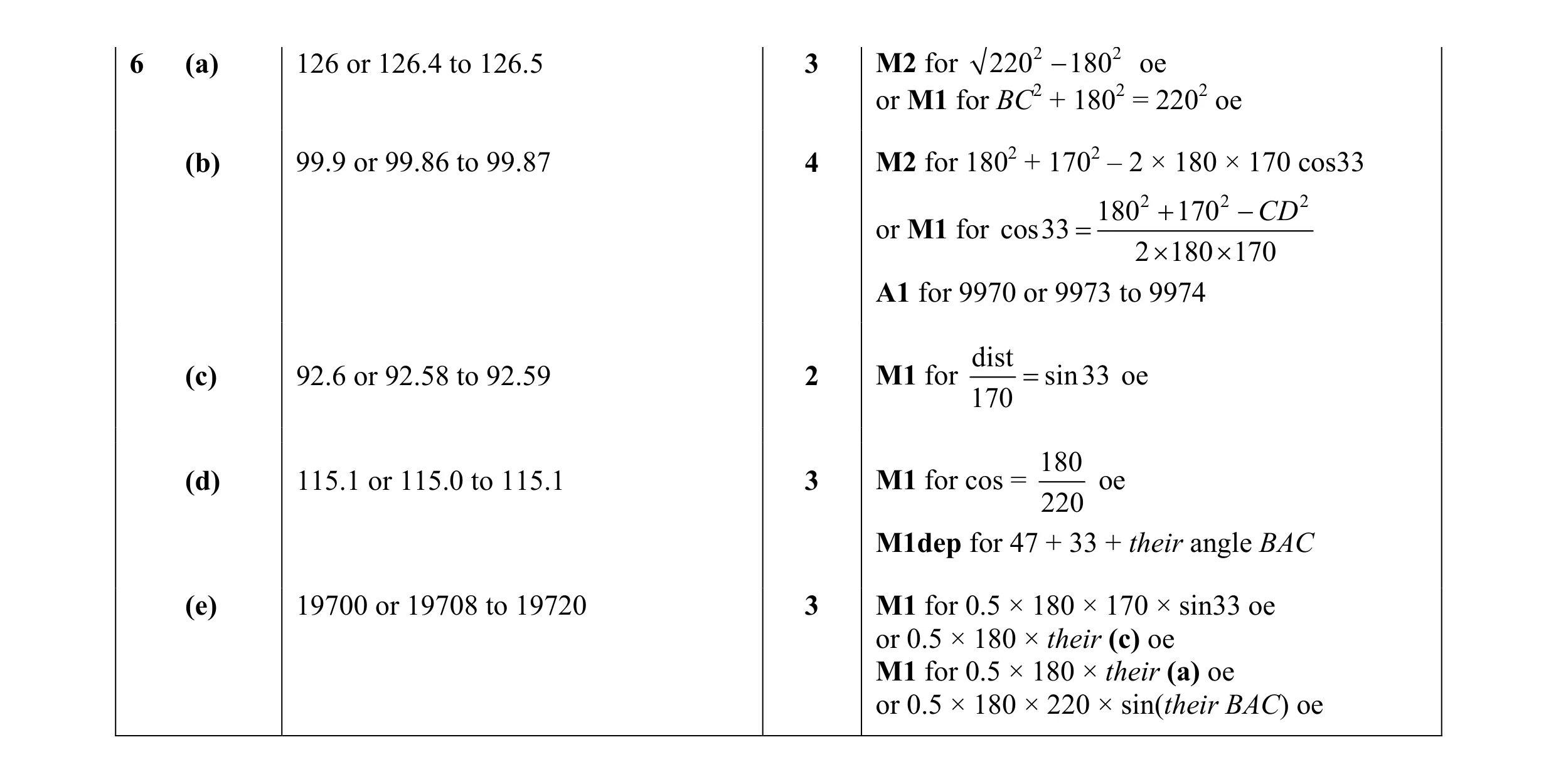
Mark scheme: 6 (a) 126 or 126.4 to 126.5 3 M2 for 220 2 − 180 2 oe or M1 for BC2 + 1802 = 2202 oe (b) 99.9 or 99.86 to 99.87 4 M2 for 1802 + 1702 – 2 × 180 × 170 cos33 180 2 + 170 2 − CD 2 or M1 for cos33 = 2 × 180 × 170 A1 for 9970 or 9973 to 9974 dist (c) 92.6 or 92.58 to 92.59 2 M1 for = sin33 oe 170 180 (d) 115.1 or 115.0 to 115.1 3 M1 for cos = oe 220 M1dep for 47 + 33 + their angle BAC (e) 19700 or 19708 to 19720 3 M1 for 0.5 × 180 × 170 × sin33 oe or 0.5 × 180 × their (c) oe M1 for 0.5 × 180 × their (a) oe or 0.5 × 180 × 220 × sin(their BAC) oe
This question in 0580/41 Oct/Nov 2016
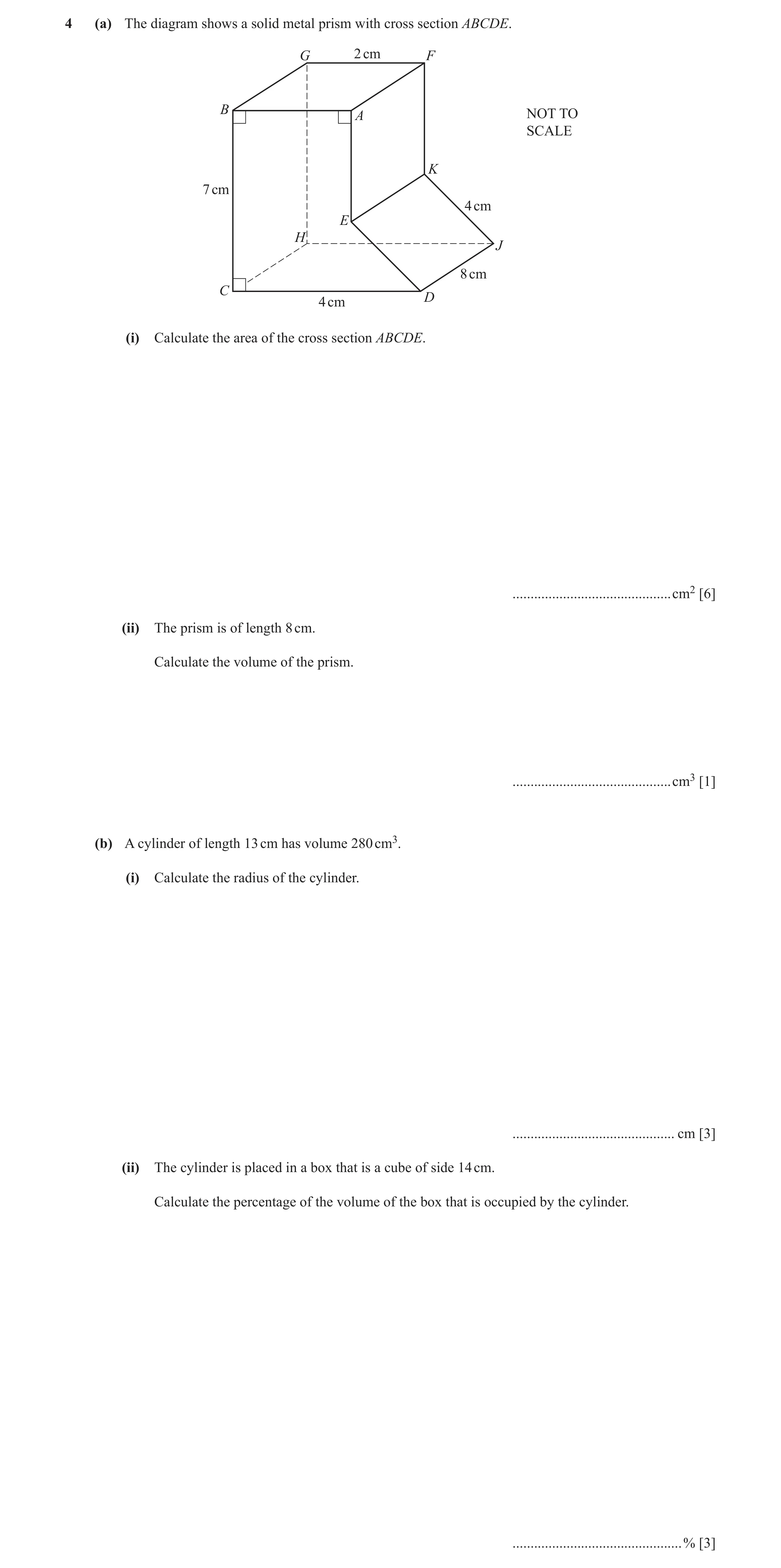
Q10 · The diagram shows a solid metal prism with cross section ABCDE 0580/43 May/June 2017
4 (a) The diagram shows a solid metal prism with cross section ABCDE. G 2 cm F B A NOT TO SCALE K 7 cm 4 cm E H J 8 cm C D 4 cm (i) Calculate the area of the cross section ABCDE. … cm2 [6] (ii) The prism is of length 8 cm. Calculate the volume of the prism. … cm3 [1] (b) A cylinder of length 13 cm has volume 280 cm3. (i) Calculate the radius of the cylinder. … cm [3] (ii) The cylinder is placed in a box that is a cube of side 14 cm. Calculate the percentage of the volume of the box that is occupied by the cylinder. … % [3]
13 marks
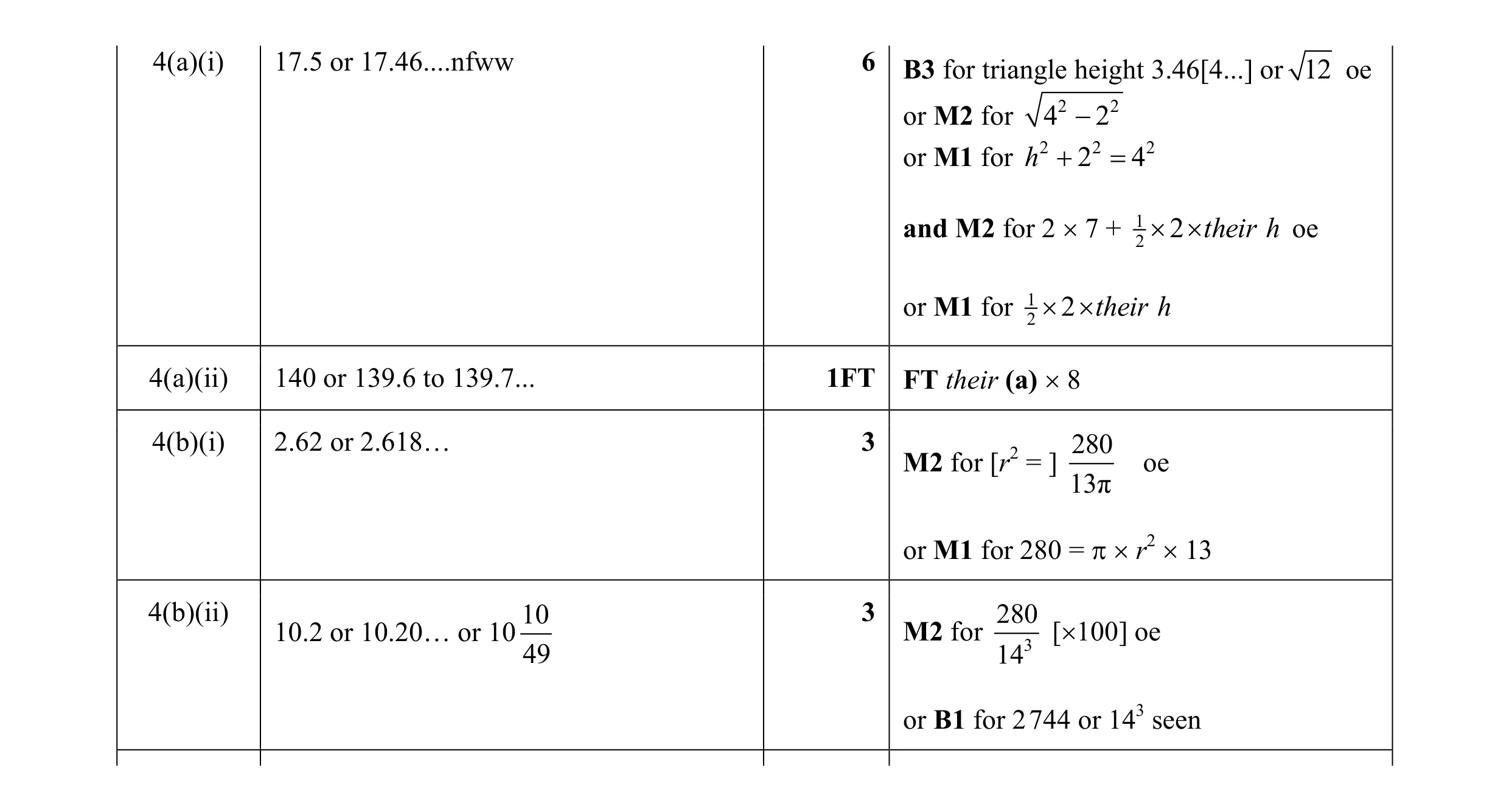
Mark scheme: 4(a)(i) 17.5 or 17.46 … nfww 6 B3 for triangle height 3.46[4...] or 12 oe or M2 for 4 2 − 2 2 or M1 for h 2 + 2 2 = 4 2 and M2 for 2 × 7 + 12 × 2 × their h oe or M1 for 12 × 2 × their h 4(a)(ii) 140 or 139.6 to 139.7... 1FT FT their (a) × 8 4(b)(i) 2.62 or 2.618… 3 280 M2 for [r2 = ] oe 13π or M1 for 280 = π × r2 × 13 4(b)(ii) 10 3 280 10.2 or 10.20… or 10 M2 for 3 [×100] oe 49 14 or B1 for 2 744 or 143 seen
This question in 0580/43 May/June 2017
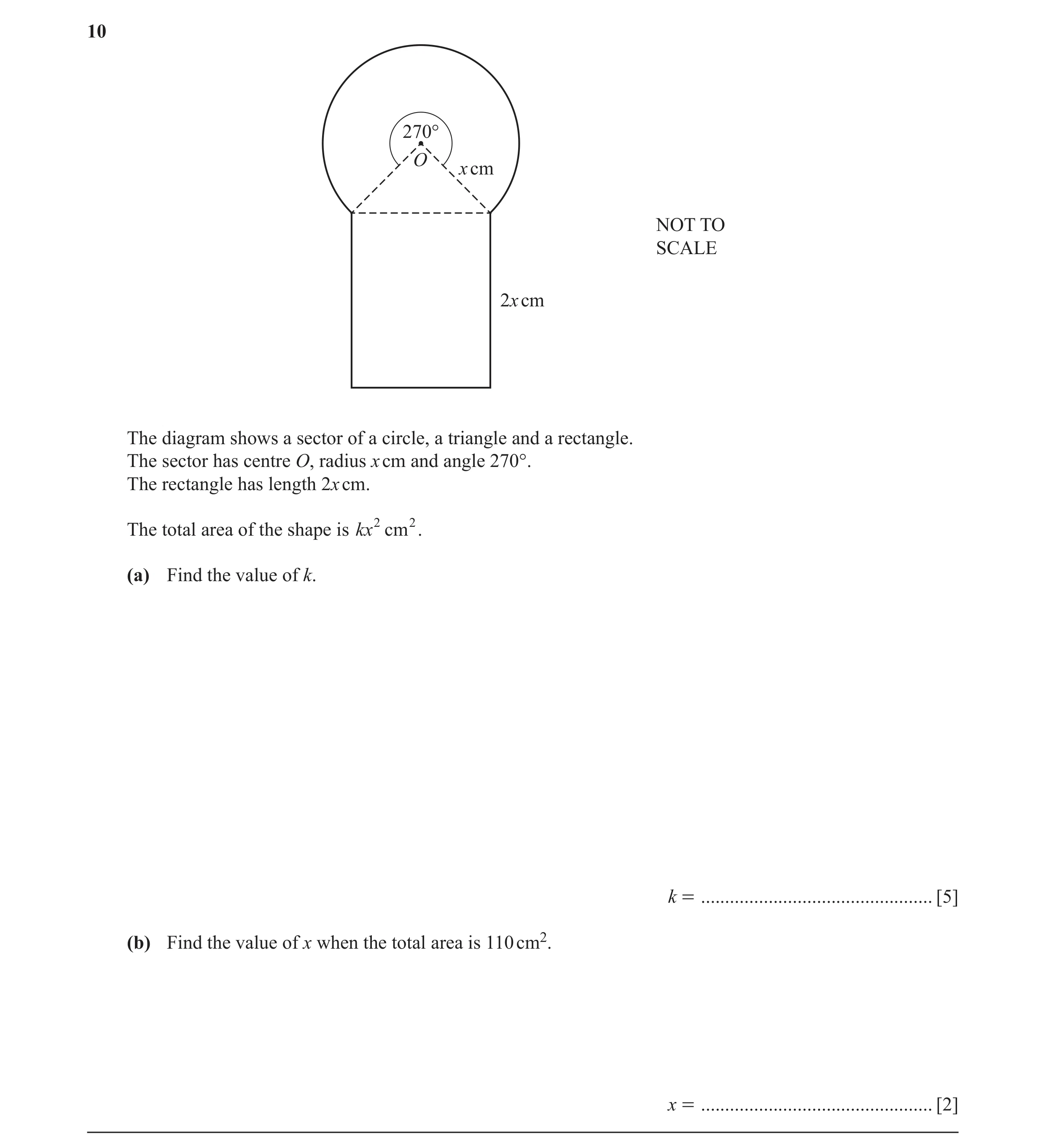
Q11 · 270° O x cm NOT TO SCALE 2x cm The diagram shows a sector of a circle, a triangle and a… 0580/42 Oct/Nov 2017
10 270° O x cm NOT TO SCALE 2x cm The diagram shows a sector of a circle, a triangle and a rectangle. The sector has centre O, radius x cm and angle 270°. The rectangle has length 2x cm. The total area of the shape is kx2 cm 2. (a) Find the value of k. k = … [5] (b) Find the value of x when the total area is 110 cm2. x = … [2]
7 marks
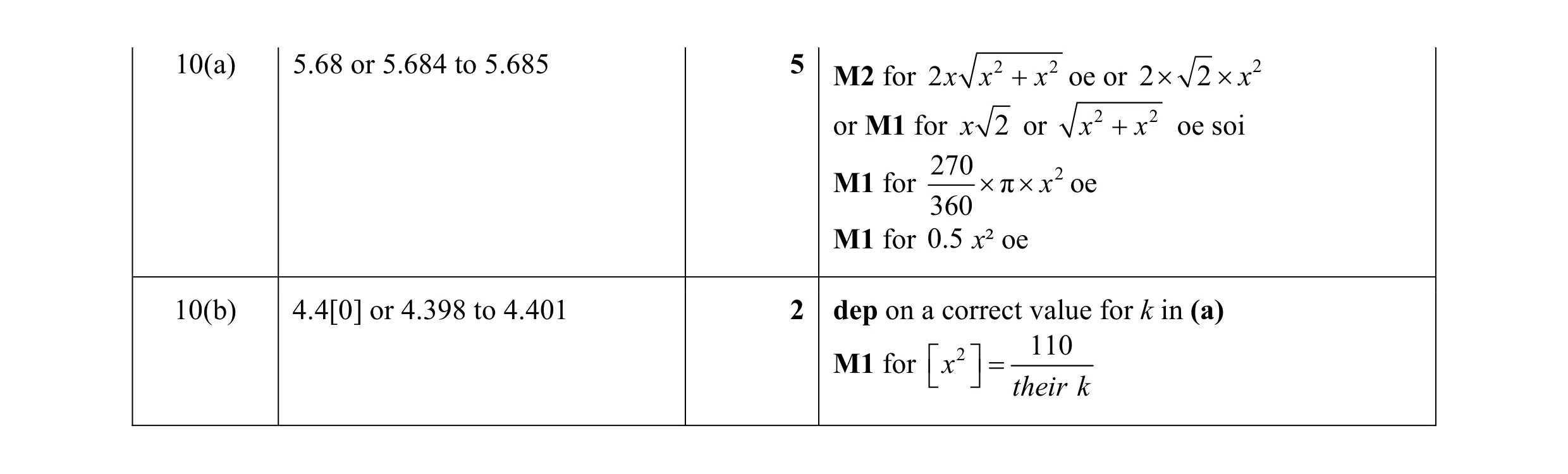
Mark scheme: 10(a) 5.68 or 5.684 to 5.685 5 2 2 2 M2 for 2 x x + x oe or 2 × 2 × x or M1 for x 2 or x 2 + x 2 oe soi 270 2 M1 for × π × x oe 360 M1 for 0.5 x² oe 10(b) 4.4[0] or 4.398 to 4.401 2 dep on a correct value for k in (a) 2 110 M1 for x = their k
This question in 0580/42 Oct/Nov 2017
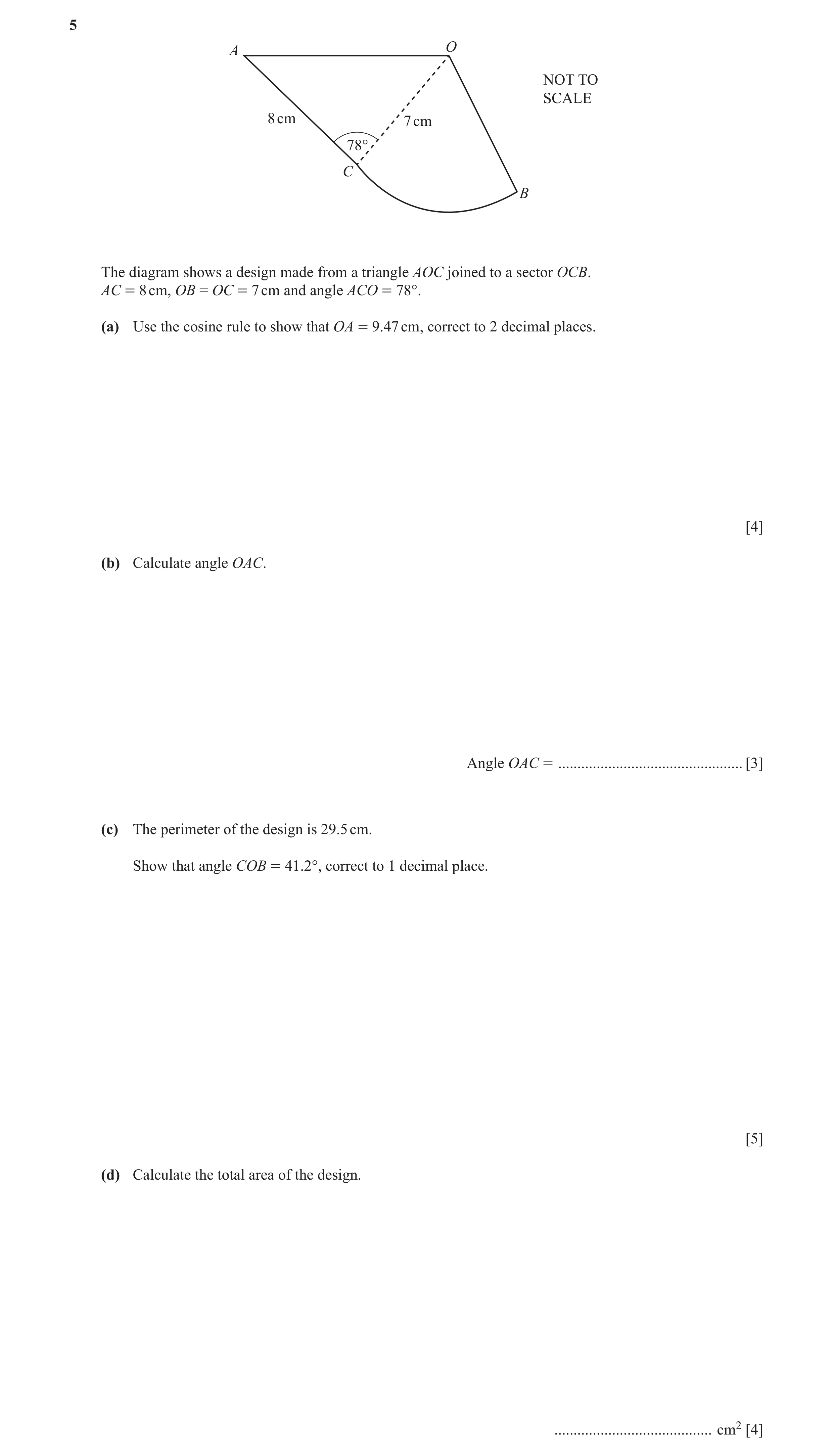
Q12 · A O NOT TO SCALE 8 cm 7 cm 78° C B The diagram shows a design made from a triangle AOC… 0580/42 May/June 2018
5 A O NOT TO SCALE 8 cm 7 cm 78° C B The diagram shows a design made from a triangle AOC joined to a sector OCB. AC = 8 cm, OB = OC = 7 cm and angle ACO = 78°. (a) Use the cosine rule to show that OA = 9.47 cm, correct to 2 decimal places. [4] (b) Calculate angle OAC. Angle OAC = … [3] (c) The perimeter of the design is 29.5 cm. Show that angle COB = 41.2°, correct to 1 decimal place. [5] (d) Calculate the total area of the design. … cm2 [4]
16 marks
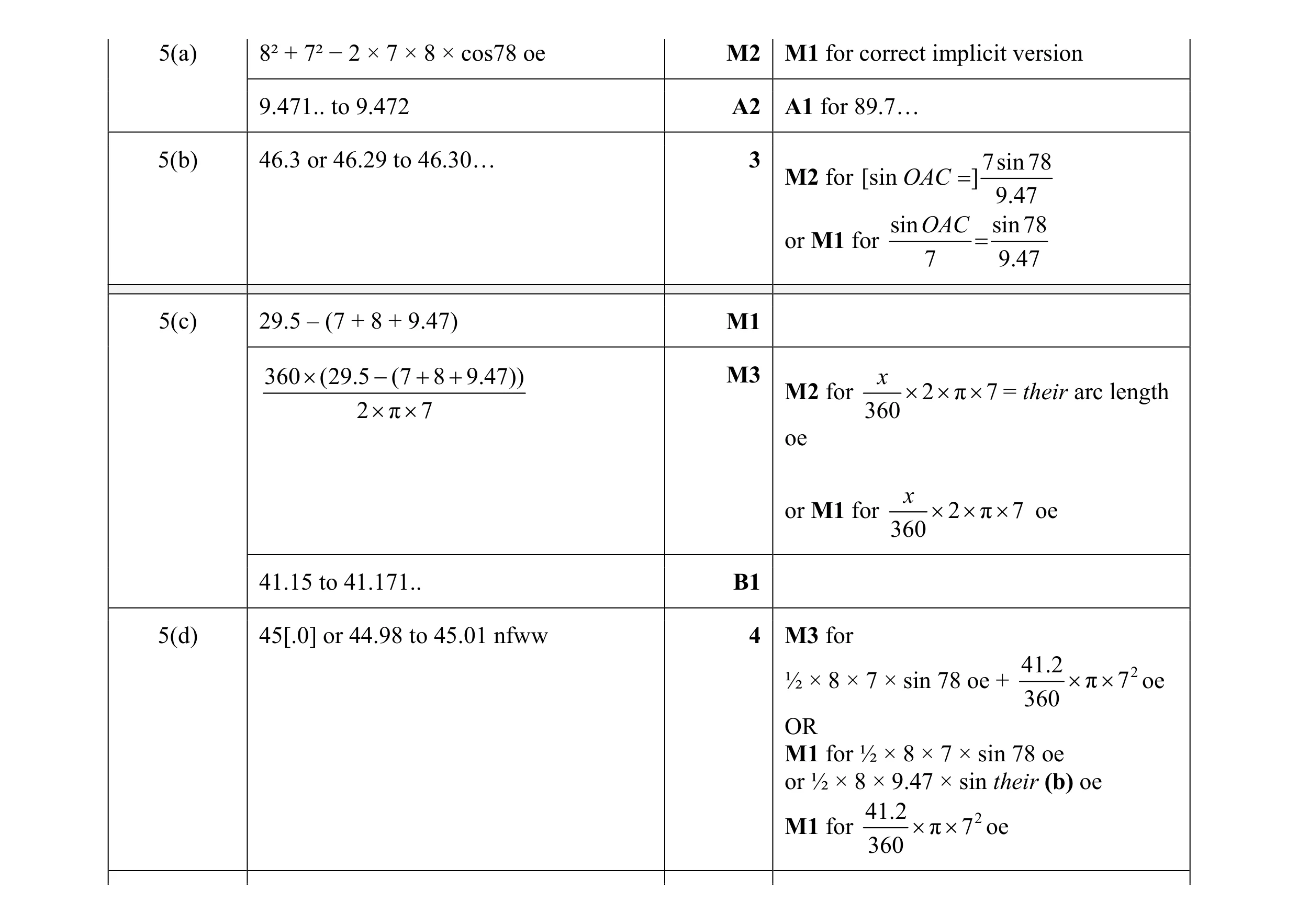
Mark scheme: 5(a) 8² + 7² − 2 × 7 × 8 × cos78 oe M2 M1 for correct implicit version 9.471.. to 9.472 A2 A1 for 89.7… 5(b) 46.3 or 46.29 to 46.30… 3 7sin78 M2 for [sin OAC = ] 9.47 sin OAC sin78 or M1 for = 7 9.47 5(c) 29.5 – (7 + 8 + 9.47) M1 360 × (29.5 − (7 + 8 + 9.47)) M3 x M2 for × 2 × π × 7 = their arc length 2 × π × 7 360 oe x or M1 for × 2 × π × 7 oe 360 41.15 to 41.171.. B1 5(d) 45[.0] or 44.98 to 45.01 nfww 4 M3 for 41.2 2 ½ × 8 × 7 × sin 78 oe + × π × 7 oe 360 OR M1 for ½ × 8 × 7 × sin 78 oe or ½ × 8 × 9.47 × sin their (b) oe 41.2 2 M1 for × π × 7 oe 360
This question in 0580/42 May/June 2018
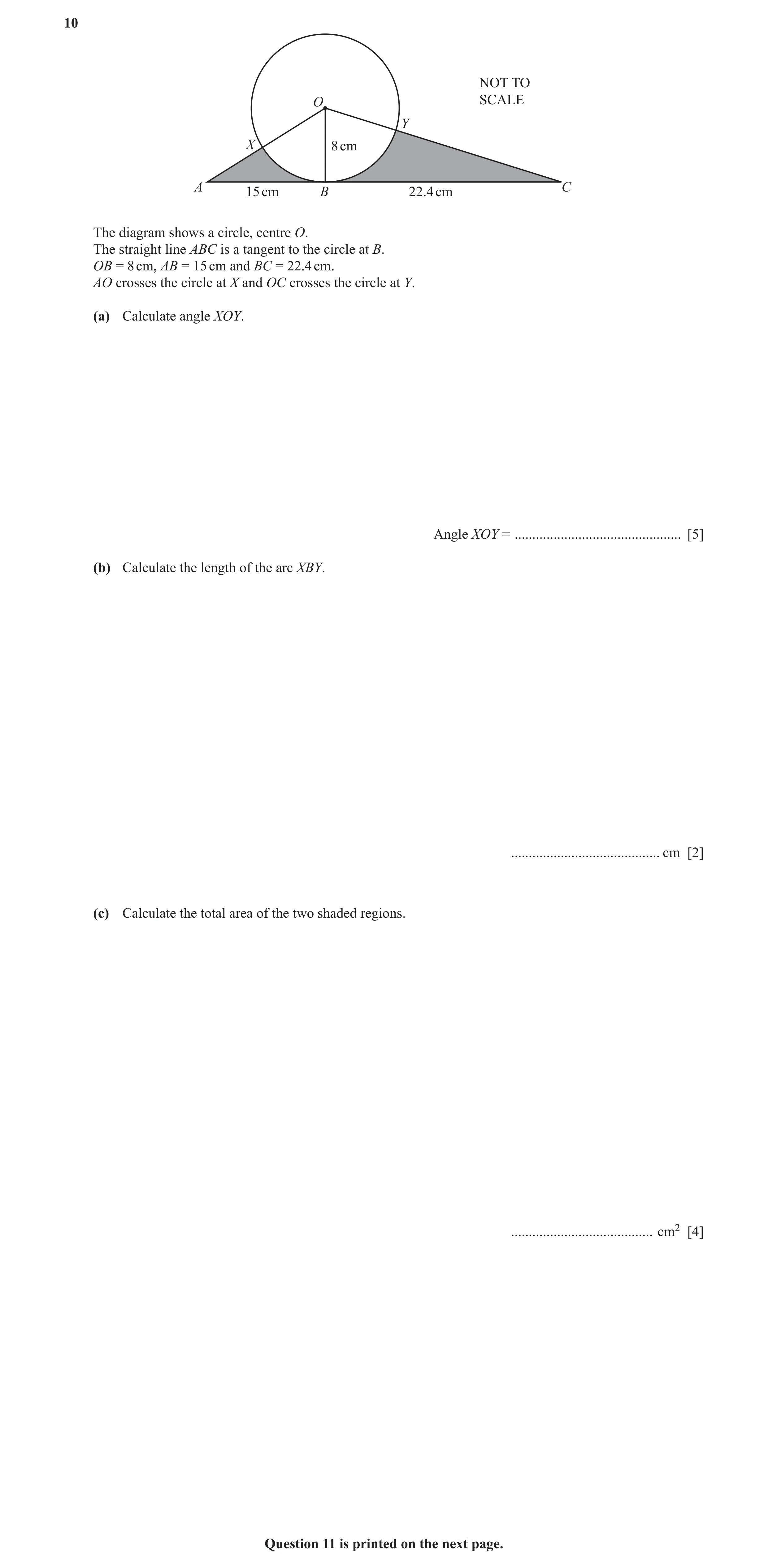
Q13 · NOT TO O SCALE Y X 8 cm A C 15 cm B 22.4 cm The diagram shows a circle, centre O 0580/41 Oct/Nov 2018
10 NOT TO O SCALE Y X 8 cm A C 15 cm B 22.4 cm The diagram shows a circle, centre O. The straight line ABC is a tangent to the circle at B. OB = 8 cm, AB = 15 cm and BC = 22.4 cm. AO crosses the circle at X and OC crosses the circle at Y. (a) Calculate angle XOY. Angle XOY = … [5] (b) Calculate the length of the arc XBY. … cm [2] (c) Calculate the total area of the two shaded regions. … cm2 [4] Question 11 is printed on the next page.
11 marks
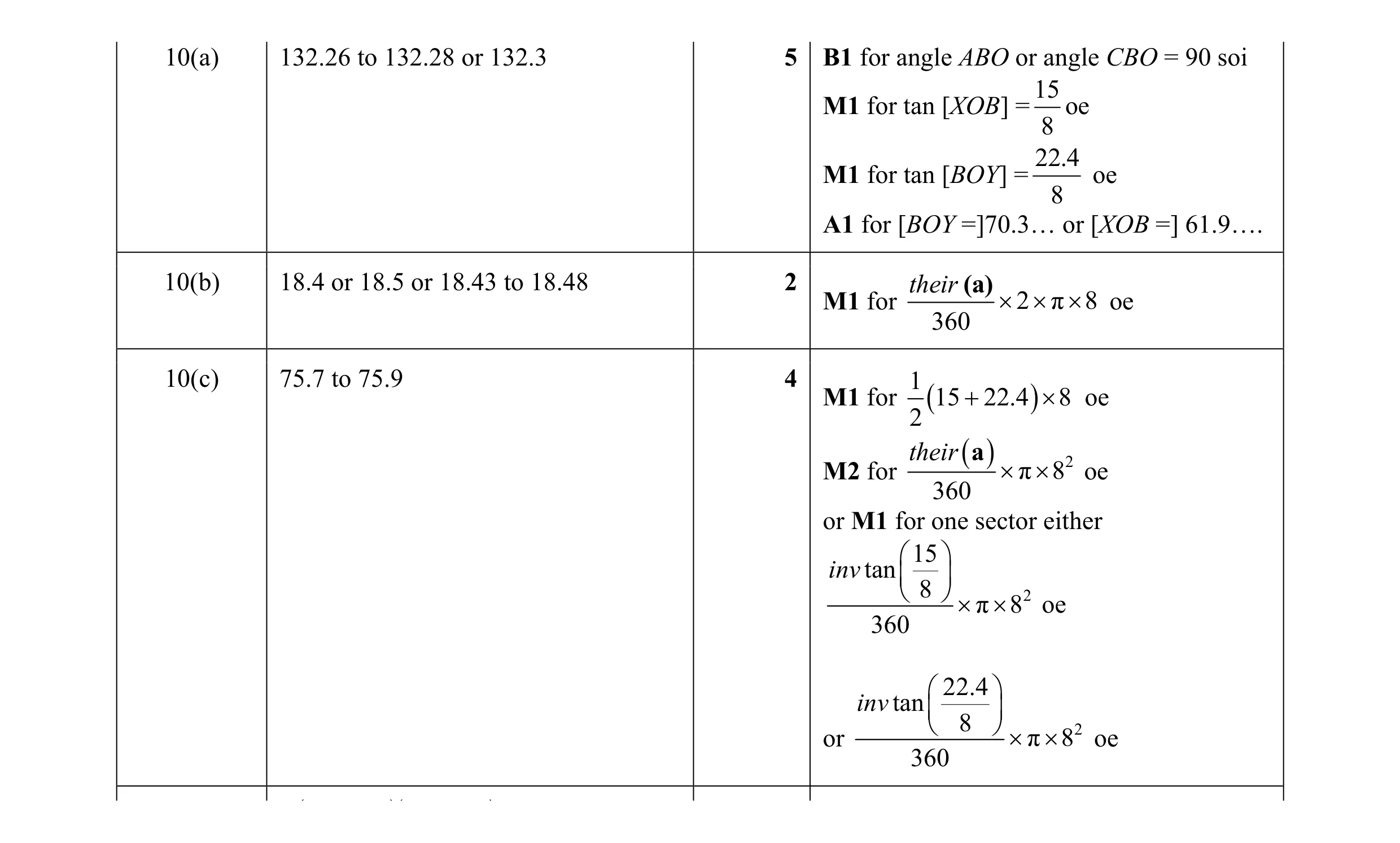
Mark scheme: 10(a) 132.26 to 132.28 or 132.3 5 B1 for angle ABO or angle CBO = 90 soi 15 M1 for tan [XOB] = oe 8 224. M1 for tan [BOY] = oe 8 A1 for [BOY =]70.3… or [XOB =] 61.9…. 10(b) 18.4 or 18.5 or 18.43 to 18.48 2 their (a) M1 for × 2 × π × 8 oe 360 10(c) 75.7 to 75.9 4 1 M1 for (15 + 22.4 ) × 8 oe 2 their ( a ) 2 M2 for × π × 8 oe 360 or M1 for one sector either 15 inv tan 8 × π × 8 2 oe 360 22.4 inv tan 8 2 or × π × 8 oe 360 ( )( )
This question in 0580/41 Oct/Nov 2018
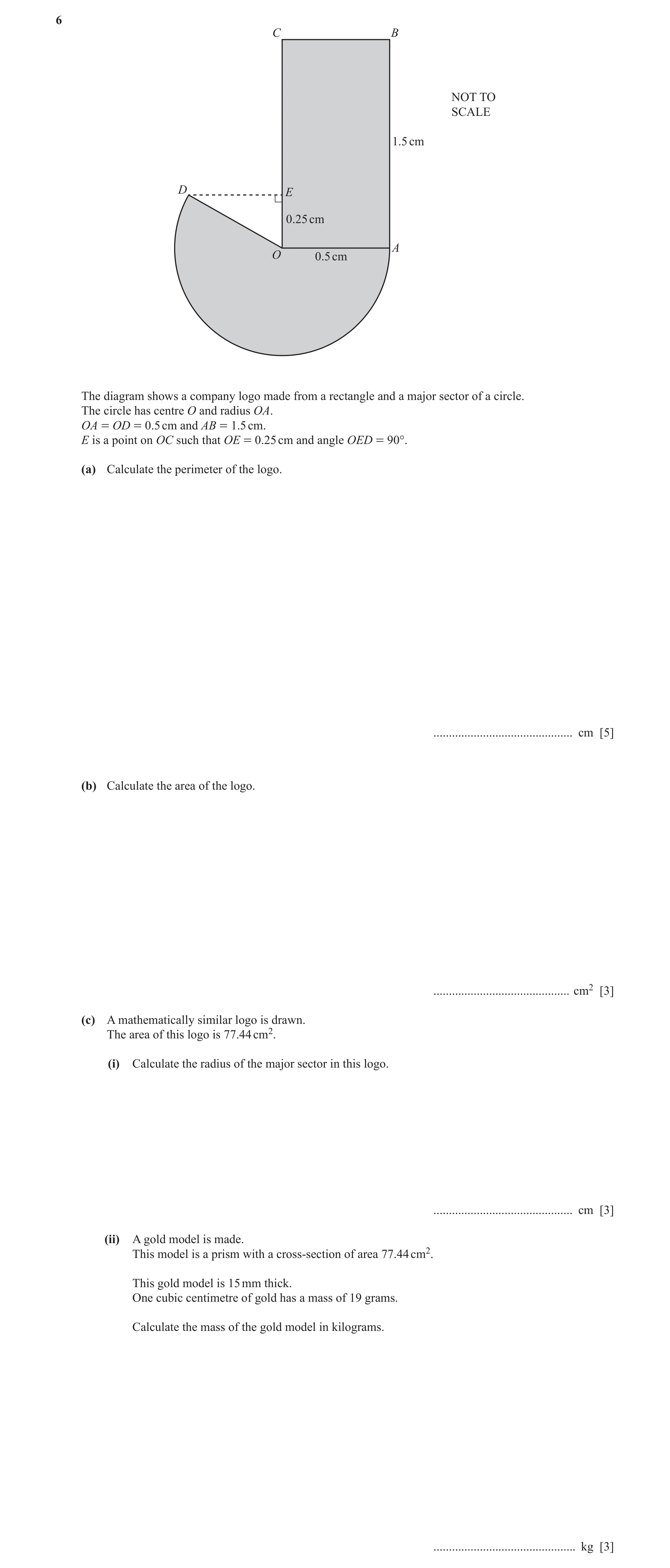
Q14 · C B NOT TO SCALE 1.5 cm D E 0.25 cm A O 0.5 cm The diagram shows a company logo made from… 0580/42 Feb/March 2019
6 C B NOT TO SCALE 1.5 cm D E 0.25 cm A O 0.5 cm The diagram shows a company logo made from a rectangle and a major sector of a circle. The circle has centre O and radius OA. OA = OD = 0.5 cm and AB = 1.5 cm. E is a point on OC such that OE = 0.25 cm and angle OED = 90°. (a) Calculate the perimeter of the logo. … cm [5] (b) Calculate the area of the logo. … cm2 [3] (c) A mathematically similar logo is drawn. The area of this logo is 77.44 cm2. (i) Calculate the radius of the major sector in this logo. … cm [3] (ii) A gold model is made. This model is a prism with a cross-section of area 77.44 cm2. This gold model is 15 mm thick. One cubic centimetre of gold has a mass of 19 grams. Calculate the mass of the gold model in kilograms. … kg [3]
14 marks
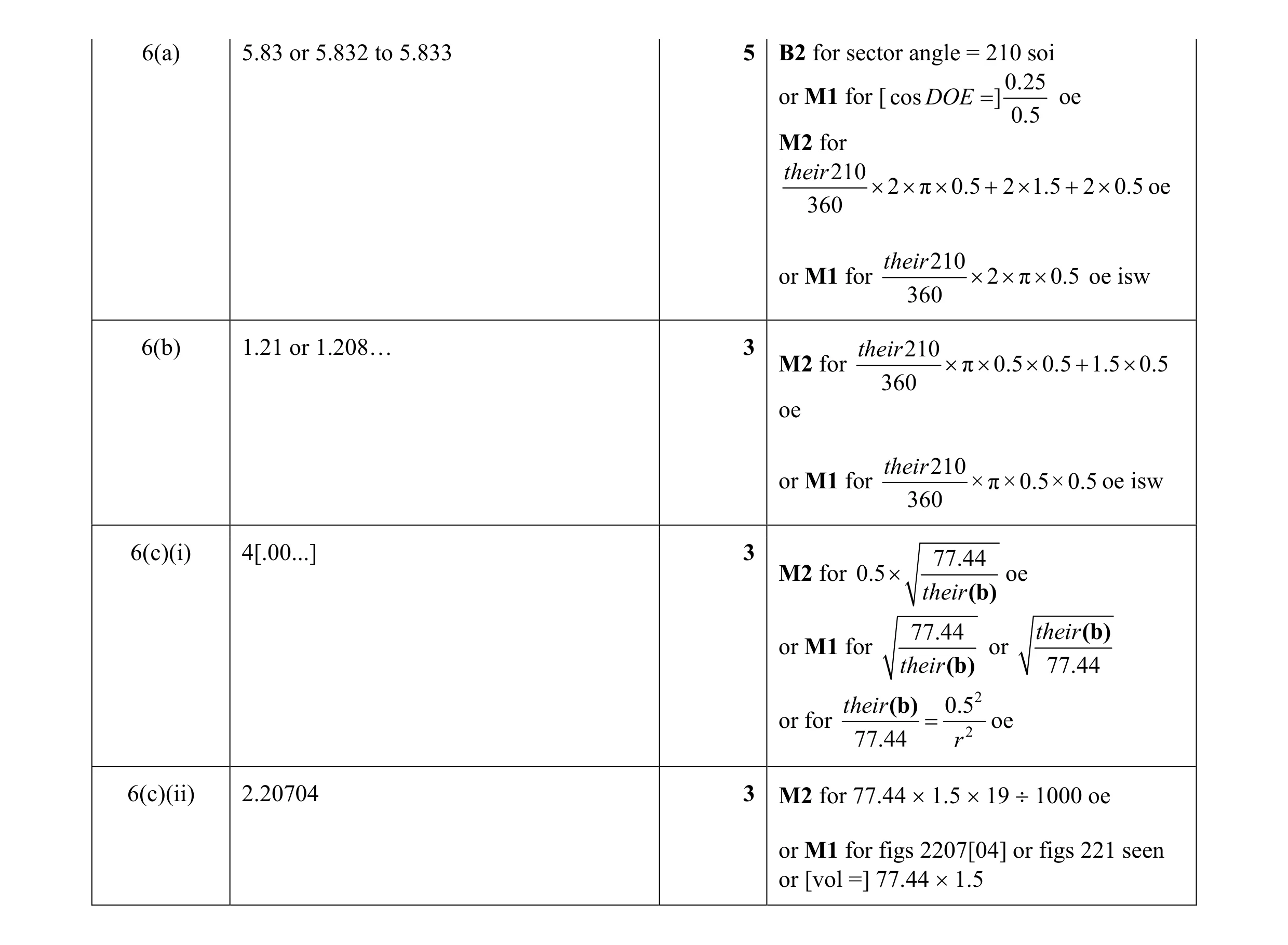
Mark scheme: 6(a) 5.83 or 5.832 to 5.833 5 B2 for sector angle = 210 soi 0.25 or M1 for [ cos DOE = ] oe 0.5 M2 for their 210 × 2 × π × 0.5 + 2 × 1.5 + 2 × 0.5 oe 360 their 210 or M1 for × 2 × π × 0.5 oe isw 360 6(b) 1.21 or 1.208… 3 their 210 M2 for × π × 0.5 × 0.5 + 1.5 × 0.5 360 oe their 210 or M1 for × π×0.5×0.5 oe isw 360 6(c)(i) 4[.00...] 3 77.44 M2 for 0.5× oe their (b) 77.44 their (b) or M1 for or their (b) 77.44 their (b) 0.5 2 or for = oe 77.44 r 2 6(c)(ii) 2.20704 3 M2 for 77.44 × 1.5 × 19 ÷ 1000 oe or M1 for figs 2207[04] or figs 221 seen or [vol =] 77.44 × 1.5
This question in 0580/42 Feb/March 2019
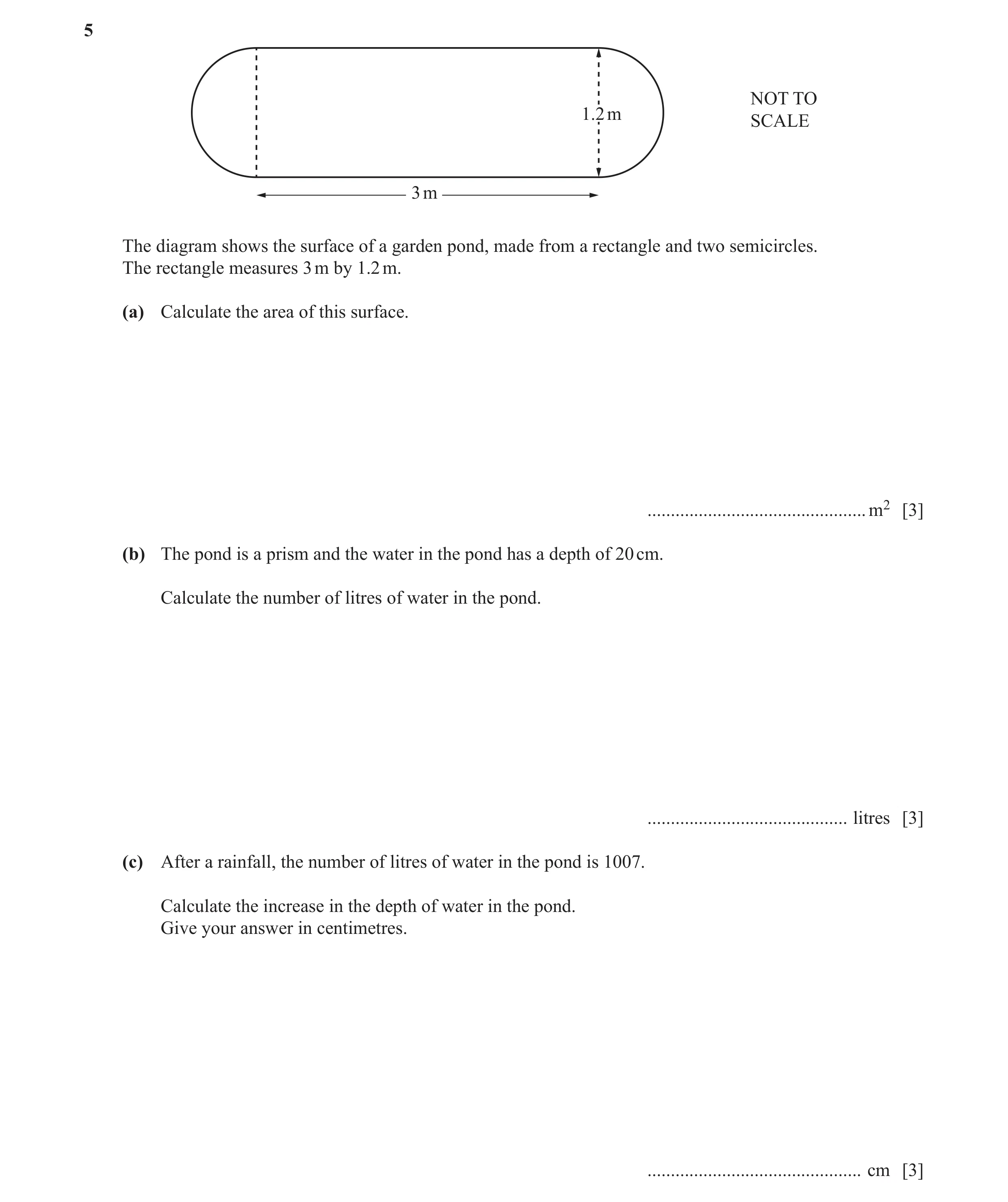
Q15 · NOT TO 1.2 m SCALE 3 m The diagram shows the surface of a garden pond, made from a… 0580/41 May/June 2019
5 NOT TO 1.2 m SCALE 3 m The diagram shows the surface of a garden pond, made from a rectangle and two semicircles. The rectangle measures 3 m by 1.2 m. (a) Calculate the area of this surface. … m2 [3] (b) The pond is a prism and the water in the pond has a depth of 20 cm. Calculate the number of litres of water in the pond. … litres [3] (c) After a rainfall, the number of litres of water in the pond is 1007. Calculate the increase in the depth of water in the pond. Give your answer in centimetres. … cm [3]
9 marks
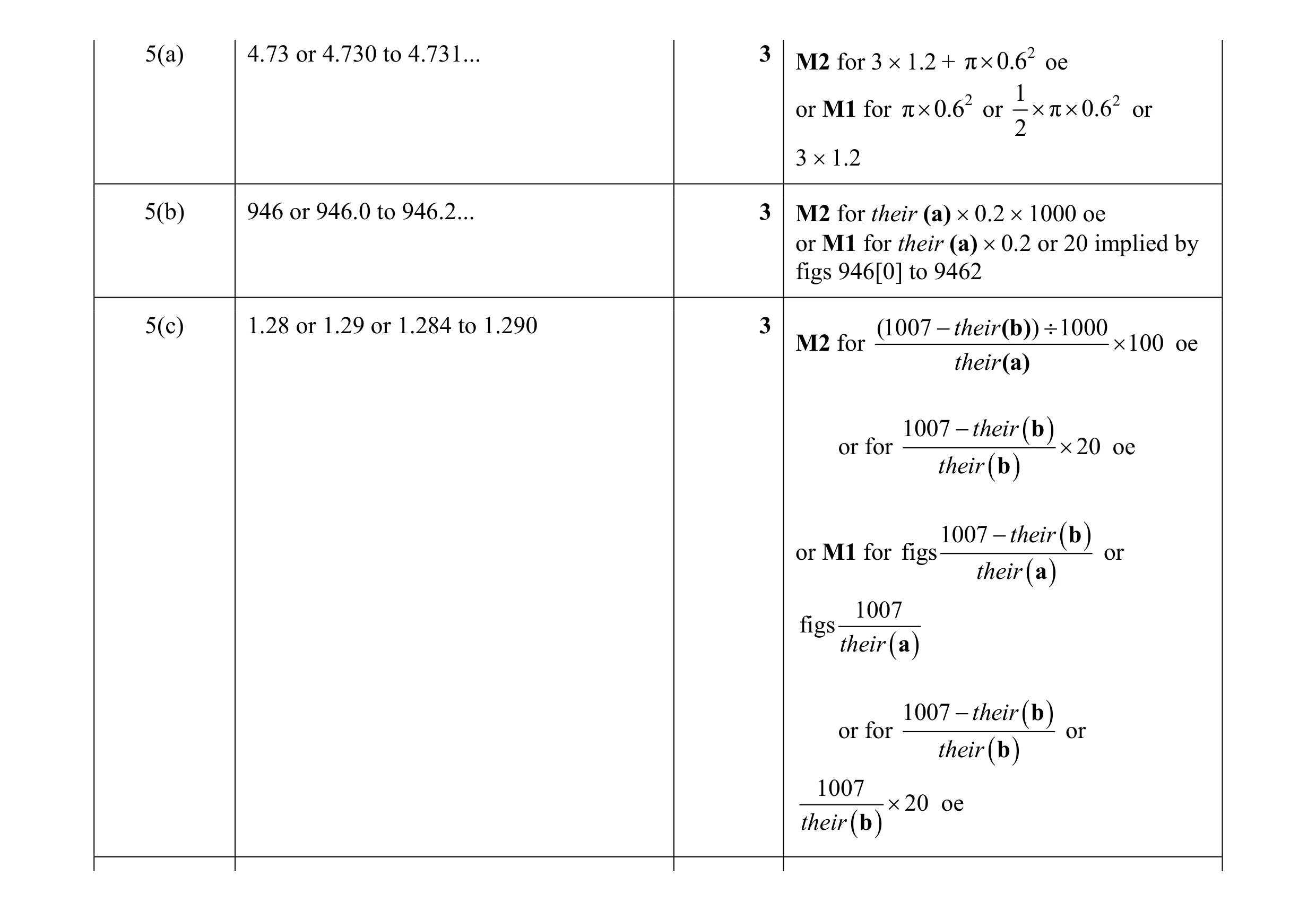
Mark scheme: 5(a) 4.73 or 4.730 to 4.731... 3 M2 for 3 × 1.2 + π × 0.62 oe 2 1 2 or M1 for π × 0.6 or × π × 0.6 or 2 3 × 1.2 5(b) 946 or 946.0 to 946.2... 3 M2 for their (a) × 0.2 × 1000 oe or M1 for their (a) × 0.2 or 20 implied by figs 946[0] to 9462 5(c) 1.28 or 1.29 or 1.284 to 1.290 3 (1007 − their (b)) ÷ 1000 M2 for × 100 oe their (a) 1007 − their ( b ) or for × 20 oe their ( b ) 1007 − their ( b ) or M1 for figs or their ( a ) 1007 figs their ( a ) 1007 − their ( b ) or for or their ( b ) 1007 × 20 oe their ( b )
This question in 0580/41 May/June 2019
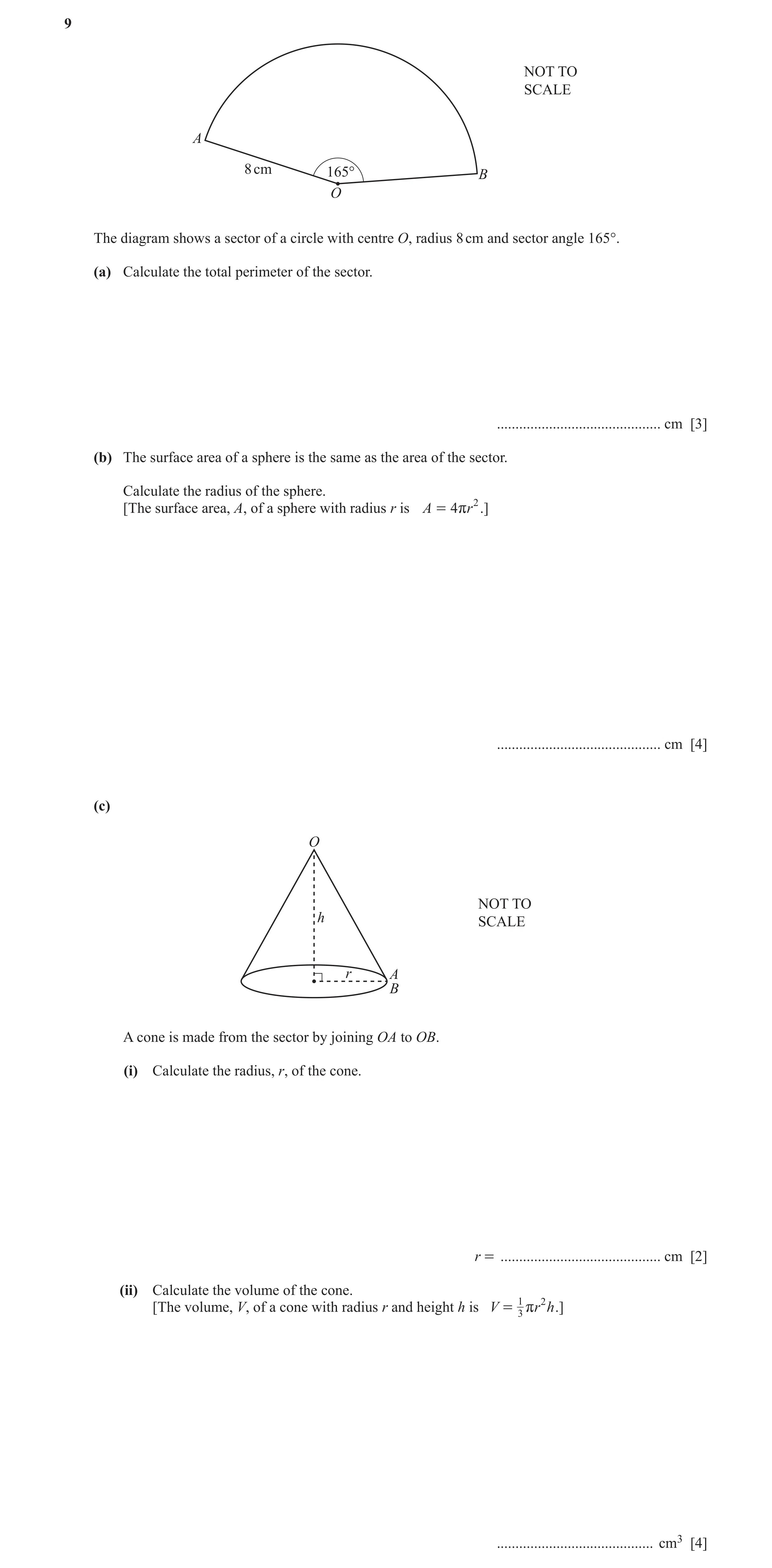
Q16 · NOT TO SCALE A 8 cm 165° B O The diagram shows a sector of a circle with centre O, radius… 0580/41 May/June 2020
9 NOT TO SCALE A 8 cm 165° B O The diagram shows a sector of a circle with centre O, radius 8 cm and sector angle 165°. (a) Calculate the total perimeter of the sector. … cm [3] (b) The surface area of a sphere is the same as the area of the sector. Calculate the radius of the sphere. [The surface area, A, of a sphere with radius r is A = 4rr 2 .] … cm [4] (c) O NOT TO h SCALE r A B A cone is made from the sector by joining OA to OB. (i) Calculate the radius, r, of the cone. r = … cm [2] (ii) Calculate the volume of the cone. r r h .] [The volume, V, of a cone with radius r and height h is V = 13 2 … cm3 [4]
13 marks
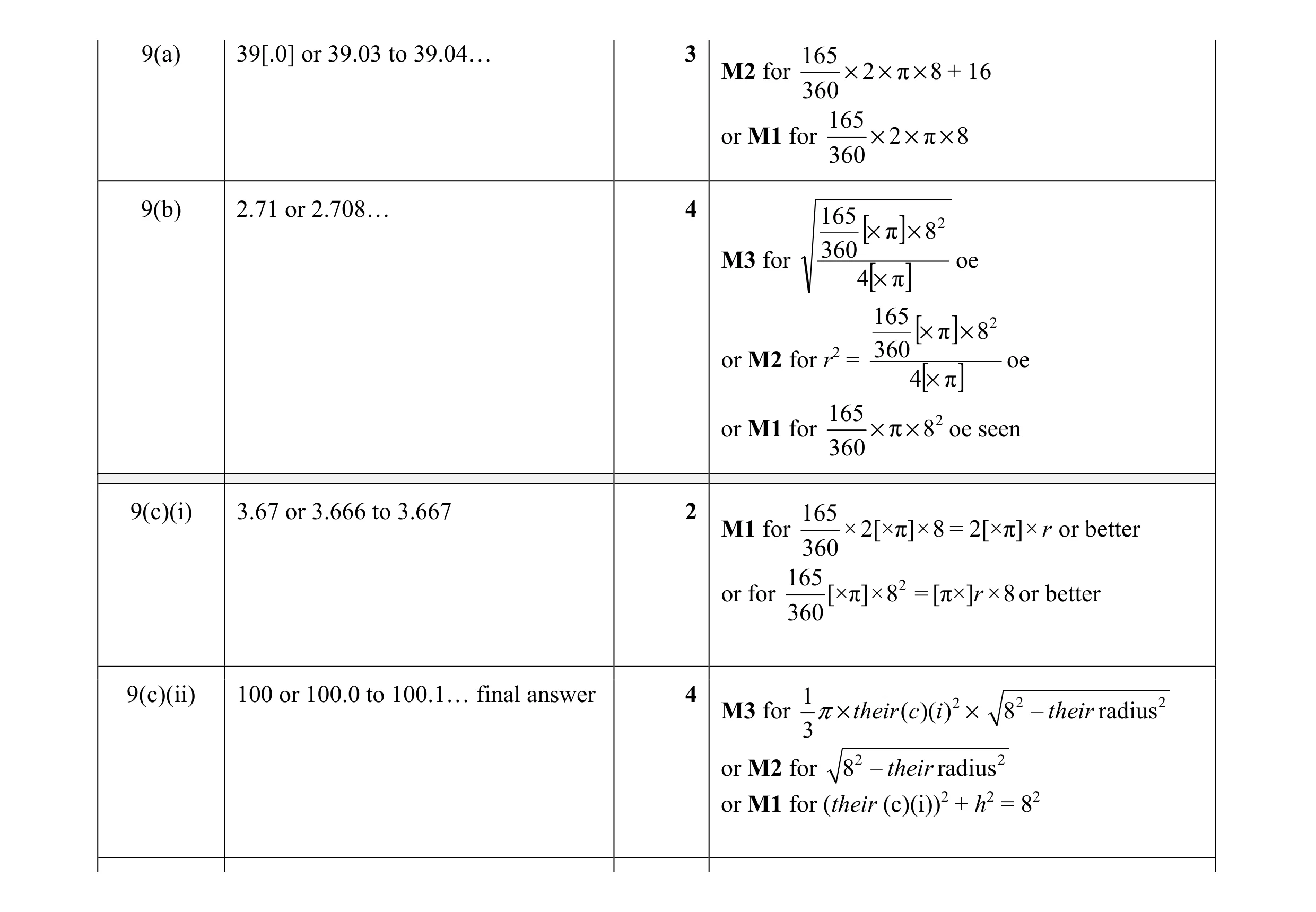
Mark scheme: 9(a) 39[.0] or 39.03 to 39.04… 3 165 M2 for × 2 × π × 8 + 16 360 165 or M1 for × 2 × π × 8 360 9(b) 2.71 or 2.708… 4 165 2 [× π ] × 8 360 M3 for oe 4[× π ] 165 2 [× π ] × 8 360 or M2 for r2 = oe 4[× π ] 165 2 or M1 for × π × 8 oe seen 360 9(c)(i) 3.67 or 3.666 to 3.667 2 165 M1 for ×2[×π]×8 = 2[×π]× r or better 360 or for 165[×π]×8 2 = [π×]r ×8 or better 360 9(c)(ii) 100 or 100.0 to 100.1… final answer 4 1 2 2 2 M3 for π × their ( c )( i ) × 8 – their radius 3 or M2 for 8 2 – their radius 2 or M1 for (their (c)(i))2 + h2 = 82
This question in 0580/41 May/June 2020
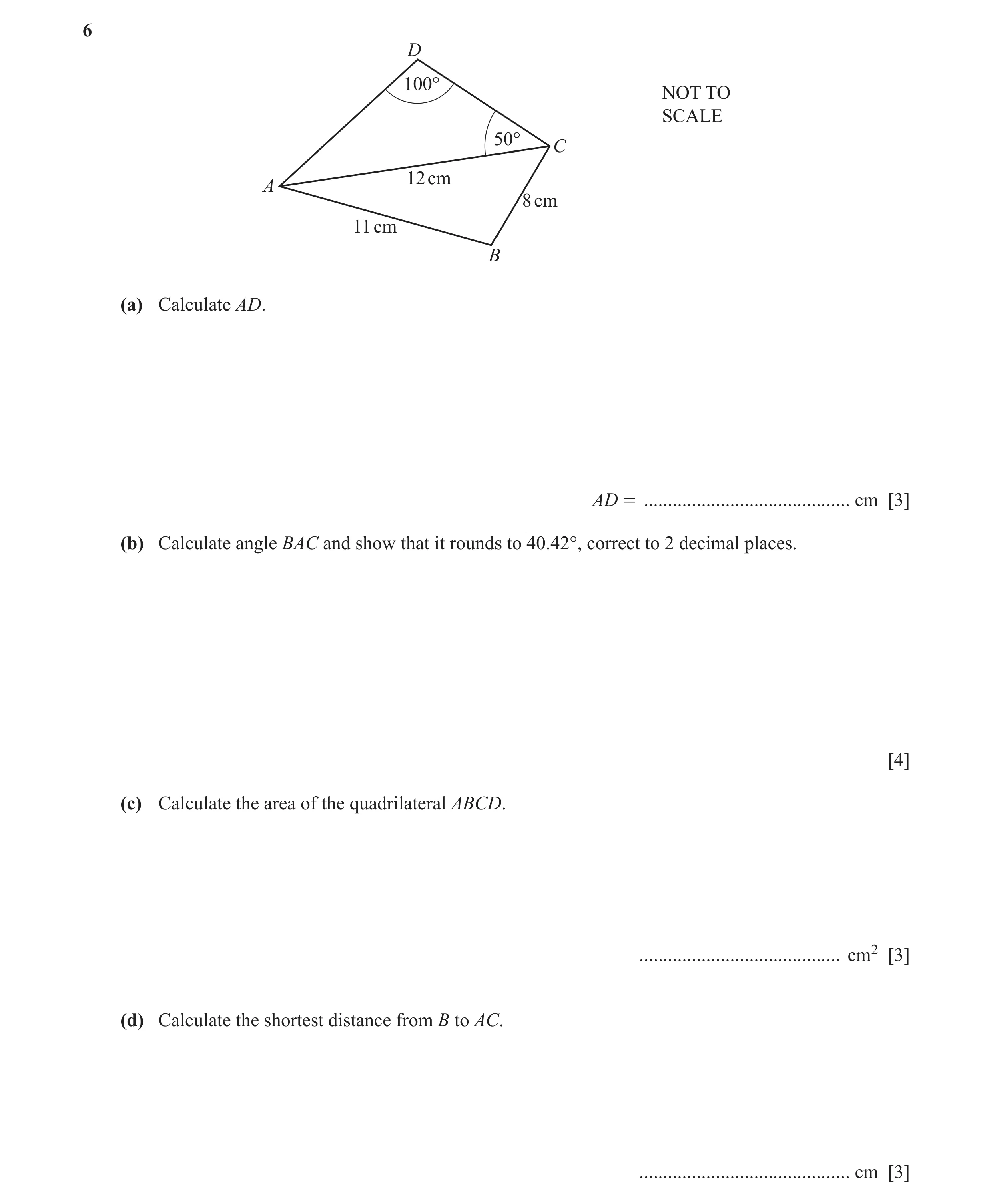
Q17 · D 100° NOT TO SCALE 50° C 12 cm A 8 cm 11 cm B (a) Calculate AD 0580/43 Oct/Nov 2021
6 D 100° NOT TO SCALE 50° C 12 cm A 8 cm 11 cm B (a) Calculate AD. AD = … cm [3] (b) Calculate angle BAC and show that it rounds to 40.42°, correct to 2 decimal places. [4] (c) Calculate the area of the quadrilateral ABCD. … cm2 [3] (d) Calculate the shortest distance from B to AC. … cm [3]
13 marks
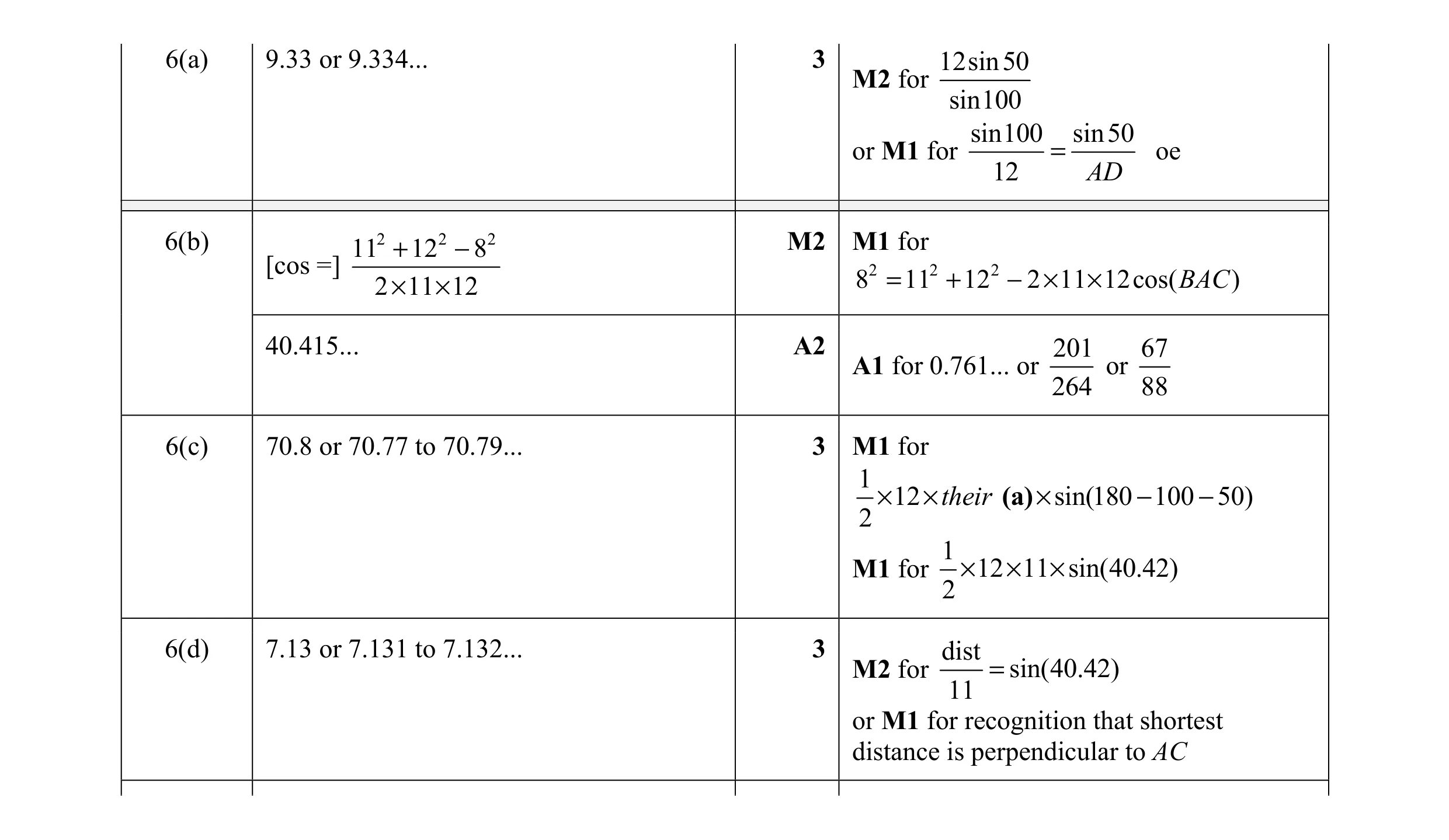
Mark scheme: 6(a) 9.33 or 9.334... 3 12sin50 M2 for sin100 sin100 sin50 or M1 for = oe 12 AD 6(b) 112 + 12 2 − 8 2 M2 M1 for [cos =] 2 2 2 2 × 11 × 12 8 = 11 + 12 − 2 × 11 × 12cos( BAC ) 40.415... A2 201 67 A1 for 0.761... or or 264 88 6(c) 70.8 or 70.77 to 70.79... 3 M1 for 1 × 12 × their (a) × sin(180 − 100 − 50) 2 1 M1 for × 12 × 11 × sin(40.42) 2 6(d) 7.13 or 7.131 to 7.132... 3 dist M2 for = sin(40.42) 11 or M1 for recognition that shortest distance is perpendicular to AC
This question in 0580/43 Oct/Nov 2021
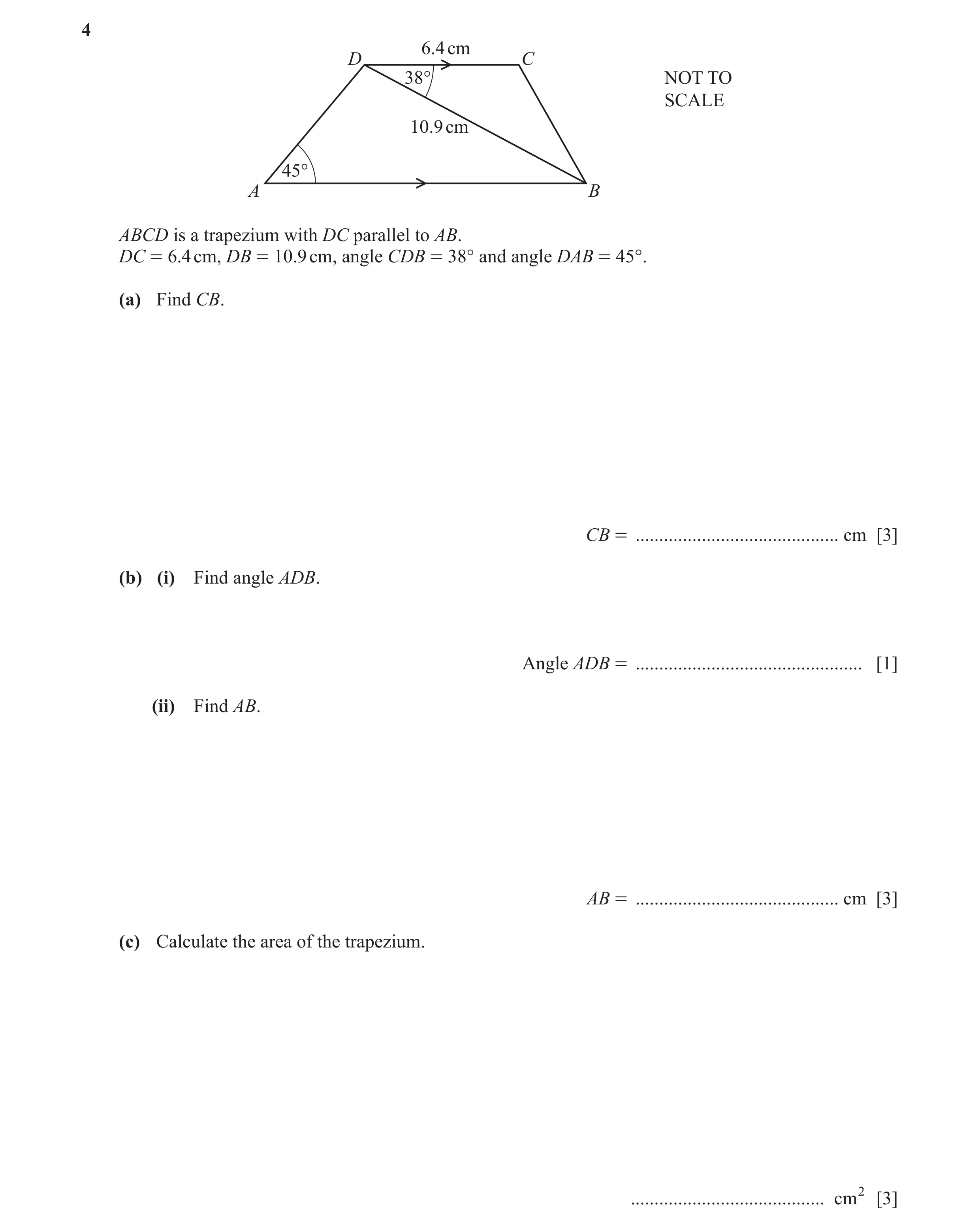
Q18 · 6.4 cm D C 38° NOT TO SCALE 10.9 cm 45° A B ABCD is a trapezium with DC parallel to AB 0580/42 May/June 2022
4 6.4 cm D C 38° NOT TO SCALE 10.9 cm 45° A B ABCD is a trapezium with DC parallel to AB. DC = 6.4 cm, DB = 10.9 cm, angle CDB = 38° and angle DAB = 45°. (a) Find CB. CB = … cm [3] (b) (i) Find angle ADB. Angle ADB = … [1] (ii) Find AB. AB = … cm [3] (c) Calculate the area of the trapezium. … cm2 [3]
10 marks
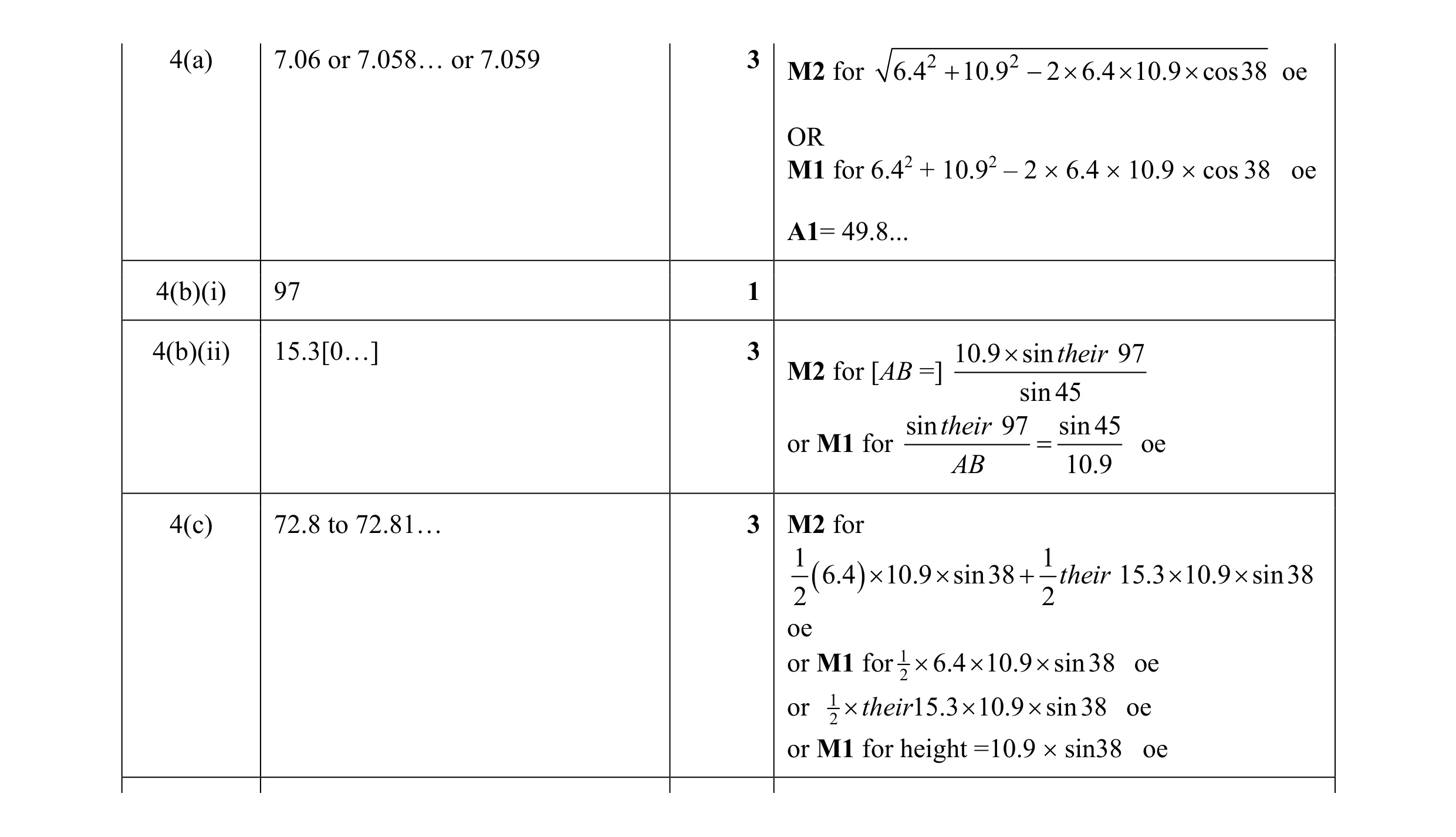
Mark scheme: 4(a) 7.06 or 7.058… or 7.059 3 2 2 M2 for 6.4 10.9 2 6.4 10.9 cos38 oe OR M1 for 6.42 + 10.92 – 2 6.4 10.9 cos 38 oe A1= 49.8... 4(b)(i) 97 1 4(b)(ii) 15.3[0…] 3 10.9 sin their 97 M2 for [AB =] sin45 sin their 97 sin45 or M1 for oe AB 10.9 4(c) 72.8 to 72.81… 3 M2 for 1 1 6.4 10.9 sin38 their 15.3 10.9 sin38 2 2 oe or M1 for 12 6.4 10.9 sin38 oe or 12 their15.3 10.9 sin38 oe or M1 for height =10.9 sin38 oe
This question in 0580/42 May/June 2022
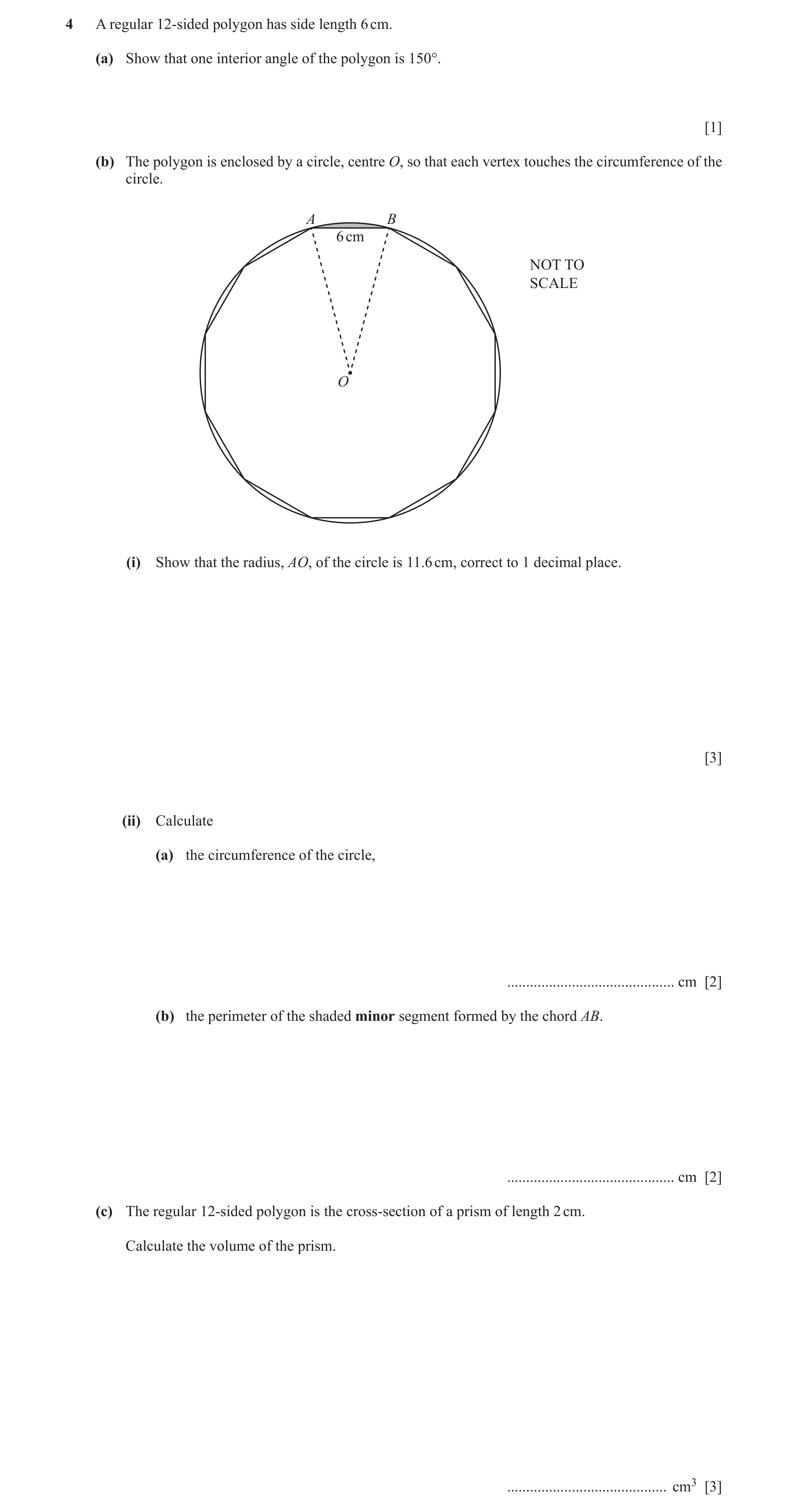
Q19 · A regular 12-sided polygon has side length 6 cm 0580/43 May/June 2022
4 A regular 12-sided polygon has side length 6 cm. (a) Show that one interior angle of the polygon is 150°. [1] (b) The polygon is enclosed by a circle, centre O, so that each vertex touches the circumference of the circle. A B 6 cm NOT TO SCALE O (i) Show that the radius, AO, of the circle is 11.6 cm, correct to 1 decimal place. [3] (ii) Calculate (a) the circumference of the circle, … cm [2] (b) the perimeter of the shaded minor segment formed by the chord AB. … cm [2] (c) The regular 12-sided polygon is the cross-section of a prism of length 2 cm. Calculate the volume of the prism. … cm3 [3]
11 marks
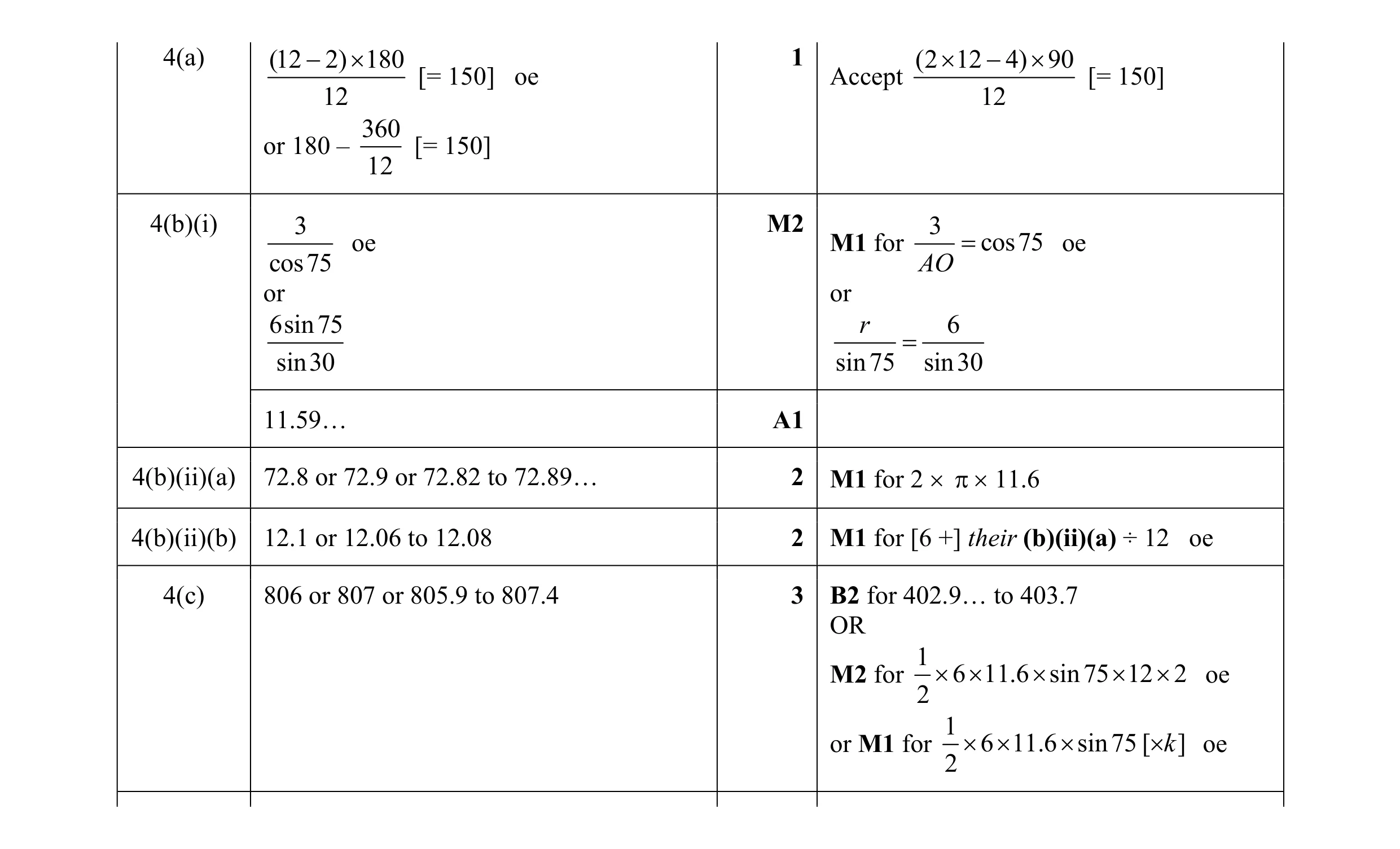
Mark scheme: 4(a) (12 2) 180 1 (2 12 4) 90 [= 150] oe Accept [= 150] 12 12 360 or 180 – [= 150] 12 4(b)(i) 3 M2 3 oe M1 for cos75 oe cos75 AO or or 6sin75 r 6 sin30 sin75 sin30 11.59… A1 4(b)(ii)(a) 72.8 or 72.9 or 72.82 to 72.89… 2 M1 for 2 11.6 4(b)(ii)(b) 12.1 or 12.06 to 12.08 2 M1 for [6 +] their (b)(ii)(a) ÷ 12 oe 4(c) 806 or 807 or 805.9 to 807.4 3 B2 for 402.9… to 403.7 OR 1 M2 for 6 11.6 sin75 12 2 oe 2 1 or M1 for 6 11.6 sin75 [k ] oe 2
This question in 0580/43 May/June 2022
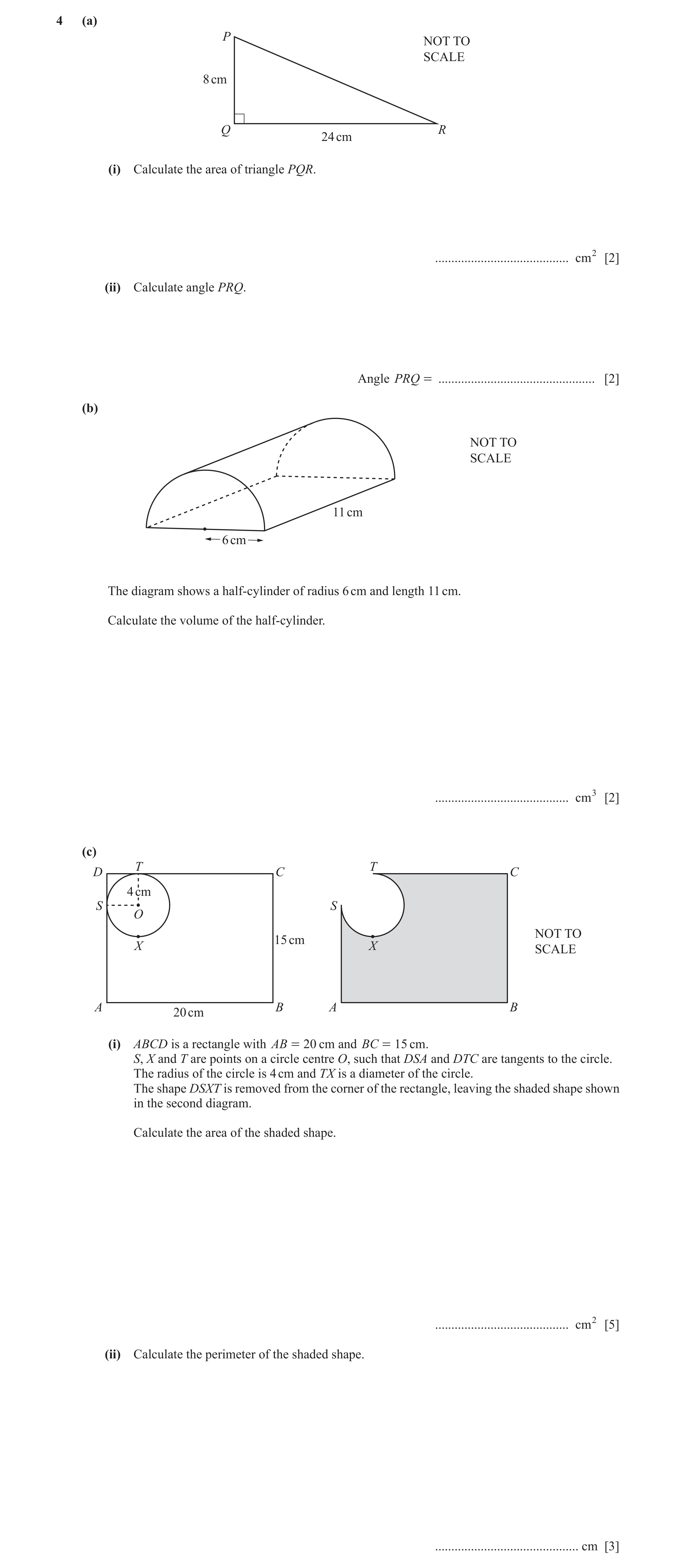
Q20 · P NOT TO SCALE 8 cm Q R 24 cm (i) Calculate the area of triangle PQR 0580/41 May/June 2023
4 (a) P NOT TO SCALE 8 cm Q R 24 cm (i) Calculate the area of triangle PQR. … cm2 [2] (ii) Calculate angle PRQ. Angle PRQ = … [2] (b) NOT TO SCALE 11 cm 6 cm The diagram shows a half-cylinder of radius 6 cm and length 11 cm. Calculate the volume of the half-cylinder. … cm3 [2] (c) T T D C C 44 cmcm S S O NOT TO 15 cm X X SCALE A B A B 20 cm (i) ABCD is a rectangle with AB = 20 cm and BC = 15 cm. S, X and T are points on a circle centre O, such that DSA and DTC are tangents to the circle. The radius of the circle is 4 cm and TX is a diameter of the circle. The shape DSXT is removed from the corner of the rectangle, leaving the shaded shape shown in the second diagram. Calculate the area of the shaded shape. … cm2 [5] (ii) Calculate the perimeter of the shaded shape. … cm [3]
14 marks
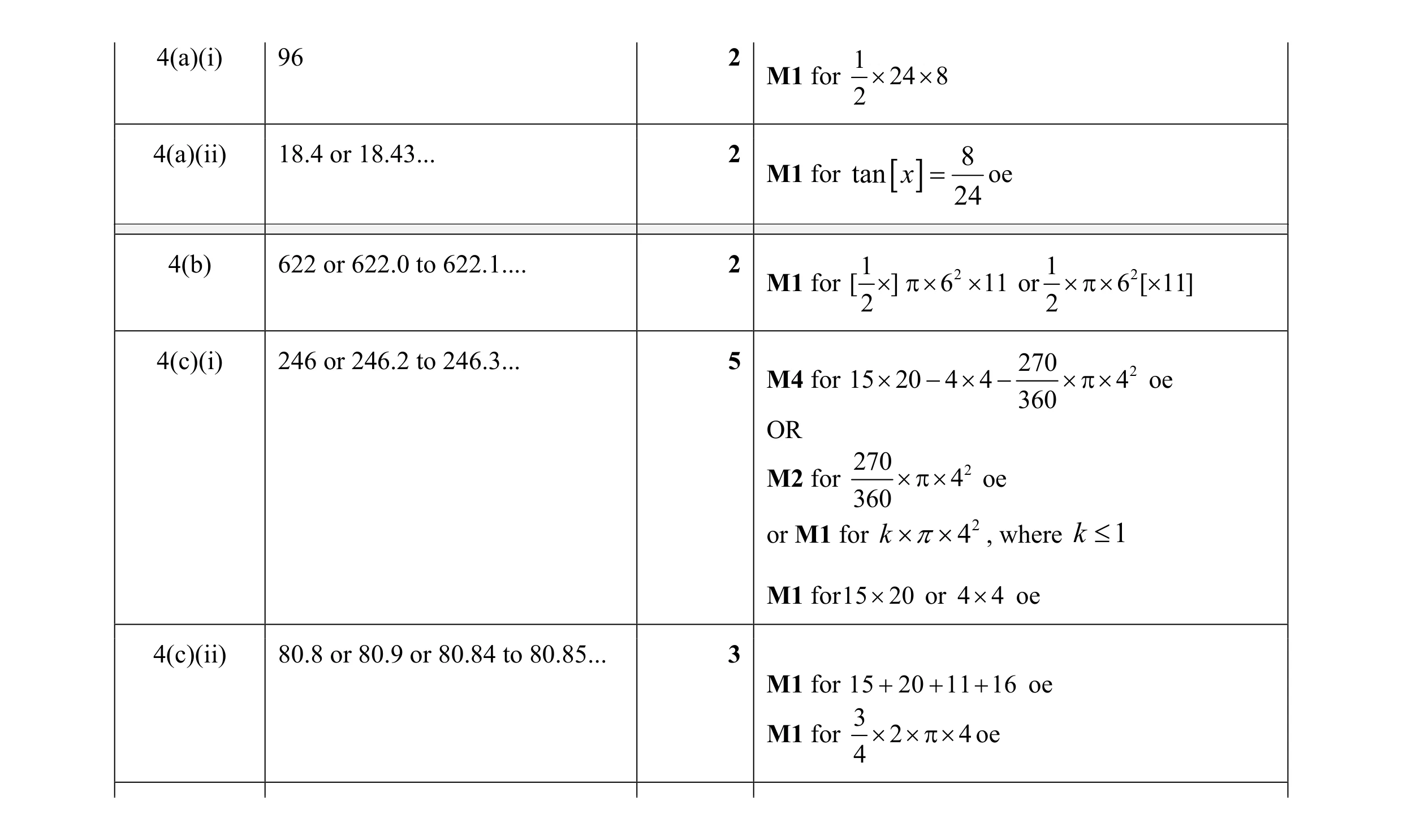
Mark scheme: 4(a)(i) 96 2 1 M1 for 24 8 2 4(a)(ii) 18.4 or 18.43... 2 8 M1 for tan x oe 24 4(b) 622 or 622.0 to 622.1 … 2 1 2 1 2 M1 for [ 2] 6 11 or 2 6 [ 11] 4(c)(i) 246 or 246.2 to 246.3... 5 270 2 M4 for 15 20 4 4 4 oe 360 OR 270 2 M2 for 4 oe 360 or M1 for k 4 2 , where k 1 M1 for15 20 or 4 4 oe 4(c)(ii) 80.8 or 80.9 or 80.84 to 80.85... 3 M1 for 15 20 11 16 oe 3 M1 for 2 4 oe 4
This question in 0580/41 May/June 2023
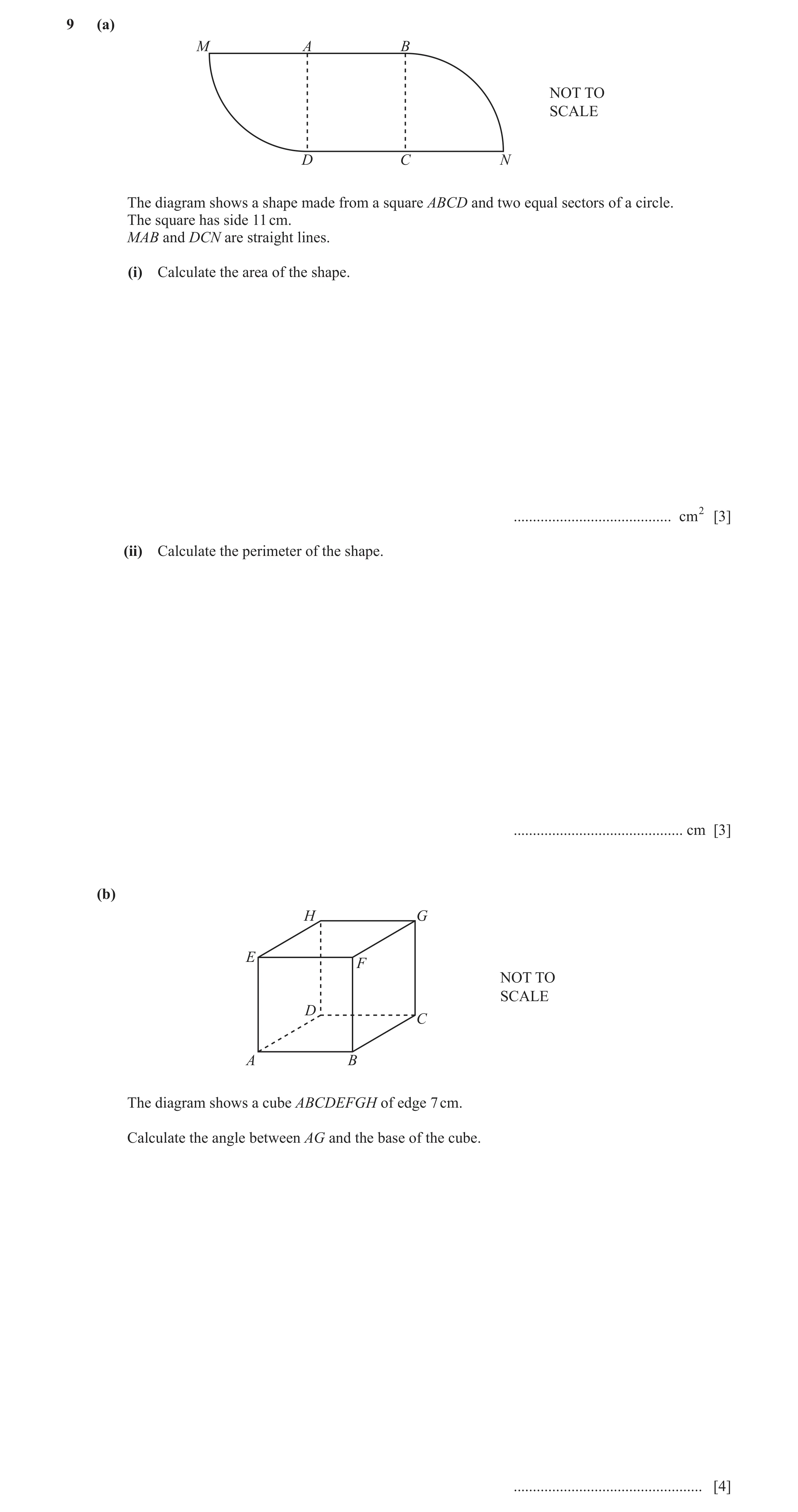
Q21 · M A B NOT TO SCALE D C N The diagram shows a shape made from a square ABCD and two equal… 0580/43 May/June 2023
9 (a) M A B NOT TO SCALE D C N The diagram shows a shape made from a square ABCD and two equal sectors of a circle. The square has side 11 cm. MAB and DCN are straight lines. (i) Calculate the area of the shape. … cm2 [3] (ii) Calculate the perimeter of the shape. … cm [3] (b) H G E F NOT TO SCALE D C A B The diagram shows a cube ABCDEFGH of edge 7 cm. Calculate the angle between AG and the base of the cube. … [4]
10 marks
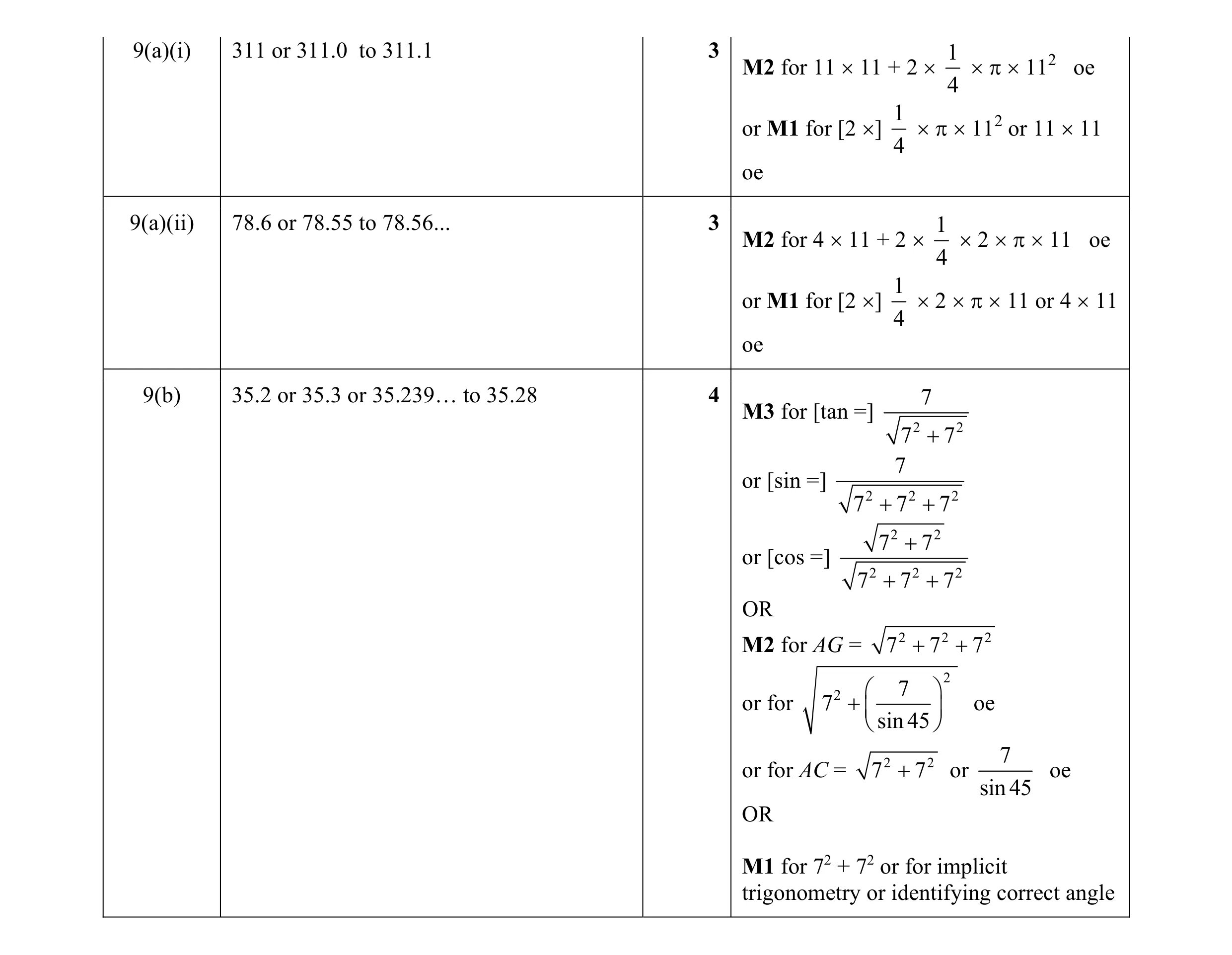
Mark scheme: 9(a)(i) 311 or 311.0 to 311.1 3 1 M2 for 11 11 + 2 112 oe 4 1 or M1 for [2 ] 112 or 11 11 4 oe 9(a)(ii) 78.6 or 78.55 to 78.56... 3 1 M2 for 4 11 + 2 2 11 oe 4 1 or M1 for [2 ] 2 11 or 4 11 4 oe 9(b) 35.2 or 35.3 or 35.239… to 35.28 4 7 M3 for [tan =] 7 2 7 2 7 or [sin =] 7 2 7 2 7 2 7 2 7 2 or [cos =] 7 2 7 2 7 2 OR M2 for AG = 7 2 7 2 7 2 2 7 2 or for 7 oe sin 45 2 2 7 or for AC = 7 7 or oe sin45 OR M1 for 72 + 72 or for implicit trigonometry or identifying correct angle
This question in 0580/43 May/June 2023
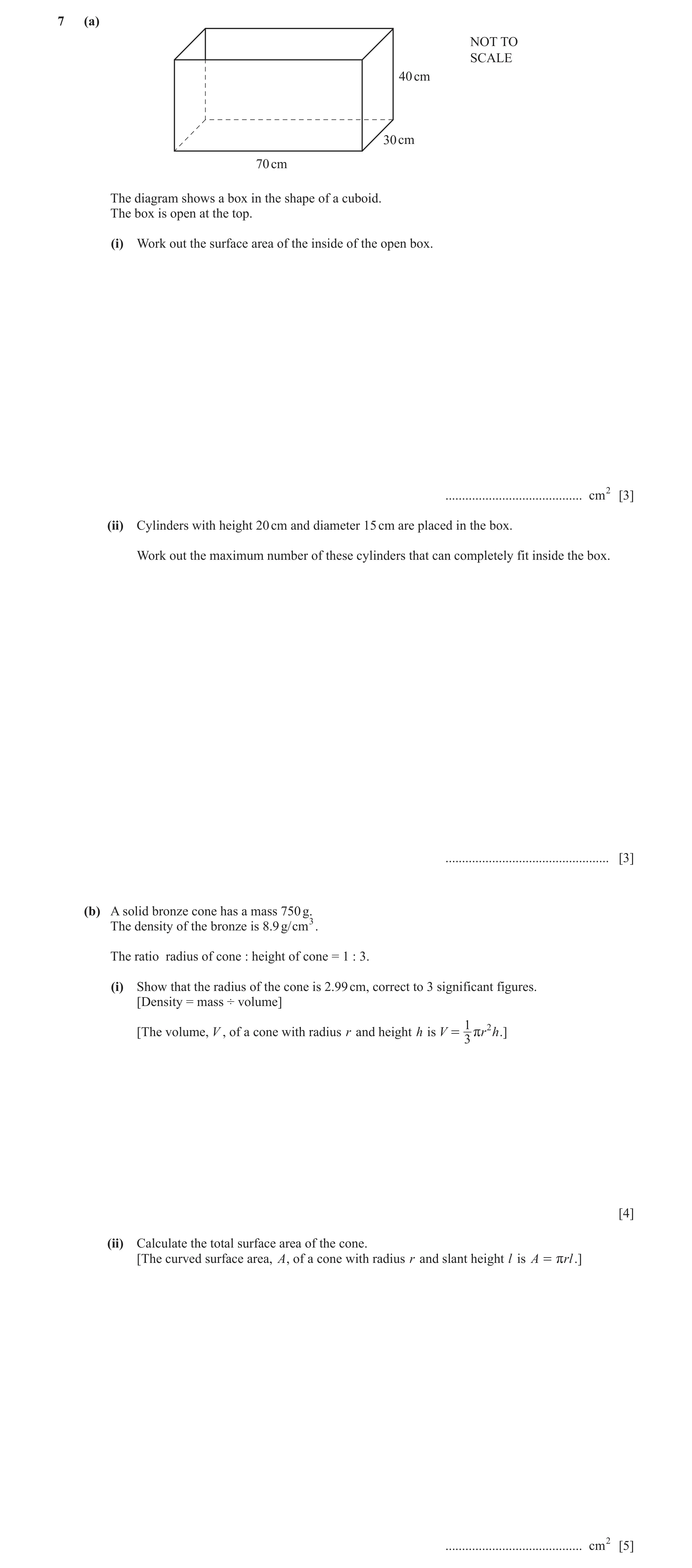
Q22 · NOT TO SCALE 40 cm 30 cm 70 cm The diagram shows a box in the shape of a cuboid 0580/41 May/June 2024
7 (a) NOT TO SCALE 40 cm 30 cm 70 cm The diagram shows a box in the shape of a cuboid. The box is open at the top. (i) Work out the surface area of the inside of the open box. … cm 2 [3] (ii) Cylinders with height 20 cm and diameter 15 cm are placed in the box. Work out the maximum number of these cylinders that can completely fit inside the box. … [3] (b) A solid bronze cone has a mass 750 g. The density of the bronze is 8.9 g/cm3. The ratio radius of cone : height of cone = 1 : 3. (i) Show that the radius of the cone is 2.99 cm, correct to 3 significant figures. [Density = mass ÷ volume] 1 2 [The volume, V , of a cone with radius r and height h is V = rr h .] 3 [4] (ii) Calculate the total surface area of the cone. [The curved surface area, A, of a cone with radius r and slant height l is A = rrl .] … cm 2 [5]
15 marks
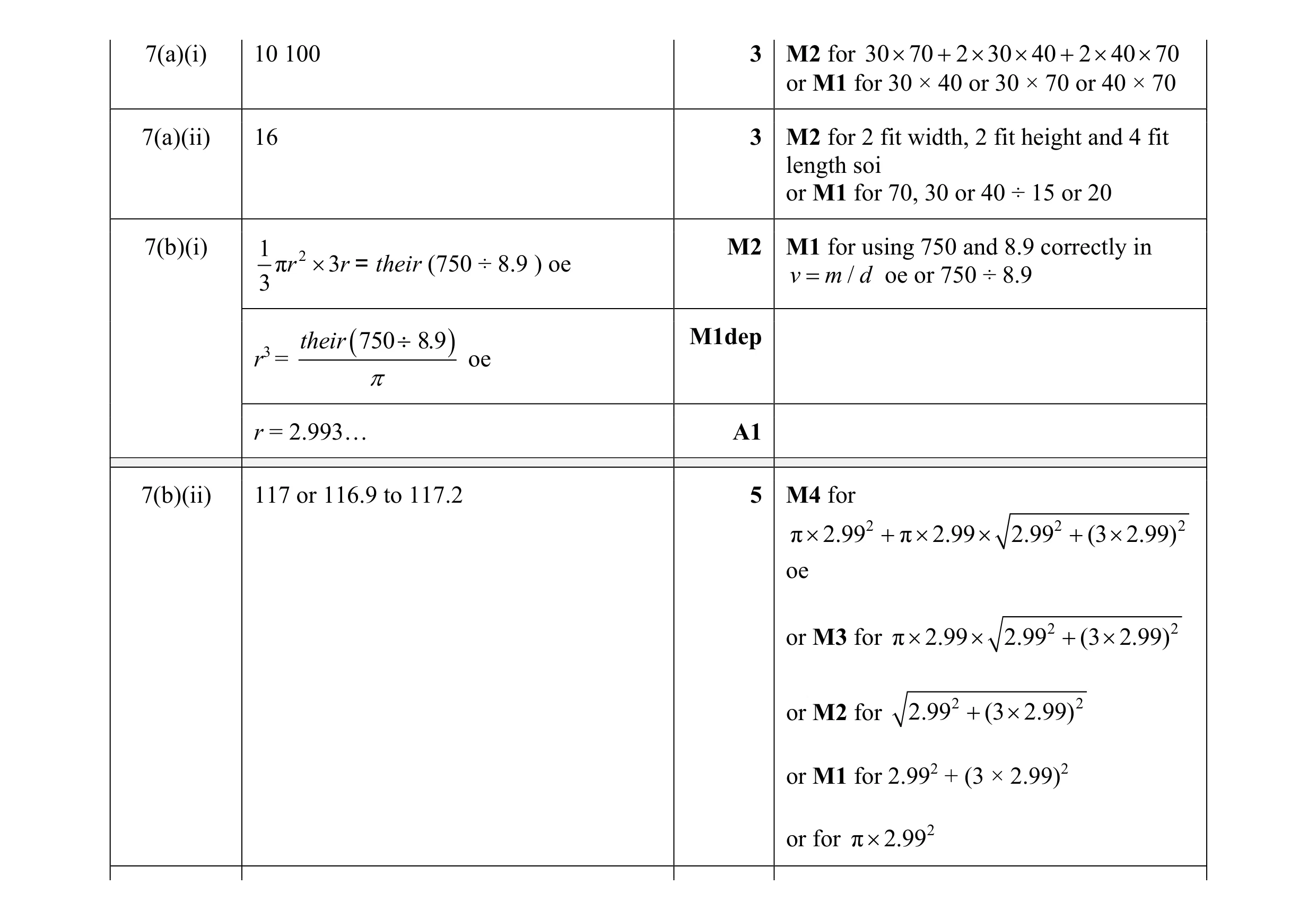
Mark scheme: 7(a)(i) 10 100 3 M2 for 30 70 2 30 40 2 40 70 or M1 for 30 × 40 or 30 × 70 or 40 × 70 7(a)(ii) 16 3 M2 for 2 fit width, 2 fit height and 4 fit length soi or M1 for 70, 30 or 40 ÷ 15 or 20 7(b)(i) 1 2 M2 M1 for using 750 and 8.9 correctly in πr 3r = their (750 ÷ 8.9 ) oe v m / d oe or 750 ÷ 8.9 3 their 750 8.9 M1dep r3 = oe r = 2.993… A1 7(b)(ii) 117 or 116.9 to 117.2 5 M4 for π 2.99 2 π 2.99 2.99 2 (3 2.99) 2 oe or M3 for π 2.99 2.99 2 (3 2.99) 2 or M2 for 2.99 2 (3 2.99) 2 or M1 for 2.992 + (3 × 2.99)2 or for π 2.99 2
This question in 0580/41 May/June 2024
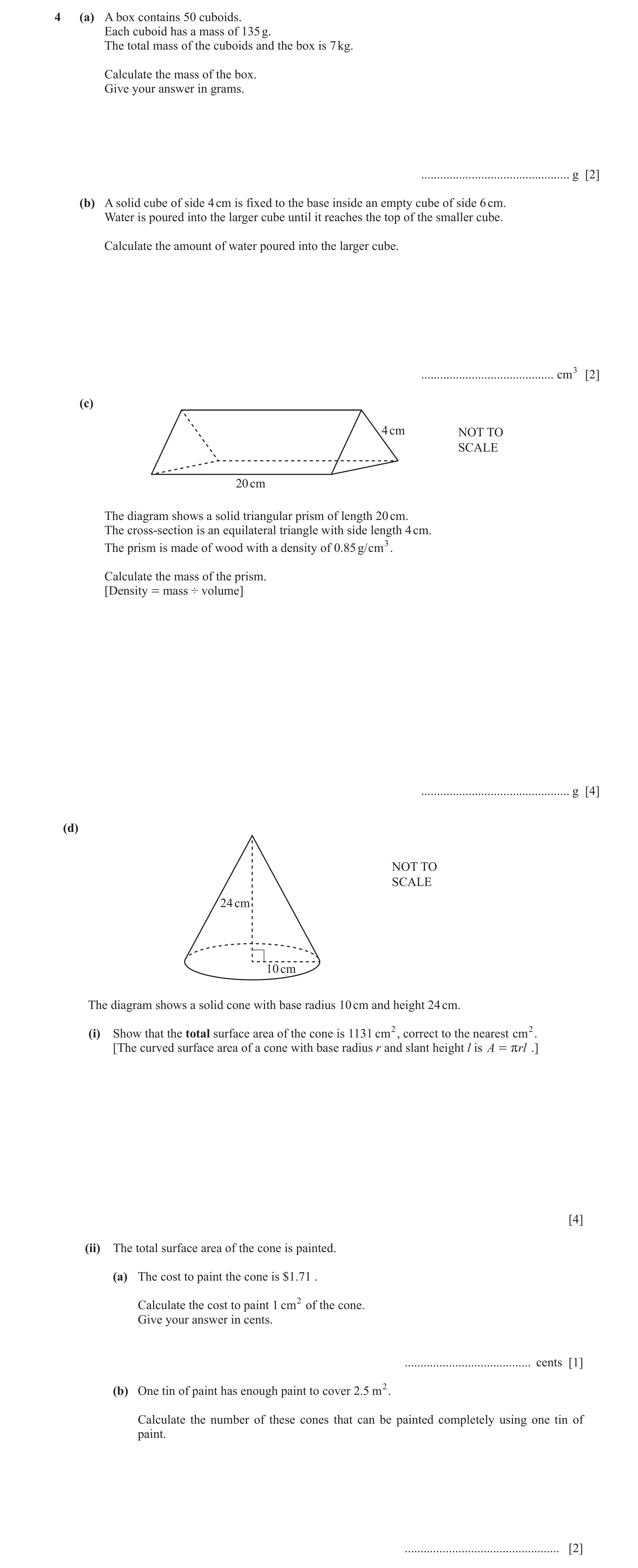
Q23 · A box contains 50 cuboids 0580/43 Oct/Nov 2024
4 (a) A box contains 50 cuboids. Each cuboid has a mass of 135 g. The total mass of the cuboids and the box is 7 kg. Calculate the mass of the box. Give your answer in grams. … g [2] (b) A solid cube of side 4 cm is fixed to the base inside an empty cube of side 6 cm. Water is poured into the larger cube until it reaches the top of the smaller cube. Calculate the amount of water poured into the larger cube. … cm3 [2] (c) 4 cm NOT TO SCALE 20 cm The diagram shows a solid triangular prism of length 20 cm. The cross-section is an equilateral triangle with side length 4 cm. The prism is made of wood with a density of 0.85 g/cm3. Calculate the mass of the prism. [Density = mass ÷ volume] … g [4] (d) NOT TO SCALE 24 cm 10 cm The diagram shows a solid cone with base radius 10 cm and height 24 cm. (i) Show that the total surface area of the cone is 1131 cm2, correct to the nearest cm2. [The curved surface area of a cone with base radius r and slant height l is A = r rl .] [4] (ii) The total surface area of the cone is painted. (a) The cost to paint the cone is $1.71 . Calculate the cost to paint 1 cm2 of the cone. Give your answer in cents. … cents [1] (b) One tin of paint has enough paint to cover 2.5 m2. Calculate the number of these cones that can be painted completely using one tin of paint. … [2]
15 marks
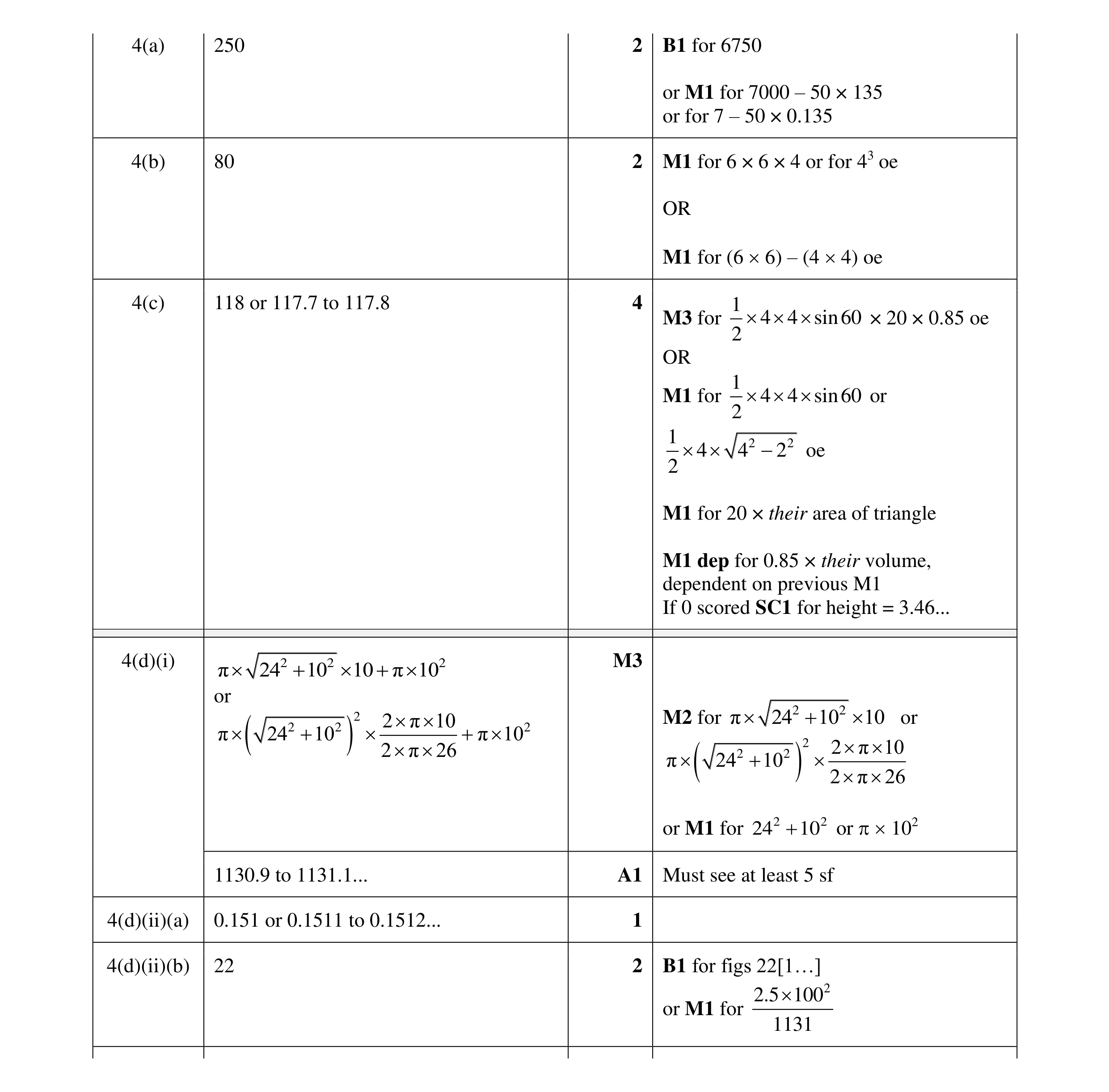
Mark scheme: 4(a) 250 2 B1 for 6750 or M1 for 7000 – 50 × 135 or for 7 – 50 × 0.135 4(b) 80 2 M1 for 6 × 6 × 4 or for 43 oe OR M1 for (6 6) – (4 4) oe 4(c) 118 or 117.7 to 117.8 4 1 M3 for 4 4 sin60 × 20 × 0.85 oe 2 OR 1 M1 for 4 4 sin60 or 2 1 2 2 4 4 − 2 oe 2 M1 for 20 × their area of triangle M1 dep for 0.85 × their volume, dependent on previous M1 If 0 scored SC1 for height = 3.46... 4(d)(i) 2 2 2 M3 π 24 + 10 10 + π 10 or 2 2 2 2 2 2 π 10 2 M2 for π 24 + 10 10 or π 24 + 10 + π 10 2 ( ) 2 π 26 2 2 2 π 10 π 24 + 10 ( ) 2 π 26 or M1 for 24 2 + 10 2 or 102 1130.9 to 1131.1... A1 Must see at least 5 sf 4(d)(ii)(a) 0.151 or 0.1511 to 0.1512... 1 4(d)(ii)(b) 22 2 B1 for figs 22[1…] 2.5 100 2 or M1 for 1131
This question in 0580/43 Oct/Nov 2024
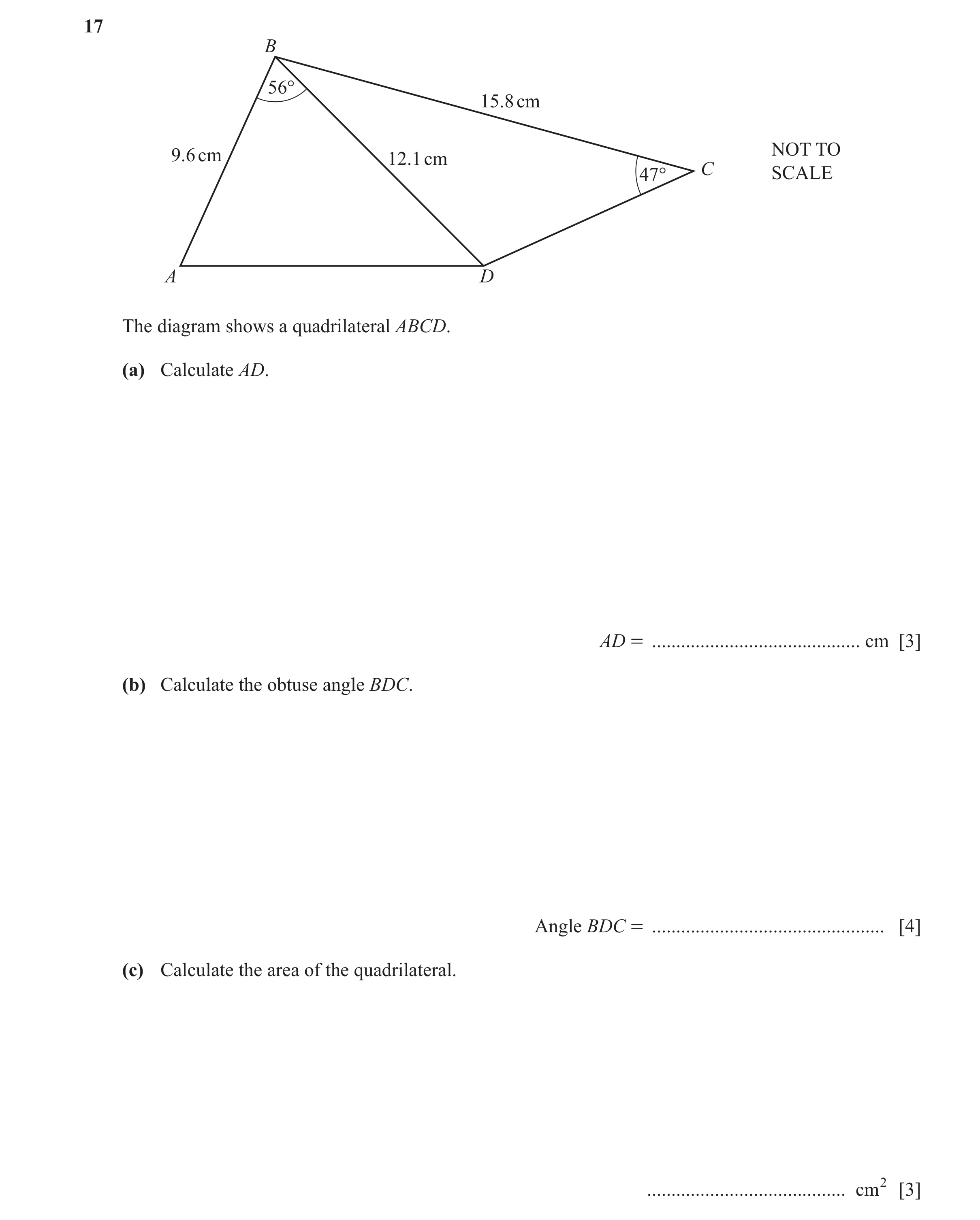
Q24 · B 56° 15.8 cm NOT TO 9.6 cm 12.1 cm C SCALE 47° A D The diagram shows a quadrilateral ABCD 0580/41 May/June 2025
17 B 56° 15.8 cm NOT TO 9.6 cm 12.1 cm C SCALE 47° A D The diagram shows a quadrilateral ABCD. (a) Calculate AD. AD = … cm [3] (b) Calculate the obtuse angle BDC. Angle BDC = … [4] (c) Calculate the area of the quadrilateral. … cm2 [3]
10 marks
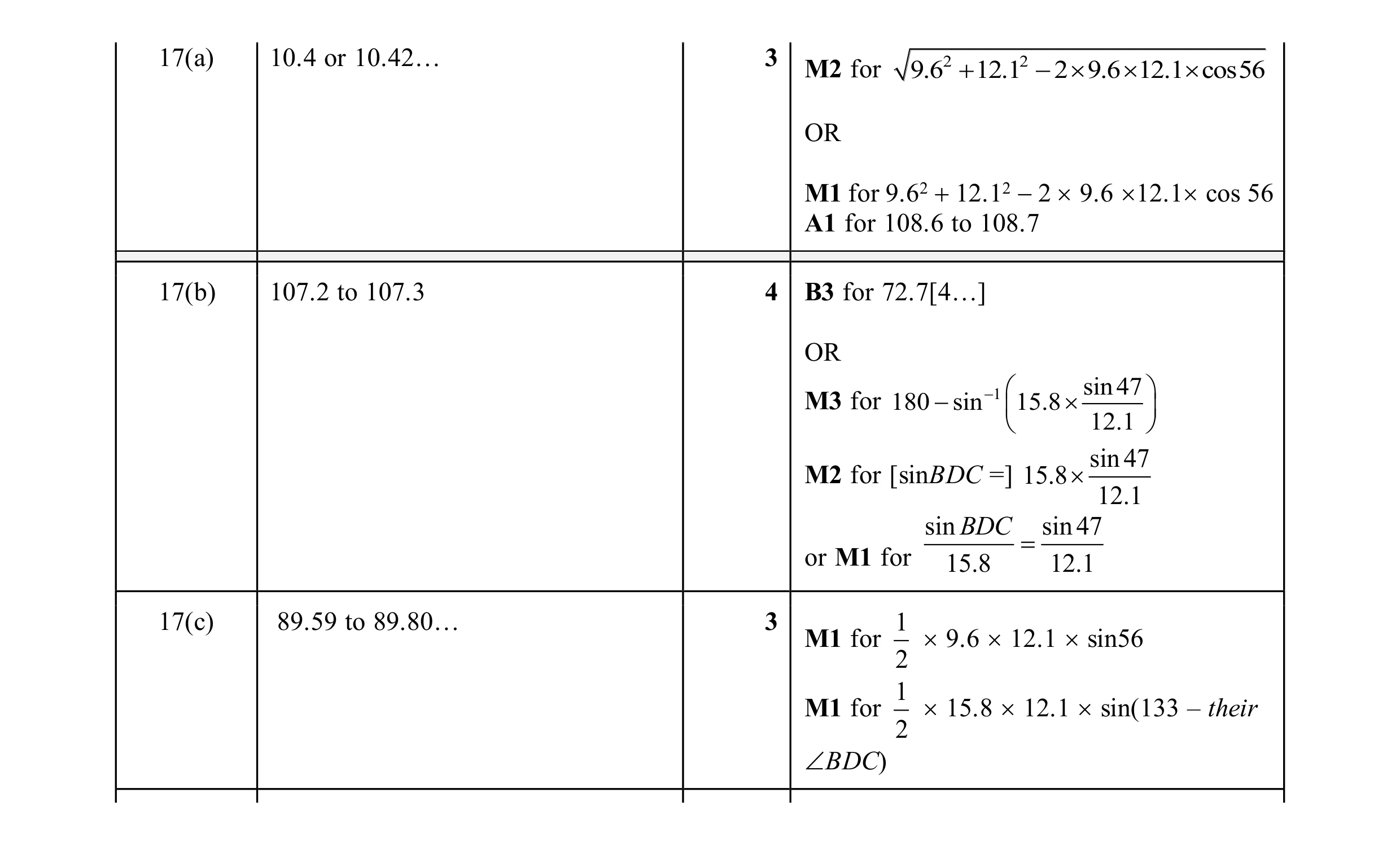
Mark scheme: 17(a) 10.4 or 10.42… 3 2 2 M2 for 9.6 + 12.1 −2 9.6 12.1 cos56 OR M1 for 9.62 + 12.12 − 2 9.6 12.1 cos 56 A1 for 108.6 to 108.7 17(b) 107.2 to 107.3 4 B3 for 72.7[4…] OR −1 sin47 M3 for 180 − sin 15.8 12. 1 sin47 M2 for [sinBDC =] 15.8 12.1 sin BDC sin47 = or M1 for 15.8 12.1 17(c) 89.59 to 89.80… 3 1 M1 for 9.6 12.1 sin56 2 1 M1 for 15.8 12.1 sin(133 – their 2 BDC)
This question in 0580/41 May/June 2025
 1 / 38
 18 / 38
 24 / 38
 27 / 38
 28 / 38
 38 / 38
 12
 16
 12
 13
 15
 15
 17
 17
 15
 13
 7
 16
 11
 14
 9
 13
 13
 10
 11
 14
 10
 15
 15
 10