Cambridge IGCSE Mathematics 0580 — 2016 May/June Paper 4 · Variant 3
0580/43/M/J/16 · 10 questions · 130 marks · ≈146 min
The question paper and its mark scheme, free to read here and free to download. This is Cambridge’s own paper, exactly as it was sat.
Question paper16 pages
Mark scheme7 pages
Answers below. Sit the paper first if you are practising.
Questions as text
Q1 · A football club sells tickets at different prices dependent on age group
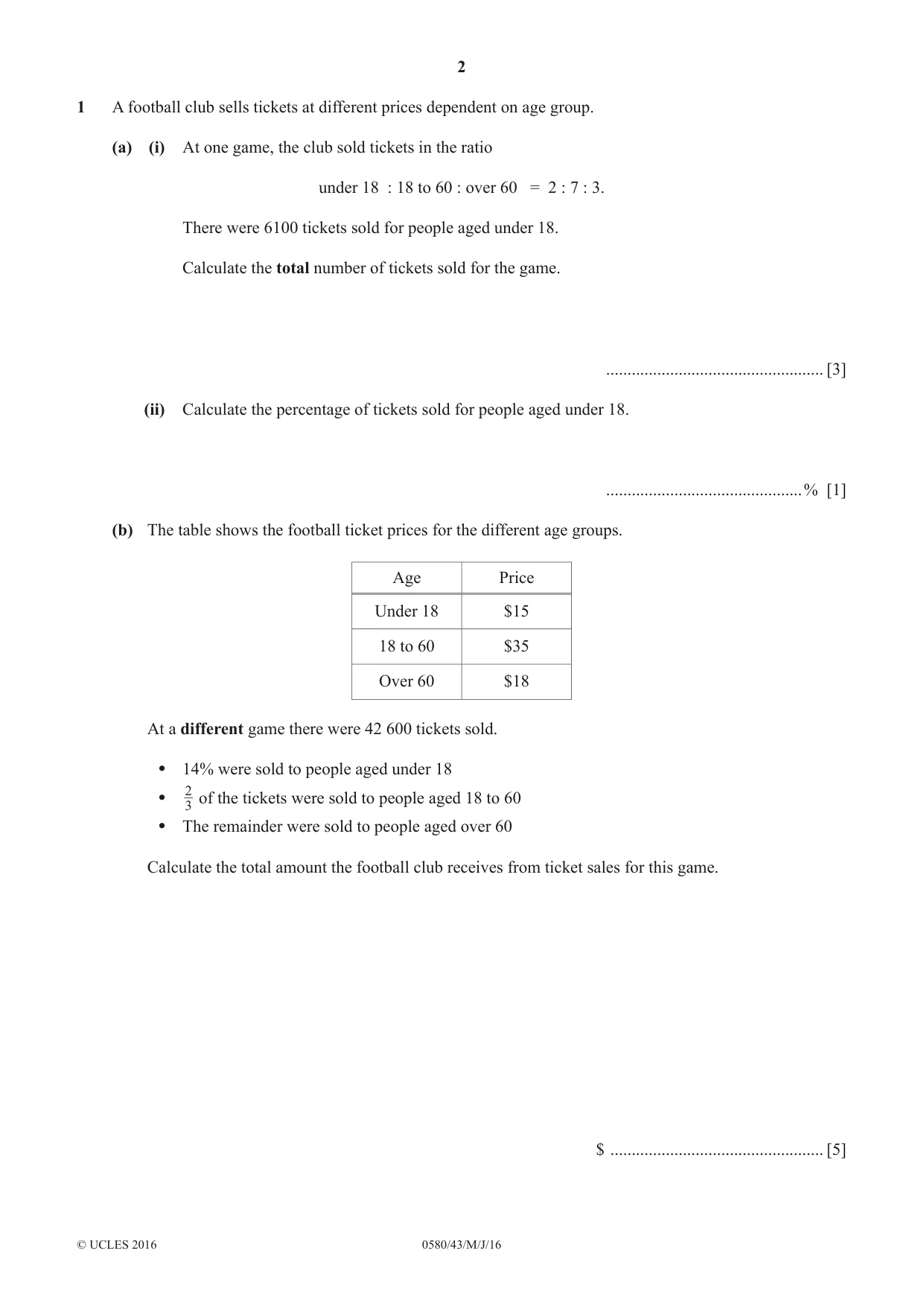
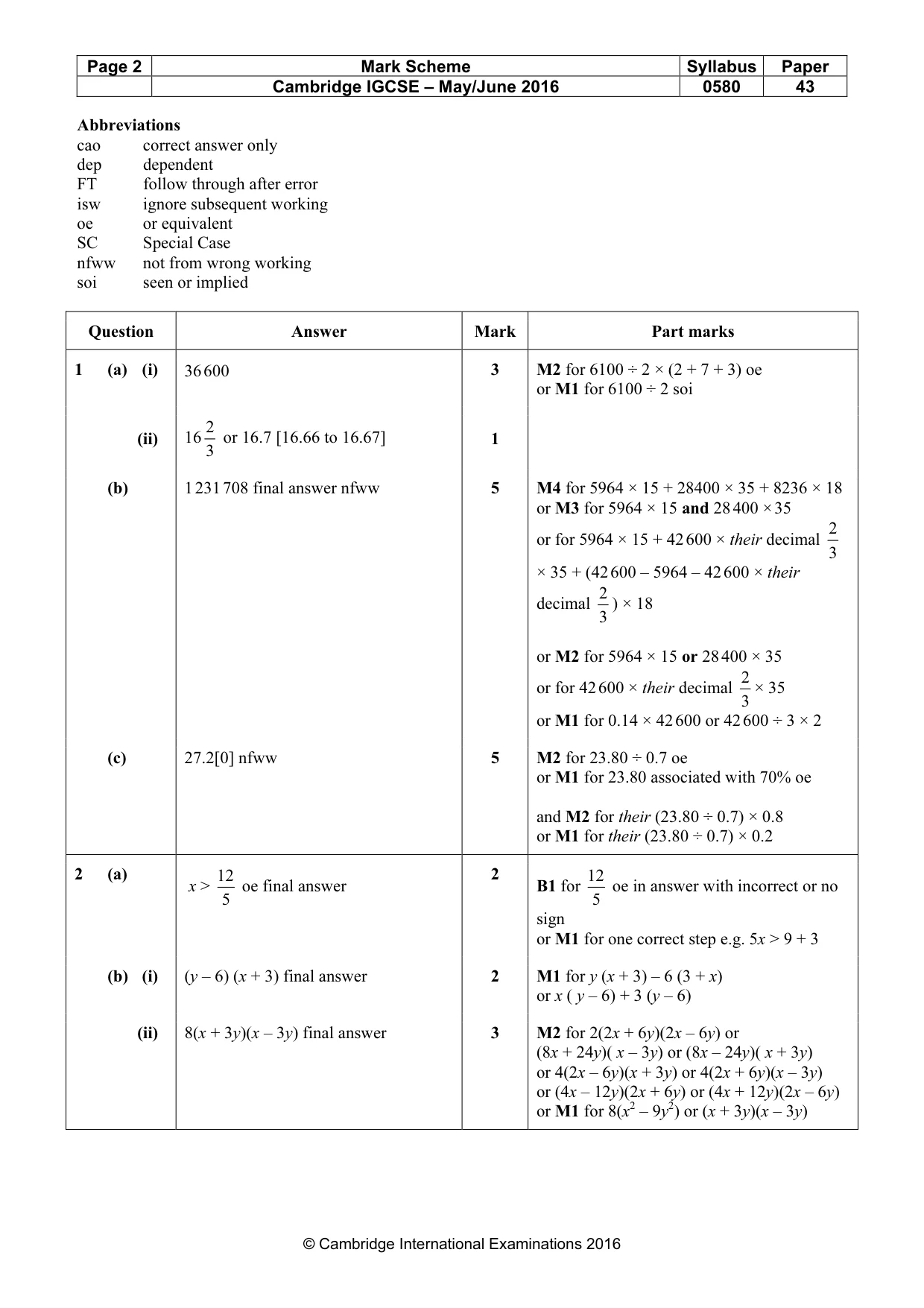
1 A football club sells tickets at different prices dependent on age group. (a) (i) At one game, the club sold tickets in the ratio under 18 : 18 to 60 : over 60 = 2 : 7 : 3. There were 6100 tickets sold for people aged under 18. Calculate the total number of tickets sold for the game. ................................................... [3] (ii) Calculate the percentage of tickets sold for people aged under 18. ..............................................% [1] (b) The table shows the football ticket prices for the different age groups. Age Price Under 18 $15 18 to 60 $35 Over 60 $18 At a different game there were 42 600 tickets sold. • 14% were sold to people aged under 18 2 • 3 of the tickets were sold to people aged 18 to 60 • The remainder were sold to people aged over 60 Calculate the total amount the football club receives from ticket sales for this game. $ .................................................. [5] (c) In a sale, the football club shop reduced the price of the football shirts to $23.80 . An error was made when working out this sale price. The price was reduced by 30% instead of 20%. Calculate the correct sale price for the football shirt. $ ................................................... [5]
Mark scheme: Question Answer Mark Part marks 1 (a) (i) 3 M2 for 6100 ÷ 2 × (2 + 7 + 3) oe 36 600 or M1 for 6100 ÷ 2 soi 2 (ii) 16 or 16.7 [16.66 to 16.67] 1 3 (b) 1 231 708 final answer nfww 5 M4 for 5964 × 15 + 28400 × 35 + 8236 × 18 or M3 for 5964 × 15 and 28 400 × 35 2 or for 5964 × 15 + 42 600 × their decimal 3 × 35 + (42 600 – 5964 – 42 600 × their 2 decimal ) × 18 3 or M2 for 5964 × 15 or 28 400 × 35 2 or for 42 600 × their decimal × 35 3 or M1 for 0.14 × 42 600 or 42 600 ÷ 3 × 2 (c) 27.2[0] nfww 5 M2 for 23.80 ÷ 0.7 oe or M1 for 23.80 associated with 70% oe and M2 for their (23.80 ÷ 0.7) × 0.8 or M1 for their (23.80 ÷ 0.7) × 0.2
Question 2
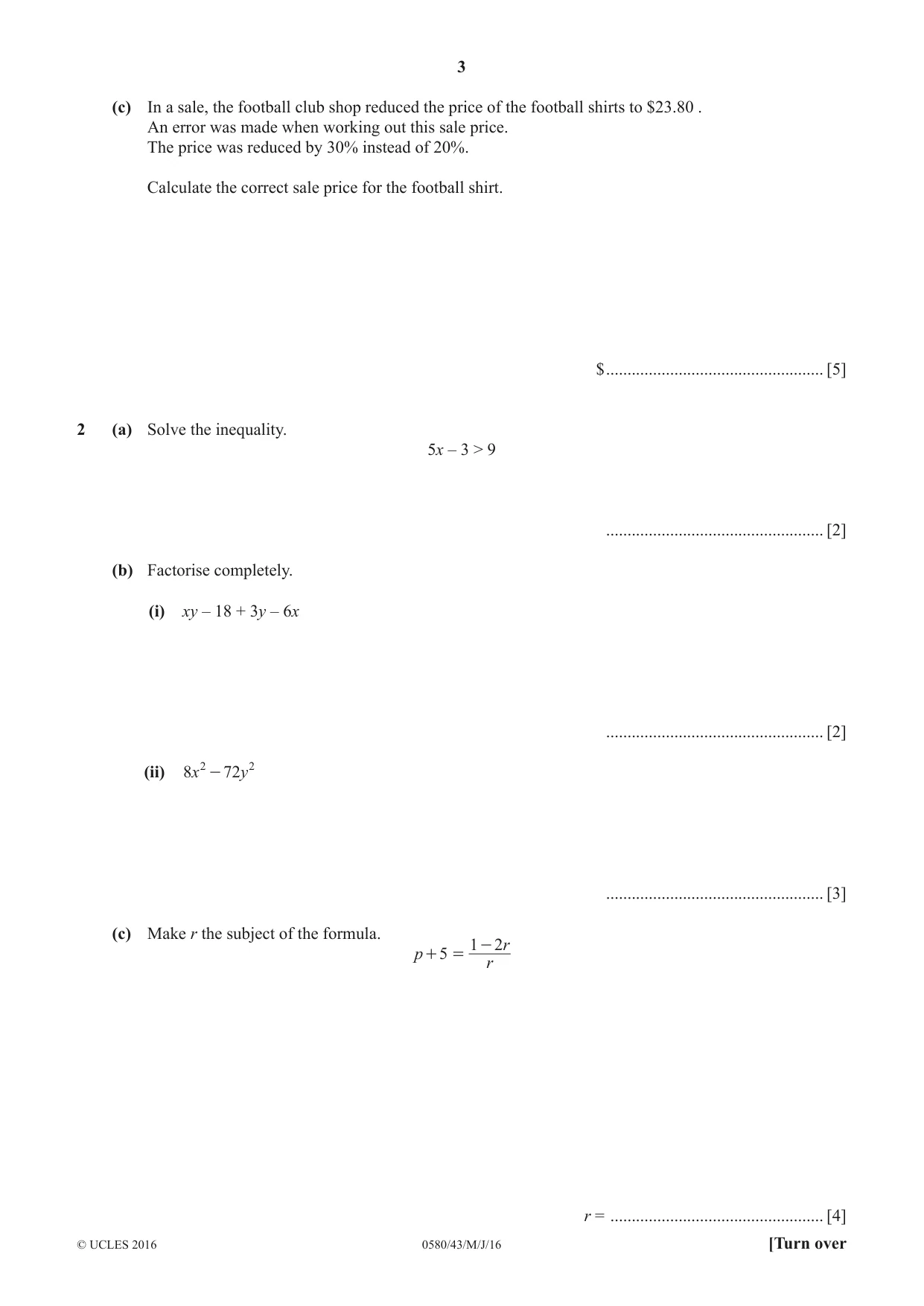
2 (a) Solve the inequality. 5x – 3 > 9 ................................................... [2] (b) Factorise completely. (i) xy – 18 + 3y – 6x ................................................... [2] (ii) 8x 2 - 72y 2 ................................................... [3] (c) Make r the subject of the formula. 1 - 2r p + 5 = r r = .................................................. [4]
Mark scheme: 2 (a) 12 2 12 x > oe final answer B1 for oe in answer with incorrect or no 5 5 sign or M1 for one correct step e.g. 5x > 9 + 3 (b) (i) (y – 6) (x + 3) final answer 2 M1 for y (x + 3) – 6 (3 + x) or x ( y – 6) + 3 (y – 6) (ii) 8(x + 3y)(x – 3y) final answer 3 M2 for 2(2x + 6y)(2x – 6y) or (8x + 24y)( x – 3y) or (8x – 24y)( x + 3y) or 4(2x – 6y)(x + 3y) or 4(2x + 6y)(x – 3y) or (4x – 12y)(2x + 6y) or (4x + 12y)(2x – 6y) or M1 for 8(x2 – 9y2) or (x + 3y)(x – 3y)
Q3 · The diagram shows the graph of y = f(x) for - 3.5 G x G 2.5
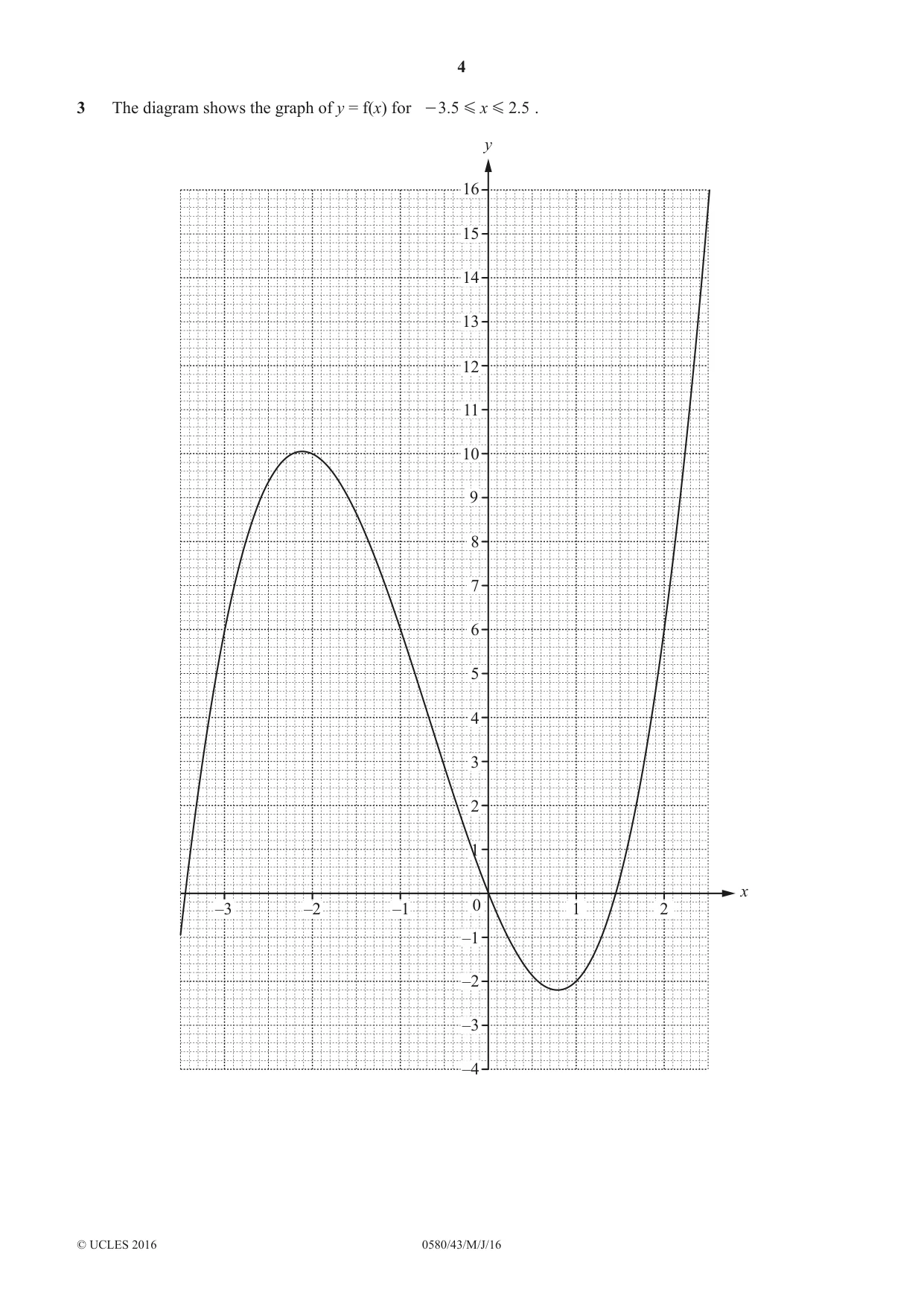
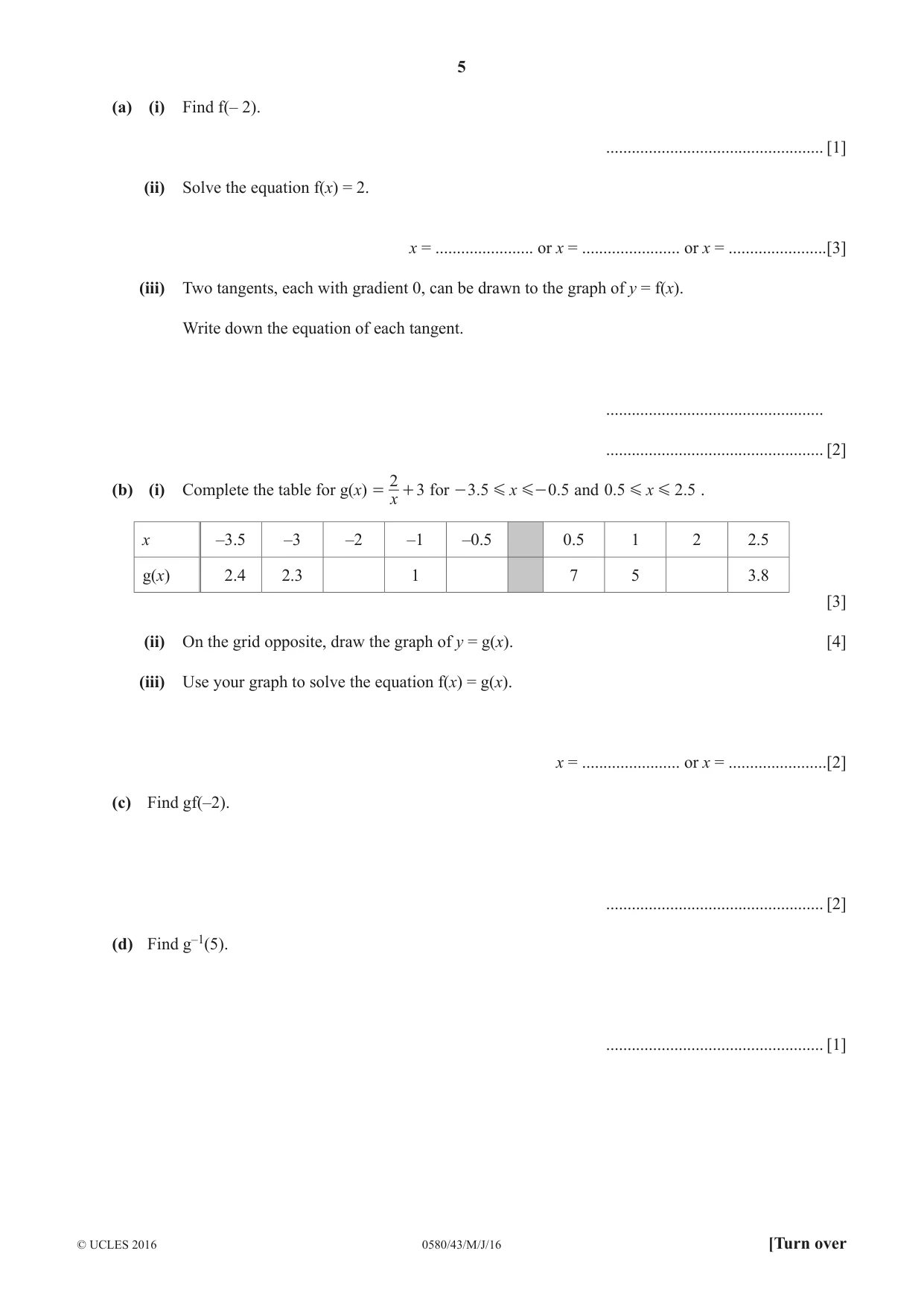
3 The diagram shows the graph of y = f(x) for - 3.5 G x G 2.5 . y 16 15 14 13 12 11 10 9 8 7 6 5 4 3 2 1 x –3 –2 –1 0 1 2 –1 –2 –3 –4 (a) (i) Find f(– 2). ................................................... [1] (ii) Solve the equation f(x) = 2. x = ....................... or x = ....................... or x = .......................[3] (iii) Two tangents, each with gradient 0, can be drawn to the graph of y = f(x). Write down the equation of each tangent. ................................................... ................................................... [2] 2 (b) (i) Complete the table for g(x) = + 3 for - 3. 5 G x G - 0. 5 and 0. 5 G x G 2. 5 . x x –3.5 –3 –2 –1 –0.5 0.5 1 2 2.5 g(x) 2.4 2.3 1 7 5 3.8 [3] (ii) On the grid opposite, draw the graph of y = g(x). [4] (iii) Use your graph to solve the equation f(x) = g(x). x = ....................... or x = .......................[2] (c) Find gf(–2). ................................................... [2] (d) Find g–1(5). ................................................... [1]
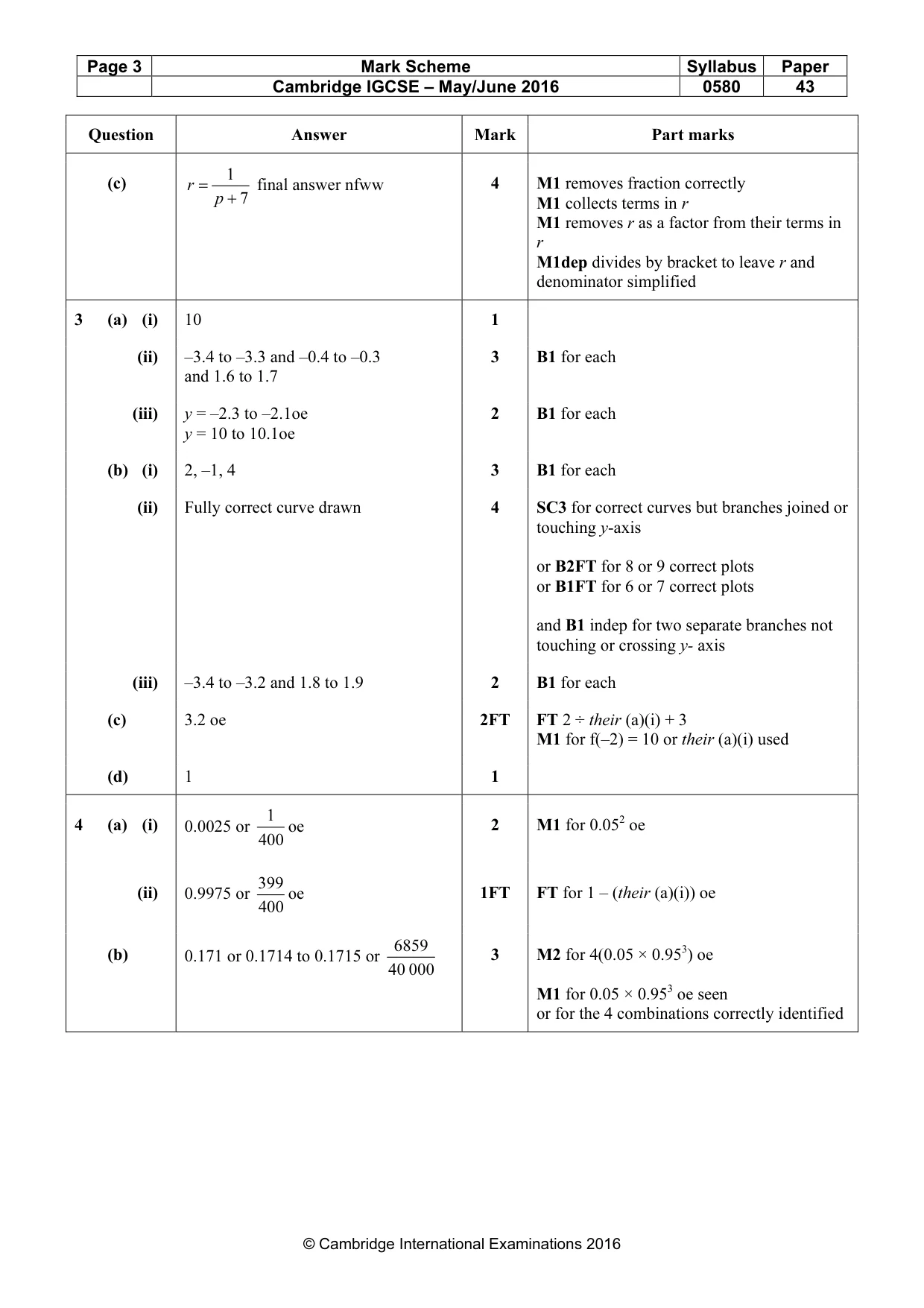
Mark scheme: 3 (a) (i) 10 1 (ii) –3.4 to –3.3 and –0.4 to –0.3 3 B1 for each and 1.6 to 1.7 (iii) y = –2.3 to –2.1oe 2 B1 for each y = 10 to 10.1oe (b) (i) 2, –1, 4 3 B1 for each (ii) Fully correct curve drawn 4 SC3 for correct curves but branches joined or touching y-axis or B2FT for 8 or 9 correct plots or B1FT for 6 or 7 correct plots and B1 indep for two separate branches not touching or crossing y- axis (iii) –3.4 to –3.2 and 1.8 to 1.9 2 B1 for each (c) 3.2 oe 2FT FT 2 ÷ their (a)(i) + 3 M1 for f(–2) = 10 or their (a)(i) used (d) 1 1 1
Q4 · Coins are put into a machine to pay for parking cars
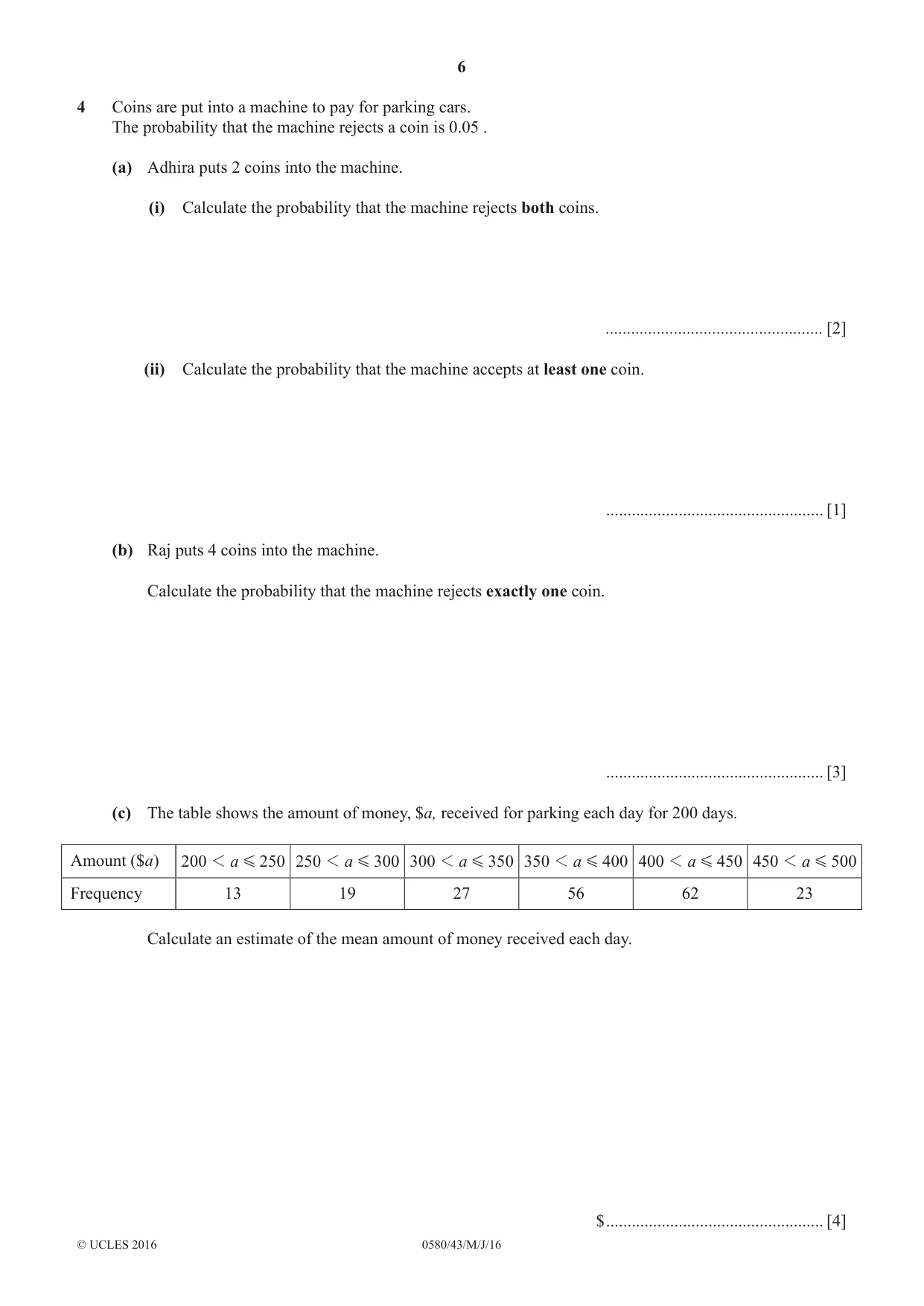
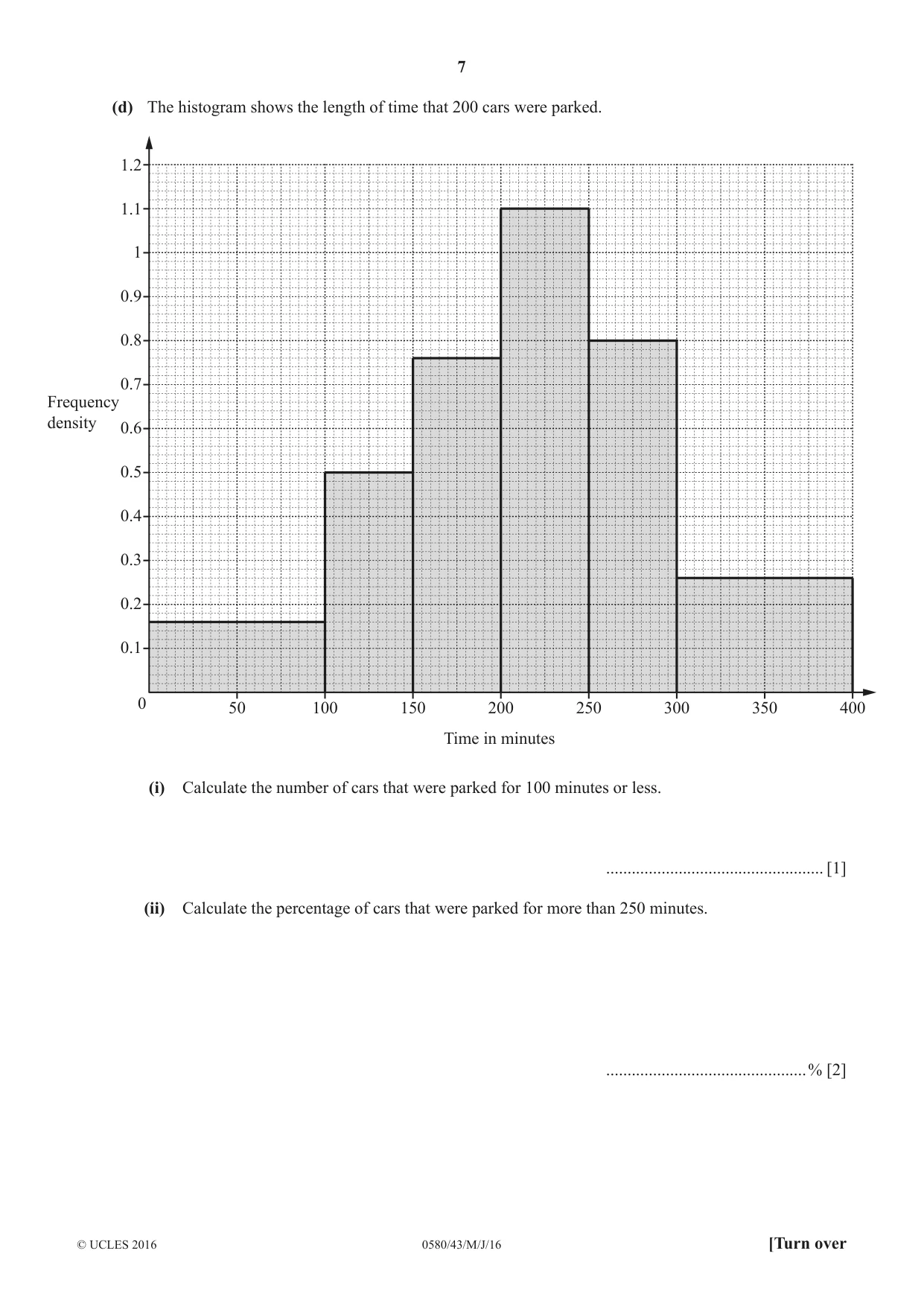
4 Coins are put into a machine to pay for parking cars. The probability that the machine rejects a coin is 0.05 . (a) Adhira puts 2 coins into the machine. (i) Calculate the probability that the machine rejects both coins. ................................................... [2] (ii) Calculate the probability that the machine accepts at least one coin. ................................................... [1] (b) Raj puts 4 coins into the machine. Calculate the probability that the machine rejects exactly one coin. ................................................... [3] (c) The table shows the amount of money, $a, received for parking each day for 200 days. Amount ($a) 200 1 a G 250 250 1 a G 300 300 1 a G 350 350 1 a G 400 400 1 a G 450 450 1 a G 500 Frequency 13 19 27 56 62 23 Calculate an estimate of the mean amount of money received each day. $ ................................................... [4] (d) The histogram shows the length of time that 200 cars were parked. 1.2 1.1 1 0.9 0.8 0.7 Frequency density 0.6 0.5 0.4 0.3 0.2 0.1 0 50 100 150 200 250 300 350 400 Time in minutes (i) Calculate the number of cars that were parked for 100 minutes or less. ................................................... [1] (ii) Calculate the percentage of cars that were parked for more than 250 minutes. ...............................................% [2]
Mark scheme: 14 (a) (i) 2 M1 for 0.052 oe 0.0025 or oe 400 399 (ii) 1FT FT for 1 – (their (a)(i)) oe 0.9975 or oe 400 6859 (b) 3 M2 for 4(0.05 × 0.953) oe 0.171 or 0.1714 to 0.1715 or 40 000 M1 for 0.05 × 0.953 oe seen or for the 4 combinations correctly identified
Q5 · NOT TO A SCALE North 510 km B 720 km 40° C A plane flies from A to C and then from C to B
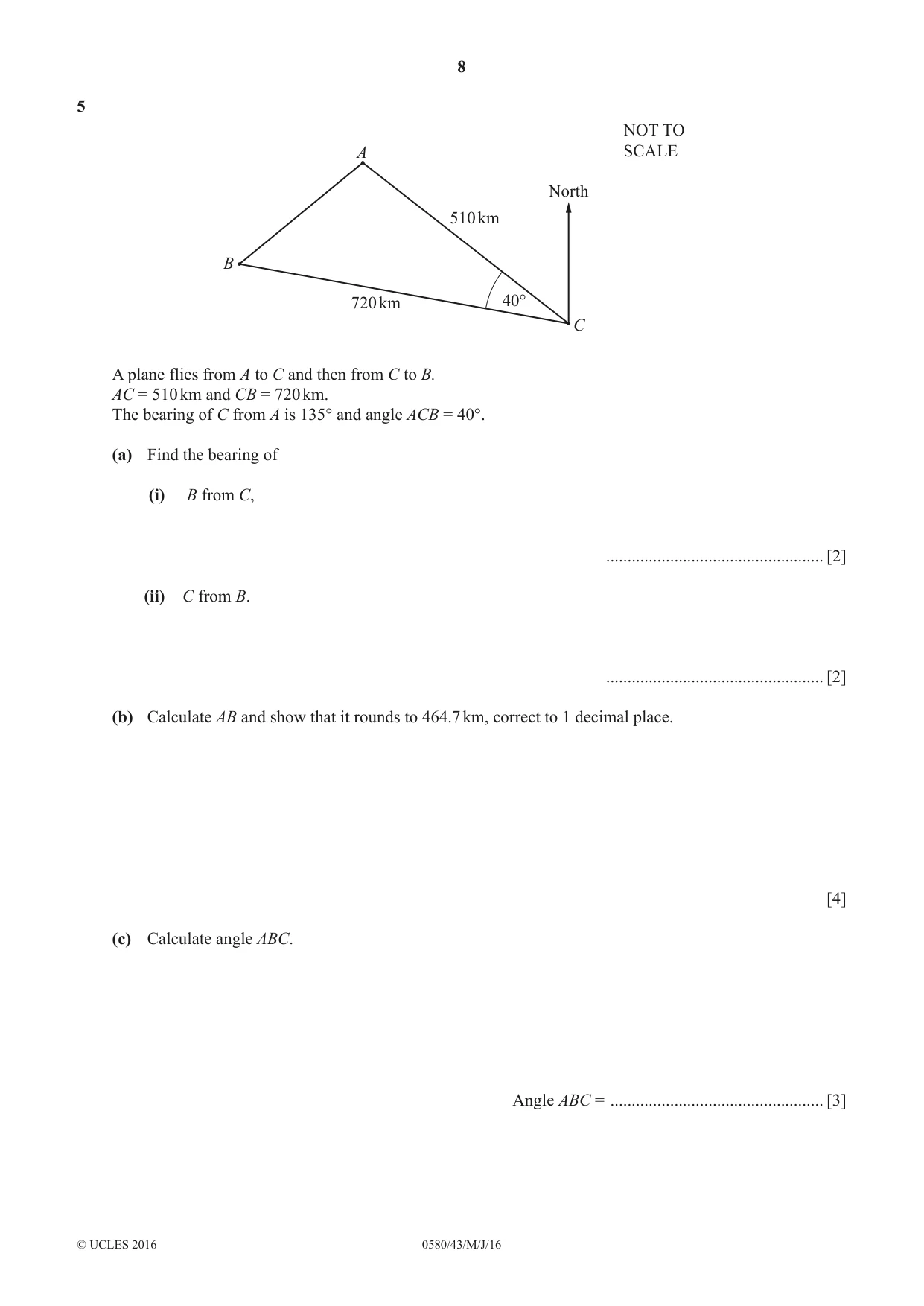
5 NOT TO A SCALE North 510 km B 720 km 40° C A plane flies from A to C and then from C to B. AC = 510 km and CB = 720 km. The bearing of C from A is 135° and angle ACB = 40°. (a) Find the bearing of (i) B from C, ................................................... [2] (ii) C from B. ................................................... [2] (b) Calculate AB and show that it rounds to 464.7 km, correct to 1 decimal place. [4] (c) Calculate angle ABC. Angle ABC = .................................................. [3]
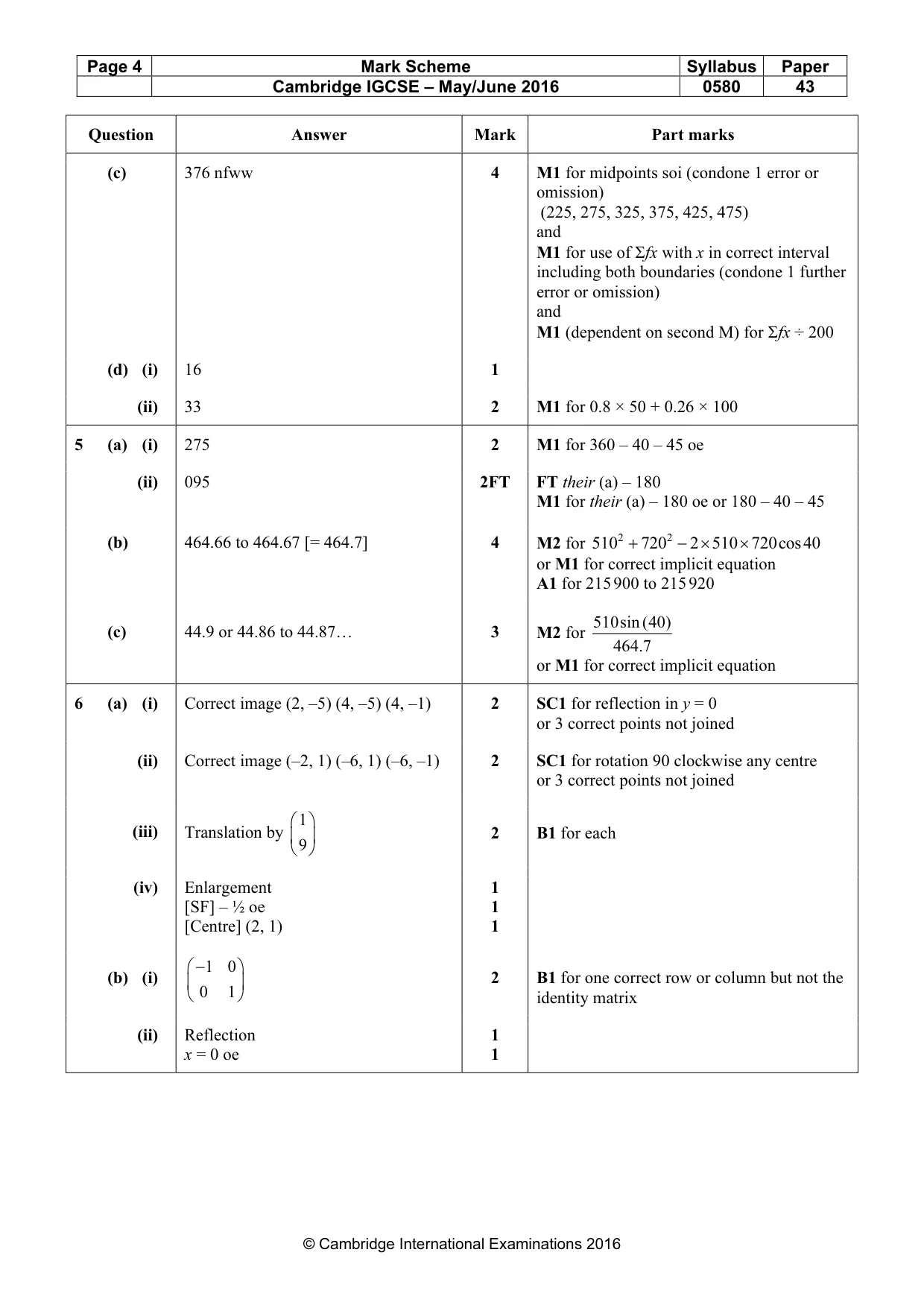
Mark scheme: 5 (a) (i) 275 2 M1 for 360 – 40 – 45 oe (ii) 095 2FT FT their (a) – 180 M1 for their (a) – 180 oe or 180 – 40 – 45 (b) 464.66 to 464.67 [= 464.7] 4 M2 for 510 2 + 720 2 −×2 510 × 720cos40 or M1 for correct implicit equation A1 for 215 900 to 215 920 510sin(40) (c) 44.9 or 44.86 to 44.87… 3 M2 for 464.7 or M1 for correct implicit equation
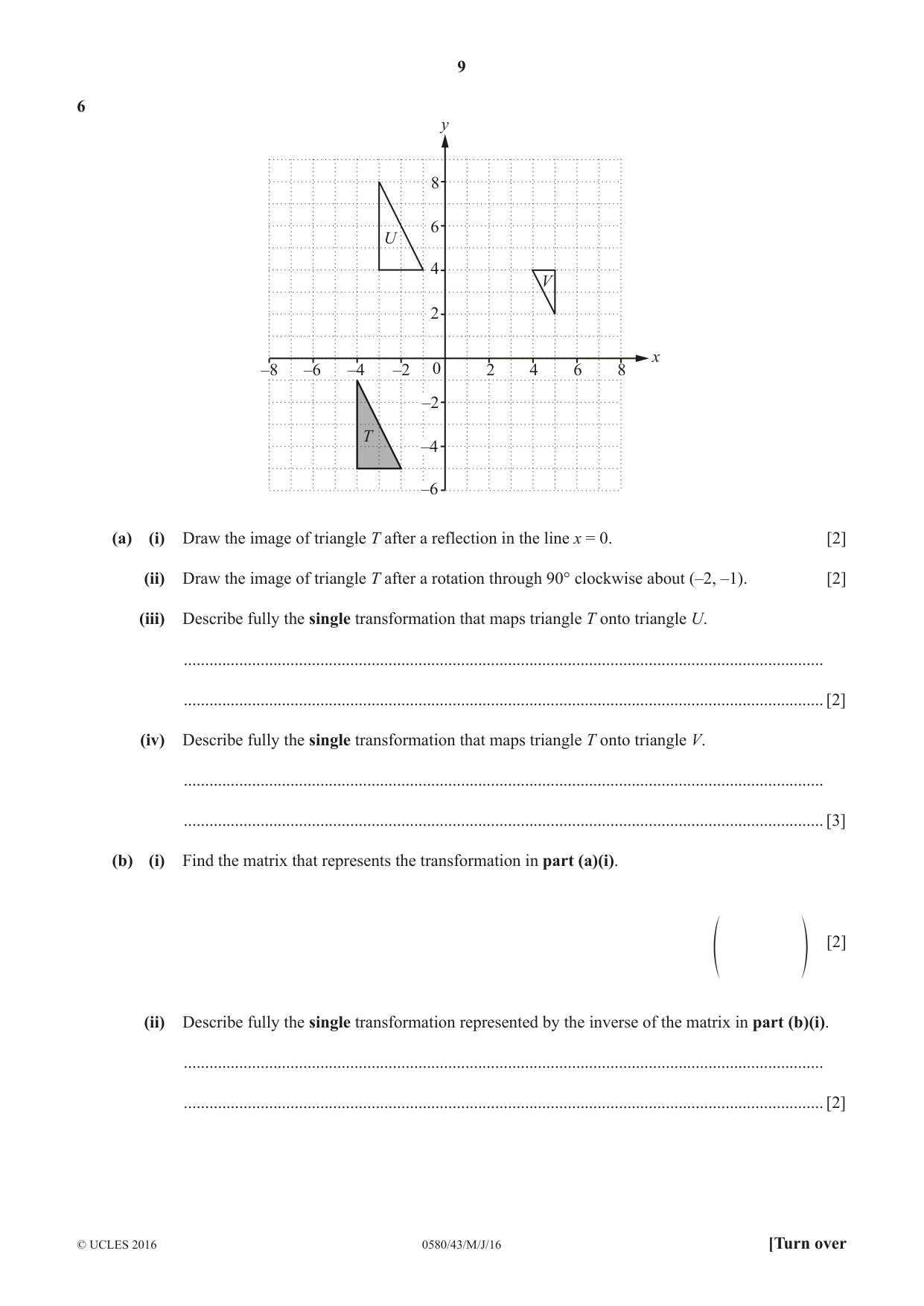
Q6 · Y 8 6 U 4 V 2 x –8 –6 –4 –2 0 2 4 6 8 –2 T –4 –6 (a) (i) Draw the image of triangle T…
6 y 8 6 U 4 V 2 x –8 –6 –4 –2 0 2 4 6 8 –2 T –4 –6 (a) (i) Draw the image of triangle T after a reflection in the line x = 0. [2] (ii) Draw the image of triangle T after a rotation through 90° clockwise about (–2, –1). [2] (iii) Describe fully the single transformation that maps triangle T onto triangle U. ...................................................................................................................................................... ...................................................................................................................................................... [2] (iv) Describe fully the single transformation that maps triangle T onto triangle V. ...................................................................................................................................................... ...................................................................................................................................................... [3] (b) (i) Find the matrix that represents the transformation in part (a)(i). [2] f p (ii) Describe fully the single transformation represented by the inverse of the matrix in part (b)(i). ...................................................................................................................................................... ...................................................................................................................................................... [2]
Mark scheme: 6 (a) (i) Correct image (2, –5) (4, –5) (4, –1) 2 SC1 for reflection in y = 0 or 3 correct points not joined (ii) Correct image (–2, 1) (–6, 1) (–6, –1) 2 SC1 for rotation 90 clockwise any centre or 3 correct points not joined 1 (iii) Translation by 2 B1 for each 9 (iv) Enlargement 1 [SF] – ½ oe 1 [Centre] (2, 1) 1 −1 0 (b) (i) 2 B1 for one correct row or column but not the 0 1 identity matrix (ii) Reflection 1 x = 0 oe 1
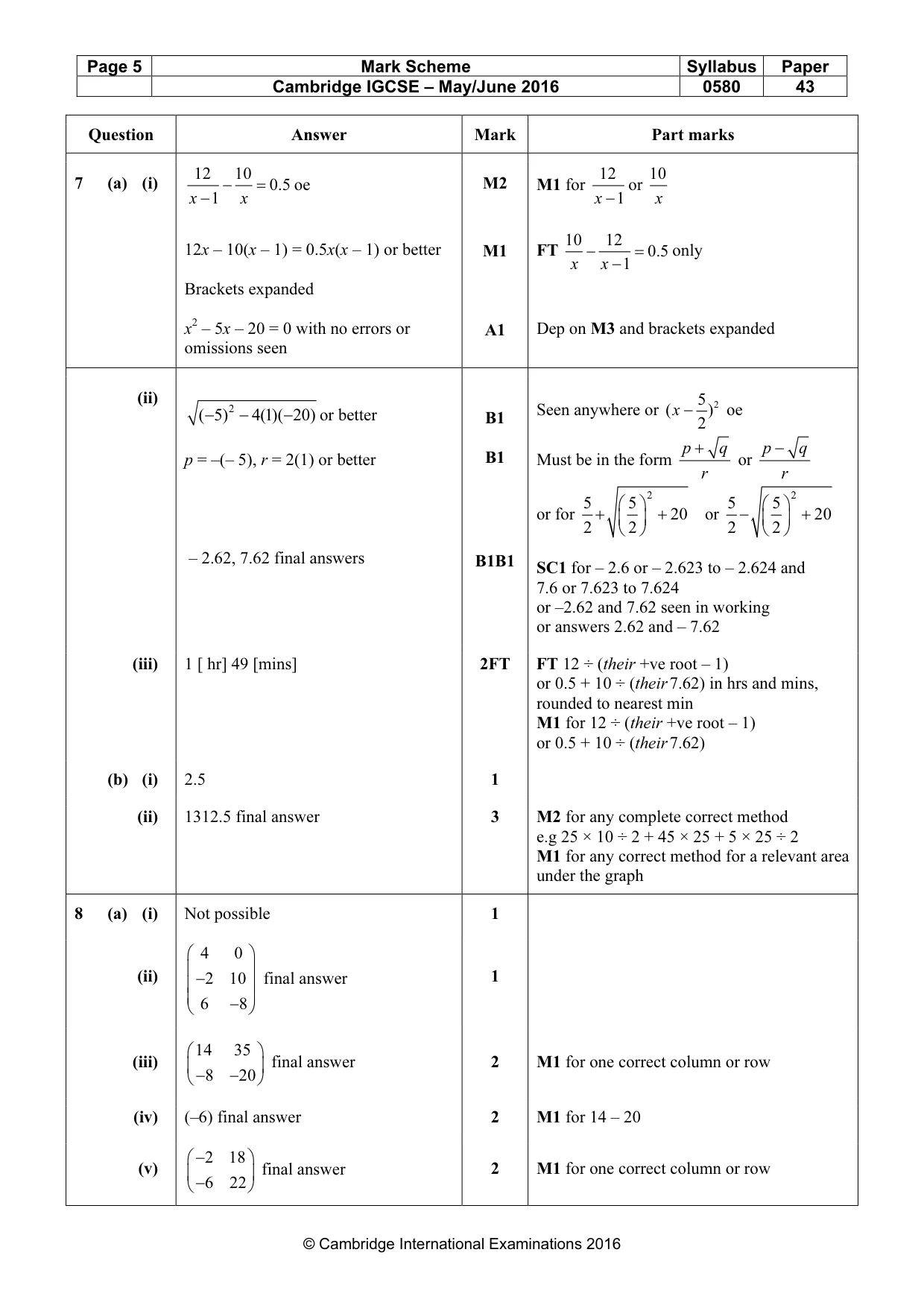
Q7 · Alfonso runs 10 km at an average speed of x km/h
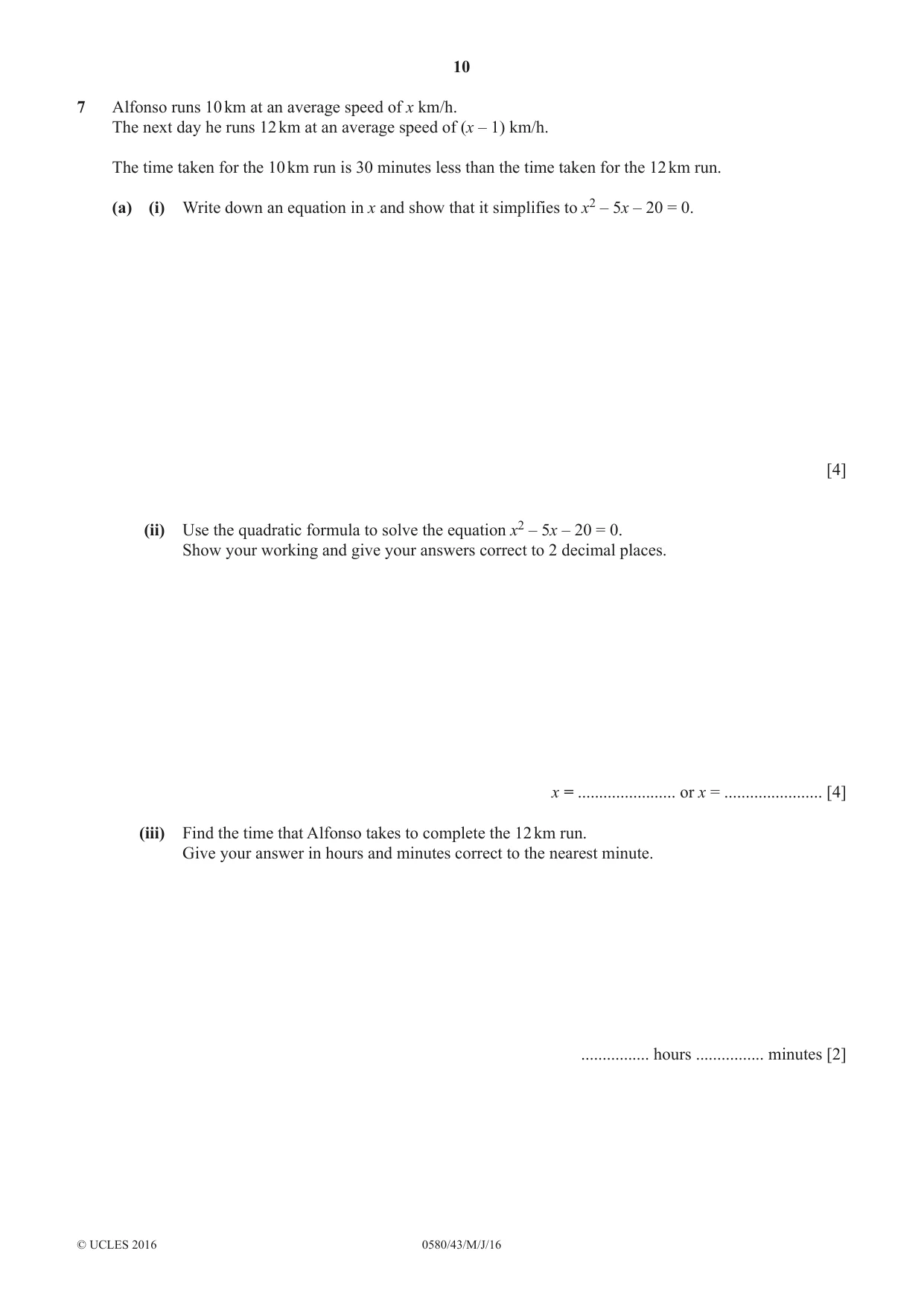
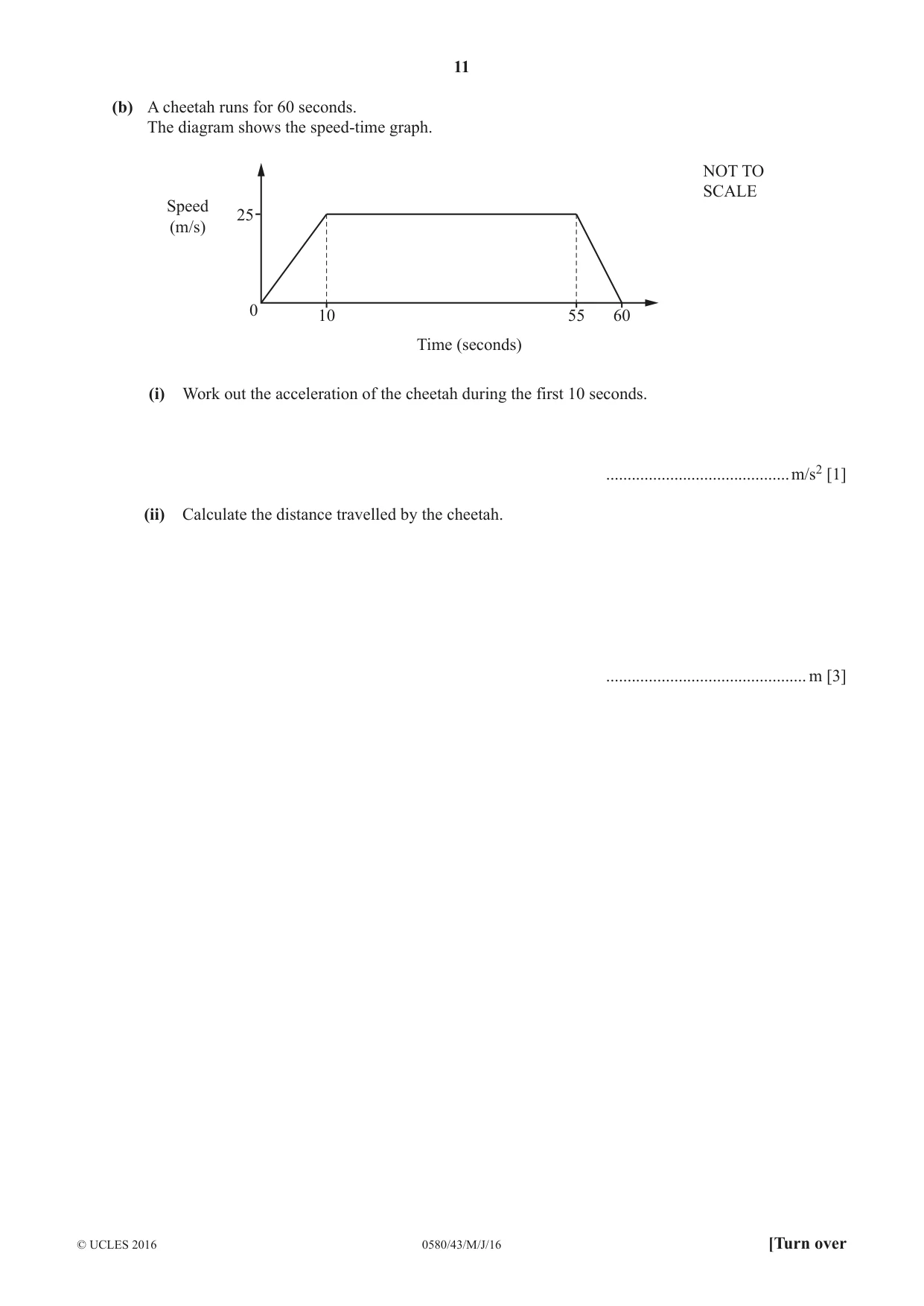
7 Alfonso runs 10 km at an average speed of x km/h. The next day he runs 12 km at an average speed of (x – 1) km/h. The time taken for the 10 km run is 30 minutes less than the time taken for the 12 km run. (a) (i) Write down an equation in x and show that it simplifies to x2 – 5x – 20 = 0. [4] (ii) Use the quadratic formula to solve the equation x2 – 5x – 20 = 0. Show your working and give your answers correct to 2 decimal places. x = ....................... or x = ....................... [4] (iii) Find the time that Alfonso takes to complete the 12 km run. Give your answer in hours and minutes correct to the nearest minute. ................ hours ................ minutes [2] (b) A cheetah runs for 60 seconds. The diagram shows the speed-time graph. NOT TO SCALE Speed 25 (m/s) 0 10 55 60 Time (seconds) (i) Work out the acceleration of the cheetah during the first 10 seconds. ...........................................m/s2 [1] (ii) Calculate the distance travelled by the cheetah. ............................................... m [3]
Mark scheme: 12 10 12 10 7 (a) (i) − = 0.5 oe M2 M1 for x − 1 x x −or1 x 10 12 12x – 10(x – 1) = 0.5x(x – 1) or better M1 FT − = 0.5 only x x − 1 Brackets expanded x2 – 5x – 20 = 0 with no errors or A1 Dep on M3 and brackets expanded omissions seen (ii) 5 2 ( −5) 2 − 4(1)( −20) or better B1 Seen anywhere or ( x − ) oe 2 p + q p − q B1 p = –(– 5), r = 2(1) or better Must be in the form or r r 2 2 5 5 5 5 or for + + 20 or − + 20 2 2 2 2 – 2.62, 7.62 final answers B1B1 SC1 for – 2.6 or – 2.623 to – 2.624 and 7.6 or 7.623 to 7.624 or –2.62 and 7.62 seen in working or answers 2.62 and – 7.62 (iii) 1 [ hr] 49 [mins] 2FT FT 12 ÷ (their +ve root – 1) or 0.5 + 10 ÷ (their 7.62) in hrs and mins, rounded to nearest min M1 for 12 ÷ (their +ve root – 1) or 0.5 + 10 ÷ (their 7.62) (b) (i) 2.5 1 (ii) 1312.5 final answer 3 M2 for any complete correct method e.g 25 × 10 ÷ 2 + 45 × 25 + 5 × 25 ÷ 2 M1 for any correct method for a relevant area under the graph
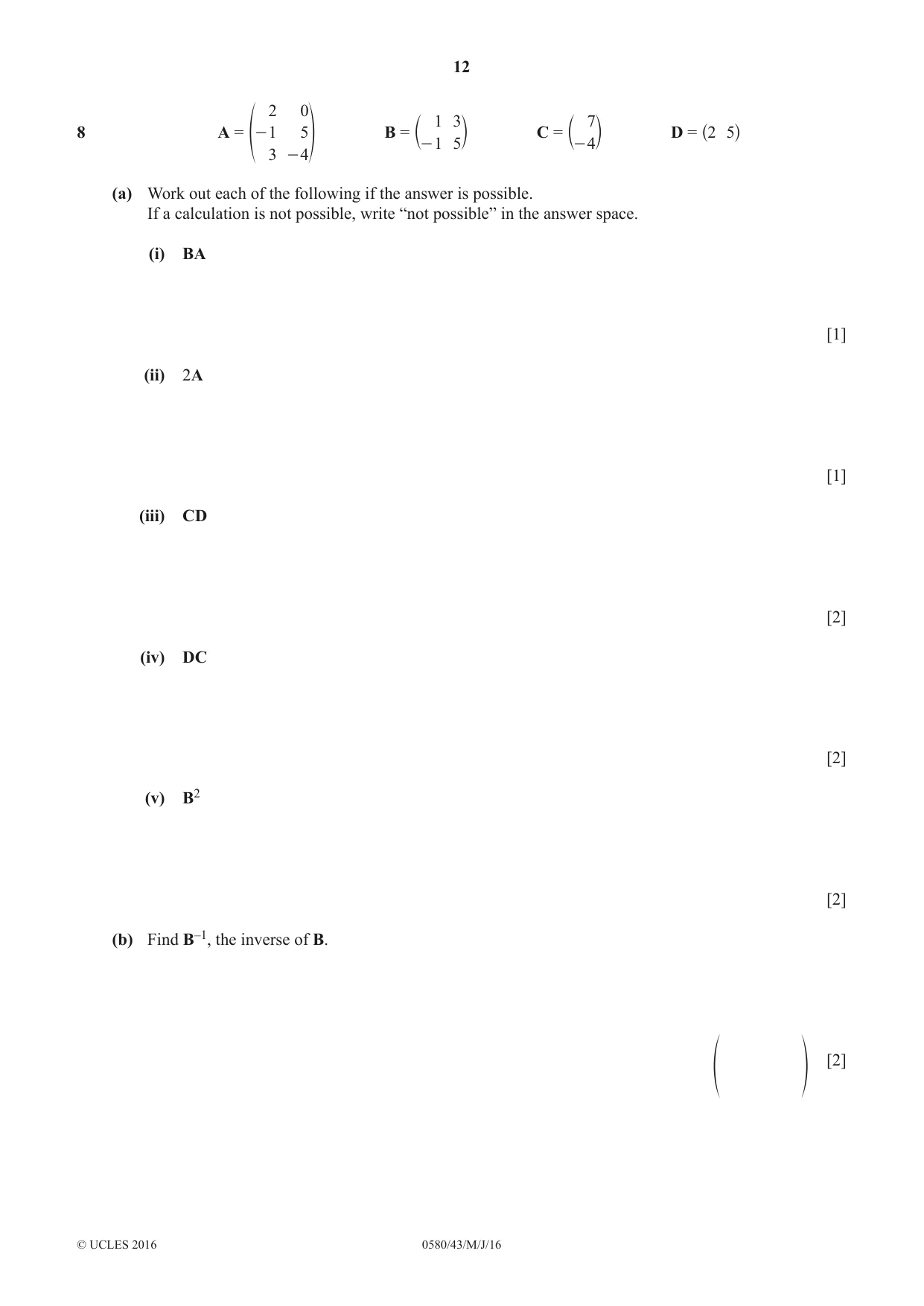
Q8 · 0 1 3 7 8 A = - 1 5 B = C = D = ^2 5h c- 1 5m c- 4m f 3 - 4p (a) Work out each of the…
2 0 1 3 7 8 A = - 1 5 B = C = D = ^2 5h c- 1 5m c- 4m f 3 - 4p (a) Work out each of the following if the answer is possible. If a calculation is not possible, write “not possible” in the answer space. (i) BA [1] (ii) 2A [1] (iii) CD [2] (iv) DC [2] (v) B2 [2] (b) Find B–1, the inverse of B. [2] f p
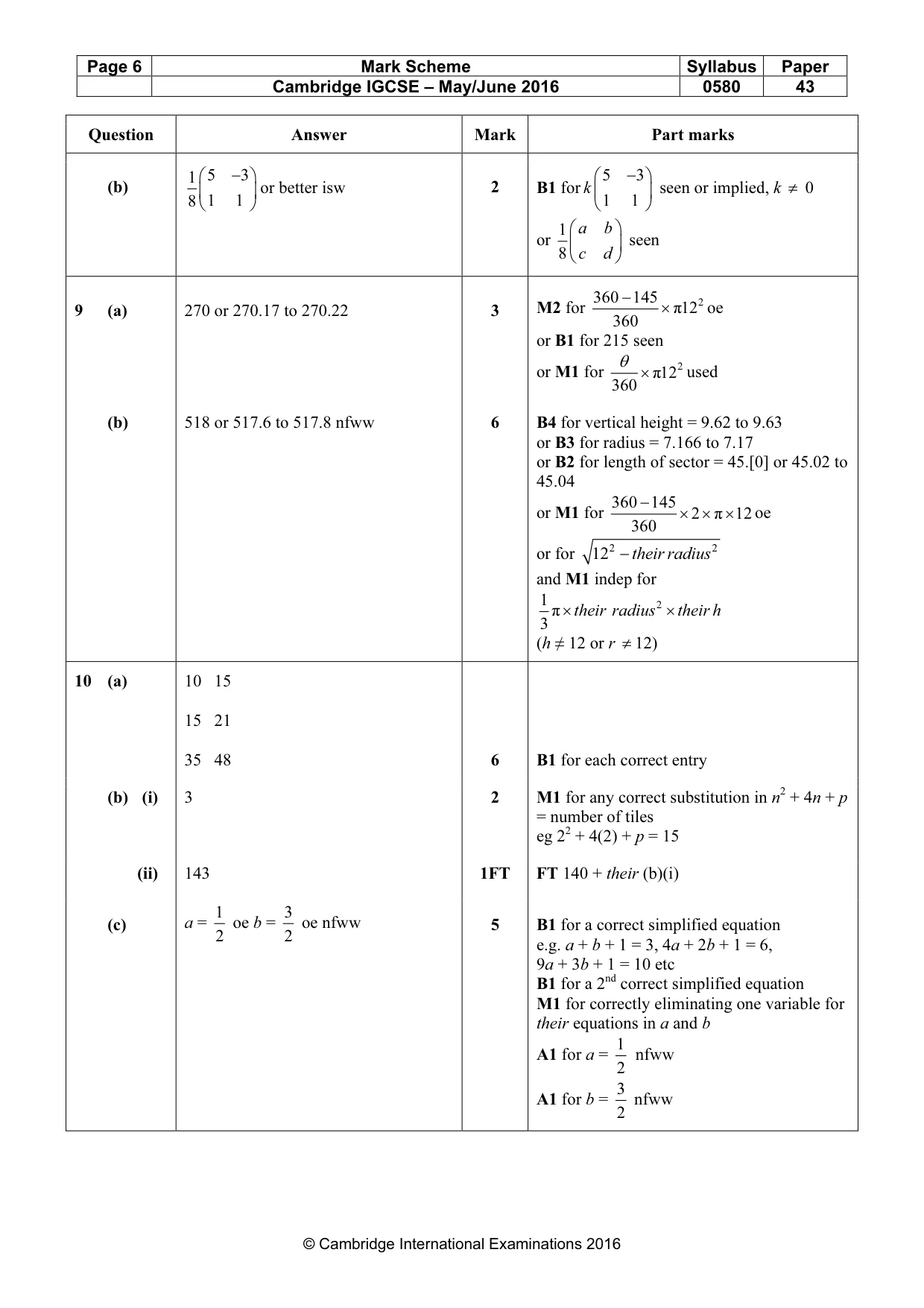
Mark scheme: 8 (a) (i) Not possible 1 4 0 (ii) 1 − 2 10 final answer 6 − 8 14 35 (iii) final answer 2 M1 for one correct column or row − 8 − 20 (iv) (–6) final answer 2 M1 for 14 – 20 −2 18 (v) final answer 2 M1 for one correct column or row −6 22
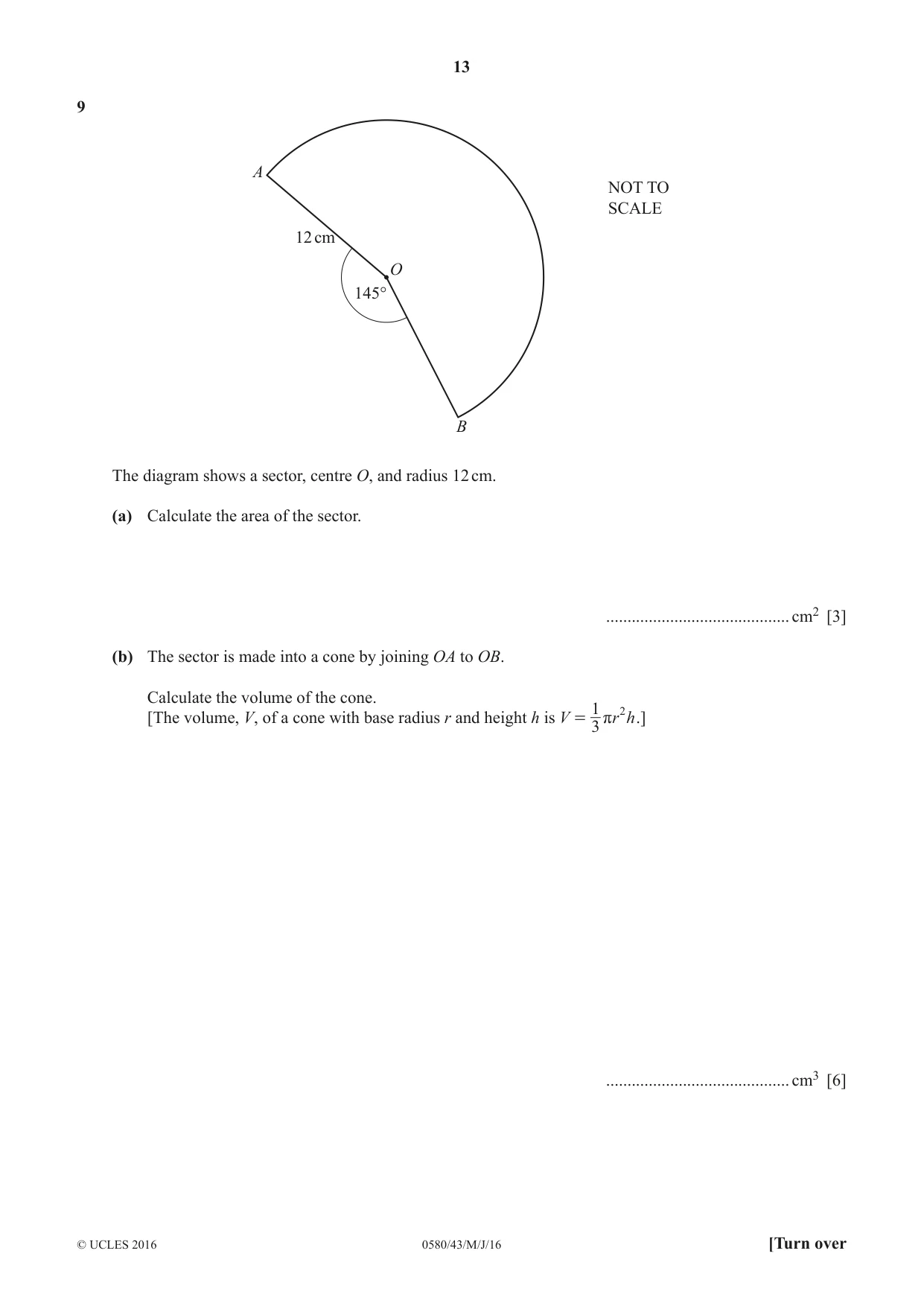
Q9 · A NOT TO SCALE 12 cm O 145° B The diagram shows a sector, centre O, and radius 12 cm
9 A NOT TO SCALE 12 cm O 145° B The diagram shows a sector, centre O, and radius 12 cm. (a) Calculate the area of the sector. ...........................................cm2 [3] (b) The sector is made into a cone by joining OA to OB. Calculate the volume of the cone. 1 2 r r h .] [The volume, V, of a cone with base radius r and height h is V = 3 ...........................................cm3 [6]
Mark scheme: 360 145 2 9 (a) 270 or 270.17 to 270.22 3 M2 for × π12 oe 360 or B1 for 215 seen θ 2 or M1 for × π12 used 360 (b) 518 or 517.6 to 517.8 nfww 6 B4 for vertical height = 9.62 to 9.63 or B3 for radius = 7.166 to 7.17 or B2 for length of sector = 45.[0] or 45.02 to 45.04 360 − 145 or M1 for × 2 × π × 12 oe 360 or for 12 2 − their radius 2 and M1 indep for 1 2 π × their radius × their h 3 (h ≠ 12 or r ≠12)
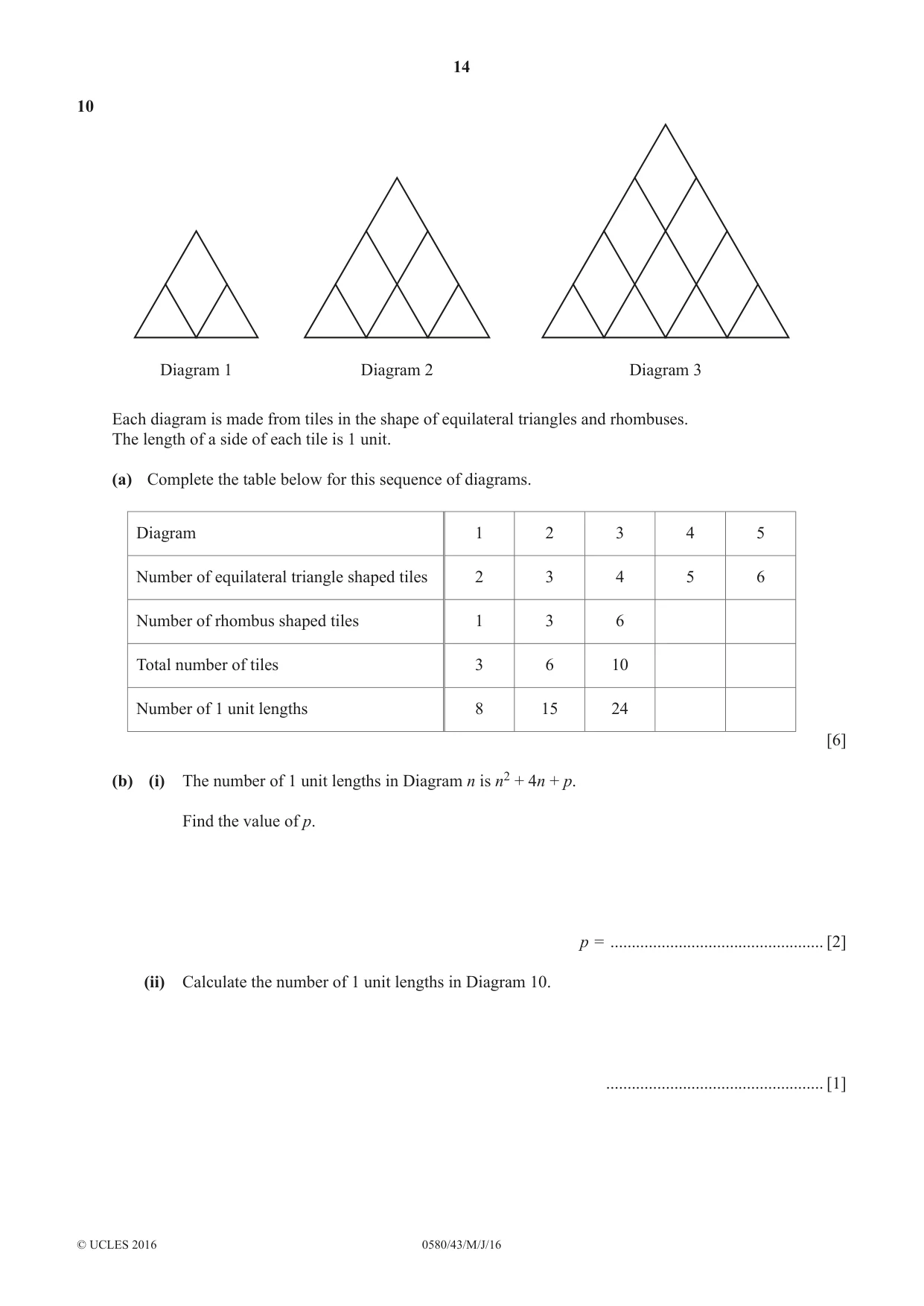
Q10 · Diagram 1 Diagram 2 Diagram 3 Each diagram is made from tiles in the shape of equilateral…
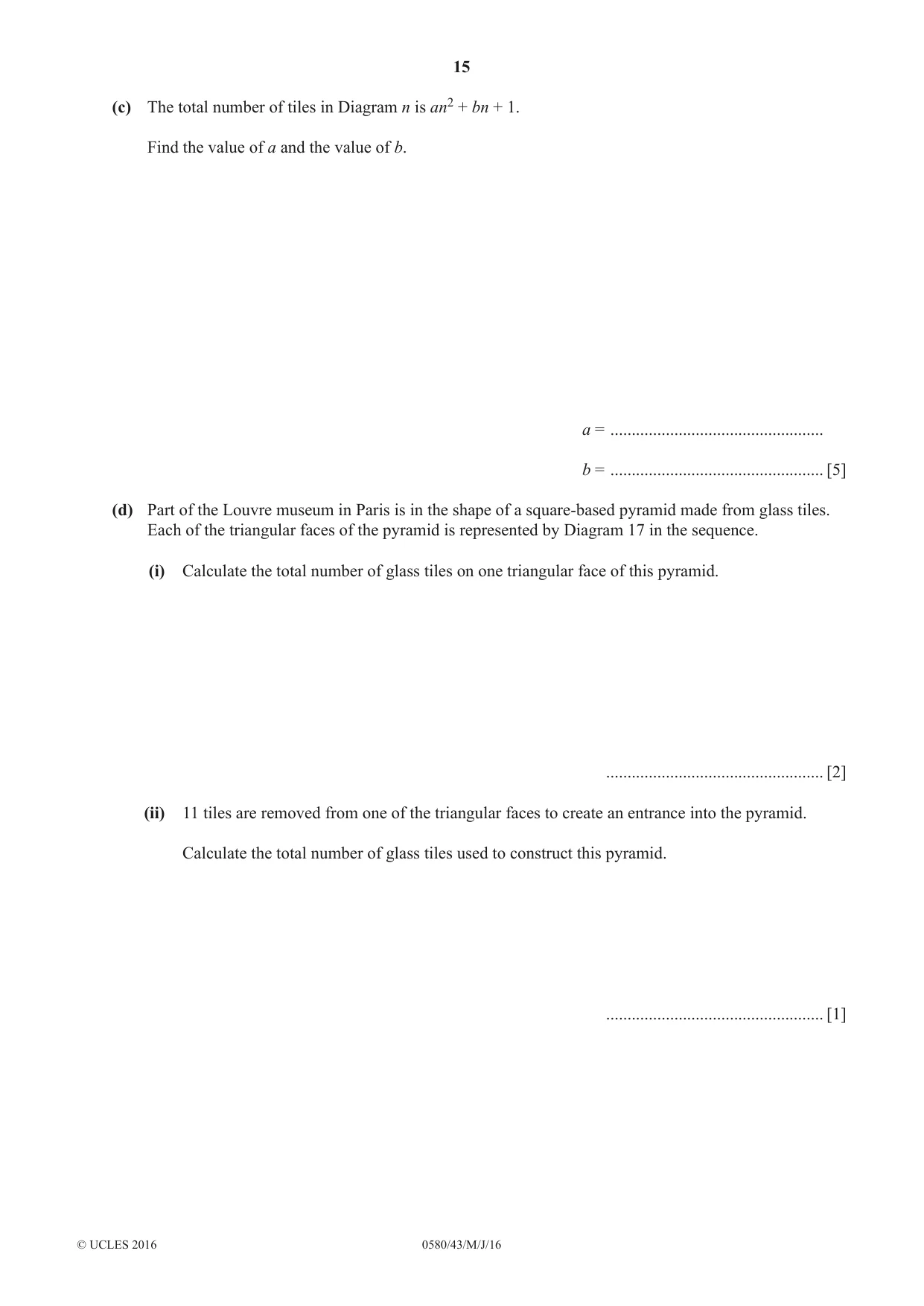
10 Diagram 1 Diagram 2 Diagram 3 Each diagram is made from tiles in the shape of equilateral triangles and rhombuses. The length of a side of each tile is 1 unit. (a) Complete the table below for this sequence of diagrams. Diagram 1 2 3 4 5 Number of equilateral triangle shaped tiles 2 3 4 5 6 Number of rhombus shaped tiles 1 3 6 Total number of tiles 3 6 10 Number of 1 unit lengths 8 15 24 [6] (b) (i) The number of 1 unit lengths in Diagram n is n2 + 4n + p. Find the value of p. p = .................................................. [2] (ii) Calculate the number of 1 unit lengths in Diagram 10. ................................................... [1] (c) The total number of tiles in Diagram n is an2 + bn + 1. Find the value of a and the value of b. a = .................................................. b = .................................................. [5] (d) Part of the Louvre museum in Paris is in the shape of a square-based pyramid made from glass tiles. Each of the triangular faces of the pyramid is represented by Diagram 17 in the sequence. (i) Calculate the total number of glass tiles on one triangular face of this pyramid. ................................................... [2] (ii) 11 tiles are removed from one of the triangular faces to create an entrance into the pyramid. Calculate the total number of glass tiles used to construct this pyramid. ................................................... [1]
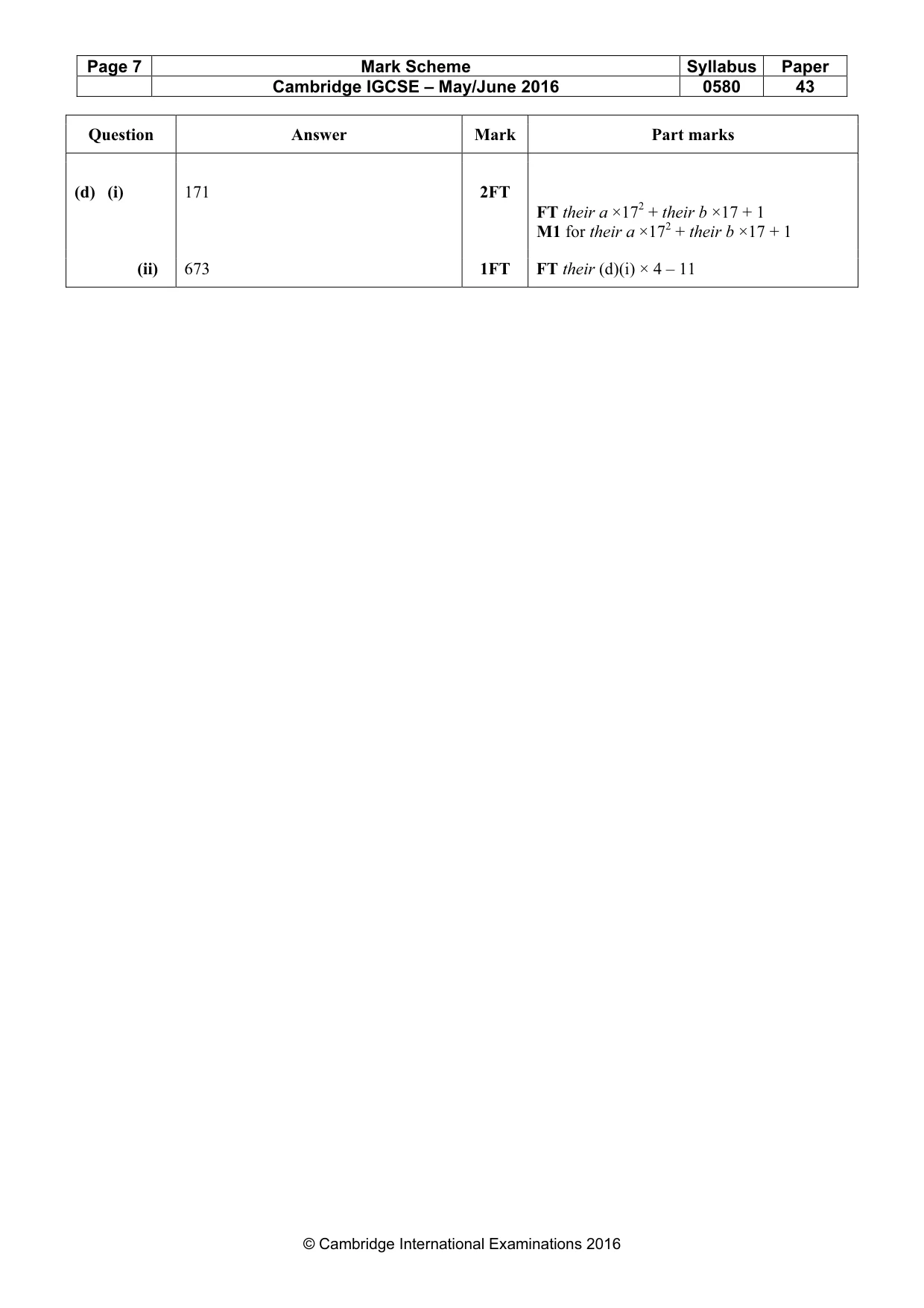
Mark scheme: 10 (a) 10 15 15 21 35 48 6 B1 for each correct entry (b) (i) 3 2 M1 for any correct substitution in n2 + 4n + p = number of tiles eg 22 + 4(2) + p = 15 (ii) 143 1FT FT 140 + their (b)(i) 1 3 (c) a = oe b = oe nfww 5 B1 for a correct simplified equation 2 2 e.g. a + b + 1 = 3, 4a + 2b + 1 = 6, 9a + 3b + 1 = 10 etc B1 for a 2nd correct simplified equation M1 for correctly eliminating one variable for their equations in a and b 1 A1 for a = nfww 2 3 A1 for b = nfww 2 (d) (i) 171 2FT FT their a ×172 + their b ×17 + 1 M1 for their a ×172 + their b ×17 + 1 (ii) 673 1FT FT their (d)(i) × 4 – 11
What was in this paper
The subtopics covered by these 10 questions, and how many questions each got. Open one in a new tab to see every Cambridge question on it.
What you needed in this session
Cambridge’s own grade thresholds for 2016 May/June, Paper 4 · Variant 3. A higher threshold means an easier paper — the bar moves with how the cohort did.