Cambridge IGCSE Mathematics 0580 — 2018 Oct/Nov Paper 4 · Variant 1
0580/41/O/N/18 · 11 questions · 130 marks · ≈146 min
The question paper and its mark scheme, free to read here and free to download. This is Cambridge’s own paper, exactly as it was sat.
Question paper16 pages
Mark scheme8 pages
Answers below. Sit the paper first if you are practising.
Questions as text
Question 1
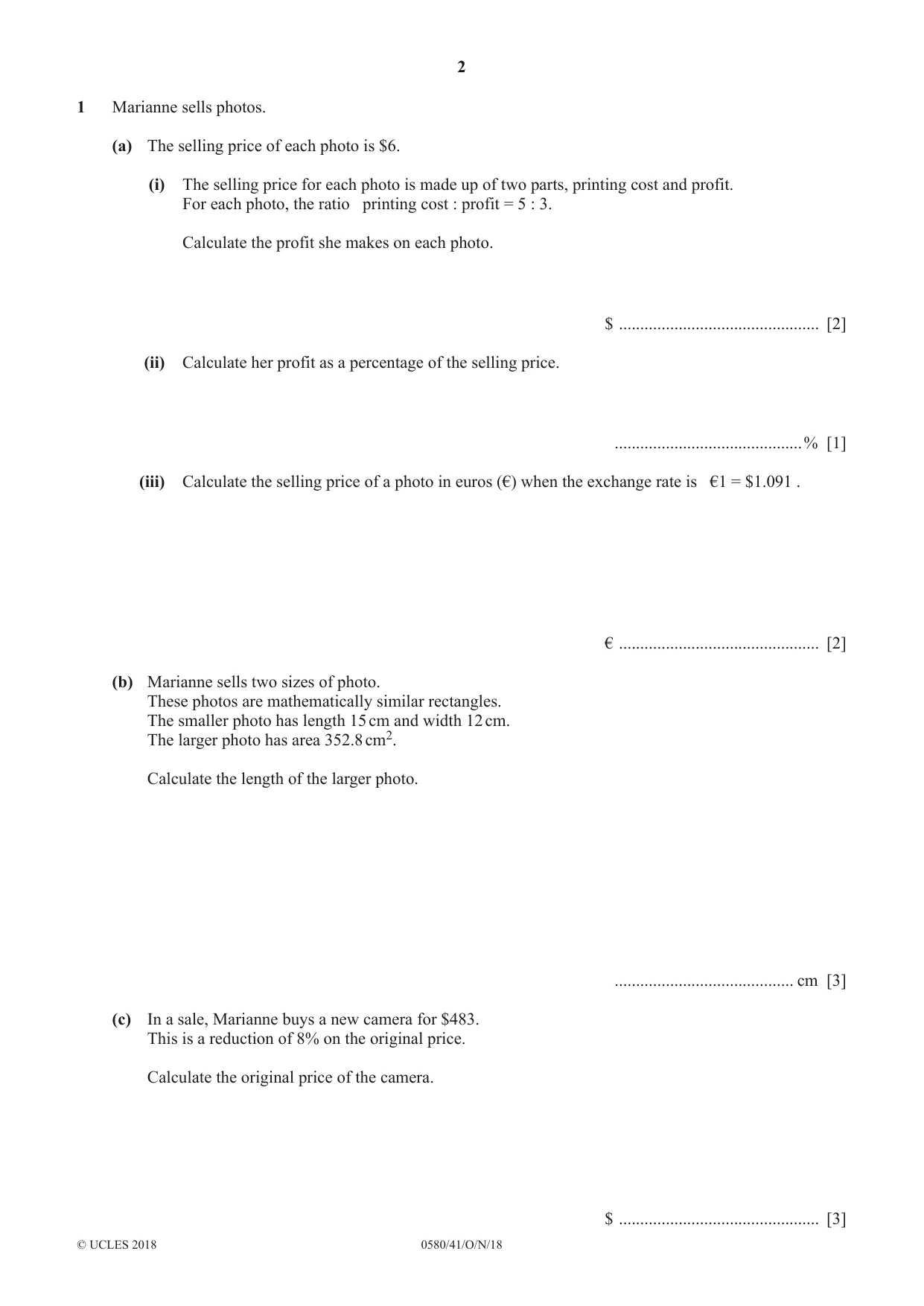
1 Marianne sells photos. (a) The selling price of each photo is $6. (i) The selling price for each photo is made up of two parts, printing cost and profit. For each photo, the ratio printing cost : profit = 5 : 3. Calculate the profit she makes on each photo. $ ............................................... [2] (ii) Calculate her profit as a percentage of the selling price. ............................................% [1] (iii) Calculate the selling price of a photo in euros (€) when the exchange rate is €1 = $1.091 . € ............................................... [2] (b) Marianne sells two sizes of photo. These photos are mathematically similar rectangles. The smaller photo has length 15 cm and width 12 cm. The larger photo has area 352.8 cm2. Calculate the length of the larger photo. .......................................... cm [3] (c) In a sale, Marianne buys a new camera for $483. This is a reduction of 8% on the original price. Calculate the original price of the camera. $ ............................................... [3]
Mark scheme: Question Answer Marks Partial Marks 1(a)(i) 2.25 final answer 2 3 6 M1 for or oe 5 + 3 5 + 3 1(a)(ii) 37.5 1 (a)(i) FT their × 100 6 1(a)(iii) 5.5[0] or 5.499 to 5.500 2 M1 for 6 ÷ .1091 1(b) 21 3 3528. M2 for 15 × oe 15 × 12 or SC2 for answer 16.8 352 8. 15× 12 or M1 for or seen 15 × 12 352 8. or M1 for a correct implicit statement for the length 1(c) 525 3 483 M2 for [× 100] oe 100 − 8 or M1 for 483 associated with 92 [%]
Q2 · Y 8 6 4 B 2 –8 –6 –4 –2 0 2 4 6 8 10 x –2 –4 A C –6 D –8 –10 (a) Describe fully the…
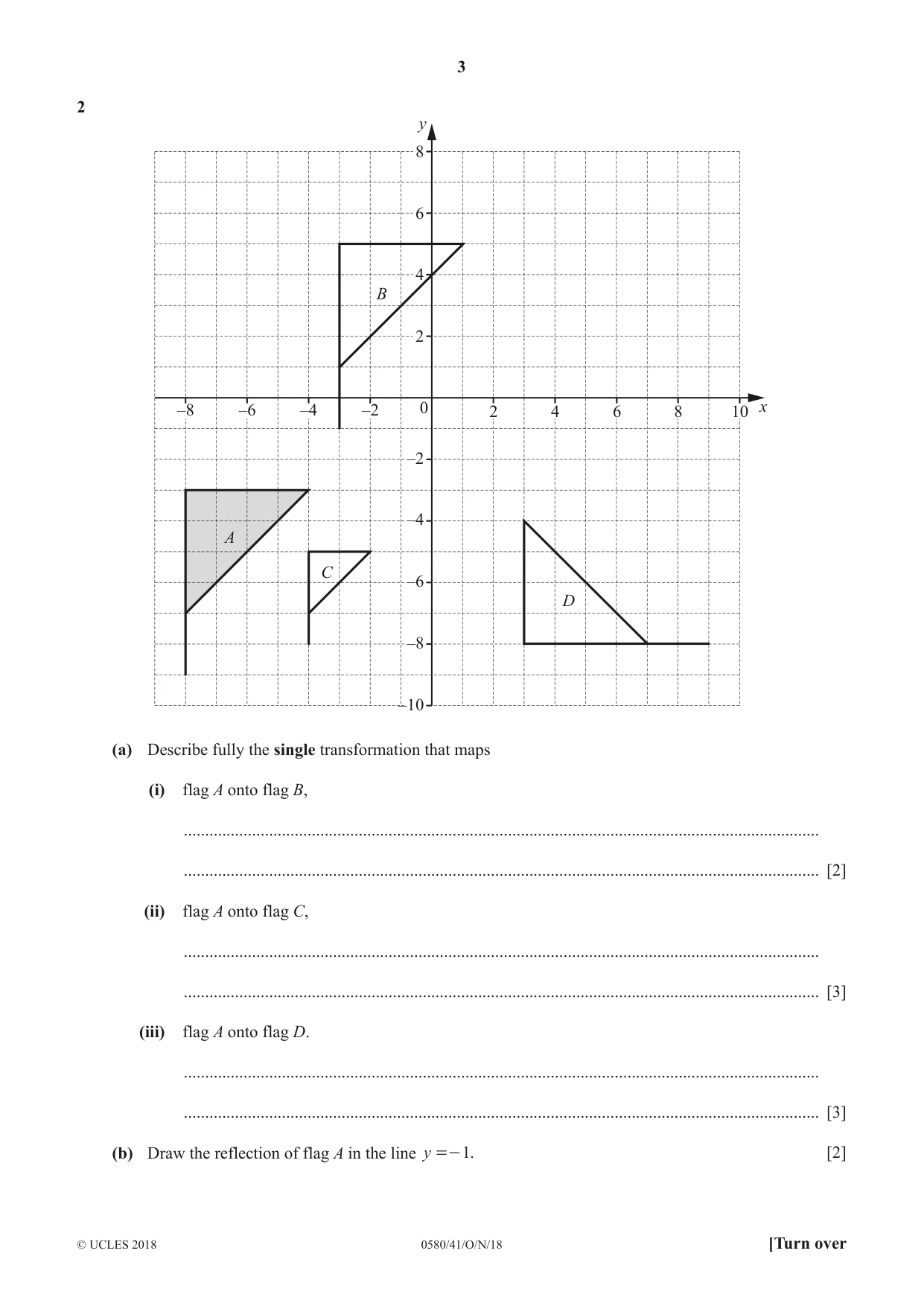
2 y 8 6 4 B 2 –8 –6 –4 –2 0 2 4 6 8 10 x –2 –4 A C –6 D –8 –10 (a) Describe fully the single transformation that maps (i) flag A onto flag B, ..................................................................................................................................................... ..................................................................................................................................................... [2] (ii) flag A onto flag C, ..................................................................................................................................................... ..................................................................................................................................................... [3] (iii) flag A onto flag D. ..................................................................................................................................................... ..................................................................................................................................................... [3] (b) Draw the reflection of flag A in the line y =- 1. [2]
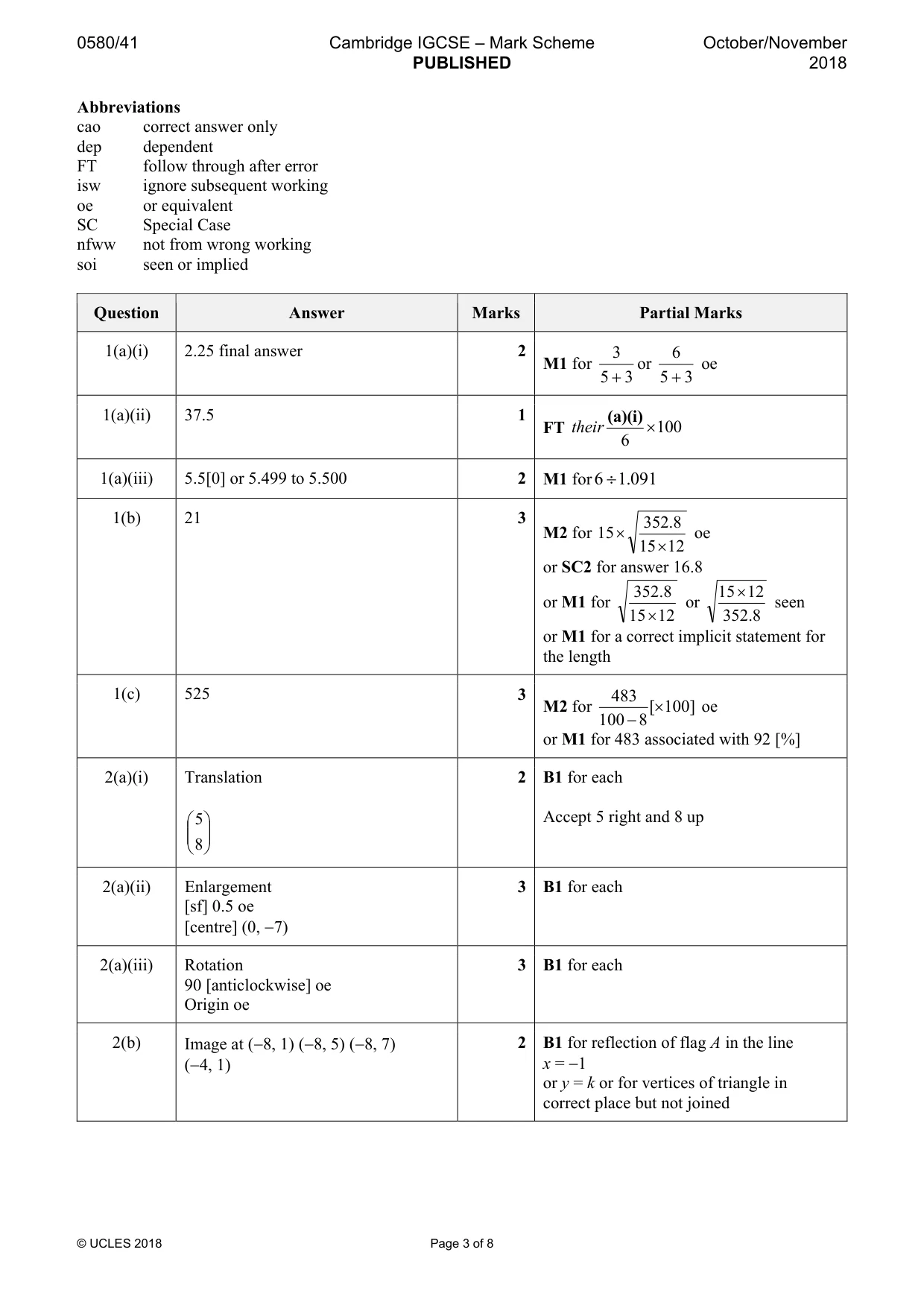
Mark scheme: 2(a)(i) Translation 2 B1 for each 5 Accept 5 right and 8 up 8 2(a)(ii) Enlargement 3 B1 for each [sf] 0.5 oe [centre] (0, −7) 2(a)(iii) Rotation 3 B1 for each 90 [anticlockwise] oe Origin oe 2(b) Image at (−8, 1) (−8, 5) (−8, 7) 2 B1 for reflection of flag A in the line (−4, 1) x = −1 or y = k or for vertices of triangle in correct place but not joined
Q3 · The table shows some values of y = x 3 - 3x 2 + x
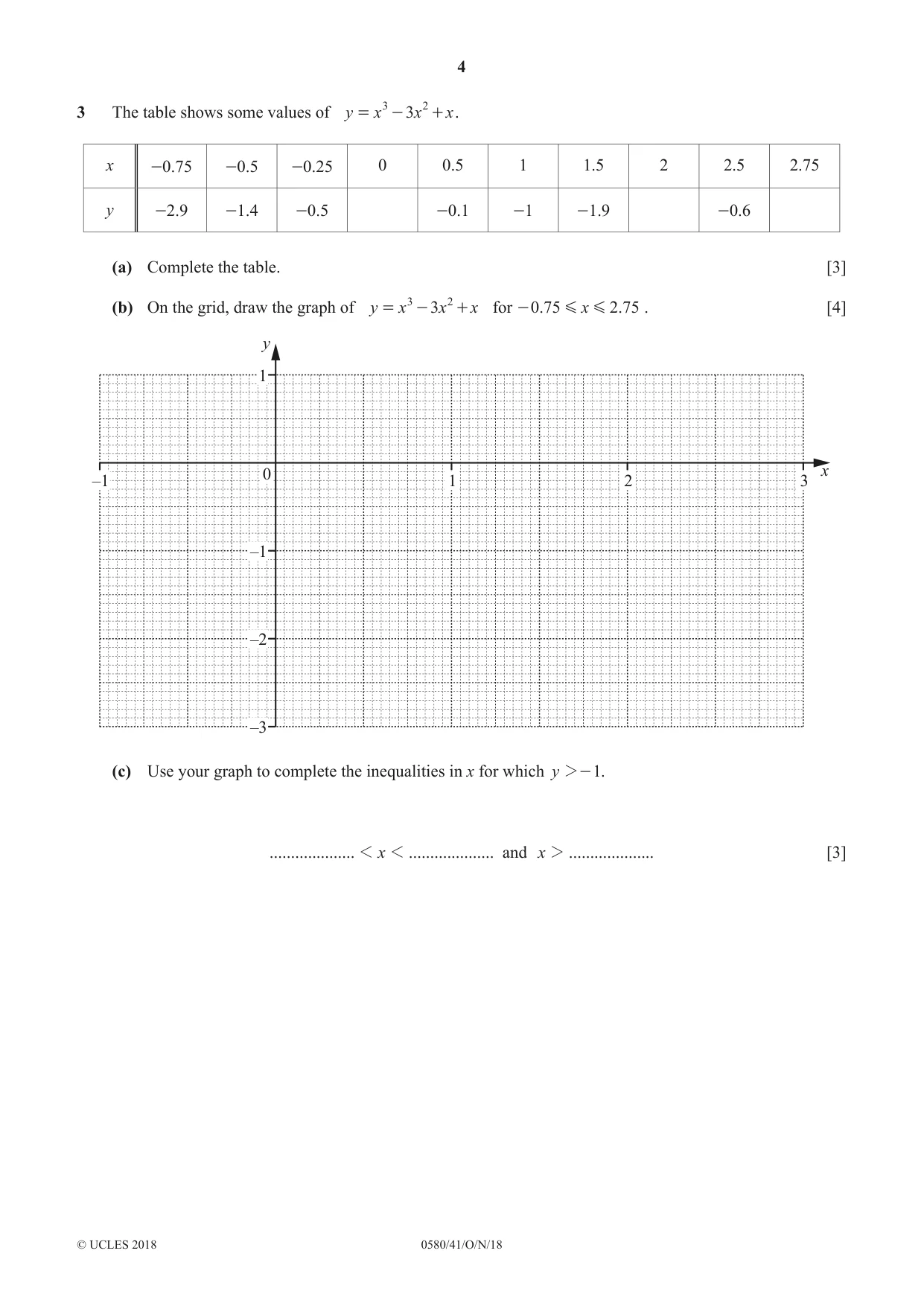
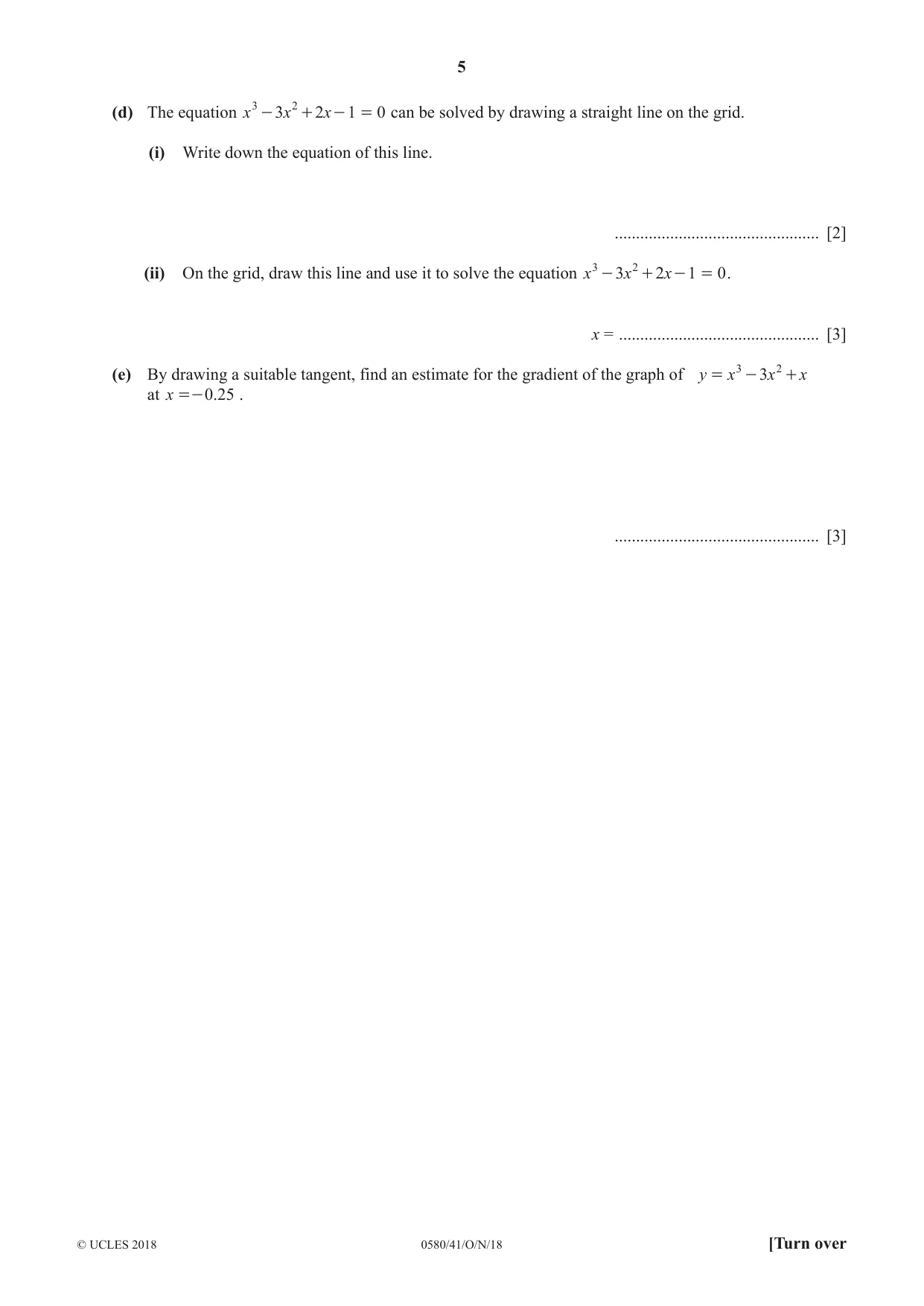
3 The table shows some values of y = x 3 - 3x 2 + x . x -0.75 -0.5 -0.25 0 0.5 1 1.5 2 2.5 2.75 y -2.9 -1.4 -0.5 -0.1 -1 -1.9 -0.6 (a) Complete the table. [3] (b) On the grid, draw the graph of y = x 3 - 3x 2 + x for - 0.75 G x G 2.75 . [4] y 1 0 x –1 1 2 3 –1 –2 –3 (c) Use your graph to complete the inequalities in x for which y 2- 1. .................... 1 x 1 .................... and x 2 .................... [3] (d) The equation x 3 - 3x 2 + 2x - 1 = 0 can be solved by drawing a straight line on the grid. (i) Write down the equation of this line. ................................................ [2] (ii) On the grid, draw this line and use it to solve the equation x 3 - 3x 2 + 2x - 1 = 0 . x = ............................................... [3] (e) By drawing a suitable tangent, find an estimate for the gradient of the graph of y = x 3 - 3x 2 + x at x =- 0.25 . ................................................ [3]
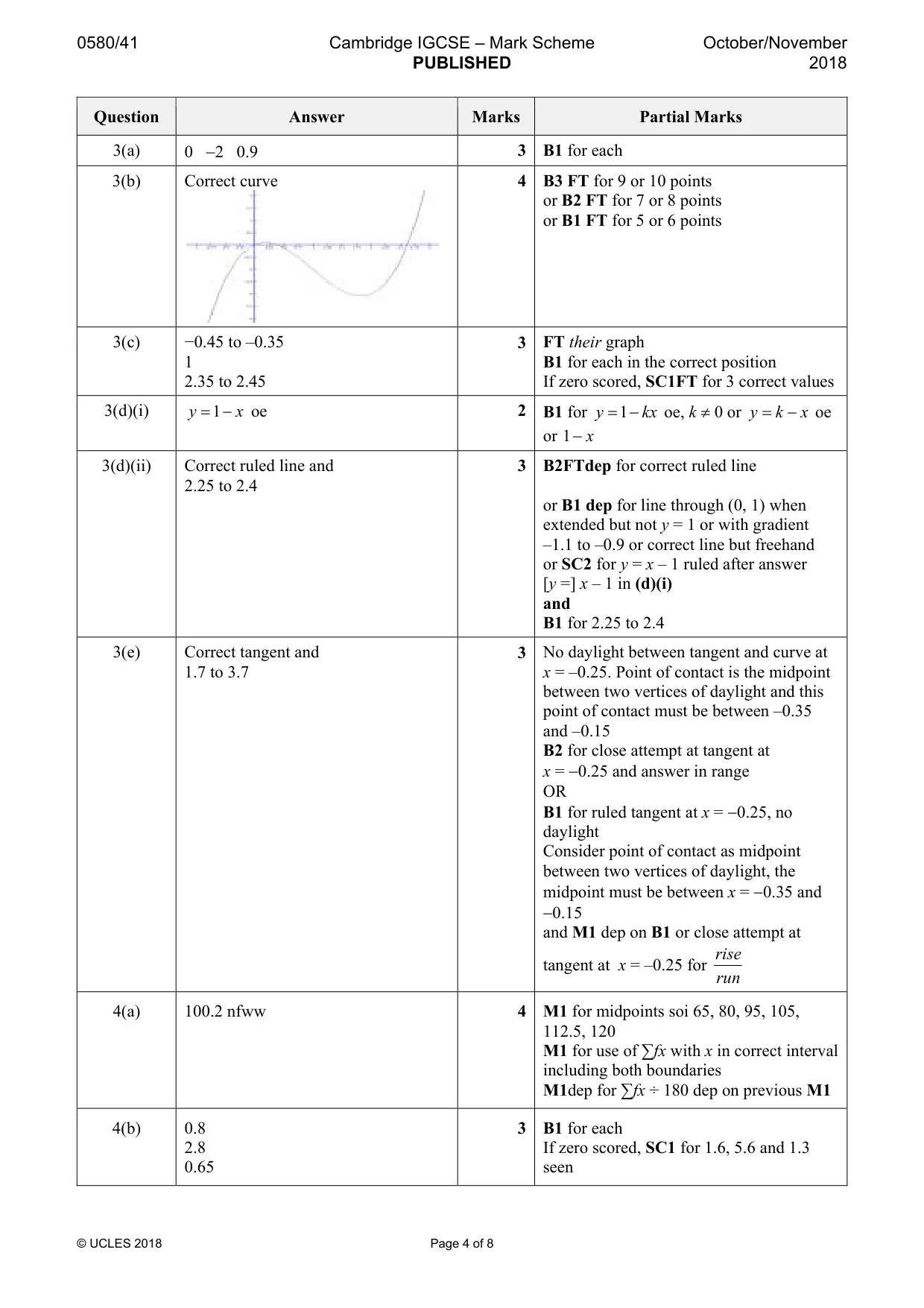
Mark scheme: 3(a) 0 −2 0.9 3 B1 for each 3(b) Correct curve 4 B3 FT for 9 or 10 points or B2 FT for 7 or 8 points or B1 FT for 5 or 6 points 3(c) −0.45 to –0.35 3 FT their graph 1 B1 for each in the correct position 2.35 to 2.45 If zero scored, SC1FT for 3 correct values 3(d)(i) y =1 − x oe 2 B1 for y =1 − kx oe, k ≠ 0 or y = k − x oe or 1−x 3(d)(ii) Correct ruled line and 3 B2FTdep for correct ruled line 2.25 to 2.4 or B1 dep for line through (0, 1) when extended but not y = 1 or with gradient –1.1 to –0.9 or correct line but freehand or SC2 for y = x – 1 ruled after answer [y =] x – 1 in (d)(i) and B1 for 2.25 to 2.4 3(e) Correct tangent and 3 No daylight between tangent and curve at 1.7 to 3.7 x = –0.25. Point of contact is the midpoint between two vertices of daylight and this point of contact must be between –0.35 and –0.15 B2 for close attempt at tangent at x = −0.25 and answer in range OR B1 for ruled tangent at x = −0.25, no daylight Consider point of contact as midpoint between two vertices of daylight, the midpoint must be between x = −0.35 and −0.15 and M1 dep on B1 or close attempt at rise tangent at x = –0.25 for run
Q4 · A school nurse records the height, h cm, of each of 180 children
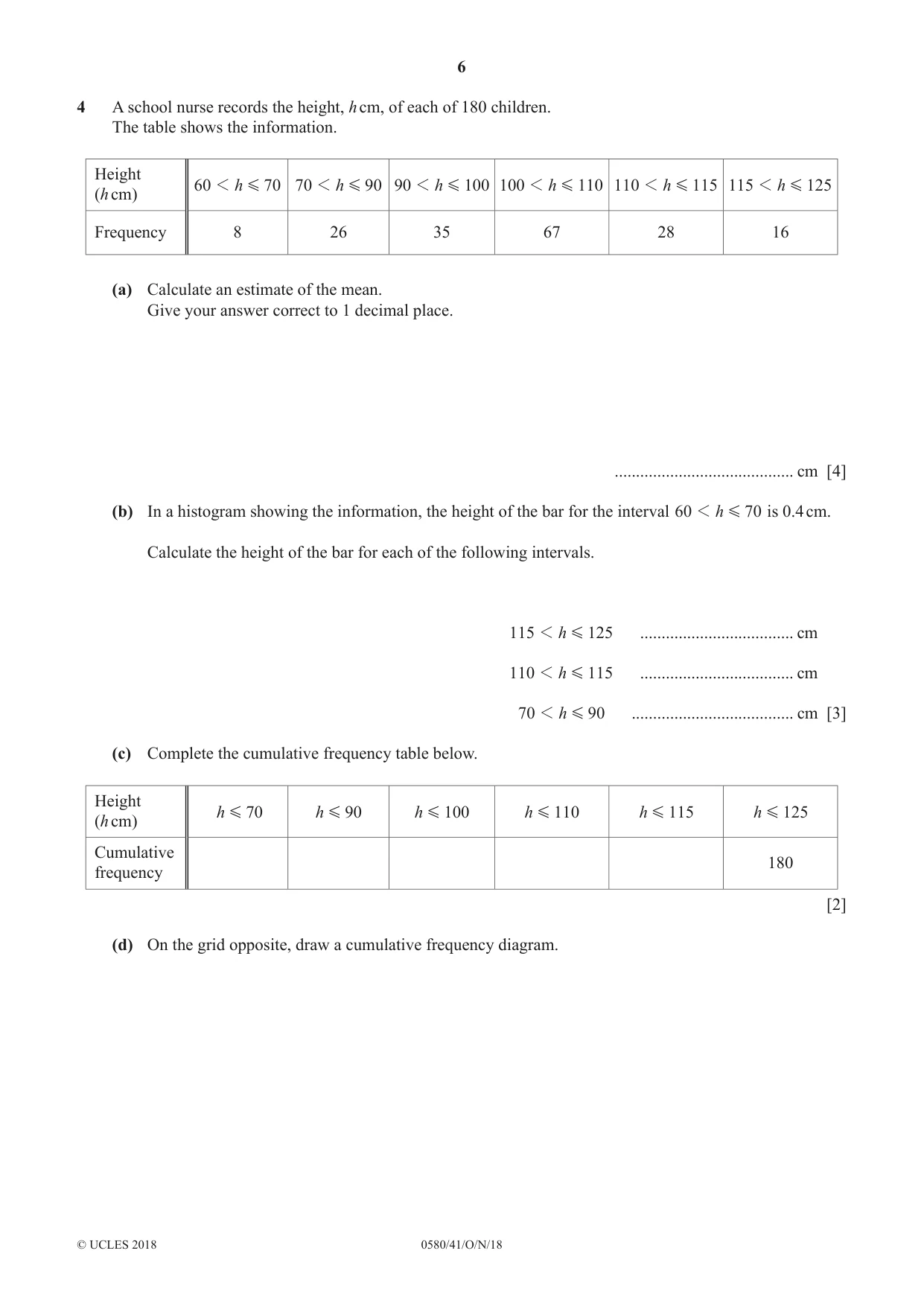
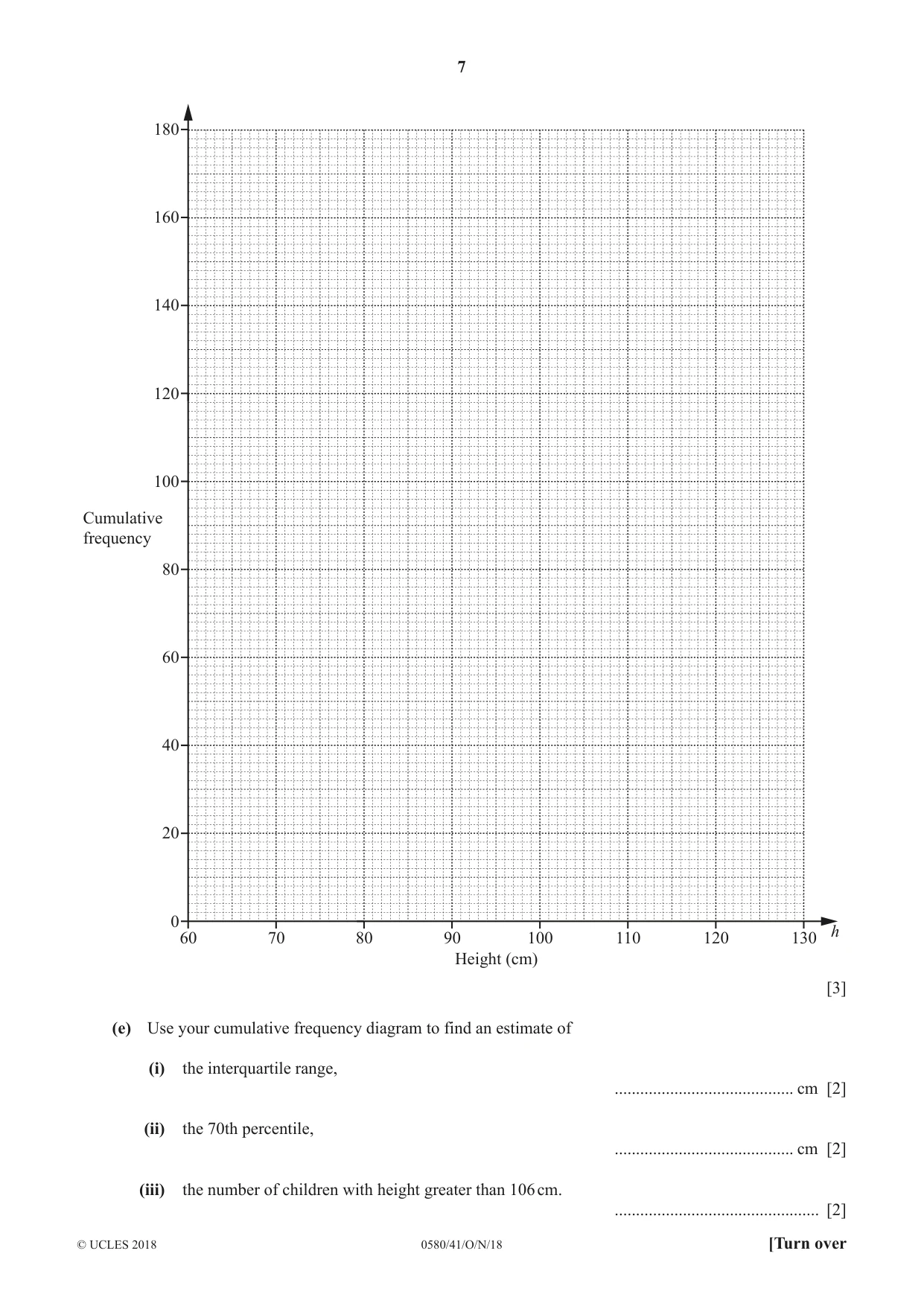
4 A school nurse records the height, h cm, of each of 180 children. The table shows the information. Height 60 1 h G 70 70 1 h G 90 90 1 h G 100 100 1 h G 110 110 1 h G 115 115 1 h G 125 (h cm) Frequency 8 26 35 67 28 16 (a) Calculate an estimate of the mean. Give your answer correct to 1 decimal place. .......................................... cm [4] (b) In a histogram showing the information, the height of the bar for the interval 60 1 h G 70 is 0.4 cm. Calculate the height of the bar for each of the following intervals. 115 1 h G 125 .................................... cm 110 1 h G 115 .................................... cm 70 1 h G 90 ...................................... cm [3] (c) Complete the cumulative frequency table below. Height h G 70 h G 90 h G 100 h G 110 h G 115 h G 125 (h cm) Cumulative 180 frequency [2] (d) On the grid opposite, draw a cumulative frequency diagram. 180 160 140 120 100 Cumulative frequency 80 60 40 20 0 h 60 70 80 90 100 110 120 130 Height (cm) [3] (e) Use your cumulative frequency diagram to find an estimate of (i) the interquartile range, .......................................... cm [2] (ii) the 70th percentile, .......................................... cm [2] (iii) the number of children with height greater than 106 cm. ................................................ [2]
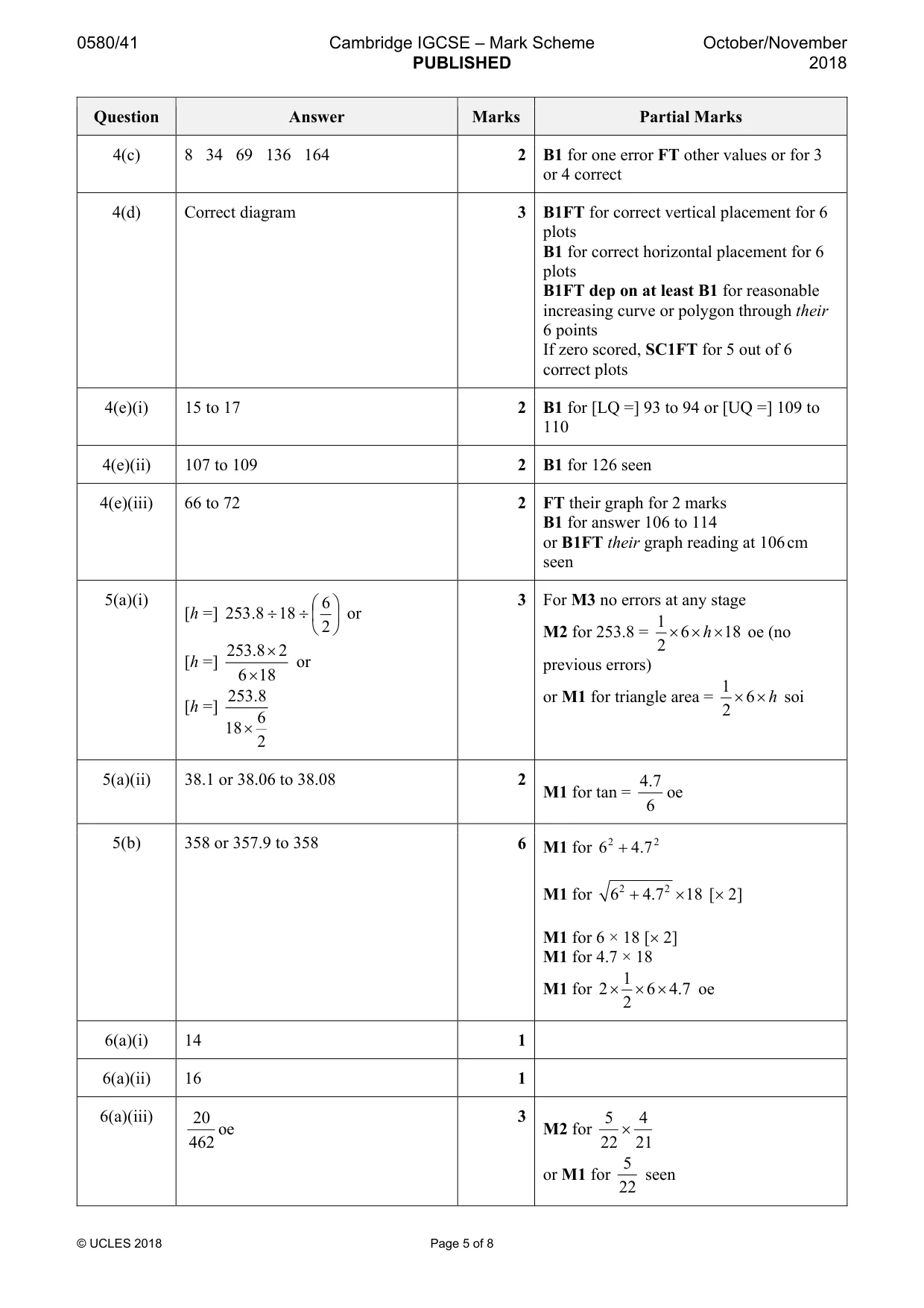
Mark scheme: 4(a) 100.2 nfww 4 M1 for midpoints soi 65, 80, 95, 105, 112.5, 120 M1 for use of ∑fx with x in correct interval including both boundaries M1dep for ∑fx ÷ 180 dep on previous M1 4(b) 0.8 3 B1 for each 2.8 If zero scored, SC1 for 1.6, 5.6 and 1.3 0.65 seen 4(c) 8 34 69 136 164 2 B1 for one error FT other values or for 3 or 4 correct 4(d) Correct diagram 3 B1FT for correct vertical placement for 6 plots B1 for correct horizontal placement for 6 plots B1FT dep on at least B1 for reasonable increasing curve or polygon through their 6 points If zero scored, SC1FT for 5 out of 6 correct plots 4(e)(i) 15 to 17 2 B1 for [LQ =] 93 to 94 or [UQ =] 109 to 110 4(e)(ii) 107 to 109 2 B1 for 126 seen 4(e)(iii) 66 to 72 2 FT their graph for 2 marks B1 for answer 106 to 114 or B1FT their graph reading at 106 cm seen
Q5 · NOT TO SCALE 18 cm h cm x° 6 cm The diagram shows a prism with length 18 cm and volume…
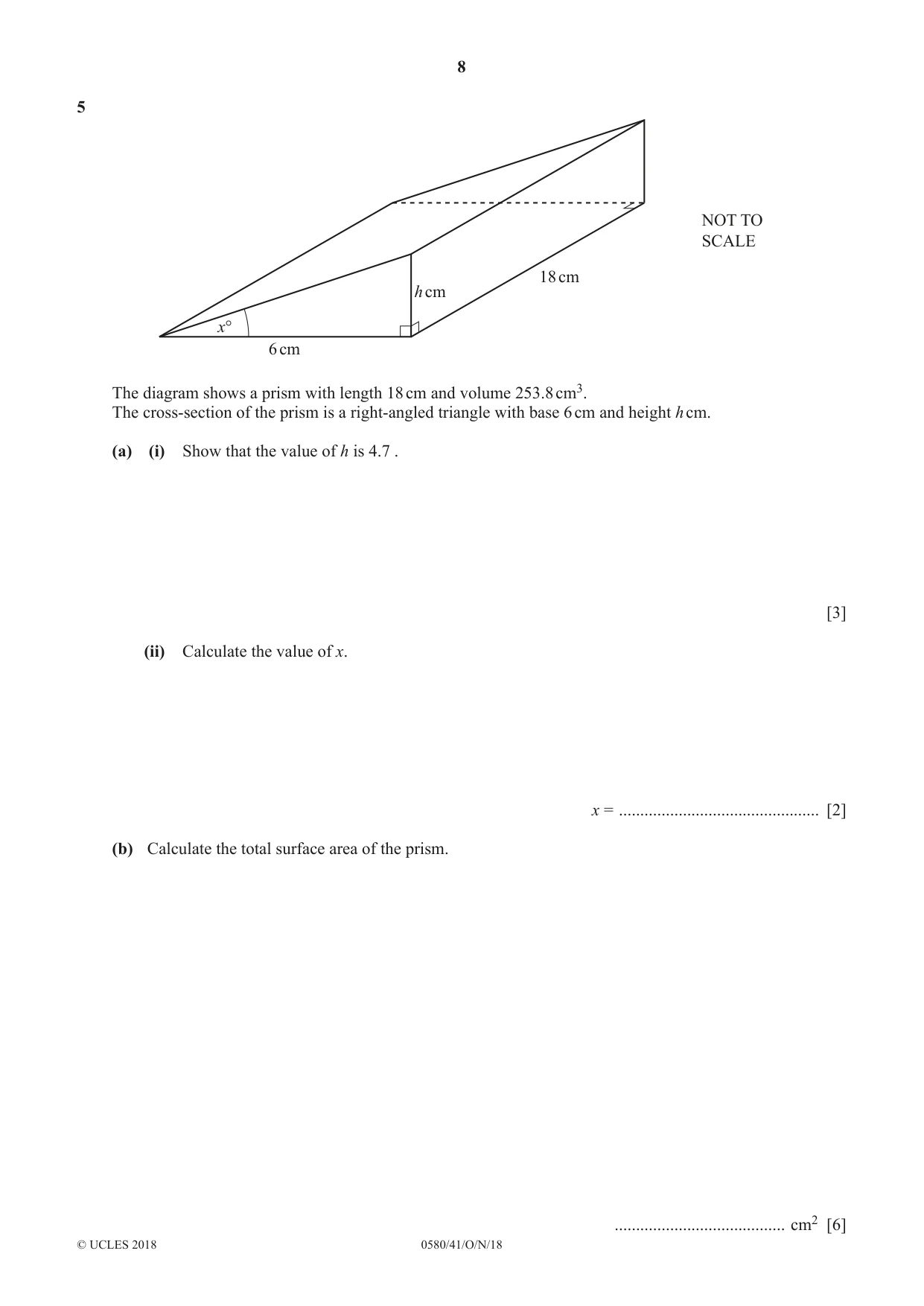
5 NOT TO SCALE 18 cm h cm x° 6 cm The diagram shows a prism with length 18 cm and volume 253.8 cm3. The cross-section of the prism is a right-angled triangle with base 6 cm and height h cm. (a) (i) Show that the value of h is 4.7 . [3] (ii) Calculate the value of x. x = ............................................... [2] (b) Calculate the total surface area of the prism. ........................................ cm2 [6]
Mark scheme: 5(a)(i) 6 3 For M3 no errors at any stage [h =] 253 8. ÷ 18 ÷ or 1 2 M2 for 253.8 = × 6 × h × 18 oe (no 2 253.8 × 2 [h =] or previous errors) 6 × 18 1 253.8 or M1 for triangle area = ×6 × h soi [h =] 2 6 18 × 2 5(a)(ii) 38.1 or 38.06 to 38.08 2 7.4 M1 for tan = oe 6 5(b) 358 or 357.9 to 358 6 M1 for 6 2 + 7.4 2 M1 for 6 2 + 4.7 2 × 18 [× 2] M1 for 6 × 18 [× 2] M1 for 4.7 × 18 1 M1 for 2 × × 6 × 4.7 oe 2
Q6 · M D 5 3 8 2 4 9 12 G The Venn diagram above shows information about the number of…
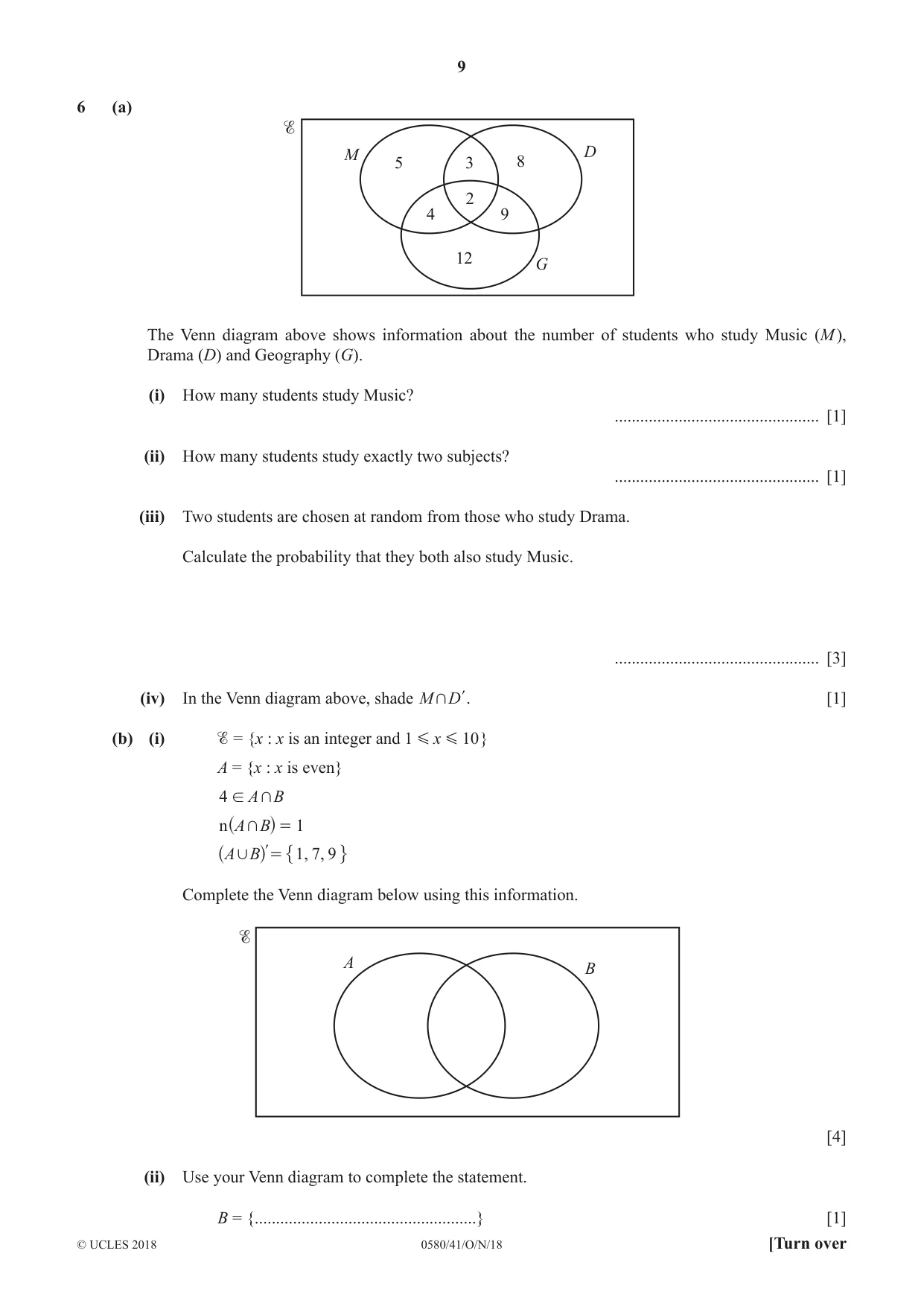
6 (a) M D 5 3 8 2 4 9 12 G The Venn diagram above shows information about the number of students who study Music (M ), Drama (D) and Geography (G). (i) How many students study Music? ................................................ [1] (ii) How many students study exactly two subjects? ................................................ [1] (iii) Two students are chosen at random from those who study Drama. Calculate the probability that they both also study Music. ................................................ [3] (iv) In the Venn diagram above, shade M + D l. [1] (b) (i) = {x : x is an integer and 1 G x G 10 } A = {x : x is even} 4 ! A + B n A + B = 1 ^ h A , B l = 1, 7, 9 ^ h " , Complete the Venn diagram below using this information. A B [4] (ii) Use your Venn diagram to complete the statement. B = {....................................................} [1]
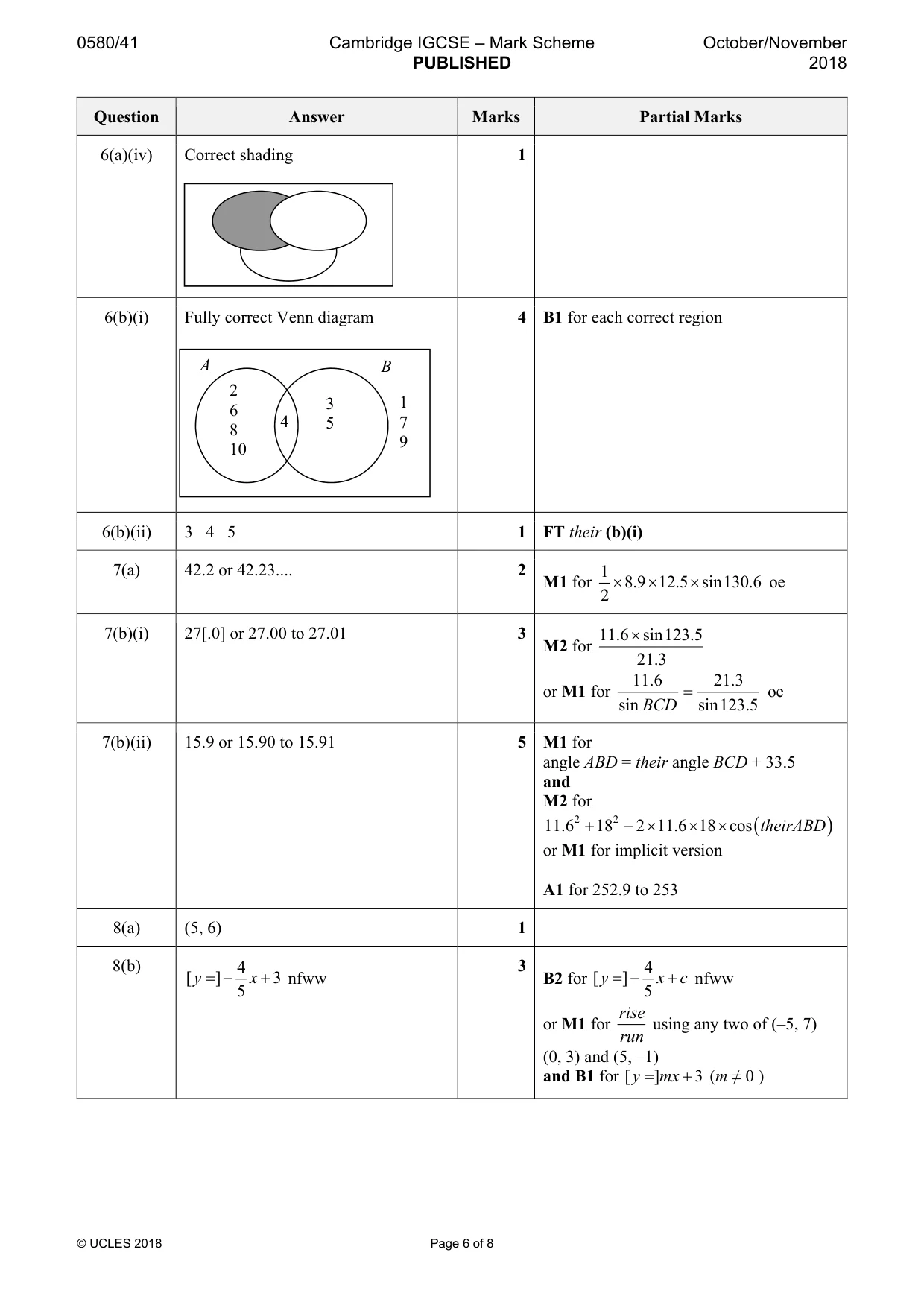
Mark scheme: 6(a)(i) 14 1 6(a)(ii) 16 1 6(a)(iii) 20 3 5 4 oe M2 for × 462 22 21 5 or M1 for seen 22 6(a)(iv) Correct shading 1 6(b)(i) Fully correct Venn diagram 4 B1 for each correct region A B 2 3 1 6 4 5 7 8 9 10 6(b)(ii) 3 4 5 1 FT their (b)(i)
Q7 · R 130.6° NOT TO 8.9 cm 12.5 cm SCALE P Q Calculate the area of triangle PQR
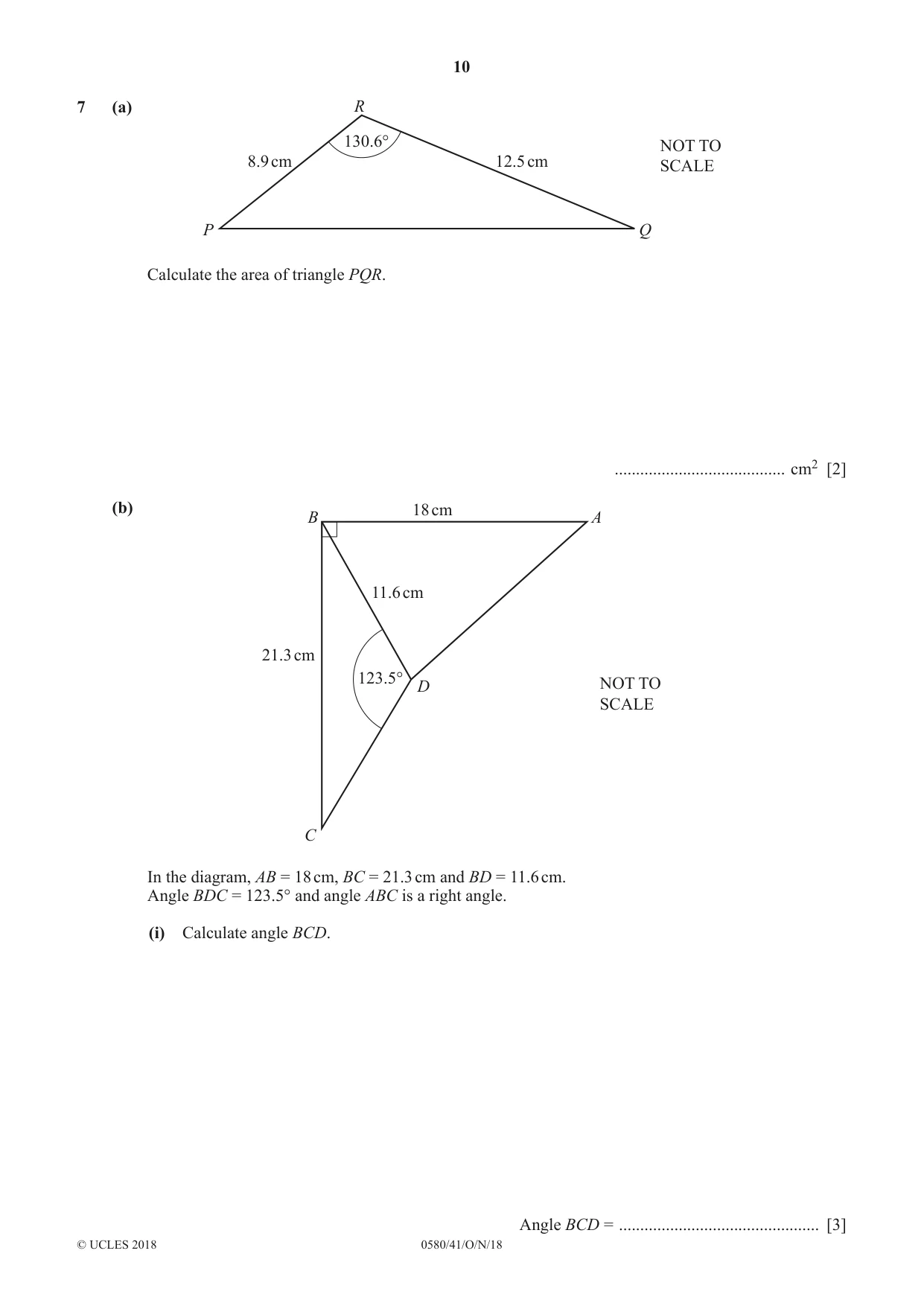
7 (a) R 130.6° NOT TO 8.9 cm 12.5 cm SCALE P Q Calculate the area of triangle PQR. ........................................ cm2 [2] (b) 18 cm B A 11.6 cm 21.3 cm 123.5° D NOT TO SCALE C In the diagram, AB = 18 cm, BC = 21.3 cm and BD = 11.6 cm. Angle BDC = 123.5° and angle ABC is a right angle. (i) Calculate angle BCD. Angle BCD = ............................................... [3] (ii) Calculate AD. AD = ......................................... cm [5]
Mark scheme: 7(a) 42.2 or 42.23.... 2 1 M1 for × 9.8 × 125. × sin 1306. oe 2 7(b)(i) 27[.0] or 27.00 to 27.01 3 116. × sin 1235. M2 for 213. 11 6. 21 3. or M1 for = oe sin BCD sin 123 5. 7(b)(ii) 15.9 or 15.90 to 15.91 5 M1 for angle ABD = their angle BCD + 33.5 and M2 for 11.6 2 + 18 2 −×2 11.6 × 18 × cos ( theirABD ) or M1 for implicit version A1 for 252.9 to 253
Q8 · Y 8 l 7 A 6 5 4 3 2 1 –5 –4 –3 –2 –1 0 1 2 3 4 5 6 x –1 B –2 –3 (a) Write down the…
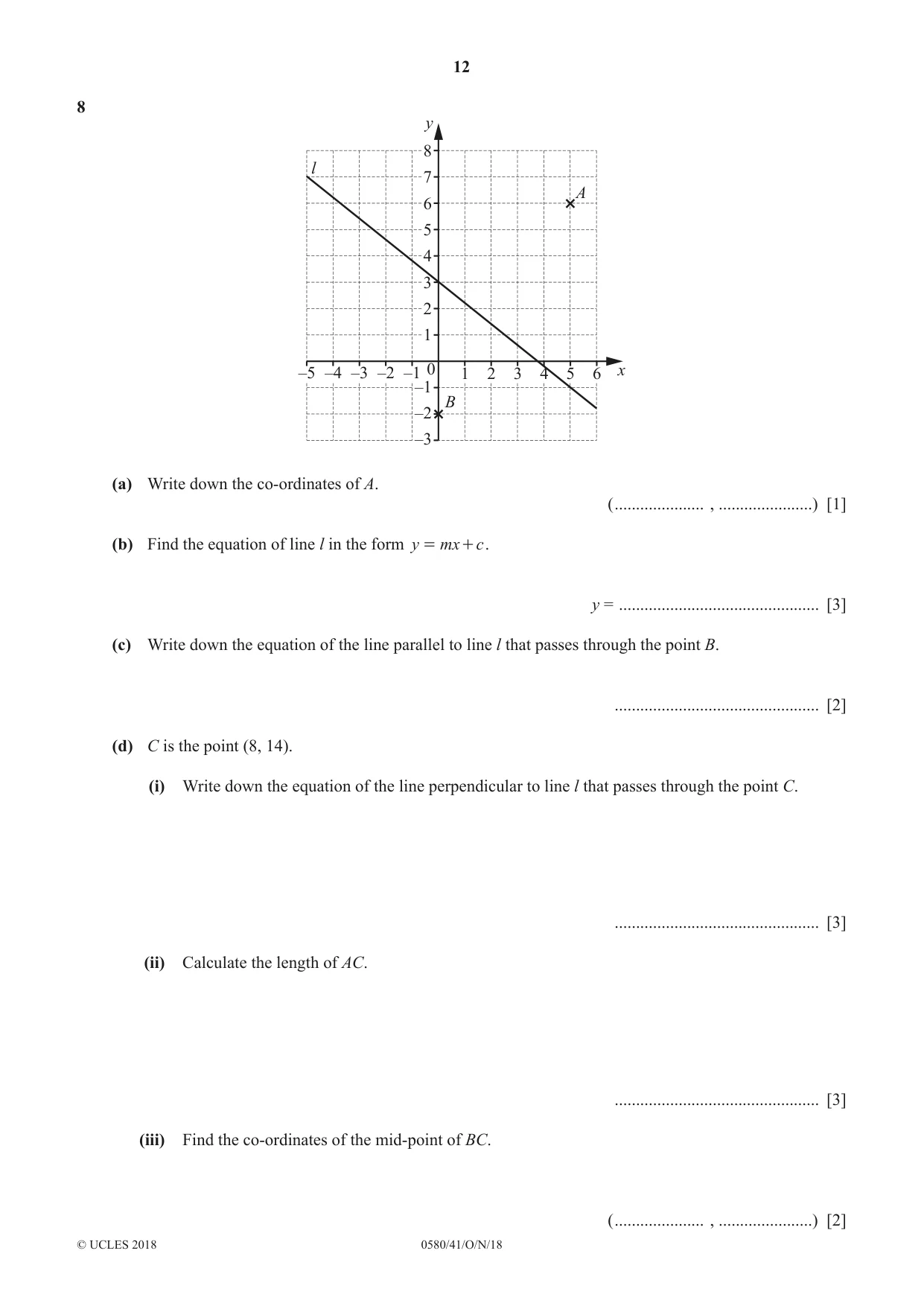
8 y 8 l 7 A 6 5 4 3 2 1 –5 –4 –3 –2 –1 0 1 2 3 4 5 6 x –1 B –2 –3 (a) Write down the co-ordinates of A. ( ..................... , ......................) [1] (b) Find the equation of line l in the form y = mx + c . y = ............................................... [3] (c) Write down the equation of the line parallel to line l that passes through the point B. ................................................ [2] (d) C is the point (8, 14). (i) Write down the equation of the line perpendicular to line l that passes through the point C. ................................................ [3] (ii) Calculate the length of AC. ................................................ [3] (iii) Find the co-ordinates of the mid-point of BC. ( ..................... , ......................) [2]
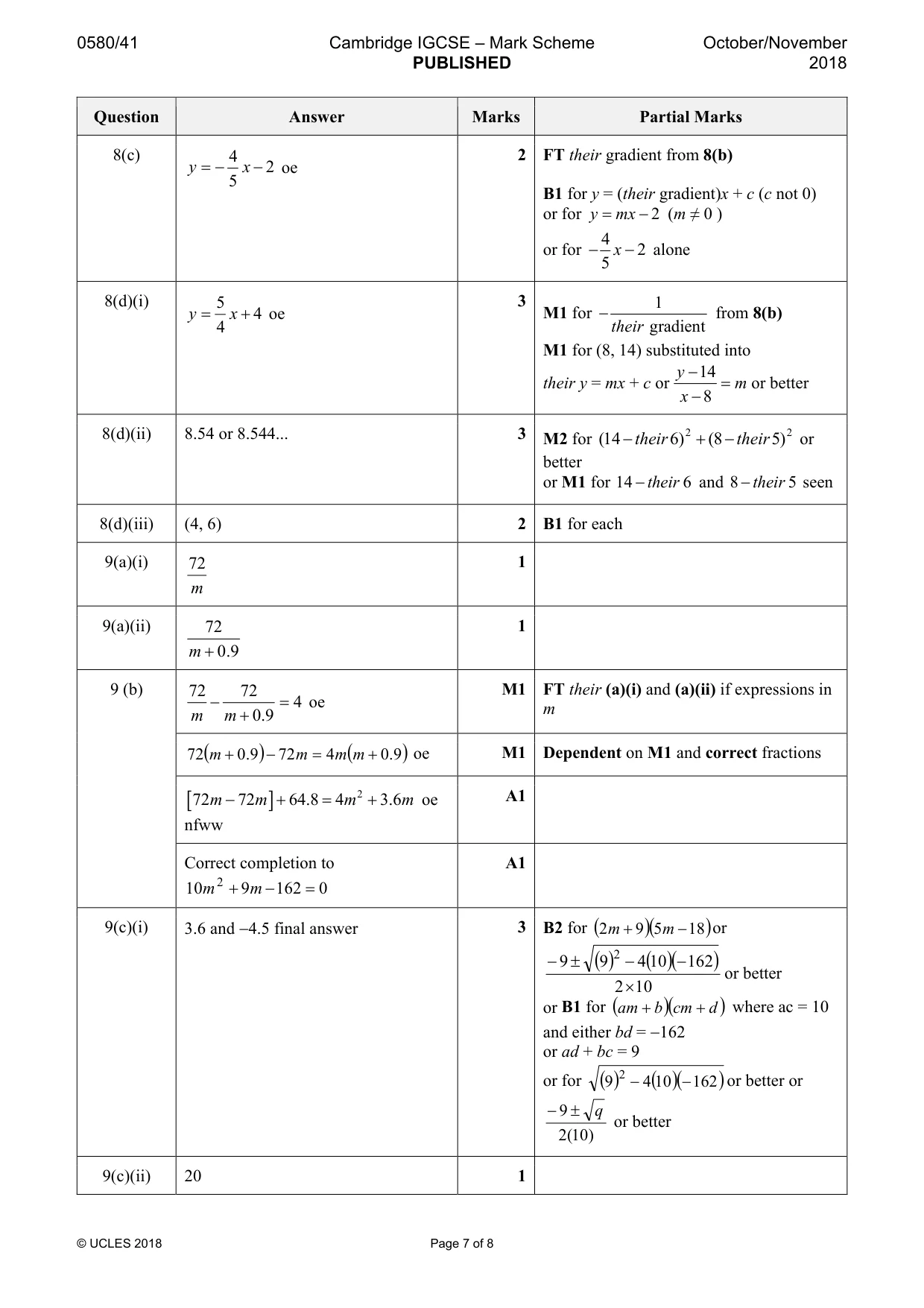
Mark scheme: 8(a) (5, 6) 1 8(b) 4 3 4 [ y = ] − x + 3 nfww B2 for [ y = ] − x + c nfww 5 5 rise or M1 for using any two of (–5, 7) run (0, 3) and (5, –1) and B1 for [ y = ]mx + 3 (m ≠ 0 ) 8(c) 4 2 FT their gradient from 8(b) y = − x − 2 oe 5 B1 for y = (their gradient)x + c (c not 0) or for y = mx − 2 (m ≠ 0 ) 4 or for − x − 2 alone 5 8(d)(i) 5 3 1 y = x + 4 oe M1 for −their gradient from 8(b) 4 M1 for (8, 14) substituted into y − 14 their y = mx + c or = m or better x − 8 8(d)(ii) 8.54 or 8.544... 3 M2 for (14 − their 6) 2 + (8 − their 5) 2 or better or M1 for 14 − their 6 and 8 − their 5 seen 8(d)(iii) (4, 6) 2 B1 for each
Q9 · Paulo and Jim each buy sacks of rice but from different shops
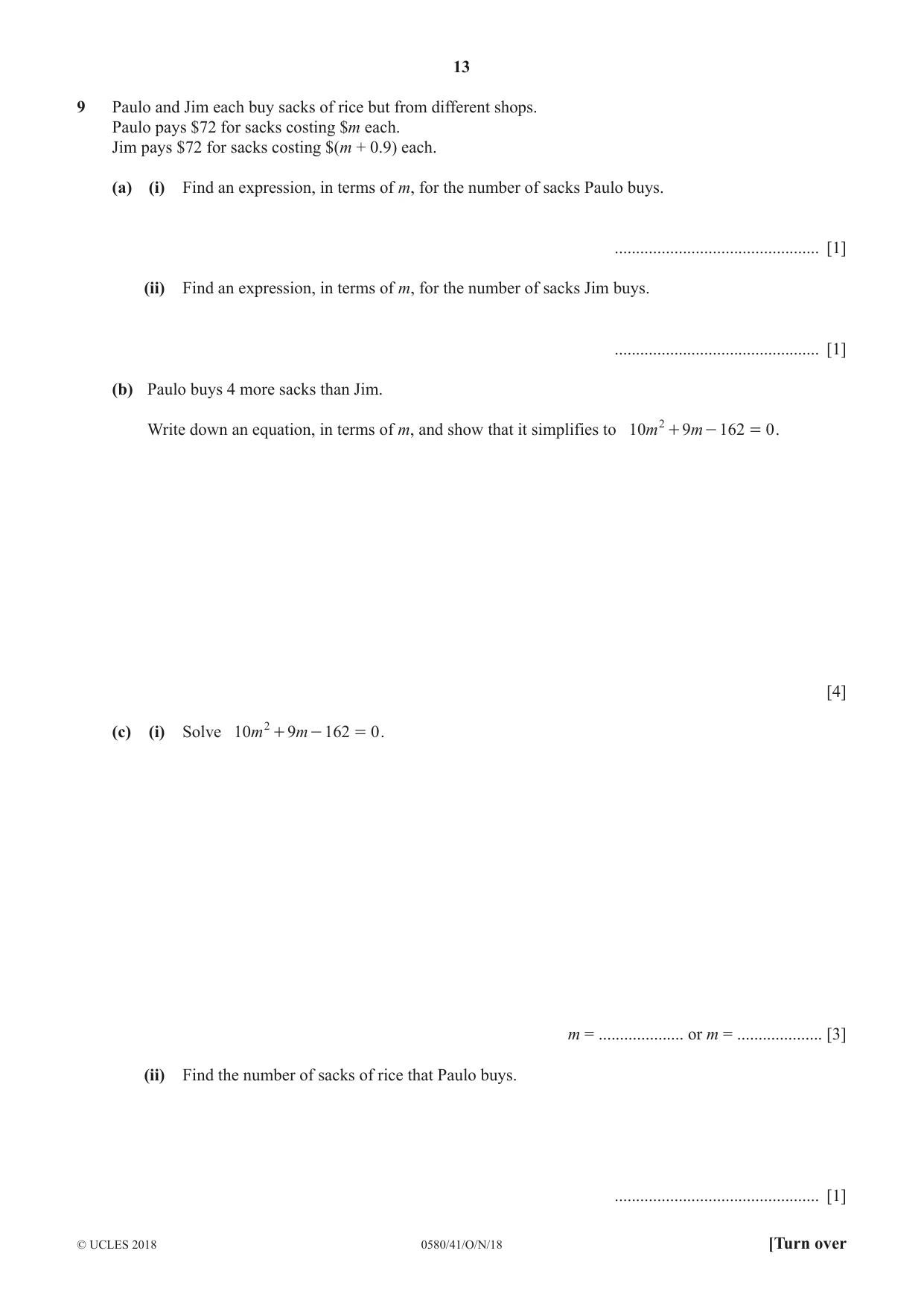
9 Paulo and Jim each buy sacks of rice but from different shops. Paulo pays $72 for sacks costing $m each. Jim pays $72 for sacks costing $(m + 0.9) each. (a) (i) Find an expression, in terms of m, for the number of sacks Paulo buys. ................................................ [1] (ii) Find an expression, in terms of m, for the number of sacks Jim buys. ................................................ [1] (b) Paulo buys 4 more sacks than Jim. Write down an equation, in terms of m, and show that it simplifies to 10m 2 + 9m - 162 = 0 . [4] (c) (i) Solve 10m 2 + 9m - 162 = 0 . m = .................... or m = .................... [3] (ii) Find the number of sacks of rice that Paulo buys. ................................................ [1]
Mark scheme: 9(a)(i) 72 1 m 9(a)(ii) 72 1 m + 9.0 9 (b) 72 72 M1 FT their (a)(i) and (a)(ii) if expressions in = 4 oe m m −m + 9.0 72 (m + 9.0 ) − 72 m = 4 m (m + 9.0 ) oe M1 Dependent on M1 and correct fractions [ 72 m − 72 m ] + 64.8 = 4 m 2 + 3.6 m oe A1 nfww Correct completion to A1 10 m 2 + 9 m − 162 = 0 9(c)(i) 3.6 and −4.5 final answer 3 B2 for (2 m + 9 )(5 m − 18 ) or − 9 ± (9 )2 − 4(10 )(− 162 ) or better 2 × 10 or B1 for (am + b )(cm + d ) where ac = 10 and either bd = −162 or ad + bc = 9 or for (9 )2 − 4 (10 )(− 162 ) or better or − 9 ± q or better 2 (10 ) 9(c)(ii) 20 1
Q10 · NOT TO O SCALE Y X 8 cm A C 15 cm B 22.4 cm The diagram shows a circle, centre O
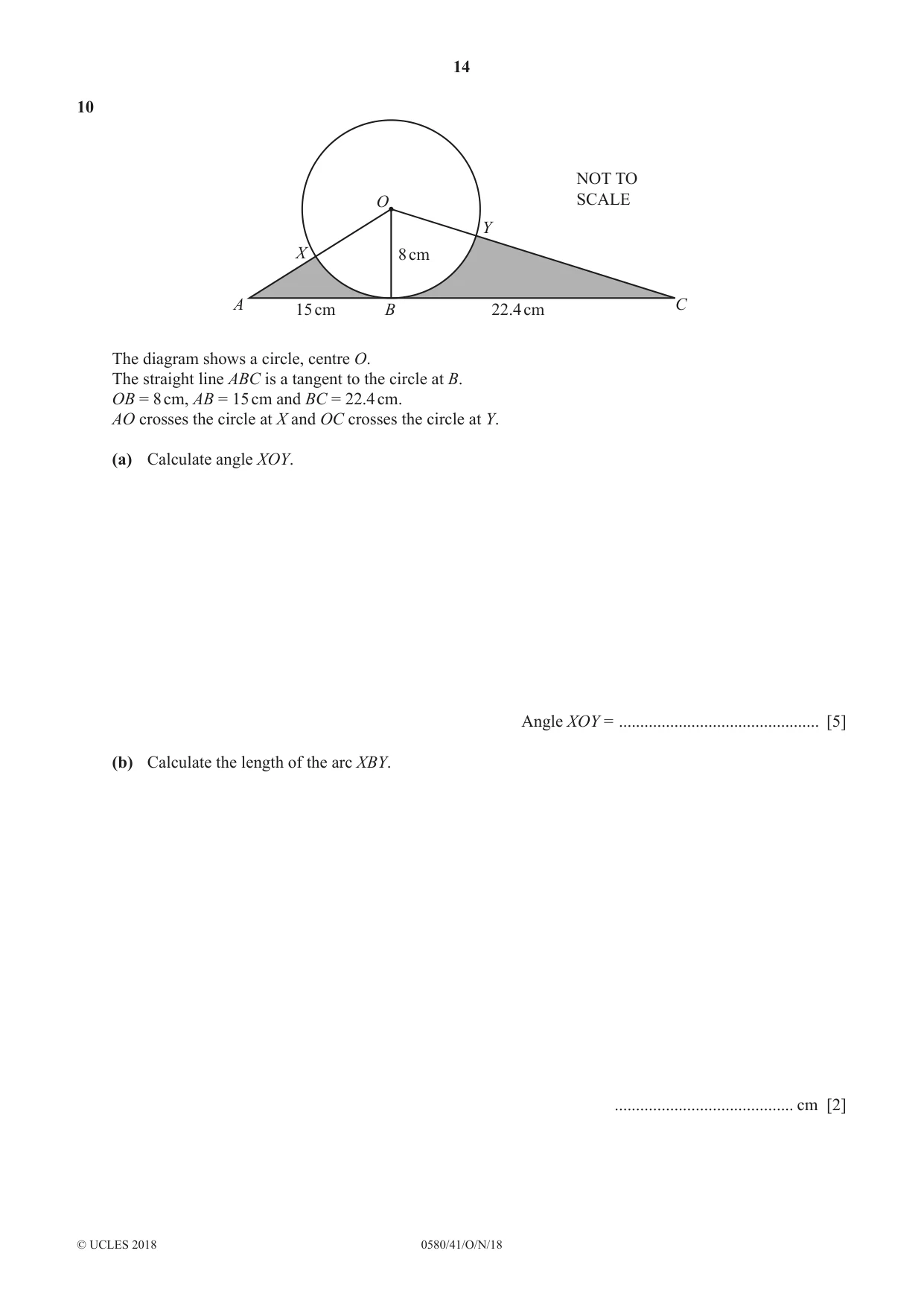
10 NOT TO O SCALE Y X 8 cm A C 15 cm B 22.4 cm The diagram shows a circle, centre O. The straight line ABC is a tangent to the circle at B. OB = 8 cm, AB = 15 cm and BC = 22.4 cm. AO crosses the circle at X and OC crosses the circle at Y. (a) Calculate angle XOY. Angle XOY = ............................................... [5] (b) Calculate the length of the arc XBY. .......................................... cm [2] (c) Calculate the total area of the two shaded regions. ........................................ cm2 [4] Question 11 is printed on the next page.
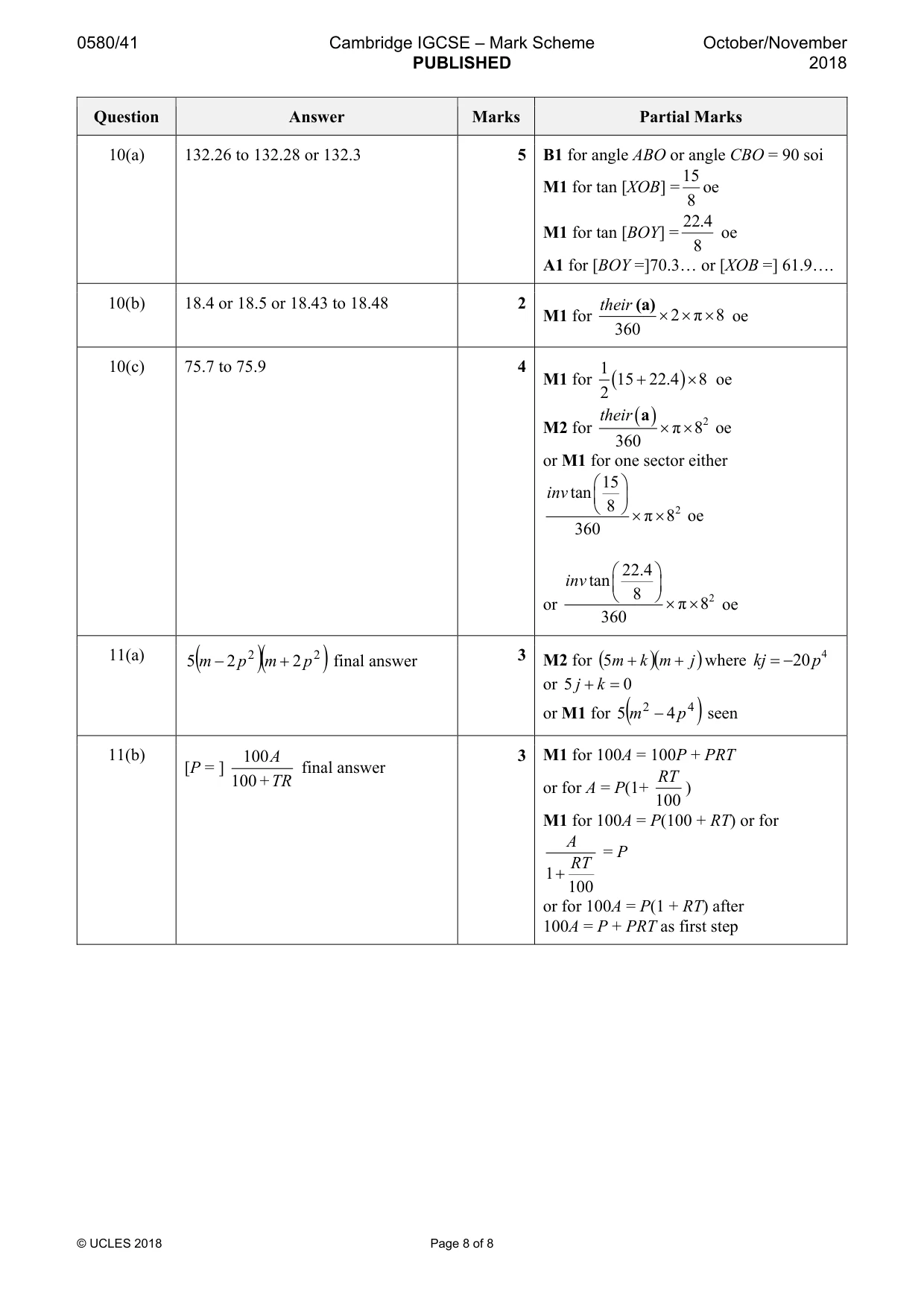
Mark scheme: 10(a) 132.26 to 132.28 or 132.3 5 B1 for angle ABO or angle CBO = 90 soi 15 M1 for tan [XOB] = oe 8 224. M1 for tan [BOY] = oe 8 A1 for [BOY =]70.3… or [XOB =] 61.9…. 10(b) 18.4 or 18.5 or 18.43 to 18.48 2 their (a) M1 for × 2 × π × 8 oe 360 10(c) 75.7 to 75.9 4 1 M1 for (15 + 22.4 ) × 8 oe 2 their ( a ) 2 M2 for × π × 8 oe 360 or M1 for one sector either 15 inv tan 8 × π × 8 2 oe 360 22.4 inv tan 8 2 or × π × 8 oe 360 ( )( )
Q11 · Factorise 5m 2 - 20p 4
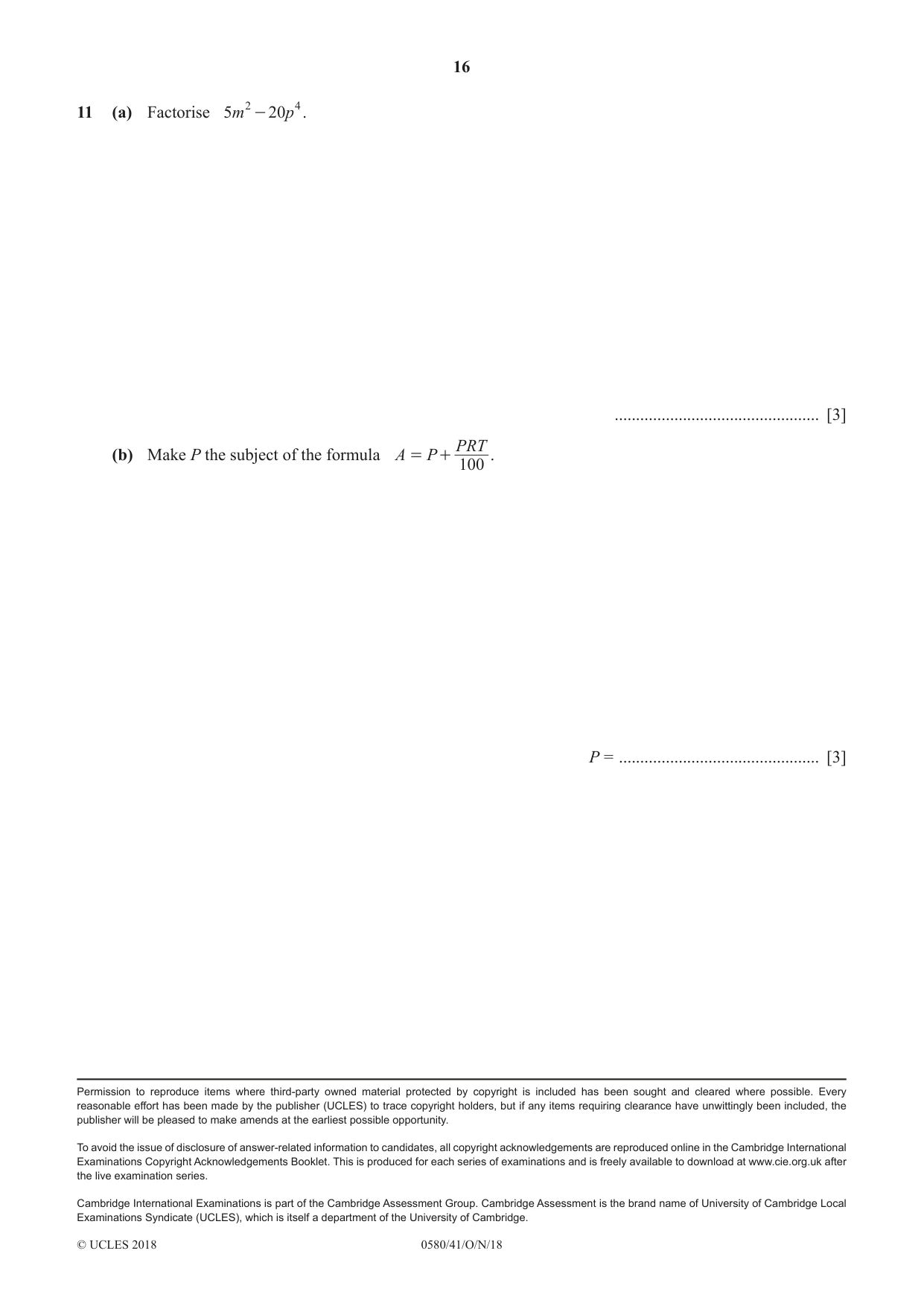
11 (a) Factorise 5m 2 - 20p 4 . ................................................ [3] PRT (b) Make P the subject of the formula A = P + . 100 P = ............................................... [3]
Mark scheme: 2 211(a) 3 M2 for (5 m + k )(m + )j where kj = −20 p 4 5(m − 2 p )(m + 2 p ) final answer or 5 j + k = 0 or M1 for 5(m 2 − 4 p 4 ) seen 11(b) 100 A 3 M1 for 100A = 100P + PRT [P = ] final answer RT 100 + TR or for A = P(1+ ) 100 M1 for 100A = P(100 + RT) or for A = P RT 1 + 100 or for 100A = P(1 + RT) after 100A = P + PRT as first step
What was in this paper
The subtopics covered by these 11 questions, and how many questions each got. Open one in a new tab to see every Cambridge question on it.
What you needed in this session
Cambridge’s own grade thresholds for 2018 Oct/Nov, Paper 4 · Variant 1. A higher threshold means an easier paper — the bar moves with how the cohort did.