Cambridge IGCSE Mathematics 0580 — 2016 Oct/Nov Paper 4 · Variant 1
0580/41/O/N/16 · 10 questions · 130 marks · ≈146 min
The question paper and its mark scheme, free to read here and free to download. This is Cambridge’s own paper, exactly as it was sat.
Question paper20 pages
Mark scheme7 pages
Answers below. Sit the paper first if you are practising.
Questions as text
Q1 · Divide $105 in the ratio 4 : 3
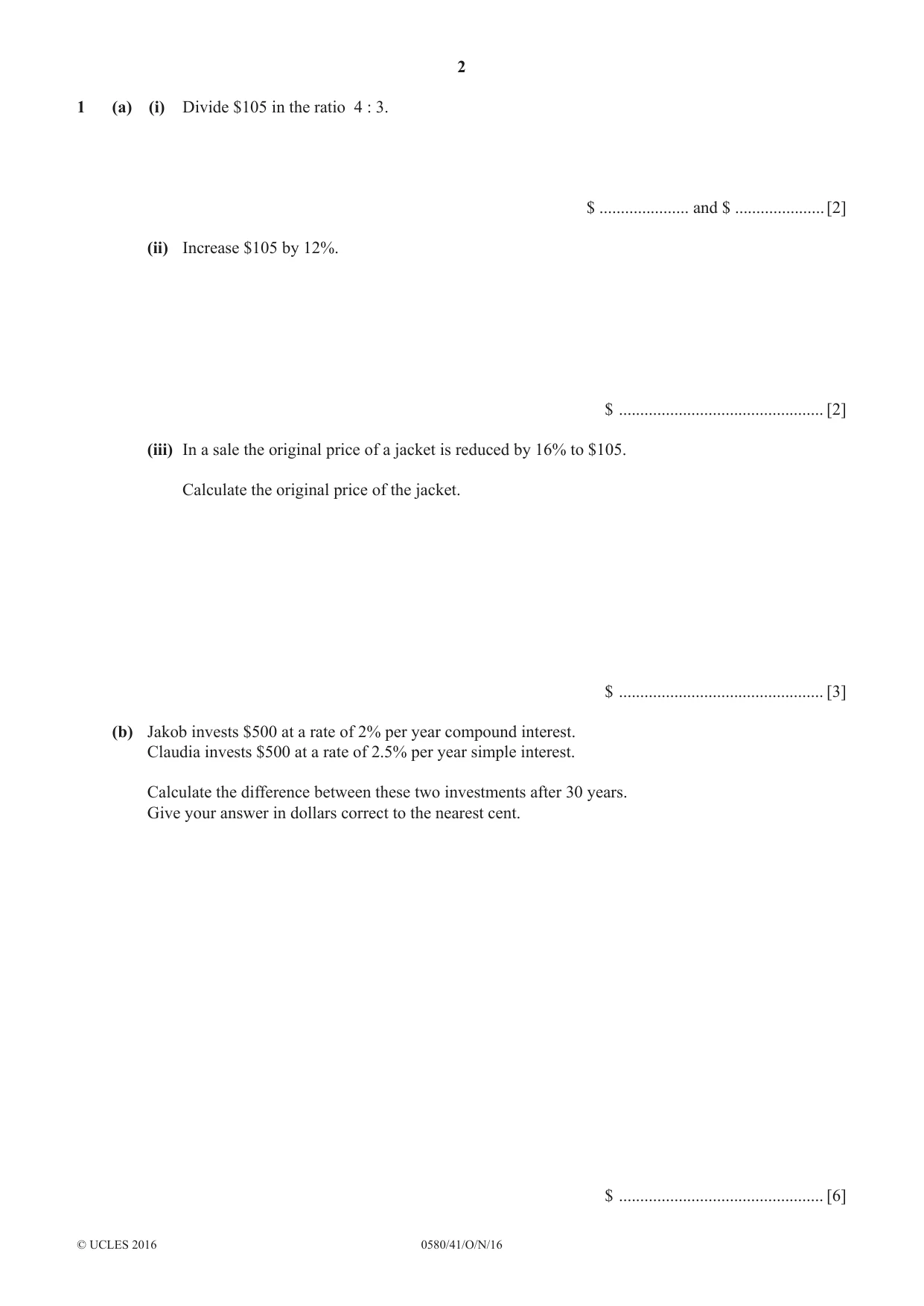
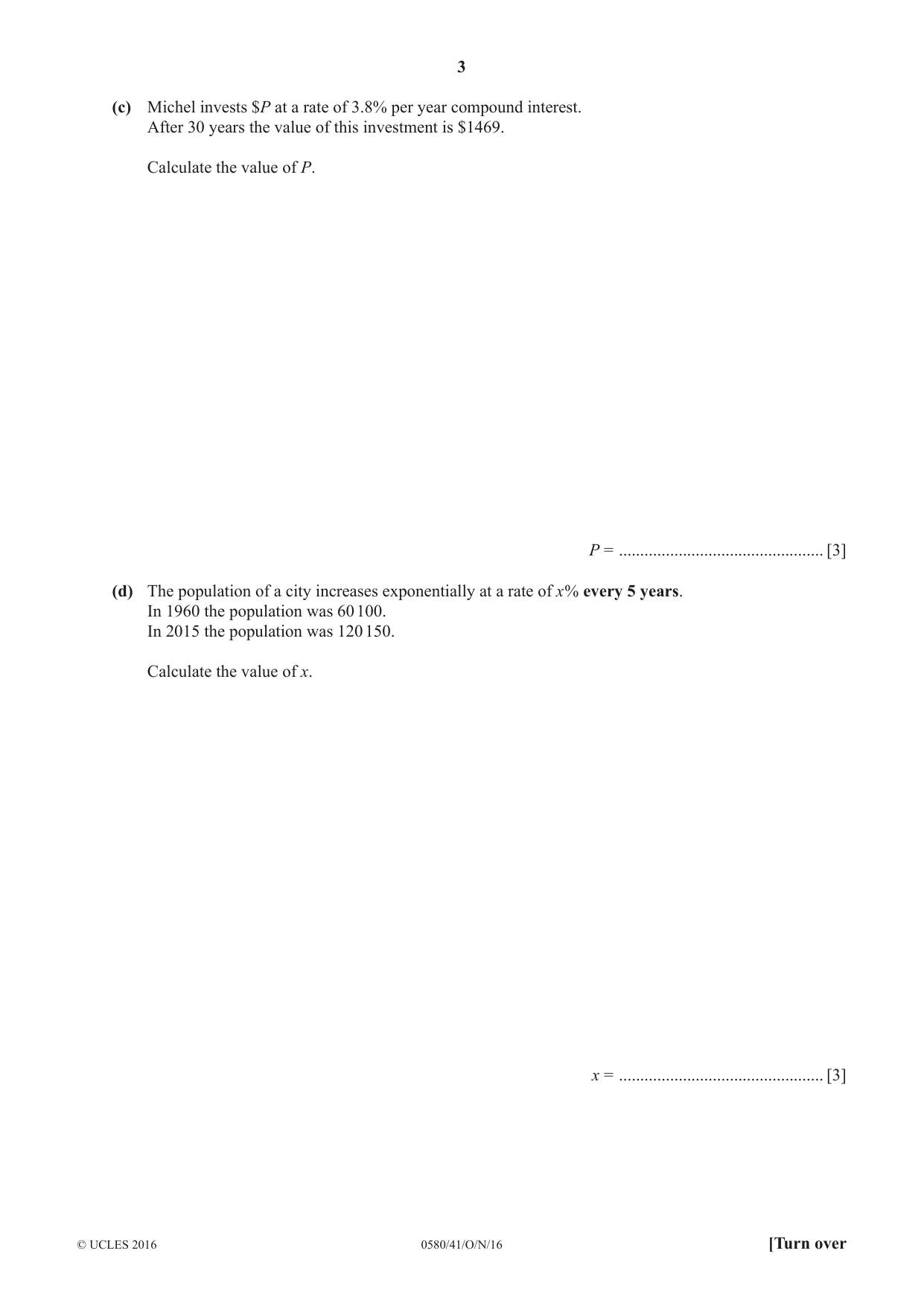
1 (a) (i) Divide $105 in the ratio 4 : 3. $ ..................... and $ ..................... [2] (ii) Increase $105 by 12%. $ ................................................ [2] (iii) In a sale the original price of a jacket is reduced by 16% to $105. Calculate the original price of the jacket. $ ................................................ [3] (b) Jakob invests $500 at a rate of 2% per year compound interest. Claudia invests $500 at a rate of 2.5% per year simple interest. Calculate the difference between these two investments after 30 years. Give your answer in dollars correct to the nearest cent. $ ................................................ [6] (c) Michel invests $P at a rate of 3.8% per year compound interest. After 30 years the value of this investment is $1469. Calculate the value of P. P = ................................................ [3] (d) The population of a city increases exponentially at a rate of x% every 5 years. In 1960 the population was 60 100. In 2015 the population was 120 150. Calculate the value of x. x = ................................................ [3]
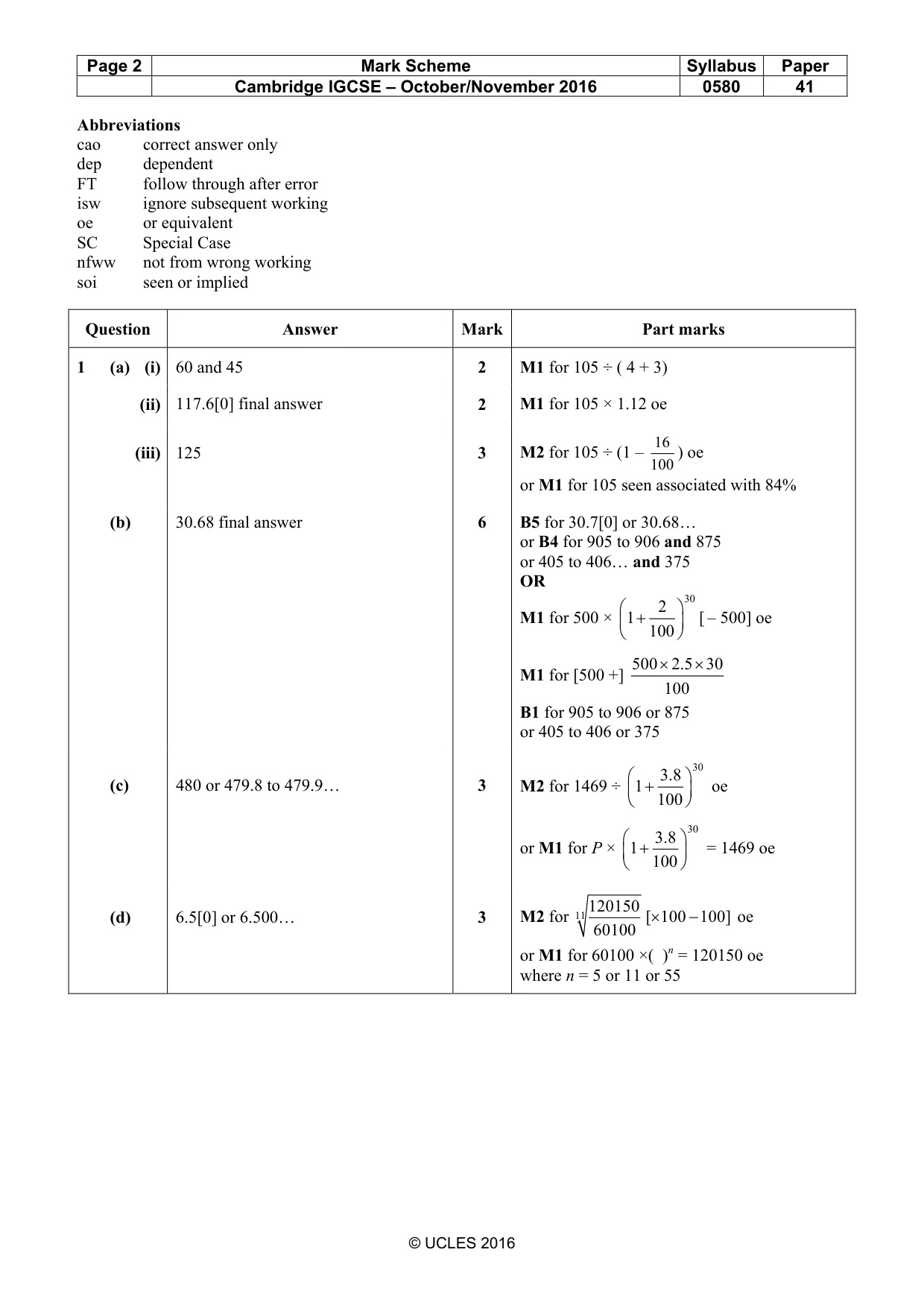
Mark scheme: Question Answer Mark Part marks 1 (a) (i) 60 and 45 2 M1 for 105 ÷ ( 4 + 3) (ii) 117.6[0] final answer 2 M1 for 105 × 1.12 oe 16 (iii) 125 3 M2 for 105 ÷ (1 – ) oe 100 or M1 for 105 seen associated with 84% (b) 30.68 final answer 6 B5 for 30.7[0] or 30.68… or B4 for 905 to 906 and 875 or 405 to 406… and 375 OR 2 30 M1 for 500 × 1 + [ – 500] oe 100 500 × 2.5 × 30 M1 for [500 +] 100 B1 for 905 to 906 or 875 or 405 to 406 or 375 3.8 30 (c) 480 or 479.8 to 479.9… 3 M2 for 1469 ÷ 1 + oe 100 3.8 30 or M1 for P × 1 + = 1469 oe 100 120150 (d) 6.5[0] or 6.500… 3 M2 for 11 [× 100 − 100] oe 60100 or M1 for 60100 ×( )n = 120150 oe where n = 5 or 11 or 55
Q2 · 200 students record the time, t minutes, for their journey from home to school
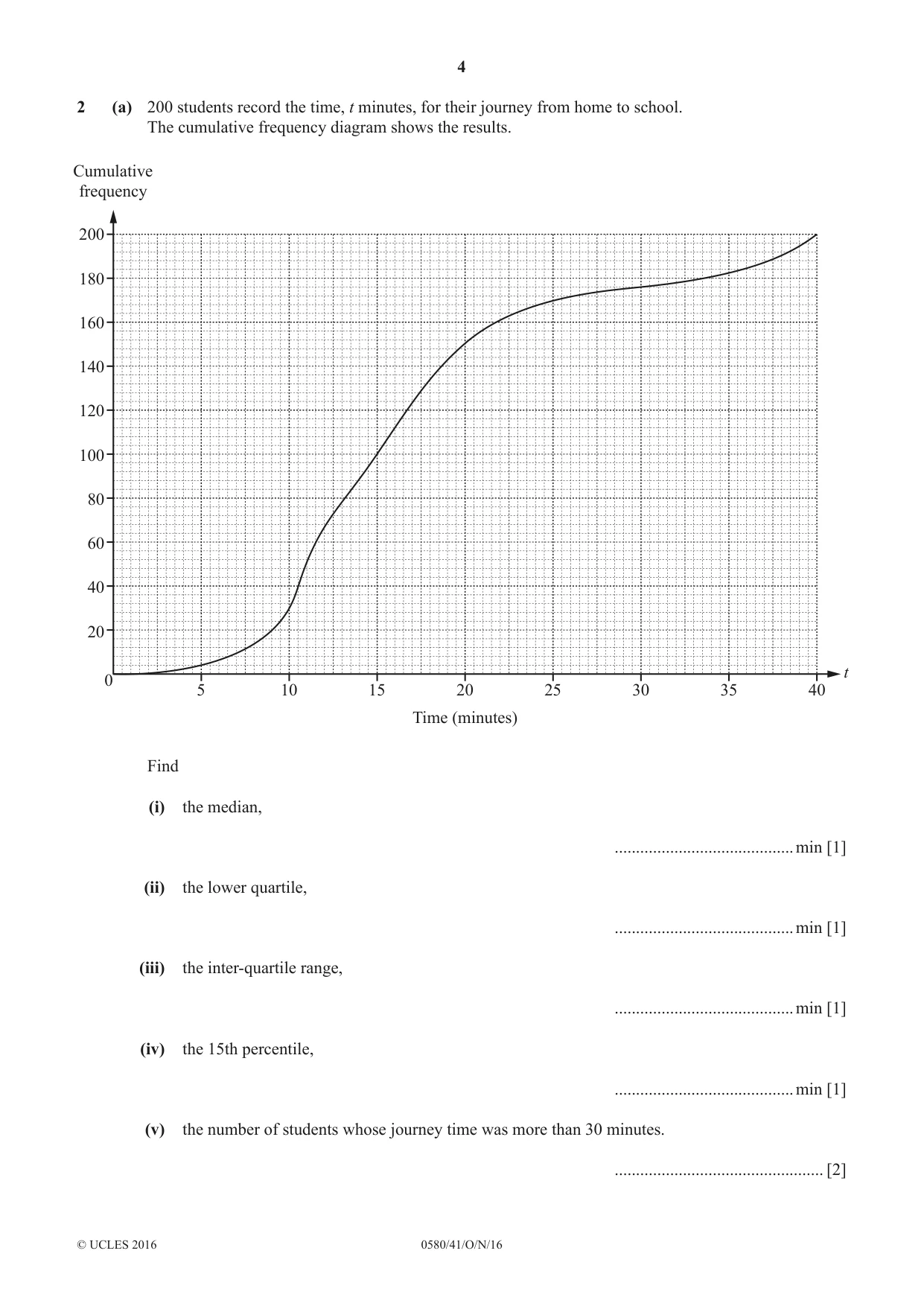
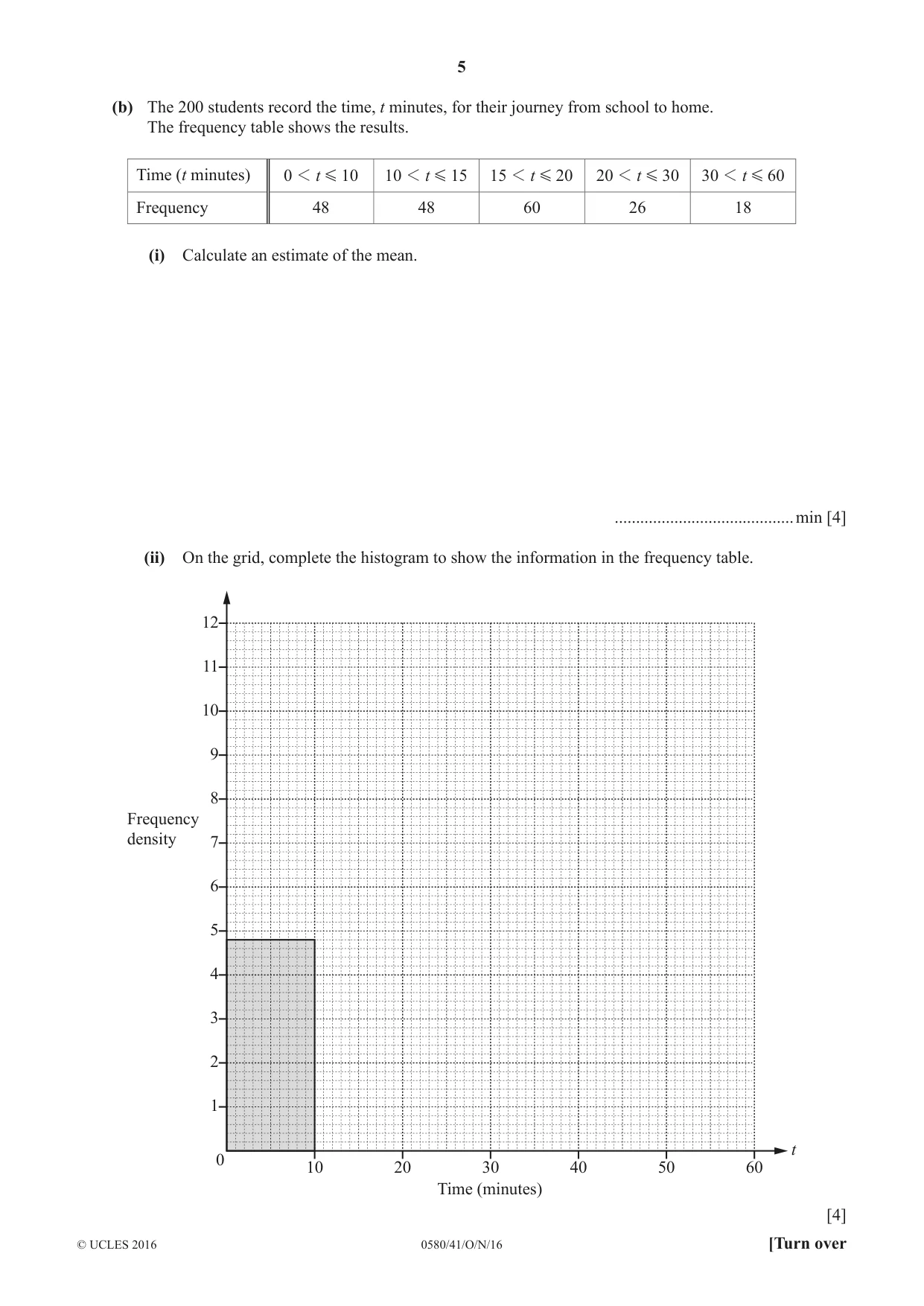
2 (a) 200 students record the time, t minutes, for their journey from home to school. The cumulative frequency diagram shows the results. Cumulative frequency 200 180 160 140 120 100 80 60 40 20 t 0 5 10 15 20 25 30 35 40 Time (minutes) Find (i) the median, ..........................................min [1] (ii) the lower quartile, ..........................................min [1] (iii) the inter-quartile range, ..........................................min [1] (iv) the 15th percentile, ..........................................min [1] (v) the number of students whose journey time was more than 30 minutes. ................................................. [2] (b) The 200 students record the time, t minutes, for their journey from school to home. The frequency table shows the results. Time (t minutes) 0 1 t G 10 10 1 t G 15 15 1 t G 20 20 1 t G 30 30 1 t G 60 Frequency 48 48 60 26 18 (i) Calculate an estimate of the mean. ..........................................min [4] (ii) On the grid, complete the histogram to show the information in the frequency table. 12 11 10 9 8 Frequency density 7 6 5 4 3 2 1 t 0 10 20 30 40 50 60 Time (minutes) [4]
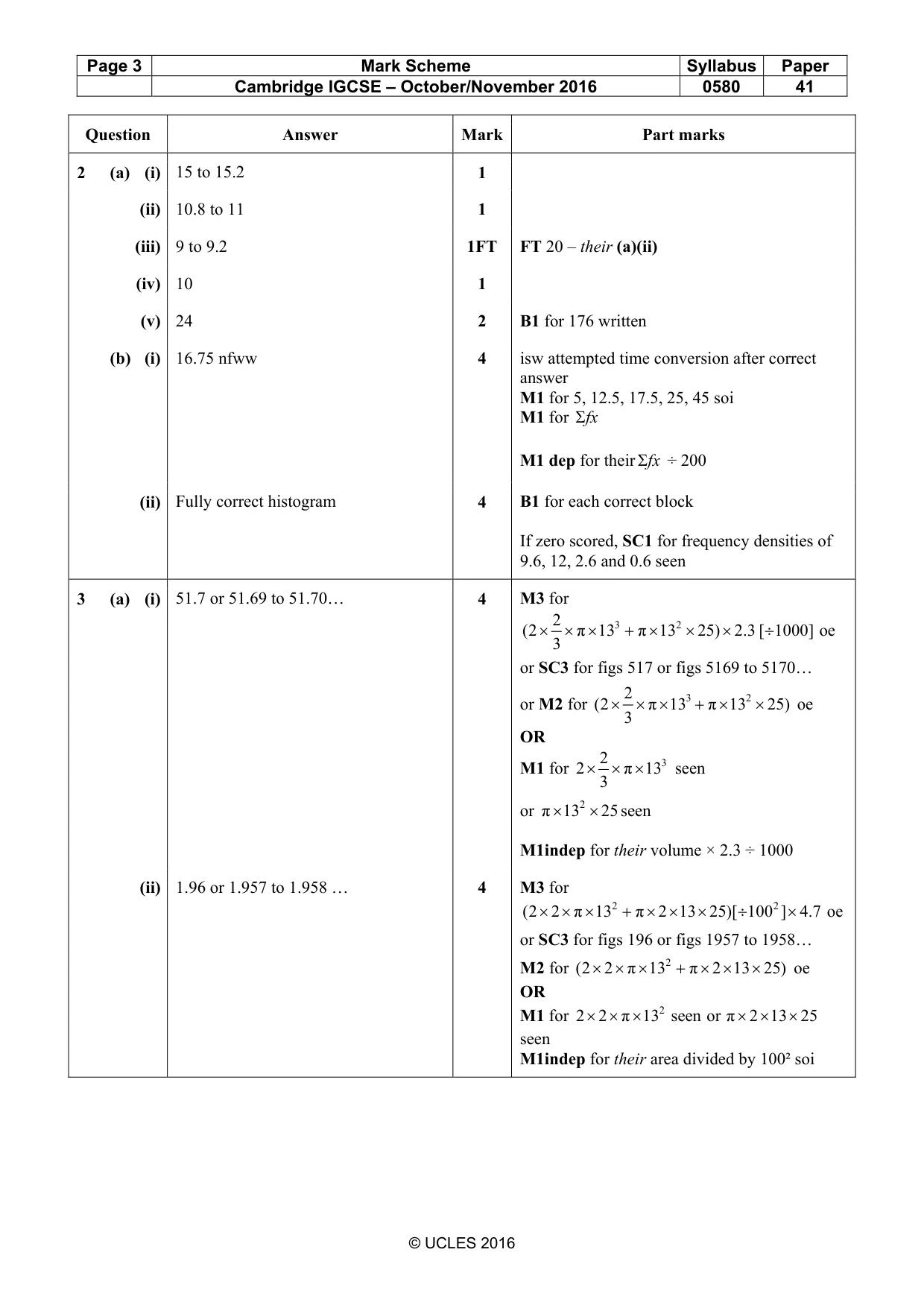
Mark scheme: 2 (a) (i) 15 to 15.2 1 (ii) 10.8 to 11 1 (iii) 9 to 9.2 1FT FT 20 – their (a)(ii) (iv) 10 1 (v) 24 2 B1 for 176 written (b) (i) 16.75 nfww 4 isw attempted time conversion after correct answer M1 for 5, 12.5, 17.5, 25, 45 soi M1 for Σ fx M1 dep for their Σ fx ÷ 200 (ii) Fully correct histogram 4 B1 for each correct block If zero scored, SC1 for frequency densities of 9.6, 12, 2.6 and 0.6 seen
Q3 · NOT TO SCALE 13 cm 25 cm The diagram shows a solid made up of a cylinder and two…
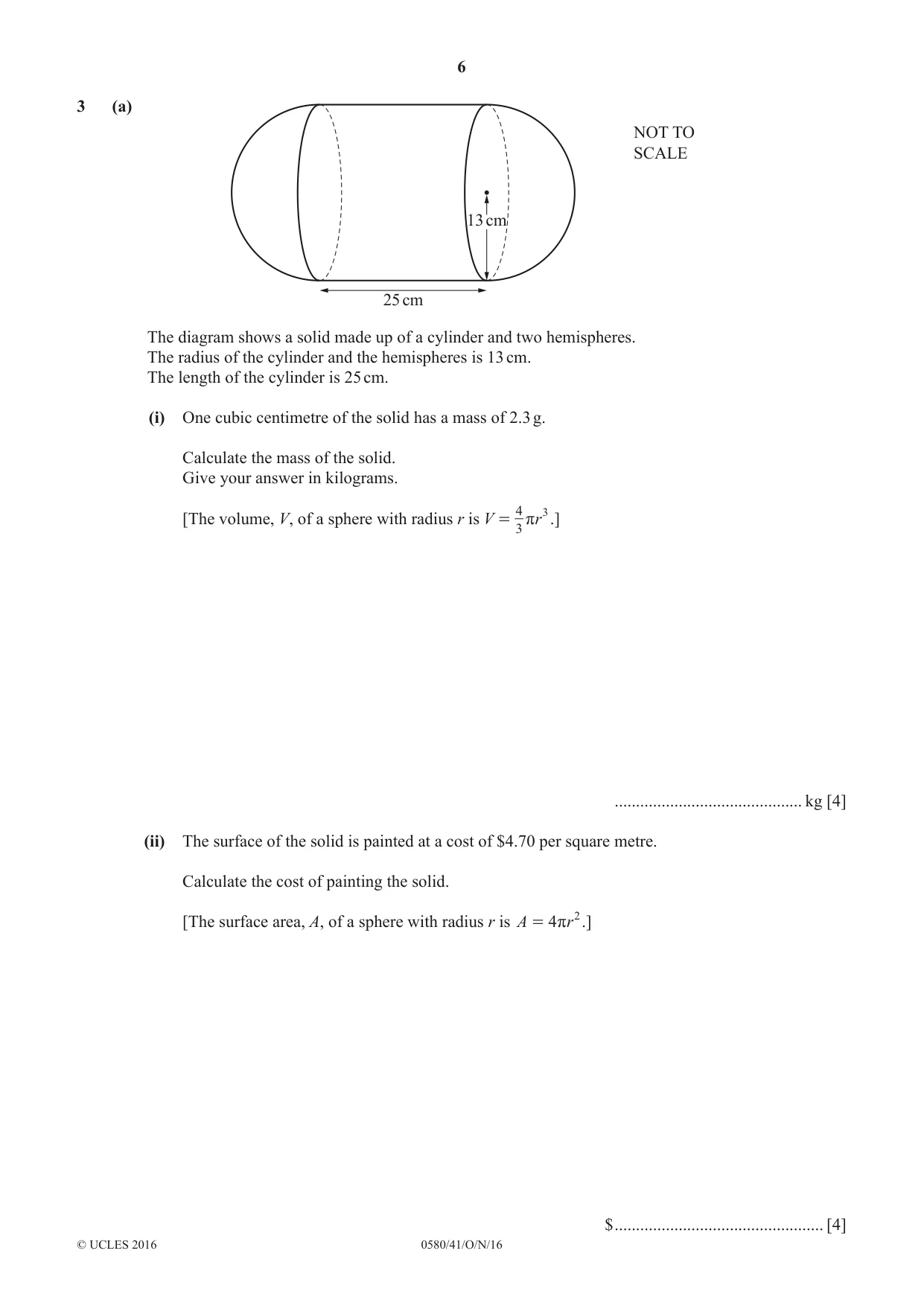
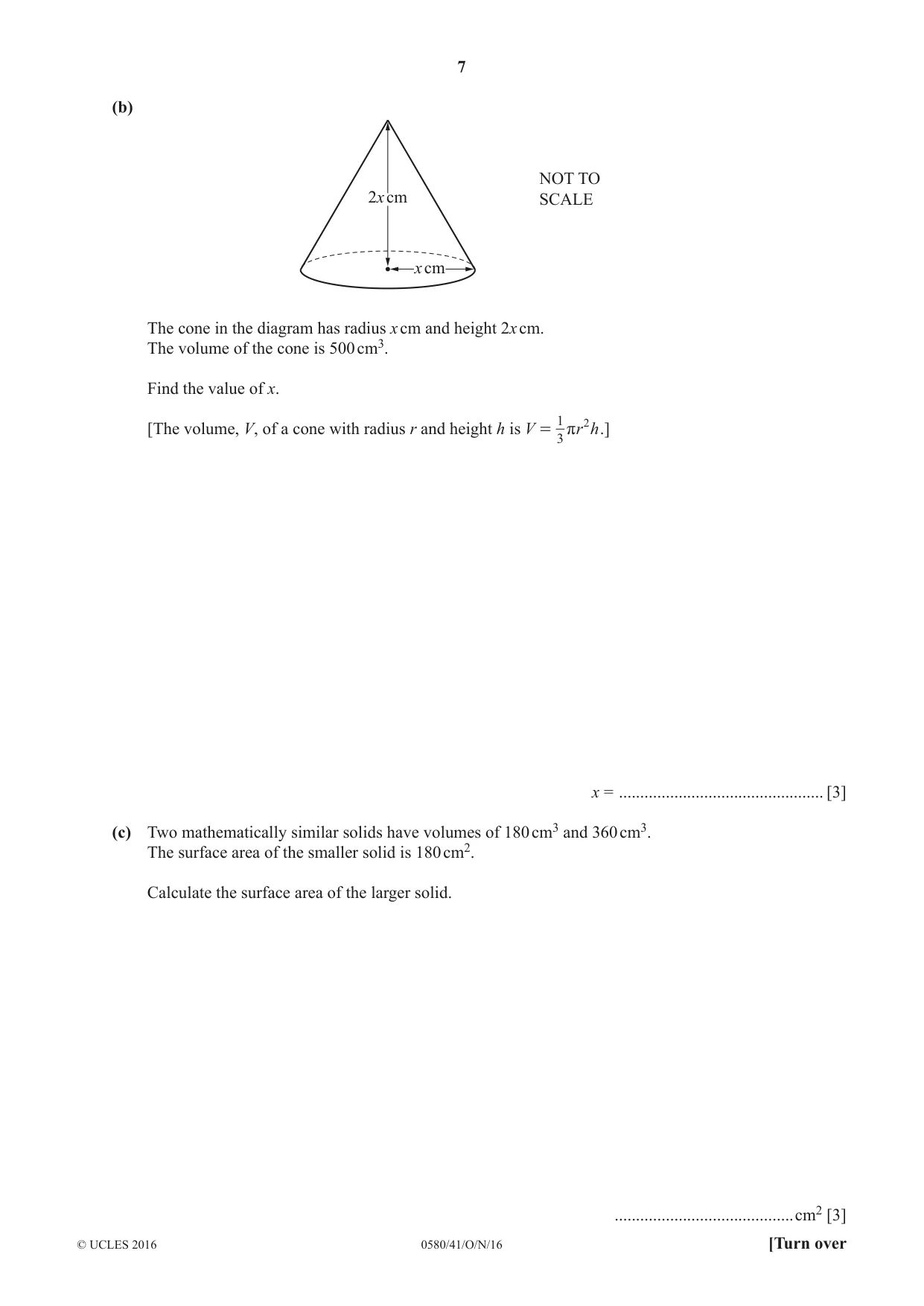
3 (a) NOT TO SCALE 13 cm 25 cm The diagram shows a solid made up of a cylinder and two hemispheres. The radius of the cylinder and the hemispheres is 13 cm. The length of the cylinder is 25 cm. (i) One cubic centimetre of the solid has a mass of 2.3 g. Calculate the mass of the solid. Give your answer in kilograms. 4 [The volume, V, of a sphere with radius r is V = r r3 .] 3 ............................................ kg [4] (ii) The surface of the solid is painted at a cost of $4.70 per square metre. Calculate the cost of painting the solid. [The surface area, A, of a sphere with radius r is A = 4 rr 2 .] $ ................................................. [4] (b) NOT TO 2x cm SCALE x cm The cone in the diagram has radius x cm and height 2x cm. The volume of the cone is 500 cm3. Find the value of x. 1 2 [The volume, V, of a cone with radius r and height h is V = r r h .] 3 x = ................................................ [3] (c) Two mathematically similar solids have volumes of 180 cm3 and 360 cm3. The surface area of the smaller solid is 180 cm2. Calculate the surface area of the larger solid. ..........................................cm2 [3]
Mark scheme: 3 (a) (i) 51.7 or 51.69 to 51.70… 4 M3 for 2 3 2 (2 × × π × 13 + π × 13 × 25) × 2.3 [ ÷ 1000] oe 3 or SC3 for figs 517 or figs 5169 to 5170… 2 3 2 or M2 for (2 × × π × 13 + π × 13 × 25) oe 3 OR 2 3 M1 for 2 × × π × 13 seen 3 or π × 132 × 25 seen M1indep for their volume × 2.3 ÷ 1000 (ii) 1.96 or 1.957 to 1.958 … 4 M3 for (2 × 2 × π × 132 + π × 2 × 13 × 25)[ ÷ 100 2 ] × 4.7 oe or SC3 for figs 196 or figs 1957 to 1958… M2 for (2 × 2 × π × 132 + π × 2 × 13 × 25) oe OR M1 for 2 × 2 × π × 132 seen or π × 2 × 13 × 25 seen M1indep for their area divided by 100² soi
Q4 · Y = 1 - 2 , x !
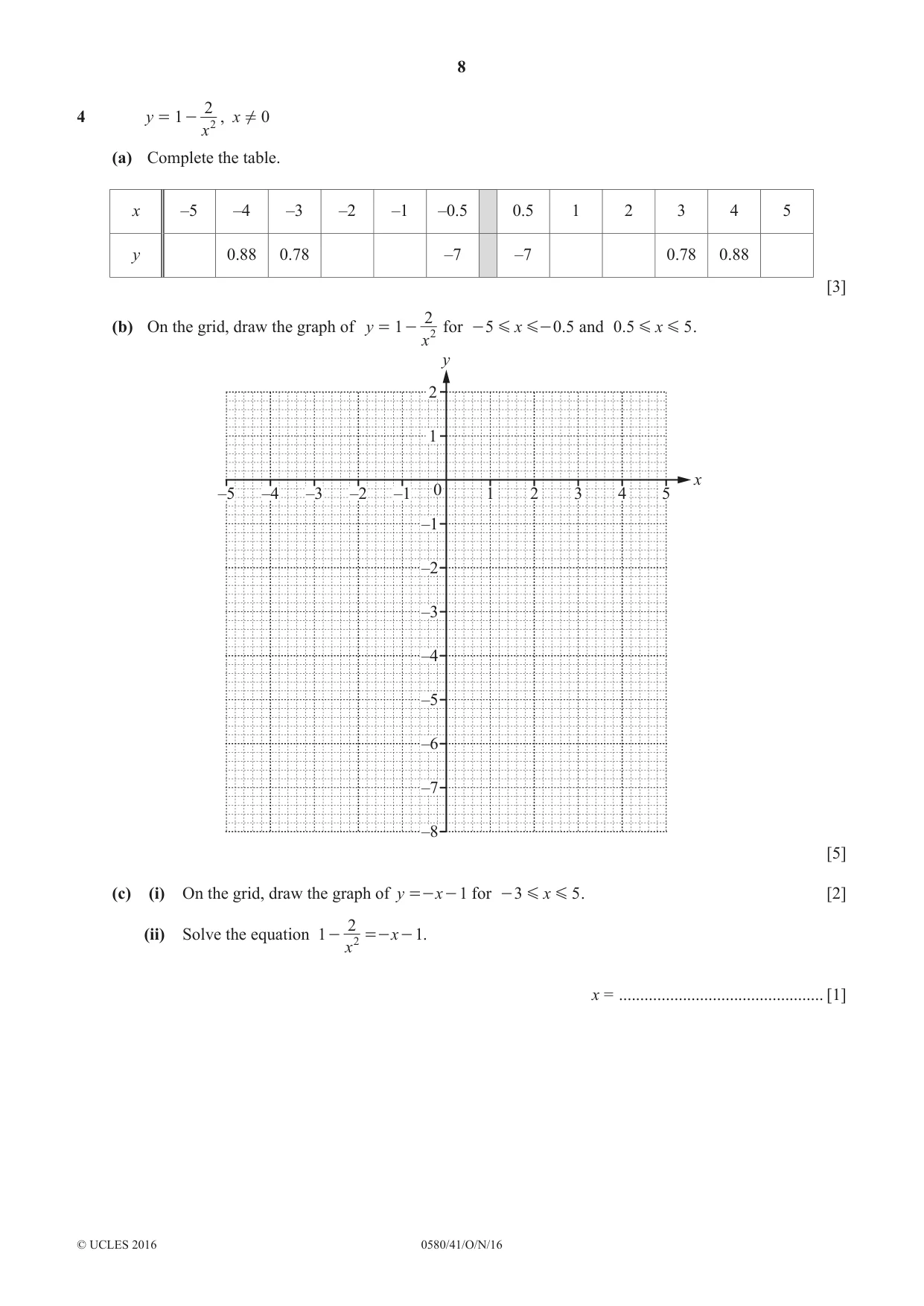
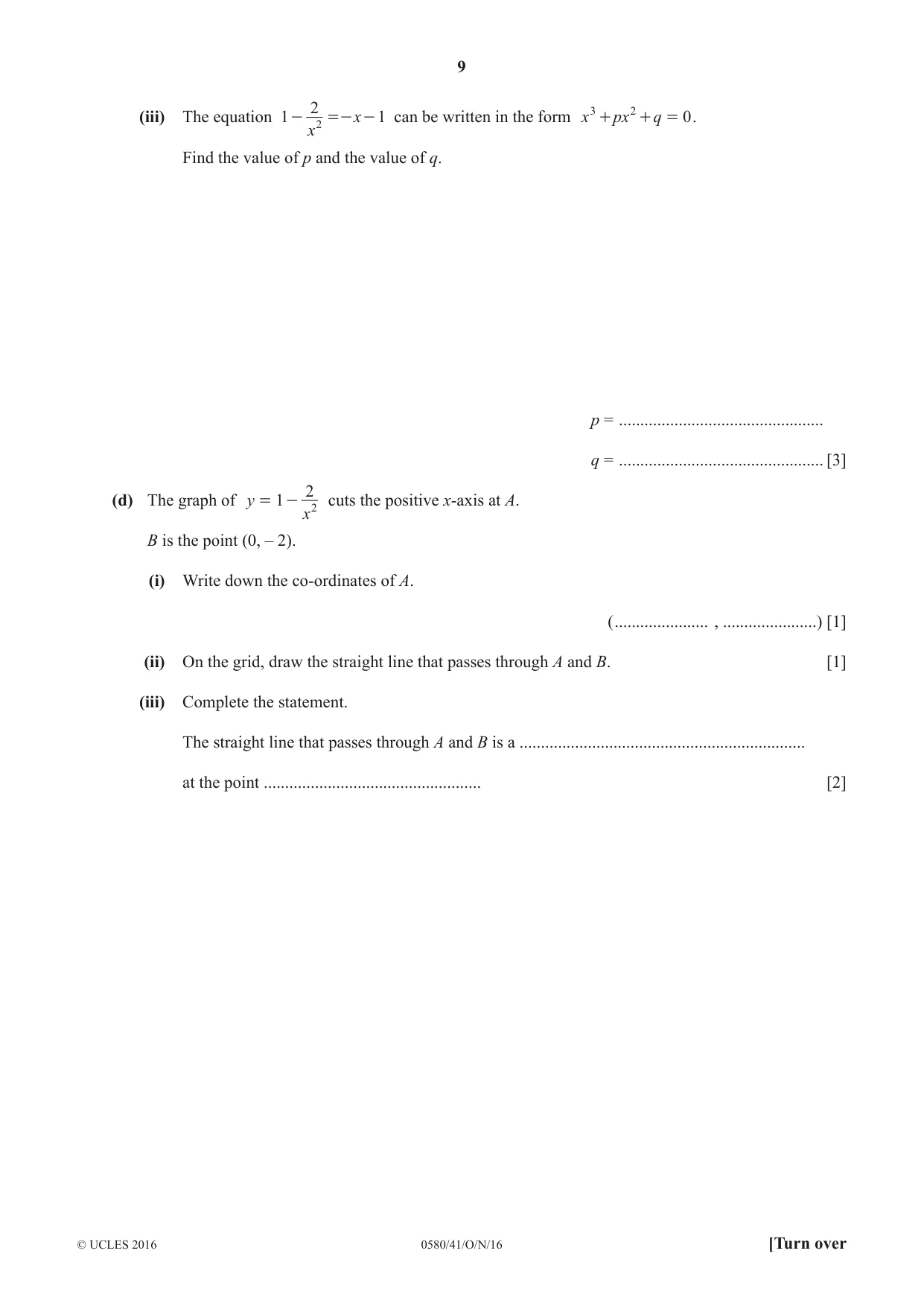
24 y = 1 - 2 , x ! 0 x (a) Complete the table. x –5 –4 –3 –2 –1 –0.5 0.5 1 2 3 4 5 y 0.88 0.78 –7 –7 0.78 0.88 [3] 2 (b) On the grid, draw the graph of y = 1 - 2 for - 5 G x G - 0 .5 and 0.5 G x G 5 . x y 2 1 x –5 –4 –3 –2 –1 0 1 2 3 4 5 –1 –2 –3 –4 –5 –6 –7 –8 [5] (c) (i) On the grid, draw the graph of y =- x - 1 for - 3 G x G 5 . [2] 2 (ii) Solve the equation 1 - 2 =- x - 1. x x = ................................................ [1] 2 3 2 (iii) The equation 1 - 2 =- x - 1 can be written in the form x + px + q = 0 . x Find the value of p and the value of q. p = ................................................ q = ................................................ [3] 2(d) The graph of y = 1 - 2 cuts the positive x-axis at A. x B is the point (0, – 2). (i) Write down the co-ordinates of A. ( ...................... , ......................) [1] (ii) On the grid, draw the straight line that passes through A and B. [1] (iii) Complete the statement. The straight line that passes through A and B is a ................................................................... at the point ................................................... [2]
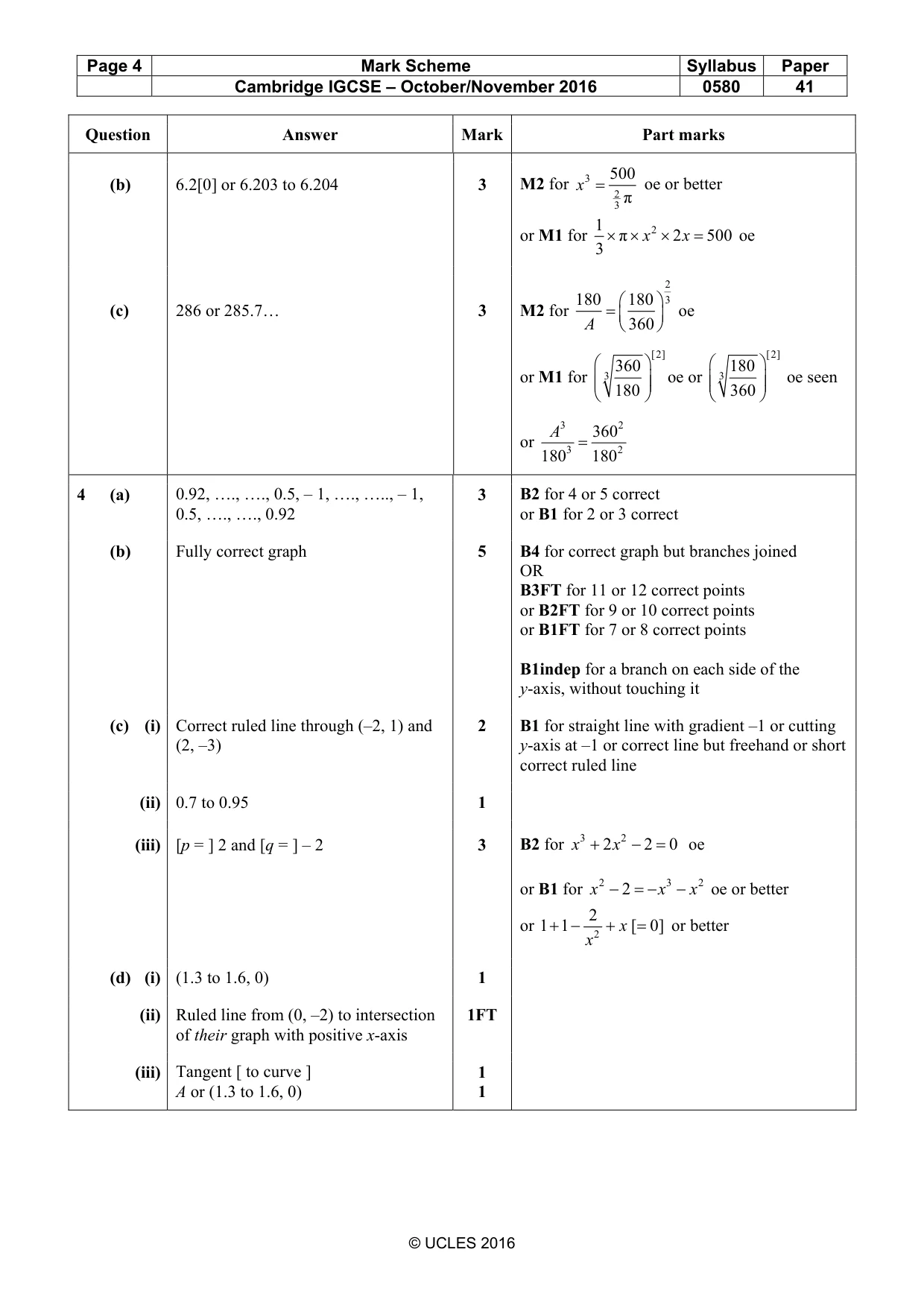
Mark scheme: 4 (a) 0.92, …., …., 0.5, – 1, …., ….., – 1, 3 B2 for 4 or 5 correct 0.5, …., …., 0.92 or B1 for 2 or 3 correct (b) Fully correct graph 5 B4 for correct graph but branches joined OR B3FT for 11 or 12 correct points or B2FT for 9 or 10 correct points or B1FT for 7 or 8 correct points B1indep for a branch on each side of the y-axis, without touching it (c) (i) Correct ruled line through (–2, 1) and 2 B1 for straight line with gradient –1 or cutting (2, –3) y-axis at –1 or correct line but freehand or short correct ruled line (ii) 0.7 to 0.95 1 (iii) [p = ] 2 and [q = ] – 2 3 B2 for x 3 + 2 x 2 − 2 = 0 oe or B1 for x 2 − 2 = − x 3 − x 2 oe or better 2 or 1 + 1 − + x [ = 0] or better x 2 (d) (i) (1.3 to 1.6, 0) 1 (ii) Ruled line from (0, –2) to intersection 1FT of their graph with positive x-axis (iii) Tangent [ to curve ] 1 A or (1.3 to 1.6, 0) 1
Q5 · Y 8 7 6 A 5 4 3 B 2 1 x –8 –7 –6 –5 –4 –3 –2 –1 0 1 2 3 4 5 6 7 8 –1 –2 –3 –4 –5 –6 –7 –8…
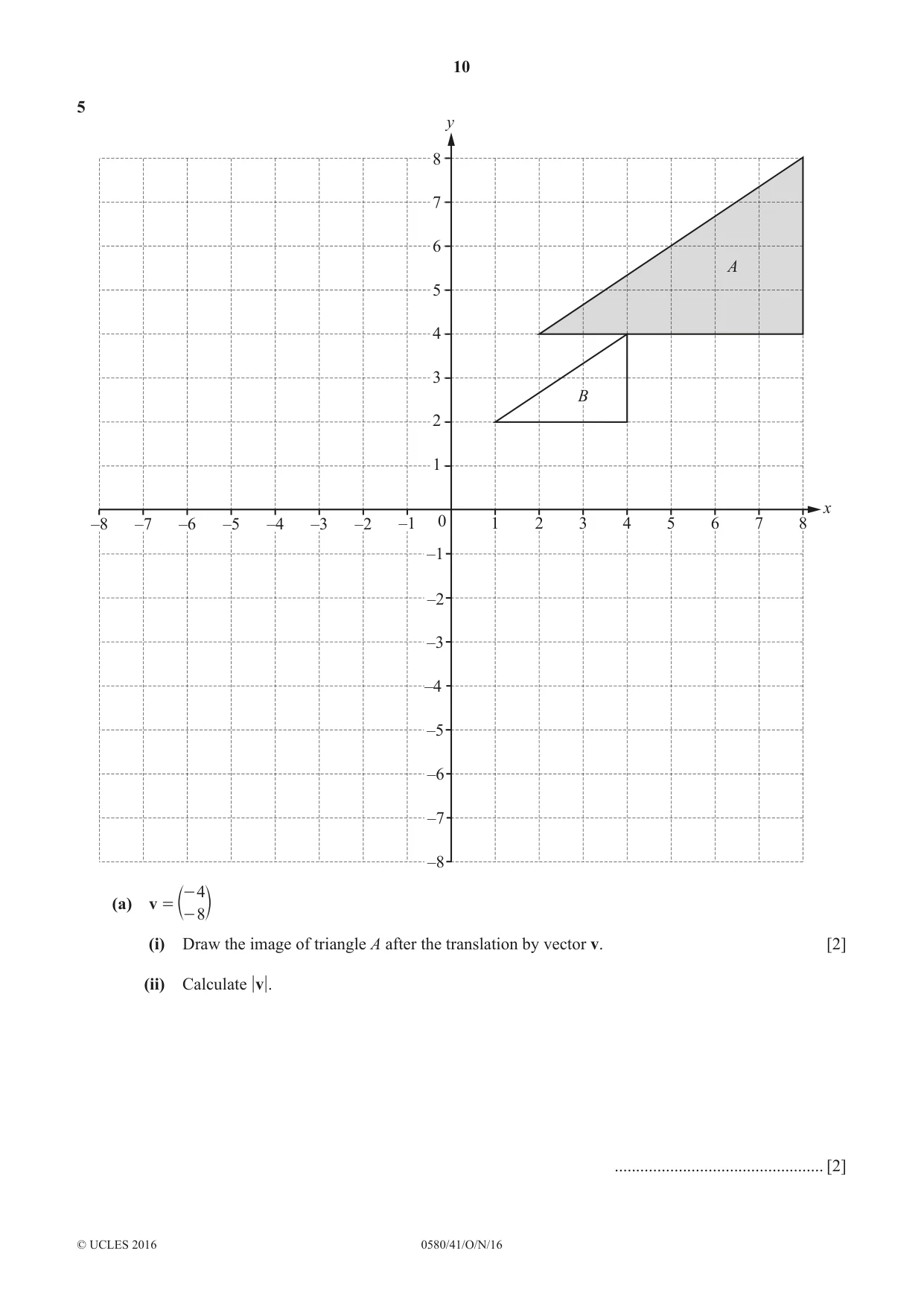
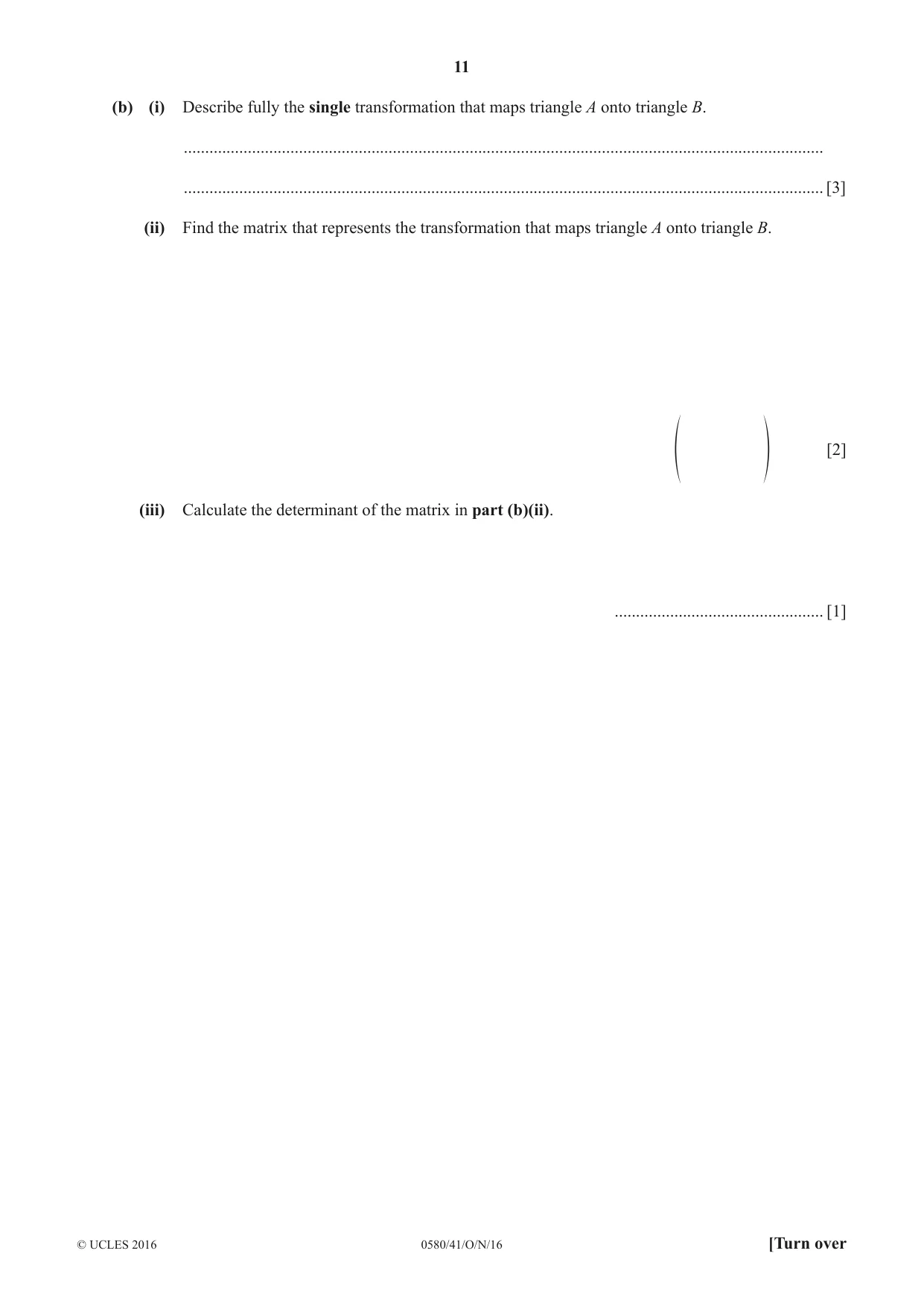
5 y 8 7 6 A 5 4 3 B 2 1 x –8 –7 –6 –5 –4 –3 –2 –1 0 1 2 3 4 5 6 7 8 –1 –2 –3 –4 –5 –6 –7 –8 - 4 (a) v = c- 8m (i) Draw the image of triangle A after the translation by vector v. [2] (ii) Calculate v . ................................................. [2] (b) (i) Describe fully the single transformation that maps triangle A onto triangle B. ...................................................................................................................................................... ...................................................................................................................................................... [3] (ii) Find the matrix that represents the transformation that maps triangle A onto triangle B. [2] f p (iii) Calculate the determinant of the matrix in part (b)(ii). ................................................. [1]
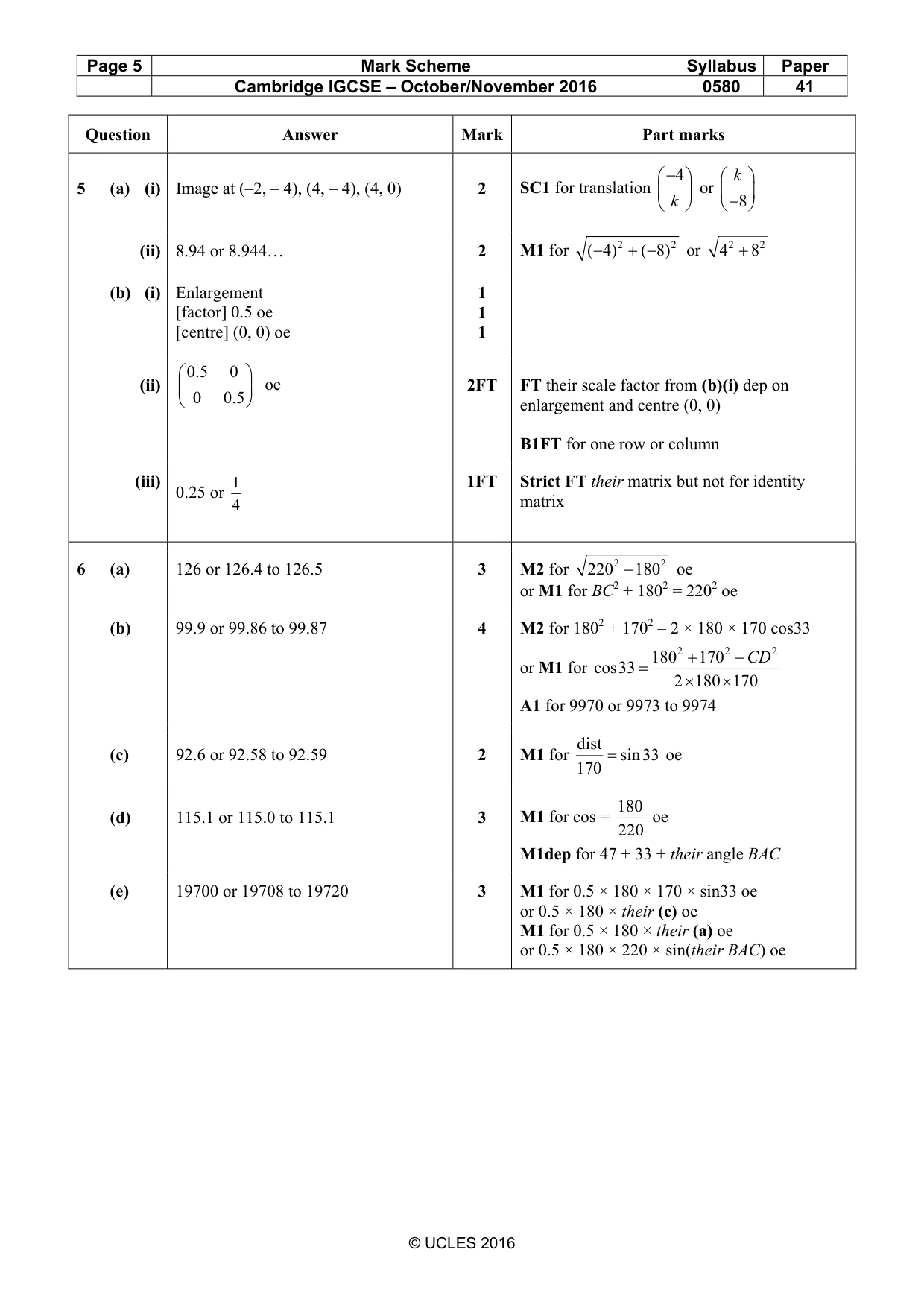
Mark scheme: 4 k 5 (a) (i) Image at (–2, – 4), (4, – 4), (4, 0) 2 SC1 for translation or k −8 (ii) 8.94 or 8.944… 2 M1 for ( − 4) 2 + ( − 8) 2 or 4 2 + 8 2 (b) (i) Enlargement 1 [factor] 0.5 oe 1 [centre] (0, 0) oe 1 0.5 0 (ii) oe 2FT FT their scale factor from (b)(i) dep on 0 0.5 enlargement and centre (0, 0) B1FT for one row or column (iii) 1 1FT Strict FT their matrix but not for identity 0.25 or 4 matrix 2 2
Q6 · D North 170 m NOT TO SCALE C 33° 180 m A 220 m B The diagram shows five straight…
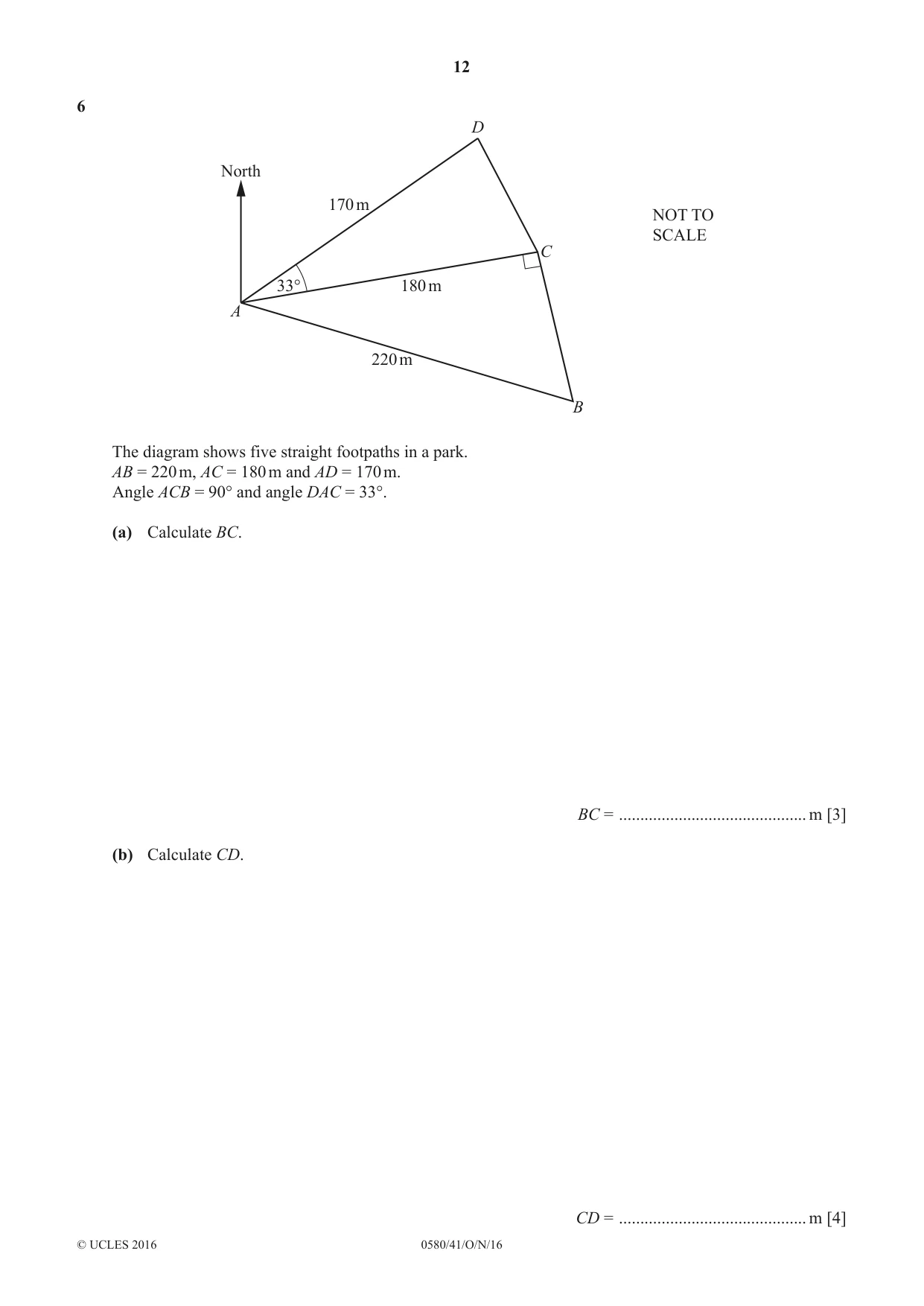
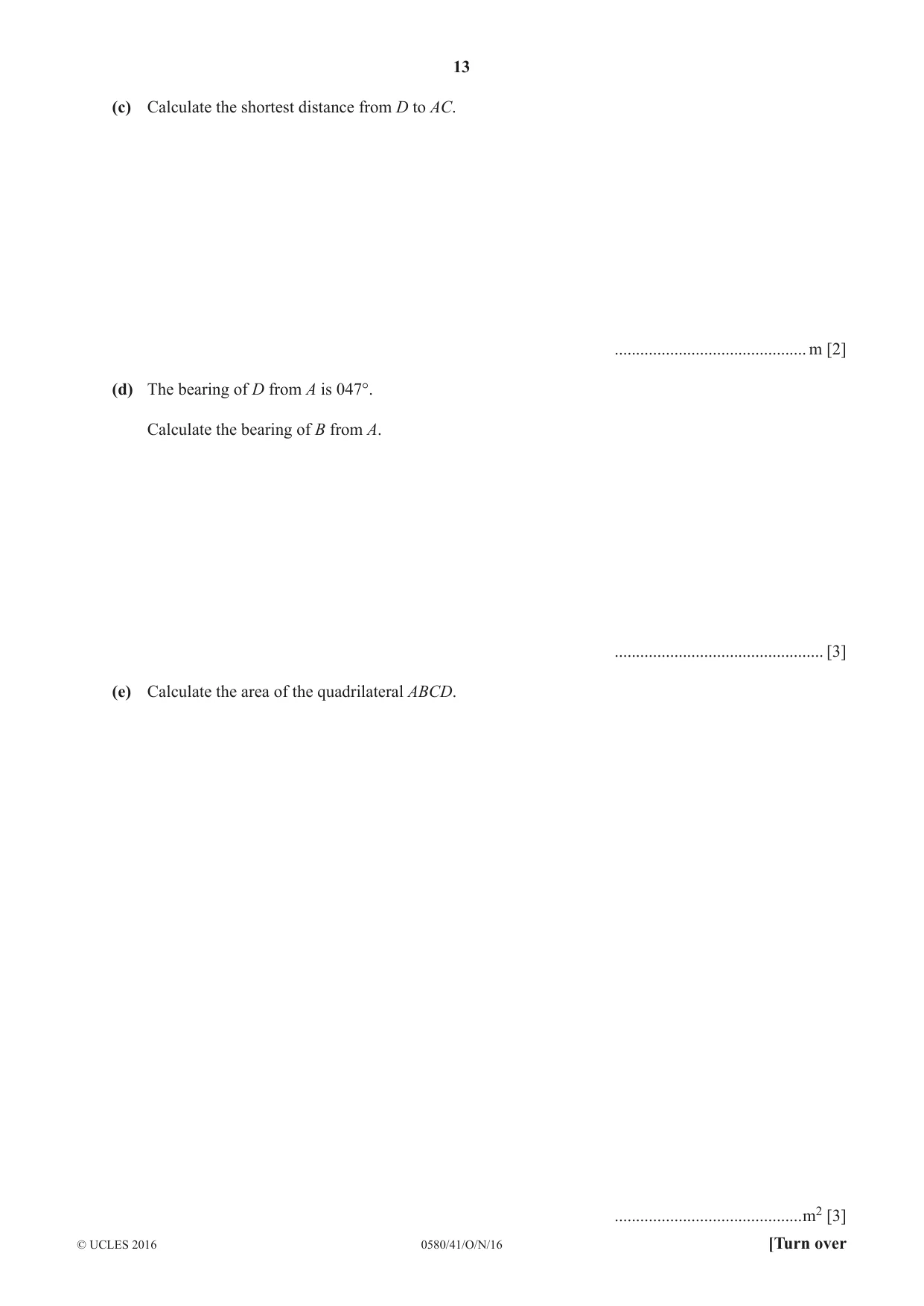
6 D North 170 m NOT TO SCALE C 33° 180 m A 220 m B The diagram shows five straight footpaths in a park. AB = 220 m, AC = 180 m and AD = 170 m. Angle ACB = 90° and angle DAC = 33°. (a) Calculate BC. BC = ............................................ m [3] (b) Calculate CD. CD = ............................................ m [4] (c) Calculate the shortest distance from D to AC. ............................................. m [2] (d) The bearing of D from A is 047°. Calculate the bearing of B from A. ................................................. [3] (e) Calculate the area of the quadrilateral ABCD. ............................................m2 [3]
Mark scheme: 6 (a) 126 or 126.4 to 126.5 3 M2 for 220 2 − 180 2 oe or M1 for BC2 + 1802 = 2202 oe (b) 99.9 or 99.86 to 99.87 4 M2 for 1802 + 1702 – 2 × 180 × 170 cos33 180 2 + 170 2 − CD 2 or M1 for cos33 = 2 × 180 × 170 A1 for 9970 or 9973 to 9974 dist (c) 92.6 or 92.58 to 92.59 2 M1 for = sin33 oe 170 180 (d) 115.1 or 115.0 to 115.1 3 M1 for cos = oe 220 M1dep for 47 + 33 + their angle BAC (e) 19700 or 19708 to 19720 3 M1 for 0.5 × 180 × 170 × sin33 oe or 0.5 × 180 × their (c) oe M1 for 0.5 × 180 × their (a) oe or 0.5 × 180 × 220 × sin(their BAC) oe
Q7 · A train stops at station A and then at station B
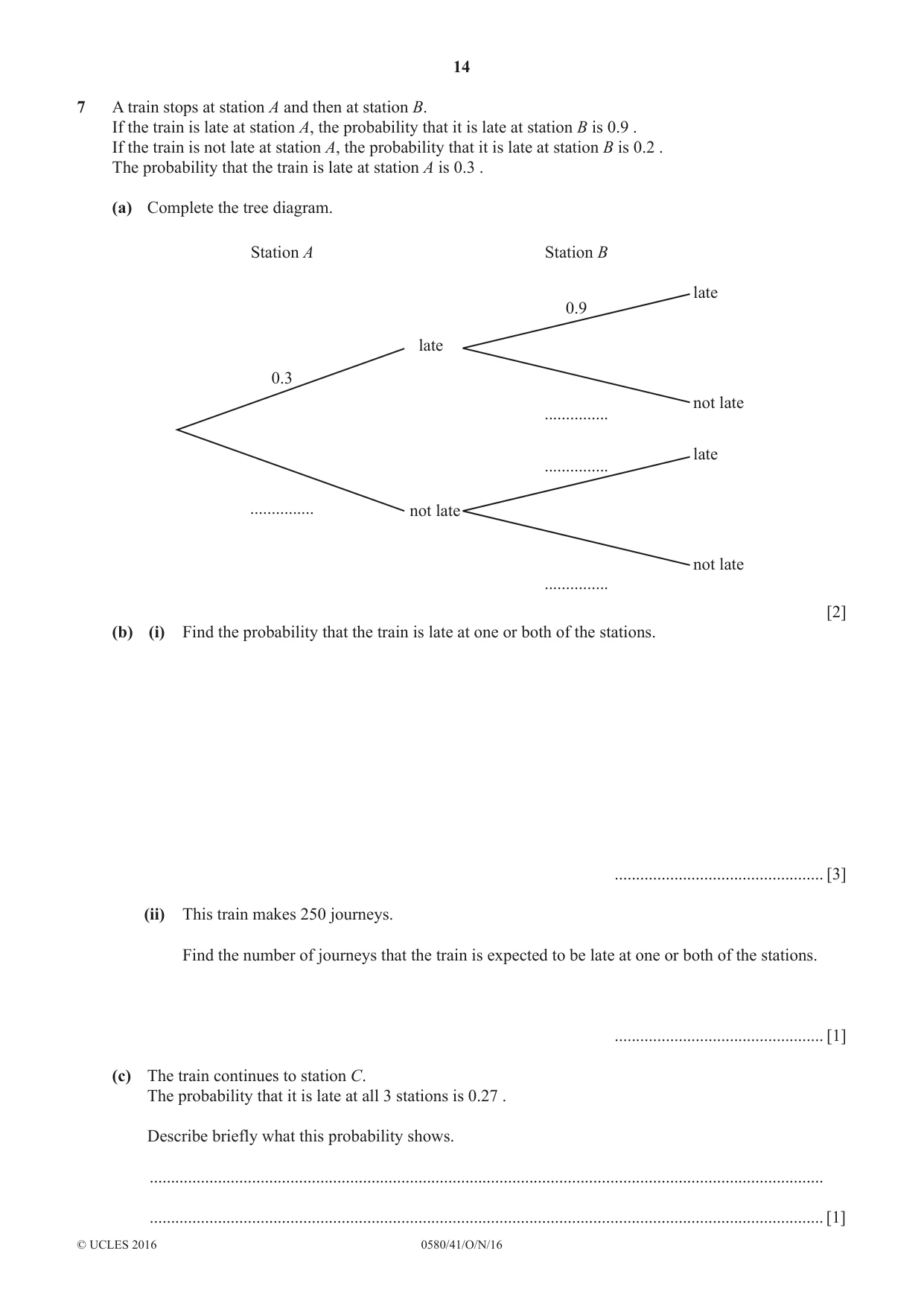
7 A train stops at station A and then at station B. If the train is late at station A, the probability that it is late at station B is 0.9 . If the train is not late at station A, the probability that it is late at station B is 0.2 . The probability that the train is late at station A is 0.3 . (a) Complete the tree diagram. Station A Station B late 0.9 late 0.3 not late ............... late ............... ............... not late not late ............... [2] (b) (i) Find the probability that the train is late at one or both of the stations. ................................................. [3] (ii) This train makes 250 journeys. Find the number of journeys that the train is expected to be late at one or both of the stations. ................................................. [1] (c) The train continues to station C. The probability that it is late at all 3 stations is 0.27 . Describe briefly what this probability shows. .............................................................................................................................................................. .............................................................................................................................................................. [1]
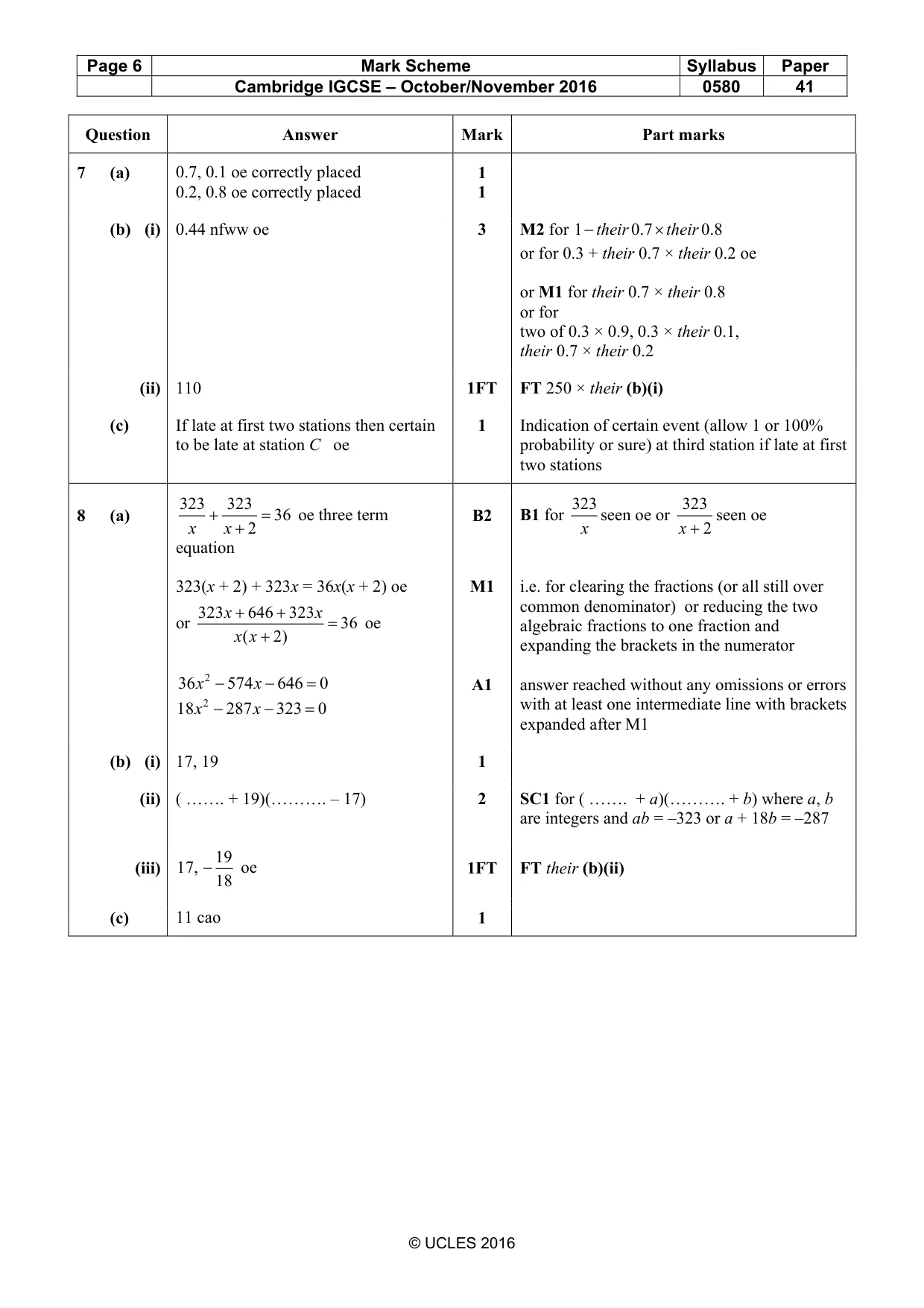
Mark scheme: 7 (a) 0.7, 0.1 oe correctly placed 1 0.2, 0.8 oe correctly placed 1 (b) (i) 0.44 nfww oe 3 M2 for 1 − their 0.7 × their 0.8 or for 0.3 + their 0.7 × their 0.2 oe or M1 for their 0.7 × their 0.8 or for two of 0.3 × 0.9, 0.3 × their 0.1, their 0.7 × their 0.2 (ii) 110 1FT FT 250 × their (b)(i) (c) If late at first two stations then certain 1 Indication of certain event (allow 1 or 100% to be late at station C oe probability or sure) at third station if late at first two stations 323 323 323 323
Q8 · Apples cost x cents each and oranges cost (x + 2) cents each
8 Apples cost x cents each and oranges cost (x + 2) cents each. Dylan spends $3.23 on apples and $3.23 on oranges. The total of the number of apples and the number of oranges Dylan buys is 36. (a) Write an equation in x and show that it simplifies to 18x 2 - 287x - 323 = 0 . [4] (b) (i) Find the two prime factors of 323. ....................... , .......................[1] (ii) Complete the statement. 18x 2 - 287 x - 323 = (18x ......................)(x ......................) [2] (iii) Solve the equation 18x 2 - 287x - 323 = 0 . x = .......................... or x = ..........................[1] (c) Find the largest number of apples Dylan can buy for $2. ................................................. [1]
Mark scheme: 323 323 323 323 8 (a) + = 36 oe three term B2 B1 for seen oe or seen oe x x + 2 x x + 2 equation 323(x + 2) + 323x = 36x(x + 2) oe M1 i.e. for clearing the fractions (or all still over common denominator) or reducing the two 323 x + 646 + 323 x or = 36 oe algebraic fractions to one fraction and x ( x + 2) expanding the brackets in the numerator 36 x 2 − 574 x − 646 = 0 A1 answer reached without any omissions or errors 18 x 2 − 287 x − 323 = 0 with at least one intermediate line with brackets expanded after M1 (b) (i) 17, 19 1 (ii) ( ……. + 19)(………. – 17) 2 SC1 for ( ……. + a)(………. + b) where a, b are integers and ab = –323 or a + 18b = –287 19 (iii) 17, − oe 1FT FT their (b)(ii) 18 (c) 11 cao 1
Q9 · F(x) = 2x + 1 g(x) = 3x - 2 h(x) = 3 x (a) Find hf(2) – f h(1)
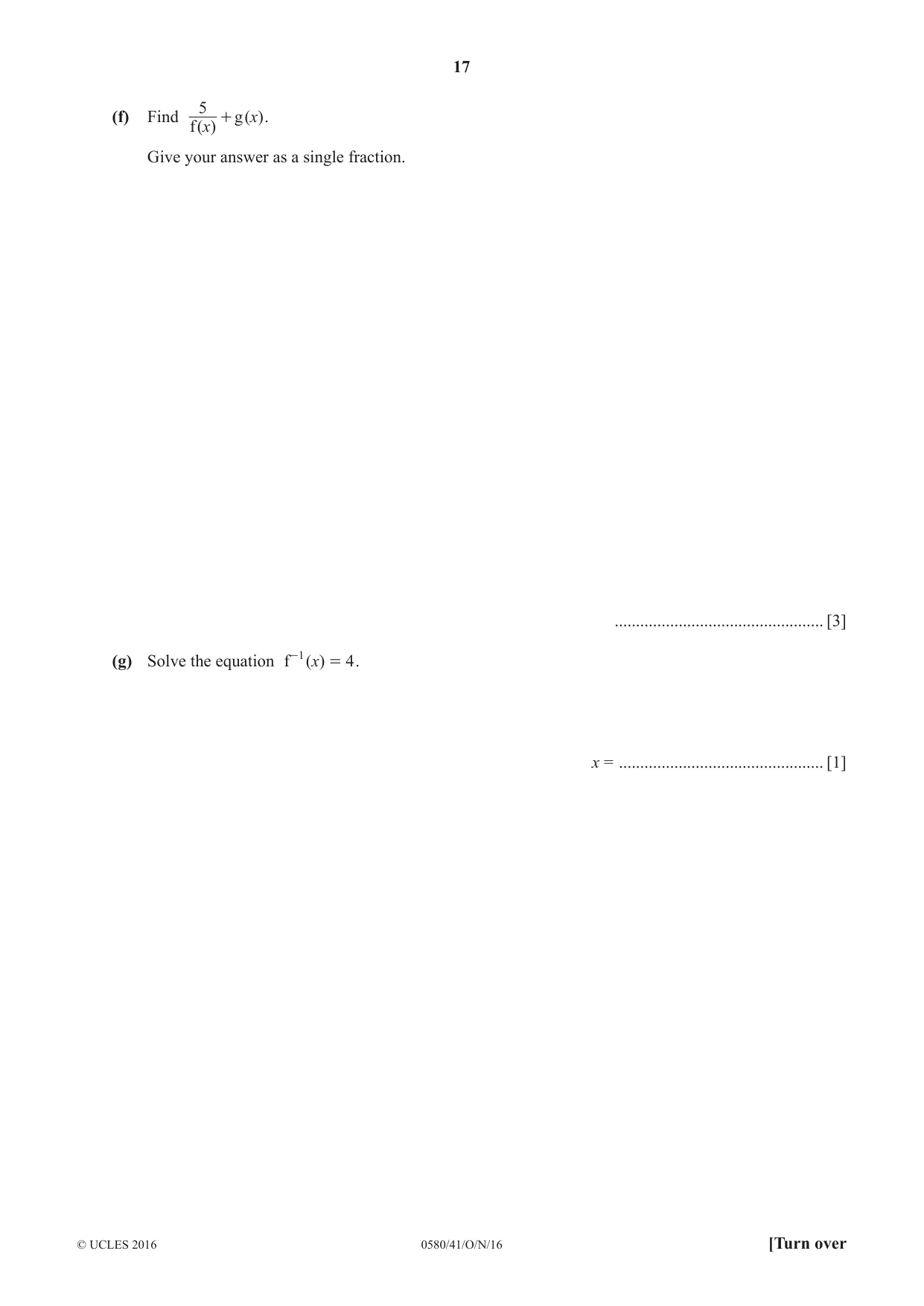
9 f(x) = 2x + 1 g(x) = 3x - 2 h(x) = 3 x (a) Find hf(2) – f h(1). ................................................. [3] (b) Find gf(x), giving your answer in its simplest form. ................................................. [2] (c) Solve the inequality f(x) 2 g (x) . ................................................. [2] 1 (d) Solve the equation h(x) = . 9 x = ................................................ [1] (e) Find g -1 ()x . g -1 ()x = ................................................ [2] 5(f) Find + g(x) . f(x) Give your answer as a single fraction. ................................................. [3] (g) Solve the equation f -1 (x) = 4 . x = ................................................ [1]
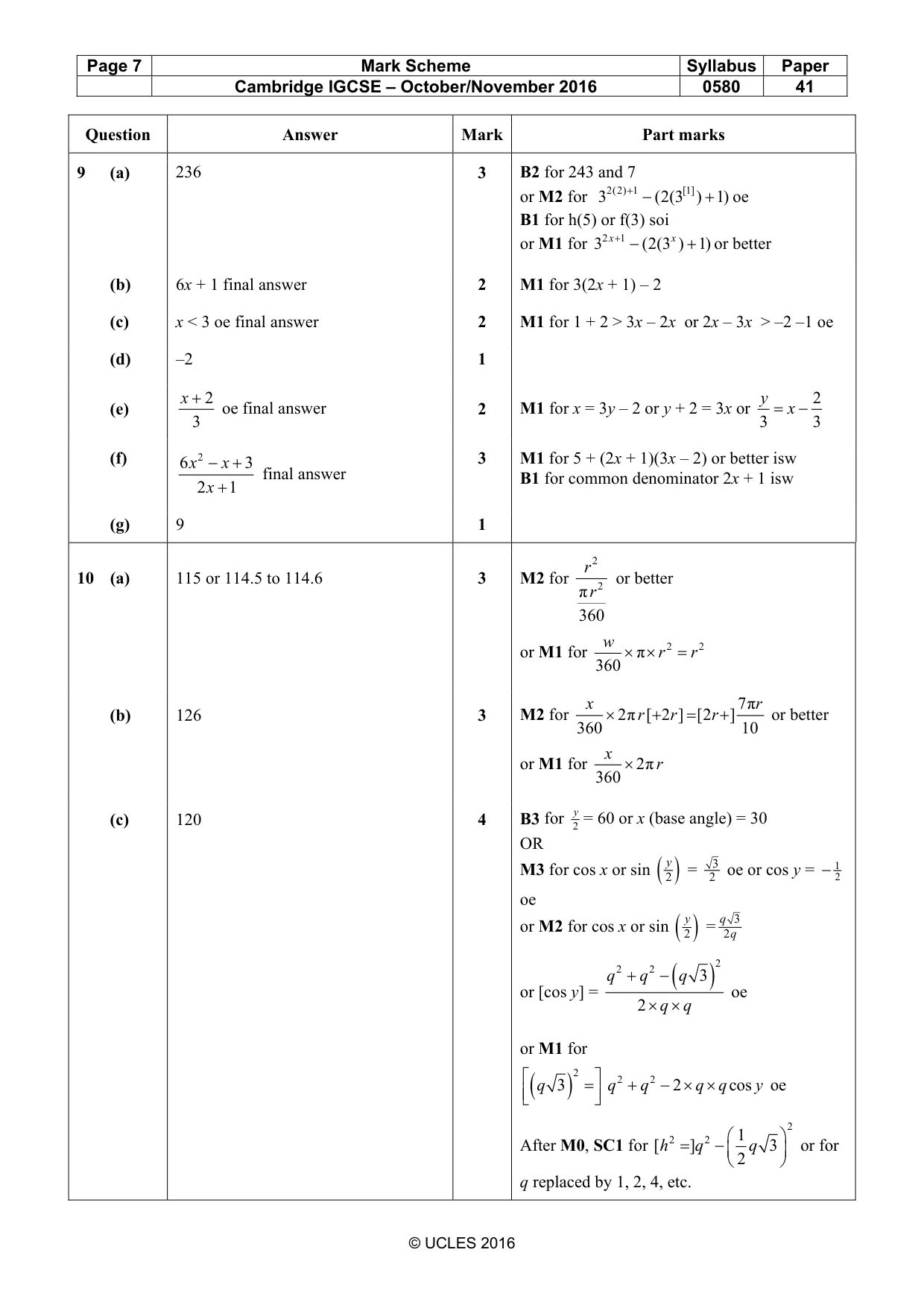
Mark scheme: 9 (a) 236 3 B2 for 243 and 7 or M2 for 32(2) +1 − (2(3[1] ) + 1) oe B1 for h(5) or f(3) soi or M1 for 32 x +1 − (2(3 x ) + 1) or better (b) 6x + 1 final answer 2 M1 for 3(2x + 1) – 2 (c) x < 3 oe final answer 2 M1 for 1 + 2 > 3x – 2x or 2x – 3x > –2 –1 oe (d) –2 1 x + 2 y 2 (e) oe final answer 2 M1 for x = 3y – 2 or y + 2 = 3x or = x − 3 3 3 (f) 6 x 2 − x + 3 3 M1 for 5 + (2x + 1)(3x – 2) or better isw final answer B1 for common denominator 2x + 1 isw 2 x + 1 (g) 9 1 2r
Q10 · R cm NOT TO SCALE w° r cm The area of this sector is r2 square centimetres
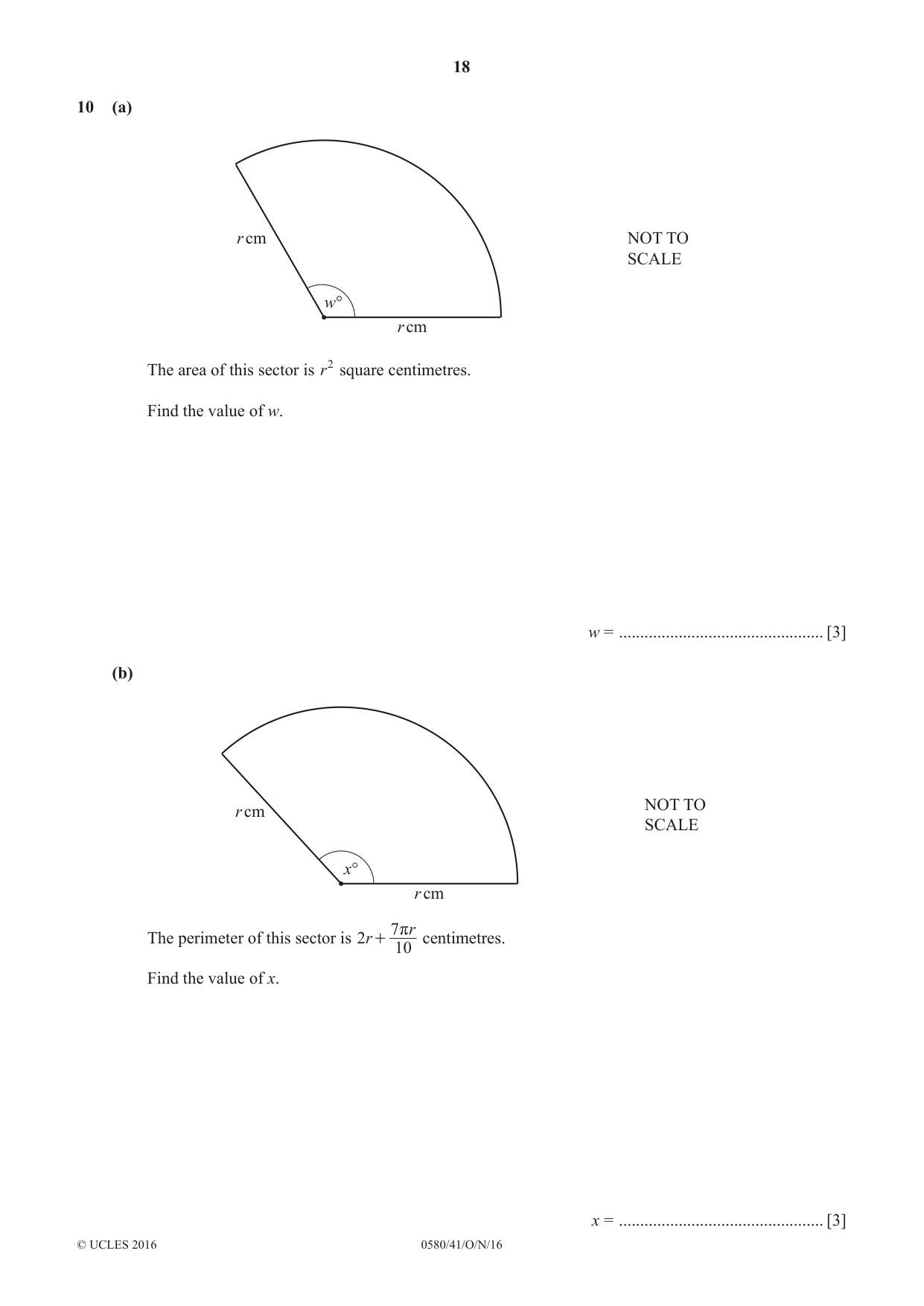
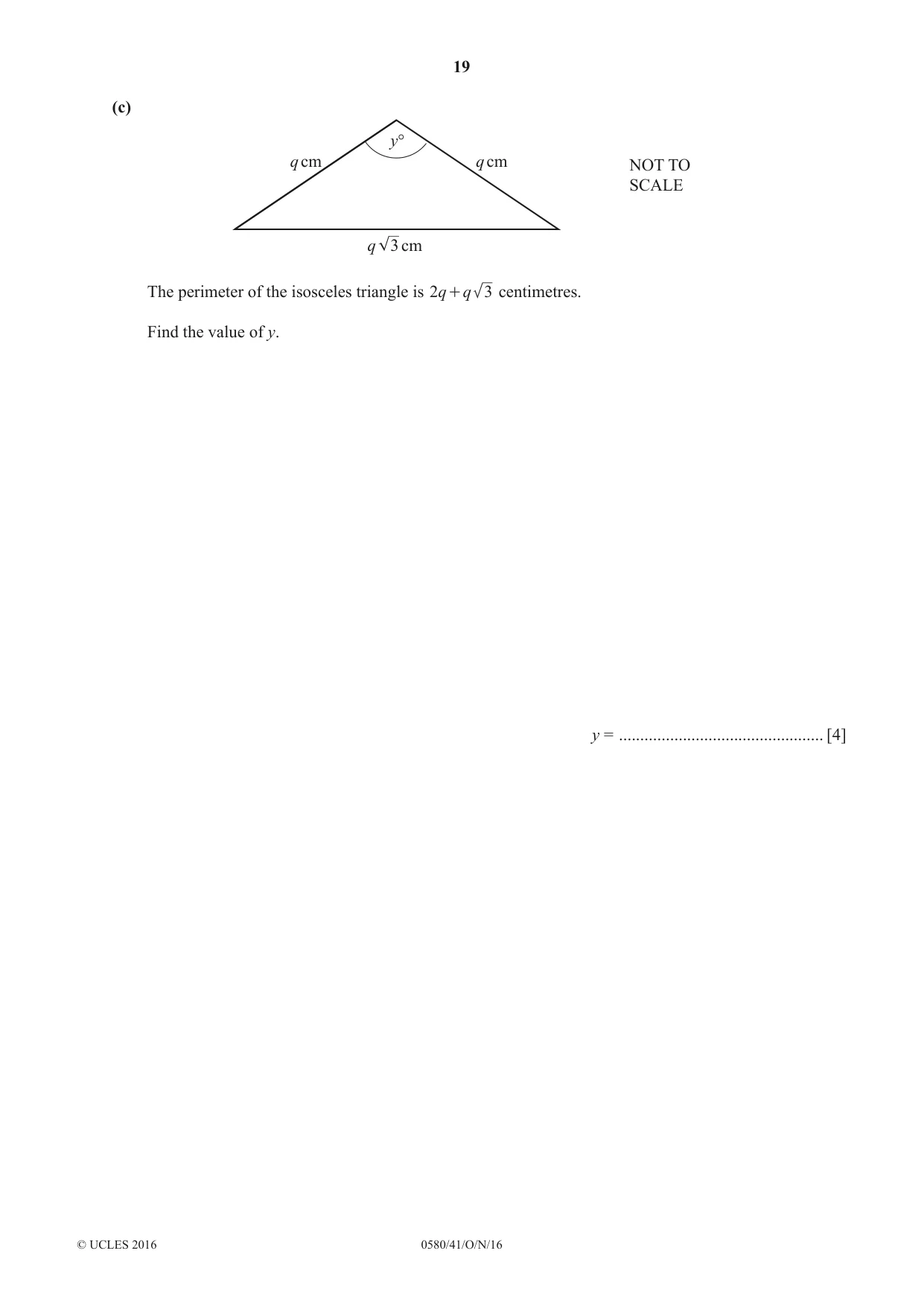
10 (a) r cm NOT TO SCALE w° r cm The area of this sector is r2 square centimetres. Find the value of w. w = ................................................ [3] (b) NOT TO r cm SCALE x° r cm 7r r The perimeter of this sector is 2r + centimetres. 10 Find the value of x. x = ................................................ [3] (c) y° q cm q cm NOT TO SCALE cm The perimeter of the isosceles triangle is 2q + q 3 centimetres. Find the value of y. y = ................................................ [4]
Mark scheme: r 10 (a) 115 or 114.5 to 114.6 3 M2 for 2 or better π r 360 w 2 2 or M1 for × π × r = r 360 x 7π r (b) 126 3 M2 for × 2π r [ + 2 r ] = [2 r + ] or better 360 10 x or M1 for × 2π r 360 (c) 120 4 B3 for 2y = 60 or x (base angle) = 30 OR = M3 for cos x or sin y 3 1 oe or cos y = − 2 2 ( 2 ) oe y q 3 or M2 for cos x or sin = ( 2 ) 2 q 2 q 2 + q 2 − q 3 ( ) or [cos y] = oe 2 × q × q or M1 for 2 2 2 q 3 = q + q − 2 × q × q cos y oe ( ) 2 2 1 2 After M0, SC1 for [ h = ]q − q 3 or for 2 q replaced by 1, 2, 4, etc.
What was in this paper
The subtopics covered by these 10 questions, and how many questions each got. Open one in a new tab to see every Cambridge question on it.
What you needed in this session
Cambridge’s own grade thresholds for 2016 Oct/Nov, Paper 4 · Variant 1. A higher threshold means an easier paper — the bar moves with how the cohort did.