Cambridge IGCSE Mathematics 0580 — 2016 May/June Paper 4 · Variant 2
0580/42/M/J/16 · 9 questions · 130 marks · ≈146 min
The question paper and its mark scheme, free to read here and free to download. This is Cambridge’s own paper, exactly as it was sat.
Question paper16 pages
Mark scheme7 pages
Answers below. Sit the paper first if you are practising.
Questions as text
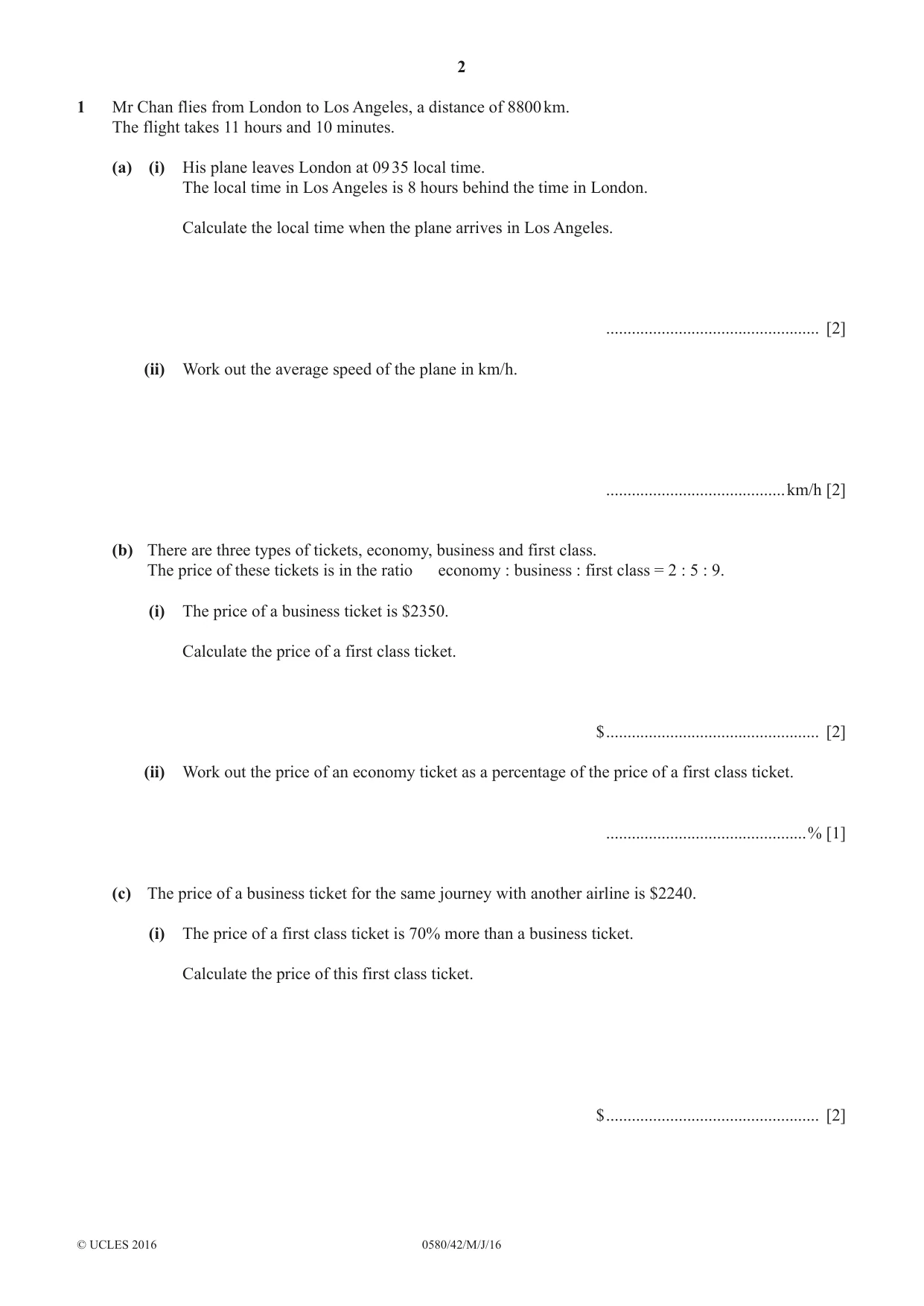
Q1 · Mr Chan flies from London to Los Angeles, a distance of 8800 km
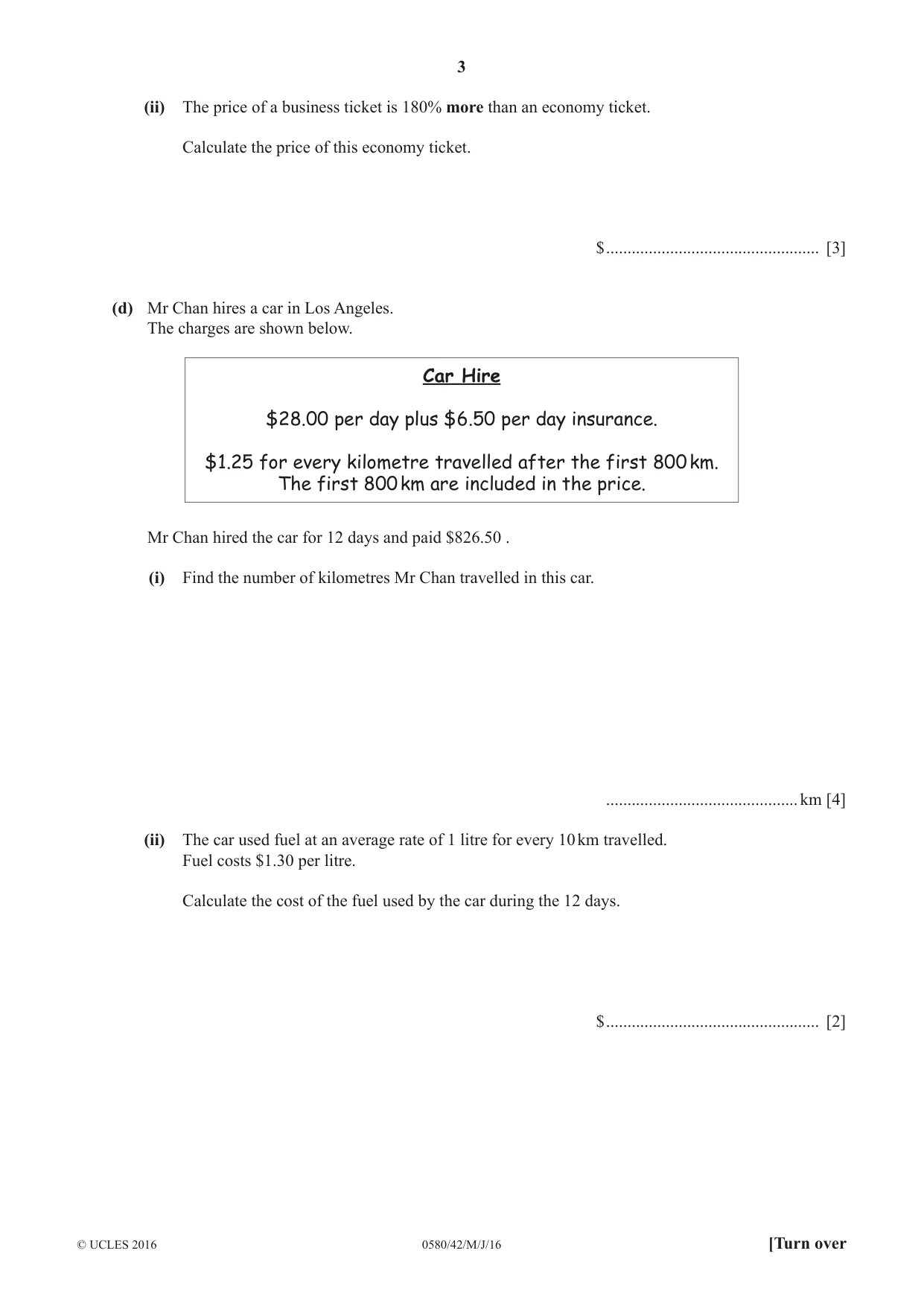
1 Mr Chan flies from London to Los Angeles, a distance of 8800 km. The flight takes 11 hours and 10 minutes. (a) (i) His plane leaves London at 09 35 local time. The local time in Los Angeles is 8 hours behind the time in London. Calculate the local time when the plane arrives in Los Angeles. .................................................. [2] (ii) Work out the average speed of the plane in km/h. ..........................................km/h [2] (b) There are three types of tickets, economy, business and first class. The price of these tickets is in the ratio economy : business : first class = 2 : 5 : 9. (i) The price of a business ticket is $2350. Calculate the price of a first class ticket. $ .................................................. [2] (ii) Work out the price of an economy ticket as a percentage of the price of a first class ticket. ...............................................% [1] (c) The price of a business ticket for the same journey with another airline is $2240. (i) The price of a first class ticket is 70% more than a business ticket. Calculate the price of this first class ticket. $ .................................................. [2] (ii) The price of a business ticket is 180% more than an economy ticket. Calculate the price of this economy ticket. $ .................................................. [3] (d) Mr Chan hires a car in Los Angeles. The charges are shown below. Car Hire $28.00 per day plus $6.50 per day insurance. $1.25 for every kilometre travelled after the first 800 km. The first 800 km are included in the price. Mr Chan hired the car for 12 days and paid $826.50 . (i) Find the number of kilometres Mr Chan travelled in this car. .............................................km [4] (ii) The car used fuel at an average rate of 1 litre for every 10 km travelled. Fuel costs $1.30 per litre. Calculate the cost of the fuel used by the car during the 12 days. $ .................................................. [2]
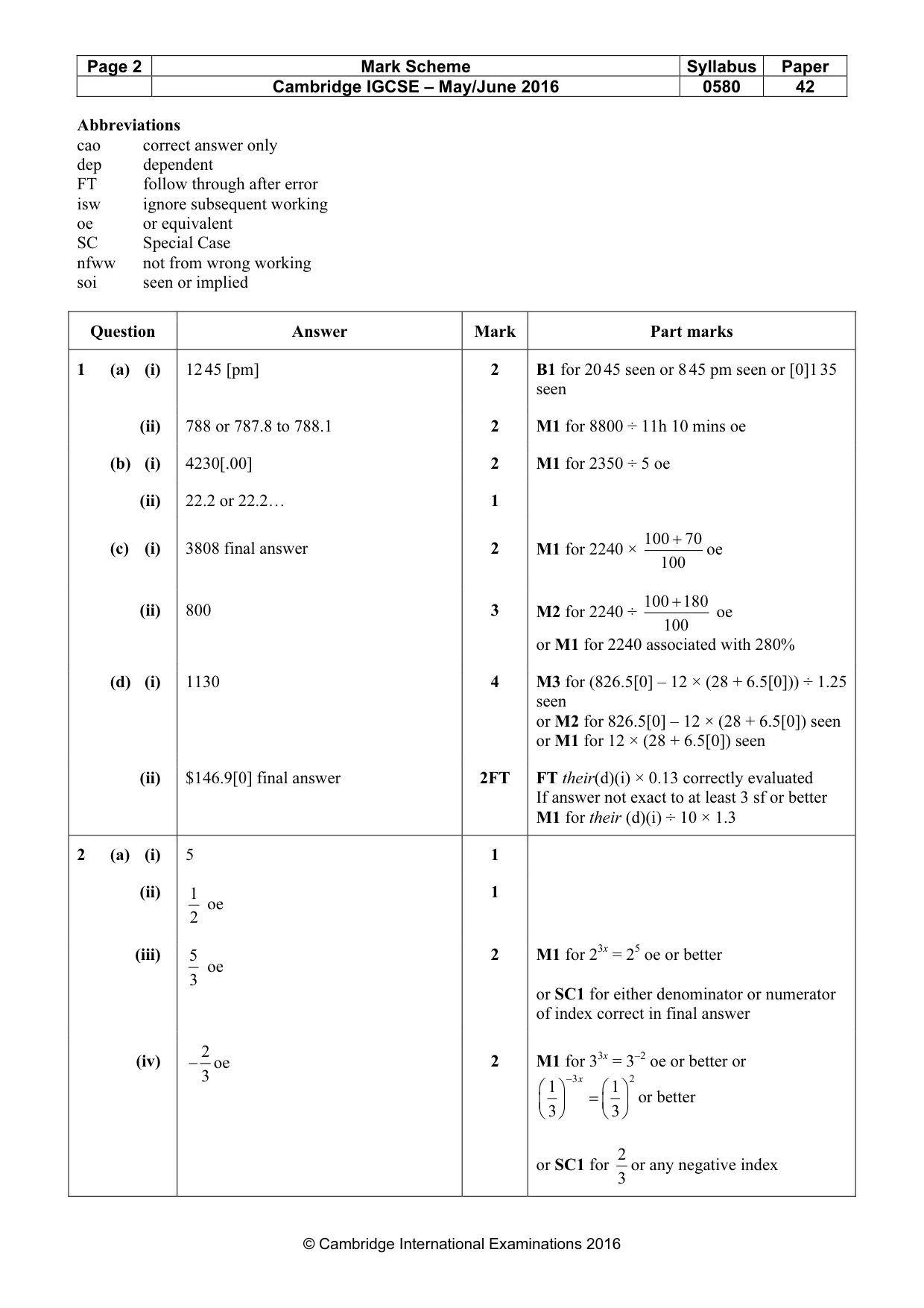
Mark scheme: Question Answer Mark Part marks 1 (a) (i) 12 45 [pm] 2 B1 for 20 45 seen or 8 45 pm seen or [0]1 35 seen (ii) 788 or 787.8 to 788.1 2 M1 for 8800 ÷ 11h 10 mins oe (b) (i) 4230[.00] 2 M1 for 2350 ÷ 5 oe (ii) 22.2 or 22.2… 1 100 + 70 (c) (i) 3808 final answer 2 M1 for 2240 × oe 100 100 + 180 (ii) 800 3 M2 for 2240 ÷ oe 100 or M1 for 2240 associated with 280% (d) (i) 1130 4 M3 for (826.5[0] – 12 × (28 + 6.5[0])) ÷ 1.25 seen or M2 for 826.5[0] – 12 × (28 + 6.5[0]) seen or M1 for 12 × (28 + 6.5[0]) seen (ii) $146.9[0] final answer 2FT FT their(d)(i) × 0.13 correctly evaluated If answer not exact to at least 3 sf or better M1 for their (d)(i) ÷ 10 × 1.3
Q2 · Work out the value of x in each of the following
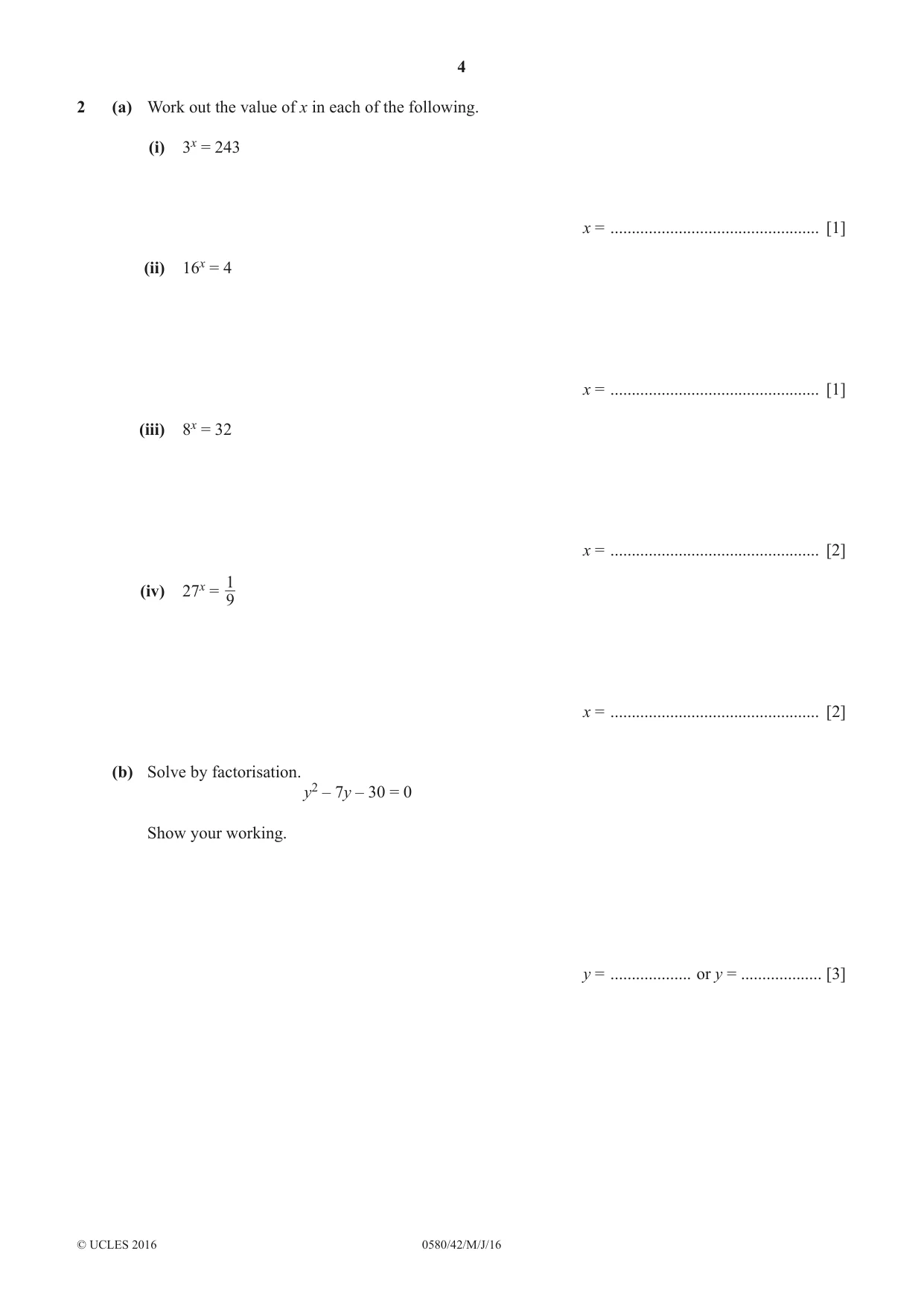
2 (a) Work out the value of x in each of the following. (i) 3x = 243 x = ................................................. [1] (ii) 16x = 4 x = ................................................. [1] (iii) 8x = 32 x = ................................................. [2] 1 (iv) 27x = 9 x = ................................................. [2] (b) Solve by factorisation. y2 – 7y – 30 = 0 Show your working. y = ................... or y = ................... [3]
Mark scheme: 2 (a) (i) 5 1 (ii) 1 1 oe 2 (iii) 5 2 M1 for 23x = 25 oe or better oe 3 or SC1 for either denominator or numerator of index correct in final answer 2 (iv) − oe 2 M1 for 33x = 3–2 oe or better or 3 −3 x 2 1 1 = or better 3 3 2 or SC1 for or any negative index 3
Q3 · Y 5 4 3 A 2 1 x –4 –3 –2 –1 0 1 2 3 4 5 6 7 –1 –2 –3 –4 –5 –6 On the grid, draw the image…
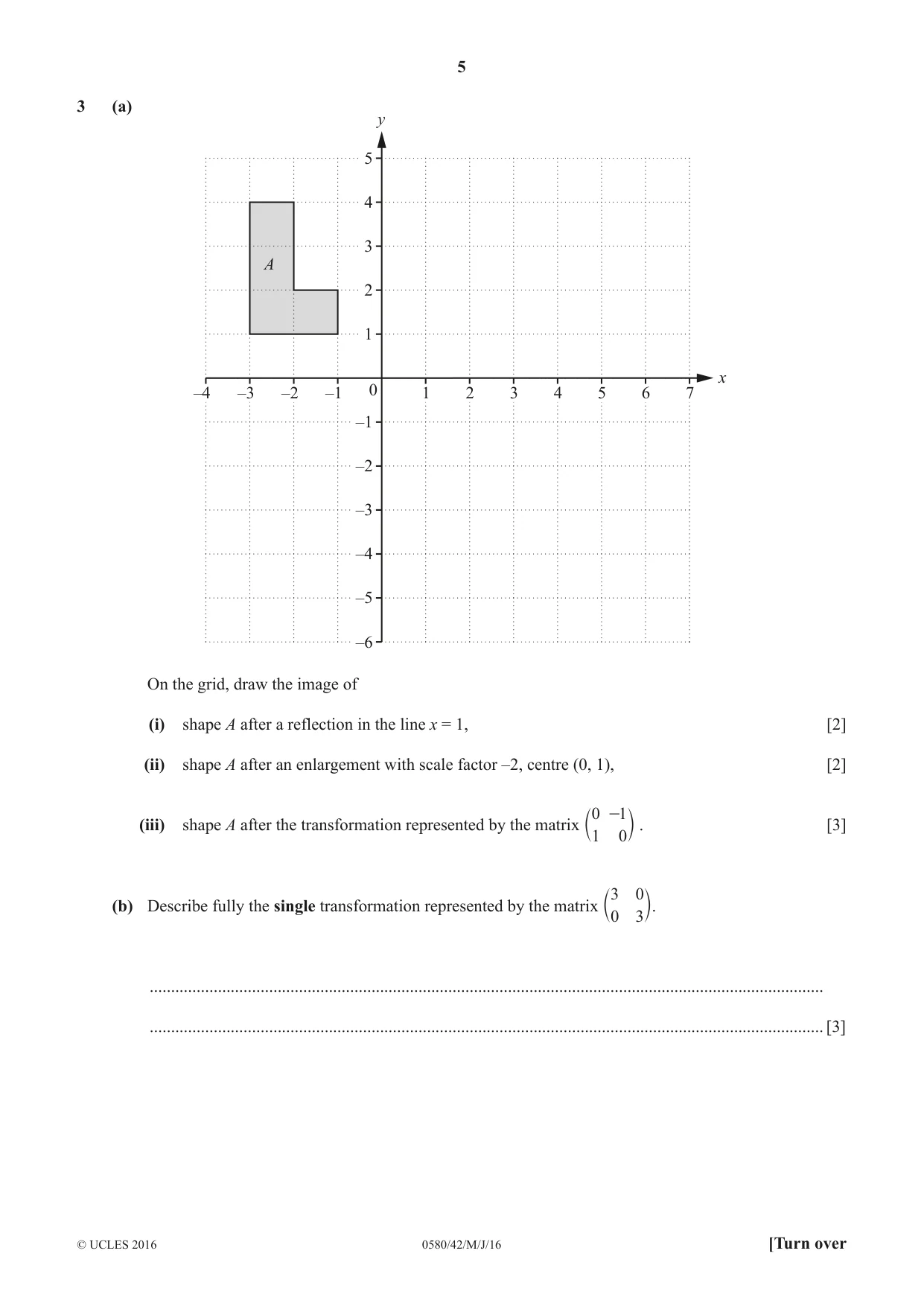
3 (a) y 5 4 3 A 2 1 x –4 –3 –2 –1 0 1 2 3 4 5 6 7 –1 –2 –3 –4 –5 –6 On the grid, draw the image of (i) shape A after a reflection in the line x = 1, [2] (ii) shape A after an enlargement with scale factor –2, centre (0, 1), [2] 0 -1 (iii) shape A after the transformation represented by the matrix . [3] c m 1 0 3 0 (b) Describe fully the single transformation represented by the matrix c m. 0 3 .............................................................................................................................................................. .............................................................................................................................................................. [3]
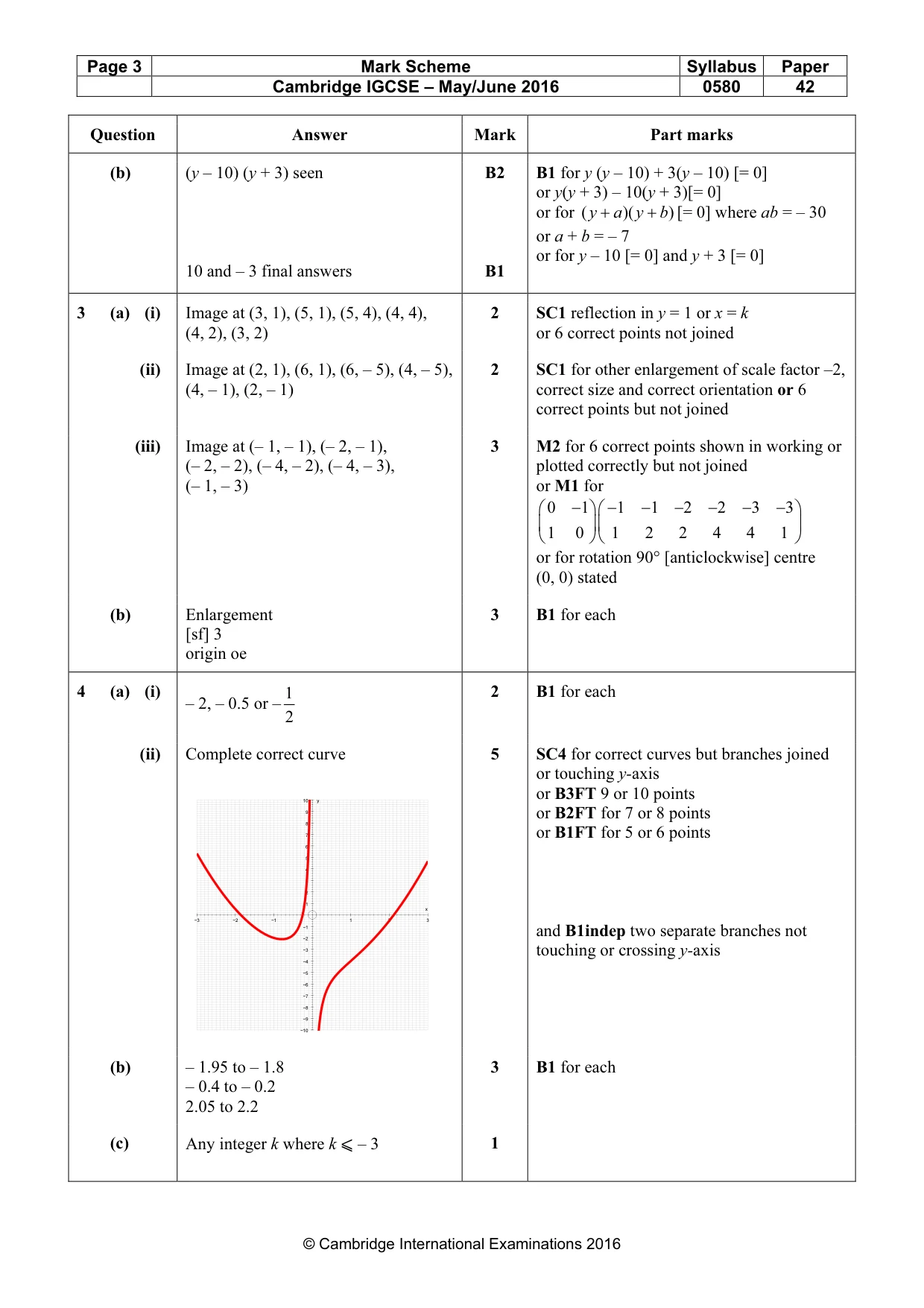
Mark scheme: 3 (a) (i) Image at (3, 1), (5, 1), (5, 4), (4, 4), 2 SC1 reflection in y = 1 or x = k (4, 2), (3, 2) or 6 correct points not joined (ii) Image at (2, 1), (6, 1), (6, – 5), (4, – 5), 2 SC1 for other enlargement of scale factor –2, (4, – 1), (2, – 1) correct size and correct orientation or 6 correct points but not joined (iii) Image at (– 1, – 1), (– 2, – 1), 3 M2 for 6 correct points shown in working or (– 2, – 2), (– 4, – 2), (– 4, – 3), plotted correctly but not joined (– 1, – 3) or M1 for 0 −1 −1 −1 −2 −2 −3 −3 1 0 1 2 2 4 4 1 or for rotation 90° [anticlockwise] centre (0, 0) stated (b) Enlargement 3 B1 for each [sf] 3 origin oe
Q4 · F(x) = x2 – – 4 , x ≠ 0 x (a) (i) Complete the table
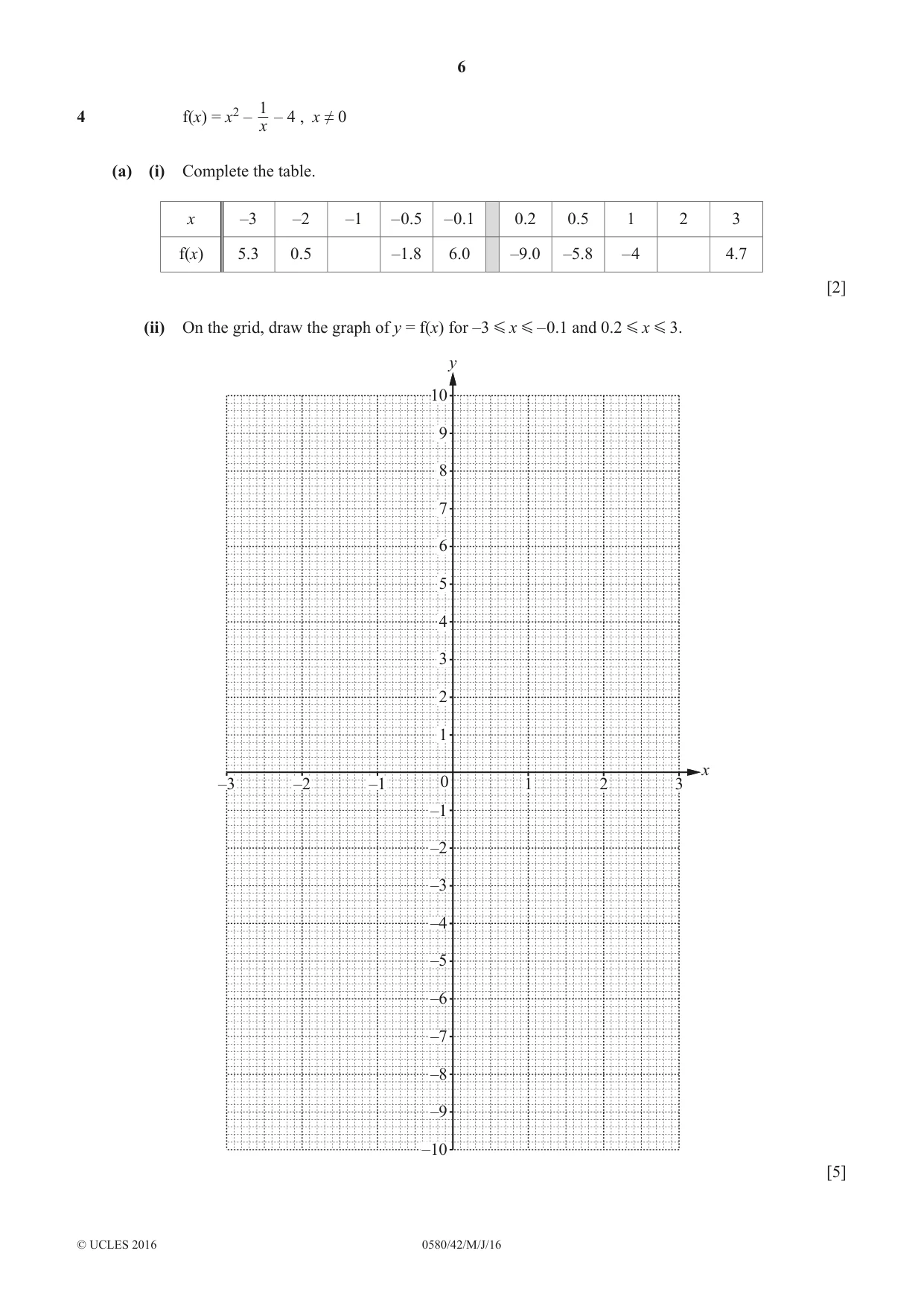
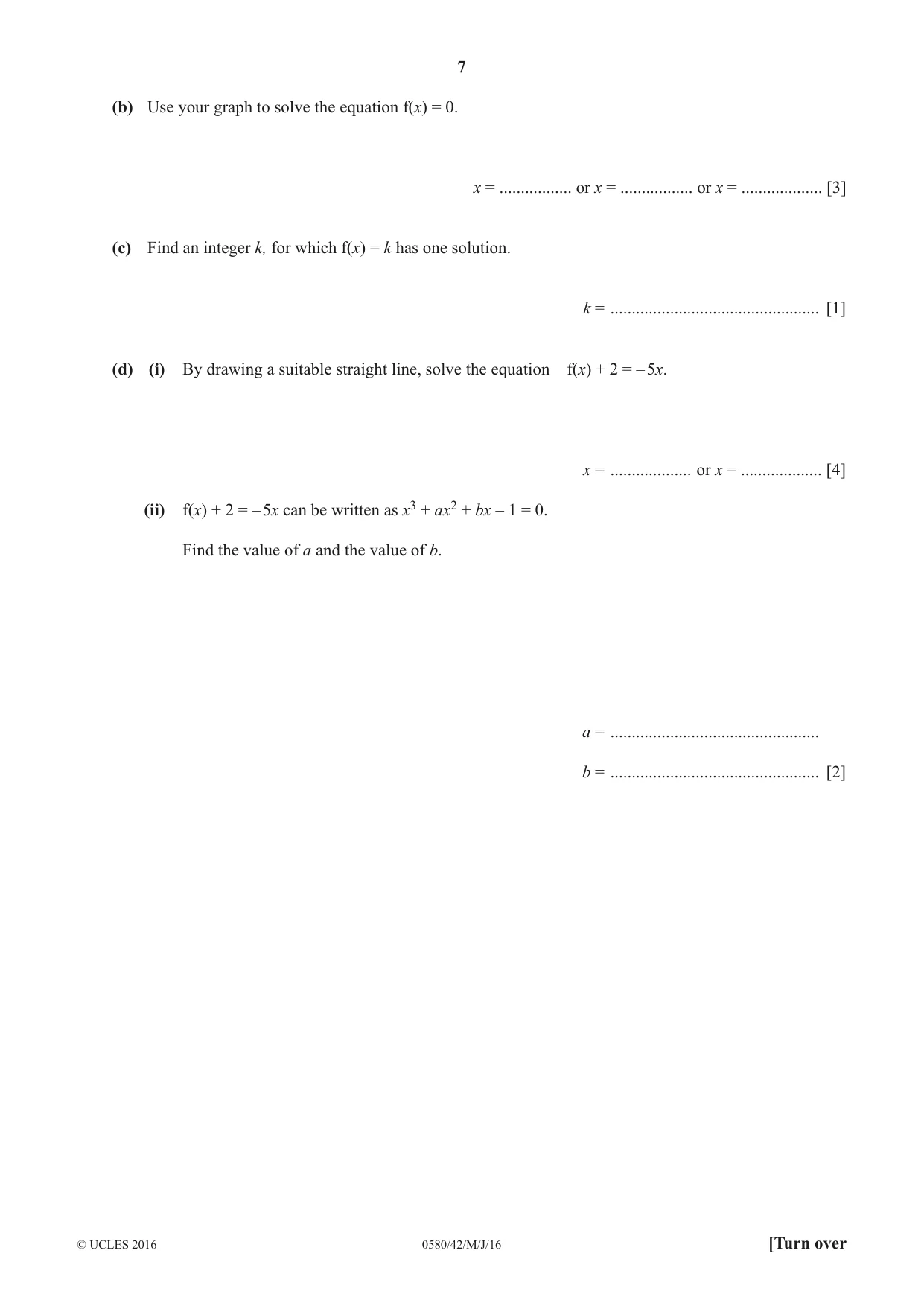
14 f(x) = x2 – – 4 , x ≠ 0 x (a) (i) Complete the table. x –3 –2 –1 –0.5 –0.1 0.2 0.5 1 2 3 f(x) 5.3 0.5 –1.8 6.0 –9.0 –5.8 –4 4.7 [2] (ii) On the grid, draw the graph of y = f(x) for –3 G x G –0.1 and 0.2 G x G 3. y 10 9 8 7 6 5 4 3 2 1 x –3 –2 –1 0 1 2 3 –1 –2 –3 –4 –5 –6 –7 –8 –9 –10 [5] (b) Use your graph to solve the equation f(x) = 0. x = ................. or x = ................. or x = ................... [3] (c) Find an integer k, for which f(x) = k has one solution. k = ................................................. [1] (d) (i) By drawing a suitable straight line, solve the equation f(x) + 2 = – 5x. x = ................... or x = ................... [4] (ii) f(x) + 2 = – 5x can be written as x3 + ax2 + bx – 1 = 0. Find the value of a and the value of b. a = ................................................. b = ................................................. [2]
Mark scheme: 4 (a) (i) 1 2 B1 for each – 2, – 0.5 or – 2 (ii) Complete correct curve 5 SC4 for correct curves but branches joined or touching y-axis 10 y or B3FT 9 or 10 points 9 8 or B2FT for 7 or 8 points 7 or B1FT for 5 or 6 points 6 5 4 3 2 1 x −3 −2 −1 1 2 3 −1 −2 and B1indep two separate branches not −3 −4 touching or crossing y-axis −5 −6 −7 −8 −9 −10 (b) – 1.95 to – 1.8 3 B1 for each – 0.4 to – 0.2 2.05 to 2.2 (c) Any integer k where k ⩽ – 3 1
Q5 · Kiah plays a game
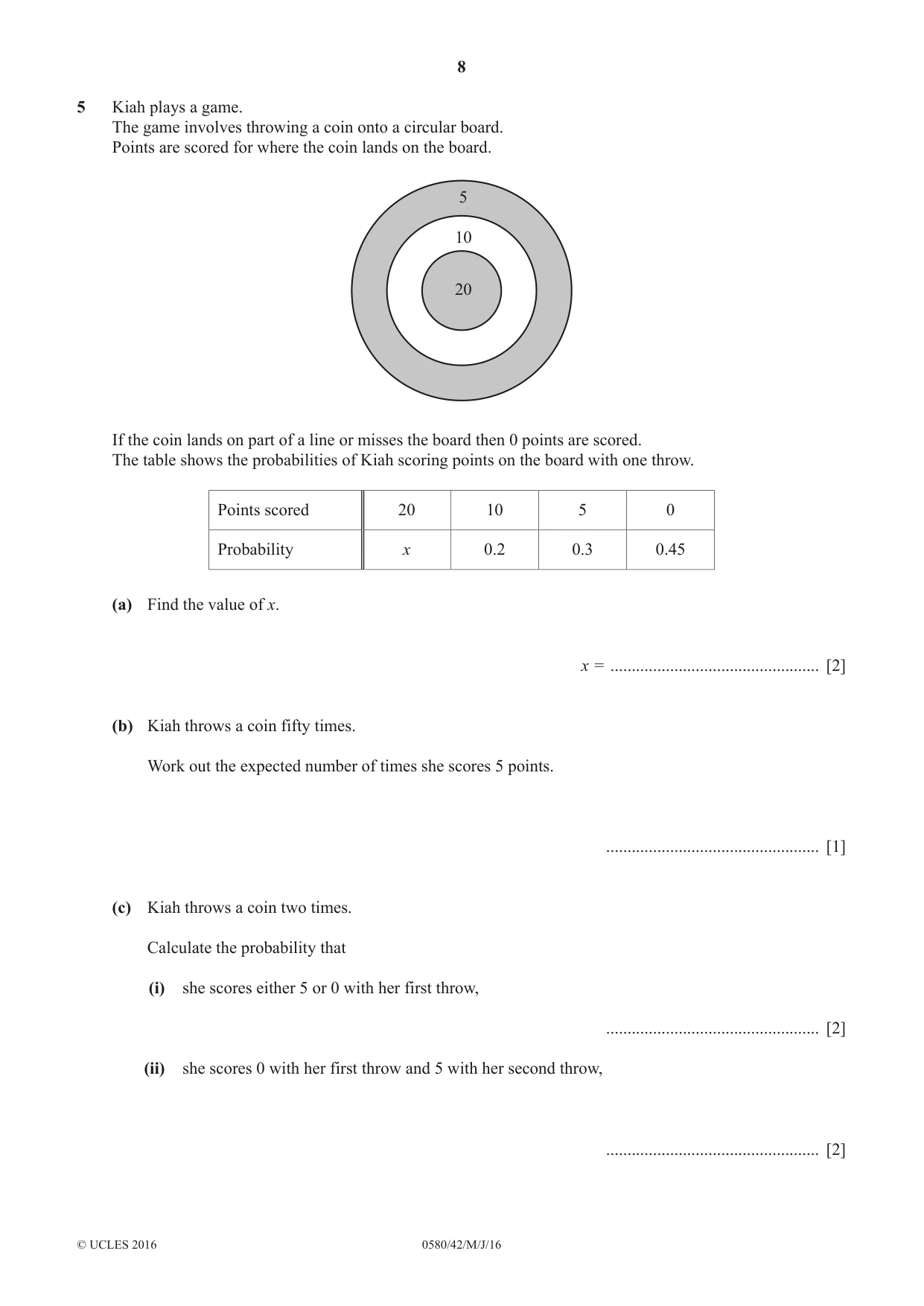
5 Kiah plays a game. The game involves throwing a coin onto a circular board. Points are scored for where the coin lands on the board. 5 10 20 If the coin lands on part of a line or misses the board then 0 points are scored. The table shows the probabilities of Kiah scoring points on the board with one throw. Points scored 20 10 5 0 Probability x 0.2 0.3 0.45 (a) Find the value of x. x = ................................................. [2] (b) Kiah throws a coin fifty times. Work out the expected number of times she scores 5 points. .................................................. [1] (c) Kiah throws a coin two times. Calculate the probability that (i) she scores either 5 or 0 with her first throw, .................................................. [2] (ii) she scores 0 with her first throw and 5 with her second throw, .................................................. [2] (iii) she scores a total of 15 points with her two throws. .................................................. [3] (d) Kiah throws a coin three times. Calculate the probability that she scores a total of 10 points with her three throws. .................................................. [5]
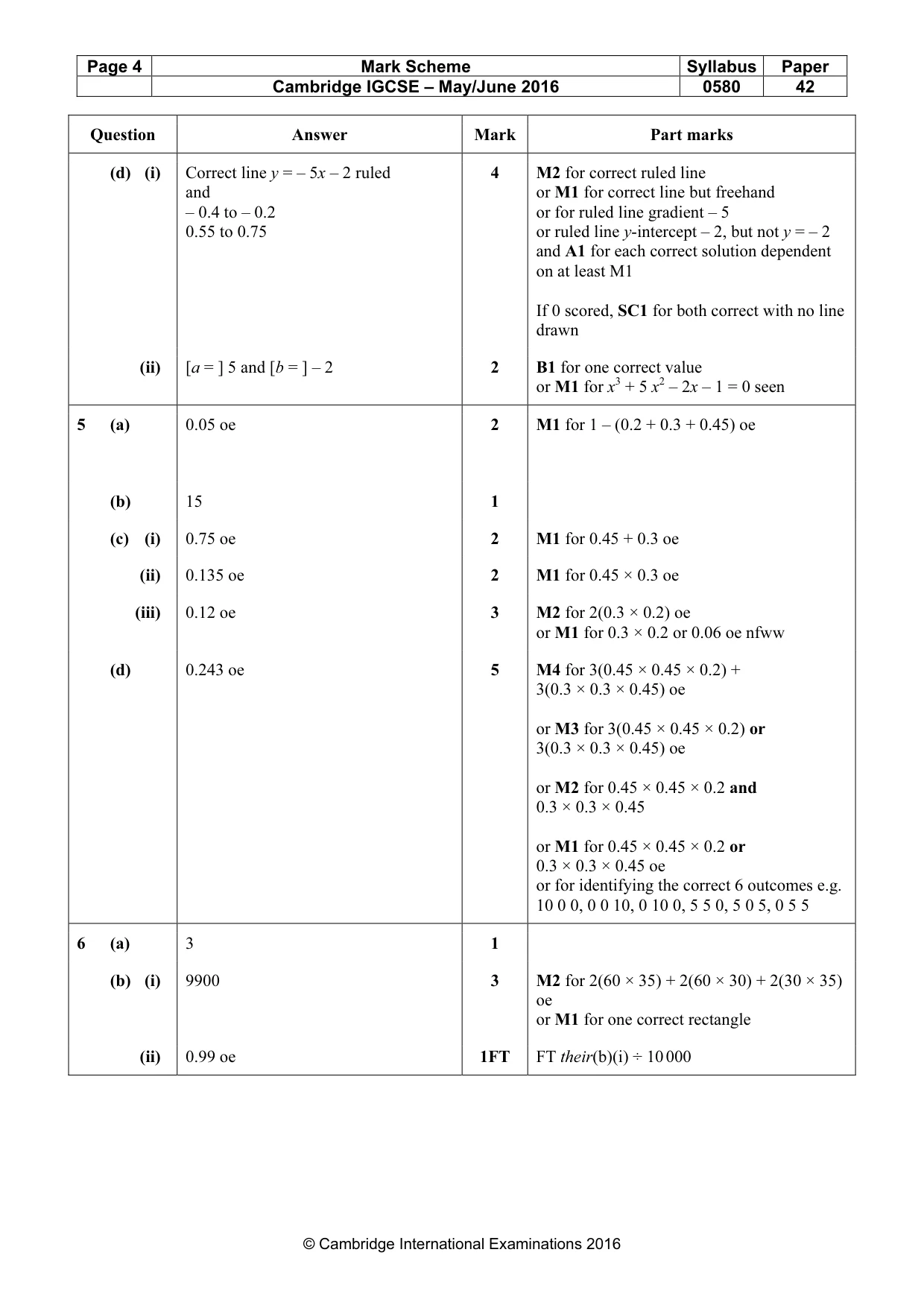
Mark scheme: 5 (a) 0.05 oe 2 M1 for 1 – (0.2 + 0.3 + 0.45) oe (b) 15 1 (c) (i) 0.75 oe 2 M1 for 0.45 + 0.3 oe (ii) 0.135 oe 2 M1 for 0.45 × 0.3 oe (iii) 0.12 oe 3 M2 for 2(0.3 × 0.2) oe or M1 for 0.3 × 0.2 or 0.06 oe nfww (d) 0.243 oe 5 M4 for 3(0.45 × 0.45 × 0.2) + 3(0.3 × 0.3 × 0.45) oe or M3 for 3(0.45 × 0.45 × 0.2) or 3(0.3 × 0.3 × 0.45) oe or M2 for 0.45 × 0.45 × 0.2 and 0.3 × 0.3 × 0.45 or M1 for 0.45 × 0.45 × 0.2 or 0.3 × 0.3 × 0.45 oe or for identifying the correct 6 outcomes e.g. 10 0 0, 0 0 10, 0 10 0, 5 5 0, 5 0 5, 0 5 5
Q6 · The diagram shows a cuboid
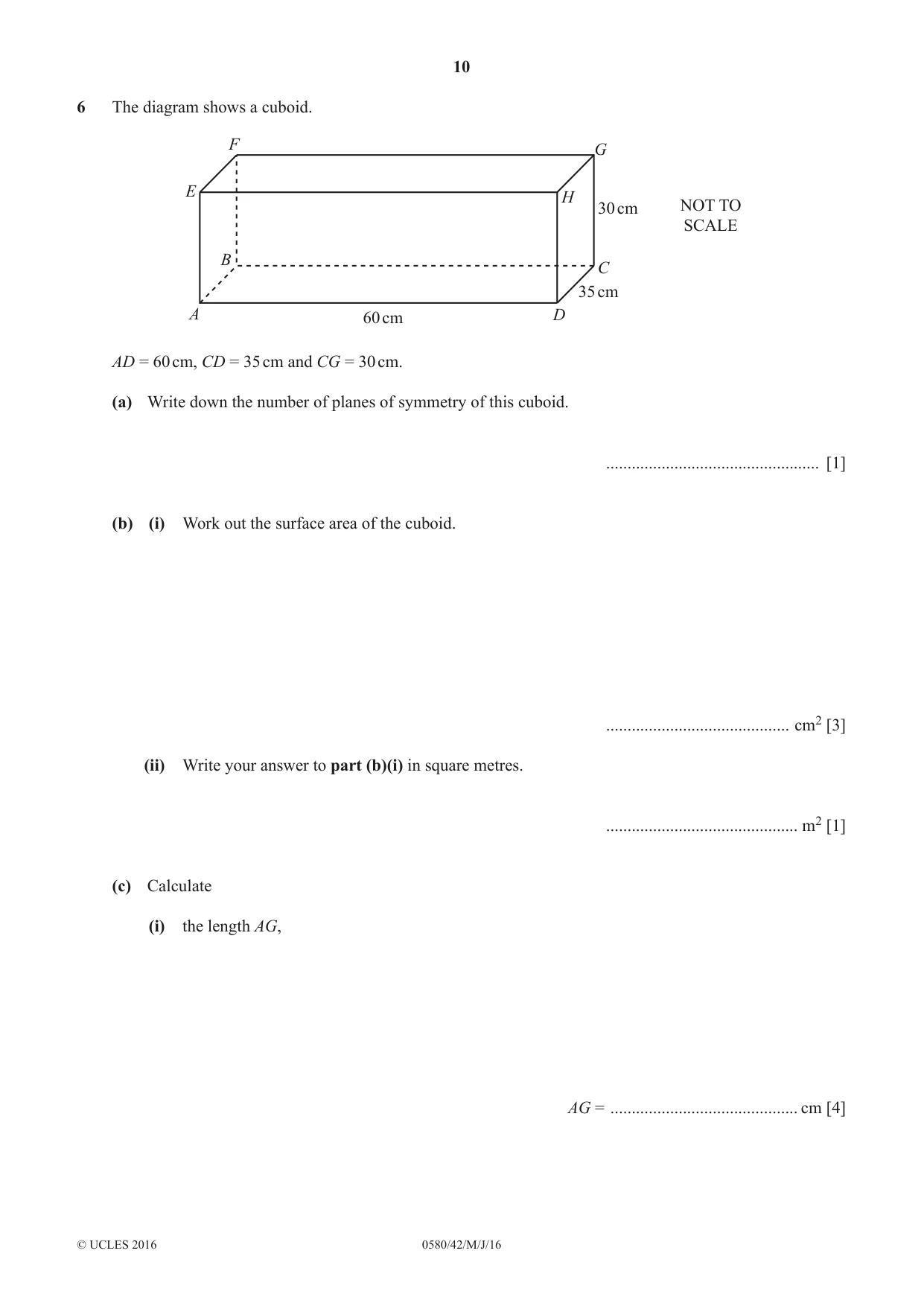
6 The diagram shows a cuboid. F G E H 30 cm NOT TO SCALE B C 35 cm A 60 cm D AD = 60 cm, CD = 35 cm and CG = 30 cm. (a) Write down the number of planes of symmetry of this cuboid. .................................................. [1] (b) (i) Work out the surface area of the cuboid. ........................................... cm2 [3] (ii) Write your answer to part (b)(i) in square metres. ............................................. m2 [1] (c) Calculate (i) the length AG, AG = ............................................ cm [4] (ii) the angle between AG and the base ABCD. .................................................. [3] (d) (i) Show that the volume of the cuboid is 63 000 cm3. [1] (ii) A cylinder of height 40 cm has the same volume as the cuboid. Calculate the radius of the cylinder. ............................................. cm [3]
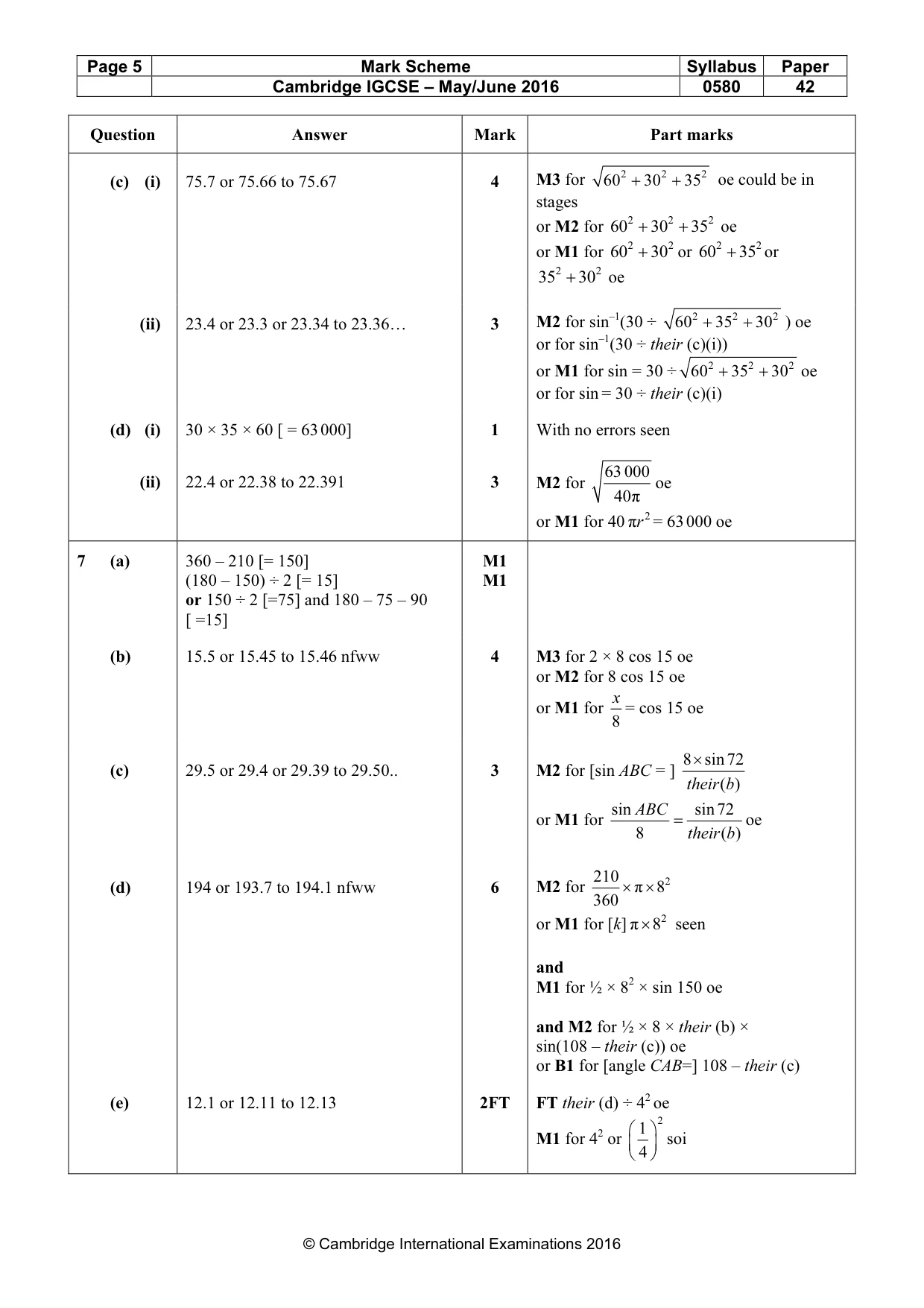
Mark scheme: 6 (a) 3 1 (b) (i) 9900 3 M2 for 2(60 × 35) + 2(60 × 30) + 2(30 × 35) oe or M1 for one correct rectangle (ii) 0.99 oe 1FT FT their(b)(i) ÷ 10 000
Q7 · NOT TO SCALE 210° 88cmcm O A B 8 cm 72° C The diagram shows a design for a logo made from…
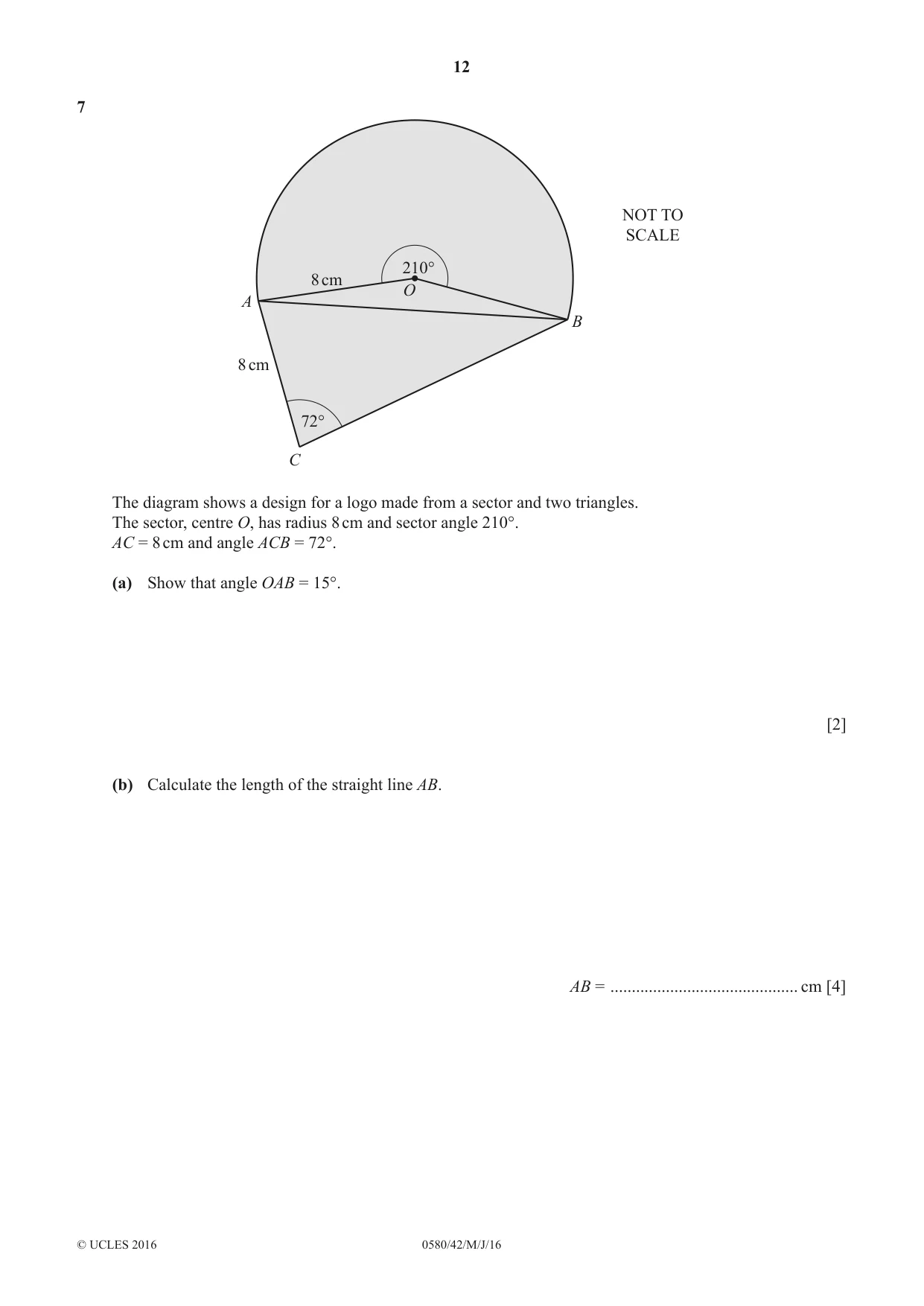
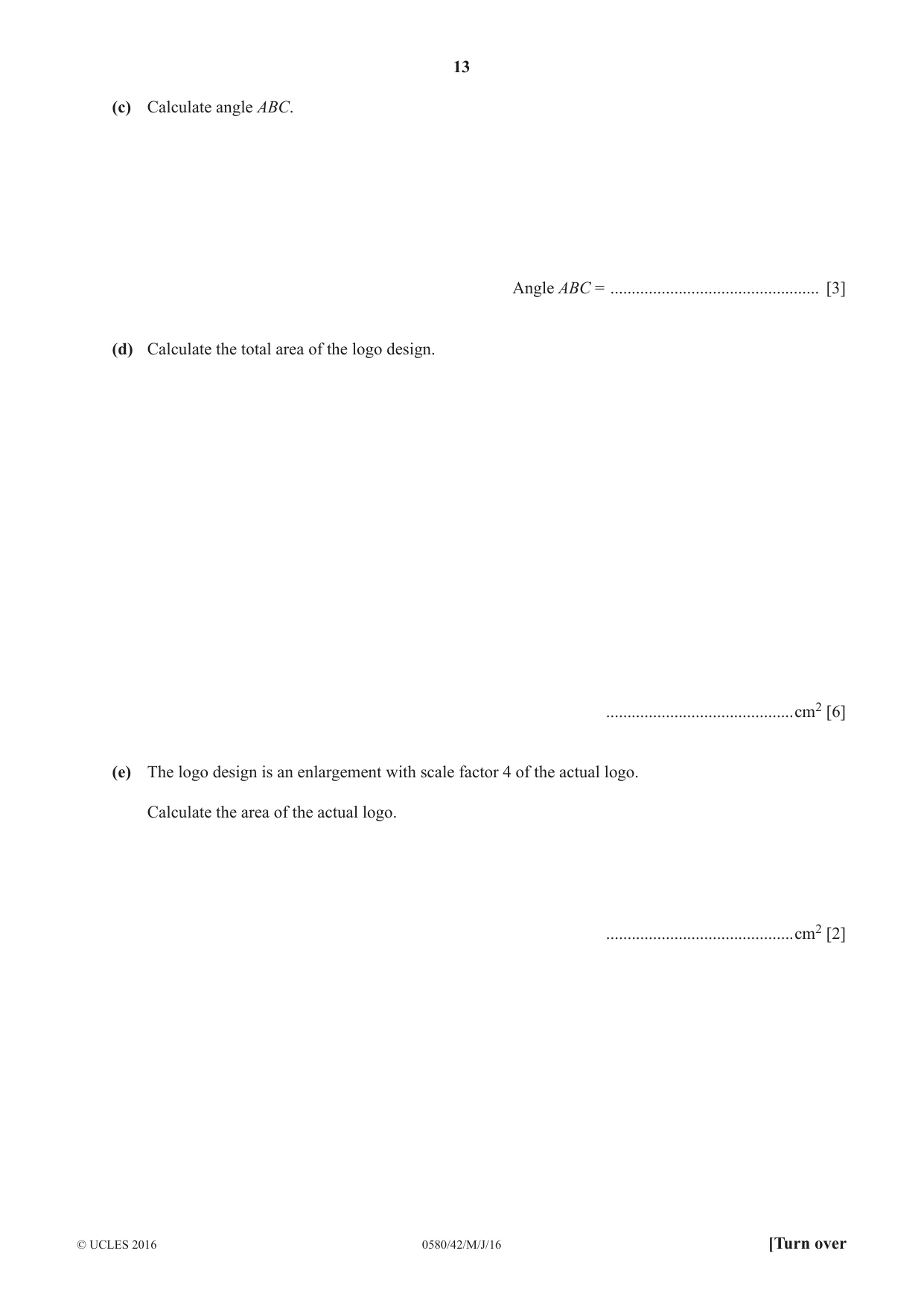
7 NOT TO SCALE 210° 88cmcm O A B 8 cm 72° C The diagram shows a design for a logo made from a sector and two triangles. The sector, centre O, has radius 8 cm and sector angle 210°. AC = 8 cm and angle ACB = 72°. (a) Show that angle OAB = 15°. [2] (b) Calculate the length of the straight line AB. AB = ............................................ cm [4] (c) Calculate angle ABC. Angle ABC = ................................................. [3] (d) Calculate the total area of the logo design. ............................................cm2 [6] (e) The logo design is an enlargement with scale factor 4 of the actual logo. Calculate the area of the actual logo. ............................................cm2 [2]
Mark scheme: 7 (a) 360 – 210 [= 150] M1 (180 – 150) ÷ 2 [= 15] M1 or 150 ÷ 2 [=75] and 180 – 75 – 90 [ =15] (b) 15.5 or 15.45 to 15.46 nfww 4 M3 for 2 × 8 cos 15 oe or M2 for 8 cos 15 oe x or M1 for = cos 15 oe 8 8 × sin72 (c) 29.5 or 29.4 or 29.39 to 29.50.. 3 M2 for [sin ABC = ] their (b ) sin ABC sin72 or M1 for = oe 8 their (b ) 210 2 (d) 194 or 193.7 to 194.1 nfww 6 M2 for × π × 8 360 or M1 for [k] π × 8 2 seen and M1 for ½ × 82 × sin 150 oe and M2 for ½ × 8 × their (b) × sin(108 – their (c)) oe or B1 for [angle CAB=] 108 – their (c) (e) 12.1 or 12.11 to 12.13 2FT FT their (d) ÷ 42 oe 2 1 M1 for 42 or soi 4
Q8 · F(x) = 5x + 7 g(x) = , x ≠ 3 x - 3 (a) Find (i) fg(1)…
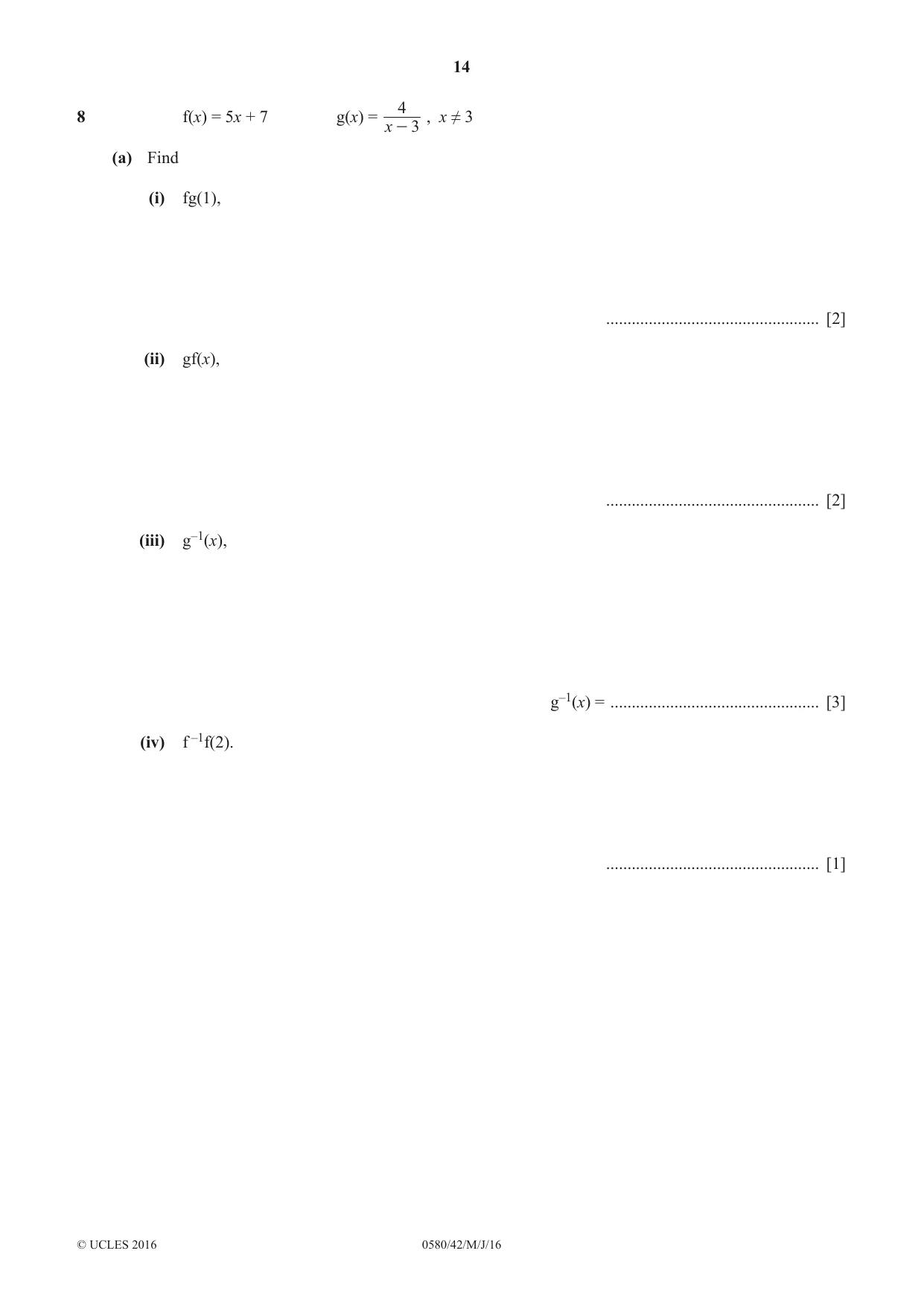
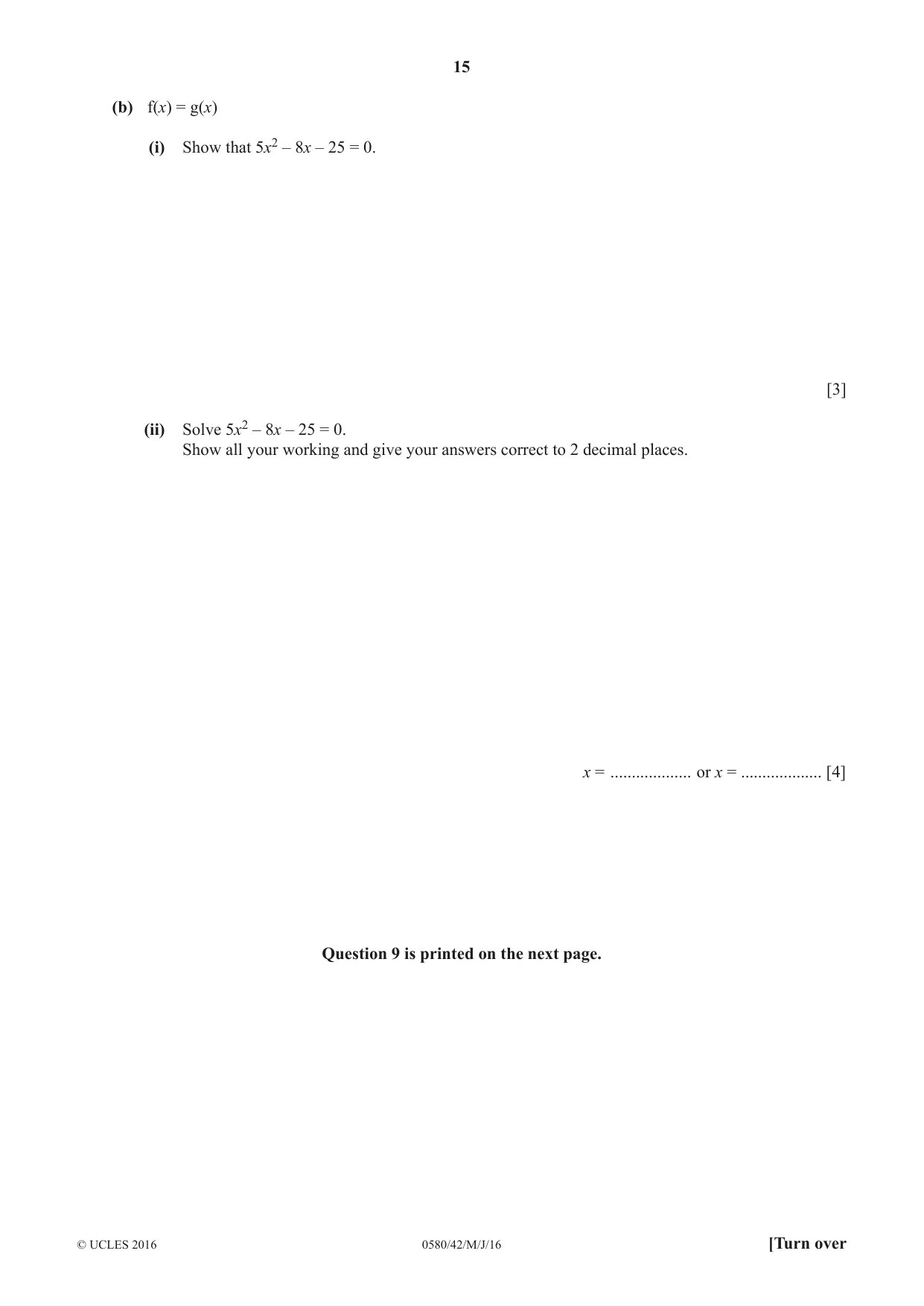
48 f(x) = 5x + 7 g(x) = , x ≠ 3 x - 3 (a) Find (i) fg(1), .................................................. [2] (ii) gf(x), .................................................. [2] (iii) g–1(x), g–1(x) = ................................................. [3] (iv) f –1f(2). .................................................. [1] (b) f(x) = g(x) (i) Show that 5x2 – 8x – 25 = 0. [3] (ii) Solve 5x2 – 8x – 25 = 0. Show all your working and give your answers correct to 2 decimal places. x = ................... or x = ................... [4] Question 9 is printed on the next page.
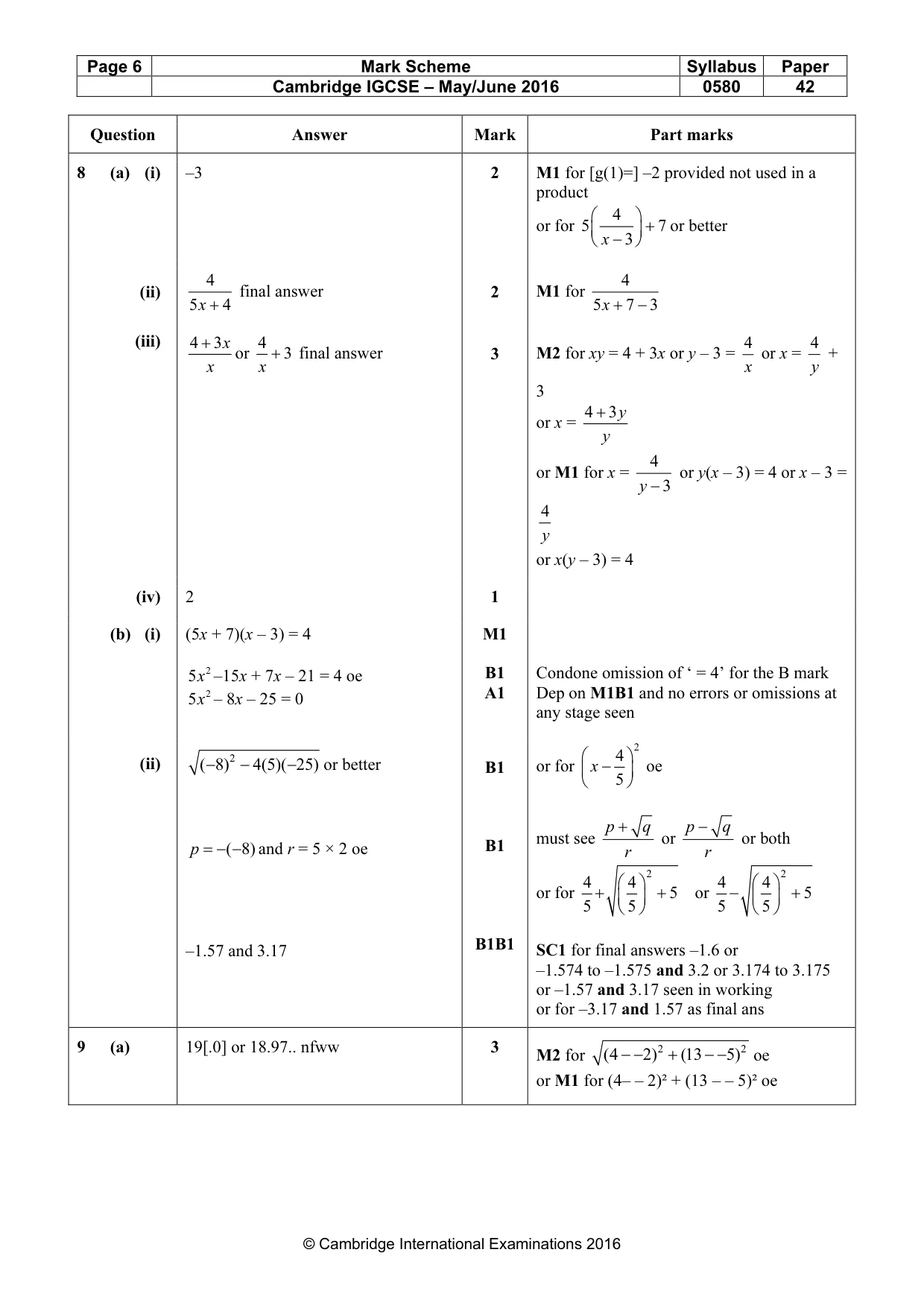
Mark scheme: 8 (a) (i) –3 2 M1 for [g(1)=] –2 provided not used in a product 4 or for 5 + 7 or better x − 3 4 4 (ii) final answer 2 M1 for 5 x + 4 5 x + 7 − 3 (iii) 4 + 3x 4 4 4 or + 3 final answer 3 M2 for xy = 4 + 3x or y – 3 = or x = + x x x y 3 4 + 3y or x = y 4 or M1 for x = or y(x – 3) = 4 or x – 3 = y − 3 4 y or x(y – 3) = 4 (iv) 2 1 (b) (i) (5x + 7)(x – 3) = 4 M1 5x 2 –15x + 7x – 21 = 4 oe B1 Condone omission of ‘ = 4’ for the B mark 2 A1 Dep on M1B1 and no errors or omissions at 5x – 8x – 25 = 0 any stage seen 2 (ii) ( −8) 2 − 4(5)( −25) or better B1 or for x − 4 oe 5 p + q p − q B1 must see or or both p = −−( 8) and r = 5 × 2 oe r r 2 2 4 4 4 4 or for + + 5 or − + 5 5 5 5 5 B1B1 SC1 for final answers –1.6 or –1.57 and 3.17 –1.574 to –1.575 and 3.2 or 3.174 to 3.175 or –1.57 and 3.17 seen in working or for –3.17 and 1.57 as final ans
Q9 · A line joins the points A (–2, –5) and B (4, 13)
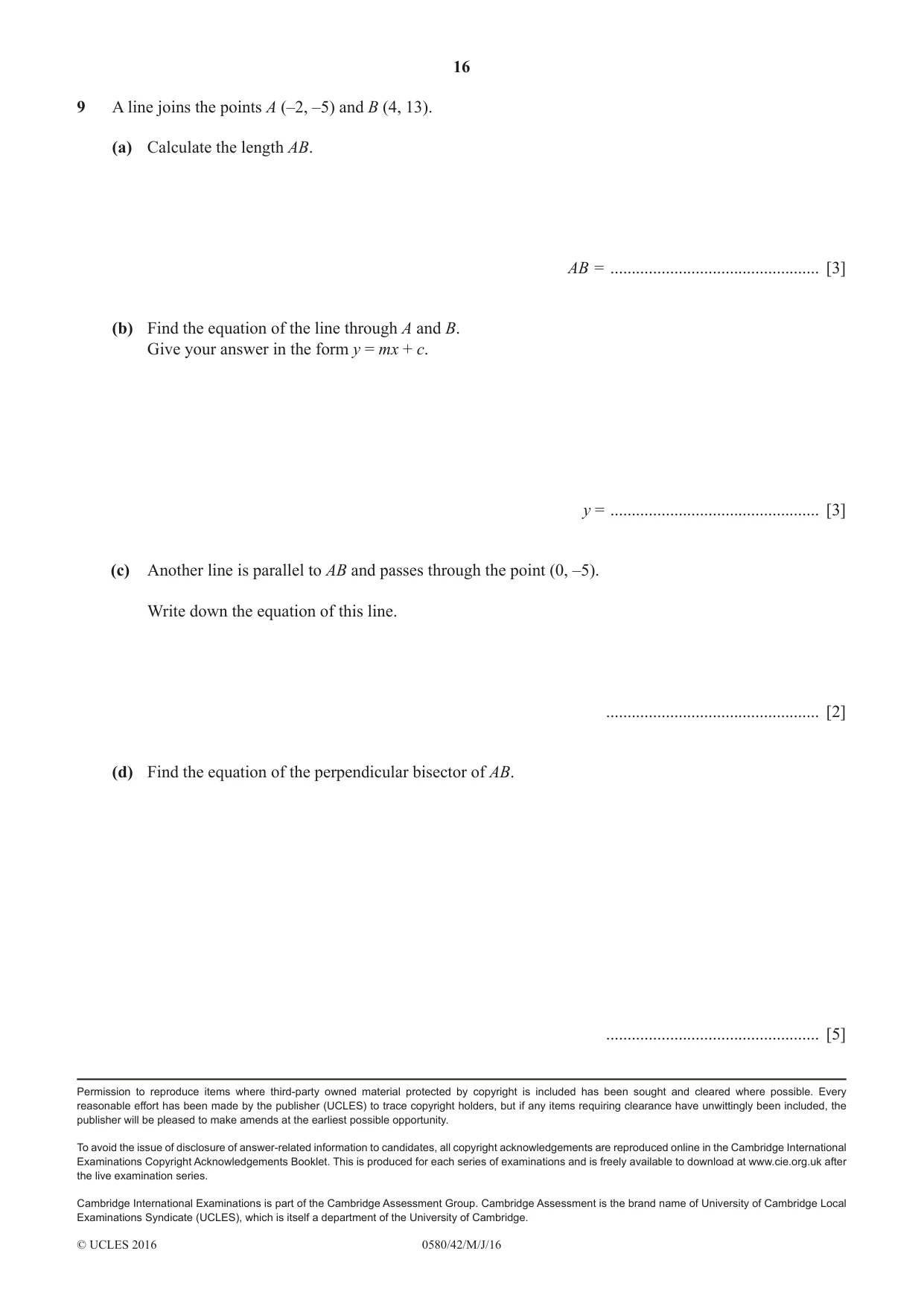
9 A line joins the points A (–2, –5) and B (4, 13). (a) Calculate the length AB. AB = ................................................. [3] (b) Find the equation of the line through A and B. Give your answer in the form y = mx + c. y = ................................................. [3] (c) Another line is parallel to AB and passes through the point (0, –5). Write down the equation of this line. .................................................. [2] (d) Find the equation of the perpendicular bisector of AB. .................................................. [5]
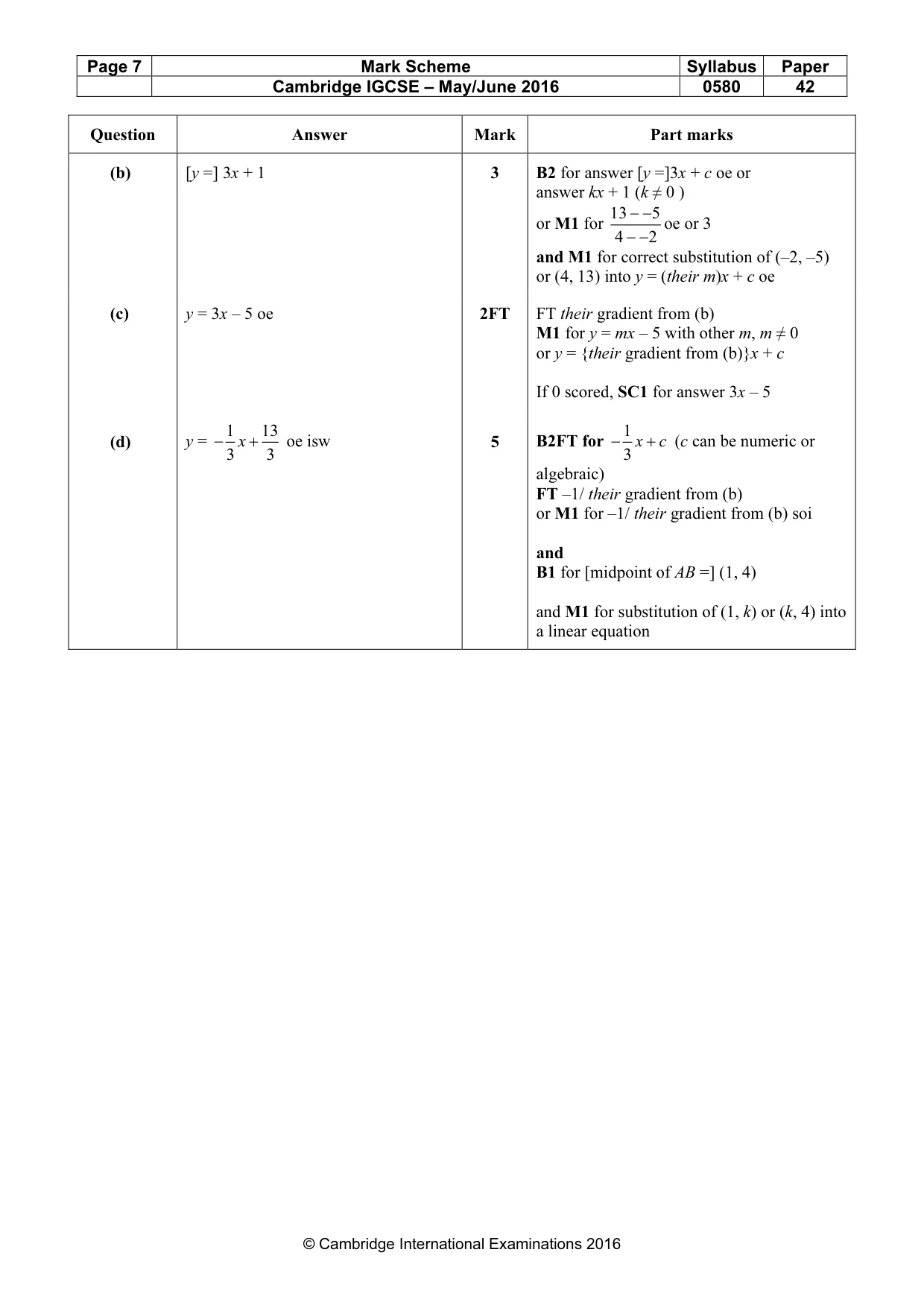
Mark scheme: 2 + (13 −−5) 2 oe9 (a) 19[.0] or 18.97.. nfww 3 M2 for (4 −−2) or M1 for (4– – 2)² + (13 – – 5)² oe (b) [y =] 3x + 1 3 B2 for answer [y =]3x + c oe or answer kx + 1 (k ≠ 0 ) 13 −− 5 or M1 for oe or 3 4 −− 2 and M1 for correct substitution of (–2, –5) or (4, 13) into y = (their m)x + c oe (c) y = 3x – 5 oe 2FT FT their gradient from (b) M1 for y = mx – 5 with other m, m ≠ 0 or y = {their gradient from (b)}x + c If 0 scored, SC1 for answer 3x – 5 1 13 1 (d) y = − x + oe isw 5 B2FT for − x + c (c can be numeric or 3 3 3 algebraic) FT –1/ their gradient from (b) or M1 for –1/ their gradient from (b) soi and B1 for [midpoint of AB =] (1, 4) and M1 for substitution of (1, k) or (k, 4) into a linear equation
What was in this paper
The subtopics covered by these 9 questions, and how many questions each got. Open one in a new tab to see every Cambridge question on it.
What you needed in this session
Cambridge’s own grade thresholds for 2016 May/June, Paper 4 · Variant 2. A higher threshold means an easier paper — the bar moves with how the cohort did.