Cambridge IGCSE Mathematics 0580 — 2010 Oct/Nov Paper 4 · Variant 3
0580/43/O/N/10 · 8 questions · 130 marks · ≈146 min
The question paper and its mark scheme, free to read here and free to download. This is Cambridge’s own paper, exactly as it was sat.
Question paper20 pages
Mark scheme6 pages
Answers below. Sit the paper first if you are practising.
Questions as text
Q1 · Thomas, Ursula and Vanessa share $200 in the ratio For Examiner's Thomas : Ursula…
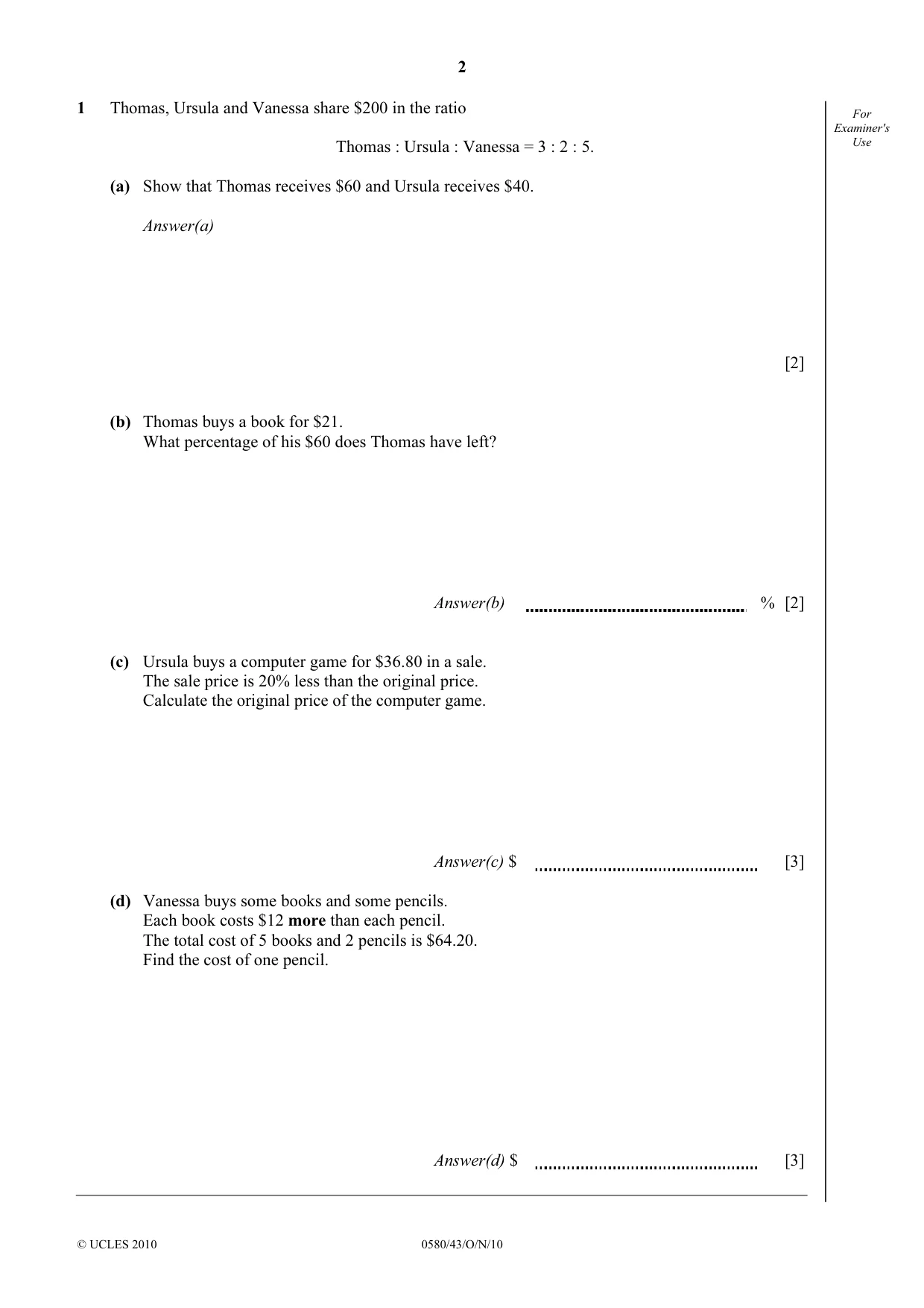
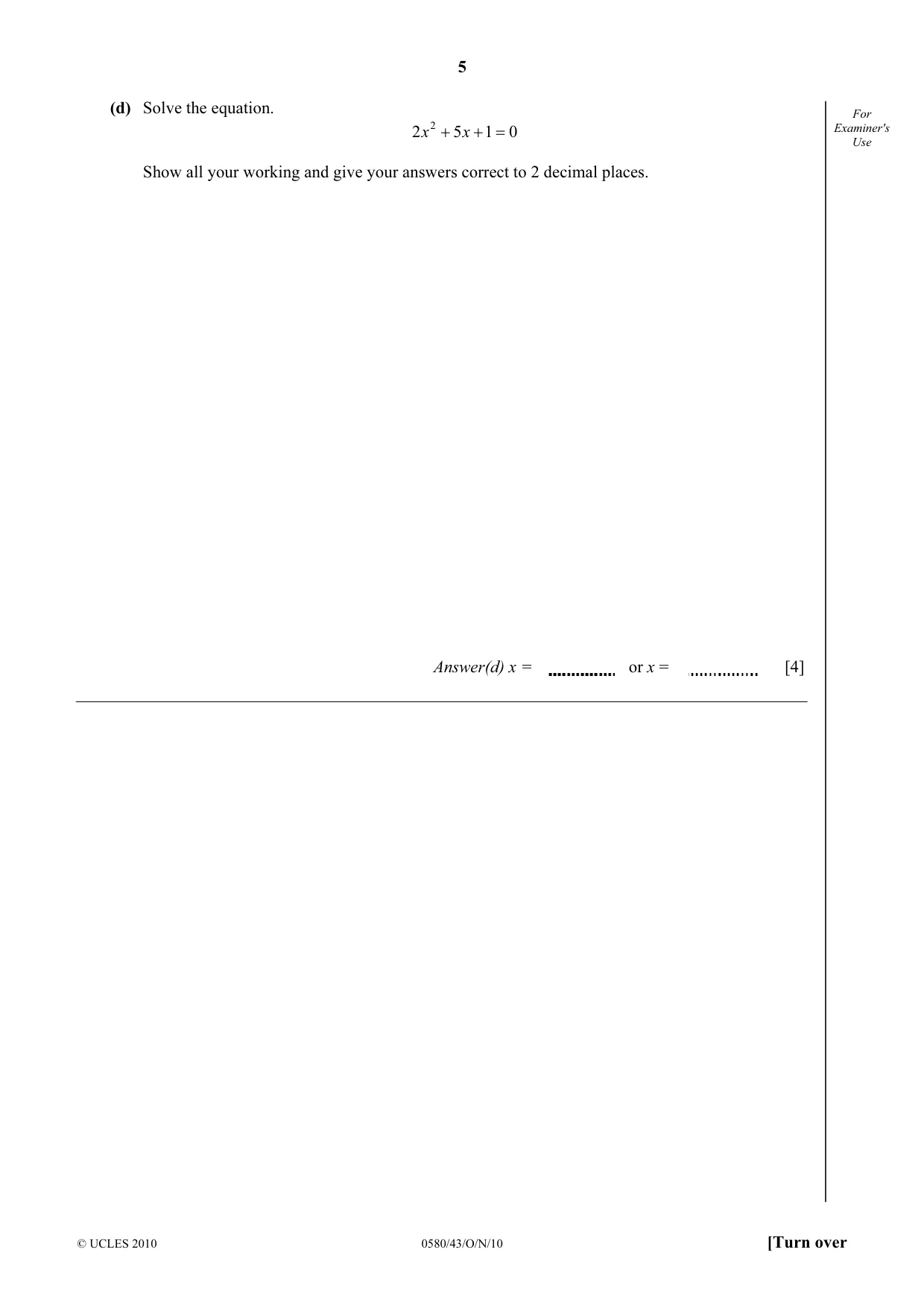
1 Thomas, Ursula and Vanessa share $200 in the ratio For Examiner's Thomas : Ursula : Vanessa = 3 : 2 : 5. Use (a) Show that Thomas receives $60 and Ursula receives $40. Answer(a) [2] (b) Thomas buys a book for $21. What percentage of his $60 does Thomas have left? Answer(b) % [2] (c) Ursula buys a computer game for $36.80 in a sale. The sale price is 20% less than the original price. Calculate the original price of the computer game. Answer(c) $ [3] (d) Vanessa buys some books and some pencils. Each book costs $12 more than each pencil. The total cost of 5 books and 2 pencils is $64.20. Find the cost of one pencil. Answer(d) $ [3]
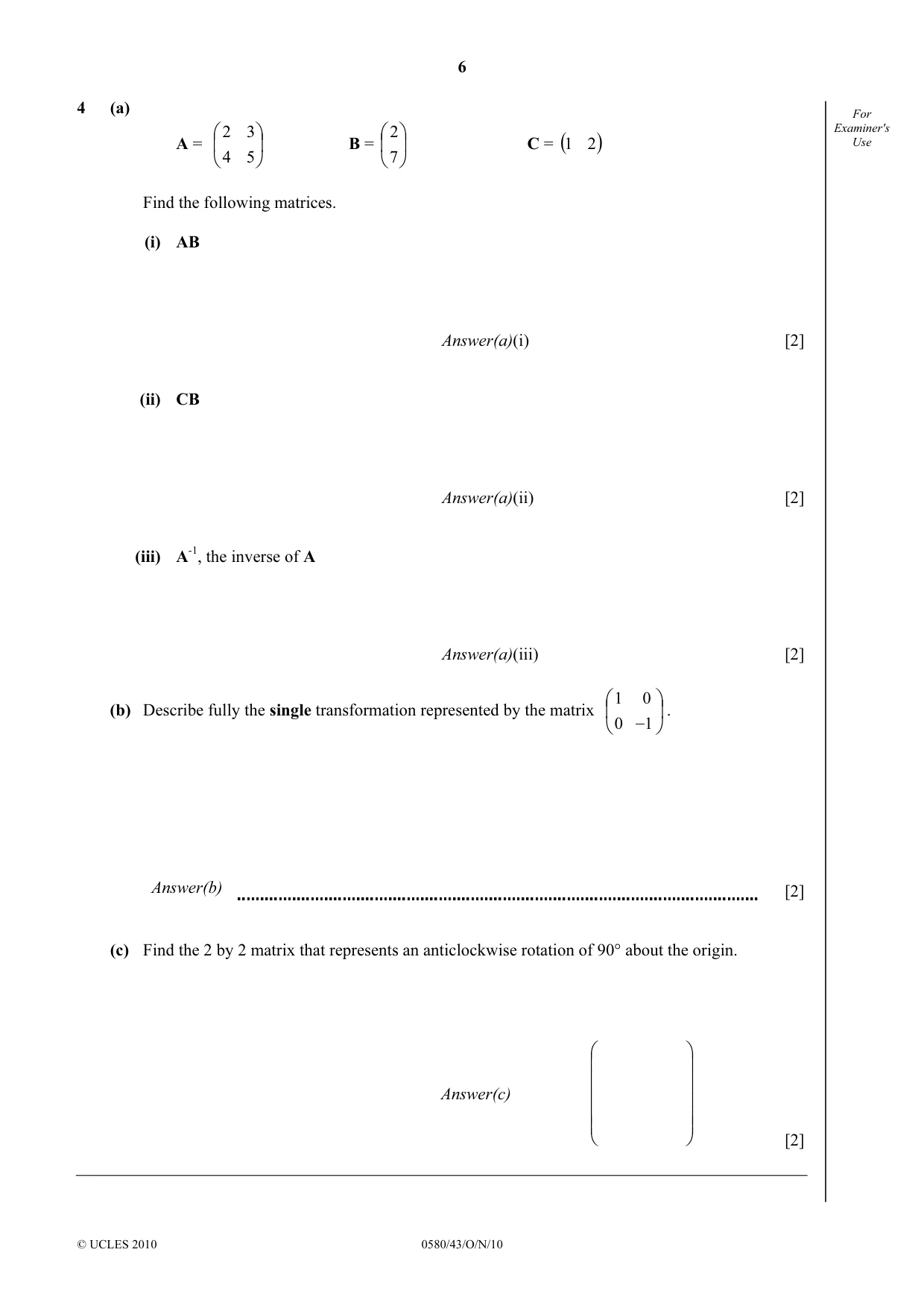
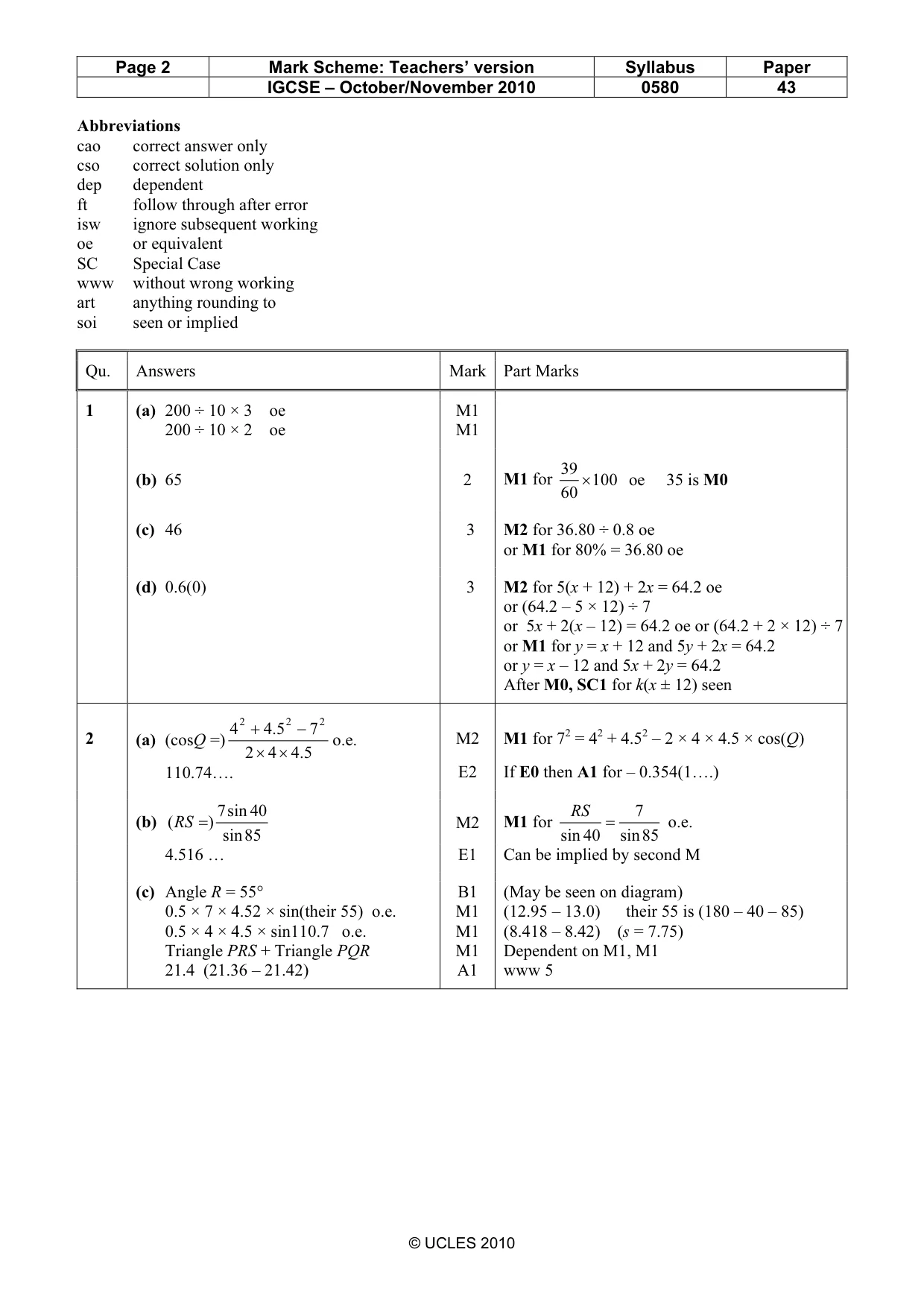
Mark scheme: Qu. Answers Mark Part Marks 1 (a) 200 ÷ 10 × 3 oe M1 200 ÷ 10 × 2 oe M1 39 (b) 65 2 M1 for × 100 oe 35 is M0 60 (c) 46 3 M2 for 36.80 ÷ 0.8 oe or M1 for 80% = 36.80 oe (d) 0.6(0) 3 M2 for 5(x + 12) + 2x = 64.2 oe or (64.2 – 5 × 12) ÷ 7 or 5x + 2(x – 12) = 64.2 oe or (64.2 + 2 × 12) ÷ 7 or M1 for y = x + 12 and 5y + 2x = 64.2 or y = x – 12 and 5x + 2y = 64.2 After M0, SC1 for k(x ± 12) seen 4 2 + 4 5 2 7 2
Q2 · For R Examiner's 4 km Q Use NOT TO SCALE 7 km 4.5 km 85° S 40° P The diagram shows five…
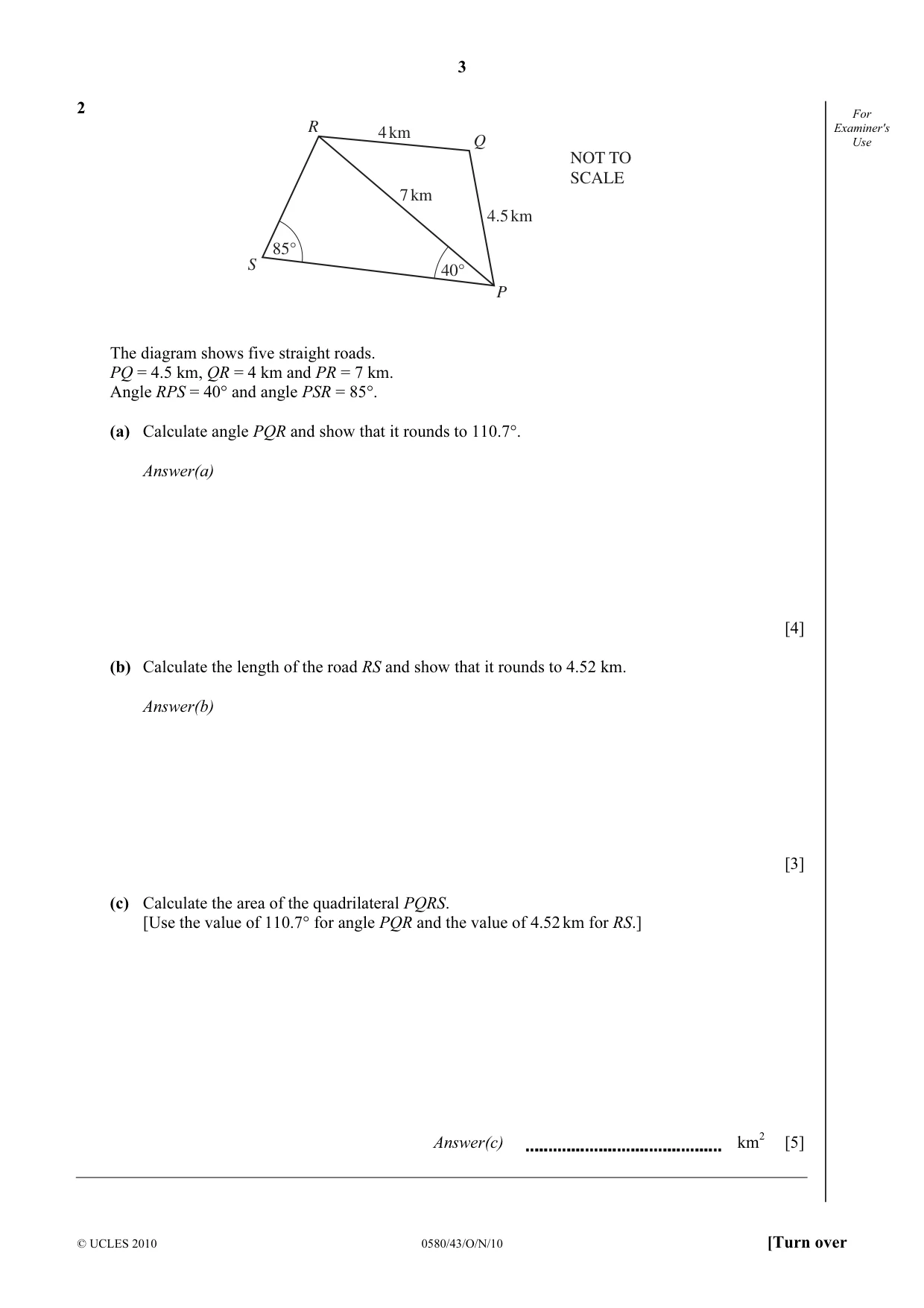
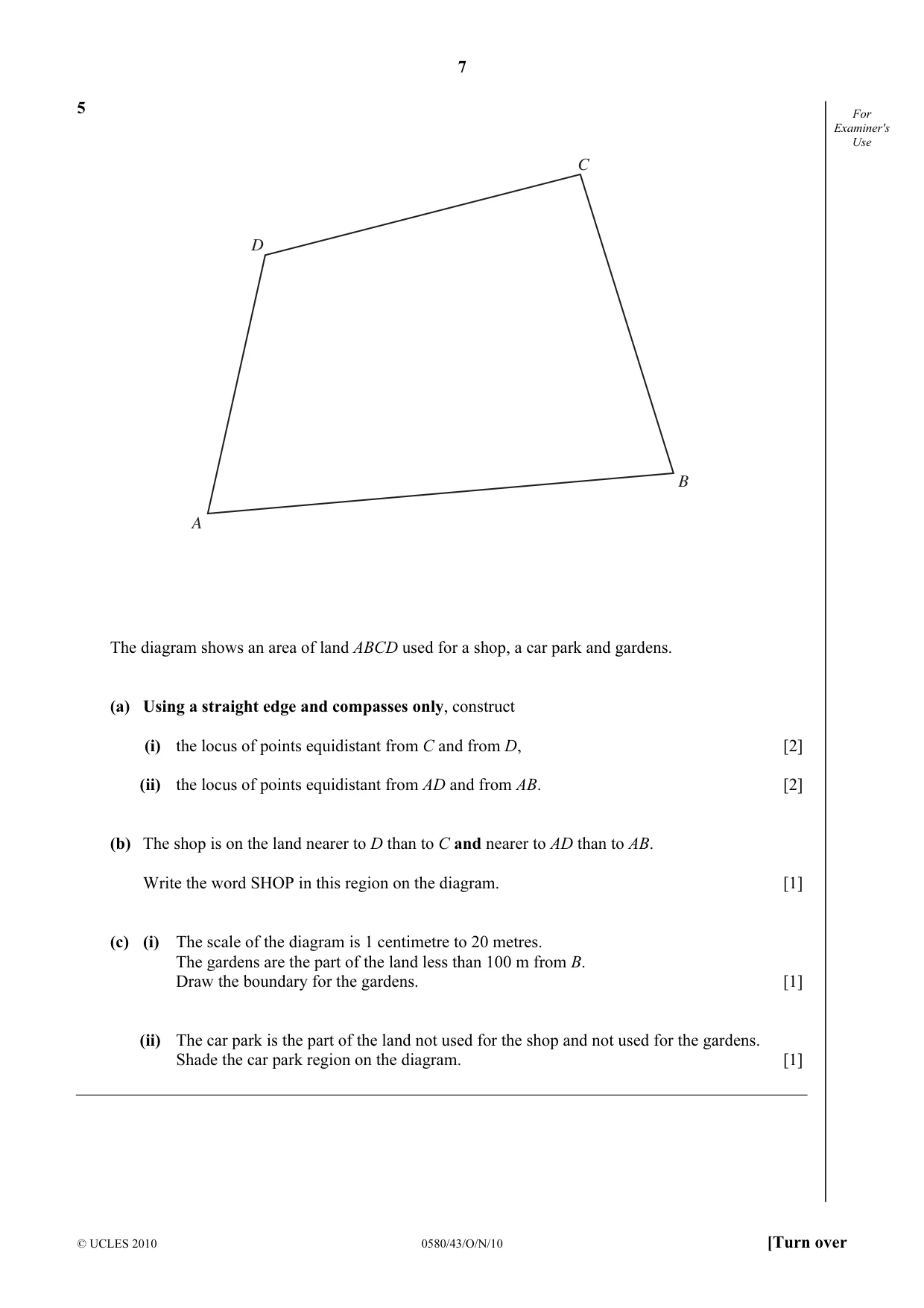
2 For R Examiner's 4 km Q Use NOT TO SCALE 7 km 4.5 km 85° S 40° P The diagram shows five straight roads. PQ = 4.5 km, QR = 4 km and PR = 7 km. Angle RPS = 40° and angle PSR = 85°. (a) Calculate angle PQR and show that it rounds to 110.7°. Answer(a) [4] (b) Calculate the length of the road RS and show that it rounds to 4.52 km. Answer(b) [3] (c) Calculate the area of the quadrilateral PQRS. [Use the value of 110.7° for angle PQR and the value of 4.52 km for RS.] Answer(c) km2 [5]
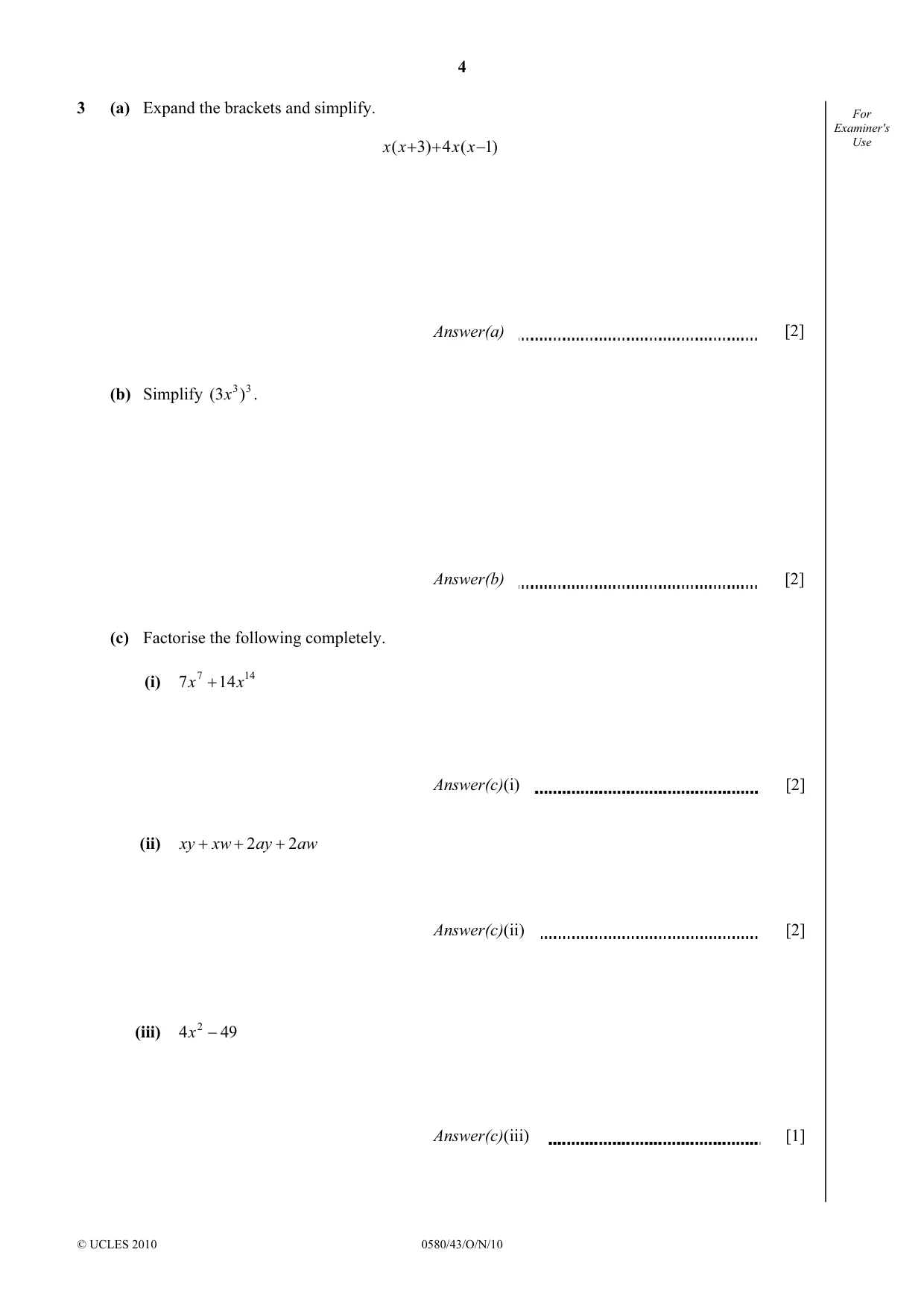
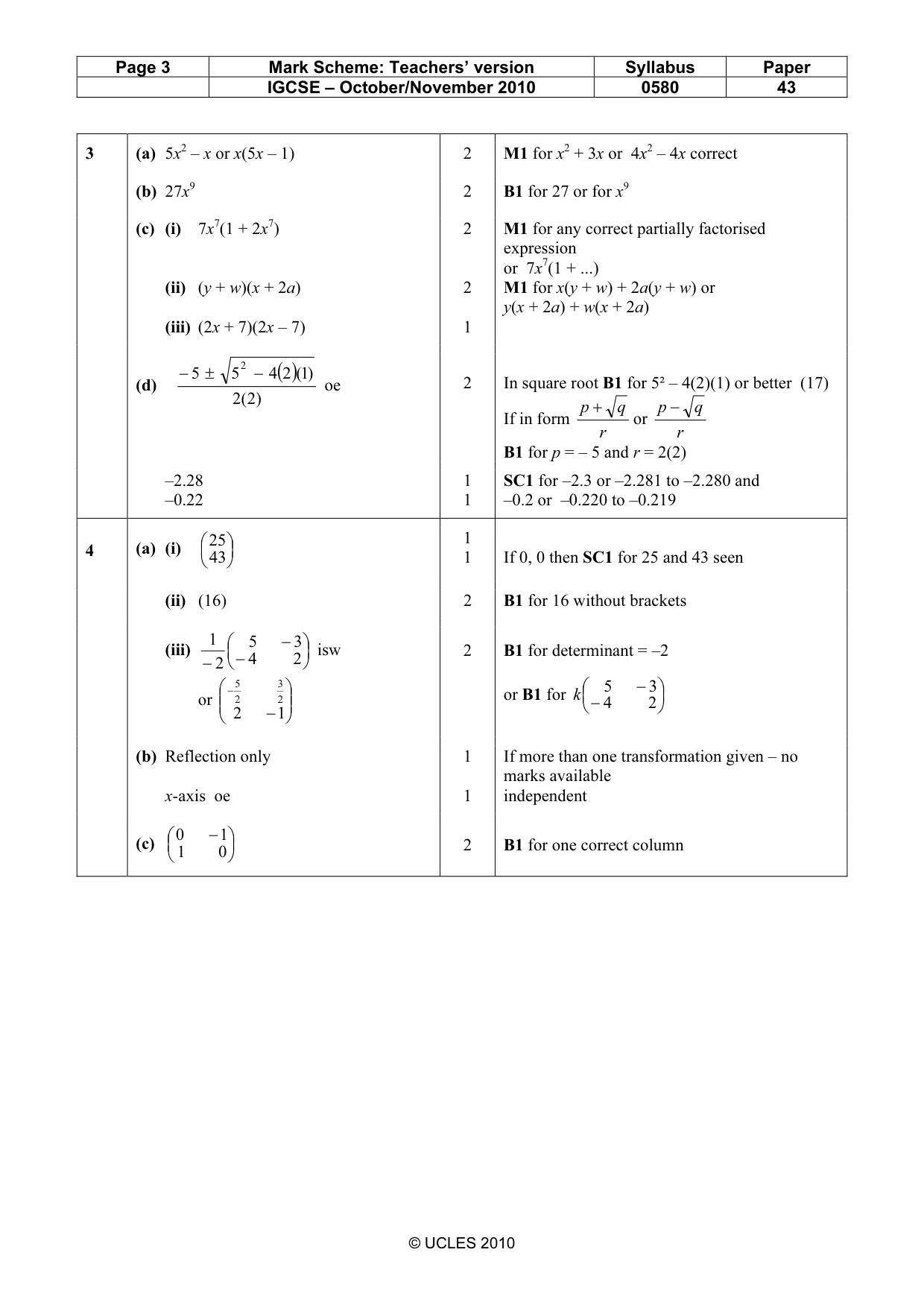
Mark scheme: 4 + 5.4 − 7 2 (a) (cosQ =) o.e. M2 M1 for 72 = 42 + 4.52 – 2 × 4 × 4.5 × cos(Q) 2 × 4 × 5.4 110.74…. E2 If E0 then A1 for – 0.354(1….) 7 sin 40 RS 7 (b) ( RS = ) M2 M1 for = o.e. sin 85 sin 40 sin 85 4.516 … E1 Can be implied by second M (c) Angle R = 55° B1 (May be seen on diagram) 0.5 × 7 × 4.52 × sin(their 55) o.e. M1 (12.95 – 13.0) their 55 is (180 – 40 – 85) 0.5 × 4 × 4.5 × sin110.7 o.e. M1 (8.418 – 8.42) (s = 7.75) Triangle PRS + Triangle PQR M1 Dependent on M1, M1 21.4 (21.36 – 21.42) A1 www 5 IGCSE – October/November 2010 0580 43 3 (a) 5x2 – x or x(5x – 1) 2 M1 for x2 + 3x or 4x2 – 4x correct (b) 27x9 2 B1 for 27 or for x9 (c) (i) 7x7(1 + 2x7) 2 M1 for any correct partially factorised expression or 7x7(1 + ...) (ii) (y + w)(x + 2a) 2 M1 for x(y + w) + 2a(y + w) or y(x + 2a) + w(x + 2a) (iii) (2x + 7)(2x – 7) 1 2 ( )
Q6 · Sacha either walks or cycles to school
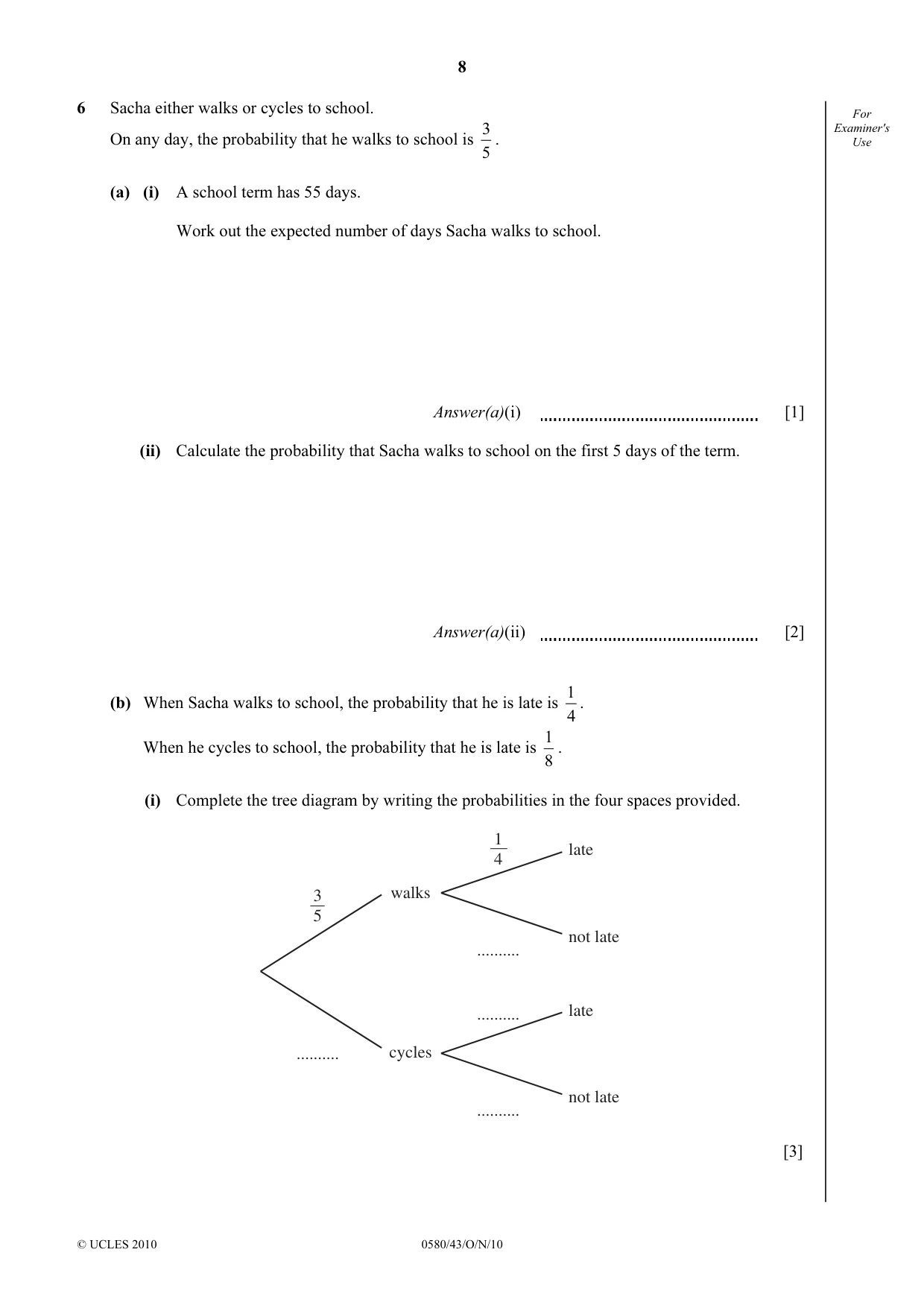
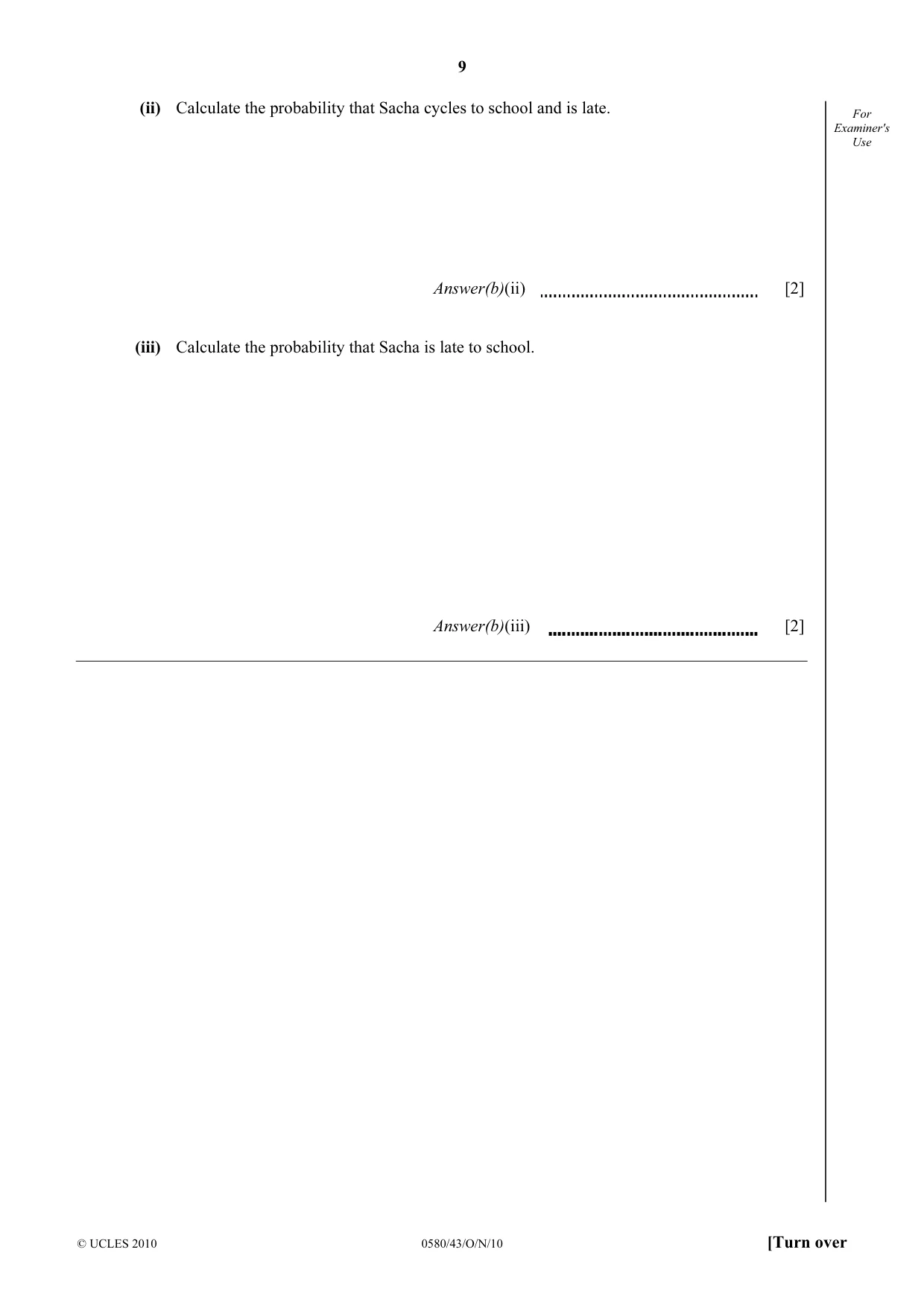
6 Sacha either walks or cycles to school. For 3 Examiner's On any day, the probability that he walks to school is . Use 5 (a) (i) A school term has 55 days. Work out the expected number of days Sacha walks to school. Answer(a)(i) [1] (ii) Calculate the probability that Sacha walks to school on the first 5 days of the term. Answer(a)(ii) [2] 1 (b) When Sacha walks to school, the probability that he is late is . 4 1 When he cycles to school, the probability that he is late is . 8 (i) Complete the tree diagram by writing the probabilities in the four spaces provided. 1 late 4 3 walks 5 not late .......... .......... late .......... cycles not late .......... [3] (ii) Calculate the probability that Sacha cycles to school and is late. For Examiner's Use Answer(b)(ii) [2] (iii) Calculate the probability that Sacha is late to school. Answer(b)(iii) [2]
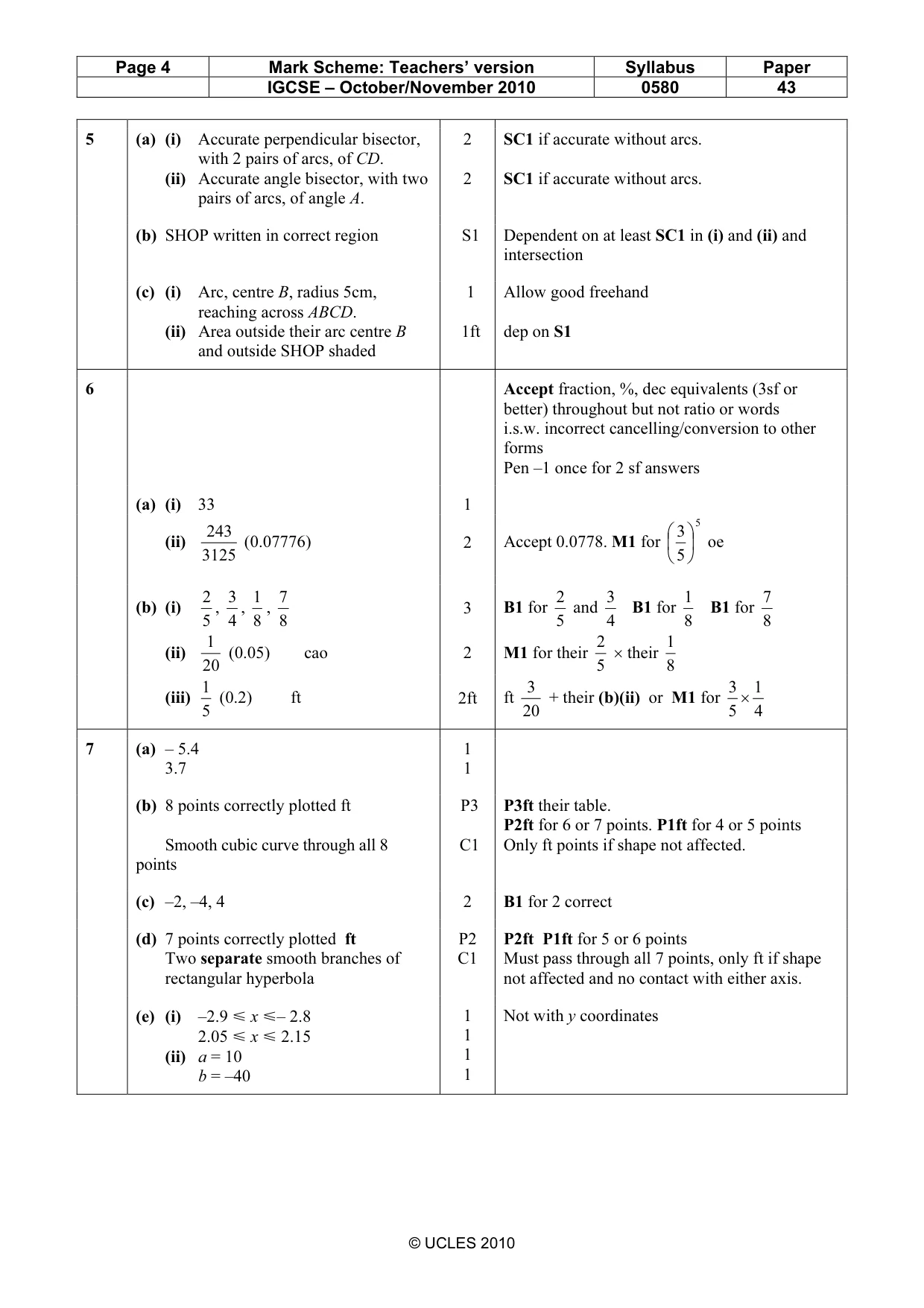
Mark scheme: 6 Accept fraction, %, dec equivalents (3sf or better) throughout but not ratio or words i.s.w. incorrect cancelling/conversion to other forms Pen –1 once for 2 sf answers (a) (i) 33 1 5 243 (ii) (0.07776) 2 Accept 0.0778. M1 for 3 oe 3125 5 2 3 1 7 2 3 1 7 (b) (i) , , , 3 B1 for and B1 for B1 for 5 4 8 8 5 4 8 8 1 2 1 (ii) (0.05) cao 2 M1 for their × their 20 5 8 1 3 3 1 (iii) (0.2) ft 2ft ft + their (b)(ii) or M1 for × 5 20 5 4
Q7 · X 3 For 7 (a) Complete the table for the function f(x) = + 1
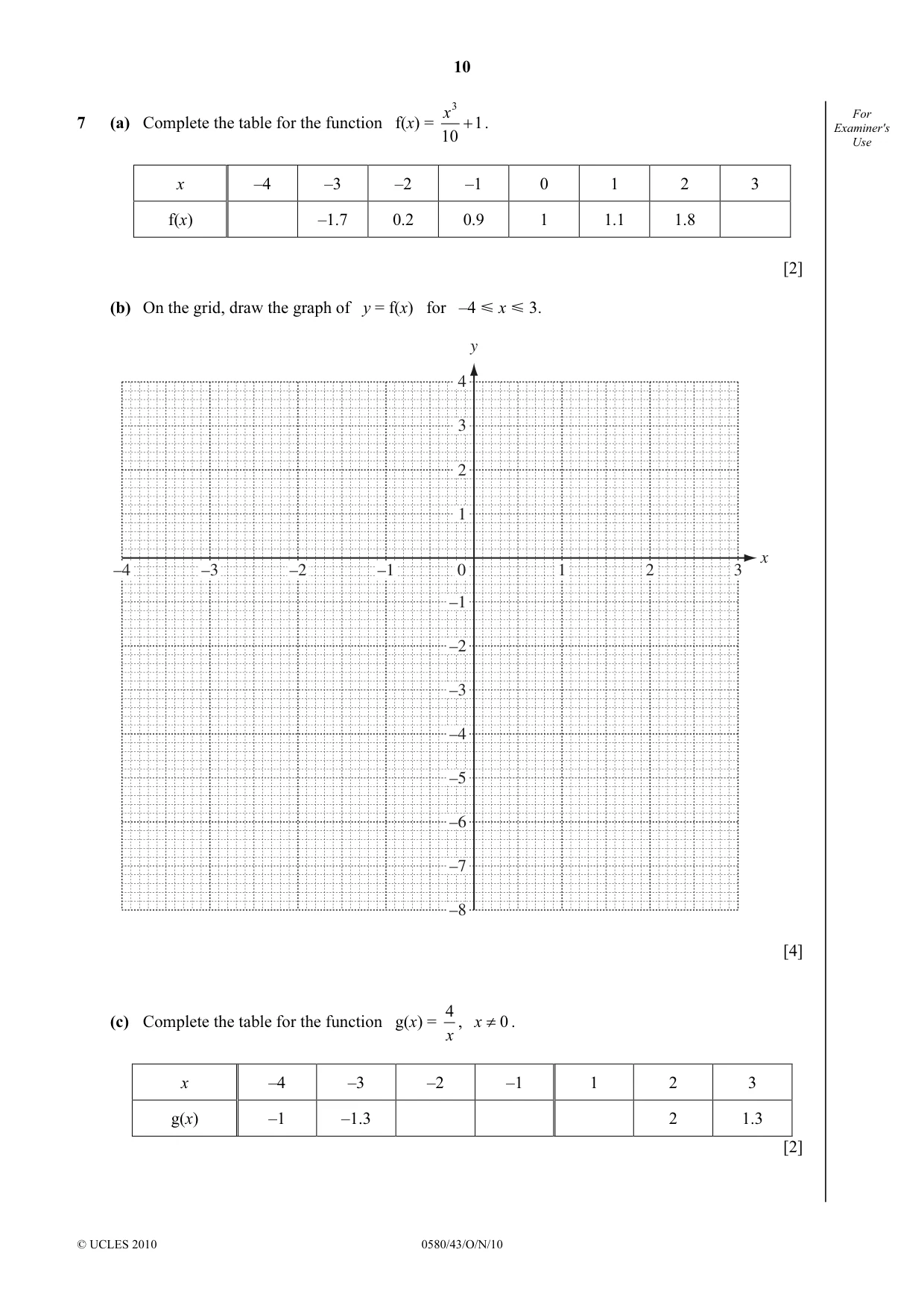
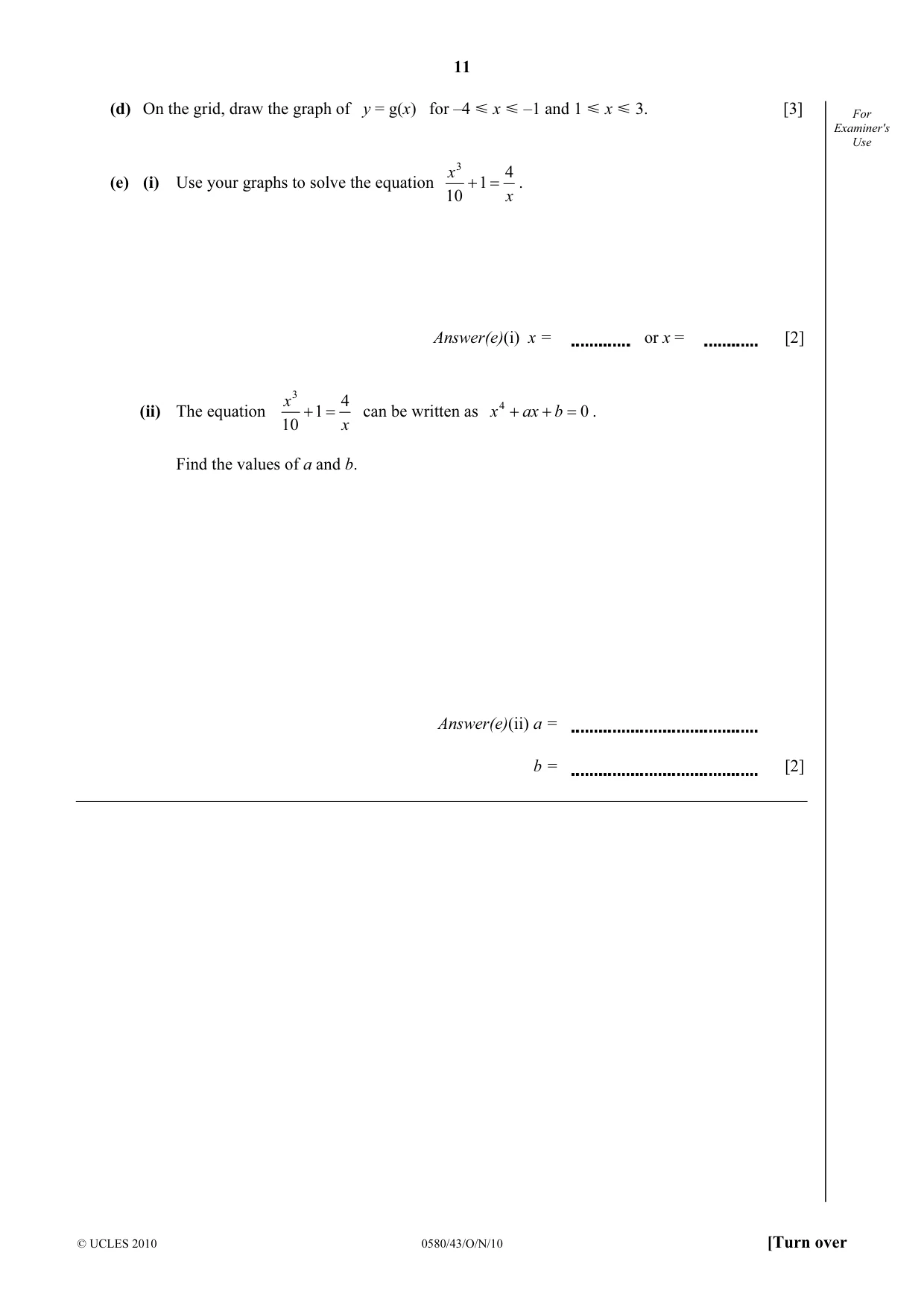
x 3 For 7 (a) Complete the table for the function f(x) = + 1 . Examiner's 10 Use x –4 –3 –2 –1 0 1 2 3 f(x) –1.7 0.2 0.9 1 1.1 1.8 [2] (b) On the grid, draw the graph of y = f(x) for –4 Y x Y=3. y 4 3 2 1 x –4 –3 –2 –1 0 1 2 3 –1 –2 –3 –4 –5 –6 –7 –8 [4] 4 (c) Complete the table for the function g(x) = , x ≠ 0 . x x –4 –3 –2 –1 1 2 3 g(x) –1 –1.3 2 1.3 [2] (d) On the grid, draw the graph of y = g(x) for –4 Y x Y –1 and 1 Y x Y 3. [3] For Examiner's Use x 3 4 (e) (i) Use your graphs to solve the equation + 1 = . 10 x Answer(e)(i) x = or x = [2] x 3 4 4 (ii) The equation + 1 = can be written as x + ax + b = 0 . 10 x Find the values of a and b. Answer(e)(ii) a = b = [2]
Mark scheme: 7 (a) – 5.4 1 3.7 1 (b) 8 points correctly plotted ft P3 P3ft their table. P2ft for 6 or 7 points. P1ft for 4 or 5 points Smooth cubic curve through all 8 C1 Only ft points if shape not affected. points (c) –2, –4, 4 2 B1 for 2 correct (d) 7 points correctly plotted ft P2 P2ft P1ft for 5 or 6 points Two separate smooth branches of C1 Must pass through all 7 points, only ft if shape rectangular hyperbola not affected and no contact with either axis. (e) (i) –2.9 Y x Y– 2.8 1 Not with y coordinates 2.05 Y x Y 2.15 1 (ii) a = 10 1 b = –40 1 IGCSE – October/November 2010 0580 43 2
Q8 · For Examiner's NOT TO Use SCALE 3 cm 12 cm The diagram shows a solid made up of a…
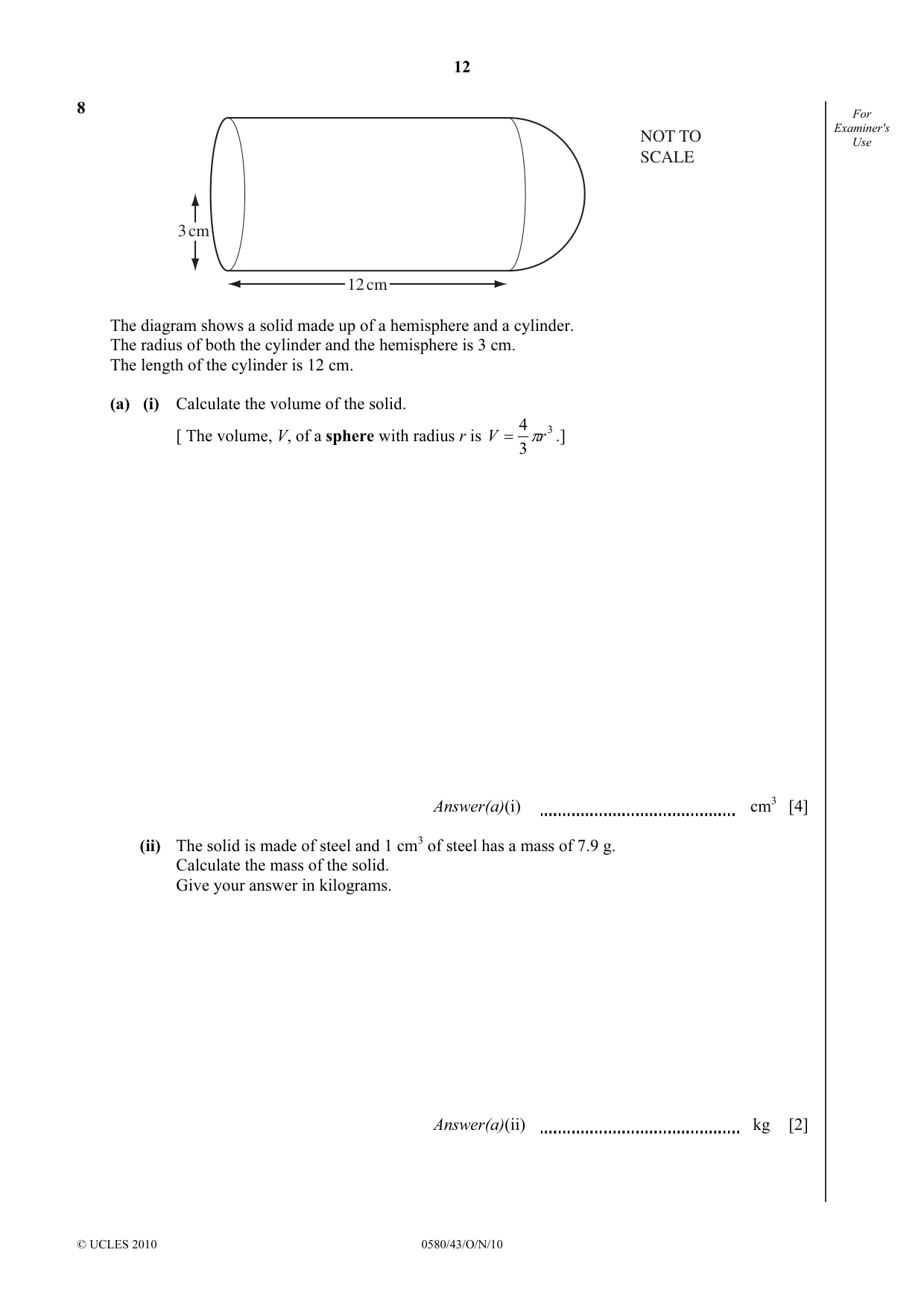
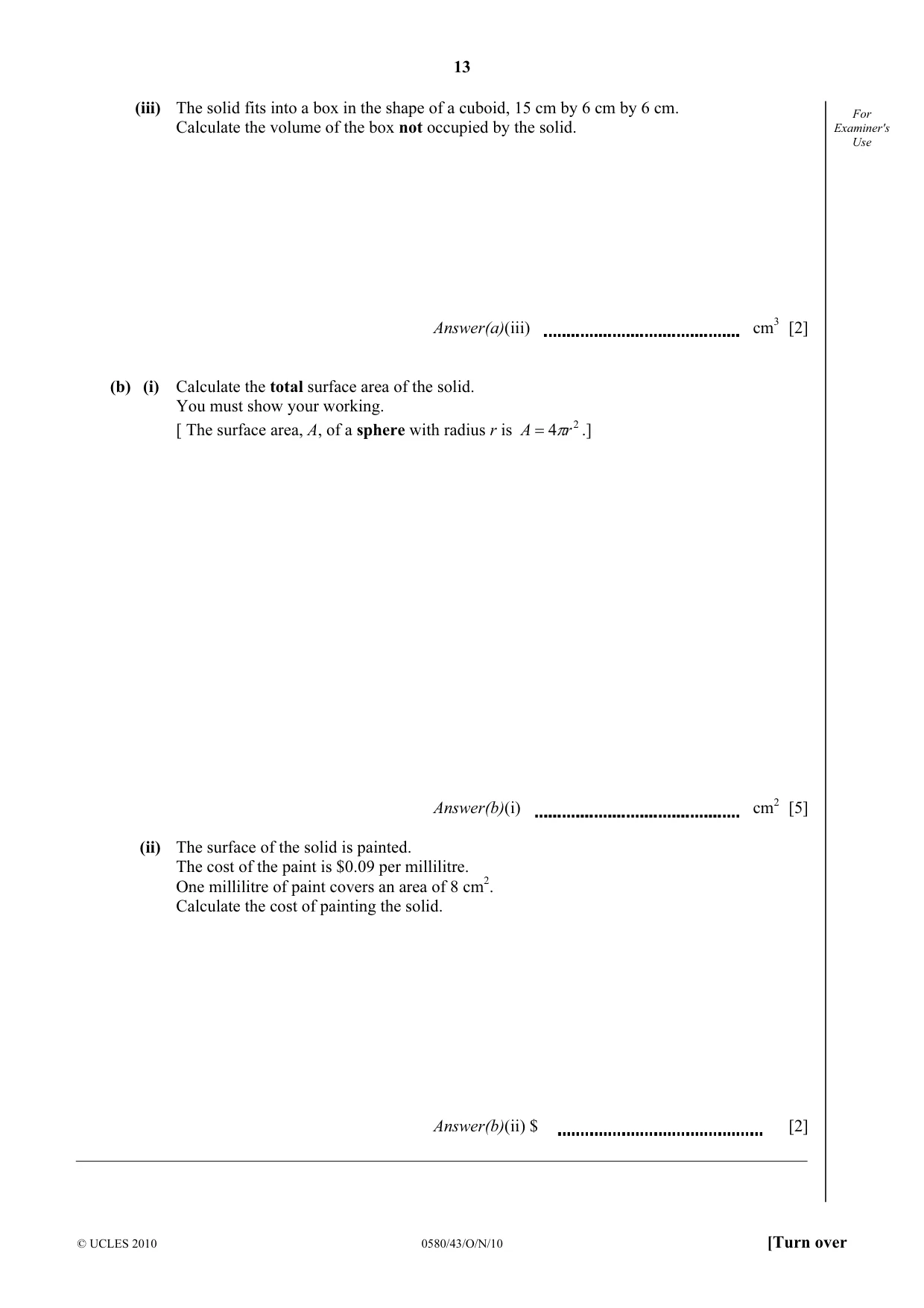
8 For Examiner's NOT TO Use SCALE 3 cm 12 cm The diagram shows a solid made up of a hemisphere and a cylinder. The radius of both the cylinder and the hemisphere is 3 cm. The length of the cylinder is 12 cm. (a) (i) Calculate the volume of the solid. 4 3 [ The volume, V, of a sphere with radius r is V = πr .] 3 Answer(a)(i) cm3 [4] (ii) The solid is made of steel and 1 cm3 of steel has a mass of 7.9 g. Calculate the mass of the solid. Give your answer in kilograms. Answer(a)(ii) kg [2] (iii) The solid fits into a box in the shape of a cuboid, 15 cm by 6 cm by 6 cm. For Calculate the volume of the box not occupied by the solid. Examiner's Use Answer(a)(iii) cm3 [2] (b) (i) Calculate the total surface area of the solid. You must show your working. [ The surface area, A, of a sphere with radius r is A = 4πr 2 .] Answer(b)(i) cm2 [5] (ii) The surface of the solid is painted. The cost of the paint is $0.09 per millilitre. One millilitre of paint covers an area of 8 cm2. Calculate the cost of painting the solid. Answer(b)(ii) $ [2]
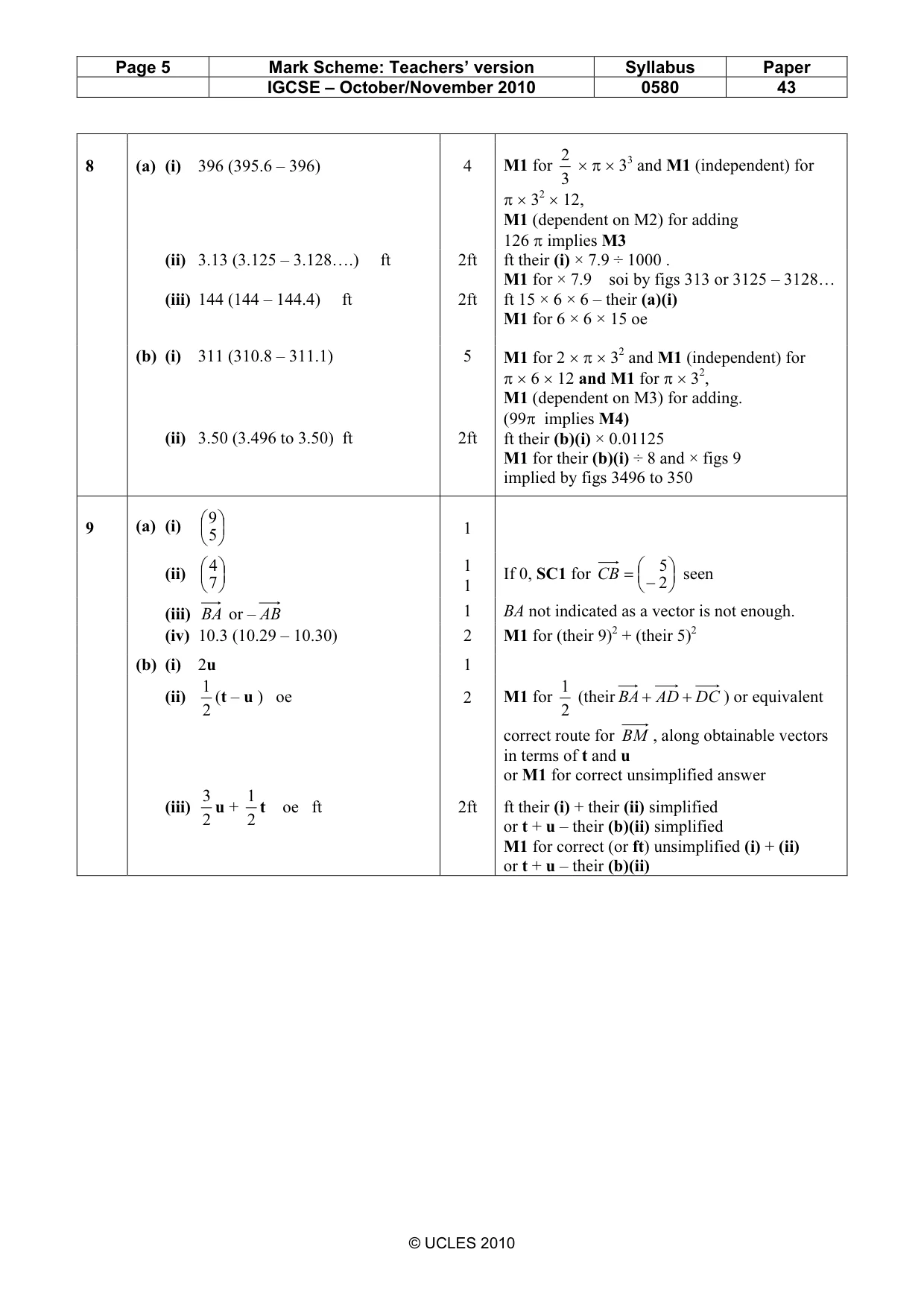
Mark scheme: 2 8 (a) (i) 396 (395.6 – 396) 4 M1 for × π × 33 and M1 (independent) for 3 π × 32 × 12, M1 (dependent on M2) for adding 126 π implies M3 (ii) 3.13 (3.125 – 3.128….) ft 2ft ft their (i) × 7.9 ÷ 1000 . M1 for × 7.9 soi by figs 313 or 3125 – 3128… (iii) 144 (144 – 144.4) ft 2ft ft 15 × 6 × 6 – their (a)(i) M1 for 6 × 6 × 15 oe (b) (i) 311 (310.8 – 311.1) 5 M1 for 2 × π × 32 and M1 (independent) for π × 6 × 12 and M1 for π × 32, M1 (dependent on M3) for adding. (99π implies M4) (ii) 3.50 (3.496 to 3.50) ft 2ft ft their (b)(i) × 0.01125 M1 for their (b)(i) ÷ 8 and × figs 9 implied by figs 3496 to 350 9
Q9 · For y Examiner's Use 3 A 2 1 x –4 –3 –2 –1 0 1 2 3 4 5 –1 C –2 –3 B –4 The points A (5…
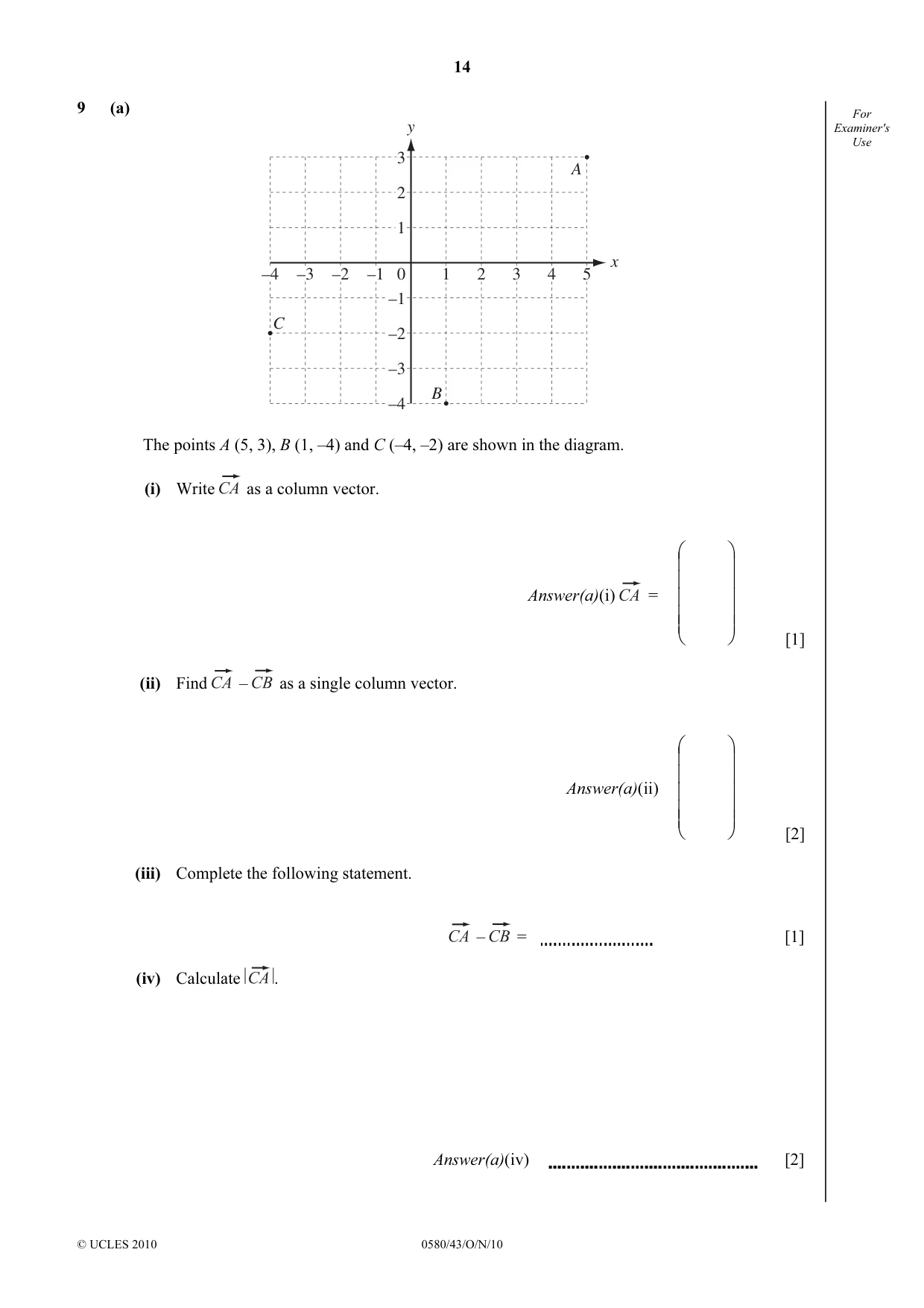
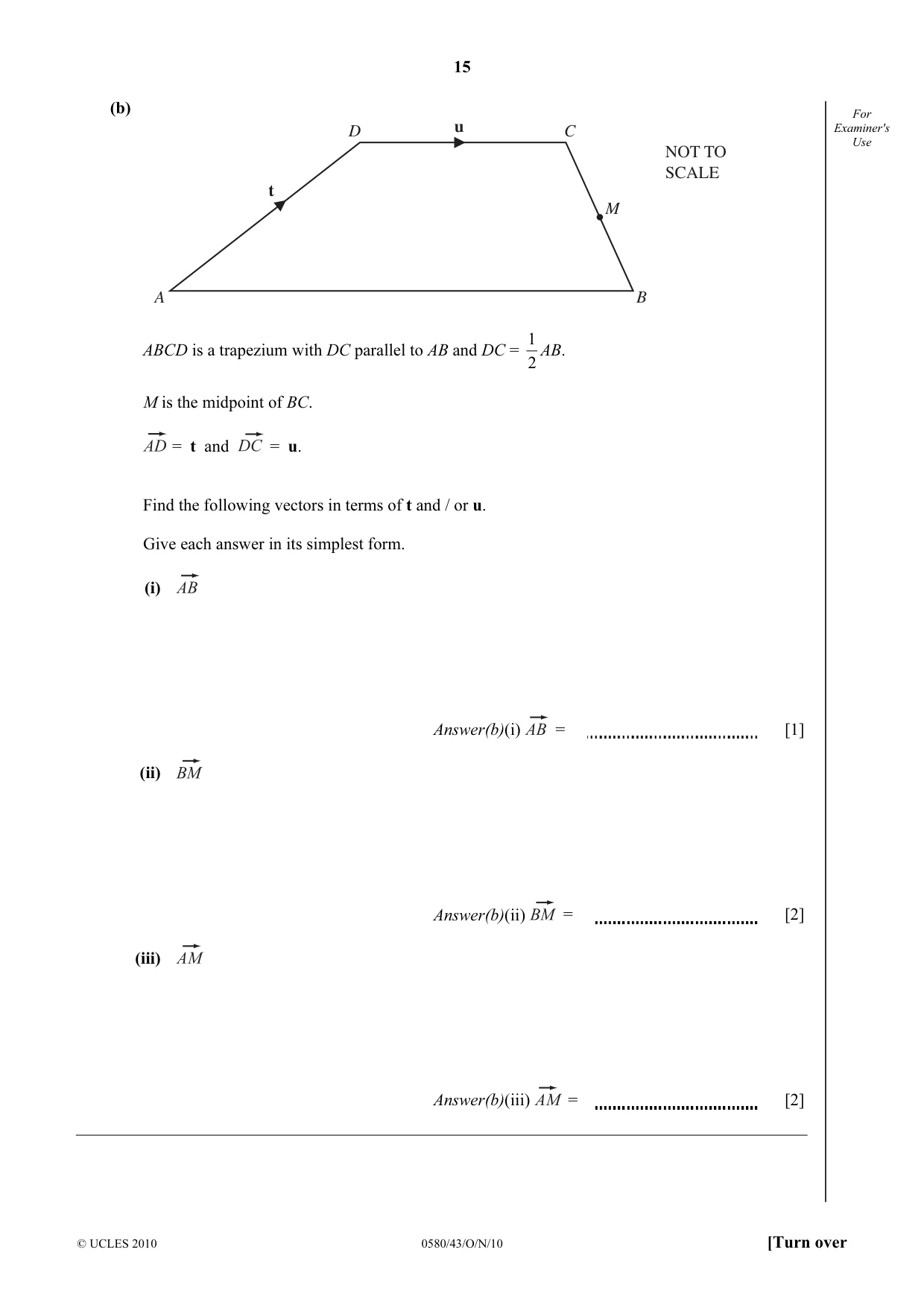
9 (a) For y Examiner's Use 3 A 2 1 x –4 –3 –2 –1 0 1 2 3 4 5 –1 C –2 –3 B –4 The points A (5, 3), B (1, –4) and C (–4, –2) are shown in the diagram. (i) Write as a column vector. Answer(a)(i) = [1] (ii) Find – as a single column vector. Answer(a)(ii) [2] (iii) Complete the following statement. – = [1] (iv) Calculate . Answer(a)(iv) [2] (b) For u Examiner's D C Use NOT TO SCALE t M A B 1 ABCD is a trapezium with DC parallel to AB and DC = AB. 2 M is the midpoint of BC. = t and = u. Find the following vectors in terms of t and / or u. Give each answer in its simplest form. (i) Answer(b)(i) = [1] (ii) Answer(b)(ii) = [2] (iii) Answer(b)(iii) = [2]
Mark scheme: 9 (a) (i) 9 1 5 (ii) 4 1 If 0, SC1 for CB = 5 seen 7 1 − 2 (iii) BA or – AB 1 BA not indicated as a vector is not enough. (iv) 10.3 (10.29 – 10.30) 2 M1 for (their 9)2 + (their 5)2 (b) (i) 2u 1 1 1 (ii) (t – u ) oe 2 M1 for (their BA + AD + DC ) or equivalent 2 2 correct route for BM , along obtainable vectors in terms of t and u or M1 for correct unsimplified answer 3 1 (iii) u + t oe ft 2ft ft their (i) + their (ii) simplified 2 2 or t + u – their (b)(ii) simplified M1 for correct (or ft) unsimplified (i) + (ii) or t + u – their (b)(ii) IGCSE – October/November 2010 0580 43
Q10 · For a set of six integers, the mode is 8, the median is 9 and the mean is 10
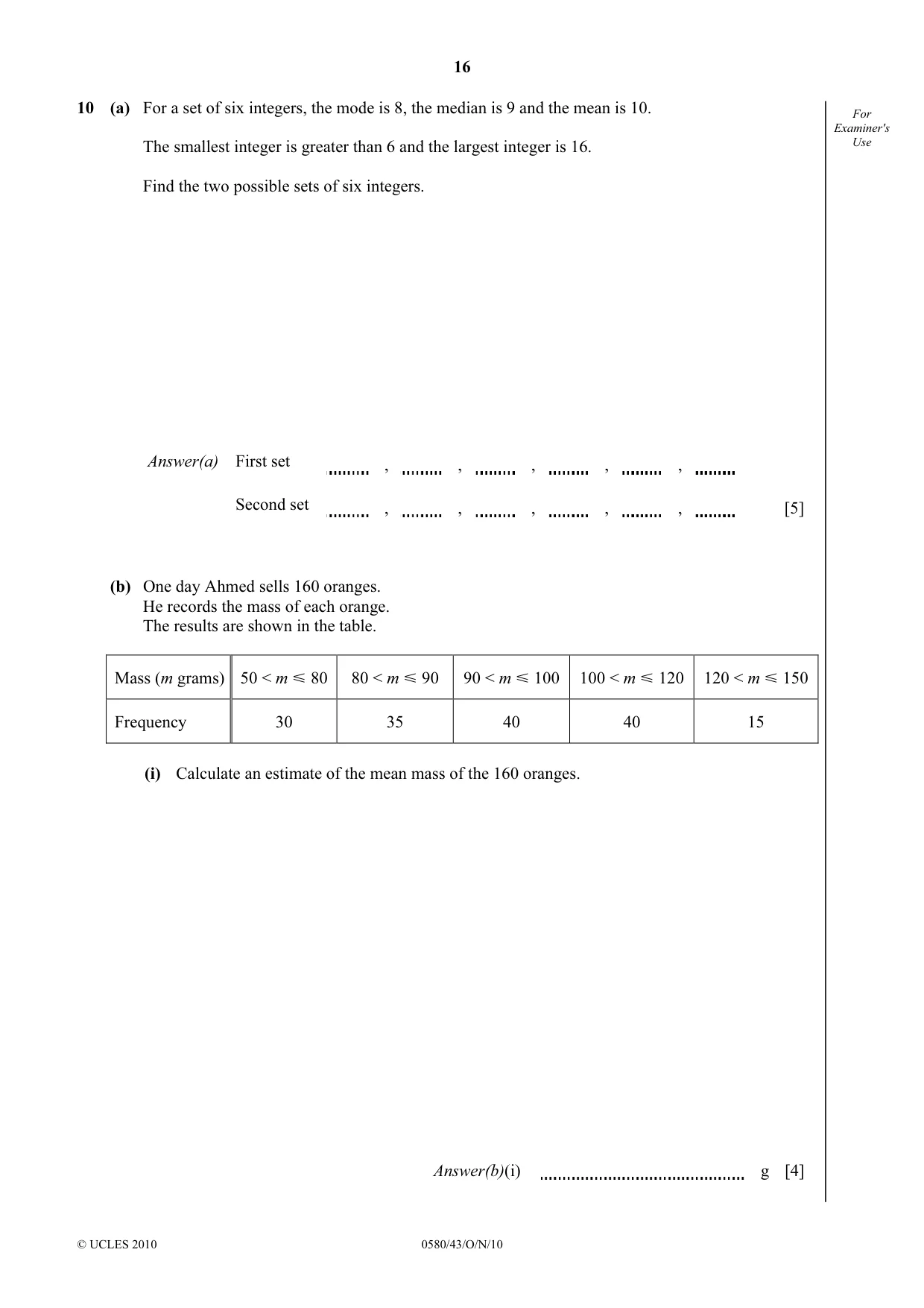
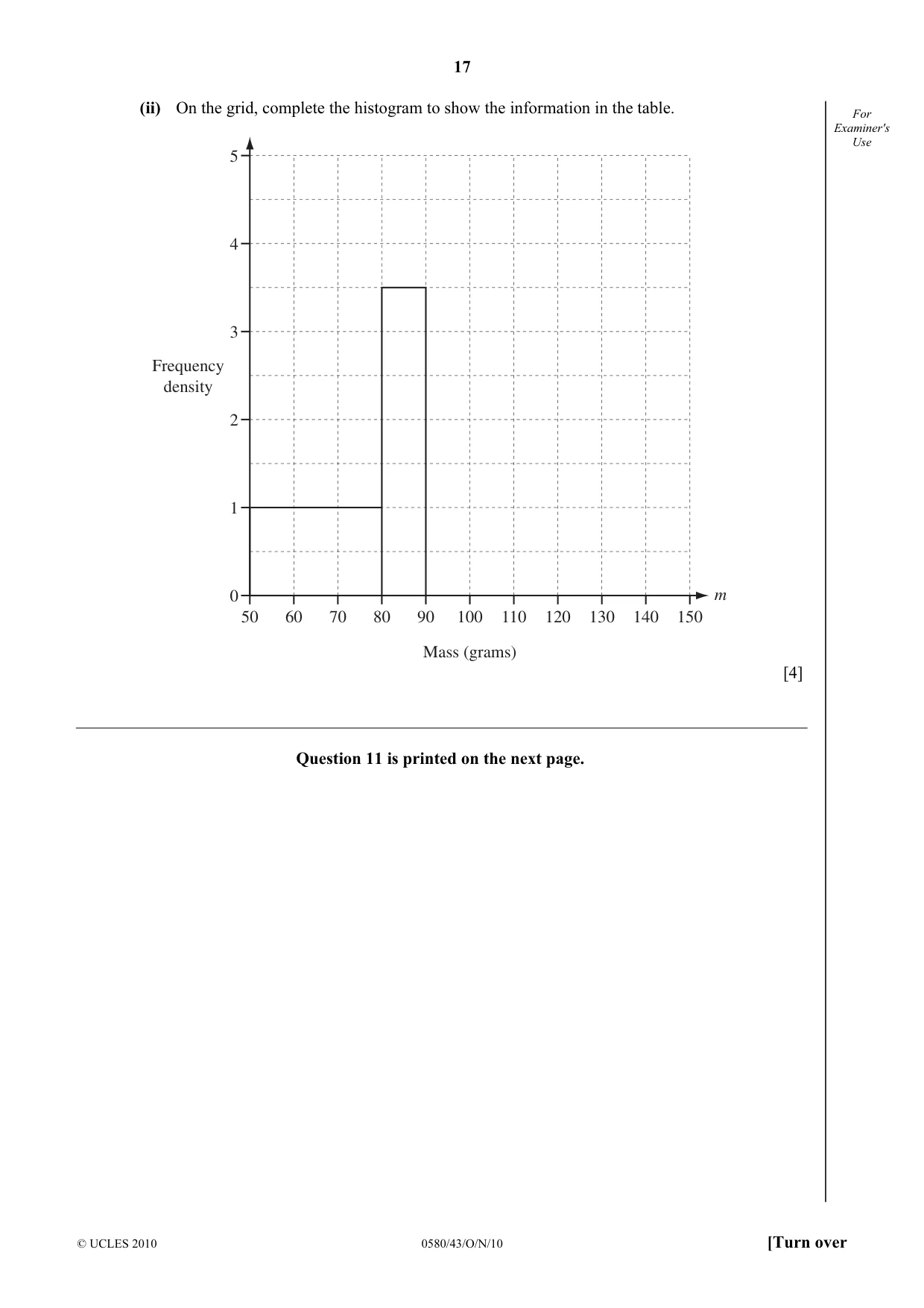
10 (a) For a set of six integers, the mode is 8, the median is 9 and the mean is 10. For Examiner's The smallest integer is greater than 6 and the largest integer is 16. Use Find the two possible sets of six integers. Answer(a) First set , , , , , Second set , , , , , [5] (b) One day Ahmed sells 160 oranges. He records the mass of each orange. The results are shown in the table. Mass (m grams) 50 < m Y 80 80 < m Y 90 90 < m Y 100 100 < m Y 120 120 < m Y 150 Frequency 30 35 40 40 15 (i) Calculate an estimate of the mean mass of the 160 oranges. Answer(b)(i) g [4] (ii) On the grid, complete the histogram to show the information in the table. For Examiner's Use 5 4 3 Frequency density 2 1 0 m 50 60 70 80 90 100 110 120 130 140 150 Mass (grams) [4] Question 11 is printed on the next page.
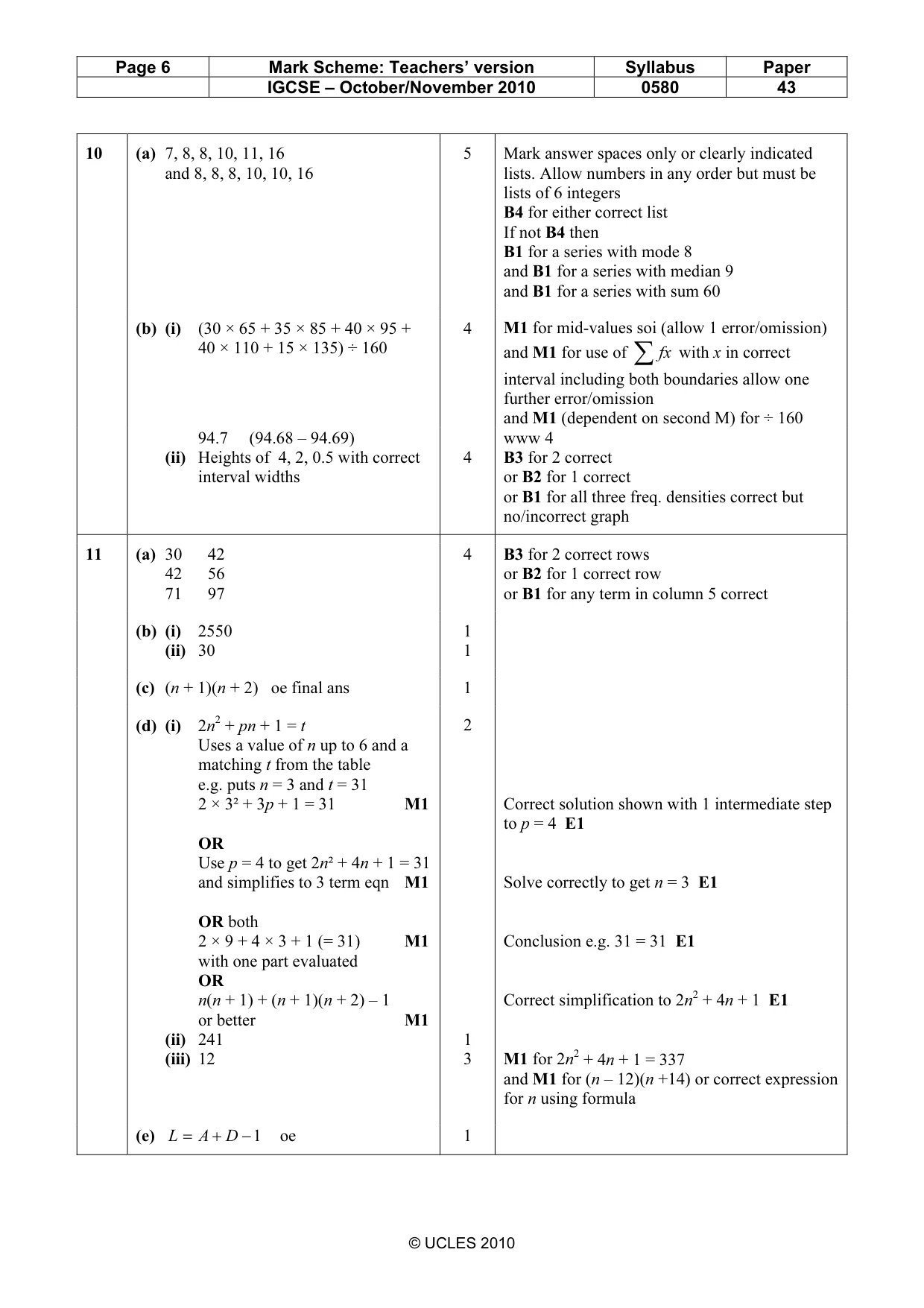
Mark scheme: 10 (a) 7, 8, 8, 10, 11, 16 5 Mark answer spaces only or clearly indicated and 8, 8, 8, 10, 10, 16 lists. Allow numbers in any order but must be lists of 6 integers B4 for either correct list If not B4 then B1 for a series with mode 8 and B1 for a series with median 9 and B1 for a series with sum 60 (b) (i) (30 × 65 + 35 × 85 + 40 × 95 + 4 M1 for mid-values soi (allow 1 error/omission) with x in correct 40 × 110 + 15 × 135) ÷ 160 and M1 for use of ∑fx interval including both boundaries allow one further error/omission and M1 (dependent on second M) for ÷ 160 94.7 (94.68 – 94.69) www 4 (ii) Heights of 4, 2, 0.5 with correct 4 B3 for 2 correct interval widths or B2 for 1 correct or B1 for all three freq. densities correct but no/incorrect graph
Q11 · For Examiner's Use Diagram 1 Diagram 2 Diagram 3 Diagram 4 The first four Diagrams in a…
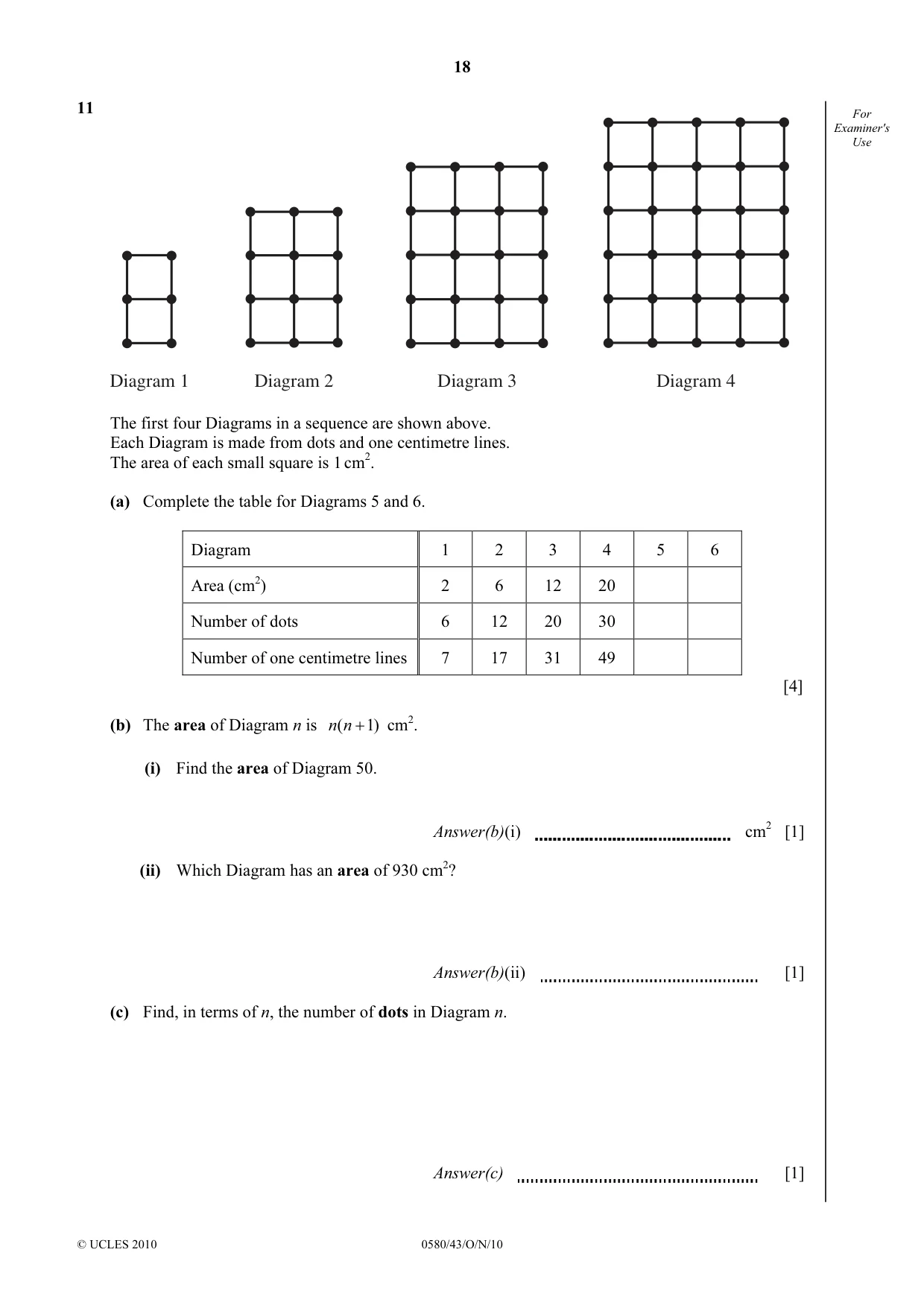
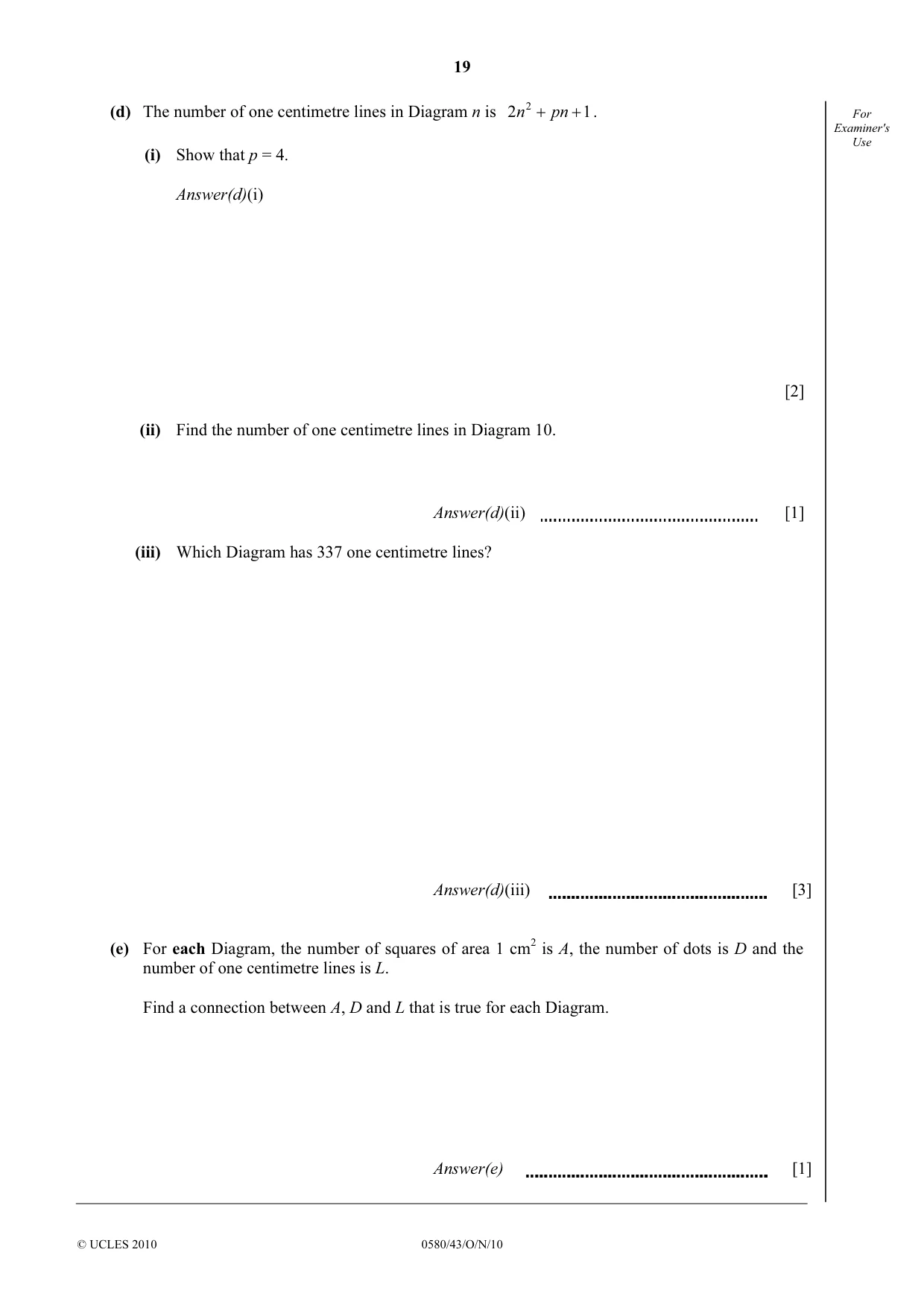
11 For Examiner's Use Diagram 1 Diagram 2 Diagram 3 Diagram 4 The first four Diagrams in a sequence are shown above. Each Diagram is made from dots and one centimetre lines. The area of each small square is 1 cm2. (a) Complete the table for Diagrams 5 and 6. Diagram 1 2 3 4 5 6 Area (cm2) 2 6 12 20 Number of dots 6 12 20 30 Number of one centimetre lines 7 17 31 49 [4] (b) The area of Diagram n is n ( n + )1 cm2. (i) Find the area of Diagram 50. Answer(b)(i) cm2 [1] (ii) Which Diagram has an area of 930 cm2? Answer(b)(ii) [1] (c) Find, in terms of n, the number of dots in Diagram n. Answer(c) [1] (d) The number of one centimetre lines in Diagram n is 2 n 2 + pn + 1 . For Examiner's Use (i) Show that p = 4. Answer(d)(i) [2] (ii) Find the number of one centimetre lines in Diagram 10. Answer(d)(ii) [1] (iii) Which Diagram has 337 one centimetre lines? Answer(d)(iii) [3] (e) For each Diagram, the number of squares of area 1 cm2 is A, the number of dots is D and the number of one centimetre lines is L. Find a connection between A, D and L that is true for each Diagram. Answer(e) [1]
Mark scheme: 11 (a) 30 42 4 B3 for 2 correct rows 42 56 or B2 for 1 correct row 71 97 or B1 for any term in column 5 correct (b) (i) 2550 1 (ii) 30 1 (c) (n + 1)(n + 2) oe final ans 1 (d) (i) 2n2 + pn + 1 = t 2 Uses a value of n up to 6 and a matching t from the table e.g. puts n = 3 and t = 31 2 × 3² + 3p + 1 = 31 M1 Correct solution shown with 1 intermediate step to p = 4 E1 OR Use p = 4 to get 2n² + 4n + 1 = 31 and simplifies to 3 term eqn M1 Solve correctly to get n = 3 E1 OR both 2 × 9 + 4 × 3 + 1 (= 31) M1 Conclusion e.g. 31 = 31 E1 with one part evaluated OR n(n + 1) + (n + 1)(n + 2) – 1 Correct simplification to 2n2 + 4n + 1 E1 or better M1 (ii) 241 1 (iii) 12 3 M1 for 2n2 + 4n + 1 = 337 and M1 for (n – 12)(n +14) or correct expression for n using formula (e) L = A + D − 1 oe 1
What was in this paper
The subtopics covered by these 8 questions, and how many questions each got. Open one in a new tab to see every Cambridge question on it.
What you needed in this session
Cambridge’s own grade thresholds for 2010 Oct/Nov, Paper 4 · Variant 3. A higher threshold means an easier paper — the bar moves with how the cohort did.