Cambridge IGCSE Mathematics 0580 — 2014 May/June Paper 4 · Variant 3
0580/43/M/J/14 · 6 questions · 130 marks · ≈146 min
The question paper and its mark scheme, free to read here and free to download. This is Cambridge’s own paper, exactly as it was sat.
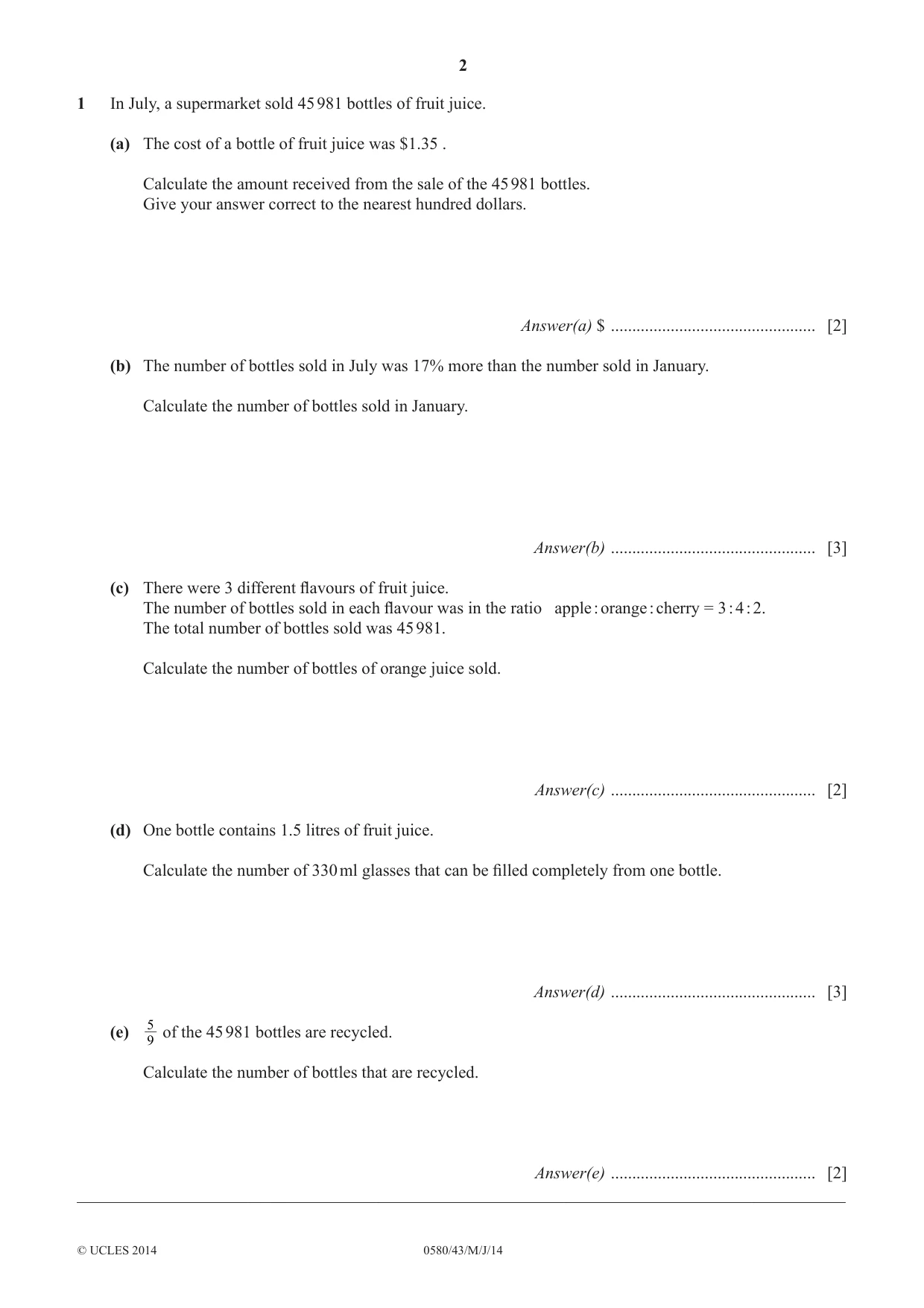
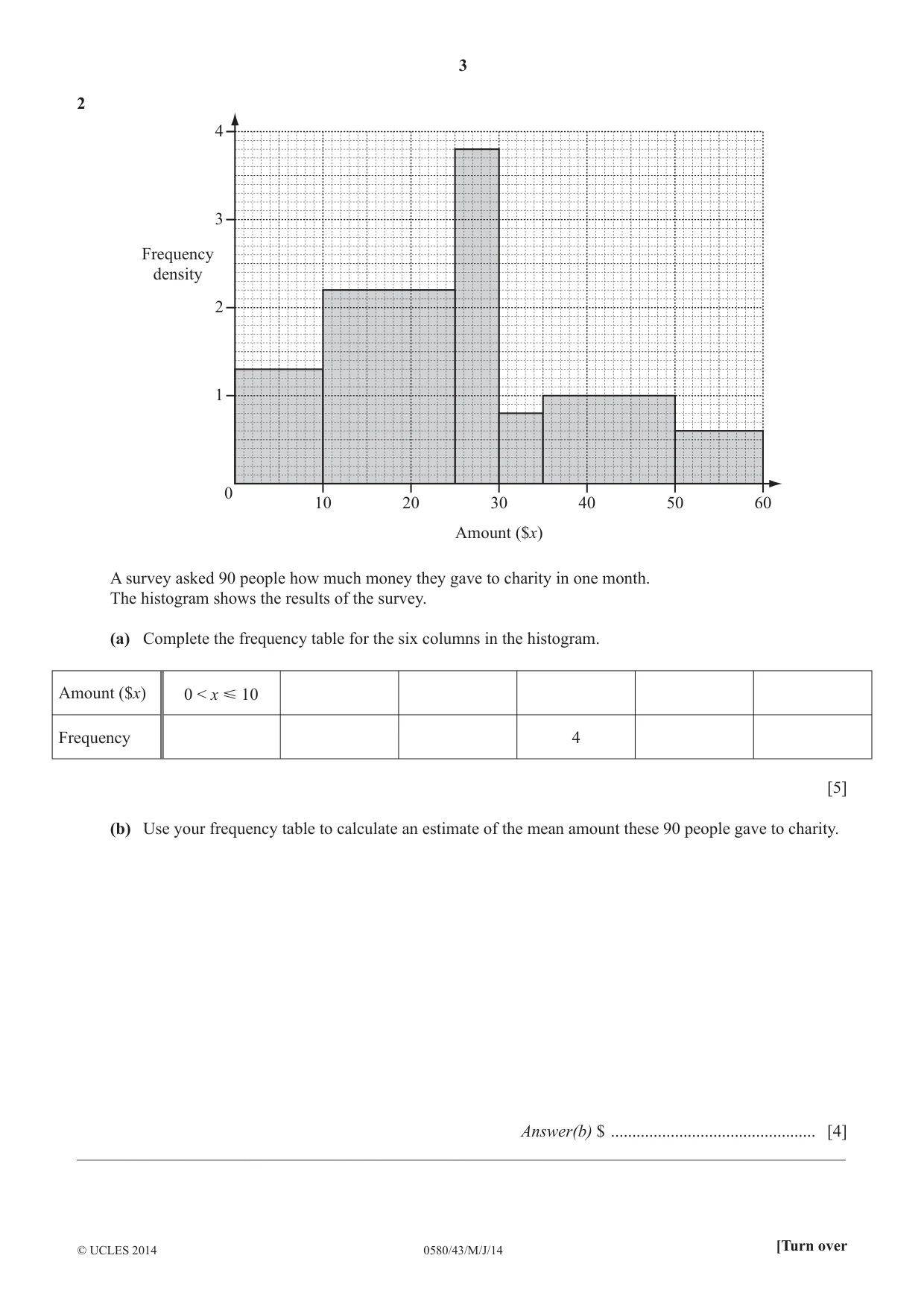
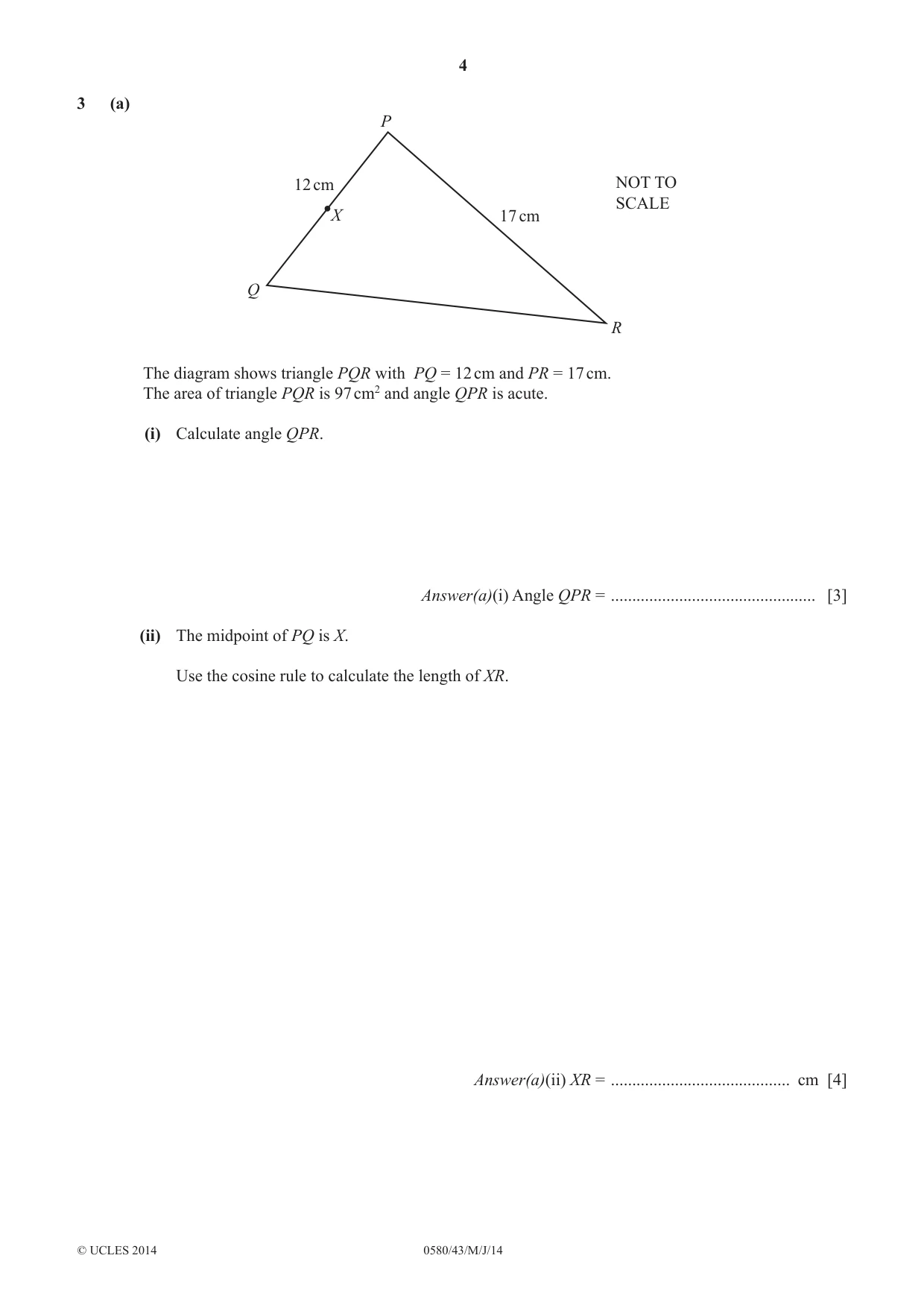
Question paper16 pages
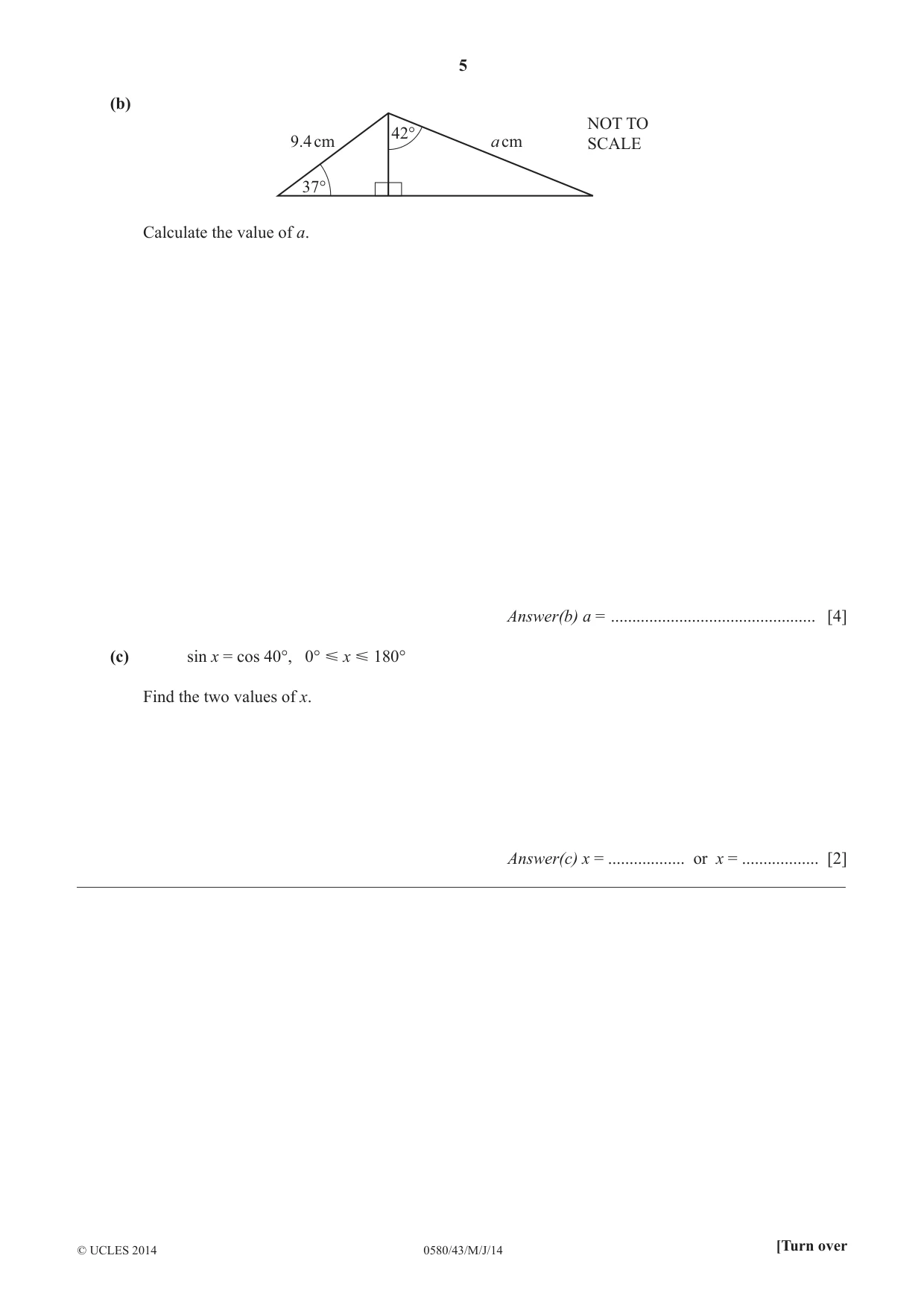
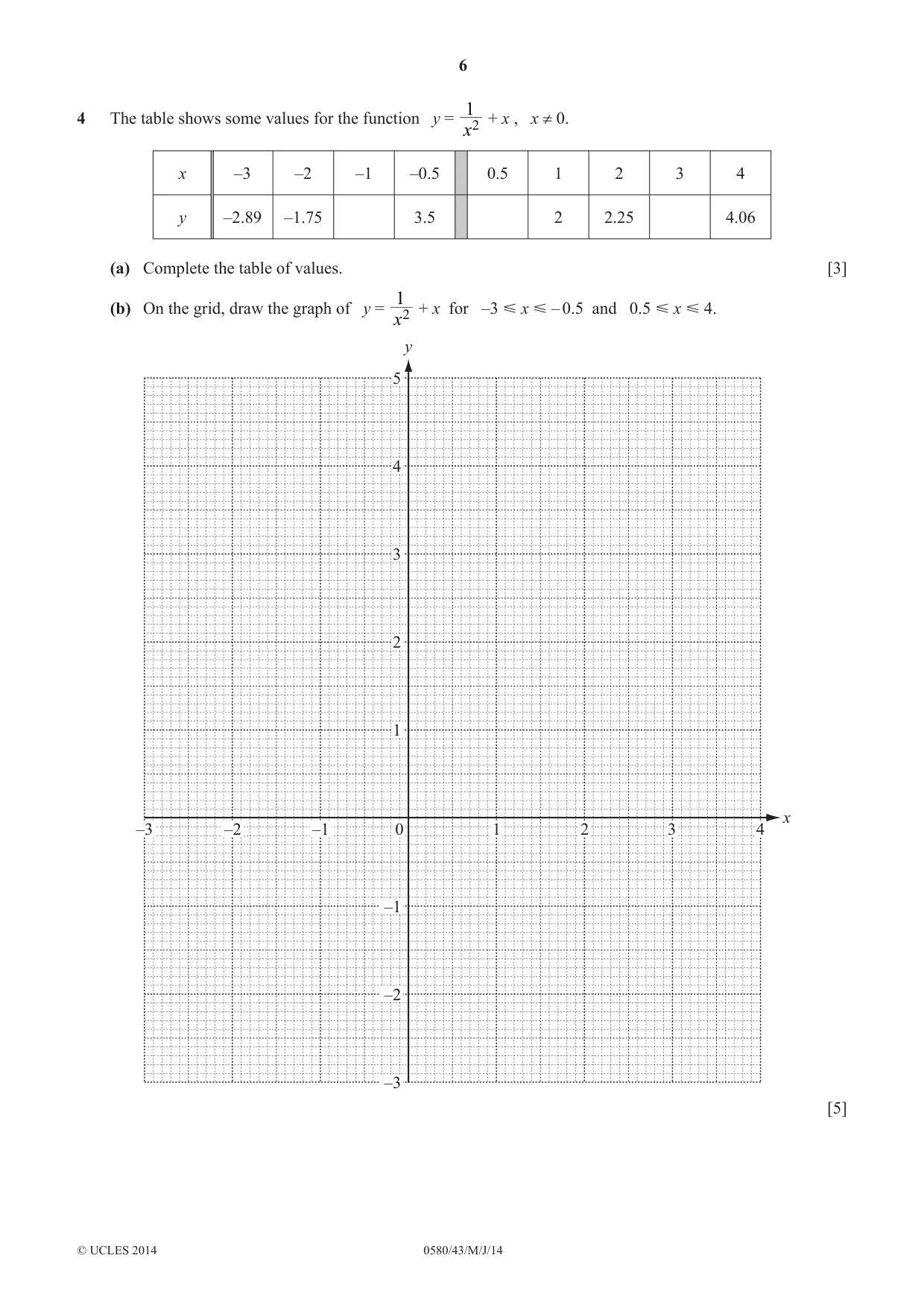
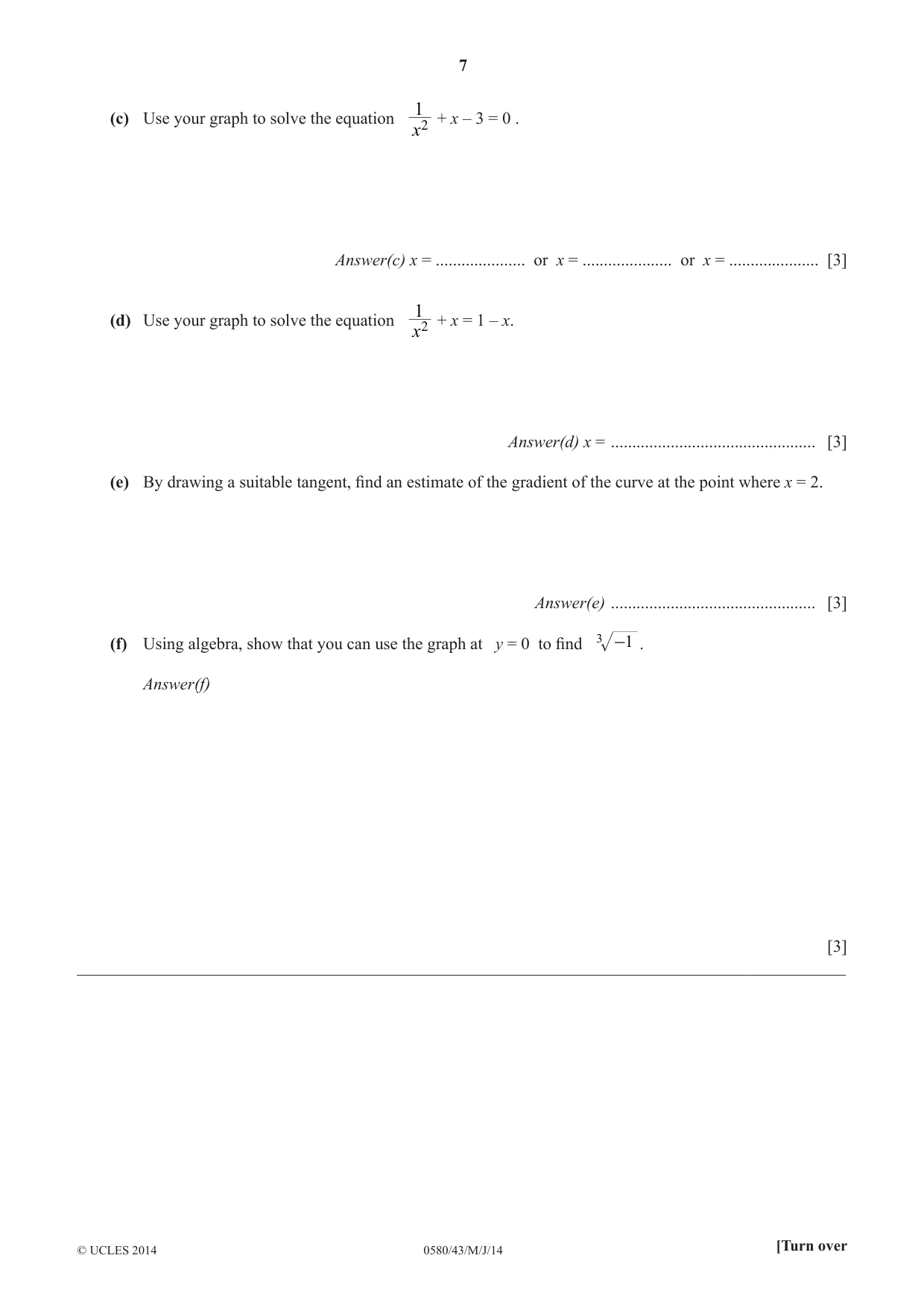
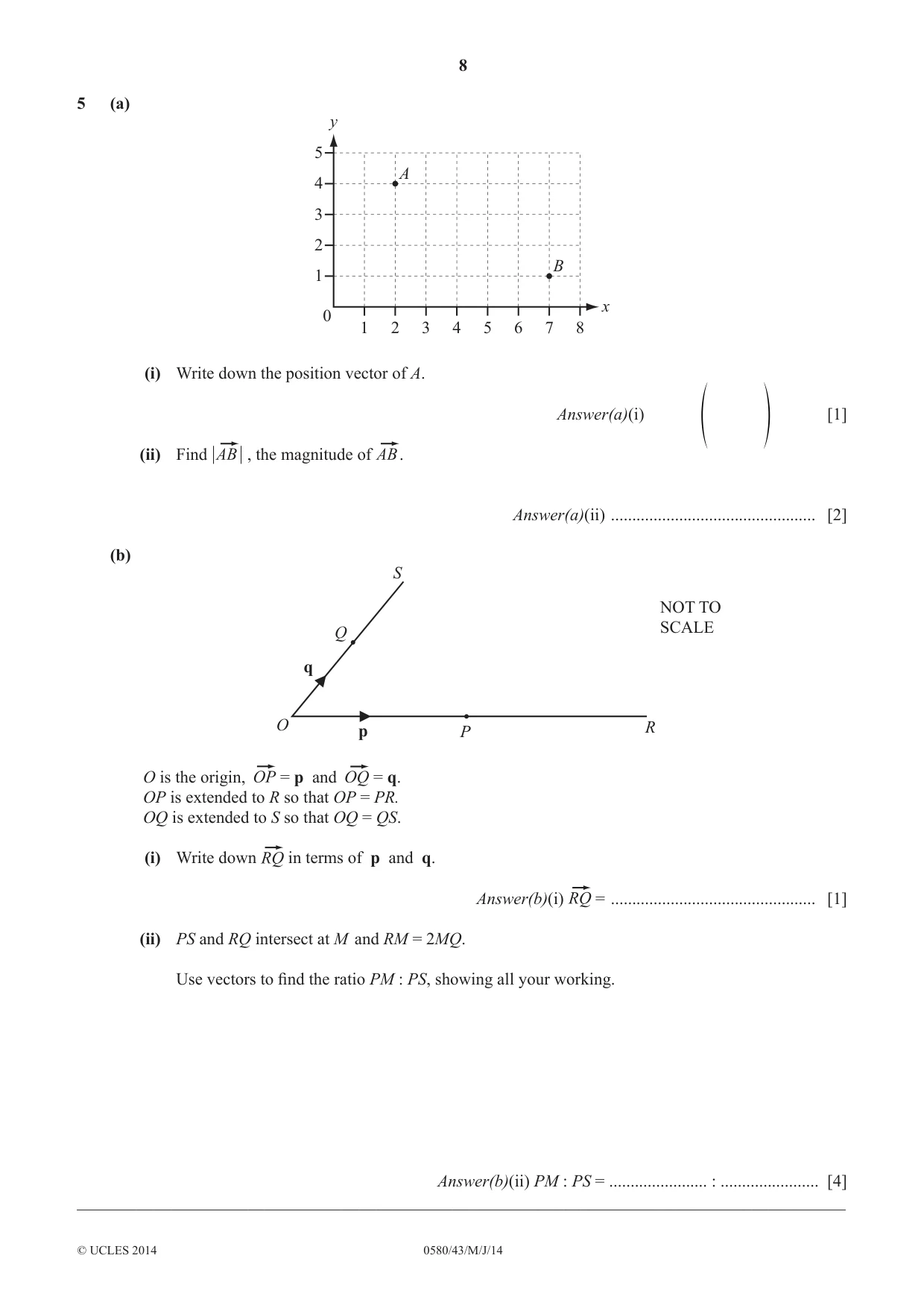
Mark scheme7 pages
Answers below. Sit the paper first if you are practising.
Questions as text
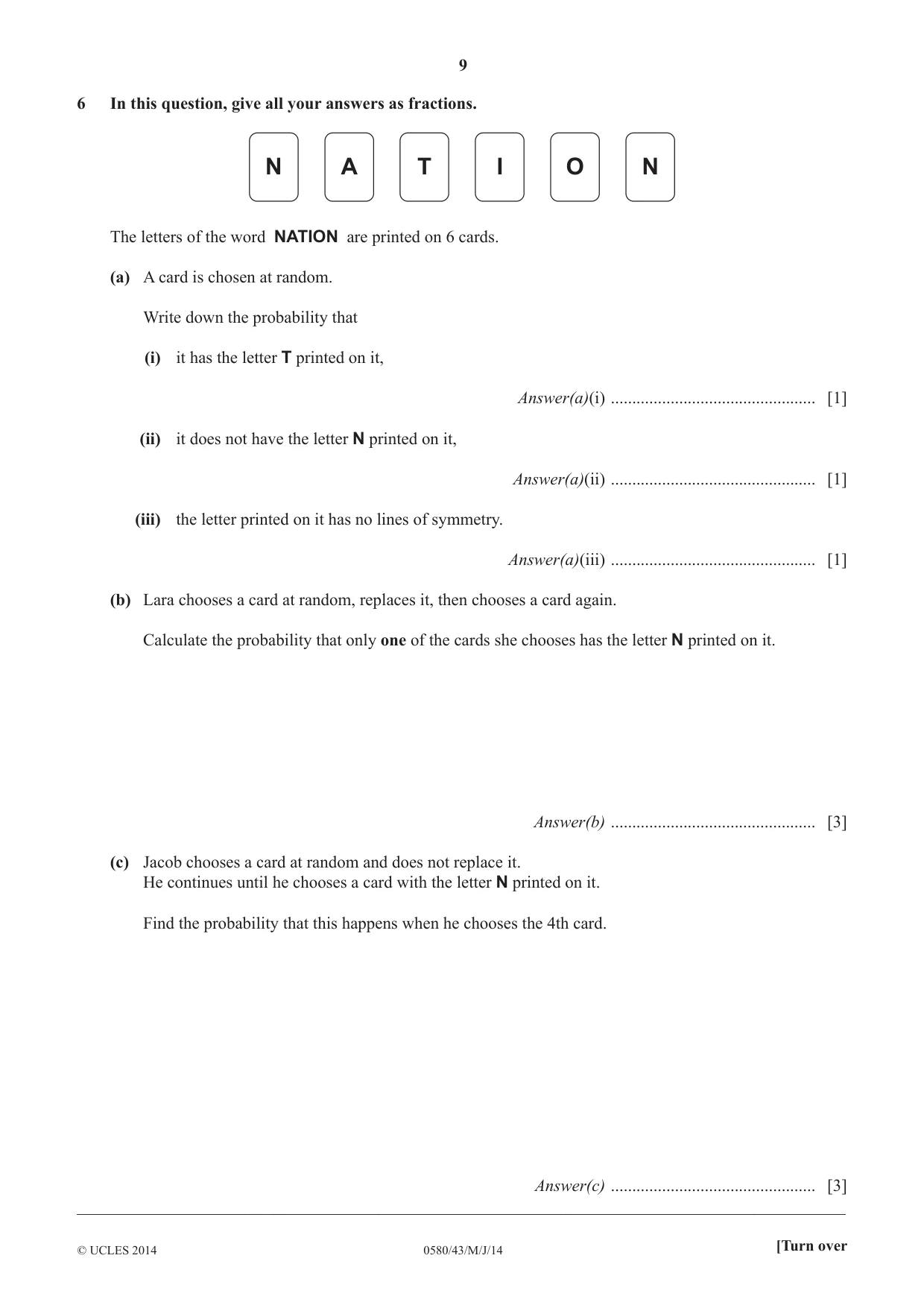
Q6 · In this question, give all your answers as fractions
6 In this question, give all your answers as fractions. N A T I O N The letters of the word NATION are printed on 6 cards. (a) A card is chosen at random. Write down the probability that (i) it has the letter T printed on it, Answer(a)(i) ................................................ [1] (ii) it does not have the letter N printed on it, Answer(a)(ii) ................................................ [1] (iii) the letter printed on it has no lines of symmetry. Answer(a)(iii) ................................................ [1] (b) Lara chooses a card at random, replaces it, then chooses a card again. Calculate the probability that only one of the cards she chooses has the letter N printed on it. Answer(b) ................................................ [3] (c) Jacob chooses a card at random and does not replace it. He continues until he chooses a card with the letter N printed on it. Find the probability that this happens when he chooses the 4th card. Answer(c) ................................................ [3] __________________________________________________________________________________________
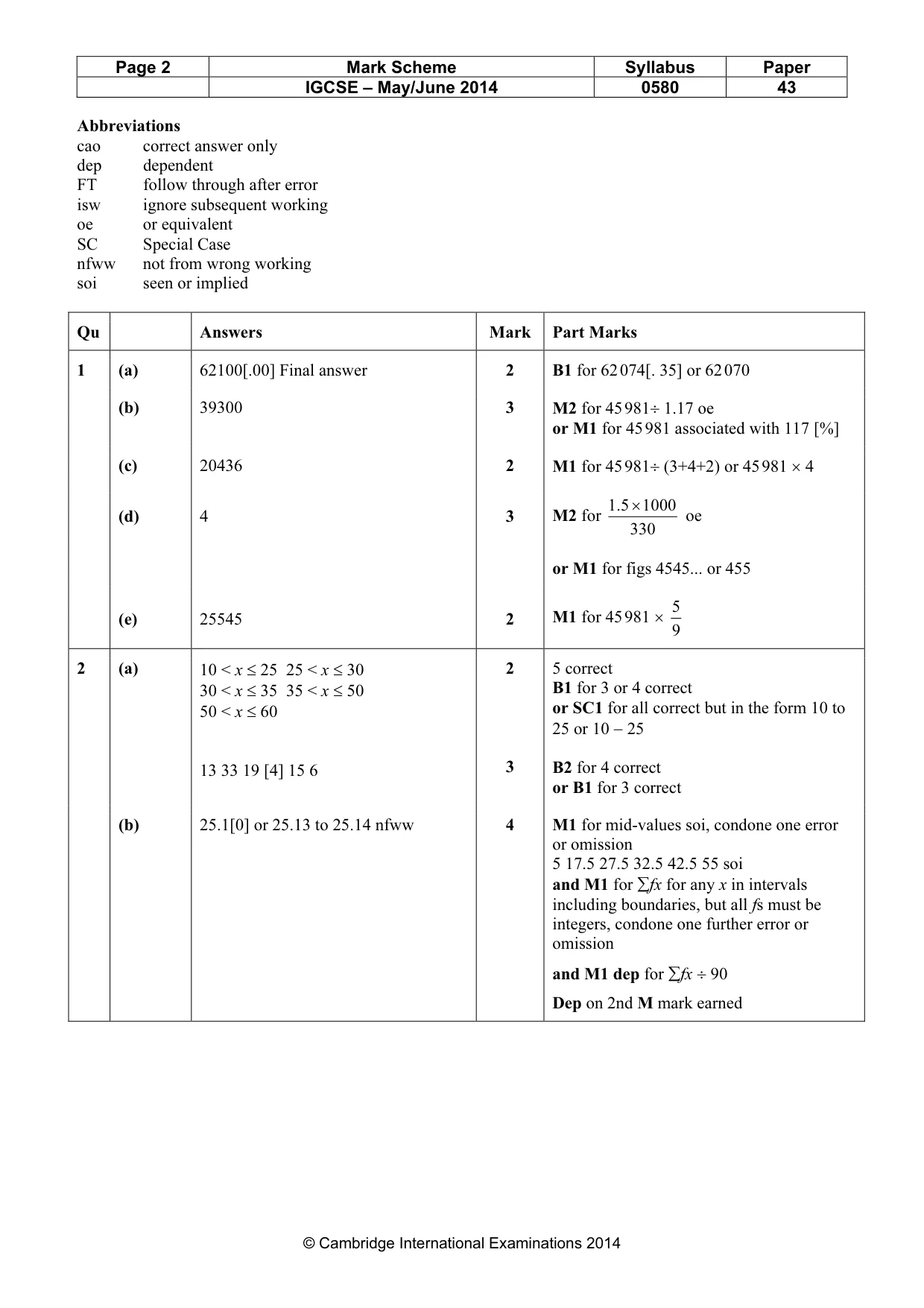
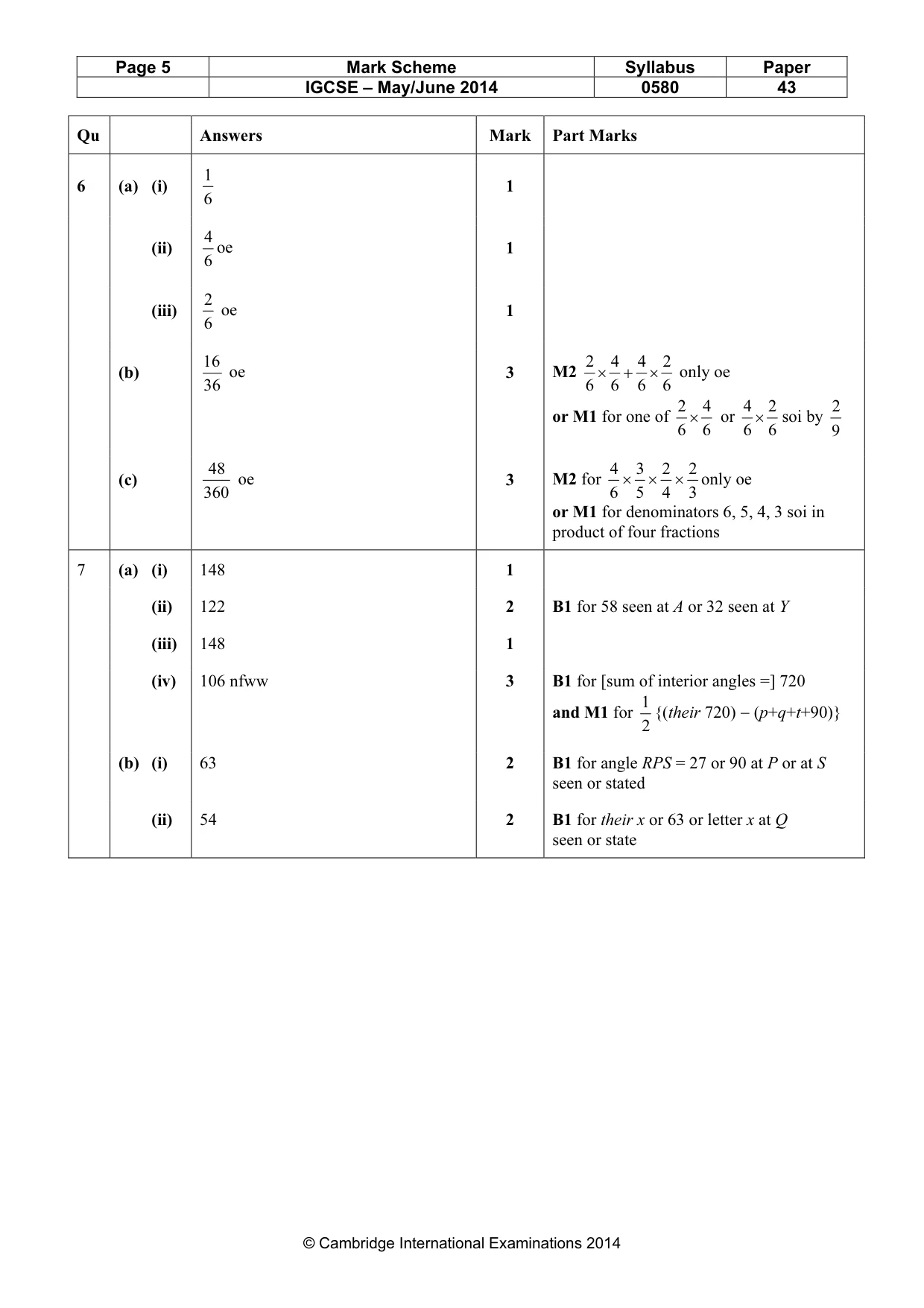
Mark scheme: 16 (a) (i) 1 6 4 (ii) oe 1 6 2 (iii) oe 1 6 16 2 4 4 2 (b) oe 3 M2 × + × only oe 36 6 6 6 6 2 4 4 2 2 or M1 for one of × or × soi by 6 6 6 6 9 48 4 3 2 2 (c) oe 3 M2 for × × × only oe 360 6 5 4 3 or M1 for denominators 6, 5, 4, 3 soi in product of four fractions
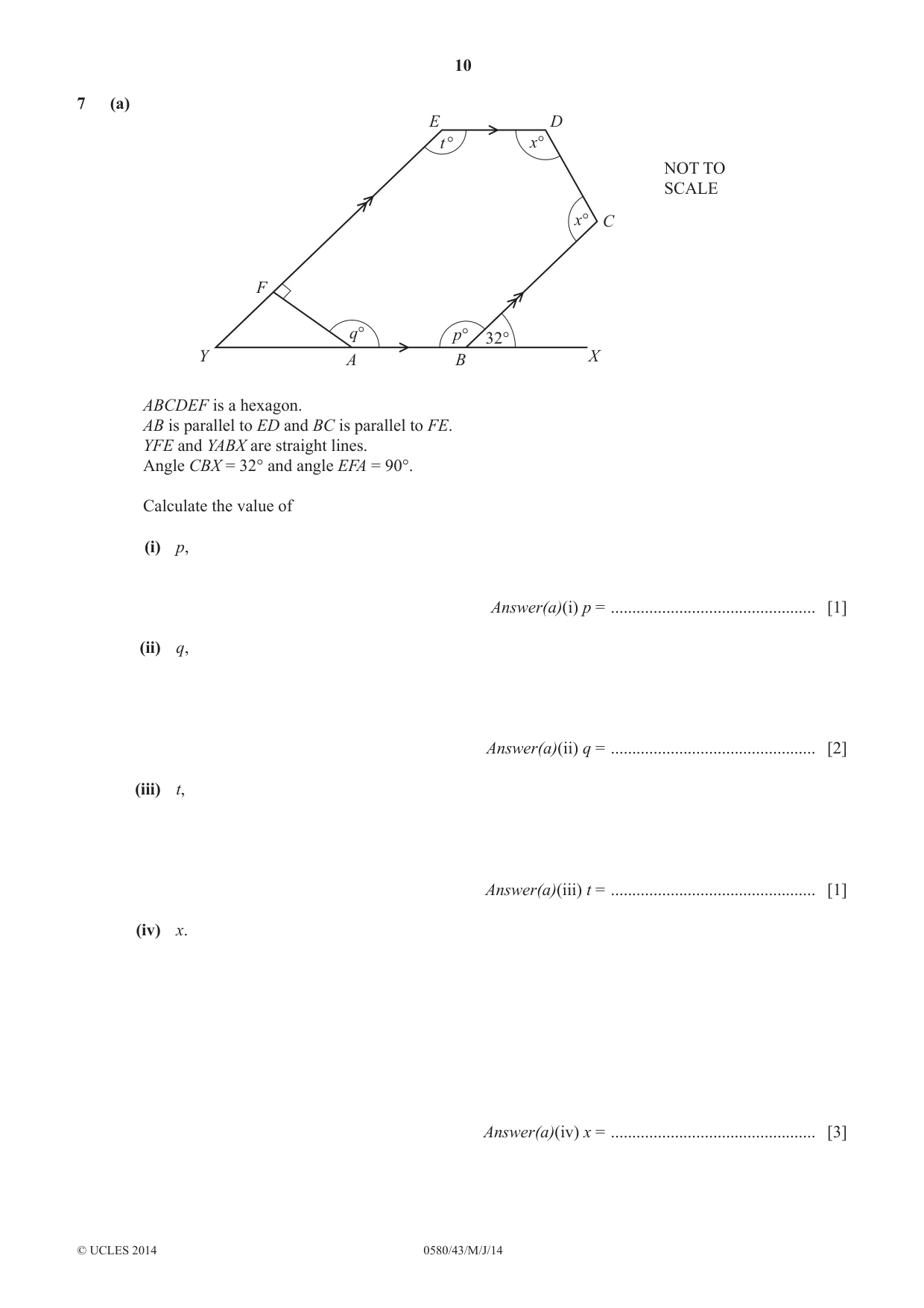
Q7 · E D t ° x° NOT TO SCALE x° C F q° p° 32° Y A B X ABCDEF is a hexagon
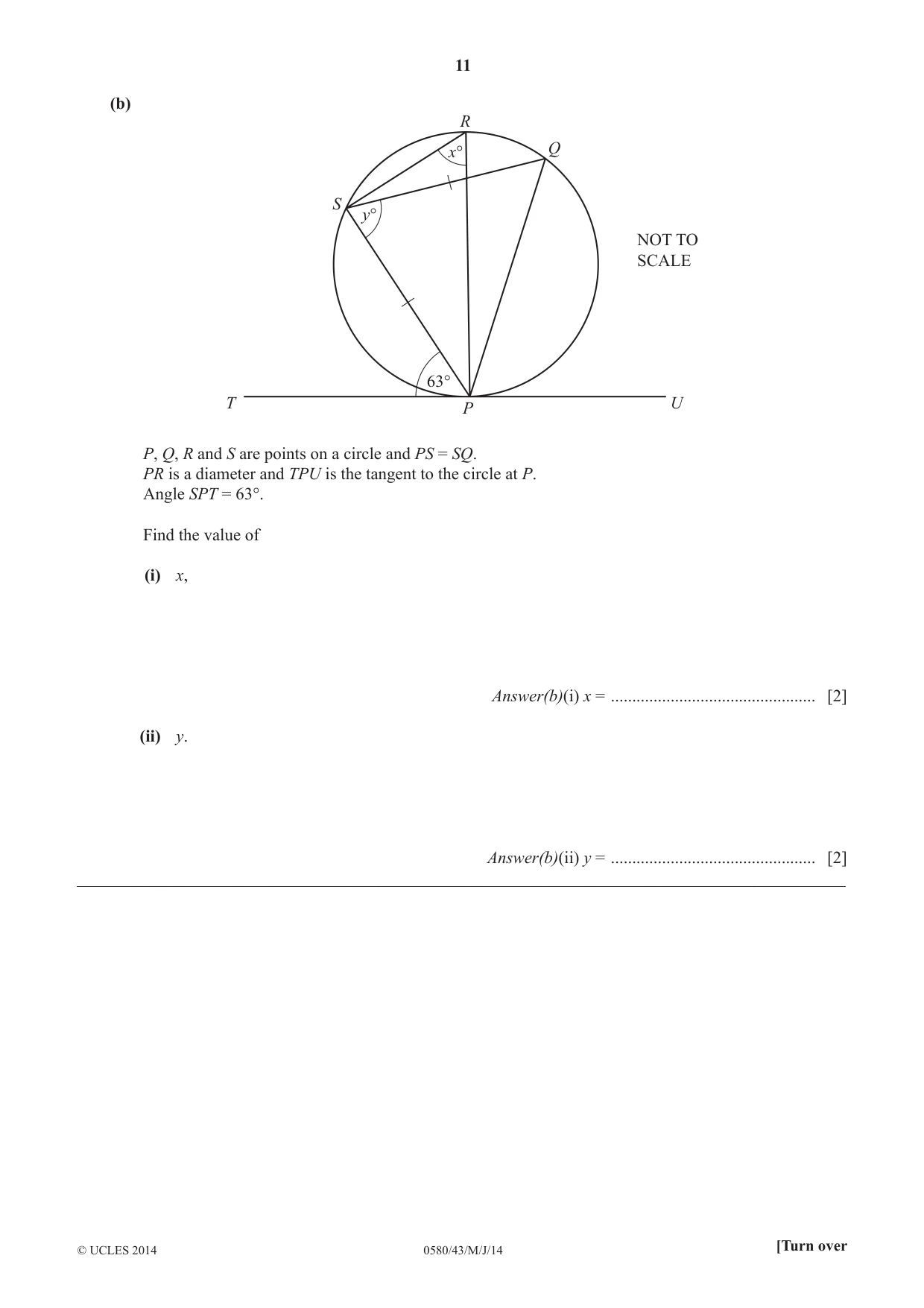
7 (a) E D t ° x° NOT TO SCALE x° C F q° p° 32° Y A B X ABCDEF is a hexagon. AB is parallel to ED and BC is parallel to FE. YFE and YABX are straight lines. Angle CBX = 32° and angle EFA = 90°. Calculate the value of (i) p, Answer(a)(i) p = ................................................ [1] (ii) q, Answer(a)(ii) q = ................................................ [2] (iii) t, Answer(a)(iii) t = ................................................ [1] (iv) x. Answer(a)(iv) x = ................................................ [3] (b) R x° Q S y° NOT TO SCALE 63° T U P P, Q, R and S are points on a circle and PS = SQ. PR is a diameter and TPU is the tangent to the circle at P. Angle SPT = 63°. Find the value of (i) x, Answer(b)(i) x = ................................................ [2] (ii) y. Answer(b)(ii) y = ................................................ [2] __________________________________________________________________________________________
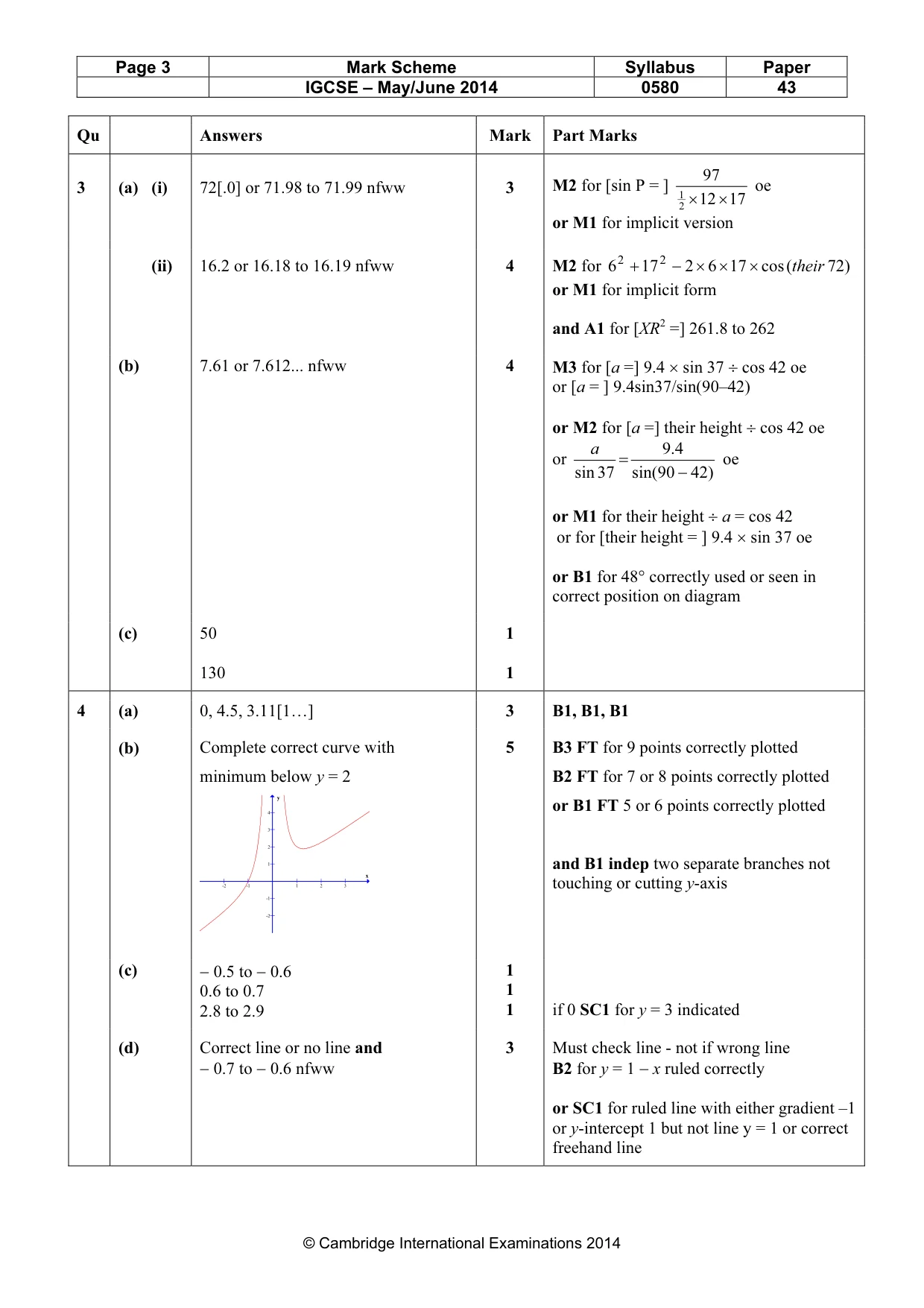
Mark scheme: 7 (a) (i) 148 1 (ii) 122 2 B1 for 58 seen at A or 32 seen at Y (iii) 148 1 (iv) 106 nfww 3 B1 for [sum of interior angles =] 720 1 and M1 for {(their 720) − (p+q+t+90)} 2 (b) (i) 63 2 B1 for angle RPS = 27 or 90 at P or at S seen or stated (ii) 54 2 B1 for their x or 63 or letter x at Q seen or state IGCSE – May/June 2014 0580 43 Qu Answers Mark Part Marks
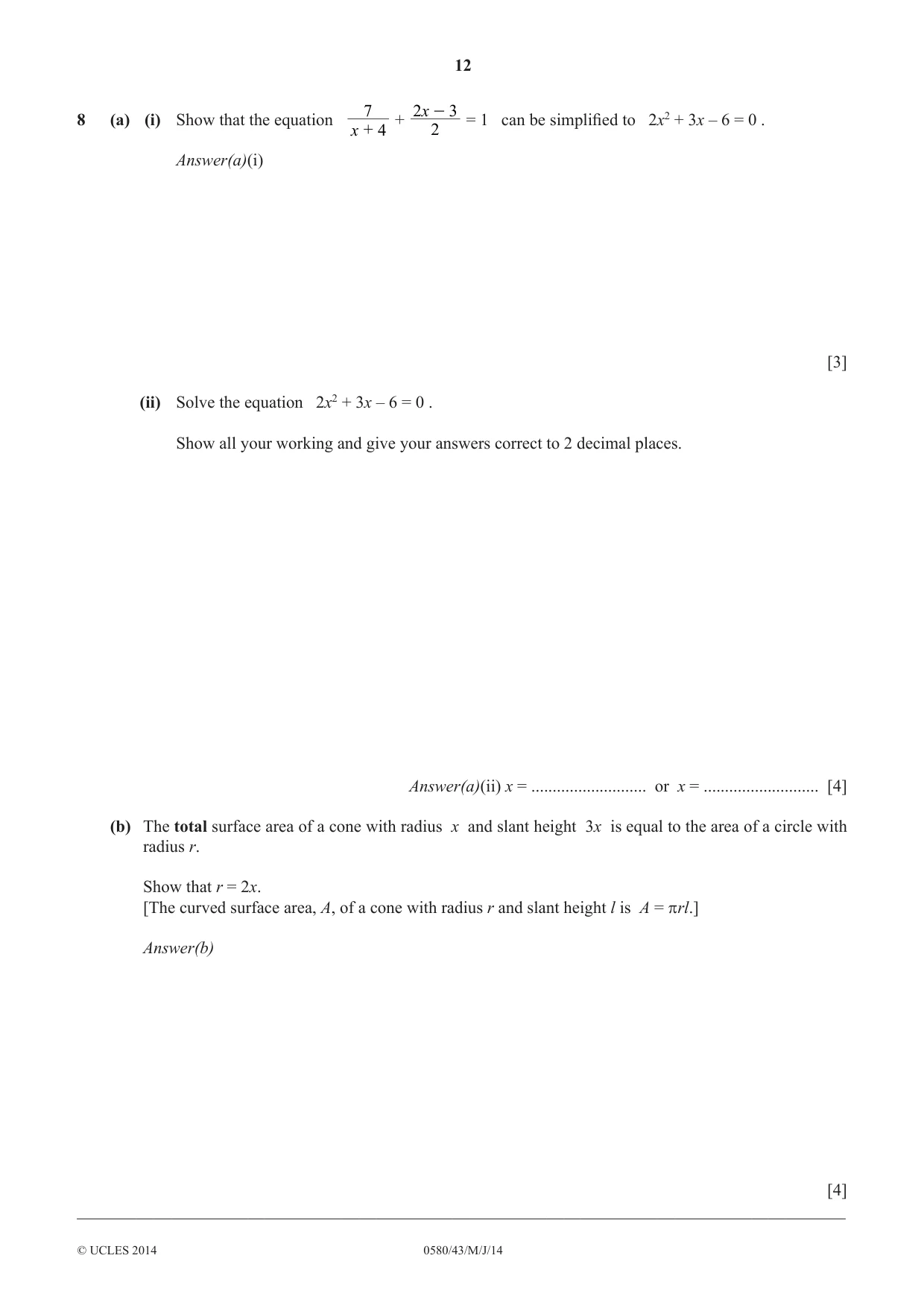
Q8 · 2x - 38 (a) (i) Show that the equation + = 1 can be simplifi ed to 2x2 + 3x – 6 = 0
7 2x - 38 (a) (i) Show that the equation + = 1 can be simplifi ed to 2x2 + 3x – 6 = 0 . x + 4 2 Answer(a)(i) [3] (ii) Solve the equation 2x2 + 3x – 6 = 0 . Show all your working and give your answers correct to 2 decimal places. Answer(a)(ii) x = ........................... or x = ........................... [4] (b) The total surface area of a cone with radius x and slant height 3x is equal to the area of a circle with radius r. Show that r = 2x. [The curved surface area, A, of a cone with radius r and slant height l is A = πrl.] Answer(b) [4] __________________________________________________________________________________________
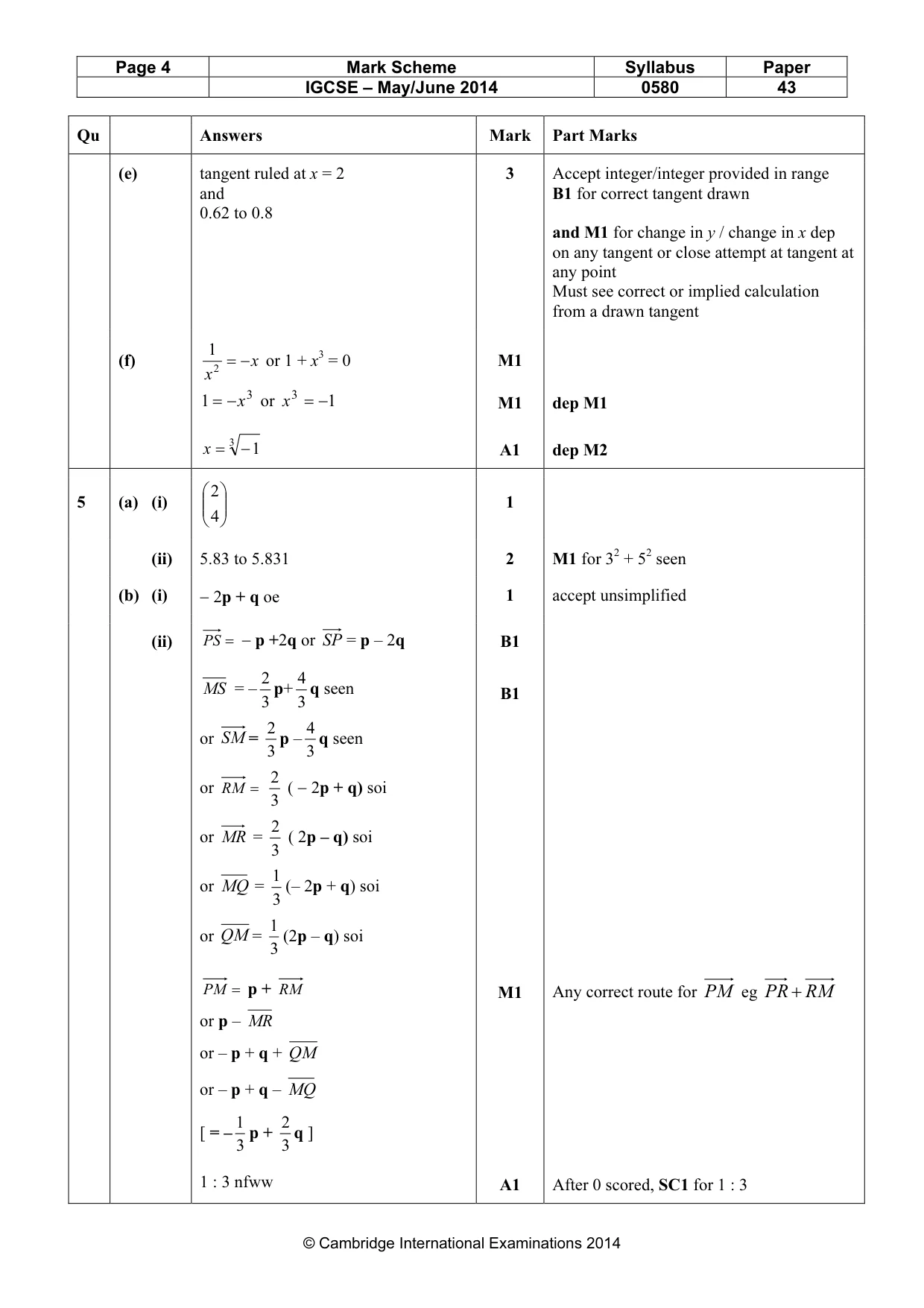
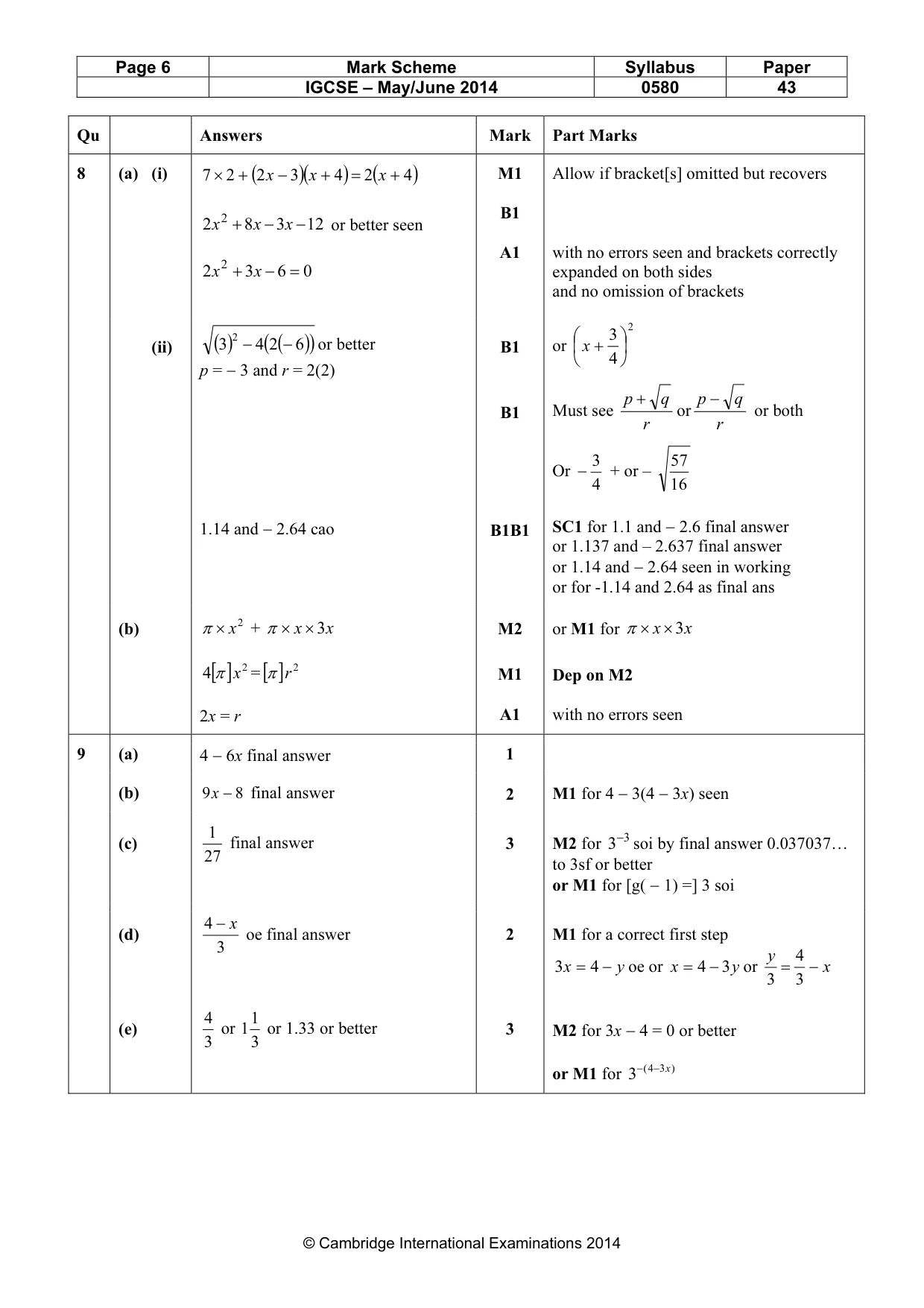
Mark scheme: 8 (a) (i) 7 × 2 + (2 x − 3)( x + 4 ) = 2( x + 4 ) M1 Allow if bracket[s] omitted but recovers B1 2 x 2 + 8 x − 3 x − 12 or better seen A1 with no errors seen and brackets correctly 2 x 2 + 3 x − 6 = 0 expanded on both sides and no omission of brackets 2 2 3 (ii) (3) − 4(2(− 6 )) or better B1 or x + 4 p = − 3 and r = 2(2) p + q p − q B1 Must see or or both r r 3 57 Or − + or – 4 16 1.14 and − 2.64 cao B1B1 SC1 for 1.1 and − 2.6 final answer or 1.137 and – 2.637 final answer or 1.14 and − 2.64 seen in working or for -1.14 and 2.64 as final ans (b) π × x 2 + π × x × 3 x M2 or M1 for π × x × 3 x 4[π ] x 2 =[π ] r 2 M1 Dep on M2 2x = r A1 with no errors seen
Q9 · F(x) = 4 – 3x g(x) = 3–x (a) Find f(2x) in terms of x
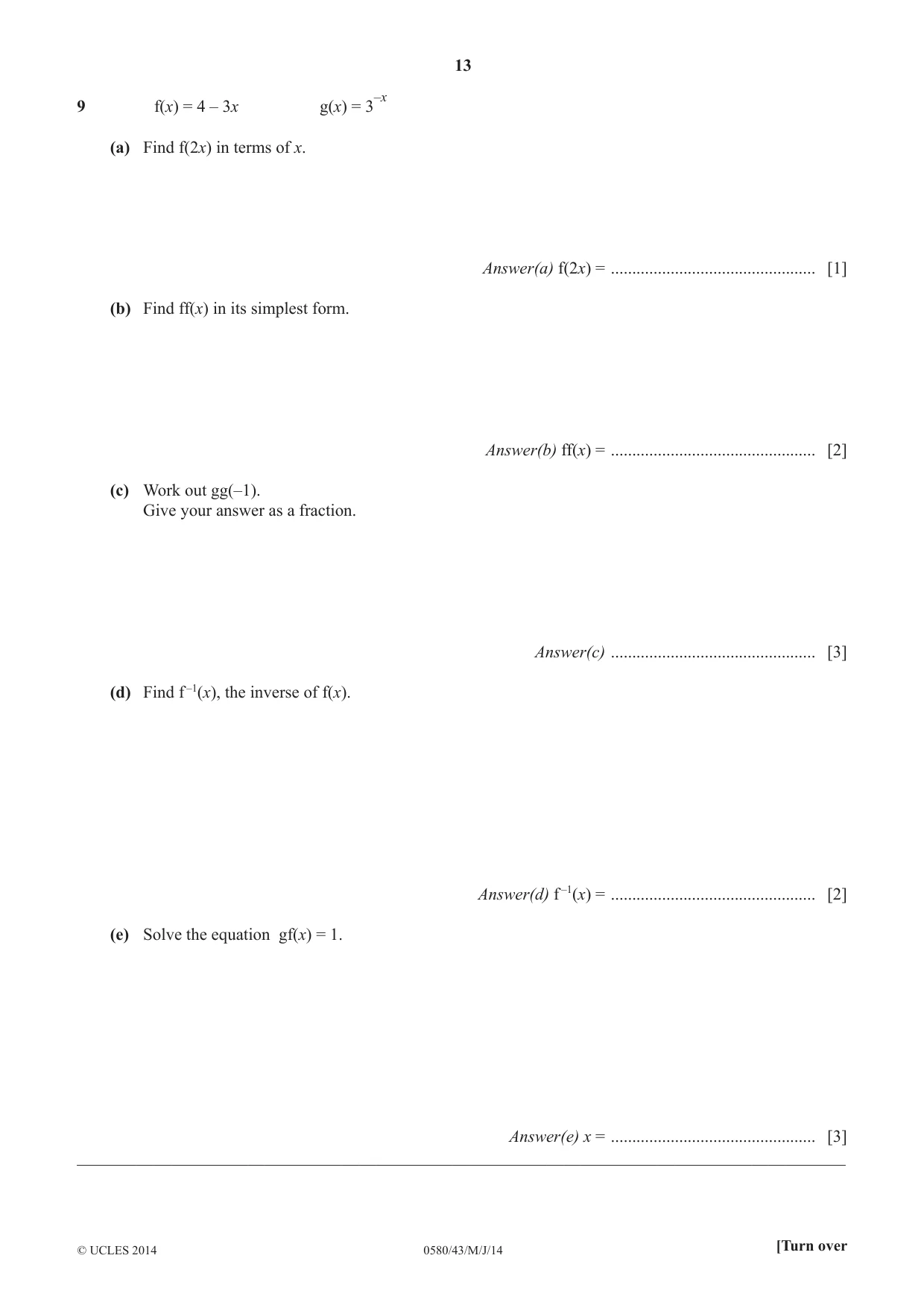
9 f(x) = 4 – 3x g(x) = 3–x (a) Find f(2x) in terms of x. Answer(a) f(2x) = ................................................ [1] (b) Find ff(x) in its simplest form. Answer(b) ff(x) = ................................................ [2] (c) Work out gg(–1). Give your answer as a fraction. Answer(c) ................................................ [3] (d) Find f –1(x), the inverse of f(x). Answer(d) f –1(x) = ................................................ [2] (e) Solve the equation gf(x) = 1. Answer(e) x = ................................................ [3] __________________________________________________________________________________________
Mark scheme: 9 (a) 4 − 6x final answer 1 (b) 9 x − 8 final answer 2 M1 for 4 − 3(4 − 3x) seen 1 3 (c) final answer 3 M2 for 3−soi by final answer 0.037037… 27 to 3sf or better or M1 for [g( − 1) =] 3 soi 4 − x (d) oe final answer 2 M1 for a correct first step 3 y 4 3 x = 4 − y oe or x = 4 − 3 y or = − x 3 3 4 1 (e) or 1 or 1.33 or better 3 M2 for 3x − 4 = 0 or better 3 3 or M1 for 3 − ( 4 −3 x ) IGCSE – May/June 2014 0580 43 Qu Answers Mark Part Marks
Q10 · 8 cm NOT TO SCALE r cm The three sides of an equilateral triangle are tangents to a…
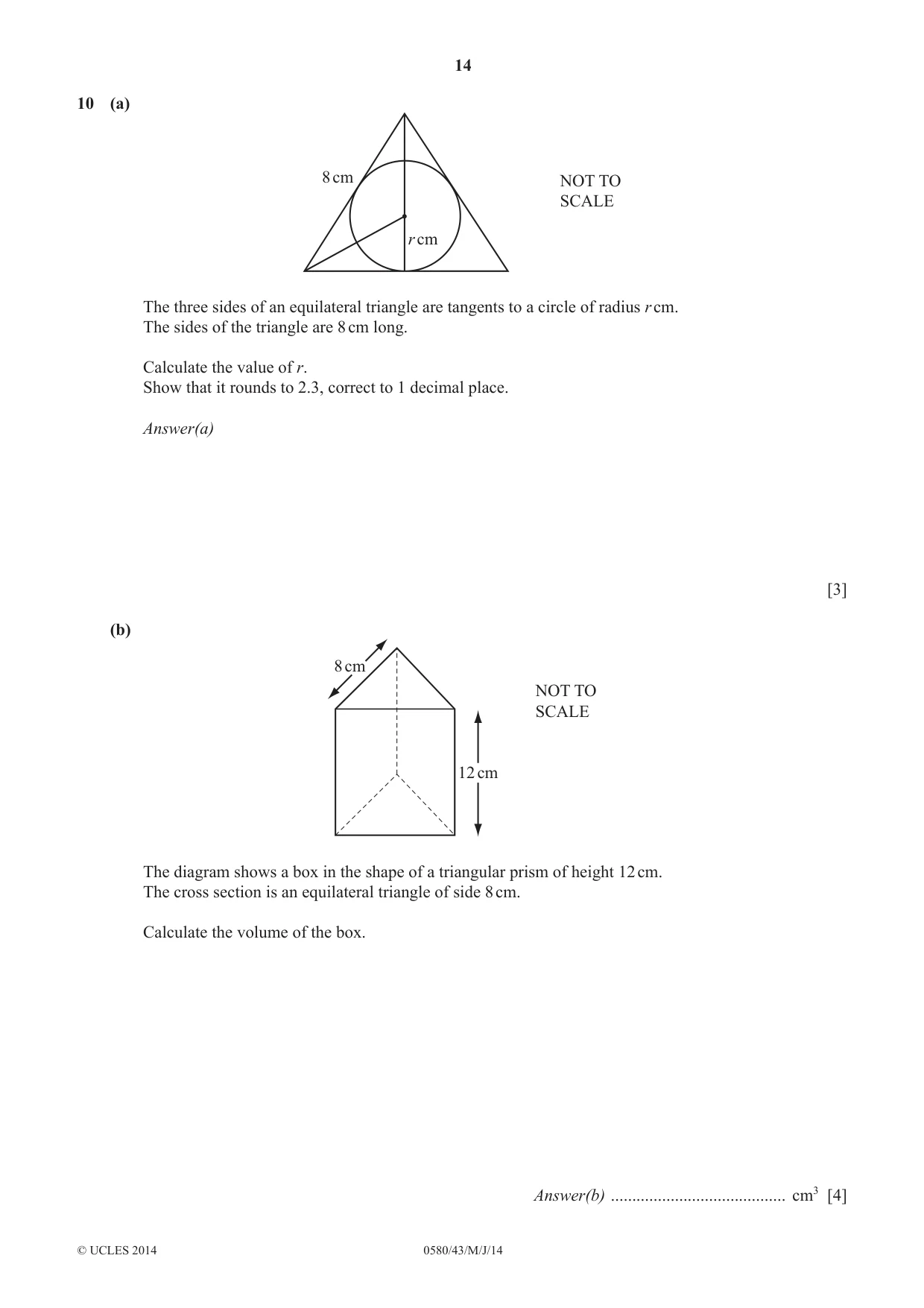
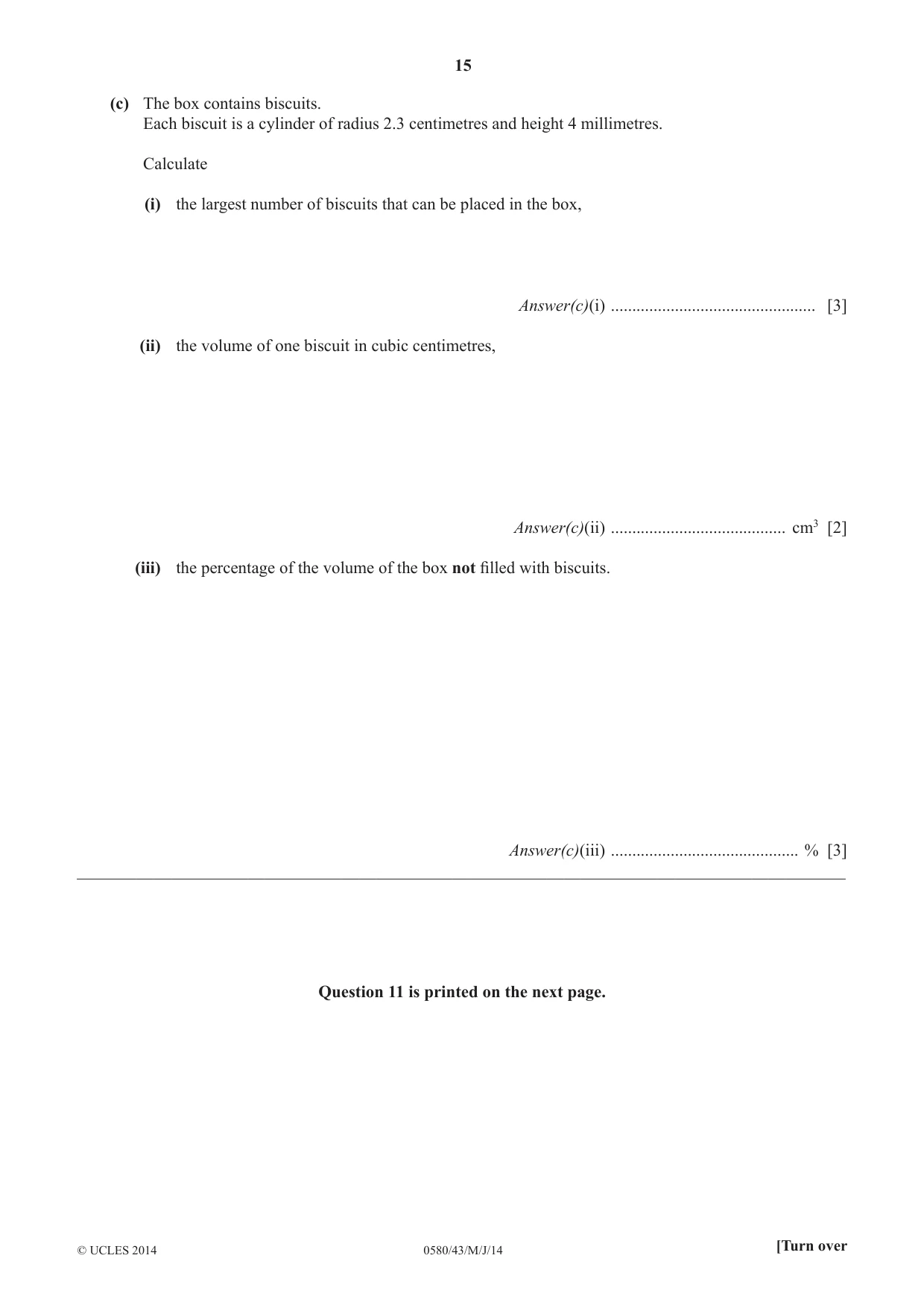
10 (a) 8 cm NOT TO SCALE r cm The three sides of an equilateral triangle are tangents to a circle of radius r cm. The sides of the triangle are 8 cm long. Calculate the value of r. Show that it rounds to 2.3, correct to 1 decimal place. Answer(a) [3] (b) 8 cm NOT TO SCALE 12 cm The diagram shows a box in the shape of a triangular prism of height 12 cm. The cross section is an equilateral triangle of side 8 cm. Calculate the volume of the box. Answer(b) ......................................... cm3 [4] (c) The box contains biscuits. Each biscuit is a cylinder of radius 2.3 centimetres and height 4 millimetres. Calculate (i) the largest number of biscuits that can be placed in the box, Answer(c)(i) ................................................ [3] (ii) the volume of one biscuit in cubic centimetres, Answer(c)(ii) ......................................... cm3 [2] (iii) the percentage of the volume of the box not fi lled with biscuits. Answer(c)(iii) ............................................ % [3] __________________________________________________________________________________________ Question 11 is printed on the next page.
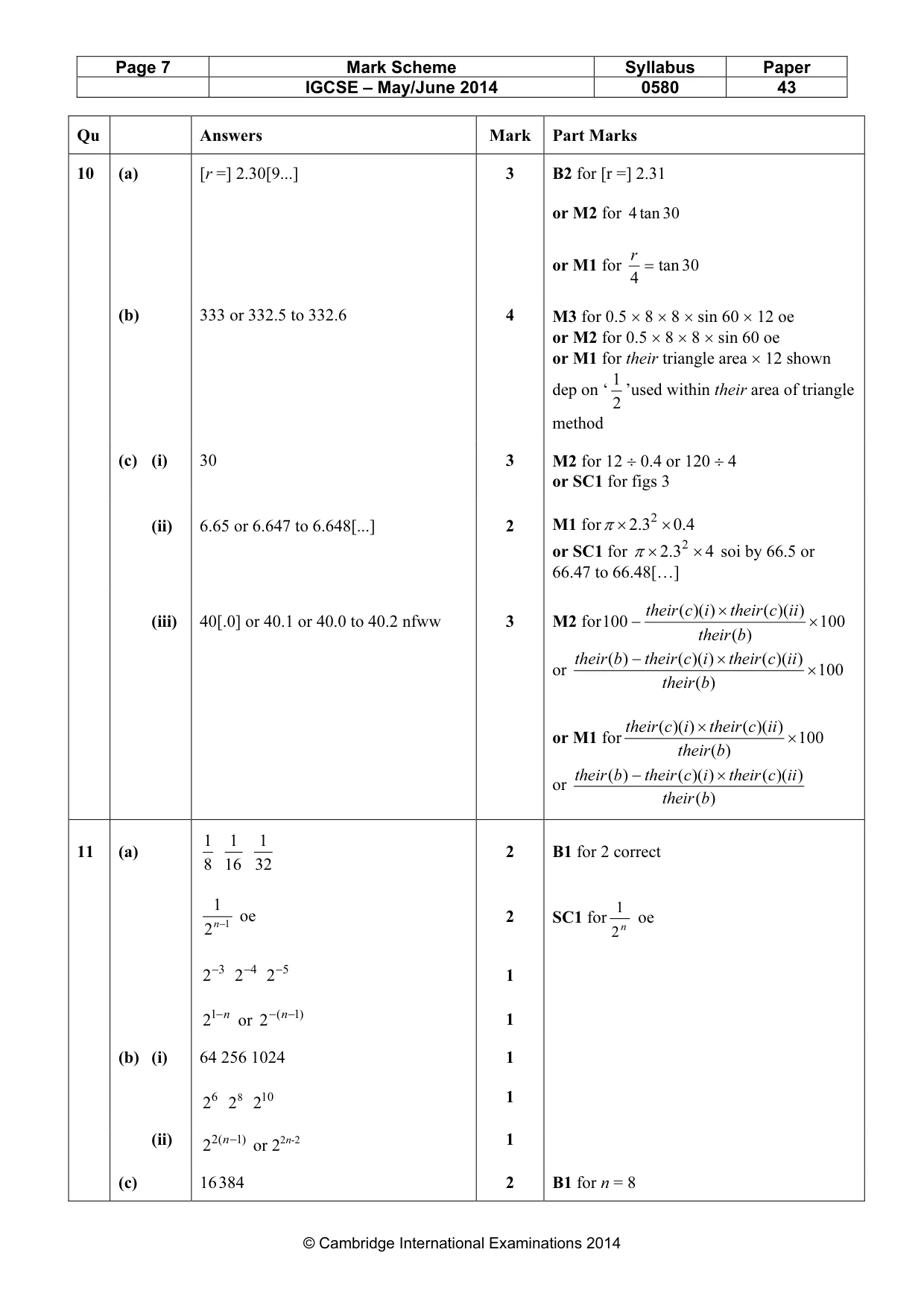
Mark scheme: 10 (a) [r =] 2.30[9...] 3 B2 for [r =] 2.31 or M2 for 4 tan 30 r or M1 for = tan 30 4 (b) 333 or 332.5 to 332.6 4 M3 for 0.5 × 8 × 8 × sin 60 × 12 oe or M2 for 0.5 × 8 × 8 × sin 60 oe or M1 for their triangle area × 12 shown 1 dep on ‘ ’used within their area of triangle 2 method (c) (i) 30 3 M2 for 12 ÷ 0.4 or 120 ÷ 4 or SC1 for figs 3 (ii) 6.65 or 6.647 to 6.648[...] 2 M1 for π × 3.2 2 × 4.0 or SC1 for π × 3.2 2 × 4 soi by 66.5 or 66.47 to 66.48[…] their ( c )(i ) × their ( c )(ii ) (iii) 40[.0] or 40.1 or 40.0 to 40.2 nfww 3 M2 for 100 − × 100 their (b ) their (b ) − their ( c )(i ) × their ( c )(ii ) or × 100 their (b ) their ( c )(i ) × their ( c )(ii ) or M1 for × 100 their (b ) their ( b ) − their ( c )(i ) × their ( c )(ii ) or their ( b ) 1 1 1
Q11 · Diagram 1 Diagram 2 Diagram 3 The fi rst three diagrams in a sequence are shown above
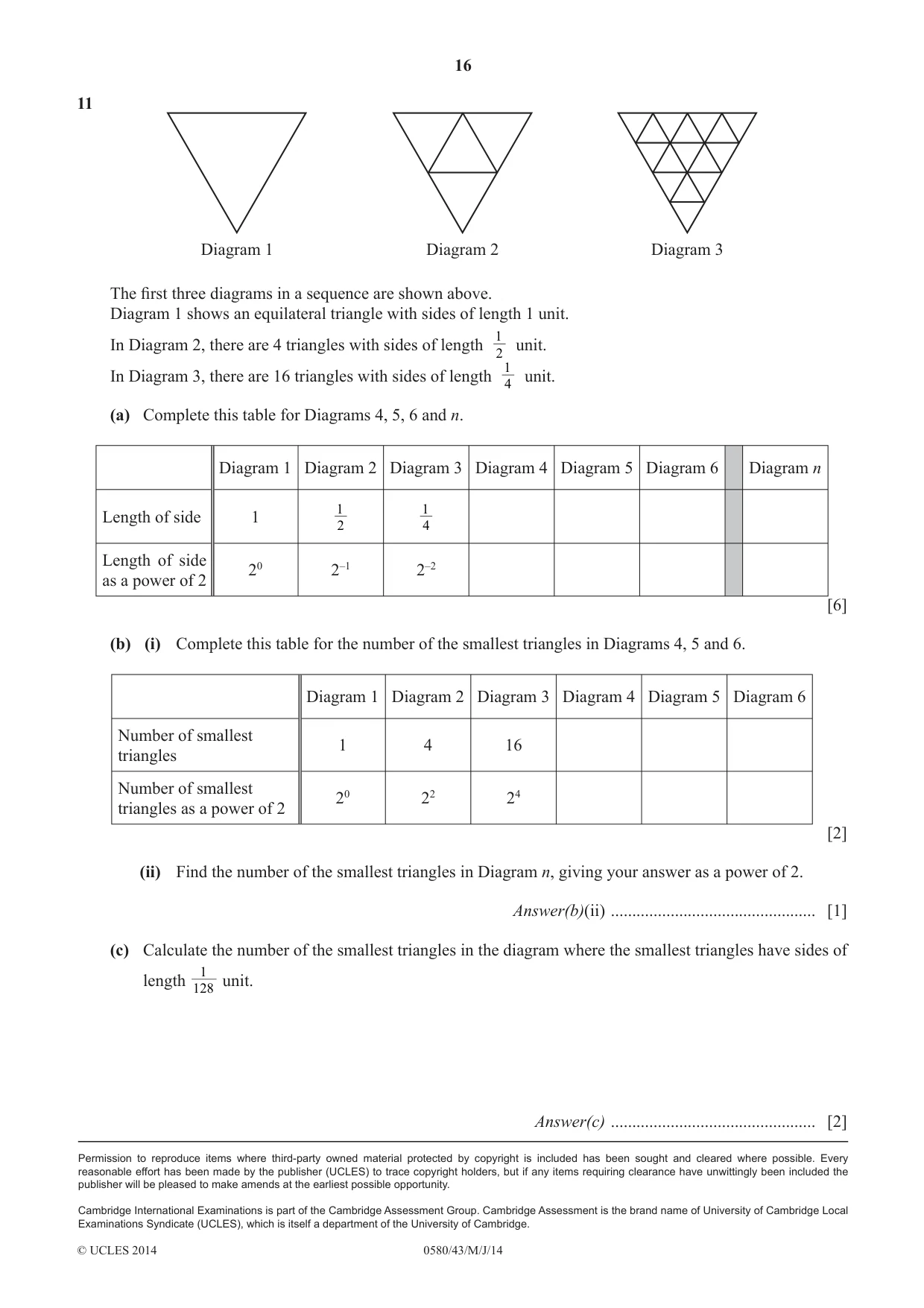
11 Diagram 1 Diagram 2 Diagram 3 The fi rst three diagrams in a sequence are shown above. Diagram 1 shows an equilateral triangle with sides of length 1 unit. 1 In Diagram 2, there are 4 triangles with sides of length unit. 2 1 In Diagram 3, there are 16 triangles with sides of length unit. 4 (a) Complete this table for Diagrams 4, 5, 6 and n. Diagram 1 Diagram 2 Diagram 3 Diagram 4 Diagram 5 Diagram 6 Diagram n 1 1 Length of side 1 2 4 Length of side 20 2–1 2–2 as a power of 2 [6] (b) (i) Complete this table for the number of the smallest triangles in Diagrams 4, 5 and 6. Diagram 1 Diagram 2 Diagram 3 Diagram 4 Diagram 5 Diagram 6 Number of smallest 1 4 16 triangles Number of smallest 20 22 24 triangles as a power of 2 [2] (ii) Find the number of the smallest triangles in Diagram n, giving your answer as a power of 2. Answer(b)(ii) ................................................ [1] (c) Calculate the number of the smallest triangles in the diagram where the smallest triangles have sides of 1 length unit. 128 Answer(c) ................................................ [2]
Mark scheme: 1 1 1 11 (a) 2 B1 for 2 correct 8 16 32 1 1 n −1 oe 2 SC1 for n oe 2 2 2−3 2−4 2−5 1 21− n or 2 −n( −)1 1 (b) (i) 64 256 1024 1 6 8 10 1 2 2 2 (ii) 2 ( n −)1 1 2 or 22n-2 (c) 16 384 2 B1 for n = 8
What was in this paper
The subtopics covered by these 6 questions, and how many questions each got. Open one in a new tab to see every Cambridge question on it.
What you needed in this session
Cambridge’s own grade thresholds for 2014 May/June, Paper 4 · Variant 3. A higher threshold means an easier paper — the bar moves with how the cohort did.