Cambridge IGCSE Mathematics 0580 — 2020 May/June Paper 4 · Variant 1
0580/41/M/J/20 · 10 questions · 130 marks · ≈146 min
The question paper and its mark scheme, free to read here and free to download. This is Cambridge’s own paper, exactly as it was sat.
Question paper20 pages
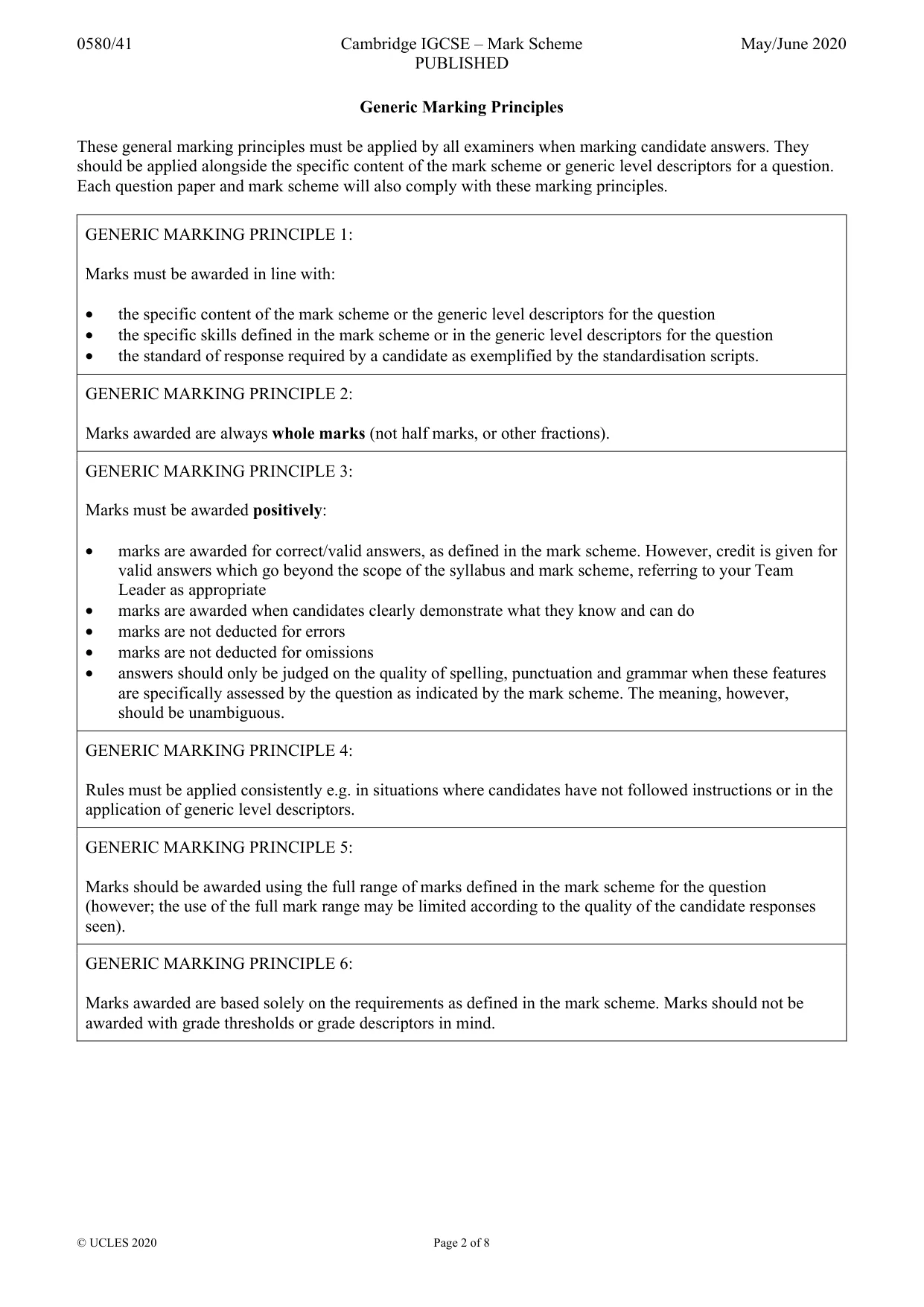
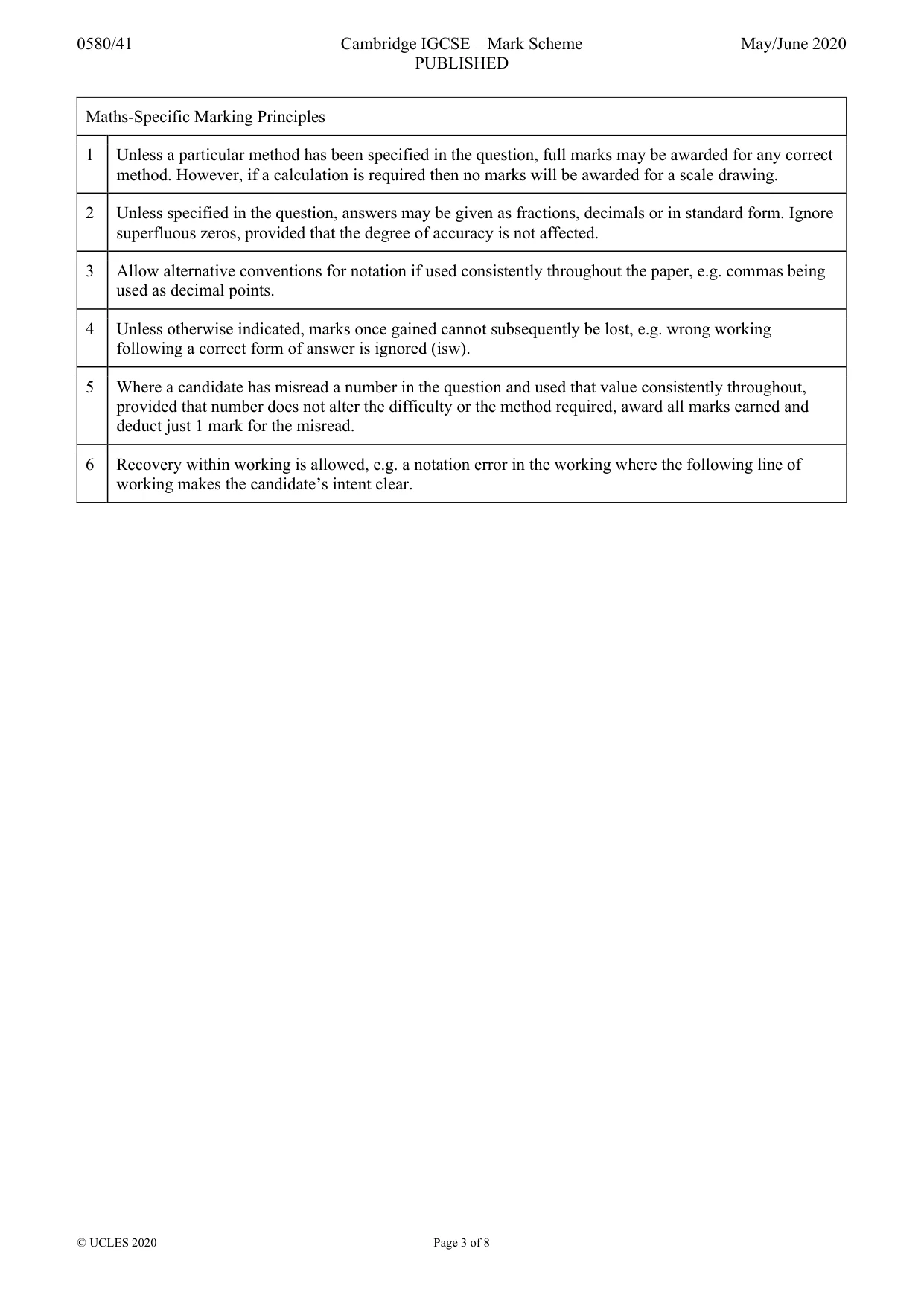
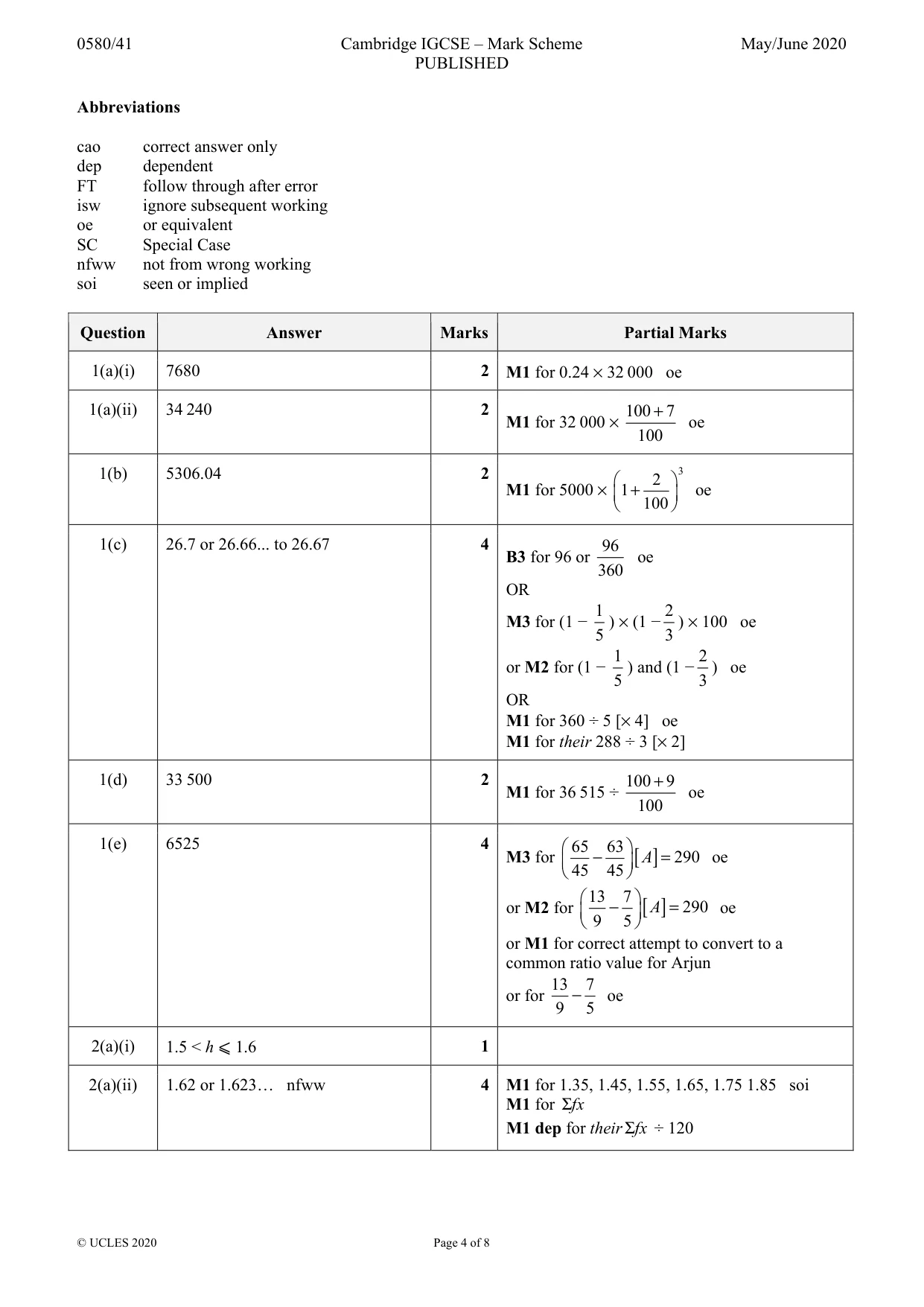
Mark scheme8 pages
Answers below. Sit the paper first if you are practising.
Questions as text
Q1 · In 2018, Gretal earned $32 000
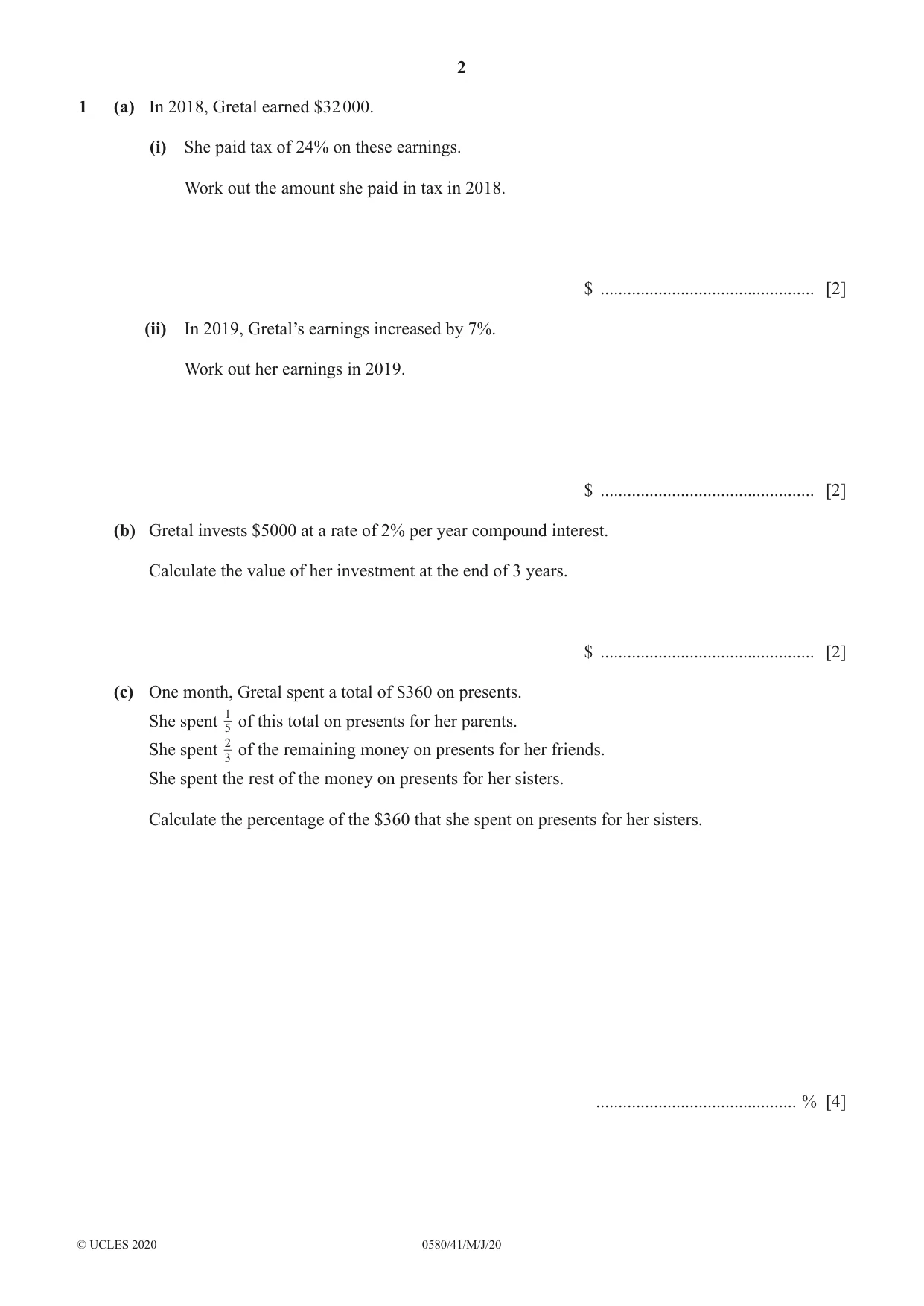
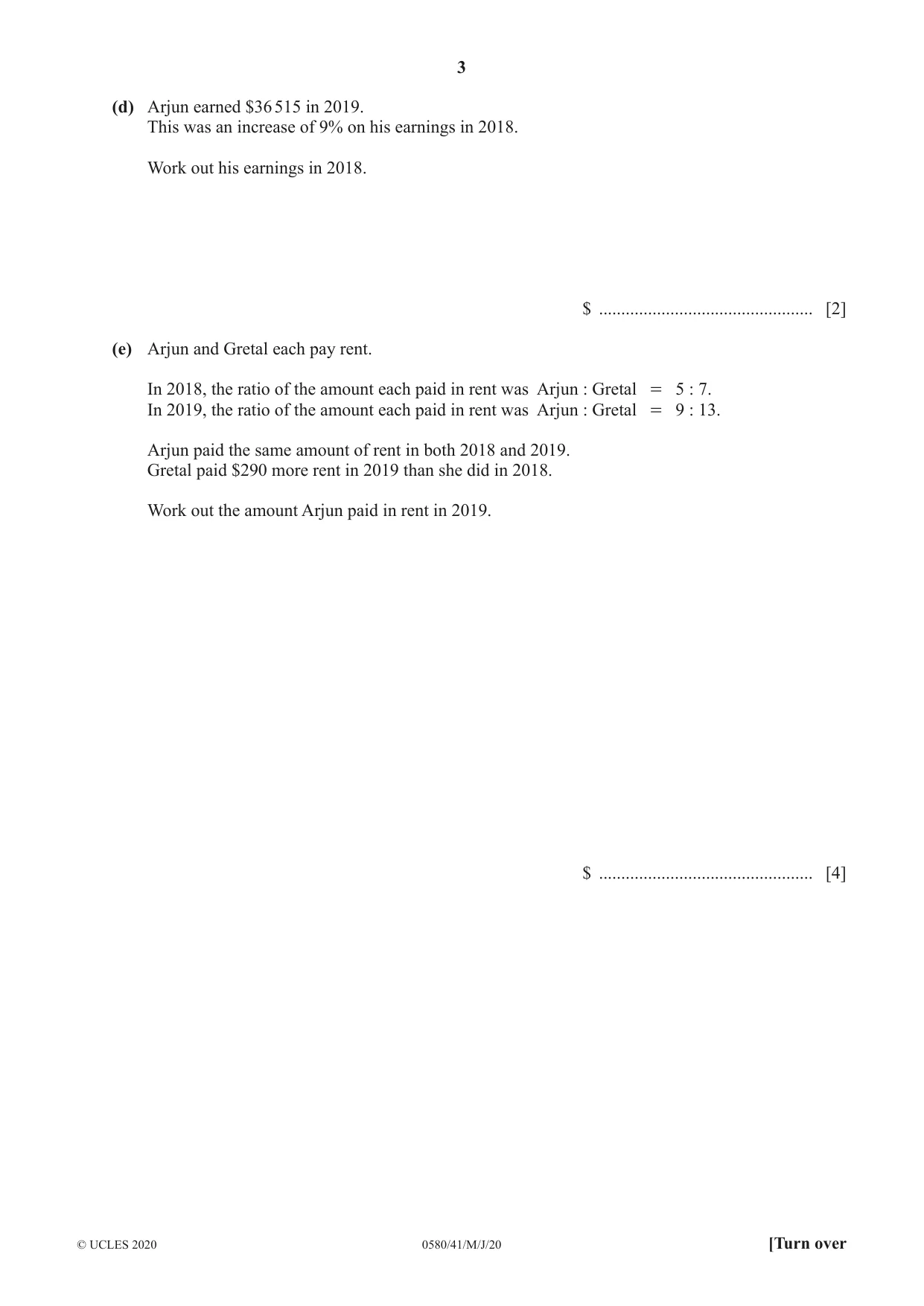
1 (a) In 2018, Gretal earned $32 000. (i) She paid tax of 24% on these earnings. Work out the amount she paid in tax in 2018. $ ................................................ [2] (ii) In 2019, Gretal’s earnings increased by 7%. Work out her earnings in 2019. $ ................................................ [2] (b) Gretal invests $5000 at a rate of 2% per year compound interest. Calculate the value of her investment at the end of 3 years. $ ................................................ [2] (c) One month, Gretal spent a total of $360 on presents. She spent 15 of this total on presents for her parents. She spent 23 of the remaining money on presents for her friends. She spent the rest of the money on presents for her sisters. Calculate the percentage of the $360 that she spent on presents for her sisters. ............................................. % [4] (d) Arjun earned $36 515 in 2019. This was an increase of 9% on his earnings in 2018. Work out his earnings in 2018. $ ................................................ [2] (e) Arjun and Gretal each pay rent. In 2018, the ratio of the amount each paid in rent was Arjun : Gretal = 5 : 7. In 2019, the ratio of the amount each paid in rent was Arjun : Gretal = 9 : 13. Arjun paid the same amount of rent in both 2018 and 2019. Gretal paid $290 more rent in 2019 than she did in 2018. Work out the amount Arjun paid in rent in 2019. $ ................................................ [4]
Mark scheme: Question Answer Marks Partial Marks 1(a)(i) 7680 2 M1 for 0.24 × 32 000 oe 1(a)(ii) 34 240 2 100 + 7 M1 for 32 000 × oe 100 1(b) 5306.04 2 3 2 M1 for 5000 × 1 + oe 100 1(c) 26.7 or 26.66... to 26.67 4 96 B3 for 96 or oe 360 OR 1 M3 for (1 − ) × (1 −2 ) × 100 oe 5 3 1 or M2 for (1 − ) and (1 −2 ) oe 5 3 OR M1 for 360 ÷ 5 [× 4] oe M1 for their 288 ÷ 3 [× 2] 1(d) 33 500 2 100 + 9 M1 for 36 515 ÷ oe 100 1(e) 6525 4 65 63 M3 for − [ A ] = 290 oe 45 45 13 7 or M2 for − [ A ] = 290 oe 9 5 or M1 for correct attempt to convert to a common ratio value for Arjun 13 7 or for − oe 9 5
Q2 · The heights, h metres, of the 120 boys in an athletics club are recorded
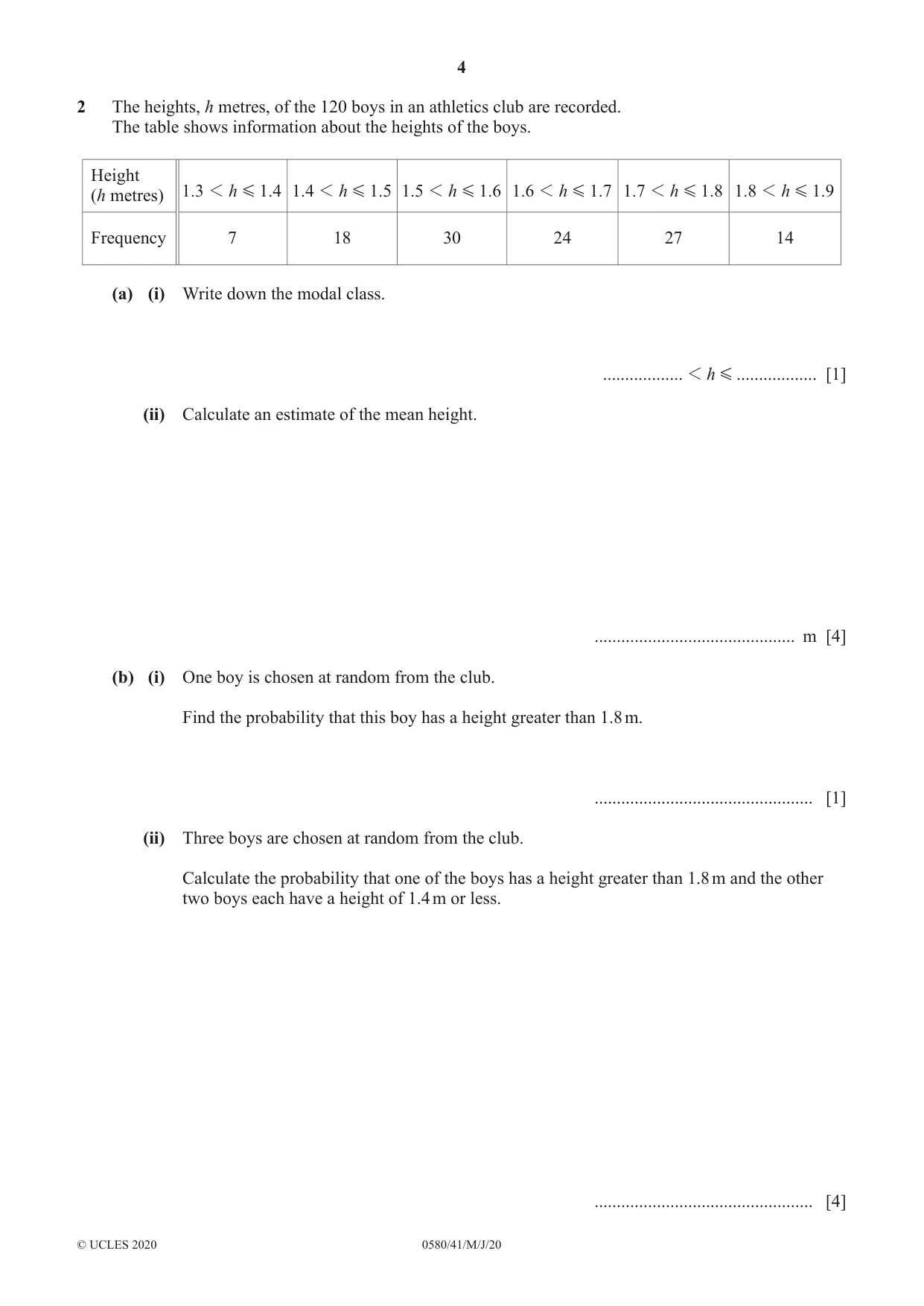
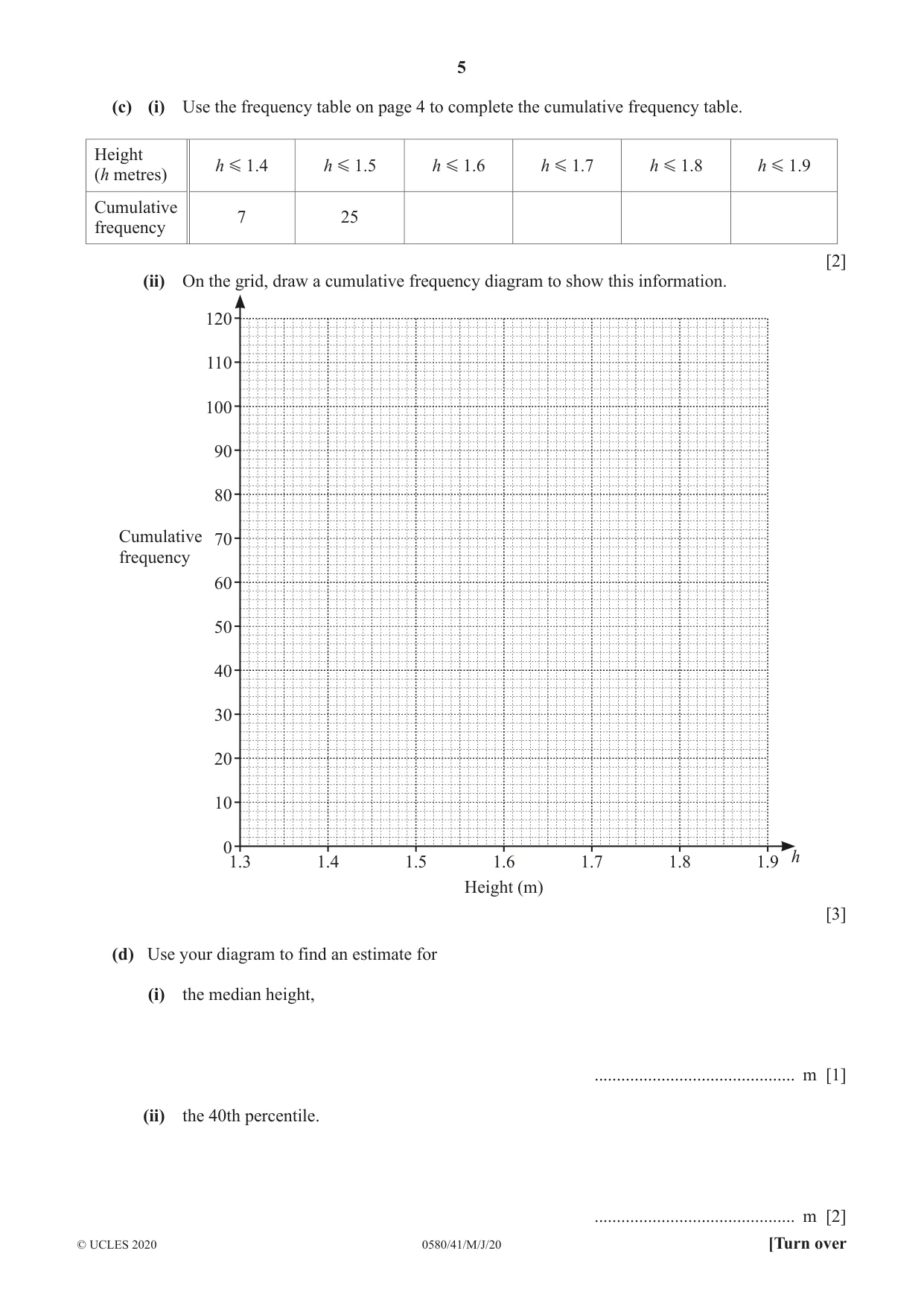
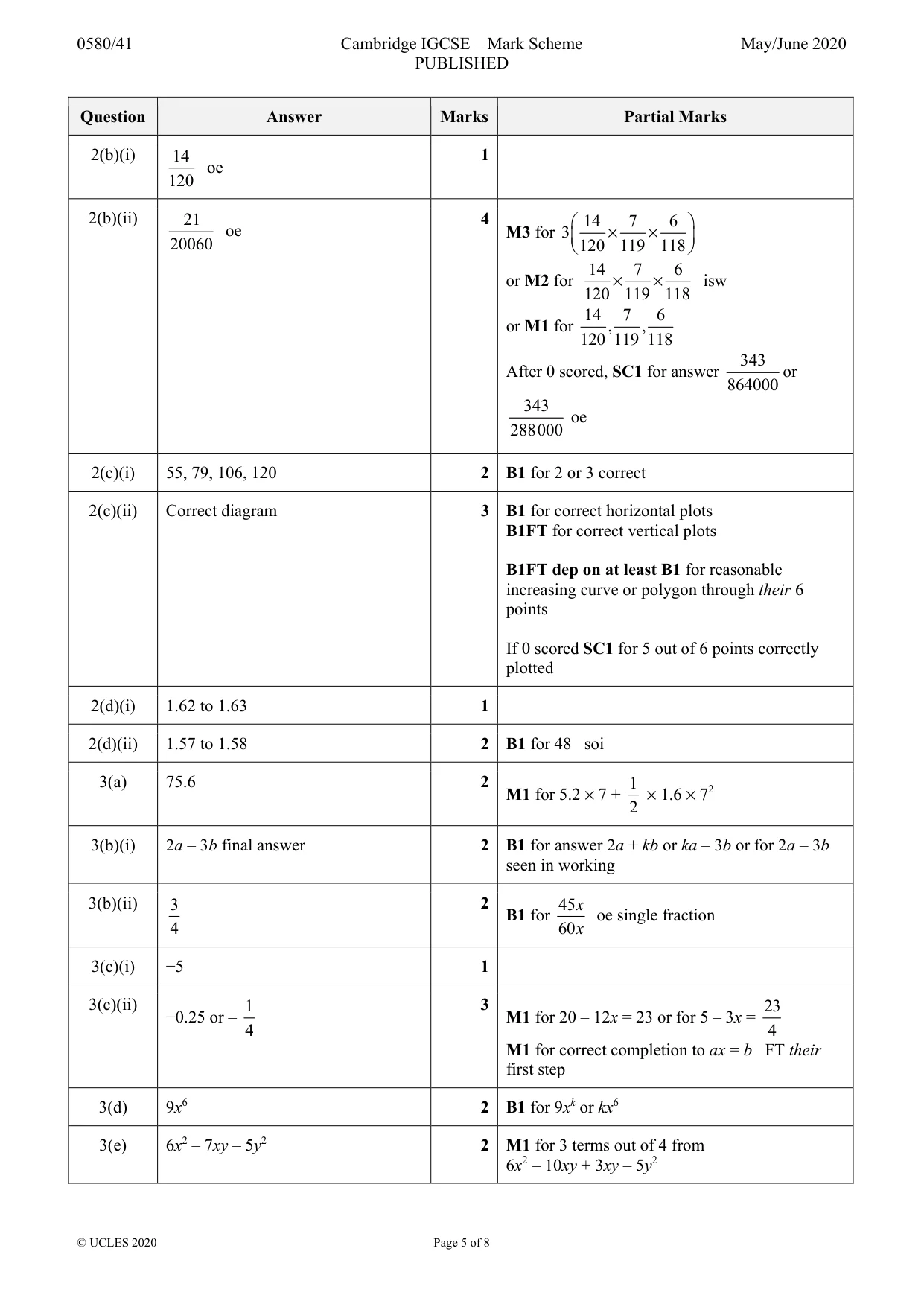
2 The heights, h metres, of the 120 boys in an athletics club are recorded. The table shows information about the heights of the boys. Height (h metres) 1.3 1 h G 1.4 1.4 1 h G 1.5 1.5 1 h G 1.6 1.6 1 h G 1 .7 1.7 1 h G 1.8 1.8 1 h G 1.9 Frequency 7 18 30 24 27 14 (a) (i) Write down the modal class. .................. 1 h G .................. [1] (ii) Calculate an estimate of the mean height. ............................................. m [4] (b) (i) One boy is chosen at random from the club. Find the probability that this boy has a height greater than 1.8 m. ................................................. [1] (ii) Three boys are chosen at random from the club. Calculate the probability that one of the boys has a height greater than 1.8 m and the other two boys each have a height of 1.4 m or less. ................................................. [4] (c) (i) Use the frequency table on page 4 to complete the cumulative frequency table. Height h G 1.4 h G 1.5 h G 1.6 h G 1.7 h G 1.8 h G 1.9(h metres) Cumulative 7 25frequency [2] (ii) On the grid, draw a cumulative frequency diagram to show this information. 120 110 100 90 80 Cumulative 70 frequency 60 50 40 30 20 10 0 h 1.3 1.4 1.5 1.6 1.7 1.8 1.9 Height (m) [3] (d) Use your diagram to find an estimate for (i) the median height, ............................................. m [1] (ii) the 40th percentile. ............................................. m [2]
Mark scheme: 2(a)(i) 1.5 < h ⩽ 1.6 1 2(a)(ii) 1.62 or 1.623… nfww 4 M1 for 1.35, 1.45, 1.55, 1.65, 1.75 1.85 soi M1 for Σfx M1 dep for their Σfx ÷ 120 2(b)(i) 14 1 oe 120 2(b)(ii) 21 4 14 7 6 oe M3 for 3 × × 20060 120 119 118 14 7 6 or M2 for × × isw 120 119 118 14 7 6 or M1 for , , 120 119 118 343 After 0 scored, SC1 for answer or 864000 343 oe 288000 2(c)(i) 55, 79, 106, 120 2 B1 for 2 or 3 correct 2(c)(ii) Correct diagram 3 B1 for correct horizontal plots B1FT for correct vertical plots B1FT dep on at least B1 for reasonable increasing curve or polygon through their 6 points If 0 scored SC1 for 5 out of 6 points correctly plotted 2(d)(i) 1.62 to 1.63 1 2(d)(ii) 1.57 to 1.58 2 B1 for 48 soi
Q3 · S = ut + 12 at 2 Find the value of s when u = 5.2 , t = 7 and a = 1.6
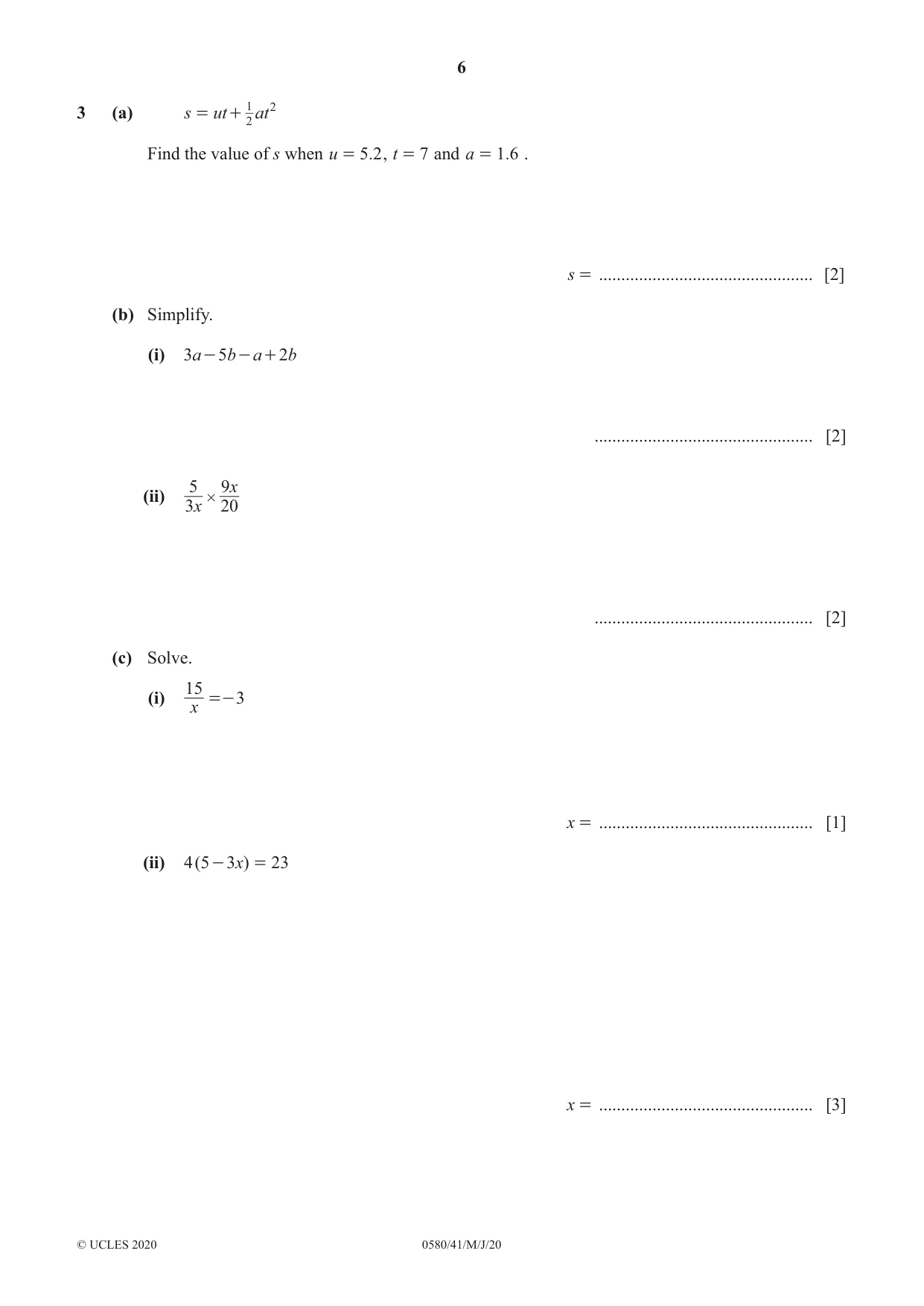
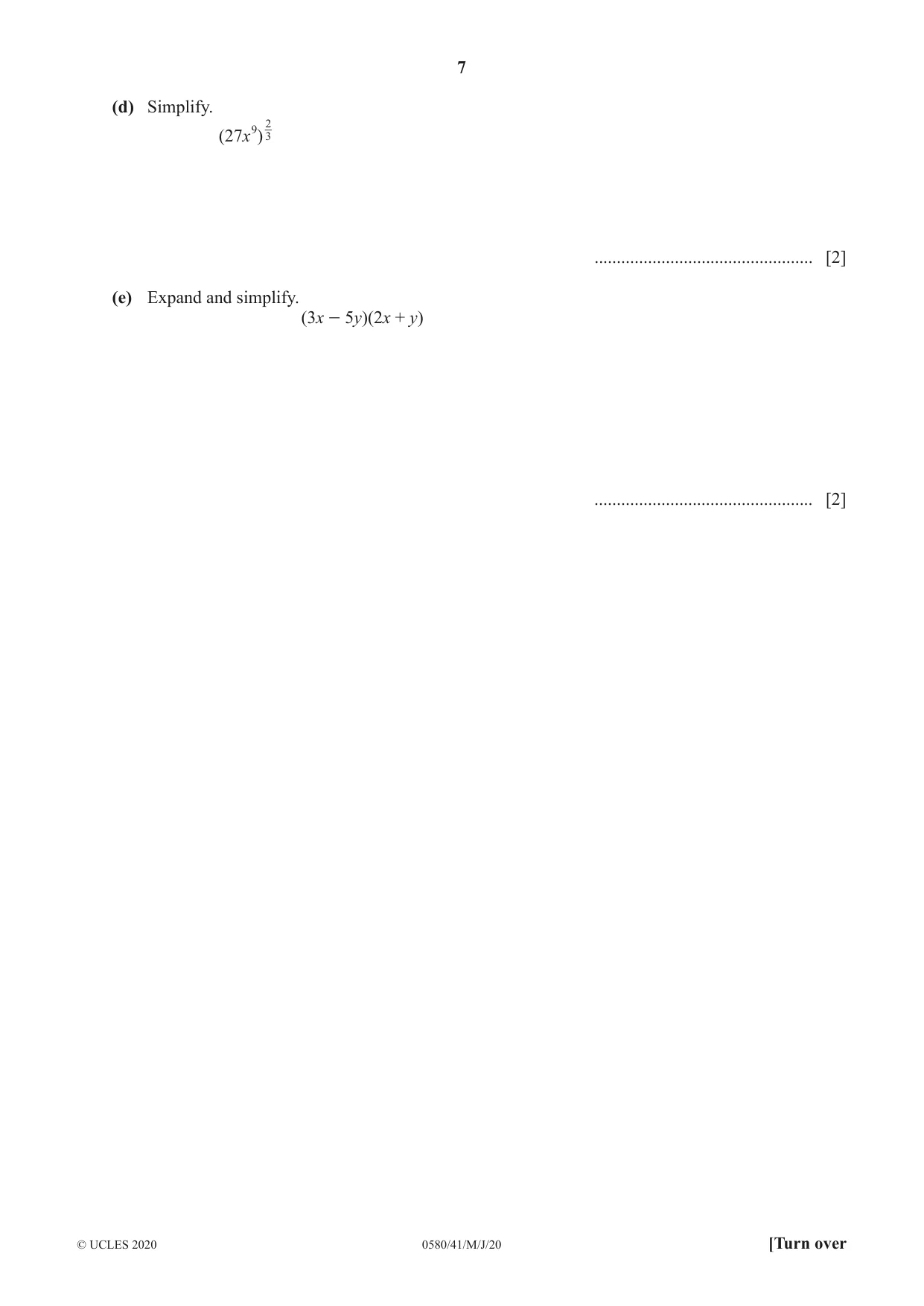
3 (a) s = ut + 12 at 2 Find the value of s when u = 5.2 , t = 7 and a = 1.6 . s = ................................................ [2] (b) Simplify. (i) 3a - 5b - a + 2b ................................................. [2] 5 9x (ii) # 3x 20 ................................................. [2] (c) Solve. 15 (i) =- 3 x x = ................................................ [1] (ii) 4 ( 5 - 3)x = 23 x = ................................................ [3] (d) Simplify. 2 ( 27x 9) 3 ................................................. [2] (e) Expand and simplify. (3x - 5y)(2x + y) ................................................. [2]
Mark scheme: 3(a) 75.6 2 1 M1 for 5.2 × 7 + × 1.6 × 72 2 3(b)(i) 2a – 3b final answer 2 B1 for answer 2a + kb or ka – 3b or for 2a – 3b seen in working 3(b)(ii) 3 2 45 x B1 for oe single fraction 4 60 x 3(c)(i) −5 1 3(c)(ii) 1 3 23 −0.25 or – M1 for 20 – 12x = 23 or for 5 – 3x = 4 4 M1 for correct completion to ax = b FT their first step 3(d) 9x6 2 B1 for 9xk or kx6 3(e) 6x2 – 7xy – 5y2 2 M1 for 3 terms out of 4 from 6x2 – 10xy + 3xy – 5y2
Q4 · Y 6 5 4 3 2 T 1 0 x – 6 – 5 – 4 – 3 – 2 – 1 1 2 3 4 5 6 – 1 – 2 – 3 – 4 A – 5 – 6 (a)…
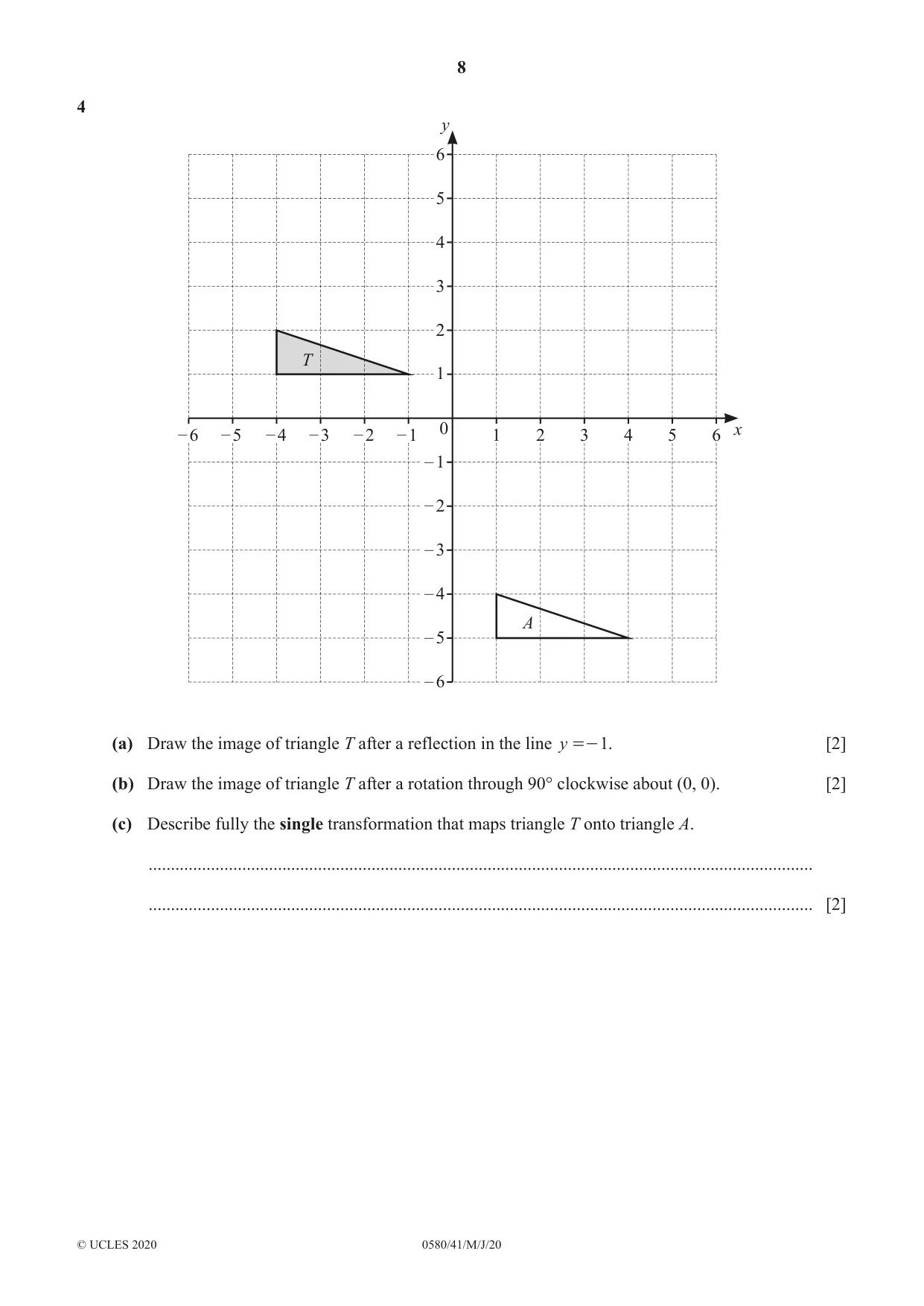
4 y 6 5 4 3 2 T 1 0 x – 6 – 5 – 4 – 3 – 2 – 1 1 2 3 4 5 6 – 1 – 2 – 3 – 4 A – 5 – 6 (a) Draw the image of triangle T after a reflection in the line y =- 1. [2] (b) Draw the image of triangle T after a rotation through 90° clockwise about (0, 0). [2] (c) Describe fully the single transformation that maps triangle T onto triangle A. ..................................................................................................................................................... ..................................................................................................................................................... [2]
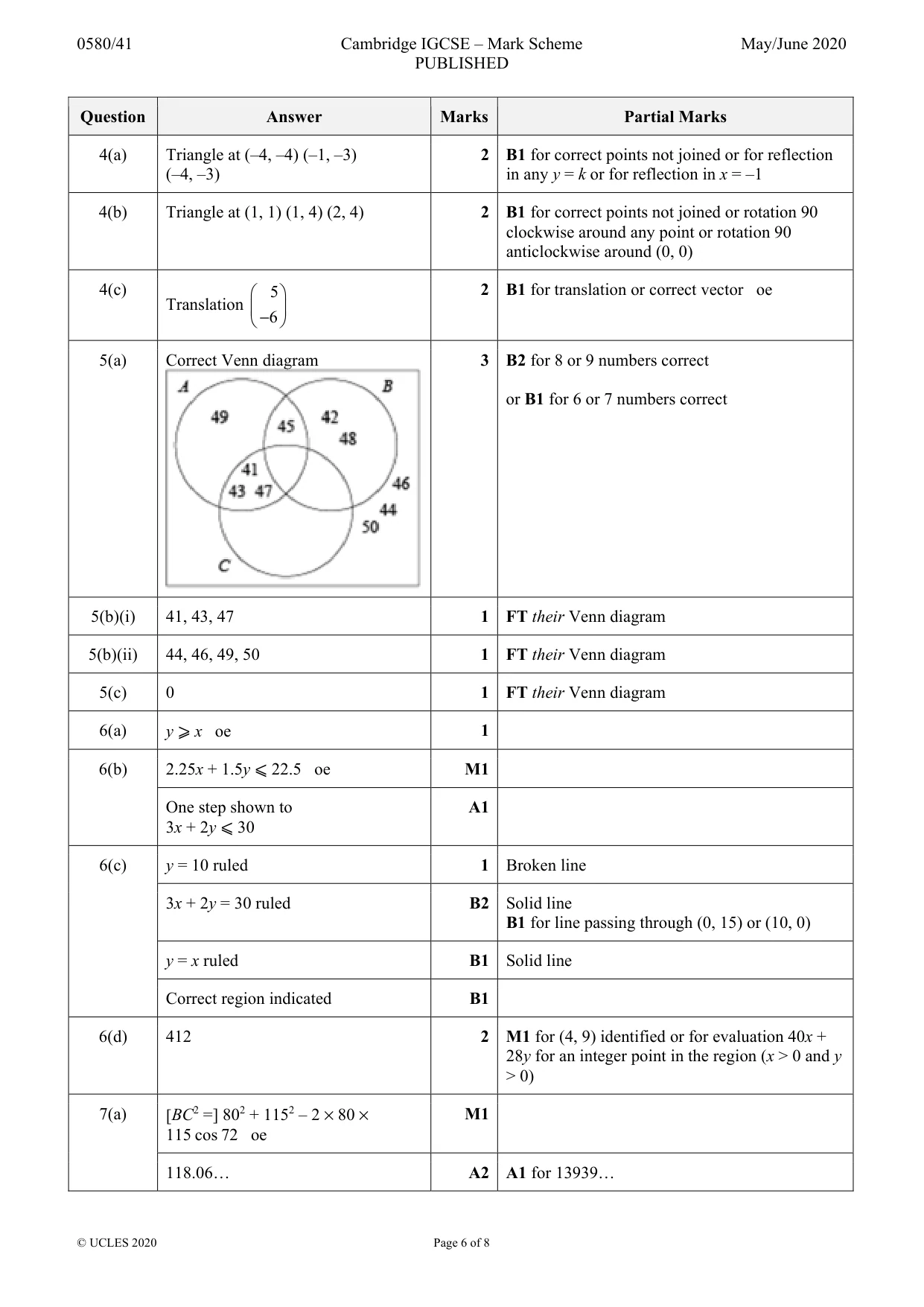
Mark scheme: 4(a) Triangle at (–4, –4) (–1, –3) 2 B1 for correct points not joined or for reflection (–4, –3) in any y = k or for reflection in x = –1 4(b) Triangle at (1, 1) (1, 4) (2, 4) 2 B1 for correct points not joined or rotation 90 clockwise around any point or rotation 90 anticlockwise around (0, 0) 4(c) 5 2 B1 for translation or correct vector oe Translation − 6
Q5 · X is an integer
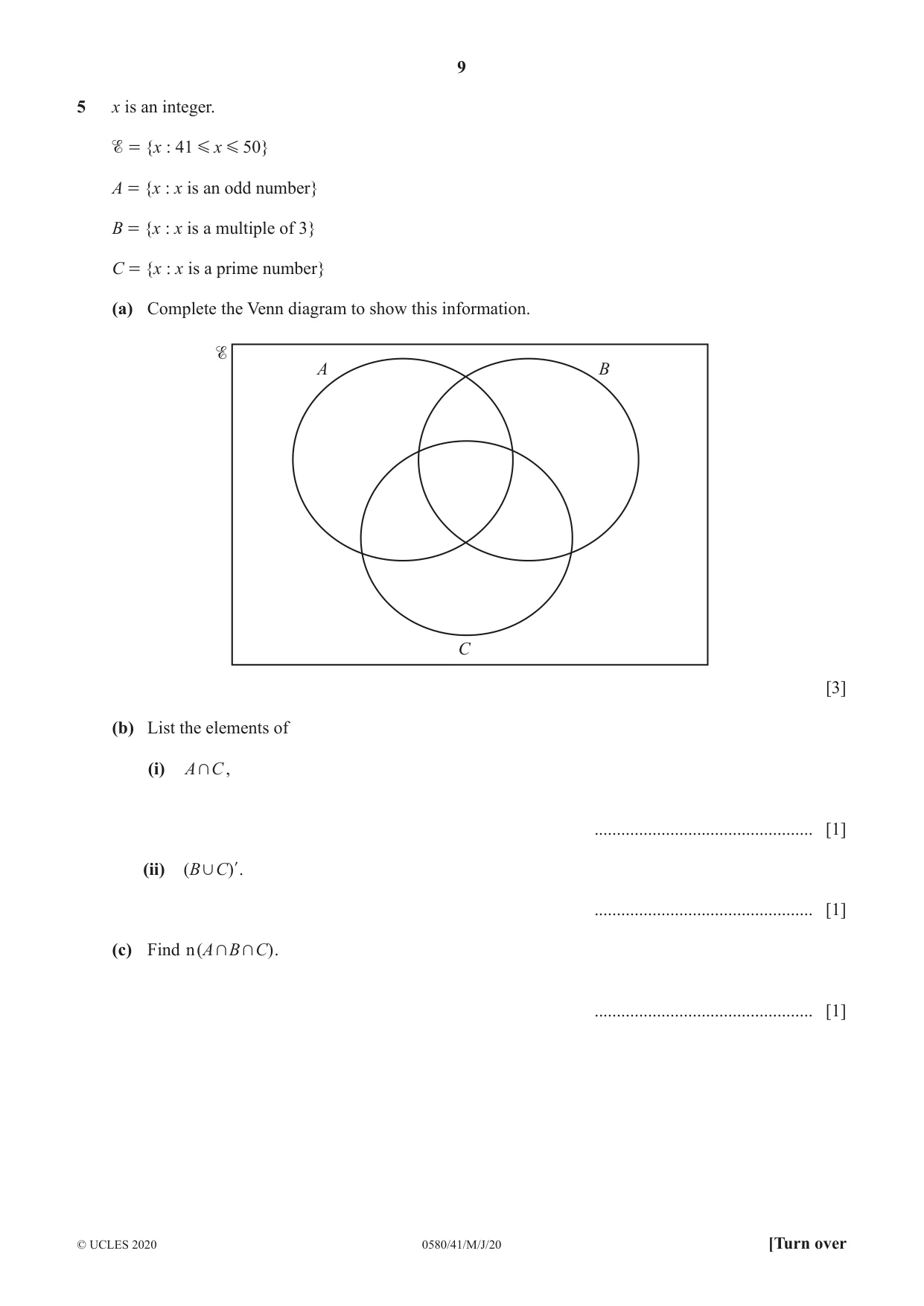
5 x is an integer. = {x : 41 G x G 50} A = {x : x is an odd number} B = {x : x is a multiple of 3} C = {x : x is a prime number} (a) Complete the Venn diagram to show this information. A B C [3] (b) List the elements of (i) A + C , ................................................. [1] (ii) ( B , C) l. ................................................. [1] (c) Find n ( A + B + C) . ................................................. [1]
Mark scheme: 5(a) Correct Venn diagram 3 B2 for 8 or 9 numbers correct or B1 for 6 or 7 numbers correct 5(b)(i) 41, 43, 47 1 FT their Venn diagram 5(b)(ii) 44, 46, 49, 50 1 FT their Venn diagram 5(c) 0 1 FT their Venn diagram
Q6 · Raheem makes baskets and mats
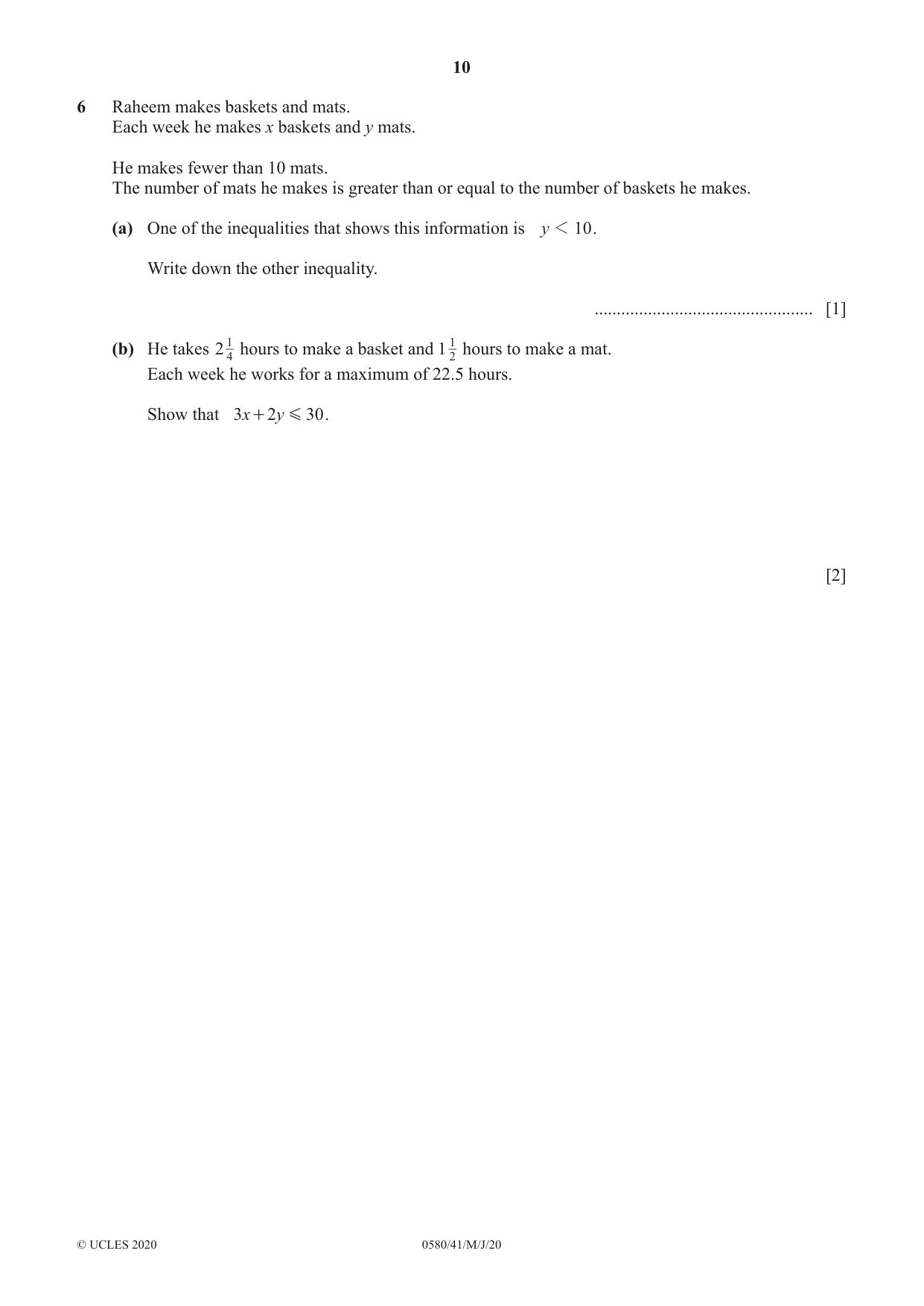
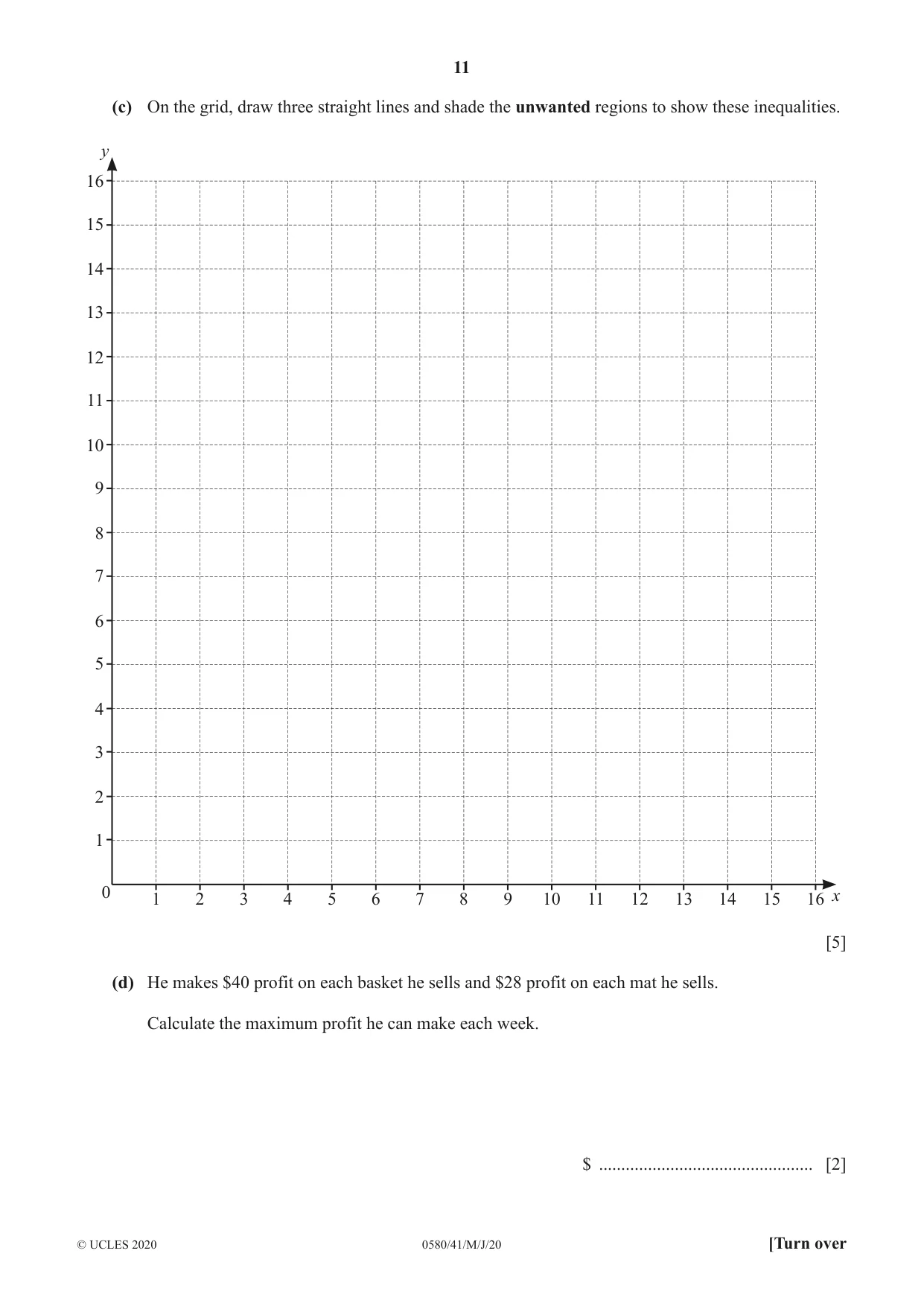
6 Raheem makes baskets and mats. Each week he makes x baskets and y mats. He makes fewer than 10 mats. The number of mats he makes is greater than or equal to the number of baskets he makes. (a) One of the inequalities that shows this information is y 1 10 . Write down the other inequality. ................................................. [1] (b) He takes 2 14 hours to make a basket and 1 12 hours to make a mat. Each week he works for a maximum of 22.5 hours. Show that 3x + 2y G 30 . [2] (c) On the grid, draw three straight lines and shade the unwanted regions to show these inequalities. y 16 15 14 13 12 11 10 9 8 7 6 5 4 3 2 1 0 1 2 3 4 5 6 7 8 9 10 11 12 13 14 15 16 x [5] (d) He makes $40 profit on each basket he sells and $28 profit on each mat he sells. Calculate the maximum profit he can make each week. $ ................................................ [2]
Mark scheme: 6(a) y ⩾ x oe 1 6(b) 2.25x + 1.5y ⩽ 22.5 oe M1 One step shown to A1 3x + 2y ⩽ 30 6(c) y = 10 ruled 1 Broken line 3x + 2y = 30 ruled B2 Solid line B1 for line passing through (0, 15) or (10, 0) y = x ruled B1 Solid line Correct region indicated B1 6(d) 412 2 M1 for (4, 9) identified or for evaluation 40x + 28y for an integer point in the region (x > 0 and y > 0)
Q7 · North B 80 m NOT TO A SCALE 72° 115 m C The diagram shows the positions of three points…
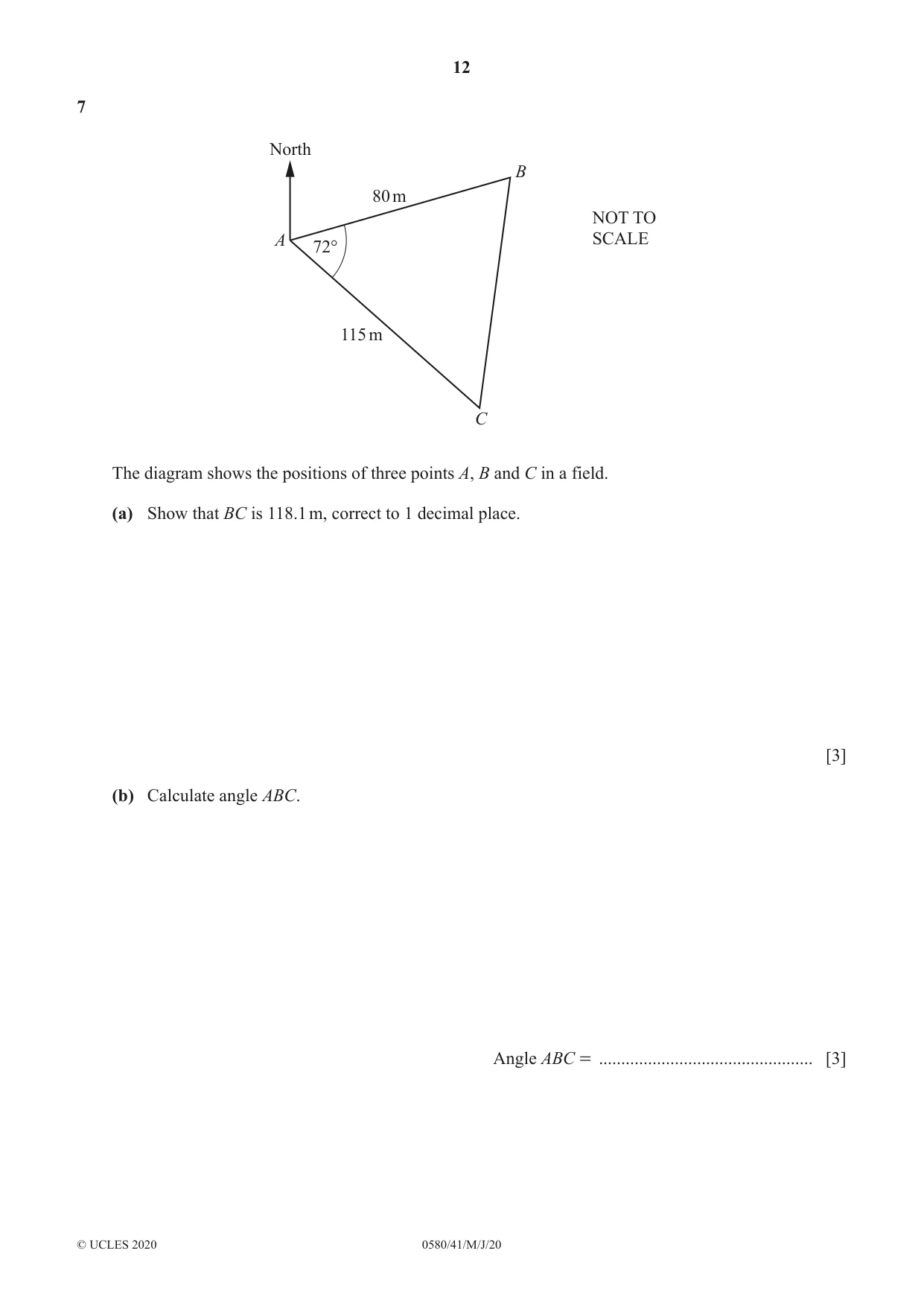
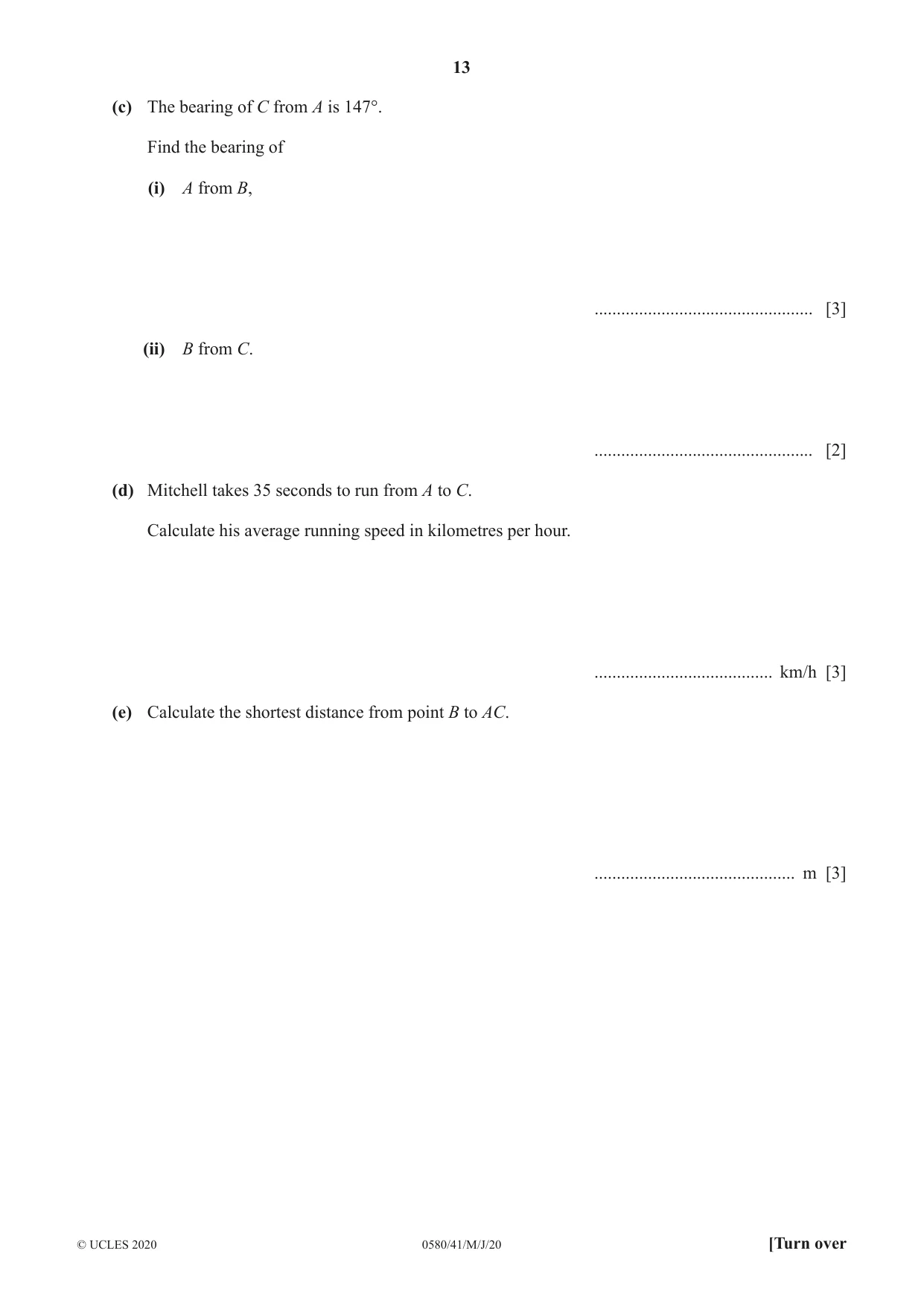
7 North B 80 m NOT TO A SCALE 72° 115 m C The diagram shows the positions of three points A, B and C in a field. (a) Show that BC is 118.1 m, correct to 1 decimal place. [3] (b) Calculate angle ABC. Angle ABC = ................................................ [3] (c) The bearing of C from A is 147°. Find the bearing of (i) A from B, ................................................. [3] (ii) B from C. ................................................. [2] (d) Mitchell takes 35 seconds to run from A to C. Calculate his average running speed in kilometres per hour. ........................................ km/h [3] (e) Calculate the shortest distance from point B to AC. ............................................. m [3]
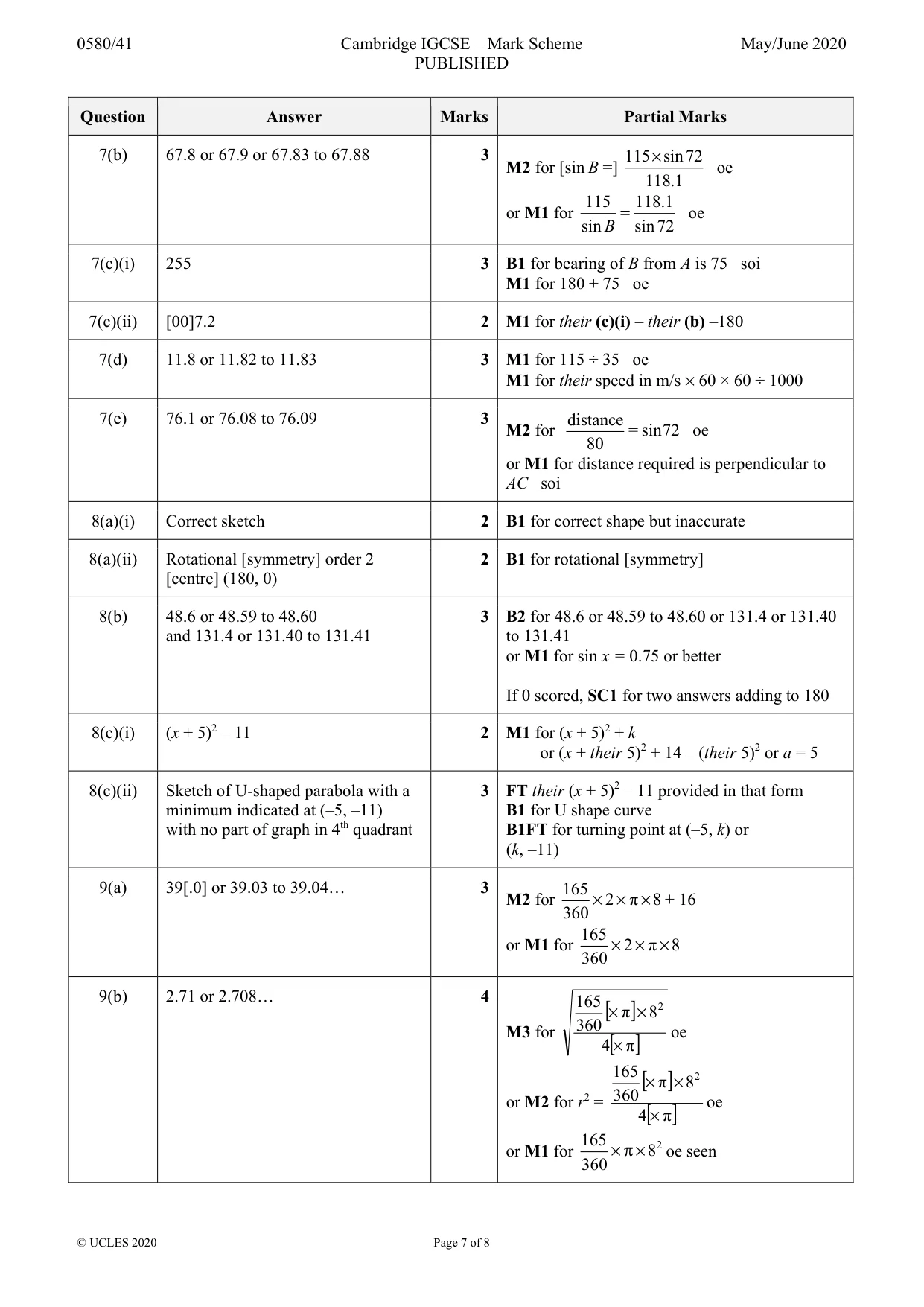
Mark scheme: 7(a) [BC2 =] 802 + 1152 – 2 × 80 × M1 115 cos 72 oe 118.06… A2 A1 for 13939… 7(b) 67.8 or 67.9 or 67.83 to 67.88 3 115 × sin72 M2 for [sin B =] oe 118.1 115 118.1 or M1 for = oe sin B sin72 7(c)(i) 255 3 B1 for bearing of B from A is 75 soi M1 for 180 + 75 oe 7(c)(ii) [00]7.2 2 M1 for their (c)(i) – their (b) –180 7(d) 11.8 or 11.82 to 11.83 3 M1 for 115 ÷ 35 oe M1 for their speed in m/s × 60 × 60 ÷ 1000 7(e) 76.1 or 76.08 to 76.09 3 distance M2 for = sin72 oe 80 or M1 for distance required is perpendicular to AC soi
Q8 · On the axes, sketch the graph of y = sin x for 0° G x G 360 °
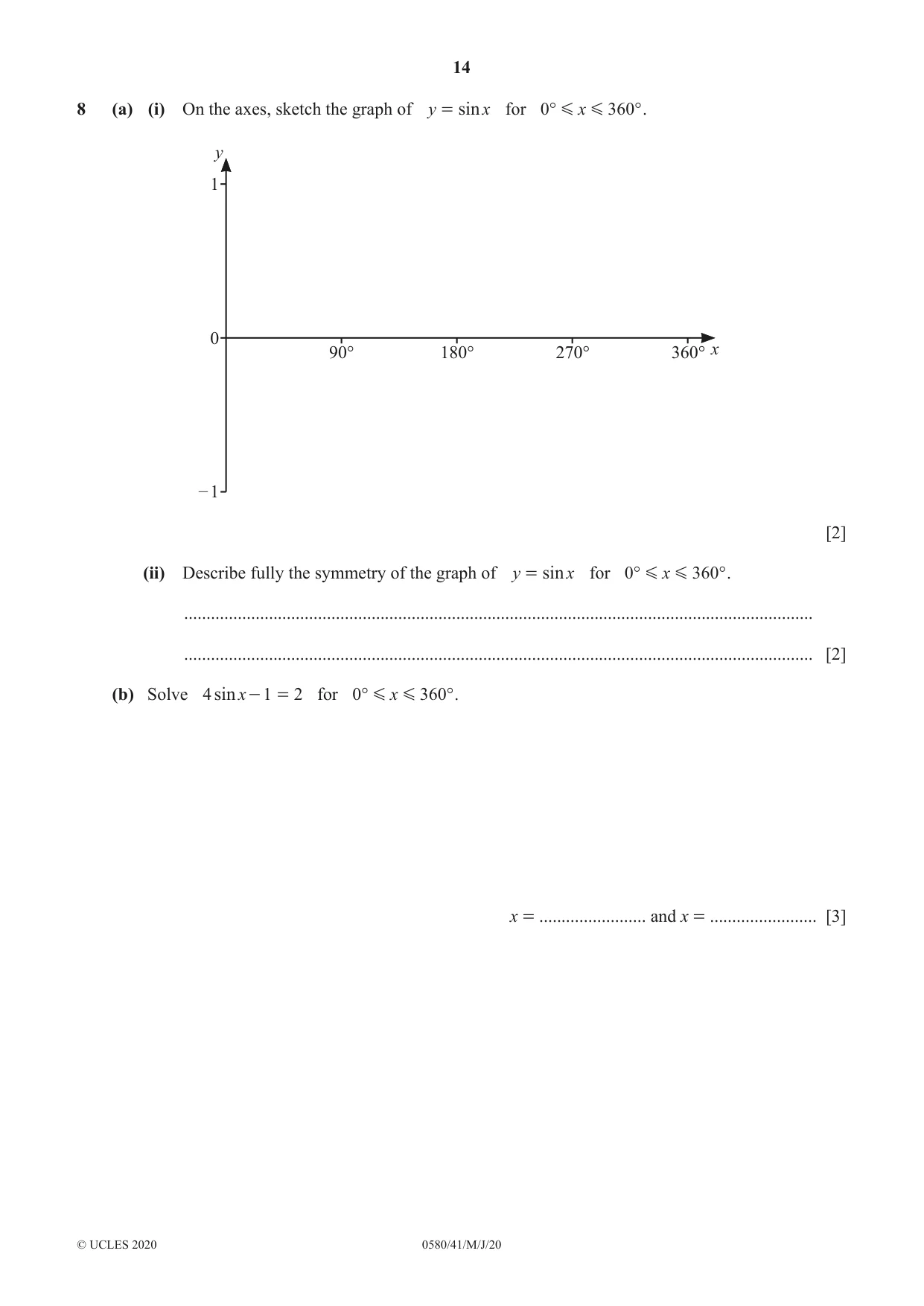
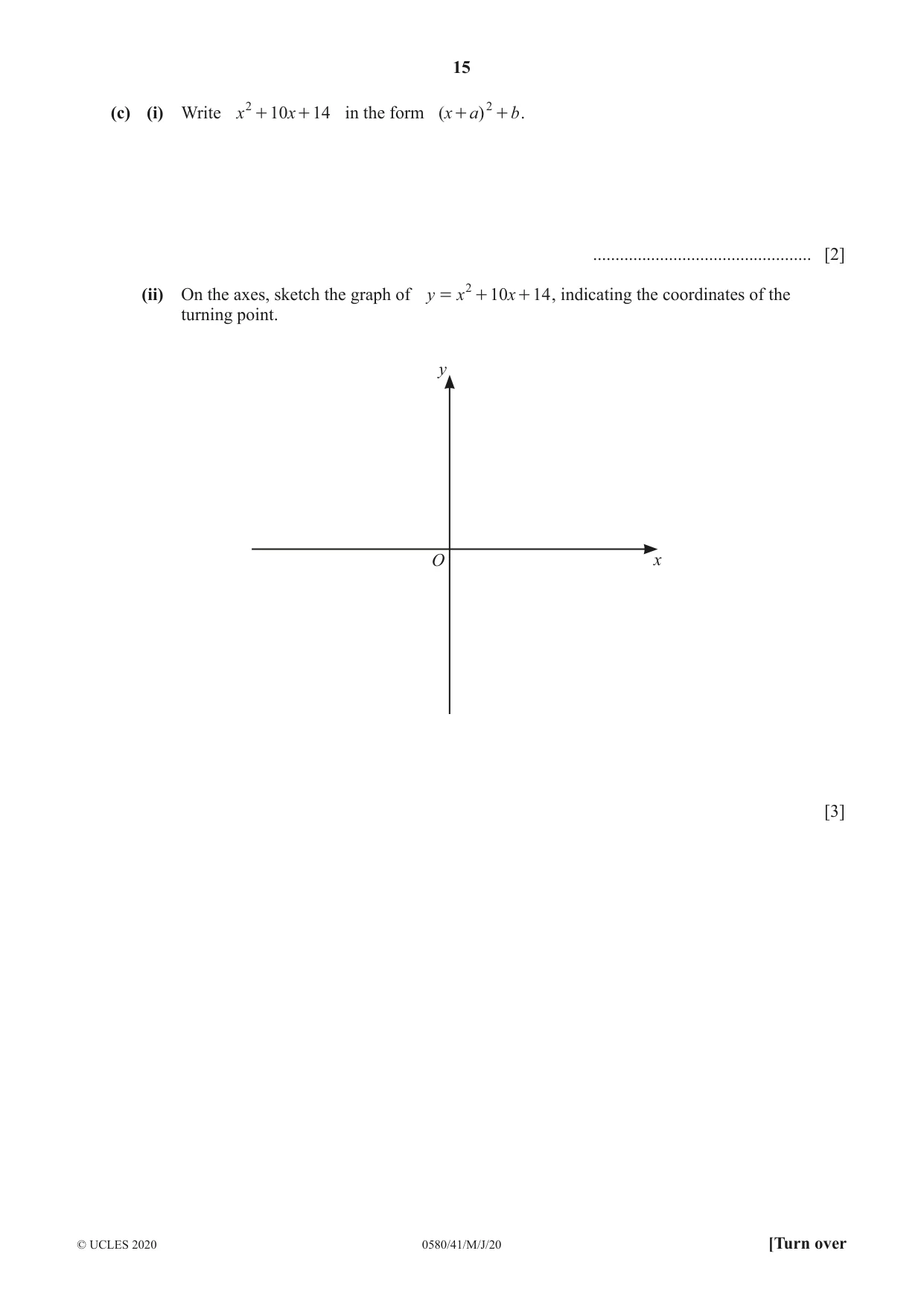
8 (a) (i) On the axes, sketch the graph of y = sin x for 0° G x G 360 ° . y 1 0 90° 180° 270° 360° x – 1 [2] (ii) Describe fully the symmetry of the graph of y = sin x for 0° G x G 360 ° . ............................................................................................................................................. ............................................................................................................................................. [2] (b) Solve 4 sinx - 1 = 2 for 0° G x G 360° . x = ........................ and x = ........................ [3] (c) (i) Write x 2 + 10 x + 14 in the form ( x + a ) 2 + b . ................................................. [2] (ii) On the axes, sketch the graph of y = x 2 + 10x + 14 , indicating the coordinates of the turning point. y O x [3]
Mark scheme: 8(a)(i) Correct sketch 2 B1 for correct shape but inaccurate 8(a)(ii) Rotational [symmetry] order 2 2 B1 for rotational [symmetry] [centre] (180, 0) 8(b) 48.6 or 48.59 to 48.60 3 B2 for 48.6 or 48.59 to 48.60 or 131.4 or 131.40 and 131.4 or 131.40 to 131.41 to 131.41 or M1 for sin x = 0.75 or better If 0 scored, SC1 for two answers adding to 180 8(c)(i) (x + 5)2 – 11 2 M1 for (x + 5)2 + k or (x + their 5)2 + 14 – (their 5)2 or a = 5 8(c)(ii) Sketch of U-shaped parabola with a 3 FT their (x + 5)2 – 11 provided in that form minimum indicated at (–5, –11) B1 for U shape curve with no part of graph in 4th quadrant B1FT for turning point at (–5, k) or (k, –11)
Q9 · NOT TO SCALE A 8 cm 165° B O The diagram shows a sector of a circle with centre O, radius…
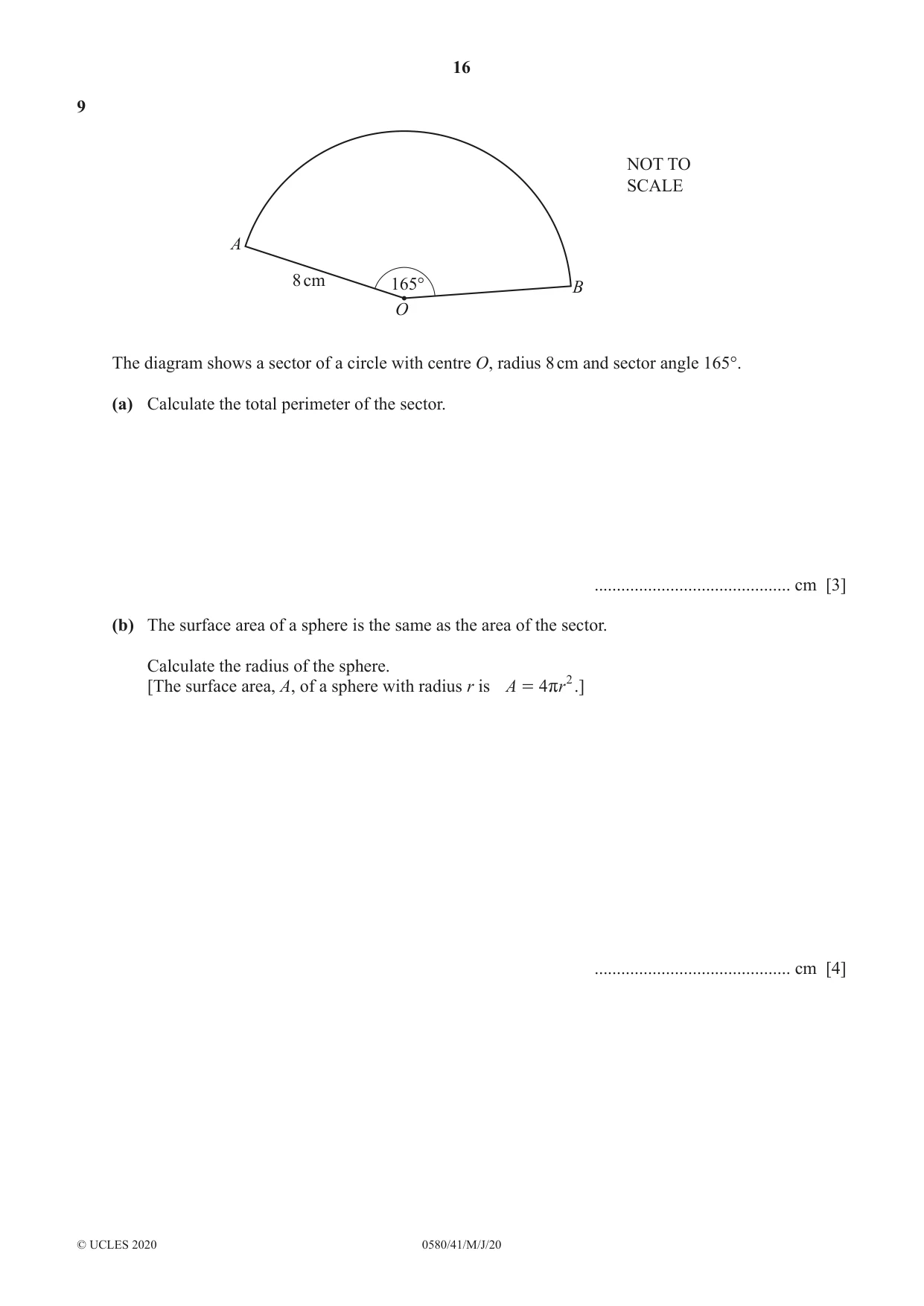
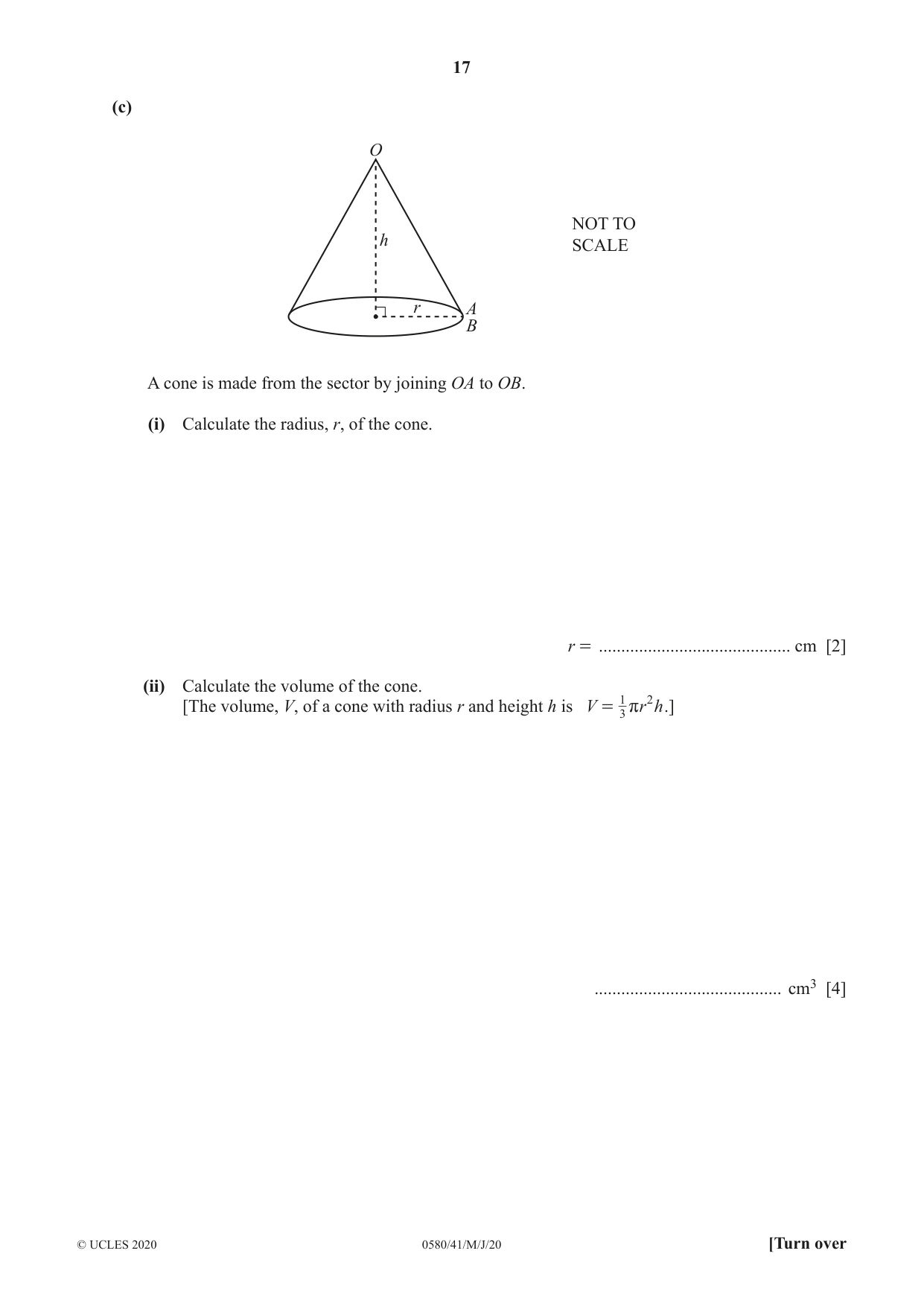
9 NOT TO SCALE A 8 cm 165° B O The diagram shows a sector of a circle with centre O, radius 8 cm and sector angle 165°. (a) Calculate the total perimeter of the sector. ............................................ cm [3] (b) The surface area of a sphere is the same as the area of the sector. Calculate the radius of the sphere. [The surface area, A, of a sphere with radius r is A = 4rr 2 .] ............................................ cm [4] (c) O NOT TO h SCALE r A B A cone is made from the sector by joining OA to OB. (i) Calculate the radius, r, of the cone. r = ........................................... cm [2] (ii) Calculate the volume of the cone. r r h .] [The volume, V, of a cone with radius r and height h is V = 13 2 .......................................... cm3 [4]
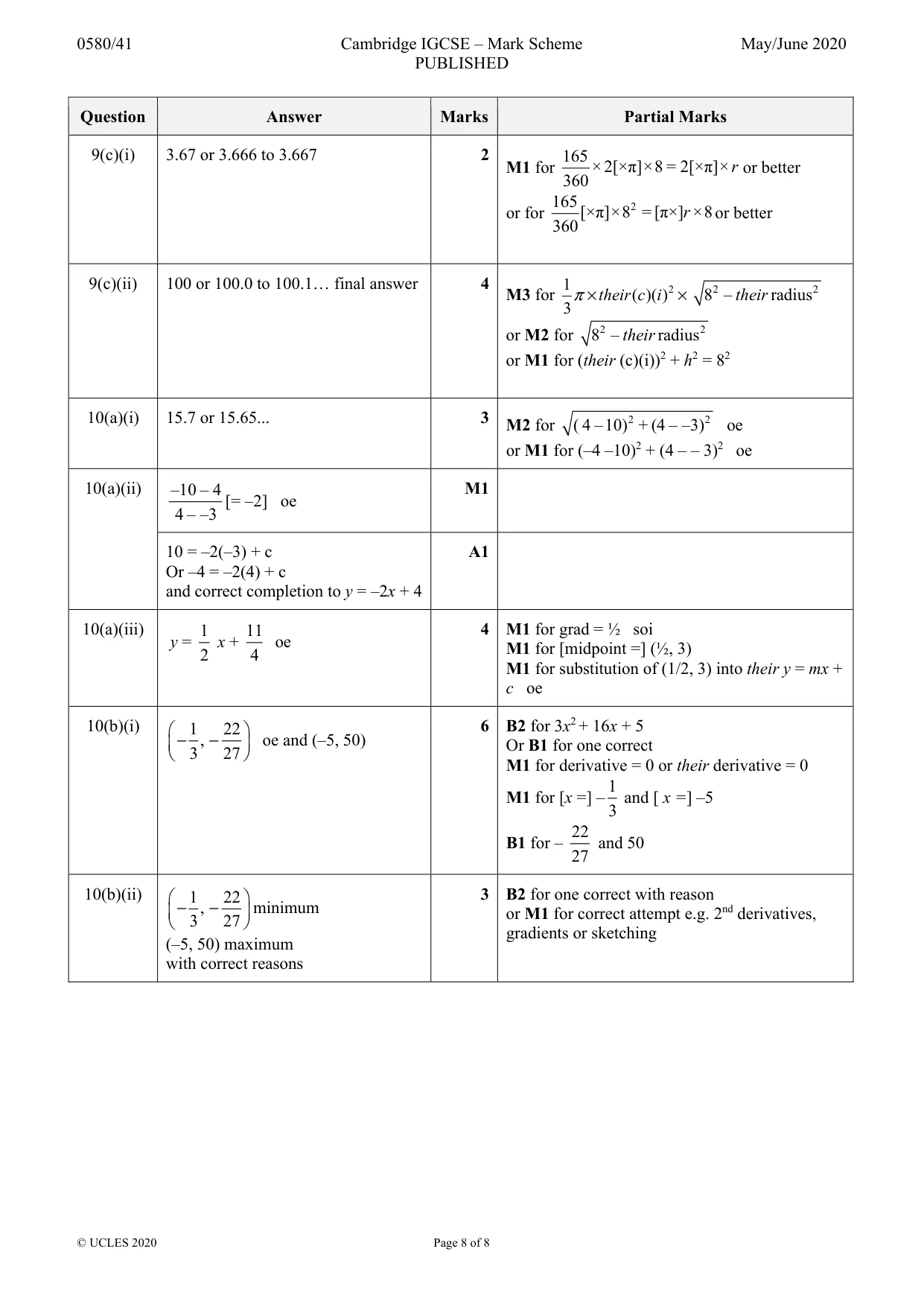
Mark scheme: 9(a) 39[.0] or 39.03 to 39.04… 3 165 M2 for × 2 × π × 8 + 16 360 165 or M1 for × 2 × π × 8 360 9(b) 2.71 or 2.708… 4 165 2 [× π ] × 8 360 M3 for oe 4[× π ] 165 2 [× π ] × 8 360 or M2 for r2 = oe 4[× π ] 165 2 or M1 for × π × 8 oe seen 360 9(c)(i) 3.67 or 3.666 to 3.667 2 165 M1 for ×2[×π]×8 = 2[×π]× r or better 360 or for 165[×π]×8 2 = [π×]r ×8 or better 360 9(c)(ii) 100 or 100.0 to 100.1… final answer 4 1 2 2 2 M3 for π × their ( c )( i ) × 8 – their radius 3 or M2 for 8 2 – their radius 2 or M1 for (their (c)(i))2 + h2 = 82
Q10 · A rhombus ABCD has a diagonal AC where A is the point (-3, 10) and C is the point (4, -4)
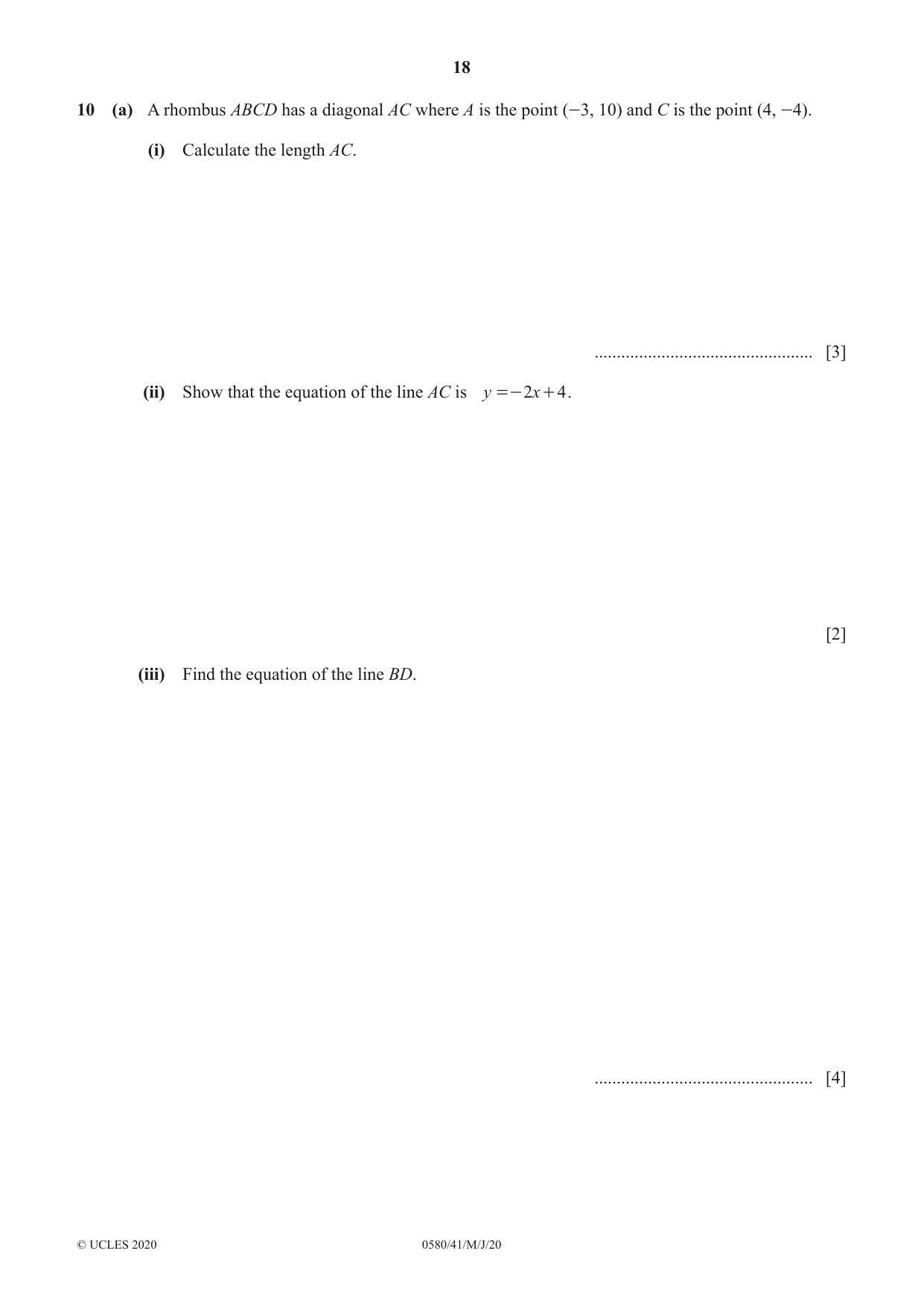
10 (a) A rhombus ABCD has a diagonal AC where A is the point (-3, 10) and C is the point (4, -4). (i) Calculate the length AC. ................................................. [3] (ii) Show that the equation of the line AC is y =- 2x + 4 . [2] (iii) Find the equation of the line BD. ................................................. [4] (b) A curve has the equation y = x 3 + 8x 2 + 5x . (i) Work out the coordinates of the two turning points. (.................... , ....................) and (.................... , ....................) [6] (ii) Determine whether each of the turning points is a maximum or a minimum. Give reasons for your answers. [3]
Mark scheme: 10(a)(i) 15.7 or 15.65... 3 2 2 M2 for ( 4 – 10) + (4 – –3) oe or M1 for (–4 –10)2 + (4 – – 3)2 oe 10(a)(ii) –10 – 4 M1 [= –2] oe 4 – –3 10 = –2(–3) + c A1 Or –4 = –2(4) + c and correct completion to y = –2x + 4 10(a)(iii) 1 11 4 M1 for grad = ½ soi y = x + oe M1 for [midpoint =] (½, 3) 2 4 M1 for substitution of (1/2, 3) into their y = mx + c oe 10(b)(i) 1 22 6 B2 for 3x2 + 16x + 5 − , − oe and (–5, 50) Or B1 for one correct 3 27 M1 for derivative = 0 or their derivative = 0 1 M1 for [x =] – and [ x =] –5 3 22 B1 for – and 50 27 10(b)(ii) 1 22 3 B2 for one correct with reason − , − minimum or M1 for correct attempt e.g. 2nd derivatives, 3 27 gradients or sketching (–5, 50) maximum with correct reasons
What was in this paper
The subtopics covered by these 10 questions, and how many questions each got. Open one in a new tab to see every Cambridge question on it.