Questions as text
Q1 · What is not an aim of government economic policy? 0455/11 Oct/Nov 2007
26 What is not an aim of government economic policy? A economic growth B full employment C interest rates D stable prices
1 marks
Answer: C
This question in 0455/11 Oct/Nov 2007
Q2 · A government achieves a high rate of economic growth 0455/11 May/June 2010
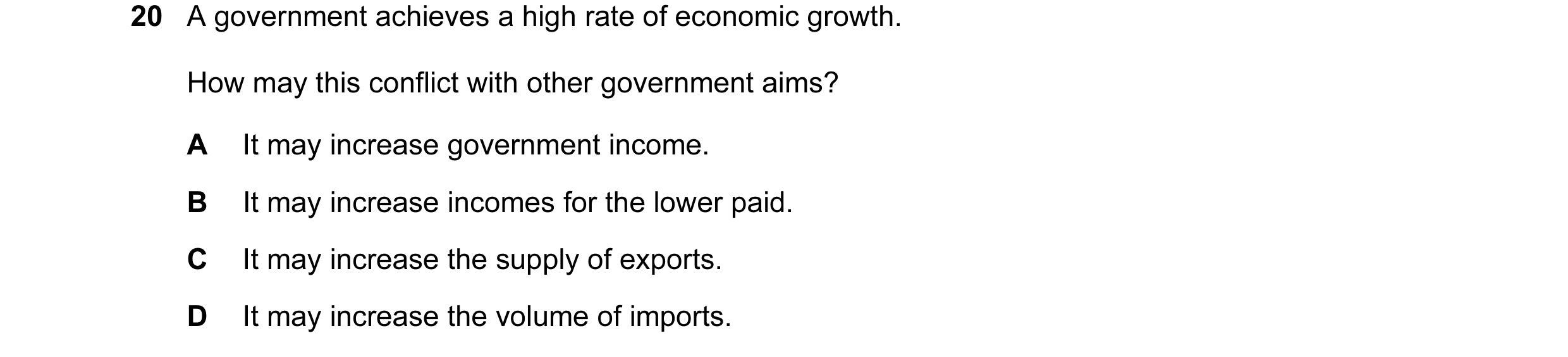
20 A government achieves a high rate of economic growth. How may this conflict with other government aims? A It may increase government income. B It may increase incomes for the lower paid. C It may increase the supply of exports. D It may increase the volume of imports.
1 marks
Answer: D
This question in 0455/11 May/June 2010
Q3 · A government achieves a high rate of economic growth 0455/12 May/June 2010
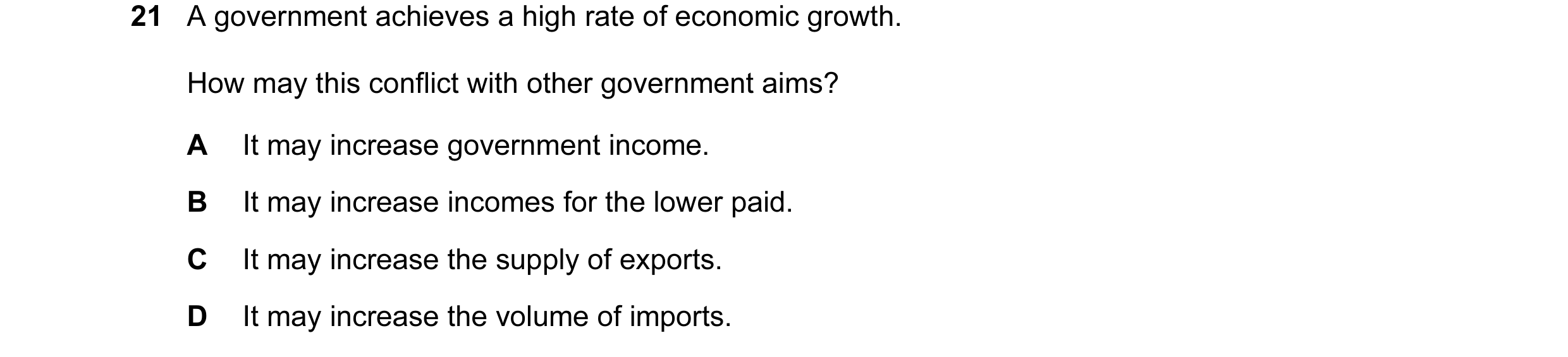
21 A government achieves a high rate of economic growth. How may this conflict with other government aims? A It may increase government income. B It may increase incomes for the lower paid. C It may increase the supply of exports. D It may increase the volume of imports.
1 marks
Answer: D
This question in 0455/12 May/June 2010
Q4 · The central bank of Mexico set its rate of interest to try to keep the rise in the price… 0455/11 May/June 2011
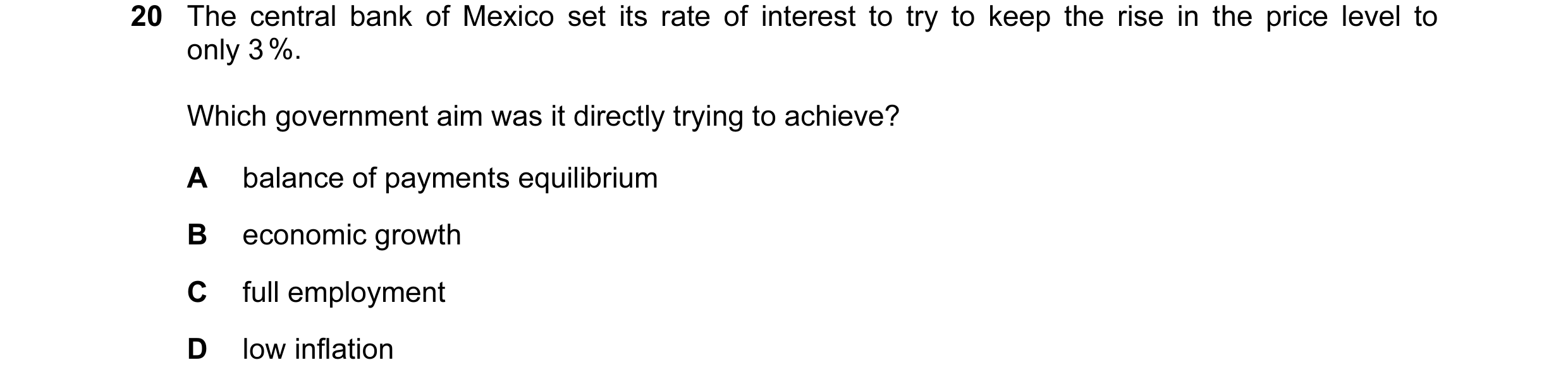
20 The central bank of Mexico set its rate of interest to try to keep the rise in the price level to only 3 %. Which government aim was it directly trying to achieve? A balance of payments equilibrium B economic growth C full employment D low inflation
1 marks
Answer: D
This question in 0455/11 May/June 2011
Q5 · The table gives information about some economic indicators in a number of countries 0455/11 May/June 2013
25 The table gives information about some economic indicators in a number of countries. inflation interest rates unemployment % % % country W 1.4 3.4 10.2 country X 3.7 8.7 12.3 country Y 3.6 7.3 14.2 country Z 2.1 6.0 7.7 What may be concluded from this information? A Countries with higher inflation have higher interest rates. B Countries with higher interest rates have lower inflation. C The country with the lowest inflation had the highest unemployment. D The country with the lowest unemployment had the highest inflation.
1 marks
Answer: A
This question in 0455/11 May/June 2013
Q6 · Which are two aims that a Government normally pursues when managing the performance of… 0455/11 May/June 2014
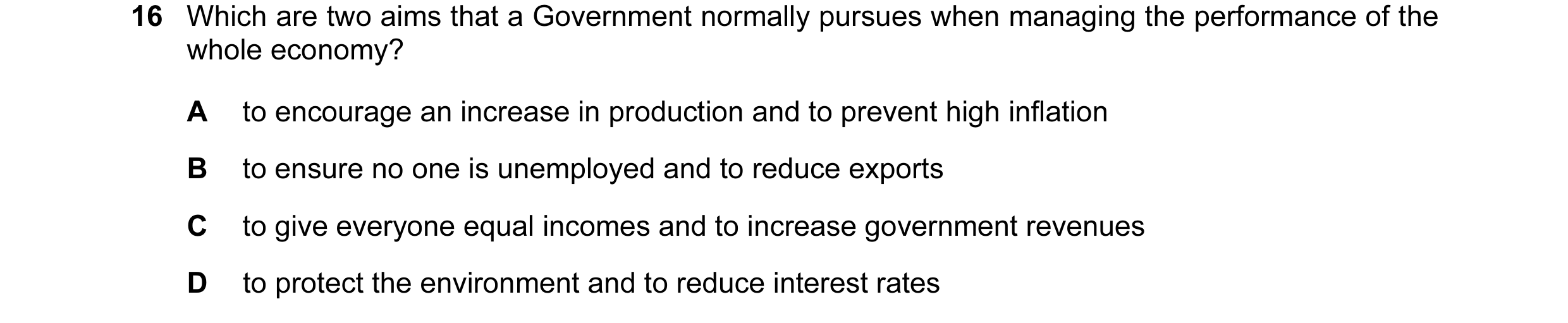
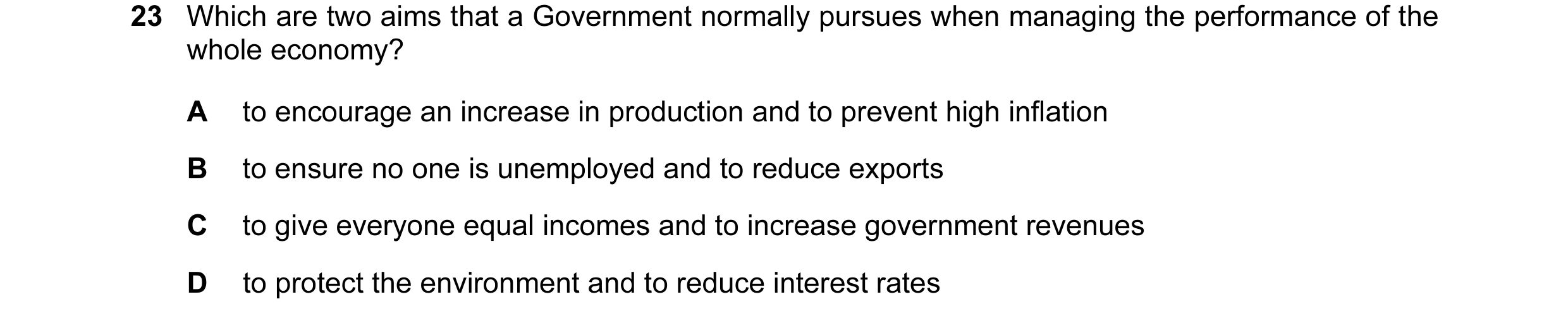
16 Which are two aims that a Government normally pursues when managing the performance of the whole economy? A to encourage an increase in production and to prevent high inflation B to ensure no one is unemployed and to reduce exports C to give everyone equal incomes and to increase government revenues D to protect the environment and to reduce interest rates
1 marks
Answer: A
This question in 0455/11 May/June 2014
Q7 · In which case is success for the government in achieving the first aim likely to cause… 0455/11 May/June 2014
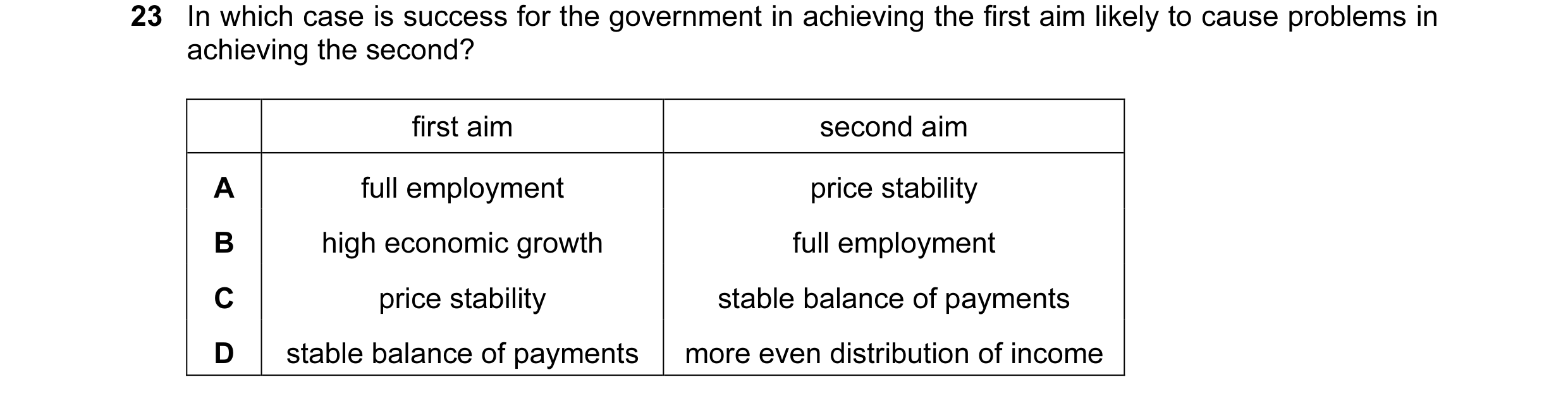
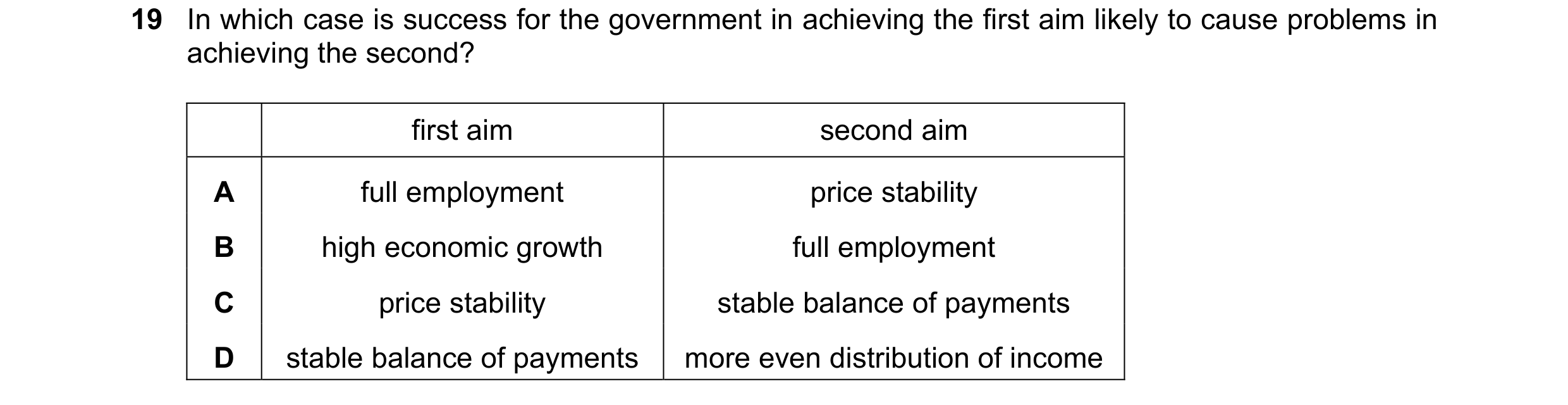
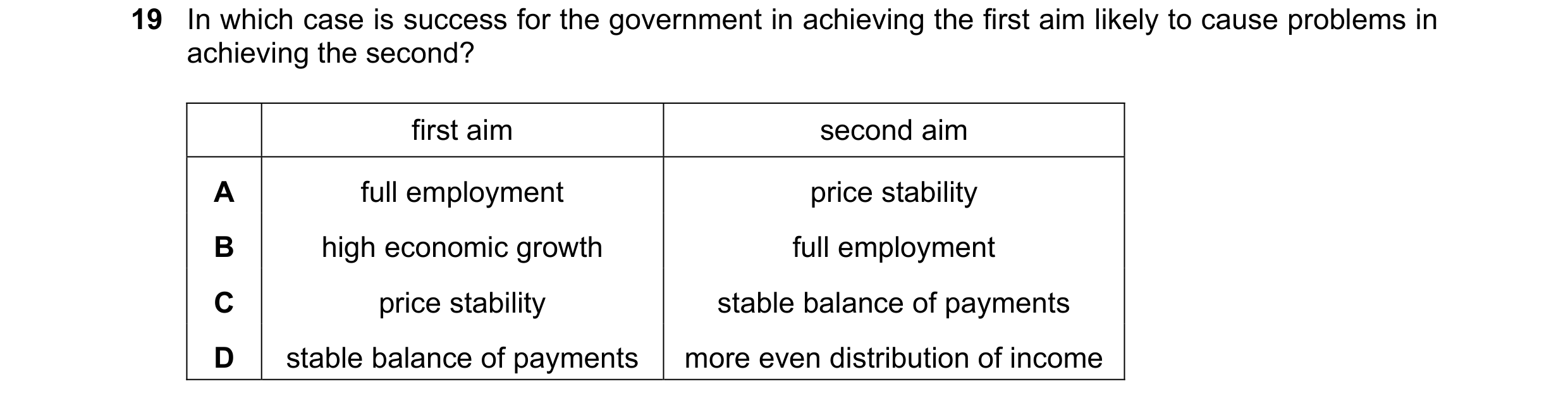
23 In which case is success for the government in achieving the first aim likely to cause problems in achieving the second? first aim second aim A full employment price stability B high economic growth full employment C price stability stable balance of payments D stable balance of payments more even distribution of income
1 marks
Answer: A
This question in 0455/11 May/June 2014
Q8 · In which case is success for the government in achieving the first aim likely to cause… 0455/12 May/June 2014
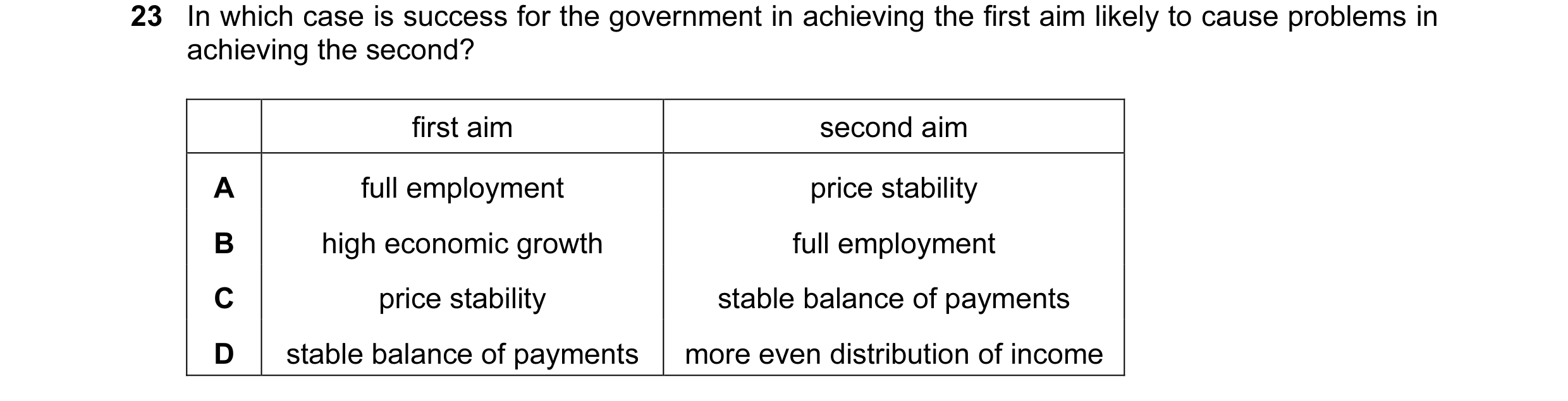
23 In which case is success for the government in achieving the first aim likely to cause problems in achieving the second? first aim second aim A full employment price stability B high economic growth full employment C price stability stable balance of payments D stable balance of payments more even distribution of income
1 marks
Answer: A
This question in 0455/12 May/June 2014
Q9 · In which case is success for the government in achieving the first aim likely to cause… 0455/13 May/June 2014
16 In which case is success for the government in achieving the first aim likely to cause problems in achieving the second? first aim second aim A full employment price stability B high economic growth full employment C price stability stable balance of payments D stable balance of payments more even distribution of income
1 marks
Answer: A
This question in 0455/13 May/June 2014
Q10 · Which are two aims that a Government normally pursues when managing the performance of… 0455/13 May/June 2014
23 Which are two aims that a Government normally pursues when managing the performance of the whole economy? A to encourage an increase in production and to prevent high inflation B to ensure no one is unemployed and to reduce exports C to give everyone equal incomes and to increase government revenues D to protect the environment and to reduce interest rates
1 marks
Answer: A
This question in 0455/13 May/June 2014
Q11 · In 2011 the Egyptian Government increased the top rate of income tax 0455/11 Oct/Nov 2014
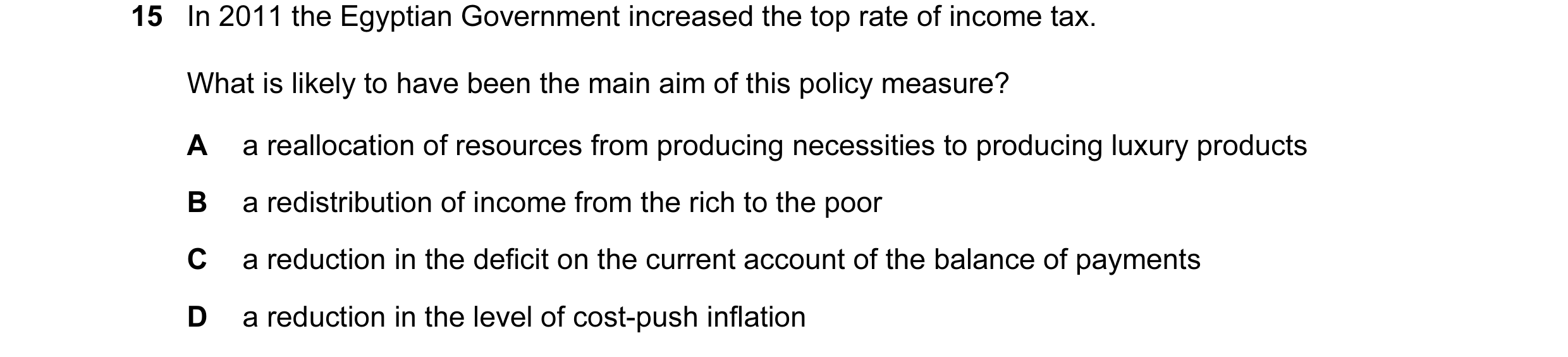
15 In 2011 the Egyptian Government increased the top rate of income tax. What is likely to have been the main aim of this policy measure? A a reallocation of resources from producing necessities to producing luxury products B a redistribution of income from the rich to the poor C a reduction in the deficit on the current account of the balance of payments D a reduction in the level of cost-push inflation
1 marks
Answer: B
This question in 0455/11 Oct/Nov 2014
Q12 · A government aims to keep domestic prices stable in a fully employed economy 0455/11 Oct/Nov 2014
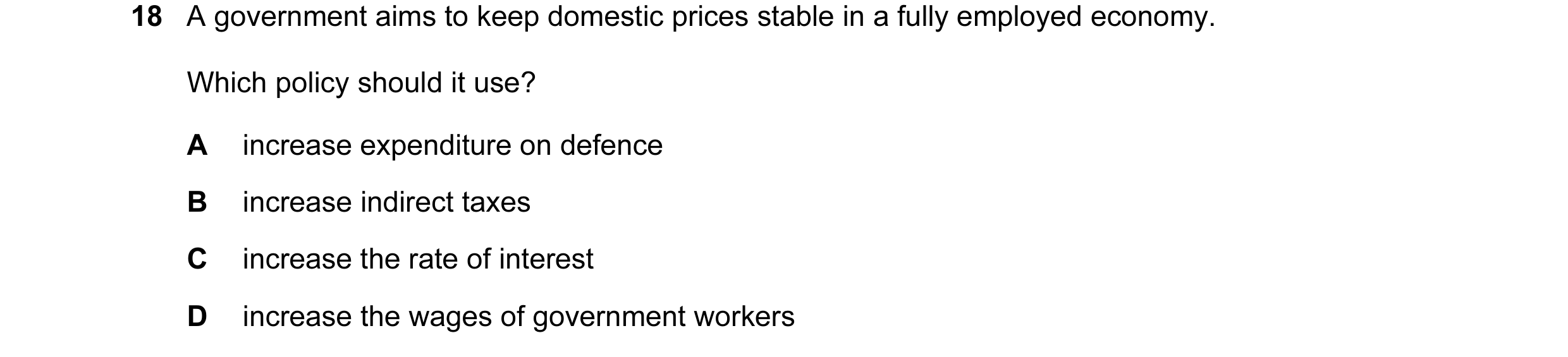
18 A government aims to keep domestic prices stable in a fully employed economy. Which policy should it use? A increase expenditure on defence B increase indirect taxes C increase the rate of interest D increase the wages of government workers
1 marks
Answer: C
This question in 0455/11 Oct/Nov 2014
Q13 · In trying to achieve one of its aims a government may make it difficult to achieve… 0455/13 Oct/Nov 2014
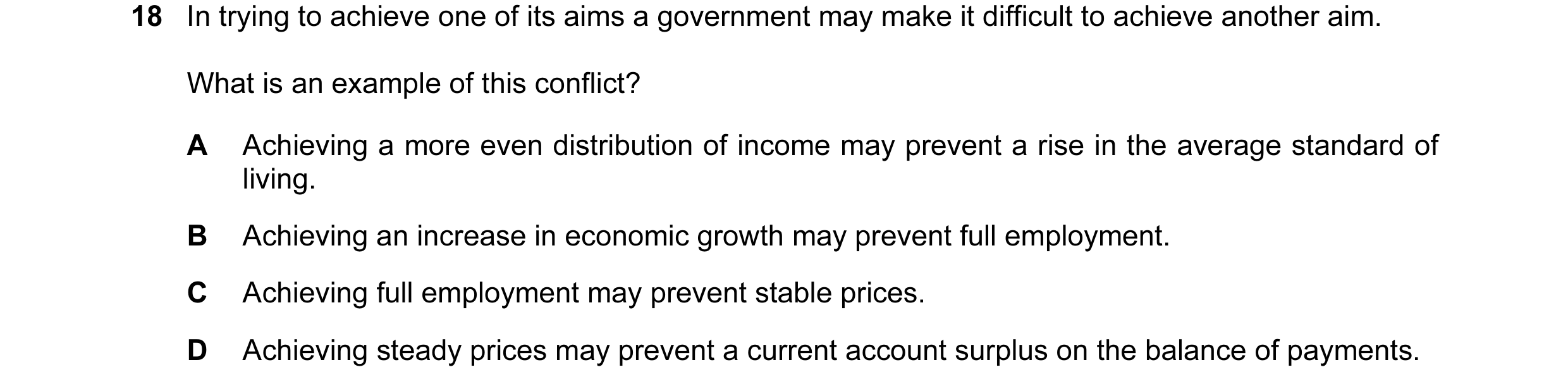
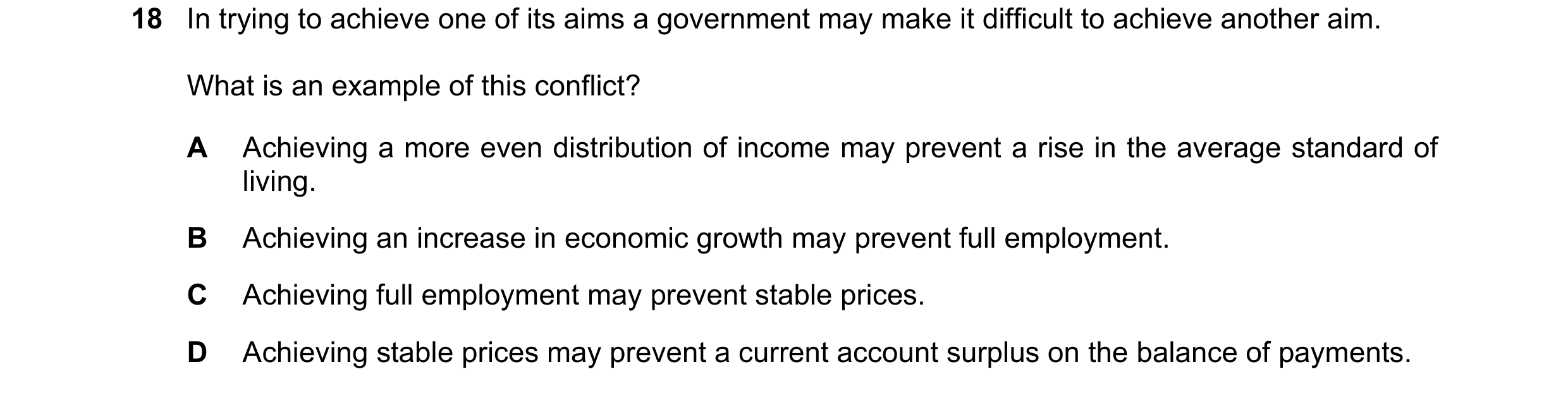
18 In trying to achieve one of its aims a government may make it difficult to achieve another aim. What is an example of this conflict? A Achieving a more even distribution of income may prevent a rise in the average standard of living. B Achieving an increase in economic growth may prevent full employment. C Achieving full employment may prevent stable prices. D Achieving steady prices may prevent a current account surplus on the balance of payments.
1 marks
Answer: C
This question in 0455/13 Oct/Nov 2014
Q14 · From 2012 to 2013, European economies experienced weak economic growth 0455/11 May/June 2015
23 From 2012 to 2013, European economies experienced weak economic growth. Based on the information on GDP, industrial production and unemployment in the table, which economy performed worst? Percentage change 2012-2013 industrial GDP unemployment production A UK +1.0 –2.3 –0.1 B Germany +0.3 –1.1 0.0 C Italy –1.8 –4.2 +1.5 D Spain –1.7 –1.3 +1.3
1 marks
Answer: C
This question in 0455/11 May/June 2015
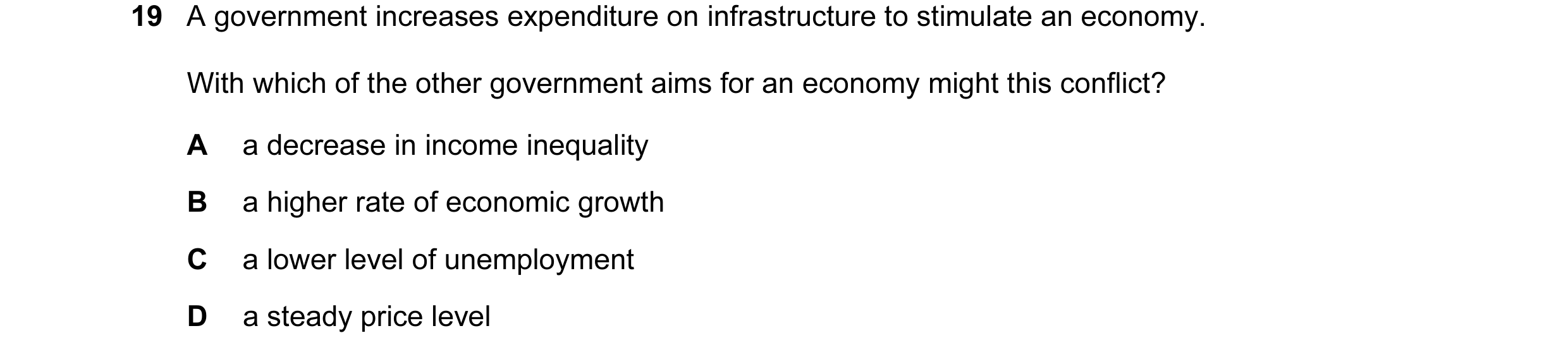
Q15 · A government increases expenditure on infrastructure to stimulate an economy 0455/12 May/June 2015
19 A government increases expenditure on infrastructure to stimulate an economy. With which of the other government aims for an economy might this conflict? A a decrease in income inequality B a higher rate of economic growth C a lower level of unemployment D a steady price level
1 marks
Answer: D
This question in 0455/12 May/June 2015
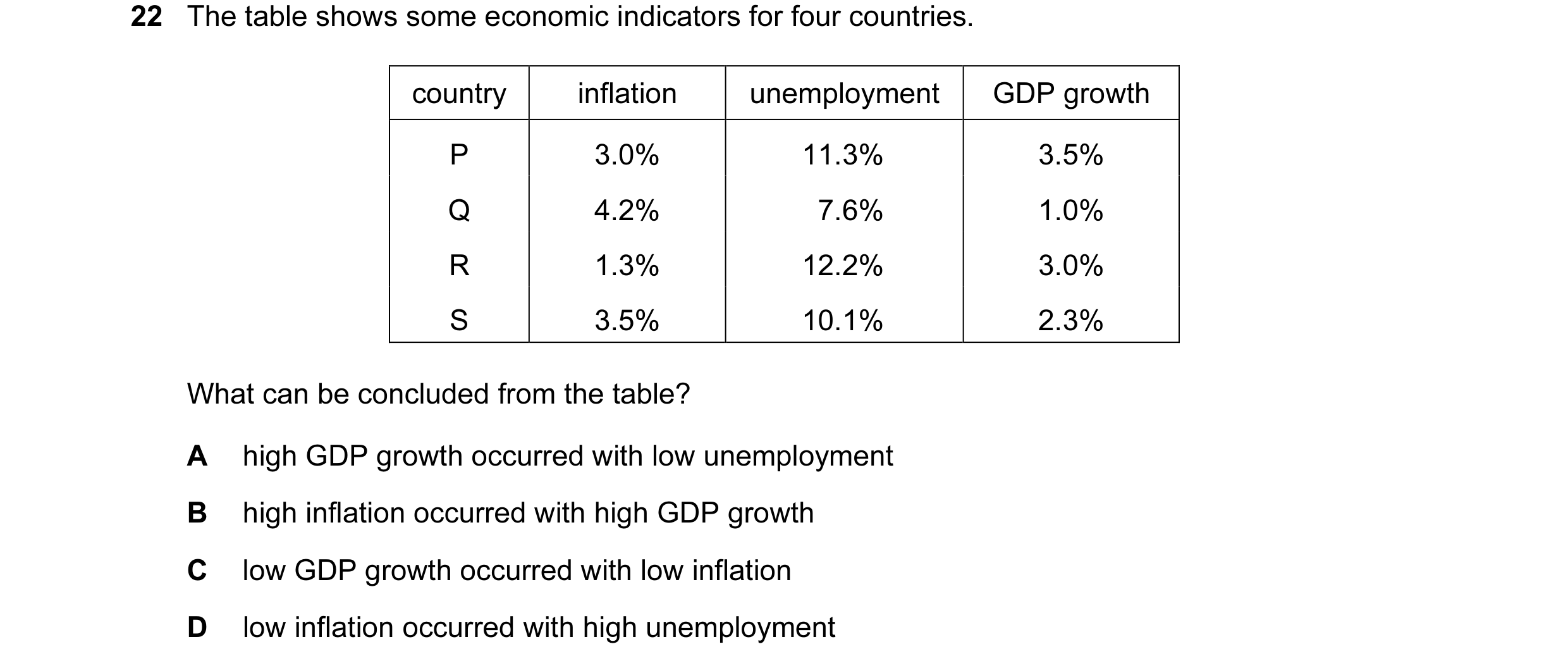
Q16 · The table shows some economic indicators for four countries 0455/12 May/June 2015
22 The table shows some economic indicators for four countries. country inflation unemployment GDP growth P 3.0% 11.3% 3.5% Q 4.2% 7.6% 1.0% R 1.3% 12.2% 3.0% S 3.5% 10.1% 2.3% What can be concluded from the table? A high GDP growth occurred with low unemployment B high inflation occurred with high GDP growth C low GDP growth occurred with low inflation D low inflation occurred with high unemployment
1 marks
Answer: D
This question in 0455/12 May/June 2015
Q17 · Which statement about the meaning of government economic aims is correct? 0455/11 Oct/Nov 2015
17 Which statement about the meaning of government economic aims is correct? A Economic growth means that a country’s real output must rise over time. B Full employment means that no one must be unemployed. C Price stability means that the price of all goods and services must remain unchanged. D Redistribution of income means that everyone must have equal incomes.
1 marks
Answer: A
This question in 0455/11 Oct/Nov 2015
Q18 · Which statement about the meaning of government economic aims is correct? 0455/12 Oct/Nov 2015
17 Which statement about the meaning of government economic aims is correct? A Economic growth means that a country’s real output must rise over time. B Full employment means that no one must be unemployed. C Price stability means that the price of all goods and services must remain unchanged. D Redistribution of income means that everyone must have equal incomes.
1 marks
Answer: A
This question in 0455/12 Oct/Nov 2015
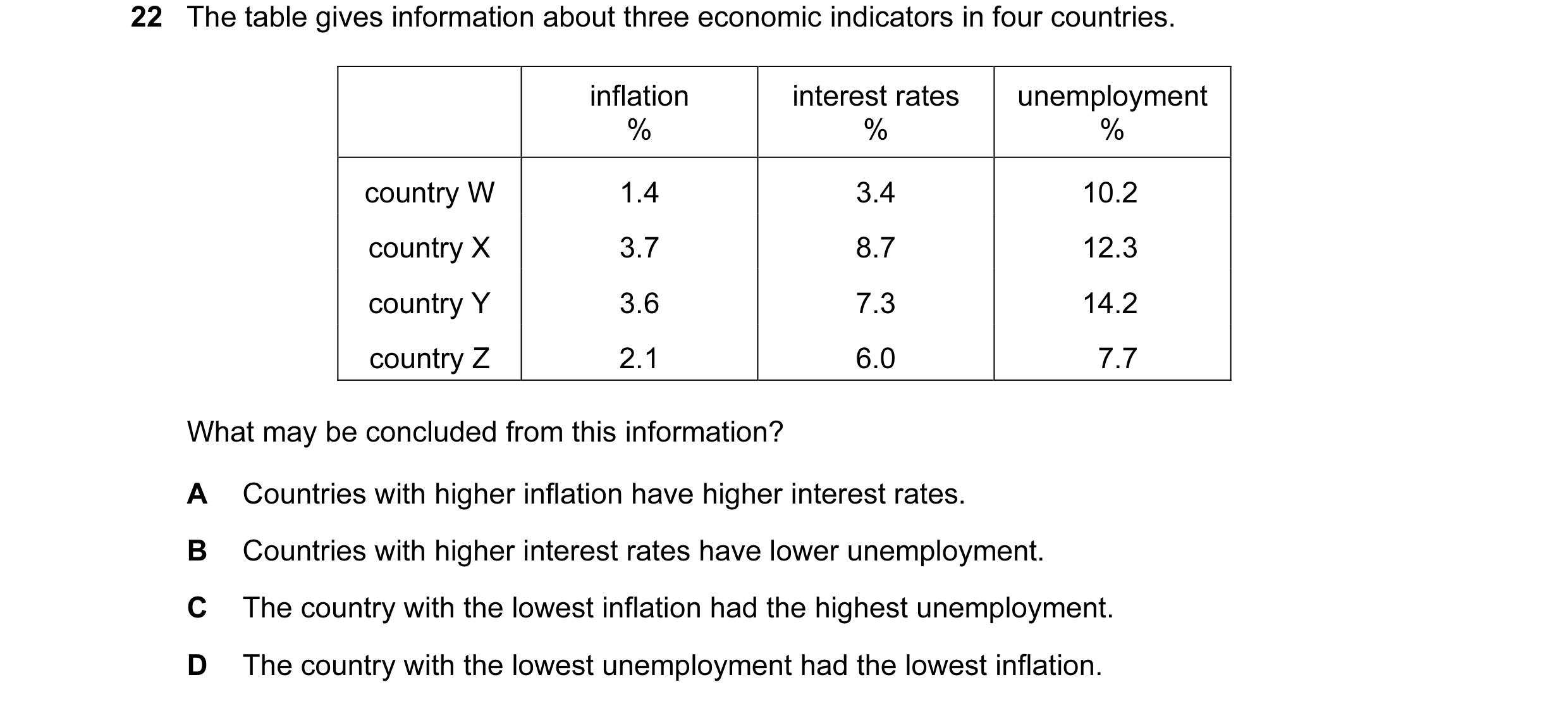
Q19 · The table gives information about three economic indicators in four countries 0455/11 May/June 2016
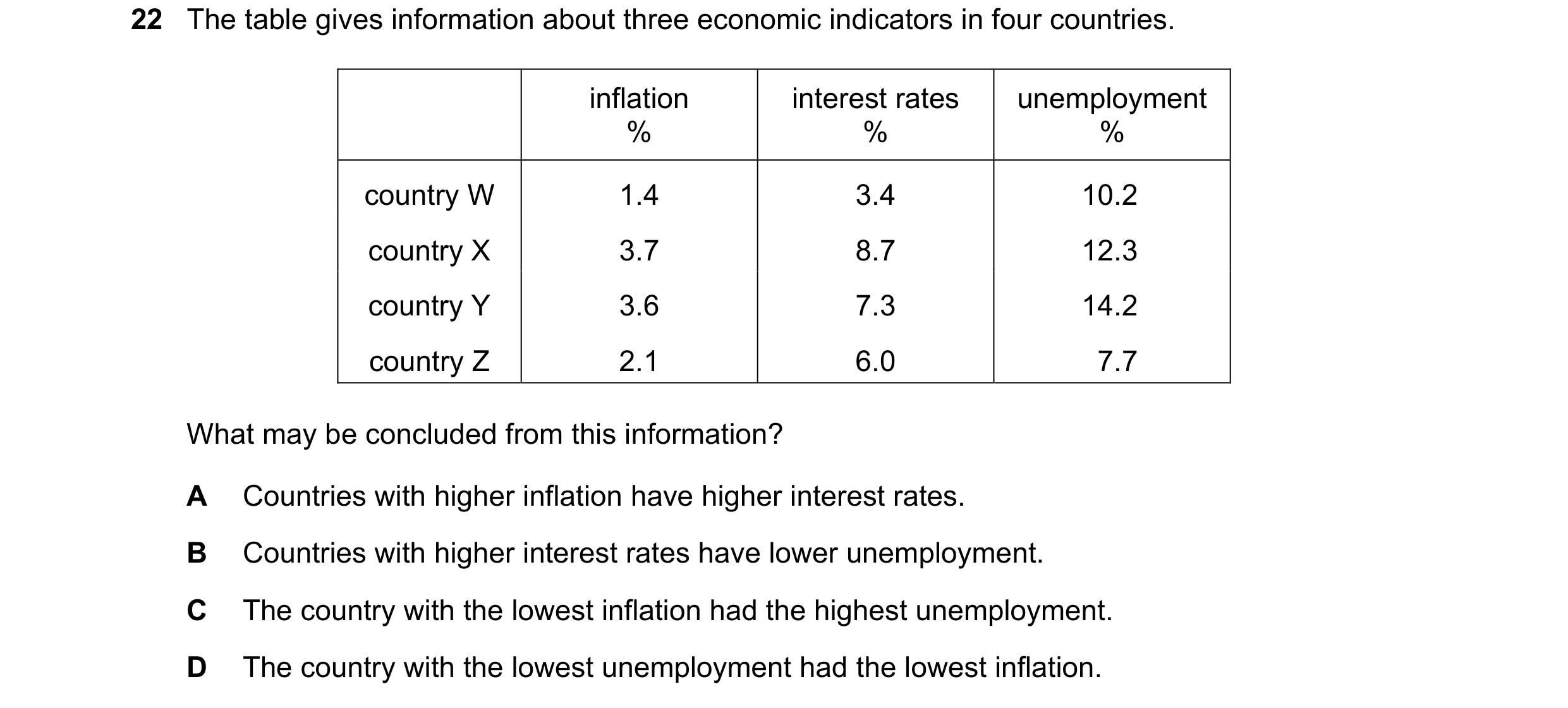
22 The table gives information about three economic indicators in four countries. inflation interest rates unemployment % % % country W 1.4 3.4 10.2 country X 3.7 8.7 12.3 country Y 3.6 7.3 14.2 country Z 2.1 6.0 7.7 What may be concluded from this information? A Countries with higher inflation have higher interest rates. B Countries with higher interest rates have lower unemployment. C The country with the lowest inflation had the highest unemployment. D The country with the lowest unemployment had the lowest inflation.
1 marks
Answer: A
This question in 0455/11 May/June 2016
Q20 · The table gives information about three economic indicators in four countries 0455/12 May/June 2016
22 The table gives information about three economic indicators in four countries. inflation interest rates unemployment % % % country W 1.4 3.4 10.2 country X 3.7 8.7 12.3 country Y 3.6 7.3 14.2 country Z 2.1 6.0 7.7 What may be concluded from this information? A Countries with higher inflation have higher interest rates. B Countries with higher interest rates have lower unemployment. C The country with the lowest inflation had the highest unemployment. D The country with the lowest unemployment had the lowest inflation.
1 marks
Answer: A
This question in 0455/12 May/June 2016
Q21 · The table gives information about three economic indicators in four countries 0455/13 May/June 2016
22 The table gives information about three economic indicators in four countries. inflation interest rates unemployment % % % country W 1.4 3.4 10.2 country X 3.7 8.7 12.3 country Y 3.6 7.3 14.2 country Z 2.1 6.0 7.7 What may be concluded from this information? A Countries with higher inflation have higher interest rates. B Countries with higher interest rates have lower unemployment. C The country with the lowest inflation had the highest unemployment. D The country with the lowest unemployment had the lowest inflation.
1 marks
Answer: A
This question in 0455/13 May/June 2016
Q22 · In trying to achieve one of its aims a government may make it difficult to achieve… 0455/11 May/June 2017
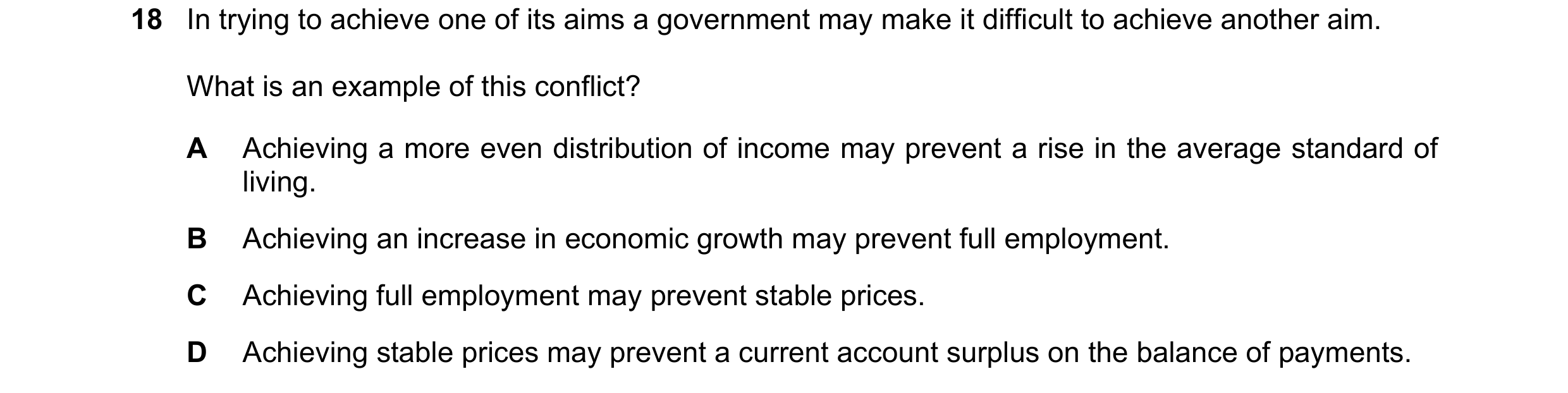
18 In trying to achieve one of its aims a government may make it difficult to achieve another aim. What is an example of this conflict? A Achieving a more even distribution of income may prevent a rise in the average standard of living. B Achieving an increase in economic growth may prevent full employment. C Achieving full employment may prevent stable prices. D Achieving stable prices may prevent a current account surplus on the balance of payments.
1 marks
Answer: C
This question in 0455/11 May/June 2017
Q23 · In trying to achieve one of its aims a government may make it difficult to achieve… 0455/12 May/June 2017
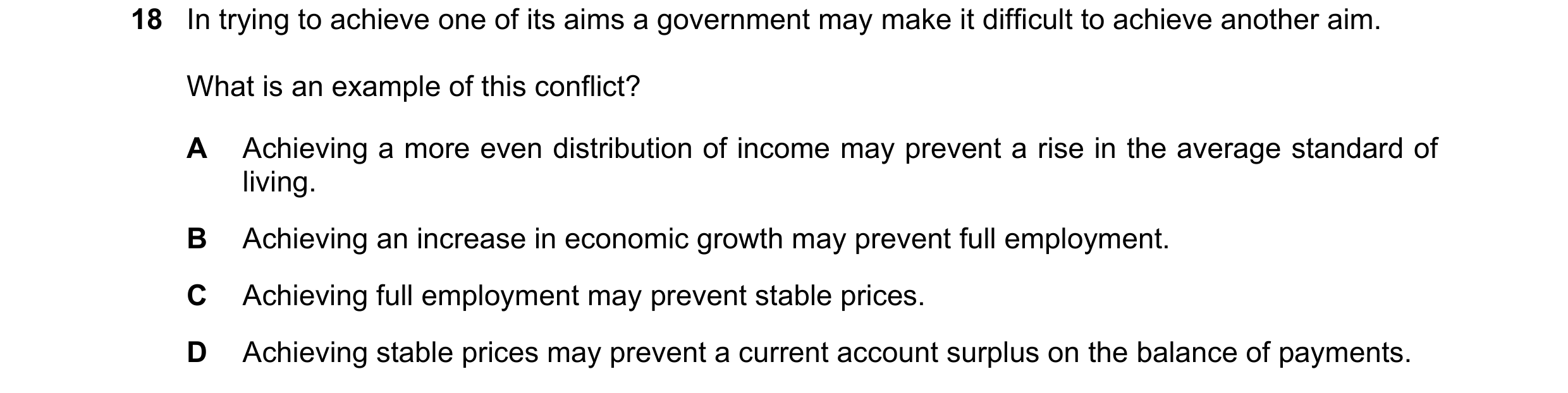
18 In trying to achieve one of its aims a government may make it difficult to achieve another aim. What is an example of this conflict? A Achieving a more even distribution of income may prevent a rise in the average standard of living. B Achieving an increase in economic growth may prevent full employment. C Achieving full employment may prevent stable prices. D Achieving stable prices may prevent a current account surplus on the balance of payments.
1 marks
Answer: C
This question in 0455/12 May/June 2017
Q24 · In trying to achieve one of its aims a government may make it difficult to achieve… 0455/13 May/June 2017
18 In trying to achieve one of its aims a government may make it difficult to achieve another aim. What is an example of this conflict? A Achieving a more even distribution of income may prevent a rise in the average standard of living. B Achieving an increase in economic growth may prevent full employment. C Achieving full employment may prevent stable prices. D Achieving stable prices may prevent a current account surplus on the balance of payments.
1 marks
Answer: C
This question in 0455/13 May/June 2017
Q25 · What is an aim of government policy? 0455/11 May/June 2018
17 What is an aim of government policy? A income tax B interest rates C stable prices D unemployment
1 marks
Answer: C
This question in 0455/11 May/June 2018
Q26 · What is an aim of government policy? 0455/12 May/June 2018
17 What is an aim of government policy? A income tax B interest rates C stable prices D unemployment
1 marks
Answer: C
This question in 0455/12 May/June 2018
Q27 · What is an aim of government policy? 0455/13 May/June 2018
17 What is an aim of government policy? A income tax B interest rates C stable prices D unemployment
1 marks
Answer: C
This question in 0455/13 May/June 2018
Q28 · In which case is success for the government in achieving the first aim likely to cause… 0455/11 Oct/Nov 2018
19 In which case is success for the government in achieving the first aim likely to cause problems in achieving the second? first aim second aim A full employment price stability B high economic growth full employment C price stability stable balance of payments D stable balance of payments more even distribution of income
1 marks
Answer: A
This question in 0455/11 Oct/Nov 2018
Q29 · In which case is success for the government in achieving the first aim likely to cause… 0455/12 Oct/Nov 2018
19 In which case is success for the government in achieving the first aim likely to cause problems in achieving the second? first aim second aim A full employment price stability B high economic growth full employment C price stability stable balance of payments D stable balance of payments more even distribution of income
1 marks
Answer: A
This question in 0455/12 Oct/Nov 2018
Q30 · In which case is success for the government in achieving the first aim likely to cause… 0455/13 Oct/Nov 2018
19 In which case is success for the government in achieving the first aim likely to cause problems in achieving the second? first aim second aim A full employment price stability B high economic growth full employment C price stability stable balance of payments D stable balance of payments more even distribution of income
1 marks
Answer: A
This question in 0455/13 Oct/Nov 2018
Q31 · A government lowers interest rates to encourage more borrowing and spending by households… 0455/12 Feb/March 2019
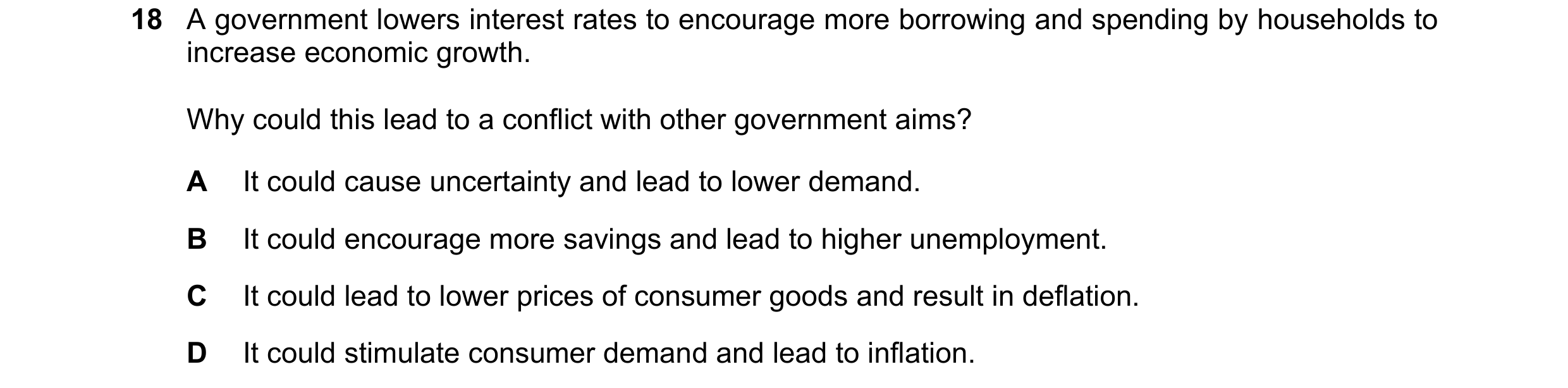
18 A government lowers interest rates to encourage more borrowing and spending by households to increase economic growth. Why could this lead to a conflict with other government aims? A It could cause uncertainty and lead to lower demand. B It could encourage more savings and lead to higher unemployment. C It could lead to lower prices of consumer goods and result in deflation. D It could stimulate consumer demand and lead to inflation.
1 marks
Answer: D
This question in 0455/12 Feb/March 2019
Q32 · A country experiences a long strike by railway workers 0455/12 Feb/March 2020
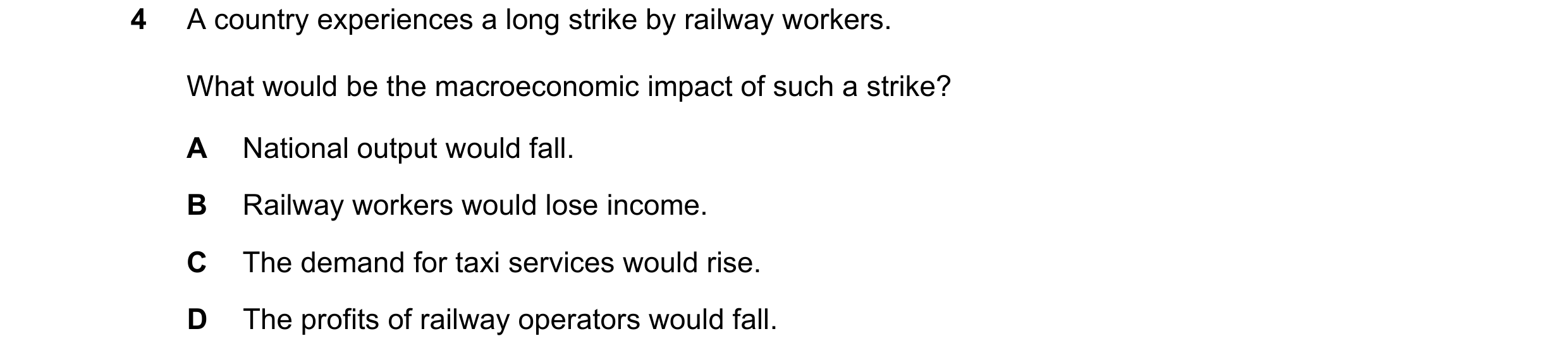
4 A country experiences a long strike by railway workers. What would be the macroeconomic impact of such a strike? A National output would fall. B Railway workers would lose income. C The demand for taxi services would rise. D The profits of railway operators would fall.
1 marks
This question in 0455/12 Feb/March 2020
Q33 · The table gives information about three economic indicators in four countries 0455/11 May/June 2020
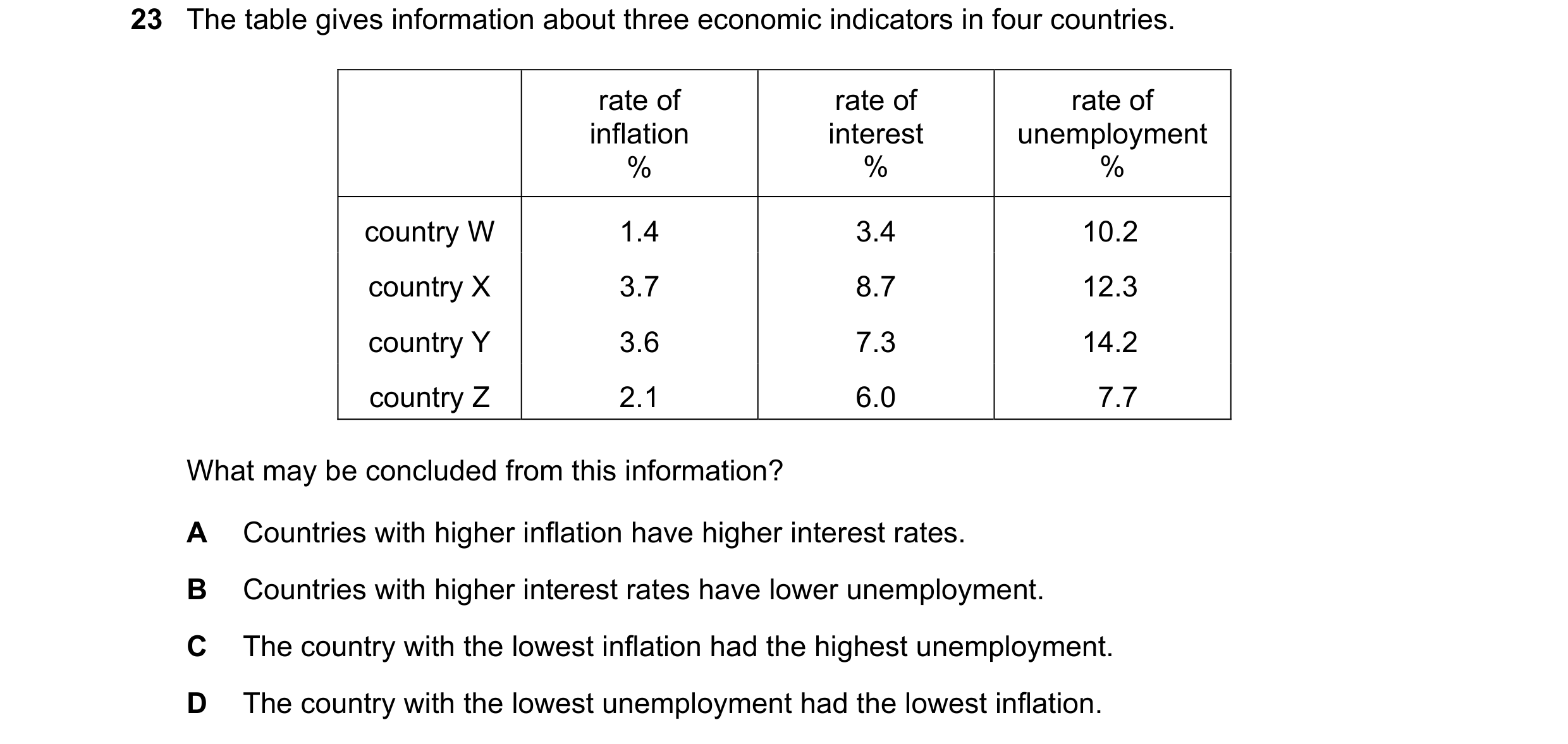
23 The table gives information about three economic indicators in four countries. rate of rate of rate of inflation interest unemployment % % % country W 1.4 3.4 10.2 country X 3.7 8.7 12.3 country Y 3.6 7.3 14.2 country Z 2.1 6.0 7.7 What may be concluded from this information? A Countries with higher inflation have higher interest rates. B Countries with higher interest rates have lower unemployment. C The country with the lowest inflation had the highest unemployment. D The country with the lowest unemployment had the lowest inflation.
1 marks
Answer: A
This question in 0455/11 May/June 2020
Q34 · The table gives information about three economic indicators in four countries 0455/12 May/June 2020
23 The table gives information about three economic indicators in four countries. rate of rate of rate of inflation interest unemployment % % % country W 1.4 3.4 10.2 country X 3.7 8.7 12.3 country Y 3.6 7.3 14.2 country Z 2.1 6.0 7.7 What may be concluded from this information? A Countries with higher inflation have higher interest rates. B Countries with higher interest rates have lower unemployment. C The country with the lowest inflation had the highest unemployment. D The country with the lowest unemployment had the lowest inflation.
1 marks
Answer: A
This question in 0455/12 May/June 2020
Q35 · What are two aims that a government normally pursues when managing the performance of the… 0455/11 Oct/Nov 2020
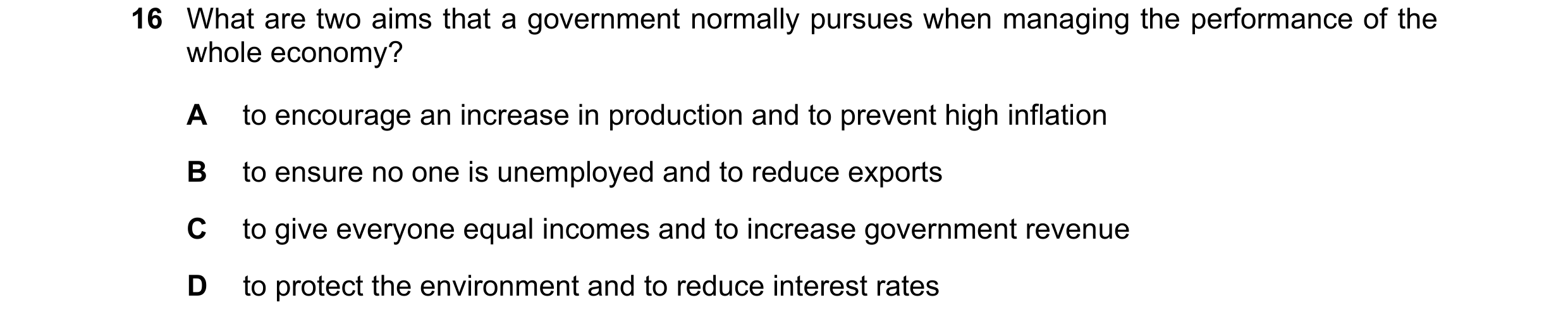
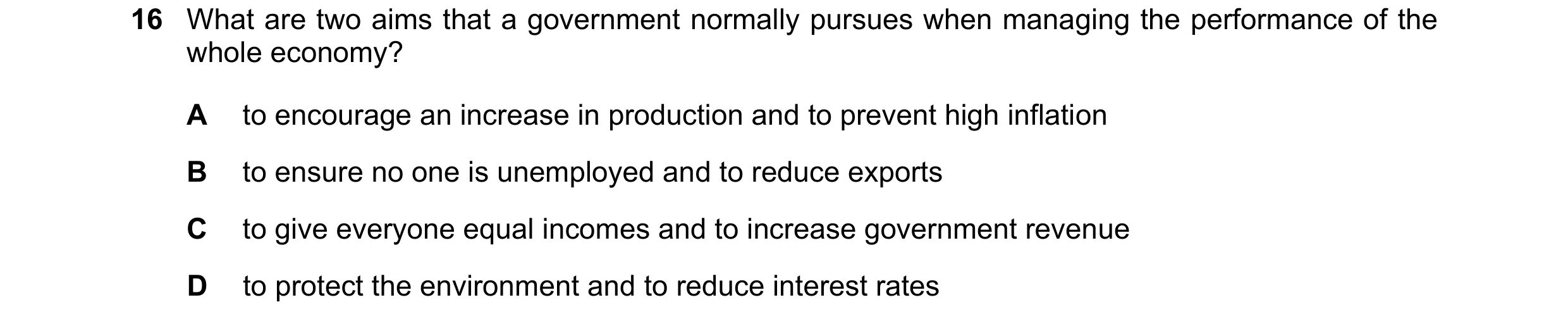
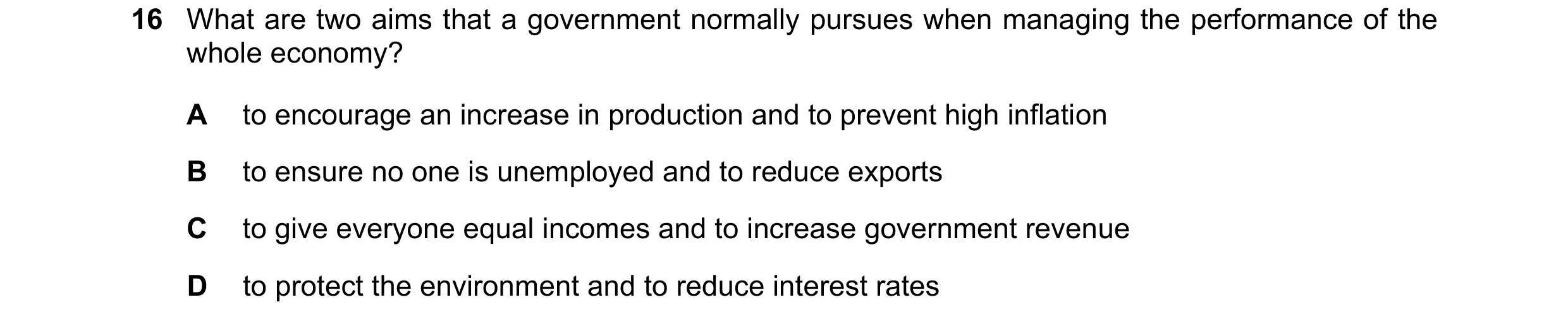
16 What are two aims that a government normally pursues when managing the performance of the whole economy? A to encourage an increase in production and to prevent high inflation B to ensure no one is unemployed and to reduce exports C to give everyone equal incomes and to increase government revenue D to protect the environment and to reduce interest rates
1 marks
Answer: A
This question in 0455/11 Oct/Nov 2020
Q36 · What is an example of a macroeconomic aim? 0455/12 Oct/Nov 2020
4 What is an example of a macroeconomic aim? A to create and maintain full employment B to improve efficiency in the manufacturing sector of the economy C to provide consumers with greater information when buying goods and services D to encourage greater occupational mobility of labour
1 marks
Answer: A
This question in 0455/12 Oct/Nov 2020
Q37 · What are two aims that a government normally pursues when managing the performance of the… 0455/12 Oct/Nov 2020
16 What are two aims that a government normally pursues when managing the performance of the whole economy? A to encourage an increase in production and to prevent high inflation B to ensure no one is unemployed and to reduce exports C to give everyone equal incomes and to increase government revenue D to protect the environment and to reduce interest rates
1 marks
Answer: A
This question in 0455/12 Oct/Nov 2020
Q38 · What are two aims that a government normally pursues when managing the performance of the… 0455/13 Oct/Nov 2020
16 What are two aims that a government normally pursues when managing the performance of the whole economy? A to encourage an increase in production and to prevent high inflation B to ensure no one is unemployed and to reduce exports C to give everyone equal incomes and to increase government revenue D to protect the environment and to reduce interest rates
1 marks
Answer: A
This question in 0455/13 Oct/Nov 2020
Q39 · What is a macroeconomic aim of a government? 0455/12 Oct/Nov 2021
6 What is a macroeconomic aim of a government? A balance of payments stability B deflation C income inequality D unemployment
1 marks
Answer: A
This question in 0455/12 Oct/Nov 2021
Q40 · A government uses different supply-side policy measures to improve economic performance 0455/11 May/June 2022
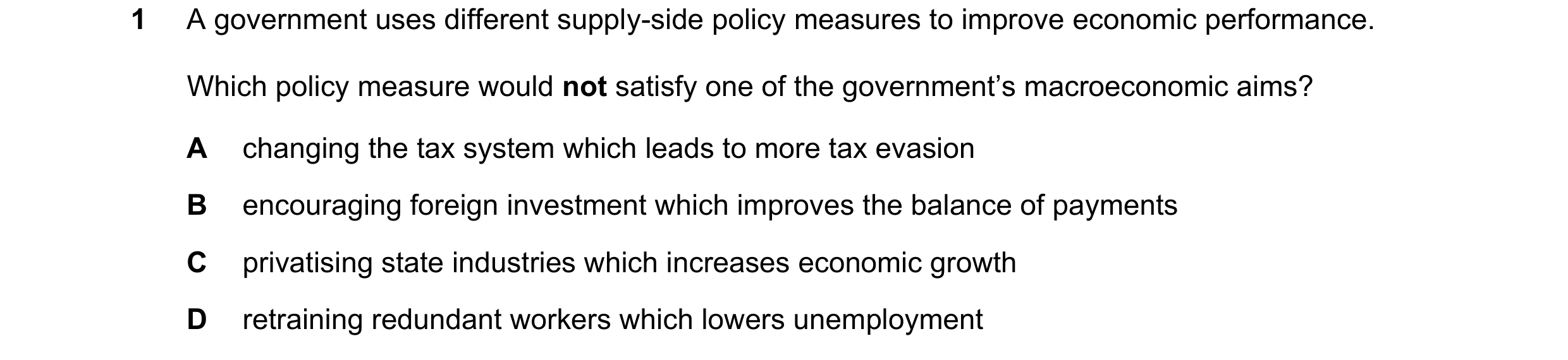
1 A government uses different supply-side policy measures to improve economic performance. Which policy measure would not satisfy one of the government’s macroeconomic aims? A changing the tax system which leads to more tax evasion B encouraging foreign investment which improves the balance of payments C privatising state industries which increases economic growth D retraining redundant workers which lowers unemployment
1 marks
Answer: A
This question in 0455/11 May/June 2022
Q41 · A government retrains unemployed industrial workers to increase employment opportunities 0455/11 May/June 2022
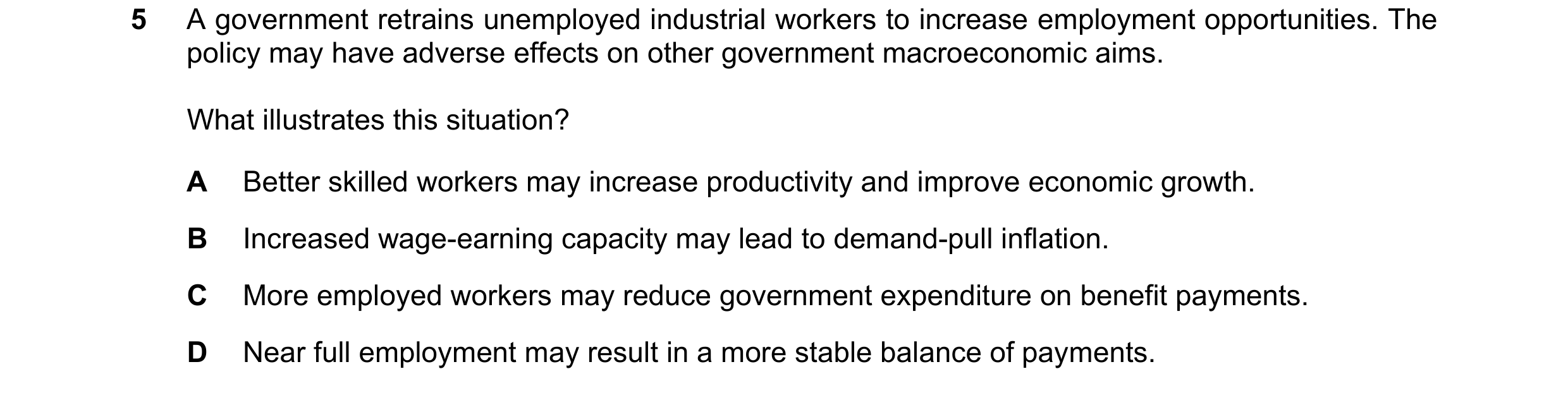
5 A government retrains unemployed industrial workers to increase employment opportunities. The policy may have adverse effects on other government macroeconomic aims. What illustrates this situation? A Better skilled workers may increase productivity and improve economic growth. B Increased wage-earning capacity may lead to demand-pull inflation. C More employed workers may reduce government expenditure on benefit payments. D Near full employment may result in a more stable balance of payments.
1 marks
Answer: B
This question in 0455/11 May/June 2022
Q42 · What is not usually a macroeconomic aim? 0455/13 May/June 2022
16 What is not usually a macroeconomic aim? A balance of payments stability B high government borrowing C lowering cyclical unemployment D reducing absolute poverty
1 marks
Answer: B
This question in 0455/13 May/June 2022
Q43 · What is an example of a government macroeconomic aim? 0455/11 May/June 2023
17 What is an example of a government macroeconomic aim? A a minimum of 10 years of schooling B a sales tax of 10% on consumer goods C a target rate of 2% inflation D increasing pay for nurses
1 marks
Answer: C
This question in 0455/11 May/June 2023
Q44 · What is an example of a macroeconomic indicator? 0455/12 May/June 2023
4 What is an example of a macroeconomic indicator? A agricultural prices B average earnings in the secondary sector C real Gross Domestic Product (real GDP) D total costs of German pharmaceutical firms
1 marks
Answer: C
This question in 0455/12 May/June 2023
Q45 · What is a macroeconomic aim of government? 0455/13 Oct/Nov 2024
17 What is a macroeconomic aim of government? A equilibrium prices in markets B high wages C low inflation D profit maximisation
1 marks
Answer: C
This question in 0455/13 Oct/Nov 2024
Q46 · In 2020, to prevent the spread of a pandemic, many governments temporarily closed… 0455/11 May/June 2025
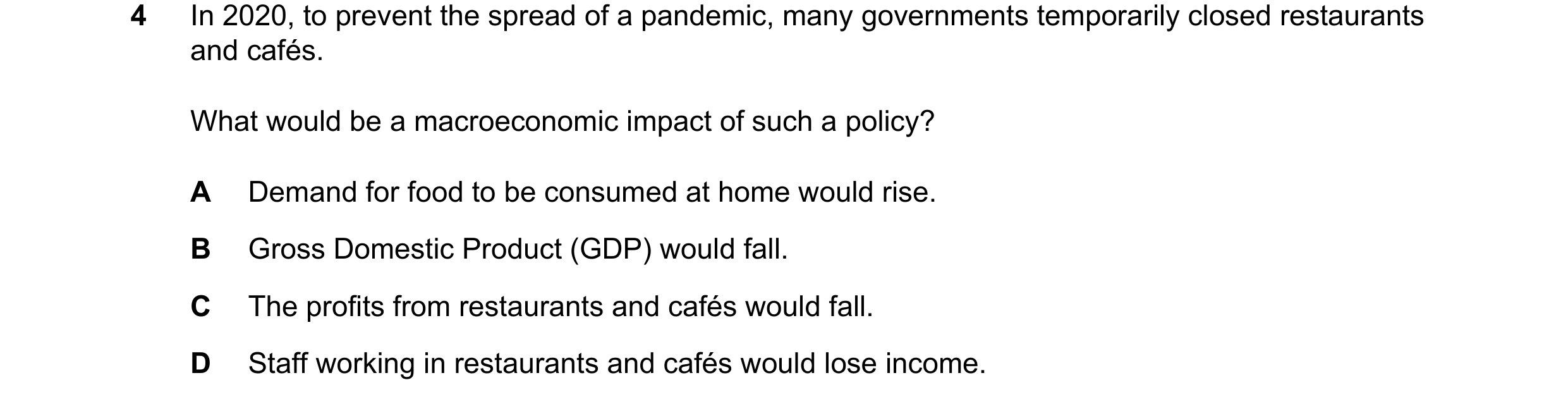
4 In 2020, to prevent the spread of a pandemic, many governments temporarily closed restaurants and cafés. What would be a macroeconomic impact of such a policy? A Demand for food to be consumed at home would rise. B Gross Domestic Product (GDP) would fall. C The profits from restaurants and cafés would fall. D Staff working in restaurants and cafés would lose income.
1 marks
Answer: B
This question in 0455/11 May/June 2025
Q47 · What is a macroeconomic aim of a government? 0455/11 May/June 2025
17 What is a macroeconomic aim of a government? A high external costs B high sales tax C low unemployment D low wages
1 marks
Answer: C
This question in 0455/11 May/June 2025
Q48 · Many central banks around the world decreased interest rates during a recession caused by… 0455/12 May/June 2025
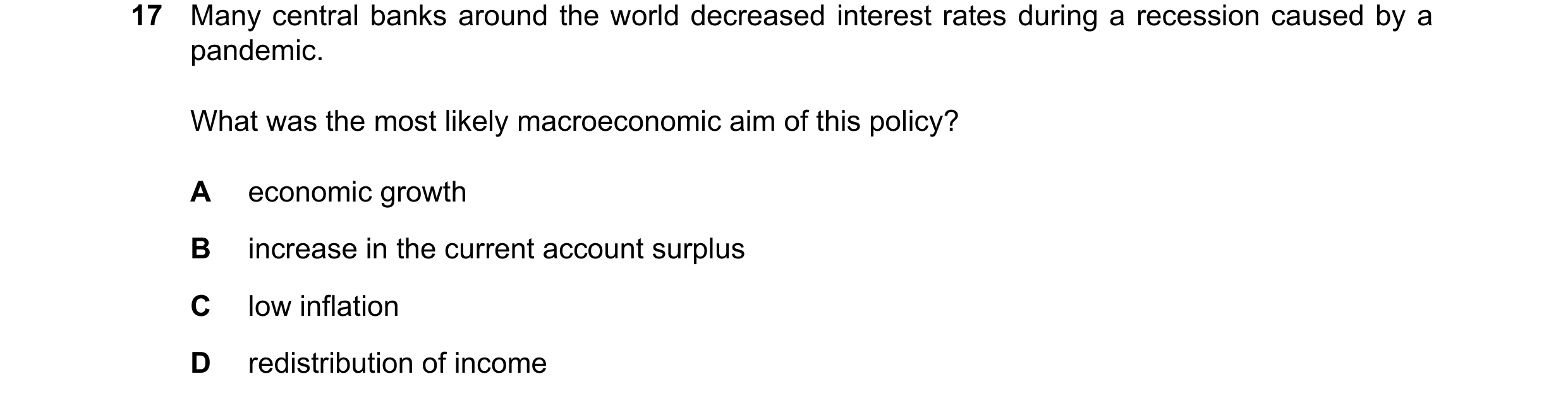
17 Many central banks around the world decreased interest rates during a recession caused by a pandemic. What was the most likely macroeconomic aim of this policy? A economic growth B increase in the current account surplus C low inflation D redistribution of income
1 marks
Answer: A
This question in 0455/12 May/June 2025
Q49 · Japan’s population has an increasing proportion of elderly people 0455/12 May/June 2025
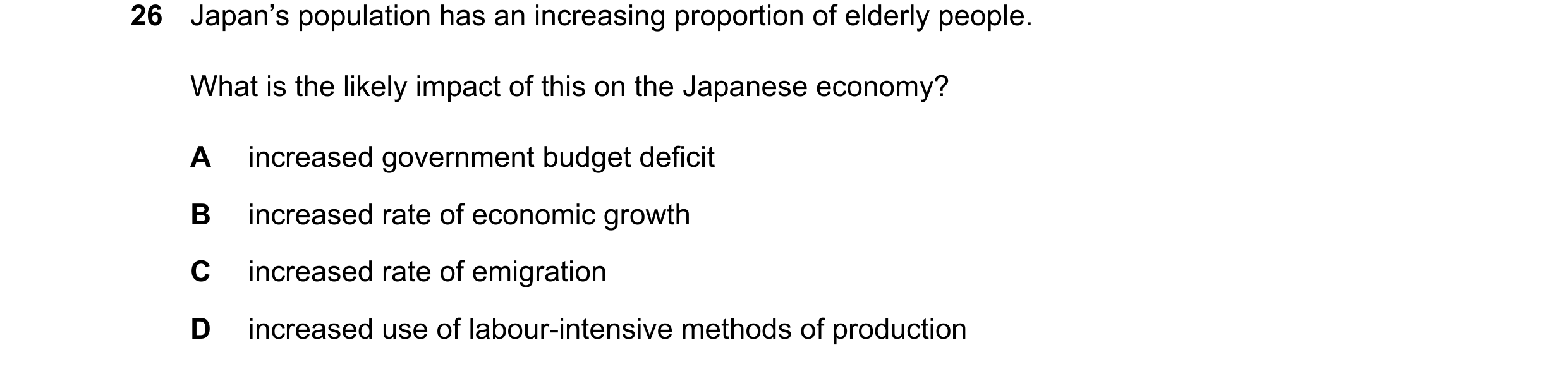
26 Japan’s population has an increasing proportion of elderly people. What is the likely impact of this on the Japanese economy? A increased government budget deficit B increased rate of economic growth C increased rate of emigration D increased use of labour-intensive methods of production
1 marks
Answer: A
This question in 0455/12 May/June 2025
Q50 · What is the most likely reason for a government to aim for price stability? 0455/13 May/June 2025
17 What is the most likely reason for a government to aim for price stability? A to improve international competitiveness B to increase workers' wage demands C to reduce consumer spending D to reduce spending on employment-related benefits
1 marks
Answer: A
This question in 0455/13 May/June 2025
Q51 · What are two macroeconomic aims of government? 0455/11 Oct/Nov 2025
17 What are two macroeconomic aims of government? A to allocate resources and reduce trade union membership B to create economic growth and prevent high inflation C to raise interest rates and reduce pollution D to reduce exports and increase imports
1 marks
Answer: B
This question in 0455/11 Oct/Nov 2025
Q52 · A government has stated for the next year it has four main aims 0455/13 Oct/Nov 2025
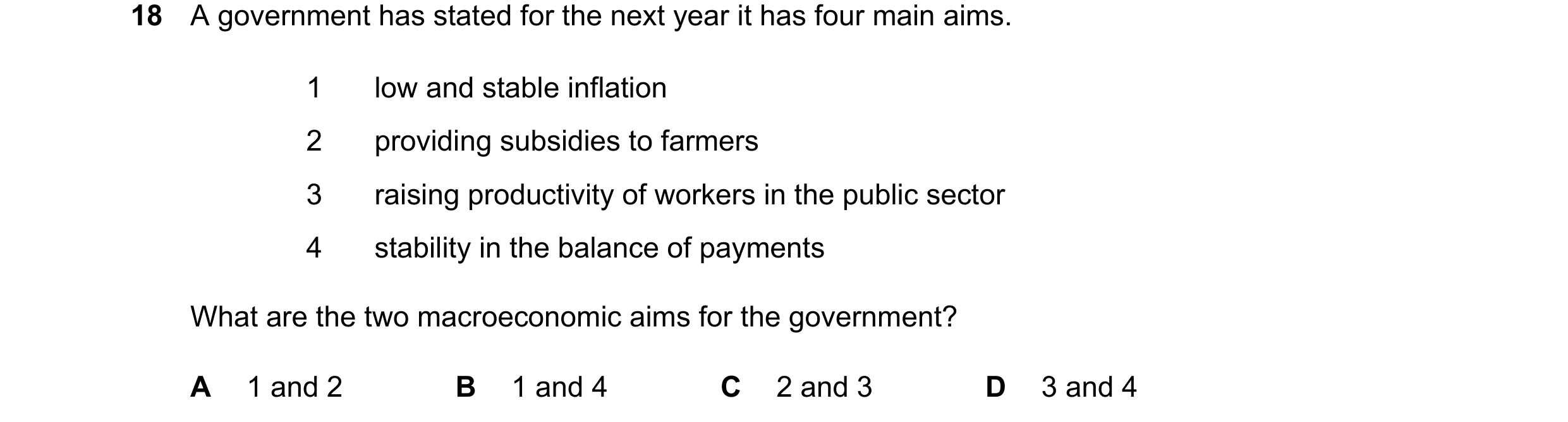
18 A government has stated for the next year it has four main aims. 1 low and stable inflation 2 providing subsidies to farmers 3 raising productivity of workers in the public sector 4 stability in the balance of payments What are the two macroeconomic aims for the government? A 1 and 2 B 1 and 4 C 2 and 3 D 3 and 4
1 marks
Answer: B
This question in 0455/13 Oct/Nov 2025

 1 / 12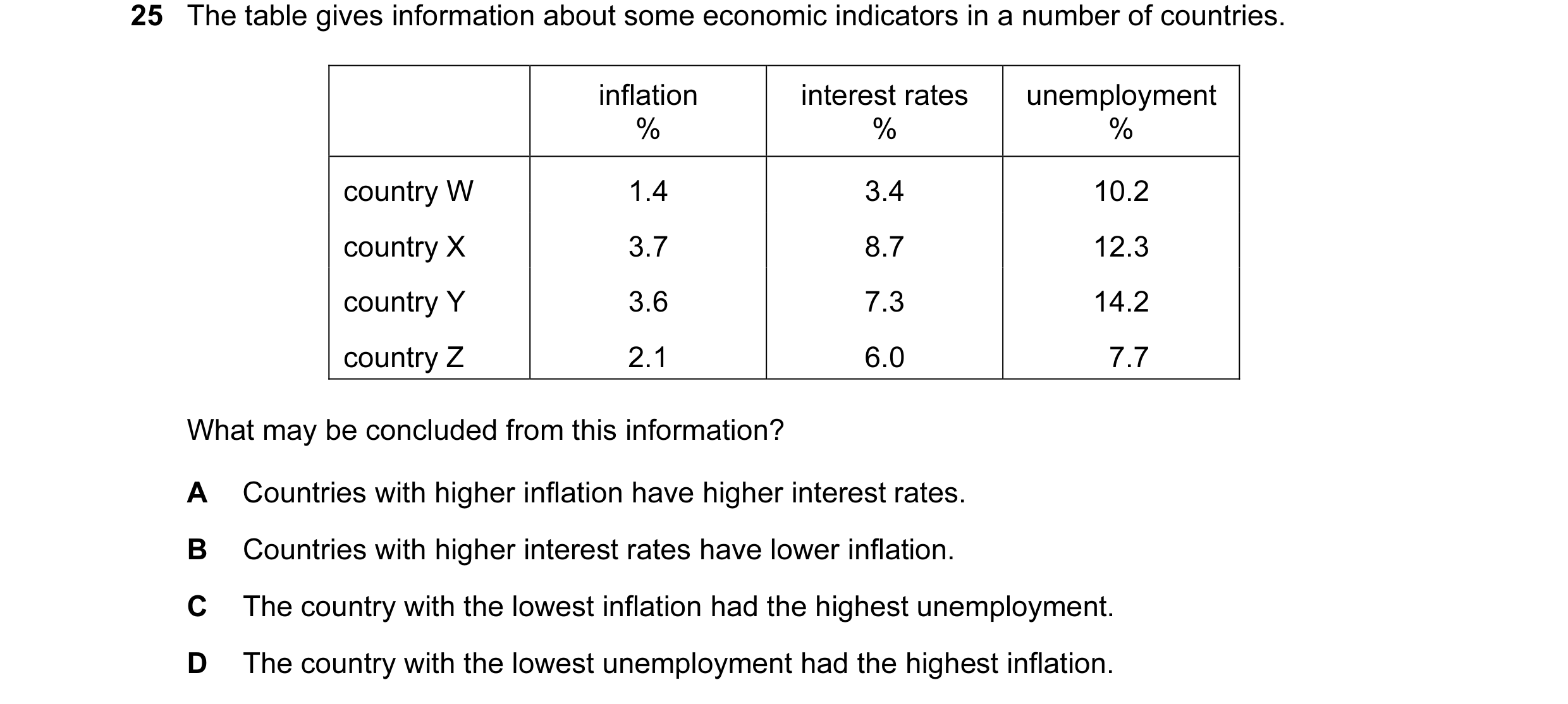
 2 / 12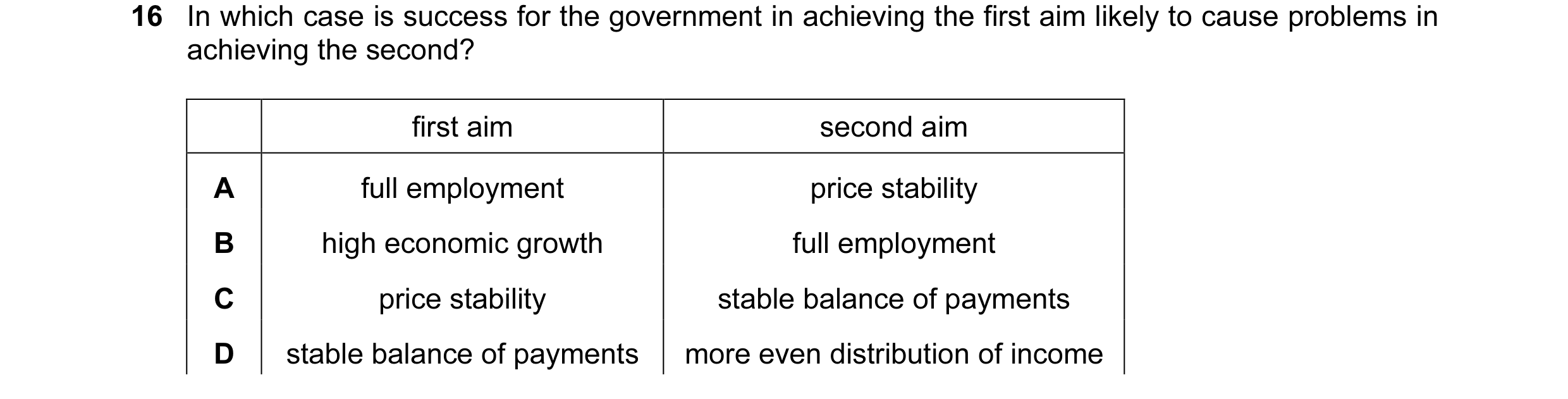
 3 / 12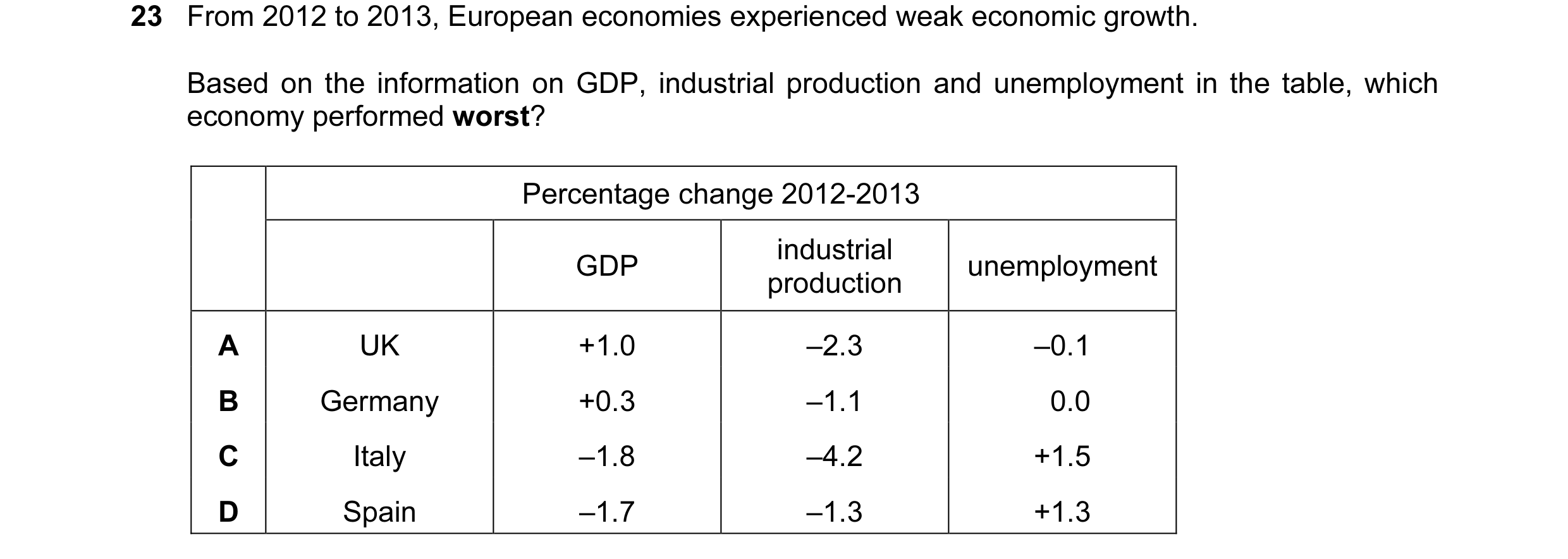
 4 / 12
 5 / 12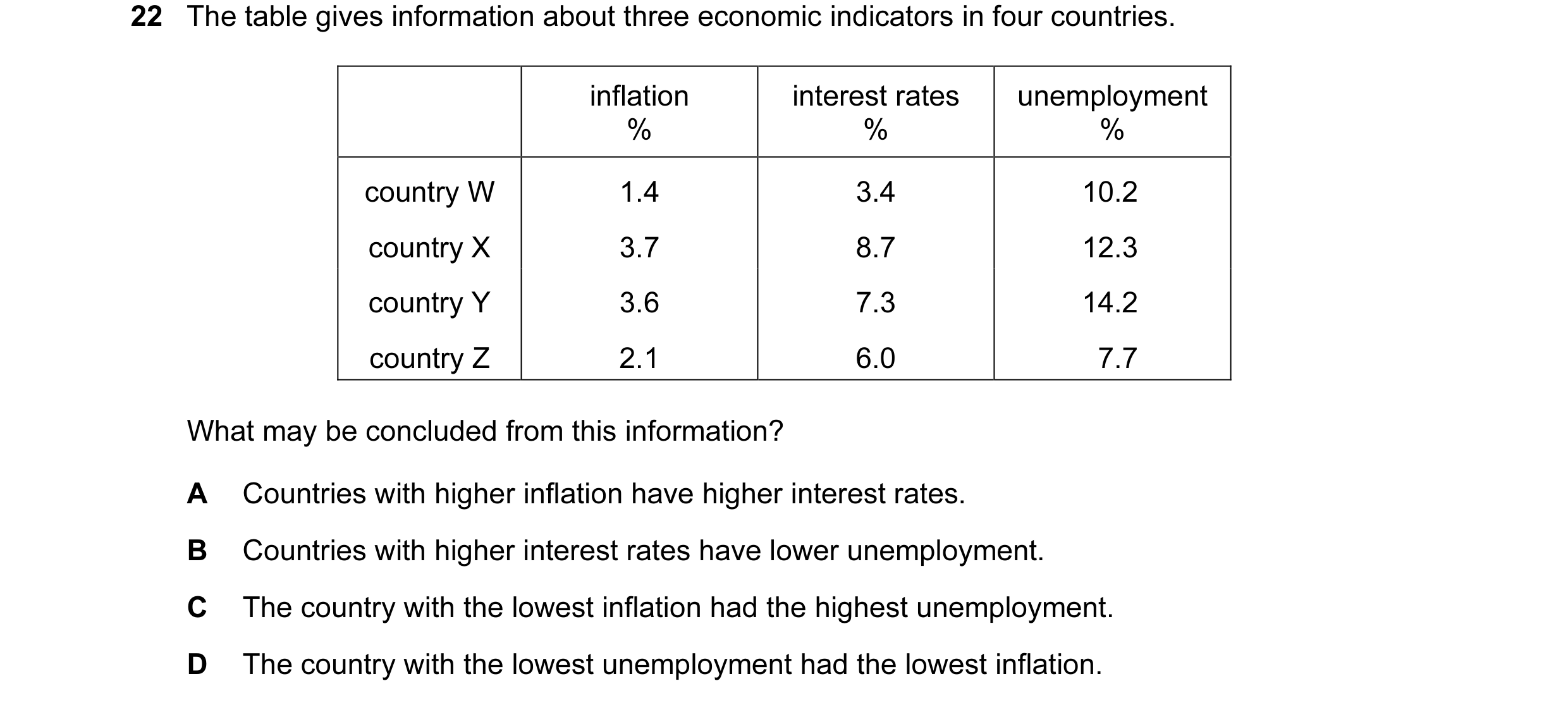
 6 / 12


 7 / 12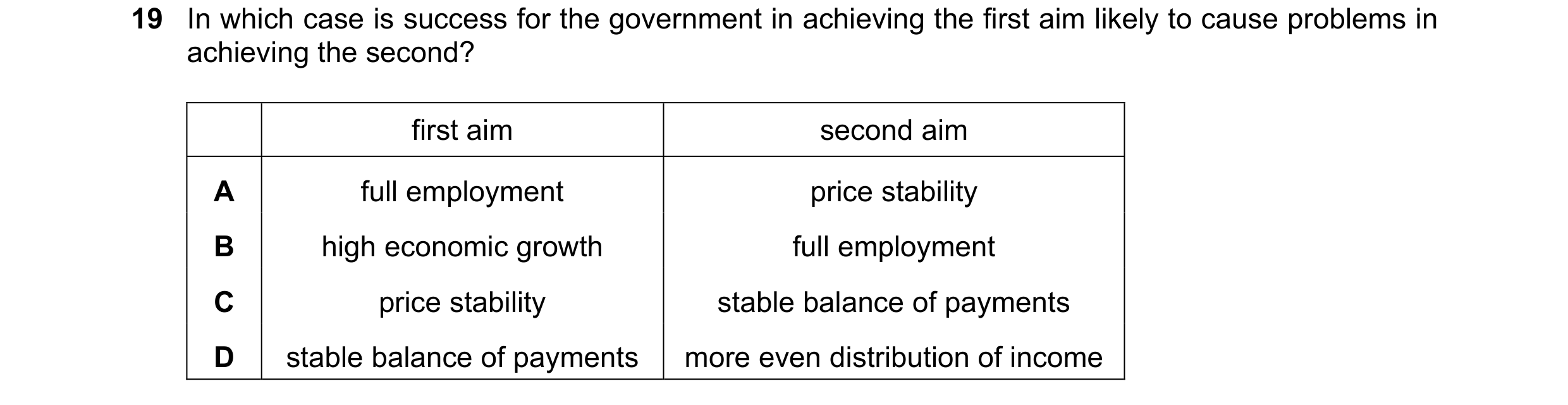
 8 / 12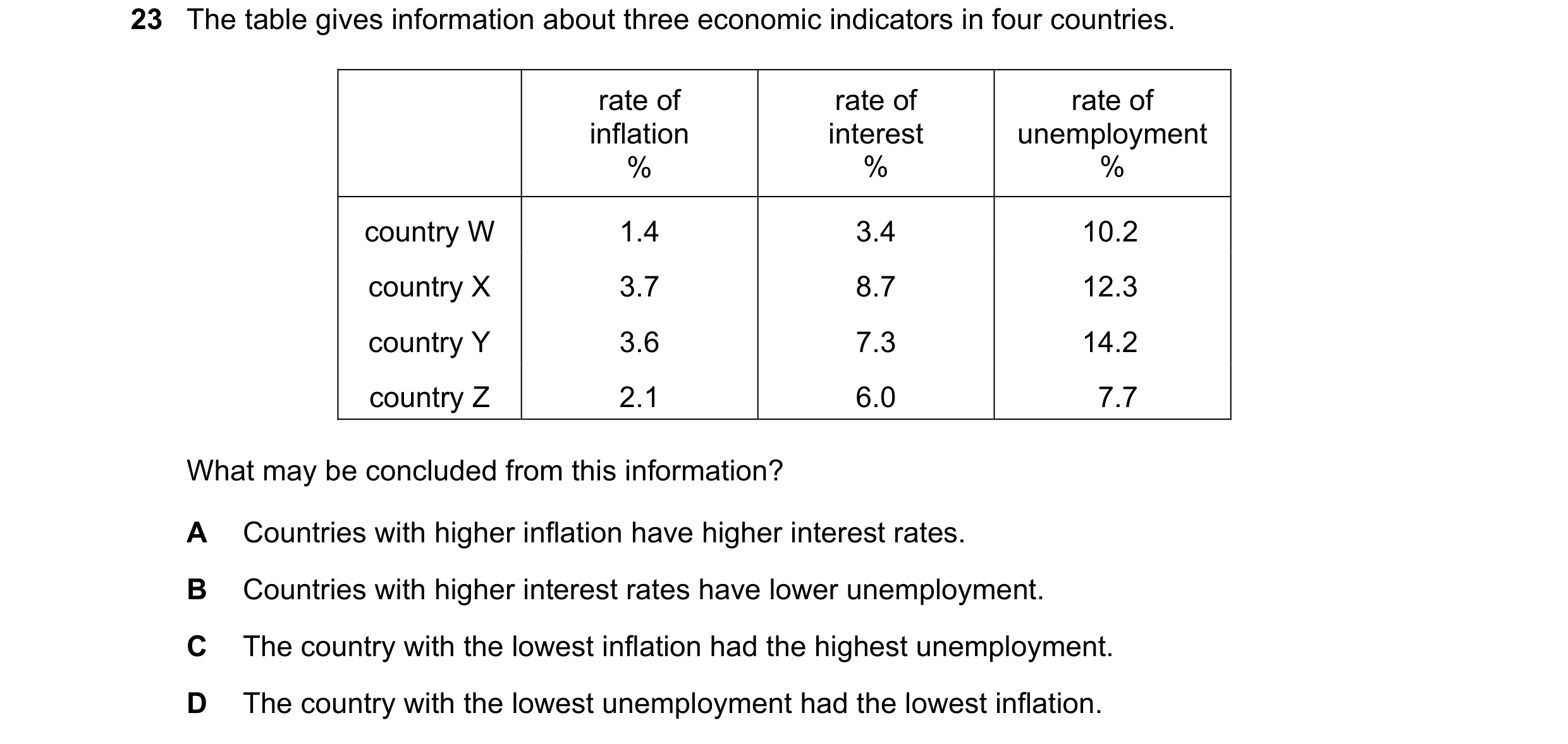

 9 / 12


 10 / 12

 11 / 12

 12 / 12