Questions as text
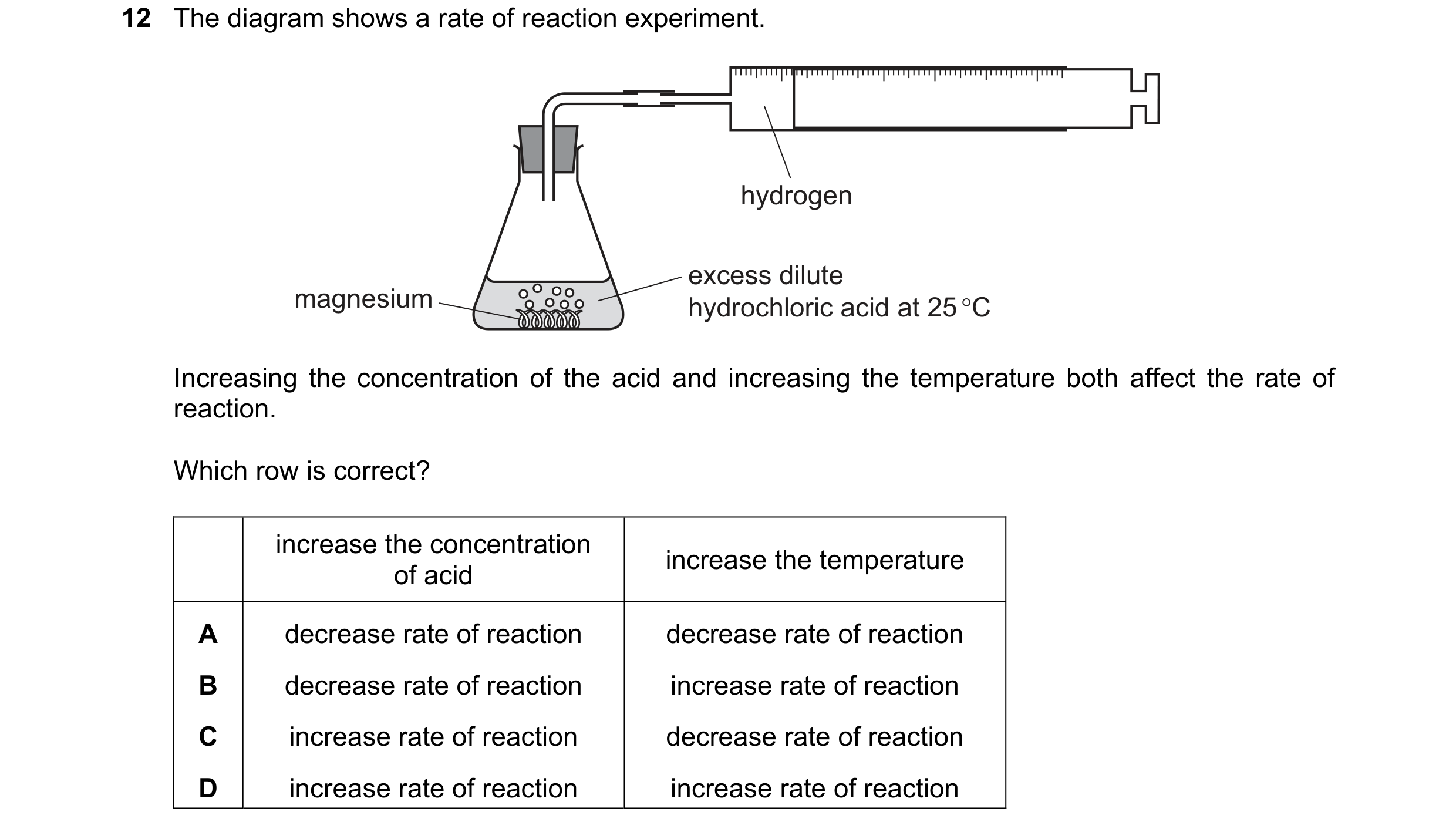
Q1 · The diagram shows a rate of reaction experiment 0971/11 May/June 2018
12 The diagram shows a rate of reaction experiment. hydrogen excess dilute magnesium hydrochloric acid at 25 °C Increasing the concentration of the acid and increasing the temperature both affect the rate of reaction. Which row is correct? increase the concentration increase the temperature of acid A decrease rate of reaction decrease rate of reaction B decrease rate of reaction increase rate of reaction C increase rate of reaction decrease rate of reaction D increase rate of reaction increase rate of reaction
1 marks
Answer: D
This question in 0971/11 May/June 2018
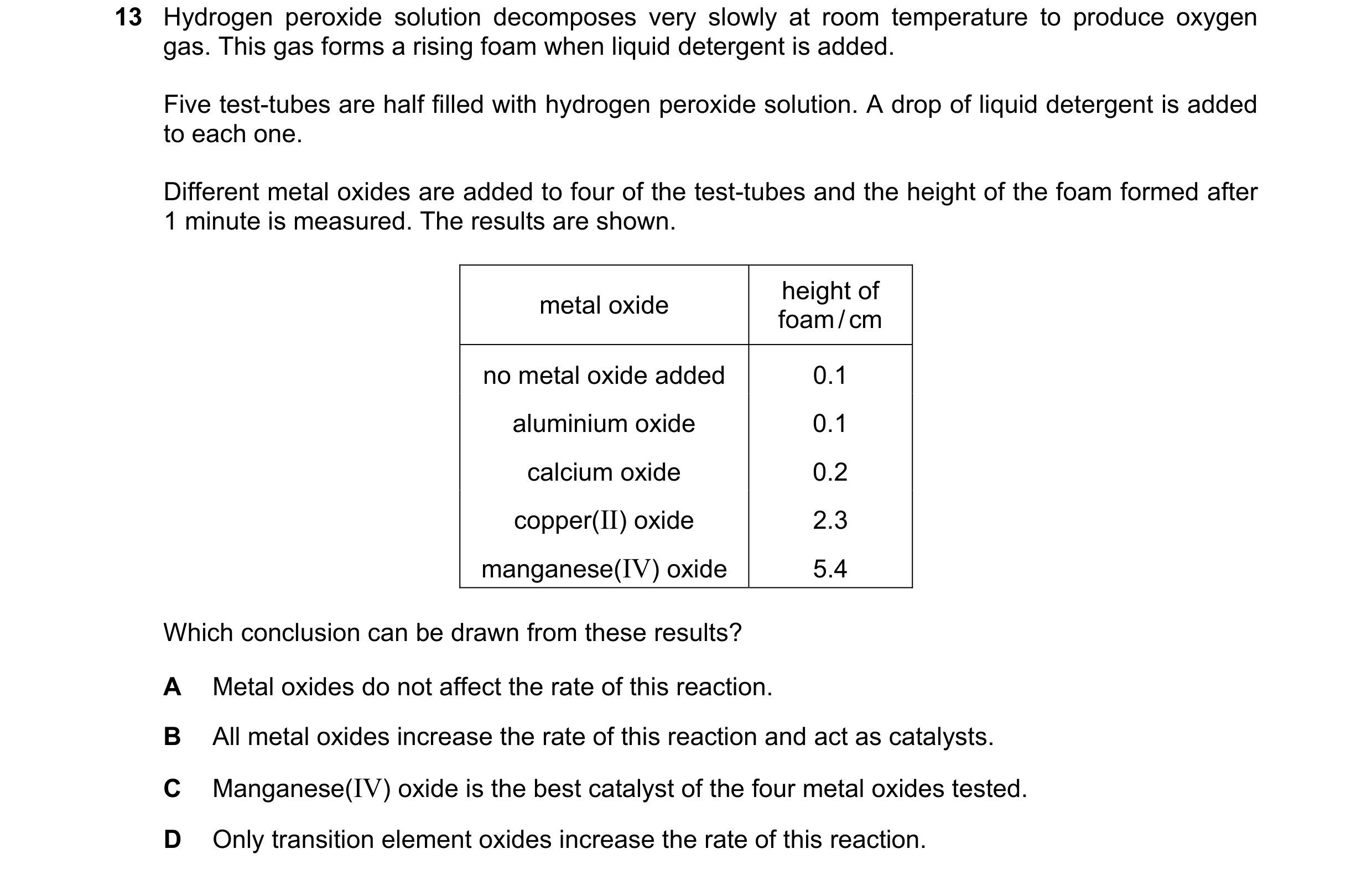
Q2 · Hydrogen peroxide solution decomposes very slowly at room temperature to produce oxygen… 0971/11 May/June 2019
13 Hydrogen peroxide solution decomposes very slowly at room temperature to produce oxygen gas. This gas forms a rising foam when liquid detergent is added. Five test-tubes are half filled with hydrogen peroxide solution. A drop of liquid detergent is added to each one. Different metal oxides are added to four of the test-tubes and the height of the foam formed after 1 minute is measured. The results are shown. height of metal oxide foam / cm no metal oxide added 0.1 aluminium oxide 0.1 calcium oxide 0.2 copper(II) oxide 2.3 manganese(IV) oxide 5.4 Which conclusion can be drawn from these results? A Metal oxides do not affect the rate of this reaction. B All metal oxides increase the rate of this reaction and act as catalysts. C Manganese(IV) oxide is the best catalyst of the four metal oxides tested. D Only transition element oxides increase the rate of this reaction.
1 marks
Answer: C
This question in 0971/11 May/June 2019
Q3 · Four students collect the gas produced from the reaction of calcium carbonate with dilute… 0971/12 Oct/Nov 2019
13 Four students collect the gas produced from the reaction of calcium carbonate with dilute hydrochloric acid. Each student records the time taken to collect a volume of gas. Which results show the highest average rate of reaction? A 15 cm3 of gas collected in 20 seconds B 50 cm3 of gas collected in 40 seconds C 75 cm3 of gas collected in 80 seconds D 90 cm3 of gas collected in 100 seconds
1 marks
Answer: B
This question in 0971/12 Oct/Nov 2019
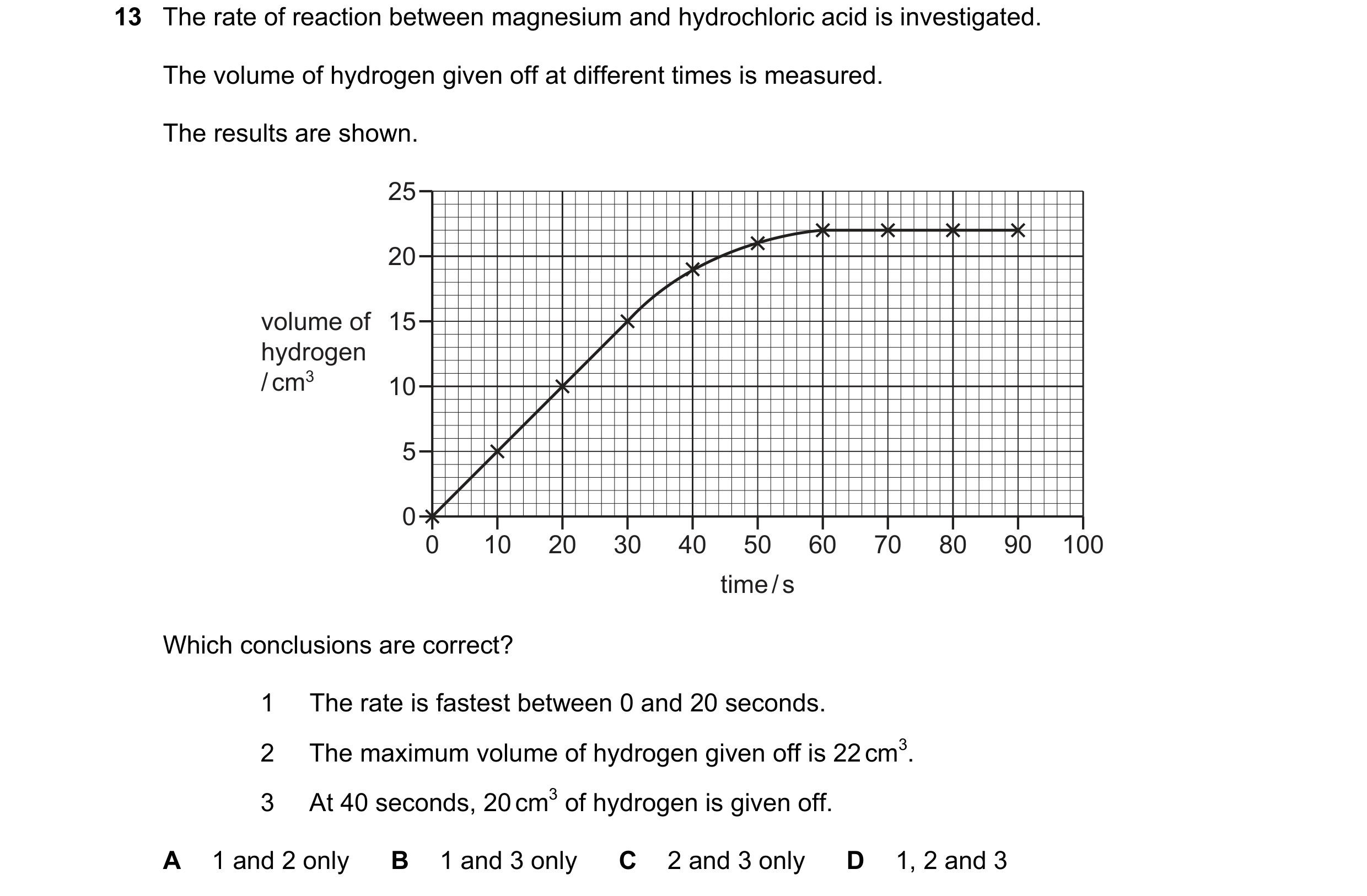
Q4 · The rate of reaction between magnesium and hydrochloric acid is investigated 0971/11 May/June 2020
13 The rate of reaction between magnesium and hydrochloric acid is investigated. The volume of hydrogen given off at different times is measured. The results are shown. 25 20 volume of 15 hydrogen / cm3 10 5 0 0 10 20 30 40 50 60 70 80 90 100 time / s Which conclusions are correct? 1 The rate is fastest between 0 and 20 seconds. 2 The maximum volume of hydrogen given off is 22 cm3. 3 At 40 seconds, 20 cm3 of hydrogen is given off. A 1 and 2 only B 1 and 3 only C 2 and 3 only D 1, 2 and 3
1 marks
Answer: A
This question in 0971/11 May/June 2020
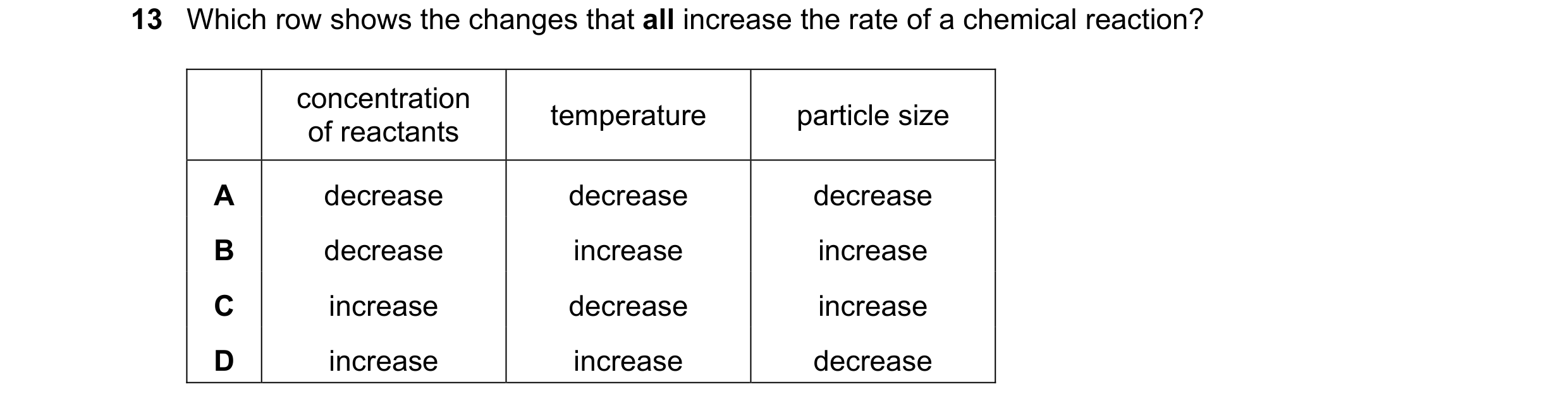
Q5 · Which row shows the changes that all increase the rate of a chemical reaction? 0971/12 May/June 2020
13 Which row shows the changes that all increase the rate of a chemical reaction? concentration temperature particle size of reactants A decrease decrease decrease B decrease increase increase C increase decrease increase D increase increase decrease
1 marks
Answer: D
This question in 0971/12 May/June 2020
Q6 · Nitrogen, N2, and hydrogen, H2, can be converted into ammonia, NH3, using a catalyst 0971/12 Oct/Nov 2020
17 Nitrogen, N2, and hydrogen, H2, can be converted into ammonia, NH3, using a catalyst. What is the purpose of the catalyst? A to increase the amount of ammonia produced B to increase the rate of reaction C to reduce the amount of reactants needed D to reduce the rate of reaction
1 marks
Answer: B
This question in 0971/12 Oct/Nov 2020
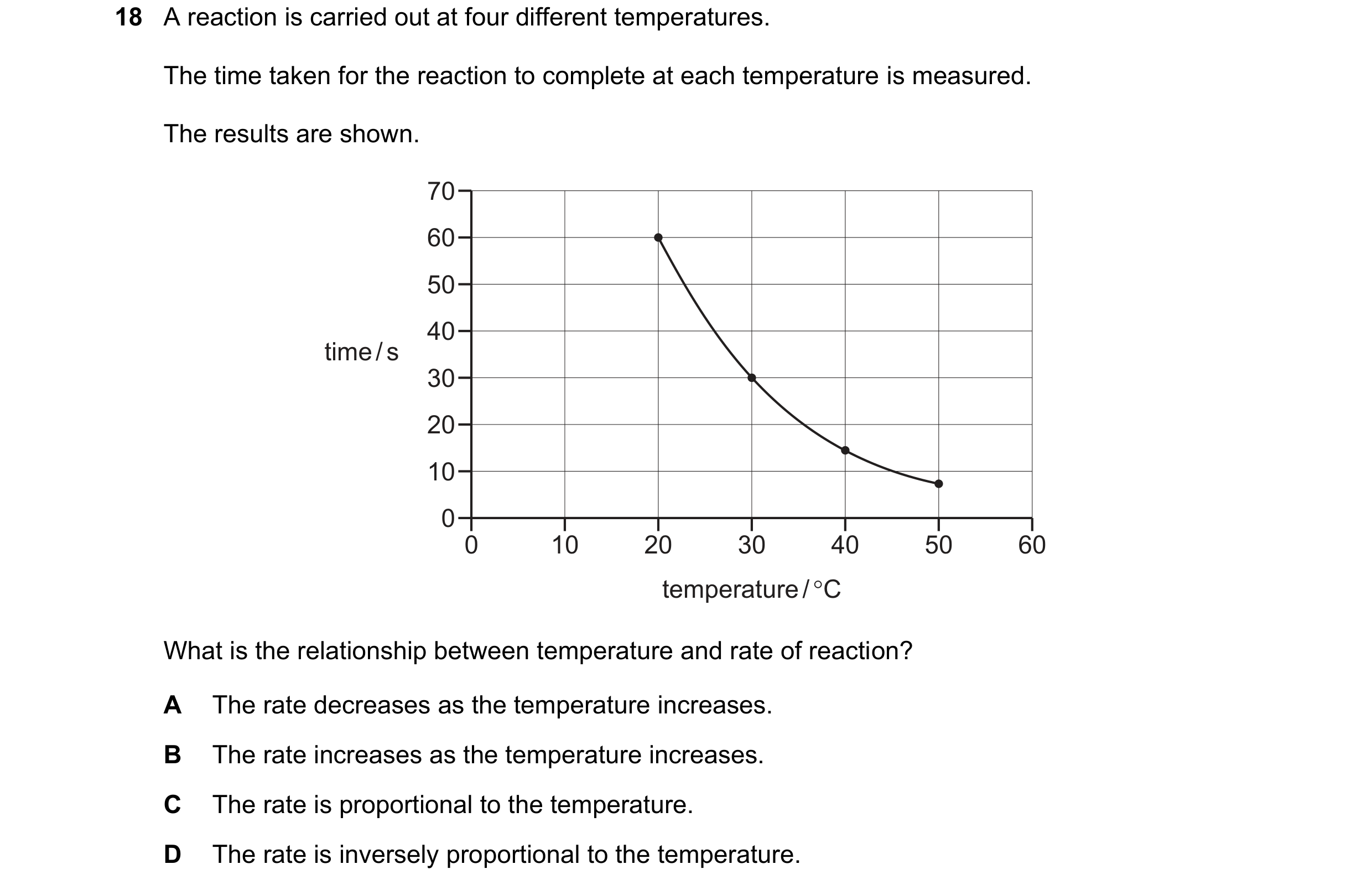
Q7 · A reaction is carried out at four different temperatures 0971/12 Oct/Nov 2020
18 A reaction is carried out at four different temperatures. The time taken for the reaction to complete at each temperature is measured. The results are shown. 70 60 50 40 time / s 30 20 10 0 0 10 20 30 40 50 60 temperature / °C What is the relationship between temperature and rate of reaction? A The rate decreases as the temperature increases. B The rate increases as the temperature increases. C The rate is proportional to the temperature. D The rate is inversely proportional to the temperature.
1 marks
Answer: B
This question in 0971/12 Oct/Nov 2020
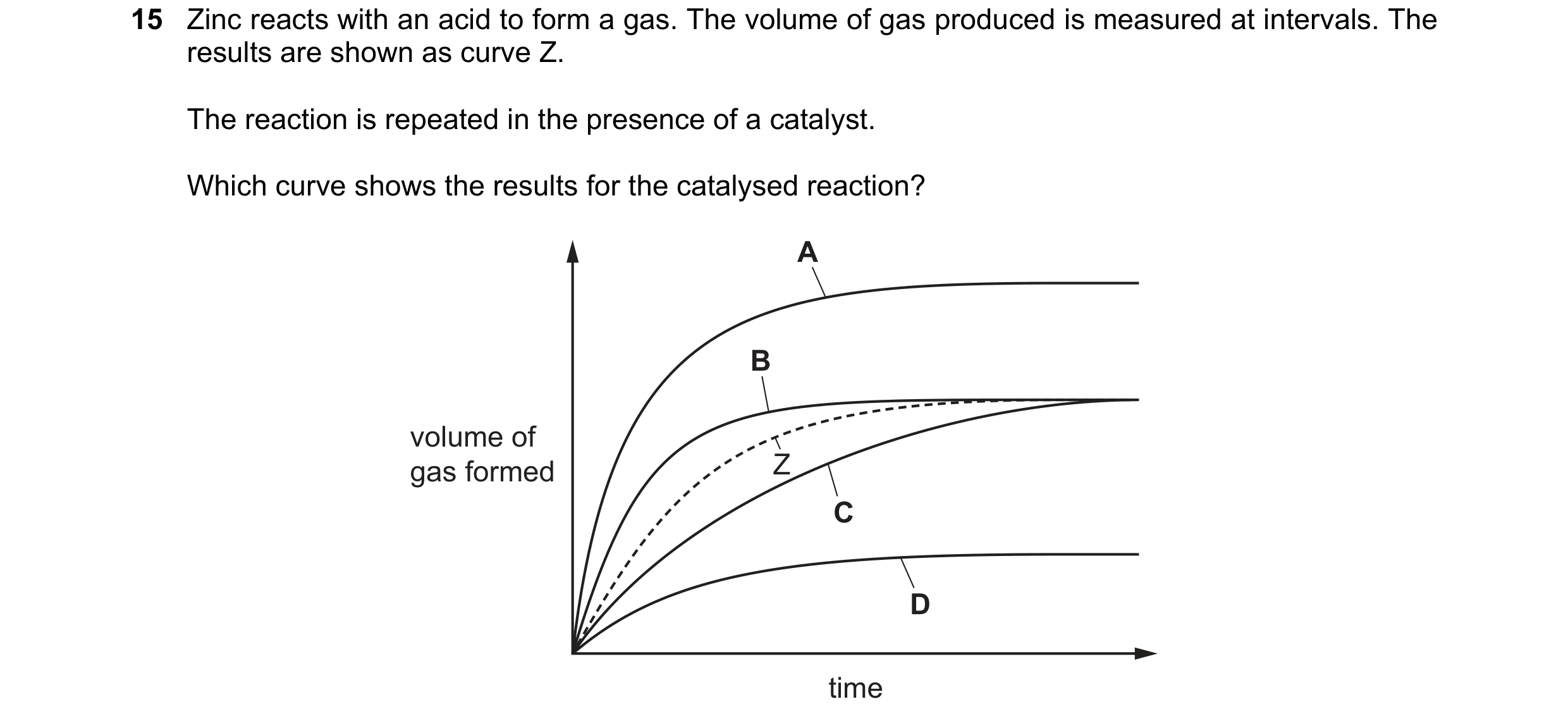
Q8 · Zinc reacts with an acid to form a gas 0971/11 May/June 2021
15 Zinc reacts with an acid to form a gas. The volume of gas produced is measured at intervals. The results are shown as curve Z. The reaction is repeated in the presence of a catalyst. Which curve shows the results for the catalysed reaction? A B volume of gas formed Z C D time
1 marks
Answer: B
This question in 0971/11 May/June 2021
Q9 · Solid copper(II) carbonate reacts with dilute sulfuric acid 0971/12 Oct/Nov 2021
13 Solid copper(II) carbonate reacts with dilute sulfuric acid. CuCO3 + H2SO4 CuSO4 + CO2 + H2O The rate of the reaction can be changed by varying the conditions. Which changes always increase the rate of this chemical reaction? 1 increasing the concentration of sulfuric acid 2 increasing the size of the pieces of copper(II) carbonate 3 increasing the temperature 4 increasing the volume of sulfuric acid A 1, 3 and 4 B 1 and 3 only C 2 and 3 D 3 and 4 only
1 marks
Answer: B
This question in 0971/12 Oct/Nov 2021
Q10 · When a piece of marble is added to hydrochloric acid, bubbles of carbon dioxide gas are… 0971/12 Oct/Nov 2021
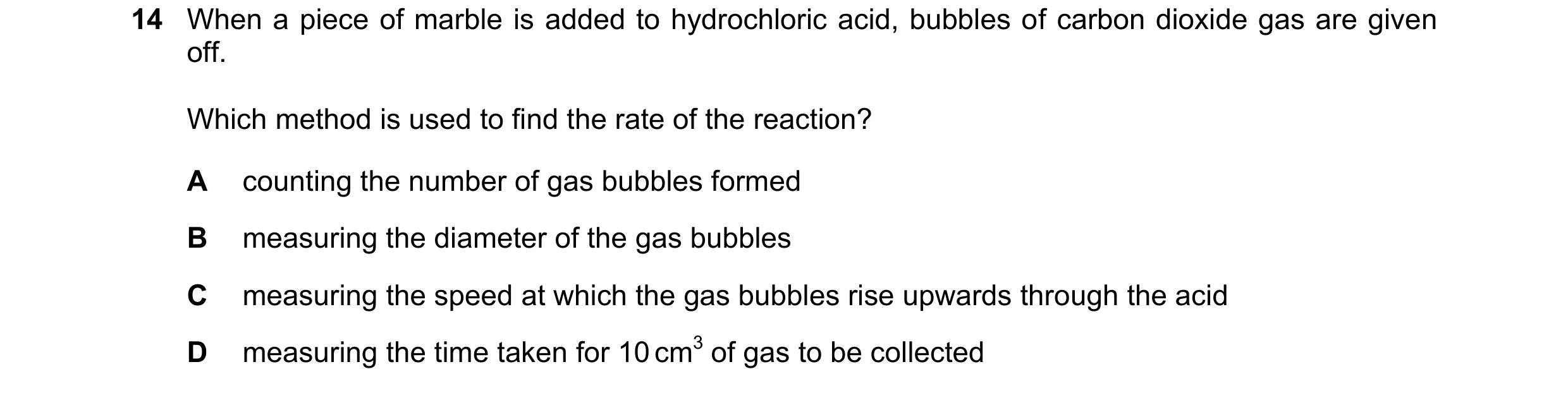
14 When a piece of marble is added to hydrochloric acid, bubbles of carbon dioxide gas are given off. Which method is used to find the rate of the reaction? A counting the number of gas bubbles formed B measuring the diameter of the gas bubbles C measuring the speed at which the gas bubbles rise upwards through the acid D measuring the time taken for 10 cm3 of gas to be collected
1 marks
Answer: D
This question in 0971/12 Oct/Nov 2021
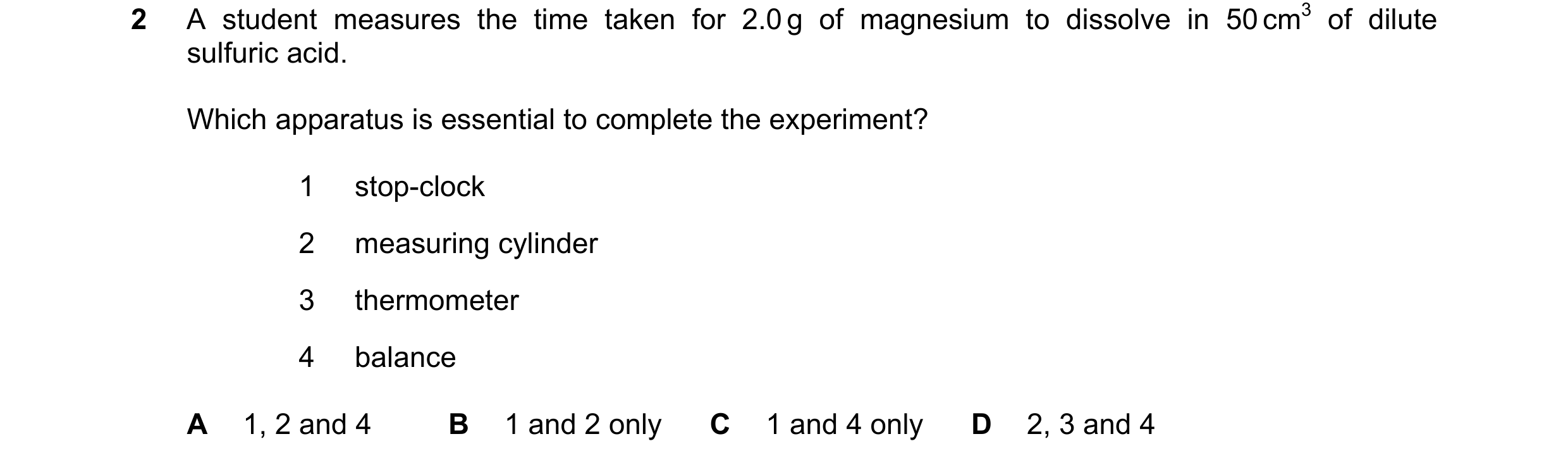
Q11 · A student measures the time taken for 2.0 g of magnesium to dissolve in 50 cm3 of dilute… 0971/11 May/June 2022
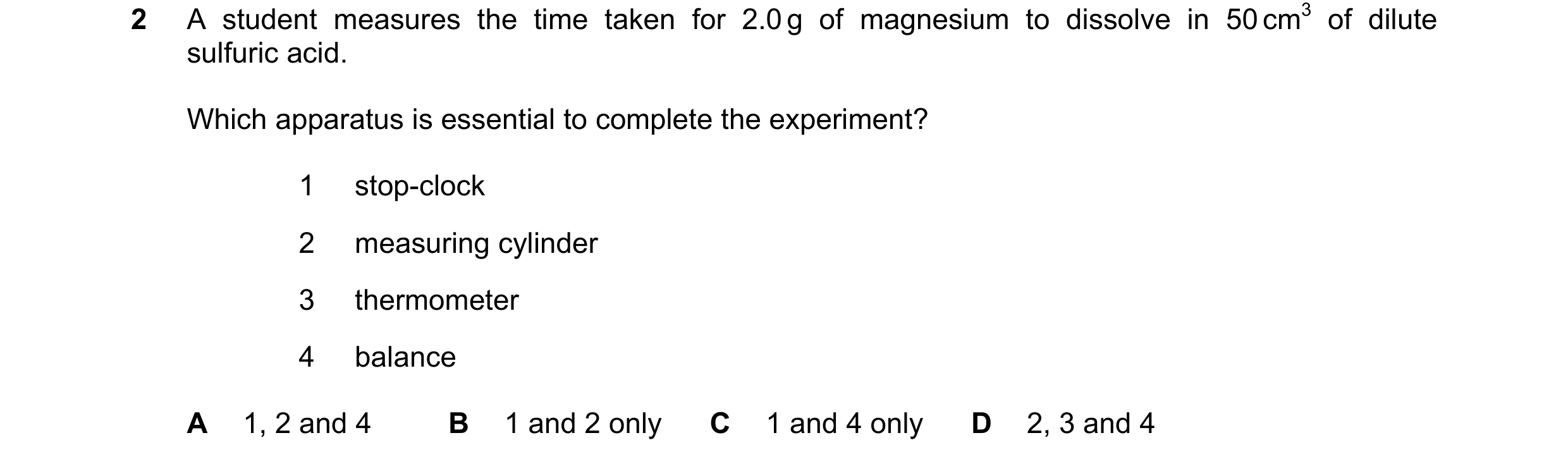
2 A student measures the time taken for 2.0 g of magnesium to dissolve in 50 cm3 of dilute sulfuric acid. Which apparatus is essential to complete the experiment? 1 stop-clock 2 measuring cylinder 3 thermometer 4 balance A 1, 2 and 4 B 1 and 2 only C 1 and 4 only D 2, 3 and 4
1 marks
Answer: A
This question in 0971/11 May/June 2022
Q12 · Excess magnesium ribbon is reacted with a fixed volume of hydrochloric acid and the… 0971/11 May/June 2022
16 Excess magnesium ribbon is reacted with a fixed volume of hydrochloric acid and the volume of gas given off over time is measured. The results of two different experiments are shown. reaction 1 volume of gas given off reaction 2 00 time Which statement explains the differences between the results of the two experiments? A Reaction 1 uses a catalyst. B The acid used is twice as concentrated in reaction 1. C The magnesium ribbon is in smaller pieces in reaction 2. D The temperature is higher in reaction 2.
1 marks
Answer: B
This question in 0971/11 May/June 2022
Q13 · A student measures the time taken for 2.0 g of magnesium to dissolve in 50 cm3 of dilute… 0971/12 May/June 2022
2 A student measures the time taken for 2.0 g of magnesium to dissolve in 50 cm3 of dilute sulfuric acid. Which apparatus is essential to complete the experiment? 1 stop-clock 2 measuring cylinder 3 thermometer 4 balance A 1, 2 and 4 B 1 and 2 only C 1 and 4 only D 2, 3 and 4
1 marks
Answer: A
This question in 0971/12 May/June 2022
Q14 · Which statement about rate of reaction is correct? 0971/12 May/June 2022
13 Which statement about rate of reaction is correct? A Catalysts increase the time for the reaction to be completed. B Decreasing particle size increases the rate of reaction. C Decreasing temperature increases the rate of reaction. D Rate of reaction decreases as the concentration increases.
1 marks
Answer: B
This question in 0971/12 May/June 2022
Q15 · The volume of gas given off in a chemical reaction is measured over time 0971/12 Oct/Nov 2022
14 The volume of gas given off in a chemical reaction is measured over time. The results are shown. 100 90 80 70 volume 60 of gas 50 / cm3 40 30 20 10 0 0 2 4 6 8 10 time / s At which time is the rate of reaction greatest? A 0 s B 4 s C 6 s D 10 s
1 marks
Answer: C
This question in 0971/12 Oct/Nov 2022
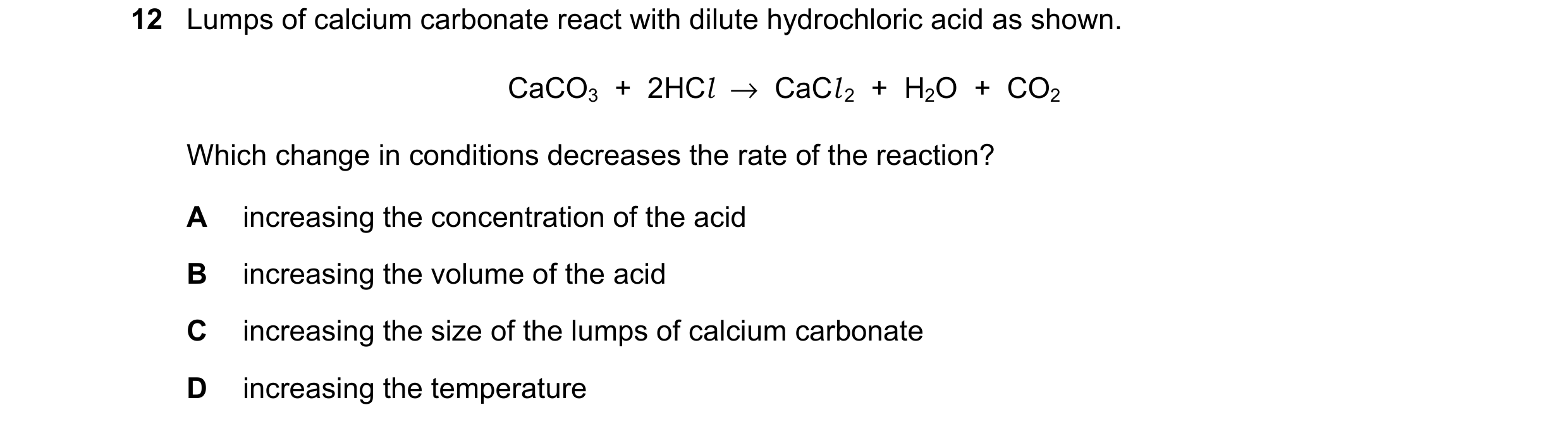
Q16 · Lumps of calcium carbonate react with dilute hydrochloric acid as shown 0971/11 May/June 2023
12 Lumps of calcium carbonate react with dilute hydrochloric acid as shown. CaCO3 + 2HCl → CaCl 2 + H2O + CO2 Which change in conditions decreases the rate of the reaction? A increasing the concentration of the acid B increasing the volume of the acid C increasing the size of the lumps of calcium carbonate D increasing the temperature
1 marks
Answer: C
This question in 0971/11 May/June 2023
Q17 · Which changes increase the rate of reaction? 0971/12 May/June 2023
12 Which changes increase the rate of reaction? 1 increasing the concentration of the reactants 2 increasing the particle size of a solid reactant 3 increasing the temperature A 1, 2 and 3 B 1 and 2 only C 1 and 3 only D 2 and 3 only
1 marks
Answer: C
This question in 0971/12 May/June 2023
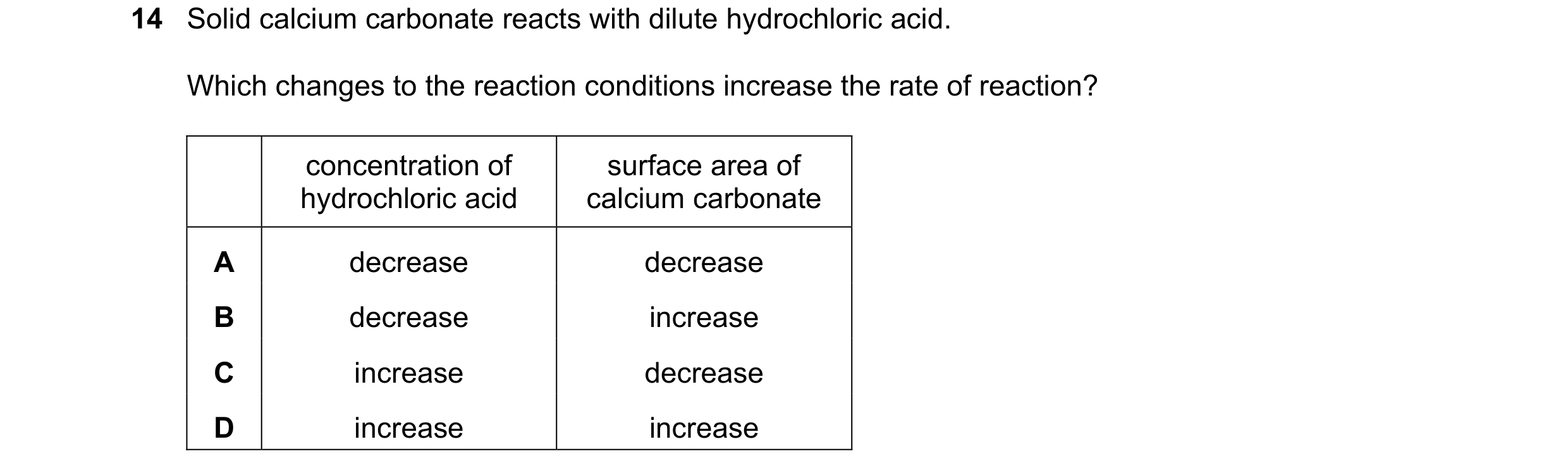
Q18 · Solid calcium carbonate reacts with dilute hydrochloric acid 0971/12 Oct/Nov 2023
14 Solid calcium carbonate reacts with dilute hydrochloric acid. Which changes to the reaction conditions increase the rate of reaction? concentration of surface area of hydrochloric acid calcium carbonate A decrease decrease B decrease increase C increase decrease D increase increase
1 marks
Answer: D
This question in 0971/12 Oct/Nov 2023
Q19 · Zinc reacts slowly with dilute sulfuric acid at room temperature 0971/12 Oct/Nov 2023
15 Zinc reacts slowly with dilute sulfuric acid at room temperature. Bubbles of a gas, L, form on the surface of the zinc. When a small amount of copper is added, the reaction is faster. Which row identifies L and explains why the reaction is faster? gas formed reason the reaction is faster in reaction A hydrogen copper acts as a catalyst B hydrogen copper is more reactive than zinc C oxygen copper acts as a catalyst D oxygen copper is more reactive than zinc
1 marks
Answer: A
This question in 0971/12 Oct/Nov 2023
Q20 · A method used to investigate the rate of reaction of calcium carbonate with dilute… 0971/11 May/June 2024
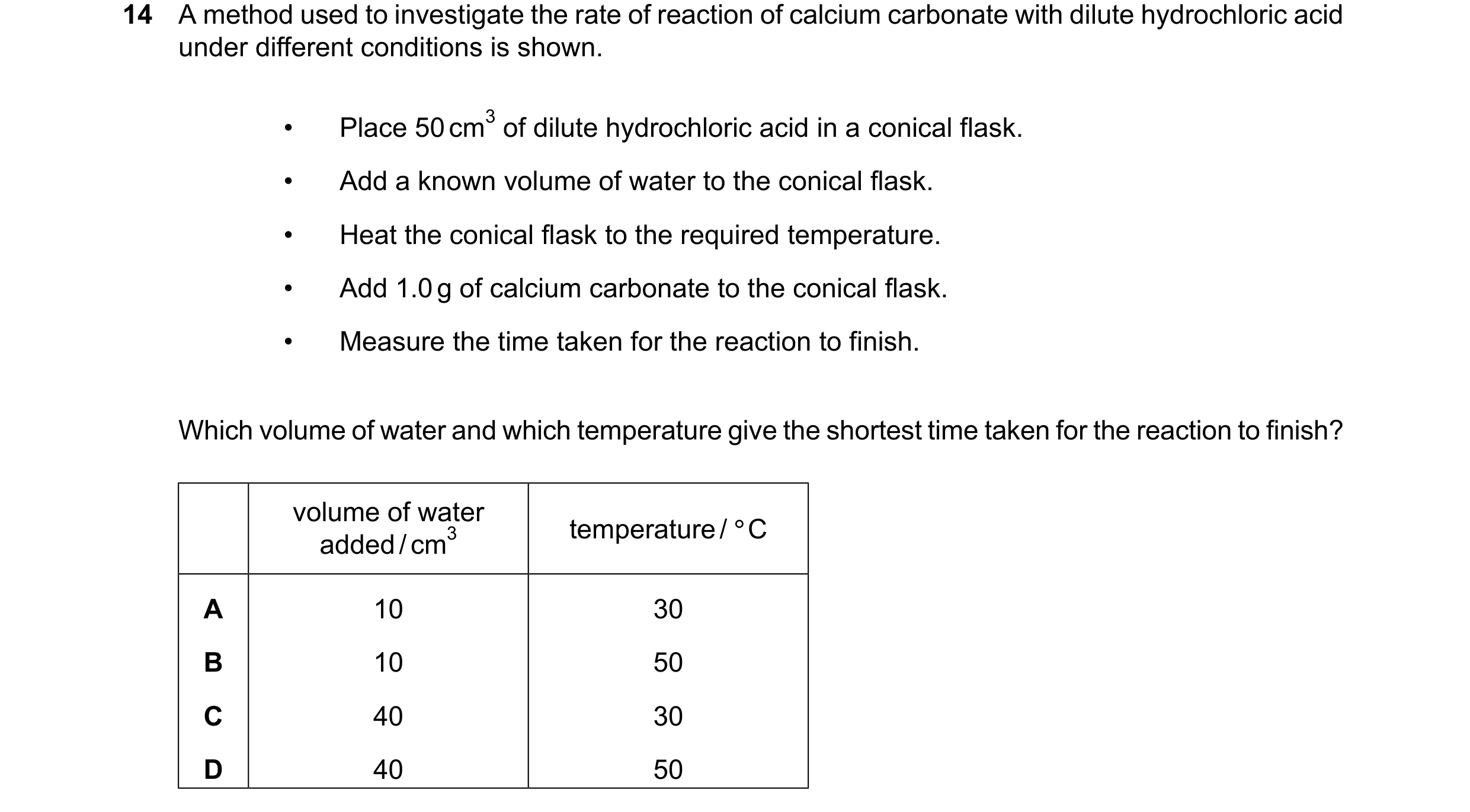
14 A method used to investigate the rate of reaction of calcium carbonate with dilute hydrochloric acid under different conditions is shown. Place 50cm3 of dilute hydrochloric acid in a conical flask. • • Add a known volume of water to the conical flask. • Heat the conical flask to the required temperature. • Add 1.0g of calcium carbonate to the conical flask. • Measure the time taken for the reaction to finish. Which volume of water and which temperature give the shortest time taken for the reaction to finish? volume of water added/cm3 temperature/°C A 10 30 B 10 50 C 40 30 D 40 50
1 marks
Answer: B
This question in 0971/11 May/June 2024
Q21 · The rate of reaction between magnesium and hydrochloric acid is investigated 0971/11 May/June 2024
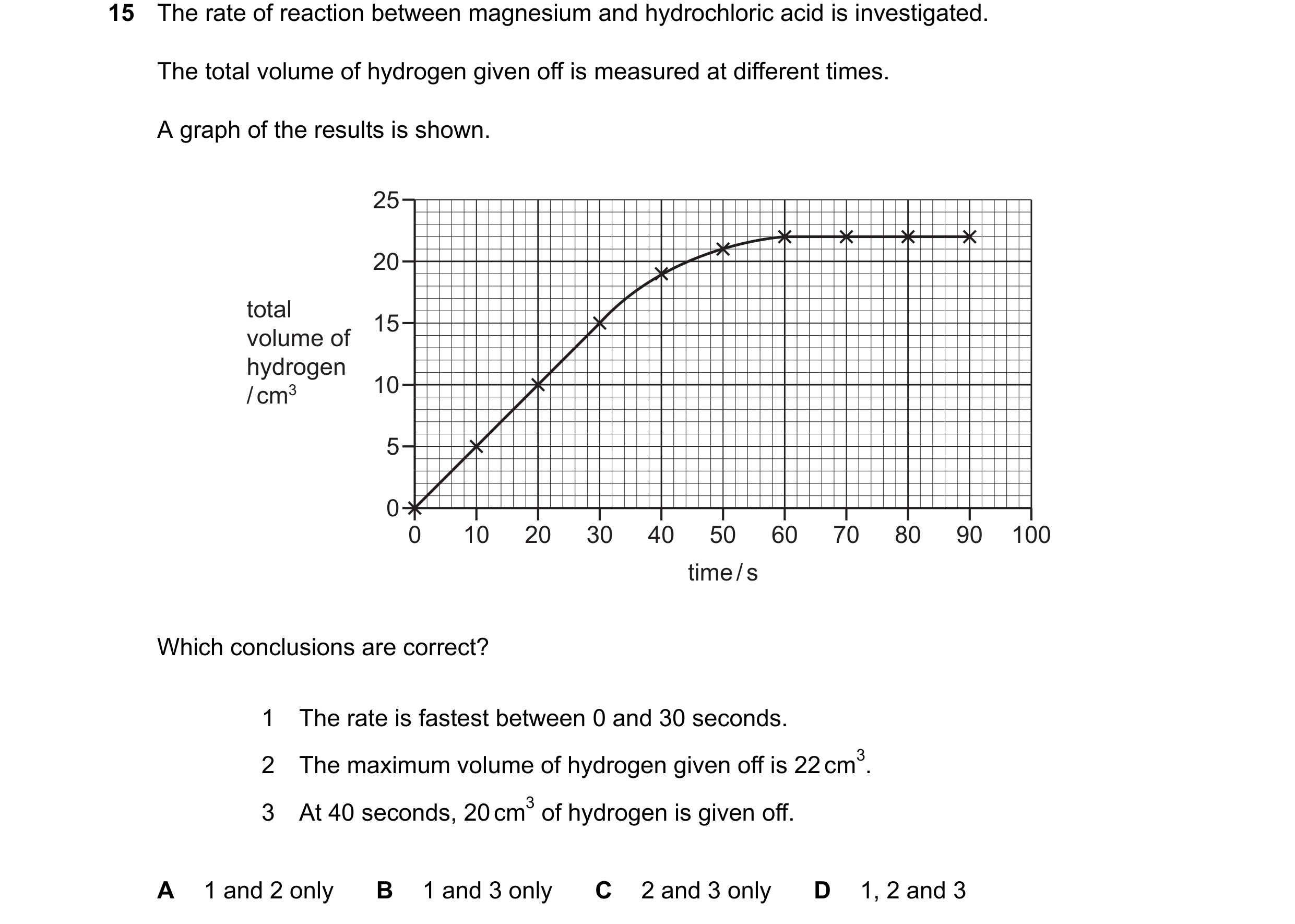
15 The rate of reaction between magnesium and hydrochloric acid is investigated. The total volume of hydrogen given off is measured at different times. A graph of the results is shown. 25 20 total 15 volume of hydrogen / cm3 10 5 0 0 10 20 30 40 50 60 70 80 90 100 time / s Which conclusions are correct? 1 The rate is fastest between 0 and 30 seconds. 2 The maximum volume of hydrogen given off is 22cm3. At 40 seconds, 20cm3 of hydrogen is given off. 3 A 1 and 2 only B 1 and 3 only C 2 and 3 only D 1, 2 and 3
1 marks
Answer: A
This question in 0971/11 May/June 2024
Q22 · A known mass of gaseous ammonia and excess gaseous hydrogen chloride react together to… 0971/12 May/June 2024
17 A known mass of gaseous ammonia and excess gaseous hydrogen chloride react together to make solid ammonium chloride. Line X shows the total mass of ammonium chloride produced over time. The reaction is repeated at a higher pressure. All other conditions are kept the same. Line Y shows the total mass of ammonium chloride produced over time at the higher pressure. Which diagram is correct? A B X X total mass of total mass of ammonium ammonium Y chloride Y chloride produced / g produced / g 0 0 0 time / s 0 time / s C D Y Y total mass of total mass of ammonium ammonium X chloride X chloride produced / g produced / g 0 0 0 time / s 0 time / s
1 marks
Answer: D
This question in 0971/12 May/June 2024
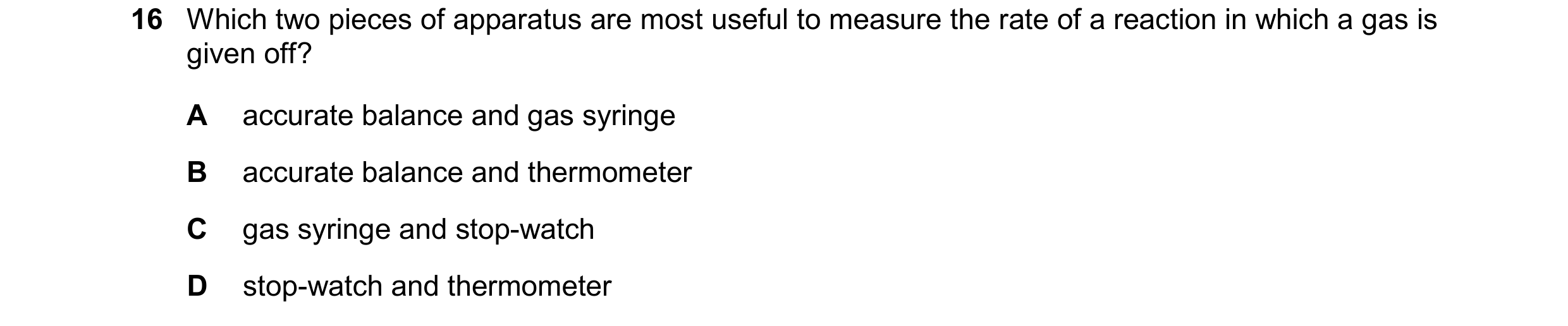
Q23 · Which two pieces of apparatus are most useful to measure the rate of a reaction in which… 0971/12 Oct/Nov 2024
16 Which two pieces of apparatus are most useful to measure the rate of a reaction in which a gas is given off? A accurate balance and gas syringe B accurate balance and thermometer C gas syringe and stop-watch D stop-watch and thermometer
1 marks
Answer: C
This question in 0971/12 Oct/Nov 2024
Q24 · Reaction 1 and reaction 2 both produce a gas 0971/12 Oct/Nov 2024
17 Reaction 1 and reaction 2 both produce a gas. The total volume of gas produced in each reaction is measured every minute for 10 minutes. A graph of the results is shown. 100 90 2 80 70 60 total volume 50 of gas / cm3 1 40 30 20 10 0 0 1 2 3 4 5 6 7 8 9 10 time / min Which row describes how the rate of reaction changes, if at all, during each reaction? reaction 1 reaction 2 A the rate is constant the rate decreases after 2 minutes B the rate increases the rate increases C the rate increases the rate decreases after 2 minutes D the rate is constant the rate increases
1 marks
Answer: A
This question in 0971/12 Oct/Nov 2024
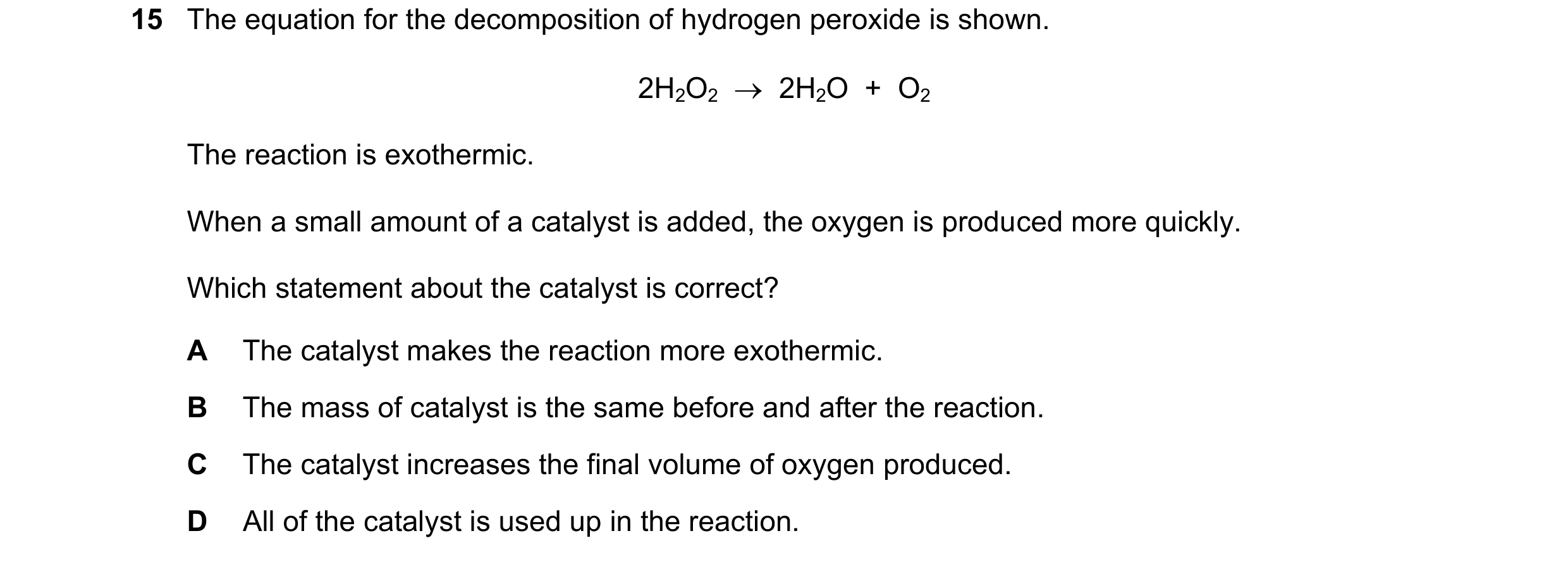
Q25 · The equation for the decomposition of hydrogen peroxide is shown 0971/11 May/June 2025
15 The equation for the decomposition of hydrogen peroxide is shown. 2H2O2 2H2O + O2 The reaction is exothermic. When a small amount of a catalyst is added, the oxygen is produced more quickly. Which statement about the catalyst is correct? A The catalyst makes the reaction more exothermic. B The mass of catalyst is the same before and after the reaction. C The catalyst increases the final volume of oxygen produced. D All of the catalyst is used up in the reaction.
1 marks
Answer: B
This question in 0971/11 May/June 2025
Q26 · The total volume of gas produced in two different experiments is measured against time 0971/12 May/June 2025
16 The total volume of gas produced in two different experiments is measured against time. A graph of the results of the two experiments is shown. Which point shows the fastest rate of reaction? D experiment 2 experiment 1 B total volume of gas C A 0 0 time
1 marks
Answer: A
This question in 0971/12 May/June 2025
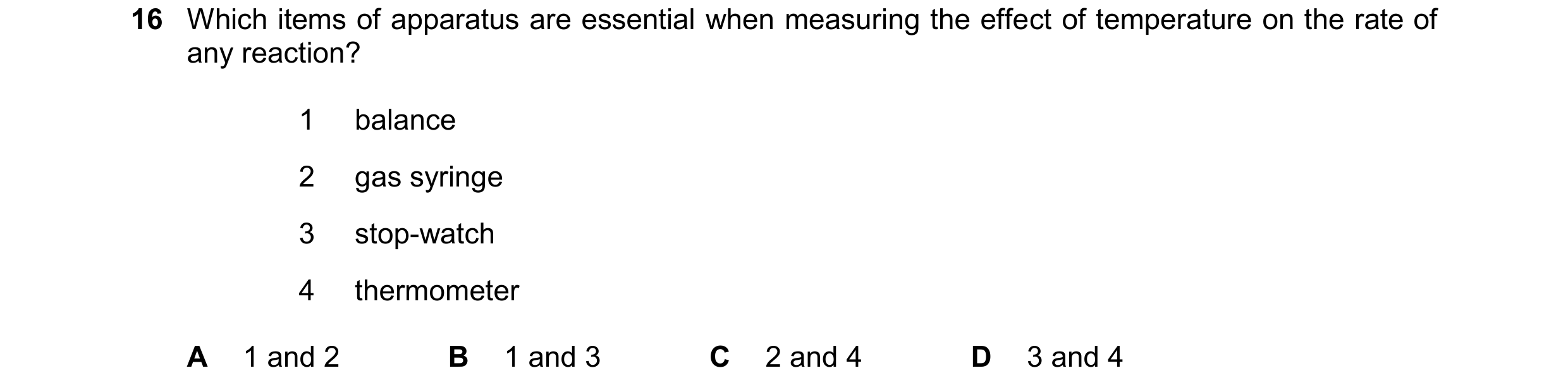
Q27 · Which items of apparatus are essential when measuring the effect of temperature on the… 0971/12 Oct/Nov 2025
16 Which items of apparatus are essential when measuring the effect of temperature on the rate of any reaction? 1 balance 2 gas syringe 3 stop-watch 4 thermometer A 1 and 2 B 1 and 3 C 2 and 4 D 3 and 4
1 marks
Answer: D
This question in 0971/12 Oct/Nov 2025
 1 / 11
 2 / 11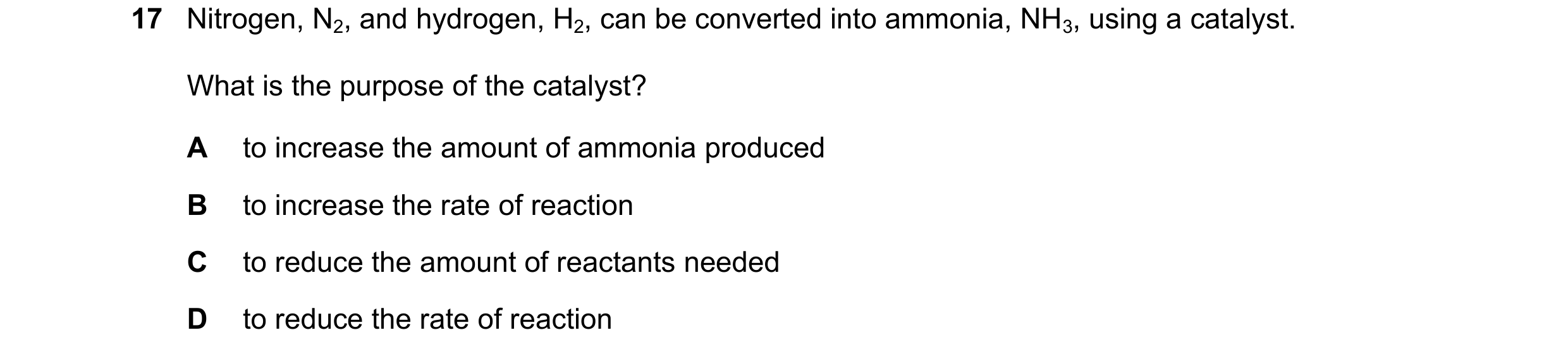
 3 / 11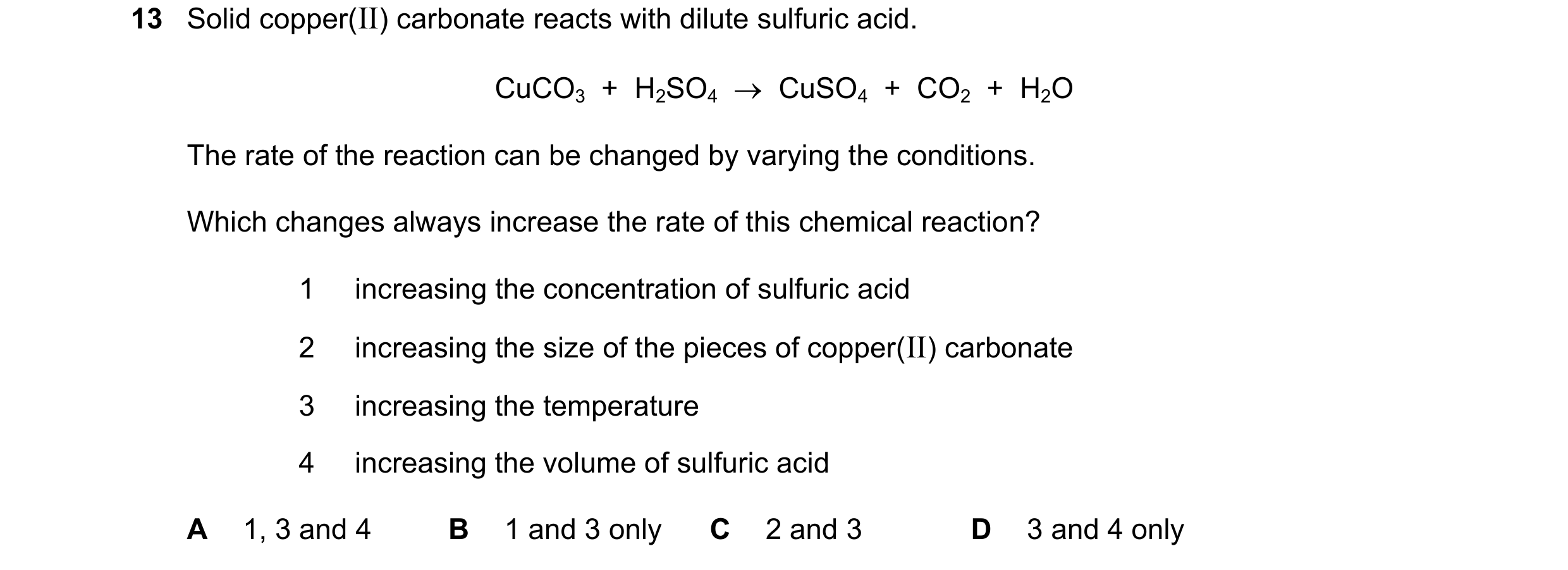
 4 / 11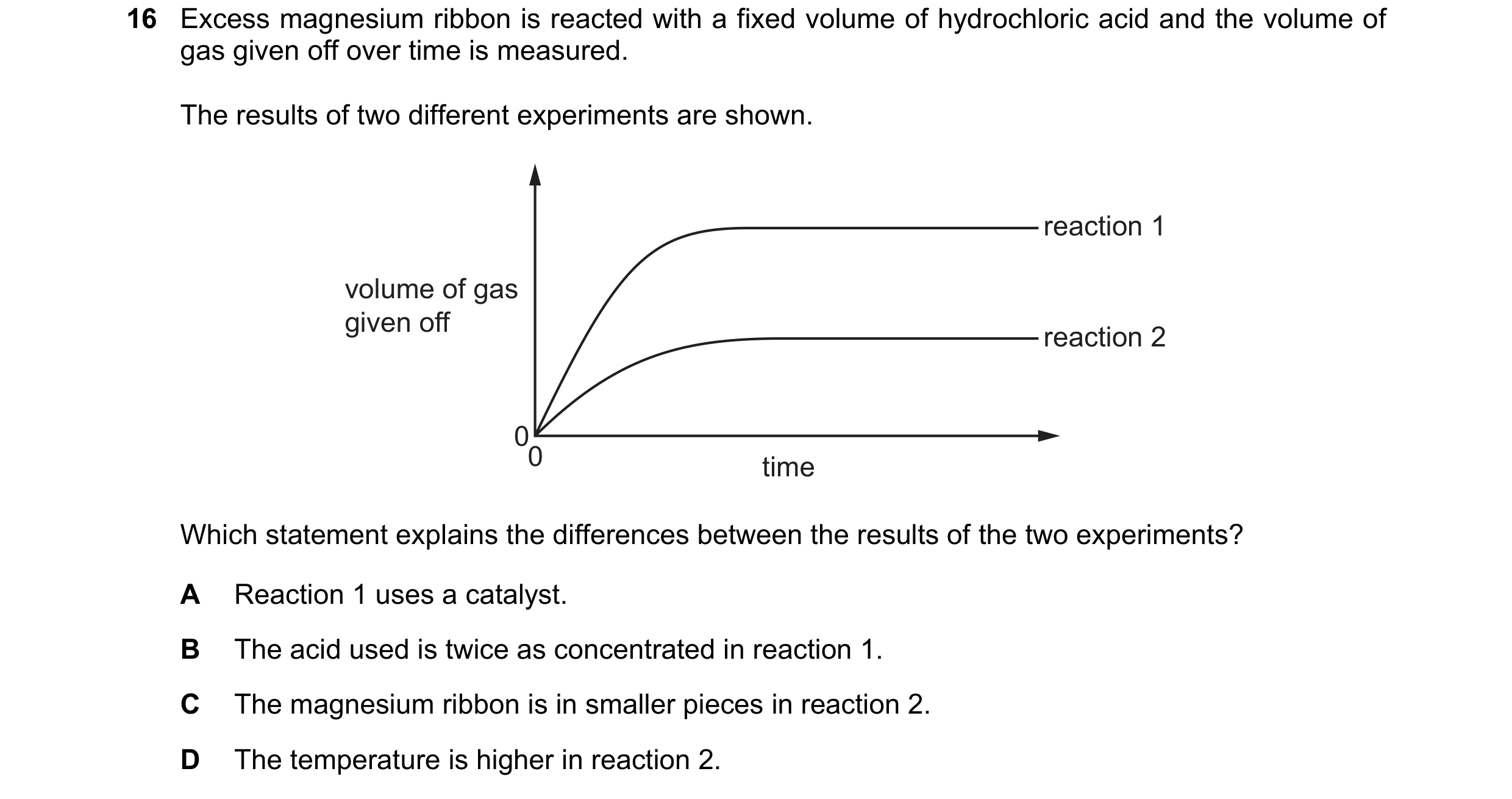
 5 / 11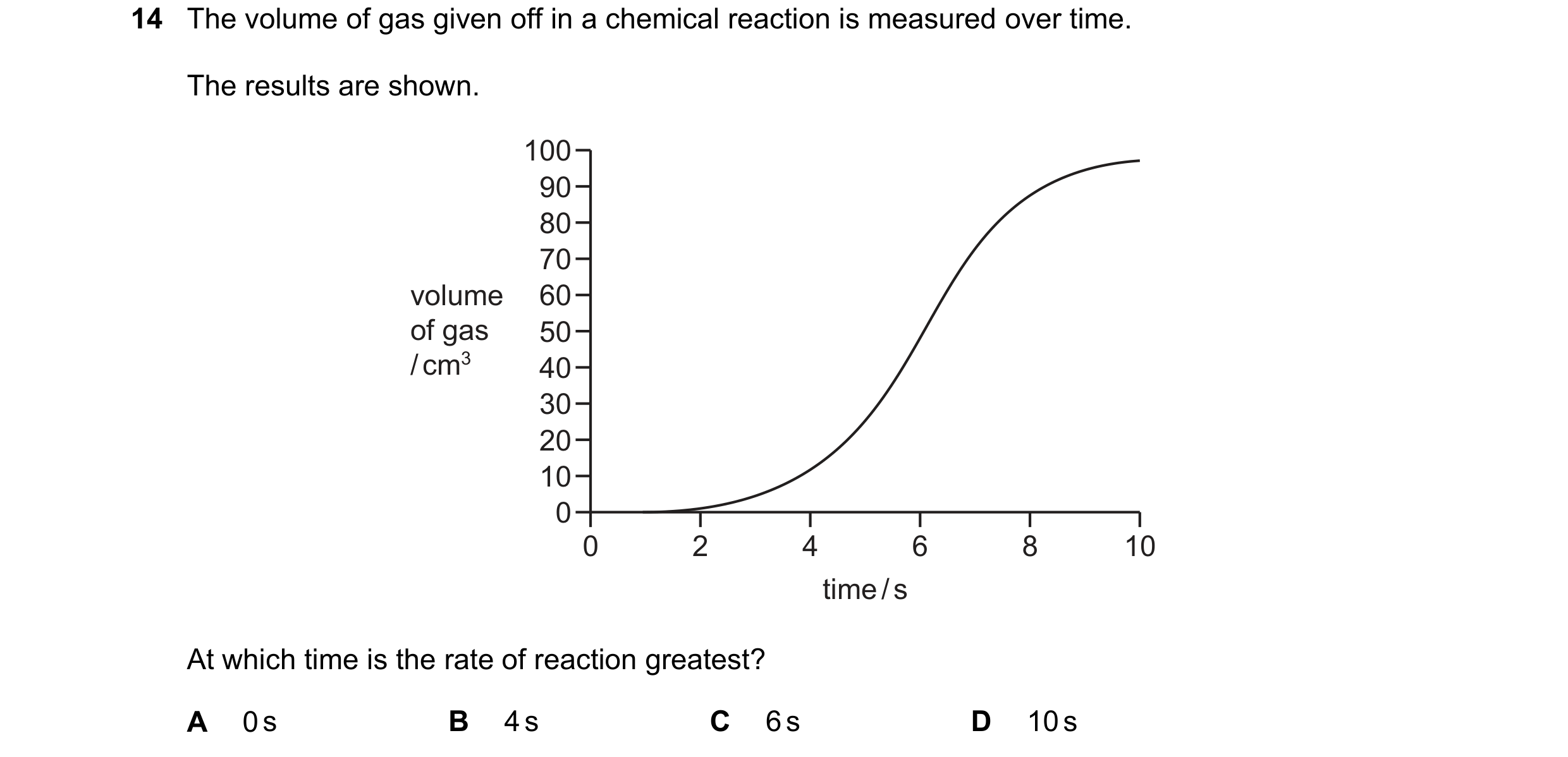

 6 / 11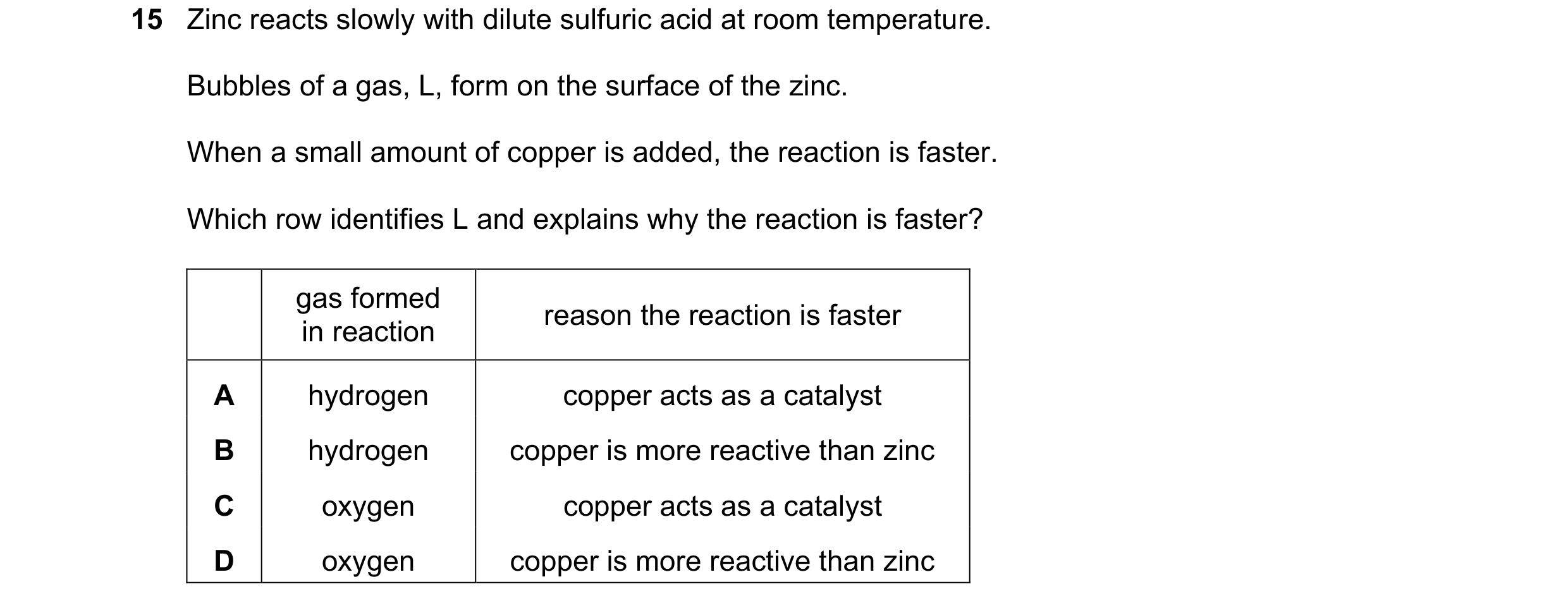
 7 / 11
 8 / 11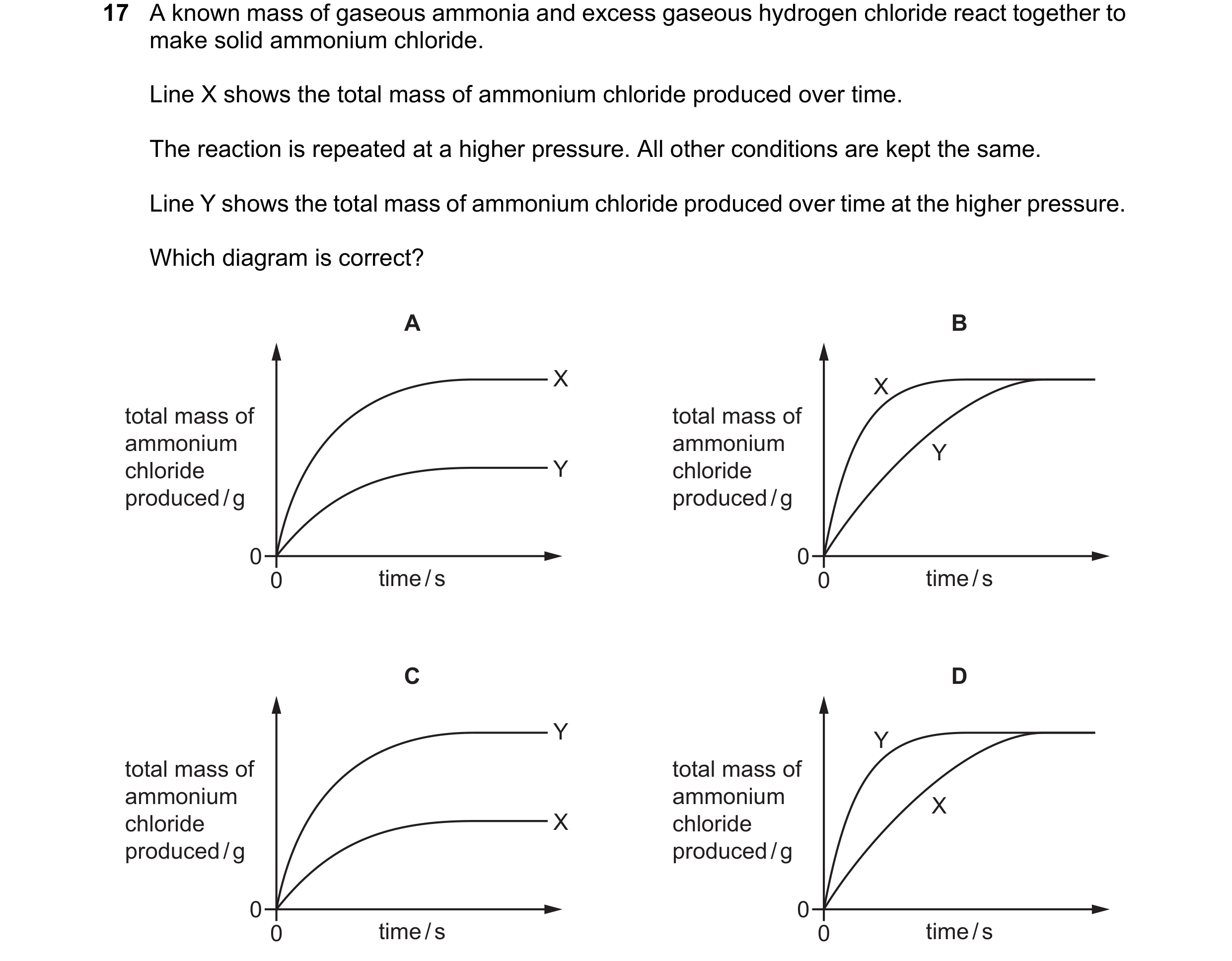
 9 / 11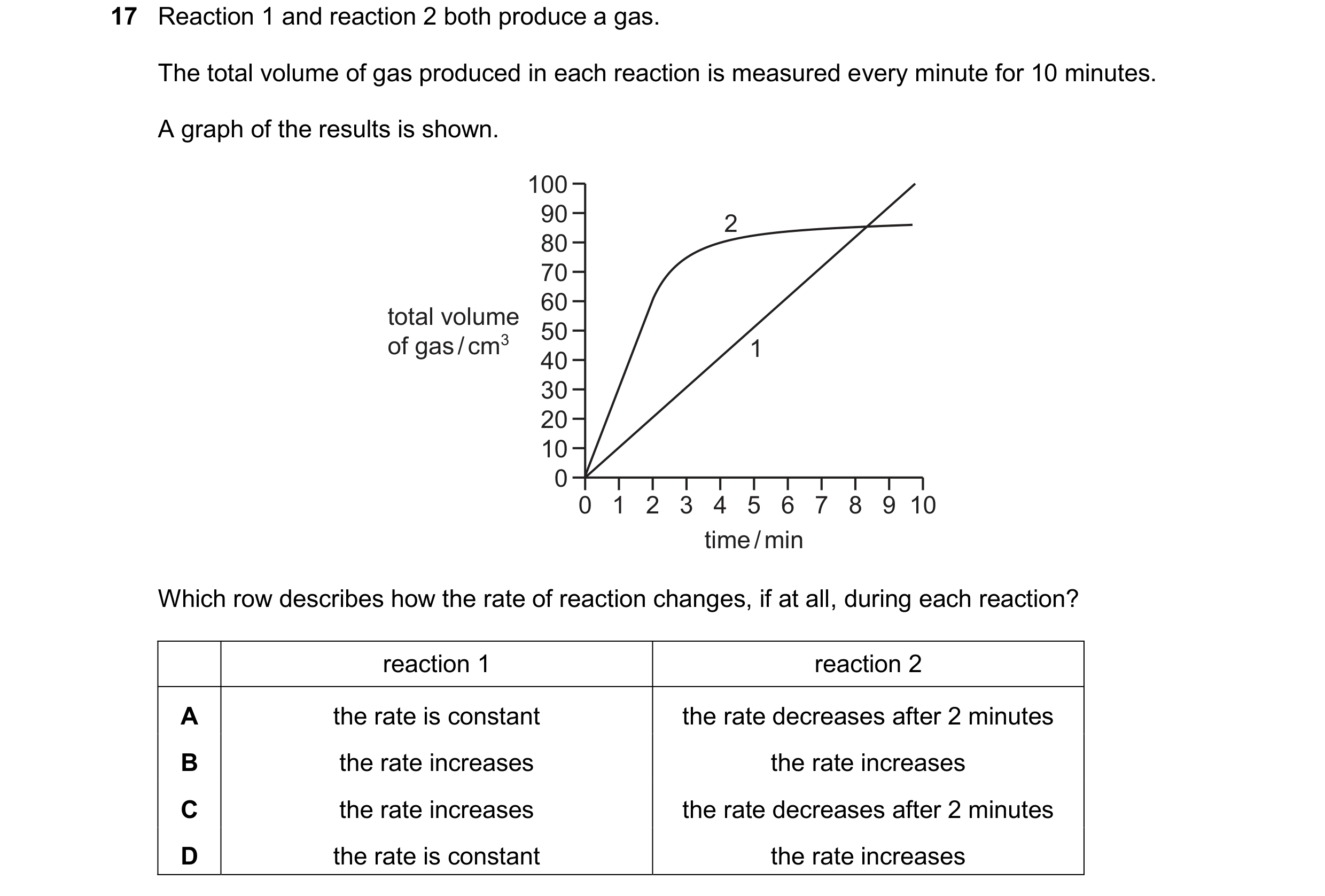
 10 / 11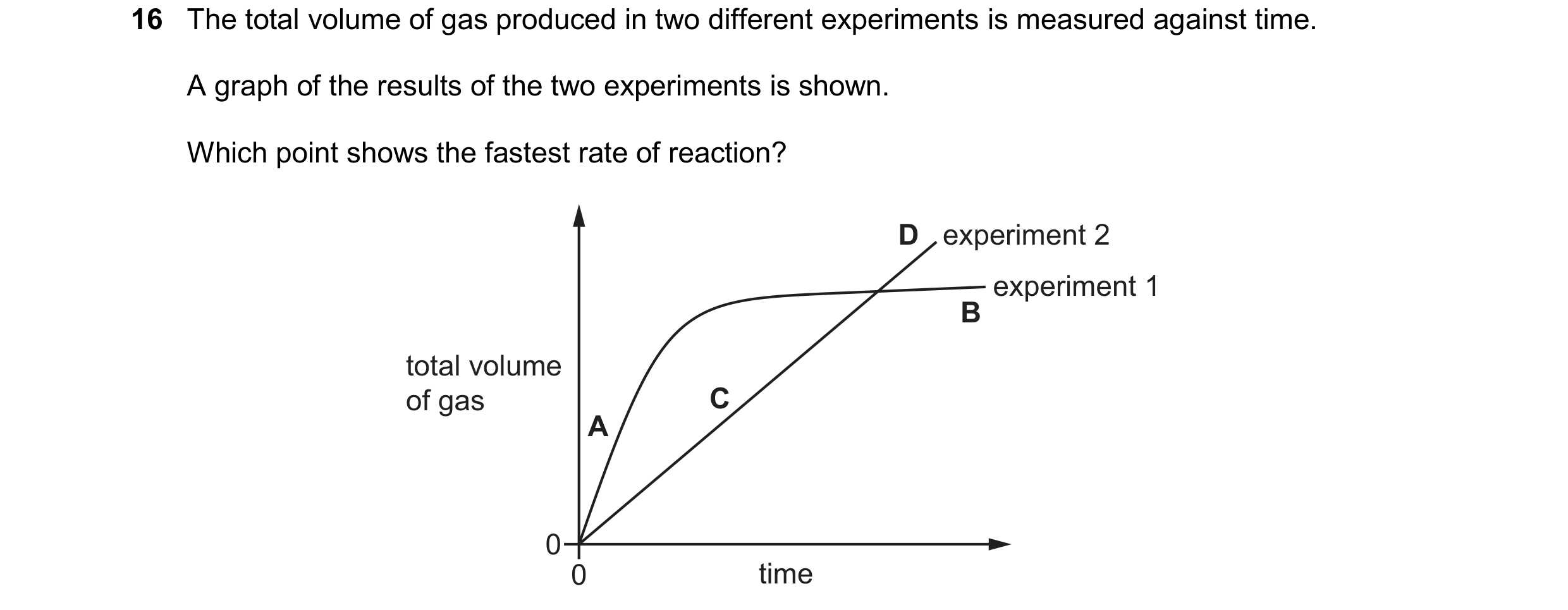
 11 / 11