Cambridge IGCSE Chemistry (9-1) 0971 — 2022 May/June Paper 1 · Variant 2
0971/12/M/J/22 · 40 questions · 40 marks · ≈45 min
The question paper and its mark scheme, free to read here and free to download. This is Cambridge’s own paper, exactly as it was sat.
Question paper16 pages


Mark scheme3 pages
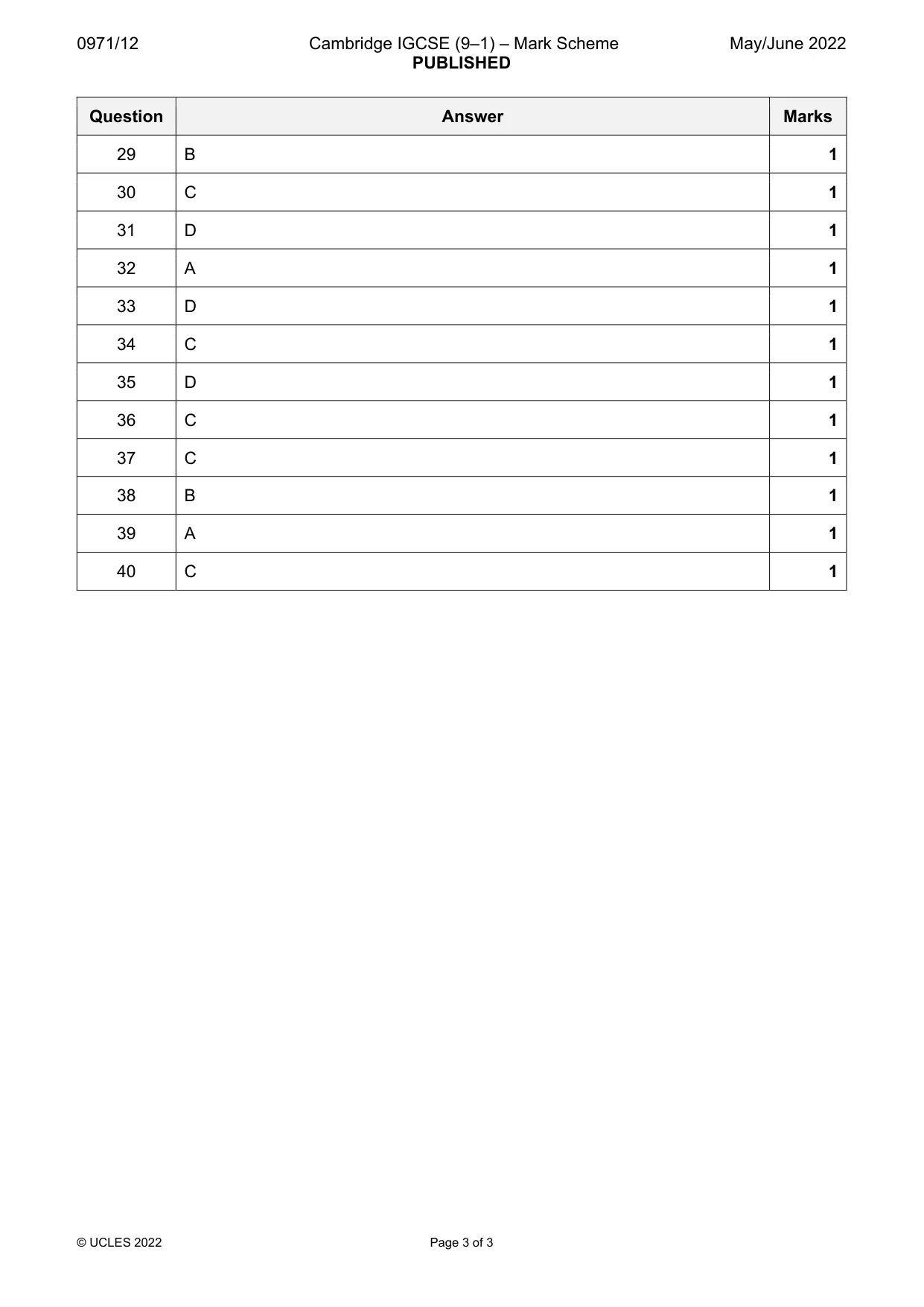
Answers below. Sit the paper first if you are practising.
Questions as text
Q1 · Substances change state when their temperature is changed
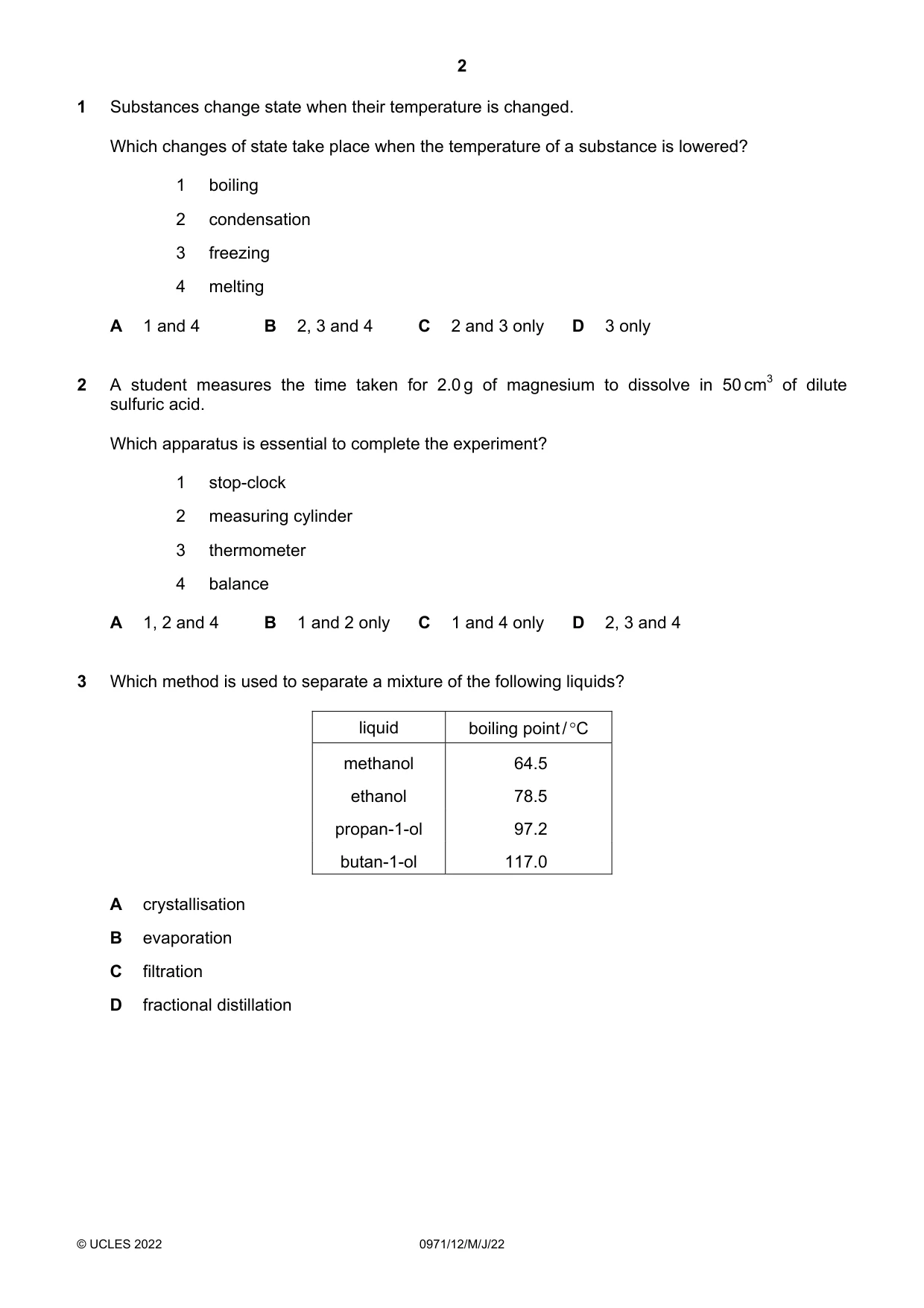
1 Substances change state when their temperature is changed. Which changes of state take place when the temperature of a substance is lowered? 1 boiling 2 condensation 3 freezing 4 melting A 1 and 4 B 2, 3 and 4 C 2 and 3 only D 3 only
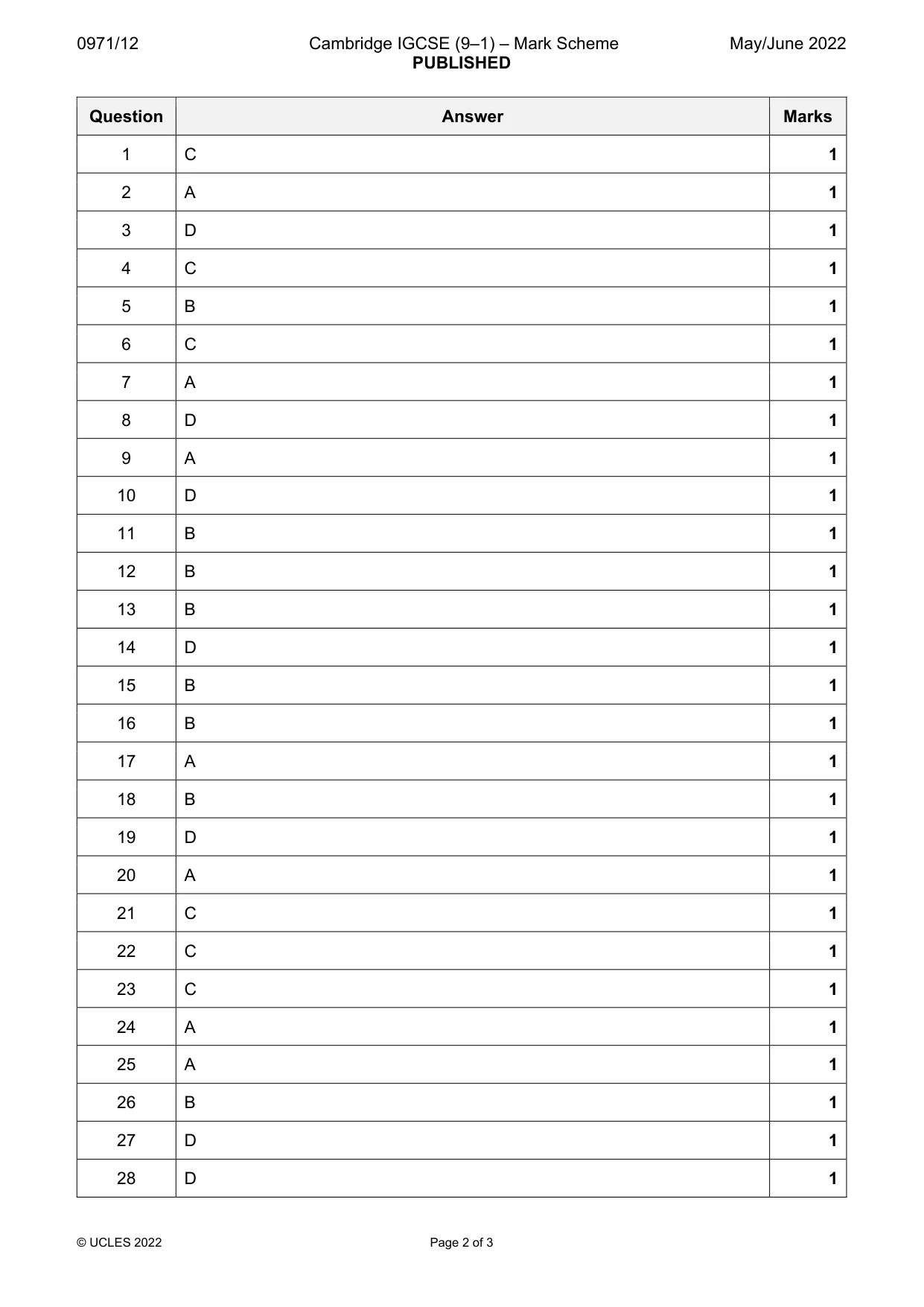
Mark scheme: C
Q2 · A student measures the time taken for 2.0 g of magnesium to dissolve in 50 cm3 of dilute…
2 A student measures the time taken for 2.0 g of magnesium to dissolve in 50 cm3 of dilute sulfuric acid. Which apparatus is essential to complete the experiment? 1 stop-clock 2 measuring cylinder 3 thermometer 4 balance A 1, 2 and 4 B 1 and 2 only C 1 and 4 only D 2, 3 and 4
Mark scheme: A
Q3 · Which method is used to separate a mixture of the following liquids?
3 Which method is used to separate a mixture of the following liquids? liquid boiling point / C methanol 64.5 ethanol 78.5 propan-1-ol 97.2 butan-1-ol 117.0 A crystallisation B evaporation C filtration D fractional distillation
Mark scheme: D
Q4 · X and Y are two different elements
4 X and Y are two different elements. X and Y have the same number of nucleons. Which statement about X and Y is correct? A They have the same physical properties. B Their atoms have the same number of electrons. C They are in different groups of the Periodic Table. D They have different relative masses.
Mark scheme: C
Q5 · Which row identifies an alloy, a pure metal and a non-metal?
5 Which row identifies an alloy, a pure metal and a non-metal? alloy pure metal non-metal A brass carbon copper B brass copper carbon C copper brass carbon D copper carbon brass
Mark scheme: B
Q6 · Which statement about ions and ionic bonding is correct?
6 Which statement about ions and ionic bonding is correct? A Caesium atoms gain electrons to form negatively charged caesium ions. B Ionic bonding involves sharing of pairs of electrons. C Potassium ions and chloride ions have the same number of outer-shell electrons. D Sodium ions have an equal number of protons and electrons.
Mark scheme: C
Q7 · Which dot-and-cross diagram shows the arrangement of outer shell electrons in a molecule…
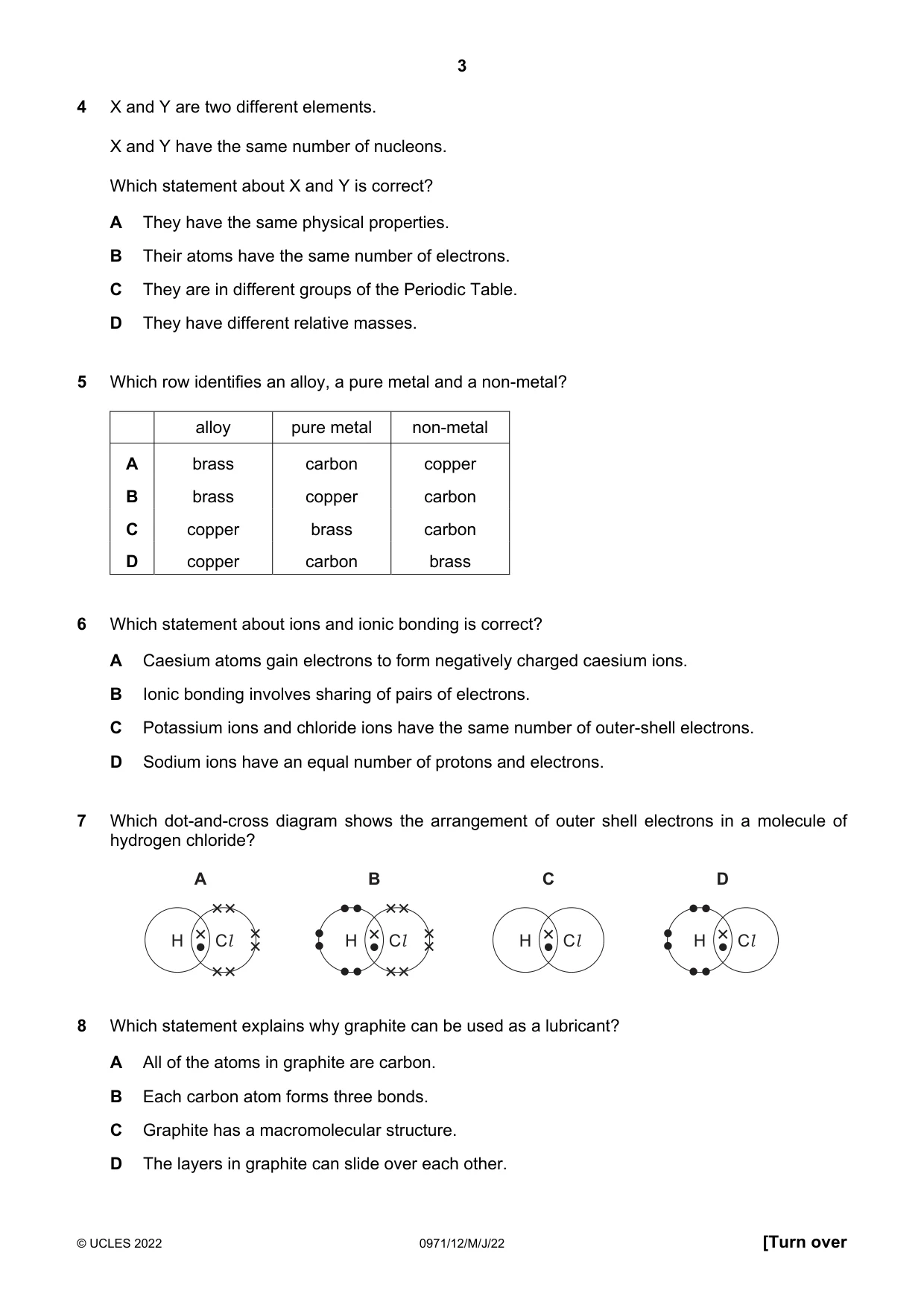
7 Which dot-and-cross diagram shows the arrangement of outer shell electrons in a molecule of hydrogen chloride? A B C D H Cl H Cl H Cl H Cl
Mark scheme: A
Q8 · Which statement explains why graphite can be used as a lubricant?
8 Which statement explains why graphite can be used as a lubricant? A All of the atoms in graphite are carbon. B Each carbon atom forms three bonds. C Graphite has a macromolecular structure. D The layers in graphite can slide over each other.
Mark scheme: D
Q9 · A compound of element X has the formula X2O and a relative formula mass of 144
9 A compound of element X has the formula X2O and a relative formula mass of 144. What is element X? A copper, Cu B gadolinium, Gd C sulfur, S D tellurium, Te
Mark scheme: A
Q10 · The diagram shows the electrolysis of concentrated hydrochloric acid and concentrated…
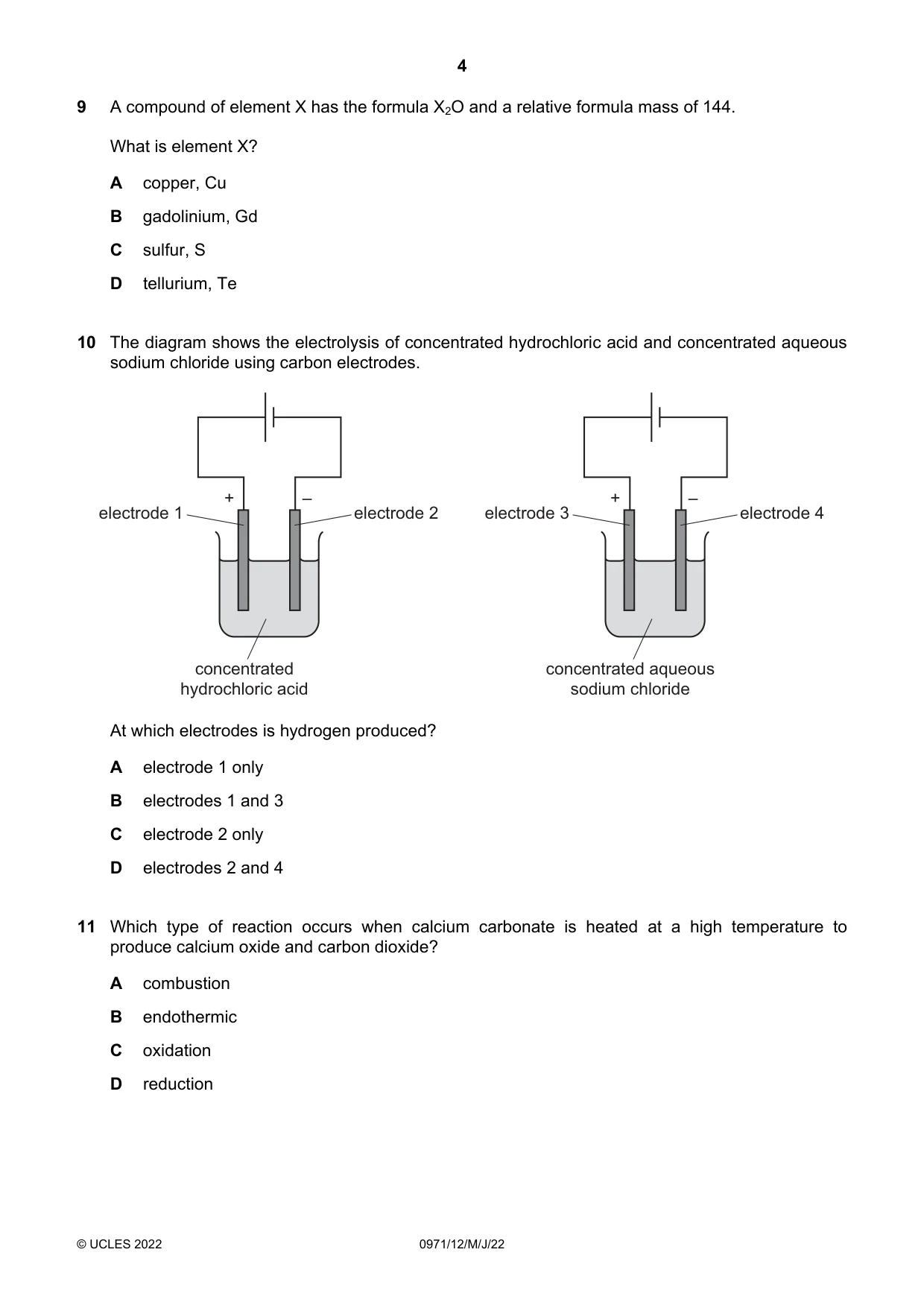
10 The diagram shows the electrolysis of concentrated hydrochloric acid and concentrated aqueous sodium chloride using carbon electrodes. + – + – electrode 1 electrode 2 electrode 3 electrode 4 concentrated concentrated aqueous hydrochloric acid sodium chloride At which electrodes is hydrogen produced? A electrode 1 only B electrodes 1 and 3 C electrode 2 only D electrodes 2 and 4
Mark scheme: D
Q11 · Which type of reaction occurs when calcium carbonate is heated at a high temperature to…
11 Which type of reaction occurs when calcium carbonate is heated at a high temperature to produce calcium oxide and carbon dioxide? A combustion B endothermic C oxidation D reduction
Mark scheme: B
Q12 · Which row identifies a chemical change and a physical change?
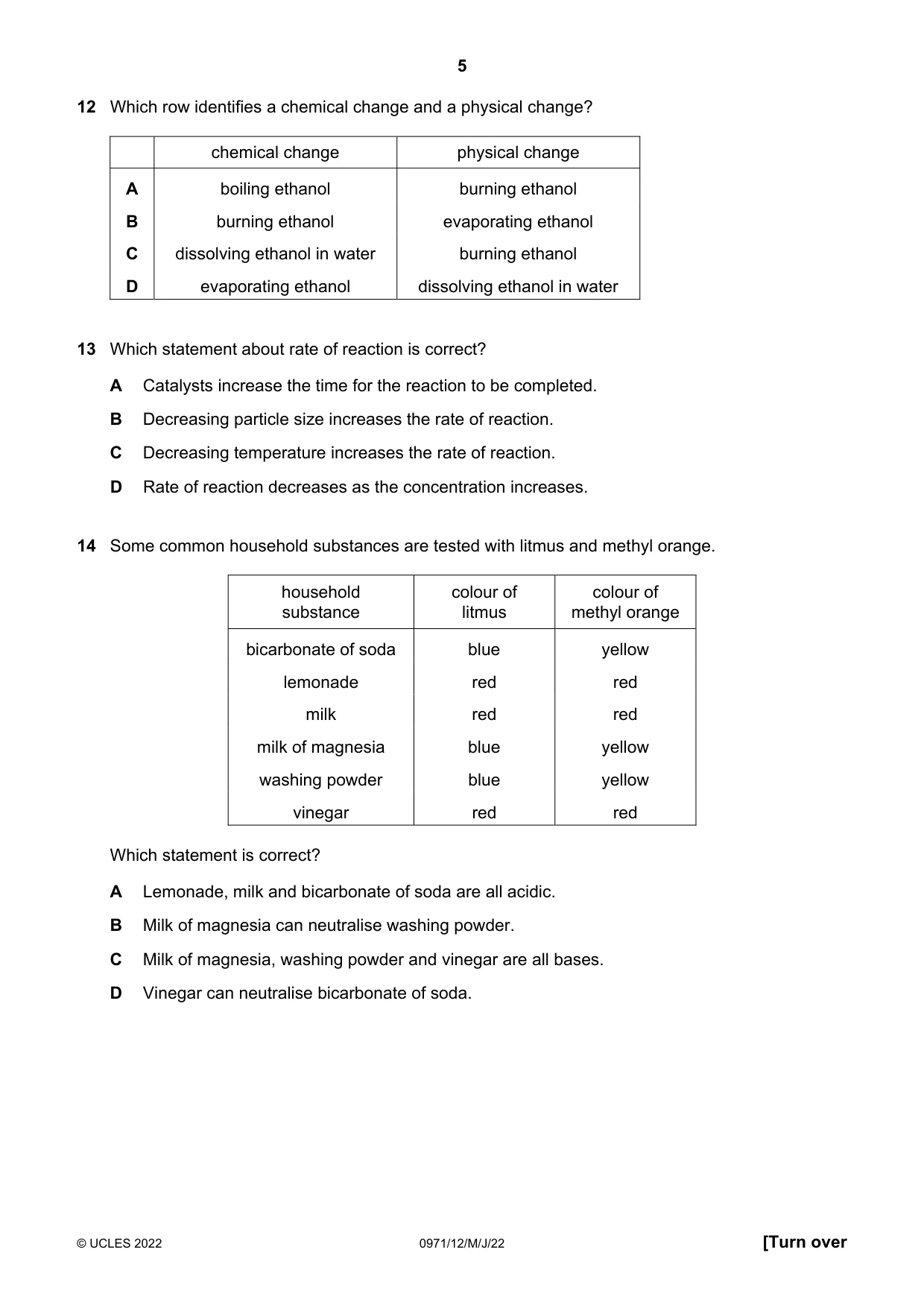
12 Which row identifies a chemical change and a physical change? chemical change physical change A boiling ethanol burning ethanol B burning ethanol evaporating ethanol C dissolving ethanol in water burning ethanol D evaporating ethanol dissolving ethanol in water
Mark scheme: B
Q13 · Which statement about rate of reaction is correct?
13 Which statement about rate of reaction is correct? A Catalysts increase the time for the reaction to be completed. B Decreasing particle size increases the rate of reaction. C Decreasing temperature increases the rate of reaction. D Rate of reaction decreases as the concentration increases.
Mark scheme: B
Q14 · Some common household substances are tested with litmus and methyl orange
14 Some common household substances are tested with litmus and methyl orange. household colour of colour of substance litmus methyl orange bicarbonate of soda blue yellow lemonade red red milk red red milk of magnesia blue yellow washing powder blue yellow vinegar red red Which statement is correct? A Lemonade, milk and bicarbonate of soda are all acidic. B Milk of magnesia can neutralise washing powder. C Milk of magnesia, washing powder and vinegar are all bases. D Vinegar can neutralise bicarbonate of soda.
Mark scheme: D
More questions on The characteristic properties of acids and bases
Q15 · Water is added to anhydrous copper(II) sulfate
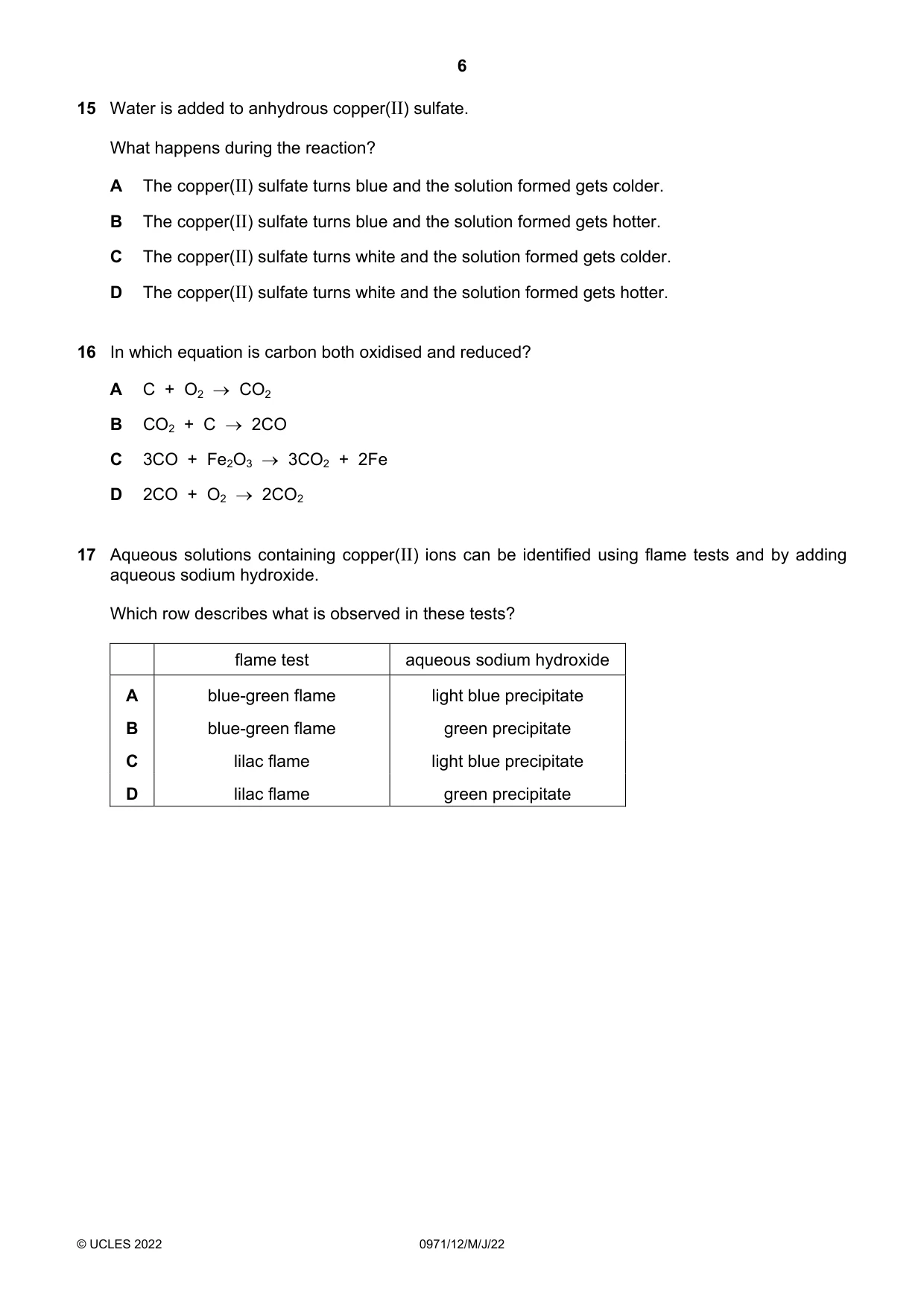
15 Water is added to anhydrous copper(II) sulfate. What happens during the reaction? A The copper(II) sulfate turns blue and the solution formed gets colder. B The copper(II) sulfate turns blue and the solution formed gets hotter. C The copper(II) sulfate turns white and the solution formed gets colder. D The copper(II) sulfate turns white and the solution formed gets hotter.
Mark scheme: B
Q16 · In which equation is carbon both oxidised and reduced?
16 In which equation is carbon both oxidised and reduced? A C + O2 CO2 B CO2 + C 2CO C 3CO + Fe2O3 3CO2 + 2Fe D 2CO + O2 2CO2
Mark scheme: B
Q17 · Aqueous solutions containing copper(II) ions can be identified using flame tests and by…
17 Aqueous solutions containing copper(II) ions can be identified using flame tests and by adding aqueous sodium hydroxide. Which row describes what is observed in these tests? flame test aqueous sodium hydroxide A blue-green flame light blue precipitate B blue-green flame green precipitate C lilac flame light blue precipitate D lilac flame green precipitate
Mark scheme: A
Q18 · The oxides of two elements, X and Y, are separately dissolved in water and the pH of each…
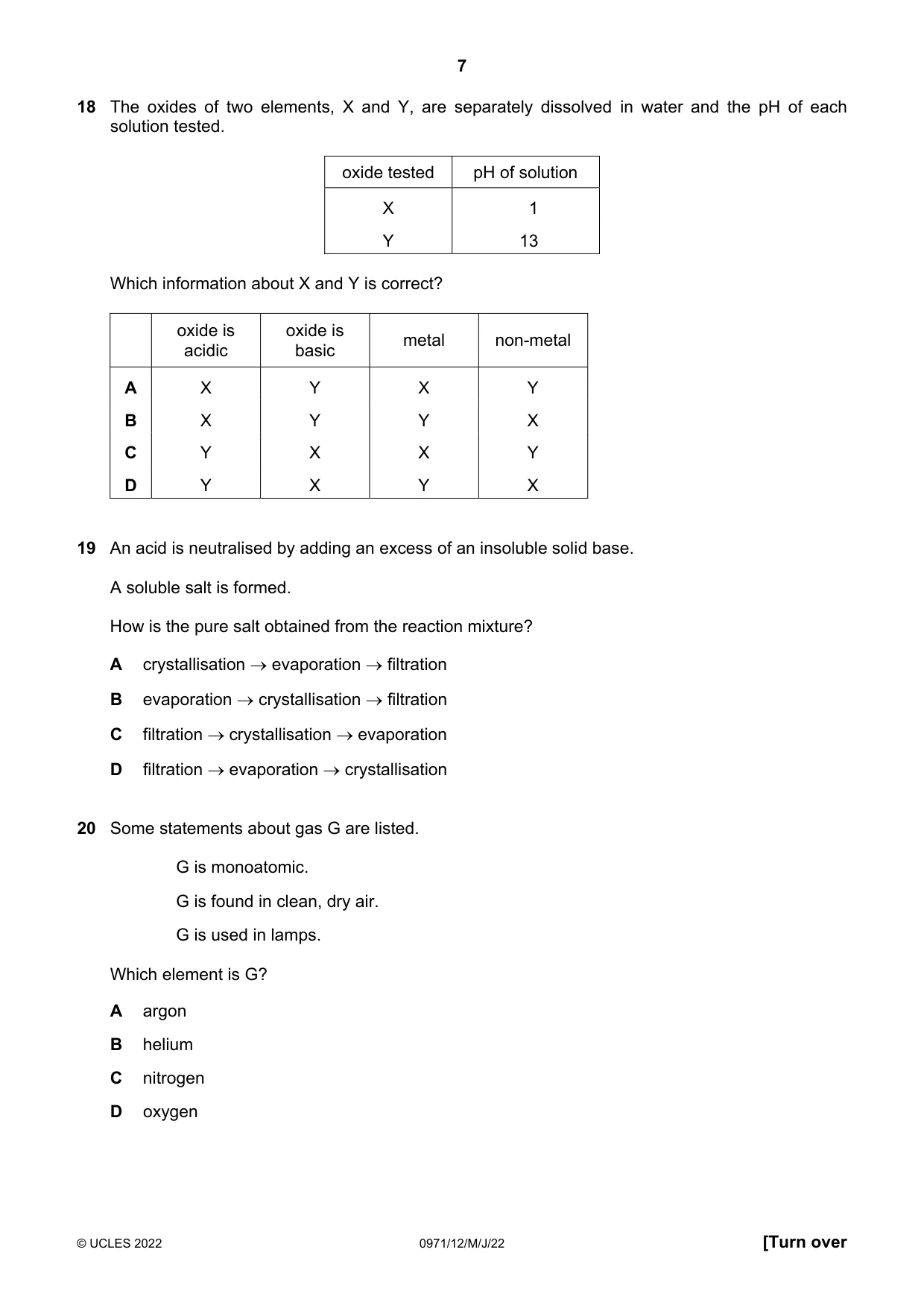
18 The oxides of two elements, X and Y, are separately dissolved in water and the pH of each solution tested. oxide tested pH of solution X 1 Y 13 Which information about X and Y is correct? oxide is oxide is metal non-metal acidic basic A X Y X Y B X Y Y X C Y X X Y D Y X Y X
Mark scheme: B
Q19 · An acid is neutralised by adding an excess of an insoluble solid base
19 An acid is neutralised by adding an excess of an insoluble solid base. A soluble salt is formed. How is the pure salt obtained from the reaction mixture? A crystallisation evaporation filtration B evaporation crystallisation filtration C filtration crystallisation evaporation D filtration evaporation crystallisation
Mark scheme: D
Q20 · Some statements about gas G are listed
20 Some statements about gas G are listed. G is monoatomic. G is found in clean, dry air. G is used in lamps. Which element is G? A argon B helium C nitrogen D oxygen
Mark scheme: A
Q21 · Part of the Periodic Table is shown
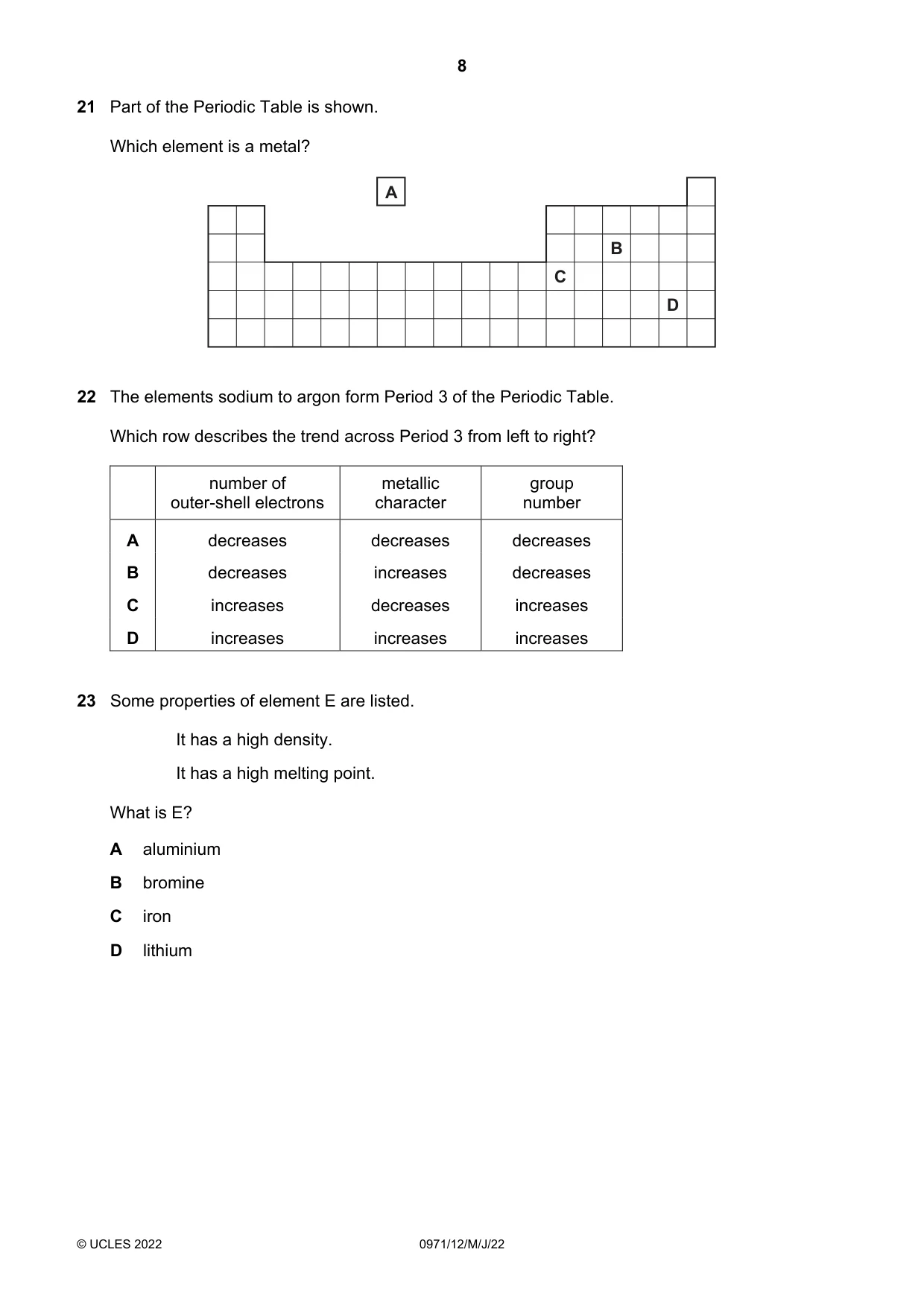
21 Part of the Periodic Table is shown. Which element is a metal? A B C D
Mark scheme: C
Q22 · The elements sodium to argon form Period 3 of the Periodic Table
22 The elements sodium to argon form Period 3 of the Periodic Table. Which row describes the trend across Period 3 from left to right? number of metallic group outer-shell electrons character number A decreases decreases decreases B decreases increases decreases C increases decreases increases D increases increases increases
Mark scheme: C
Q23 · Some properties of element E are listed
23 Some properties of element E are listed. It has a high density. It has a high melting point. What is E? A aluminium B bromine C iron D lithium
Mark scheme: C
Q24 · Lithium, sodium and potassium are elements in Group I of the Periodic Table
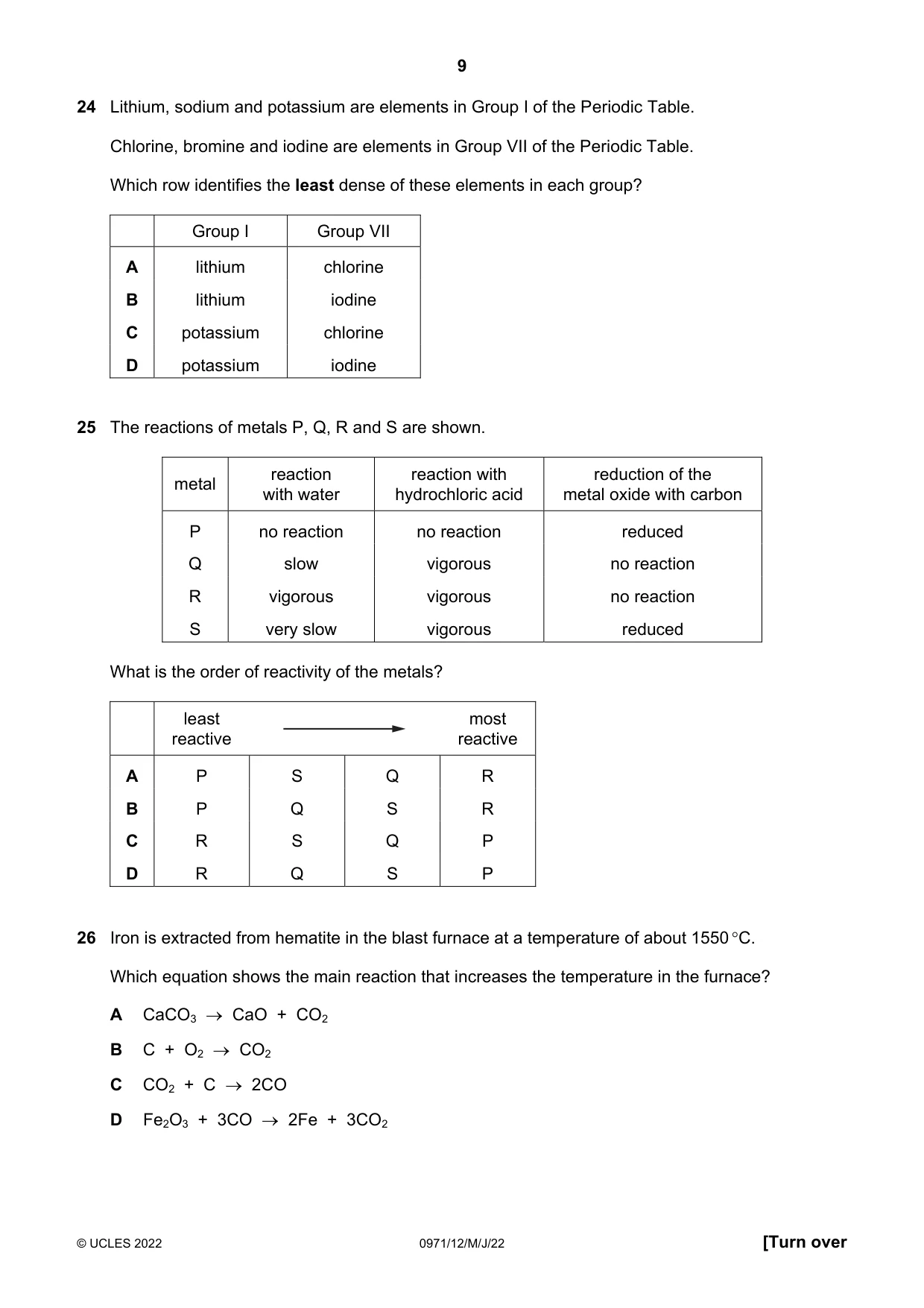
24 Lithium, sodium and potassium are elements in Group I of the Periodic Table. Chlorine, bromine and iodine are elements in Group VII of the Periodic Table. Which row identifies the least dense of these elements in each group? Group I Group VII A lithium chlorine B lithium iodine C potassium chlorine D potassium iodine
Mark scheme: A
Q25 · The reactions of metals P, Q, R and S are shown
25 The reactions of metals P, Q, R and S are shown. reaction reaction with reduction of the metal with water hydrochloric acid metal oxide with carbon P no reaction no reaction reduced Q slow vigorous no reaction R vigorous vigorous no reaction S very slow vigorous reduced What is the order of reactivity of the metals? least most reactive reactive A P S Q R B P Q S R C R S Q P D R Q S P
Mark scheme: A
Q26 · Iron is extracted from hematite in the blast furnace at a temperature of about 1550 C
26 Iron is extracted from hematite in the blast furnace at a temperature of about 1550 C. Which equation shows the main reaction that increases the temperature in the furnace? A CaCO3 CaO + CO2 B C + O2 CO2 C CO2 + C 2CO D Fe2O3 + 3CO 2Fe + 3CO2
Mark scheme: B
Q27 · Which diagram represents the arrangement of atoms in an alloy?
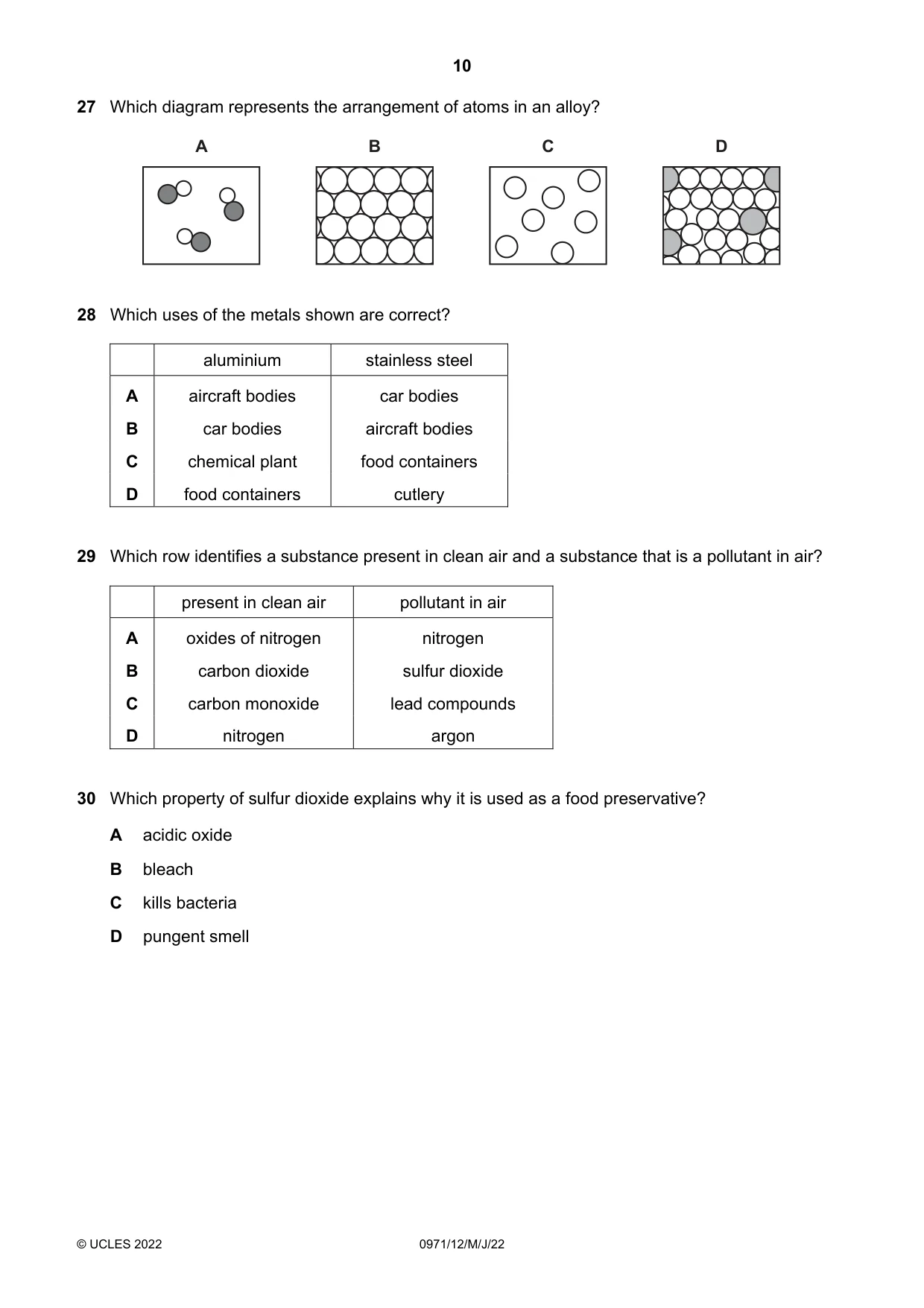
27 Which diagram represents the arrangement of atoms in an alloy? A B C D
Mark scheme: D
Q28 · Which uses of the metals shown are correct?
28 Which uses of the metals shown are correct? aluminium stainless steel A aircraft bodies car bodies B car bodies aircraft bodies C chemical plant food containers D food containers cutlery
Mark scheme: D
Q29 · Which row identifies a substance present in clean air and a substance that is a pollutant…
29 Which row identifies a substance present in clean air and a substance that is a pollutant in air? present in clean air pollutant in air A oxides of nitrogen nitrogen B carbon dioxide sulfur dioxide C carbon monoxide lead compounds D nitrogen argon
Mark scheme: B
Q30 · Which property of sulfur dioxide explains why it is used as a food preservative?
30 Which property of sulfur dioxide explains why it is used as a food preservative? A acidic oxide B bleach C kills bacteria D pungent smell
Mark scheme: C
Q31 · Fertilisers are used to provide three of the elements needed for plant growth
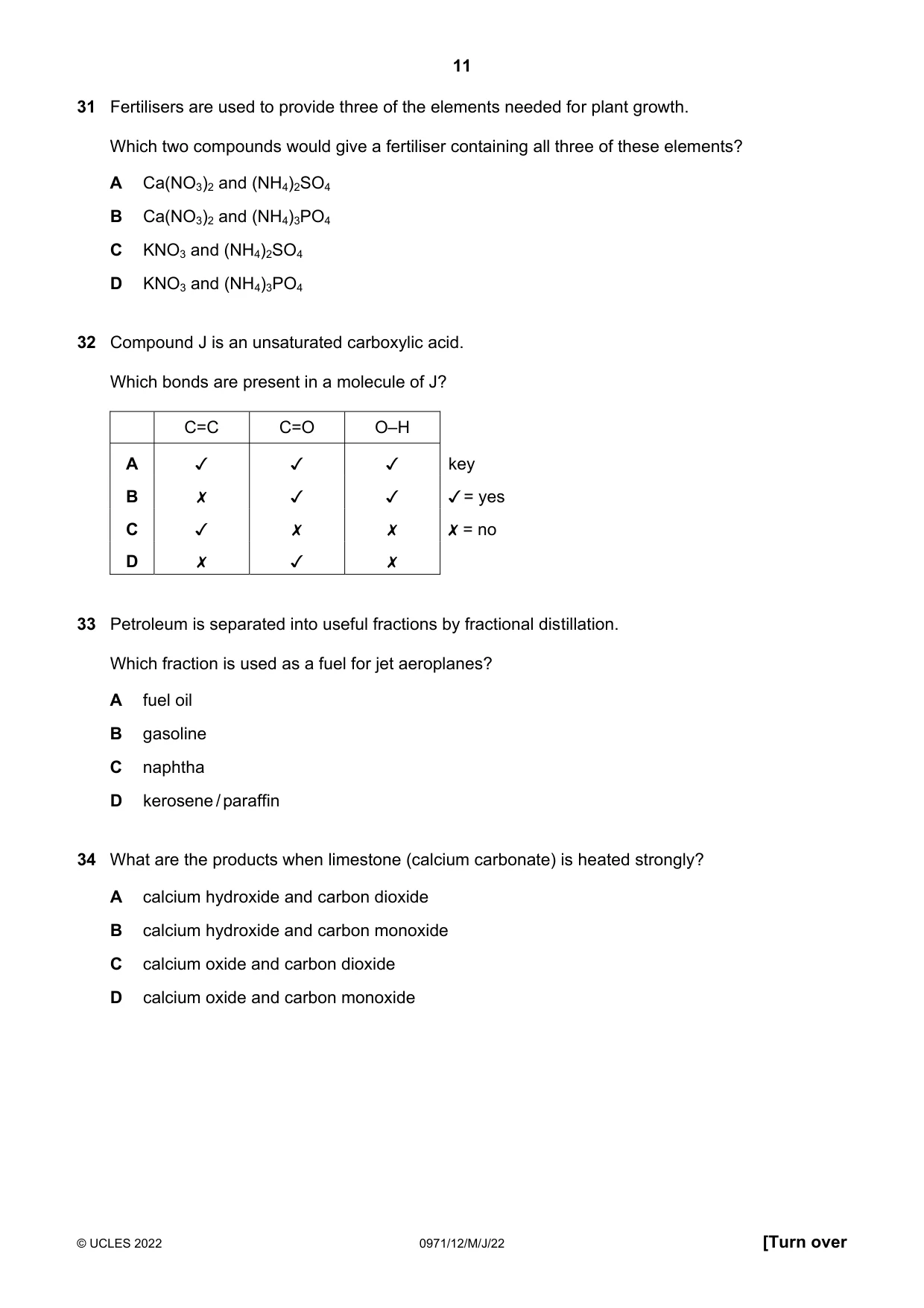
31 Fertilisers are used to provide three of the elements needed for plant growth. Which two compounds would give a fertiliser containing all three of these elements? A Ca(NO3)2 and (NH4)2SO4 B Ca(NO3)2 and (NH4)3PO4 C KNO3 and (NH4)2SO4 D KNO3 and (NH4)3PO4
Mark scheme: D
Q32 · Compound J is an unsaturated carboxylic acid
32 Compound J is an unsaturated carboxylic acid. Which bonds are present in a molecule of J? C=C C=O O-H A v v v B x v v Cc v x x D x v x key /=yes X =no
Mark scheme: A
More questions on Formulae, functional groups and terminology
Q33 · Petroleum is separated into useful fractions by fractional distillation
33 Petroleum is separated into useful fractions by fractional distillation. Which fraction is used as a fuel for jet aeroplanes? A fuel oil B gasoline C naphtha D kerosene / paraffin
Mark scheme: D
Q34 · What are the products when limestone (calcium carbonate) is heated strongly?
34 What are the products when limestone (calcium carbonate) is heated strongly? A calcium hydroxide and carbon dioxide B calcium hydroxide and carbon monoxide C calcium oxide and carbon dioxide D calcium oxide and carbon monoxide
Mark scheme: C
Q35 · Ethene reacts with substance X to form ethanol
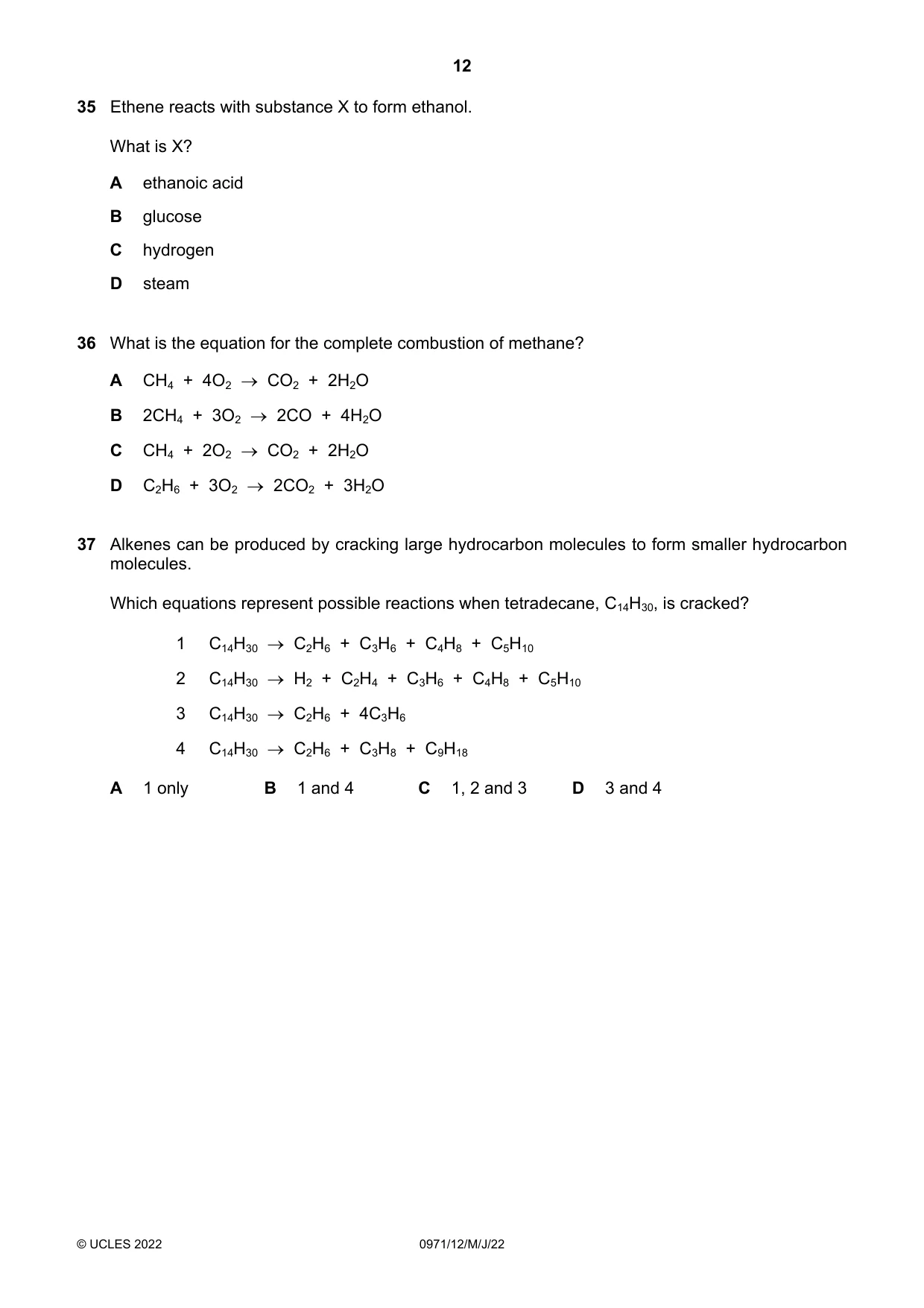
35 Ethene reacts with substance X to form ethanol. What is X? A ethanoic acid B glucose C hydrogen D steam
Mark scheme: D
Q36 · What is the equation for the complete combustion of methane?
36 What is the equation for the complete combustion of methane? A CH4 + 4O2 CO2 + 2H2O B 2CH4 + 3O2 2CO + 4H2O C CH4 + 2O2 CO2 + 2H2O D C2H6 + 3O2 2CO2 + 3H2O
Mark scheme: C
Q37 · Alkenes can be produced by cracking large hydrocarbon molecules to form smaller…
37 Alkenes can be produced by cracking large hydrocarbon molecules to form smaller hydrocarbon molecules. Which equations represent possible reactions when tetradecane, C14H30, is cracked? 1 C14H30 C2H6 + C3H6 + C4H8 + C5H10 2 C14H30 H2 + C2H4 + C3H6 + C4H8 + C5H10 3 C14H30 C2H6 + 4C3H6 4 C14H30 C2H6 + C3H8 + C9H18 A 1 only B 1 and 4 C 1, 2 and 3 D 3 and 4
Mark scheme: C
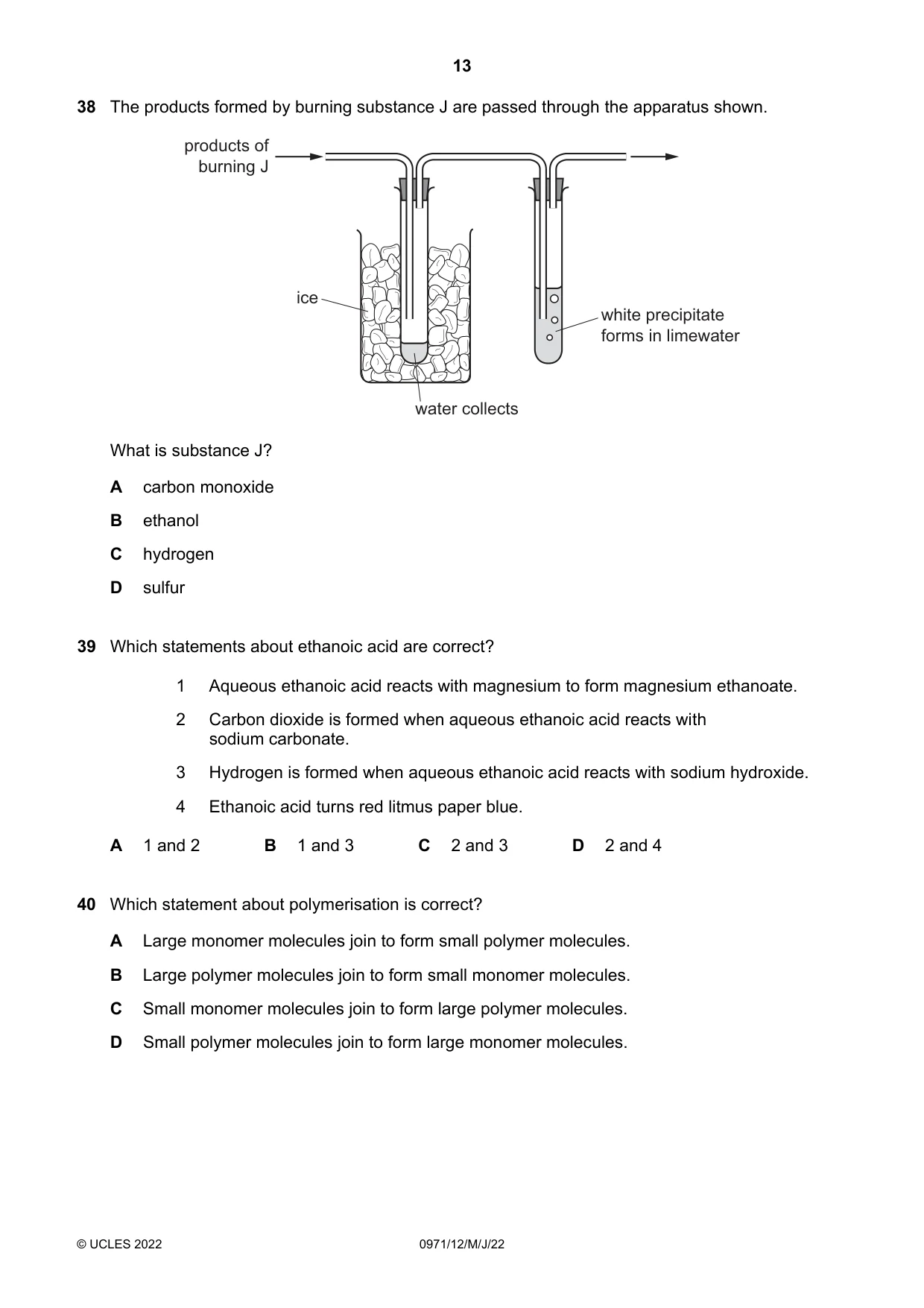
Q38 · The products formed by burning substance J are passed through the apparatus shown
38 The products formed by burning substance J are passed through the apparatus shown. products of burning J ice white precipitate forms in limewater water collects What is substance J? A carbon monoxide B ethanol C hydrogen D sulfur
Mark scheme: B
Q39 · Which statements about ethanoic acid are correct?
39 Which statements about ethanoic acid are correct? 1 Aqueous ethanoic acid reacts with magnesium to form magnesium ethanoate. 2 Carbon dioxide is formed when aqueous ethanoic acid reacts with sodium carbonate. 3 Hydrogen is formed when aqueous ethanoic acid reacts with sodium hydroxide. 4 Ethanoic acid turns red litmus paper blue. A 1 and 2 B 1 and 3 C 2 and 3 D 2 and 4
Mark scheme: A
Q40 · Which statement about polymerisation is correct?
40 Which statement about polymerisation is correct? A Large monomer molecules join to form small polymer molecules. B Large polymer molecules join to form small monomer molecules. C Small monomer molecules join to form large polymer molecules. D Small polymer molecules join to form large monomer molecules.
Mark scheme: C
What was in this paper
The subtopics covered by these 40 questions, and how many questions each got. Open one in a new tab to see every Cambridge question on it.
2Alcohols2Alloys and their properties2Arrangement of elements2Exothermic and endothermic reactions2Oxides2Alkanes1Alkenes1Carboxylic acids1Electrolysis1Experimental design1Extraction of metals1Fertilisers1Formulae, functional groups and terminology1Fuels1Giant covalent structures1Group I properties1Identification of ions and gases1Ions and ionic bonds1Isotopes1Noble gases1Physical and chemical changes1Polymers1Preparation of salts1Rate of reaction1Reactivity series1Redox1Relative masses of atoms and molecules1Separation and purification1Simple molecules and covalent bonds1Solids, liquids and gases1The characteristic properties of acids and bases1Transition elements1Uses of metals1What you needed in this session
Cambridge’s own grade thresholds for 2022 May/June, Paper 1 · Variant 2. A higher threshold means an easier paper — the bar moves with how the cohort did.