Cambridge IGCSE Chemistry (9-1) 0971 — 2025 Oct/Nov Paper 1 · Variant 2
0971/12/O/N/25 · 40 questions · 40 marks · 45 min
The question paper and its mark scheme, free to read here and free to download. This is Cambridge’s own paper, exactly as it was sat.
Question paper16 pages


Mark scheme3 pages
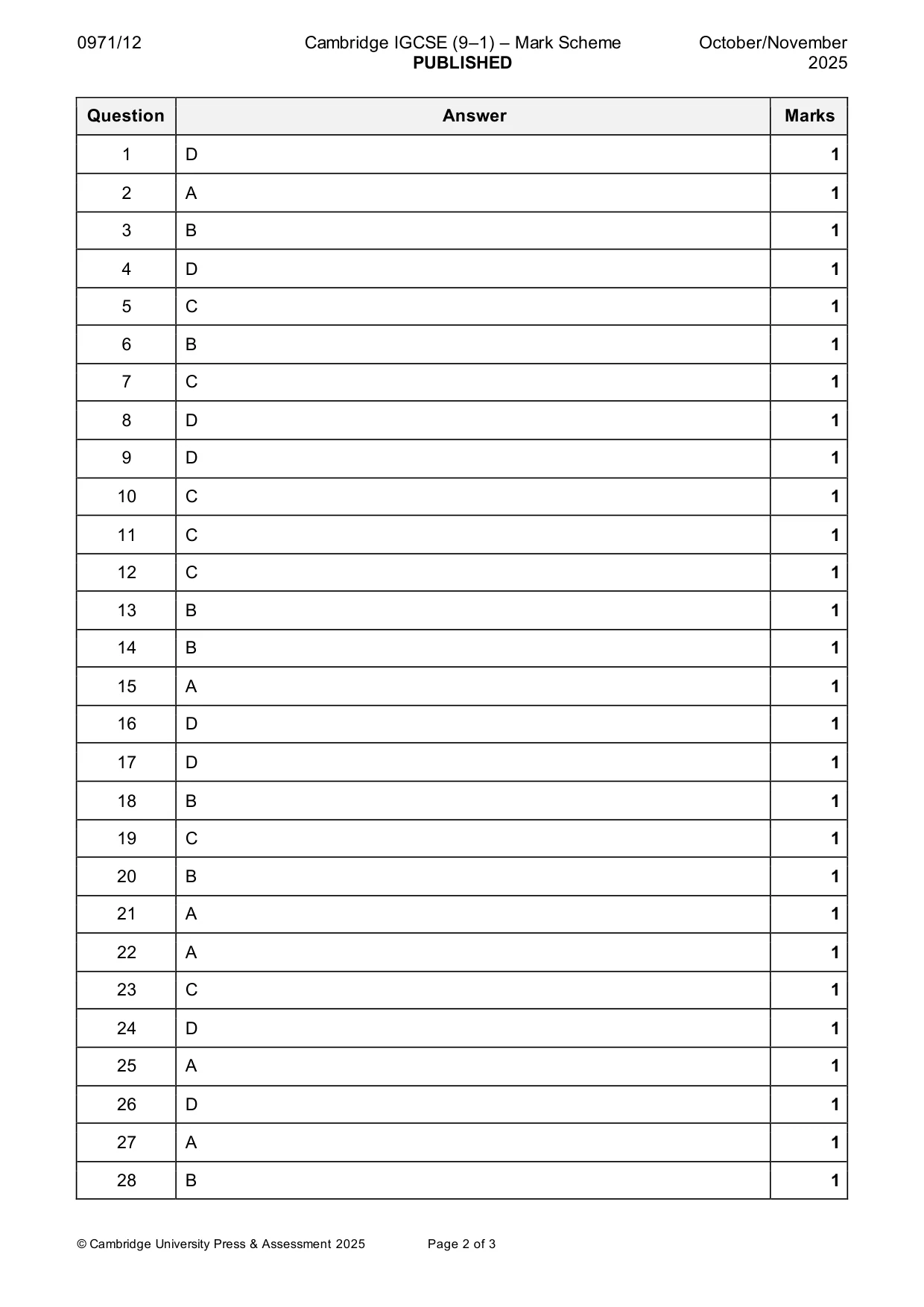
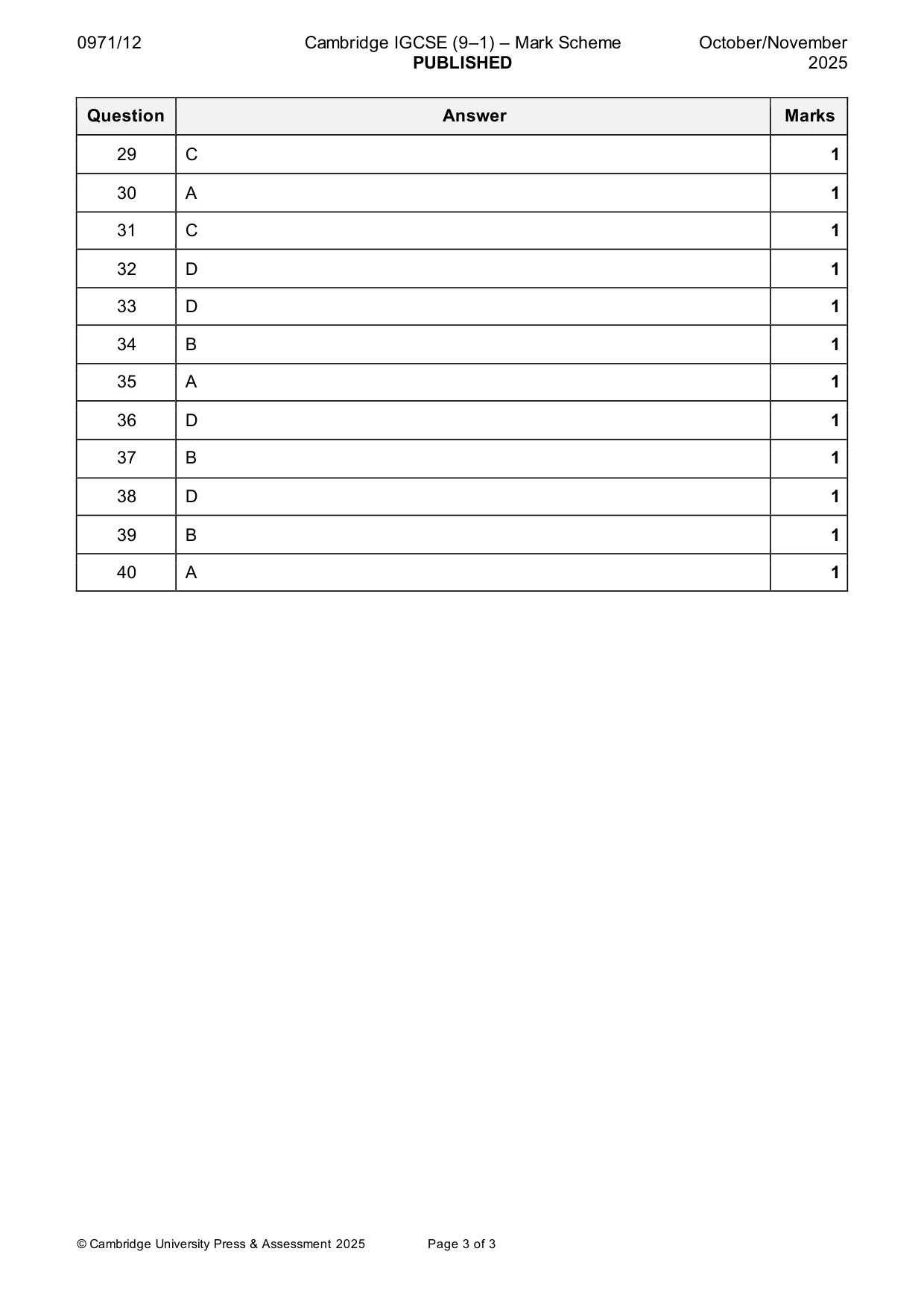
Answers below. Sit the paper first if you are practising.
Questions as text
Q1 · Water exists as solid ice, liquid water and steam
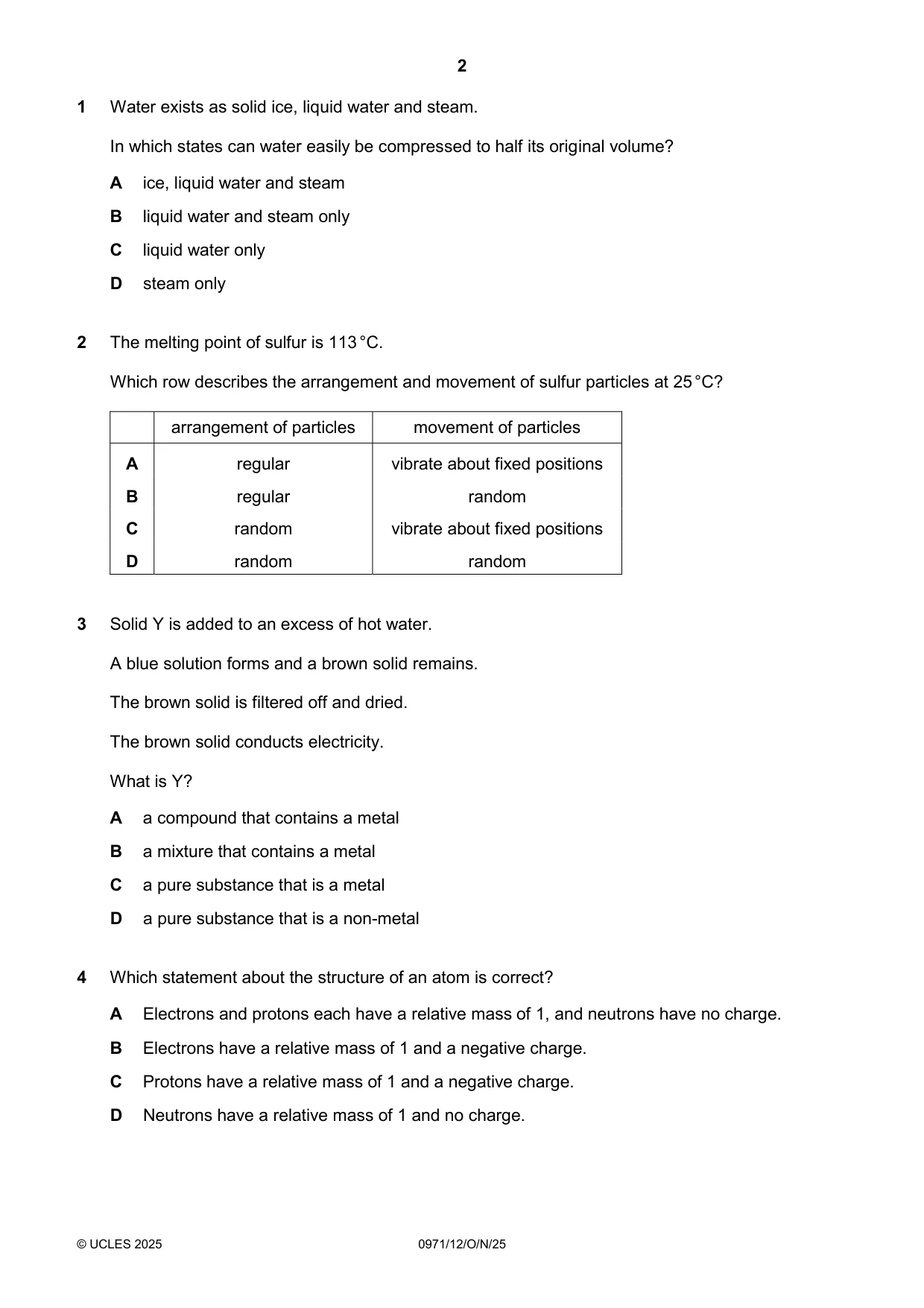
1 Water exists as solid ice, liquid water and steam. In which states can water easily be compressed to half its original volume? A ice, liquid water and steam B liquid water and steam only C liquid water only D steam only
Mark scheme: D
Q2 · The melting point of sulfur is 113 °C
2 The melting point of sulfur is 113 °C. Which row describes the arrangement and movement of sulfur particles at 25 °C? arrangement of particles movement of particles A regular vibrate about fixed positions B regular random C random vibrate about fixed positions D random random
Mark scheme: A
Q3 · Solid Y is added to an excess of hot water
3 Solid Y is added to an excess of hot water. A blue solution forms and a brown solid remains. The brown solid is filtered off and dried. The brown solid conducts electricity. What is Y? A a compound that contains a metal B a mixture that contains a metal C a pure substance that is a metal D a pure substance that is a non-metal
Mark scheme: B
Q4 · Which statement about the structure of an atom is correct?
4 Which statement about the structure of an atom is correct? A Electrons and protons each have a relative mass of 1, and neutrons have no charge. B Electrons have a relative mass of 1 and a negative charge. C Protons have a relative mass of 1 and a negative charge. D Neutrons have a relative mass of 1 and no charge.
Mark scheme: D
Q5 · The diagram shows the electronic configuration of a particle with a nucleon number of 40
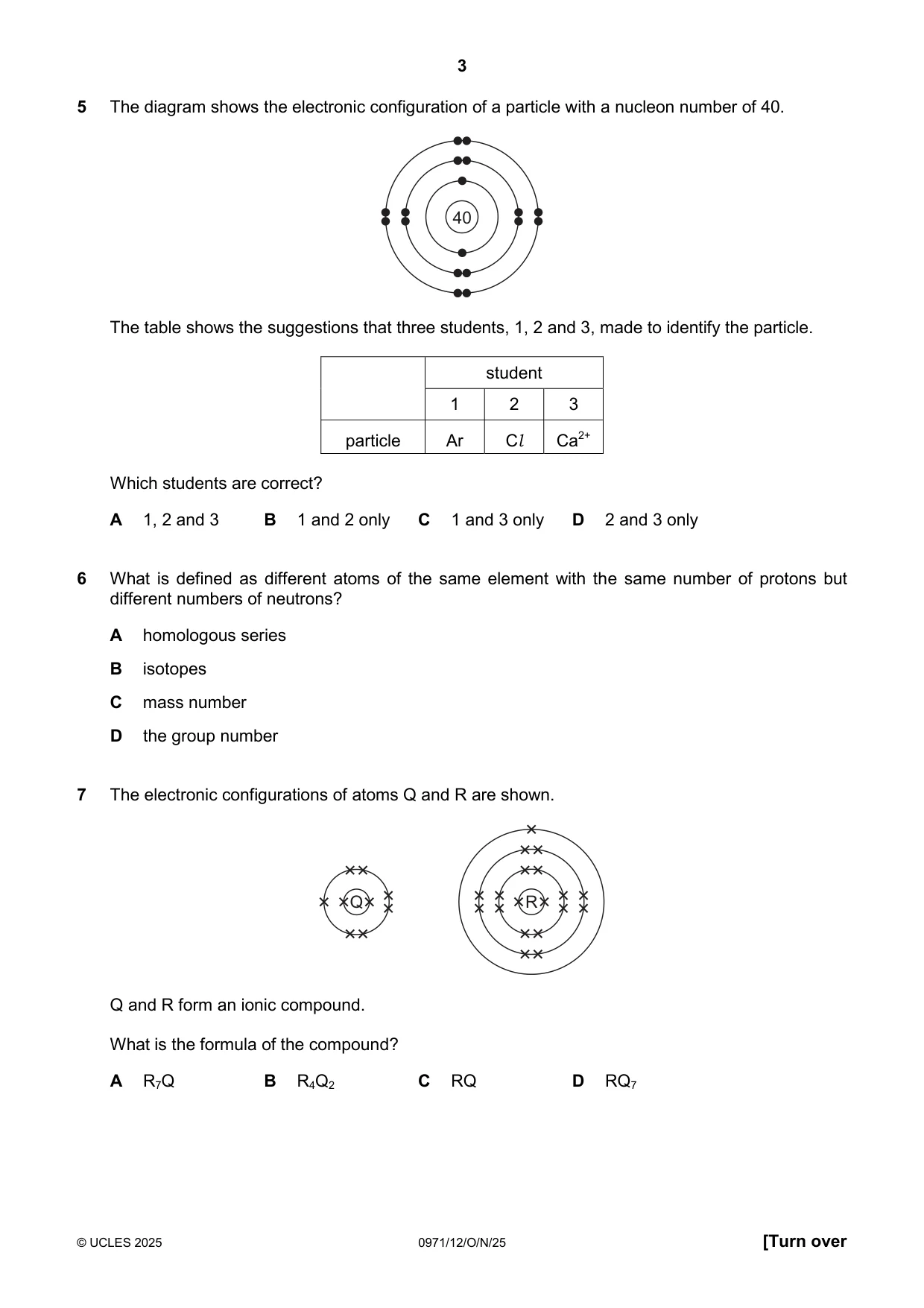
5 The diagram shows the electronic configuration of a particle with a nucleon number of 40. 40 The table shows the suggestions that three students, 1, 2 and 3, made to identify the particle. student 1 2 3 particle Ar Cl Ca2+ Which students are correct? A 1, 2 and 3 B 1 and 2 only C 1 and 3 only D 2 and 3 only
Mark scheme: C
Q6 · What is defined as different atoms of the same element with the same number of protons…
6 What is defined as different atoms of the same element with the same number of protons but different numbers of neutrons? A homologous series B isotopes C mass number D the group number
Mark scheme: B
Q7 · The electronic configurations of atoms Q and R are shown
7 The electronic configurations of atoms Q and R are shown. Q R Q and R form an ionic compound. What is the formula of the compound? A R7Q B R4Q2 C RQ D RQ7
Mark scheme: C
Q8 · Which properties are typical of simple molecules?
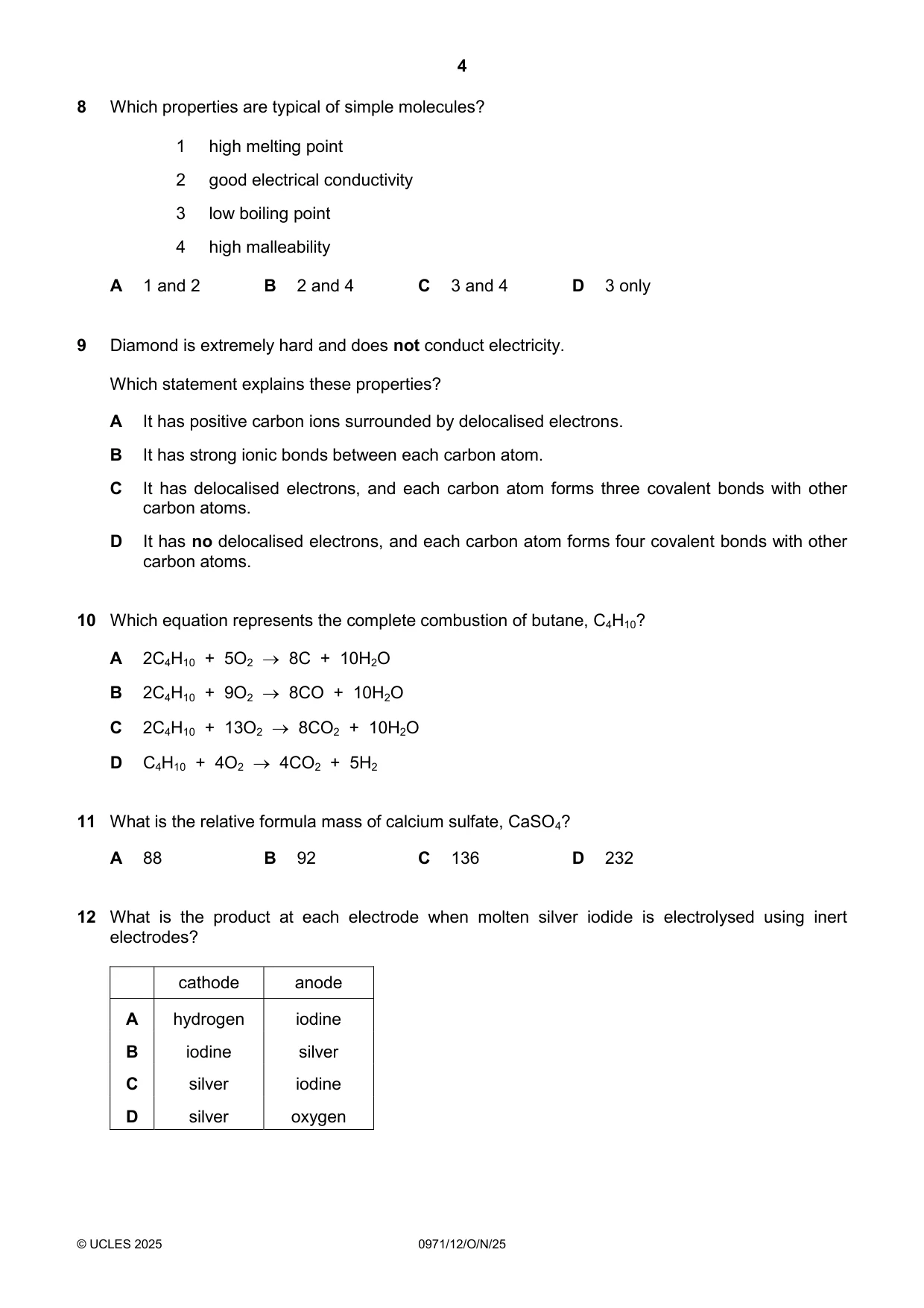
8 Which properties are typical of simple molecules? 1 high melting point 2 good electrical conductivity 3 low boiling point 4 high malleability A 1 and 2 B 2 and 4 C 3 and 4 D 3 only
Mark scheme: D
Q9 · Diamond is extremely hard and does not conduct electricity
9 Diamond is extremely hard and does not conduct electricity. Which statement explains these properties? A It has positive carbon ions surrounded by delocalised electrons. B It has strong ionic bonds between each carbon atom. C It has delocalised electrons, and each carbon atom forms three covalent bonds with other carbon atoms. D It has no delocalised electrons, and each carbon atom forms four covalent bonds with other carbon atoms.
Mark scheme: D
Q10 · Which equation represents the complete combustion of butane, C4H10?
10 Which equation represents the complete combustion of butane, C4H10? A 2C4H10 + 5O2 8C + 10H2O B 2C4H10 + 9O2 8CO + 10H2O C 2C4H10 + 13O2 8CO2 + 10H2O D C4H10 + 4O2 4CO2 + 5H2
Mark scheme: C
Q11 · What is the relative formula mass of calcium sulfate, CaSO4?
11 What is the relative formula mass of calcium sulfate, CaSO4? A 88 B 92 C 136 D 232
Mark scheme: C
Q12 · What is the product at each electrode when molten silver iodide is electrolysed using…
12 What is the product at each electrode when molten silver iodide is electrolysed using inert electrodes? cathode anode A hydrogen iodine B iodine silver C silver iodine D silver oxygen
Mark scheme: C
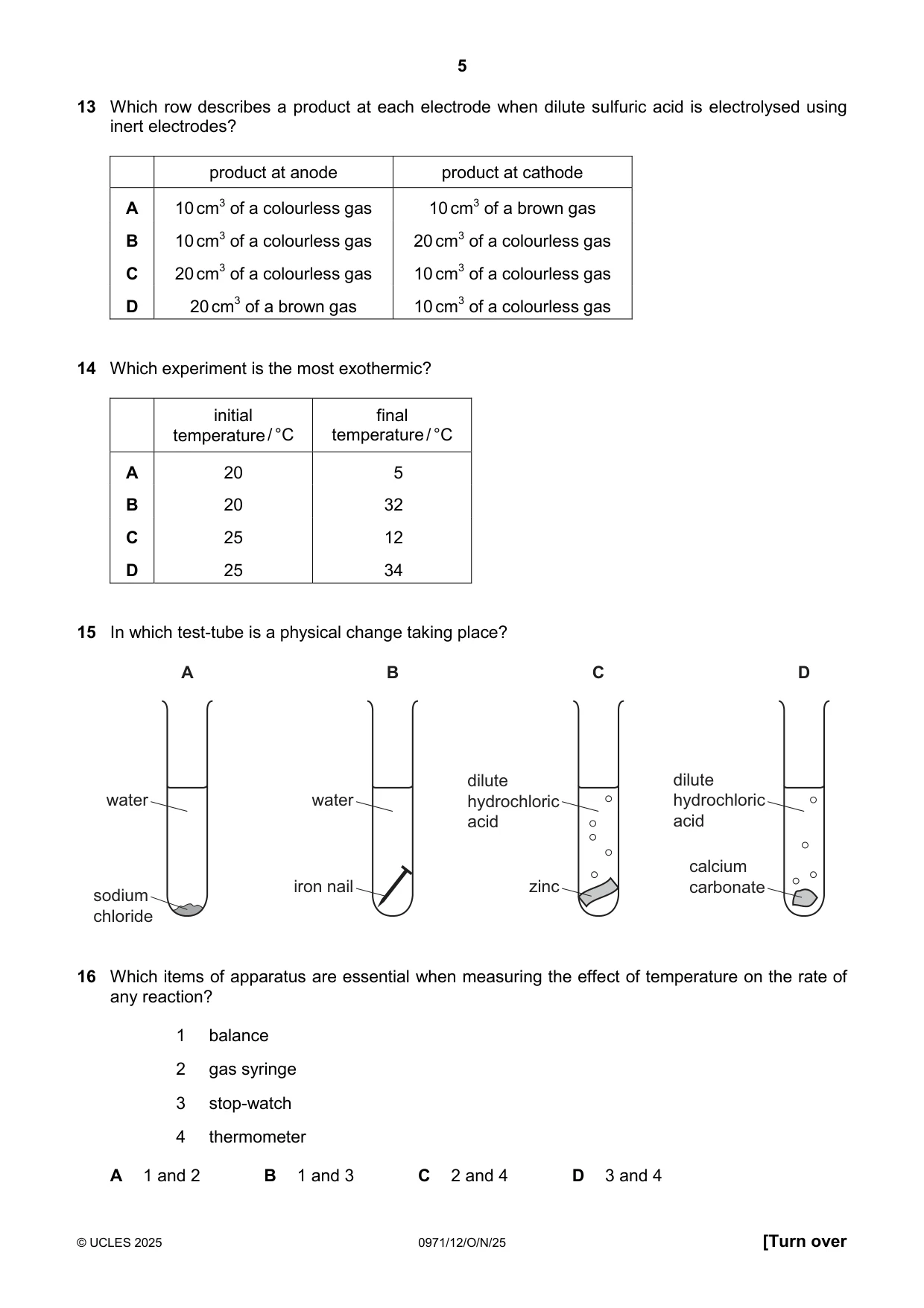
Q13 · Which row describes a product at each electrode when dilute sulfuric acid is electrolysed…
13 Which row describes a product at each electrode when dilute sulfuric acid is electrolysed using inert electrodes? product at anode product at cathode A 10 cm3 of a colourless gas 10 cm3 of a brown gas B 10 cm3 of a colourless gas 20 cm3 of a colourless gas C 20 cm3 of a colourless gas 10 cm3 of a colourless gas D 20 cm3 of a brown gas 10 cm3 of a colourless gas
Mark scheme: B
Q14 · Which experiment is the most exothermic?
14 Which experiment is the most exothermic? initial final temperature / °C temperature / °C A 20 5 B 20 32 C 25 12 D 25 34
Mark scheme: B
Q15 · In which test-tube is a physical change taking place?
15 In which test-tube is a physical change taking place? A B C D dilute dilute water water hydrochloric hydrochloric acid acid calcium iron nail zinc carbonate sodium chloride
Mark scheme: A
Q16 · Which items of apparatus are essential when measuring the effect of temperature on the…
16 Which items of apparatus are essential when measuring the effect of temperature on the rate of any reaction? 1 balance 2 gas syringe 3 stop-watch 4 thermometer A 1 and 2 B 1 and 3 C 2 and 4 D 3 and 4
Mark scheme: D
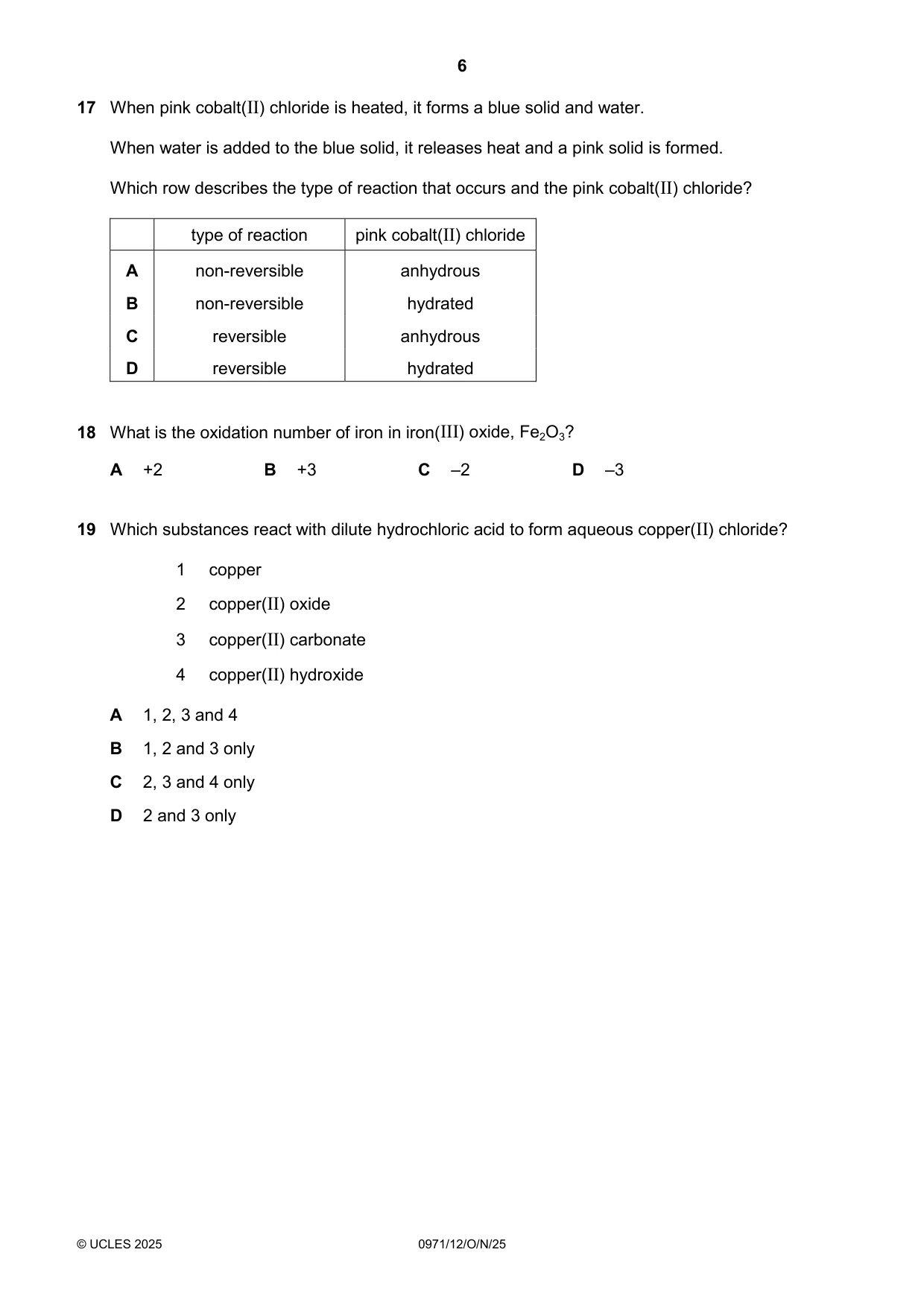
Q17 · When pink cobalt(II) chloride is heated, it forms a blue solid and water
17 When pink cobalt(II) chloride is heated, it forms a blue solid and water. When water is added to the blue solid, it releases heat and a pink solid is formed. Which row describes the type of reaction that occurs and the pink cobalt(II) chloride? type of reaction pink cobalt(II) chloride A non-reversible anhydrous B non-reversible hydrated C reversible anhydrous D reversible hydrated
Mark scheme: D
Q18 · What is the oxidation number of iron in iron(III) oxide, Fe2O3?
18 What is the oxidation number of iron in iron(III) oxide, Fe2O3? A +2 B +3 C –2 D –3
Mark scheme: B
Q19 · Which substances react with dilute hydrochloric acid to form aqueous copper(II) chloride?
19 Which substances react with dilute hydrochloric acid to form aqueous copper(II) chloride? 1 copper 2 copper(II) oxide 3 copper(II) carbonate 4 copper(II) hydroxide A 1, 2, 3 and 4 B 1, 2 and 3 only C 2, 3 and 4 only D 2 and 3 only
Mark scheme: C
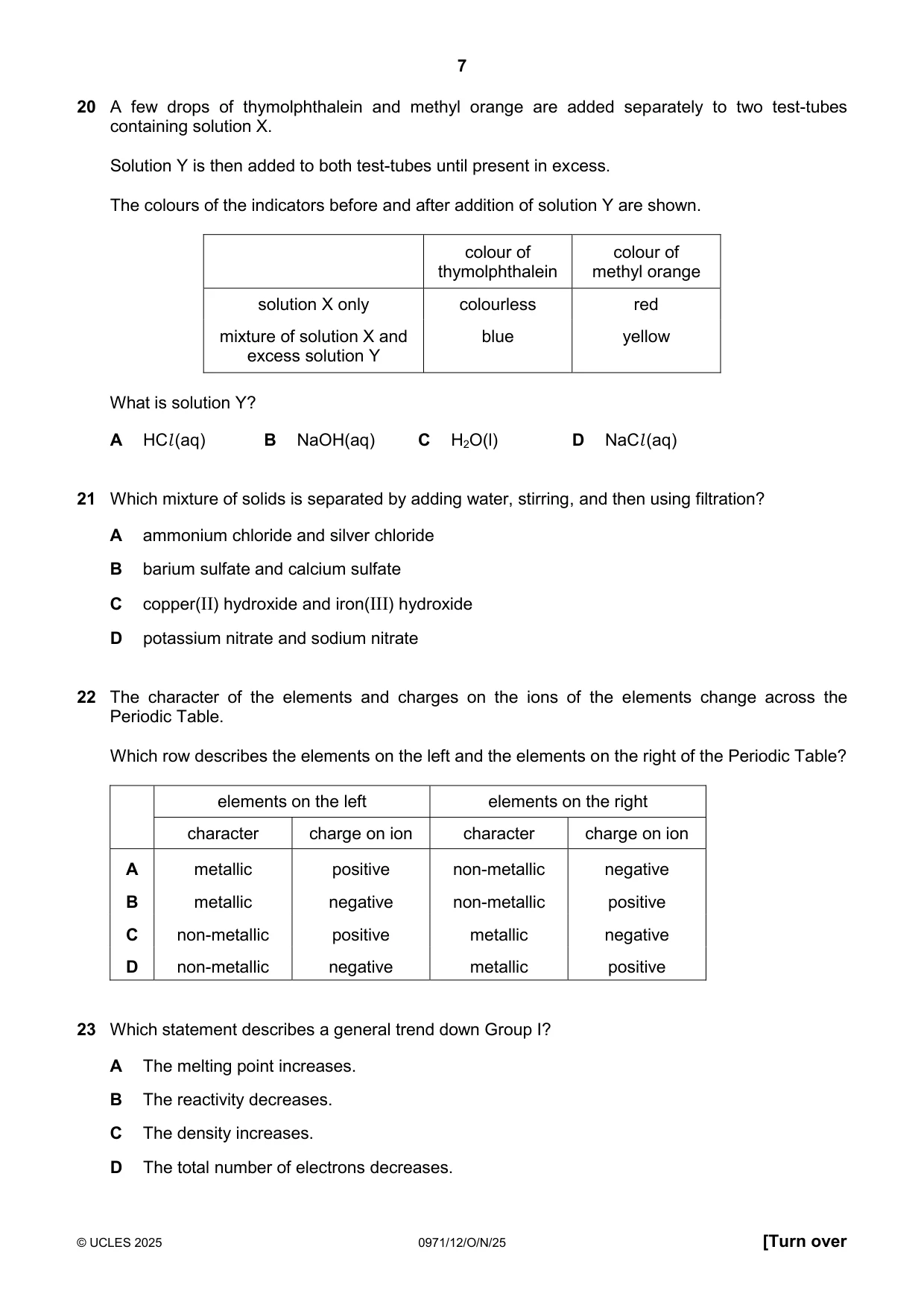
Q20 · A few drops of thymolphthalein and methyl orange are added separately to two test-tubes…
20 A few drops of thymolphthalein and methyl orange are added separately to two test-tubes containing solution X. Solution Y is then added to both test-tubes until present in excess. The colours of the indicators before and after addition of solution Y are shown. colour of colour of thymolphthalein methyl orange solution X only colourless red mixture of solution X and blue yellow excess solution Y What is solution Y? A HCl (aq) B NaOH(aq) C H2O(l) D NaCl (aq)
Mark scheme: B
More questions on The characteristic properties of acids and bases
Q21 · Which mixture of solids is separated by adding water, stirring, and then using filtration?
21 Which mixture of solids is separated by adding water, stirring, and then using filtration? A ammonium chloride and silver chloride B barium sulfate and calcium sulfate C copper(II) hydroxide and iron(III) hydroxide D potassium nitrate and sodium nitrate
Mark scheme: A
Q22 · The character of the elements and charges on the ions of the elements change across the…
22 The character of the elements and charges on the ions of the elements change across the Periodic Table. Which row describes the elements on the left and the elements on the right of the Periodic Table? elements on the left elements on the right character charge on ion character charge on ion A metallic positive non-metallic negative B metallic negative non-metallic positive C non-metallic positive metallic negative D non-metallic negative metallic positive
Mark scheme: A
Q23 · Which statement describes a general trend down Group I?
23 Which statement describes a general trend down Group I? A The melting point increases. B The reactivity decreases. C The density increases. D The total number of electrons decreases.
Mark scheme: C
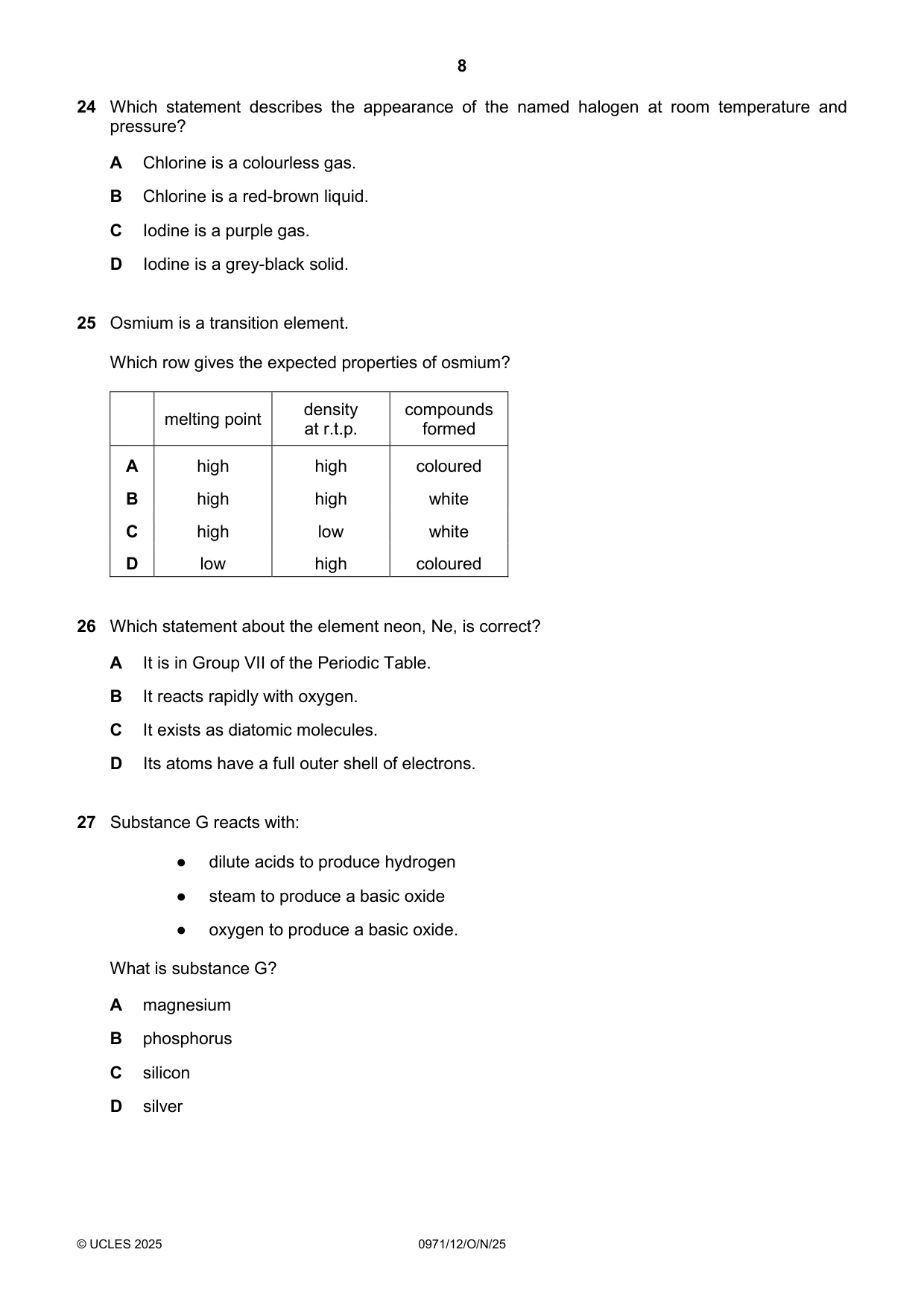
Q24 · Which statement describes the appearance of the named halogen at room temperature and…
24 Which statement describes the appearance of the named halogen at room temperature and pressure? A Chlorine is a colourless gas. B Chlorine is a red-brown liquid. C Iodine is a purple gas. D Iodine is a grey-black solid.
Mark scheme: D
Q25 · Osmium is a transition element
25 Osmium is a transition element. Which row gives the expected properties of osmium? density compounds melting point at r.t.p. formed A high high coloured B high high white C high low white D low high coloured
Mark scheme: A
Q26 · Which statement about the element neon, Ne, is correct?
26 Which statement about the element neon, Ne, is correct? A It is in Group VII of the Periodic Table. B It reacts rapidly with oxygen. C It exists as diatomic molecules. D Its atoms have a full outer shell of electrons.
Mark scheme: D
Q27 · Substance G reacts with: ● dilute acids to produce hydrogen ● steam to produce a basic…
27 Substance G reacts with: ● dilute acids to produce hydrogen ● steam to produce a basic oxide ● oxygen to produce a basic oxide. What is substance G? A magnesium B phosphorus C silicon D silver
Mark scheme: A
Q28 · Which row describes two properties and a use of the named metal?
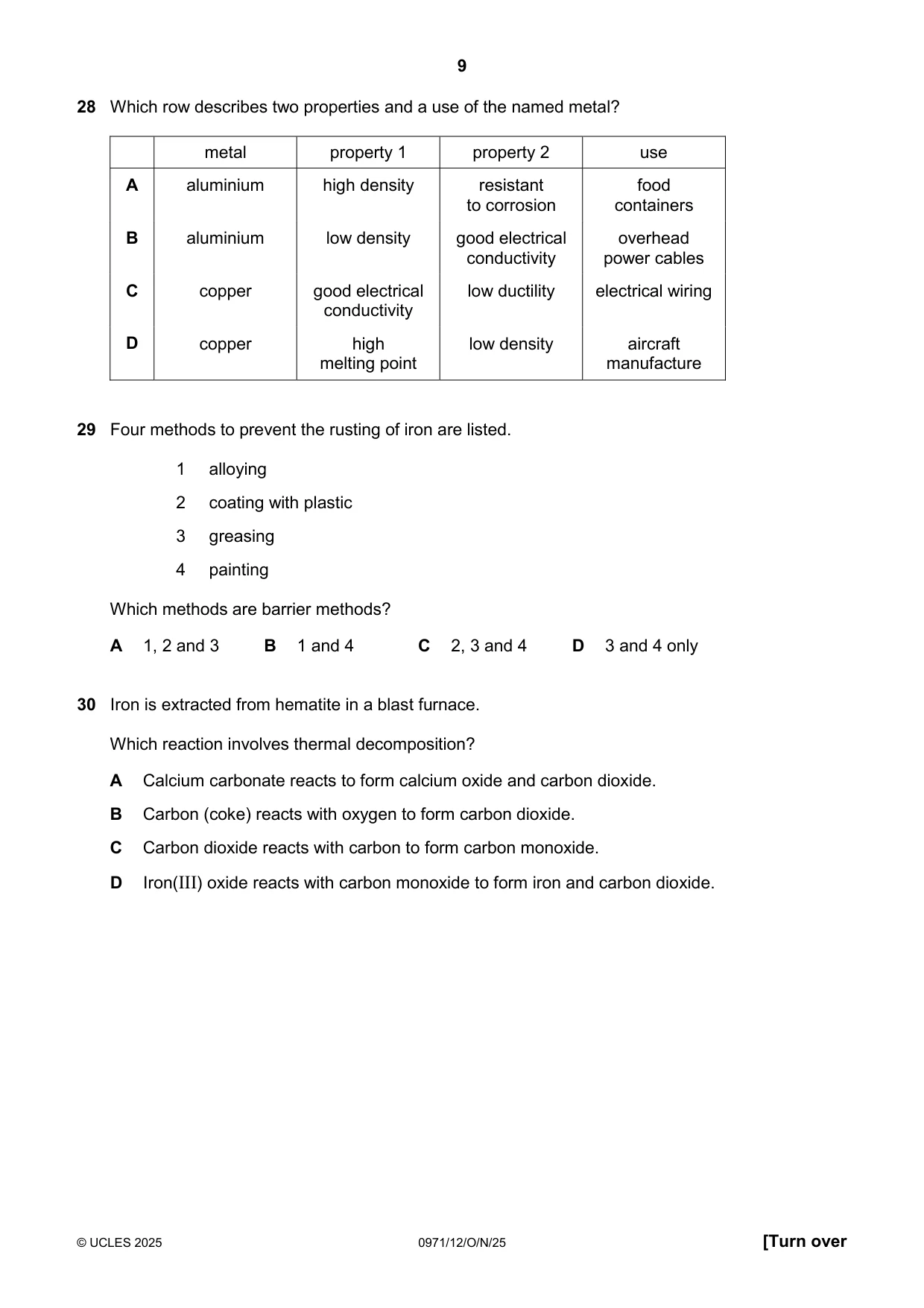
28 Which row describes two properties and a use of the named metal? metal property 1 property 2 use A aluminium high density resistant food to corrosion containers B aluminium low density good electrical overhead conductivity power cables C copper good electrical low ductility electrical wiring conductivity D copper high low density aircraft melting point manufacture
Mark scheme: B
Q29 · Four methods to prevent the rusting of iron are listed
29 Four methods to prevent the rusting of iron are listed. 1 alloying 2 coating with plastic 3 greasing 4 painting Which methods are barrier methods? A 1, 2 and 3 B 1 and 4 C 2, 3 and 4 D 3 and 4 only
Mark scheme: C
Q30 · Iron is extracted from hematite in a blast furnace
30 Iron is extracted from hematite in a blast furnace. Which reaction involves thermal decomposition? A Calcium carbonate reacts to form calcium oxide and carbon dioxide. B Carbon (coke) reacts with oxygen to form carbon dioxide. C Carbon dioxide reacts with carbon to form carbon monoxide. D Iron(III) oxide reacts with carbon monoxide to form iron and carbon dioxide.
Mark scheme: A
Q31 · Clean, dry air contains nitrogen, oxygen and small amounts of other gases
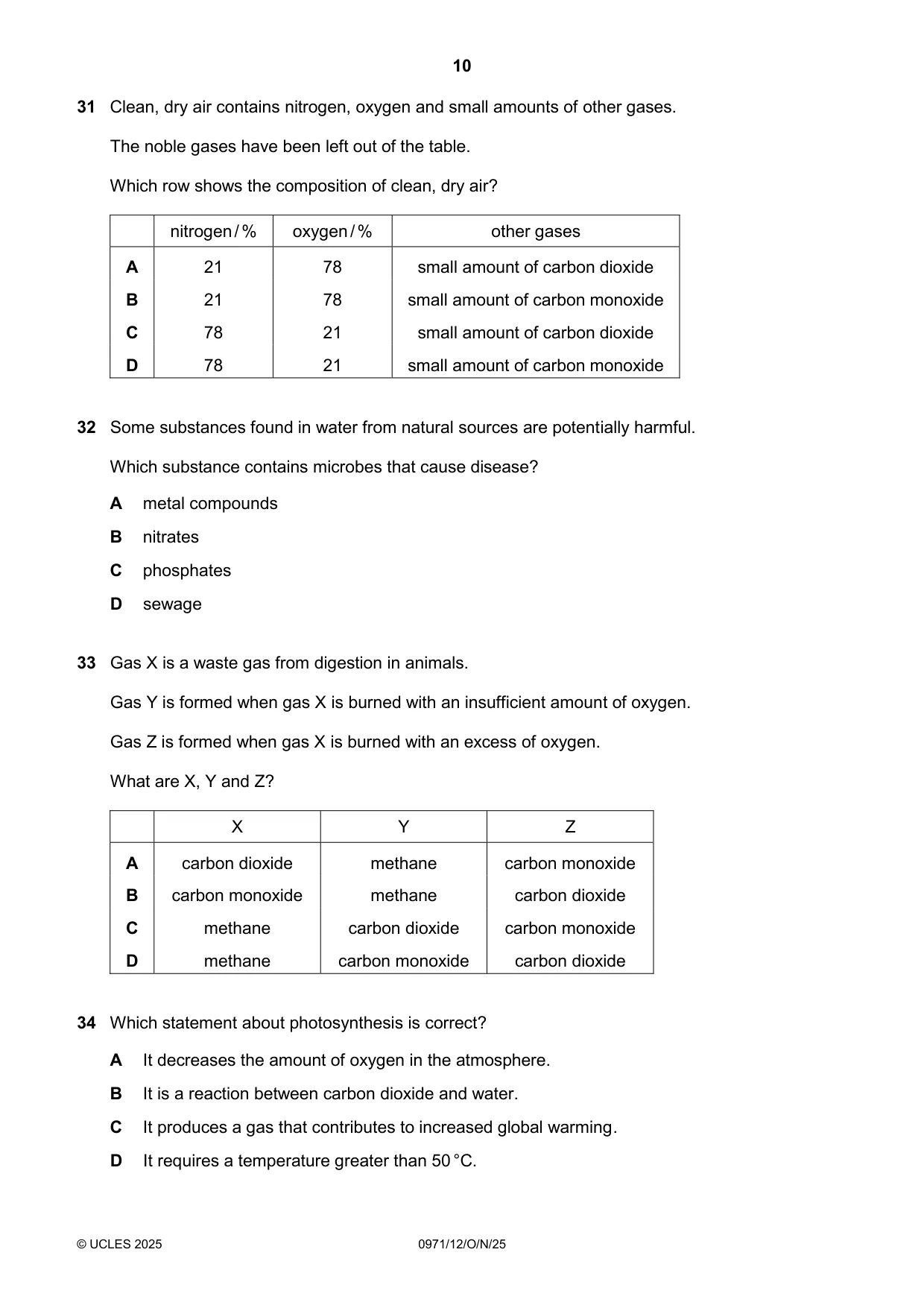
31 Clean, dry air contains nitrogen, oxygen and small amounts of other gases. The noble gases have been left out of the table. Which row shows the composition of clean, dry air? nitrogen / % oxygen / % other gases A 21 78 small amount of carbon dioxide B 21 78 small amount of carbon monoxide C 78 21 small amount of carbon dioxide D 78 21 small amount of carbon monoxide
Mark scheme: C
Q32 · Some substances found in water from natural sources are potentially harmful
32 Some substances found in water from natural sources are potentially harmful. Which substance contains microbes that cause disease? A metal compounds B nitrates C phosphates D sewage
Mark scheme: D
Q33 · Gas X is a waste gas from digestion in animals
33 Gas X is a waste gas from digestion in animals. Gas Y is formed when gas X is burned with an insufficient amount of oxygen. Gas Z is formed when gas X is burned with an excess of oxygen. What are X, Y and Z? X Y Z A carbon dioxide methane carbon monoxide B carbon monoxide methane carbon dioxide C methane carbon dioxide carbon monoxide D methane carbon monoxide carbon dioxide
Mark scheme: D
Q34 · Which statement about photosynthesis is correct?
34 Which statement about photosynthesis is correct? A It decreases the amount of oxygen in the atmosphere. B It is a reaction between carbon dioxide and water. C It produces a gas that contributes to increased global warming. D It requires a temperature greater than 50 °C.
Mark scheme: B
Q35 · L and M are different homologous series
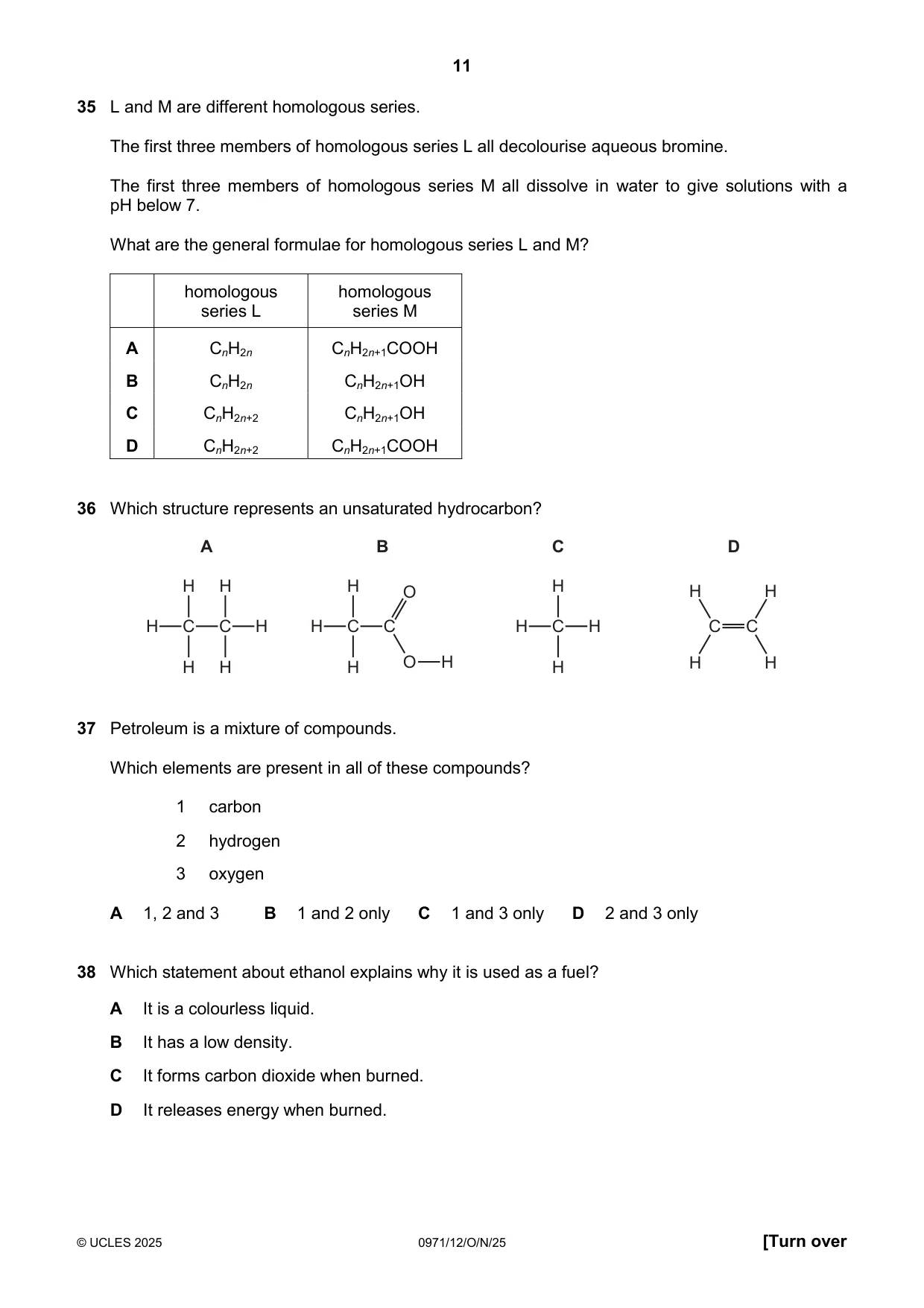
35 L and M are different homologous series. The first three members of homologous series L all decolourise aqueous bromine. The first three members of homologous series M all dissolve in water to give solutions with a pH below 7. What are the general formulae for homologous series L and M? homologous homologous series L series M A CnH2n CnH2n+1COOH B CnH2n CnH2n+1OH C CnH2n+2 CnH2n+1OH D CnH2n+2 CnH2n+1COOH
Mark scheme: A
More questions on Formulae, functional groups and terminology
Q36 · Which structure represents an unsaturated hydrocarbon?
36 Which structure represents an unsaturated hydrocarbon? A B C D H H H O H H H H C C H H C C H C H C C H H H O H H H H
Mark scheme: D
Q37 · Petroleum is a mixture of compounds
37 Petroleum is a mixture of compounds. Which elements are present in all of these compounds? 1 carbon 2 hydrogen 3 oxygen A 1, 2 and 3 B 1 and 2 only C 1 and 3 only D 2 and 3 only
Mark scheme: B
Q38 · Which statement about ethanol explains why it is used as a fuel?
38 Which statement about ethanol explains why it is used as a fuel? A It is a colourless liquid. B It has a low density. C It forms carbon dioxide when burned. D It releases energy when burned.
Mark scheme: D
Q39 · The table shows the observations of two tests on an aqueous solution of a solid
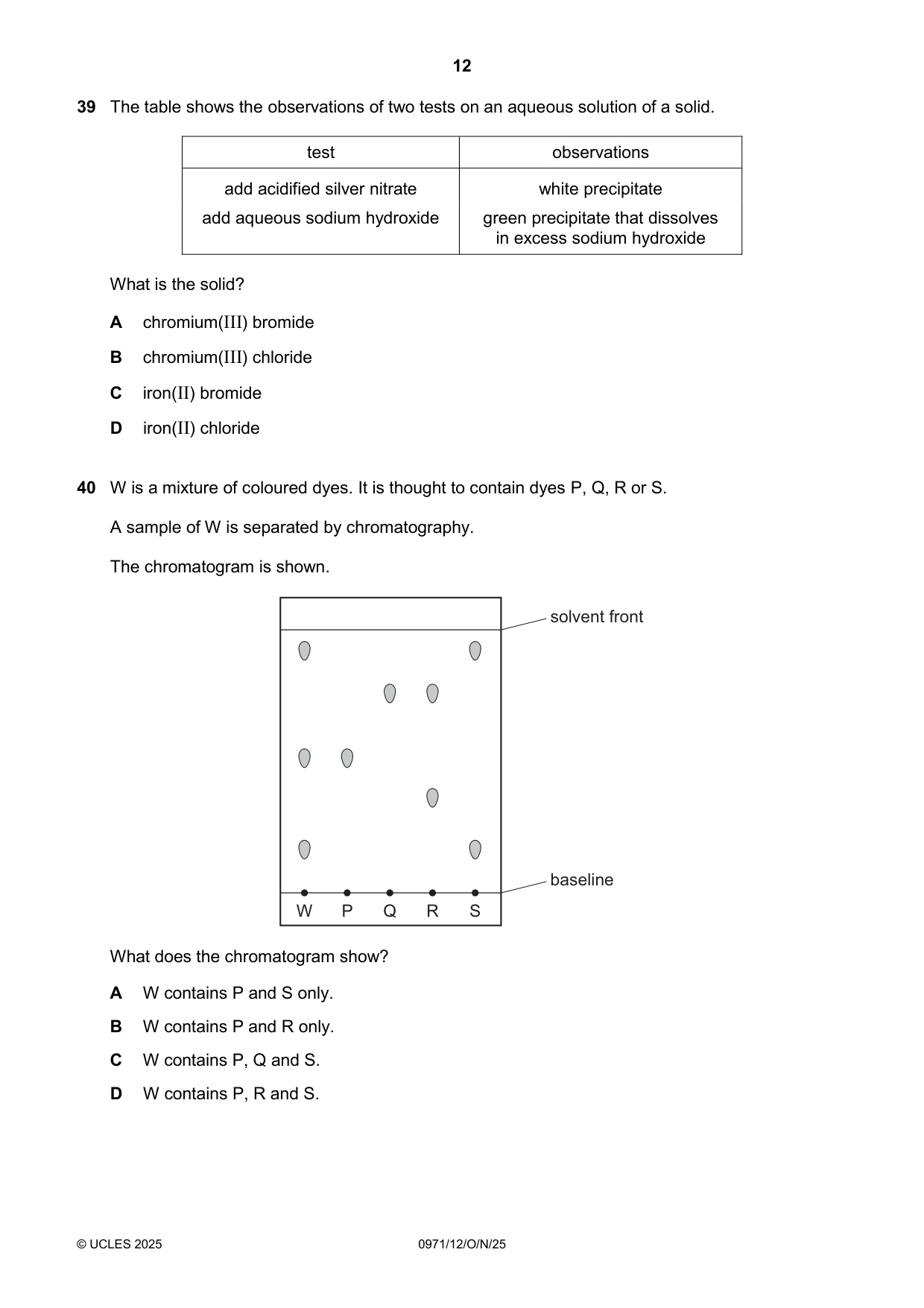
39 The table shows the observations of two tests on an aqueous solution of a solid. test observations add acidified silver nitrate white precipitate add aqueous sodium hydroxide green precipitate that dissolves in excess sodium hydroxide What is the solid? A chromium(III) bromide B chromium(III) chloride C iron(II) bromide D iron(II) chloride
Mark scheme: B
Q40 · W is a mixture of coloured dyes
40 W is a mixture of coloured dyes. It is thought to contain dyes P, Q, R or S. A sample of W is separated by chromatography. The chromatogram is shown. solvent front baseline W P Q R S What does the chromatogram show? A W contains P and S only. B W contains P and R only. C W contains P, Q and S. D W contains P, R and S.
Mark scheme: A
What was in this paper
The subtopics covered by these 40 questions, and how many questions each got. Open one in a new tab to see every Cambridge question on it.
3Fuels3Atomic structure and the Periodic Table2Electrolysis2Solids, liquids and gases2Alkenes1Arrangement of elements1Chromatography1Corrosion of metals1Elements, compounds and mixtures1Exothermic and endothermic reactions1Extraction of metals1Formulae, functional groups and terminology1Giant covalent structures1Group I properties1Group VII properties1Identification of ions and gases1Ions and ionic bonds1Isotopes1Noble gases1Physical and chemical changes1Preparation of salts1Rate of reaction1Reactivity series1Redox1Relative masses of atoms and molecules1Reversible reactions and equilibrium1Separation and purification1Simple molecules and covalent bonds1The characteristic properties of acids and bases1Transition elements1Uses of metals1Water1What you needed in this session
Cambridge’s own grade thresholds for 2025 Oct/Nov, Paper 1 · Variant 2. A higher threshold means an easier paper — the bar moves with how the cohort did.