Cambridge IGCSE Chemistry (9-1) 0971 — 2020 May/June Paper 1 · Variant 1
0971/11/M/J/20 · 40 questions · 40 marks · ≈45 min
The question paper and its mark scheme, free to read here and free to download. This is Cambridge’s own paper, exactly as it was sat.
Question paper16 pages
Mark scheme3 pages
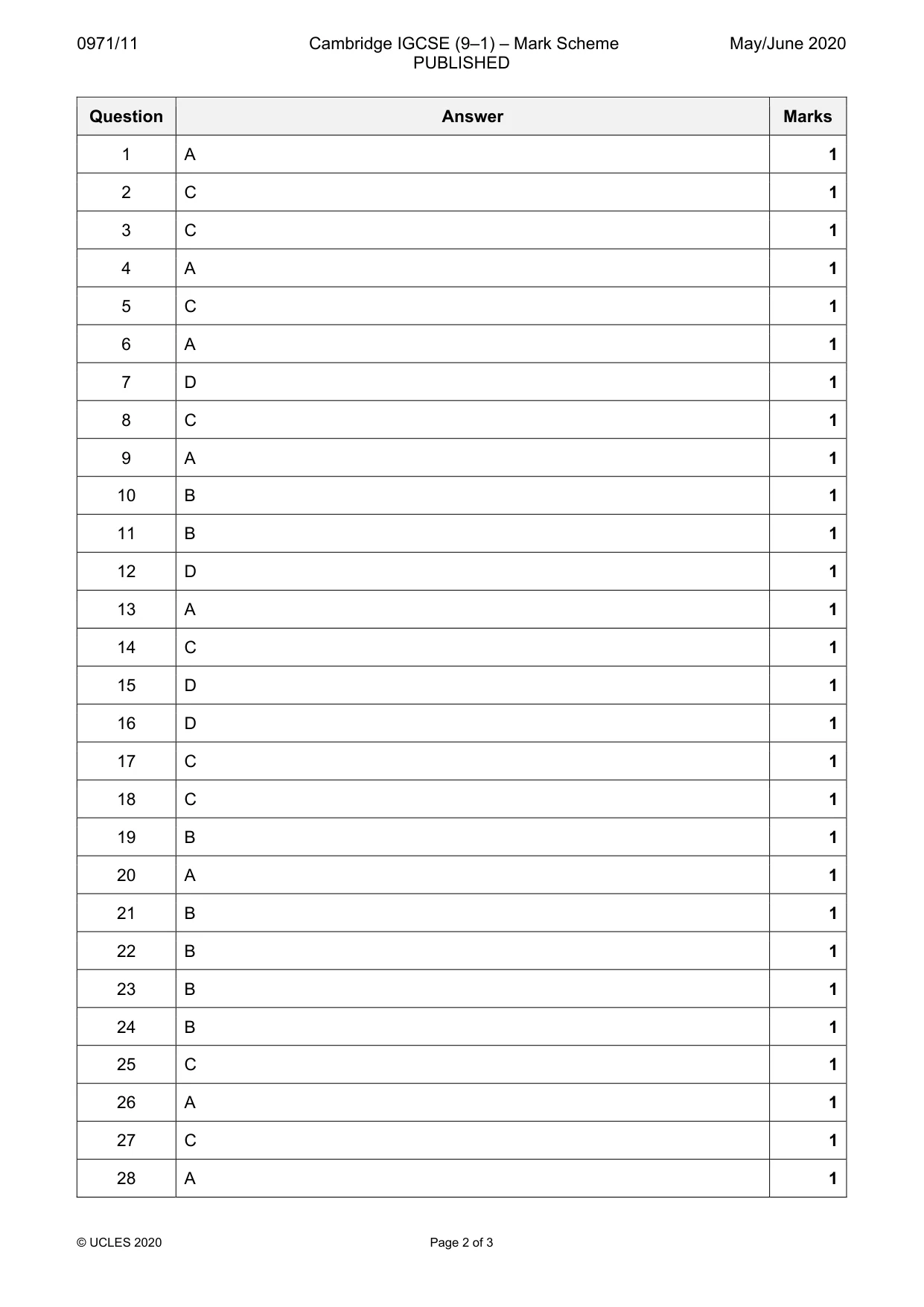
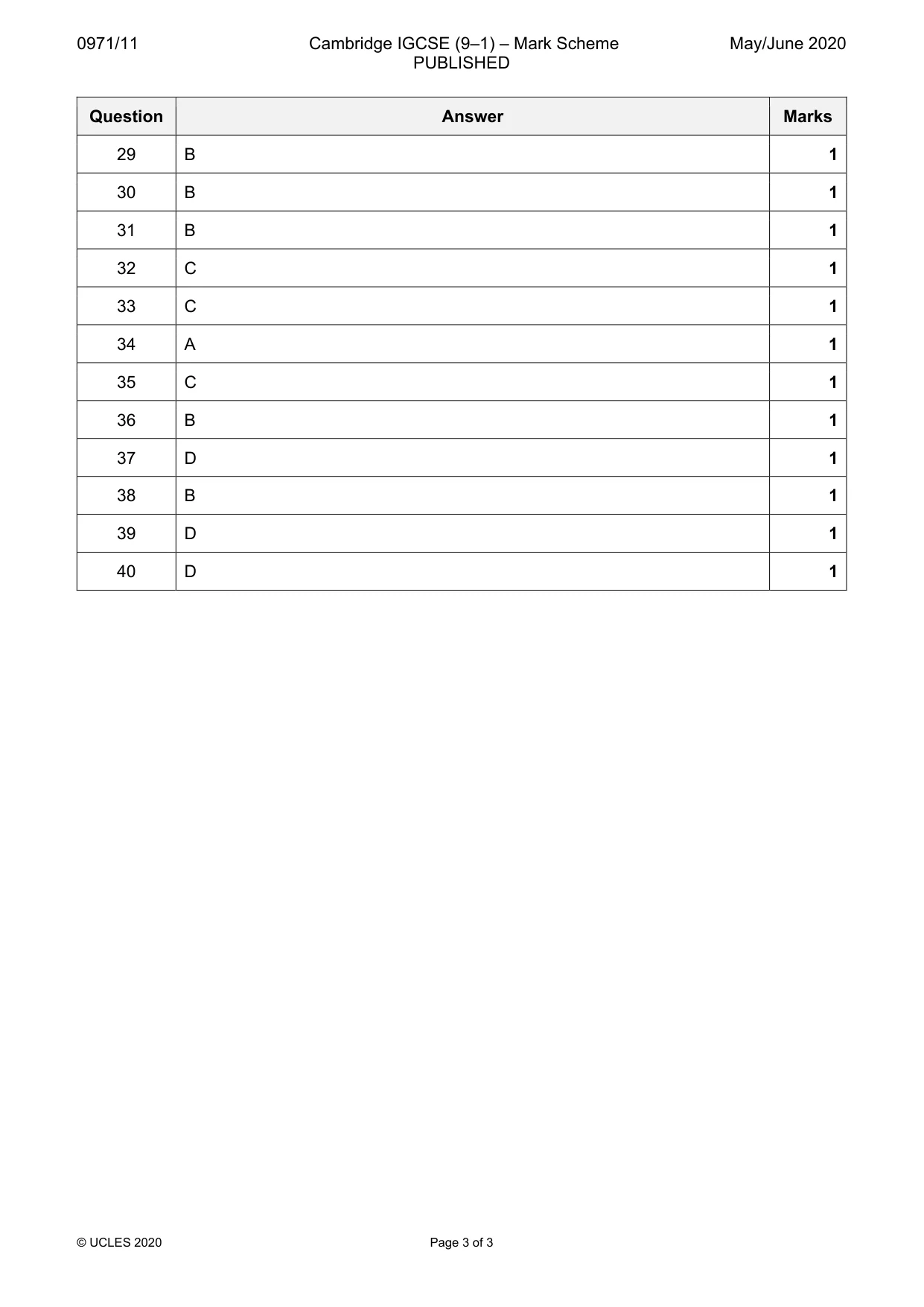
Answers below. Sit the paper first if you are practising.
Questions as text
Q1 · Nitrogen is heated in a balloon, which expands slightly
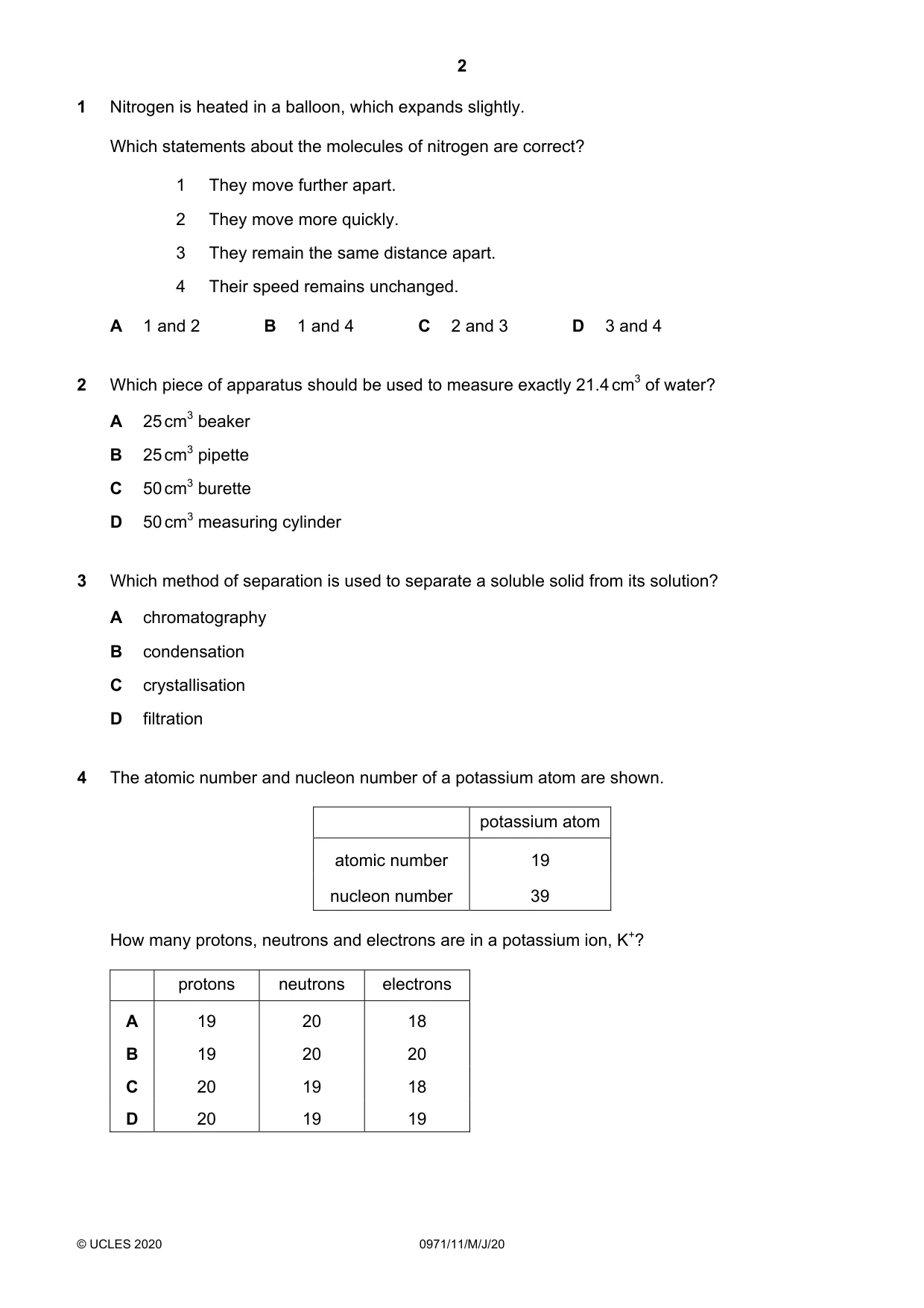
1 Nitrogen is heated in a balloon, which expands slightly. Which statements about the molecules of nitrogen are correct? 1 They move further apart. 2 They move more quickly. 3 They remain the same distance apart. 4 Their speed remains unchanged. A 1 and 2 B 1 and 4 C 2 and 3 D 3 and 4
Mark scheme: A
Q2 · Which piece of apparatus should be used to measure exactly 21.4 cm3 of water?
2 Which piece of apparatus should be used to measure exactly 21.4 cm3 of water? A 25 cm3 beaker B 25 cm3 pipette C 50 cm3 burette D 50 cm3 measuring cylinder
Mark scheme: C
Q3 · Which method of separation is used to separate a soluble solid from its solution?
3 Which method of separation is used to separate a soluble solid from its solution? A chromatography B condensation C crystallisation D filtration
Mark scheme: C
Q4 · The atomic number and nucleon number of a potassium atom are shown
4 The atomic number and nucleon number of a potassium atom are shown. potassium atom atomic number 19 nucleon number 39 How many protons, neutrons and electrons are in a potassium ion, K+? protons neutrons electrons A 19 20 18 B 19 20 20 C 20 19 18 D 20 19 19
Mark scheme: A
Q5 · Sodium is in Group I of the Periodic Table
5 Sodium is in Group I of the Periodic Table. Chlorine is in Group VII of the Periodic Table. Sodium and chlorine combine to form a compound. Which statement about the combination of sodium and chlorine atoms is correct? A Both sodium and chlorine lose electrons. B Both sodium and chlorine gain electrons. C Sodium loses electrons and chlorine gains electrons. D Sodium gains electrons and chlorine loses electrons.
Mark scheme: C
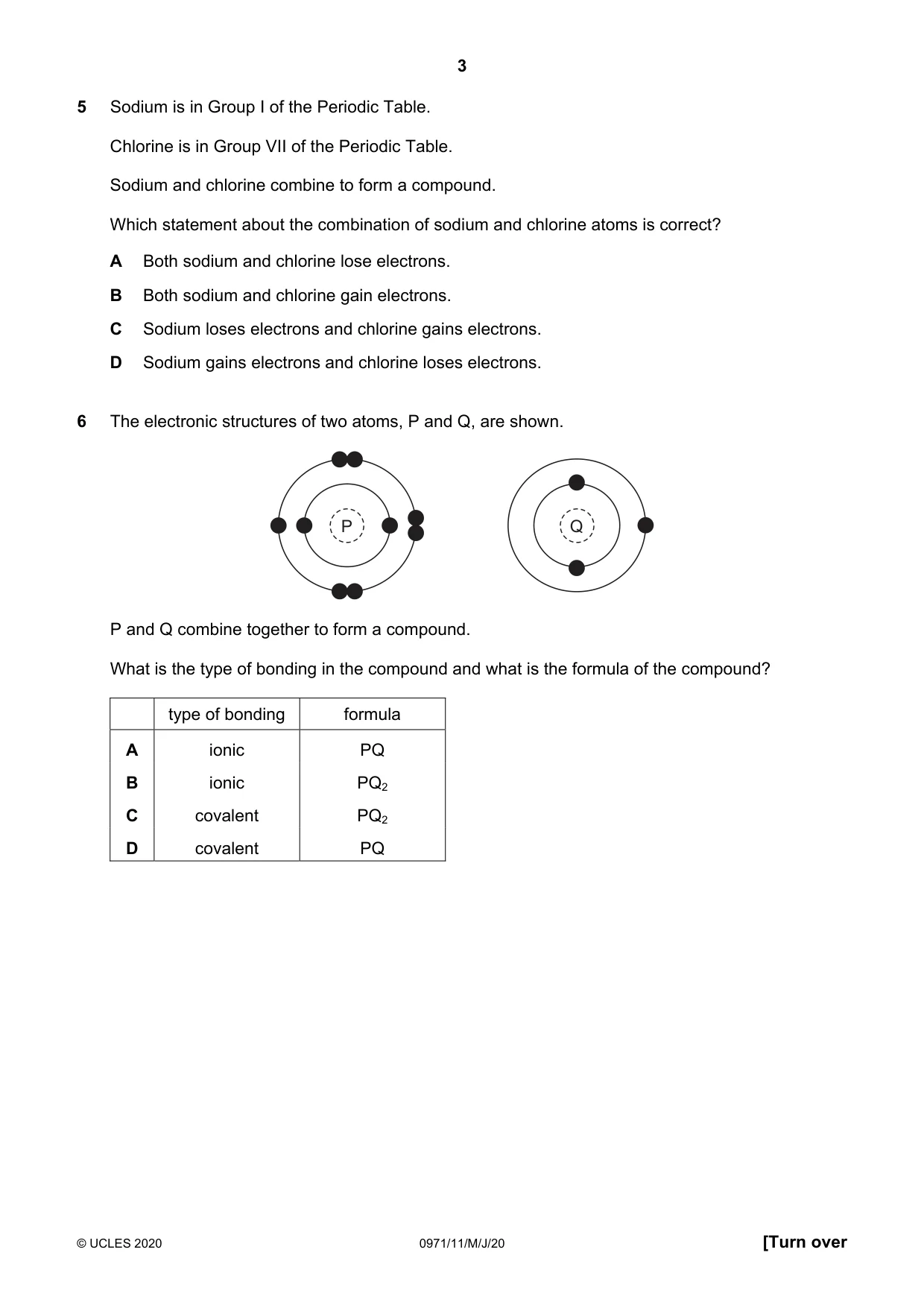
Q6 · The electronic structures of two atoms, P and Q, are shown
6 The electronic structures of two atoms, P and Q, are shown. P Q P and Q combine together to form a compound. What is the type of bonding in the compound and what is the formula of the compound? type of bonding formula A ionic PQ B ionic PQ2 C covalent PQ2 D covalent PQ
Mark scheme: A
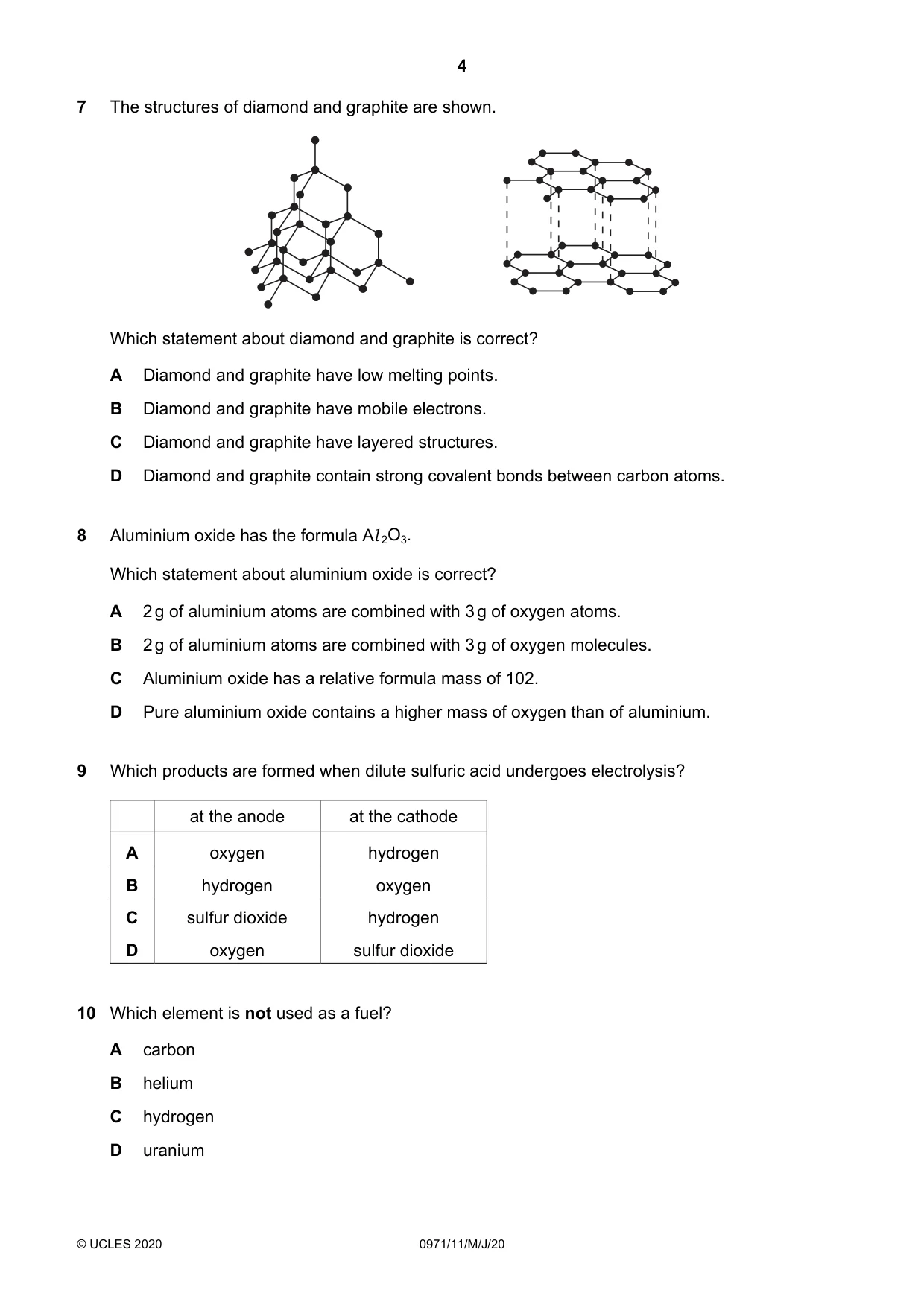
Q7 · The structures of diamond and graphite are shown
7 The structures of diamond and graphite are shown. Which statement about diamond and graphite is correct? A Diamond and graphite have low melting points. B Diamond and graphite have mobile electrons. C Diamond and graphite have layered structures. D Diamond and graphite contain strong covalent bonds between carbon atoms.
Mark scheme: D
Q8 · Aluminium oxide has the formula Al 2O3
8 Aluminium oxide has the formula Al 2O3. Which statement about aluminium oxide is correct? A 2 g of aluminium atoms are combined with 3 g of oxygen atoms. B 2 g of aluminium atoms are combined with 3 g of oxygen molecules. C Aluminium oxide has a relative formula mass of 102. D Pure aluminium oxide contains a higher mass of oxygen than of aluminium.
Mark scheme: C
Q9 · Which products are formed when dilute sulfuric acid undergoes electrolysis?
9 Which products are formed when dilute sulfuric acid undergoes electrolysis? at the anode at the cathode A oxygen hydrogen B hydrogen oxygen C sulfur dioxide hydrogen D oxygen sulfur dioxide
Mark scheme: A
Q10 · Which element is not used as a fuel?
10 Which element is not used as a fuel? A carbon B helium C hydrogen D uranium
Mark scheme: B
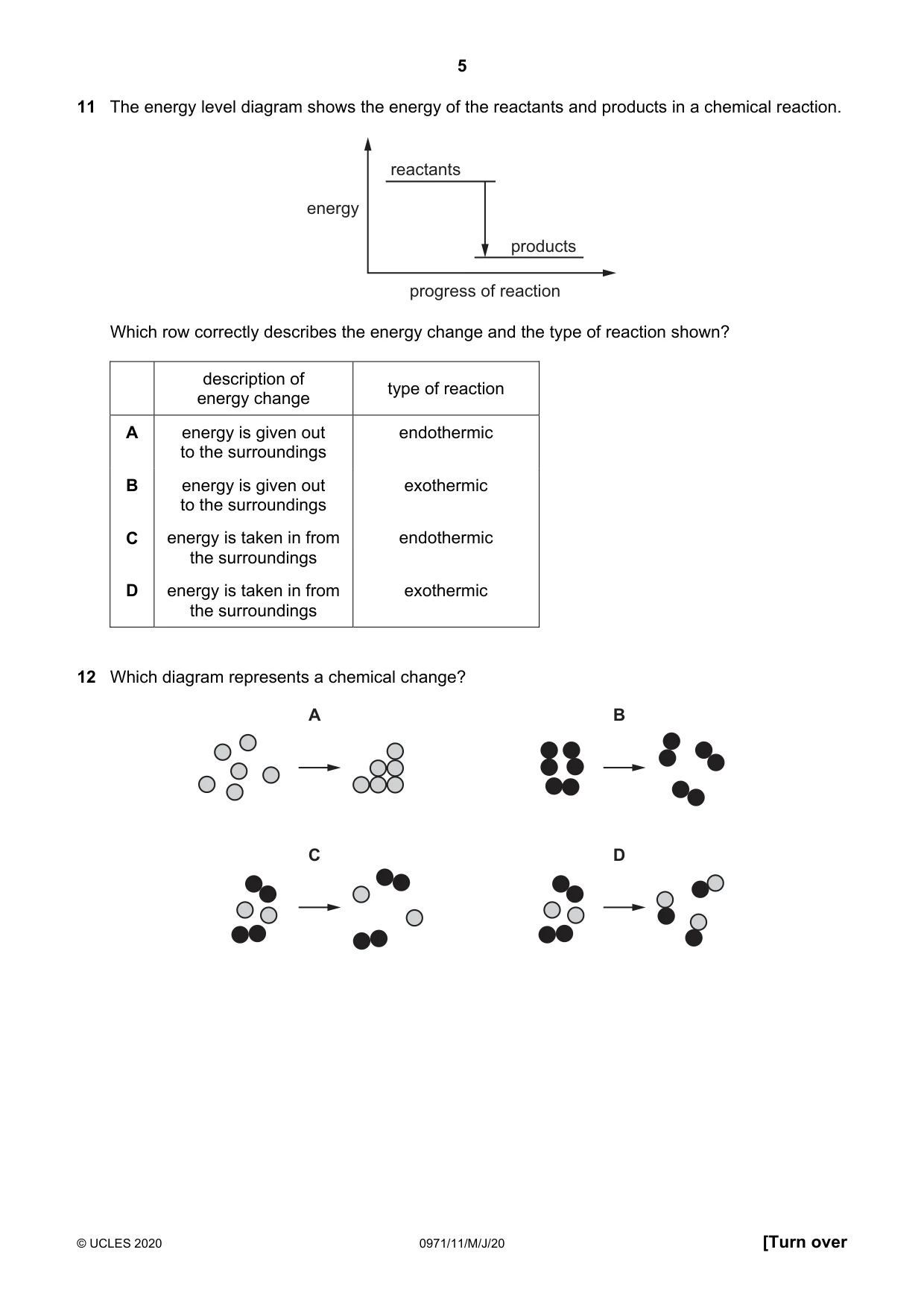
Q11 · The energy level diagram shows the energy of the reactants and products in a chemical…
11 The energy level diagram shows the energy of the reactants and products in a chemical reaction. reactants energy products progress of reaction Which row correctly describes the energy change and the type of reaction shown? description of type of reaction energy change A energy is given out endothermic to the surroundings B energy is given out exothermic to the surroundings C energy is taken in from endothermic the surroundings D energy is taken in from exothermic the surroundings
Mark scheme: B
Q12 · Which diagram represents a chemical change?
12 Which diagram represents a chemical change? A B C D
Mark scheme: D
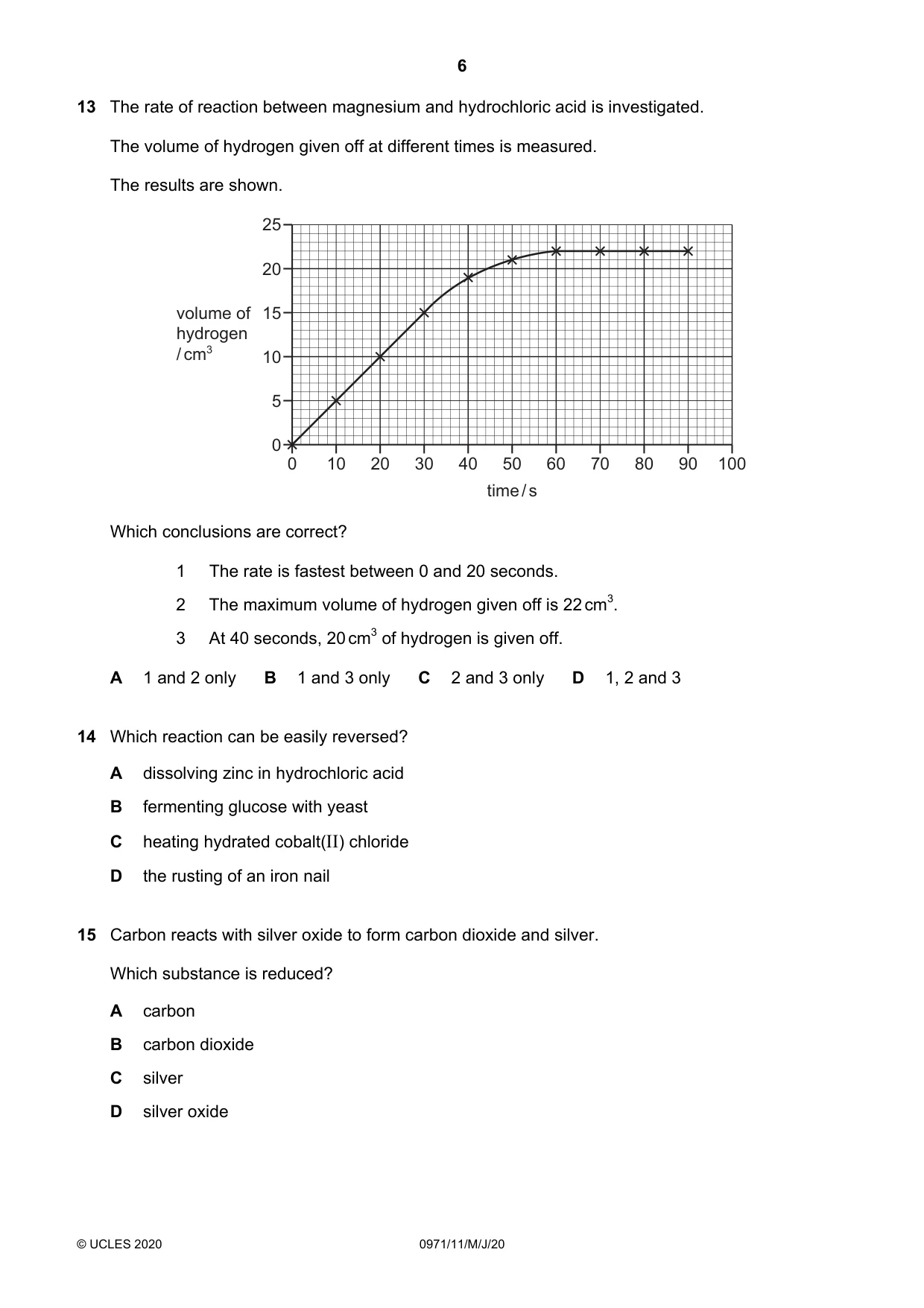
Q13 · The rate of reaction between magnesium and hydrochloric acid is investigated
13 The rate of reaction between magnesium and hydrochloric acid is investigated. The volume of hydrogen given off at different times is measured. The results are shown. 25 20 volume of 15 hydrogen / cm3 10 5 0 0 10 20 30 40 50 60 70 80 90 100 time / s Which conclusions are correct? 1 The rate is fastest between 0 and 20 seconds. 2 The maximum volume of hydrogen given off is 22 cm3. 3 At 40 seconds, 20 cm3 of hydrogen is given off. A 1 and 2 only B 1 and 3 only C 2 and 3 only D 1, 2 and 3
Mark scheme: A
Q14 · Which reaction can be easily reversed?
14 Which reaction can be easily reversed? A dissolving zinc in hydrochloric acid B fermenting glucose with yeast C heating hydrated cobalt(II) chloride D the rusting of an iron nail
Mark scheme: C
Q15 · Carbon reacts with silver oxide to form carbon dioxide and silver
15 Carbon reacts with silver oxide to form carbon dioxide and silver. Which substance is reduced? A carbon B carbon dioxide C silver D silver oxide
Mark scheme: D
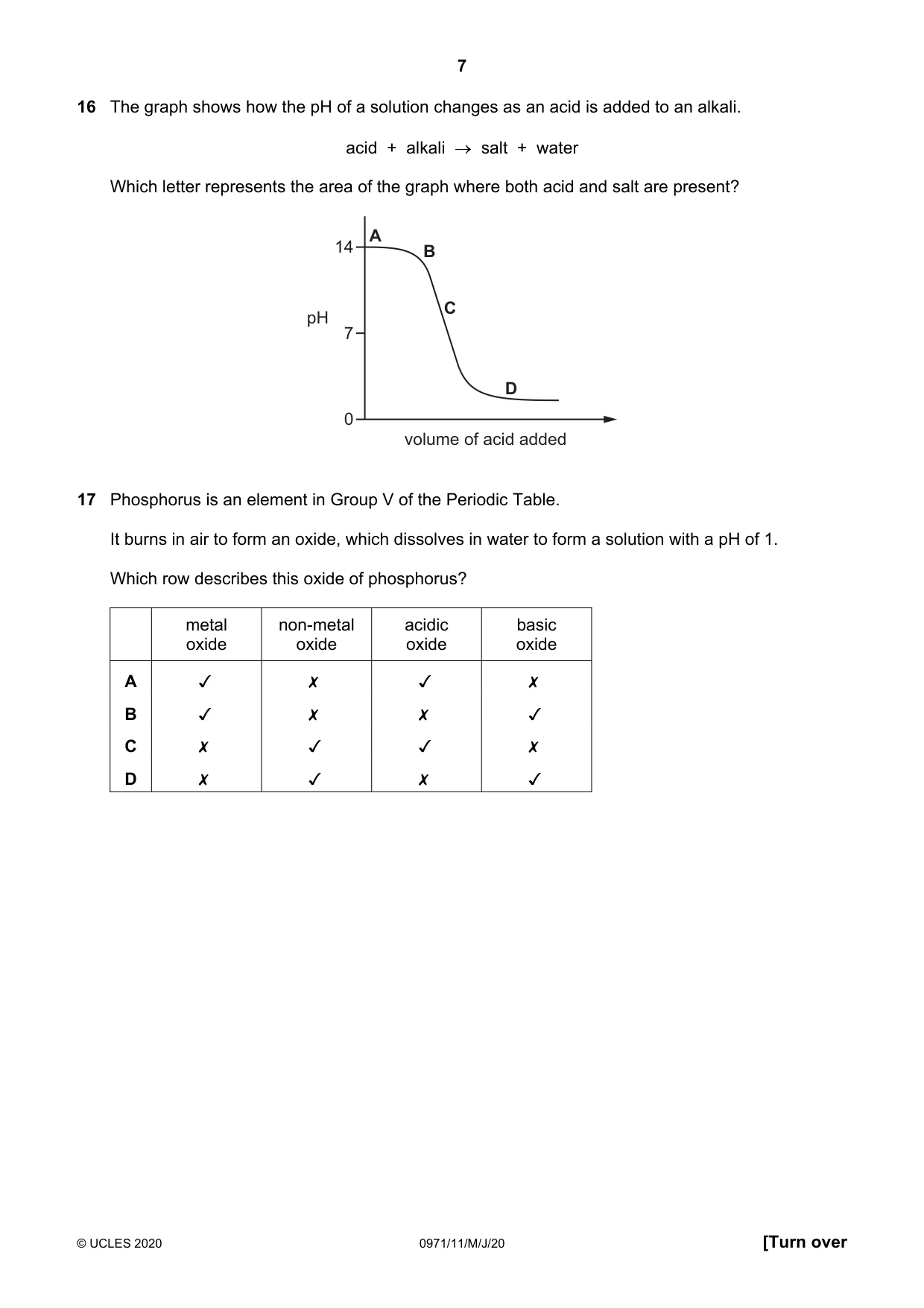
Q16 · The graph shows how the pH of a solution changes as an acid is added to an alkali
16 The graph shows how the pH of a solution changes as an acid is added to an alkali. acid + alkali → salt + water Which letter represents the area of the graph where both acid and salt are present? A 14 B C pH 7 D 0 volume of acid added
Mark scheme: D
More questions on The characteristic properties of acids and bases
Q17 · Phosphorus is an element in Group V of the Periodic Table
17 Phosphorus is an element in Group V of the Periodic Table. It burns in air to form an oxide, which dissolves in water to form a solution with a pH of 1. Which row describes this oxide of phosphorus? metal non-metal acidic basic oxide oxide oxide oxide A v x Jv x B J x x Jv Cc x J Jv x D x Jv x JV
Mark scheme: C
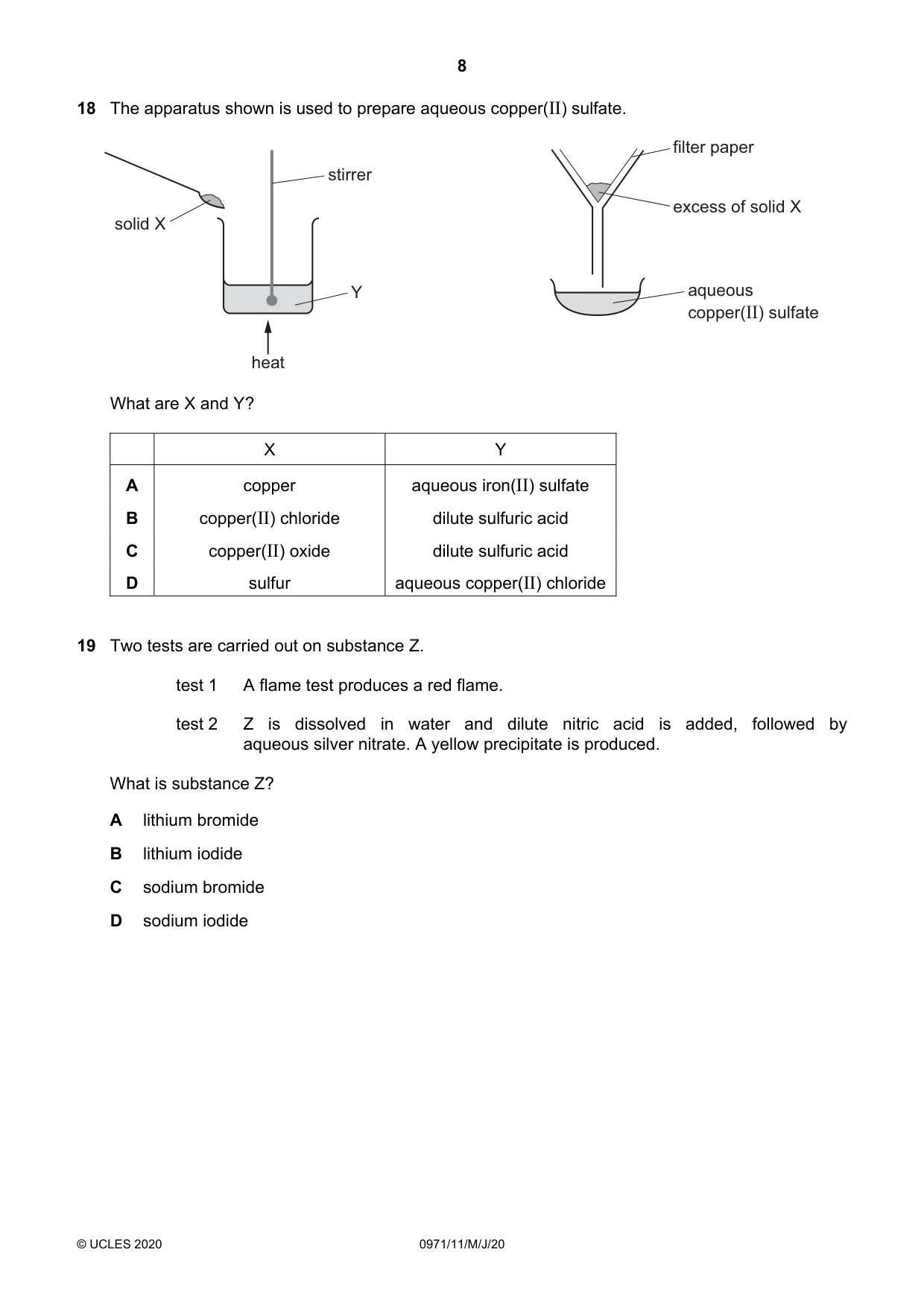
Q18 · The apparatus shown is used to prepare aqueous copper(II) sulfate
18 The apparatus shown is used to prepare aqueous copper(II) sulfate. filter paper stirrer excess of solid X solid X Y aqueous copper(II) sulfate heat What are X and Y? X Y A copper aqueous iron(II) sulfate B copper(II) chloride dilute sulfuric acid C copper(II) oxide dilute sulfuric acid D sulfur aqueous copper(II) chloride
Mark scheme: C
Q19 · Two tests are carried out on substance Z
19 Two tests are carried out on substance Z. test 1 A flame test produces a red flame. test 2 Z is dissolved in water and dilute nitric acid is added, followed by aqueous silver nitrate. A yellow precipitate is produced. What is substance Z? A lithium bromide B lithium iodide C sodium bromide D sodium iodide
Mark scheme: B
Q20 · The elements in Period 3 of the Periodic Table are shown
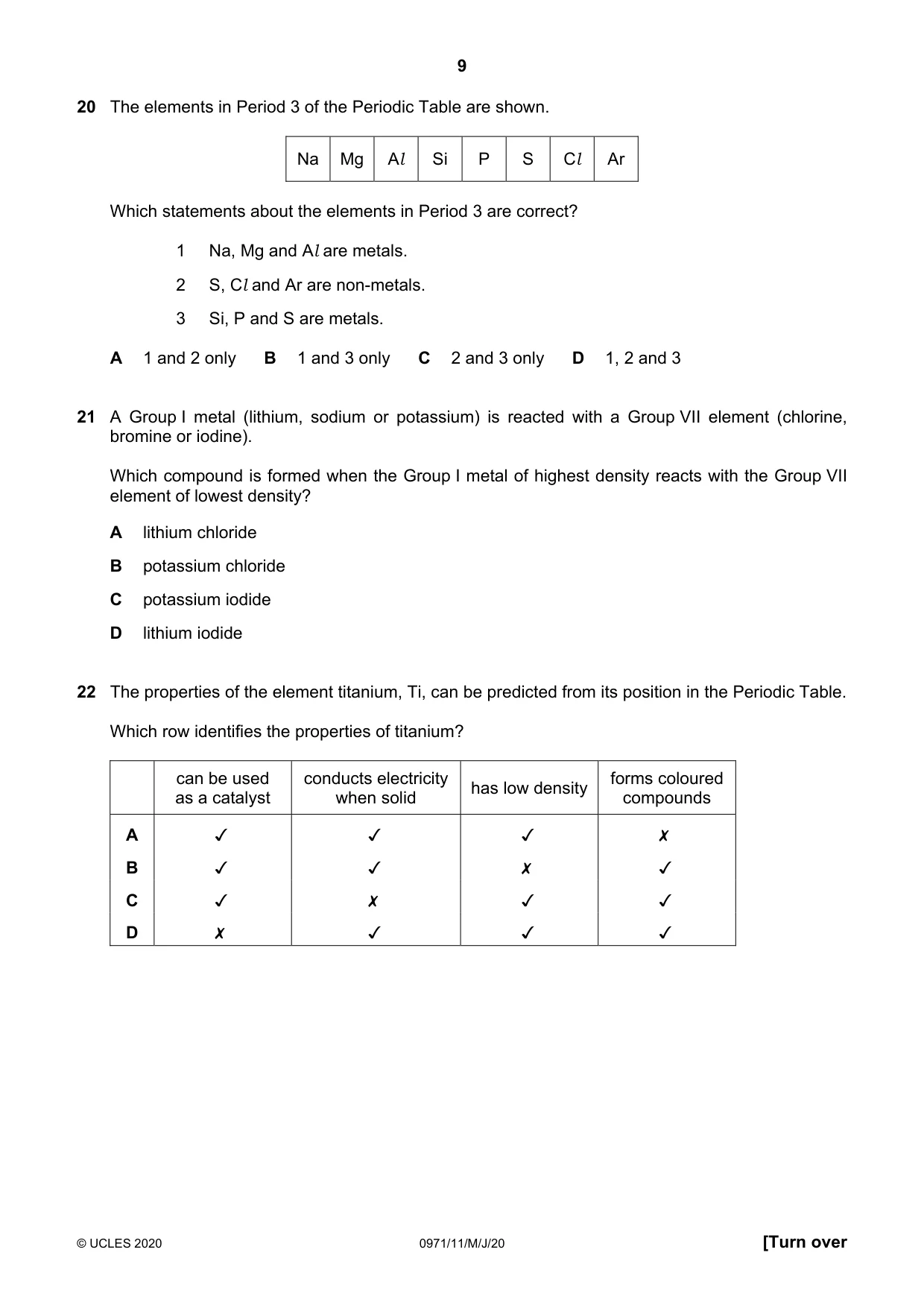
20 The elements in Period 3 of the Periodic Table are shown. Na Mg Al Si P S Cl Ar Which statements about the elements in Period 3 are correct? 1 Na, Mg and Al are metals. 2 S, Cl and Ar are non-metals. 3 Si, P and S are metals. A 1 and 2 only B 1 and 3 only C 2 and 3 only D 1, 2 and 3
Mark scheme: A
Q21 · A Group I metal (lithium, sodium or potassium) is reacted with a Group VII element…
21 A Group I metal (lithium, sodium or potassium) is reacted with a Group VII element (chlorine, bromine or iodine). Which compound is formed when the Group I metal of highest density reacts with the Group VII element of lowest density? A lithium chloride B potassium chloride C potassium iodide D lithium iodide
Mark scheme: B
Q22 · The properties of the element titanium, Ti, can be predicted from its position in the…
22 The properties of the element titanium, Ti, can be predicted from its position in the Periodic Table. Which row identifies the properties of titanium? forms coloured compounds can be used conducts electricity as a catalyst when solid has low density v v x v v v v x v x v v
Mark scheme: B
Q23 · A balloon is filled with helium
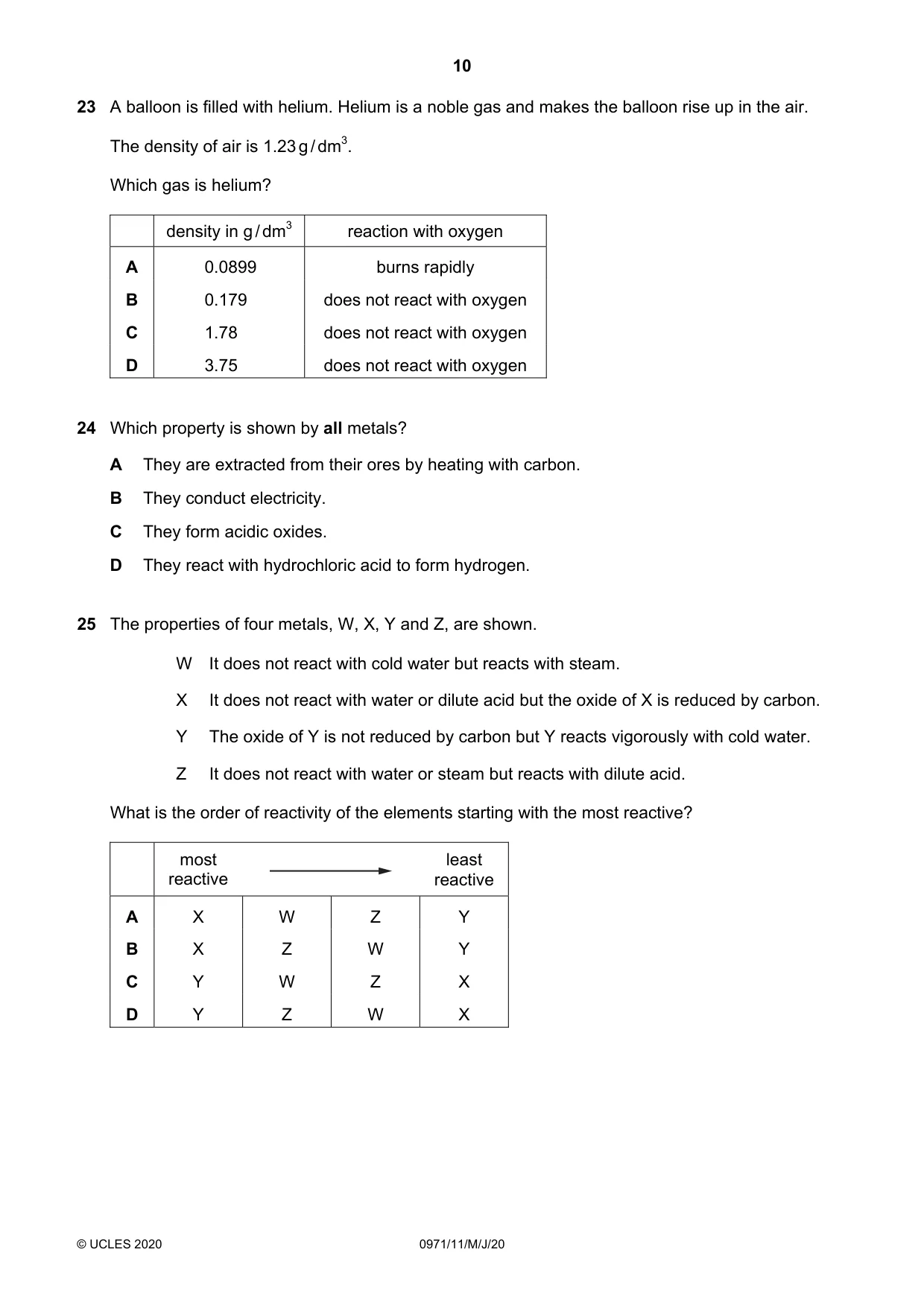
23 A balloon is filled with helium. Helium is a noble gas and makes the balloon rise up in the air. The density of air is 1.23 g / dm3. Which gas is helium? density in g / dm3 reaction with oxygen A 0.0899 burns rapidly B 0.179 does not react with oxygen C 1.78 does not react with oxygen D 3.75 does not react with oxygen
Mark scheme: B
Q24 · Which property is shown by all metals?
24 Which property is shown by all metals? A They are extracted from their ores by heating with carbon. B They conduct electricity. C They form acidic oxides. D They react with hydrochloric acid to form hydrogen.
Mark scheme: B
Q25 · The properties of four metals, W, X, Y and Z, are shown
25 The properties of four metals, W, X, Y and Z, are shown. W It does not react with cold water but reacts with steam. X It does not react with water or dilute acid but the oxide of X is reduced by carbon. Y The oxide of Y is not reduced by carbon but Y reacts vigorously with cold water. Z It does not react with water or steam but reacts with dilute acid. What is the order of reactivity of the elements starting with the most reactive? most least reactive reactive A X W Z Y B X Z W Y C Y W Z X D Y Z W X
Mark scheme: C
Q26 · Molten iron from the blast furnace contains impurities
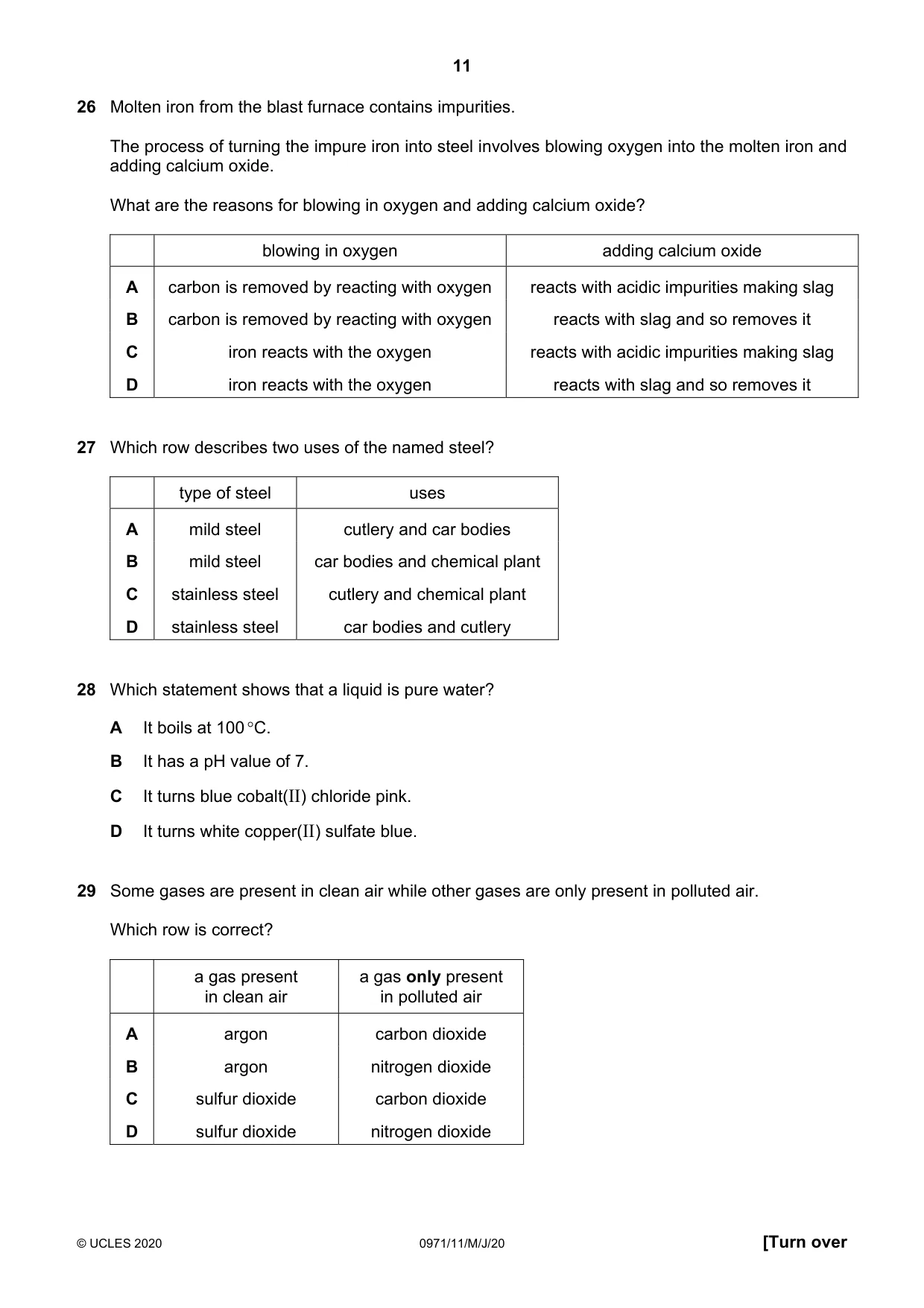
26 Molten iron from the blast furnace contains impurities. The process of turning the impure iron into steel involves blowing oxygen into the molten iron and adding calcium oxide. What are the reasons for blowing in oxygen and adding calcium oxide? blowing in oxygen adding calcium oxide A carbon is removed by reacting with oxygen reacts with acidic impurities making slag B carbon is removed by reacting with oxygen reacts with slag and so removes it C iron reacts with the oxygen reacts with acidic impurities making slag D iron reacts with the oxygen reacts with slag and so removes it
Mark scheme: A
Q27 · Which row describes two uses of the named steel?
27 Which row describes two uses of the named steel? type of steel uses A mild steel cutlery and car bodies B mild steel car bodies and chemical plant C stainless steel cutlery and chemical plant D stainless steel car bodies and cutlery
Mark scheme: C
Q28 · Which statement shows that a liquid is pure water?
28 Which statement shows that a liquid is pure water? A It boils at 100 °C. B It has a pH value of 7. C It turns blue cobalt(II) chloride pink. D It turns white copper(II) sulfate blue.
Mark scheme: A
Q29 · Some gases are present in clean air while other gases are only present in polluted air
29 Some gases are present in clean air while other gases are only present in polluted air. Which row is correct? a gas present a gas only present in clean air in polluted air A argon carbon dioxide B argon nitrogen dioxide C sulfur dioxide carbon dioxide D sulfur dioxide nitrogen dioxide
Mark scheme: B
Q30 · The diagrams show experiments to investigate rusting of iron nails
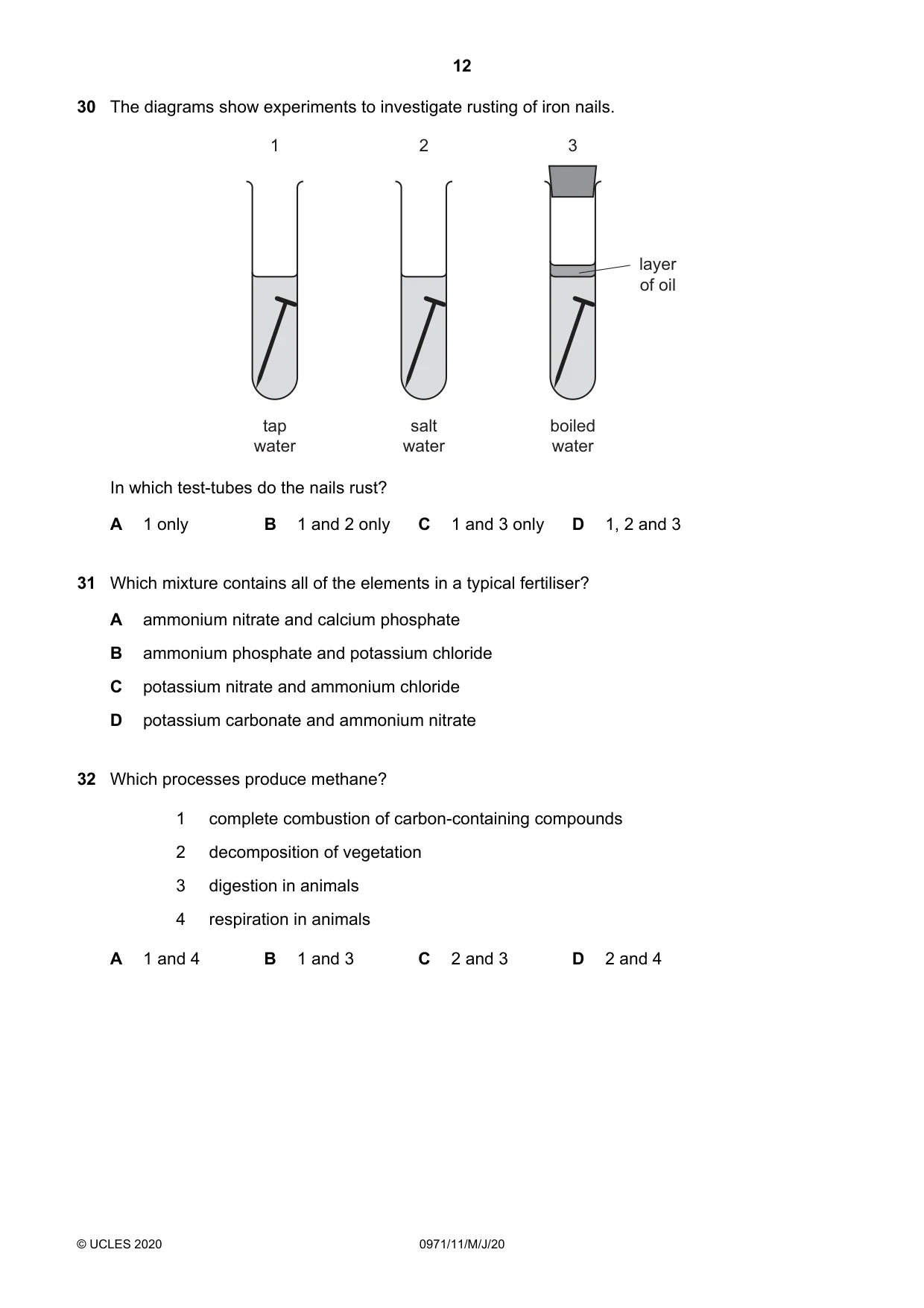
30 The diagrams show experiments to investigate rusting of iron nails. 1 2 3 layer of oil tap salt boiled water water water In which test-tubes do the nails rust? A 1 only B 1 and 2 only C 1 and 3 only D 1, 2 and 3
Mark scheme: B
Q31 · Which mixture contains all of the elements in a typical fertiliser?
31 Which mixture contains all of the elements in a typical fertiliser? A ammonium nitrate and calcium phosphate B ammonium phosphate and potassium chloride C potassium nitrate and ammonium chloride D potassium carbonate and ammonium nitrate
Mark scheme: B
Q32 · Which processes produce methane?
32 Which processes produce methane? 1 complete combustion of carbon-containing compounds 2 decomposition of vegetation 3 digestion in animals 4 respiration in animals A 1 and 4 B 1 and 3 C 2 and 3 D 2 and 4
Mark scheme: C
Q33 · The list shows four methods that were suggested for the formation of carbon dioxide
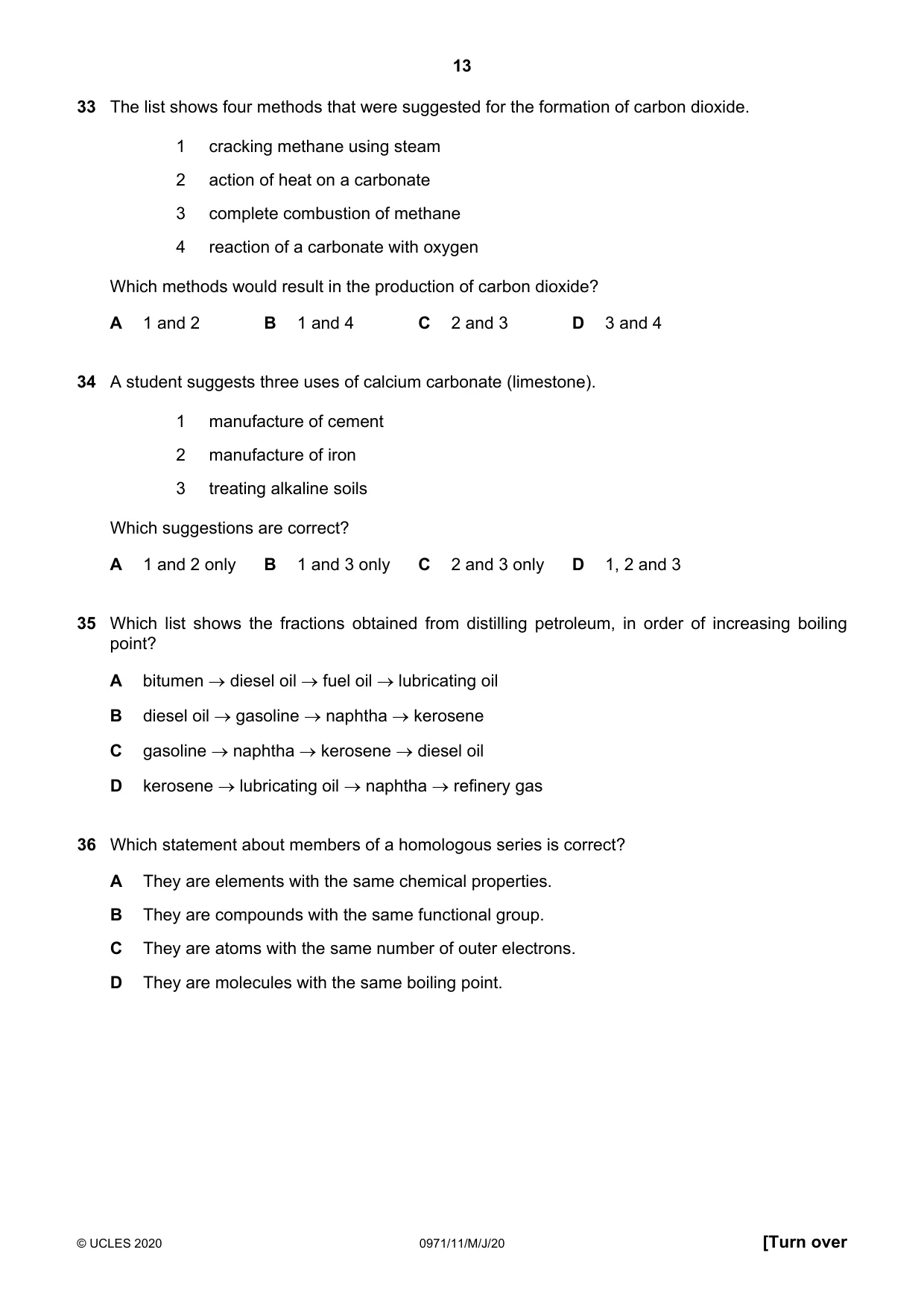
33 The list shows four methods that were suggested for the formation of carbon dioxide. 1 cracking methane using steam 2 action of heat on a carbonate 3 complete combustion of methane 4 reaction of a carbonate with oxygen Which methods would result in the production of carbon dioxide? A 1 and 2 B 1 and 4 C 2 and 3 D 3 and 4
Mark scheme: C
Q34 · A student suggests three uses of calcium carbonate (limestone)
34 A student suggests three uses of calcium carbonate (limestone). 1 manufacture of cement 2 manufacture of iron 3 treating alkaline soils Which suggestions are correct? A 1 and 2 only B 1 and 3 only C 2 and 3 only D 1, 2 and 3
Mark scheme: A
Q35 · Which list shows the fractions obtained from distilling petroleum, in order of increasing…
35 Which list shows the fractions obtained from distilling petroleum, in order of increasing boiling point? A bitumen → diesel oil → fuel oil → lubricating oil B diesel oil → gasoline → naphtha → kerosene C gasoline → naphtha → kerosene → diesel oil D kerosene → lubricating oil → naphtha → refinery gas
Mark scheme: C
Q36 · Which statement about members of a homologous series is correct?
36 Which statement about members of a homologous series is correct? A They are elements with the same chemical properties. B They are compounds with the same functional group. C They are atoms with the same number of outer electrons. D They are molecules with the same boiling point.
Mark scheme: B
More questions on Formulae, functional groups and terminology
Q37 · Increasing the number of atoms in one molecule of a hydrocarbon increases the amount of…
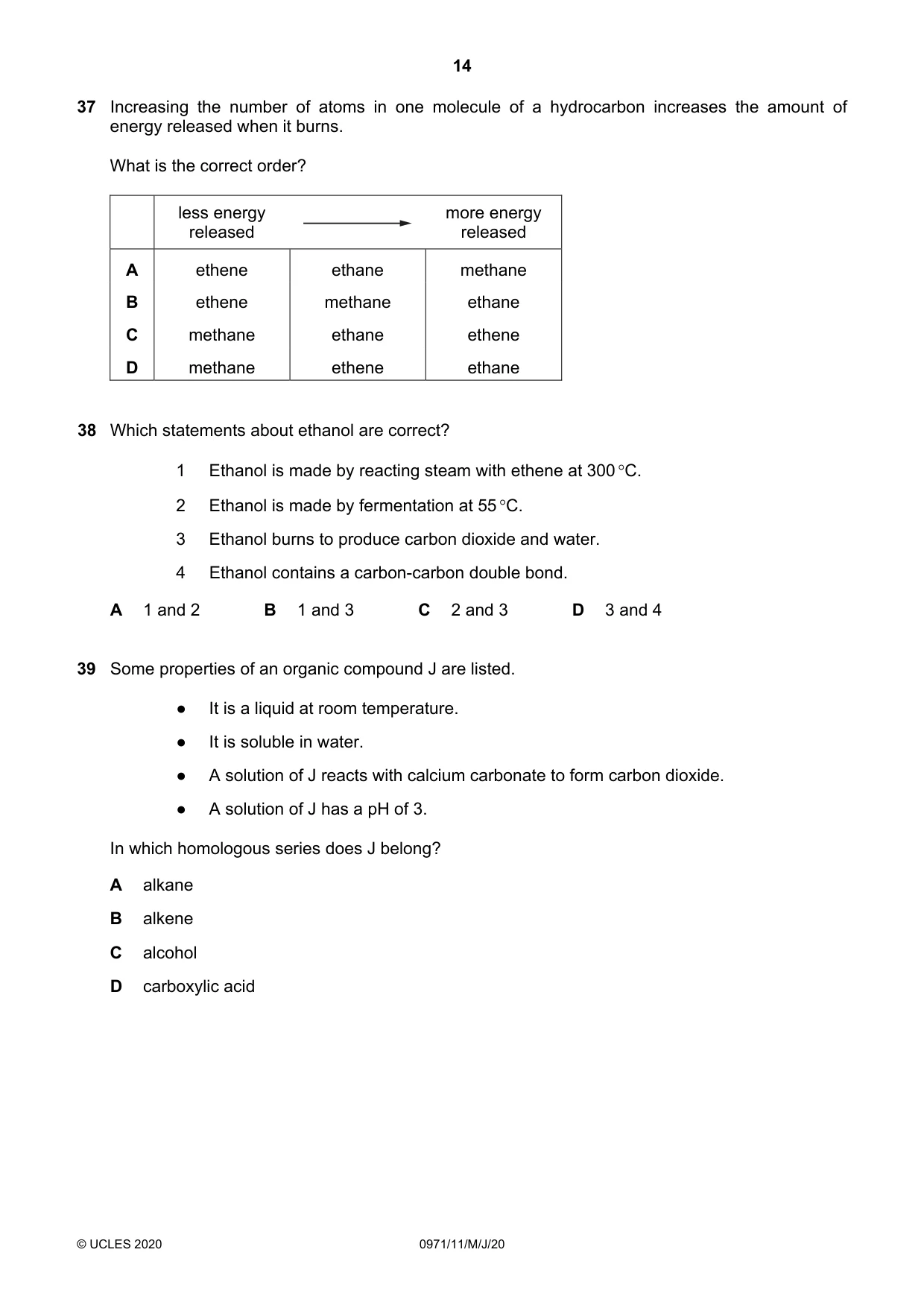
37 Increasing the number of atoms in one molecule of a hydrocarbon increases the amount of energy released when it burns. What is the correct order? less energy more energy released released A ethene ethane methane B ethene methane ethane C methane ethane ethene D methane ethene ethane
Mark scheme: D
Q38 · Which statements about ethanol are correct?
38 Which statements about ethanol are correct? 1 Ethanol is made by reacting steam with ethene at 300 °C. 2 Ethanol is made by fermentation at 55 °C. 3 Ethanol burns to produce carbon dioxide and water. 4 Ethanol contains a carbon-carbon double bond. A 1 and 2 B 1 and 3 C 2 and 3 D 3 and 4
Mark scheme: B
Q39 · Some properties of an organic compound J are listed
39 Some properties of an organic compound J are listed. ● It is a liquid at room temperature. ● It is soluble in water. ● A solution of J reacts with calcium carbonate to form carbon dioxide. ● A solution of J has a pH of 3. In which homologous series does J belong? A alkane B alkene C alcohol D carboxylic acid
Mark scheme: D
Q40 · Which polymers or types of polymer are synthetic?
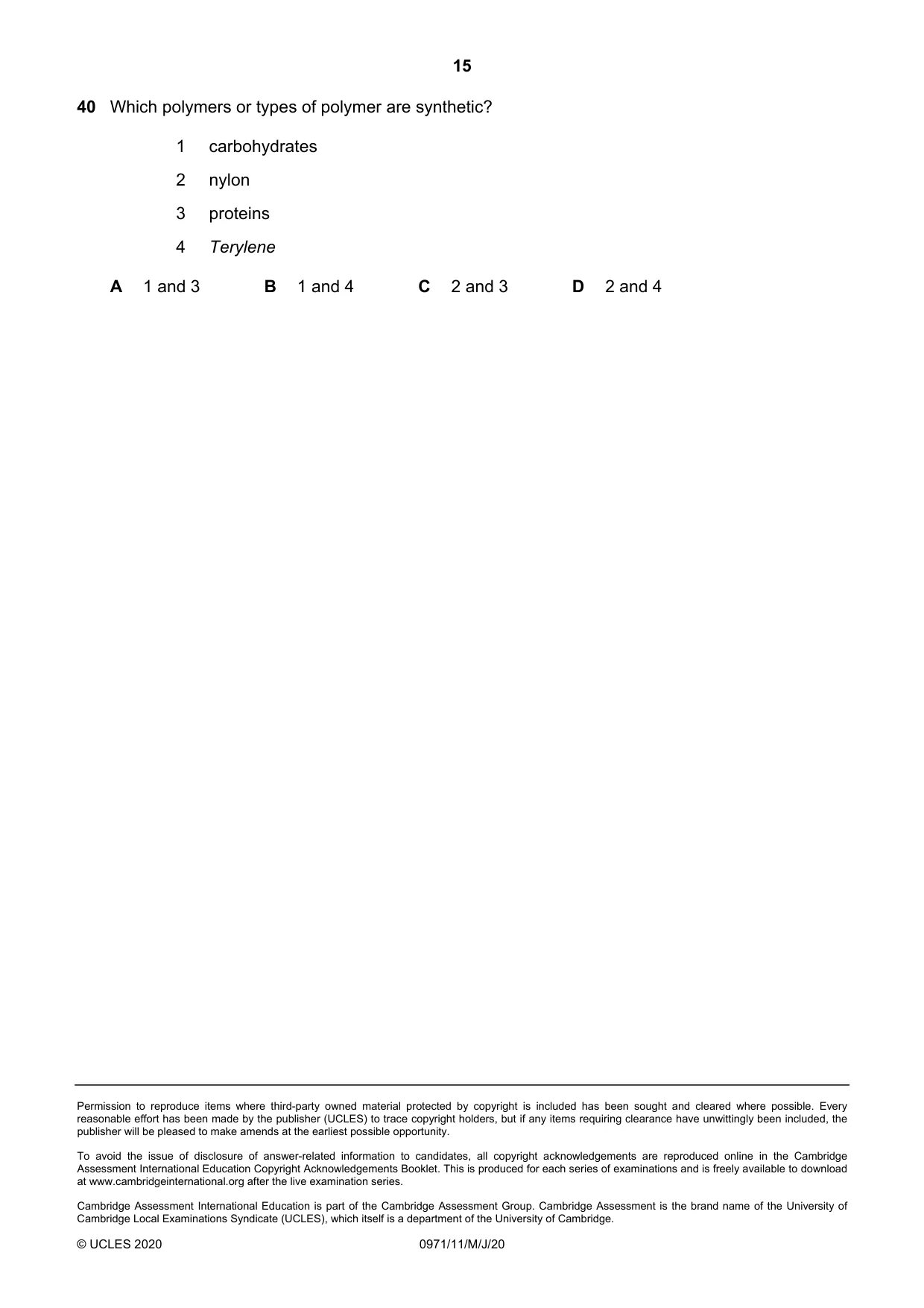
40 Which polymers or types of polymer are synthetic? 1 carbohydrates 2 nylon 3 proteins 4 Terylene A 1 and 3 B 1 and 4 C 2 and 3 D 2 and 4
Mark scheme: D
What was in this paper
The subtopics covered by these 40 questions, and how many questions each got. Open one in a new tab to see every Cambridge question on it.
4Fuels3Alcohols1Alloys and their properties1Arrangement of elements1Carboxylic acids1Corrosion of metals1Electrolysis1Exothermic and endothermic reactions1Experimental design1Extraction of metals1Fertilisers1Formulae, functional groups and terminology1Giant covalent structures1Group I properties1Identification of ions and gases1Ions and ionic bonds1Isotopes1Noble gases1Oxides1Physical and chemical changes1Polymers1Preparation of salts1Properties of metals1Rate of reaction1Reactivity series1Redox1Relative masses of atoms and molecules1Reversible reactions and equilibrium1Separation and purification1Simple molecules and covalent bonds1Solids, liquids and gases1The characteristic properties of acids and bases1Transition elements1Water1