Cambridge IGCSE Chemistry (9-1) 0971 — 2025 May/June Paper 1 · Variant 2
0971/12/M/J/25 · 40 questions · 40 marks · 45 min
The question paper and its mark scheme, free to read here and free to download. This is Cambridge’s own paper, exactly as it was sat.
Question paper16 pages

Mark scheme3 pages
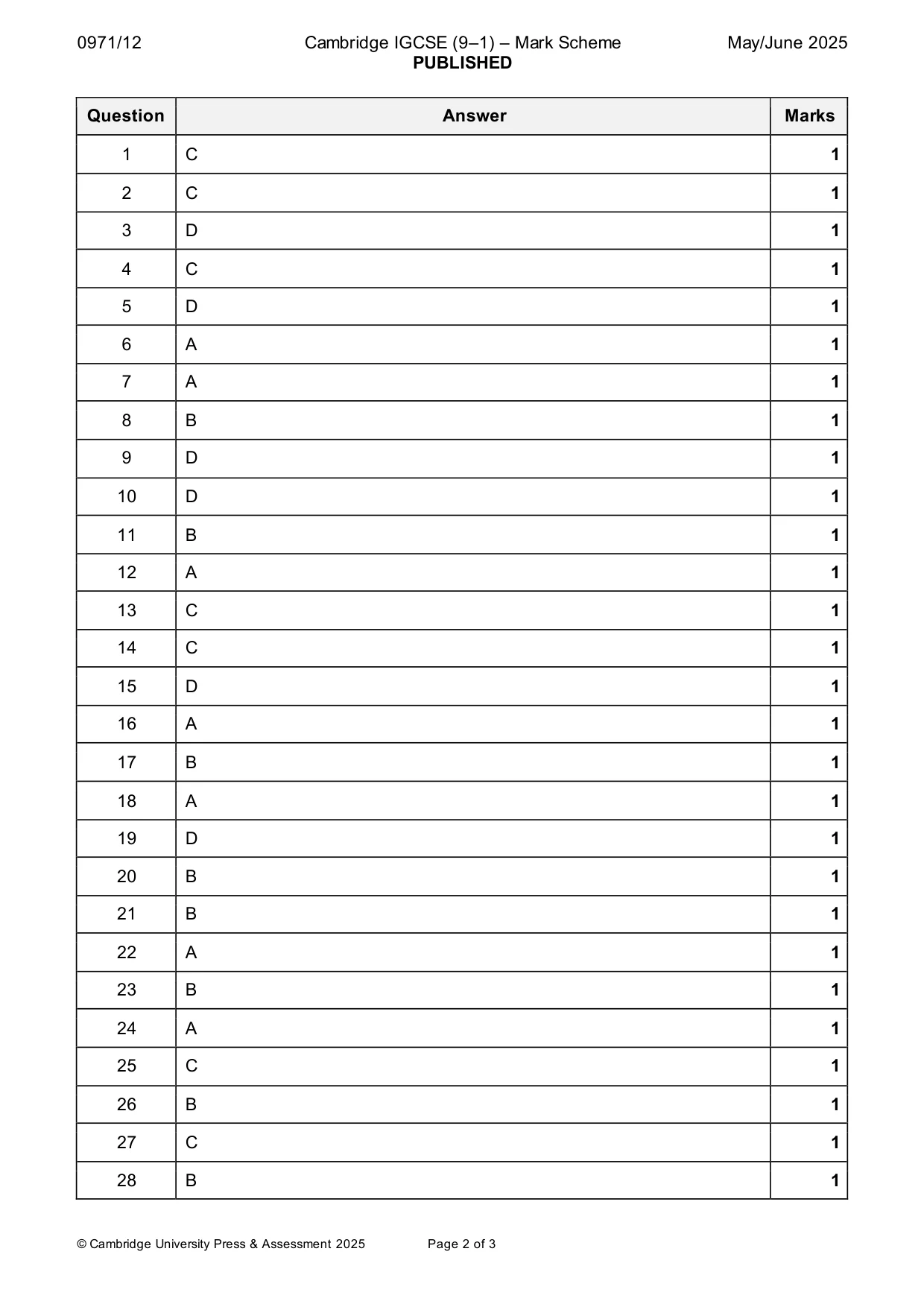
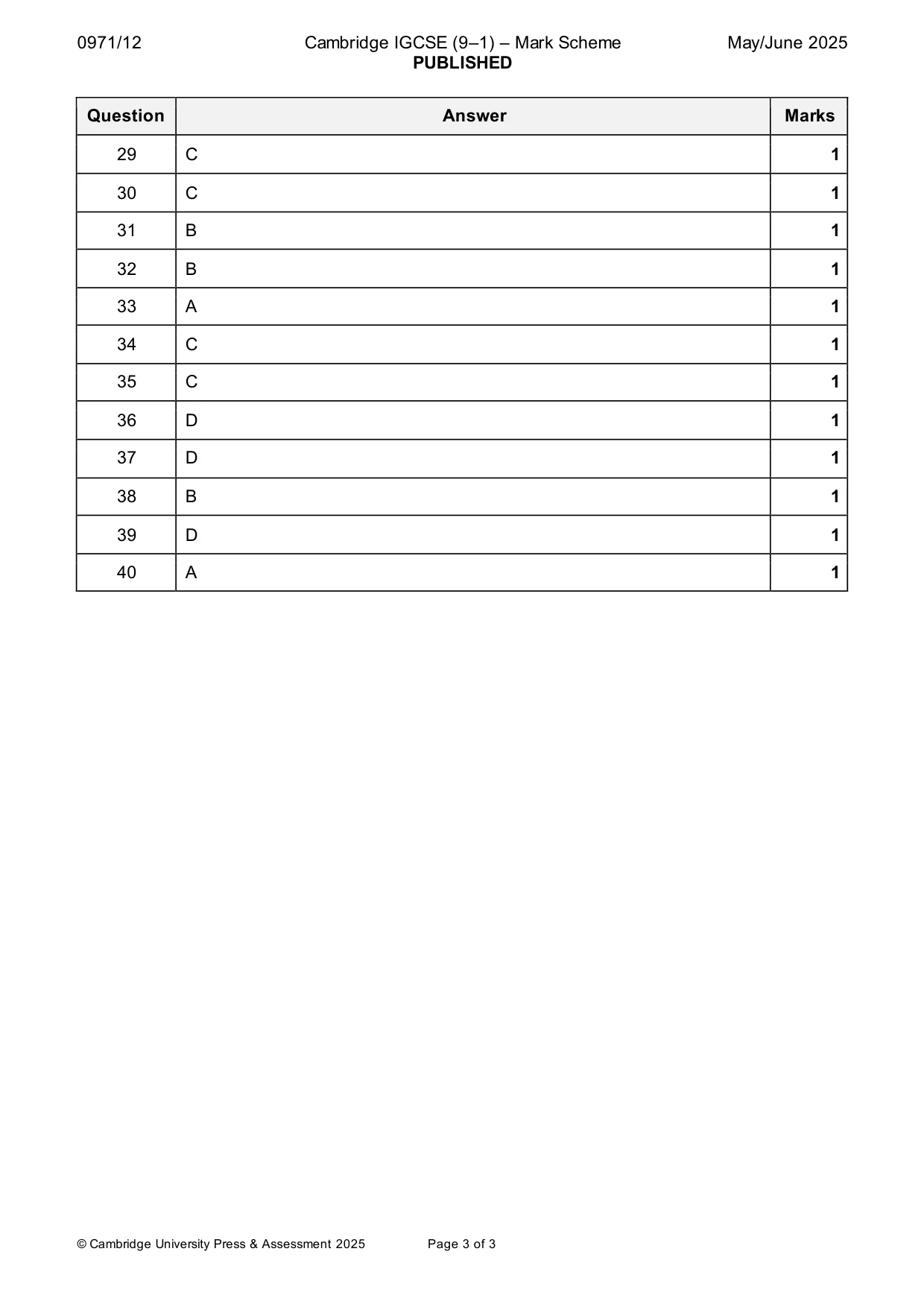
Answers below. Sit the paper first if you are practising.
Questions as text
Q1 · Substance L melts at –7 °C and is a brown liquid at room temperature
1 Substance L melts at –7 °C and is a brown liquid at room temperature. What is the boiling point of pure L? A –77 °C B –7 °C to +7 °C C 59 °C D 107 °C to 117 °C
Mark scheme: C
Q2 · Which row describes how the volume of a gas changes when its temperature is increased at…
2 Which row describes how the volume of a gas changes when its temperature is increased at constant pressure and when its pressure is increased at constant temperature? temperature is increased pressure is increased at constant pressure at constant temperature A volume decreases volume decreases B volume decreases volume increases C volume increases volume decreases D volume increases volume increases
Mark scheme: C
Q3 · Nitrogen dioxide is a red-brown gas which is more dense than air
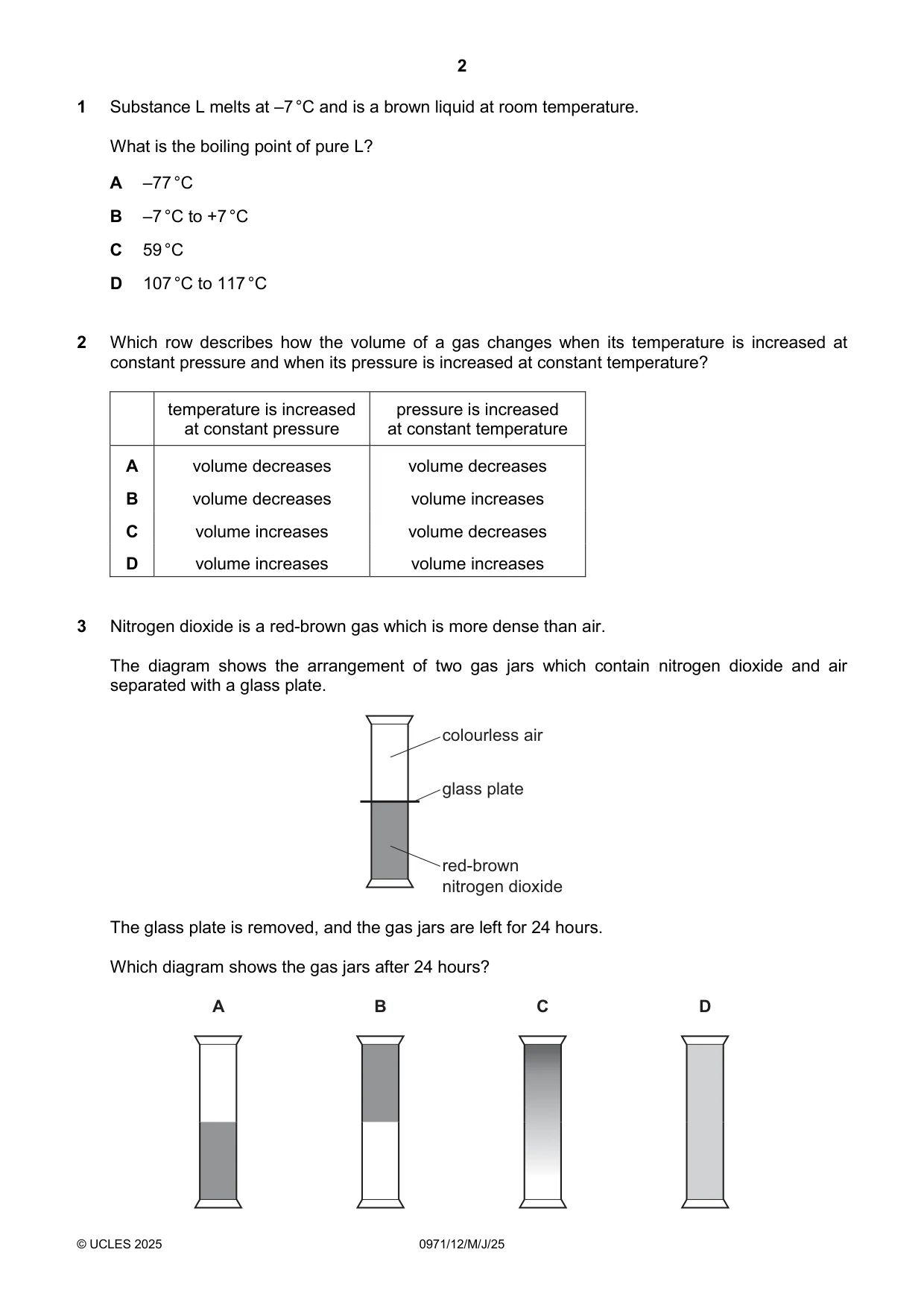
3 Nitrogen dioxide is a red-brown gas which is more dense than air. The diagram shows the arrangement of two gas jars which contain nitrogen dioxide and air separated with a glass plate. colourless air glass plate red-brown nitrogen dioxide The glass plate is removed, and the gas jars are left for 24 hours. Which diagram shows the gas jars after 24 hours? A B C D
Mark scheme: D
Q4 · Which substance is a mixture of one element and one compound?
4 Which substance is a mixture of one element and one compound? A aqueous glucose B clean, dry air C oxygen dissolved in distilled water D stainless steel
Mark scheme: C
Q5 · Which statement defines the atomic number of an element?
5 Which statement defines the atomic number of an element? A the group number of the element B the mass of one atom of the element C the number of particles in the nucleus of one atom of the element D the number of protons in the nucleus of one atom of the element
Mark scheme: D
Q6 · What is different for isotopes of the same element?
6 What is different for isotopes of the same element? A nucleon number B number of electron shells C number of electrons in the outer electron shell D proton number
Mark scheme: A
Q7 · When sodium chloride is formed from its elements, each chlorine atom ......1.....
7 When sodium chloride is formed from its elements, each chlorine atom ......1...... one ......2...... . Which words correctly complete gaps 1 and 2? 1 2 A gains electron B gains proton C loses electron D loses proton
Mark scheme: A
Q8 · In the molecules CH4, HCl and H2O, which atoms use all of their outer shell electrons in…
8 In the molecules CH4, HCl and H2O, which atoms use all of their outer shell electrons in bonding? A C and Cl B C and H C Cl and H D H and O
Mark scheme: B
Q9 · Which substance has a giant covalent structure?
9 Which substance has a giant covalent structure? A sodium chloride B ammonia C magnesium chloride D graphite
Mark scheme: D
Q10 · The diagrams show the structures of four molecules
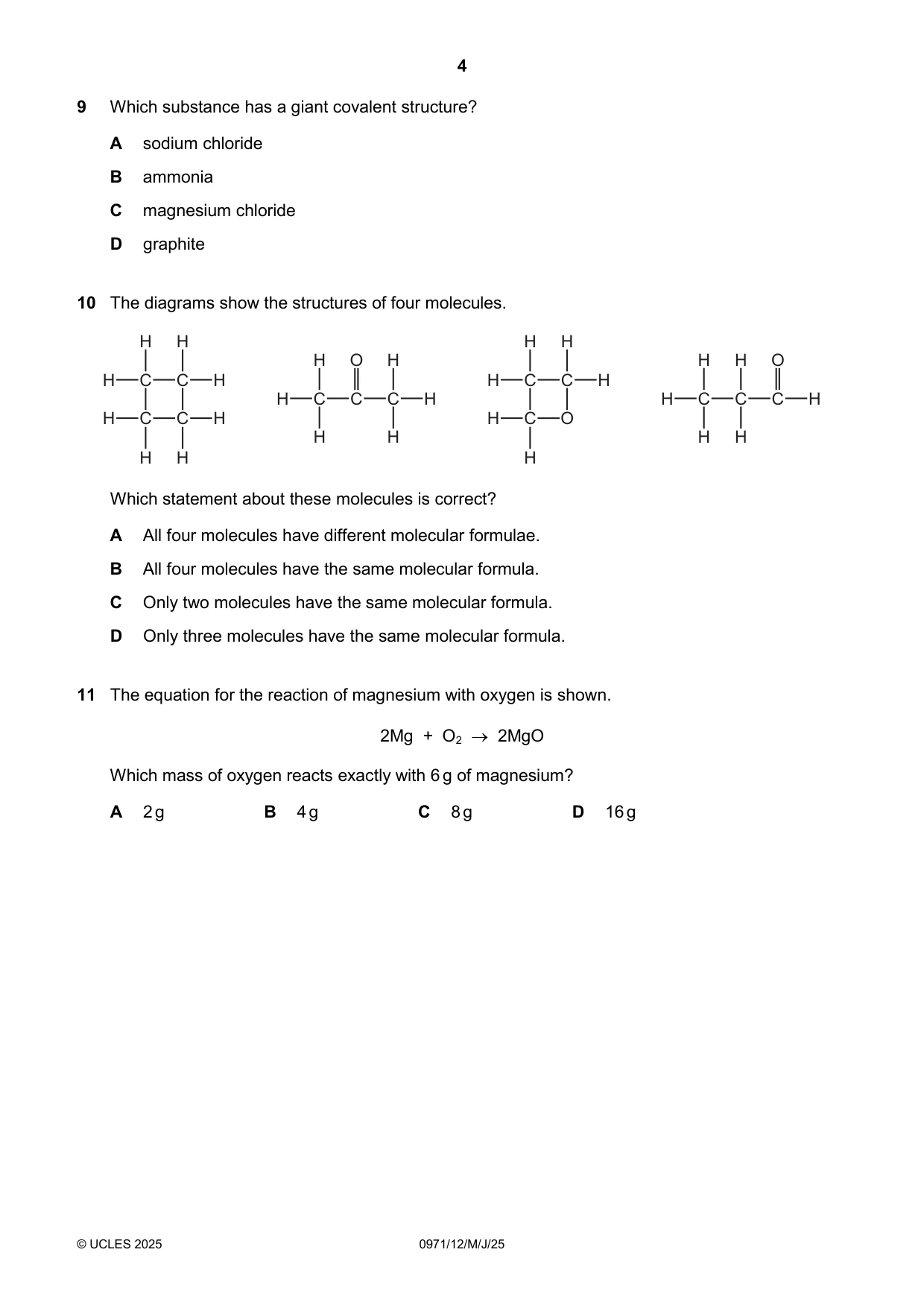
10 The diagrams show the structures of four molecules. H H H H H O H H H O H C C H H C C H H C C C H H C C C H H C C H H C O H H H H H H H Which statement about these molecules is correct? A All four molecules have different molecular formulae. B All four molecules have the same molecular formula. C Only two molecules have the same molecular formula. D Only three molecules have the same molecular formula.
Mark scheme: D
More questions on Formulae, functional groups and terminology
Q11 · The equation for the reaction of magnesium with oxygen is shown
11 The equation for the reaction of magnesium with oxygen is shown. 2Mg + O2 2MgO Which mass of oxygen reacts exactly with 6 g of magnesium? A 2 g B 4 g C 8 g D 16 g
Mark scheme: B
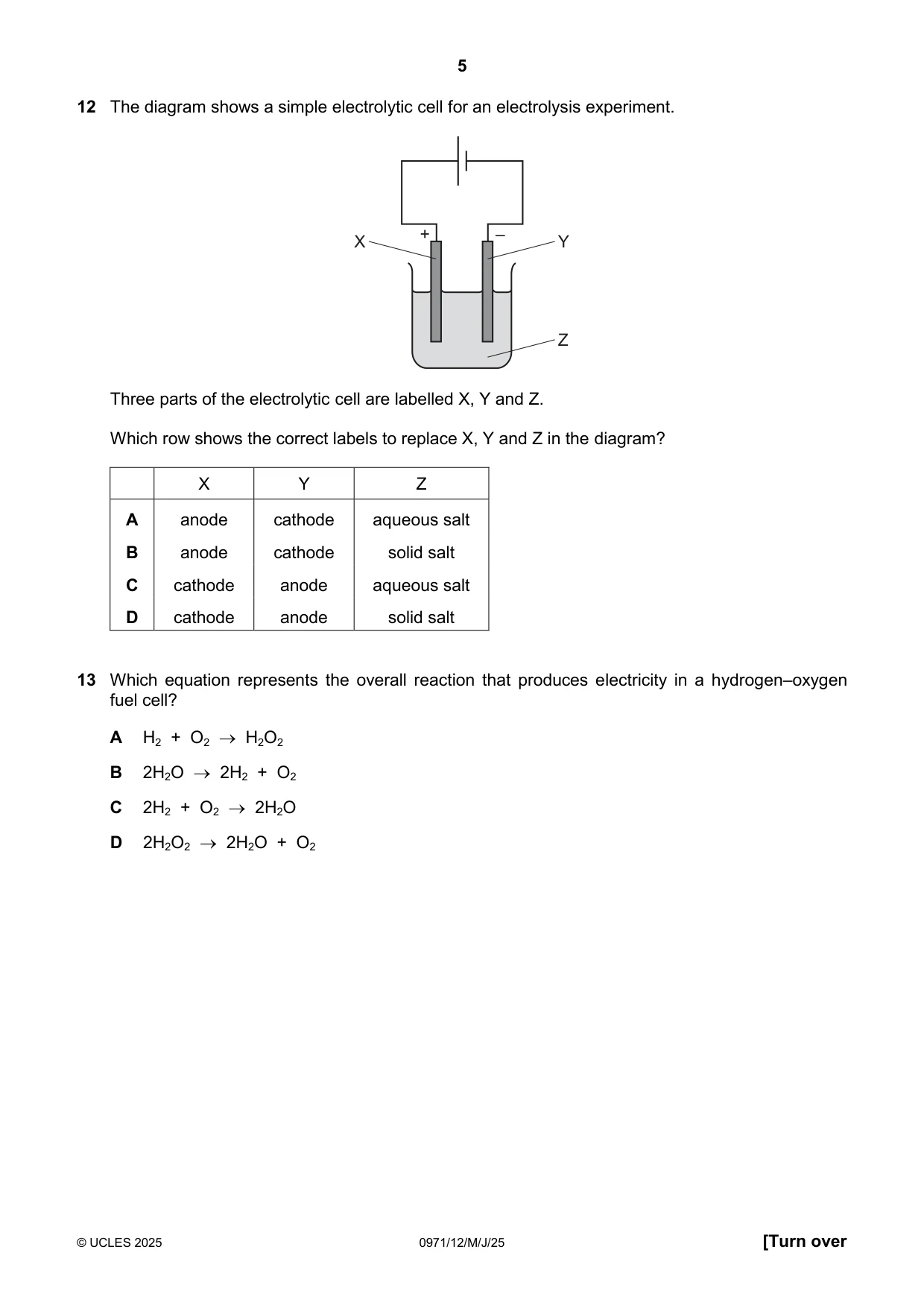
Q12 · The diagram shows a simple electrolytic cell for an electrolysis experiment
12 The diagram shows a simple electrolytic cell for an electrolysis experiment. X + – Y Z Three parts of the electrolytic cell are labelled X, Y and Z. Which row shows the correct labels to replace X, Y and Z in the diagram? X Y Z A anode cathode aqueous salt B anode cathode solid salt C cathode anode aqueous salt D cathode anode solid salt
Mark scheme: A
Q13 · Which equation represents the overall reaction that produces electricity in a…
13 Which equation represents the overall reaction that produces electricity in a hydrogen–oxygen fuel cell? A H2 + O2 H2O2 B 2H2O 2H2 + O2 C 2H2 + O2 2H2O D 2H2O2 2H2O + O2
Mark scheme: C
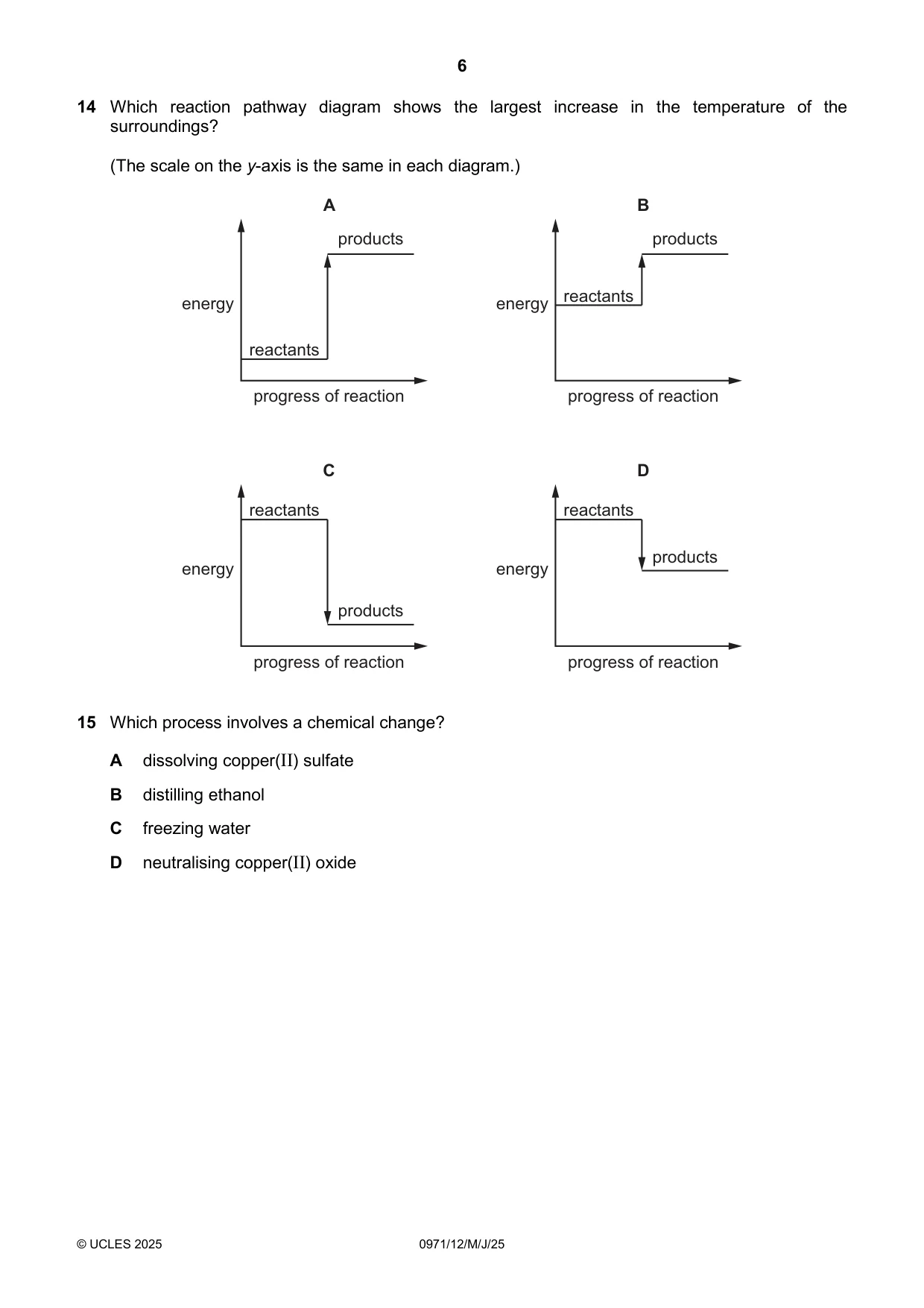
Q14 · Which reaction pathway diagram shows the largest increase in the temperature of the…
14 Which reaction pathway diagram shows the largest increase in the temperature of the surroundings? (The scale on the y-axis is the same in each diagram.) A B products products energy energy reactants reactants progress of reaction progress of reaction C D reactants reactants products energy energy products progress of reaction progress of reaction
Mark scheme: C
Q15 · Which process involves a chemical change?
15 Which process involves a chemical change? A dissolving copper(II) sulfate B distilling ethanol C freezing water D neutralising copper(II) oxide
Mark scheme: D
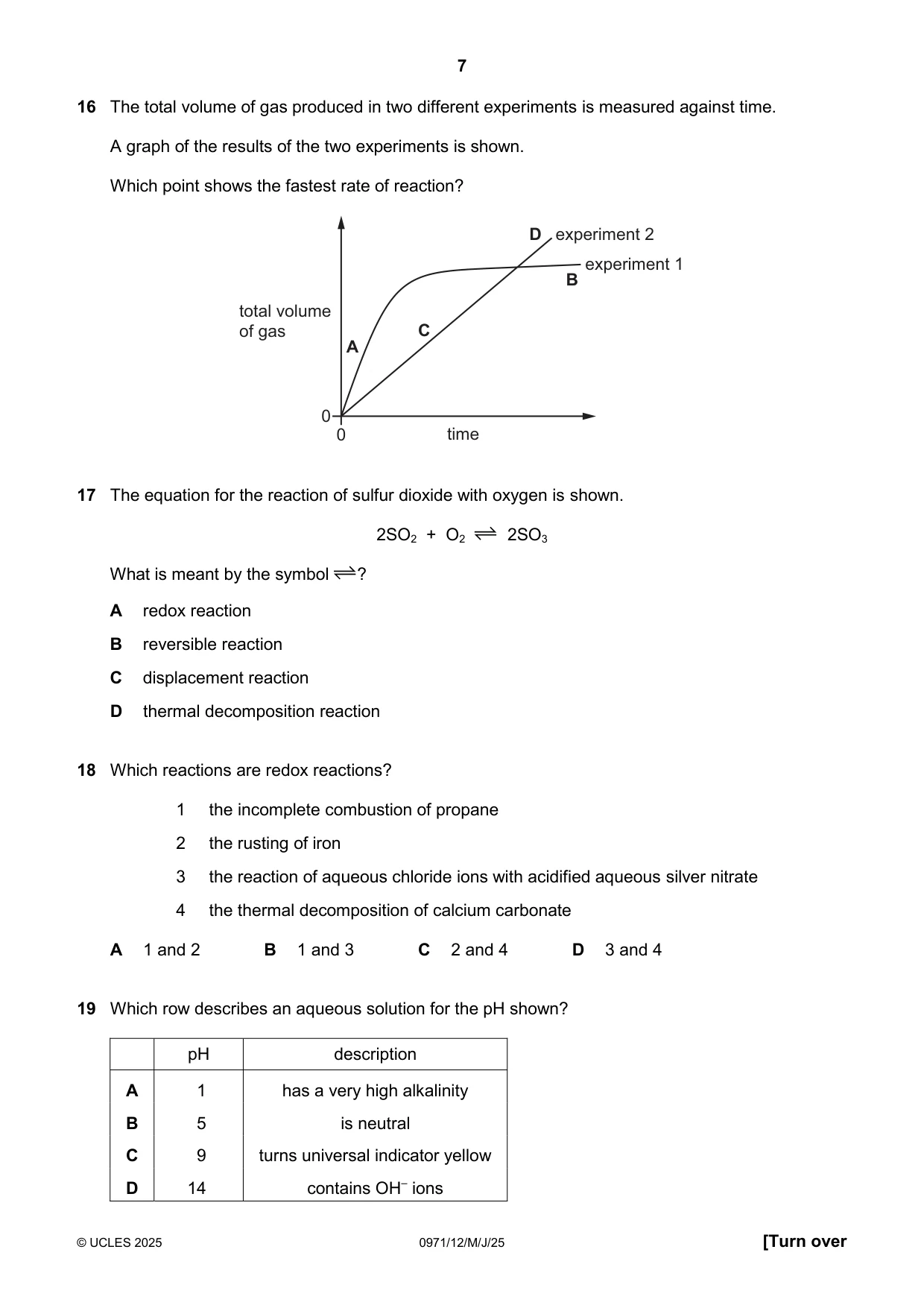
Q16 · The total volume of gas produced in two different experiments is measured against time
16 The total volume of gas produced in two different experiments is measured against time. A graph of the results of the two experiments is shown. Which point shows the fastest rate of reaction? D experiment 2 experiment 1 B total volume of gas C A 0 0 time
Mark scheme: A
Q17 · The equation for the reaction of sulfur dioxide with oxygen is shown
17 The equation for the reaction of sulfur dioxide with oxygen is shown. 2SO2 + O2 2SO3 What is meant by the symbol ? A redox reaction B reversible reaction C displacement reaction D thermal decomposition reaction
Mark scheme: B
Q18 · Which reactions are redox reactions?
18 Which reactions are redox reactions? 1 the incomplete combustion of propane 2 the rusting of iron 3 the reaction of aqueous chloride ions with acidified aqueous silver nitrate 4 the thermal decomposition of calcium carbonate A 1 and 2 B 1 and 3 C 2 and 4 D 3 and 4
Mark scheme: A
Q19 · Which row describes an aqueous solution for the pH shown?
19 Which row describes an aqueous solution for the pH shown? pH description A 1 has a very high alkalinity B 5 is neutral C 9 turns universal indicator yellow D 14 contains OH– ions
Mark scheme: D
More questions on The characteristic properties of acids and bases
Q20 · Which parts of the Periodic Table contain elements that only form basic oxides?
20 Which parts of the Periodic Table contain elements that only form basic oxides? A Group I and Period 3 B Group I only C Group VIII and Period 3 D Group VIII only
Mark scheme: B
Q21 · Which statement about elements in the Periodic Table is correct?
21 Which statement about elements in the Periodic Table is correct? A Elements in the same group of the Periodic Table have the same electronic configuration. B The atoms of the elements in Group VII form ions with a charge equal to the number of outer shell electrons minus 8. C The metallic character of the elements increases from left to right across a period. D The Periodic Table is an arrangement of elements in order of increasing nucleon number.
Mark scheme: B
Q22 · Which row identifies the trends in properties of the elements lithium to sodium to…
22 Which row identifies the trends in properties of the elements lithium to sodium to potassium? melting point density reactivity A decreasing increasing increasing B increasing increasing decreasing C increasing decreasing increasing D decreasing decreasing increasing
Mark scheme: A
Q23 · Which statements about the halogens are correct?
23 Which statements about the halogens are correct? 1 They are all diatomic molecules. 2 They are all gases at room temperature and pressure. 3 The density of the elements increases down the group. 4 The reactivity of the elements increases down the group. A 1 and 2 B 1 and 3 C 2 and 4 D 3 and 4
Mark scheme: B
Q24 · Zirconium is a transition element
24 Zirconium is a transition element. What is a property of zirconium? A high density B does not conduct heat C forms white compounds only D low melting point
Mark scheme: A
Q25 · Some gases exist as single atoms, are unreactive and have eight electrons in their outer…
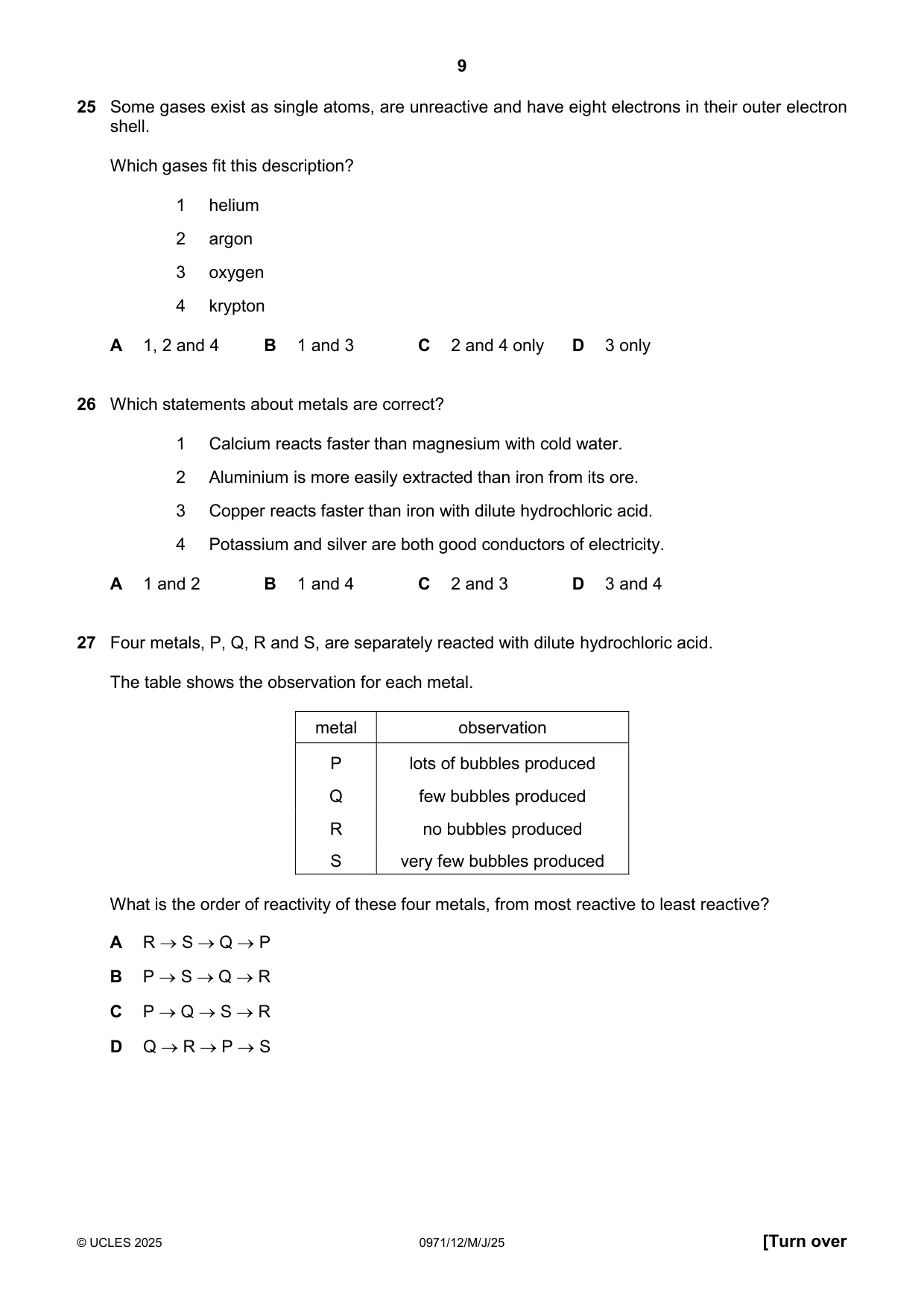
25 Some gases exist as single atoms, are unreactive and have eight electrons in their outer electron shell. Which gases fit this description? 1 helium 2 argon 3 oxygen 4 krypton A 1, 2 and 4 B 1 and 3 C 2 and 4 only D 3 only
Mark scheme: C
Q26 · Which statements about metals are correct?
26 Which statements about metals are correct? 1 Calcium reacts faster than magnesium with cold water. 2 Aluminium is more easily extracted than iron from its ore. 3 Copper reacts faster than iron with dilute hydrochloric acid. 4 Potassium and silver are both good conductors of electricity. A 1 and 2 B 1 and 4 C 2 and 3 D 3 and 4
Mark scheme: B
Q27 · Four metals, P, Q, R and S, are separately reacted with dilute hydrochloric acid
27 Four metals, P, Q, R and S, are separately reacted with dilute hydrochloric acid. The table shows the observation for each metal. metal observation P lots of bubbles produced Q few bubbles produced R no bubbles produced S very few bubbles produced What is the order of reactivity of these four metals, from most reactive to least reactive? A R S Q P B P S Q R C P Q S R D Q R P S
Mark scheme: C
Q28 · The diagram shows iron nails which are left for one week in separate test-tubes with the…
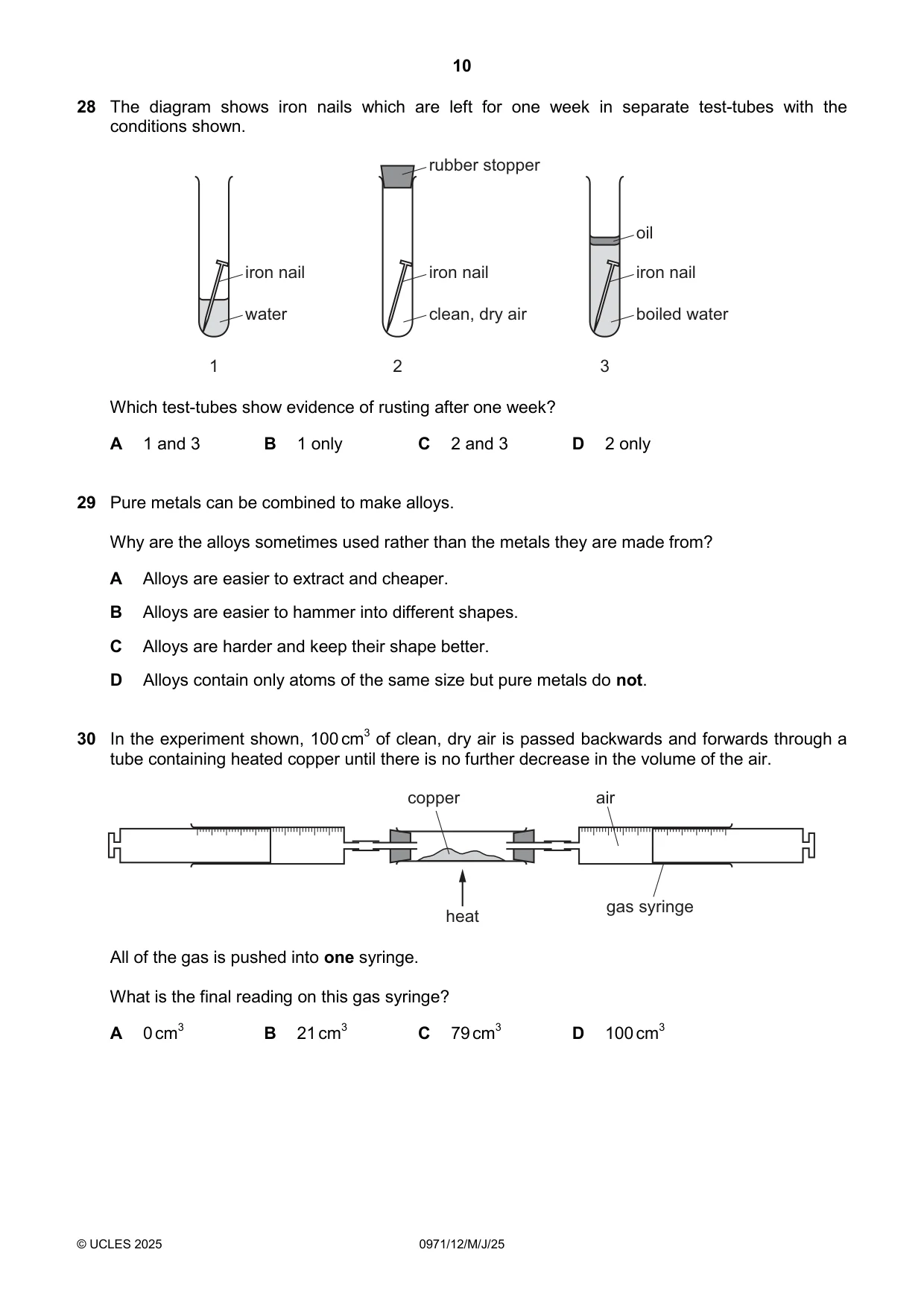
28 The diagram shows iron nails which are left for one week in separate test-tubes with the conditions shown. rubber stopper oil iron nail iron nail iron nail water clean, dry air boiled water 1 2 3 Which test-tubes show evidence of rusting after one week? A 1 and 3 B 1 only C 2 and 3 D 2 only
Mark scheme: B
Q29 · Pure metals can be combined to make alloys
29 Pure metals can be combined to make alloys. Why are the alloys sometimes used rather than the metals they are made from? A Alloys are easier to extract and cheaper. B Alloys are easier to hammer into different shapes. C Alloys are harder and keep their shape better. D Alloys contain only atoms of the same size but pure metals do not.
Mark scheme: C
Q30 · In the experiment shown, 100 cm3 of clean, dry air is passed backwards and forwards…
30 In the experiment shown, 100 cm3 of clean, dry air is passed backwards and forwards through a tube containing heated copper until there is no further decrease in the volume of the air. copper air gas syringe heat All of the gas is pushed into one syringe. What is the final reading on this gas syringe? A 0 cm3 B 21 cm3 C 79 cm3 D 100 cm3
Mark scheme: C
Q31 · Sulfur dioxide, carbon monoxide and oxides of nitrogen are gaseous pollutants found in…
31 Sulfur dioxide, carbon monoxide and oxides of nitrogen are gaseous pollutants found in the air. Which pollutants contribute to acid rain? A carbon monoxide and sulfur dioxide B oxides of nitrogen and sulfur dioxide C oxides of nitrogen only D sulfur dioxide only
Mark scheme: B
Q32 · The formulae for three organic compounds are listed
32 The formulae for three organic compounds are listed. 1 C2H4 2 C4H8 3 C4H10 Which compounds belong to the same homologous series? A 1, 2 and 3 B 1 and 2 only C 1 and 3 only D 2 and 3 only
Mark scheme: B
More questions on Formulae, functional groups and terminology
Q33 · Which fuel could be gasoline?
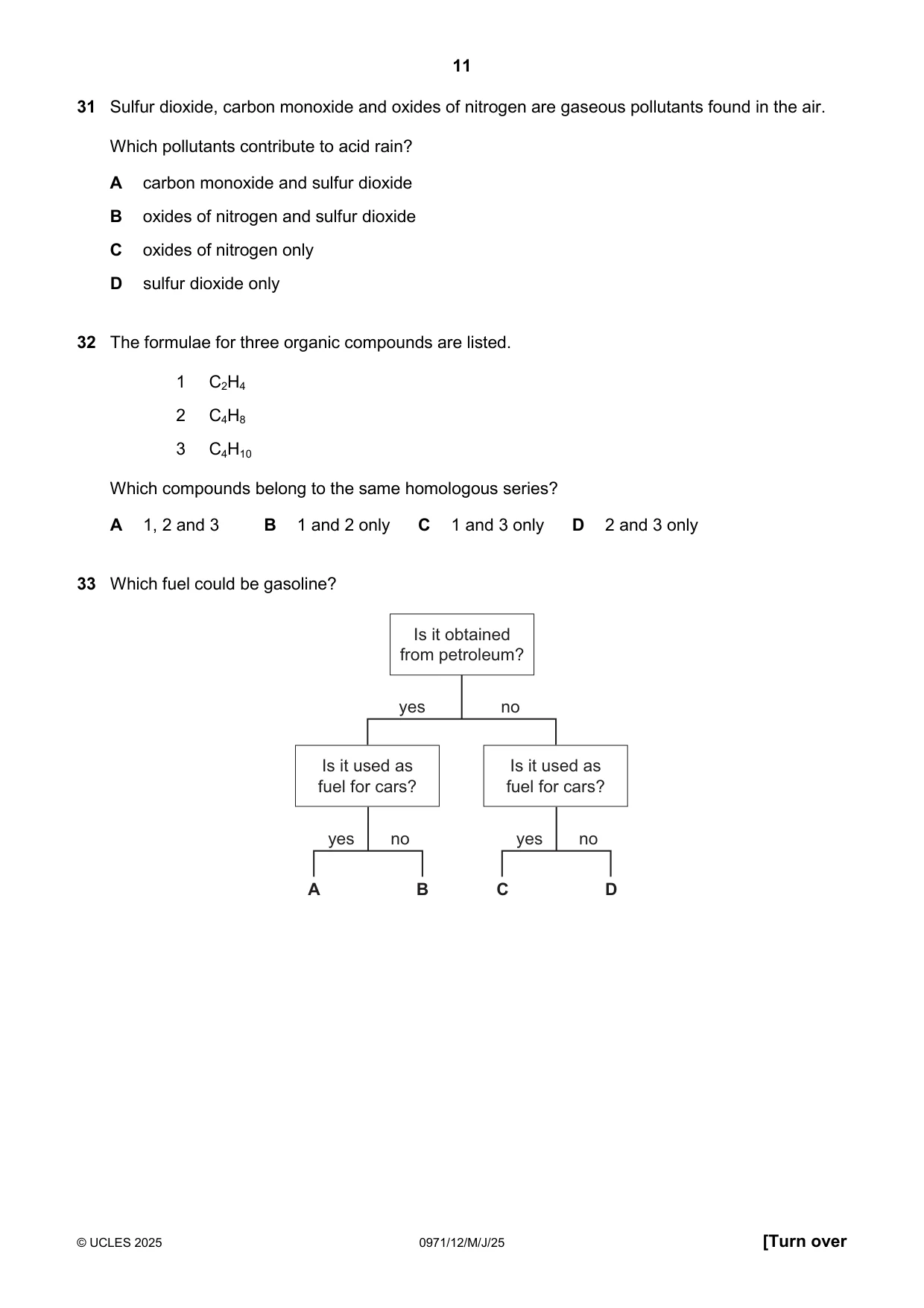
33 Which fuel could be gasoline? Is it obtained from petroleum? yes no Is it used as Is it used as fuel for cars? fuel for cars? yes no yes no A B C D
Mark scheme: A
Q34 · Three hydrocarbons are separately mixed with aqueous bromine
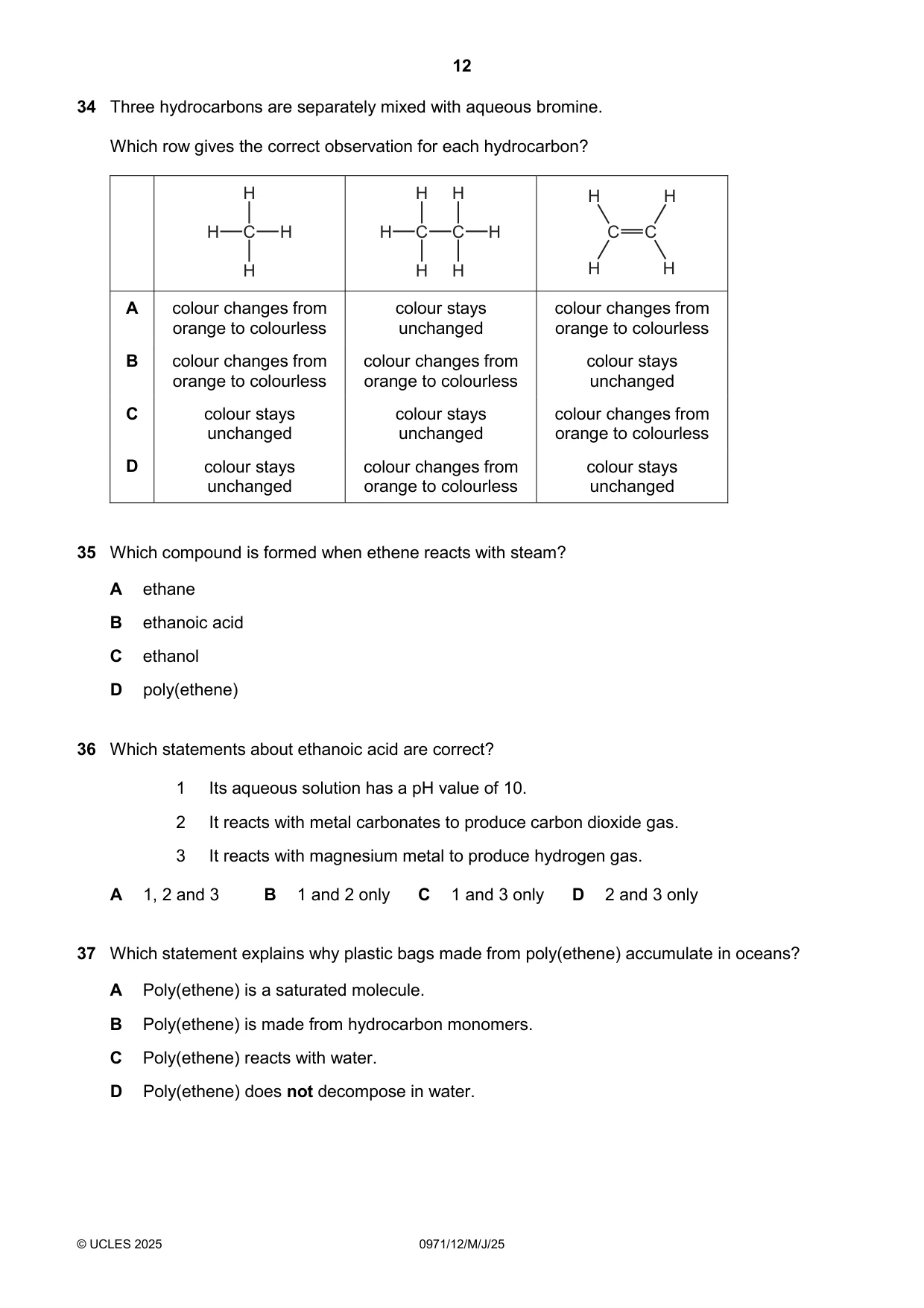
34 Three hydrocarbons are separately mixed with aqueous bromine. Which row gives the correct observation for each hydrocarbon? H H H H H H C H H C C H C C H H H H H A colour changes from colour stays colour changes from orange to colourless unchanged orange to colourless B colour changes from colour changes from colour stays orange to colourless orange to colourless unchanged C colour stays colour stays colour changes from unchanged unchanged orange to colourless D colour stays colour changes from colour stays unchanged orange to colourless unchanged
Mark scheme: C
Q35 · Which compound is formed when ethene reacts with steam?
35 Which compound is formed when ethene reacts with steam? A ethane B ethanoic acid C ethanol D poly(ethene)
Mark scheme: C
Q36 · Which statements about ethanoic acid are correct?
36 Which statements about ethanoic acid are correct? 1 Its aqueous solution has a pH value of 10. 2 It reacts with metal carbonates to produce carbon dioxide gas. 3 It reacts with magnesium metal to produce hydrogen gas. A 1, 2 and 3 B 1 and 2 only C 1 and 3 only D 2 and 3 only
Mark scheme: D
Q37 · Which statement explains why plastic bags made from poly(ethene) accumulate in oceans?
37 Which statement explains why plastic bags made from poly(ethene) accumulate in oceans? A Poly(ethene) is a saturated molecule. B Poly(ethene) is made from hydrocarbon monomers. C Poly(ethene) reacts with water. D Poly(ethene) does not decompose in water.
Mark scheme: D
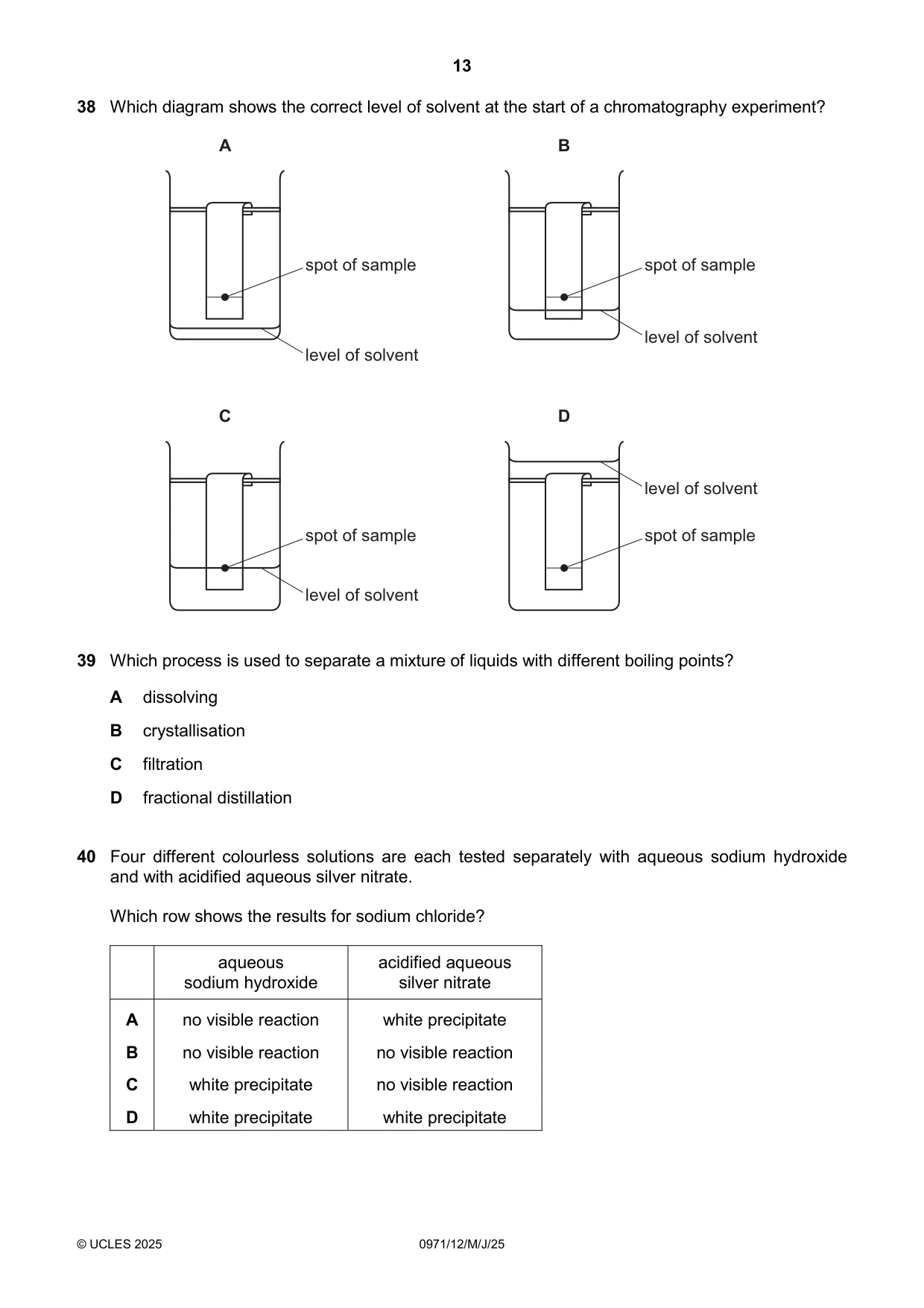
Q38 · Which diagram shows the correct level of solvent at the start of a chromatography…
38 Which diagram shows the correct level of solvent at the start of a chromatography experiment? A B spot of sample spot of sample level of solvent level of solvent C D level of solvent spot of sample spot of sample level of solvent
Mark scheme: B
Q39 · Which process is used to separate a mixture of liquids with different boiling points?
39 Which process is used to separate a mixture of liquids with different boiling points? A dissolving B crystallisation C filtration D fractional distillation
Mark scheme: D
Q40 · Four different colourless solutions are each tested separately with aqueous sodium…
40 Four different colourless solutions are each tested separately with aqueous sodium hydroxide and with acidified aqueous silver nitrate. Which row shows the results for sodium chloride? aqueous acidified aqueous sodium hydroxide silver nitrate A no visible reaction white precipitate B no visible reaction no visible reaction C white precipitate no visible reaction D white precipitate white precipitate
Mark scheme: A
What was in this paper
The subtopics covered by these 40 questions, and how many questions each got. Open one in a new tab to see every Cambridge question on it.
2Formulae, functional groups and terminology2Reactivity series2Solids, liquids and gases2Alcohols1Alkenes1Alloys and their properties1Arrangement of elements1Atomic structure and the Periodic Table1Carboxylic acids1Chromatography1Corrosion of metals1Diffusion1Electrolysis1Elements, compounds and mixtures1Exothermic and endothermic reactions1Fuels1Giant covalent structures1Group I properties1Group VII properties1Hydrogen–oxygen fuel cells1Identification of ions and gases1Ions and ionic bonds1Isotopes1Noble gases1Oxides1Physical and chemical changes1Polymers1Rate of reaction1Redox1Reversible reactions and equilibrium1Separation and purification1Simple molecules and covalent bonds1The characteristic properties of acids and bases1The mole and the Avogadro constant1Transition elements1What you needed in this session
Cambridge’s own grade thresholds for 2025 May/June, Paper 1 · Variant 2. A higher threshold means an easier paper — the bar moves with how the cohort did.