Cambridge IGCSE Chemistry (9-1) 0971 — 2024 Oct/Nov Paper 1 · Variant 2
0971/12/O/N/24 · 40 questions · 40 marks · 45 min
The question paper and its mark scheme, free to read here and free to download. This is Cambridge’s own paper, exactly as it was sat.
Question paper16 pages


Mark scheme3 pages
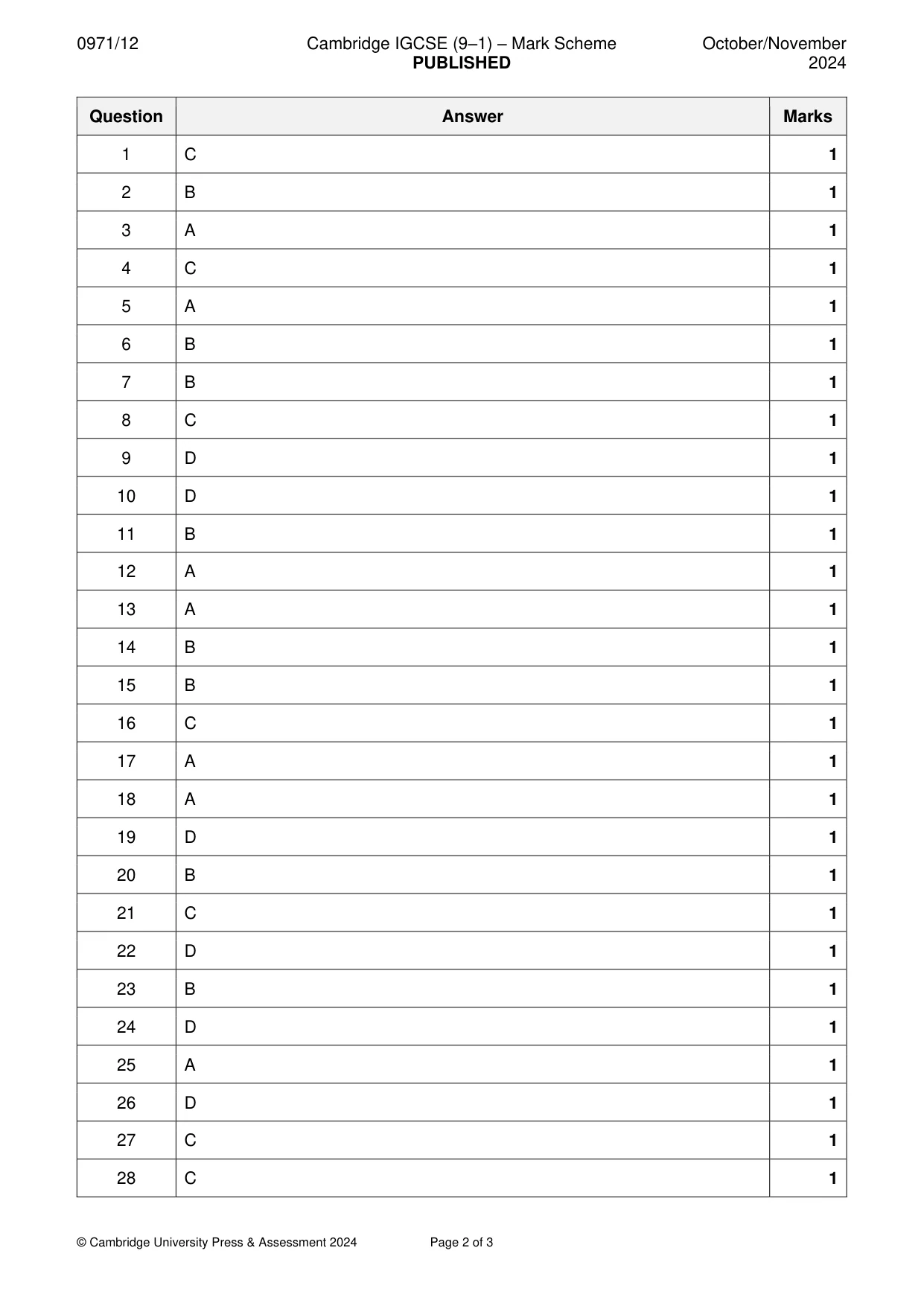
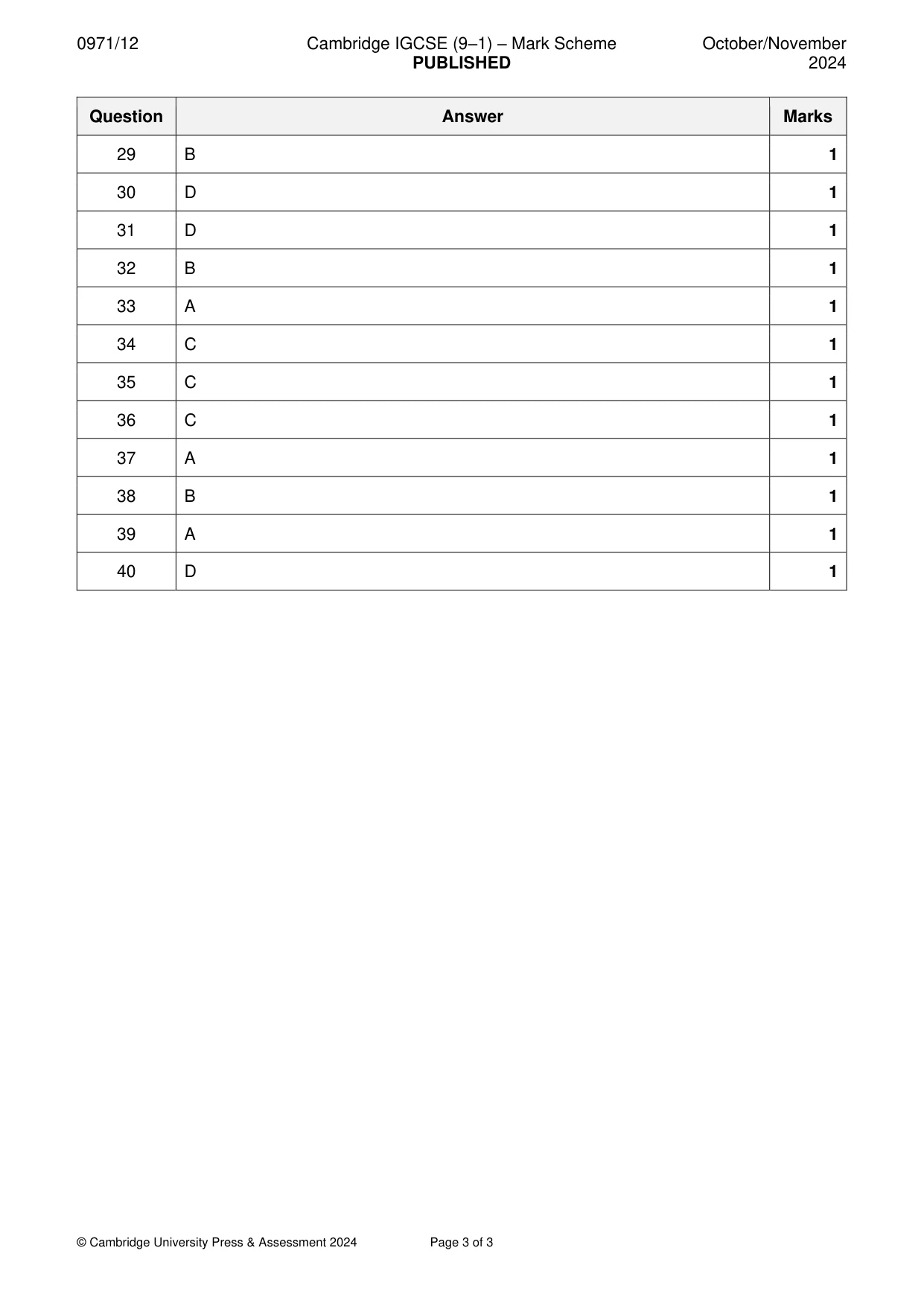
Answers below. Sit the paper first if you are practising.
Questions as text
Q1 · The table shows some information about the three states of matter
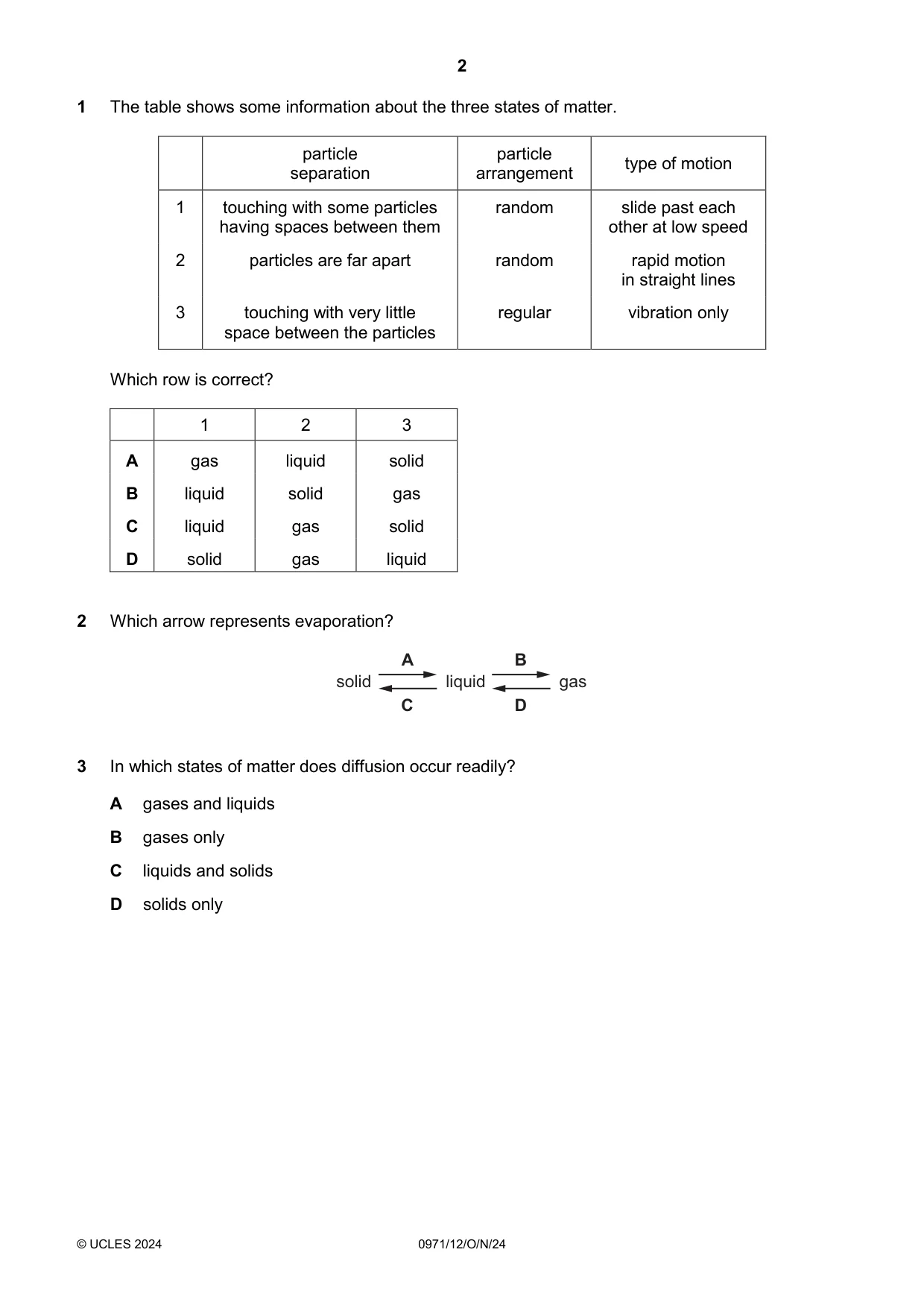
1 The table shows some information about the three states of matter. particle particle type of motion separation arrangement 1 touching with some particles random slide past each having spaces between them other at low speed 2 particles are far apart random rapid motion in straight lines 3 touching with very little regular vibration only space between the particles Which row is correct? 1 2 3 A gas liquid solid B liquid solid gas C liquid gas solid D solid gas liquid
Mark scheme: C
Q2 · Which arrow represents evaporation?
2 Which arrow represents evaporation? A B solid liquid gas C D
Mark scheme: B
Q3 · In which states of matter does diffusion occur readily?
3 In which states of matter does diffusion occur readily? A gases and liquids B gases only C liquids and solids D solids only
Mark scheme: A
Q4 · Which statement about the boxes P, Q and R is correct?
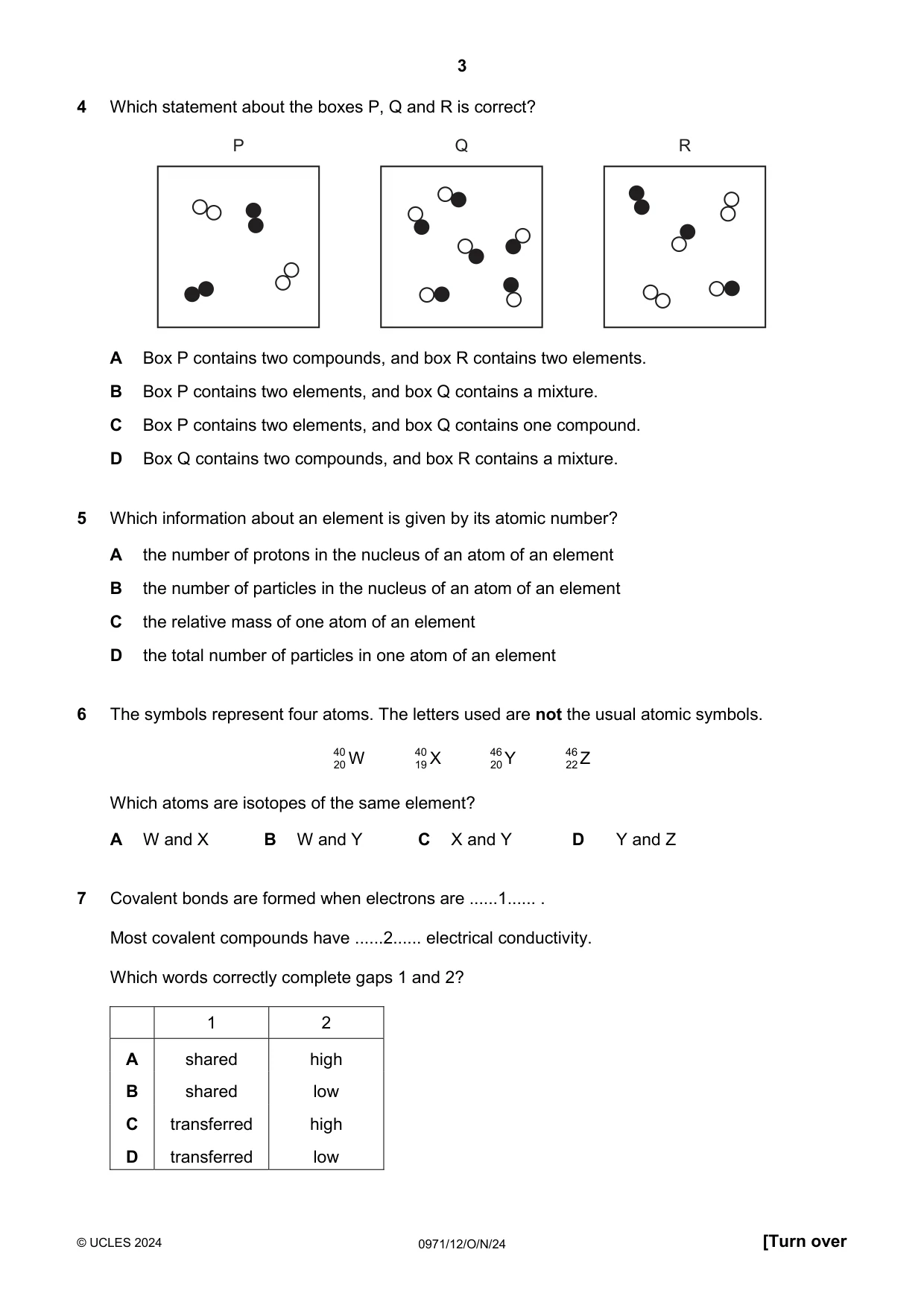
4 Which statement about the boxes P, Q and R is correct? P Q R A Box P contains two compounds, and box R contains two elements. B Box P contains two elements, and box Q contains a mixture. C Box P contains two elements, and box Q contains one compound. D Box Q contains two compounds, and box R contains a mixture.
Mark scheme: C
Q5 · Which information about an element is given by its atomic number?
5 Which information about an element is given by its atomic number? A the number of protons in the nucleus of an atom of an element B the number of particles in the nucleus of an atom of an element C the relative mass of one atom of an element D the total number of particles in one atom of an element
Mark scheme: A
Q6 · The symbols represent four atoms
6 The symbols represent four atoms. The letters used are not the usual atomic symbols. 40 W 40 X 46 Y 46 Z 20 19 20 22 Which atoms are isotopes of the same element? A W and X B W and Y C X and Y D Y and Z
Mark scheme: B
Q7 · Covalent bonds are formed when electrons are ......1.....
7 Covalent bonds are formed when electrons are ......1...... . Most covalent compounds have ......2...... electrical conductivity. Which words correctly complete gaps 1 and 2? 1 2 A shared high B shared low C transferred high D transferred low
Mark scheme: B
Q8 · Which row describes the structure and a use of diamond?
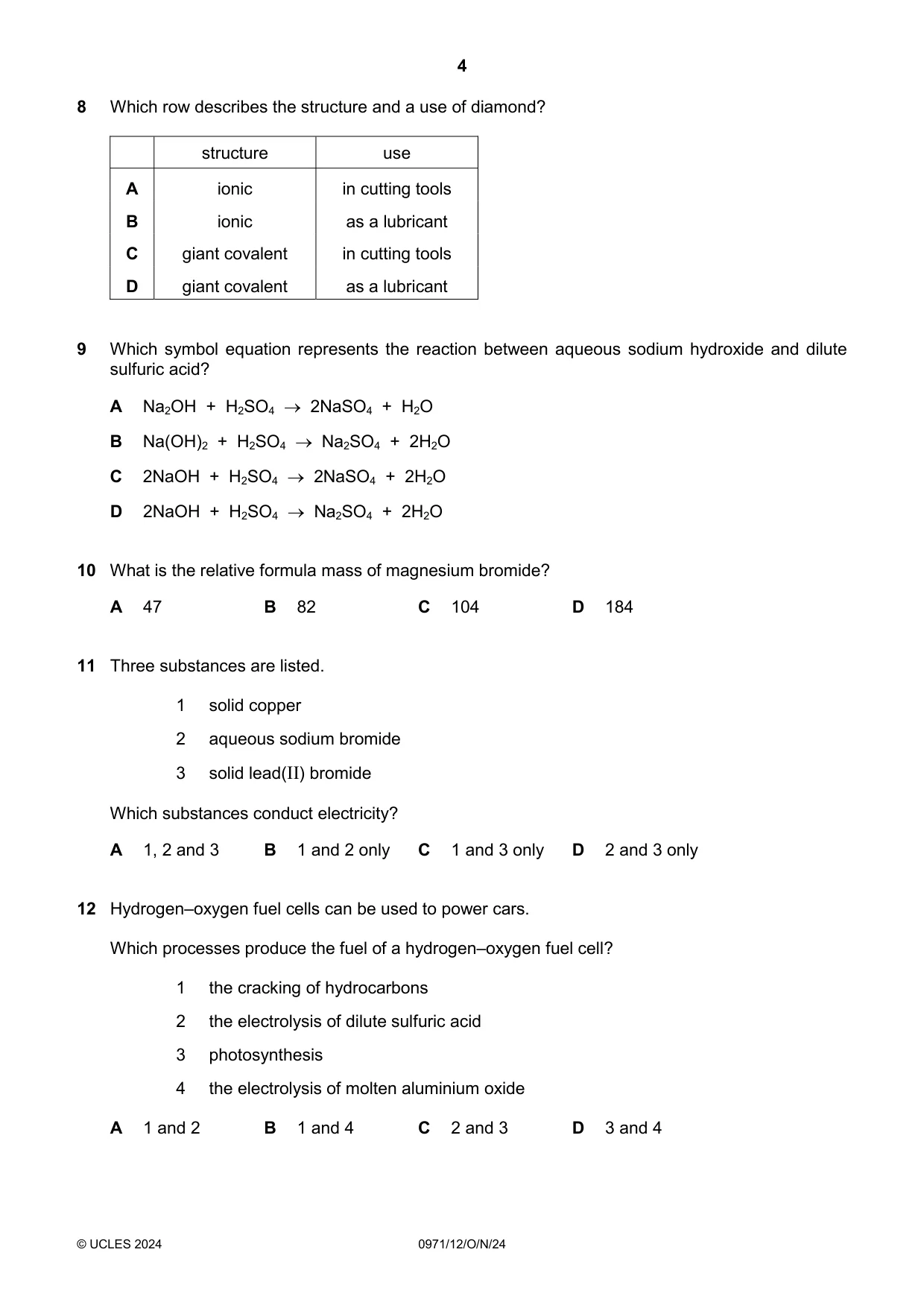
8 Which row describes the structure and a use of diamond? structure use A ionic in cutting tools B ionic as a lubricant C giant covalent in cutting tools D giant covalent as a lubricant
Mark scheme: C
Q9 · Which symbol equation represents the reaction between aqueous sodium hydroxide and dilute…
9 Which symbol equation represents the reaction between aqueous sodium hydroxide and dilute sulfuric acid? A Na2OH + H2SO4 2NaSO4 + H2O B Na(OH)2 + H2SO4 Na2SO4 + 2H2O C 2NaOH + H2SO4 2NaSO4 + 2H2O D 2NaOH + H2SO4 Na2SO4 + 2H2O
Mark scheme: D
Q10 · What is the relative formula mass of magnesium bromide?
10 What is the relative formula mass of magnesium bromide? A 47 B 82 C 104 D 184
Mark scheme: D
Q11 · Three substances are listed
11 Three substances are listed. 1 solid copper 2 aqueous sodium bromide 3 solid lead(II) bromide Which substances conduct electricity? A 1, 2 and 3 B 1 and 2 only C 1 and 3 only D 2 and 3 only
Mark scheme: B
Q12 · Hydrogen–oxygen fuel cells can be used to power cars
12 Hydrogen–oxygen fuel cells can be used to power cars. Which processes produce the fuel of a hydrogen–oxygen fuel cell? 1 the cracking of hydrocarbons 2 the electrolysis of dilute sulfuric acid 3 photosynthesis 4 the electrolysis of molten aluminium oxide A 1 and 2 B 1 and 4 C 2 and 3 D 3 and 4
Mark scheme: A
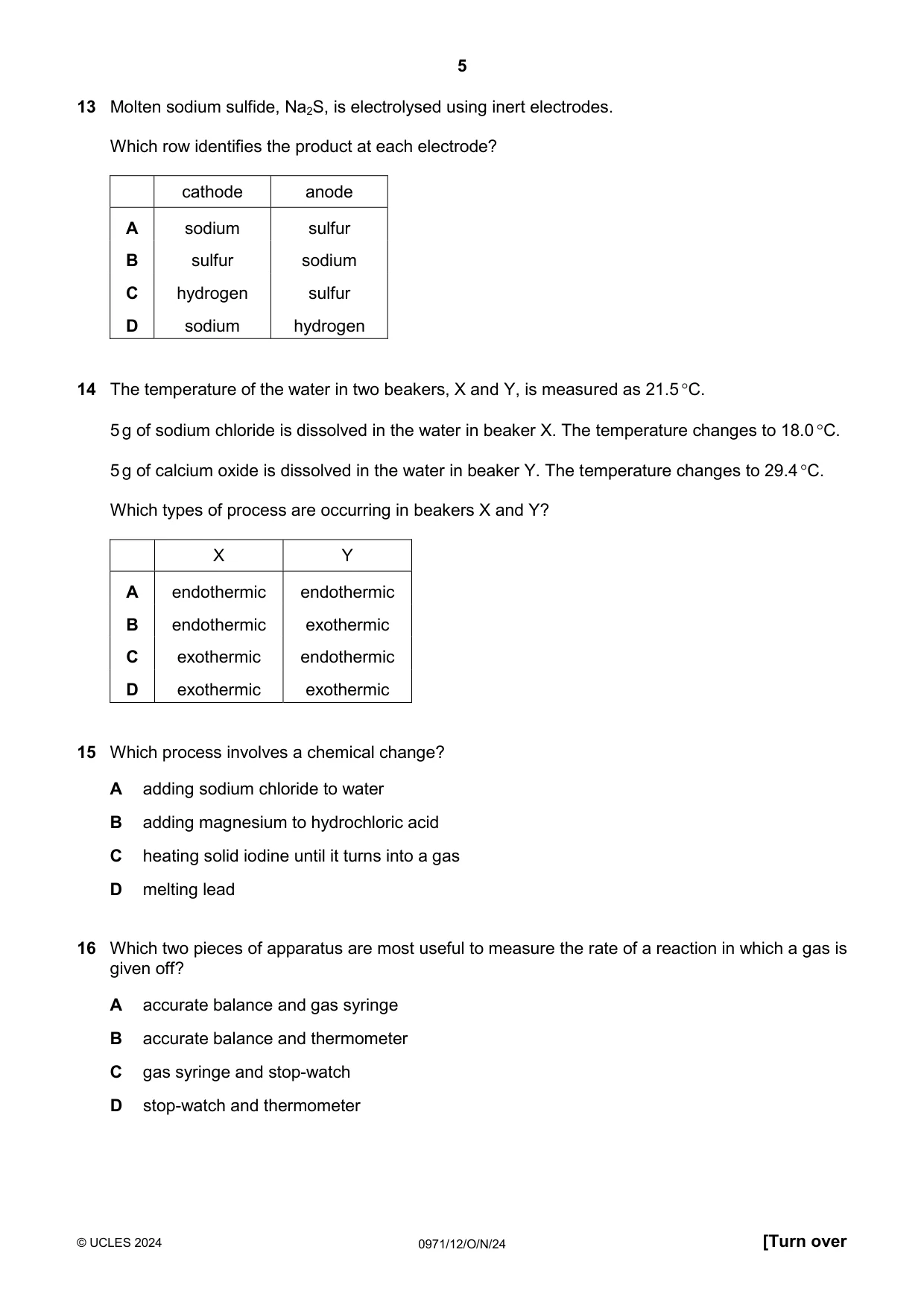
Q13 · Molten sodium sulfide, Na2S, is electrolysed using inert electrodes
13 Molten sodium sulfide, Na2S, is electrolysed using inert electrodes. Which row identifies the product at each electrode? cathode anode A sodium sulfur B sulfur sodium C hydrogen sulfur D sodium hydrogen
Mark scheme: A
Q14 · The temperature of the water in two beakers, X and Y, is measured as 21.5 C
14 The temperature of the water in two beakers, X and Y, is measured as 21.5 C. 5 g of sodium chloride is dissolved in the water in beaker X. The temperature changes to 18.0 C. 5 g of calcium oxide is dissolved in the water in beaker Y. The temperature changes to 29.4 C. Which types of process are occurring in beakers X and Y? X Y A endothermic endothermic B endothermic exothermic C exothermic endothermic D exothermic exothermic
Mark scheme: B
Q15 · Which process involves a chemical change?
15 Which process involves a chemical change? A adding sodium chloride to water B adding magnesium to hydrochloric acid C heating solid iodine until it turns into a gas D melting lead
Mark scheme: B
Q16 · Which two pieces of apparatus are most useful to measure the rate of a reaction in which…
16 Which two pieces of apparatus are most useful to measure the rate of a reaction in which a gas is given off? A accurate balance and gas syringe B accurate balance and thermometer C gas syringe and stop-watch D stop-watch and thermometer
Mark scheme: C
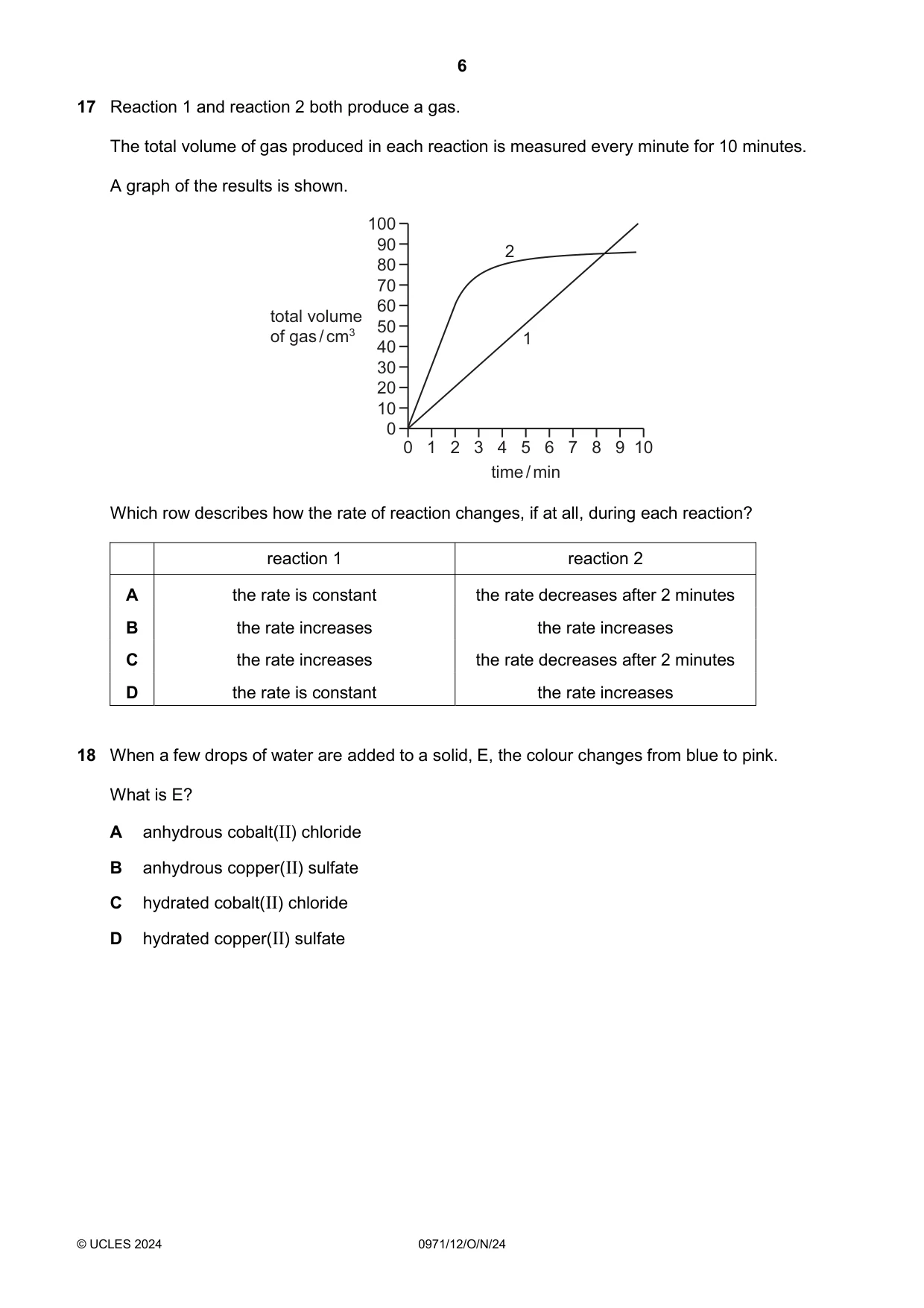
Q17 · Reaction 1 and reaction 2 both produce a gas
17 Reaction 1 and reaction 2 both produce a gas. The total volume of gas produced in each reaction is measured every minute for 10 minutes. A graph of the results is shown. 100 90 2 80 70 60 total volume 50 of gas / cm3 1 40 30 20 10 0 0 1 2 3 4 5 6 7 8 9 10 time / min Which row describes how the rate of reaction changes, if at all, during each reaction? reaction 1 reaction 2 A the rate is constant the rate decreases after 2 minutes B the rate increases the rate increases C the rate increases the rate decreases after 2 minutes D the rate is constant the rate increases
Mark scheme: A
Q18 · When a few drops of water are added to a solid, E, the colour changes from blue to pink
18 When a few drops of water are added to a solid, E, the colour changes from blue to pink. What is E? A anhydrous cobalt(II) chloride B anhydrous copper(II) sulfate C hydrated cobalt(II) chloride D hydrated copper(II) sulfate
Mark scheme: A
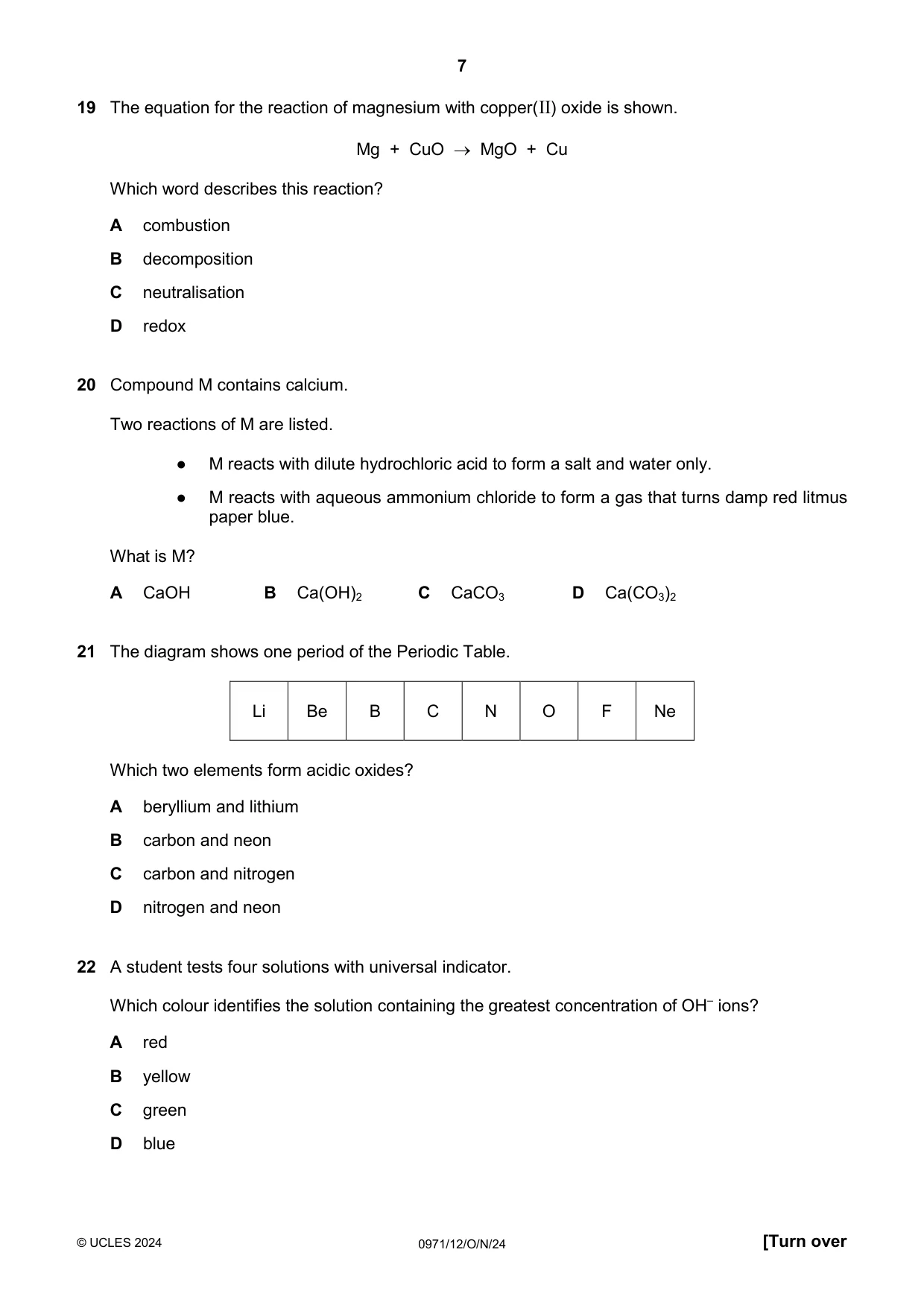
Q19 · The equation for the reaction of magnesium with copper(II) oxide is shown
19 The equation for the reaction of magnesium with copper(II) oxide is shown. Mg + CuO MgO + Cu Which word describes this reaction? A combustion B decomposition C neutralisation D redox
Mark scheme: D
Q20 · Compound M contains calcium
20 Compound M contains calcium. Two reactions of M are listed. ● M reacts with dilute hydrochloric acid to form a salt and water only. ● M reacts with aqueous ammonium chloride to form a gas that turns damp red litmus paper blue. What is M? A CaOH B Ca(OH)2 C CaCO3 D Ca(CO3)2
Mark scheme: B
Q21 · The diagram shows one period of the Periodic Table
21 The diagram shows one period of the Periodic Table. Li Be B C N O F Ne Which two elements form acidic oxides? A beryllium and lithium B carbon and neon C carbon and nitrogen D nitrogen and neon
Mark scheme: C
Q22 · A student tests four solutions with universal indicator
22 A student tests four solutions with universal indicator. Which colour identifies the solution containing the greatest concentration of OH– ions? A red B yellow C green D blue
Mark scheme: D
More questions on The characteristic properties of acids and bases
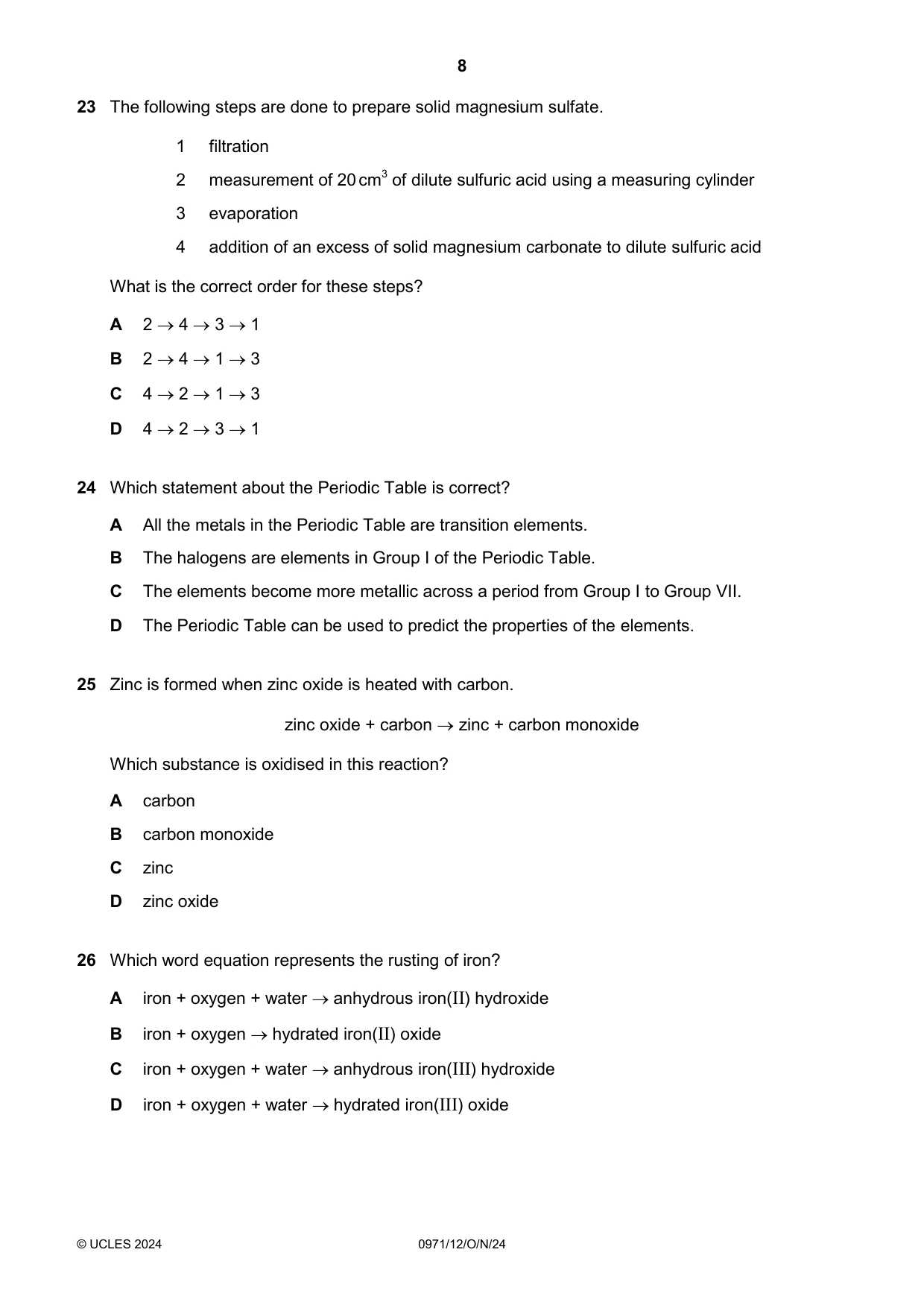
Q23 · The following steps are done to prepare solid magnesium sulfate
23 The following steps are done to prepare solid magnesium sulfate. 1 filtration 2 measurement of 20 cm3 of dilute sulfuric acid using a measuring cylinder 3 evaporation 4 addition of an excess of solid magnesium carbonate to dilute sulfuric acid What is the correct order for these steps? A 2 4 3 1 B 2 4 1 3 C 4 2 1 3 D 4 2 3 1
Mark scheme: B
Q24 · Which statement about the Periodic Table is correct?
24 Which statement about the Periodic Table is correct? A All the metals in the Periodic Table are transition elements. B The halogens are elements in Group I of the Periodic Table. C The elements become more metallic across a period from Group I to Group VII. D The Periodic Table can be used to predict the properties of the elements.
Mark scheme: D
Q25 · Zinc is formed when zinc oxide is heated with carbon
25 Zinc is formed when zinc oxide is heated with carbon. zinc oxide + carbon zinc + carbon monoxide Which substance is oxidised in this reaction? A carbon B carbon monoxide C zinc D zinc oxide
Mark scheme: A
Q26 · Which word equation represents the rusting of iron?
26 Which word equation represents the rusting of iron? A iron + oxygen + water anhydrous iron(II) hydroxide B iron + oxygen hydrated iron(II) oxide C iron + oxygen + water anhydrous iron(III) hydroxide D iron + oxygen + water hydrated iron(III) oxide
Mark scheme: D
Q27 · Which option describes the electronic configurations of three different elements from the…
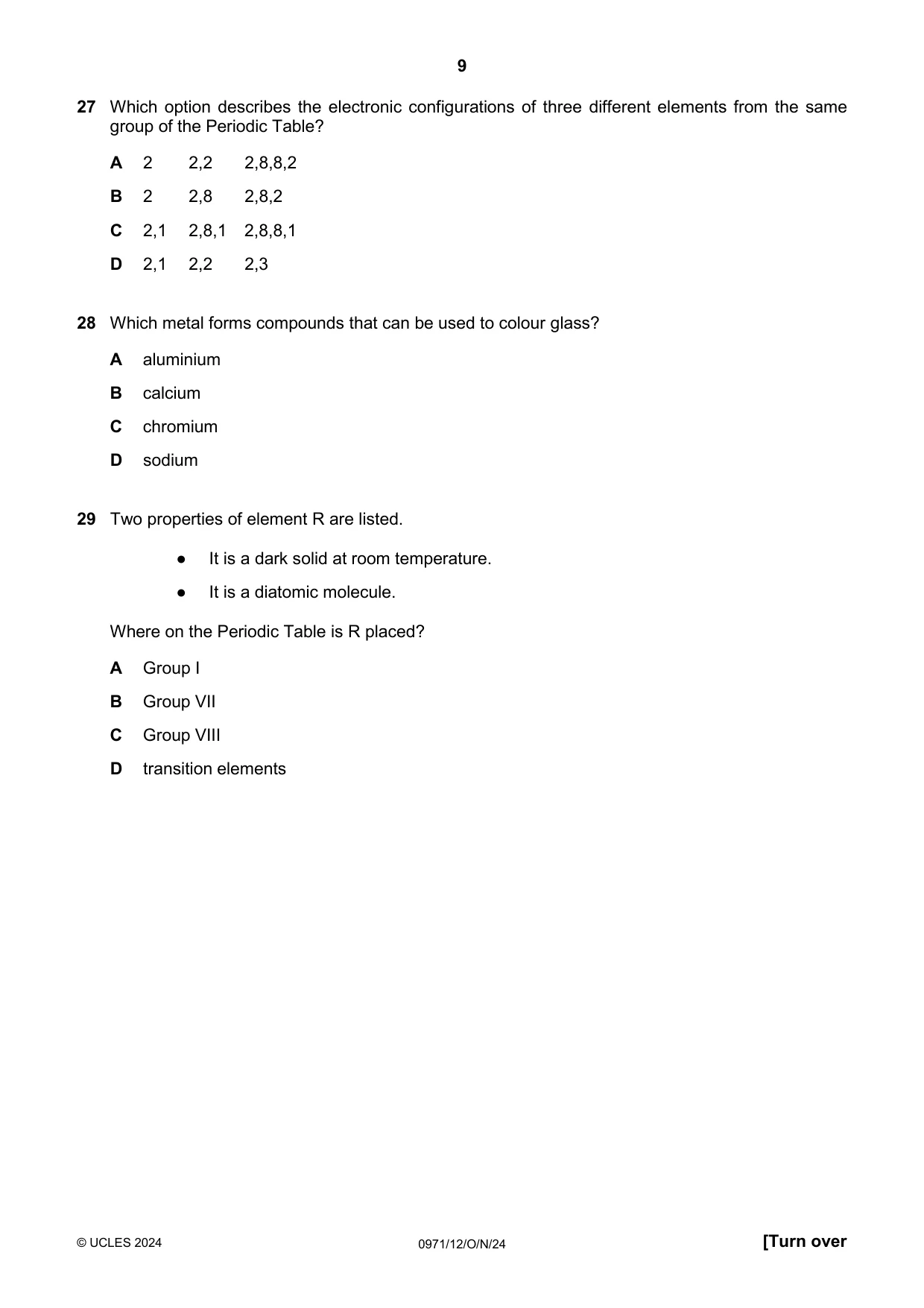
27 Which option describes the electronic configurations of three different elements from the same group of the Periodic Table? A 2 2,2 2,8,8,2 B 2 2,8 2,8,2 C 2,1 2,8,1 2,8,8,1 D 2,1 2,2 2,3
Mark scheme: C
Q28 · Which metal forms compounds that can be used to colour glass?
28 Which metal forms compounds that can be used to colour glass? A aluminium B calcium C chromium D sodium
Mark scheme: C
Q29 · Two properties of element R are listed
29 Two properties of element R are listed. ● It is a dark solid at room temperature. ● It is a diatomic molecule. Where on the Periodic Table is R placed? A Group I B Group VII C Group VIII D transition elements
Mark scheme: B
Q30 · Four metals, W, X, Y and Z, are tested with either cold water, steam or both
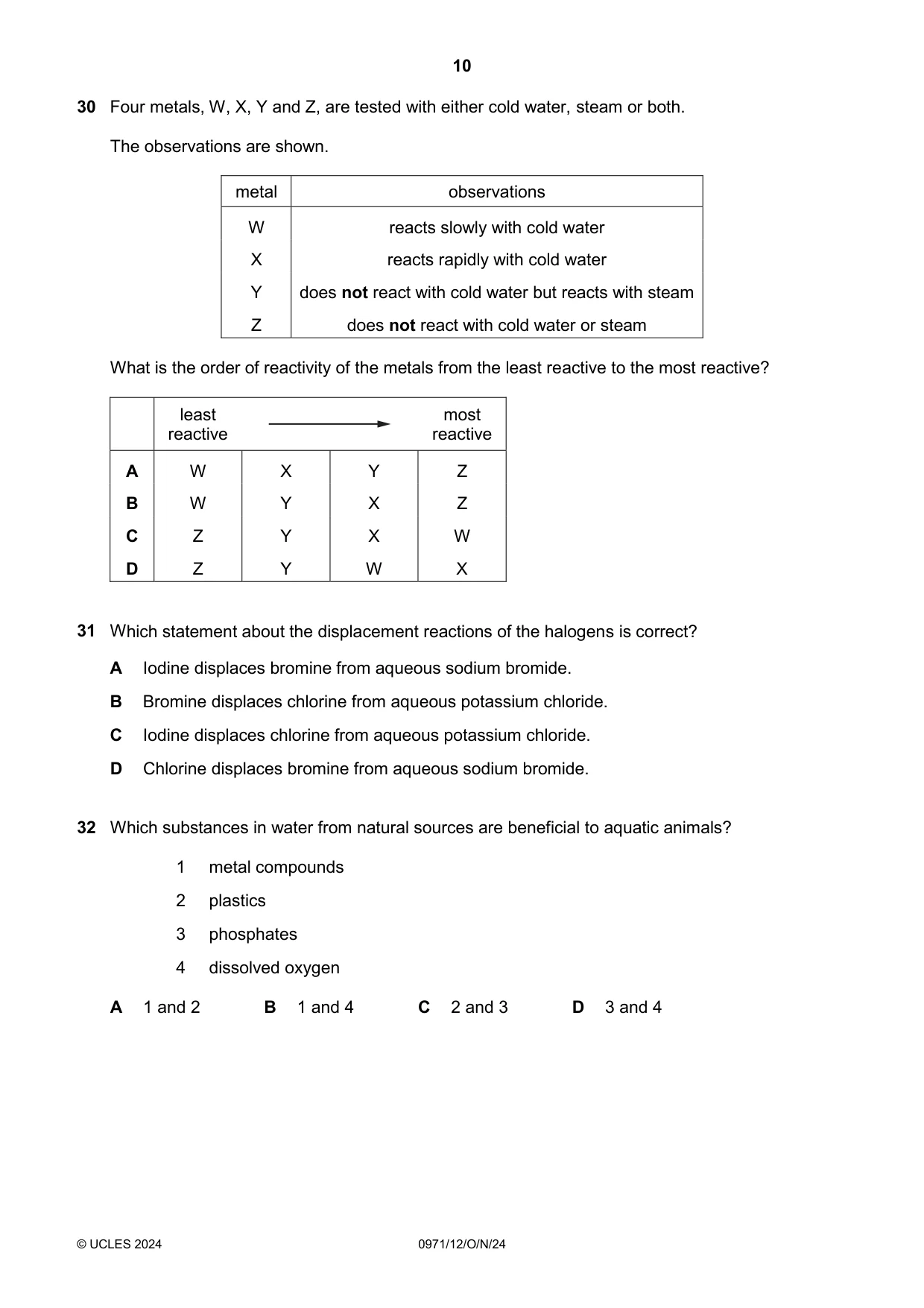
30 Four metals, W, X, Y and Z, are tested with either cold water, steam or both. The observations are shown. metal observations W reacts slowly with cold water X reacts rapidly with cold water Y does not react with cold water but reacts with steam Z does not react with cold water or steam What is the order of reactivity of the metals from the least reactive to the most reactive? least most reactive reactive A W X Y Z B W Y X Z C Z Y X W D Z Y W X
Mark scheme: D
Q31 · Which statement about the displacement reactions of the halogens is correct?
31 Which statement about the displacement reactions of the halogens is correct? A Iodine displaces bromine from aqueous sodium bromide. B Bromine displaces chlorine from aqueous potassium chloride. C Iodine displaces chlorine from aqueous potassium chloride. D Chlorine displaces bromine from aqueous sodium bromide.
Mark scheme: D
Q32 · Which substances in water from natural sources are beneficial to aquatic animals?
32 Which substances in water from natural sources are beneficial to aquatic animals? 1 metal compounds 2 plastics 3 phosphates 4 dissolved oxygen A 1 and 2 B 1 and 4 C 2 and 3 D 3 and 4
Mark scheme: B
Q33 · What are the products formed when glucose is fermented?
33 What are the products formed when glucose is fermented? A ethanol and carbon dioxide B ethanol and oxygen C ethene and carbon dioxide D ethene and oxygen
Mark scheme: A
Q34 · Which structure represents a molecule of ethanol?
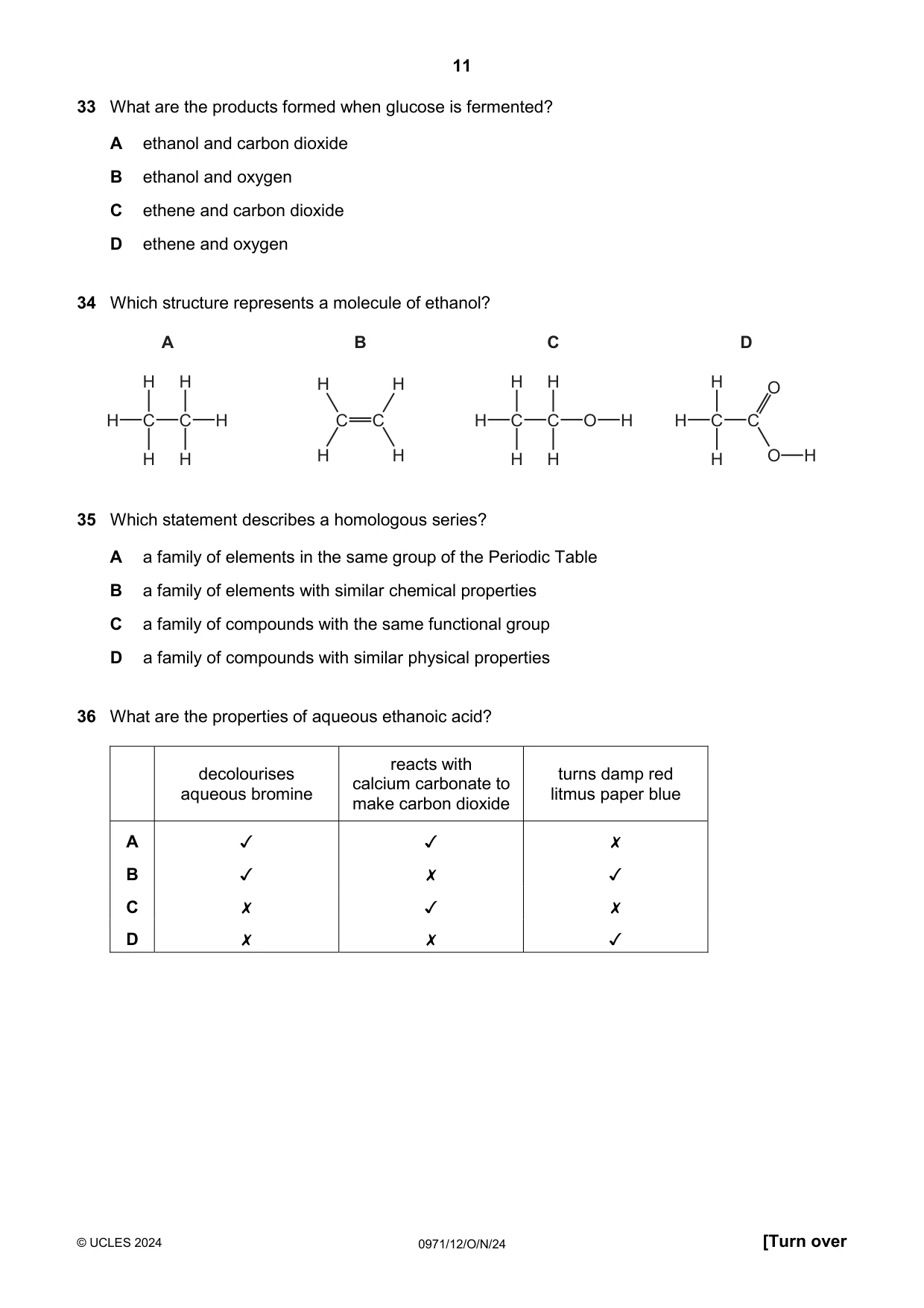
34 Which structure represents a molecule of ethanol? A B C D H H H H H H H O H C C H C C H C C O H H C C H H H H H H H O H
Mark scheme: C
Q35 · Which statement describes a homologous series?
35 Which statement describes a homologous series? A a family of elements in the same group of the Periodic Table B a family of elements with similar chemical properties C a family of compounds with the same functional group D a family of compounds with similar physical properties
Mark scheme: C
More questions on Formulae, functional groups and terminology
Q36 · What are the properties of aqueous ethanoic acid?
36 What are the properties of aqueous ethanoic acid? decolourises aqueous bromine reacts with calcium carbonate to make carbon dioxide turns damp red litmus paper blue v x v x \ &«& \ xX
Mark scheme: C
More questions on The characteristic properties of acids and bases
Q37 · Four different organic compounds are separated by a fractionating column
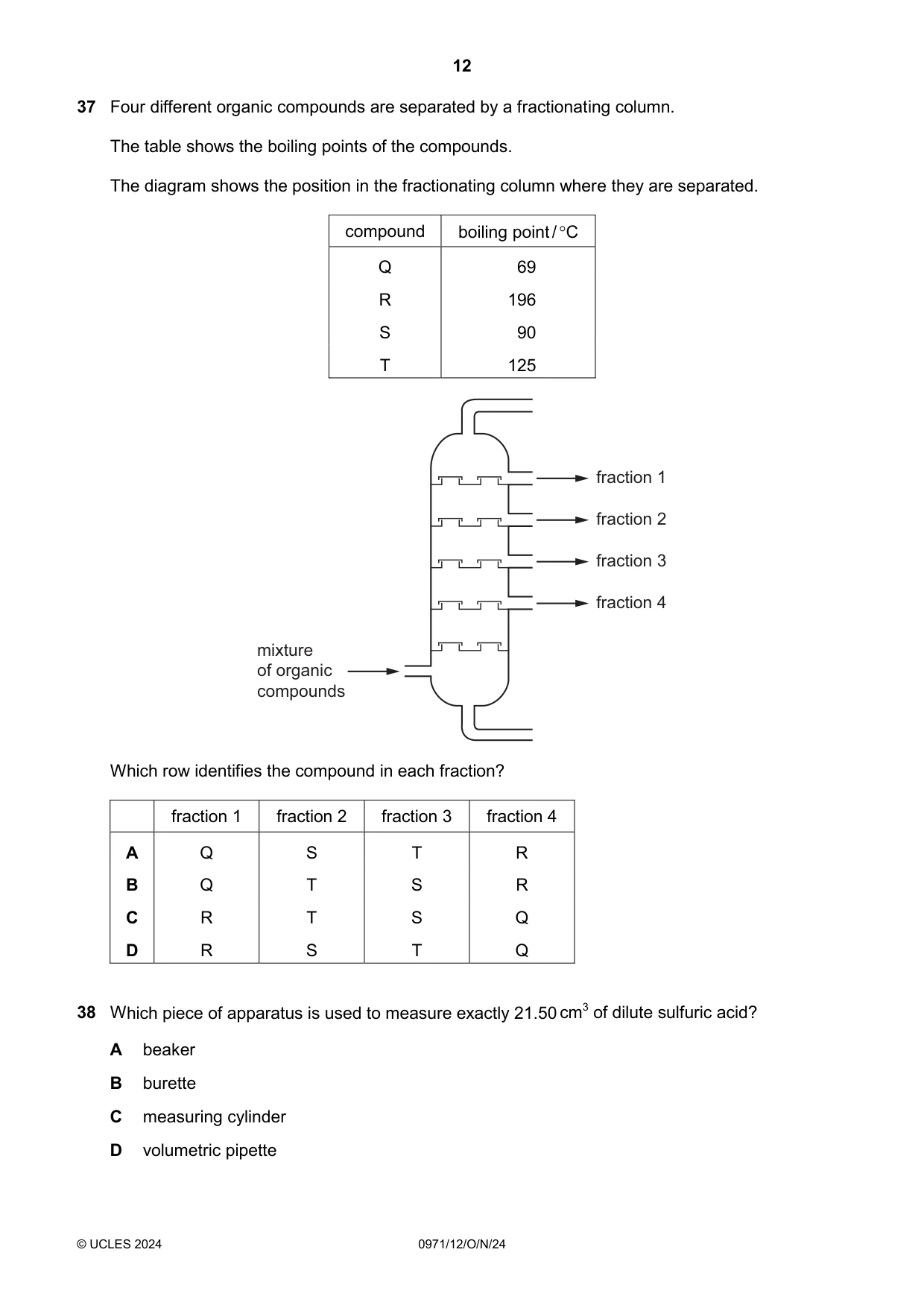
37 Four different organic compounds are separated by a fractionating column. The table shows the boiling points of the compounds. The diagram shows the position in the fractionating column where they are separated. compound boiling point / C Q 69 R 196 S 90 T 125 fraction 1 fraction 2 fraction 3 fraction 4 mixture of organic compounds Which row identifies the compound in each fraction? fraction 1 fraction 2 fraction 3 fraction 4 A Q S T R B Q T S R C R T S Q D R S T Q
Mark scheme: A
Q38 · Which piece of apparatus is used to measure exactly 21.50 cm3 of dilute sulfuric acid?
38 Which piece of apparatus is used to measure exactly 21.50 cm3 of dilute sulfuric acid? A beaker B burette C measuring cylinder D volumetric pipette
Mark scheme: B
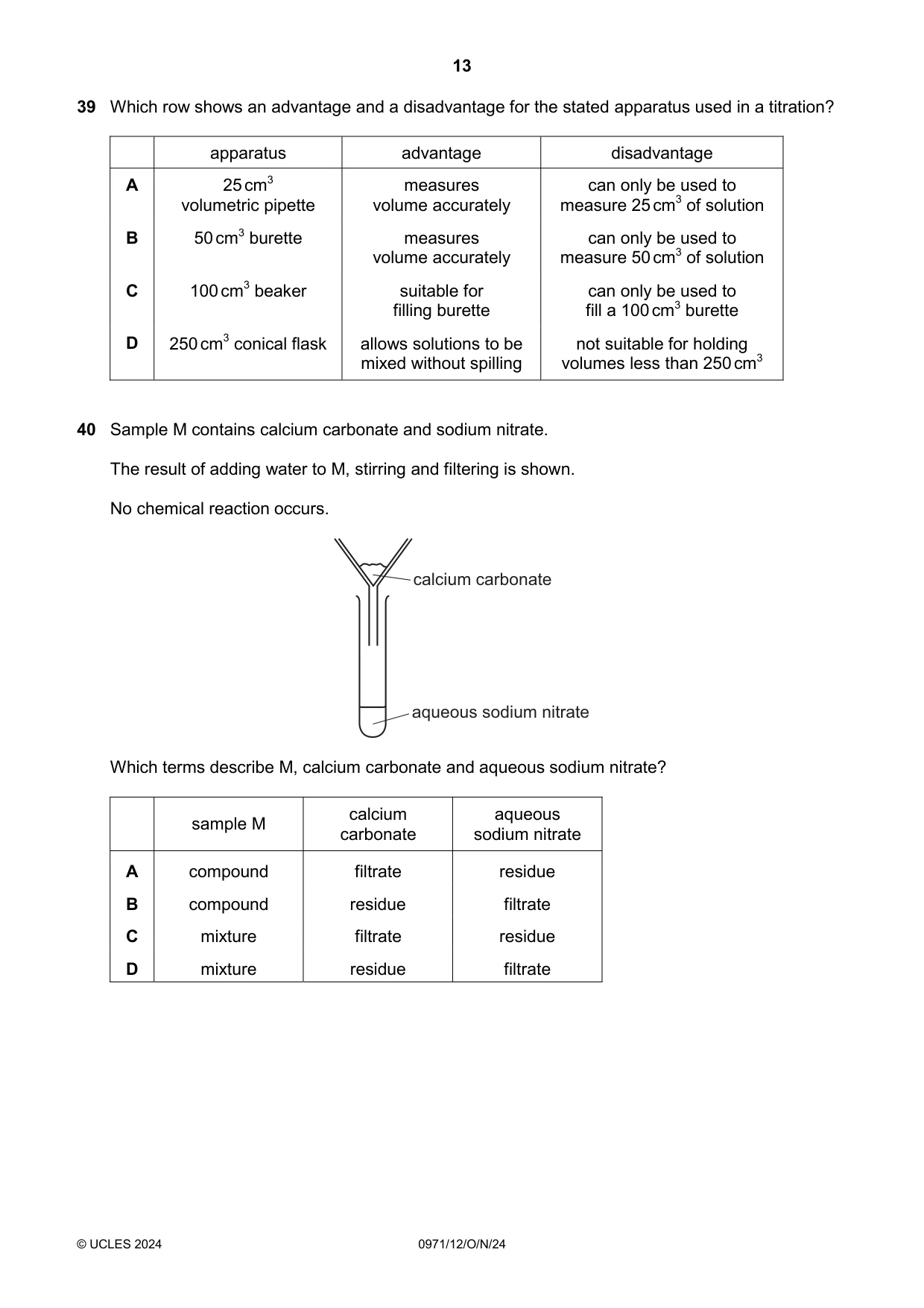
Q39 · Which row shows an advantage and a disadvantage for the stated apparatus used in a…
39 Which row shows an advantage and a disadvantage for the stated apparatus used in a titration? apparatus advantage disadvantage A 25 cm3 measures can only be used to volumetric pipette volume accurately measure 25 cm3 of solution B 50 cm3 burette measures can only be used to volume accurately measure 50 cm3 of solution C 100 cm3 beaker suitable for can only be used to filling burette fill a 100 cm3 burette D 250 cm3 conical flask allows solutions to be not suitable for holding mixed without spilling volumes less than 250 cm3
Mark scheme: A
Q40 · Sample M contains calcium carbonate and sodium nitrate
40 Sample M contains calcium carbonate and sodium nitrate. The result of adding water to M, stirring and filtering is shown. No chemical reaction occurs. calcium carbonate aqueous sodium nitrate Which terms describe M, calcium carbonate and aqueous sodium nitrate? calcium aqueous sample M carbonate sodium nitrate A compound filtrate residue B compound residue filtrate C mixture filtrate residue D mixture residue filtrate
Mark scheme: D
What was in this paper
The subtopics covered by these 40 questions, and how many questions each got. Open one in a new tab to see every Cambridge question on it.
2Alcohols2Arrangement of elements2Electrolysis2Group VII properties2Oxides2Rate of reaction2Redox2Separation and purification2Solids, liquids and gases2The characteristic properties of acids and bases2Atomic structure and the Periodic Table1Corrosion of metals1Diffusion1Elements, compounds and mixtures1Exothermic and endothermic reactions1Formulae1Formulae, functional groups and terminology1Giant covalent structures1Hydrogen–oxygen fuel cells1Identification of ions and gases1Isotopes1Physical and chemical changes1Preparation of salts1Reactivity series1Relative masses of atoms and molecules1Simple molecules and covalent bonds1Transition elements1Water1What you needed in this session
Cambridge’s own grade thresholds for 2024 Oct/Nov, Paper 1 · Variant 2. A higher threshold means an easier paper — the bar moves with how the cohort did.