Cambridge IGCSE Chemistry (9-1) 0971 — 2024 May/June Paper 1 · Variant 1
0971/11/M/J/24 · 40 questions · 40 marks · 45 min
The question paper and its mark scheme, free to read here and free to download. This is Cambridge’s own paper, exactly as it was sat.
Question paper16 pages
Mark scheme3 pages
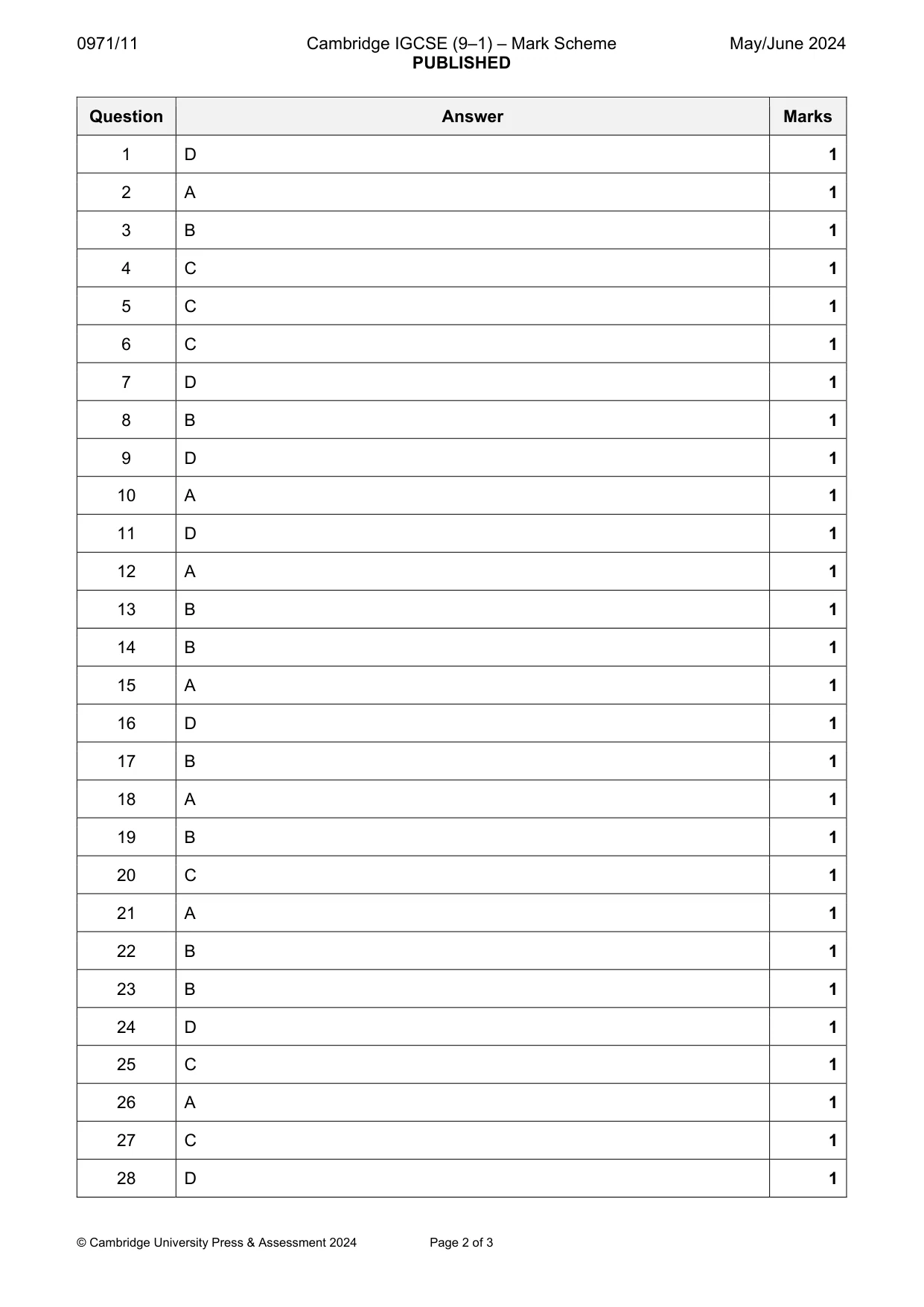
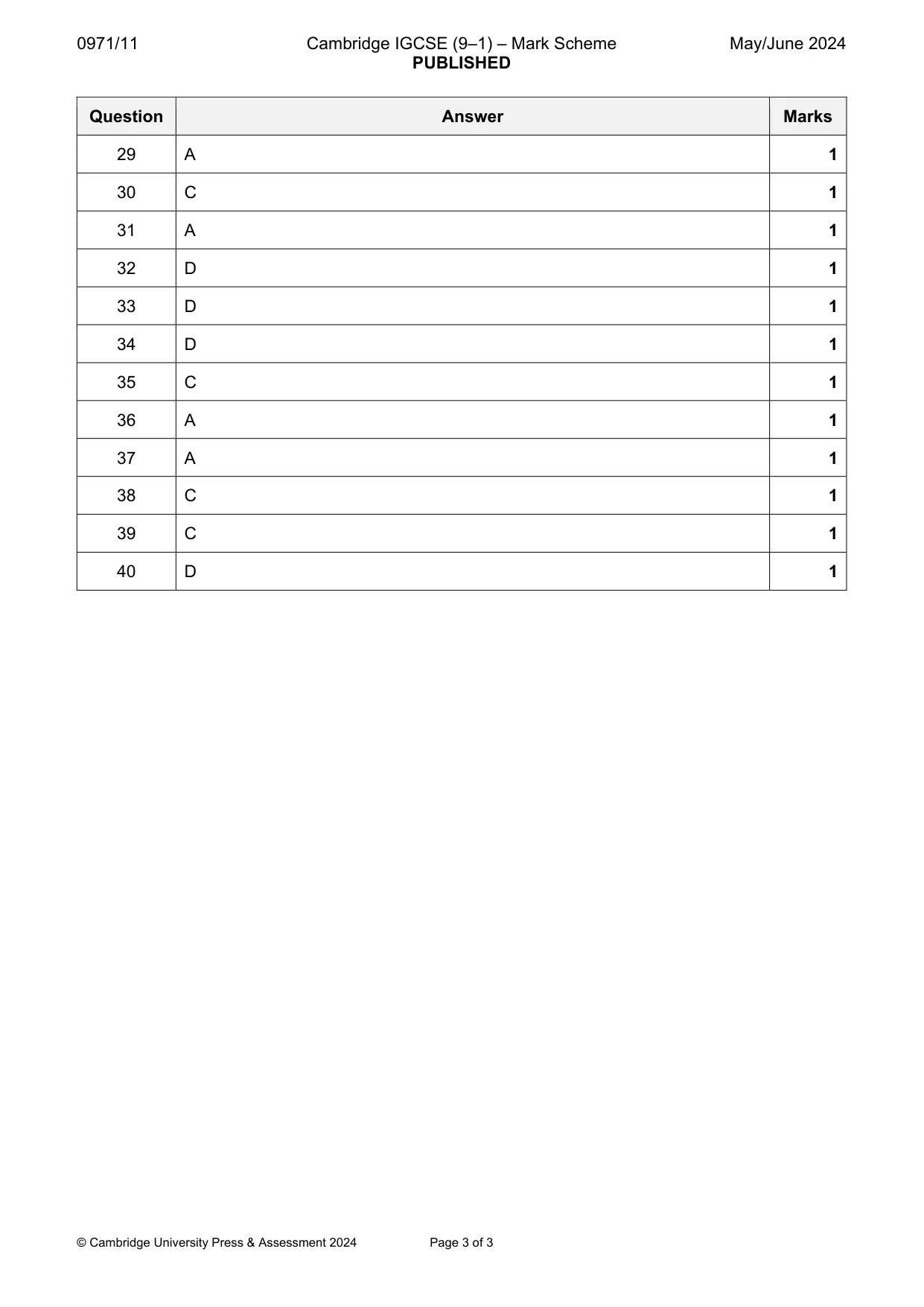
Answers below. Sit the paper first if you are practising.
Questions as text
Q1 · The boiling point of sodium is 890 °C
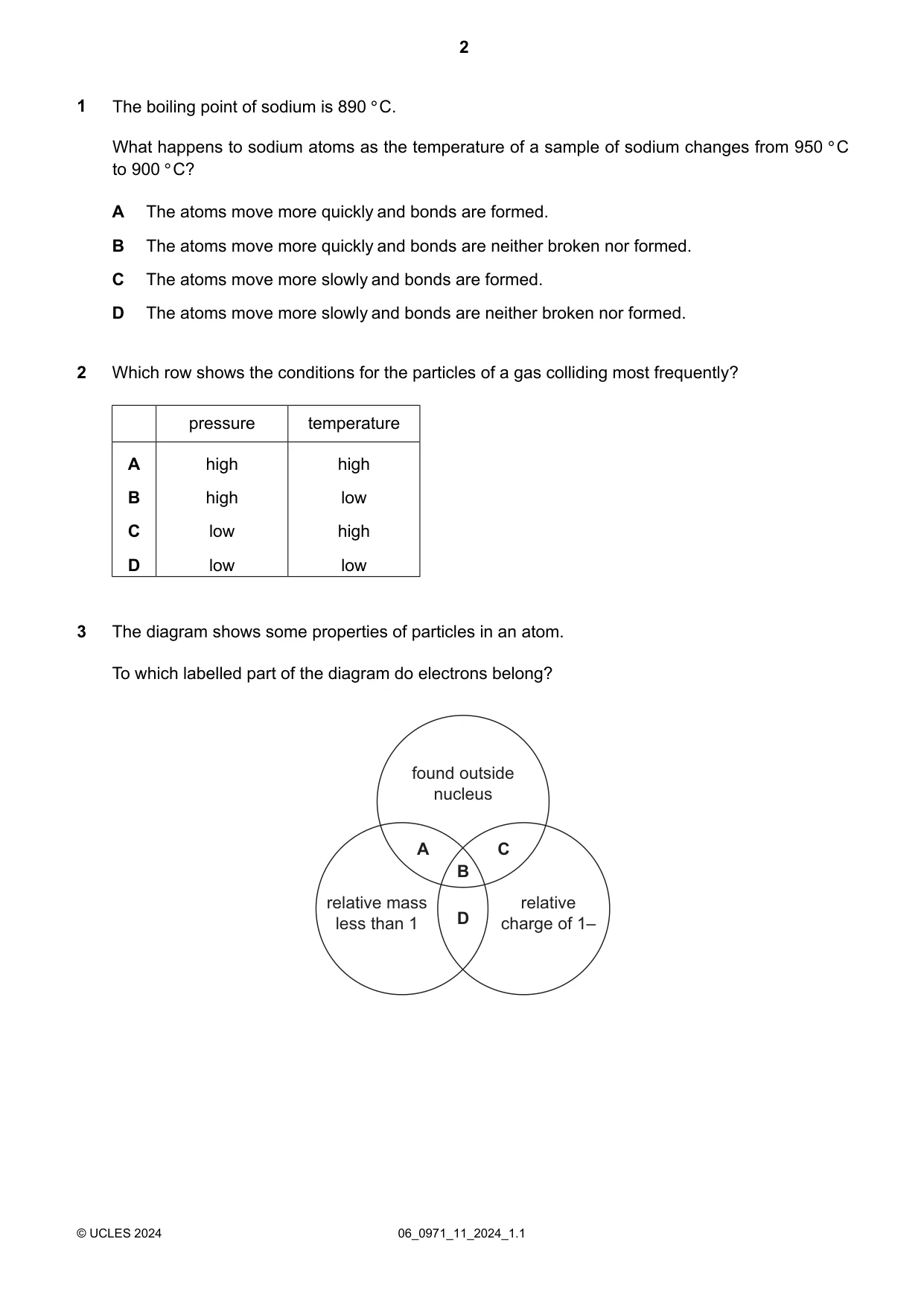
1 The boiling point of sodium is 890 °C. What happens to sodium atoms as the temperature of a sample of sodium changes from 950 °C to 900 °C? A The atoms move more quickly and bonds are formed. B The atoms move more quickly and bonds are neither broken nor formed. C The atoms move more slowly and bonds are formed. D The atoms move more slowly and bonds are neither broken nor formed.
Mark scheme: D
Q2 · Which row shows the conditions for the particles of a gas colliding most frequently?
2 Which row shows the conditions for the particles of a gas colliding most frequently? pressure temperature A high high B high low C low high D low low
Mark scheme: A
Q3 · The diagram shows some properties of particles in an atom
3 The diagram shows some properties of particles in an atom. To which labelled part of the diagram do electrons belong? found outside nucleus A C B relative mass relative D less than 1 charge of 1–
Mark scheme: B
Q4 · Some properties of substances W, X, Y and Z are shown
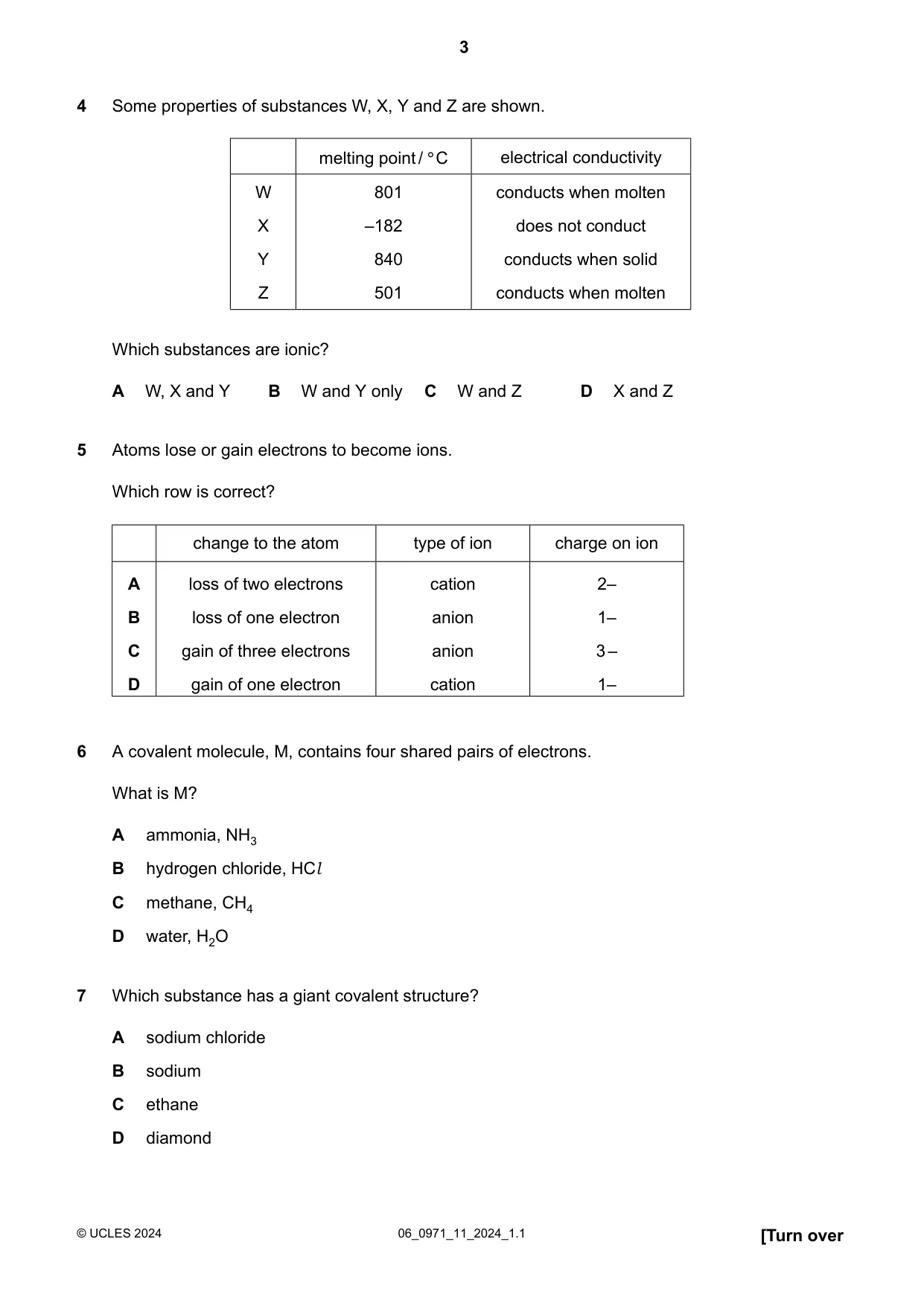
4 Some properties of substances W, X, Y and Z are shown. melting point/°C electrical conductivity W 801 conducts when molten X –182 does not conduct Y 840 conducts when solid Z 501 conducts when molten Which substances are ionic? A W, X and Y B W and Y only C W and Z D X and Z
Mark scheme: C
Q5 · Atoms lose or gain electrons to become ions
5 Atoms lose or gain electrons to become ions. Which row is correct? change to the atom type of ion charge on ion A loss of two electrons cation 2– B loss of one electron anion 1– C gain of three electrons anion 3– D gain of one electron cation 1–
Mark scheme: C
Q6 · A covalent molecule, M, contains four shared pairs of electrons
6 A covalent molecule, M, contains four shared pairs of electrons. What is M? A ammonia, NH3 B hydrogen chloride, HCl C methane, CH4 D water, H2O
Mark scheme: C
Q7 · Which substance has a giant covalent structure?
7 Which substance has a giant covalent structure? A sodium chloride B sodium C ethane D diamond
Mark scheme: D
Q8 · Iron(III) oxide is reduced by carbon monoxide to produce iron and carbon dioxide
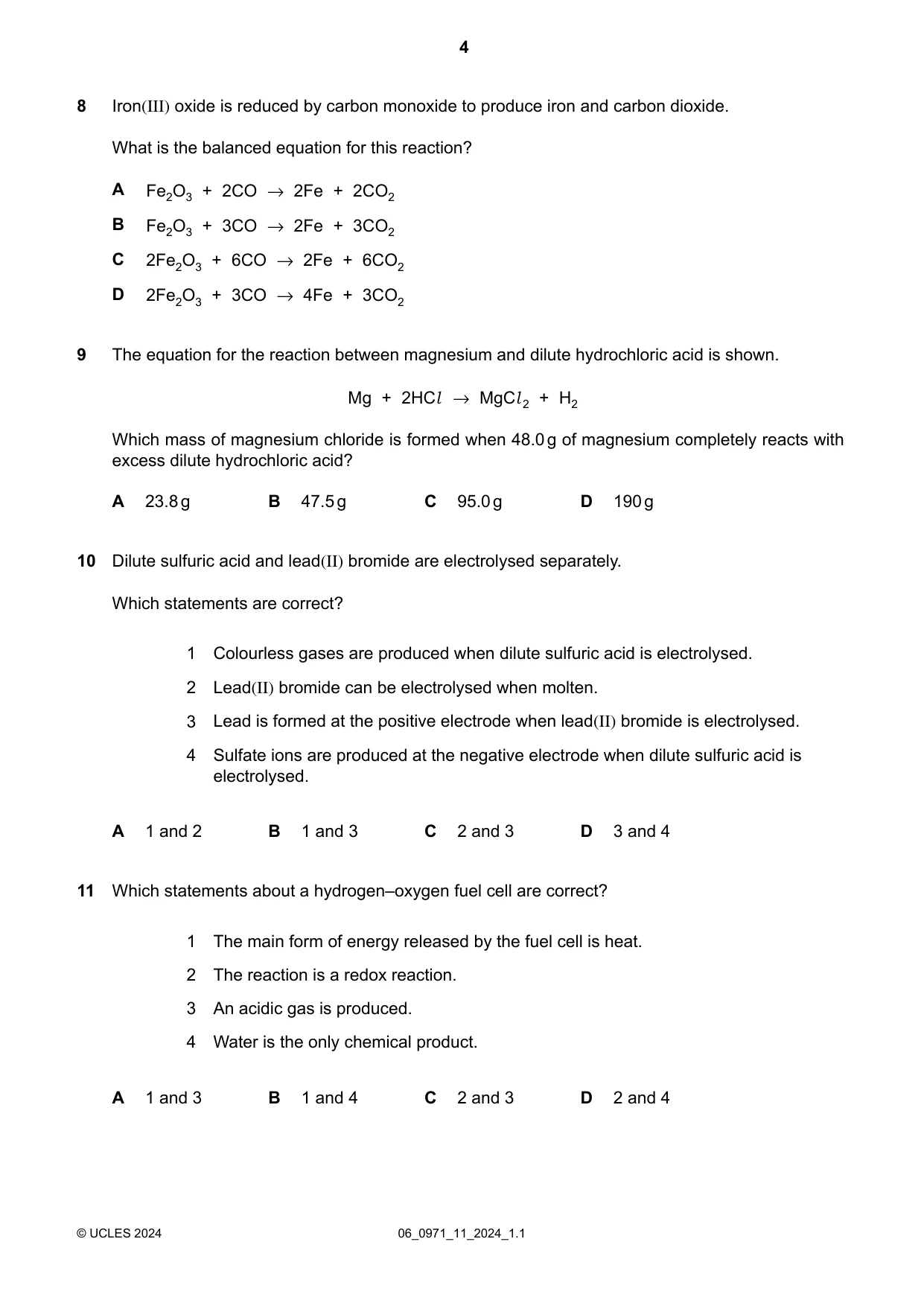
8 Iron(III) oxide is reduced by carbon monoxide to produce iron and carbon dioxide. What is the balanced equation for this reaction? A Fe2O3 + 2CO →2Fe + 2CO2 B Fe2O3 + 3CO →2Fe + 3CO2 C 2Fe2O3 + 6CO →2Fe + 6CO2 D 2Fe2O3 + 3CO →4Fe + 3CO2
Mark scheme: B
Q9 · The equation for the reaction between magnesium and dilute hydrochloric acid is shown
9 The equation for the reaction between magnesium and dilute hydrochloric acid is shown. Mg + 2HCl →MgCl 2 + H2 Which mass of magnesium chloride is formed when 48.0g of magnesium completely reacts with excess dilute hydrochloric acid? A 23.8g B 47.5g C 95.0g D 190g
Mark scheme: D
Q10 · Dilute sulfuric acid and lead(II) bromide are electrolysed separately
10 Dilute sulfuric acid and lead(II) bromide are electrolysed separately. Which statements are correct? 1 Colourless gases are produced when dilute sulfuric acid is electrolysed. 2 Lead(II) bromide can be electrolysed when molten. 3 Lead is formed at the positive electrode when lead(II) bromide is electrolysed. 4 Sulfate ions are produced at the negative electrode when dilute sulfuric acid is electrolysed. A 1 and 2 B 1 and 3 C 2 and 3 D 3 and 4
Mark scheme: A
Q11 · Which statements about a hydrogen–oxygen fuel cell are correct?
11 Which statements about a hydrogen–oxygen fuel cell are correct? 1 The main form of energy released by the fuel cell is heat. 2 The reaction is a redox reaction. 3 An acidic gas is produced. 4 Water is the only chemical product. A 1 and 3 B 1 and 4 C 2 and 3 D 2 and 4
Mark scheme: D
Q12 · Which row describes what happens during an endothermic reaction?
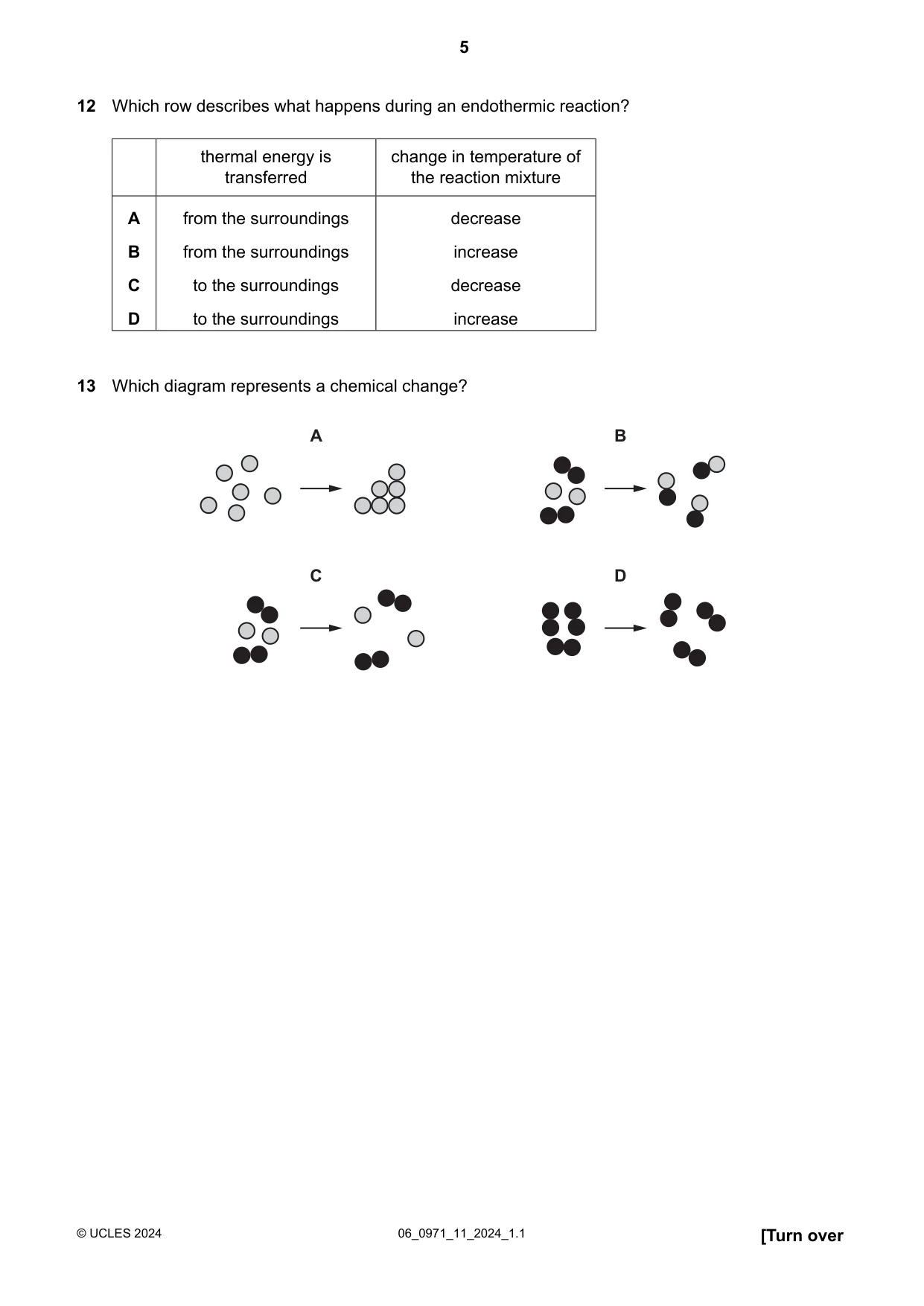
12 Which row describes what happens during an endothermic reaction? thermal energy is change in temperature of transferred the reaction mixture A from the surroundings decrease B from the surroundings increase C to the surroundings decrease D to the surroundings increase
Mark scheme: A
Q13 · Which diagram represents a chemical change?
13 Which diagram represents a chemical change? A B C D
Mark scheme: B
Q14 · A method used to investigate the rate of reaction of calcium carbonate with dilute…
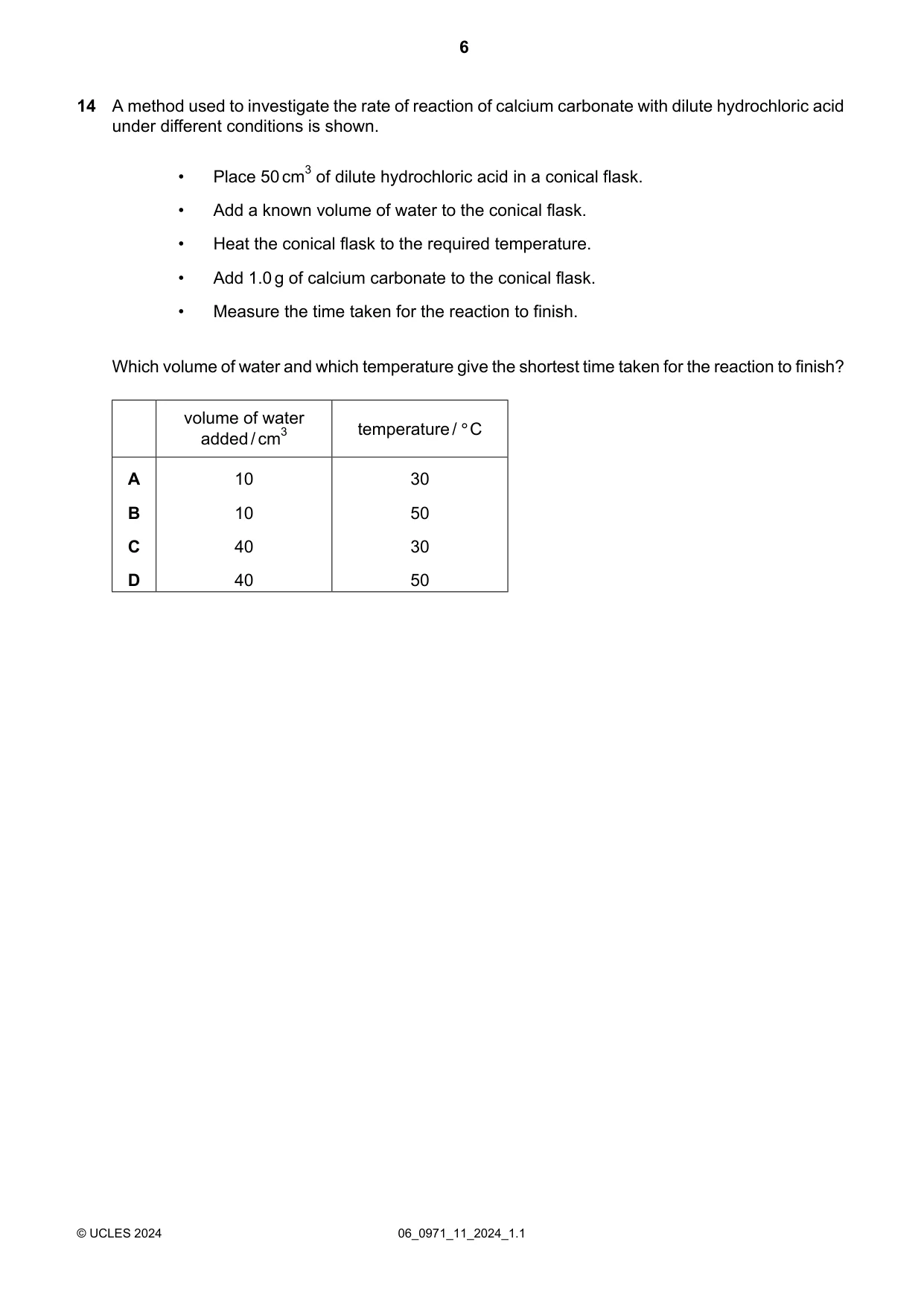
14 A method used to investigate the rate of reaction of calcium carbonate with dilute hydrochloric acid under different conditions is shown. Place 50cm3 of dilute hydrochloric acid in a conical flask. • • Add a known volume of water to the conical flask. • Heat the conical flask to the required temperature. • Add 1.0g of calcium carbonate to the conical flask. • Measure the time taken for the reaction to finish. Which volume of water and which temperature give the shortest time taken for the reaction to finish? volume of water added/cm3 temperature/°C A 10 30 B 10 50 C 40 30 D 40 50
Mark scheme: B
Q15 · The rate of reaction between magnesium and hydrochloric acid is investigated
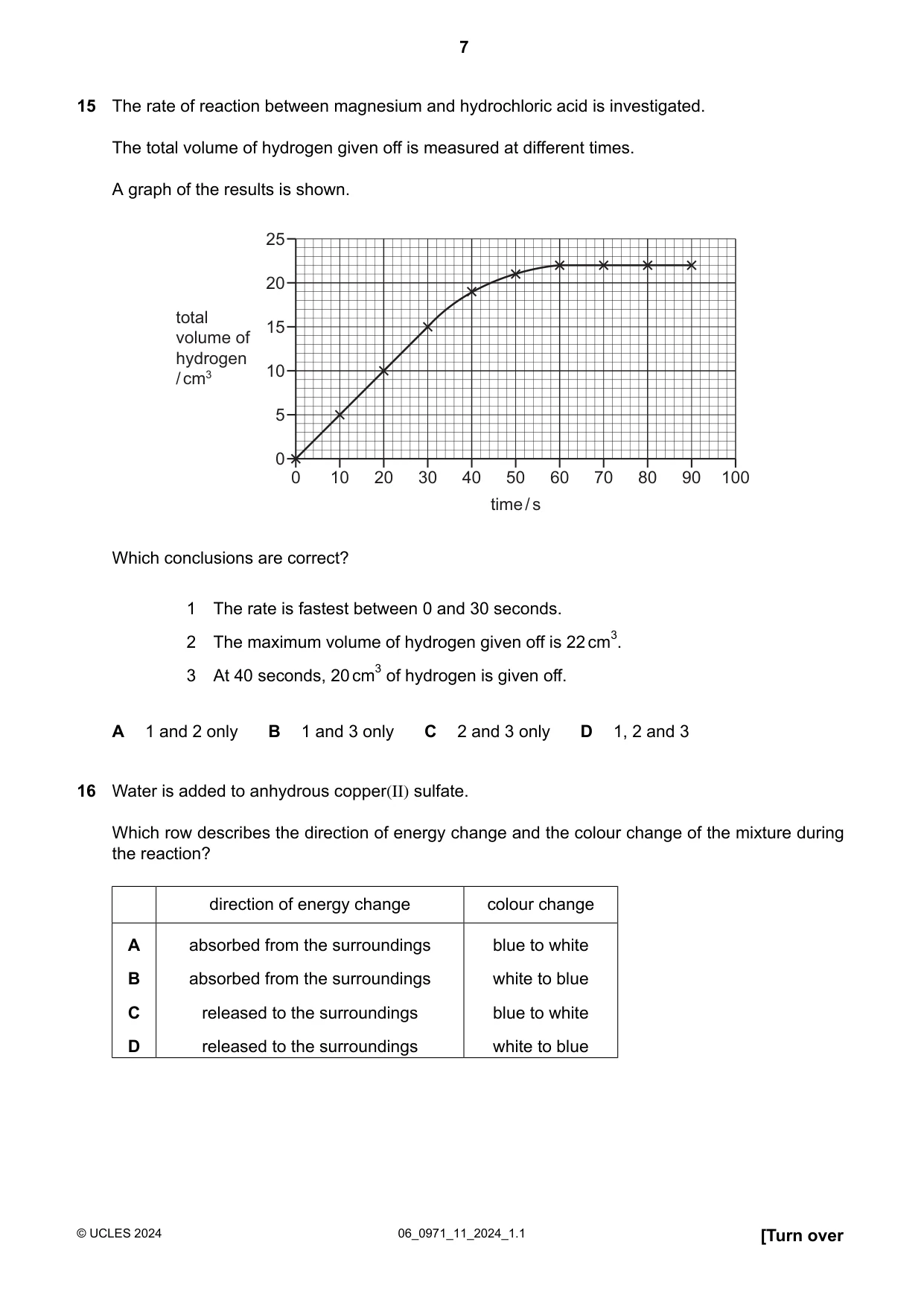
15 The rate of reaction between magnesium and hydrochloric acid is investigated. The total volume of hydrogen given off is measured at different times. A graph of the results is shown. 25 20 total 15 volume of hydrogen / cm3 10 5 0 0 10 20 30 40 50 60 70 80 90 100 time / s Which conclusions are correct? 1 The rate is fastest between 0 and 30 seconds. 2 The maximum volume of hydrogen given off is 22cm3. At 40 seconds, 20cm3 of hydrogen is given off. 3 A 1 and 2 only B 1 and 3 only C 2 and 3 only D 1, 2 and 3
Mark scheme: A
Q16 · Water is added to anhydrous copper(II) sulfate
16 Water is added to anhydrous copper(II) sulfate. Which row describes the direction of energy change and the colour change of the mixture during the reaction? direction of energy change colour change A absorbed from the surroundings blue to white B absorbed from the surroundings white to blue C released to the surroundings blue to white D released to the surroundings white to blue
Mark scheme: D
Q17 · Which equation represents an oxidation reaction?
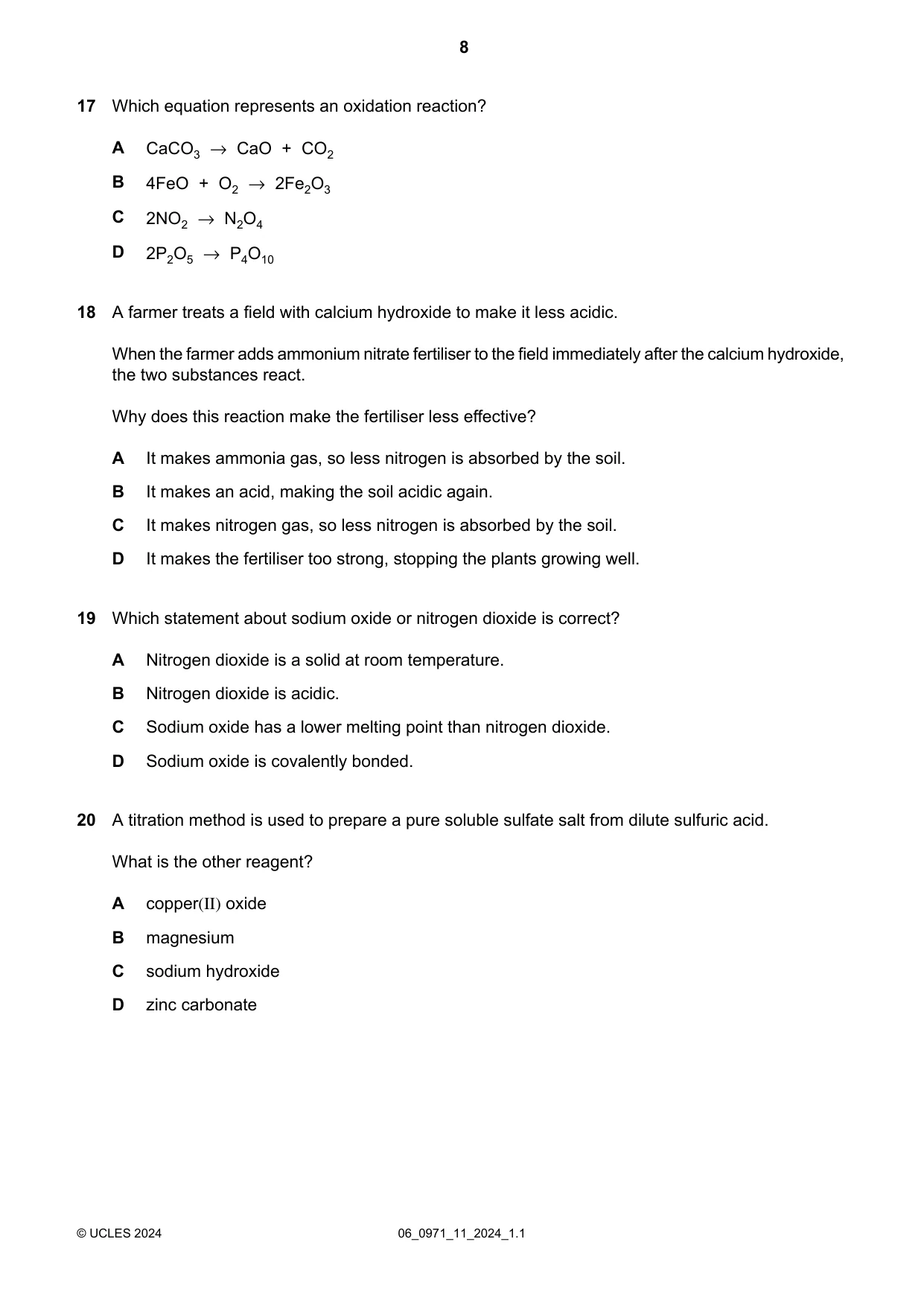
17 Which equation represents an oxidation reaction? A CaCO3 →CaO + CO2 B 4FeO + O2 →2Fe2O3 C 2NO2 →N2O4 D 2P2O5 →P4O10
Mark scheme: B
Q18 · A farmer treats a field with calcium hydroxide to make it less acidic
18 A farmer treats a field with calcium hydroxide to make it less acidic. When the farmer adds ammonium nitrate fertiliser to the field immediately after the calcium hydroxide, the two substances react. Why does this reaction make the fertiliser less effective? A It makes ammonia gas, so less nitrogen is absorbed by the soil. B It makes an acid, making the soil acidic again. C It makes nitrogen gas, so less nitrogen is absorbed by the soil. D It makes the fertiliser too strong, stopping the plants growing well.
Mark scheme: A
Q19 · Which statement about sodium oxide or nitrogen dioxide is correct?
19 Which statement about sodium oxide or nitrogen dioxide is correct? A Nitrogen dioxide is a solid at room temperature. B Nitrogen dioxide is acidic. C Sodium oxide has a lower melting point than nitrogen dioxide. D Sodium oxide is covalently bonded.
Mark scheme: B
Q20 · A titration method is used to prepare a pure soluble sulfate salt from dilute sulfuric…
20 A titration method is used to prepare a pure soluble sulfate salt from dilute sulfuric acid. What is the other reagent? A copper(II) oxide B magnesium C sodium hydroxide D zinc carbonate
Mark scheme: C
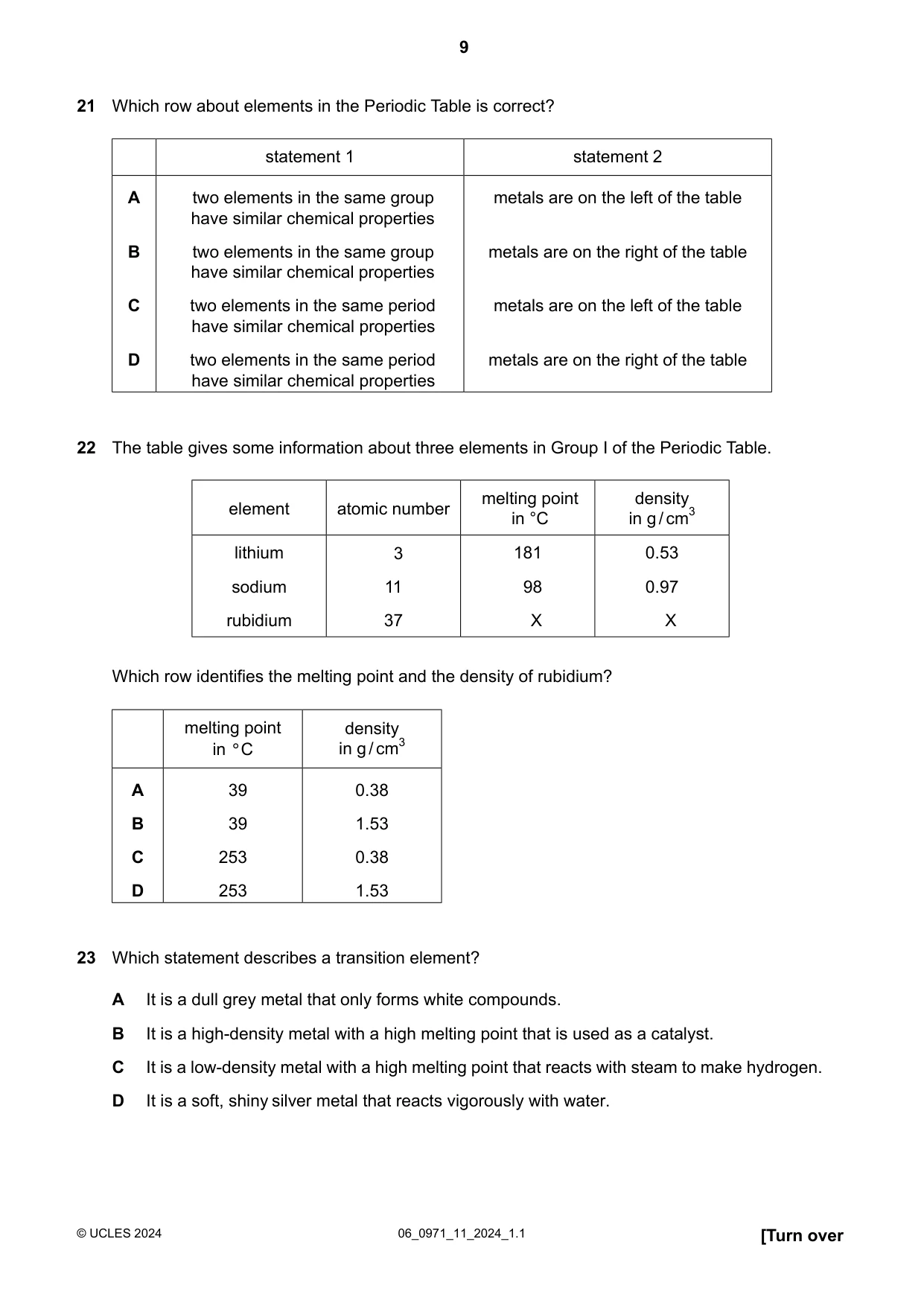
Q21 · Which row about elements in the Periodic Table is correct?
21 Which row about elements in the Periodic Table is correct? statement 1 statement 2 A two elements in the same group metals are on the left of the table have similar chemical properties B two elements in the same group metals are on the right of the table have similar chemical properties C two elements in the same period metals are on the left of the table have similar chemical properties D two elements in the same period metals are on the right of the table have similar chemical properties
Mark scheme: A
Q22 · The table gives some information about three elements in Group I of the Periodic Table
22 The table gives some information about three elements in Group I of the Periodic Table. melting point density element atomic number in °C in g/cm3 lithium 3 181 0.53 sodium 11 98 0.97 rubidium 37 X X Which row identifies the melting point and the density of rubidium? melting point density in °C in g/cm3 A 39 0.38 B 39 1.53 C 253 0.38 D 253 1.53
Mark scheme: B
Q23 · Which statement describes a transition element?
23 Which statement describes a transition element? A It is a dull grey metal that only forms white compounds. B It is a high-density metal with a high melting point that is used as a catalyst. C It is a low-density metal with a high melting point that reacts with steam to make hydrogen. D It is a soft, shiny silver metal that reacts vigorously with water.
Mark scheme: B
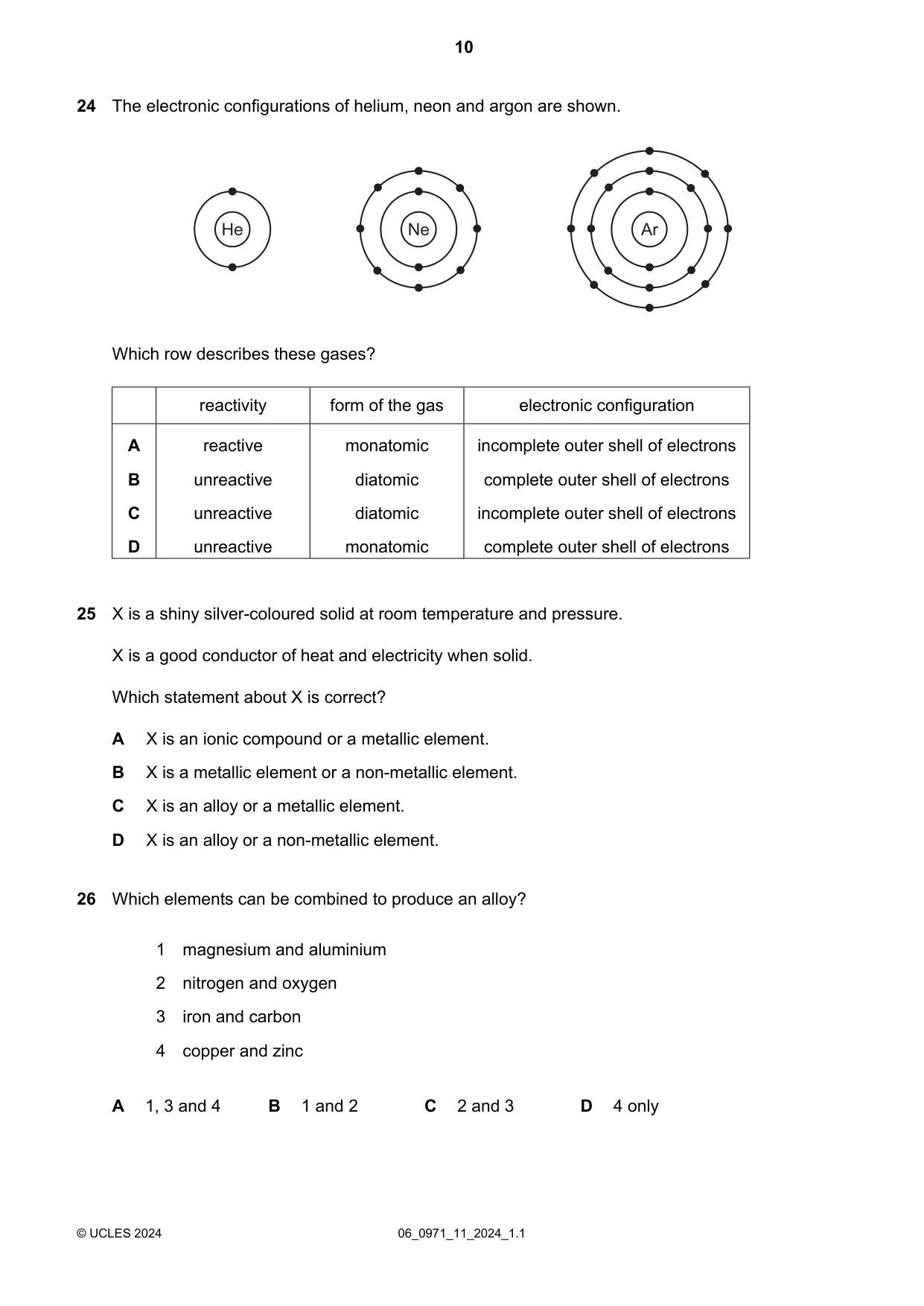
Q24 · The electronic configurations of helium, neon and argon are shown
24 The electronic configurations of helium, neon and argon are shown. He Ne Ar Which row describes these gases? reactivity form of the gas electronic configuration A reactive monatomic incomplete outer shell of electrons B unreactive diatomic complete outer shell of electrons C unreactive diatomic incomplete outer shell of electrons D unreactive monatomic complete outer shell of electrons
Mark scheme: D
Q25 · X is a shiny silver-coloured solid at room temperature and pressure
25 X is a shiny silver-coloured solid at room temperature and pressure. X is a good conductor of heat and electricity when solid. Which statement about X is correct? A X is an ionic compound or a metallic element. B X is a metallic element or a non-metallic element. C X is an alloy or a metallic element. D X is an alloy or a non-metallic element.
Mark scheme: C
Q26 · Which elements can be combined to produce an alloy?
26 Which elements can be combined to produce an alloy? 1 magnesium and aluminium 2 nitrogen and oxygen 3 iron and carbon 4 copper and zinc A 1, 3 and 4 B 1 and 2 C 2 and 3 D 4 only
Mark scheme: A
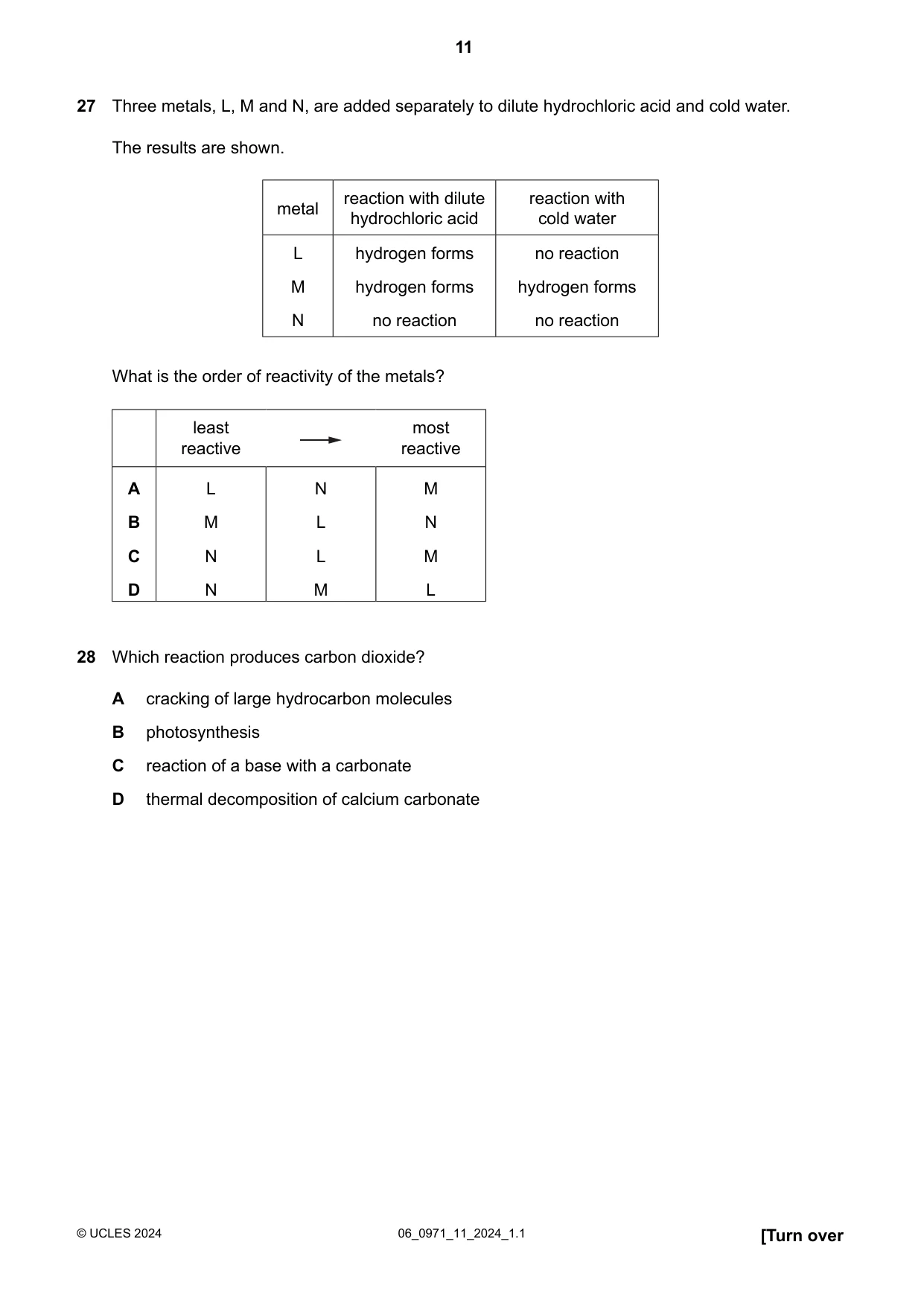
Q27 · Three metals, L, M and N, are added separately to dilute hydrochloric acid and cold water
27 Three metals, L, M and N, are added separately to dilute hydrochloric acid and cold water. The results are shown. reaction with dilute reaction with metal hydrochloric acid cold water L hydrogen forms no reaction M hydrogen forms hydrogen forms N no reaction no reaction What is the order of reactivity of the metals? least most reactive reactive A L N M B M L N C N L M D N M L
Mark scheme: C
Q28 · Which reaction produces carbon dioxide?
28 Which reaction produces carbon dioxide? A cracking of large hydrocarbon molecules B photosynthesis C reaction of a base with a carbonate D thermal decomposition of calcium carbonate
Mark scheme: D
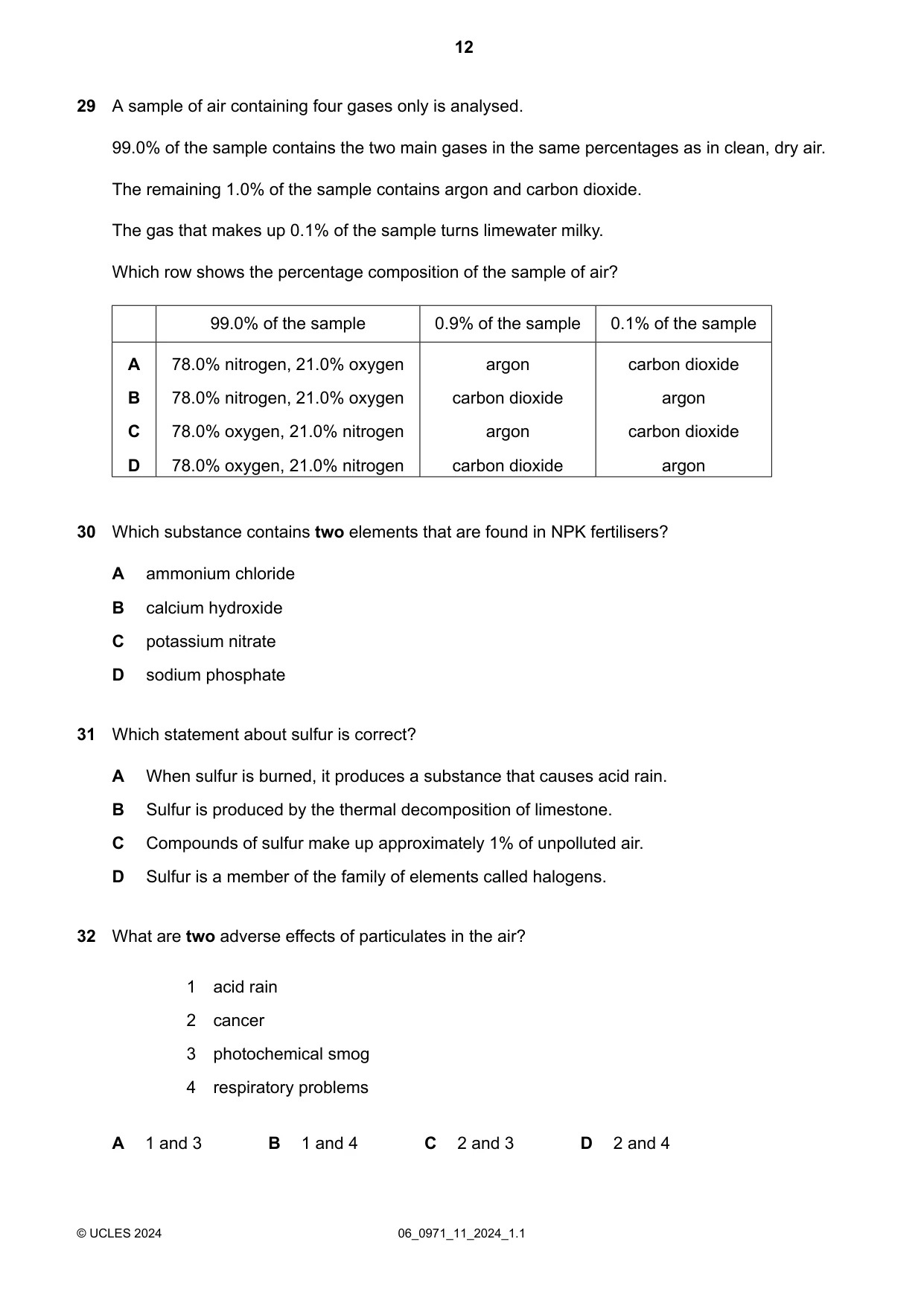
Q29 · A sample of air containing four gases only is analysed
29 A sample of air containing four gases only is analysed. 99.0% of the sample contains the two main gases in the same percentages as in clean, dry air. The remaining 1.0% of the sample contains argon and carbon dioxide. The gas that makes up 0.1% of the sample turns limewater milky. Which row shows the percentage composition of the sample of air? 99.0% of the sample 0.9% of the sample 0.1% of the sample A 78.0% nitrogen, 21.0% oxygen argon carbon dioxide B 78.0% nitrogen, 21.0% oxygen carbon dioxide argon C 78.0% oxygen, 21.0% nitrogen argon carbon dioxide D 78.0% oxygen, 21.0% nitrogen carbon dioxide argon
Mark scheme: A
Q30 · Which substance contains two elements that are found in NPK fertilisers?
30 Which substance contains two elements that are found in NPK fertilisers? A ammonium chloride B calcium hydroxide C potassium nitrate D sodium phosphate
Mark scheme: C
Q31 · Which statement about sulfur is correct?
31 Which statement about sulfur is correct? A When sulfur is burned, it produces a substance that causes acid rain. B Sulfur is produced by the thermal decomposition of limestone. C Compounds of sulfur make up approximately 1% of unpolluted air. D Sulfur is a member of the family of elements called halogens.
Mark scheme: A
Q32 · What are two adverse effects of particulates in the air?
32 What are two adverse effects of particulates in the air? 1 acid rain 2 cancer 3 photochemical smog 4 respiratory problems A 1 and 3 B 1 and 4 C 2 and 3 D 2 and 4
Mark scheme: D
Q33 · Which formula represents a compound that is a member of the homologous series of alkanes?
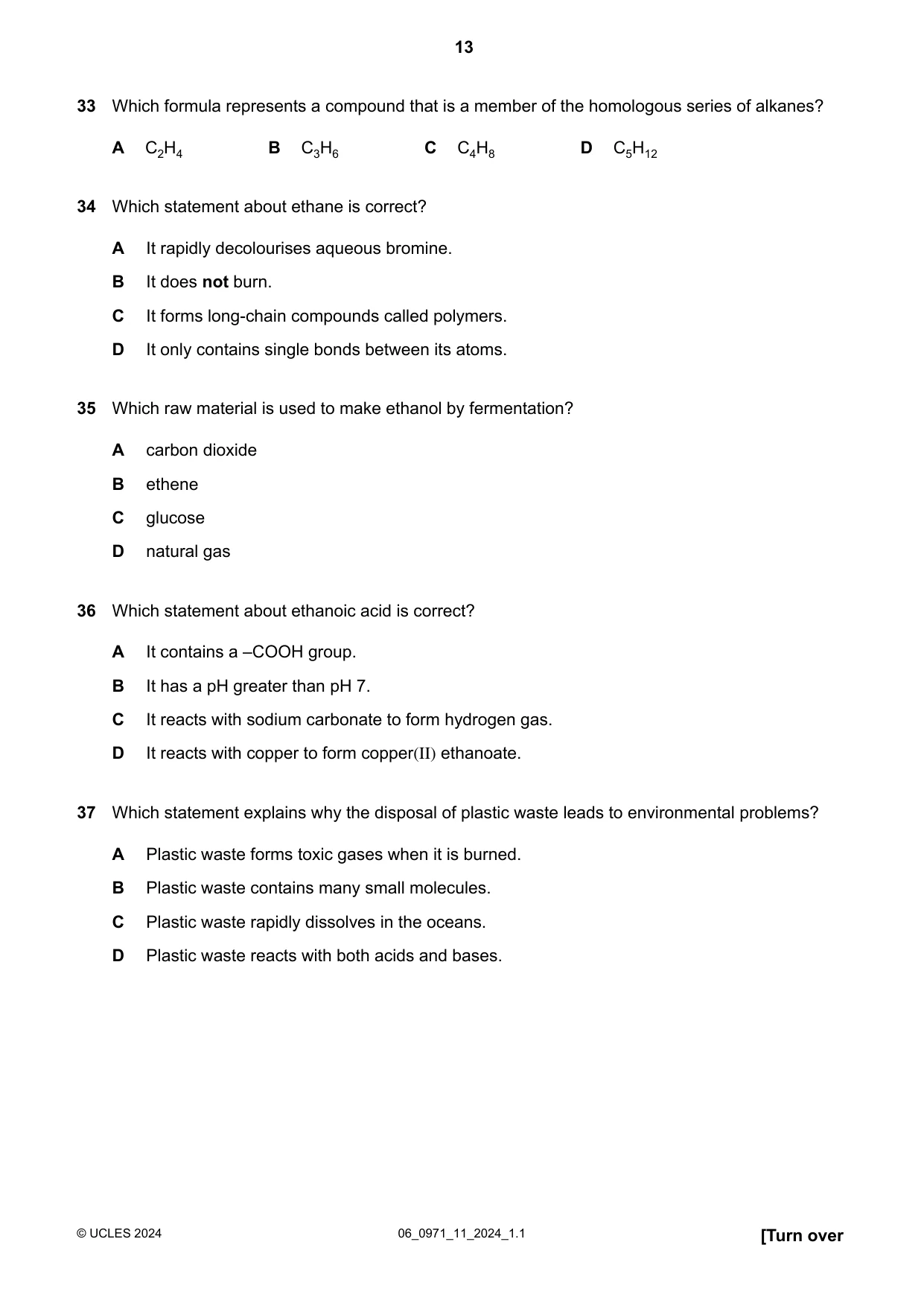
33 Which formula represents a compound that is a member of the homologous series of alkanes? A C2H4 B C3H6 C C4H8 D C5H12
Mark scheme: D
Q34 · Which statement about ethane is correct?
34 Which statement about ethane is correct? A It rapidly decolourises aqueous bromine. B It does not burn. C It forms long-chain compounds called polymers. D It only contains single bonds between its atoms.
Mark scheme: D
Q35 · Which raw material is used to make ethanol by fermentation?
35 Which raw material is used to make ethanol by fermentation? A carbon dioxide B ethene C glucose D natural gas
Mark scheme: C
Q36 · Which statement about ethanoic acid is correct?
36 Which statement about ethanoic acid is correct? A It contains a –COOH group. B It has a pH greater than pH 7. C It reacts with sodium carbonate to form hydrogen gas. D It reacts with copper to form copper(II) ethanoate.
Mark scheme: A
Q37 · Which statement explains why the disposal of plastic waste leads to environmental…
37 Which statement explains why the disposal of plastic waste leads to environmental problems? A Plastic waste forms toxic gases when it is burned. B Plastic waste contains many small molecules. C Plastic waste rapidly dissolves in the oceans. D Plastic waste reacts with both acids and bases.
Mark scheme: A
Q38 · Substance X and four known substances, P, Q, R and S, are analysed by chromatography
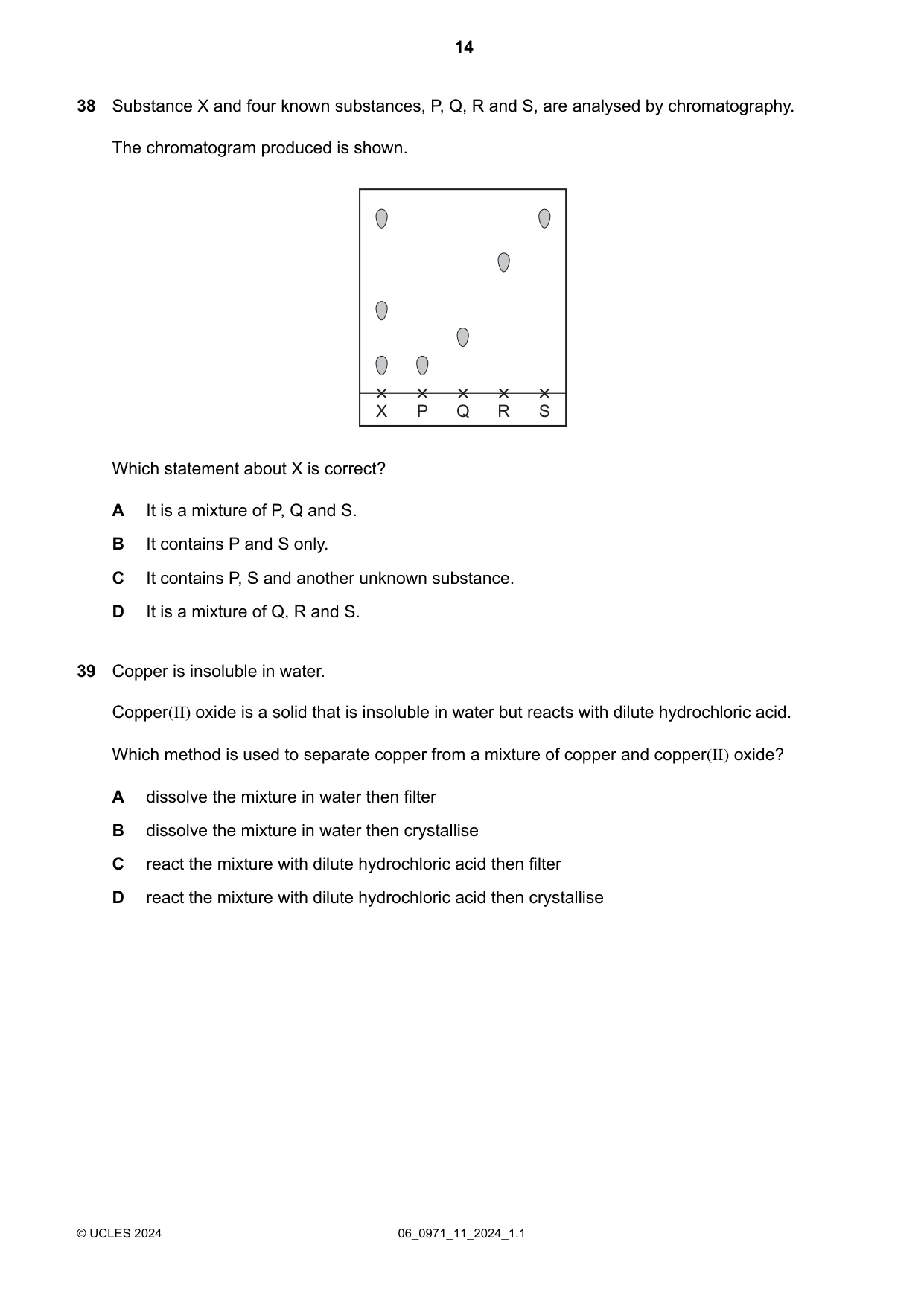
38 Substance X and four known substances, P, Q, R and S, are analysed by chromatography. The chromatogram produced is shown. X P Q R S Which statement about X is correct? A It is a mixture of P, Q and S. B It contains P and S only. C It contains P, S and another unknown substance. D It is a mixture of Q, R and S.
Mark scheme: C
Q39 · Copper is insoluble in water
39 Copper is insoluble in water. Copper(II) oxide is a solid that is insoluble in water but reacts with dilute hydrochloric acid. Which method is used to separate copper from a mixture of copper and copper(II) oxide? A dissolve the mixture in water then filter B dissolve the mixture in water then crystallise C react the mixture with dilute hydrochloric acid then filter D react the mixture with dilute hydrochloric acid then crystallise
Mark scheme: C
Q40 · A salt, S, is dissolved in water and three tests are carried out on the solution formed
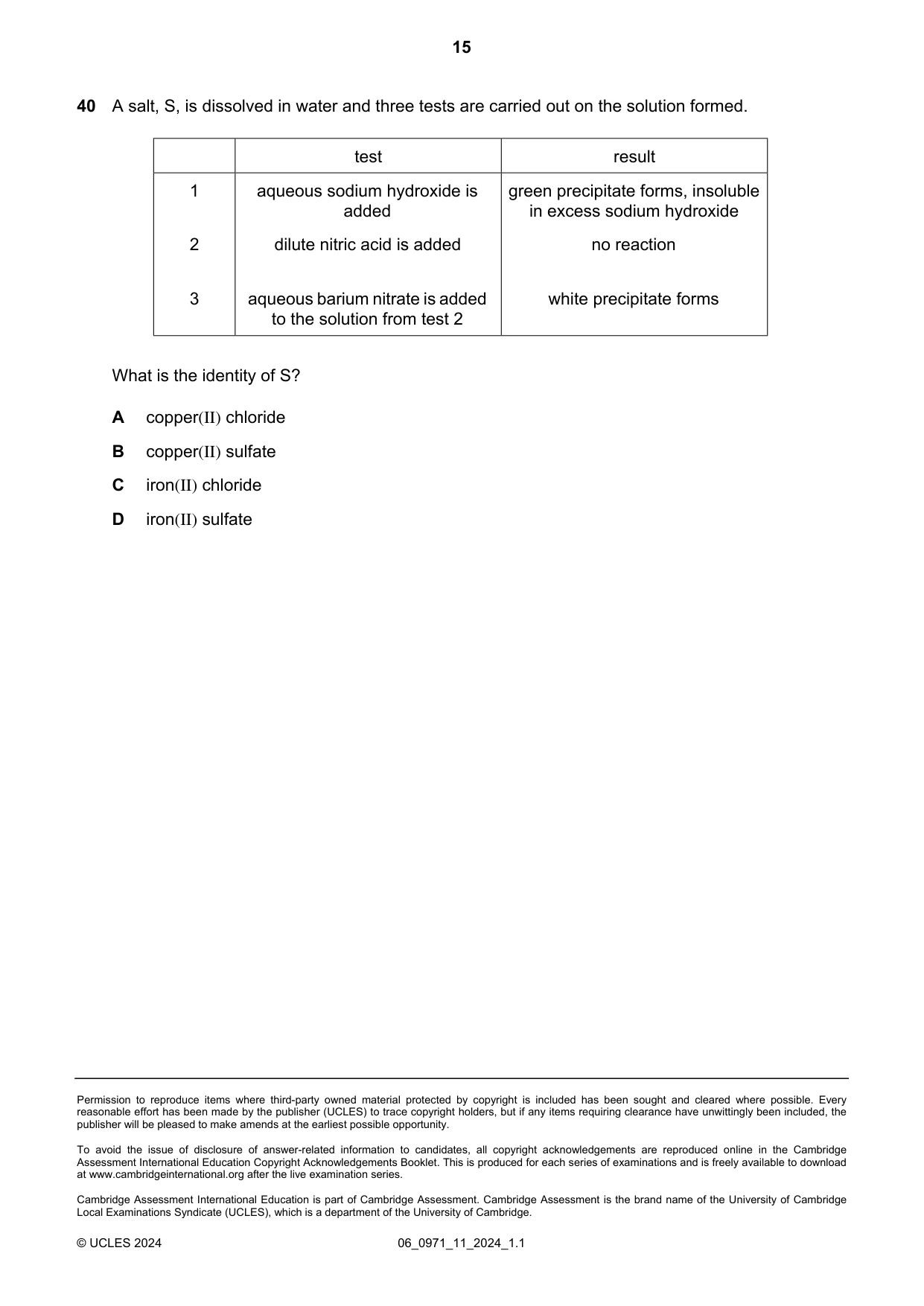
40 A salt, S, is dissolved in water and three tests are carried out on the solution formed. test result 1 aqueous sodium hydroxide is green precipitate forms, insoluble added in excess sodium hydroxide 2 dilute nitric acid is added no reaction 3 aqueous barium nitrate is added white precipitate forms to the solution from test 2 What is the identity of S? A copper(II) chloride B copper(II) sulfate C iron(II) chloride D iron(II) sulfate
Mark scheme: D
What was in this paper
The subtopics covered by these 40 questions, and how many questions each got. Open one in a new tab to see every Cambridge question on it.
4Alkanes2Exothermic and endothermic reactions2Fertilisers2Ions and ionic bonds2Rate of reaction2Redox2Solids, liquids and gases2Alcohols1Alloys and their properties1Arrangement of elements1Atomic structure and the Periodic Table1Carboxylic acids1Chromatography1Electrolysis1Giant covalent structures1Group I properties1Hydrogen–oxygen fuel cells1Identification of ions and gases1Noble gases1Oxides1Physical and chemical changes1Polymers1Preparation of salts1Properties of metals1Reactivity series1Separation and purification1Simple molecules and covalent bonds1The mole and the Avogadro constant1Transition elements1What you needed in this session
Cambridge’s own grade thresholds for 2024 May/June, Paper 1 · Variant 1. A higher threshold means an easier paper — the bar moves with how the cohort did.