Cambridge IGCSE Chemistry (9-1) 0971 — 2025 May/June Paper 1 · Variant 1
0971/11/M/J/25 · 40 questions · 40 marks · 45 min
The question paper and its mark scheme, free to read here and free to download. This is Cambridge’s own paper, exactly as it was sat.
Question paper16 pages

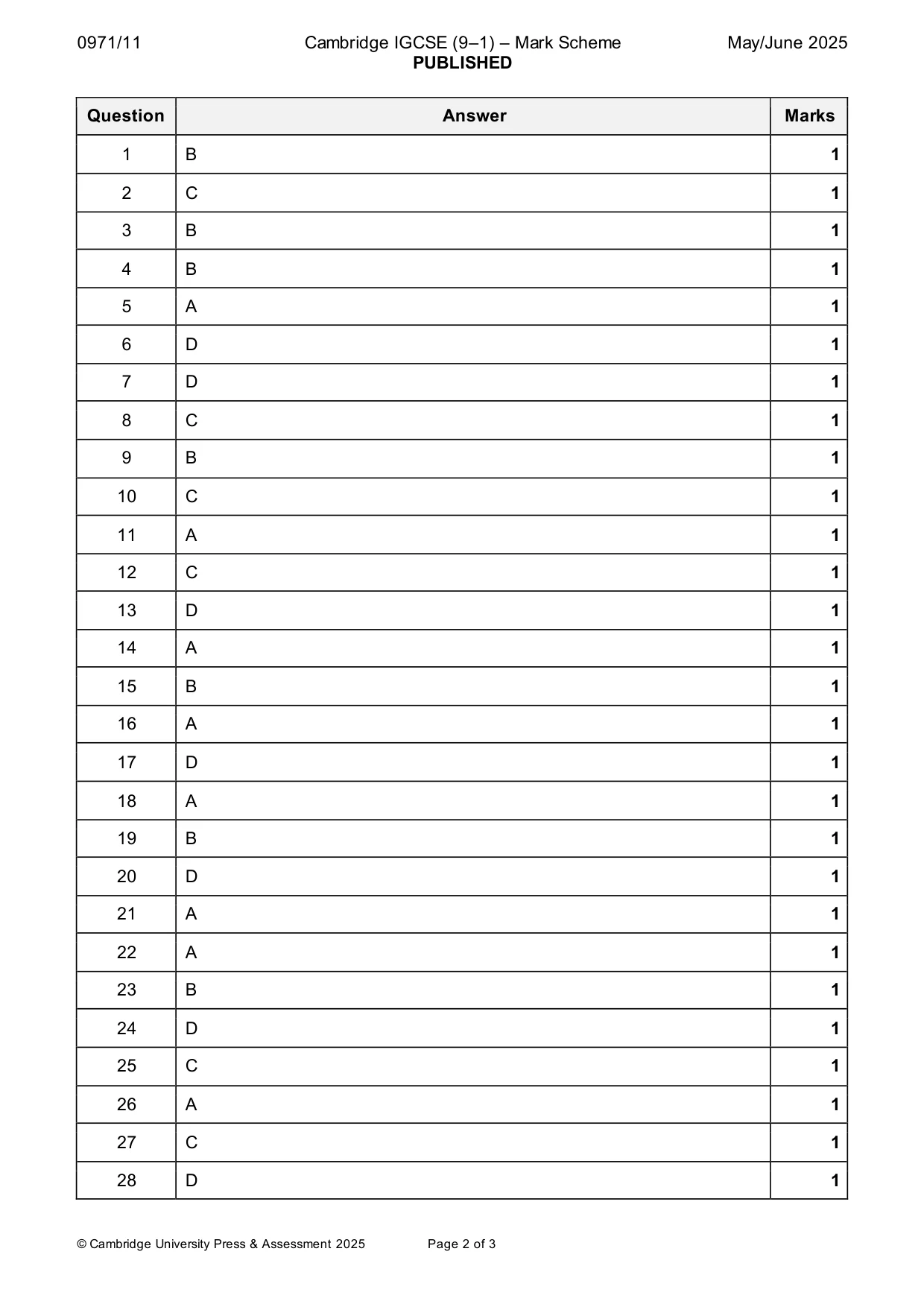
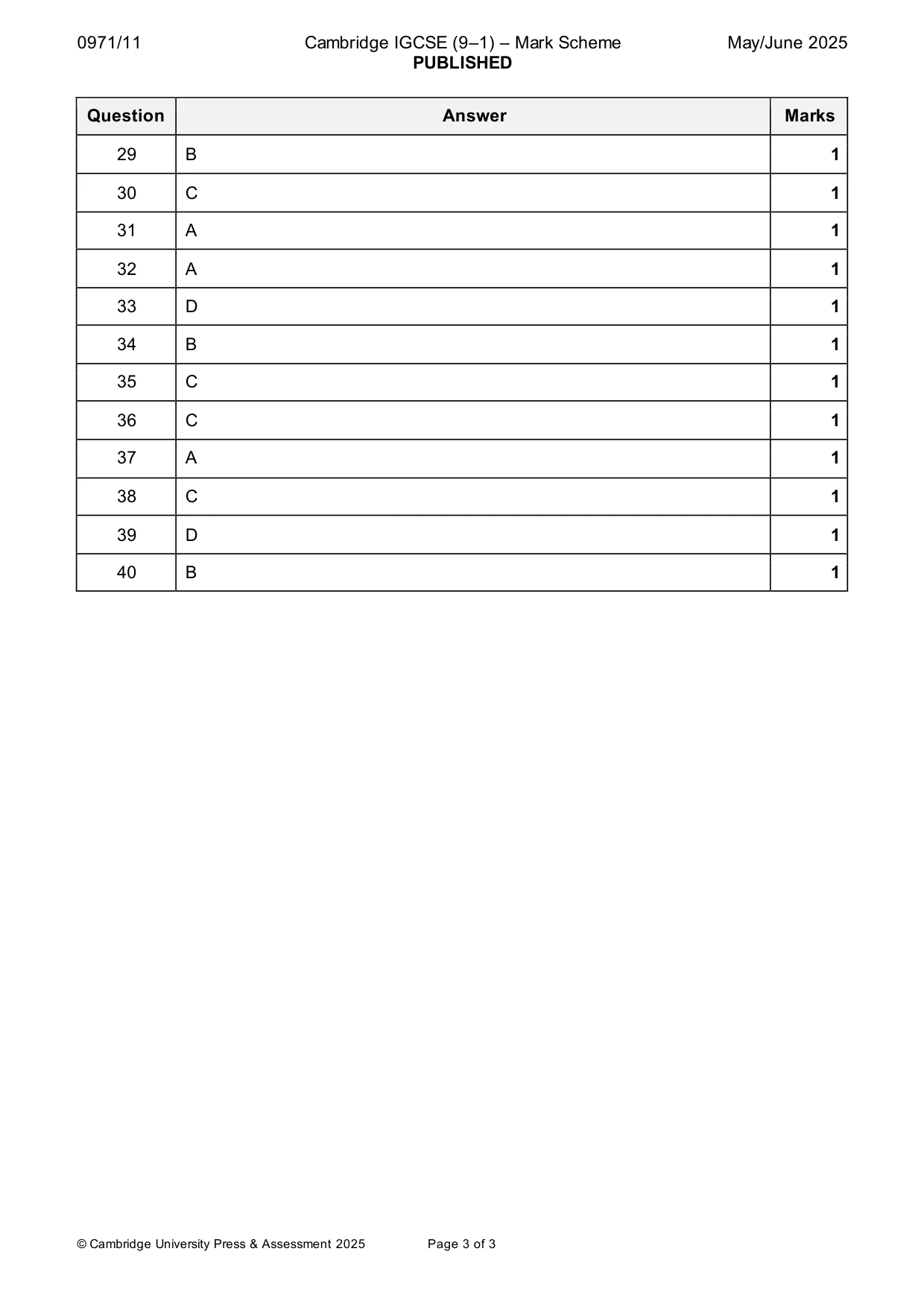
Mark scheme3 pages
Answers below. Sit the paper first if you are practising.
Questions as text
Q1 · Which process happens when water vapour changes to rain?
1 Which process happens when water vapour changes to rain? A boiling B condensing C evaporating D freezing
Mark scheme: B
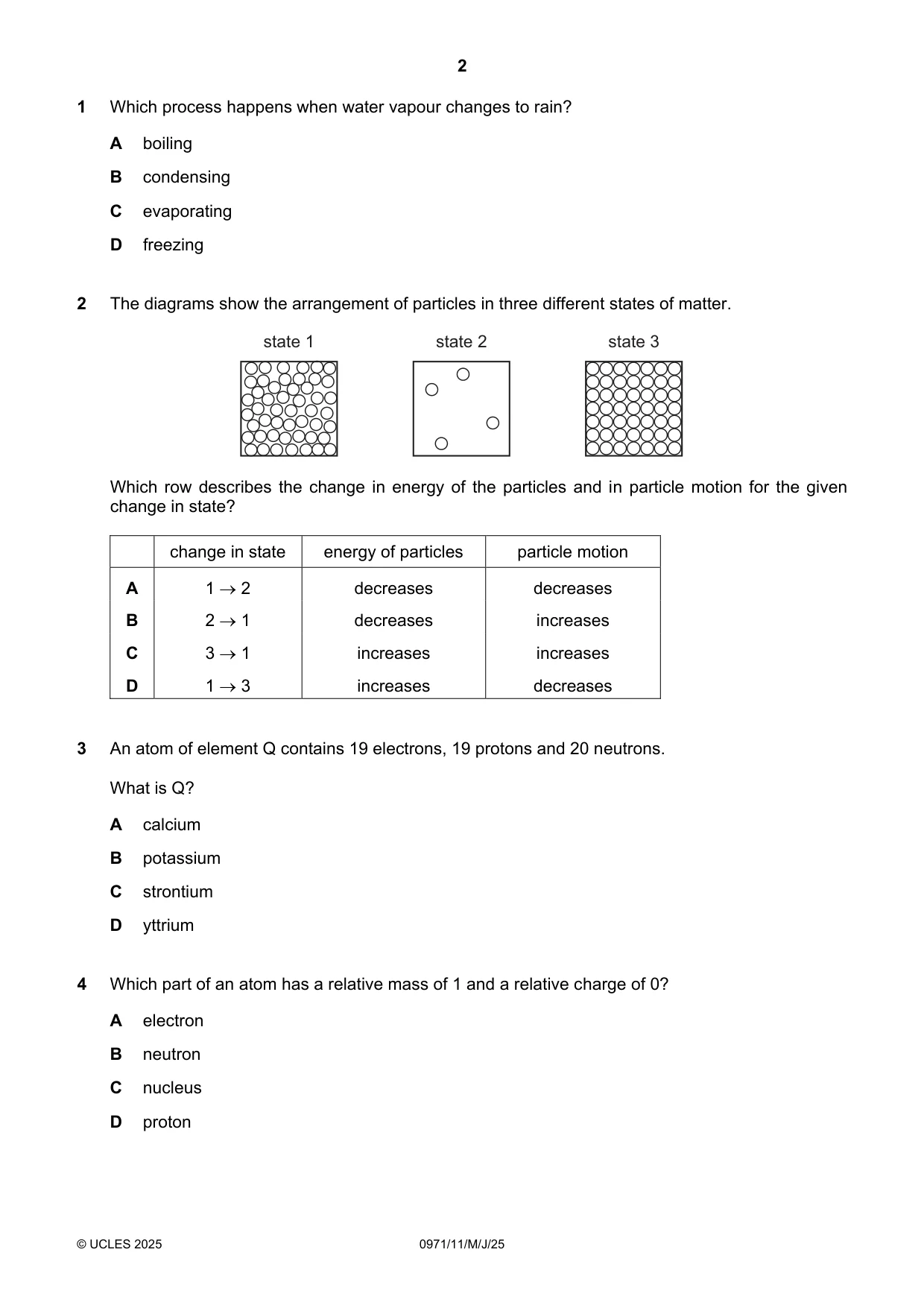
Q2 · The diagrams show the arrangement of particles in three different states of matter
2 The diagrams show the arrangement of particles in three different states of matter. state 2 state 1 state 3 Which row describes the change in energy of the particles and in particle motion for the given change in state? change in state energy of particles particle motion A 1 2 decreases decreases B 2 1 decreases increases C 3 1 increases increases D 1 3 increases decreases
Mark scheme: C
Q3 · An atom of element Q contains 19 electrons, 19 protons and 20 neutrons
3 An atom of element Q contains 19 electrons, 19 protons and 20 neutrons. What is Q? A calcium B potassium C strontium D yttrium
Mark scheme: B
Q4 · Which part of an atom has a relative mass of 1 and a relative charge of 0?
4 Which part of an atom has a relative mass of 1 and a relative charge of 0? A electron B neutron C nucleus D proton
Mark scheme: B
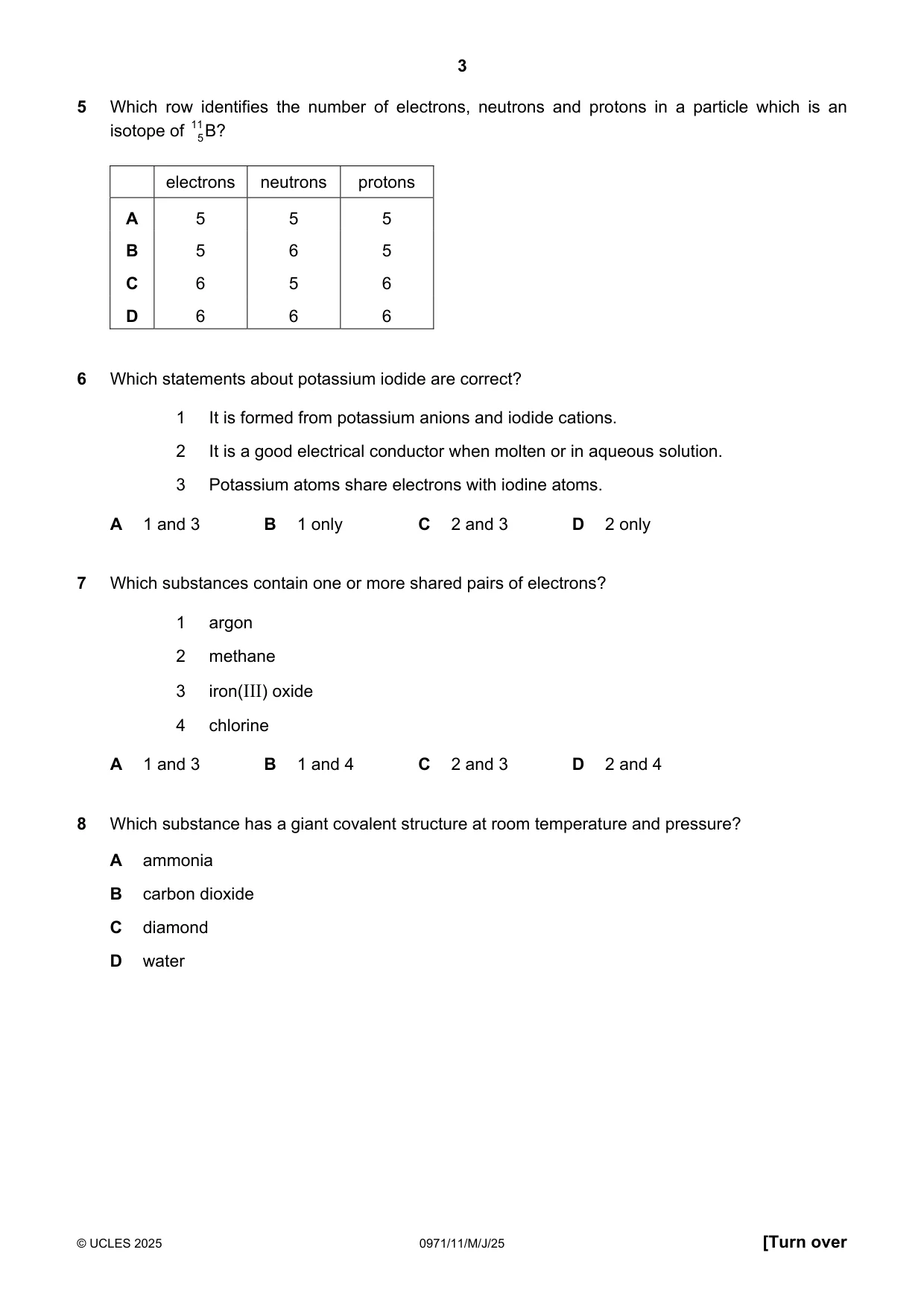
Q5 · Which row identifies the number of electrons, neutrons and protons in a particle which is…
5 Which row identifies the number of electrons, neutrons and protons in a particle which is an isotope of 11 B? 5 electrons neutrons protons A 5 5 5 B 5 6 5 C 6 5 6 D 6 6 6
Mark scheme: A
Q6 · Which statements about potassium iodide are correct?
6 Which statements about potassium iodide are correct? 1 It is formed from potassium anions and iodide cations. 2 It is a good electrical conductor when molten or in aqueous solution. 3 Potassium atoms share electrons with iodine atoms. A 1 and 3 B 1 only C 2 and 3 D 2 only
Mark scheme: D
Q7 · Which substances contain one or more shared pairs of electrons?
7 Which substances contain one or more shared pairs of electrons? 1 argon 2 methane 3 iron(III) oxide 4 chlorine A 1 and 3 B 1 and 4 C 2 and 3 D 2 and 4
Mark scheme: D
Q8 · Which substance has a giant covalent structure at room temperature and pressure?
8 Which substance has a giant covalent structure at room temperature and pressure? A ammonia B carbon dioxide C diamond D water
Mark scheme: C
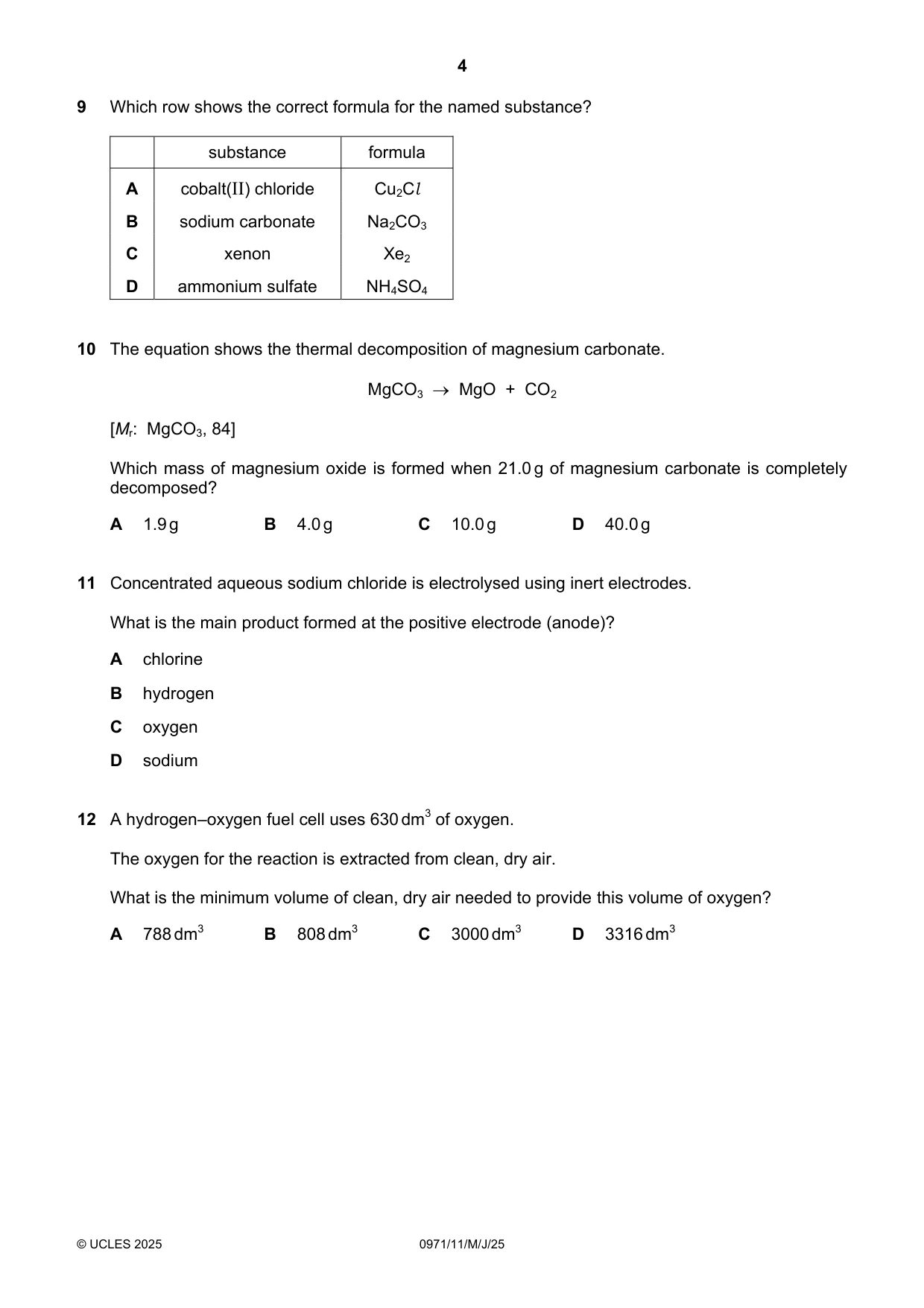
Q9 · Which row shows the correct formula for the named substance?
9 Which row shows the correct formula for the named substance? substance formula A cobalt(II) chloride Cu2Cl B sodium carbonate Na2CO3 C xenon Xe2 D ammonium sulfate NH4SO4
Mark scheme: B
Q10 · The equation shows the thermal decomposition of magnesium carbonate
10 The equation shows the thermal decomposition of magnesium carbonate. MgCO3 MgO + CO2 [Mr: MgCO3, 84] Which mass of magnesium oxide is formed when 21.0 g of magnesium carbonate is completely decomposed? A 1.9 g B 4.0 g C 10.0 g D 40.0 g
Mark scheme: C
Q11 · Concentrated aqueous sodium chloride is electrolysed using inert electrodes
11 Concentrated aqueous sodium chloride is electrolysed using inert electrodes. What is the main product formed at the positive electrode (anode)? A chlorine B hydrogen C oxygen D sodium
Mark scheme: A
Q12 · A hydrogen–oxygen fuel cell uses 630 dm3 of oxygen
12 A hydrogen–oxygen fuel cell uses 630 dm3 of oxygen. The oxygen for the reaction is extracted from clean, dry air. What is the minimum volume of clean, dry air needed to provide this volume of oxygen? A 788 dm3 B 808 dm3 C 3000 dm3 D 3316 dm3
Mark scheme: C
Q13 · Three statements about energy changes in chemical reactions are listed
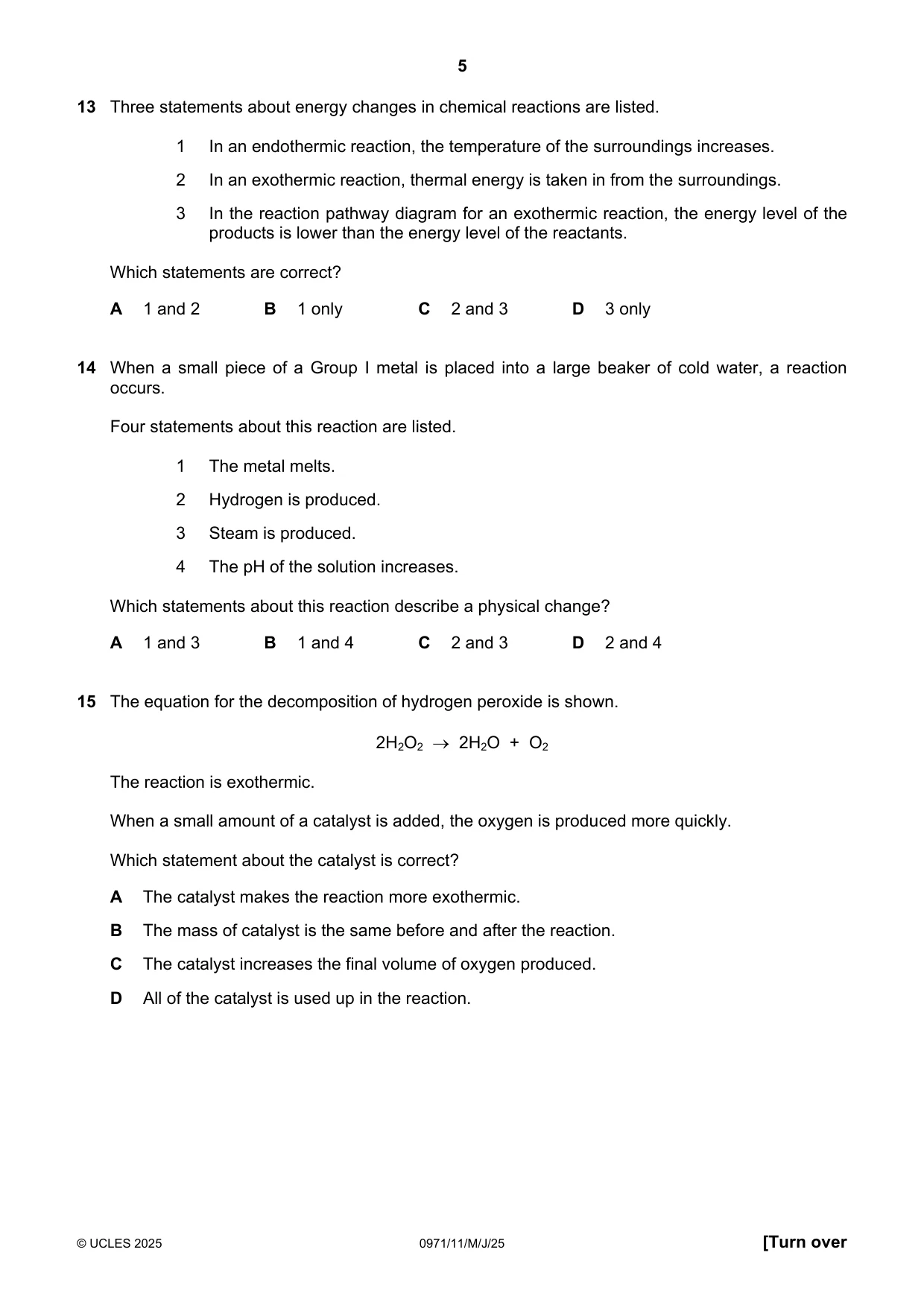
13 Three statements about energy changes in chemical reactions are listed. 1 In an endothermic reaction, the temperature of the surroundings increases. 2 In an exothermic reaction, thermal energy is taken in from the surroundings. 3 In the reaction pathway diagram for an exothermic reaction, the energy level of the products is lower than the energy level of the reactants. Which statements are correct? A 1 and 2 B 1 only C 2 and 3 D 3 only
Mark scheme: D
Q14 · When a small piece of a Group I metal is placed into a large beaker of cold water, a…
14 When a small piece of a Group I metal is placed into a large beaker of cold water, a reaction occurs. Four statements about this reaction are listed. 1 The metal melts. 2 Hydrogen is produced. 3 Steam is produced. 4 The pH of the solution increases. Which statements about this reaction describe a physical change? A 1 and 3 B 1 and 4 C 2 and 3 D 2 and 4
Mark scheme: A
Q15 · The equation for the decomposition of hydrogen peroxide is shown
15 The equation for the decomposition of hydrogen peroxide is shown. 2H2O2 2H2O + O2 The reaction is exothermic. When a small amount of a catalyst is added, the oxygen is produced more quickly. Which statement about the catalyst is correct? A The catalyst makes the reaction more exothermic. B The mass of catalyst is the same before and after the reaction. C The catalyst increases the final volume of oxygen produced. D All of the catalyst is used up in the reaction.
Mark scheme: B
Q16 · The equation for the reaction between copper(II) oxide and carbon is shown
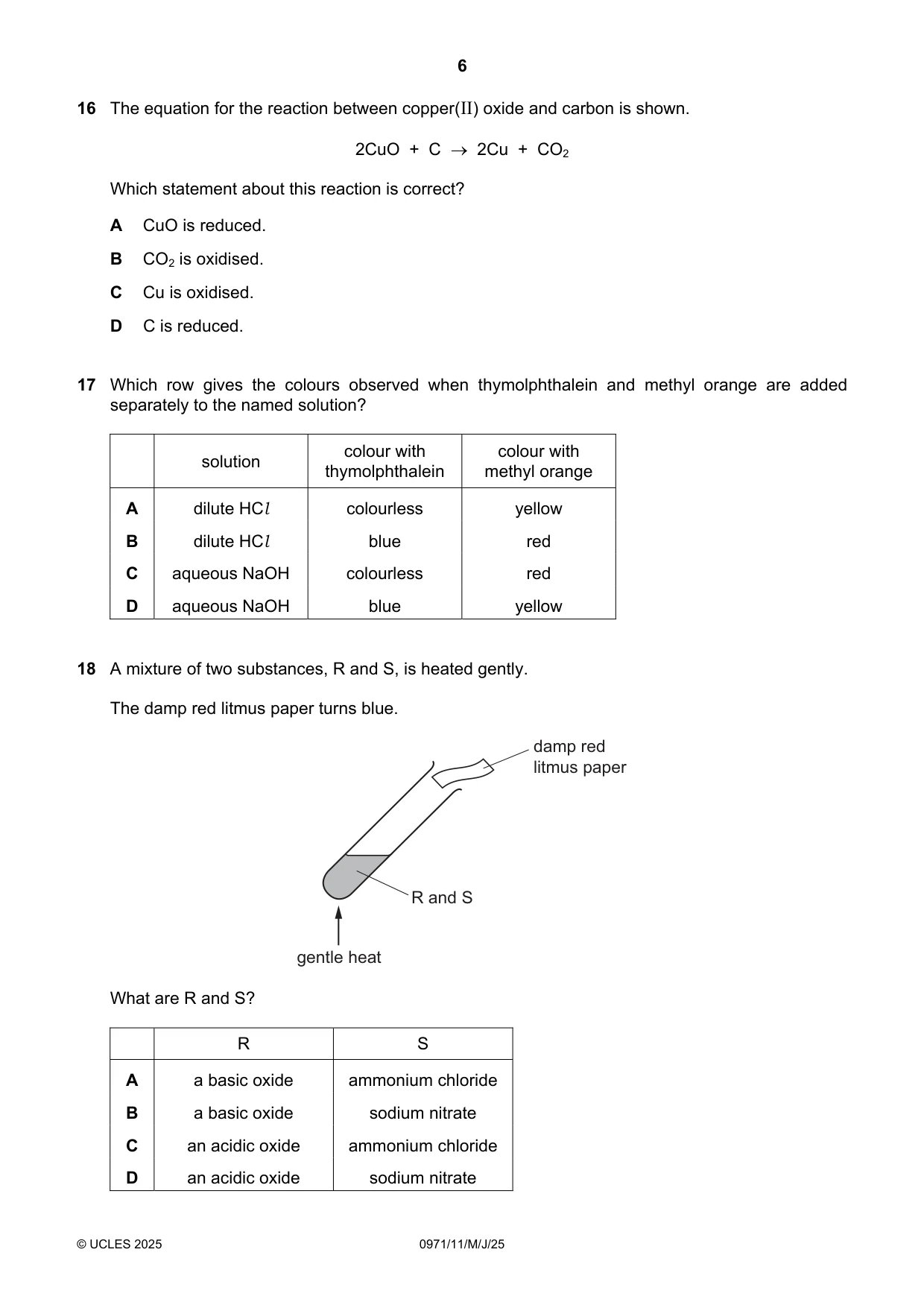
16 The equation for the reaction between copper(II) oxide and carbon is shown. 2CuO + C 2Cu + CO2 Which statement about this reaction is correct? A CuO is reduced. B CO2 is oxidised. C Cu is oxidised. D C is reduced.
Mark scheme: A
Q17 · Which row gives the colours observed when thymolphthalein and methyl orange are added…
17 Which row gives the colours observed when thymolphthalein and methyl orange are added separately to the named solution? colour with colour with solution thymolphthalein methyl orange A dilute HCl colourless yellow B dilute HCl blue red C aqueous NaOH colourless red D aqueous NaOH blue yellow
Mark scheme: D
More questions on The characteristic properties of acids and bases
Q18 · A mixture of two substances, R and S, is heated gently
18 A mixture of two substances, R and S, is heated gently. The damp red litmus paper turns blue. damp red litmus paper R and S gentle heat What are R and S? R S A a basic oxide ammonium chloride B a basic oxide sodium nitrate C an acidic oxide ammonium chloride D an acidic oxide sodium nitrate
Mark scheme: A
Q19 · Which reactants are used to make the salt copper(II) sulfate?
19 Which reactants are used to make the salt copper(II) sulfate? A dilute acid + alkali B dilute acid + metal carbonate C dilute acid + metal D dilute acid + non-metal oxide
Mark scheme: B
Q20 · Which statement about the Periodic Table is correct?
20 Which statement about the Periodic Table is correct? A The elements are arranged in order of increasing relative atomic mass. B The reactivity of the elements in Group I and in Group VII increases as the groups are descended. C Elements in the same period have similar chemical properties. D Elements in Group II form ions with a 2+ charge.
Mark scheme: D
Q21 · Part of the Periodic Table is shown
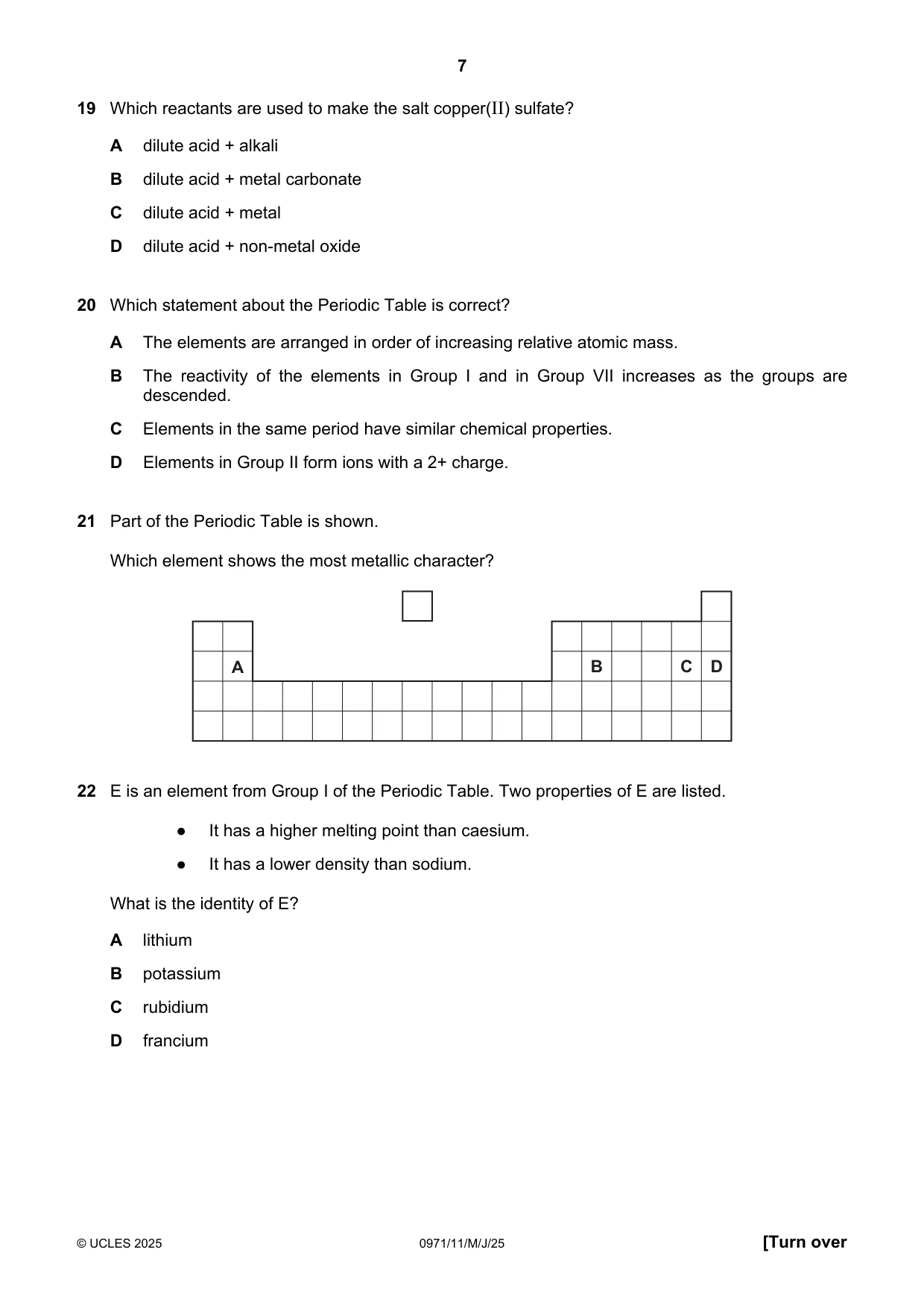
21 Part of the Periodic Table is shown. Which element shows the most metallic character? A B C D
Mark scheme: A
Q22 · E is an element from Group I of the Periodic Table
22 E is an element from Group I of the Periodic Table. Two properties of E are listed. ● It has a higher melting point than caesium. ● It has a lower density than sodium. What is the identity of E? A lithium B potassium C rubidium D francium
Mark scheme: A
Q23 · An equation for the displacement reaction between aqueous halogen, X2, and aqueous halide…
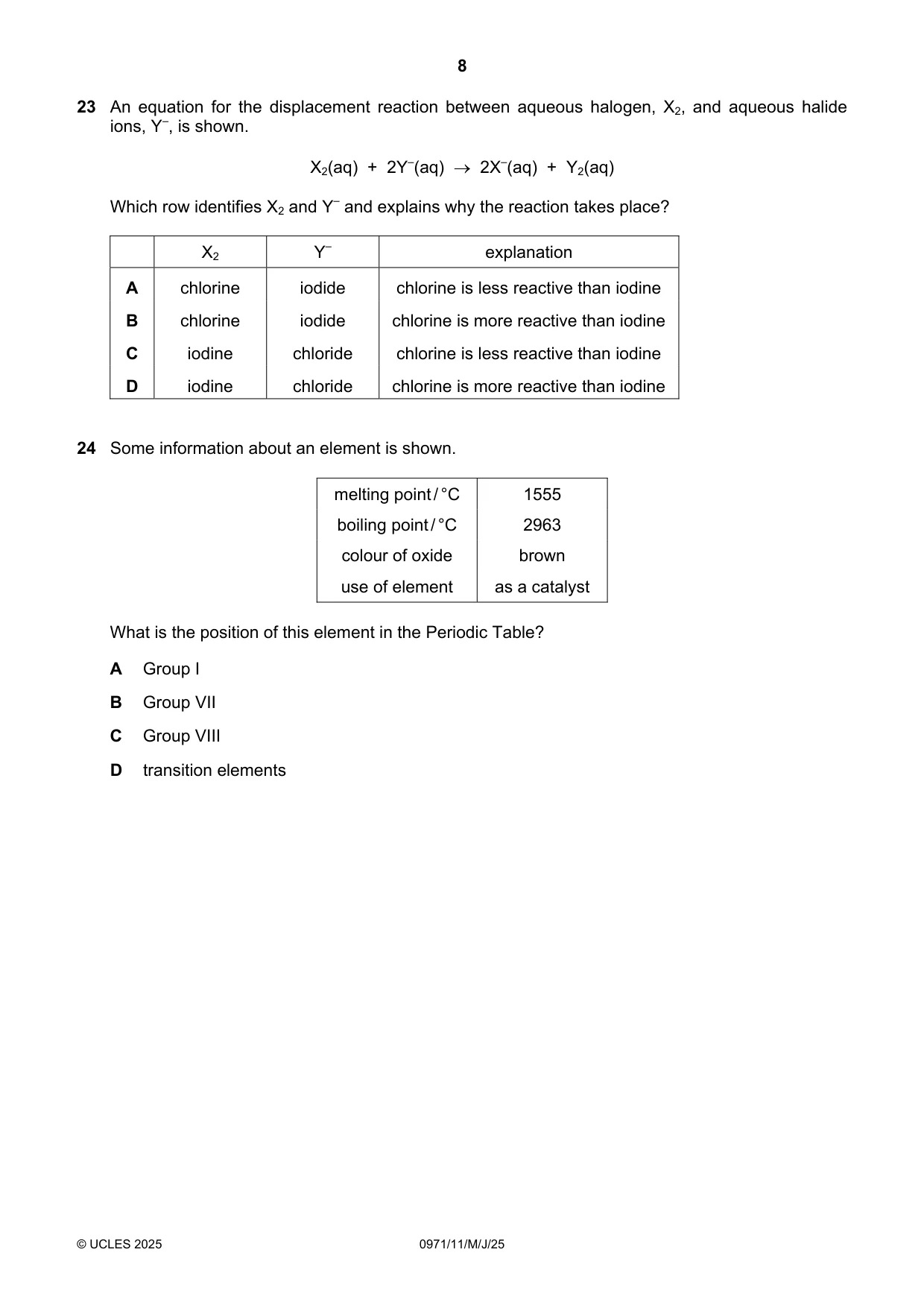
23 An equation for the displacement reaction between aqueous halogen, X2, and aqueous halide ions, Y–, is shown. X2(aq) + 2Y–(aq) 2X–(aq) + Y2(aq) Which row identifies X2 and Y– and explains why the reaction takes place? X2 Y– explanation A chlorine iodide chlorine is less reactive than iodine B chlorine iodide chlorine is more reactive than iodine C iodine chloride chlorine is less reactive than iodine D iodine chloride chlorine is more reactive than iodine
Mark scheme: B
Q24 · Some information about an element is shown
24 Some information about an element is shown. melting point / °C 1555 boiling point / °C 2963 colour of oxide brown use of element as a catalyst What is the position of this element in the Periodic Table? A Group I B Group VII C Group VIII D transition elements
Mark scheme: D
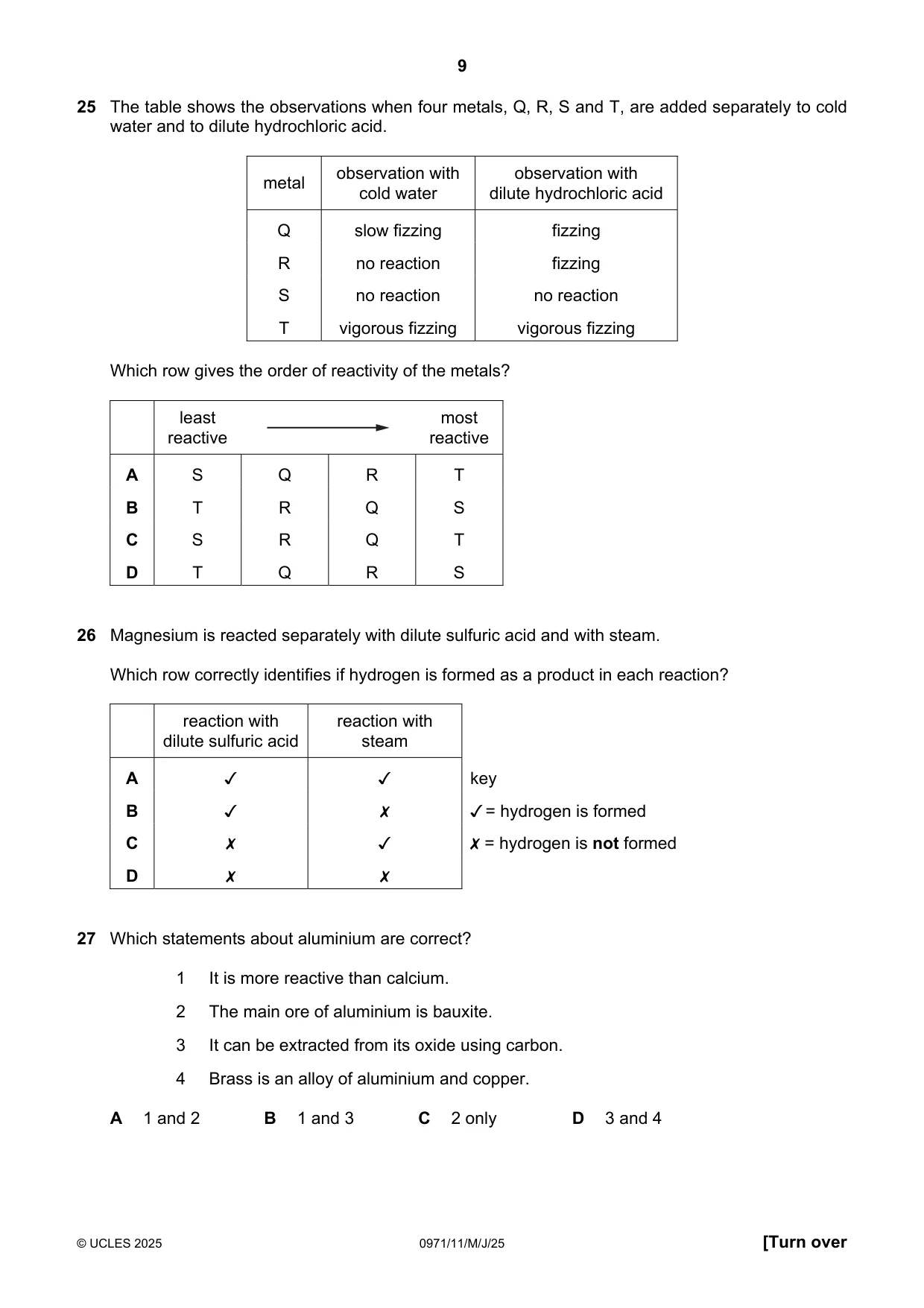
Q25 · The table shows the observations when four metals, Q, R, S and T, are added separately to…
25 The table shows the observations when four metals, Q, R, S and T, are added separately to cold water and to dilute hydrochloric acid. observation with observation with metal cold water dilute hydrochloric acid Q slow fizzing fizzing R no reaction fizzing S no reaction no reaction T vigorous fizzing vigorous fizzing Which row gives the order of reactivity of the metals? least most reactive reactive A S Q R T B T R Q S C S R Q T D T Q R S
Mark scheme: C
Q26 · Magnesium is reacted separately with dilute sulfuric acid and with steam
26 Magnesium is reacted separately with dilute sulfuric acid and with steam. Which row correctly identifies if hydrogen is formed as a product in each reaction? reaction with reaction with dilute sulfuric acid steam Jv v key ¥ = hydrogen is formed 0 0O WwW > v x x Jv X = hydrogen is not formed x x
Mark scheme: A
Q27 · Which statements about aluminium are correct?
27 Which statements about aluminium are correct? 1 It is more reactive than calcium. 2 The main ore of aluminium is bauxite. 3 It can be extracted from its oxide using carbon. 4 Brass is an alloy of aluminium and copper. A 1 and 2 B 1 and 3 C 2 only D 3 and 4
Mark scheme: C
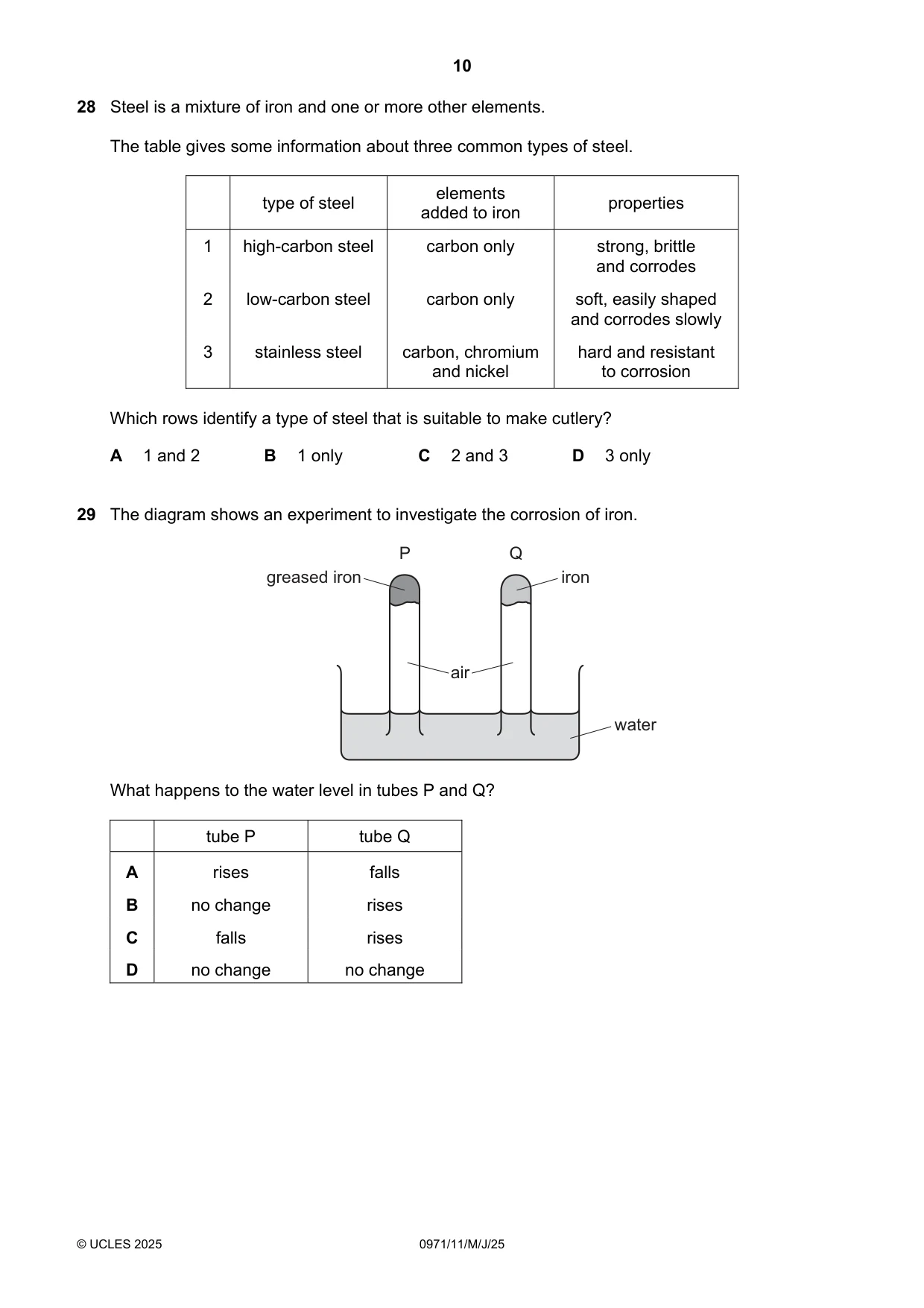
Q28 · Steel is a mixture of iron and one or more other elements
28 Steel is a mixture of iron and one or more other elements. The table gives some information about three common types of steel. elements type of steel properties added to iron 1 high-carbon steel carbon only strong, brittle and corrodes 2 low-carbon steel carbon only soft, easily shaped and corrodes slowly 3 stainless steel carbon, chromium hard and resistant and nickel to corrosion Which rows identify a type of steel that is suitable to make cutlery? A 1 and 2 B 1 only C 2 and 3 D 3 only
Mark scheme: D
Q29 · The diagram shows an experiment to investigate the corrosion of iron
29 The diagram shows an experiment to investigate the corrosion of iron. P Q greased iron iron air water What happens to the water level in tubes P and Q? tube P tube Q A rises falls B no change rises C falls rises D no change no change
Mark scheme: B
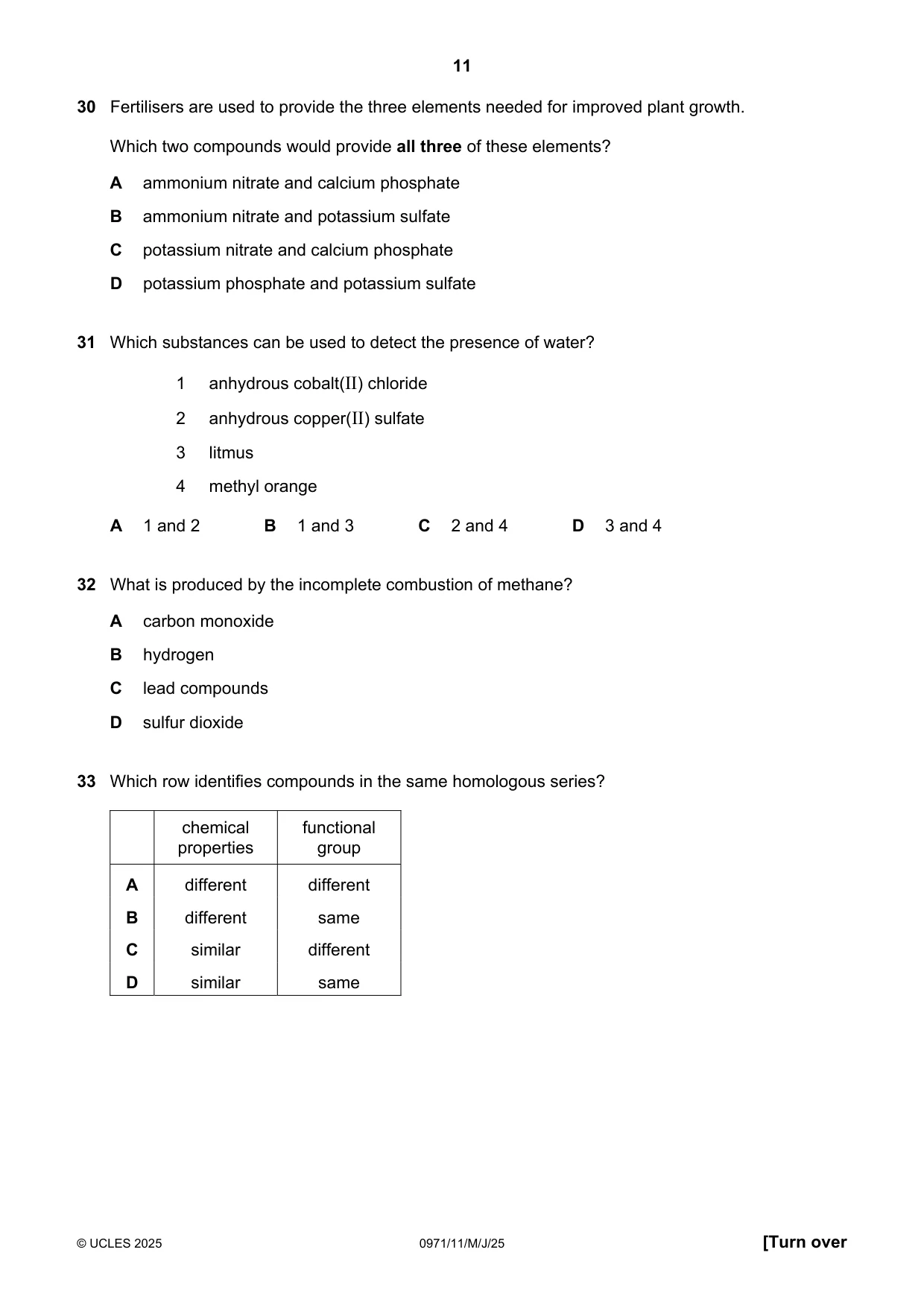
Q30 · Fertilisers are used to provide the three elements needed for improved plant growth
30 Fertilisers are used to provide the three elements needed for improved plant growth. Which two compounds would provide all three of these elements? A ammonium nitrate and calcium phosphate B ammonium nitrate and potassium sulfate C potassium nitrate and calcium phosphate D potassium phosphate and potassium sulfate
Mark scheme: C
Q31 · Which substances can be used to detect the presence of water?
31 Which substances can be used to detect the presence of water? 1 anhydrous cobalt(II) chloride 2 anhydrous copper(II) sulfate 3 litmus 4 methyl orange A 1 and 2 B 1 and 3 C 2 and 4 D 3 and 4
Mark scheme: A
Q32 · What is produced by the incomplete combustion of methane?
32 What is produced by the incomplete combustion of methane? A carbon monoxide B hydrogen C lead compounds D sulfur dioxide
Mark scheme: A
Q33 · Which row identifies compounds in the same homologous series?
33 Which row identifies compounds in the same homologous series? chemical functional properties group A different different B different same C similar different D similar same
Mark scheme: D
More questions on Formulae, functional groups and terminology
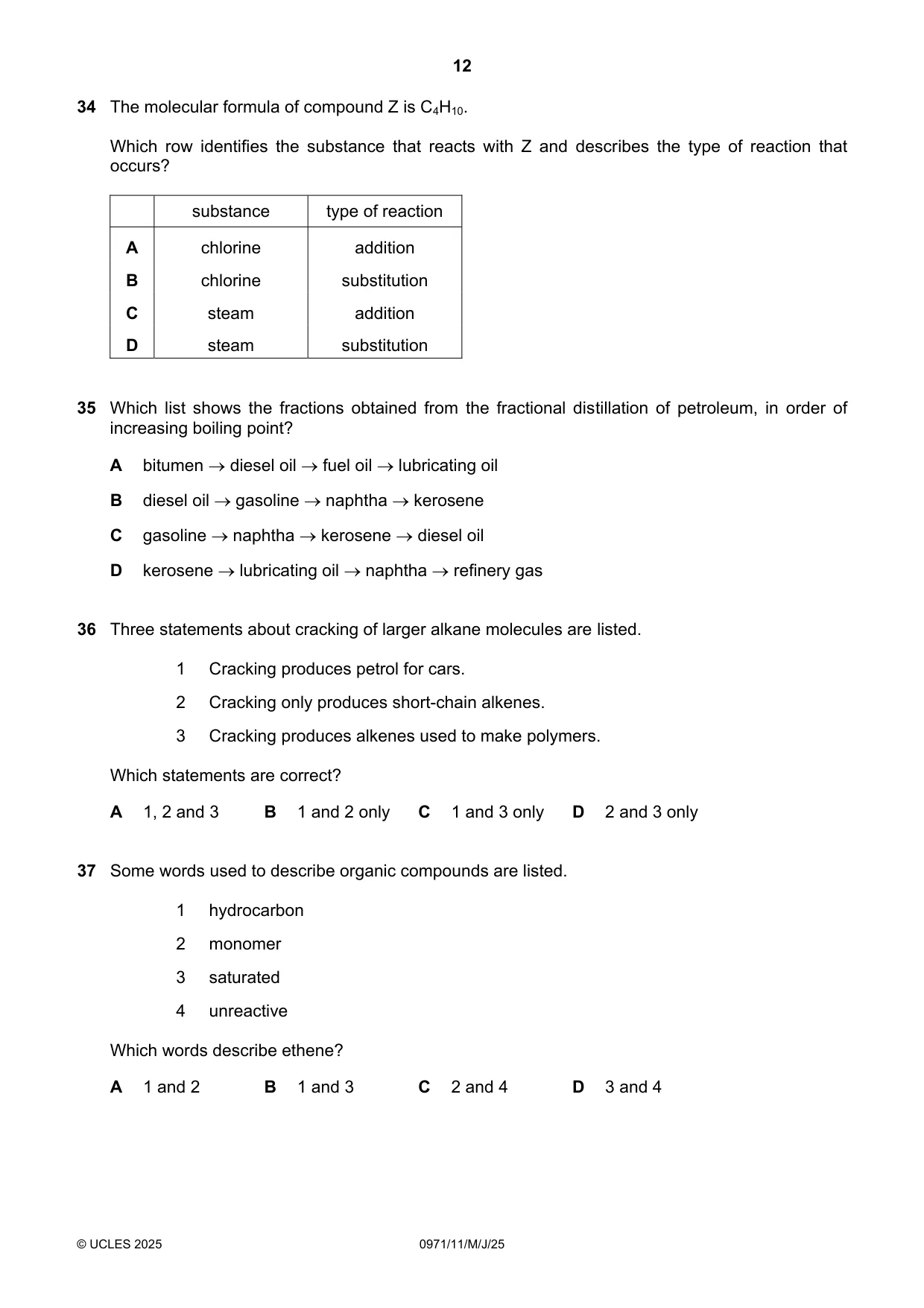
Q34 · The molecular formula of compound Z is C4H10
34 The molecular formula of compound Z is C4H10. Which row identifies the substance that reacts with Z and describes the type of reaction that occurs? substance type of reaction A chlorine addition B chlorine substitution C steam addition D steam substitution
Mark scheme: B
Q35 · Which list shows the fractions obtained from the fractional distillation of petroleum, in…
35 Which list shows the fractions obtained from the fractional distillation of petroleum, in order of increasing boiling point? A bitumen diesel oil fuel oil lubricating oil B diesel oil gasoline naphtha kerosene C gasoline naphtha kerosene diesel oil D kerosene lubricating oil naphtha refinery gas
Mark scheme: C
Q36 · Three statements about cracking of larger alkane molecules are listed
36 Three statements about cracking of larger alkane molecules are listed. 1 Cracking produces petrol for cars. 2 Cracking only produces short-chain alkenes. 3 Cracking produces alkenes used to make polymers. Which statements are correct? A 1, 2 and 3 B 1 and 2 only C 1 and 3 only D 2 and 3 only
Mark scheme: C
Q37 · Some words used to describe organic compounds are listed
37 Some words used to describe organic compounds are listed. 1 hydrocarbon 2 monomer 3 saturated 4 unreactive Which words describe ethene? A 1 and 2 B 1 and 3 C 2 and 4 D 3 and 4
Mark scheme: A
Q38 · A student measures 25.00 cm3 of dilute hydrochloric acid accurately
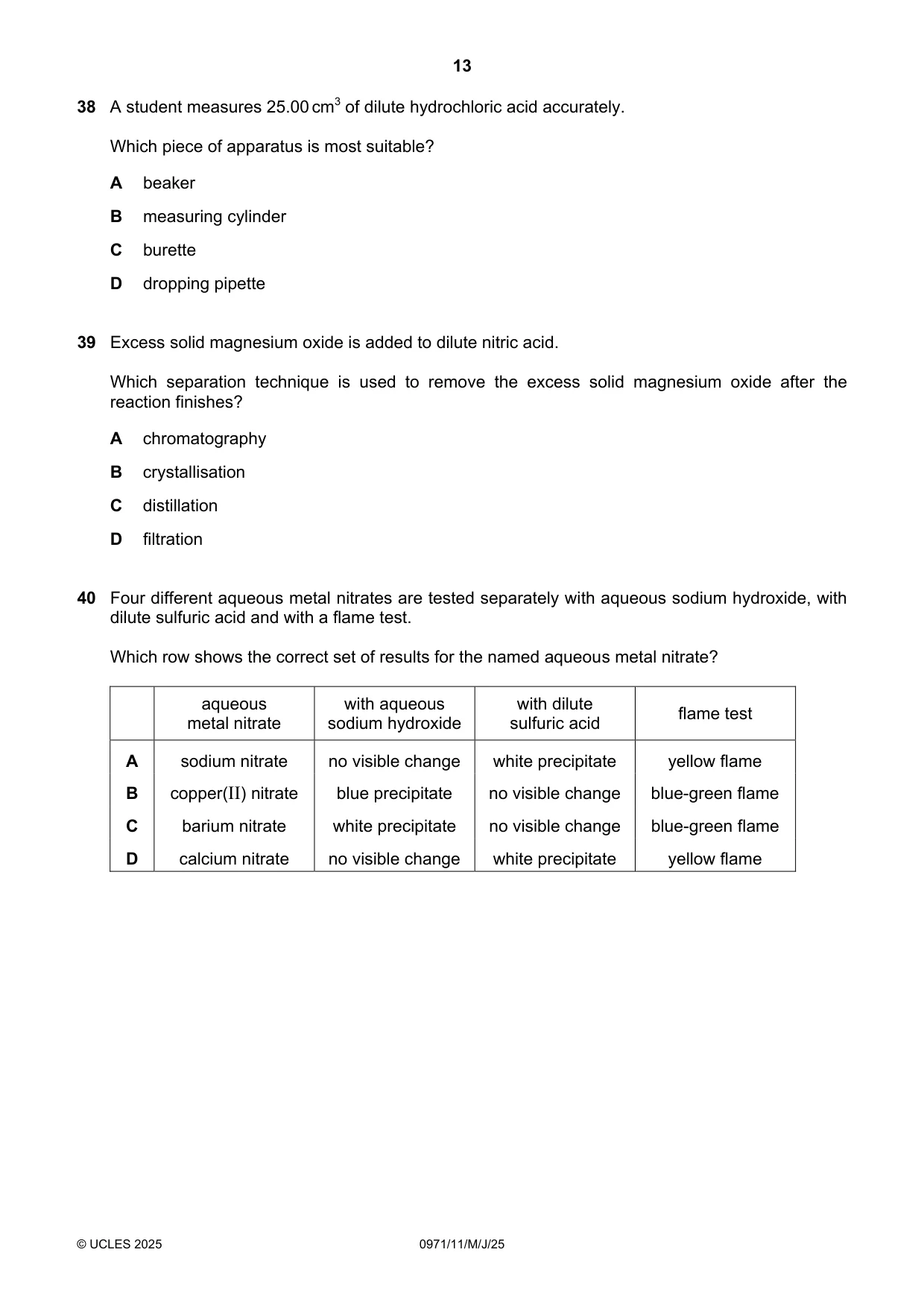
38 A student measures 25.00 cm3 of dilute hydrochloric acid accurately. Which piece of apparatus is most suitable? A beaker B measuring cylinder C burette D dropping pipette
Mark scheme: C
Q39 · Excess solid magnesium oxide is added to dilute nitric acid
39 Excess solid magnesium oxide is added to dilute nitric acid. Which separation technique is used to remove the excess solid magnesium oxide after the reaction finishes? A chromatography B crystallisation C distillation D filtration
Mark scheme: D
Q40 · Four different aqueous metal nitrates are tested separately with aqueous sodium…
40 Four different aqueous metal nitrates are tested separately with aqueous sodium hydroxide, with dilute sulfuric acid and with a flame test. Which row shows the correct set of results for the named aqueous metal nitrate? aqueous with aqueous with dilute flame test metal nitrate sodium hydroxide sulfuric acid A sodium nitrate no visible change white precipitate yellow flame B copper(II) nitrate blue precipitate no visible change blue-green flame C barium nitrate white precipitate no visible change blue-green flame D calcium nitrate no visible change white precipitate yellow flame
Mark scheme: B
What was in this paper
The subtopics covered by these 40 questions, and how many questions each got. Open one in a new tab to see every Cambridge question on it.
2Atomic structure and the Periodic Table2Fuels2Identification of ions and gases2Reactivity series2Air quality and climate1Alkanes1Alkenes1Alloys and their properties1Corrosion of metals1Electrolysis1Exothermic and endothermic reactions1Experimental design1Extraction of metals1Fertilisers1Formulae1Formulae, functional groups and terminology1Giant covalent structures1Group I properties1Group VII properties1Hydrogen–oxygen fuel cells1Ions and ionic bonds1Isotopes1Physical and chemical changes1Preparation of salts1Rate of reaction1Redox1Separation and purification1Simple molecules and covalent bonds1The characteristic properties of acids and bases1The mole and the Avogadro constant1Transition elements1Water1What you needed in this session
Cambridge’s own grade thresholds for 2025 May/June, Paper 1 · Variant 1. A higher threshold means an easier paper — the bar moves with how the cohort did.