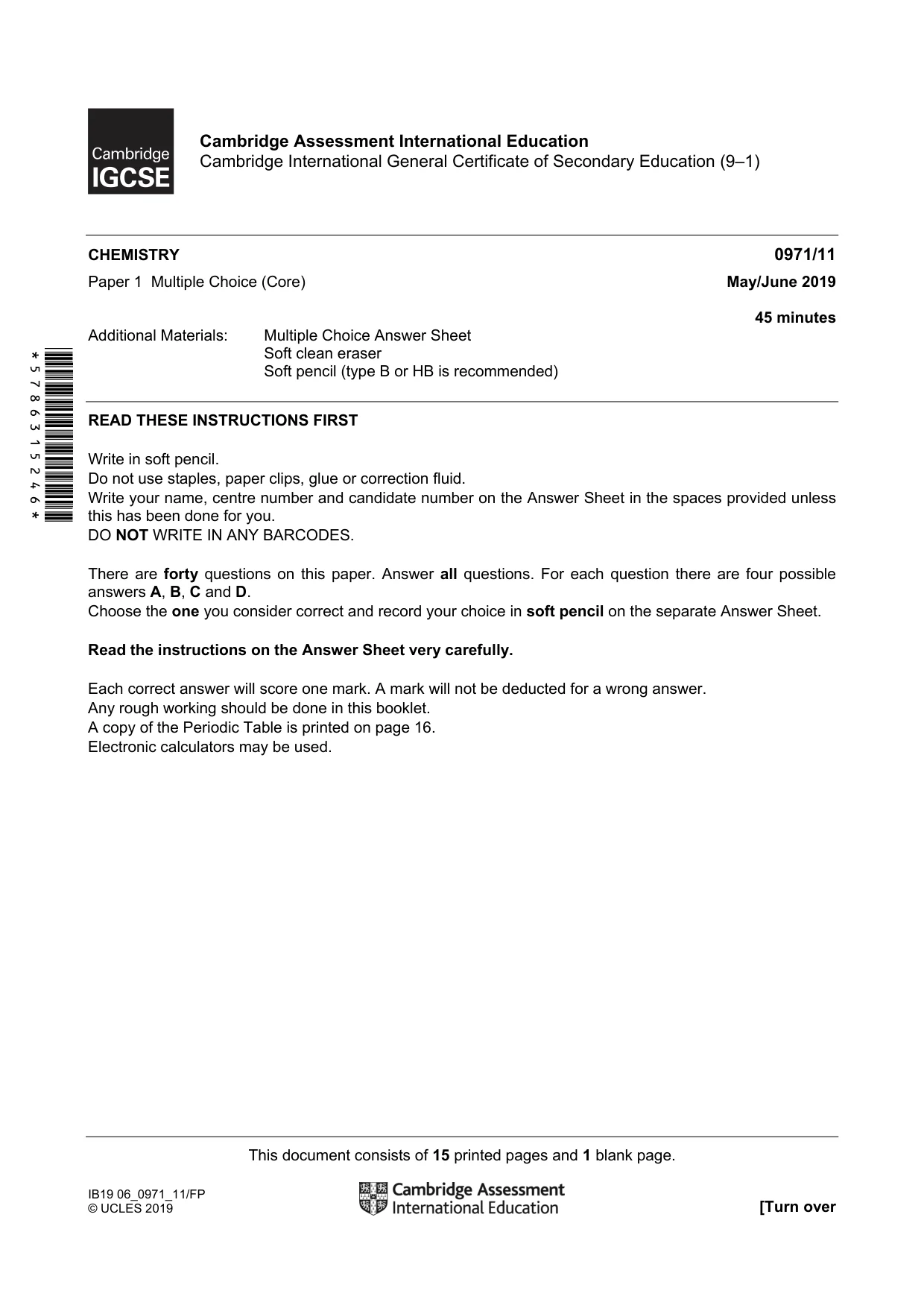
Cambridge IGCSE Chemistry (9-1) 0971 — 2019 May/June Paper 1 · Variant 1
0971/11/M/J/19 · 40 questions · 40 marks · ≈45 min
The question paper and its mark scheme, free to read here and free to download. This is Cambridge’s own paper, exactly as it was sat.
Question paper16 pages

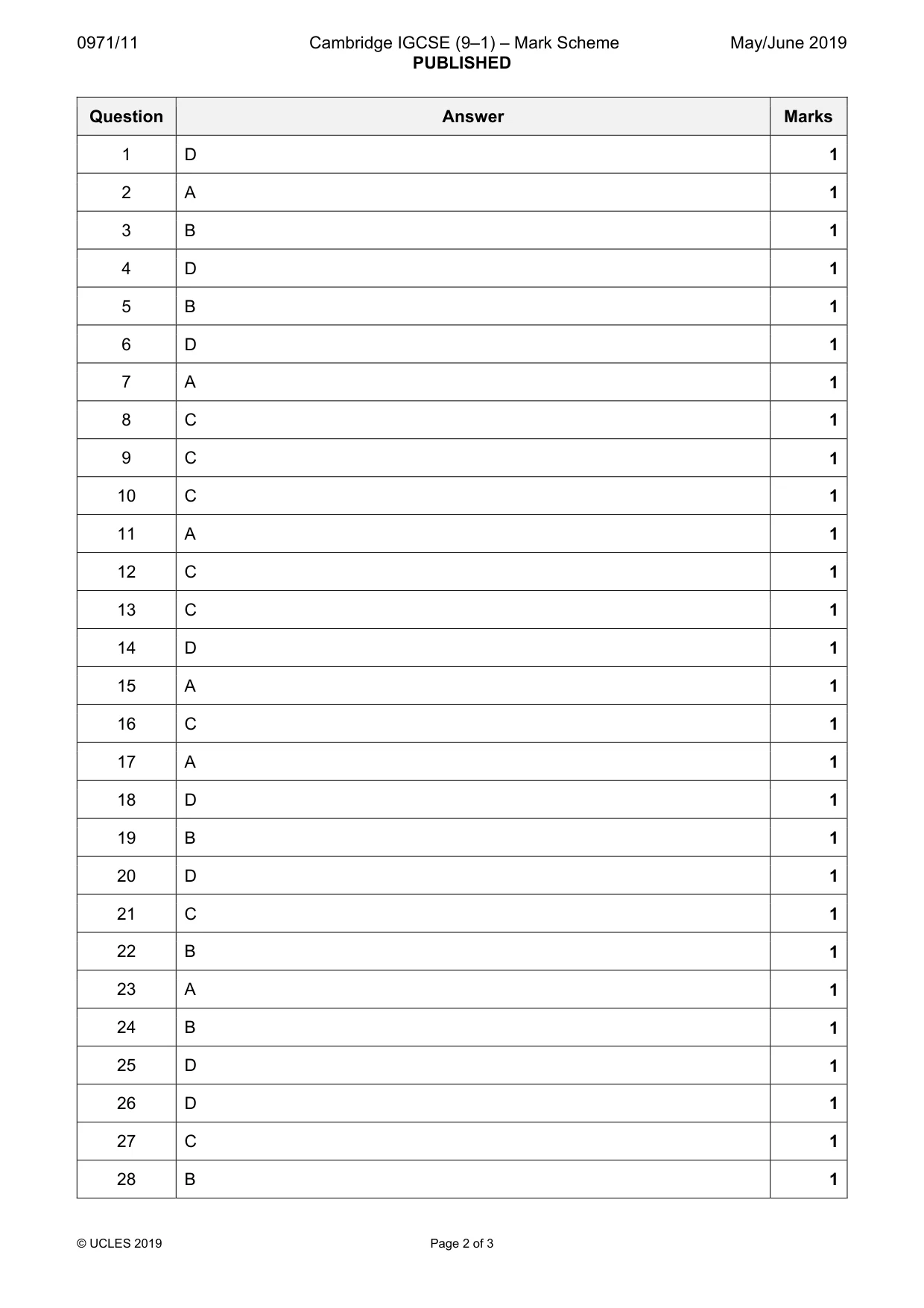
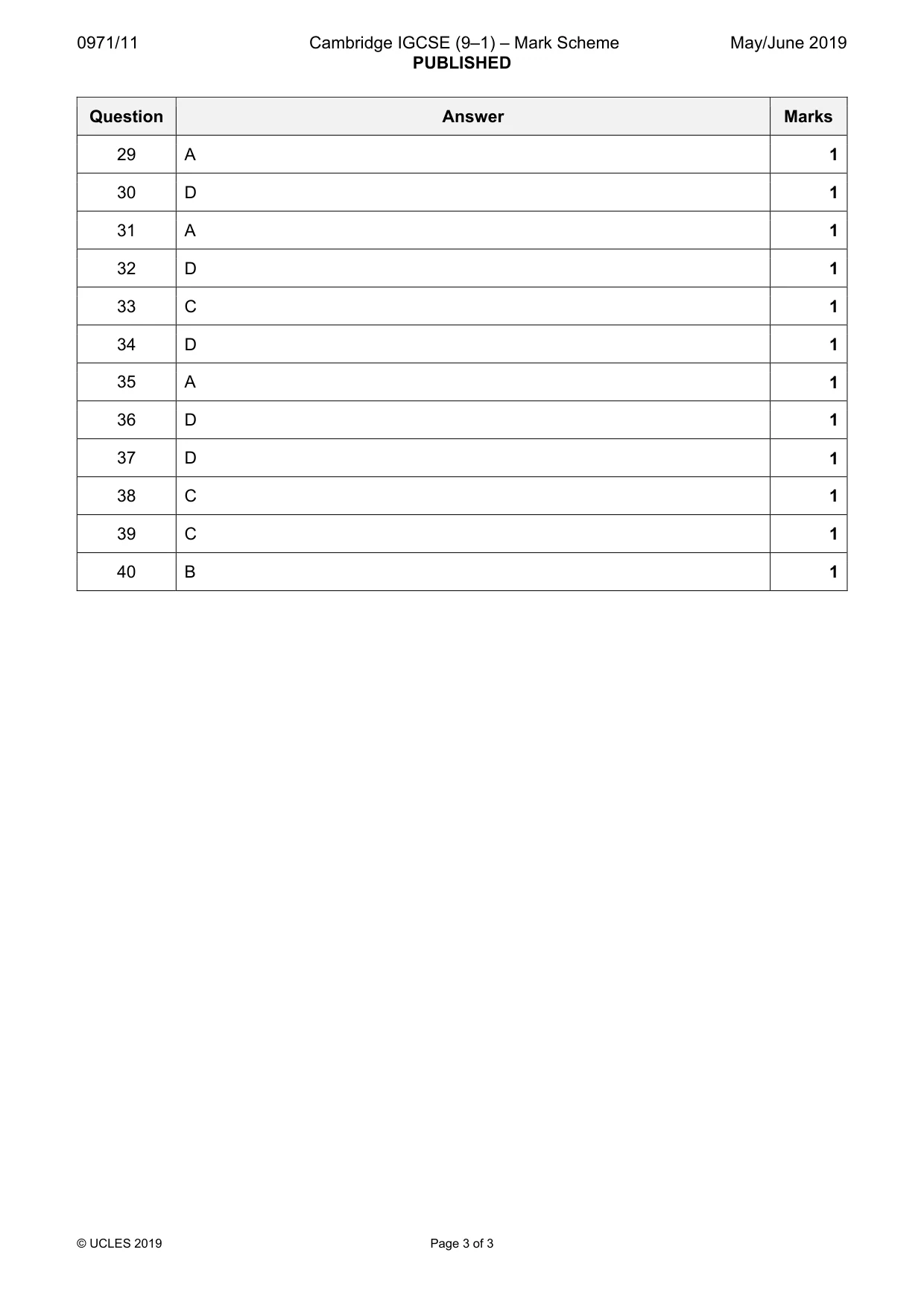
Mark scheme3 pages
Answers below. Sit the paper first if you are practising.
Questions as text
Q1 · Sodium chloride is a liquid at 900 °C
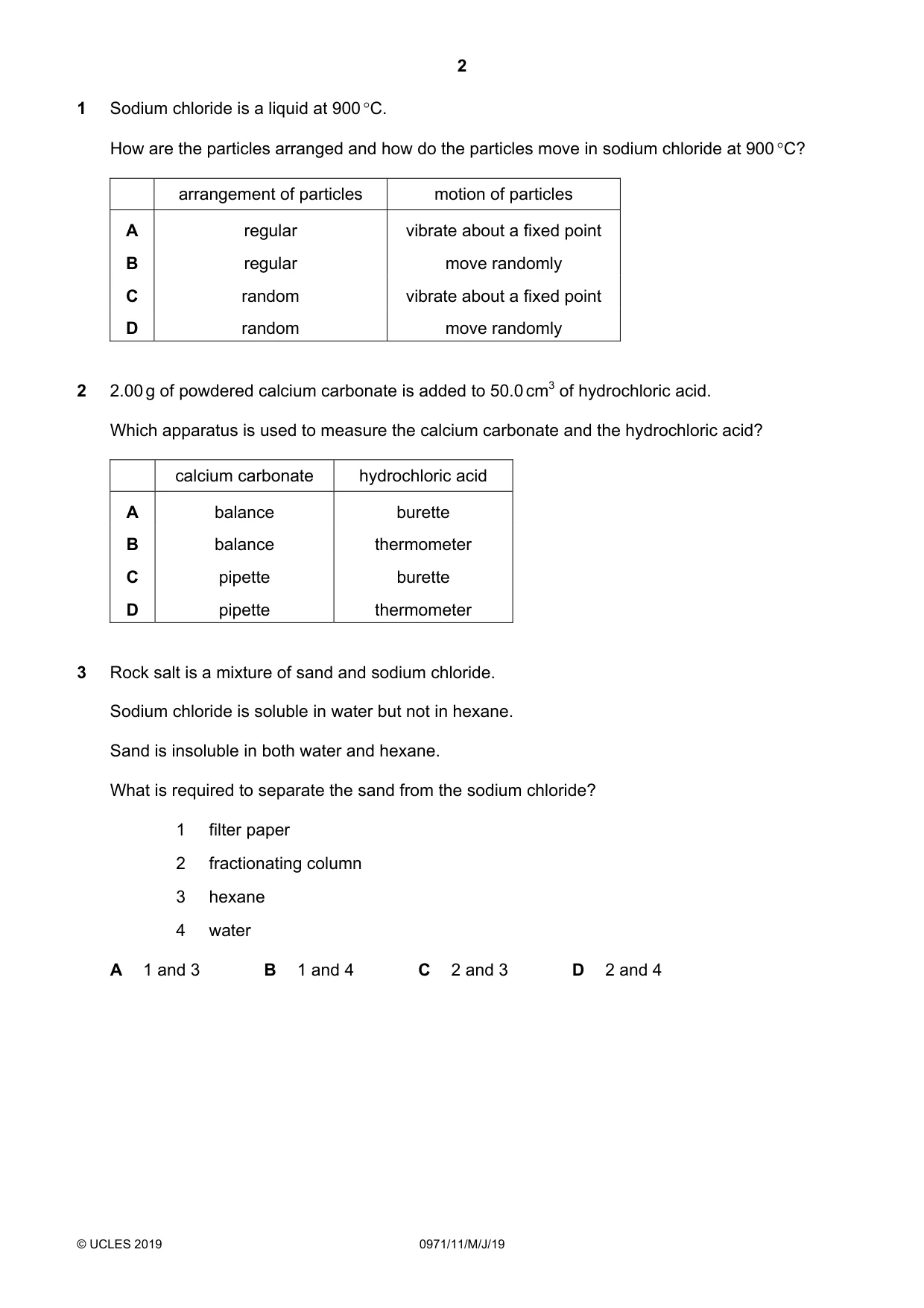
1 Sodium chloride is a liquid at 900 °C. How are the particles arranged and how do the particles move in sodium chloride at 900 °C? arrangement of particles motion of particles A regular vibrate about a fixed point B regular move randomly C random vibrate about a fixed point D random move randomly
Mark scheme: D
Q2 · 2.00 g of powdered calcium carbonate is added to 50.0 cm3 of hydrochloric acid
2 2.00 g of powdered calcium carbonate is added to 50.0 cm3 of hydrochloric acid. Which apparatus is used to measure the calcium carbonate and the hydrochloric acid? calcium carbonate hydrochloric acid A balance burette B balance thermometer C pipette burette D pipette thermometer
Mark scheme: A
Q3 · Rock salt is a mixture of sand and sodium chloride
3 Rock salt is a mixture of sand and sodium chloride. Sodium chloride is soluble in water but not in hexane. Sand is insoluble in both water and hexane. What is required to separate the sand from the sodium chloride? 1 filter paper 2 fractionating column 3 hexane 4 water A 1 and 3 B 1 and 4 C 2 and 3 D 2 and 4
Mark scheme: B
Q4 · The colours in four dyes are separated using chromatography
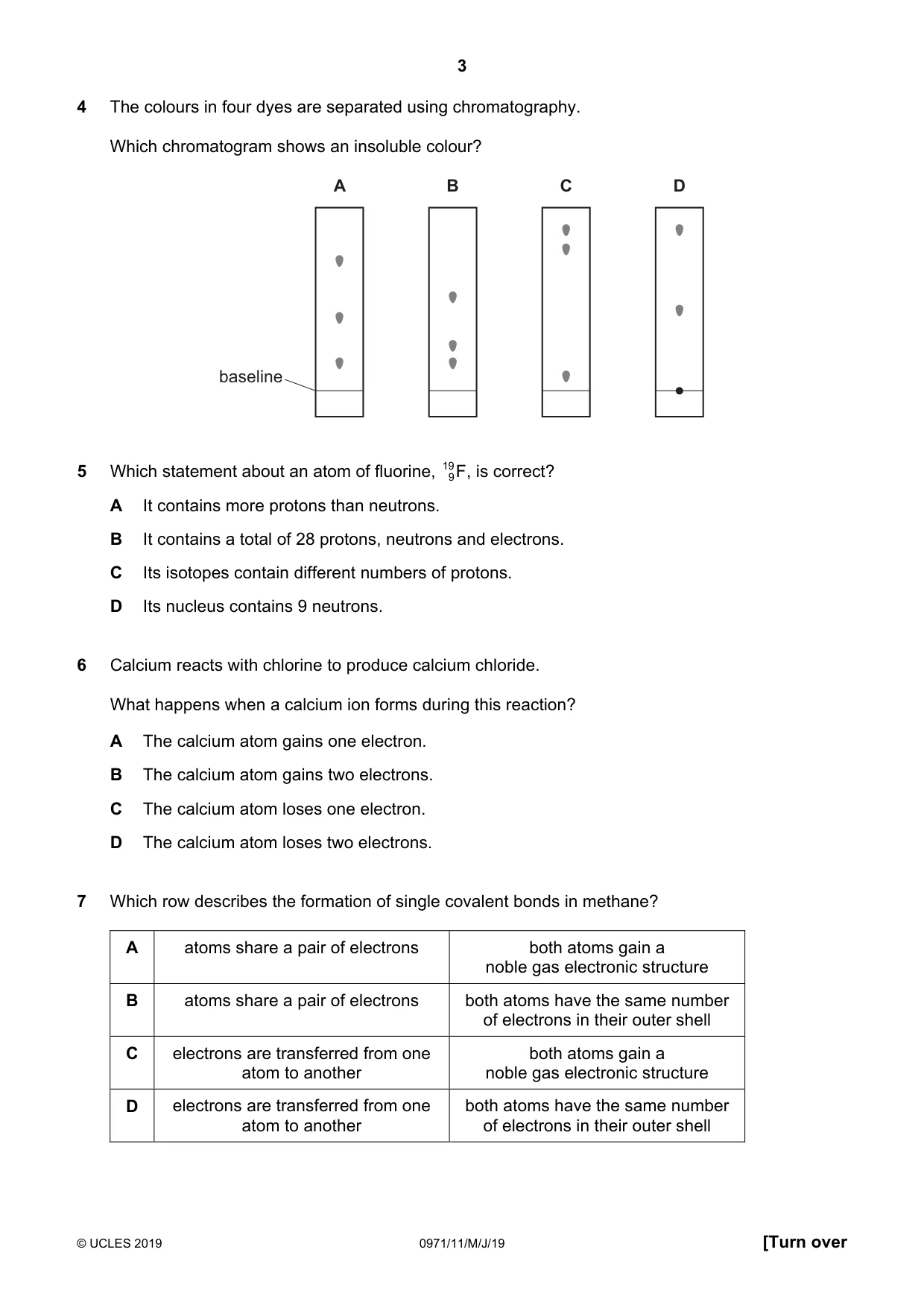
4 The colours in four dyes are separated using chromatography. Which chromatogram shows an insoluble colour? A B C D baseline
Mark scheme: D
Q5 · Which statement about an atom of fluorine, 19 9 , is correct?
5 Which statement about an atom of fluorine, 19 9 , is correct? F A It contains more protons than neutrons. B It contains a total of 28 protons, neutrons and electrons. C Its isotopes contain different numbers of protons. D Its nucleus contains 9 neutrons.
Mark scheme: B
Q6 · Calcium reacts with chlorine to produce calcium chloride
6 Calcium reacts with chlorine to produce calcium chloride. What happens when a calcium ion forms during this reaction? A The calcium atom gains one electron. B The calcium atom gains two electrons. C The calcium atom loses one electron. D The calcium atom loses two electrons.
Mark scheme: D
Q7 · Which row describes the formation of single covalent bonds in methane?
7 Which row describes the formation of single covalent bonds in methane? A atoms share a pair of electrons both atoms gain a noble gas electronic structure B atoms share a pair of electrons both atoms have the same number of electrons in their outer shell C electrons are transferred from one both atoms gain a atom to another noble gas electronic structure D electrons are transferred from one both atoms have the same number atom to another of electrons in their outer shell
Mark scheme: A
Q8 · Diamond and graphite have giant covalent structures of carbon atoms
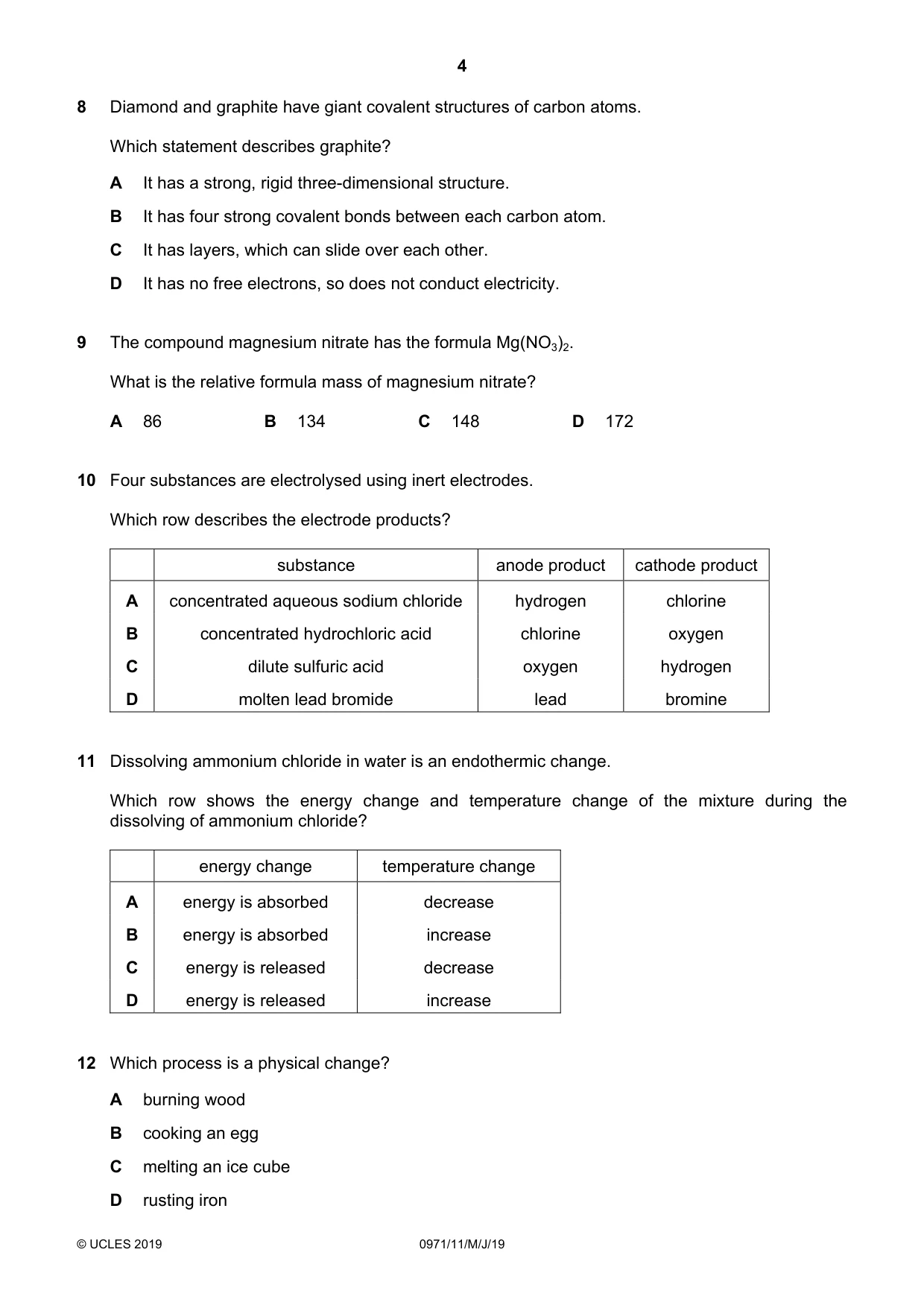
8 Diamond and graphite have giant covalent structures of carbon atoms. Which statement describes graphite? A It has a strong, rigid three-dimensional structure. B It has four strong covalent bonds between each carbon atom. C It has layers, which can slide over each other. D It has no free electrons, so does not conduct electricity.
Mark scheme: C
Q9 · The compound magnesium nitrate has the formula Mg(NO3)2
9 The compound magnesium nitrate has the formula Mg(NO3)2. What is the relative formula mass of magnesium nitrate? A 86 B 134 C 148 D 172
Mark scheme: C
Q10 · Four substances are electrolysed using inert electrodes
10 Four substances are electrolysed using inert electrodes. Which row describes the electrode products? substance anode product cathode product A concentrated aqueous sodium chloride hydrogen chlorine B concentrated hydrochloric acid chlorine oxygen C dilute sulfuric acid oxygen hydrogen D molten lead bromide lead bromine
Mark scheme: C
Q11 · Dissolving ammonium chloride in water is an endothermic change
11 Dissolving ammonium chloride in water is an endothermic change. Which row shows the energy change and temperature change of the mixture during the dissolving of ammonium chloride? energy change temperature change A energy is absorbed decrease B energy is absorbed increase C energy is released decrease D energy is released increase
Mark scheme: A
Q12 · Which process is a physical change?
12 Which process is a physical change? A burning wood B cooking an egg C melting an ice cube D rusting iron
Mark scheme: C
Q13 · Hydrogen peroxide solution decomposes very slowly at room temperature to produce oxygen…
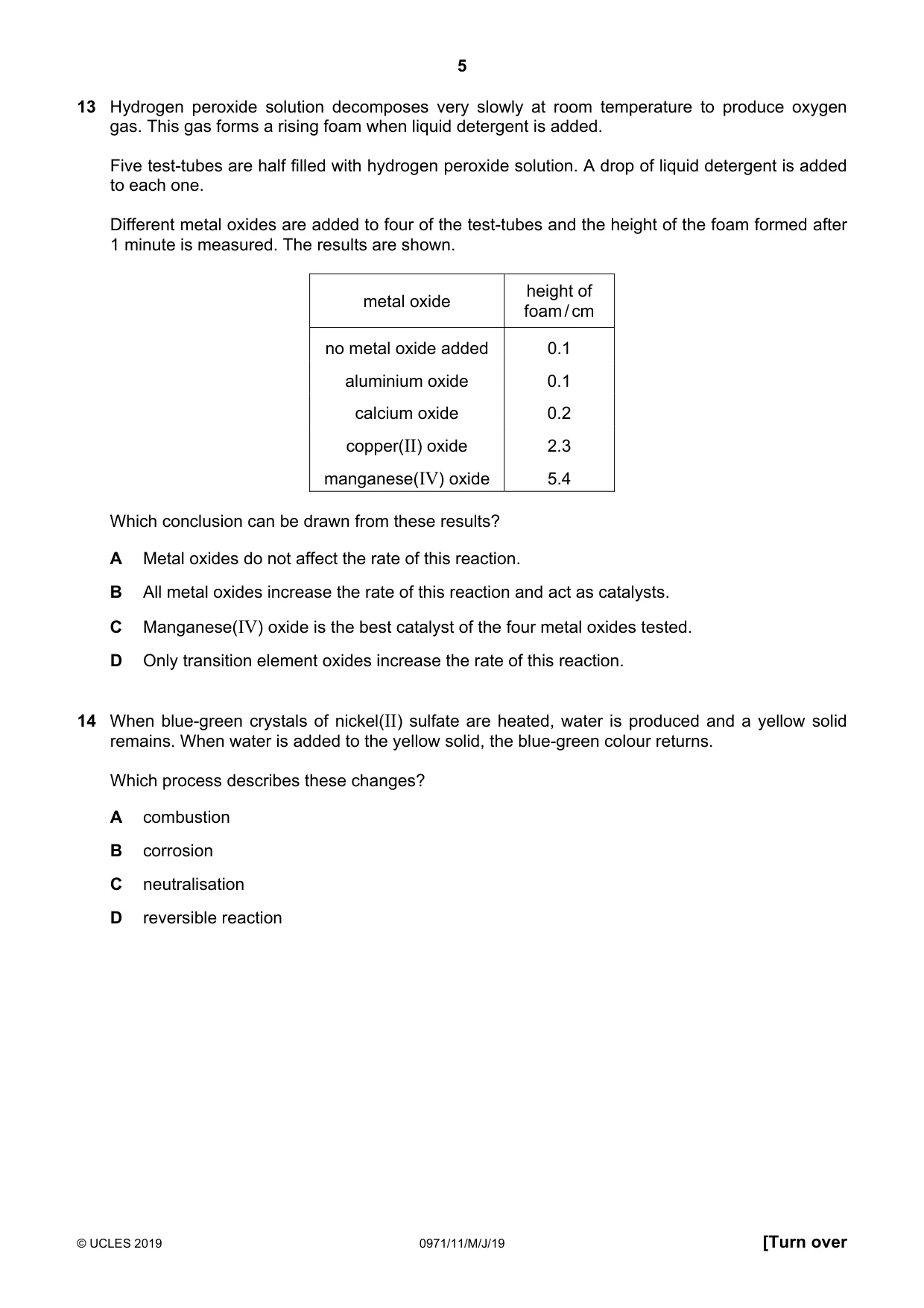
13 Hydrogen peroxide solution decomposes very slowly at room temperature to produce oxygen gas. This gas forms a rising foam when liquid detergent is added. Five test-tubes are half filled with hydrogen peroxide solution. A drop of liquid detergent is added to each one. Different metal oxides are added to four of the test-tubes and the height of the foam formed after 1 minute is measured. The results are shown. height of metal oxide foam / cm no metal oxide added 0.1 aluminium oxide 0.1 calcium oxide 0.2 copper(II) oxide 2.3 manganese(IV) oxide 5.4 Which conclusion can be drawn from these results? A Metal oxides do not affect the rate of this reaction. B All metal oxides increase the rate of this reaction and act as catalysts. C Manganese(IV) oxide is the best catalyst of the four metal oxides tested. D Only transition element oxides increase the rate of this reaction.
Mark scheme: C
Q14 · When blue-green crystals of nickel(II) sulfate are heated, water is produced and a yellow…
14 When blue-green crystals of nickel(II) sulfate are heated, water is produced and a yellow solid remains. When water is added to the yellow solid, the blue-green colour returns. Which process describes these changes? A combustion B corrosion C neutralisation D reversible reaction
Mark scheme: D
Q15 · In a blast furnace, iron is extracted when iron(III) oxide reacts with carbon monoxide
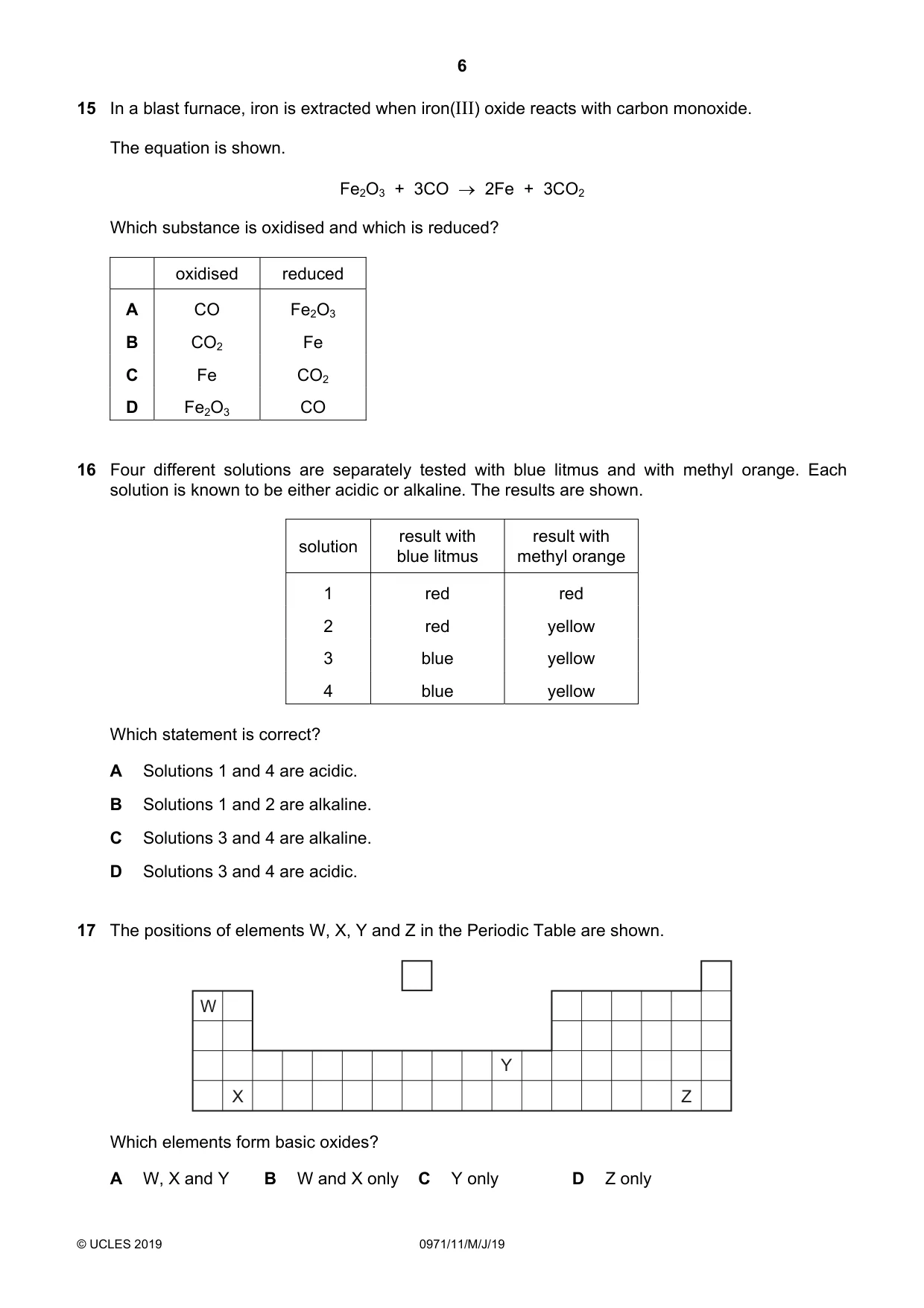
15 In a blast furnace, iron is extracted when iron(III) oxide reacts with carbon monoxide. The equation is shown. Fe2O3 + 3CO → 2Fe + 3CO2 Which substance is oxidised and which is reduced? oxidised reduced A CO Fe2O3 B CO2 Fe C Fe CO2 D Fe2O3 CO
Mark scheme: A
Q16 · Four different solutions are separately tested with blue litmus and with methyl orange
16 Four different solutions are separately tested with blue litmus and with methyl orange. Each solution is known to be either acidic or alkaline. The results are shown. result with result with solution blue litmus methyl orange 1 red red 2 red yellow 3 blue yellow 4 blue yellow Which statement is correct? A Solutions 1 and 4 are acidic. B Solutions 1 and 2 are alkaline. C Solutions 3 and 4 are alkaline. D Solutions 3 and 4 are acidic.
Mark scheme: C
More questions on The characteristic properties of acids and bases
Q17 · The positions of elements W, X, Y and Z in the Periodic Table are shown
17 The positions of elements W, X, Y and Z in the Periodic Table are shown. W Y X Z Which elements form basic oxides? A W, X and Y B W and X only C Y only D Z only
Mark scheme: A
Q18 · How could crystals of a pure salt be prepared from dilute sulfuric acid?
18 How could crystals of a pure salt be prepared from dilute sulfuric acid? A add an excess of aqueous sodium hydroxide, filter, evaporate the filtrate to crystallisation point B add an excess of copper(II) carbonate, filter, evaporate the filtrate to dryness C add an excess of copper metal, filter, evaporate the filtrate to crystallisation point D add an excess of zinc oxide, filter, evaporate the filtrate to crystallisation point
Mark scheme: D
Q19 · The results of two tests on a solution of compound Q are shown
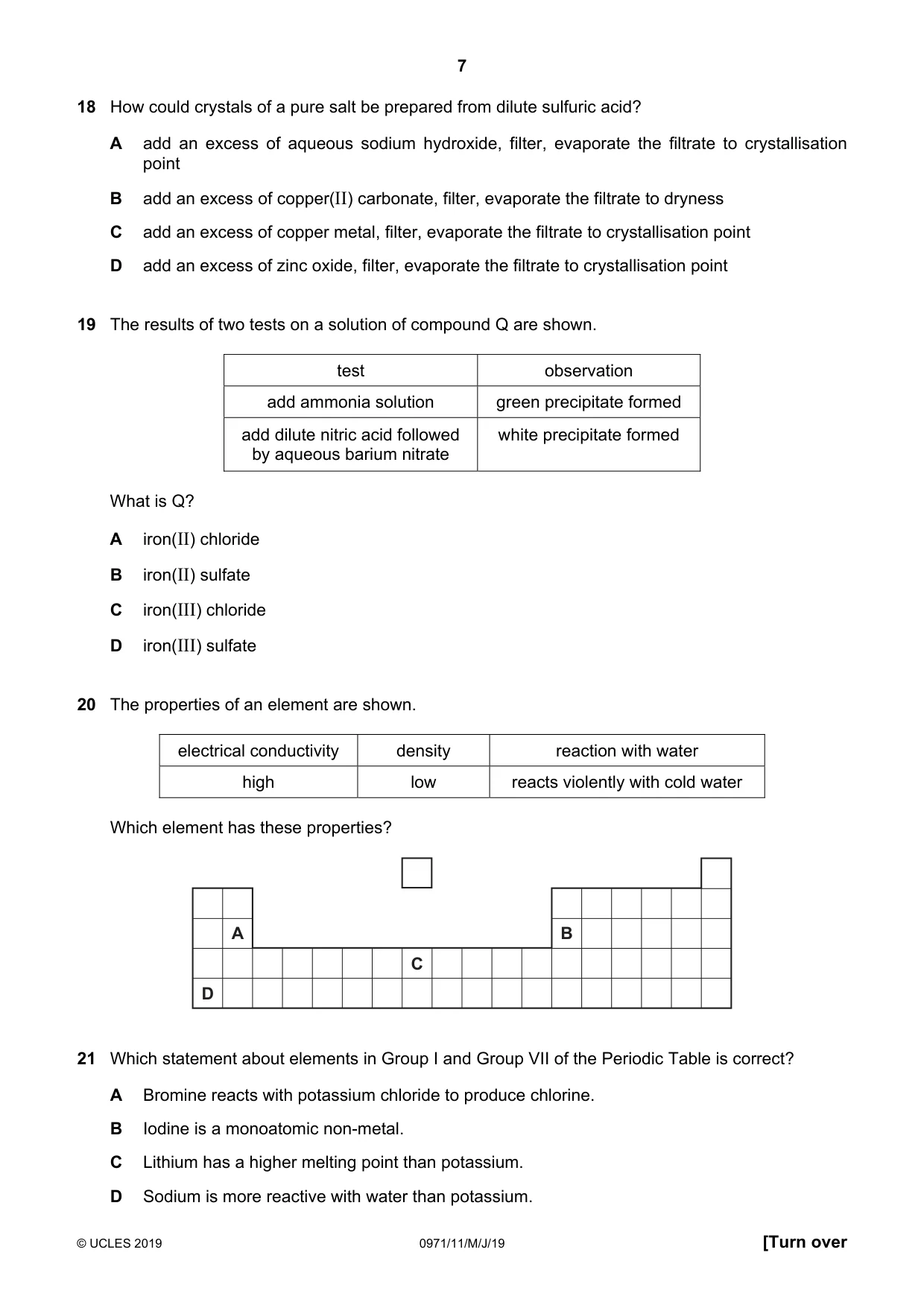
19 The results of two tests on a solution of compound Q are shown. test observation add ammonia solution green precipitate formed add dilute nitric acid followed white precipitate formed by aqueous barium nitrate What is Q? A iron(II) chloride B iron(II) sulfate C iron(III) chloride D iron(III) sulfate
Mark scheme: B
Q20 · The properties of an element are shown
20 The properties of an element are shown. electrical conductivity density reaction with water high low reacts violently with cold water Which element has these properties? A B C D
Mark scheme: D
Q21 · Which statement about elements in Group I and Group VII of the Periodic Table is correct?
21 Which statement about elements in Group I and Group VII of the Periodic Table is correct? A Bromine reacts with potassium chloride to produce chlorine. B Iodine is a monoatomic non-metal. C Lithium has a higher melting point than potassium. D Sodium is more reactive with water than potassium.
Mark scheme: C
Q22 · Which row describes the properties of a transition element?
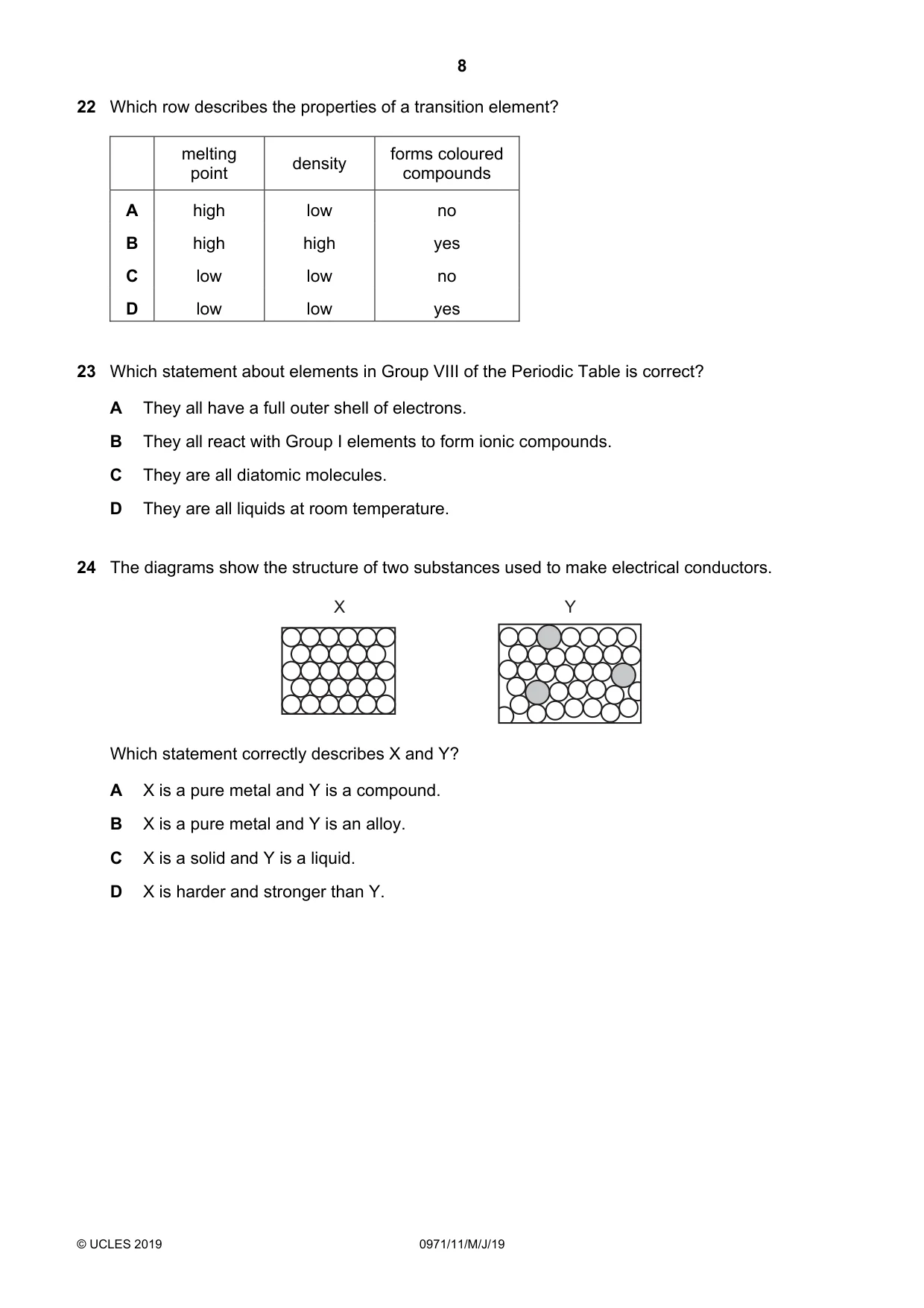
22 Which row describes the properties of a transition element? melting forms coloured density point compounds A high low no B high high yes C low low no D low low yes
Mark scheme: B
Q23 · Which statement about elements in Group VIII of the Periodic Table is correct?
23 Which statement about elements in Group VIII of the Periodic Table is correct? A They all have a full outer shell of electrons. B They all react with Group I elements to form ionic compounds. C They are all diatomic molecules. D They are all liquids at room temperature.
Mark scheme: A
Q24 · The diagrams show the structure of two substances used to make electrical conductors
24 The diagrams show the structure of two substances used to make electrical conductors. X Y Which statement correctly describes X and Y? A X is a pure metal and Y is a compound. B X is a pure metal and Y is an alloy. C X is a solid and Y is a liquid. D X is harder and stronger than Y.
Mark scheme: B
Q25 · The reactions of three metals, P, Q and R, are shown
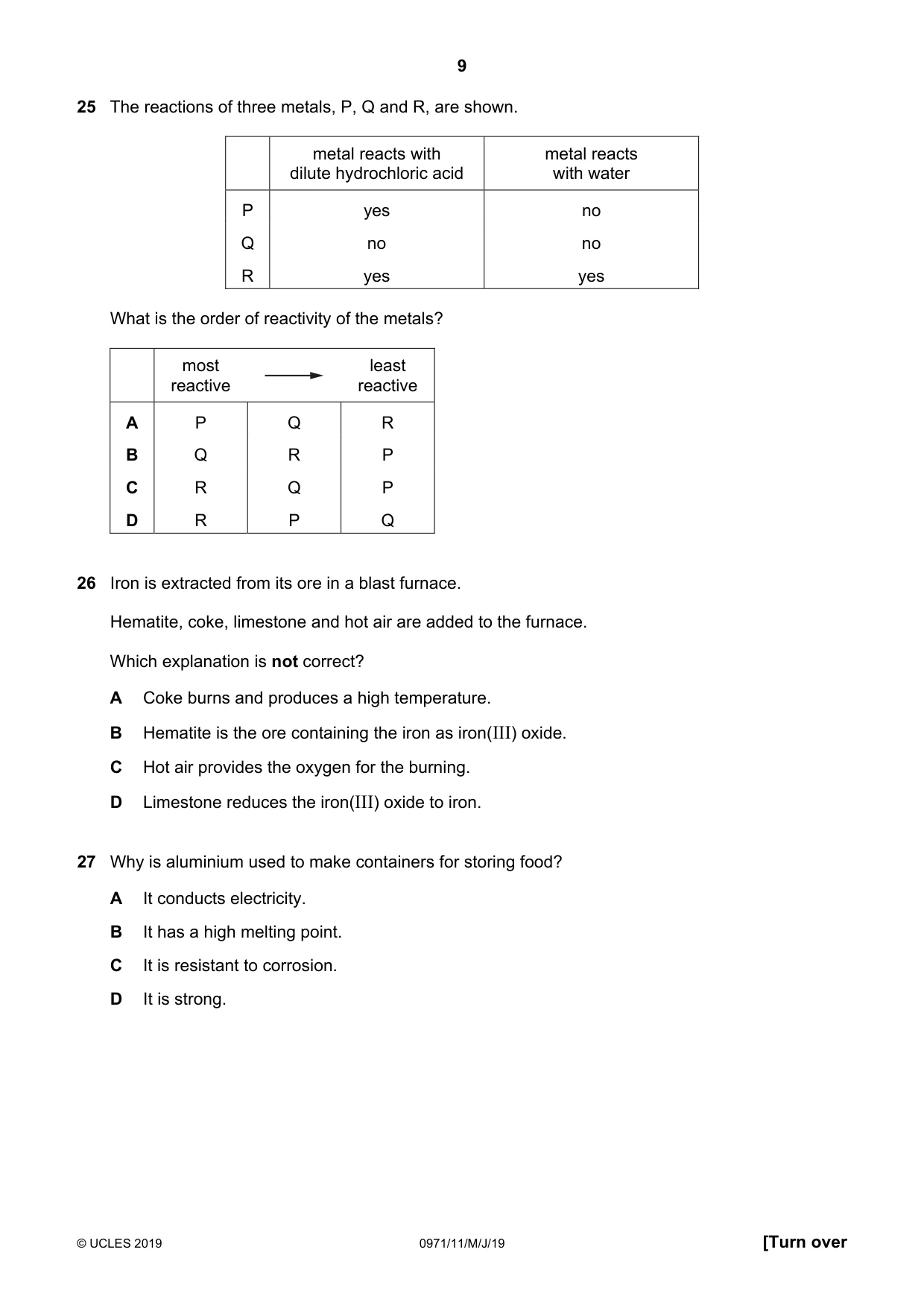
25 The reactions of three metals, P, Q and R, are shown. metal reacts with metal reacts dilute hydrochloric acid with water P yes no Q no no R yes yes What is the order of reactivity of the metals? most least reactive reactive A P Q R B Q R P C R Q P D R P Q
Mark scheme: D
Q26 · Iron is extracted from its ore in a blast furnace
26 Iron is extracted from its ore in a blast furnace. Hematite, coke, limestone and hot air are added to the furnace. Which explanation is not correct? A Coke burns and produces a high temperature. B Hematite is the ore containing the iron as iron(III) oxide. C Hot air provides the oxygen for the burning. D Limestone reduces the iron(III) oxide to iron.
Mark scheme: D
Q27 · Why is aluminium used to make containers for storing food?
27 Why is aluminium used to make containers for storing food? A It conducts electricity. B It has a high melting point. C It is resistant to corrosion. D It is strong.
Mark scheme: C
Q28 · Water can be treated by filtration then chlorination
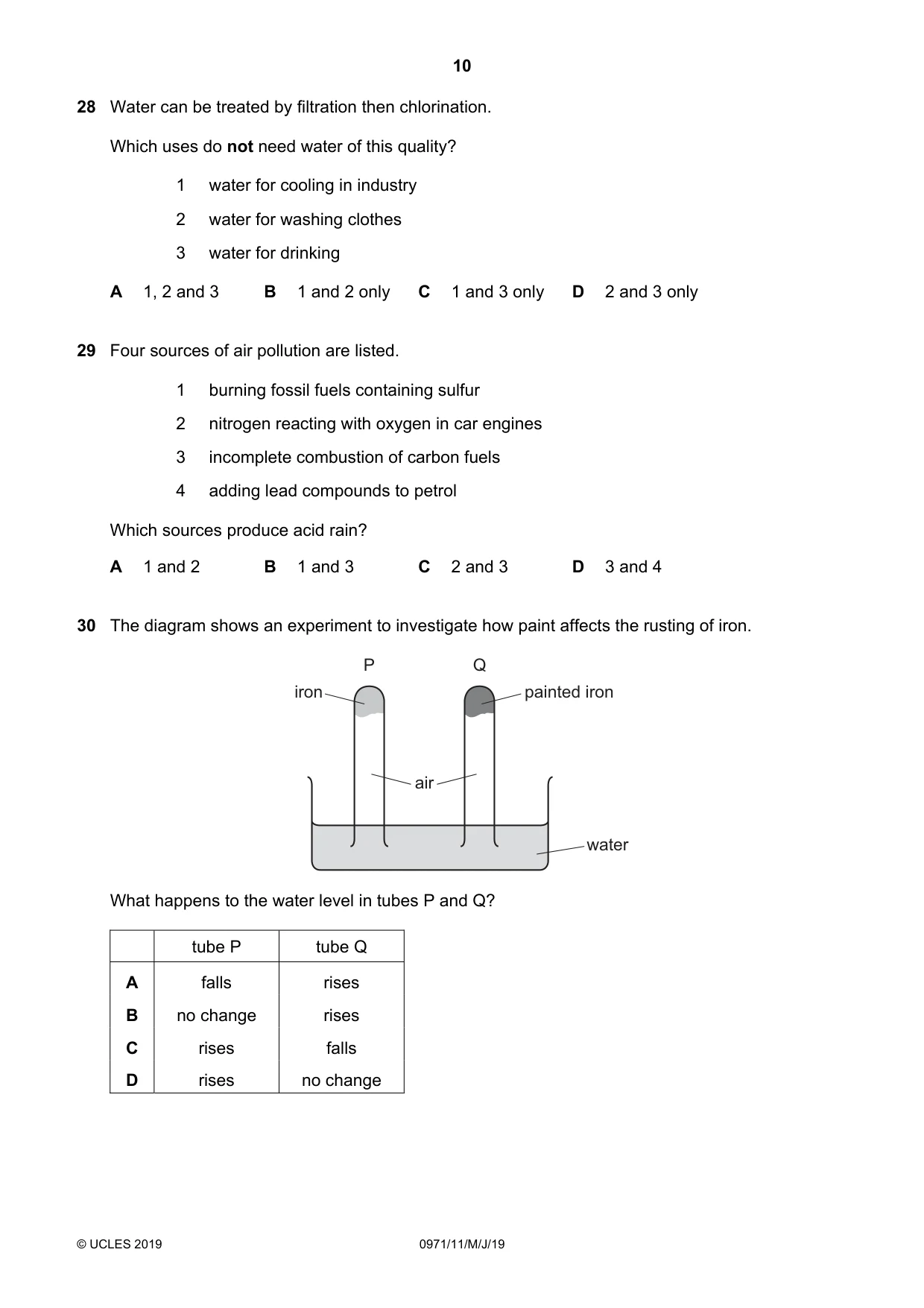
28 Water can be treated by filtration then chlorination. Which uses do not need water of this quality? 1 water for cooling in industry 2 water for washing clothes 3 water for drinking A 1, 2 and 3 B 1 and 2 only C 1 and 3 only D 2 and 3 only
Mark scheme: B
Q29 · Four sources of air pollution are listed
29 Four sources of air pollution are listed. 1 burning fossil fuels containing sulfur 2 nitrogen reacting with oxygen in car engines 3 incomplete combustion of carbon fuels 4 adding lead compounds to petrol Which sources produce acid rain? A 1 and 2 B 1 and 3 C 2 and 3 D 3 and 4
Mark scheme: A
Q30 · The diagram shows an experiment to investigate how paint affects the rusting of iron
30 The diagram shows an experiment to investigate how paint affects the rusting of iron. P Q iron painted iron air water What happens to the water level in tubes P and Q? tube P tube Q A falls rises B no change rises C rises falls D rises no change
Mark scheme: D
Q31 · A mixture of two substances, R and S, is heated
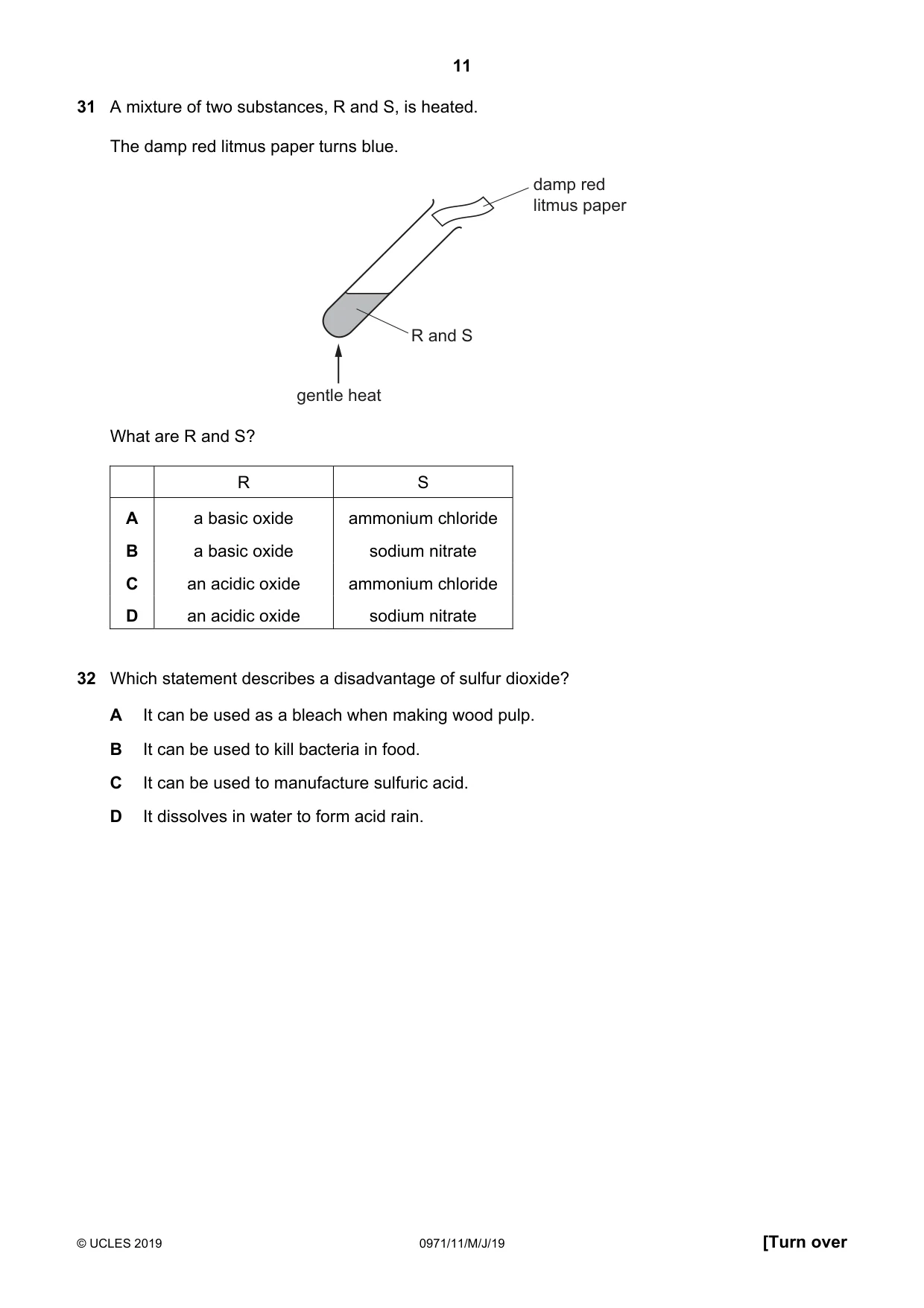
31 A mixture of two substances, R and S, is heated. The damp red litmus paper turns blue. damp red litmus paper R and S gentle heat What are R and S? R S A a basic oxide ammonium chloride B a basic oxide sodium nitrate C an acidic oxide ammonium chloride D an acidic oxide sodium nitrate
Mark scheme: A
Q32 · Which statement describes a disadvantage of sulfur dioxide?
32 Which statement describes a disadvantage of sulfur dioxide? A It can be used as a bleach when making wood pulp. B It can be used to kill bacteria in food. C It can be used to manufacture sulfuric acid. D It dissolves in water to form acid rain.
Mark scheme: D
Q33 · The diagram represents a lime kiln used to heat limestone to a very high temperature
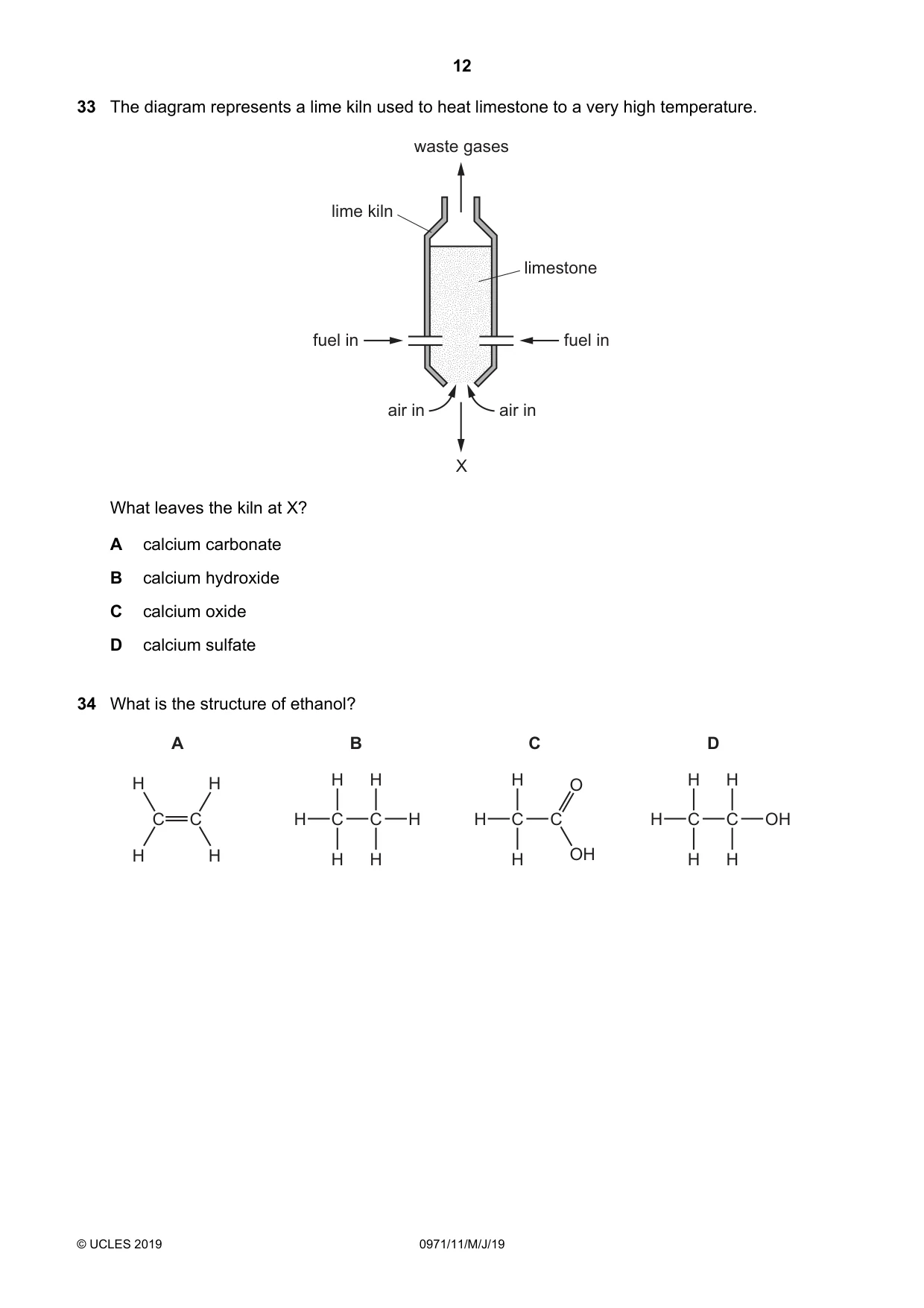
33 The diagram represents a lime kiln used to heat limestone to a very high temperature. waste gases lime kiln limestone fuel in fuel in air in air in X What leaves the kiln at X? A calcium carbonate B calcium hydroxide C calcium oxide D calcium sulfate
Mark scheme: C
Q34 · What is the structure of ethanol?
34 What is the structure of ethanol? A B C D H H H H H O H H C C H C C H H C C H C C OH H H H H H OH H H
Mark scheme: D
More questions on Formulae, functional groups and terminology
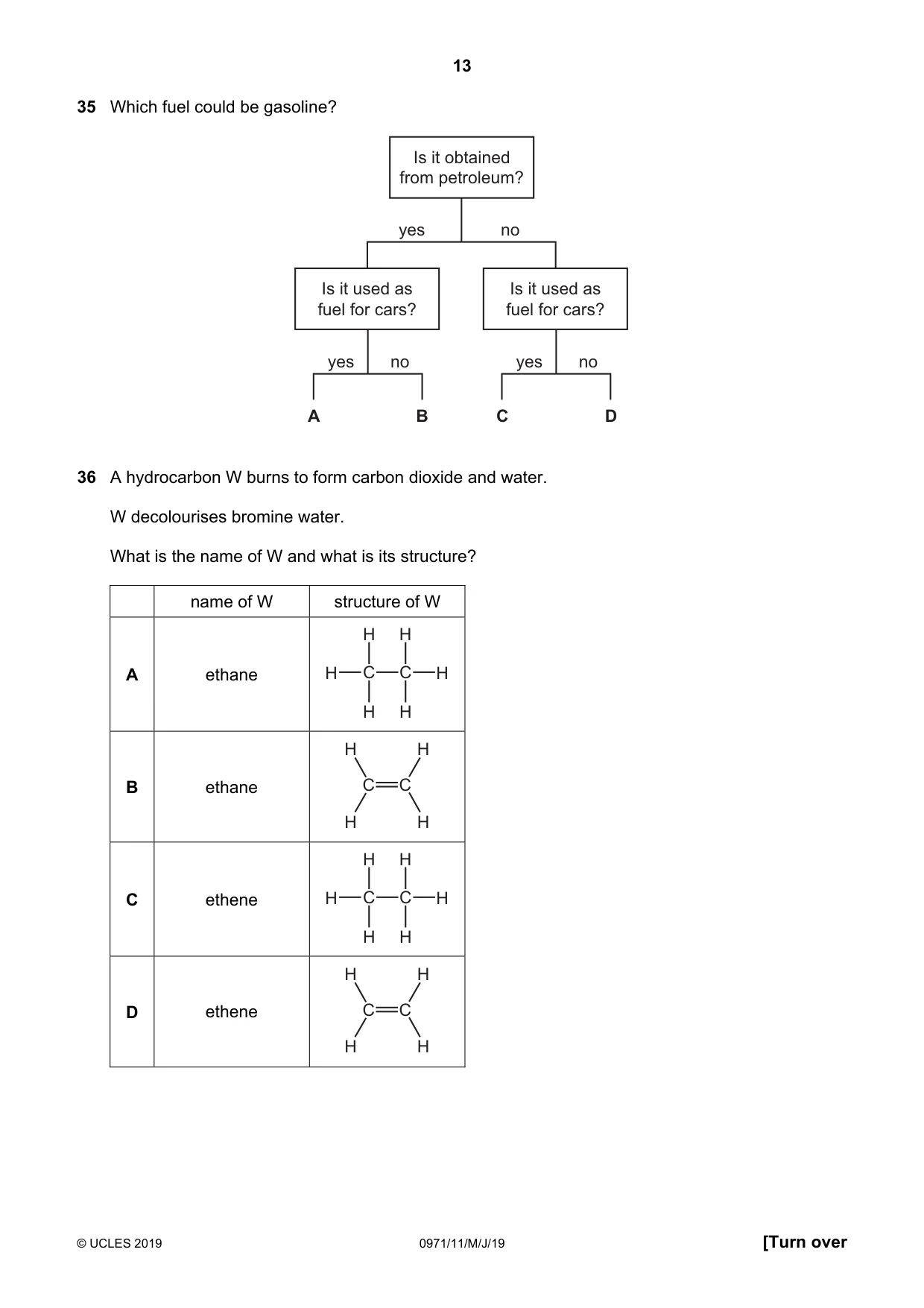
Q35 · Which fuel could be gasoline?
35 Which fuel could be gasoline? Is it obtained from petroleum? yes no Is it used as Is it used as fuel for cars? fuel for cars? yes no yes no A B C D
Mark scheme: A
Q36 · A hydrocarbon W burns to form carbon dioxide and water
36 A hydrocarbon W burns to form carbon dioxide and water. W decolourises bromine water. What is the name of W and what is its structure? name of W structure of W H H A ethane H C C H H H H H B ethane C C H H H H C ethene H C C H H H H H D ethene C C H H
Mark scheme: D
Q37 · Why is ethanol a member of the homologous series of alcohols but propane is not?
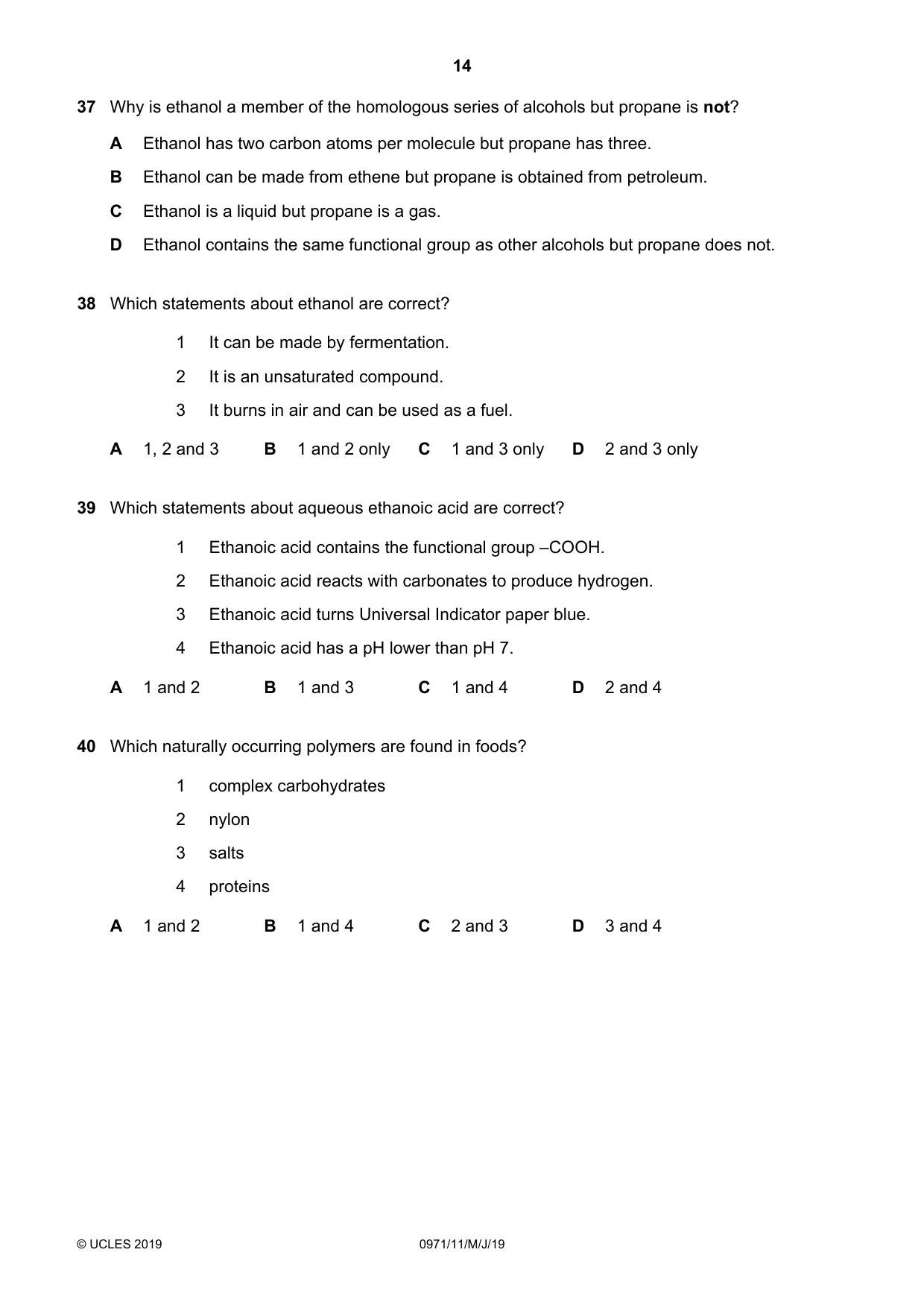
37 Why is ethanol a member of the homologous series of alcohols but propane is not? A Ethanol has two carbon atoms per molecule but propane has three. B Ethanol can be made from ethene but propane is obtained from petroleum. C Ethanol is a liquid but propane is a gas. D Ethanol contains the same functional group as other alcohols but propane does not.
Mark scheme: D
Q38 · Which statements about ethanol are correct?
38 Which statements about ethanol are correct? 1 It can be made by fermentation. 2 It is an unsaturated compound. 3 It burns in air and can be used as a fuel. A 1, 2 and 3 B 1 and 2 only C 1 and 3 only D 2 and 3 only
Mark scheme: C
Q39 · Which statements about aqueous ethanoic acid are correct?
39 Which statements about aqueous ethanoic acid are correct? 1 Ethanoic acid contains the functional group –COOH. 2 Ethanoic acid reacts with carbonates to produce hydrogen. 3 Ethanoic acid turns Universal Indicator paper blue. 4 Ethanoic acid has a pH lower than pH 7. A 1 and 2 B 1 and 3 C 1 and 4 D 2 and 4
Mark scheme: C
Q40 · Which naturally occurring polymers are found in foods?
40 Which naturally occurring polymers are found in foods? 1 complex carbohydrates 2 nylon 3 salts 4 proteins A 1 and 2 B 1 and 4 C 2 and 3 D 3 and 4
Mark scheme: B
What was in this paper
The subtopics covered by these 40 questions, and how many questions each got. Open one in a new tab to see every Cambridge question on it.
2Alcohols2Corrosion of metals2Identification of ions and gases2Oxides2Alkenes1Alloys and their properties1Atomic structure and the Periodic Table1Carboxylic acids1Chromatography1Electrolysis1Exothermic and endothermic reactions1Experimental design1Extraction of metals1Formulae, functional groups and terminology1Fuels1Giant covalent structures1Group I properties1Group VII properties1Ions and ionic bonds1Noble gases1Physical and chemical changes1Polymers1Preparation of salts1Rate of reaction1Reactivity series1Redox1Relative masses of atoms and molecules1Reversible reactions and equilibrium1Separation and purification1Simple molecules and covalent bonds1Solids, liquids and gases1The characteristic properties of acids and bases1Transition elements1Water1What you needed in this session
Cambridge’s own grade thresholds for 2019 May/June, Paper 1 · Variant 1. A higher threshold means an easier paper — the bar moves with how the cohort did.