Cambridge IGCSE Chemistry (9-1) 0971 — 2019 Oct/Nov Paper 1 · Variant 2
0971/12/O/N/19 · 40 questions · 40 marks · ≈45 min
The question paper and its mark scheme, free to read here and free to download. This is Cambridge’s own paper, exactly as it was sat.
Question paper16 pages
Mark scheme3 pages
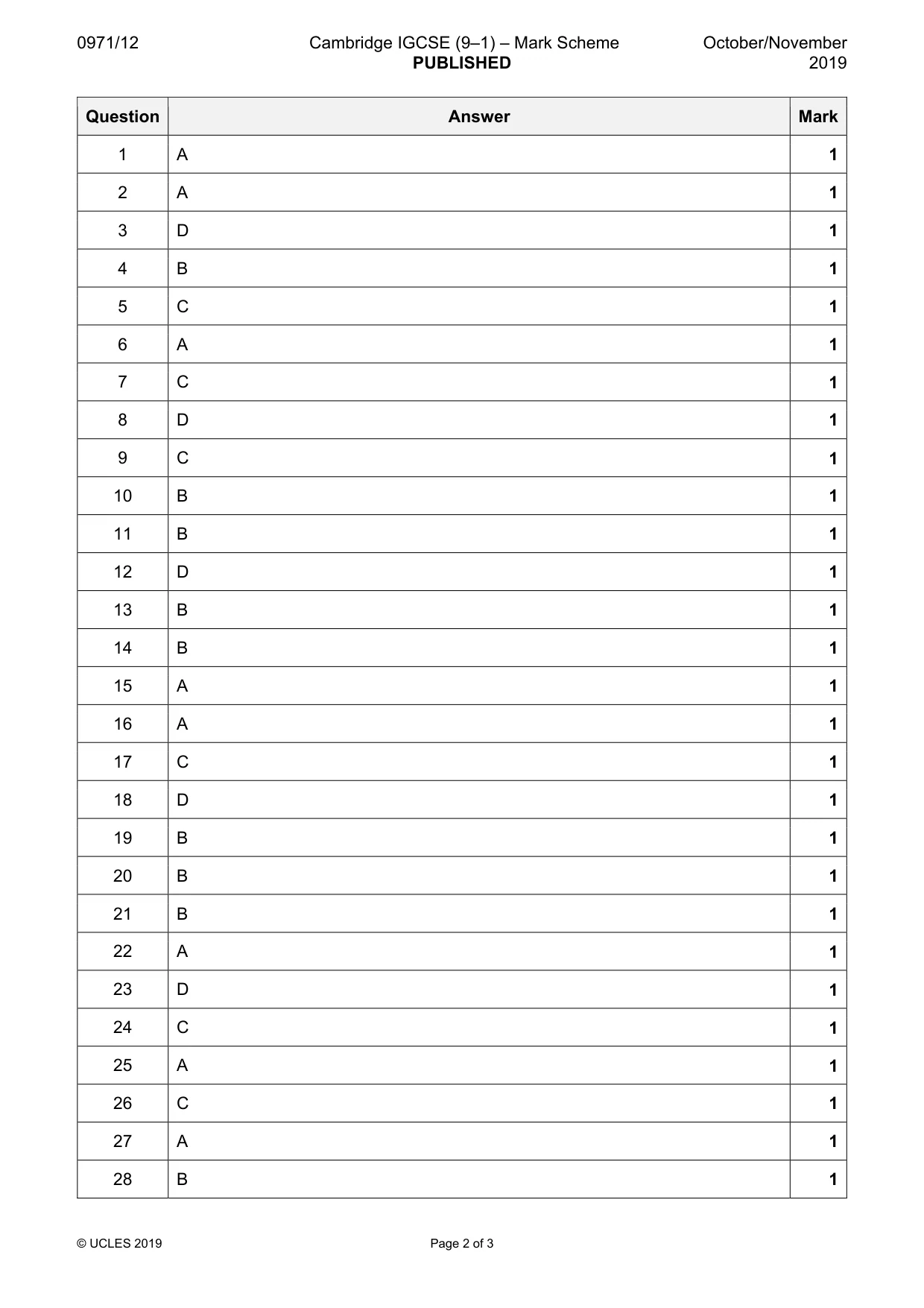
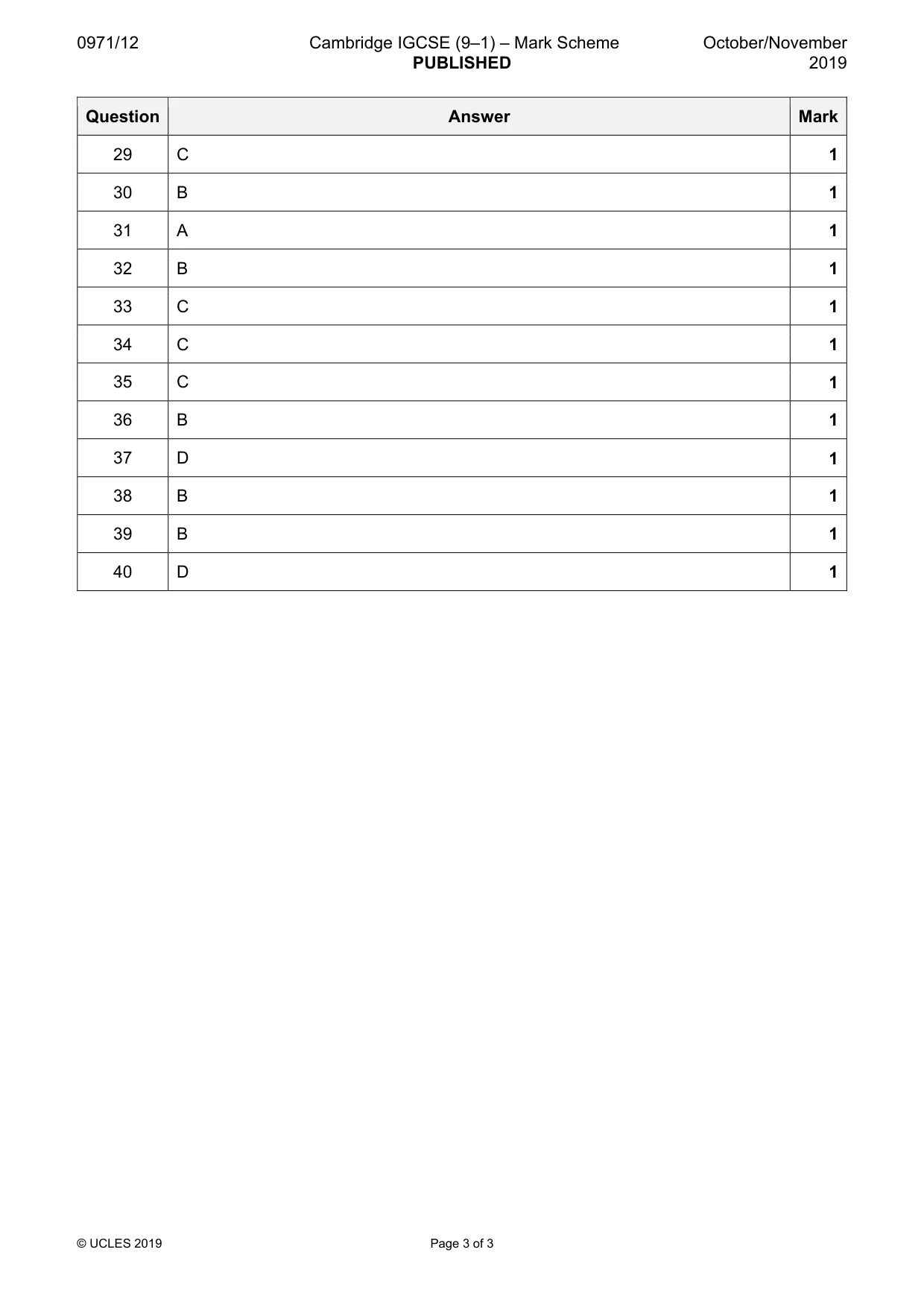
Answers below. Sit the paper first if you are practising.
Questions as text
Q1 · The diagram shows a cup of hot tea
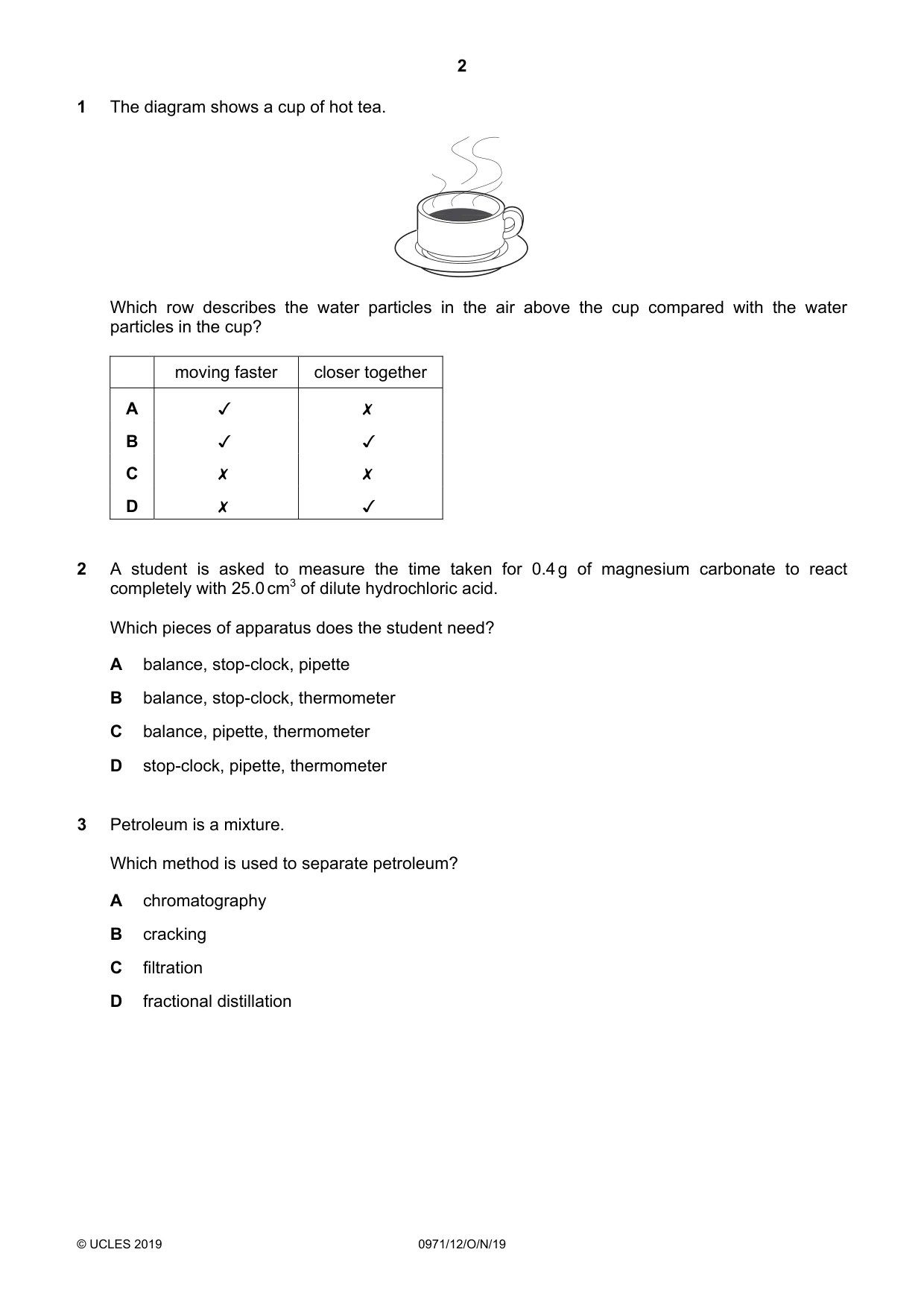
1 The diagram shows a cup of hot tea. Which row describes the water particles in the air above the cup compared with the water particles in the cup? moving faster closer together v x 0 0O WwW > v v x x x v
Mark scheme: A
Q2 · A student is asked to measure the time taken for 0.4 g of magnesium carbonate to react…
2 A student is asked to measure the time taken for 0.4 g of magnesium carbonate to react completely with 25.0 cm3 of dilute hydrochloric acid. Which pieces of apparatus does the student need? A balance, stop-clock, pipette B balance, stop-clock, thermometer C balance, pipette, thermometer D stop-clock, pipette, thermometer
Mark scheme: A
Q3 · Petroleum is a mixture
3 Petroleum is a mixture. Which method is used to separate petroleum? A chromatography B cracking C filtration D fractional distillation
Mark scheme: D
Q4 · Magnesium hydroxide can be obtained from sea water as shown
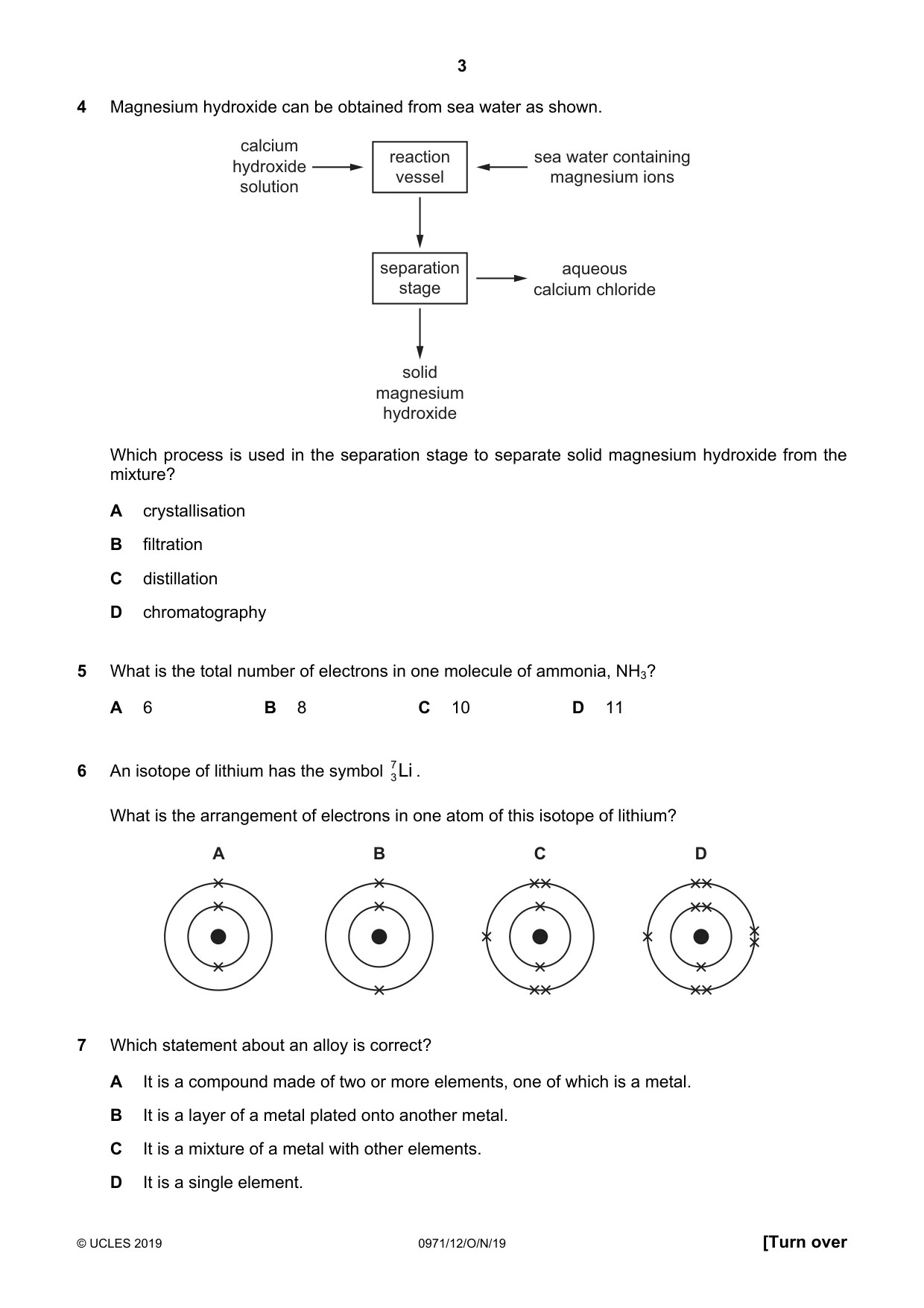
4 Magnesium hydroxide can be obtained from sea water as shown. calcium reaction sea water containing hydroxide vessel magnesium ions solution separation aqueous stage calcium chloride solid magnesium hydroxide Which process is used in the separation stage to separate solid magnesium hydroxide from the mixture? A crystallisation B filtration C distillation D chromatography
Mark scheme: B
Q5 · What is the total number of electrons in one molecule of ammonia, NH3?
5 What is the total number of electrons in one molecule of ammonia, NH3? A 6 B 8 C 10 D 11
Mark scheme: C
Q6 · An isotope of lithium has the symbol Li 7
6 An isotope of lithium has the symbol Li 7 . 3 What is the arrangement of electrons in one atom of this isotope of lithium? A B C D
Mark scheme: A
Q7 · Which statement about an alloy is correct?
7 Which statement about an alloy is correct? A It is a compound made of two or more elements, one of which is a metal. B It is a layer of a metal plated onto another metal. C It is a mixture of a metal with other elements. D It is a single element.
Mark scheme: C
Q8 · Graphite is a form of carbon
8 Graphite is a form of carbon. Why can graphite be used as a lubricant? A Graphite contains unbonded electrons which move through the structure. B Graphite contains weak covalent bonds so the atoms move easily. C Graphite has a low melting point so it easily turns into a liquid. D Graphite has weak attractive forces between layers so they can move.
Mark scheme: D
Q9 · Magnesium burns in oxygen to form magnesium oxide
9 Magnesium burns in oxygen to form magnesium oxide. The equation for the reaction is shown. 2Mg + O2 → 2MgO Which mass of magnesium oxide is formed when 48 g of magnesium is burned? A 20 g B 40 g C 80 g D 160 g
Mark scheme: C
Q10 · The apparatus used for electrolysis is shown
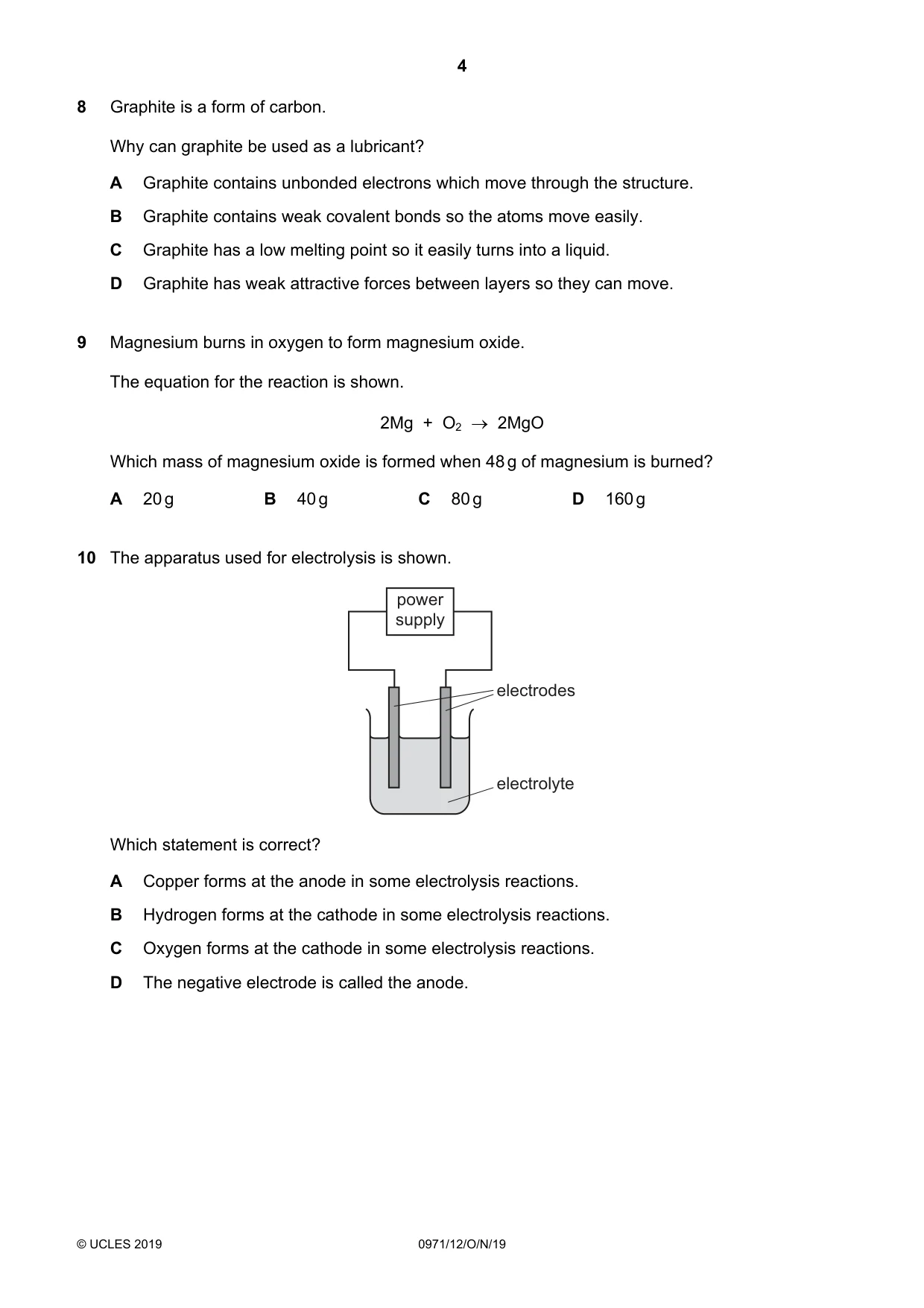
10 The apparatus used for electrolysis is shown. power supply electrodes electrolyte Which statement is correct? A Copper forms at the anode in some electrolysis reactions. B Hydrogen forms at the cathode in some electrolysis reactions. C Oxygen forms at the cathode in some electrolysis reactions. D The negative electrode is called the anode.
Mark scheme: B
Q11 · The temperature of the water in two beakers, X and Y, is measured as 21.5 °C
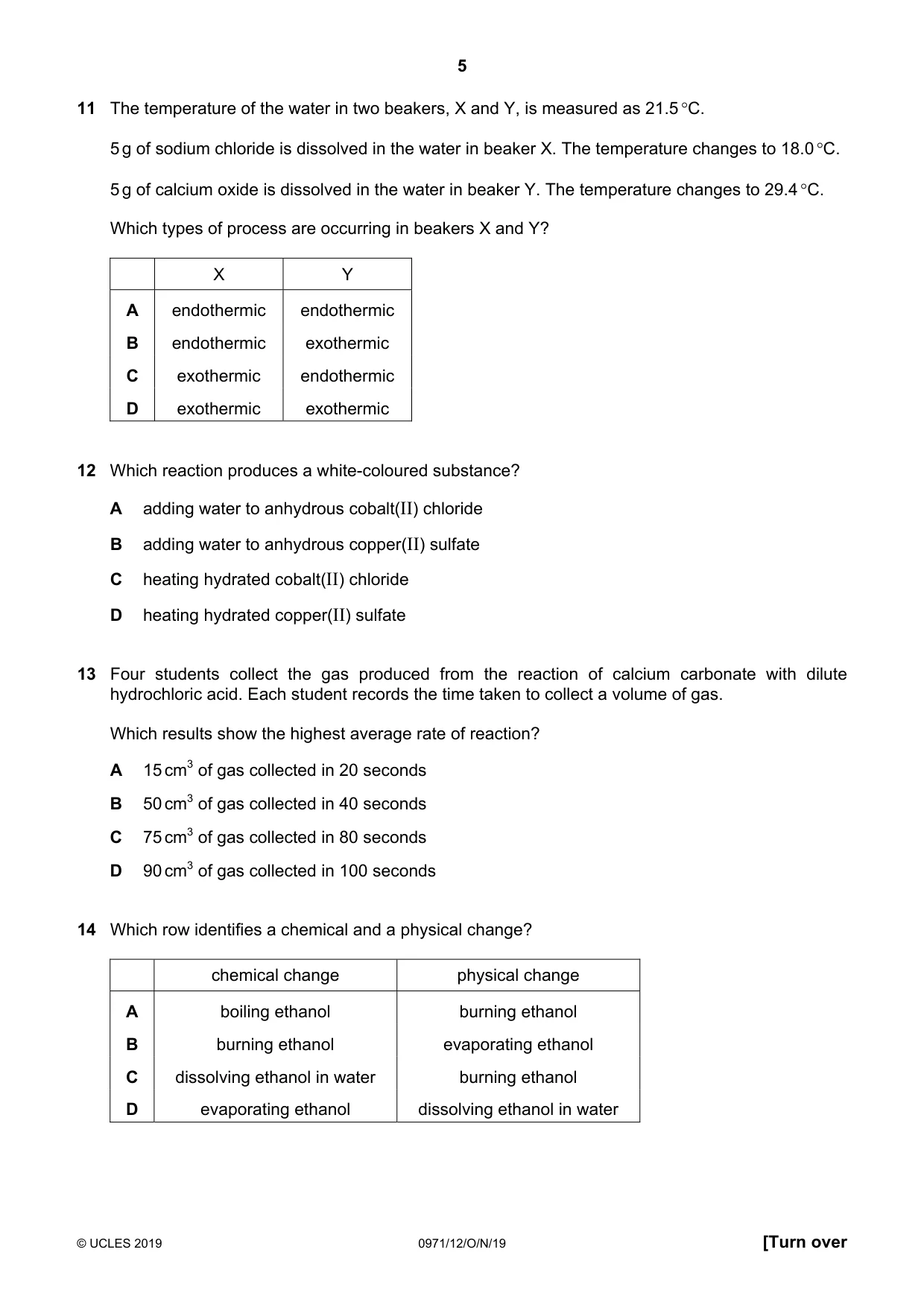
11 The temperature of the water in two beakers, X and Y, is measured as 21.5 °C. 5 g of sodium chloride is dissolved in the water in beaker X. The temperature changes to 18.0 °C. 5 g of calcium oxide is dissolved in the water in beaker Y. The temperature changes to 29.4 °C. Which types of process are occurring in beakers X and Y? X Y A endothermic endothermic B endothermic exothermic C exothermic endothermic D exothermic exothermic
Mark scheme: B
Q12 · Which reaction produces a white-coloured substance?
12 Which reaction produces a white-coloured substance? A adding water to anhydrous cobalt(II) chloride B adding water to anhydrous copper(II) sulfate C heating hydrated cobalt(II) chloride D heating hydrated copper(II) sulfate
Mark scheme: D
Q13 · Four students collect the gas produced from the reaction of calcium carbonate with dilute…
13 Four students collect the gas produced from the reaction of calcium carbonate with dilute hydrochloric acid. Each student records the time taken to collect a volume of gas. Which results show the highest average rate of reaction? A 15 cm3 of gas collected in 20 seconds B 50 cm3 of gas collected in 40 seconds C 75 cm3 of gas collected in 80 seconds D 90 cm3 of gas collected in 100 seconds
Mark scheme: B
Q14 · Which row identifies a chemical and a physical change?
14 Which row identifies a chemical and a physical change? chemical change physical change A boiling ethanol burning ethanol B burning ethanol evaporating ethanol C dissolving ethanol in water burning ethanol D evaporating ethanol dissolving ethanol in water
Mark scheme: B
Q15 · When magnesium is heated with zinc oxide a reaction occurs
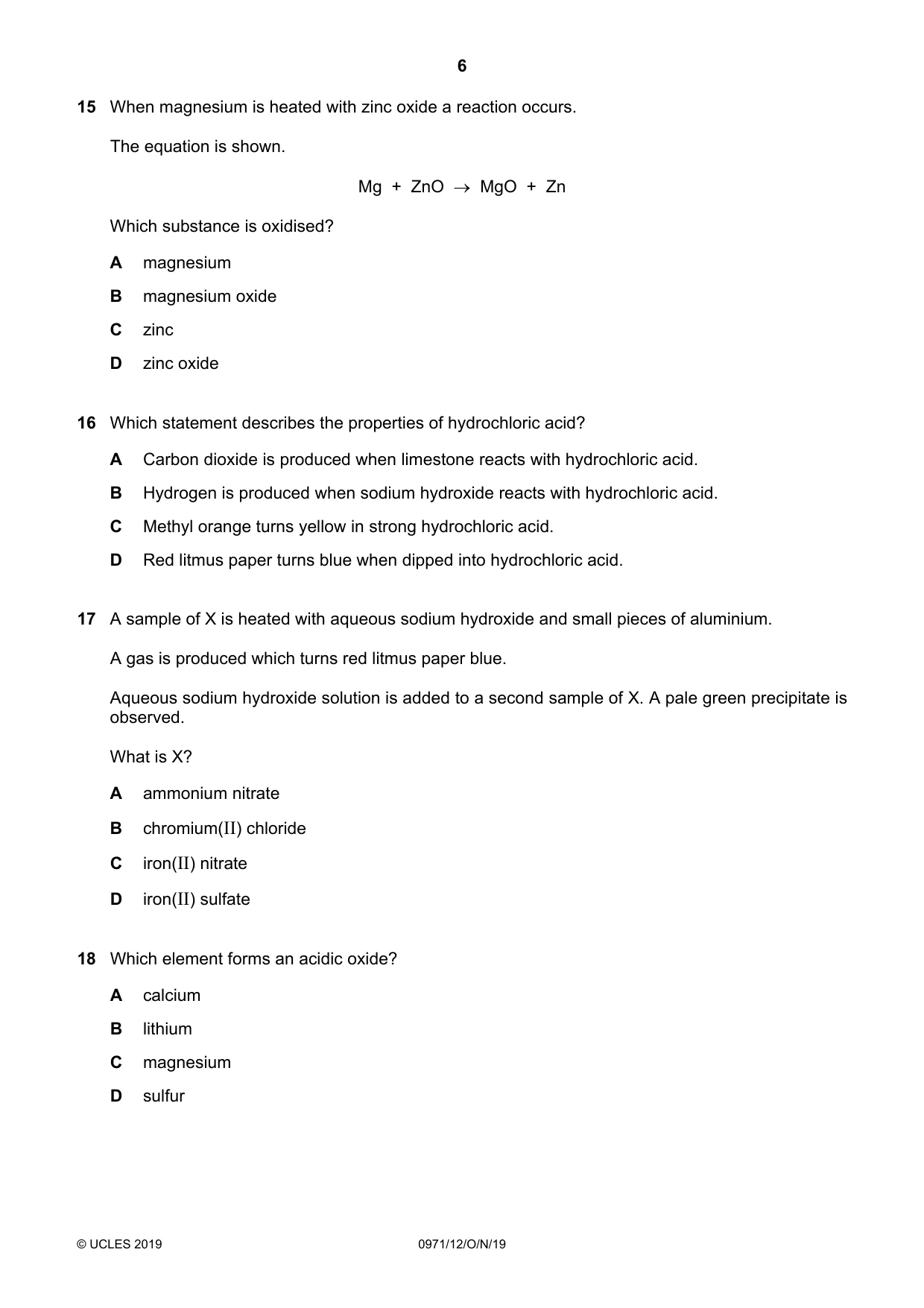
15 When magnesium is heated with zinc oxide a reaction occurs. The equation is shown. Mg + ZnO → MgO + Zn Which substance is oxidised? A magnesium B magnesium oxide C zinc D zinc oxide
Mark scheme: A
Q16 · Which statement describes the properties of hydrochloric acid?
16 Which statement describes the properties of hydrochloric acid? A Carbon dioxide is produced when limestone reacts with hydrochloric acid. B Hydrogen is produced when sodium hydroxide reacts with hydrochloric acid. C Methyl orange turns yellow in strong hydrochloric acid. D Red litmus paper turns blue when dipped into hydrochloric acid.
Mark scheme: A
More questions on The characteristic properties of acids and bases
Q17 · A sample of X is heated with aqueous sodium hydroxide and small pieces of aluminium
17 A sample of X is heated with aqueous sodium hydroxide and small pieces of aluminium. A gas is produced which turns red litmus paper blue. Aqueous sodium hydroxide solution is added to a second sample of X. A pale green precipitate is observed. What is X? A ammonium nitrate B chromium(II) chloride C iron(II) nitrate D iron(II) sulfate
Mark scheme: C
Q18 · Which element forms an acidic oxide?
18 Which element forms an acidic oxide? A calcium B lithium C magnesium D sulfur
Mark scheme: D
Q19 · A method used to make copper(II) sulfate crystals is shown
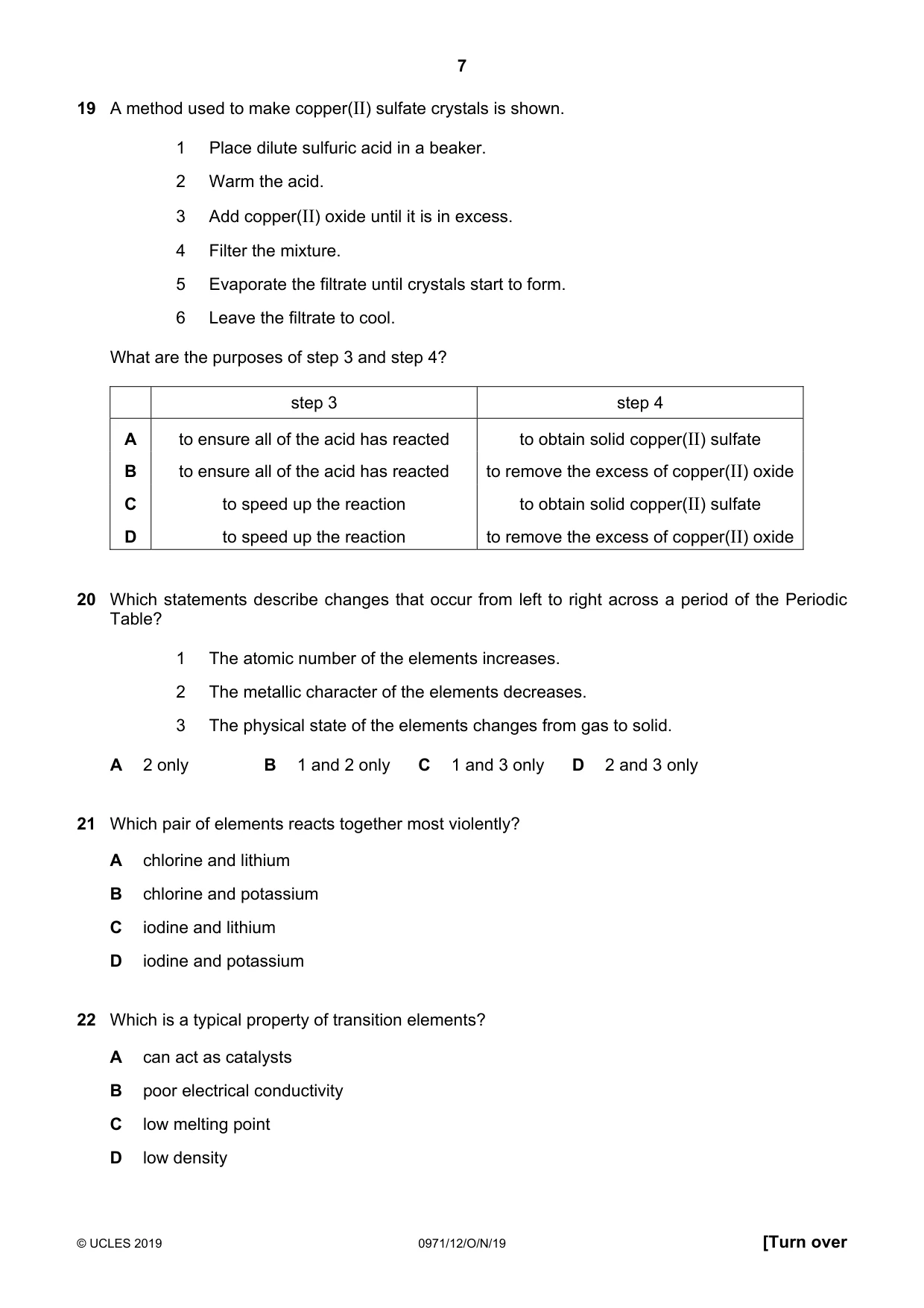
19 A method used to make copper(II) sulfate crystals is shown. 1 Place dilute sulfuric acid in a beaker. 2 Warm the acid. 3 Add copper(II) oxide until it is in excess. 4 Filter the mixture. 5 Evaporate the filtrate until crystals start to form. 6 Leave the filtrate to cool. What are the purposes of step 3 and step 4? step 3 step 4 A to ensure all of the acid has reacted to obtain solid copper(II) sulfate B to ensure all of the acid has reacted to remove the excess of copper(II) oxide C to speed up the reaction to obtain solid copper(II) sulfate D to speed up the reaction to remove the excess of copper(II) oxide
Mark scheme: B
Q20 · Which statements describe changes that occur from left to right across a period of the…
20 Which statements describe changes that occur from left to right across a period of the Periodic Table? 1 The atomic number of the elements increases. 2 The metallic character of the elements decreases. 3 The physical state of the elements changes from gas to solid. A 2 only B 1 and 2 only C 1 and 3 only D 2 and 3 only
Mark scheme: B
Q21 · Which pair of elements reacts together most violently?
21 Which pair of elements reacts together most violently? A chlorine and lithium B chlorine and potassium C iodine and lithium D iodine and potassium
Mark scheme: B
Q22 · Which is a typical property of transition elements?
22 Which is a typical property of transition elements? A can act as catalysts B poor electrical conductivity C low melting point D low density
Mark scheme: A
Q23 · Helium is a noble gas
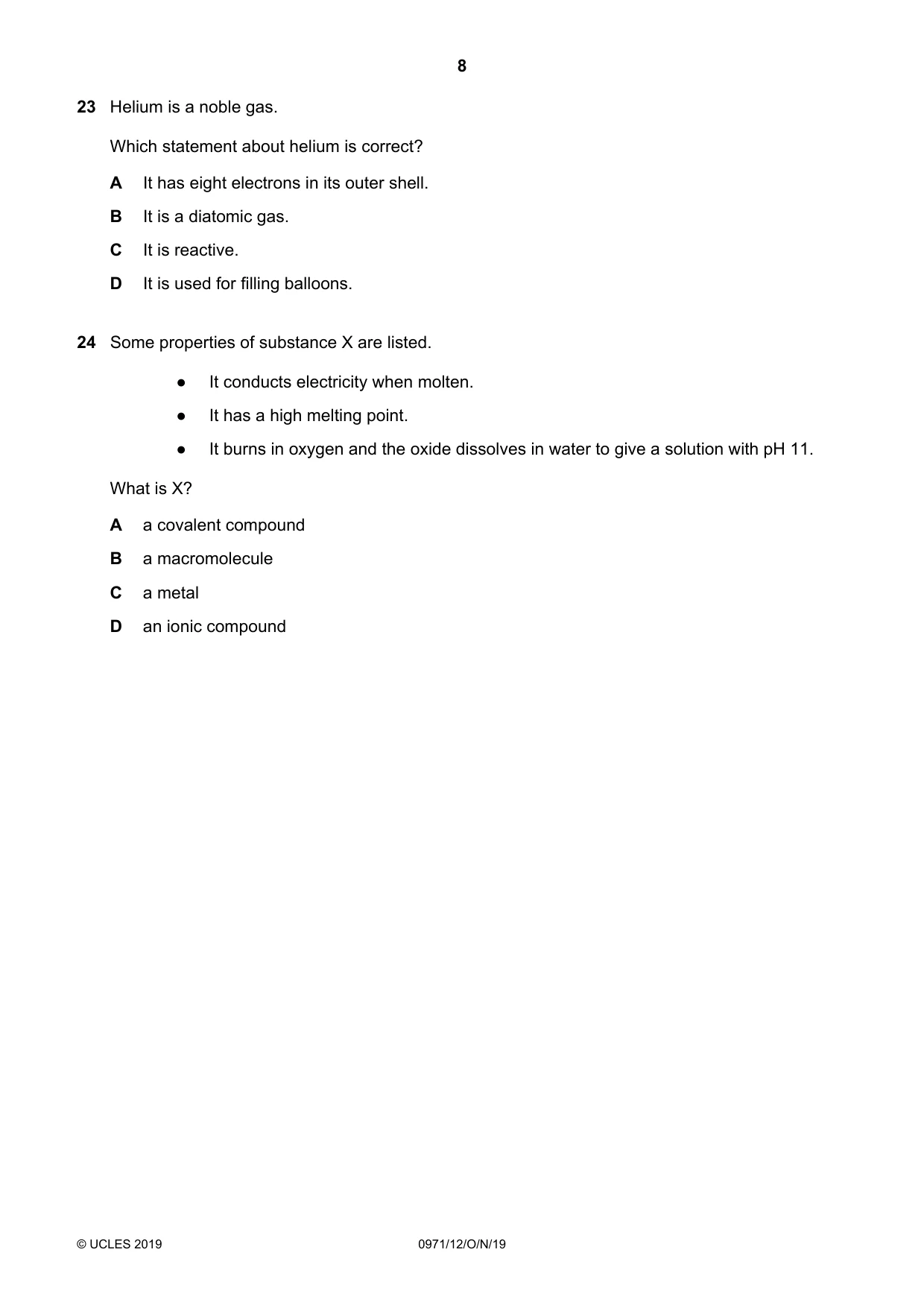
23 Helium is a noble gas. Which statement about helium is correct? A It has eight electrons in its outer shell. B It is a diatomic gas. C It is reactive. D It is used for filling balloons.
Mark scheme: D
Q24 · Some properties of substance X are listed
24 Some properties of substance X are listed. ● It conducts electricity when molten. ● It has a high melting point. ● It burns in oxygen and the oxide dissolves in water to give a solution with pH 11. What is X? A a covalent compound B a macromolecule C a metal D an ionic compound
Mark scheme: C
Q25 · Four unknown metals, Q, R, S and T, are reacted with water, steam and dilute hydrochloric…
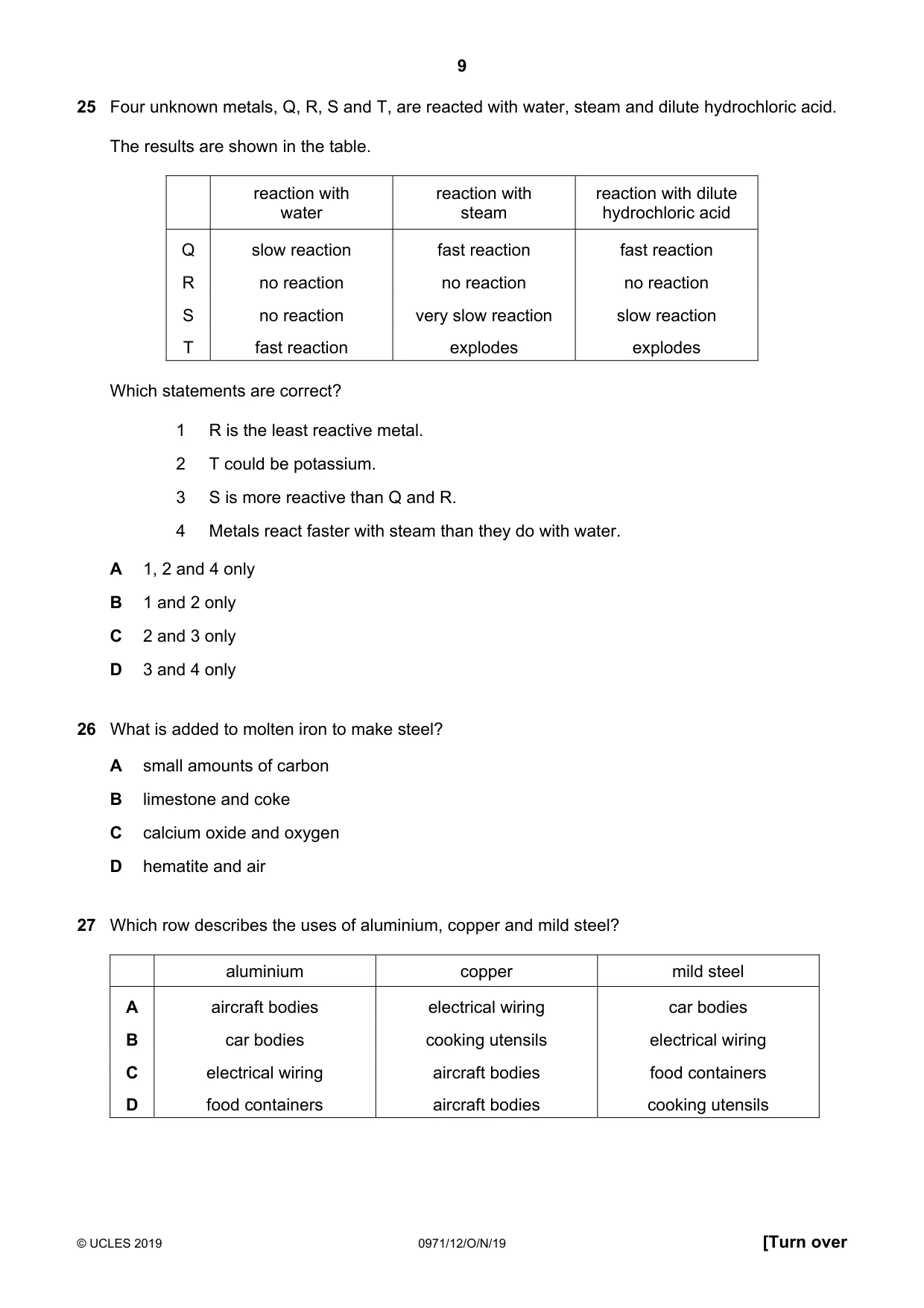
25 Four unknown metals, Q, R, S and T, are reacted with water, steam and dilute hydrochloric acid. The results are shown in the table. reaction with reaction with reaction with dilute water steam hydrochloric acid Q slow reaction fast reaction fast reaction R no reaction no reaction no reaction S no reaction very slow reaction slow reaction T fast reaction explodes explodes Which statements are correct? 1 R is the least reactive metal. 2 T could be potassium. 3 S is more reactive than Q and R. 4 Metals react faster with steam than they do with water. A 1, 2 and 4 only B 1 and 2 only C 2 and 3 only D 3 and 4 only
Mark scheme: A
Q26 · What is added to molten iron to make steel?
26 What is added to molten iron to make steel? A small amounts of carbon B limestone and coke C calcium oxide and oxygen D hematite and air
Mark scheme: C
Q27 · Which row describes the uses of aluminium, copper and mild steel?
27 Which row describes the uses of aluminium, copper and mild steel? aluminium copper mild steel A aircraft bodies electrical wiring car bodies B car bodies cooking utensils electrical wiring C electrical wiring aircraft bodies food containers D food containers aircraft bodies cooking utensils
Mark scheme: A
Q28 · River water contains soluble impurities, insoluble impurities and bacteria
28 River water contains soluble impurities, insoluble impurities and bacteria. River water is made safe to drink by filtration and chlorination. Which statement is correct? A Filtration removes bacteria and insoluble impurities, and chlorination removes soluble impurities. B Filtration removes insoluble impurities, and chlorination kills the bacteria. C Filtration removes soluble and insoluble impurities, and chlorination kills the bacteria. D Filtration removes soluble impurities and bacteria, and chlorination removes insoluble impurities.
Mark scheme: B
Q29 · Clean, dry air contains nitrogen, oxygen and small amounts of other gases
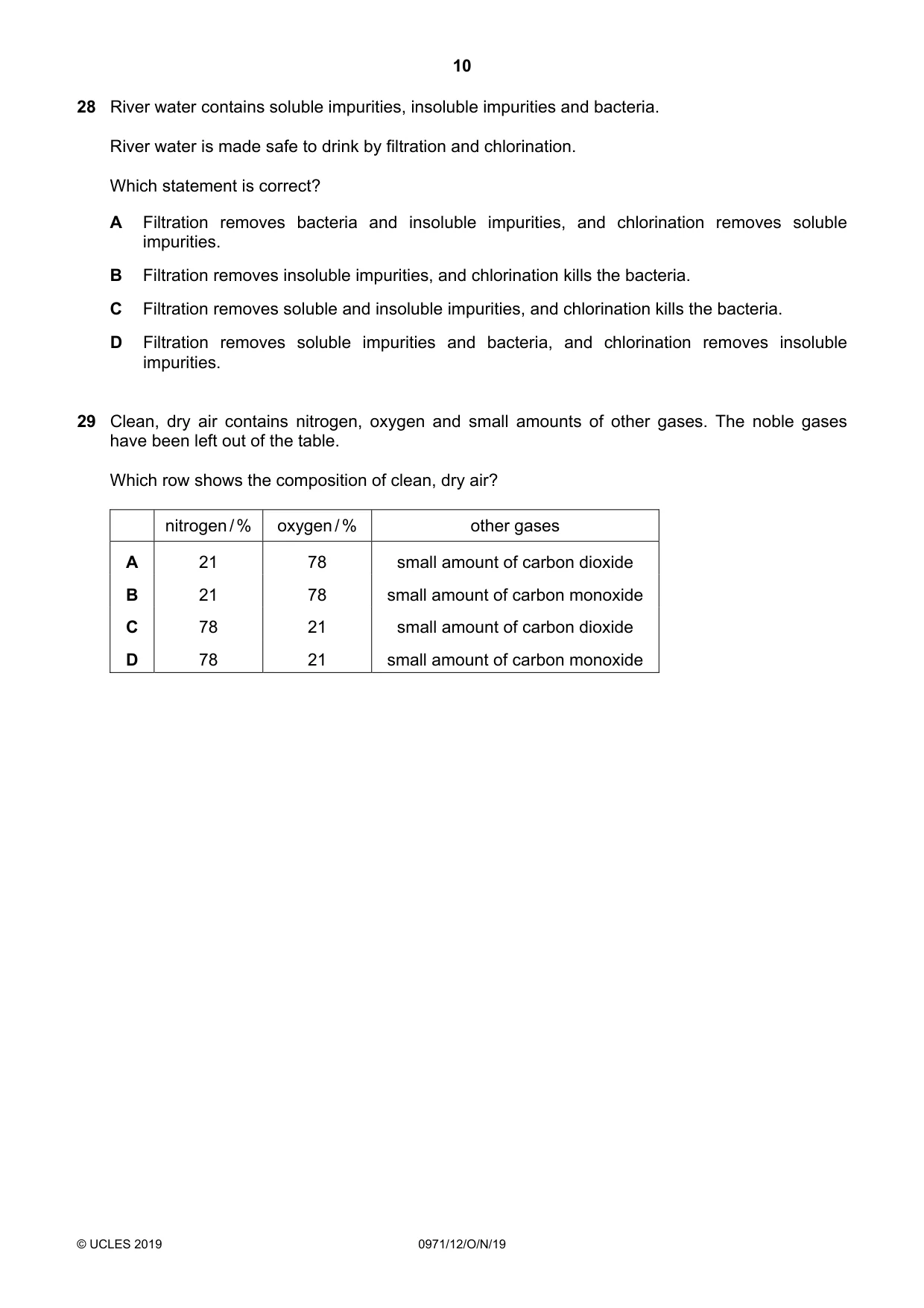
29 Clean, dry air contains nitrogen, oxygen and small amounts of other gases. The noble gases have been left out of the table. Which row shows the composition of clean, dry air? nitrogen / % oxygen / % other gases A 21 78 small amount of carbon dioxide B 21 78 small amount of carbon monoxide C 78 21 small amount of carbon dioxide D 78 21 small amount of carbon monoxide
Mark scheme: C
Q30 · The apparatus shown is set up and left for a week
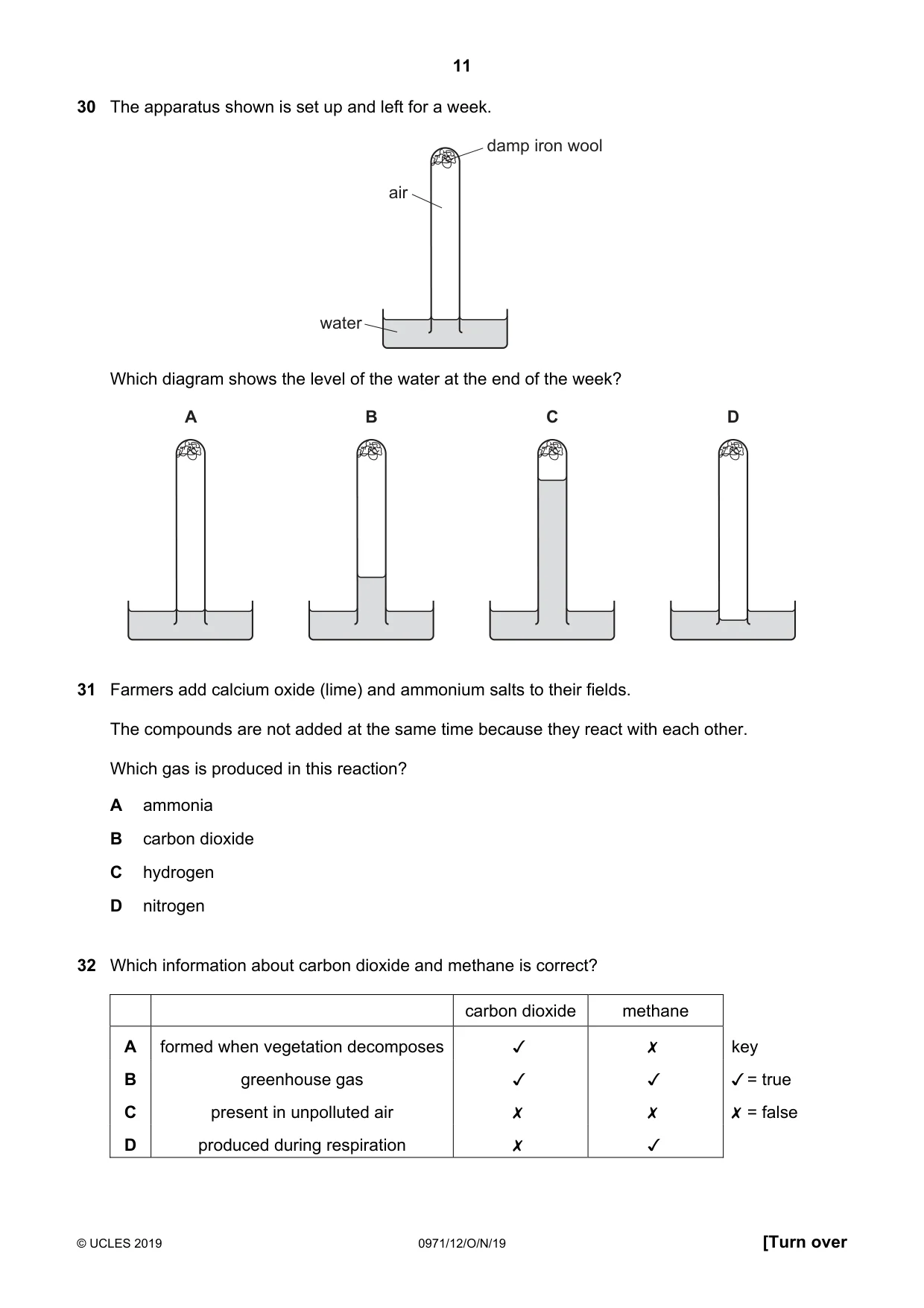
30 The apparatus shown is set up and left for a week. damp iron wool air water Which diagram shows the level of the water at the end of the week? A B C D
Mark scheme: B
Q31 · Farmers add calcium oxide (lime) and ammonium salts to their fields
31 Farmers add calcium oxide (lime) and ammonium salts to their fields. The compounds are not added at the same time because they react with each other. Which gas is produced in this reaction? A ammonia B carbon dioxide C hydrogen D nitrogen
Mark scheme: A
Q32 · Which information about carbon dioxide and methane is correct?
32. Which information about carbon dioxide and methane is correct? carbon dioxide methane A | formed when vegetation decomposes v x B greenhouse gas Jv Jv Cc present in unpolluted air x Xx D produced during respiration x Jv key J/ = true X = false
Mark scheme: B
Q33 · Which statement about the uses of sulfur dioxide is not correct?
33 Which statement about the uses of sulfur dioxide is not correct? A It is used as a bleach in the manufacture of paper. B It is used as a food preservative. C It is used in the manufacture of cement. D It is used in the manufacture of sulfuric acid.
Mark scheme: C
Q34 · Which statement about limestone and lime is correct?
34 Which statement about limestone and lime is correct? A Limestone combines with water to produce slaked lime. B Lime is obtained from limestone by oxidation. C Lime is used in the desulfurisation of flue gases. D Lime is used in the treatment of alkaline soil.
Mark scheme: C
Q35 · Some fractions obtained from petroleum are listed
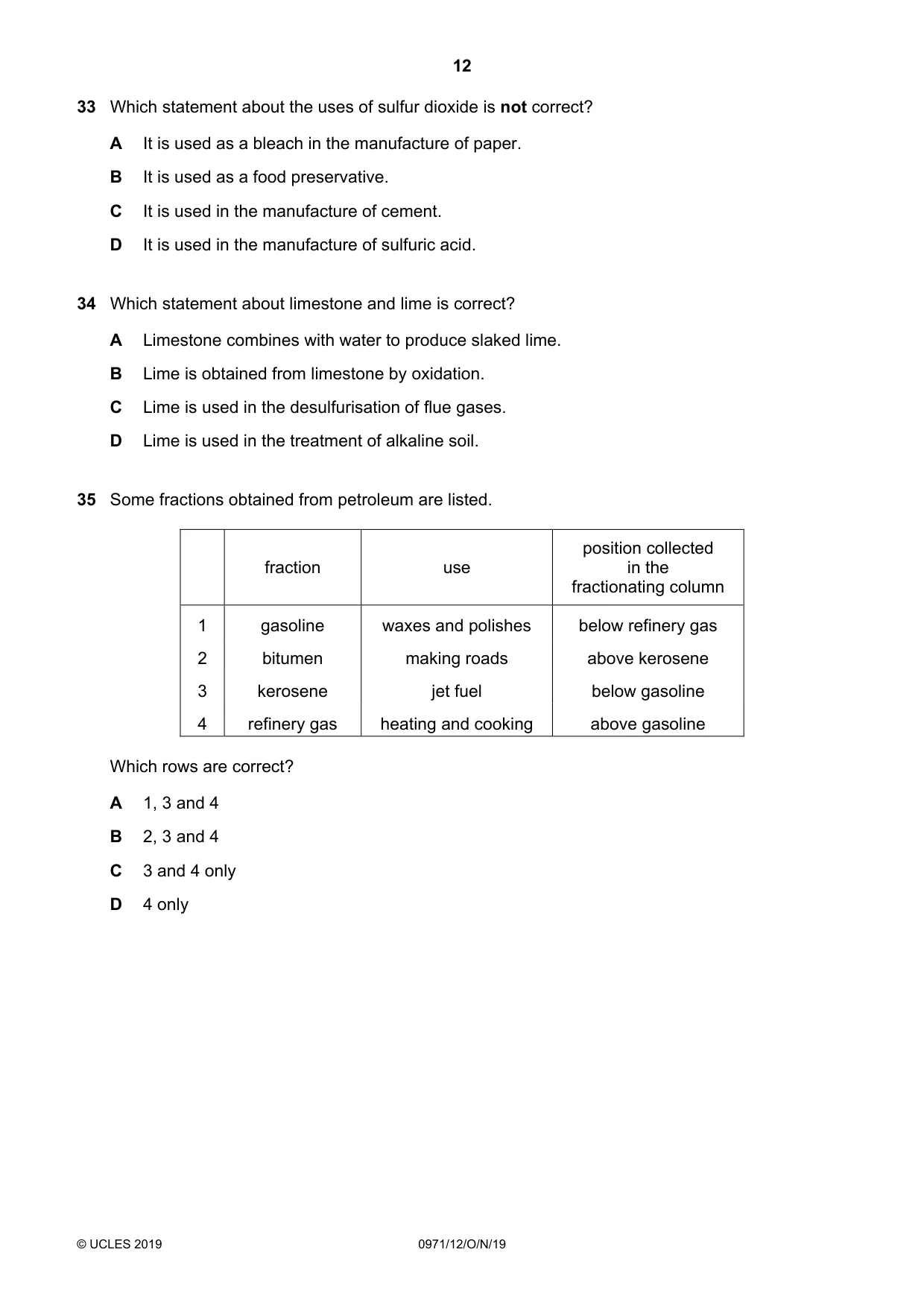
35 Some fractions obtained from petroleum are listed. position collected fraction use in the fractionating column 1 gasoline waxes and polishes below refinery gas 2 bitumen making roads above kerosene 3 kerosene jet fuel below gasoline 4 refinery gas heating and cooking above gasoline Which rows are correct? A 1, 3 and 4 B 2, 3 and 4 C 3 and 4 only D 4 only
Mark scheme: C
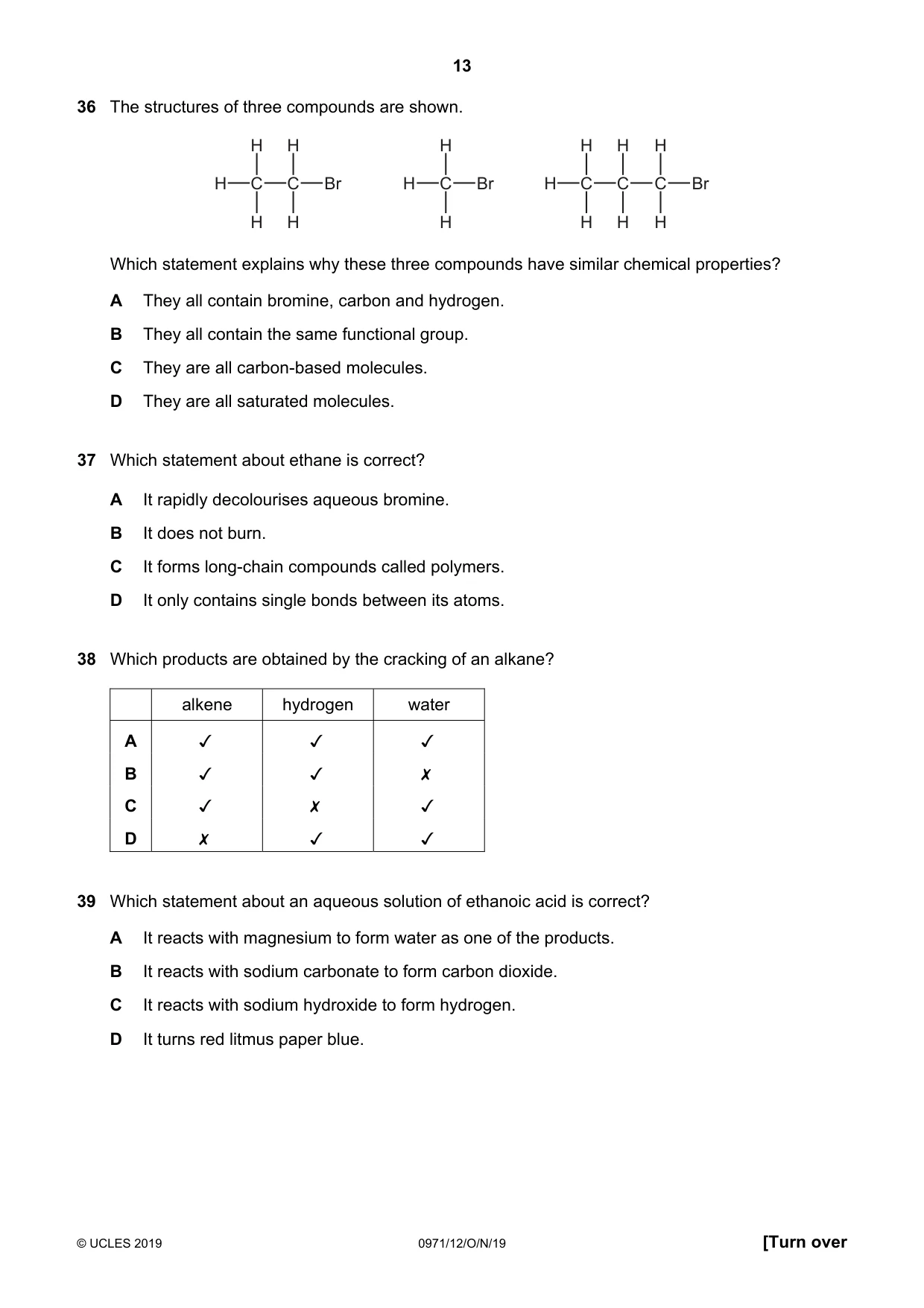
Q36 · The structures of three compounds are shown
36 The structures of three compounds are shown. H H H H H H H C C Br H C Br H C C C Br H H H H H H Which statement explains why these three compounds have similar chemical properties? A They all contain bromine, carbon and hydrogen. B They all contain the same functional group. C They are all carbon-based molecules. D They are all saturated molecules.
Mark scheme: B
More questions on Formulae, functional groups and terminology
Q37 · Which statement about ethane is correct?
37 Which statement about ethane is correct? A It rapidly decolourises aqueous bromine. B It does not burn. C It forms long-chain compounds called polymers. D It only contains single bonds between its atoms.
Mark scheme: D
Q38 · Which products are obtained by the cracking of an alkane?
38 Which products are obtained by the cracking of an alkane? alkene hydrogen water v v v 0 Oo WwW > v v x v x v x v v
Mark scheme: B
Q39 · Which statement about an aqueous solution of ethanoic acid is correct?
39 Which statement about an aqueous solution of ethanoic acid is correct? A It reacts with magnesium to form water as one of the products. B It reacts with sodium carbonate to form carbon dioxide. C It reacts with sodium hydroxide to form hydrogen. D It turns red litmus paper blue.
Mark scheme: B
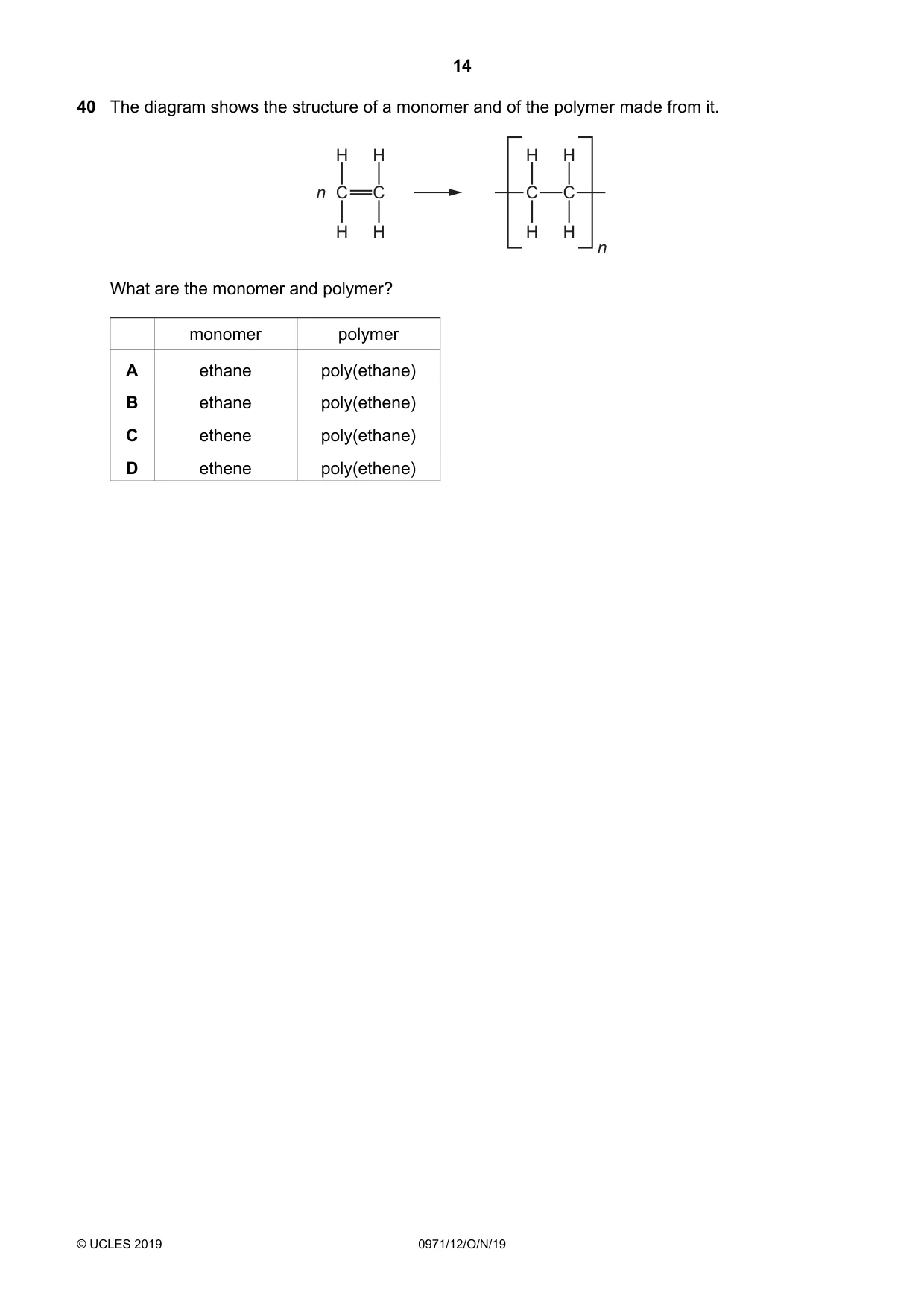
Q40 · The diagram shows the structure of a monomer and of the polymer made from it
40 The diagram shows the structure of a monomer and of the polymer made from it. H H H H n C C C C H H H H n What are the monomer and polymer? monomer polymer A ethane poly(ethane) B ethane poly(ethene) C ethene poly(ethane) D ethene poly(ethene)
Mark scheme: D
What was in this paper
The subtopics covered by these 40 questions, and how many questions each got. Open one in a new tab to see every Cambridge question on it.
3Alloys and their properties2Identification of ions and gases2Oxides2Separation and purification2Alkanes1Alkenes1Arrangement of elements1Carboxylic acids1Corrosion of metals1Electrolysis1Exothermic and endothermic reactions1Experimental design1Fertilisers1Formulae, functional groups and terminology1Fuels1Giant covalent structures1Group VII properties1Ions and ionic bonds1Isotopes1Noble gases1Physical and chemical changes1Polymers1Preparation of salts1Rate of reaction1Reactivity series1Redox1Simple molecules and covalent bonds1Solids, liquids and gases1The characteristic properties of acids and bases1The mole and the Avogadro constant1Transition elements1Uses of metals1Water1What you needed in this session
Cambridge’s own grade thresholds for 2019 Oct/Nov, Paper 1 · Variant 2. A higher threshold means an easier paper — the bar moves with how the cohort did.