Cambridge IGCSE Chemistry (9-1) 0971 — 2021 May/June Paper 1 · Variant 1
0971/11/M/J/21 · 40 questions · 40 marks · ≈45 min
The question paper and its mark scheme, free to read here and free to download. This is Cambridge’s own paper, exactly as it was sat.
Question paper16 pages
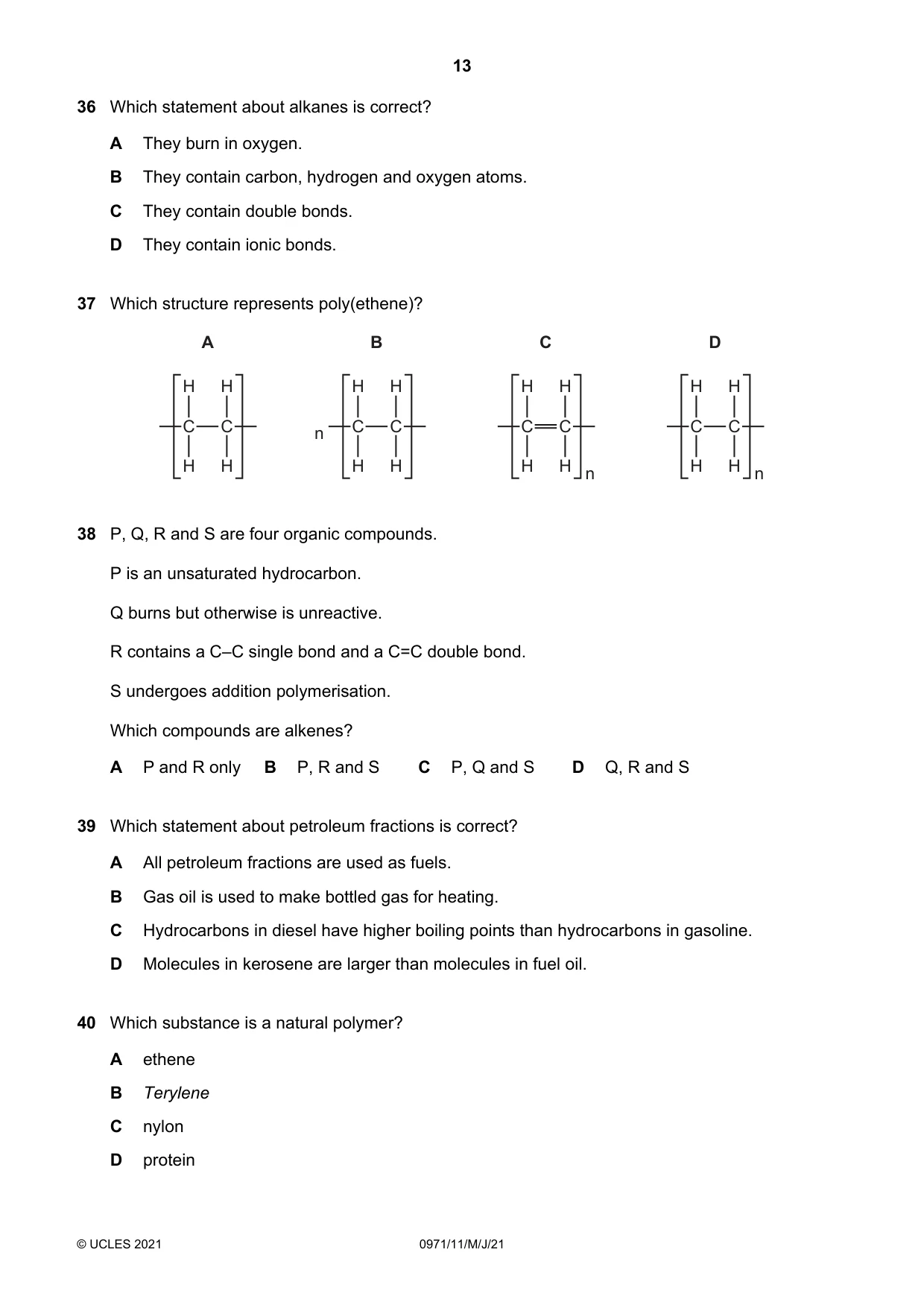

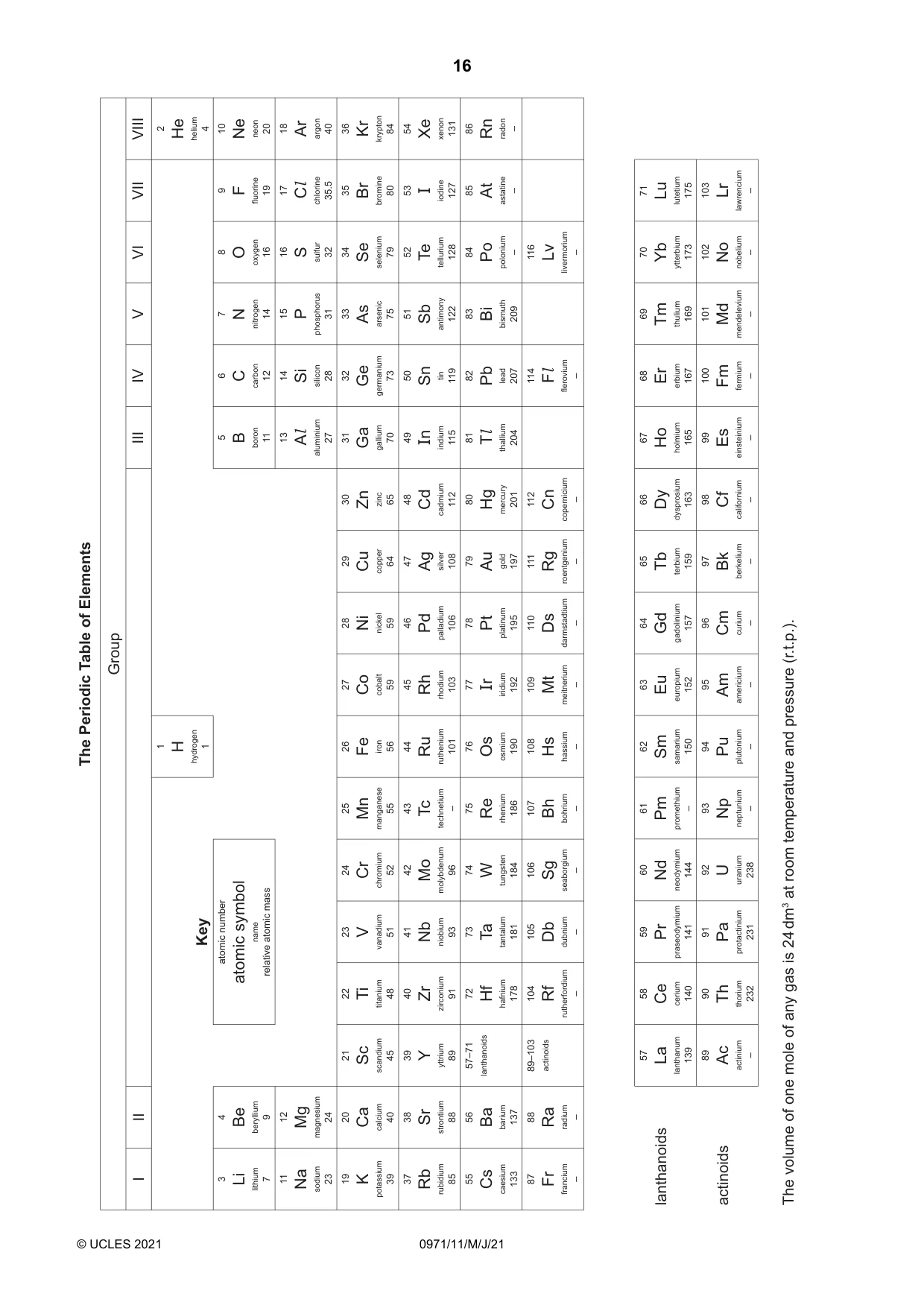
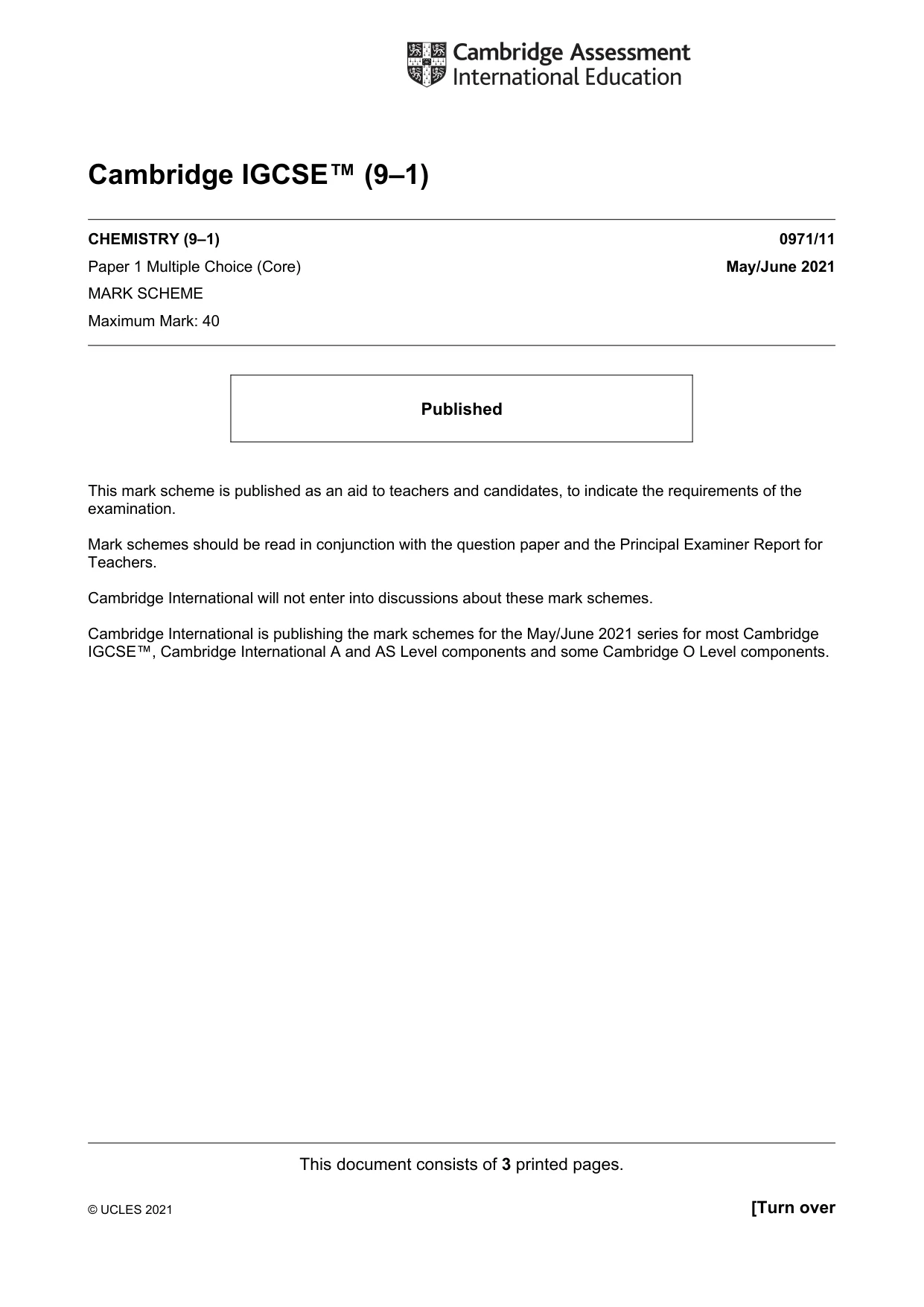
Mark scheme3 pages
Answers below. Sit the paper first if you are practising.
Questions as text
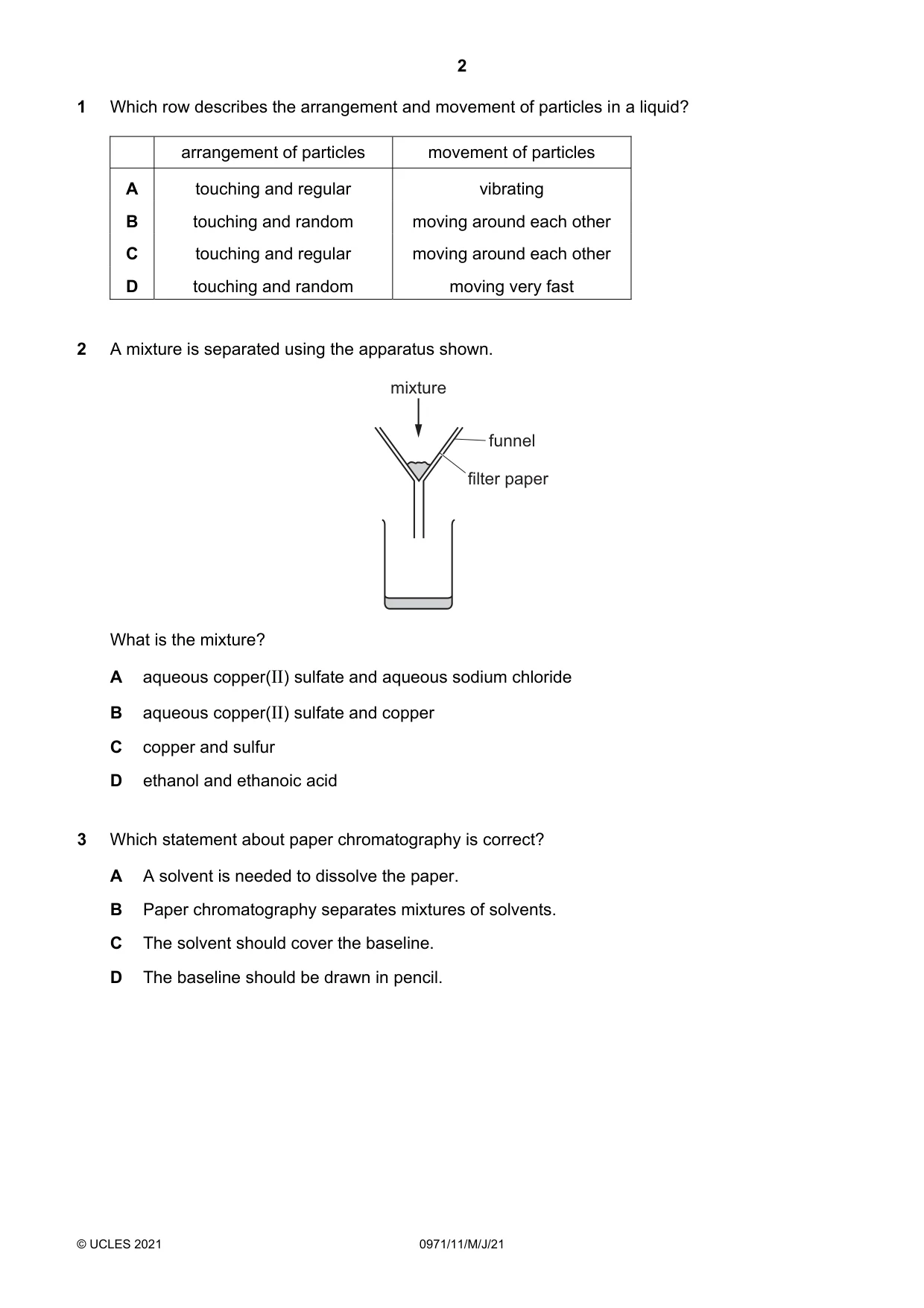
Q1 · Which row describes the arrangement and movement of particles in a liquid?
1 Which row describes the arrangement and movement of particles in a liquid? arrangement of particles movement of particles A touching and regular vibrating B touching and random moving around each other C touching and regular moving around each other D touching and random moving very fast
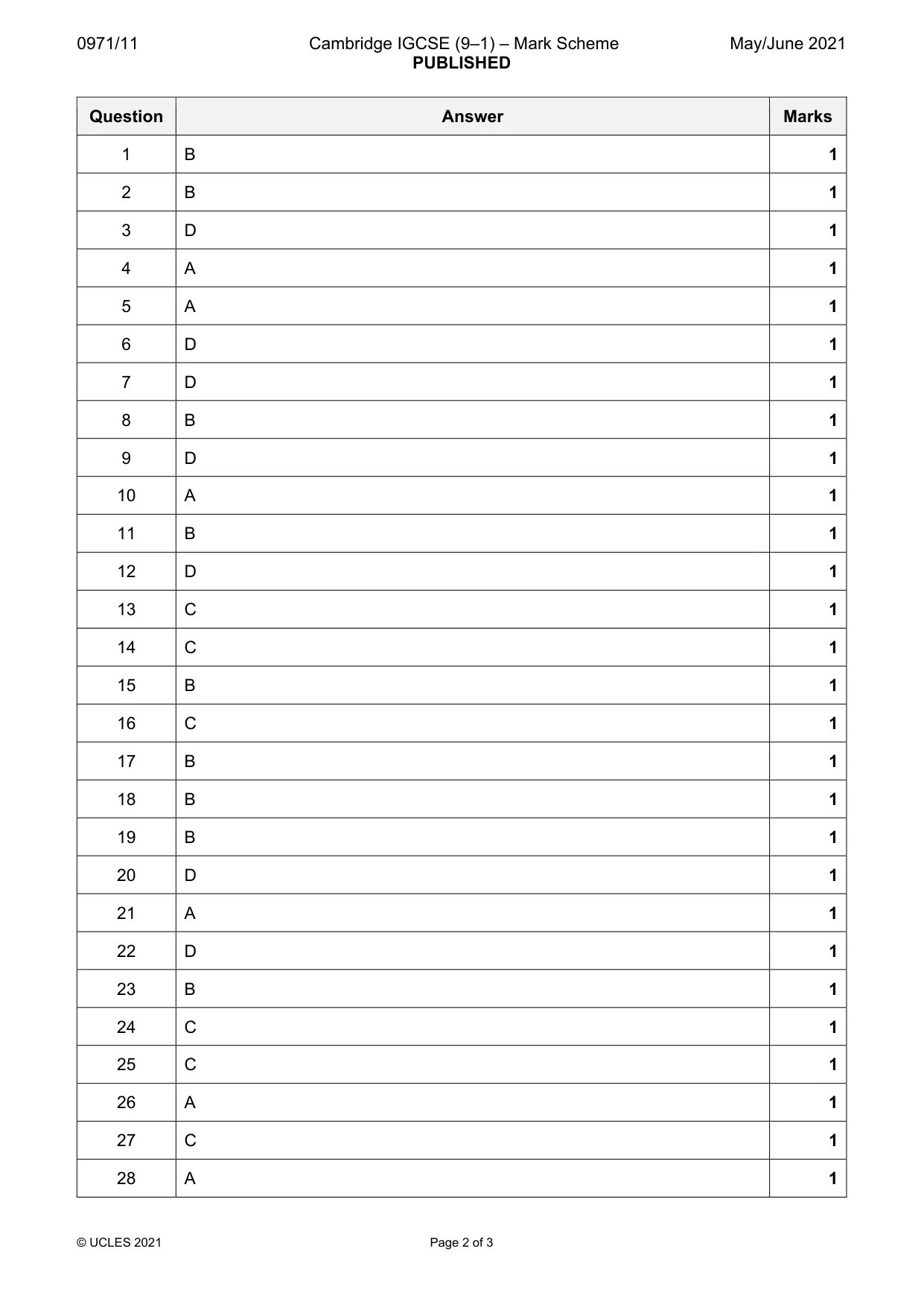
Mark scheme: B
Q2 · A mixture is separated using the apparatus shown
2 A mixture is separated using the apparatus shown. mixture funnel filter paper What is the mixture? A aqueous copper(II) sulfate and aqueous sodium chloride B aqueous copper(II) sulfate and copper C copper and sulfur D ethanol and ethanoic acid
Mark scheme: B
Q3 · Which statement about paper chromatography is correct?
3 Which statement about paper chromatography is correct? A A solvent is needed to dissolve the paper. B Paper chromatography separates mixtures of solvents. C The solvent should cover the baseline. D The baseline should be drawn in pencil.
Mark scheme: D
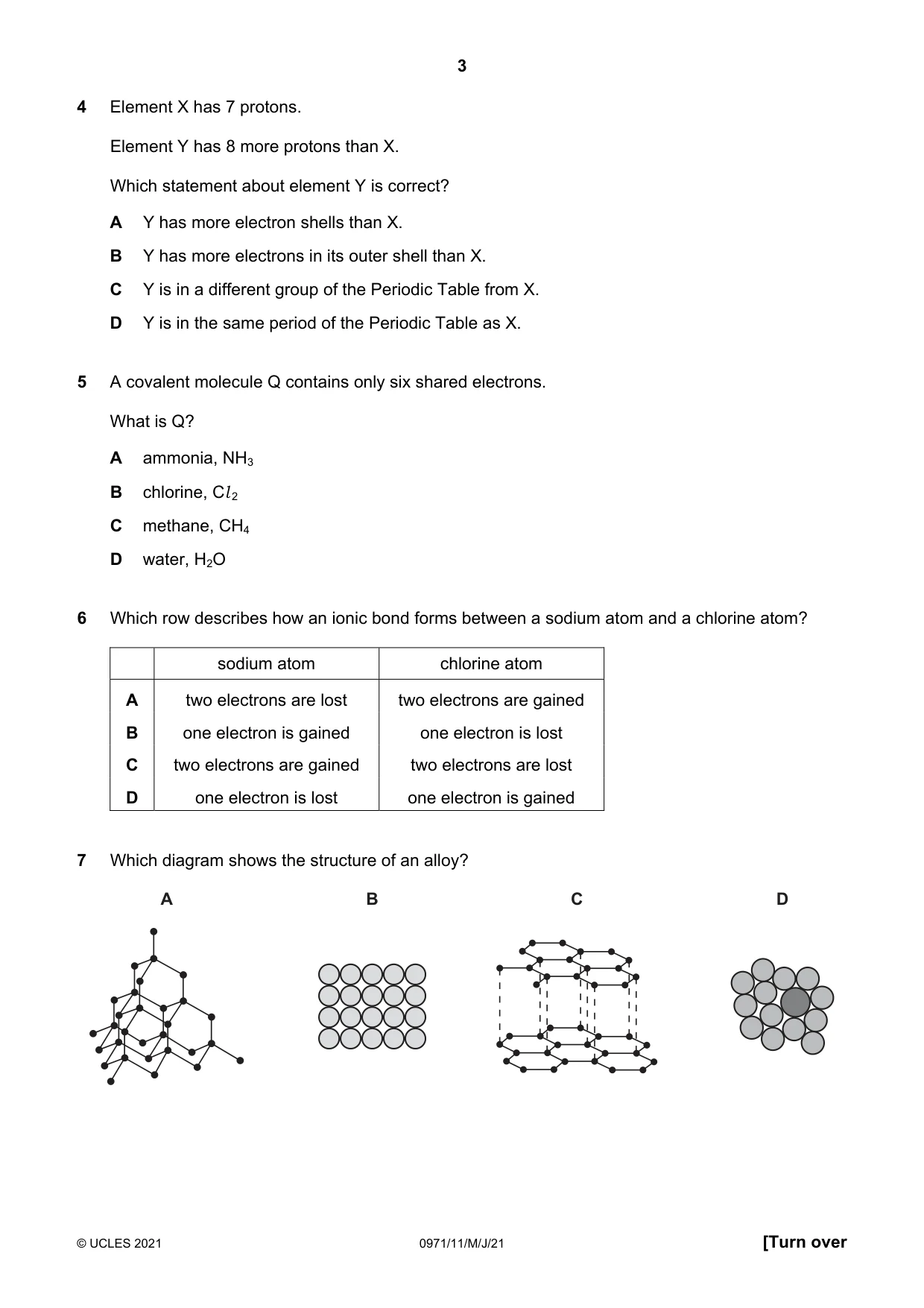
Q4 · Element X has 7 protons
4 Element X has 7 protons. Element Y has 8 more protons than X. Which statement about element Y is correct? A Y has more electron shells than X. B Y has more electrons in its outer shell than X. C Y is in a different group of the Periodic Table from X. D Y is in the same period of the Periodic Table as X.
Mark scheme: A
Q5 · A covalent molecule Q contains only six shared electrons
5 A covalent molecule Q contains only six shared electrons. What is Q? A ammonia, NH3 B chlorine, Cl 2 C methane, CH4 D water, H2O
Mark scheme: A
Q6 · Which row describes how an ionic bond forms between a sodium atom and a chlorine atom?
6 Which row describes how an ionic bond forms between a sodium atom and a chlorine atom? sodium atom chlorine atom A two electrons are lost two electrons are gained B one electron is gained one electron is lost C two electrons are gained two electrons are lost D one electron is lost one electron is gained
Mark scheme: D
Q7 · Which diagram shows the structure of an alloy?
7 Which diagram shows the structure of an alloy? A B C D
Mark scheme: D
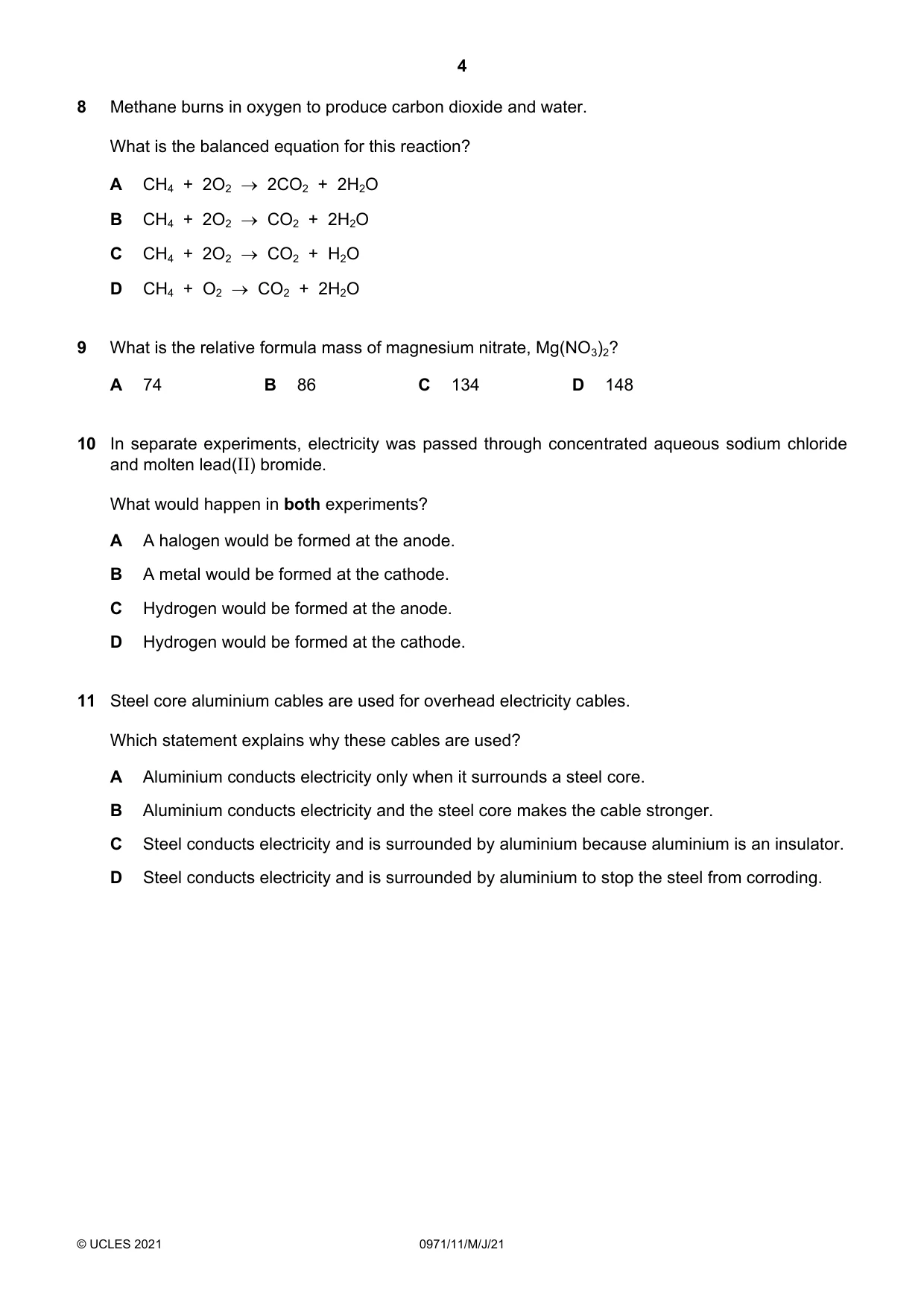
Q8 · Methane burns in oxygen to produce carbon dioxide and water
8 Methane burns in oxygen to produce carbon dioxide and water. What is the balanced equation for this reaction? A CH4 + 2O2 2CO2 + 2H2O B CH4 + 2O2 CO2 + 2H2O C CH4 + 2O2 CO2 + H2O D CH4 + O2 CO2 + 2H2O
Mark scheme: B
Q9 · What is the relative formula mass of magnesium nitrate, Mg(NO3)2?
9 What is the relative formula mass of magnesium nitrate, Mg(NO3)2? A 74 B 86 C 134 D 148
Mark scheme: D
Q10 · In separate experiments, electricity was passed through concentrated aqueous sodium…
10 In separate experiments, electricity was passed through concentrated aqueous sodium chloride and molten lead(II) bromide. What would happen in both experiments? A A halogen would be formed at the anode. B A metal would be formed at the cathode. C Hydrogen would be formed at the anode. D Hydrogen would be formed at the cathode.
Mark scheme: A
Q11 · Steel core aluminium cables are used for overhead electricity cables
11 Steel core aluminium cables are used for overhead electricity cables. Which statement explains why these cables are used? A Aluminium conducts electricity only when it surrounds a steel core. B Aluminium conducts electricity and the steel core makes the cable stronger. C Steel conducts electricity and is surrounded by aluminium because aluminium is an insulator. D Steel conducts electricity and is surrounded by aluminium to stop the steel from corroding.
Mark scheme: B
Q12 · The complete combustion of propane is exothermic
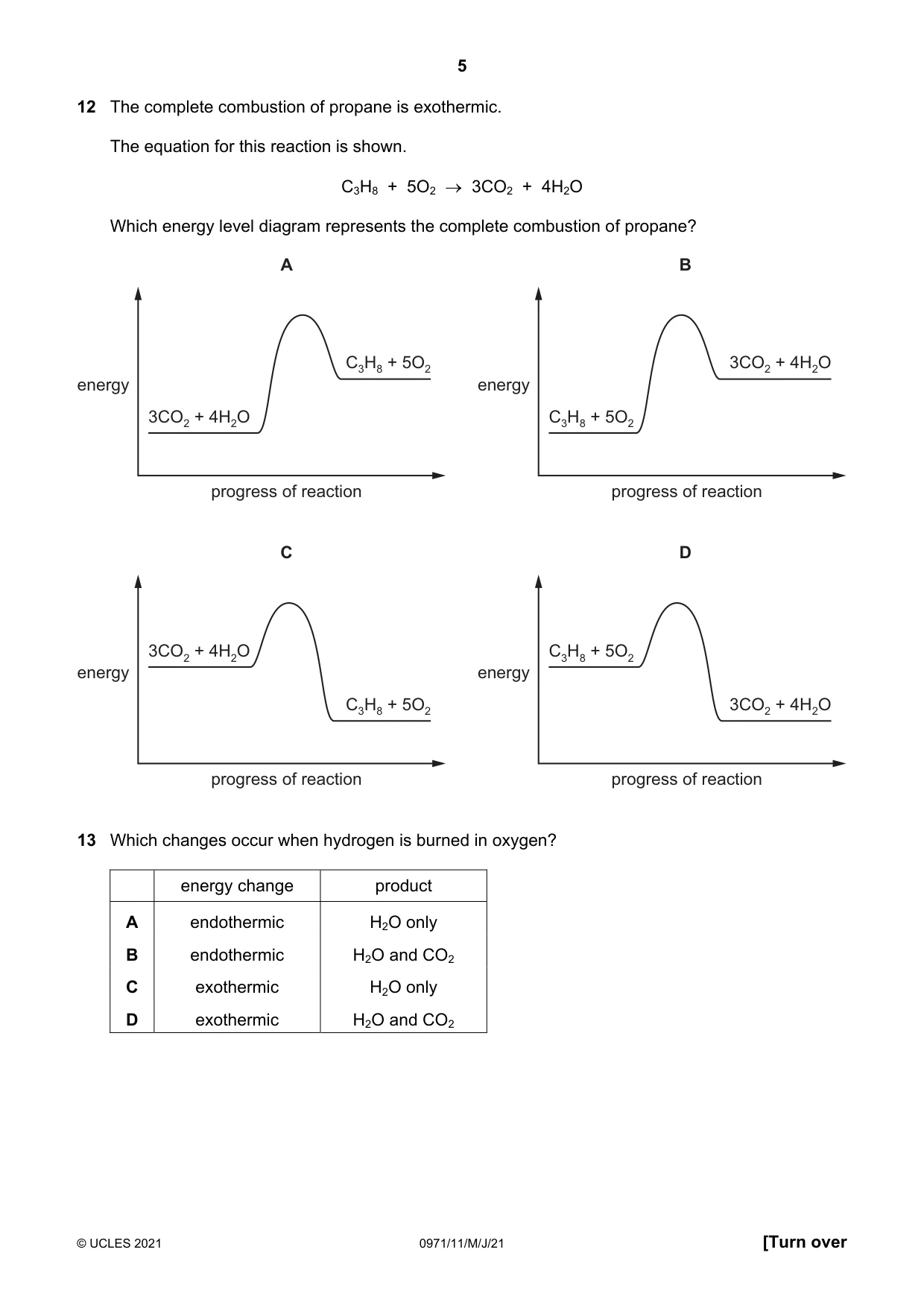
12 The complete combustion of propane is exothermic. The equation for this reaction is shown. C3H8 + 5O2 3CO2 + 4H2O Which energy level diagram represents the complete combustion of propane? A B C3H8 + 5O2 3CO2 + 4H2O energy energy 3CO2 + 4H2O C3H8 + 5O2 progress of reaction progress of reaction C D 3CO2 + 4H2O C3H8 + 5O2 energy energy C3H8 + 5O2 3CO2 + 4H2O progress of reaction progress of reaction
Mark scheme: D
Q13 · Which changes occur when hydrogen is burned in oxygen?
13 Which changes occur when hydrogen is burned in oxygen? energy change product A endothermic H2O only B endothermic H2O and CO2 C exothermic H2O only D exothermic H2O and CO2
Mark scheme: C
Q14 · When sulfur is heated it undergoes a ......1.....
14 When sulfur is heated it undergoes a ......1...... change as it melts. Further heating causes the sulfur to undergo a ......2...... change and form sulfur dioxide. Which words complete gaps 1 and 2? 1 2 A chemical chemical B chemical physical C physical chemical D physical physical
Mark scheme: C
Q15 · Zinc reacts with an acid to form a gas
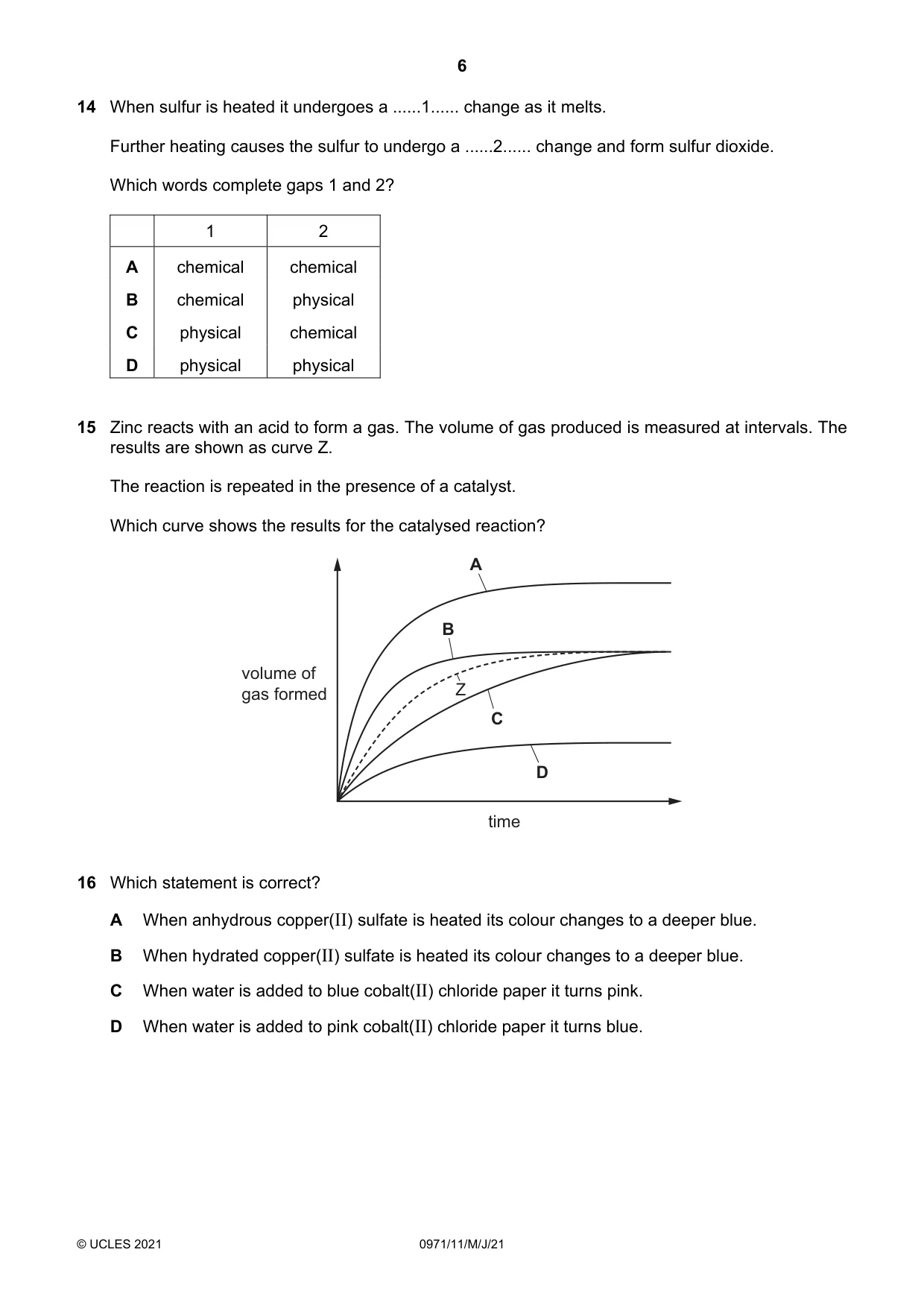
15 Zinc reacts with an acid to form a gas. The volume of gas produced is measured at intervals. The results are shown as curve Z. The reaction is repeated in the presence of a catalyst. Which curve shows the results for the catalysed reaction? A B volume of gas formed Z C D time
Mark scheme: B
Q16 · Which statement is correct?
16 Which statement is correct? A When anhydrous copper(II) sulfate is heated its colour changes to a deeper blue. B When hydrated copper(II) sulfate is heated its colour changes to a deeper blue. C When water is added to blue cobalt(II) chloride paper it turns pink. D When water is added to pink cobalt(II) chloride paper it turns blue.
Mark scheme: C
Q17 · Three separate experiments are carried out on an aqueous solution of S
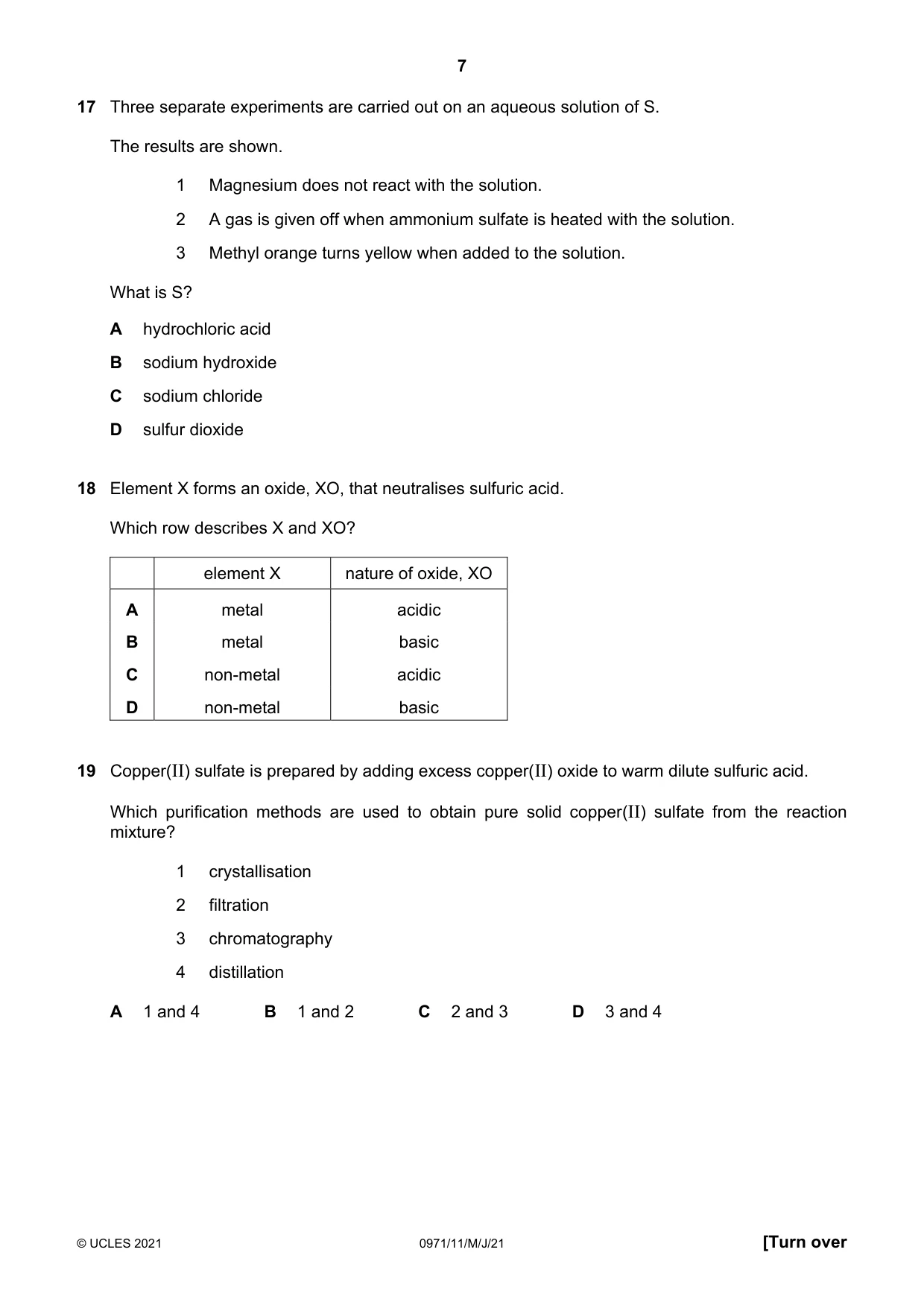
17 Three separate experiments are carried out on an aqueous solution of S. The results are shown. 1 Magnesium does not react with the solution. 2 A gas is given off when ammonium sulfate is heated with the solution. 3 Methyl orange turns yellow when added to the solution. What is S? A hydrochloric acid B sodium hydroxide C sodium chloride D sulfur dioxide
Mark scheme: B
More questions on The characteristic properties of acids and bases
Q18 · Element X forms an oxide, XO, that neutralises sulfuric acid
18 Element X forms an oxide, XO, that neutralises sulfuric acid. Which row describes X and XO? element X nature of oxide, XO A metal acidic B metal basic C non-metal acidic D non-metal basic
Mark scheme: B
Q19 · Copper(II) sulfate is prepared by adding excess copper(II) oxide to warm dilute sulfuric…
19 Copper(II) sulfate is prepared by adding excess copper(II) oxide to warm dilute sulfuric acid. Which purification methods are used to obtain pure solid copper(II) sulfate from the reaction mixture? 1 crystallisation 2 filtration 3 chromatography 4 distillation A 1 and 4 B 1 and 2 C 2 and 3 D 3 and 4
Mark scheme: B
Q20 · Some reactions of element M are shown
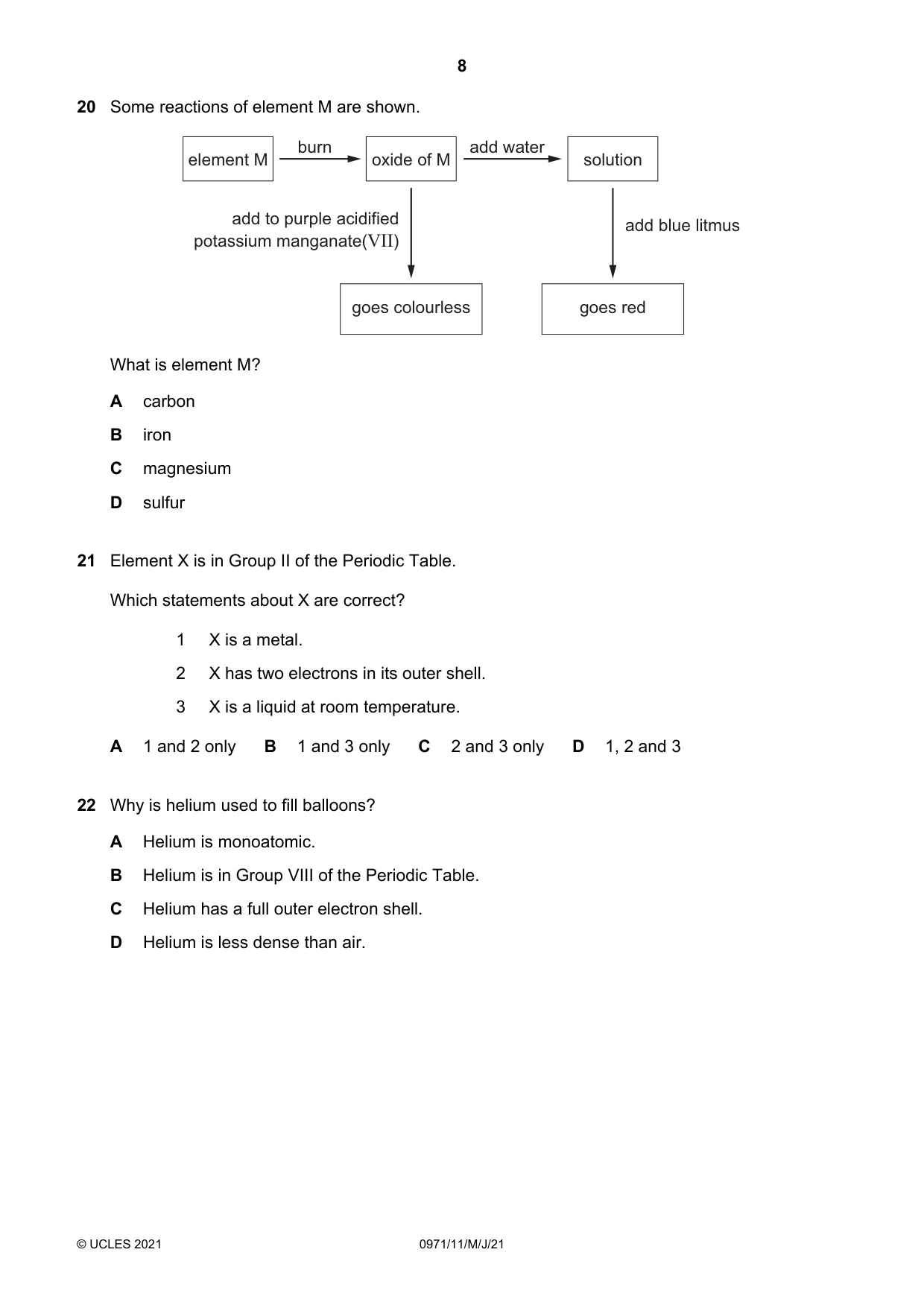
20 Some reactions of element M are shown. burn add water element M oxide of M solution add to purple acidified add blue litmus potassium manganate(VII) goes colourless goes red What is element M? A carbon B iron C magnesium D sulfur
Mark scheme: D
Q21 · Element X is in Group II of the Periodic Table
21 Element X is in Group II of the Periodic Table. Which statements about X are correct? 1 X is a metal. 2 X has two electrons in its outer shell. 3 X is a liquid at room temperature. A 1 and 2 only B 1 and 3 only C 2 and 3 only D 1, 2 and 3
Mark scheme: A
Q22 · Why is helium used to fill balloons?
22 Why is helium used to fill balloons? A Helium is monoatomic. B Helium is in Group VIII of the Periodic Table. C Helium has a full outer electron shell. D Helium is less dense than air.
Mark scheme: D
Q23 · Which row describes the trend in properties of the elements in Group I as the group is…
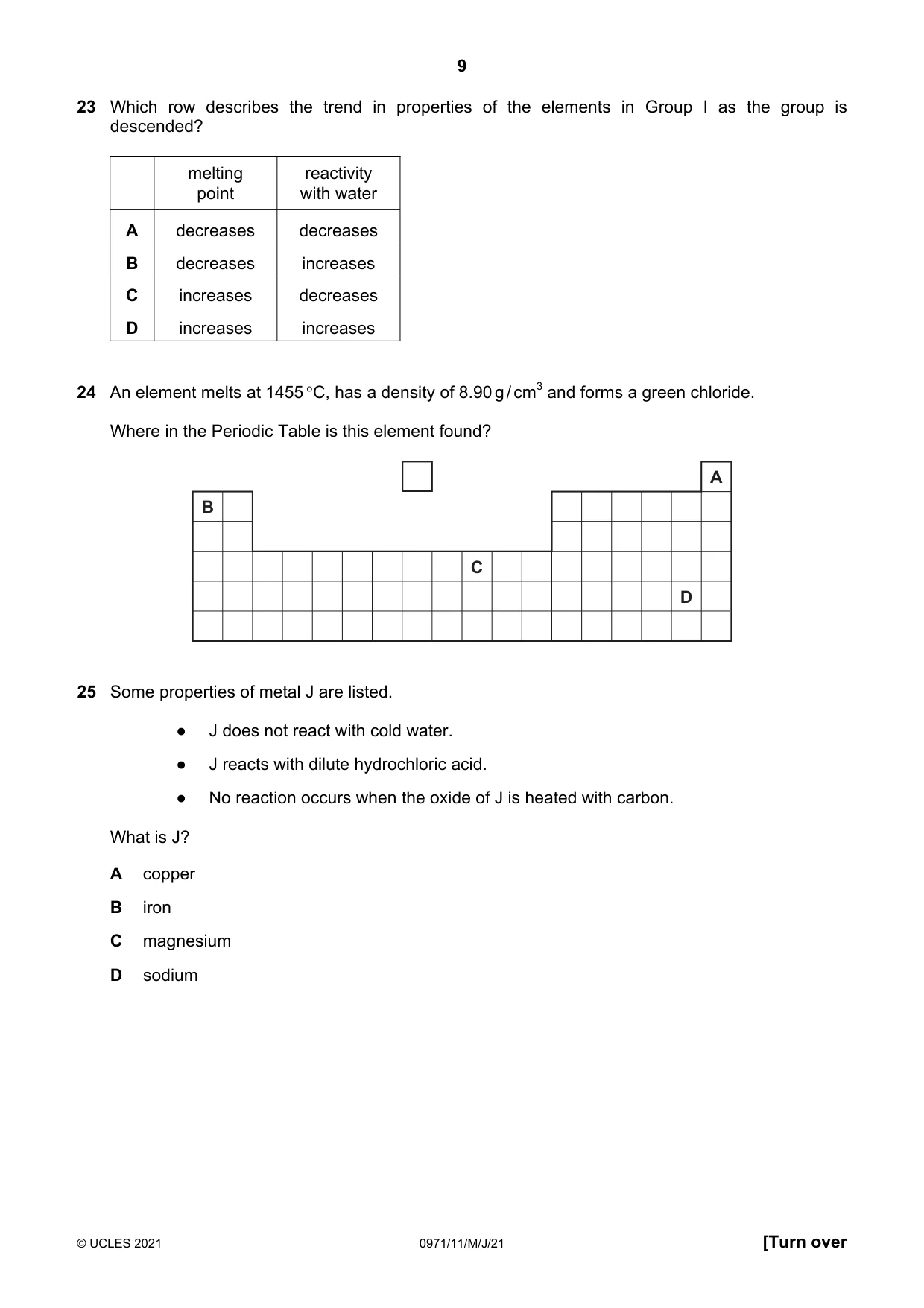
23 Which row describes the trend in properties of the elements in Group I as the group is descended? melting reactivity point with water A decreases decreases B decreases increases C increases decreases D increases increases
Mark scheme: B
Q24 · An element melts at 1455 C, has a density of 8.90 g / cm3 and forms a green chloride
24 An element melts at 1455 C, has a density of 8.90 g / cm3 and forms a green chloride. Where in the Periodic Table is this element found? A B C D
Mark scheme: C
Q25 · Some properties of metal J are listed
25 Some properties of metal J are listed. ● J does not react with cold water. ● J reacts with dilute hydrochloric acid. ● No reaction occurs when the oxide of J is heated with carbon. What is J? A copper B iron C magnesium D sodium
Mark scheme: C
Q26 · Iron from a blast furnace is treated with oxygen and with calcium oxide to make steel
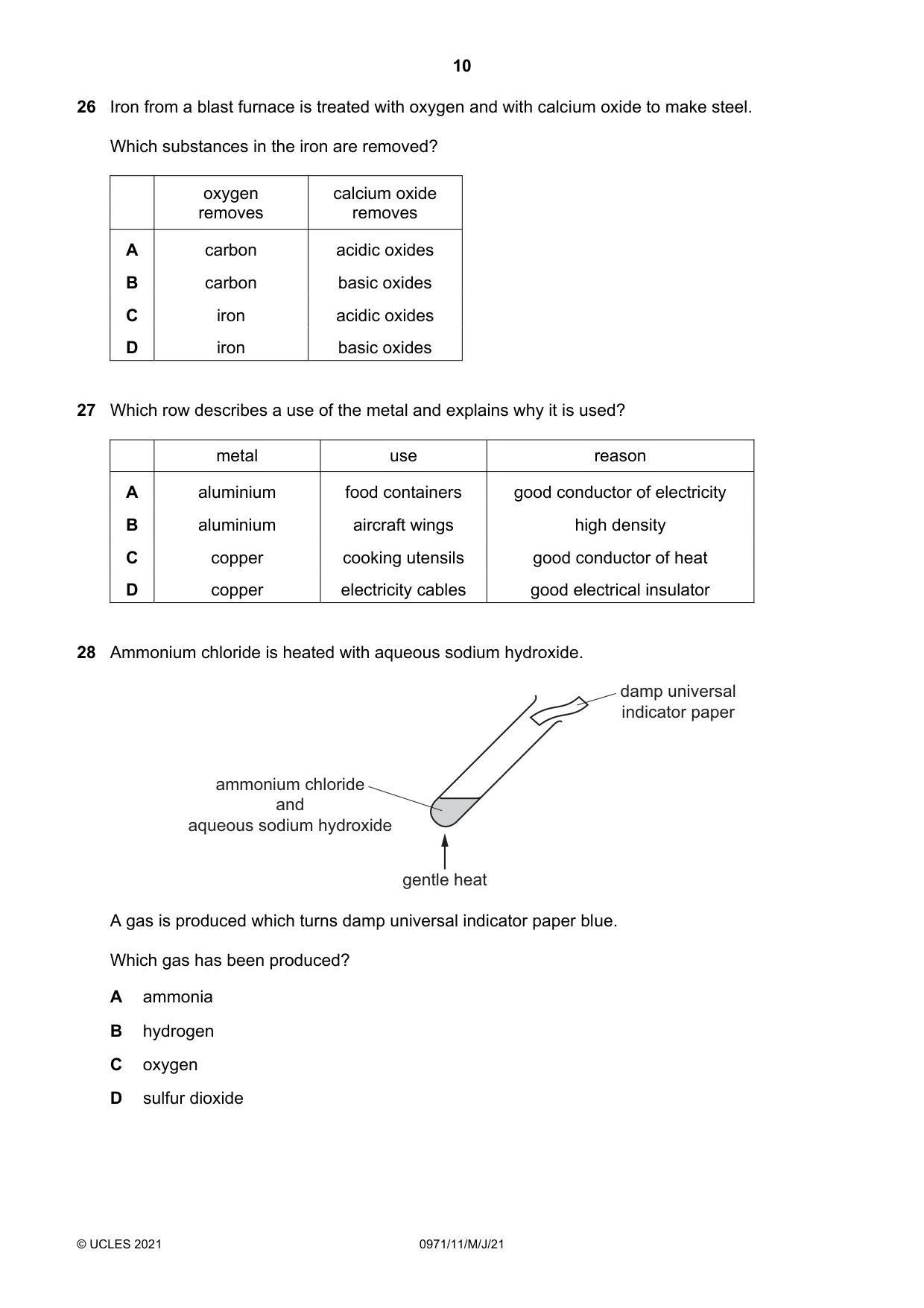
26 Iron from a blast furnace is treated with oxygen and with calcium oxide to make steel. Which substances in the iron are removed? oxygen calcium oxide removes removes A carbon acidic oxides B carbon basic oxides C iron acidic oxides D iron basic oxides
Mark scheme: A
Q27 · Which row describes a use of the metal and explains why it is used?
27 Which row describes a use of the metal and explains why it is used? metal use reason A aluminium food containers good conductor of electricity B aluminium aircraft wings high density C copper cooking utensils good conductor of heat D copper electricity cables good electrical insulator
Mark scheme: C
Q28 · Ammonium chloride is heated with aqueous sodium hydroxide
28 Ammonium chloride is heated with aqueous sodium hydroxide. damp universal indicator paper ammonium chloride and aqueous sodium hydroxide gentle heat A gas is produced which turns damp universal indicator paper blue. Which gas has been produced? A ammonia B hydrogen C oxygen D sulfur dioxide
Mark scheme: A
Q29 · Which two gases make up approximately 99% of clean, dry air?
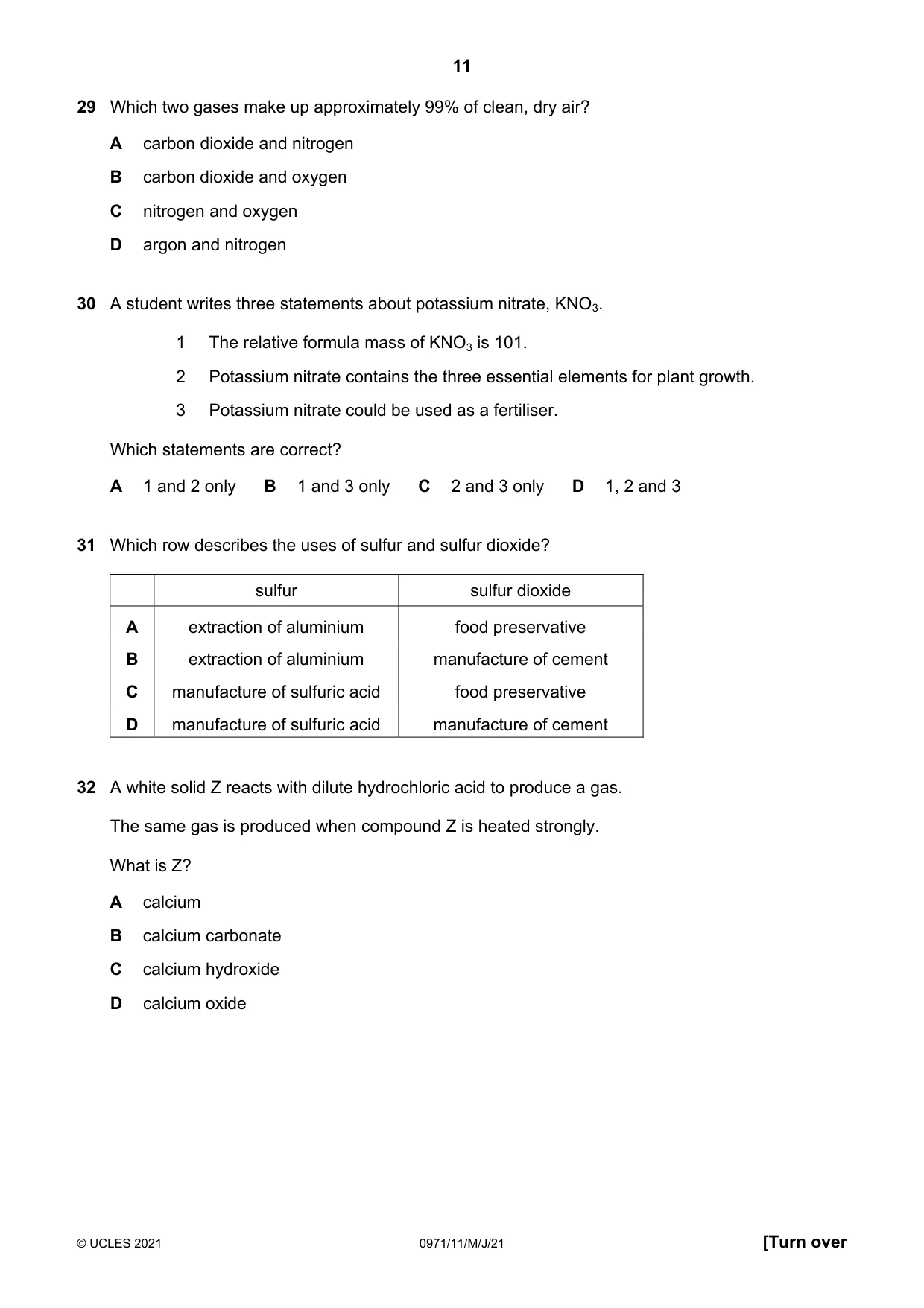
29 Which two gases make up approximately 99% of clean, dry air? A carbon dioxide and nitrogen B carbon dioxide and oxygen C nitrogen and oxygen D argon and nitrogen
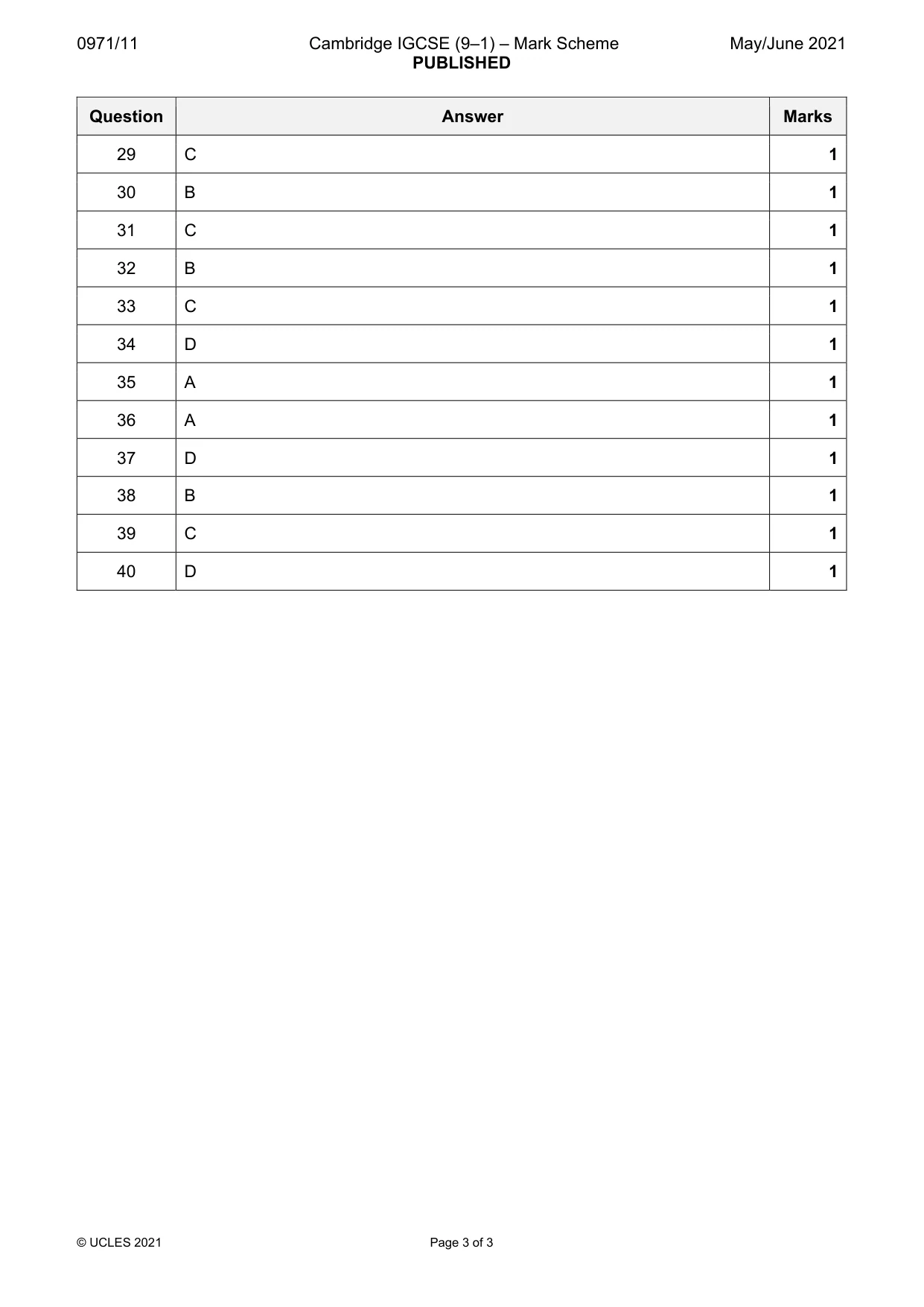
Mark scheme: C
Q30 · A student writes three statements about potassium nitrate, KNO3
30 A student writes three statements about potassium nitrate, KNO3. 1 The relative formula mass of KNO3 is 101. 2 Potassium nitrate contains the three essential elements for plant growth. 3 Potassium nitrate could be used as a fertiliser. Which statements are correct? A 1 and 2 only B 1 and 3 only C 2 and 3 only D 1, 2 and 3
Mark scheme: B
Q31 · Which row describes the uses of sulfur and sulfur dioxide?
31 Which row describes the uses of sulfur and sulfur dioxide? sulfur sulfur dioxide A extraction of aluminium food preservative B extraction of aluminium manufacture of cement C manufacture of sulfuric acid food preservative D manufacture of sulfuric acid manufacture of cement
Mark scheme: C
Q32 · A white solid Z reacts with dilute hydrochloric acid to produce a gas
32 A white solid Z reacts with dilute hydrochloric acid to produce a gas. The same gas is produced when compound Z is heated strongly. What is Z? A calcium B calcium carbonate C calcium hydroxide D calcium oxide
Mark scheme: B
Q33 · Some information about compound L is listed
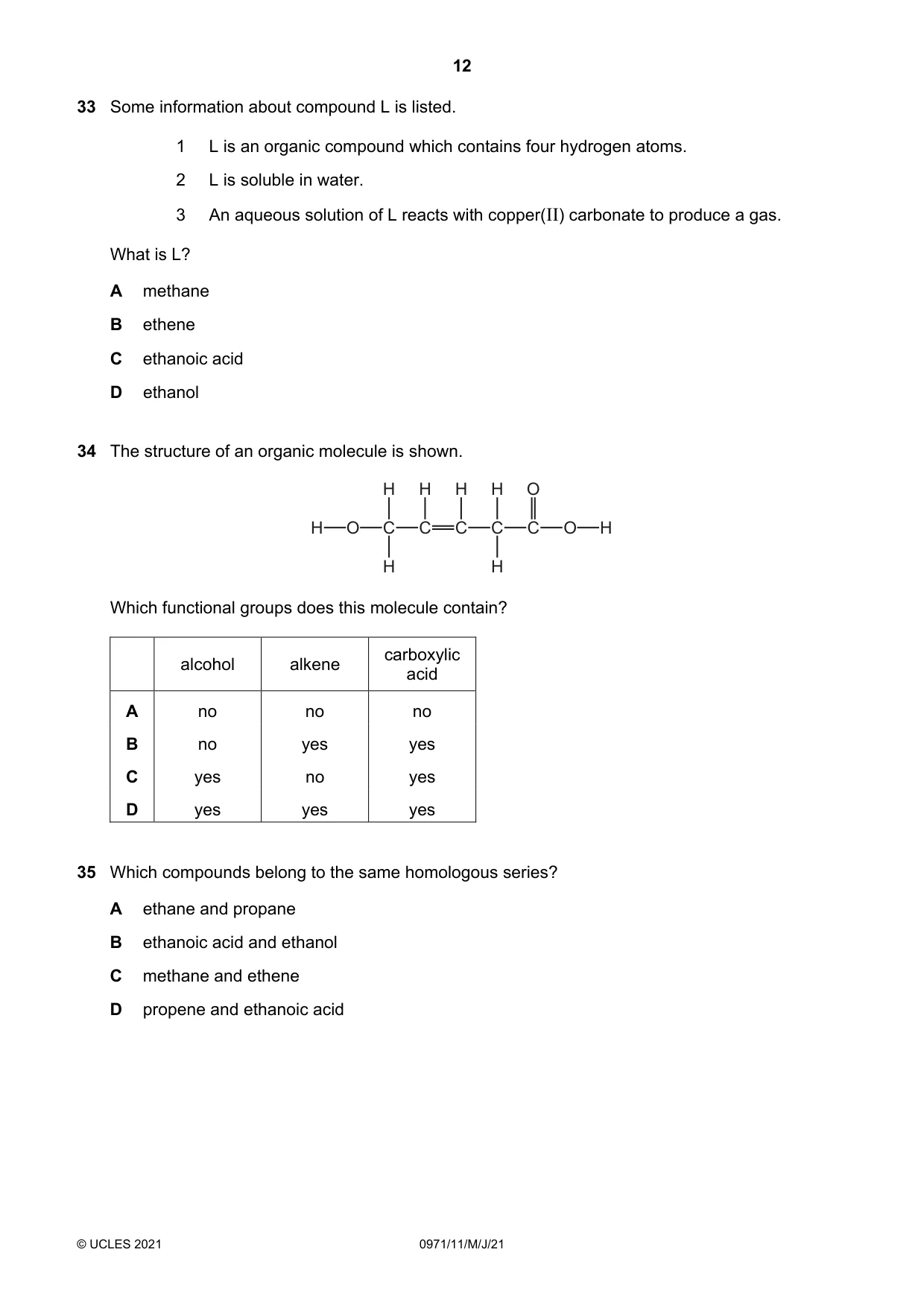
33 Some information about compound L is listed. 1 L is an organic compound which contains four hydrogen atoms. 2 L is soluble in water. 3 An aqueous solution of L reacts with copper(II) carbonate to produce a gas. What is L? A methane B ethene C ethanoic acid D ethanol
Mark scheme: C
Q34 · The structure of an organic molecule is shown
34 The structure of an organic molecule is shown. H H H H O H O C C C C C O H H H Which functional groups does this molecule contain? carboxylic alcohol alkene acid A no no no B no yes yes C yes no yes D yes yes yes
Mark scheme: D
More questions on Formulae, functional groups and terminology
Q35 · Which compounds belong to the same homologous series?
35 Which compounds belong to the same homologous series? A ethane and propane B ethanoic acid and ethanol C methane and ethene D propene and ethanoic acid
Mark scheme: A
More questions on Formulae, functional groups and terminology
Q36 · Which statement about alkanes is correct?
36 Which statement about alkanes is correct? A They burn in oxygen. B They contain carbon, hydrogen and oxygen atoms. C They contain double bonds. D They contain ionic bonds.
Mark scheme: A
Q37 · Which structure represents poly(ethene)?
37 Which structure represents poly(ethene)? A B C D H H H H H H H H C C n C C C C C C H H H H H H n H H n
Mark scheme: D
Q38 · P, Q, R and S are four organic compounds
38 P, Q, R and S are four organic compounds. P is an unsaturated hydrocarbon. Q burns but otherwise is unreactive. R contains a C–C single bond and a C=C double bond. S undergoes addition polymerisation. Which compounds are alkenes? A P and R only B P, R and S C P, Q and S D Q, R and S
Mark scheme: B
Q39 · Which statement about petroleum fractions is correct?
39 Which statement about petroleum fractions is correct? A All petroleum fractions are used as fuels. B Gas oil is used to make bottled gas for heating. C Hydrocarbons in diesel have higher boiling points than hydrocarbons in gasoline. D Molecules in kerosene are larger than molecules in fuel oil.
Mark scheme: C
Q40 · Which substance is a natural polymer?
40 Which substance is a natural polymer? A ethene B Terylene C nylon D protein
Mark scheme: D
What was in this paper
The subtopics covered by these 40 questions, and how many questions each got. Open one in a new tab to see every Cambridge question on it.
2Exothermic and endothermic reactions2Formulae, functional groups and terminology2Fuels2Identification of ions and gases2Polymers2Separation and purification2Air quality and climate1Alkanes1Alkenes1Arrangement of elements1Atomic structure and the Periodic Table1Carboxylic acids1Chromatography1Electrolysis1Extraction of metals1Fertilisers1Formulae1Group I properties1Ions and ionic bonds1Noble gases1Oxides1Physical and chemical changes1Preparation of salts1Rate of reaction1Reactivity series1Redox1Relative masses of atoms and molecules1Simple molecules and covalent bonds1Solids, liquids and gases1The characteristic properties of acids and bases1Transition elements1Uses of metals1What you needed in this session
Cambridge’s own grade thresholds for 2021 May/June, Paper 1 · Variant 1. A higher threshold means an easier paper — the bar moves with how the cohort did.