Cambridge IGCSE Chemistry (9-1) 0971 — 2023 May/June Paper 1 · Variant 2
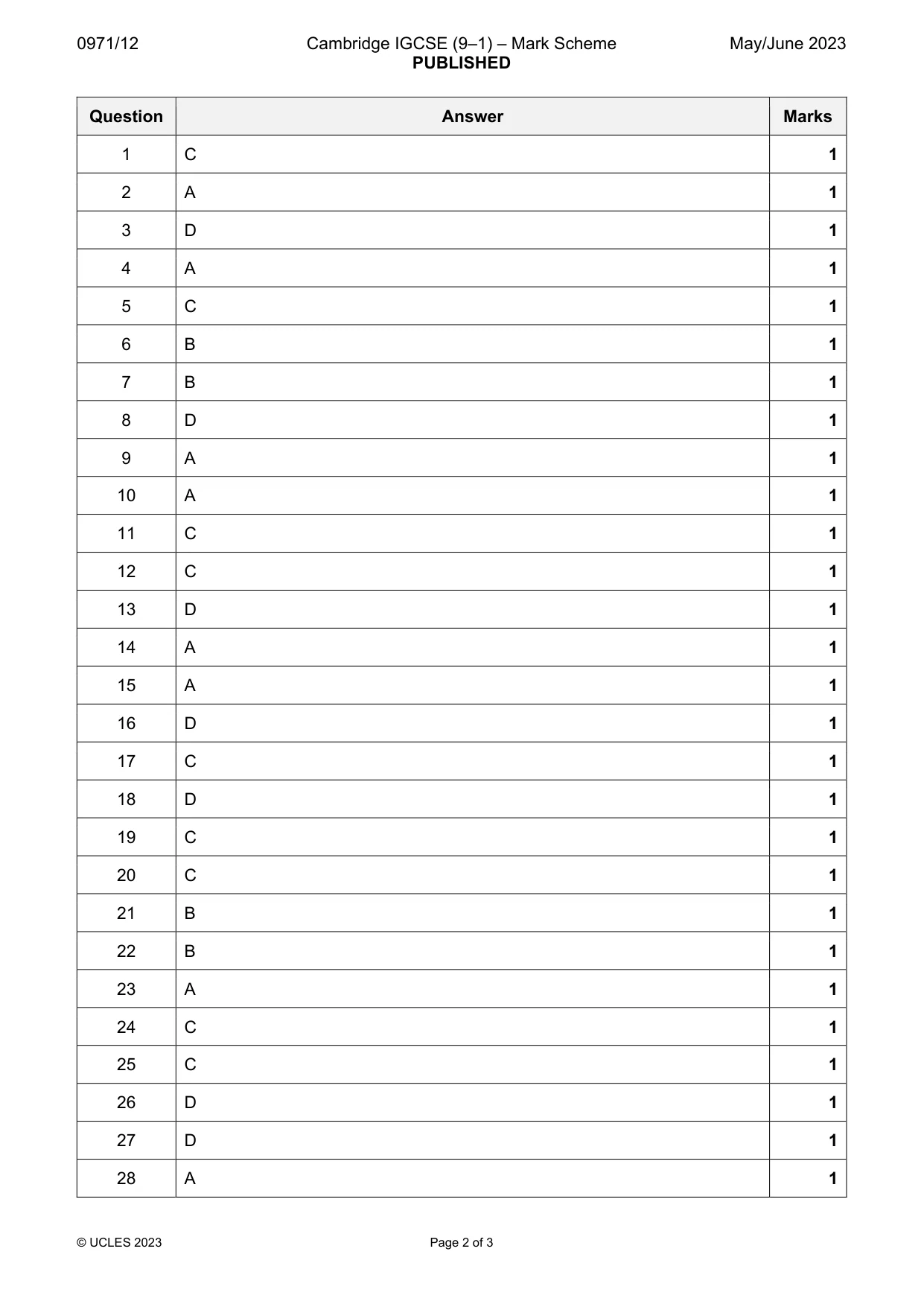
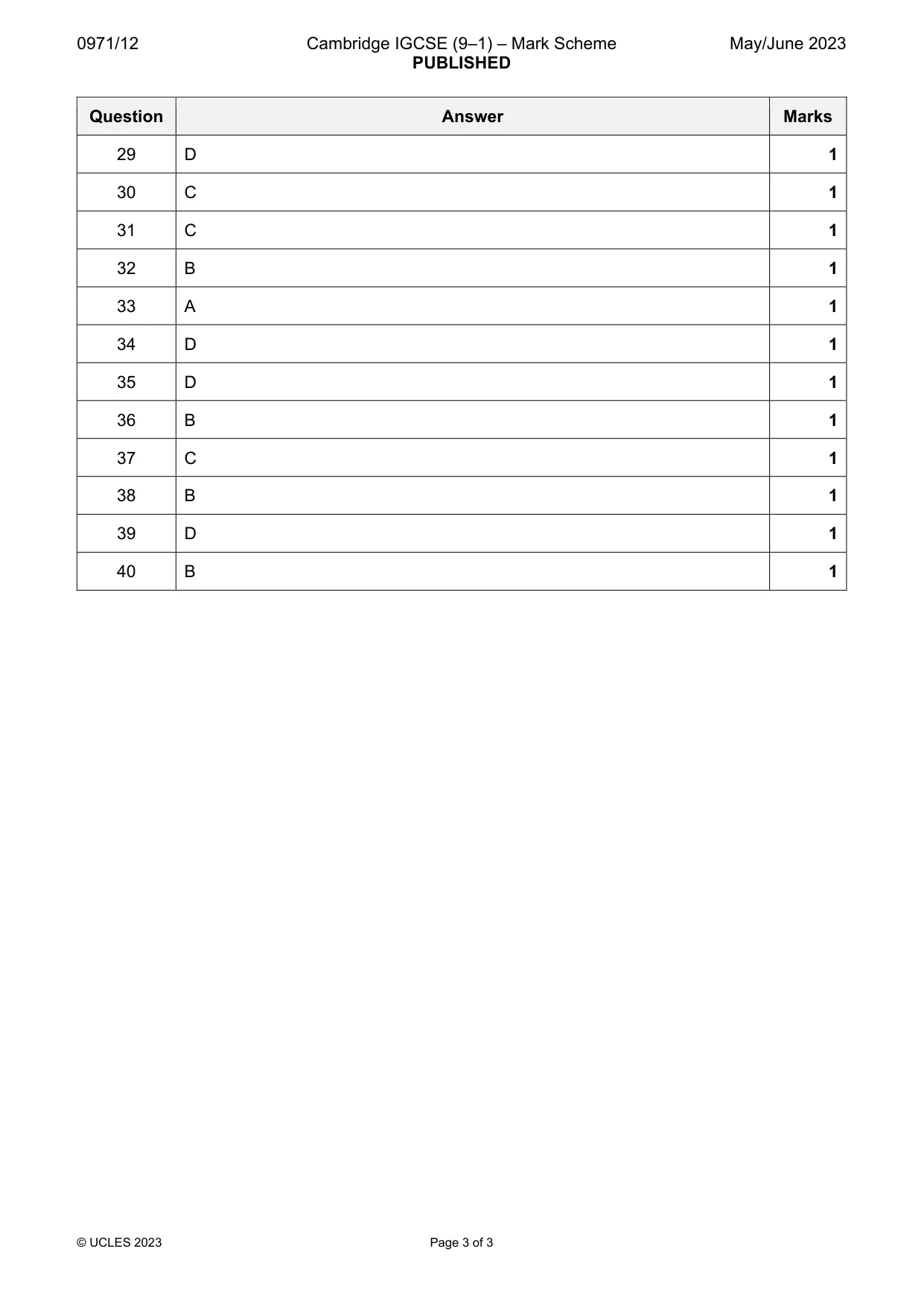
0971/12/M/J/23 · 40 questions · 40 marks · 45 min
The question paper and its mark scheme, free to read here and free to download. This is Cambridge’s own paper, exactly as it was sat.
Question paper16 pages

Mark scheme3 pages
Answers below. Sit the paper first if you are practising.
Questions as text
Q1 · Four physical changes of ethanol are listed
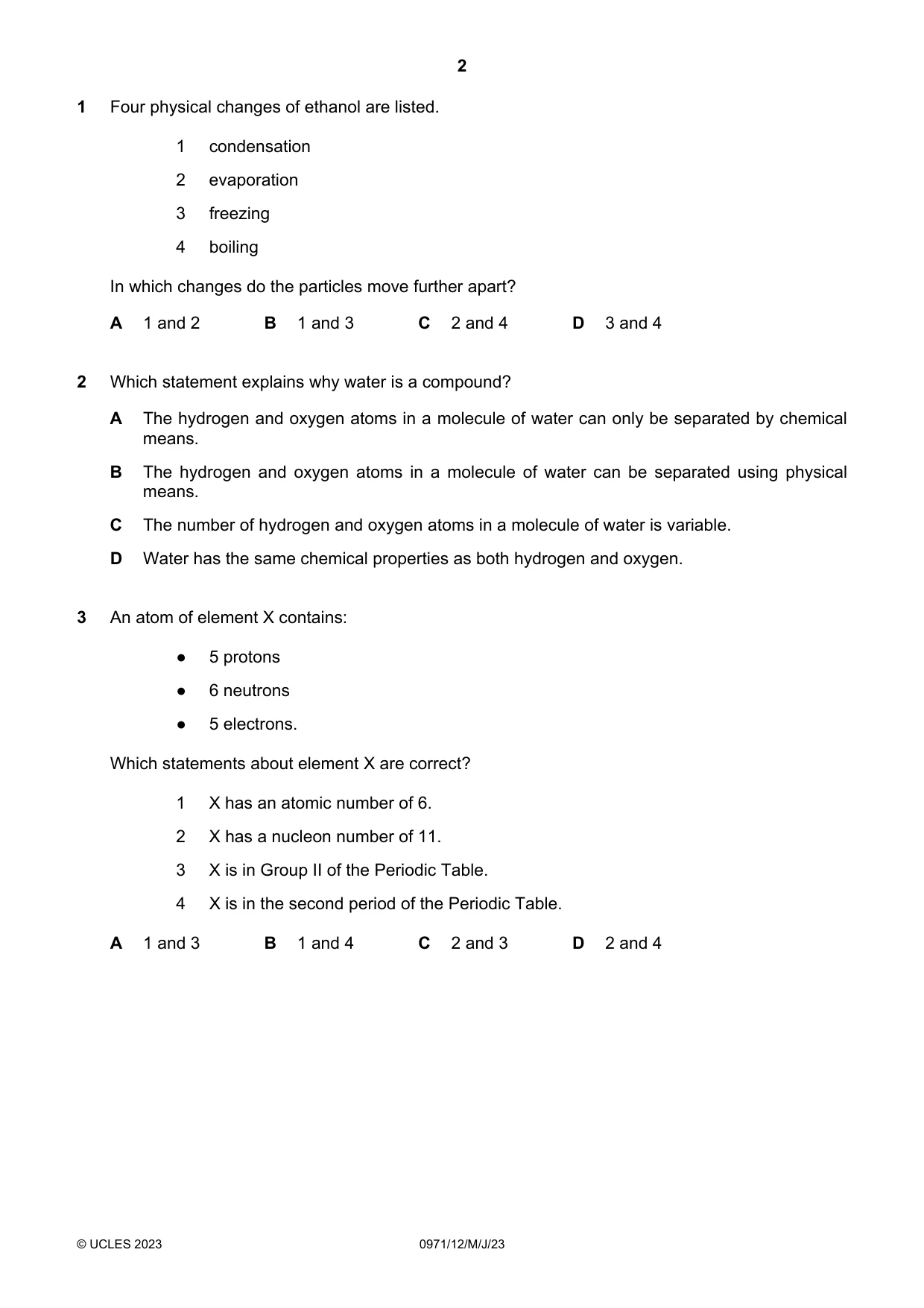
1 Four physical changes of ethanol are listed. 1 condensation 2 evaporation 3 freezing 4 boiling In which changes do the particles move further apart? A 1 and 2 B 1 and 3 C 2 and 4 D 3 and 4
Mark scheme: C
Q2 · Which statement explains why water is a compound?
2 Which statement explains why water is a compound? A The hydrogen and oxygen atoms in a molecule of water can only be separated by chemical means. B The hydrogen and oxygen atoms in a molecule of water can be separated using physical means. C The number of hydrogen and oxygen atoms in a molecule of water is variable. D Water has the same chemical properties as both hydrogen and oxygen.
Mark scheme: A
Q3 · An atom of element X contains: ● 5 protons ● 6 neutrons ● 5 electrons
3 An atom of element X contains: ● 5 protons ● 6 neutrons ● 5 electrons. Which statements about element X are correct? 1 X has an atomic number of 6. 2 X has a nucleon number of 11. 3 X is in Group II of the Periodic Table. 4 X is in the second period of the Periodic Table. A 1 and 3 B 1 and 4 C 2 and 3 D 2 and 4
Mark scheme: D
Q4 · Which row describes properties of lithium fluoride?
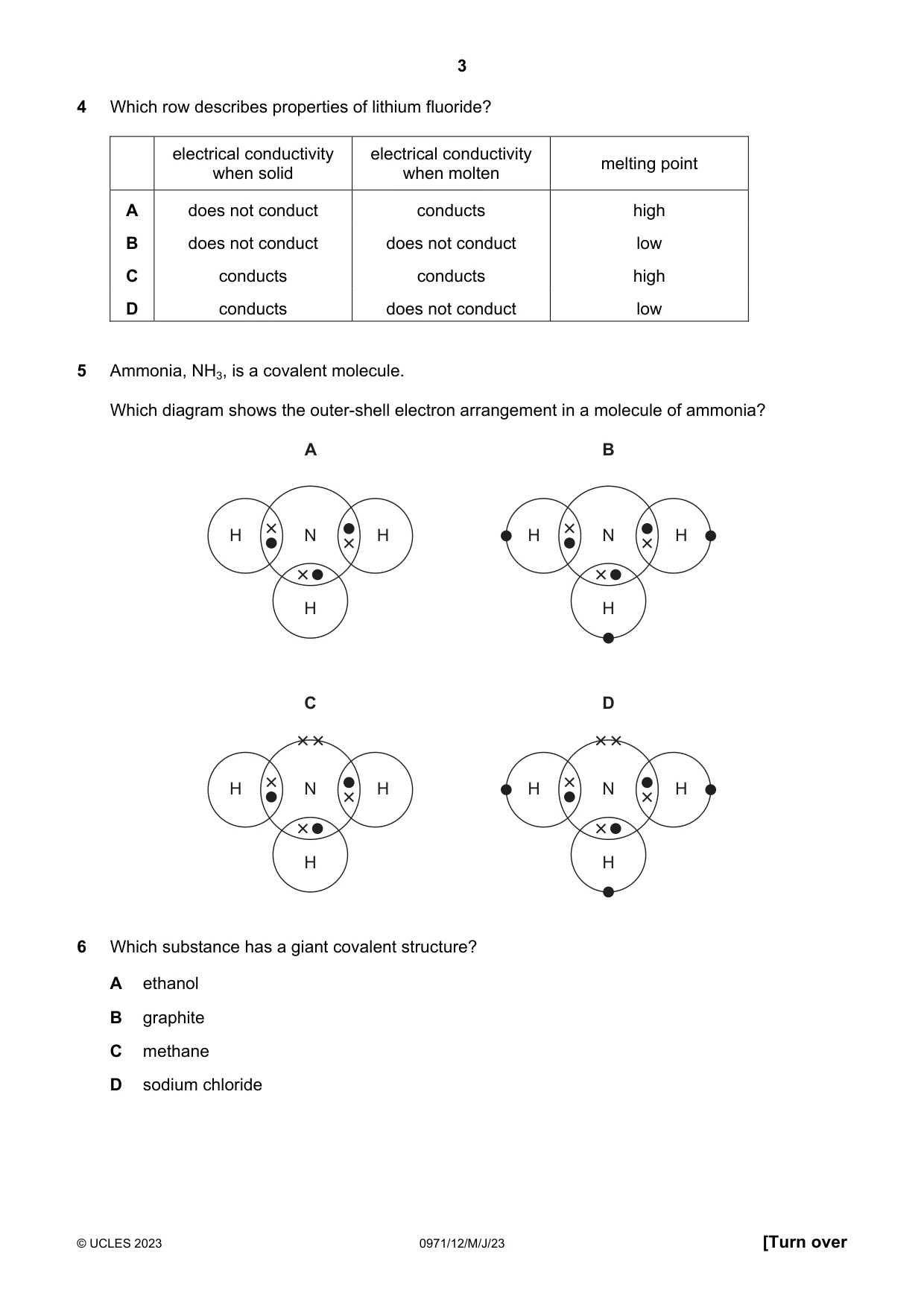
4 Which row describes properties of lithium fluoride? electrical conductivity electrical conductivity melting point when solid when molten A does not conduct conducts high B does not conduct does not conduct low C conducts conducts high D conducts does not conduct low
Mark scheme: A
Q5 · Ammonia, NH3, is a covalent molecule
5 Ammonia, NH3, is a covalent molecule. Which diagram shows the outer-shell electron arrangement in a molecule of ammonia? A B H N H H N H H H C D H N H H N H H H
Mark scheme: C
Q6 · Which substance has a giant covalent structure?
6 Which substance has a giant covalent structure? A ethanol B graphite C methane D sodium chloride
Mark scheme: B
Q7 · Sodium burns in oxygen to form sodium oxide
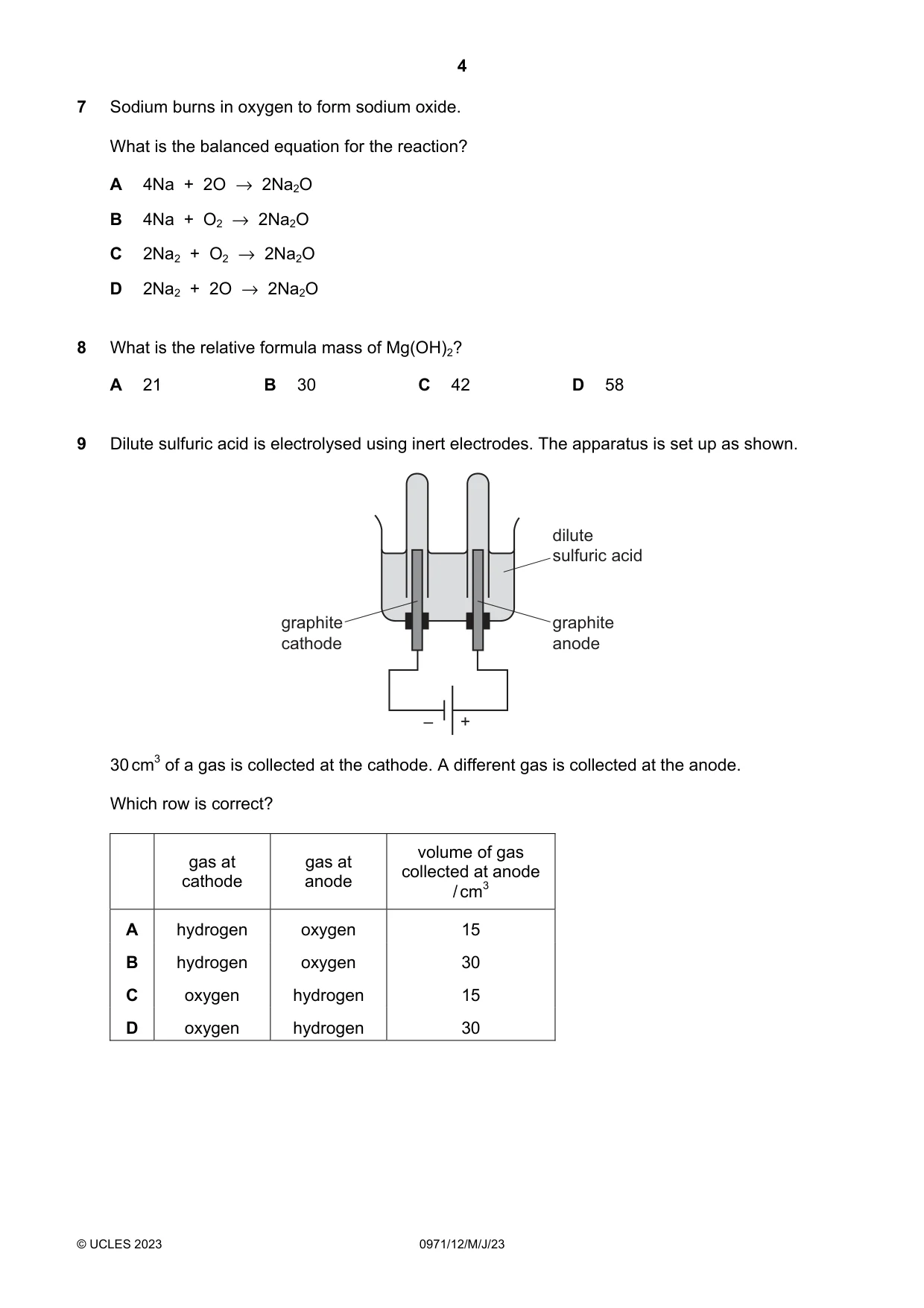
7 Sodium burns in oxygen to form sodium oxide. What is the balanced equation for the reaction? A 4Na + 2O → 2Na2O B 4Na + O2 → 2Na2O C 2Na2 + O2 → 2Na2O D 2Na2 + 2O → 2Na2O
Mark scheme: B
Q8 · What is the relative formula mass of Mg(OH)2?
8 What is the relative formula mass of Mg(OH)2? A 21 B 30 C 42 D 58
Mark scheme: D
Q9 · Dilute sulfuric acid is electrolysed using inert electrodes
9 Dilute sulfuric acid is electrolysed using inert electrodes. The apparatus is set up as shown. dilute sulfuric acid graphite graphite cathode anode – + 30 cm3 of a gas is collected at the cathode. A different gas is collected at the anode. Which row is correct? volume of gas gas at gas at collected at anode cathode anode / cm3 A hydrogen oxygen 15 B hydrogen oxygen 30 C oxygen hydrogen 15 D oxygen hydrogen 30
Mark scheme: A
Q10 · Four statements about hydrogen fuel cells are listed
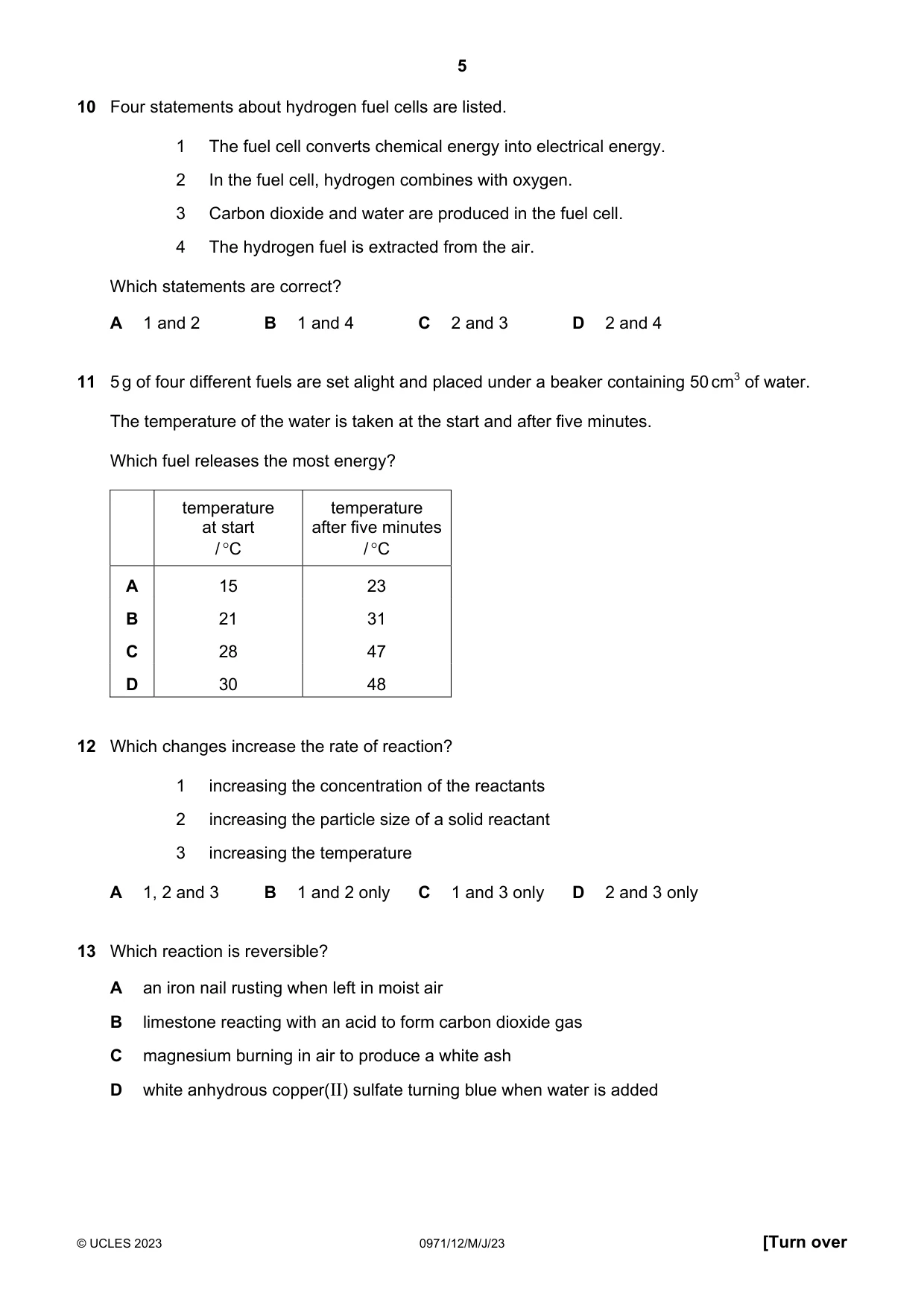
10 Four statements about hydrogen fuel cells are listed. 1 The fuel cell converts chemical energy into electrical energy. 2 In the fuel cell, hydrogen combines with oxygen. 3 Carbon dioxide and water are produced in the fuel cell. 4 The hydrogen fuel is extracted from the air. Which statements are correct? A 1 and 2 B 1 and 4 C 2 and 3 D 2 and 4
Mark scheme: A
Q11 · 5 g of four different fuels are set alight and placed under a beaker containing 50 cm3 of…
11 5 g of four different fuels are set alight and placed under a beaker containing 50 cm3 of water. The temperature of the water is taken at the start and after five minutes. Which fuel releases the most energy? temperature temperature at start after five minutes / °C / °C A 15 23 B 21 31 C 28 47 D 30 48
Mark scheme: C
Q12 · Which changes increase the rate of reaction?
12 Which changes increase the rate of reaction? 1 increasing the concentration of the reactants 2 increasing the particle size of a solid reactant 3 increasing the temperature A 1, 2 and 3 B 1 and 2 only C 1 and 3 only D 2 and 3 only
Mark scheme: C
Q13 · Which reaction is reversible?
13 Which reaction is reversible? A an iron nail rusting when left in moist air B limestone reacting with an acid to form carbon dioxide gas C magnesium burning in air to produce a white ash D white anhydrous copper(II) sulfate turning blue when water is added
Mark scheme: D
Q14 · The equation for the reaction between iron(III) oxide and carbon is shown
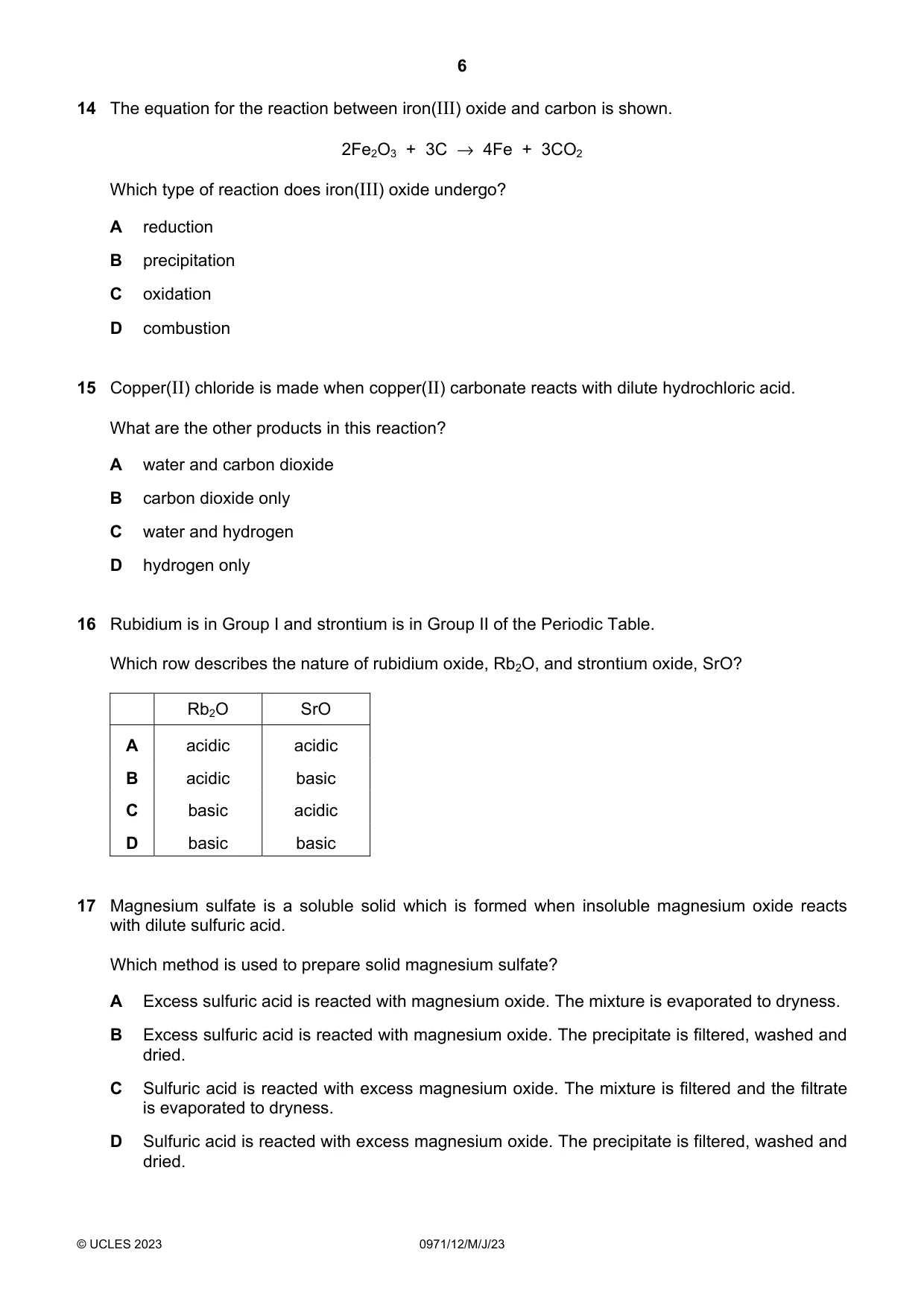
14 The equation for the reaction between iron(III) oxide and carbon is shown. 2Fe2O3 + 3C → 4Fe + 3CO2 Which type of reaction does iron(III) oxide undergo? A reduction B precipitation C oxidation D combustion
Mark scheme: A
Q15 · Copper(II) chloride is made when copper(II) carbonate reacts with dilute hydrochloric acid
15 Copper(II) chloride is made when copper(II) carbonate reacts with dilute hydrochloric acid. What are the other products in this reaction? A water and carbon dioxide B carbon dioxide only C water and hydrogen D hydrogen only
Mark scheme: A
Q16 · Rubidium is in Group I and strontium is in Group II of the Periodic Table
16 Rubidium is in Group I and strontium is in Group II of the Periodic Table. Which row describes the nature of rubidium oxide, Rb2O, and strontium oxide, SrO? Rb2O SrO A acidic acidic B acidic basic C basic acidic D basic basic
Mark scheme: D
Q17 · Magnesium sulfate is a soluble solid which is formed when insoluble magnesium oxide…
17 Magnesium sulfate is a soluble solid which is formed when insoluble magnesium oxide reacts with dilute sulfuric acid. Which method is used to prepare solid magnesium sulfate? A Excess sulfuric acid is reacted with magnesium oxide. The mixture is evaporated to dryness. B Excess sulfuric acid is reacted with magnesium oxide. The precipitate is filtered, washed and dried. C Sulfuric acid is reacted with excess magnesium oxide. The mixture is filtered and the filtrate is evaporated to dryness. D Sulfuric acid is reacted with excess magnesium oxide. The precipitate is filtered, washed and dried.
Mark scheme: C
Q18 · Q and R are elements in the same period of the Periodic Table
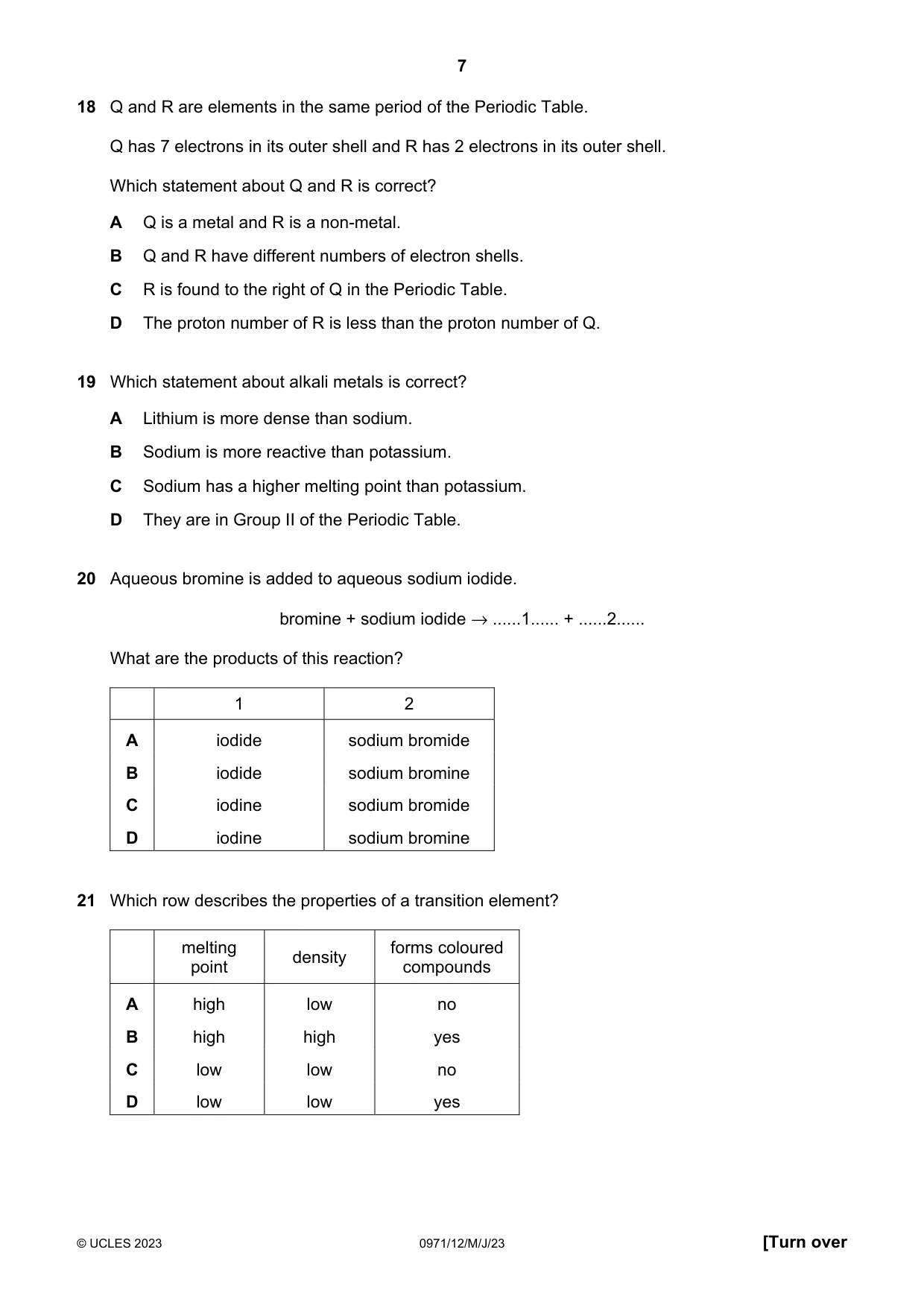
18 Q and R are elements in the same period of the Periodic Table. Q has 7 electrons in its outer shell and R has 2 electrons in its outer shell. Which statement about Q and R is correct? A Q is a metal and R is a non-metal. B Q and R have different numbers of electron shells. C R is found to the right of Q in the Periodic Table. D The proton number of R is less than the proton number of Q.
Mark scheme: D
Q19 · Which statement about alkali metals is correct?
19 Which statement about alkali metals is correct? A Lithium is more dense than sodium. B Sodium is more reactive than potassium. C Sodium has a higher melting point than potassium. D They are in Group II of the Periodic Table.
Mark scheme: C
Q20 · Aqueous bromine is added to aqueous sodium iodide
20 Aqueous bromine is added to aqueous sodium iodide. bromine + sodium iodide → ......1...... + ......2...... What are the products of this reaction? 1 2 A iodide sodium bromide B iodide sodium bromine C iodine sodium bromide D iodine sodium bromine
Mark scheme: C
Q21 · Which row describes the properties of a transition element?
21 Which row describes the properties of a transition element? melting forms coloured density point compounds A high low no B high high yes C low low no D low low yes
Mark scheme: B
Q22 · Which row describes the properties of argon?
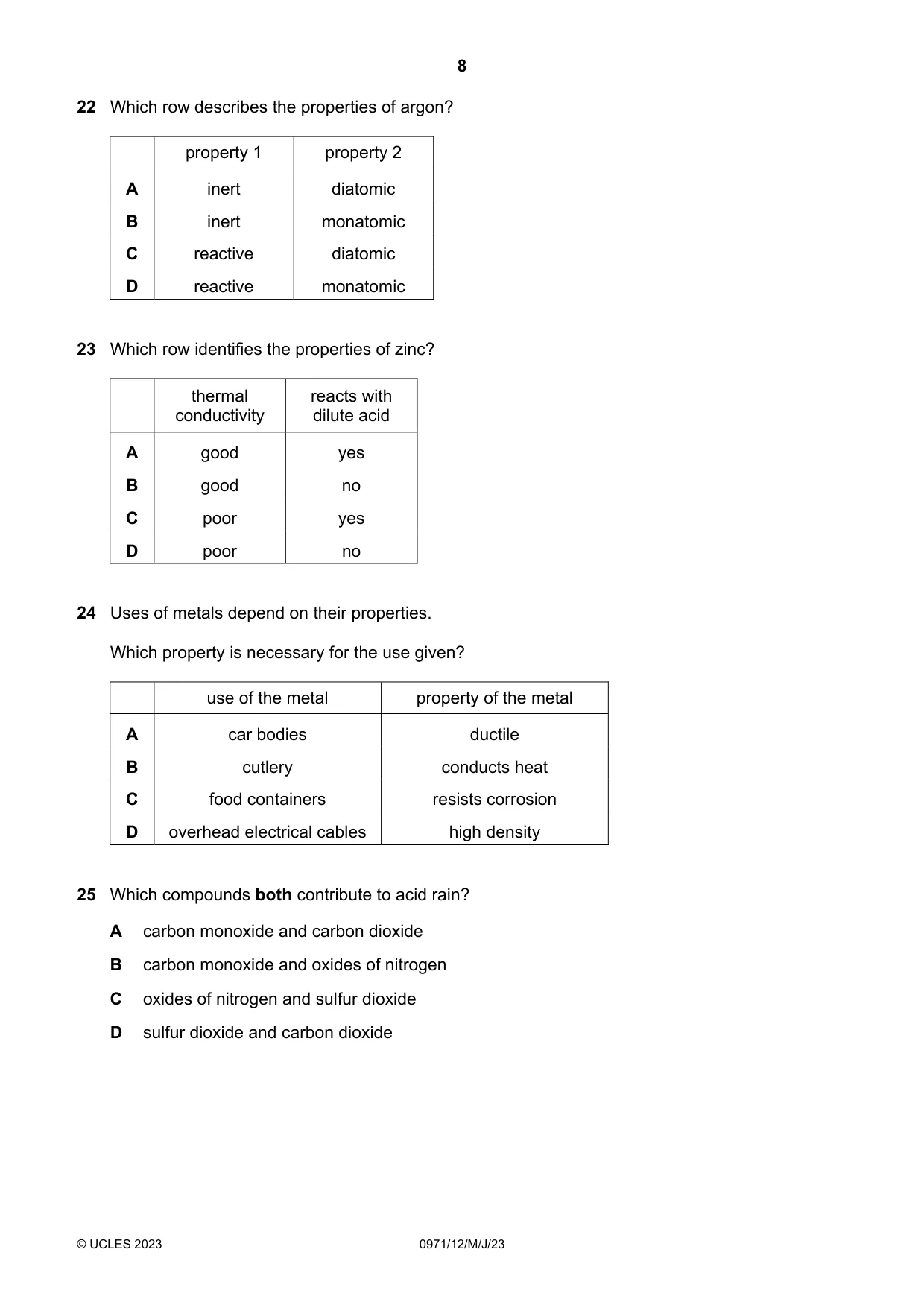
22 Which row describes the properties of argon? property 1 property 2 A inert diatomic B inert monatomic C reactive diatomic D reactive monatomic
Mark scheme: B
Q23 · Which row identifies the properties of zinc?
23 Which row identifies the properties of zinc? thermal reacts with conductivity dilute acid A good yes B good no C poor yes D poor no
Mark scheme: A
Q24 · Uses of metals depend on their properties
24 Uses of metals depend on their properties. Which property is necessary for the use given? use of the metal property of the metal A car bodies ductile B cutlery conducts heat C food containers resists corrosion D overhead electrical cables high density
Mark scheme: C
Q25 · Which compounds both contribute to acid rain?
25 Which compounds both contribute to acid rain? A carbon monoxide and carbon dioxide B carbon monoxide and oxides of nitrogen C oxides of nitrogen and sulfur dioxide D sulfur dioxide and carbon dioxide
Mark scheme: C
Q26 · P, Q, R and S are metals
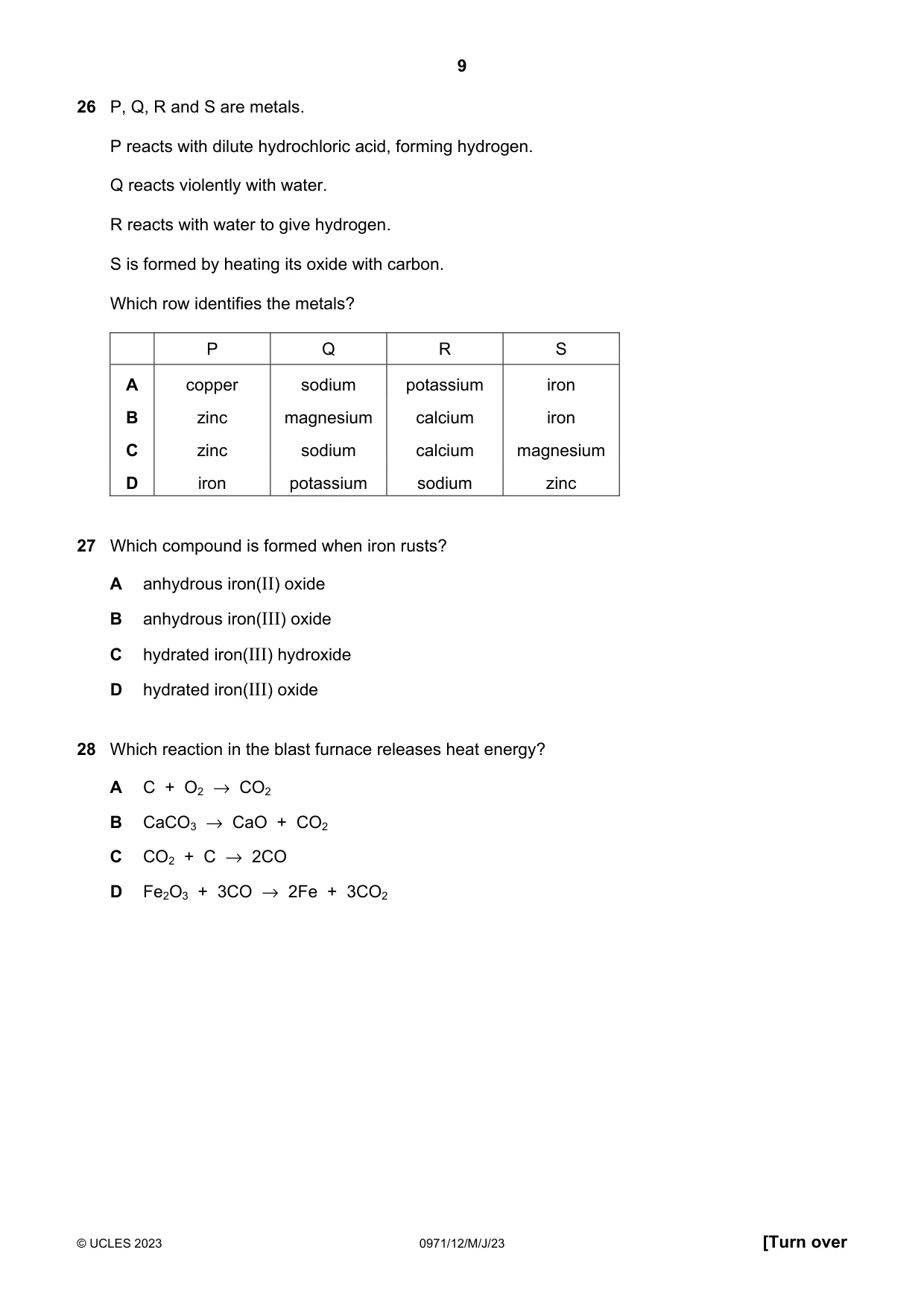
26 P, Q, R and S are metals. P reacts with dilute hydrochloric acid, forming hydrogen. Q reacts violently with water. R reacts with water to give hydrogen. S is formed by heating its oxide with carbon. Which row identifies the metals? P Q R S A copper sodium potassium iron B zinc magnesium calcium iron C zinc sodium calcium magnesium D iron potassium sodium zinc
Mark scheme: D
Q27 · Which compound is formed when iron rusts?
27 Which compound is formed when iron rusts? A anhydrous iron(II) oxide B anhydrous iron(III) oxide C hydrated iron(III) hydroxide D hydrated iron(III) oxide
Mark scheme: D
Q28 · Which reaction in the blast furnace releases heat energy?
28 Which reaction in the blast furnace releases heat energy? A C + O2 → CO2 B CaCO3 → CaO + CO2 C CO2 + C → 2CO D Fe2O3 + 3CO → 2Fe + 3CO2
Mark scheme: A
Q29 · A wax candle is made from a mixture of hydrocarbons
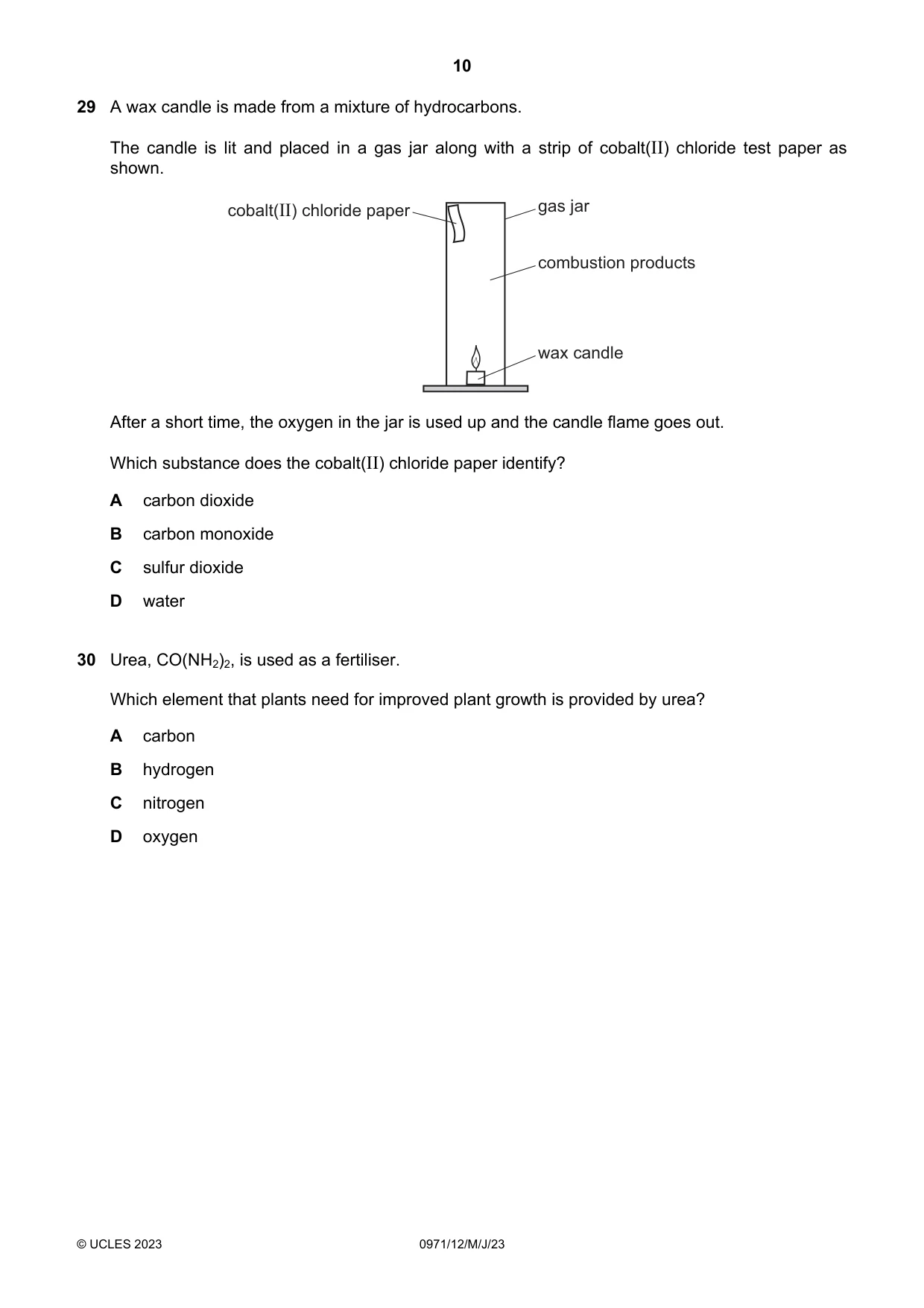
29 A wax candle is made from a mixture of hydrocarbons. The candle is lit and placed in a gas jar along with a strip of cobalt(II) chloride test paper as shown. cobalt(II) chloride paper gas jar combustion products wax candle After a short time, the oxygen in the jar is used up and the candle flame goes out. Which substance does the cobalt(II) chloride paper identify? A carbon dioxide B carbon monoxide C sulfur dioxide D water
Mark scheme: D
Q30 · Urea, CO(NH2)2, is used as a fertiliser
30 Urea, CO(NH2)2, is used as a fertiliser. Which element that plants need for improved plant growth is provided by urea? A carbon B hydrogen C nitrogen D oxygen
Mark scheme: C
Q31 · The percentage composition of gases on Neptune is shown
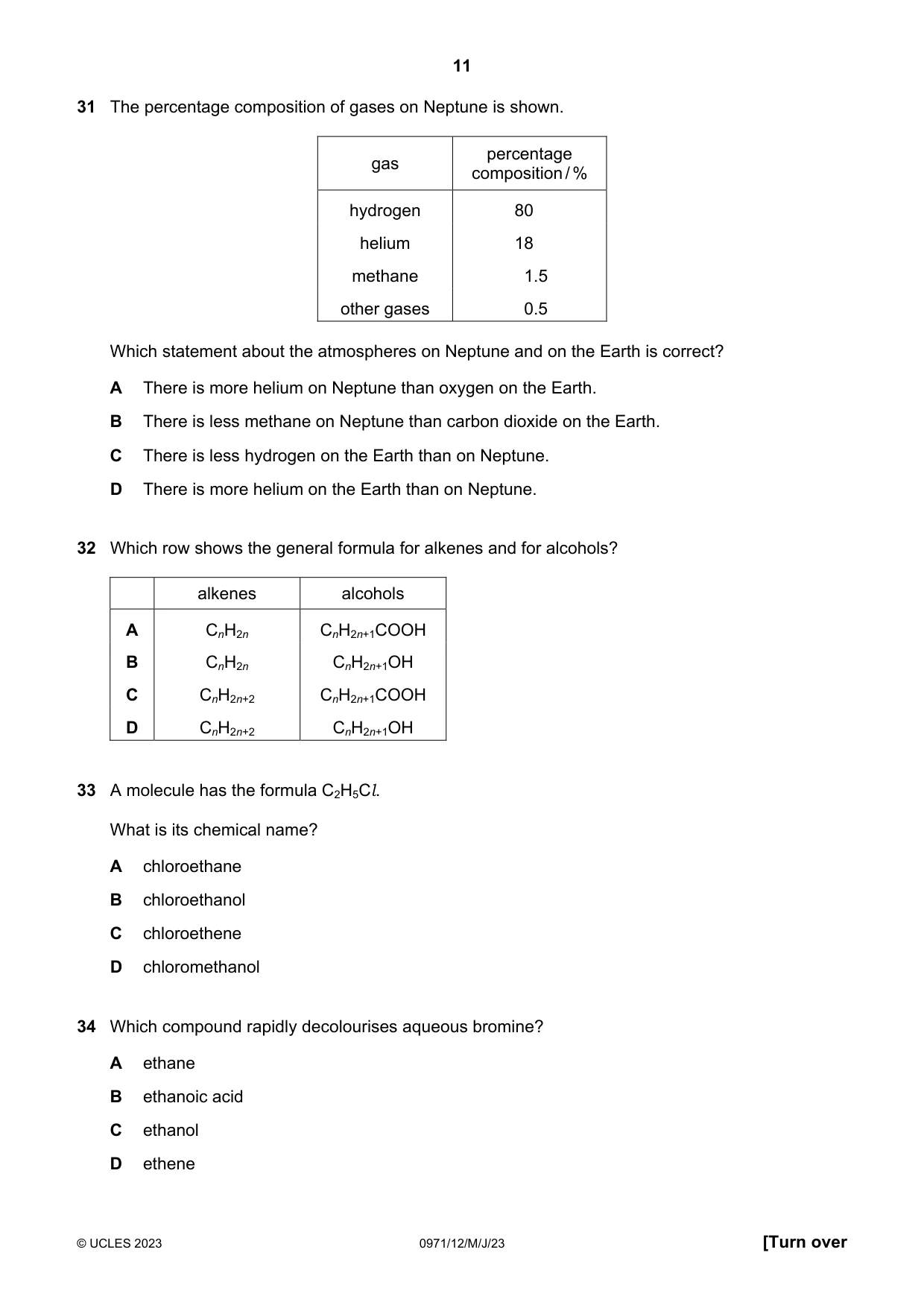
31 The percentage composition of gases on Neptune is shown. percentage gas composition / % hydrogen 80 helium 18 methane 1.5 other gases 0.5 Which statement about the atmospheres on Neptune and on the Earth is correct? A There is more helium on Neptune than oxygen on the Earth. B There is less methane on Neptune than carbon dioxide on the Earth. C There is less hydrogen on the Earth than on Neptune. D There is more helium on the Earth than on Neptune.
Mark scheme: C
Q32 · Which row shows the general formula for alkenes and for alcohols?
32 Which row shows the general formula for alkenes and for alcohols? alkenes alcohols A CnH2n CnH2n+1COOH B CnH2n CnH2n+1OH C CnH2n+2 CnH2n+1COOH D CnH2n+2 CnH2n+1OH
Mark scheme: B
More questions on Formulae, functional groups and terminology
Q33 · A molecule has the formula C2H5Cl
33 A molecule has the formula C2H5Cl. What is its chemical name? A chloroethane B chloroethanol C chloroethene D chloromethanol
Mark scheme: A
Q34 · Which compound rapidly decolourises aqueous bromine?
34 Which compound rapidly decolourises aqueous bromine? A ethane B ethanoic acid C ethanol D ethene
Mark scheme: D
Q35 · Compound Z has the molecular formula C2H6O
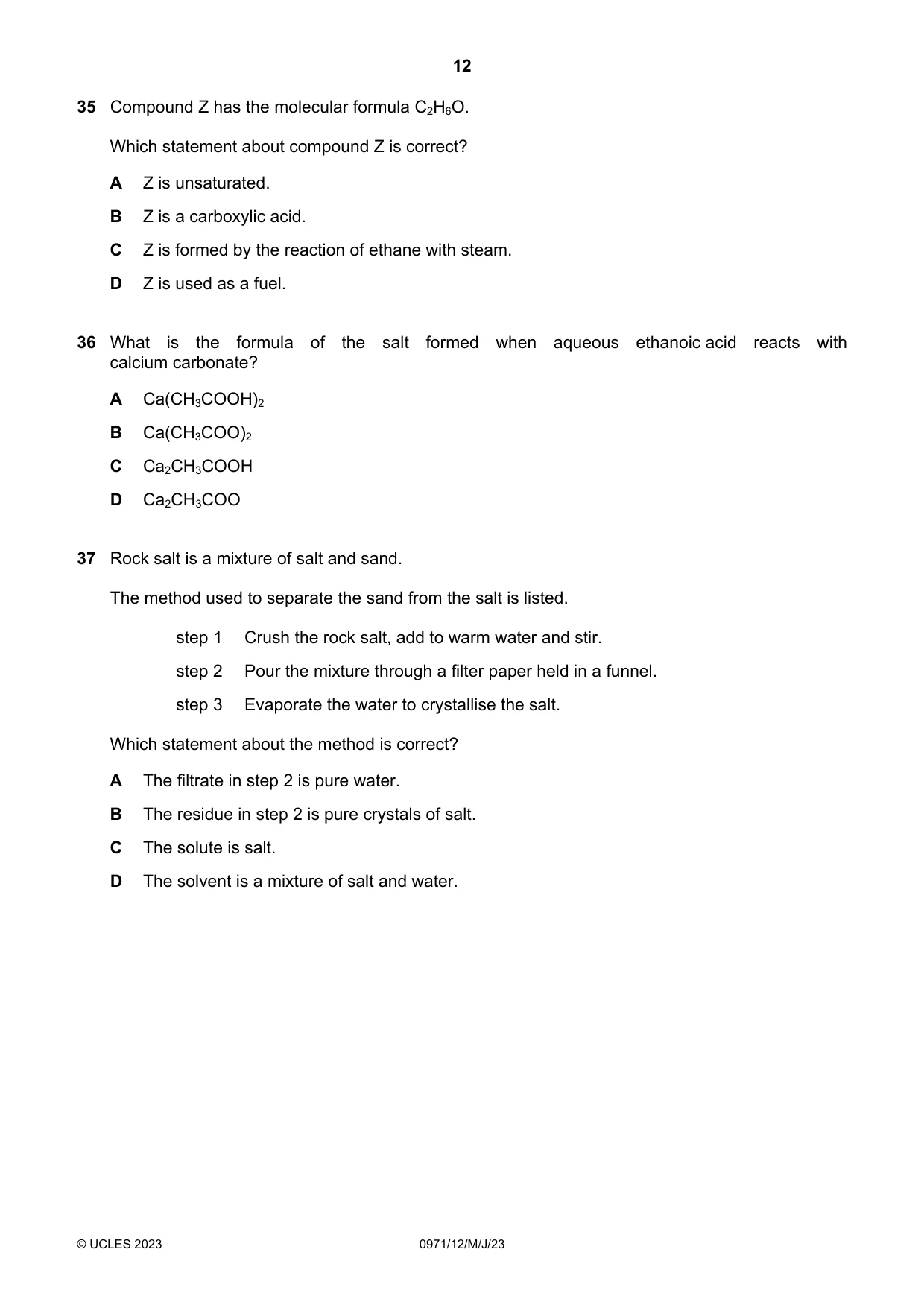
35 Compound Z has the molecular formula C2H6O. Which statement about compound Z is correct? A Z is unsaturated. B Z is a carboxylic acid. C Z is formed by the reaction of ethane with steam. D Z is used as a fuel.
Mark scheme: D
Q36 · What is the formula of the salt formed when aqueous ethanoic acid reacts with calcium…
36 What is the formula of the salt formed when aqueous ethanoic acid reacts with calcium carbonate? A Ca(CH3COOH)2 B Ca(CH3COO)2 C Ca2CH3COOH D Ca2CH3COO
Mark scheme: B
Q37 · Rock salt is a mixture of salt and sand
37 Rock salt is a mixture of salt and sand. The method used to separate the sand from the salt is listed. step 1 Crush the rock salt, add to warm water and stir. step 2 Pour the mixture through a filter paper held in a funnel. step 3 Evaporate the water to crystallise the salt. Which statement about the method is correct? A The filtrate in step 2 is pure water. B The residue in step 2 is pure crystals of salt. C The solute is salt. D The solvent is a mixture of salt and water.
Mark scheme: C
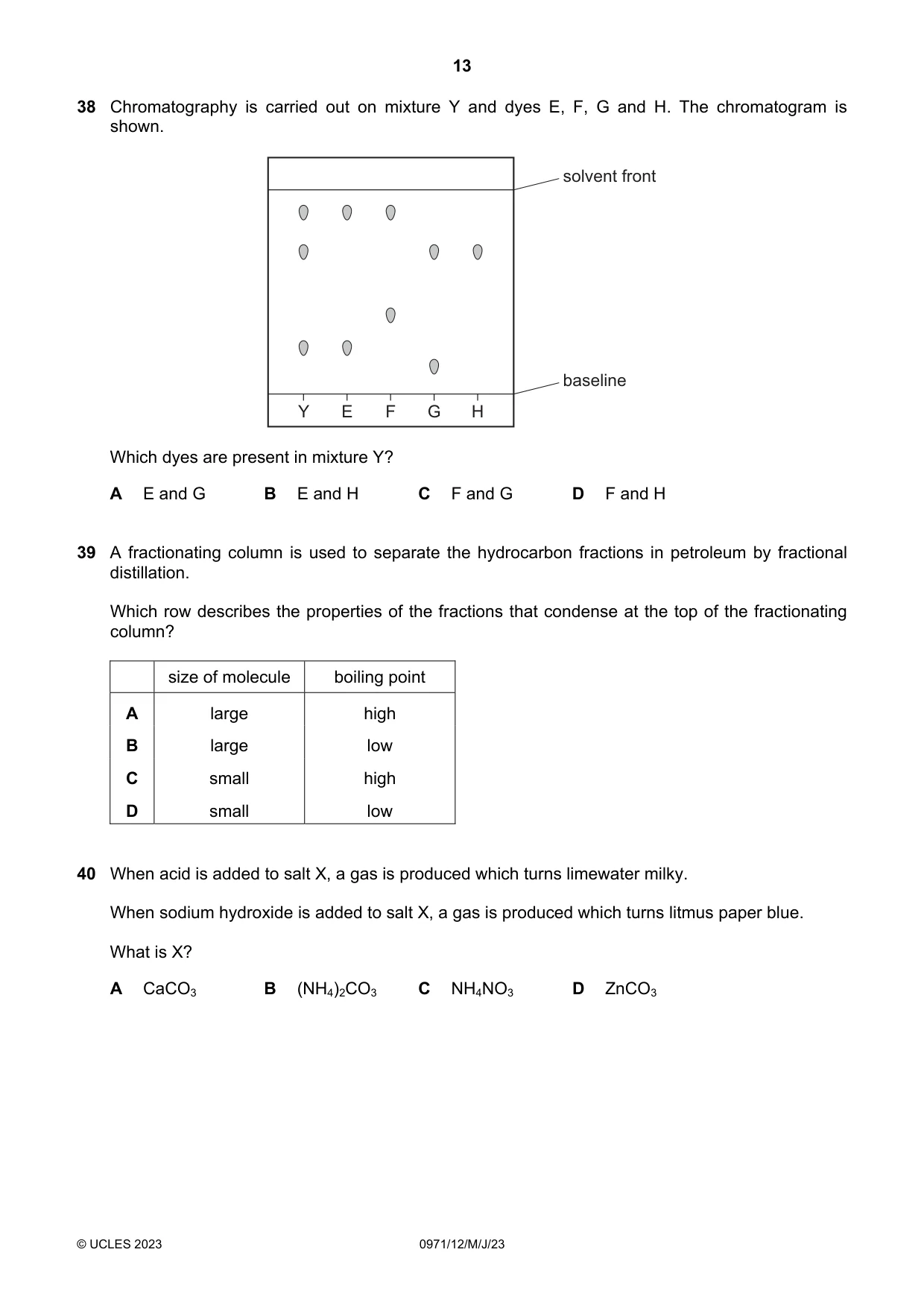
Q38 · Chromatography is carried out on mixture Y and dyes E, F, G and H
38 Chromatography is carried out on mixture Y and dyes E, F, G and H. The chromatogram is shown. solvent front baseline Y E F G H Which dyes are present in mixture Y? A E and G B E and H C F and G D F and H
Mark scheme: B
Q39 · A fractionating column is used to separate the hydrocarbon fractions in petroleum by…
39 A fractionating column is used to separate the hydrocarbon fractions in petroleum by fractional distillation. Which row describes the properties of the fractions that condense at the top of the fractionating column? size of molecule boiling point A large high B large low C small high D small low
Mark scheme: D
Q40 · When acid is added to salt X, a gas is produced which turns limewater milky
40 When acid is added to salt X, a gas is produced which turns limewater milky. When sodium hydroxide is added to salt X, a gas is produced which turns litmus paper blue. What is X? A CaCO3 B (NH4)2CO3 C NH4NO3 D ZnCO3
Mark scheme: B
What was in this paper
The subtopics covered by these 40 questions, and how many questions each got. Open one in a new tab to see every Cambridge question on it.
2Identification of ions and gases2Preparation of salts2Separation and purification2Alcohols1Alkenes1Arrangement of elements1Atomic structure and the Periodic Table1Carboxylic acids1Chromatography1Corrosion of metals1Electrolysis1Elements, compounds and mixtures1Exothermic and endothermic reactions1Extraction of metals1Fertilisers1Formulae1Formulae, functional groups and terminology1Giant covalent structures1Group I properties1Group VII properties1Hydrogen–oxygen fuel cells1Ions and ionic bonds1Naming organic compounds1Noble gases1Oxides1Properties of metals1Rate of reaction1Reactivity series1Redox1Relative masses of atoms and molecules1Reversible reactions and equilibrium1Simple molecules and covalent bonds1Solids, liquids and gases1Transition elements1Uses of metals1What you needed in this session
Cambridge’s own grade thresholds for 2023 May/June, Paper 1 · Variant 2. A higher threshold means an easier paper — the bar moves with how the cohort did.