Cambridge IGCSE Chemistry (9-1) 0971 — 2024 May/June Paper 1 · Variant 2
0971/12/M/J/24 · 40 questions · 40 marks · 45 min
The question paper and its mark scheme, free to read here and free to download. This is Cambridge’s own paper, exactly as it was sat.
Question paper16 pages
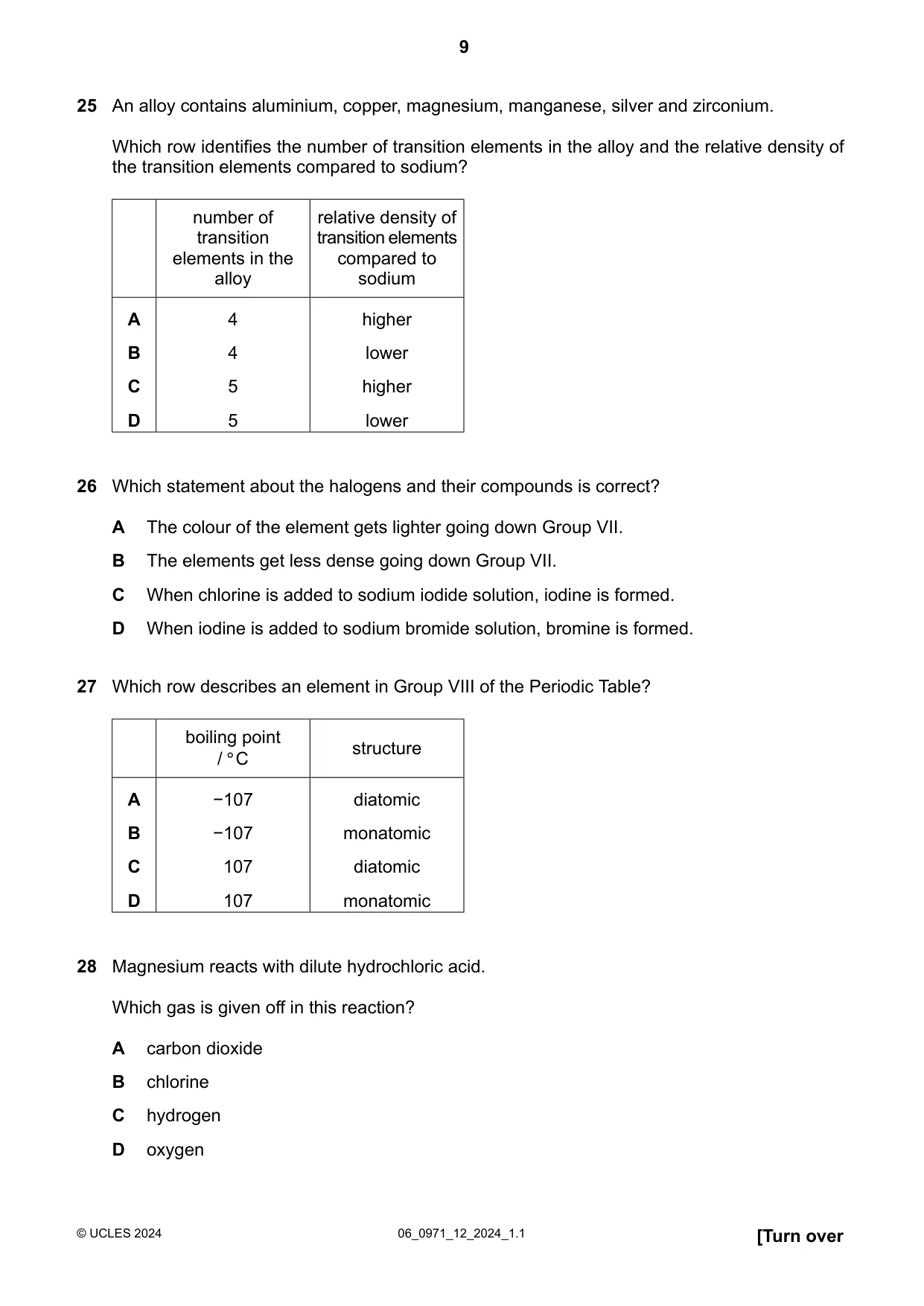
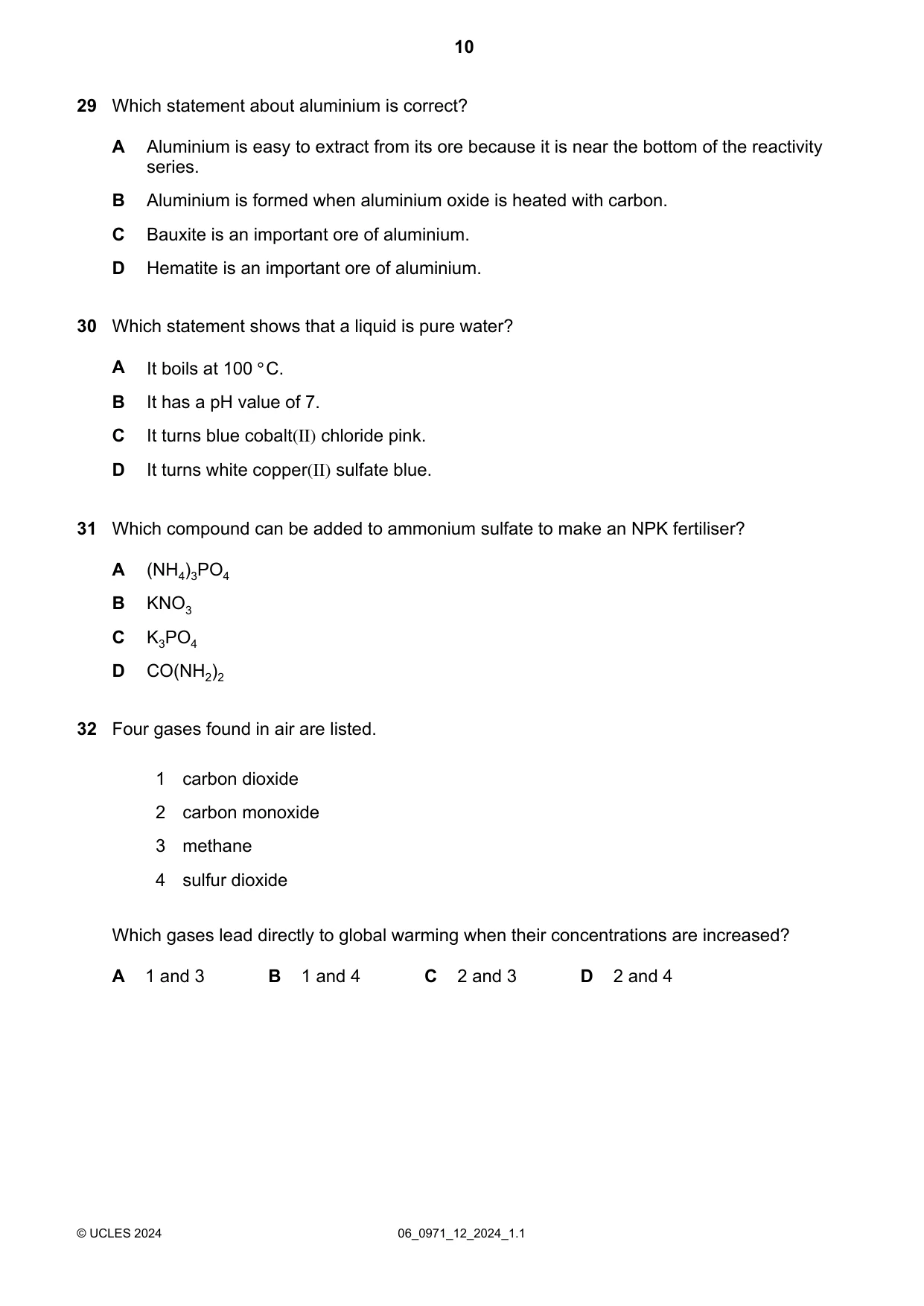
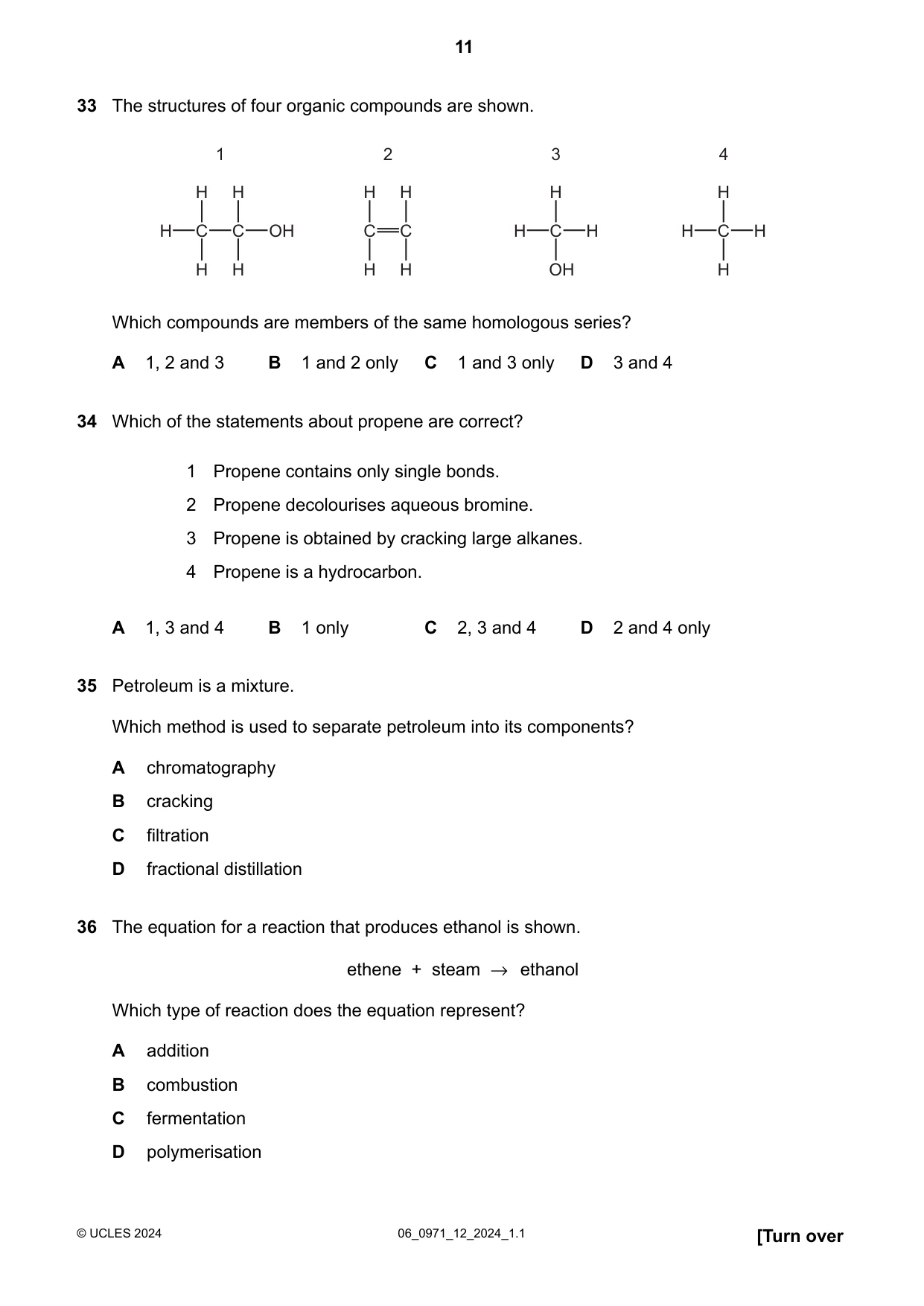
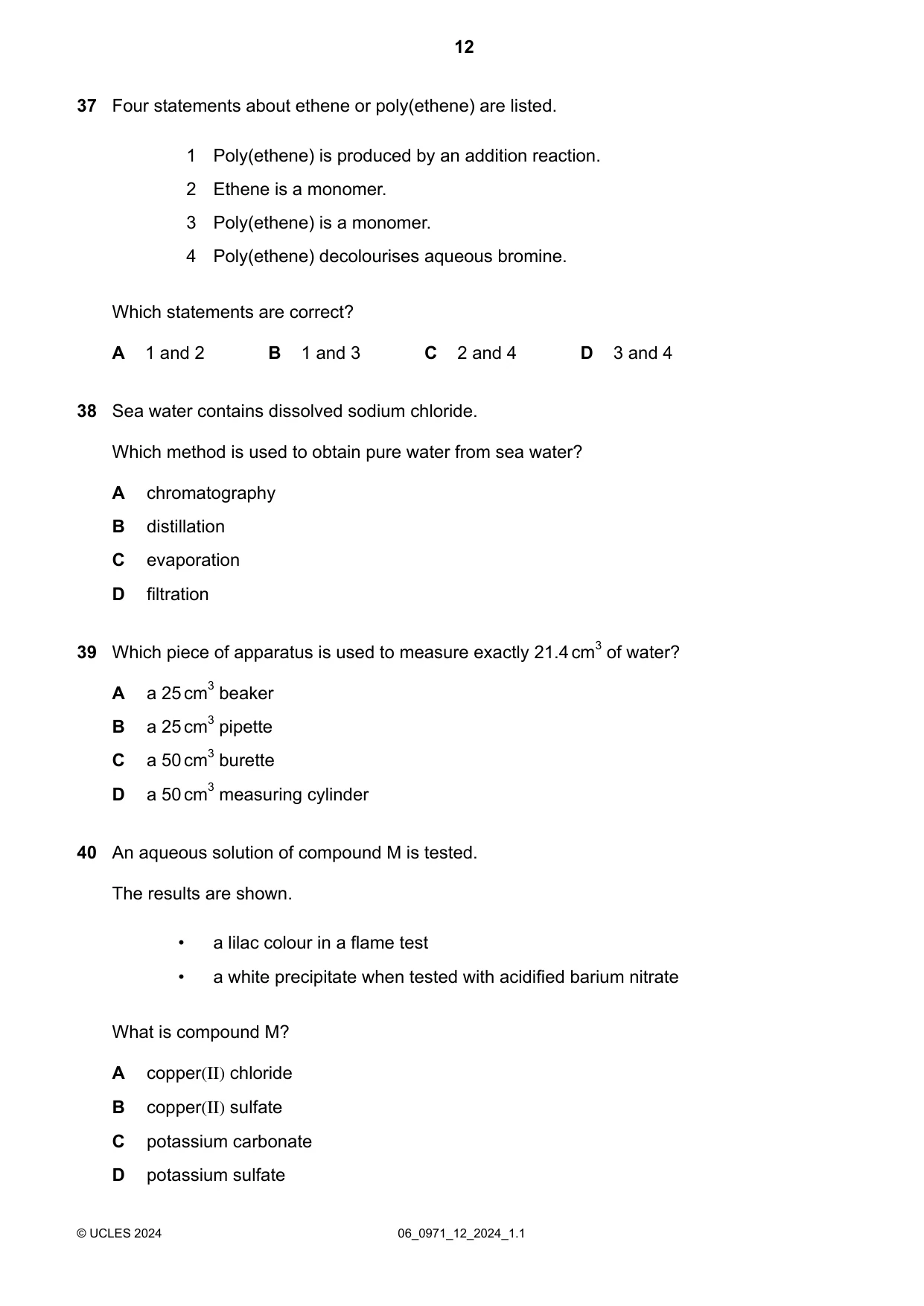


Mark scheme3 pages
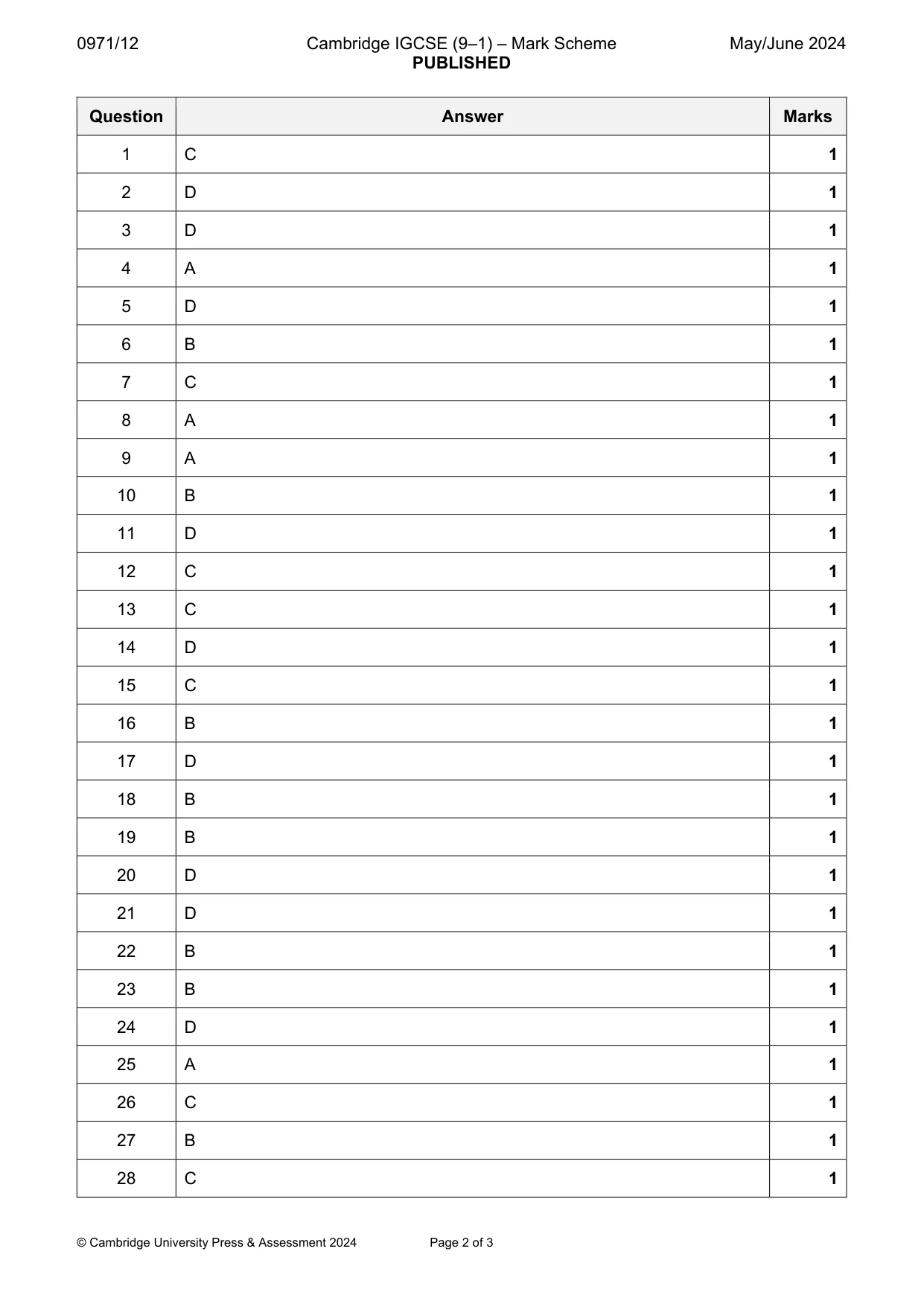
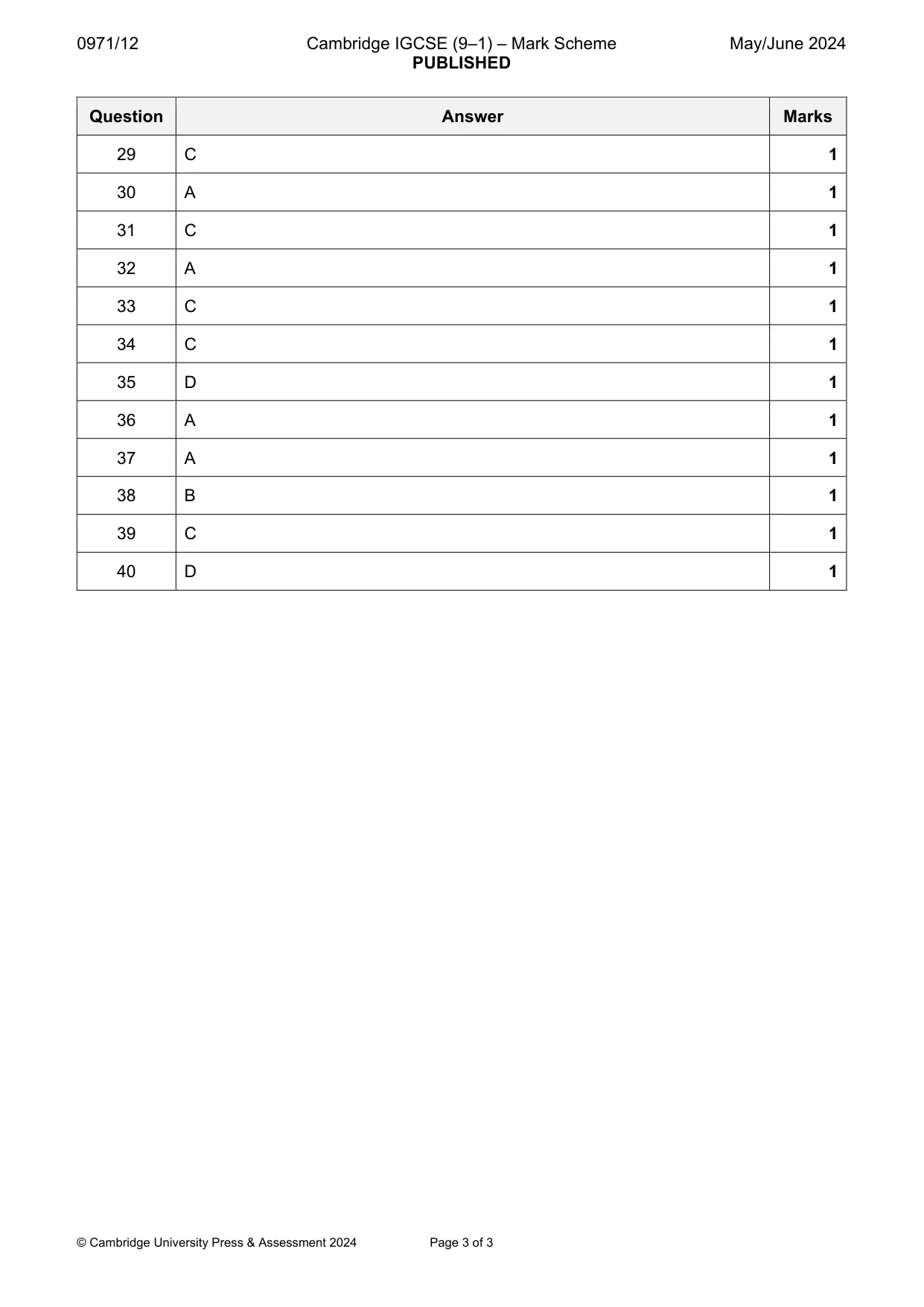
Answers below. Sit the paper first if you are practising.
Questions as text
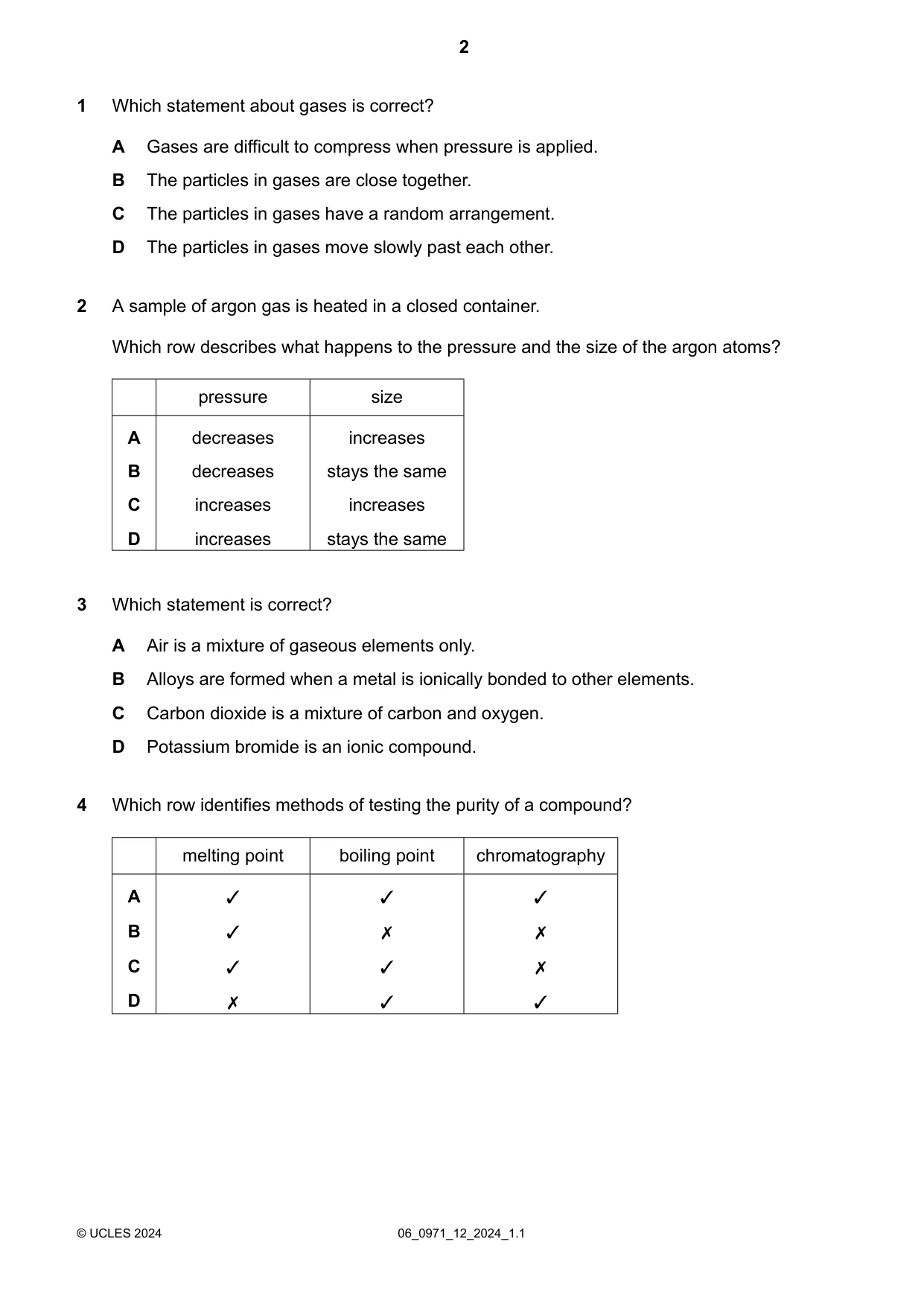
Q1 · Which statement about gases is correct?
1 Which statement about gases is correct? A Gases are difficult to compress when pressure is applied. B The particles in gases are close together. C The particles in gases have a random arrangement. D The particles in gases move slowly past each other.
Mark scheme: C
Q2 · A sample of argon gas is heated in a closed container
2 A sample of argon gas is heated in a closed container. Which row describes what happens to the pressure and the size of the argon atoms? pressure size A decreases increases B decreases stays the same C increases increases D increases stays the same
Mark scheme: D
Q3 · Which statement is correct?
3 Which statement is correct? A Air is a mixture of gaseous elements only. B Alloys are formed when a metal is ionically bonded to other elements. C Carbon dioxide is a mixture of carbon and oxygen. D Potassium bromide is an ionic compound.
Mark scheme: D
Q4 · Which row identifies methods of testing the purity of a compound?
4 Which row identifies methods of testing the purity of a compound? melting point boiling point chromatography A ✓ ✓ ✓ B ✓ ✗ ✗ C ✓ ✓ ✗ D ✗ ✓ ✓
Mark scheme: A
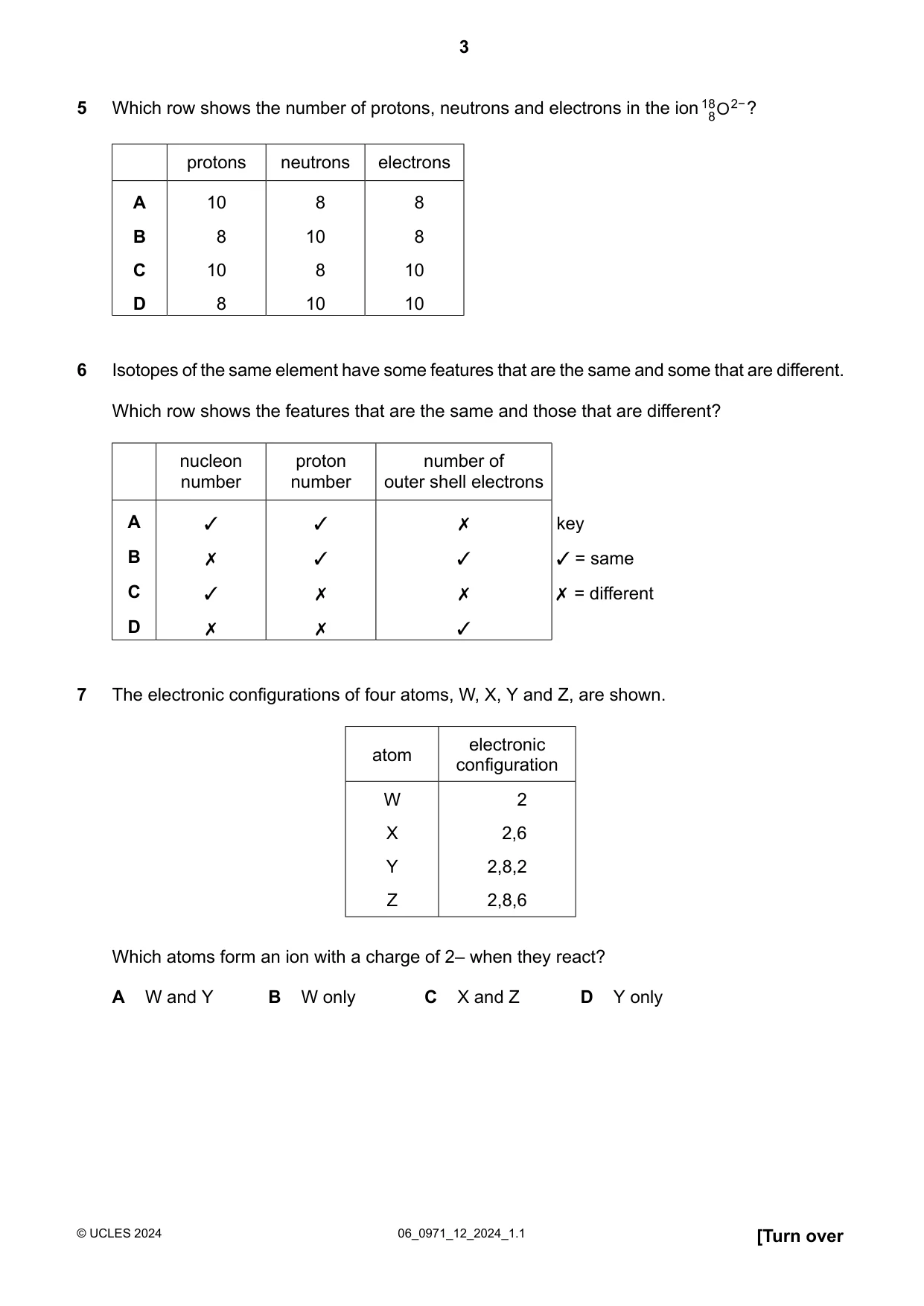
Q5 · Which row shows the number of protons, neutrons and electrons in the ion ?
5 Which row shows the number of protons, neutrons and electrons in the ion ? protons neutrons electrons A 10 8 8 B 8 10 8 C 10 8 10 D 8 10 10
Mark scheme: D
Q6 · Isotopes of the same element have some features that are the same and some that are…
6 Isotopes of the same element have some features that are the same and some that are different. Which row shows the features that are the same and those that are different? nucleon proton number of number number outer shell electrons A ✓ ✓ ✗ key B ✗ ✓ ✓ ✓= same C ✓ ✗ ✗ ✗= different D ✗ ✗ ✓
Mark scheme: B
Q7 · The electronic configurations of four atoms, W, X, Y and Z, are shown
7 The electronic configurations of four atoms, W, X, Y and Z, are shown. electronic atom configuration W 2 X 2,6 Y 2,8,2 Z 2,8,6 Which atoms form an ion with a charge of 2– when they react? A W and Y B W only C X and Z D Y only
Mark scheme: C
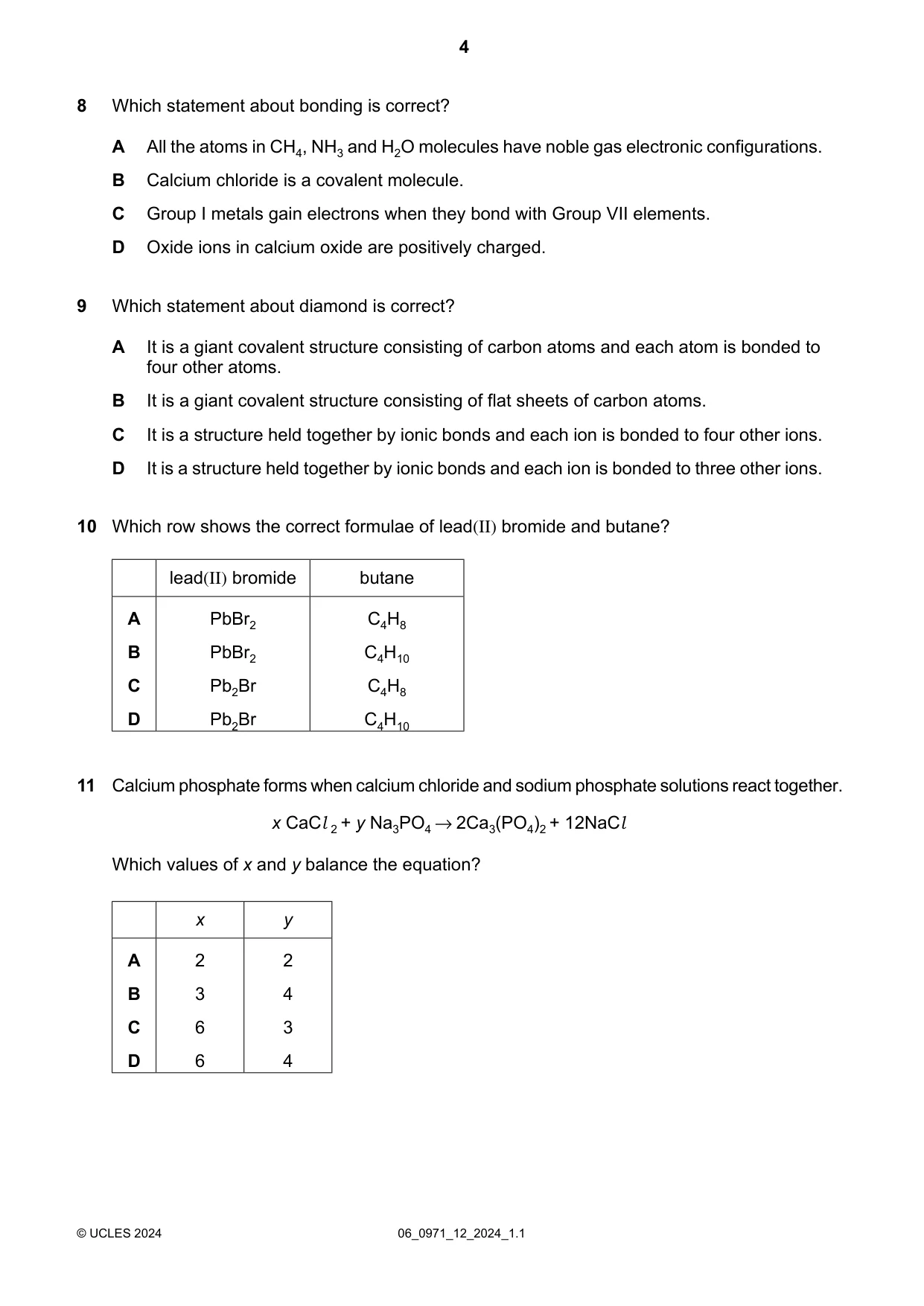
Q8 · Which statement about bonding is correct?
8 Which statement about bonding is correct? A All the atoms in CH4, NH3 and H2O molecules have noble gas electronic configurations. B Calcium chloride is a covalent molecule. C Group I metals gain electrons when they bond with Group VII elements. D Oxide ions in calcium oxide are positively charged.
Mark scheme: A
Q9 · Which statement about diamond is correct?
9 Which statement about diamond is correct? A It is a giant covalent structure consisting of carbon atoms and each atom is bonded to four other atoms. B It is a giant covalent structure consisting of flat sheets of carbon atoms. C It is a structure held together by ionic bonds and each ion is bonded to four other ions. D It is a structure held together by ionic bonds and each ion is bonded to three other ions.
Mark scheme: A
Q10 · Which row shows the correct formulae of lead(II) bromide and butane?
10 Which row shows the correct formulae of lead(II) bromide and butane? lead(II) bromide butane A PbBr2 C4H8 B PbBr2 C4H10 C Pb2Br C4H8 D Pb2Br C4H10
Mark scheme: B
Q11 · Calcium phosphate forms when calcium chloride and sodium phosphate solutions react…
11 Calcium phosphate forms when calcium chloride and sodium phosphate solutions react together. x CaCl 2 + y Na3PO4 → 2Ca3(PO4)2 + 12NaCl Which values of x and y balance the equation? x y A 2 2 B 3 4 C 6 3 D 6 4
Mark scheme: D
Q12 · What is the definition of relative molecular mass, Mr?
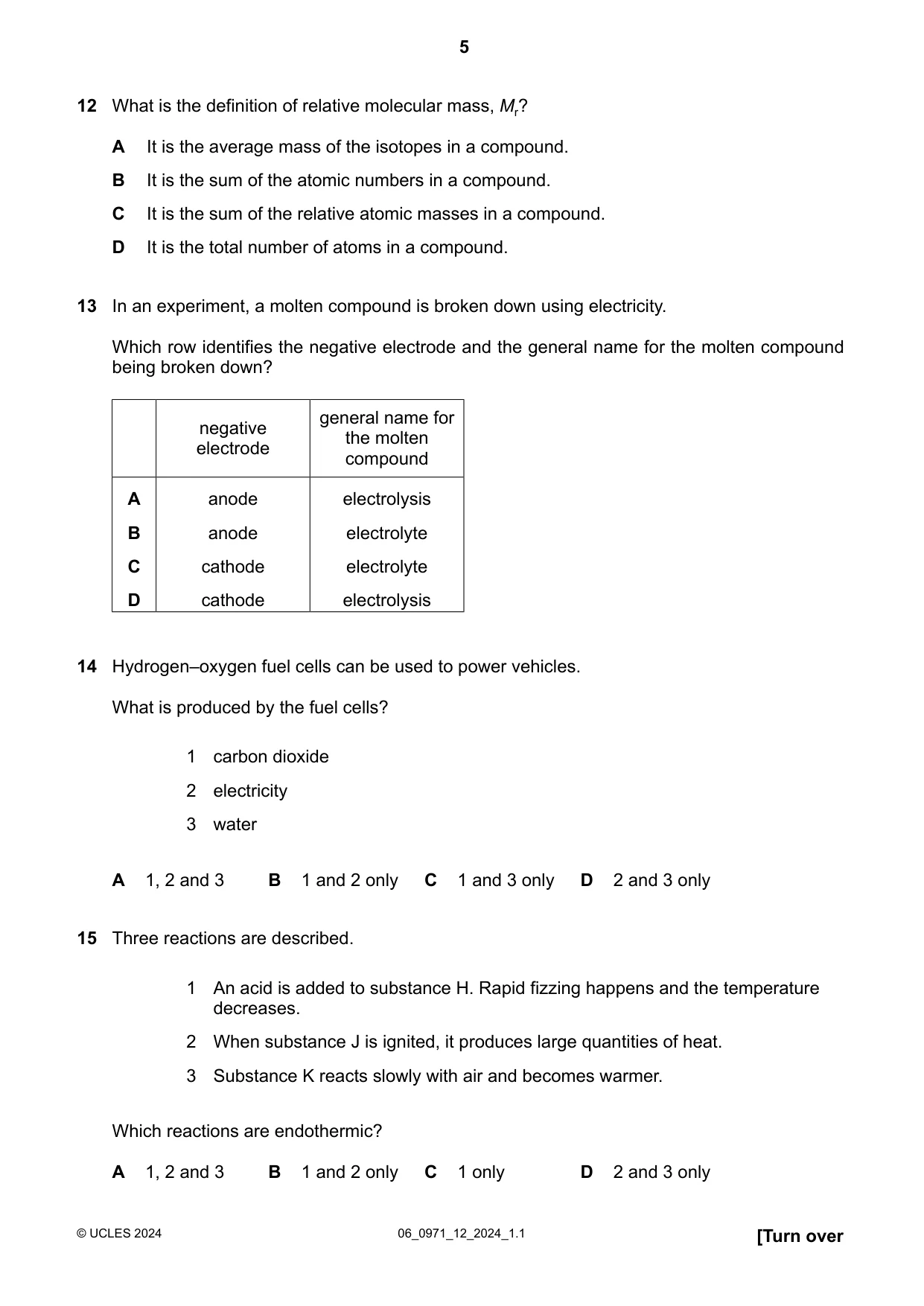
12 What is the definition of relative molecular mass, Mr? A It is the average mass of the isotopes in a compound. B It is the sum of the atomic numbers in a compound. C It is the sum of the relative atomic masses in a compound. D It is the total number of atoms in a compound.
Mark scheme: C
Q13 · In an experiment, a molten compound is broken down using electricity
13 In an experiment, a molten compound is broken down using electricity. Which row identifies the negative electrode and the general name for the molten compound being broken down? general name for negative the molten electrode compound A anode electrolysis B anode electrolyte C cathode electrolyte D cathode electrolysis
Mark scheme: C
Q14 · Hydrogen–oxygen fuel cells can be used to power vehicles
14 Hydrogen–oxygen fuel cells can be used to power vehicles. What is produced by the fuel cells? 1 carbon dioxide 2 electricity 3 water A 1, 2 and 3 B 1 and 2 only C 1 and 3 only D 2 and 3 only
Mark scheme: D
Q15 · Three reactions are described
15 Three reactions are described. 1 An acid is added to substance H. Rapid fizzing happens and the temperature decreases. 2 When substance J is ignited, it produces large quantities of heat. 3 Substance K reacts slowly with air and becomes warmer. Which reactions are endothermic? A 1, 2 and 3 B 1 and 2 only C 1 only D 2 and 3 only
Mark scheme: C
Q16 · Which of the processes produces a physical change?
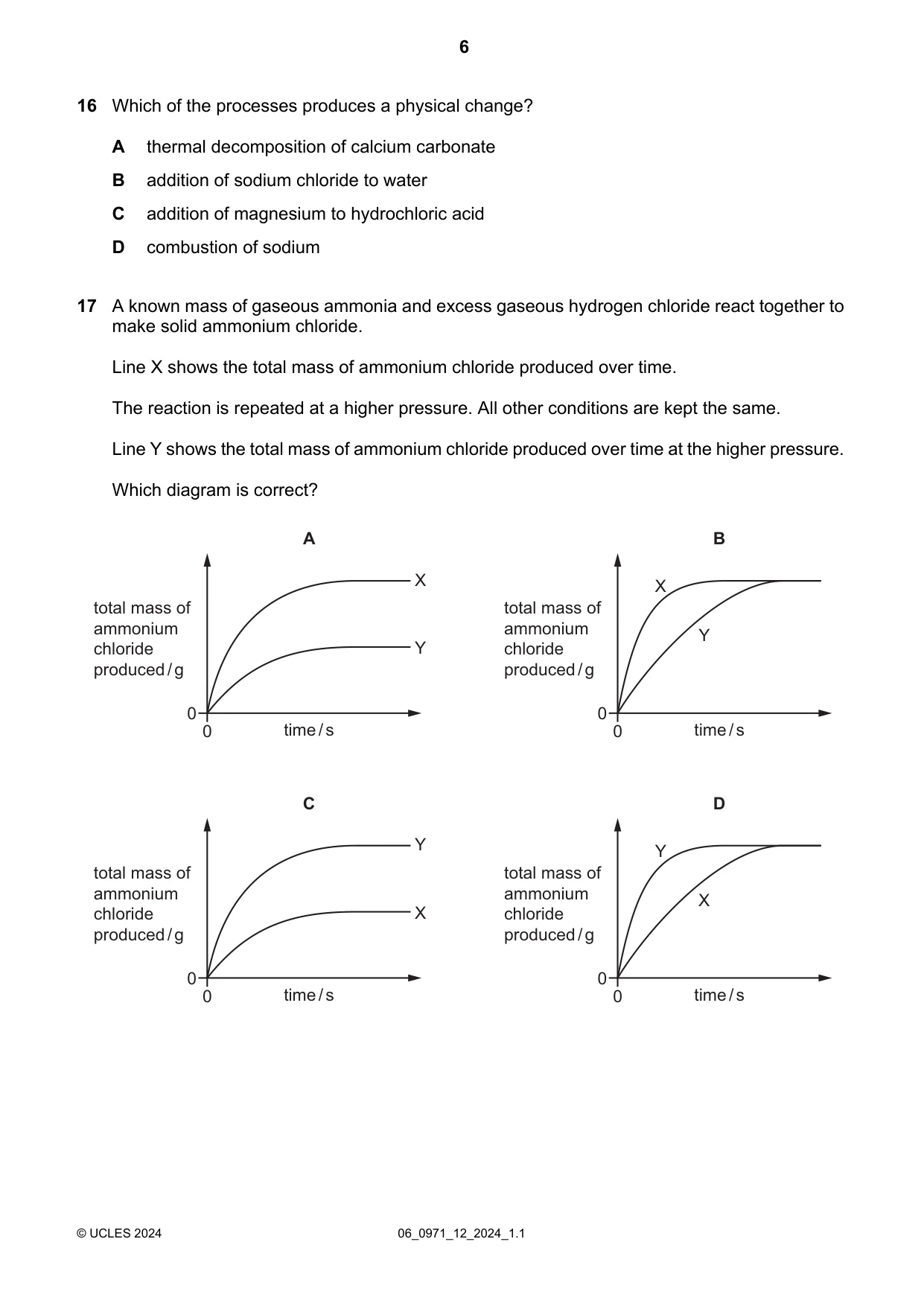
16 Which of the processes produces a physical change? A thermal decomposition of calcium carbonate B addition of sodium chloride to water C addition of magnesium to hydrochloric acid D combustion of sodium
Mark scheme: B
Q17 · A known mass of gaseous ammonia and excess gaseous hydrogen chloride react together to…
17 A known mass of gaseous ammonia and excess gaseous hydrogen chloride react together to make solid ammonium chloride. Line X shows the total mass of ammonium chloride produced over time. The reaction is repeated at a higher pressure. All other conditions are kept the same. Line Y shows the total mass of ammonium chloride produced over time at the higher pressure. Which diagram is correct? A B X X total mass of total mass of ammonium ammonium Y chloride Y chloride produced / g produced / g 0 0 0 time / s 0 time / s C D Y Y total mass of total mass of ammonium ammonium X chloride X chloride produced / g produced / g 0 0 0 time / s 0 time / s
Mark scheme: D
Q18 · The equation for the hydration of anhydrous copper(II) sulfate is shown
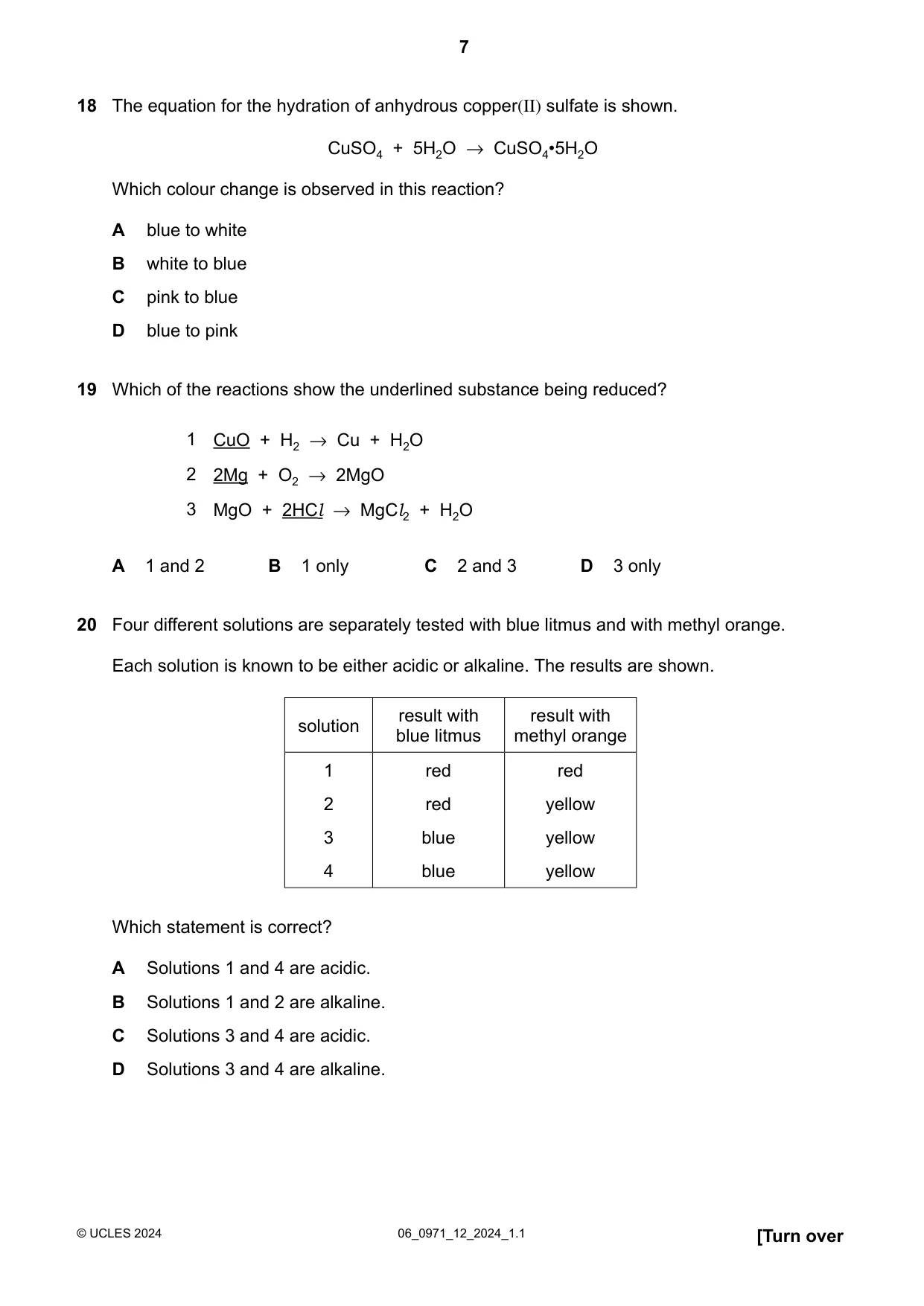
18 The equation for the hydration of anhydrous copper(II) sulfate is shown. CuSO4 + 5H2O →CuSO4•5H2O Which colour change is observed in this reaction? A blue to white B white to blue C pink to blue D blue to pink
Mark scheme: B
Q19 · Which of the reactions show the underlined substance being reduced?
19 Which of the reactions show the underlined substance being reduced? 1 CuO + H2 →Cu + H2O 2 2Mg + O2 →2MgO 3 MgO + 2HCl →MgCl2 + H2O A 1 and 2 B 1 only C 2 and 3 D 3 only
Mark scheme: B
Q20 · Four different solutions are separately tested with blue litmus and with methyl orange
20 Four different solutions are separately tested with blue litmus and with methyl orange. Each solution is known to be either acidic or alkaline. The results are shown. result with result with solution blue litmus methyl orange 1 red red 2 red yellow 3 blue yellow 4 blue yellow Which statement is correct? A Solutions 1 and 4 are acidic. B Solutions 1 and 2 are alkaline. C Solutions 3 and 4 are acidic. D Solutions 3 and 4 are alkaline.
Mark scheme: D
More questions on The characteristic properties of acids and bases
Q21 · Which statement about sulfur dioxide or calcium oxide is correct?
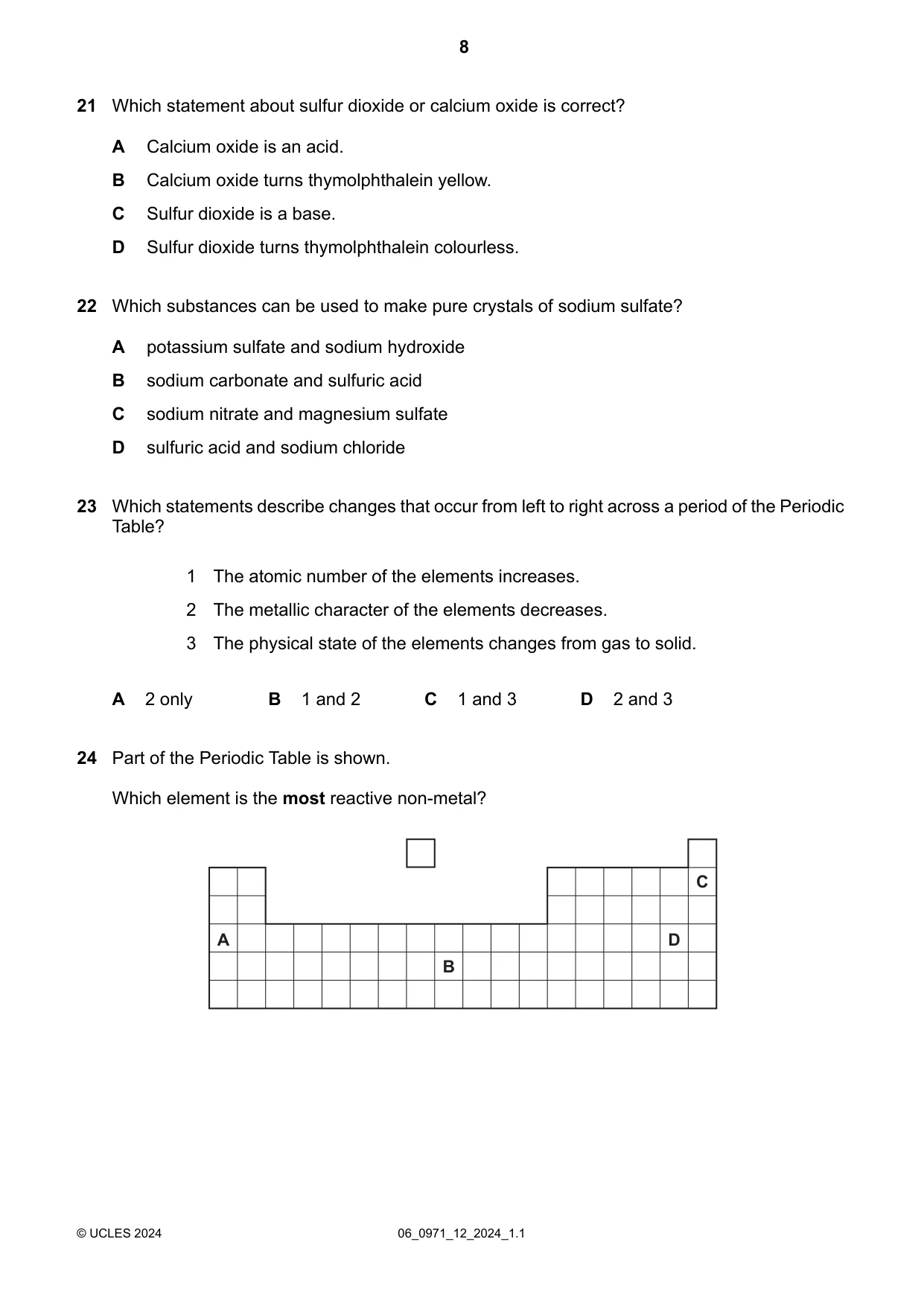
21 Which statement about sulfur dioxide or calcium oxide is correct? A Calcium oxide is an acid. B Calcium oxide turns thymolphthalein yellow. C Sulfur dioxide is a base. D Sulfur dioxide turns thymolphthalein colourless.
Mark scheme: D
Q22 · Which substances can be used to make pure crystals of sodium sulfate?
22 Which substances can be used to make pure crystals of sodium sulfate? A potassium sulfate and sodium hydroxide B sodium carbonate and sulfuric acid C sodium nitrate and magnesium sulfate D sulfuric acid and sodium chloride
Mark scheme: B
Q23 · Which statements describe changes that occur from left to right across a period of the…
23 Which statements describe changes that occur from left to right across a period of the Periodic Table? 1 The atomic number of the elements increases. 2 The metallic character of the elements decreases. 3 The physical state of the elements changes from gas to solid. A 2 only B 1 and 2 C 1 and 3 D 2 and 3
Mark scheme: B
Q24 · Part of the Periodic Table is shown
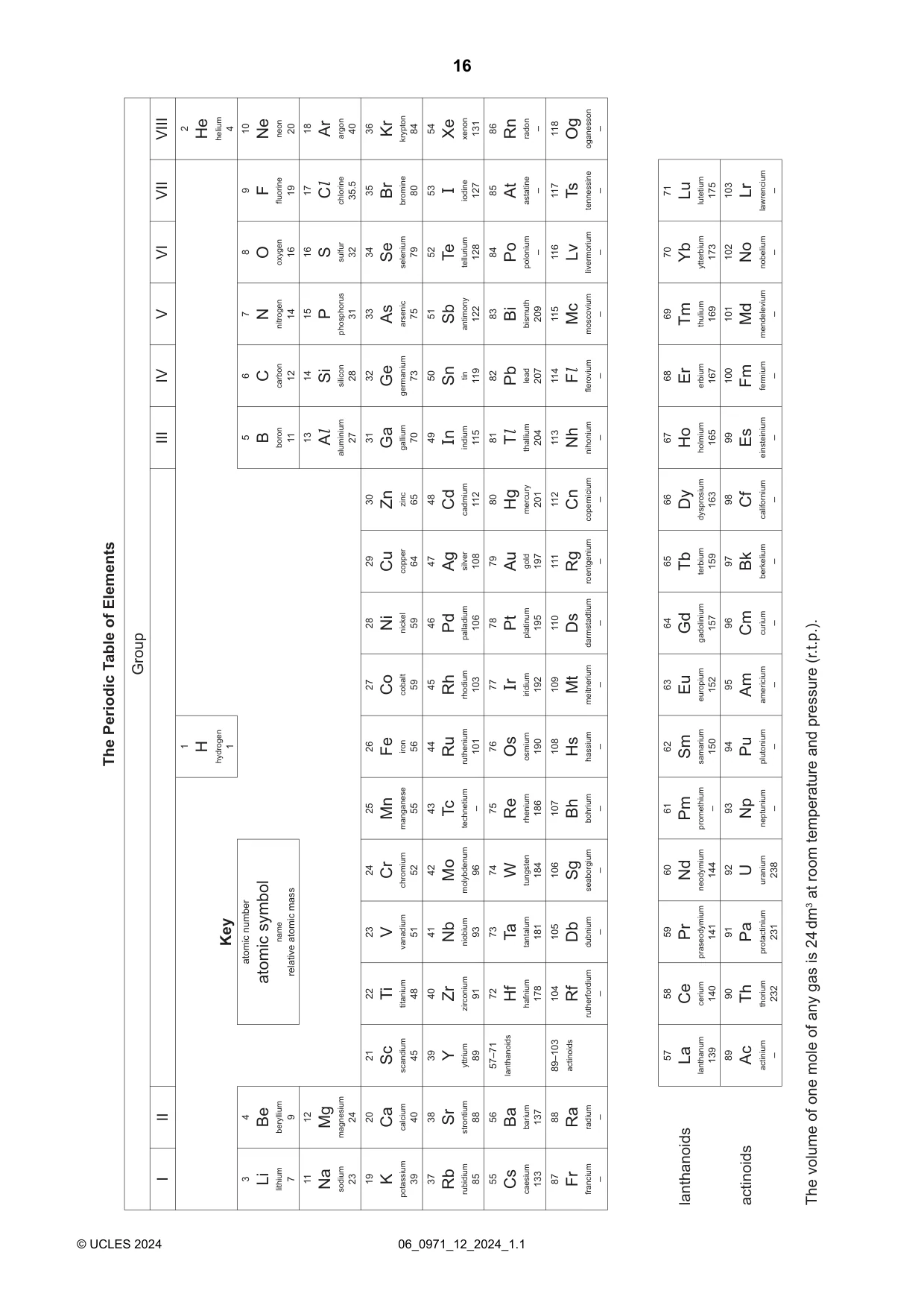
24 Part of the Periodic Table is shown. Which element is the most reactive non-metal? C A D B
Mark scheme: D
Q25 · An alloy contains aluminium, copper, magnesium, manganese, silver and zirconium
25 An alloy contains aluminium, copper, magnesium, manganese, silver and zirconium. Which row identifies the number of transition elements in the alloy and the relative density of the transition elements compared to sodium? number of relative density of transition transition elements elements in the compared to alloy sodium A 4 higher B 4 lower C 5 higher D 5 lower
Mark scheme: A
Q26 · Which statement about the halogens and their compounds is correct?
26 Which statement about the halogens and their compounds is correct? A The colour of the element gets lighter going down Group VII. B The elements get less dense going down Group VII. C When chlorine is added to sodium iodide solution, iodine is formed. D When iodine is added to sodium bromide solution, bromine is formed.
Mark scheme: C
Q27 · Which row describes an element in Group VIII of the Periodic Table?
27 Which row describes an element in Group VIII of the Periodic Table? boiling point structure /°C A −107 diatomic B −107 monatomic C 107 diatomic D 107 monatomic
Mark scheme: B
Q28 · Magnesium reacts with dilute hydrochloric acid
28 Magnesium reacts with dilute hydrochloric acid. Which gas is given off in this reaction? A carbon dioxide B chlorine C hydrogen D oxygen
Mark scheme: C
Q29 · Which statement about aluminium is correct?
29 Which statement about aluminium is correct? A Aluminium is easy to extract from its ore because it is near the bottom of the reactivity series. B Aluminium is formed when aluminium oxide is heated with carbon. C Bauxite is an important ore of aluminium. D Hematite is an important ore of aluminium.
Mark scheme: C
Q30 · Which statement shows that a liquid is pure water?
30 Which statement shows that a liquid is pure water? A It boils at 100°C. B It has a pH value of 7. C It turns blue cobalt(II) chloride pink. D It turns white copper(II) sulfate blue.
Mark scheme: A
Q31 · Which compound can be added to ammonium sulfate to make an NPK fertiliser?
31 Which compound can be added to ammonium sulfate to make an NPK fertiliser? A (NH4)3PO4 B KNO3 C K3PO4 D CO(NH2)2
Mark scheme: C
Q32 · Four gases found in air are listed
32 Four gases found in air are listed. 1 carbon dioxide 2 carbon monoxide 3 methane 4 sulfur dioxide Which gases lead directly to global warming when their concentrations are increased? A 1 and 3 B 1 and 4 C 2 and 3 D 2 and 4
Mark scheme: A
Q33 · The structures of four organic compounds are shown
33 The structures of four organic compounds are shown. 1 2 3 4 H H H H H H H C C OH C C H C H H C H H H H H OH H Which compounds are members of the same homologous series? A 1, 2 and 3 B 1 and 2 only C 1 and 3 only D 3 and 4
Mark scheme: C
More questions on Formulae, functional groups and terminology
Q34 · Which of the statements about propene are correct?
34 Which of the statements about propene are correct? 1 Propene contains only single bonds. 2 Propene decolourises aqueous bromine. 3 Propene is obtained by cracking large alkanes. 4 Propene is a hydrocarbon. A 1, 3 and 4 B 1 only C 2, 3 and 4 D 2 and 4 only
Mark scheme: C
Q35 · Petroleum is a mixture
35 Petroleum is a mixture. Which method is used to separate petroleum into its components? A chromatography B cracking C filtration D fractional distillation
Mark scheme: D
Q36 · The equation for a reaction that produces ethanol is shown
36 The equation for a reaction that produces ethanol is shown. ethene + steam →ethanol Which type of reaction does the equation represent? A addition B combustion C fermentation D polymerisation
Mark scheme: A
Q37 · Four statements about ethene or poly(ethene) are listed
37 Four statements about ethene or poly(ethene) are listed. 1 Poly(ethene) is produced by an addition reaction. 2 Ethene is a monomer. 3 Poly(ethene) is a monomer. 4 Poly(ethene) decolourises aqueous bromine. Which statements are correct? A 1 and 2 B 1 and 3 C 2 and 4 D 3 and 4
Mark scheme: A
Q38 · Sea water contains dissolved sodium chloride
38 Sea water contains dissolved sodium chloride. Which method is used to obtain pure water from sea water? A chromatography B distillation C evaporation D filtration Which piece of apparatus is used to measure exactly 21.4cm3 of water?
Mark scheme: B
Q39 · A 25cm3 beaker A a 25cm3 pipette B a 50cm3 burette C a 50cm3 measuring cylinder D
39 a 25cm3 beaker A a 25cm3 pipette B a 50cm3 burette C a 50cm3 measuring cylinder D
Mark scheme: C
Q40 · An aqueous solution of compound M is tested
40 An aqueous solution of compound M is tested. The results are shown. • a lilac colour in a flame test • a white precipitate when tested with acidified barium nitrate What is compound M? A copper(II) chloride B copper(II) sulfate C potassium carbonate D potassium sulfate
Mark scheme: D
What was in this paper
The subtopics covered by these 40 questions, and how many questions each got. Open one in a new tab to see every Cambridge question on it.
2Experimental design2Formulae2Group VII properties2Separation and purification2Solids, liquids and gases2Air quality and climate1Arrangement of elements1Atomic structure and the Periodic Table1Electrolysis1Elements, compounds and mixtures1Exothermic and endothermic reactions1Extraction of metals1Fertilisers1Formulae, functional groups and terminology1Giant covalent structures1Hydrogen–oxygen fuel cells1Identification of ions and gases1Ions and ionic bonds1Isotopes1Noble gases1Oxides1Physical and chemical changes1Polymers1Preparation of salts1Rate of reaction1Reactivity series1Redox1Relative masses of atoms and molecules1Reversible reactions and equilibrium1Simple molecules and covalent bonds1The characteristic properties of acids and bases1Transition elements1Water1What you needed in this session
Cambridge’s own grade thresholds for 2024 May/June, Paper 1 · Variant 2. A higher threshold means an easier paper — the bar moves with how the cohort did.