Cambridge IGCSE Chemistry (9-1) 0971 — 2021 Oct/Nov Paper 1 · Variant 2
0971/12/O/N/21 · 40 questions · 40 marks · ≈45 min
The question paper and its mark scheme, free to read here and free to download. This is Cambridge’s own paper, exactly as it was sat.
Question paper16 pages


Mark scheme3 pages
Answers below. Sit the paper first if you are practising.
Questions as text
Q1 · Which row describes what happens to the particles in solid iodine when it is heated and…
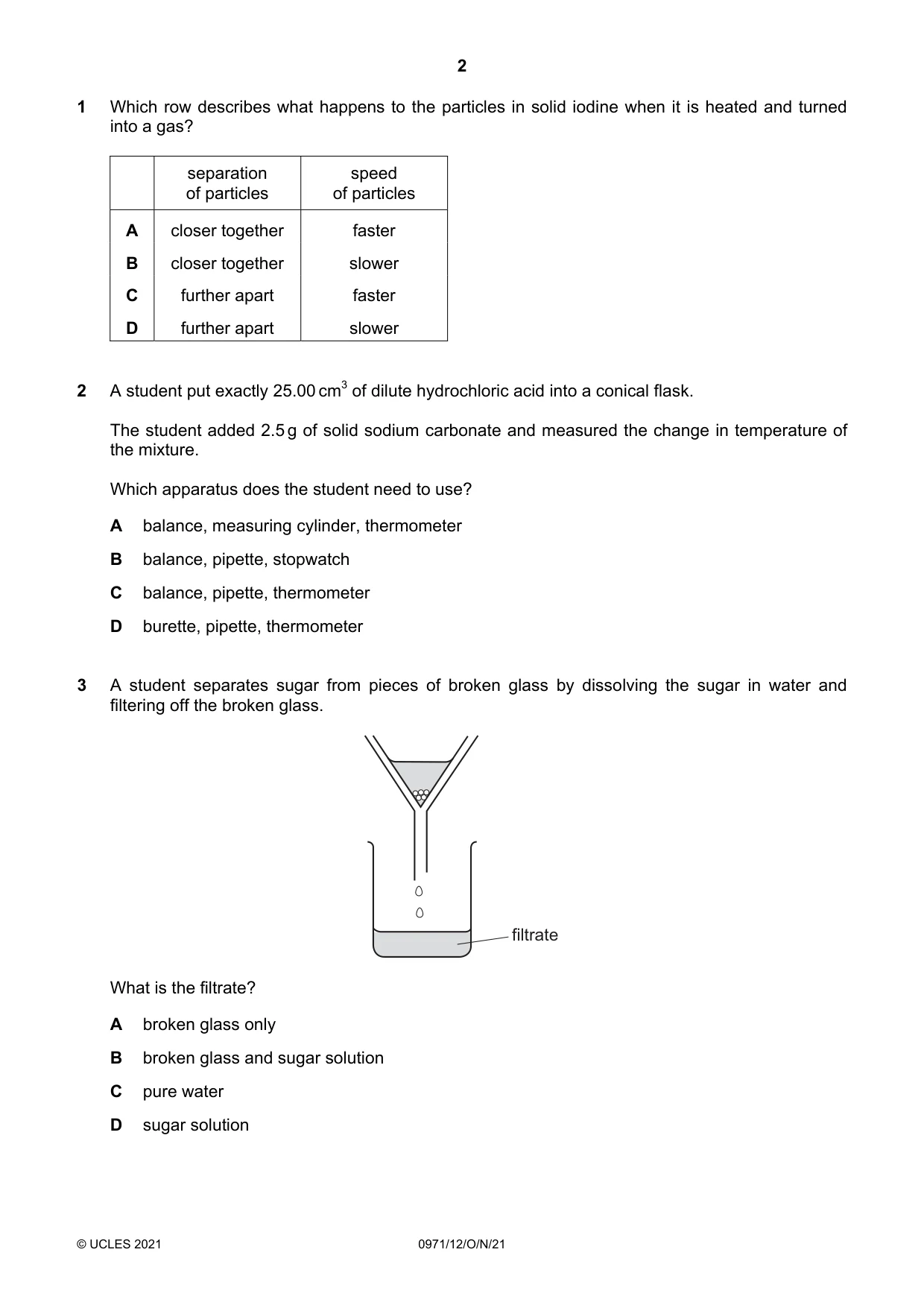
1 Which row describes what happens to the particles in solid iodine when it is heated and turned into a gas? separation speed of particles of particles A closer together faster B closer together slower C further apart faster D further apart slower
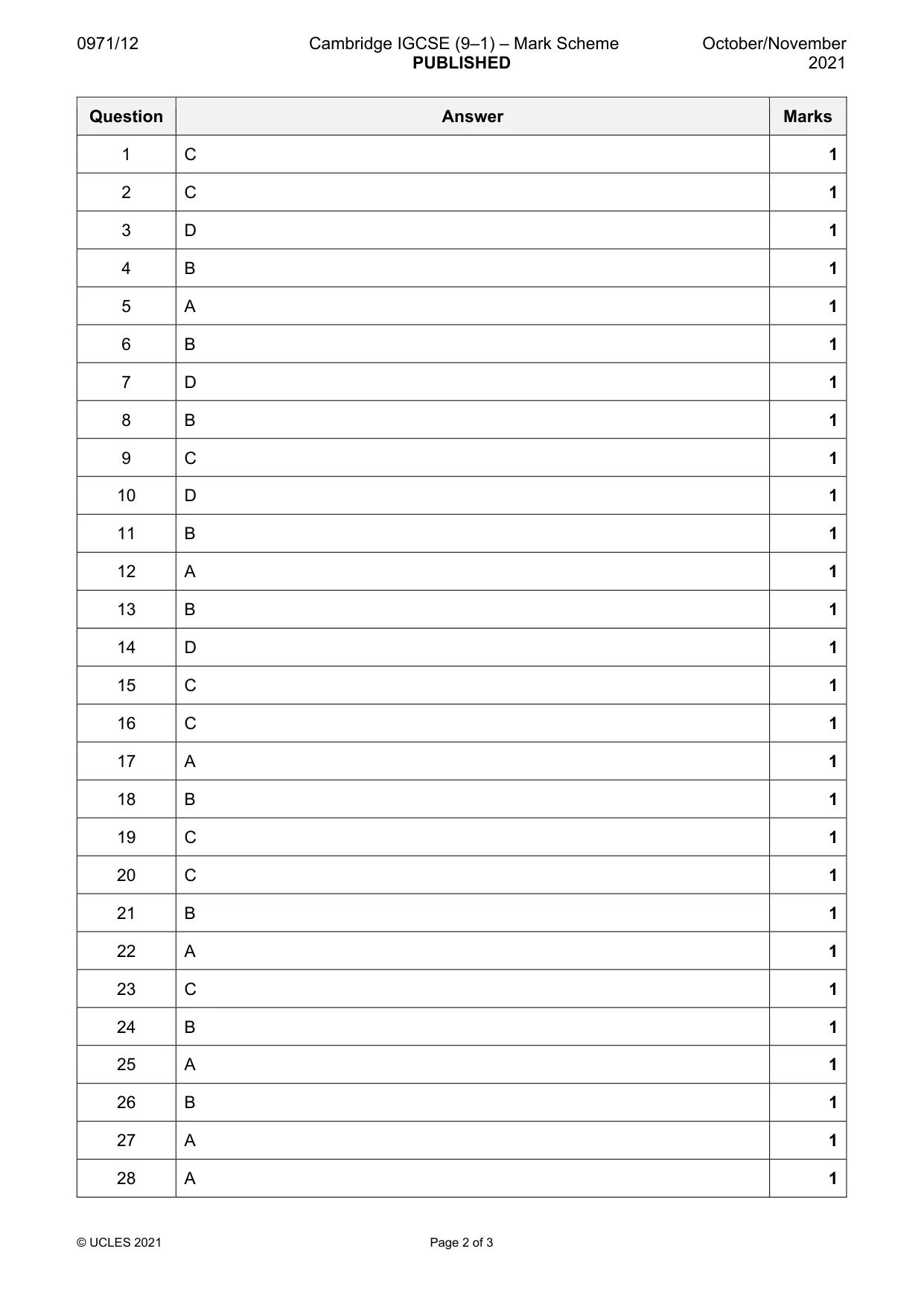
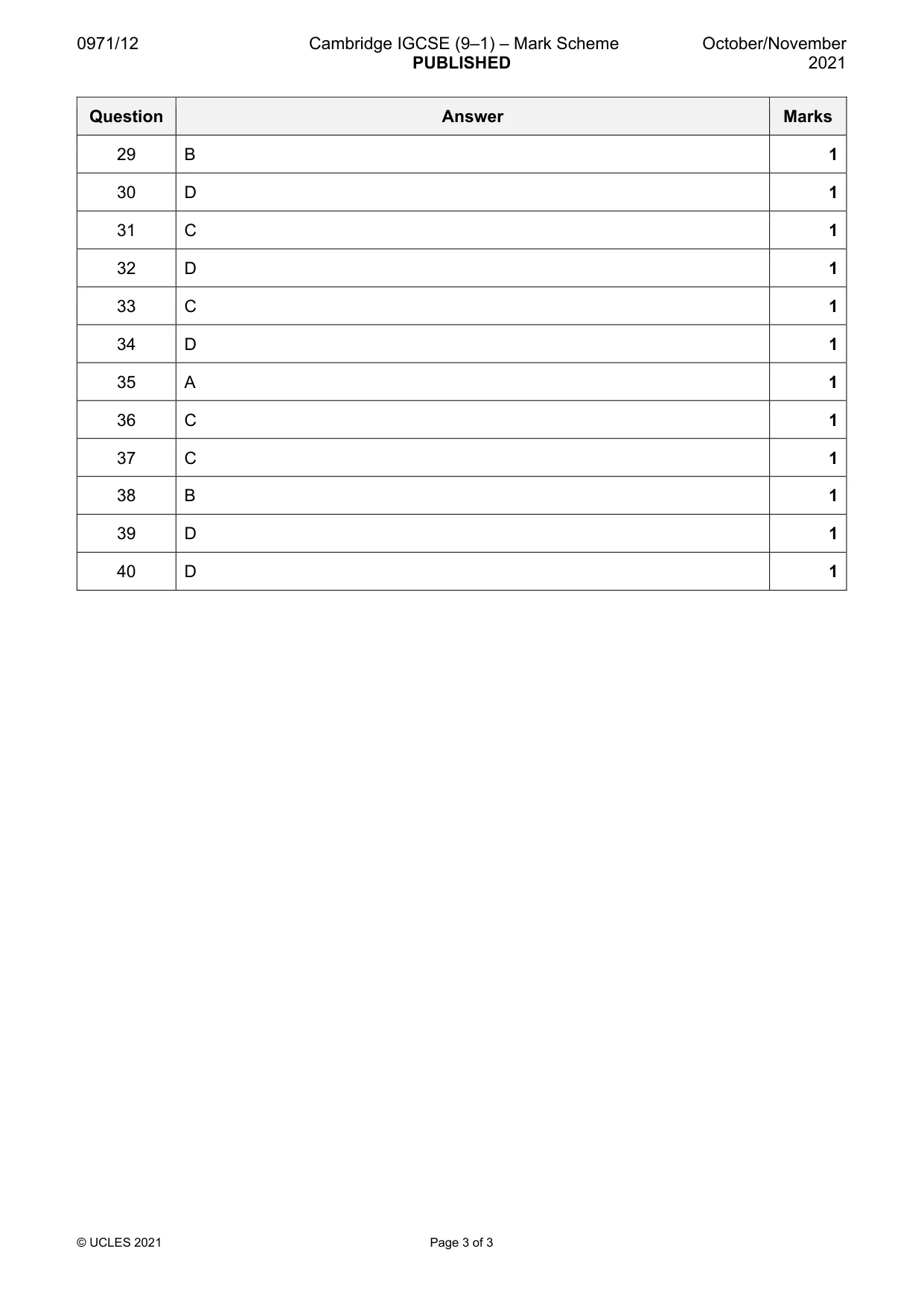
Mark scheme: C
Q2 · A student put exactly 25.00 cm3 of dilute hydrochloric acid into a conical flask
2 A student put exactly 25.00 cm3 of dilute hydrochloric acid into a conical flask. The student added 2.5 g of solid sodium carbonate and measured the change in temperature of the mixture. Which apparatus does the student need to use? A balance, measuring cylinder, thermometer B balance, pipette, stopwatch C balance, pipette, thermometer D burette, pipette, thermometer
Mark scheme: C
Q3 · A student separates sugar from pieces of broken glass by dissolving the sugar in water…
3 A student separates sugar from pieces of broken glass by dissolving the sugar in water and filtering off the broken glass. filtrate What is the filtrate? A broken glass only B broken glass and sugar solution C pure water D sugar solution
Mark scheme: D
Q4 · How many protons, neutrons and electrons are there in one atom of the isotope 27 13Al ?
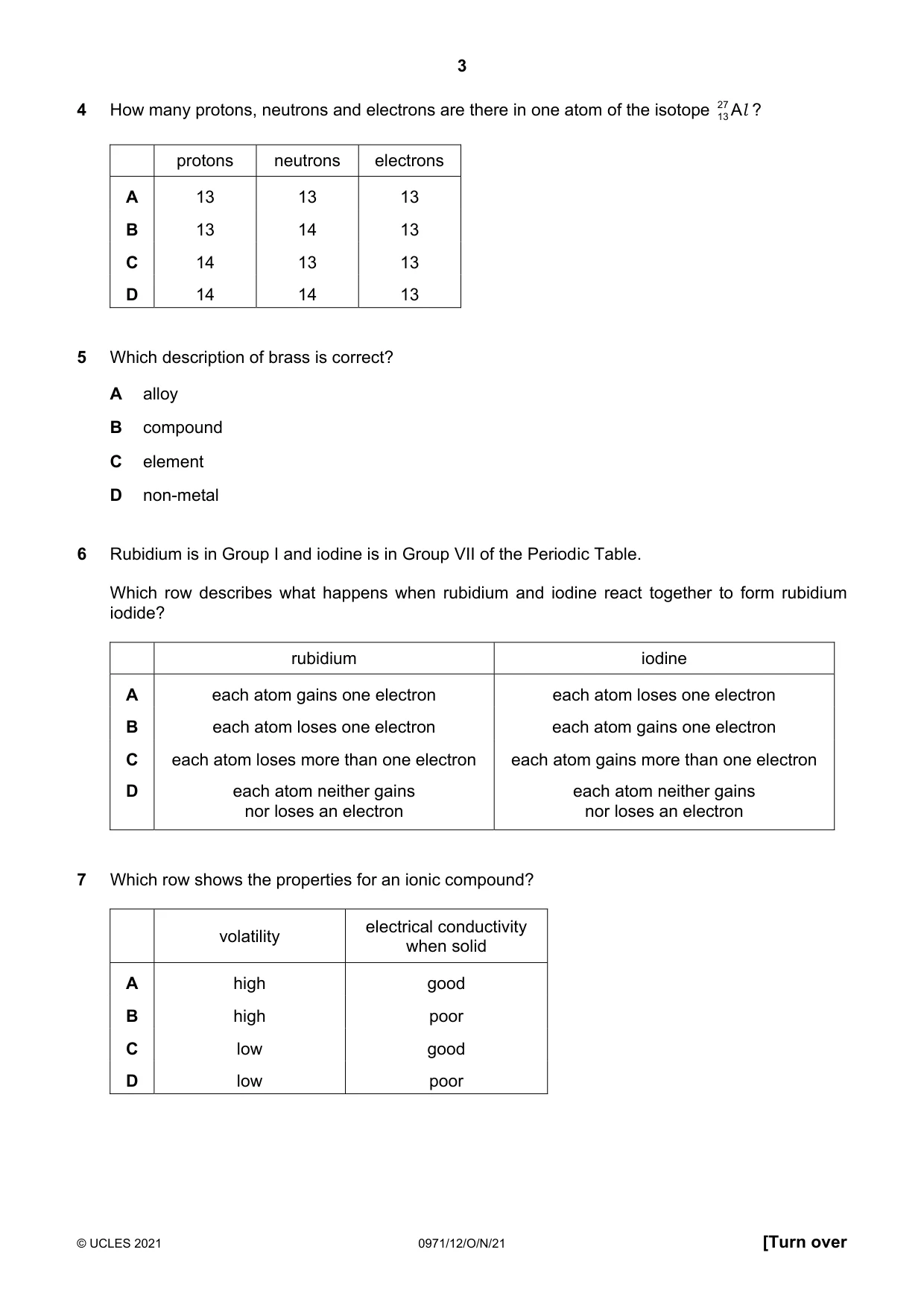
4 How many protons, neutrons and electrons are there in one atom of the isotope 27 13Al ? protons neutrons electrons A 13 13 13 B 13 14 13 C 14 13 13 D 14 14 13
Mark scheme: B
Q5 · Which description of brass is correct?
5 Which description of brass is correct? A alloy B compound C element D non-metal
Mark scheme: A
Q6 · Rubidium is in Group I and iodine is in Group VII of the Periodic Table
6 Rubidium is in Group I and iodine is in Group VII of the Periodic Table. Which row describes what happens when rubidium and iodine react together to form rubidium iodide? rubidium iodine A each atom gains one electron each atom loses one electron B each atom loses one electron each atom gains one electron C each atom loses more than one electron each atom gains more than one electron D each atom neither gains each atom neither gains nor loses an electron nor loses an electron
Mark scheme: B
Q7 · Which row shows the properties for an ionic compound?
7 Which row shows the properties for an ionic compound? electrical conductivity volatility when solid A high good B high poor C low good D low poor
Mark scheme: D
Q8 · Which substance is described as a macromolecule?
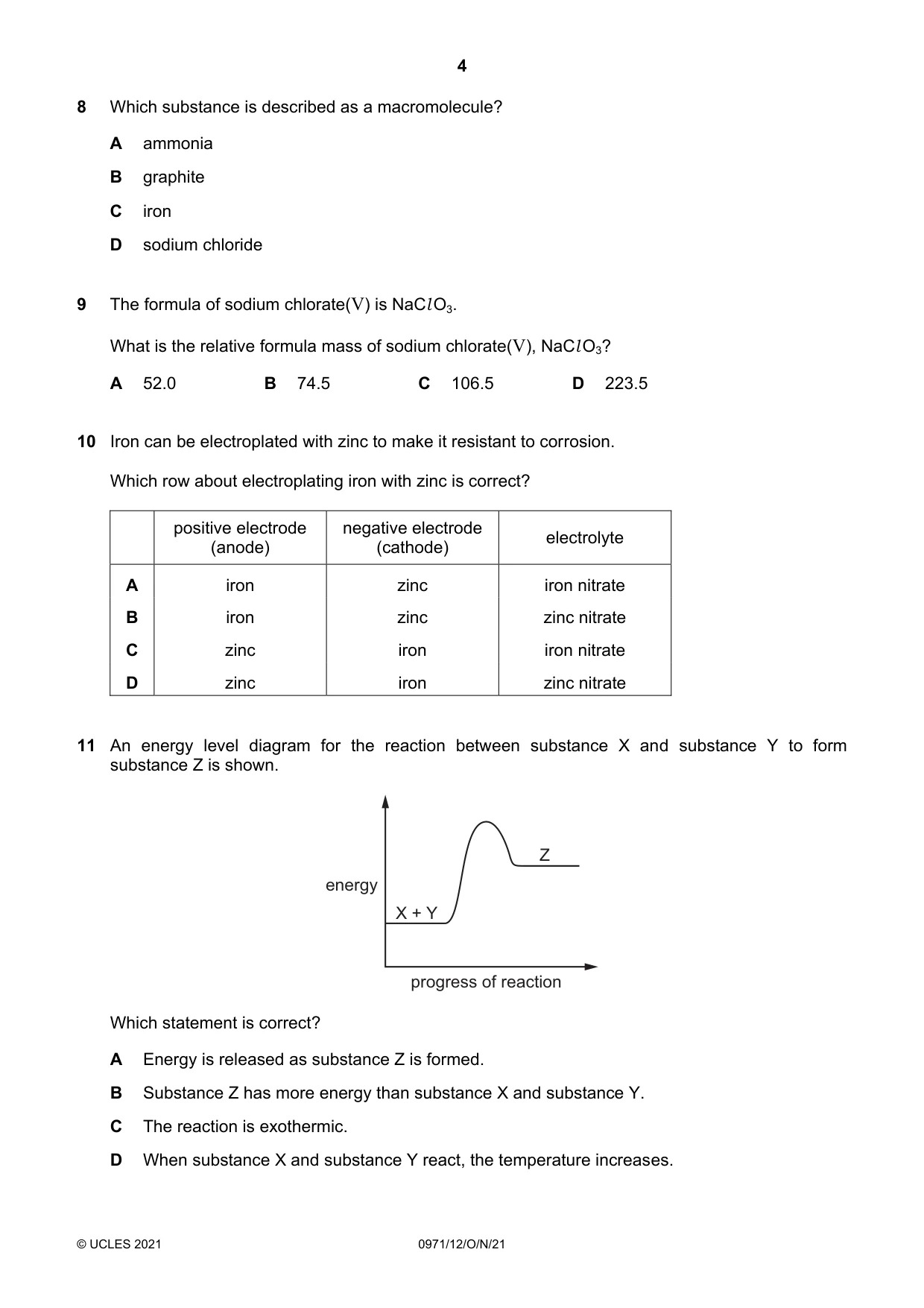
8 Which substance is described as a macromolecule? A ammonia B graphite C iron D sodium chloride
Mark scheme: B
Q9 · The formula of sodium chlorate(V) is NaCl O3
9 The formula of sodium chlorate(V) is NaCl O3. What is the relative formula mass of sodium chlorate(V), NaCl O3? A 52.0 B 74.5 C 106.5 D 223.5
Mark scheme: C
Q10 · Iron can be electroplated with zinc to make it resistant to corrosion
10 Iron can be electroplated with zinc to make it resistant to corrosion. Which row about electroplating iron with zinc is correct? positive electrode negative electrode electrolyte (anode) (cathode) A iron zinc iron nitrate B iron zinc zinc nitrate C zinc iron iron nitrate D zinc iron zinc nitrate
Mark scheme: D
Q11 · An energy level diagram for the reaction between substance X and substance Y to form…
11 An energy level diagram for the reaction between substance X and substance Y to form substance Z is shown. Z energy X + Y progress of reaction Which statement is correct? A Energy is released as substance Z is formed. B Substance Z has more energy than substance X and substance Y. C The reaction is exothermic. D When substance X and substance Y react, the temperature increases.
Mark scheme: B
Q12 · Which reactions are exothermic?
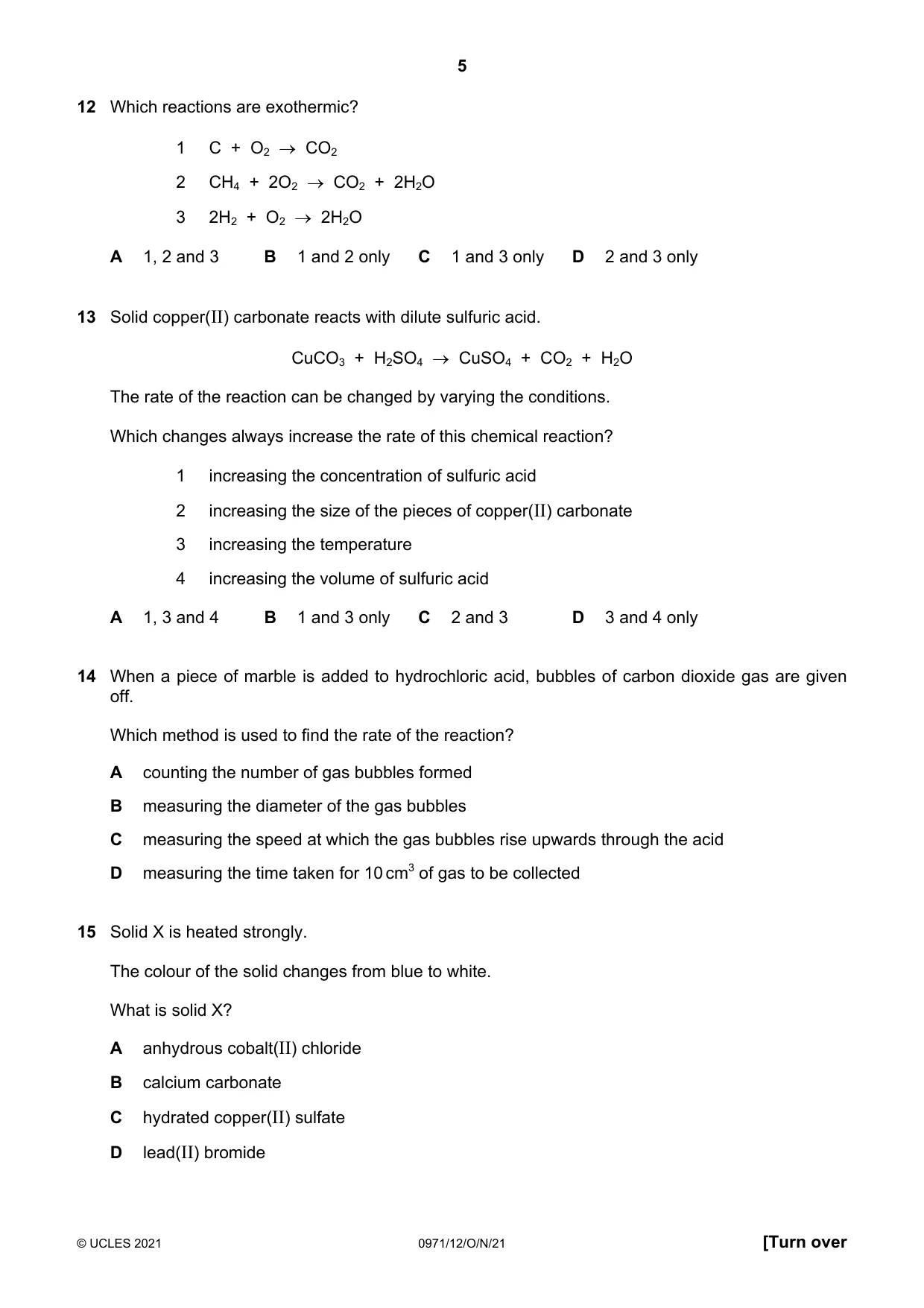
12 Which reactions are exothermic? 1 C + O2 CO2 2 CH4 + 2O2 CO2 + 2H2O 3 2H2 + O2 2H2O A 1, 2 and 3 B 1 and 2 only C 1 and 3 only D 2 and 3 only
Mark scheme: A
Q13 · Solid copper(II) carbonate reacts with dilute sulfuric acid
13 Solid copper(II) carbonate reacts with dilute sulfuric acid. CuCO3 + H2SO4 CuSO4 + CO2 + H2O The rate of the reaction can be changed by varying the conditions. Which changes always increase the rate of this chemical reaction? 1 increasing the concentration of sulfuric acid 2 increasing the size of the pieces of copper(II) carbonate 3 increasing the temperature 4 increasing the volume of sulfuric acid A 1, 3 and 4 B 1 and 3 only C 2 and 3 D 3 and 4 only
Mark scheme: B
Q14 · When a piece of marble is added to hydrochloric acid, bubbles of carbon dioxide gas are…
14 When a piece of marble is added to hydrochloric acid, bubbles of carbon dioxide gas are given off. Which method is used to find the rate of the reaction? A counting the number of gas bubbles formed B measuring the diameter of the gas bubbles C measuring the speed at which the gas bubbles rise upwards through the acid D measuring the time taken for 10 cm3 of gas to be collected
Mark scheme: D
Q15 · Solid X is heated strongly
15 Solid X is heated strongly. The colour of the solid changes from blue to white. What is solid X? A anhydrous cobalt(II) chloride B calcium carbonate C hydrated copper(II) sulfate D lead(II) bromide
Mark scheme: C
Q16 · What happens to a chemical substance when it is reduced?
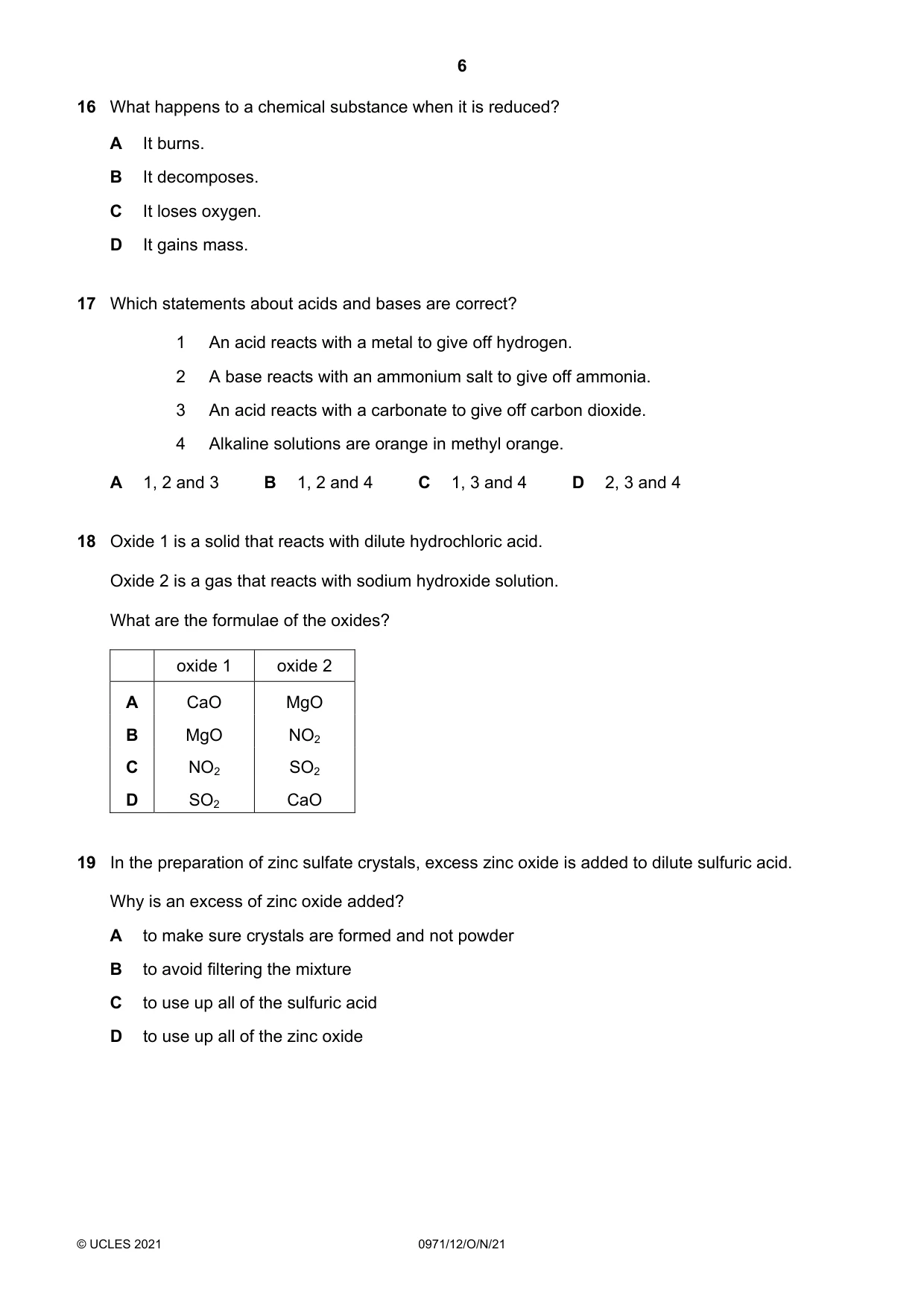
16 What happens to a chemical substance when it is reduced? A It burns. B It decomposes. C It loses oxygen. D It gains mass.
Mark scheme: C
Q17 · Which statements about acids and bases are correct?
17 Which statements about acids and bases are correct? 1 An acid reacts with a metal to give off hydrogen. 2 A base reacts with an ammonium salt to give off ammonia. 3 An acid reacts with a carbonate to give off carbon dioxide. 4 Alkaline solutions are orange in methyl orange. A 1, 2 and 3 B 1, 2 and 4 C 1, 3 and 4 D 2, 3 and 4
Mark scheme: A
More questions on The characteristic properties of acids and bases
Q18 · Oxide 1 is a solid that reacts with dilute hydrochloric acid
18 Oxide 1 is a solid that reacts with dilute hydrochloric acid. Oxide 2 is a gas that reacts with sodium hydroxide solution. What are the formulae of the oxides? oxide 1 oxide 2 A CaO MgO B MgO NO2 C NO2 SO2 D SO2 CaO
Mark scheme: B
Q19 · In the preparation of zinc sulfate crystals, excess zinc oxide is added to dilute…
19 In the preparation of zinc sulfate crystals, excess zinc oxide is added to dilute sulfuric acid. Why is an excess of zinc oxide added? A to make sure crystals are formed and not powder B to avoid filtering the mixture C to use up all of the sulfuric acid D to use up all of the zinc oxide
Mark scheme: C
Q20 · Which statement about aqueous sodium hydroxide is correct?
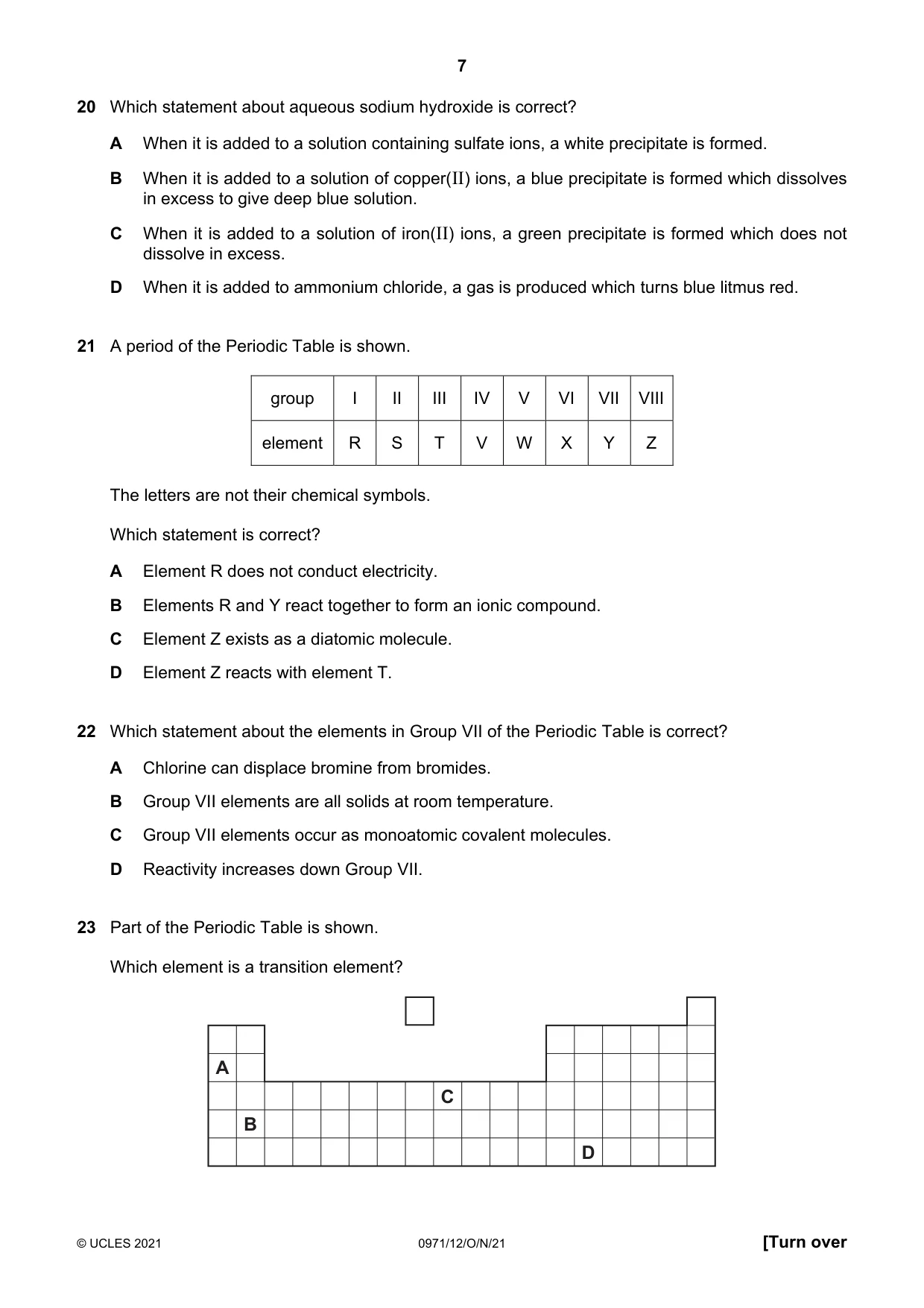
20 Which statement about aqueous sodium hydroxide is correct? A When it is added to a solution containing sulfate ions, a white precipitate is formed. B When it is added to a solution of copper(II) ions, a blue precipitate is formed which dissolves in excess to give deep blue solution. C When it is added to a solution of iron(II) ions, a green precipitate is formed which does not dissolve in excess. D When it is added to ammonium chloride, a gas is produced which turns blue litmus red.
Mark scheme: C
Q21 · A period of the Periodic Table is shown
21 A period of the Periodic Table is shown. group I II III IV V VI VII VIII element R S T V W X Y Z The letters are not their chemical symbols. Which statement is correct? A Element R does not conduct electricity. B Elements R and Y react together to form an ionic compound. C Element Z exists as a diatomic molecule. D Element Z reacts with element T.
Mark scheme: B
Q22 · Which statement about the elements in Group VII of the Periodic Table is correct?
22 Which statement about the elements in Group VII of the Periodic Table is correct? A Chlorine can displace bromine from bromides. B Group VII elements are all solids at room temperature. C Group VII elements occur as monoatomic covalent molecules. D Reactivity increases down Group VII.
Mark scheme: A
Q23 · Part of the Periodic Table is shown
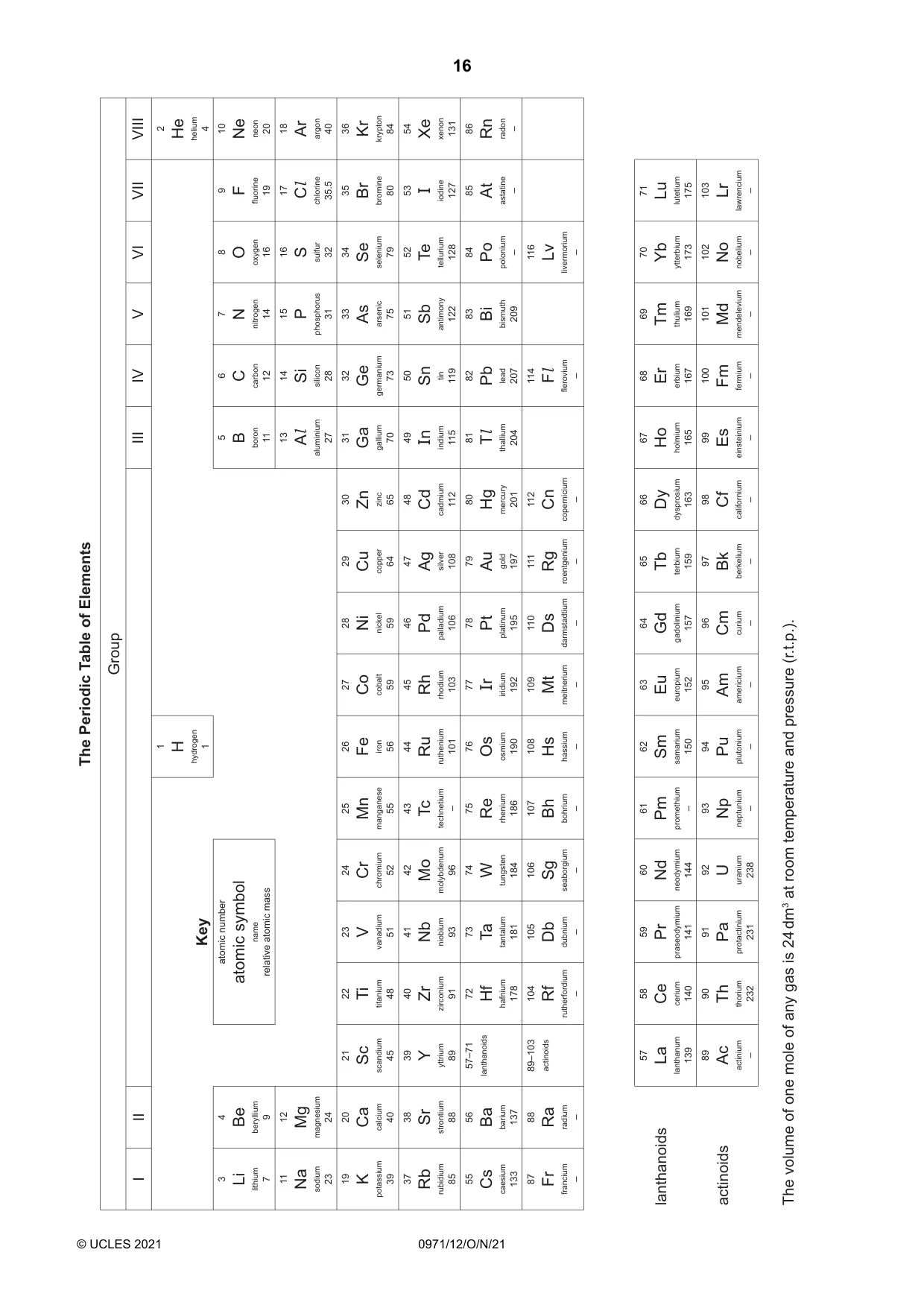
23 Part of the Periodic Table is shown. Which element is a transition element? A C B D
Mark scheme: C
Q24 · The noble gases are in Group VIII of the Periodic Table
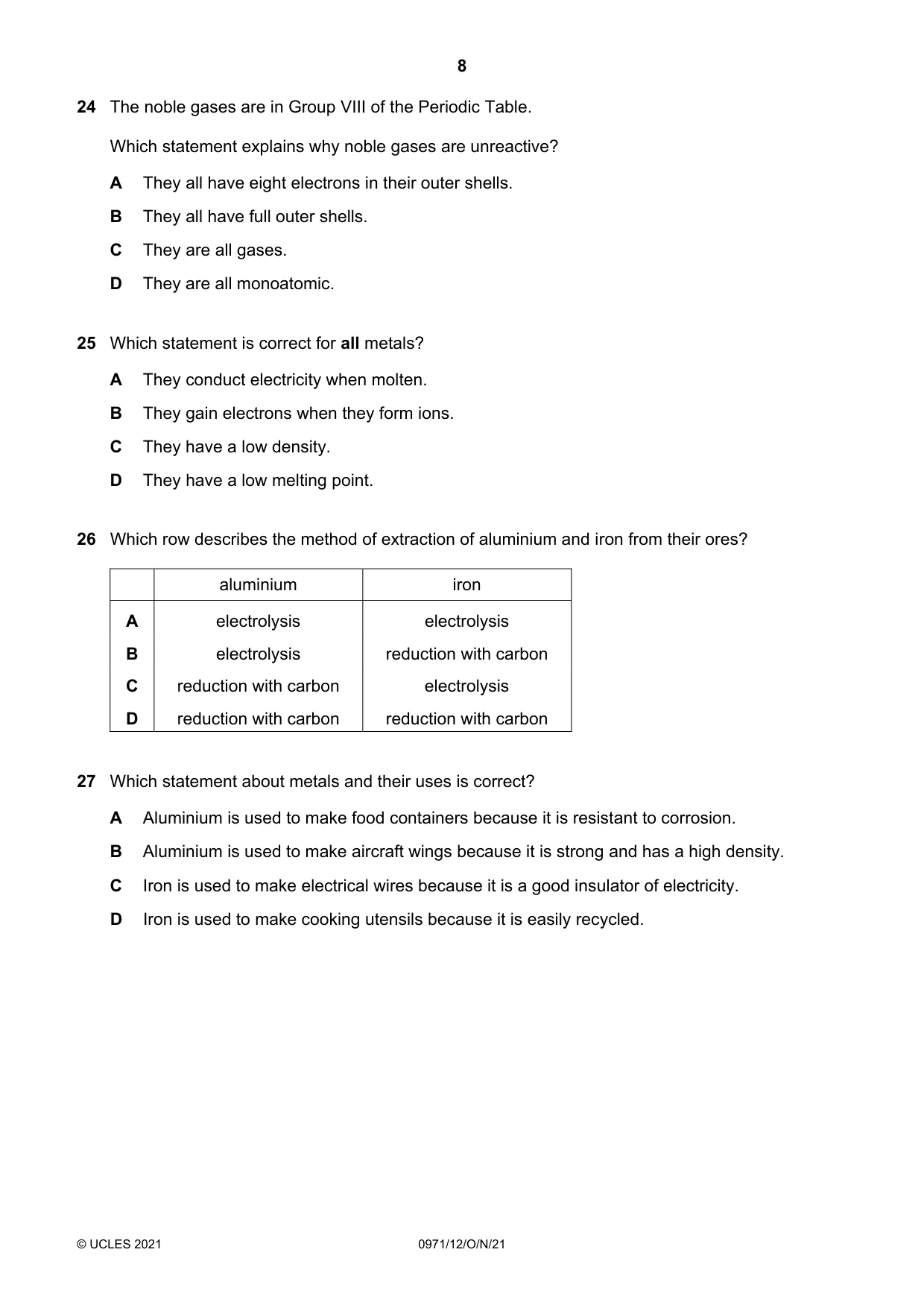
24 The noble gases are in Group VIII of the Periodic Table. Which statement explains why noble gases are unreactive? A They all have eight electrons in their outer shells. B They all have full outer shells. C They are all gases. D They are all monoatomic.
Mark scheme: B
Q25 · Which statement is correct for all metals?
25 Which statement is correct for all metals? A They conduct electricity when molten. B They gain electrons when they form ions. C They have a low density. D They have a low melting point.
Mark scheme: A
Q26 · Which row describes the method of extraction of aluminium and iron from their ores?
26 Which row describes the method of extraction of aluminium and iron from their ores? aluminium iron A electrolysis electrolysis B electrolysis reduction with carbon C reduction with carbon electrolysis D reduction with carbon reduction with carbon
Mark scheme: B
Q27 · Which statement about metals and their uses is correct?
27 Which statement about metals and their uses is correct? A Aluminium is used to make food containers because it is resistant to corrosion. B Aluminium is used to make aircraft wings because it is strong and has a high density. C Iron is used to make electrical wires because it is a good insulator of electricity. D Iron is used to make cooking utensils because it is easily recycled.
Mark scheme: A
Q28 · The diagrams show some uses of water in the home
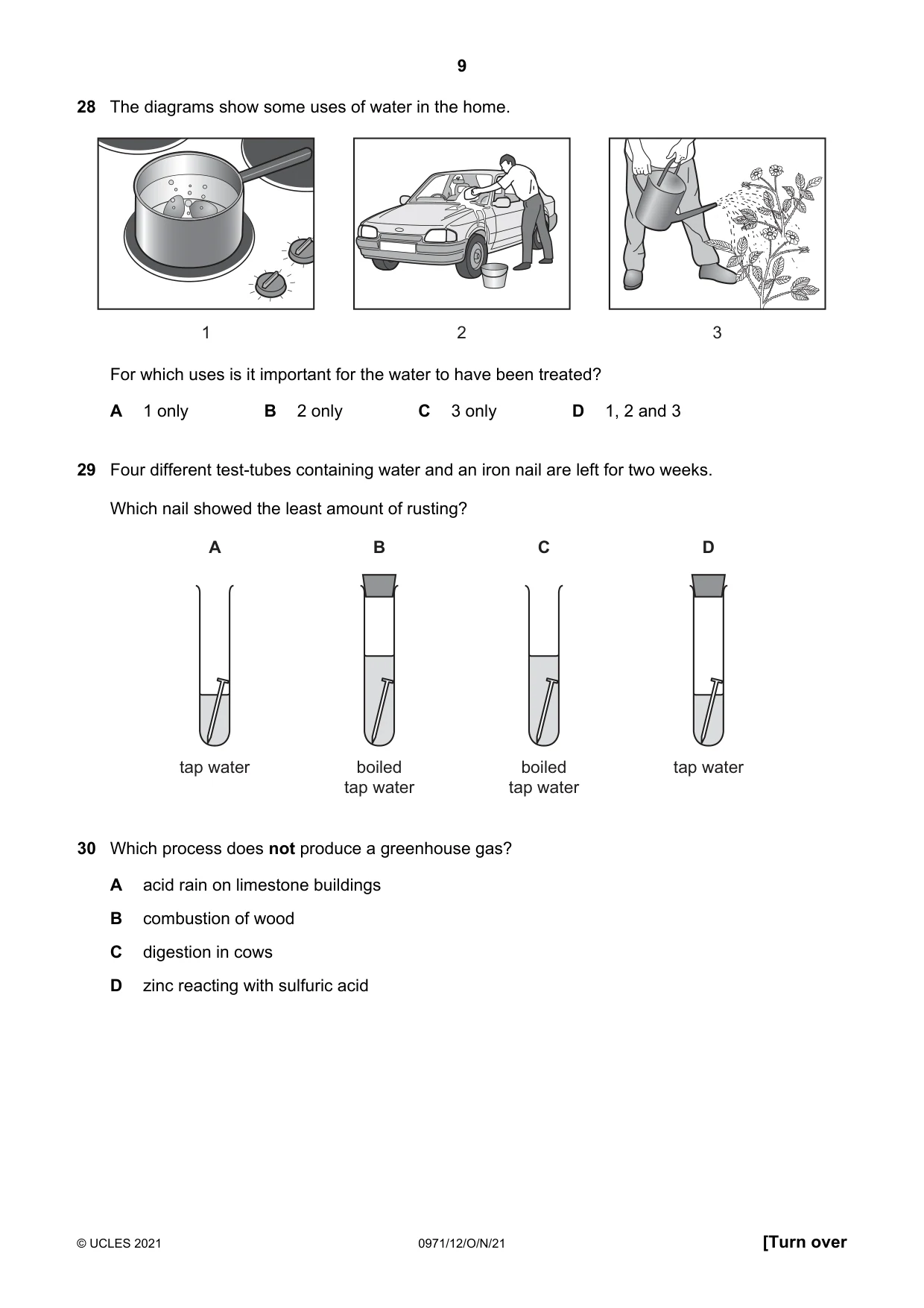
28 The diagrams show some uses of water in the home. 1 2 3 For which uses is it important for the water to have been treated? A 1 only B 2 only C 3 only D 1, 2 and 3
Mark scheme: A
Q29 · Four different test-tubes containing water and an iron nail are left for two weeks
29 Four different test-tubes containing water and an iron nail are left for two weeks. Which nail showed the least amount of rusting? A B C D tap water boiled boiled tap water tap water tap water
Mark scheme: B
Q30 · Which process does not produce a greenhouse gas?
30 Which process does not produce a greenhouse gas? A acid rain on limestone buildings B combustion of wood C digestion in cows D zinc reacting with sulfuric acid
Mark scheme: D
Q31 · Sulfur burns to make sulfur dioxide
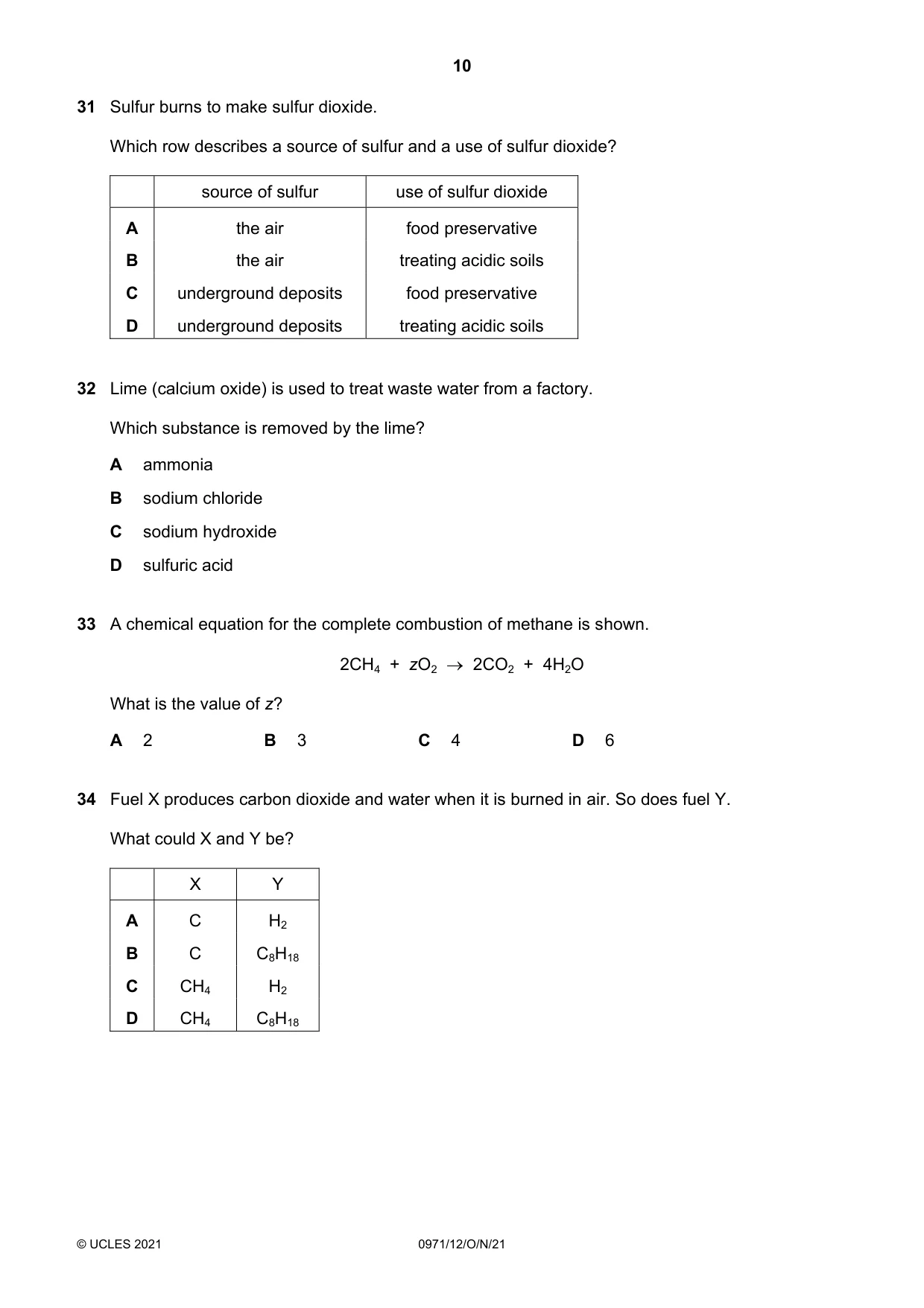
31 Sulfur burns to make sulfur dioxide. Which row describes a source of sulfur and a use of sulfur dioxide? source of sulfur use of sulfur dioxide A the air food preservative B the air treating acidic soils C underground deposits food preservative D underground deposits treating acidic soils
Mark scheme: C
Q32 · Lime (calcium oxide) is used to treat waste water from a factory
32 Lime (calcium oxide) is used to treat waste water from a factory. Which substance is removed by the lime? A ammonia B sodium chloride C sodium hydroxide D sulfuric acid
Mark scheme: D
More questions on The characteristic properties of acids and bases
Q33 · A chemical equation for the complete combustion of methane is shown
33 A chemical equation for the complete combustion of methane is shown. 2CH4 + zO2 2CO2 + 4H2O What is the value of z? A 2 B 3 C 4 D 6
Mark scheme: C
Q34 · Fuel X produces carbon dioxide and water when it is burned in air
34 Fuel X produces carbon dioxide and water when it is burned in air. So does fuel Y. What could X and Y be? X Y A C H2 B C C8H18 C CH4 H2 D CH4 C8H18
Mark scheme: D
Q35 · Which substance is not a fossil fuel?
35 Which substance is not a fossil fuel? A ethanol B gasoline C kerosene D methane
Mark scheme: A
Q36 · Which compound belongs to a different homologous series to the others?
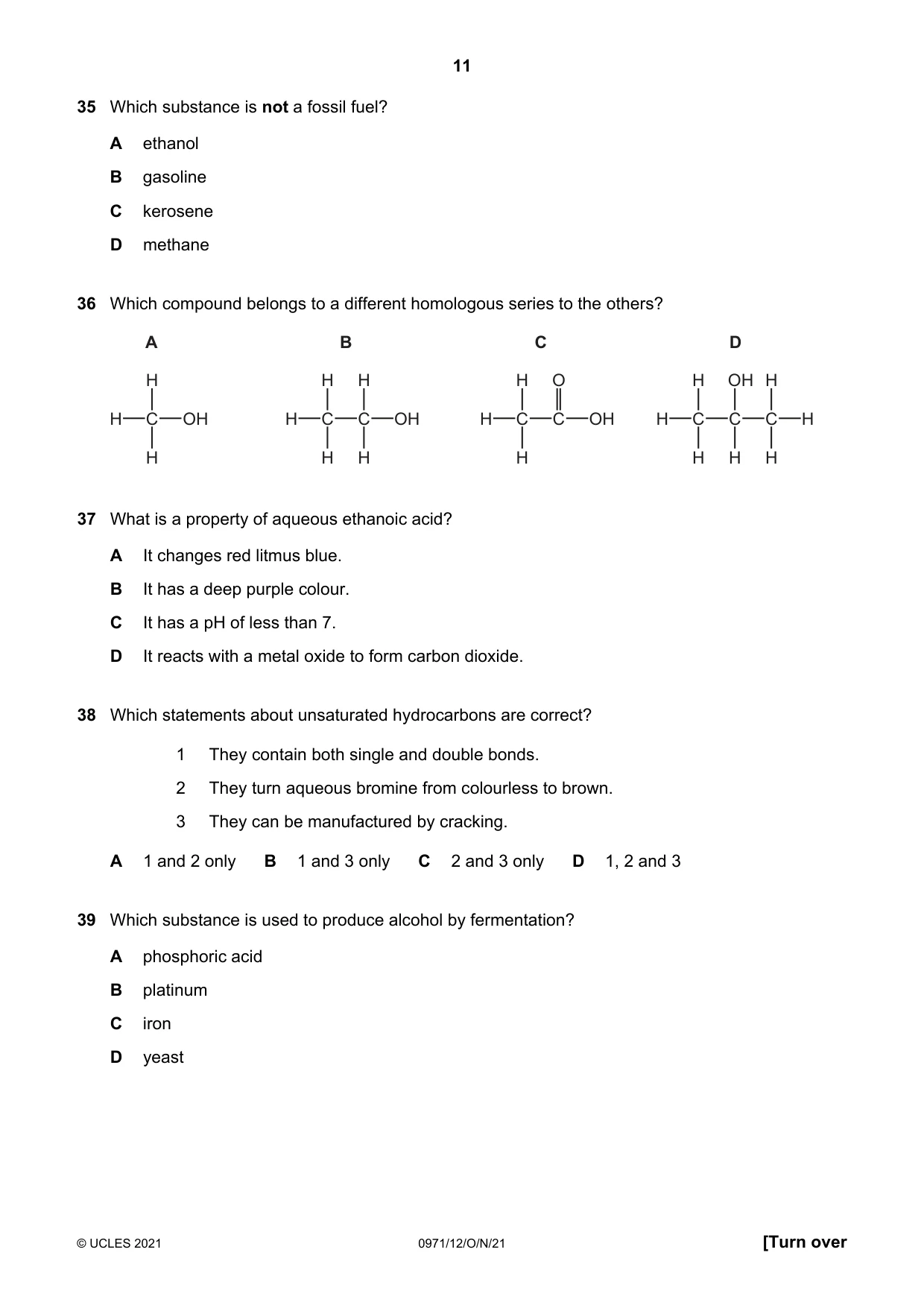
36 Which compound belongs to a different homologous series to the others? A B C D H H H H O H OH H H C OH H C C OH H C C OH H C C C H H H H H H H H
Mark scheme: C
More questions on Formulae, functional groups and terminology
Q37 · What is a property of aqueous ethanoic acid?
37 What is a property of aqueous ethanoic acid? A It changes red litmus blue. B It has a deep purple colour. C It has a pH of less than 7. D It reacts with a metal oxide to form carbon dioxide.
Mark scheme: C
More questions on The characteristic properties of acids and bases
Q38 · Which statements about unsaturated hydrocarbons are correct?
38 Which statements about unsaturated hydrocarbons are correct? 1 They contain both single and double bonds. 2 They turn aqueous bromine from colourless to brown. 3 They can be manufactured by cracking. A 1 and 2 only B 1 and 3 only C 2 and 3 only D 1, 2 and 3
Mark scheme: B
Q39 · Which substance is used to produce alcohol by fermentation?
39 Which substance is used to produce alcohol by fermentation? A phosphoric acid B platinum C iron D yeast
Mark scheme: D
Q40 · Which statements are correct?
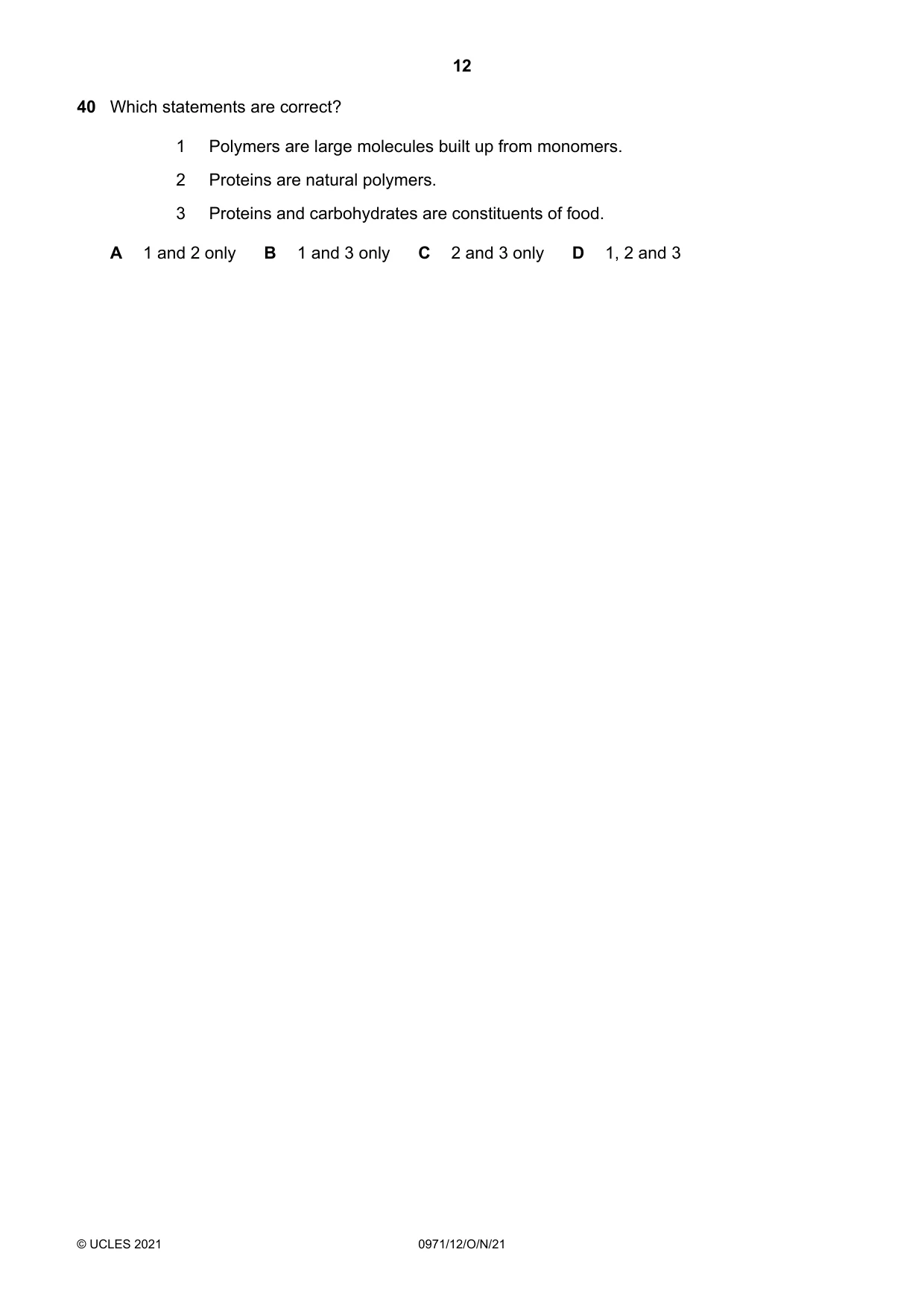
40 Which statements are correct? 1 Polymers are large molecules built up from monomers. 2 Proteins are natural polymers. 3 Proteins and carbohydrates are constituents of food. A 1 and 2 only B 1 and 3 only C 2 and 3 only D 1, 2 and 3
Mark scheme: D
What was in this paper
The subtopics covered by these 40 questions, and how many questions each got. Open one in a new tab to see every Cambridge question on it.
3Air quality and climate2Exothermic and endothermic reactions2Fuels2Identification of ions and gases2Ions and ionic bonds2Rate of reaction2Alcohols1Alkenes1Alloys and their properties1Arrangement of elements1Corrosion of metals1Electrolysis1Experimental design1Extraction of metals1Formulae1Formulae, functional groups and terminology1Giant covalent structures1Group VII properties1Isotopes1Noble gases1Oxides1Polymers1Preparation of salts1Properties of metals1Redox1Relative masses of atoms and molecules1Separation and purification1Solids, liquids and gases1Transition elements1Uses of metals1Water1What you needed in this session
Cambridge’s own grade thresholds for 2021 Oct/Nov, Paper 1 · Variant 2. A higher threshold means an easier paper — the bar moves with how the cohort did.