Cambridge IGCSE Chemistry (9-1) 0971 — 2022 Oct/Nov Paper 1 · Variant 2
0971/12/O/N/22 · 40 questions · 40 marks · ≈45 min
The question paper and its mark scheme, free to read here and free to download. This is Cambridge’s own paper, exactly as it was sat.
Question paper16 pages


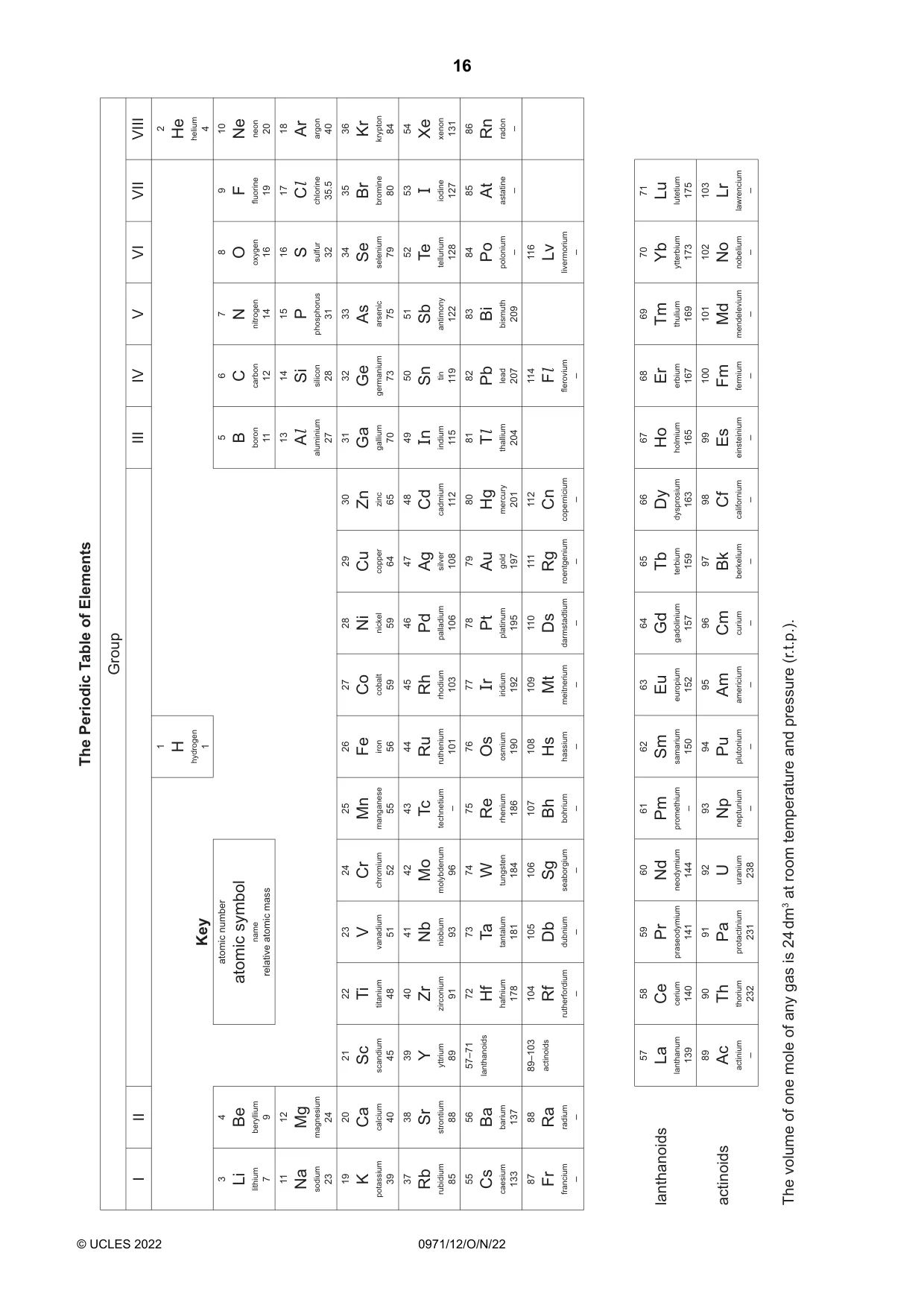
Mark scheme3 pages
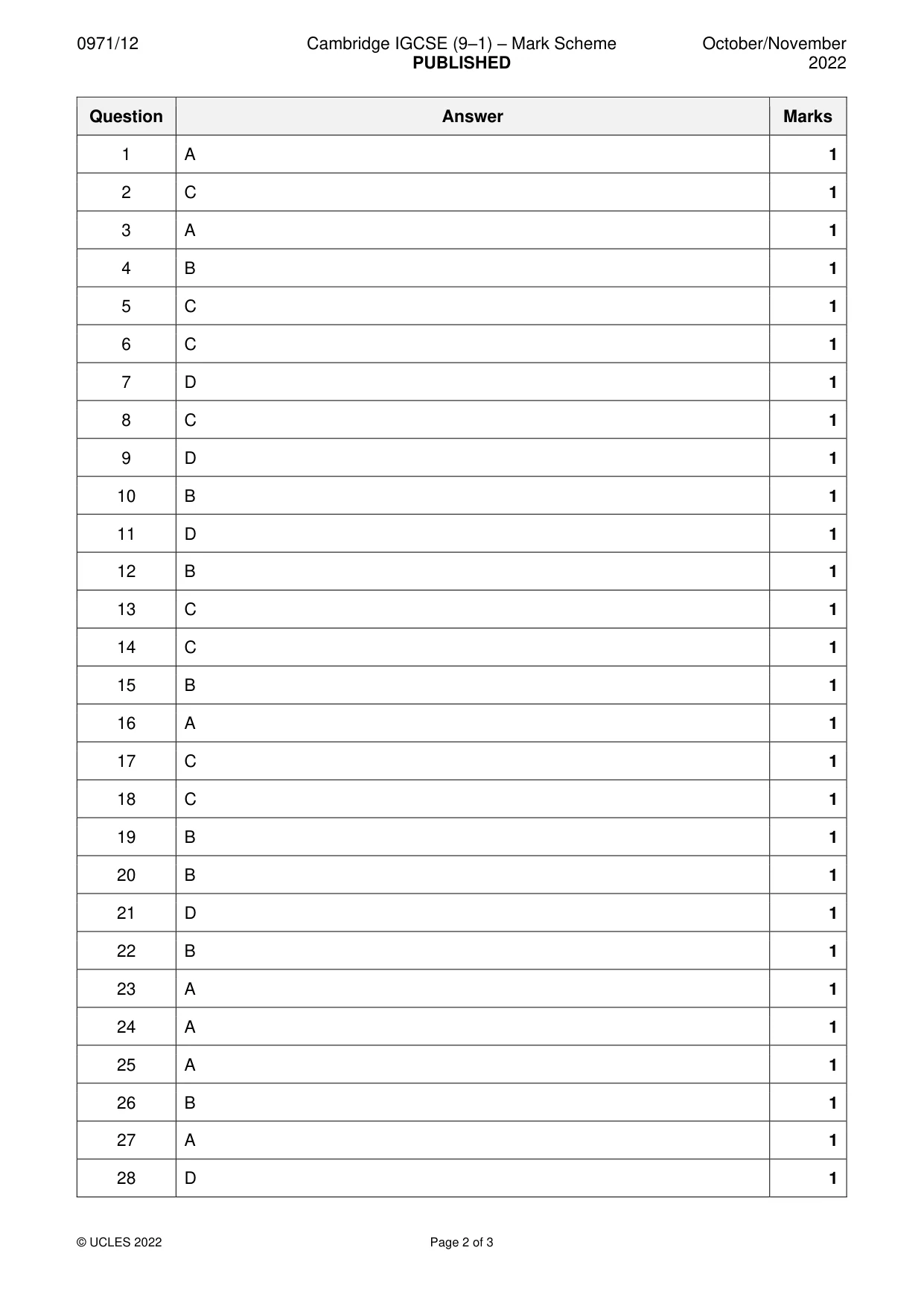
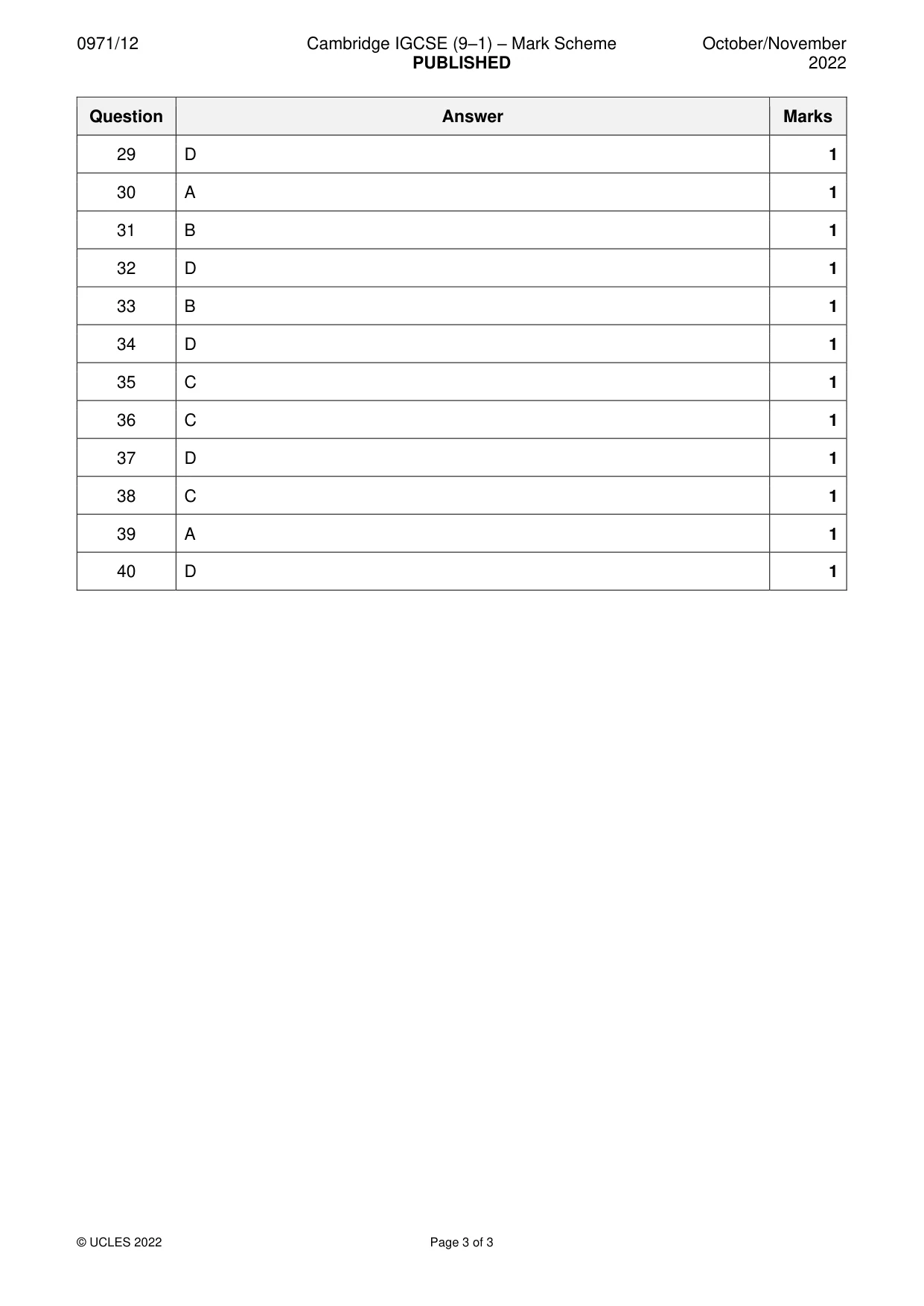
Answers below. Sit the paper first if you are practising.
Questions as text
Q1 · Which statement describes the particles in a liquid?
1 Which statement describes the particles in a liquid? A They are close together but have no regular arrangement. B They are densely packed in a regular order. C They move freely at high speed and are widely spaced. D They vibrate but do not move from a fixed position.
Mark scheme: A
Q2 · The apparatus used in a chromatography experiment is shown
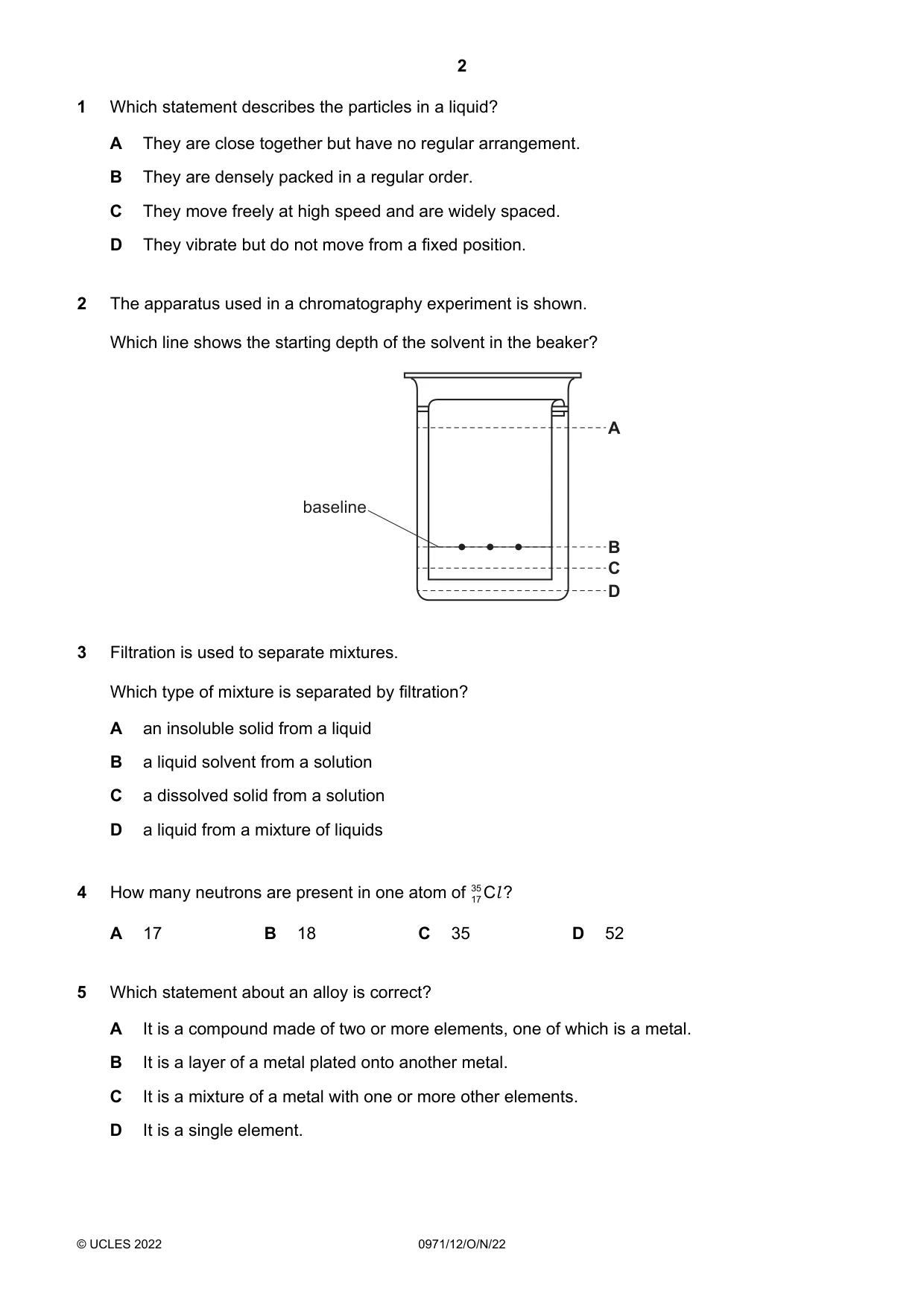
2 The apparatus used in a chromatography experiment is shown. Which line shows the starting depth of the solvent in the beaker? A baseline B C D
Mark scheme: C
Q3 · Filtration is used to separate mixtures
3 Filtration is used to separate mixtures. Which type of mixture is separated by filtration? A an insoluble solid from a liquid B a liquid solvent from a solution C a dissolved solid from a solution D a liquid from a mixture of liquids
Mark scheme: A
Q4 · How many neutrons are present in one atom of 35 C l ?
4 How many neutrons are present in one atom of 35 C l ? 17 A 17 B 18 C 35 D 52
Mark scheme: B
Q5 · Which statement about an alloy is correct?
5 Which statement about an alloy is correct? A It is a compound made of two or more elements, one of which is a metal. B It is a layer of a metal plated onto another metal. C It is a mixture of a metal with one or more other elements. D It is a single element.
Mark scheme: C
Q6 · Which statement about compounds is correct?
6 Which statement about compounds is correct? A Covalent compounds are less volatile than ionic compounds. B Covalent compounds conduct electricity when they are solid. C Ionic compounds conduct electricity when molten. D Ionic compounds are insoluble in water.
Mark scheme: C
Q7 · Which statement explains why diamond is used in cutting tools?
7 Which statement explains why diamond is used in cutting tools? A It has no free electrons. B It has a high melting point. C It is colourless. D It is hard.
Mark scheme: D
Q8 · Caffeine is a stimulant found in coffee
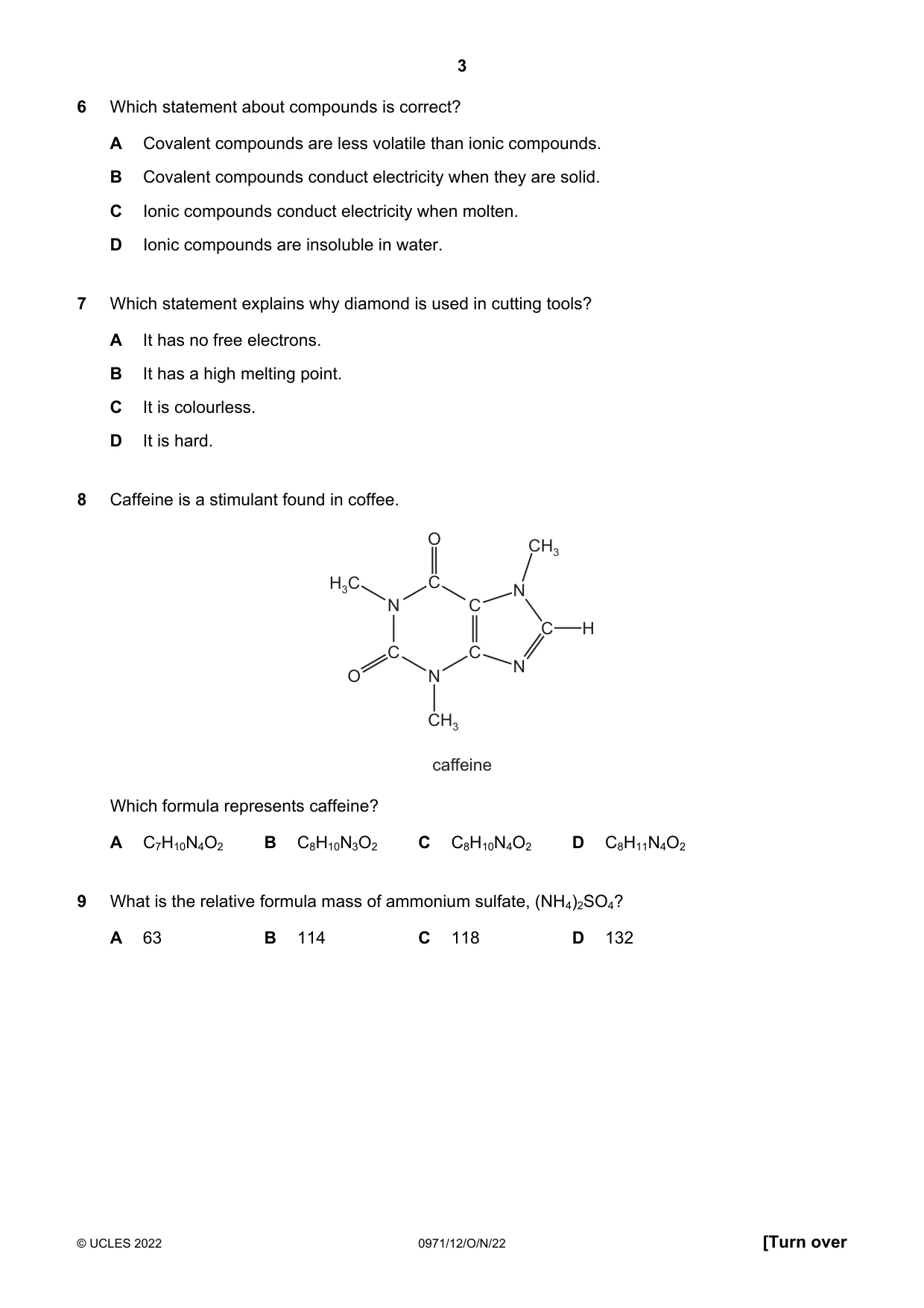
8 Caffeine is a stimulant found in coffee. O CH3 H3C C N N C C H C C N O N CH3 caffeine Which formula represents caffeine? A C7H10N4O2 B C8H10N3O2 C C8H10N4O2 D C8H11N4O2
Mark scheme: C
Q9 · What is the relative formula mass of ammonium sulfate, (NH4)2SO4?
9 What is the relative formula mass of ammonium sulfate, (NH4)2SO4? A 63 B 114 C 118 D 132
Mark scheme: D
Q10 · The electrolysis of concentrated aqueous sodium chloride and molten sodium chloride is…
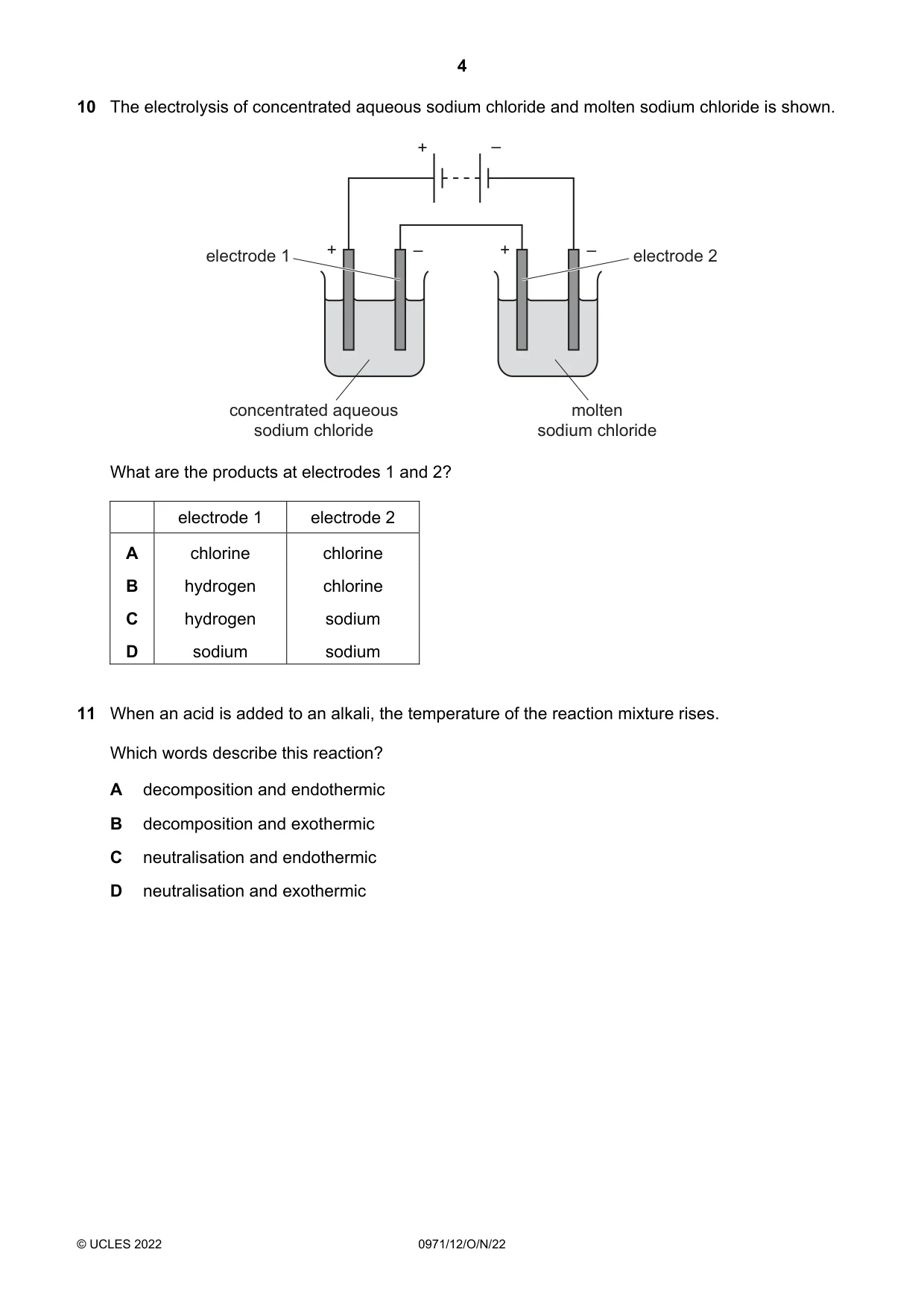
10 The electrolysis of concentrated aqueous sodium chloride and molten sodium chloride is shown. + – electrode 1 + – + – electrode 2 concentrated aqueous molten sodium chloride sodium chloride What are the products at electrodes 1 and 2? electrode 1 electrode 2 A chlorine chlorine B hydrogen chlorine C hydrogen sodium D sodium sodium
Mark scheme: B
Q11 · When an acid is added to an alkali, the temperature of the reaction mixture rises
11 When an acid is added to an alkali, the temperature of the reaction mixture rises. Which words describe this reaction? A decomposition and endothermic B decomposition and exothermic C neutralisation and endothermic D neutralisation and exothermic
Mark scheme: D
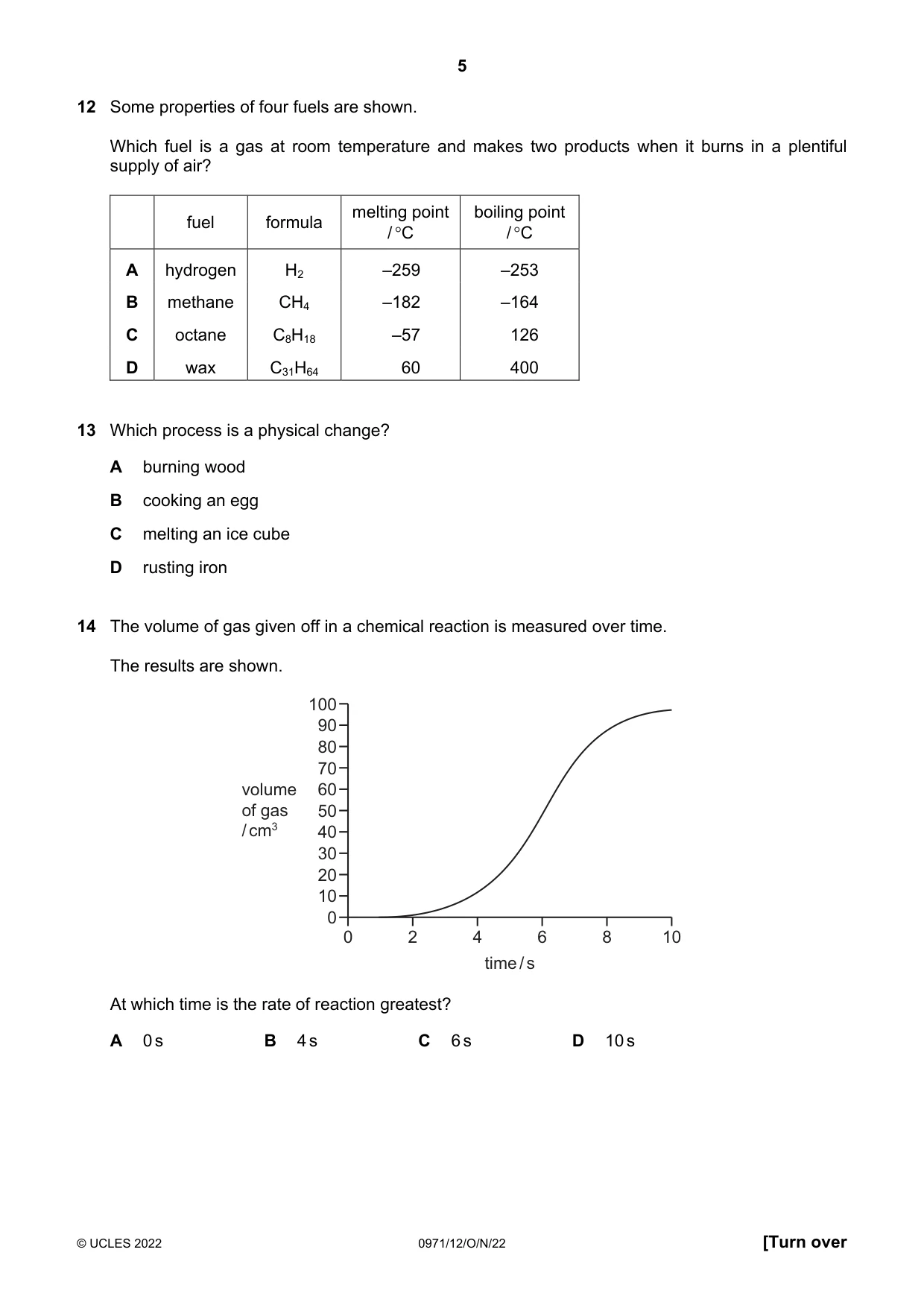
Q12 · Some properties of four fuels are shown
12 Some properties of four fuels are shown. Which fuel is a gas at room temperature and makes two products when it burns in a plentiful supply of air? melting point boiling point fuel formula / C / C A hydrogen H2 –259 –253 B methane CH4 –182 –164 C octane C8H18 –57 126 D wax C31H64 60 400
Mark scheme: B
Q13 · Which process is a physical change?
13 Which process is a physical change? A burning wood B cooking an egg C melting an ice cube D rusting iron
Mark scheme: C
Q14 · The volume of gas given off in a chemical reaction is measured over time
14 The volume of gas given off in a chemical reaction is measured over time. The results are shown. 100 90 80 70 volume 60 of gas 50 / cm3 40 30 20 10 0 0 2 4 6 8 10 time / s At which time is the rate of reaction greatest? A 0 s B 4 s C 6 s D 10 s
Mark scheme: C
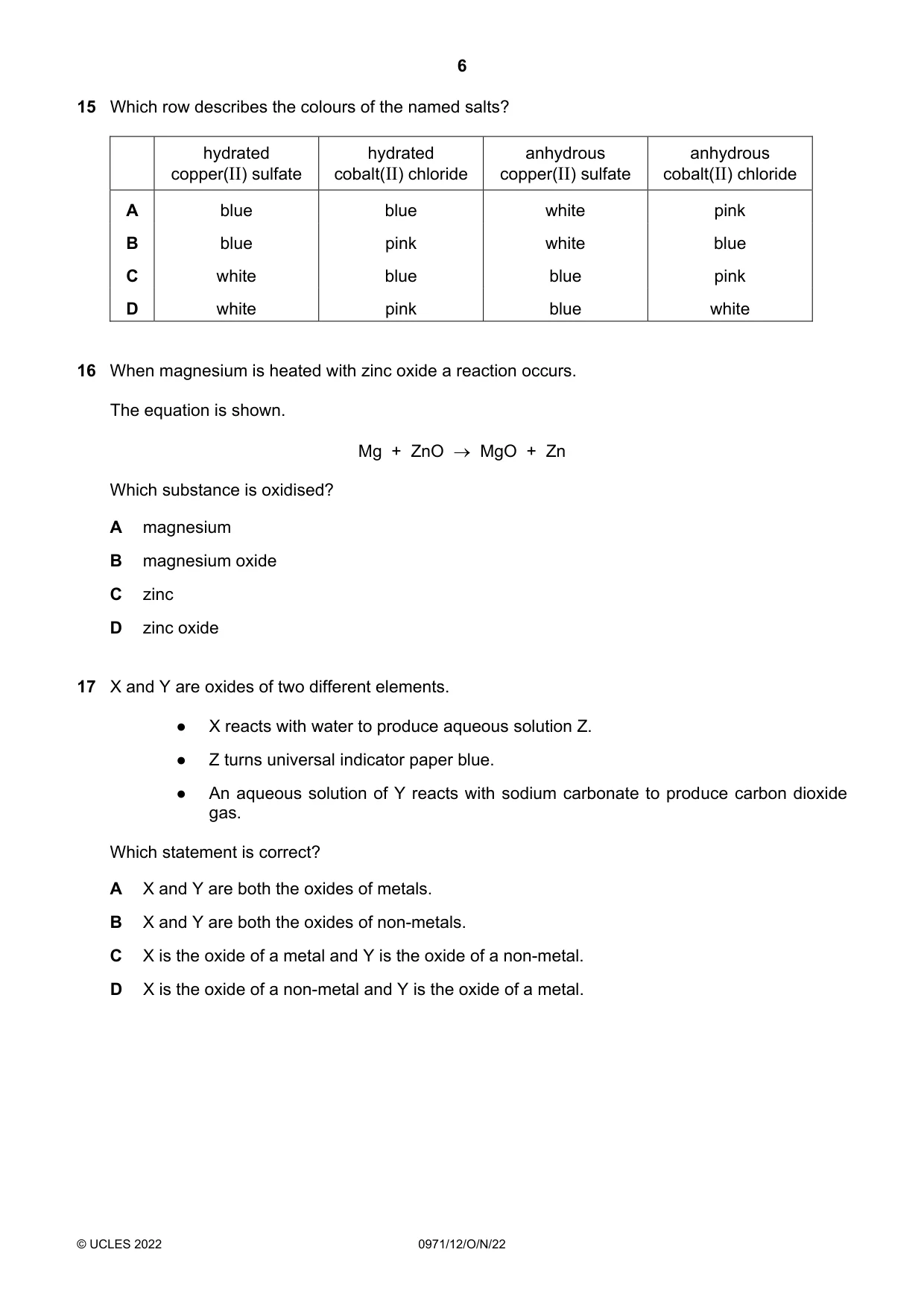
Q15 · Which row describes the colours of the named salts?
15 Which row describes the colours of the named salts? hydrated hydrated anhydrous anhydrous copper(II) sulfate cobalt(II) chloride copper(II) sulfate cobalt(II) chloride A blue blue white pink B blue pink white blue C white blue blue pink D white pink blue white
Mark scheme: B
Q16 · When magnesium is heated with zinc oxide a reaction occurs
16 When magnesium is heated with zinc oxide a reaction occurs. The equation is shown. Mg + ZnO MgO + Zn Which substance is oxidised? A magnesium B magnesium oxide C zinc D zinc oxide
Mark scheme: A
Q17 · X and Y are oxides of two different elements
17 X and Y are oxides of two different elements. ● X reacts with water to produce aqueous solution Z. ● Z turns universal indicator paper blue. ● An aqueous solution of Y reacts with sodium carbonate to produce carbon dioxide gas. Which statement is correct? A X and Y are both the oxides of metals. B X and Y are both the oxides of non-metals. C X is the oxide of a metal and Y is the oxide of a non-metal. D X is the oxide of a non-metal and Y is the oxide of a metal.
Mark scheme: C
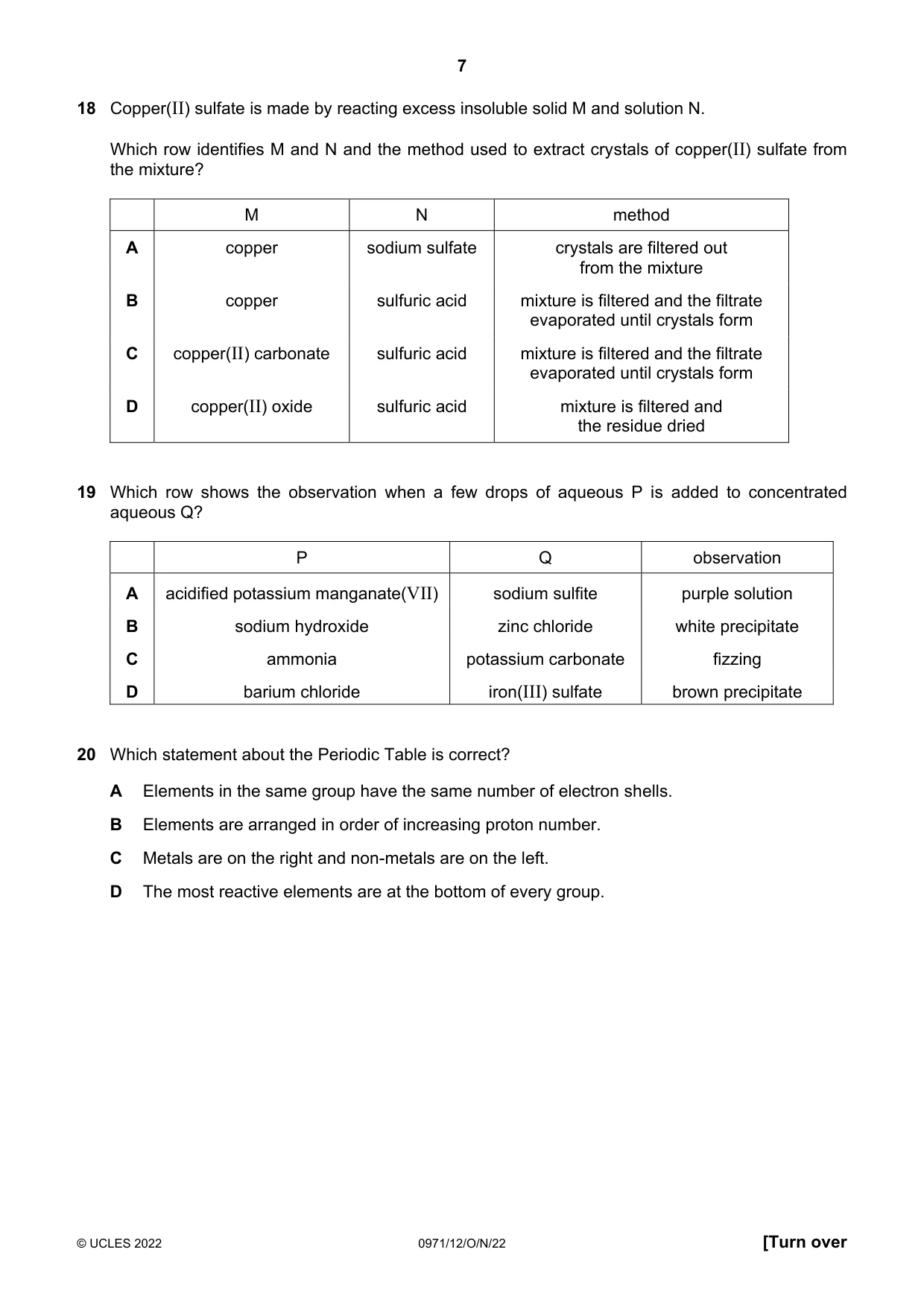
Q18 · Copper(II) sulfate is made by reacting excess insoluble solid M and solution N
18 Copper(II) sulfate is made by reacting excess insoluble solid M and solution N. Which row identifies M and N and the method used to extract crystals of copper(II) sulfate from the mixture? M N method A copper sodium sulfate crystals are filtered out from the mixture B copper sulfuric acid mixture is filtered and the filtrate evaporated until crystals form C copper(II) carbonate sulfuric acid mixture is filtered and the filtrate evaporated until crystals form D copper(II) oxide sulfuric acid mixture is filtered and the residue dried
Mark scheme: C
Q19 · Which row shows the observation when a few drops of aqueous P is added to concentrated…
19 Which row shows the observation when a few drops of aqueous P is added to concentrated aqueous Q? P Q observation A acidified potassium manganate(VII) sodium sulfite purple solution B sodium hydroxide zinc chloride white precipitate C ammonia potassium carbonate fizzing D barium chloride iron(III) sulfate brown precipitate
Mark scheme: B
Q20 · Which statement about the Periodic Table is correct?
20 Which statement about the Periodic Table is correct? A Elements in the same group have the same number of electron shells. B Elements are arranged in order of increasing proton number. C Metals are on the right and non-metals are on the left. D The most reactive elements are at the bottom of every group.
Mark scheme: B
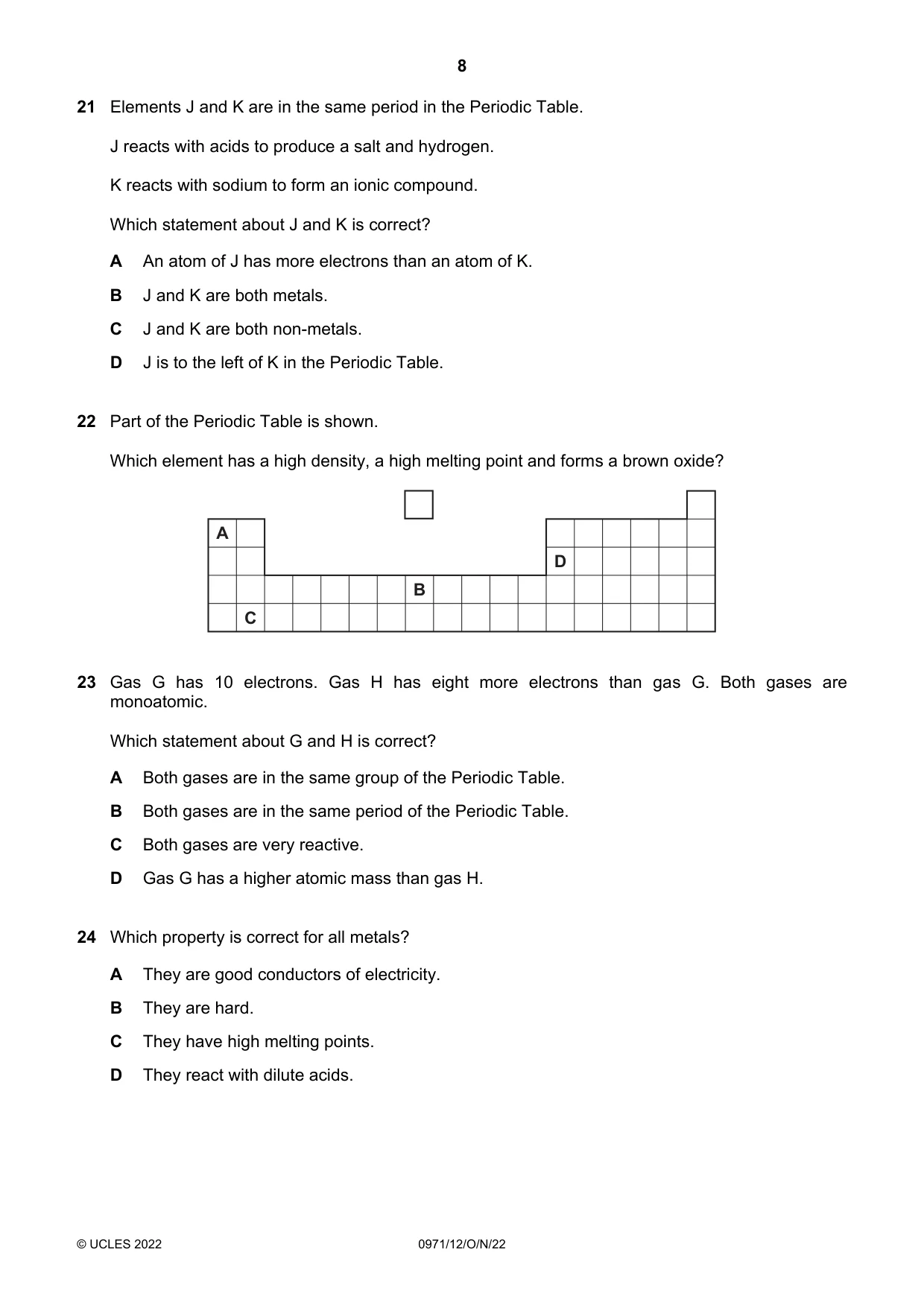
Q21 · Elements J and K are in the same period in the Periodic Table
21 Elements J and K are in the same period in the Periodic Table. J reacts with acids to produce a salt and hydrogen. K reacts with sodium to form an ionic compound. Which statement about J and K is correct? A An atom of J has more electrons than an atom of K. B J and K are both metals. C J and K are both non-metals. D J is to the left of K in the Periodic Table.
Mark scheme: D
Q22 · Part of the Periodic Table is shown
22 Part of the Periodic Table is shown. Which element has a high density, a high melting point and forms a brown oxide? A D B C
Mark scheme: B
Q23 · Gas G has 10 electrons
23 Gas G has 10 electrons. Gas H has eight more electrons than gas G. Both gases are monoatomic. Which statement about G and H is correct? A Both gases are in the same group of the Periodic Table. B Both gases are in the same period of the Periodic Table. C Both gases are very reactive. D Gas G has a higher atomic mass than gas H.
Mark scheme: A
Q24 · Which property is correct for all metals?
24 Which property is correct for all metals? A They are good conductors of electricity. B They are hard. C They have high melting points. D They react with dilute acids.
Mark scheme: A
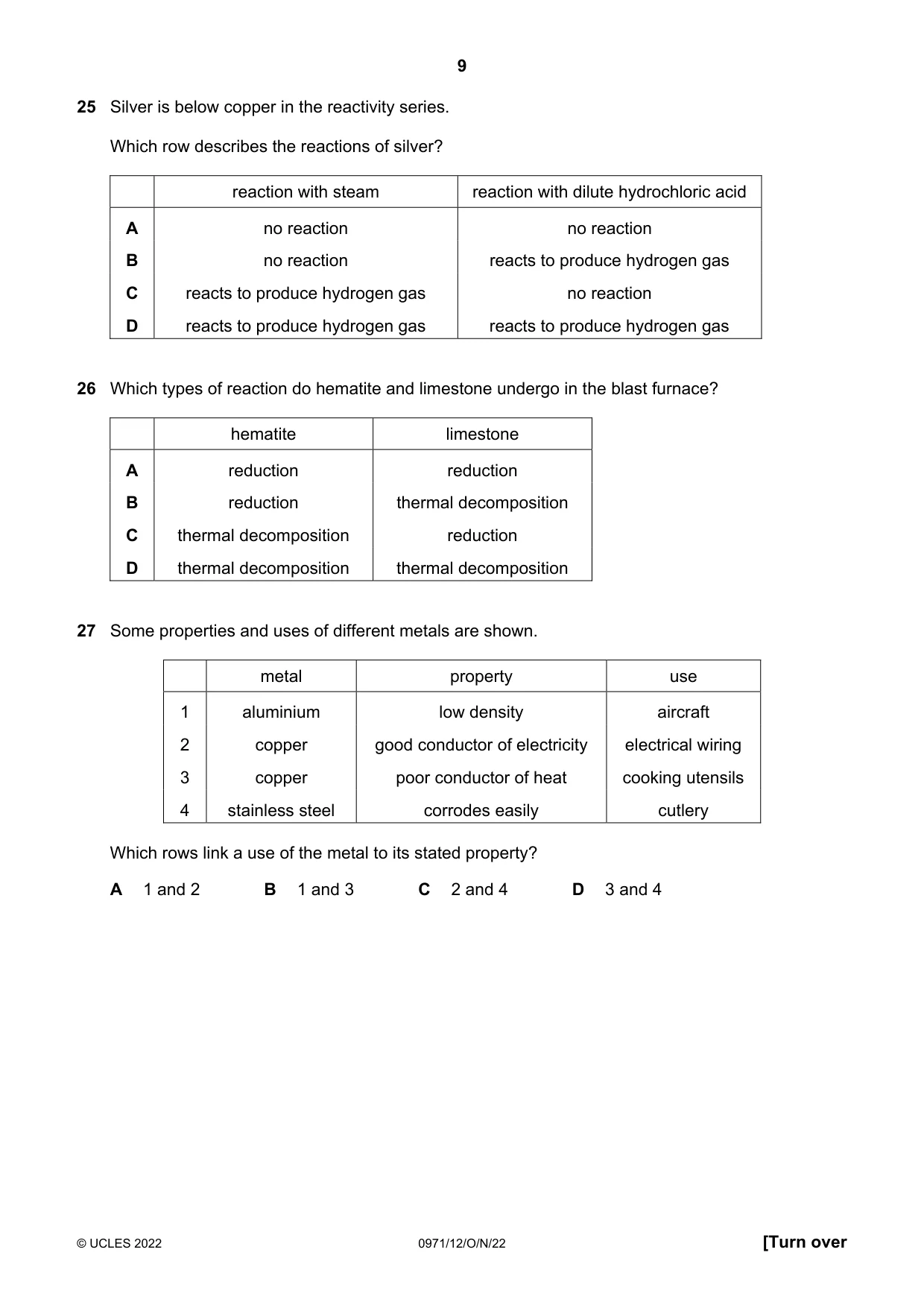
Q25 · Silver is below copper in the reactivity series
25 Silver is below copper in the reactivity series. Which row describes the reactions of silver? reaction with steam reaction with dilute hydrochloric acid A no reaction no reaction B no reaction reacts to produce hydrogen gas C reacts to produce hydrogen gas no reaction D reacts to produce hydrogen gas reacts to produce hydrogen gas
Mark scheme: A
Q26 · Which types of reaction do hematite and limestone undergo in the blast furnace?
26 Which types of reaction do hematite and limestone undergo in the blast furnace? hematite limestone A reduction reduction B reduction thermal decomposition C thermal decomposition reduction D thermal decomposition thermal decomposition
Mark scheme: B
Q27 · Some properties and uses of different metals are shown
27 Some properties and uses of different metals are shown. metal property use 1 aluminium low density aircraft 2 copper good conductor of electricity electrical wiring 3 copper poor conductor of heat cooking utensils 4 stainless steel corrodes easily cutlery Which rows link a use of the metal to its stated property? A 1 and 2 B 1 and 3 C 2 and 4 D 3 and 4
Mark scheme: A
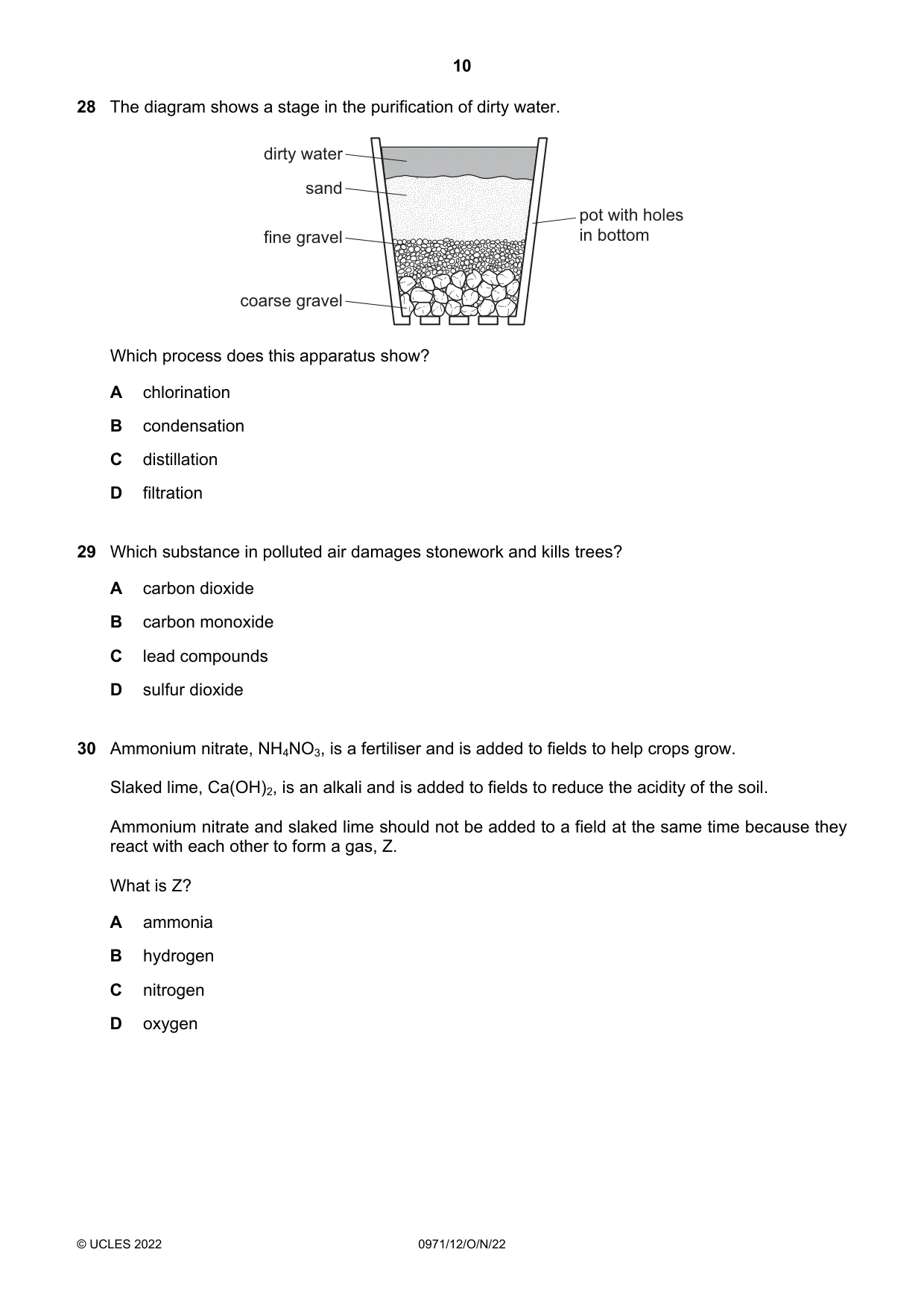
Q28 · The diagram shows a stage in the purification of dirty water
28 The diagram shows a stage in the purification of dirty water. dirty water sand pot with holes fine gravel in bottom coarse gravel Which process does this apparatus show? A chlorination B condensation C distillation D filtration
Mark scheme: D
Q29 · Which substance in polluted air damages stonework and kills trees?
29 Which substance in polluted air damages stonework and kills trees? A carbon dioxide B carbon monoxide C lead compounds D sulfur dioxide
Mark scheme: D
Q30 · Ammonium nitrate, NH4NO3, is a fertiliser and is added to fields to help crops grow
30 Ammonium nitrate, NH4NO3, is a fertiliser and is added to fields to help crops grow. Slaked lime, Ca(OH)2, is an alkali and is added to fields to reduce the acidity of the soil. Ammonium nitrate and slaked lime should not be added to a field at the same time because they react with each other to form a gas, Z. What is Z? A ammonia B hydrogen C nitrogen D oxygen
Mark scheme: A
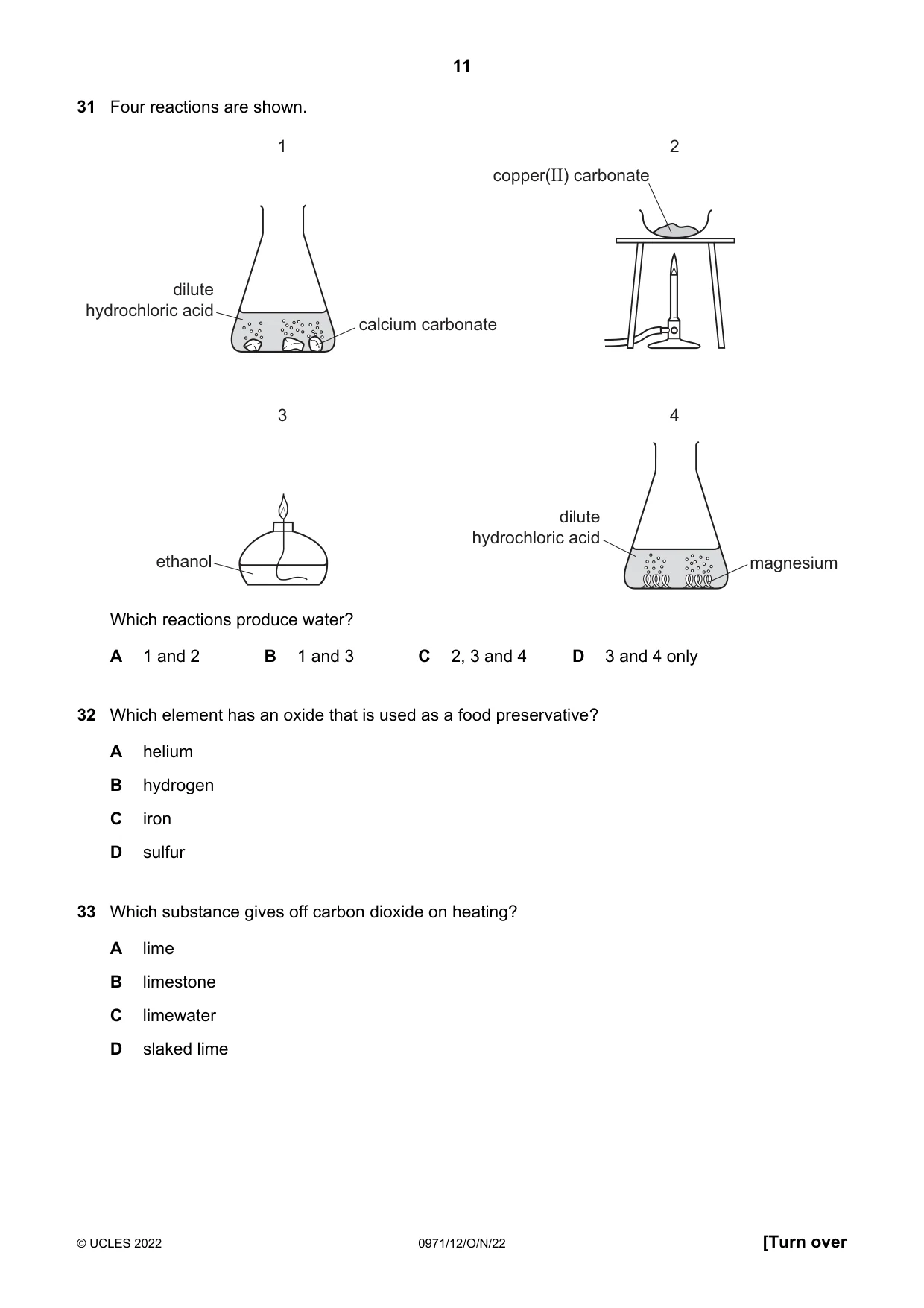
Q31 · Four reactions are shown
31 Four reactions are shown. 1 2 copper(II) carbonate dilute hydrochloric acid calcium carbonate 3 4 dilute hydrochloric acid ethanol magnesium Which reactions produce water? A 1 and 2 B 1 and 3 C 2, 3 and 4 D 3 and 4 only
Mark scheme: B
Q32 · Which element has an oxide that is used as a food preservative?
32 Which element has an oxide that is used as a food preservative? A helium B hydrogen C iron D sulfur
Mark scheme: D
Q33 · Which substance gives off carbon dioxide on heating?
33 Which substance gives off carbon dioxide on heating? A lime B limestone C limewater D slaked lime
Mark scheme: B
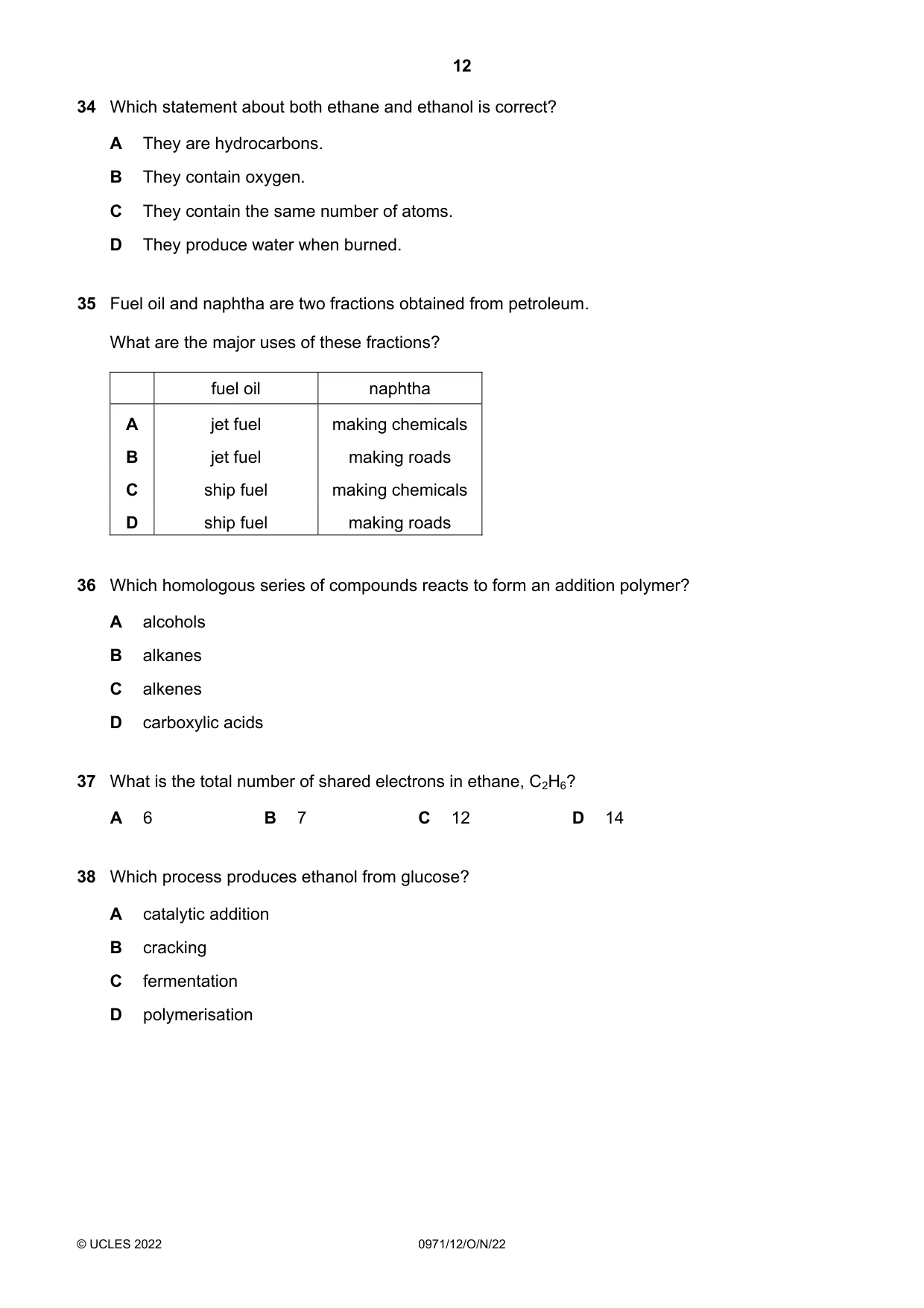
Q34 · Which statement about both ethane and ethanol is correct?
34 Which statement about both ethane and ethanol is correct? A They are hydrocarbons. B They contain oxygen. C They contain the same number of atoms. D They produce water when burned.
Mark scheme: D
Q35 · Fuel oil and naphtha are two fractions obtained from petroleum
35 Fuel oil and naphtha are two fractions obtained from petroleum. What are the major uses of these fractions? fuel oil naphtha A jet fuel making chemicals B jet fuel making roads C ship fuel making chemicals D ship fuel making roads
Mark scheme: C
Q36 · Which homologous series of compounds reacts to form an addition polymer?
36 Which homologous series of compounds reacts to form an addition polymer? A alcohols B alkanes C alkenes D carboxylic acids
Mark scheme: C
Q37 · What is the total number of shared electrons in ethane, C2H6?
37 What is the total number of shared electrons in ethane, C2H6? A 6 B 7 C 12 D 14
Mark scheme: D
Q38 · Which process produces ethanol from glucose?
38 Which process produces ethanol from glucose? A catalytic addition B cracking C fermentation D polymerisation
Mark scheme: C
Q39 · Which statement about unsaturated hydrocarbons is correct?
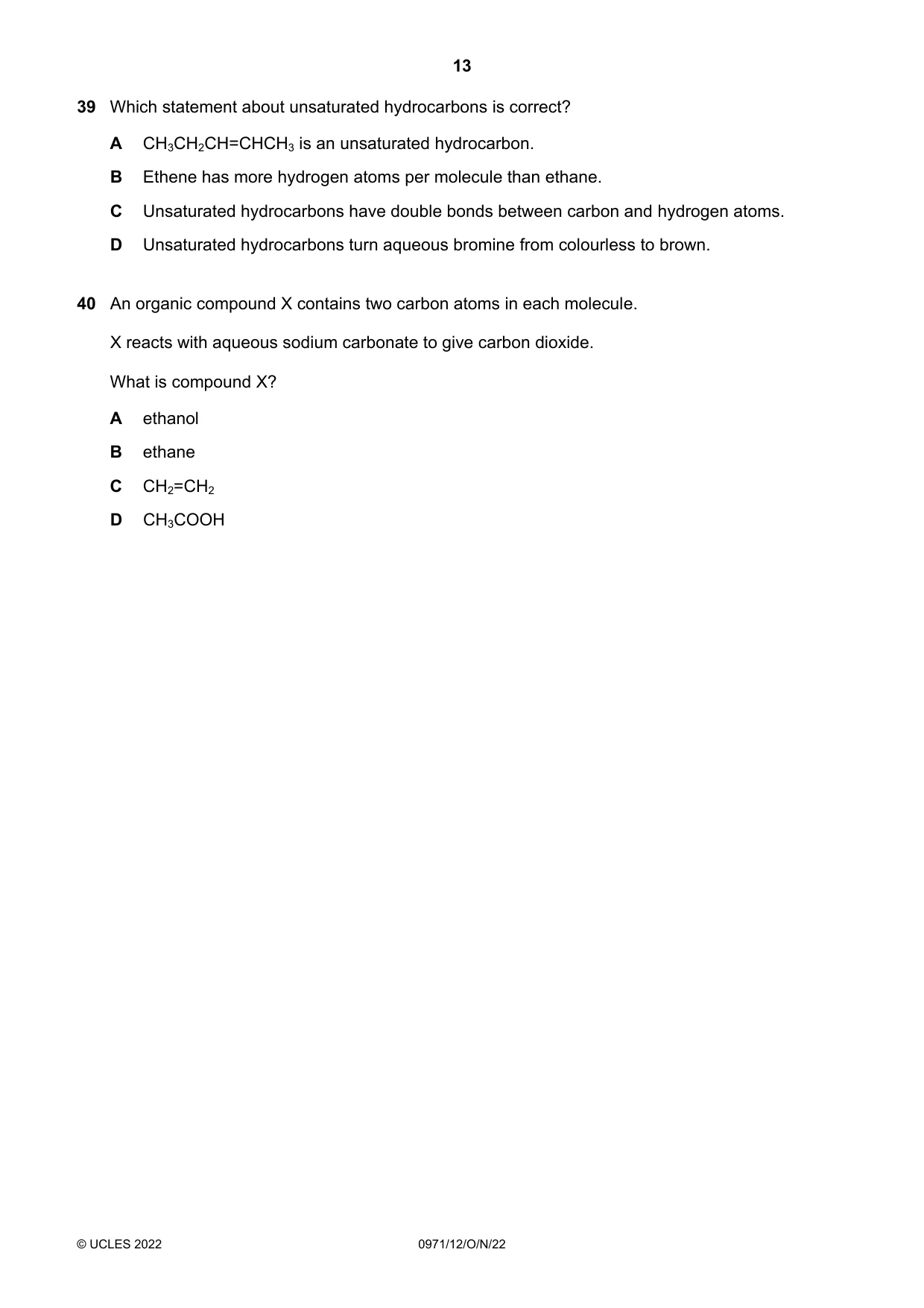
39 Which statement about unsaturated hydrocarbons is correct? A CH3CH2CH=CHCH3 is an unsaturated hydrocarbon. B Ethene has more hydrogen atoms per molecule than ethane. C Unsaturated hydrocarbons have double bonds between carbon and hydrogen atoms. D Unsaturated hydrocarbons turn aqueous bromine from colourless to brown.
Mark scheme: A
Q40 · An organic compound X contains two carbon atoms in each molecule
40 An organic compound X contains two carbon atoms in each molecule. X reacts with aqueous sodium carbonate to give carbon dioxide. What is compound X? A ethanol B ethane C CH2=CH2 D CH3COOH
Mark scheme: D
What was in this paper
The subtopics covered by these 40 questions, and how many questions each got. Open one in a new tab to see every Cambridge question on it.
2Alcohols2Arrangement of elements2Fuels2Identification of ions and gases2Oxides2Preparation of salts2Alkenes1Alloys and their properties1Carboxylic acids1Chromatography1Electrolysis1Exothermic and endothermic reactions1Extraction of metals1Fertilisers1Formulae1Giant covalent structures1Ions and ionic bonds1Isotopes1Noble gases1Physical and chemical changes1Polymers1Properties of metals1Rate of reaction1Reactivity series1Redox1Relative masses of atoms and molecules1Separation and purification1Simple molecules and covalent bonds1Solids, liquids and gases1Transition elements1Uses of metals1Water1What you needed in this session
Cambridge’s own grade thresholds for 2022 Oct/Nov, Paper 1 · Variant 2. A higher threshold means an easier paper — the bar moves with how the cohort did.