Questions as text
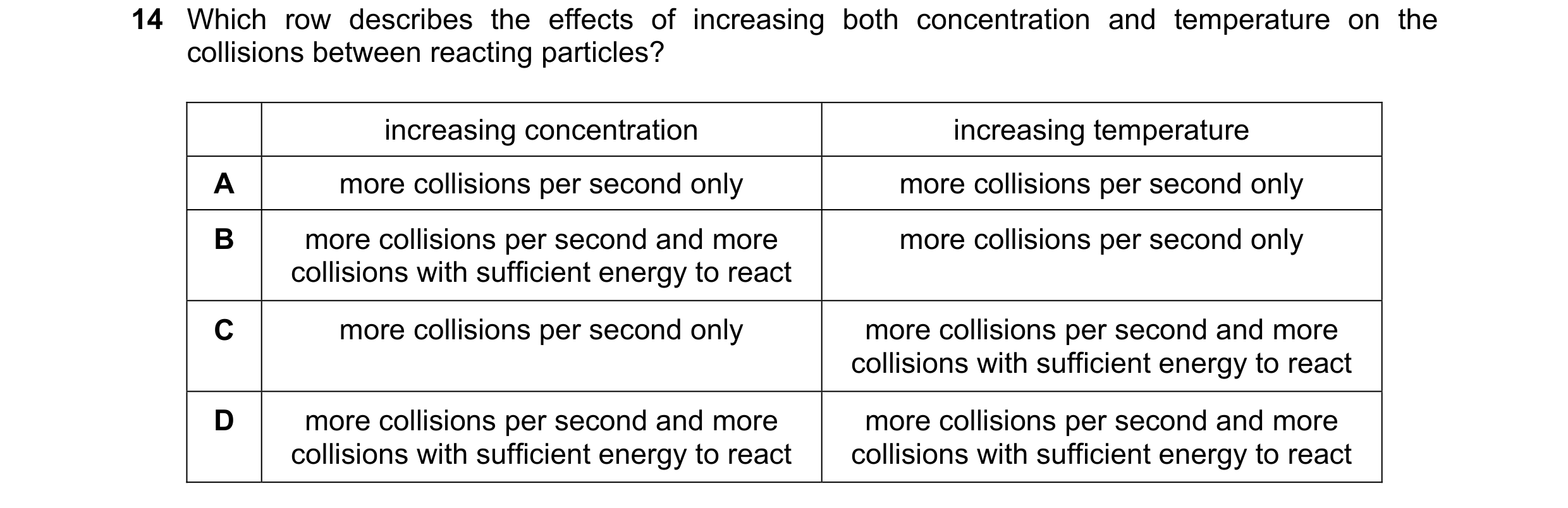
Q1 · Which row describes the effects of increasing both concentration and temperature on the… 0971/21 May/June 2018
14 Which row describes the effects of increasing both concentration and temperature on the collisions between reacting particles? increasing concentration increasing temperature A more collisions per second only more collisions per second only B more collisions per second and more more collisions per second only collisions with sufficient energy to react C more collisions per second only more collisions per second and more collisions with sufficient energy to react D more collisions per second and more more collisions per second and more collisions with sufficient energy to react collisions with sufficient energy to react
1 marks
Answer: C
This question in 0971/21 May/June 2018
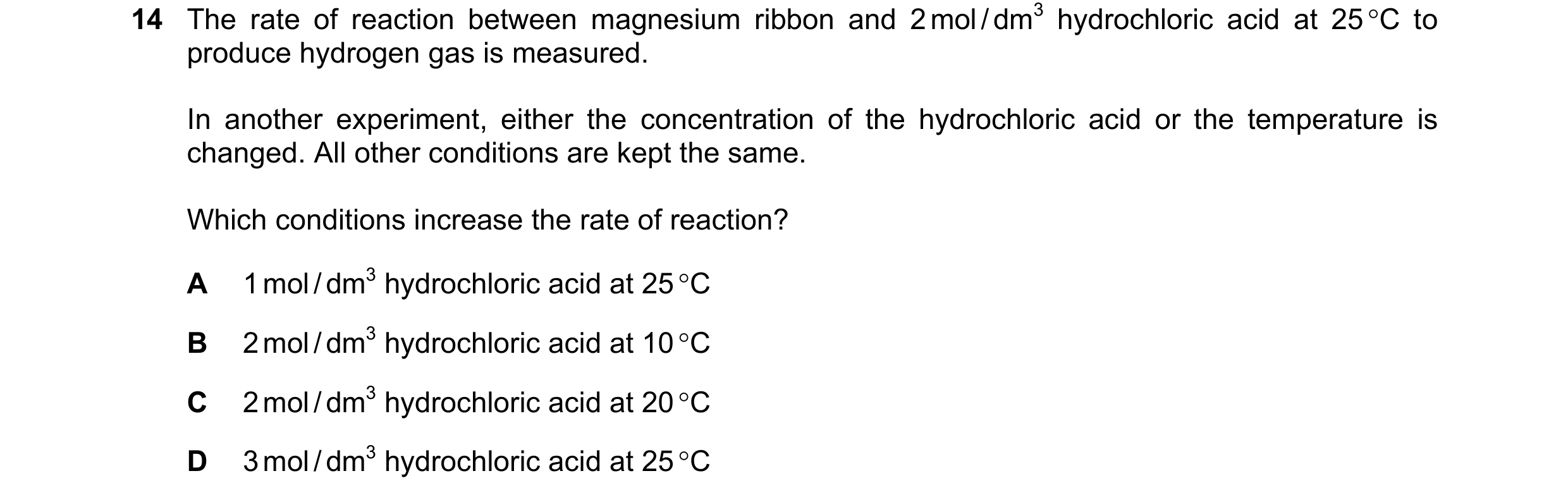
Q2 · The rate of reaction between magnesium ribbon and 2 mol / dm3 hydrochloric acid at 25 °C… 0971/22 Oct/Nov 2018
14 The rate of reaction between magnesium ribbon and 2 mol / dm3 hydrochloric acid at 25 °C to produce hydrogen gas is measured. In another experiment, either the concentration of the hydrochloric acid or the temperature is changed. All other conditions are kept the same. Which conditions increase the rate of reaction? A 1 mol / dm3 hydrochloric acid at 25 °C B 2 mol / dm3 hydrochloric acid at 10 °C C 2 mol / dm3 hydrochloric acid at 20 °C D 3 mol / dm3 hydrochloric acid at 25 °C
1 marks
Answer: D
This question in 0971/22 Oct/Nov 2018
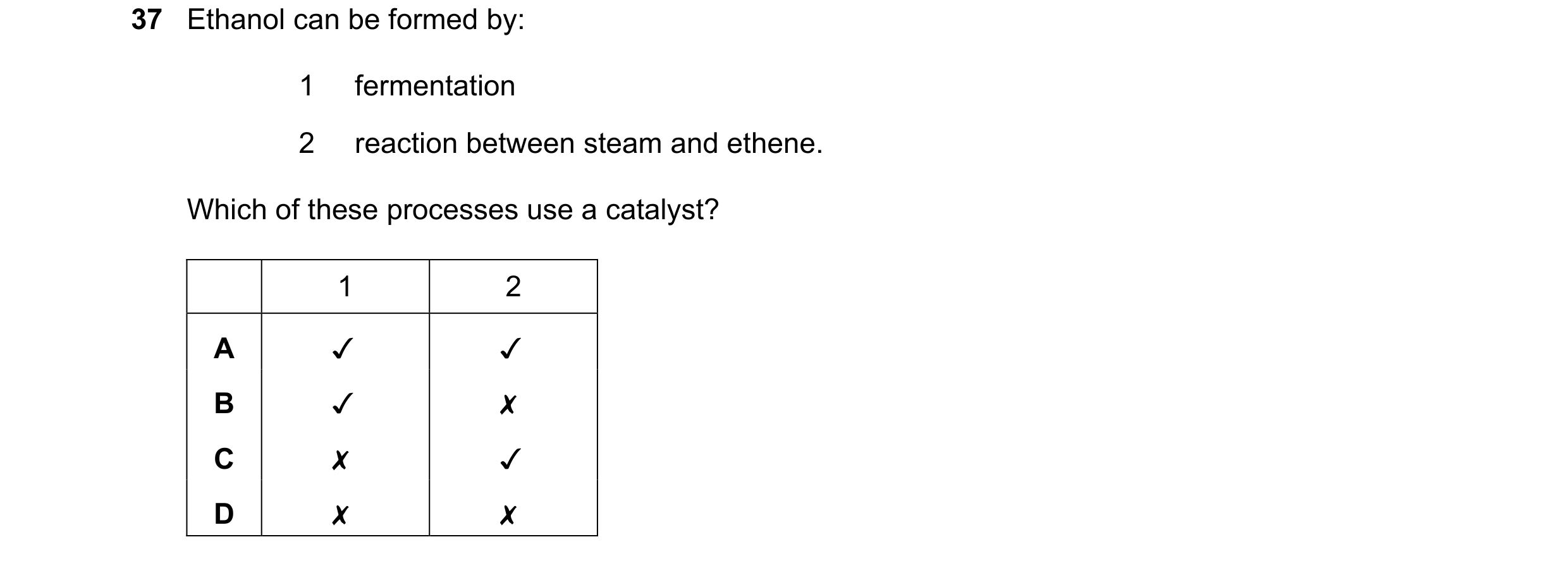
Q3 · Ethanol can be formed by: 1 fermentation 2 reaction between steam and ethene 0971/22 Oct/Nov 2018
37 Ethanol can be formed by:
1 fermentation
2 reaction between steam and ethene.
Which of these processes use a catalyst?
—
0 ONO WwW >
~~ KN
~*~ QL €K NIN
1 marks
Answer: A
This question in 0971/22 Oct/Nov 2018
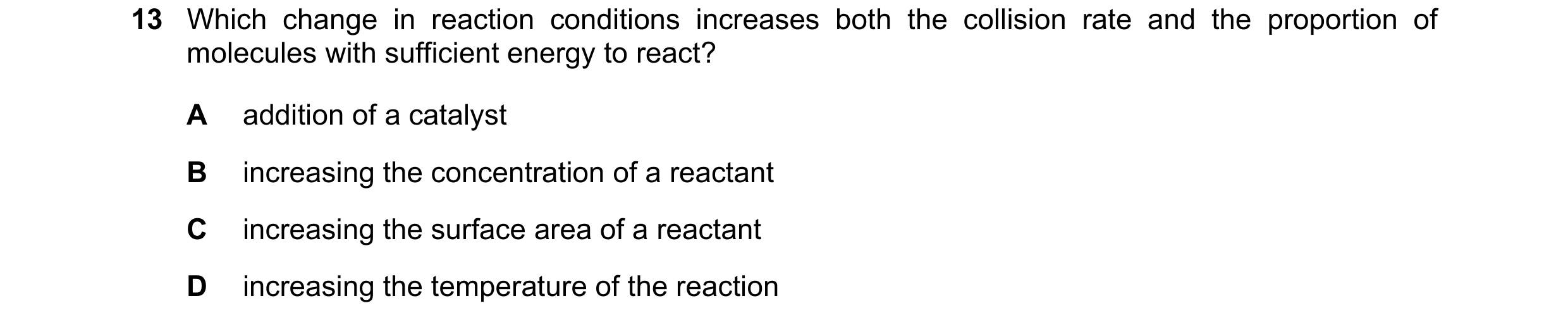
Q4 · Which change in reaction conditions increases both the collision rate and the proportion… 0971/21 May/June 2019
13 Which change in reaction conditions increases both the collision rate and the proportion of molecules with sufficient energy to react? A addition of a catalyst B increasing the concentration of a reactant C increasing the surface area of a reactant D increasing the temperature of the reaction
1 marks
Answer: D
This question in 0971/21 May/June 2019
Q5 · A sample of dilute nitric acid is added to lumps of limestone in a conical flask 0971/22 Oct/Nov 2019
16 A sample of dilute nitric acid is added to lumps of limestone in a conical flask. The conical flask is placed on a balance and the loss in mass is measured. A second sample of nitric acid of a different concentration is separately tested. All other conditions are kept the same. The loss in mass in 1 minute at each concentration of nitric acid is shown. concentration loss in mass in in mol / dm3 1 minute / g 0.5 0.15 1.0 0.25 Which row describes and explains the results obtained using 1.0 mol / dm3 nitric acid compared with 0.5 mol / dm3 nitric acid? description explanation A decrease in reaction rate decrease in particle collision energy B decrease in reaction rate increase in particle collision rate C increase in reaction rate increase in particle collision rate D increase in reaction rate increase in particle collision rate and collision energy
1 marks
Answer: C
This question in 0971/22 Oct/Nov 2019
Q6 · The rate of reaction between calcium carbonate chips and hydrochloric acid is studied by… 0971/21 May/June 2020
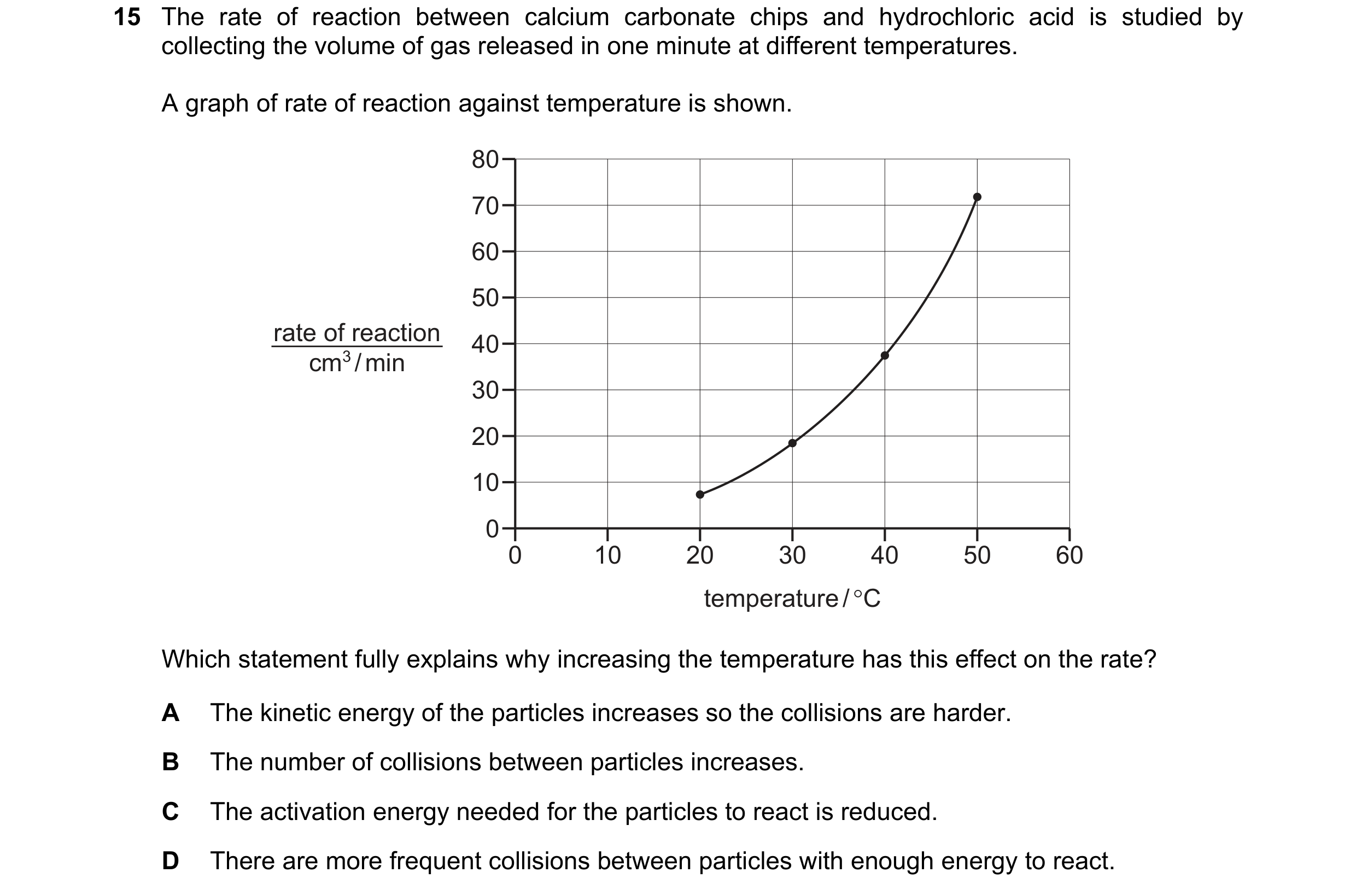
15 The rate of reaction between calcium carbonate chips and hydrochloric acid is studied by collecting the volume of gas released in one minute at different temperatures. A graph of rate of reaction against temperature is shown. 80 70 60 50 rate of reaction 40 cm3 / min 30 20 10 0 0 10 20 30 40 50 60 temperature / °C Which statement fully explains why increasing the temperature has this effect on the rate? A The kinetic energy of the particles increases so the collisions are harder. B The number of collisions between particles increases. C The activation energy needed for the particles to react is reduced. D There are more frequent collisions between particles with enough energy to react.
1 marks
Answer: D
This question in 0971/21 May/June 2020
Q7 · The Contact process is used to manufacture concentrated sulfuric acid and consists of… 0971/21 May/June 2020
34 The Contact process is used to manufacture concentrated sulfuric acid and consists of four steps. Which step involves a catalyst? A production of sulfur dioxide gas B production of sulfur trioxide gas C production of oleum D production of concentrated sulfuric acid
1 marks
Answer: B
This question in 0971/21 May/June 2020
Q8 · The results of adding excess marble chips (calcium carbonate) to hydrochloric acid at 50… 0971/22 May/June 2020
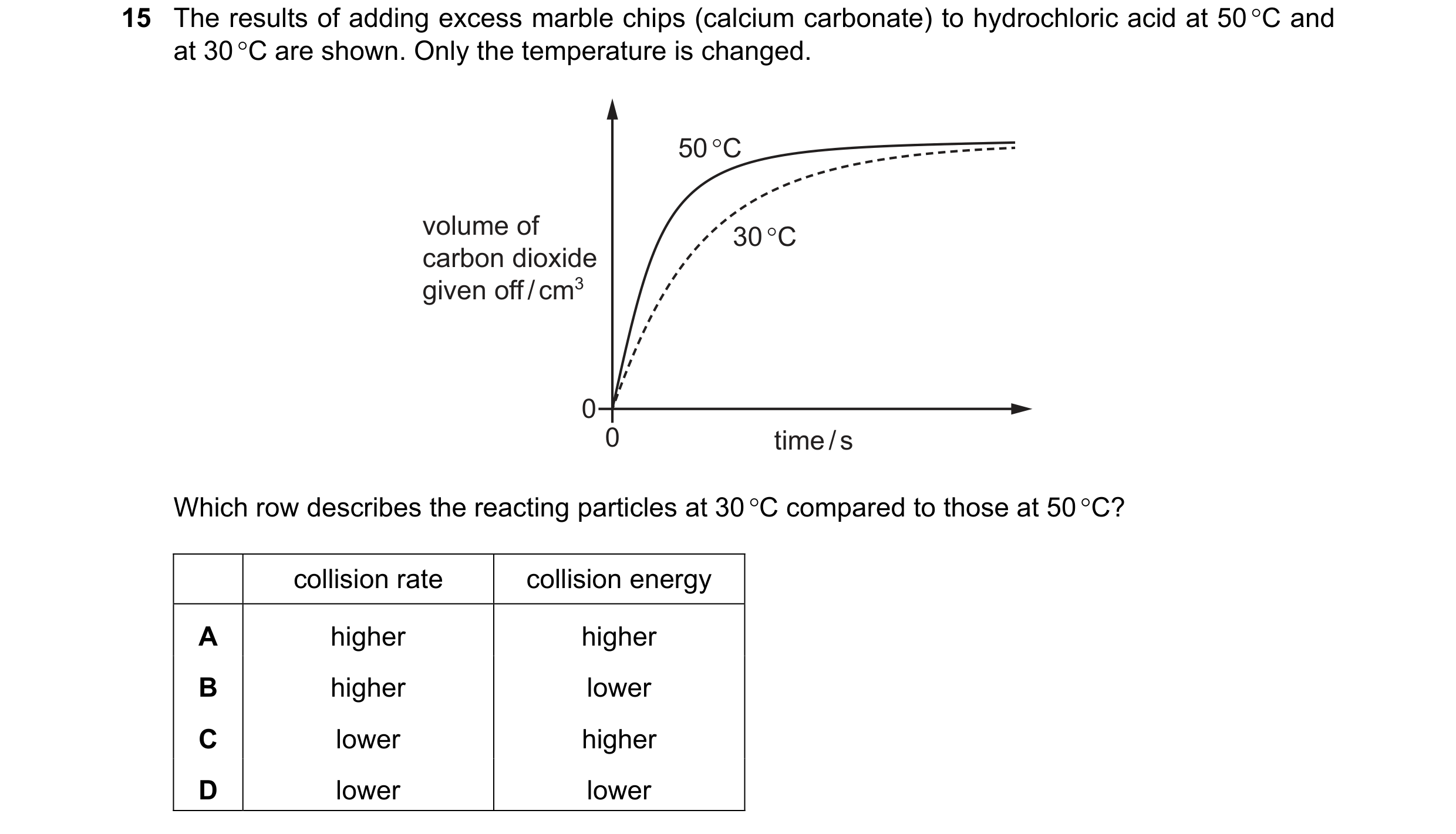
15 The results of adding excess marble chips (calcium carbonate) to hydrochloric acid at 50 °C and at 30 °C are shown. Only the temperature is changed. 50 °C volume of 30 °C carbon dioxide given off / cm3 0 0 time / s Which row describes the reacting particles at 30 °C compared to those at 50 °C? collision rate collision energy A higher higher B higher lower C lower higher D lower lower
1 marks
Answer: D
This question in 0971/22 May/June 2020
Q9 · One of the reactions used in the manufacture of sulfuric acid is shown 0971/22 May/June 2020
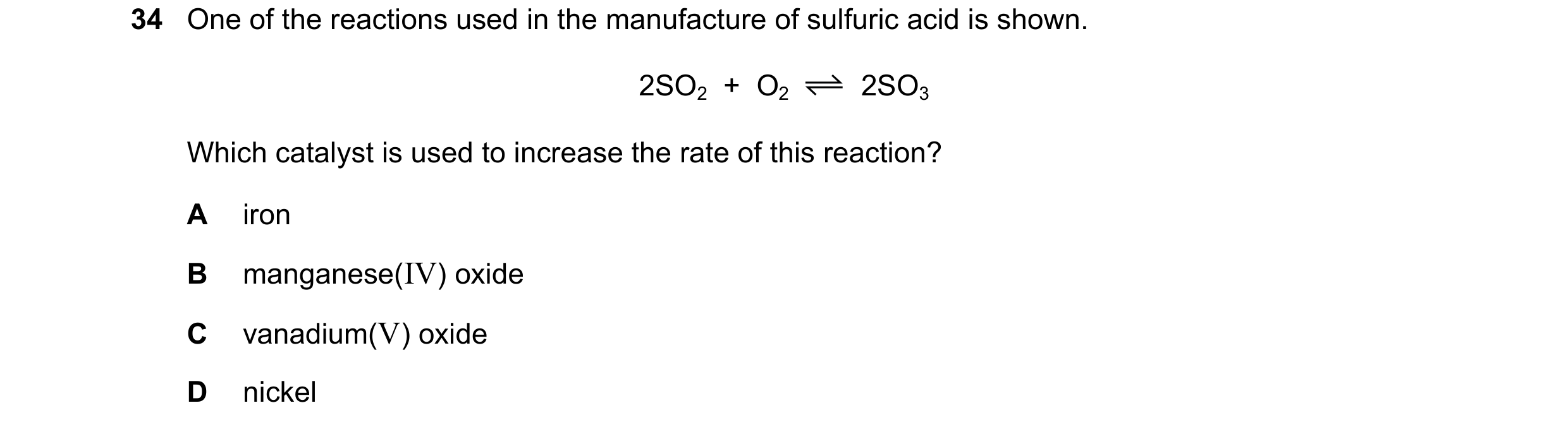
34 One of the reactions used in the manufacture of sulfuric acid is shown. 2SO2 + O2 2SO3 Which catalyst is used to increase the rate of this reaction? A iron B manganese(IV) oxide C vanadium(V) oxide D nickel
1 marks
Answer: C
This question in 0971/22 May/June 2020
Q10 · Nitrogen, N2, and hydrogen, H2, can be converted into ammonia, NH3, using a catalyst 0971/22 Oct/Nov 2020
17 Nitrogen, N2, and hydrogen, H2, can be converted into ammonia, NH3, using a catalyst. What is the purpose of the catalyst? A to increase the amount of ammonia produced B to increase the rate of reaction C to reduce the amount of reactants needed D to reduce the rate of reaction
1 marks
Answer: B
This question in 0971/22 Oct/Nov 2020
Q11 · Four statements about the effect of increasing temperature on a reaction are shown 0971/21 May/June 2021
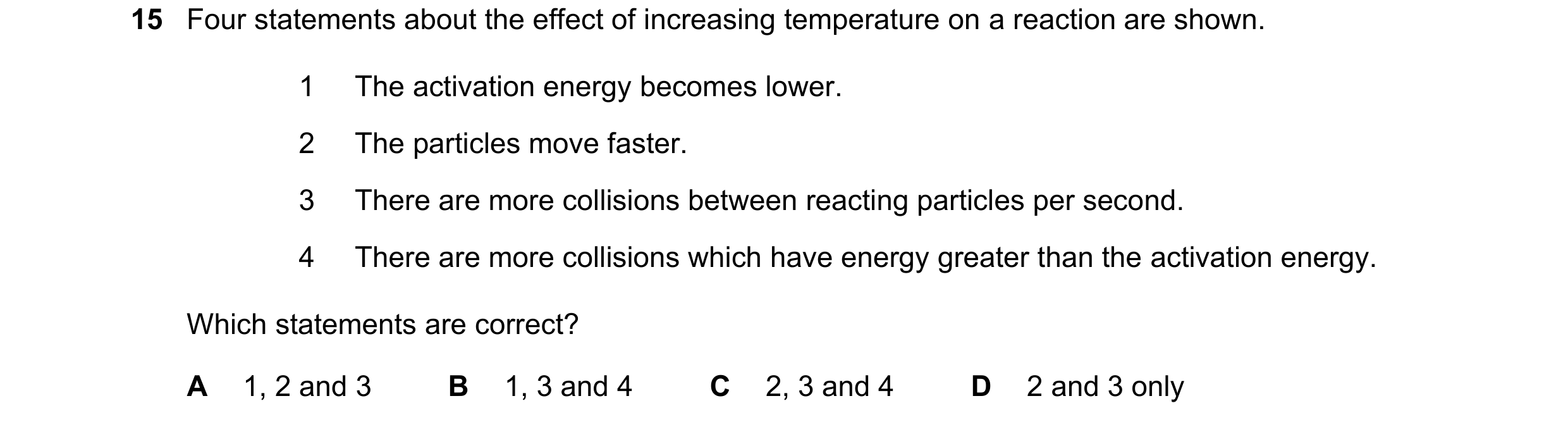
15 Four statements about the effect of increasing temperature on a reaction are shown. 1 The activation energy becomes lower. 2 The particles move faster. 3 There are more collisions between reacting particles per second. 4 There are more collisions which have energy greater than the activation energy. Which statements are correct? A 1, 2 and 3 B 1, 3 and 4 C 2, 3 and 4 D 2 and 3 only
1 marks
Answer: C
This question in 0971/21 May/June 2021
Q12 · Which catalyst is used in the Contact process? 0971/21 May/June 2021
31 Which catalyst is used in the Contact process? A calcium oxide B iron C manganese(II) oxide D vanadium(V) oxide
1 marks
Answer: D
This question in 0971/21 May/June 2021
Q13 · An excess of calcium carbonate reacts with dilute hydrochloric acid 0971/22 May/June 2021
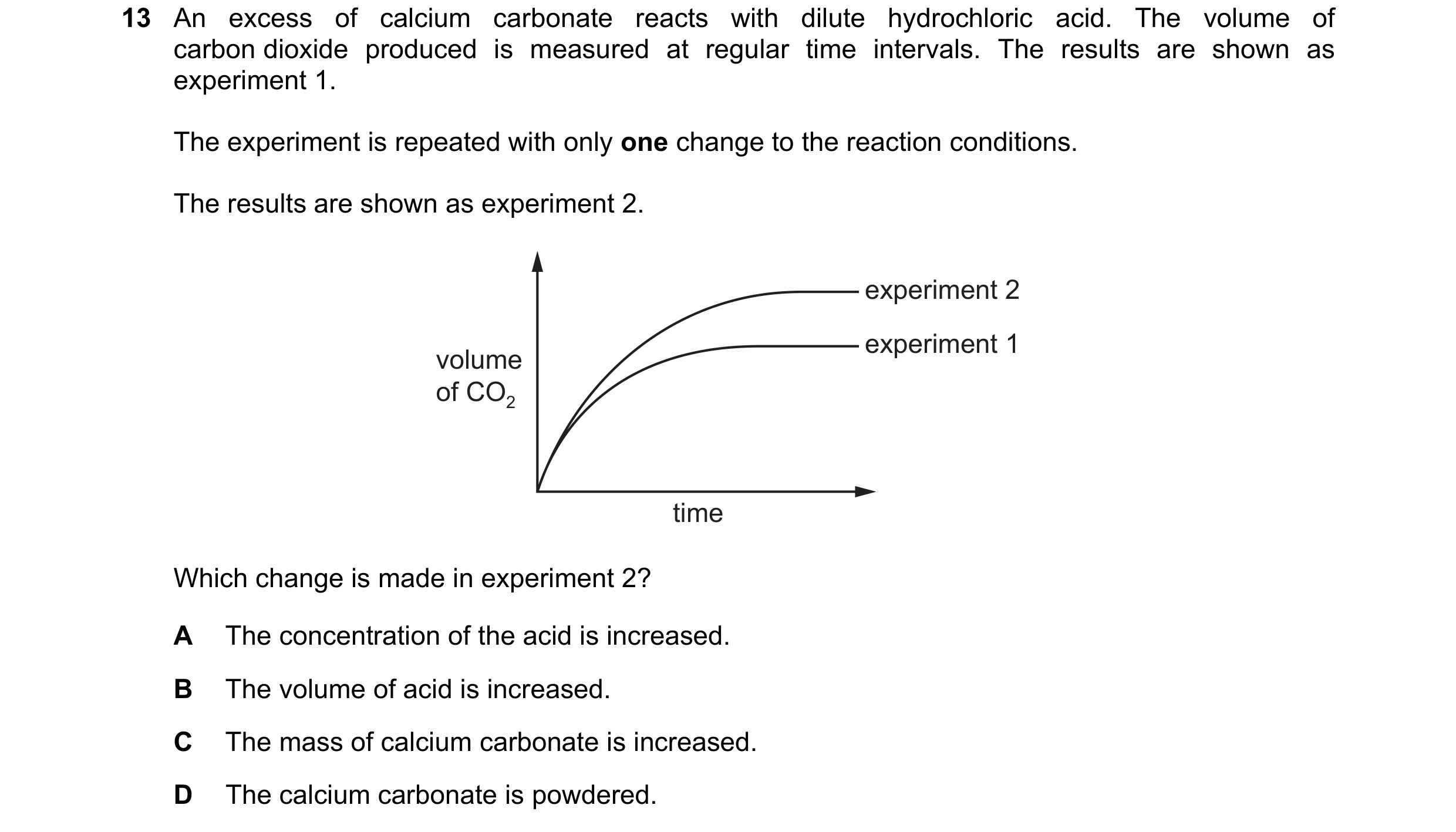
13 An excess of calcium carbonate reacts with dilute hydrochloric acid. The volume of carbon dioxide produced is measured at regular time intervals. The results are shown as experiment 1. The experiment is repeated with only one change to the reaction conditions. The results are shown as experiment 2. experiment 2 experiment 1 volume of CO2 time Which change is made in experiment 2? A The concentration of the acid is increased. B The volume of acid is increased. C The mass of calcium carbonate is increased. D The calcium carbonate is powdered.
1 marks
Answer: B
This question in 0971/22 May/June 2021
Q14 · Four statements about the effect of increasing temperature on a reaction are shown 0971/22 May/June 2021
15 Four statements about the effect of increasing temperature on a reaction are shown. 1 The activation energy becomes lower. 2 The particles move faster. 3 There are more collisions between reacting particles per second. 4 There are more collisions which have energy greater than the activation energy. Which statements are correct? A 1, 2 and 3 B 1, 3 and 4 C 2, 3 and 4 D 2 and 3 only
1 marks
Answer: C
This question in 0971/22 May/June 2021
Q15 · A student measures the time taken for 2.0 g of magnesium to dissolve in 50 cm3 of dilute… 0971/21 May/June 2022
2 A student measures the time taken for 2.0 g of magnesium to dissolve in 50 cm3 of dilute sulfuric acid. Which apparatus is essential to complete the experiment? 1 stop-clock 2 measuring cylinder 3 thermometer 4 balance A 1, 2 and 4 B 1 and 2 only C 1 and 4 only D 2, 3 and 4
1 marks
Answer: A
This question in 0971/21 May/June 2022
Q16 · The equation for the manufacture of ammonia in the Haber process is shown 0971/21 May/June 2022
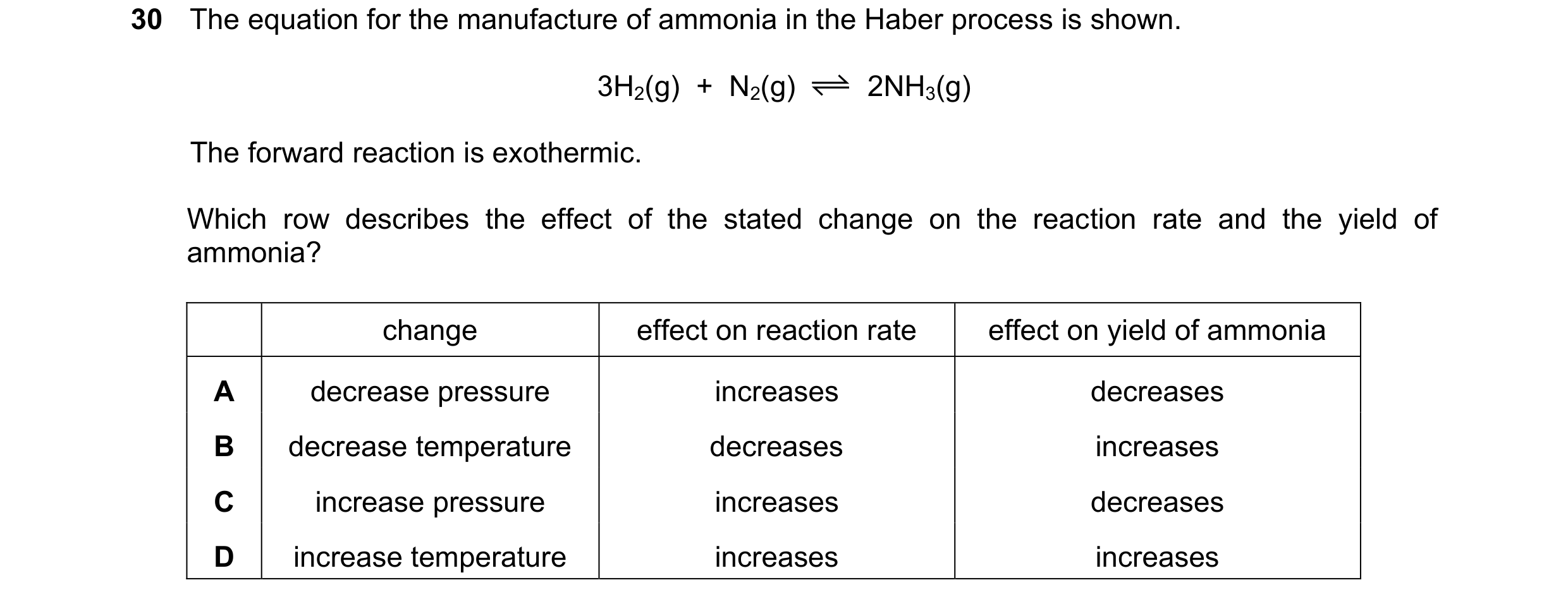
30 The equation for the manufacture of ammonia in the Haber process is shown. 3H2(g) + N2(g) 2NH3(g) The forward reaction is exothermic. Which row describes the effect of the stated change on the reaction rate and the yield of ammonia? change effect on reaction rate effect on yield of ammonia A decrease pressure increases decreases B decrease temperature decreases increases C increase pressure increases decreases D increase temperature increases increases
1 marks
Answer: B
This question in 0971/21 May/June 2022
Q17 · A student measures the time taken for 2.0 g of magnesium to dissolve in 50 cm3 of dilute… 0971/22 May/June 2022
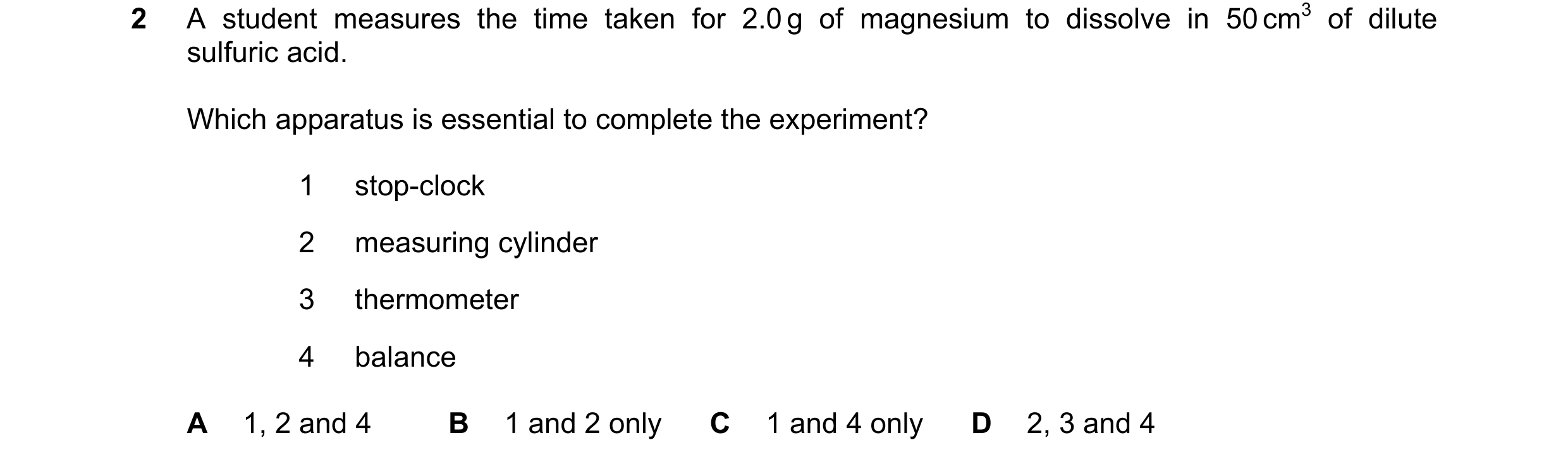
2 A student measures the time taken for 2.0 g of magnesium to dissolve in 50 cm3 of dilute sulfuric acid. Which apparatus is essential to complete the experiment? 1 stop-clock 2 measuring cylinder 3 thermometer 4 balance A 1, 2 and 4 B 1 and 2 only C 1 and 4 only D 2, 3 and 4
1 marks
Answer: A
This question in 0971/22 May/June 2022
Q18 · Which statements explain why increasing the concentration of a reactant increases the… 0971/22 May/June 2022
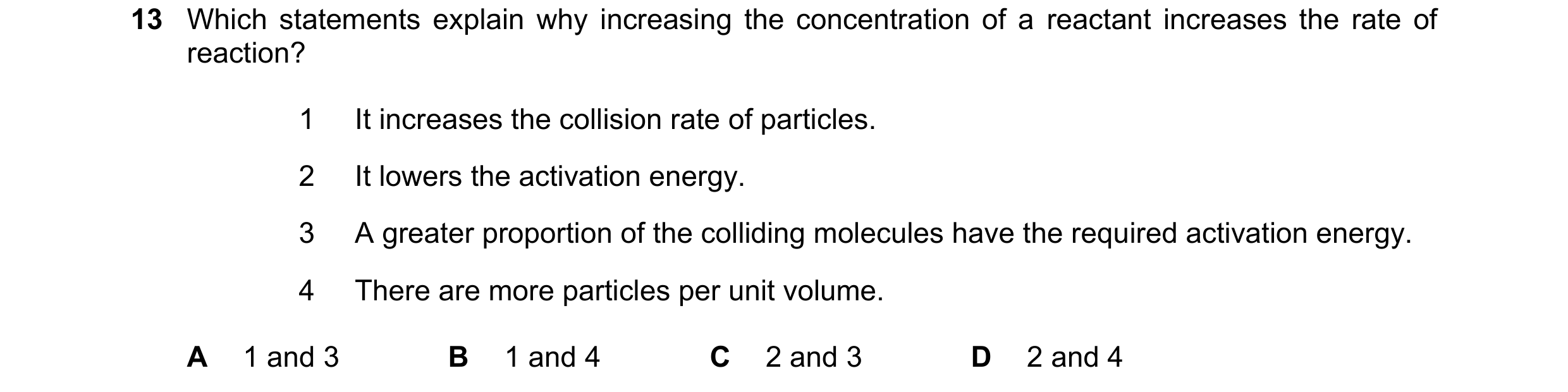
13 Which statements explain why increasing the concentration of a reactant increases the rate of reaction? 1 It increases the collision rate of particles. 2 It lowers the activation energy. 3 A greater proportion of the colliding molecules have the required activation energy. 4 There are more particles per unit volume. A 1 and 3 B 1 and 4 C 2 and 3 D 2 and 4
1 marks
Answer: B
This question in 0971/22 May/June 2022
Q19 · The volume of gas given off in a chemical reaction is measured over time 0971/22 Oct/Nov 2022
15 The volume of gas given off in a chemical reaction is measured over time. The results are shown. 100 90 80 70 volume 60 of gas 50 / cm3 40 30 20 10 0 0 2 4 6 8 10 time / s At which time is the rate of reaction greatest? A 0 s B 4 s C 6 s D 10 s
1 marks
Answer: C
This question in 0971/22 Oct/Nov 2022
Q20 · The scheme shows four stages in the conversion of sulfur to sulfuric acid 0971/22 Oct/Nov 2022
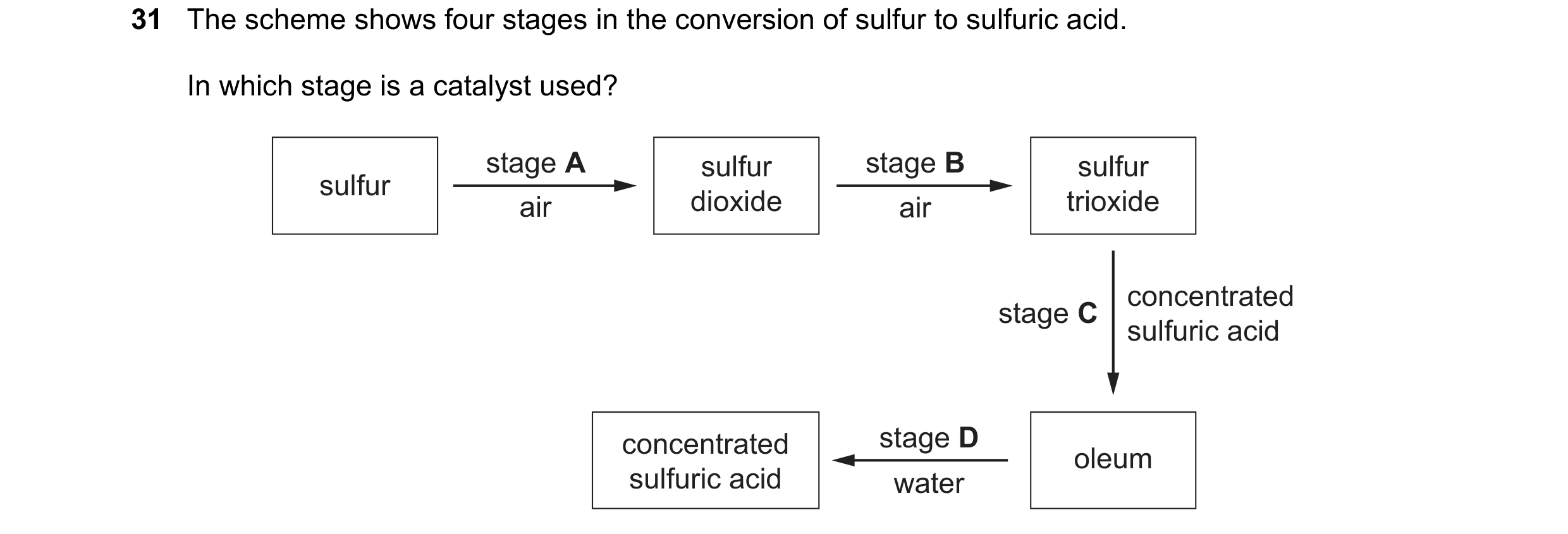
31 The scheme shows four stages in the conversion of sulfur to sulfuric acid. In which stage is a catalyst used? stage A sulfur stage B sulfur sulfur air dioxide air trioxide stage C concentrated sulfuric acid stage D concentrated oleum sulfuric acid water
1 marks
Answer: B
This question in 0971/22 Oct/Nov 2022
Q21 · Which row describes the effect on the activation energy and the frequency of particle… 0971/21 May/June 2023
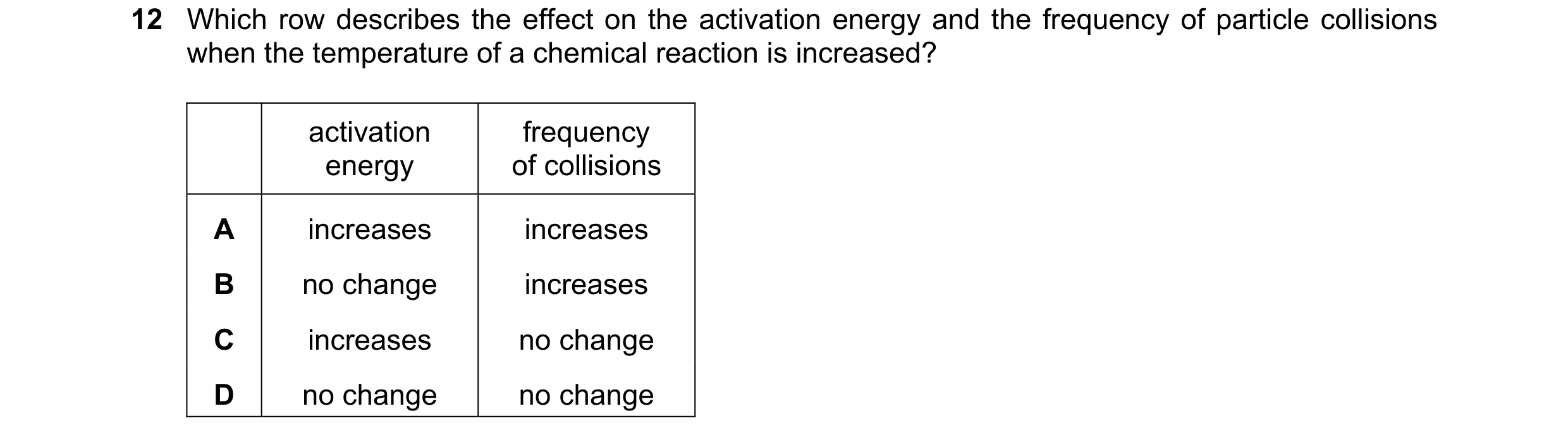
12 Which row describes the effect on the activation energy and the frequency of particle collisions when the temperature of a chemical reaction is increased? activation frequency energy of collisions A increases increases B no change increases C increases no change D no change no change
1 marks
Answer: B
This question in 0971/21 May/June 2023
Q22 · Which change increases the rate of reaction by decreasing the activation energy, Ea? 0971/22 May/June 2023
12 Which change increases the rate of reaction by decreasing the activation energy, Ea? A addition of a catalyst B decrease in size of solid reactants C increase in concentration of solutions D increase in temperature
1 marks
Answer: A
This question in 0971/22 May/June 2023
Q23 · Hydrochloric acid is added to excess calcium carbonate in two separate experiments 0971/22 Oct/Nov 2023
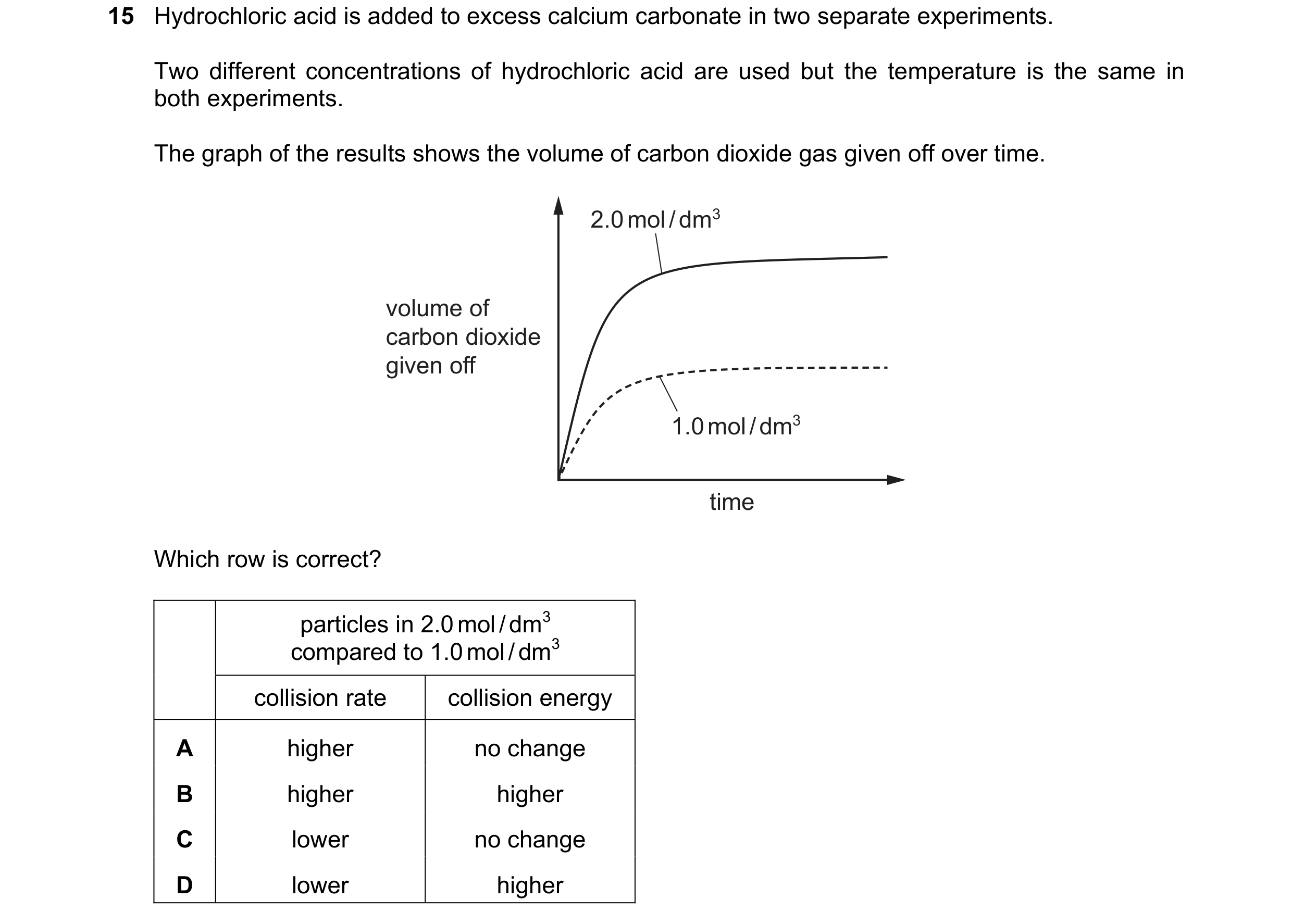
15 Hydrochloric acid is added to excess calcium carbonate in two separate experiments. Two different concentrations of hydrochloric acid are used but the temperature is the same in both experiments. The graph of the results shows the volume of carbon dioxide gas given off over time. 2.0 mol / dm3 volume of carbon dioxide given off 1.0 mol / dm3 time Which row is correct? particles in 2.0 mol / dm3 compared to 1.0 mol / dm3 collision rate collision energy A higher no change B higher higher C lower no change D lower higher
1 marks
Answer: A
This question in 0971/22 Oct/Nov 2023
Q24 · Powdered magnesium carbonate is added to excess dilute hydrochloric acid 0971/21 May/June 2024
18 Powdered magnesium carbonate is added to excess dilute hydrochloric acid. The total volume of gas produced is measured over time. A graph of the results is shown. 300 200 total volume of gas produced / cm3 100 0 0 25 50 75 100 125 150 175 200 time / s The experiment is repeated but the concentration of the hydrochloric acid is doubled. All other conditions are kept the same. Which statements about the second experiment are correct? 1 The final volume of gas is 360cm3. 2 The reaction finishes before 90 seconds. 3 The activation energy of the reaction is lower. A 1 and 2 B 1 and 3 C 2 and 3 D 2 only
1 marks
Answer: D
This question in 0971/21 May/June 2024
Q25 · Which statements explain why increasing the temperature changes the rate of a chemical… 0971/21 May/June 2024
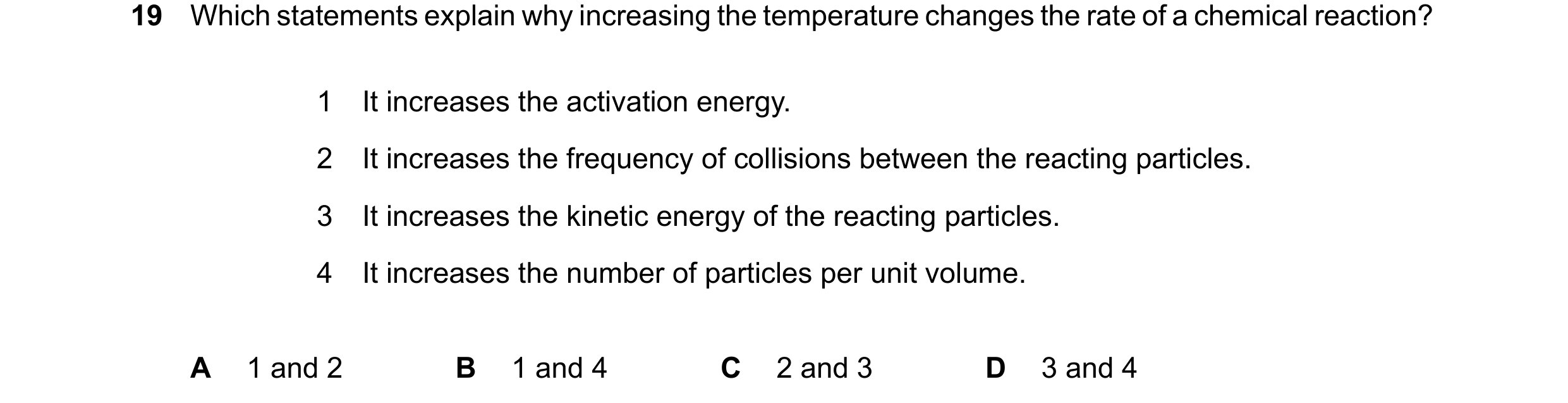
19 Which statements explain why increasing the temperature changes the rate of a chemical reaction? 1 It increases the activation energy. 2 It increases the frequency of collisions between the reacting particles. 3 It increases the kinetic energy of the reacting particles. 4 It increases the number of particles per unit volume. A 1 and 2 B 1 and 4 C 2 and 3 D 3 and 4
1 marks
Answer: C
This question in 0971/21 May/June 2024
Q26 · The hydrogen gas produced is collected and its total volume is measured every 10 seconds 0971/22 May/June 2024
13 The hydrogen gas produced is collected and its total volume is measured every 10 seconds. The experiment is repeated with 5cm3 of 0.5mol/dm3 sulfuric acid added to 5cm3 of water using the same mass of magnesium ribbon. Which line on the graph shows the results of the second experiment? 250 A 200 150 original experiment total volume of B hydrogen / cm3 100 C 50 D 0 0 50 100 150 200 250 time / s
1 marks
Answer: D
This question in 0971/22 May/June 2024
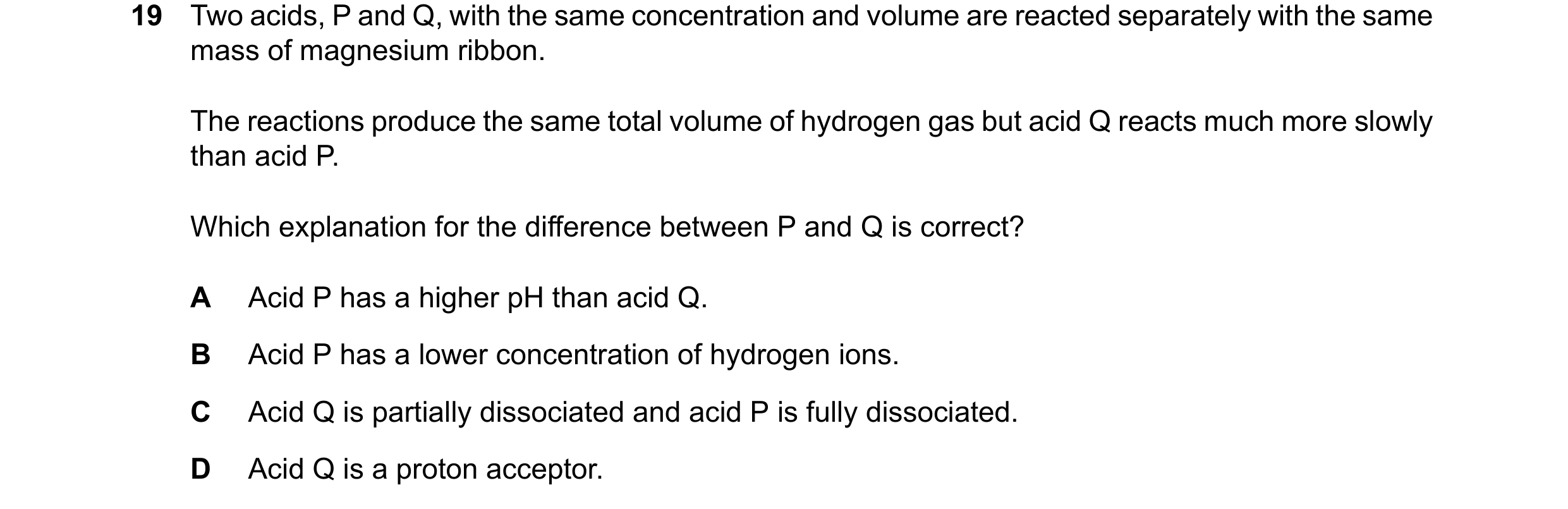
Q27 · Two acids, P and Q, with the same concentration and volume are reacted separately with… 0971/22 May/June 2024
19 Two acids, P and Q, with the same concentration and volume are reacted separately with the same mass of magnesium ribbon. The reactions produce the same total volume of hydrogen gas but acid Q reacts much more slowly than acid P. Which explanation for the difference between P and Q is correct? A Acid P has a higher pH than acid Q. B Acid P has a lower concentration of hydrogen ions. C Acid Q is partially dissociated and acid P is fully dissociated. D Acid Q is a proton acceptor.
1 marks
Answer: C
This question in 0971/22 May/June 2024
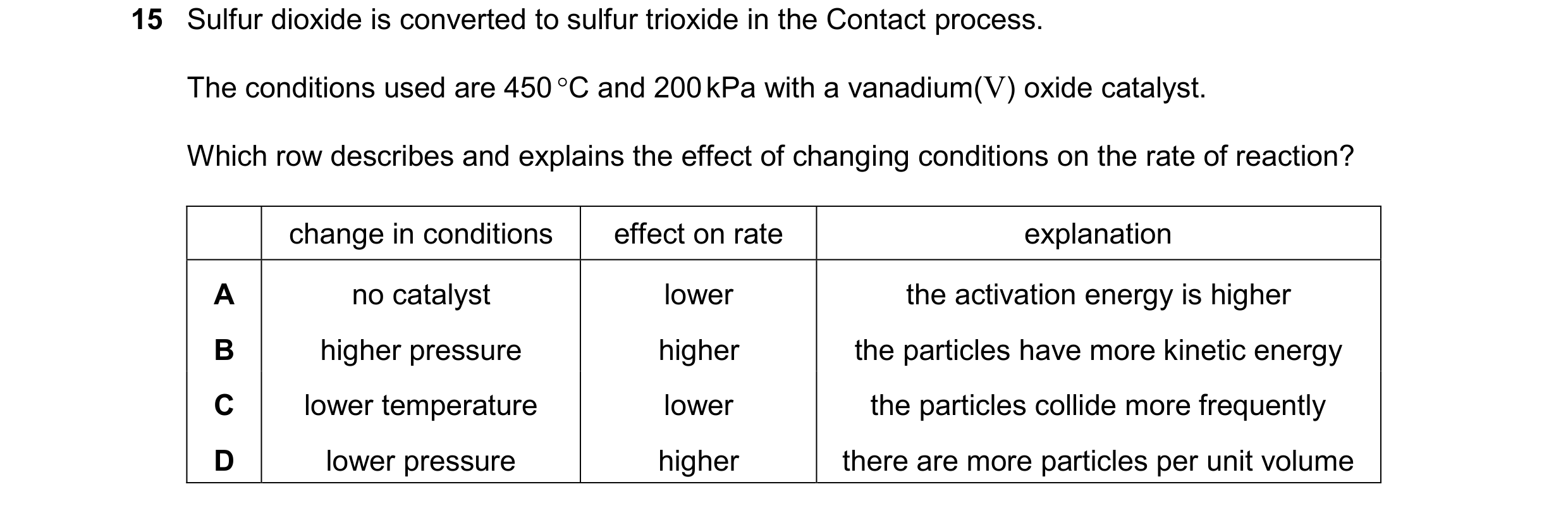
Q28 · Sulfur dioxide is converted to sulfur trioxide in the Contact process 0971/22 Oct/Nov 2024
15 Sulfur dioxide is converted to sulfur trioxide in the Contact process. The conditions used are 450 C and 200 kPa with a vanadium(V) oxide catalyst. Which row describes and explains the effect of changing conditions on the rate of reaction? change in conditions effect on rate explanation A no catalyst lower the activation energy is higher B higher pressure higher the particles have more kinetic energy C lower temperature lower the particles collide more frequently D lower pressure higher there are more particles per unit volume
1 marks
Answer: A
This question in 0971/22 Oct/Nov 2024
Q29 · Which statement describes the effect of adding a catalyst to a chemical reaction? 0971/22 May/June 2025
15 Which statement describes the effect of adding a catalyst to a chemical reaction? A The activation energy, Ea, of the reaction is increased. B The enthalpy change, H, of the reaction stays unchanged. C The frequency of collisions between the particles is decreased. D The kinetic energy of the particles is increased.
1 marks
Answer: B
This question in 0971/22 May/June 2025
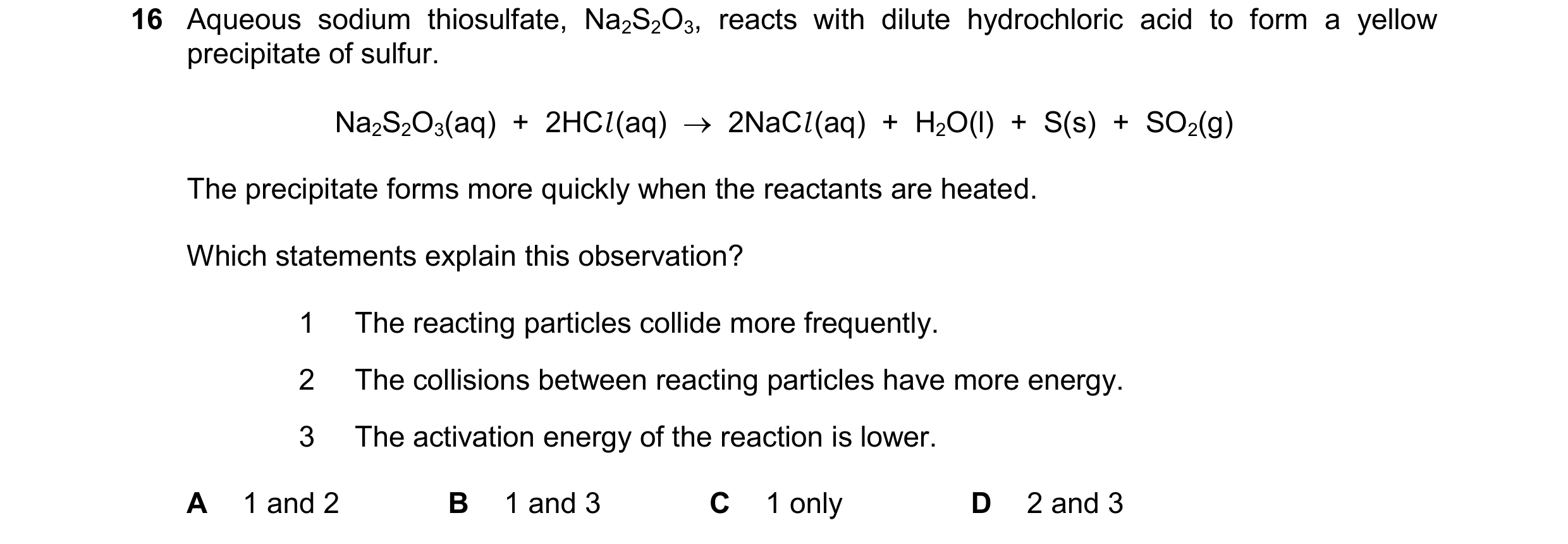
Q30 · Aqueous sodium thiosulfate, Na2S2O3, reacts with dilute hydrochloric acid to form a… 0971/22 Oct/Nov 2025
16 Aqueous sodium thiosulfate, Na2S2O3, reacts with dilute hydrochloric acid to form a yellow precipitate of sulfur. Na2S2O3(aq) + 2HCl (aq) 2NaCl (aq) + H2O(l) + S(s) + SO2(g) The precipitate forms more quickly when the reactants are heated. Which statements explain this observation? 1 The reacting particles collide more frequently. 2 The collisions between reacting particles have more energy. 3 The activation energy of the reaction is lower. A 1 and 2 B 1 and 3 C 1 only D 2 and 3
1 marks
Answer: A
This question in 0971/22 Oct/Nov 2025
 1 / 10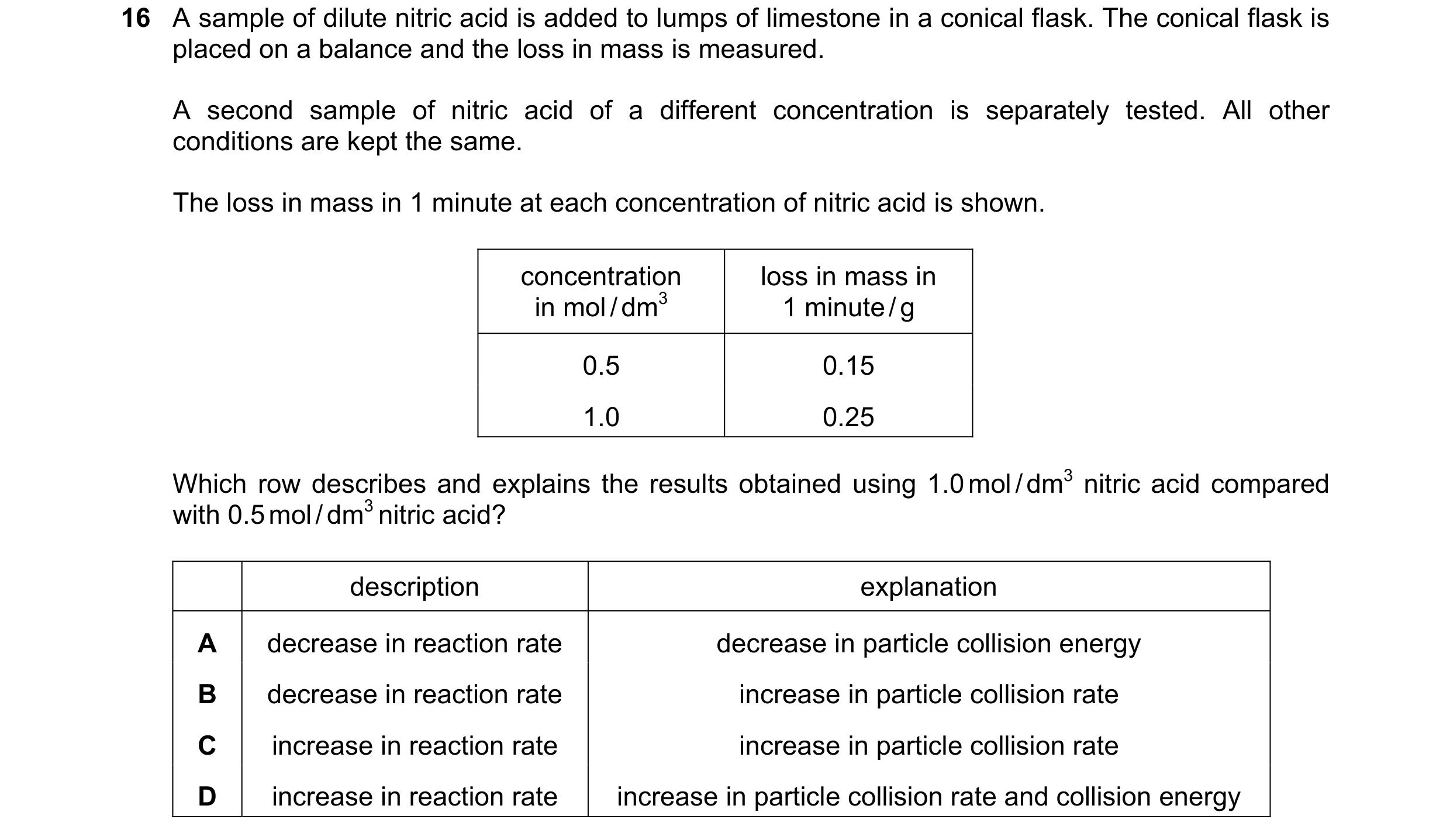
 2 / 10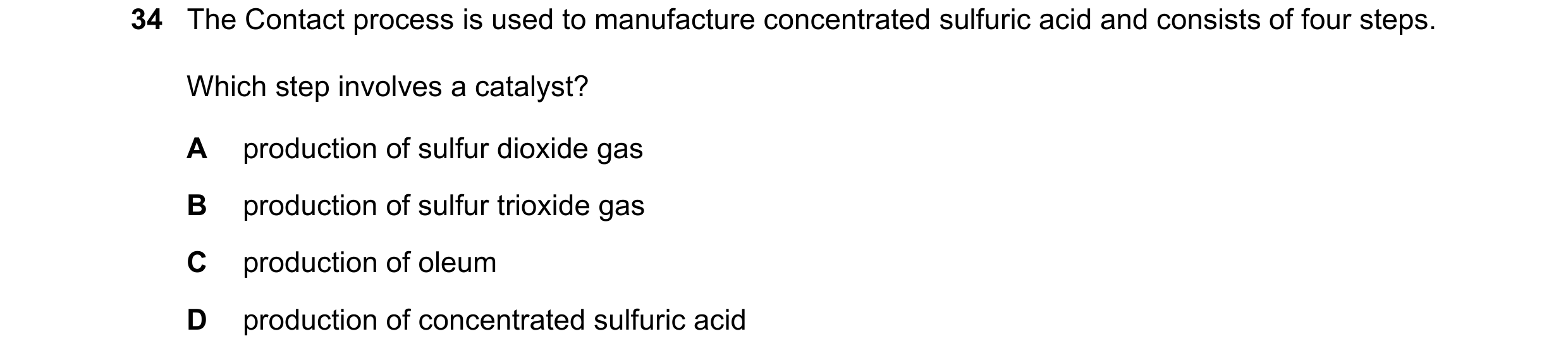
 3 / 10

 4 / 10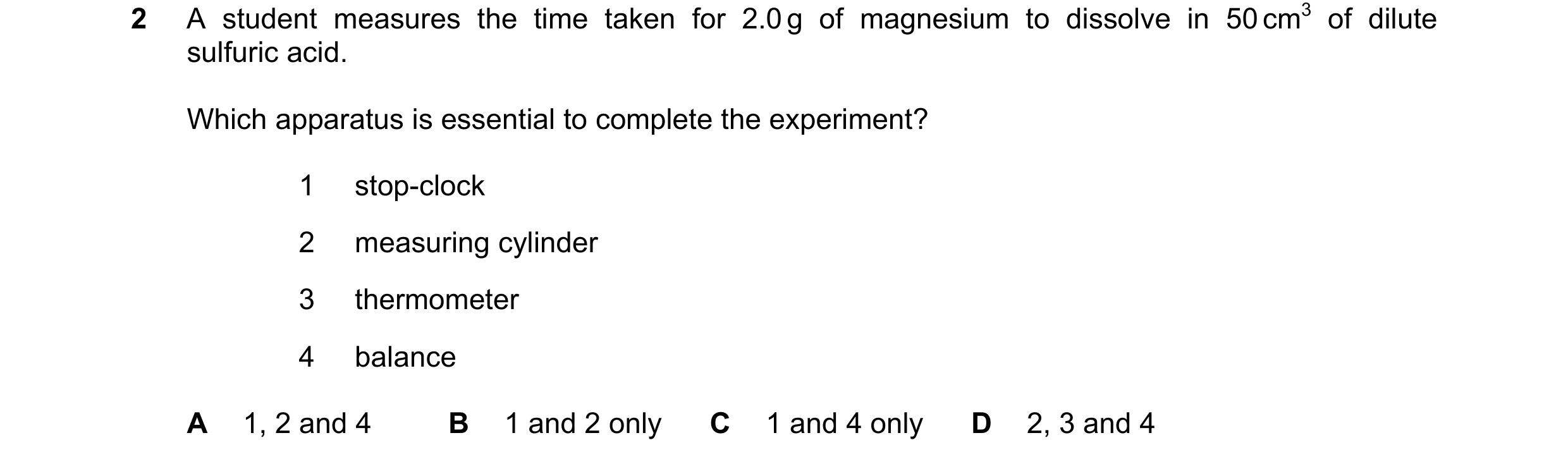
 5 / 10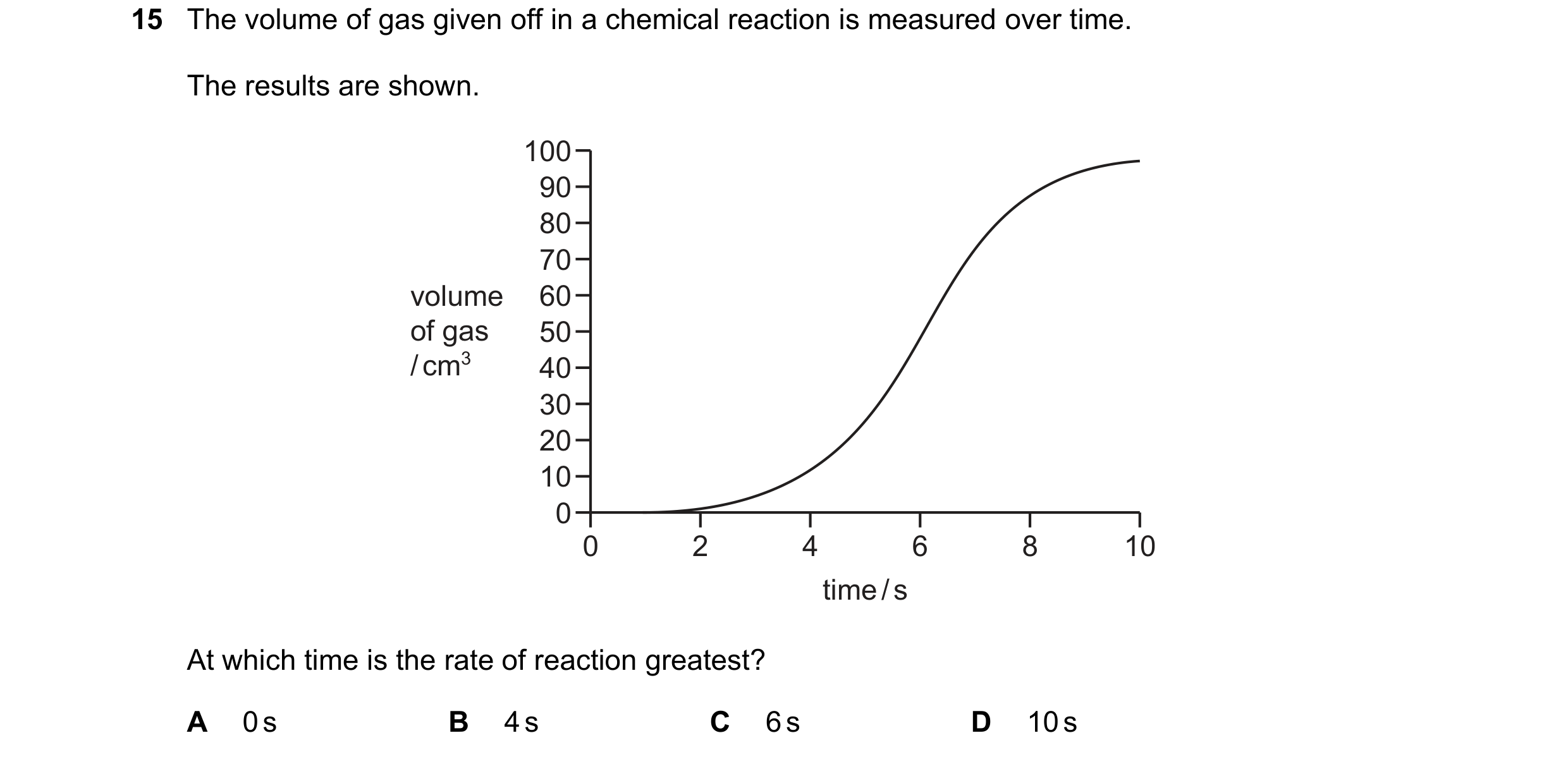
 6 / 10
 7 / 10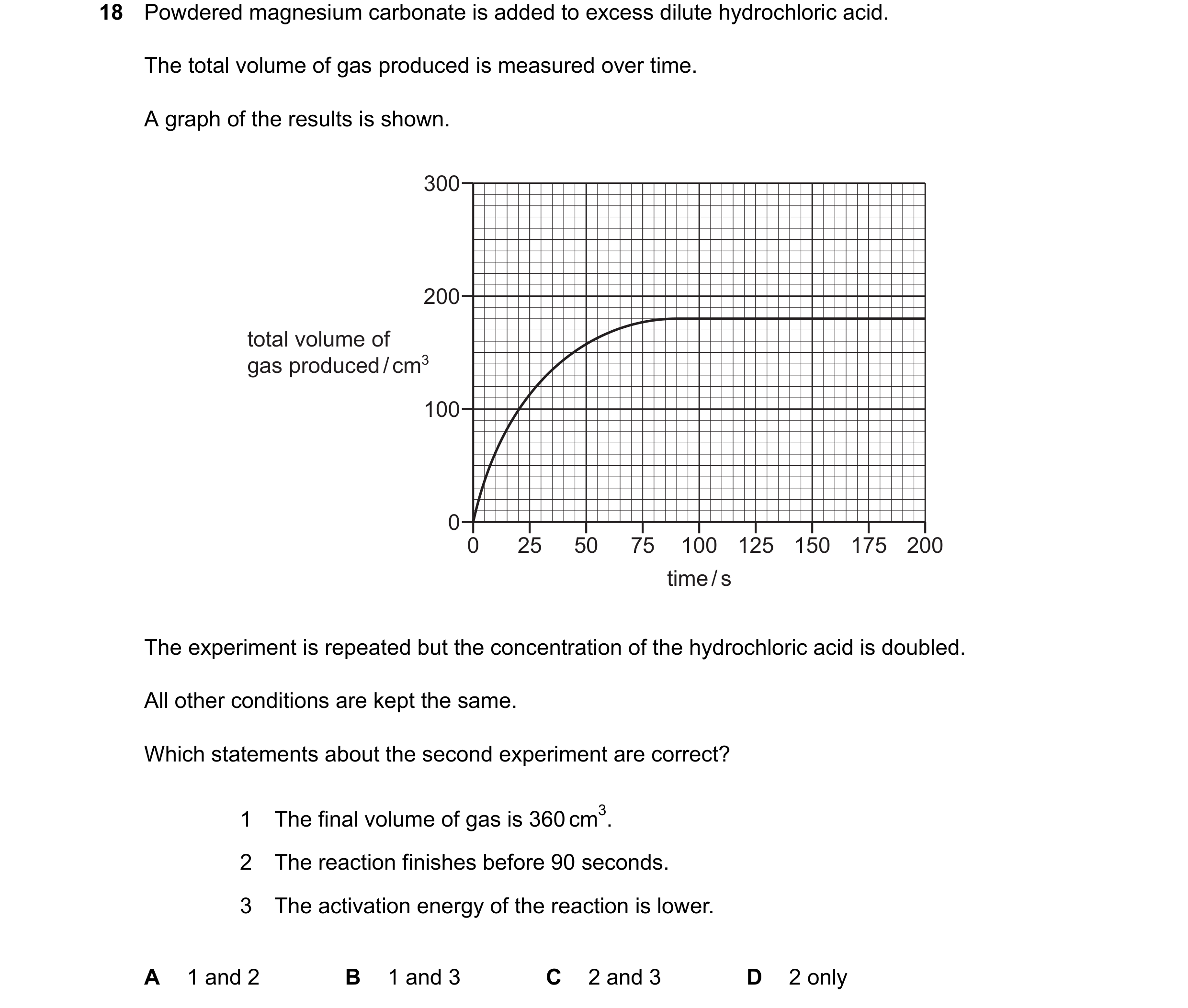
 8 / 10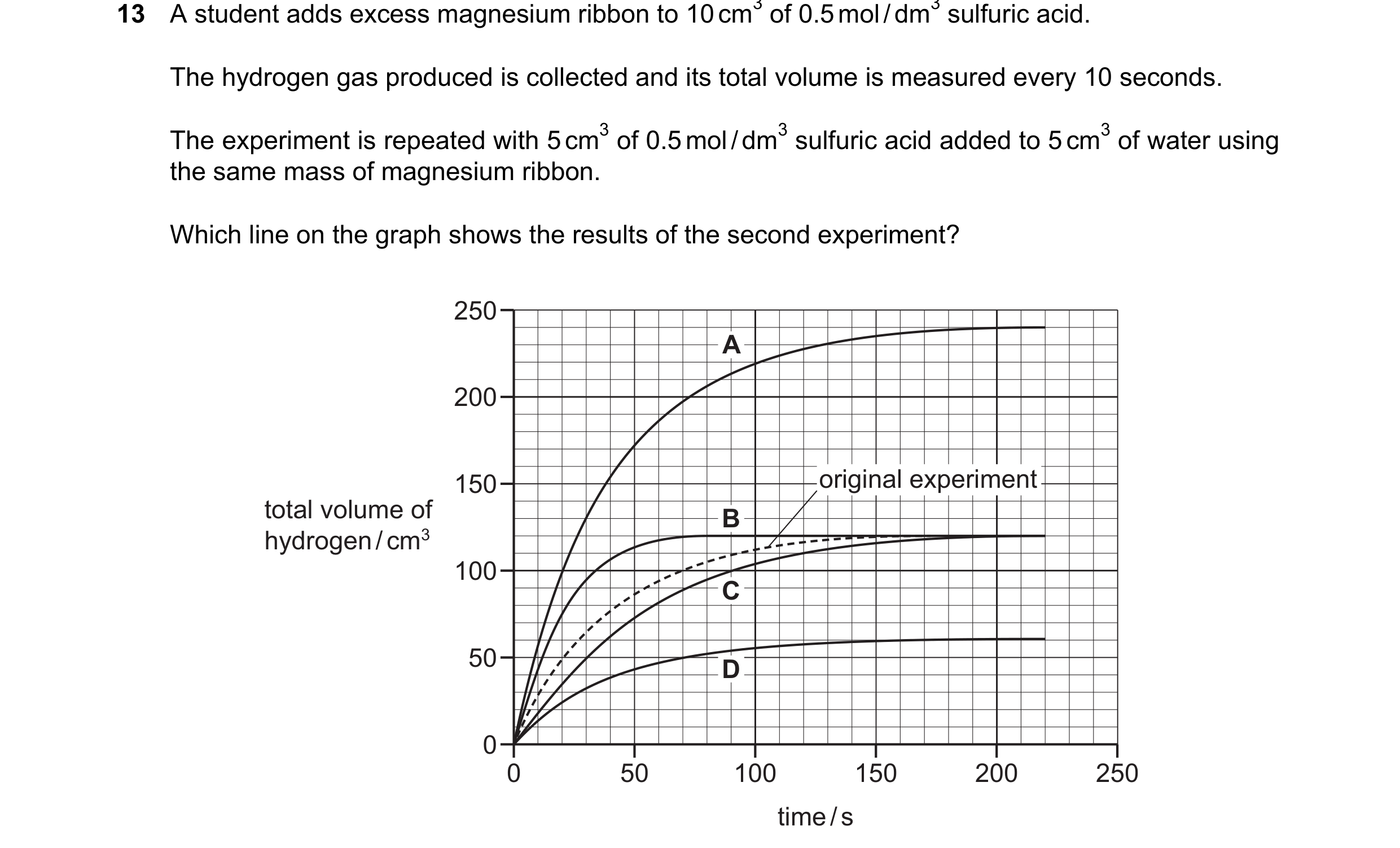
 9 / 10
 10 / 10