Cambridge IGCSE Chemistry (9-1) 0971 — 2020 May/June Paper 1 · Variant 2
0971/12/M/J/20 · 40 questions · 40 marks · ≈45 min
The question paper and its mark scheme, free to read here and free to download. This is Cambridge’s own paper, exactly as it was sat.
Question paper16 pages


Mark scheme3 pages
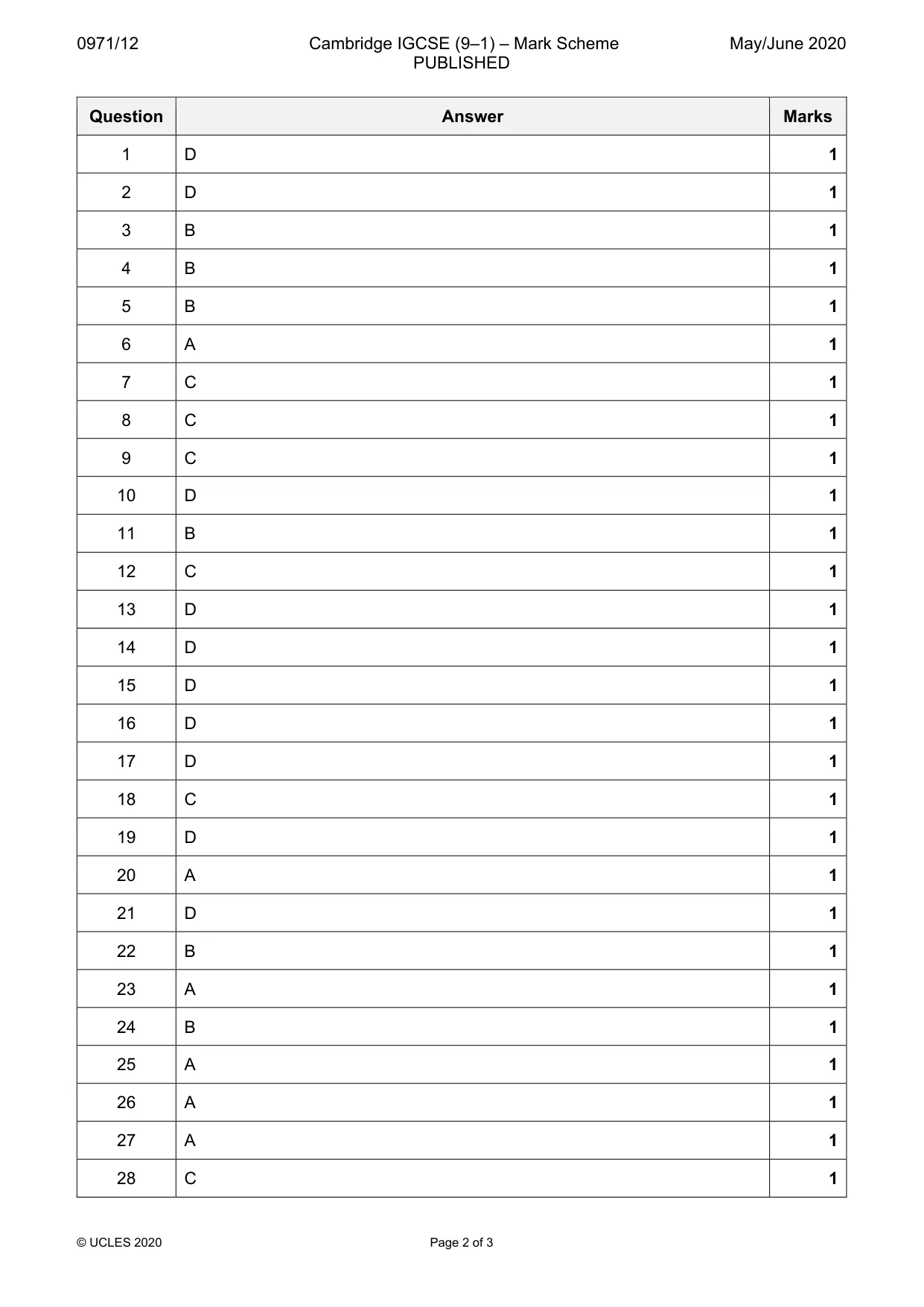
Answers below. Sit the paper first if you are practising.
Questions as text
Q1 · Each rectangle shows the arrangement of particles in each of the three states of matter
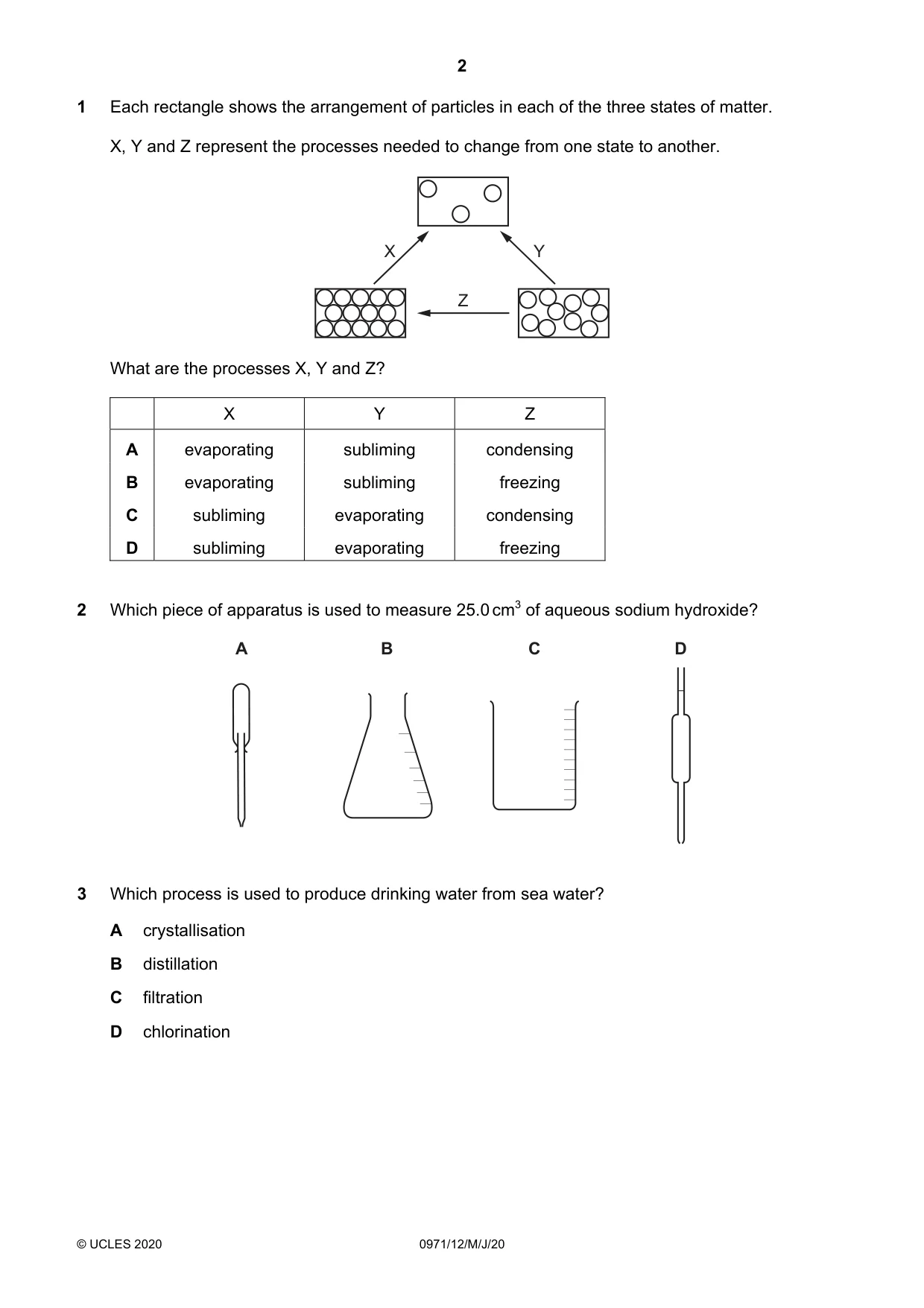
1 Each rectangle shows the arrangement of particles in each of the three states of matter. X, Y and Z represent the processes needed to change from one state to another. X Y Z What are the processes X, Y and Z? X Y Z A evaporating subliming condensing B evaporating subliming freezing C subliming evaporating condensing D subliming evaporating freezing
Mark scheme: D
Q2 · Which piece of apparatus is used to measure 25.0 cm3 of aqueous sodium hydroxide?
2 Which piece of apparatus is used to measure 25.0 cm3 of aqueous sodium hydroxide? A B C D
Mark scheme: D
Q3 · Which process is used to produce drinking water from sea water?
3 Which process is used to produce drinking water from sea water? A crystallisation B distillation C filtration D chlorination
Mark scheme: B
Q4 · The diagram shows the electronic structure of a particle with a nucleon number (mass…
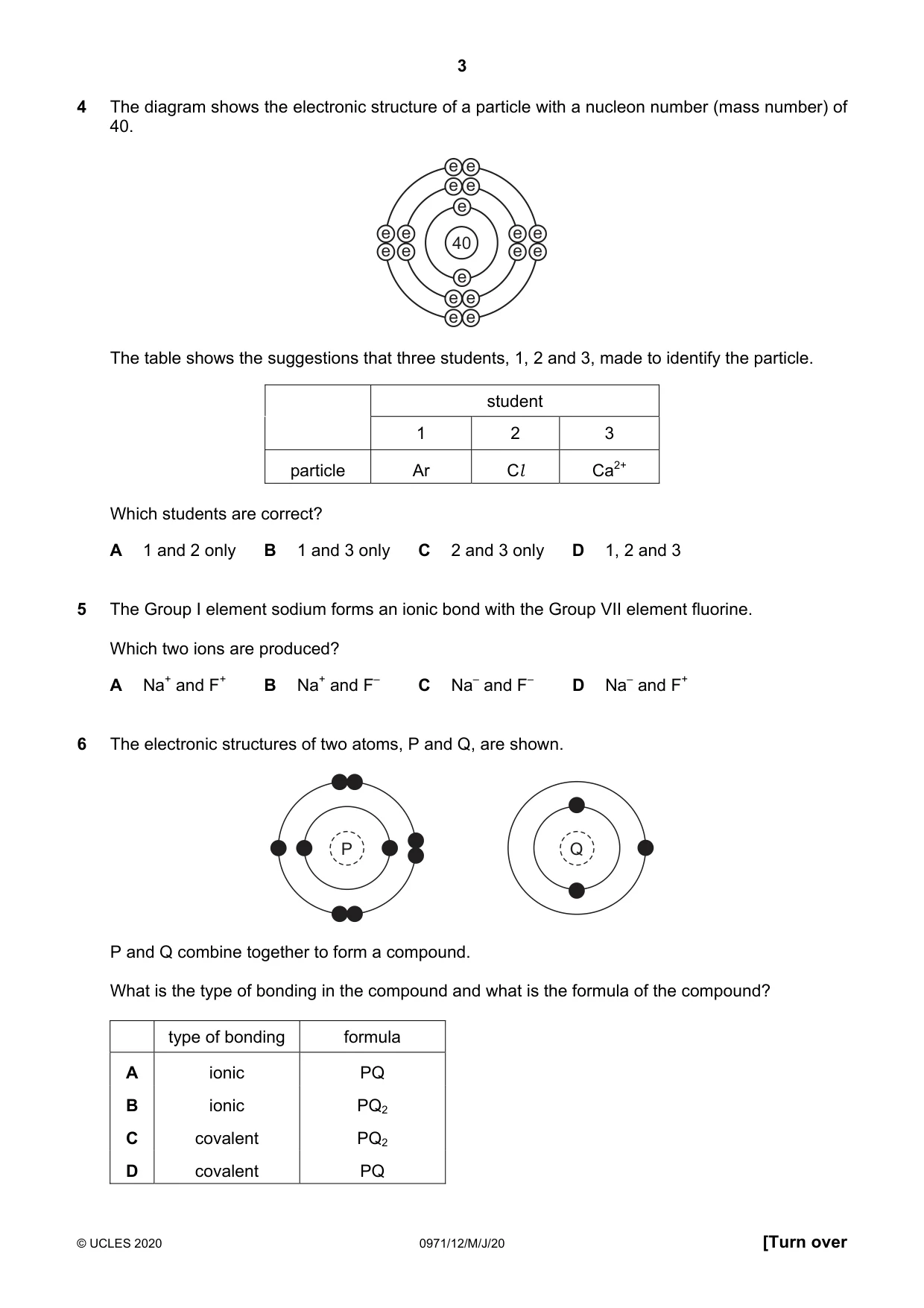
4 The diagram shows the electronic structure of a particle with a nucleon number (mass number) of 40. e e e e e e e e e e e 40 e e e e e e e The table shows the suggestions that three students, 1, 2 and 3, made to identify the particle. student 1 2 3 particle Ar Cl Ca2+ Which students are correct? A 1 and 2 only B 1 and 3 only C 2 and 3 only D 1, 2 and 3
Mark scheme: B
Q5 · The Group I element sodium forms an ionic bond with the Group VII element fluorine
5 The Group I element sodium forms an ionic bond with the Group VII element fluorine. Which two ions are produced? A Na+ and F+ B Na+ and F– C Na– and F– D Na– and F+
Mark scheme: B
Q6 · The electronic structures of two atoms, P and Q, are shown
6 The electronic structures of two atoms, P and Q, are shown. P Q P and Q combine together to form a compound. What is the type of bonding in the compound and what is the formula of the compound? type of bonding formula A ionic PQ B ionic PQ2 C covalent PQ2 D covalent PQ
Mark scheme: A
Q7 · Graphite is a macromolecule
7 Graphite is a macromolecule. Which statements about graphite are correct? 1 Carbon atoms form four covalent bonds with neighbouring atoms. 2 There are free electrons between layers of carbon atoms. 3 Graphite is a useful lubricant. 4 Graphite is a good conductor of electricity. A 1 and 2 B 1, 3 and 4 C 2, 3 and 4 D 3 and 4 only
Mark scheme: C
Q8 · Aluminium oxide has the formula Al 2O3
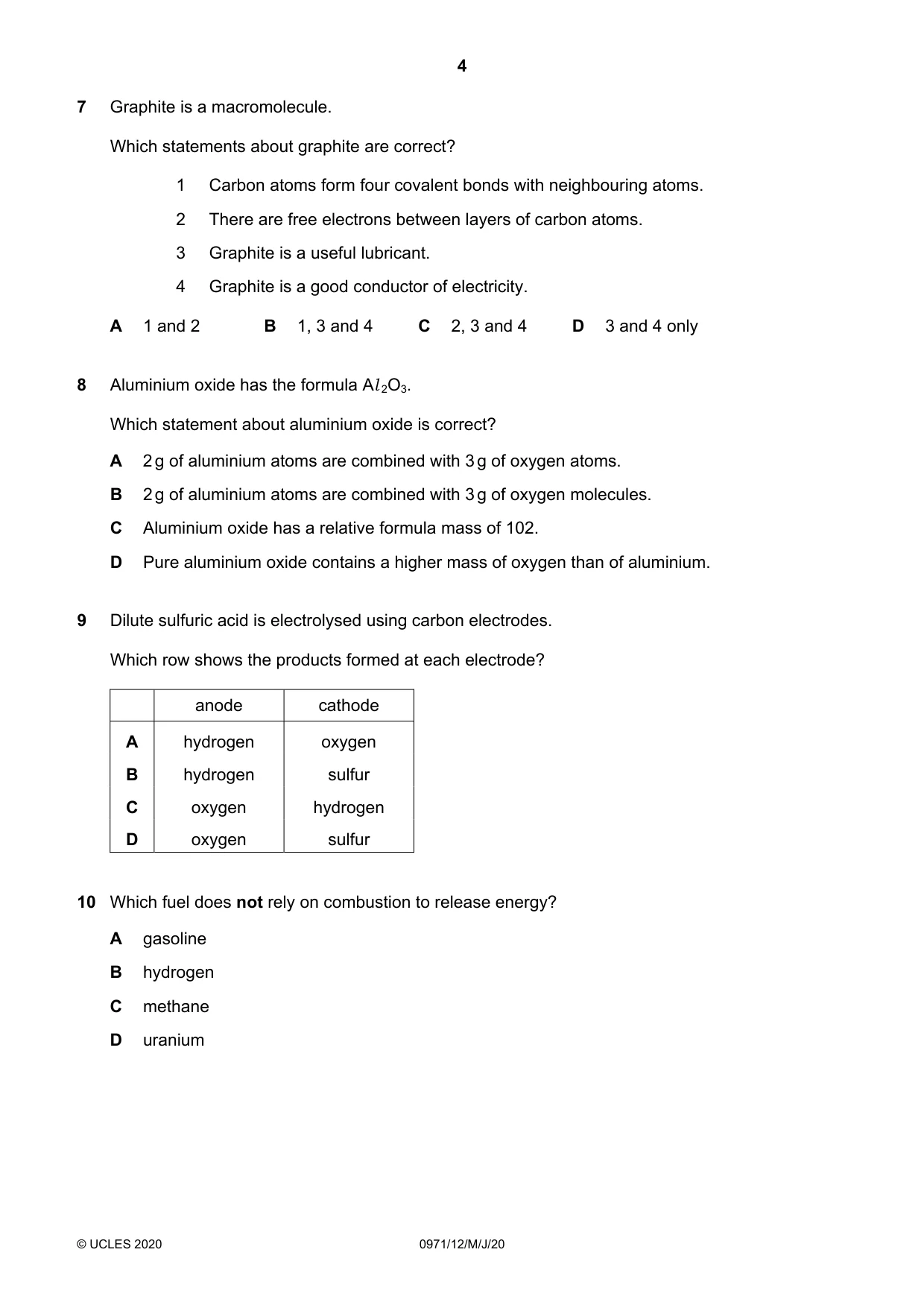
8 Aluminium oxide has the formula Al 2O3. Which statement about aluminium oxide is correct? A 2 g of aluminium atoms are combined with 3 g of oxygen atoms. B 2 g of aluminium atoms are combined with 3 g of oxygen molecules. C Aluminium oxide has a relative formula mass of 102. D Pure aluminium oxide contains a higher mass of oxygen than of aluminium.
Mark scheme: C
Q9 · Dilute sulfuric acid is electrolysed using carbon electrodes
9 Dilute sulfuric acid is electrolysed using carbon electrodes. Which row shows the products formed at each electrode? anode cathode A hydrogen oxygen B hydrogen sulfur C oxygen hydrogen D oxygen sulfur
Mark scheme: C
Q10 · Which fuel does not rely on combustion to release energy?
10 Which fuel does not rely on combustion to release energy? A gasoline B hydrogen C methane D uranium
Mark scheme: D
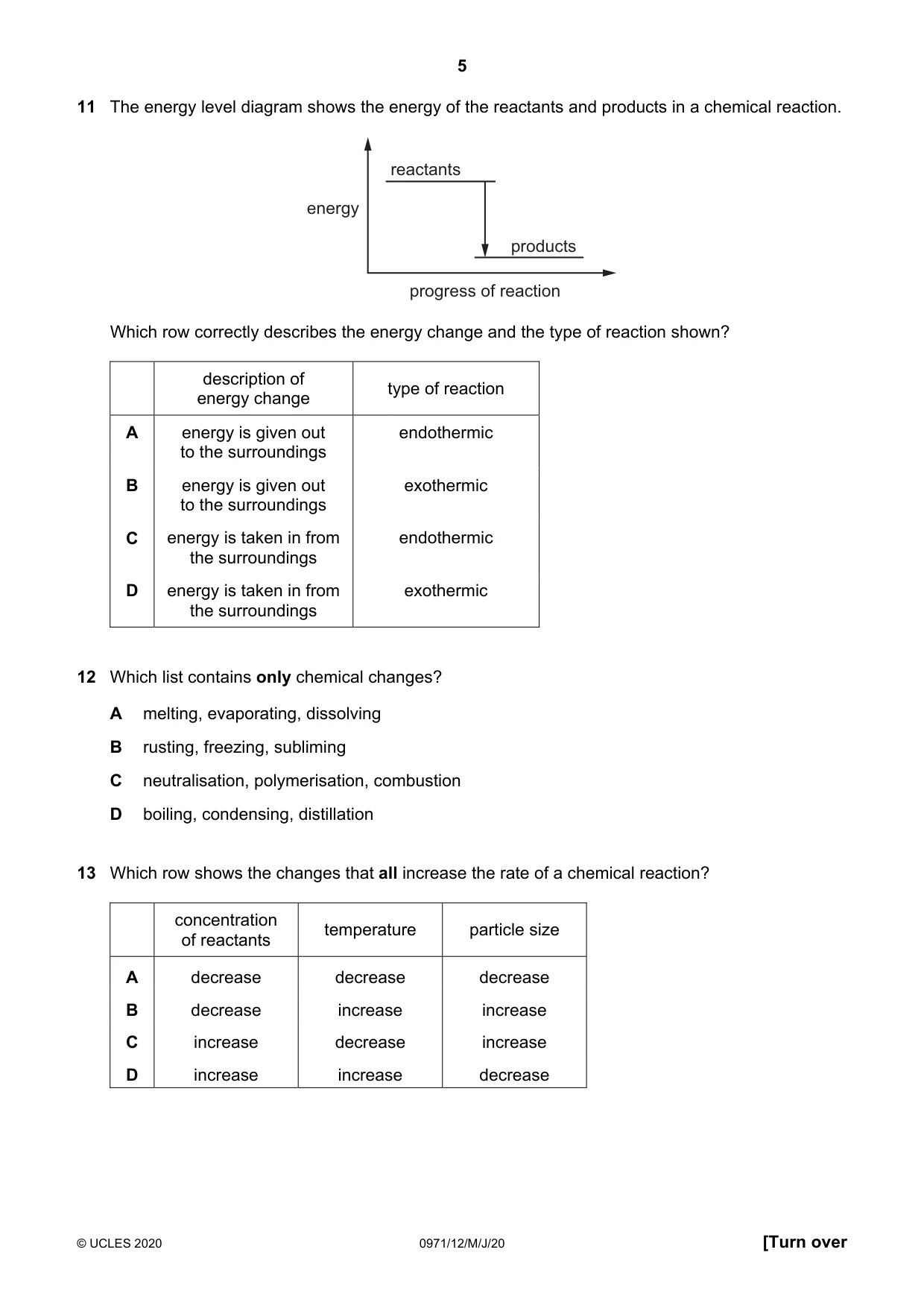
Q11 · The energy level diagram shows the energy of the reactants and products in a chemical…
11 The energy level diagram shows the energy of the reactants and products in a chemical reaction. reactants energy products progress of reaction Which row correctly describes the energy change and the type of reaction shown? description of type of reaction energy change A energy is given out endothermic to the surroundings B energy is given out exothermic to the surroundings C energy is taken in from endothermic the surroundings D energy is taken in from exothermic the surroundings
Mark scheme: B
Q12 · Which list contains only chemical changes?
12 Which list contains only chemical changes? A melting, evaporating, dissolving B rusting, freezing, subliming C neutralisation, polymerisation, combustion D boiling, condensing, distillation
Mark scheme: C
Q13 · Which row shows the changes that all increase the rate of a chemical reaction?
13 Which row shows the changes that all increase the rate of a chemical reaction? concentration temperature particle size of reactants A decrease decrease decrease B decrease increase increase C increase decrease increase D increase increase decrease
Mark scheme: D
Q14 · Which reaction is reversible?
14 Which reaction is reversible? A an iron nail rusting when left in moist air B limestone reacting with an acid to form carbon dioxide gas C magnesium burning in air to produce a white ash D white anhydrous copper(II) sulfate turning blue when water is added
Mark scheme: D
Q15 · When heated strongly, silicon(IV) oxide reacts with carbon
15 When heated strongly, silicon(IV) oxide reacts with carbon. SiO2 + 2C → Si + 2CO Which term describes what happens to silicon(IV) oxide? A thermal decomposition B neutralisation C oxidation D reduction
Mark scheme: D
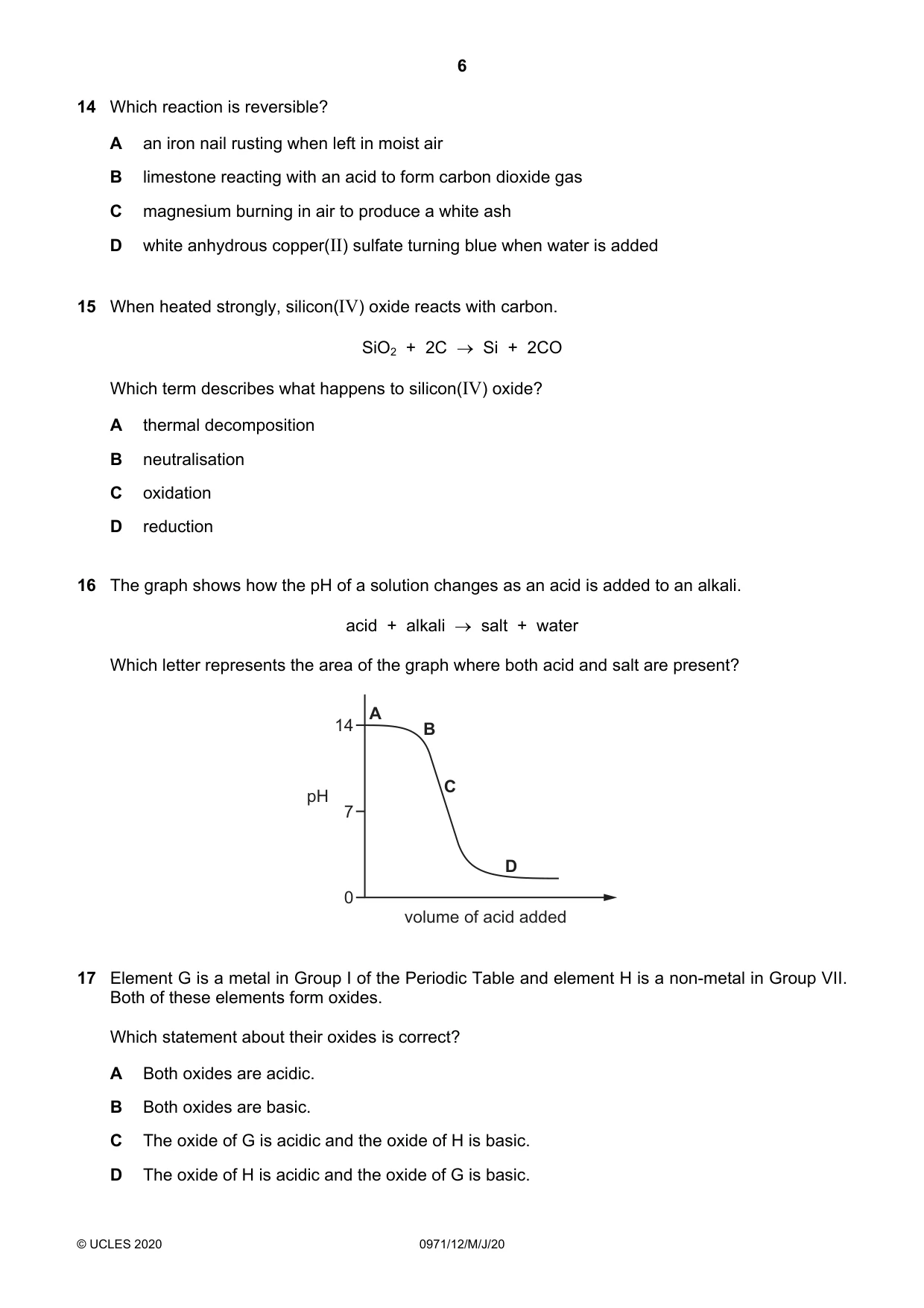
Q16 · The graph shows how the pH of a solution changes as an acid is added to an alkali
16 The graph shows how the pH of a solution changes as an acid is added to an alkali. acid + alkali → salt + water Which letter represents the area of the graph where both acid and salt are present? A 14 B C pH 7 D 0 volume of acid added
Mark scheme: D
More questions on The characteristic properties of acids and bases
Q17 · Element G is a metal in Group I of the Periodic Table and element H is a non-metal in…
17 Element G is a metal in Group I of the Periodic Table and element H is a non-metal in Group VII. Both of these elements form oxides. Which statement about their oxides is correct? A Both oxides are acidic. B Both oxides are basic. C The oxide of G is acidic and the oxide of H is basic. D The oxide of H is acidic and the oxide of G is basic.
Mark scheme: D
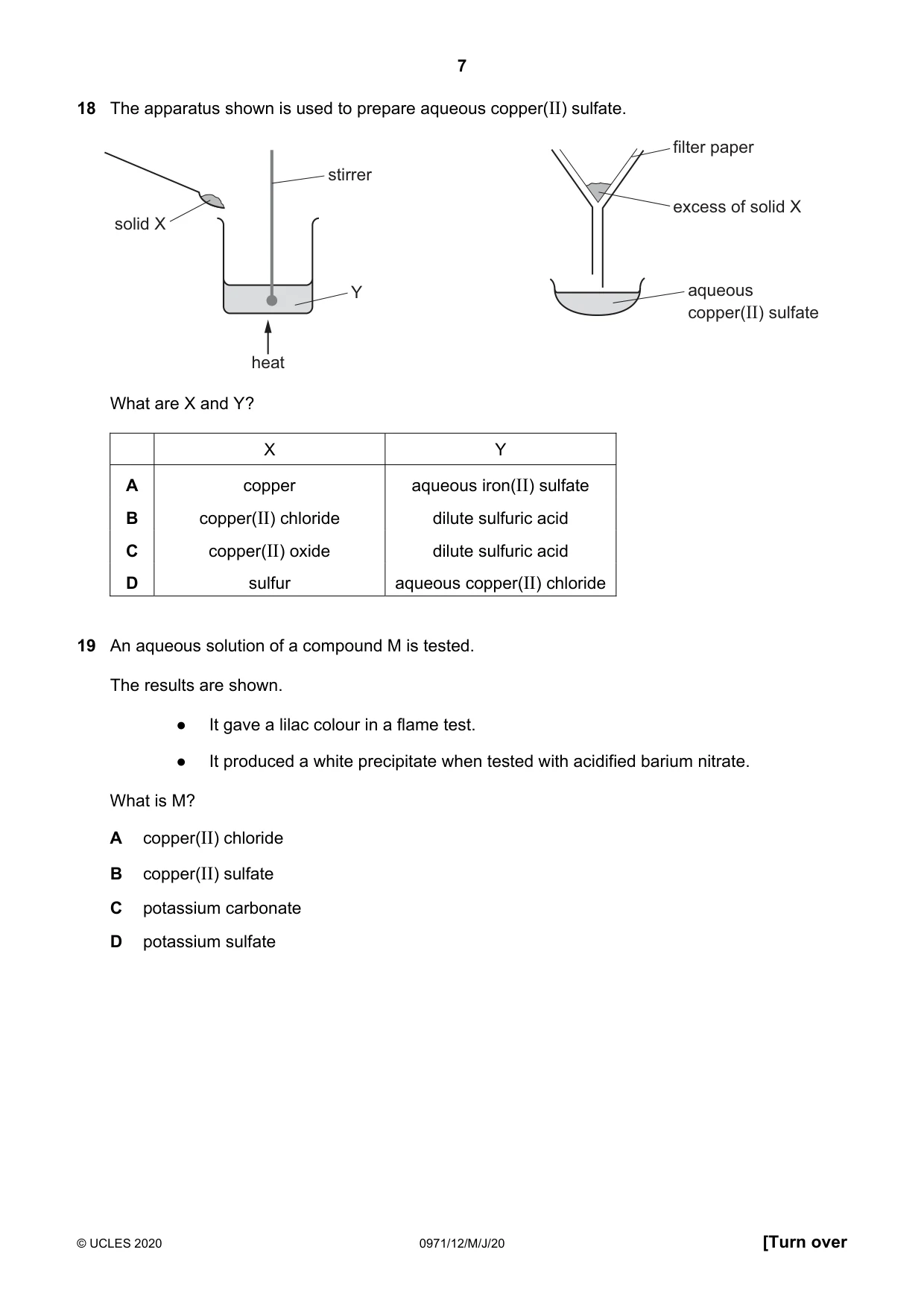
Q18 · The apparatus shown is used to prepare aqueous copper(II) sulfate
18 The apparatus shown is used to prepare aqueous copper(II) sulfate. filter paper stirrer excess of solid X solid X Y aqueous copper(II) sulfate heat What are X and Y? X Y A copper aqueous iron(II) sulfate B copper(II) chloride dilute sulfuric acid C copper(II) oxide dilute sulfuric acid D sulfur aqueous copper(II) chloride
Mark scheme: C
Q19 · An aqueous solution of a compound M is tested
19 An aqueous solution of a compound M is tested. The results are shown. ● It gave a lilac colour in a flame test. ● It produced a white precipitate when tested with acidified barium nitrate. What is M? A copper(II) chloride B copper(II) sulfate C potassium carbonate D potassium sulfate
Mark scheme: D
Q20 · The character of the elements and charges on the ions of the elements change across the…
20 The character of the elements and charges on the ions of the elements change across the Periodic Table. Which row describes the elements on the left of the table and the elements on the right? elements on the left elements on the right character charge on ion character charge on ion A metallic positive non-metallic negative B metallic negative non-metallic positive C non-metallic positive metallic negative D non-metallic negative metallic positive
Mark scheme: A
Q21 · Which statement about Group I and Group VII elements is correct?
21 Which statement about Group I and Group VII elements is correct? A Group VII elements are monoatomic non-metals. B Lithium is more reactive with water than caesium. C The melting points of Group I metals increase down the group. D Potassium bromide reacts with chlorine to produce an orange solution.
Mark scheme: D
Q22 · The properties of the element titanium, Ti, can be predicted from its position in the…
22 The properties of the element titanium, Ti, can be predicted from its position in the Periodic Table. Which row identifies the properties of titanium? forms coloured compounds can be used conducts electricity as a catalyst when solid has low density v v x v v v v x v x v v
Mark scheme: B
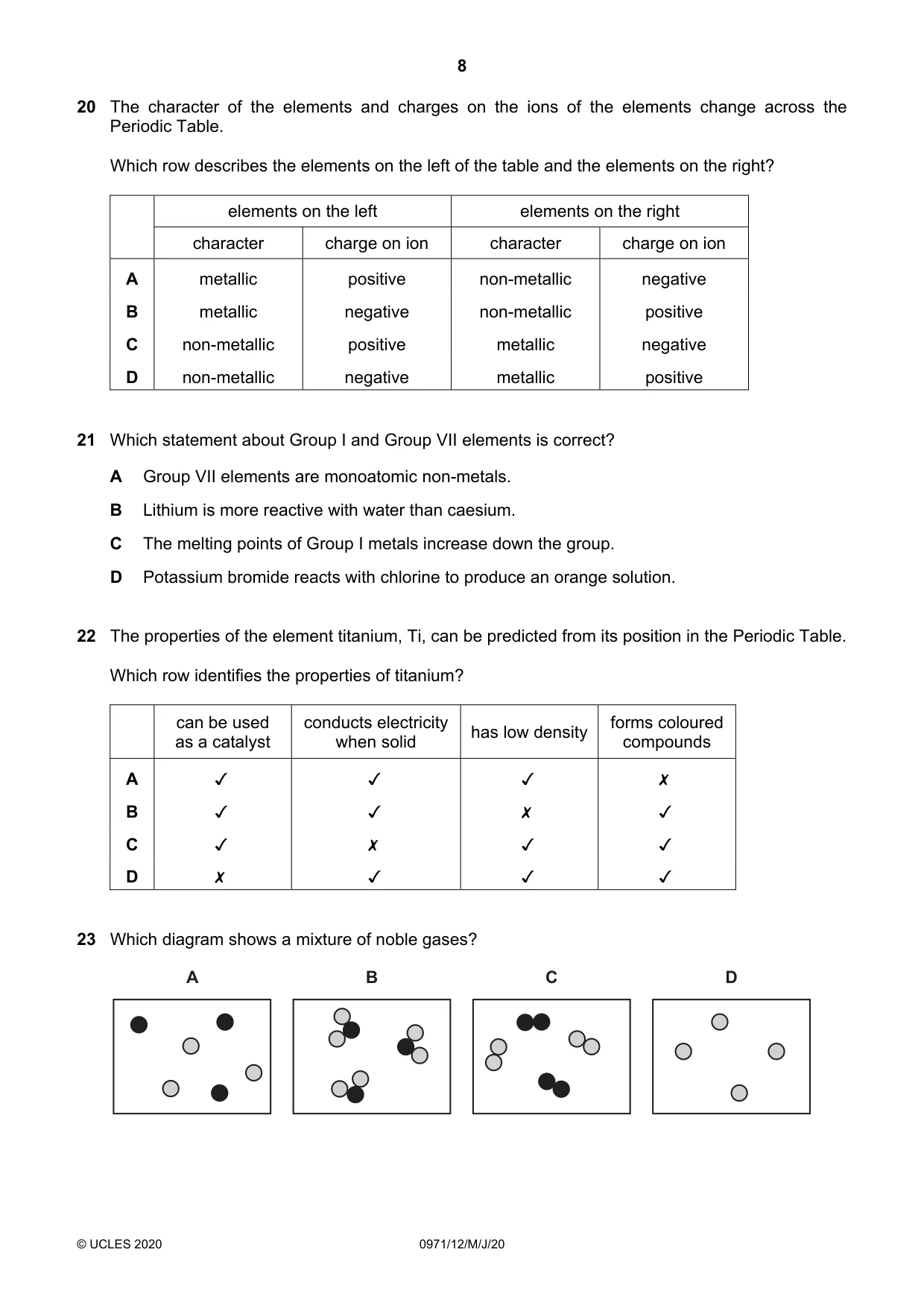
Q23 · Which diagram shows a mixture of noble gases?
23 Which diagram shows a mixture of noble gases? A B C D
Mark scheme: A
Q24 · Which property is shown by all metals?
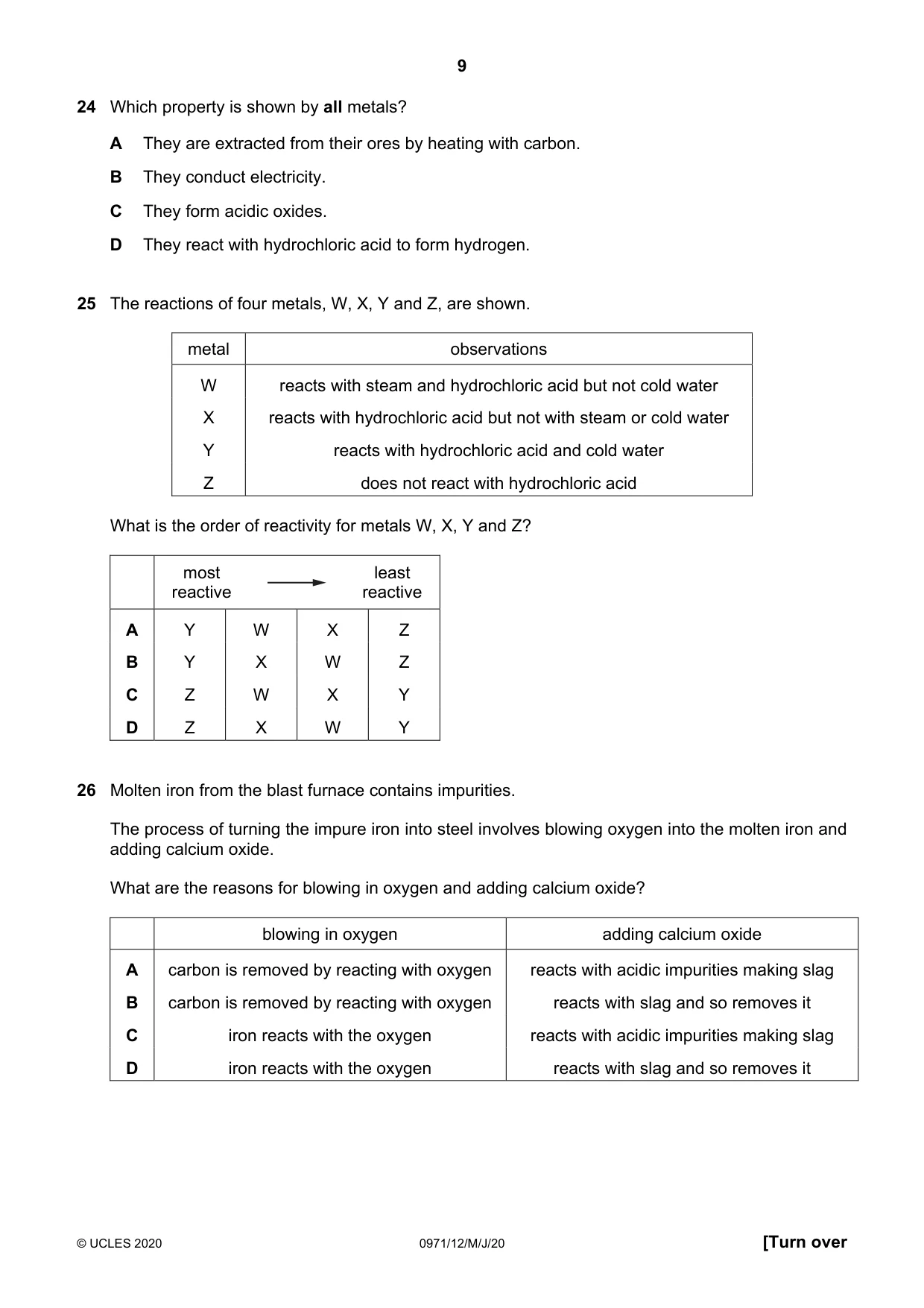
24 Which property is shown by all metals? A They are extracted from their ores by heating with carbon. B They conduct electricity. C They form acidic oxides. D They react with hydrochloric acid to form hydrogen.
Mark scheme: B
Q25 · The reactions of four metals, W, X, Y and Z, are shown
25 The reactions of four metals, W, X, Y and Z, are shown. metal observations W reacts with steam and hydrochloric acid but not cold water X reacts with hydrochloric acid but not with steam or cold water Y reacts with hydrochloric acid and cold water Z does not react with hydrochloric acid What is the order of reactivity for metals W, X, Y and Z? most least reactive reactive A Y W X Z B Y X W Z C Z W X Y D Z X W Y
Mark scheme: A
Q26 · Molten iron from the blast furnace contains impurities
26 Molten iron from the blast furnace contains impurities. The process of turning the impure iron into steel involves blowing oxygen into the molten iron and adding calcium oxide. What are the reasons for blowing in oxygen and adding calcium oxide? blowing in oxygen adding calcium oxide A carbon is removed by reacting with oxygen reacts with acidic impurities making slag B carbon is removed by reacting with oxygen reacts with slag and so removes it C iron reacts with the oxygen reacts with acidic impurities making slag D iron reacts with the oxygen reacts with slag and so removes it
Mark scheme: A
Q27 · Which statement about mild steel explains why it is a good choice for car bodies?
27 Which statement about mild steel explains why it is a good choice for car bodies? A It is cheap and strong. B It is a good conductor. C It is low density. D It resists rusting.
Mark scheme: A
Q28 · Which statement about pure water is not correct?
28 Which statement about pure water is not correct? A It condenses at 100 °C. B It freezes at 0 °C. C It turns cobalt(II) chloride paper blue. D It turns anhydrous copper(II) sulfate blue.
Mark scheme: C
Q29 · Which compounds both contribute to ‘acid rain’?
29 Which compounds both contribute to ‘acid rain’? A carbon monoxide and lead compounds B carbon monoxide and oxides of nitrogen C oxides of nitrogen and sulfur dioxide D sulfur dioxide and lead compounds
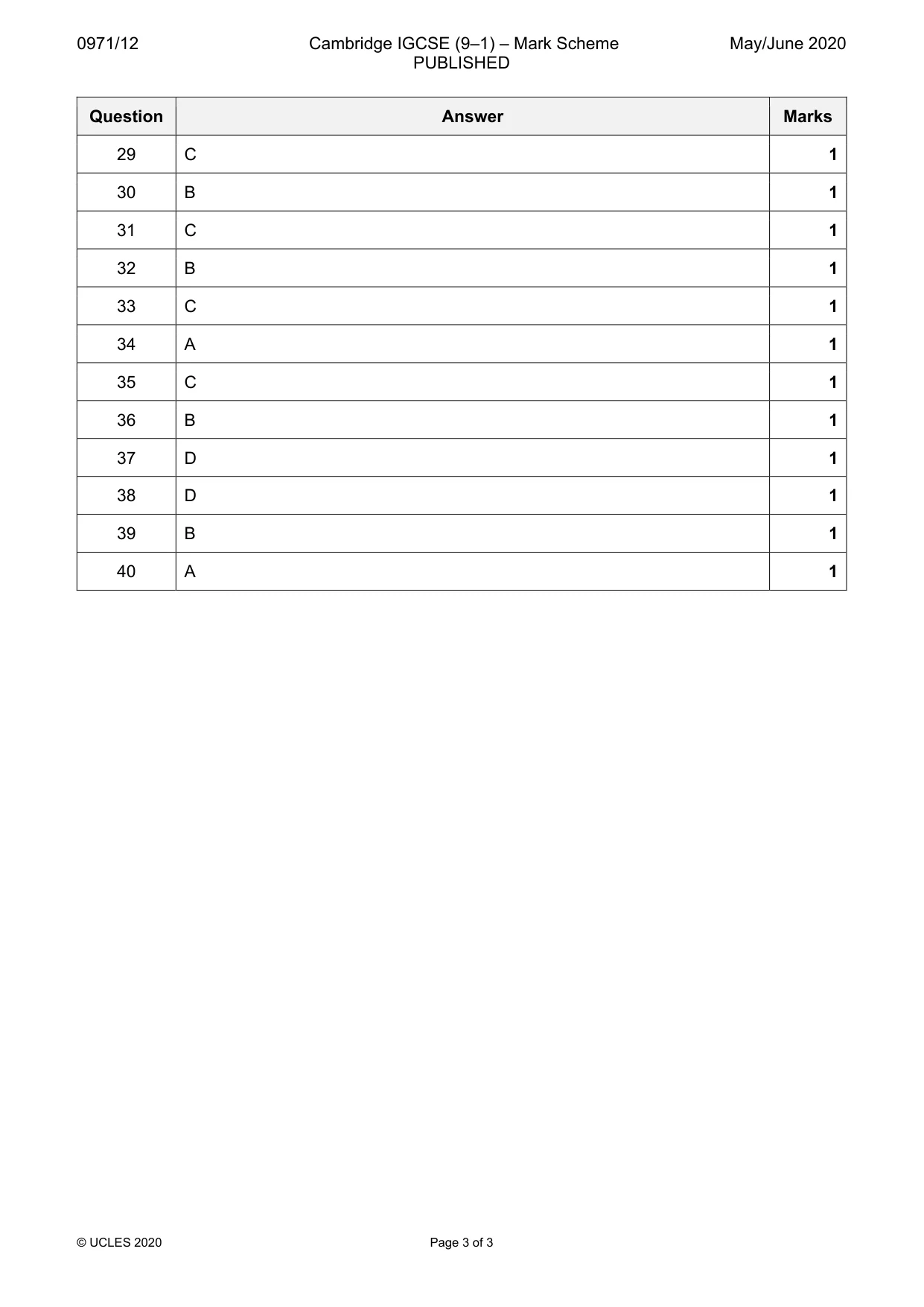
Mark scheme: C
Q30 · The diagrams show experiments to investigate rusting of iron nails
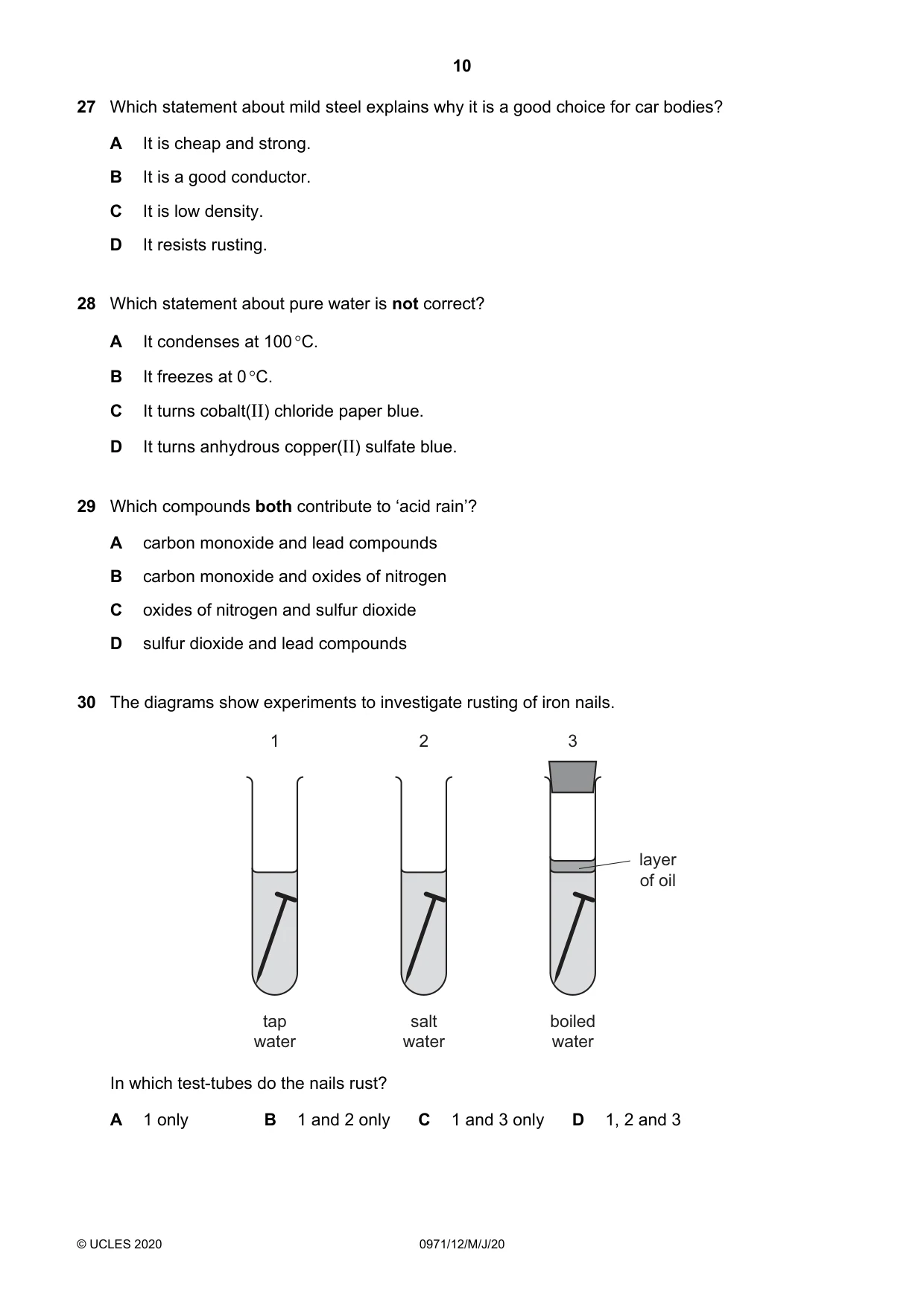
30 The diagrams show experiments to investigate rusting of iron nails. 1 2 3 layer of oil tap salt boiled water water water In which test-tubes do the nails rust? A 1 only B 1 and 2 only C 1 and 3 only D 1, 2 and 3
Mark scheme: B
Q31 · Which bag is not suitable for use as a fertiliser?
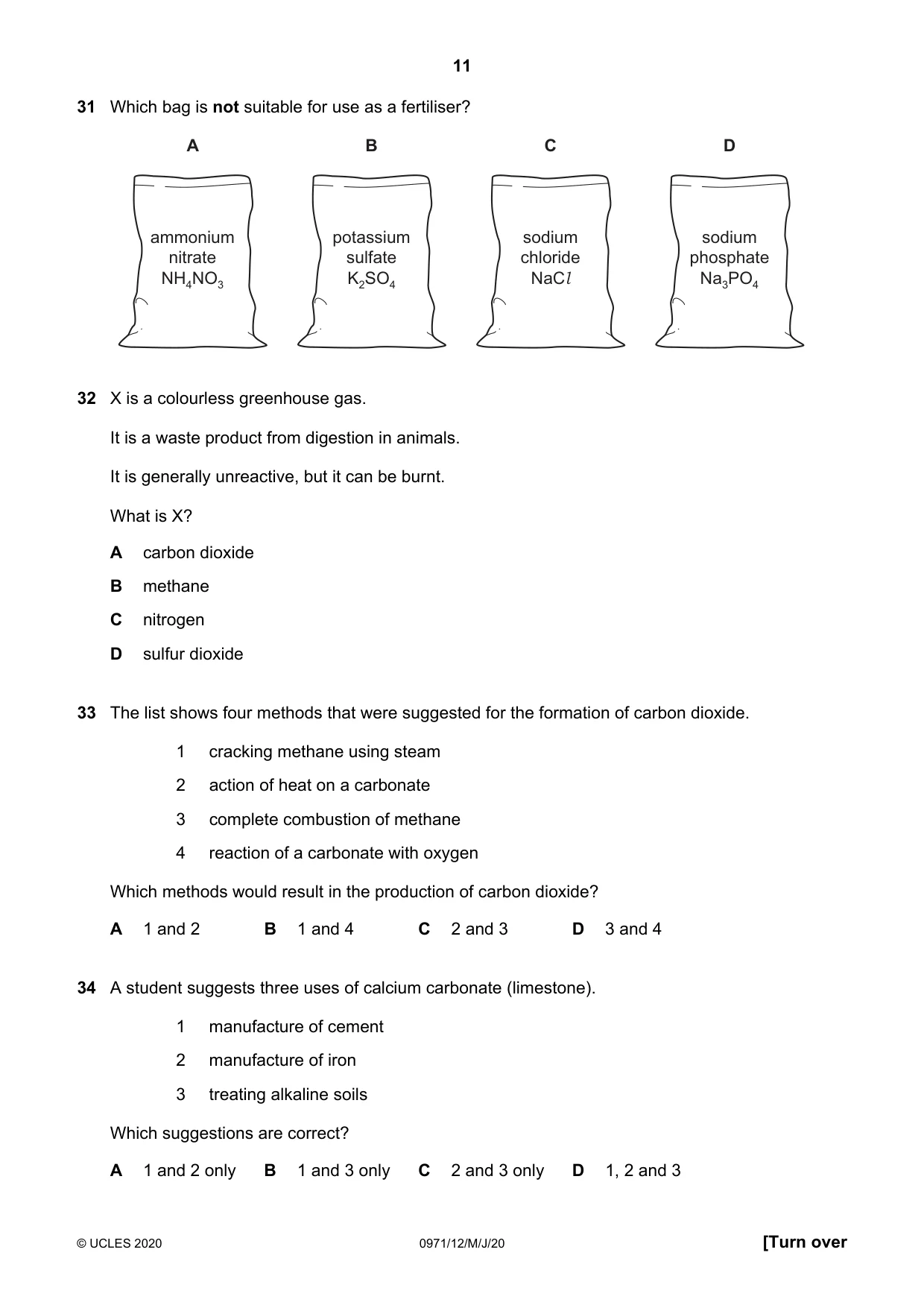
31 Which bag is not suitable for use as a fertiliser? A B C D ammonium potassium sodium sodium nitrate sulfate chloride phosphate NH4NO3 K2SO4 NaCl Na3PO4
Mark scheme: C
Q32 · X is a colourless greenhouse gas
32 X is a colourless greenhouse gas. It is a waste product from digestion in animals. It is generally unreactive, but it can be burnt. What is X? A carbon dioxide B methane C nitrogen D sulfur dioxide
Mark scheme: B
Q33 · The list shows four methods that were suggested for the formation of carbon dioxide
33 The list shows four methods that were suggested for the formation of carbon dioxide. 1 cracking methane using steam 2 action of heat on a carbonate 3 complete combustion of methane 4 reaction of a carbonate with oxygen Which methods would result in the production of carbon dioxide? A 1 and 2 B 1 and 4 C 2 and 3 D 3 and 4
Mark scheme: C
Q34 · A student suggests three uses of calcium carbonate (limestone)
34 A student suggests three uses of calcium carbonate (limestone). 1 manufacture of cement 2 manufacture of iron 3 treating alkaline soils Which suggestions are correct? A 1 and 2 only B 1 and 3 only C 2 and 3 only D 1, 2 and 3
Mark scheme: A
Q35 · Which list shows the fractions obtained from distilling petroleum, in order of increasing…
35 Which list shows the fractions obtained from distilling petroleum, in order of increasing boiling point? A bitumen → diesel oil → fuel oil → lubricating oil B diesel oil → gasoline → naphtha → kerosene C gasoline → naphtha → kerosene → diesel oil D kerosene → lubricating oil → naphtha → refinery gas
Mark scheme: C
Q36 · The structures of four compounds are shown
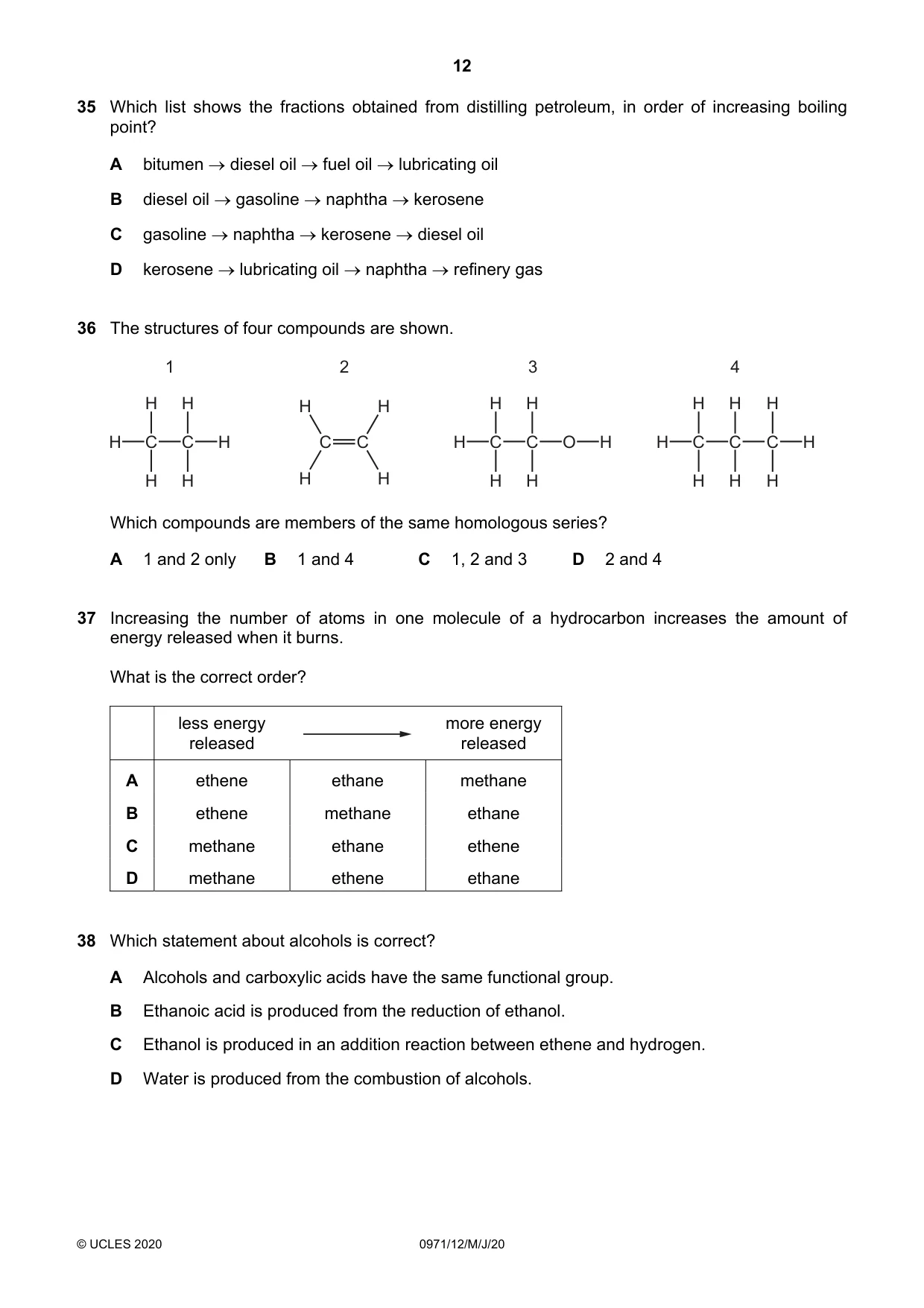
36 The structures of four compounds are shown. 1 2 3 4 H H H H H H H H H H C C H C C H C C O H H C C C H H H H H H H H H H Which compounds are members of the same homologous series? A 1 and 2 only B 1 and 4 C 1, 2 and 3 D 2 and 4
Mark scheme: B
More questions on Formulae, functional groups and terminology
Q37 · Increasing the number of atoms in one molecule of a hydrocarbon increases the amount of…
37 Increasing the number of atoms in one molecule of a hydrocarbon increases the amount of energy released when it burns. What is the correct order? less energy more energy released released A ethene ethane methane B ethene methane ethane C methane ethane ethene D methane ethene ethane
Mark scheme: D
Q38 · Which statement about alcohols is correct?
38 Which statement about alcohols is correct? A Alcohols and carboxylic acids have the same functional group. B Ethanoic acid is produced from the reduction of ethanol. C Ethanol is produced in an addition reaction between ethene and hydrogen. D Water is produced from the combustion of alcohols.
Mark scheme: D
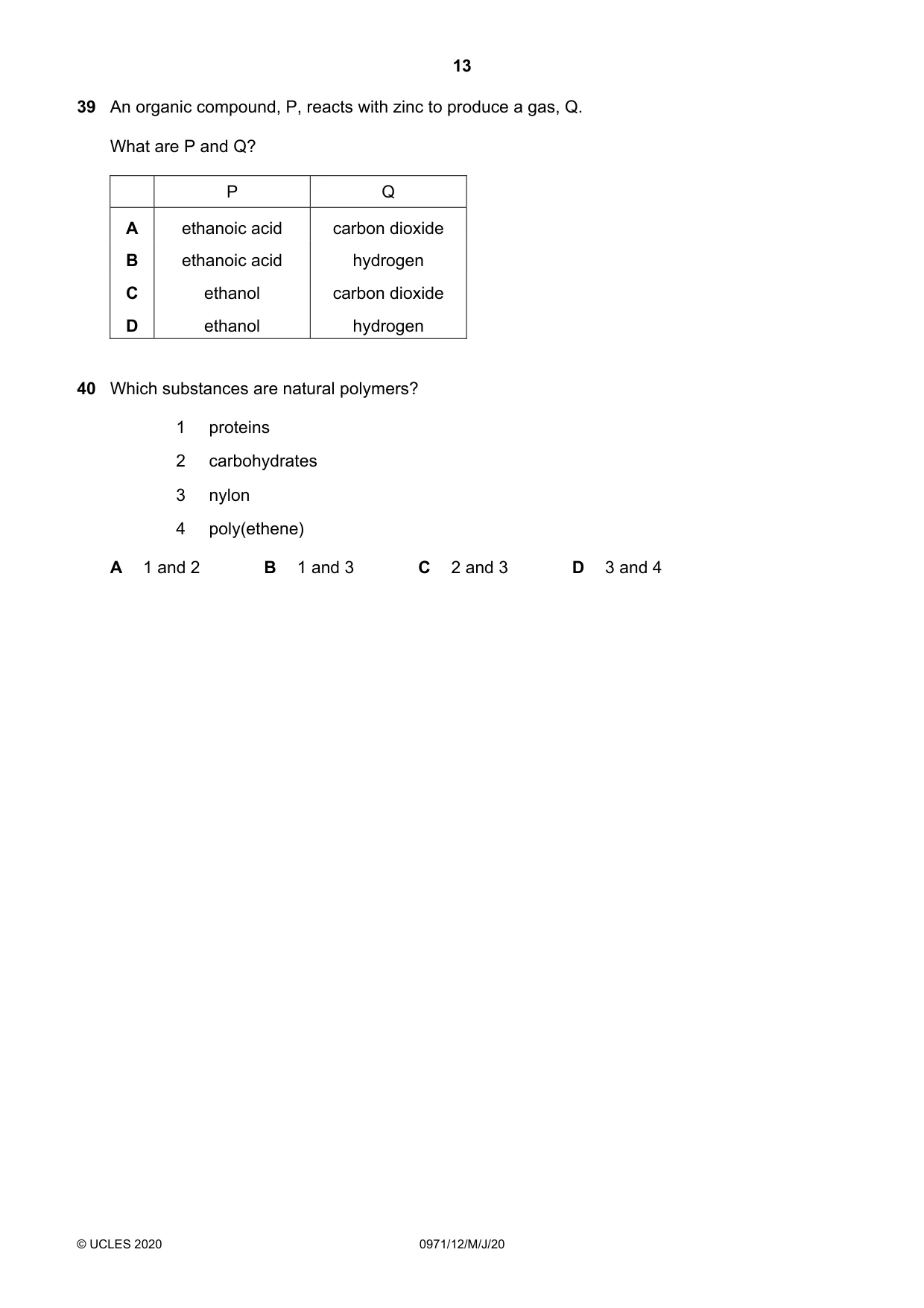
Q39 · An organic compound, P, reacts with zinc to produce a gas, Q
39 An organic compound, P, reacts with zinc to produce a gas, Q. What are P and Q? P Q A ethanoic acid carbon dioxide B ethanoic acid hydrogen C ethanol carbon dioxide D ethanol hydrogen
Mark scheme: B
Q40 · Which substances are natural polymers?
40 Which substances are natural polymers? 1 proteins 2 carbohydrates 3 nylon 4 poly(ethene) A 1 and 2 B 1 and 3 C 2 and 3 D 3 and 4
Mark scheme: A
What was in this paper
The subtopics covered by these 40 questions, and how many questions each got. Open one in a new tab to see every Cambridge question on it.
4Fuels3Water2Alcohols1Alloys and their properties1Arrangement of elements1Atomic structure and the Periodic Table1Carboxylic acids1Corrosion of metals1Electrolysis1Exothermic and endothermic reactions1Experimental design1Extraction of metals1Fertilisers1Formulae, functional groups and terminology1Giant covalent structures1Group VII properties1Identification of ions and gases1Ions and ionic bonds1Noble gases1Oxides1Physical and chemical changes1Polymers1Preparation of salts1Properties of metals1Rate of reaction1Reactivity series1Redox1Relative masses of atoms and molecules1Reversible reactions and equilibrium1Simple molecules and covalent bonds1Solids, liquids and gases1The characteristic properties of acids and bases1Transition elements1