Questions as text
Q1 · What is observed at each electrode when molten lead(II) bromide is electrolysed using… 0971/11 May/June 2018
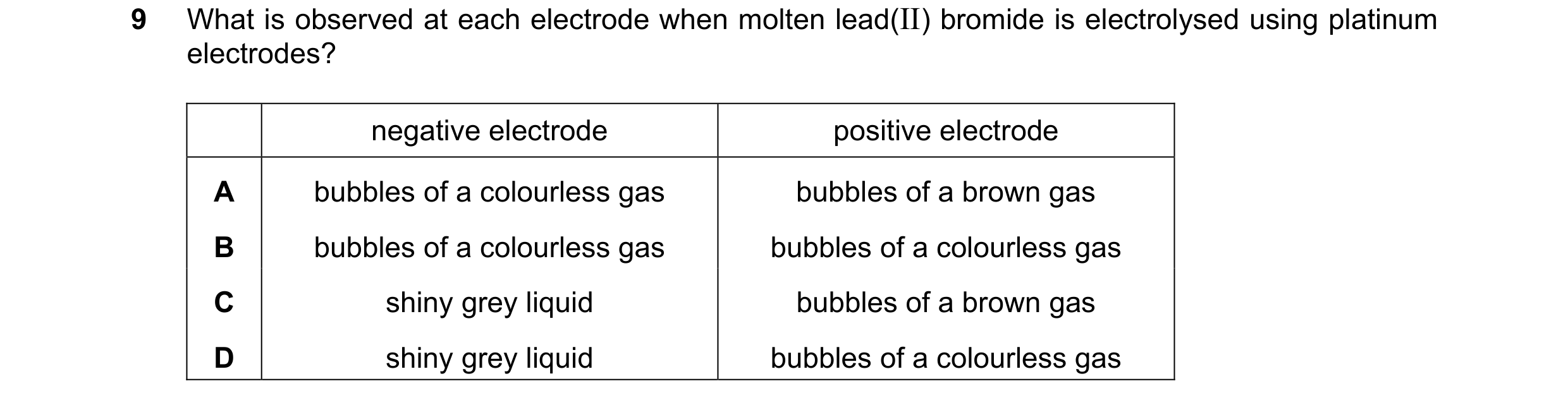
9 What is observed at each electrode when molten lead(II) bromide is electrolysed using platinum electrodes? negative electrode positive electrode A bubbles of a colourless gas bubbles of a brown gas B bubbles of a colourless gas bubbles of a colourless gas C shiny grey liquid bubbles of a brown gas D shiny grey liquid bubbles of a colourless gas
1 marks
Answer: C
This question in 0971/11 May/June 2018
Q2 · Dilute nitric acid is added to a solid, F 0971/11 May/June 2018
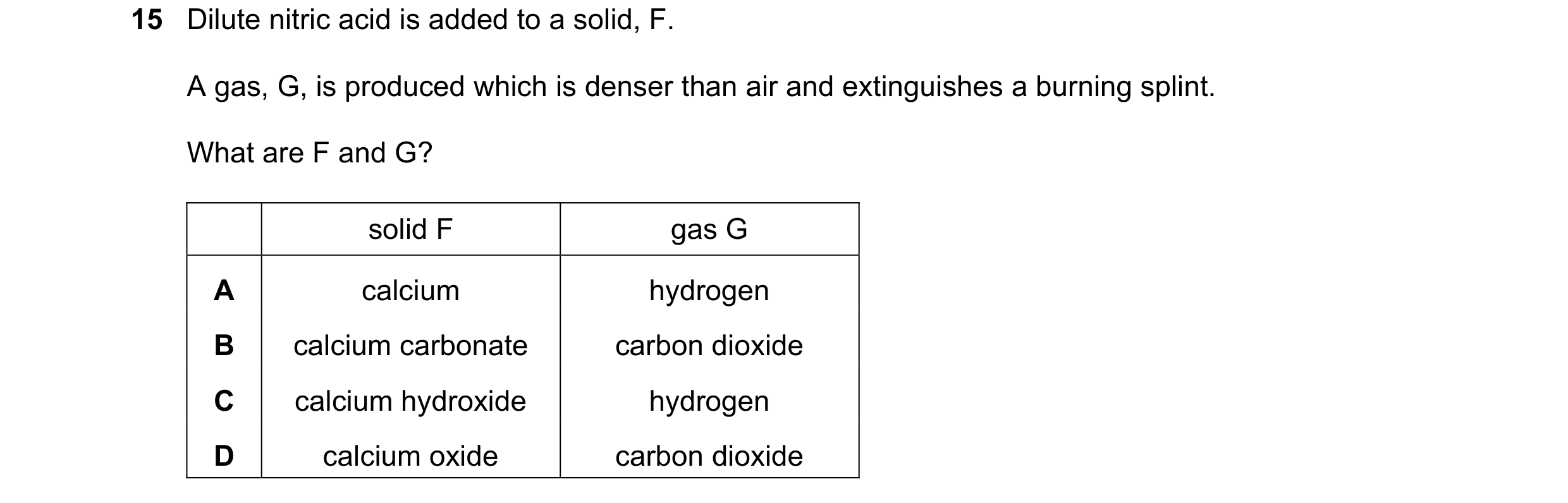
15 Dilute nitric acid is added to a solid, F. A gas, G, is produced which is denser than air and extinguishes a burning splint. What are F and G? solid F gas G A calcium hydrogen B calcium carbonate carbon dioxide C calcium hydroxide hydrogen D calcium oxide carbon dioxide
1 marks
Answer: B
This question in 0971/11 May/June 2018
Q3 · Two salt solutions, X and Y, are tested 0971/11 May/June 2018
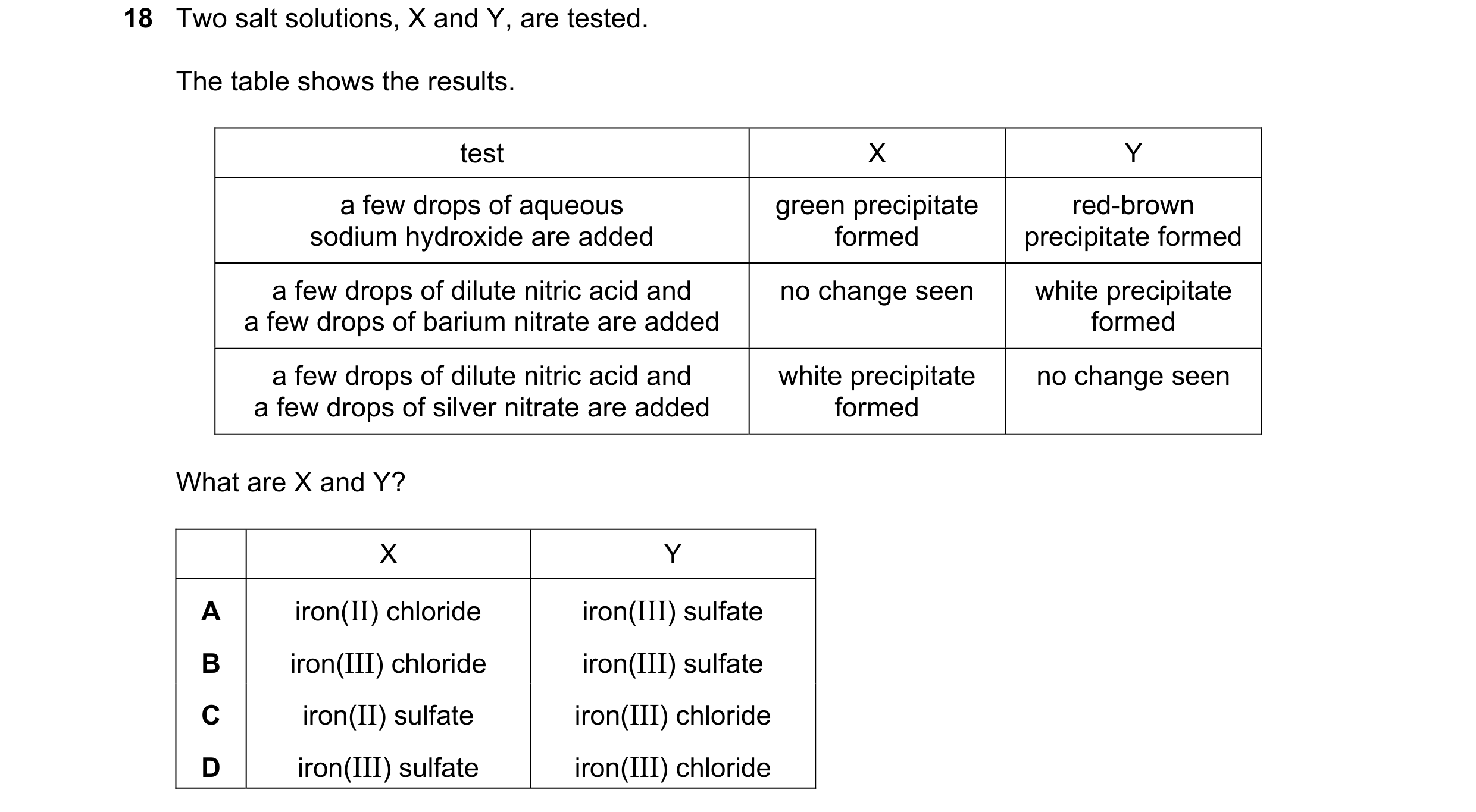
18 Two salt solutions, X and Y, are tested. The table shows the results. test X Y a few drops of aqueous green precipitate red-brown sodium hydroxide are added formed precipitate formed a few drops of dilute nitric acid and no change seen white precipitate a few drops of barium nitrate are added formed a few drops of dilute nitric acid and white precipitate no change seen a few drops of silver nitrate are added formed What are X and Y? X Y A iron(II) chloride iron(III) sulfate B iron(III) chloride iron(III) sulfate C iron(II) sulfate iron(III) chloride D iron(III) sulfate iron(III) chloride
1 marks
Answer: A
This question in 0971/11 May/June 2018
Q4 · The results of two tests on a solution of compound Q are shown 0971/11 May/June 2019
19 The results of two tests on a solution of compound Q are shown. test observation add ammonia solution green precipitate formed add dilute nitric acid followed white precipitate formed by aqueous barium nitrate What is Q? A iron(II) chloride B iron(II) sulfate C iron(III) chloride D iron(III) sulfate
1 marks
Answer: B
This question in 0971/11 May/June 2019
Q5 · A mixture of two substances, R and S, is heated 0971/11 May/June 2019
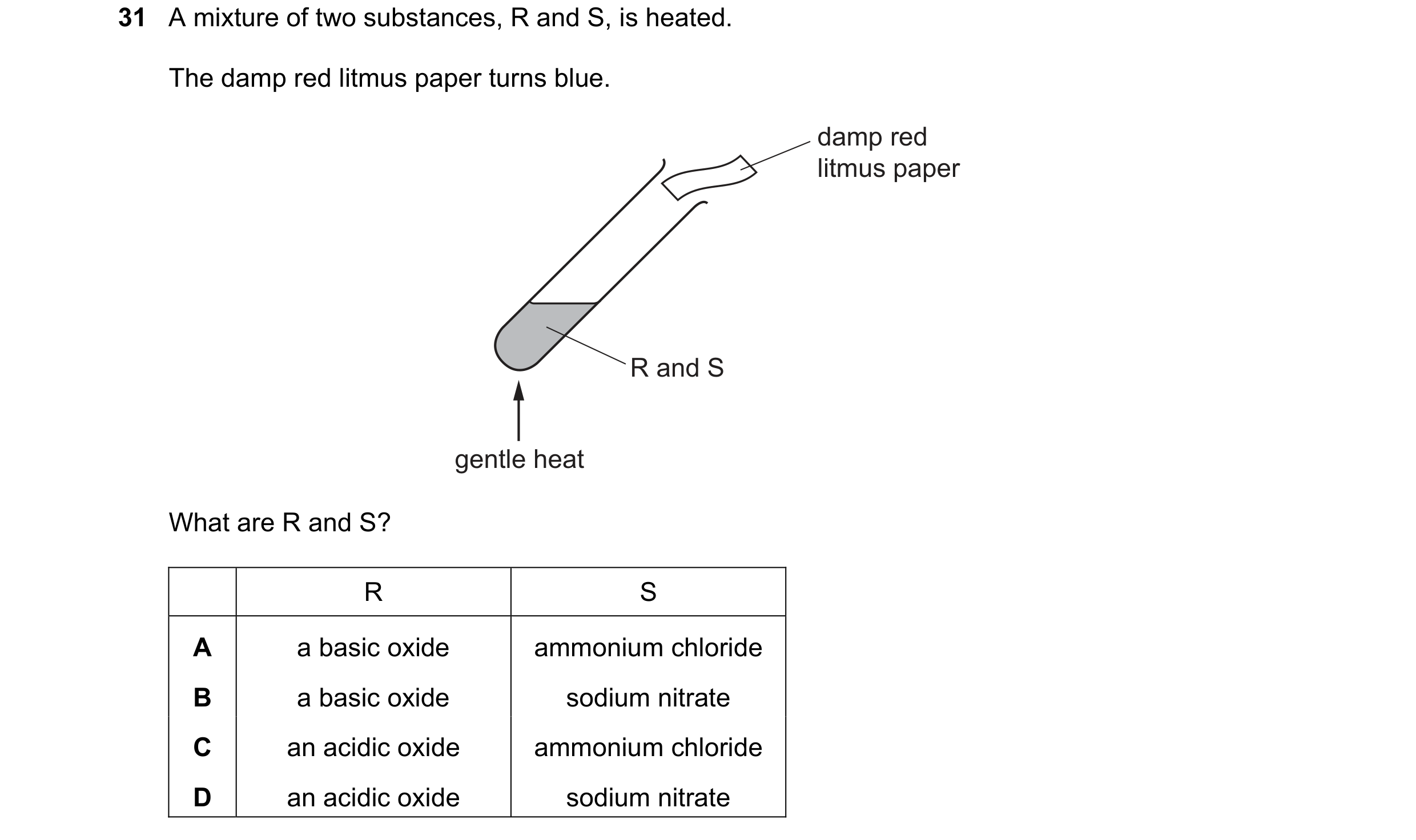
31 A mixture of two substances, R and S, is heated. The damp red litmus paper turns blue. damp red litmus paper R and S gentle heat What are R and S? R S A a basic oxide ammonium chloride B a basic oxide sodium nitrate C an acidic oxide ammonium chloride D an acidic oxide sodium nitrate
1 marks
Answer: A
This question in 0971/11 May/June 2019
Q6 · Which reaction produces a white-coloured substance? 0971/12 Oct/Nov 2019
12 Which reaction produces a white-coloured substance? A adding water to anhydrous cobalt(II) chloride B adding water to anhydrous copper(II) sulfate C heating hydrated cobalt(II) chloride D heating hydrated copper(II) sulfate
1 marks
Answer: D
This question in 0971/12 Oct/Nov 2019
Q7 · A sample of X is heated with aqueous sodium hydroxide and small pieces of aluminium 0971/12 Oct/Nov 2019
17 A sample of X is heated with aqueous sodium hydroxide and small pieces of aluminium. A gas is produced which turns red litmus paper blue. Aqueous sodium hydroxide solution is added to a second sample of X. A pale green precipitate is observed. What is X? A ammonium nitrate B chromium(II) chloride C iron(II) nitrate D iron(II) sulfate
1 marks
Answer: C
This question in 0971/12 Oct/Nov 2019
Q8 · Two tests are carried out on substance Z 0971/11 May/June 2020
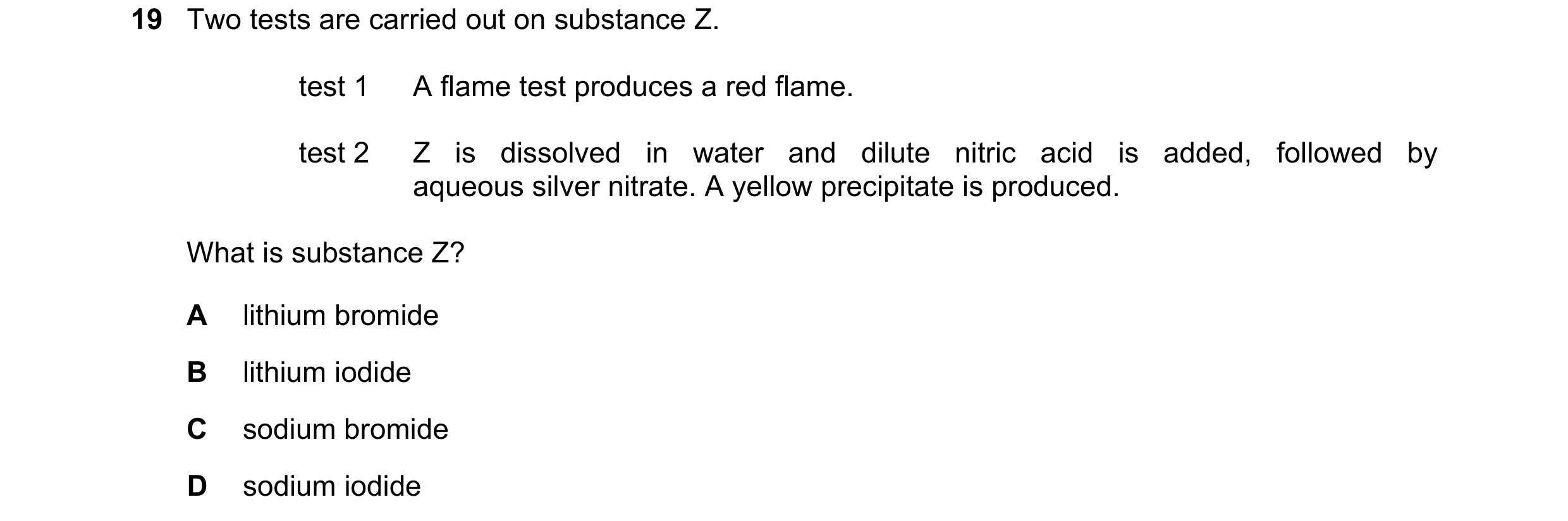
19 Two tests are carried out on substance Z. test 1 A flame test produces a red flame. test 2 Z is dissolved in water and dilute nitric acid is added, followed by aqueous silver nitrate. A yellow precipitate is produced. What is substance Z? A lithium bromide B lithium iodide C sodium bromide D sodium iodide
1 marks
Answer: B
This question in 0971/11 May/June 2020
Q9 · An aqueous solution of a compound M is tested 0971/12 May/June 2020
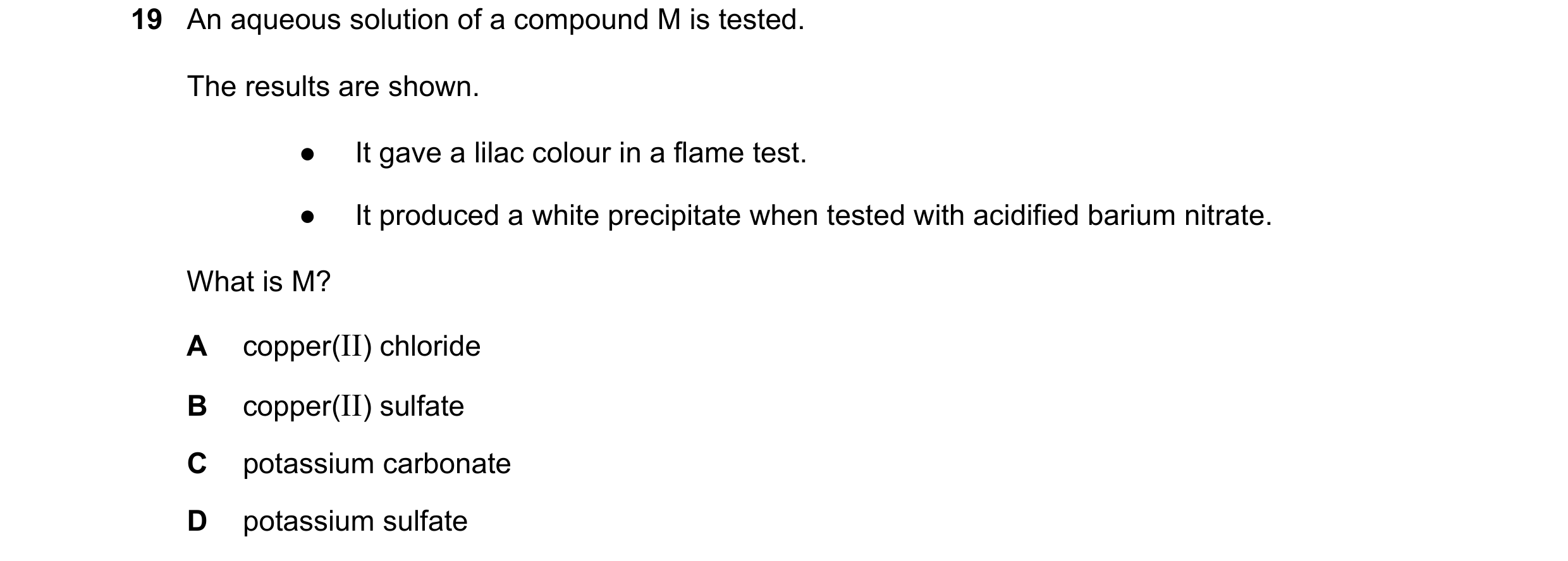
19 An aqueous solution of a compound M is tested. The results are shown. ● It gave a lilac colour in a flame test. ● It produced a white precipitate when tested with acidified barium nitrate. What is M? A copper(II) chloride B copper(II) sulfate C potassium carbonate D potassium sulfate
1 marks
Answer: D
This question in 0971/12 May/June 2020
Q10 · Which statement about pure water is not correct? 0971/12 May/June 2020
28 Which statement about pure water is not correct? A It condenses at 100 °C. B It freezes at 0 °C. C It turns cobalt(II) chloride paper blue. D It turns anhydrous copper(II) sulfate blue.
1 marks
Answer: C
This question in 0971/12 May/June 2020
Q11 · Which statement describes how a flame test is done? 0971/12 Oct/Nov 2020
23 Which statement describes how a flame test is done? A The tip of a clean wire is dipped into the substance and the wire is placed in a blue Bunsen burner flame. B The tip of a clean wire is dipped into the substance and the wire is placed in a yellow Bunsen burner flame. C A wooden splint is lit and is placed above a test-tube containing the gas being tested. D A wooden splint is lit, blown out and the glowing splint put into a test-tube of the gas being tested.
1 marks
Answer: A
This question in 0971/12 Oct/Nov 2020
Q12 · When solid S is heated strongly, it forms gas G 0971/12 Oct/Nov 2020
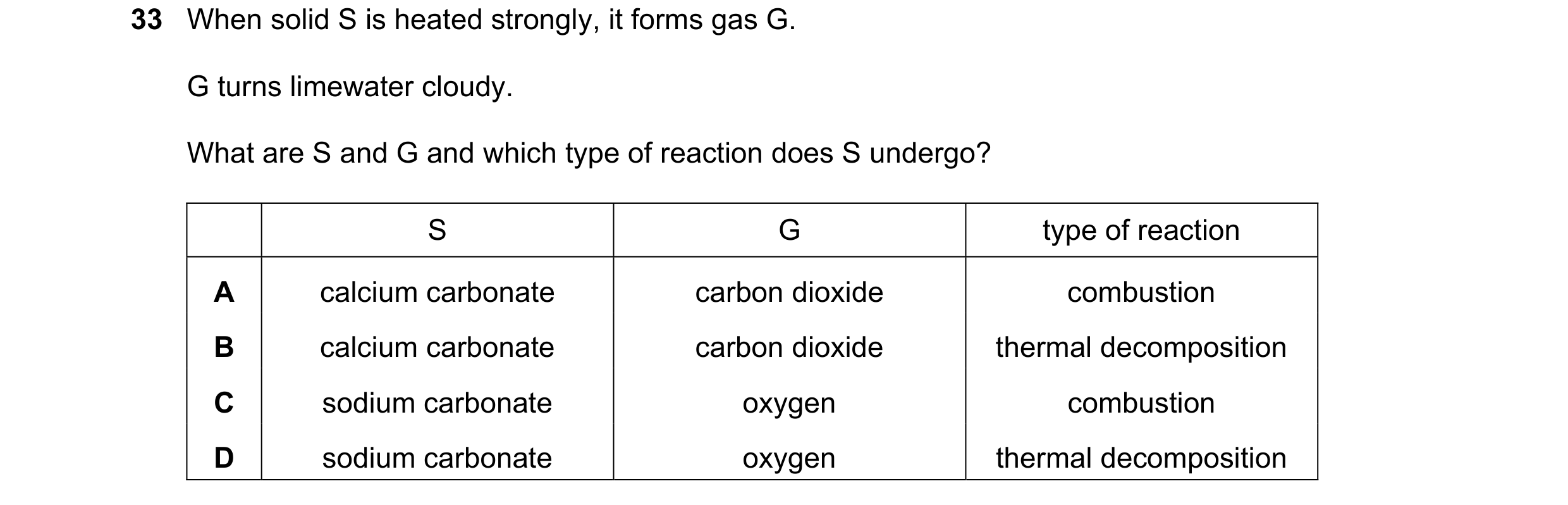
33 When solid S is heated strongly, it forms gas G. G turns limewater cloudy. What are S and G and which type of reaction does S undergo? S G type of reaction A calcium carbonate carbon dioxide combustion B calcium carbonate carbon dioxide thermal decomposition C sodium carbonate oxygen combustion D sodium carbonate oxygen thermal decomposition
1 marks
Answer: B
This question in 0971/12 Oct/Nov 2020
Q13 · Which statement is correct? 0971/11 May/June 2021
16 Which statement is correct? A When anhydrous copper(II) sulfate is heated its colour changes to a deeper blue. B When hydrated copper(II) sulfate is heated its colour changes to a deeper blue. C When water is added to blue cobalt(II) chloride paper it turns pink. D When water is added to pink cobalt(II) chloride paper it turns blue.
1 marks
Answer: C
This question in 0971/11 May/June 2021
Q14 · Ammonium chloride is heated with aqueous sodium hydroxide 0971/11 May/June 2021
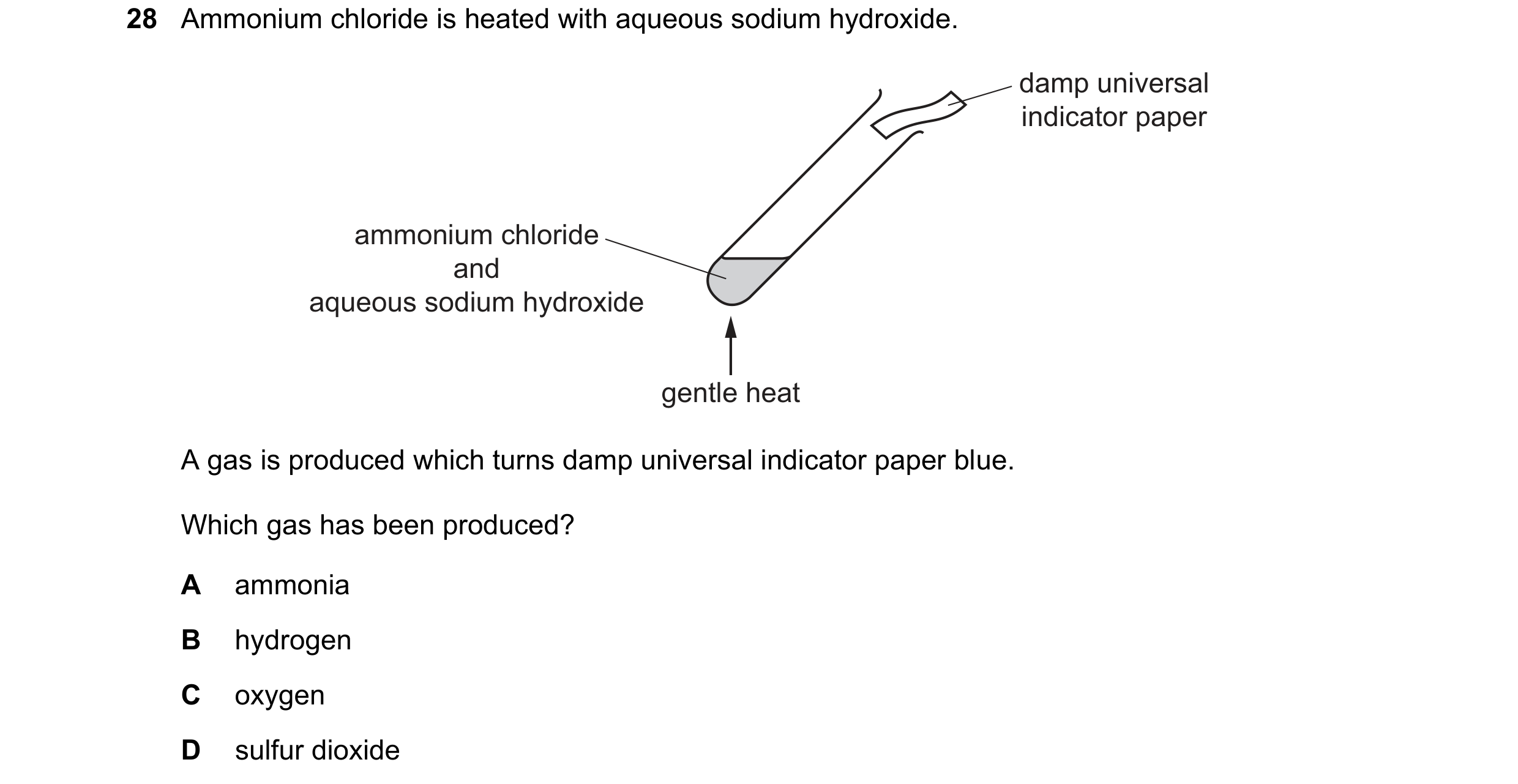
28 Ammonium chloride is heated with aqueous sodium hydroxide. damp universal indicator paper ammonium chloride and aqueous sodium hydroxide gentle heat A gas is produced which turns damp universal indicator paper blue. Which gas has been produced? A ammonia B hydrogen C oxygen D sulfur dioxide
1 marks
Answer: A
This question in 0971/11 May/June 2021
Q15 · Solid X is heated strongly 0971/12 Oct/Nov 2021
15 Solid X is heated strongly. The colour of the solid changes from blue to white. What is solid X? A anhydrous cobalt(II) chloride B calcium carbonate C hydrated copper(II) sulfate D lead(II) bromide
1 marks
Answer: C
This question in 0971/12 Oct/Nov 2021
Q16 · Which statement about aqueous sodium hydroxide is correct? 0971/12 Oct/Nov 2021
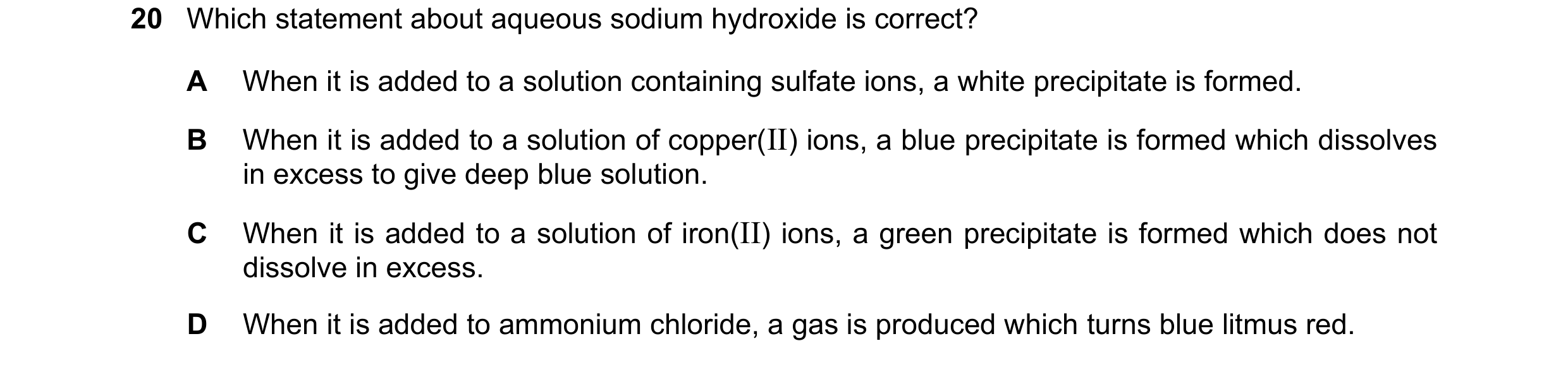
20 Which statement about aqueous sodium hydroxide is correct? A When it is added to a solution containing sulfate ions, a white precipitate is formed. B When it is added to a solution of copper(II) ions, a blue precipitate is formed which dissolves in excess to give deep blue solution. C When it is added to a solution of iron(II) ions, a green precipitate is formed which does not dissolve in excess. D When it is added to ammonium chloride, a gas is produced which turns blue litmus red.
1 marks
Answer: C
This question in 0971/12 Oct/Nov 2021
Q17 · Three separate samples of an aqueous compound T are tested 0971/11 May/June 2022
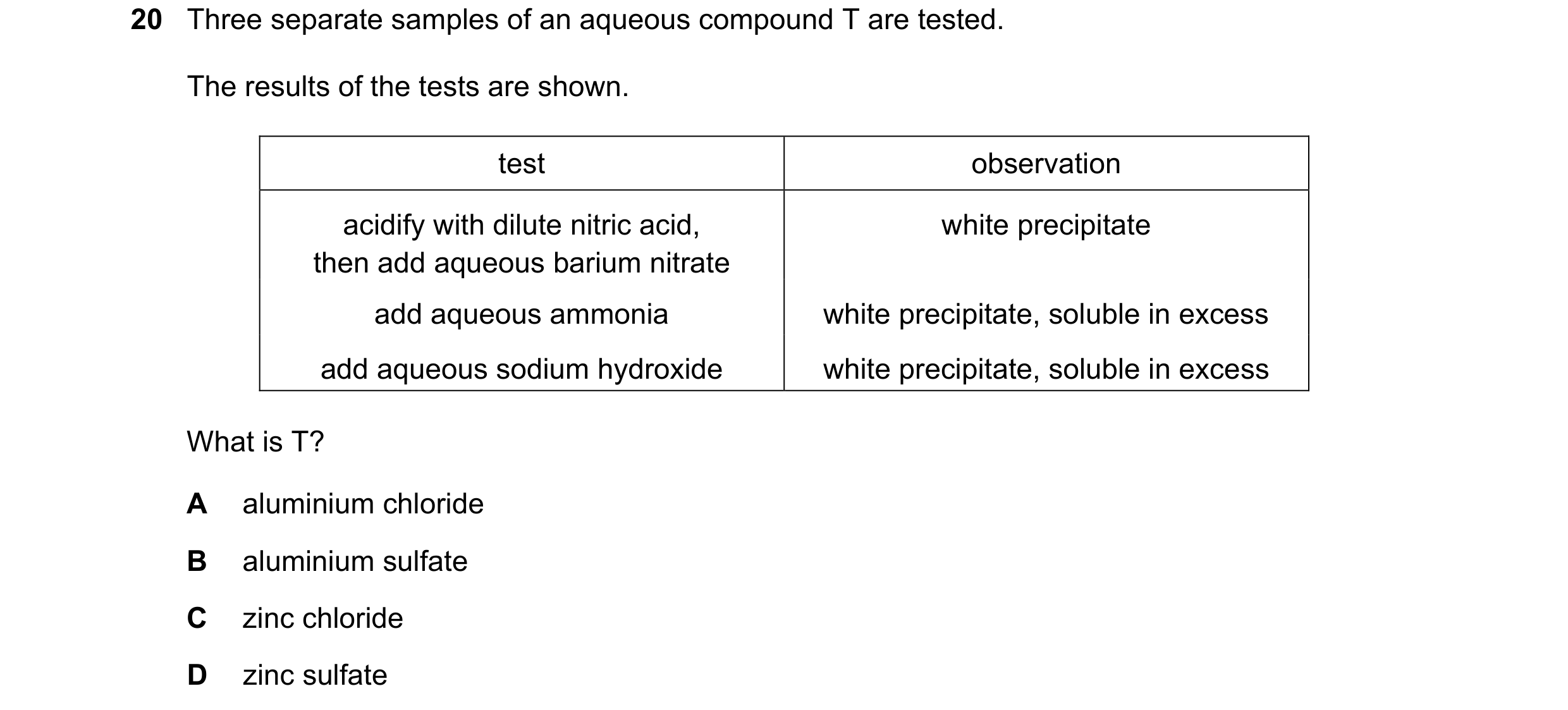
20 Three separate samples of an aqueous compound T are tested. The results of the tests are shown. test observation acidify with dilute nitric acid, white precipitate then add aqueous barium nitrate add aqueous ammonia white precipitate, soluble in excess add aqueous sodium hydroxide white precipitate, soluble in excess What is T? A aluminium chloride B aluminium sulfate C zinc chloride D zinc sulfate
1 marks
Answer: D
This question in 0971/11 May/June 2022
Q18 · The diagram shows the electrolysis of concentrated hydrochloric acid and concentrated… 0971/12 May/June 2022
10 The diagram shows the electrolysis of concentrated hydrochloric acid and concentrated aqueous sodium chloride using carbon electrodes. + – + – electrode 1 electrode 2 electrode 3 electrode 4 concentrated concentrated aqueous hydrochloric acid sodium chloride At which electrodes is hydrogen produced? A electrode 1 only B electrodes 1 and 3 C electrode 2 only D electrodes 2 and 4
1 marks
Answer: D
This question in 0971/12 May/June 2022
Q19 · Aqueous solutions containing copper(II) ions can be identified using flame tests and by… 0971/12 May/June 2022
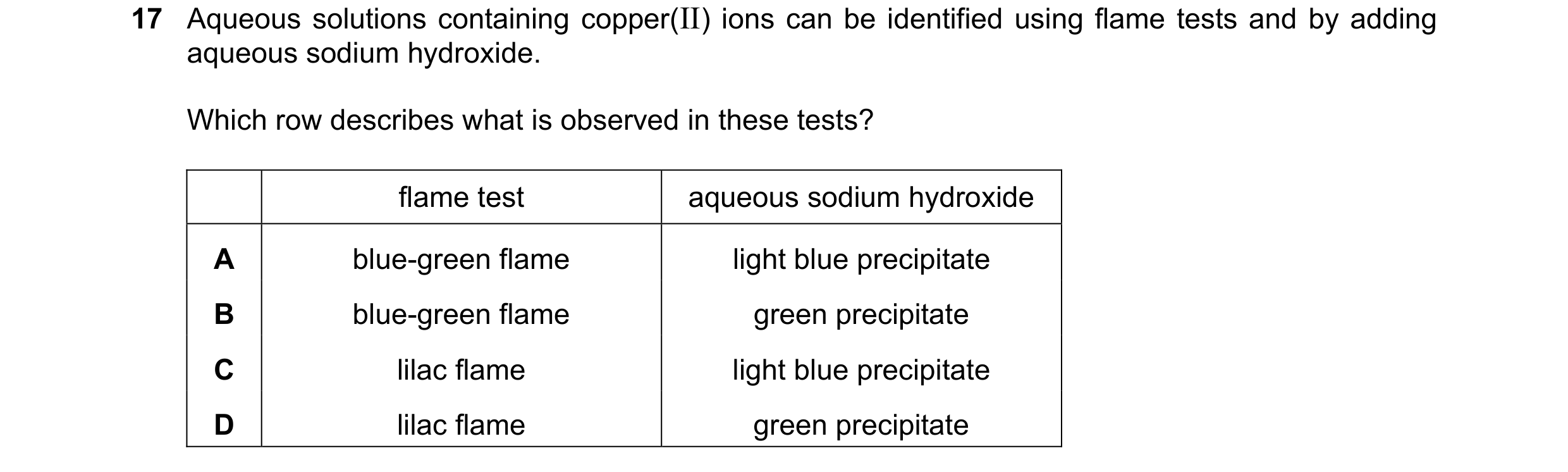
17 Aqueous solutions containing copper(II) ions can be identified using flame tests and by adding aqueous sodium hydroxide. Which row describes what is observed in these tests? flame test aqueous sodium hydroxide A blue-green flame light blue precipitate B blue-green flame green precipitate C lilac flame light blue precipitate D lilac flame green precipitate
1 marks
Answer: A
This question in 0971/12 May/June 2022
Q20 · The products formed by burning substance J are passed through the apparatus shown 0971/12 May/June 2022
38 The products formed by burning substance J are passed through the apparatus shown. products of burning J ice white precipitate forms in limewater water collects What is substance J? A carbon monoxide B ethanol C hydrogen D sulfur
1 marks
Answer: B
This question in 0971/12 May/June 2022
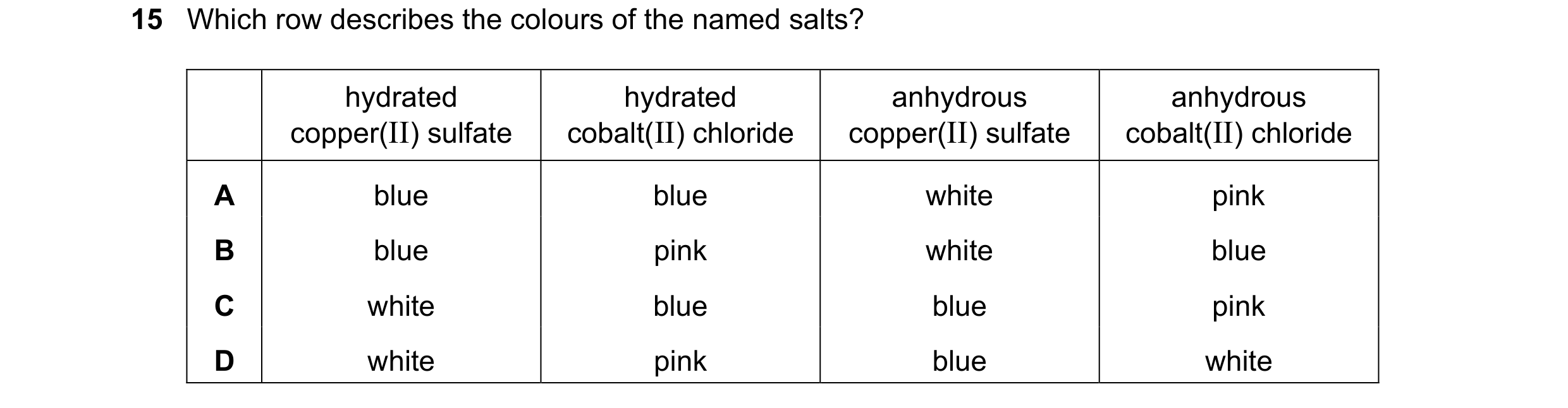
Q21 · Which row describes the colours of the named salts? 0971/12 Oct/Nov 2022
15 Which row describes the colours of the named salts? hydrated hydrated anhydrous anhydrous copper(II) sulfate cobalt(II) chloride copper(II) sulfate cobalt(II) chloride A blue blue white pink B blue pink white blue C white blue blue pink D white pink blue white
1 marks
Answer: B
This question in 0971/12 Oct/Nov 2022
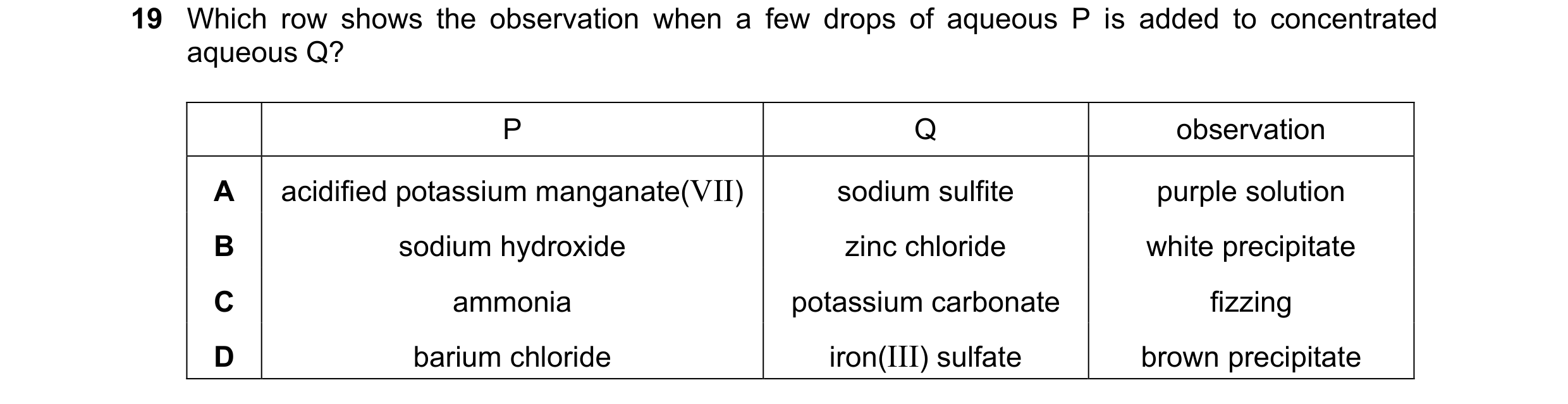
Q22 · Which row shows the observation when a few drops of aqueous P is added to concentrated… 0971/12 Oct/Nov 2022
19 Which row shows the observation when a few drops of aqueous P is added to concentrated aqueous Q? P Q observation A acidified potassium manganate(VII) sodium sulfite purple solution B sodium hydroxide zinc chloride white precipitate C ammonia potassium carbonate fizzing D barium chloride iron(III) sulfate brown precipitate
1 marks
Answer: B
This question in 0971/12 Oct/Nov 2022
Q23 · The results of two separate tests on a white solid X are shown 0971/11 May/June 2023
40 The results of two separate tests on a white solid X are shown. test result add dilute nitric acid effervescence add aqueous a gas is formed which turns sodium hydroxide and warm damp red litmus paper blue What is X? A aluminium carbonate B aluminium nitrate C ammonium carbonate D ammonium nitrate
1 marks
Answer: C
This question in 0971/11 May/June 2023
Q24 · Dilute sulfuric acid is electrolysed using inert electrodes 0971/12 May/June 2023
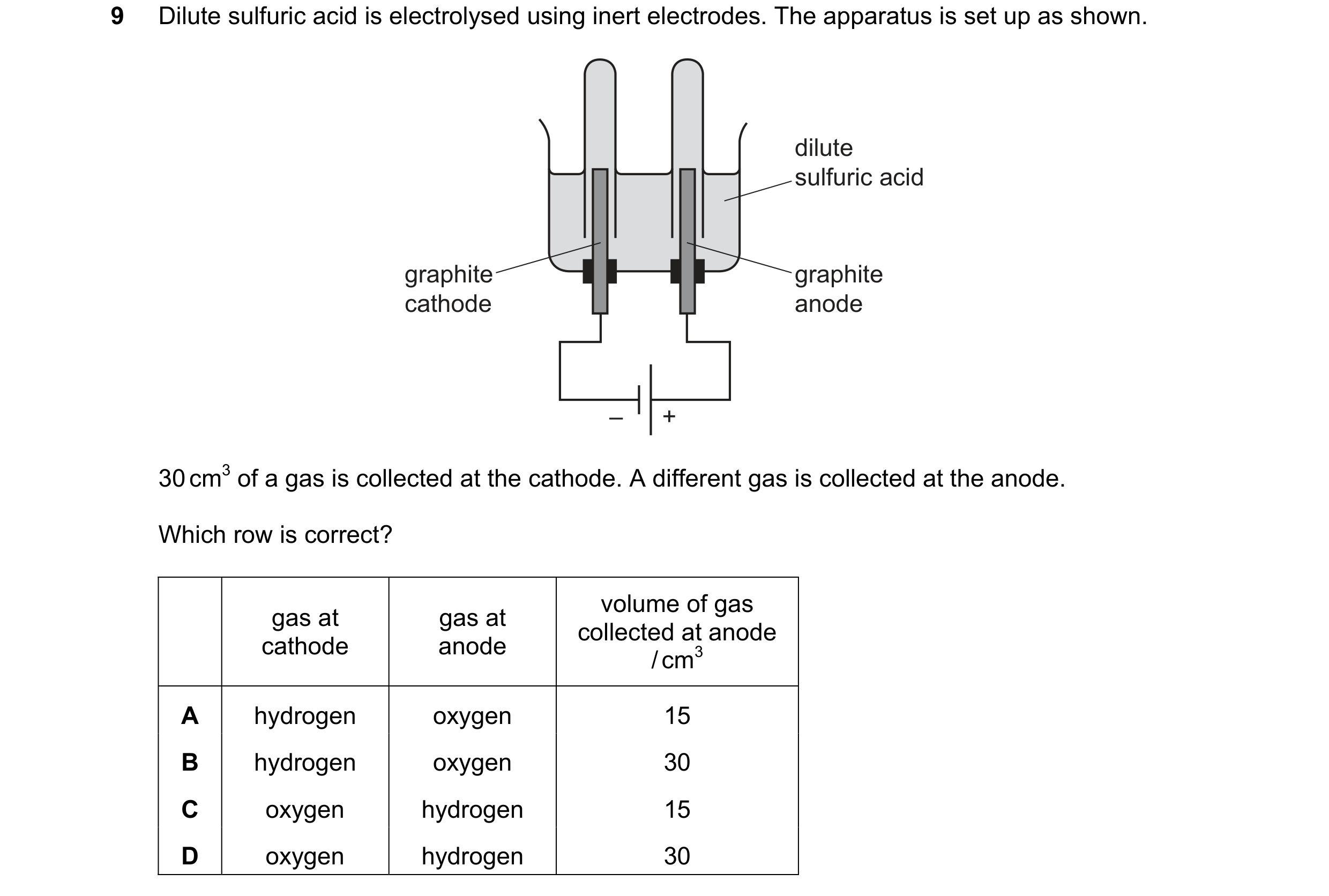
9 Dilute sulfuric acid is electrolysed using inert electrodes. The apparatus is set up as shown. dilute sulfuric acid graphite graphite cathode anode – + 30 cm3 of a gas is collected at the cathode. A different gas is collected at the anode. Which row is correct? volume of gas gas at gas at collected at anode cathode anode / cm3 A hydrogen oxygen 15 B hydrogen oxygen 30 C oxygen hydrogen 15 D oxygen hydrogen 30
1 marks
Answer: A
This question in 0971/12 May/June 2023
Q25 · A wax candle is made from a mixture of hydrocarbons 0971/12 May/June 2023
29 A wax candle is made from a mixture of hydrocarbons. The candle is lit and placed in a gas jar along with a strip of cobalt(II) chloride test paper as shown. cobalt(II) chloride paper gas jar combustion products wax candle After a short time, the oxygen in the jar is used up and the candle flame goes out. Which substance does the cobalt(II) chloride paper identify? A carbon dioxide B carbon monoxide C sulfur dioxide D water
1 marks
Answer: D
This question in 0971/12 May/June 2023
Q26 · When acid is added to salt X, a gas is produced which turns limewater milky 0971/12 May/June 2023
40 When acid is added to salt X, a gas is produced which turns limewater milky. When sodium hydroxide is added to salt X, a gas is produced which turns litmus paper blue. What is X? A CaCO3 B (NH4)2CO3 C NH4NO3 D ZnCO3
1 marks
Answer: B
This question in 0971/12 May/June 2023
Q27 · Which reaction shows a colour change from white to blue? 0971/12 Oct/Nov 2023
16 Which reaction shows a colour change from white to blue? A adding water to anhydrous copper(II) sulfate B adding water to hydrated copper(II) sulfate C heating anhydrous copper(II) sulfate D heating hydrated copper(II) sulfate
1 marks
Answer: A
This question in 0971/12 Oct/Nov 2023
Q28 · The results of tests on three gases, X, Y and Z, are shown 0971/12 Oct/Nov 2023
40 The results of tests on three gases, X, Y and Z, are shown. test X Y Z aqueous potassium manganate(VII) purple to colourless no change no change damp red litmus paper no change turns blue no change lighted splint no change no change pops What are X, Y and Z? X Y Z A chlorine sulfur dioxide hydrogen B chlorine sulfur dioxide oxygen C sulfur dioxide ammonia oxygen D sulfur dioxide ammonia hydrogen
1 marks
Answer: D
This question in 0971/12 Oct/Nov 2023
Q29 · A salt, S, is dissolved in water and three tests are carried out on the solution formed 0971/11 May/June 2024
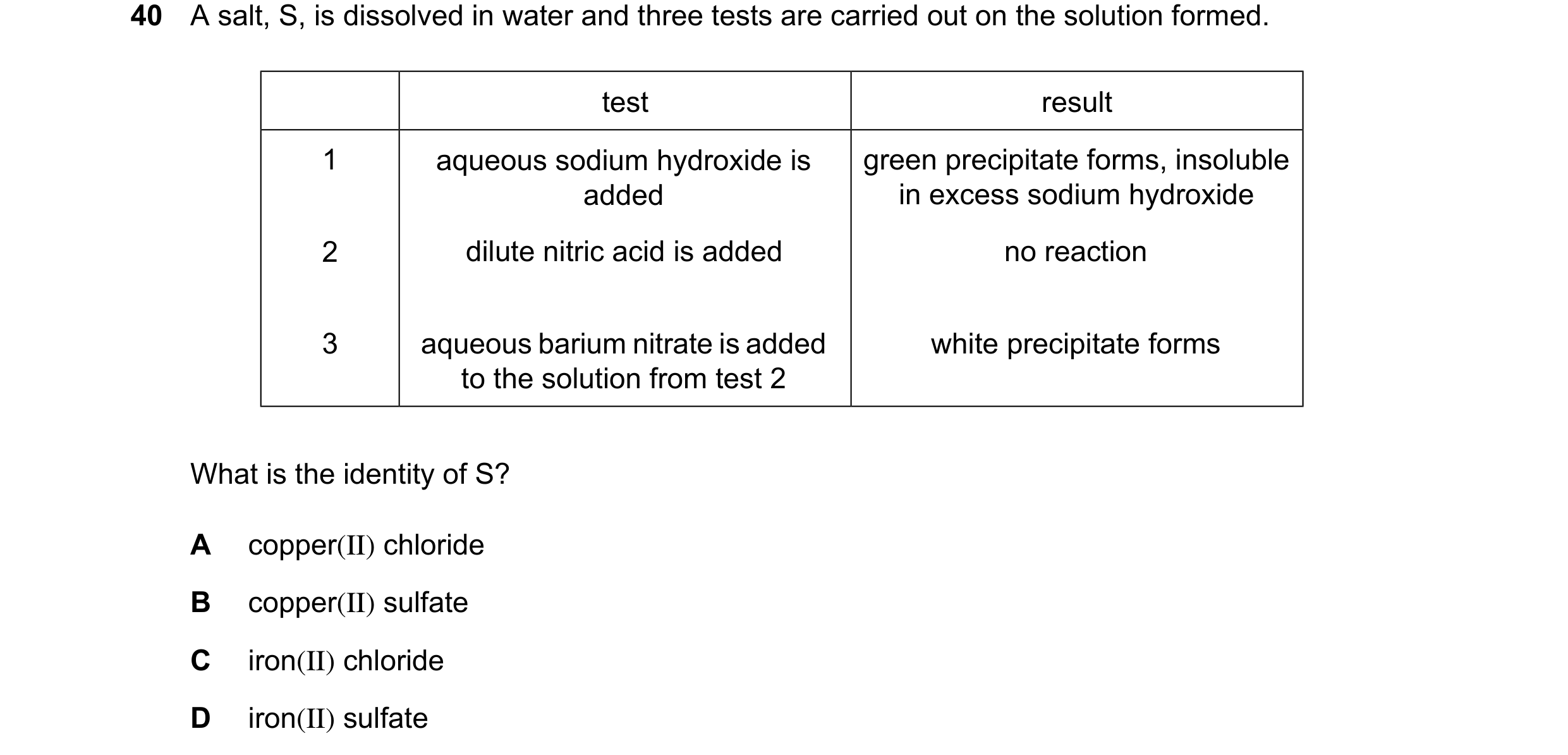
40 A salt, S, is dissolved in water and three tests are carried out on the solution formed. test result 1 aqueous sodium hydroxide is green precipitate forms, insoluble added in excess sodium hydroxide 2 dilute nitric acid is added no reaction 3 aqueous barium nitrate is added white precipitate forms to the solution from test 2 What is the identity of S? A copper(II) chloride B copper(II) sulfate C iron(II) chloride D iron(II) sulfate
1 marks
Answer: D
This question in 0971/11 May/June 2024
Q30 · An aqueous solution of compound M is tested 0971/12 May/June 2024
40 An aqueous solution of compound M is tested. The results are shown. • a lilac colour in a flame test • a white precipitate when tested with acidified barium nitrate What is compound M? A copper(II) chloride B copper(II) sulfate C potassium carbonate D potassium sulfate
1 marks
Answer: D
This question in 0971/12 May/June 2024
Q31 · When a few drops of water are added to a solid, E, the colour changes from blue to pink 0971/12 Oct/Nov 2024
18 When a few drops of water are added to a solid, E, the colour changes from blue to pink. What is E? A anhydrous cobalt(II) chloride B anhydrous copper(II) sulfate C hydrated cobalt(II) chloride D hydrated copper(II) sulfate
1 marks
Answer: A
This question in 0971/12 Oct/Nov 2024
Q32 · Compound M contains calcium 0971/12 Oct/Nov 2024
20 Compound M contains calcium. Two reactions of M are listed. ● M reacts with dilute hydrochloric acid to form a salt and water only. ● M reacts with aqueous ammonium chloride to form a gas that turns damp red litmus paper blue. What is M? A CaOH B Ca(OH)2 C CaCO3 D Ca(CO3)2
1 marks
Answer: B
This question in 0971/12 Oct/Nov 2024
Q33 · A mixture of two substances, R and S, is heated gently 0971/11 May/June 2025
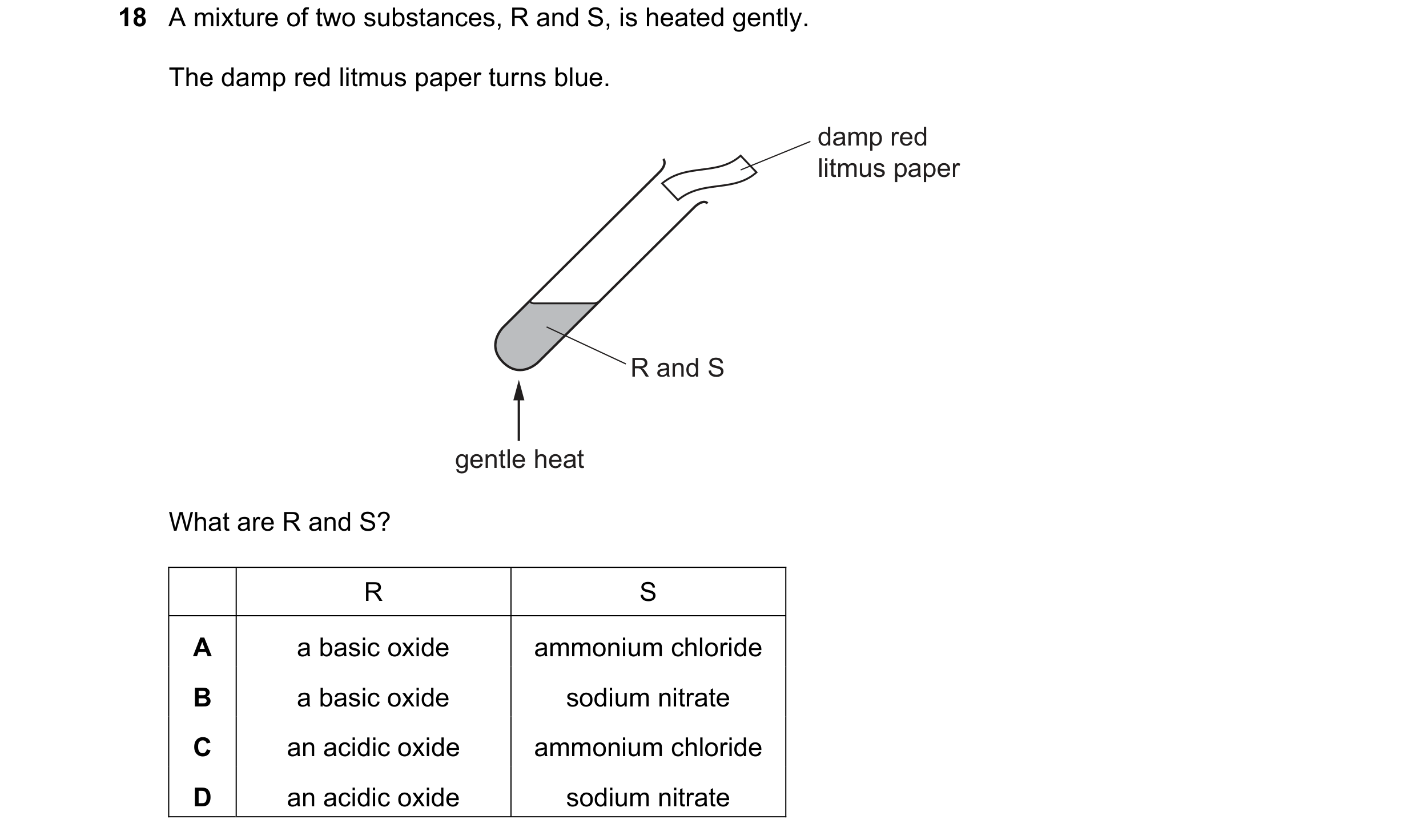
18 A mixture of two substances, R and S, is heated gently. The damp red litmus paper turns blue. damp red litmus paper R and S gentle heat What are R and S? R S A a basic oxide ammonium chloride B a basic oxide sodium nitrate C an acidic oxide ammonium chloride D an acidic oxide sodium nitrate
1 marks
Answer: A
This question in 0971/11 May/June 2025
Q34 · Four different aqueous metal nitrates are tested separately with aqueous sodium… 0971/11 May/June 2025
40 Four different aqueous metal nitrates are tested separately with aqueous sodium hydroxide, with dilute sulfuric acid and with a flame test. Which row shows the correct set of results for the named aqueous metal nitrate? aqueous with aqueous with dilute flame test metal nitrate sodium hydroxide sulfuric acid A sodium nitrate no visible change white precipitate yellow flame B copper(II) nitrate blue precipitate no visible change blue-green flame C barium nitrate white precipitate no visible change blue-green flame D calcium nitrate no visible change white precipitate yellow flame
1 marks
Answer: B
This question in 0971/11 May/June 2025
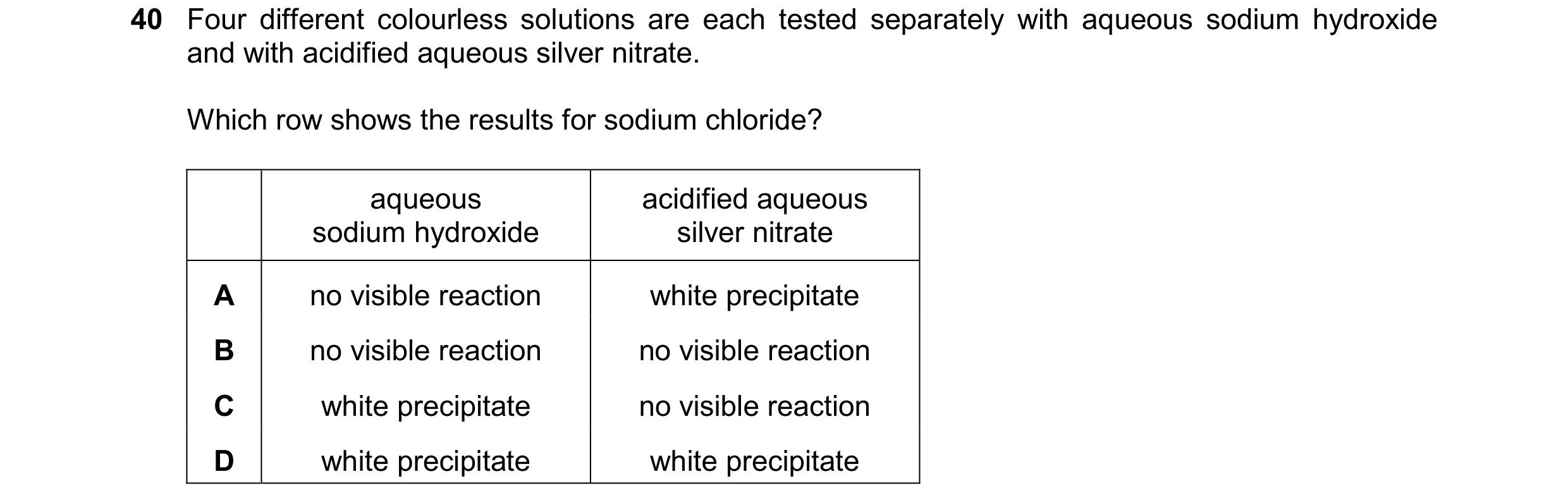
Q35 · Four different colourless solutions are each tested separately with aqueous sodium… 0971/12 May/June 2025
40 Four different colourless solutions are each tested separately with aqueous sodium hydroxide and with acidified aqueous silver nitrate. Which row shows the results for sodium chloride? aqueous acidified aqueous sodium hydroxide silver nitrate A no visible reaction white precipitate B no visible reaction no visible reaction C white precipitate no visible reaction D white precipitate white precipitate
1 marks
Answer: A
This question in 0971/12 May/June 2025
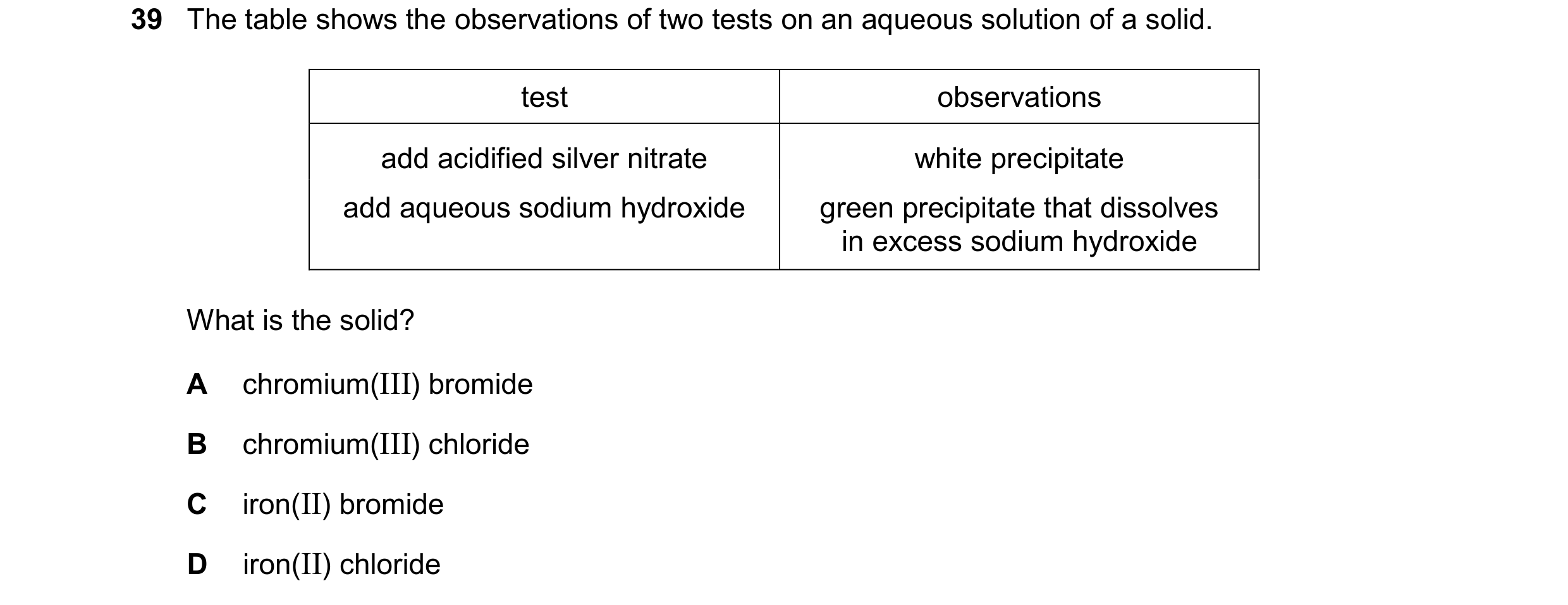
Q36 · The table shows the observations of two tests on an aqueous solution of a solid 0971/12 Oct/Nov 2025
39 The table shows the observations of two tests on an aqueous solution of a solid. test observations add acidified silver nitrate white precipitate add aqueous sodium hydroxide green precipitate that dissolves in excess sodium hydroxide What is the solid? A chromium(III) bromide B chromium(III) chloride C iron(II) bromide D iron(II) chloride
1 marks
Answer: B
This question in 0971/12 Oct/Nov 2025
 1 / 12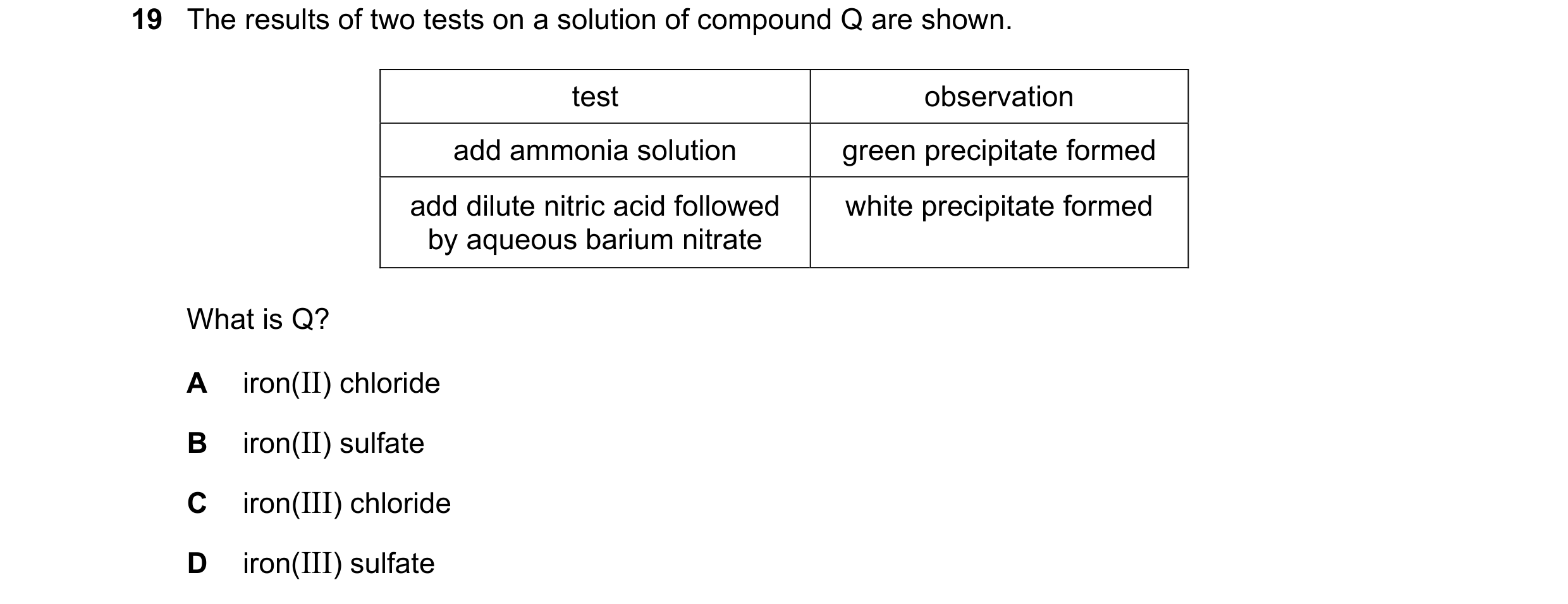
 2 / 12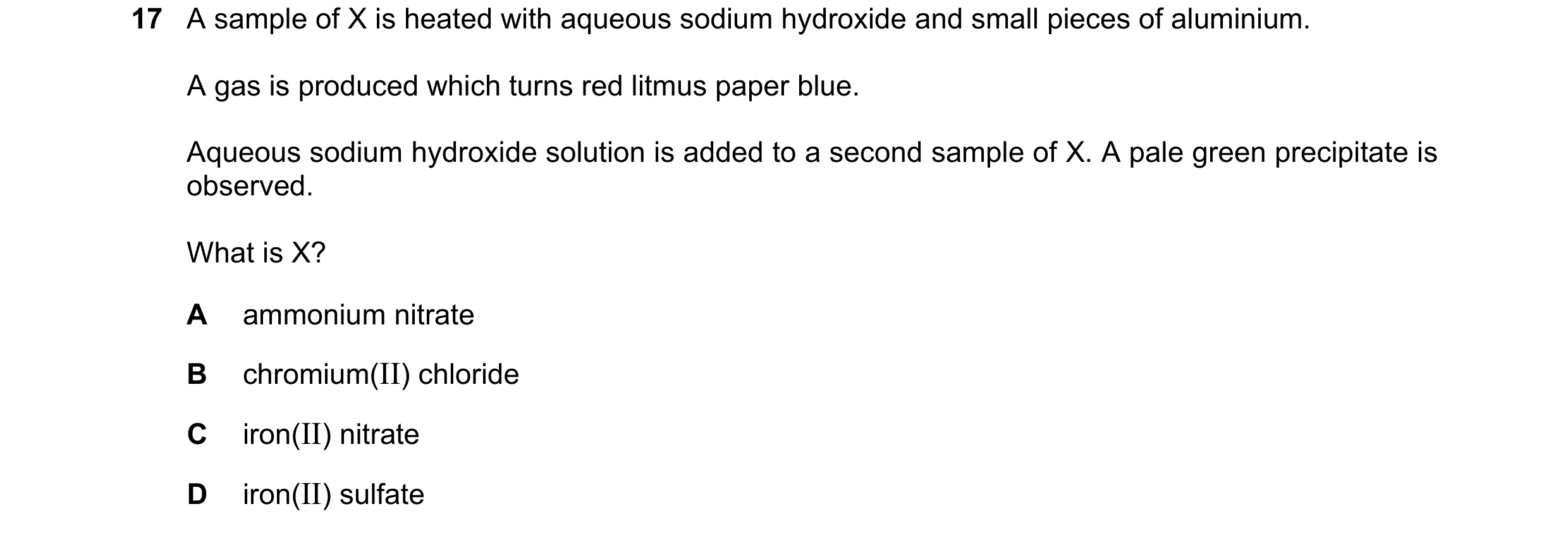
 3 / 12

 4 / 12
 5 / 12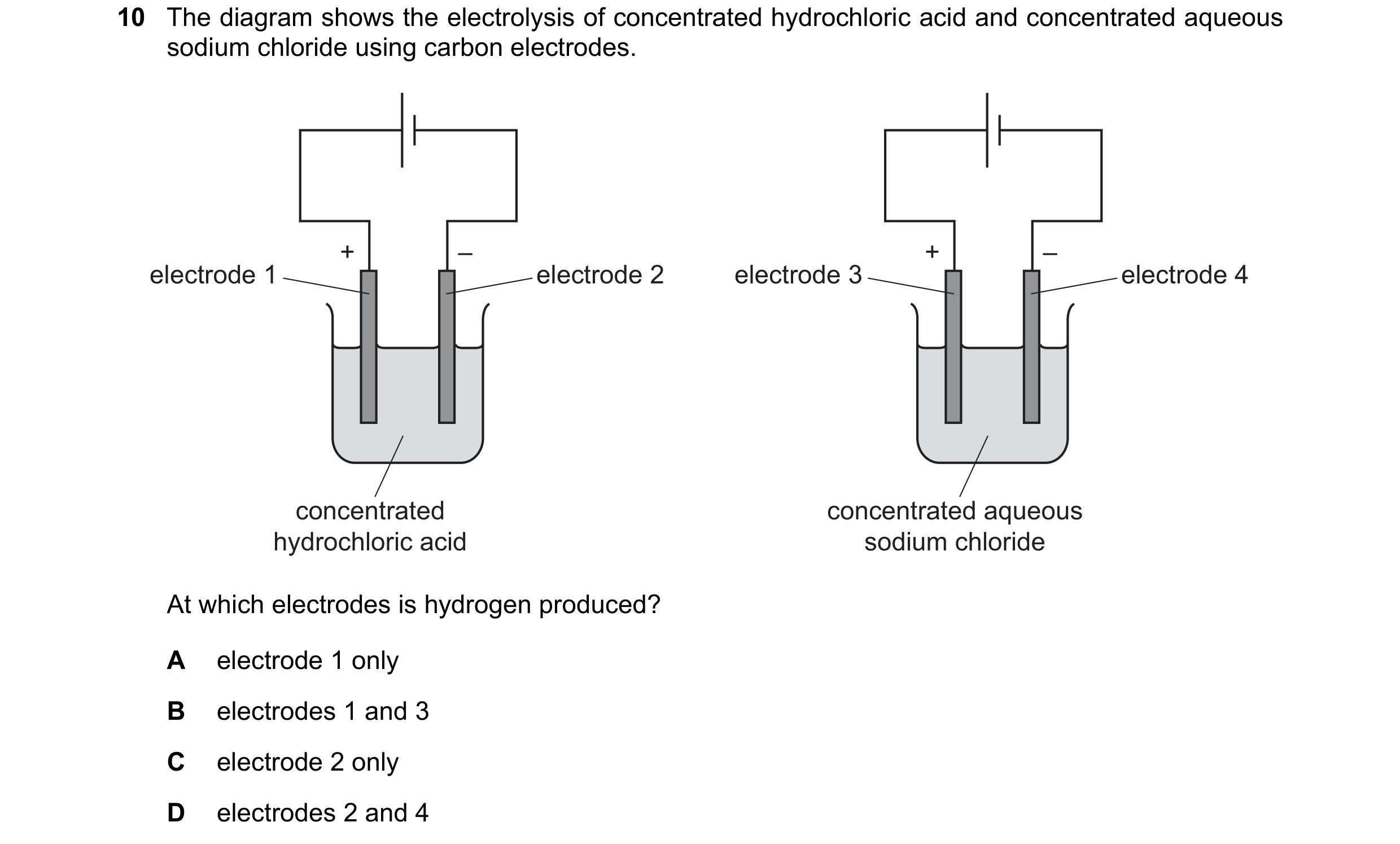
 6 / 12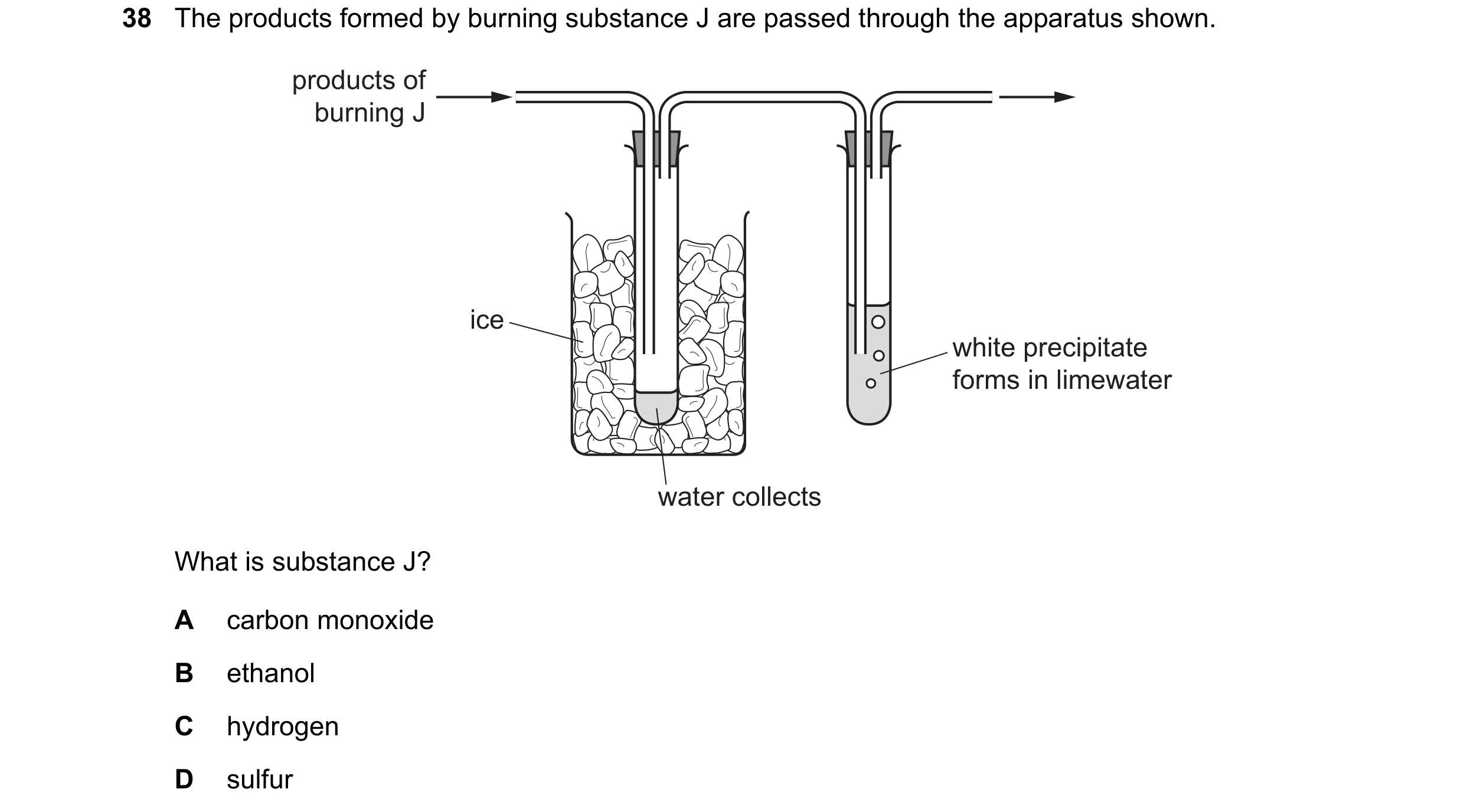
 7 / 12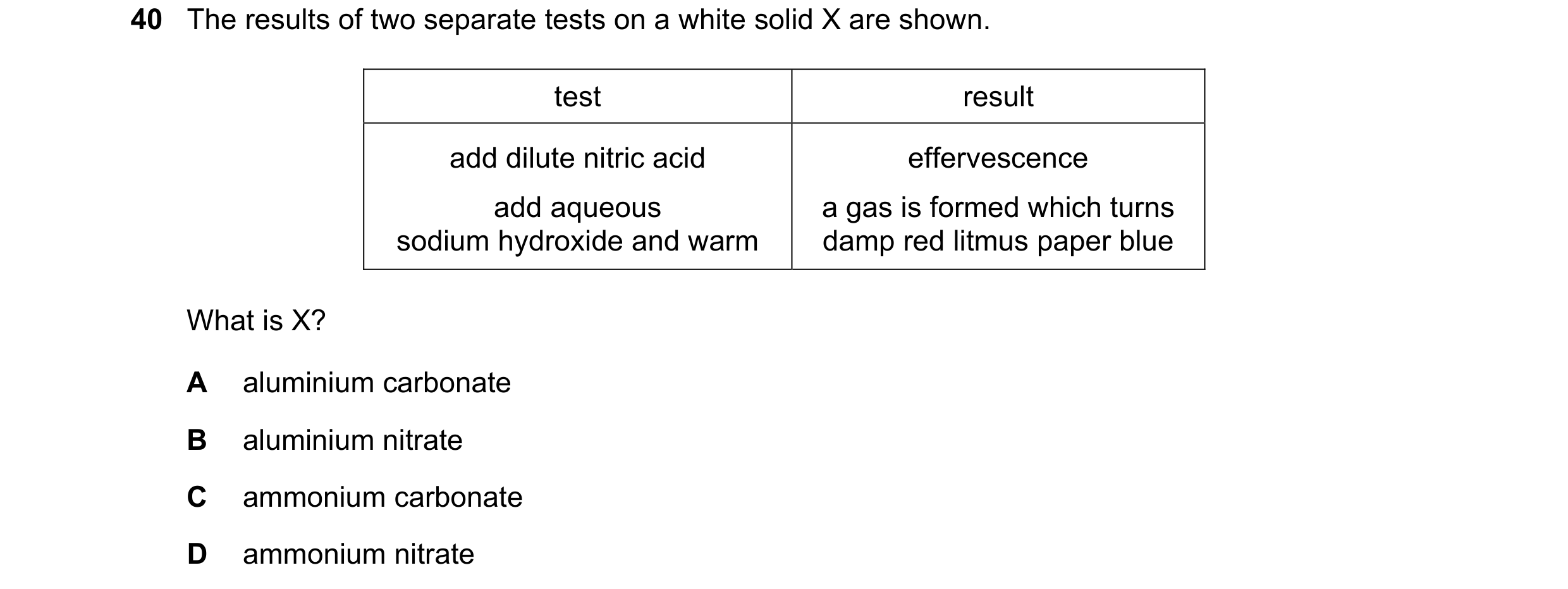
 8 / 12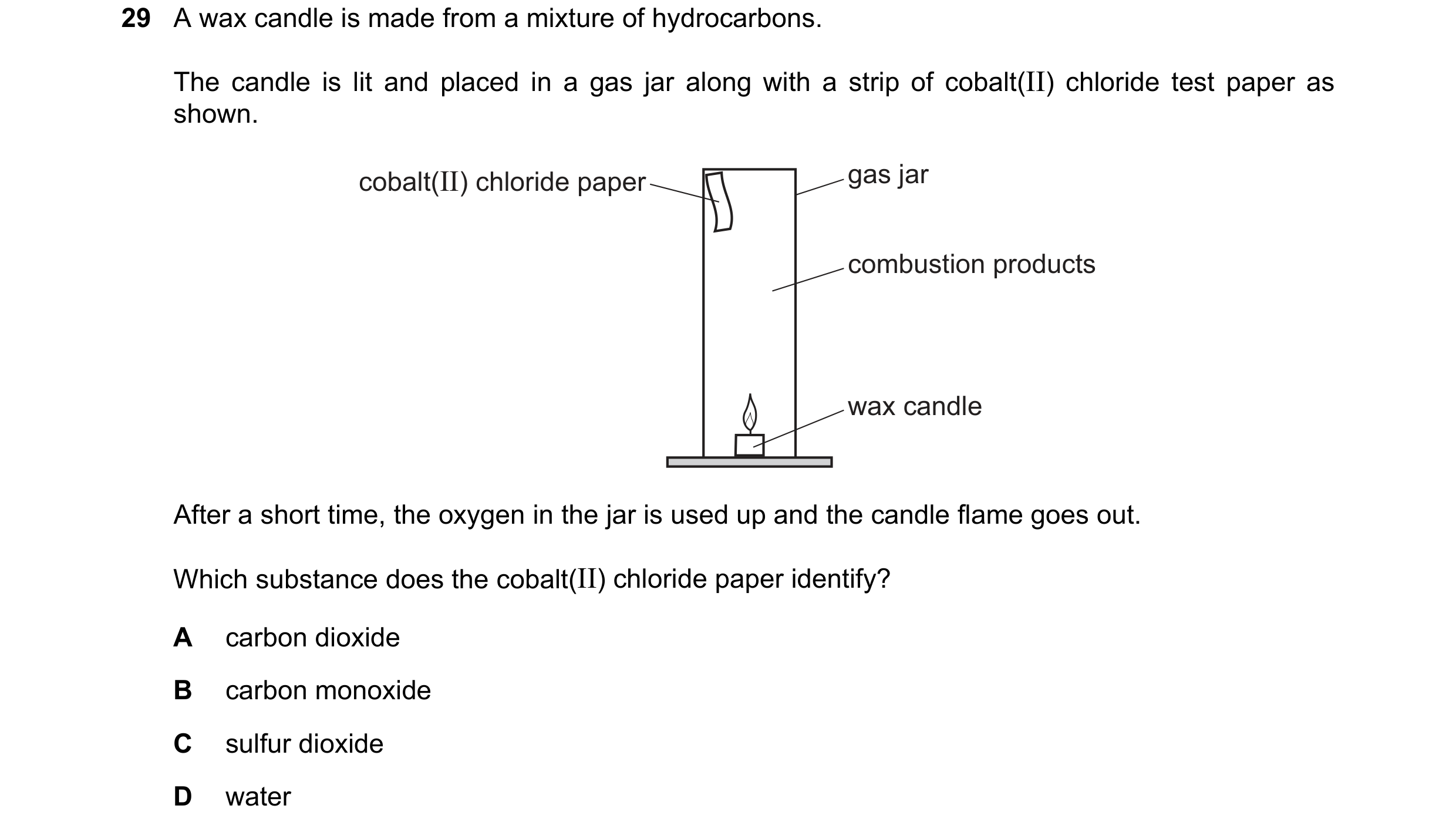

 9 / 12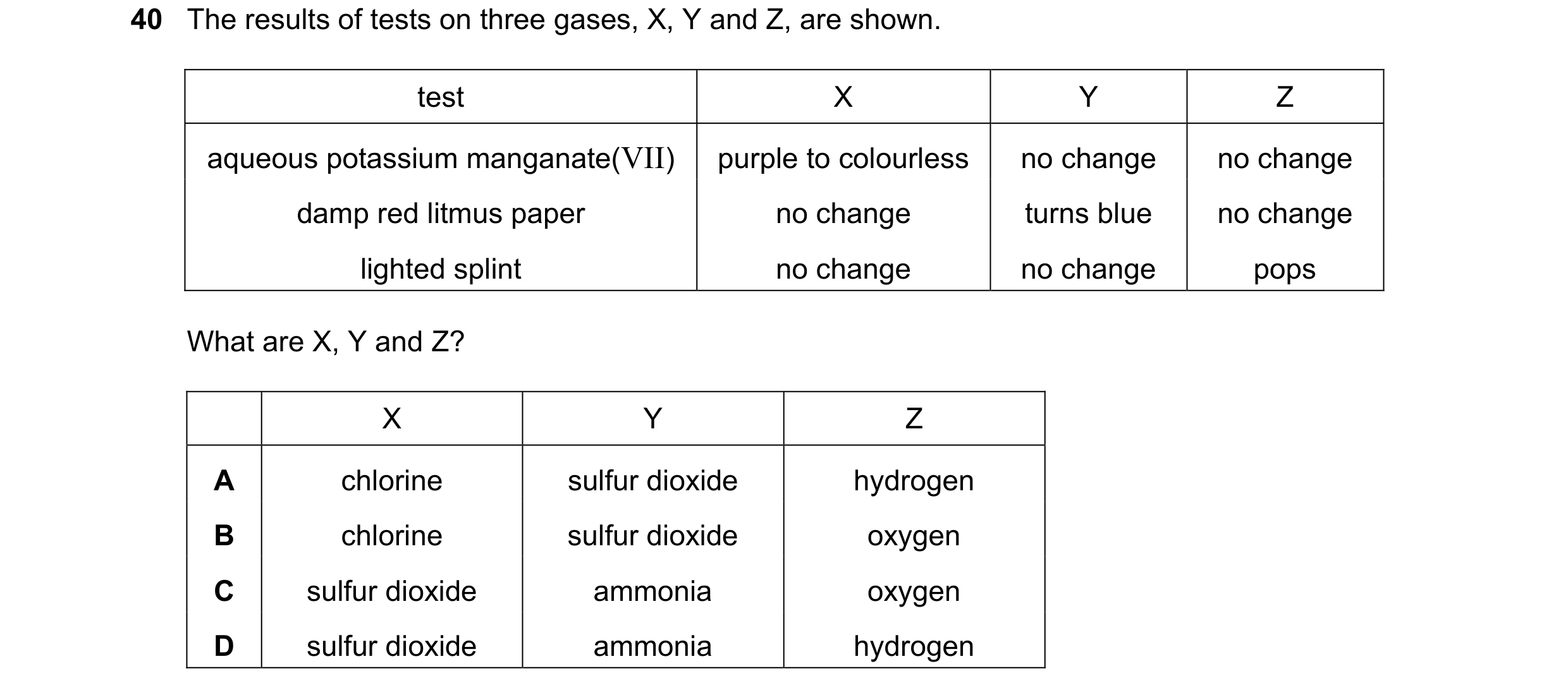
 10 / 12
 11 / 12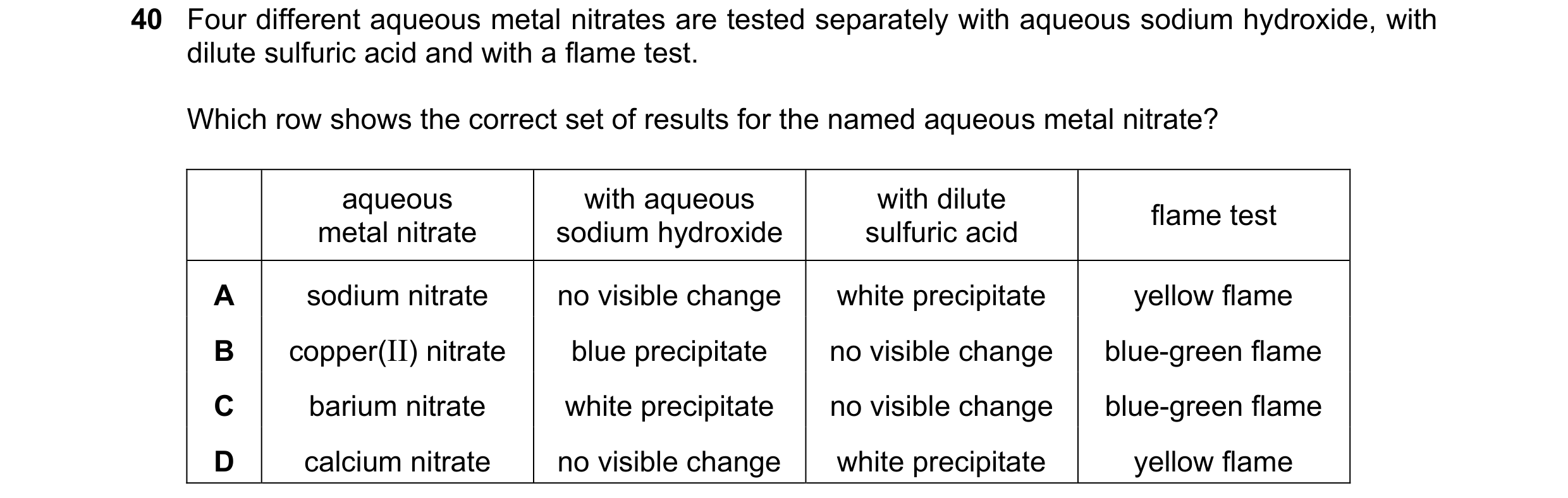
 12 / 12