Questions as text
Q1 · Dilute sulfuric acid is electrolysed using inert electrodes 0971/21 May/June 2018
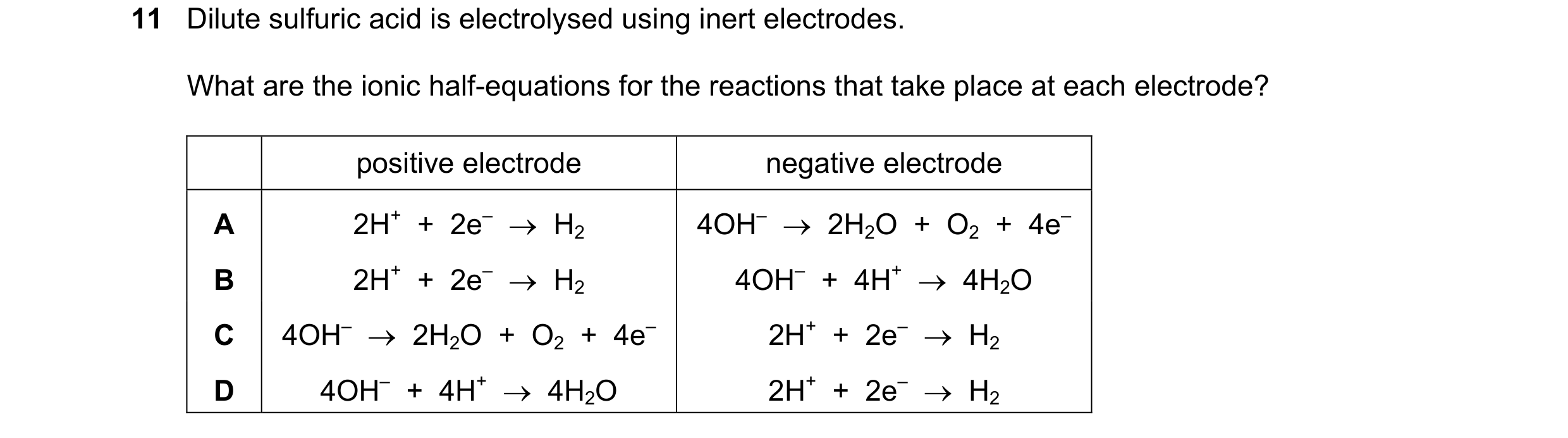
11 Dilute sulfuric acid is electrolysed using inert electrodes. What are the ionic half-equations for the reactions that take place at each electrode? positive electrode negative electrode A 2H+ + 2e– → H2 4OH– → 2H2O + O2 + 4e– B 2H+ + 2e– → H2 4OH– + 4H+ → 4H2O C 4OH– → 2H2O + O2 + 4e– 2H+ + 2e– → H2 D 4OH– + 4H+ → 4H2O 2H+ + 2e– → H2
1 marks
Answer: C
This question in 0971/21 May/June 2018
Q2 · When dilute sulfuric acid is added to solid X, a colourless solution is formed and a gas… 0971/22 Oct/Nov 2018
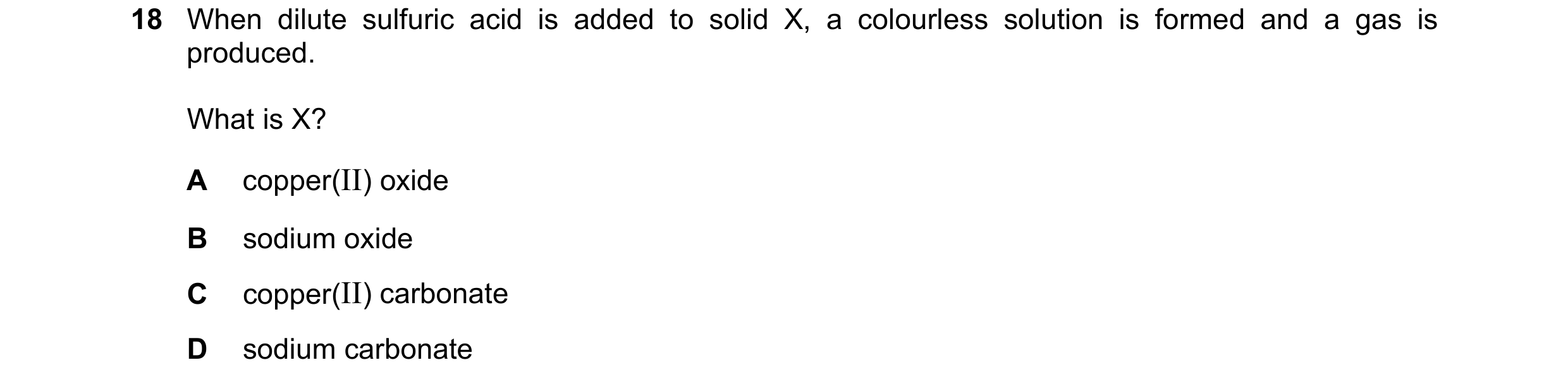
18 When dilute sulfuric acid is added to solid X, a colourless solution is formed and a gas is produced. What is X? A copper(II) oxide B sodium oxide C copper(II) carbonate D sodium carbonate
1 marks
Answer: D
This question in 0971/22 Oct/Nov 2018
Q3 · A few drops of methyl orange are added to a reaction mixture 0971/22 Oct/Nov 2018
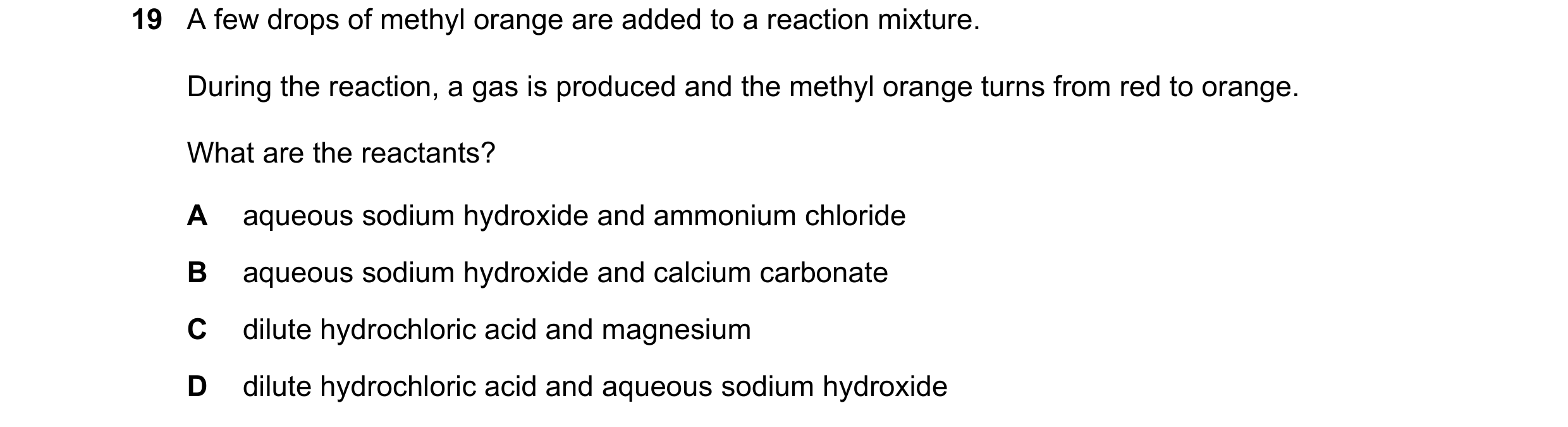
19 A few drops of methyl orange are added to a reaction mixture. During the reaction, a gas is produced and the methyl orange turns from red to orange. What are the reactants? A aqueous sodium hydroxide and ammonium chloride B aqueous sodium hydroxide and calcium carbonate C dilute hydrochloric acid and magnesium D dilute hydrochloric acid and aqueous sodium hydroxide
1 marks
Answer: C
This question in 0971/22 Oct/Nov 2018
Q4 · Which statement about the electrolysis of copper(II) sulfate solution using carbon… 0971/21 May/June 2019
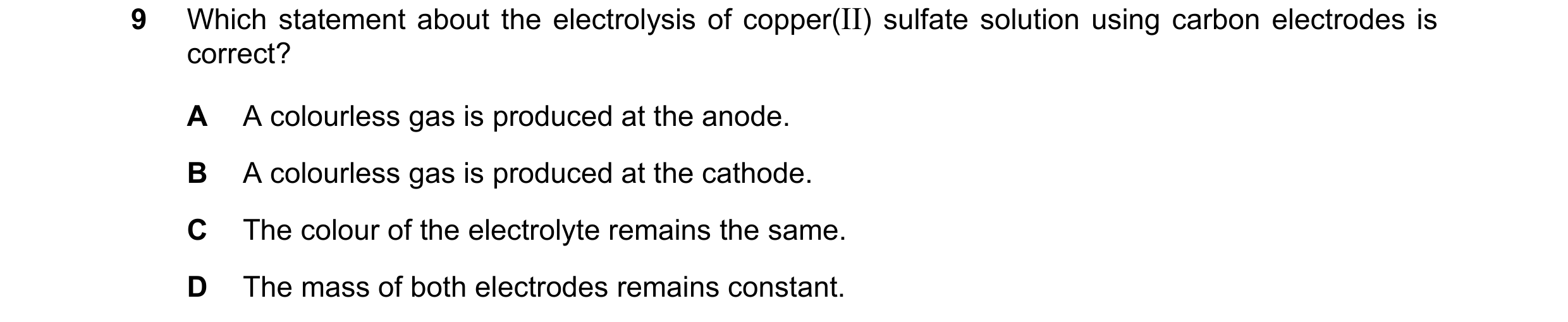
9 Which statement about the electrolysis of copper(II) sulfate solution using carbon electrodes is correct? A A colourless gas is produced at the anode. B A colourless gas is produced at the cathode. C The colour of the electrolyte remains the same. D The mass of both electrodes remains constant.
1 marks
Answer: A
This question in 0971/21 May/June 2019
Q5 · Three metal compounds, P, Q and R, are heated using a Bunsen burner 0971/21 May/June 2019
24 Three metal compounds, P, Q and R, are heated using a Bunsen burner. The results are shown. P colourless gas produced, which relights a glowing splint Q colourless gas produced, which turns limewater milky R no reaction Which row shows the identity of P, Q and R? P Q R A magnesium carbonate potassium carbonate potassium nitrate B magnesium carbonate potassium nitrate potassium carbonate C potassium nitrate magnesium carbonate potassium carbonate D potassium nitrate potassium carbonate magnesium carbonate
1 marks
Answer: C
This question in 0971/21 May/June 2019
Q6 · A solution of iron(III) sulfate reacts with aqueous sodium hydroxide to form a red–brown… 0971/21 May/June 2020
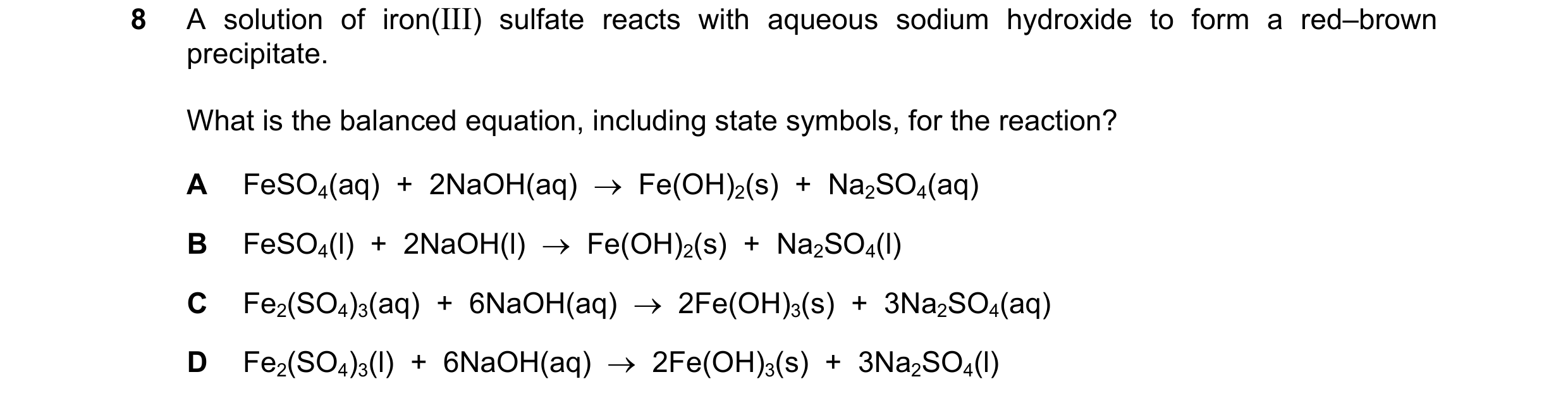
8 A solution of iron(III) sulfate reacts with aqueous sodium hydroxide to form a red–brown precipitate. What is the balanced equation, including state symbols, for the reaction? A FeSO4(aq) + 2NaOH(aq) → Fe(OH)2(s) + Na2SO4(aq) B FeSO4(l) + 2NaOH(l) → Fe(OH)2(s) + Na2SO4(l) C Fe2(SO4)3(aq) + 6NaOH(aq) → 2Fe(OH)3(s) + 3Na2SO4(aq) D Fe2(SO4)3(l) + 6NaOH(aq) → 2Fe(OH)3(s) + 3Na2SO4(l)
1 marks
Answer: C
This question in 0971/21 May/June 2020
Q7 · Which statement shows that a liquid is pure water? 0971/21 May/June 2020
29 Which statement shows that a liquid is pure water? A It boils at 100 °C. B It has a pH value of 7. C It turns blue cobalt(II) chloride pink. D It turns white copper(II) sulfate blue.
1 marks
Answer: A
This question in 0971/21 May/June 2020
Q8 · Electrolytes can be broken down by electrolysis 0971/22 May/June 2020
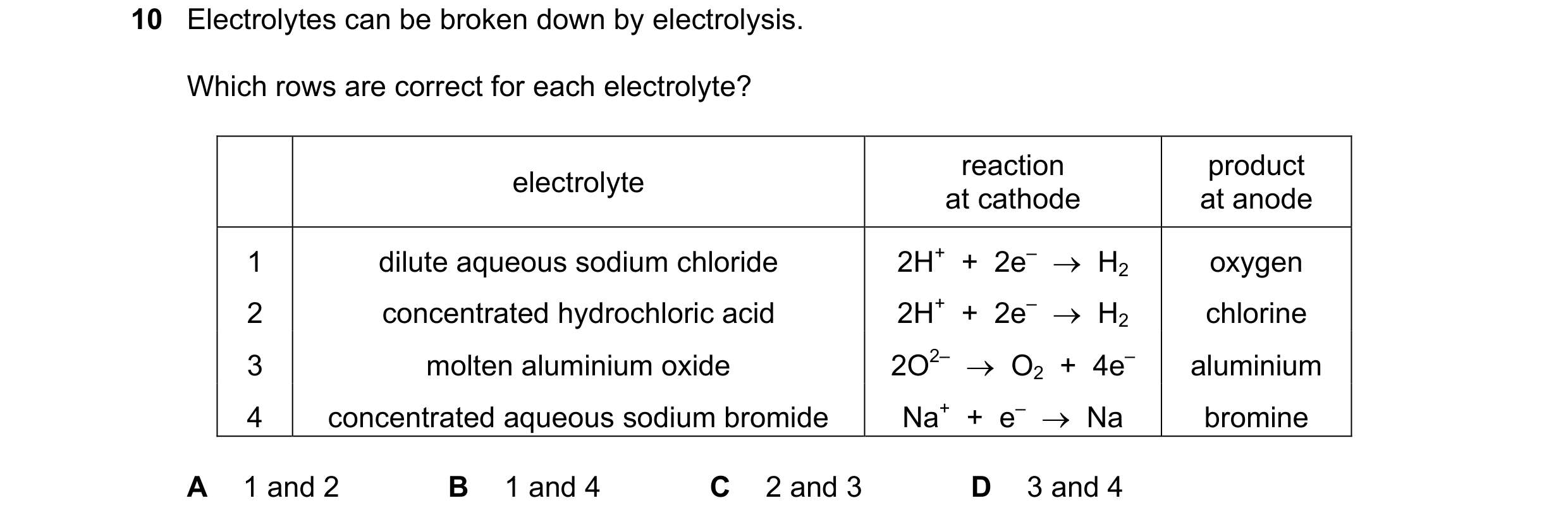
10 Electrolytes can be broken down by electrolysis. Which rows are correct for each electrolyte? reaction product electrolyte at cathode at anode 1 dilute aqueous sodium chloride 2H+ + 2e– → H2 oxygen 2 concentrated hydrochloric acid 2H+ + 2e– → H2 chlorine 3 molten aluminium oxide 2O2– → O2 + 4e– aluminium 4 concentrated aqueous sodium bromide Na+ + e– → Na bromine A 1 and 2 B 1 and 4 C 2 and 3 D 3 and 4
1 marks
Answer: A
This question in 0971/22 May/June 2020
Q9 · Which statement about pure water is not correct? 0971/22 May/June 2020
29 Which statement about pure water is not correct? A It condenses at 100 °C. B It freezes at 0 °C. C It turns cobalt(II) chloride paper blue. D It turns anhydrous copper(II) sulfate blue.
1 marks
Answer: C
This question in 0971/22 May/June 2020
Q10 · The results of tests on solid S and its aqueous solution are shown 0971/22 Oct/Nov 2020
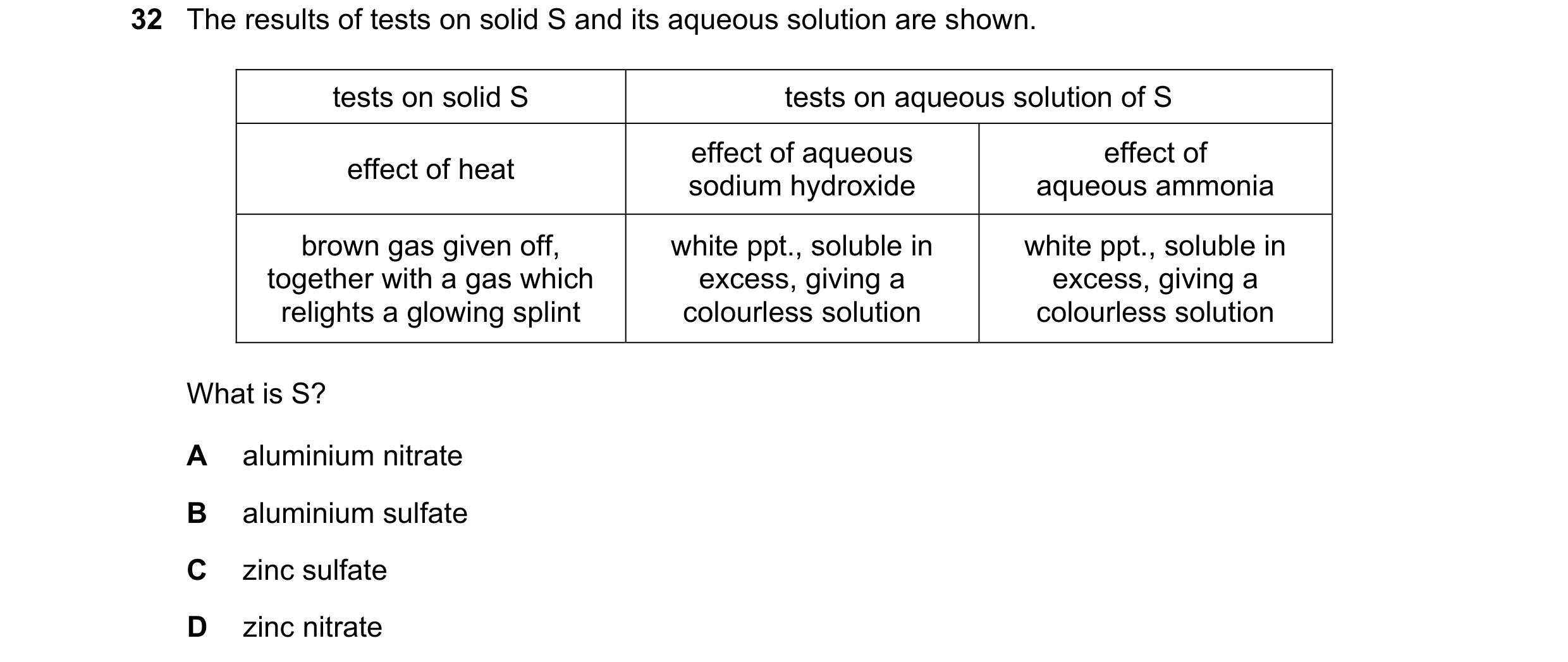
32 The results of tests on solid S and its aqueous solution are shown. tests on solid S tests on aqueous solution of S effect of aqueous effect of effect of heat sodium hydroxide aqueous ammonia brown gas given off, white ppt., soluble in white ppt., soluble in together with a gas which excess, giving a excess, giving a relights a glowing splint colourless solution colourless solution What is S? A aluminium nitrate B aluminium sulfate C zinc sulfate D zinc nitrate
1 marks
Answer: D
This question in 0971/22 Oct/Nov 2020
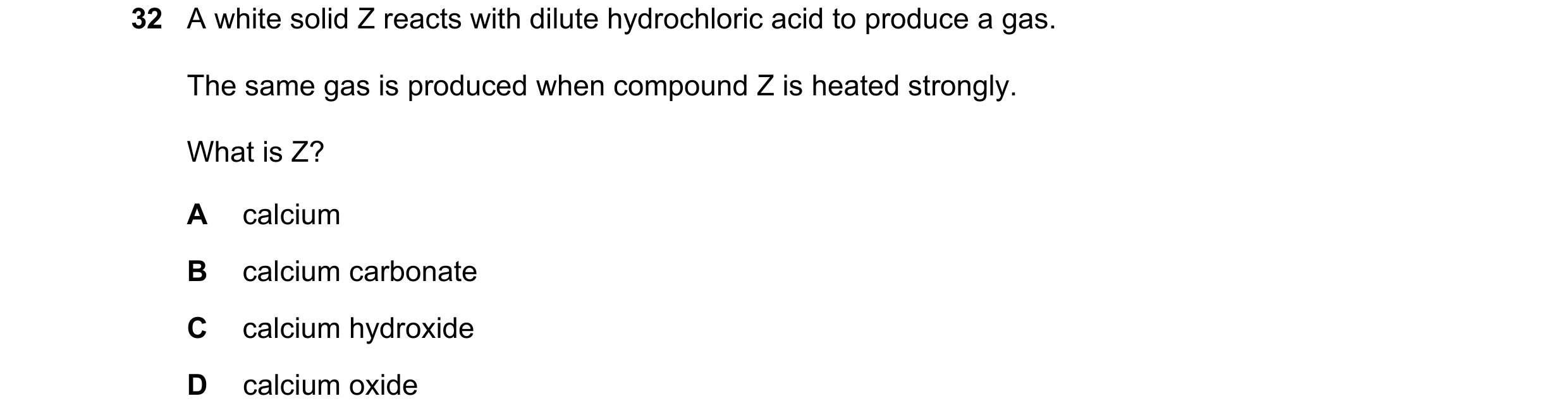
Q11 · A white solid Z reacts with dilute hydrochloric acid to produce a gas 0971/21 May/June 2021
32 A white solid Z reacts with dilute hydrochloric acid to produce a gas. The same gas is produced when compound Z is heated strongly. What is Z? A calcium B calcium carbonate C calcium hydroxide D calcium oxide
1 marks
Answer: B
This question in 0971/21 May/June 2021
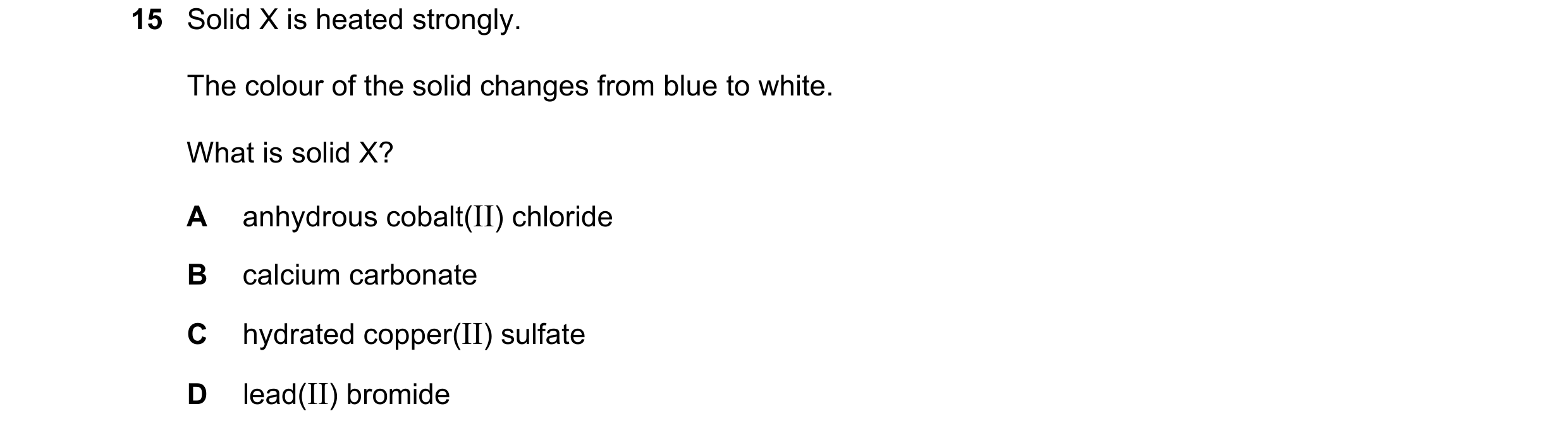
Q12 · Solid X is heated strongly 0971/22 Oct/Nov 2021
15 Solid X is heated strongly. The colour of the solid changes from blue to white. What is solid X? A anhydrous cobalt(II) chloride B calcium carbonate C hydrated copper(II) sulfate D lead(II) bromide
1 marks
Answer: C
This question in 0971/22 Oct/Nov 2021
Q13 · Acidified aqueous silver nitrate is added to a test-tube containing aqueous chloride ions 0971/21 May/June 2022
14 Acidified aqueous silver nitrate is added to a test-tube containing aqueous chloride ions. The test-tube is then left in direct sunlight. Which row describes the observations and explains what happens to the reaction mixture? observation on adding observation after explanation aqueous silver nitrate leaving in sunlight A yellow precipitate precipitate dissolves silver chloride forms B yellow precipitate precipitate turns grey silver ions are reduced C white precipitate precipitate dissolves silver chloride forms D white precipitate precipitate turns grey silver ions are reduced
1 marks
Answer: D
This question in 0971/21 May/June 2022
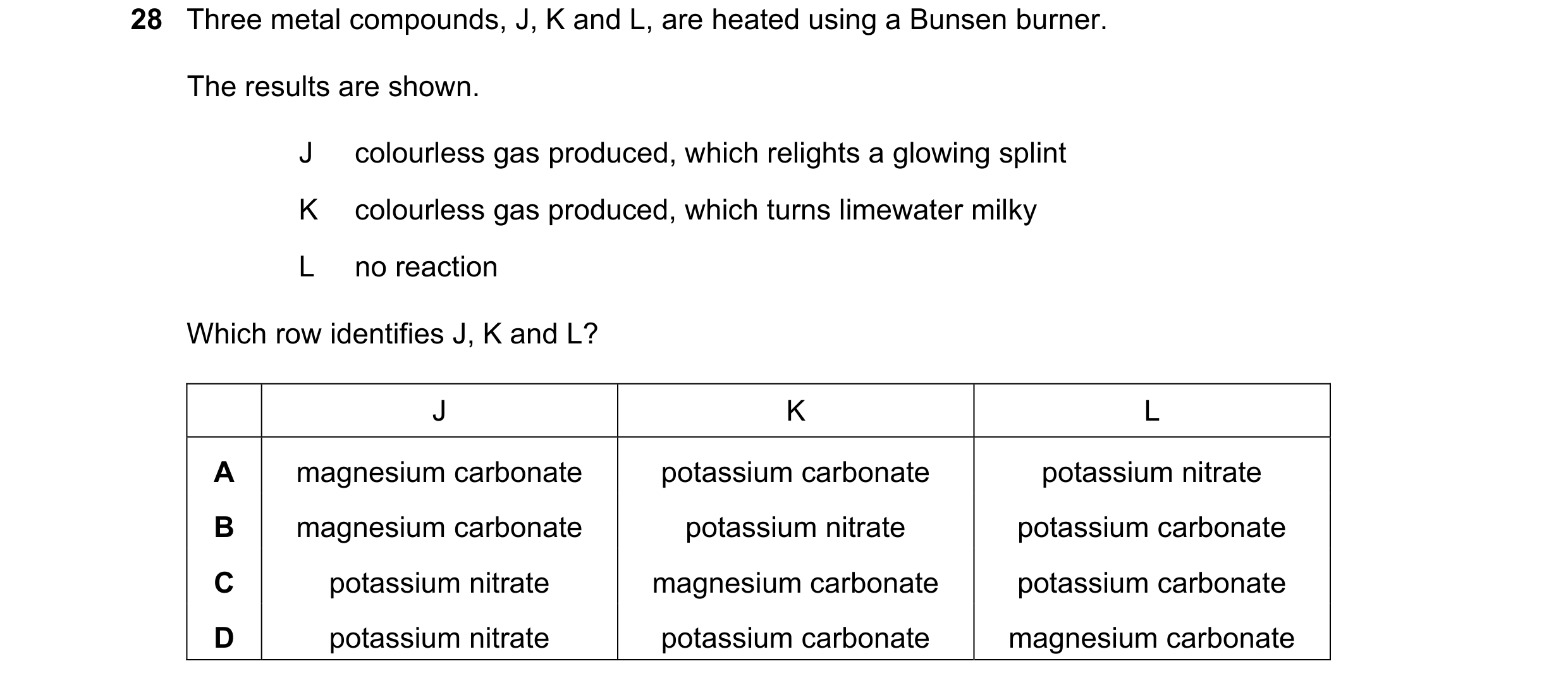
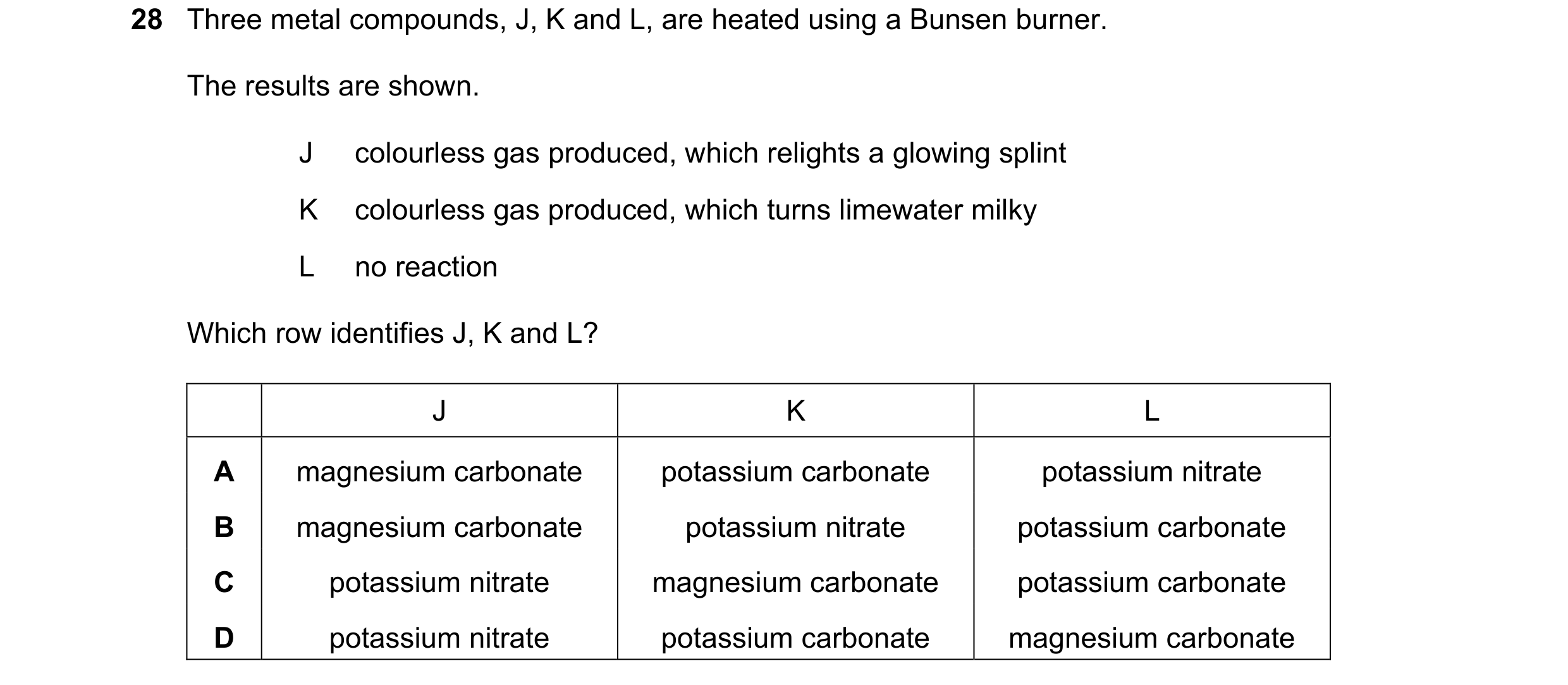
Q14 · Three metal compounds, J, K and L, are heated using a Bunsen burner 0971/21 May/June 2022
28 Three metal compounds, J, K and L, are heated using a Bunsen burner. The results are shown. J colourless gas produced, which relights a glowing splint K colourless gas produced, which turns limewater milky L no reaction Which row identifies J, K and L? J K L A magnesium carbonate potassium carbonate potassium nitrate B magnesium carbonate potassium nitrate potassium carbonate C potassium nitrate magnesium carbonate potassium carbonate D potassium nitrate potassium carbonate magnesium carbonate
1 marks
Answer: C
This question in 0971/21 May/June 2022
Q15 · The diagram shows the electrolysis of concentrated hydrochloric acid and concentrated… 0971/22 May/June 2022
10 The diagram shows the electrolysis of concentrated hydrochloric acid and concentrated aqueous sodium chloride using carbon electrodes. + – + – electrode 1 electrode 2 electrode 3 electrode 4 concentrated concentrated aqueous hydrochloric acid sodium chloride At which electrodes is hydrogen produced? A electrode 1 only B electrodes 1 and 3 C electrode 2 only D electrodes 2 and 4
1 marks
Answer: D
This question in 0971/22 May/June 2022
Q16 · Three metal compounds, J, K and L, are heated using a Bunsen burner 0971/22 May/June 2022
28 Three metal compounds, J, K and L, are heated using a Bunsen burner. The results are shown. J colourless gas produced, which relights a glowing splint K colourless gas produced, which turns limewater milky L no reaction Which row identifies J, K and L? J K L A magnesium carbonate potassium carbonate potassium nitrate B magnesium carbonate potassium nitrate potassium carbonate C potassium nitrate magnesium carbonate potassium carbonate D potassium nitrate potassium carbonate magnesium carbonate
1 marks
Answer: C
This question in 0971/22 May/June 2022
Q17 · A wax candle is made from a mixture of hydrocarbons 0971/22 May/June 2023
29 A wax candle is made from a mixture of hydrocarbons. The candle is lit and placed in a gas jar along with a strip of cobalt(II) chloride test paper as shown. cobalt(II) chloride paper gas jar combustion products wax candle After a short time, the oxygen in the jar is used up and the candle flame goes out. Which substance does the cobalt(II) chloride paper identify? A carbon dioxide B carbon monoxide C sulfur dioxide D water
1 marks
Answer: D
This question in 0971/22 May/June 2023
Q18 · Which compound rapidly decolourises aqueous bromine? 0971/22 May/June 2023
31 Which compound rapidly decolourises aqueous bromine? A propane B propanoic acid C propanol D propene
1 marks
Answer: D
This question in 0971/22 May/June 2023
Q19 · When acid is added to salt X, a gas is produced which turns limewater milky 0971/22 May/June 2023
40 When acid is added to salt X, a gas is produced which turns limewater milky. When sodium hydroxide is added to salt X, a gas is produced which turns litmus paper blue. What is X? A CaCO3 B (NH4)2CO3 C NH4NO3 D ZnCO3
1 marks
Answer: B
This question in 0971/22 May/June 2023
Q20 · Which gas is produced when ammonium chloride is warmed with aqueous sodium hydroxide? 0971/21 May/June 2024
24 Which gas is produced when ammonium chloride is warmed with aqueous sodium hydroxide? A ammonia B chlorine C hydrogen D nitrogen
1 marks
Answer: A
This question in 0971/21 May/June 2024
Q21 · Information about four substances, W, X, Y and Z, is shown 0971/22 May/June 2024
6 Information about four substances, W, X, Y and Z, is shown. melting point/°C electrical conductivity W 1710 does not conduct when solid X 3500 conducts when solid Y 120 does not conduct Z 801 conducts when molten W, X, Y and Z are graphite, poly(ethene), sodium chloride and silicon(IV) oxide but not in that order. What are W, X, Y and Z? W X Y Z A graphite poly(ethene) silicon(IV) oxide sodium chloride B sodium chloride graphite poly(ethene) silicon(IV) oxide C poly(ethene) sodium chloride graphite silicon(IV) oxide D silicon(IV) oxide graphite poly(ethene) sodium chloride
1 marks
Answer: D
This question in 0971/22 May/June 2024
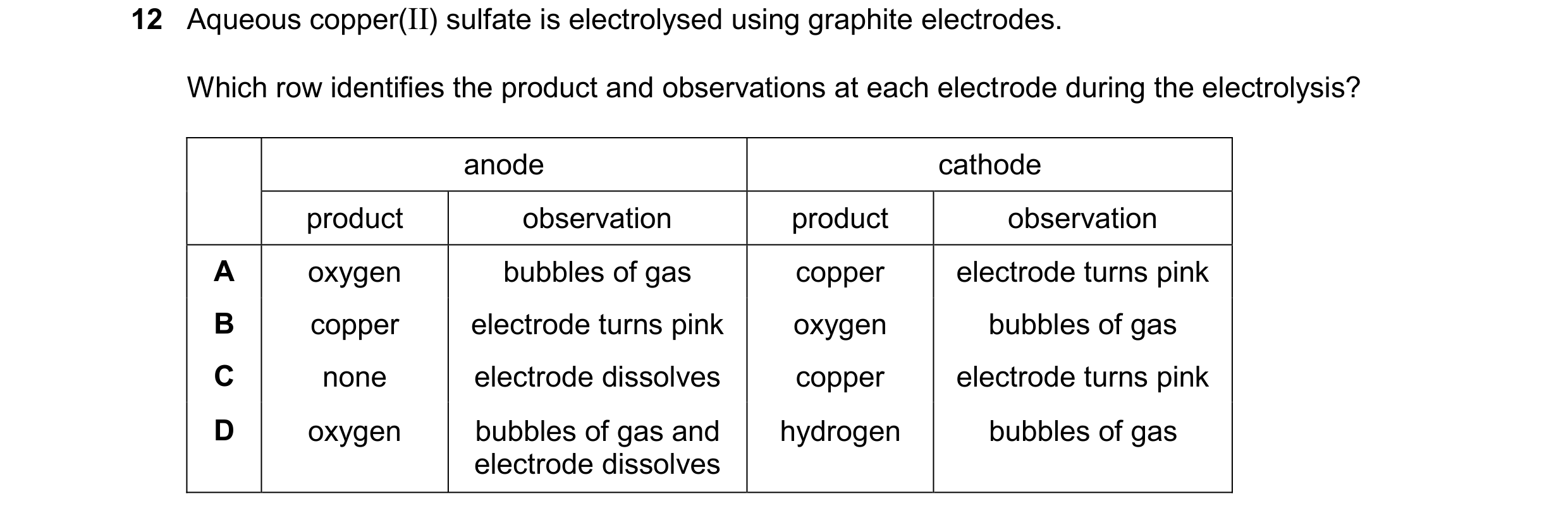
Q22 · Aqueous copper(II) sulfate is electrolysed using graphite electrodes 0971/22 Oct/Nov 2024
12 Aqueous copper(II) sulfate is electrolysed using graphite electrodes. Which row identifies the product and observations at each electrode during the electrolysis? anode cathode product observation product observation A oxygen bubbles of gas copper electrode turns pink B copper electrode turns pink oxygen bubbles of gas C none electrode dissolves copper electrode turns pink D oxygen bubbles of gas and hydrogen bubbles of gas electrode dissolves
1 marks
Answer: A
This question in 0971/22 Oct/Nov 2024
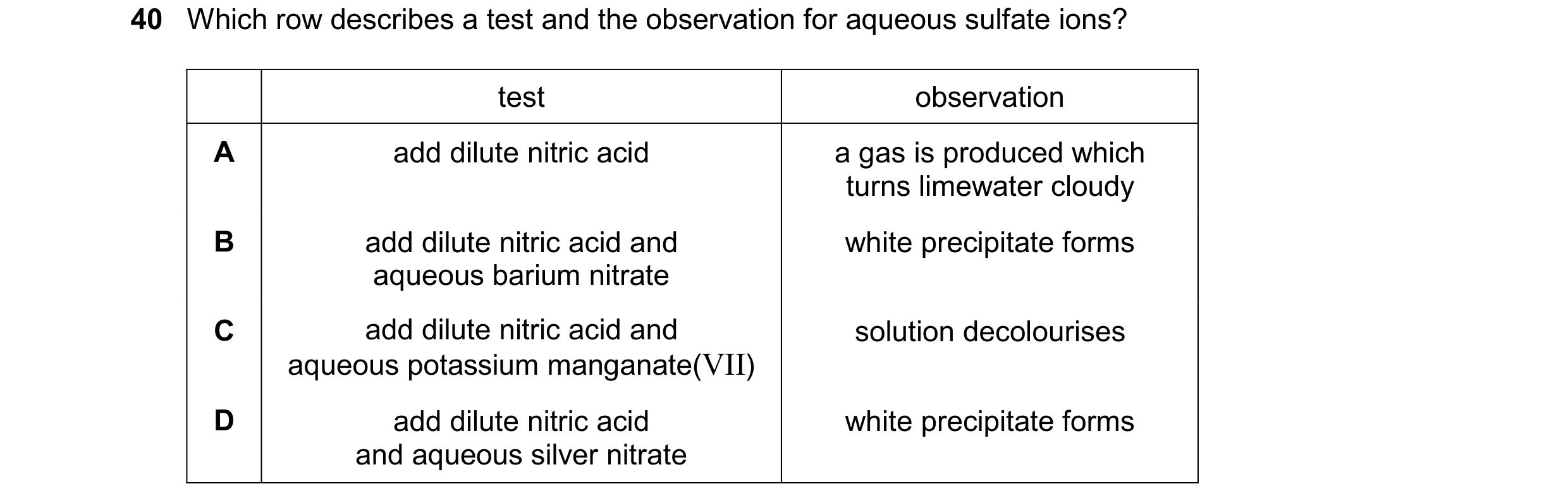
Q23 · Which row describes a test and the observation for aqueous sulfate ions? 0971/22 Oct/Nov 2024
40 Which row describes a test and the observation for aqueous sulfate ions? test observation A add dilute nitric acid a gas is produced which turns limewater cloudy B add dilute nitric acid and white precipitate forms aqueous barium nitrate C add dilute nitric acid and solution decolourises aqueous potassium manganate(VII) D add dilute nitric acid white precipitate forms and aqueous silver nitrate
1 marks
Answer: B
This question in 0971/22 Oct/Nov 2024
Q24 · Water is added separately to anhydrous copper(II) sulfate and to anhydrous cobalt(II)… 0971/22 May/June 2025
29 Water is added separately to anhydrous copper(II) sulfate and to anhydrous cobalt(II) chloride. Which row shows the colour changes? anhydrous anhydrous copper(II) sulfate cobalt(II) chloride A blue to white blue to pink B blue to white pink to blue C white to blue blue to pink D white to blue pink to blue
1 marks
Answer: C
This question in 0971/22 May/June 2025
 1 / 8
1 / 8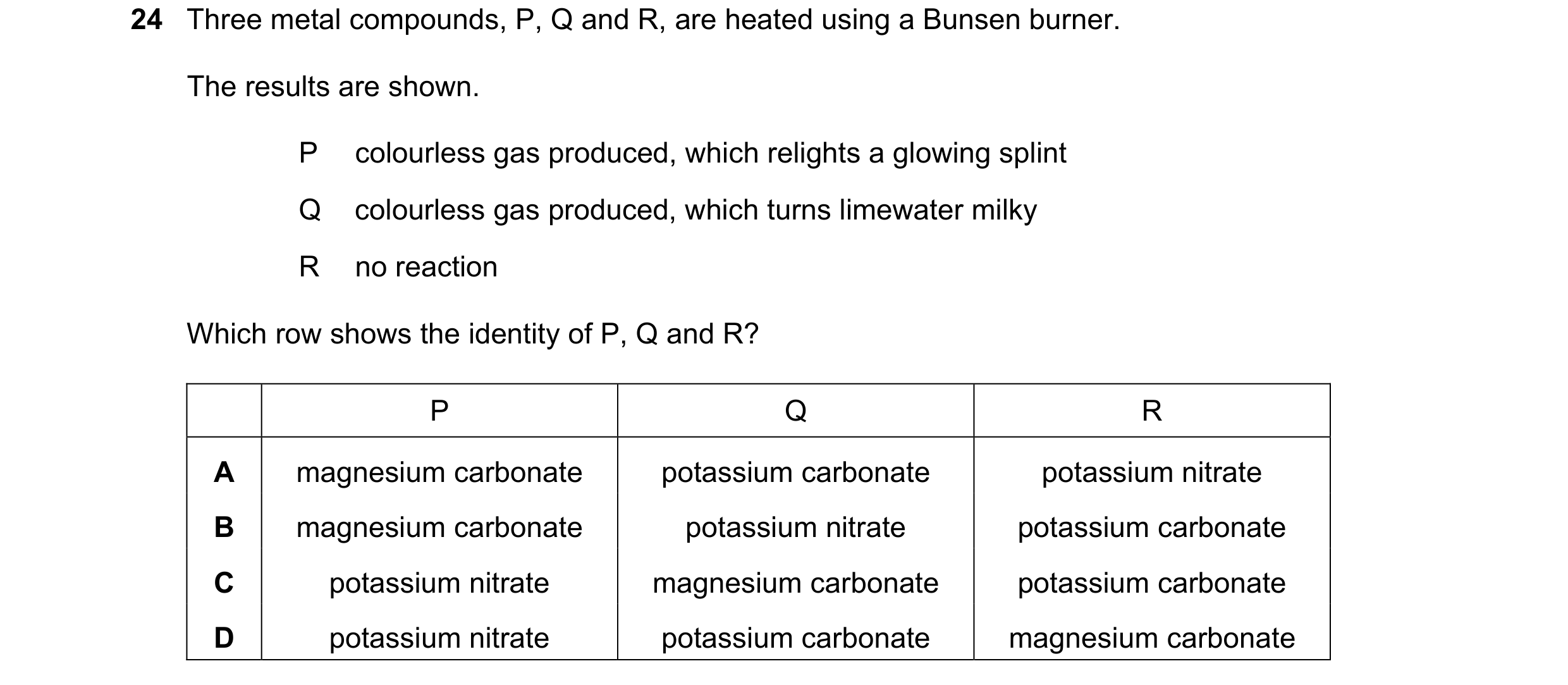

 2 / 8
2 / 8
 3 / 8
3 / 8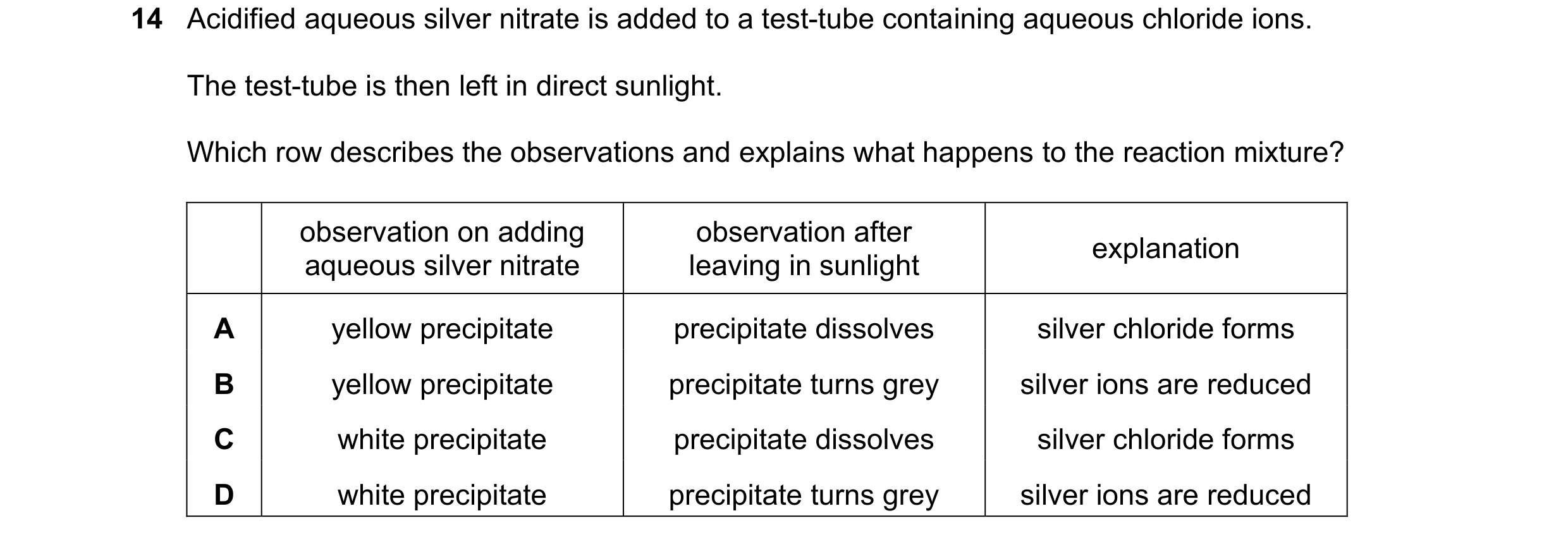
 4 / 8
4 / 8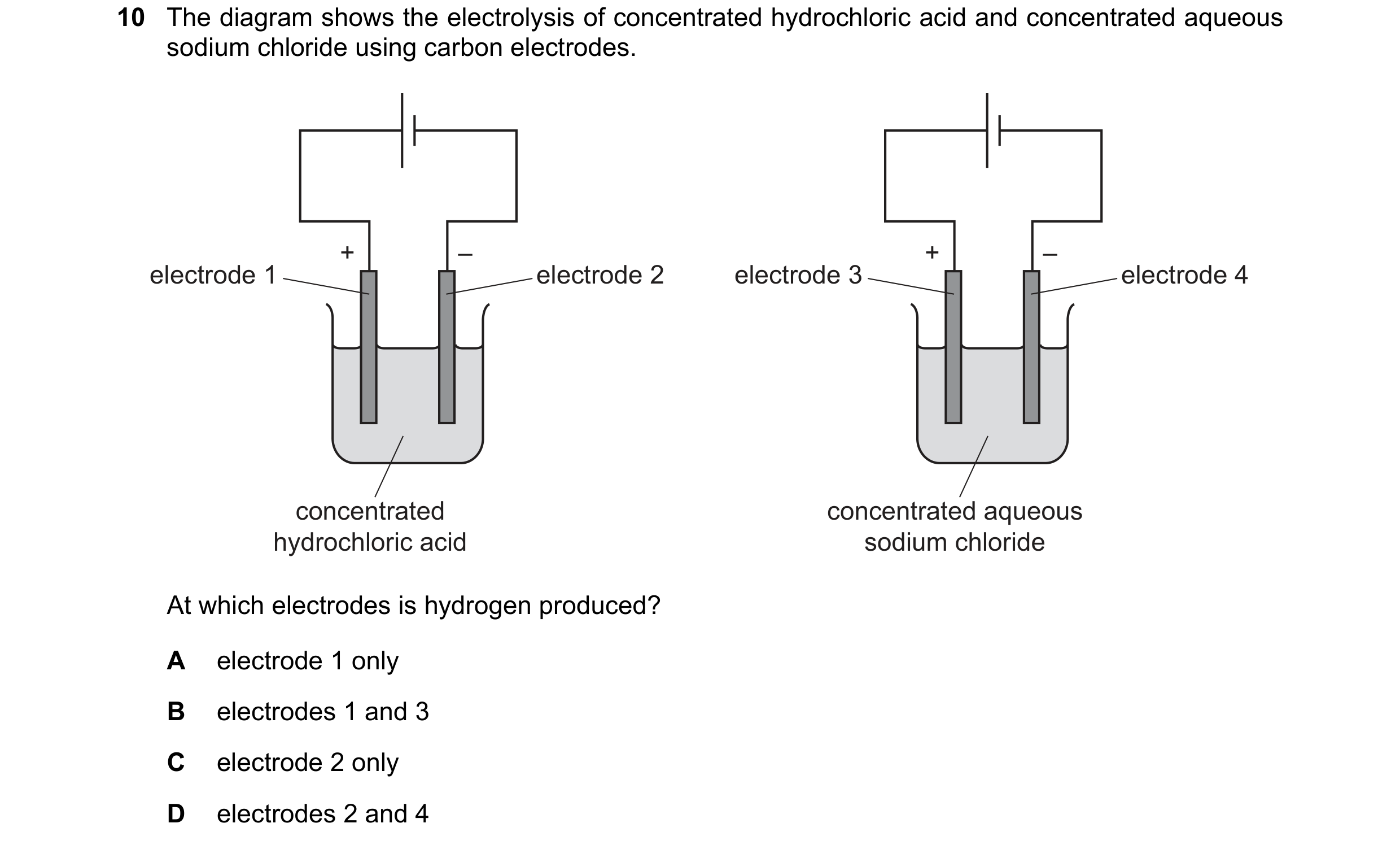
 5 / 8
5 / 8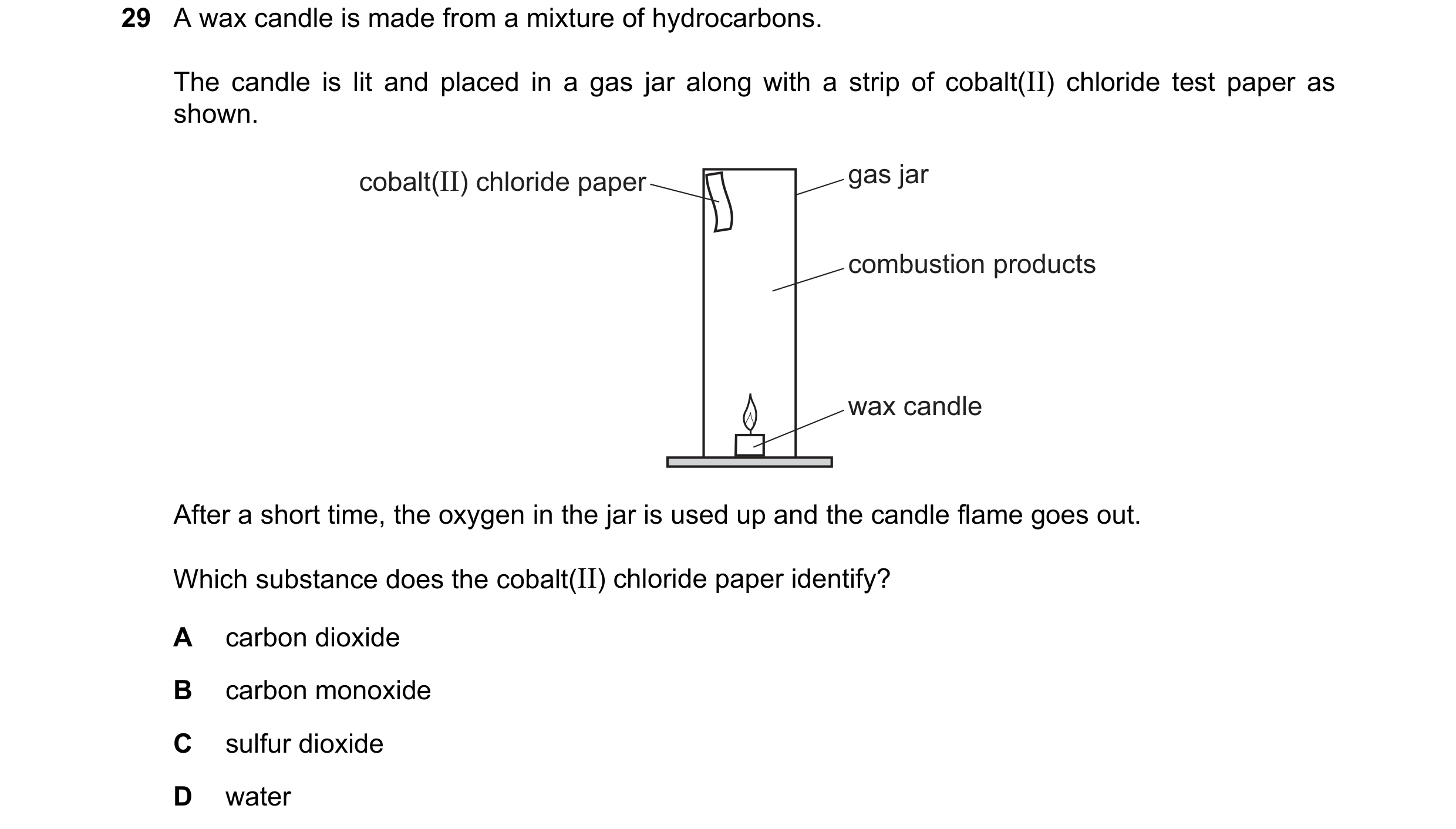


 6 / 8
6 / 8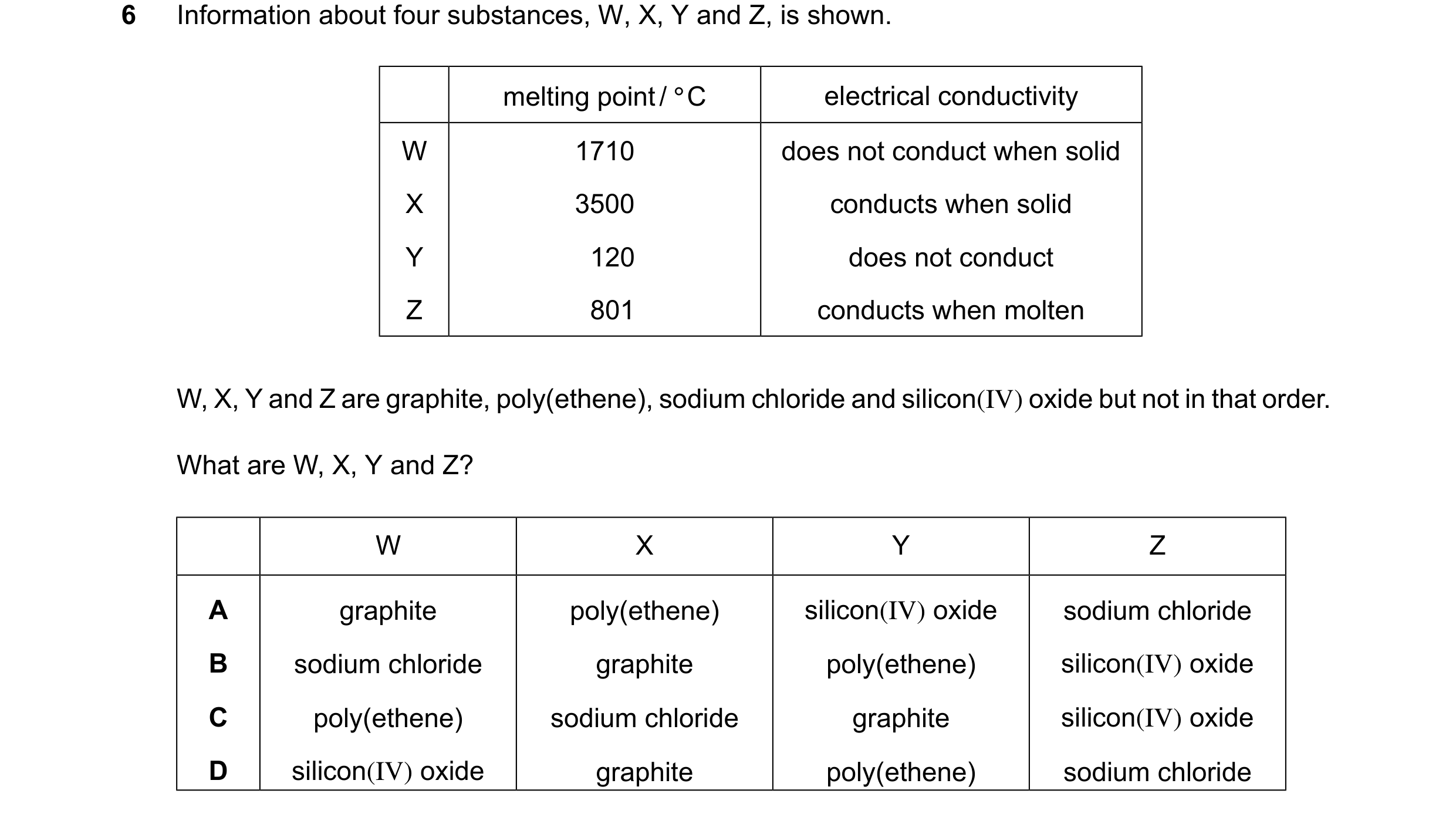
 7 / 8
7 / 8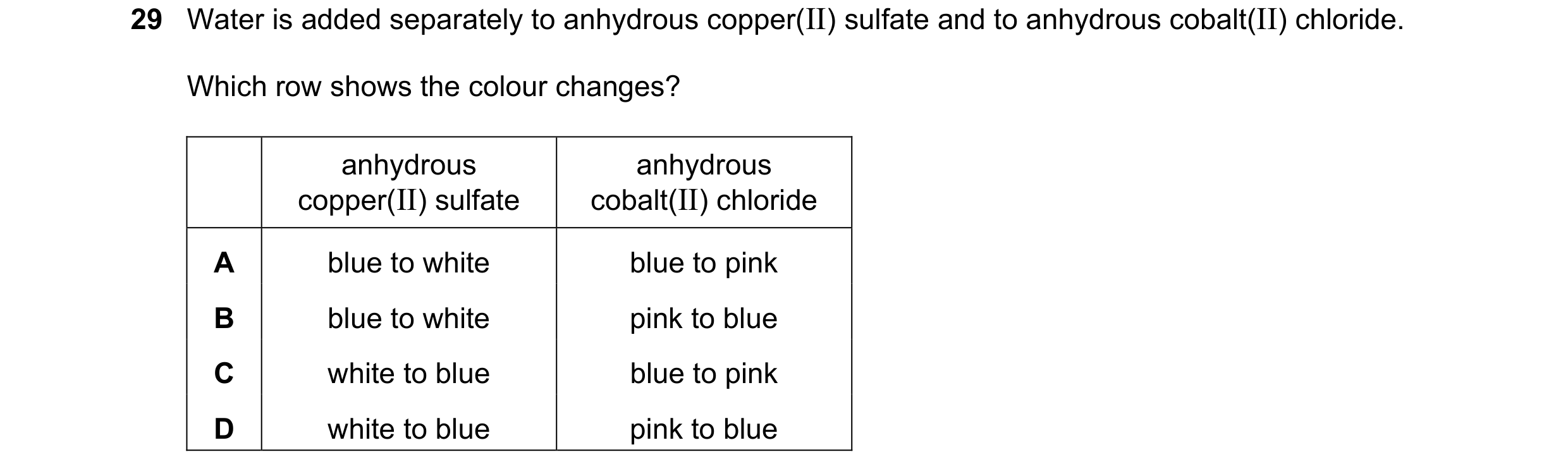 8 / 8
8 / 8