Questions as text
Q1 · Why should a trader provide for the depreciation of a non-current asset? 0452/12 Feb/March 2020
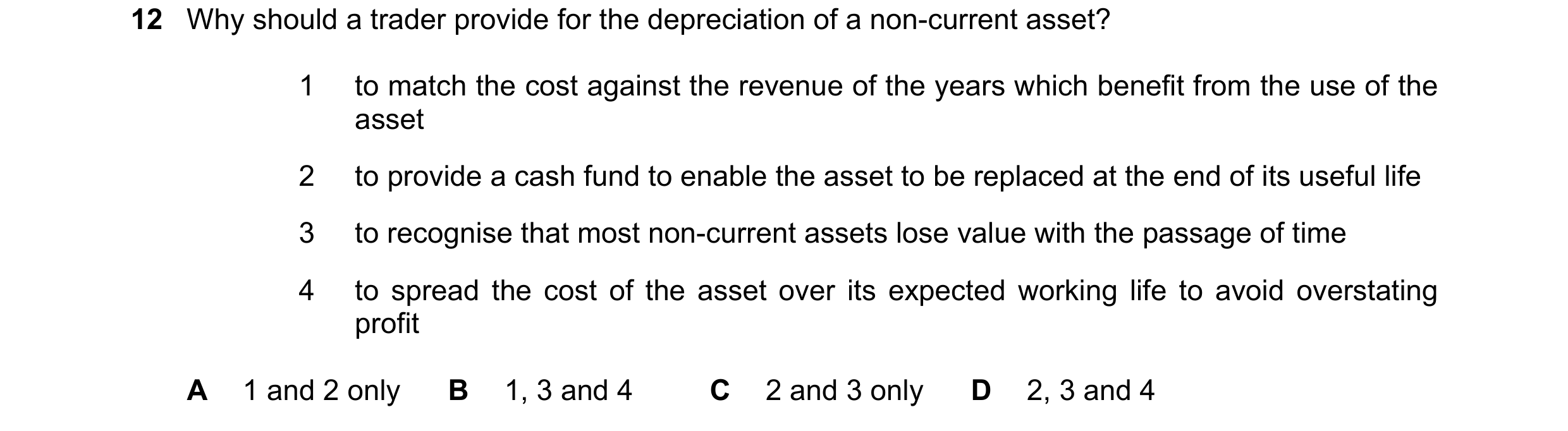
12 Why should a trader provide for the depreciation of a non-current asset? 1 to match the cost against the revenue of the years which benefit from the use of the asset 2 to provide a cash fund to enable the asset to be replaced at the end of its useful life 3 to recognise that most non-current assets lose value with the passage of time 4 to spread the cost of the asset over its expected working life to avoid overstating profit A 1 and 2 only B 1, 3 and 4 C 2 and 3 only D 2, 3 and 4
1 marks
Answer: B
This question in 0452/12 Feb/March 2020
Q2 · Which is an application of the materiality principle? 0452/12 Feb/March 2020
33 Which is an application of the materiality principle? A always using the straight-line method when depreciating assets B buying raw materials on credit rather than paying immediately C charging the cost of light bulbs and batteries to operating expenses D recording goods sold only when its legal title passes to the buyer
1 marks
Answer: C
This question in 0452/12 Feb/March 2020
Q3 · Which accounting principle states that revenue should not be recorded before it is earned? 0452/12 Feb/March 2020
34 Which accounting principle states that revenue should not be recorded before it is earned? A consistency B matching C money measurement D realisation
1 marks
Answer: D
This question in 0452/12 Feb/March 2020
Q4 · Which accounting objective requires that financial statements are free from bias and… 0452/12 Feb/March 2020
35 Which accounting objective requires that financial statements are free from bias and errors? A comparability B relevance C reliability D understandability
1 marks
Answer: C
This question in 0452/12 Feb/March 2020
Q5 · Rashid’s financial year ends on 31 December 0452/11 May/June 2020
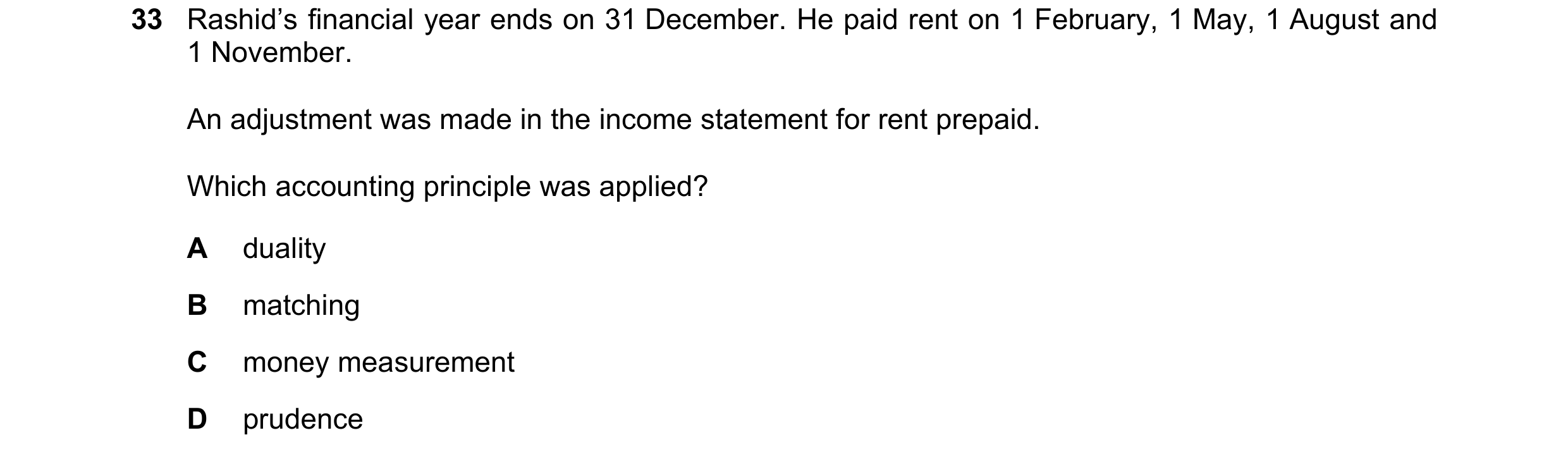
33 Rashid’s financial year ends on 31 December. He paid rent on 1 February, 1 May, 1 August and 1 November. An adjustment was made in the income statement for rent prepaid. Which accounting principle was applied? A duality B matching C money measurement D prudence
1 marks
Answer: B
This question in 0452/11 May/June 2020
Q6 · Which statement describes the going concern principle? 0452/11 May/June 2020
34 Which statement describes the going concern principle? A Accounting methods must be used consistently from one accounting period to the next. B It is assumed that the business will continue to operate for the foreseeable future. C Revenue is earned when legal title to goods passes from the seller to the buyer. D The business is treated as being completely separate from the owner of the business.
1 marks
Answer: B
This question in 0452/11 May/June 2020
Q7 · Brad purchased a machine for $1000 on 1 January 2019 0452/11 May/June 2020
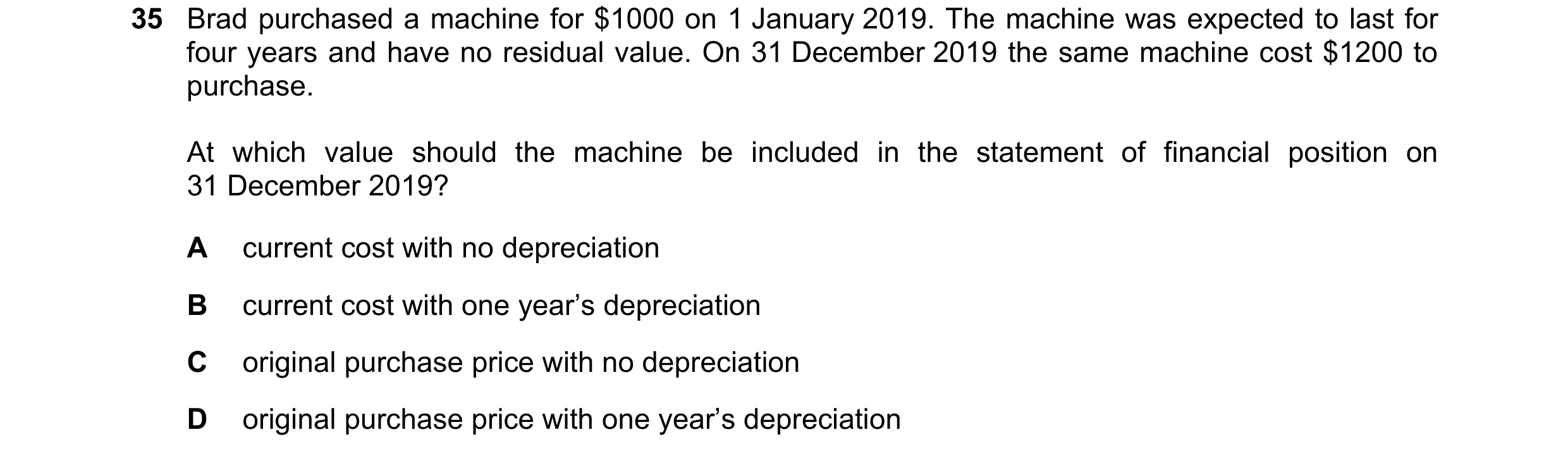
35 Brad purchased a machine for $1000 on 1 January 2019. The machine was expected to last for four years and have no residual value. On 31 December 2019 the same machine cost $1200 to purchase. At which value should the machine be included in the statement of financial position on 31 December 2019? A current cost with no depreciation B current cost with one year’s depreciation C original purchase price with no depreciation D original purchase price with one year’s depreciation
1 marks
Answer: D
This question in 0452/11 May/June 2020
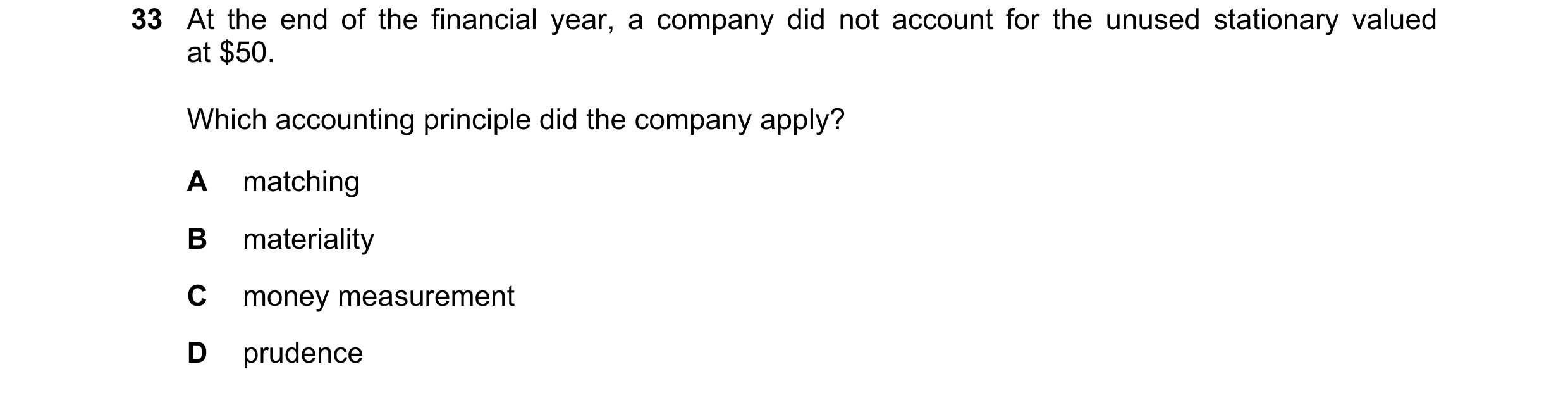
Q8 · At the end of the financial year, a company did not account for the unused stationary… 0452/12 May/June 2020
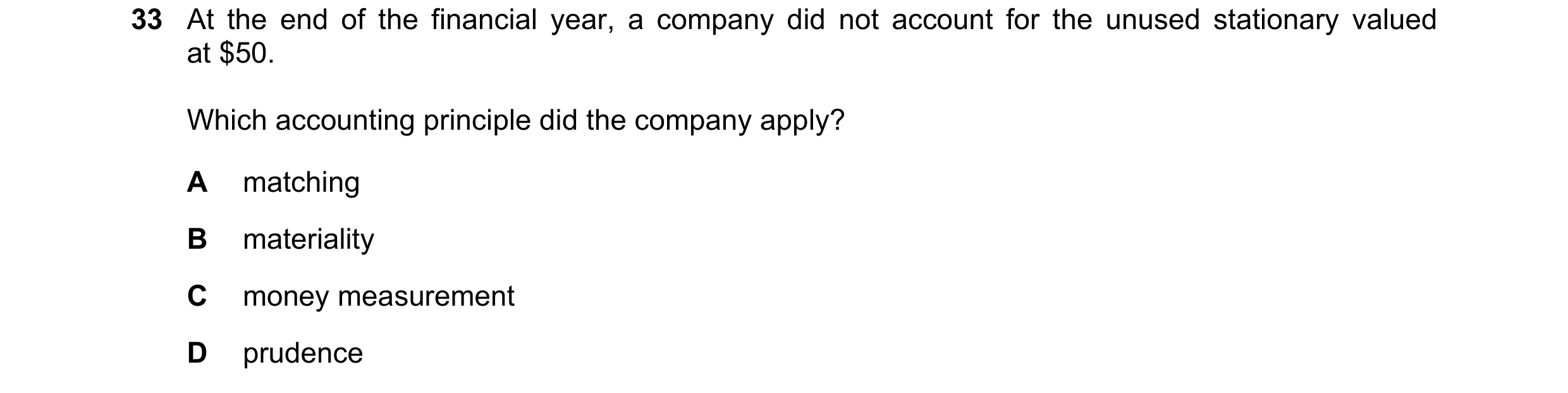
33 At the end of the financial year, a company did not account for the unused stationary valued at $50. Which accounting principle did the company apply? A matching B materiality C money measurement D prudence
1 marks
Answer: B
This question in 0452/12 May/June 2020
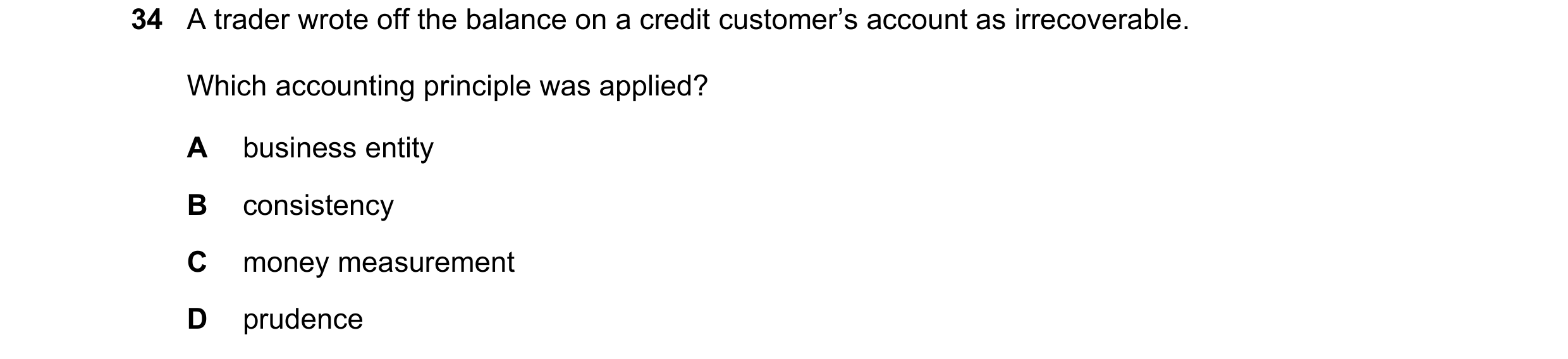
Q9 · A trader wrote off the balance on a credit customer’s account as irrecoverable 0452/12 May/June 2020
34 A trader wrote off the balance on a credit customer’s account as irrecoverable. Which accounting principle was applied? A business entity B consistency C money measurement D prudence
1 marks
Answer: D
This question in 0452/12 May/June 2020
Q10 · At the end of the financial year, a company did not account for the unused stationary… 0452/13 May/June 2020
33 At the end of the financial year, a company did not account for the unused stationary valued at $50. Which accounting principle did the company apply? A matching B materiality C money measurement D prudence
1 marks
Answer: B
This question in 0452/13 May/June 2020
Q11 · A trader wrote off the balance on a credit customer’s account as irrecoverable 0452/13 May/June 2020
34 A trader wrote off the balance on a credit customer’s account as irrecoverable. Which accounting principle was applied? A business entity B consistency C money measurement D prudence
1 marks
Answer: D
This question in 0452/13 May/June 2020
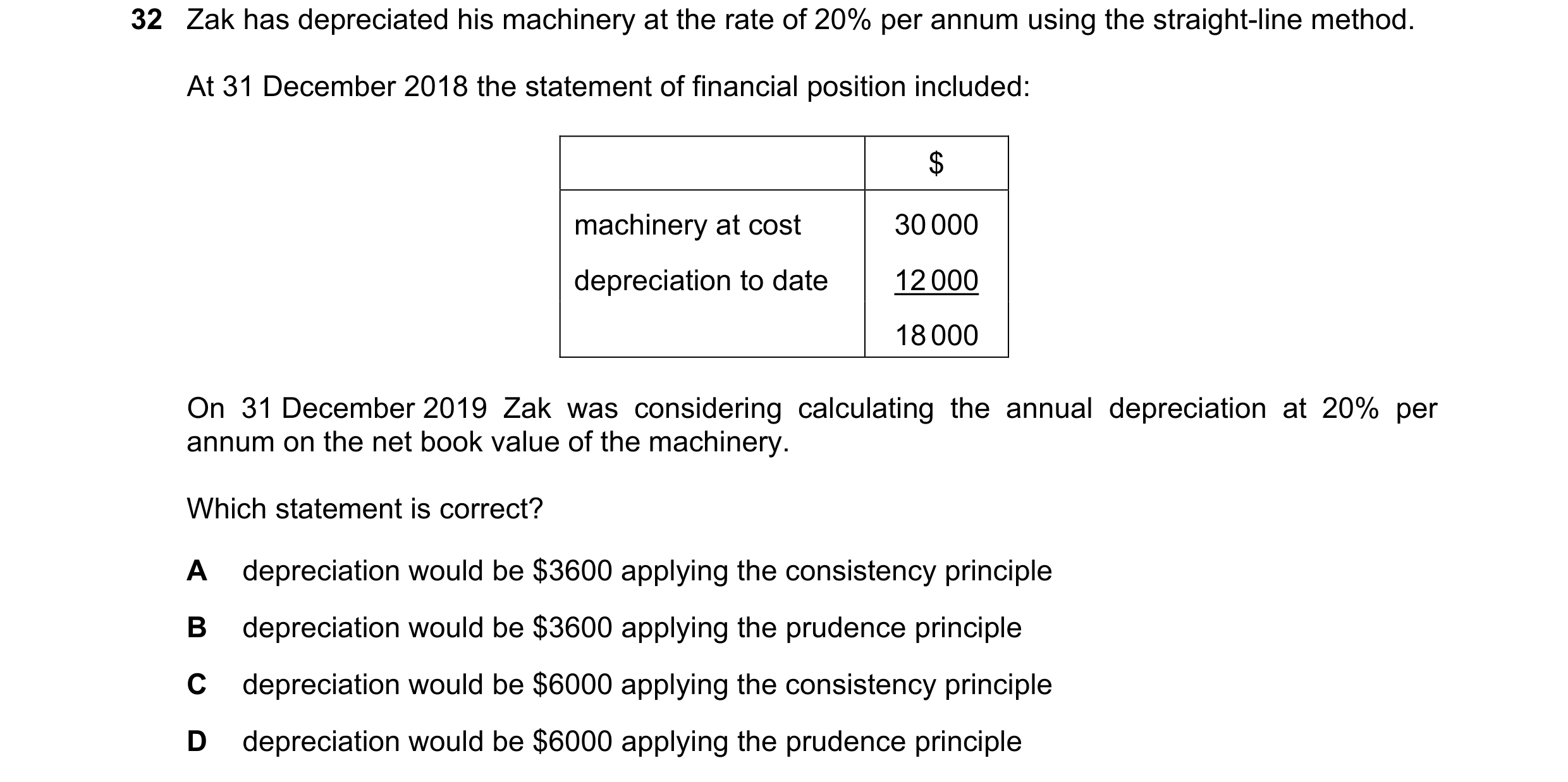
Q12 · Zak has depreciated his machinery at the rate of 20% per annum using the straight-line… 0452/11 Oct/Nov 2020
32 Zak has depreciated his machinery at the rate of 20% per annum using the straight-line method. At 31 December 2018 the statement of financial position included: $ machinery at cost 30 000 depreciation to date 12 000 18 000 On 31 December 2019 Zak was considering calculating the annual depreciation at 20% per annum on the net book value of the machinery. Which statement is correct? A depreciation would be $3600 applying the consistency principle B depreciation would be $3600 applying the prudence principle C depreciation would be $6000 applying the consistency principle D depreciation would be $6000 applying the prudence principle
1 marks
Answer: C
This question in 0452/11 Oct/Nov 2020
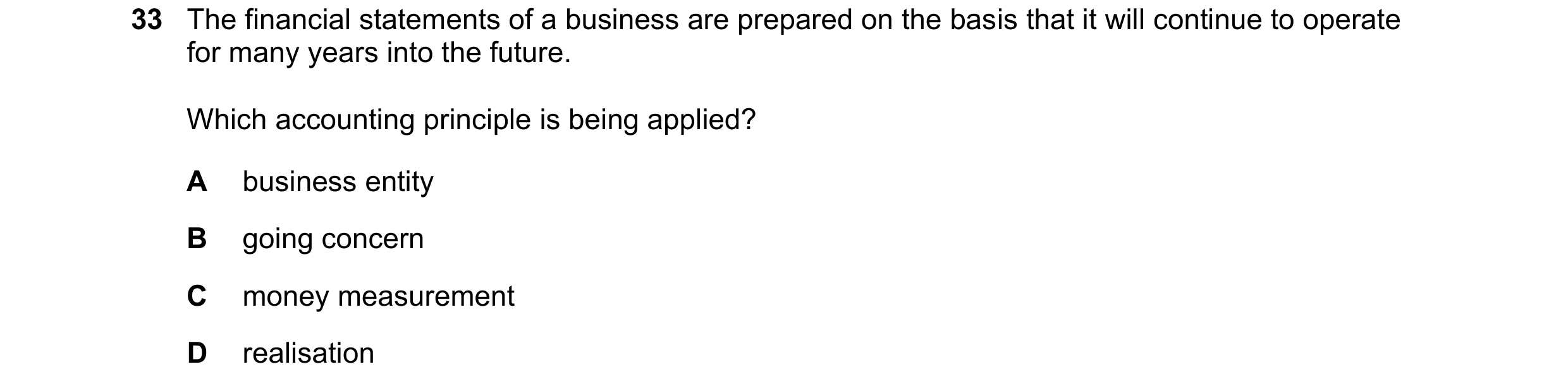
Q13 · The financial statements of a business are prepared on the basis that it will continue to… 0452/11 Oct/Nov 2020
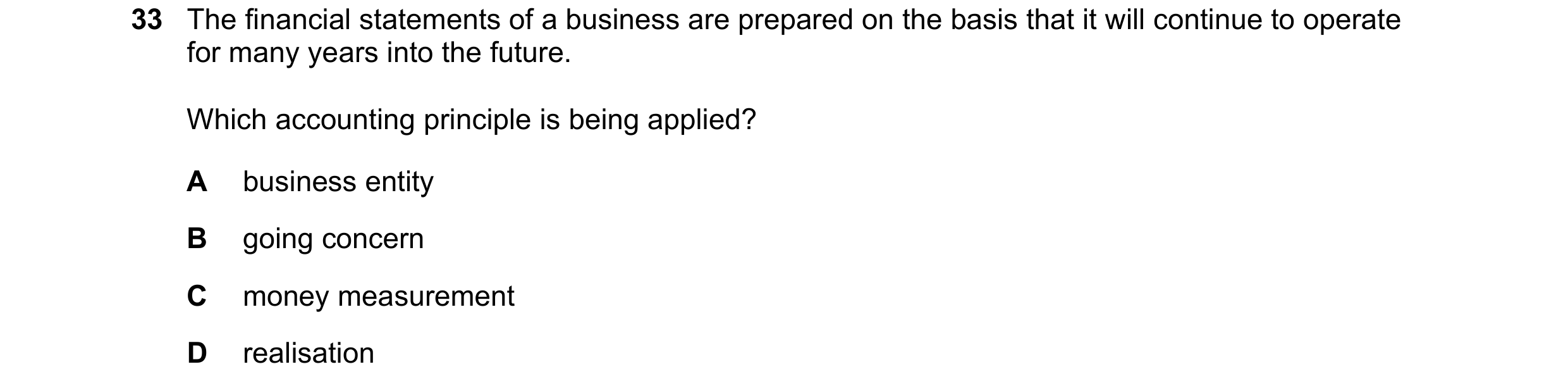
33 The financial statements of a business are prepared on the basis that it will continue to operate for many years into the future. Which accounting principle is being applied? A business entity B going concern C money measurement D realisation
1 marks
Answer: B
This question in 0452/11 Oct/Nov 2020
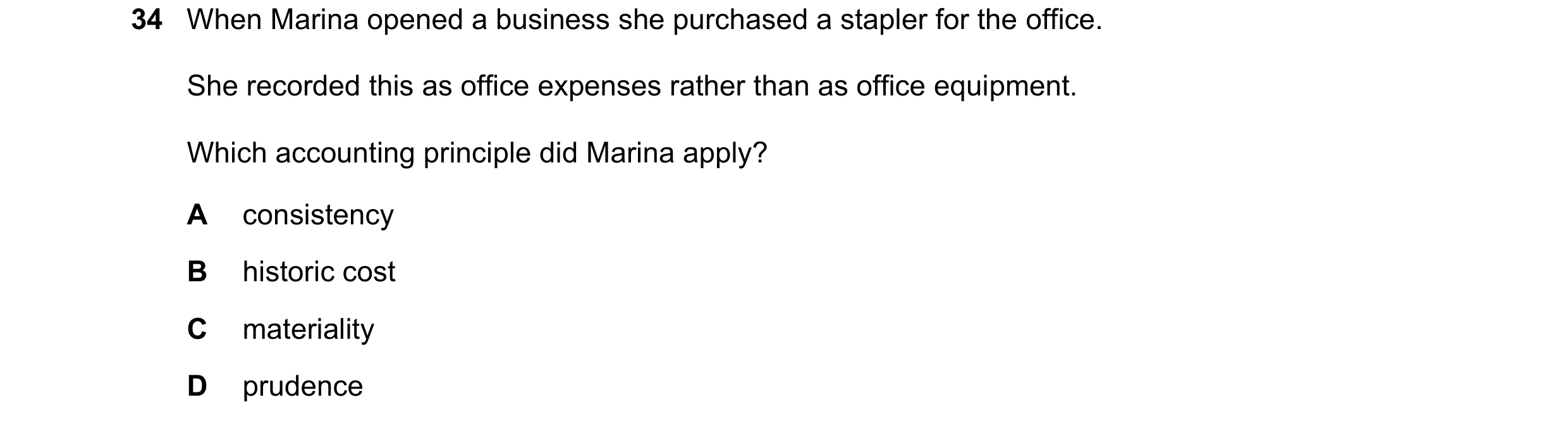
Q14 · When Marina opened a business she purchased a stapler for the office 0452/11 Oct/Nov 2020
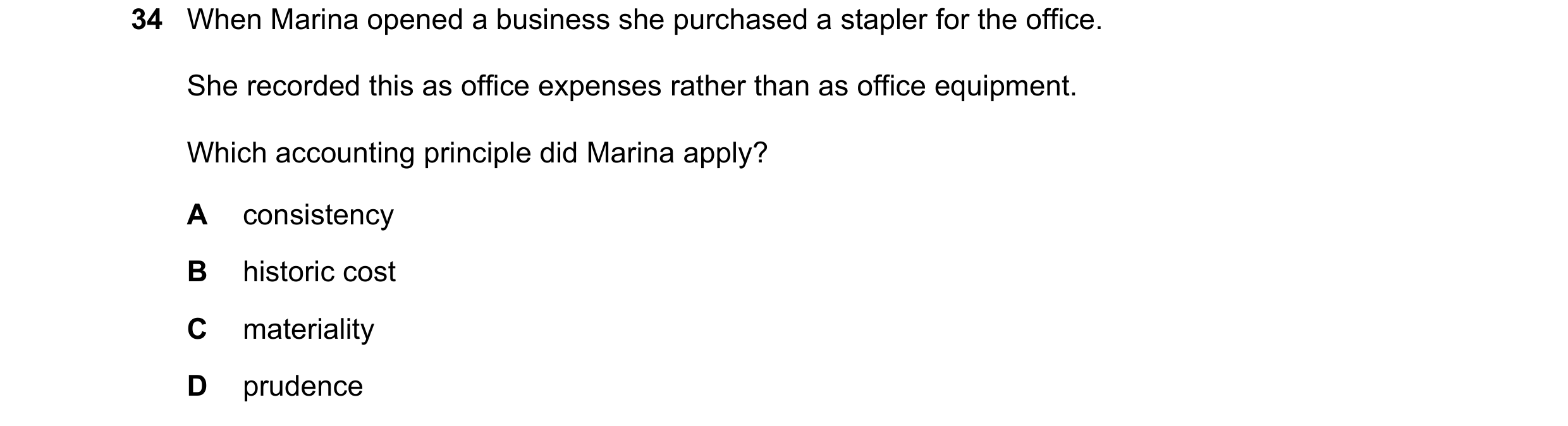
34 When Marina opened a business she purchased a stapler for the office. She recorded this as office expenses rather than as office equipment. Which accounting principle did Marina apply? A consistency B historic cost C materiality D prudence
1 marks
Answer: C
This question in 0452/11 Oct/Nov 2020
Q15 · What is not an aim of international accounting standards? 0452/11 Oct/Nov 2020
35 What is not an aim of international accounting standards? A to ensure accounting standards in different countries agree B to establish an organisation to set standards in every country C to make it easier to compare companies’ financial statements D to reduce the variety of accounting practices worldwide
1 marks
Answer: B
This question in 0452/11 Oct/Nov 2020
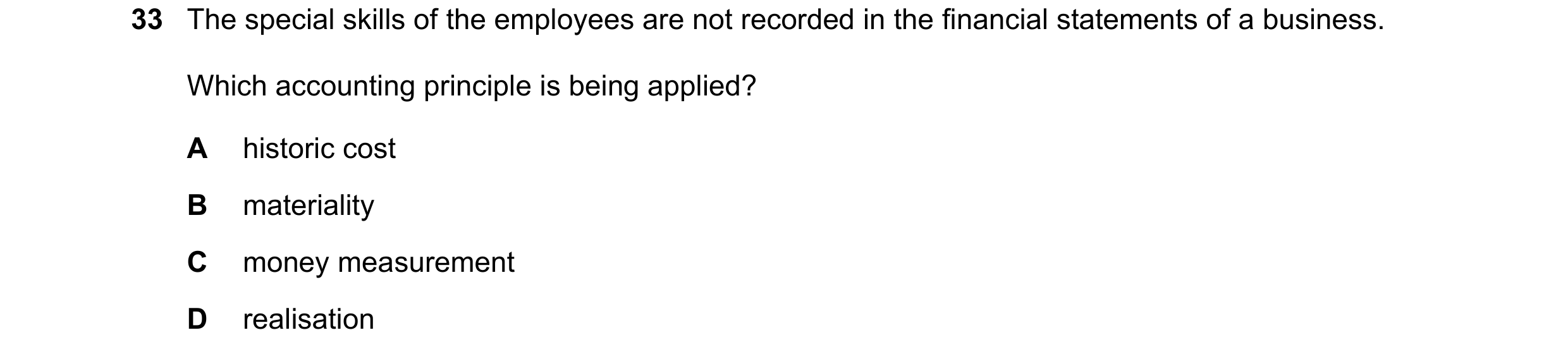
Q16 · The special skills of the employees are not recorded in the financial statements of a… 0452/12 Oct/Nov 2020
33 The special skills of the employees are not recorded in the financial statements of a business. Which accounting principle is being applied? A historic cost B materiality C money measurement D realisation
1 marks
Answer: C
This question in 0452/12 Oct/Nov 2020
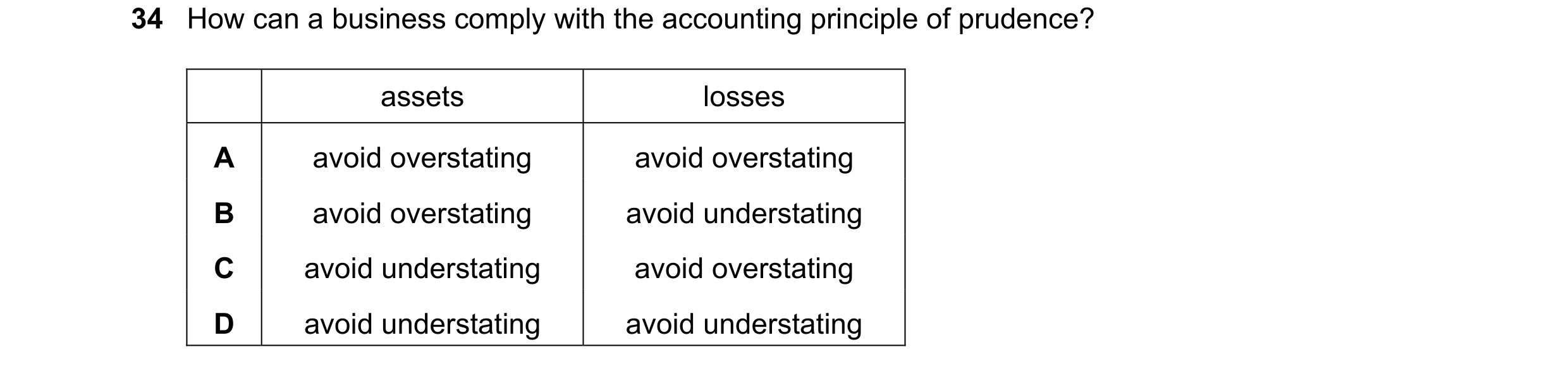
Q17 · How can a business comply with the accounting principle of prudence? 0452/12 Oct/Nov 2020
34 How can a business comply with the accounting principle of prudence? assets losses A avoid overstating avoid overstating B avoid overstating avoid understating C avoid understating avoid overstating D avoid understating avoid understating
1 marks
Answer: B
This question in 0452/12 Oct/Nov 2020
Q18 · What is not an aim of international accounting standards? 0452/12 Oct/Nov 2020
35 What is not an aim of international accounting standards? A to ensure accounting standards in different countries agree B to establish an organisation to set standards in every country C to make it easier to compare companies’ financial statements D to reduce the variety of accounting practices worldwide
1 marks
Answer: B
This question in 0452/12 Oct/Nov 2020
Q19 · Zak has depreciated his machinery at the rate of 20% per annum using the straight-line… 0452/13 Oct/Nov 2020
32 Zak has depreciated his machinery at the rate of 20% per annum using the straight-line method. At 31 December 2018 the statement of financial position included: $ machinery at cost 30 000 depreciation to date 12 000 18 000 On 31 December 2019 Zak was considering calculating the annual depreciation at 20% per annum on the net book value of the machinery. Which statement is correct? A depreciation would be $3600 applying the consistency principle B depreciation would be $3600 applying the prudence principle C depreciation would be $6000 applying the consistency principle D depreciation would be $6000 applying the prudence principle
1 marks
Answer: C
This question in 0452/13 Oct/Nov 2020
Q20 · The financial statements of a business are prepared on the basis that it will continue to… 0452/13 Oct/Nov 2020
33 The financial statements of a business are prepared on the basis that it will continue to operate for many years into the future. Which accounting principle is being applied? A business entity B going concern C money measurement D realisation
1 marks
Answer: B
This question in 0452/13 Oct/Nov 2020
Q21 · When Marina opened a business she purchased a stapler for the office 0452/13 Oct/Nov 2020
34 When Marina opened a business she purchased a stapler for the office. She recorded this as office expenses rather than as office equipment. Which accounting principle did Marina apply? A consistency B historic cost C materiality D prudence
1 marks
Answer: C
This question in 0452/13 Oct/Nov 2020
Q22 · What is not an aim of international accounting standards? 0452/13 Oct/Nov 2020
35 What is not an aim of international accounting standards? A to ensure accounting standards in different countries agree B to establish an organisation to set standards in every country C to make it easier to compare companies’ financial statements D to reduce the variety of accounting practices worldwide
1 marks
Answer: B
This question in 0452/13 Oct/Nov 2020
Q23 · Amaira depreciates her non-current assets by the same rate and using the same method… 0452/12 Feb/March 2021
34 Amaira depreciates her non-current assets by the same rate and using the same method every year. Which group of accounting principles is she applying? A business entity, consistency, matching B business entity, prudence, realisation C consistency, matching, prudence D matching, prudence, realisation
1 marks
Answer: C
This question in 0452/12 Feb/March 2021
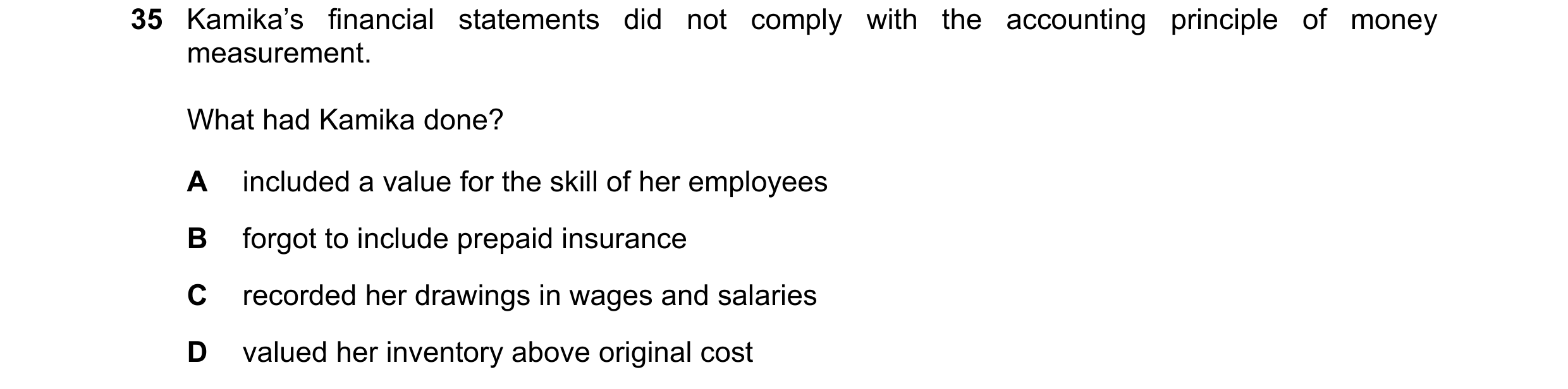
Q24 · Kamika’s financial statements did not comply with the accounting principle of money… 0452/12 Feb/March 2021
35 Kamika’s financial statements did not comply with the accounting principle of money measurement. What had Kamika done? A included a value for the skill of her employees B forgot to include prepaid insurance C recorded her drawings in wages and salaries D valued her inventory above original cost
1 marks
Answer: A
This question in 0452/12 Feb/March 2021
Q25 · Why does a business provide for depreciation on non-current assets? 0452/11 May/June 2021
12 Why does a business provide for depreciation on non-current assets? A to charge the cost of non-current assets against profit in the year of purchase B to ensure that non-current assets appear at book value in the statement of financial position C to ensure that the matching principle is applied when preparing financial statements D to retain cash in the business for replacement of non-current assets
1 marks
Answer: C
This question in 0452/11 May/June 2021
Q26 · Why does a business maintain a provision for doubtful debts account? 0452/11 May/June 2021
15 Why does a business maintain a provision for doubtful debts account? A to apply the accounting principle of prudence B to avoid profit for the year being understated C to have an accurate forecast of debts which will be uncollectible D to reduce the expense of irrecoverable debts in the future
1 marks
Answer: A
This question in 0452/11 May/June 2021
Q27 · How should inventory be valued? 0452/11 May/June 2021
16 How should inventory be valued? A cost B higher of cost and net realisable value C lower of cost and net realisable value D net realisable value
1 marks
Answer: C
This question in 0452/11 May/June 2021
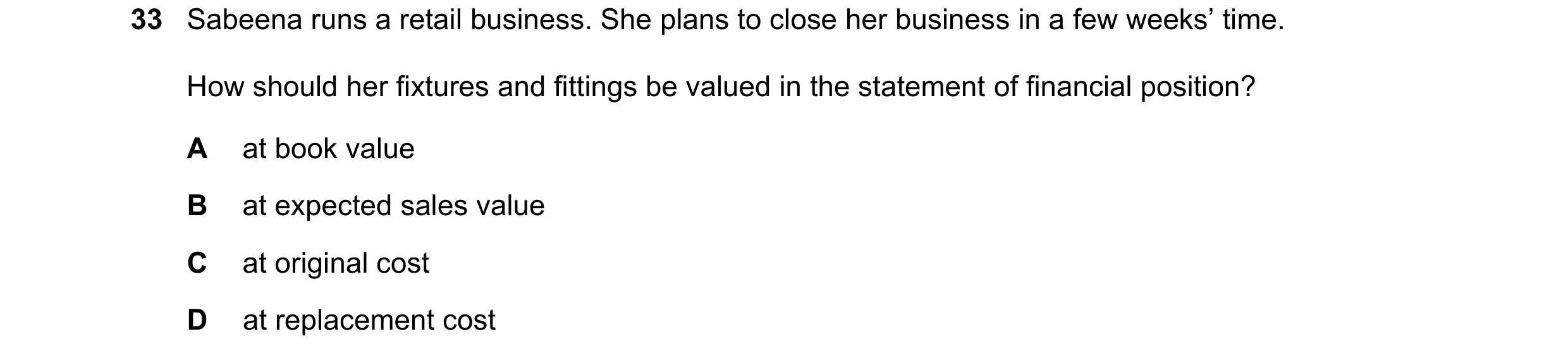
Q28 · Sabeena runs a retail business 0452/11 May/June 2021
33 Sabeena runs a retail business. She plans to close her business in a few weeks’ time. How should her fixtures and fittings be valued in the statement of financial position? A at book value B at expected sales value C at original cost D at replacement cost
1 marks
Answer: B
This question in 0452/11 May/June 2021
Q29 · Why should a trader match his costs for a financial year with the revenues for the same… 0452/11 May/June 2021
34 Why should a trader match his costs for a financial year with the revenues for the same period? A to account for all liabilities B to account for money that has been paid in advance C to make sure outstanding income is included D to show the correct profit figure
1 marks
Answer: D
This question in 0452/11 May/June 2021
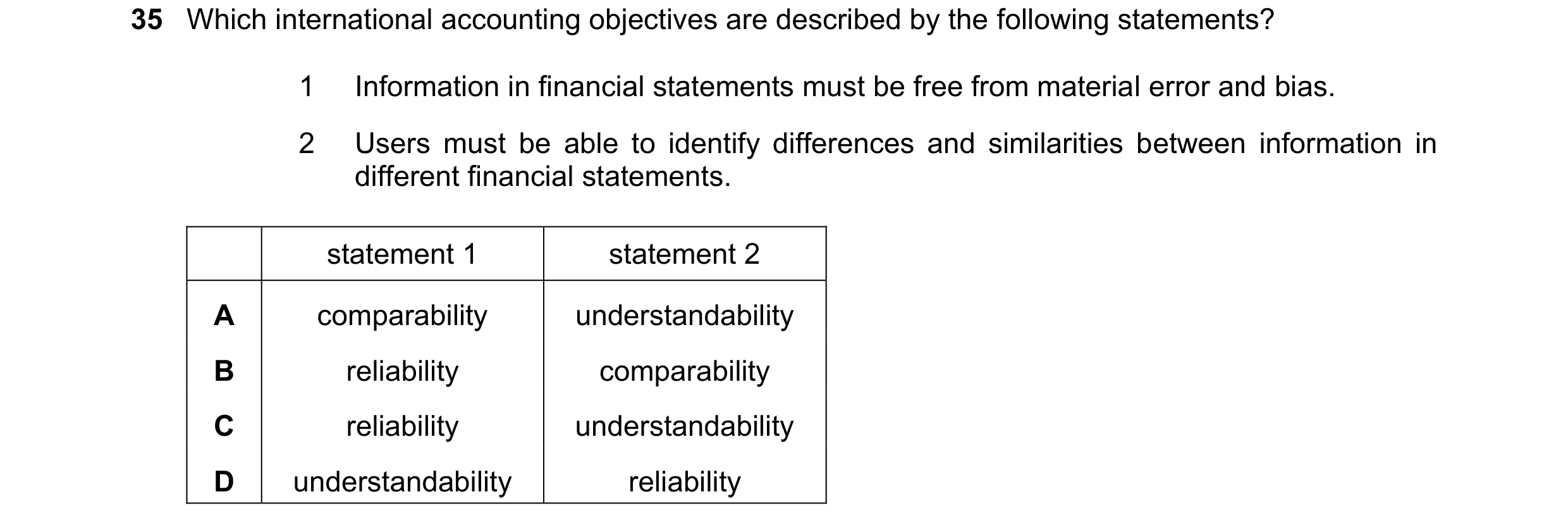
Q30 · Which international accounting objectives are described by the following statements? 0452/11 May/June 2021
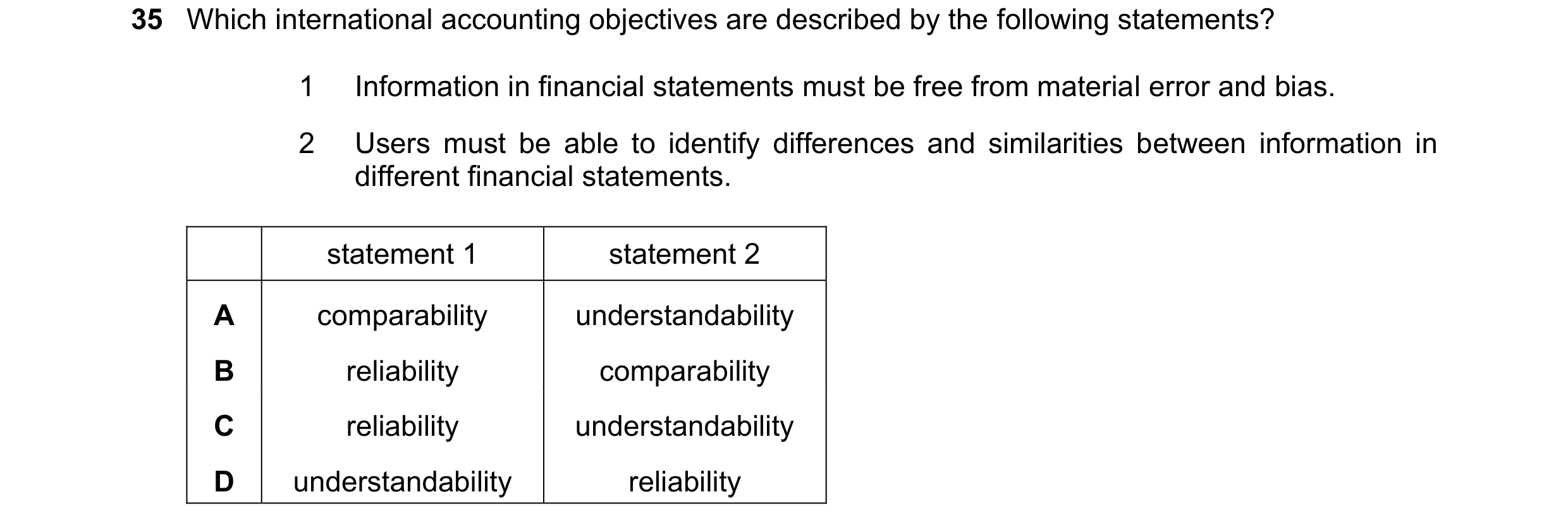
35 Which international accounting objectives are described by the following statements? 1 Information in financial statements must be free from material error and bias. 2 Users must be able to identify differences and similarities between information in different financial statements. statement 1 statement 2 A comparability understandability B reliability comparability C reliability understandability D understandability reliability
1 marks
Answer: B
This question in 0452/11 May/June 2021
Q31 · Why does a business provide for depreciation on non-current assets? 0452/12 May/June 2021
17 Why does a business provide for depreciation on non-current assets? A to charge the cost of non-current assets against profit in the year of purchase B to ensure that non-current assets appear at book value in the statement of financial position C to ensure that the matching principle is applied when preparing financial statements D to retain cash in the business for replacement of non-current assets
1 marks
Answer: C
This question in 0452/12 May/June 2021
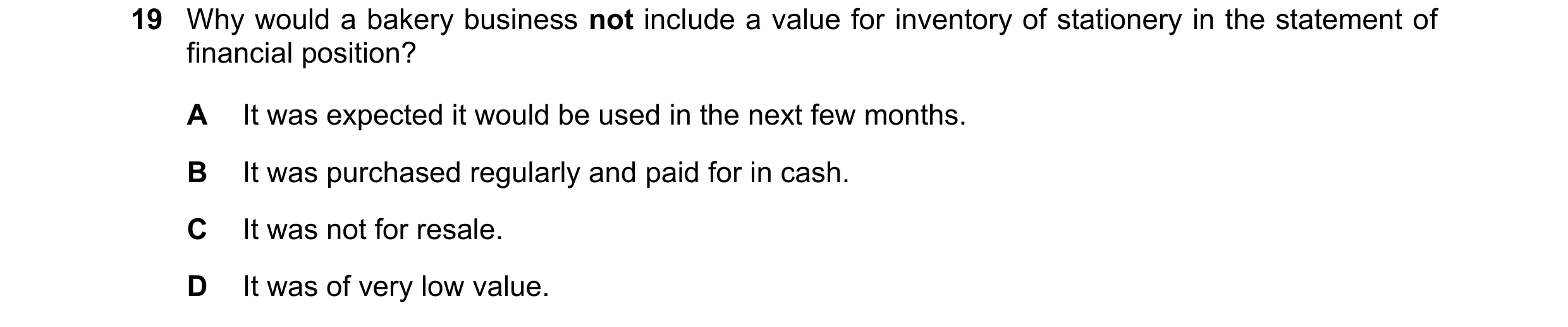
Q32 · Why would a bakery business not include a value for inventory of stationery in the… 0452/12 May/June 2021
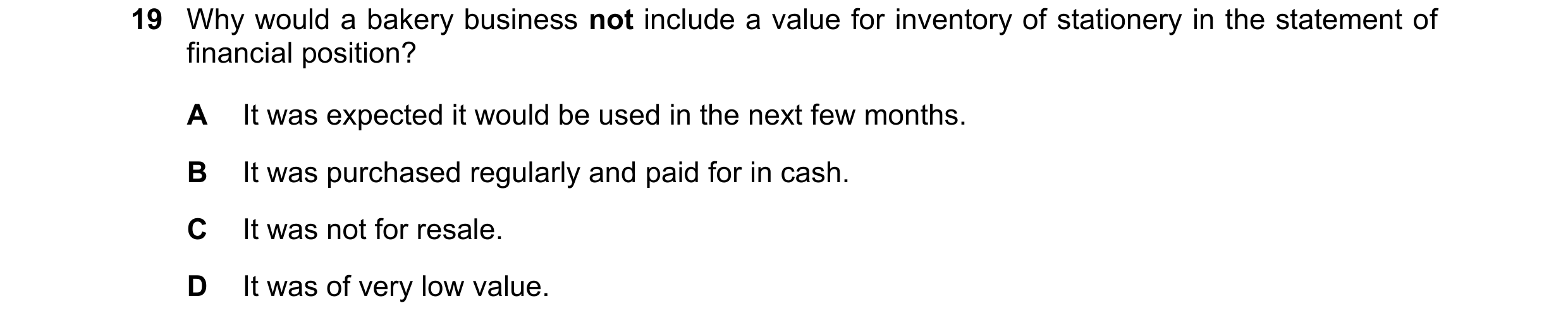
19 Why would a bakery business not include a value for inventory of stationery in the statement of financial position? A It was expected it would be used in the next few months. B It was purchased regularly and paid for in cash. C It was not for resale. D It was of very low value.
1 marks
Answer: D
This question in 0452/12 May/June 2021
Q33 · Which international accounting objectives are described by the following statements? 0452/12 May/June 2021
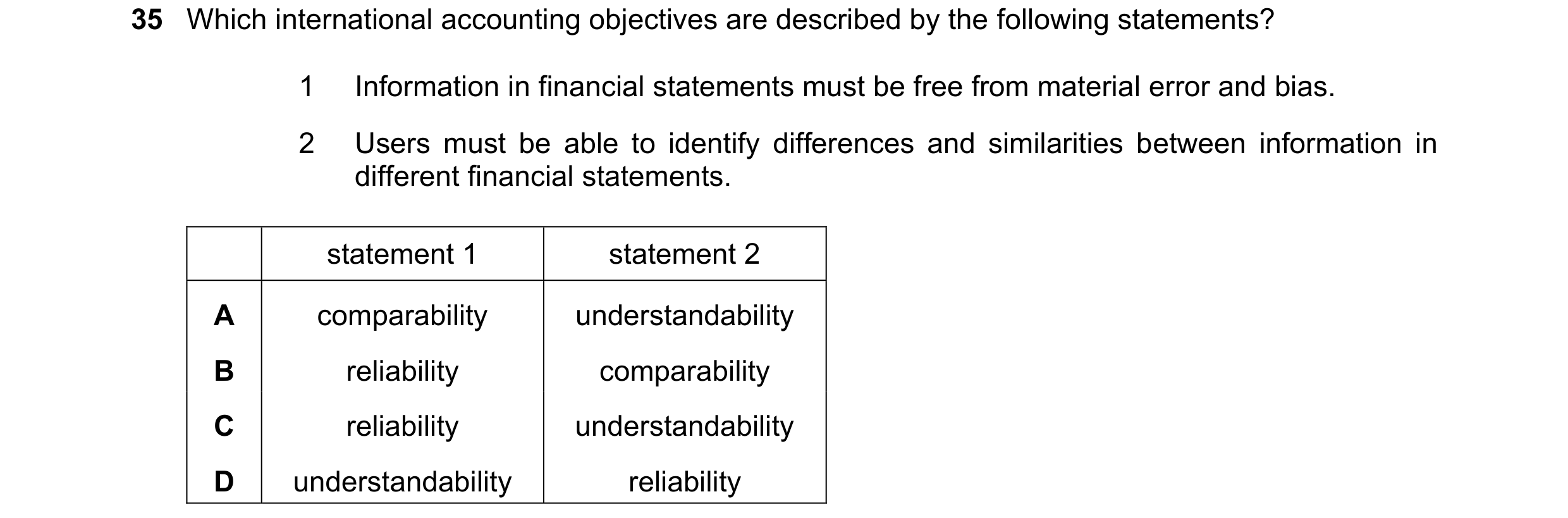
35 Which international accounting objectives are described by the following statements? 1 Information in financial statements must be free from material error and bias. 2 Users must be able to identify differences and similarities between information in different financial statements. statement 1 statement 2 A comparability understandability B reliability comparability C reliability understandability D understandability reliability
1 marks
Answer: B
This question in 0452/12 May/June 2021
Q34 · Why does a business provide for depreciation on non-current assets? 0452/13 May/June 2021
17 Why does a business provide for depreciation on non-current assets? A to charge the cost of non-current assets against profit in the year of purchase B to ensure that non-current assets appear at book value in the statement of financial position C to ensure that the matching principle is applied when preparing financial statements D to retain cash in the business for replacement of non-current assets
1 marks
Answer: C
This question in 0452/13 May/June 2021
Q35 · Why would a bakery business not include a value for inventory of stationery in the… 0452/13 May/June 2021
19 Why would a bakery business not include a value for inventory of stationery in the statement of financial position? A It was expected it would be used in the next few months. B It was purchased regularly and paid for in cash. C It was not for resale. D It was of very low value.
1 marks
Answer: D
This question in 0452/13 May/June 2021
Q36 · How should inventory be valued? 0452/13 May/June 2021
21 How should inventory be valued? A cost B higher of cost and net realisable value C lower of cost and net realisable value D net realisable value
1 marks
Answer: C
This question in 0452/13 May/June 2021
Q37 · Which international accounting objectives are described by the following statements? 0452/13 May/June 2021
35 Which international accounting objectives are described by the following statements? 1 Information in financial statements must be free from material error and bias. 2 Users must be able to identify differences and similarities between information in different financial statements. statement 1 statement 2 A comparability understandability B reliability comparability C reliability understandability D understandability reliability
1 marks
Answer: B
This question in 0452/13 May/June 2021
Q38 · What does the objective of understandability assume users of financial statements will… 0452/11 Oct/Nov 2021
35 What does the objective of understandability assume users of financial statements will possess? A a reasonable knowledge of accounting B full knowledge of accounting C knowledge of book-keeping but not accounting D no knowledge of book-keeping or accounting
1 marks
Answer: A
This question in 0452/11 Oct/Nov 2021
Q39 · Charlie is a car dealer 0452/12 Oct/Nov 2021
34 Charlie is a car dealer. Joe wanted a new car and went to Charlie’s car showroom. On Monday Joe took a car for a test drive and decided to buy it. On Tuesday Joe arranged to pay for the car by cheque. On Wednesday Joe collected the car and received an invoice. On Thursday Joe’s cheque was cleared by the bank. On which day was Charlie able to account for the profit on the sale? A Monday B Tuesday C Wednesday D Thursday
1 marks
Answer: C
This question in 0452/12 Oct/Nov 2021
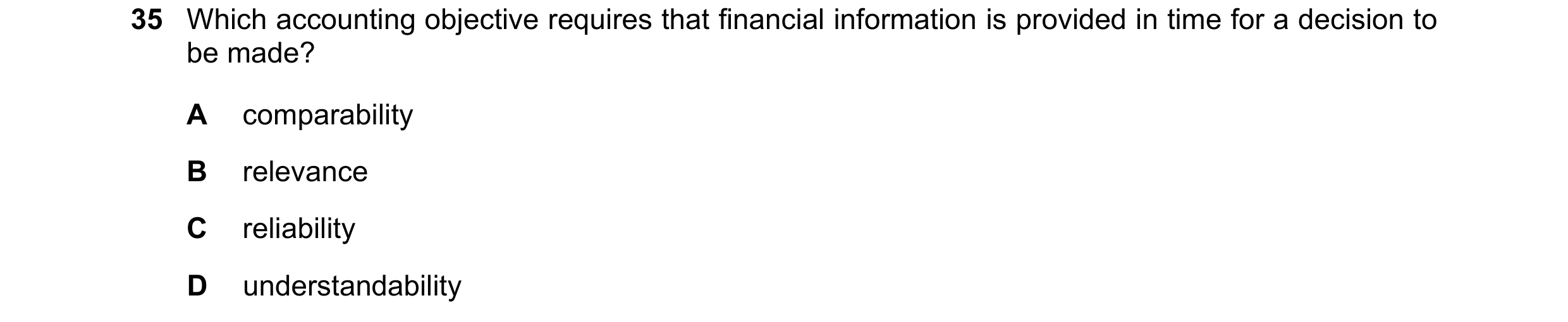
Q40 · Which accounting objective requires that financial information is provided in time for a… 0452/12 Oct/Nov 2021
35 Which accounting objective requires that financial information is provided in time for a decision to be made? A comparability B relevance C reliability D understandability
1 marks
Answer: B
This question in 0452/12 Oct/Nov 2021
Q41 · What does the objective of understandability assume users of financial statements will… 0452/13 Oct/Nov 2021
35 What does the objective of understandability assume users of financial statements will possess? A a reasonable knowledge of accounting B full knowledge of accounting C knowledge of book-keeping but not accounting D no knowledge of book-keeping or accounting
1 marks
Answer: A
This question in 0452/13 Oct/Nov 2021
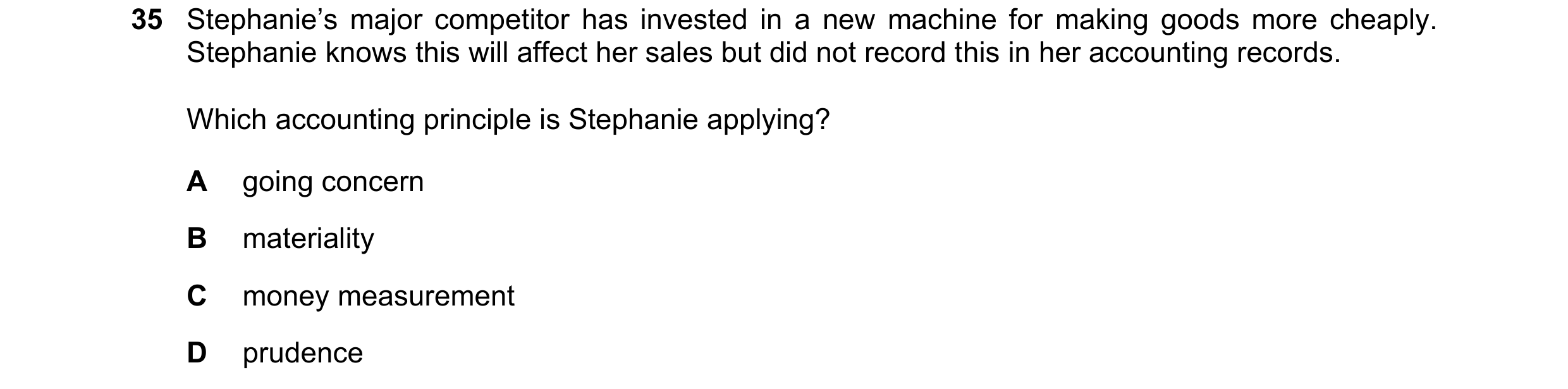
Q42 · Stephanie’s major competitor has invested in a new machine for making goods more cheaply 0452/12 Feb/March 2022
35 Stephanie’s major competitor has invested in a new machine for making goods more cheaply. Stephanie knows this will affect her sales but did not record this in her accounting records. Which accounting principle is Stephanie applying? A going concern B materiality C money measurement D prudence
1 marks
Answer: C
This question in 0452/12 Feb/March 2022
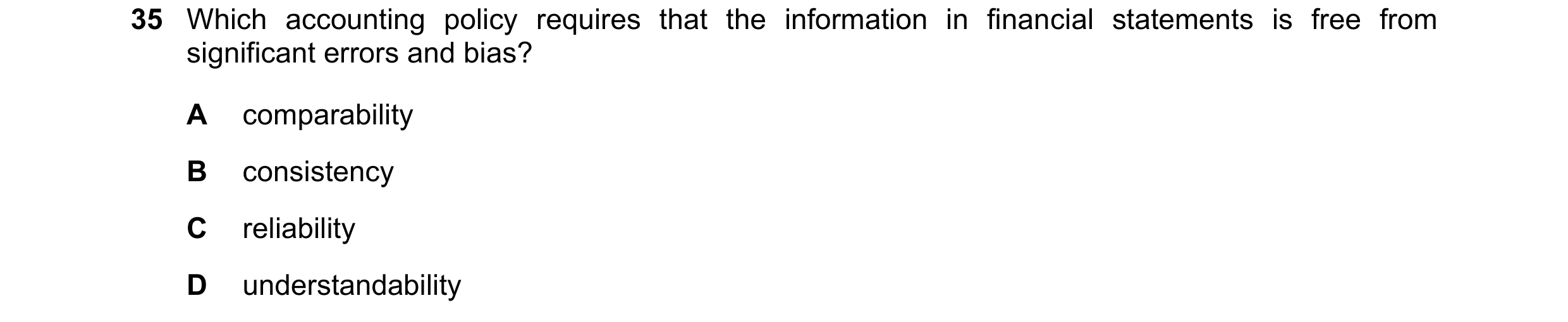
Q43 · Which accounting policy requires that the information in financial statements is free… 0452/11 May/June 2022
35 Which accounting policy requires that the information in financial statements is free from significant errors and bias? A comparability B consistency C reliability D understandability
1 marks
Answer: C
This question in 0452/11 May/June 2022
Q44 · After the financial statements for the year ended 30 April 2022 had been prepared, a… 0452/12 May/June 2022
16 After the financial statements for the year ended 30 April 2022 had been prepared, a trader discovered that the closing inventory had been over-valued. What will be the effect of this error? profit for the year capital on profit for the year ended 30 April 2022 30 April 2022 ending 30 April 2023 A overstated overstated understated B overstated understated no effect C understated no effect no effect D understated understated overstated
1 marks
Answer: A
This question in 0452/12 May/June 2022
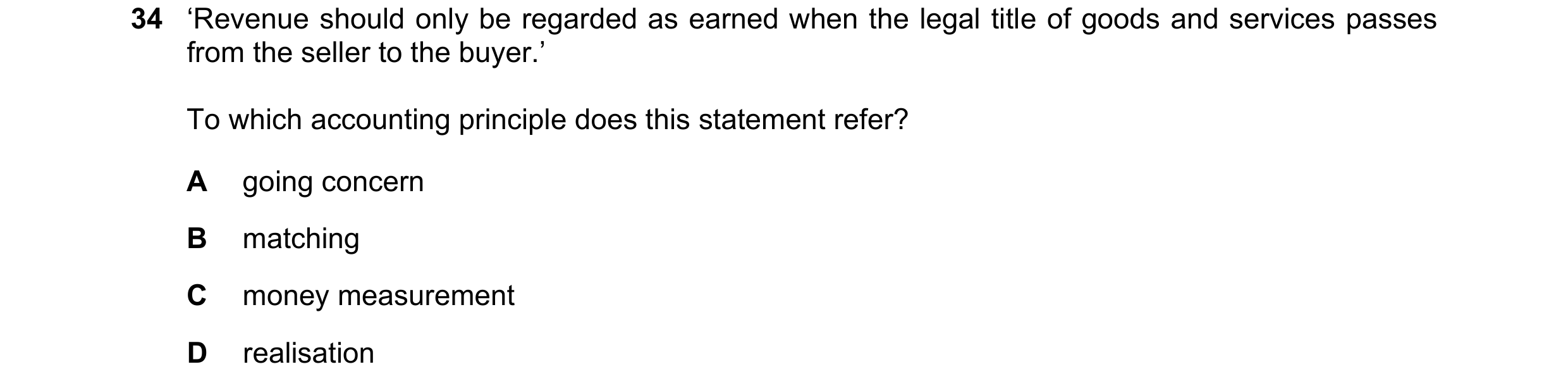
Q45 · ‘Revenue should only be regarded as earned when the legal title of goods and services… 0452/12 May/June 2022
34 ‘Revenue should only be regarded as earned when the legal title of goods and services passes from the seller to the buyer.’ To which accounting principle does this statement refer? A going concern B matching C money measurement D realisation
1 marks
Answer: D
This question in 0452/12 May/June 2022
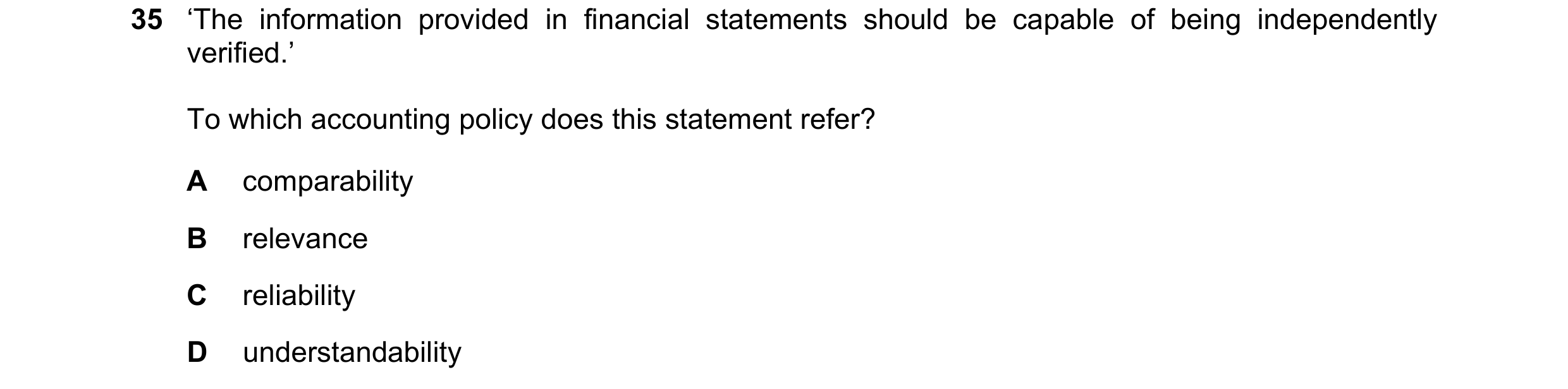
Q46 · ‘The information provided in financial statements should be capable of being… 0452/12 May/June 2022
35 ‘The information provided in financial statements should be capable of being independently verified.’ To which accounting policy does this statement refer? A comparability B relevance C reliability D understandability
1 marks
Answer: C
This question in 0452/12 May/June 2022
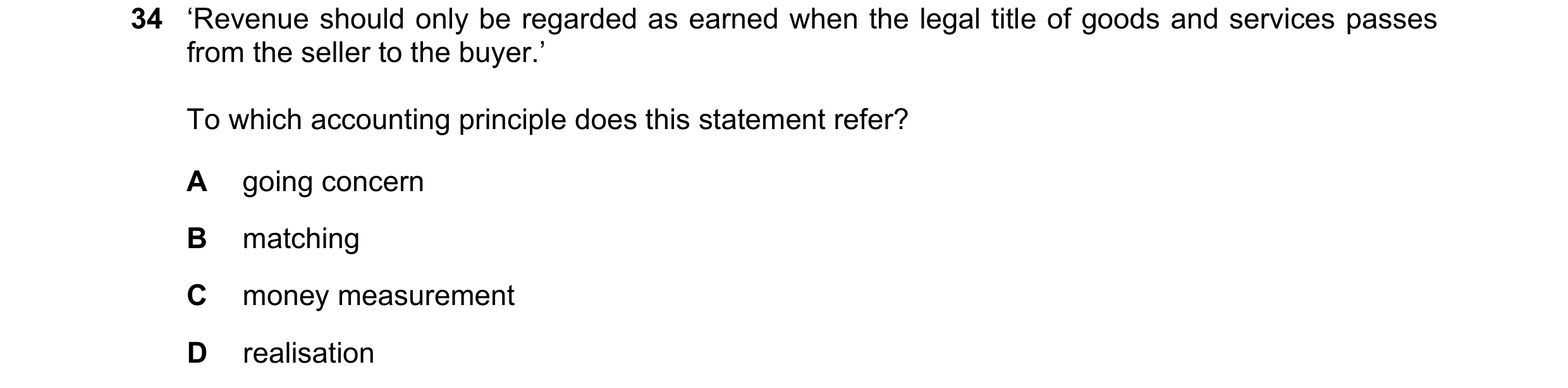
Q47 · ‘Revenue should only be regarded as earned when the legal title of goods and services… 0452/13 May/June 2022
34 ‘Revenue should only be regarded as earned when the legal title of goods and services passes from the seller to the buyer.’ To which accounting principle does this statement refer? A going concern B matching C money measurement D realisation
1 marks
Answer: D
This question in 0452/13 May/June 2022
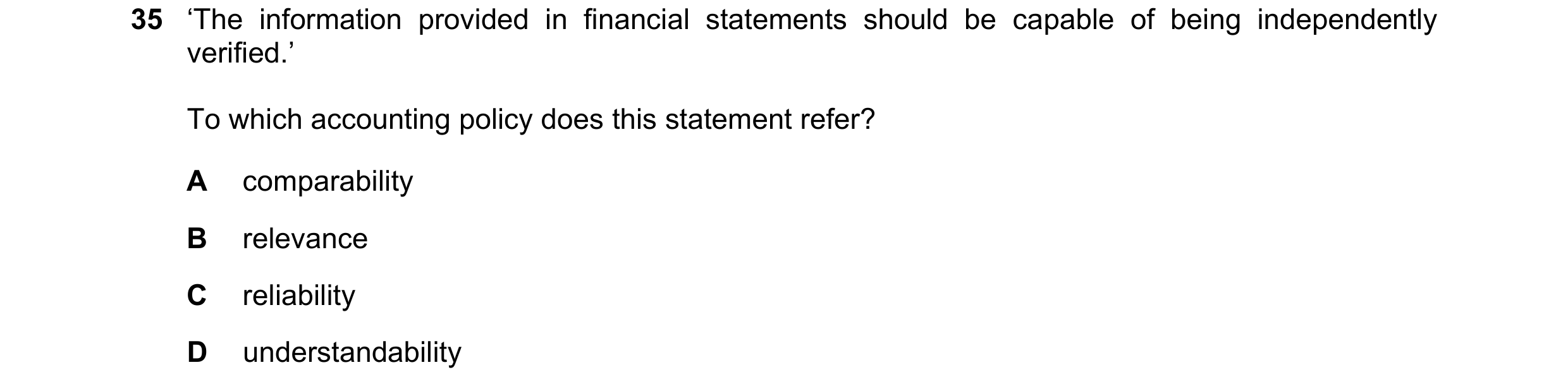
Q48 · ‘The information provided in financial statements should be capable of being… 0452/13 May/June 2022
35 ‘The information provided in financial statements should be capable of being independently verified.’ To which accounting policy does this statement refer? A comparability B relevance C reliability D understandability
1 marks
Answer: C
This question in 0452/13 May/June 2022
Q49 · The application of which accounting principle makes it easier to compare financial… 0452/11 Oct/Nov 2022
33 The application of which accounting principle makes it easier to compare financial statements year-on-year? A business entity B consistency C duality D going concern
1 marks
Answer: B
This question in 0452/11 Oct/Nov 2022
Q50 · What does the principle of prudence ensure? 0452/11 Oct/Nov 2022
34 What does the principle of prudence ensure? A Assets are not understated. B Liabilities are not estimated. C Losses are not anticipated. D Profits are not overstated.
1 marks
Answer: D
This question in 0452/11 Oct/Nov 2022
Q51 · Which statement is not correct about reasons for using international accounting standards? 0452/11 Oct/Nov 2022
35 Which statement is not correct about reasons for using international accounting standards? A assists when making comparisons between companies B improves the reliability of accounting information C narrows the areas of difference in financial reporting D makes the preparation of financial statements less time-consuming
1 marks
Answer: D
This question in 0452/11 Oct/Nov 2022
Q52 · Why should inventory be valued at the lower of cost and net realisable value? 0452/12 Oct/Nov 2022
17 Why should inventory be valued at the lower of cost and net realisable value? A to avoid undervaluing the inventory B to comply with the historic cost principle C to comply with the principle of materiality D to ensure that profits are not overstated
1 marks
Answer: D
This question in 0452/12 Oct/Nov 2022
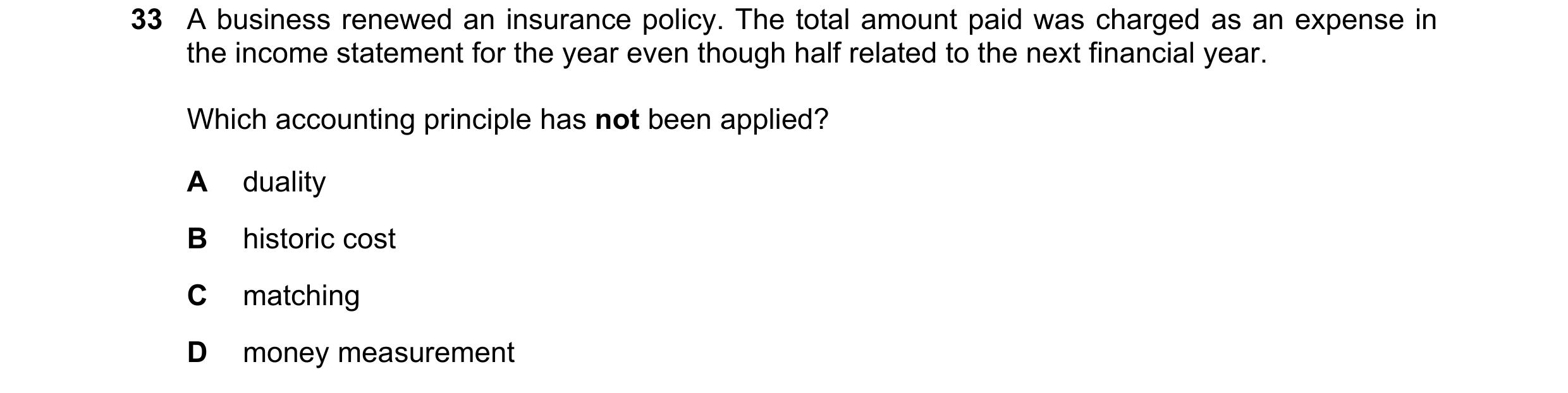
Q53 · A business renewed an insurance policy 0452/12 Oct/Nov 2022
33 A business renewed an insurance policy. The total amount paid was charged as an expense in the income statement for the year even though half related to the next financial year. Which accounting principle has not been applied? A duality B historic cost C matching D money measurement
1 marks
Answer: C
This question in 0452/12 Oct/Nov 2022
Q54 · What is meant by the business entity principle? 0452/12 Oct/Nov 2022
34 What is meant by the business entity principle? A All aspects of the business are recorded in money terms. B Goods taken by the owner for personal use are not recorded. C It is assumed that the business will continue to operate indefinitely. D Transactions are recorded from the point of view of the business.
1 marks
Answer: D
This question in 0452/12 Oct/Nov 2022
Q55 · Which statement is not correct about reasons for using international accounting standards? 0452/12 Oct/Nov 2022
35 Which statement is not correct about reasons for using international accounting standards? A assists when making comparisons between companies B improves the reliability of accounting information C narrows the areas of difference in financial reporting D makes the preparation of financial statements less time-consuming
1 marks
Answer: D
This question in 0452/12 Oct/Nov 2022
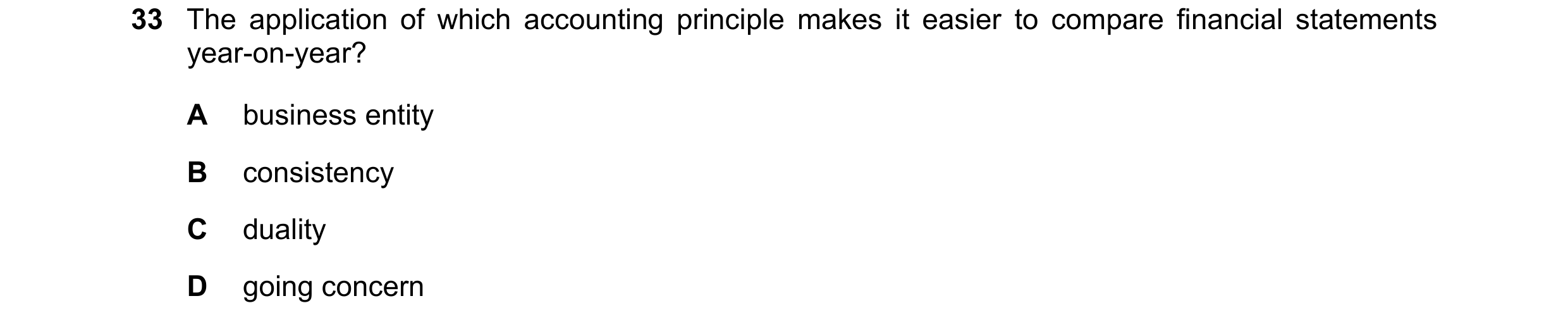
Q56 · The application of which accounting principle makes it easier to compare financial… 0452/13 Oct/Nov 2022
33 The application of which accounting principle makes it easier to compare financial statements year-on-year? A business entity B consistency C duality D going concern
1 marks
Answer: B
This question in 0452/13 Oct/Nov 2022
Q57 · What does the principle of prudence ensure? 0452/13 Oct/Nov 2022
34 What does the principle of prudence ensure? A Assets are not understated. B Liabilities are not estimated. C Losses are not anticipated. D Profits are not overstated.
1 marks
Answer: D
This question in 0452/13 Oct/Nov 2022
Q58 · Which statement is not correct about reasons for using international accounting standards? 0452/13 Oct/Nov 2022
35 Which statement is not correct about reasons for using international accounting standards? A assists when making comparisons between companies B improves the reliability of accounting information C narrows the areas of difference in financial reporting D makes the preparation of financial statements less time-consuming
1 marks
Answer: D
This question in 0452/13 Oct/Nov 2022
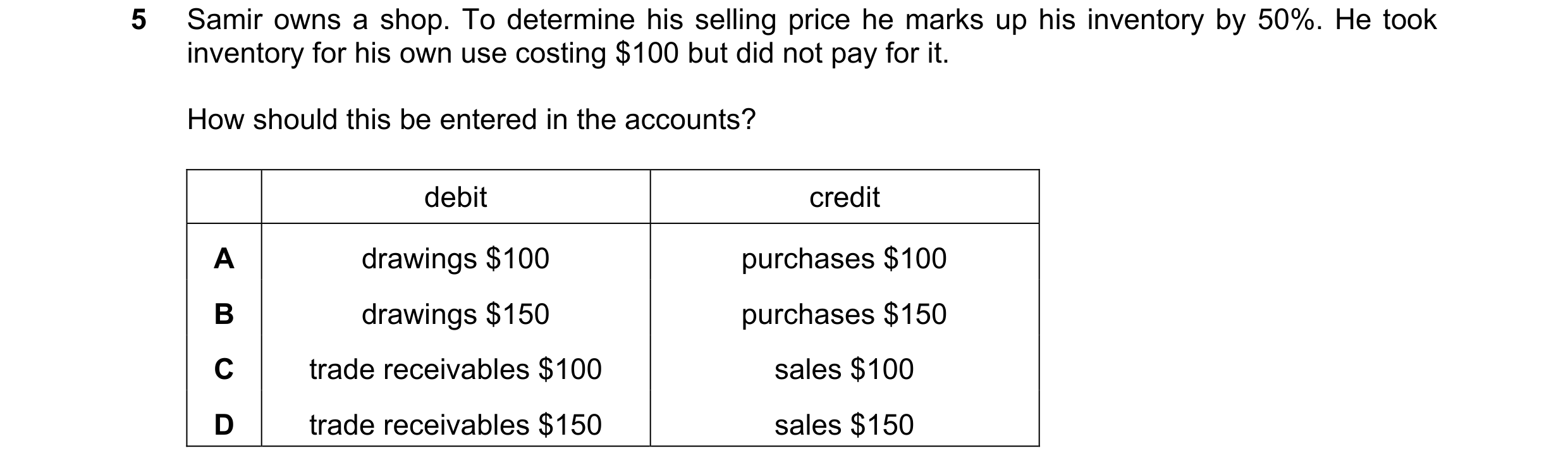
Q59 · Samir owns a shop 0452/12 Feb/March 2023
5 Samir owns a shop. To determine his selling price he marks up his inventory by 50%. He took inventory for his own use costing $100 but did not pay for it. How should this be entered in the accounts? debit credit A drawings $100 purchases $100 B drawings $150 purchases $150 C trade receivables $100 sales $100 D trade receivables $150 sales $150
1 marks
Answer: A
This question in 0452/12 Feb/March 2023
Q60 · To finance further expansion, a business owner paid $10 000 into the business bank account 0452/12 Feb/March 2023
35 To finance further expansion, a business owner paid $10 000 into the business bank account. In the ledger, a debit entry was made in the bank account and a credit entry made in the capital account. Which accounting principles were being applied? A business entity and prudence B business entity and duality C matching and duality D matching and prudence
1 marks
Answer: B
This question in 0452/12 Feb/March 2023
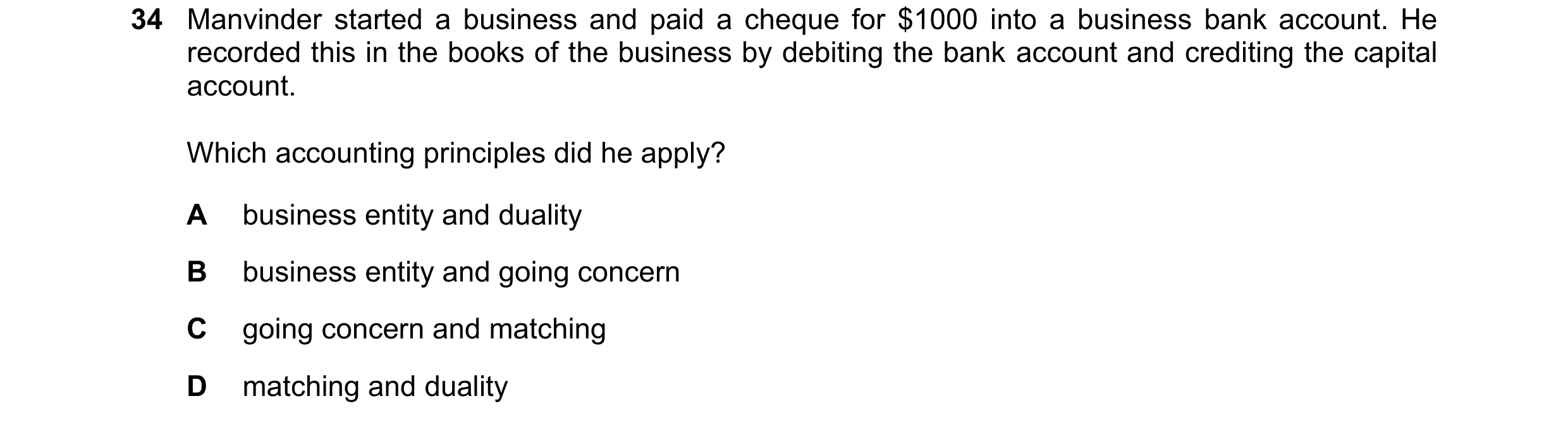
Q61 · Manvinder started a business and paid a cheque for $1000 into a business bank account 0452/11 May/June 2023
34 Manvinder started a business and paid a cheque for $1000 into a business bank account. He recorded this in the books of the business by debiting the bank account and crediting the capital account. Which accounting principles did he apply? A business entity and duality B business entity and going concern C going concern and matching D matching and duality
1 marks
Answer: A
This question in 0452/11 May/June 2023
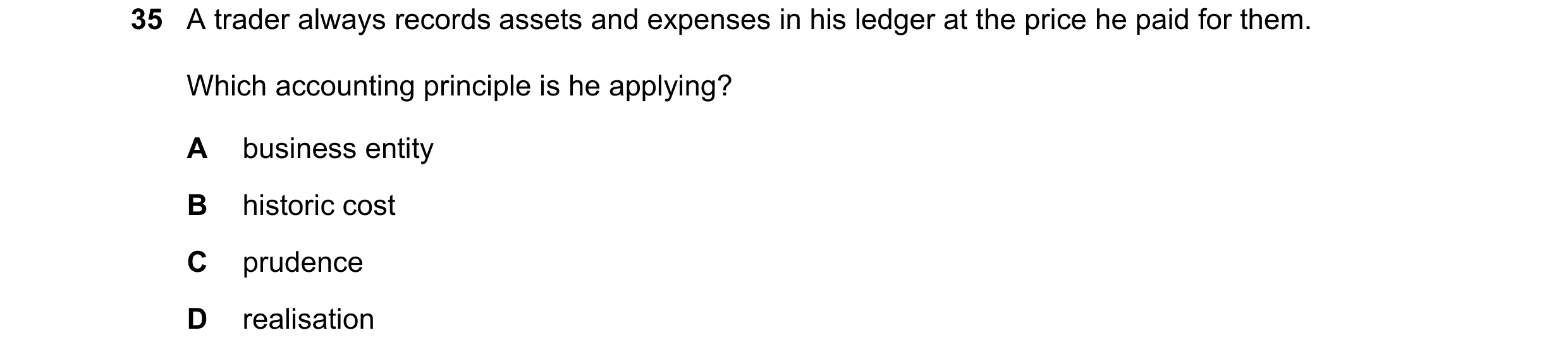
Q62 · A trader always records assets and expenses in his ledger at the price he paid for them 0452/11 May/June 2023
35 A trader always records assets and expenses in his ledger at the price he paid for them. Which accounting principle is he applying? A business entity B historic cost C prudence D realisation
1 marks
Answer: B
This question in 0452/11 May/June 2023
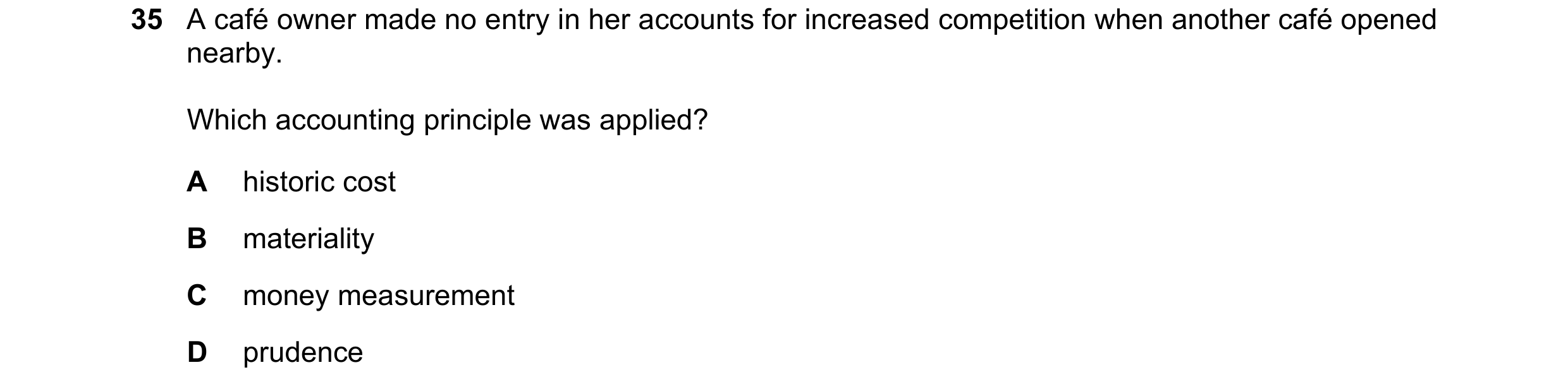
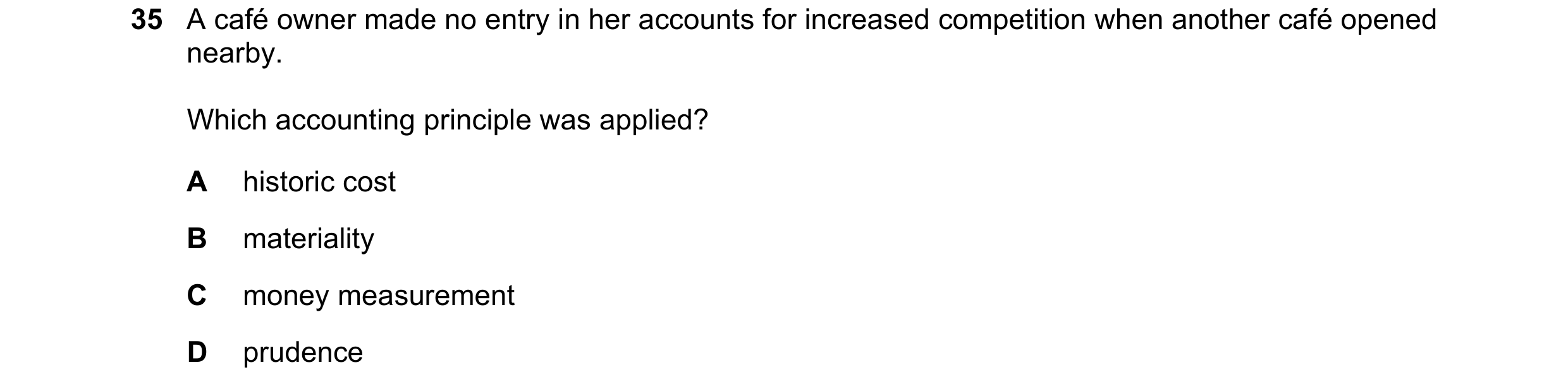
Q63 · A café owner made no entry in her accounts for increased competition when another café… 0452/12 May/June 2023
35 A café owner made no entry in her accounts for increased competition when another café opened nearby. Which accounting principle was applied? A historic cost B materiality C money measurement D prudence
1 marks
Answer: C
This question in 0452/12 May/June 2023
Q64 · A café owner made no entry in her accounts for increased competition when another café… 0452/13 May/June 2023
35 A café owner made no entry in her accounts for increased competition when another café opened nearby. Which accounting principle was applied? A historic cost B materiality C money measurement D prudence
1 marks
Answer: C
This question in 0452/13 May/June 2023
Q65 · What is a reason for charging depreciation on a non-current asset? 0452/11 Oct/Nov 2023
17 What is a reason for charging depreciation on a non-current asset? A to build up a fund of money that can be used to replace the asset B to charge the cost of the asset over the years which benefit from its use C to ensure that profit is not understated in the income statement D to show the asset at its market value in the statement of financial position
1 marks
Answer: B
This question in 0452/11 Oct/Nov 2023
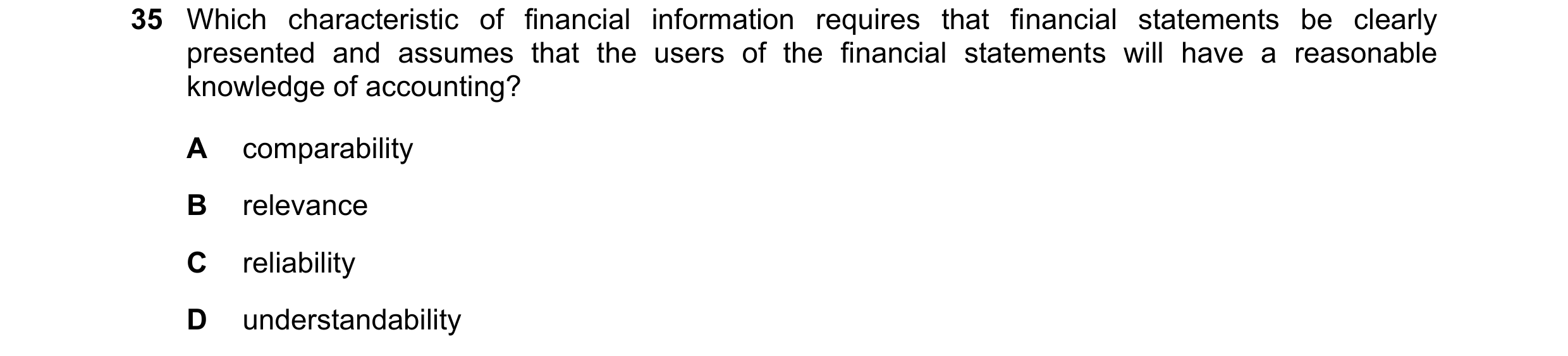
Q66 · Which characteristic of financial information requires that financial statements be… 0452/11 Oct/Nov 2023
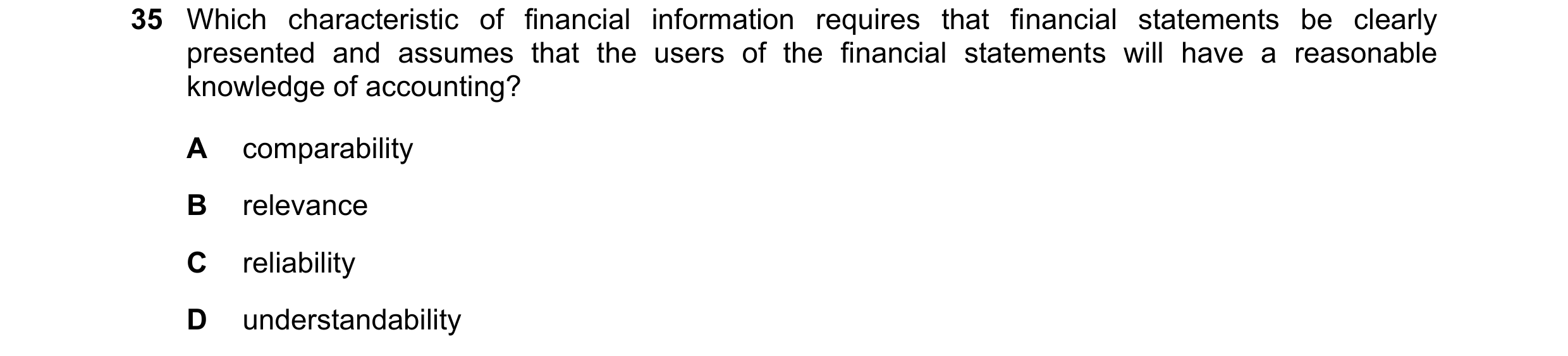
35 Which characteristic of financial information requires that financial statements be clearly presented and assumes that the users of the financial statements will have a reasonable knowledge of accounting? A comparability B relevance C reliability D understandability
1 marks
Answer: D
This question in 0452/11 Oct/Nov 2023
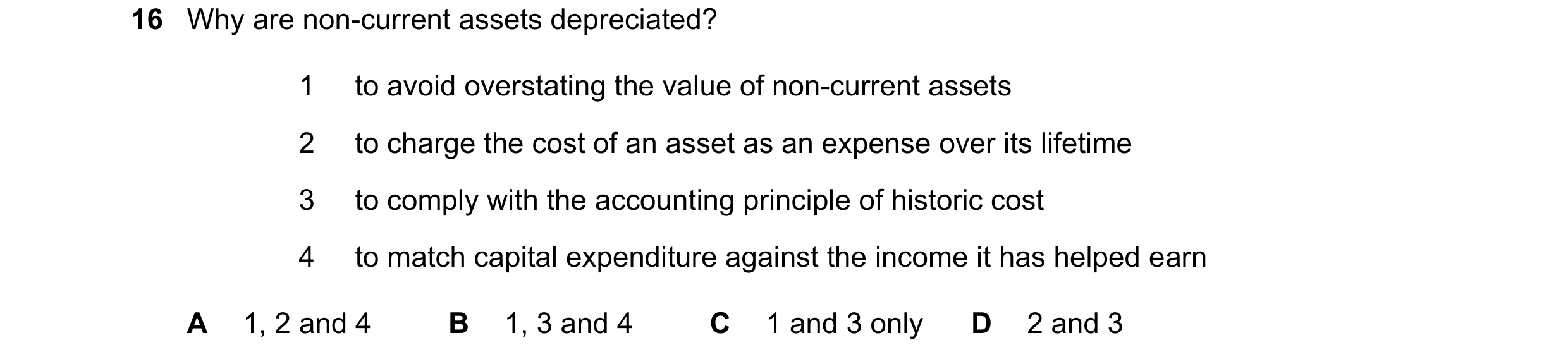
Q67 · Why are non-current assets depreciated? 0452/12 Oct/Nov 2023
16 Why are non-current assets depreciated? 1 to avoid overstating the value of non-current assets 2 to charge the cost of an asset as an expense over its lifetime 3 to comply with the accounting principle of historic cost 4 to match capital expenditure against the income it has helped earn A 1, 2 and 4 B 1, 3 and 4 C 1 and 3 only D 2 and 3
1 marks
Answer: A
This question in 0452/12 Oct/Nov 2023
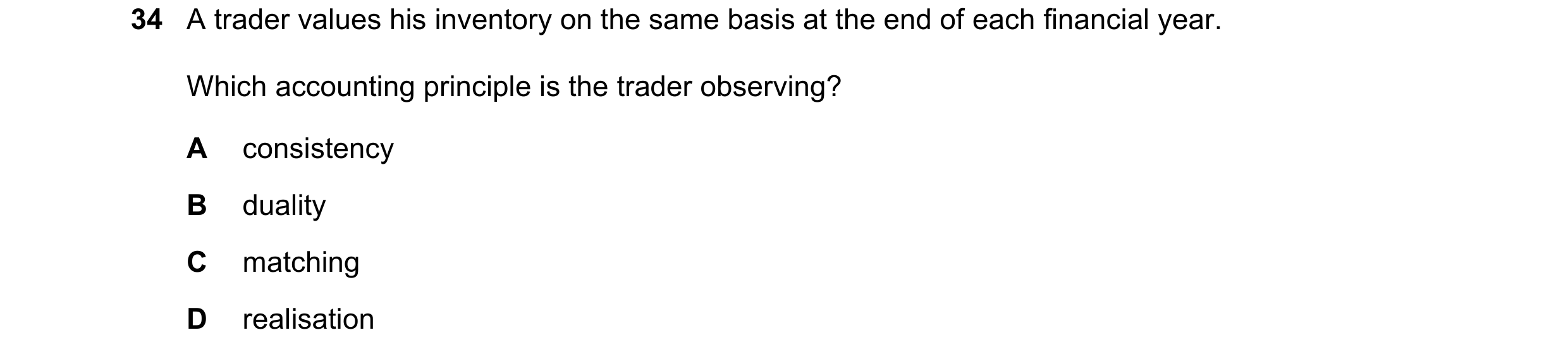
Q68 · A trader values his inventory on the same basis at the end of each financial year 0452/12 Oct/Nov 2023
34 A trader values his inventory on the same basis at the end of each financial year. Which accounting principle is the trader observing? A consistency B duality C matching D realisation
1 marks
Answer: A
This question in 0452/12 Oct/Nov 2023
Q69 · Which characteristic of financial information requires that financial statements be… 0452/13 Oct/Nov 2023
35 Which characteristic of financial information requires that financial statements be clearly presented and assumes that the users of the financial statements will have a reasonable knowledge of accounting? A comparability B relevance C reliability D understandability
1 marks
Answer: D
This question in 0452/13 Oct/Nov 2023
Q70 · Why would a bakery business not include a value for inventory of stationery in the… 0452/12 Feb/March 2024
34 Why would a bakery business not include a value for inventory of stationery in the statement of financial position? A It was to be used in the next few months. B It was purchased regularly and paid for in cash. C It was new and unused. D It was of very low value.
1 marks
Answer: D
This question in 0452/12 Feb/March 2024
Q71 · A trader decides to write off the balance owed by a credit customer as an irrecoverable… 0452/12 Feb/March 2024
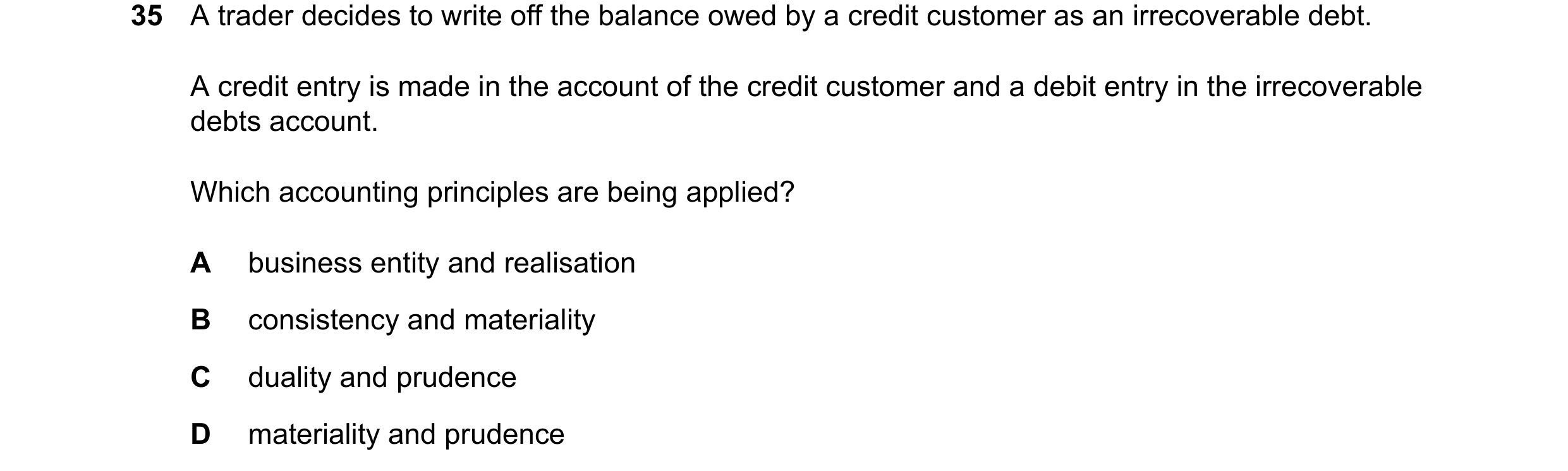
35 A trader decides to write off the balance owed by a credit customer as an irrecoverable debt. A credit entry is made in the account of the credit customer and a debit entry in the irrecoverable debts account. Which accounting principles are being applied? A business entity and realisation B consistency and materiality C duality and prudence D materiality and prudence
1 marks
Answer: C
This question in 0452/12 Feb/March 2024
Q72 · Why is inventory valued at the lower of cost and net realisable value? 0452/11 May/June 2024
18 Why is inventory valued at the lower of cost and net realisable value? A to avoid overstating current assets and sales B to avoid overstating profit and current assets C to avoid understating current assets and sales D to avoid understating profit and current assets
1 marks
Answer: B
This question in 0452/11 May/June 2024
Q73 · William is a trader 0452/11 May/June 2024
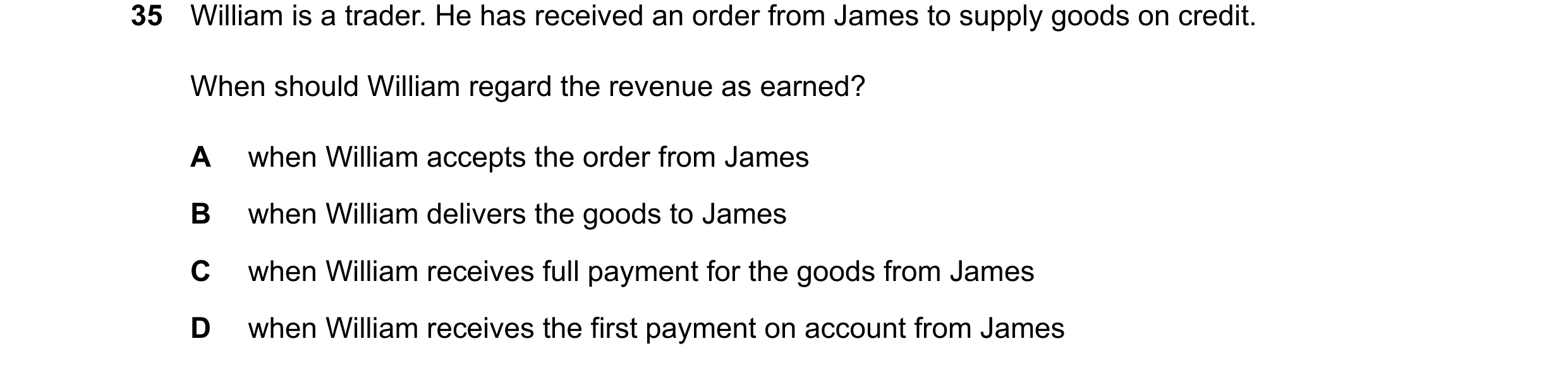
35 William is a trader. He has received an order from James to supply goods on credit. When should William regard the revenue as earned? A when William accepts the order from James B when William delivers the goods to James C when William receives full payment for the goods from James D when William receives the first payment on account from James
1 marks
Answer: B
This question in 0452/11 May/June 2024
Q74 · Why is it important to match costs and revenues? 0452/12 May/June 2024
17 Why is it important to match costs and revenues? A so that every debit entry has a corresponding credit entry B so that the business does not incur any losses C to enable a better comparison of profit from year to year D to ensure that the bank balance is accurate
1 marks
Answer: C
This question in 0452/12 May/June 2024
Q75 · Which statement correctly describes the principle of realisation? 0452/12 May/June 2024
35 Which statement correctly describes the principle of realisation? A Profit is earned when a cheque is received from a customer in payment for goods supplied. B Profit is earned when a cheque received from a customer is paid into the business bank account. C Profit is earned when the goods are supplied, and ownership passes to the customer. D Profit is earned when the customer places an order for the goods.
1 marks
Answer: C
This question in 0452/12 May/June 2024
Q76 · Why is it important to match costs and revenues? 0452/13 May/June 2024
17 Why is it important to match costs and revenues? A so that every debit entry has a corresponding credit entry B so that the business does not incur any losses C to enable a better comparison of profit from year to year D to ensure that the bank balance is accurate
1 marks
Answer: C
This question in 0452/13 May/June 2024
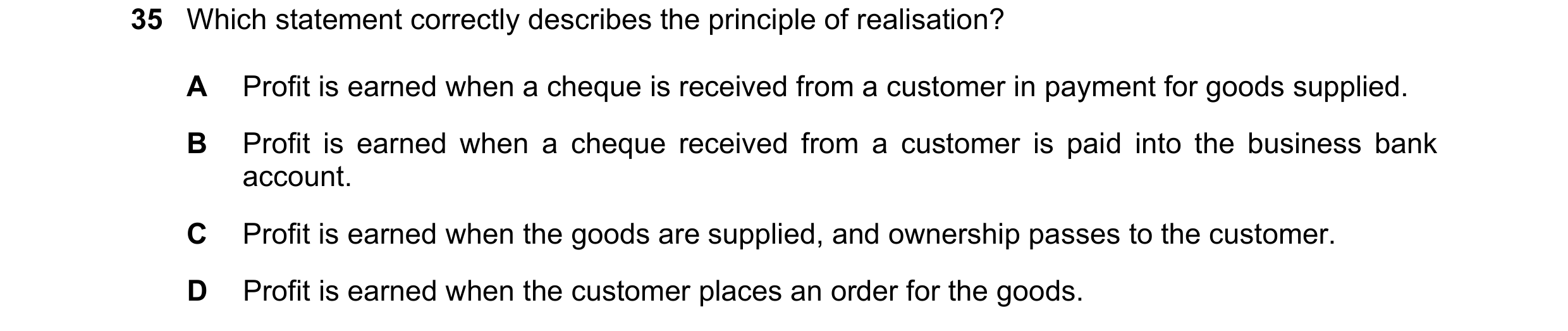
Q77 · Which statement correctly describes the principle of realisation? 0452/13 May/June 2024
35 Which statement correctly describes the principle of realisation? A Profit is earned when a cheque is received from a customer in payment for goods supplied. B Profit is earned when a cheque received from a customer is paid into the business bank account. C Profit is earned when the goods are supplied, and ownership passes to the customer. D Profit is earned when the customer places an order for the goods.
1 marks
Answer: C
This question in 0452/13 May/June 2024
Q78 · Why should a business depreciate its non-current assets? 0452/11 Oct/Nov 2024
17 Why should a business depreciate its non-current assets? A to charge the cost of an asset as an expense in the year of purchase B to ensure that cash is available to replace the non-current assets C to ensure the value of non-current assets is not understated D to match capital expenditure against the revenue it has helped to earn
1 marks
Answer: D
This question in 0452/11 Oct/Nov 2024
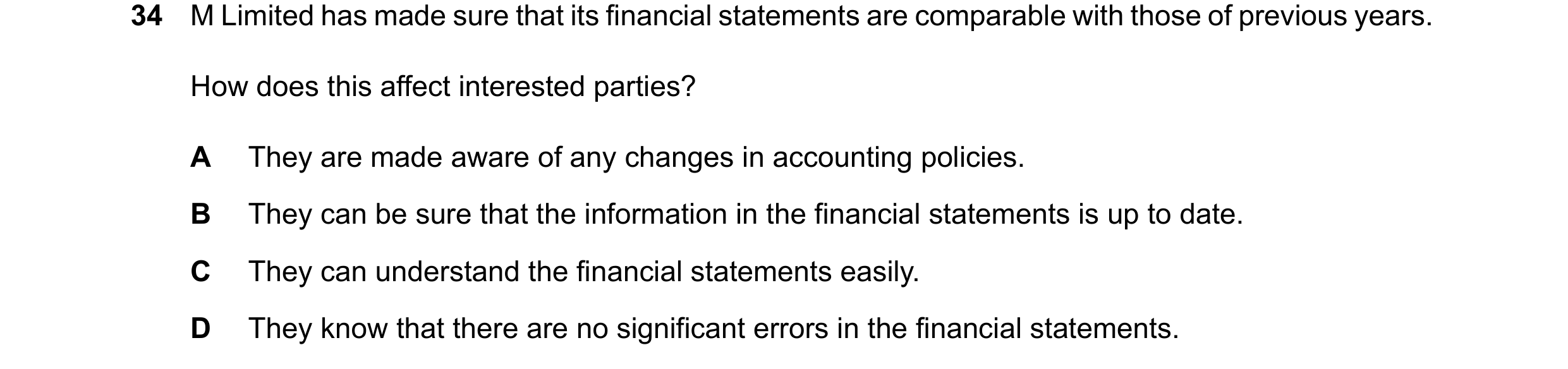
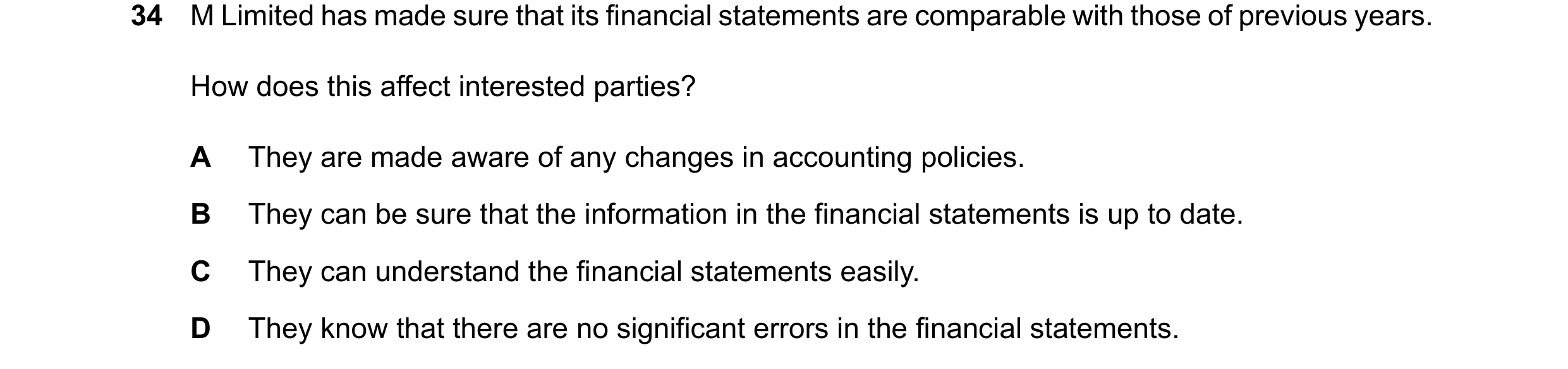
Q79 · M Limited has made sure that its financial statements are comparable with those of… 0452/11 Oct/Nov 2024
34 M Limited has made sure that its financial statements are comparable with those of previous years. How does this affect interested parties? A They are made aware of any changes in accounting policies. B They can be sure that the information in the financial statements is up to date. C They can understand the financial statements easily. D They know that there are no significant errors in the financial statements.
1 marks
Answer: A
This question in 0452/11 Oct/Nov 2024
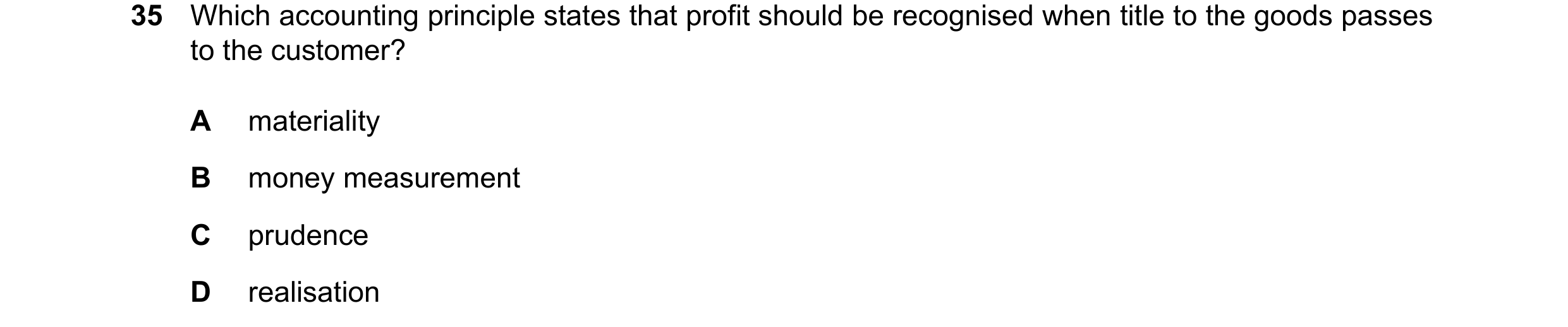
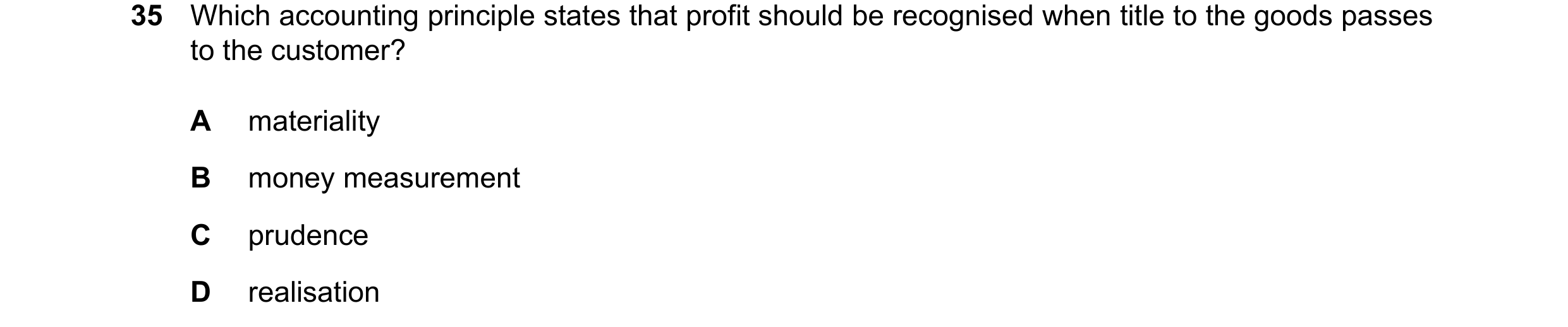
Q80 · Which accounting principle states that profit should be recognised when title to the… 0452/11 Oct/Nov 2024
35 Which accounting principle states that profit should be recognised when title to the goods passes to the customer? A materiality B money measurement C prudence D realisation
1 marks
Answer: D
This question in 0452/11 Oct/Nov 2024
Q81 · Which accounting principle is the accounting equation based on? 0452/12 Oct/Nov 2024
34 Which accounting principle is the accounting equation based on? A duality B going concern C materiality D realisation
1 marks
Answer: A
This question in 0452/12 Oct/Nov 2024
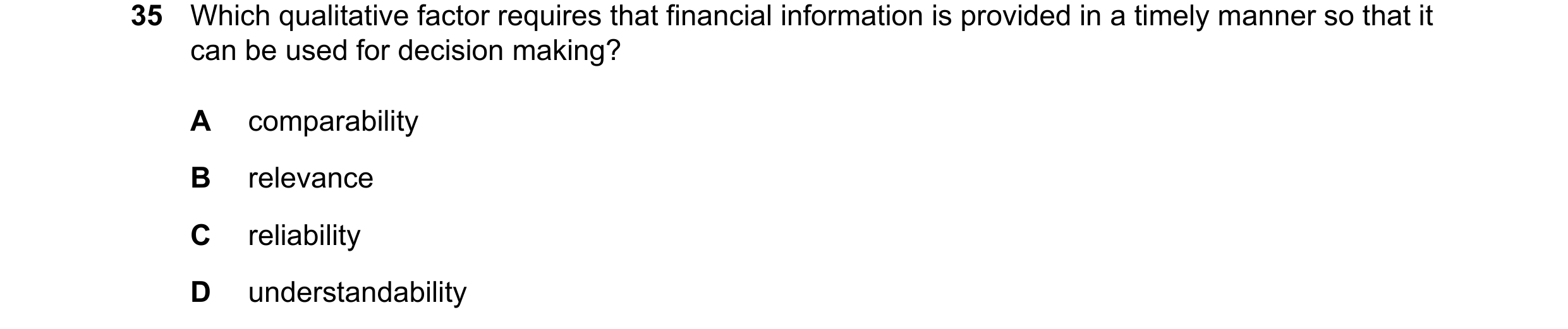
Q82 · Which qualitative factor requires that financial information is provided in a timely… 0452/12 Oct/Nov 2024
35 Which qualitative factor requires that financial information is provided in a timely manner so that it can be used for decision making? A comparability B relevance C reliability D understandability
1 marks
Answer: B
This question in 0452/12 Oct/Nov 2024
Q83 · Why should a business depreciate its non-current assets? 0452/13 Oct/Nov 2024
17 Why should a business depreciate its non-current assets? A to charge the cost of an asset as an expense in the year of purchase B to ensure that cash is available to replace the non-current assets C to ensure the value of non-current assets is not understated D to match capital expenditure against the revenue it has helped to earn
1 marks
Answer: D
This question in 0452/13 Oct/Nov 2024
Q84 · M Limited has made sure that its financial statements are comparable with those of… 0452/13 Oct/Nov 2024
34 M Limited has made sure that its financial statements are comparable with those of previous years. How does this affect interested parties? A They are made aware of any changes in accounting policies. B They can be sure that the information in the financial statements is up to date. C They can understand the financial statements easily. D They know that there are no significant errors in the financial statements.
1 marks
Answer: A
This question in 0452/13 Oct/Nov 2024
Q85 · Which accounting principle states that profit should be recognised when title to the… 0452/13 Oct/Nov 2024
35 Which accounting principle states that profit should be recognised when title to the goods passes to the customer? A materiality B money measurement C prudence D realisation
1 marks
Answer: D
This question in 0452/13 Oct/Nov 2024
Q86 · The end-of-year inventories held by a sports shop are shown in the table 0452/12 Feb/March 2025
20 The end-of-year inventories held by a sports shop are shown in the table. cost net realisable value $ $ football kits 250 230 tracksuits 210 240 football boots 160 200 Which inventory value is shown in the statement of financial position? A $600 B $620 C $630 D $670
1 marks
Answer: A
This question in 0452/12 Feb/March 2025
Q87 · When does a business recognise the income from a sale of goods on credit? 0452/12 Feb/March 2025
35 When does a business recognise the income from a sale of goods on credit? A when a cheque is received from the customer in payment for the goods B when a cheque received is paid into the business bank account C when the goods are delivered to the customer D when the goods are ordered by the customer
1 marks
Answer: C
This question in 0452/12 Feb/March 2025
Q88 · How should a business value its inventory? 0452/11 May/June 2025
18 How should a business value its inventory? A at the higher of cost and net realisable value B at the lower of cost and net realisable value C at the higher of selling price and cost D at the lower of cost and net book value
1 marks
Answer: B
This question in 0452/11 May/June 2025
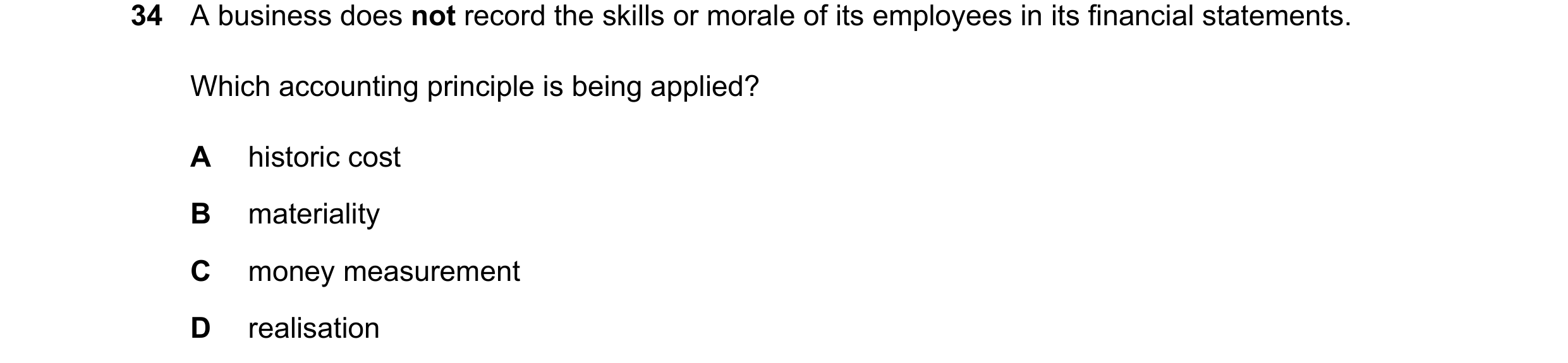
Q89 · A business does not record the skills or morale of its employees in its financial… 0452/11 May/June 2025
34 A business does not record the skills or morale of its employees in its financial statements. Which accounting principle is being applied? A historic cost B materiality C money measurement D realisation
1 marks
Answer: C
This question in 0452/11 May/June 2025
Q90 · What does the objective of understandability assume users of financial statements will… 0452/11 May/June 2025
35 What does the objective of understandability assume users of financial statements will possess? A full knowledge of accounting B knowledge of book-keeping but not accounting C no knowledge of book-keeping or accounting D reasonable knowledge of accounting
1 marks
Answer: D
This question in 0452/11 May/June 2025
Q91 · Vikram wanted to apply the principle of consistency when accounting for the use of his… 0452/12 May/June 2025
34 Vikram wanted to apply the principle of consistency when accounting for the use of his delivery van. What did this require? A making the same number of deliveries each year B paying the same amount for repairs each year C providing the same amount of depreciation each year D using the same method of depreciation each year
1 marks
Answer: D
This question in 0452/12 May/June 2025
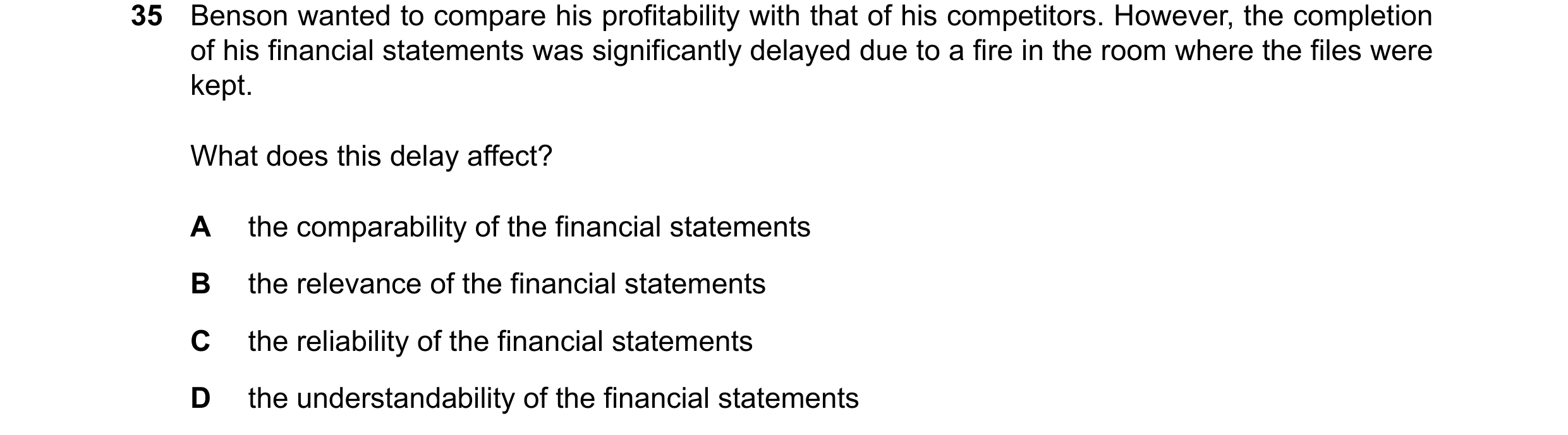
Q92 · Benson wanted to compare his profitability with that of his competitors 0452/12 May/June 2025
35 Benson wanted to compare his profitability with that of his competitors. However, the completion of his financial statements was significantly delayed due to a fire in the room where the files were kept. What does this delay affect? A the comparability of the financial statements B the relevance of the financial statements C the reliability of the financial statements D the understandability of the financial statements
1 marks
Answer: B
This question in 0452/12 May/June 2025
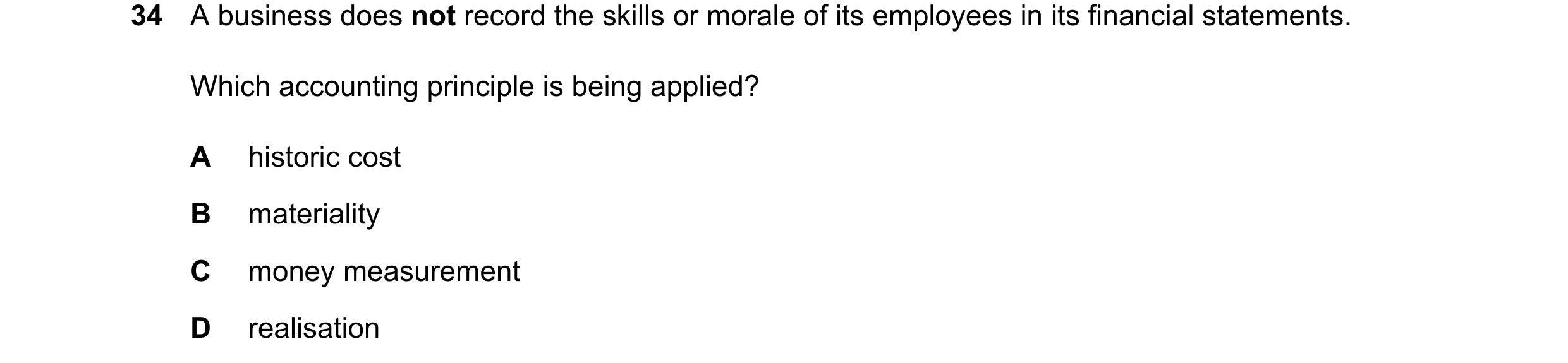
Q93 · A business does not record the skills or morale of its employees in its financial… 0452/13 May/June 2025
34 A business does not record the skills or morale of its employees in its financial statements. Which accounting principle is being applied? A historic cost B materiality C money measurement D realisation
1 marks
Answer: C
This question in 0452/13 May/June 2025
Q94 · What does the objective of understandability assume users of financial statements will… 0452/13 May/June 2025
35 What does the objective of understandability assume users of financial statements will possess? A full knowledge of accounting B knowledge of book-keeping but not accounting C no knowledge of book-keeping or accounting D reasonable knowledge of accounting
1 marks
Answer: D
This question in 0452/13 May/June 2025
Q95 · Why should prepaid income be shown in the financial statements of a business? 0452/12 Oct/Nov 2025
18 Why should prepaid income be shown in the financial statements of a business? A so that credit customers pay the correct amount B so that payments to credit suppliers are correctly recorded C so that the statement of financial position shows the correct current assets D so that the total income is matched against the total costs of the same period
1 marks
Answer: D
This question in 0452/12 Oct/Nov 2025
Q96 · Antionette decides to treat a calculator bought for her large business as an expense… 0452/12 Oct/Nov 2025
35 Antionette decides to treat a calculator bought for her large business as an expense instead of as a non-current asset even though it will be used for several years. Which principle did Antionette apply in deciding to account for the calculator as an expense? A duality B historic cost C materiality D money measurement
1 marks
Answer: C
This question in 0452/12 Oct/Nov 2025
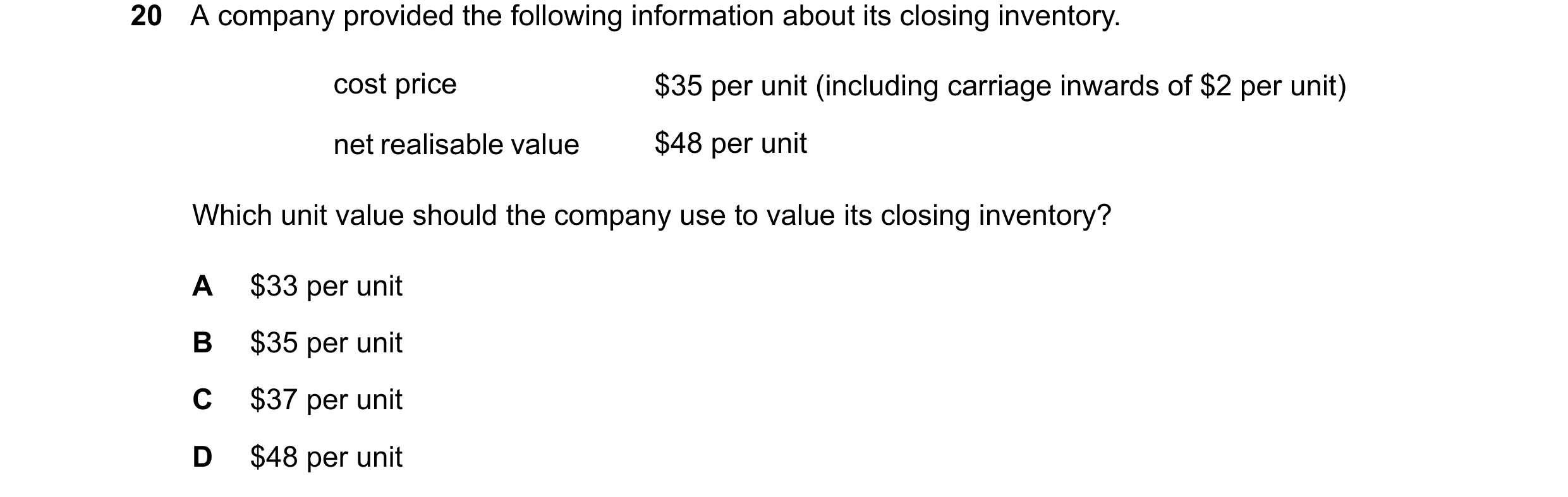
Q97 · A company provided the following information about its closing inventory 0452/13 Oct/Nov 2025
20 A company provided the following information about its closing inventory. cost price $35 per unit (including carriage inwards of $2 per unit) net realisable value $48 per unit Which unit value should the company use to value its closing inventory? A $33 per unit B $35 per unit C $37 per unit D $48 per unit
1 marks
Answer: B
This question in 0452/13 Oct/Nov 2025
Q98 · Which action is an application of the materiality principle? 0452/13 Oct/Nov 2025
34 Which action is an application of the materiality principle? A always using the straight-line method when depreciating assets B buying raw materials on credit rather than paying immediately C charging the cost of light bulbs and batteries to general expenses D recording goods sold only when their legal title passes to the buyer
1 marks
Answer: C
This question in 0452/13 Oct/Nov 2025
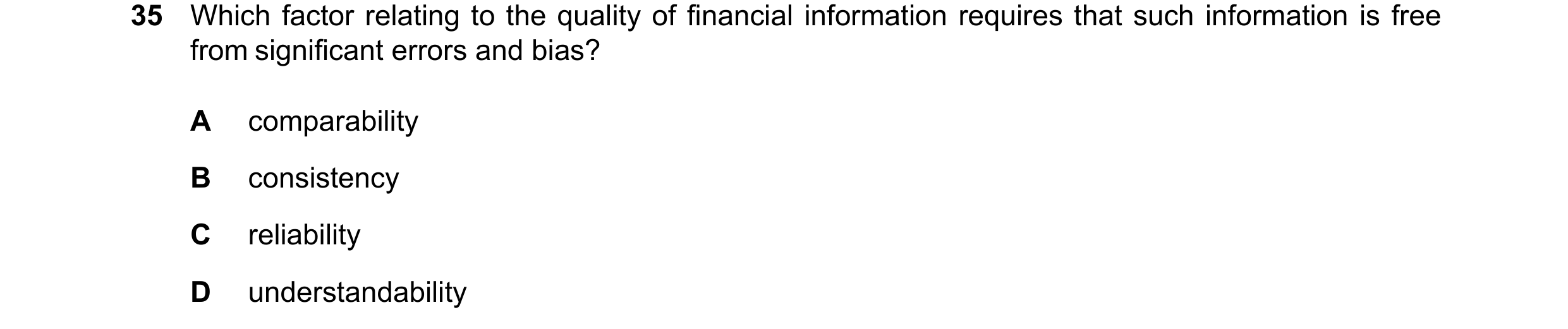
Q99 · Which factor relating to the quality of financial information requires that such… 0452/13 Oct/Nov 2025
35 Which factor relating to the quality of financial information requires that such information is free from significant errors and bias? A comparability B consistency C reliability D understandability
1 marks
Answer: C
This question in 0452/13 Oct/Nov 2025



 1 / 20
 2 / 20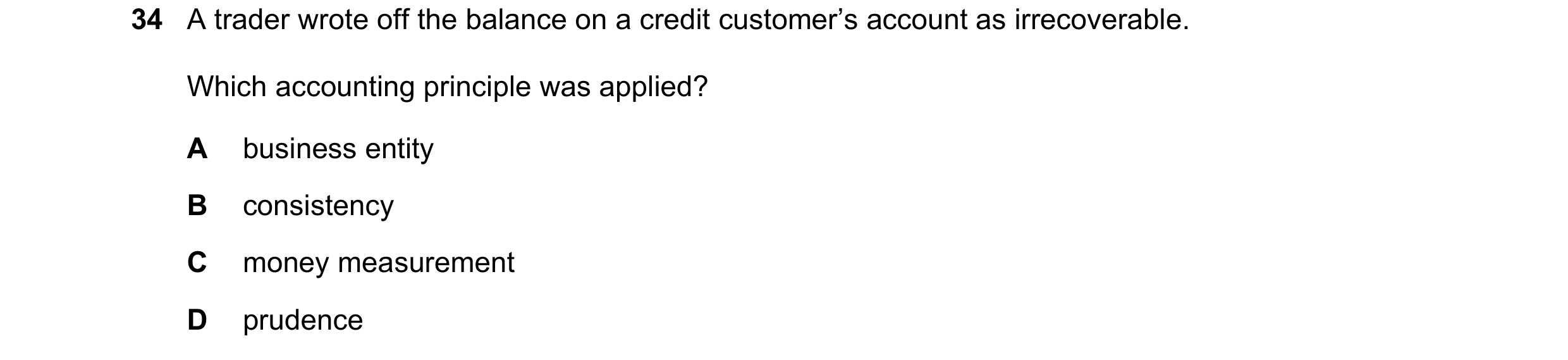
 3 / 20
 4 / 20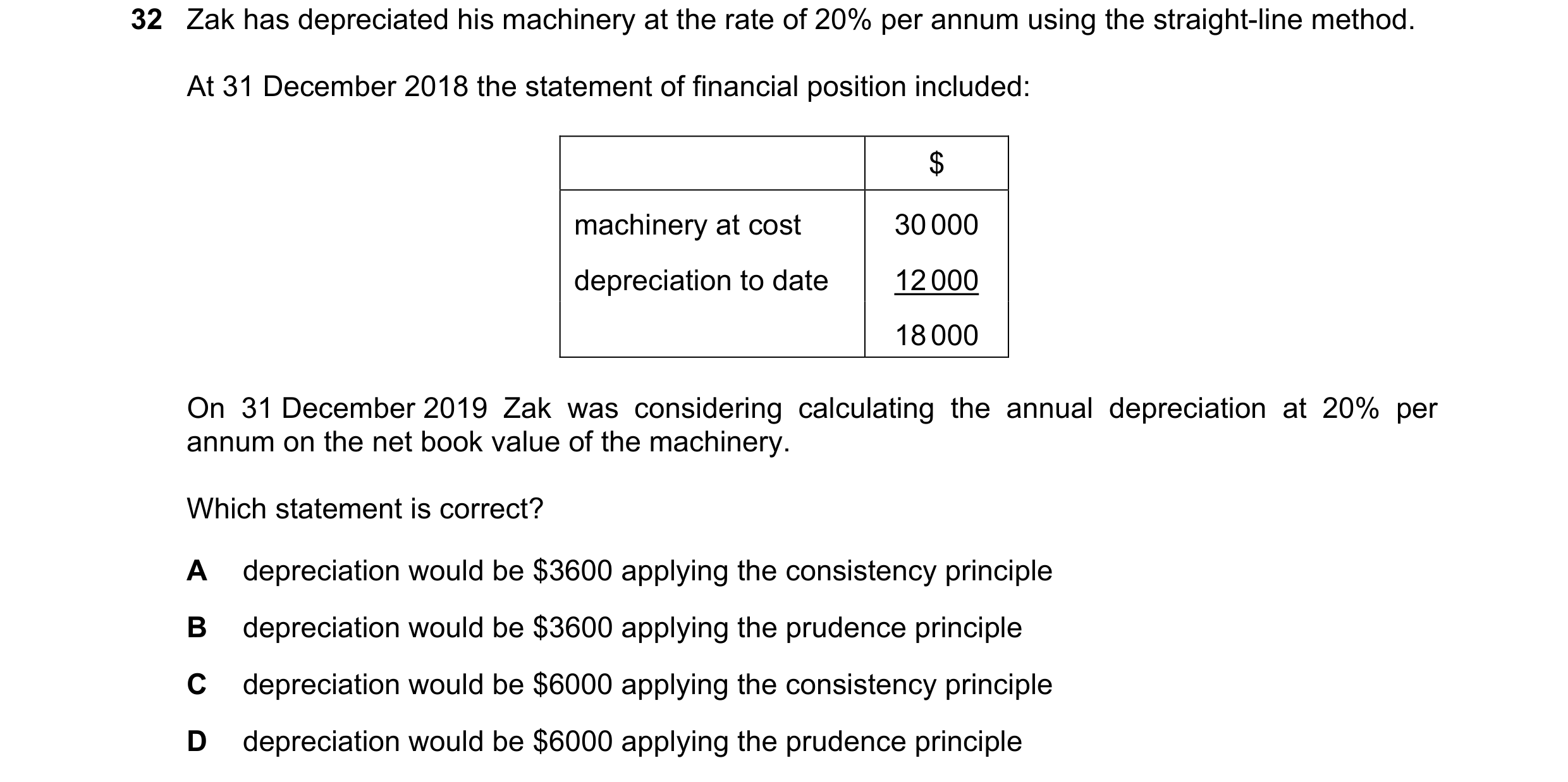
 5 / 20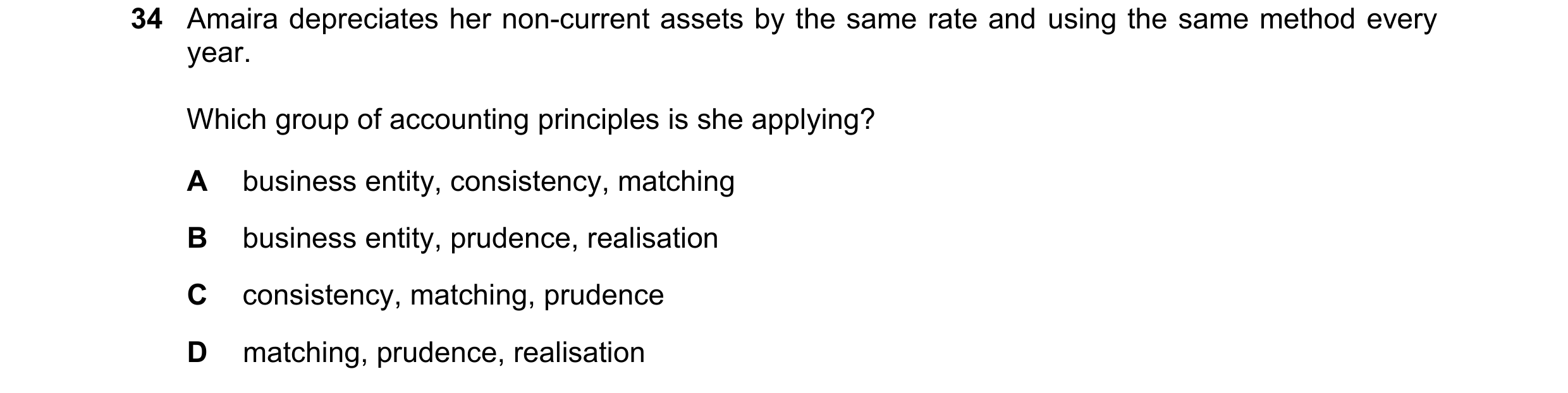



 6 / 20

 7 / 20

 8 / 20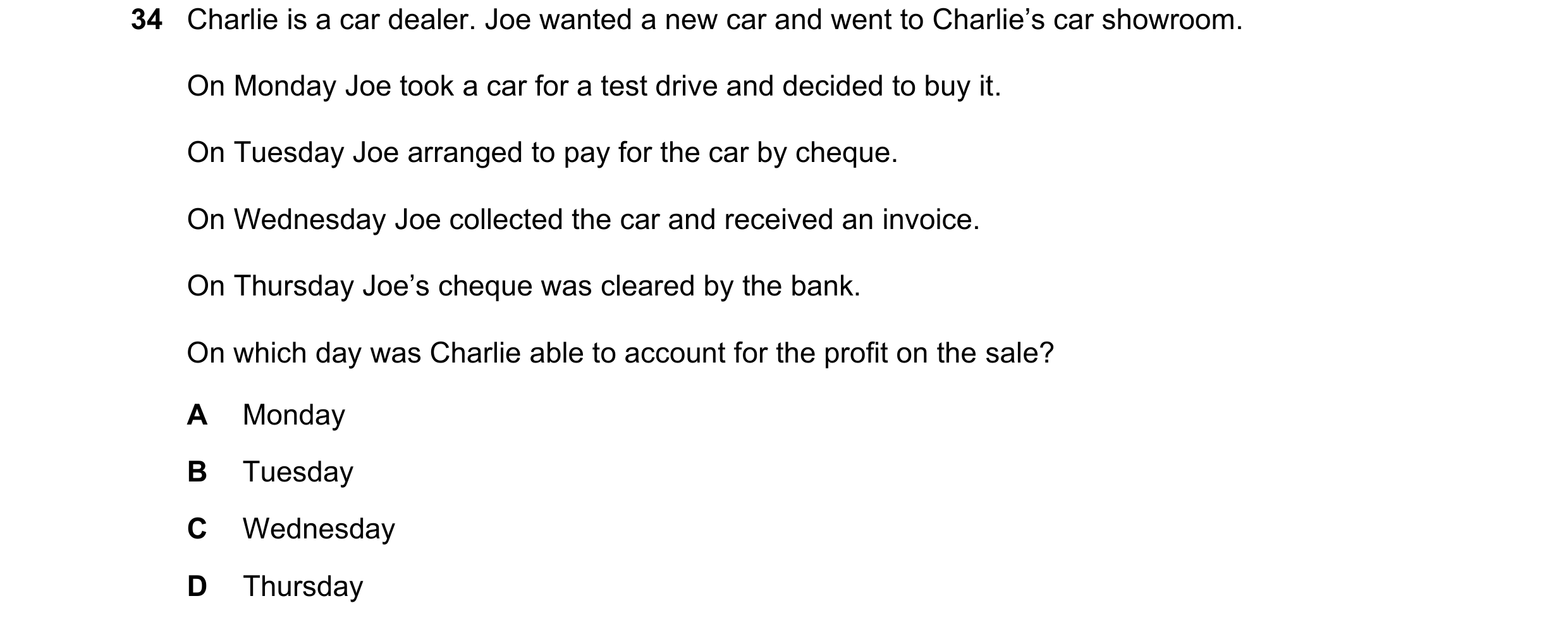

 9 / 20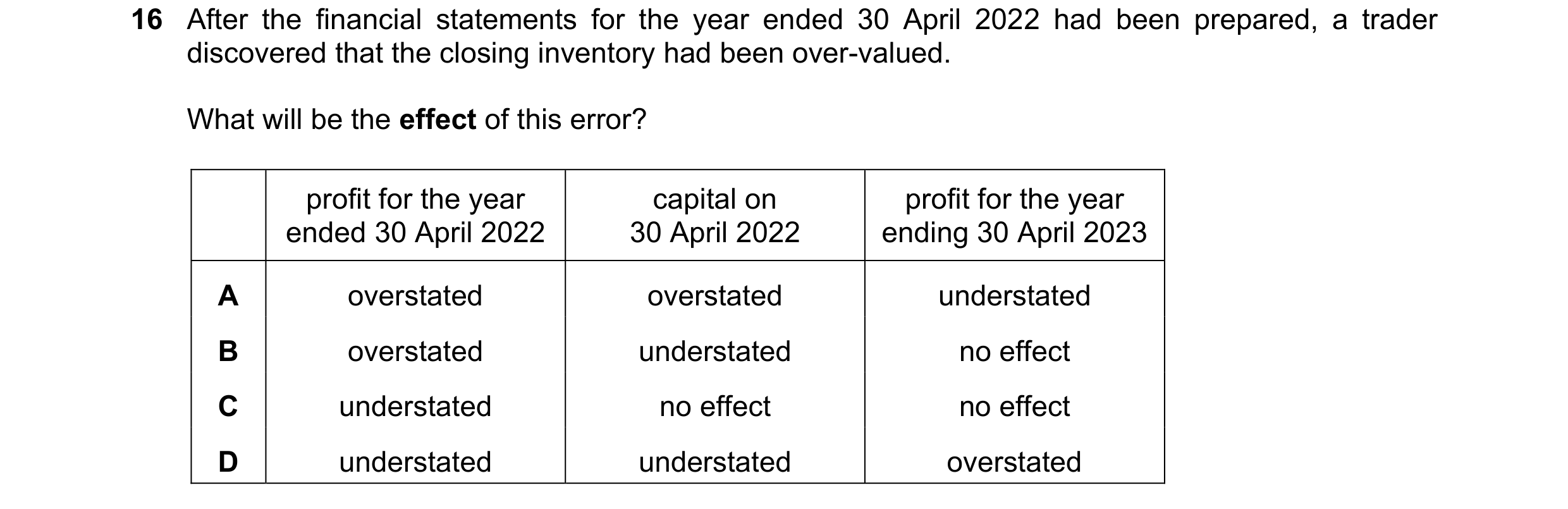
 10 / 20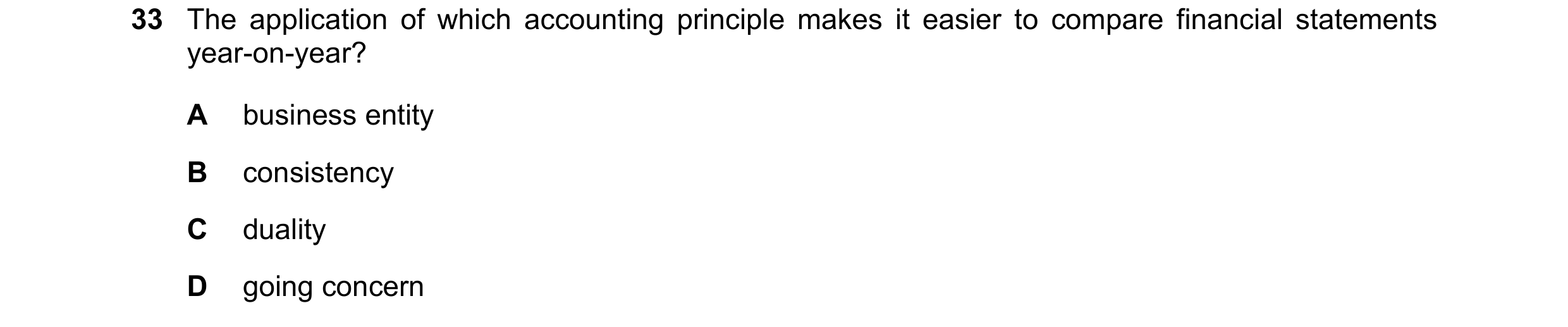



 11 / 20


 12 / 20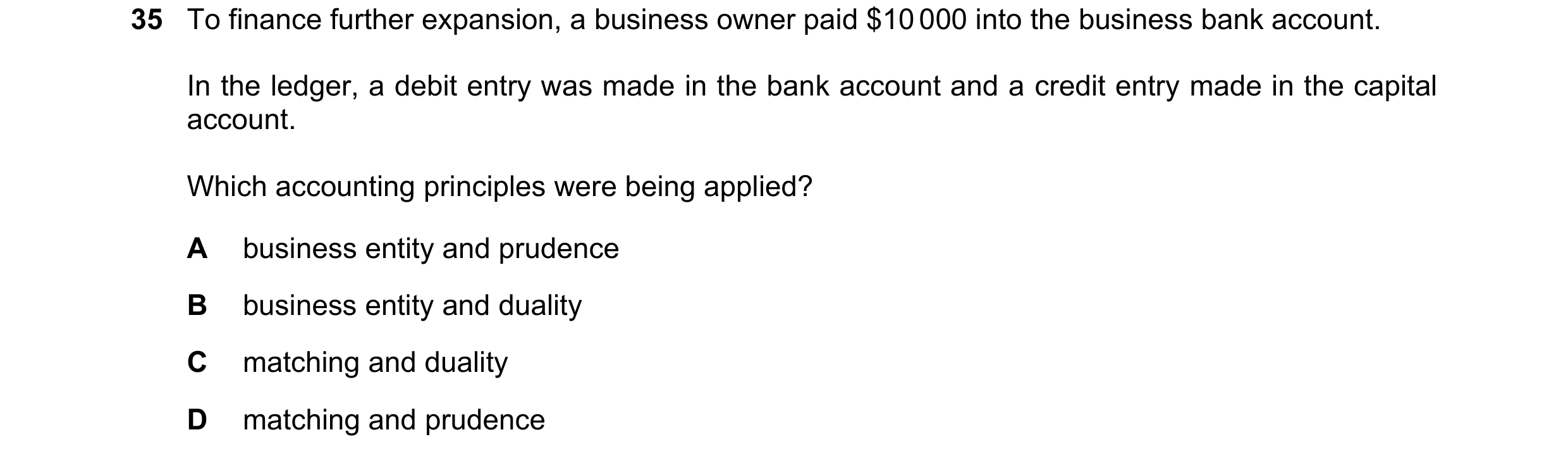
 13 / 20
 14 / 20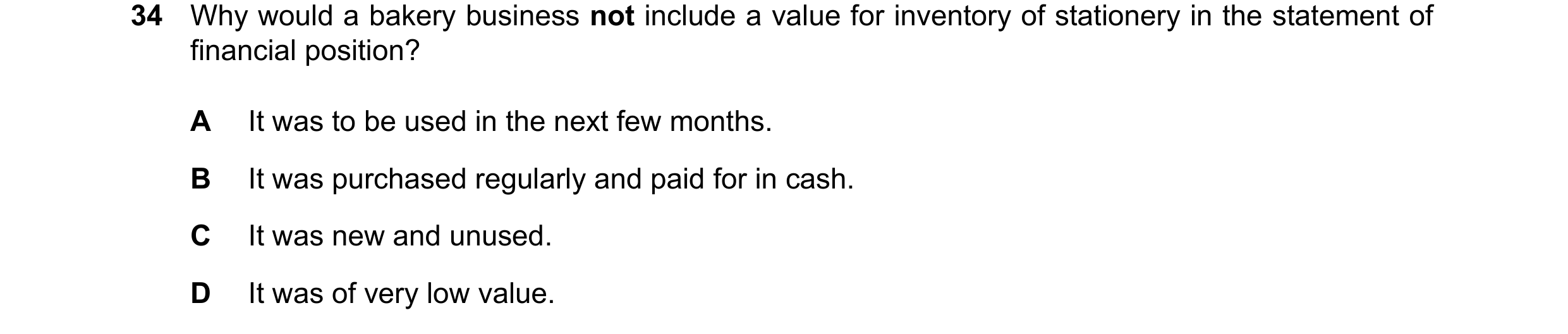

 15 / 20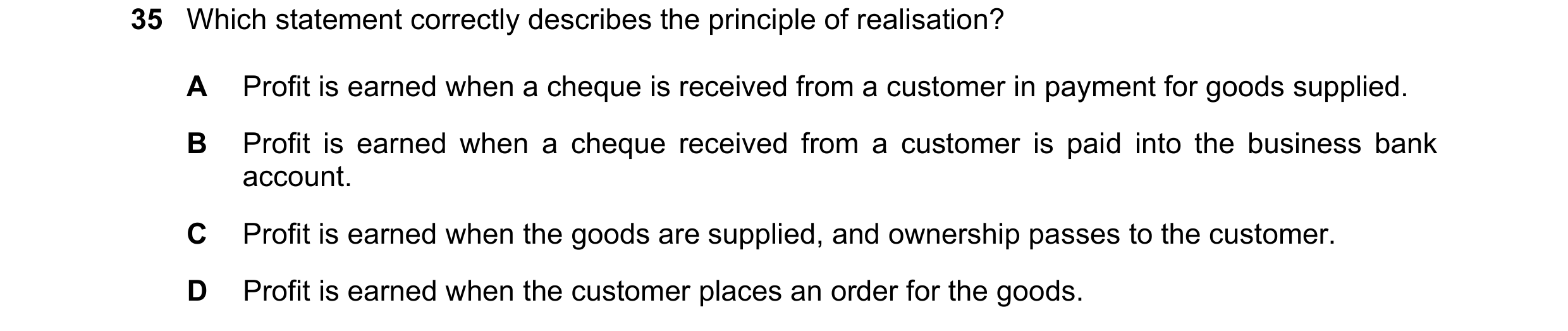


 16 / 20

 17 / 20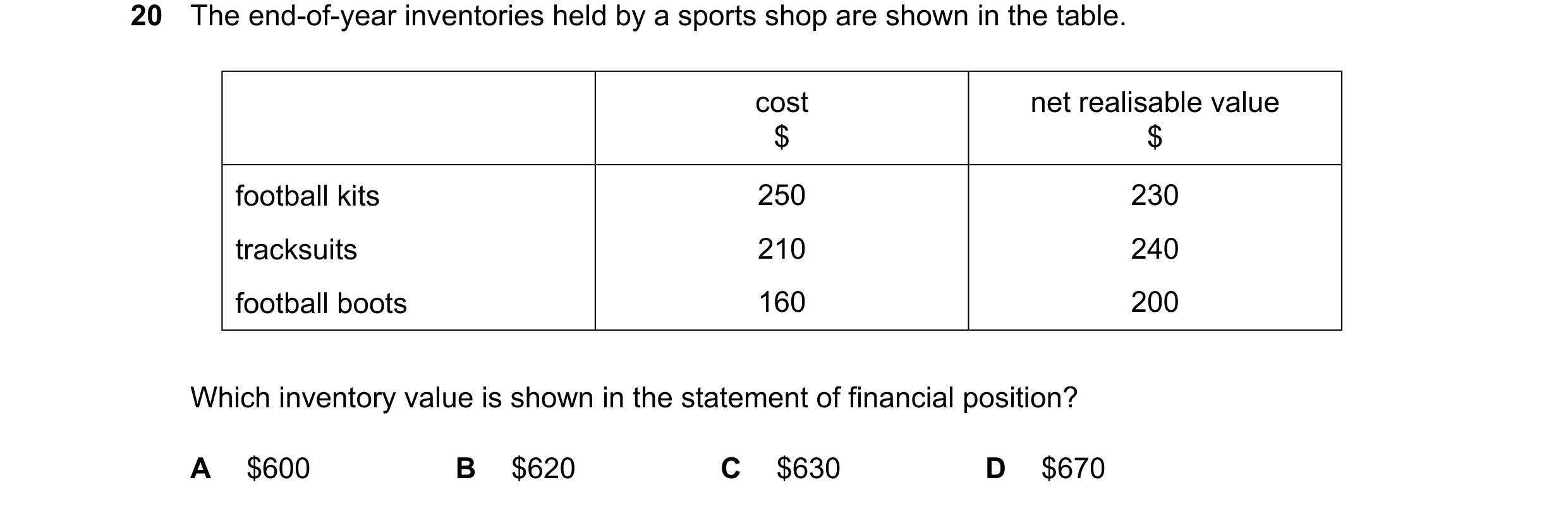


 18 / 20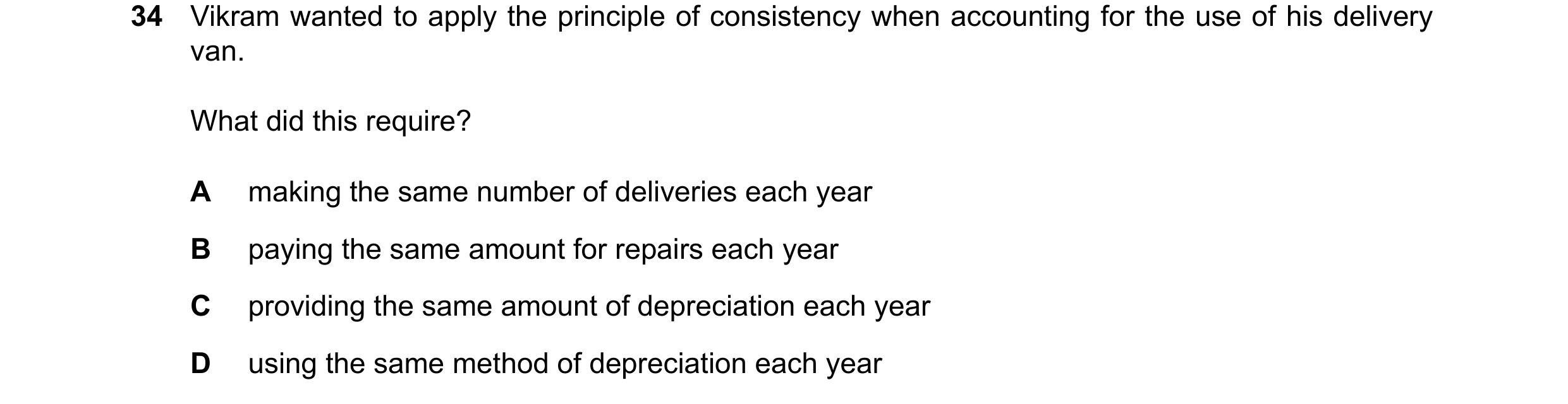

 19 / 20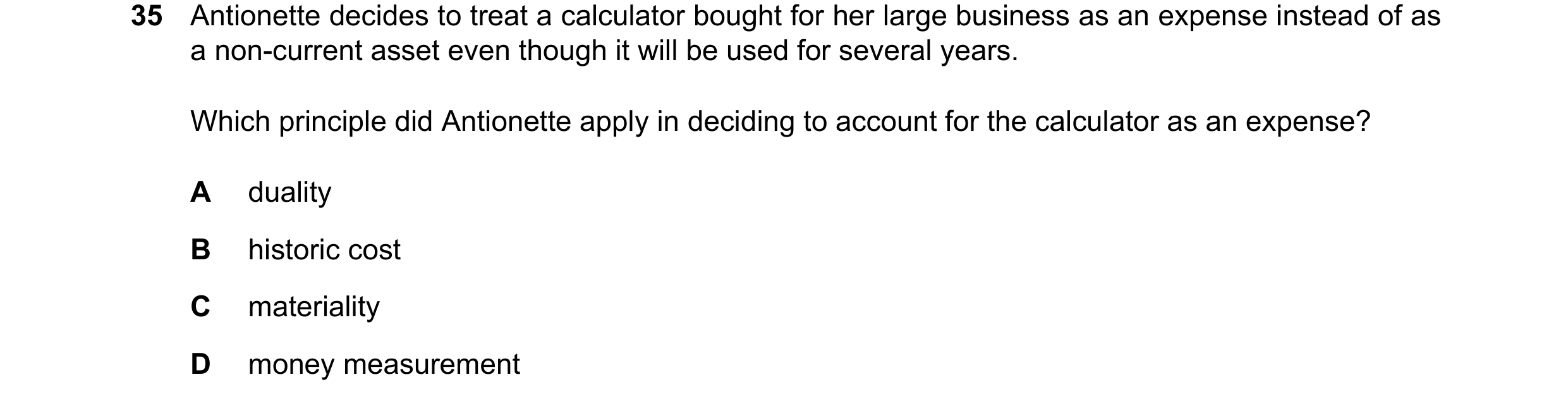

 20 / 20