Cambridge IGCSE Accounting 0452 — 2020 Feb/March Paper 1 · Variant 2
0452/12/F/M/20 · 35 questions · 35 marks · ≈39 min
The question paper and its mark scheme, free to read here and free to download. This is Cambridge’s own paper, exactly as it was sat.
Question paper12 pages
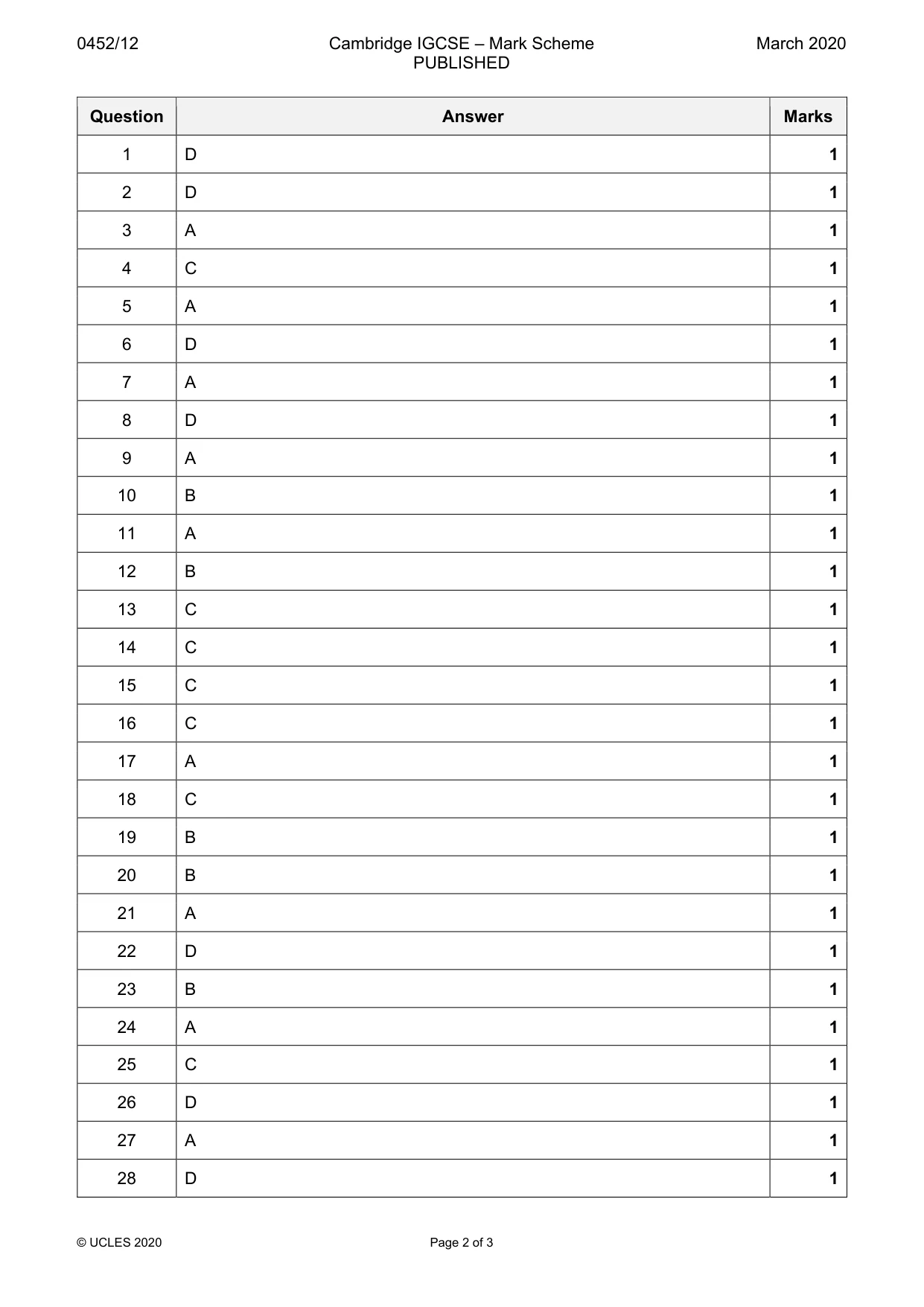
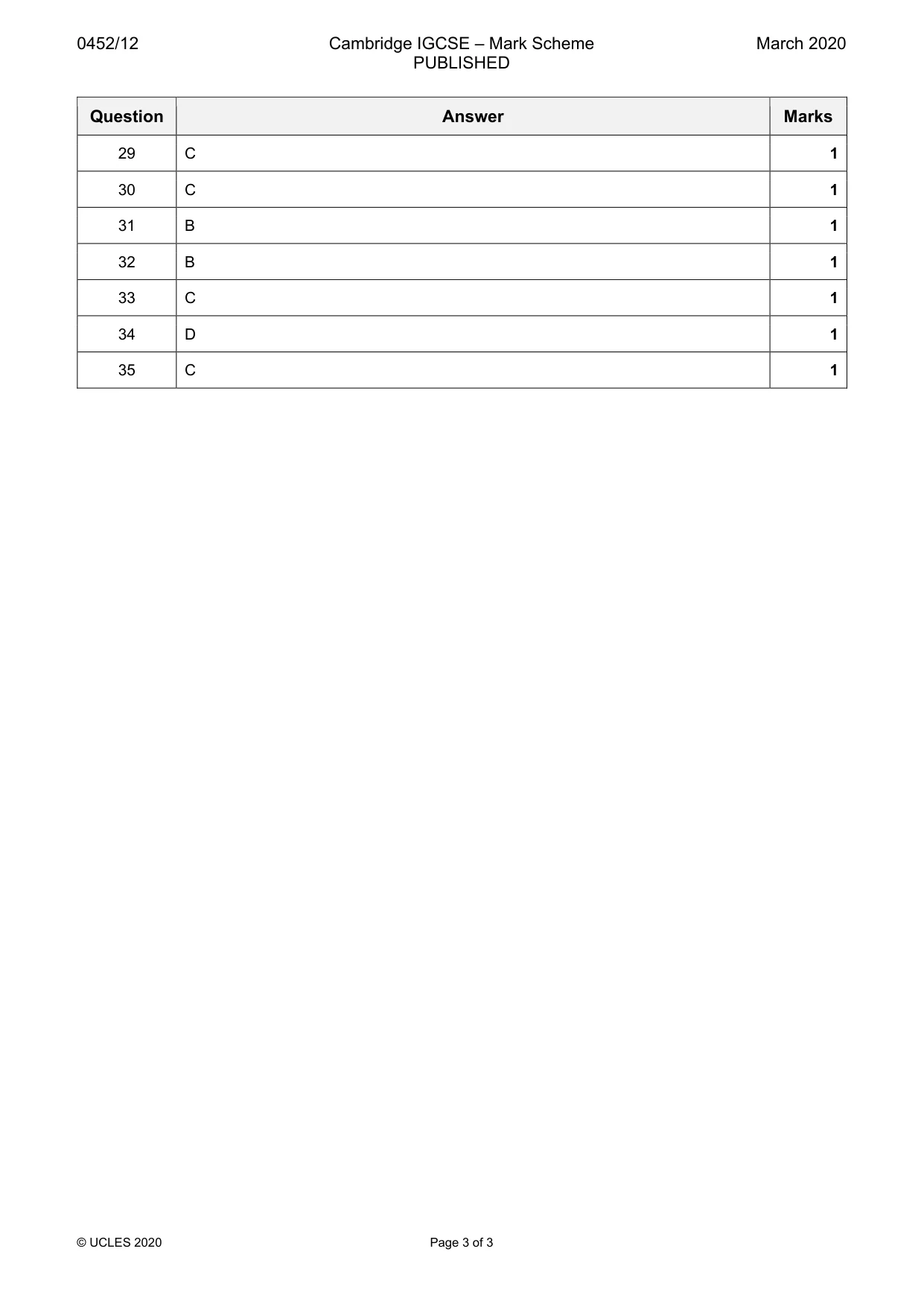
Mark scheme3 pages
Answers below. Sit the paper first if you are practising.
Questions as text
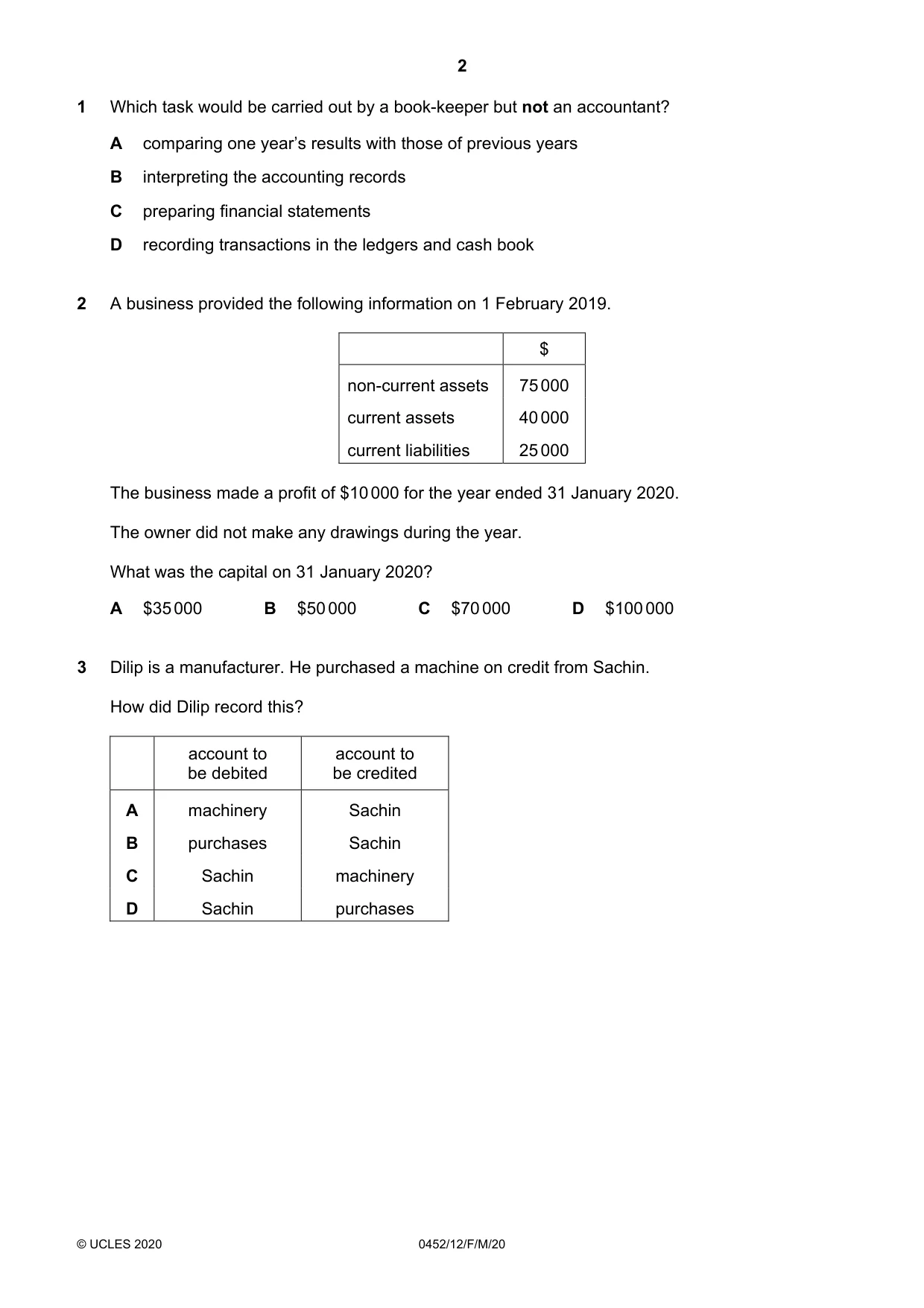
Q1 · Which task would be carried out by a book-keeper but not an accountant?
1 Which task would be carried out by a book-keeper but not an accountant? A comparing one year’s results with those of previous years B interpreting the accounting records C preparing financial statements D recording transactions in the ledgers and cash book
Mark scheme: D
Q2 · A business provided the following information on 1 February 2019
2 A business provided the following information on 1 February 2019. $ non-current assets 75 000 current assets 40 000 current liabilities 25 000 The business made a profit of $10 000 for the year ended 31 January 2020. The owner did not make any drawings during the year. What was the capital on 31 January 2020? A $35 000 B $50 000 C $70 000 D $100 000
Mark scheme: D
Q3 · Dilip is a manufacturer
3 Dilip is a manufacturer. He purchased a machine on credit from Sachin. How did Dilip record this? account to account to be debited be credited A machinery Sachin B purchases Sachin C Sachin machinery D Sachin purchases
Mark scheme: A
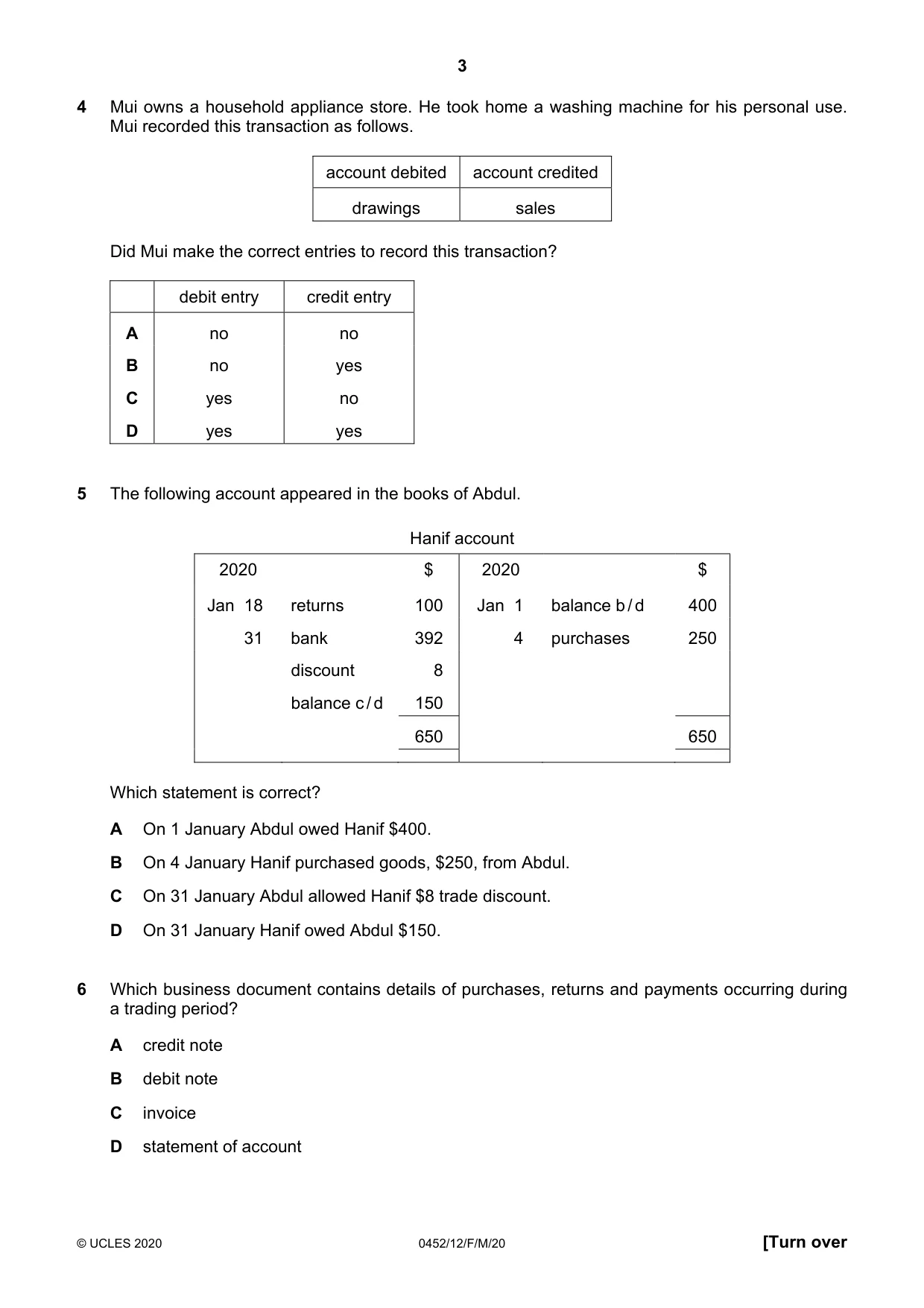
Q4 · Mui owns a household appliance store
4 Mui owns a household appliance store. He took home a washing machine for his personal use. Mui recorded this transaction as follows. account debited account credited drawings sales Did Mui make the correct entries to record this transaction? debit entry credit entry A no no B no yes C yes no D yes yes
Mark scheme: C
Q5 · The following account appeared in the books of Abdul
5 The following account appeared in the books of Abdul. Hanif account 2020 $ 2020 $ Jan 18 returns 100 Jan 1 balance b / d 400 31 bank 392 4 purchases 250 discount 8 balance c / d 150 650 650 Which statement is correct? A On 1 January Abdul owed Hanif $400. B On 4 January Hanif purchased goods, $250, from Abdul. C On 31 January Abdul allowed Hanif $8 trade discount. D On 31 January Hanif owed Abdul $150.
Mark scheme: A
Q6 · Which business document contains details of purchases, returns and payments occurring…
6 Which business document contains details of purchases, returns and payments occurring during a trading period? A credit note B debit note C invoice D statement of account
Mark scheme: D
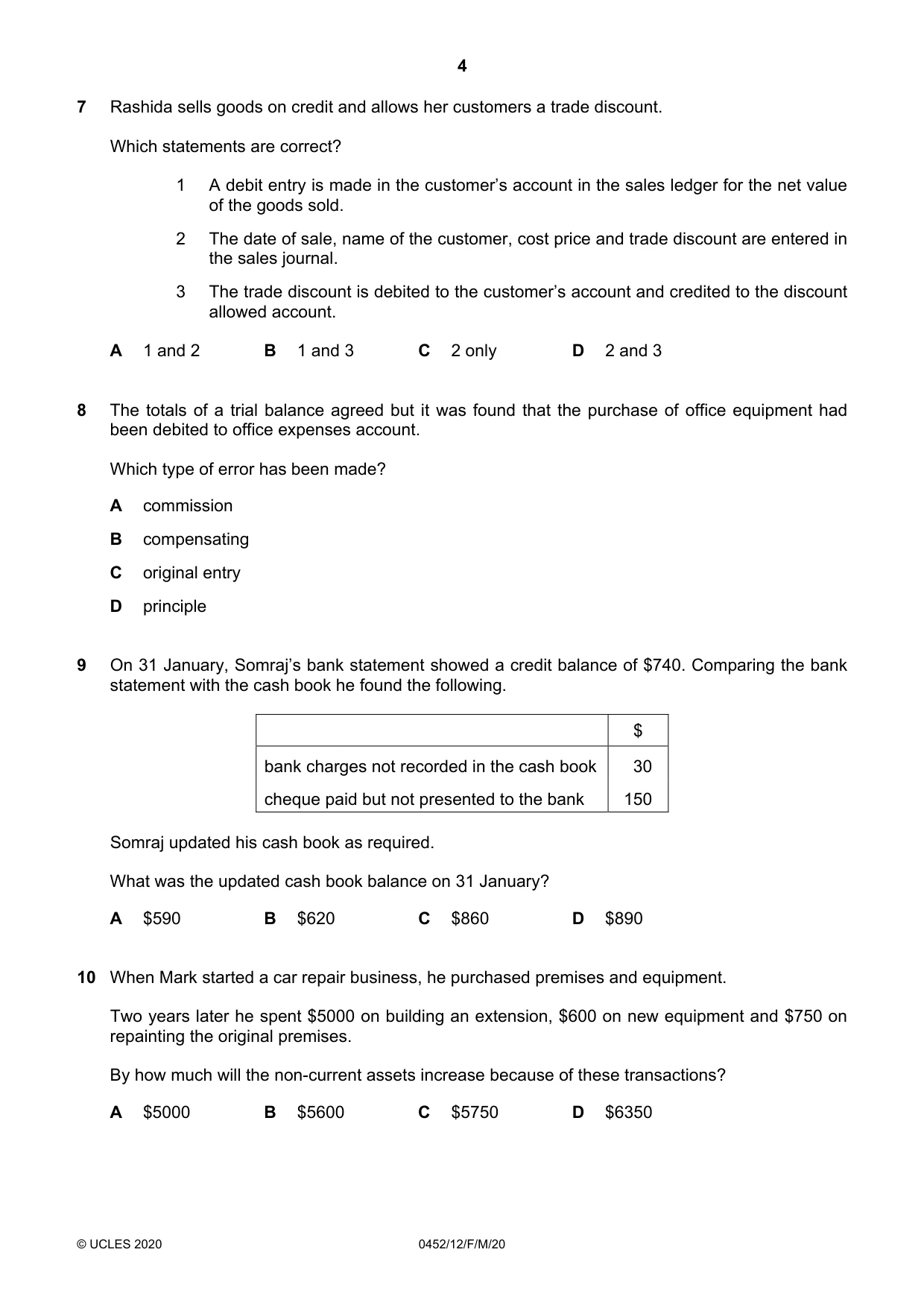
Q7 · Rashida sells goods on credit and allows her customers a trade discount
7 Rashida sells goods on credit and allows her customers a trade discount. Which statements are correct? 1 A debit entry is made in the customer’s account in the sales ledger for the net value of the goods sold. 2 The date of sale, name of the customer, cost price and trade discount are entered in the sales journal. 3 The trade discount is debited to the customer’s account and credited to the discount allowed account. A 1 and 2 B 1 and 3 C 2 only D 2 and 3
Mark scheme: A
Q8 · The totals of a trial balance agreed but it was found that the purchase of office…
8 The totals of a trial balance agreed but it was found that the purchase of office equipment had been debited to office expenses account. Which type of error has been made? A commission B compensating C original entry D principle
Mark scheme: D
Q9 · On 31 January, Somraj’s bank statement showed a credit balance of $740
9 On 31 January, Somraj’s bank statement showed a credit balance of $740. Comparing the bank statement with the cash book he found the following. $ bank charges not recorded in the cash book 30 cheque paid but not presented to the bank 150 Somraj updated his cash book as required. What was the updated cash book balance on 31 January? A $590 B $620 C $860 D $890
Mark scheme: A
Q10 · When Mark started a car repair business, he purchased premises and equipment
10 When Mark started a car repair business, he purchased premises and equipment. Two years later he spent $5000 on building an extension, $600 on new equipment and $750 on repainting the original premises. By how much will the non-current assets increase because of these transactions? A $5000 B $5600 C $5750 D $6350
Mark scheme: B
More questions on Capital and revenue expenditure and receipts
Q11 · A farmer sold a piece of land at market value
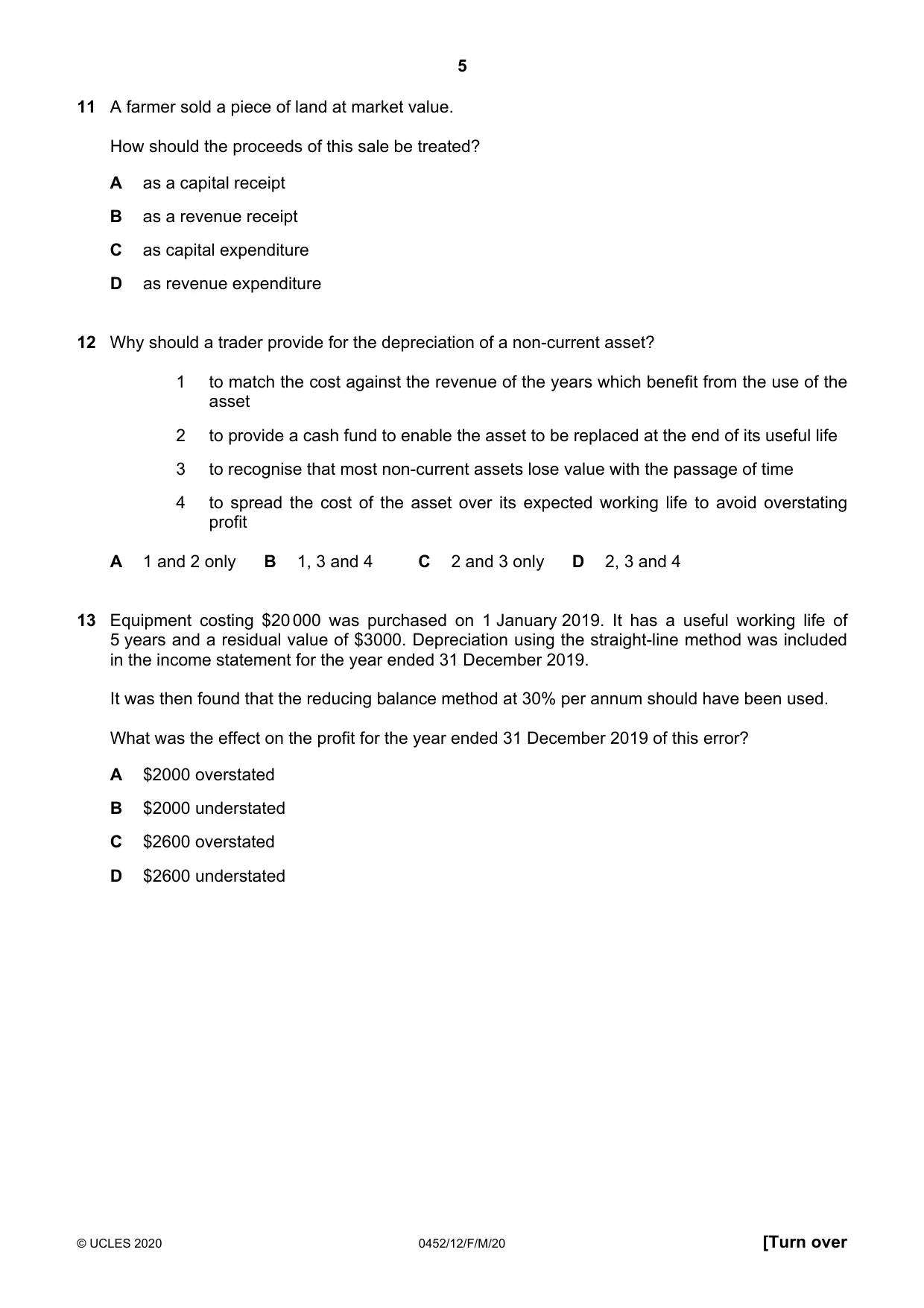
11 A farmer sold a piece of land at market value. How should the proceeds of this sale be treated? A as a capital receipt B as a revenue receipt C as capital expenditure D as revenue expenditure
Mark scheme: A
More questions on Capital and revenue expenditure and receipts
Q12 · Why should a trader provide for the depreciation of a non-current asset?
12 Why should a trader provide for the depreciation of a non-current asset? 1 to match the cost against the revenue of the years which benefit from the use of the asset 2 to provide a cash fund to enable the asset to be replaced at the end of its useful life 3 to recognise that most non-current assets lose value with the passage of time 4 to spread the cost of the asset over its expected working life to avoid overstating profit A 1 and 2 only B 1, 3 and 4 C 2 and 3 only D 2, 3 and 4
Mark scheme: B
More questions on Accounting for depreciation and disposal of non-current assets
Q13 · Equipment costing $20 000 was purchased on 1 January 2019
13 Equipment costing $20 000 was purchased on 1 January 2019. It has a useful working life of 5 years and a residual value of $3000. Depreciation using the straight-line method was included in the income statement for the year ended 31 December 2019. It was then found that the reducing balance method at 30% per annum should have been used. What was the effect on the profit for the year ended 31 December 2019 of this error? A $2000 overstated B $2000 understated C $2600 overstated D $2600 understated
Mark scheme: C
Q14 · A business provided the following information about two expenses
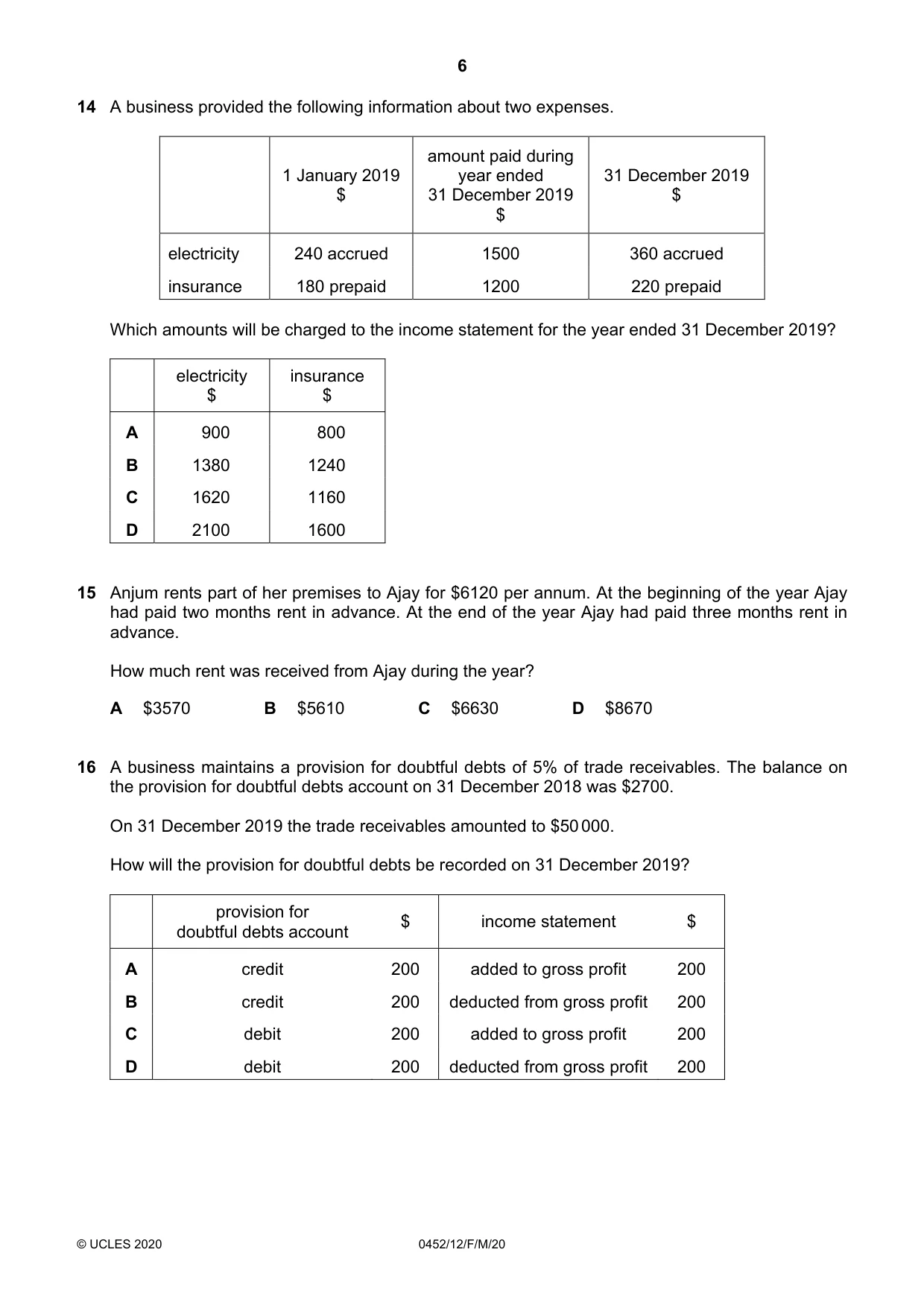
14 A business provided the following information about two expenses. amount paid during 1 January 2019 year ended 31 December 2019 $ 31 December 2019 $ $ electricity 240 accrued 1500 360 accrued insurance 180 prepaid 1200 220 prepaid Which amounts will be charged to the income statement for the year ended 31 December 2019? electricity insurance $ $ A 900 800 B 1380 1240 C 1620 1160 D 2100 1600
Mark scheme: C
Q15 · Anjum rents part of her premises to Ajay for $6120 per annum
15 Anjum rents part of her premises to Ajay for $6120 per annum. At the beginning of the year Ajay had paid two months rent in advance. At the end of the year Ajay had paid three months rent in advance. How much rent was received from Ajay during the year? A $3570 B $5610 C $6630 D $8670
Mark scheme: C
Q16 · A business maintains a provision for doubtful debts of 5% of trade receivables
16 A business maintains a provision for doubtful debts of 5% of trade receivables. The balance on the provision for doubtful debts account on 31 December 2018 was $2700. On 31 December 2019 the trade receivables amounted to $50 000. How will the provision for doubtful debts be recorded on 31 December 2019? provision for $ income statement $ doubtful debts account A credit 200 added to gross profit 200 B credit 200 deducted from gross profit 200 C debit 200 added to gross profit 200 D debit 200 deducted from gross profit 200
Mark scheme: C
More questions on Irrecoverable debts and allowance for irrecoverable debts
Q17 · At the end of the financial year Cindy valued her inventory at cost
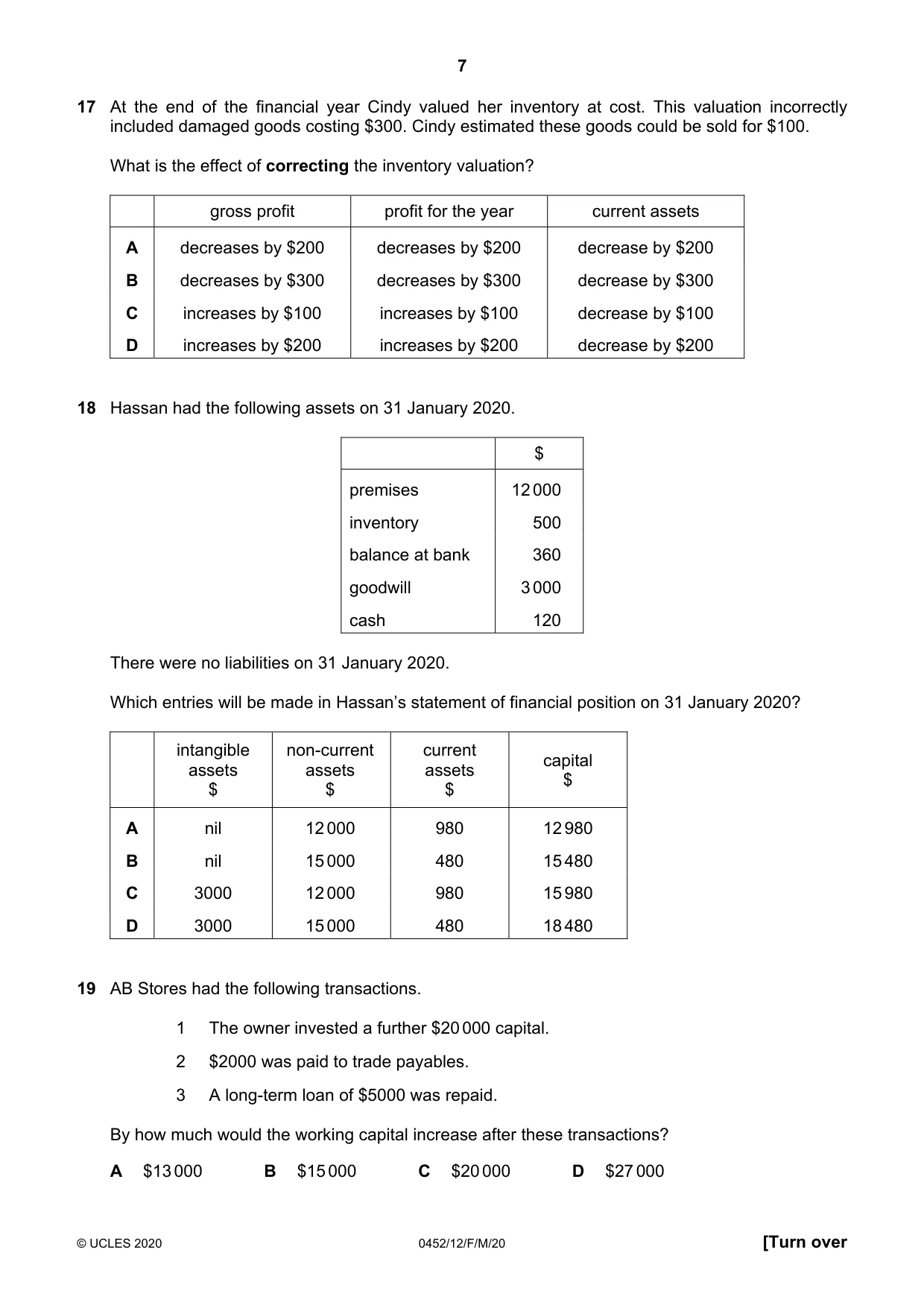
17 At the end of the financial year Cindy valued her inventory at cost. This valuation incorrectly included damaged goods costing $300. Cindy estimated these goods could be sold for $100. What is the effect of correcting the inventory valuation? gross profit profit for the year current assets A decreases by $200 decreases by $200 decrease by $200 B decreases by $300 decreases by $300 decrease by $300 C increases by $100 increases by $100 decrease by $100 D increases by $200 increases by $200 decrease by $200
Mark scheme: A
Q18 · Hassan had the following assets on 31 January 2020
18 Hassan had the following assets on 31 January 2020. $ premises 12 000 inventory 500 balance at bank 360 goodwill 3 000 cash 120 There were no liabilities on 31 January 2020. Which entries will be made in Hassan’s statement of financial position on 31 January 2020? intangible non-current current capital assets assets assets $ $ $ $ A nil 12 000 980 12 980 B nil 15 000 480 15 480 C 3000 12 000 980 15 980 D 3000 15 000 480 18 480
Mark scheme: C
Q19 · AB Stores had the following transactions
19 AB Stores had the following transactions. 1 The owner invested a further $20 000 capital. 2 $2000 was paid to trade payables. 3 A long-term loan of $5000 was repaid. By how much would the working capital increase after these transactions? A $13 000 B $15 000 C $20 000 D $27 000
Mark scheme: B
More questions on Calculation and understanding of accounting ratios
Q20 · The balances in the books of a business included the following
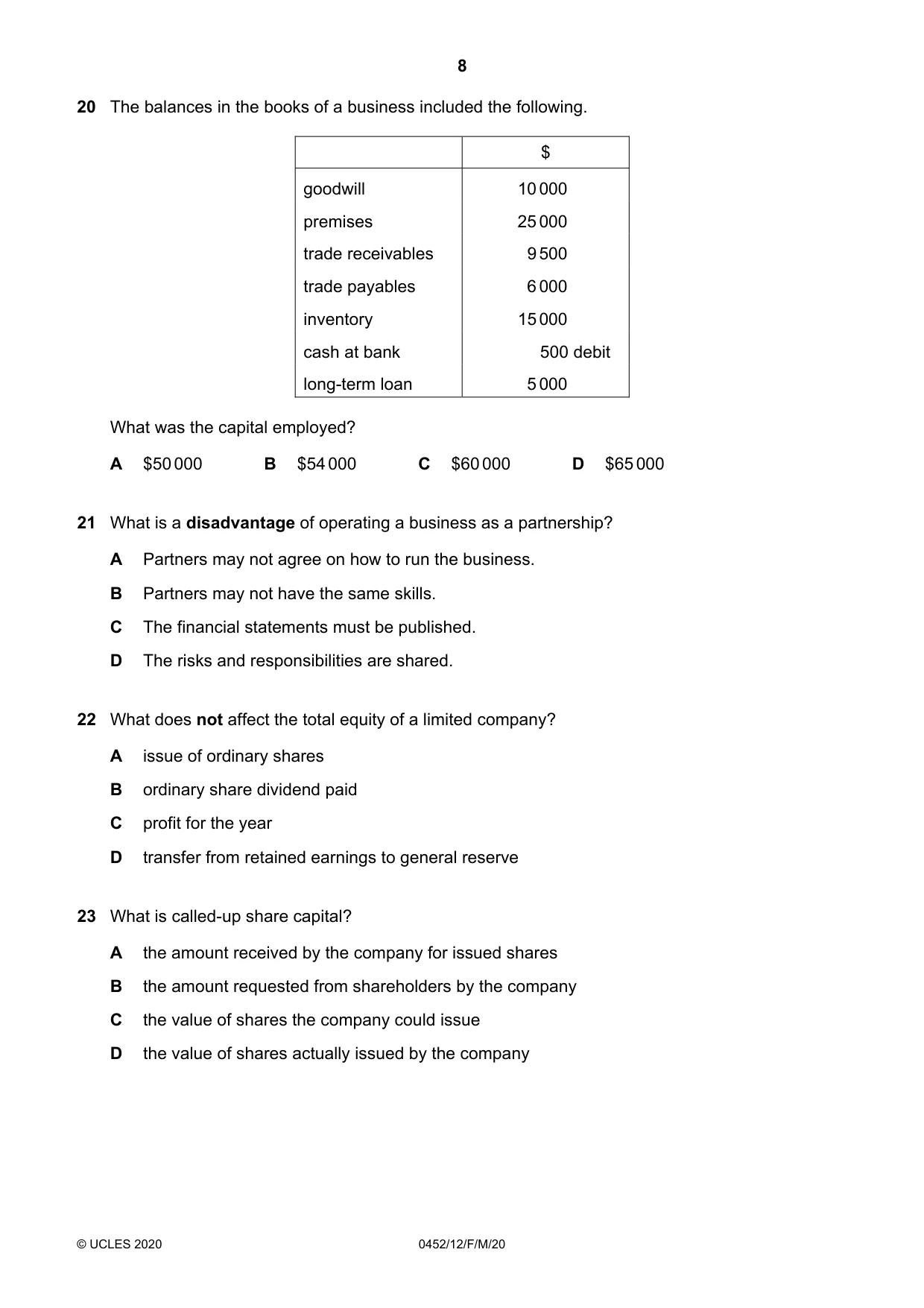
20 The balances in the books of a business included the following. $ goodwill 10 000 premises 25 000 trade receivables 9 500 trade payables 6 000 inventory 15 000 cash at bank 500 debit long-term loan 5 000 What was the capital employed? A $50 000 B $54 000 C $60 000 D $65 000
Mark scheme: B
More questions on Calculation and understanding of accounting ratios
Q21 · What is a disadvantage of operating a business as a partnership?
21 What is a disadvantage of operating a business as a partnership? A Partners may not agree on how to run the business. B Partners may not have the same skills. C The financial statements must be published. D The risks and responsibilities are shared.
Mark scheme: A
Q22 · What does not affect the total equity of a limited company?
22 What does not affect the total equity of a limited company? A issue of ordinary shares B ordinary share dividend paid C profit for the year D transfer from retained earnings to general reserve
Mark scheme: D
Q23 · What is called-up share capital?
23 What is called-up share capital? A the amount received by the company for issued shares B the amount requested from shareholders by the company C the value of shares the company could issue D the value of shares actually issued by the company
Mark scheme: B
Q24 · A limited company provided the following information
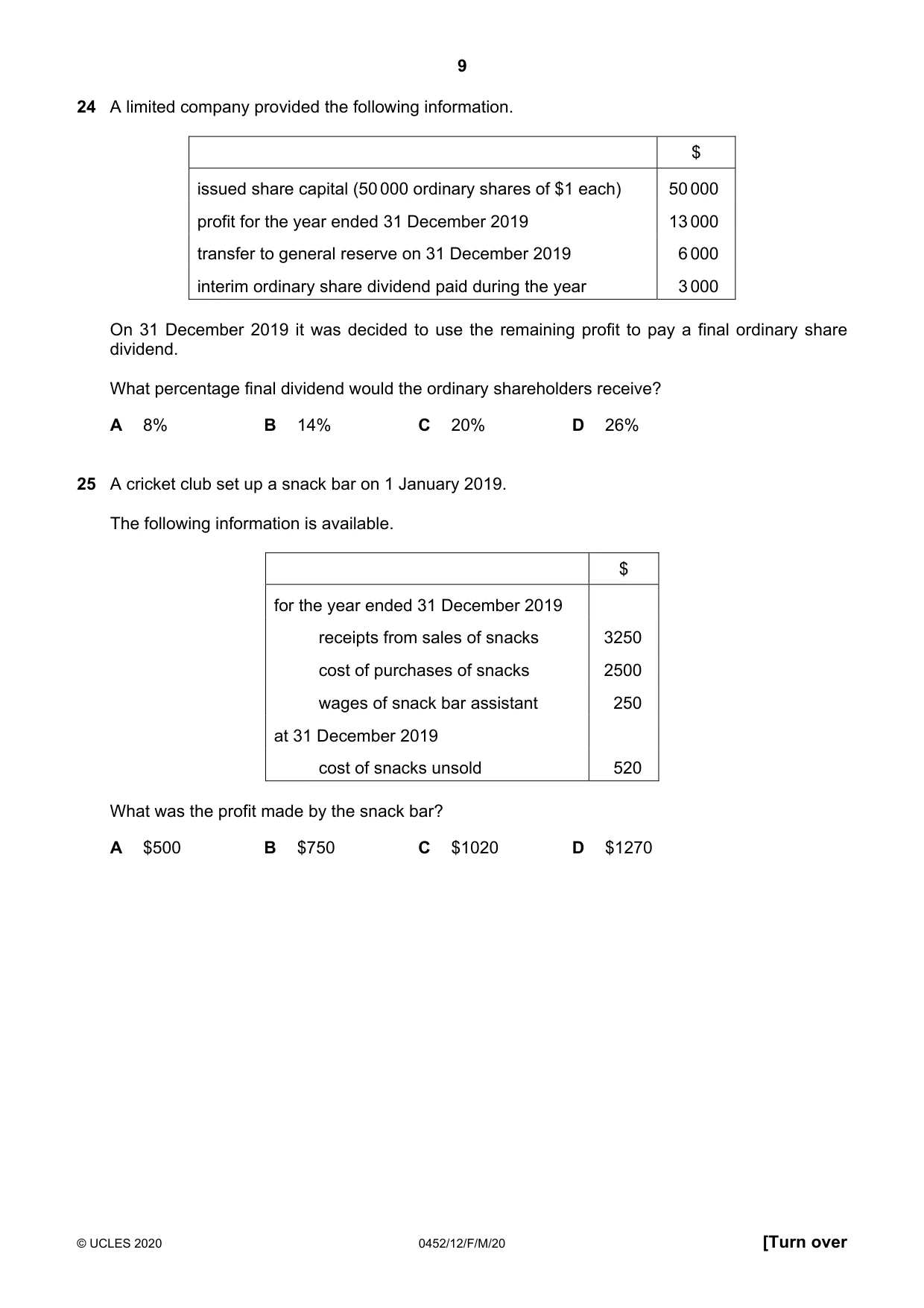
24 A limited company provided the following information. $ issued share capital (50 000 ordinary shares of $1 each) 50 000 profit for the year ended 31 December 2019 13 000 transfer to general reserve on 31 December 2019 6 000 interim ordinary share dividend paid during the year 3 000 On 31 December 2019 it was decided to use the remaining profit to pay a final ordinary share dividend. What percentage final dividend would the ordinary shareholders receive? A 8% B 14% C 20% D 26%
Mark scheme: A
Q25 · A cricket club set up a snack bar on 1 January 2019
25 A cricket club set up a snack bar on 1 January 2019. The following information is available. $ for the year ended 31 December 2019 receipts from sales of snacks 3250 cost of purchases of snacks 2500 wages of snack bar assistant 250 at 31 December 2019 cost of snacks unsold 520 What was the profit made by the snack bar? A $500 B $750 C $1020 D $1270
Mark scheme: C
Q26 · A social club had the following assets and liabilities
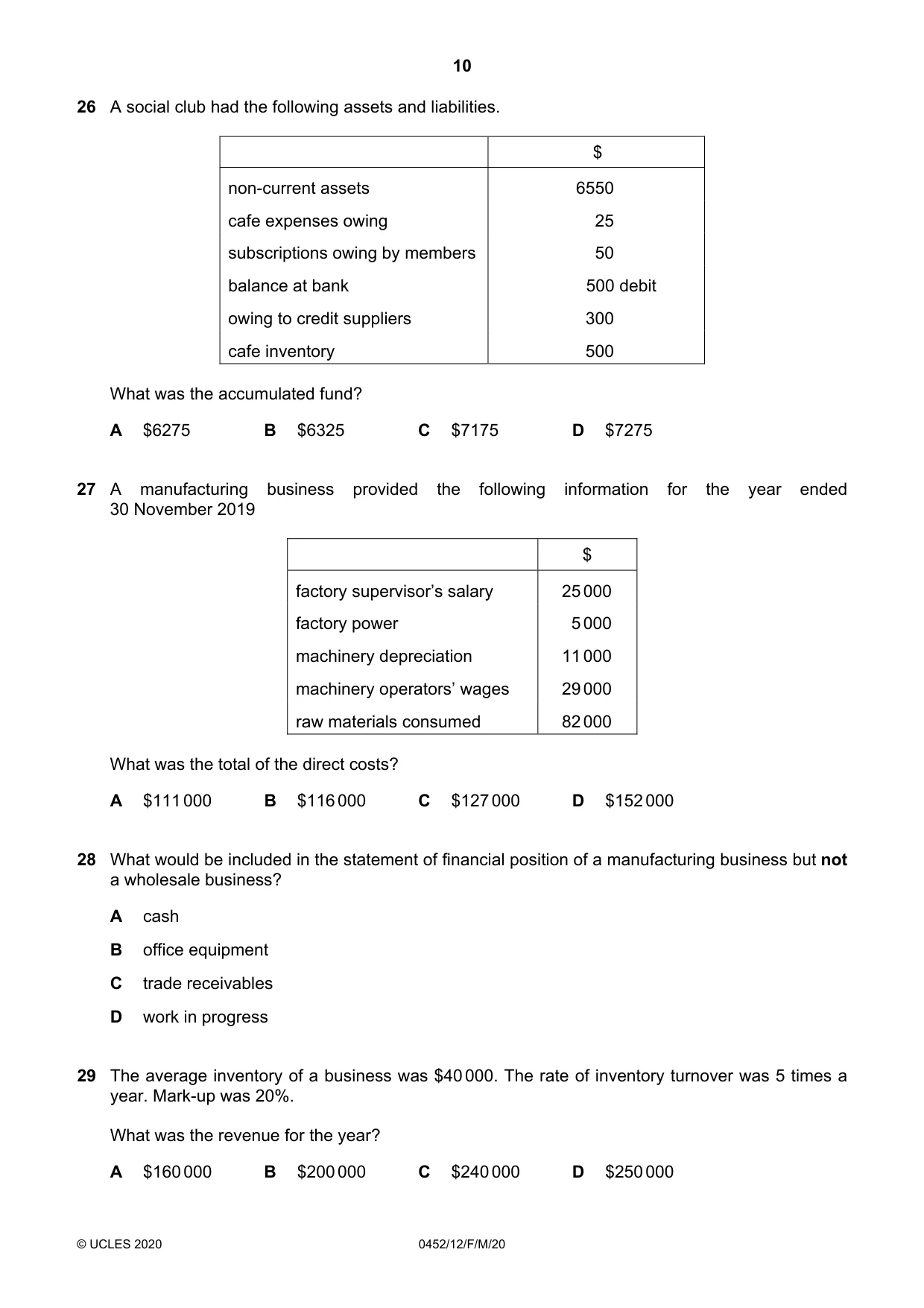
26 A social club had the following assets and liabilities. $ non-current assets 6550 cafe expenses owing 25 subscriptions owing by members 50 balance at bank 500 debit owing to credit suppliers 300 cafe inventory 500 What was the accumulated fund? A $6275 B $6325 C $7175 D $7275
Mark scheme: D
Q27 · A manufacturing business provided the following information for the year ended 30…
27 A manufacturing business provided the following information for the year ended 30 November 2019 $ factory supervisor’s salary 25 000 factory power 5 000 machinery depreciation 11 000 machinery operators’ wages 29 000 raw materials consumed 82 000 What was the total of the direct costs? A $111 000 B $116 000 C $127 000 D $152 000
Mark scheme: A
Q28 · What would be included in the statement of financial position of a manufacturing business…
28 What would be included in the statement of financial position of a manufacturing business but not a wholesale business? A cash B office equipment C trade receivables D work in progress
Mark scheme: D
Q29 · The average inventory of a business was $40 000
29 The average inventory of a business was $40 000. The rate of inventory turnover was 5 times a year. Mark-up was 20%. What was the revenue for the year? A $160 000 B $200 000 C $240 000 D $250 000
Mark scheme: C
More questions on Calculation and understanding of accounting ratios
Q30 · Sumit does not maintain a full set of accounting records
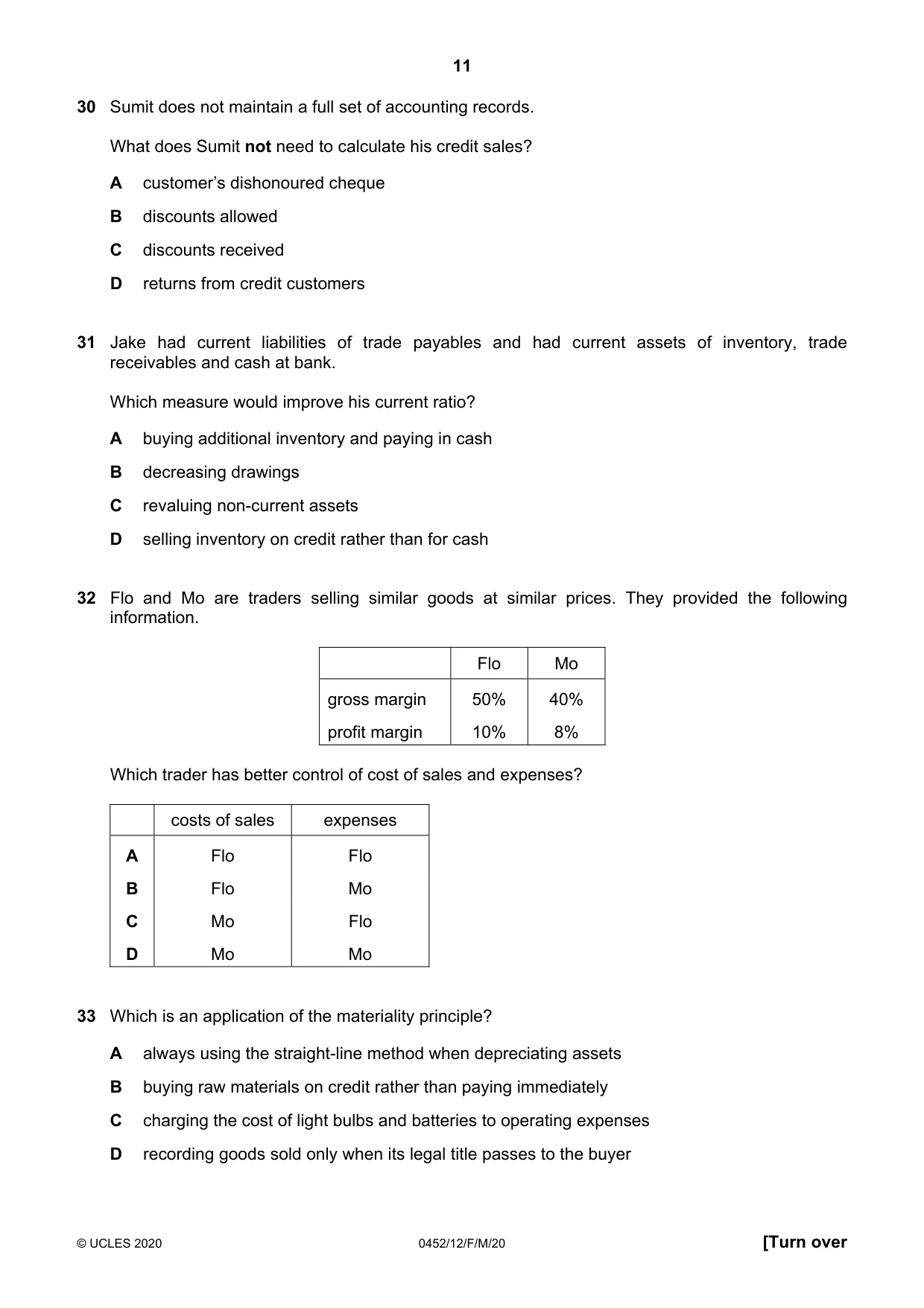
30 Sumit does not maintain a full set of accounting records. What does Sumit not need to calculate his credit sales? A customer’s dishonoured cheque B discounts allowed C discounts received D returns from credit customers
Mark scheme: C
Q31 · Jake had current liabilities of trade payables and had current assets of inventory, trade…
31 Jake had current liabilities of trade payables and had current assets of inventory, trade receivables and cash at bank. Which measure would improve his current ratio? A buying additional inventory and paying in cash B decreasing drawings C revaluing non-current assets D selling inventory on credit rather than for cash
Mark scheme: B
More questions on Calculation and understanding of accounting ratios
Q32 · Flo and Mo are traders selling similar goods at similar prices
32 Flo and Mo are traders selling similar goods at similar prices. They provided the following information. Flo Mo gross margin 50% 40% profit margin 10% 8% Which trader has better control of cost of sales and expenses? costs of sales expenses A Flo Flo B Flo Mo C Mo Flo D Mo Mo
Mark scheme: B
Q33 · Which is an application of the materiality principle?
33 Which is an application of the materiality principle? A always using the straight-line method when depreciating assets B buying raw materials on credit rather than paying immediately C charging the cost of light bulbs and batteries to operating expenses D recording goods sold only when its legal title passes to the buyer
Mark scheme: C
Q34 · Which accounting principle states that revenue should not be recorded before it is earned?
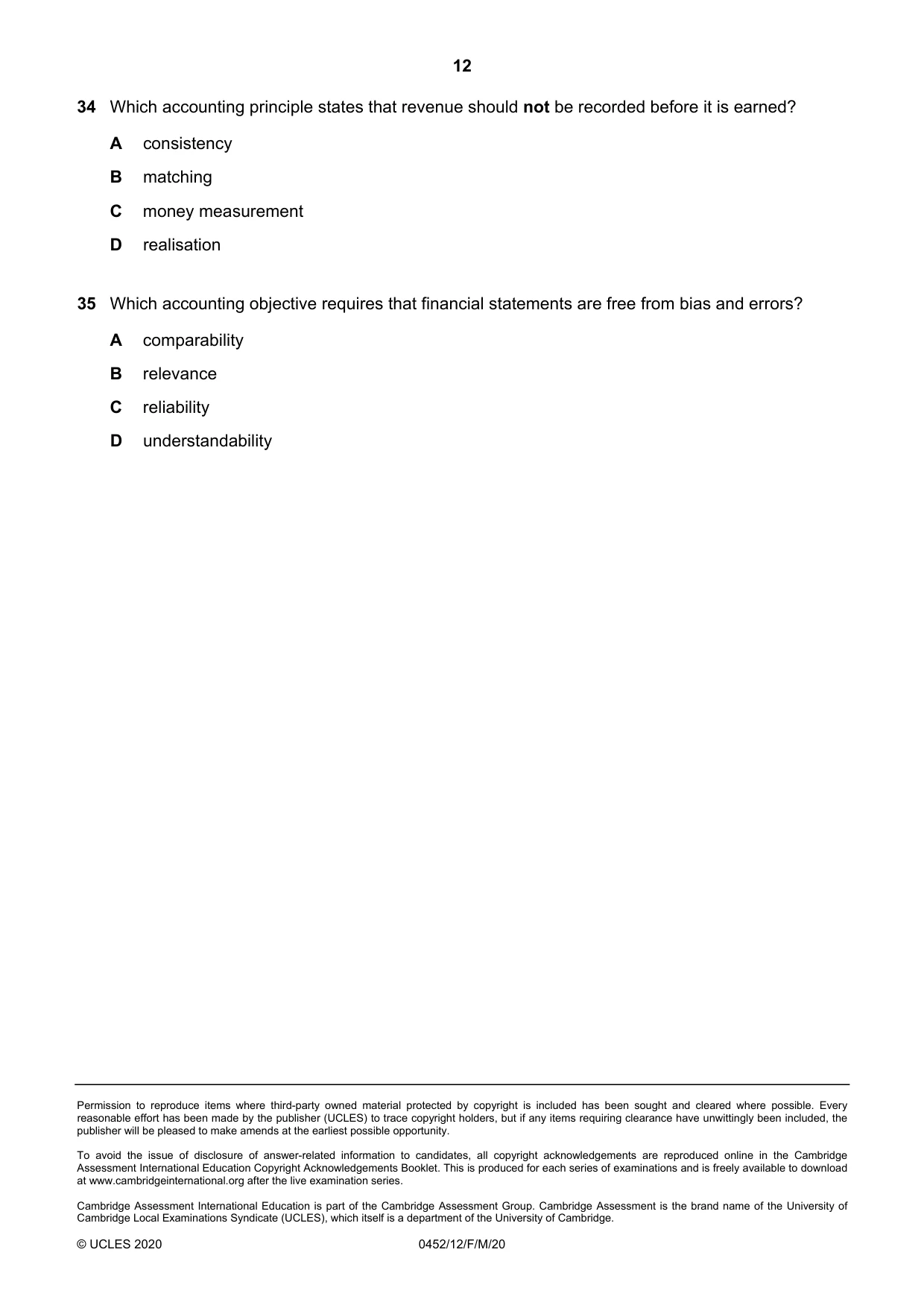
34 Which accounting principle states that revenue should not be recorded before it is earned? A consistency B matching C money measurement D realisation
Mark scheme: D
Q35 · Which accounting objective requires that financial statements are free from bias and…
35 Which accounting objective requires that financial statements are free from bias and errors? A comparability B relevance C reliability D understandability
Mark scheme: C
What was in this paper
The subtopics covered by these 35 questions, and how many questions each got. Open one in a new tab to see every Cambridge question on it.
4Accounting concepts3Limited companies3The double entry system of book-keeping3Capital and revenue expenditure and receipts2Clubs and societies2Corrections of errors2Manufacturing accounts2Other payables and other receivables2Accounting for depreciation and disposal of non-current assets1Bank reconciliation1Books of prime entry1Business documents1Incomplete records1Interpretation of accounting ratios1Irrecoverable debts and allowance for irrecoverable debts1Partnerships1Sole traders1The accounting equation1The purpose of accounting1Valuation of inventory1What you needed in this session
Cambridge’s own grade thresholds for 2020 Feb/March, Paper 1 · Variant 2. A higher threshold means an easier paper — the bar moves with how the cohort did.