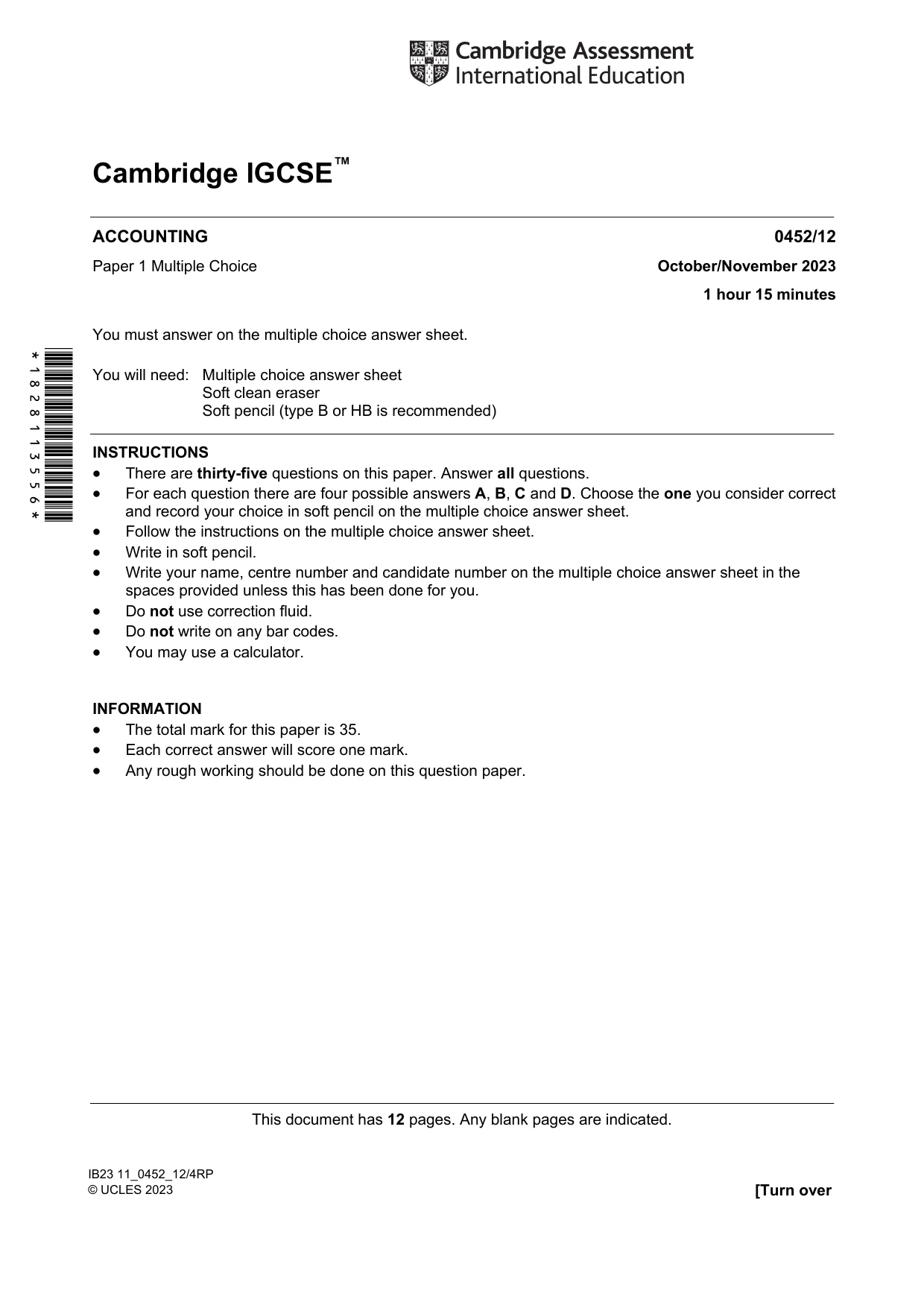
Cambridge IGCSE Accounting 0452 — 2023 Oct/Nov Paper 1 · Variant 2
0452/12/O/N/23 · 35 questions · 35 marks · ≈39 min
The question paper and its mark scheme, free to read here and free to download. This is Cambridge’s own paper, exactly as it was sat.
Question paper12 pages
Mark scheme3 pages
Answers below. Sit the paper first if you are practising.
Questions as text
Q1 · Which actions are examples of book-keeping?
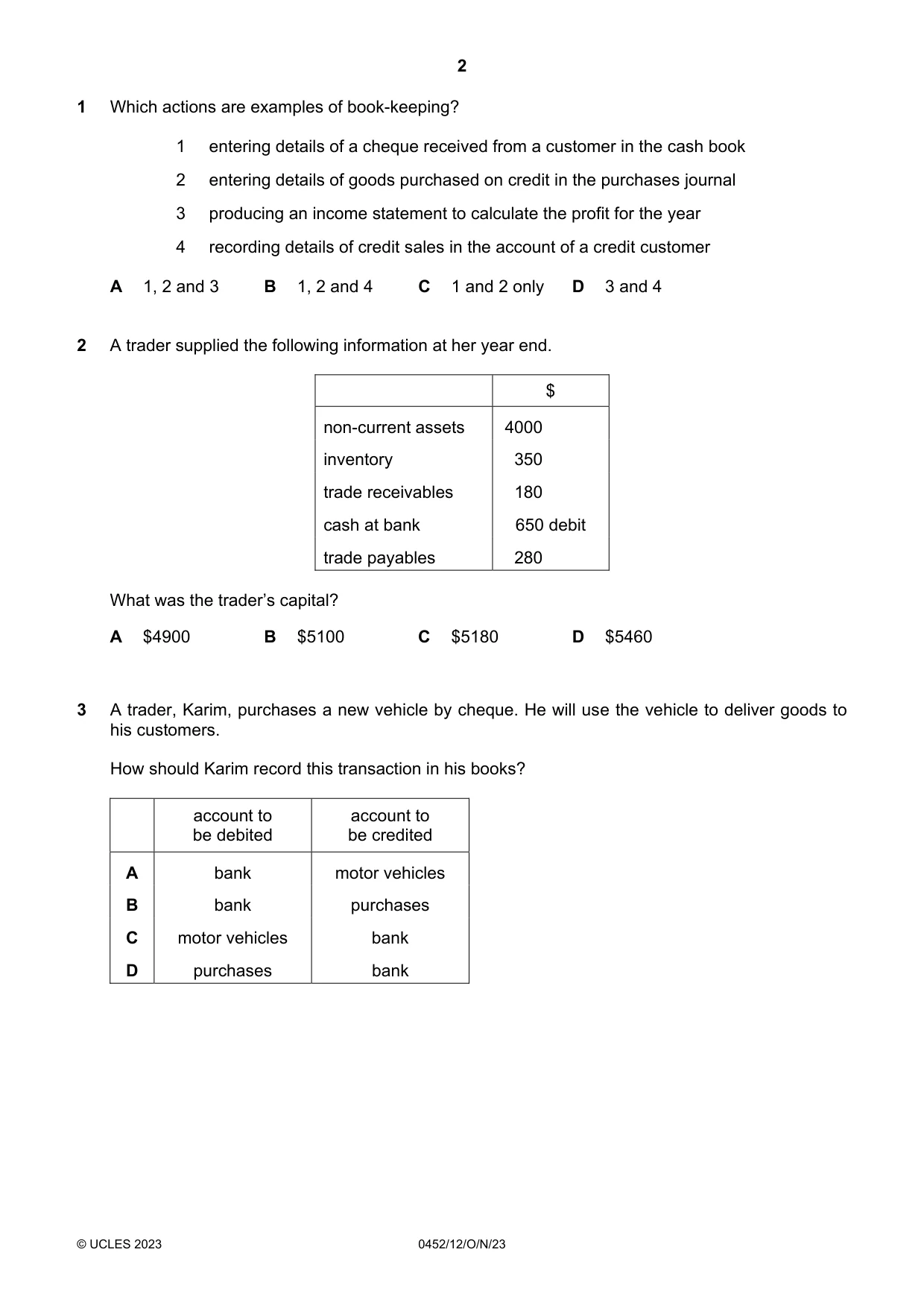
1 Which actions are examples of book-keeping? 1 entering details of a cheque received from a customer in the cash book 2 entering details of goods purchased on credit in the purchases journal 3 producing an income statement to calculate the profit for the year 4 recording details of credit sales in the account of a credit customer A 1, 2 and 3 B 1, 2 and 4 C 1 and 2 only D 3 and 4
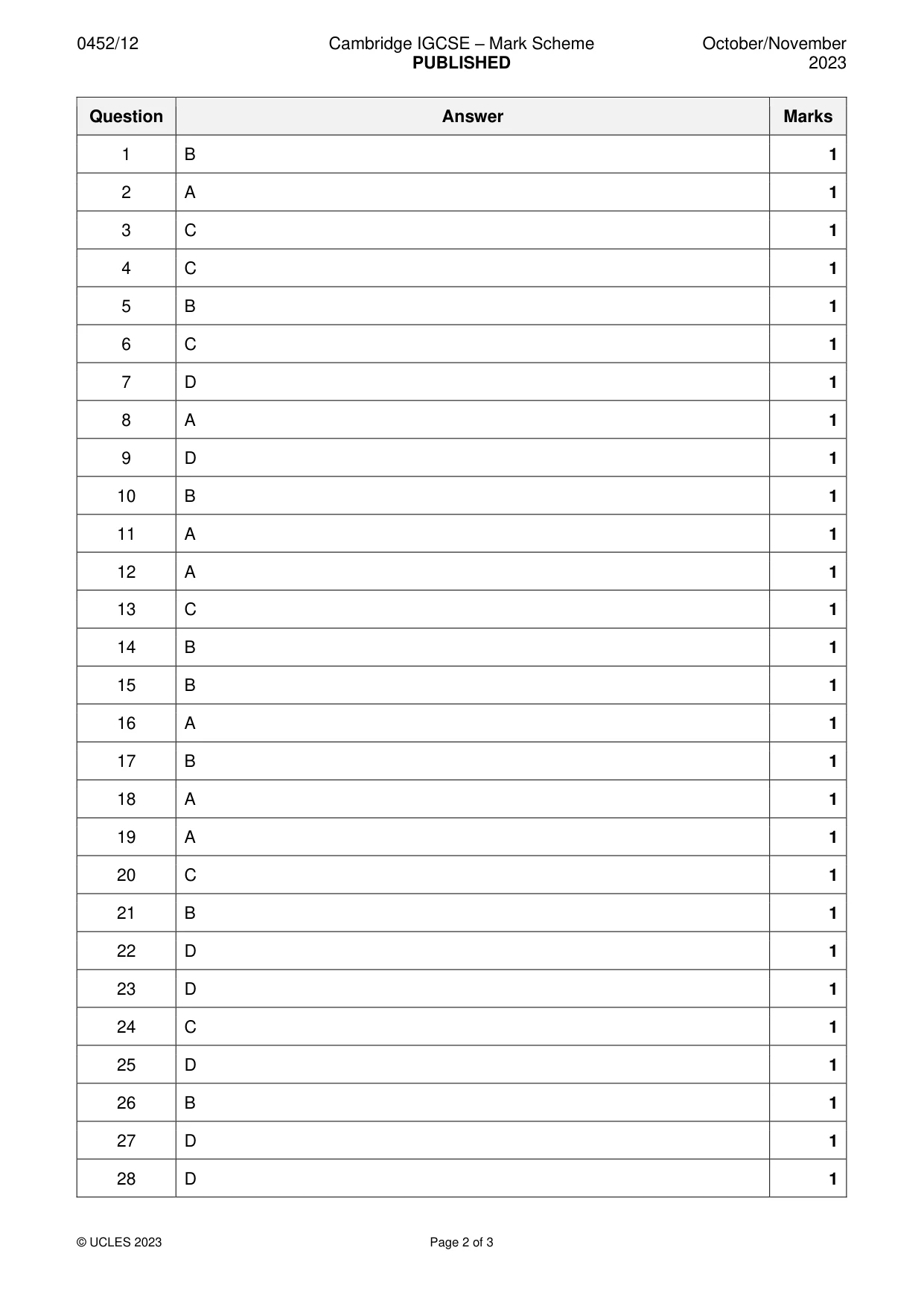
Mark scheme: B
Q2 · A trader supplied the following information at her year end
2 A trader supplied the following information at her year end. $ non-current assets 4000 inventory 350 trade receivables 180 cash at bank 650 debit trade payables 280 What was the trader’s capital? A $4900 B $5100 C $5180 D $5460
Mark scheme: A
Q3 · A trader, Karim, purchases a new vehicle by cheque
3 A trader, Karim, purchases a new vehicle by cheque. He will use the vehicle to deliver goods to his customers. How should Karim record this transaction in his books? account to account to be debited be credited A bank motor vehicles B bank purchases C motor vehicles bank D purchases bank
Mark scheme: C
Q4 · The following ledger account was in Meena’s sales ledger
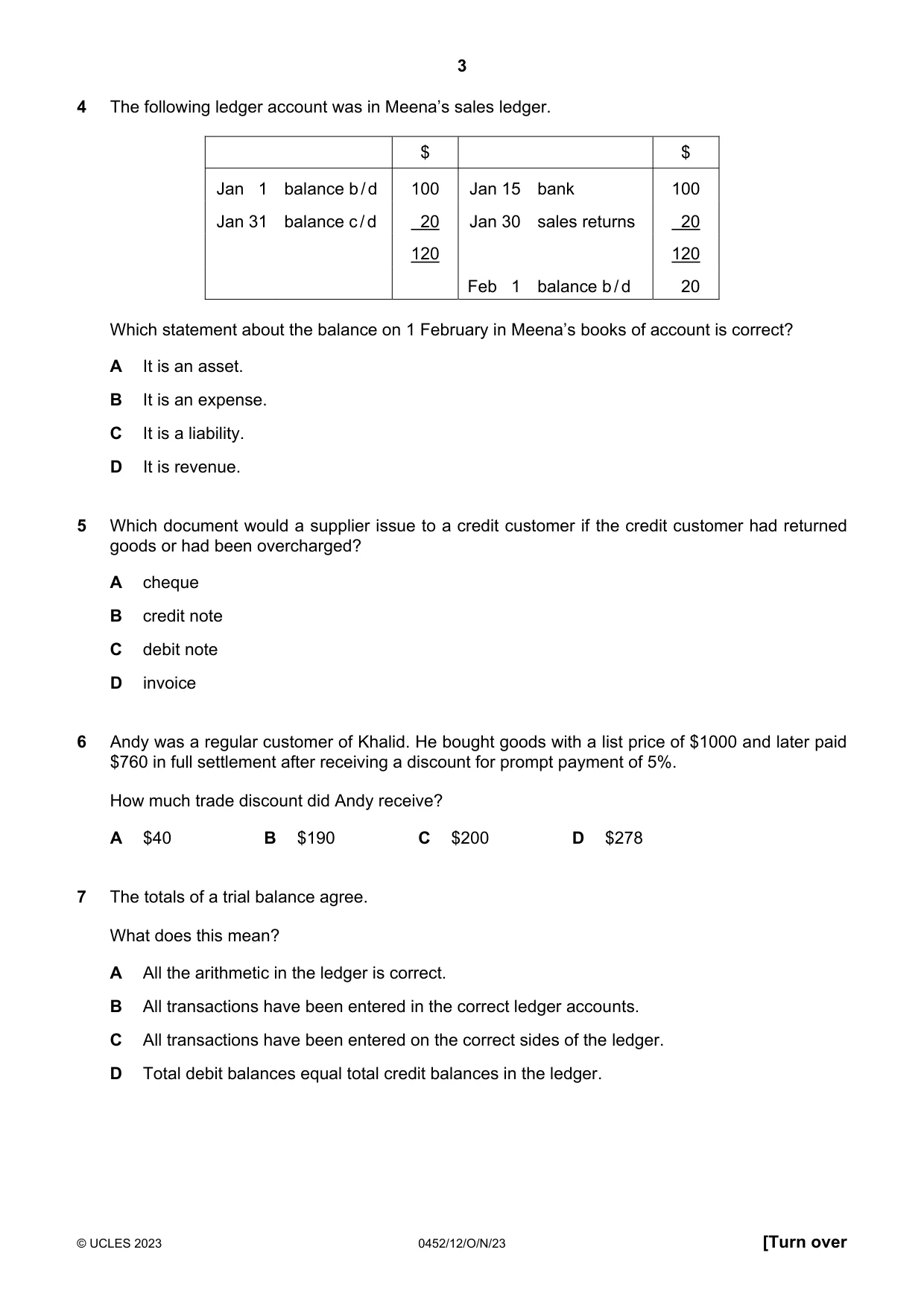
4 The following ledger account was in Meena’s sales ledger. $ $ Jan 1 balance b / d 100 Jan 15 bank 100 Jan 31 balance c / d 20 Jan 30 sales returns 20 120 120 Feb 1 balance b / d 20 Which statement about the balance on 1 February in Meena’s books of account is correct? A It is an asset. B It is an expense. C It is a liability. D It is revenue.
Mark scheme: C
Q5 · Which document would a supplier issue to a credit customer if the credit customer had…
5 Which document would a supplier issue to a credit customer if the credit customer had returned goods or had been overcharged? A cheque B credit note C debit note D invoice
Mark scheme: B
Q6 · Andy was a regular customer of Khalid
6 Andy was a regular customer of Khalid. He bought goods with a list price of $1000 and later paid $760 in full settlement after receiving a discount for prompt payment of 5%. How much trade discount did Andy receive? A $40 B $190 C $200 D $278
Mark scheme: C
Q7 · The totals of a trial balance agree
7 The totals of a trial balance agree. What does this mean? A All the arithmetic in the ledger is correct. B All transactions have been entered in the correct ledger accounts. C All transactions have been entered on the correct sides of the ledger. D Total debit balances equal total credit balances in the ledger.
Mark scheme: D
Q8 · A cheque received from Joe was credited to Joanna’s account
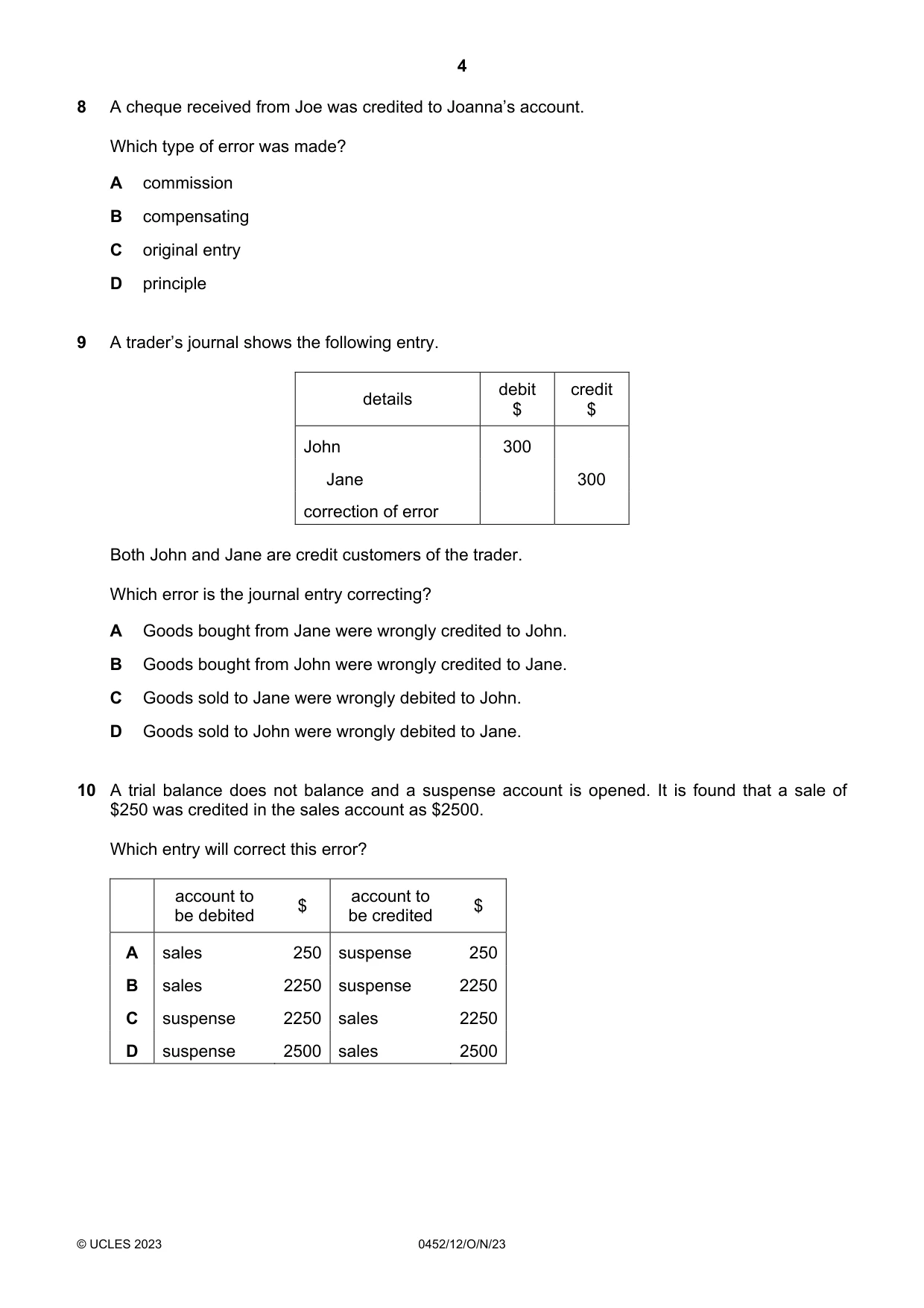
8 A cheque received from Joe was credited to Joanna’s account. Which type of error was made? A commission B compensating C original entry D principle
Mark scheme: A
Q9 · A trader’s journal shows the following entry
9 A trader’s journal shows the following entry. debit credit details $ $ John 300 Jane 300 correction of error Both John and Jane are credit customers of the trader. Which error is the journal entry correcting? A Goods bought from Jane were wrongly credited to John. B Goods bought from John were wrongly credited to Jane. C Goods sold to Jane were wrongly debited to John. D Goods sold to John were wrongly debited to Jane.
Mark scheme: D
Q10 · A trial balance does not balance and a suspense account is opened
10 A trial balance does not balance and a suspense account is opened. It is found that a sale of $250 was credited in the sales account as $2500. Which entry will correct this error? account to account to $ $ be debited be credited A sales 250 suspense 250 B sales 2250 suspense 2250 C suspense 2250 sales 2250 D suspense 2500 sales 2500
Mark scheme: B
Q11 · A cheque received from D Pawson, a trade receivable, was correctly debited to the bank…
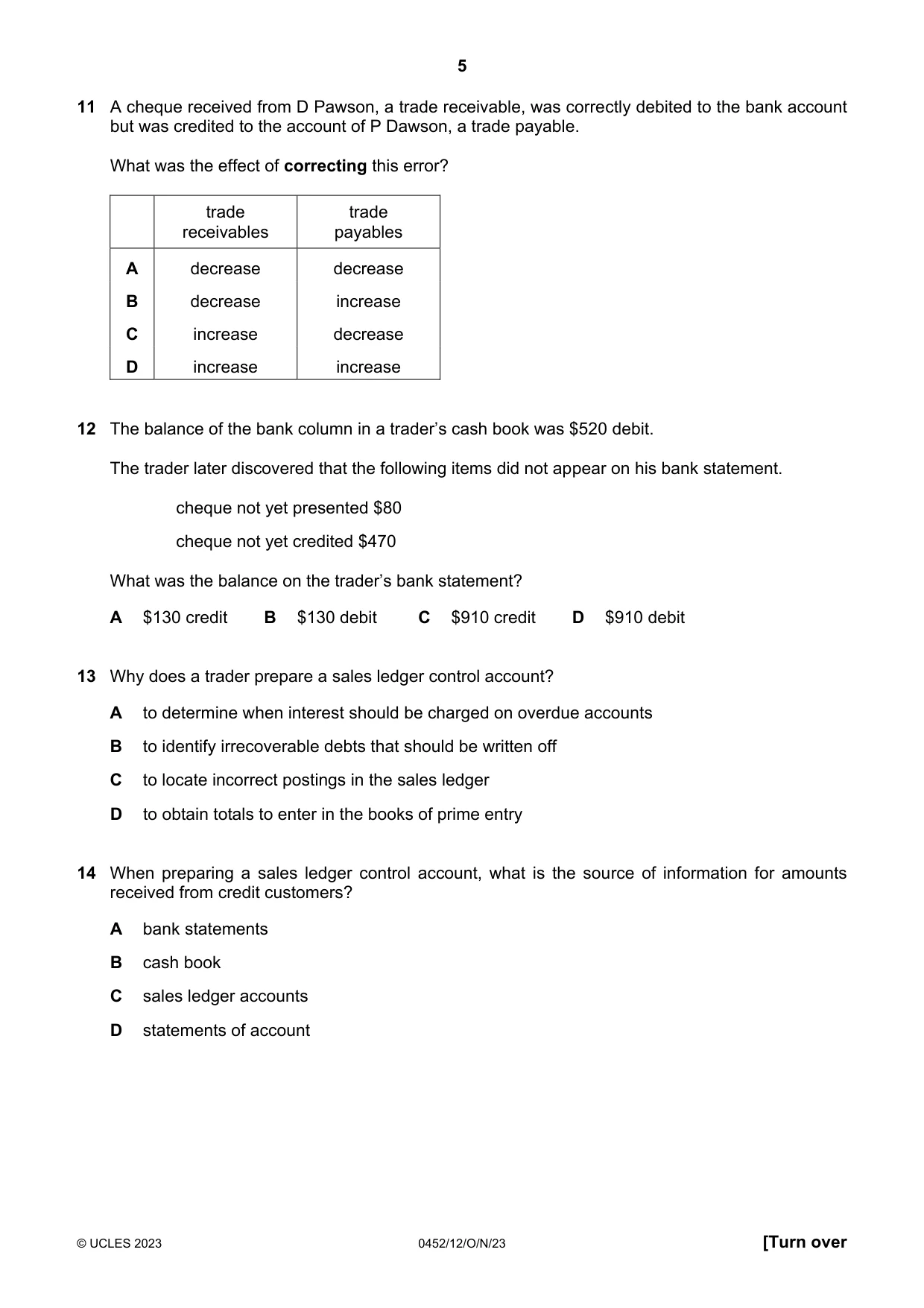
11 A cheque received from D Pawson, a trade receivable, was correctly debited to the bank account but was credited to the account of P Dawson, a trade payable. What was the effect of correcting this error? trade trade receivables payables A decrease decrease B decrease increase C increase decrease D increase increase
Mark scheme: A
Q12 · The balance of the bank column in a trader’s cash book was $520 debit
12 The balance of the bank column in a trader’s cash book was $520 debit. The trader later discovered that the following items did not appear on his bank statement. cheque not yet presented $80 cheque not yet credited $470 What was the balance on the trader’s bank statement? A $130 credit B $130 debit C $910 credit D $910 debit
Mark scheme: A
Q13 · Why does a trader prepare a sales ledger control account?
13 Why does a trader prepare a sales ledger control account? A to determine when interest should be charged on overdue accounts B to identify irrecoverable debts that should be written off C to locate incorrect postings in the sales ledger D to obtain totals to enter in the books of prime entry
Mark scheme: C
Q14 · When preparing a sales ledger control account, what is the source of information for…
14 When preparing a sales ledger control account, what is the source of information for amounts received from credit customers? A bank statements B cash book C sales ledger accounts D statements of account
Mark scheme: B
Q15 · Plant and machinery, $2000, was incorrectly posted to the credit side of the purchases…
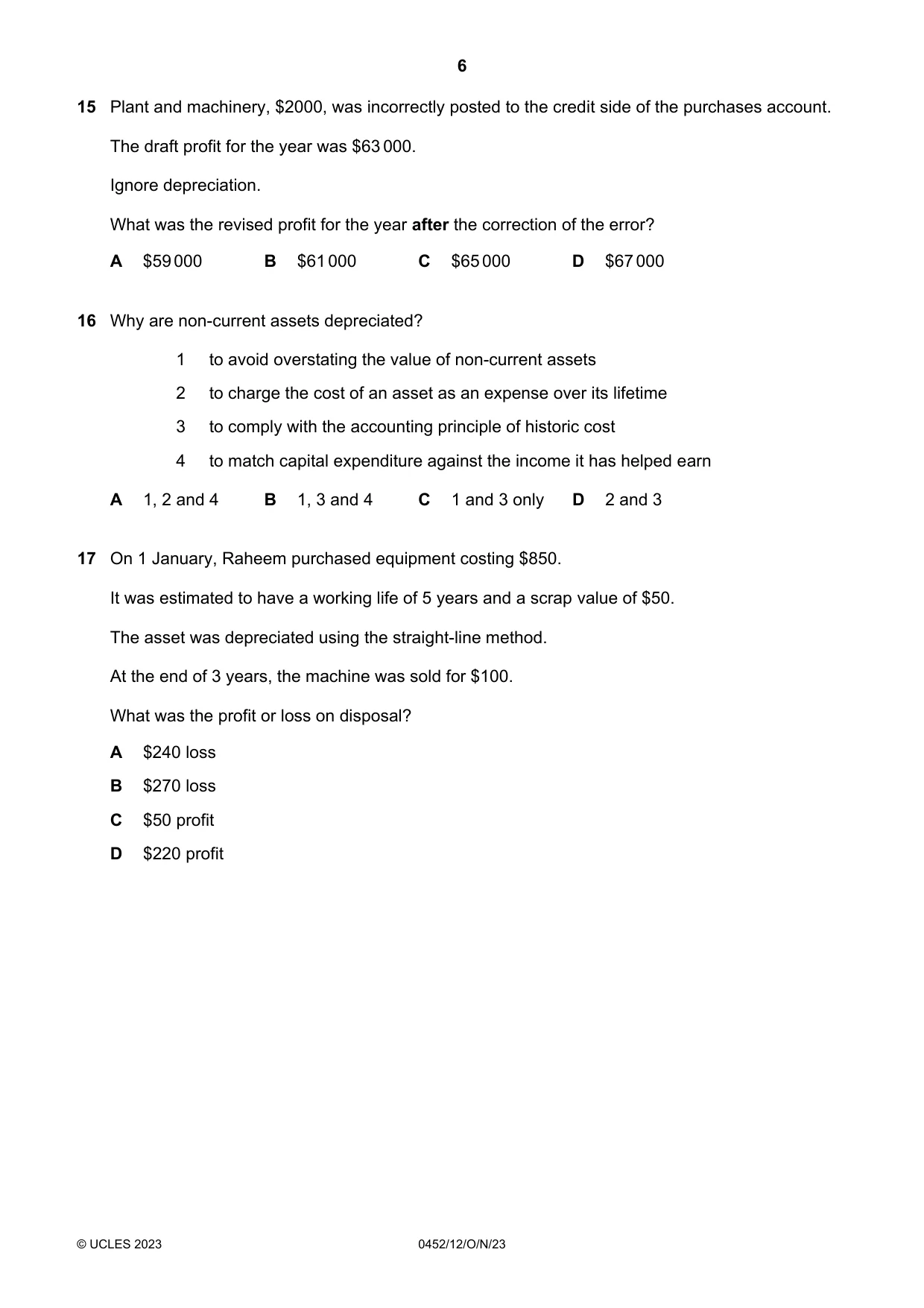
15 Plant and machinery, $2000, was incorrectly posted to the credit side of the purchases account. The draft profit for the year was $63 000. Ignore depreciation. What was the revised profit for the year after the correction of the error? A $59 000 B $61 000 C $65 000 D $67 000
Mark scheme: B
Q16 · Why are non-current assets depreciated?
16 Why are non-current assets depreciated? 1 to avoid overstating the value of non-current assets 2 to charge the cost of an asset as an expense over its lifetime 3 to comply with the accounting principle of historic cost 4 to match capital expenditure against the income it has helped earn A 1, 2 and 4 B 1, 3 and 4 C 1 and 3 only D 2 and 3
Mark scheme: A
More questions on Accounting for depreciation and disposal of non-current assets
Q17 · On 1 January, Raheem purchased equipment costing $850
17 On 1 January, Raheem purchased equipment costing $850. It was estimated to have a working life of 5 years and a scrap value of $50. The asset was depreciated using the straight-line method. At the end of 3 years, the machine was sold for $100. What was the profit or loss on disposal? A $240 loss B $270 loss C $50 profit D $220 profit
Mark scheme: B
More questions on Accounting for depreciation and disposal of non-current assets
Q18 · Imran maintains a provision for doubtful debts of 5% of the trade receivables at the end…
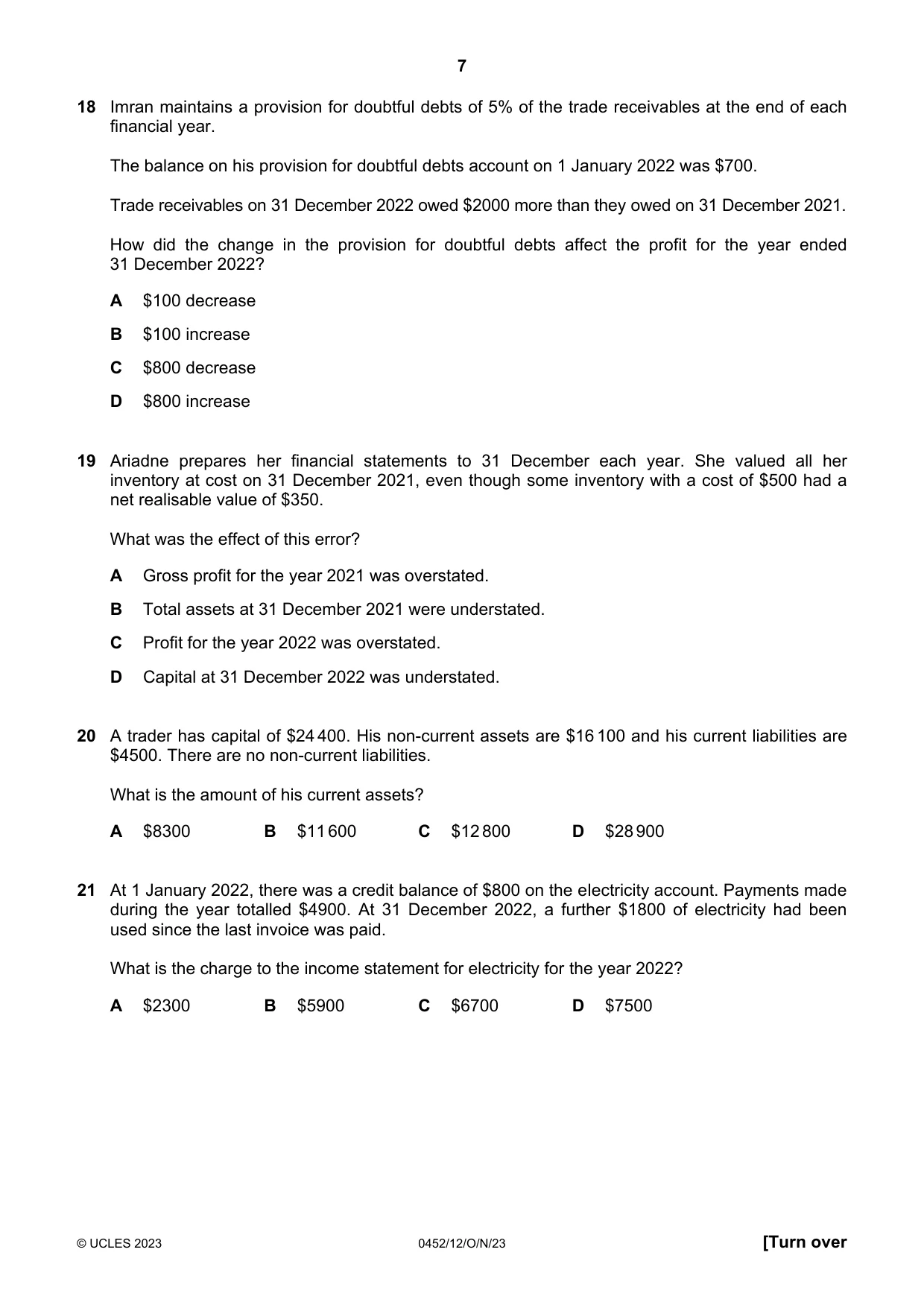
18 Imran maintains a provision for doubtful debts of 5% of the trade receivables at the end of each financial year. The balance on his provision for doubtful debts account on 1 January 2022 was $700. Trade receivables on 31 December 2022 owed $2000 more than they owed on 31 December 2021. How did the change in the provision for doubtful debts affect the profit for the year ended 31 December 2022? A $100 decrease B $100 increase C $800 decrease D $800 increase
Mark scheme: A
More questions on Irrecoverable debts and allowance for irrecoverable debts
Q19 · Ariadne prepares her financial statements to 31 December each year
19 Ariadne prepares her financial statements to 31 December each year. She valued all her inventory at cost on 31 December 2021, even though some inventory with a cost of $500 had a net realisable value of $350. What was the effect of this error? A Gross profit for the year 2021 was overstated. B Total assets at 31 December 2021 were understated. C Profit for the year 2022 was overstated. D Capital at 31 December 2022 was understated.
Mark scheme: A
Q20 · A trader has capital of $24 400
20 A trader has capital of $24 400. His non-current assets are $16 100 and his current liabilities are $4500. There are no non-current liabilities. What is the amount of his current assets? A $8300 B $11 600 C $12 800 D $28 900
Mark scheme: C
Q21 · At 1 January 2022, there was a credit balance of $800 on the electricity account
21 At 1 January 2022, there was a credit balance of $800 on the electricity account. Payments made during the year totalled $4900. At 31 December 2022, a further $1800 of electricity had been used since the last invoice was paid. What is the charge to the income statement for electricity for the year 2022? A $2300 B $5900 C $6700 D $7500
Mark scheme: B
Q22 · Josh and Karen are in a partnership sharing profits and losses 3 : 2
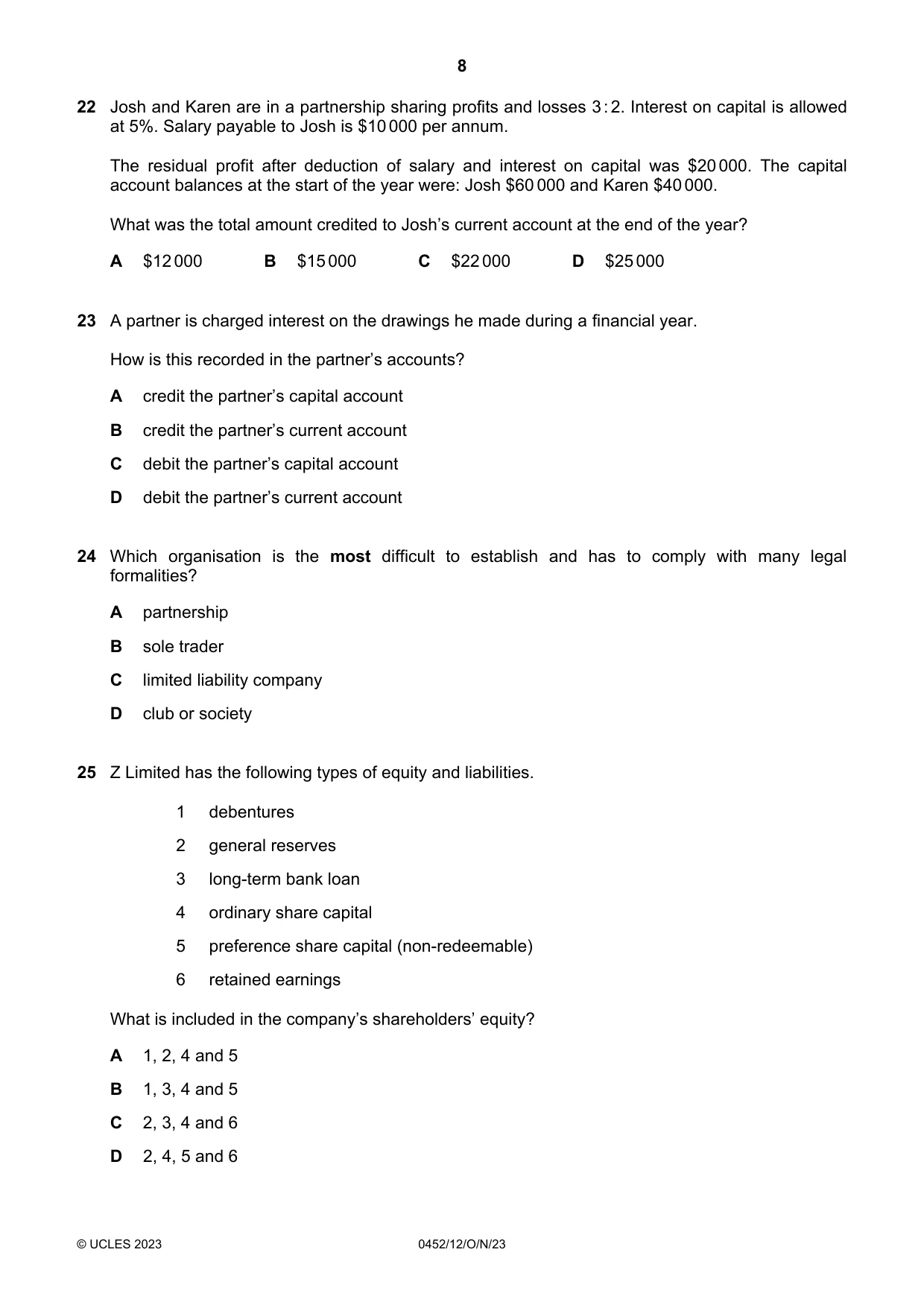
22 Josh and Karen are in a partnership sharing profits and losses 3 : 2. Interest on capital is allowed at 5%. Salary payable to Josh is $10 000 per annum. The residual profit after deduction of salary and interest on capital was $20 000. The capital account balances at the start of the year were: Josh $60 000 and Karen $40 000. What was the total amount credited to Josh’s current account at the end of the year? A $12 000 B $15 000 C $22 000 D $25 000
Mark scheme: D
Q23 · A partner is charged interest on the drawings he made during a financial year
23 A partner is charged interest on the drawings he made during a financial year. How is this recorded in the partner’s accounts? A credit the partner’s capital account B credit the partner’s current account C debit the partner’s capital account D debit the partner’s current account
Mark scheme: D
Q24 · Which organisation is the most difficult to establish and has to comply with many legal…
24 Which organisation is the most difficult to establish and has to comply with many legal formalities? A partnership B sole trader C limited liability company D club or society
Mark scheme: C
Q25 · Z Limited has the following types of equity and liabilities
25 Z Limited has the following types of equity and liabilities. 1 debentures 2 general reserves 3 long-term bank loan 4 ordinary share capital 5 preference share capital (non-redeemable) 6 retained earnings What is included in the company’s shareholders’ equity? A 1, 2, 4 and 5 B 1, 3, 4 and 5 C 2, 3, 4 and 6 D 2, 4, 5 and 6
Mark scheme: D
Q26 · A sports club operates a shop selling running shoes to members
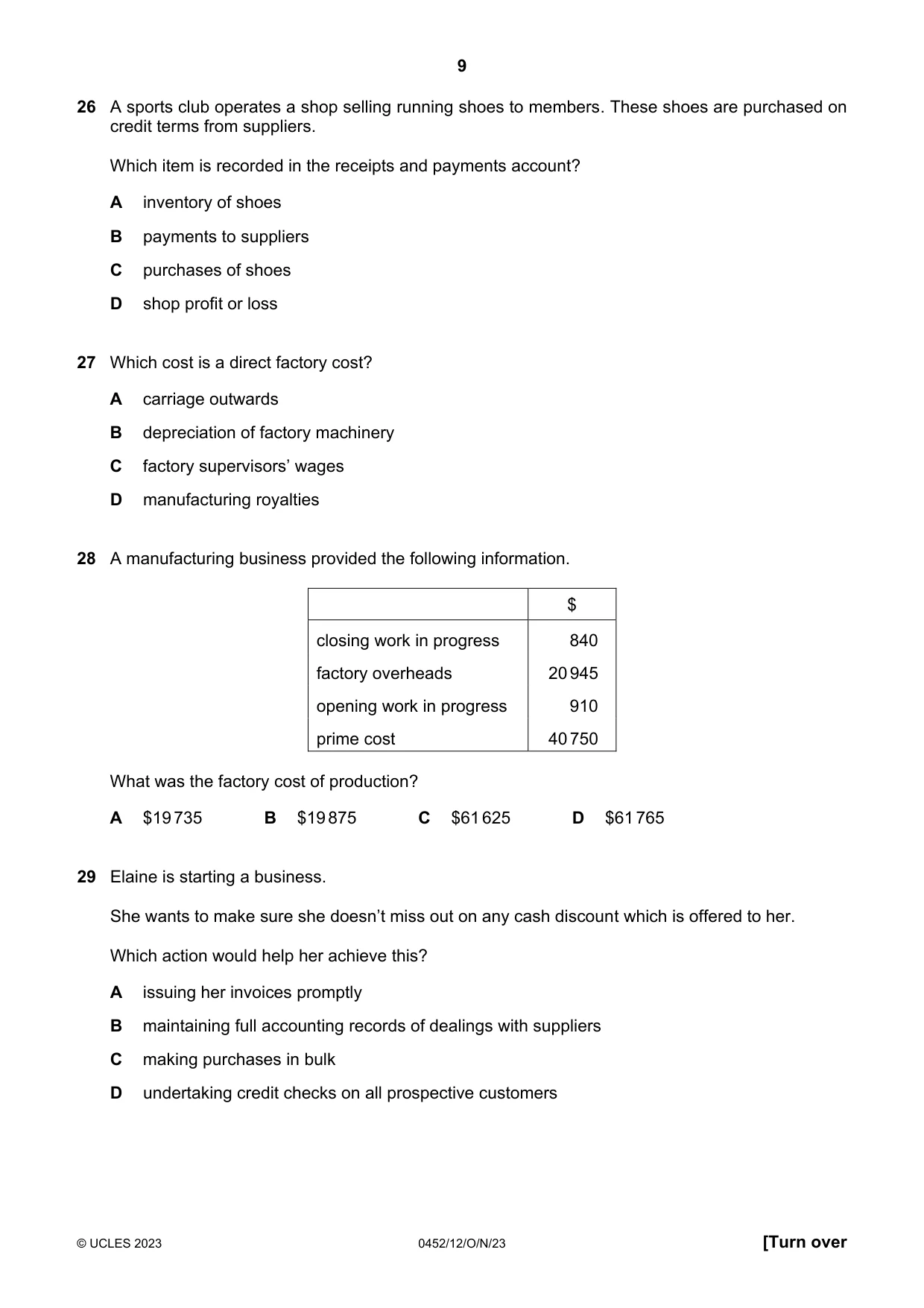
26 A sports club operates a shop selling running shoes to members. These shoes are purchased on credit terms from suppliers. Which item is recorded in the receipts and payments account? A inventory of shoes B payments to suppliers C purchases of shoes D shop profit or loss
Mark scheme: B
Q27 · Which cost is a direct factory cost?
27 Which cost is a direct factory cost? A carriage outwards B depreciation of factory machinery C factory supervisors’ wages D manufacturing royalties
Mark scheme: D
Q28 · A manufacturing business provided the following information
28 A manufacturing business provided the following information. $ closing work in progress 840 factory overheads 20 945 opening work in progress 910 prime cost 40 750 What was the factory cost of production? A $19 735 B $19 875 C $61 625 D $61 765
Mark scheme: D
Q29 · Elaine is starting a business
29 Elaine is starting a business. She wants to make sure she doesn’t miss out on any cash discount which is offered to her. Which action would help her achieve this? A issuing her invoices promptly B maintaining full accounting records of dealings with suppliers C making purchases in bulk D undertaking credit checks on all prospective customers
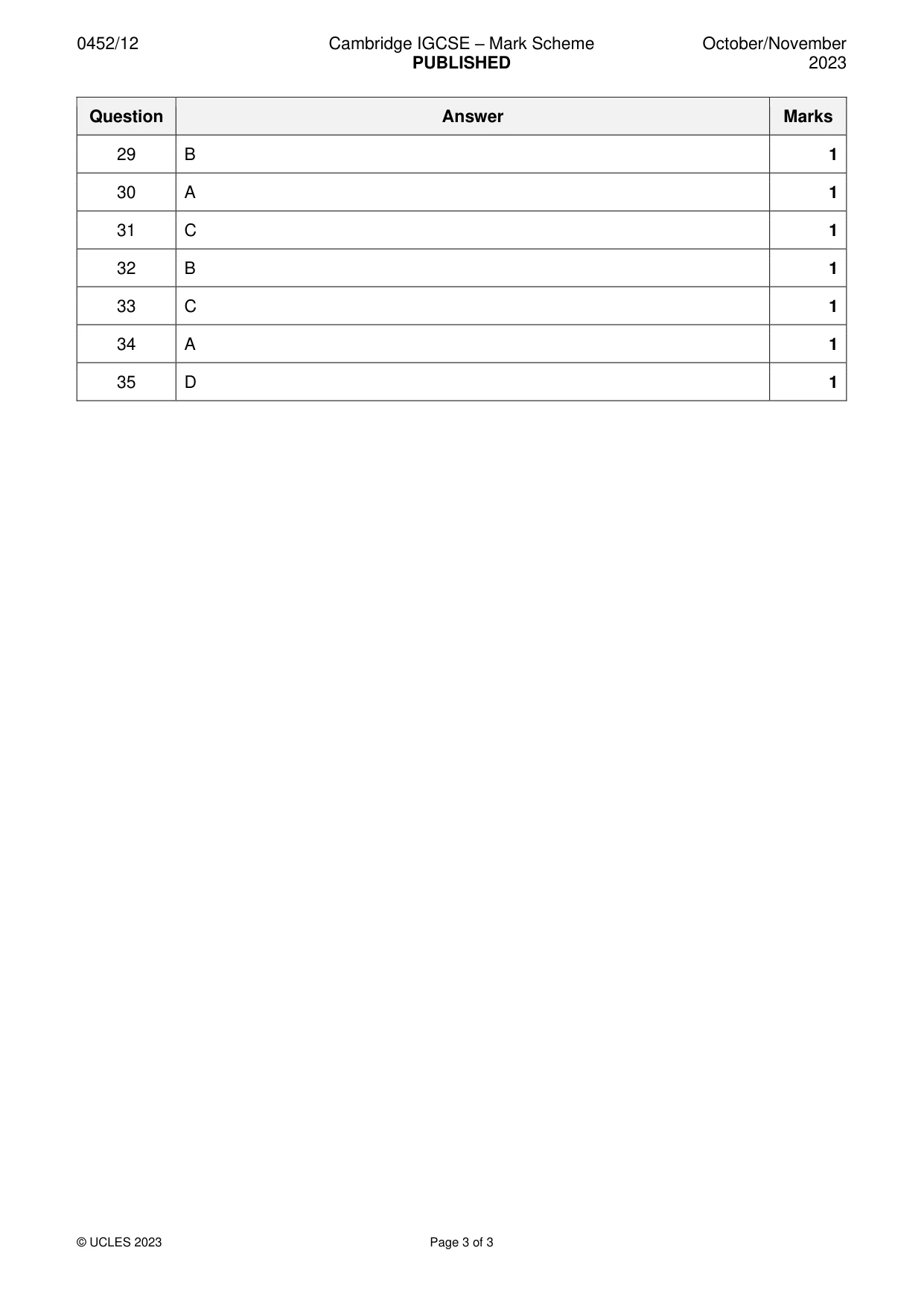
Mark scheme: B
Q30 · Ahmed provided the following information
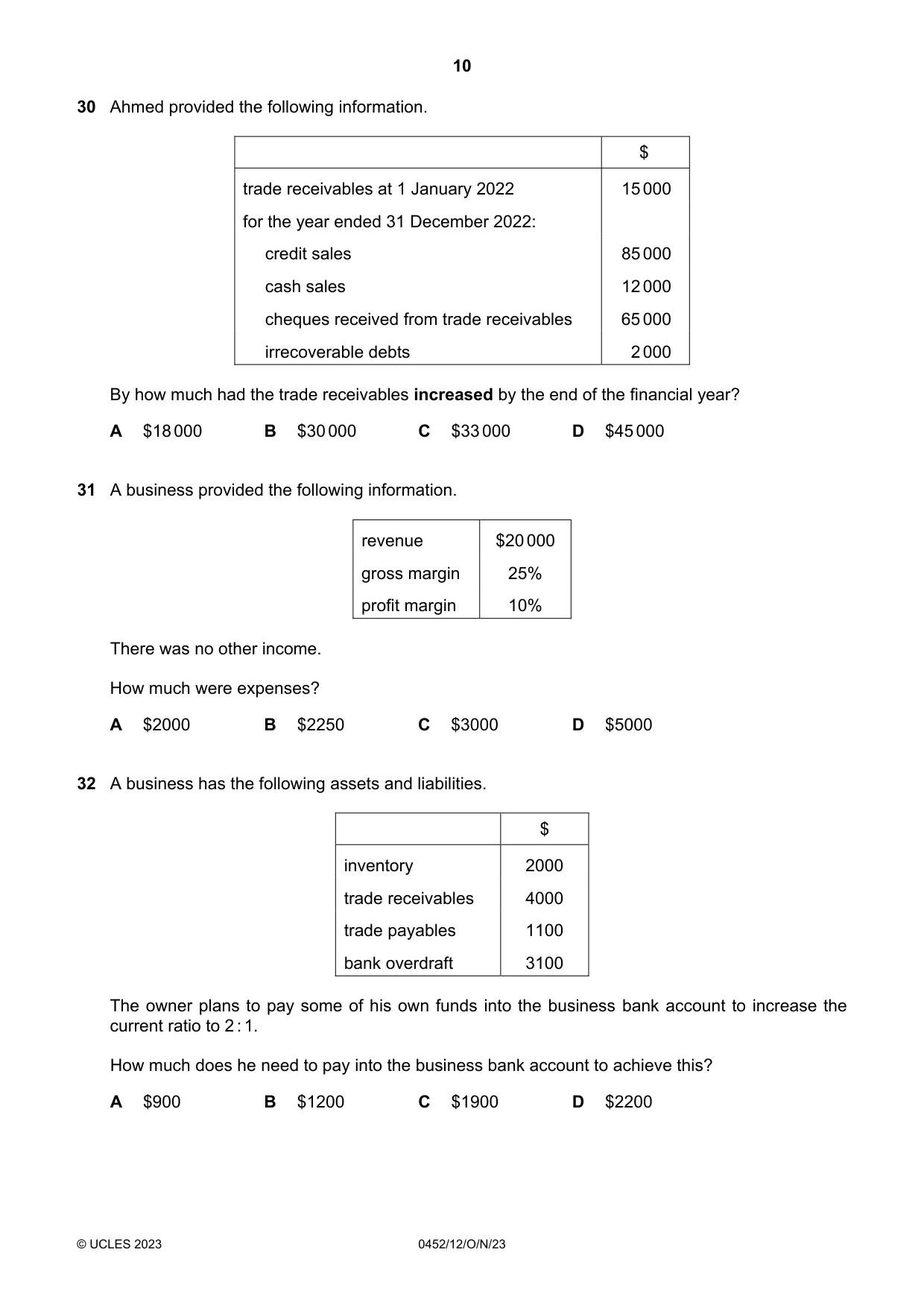
30 Ahmed provided the following information. $ trade receivables at 1 January 2022 15 000 for the year ended 31 December 2022: credit sales 85 000 cash sales 12 000 cheques received from trade receivables 65 000 irrecoverable debts 2 000 By how much had the trade receivables increased by the end of the financial year? A $18 000 B $30 000 C $33 000 D $45 000
Mark scheme: A
Q31 · A business provided the following information
31 A business provided the following information. revenue $20 000 gross margin 25% profit margin 10% There was no other income. How much were expenses? A $2000 B $2250 C $3000 D $5000
Mark scheme: C
More questions on Calculation and understanding of accounting ratios
Q32 · A business has the following assets and liabilities
32 A business has the following assets and liabilities. $ inventory 2000 trade receivables 4000 trade payables 1100 bank overdraft 3100 The owner plans to pay some of his own funds into the business bank account to increase the current ratio to 2 : 1. How much does he need to pay into the business bank account to achieve this? A $900 B $1200 C $1900 D $2200
Mark scheme: B
More questions on Calculation and understanding of accounting ratios
Q33 · Lynne provided the following information about her trading business
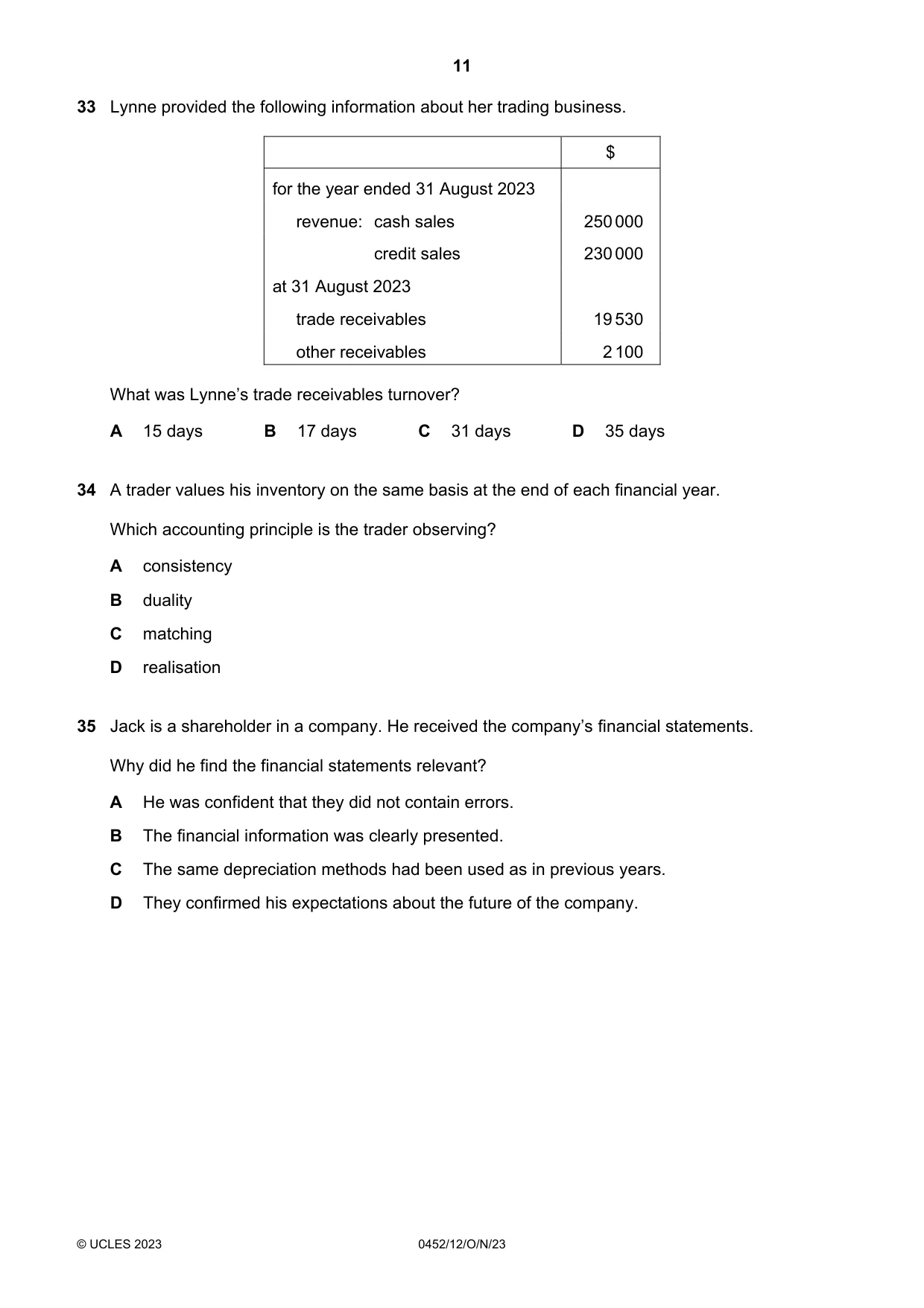
33 Lynne provided the following information about her trading business. $ for the year ended 31 August 2023 revenue: cash sales 250 000 credit sales 230 000 at 31 August 2023 trade receivables 19 530 other receivables 2 100 What was Lynne’s trade receivables turnover? A 15 days B 17 days C 31 days D 35 days
Mark scheme: C
More questions on Calculation and understanding of accounting ratios
Q34 · A trader values his inventory on the same basis at the end of each financial year
34 A trader values his inventory on the same basis at the end of each financial year. Which accounting principle is the trader observing? A consistency B duality C matching D realisation
Mark scheme: A
Q35 · Jack is a shareholder in a company
35 Jack is a shareholder in a company. He received the company’s financial statements. Why did he find the financial statements relevant? A He was confident that they did not contain errors. B The financial information was clearly presented. C The same depreciation methods had been used as in previous years. D They confirmed his expectations about the future of the company.
Mark scheme: D
What was in this paper
The subtopics covered by these 35 questions, and how many questions each got. Open one in a new tab to see every Cambridge question on it.
5Control accounts4Calculation and understanding of accounting ratios3Accounting for depreciation and disposal of non-current assets2Business documents2Limited companies2Manufacturing accounts2Partnerships2The accounting equation2Accounting concepts1Bank reconciliation1Books of prime entry1Clubs and societies1Interested parties1Irrecoverable debts and allowance for irrecoverable debts1Other payables and other receivables1The double entry system of book-keeping1The purpose of accounting1The trial balance1Valuation of inventory1What you needed in this session
Cambridge’s own grade thresholds for 2023 Oct/Nov, Paper 1 · Variant 2. A higher threshold means an easier paper — the bar moves with how the cohort did.