Cambridge IGCSE Accounting 0452 — 2021 Oct/Nov Paper 1 · Variant 2
0452/12/O/N/21 · 35 questions · 35 marks · ≈39 min
The question paper and its mark scheme, free to read here and free to download. This is Cambridge’s own paper, exactly as it was sat.
Question paper12 pages
Mark scheme3 pages
Answers below. Sit the paper first if you are practising.
Questions as text
Q1 · Which statement is correct?
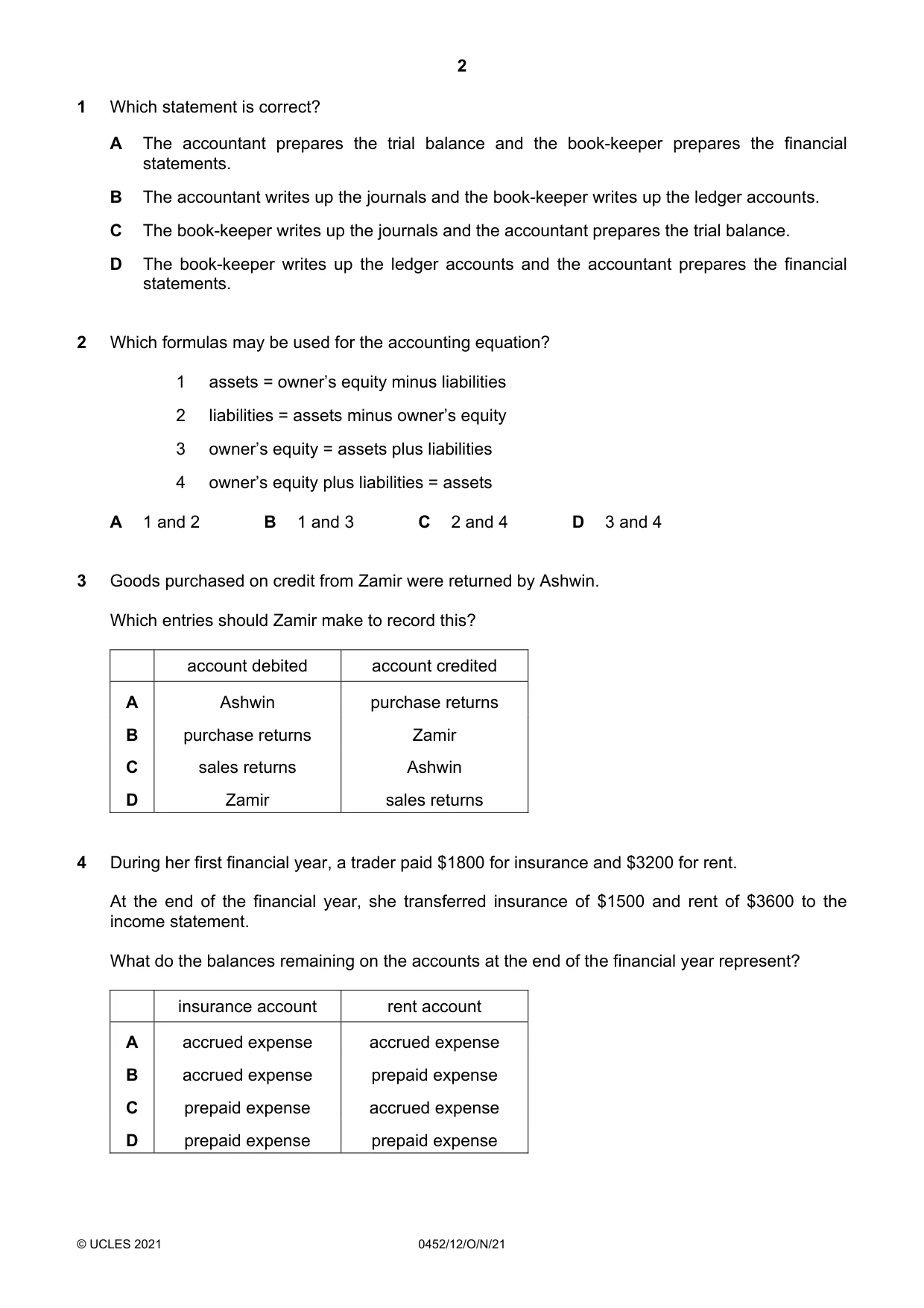
1 Which statement is correct? A The accountant prepares the trial balance and the book-keeper prepares the financial statements. B The accountant writes up the journals and the book-keeper writes up the ledger accounts. C The book-keeper writes up the journals and the accountant prepares the trial balance. D The book-keeper writes up the ledger accounts and the accountant prepares the financial statements.
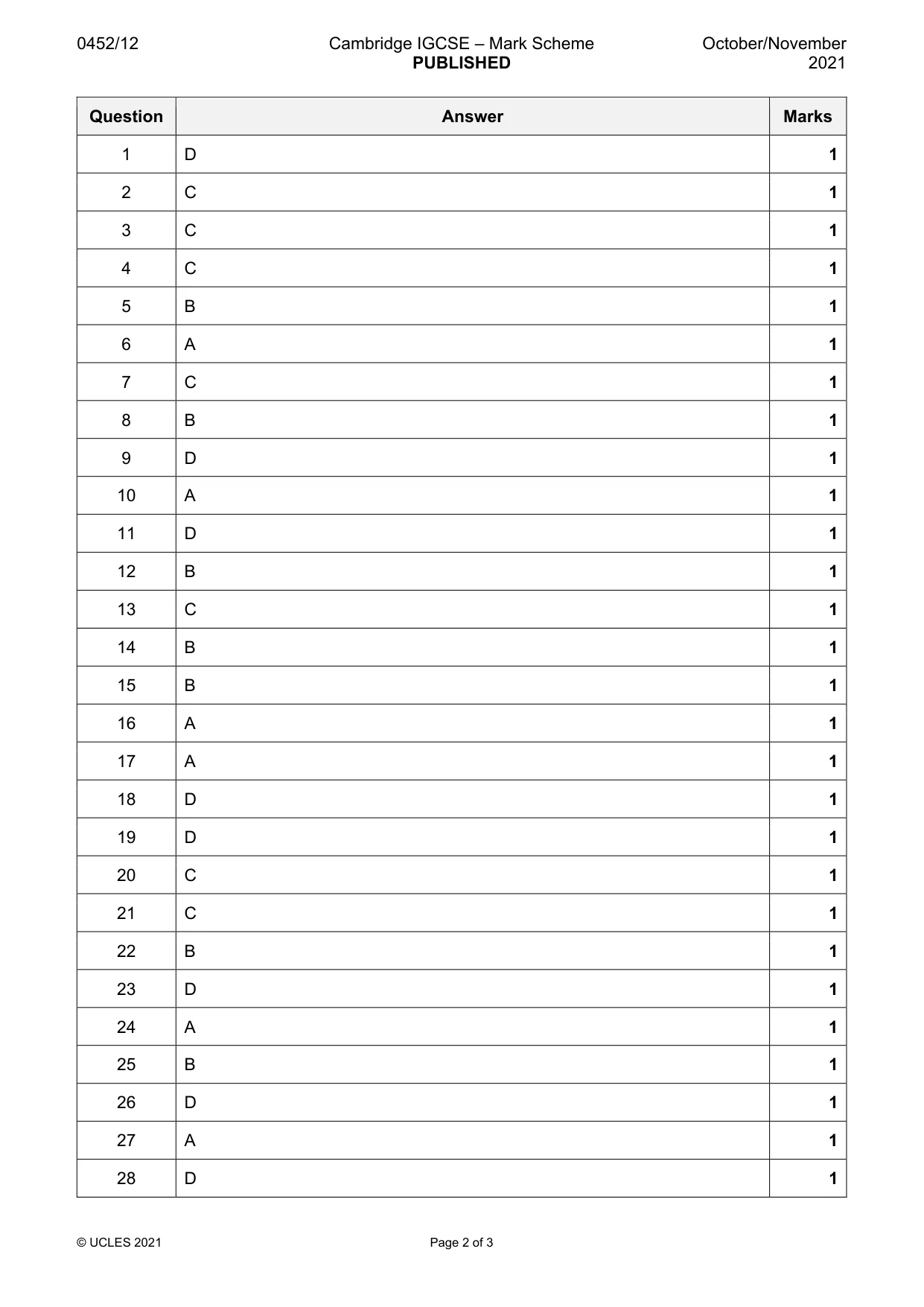
Mark scheme: D
Q2 · Which formulas may be used for the accounting equation?
2 Which formulas may be used for the accounting equation? 1 assets = owner’s equity minus liabilities 2 liabilities = assets minus owner’s equity 3 owner’s equity = assets plus liabilities 4 owner’s equity plus liabilities = assets A 1 and 2 B 1 and 3 C 2 and 4 D 3 and 4
Mark scheme: C
Q3 · Goods purchased on credit from Zamir were returned by Ashwin
3 Goods purchased on credit from Zamir were returned by Ashwin. Which entries should Zamir make to record this? account debited account credited A Ashwin purchase returns B purchase returns Zamir C sales returns Ashwin D Zamir sales returns
Mark scheme: C
Q4 · During her first financial year, a trader paid $1800 for insurance and $3200 for rent
4 During her first financial year, a trader paid $1800 for insurance and $3200 for rent. At the end of the financial year, she transferred insurance of $1500 and rent of $3600 to the income statement. What do the balances remaining on the accounts at the end of the financial year represent? insurance account rent account A accrued expense accrued expense B accrued expense prepaid expense C prepaid expense accrued expense D prepaid expense prepaid expense
Mark scheme: C
Q5 · Leah bought goods, $8000, less 15% trade discount
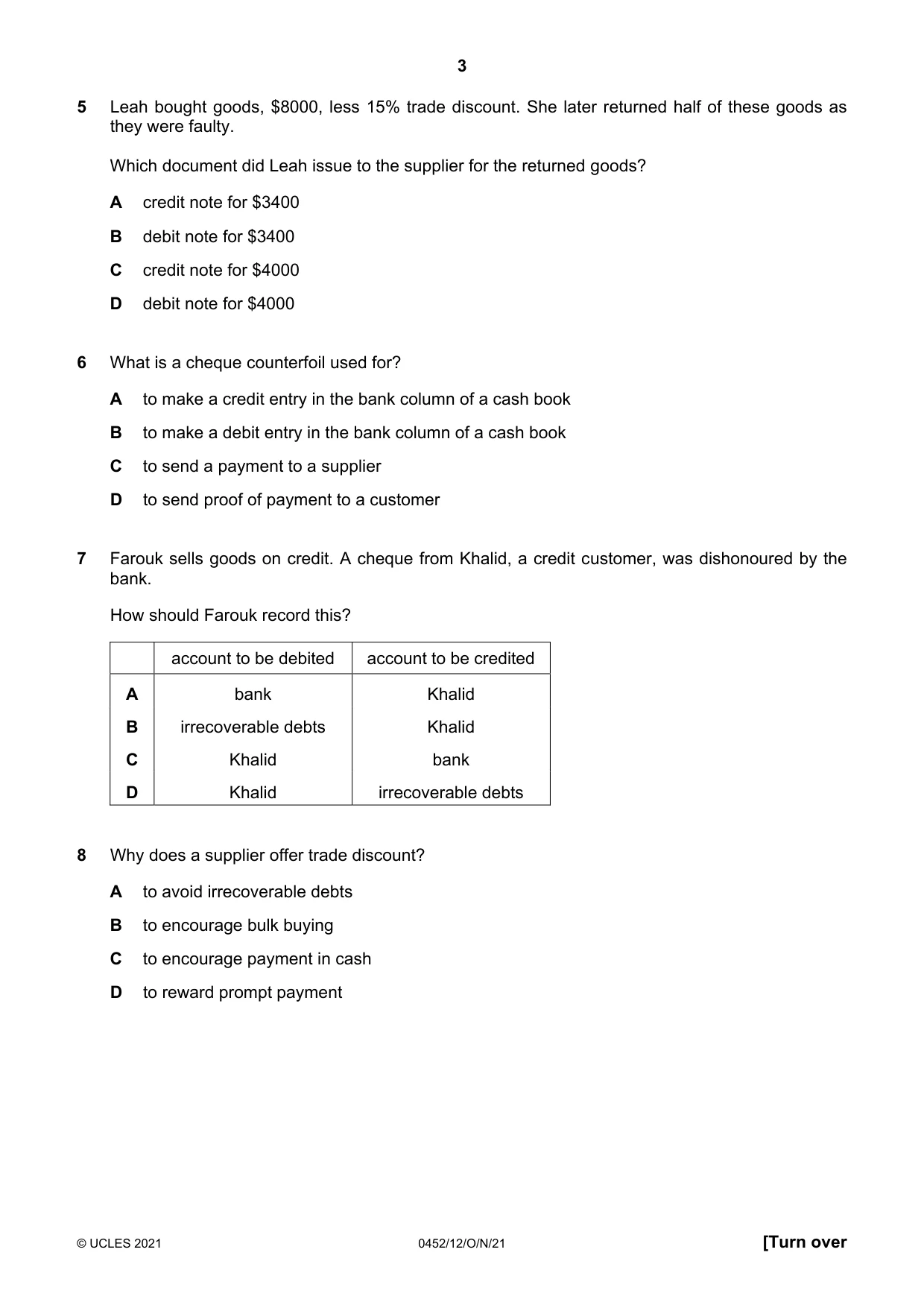
5 Leah bought goods, $8000, less 15% trade discount. She later returned half of these goods as they were faulty. Which document did Leah issue to the supplier for the returned goods? A credit note for $3400 B debit note for $3400 C credit note for $4000 D debit note for $4000
Mark scheme: B
Q6 · What is a cheque counterfoil used for?
6 What is a cheque counterfoil used for? A to make a credit entry in the bank column of a cash book B to make a debit entry in the bank column of a cash book C to send a payment to a supplier D to send proof of payment to a customer
Mark scheme: A
Q7 · Farouk sells goods on credit
7 Farouk sells goods on credit. A cheque from Khalid, a credit customer, was dishonoured by the bank. How should Farouk record this? account to be debited account to be credited A bank Khalid B irrecoverable debts Khalid C Khalid bank D Khalid irrecoverable debts
Mark scheme: C
Q8 · Why does a supplier offer trade discount?
8 Why does a supplier offer trade discount? A to avoid irrecoverable debts B to encourage bulk buying C to encourage payment in cash D to reward prompt payment
Mark scheme: B
Q9 · Ann maintains a petty cash book using the imprest system
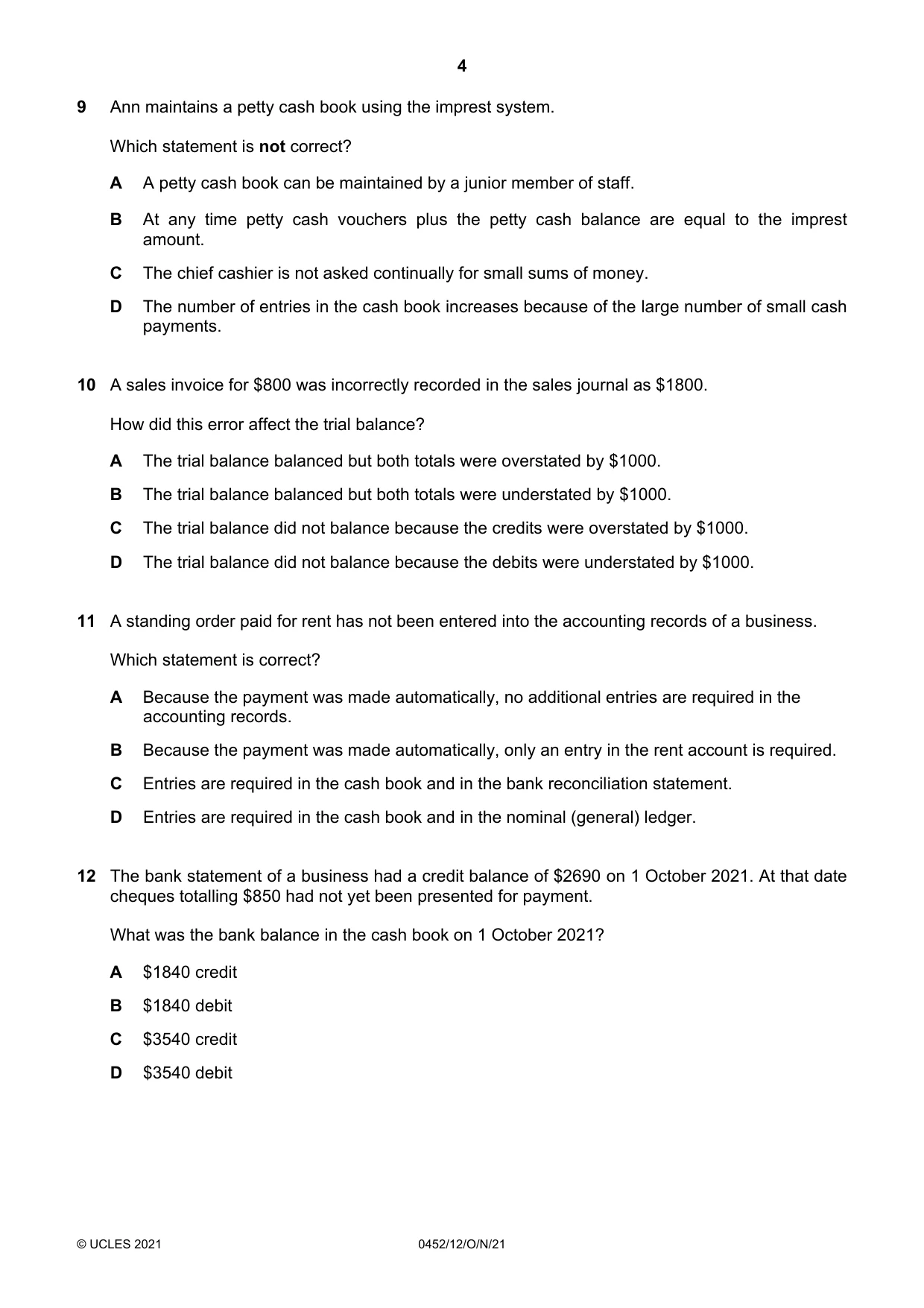
9 Ann maintains a petty cash book using the imprest system. Which statement is not correct? A A petty cash book can be maintained by a junior member of staff. B At any time petty cash vouchers plus the petty cash balance are equal to the imprest amount. C The chief cashier is not asked continually for small sums of money. D The number of entries in the cash book increases because of the large number of small cash payments.
Mark scheme: D
Q10 · A sales invoice for $800 was incorrectly recorded in the sales journal as $1800
10 A sales invoice for $800 was incorrectly recorded in the sales journal as $1800. How did this error affect the trial balance? A The trial balance balanced but both totals were overstated by $1000. B The trial balance balanced but both totals were understated by $1000. C The trial balance did not balance because the credits were overstated by $1000. D The trial balance did not balance because the debits were understated by $1000.
Mark scheme: A
Q11 · A standing order paid for rent has not been entered into the accounting records of a…
11 A standing order paid for rent has not been entered into the accounting records of a business. Which statement is correct? A Because the payment was made automatically, no additional entries are required in the accounting records. B Because the payment was made automatically, only an entry in the rent account is required. C Entries are required in the cash book and in the bank reconciliation statement. D Entries are required in the cash book and in the nominal (general) ledger.
Mark scheme: D
Q12 · The bank statement of a business had a credit balance of $2690 on 1 October 2021
12 The bank statement of a business had a credit balance of $2690 on 1 October 2021. At that date cheques totalling $850 had not yet been presented for payment. What was the bank balance in the cash book on 1 October 2021? A $1840 credit B $1840 debit C $3540 credit D $3540 debit
Mark scheme: B
Q13 · A trader has purchased new business premises
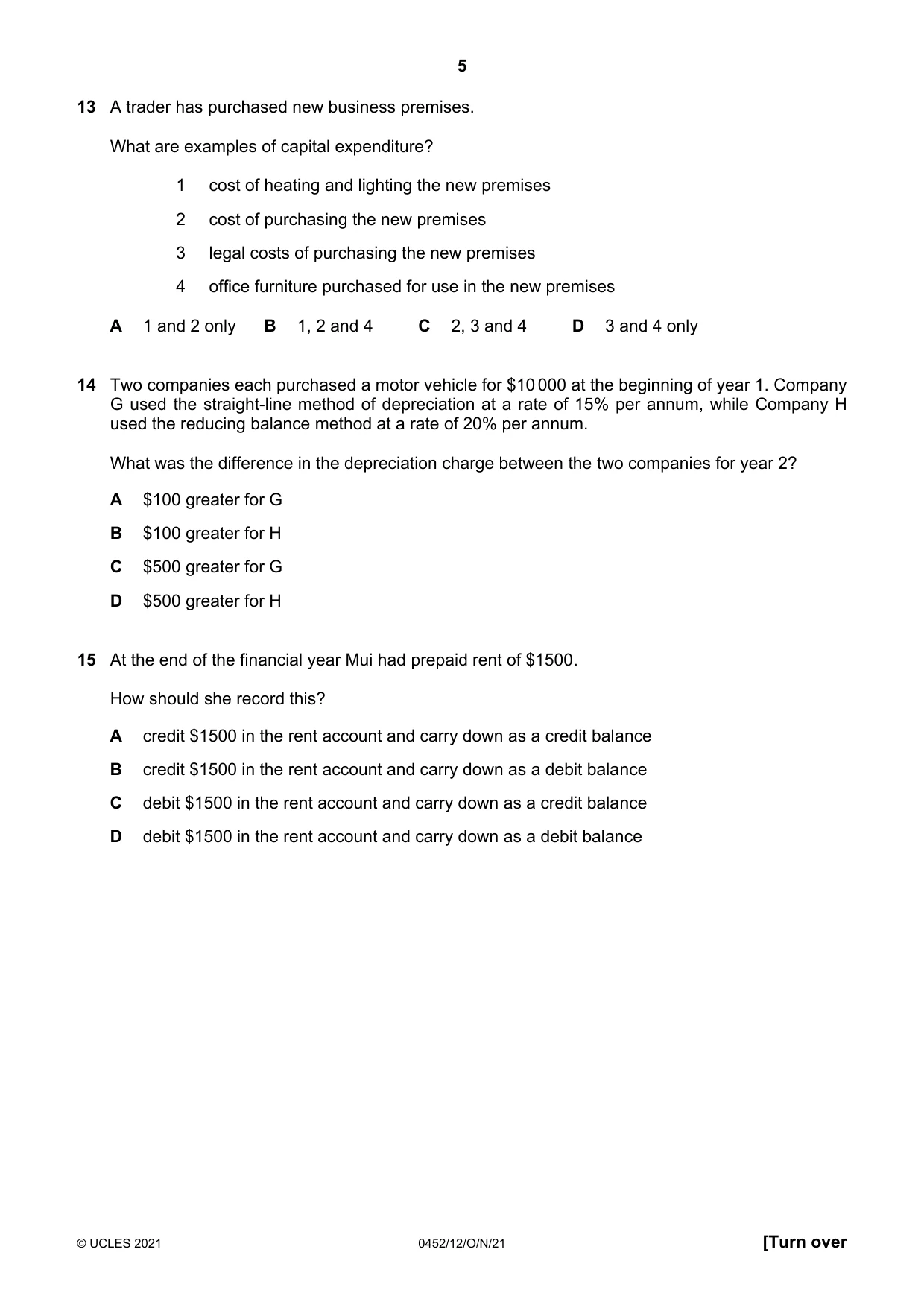
13 A trader has purchased new business premises. What are examples of capital expenditure? 1 cost of heating and lighting the new premises 2 cost of purchasing the new premises 3 legal costs of purchasing the new premises 4 office furniture purchased for use in the new premises A 1 and 2 only B 1, 2 and 4 C 2, 3 and 4 D 3 and 4 only
Mark scheme: C
More questions on Capital and revenue expenditure and receipts
Q14 · Two companies each purchased a motor vehicle for $10 000 at the beginning of year 1
14 Two companies each purchased a motor vehicle for $10 000 at the beginning of year 1. Company G used the straight-line method of depreciation at a rate of 15% per annum, while Company H used the reducing balance method at a rate of 20% per annum. What was the difference in the depreciation charge between the two companies for year 2? A $100 greater for G B $100 greater for H C $500 greater for G D $500 greater for H
Mark scheme: B
More questions on Accounting for depreciation and disposal of non-current assets
Q15 · At the end of the financial year Mui had prepaid rent of $1500
15 At the end of the financial year Mui had prepaid rent of $1500. How should she record this? A credit $1500 in the rent account and carry down as a credit balance B credit $1500 in the rent account and carry down as a debit balance C debit $1500 in the rent account and carry down as a credit balance D debit $1500 in the rent account and carry down as a debit balance
Mark scheme: B
Q16 · After preparing draft financial statements at the end of her first year of trading, Lucy…
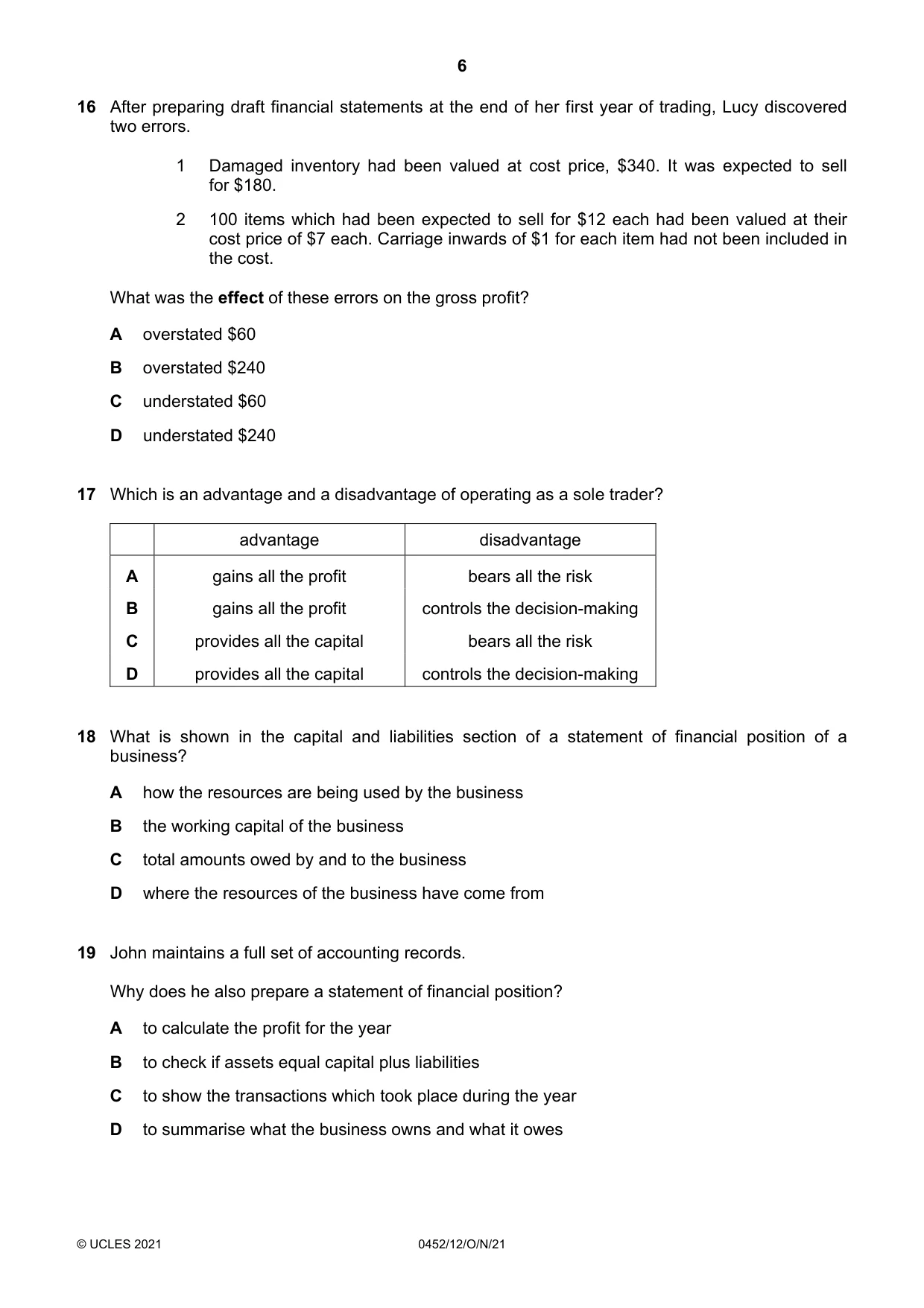
16 After preparing draft financial statements at the end of her first year of trading, Lucy discovered two errors. 1 Damaged inventory had been valued at cost price, $340. It was expected to sell for $180. 2 100 items which had been expected to sell for $12 each had been valued at their cost price of $7 each. Carriage inwards of $1 for each item had not been included in the cost. What was the effect of these errors on the gross profit? A overstated $60 B overstated $240 C understated $60 D understated $240
Mark scheme: A
Q17 · Which is an advantage and a disadvantage of operating as a sole trader?
17 Which is an advantage and a disadvantage of operating as a sole trader? advantage disadvantage A gains all the profit bears all the risk B gains all the profit controls the decision-making C provides all the capital bears all the risk D provides all the capital controls the decision-making
Mark scheme: A
Q18 · What is shown in the capital and liabilities section of a statement of financial position…
18 What is shown in the capital and liabilities section of a statement of financial position of a business? A how the resources are being used by the business B the working capital of the business C total amounts owed by and to the business D where the resources of the business have come from
Mark scheme: D
Q19 · John maintains a full set of accounting records
19 John maintains a full set of accounting records. Why does he also prepare a statement of financial position? A to calculate the profit for the year B to check if assets equal capital plus liabilities C to show the transactions which took place during the year D to summarise what the business owns and what it owes
Mark scheme: D
Q20 · A sole trader paid off the business’s overdraft using his own personal funds
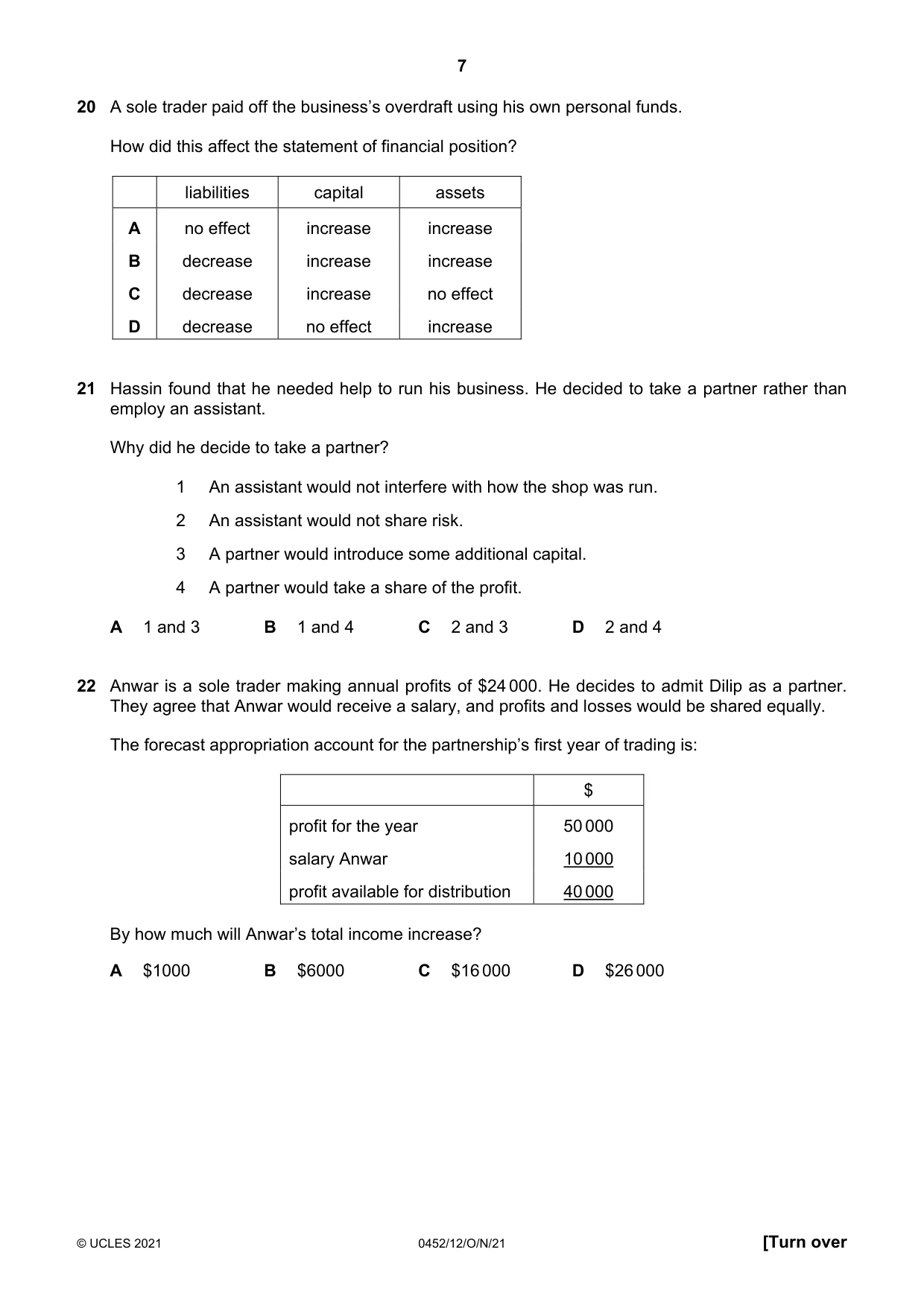
20 A sole trader paid off the business’s overdraft using his own personal funds. How did this affect the statement of financial position? liabilities capital assets A no effect increase increase B decrease increase increase C decrease increase no effect D decrease no effect increase
Mark scheme: C
Q21 · Hassin found that he needed help to run his business
21 Hassin found that he needed help to run his business. He decided to take a partner rather than employ an assistant. Why did he decide to take a partner? 1 An assistant would not interfere with how the shop was run. 2 An assistant would not share risk. 3 A partner would introduce some additional capital. 4 A partner would take a share of the profit. A 1 and 3 B 1 and 4 C 2 and 3 D 2 and 4
Mark scheme: C
Q22 · Anwar is a sole trader making annual profits of $24 000
22 Anwar is a sole trader making annual profits of $24 000. He decides to admit Dilip as a partner. They agree that Anwar would receive a salary, and profits and losses would be shared equally. The forecast appropriation account for the partnership’s first year of trading is: $ profit for the year 50 000 salary Anwar 10 000 profit available for distribution 40 000 By how much will Anwar’s total income increase? A $1000 B $6000 C $16 000 D $26 000
Mark scheme: B
Q23 · BCD Limited provided the following information
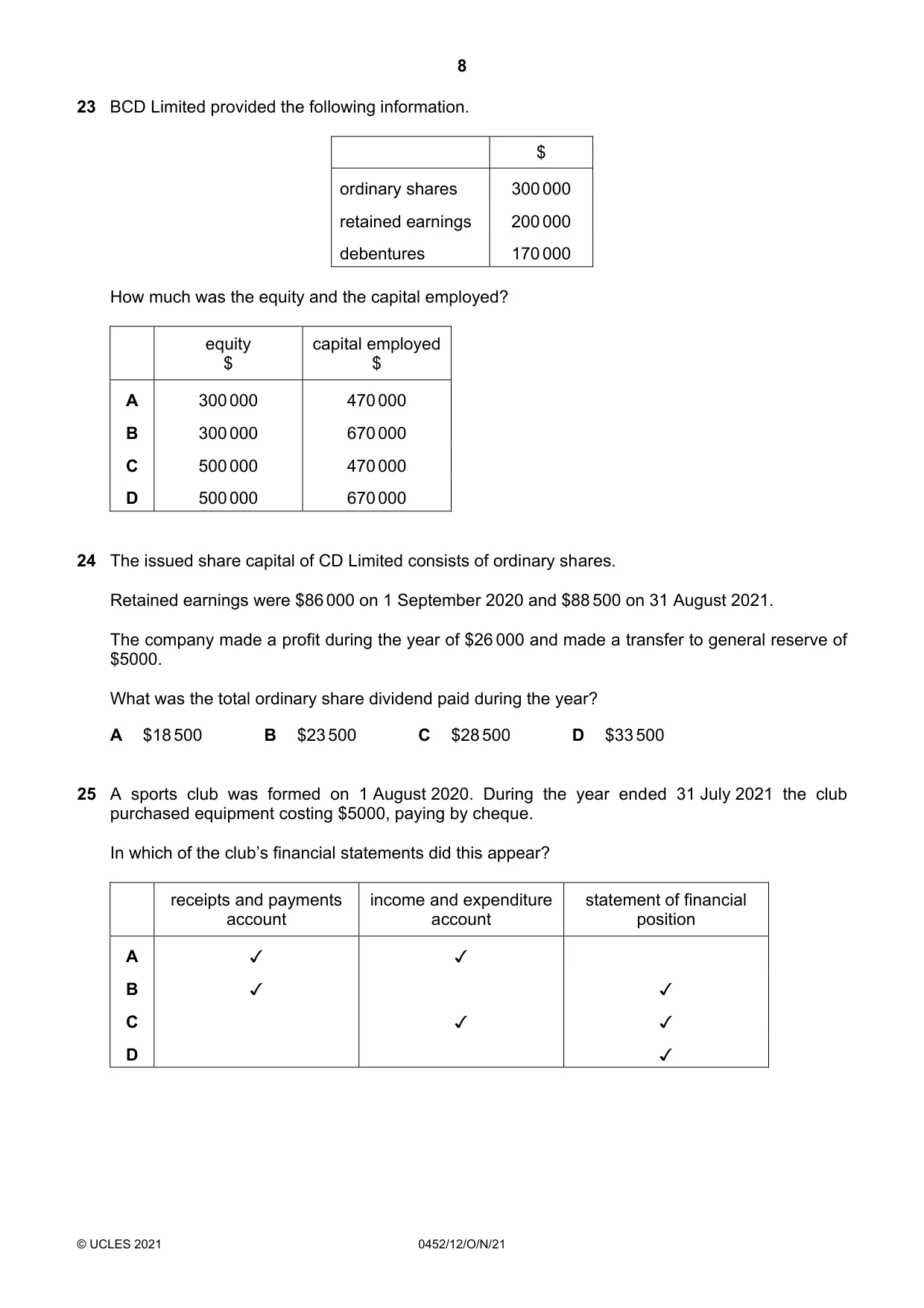
23 BCD Limited provided the following information. $ ordinary shares 300 000 retained earnings 200 000 debentures 170 000 How much was the equity and the capital employed? equity capital employed $ $ A 300 000 470 000 B 300 000 670 000 C 500 000 470 000 D 500 000 670 000
Mark scheme: D
Q24 · The issued share capital of CD Limited consists of ordinary shares
24 The issued share capital of CD Limited consists of ordinary shares. Retained earnings were $86 000 on 1 September 2020 and $88 500 on 31 August 2021. The company made a profit during the year of $26 000 and made a transfer to general reserve of $5000. What was the total ordinary share dividend paid during the year? A $18 500 B $23 500 C $28 500 D $33 500
Mark scheme: A
Q25 · A sports club was formed on 1 August 2020
25 A sports club was formed on 1 August 2020. During the year ended 31 July 2021 the club purchased equipment costing $5000, paying by cheque. In which of the club’s financial statements did this appear? receipts and payments | income and expenditure statement of financial account account position A Jv J B Jv J Cc J J D Jv
Mark scheme: B
Q26 · A sports club has 100 members and the annual subscription is $60
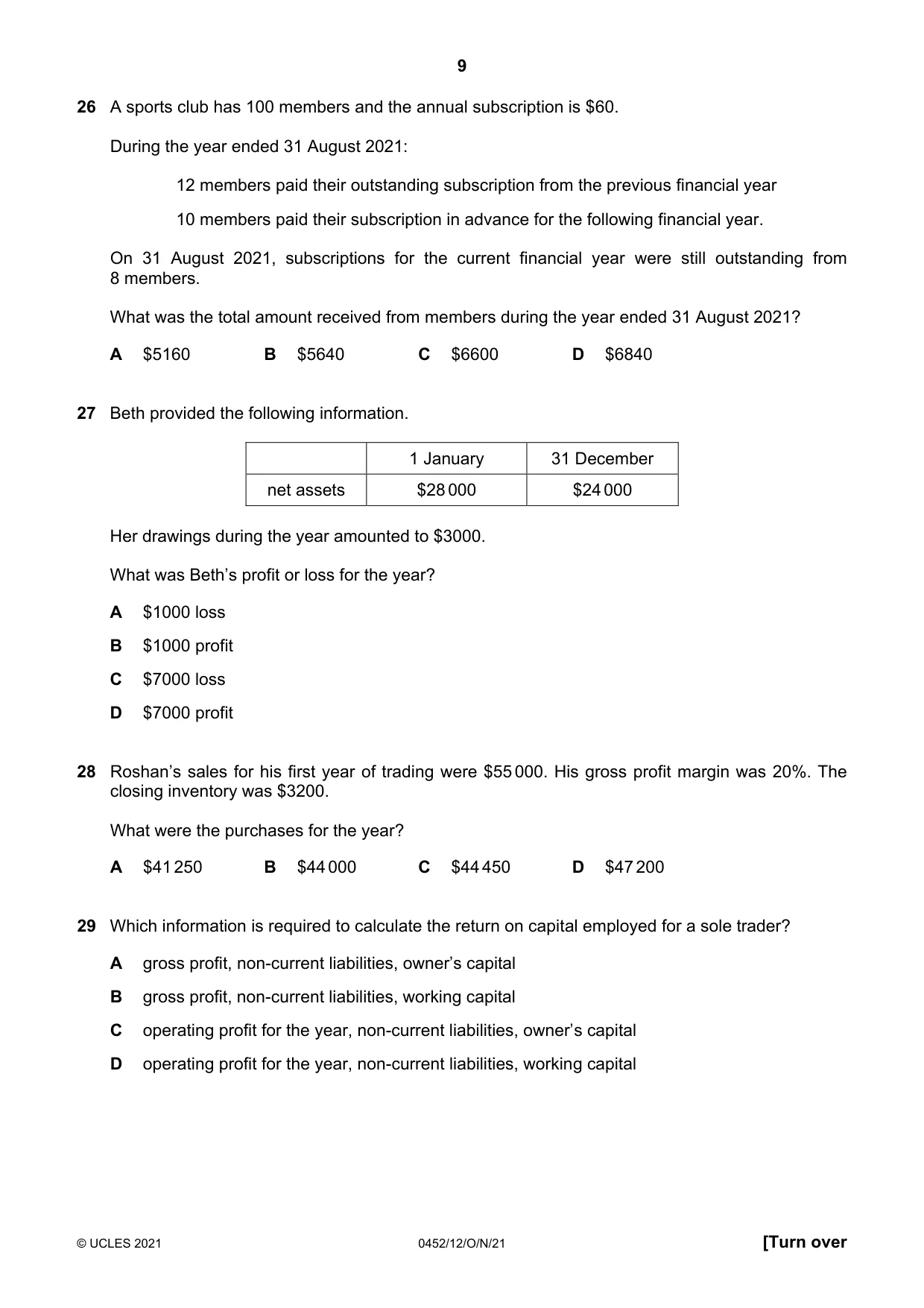
26 A sports club has 100 members and the annual subscription is $60. During the year ended 31 August 2021: 12 members paid their outstanding subscription from the previous financial year 10 members paid their subscription in advance for the following financial year. On 31 August 2021, subscriptions for the current financial year were still outstanding from 8 members. What was the total amount received from members during the year ended 31 August 2021? A $5160 B $5640 C $6600 D $6840
Mark scheme: D
Q27 · Beth provided the following information
27 Beth provided the following information. 1 January 31 December net assets $28 000 $24 000 Her drawings during the year amounted to $3000. What was Beth’s profit or loss for the year? A $1000 loss B $1000 profit C $7000 loss D $7000 profit
Mark scheme: A
Q28 · Roshan’s sales for his first year of trading were $55 000
28 Roshan’s sales for his first year of trading were $55 000. His gross profit margin was 20%. The closing inventory was $3200. What were the purchases for the year? A $41 250 B $44 000 C $44 450 D $47 200
Mark scheme: D
More questions on Calculation and understanding of accounting ratios
Q29 · Which information is required to calculate the return on capital employed for a sole…
29 Which information is required to calculate the return on capital employed for a sole trader? A gross profit, non-current liabilities, owner’s capital B gross profit, non-current liabilities, working capital C operating profit for the year, non-current liabilities, owner’s capital D operating profit for the year, non-current liabilities, working capital
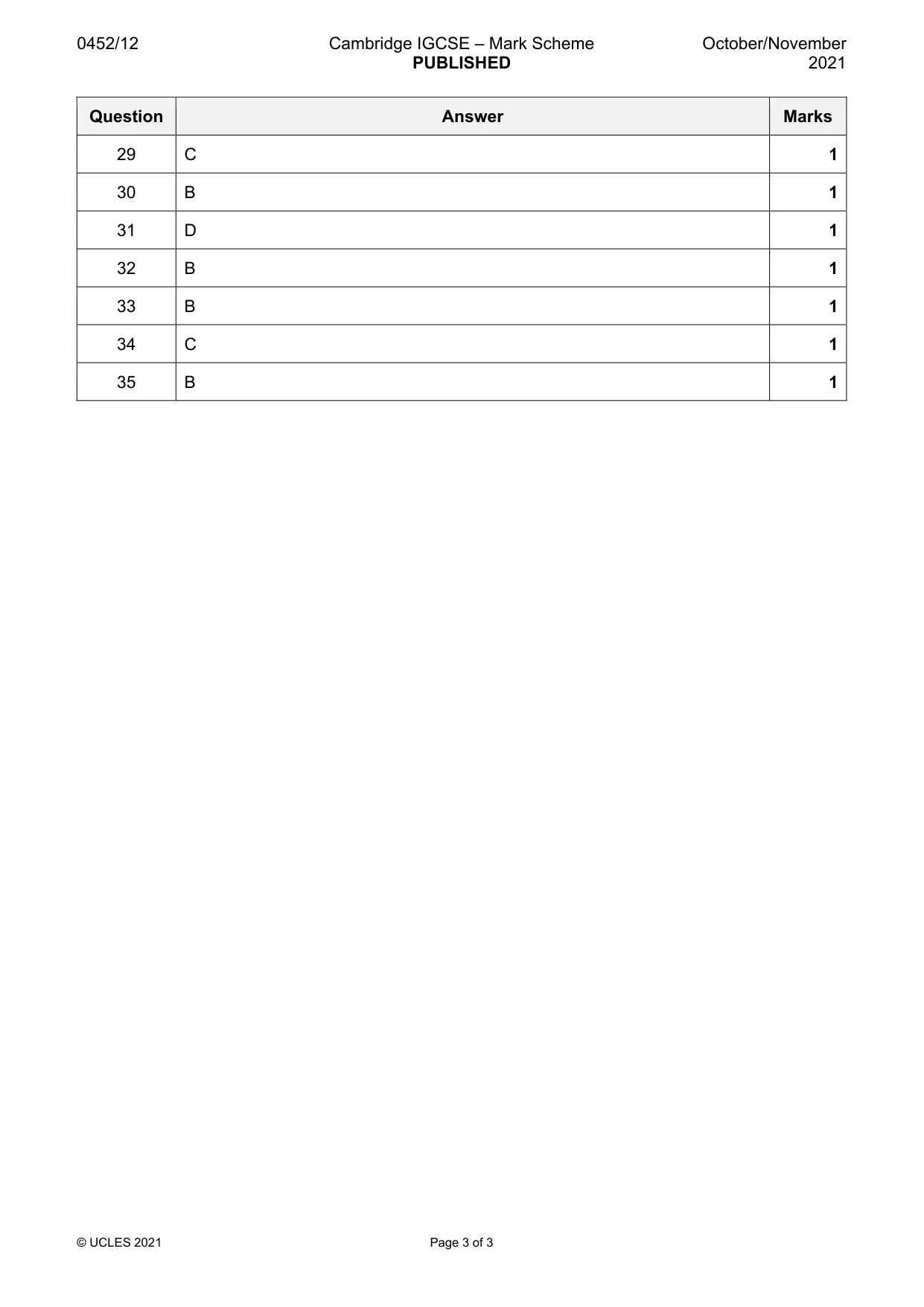
Mark scheme: C
More questions on Calculation and understanding of accounting ratios
Q30 · What is the best indicator of the liquidity of a business?
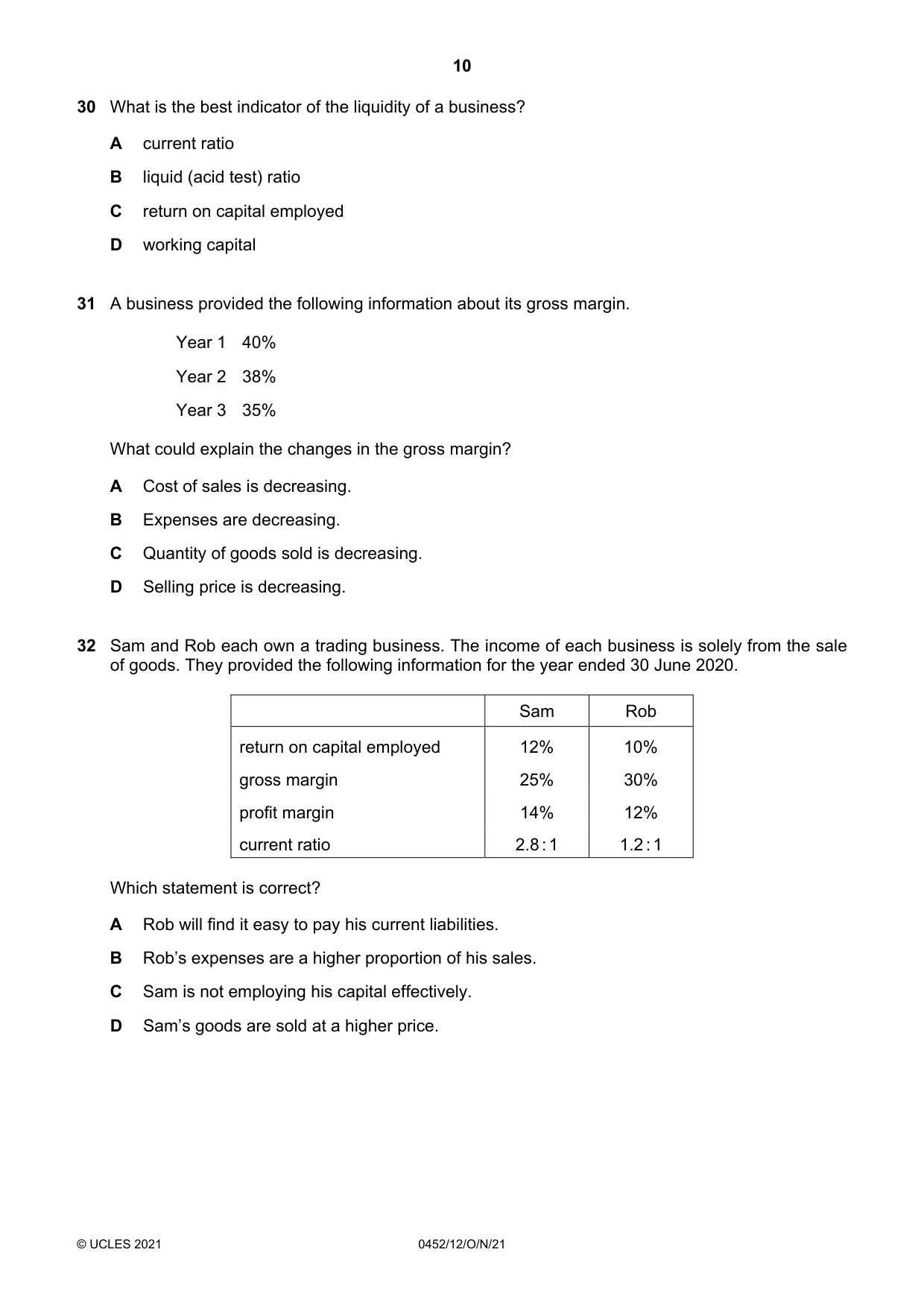
30 What is the best indicator of the liquidity of a business? A current ratio B liquid (acid test) ratio C return on capital employed D working capital
Mark scheme: B
More questions on Calculation and understanding of accounting ratios
Q31 · A business provided the following information about its gross margin
31 A business provided the following information about its gross margin. Year 1 40% Year 2 38% Year 3 35% What could explain the changes in the gross margin? A Cost of sales is decreasing. B Expenses are decreasing. C Quantity of goods sold is decreasing. D Selling price is decreasing.
Mark scheme: D
Q32 · Sam and Rob each own a trading business
32 Sam and Rob each own a trading business. The income of each business is solely from the sale of goods. They provided the following information for the year ended 30 June 2020. Sam Rob return on capital employed 12% 10% gross margin 25% 30% profit margin 14% 12% current ratio 2.8 : 1 1.2 : 1 Which statement is correct? A Rob will find it easy to pay his current liabilities. B Rob’s expenses are a higher proportion of his sales. C Sam is not employing his capital effectively. D Sam’s goods are sold at a higher price.
Mark scheme: B
Q33 · Why would the owner of a business want to see his financial statements at the end of the…
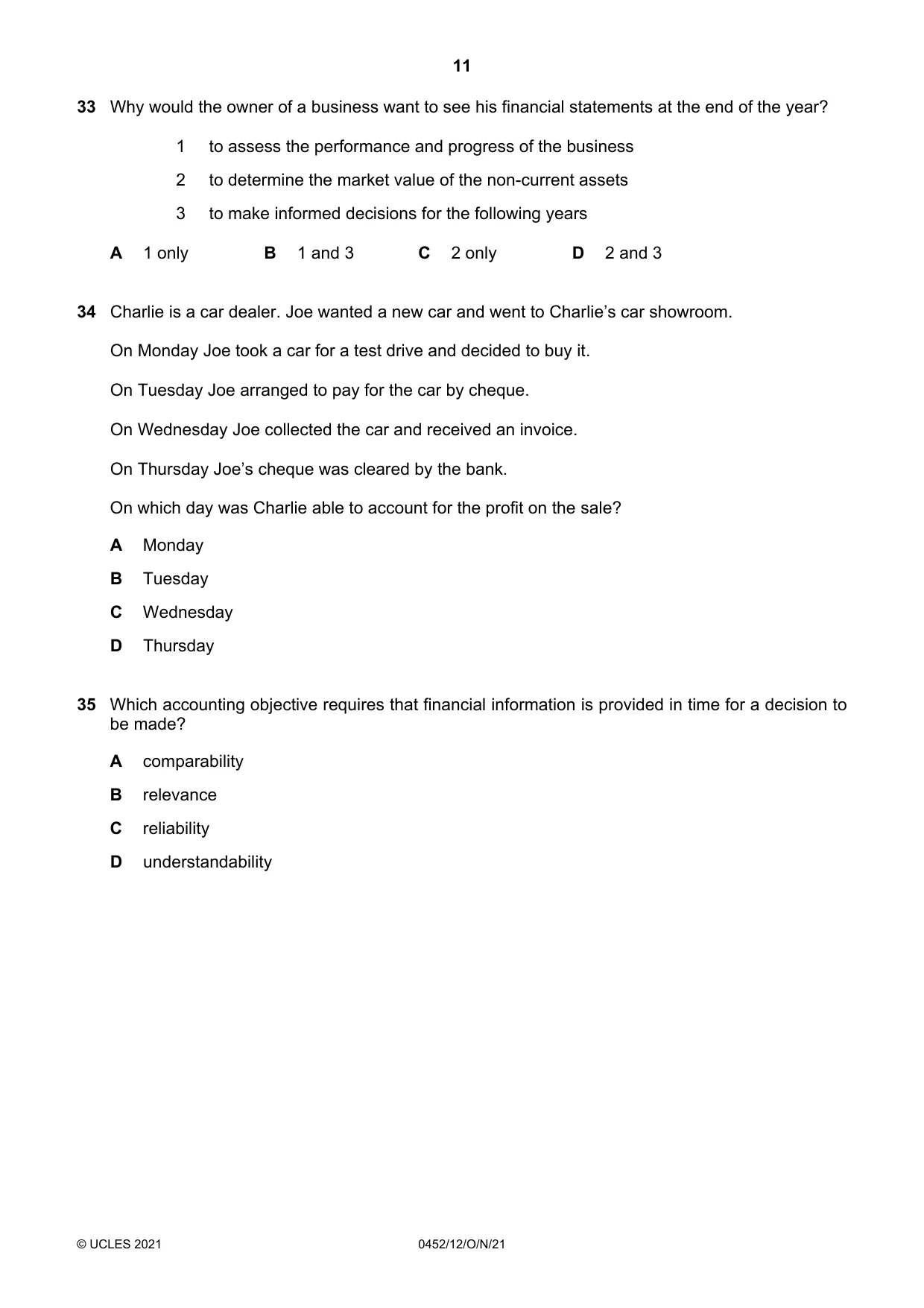
33 Why would the owner of a business want to see his financial statements at the end of the year? 1 to assess the performance and progress of the business 2 to determine the market value of the non-current assets 3 to make informed decisions for the following years A 1 only B 1 and 3 C 2 only D 2 and 3
Mark scheme: B
Q34 · Charlie is a car dealer
34 Charlie is a car dealer. Joe wanted a new car and went to Charlie’s car showroom. On Monday Joe took a car for a test drive and decided to buy it. On Tuesday Joe arranged to pay for the car by cheque. On Wednesday Joe collected the car and received an invoice. On Thursday Joe’s cheque was cleared by the bank. On which day was Charlie able to account for the profit on the sale? A Monday B Tuesday C Wednesday D Thursday
Mark scheme: C
Q35 · Which accounting objective requires that financial information is provided in time for a…
35 Which accounting objective requires that financial information is provided in time for a decision to be made? A comparability B relevance C reliability D understandability
Mark scheme: B
What was in this paper
The subtopics covered by these 35 questions, and how many questions each got. Open one in a new tab to see every Cambridge question on it.
4Business documents3Calculation and understanding of accounting ratios3Accounting concepts2Bank reconciliation2Books of prime entry2Clubs and societies2Interpretation of accounting ratios2Limited companies2Other payables and other receivables2Partnerships2Accounting for depreciation and disposal of non-current assets1Capital and revenue expenditure and receipts1Corrections of errors1Incomplete records1Interested parties1Sole traders1The double entry system of book-keeping1The purpose of accounting1Valuation of inventory1What you needed in this session
Cambridge’s own grade thresholds for 2021 Oct/Nov, Paper 1 · Variant 2. A higher threshold means an easier paper — the bar moves with how the cohort did.