Cambridge IGCSE Accounting 0452 — 2022 Feb/March Paper 1 · Variant 2
0452/12/F/M/22 · 35 questions · 35 marks · ≈39 min
The question paper and its mark scheme, free to read here and free to download. This is Cambridge’s own paper, exactly as it was sat.
Question paper12 pages
Mark scheme3 pages
Answers below. Sit the paper first if you are practising.
Questions as text
Q1 · What is prepared by a book-keeper?
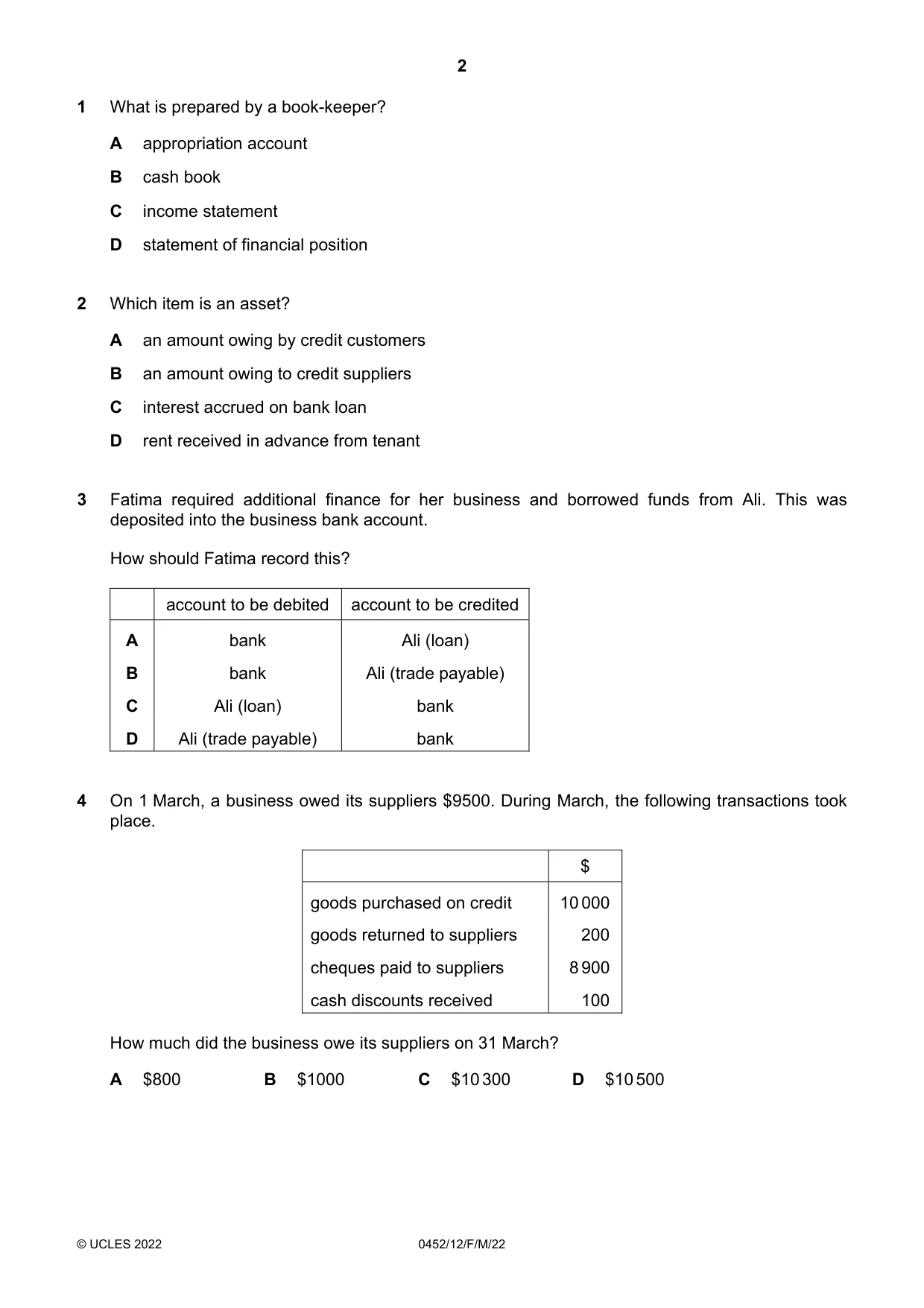
1 What is prepared by a book-keeper? A appropriation account B cash book C income statement D statement of financial position
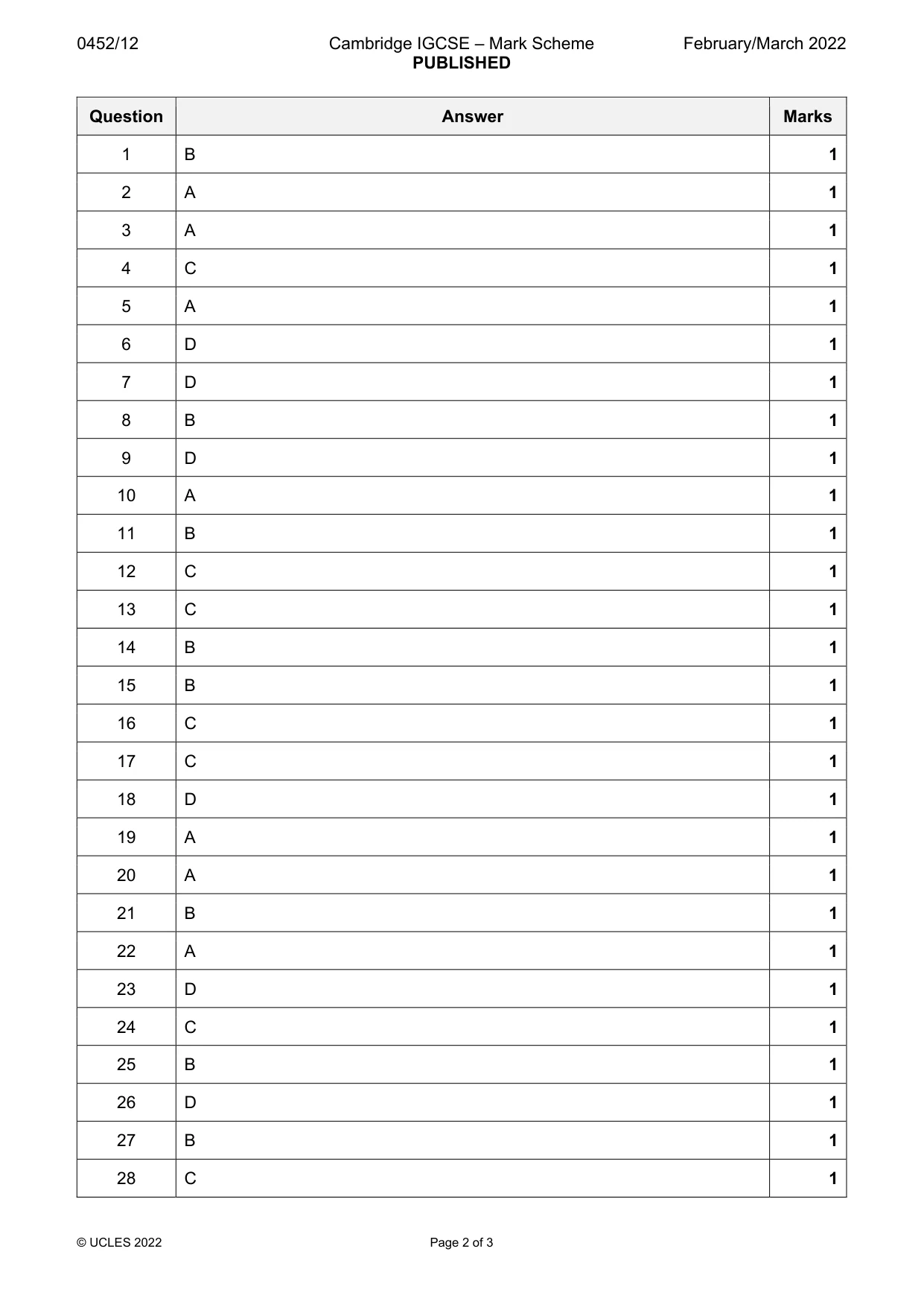
Mark scheme: B
Q2 · Which item is an asset?
2 Which item is an asset? A an amount owing by credit customers B an amount owing to credit suppliers C interest accrued on bank loan D rent received in advance from tenant
Mark scheme: A
Q3 · Fatima required additional finance for her business and borrowed funds from Ali
3 Fatima required additional finance for her business and borrowed funds from Ali. This was deposited into the business bank account. How should Fatima record this? account to be debited account to be credited A bank Ali (loan) B bank Ali (trade payable) C Ali (loan) bank D Ali (trade payable) bank
Mark scheme: A
Q4 · On 1 March, a business owed its suppliers $9500
4 On 1 March, a business owed its suppliers $9500. During March, the following transactions took place. $ goods purchased on credit 10 000 goods returned to suppliers 200 cheques paid to suppliers 8 900 cash discounts received 100 How much did the business owe its suppliers on 31 March? A $800 B $1000 C $10 300 D $10 500
Mark scheme: C
Q5 · Which document from a supplier reduces the amount owed by a customer?
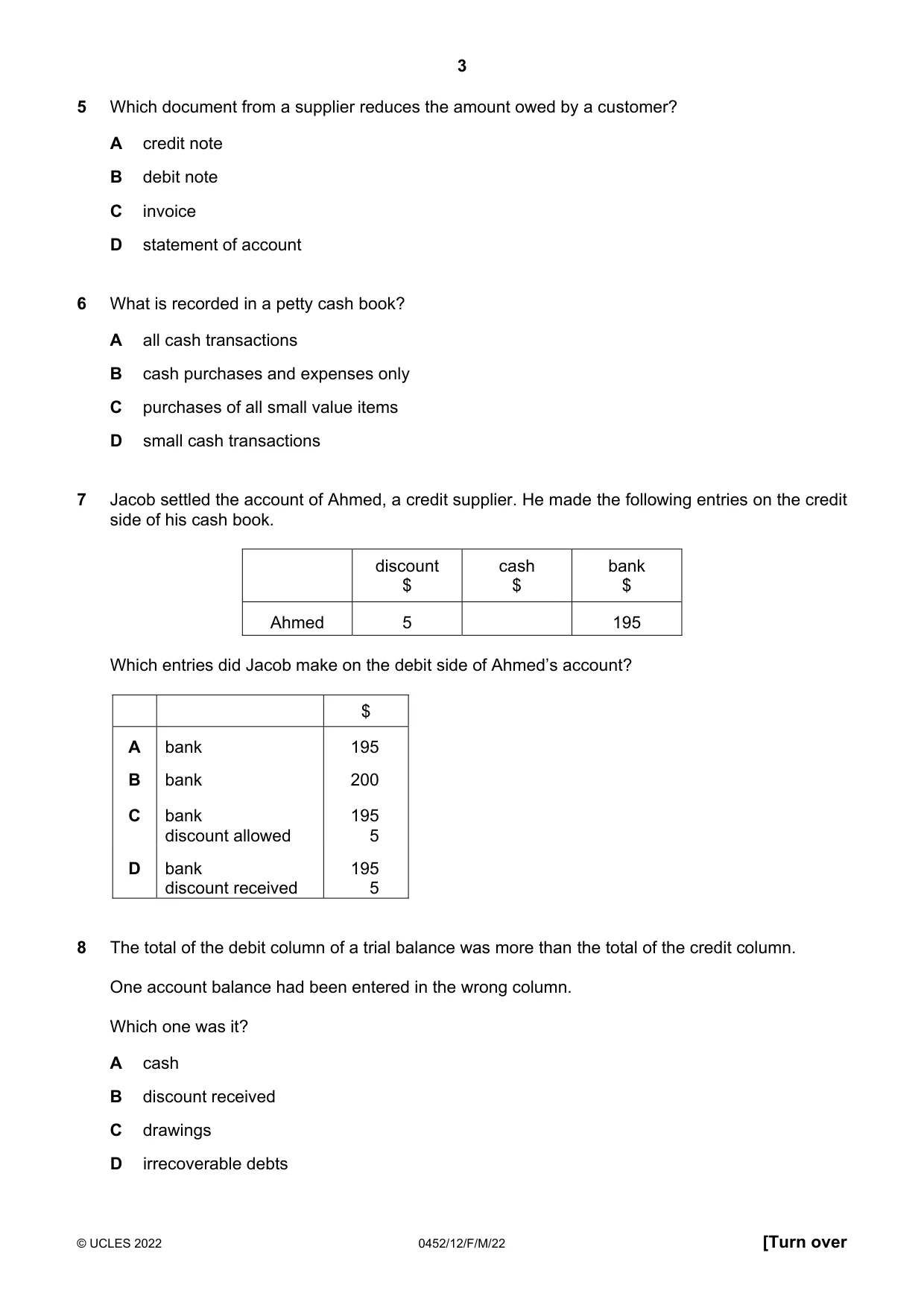
5 Which document from a supplier reduces the amount owed by a customer? A credit note B debit note C invoice D statement of account
Mark scheme: A
Q6 · What is recorded in a petty cash book?
6 What is recorded in a petty cash book? A all cash transactions B cash purchases and expenses only C purchases of all small value items D small cash transactions
Mark scheme: D
Q7 · Jacob settled the account of Ahmed, a credit supplier
7 Jacob settled the account of Ahmed, a credit supplier. He made the following entries on the credit side of his cash book. discount cash bank $ $ $ Ahmed 5 195 Which entries did Jacob make on the debit side of Ahmed’s account? $ A bank 195 B bank 200 C bank 195 discount allowed 5 D bank 195 discount received 5
Mark scheme: D
Q8 · The total of the debit column of a trial balance was more than the total of the credit…
8 The total of the debit column of a trial balance was more than the total of the credit column. One account balance had been entered in the wrong column. Which one was it? A cash B discount received C drawings D irrecoverable debts
Mark scheme: B
Q9 · Davi prepared the following journal entry to correct an error
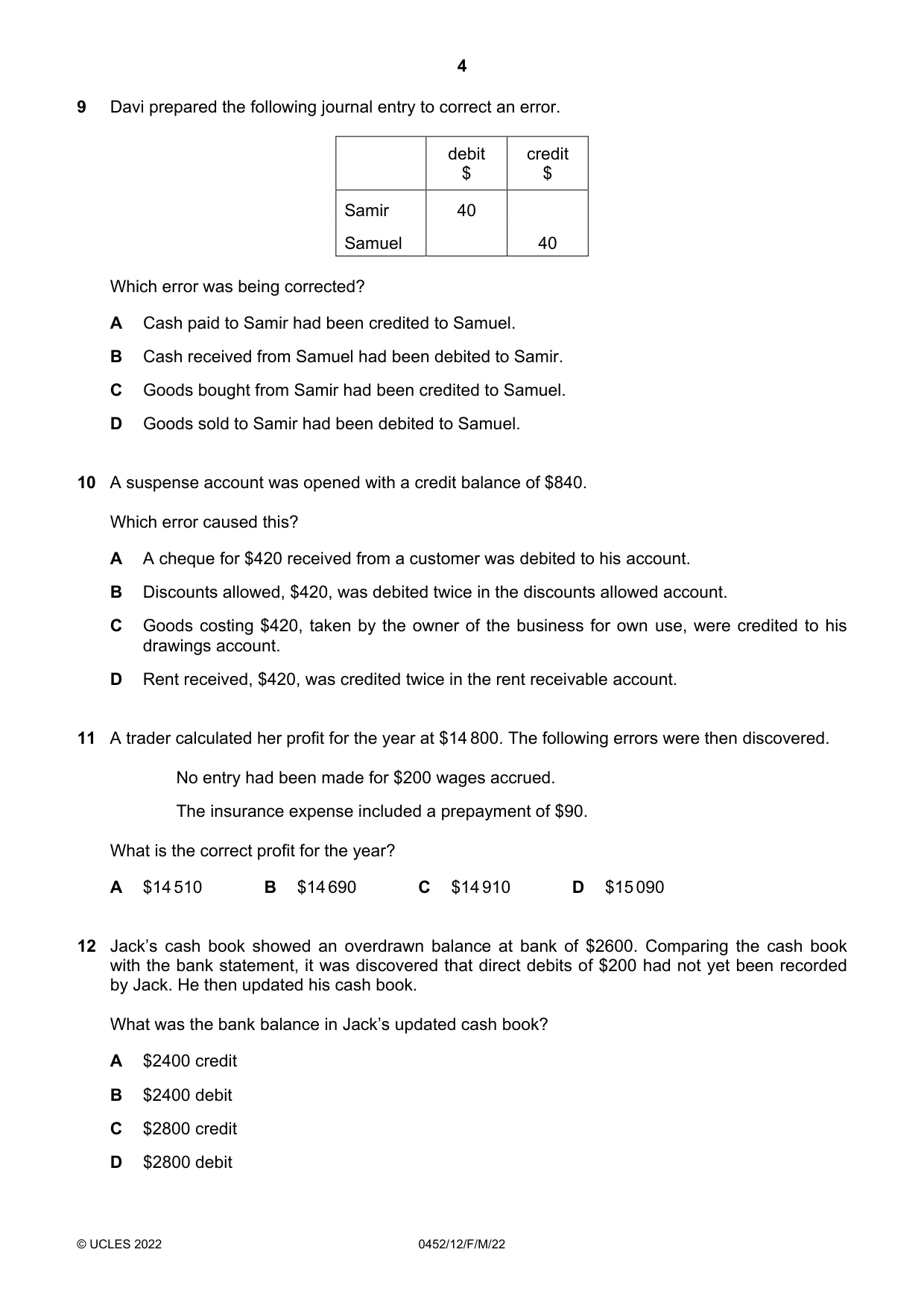
9 Davi prepared the following journal entry to correct an error. debit credit $ $ Samir 40 Samuel 40 Which error was being corrected? A Cash paid to Samir had been credited to Samuel. B Cash received from Samuel had been debited to Samir. C Goods bought from Samir had been credited to Samuel. D Goods sold to Samir had been debited to Samuel.
Mark scheme: D
Q10 · A suspense account was opened with a credit balance of $840
10 A suspense account was opened with a credit balance of $840. Which error caused this? A A cheque for $420 received from a customer was debited to his account. B Discounts allowed, $420, was debited twice in the discounts allowed account. C Goods costing $420, taken by the owner of the business for own use, were credited to his drawings account. D Rent received, $420, was credited twice in the rent receivable account.
Mark scheme: A
Q11 · A trader calculated her profit for the year at $14 800
11 A trader calculated her profit for the year at $14 800. The following errors were then discovered. No entry had been made for $200 wages accrued. The insurance expense included a prepayment of $90. What is the correct profit for the year? A $14 510 B $14 690 C $14 910 D $15 090
Mark scheme: B
Q12 · Jack’s cash book showed an overdrawn balance at bank of $2600
12 Jack’s cash book showed an overdrawn balance at bank of $2600. Comparing the cash book with the bank statement, it was discovered that direct debits of $200 had not yet been recorded by Jack. He then updated his cash book. What was the bank balance in Jack’s updated cash book? A $2400 credit B $2400 debit C $2800 credit D $2800 debit
Mark scheme: C
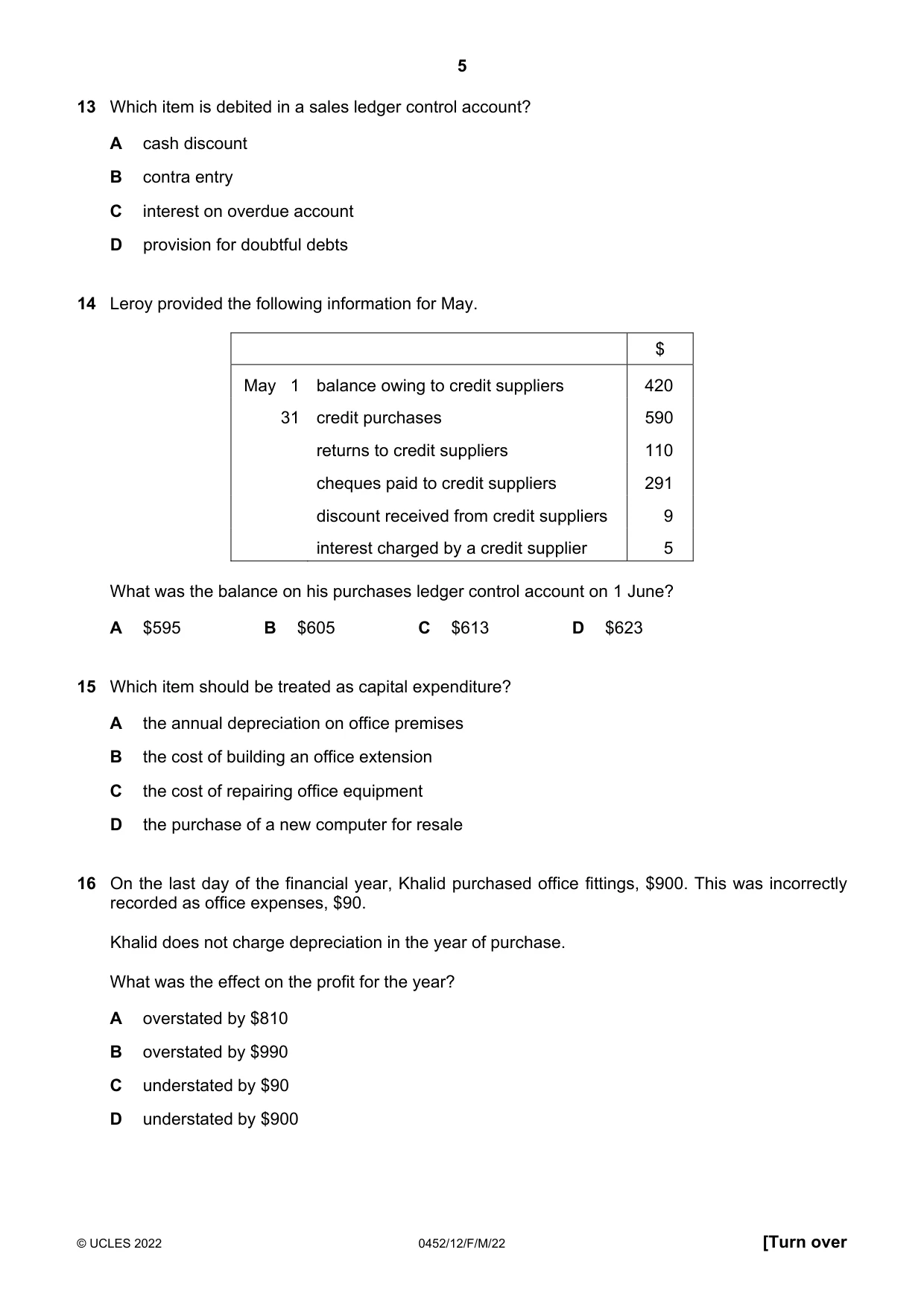
Q13 · Which item is debited in a sales ledger control account?
13 Which item is debited in a sales ledger control account? A cash discount B contra entry C interest on overdue account D provision for doubtful debts
Mark scheme: C
Q14 · Leroy provided the following information for May
14 Leroy provided the following information for May. $ May 1 balance owing to credit suppliers 420 31 credit purchases 590 returns to credit suppliers 110 cheques paid to credit suppliers 291 discount received from credit suppliers 9 interest charged by a credit supplier 5 What was the balance on his purchases ledger control account on 1 June? A $595 B $605 C $613 D $623
Mark scheme: B
Q15 · Which item should be treated as capital expenditure?
15 Which item should be treated as capital expenditure? A the annual depreciation on office premises B the cost of building an office extension C the cost of repairing office equipment D the purchase of a new computer for resale
Mark scheme: B
More questions on Capital and revenue expenditure and receipts
Q16 · On the last day of the financial year, Khalid purchased office fittings, $900
16 On the last day of the financial year, Khalid purchased office fittings, $900. This was incorrectly recorded as office expenses, $90. Khalid does not charge depreciation in the year of purchase. What was the effect on the profit for the year? A overstated by $810 B overstated by $990 C understated by $90 D understated by $900
Mark scheme: C
More questions on Capital and revenue expenditure and receipts
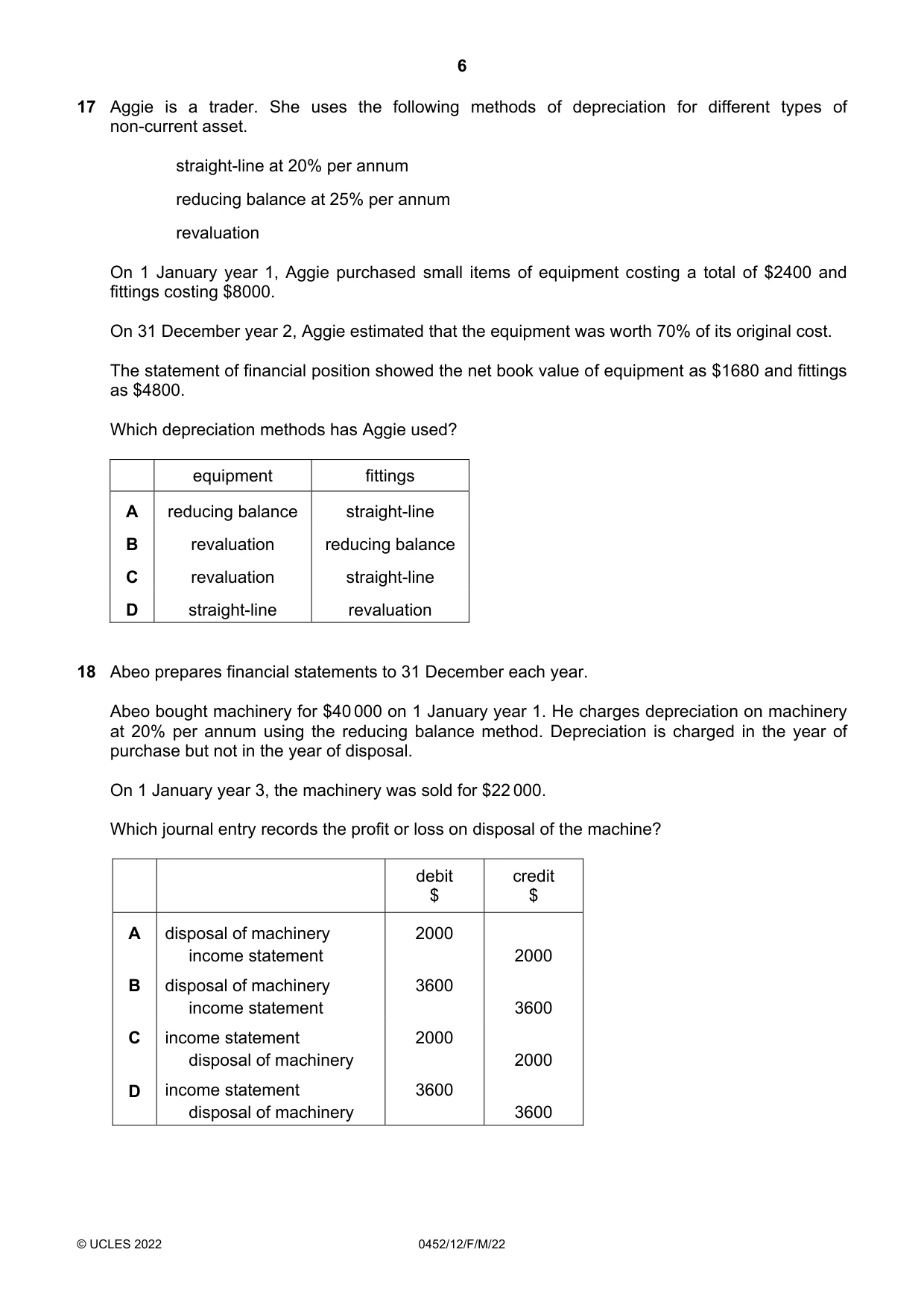
Q17 · Aggie is a trader
17 Aggie is a trader. She uses the following methods of depreciation for different types of non-current asset. straight-line at 20% per annum reducing balance at 25% per annum revaluation On 1 January year 1, Aggie purchased small items of equipment costing a total of $2400 and fittings costing $8000. On 31 December year 2, Aggie estimated that the equipment was worth 70% of its original cost. The statement of financial position showed the net book value of equipment as $1680 and fittings as $4800. Which depreciation methods has Aggie used? equipment fittings A reducing balance straight-line B revaluation reducing balance C revaluation straight-line D straight-line revaluation
Mark scheme: C
More questions on Accounting for depreciation and disposal of non-current assets
Q18 · Abeo prepares financial statements to 31 December each year
18 Abeo prepares financial statements to 31 December each year. Abeo bought machinery for $40 000 on 1 January year 1. He charges depreciation on machinery at 20% per annum using the reducing balance method. Depreciation is charged in the year of purchase but not in the year of disposal. On 1 January year 3, the machinery was sold for $22 000. Which journal entry records the profit or loss on disposal of the machine? debit credit $ $ A disposal of machinery 2000 income statement 2000 B disposal of machinery 3600 income statement 3600 C income statement 2000 disposal of machinery 2000 D income statement 3600 disposal of machinery 3600
Mark scheme: D
More questions on Accounting for depreciation and disposal of non-current assets
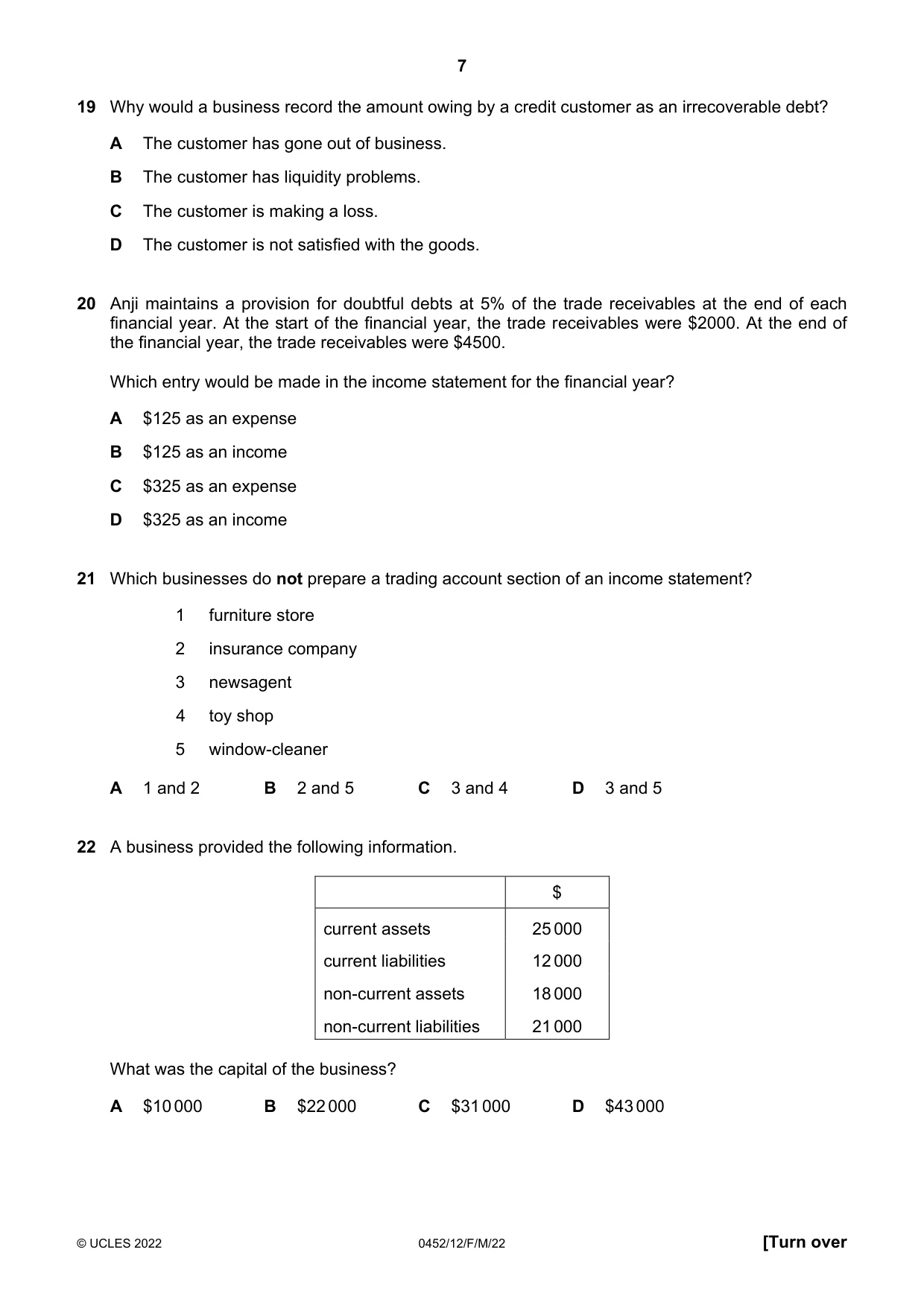
Q19 · Why would a business record the amount owing by a credit customer as an irrecoverable…
19 Why would a business record the amount owing by a credit customer as an irrecoverable debt? A The customer has gone out of business. B The customer has liquidity problems. C The customer is making a loss. D The customer is not satisfied with the goods.
Mark scheme: A
More questions on Irrecoverable debts and allowance for irrecoverable debts
Q20 · Anji maintains a provision for doubtful debts at 5% of the trade receivables at the end…
20 Anji maintains a provision for doubtful debts at 5% of the trade receivables at the end of each financial year. At the start of the financial year, the trade receivables were $2000. At the end of the financial year, the trade receivables were $4500. Which entry would be made in the income statement for the financial year? A $125 as an expense B $125 as an income C $325 as an expense D $325 as an income
Mark scheme: A
More questions on Irrecoverable debts and allowance for irrecoverable debts
Q21 · Which businesses do not prepare a trading account section of an income statement?
21 Which businesses do not prepare a trading account section of an income statement? 1 furniture store 2 insurance company 3 newsagent 4 toy shop 5 window-cleaner A 1 and 2 B 2 and 5 C 3 and 4 D 3 and 5
Mark scheme: B
Q22 · A business provided the following information
22 A business provided the following information. $ current assets 25 000 current liabilities 12 000 non-current assets 18 000 non-current liabilities 21 000 What was the capital of the business? A $10 000 B $22 000 C $31 000 D $43 000
Mark scheme: A
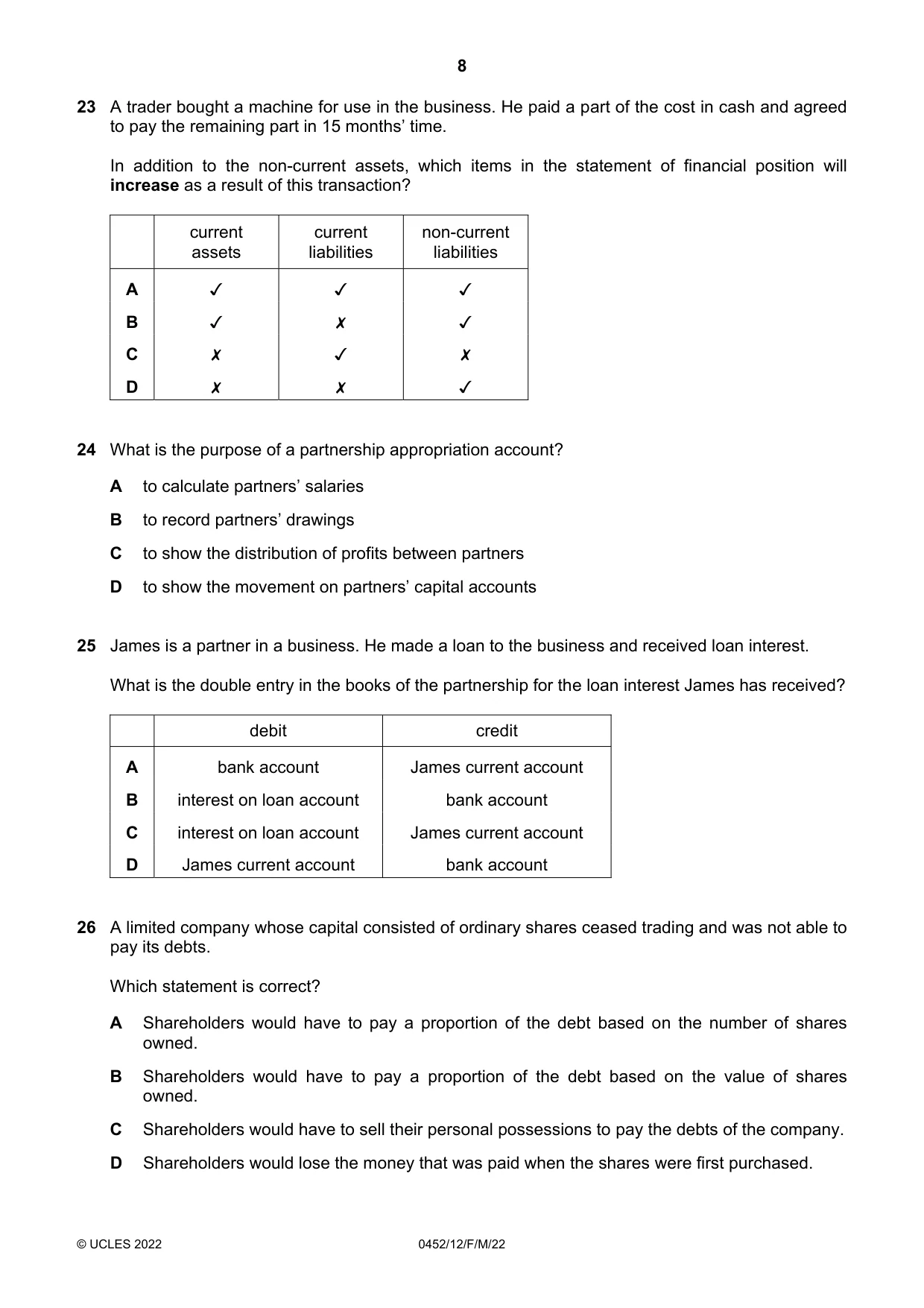
Q23 · A trader bought a machine for use in the business
23 A trader bought a machine for use in the business. He paid a part of the cost in cash and agreed to pay the remaining part in 15 months’ time. In addition to the non-current assets, which items in the statement of financial position will increase as a result of this transaction? current current non-current assets liabilities liabilities Jv Jv Jv 0 0O WwW > v x v x v x x x v
Mark scheme: D
Q24 · What is the purpose of a partnership appropriation account?
24 What is the purpose of a partnership appropriation account? A to calculate partners’ salaries B to record partners’ drawings C to show the distribution of profits between partners D to show the movement on partners’ capital accounts
Mark scheme: C
Q25 · James is a partner in a business
25 James is a partner in a business. He made a loan to the business and received loan interest. What is the double entry in the books of the partnership for the loan interest James has received? debit credit A bank account James current account B interest on loan account bank account C interest on loan account James current account D James current account bank account
Mark scheme: B
Q26 · A limited company whose capital consisted of ordinary shares ceased trading and was not…
26 A limited company whose capital consisted of ordinary shares ceased trading and was not able to pay its debts. Which statement is correct? A Shareholders would have to pay a proportion of the debt based on the number of shares owned. B Shareholders would have to pay a proportion of the debt based on the value of shares owned. C Shareholders would have to sell their personal possessions to pay the debts of the company. D Shareholders would lose the money that was paid when the shares were first purchased.
Mark scheme: D
Q27 · A limited company was formed on 1 June 2021
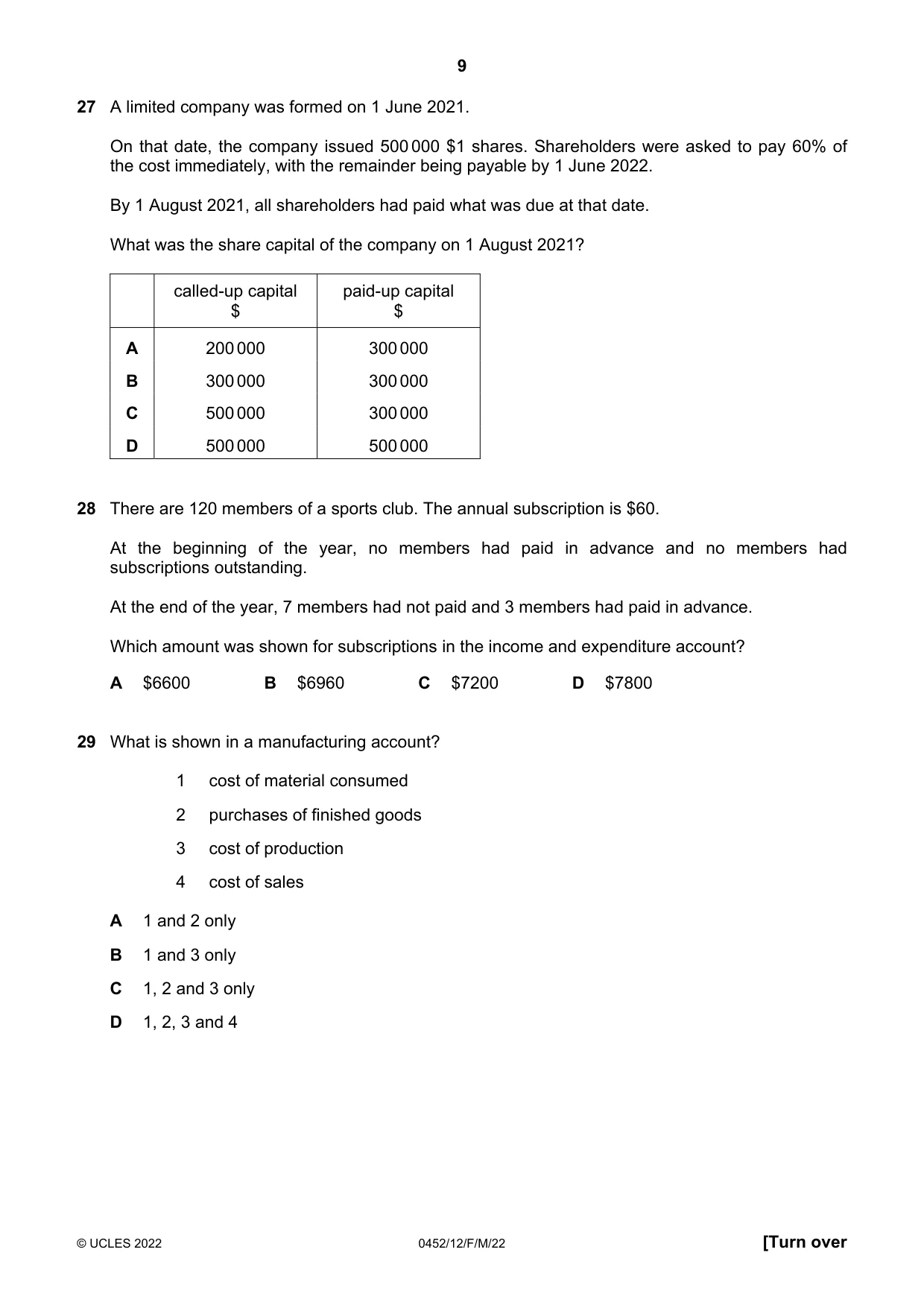
27 A limited company was formed on 1 June 2021. On that date, the company issued 500 000 $1 shares. Shareholders were asked to pay 60% of the cost immediately, with the remainder being payable by 1 June 2022. By 1 August 2021, all shareholders had paid what was due at that date. What was the share capital of the company on 1 August 2021? called-up capital paid-up capital $ $ A 200 000 300 000 B 300 000 300 000 C 500 000 300 000 D 500 000 500 000
Mark scheme: B
Q28 · There are 120 members of a sports club
28 There are 120 members of a sports club. The annual subscription is $60. At the beginning of the year, no members had paid in advance and no members had subscriptions outstanding. At the end of the year, 7 members had not paid and 3 members had paid in advance. Which amount was shown for subscriptions in the income and expenditure account? A $6600 B $6960 C $7200 D $7800
Mark scheme: C
Q29 · What is shown in a manufacturing account?
29 What is shown in a manufacturing account? 1 cost of material consumed 2 purchases of finished goods 3 cost of production 4 cost of sales A 1 and 2 only B 1 and 3 only C 1, 2 and 3 only D 1, 2, 3 and 4
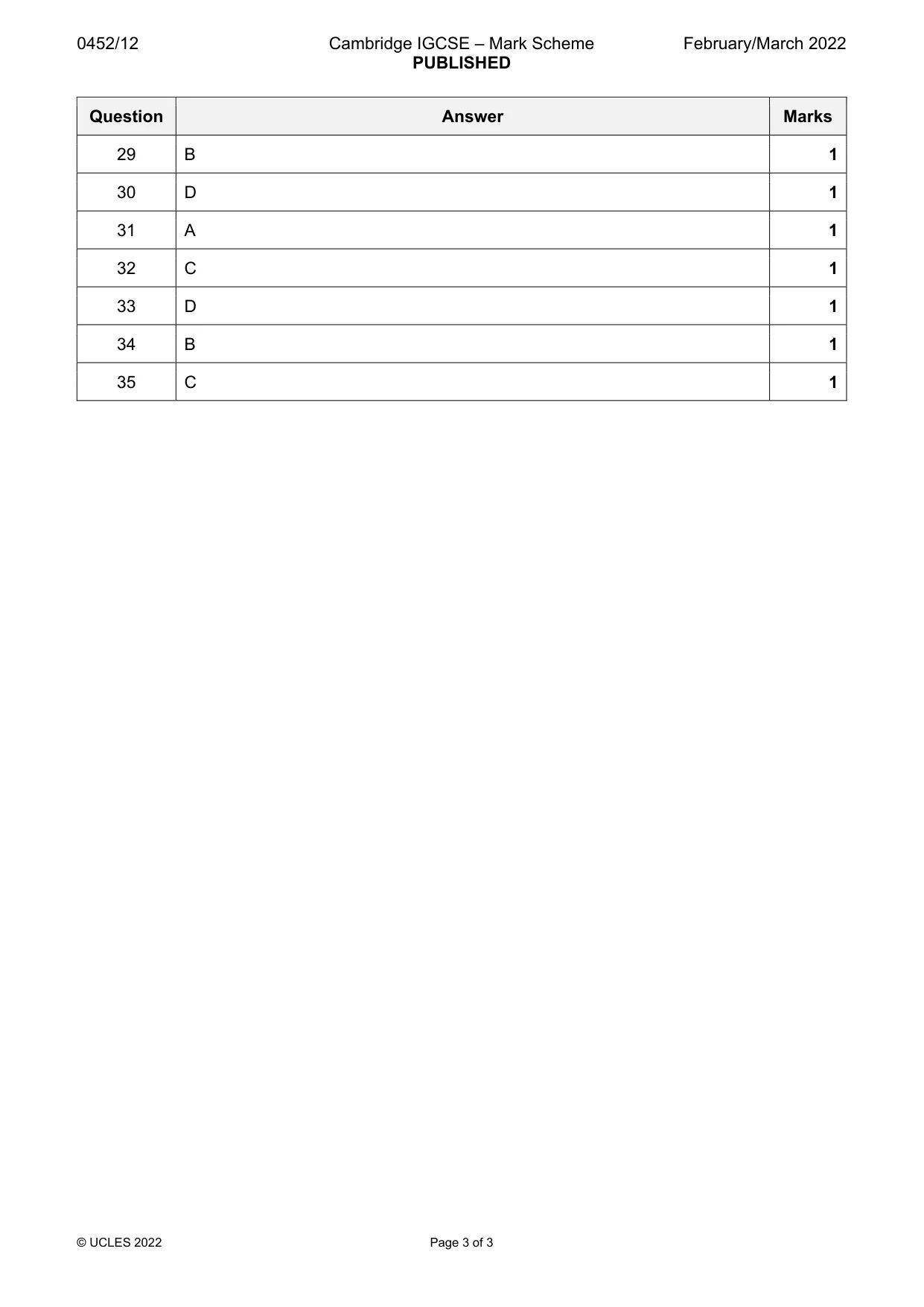
Mark scheme: B
Q30 · Tarek produced a statement of affairs at 31 December year 1 and at 31 December year 2
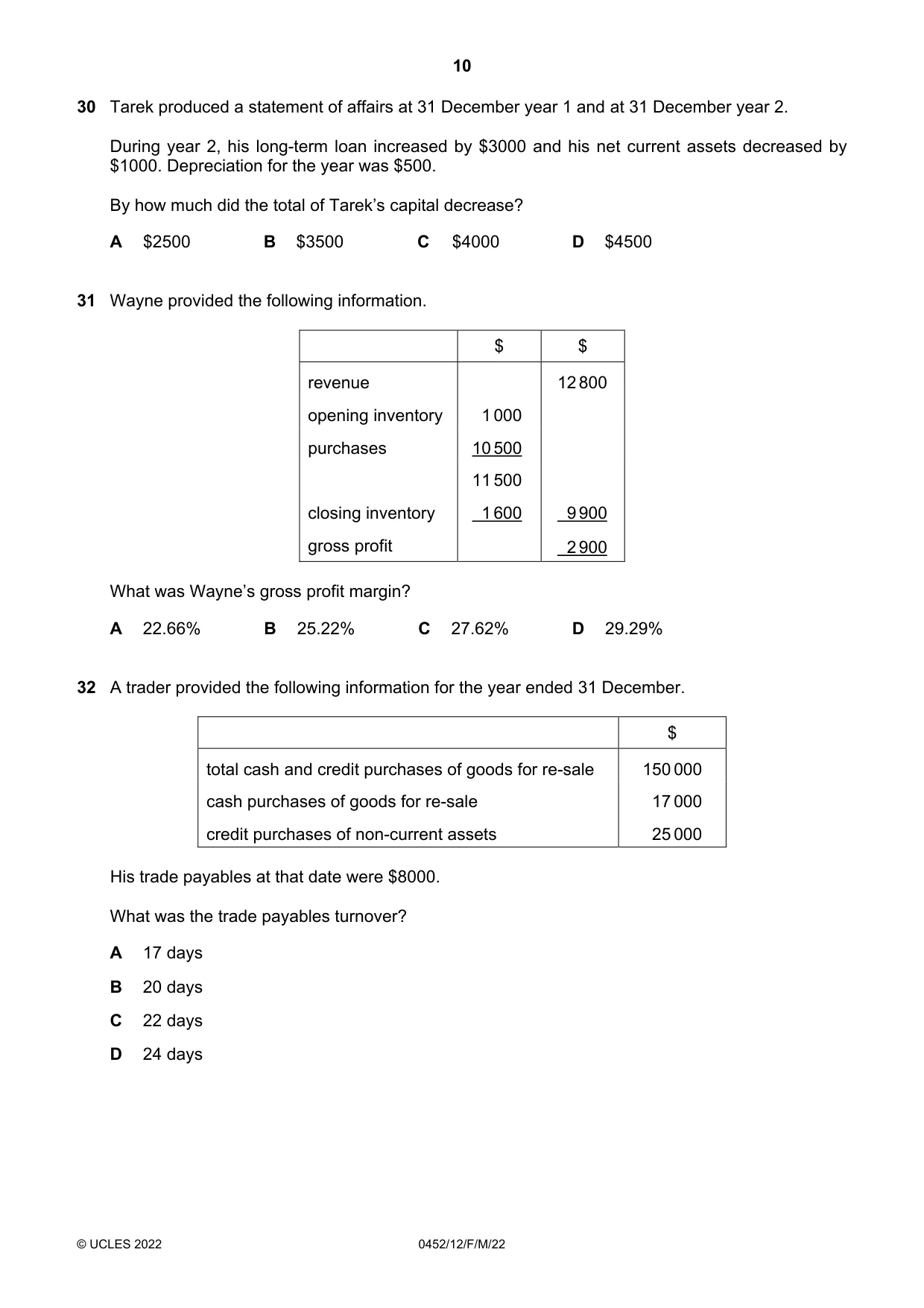
30 Tarek produced a statement of affairs at 31 December year 1 and at 31 December year 2. During year 2, his long-term loan increased by $3000 and his net current assets decreased by $1000. Depreciation for the year was $500. By how much did the total of Tarek’s capital decrease? A $2500 B $3500 C $4000 D $4500
Mark scheme: D
Q31 · Wayne provided the following information
31 Wayne provided the following information. $ $ revenue 12 800 opening inventory 1 000 purchases 10 500 11 500 closing inventory 1 600 9 900 gross profit 2 900 What was Wayne’s gross profit margin? A 22.66% B 25.22% C 27.62% D 29.29%
Mark scheme: A
More questions on Calculation and understanding of accounting ratios
Q32 · A trader provided the following information for the year ended 31 December
32 A trader provided the following information for the year ended 31 December. $ total cash and credit purchases of goods for re-sale 150 000 cash purchases of goods for re-sale 17 000 credit purchases of non-current assets 25 000 His trade payables at that date were $8000. What was the trade payables turnover? A 17 days B 20 days C 22 days D 24 days
Mark scheme: C
More questions on Calculation and understanding of accounting ratios
Q33 · A trader decided to reduce her level of inventory in order to reduce the storage costs
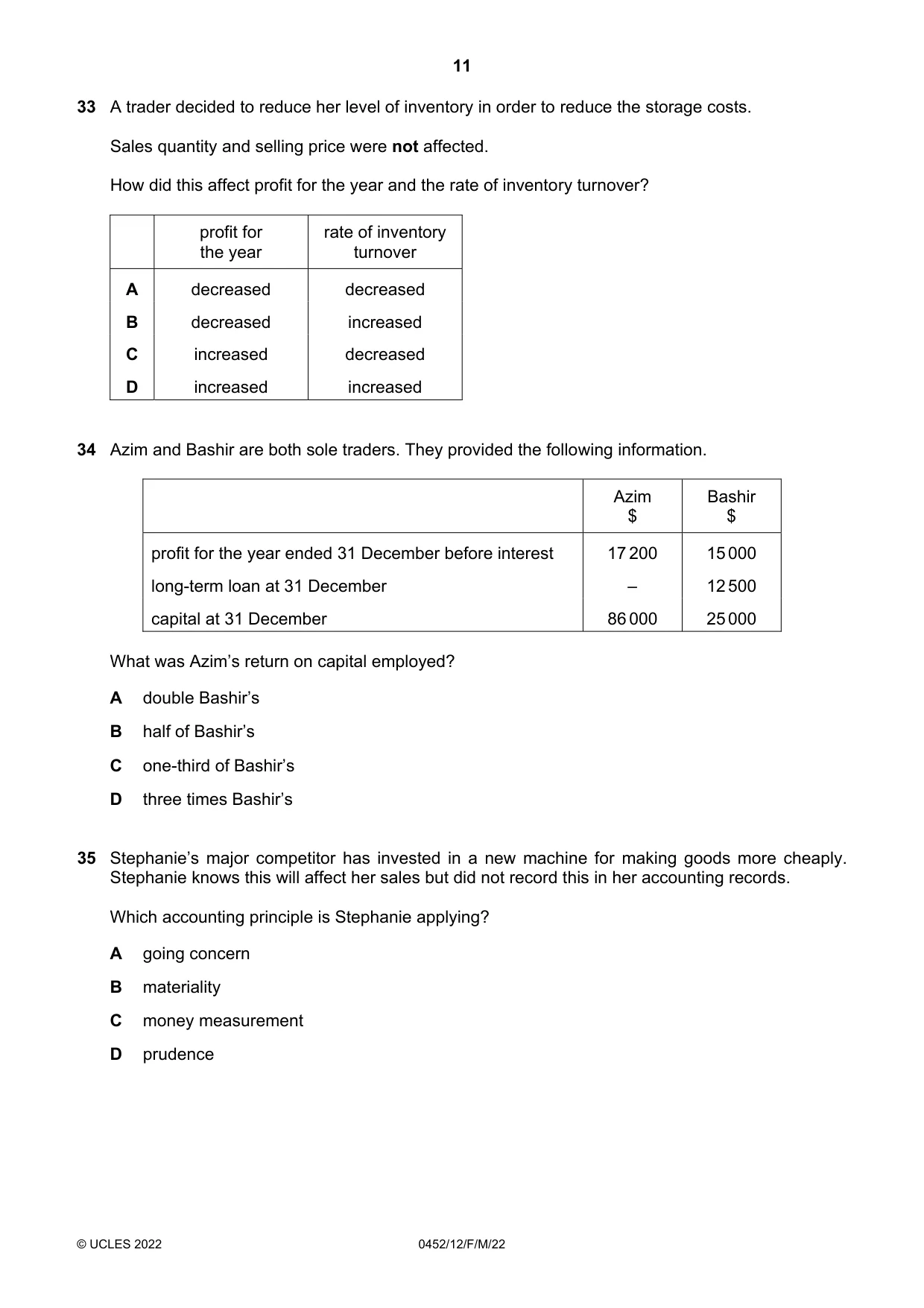
33 A trader decided to reduce her level of inventory in order to reduce the storage costs. Sales quantity and selling price were not affected. How did this affect profit for the year and the rate of inventory turnover? profit for rate of inventory the year turnover A decreased decreased B decreased increased C increased decreased D increased increased
Mark scheme: D
Q34 · Azim and Bashir are both sole traders
34 Azim and Bashir are both sole traders. They provided the following information. Azim Bashir $ $ profit for the year ended 31 December before interest 17 200 15 000 long-term loan at 31 December – 12 500 capital at 31 December 86 000 25 000 What was Azim’s return on capital employed? A double Bashir’s B half of Bashir’s C one-third of Bashir’s D three times Bashir’s
Mark scheme: B
More questions on Calculation and understanding of accounting ratios
Q35 · Stephanie’s major competitor has invested in a new machine for making goods more cheaply
35 Stephanie’s major competitor has invested in a new machine for making goods more cheaply. Stephanie knows this will affect her sales but did not record this in her accounting records. Which accounting principle is Stephanie applying? A going concern B materiality C money measurement D prudence
Mark scheme: C
What was in this paper
The subtopics covered by these 35 questions, and how many questions each got. Open one in a new tab to see every Cambridge question on it.
3Control accounts3The accounting equation3The double entry system of book-keeping3Accounting for depreciation and disposal of non-current assets2Capital and revenue expenditure and receipts2Corrections of errors2Irrecoverable debts and allowance for irrecoverable debts2Limited companies2Partnerships2Accounting concepts1Bank reconciliation1Books of prime entry1Business documents1Clubs and societies1Incomplete records1Interpretation of accounting ratios1Manufacturing accounts1Other payables and other receivables1Sole traders1The trial balance1What you needed in this session
Cambridge’s own grade thresholds for 2022 Feb/March, Paper 1 · Variant 2. A higher threshold means an easier paper — the bar moves with how the cohort did.