Cambridge IGCSE Accounting 0452 — 2025 Feb/March Paper 1 · Variant 2
0452/12/F/M/25 · 35 questions · 35 marks · ≈39 min
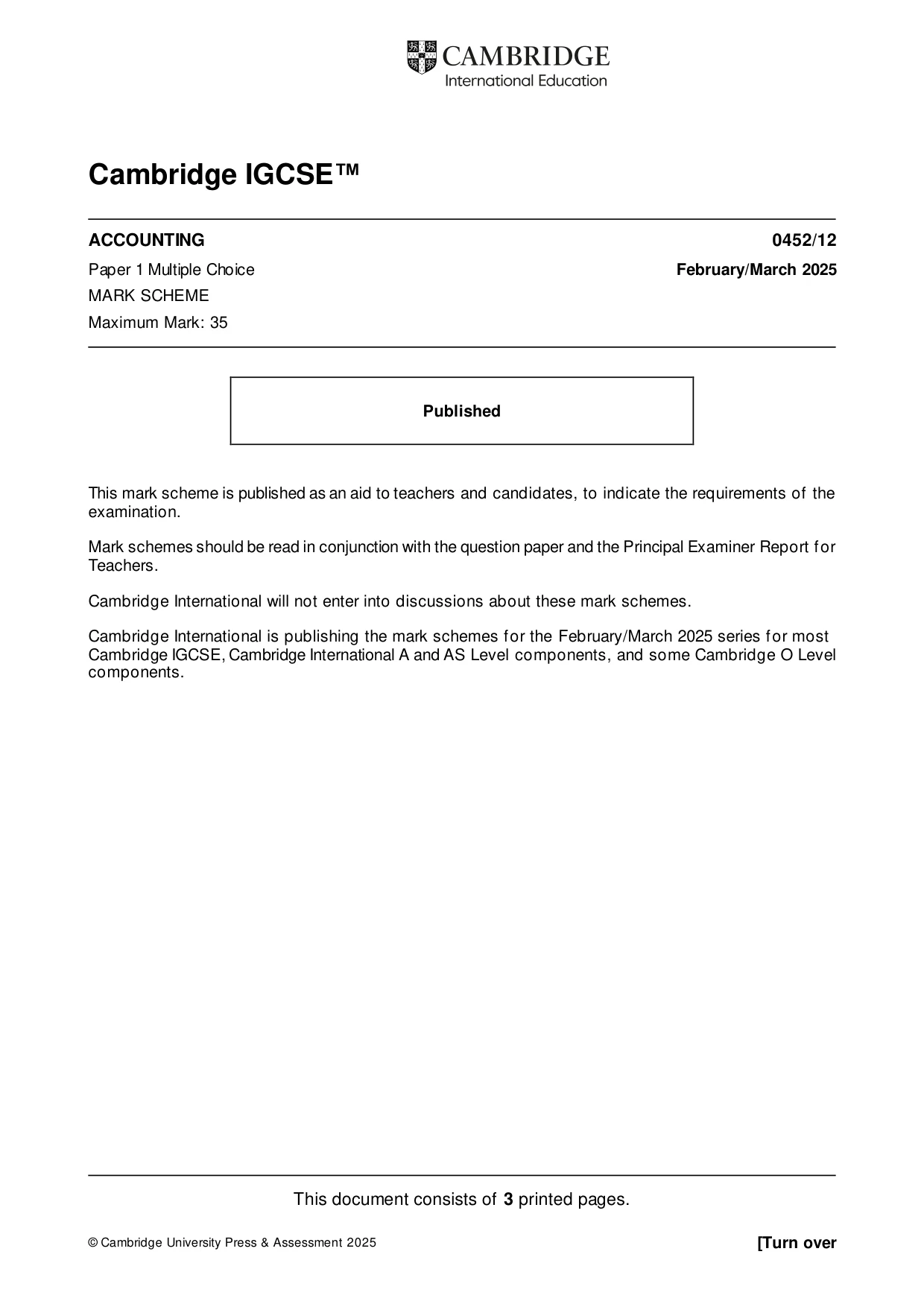
The question paper and its mark scheme, free to read here and free to download. This is Cambridge’s own paper, exactly as it was sat.
Question paper12 pages
Mark scheme3 pages
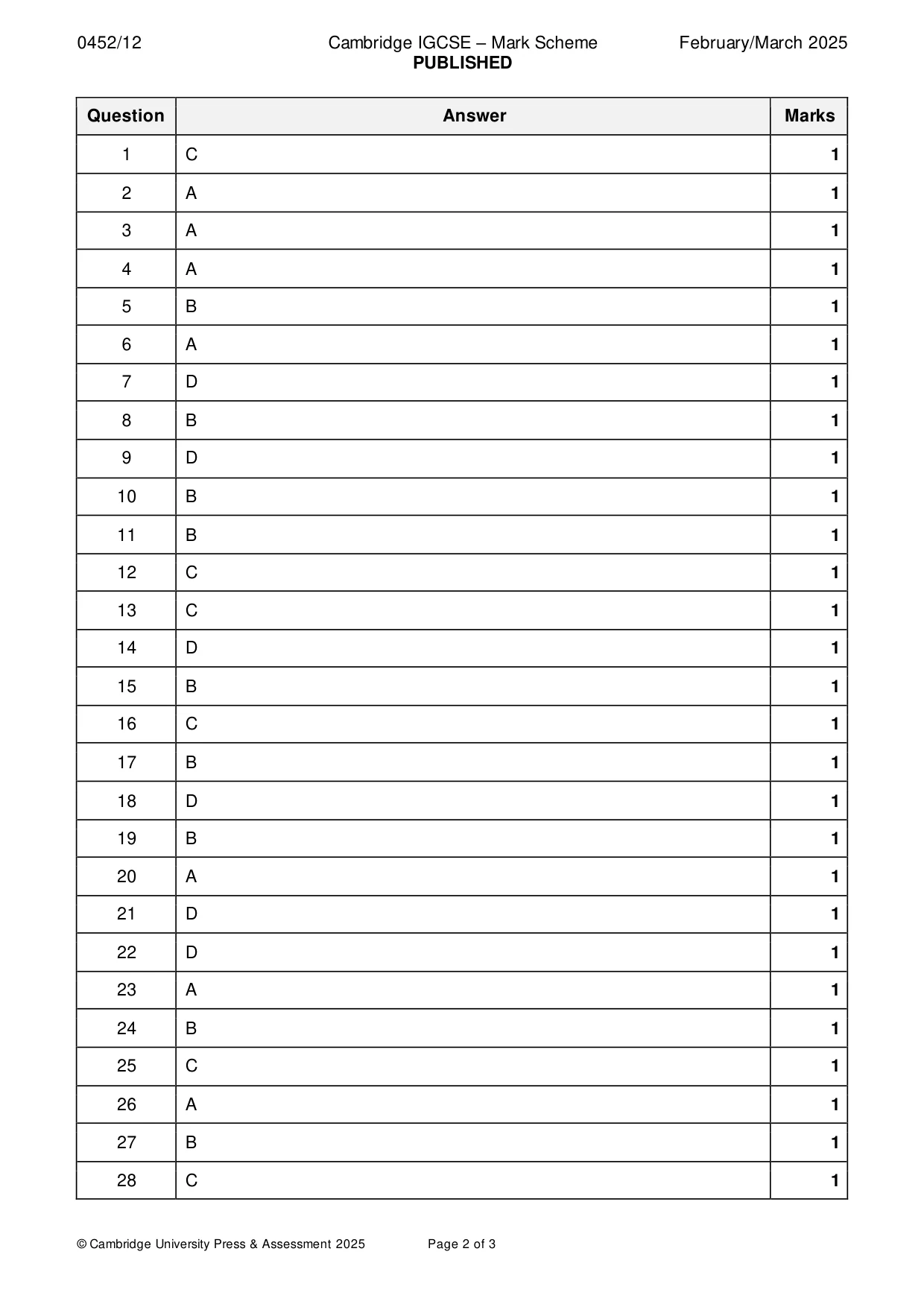
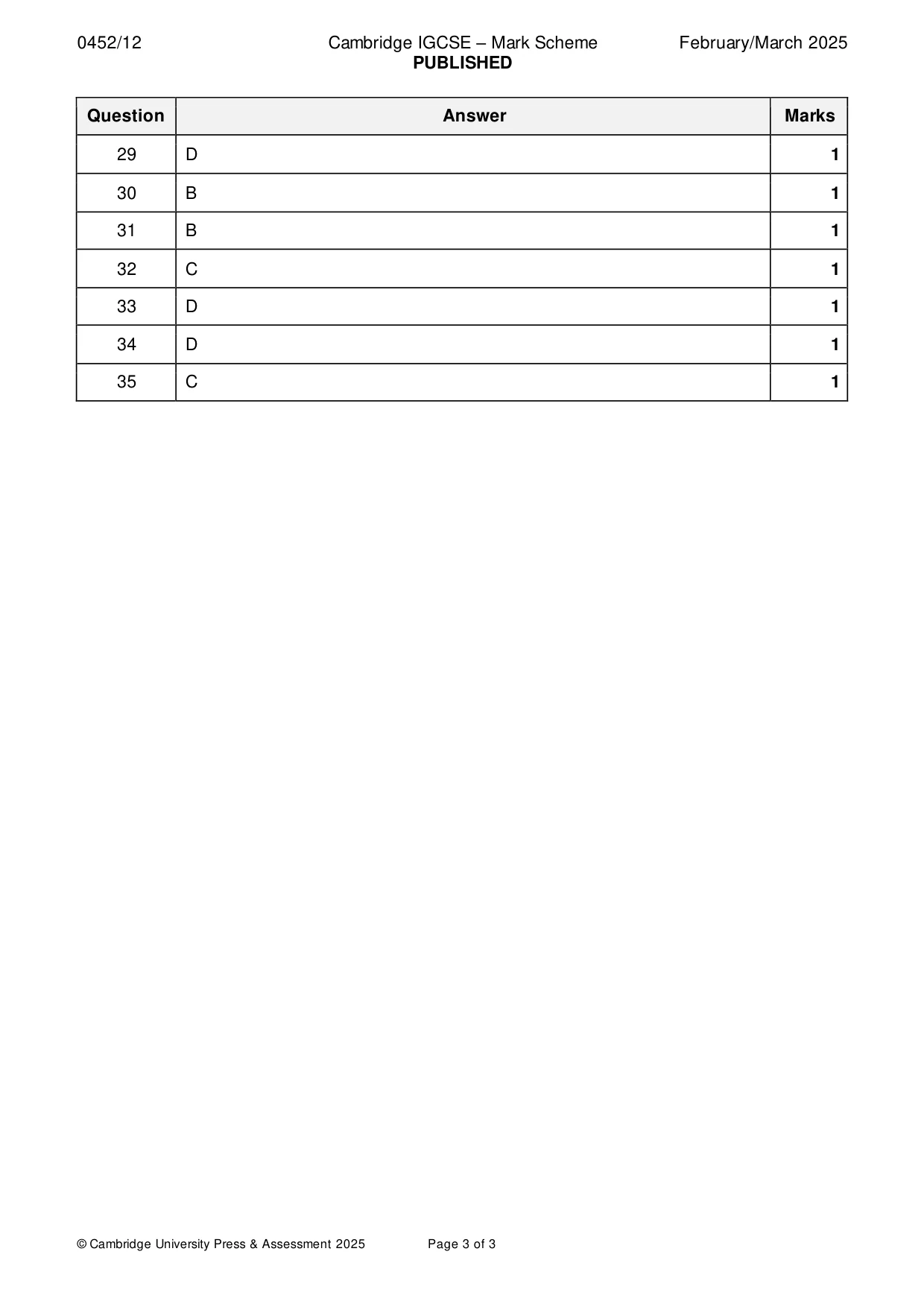
Answers below. Sit the paper first if you are practising.
Questions as text
Q1 · A business employs a book-keeper and an accountant
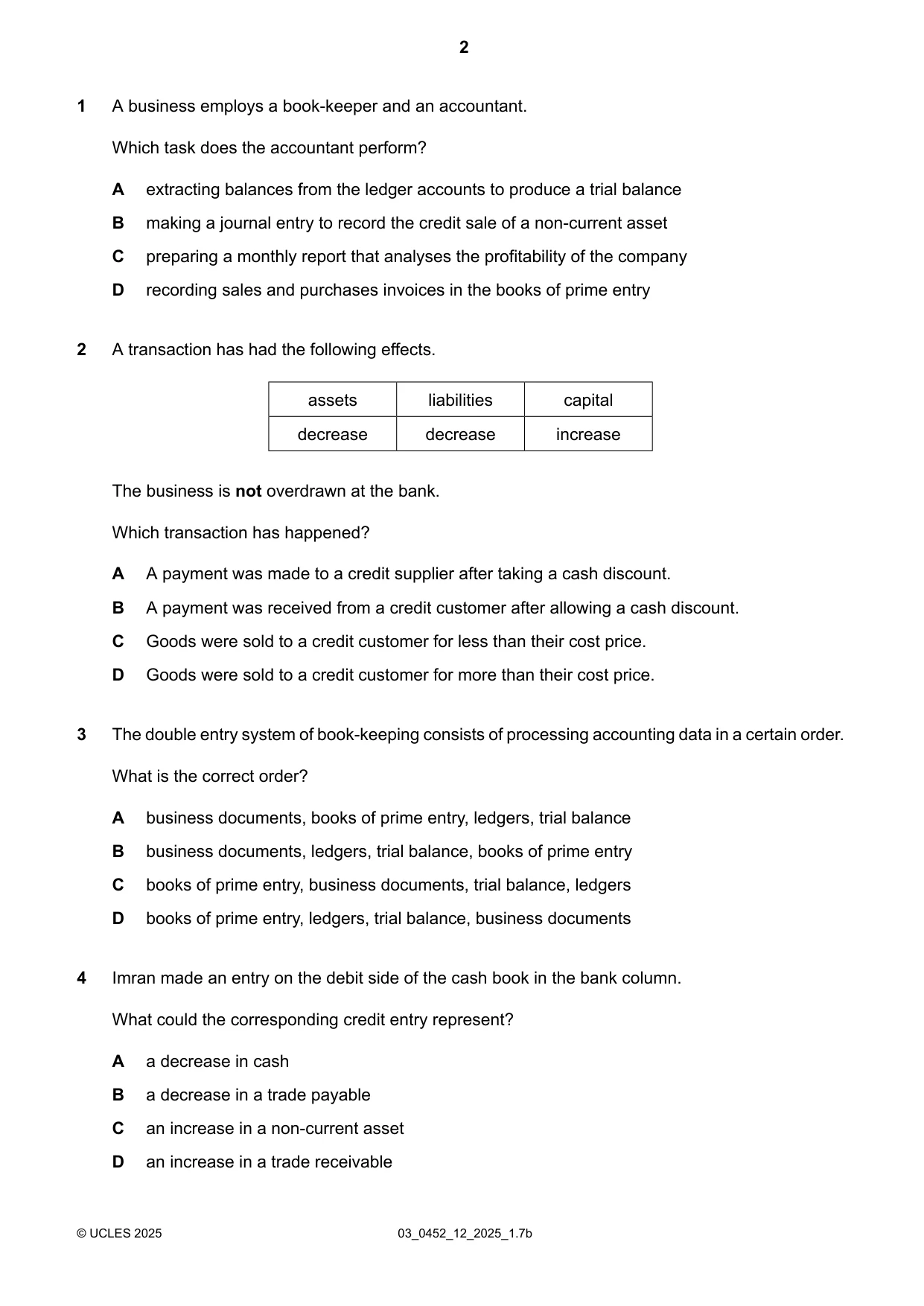
1 A business employs a book-keeper and an accountant. Which task does the accountant perform? A extracting balances from the ledger accounts to produce a trial balance B making a journal entry to record the credit sale of a non-current asset C preparing a monthly report that analyses the profitability of the company D recording sales and purchases invoices in the books of prime entry
Mark scheme: C
Q2 · A transaction has had the following effects
2 A transaction has had the following effects. assets liabilities capital decrease decrease increase The business is not overdrawn at the bank. Which transaction has happened? A A payment was made to a credit supplier after taking a cash discount. B A payment was received from a credit customer after allowing a cash discount. C Goods were sold to a credit customer for less than their cost price. D Goods were sold to a credit customer for more than their cost price.
Mark scheme: A
Q3 · The double entry system of book-keeping consists of processing accounting data in a…
3 The double entry system of book-keeping consists of processing accounting data in a certain order. What is the correct order? A business documents, books of prime entry, ledgers, trial balance B business documents, ledgers, trial balance, books of prime entry C books of prime entry, business documents, trial balance, ledgers D books of prime entry, ledgers, trial balance, business documents
Mark scheme: A
Q4 · Imran made an entry on the debit side of the cash book in the bank column
4 Imran made an entry on the debit side of the cash book in the bank column. What could the corresponding credit entry represent? A a decrease in cash B a decrease in a trade payable C an increase in a non-current asset D an increase in a trade receivable
Mark scheme: A
Q5 · Dave supplies goods to Peter on credit
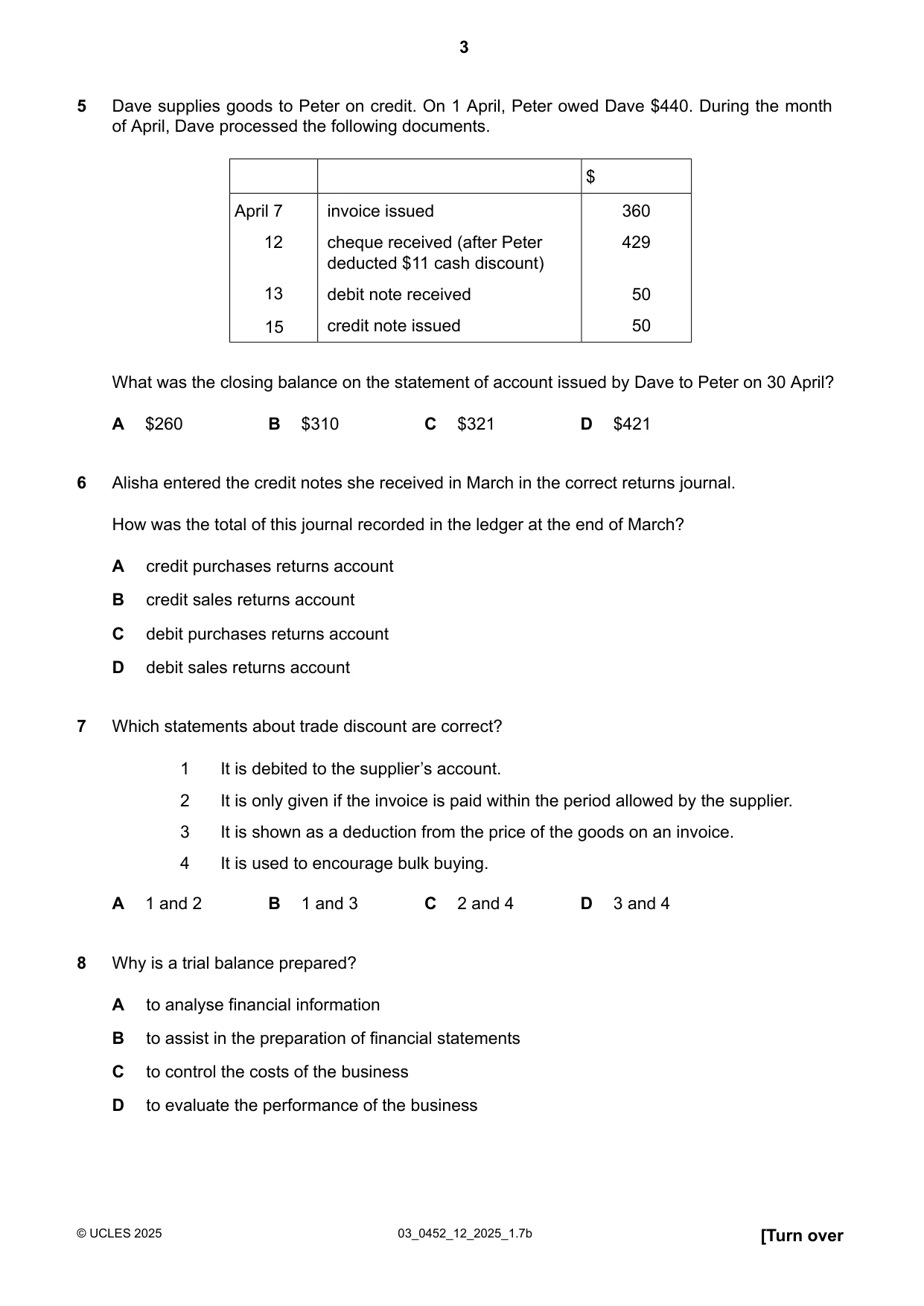
5 Dave supplies goods to Peter on credit. On 1 April, Peter owed Dave $440. During the month of April, Dave processed the following documents. $ April 7 invoice issued 360 12 cheque received (after Peter 429 deducted $11 cash discount) 13 debit note received 50 15 credit note issued 50 What was the closing balance on the statement of account issued by Dave to Peter on 30 April? A $260 B $310 C $321 D $421
Mark scheme: B
Q6 · Alisha entered the credit notes she received in March in the correct returns journal
6 Alisha entered the credit notes she received in March in the correct returns journal. How was the total of this journal recorded in the ledger at the end of March? A credit purchases returns account B credit sales returns account C debit purchases returns account D debit sales returns account
Mark scheme: A
Q7 · Which statements about trade discount are correct?
7 Which statements about trade discount are correct? 1 It is debited to the supplier’s account. 2 It is only given if the invoice is paid within the period allowed by the supplier. 3 It is shown as a deduction from the price of the goods on an invoice. 4 It is used to encourage bulk buying. A 1 and 2 B 1 and 3 C 2 and 4 D 3 and 4
Mark scheme: D
Q8 · Why is a trial balance prepared?
8 Why is a trial balance prepared? A to analyse financial information B to assist in the preparation of financial statements C to control the costs of the business D to evaluate the performance of the business
Mark scheme: B
Q9 · Which group of account balances would appear in the credit column of a trial balance?
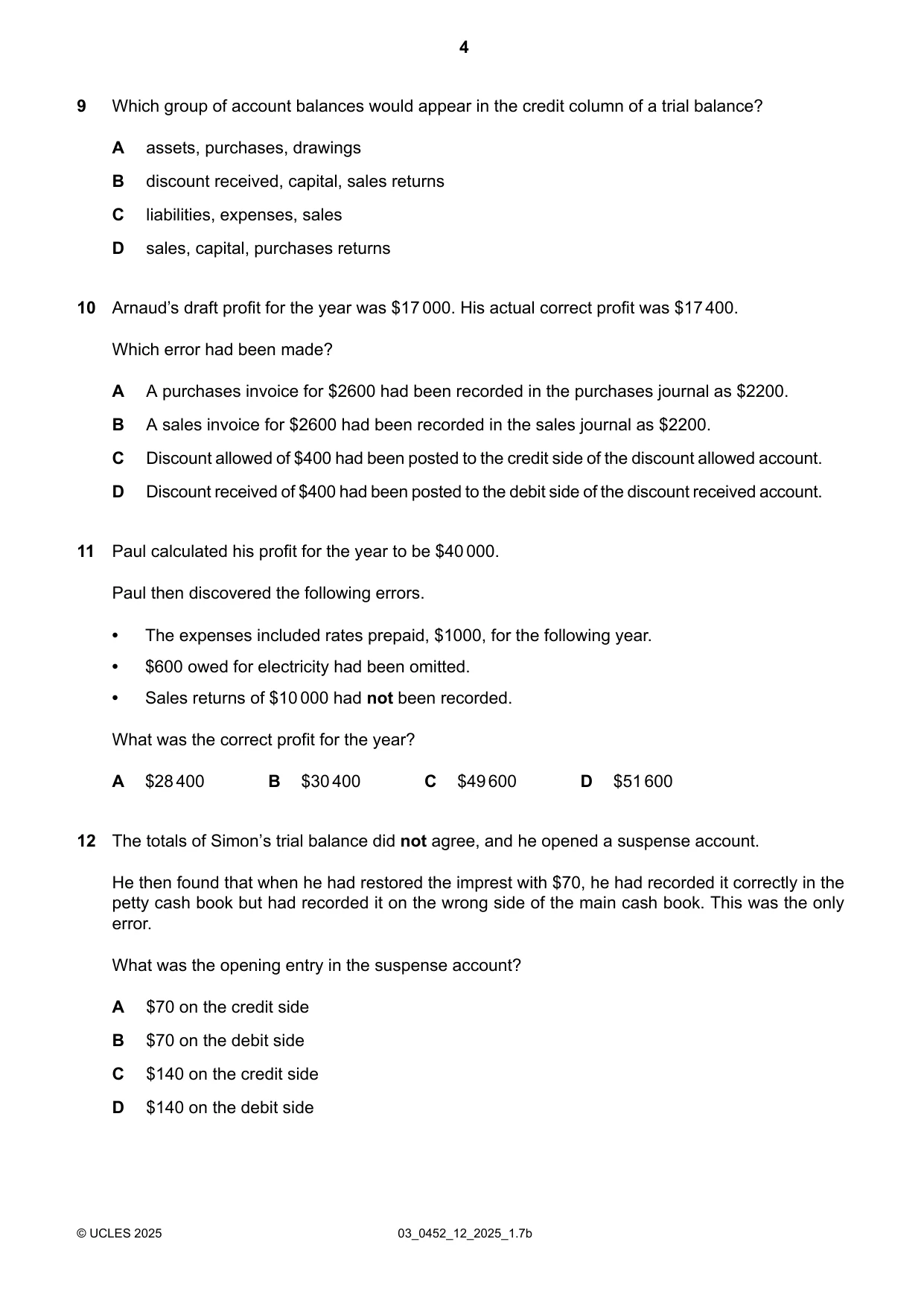
9 Which group of account balances would appear in the credit column of a trial balance? A assets, purchases, drawings B discount received, capital, sales returns C liabilities, expenses, sales D sales, capital, purchases returns
Mark scheme: D
Q10 · Arnaud’s draft profit for the year was $17000
10 Arnaud’s draft profit for the year was $17000. His actual correct profit was $17400. Which error had been made? A A purchases invoice for $2600 had been recorded in the purchases journal as $2200. B A sales invoice for $2600 had been recorded in the sales journal as $2200. C Discount allowed of $400 had been posted to the credit side of the discount allowed account. D Discount received of $400 had been posted to the debit side of the discount received account.
Mark scheme: B
Q11 · Paul calculated his profit for the year to be $40000
11 Paul calculated his profit for the year to be $40000. Paul then discovered the following errors. • The expenses included rates prepaid, $1000, for the following year. • $600 owed for electricity had been omitted. • Sales returns of $10000 had not been recorded. What was the correct profit for the year? A $28400 B $30400 C $49600 D $51600
Mark scheme: B
Q12 · The totals of Simon’s trial balance did not agree, and he opened a suspense account
12 The totals of Simon’s trial balance did not agree, and he opened a suspense account. He then found that when he had restored the imprest with $70, he had recorded it correctly in the petty cash book but had recorded it on the wrong side of the main cash book. This was the only error. What was the opening entry in the suspense account? A $70 on the credit side B $70 on the debit side C $140 on the credit side D $140 on the debit side
Mark scheme: C
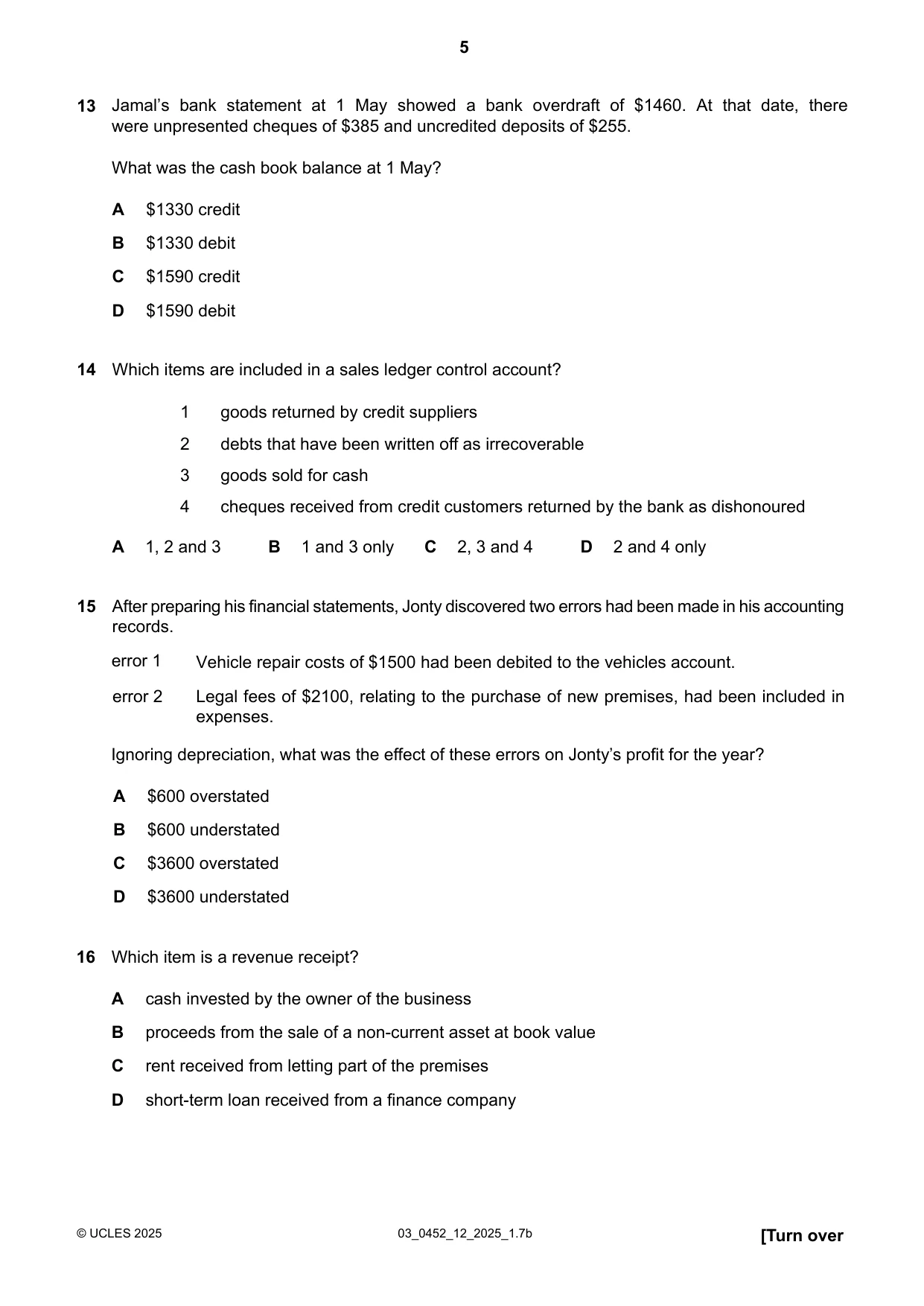
Q13 · Jamal’s bank statement at 1 May showed a bank overdraft of $1460
13 Jamal’s bank statement at 1 May showed a bank overdraft of $1460. At that date, there were unpresented cheques of $385 and uncredited deposits of $255. What was the cash book balance at 1 May? A $1330 credit B $1330 debit C $1590 credit D $1590 debit
Mark scheme: C
Q14 · Which items are included in a sales ledger control account?
14 Which items are included in a sales ledger control account? 1 goods returned by credit suppliers 2 debts that have been written off as irrecoverable 3 goods sold for cash 4 cheques received from credit customers returned by the bank as dishonoured A 1, 2 and 3 B 1 and 3 only C 2, 3 and 4 D 2 and 4 only
Mark scheme: D
Q15 · After preparing his financial statements, Jonty discovered two errors had been made in…
15 After preparing his financial statements, Jonty discovered two errors had been made in his accounting records. error 1 Vehicle repair costs of $1500 had been debited to the vehicles account. error 2 Legal fees of $2100, relating to the purchase of new premises, had been included in expenses. Ignoring depreciation, what was the effect of these errors on Jonty’s profit for the year? A $600 overstated B $600 understated C $3600 overstated D $3600 understated
Mark scheme: B
Q16 · Which item is a revenue receipt?
16 Which item is a revenue receipt? A cash invested by the owner of the business B proceeds from the sale of a non-current asset at book value C rent received from letting part of the premises D short-term loan received from a finance company
Mark scheme: C
More questions on Capital and revenue expenditure and receipts
Q17 · Samuel started his business on 1 January 2023 and bought two delivery vans for $12000 each
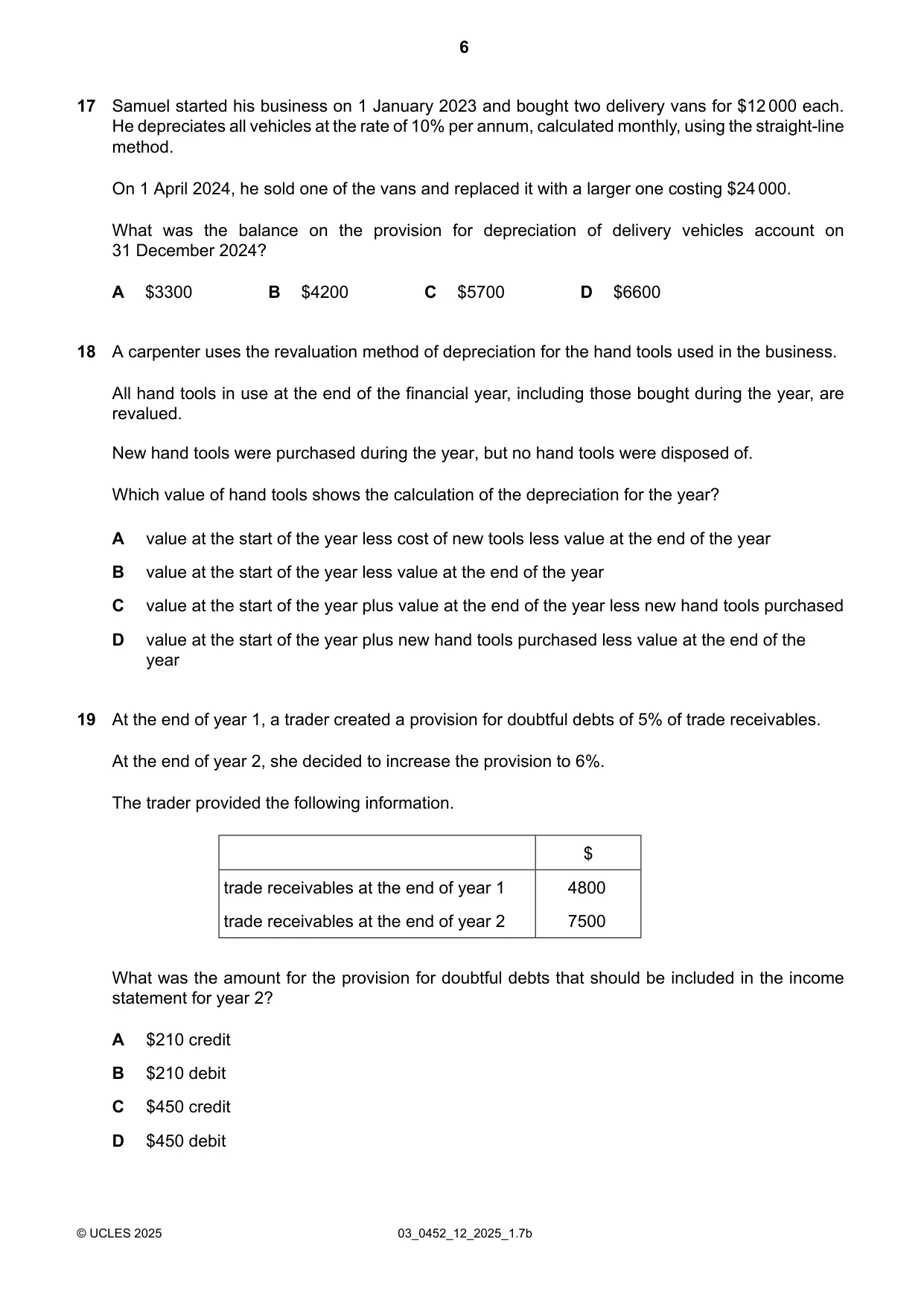
17 Samuel started his business on 1 January 2023 and bought two delivery vans for $12000 each. He depreciates all vehicles at the rate of 10% per annum, calculated monthly, using the straight-line method. On 1 April 2024, he sold one of the vans and replaced it with a larger one costing $24000. What was the balance on the provision for depreciation of delivery vehicles account on 31 December 2024? A $3300 B $4200 C $5700 D $6600
Mark scheme: B
More questions on Accounting for depreciation and disposal of non-current assets
Q18 · A carpenter uses the revaluation method of depreciation for the hand tools used in the…
18 A carpenter uses the revaluation method of depreciation for the hand tools used in the business. All hand tools in use at the end of the financial year, including those bought during the year, are revalued. New hand tools were purchased during the year, but no hand tools were disposed of. Which value of hand tools shows the calculation of the depreciation for the year? A value at the start of the year less cost of new tools less value at the end of the year B value at the start of the year less value at the end of the year C value at the start of the year plus value at the end of the year less new hand tools purchased D value at the start of the year plus new hand tools purchased less value at the end of the year
Mark scheme: D
More questions on Accounting for depreciation and disposal of non-current assets
Q19 · At the end of year 1, a trader created a provision for doubtful debts of 5% of trade…
19 At the end of year 1, a trader created a provision for doubtful debts of 5% of trade receivables. At the end of year 2, she decided to increase the provision to 6%. The trader provided the following information. $ trade receivables at the end of year 1 4800 trade receivables at the end of year 2 7500 What was the amount for the provision for doubtful debts that should be included in the income statement for year 2? A $210 credit B $210 debit C $450 credit D $450 debit
Mark scheme: B
More questions on Irrecoverable debts and allowance for irrecoverable debts
Q20 · The end-of-year inventories held by a sports shop are shown in the table
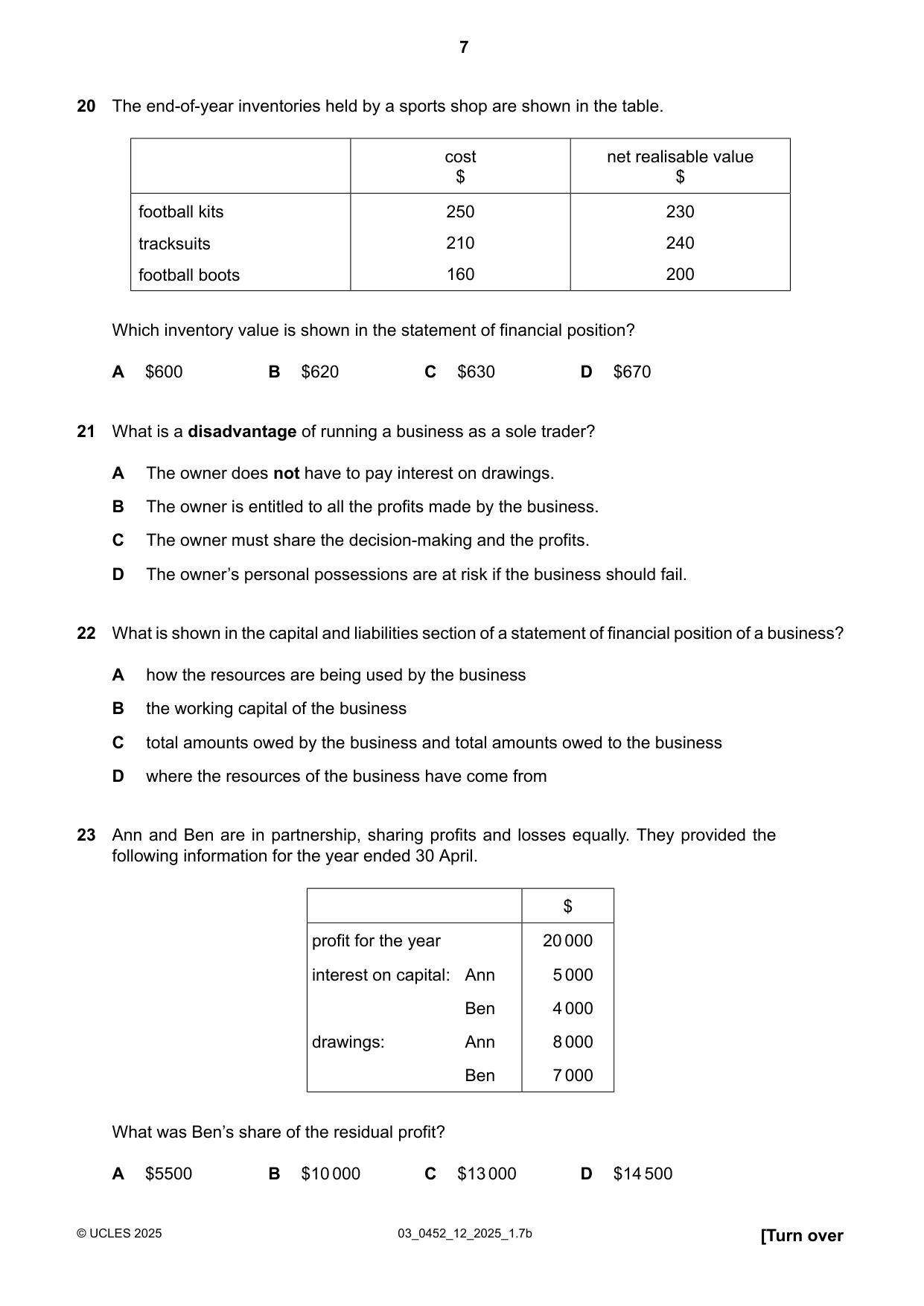
20 The end-of-year inventories held by a sports shop are shown in the table. cost net realisable value $ $ football kits 250 230 tracksuits 210 240 football boots 160 200 Which inventory value is shown in the statement of financial position? A $600 B $620 C $630 D $670
Mark scheme: A
Q21 · What is a disadvantage of running a business as a sole trader?
21 What is a disadvantage of running a business as a sole trader? A The owner does not have to pay interest on drawings. B The owner is entitled to all the profits made by the business. C The owner must share the decision-making and the profits. D The owner’s personal possessions are at risk if the business should fail.
Mark scheme: D
Q22 · What is shown in the capital and liabilities section of a statement of financial position…
22 What is shown in the capital and liabilities section of a statement of financial position of a business? A how the resources are being used by the business B the working capital of the business C total amounts owed by the business and total amounts owed to the business D where the resources of the business have come from
Mark scheme: D
Q23 · Ann and Ben are in partnership, sharing profits and losses equally
23 Ann and Ben are in partnership, sharing profits and losses equally. They provided the following information for the year ended 30 April. $ profit for the year 20000 interest on capital: Ann 5000 Ben 4000 drawings: Ann 8000 Ben 7000 What was Ben’s share of the residual profit? A $5500 B $10000 C $13000 D $14500
Mark scheme: A
Q24 · Frankie is a partner
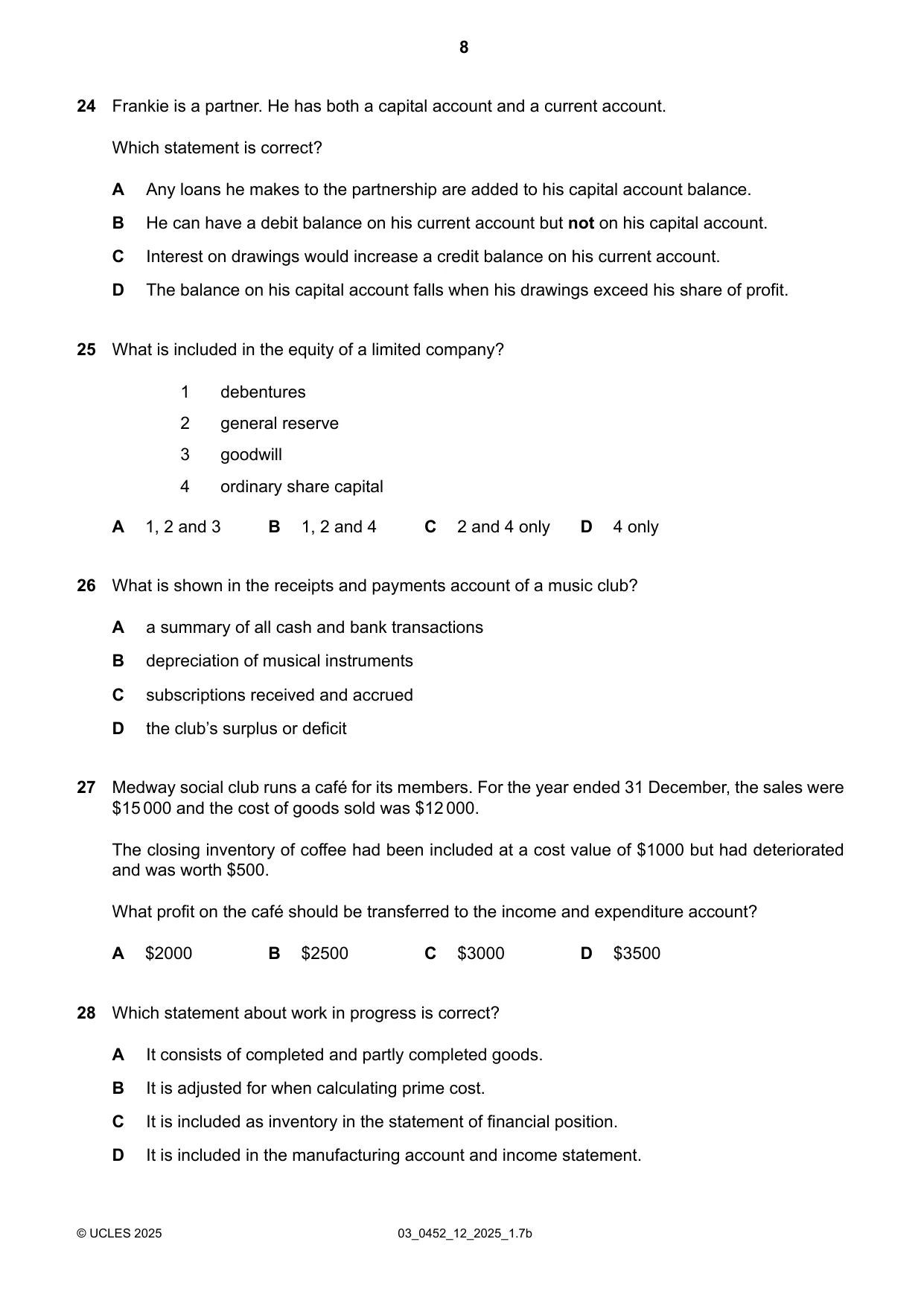
24 Frankie is a partner. He has both a capital account and a current account. Which statement is correct? A Any loans he makes to the partnership are added to his capital account balance. B He can have a debit balance on his current account but not on his capital account. C Interest on drawings would increase a credit balance on his current account. D The balance on his capital account falls when his drawings exceed his share of profit.
Mark scheme: B
Q25 · What is included in the equity of a limited company?
25 What is included in the equity of a limited company? 1 debentures 2 general reserve 3 goodwill 4 ordinary share capital A 1, 2 and 3 B 1, 2 and 4 C 2 and 4 only D 4 only
Mark scheme: C
Q26 · What is shown in the receipts and payments account of a music club?
26 What is shown in the receipts and payments account of a music club? A a summary of all cash and bank transactions B depreciation of musical instruments C subscriptions received and accrued D the club’s surplus or deficit
Mark scheme: A
Q27 · Medway social club runs a café for its members
27 Medway social club runs a café for its members. For the year ended 31 December, the sales were $15000 and the cost of goods sold was $12000. The closing inventory of coffee had been included at a cost value of $1000 but had deteriorated and was worth $500. What profit on the café should be transferred to the income and expenditure account? A $2000 B $2500 C $3000 D $3500
Mark scheme: B
Q28 · Which statement about work in progress is correct?
28 Which statement about work in progress is correct? A It consists of completed and partly completed goods. B It is adjusted for when calculating prime cost. C It is included as inventory in the statement of financial position. D It is included in the manufacturing account and income statement.
Mark scheme: C
Q29 · A manufacturer calculated the cost of production for the year at $57 000
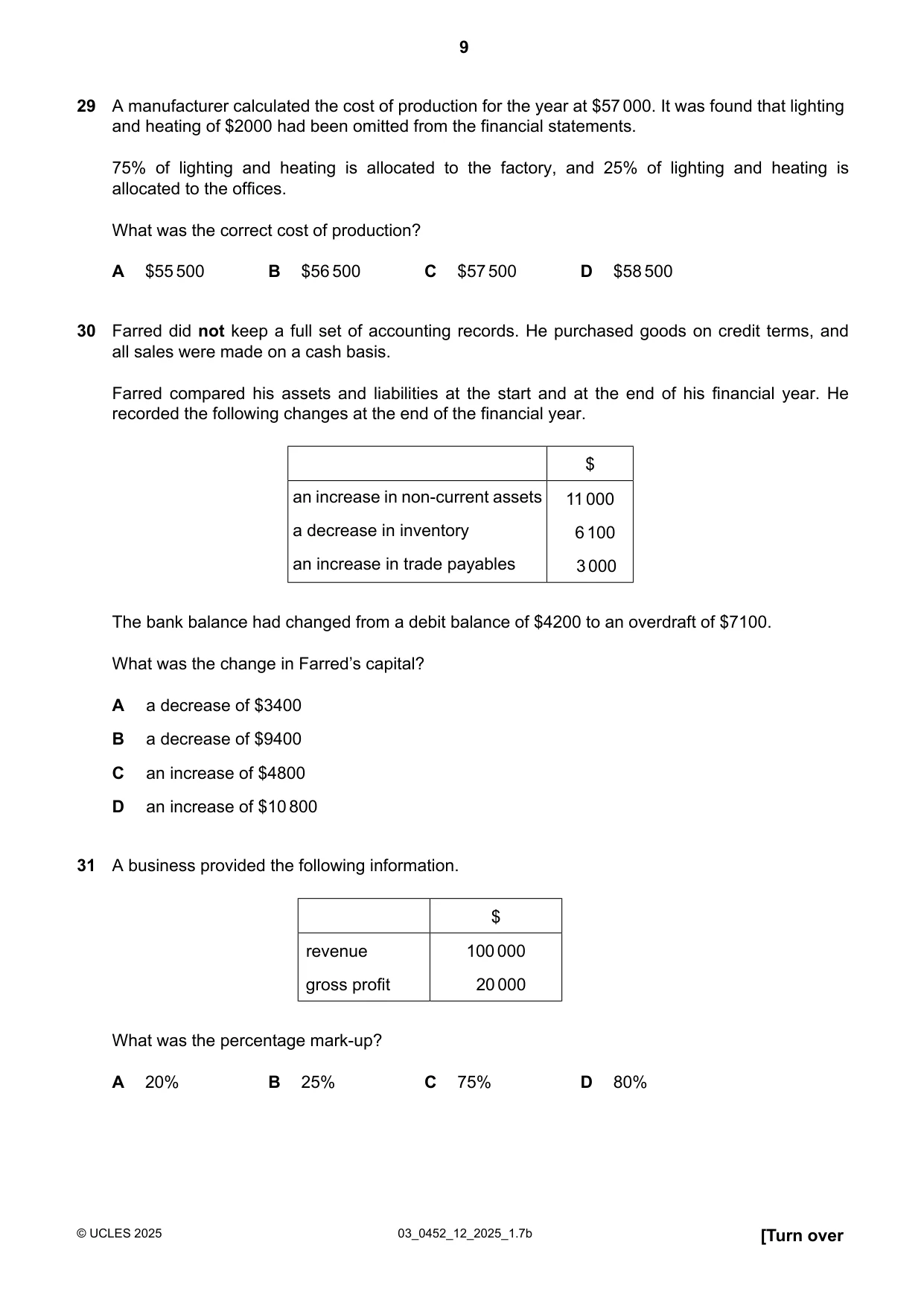
29 A manufacturer calculated the cost of production for the year at $57 000. It was found that lighting and heating of $2000 had been omitted from the financial statements. 75% of lighting and heating is allocated to the factory, and 25% of lighting and heating is allocated to the offices. What was the correct cost of production? A $55500 B $56500 C $57500 D $58500
Mark scheme: D
Q30 · Farred did not keep a full set of accounting records
30 Farred did not keep a full set of accounting records. He purchased goods on credit terms, and all sales were made on a cash basis. Farred compared his assets and liabilities at the start and at the end of his financial year. He recorded the following changes at the end of the financial year. $ an increase in non-current assets 11000 a decrease in inventory 6100 an increase in trade payables 3000 The bank balance had changed from a debit balance of $4200 to an overdraft of $7100. What was the change in Farred’s capital? A a decrease of $3400 B a decrease of $9400 C an increase of $4800 D an increase of $10800
Mark scheme: B
Q31 · A business provided the following information
31 A business provided the following information. $ revenue 100000 gross profit 20000 What was the percentage mark-up? A 20% B 25% C 75% D 80%
Mark scheme: B
More questions on Calculation and understanding of accounting ratios
Q32 · Why might a trader wish to increase his trade payables turnover days?
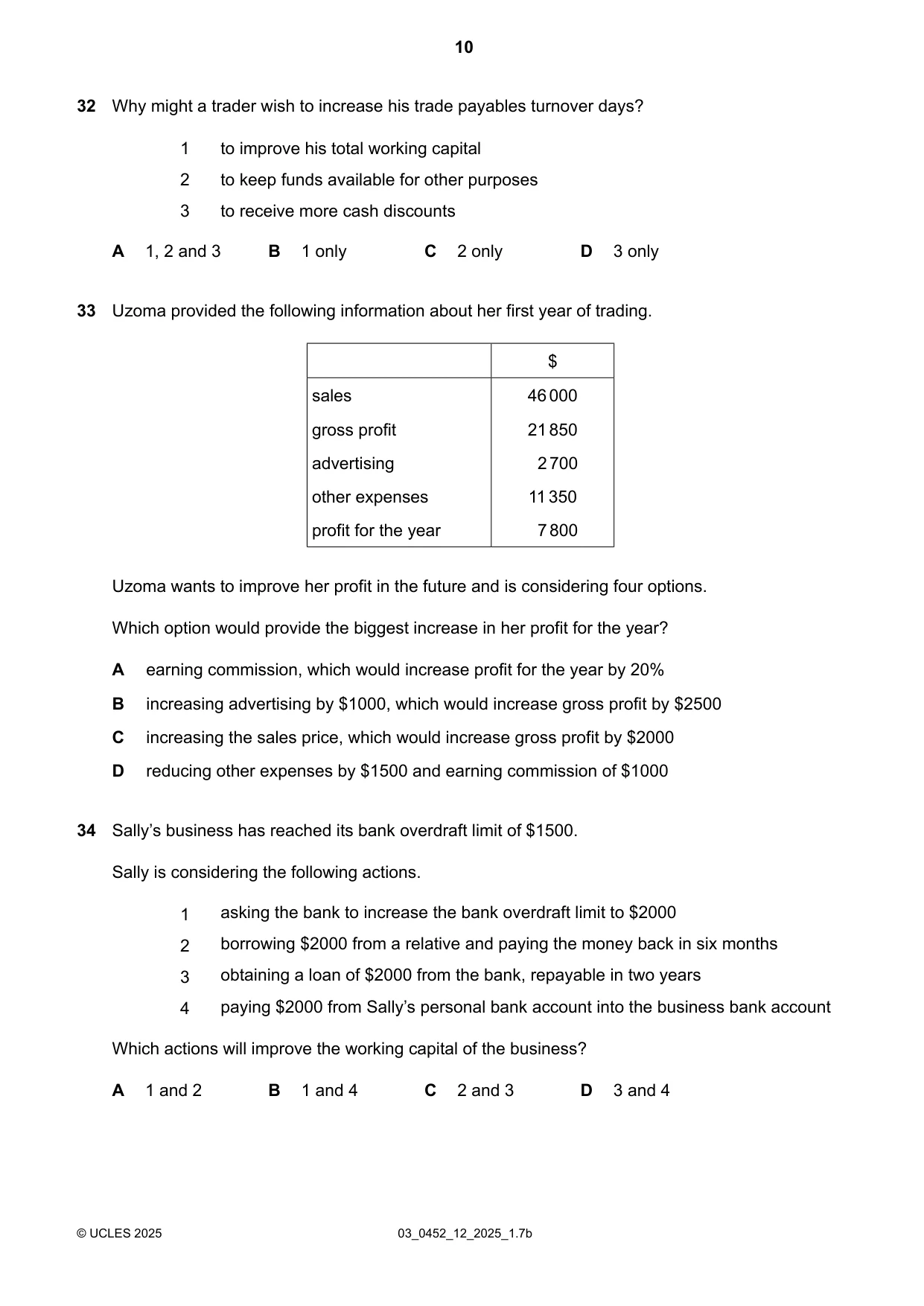
32 Why might a trader wish to increase his trade payables turnover days? 1 to improve his total working capital 2 to keep funds available for other purposes 3 to receive more cash discounts A 1, 2 and 3 B 1 only C 2 only D 3 only
Mark scheme: C
Q33 · Uzoma provided the following information about her first year of trading
33 Uzoma provided the following information about her first year of trading. $ sales 46000 gross profit 21850 advertising 2700 other expenses 11350 profit for the year 7800 Uzoma wants to improve her profit in the future and is considering four options. Which option would provide the biggest increase in her profit for the year? A earning commission, which would increase profit for the year by 20% B increasing advertising by $1000, which would increase gross profit by $2500 C increasing the sales price, which would increase gross profit by $2000 D reducing other expenses by $1500 and earning commission of $1000
Mark scheme: D
More questions on Calculation and understanding of accounting ratios
Q34 · Sally’s business has reached its bank overdraft limit of $1500
34 Sally’s business has reached its bank overdraft limit of $1500. Sally is considering the following actions. 1 asking the bank to increase the bank overdraft limit to $2000 2 borrowing $2000 from a relative and paying the money back in six months 3 obtaining a loan of $2000 from the bank, repayable in two years 4 paying $2000 from Sally’s personal bank account into the business bank account Which actions will improve the working capital of the business? A 1 and 2 B 1 and 4 C 2 and 3 D 3 and 4
Mark scheme: D
More questions on Calculation and understanding of accounting ratios
Q35 · When does a business recognise the income from a sale of goods on credit?
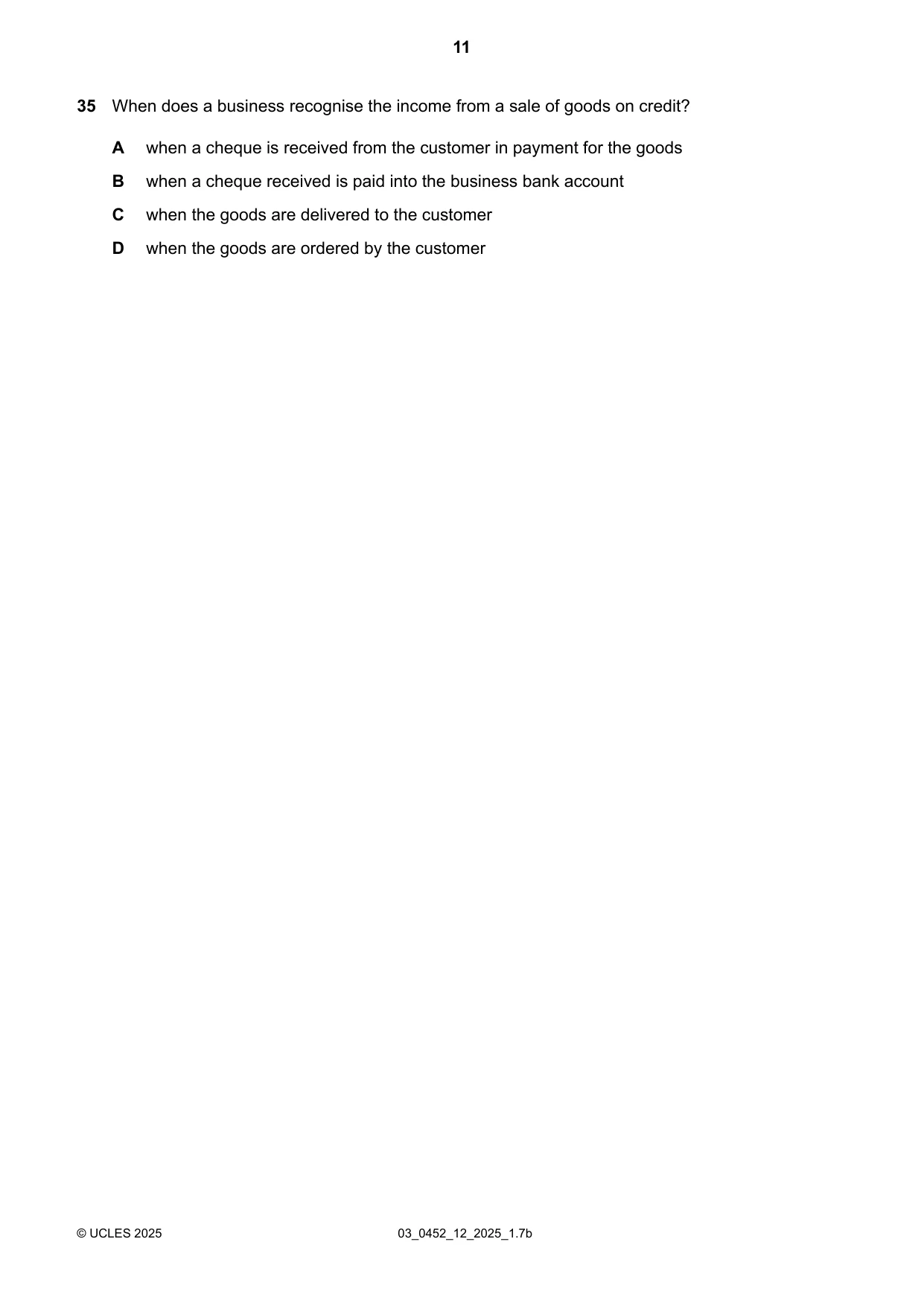
35 When does a business recognise the income from a sale of goods on credit? A when a cheque is received from the customer in payment for the goods B when a cheque received is paid into the business bank account C when the goods are delivered to the customer D when the goods are ordered by the customer
Mark scheme: C
What was in this paper
The subtopics covered by these 35 questions, and how many questions each got. Open one in a new tab to see every Cambridge question on it.
4Calculation and understanding of accounting ratios3Accounting for depreciation and disposal of non-current assets2Clubs and societies2Control accounts2Manufacturing accounts2Partnerships2The accounting equation2The double entry system of book-keeping2The trial balance2Accounting concepts1Bank reconciliation1Books of prime entry1Business documents1Capital and revenue expenditure and receipts1Incomplete records1Interpretation of accounting ratios1Irrecoverable debts and allowance for irrecoverable debts1Limited companies1Sole traders1The purpose of accounting1Valuation of inventory1What you needed in this session
Cambridge’s own grade thresholds for 2025 Feb/March, Paper 1 · Variant 2. A higher threshold means an easier paper — the bar moves with how the cohort did.